EP4284712B1 - Wingsail and method - Google Patents
Wingsail and method Download PDFInfo
- Publication number
- EP4284712B1 EP4284712B1 EP22830281.6A EP22830281A EP4284712B1 EP 4284712 B1 EP4284712 B1 EP 4284712B1 EP 22830281 A EP22830281 A EP 22830281A EP 4284712 B1 EP4284712 B1 EP 4284712B1
- Authority
- EP
- European Patent Office
- Prior art keywords
- wingsail
- aerofoil
- air
- air inlet
- starboard
- Prior art date
- Legal status (The legal status is an assumption and is not a legal conclusion. Google has not performed a legal analysis and makes no representation as to the accuracy of the status listed.)
- Active
Links
Images












Classifications
-
- B—PERFORMING OPERATIONS; TRANSPORTING
- B63—SHIPS OR OTHER WATERBORNE VESSELS; RELATED EQUIPMENT
- B63H—MARINE PROPULSION OR STEERING
- B63H9/00—Marine propulsion provided directly by wind power
- B63H9/04—Marine propulsion provided directly by wind power using sails or like wind-catching surfaces
- B63H9/06—Types of sail; Constructional features of sails; Arrangements thereof on vessels
- B63H9/061—Rigid sails; Aerofoil sails
-
- B—PERFORMING OPERATIONS; TRANSPORTING
- B63—SHIPS OR OTHER WATERBORNE VESSELS; RELATED EQUIPMENT
- B63H—MARINE PROPULSION OR STEERING
- B63H9/00—Marine propulsion provided directly by wind power
- B63H9/04—Marine propulsion provided directly by wind power using sails or like wind-catching surfaces
- B63H9/06—Types of sail; Constructional features of sails; Arrangements thereof on vessels
- B63H9/061—Rigid sails; Aerofoil sails
- B63H9/0621—Rigid sails comprising one or more pivotally supported panels
- B63H9/0635—Rigid sails comprising one or more pivotally supported panels the panels being pivotable about vertical axes
-
- B—PERFORMING OPERATIONS; TRANSPORTING
- B63—SHIPS OR OTHER WATERBORNE VESSELS; RELATED EQUIPMENT
- B63H—MARINE PROPULSION OR STEERING
- B63H9/00—Marine propulsion provided directly by wind power
- B63H9/04—Marine propulsion provided directly by wind power using sails or like wind-catching surfaces
- B63H9/06—Types of sail; Constructional features of sails; Arrangements thereof on vessels
- B63H9/061—Rigid sails; Aerofoil sails
- B63H9/0621—Rigid sails comprising one or more pivotally supported panels
-
- F—MECHANICAL ENGINEERING; LIGHTING; HEATING; WEAPONS; BLASTING
- F04—POSITIVE - DISPLACEMENT MACHINES FOR LIQUIDS; PUMPS FOR LIQUIDS OR ELASTIC FLUIDS
- F04D—NON-POSITIVE-DISPLACEMENT PUMPS
- F04D25/00—Pumping installations or systems
- F04D25/16—Combinations of two or more pumps ; Producing two or more separate gas flows
- F04D25/166—Combinations of two or more pumps ; Producing two or more separate gas flows using fans
-
- B—PERFORMING OPERATIONS; TRANSPORTING
- B63—SHIPS OR OTHER WATERBORNE VESSELS; RELATED EQUIPMENT
- B63B—SHIPS OR OTHER WATERBORNE VESSELS; EQUIPMENT FOR SHIPPING
- B63B15/00—Superstructures, deckhouses, wheelhouses or the like; Arrangements or adaptations of masts or spars, e.g. bowsprits
- B63B2015/0016—Masts characterized by mast configuration or construction
- B63B2015/005—Masts characterized by mast configuration or construction with means for varying mast position or orientation with respect to the hull
- B63B2015/0058—Masts characterized by mast configuration or construction with means for varying mast position or orientation with respect to the hull comprising active mast inclination means
-
- B—PERFORMING OPERATIONS; TRANSPORTING
- B63—SHIPS OR OTHER WATERBORNE VESSELS; RELATED EQUIPMENT
- B63B—SHIPS OR OTHER WATERBORNE VESSELS; EQUIPMENT FOR SHIPPING
- B63B35/00—Vessels or similar floating structures specially adapted for specific purposes and not otherwise provided for
- B63B2035/009—Wind propelled vessels comprising arrangements, installations or devices specially adapted therefor, other than wind propulsion arrangements, installations, or devices, such as sails, running rigging, or the like, and other than sailboards or the like or related equipment
-
- Y—GENERAL TAGGING OF NEW TECHNOLOGICAL DEVELOPMENTS; GENERAL TAGGING OF CROSS-SECTIONAL TECHNOLOGIES SPANNING OVER SEVERAL SECTIONS OF THE IPC; TECHNICAL SUBJECTS COVERED BY FORMER USPC CROSS-REFERENCE ART COLLECTIONS [XRACs] AND DIGESTS
- Y02—TECHNOLOGIES OR APPLICATIONS FOR MITIGATION OR ADAPTATION AGAINST CLIMATE CHANGE
- Y02T—CLIMATE CHANGE MITIGATION TECHNOLOGIES RELATED TO TRANSPORTATION
- Y02T50/00—Aeronautics or air transport
- Y02T50/10—Drag reduction
-
- Y—GENERAL TAGGING OF NEW TECHNOLOGICAL DEVELOPMENTS; GENERAL TAGGING OF CROSS-SECTIONAL TECHNOLOGIES SPANNING OVER SEVERAL SECTIONS OF THE IPC; TECHNICAL SUBJECTS COVERED BY FORMER USPC CROSS-REFERENCE ART COLLECTIONS [XRACs] AND DIGESTS
- Y02—TECHNOLOGIES OR APPLICATIONS FOR MITIGATION OR ADAPTATION AGAINST CLIMATE CHANGE
- Y02T—CLIMATE CHANGE MITIGATION TECHNOLOGIES RELATED TO TRANSPORTATION
- Y02T70/00—Maritime or waterways transport
- Y02T70/50—Measures to reduce greenhouse gas emissions related to the propulsion system
- Y02T70/5218—Less carbon-intensive fuels, e.g. natural gas, biofuels
- Y02T70/5236—Renewable or hybrid-electric solutions
Definitions
- the present disclosure relates to a wingsail, and a method for operating a wingsail. More particularly, the present disclosure relates to a wingsail for a watercraft.
- the watercraft may comprise a powered watercraft in some examples.
- wingsails include wingsails comprised of a single aerofoil. Wingsails comprising multiple aerofoils are also known. Wingsails can be used for marine vessels to reduce energy requirements during operation, for example during transport of goods. This reduction in energy requirements can reduce carbon emissions.
- JPS6325195 describes a rigid sail device designed to prevent an air flow along a wing surface of a rigid sail from burbling by arranging a foldable flap adjacent to each wing part of a main wing of the rigid sail.
- WO 2020/115717 A1 discloses a wingsail comprising a first aerofoil having a leading edge at a front of the wingsail and a trailing edge behind the leading edge; and a second aerofoil having a leading edge and a trailing edge, the leading edge of the second aerofoil being closer than the trailing edge of the second aerofoil to a point of maximum cross-sectional width of the second aerofoil; wherein the wingsail is configured such that the leading edge of the second aerofoil can be positioned behind the trailing edge of the first aerofoil.
- a wingsail comprising: a first aerofoil having a leading edge at a front of the wingsail and a trailing edge behind the leading edge; and a second aerofoil having a leading edge and a trailing edge, the leading edge of the second aerofoil being closer than the trailing edge of the second aerofoil to a point of maximum cross-sectional width of the second aerofoil; wherein the wingsail is configured such that the leading edge of the second aerofoil can be positioned behind the trailing edge of the first aerofoil; wherein the first aerofoil comprises: an air inlet comprising a port air inlet positioned on a port side of the first aerofoil and a starboard air inlet positioned on a starboard side of the first aerofoil; an air outlet; a channel inside the first aerofoil connecting the air inlet and the air outlet; wherein air flow from the air inlet is directed by the channel to the air outlet and the air
- the second aerofoil has a first portion comprising the leading edge of the second aerofoil, wherein the first portion is rounded.
- the second aerofoil is symmetrical along a chord line of the second aerofoil.
- the chord line comprises a longitudinal axis from the leading edge to the trailing edge.
- the air outlet is positioned at the trailing edge of the first aerofoil.
- the first aerofoil when the wingsail is being used on a starboard tack the first aerofoil is configured so that air flow is directed through the port air inlet and is not directed through the starboard air inlet, and wherein when the wingsail is being used on a port tack the first aerofoil is configured so that air flow is directed through the starboard air inlet and is not directed through the port air inlet.
- the wingsail is configured to: rotate the second aerofoil to starboard relative to the first aerofoil when the wingsail is used on a starboard tack such that the air outlet of the first aerofoil directs air flow towards the port leading edge of the second aerofoil; and rotate the second aerofoil to port relative to the first aerofoil when the wingsail is being used on a port tack such that the air outlet of the first aerofoil directs air flow towards the starboard leading edge of the second aerofoil.
- the wingsail is configured to: when the wingsail is being used on a starboard tack, draw air in the port air inlet and not draw air in the starboard air inlet, and when the wingsail is being used on a port tack, draw air in the starboard air inlet and not draw air in the port air inlet.
- the wingsail comprises: a pressure differential generator in the first aerofoil, the pressure differential generator configured to create negative internal pressure in the first aerofoil, wherein the negative internal pressure draws air into the main body of the device through the air inlet.
- the pressure differential generator comprises: one or more fans driven by a motor; or a series of fans connected by one fan shaft and driven by a motor.
- the channel comprises the pressure differential generator and an air vent.
- the second aerofoil rotates to a maximum rotation position relative to the first aerofoil to minimise a total span of the wingsail, and wherein the wingsail folds at a base of the wingsail to form a stowed configuration.
- the base of the wingsail is formed from at least one welded or seamless metal pipe.
- the wingsail comprises a protective casing for covering the first aerofoil and the second aerofoil in the stowed configuration, wherein the protective casing allows the wingsail to be raised and/or lowered and allows the wingsail to be covered when the wingsail is lowered and in the stowed configuration by performing at least one of the following: folding; rotating; rolling along a track.
- the wingsail comprises control software for opening and closing the inlet or directing the flow from one air inlet to the next; a mechanical control system for opening and closing the inlet.
- the wingsail comprises a mechanical system which is triggered to open or close the inlet based on the movement of the second aerofoil.
- the wingsail is configured to form a stowed configuration by: rotating the second aerofoil relative to the first aerofoil such that the chord lines of each aerofoil are substantially perpendicular to one another; and then rotating both aerofoils from the base of the wingsail to a horizontal position to form a stowed configuration.
- the wingsail comprises a base structure, the base structure comprising: three or more pillars supporting a platform, each of the three or more pillars having a height between two metres and four metres, wherein the first aerofoil and second aerofoil are positioned above the platform.
- the wingsail comprises a linear actuator for raising and lowering the wingsail, the linear actuator being positioned above the platform.
- a wingsail and a method for operating a wingsail is described.
- the wingsail may be used for a watercraft.
- a watercraft may comprise, for example, at least one of: a marine vessel, a boat, a ship.
- the watercraft may comprise a powered watercraft.
- the watercraft may comprise a commercial vessel such a bulk carrier or a product tanker.
- a wingsail may be positioned on a surface of a watercraft, for example on the deck of a watercraft.
- An exemplary wingsail may be rigid.
- the wingsail may be fitted to a marine vessel (e.g., a powered watercraft, a ship, etc.).
- a wingsail may be considered to be a variable-camber aerodynamic structure that is fitted to a vessel, e.g., a marine vessel.
- a typical marine vessel length to be fitted with these units may be between 150m and 360m but may also be fitted to a smaller or larger vessel.
- the wingsail is used to produce thrust which is transferred to the vessel to propel it forwards and reduce the thrust required from the ship's engine. In some examples, this can reduce the power required from the main engine and reduces fuel consumption and carbon emissions by around 20-30%, dependent on vessel type, route, number of wingsail units and other considerations.
- Some example wingsails described herein may comprise at least two wingsail elements.
- Each wingsail element may comprise a leading edge and a trailing edge.
- Each wingsail element may have an aerodynamic shape (for example, a shape similar to the shape of aerofoil element 103 or aerofoil element 105 in Figure 1 ).
- the aerodynamic shape of each wingsail element may generate a lift force when air flow passes over the surface of the respective wingsail element.
- Each wingsail element may comprise an aerofoil.
- the leading edge of each aerofoil is closer to the broadest part of the aerofoil, while the trailing edge of each aerofoil is further from the broadest part of the aerofoil.
- Other example shapes may be used for the aerofoils, however.
- the wingsail may incorporate boundary layer flow control.
- a boundary layer of a wingsail may be considered to comprise a thin layer of air flowing over the surface.
- the flow of air in the boundary layer is controlled to prevent separation of air flow over the wingsail and thus reduce the wingsails propensity to stall. This enables a greater achievable lift of the wingsail.
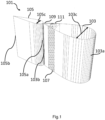
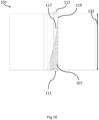
- FIG. 1 shows a perspective view of an example wingsail 101.
- Wingsail 101 is a double element wingsail having a first aerofoil 103 and a second aerofoil 105.
- One of the double elements of wingsail 101 is first aerofoil 103 and one of the double elements of wingsail 101 is second aerofoil 105.
- First aerofoil 103 comprises a leading edge 103a, a trailing edge 103b and a section 103c of maximum cross-sectional width. As can be seen in the example of Figure 1 , leading edge 103a is closer to section 103c of maximum cross-sectional width than trailing edge 103b.
- a portion of aerofoil 103 comprising leading edge 103a is rounded, and a portion of aerofoil 103 comprising trailing edge 103b is pointed (or may be a rounded shape which has a radius smaller than that of the leading-edge curvature).
- the portion of aerofoil 103 comprising leading edge 103a has a wider cross-sectional width than the portion of aerofoil 103 comprising trailing edge 103b. It is envisaged that other shapes may be used for first aerofoil 103, however.
- Second aerofoil 105 comprises a leading edge 105a, a trailing edge 105b and a section 105c of maximum cross-sectional width.
- Leading edge 105a is closer to section 105c of maximum cross-sectional width than trailing edge 105b.
- a portion of aerofoil 105 comprising leading edge 105a is rounded, and a portion of aerofoil 105 comprising trailing edge 105b is pointed. It is envisaged that other shapes may be used for first aerofoil 103, however.
- Second aerofoil 105 may be symmetrical along a chord line of second aerofoil 105, as shown in Figures 1 and 2 for example.
- First aerofoil 103 may be symmetrical along a chord line of second aerofoil 105, as shown in Figures 1 and 2 for example.
- a chord line of an aerofoil may be considered to be a longitudinal axis from the leading edge to the trailing edge of the aerofoil.
- Leading edge 103a may be considered to be at a nominal "front" of wingsail 101. Trailing edge 103b is behind leading edge 103a. In the feathered configuration of Figure 1 , the second aerofoil 105 is behind the first aerofoil 103, and the leading edge 105a of the second aerofoil 105 is in front of the trailing edge 105b of the second aerofoil 105.
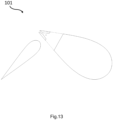
- Aerofoils 103 and 105 have "teardrop” shapes but other aerodynamic shapes may be used.
- an aerofoil such as aerofoils 103 or 105 can have any shape that produces an aerodynamic reaction (lift) perpendicular to the direction of air flow over it, for a small resistance (drag) force in the direction of air flow.
- the wingsail device 101 may rotate around its base to vary an angle of attack to the apparent wind direction. In this way, wingsail device 101 can optimise lift produced.
- the lift is generated by the creation of a pressure differential between either side of wingsail 101, leading to a high pressure and a low-pressure side due to a difference in air velocity over each side of the wingsail device 101.
- Apparent wind is the wind that a moving watercraft experiences.
- Apparent wind is a combination of the wind experienced because of forward motion of the ship combined with the prevailing wind. The two vectors combine to produce 'apparent wind' which may have a different angle and wind speed than the wind experienced because of the forward motion of the ship and the prevailing wind.
- the second aerofoil 105 is rotatable relative to the first aerofoil 103, allowing the camber of the device 101 to be adjusted and inverted.
- the second aerofoil 105 can be rotated to the port side relative to the first aerofoil 103.
- the second aerofoil 105 is rotated to the starboard side relative to the first aerofoil 103.
- second aerofoil 105 When second aerofoil 105 is rotated relative to first aerofoil 103, as seen for example in Figures 4 , 5 , 6, 6, 7 , 13 , 14A and 14B , the chord lines of the first aerofoil 103 and second aerofoil 105 are not parallel. This provides a cambered configuration for the wingsail device 103. This can be achieved by rotating the second aerofoil 105 relative to first aerofoil 103.
- a slot is formed between the first aerofoil 103 and the second aerofoil 105.
- This slot allows a high-pressure stream of air to flow from the high-pressure side to the surface of the low-pressure side. This re-energises the flow travelling over the second aerofoil and allows the flow to stay attached at more extreme angles of attack and avoid stall of the wingsail, allowing greater lift coefficients to be achieved.
- wingsail 101 can be fitted with a pressure differential generator 111 (as shown in Figure 1 , for example).
- Pressure differential generator 111 can be used to provide control of the flow of air around the device 101. This controlled flow allows the device to be used at a greater angle of attack and greater camber angle without stalling, thus greatly increasing the achievable lift coefficients for wingsail 101.
- pressure differential generator may comprise one or more rotary blades (e.g., fan blades) which may be connected by a shaft.
- Wingsail 101 To provide control of airflow around wingsail 101, air inlet 107 draws air into an interior of wingsail 101.
- Wingsail 101 also comprise an outlet 109.
- outlet 109 may be positioned at a trailing edge 103b of first aerofoil 103.
- outlet 109 may be positioned at other positions in first aerofoil 103.
- Air drawn in at inlet 107 can be directed through an interior channel 119 inside of aerofoil 103.
- the interior channel 119 connects air inlet 107 and air outlet 109.
- Air outlet 109 emits air flow, which may comprise a focused jet of air, out of aerofoil 103. This air flow may be directed towards the surface of the second aerofoil element 103.
- the air flow can be emitted out of outlet 109 at trailing edge 103b of first aerofoil 103 towards and onto a leading edge 105a of aerofoil 105.
- Pressure differential generator 111 may be powered by one or more motors. These motors may comprise hydraulic or electric motors, for example. When operated, pressure differential generator 111 may create an area of low pressure at inlet 107 of channel 119 such that air is sucked in, and an area of high pressure at outlet 109 of channel 119 such that air is pushed out of outlet 109.
- Pressure differential generator 111figu may be configured to create negative internal pressure in the first aerofoil, wherein the negative internal pressure draws air into the main body of the first aerofoil through air inlet 107.
- Pressure differential generator 111 may comprise, for example, a fan driven by a motor; or a series of fans connected by one fan shaft and driven by a motor.
- flow hits the leading edge of the first aerofoil element 103 and flows around the surface (on both sides). As air flow travels over the low pressure surface the laminar boundary layer starts to transition into turbulent flow, if the angle of attack of the device 101 is increased at this point the flow will separate and the device 101 will stall.
- the device 101 can operate at higher angles of attack (and therefore generate more lift), in some examples the air traveling over the surface of the front aerofoil 103 is sucked internally at a location near the back end of the front aerofoil 103. This removes part of the turbulent boundary layer and keeps the flow attached at higher angles of attack, thus achieving greater producible thrust of device 101.
- a second aerofoil 105 is located behind the first aerofoil 103 and when aerofoil 105 is cambered it produces a slot between the first aerofoil 103 and second aerofoil 105.
- This slot allows a high-pressure jet of air from the high-pressure side (113 in Figure 6 , 115 in Figure 7 ) to the low-pressure side (115 in Figure 6 , 113 in Figure 7 ) allowing the flow again to stay attached at higher angles of attack and camber angles - which in a similar way means that the device can produce greater thrust to the vessel.
- An air outlet 109 may be positioned at the trailing edge of the first aerofoil element 103 to further enhance the high-pressure jet of air traveling through the slot and thus allow the wingsail 101 to maximise the achievable angle of attack before stall and maximise the thrust produced whilst also reducing drag.
- FIG. 2 shows a cross sectional plan view of wingsail 101.
- air inlet 107 comprises two air inlets 107s and 107p provided on both sides 113 and 115 (the port side 113 and the starboard side 115, respectively) of first aerofoil 103.
- air inlet 107 is situated towards trailing edge 103b of first aerofoil 103.
- Each air inlet 107 may comprise a vertical strip (or vertical strips) allowing air to flow into aerofoil 103.
- the vertical strip(s) may comprise a gap in the device allowing air to flow in.
- the air inlet may comprise a surface with cut openings (such as circular holes or other shapes) or other porous material allowing air to flow into the first aerofoil 103.
- This surface with cut shapes or porous material controls the speed and volume of air flow into the wingsail to optimize the aerodynamics of the device. It also brings the added benefit that it can prevent debris being sucked into the interior of aerofoil 103.
- Air inlet 107 draws in unstable flow close to the surface of the device 101 into the main body of the first aerofoil 103 which allows the flow to stay attached at greater angles of attack, thus leading to greater lift coefficients being produced.
- a partition 112 is provided between the main body of aerofoil 103 and pressure differential generator 111.
- air flow generated affects internal air flow in a portion at the trailing edge 103b of the device, but air flow generated from pressure differential generator 111 is prevented from affecting internal air flow within the main body (i.e., in the body positioned at the leading edge 103a) of aerofoil 103.
- FIGS 3 to 7 show examples of a wingsail 101 under the influence of wind 130. Although wingsail 101 is shown in this figure, the same principles may be applied to wingsail 401, 621 or any other wingsail described herein.
- wingsail 101 When wind direction 130 is directed directly at the leading edge of a front aerofoil 103 of wingsail 101 (i.e., the wind direction is directed between the port side 113 and the starboard side 115 of the wingsail), wingsail 101 may be arranged in a feathered configuration. In this configuration, the chord line of aerofoil 103 and aerofoil 105 are aligned and in parallel with one another.
- Figure 4 shows an example of a wingsail 101 on a port tack.
- Wingsail 101 can be cambered in a port configuration where the second aerofoil 105 is rotated to the port side 113 relative to the first aerofoil 103.
- the starboard air inlet 107s is open and the port air inlet 107p is closed.
- the air outlet 109 of the first aerofoil 103 directs air flow onto the starboard leading edge of the second aerofoil 105, thus re-energising the air flow at this critical point and increasing the stall angle of the device 101.
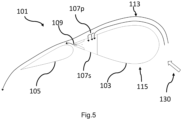
- Figure 5 shows an example of a wingsail 101 on a starboard tack.
- Wingsail 101 can be cambered in a port configuration where the second aerofoil 105 is rotated to the starboard side 115 relative to the first aerofoil 103.
- the starboard air inlet 107s is closed and the port air inlet 107p is open.
- the air outlet 109 of the first aerofoil 103 directs air flow onto the port leading edge of the second aerofoil 105, thus re-energising the air flow at this critical point and increasing the stall angle of the device 101.
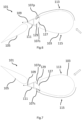
- Figure 6 shows an example of how a starboard air inlet 107s can be closed during a starboard tack while a port air inlet 107p is open.
- An interior wall 129 is positioned to close a starboard air inlet 107s while a port air inlet 107p is left open.
- Interior wall 129 can be rotated around a rotation point 127. This rotation can be performed using a motor, for example an electric or hydraulic motor. Rotation may be performed automatically based on detection by a computer system of wingsail 101 of whether wingsail 101 is on a port or starboard tack. In some examples, the rotation may be performed based on a user input into a computer system.
- the rotation is performed based on a manual operation of a user of wingsail 101.
- wingsail 101 may draw air in the port air inlet 107p and not draw air in the starboard air inlet 107s.
- Figure 7 shows an example of how a starboard air inlet 107s can be open during a port tack while a port air inlet 107p is closed.
- Wingsail 101 may be operated to move between the configuration of figures 6 and 7 .
- An interior wall 129 is positioned to close a port air inlet 107s while a port air inlet 107p is left closed.
- Interior wall 129 can be rotated around a rotation point 127. This rotation can be performed using a motor, for example an electric or hydraulic motor. Rotation may be performed automatically based on detection by a computer system of wingsail 101 of whether wingsail 101 is on a port or starboard tack. In some examples, the rotation may be performed based on a user input into a computer system.
- the rotation is performed based on a manual operation of a user of wingsail 101.
- wingsail 101 may not draw air in the port air inlet 107p and draw air in the starboard air inlet 107s.
- a computer system as described herein may comprise at least one processor and an associated memory.
- the computer system may be used to run control software for opening and closing at least one inlet of wingsail 101.
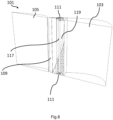
- Figure 8 shows a cross section through the centre of wingsail 101, in a configuration where the chord lines of aerofoil 103 and aerofoil 105 are aligned and parallel.
- Figure 10 also shows a side view of a cross section of wingsail 101.
- an internal air vent 119 (a channel) connects air inlet 107 to air outlet 109.
- the air outlet is positioned at the trailing edge of aerofoil 103.
- the channel 119 may be configured to direct flow from the inlet 107 at a first position along a span of the wingsail 101 and directs this flow to the air outlet 109, wherein the span of the wingsail 101 is a distance from a base of the wingsail 101 to a tip of the wingsail 101.
- the volume of the air vent is lower at the air outlet 109 than at the air inlet 107.
- the air from pressure differential generator 111 is focused as it travels to air outlet 109 by a reduction in volume of internal air vent 119 from the pressure differential generator 111 to air outlet 109, this giving a higher concentration of energized flow which is directed towards the second aerofoil.
- Air is emitted out of air outlet 109 as a focused stream of air where it flows towards the surface of second aerofoil element 105.
- second aerofoil 105 may be in a cambered configuration.
- the focused airflow from air outlet 109 re-energises the boundary layer thus allowing the flow to stay attached at greater camber angles and angles of attack, thus increasing the stall angle, and increasing the maximum achievable lift coefficient of wingsail 101.
- channel 119 is sloped so that the channel is longer along a vertical axis 132 of wingsail 101 at air outlet 109 than at air inlet 107.
- Vertical axis 132 is shown in Figure 10 .
- This sloped channel shape is useful when wingsail modules such as wingsail 101 are stacked on top of each other, as discussed further below with reference to Figures 11 and 12 .
- wingsail modules having the channel shape can be stacked upon each other to create a larger wingsail comprising multiple modules. In this case will direct air flow from the air inlet of a higher modular section through a pressure differential generator to the air outlet of a lower modular section.
- Other channel shapes can be used to provide alternative outcomes, however.
- channels may be used to direct air flow to an air inlet of a modular section through a pressure differential generator to the air outlet of a same modular section.
- any of the above-described three channel shapes may be used.
- a non-sloped channel may be used for a single unit such that the internal air flow would travel from an air inlet at one level through a pressure differential generator and exit at an air outlet at the same level.
- a modular wingsail (e.g., wingsail 621) may be made of two or more internal modules covered by an outer shell.
- wingsail 101 may have a similar dimension to 101, having a greater height than length.
- Figure 9 shows a cross section through a centre of an example portion of wingsail 401, in a configuration where the chord lines of a front aerofoil and a rear aerofoil of wingsail 401 are aligned and in parallel.
- Wingsail 401 may comprise a similar structure as wingsail 101.
- Wingsail 401 additionally includes at least one air flow straightener 425 positioned at an air outlet 405 of the front aerofoil of wingsail 401 to allow the flow to exit the air outlet in a controlled fashion, to maximise an aerodynamic benefit of the controlled airflow.
- at least one air flow straightener may be positioned at an air inlet of the front aerofoil.
- At least one air flow straightener may be positioned between the air inlet and air outlet of wingsail 401.
- An air flow straightener may comprise one or more walls placed along an air inlet, air outlet or channel connecting an air outlet and air inlet.
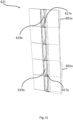
- wingsail modules such as wingsail module 601a and 601x may be stacked on top of one another to form a wingsail 621.
- Each wingsail module 601a, 601x etc. may comprise a similar structure to wingsail 101, wingsail 401 or any other wingsail described above.
- Each wingsail module 601 may comprise an air inlet 607, an air outlet and a pressure differential generator. Each wingsail module 601 may be configured to be stacked on top of one another.
- Figure 11 shows an external view of a wingsail 621 comprising wingsail modules 601a and 601x. Further modules may also be included as shown in Figure 11 , in some examples.
- Figure 12 shows an internal cross section of wingsail 621 comprising wingsail modules 601a and 601x.
- Wingsail 621 comprises at least two wingsail modules 601a and 601x each having an inlet 607a and 607x which are aligned with each other.
- Wingsail module 601a comprises an air vent 619a.
- Wingsail module 601x comprises an air vent 619x.
- an air vent for each wingsail module 601a and 601x guides internal air flow from a pressure flow generator to an air outlet for each wingsail module 601a and 601x.
- Each wingsail module (e.g., wingsail module 601a and 601x) may have its own pressure differential generator.
- An air vent for each wingsail module may guide internal air flow from an internal pressure differential generator to an air outlet.
- Wingsail 621 may comprise at least one fan at the trailing edge of the front aerofoil (similar to aerofoil 103 in wingsail 101) of each wingsail module 601a, 601x, etc.
- Each fan may be driven by one or more hydraulic or electric motors.
- Each fan may be connected by a central shaft made by shaft modules for each wingsail module.
- shaft module 617a of wingsail module 601a is connected to shaft module 617x of wingsail module 601x.
- Wingsail module 601x is positioned at the top of wingsail 621.
- Wingsail module 601a is a wingsail module other than top wingsail module 601x.
- the channel of each module e.g., channels 617x and 617a
- the channel of each module are sloped so that each channel is longer along a vertical axis of each wingsail module 617a and 617x (where both axes are similar to axis 132 of wingsail 101) at an air outlet of each wingsail module than at an air inlet of each wingsail module 607a and 607x.
- each wingsail module has this channel shape, air flow from the air inlet of a higher modular section through a pressure differential generator to the air outlet of a lower modular section.
- air flow from air inlet 607x will be directed to an air outlet of a wingsail module directly below wingsail module 601x.
- Air flow from an air inlet of a wingsail module directly above wingsail module 601a will be directed towards an air outlet of wingsail module 601a.
- Air flow from air inlet 607a will be directed to an air outlet of a wingsail module directly below wingsail module 601a.
- wingsail module 601x is at the top of wingsail 621, air flow is drawn in from above wingsail module 601x and directed towards an air outlet of wingsail module 601x.
- channel shapes may be used to provide different air flow between modules of a modular wingsail.
- the channel is sloped so that the channel is longer along a vertical axis of a wingsail module at an air inlet than at an air outlet, air flow will be directed from the air inlet of a lower modular section through a pressure differential generator to the air outlet of a higher modular section.
- the bottom wingsail module will draw in air from below the modular wingsail.
- non-sloped (substantially straight, or straight, along a vertical axis of the wingsail module) channels may be used to direct air flow to an air inlet of a modular section through a pressure differential generator to the air outlet of a same modular section.
- the wingsail may comprise an air inlet as shown in previous examples and an air outlet at the base or the tip of the wingsail. Wherein air is sucked into the air inlet by a fan positioned at the air outlet at the base or the tip of the wingsail and internal flow is directed either up or down the span of the wingsail.
- the wingsail devices described herein may comprise one or more internal structure members.
- a wingsail or wingsail module may comprise, for example, at least one: of a structural steel main spar; an aluminium main spar; a composite main spar.
- the wingsail may also comprise transverse and/or longitudinal stiffeners made of similar material.
- an outer skin may produce the external aerodynamic shape of the device of the device and may comprise, for example, at least one of: steel; aluminum; composite.
- the internal air vents (channels) may comprise, for example, at least one of: steel; aluminum; composite.
- the device may have a monocoque structure having a thicker external skin comprised of, for example, at least one of: steel; aluminium; composite. This monocoque structure may take much of the structural loads of the device.
- the device may rotate its angle of attack to the apparent wind using either a slew gear bearing or a bearing with rack and pinion system, wherein this bearing may be connected to the bottom section of the wingsail and connect the wingsail to its base (which is connected to the vessel).
- This bearing may be located beneath the first aerofoil 103 at a position where the wingsail 101 is able to naturally weather cock if all systems fail. In a natural weather cocked configuration the wingsail 101 will feather to the wind in a similar configuration as shown in figure 3 .
- devices may have multiple air inlets each comprising a starboard air inlet and a port air inlet in the front aerofoil.
- devices may have multiple air outlets in the front aerofoil.
- a wingsail may comprise at least one air inlet in the second aerofoil. In further examples, a wingsail may comprise at least one air outlet in the second aerofoil.
- wingsail 101 may be stowed and protected by a protective covering 123. This process is shown in Figures 14A and 14B .
- wingsail 101 is in a stowed configuration and protected by protective covering 123.
- protective covering 123 is opened, allowing wingsail 101 to adjust to different orientations.
- Protective covering 123 may be comprised of steel or other material and this covering may be folded or rotated over the device to protect the device from crane grabs, falling material such as iron ore or other impact causing scenarios which may damage the wing.
- a wingsail as described herein may comprise a base plate and an end plate. These plates may improve the aerodynamic performance of the device by reducing vortex shedding as a result of the generation of lift.
- a wingsail as described herein may comprise a base plate and an end plate may comprise fences along the span of the device to help direct the flow across the surface of the device and reduce vortex shedding and associated losses.
- a double element wingsail comprised of two aerofoils below is described further below with respect to Figures 15 to 26 .
- a method for moving the two aerofoils relative to each other is described.
- aerofoils described with respect to Figures 15 to 26 below may have air inlets and air outlets to control air flow as described above. Any of the features described with respect to Figures 15 to 26 below may be incorporated into any of the above-described wingsails, such as wingsail 101, 401 and 623, for example.
- Figures 15 and 16 show a wingsail 1.
- Figure 15 shows a port view and Figure 16 shows a starboard view.
- Wingsail 701 is comprised of a first aerofoil element 703 and a second aerofoil element 705, the first aerofoil element 703 is the leading element and the second aerofoil element 705 is the trailing element.
- the second aerofoil element 705 is rotatable relative to the first aerofoil element 703 to form a cambered shape (as shown in Figure 17 ) which is beneficial for producing a lift force.
- a 'slot' 704 is formed between the first aerofoil element 703 and second aerofoil element 705, and this slot 704 allows high energy flow from the pressure side to flow to the suction side and allows the flow to stay attached at a higher angle of attack - which is beneficial for producing lift.
- the second aerofoil element 7053 may be of the same chord length as the first aerofoil element 703 but in some cases may be shorter or longer.
- the thickness of the first aerofoil element 703 may be thicker than the second aerofoil element 705 to increase the second moment of area of the internal structure and to optimise the aerodynamic performance of the device.
- the shape of the aerofoil section comprising the first aerofoil element 703 and second aerofoil element 703 has a maximum thickness within the leading half of the section.
- the curvature of each aerofoil section comprising aerofoil elements 703 and 705 is convex along the total length of each section, the curvature remains positive along the total length and does not include any inflections.
- the first aerofoil element 703 is connected directly to base 706 of wingsail 701.
- Base 706 connects wingsail 701 to an associated marine vessel.
- Second aerofoil element 705 is connected to base 706 of wingsail 701 via a connection to first aerofoil element 705.
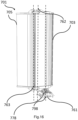
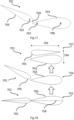
- Wingsail 701 as shown in Figure 18 is capable of transitioning between a feathered configuration 755 in which the cross-sectional centreline 758 of both aerofoil elements 703 and 705 are aligned, to a cambered configuration 756 in which the second aerofoil element 705 rotates in relation to the first aerofoil element 702.
- the wingsail 701 is also capable of articulating to a configuration where the first aerofoil element 703 and second aerofoil element 705 form a tightly packed configuration 757.
- Wingsail 701 can invert its camber in both directions to allow the wingsail to produce lift 759 with the wind angle 760 coming from both its right and left side, as shown in Figure 19 .
- Wingsail 701 is also able to rotate 360 degrees around its base 706 about an angle of attack axis 748 to allow an angle of attack of wingsail 701 to be adjusted and optimised to the direction of the wind in relation to the marine vessel.
- the aerodynamic flow around wingsail 701 can be optimised to produce a desired amount of thrust force.
- wingsail 701 can minimise its stowed height above a deck of the marine vessel and ensure the first aerofoil element 703 and second aerofoil element 705 are not protruding in any way.
- wingsail 701 forms a tightly packed configuration as presented in configuration 757 of Figure 18 and folds from a vertical position to a horizontal position to minimise an overall height of wingsail 701. This process is described in the following paragraphs.
- the second aerofoil element 705 can be rotatable relative to the first aerofoil element 703 about at least one vertical axis.
- the at least one vertical axis comprises two vertical axes.
- At least one linear actuator preferably a hydraulic ram may connect to the first and second aerofoil element.
- the primary axis 762 for rotation of the second aerofoil element 705 relative to the first aerofoil element 703 may be located within the first aerofoil element 703 and the secondary axis 763 for rotation of the second aeorofoil element 705 relative to the first aerofoil element 703 may be located within the second aerofoil element 705.
- An axis 798 may be provided for the rotation of the first aerofoil element 703 relative to the base of the wingsail.
- the two aerofoil elements may be connected by a middle linking member 771.
- Middle linking member 771 may house spherical or roller bearings, or other forms of mechanical bearings or rotating joints to freely connect the linking member to first aerofoil element 702 and second aerofoil element 705.
- Linking member 770 may comprise a top bar 772 and a bottom bar 773, and the top bar 772 and bottom bar 773 may be connected by a torsional structural member 774 to align the top and bottom bar and resist any torsional moments between the tip and the base of the wing.
- the torsional structural member 774 may comprise a torsional spar and may be spherical and comprised of steel, aluminium, or composite.
- a bottom linear actuator 765 at the base of the wing connects to both the linking member 771 (preferably to the bottom bar 773) and to the structure of the first aerofoil element 703, preferably to a first element base structure 784 and controls the relative movement of both parts.
- the wingsail 701 may comprise a top linear actuator 764 (preferably hydraulic ram) connecting the top bar 772 of linking member 771 with the structure of the first aerofoil element 703 and may connect to the first element end structure 783.
- the connection of linear actuators 764 and 765 to wingsail 701 may attach to pins fixed between two brackets fixed to each part of the wingsail 701 and allow the attachments to freely rotate with the changing angles.
- Top linear actuator 764 and a bottom linear actuator 765 are preferably used to drive the rotation of the linking member 771 in relation to the first aerofoil element 703.
- the connection points between the rams 764 and 765 and the linking member 771 may be on both the top bar and bottom bar, and its connection preferably is able to rotate relative to the linking member 771.
- the linking member may comprise, in addition to top bar 772 and bottom bar 773, other connecting bars spaced in between these two bars which may also be fixed to the torsional structure. These connecting bars may also comprise rotational bearings which connect first aerofoil element 703 to the second aerofoil element 705 and allow rotation between one another by way of two vertical axis.
- the primary axis 762 is a vertical axis preferably within the first aerofoil element 703 and runs through the centre of each of the bearings connecting the first aerofoil element 703 to the linking member 771.
- the secondary axis 763 is a vertical axis preferably within the second aerofoil element 705 and runs through the centre of each of the bearings connecting the second aerofoil element 705 to the linking member 771.
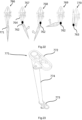
- the full range of motion of wingsail 701 is presented in Figure 22 .
- the second aerofoil element is rotated about the primary axis 762 to complete the range of motion required to actively trim the wing to optimise the aerodynamic flow.
- This movement may be controlled by one or more linear actuators, preferably one top linear actuator 764 at a top 791 of wingsail 701 and one bottom linear actuator 765 at the bottom 792 of wingsail 701 as shown in Figures 20 and 21 .
- configuration 766 shows the neutral 'feathered' configuration
- configuration 767 shows maximum working camber to starboard (typically in the range of 10-25 degrees from centre)
- configuration 768 shows maximum working camber to port (typically in the same range as maximum working camber to starboard 767).
- the second aerofoil element 705 is rotated around its primary axis 762 to a maximum rotational position.
- the maximum rotational position may in some examples be where the minimum stroke of a ram (or another linear actuator) is reached. This is shown as configuration 769.
- the second aerofoil element 705 then rotates in relation to the first aerofoil element 705 2 about its secondary axis 763 by way of approximately 90 degrees to create a tightly packed configuration 770.
- This tightly packed configuration 770 preferably minimises the combined length 793 and thickness 794 of both the first aerofoil element 703 and second aerofoil element 705 and results in an orientation of the second aerofoil element 705 in relation to the first aerofoil element 703 which is reversed from its feathered configuration 766.
- the centreline of the first aerofoil element 703 and second aerofoil element 705 may sit in parallel in this configuration or up to approximately 40° and the second aerofoil element 705 preferably sits within the length of the first aerofoil element 703.
- This rotation around the secondary axis 763 may be controlled either by rotary actuator or secondary ram arrangement connected between the linking member 771 and the second aerofoil element 705 and preferably be a hydraulic linear ram or hydraulic rotary actuator.
- a hydraulic linear ram In the case of a hydraulic linear ram being used this forms a double ram arrangement in series which allows the second aerofoil element 705 to rotate in relation to first aerofoil element 703 by an angle greater than 180 degrees. The same angle is achieved if a rotary actuator is used.
- wingsail 701 is ready to be folded down to deck to prepare for port operations.
- Figure 24 shows this process.
- the base 706 of wingsail 701 is connected to a pivotable plate 778 which is connected to the base structure 706, preferably a steel fabricated structure of welded plates and flanges, by way of a hinged arrangement.
- This arrangement allows wingsail 701 to rotate about a horizontal axis 795 to transition between an upright condensed configuration 775 (upright) and a stowed configuration 776 (horizontal).
- Hydraulic cabling and other low voltage electronic cabling may be passed from inside the base 761 through an opening in pivotable plate 778 and up into wingsail 701.
- Wingsail 701 in its upright condensed configuration 775 is lowered to its stowed configuration 776 by two linear actuators, preferably hydraulic rams 777, which take the load of the weight of the wingsail 701 as tension.
- One single ram is capable of raising and lowering the wingsail 701 and the second of these two rams reduces the load in one single ram and provides redundancy in the system in case of failure of one of the rams or its systems.
- the same process is repeated in reverse to transfer wingsail 701 from its stowed configuration to its upright and working configuration.
- wingsail 701 sits horizontally and ideally sits parallel to the deck of the vessel.
- the tip of wingsail 701 is supported by a deck support and a locking pin fixes this in place.
- the wing base will preferably be fitted on the side deck between hatch cover slides and will be lowered to a stowed configuration above hatch covers.
- the hatch covers will be able to slide underneath the stowed wingsail 701 to allow port operations to be uninterrupted.
- Wingsail 701 will preferably sit at least two metres above the deck to allow for passageway underneath.
- the rams may be fitted to the underside of the pivotable plate 778 and sit in a cavity within the deck. Where deck space is not restricted the rams will be positioned above the deck as shown in Figure 24 .
- FIG. 25 shows the bare structure 779 of the wingsail 701 and the first aerofoil element fairing 780 and second aerofoil element fairing 781 removed for clarity.
- the main structure may comprise a main spar 782 which may be connected to a first element base structure 784 and first element end structure 783 and may also be connected to a number of structural ribs 797 to provide support to the first aerofoil aerodynamic fairing 780.
- the structure may not include structural ribs 797.
- the main spar 782 protrudes beneath the first aerofoil element 703 and first element base structure 784 and attaches to the top of a bearing arrangement 785, preferably a hydraulic driven slew gear bearing, which allows wingsail 701 to rotate about 360 degrees relative to the base and the vessel.
- the loads are transferred and spread out evenly to the bearing to minimise localised stress concentrations which may impinge the rotation of the device.
- These loads may be spread out and transferred though triangular flanges preferably welded to the main spar 782 and a plate which is subsequently bolted to the top of the bearing arrangement. These triangular flanges may be comprised of steel plate. Other methods for transferring loads from the main spar 782 and the bearing may be used.
- the underside of the bearing arrangement 785 is bolted to the pivotable plate 778 which is preferably a steel plate with structural reinforcement flanges.
- Pivotable plate 778 is connected to the wingsail base 761 by way of a hinged arrangement with a horizontal axis 795 along one edge of the pivotable plate 778, and by a locking pin arrangement on the other edge of the pivotable plate 778.
- the base 761 is preferably comprised of a steel fabricated structure of welded steel plate and welded steel flange sections to transmit the forces and moments from wingsail 701 to the deck and ships existing and modified structure.
- the base 761 is preferably bolted or welded to the deck and loads transferred to the underlying structure.
- first element base structure 784, first element end structure 783 and structural ribs 797 may be comprised preferably of fabricated steel plate sections welded together to form a support for the first element fairing 780. These may also be comprised of aluminium or composite.
- the first element fairing is connected to the base support structure 34 and end support structure 783. This fairing may be joined by mechanical fastenings or chemically bonded.
- the first aerofoil aerodynamic fairing 780 and second aerofoil element aerodynamic fairing 781 may preferably be comprised of composite but may be comprised of steel or aluminium curved plate.
- the main spar 782 may be comprised of steel fabricated box section or I-beam section or other construction methods to provide a structurally efficient shape in bending and torsion.
- the main spar 782 must transfer the total accumulation of loads generated by wingsail 701 to the base of the wing.
- the first aerofoil element 703 may be connected to a linking member 771 which is rotatable relative to the first aerofoil element 703 about the primary axis 762.
- the first aerofoil element 703 may comprise a minimum of two bearings to connect it to the linking member 771 which is able to rotate.
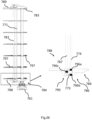
- the first aerofoil element may comprise a double shear plane arrangement 786, 790 as depicted in Figure 25 .
- Figure 25 presents a structural view of wingsail 701 with linking member 771 highlighted to indicate how linking member 771 fits within the remainder of the wingsail structure.
- Figure 25 also presents a scaled-up view of the first element base structure 784, second element base structure 788 and linking member 771 to depict how these parts link and rotate together and form the double shear pin arrangement.
- the mechanism is assumed to be similar for the end of the wing and may be found in any other location along the primary axis 762.
- the first element structure (which may be comprised of first element base structure 784, first element end structure 783 and structural ribs 797) may house a minimum of two bearings but preferably comprise more than two bearings.
- Figure 26 provides an example of a double bearing assembly embedded into the first element base structure although this assembly may be found at any point within the structure of the first aerofoil element 703 along the primary axis 762, and in this example is repeated within the first element end structure 783 but not shown in detail.
- the bearing assembly depicted in Figure 26 may comprise top bearing 796a and bottom bearing 766b and these bearings may be spaced apart with an opening between each to house the bottom bar 773.
- the top bearing 766a and bottom bearing 766b can be mechanically connected or bonded to the linking members torsional structural member 774 to allow rotation of the linking member 771 in relation to the first element base structure 784.
- the use of two bearings 796a and 796b creates a double shear plane arrangement which provides the joint with greater stability and restricts the linking member 771 from rotating transversely in relation to the first element base structure 784.
- a bearing 796c may also be provided for rotation of the second aerofoil element relative to linking member 771.
- a single bearing is used to connect the linking member 771 to the first element base structure 784.
- the bearing may be a self-aligning bearing and be able to rotate with an off axis shaft, i.e. when the top of the wingsail 701 deflects and rotates at a greater angle than the bottom of the wingsail 701 due to the deflection under load of the wingsails structure, the bearing is able to self-align to maintain movement between the linking member 771 and the first element base structure 784 about the primary axis 762.
- Bearings 796a and 796b may be cylindrical or self-aligning and must allow the linking member to freely rotate about the primary axis 762 whilst providing support for the load of the second aerofoil element 705. These bearings may transfer all the load from the linking member 771 to the first element base structure 784 and first element end structure 783, including the self-weight of the linking member 771 and second aerofoil element 705. Bearings may also be housed within structural ribs 797 or any other structure within the first aerofoil element 703. Adversely the structural ribs may contain space along the primary axis 762 to allow the torsional spar 774 of the linking member 771 to rotate freely without contact with structural ribs 797.
- the linking member 771 rotates in relation to first aerofoil element 703 and may be connected to the second aerofoil element 705 via a bearing arrangement housed within the structure of the second aerofoil element 705 acting along the secondary axis 763.
- This bearing arrangement may be connected to a torsional structural member 787 which connects the top and base of the second aerofoil element 705 to withstand torsional forces and moments acting between the top and the base of the second aerofoil element 705 and ensures that the aerofoil element does not twist adversely.
- linking member 771 to second aerofoil element 705 may be via two or more bearings fixed to torsional structural member 787 which may be fixed to a second element base structure 788 and second element end structure 789.
- This bearing arrangement allows the second aerofoil element 705 to be rotatable relative to the linking member about the secondary axis 763.
- This torsional structural member 787 withstands torsional forces and moments between the top and bottom of the second aerofoil element 705 and minimises deflection of the top portion of this element in relation to the bottom. This provides structural rigidity and avoids damage through excessive bending of the aerofoil element.
- the second aerofoil element aerodynamic fairings 781 may connect to the structure of the second aerofoil element 705.
- the second element aerodynamic fairings 781 may connect to the structure of the second aerofoil element 705 by mechanical fixing or bonding to the second element base structure 788, second element end structure 789 and structural ribs 797 of the second aerofoil element 705, or connection to any combination of these parts.
- These connections preferably comprise mechanical fastenings or bonding and the second aerofoil element fairing 781 is preferably comprised of composite but may be comprised of steel or aluminium plate.
- the first aerofoil element fairing 780 and second element faring 781 may preferably be constructed in two half sections and bonded or mechanically fastened together or may be comprised of smaller plates bonded or mechanically fastened to the structural ribs 797 or made of smaller half sections.
- the structure of the second aerofoil element 705 may be comprised of steel fabricated plates or may be comprised of composite or aluminium.
- All metallic structures of wingsail 701 may be painted with anti-corrosive paint to reduce corrosion during use within highly corrosive salty environments.
- the base and end support structure for the first and second aerofoil elements (783, 784, 788 and 789) may comprise a base and end plate, fitted to improve the aerodynamic performance of the device by reducing vortex shedding as a result of the generation of lift.
- FIG. 27 shows a cross section of an example wingsail 801 comprising multiple outlets 809a, 809b, 809c, 809d, 809e, 809f, 809g, and 809h in the leading (front) aerofoil.
- Wingsail 801 may operate similarly to wingsail 101, although instead of a single outlet (outlet 109 in aerofoil 103) wingsail 801 has multiple outlets in the front aerofoil.
- Wingsail 801 may comprise a pressurized cavity 880.
- the multiple outlets 809a, 809b, 809c, 809d, 809e, 809f, 809g, and 809h may be provided at a particular height of wingsail 801, for example at the base of wingsail 801 or at the top of wingsail 801.
- the outlets are positioned at regular intervals between the base of the wingsail 801 and the top of the wingsail 801.
- Wingsail 801 may also comprise one or more inlets in the front aerofoil (not shown in Figure 27 for clarity).
- the one or more inlets may be at a different height to the outlets.
- the multiple air outlets 809a, 809b, 809c, 809d, 809e, 809f, 809g, and 809h can act in a similar way to the single air outlet 109 of wingsail 101 in that the multilple outlets provide a high energy stream of air onto the surface of the wing to re-energise the boundary layer thus increasing the angle of attack of the wingsail 801 achievable before stall and also increasing achievable lift coefficient of wingsail 801.
- the multiple air outlets 809a, 809b, 809c, 809d, 809e, 809f, 809g, and 809h shall be configured so that air flow is directed to the high-pressure side and not the low-pressure side of the aerofoil by closing the low-pressure side air outlets.
- the air outlets on the first aerofoil element shown in Figure 27 will be situated towards the back half of the aerofoil element towards the trailing edge. In another example, one or more of these air outlets may be situated in the front half of the leading (front) aerofoil element.
- Wingsail 801 may in some examples comprise a wingsail "unit” that can be repeated to provide a modular wingsail such as wingsail 621.
- outlets are shown in the leading aerofoil of wingsail 801, it will be understood that in other examples more or fewer outlets may be used.
- Figure 28 shows a cross section of an example wingsail 901 comprising multiple outlets 909a, 909b, 909c, 909d, 809e, 909f, 909g, and 909h.
- Wingsail 901 may operate similarly to wingsail 801, although wingsail 901 has multiple outlets 984a, 984b, 984c, 984d, 984e, 984f, 984g, 984h in a trailing aerofoil.
- Wingsail 801 may comprise a pressurized cavity 880.
- the multiple outlets 984a, 984b, 984c, 984d, 984e, 984f, 984g, 984h may be provided at a particular height of wingsail 901, for example at the base of wingsail 801 or at the top of wingsail 901.
- the outlets are positioned at regular intervals between the base of the wingsail 901 and the top of the wingsail 901.
- Wingsail 901 may also comprise one or more inlets in the front aerofoil (not shown in Figure 28 for clarity).
- the one or more inlets may be at a different height to the outlets.
- the multiple air outlets 909a, 909b, 909c, 909d, 909e, 909f, 909g, and 909h can act in a similar way to the single air outlet 109 of wingsail 101 in that the multilple outlets provide a high energy stream of air onto the surface of the wing to re-energise the boundary layer thus increasing the angle of attack of the winsgail 901 achievable before stall and also increasing achievable lift coefficient of wingsail 901.
- the multiple air outlets 909a, 909b, 909c, 909d, 909e, 909f, 909g, and 909h shall be configured so that air flow is directed to the high-pressure side and not the low-pressure side of the aerofoil by closing the low pressure side air outlets.
- the air outlets on the first aerofoil element shown in Figure 28 will be situated towards the back half of the aerofoil element towards the trailing edge. In another example, one or more of these air outlets may be situated in the front half of the leading (front) aerofoil element.
- Wingsail 901 may in some examples comprise a wingsail "unit” that can be repeated to provide a modular wingsail such as wingsail 621.
- outlets are shown in the leading and trailing aerofoils of wingsail 901, it will be understood that in other examples more or fewer outlets may be used.
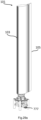
- Figure 29a shows wingsail 101 in an upright configuration.
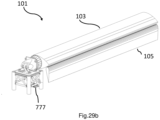
- Figure 29b shows wingsail 101 in a folded and stowed configuration wherein back (trailing) aerofoil 105 is rotated relative to the front (leading) airfoil 103 so that the chord lines of each aerofoil are substantially at 90 degrees to one another, and both aerofoils 103 and 105 are rotated from the base of the wingsail to a horizontal position to form a stowed configuration as shown in Figure 29b controlled by one or two articulating rams 777 at the base of the wingsail.
- the stowed configuration in Figure 29b is such that the in some examples wingsail 101 fits in the side channel between ships hatches and the ships side, and that the ships hatches are able to slide to an open position underneath the leading (first) aerofoil 103 or fold next to the leading (first) aerofoil 103 so that wingsail 101 does not restrict the movement of the ships hatches.
- the trailing (second) aerofoil 105 is rotated relative to the first aerofoil element by substantially 90 degrees, and in some examples, this allows the second aerofoil element to stay within the limits of the ships beam.
- chord length of the second aerofoil element 105 is dimensioned so that it is capable of folding to this stowed configuration and rest above the side deck of the ship, and the height of the first aerofoil element 103 above the side deck of the ship is dimensioned to allow the ships hatch cover to slide underneath.
- Incorporating boundary layer flow control into the design of wingsail 101 allows a smaller device to be fitted to the ship whilst still producing similar thrust to a larger device, wherein this smaller device is capable of producing a stowed configuration as described above to minimise impact on port operations and loading and unloading of the vessel, wherein ships hatches need to articulate from closed to open and cargo is removed from the ships holds and may travel over the wingsail 101 in its stowed configuration shown in Figure 29b .
- a smaller of planform area of a wingsail using the boundary layer flow control capabilities is required than if the wingsail did not have boundary layer flow control.
- wingsails described herein can produce more thrust with less total planform area (total planform area can be considered to be the combined cross-sectional area of both aerofoils along the chord line of the respective aerofoil from the base to the tip of the respective aerofoil) than previous wingsails, due to the boundary layer flow control of the wingsails described herein.
- total planform area can be considered to be the combined cross-sectional area of both aerofoils along the chord line of the respective aerofoil from the base to the tip of the respective aerofoil
- the wingsails described herein can achieve a compact stowed configuration that fits in the side channel between ships hatches and the ships side while producing required thrust for a ship.
- Figure 30 shows wingsail 101 in a stowed configuration relative to a marine vessel (ship).
- wingsail 101 in a stowed configuration fits in the side channel between the ships hatches and the ships side allowing the ships hatches to slide underneath.
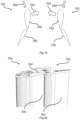
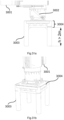
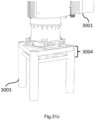
- Figure 31a shows a base structure for an energy saving device for a marine vessel.
- the energy saving device may comprise a wind propulsion system, (such as a wingsail as described herein, a flettner rotor, a turbosail, a kite) or for an energy generation device such as a wind turbine (having a vertical or a horizontal axis).
- the base is designed to be fixed to the deck of a vessel (e.g., any vessel as described herein, a bulk carrier, a tanker, a container vessel, a ro-ro vessel, a LNG carrier, a ferry, a cruise ship etc.) and comprises three or more vertical pillars 3003.
- Each of vertical pillars 3003 may have a cylindrical cross section, an I beam cross section, square cross section or other cross section. Each vertical pillar 3003 may be fixed to the deck of a marine vessel via flange and bolting pattern or any other method. Pillars 3003 hold a structural platform 3004 of the device to a height of at least 2m above the deck of a to allow full working clearance underneath to allow normal operation of vessel.
- a linear actuator 3002 for raising and lowering wind propulsion device 3001 may be situated at the deck or may be situated on platform 3004 above the pillars 3003, as shown in figures 31a-c .
- Linear actuator 3002 may comprise one or more raising rams, for example.
- pillars 3003 are at least 2m tall, to allow operations to be performed by crew under platform 3004. According to some examples, pillar 3003 are less then 4m tall, to reduce moment arm length between the deck and platform 3004 and therefore reduce stress on the fixings of pillars 3003 to the deck of the marine vessel when wind force applies a moment to the device above the base and/or dynamic loading from the rolling or pitching moment of the marine vessel.
- Figure 31b shows a further view of the base structure of Figure 31a .
- Figure 31c shows an example base structure having three pillars 3003 rather than four pillars as shown in Figure 31a and 31b .
- Figures 32a to 32d compare air flow differences between example wingsails having inlets and wingails not having inlets, and also compare different inlet positioning in an example wingsail.
- Figure 32a shows a wingsail at a 20 degree angle of attack 3210a to air flow 3230.
- no aspiration air inlet or pressurised outlet
- the flow stays attached until it reaches 60% of the chord length of a first aerofoil element 3203a of the wingsail, at which point the flow separates into a turbulent region and the wingsail is described as stalled.
- the flow does not reach second aerofoil element 3203b. This creates little lift and also causes drag.
- Figure 32b shows a wingsail again at a 20 degree angle of attack 3210b to flow 3230.
- the example wingsail of Figure 32b incorporates aspiration by an air inlet 3207b towards the back quarter of the chord length of first aerofoil element 3203b, and a pressurised air outlet at the trailing edge of the first element.
- the pressurised inlet 3207b is located near the location of flow separation and 'sucks' in the flow at this point, removing the turbulent boundary layer and keeping the flow attached along aerofoil element 3203b and aerofoil element 3205b.
- Figure 32c shows a wingsail at 30 degrees angle of attack 3210c to flow 3230.
- no aspiration air inlet or pressurised outlet
- the flow stays attached only until it reaches the first 30% of the chord length of the first element.
- the separation occurs closer to the leading edge of the first element than its trailing edge due to the greater angle of attack 3210c of the wingsail. Again, this configuration is stalled and provides little lift and significant drag and should be avoided.
- Figure 32d shows a wingsail again at a 30 degree angle of attack 3210d to flow 3230.
- the wingsail of Figure 32d incorporates aspiration, having an air inlet towards (within) the front quarter of the chord length of the first aerofoil element 3203d, and a pressurised air outlet at the trailing edge of the first aerofoil element 3203d.
- the pressurised inlet 3207 in this case is located near the location of flow separation which in this case occurs much closer to the leading edge than the trailing edge and 'sucks' in the flow at this point, removing the turbulent boundary layer and keeping the flow attached.
- wingsail does not place any limitations on the size or application of the wingsail.
- marine vessel does not place any limitations on the size or application of the marine vessel.
- the marine vessel and/or wingsail may be provided at different scales.
Landscapes
- Engineering & Computer Science (AREA)
- Mechanical Engineering (AREA)
- Life Sciences & Earth Sciences (AREA)
- Sustainable Development (AREA)
- Sustainable Energy (AREA)
- Chemical & Material Sciences (AREA)
- Combustion & Propulsion (AREA)
- Ocean & Marine Engineering (AREA)
- General Engineering & Computer Science (AREA)
- Structures Of Non-Positive Displacement Pumps (AREA)
- Wind Motors (AREA)
Description
- The present disclosure relates to a wingsail, and a method for operating a wingsail. More particularly, the present disclosure relates to a wingsail for a watercraft. The watercraft may comprise a powered watercraft in some examples.
- Known wingsails include wingsails comprised of a single aerofoil. Wingsails comprising multiple aerofoils are also known. Wingsails can be used for marine vessels to reduce energy requirements during operation, for example during transport of goods. This reduction in energy requirements can reduce carbon emissions.
-
JPS6325195 -
WO 2020/115717 A1 discloses a wingsail comprising a first aerofoil having a leading edge at a front of the wingsail and a trailing edge behind the leading edge; and a second aerofoil having a leading edge and a trailing edge, the leading edge of the second aerofoil being closer than the trailing edge of the second aerofoil to a point of maximum cross-sectional width of the second aerofoil; wherein the wingsail is configured such that the leading edge of the second aerofoil can be positioned behind the trailing edge of the first aerofoil. - According to the invention as claimed, there is provided a wingsail comprising: a first aerofoil having a leading edge at a front of the wingsail and a trailing edge behind the leading edge; and a second aerofoil having a leading edge and a trailing edge, the leading edge of the second aerofoil being closer than the trailing edge of the second aerofoil to a point of maximum cross-sectional width of the second aerofoil; wherein the wingsail is configured such that the leading edge of the second aerofoil can be positioned behind the trailing edge of the first aerofoil; wherein the first aerofoil comprises: an air inlet comprising a port air inlet positioned on a port side of the first aerofoil and a starboard air inlet positioned on a starboard side of the first aerofoil; an air outlet; a channel inside the first aerofoil connecting the air inlet and the air outlet; wherein air flow from the air inlet is directed by the channel to the air outlet and the air flow from the air outlet is directed out of the air outlet towards the leading edge of the second aerofoil.
- According to some examples, the second aerofoil has a first portion comprising the leading edge of the second aerofoil, wherein the first portion is rounded.
- According to some examples, the second aerofoil is symmetrical along a chord line of the second aerofoil.
- According to some examples, the chord line comprises a longitudinal axis from the leading edge to the trailing edge.
- According to some examples, the air outlet is positioned at the trailing edge of the first aerofoil.
- According to some examples, wherein when the wingsail is being used on a starboard tack the first aerofoil is configured so that air flow is directed through the port air inlet and is not directed through the starboard air inlet, and wherein when the wingsail is being used on a port tack the first aerofoil is configured so that air flow is directed through the starboard air inlet and is not directed through the port air inlet.
- According to some examples, the wingsail is configured to: rotate the second aerofoil to starboard relative to the first aerofoil when the wingsail is used on a starboard tack such that the air outlet of the first aerofoil directs air flow towards the port leading edge of the second aerofoil; and rotate the second aerofoil to port relative to the first aerofoil when the wingsail is being used on a port tack such that the air outlet of the first aerofoil directs air flow towards the starboard leading edge of the second aerofoil.
- According to some examples, the wingsail is configured to: when the wingsail is being used on a starboard tack, draw air in the port air inlet and not draw air in the starboard air inlet, and when the wingsail is being used on a port tack, draw air in the starboard air inlet and not draw air in the port air inlet.
- According to some examples, the wingsail comprises: a pressure differential generator in the first aerofoil, the pressure differential generator configured to create negative internal pressure in the first aerofoil, wherein the negative internal pressure draws air into the main body of the device through the air inlet.
- According to some examples, the pressure differential generator comprises: one or more fans driven by a motor; or a series of fans connected by one fan shaft and driven by a motor.
- According to some examples, the channel comprises the pressure differential generator and an air vent.
- According to some examples, the second aerofoil rotates to a maximum rotation position relative to the first aerofoil to minimise a total span of the wingsail, and wherein the wingsail folds at a base of the wingsail to form a stowed configuration.
- According to some examples, the base of the wingsail is formed from at least one welded or seamless metal pipe.
- According to some examples, the wingsail comprises a protective casing for covering the first aerofoil and the second aerofoil in the stowed configuration, wherein the protective casing allows the wingsail to be raised and/or lowered and allows the wingsail to be covered when the wingsail is lowered and in the stowed configuration by performing at least one of the following: folding; rotating; rolling along a track.
- According to some examples, the wingsail comprises control software for opening and closing the inlet or directing the flow from one air inlet to the next; a mechanical control system for opening and closing the inlet.
- According to some examples, the wingsail comprises a mechanical system which is triggered to open or close the inlet based on the movement of the second aerofoil.
- According to some examples, the wingsail is configured to form a stowed configuration by: rotating the second aerofoil relative to the first aerofoil such that the chord lines of each aerofoil are substantially perpendicular to one another; and then rotating both aerofoils from the base of the wingsail to a horizontal position to form a stowed configuration.
- According to some examples, the wingsail comprises a base structure, the base structure comprising: three or more pillars supporting a platform, each of the three or more pillars having a height between two metres and four metres, wherein the first aerofoil and second aerofoil are positioned above the platform.
- According to some examples, the wingsail comprises a linear actuator for raising and lowering the wingsail, the linear actuator being positioned above the platform.
-
-
Figure 1 shows a perspective view of a wingsail; -
Figure 2 shows a horizontal cross-section of a wingsail; -
Figure 3 shows a plan view of a wingsail in a feathered configuration; -
Figure 4 shows a plan view of a wingsail on a port tack in a cambered configuration; -
Figure 5 shows a plan view of a wingsail on a starboard tack in a cambered configuration; -
Figure 6 shows an interior view of a wingsail on a starboard tack in a cambered configuration; -
Figure 7 shows an interior view of a wingsail on a port tack in a cambered configuration; -
Figure 8 shows a vertical cross-section of a wingsail; -
Figure 9 shows a vertical cross-section of a wingsail; -
Figure 10 shows a vertical cross-section of a wingsail; -
Figure 11 shows an exterior view of a modular wingsail; -
Figure 12 shows a vertical cross-section of a modular wingsail; -
Figure 13 shows a plan view of a wingsail in a cambered configuration; -
Figure 14A shows a plan view of a wing sail in a stowed and protected configuration; -
Figure 14B shows a plan view of a wing sail in a stowed and non-protected configuration; -
Figure 15 shows a port-side view of a wingsail; -
Figure 16 shows a starboard-side view of a wingsail; -
Figure 17 shows a cross-section of the wingsail showing rotation points of a wingsail; -
Figure 18 shows cross-sections of three configurations of a wingsail; -
Figure 19 shows cross sections of the a port tack and a starboard tack of a wingsail; -
Figure 20 shows a magnified portion of the top of a wingsail; -
Figure 21 shows a magnified portion of the base of a wingsail; -
Figure 22 shows five configurations of a wingsail; -
Figure 23 shows a linking member of a wingsail, the linking member used to connect leading and trailing elements of a wingsail; -
Figure 24 shows an upright configuration and a stowed configuration of a wingsail; and -
Figure 25 shows a wingsail with aerodynamic fairings removed; -
Figure 26 shows wingsail with aerodynamic fairings removed; -
Figure 27 shows a wingsail having multiple outlets in a front aerofoil; -
Figure 28 shows a wingsail having multiple outlets in a front aerofoil and a rear aerofoil; -
Figure 29a shows a wingsail in an upright configuration; -
Figure 29b shows a wingsail in a stowed configuration; -
Figure 30 shows a wingsail in a stowed configuration relative to a ship; -
Figure 31a shows a base structure of a wind propulsion device; -
Figure 31b shows a base structure of a wind propulsion device; -
Figure 31c shows a base structure of a wind propulsion device; -
Figure 32a shows airflow around a wingsail at a first angle of attack, the wingsail not incorporating aspiration; -
Figure 32b shows airflow around a wingsail at a first angle of attack, the wingsail incorporating aspiration and having an air inlet towards the rear of a first aerofoil element; -
Figure 32c shows airflow around a wingsail at a second angle of attack, the wingsail not incorporating aspiration; and -
Figure 32d shows airflow around a wingsail at the second angle of attack, the wingsail incorporating aspiration and having an air inlet towards the front of a first aerofoil element. - According to some examples, a wingsail and a method for operating a wingsail is described. The wingsail may be used for a watercraft. A watercraft may comprise, for example, at least one of: a marine vessel, a boat, a ship. In some examples, the watercraft may comprise a powered watercraft. In some examples, the watercraft may comprise a commercial vessel such a bulk carrier or a product tanker.
- According to some examples, a wingsail may be positioned on a surface of a watercraft, for example on the deck of a watercraft.
- An exemplary wingsail may be rigid. The wingsail may be fitted to a marine vessel (e.g., a powered watercraft, a ship, etc.). A wingsail may be considered to be a variable-camber aerodynamic structure that is fitted to a vessel, e.g., a marine vessel.
- A typical marine vessel length to be fitted with these units may be between 150m and 360m but may also be fitted to a smaller or larger vessel. In some examples, the wingsail is used to produce thrust which is transferred to the vessel to propel it forwards and reduce the thrust required from the ship's engine. In some examples, this can reduce the power required from the main engine and reduces fuel consumption and carbon emissions by around 20-30%, dependent on vessel type, route, number of wingsail units and other considerations.
- Some example wingsails described herein may comprise at least two wingsail elements. Each wingsail element may comprise a leading edge and a trailing edge. Each wingsail element may have an aerodynamic shape (for example, a shape similar to the shape of
aerofoil element 103 oraerofoil element 105 inFigure 1 ). The aerodynamic shape of each wingsail element may generate a lift force when air flow passes over the surface of the respective wingsail element. Each wingsail element may comprise an aerofoil. - According to some examples, the leading edge of each aerofoil is closer to the broadest part of the aerofoil, while the trailing edge of each aerofoil is further from the broadest part of the aerofoil. Other example shapes may be used for the aerofoils, however.
- The wingsail may incorporate boundary layer flow control. A boundary layer of a wingsail may be considered to comprise a thin layer of air flowing over the surface. According to some examples, the flow of air in the boundary layer is controlled to prevent separation of air flow over the wingsail and thus reduce the wingsails propensity to stall. This enables a greater achievable lift of the wingsail.
-
Figure 1 shows a perspective view of anexample wingsail 101.Wingsail 101 is a double element wingsail having afirst aerofoil 103 and asecond aerofoil 105. One of the double elements ofwingsail 101 isfirst aerofoil 103 and one of the double elements ofwingsail 101 issecond aerofoil 105.First aerofoil 103 comprises aleading edge 103a, a trailingedge 103b and asection 103c of maximum cross-sectional width. As can be seen in the example ofFigure 1 , leadingedge 103a is closer tosection 103c of maximum cross-sectional width than trailingedge 103b. A portion ofaerofoil 103 comprisingleading edge 103a is rounded, and a portion ofaerofoil 103 comprising trailingedge 103b is pointed (or may be a rounded shape which has a radius smaller than that of the leading-edge curvature). In some examples, the portion ofaerofoil 103 comprisingleading edge 103a has a wider cross-sectional width than the portion ofaerofoil 103 comprising trailingedge 103b. It is envisaged that other shapes may be used forfirst aerofoil 103, however. -
Second aerofoil 105 comprises aleading edge 105a, a trailingedge 105b and asection 105c of maximum cross-sectional width. Leadingedge 105a is closer tosection 105c of maximum cross-sectional width than trailingedge 105b. A portion ofaerofoil 105 comprisingleading edge 105a is rounded, and a portion ofaerofoil 105 comprising trailingedge 105b is pointed. It is envisaged that other shapes may be used forfirst aerofoil 103, however. -
Second aerofoil 105 may be symmetrical along a chord line ofsecond aerofoil 105, as shown inFigures 1 and2 for example. -
First aerofoil 103 may be symmetrical along a chord line ofsecond aerofoil 105, as shown inFigures 1 and2 for example. - A chord line of an aerofoil may be considered to be a longitudinal axis from the leading edge to the trailing edge of the aerofoil.
- Leading
edge 103a may be considered to be at a nominal "front" ofwingsail 101. Trailingedge 103b is behind leadingedge 103a. In the feathered configuration ofFigure 1 , thesecond aerofoil 105 is behind thefirst aerofoil 103, and theleading edge 105a of thesecond aerofoil 105 is in front of the trailingedge 105b of thesecond aerofoil 105. -
Aerofoils aerofoils - The
wingsail device 101 may rotate around its base to vary an angle of attack to the apparent wind direction. In this way,wingsail device 101 can optimise lift produced. The lift is generated by the creation of a pressure differential between either side ofwingsail 101, leading to a high pressure and a low-pressure side due to a difference in air velocity over each side of thewingsail device 101. Apparent wind is the wind that a moving watercraft experiences. Apparent wind is a combination of the wind experienced because of forward motion of the ship combined with the prevailing wind. The two vectors combine to produce 'apparent wind' which may have a different angle and wind speed than the wind experienced because of the forward motion of the ship and the prevailing wind. - The
second aerofoil 105 is rotatable relative to thefirst aerofoil 103, allowing the camber of thedevice 101 to be adjusted and inverted. - When the
wingsail device 101 is on a port tack (when the apparent wind is hitting the port side of the device 101) thesecond aerofoil 105 can be rotated to the port side relative to thefirst aerofoil 103. - When the
wingsail device 101 is on a starboard tack (when the apparent wind is hitting the starboard side of the device) thesecond aerofoil 105 is rotated to the starboard side relative to thefirst aerofoil 103. - When
second aerofoil 105 is rotated relative tofirst aerofoil 103, as seen for example inFigures 4 ,5 ,6, 6, 7 ,13 ,14A and 14B , the chord lines of thefirst aerofoil 103 andsecond aerofoil 105 are not parallel. This provides a cambered configuration for thewingsail device 103. This can be achieved by rotating thesecond aerofoil 105 relative tofirst aerofoil 103. - In a cambered configuration of
device 101, a slot is formed between thefirst aerofoil 103 and thesecond aerofoil 105. This slot allows a high-pressure stream of air to flow from the high-pressure side to the surface of the low-pressure side. This re-energises the flow travelling over the second aerofoil and allows the flow to stay attached at more extreme angles of attack and avoid stall of the wingsail, allowing greater lift coefficients to be achieved. - In some examples,
wingsail 101 can be fitted with a pressure differential generator 111 (as shown inFigure 1 , for example). Pressuredifferential generator 111 can be used to provide control of the flow of air around thedevice 101. This controlled flow allows the device to be used at a greater angle of attack and greater camber angle without stalling, thus greatly increasing the achievable lift coefficients forwingsail 101. In some examples pressure differential generator may comprise one or more rotary blades (e.g., fan blades) which may be connected by a shaft. - To provide control of airflow around
wingsail 101,air inlet 107 draws air into an interior ofwingsail 101.Wingsail 101 also comprise anoutlet 109. In some examples, for example as shown inFigures 1 and2 ,outlet 109 may be positioned at a trailingedge 103b offirst aerofoil 103. However, it will be appreciated that inother examples outlet 109 may be positioned at other positions infirst aerofoil 103. - Air drawn in at
inlet 107 can be directed through aninterior channel 119 inside ofaerofoil 103. Theinterior channel 119 connectsair inlet 107 andair outlet 109.Air outlet 109 emits air flow, which may comprise a focused jet of air, out ofaerofoil 103. This air flow may be directed towards the surface of thesecond aerofoil element 103. In the example ofFigures 1 and2 , the air flow can be emitted out ofoutlet 109 at trailingedge 103b offirst aerofoil 103 towards and onto aleading edge 105a ofaerofoil 105. - Pressure
differential generator 111 may be powered by one or more motors. These motors may comprise hydraulic or electric motors, for example. When operated, pressuredifferential generator 111 may create an area of low pressure atinlet 107 ofchannel 119 such that air is sucked in, and an area of high pressure atoutlet 109 ofchannel 119 such that air is pushed out ofoutlet 109. - Pressure differential generator 111figu may be configured to create negative internal pressure in the first aerofoil, wherein the negative internal pressure draws air into the main body of the first aerofoil through
air inlet 107. - Pressure
differential generator 111 may comprise, for example, a fan driven by a motor; or a series of fans connected by one fan shaft and driven by a motor. - According to some examples, flow hits the leading edge of the
first aerofoil element 103 and flows around the surface (on both sides). As air flow travels over the low pressure surface the laminar boundary layer starts to transition into turbulent flow, if the angle of attack of thedevice 101 is increased at this point the flow will separate and thedevice 101 will stall. - So that the
device 101 can operate at higher angles of attack (and therefore generate more lift), in some examples the air traveling over the surface of thefront aerofoil 103 is sucked internally at a location near the back end of thefront aerofoil 103. This removes part of the turbulent boundary layer and keeps the flow attached at higher angles of attack, thus achieving greater producible thrust ofdevice 101. - A
second aerofoil 105 is located behind thefirst aerofoil 103 and whenaerofoil 105 is cambered it produces a slot between thefirst aerofoil 103 andsecond aerofoil 105. This slot allows a high-pressure jet of air from the high-pressure side (113 inFigure 6 , 115 inFigure 7 ) to the low-pressure side (115 inFigure 6 , 113 inFigure 7 ) allowing the flow again to stay attached at higher angles of attack and camber angles - which in a similar way means that the device can produce greater thrust to the vessel. - An
air outlet 109 may be positioned at the trailing edge of thefirst aerofoil element 103 to further enhance the high-pressure jet of air traveling through the slot and thus allow thewingsail 101 to maximise the achievable angle of attack before stall and maximise the thrust produced whilst also reducing drag. - As such, by using at least one
inlet 103 and at least oneoutlet 109 on thefirst aerofoil 103 higher angles of attack ofdevice 101 can be achieved without stalling. Additionally, or alternatively, higher angles of attack ofdevice 101 can be achieved without stalling by camberingsecond aerofoil 105 relative tofirst aerofoil 103. -
Figure 2 shows a cross sectional plan view ofwingsail 101. As shown inFigure 2 ,air inlet 107 comprises twoair inlets sides 113 and 115 (theport side 113 and thestarboard side 115, respectively) offirst aerofoil 103. In the example ofFigure 2 ,air inlet 107 is situated towards trailingedge 103b offirst aerofoil 103. Eachair inlet 107 may comprise a vertical strip (or vertical strips) allowing air to flow intoaerofoil 103. The vertical strip(s) may comprise a gap in the device allowing air to flow in. In other examples, the air inlet may comprise a surface with cut openings (such as circular holes or other shapes) or other porous material allowing air to flow into thefirst aerofoil 103. This surface with cut shapes or porous material controls the speed and volume of air flow into the wingsail to optimize the aerodynamics of the device. It also brings the added benefit that it can prevent debris being sucked into the interior ofaerofoil 103. -
Air inlet 107 draws in unstable flow close to the surface of thedevice 101 into the main body of thefirst aerofoil 103 which allows the flow to stay attached at greater angles of attack, thus leading to greater lift coefficients being produced. - In the example of
Figure 2 , apartition 112 is provided between the main body ofaerofoil 103 and pressuredifferential generator 111. In this way, air flow generated affects internal air flow in a portion at the trailingedge 103b of the device, but air flow generated from pressuredifferential generator 111 is prevented from affecting internal air flow within the main body (i.e., in the body positioned at theleading edge 103a) ofaerofoil 103. -
Figures 3 to 7 show examples of awingsail 101 under the influence ofwind 130. Althoughwingsail 101 is shown in this figure, the same principles may be applied towingsail - When
wind direction 130 is directed directly at the leading edge of afront aerofoil 103 of wingsail 101 (i.e., the wind direction is directed between theport side 113 and thestarboard side 115 of the wingsail),wingsail 101 may be arranged in a feathered configuration. In this configuration, the chord line ofaerofoil 103 andaerofoil 105 are aligned and in parallel with one another. -
Figure 4 shows an example of awingsail 101 on a port tack. When wingsail 101 is working on a port tack, i.e., when theapparent wind 130 is crossing the port side of the vessel on which wingsail 101 is fitted, the angle of attack ofwingsail 101 can be configured so that theapparent wind 130 is directed to the port leading edge ofwingsail 101.Wingsail 101 can be cambered in a port configuration where thesecond aerofoil 105 is rotated to theport side 113 relative to thefirst aerofoil 103. In the port configuration, thestarboard air inlet 107s is open and theport air inlet 107p is closed. Theair outlet 109 of thefirst aerofoil 103 directs air flow onto the starboard leading edge of thesecond aerofoil 105, thus re-energising the air flow at this critical point and increasing the stall angle of thedevice 101. -
Figure 5 shows an example of awingsail 101 on a starboard tack. When wingsail 101 is working on a starboard tack, i.e., when theapparent wind 130 is crossing the starboard side of the vessel on which wingsail 101 is placed, the angle of attack ofwingsail 101 can be configured so that theapparent wind 130 is directed to the starboard leading edge ofwingsail 101.Wingsail 101 can be cambered in a port configuration where thesecond aerofoil 105 is rotated to thestarboard side 115 relative to thefirst aerofoil 103. In the starboard configuration, thestarboard air inlet 107s is closed and theport air inlet 107p is open. Theair outlet 109 of thefirst aerofoil 103 directs air flow onto the port leading edge of thesecond aerofoil 105, thus re-energising the air flow at this critical point and increasing the stall angle of thedevice 101. -
Figure 6 shows an example of how astarboard air inlet 107s can be closed during a starboard tack while aport air inlet 107p is open. Aninterior wall 129 is positioned to close astarboard air inlet 107s while aport air inlet 107p is left open.Interior wall 129 can be rotated around arotation point 127. This rotation can be performed using a motor, for example an electric or hydraulic motor. Rotation may be performed automatically based on detection by a computer system ofwingsail 101 of whetherwingsail 101 is on a port or starboard tack. In some examples, the rotation may be performed based on a user input into a computer system. In other examples, the rotation is performed based on a manual operation of a user ofwingsail 101. When wingsail 101 is being used on a starboard tack,wingsail 101 may draw air in theport air inlet 107p and not draw air in thestarboard air inlet 107s. -
Figure 7 shows an example of how astarboard air inlet 107s can be open during a port tack while aport air inlet 107p is closed.Wingsail 101 may be operated to move between the configuration offigures 6 and 7 . Aninterior wall 129 is positioned to close aport air inlet 107s while aport air inlet 107p is left closed.Interior wall 129 can be rotated around arotation point 127. This rotation can be performed using a motor, for example an electric or hydraulic motor. Rotation may be performed automatically based on detection by a computer system ofwingsail 101 of whetherwingsail 101 is on a port or starboard tack. In some examples, the rotation may be performed based on a user input into a computer system. In other examples, the rotation is performed based on a manual operation of a user ofwingsail 101. When wingsail 101 is being used on a port tack,wingsail 101 may not draw air in theport air inlet 107p and draw air in thestarboard air inlet 107s. - A computer system as described herein may comprise at least one processor and an associated memory. The computer system may be used to run control software for opening and closing at least one inlet of
wingsail 101. -
Figure 8 shows a cross section through the centre ofwingsail 101, in a configuration where the chord lines ofaerofoil 103 andaerofoil 105 are aligned and parallel.Figure 10 also shows a side view of a cross section ofwingsail 101. As can be seen inFigures 8 and10 , an internal air vent 119 (a channel) connectsair inlet 107 toair outlet 109. In the example ofFigure 3 , the air outlet is positioned at the trailing edge ofaerofoil 103. Thechannel 119 may be configured to direct flow from theinlet 107 at a first position along a span of thewingsail 101 and directs this flow to theair outlet 109, wherein the span of thewingsail 101 is a distance from a base of thewingsail 101 to a tip of thewingsail 101. - The volume of the air vent is lower at the
air outlet 109 than at theair inlet 107. The air from pressuredifferential generator 111 is focused as it travels toair outlet 109 by a reduction in volume ofinternal air vent 119 from the pressuredifferential generator 111 toair outlet 109, this giving a higher concentration of energized flow which is directed towards the second aerofoil. Air is emitted out ofair outlet 109 as a focused stream of air where it flows towards the surface ofsecond aerofoil element 105. In some examples,second aerofoil 105 may be in a cambered configuration. The focused airflow fromair outlet 109 re-energises the boundary layer thus allowing the flow to stay attached at greater camber angles and angles of attack, thus increasing the stall angle, and increasing the maximum achievable lift coefficient ofwingsail 101. - In the examples of
Figures 8 ,9 and10 channel 119 is sloped so that the channel is longer along avertical axis 132 ofwingsail 101 atair outlet 109 than atair inlet 107.Vertical axis 132 is shown inFigure 10 . This sloped channel shape is useful when wingsail modules such aswingsail 101 are stacked on top of each other, as discussed further below with reference toFigures 11 and12 . In this example, wingsail modules having the channel shape (the shape of 117) can be stacked upon each other to create a larger wingsail comprising multiple modules. In this case will direct air flow from the air inlet of a higher modular section through a pressure differential generator to the air outlet of a lower modular section. Other channel shapes can be used to provide alternative outcomes, however. For example, if the channel is sloped so that the channel is longer along avertical axis 132 ofwingsail 101 atair inlet 107 than atair outlet 109, air flow will be directed from the air inlet of a lower modular section through a pressure differential generator to the air outlet of a higher modular section. Further, non-sloped (substantially straight, or straight, along a vertical axis 132) channels may be used to direct air flow to an air inlet of a modular section through a pressure differential generator to the air outlet of a same modular section. - In situations where the wingsail is comprised of a single unit (e.g., wingsail 101 of
Figure 1 ), any of the above-described three channel shapes may be used. In some examples, a non-sloped channel may be used for a single unit such that the internal air flow would travel from an air inlet at one level through a pressure differential generator and exit at an air outlet at the same level. - According to some examples, a modular wingsail (e.g., wingsail 621) may be made of two or more internal modules covered by an outer shell.
- According to some examples,
wingsail 101 may have a similar dimension to 101, having a greater height than length. -
Figure 9 shows a cross section through a centre of an example portion ofwingsail 401, in a configuration where the chord lines of a front aerofoil and a rear aerofoil ofwingsail 401 are aligned and in parallel.Wingsail 401 may comprise a similar structure aswingsail 101.Wingsail 401 additionally includes at least oneair flow straightener 425 positioned at anair outlet 405 of the front aerofoil ofwingsail 401 to allow the flow to exit the air outlet in a controlled fashion, to maximise an aerodynamic benefit of the controlled airflow. Additionally, or alternatively, at least one air flow straightener may be positioned at an air inlet of the front aerofoil. Further, instead, or additional to at least one air flow straightener being positioned at an air inlet or an air outlet of the front aerofoil ofwingsail 401, at least one air flow straightener may be positioned between the air inlet and air outlet ofwingsail 401. An air flow straightener may comprise one or more walls placed along an air inlet, air outlet or channel connecting an air outlet and air inlet. - As shown in
Figure 11 , in some examples, wingsail modules such aswingsail module wingsail 621. Eachwingsail module wingsail 101,wingsail 401 or any other wingsail described above. - Each wingsail module 601 may comprise an
air inlet 607, an air outlet and a pressure differential generator. Each wingsail module 601 may be configured to be stacked on top of one another. -
Figure 11 shows an external view of awingsail 621 comprisingwingsail modules Figure 11 , in some examples.Figure 12 shows an internal cross section ofwingsail 621 comprisingwingsail modules -
Wingsail 621 comprises at least twowingsail modules inlet 607a and 607x which are aligned with each other.Wingsail module 601a comprises anair vent 619a.Wingsail module 601x comprises anair vent 619x. Inwingsail 621, an air vent for eachwingsail module air vent wingsail module wingsail module -
Wingsail 621 may comprise at least one fan at the trailing edge of the front aerofoil (similar toaerofoil 103 in wingsail 101) of eachwingsail module Figure 11 ,shaft module 617a ofwingsail module 601a is connected toshaft module 617x ofwingsail module 601x. -
Wingsail module 601x is positioned at the top ofwingsail 621.Wingsail module 601a is a wingsail module other thantop wingsail module 601x. The channel of each module (e.g.,channels wingsail module axis 132 of wingsail 101) at an air outlet of each wingsail module than at an air inlet of eachwingsail module 607a and 607x. As each wingsail module has this channel shape, air flow from the air inlet of a higher modular section through a pressure differential generator to the air outlet of a lower modular section. For example, air flow fromair inlet 607x will be directed to an air outlet of a wingsail module directly belowwingsail module 601x. Air flow from an air inlet of a wingsail module directly abovewingsail module 601a will be directed towards an air outlet ofwingsail module 601a. Air flow from air inlet 607a will be directed to an air outlet of a wingsail module directly belowwingsail module 601a. Aswingsail module 601x is at the top ofwingsail 621, air flow is drawn in from abovewingsail module 601x and directed towards an air outlet ofwingsail module 601x. - As discussed above with relation to
Figures 8 ,9 and10 , other channel shapes may be used to provide different air flow between modules of a modular wingsail. For example, if the channel is sloped so that the channel is longer along a vertical axis of a wingsail module at an air inlet than at an air outlet, air flow will be directed from the air inlet of a lower modular section through a pressure differential generator to the air outlet of a higher modular section. In this case, the bottom wingsail module will draw in air from below the modular wingsail. Further, non-sloped (substantially straight, or straight, along a vertical axis of the wingsail module) channels may be used to direct air flow to an air inlet of a modular section through a pressure differential generator to the air outlet of a same modular section. - In another embodiment of the invention the wingsail may comprise an air inlet as shown in previous examples and an air outlet at the base or the tip of the wingsail. Wherein air is sucked into the air inlet by a fan positioned at the air outlet at the base or the tip of the wingsail and internal flow is directed either up or down the span of the wingsail.
- The wingsail devices described herein may comprise one or more internal structure members. For example, a wingsail or wingsail module may comprise, for example, at least one: of a structural steel main spar; an aluminium main spar; a composite main spar. The wingsail may also comprise transverse and/or longitudinal stiffeners made of similar material. In such examples, an outer skin may produce the external aerodynamic shape of the device of the device and may comprise, for example, at least one of: steel; aluminum; composite. The internal air vents (channels) may comprise, for example, at least one of: steel; aluminum; composite.
- In some examples, the device may have a monocoque structure having a thicker external skin comprised of, for example, at least one of: steel; aluminium; composite. This monocoque structure may take much of the structural loads of the device.
- The device may rotate its angle of attack to the apparent wind using either a slew gear bearing or a bearing with rack and pinion system, wherein this bearing may be connected to the bottom section of the wingsail and connect the wingsail to its base (which is connected to the vessel). This bearing may be located beneath the
first aerofoil 103 at a position where thewingsail 101 is able to naturally weather cock if all systems fail. In a natural weather cocked configuration thewingsail 101 will feather to the wind in a similar configuration as shown infigure 3 . - In the above-described examples, only one air inlet (comprised of a starboard air inlet and corresponding port air inlet) in the front aerofoil is described. In further examples, devices may have multiple air inlets each comprising a starboard air inlet and a port air inlet in the front aerofoil.
- In the above-described examples, only one air outlet in the front aerofoil is described. In further examples, devices may have multiple air outlets in the front aerofoil.
- In further examples, a wingsail may comprise at least one air inlet in the second aerofoil. In further examples, a wingsail may comprise at least one air outlet in the second aerofoil.
- According to some examples,
wingsail 101 may be stowed and protected by aprotective covering 123. This process is shown inFigures 14A and 14B . InFigure 14A ,wingsail 101 is in a stowed configuration and protected byprotective covering 123. InFigure 14B ,protective covering 123 is opened, allowing wingsail 101 to adjust to different orientations.Protective covering 123 may be comprised of steel or other material and this covering may be folded or rotated over the device to protect the device from crane grabs, falling material such as iron ore or other impact causing scenarios which may damage the wing. - According to some examples, a wingsail as described herein may comprise a base plate and an end plate. These plates may improve the aerodynamic performance of the device by reducing vortex shedding as a result of the generation of lift.
- According to some examples, a wingsail as described herein may comprise a base plate and an end plate may comprise fences along the span of the device to help direct the flow across the surface of the device and reduce vortex shedding and associated losses.
- A double element wingsail comprised of two aerofoils below is described further below with respect to
Figures 15 to 26 . A method for moving the two aerofoils relative to each other is described. It should be noted that aerofoils described with respect toFigures 15 to 26 below may have air inlets and air outlets to control air flow as described above. Any of the features described with respect toFigures 15 to 26 below may be incorporated into any of the above-described wingsails, such aswingsail -
Figures 15 and16 show awingsail 1.Figure 15 shows a port view andFigure 16 shows a starboard view.Wingsail 701 is comprised of afirst aerofoil element 703 and asecond aerofoil element 705, thefirst aerofoil element 703 is the leading element and thesecond aerofoil element 705 is the trailing element. Thesecond aerofoil element 705 is rotatable relative to thefirst aerofoil element 703 to form a cambered shape (as shown inFigure 17 ) which is beneficial for producing a lift force. Between thefirst aerofoil element 703 andsecond aerofoil element 705, a 'slot' 704 is formed when thesecond aerofoil element 705 is rotated in relation to thefirst aerofoil element 703, and thisslot 704 allows high energy flow from the pressure side to flow to the suction side and allows the flow to stay attached at a higher angle of attack - which is beneficial for producing lift. The second aerofoil element 7053 may be of the same chord length as thefirst aerofoil element 703 but in some cases may be shorter or longer. The thickness of thefirst aerofoil element 703 may be thicker than thesecond aerofoil element 705 to increase the second moment of area of the internal structure and to optimise the aerodynamic performance of the device. The shape of the aerofoil section comprising thefirst aerofoil element 703 andsecond aerofoil element 703 has a maximum thickness within the leading half of the section. The curvature of each aerofoil section comprisingaerofoil elements - The
first aerofoil element 703 is connected directly to base 706 ofwingsail 701. Base 706 connectswingsail 701 to an associated marine vessel.Second aerofoil element 705 is connected to base 706 ofwingsail 701 via a connection tofirst aerofoil element 705. -
Figure 18 shows some example different configurations ofwingsail 701.Wingsail 701 as shown inFigure 18 is capable of transitioning between afeathered configuration 755 in which thecross-sectional centreline 758 of bothaerofoil elements cambered configuration 756 in which thesecond aerofoil element 705 rotates in relation to the first aerofoil element 702. Thewingsail 701 is also capable of articulating to a configuration where thefirst aerofoil element 703 andsecond aerofoil element 705 form a tightly packedconfiguration 757. -
Wingsail 701 can invert its camber in both directions to allow the wingsail to producelift 759 with thewind angle 760 coming from both its right and left side, as shown inFigure 19 .Wingsail 701 is also able to rotate 360 degrees around its base 706 about an angle of attack axis 748 to allow an angle of attack ofwingsail 701 to be adjusted and optimised to the direction of the wind in relation to the marine vessel. By adjusting both the angle of attack ofwingsail 701 and a camber ofwingsail 701, the aerodynamic flow aroundwingsail 701 can be optimised to produce a desired amount of thrust force. - To allow
wingsail 701 to be stowed while producing minimal interference during port operations, wingsail 701 can minimise its stowed height above a deck of the marine vessel and ensure thefirst aerofoil element 703 andsecond aerofoil element 705 are not protruding in any way. To do thiswingsail 701 forms a tightly packed configuration as presented inconfiguration 757 ofFigure 18 and folds from a vertical position to a horizontal position to minimise an overall height ofwingsail 701. This process is described in the following paragraphs. - To allow
wingsail 701 to both adjust its camber and fold into the tightly packed configuration as shown inconfiguration 757 ofFigure 18 , thesecond aerofoil element 705 can be rotatable relative to thefirst aerofoil element 703 about at least one vertical axis. According to some examples, the at least one vertical axis comprises two vertical axes. At least one linear actuator (preferably a hydraulic ram) may connect to the first and second aerofoil element. - According to some examples, the
primary axis 762 for rotation of thesecond aerofoil element 705 relative to thefirst aerofoil element 703 may be located within thefirst aerofoil element 703 and thesecondary axis 763 for rotation of thesecond aeorofoil element 705 relative to thefirst aerofoil element 703 may be located within thesecond aerofoil element 705. Anaxis 798 may be provided for the rotation of thefirst aerofoil element 703 relative to the base of the wingsail. To connect thefirst aerofoil element 703 and thesecond aerofoil element 705 and create two rotational axis the two aerofoil elements may be connected by amiddle linking member 771.Middle linking member 771 may house spherical or roller bearings, or other forms of mechanical bearings or rotating joints to freely connect the linking member to first aerofoil element 702 andsecond aerofoil element 705. Linkingmember 770 may comprise atop bar 772 and abottom bar 773, and thetop bar 772 andbottom bar 773 may be connected by a torsionalstructural member 774 to align the top and bottom bar and resist any torsional moments between the tip and the base of the wing. The torsionalstructural member 774 may comprise a torsional spar and may be spherical and comprised of steel, aluminium, or composite. A bottomlinear actuator 765 at the base of the wing (preferably a hydraulic ram) connects to both the linking member 771 (preferably to the bottom bar 773) and to the structure of thefirst aerofoil element 703, preferably to a firstelement base structure 784 and controls the relative movement of both parts. In a similar manner thewingsail 701 may comprise a top linear actuator 764 (preferably hydraulic ram) connecting thetop bar 772 of linkingmember 771 with the structure of thefirst aerofoil element 703 and may connect to the firstelement end structure 783. The connection oflinear actuators wingsail 701 and allow the attachments to freely rotate with the changing angles. Toplinear actuator 764 and a bottomlinear actuator 765 are preferably used to drive the rotation of the linkingmember 771 in relation to thefirst aerofoil element 703. The connection points between therams member 771 may be on both the top bar and bottom bar, and its connection preferably is able to rotate relative to the linkingmember 771. The linking member may comprise, in addition totop bar 772 andbottom bar 773, other connecting bars spaced in between these two bars which may also be fixed to the torsional structure. These connecting bars may also comprise rotational bearings which connectfirst aerofoil element 703 to thesecond aerofoil element 705 and allow rotation between one another by way of two vertical axis. Theprimary axis 762 is a vertical axis preferably within thefirst aerofoil element 703 and runs through the centre of each of the bearings connecting thefirst aerofoil element 703 to the linkingmember 771. Thesecondary axis 763 is a vertical axis preferably within thesecond aerofoil element 705 and runs through the centre of each of the bearings connecting thesecond aerofoil element 705 to the linkingmember 771. - The full range of motion of
wingsail 701 according to some examples is presented inFigure 22 . To adjust and invert the camber ofwingsail 701 the second aerofoil element is rotated about theprimary axis 762 to complete the range of motion required to actively trim the wing to optimise the aerodynamic flow. This movement may be controlled by one or more linear actuators, preferably one toplinear actuator 764 at a top 791 ofwingsail 701 and one bottomlinear actuator 765 at the bottom 792 ofwingsail 701 as shown inFigures 20 and21 . As depicted inFigure 22 ,configuration 766 shows the neutral 'feathered' configuration,configuration 767 shows maximum working camber to starboard (typically in the range of 10-25 degrees from centre) andconfiguration 768 shows maximum working camber to port (typically in the same range as maximum working camber to starboard 767). - To fold the
wingsail 701 into its stowed configuration thesecond aerofoil element 705 is rotated around itsprimary axis 762 to a maximum rotational position. The maximum rotational position may in some examples be where the minimum stroke of a ram (or another linear actuator) is reached. This is shown asconfiguration 769. Thesecond aerofoil element 705 then rotates in relation to thefirst aerofoil element 705 2 about itssecondary axis 763 by way of approximately 90 degrees to create a tightly packedconfiguration 770. This tightly packedconfiguration 770 preferably minimises the combinedlength 793 andthickness 794 of both thefirst aerofoil element 703 andsecond aerofoil element 705 and results in an orientation of thesecond aerofoil element 705 in relation to thefirst aerofoil element 703 which is reversed from itsfeathered configuration 766. The centreline of thefirst aerofoil element 703 andsecond aerofoil element 705 may sit in parallel in this configuration or up to approximately 40° and thesecond aerofoil element 705 preferably sits within the length of thefirst aerofoil element 703. This rotation around thesecondary axis 763 may be controlled either by rotary actuator or secondary ram arrangement connected between the linkingmember 771 and thesecond aerofoil element 705 and preferably be a hydraulic linear ram or hydraulic rotary actuator. In the case of a hydraulic linear ram being used this forms a double ram arrangement in series which allows thesecond aerofoil element 705 to rotate in relation tofirst aerofoil element 703 by an angle greater than 180 degrees. The same angle is achieved if a rotary actuator is used. - When the
second aerofoil element 705 folding articulation routine is complete (as described above and inFigure 22 ),wingsail 701 is ready to be folded down to deck to prepare for port operations.Figure 24 shows this process. The base 706 ofwingsail 701 is connected to apivotable plate 778 which is connected to the base structure 706, preferably a steel fabricated structure of welded plates and flanges, by way of a hinged arrangement. This arrangement allowswingsail 701 to rotate about ahorizontal axis 795 to transition between an upright condensed configuration 775 (upright) and a stowed configuration 776 (horizontal). Hydraulic cabling and other low voltage electronic cabling may be passed from inside the base 761 through an opening inpivotable plate 778 and up intowingsail 701. -
Wingsail 701 in its uprightcondensed configuration 775 is lowered to its stowedconfiguration 776 by two linear actuators, preferablyhydraulic rams 777, which take the load of the weight of thewingsail 701 as tension. One single ram is capable of raising and lowering thewingsail 701 and the second of these two rams reduces the load in one single ram and provides redundancy in the system in case of failure of one of the rams or its systems. The same process is repeated in reverse to transfer wingsail 701 from its stowed configuration to its upright and working configuration. - In its stowed
configuration wingsail 701 sits horizontally and ideally sits parallel to the deck of the vessel. The tip ofwingsail 701 is supported by a deck support and a locking pin fixes this in place. On a bulk carrier vessel, the wing base will preferably be fitted on the side deck between hatch cover slides and will be lowered to a stowed configuration above hatch covers. The hatch covers will be able to slide underneath the stowed wingsail 701 to allow port operations to be uninterrupted.Wingsail 701 will preferably sit at least two metres above the deck to allow for passageway underneath. For bulk carrier installations and other installations where deck space is restricted the rams may be fitted to the underside of thepivotable plate 778 and sit in a cavity within the deck. Where deck space is not restricted the rams will be positioned above the deck as shown inFigure 24 . - The construction of
wingsail 701 according to some examples is simple and robust and its simplicity minimises the total cost of thewingsail 701 allowing the fuel saved as a result of the wing to 'pay back' the wing in a shorter time period.Figure 25 shows the bare structure 779 of thewingsail 701 and the first aerofoil element fairing 780 and second aerofoil element fairing 781 removed for clarity. The main structure may comprise amain spar 782 which may be connected to a firstelement base structure 784 and firstelement end structure 783 and may also be connected to a number ofstructural ribs 797 to provide support to the first aerofoil aerodynamic fairing 780. In another embodiment of the invention the structure may not includestructural ribs 797. Themain spar 782 protrudes beneath thefirst aerofoil element 703 and firstelement base structure 784 and attaches to the top of abearing arrangement 785, preferably a hydraulic driven slew gear bearing, which allowswingsail 701 to rotate about 360 degrees relative to the base and the vessel. The loads are transferred and spread out evenly to the bearing to minimise localised stress concentrations which may impinge the rotation of the device. These loads may be spread out and transferred though triangular flanges preferably welded to themain spar 782 and a plate which is subsequently bolted to the top of the bearing arrangement. These triangular flanges may be comprised of steel plate. Other methods for transferring loads from themain spar 782 and the bearing may be used. - According to some examples, the underside of the
bearing arrangement 785 is bolted to thepivotable plate 778 which is preferably a steel plate with structural reinforcement flanges.Pivotable plate 778 is connected to thewingsail base 761 by way of a hinged arrangement with ahorizontal axis 795 along one edge of thepivotable plate 778, and by a locking pin arrangement on the other edge of thepivotable plate 778. Thebase 761 is preferably comprised of a steel fabricated structure of welded steel plate and welded steel flange sections to transmit the forces and moments fromwingsail 701 to the deck and ships existing and modified structure. Thebase 761 is preferably bolted or welded to the deck and loads transferred to the underlying structure. - According to some examples, the first
element base structure 784, firstelement end structure 783 andstructural ribs 797 may be comprised preferably of fabricated steel plate sections welded together to form a support for the first element fairing 780. These may also be comprised of aluminium or composite. The first element fairing is connected to the base support structure 34 and endsupport structure 783. This fairing may be joined by mechanical fastenings or chemically bonded. The first aerofoil aerodynamic fairing 780 and second aerofoil elementaerodynamic fairing 781 may preferably be comprised of composite but may be comprised of steel or aluminium curved plate. - The
main spar 782 may be comprised of steel fabricated box section or I-beam section or other construction methods to provide a structurally efficient shape in bending and torsion. Themain spar 782 must transfer the total accumulation of loads generated bywingsail 701 to the base of the wing. - The
first aerofoil element 703 may be connected to a linkingmember 771 which is rotatable relative to thefirst aerofoil element 703 about theprimary axis 762. Thefirst aerofoil element 703 may comprise a minimum of two bearings to connect it to the linkingmember 771 which is able to rotate. Preferably the first aerofoil element may comprise a doubleshear plane arrangement Figure 25 . -
Figure 25 presents a structural view ofwingsail 701 with linkingmember 771 highlighted to indicate how linkingmember 771 fits within the remainder of the wingsail structure.Figure 25 also presents a scaled-up view of the firstelement base structure 784, secondelement base structure 788 and linkingmember 771 to depict how these parts link and rotate together and form the double shear pin arrangement. Although the following detail is described for the base of the wing the mechanism is assumed to be similar for the end of the wing and may be found in any other location along theprimary axis 762. - According to some examples, the first element structure (which may be comprised of first
element base structure 784, firstelement end structure 783 and structural ribs 797) may house a minimum of two bearings but preferably comprise more than two bearings.Figure 26 provides an example of a double bearing assembly embedded into the first element base structure although this assembly may be found at any point within the structure of thefirst aerofoil element 703 along theprimary axis 762, and in this example is repeated within the firstelement end structure 783 but not shown in detail. - The bearing assembly depicted in
Figure 26 may comprisetop bearing 796a and bottom bearing 766b and these bearings may be spaced apart with an opening between each to house thebottom bar 773. The top bearing 766a and bottom bearing 766b can be mechanically connected or bonded to the linking members torsionalstructural member 774 to allow rotation of the linkingmember 771 in relation to the firstelement base structure 784. The use of twobearings member 771 from rotating transversely in relation to the firstelement base structure 784. Abearing 796c may also be provided for rotation of the second aerofoil element relative to linkingmember 771. In another embodiment of the invention a single bearing is used to connect the linkingmember 771 to the firstelement base structure 784. If a single bearing is used the bearing may be a self-aligning bearing and be able to rotate with an off axis shaft, i.e. when the top of thewingsail 701 deflects and rotates at a greater angle than the bottom of thewingsail 701 due to the deflection under load of the wingsails structure, the bearing is able to self-align to maintain movement between the linkingmember 771 and the firstelement base structure 784 about theprimary axis 762. -
Bearings primary axis 762 whilst providing support for the load of thesecond aerofoil element 705. These bearings may transfer all the load from the linkingmember 771 to the firstelement base structure 784 and firstelement end structure 783, including the self-weight of the linkingmember 771 andsecond aerofoil element 705. Bearings may also be housed withinstructural ribs 797 or any other structure within thefirst aerofoil element 703. Adversely the structural ribs may contain space along theprimary axis 762 to allow thetorsional spar 774 of the linkingmember 771 to rotate freely without contact withstructural ribs 797. - The linking
member 771 rotates in relation tofirst aerofoil element 703 and may be connected to thesecond aerofoil element 705 via a bearing arrangement housed within the structure of thesecond aerofoil element 705 acting along thesecondary axis 763. This bearing arrangement may be connected to a torsionalstructural member 787 which connects the top and base of thesecond aerofoil element 705 to withstand torsional forces and moments acting between the top and the base of thesecond aerofoil element 705 and ensures that the aerofoil element does not twist adversely. - The connection of linking
member 771 tosecond aerofoil element 705 may be via two or more bearings fixed to torsionalstructural member 787 which may be fixed to a secondelement base structure 788 and secondelement end structure 789. This bearing arrangement allows thesecond aerofoil element 705 to be rotatable relative to the linking member about thesecondary axis 763. This torsionalstructural member 787 withstands torsional forces and moments between the top and bottom of thesecond aerofoil element 705 and minimises deflection of the top portion of this element in relation to the bottom. This provides structural rigidity and avoids damage through excessive bending of the aerofoil element. - In a similar manner to the first aerofoil element aerodynamic fairings 780, the second aerofoil element
aerodynamic fairings 781 may connect to the structure of thesecond aerofoil element 705. The second elementaerodynamic fairings 781 may connect to the structure of thesecond aerofoil element 705 by mechanical fixing or bonding to the secondelement base structure 788, secondelement end structure 789 andstructural ribs 797 of thesecond aerofoil element 705, or connection to any combination of these parts. These connections preferably comprise mechanical fastenings or bonding and the second aerofoil element fairing 781 is preferably comprised of composite but may be comprised of steel or aluminium plate. - The first aerofoil element fairing 780 and second element faring 781 may preferably be constructed in two half sections and bonded or mechanically fastened together or may be comprised of smaller plates bonded or mechanically fastened to the
structural ribs 797 or made of smaller half sections. The structure of thesecond aerofoil element 705 may be comprised of steel fabricated plates or may be comprised of composite or aluminium. - All metallic structures of
wingsail 701 may be painted with anti-corrosive paint to reduce corrosion during use within highly corrosive salty environments. - The base and end support structure for the first and second aerofoil elements (783, 784, 788 and 789) may comprise a base and end plate, fitted to improve the aerodynamic performance of the device by reducing vortex shedding as a result of the generation of lift.
-
Figure 27 shows a cross section of anexample wingsail 801 comprisingmultiple outlets Wingsail 801 may operate similarly towingsail 101, although instead of a single outlet (outlet 109 in aerofoil 103) wingsail 801 has multiple outlets in the front aerofoil.Wingsail 801 may comprise apressurized cavity 880. - The
multiple outlets wingsail 801, for example at the base ofwingsail 801 or at the top ofwingsail 801. In some examples, the outlets are positioned at regular intervals between the base of thewingsail 801 and the top of thewingsail 801.Wingsail 801 may also comprise one or more inlets in the front aerofoil (not shown inFigure 27 for clarity). In some examples, the one or more inlets may be at a different height to the outlets. Themultiple air outlets single air outlet 109 ofwingsail 101 in that the multilple outlets provide a high energy stream of air onto the surface of the wing to re-energise the boundary layer thus increasing the angle of attack of thewingsail 801 achievable before stall and also increasing achievable lift coefficient ofwingsail 801. Themultiple air outlets Figure 27 will be situated towards the back half of the aerofoil element towards the trailing edge. In another example, one or more of these air outlets may be situated in the front half of the leading (front) aerofoil element. -
Wingsail 801 may in some examples comprise a wingsail "unit" that can be repeated to provide a modular wingsail such aswingsail 621. - Although 8 outlets are shown in the leading aerofoil of
wingsail 801, it will be understood that in other examples more or fewer outlets may be used. -
Figure 28 shows a cross section of anexample wingsail 901 comprisingmultiple outlets Wingsail 901 may operate similarly towingsail 801, althoughwingsail 901 hasmultiple outlets Wingsail 801 may comprise apressurized cavity 880. - The
multiple outlets wingsail 901, for example at the base ofwingsail 801 or at the top ofwingsail 901. In some examples, the outlets are positioned at regular intervals between the base of thewingsail 901 and the top of thewingsail 901.Wingsail 901 may also comprise one or more inlets in the front aerofoil (not shown inFigure 28 for clarity). In some examples, the one or more inlets may be at a different height to the outlets. Themultiple air outlets single air outlet 109 ofwingsail 101 in that the multilple outlets provide a high energy stream of air onto the surface of the wing to re-energise the boundary layer thus increasing the angle of attack of thewinsgail 901 achievable before stall and also increasing achievable lift coefficient ofwingsail 901. Themultiple air outlets Figure 28 will be situated towards the back half of the aerofoil element towards the trailing edge. In another example, one or more of these air outlets may be situated in the front half of the leading (front) aerofoil element. -
Wingsail 901 may in some examples comprise a wingsail "unit" that can be repeated to provide a modular wingsail such aswingsail 621. - Although 8 outlets are shown in the leading and trailing aerofoils of
wingsail 901, it will be understood that in other examples more or fewer outlets may be used. -
Figure 29a showswingsail 101 in an upright configuration. -
Figure 29b showswingsail 101 in a folded and stowed configuration wherein back (trailing)aerofoil 105 is rotated relative to the front (leading)airfoil 103 so that the chord lines of each aerofoil are substantially at 90 degrees to one another, and bothaerofoils Figure 29b controlled by one or two articulatingrams 777 at the base of the wingsail. The stowed configuration inFigure 29b is such that the in some examples wingsail 101 fits in the side channel between ships hatches and the ships side, and that the ships hatches are able to slide to an open position underneath the leading (first)aerofoil 103 or fold next to the leading (first)aerofoil 103 so thatwingsail 101 does not restrict the movement of the ships hatches. In the stowed configuration shown inFigure 29b the trailing (second)aerofoil 105 is rotated relative to the first aerofoil element by substantially 90 degrees, and in some examples, this allows the second aerofoil element to stay within the limits of the ships beam. The chord length of thesecond aerofoil element 105 is dimensioned so that it is capable of folding to this stowed configuration and rest above the side deck of the ship, and the height of thefirst aerofoil element 103 above the side deck of the ship is dimensioned to allow the ships hatch cover to slide underneath. Incorporating boundary layer flow control into the design ofwingsail 101 allows a smaller device to be fitted to the ship whilst still producing similar thrust to a larger device, wherein this smaller device is capable of producing a stowed configuration as described above to minimise impact on port operations and loading and unloading of the vessel, wherein ships hatches need to articulate from closed to open and cargo is removed from the ships holds and may travel over thewingsail 101 in its stowed configuration shown inFigure 29b . To provide a certain amount of thrust, a smaller of planform area of a wingsail using the boundary layer flow control capabilities is required than if the wingsail did not have boundary layer flow control. In other words, wingsails described herein can produce more thrust with less total planform area (total planform area can be considered to be the combined cross-sectional area of both aerofoils along the chord line of the respective aerofoil from the base to the tip of the respective aerofoil) than previous wingsails, due to the boundary layer flow control of the wingsails described herein. With the smaller planform area, in some examples, the wingsails described herein can achieve a compact stowed configuration that fits in the side channel between ships hatches and the ships side while producing required thrust for a ship. -
Figure 30 shows wingsail 101 in a stowed configuration relative to a marine vessel (ship). As can be seen,wingsail 101 in a stowed configuration fits in the side channel between the ships hatches and the ships side allowing the ships hatches to slide underneath. -
Figure 31a shows a base structure for an energy saving device for a marine vessel. The energy saving device may comprise a wind propulsion system, (such as a wingsail as described herein, a flettner rotor, a turbosail, a kite) or for an energy generation device such as a wind turbine (having a vertical or a horizontal axis). The base is designed to be fixed to the deck of a vessel (e.g., any vessel as described herein, a bulk carrier, a tanker, a container vessel, a ro-ro vessel, a LNG carrier, a ferry, a cruise ship etc.) and comprises three or morevertical pillars 3003. Each ofvertical pillars 3003 may have a cylindrical cross section, an I beam cross section, square cross section or other cross section. Eachvertical pillar 3003 may be fixed to the deck of a marine vessel via flange and bolting pattern or any other method.Pillars 3003 hold astructural platform 3004 of the device to a height of at least 2m above the deck of a to allow full working clearance underneath to allow normal operation of vessel. - A
linear actuator 3002 for raising and loweringwind propulsion device 3001 may be situated at the deck or may be situated onplatform 3004 above thepillars 3003, as shown infigures 31a-c .Linear actuator 3002 may comprise one or more raising rams, for example. By situating linear actuator onplatform 3004 above the deck, the probability of accidents involvinglinear actuator 3004 and crew members working on the deck is reduced. - By raising wind propulsion device above deck height,
wind propulsion device 3001 has less effect on deck layout (as deck space is saved). According to some examples,pillars 3003 are at least 2m tall, to allow operations to be performed by crew underplatform 3004. According to some examples,pillar 3003 are less then 4m tall, to reduce moment arm length between the deck andplatform 3004 and therefore reduce stress on the fixings ofpillars 3003 to the deck of the marine vessel when wind force applies a moment to the device above the base and/or dynamic loading from the rolling or pitching moment of the marine vessel. -
Figure 31b shows a further view of the base structure ofFigure 31a .Figure 31c shows an example base structure having threepillars 3003 rather than four pillars as shown inFigure 31a and 31b . -
Figures 32a to 32d compare air flow differences between example wingsails having inlets and wingails not having inlets, and also compare different inlet positioning in an example wingsail. -
Figure 32a shows a wingsail at a 20 degree angle ofattack 3210a toair flow 3230. In this image no aspiration (air inlet or pressurised outlet) is present. The flow stays attached until it reaches 60% of the chord length of afirst aerofoil element 3203a of the wingsail, at which point the flow separates into a turbulent region and the wingsail is described as stalled. The flow does not reachsecond aerofoil element 3203b. This creates little lift and also causes drag. -
Figure 32b shows a wingsail again at a 20 degree angle ofattack 3210b to flow 3230. The example wingsail ofFigure 32b incorporates aspiration by anair inlet 3207b towards the back quarter of the chord length offirst aerofoil element 3203b, and a pressurised air outlet at the trailing edge of the first element. The pressurisedinlet 3207b is located near the location of flow separation and 'sucks' in the flow at this point, removing the turbulent boundary layer and keeping the flow attached alongaerofoil element 3203b andaerofoil element 3205b. This means that at anangle 3210b which would otherwise be stalled, the wingsail is still working well as an aerofoil and able to achieve greater lift due to the greater pressure differential between the high (H) and low (L) pressure regions due to the high angle of attack. -
Figure 32c shows a wingsail at 30 degrees angle ofattack 3210c to flow 3230. In this example no aspiration (air inlet or pressurised outlet) is present. The flow stays attached only until it reaches the first 30% of the chord length of the first element. In comparison on toFigure 32a the separation occurs closer to the leading edge of the first element than its trailing edge due to the greater angle ofattack 3210c of the wingsail. Again, this configuration is stalled and provides little lift and significant drag and should be avoided. -
Figure 32d shows a wingsail again at a 30 degree angle ofattack 3210d to flow 3230. The wingsail ofFigure 32d incorporates aspiration, having an air inlet towards (within) the front quarter of the chord length of thefirst aerofoil element 3203d, and a pressurised air outlet at the trailing edge of thefirst aerofoil element 3203d. The pressurised inlet 3207 in this case is located near the location of flow separation which in this case occurs much closer to the leading edge than the trailing edge and 'sucks' in the flow at this point, removing the turbulent boundary layer and keeping the flow attached. As theair inlet 3207d is located much closer to the leading edge of thefirst element 3203d, this means that a greater angle ofattack 3210d can be achieved for the whole wingsail in comparison to the winsail ofFigure 32a , thus increasing the pressure differential between the high (H) and low (L) pressurised regions and creating a greater amount of thrust and reduction in fuel consumption of the vessel. - It will of course be understood that the examples described are by way of example only and are not intended to limit the scope of the invention which is defined by the appended claims. The term "wingsail" does not place any limitations on the size or application of the wingsail. The term "marine vessel" does not place any limitations on the size or application of the marine vessel. The marine vessel and/or wingsail may be provided at different scales.
- It will of course be understood that the examples described are by way of example only and are not intended to limit the scope of the invention which is defined by the appended claims. It will be also understood that any of the aforementioned examples may be combined.
- The Figures are schematic in nature and not necessarily drawn to scale. It will be further understood that aspects of the described examples can be combined in any way.
Claims (15)
- A wingsail (101) comprising:a first aerofoil (103) having a leading edge (103a) at a front of the wingsail (101) and a trailing edge (103b) behind the leading edge (103a); anda second aerofoil (105) having a leading edge (105a) and a trailing edge (105b), the leading edge (105a) of the second aerofoil (105) being closer than the trailing edge (105b) of the second aerofoil (105) to a point of maximum cross-sectional width (105c) of the second aerofoil;wherein the wingsail (101) is configured such that the leading edge (105a) of the second aerofoil (105) can be positioned behind the trailing edge (103b) of the first aerofoil (103);characterized in that the first aerofoil (103) comprises:an air inlet (107) comprising a port air inlet (107p) positioned on a port side of the first aerofoil (103) and a starboard air inlet (107s) positioned on a starboard side of the first aerofoil;an air outlet (109);a channel (119) inside the first aerofoil (103) connecting the air inlet and the air outlet (109);wherein air flow from the air inlet (107) is directed by the channel (119) to the air outlet (109) and the air flow from the air outlet (109) is directed out of the air outlet (109) towards the leading edge (105a) of the second aerofoil (105).
- A wingsail (101) according to claim 1, wherein the second aerofoil (105) has a first portion comprising the leading edge (105a) of the second aerofoil (105), wherein the first portion is rounded.
- A wingsail (101) according to claim 1 or claim 2, wherein the second aerofoil (105) is symmetrical along a chord line of the second aerofoil (105).
- A wingsail (101) according to any preceding claim, wherein the air outlet (109) is positioned at the trailing edge (103c) of the first aerofoil (103).
- A wingsail (101) according to any preceding claim, wherein when the wingsail (101) is being used on a starboard tack the first aerofoil (103) is configured so that air flow is directed through the port air inlet (107p) and is not directed through the starboard air inlet (107s), and wherein when the wingsail (101) is being used on a port tack the first aerofoil (103) is configured so that air flow is directed through the starboard air inlet (107s) and is not directed through the port air inlet (107p).
- A wingsail (101) according to claim 5, wherein the wingsail (101) is configured to:
rotate the second aerofoil (105) to starboard relative to the first aerofoil (103) when the wingsail is used on a starboard tack such that the air outlet (109) of the first aerofoil (103) directs air flow towards the port leading edge of the second aerofoil (105); and rotate the second aerofoil (105) to port relative to the first aerofoil (103) when the wingsail (101) is being used on a port tack such that the air outlet (109) of the first aerofoil (103) directs air flow towards the starboard leading edge of the second aerofoil (105). - A wingsail (101) according to claim 5 or claim 6, wherein the wingsail (101) is configured to:when the wingsail (101) is being used on a starboard tack, draw air in the port air inlet (107p) and not draw air in the starboard air inlet (107s), andwhen the wingsail is being used on a port tack, draw air in the starboard air inlet (107s) and not draw air in the port air inlet (107p).
- A wingsail (101) according to any preceding claim, wherein the wingsail (101) comprises:
a pressure differential generator (111) in the first aerofoil (103), the pressure differential generator (111) configured to create negative internal pressure in the first aerofoil (103), wherein the negative internal pressure draws air into the main body of the device through the air inlet (107), preferably wherein the pressure differential generator (111) comprises: one or more fans driven by a motor; or a series of fans connected by one fan shaft and driven by a motor, and preferably, wherein the channel (119) comprises the pressure differential generator (111) and an air vent. - A wingsail (101) according to any preceding claim, wherein the second aerofoil (105) rotates to a maximum rotation position relative to the first aerofoil (103) to minimise a total span of the wingsail (101), and wherein the wingsail (101) folds at a base of the wingsail (101) to form a stowed configuration.
- A wingsail (101) according to claim 9, wherein the wingsail (101) comprises a protective casing for covering the first aerofoil (103) and the second aerofoil (105) in the stowed configuration, wherein the protective casing allows the wingsail (101) to be raised and/or lowered and allows the wingsail (101) to be covered when the wingsail (101) is lowered and in the stowed configuration by performing at least one of the following: folding; rotating; rolling along a track.
- A wingsail (101) according to any preceding claim, comprising at least one of: control software for opening and closing the air inlet (107) or directing the flow from one air inlet to a next air inlet; a mechanical control system for opening and closing the inlet.
- A wingsail (101) according to any preceding claim, wherein the wingsail (101) comprises a mechanical system which is triggered to open or close the air inlet (107) based on the movement of the second aerofoil (105).
- A wingsail (101) according to any preceding claim, wherein the wingsail (101) is configured to form a stowed configuration by:rotating the second aerofoil (105) relative to the first aerofoil (103) such that the chord lines of each aerofoil are substantially perpendicular to one another; and thenrotating both aerofoils from the base of the wingsail (101) to a horizontal position to form a stowed configuration.
- A wingsail (101) according to any preceding claim, wherein the wingsail (101) comprises a base structure, the base structure comprising:
three or more pillars supporting a platform, each of the three or more pillars having a height between two metres and four metres, wherein the first aerofoil and second aerofoil are positioned above the platform. - A wingsail (101) according to claim 14, comprising:
a linear actuator (101) for raising and lowering the wingsail, the linear actuator (101) being positioned above the platform.
Priority Applications (1)
| Application Number | Priority Date | Filing Date | Title |
|---|---|---|---|
| EP25157007.3A EP4530177A3 (en) | 2021-12-28 | 2022-12-23 | Wingsail and method |
Applications Claiming Priority (3)
| Application Number | Priority Date | Filing Date | Title |
|---|---|---|---|
| GBGB2119051.7A GB202119051D0 (en) | 2021-12-28 | 2021-12-28 | Wingsail and method of use |
| GB2209179.7A GB2614585B (en) | 2021-12-28 | 2022-06-22 | Wingsail and method |
| PCT/EP2022/087721 WO2023126346A1 (en) | 2021-12-28 | 2022-12-23 | Wingsail and method |
Related Child Applications (1)
| Application Number | Title | Priority Date | Filing Date |
|---|---|---|---|
| EP25157007.3A Division EP4530177A3 (en) | 2021-12-28 | 2022-12-23 | Wingsail and method |
Publications (2)
| Publication Number | Publication Date |
|---|---|
| EP4284712A1 EP4284712A1 (en) | 2023-12-06 |
| EP4284712B1 true EP4284712B1 (en) | 2025-02-12 |
Family
ID=84604228
Family Applications (2)
| Application Number | Title | Priority Date | Filing Date |
|---|---|---|---|
| EP22830281.6A Active EP4284712B1 (en) | 2021-12-28 | 2022-12-23 | Wingsail and method |
| EP25157007.3A Pending EP4530177A3 (en) | 2021-12-28 | 2022-12-23 | Wingsail and method |
Family Applications After (1)
| Application Number | Title | Priority Date | Filing Date |
|---|---|---|---|
| EP25157007.3A Pending EP4530177A3 (en) | 2021-12-28 | 2022-12-23 | Wingsail and method |
Country Status (7)
| Country | Link |
|---|---|
| US (1) | US20250066004A1 (en) |
| EP (2) | EP4284712B1 (en) |
| JP (1) | JP2025502769A (en) |
| KR (1) | KR20250003471A (en) |
| ES (1) | ES3028874T3 (en) |
| GB (1) | GB2628740B (en) |
| WO (1) | WO2023126346A1 (en) |
Families Citing this family (2)
| Publication number | Priority date | Publication date | Assignee | Title |
|---|---|---|---|---|
| EP4574647A1 (en) | 2023-12-22 | 2025-06-25 | Manta Marine Technologies AS | Method and system for the control of a propulsive power of a ship |
| GB2637326A (en) * | 2024-01-17 | 2025-07-23 | Smart Green Shipping Alliance Ltd | Improvements in or relating to wind propulsion apparatus |
Citations (5)
| Publication number | Priority date | Publication date | Assignee | Title |
|---|---|---|---|---|
| US2585676A (en) | 1947-07-31 | 1952-02-12 | Poisson-Quinton Philippe | Aircraft wing and flap with boundary layer control |
| US4669409A (en) | 1983-09-23 | 1987-06-02 | Asker Gunnar C F | Wind ship propulsion system |
| US20140144362A1 (en) | 2010-10-26 | 2014-05-29 | Gregory Mark Atkinson | Power module for use in marine vessel, and wind-propelled vessel provided with said power module |
| WO2020115717A1 (en) | 2018-12-06 | 2020-06-11 | Ayro | Ship with sail propulsion |
| US20200262531A1 (en) | 2019-02-18 | 2020-08-20 | Becker Marine Systems Gmbh | Rigid sail for vessels, in particular large ships, and vessel with a rigid sail |
Family Cites Families (13)
| Publication number | Priority date | Publication date | Assignee | Title |
|---|---|---|---|---|
| AU554405B2 (en) * | 1981-03-19 | 1986-08-21 | Walker Wingsail Systems Ltd. | Sail of hinged aerofoil sections |
| US4630997A (en) | 1981-11-24 | 1986-12-23 | Fondation Cousteau | Apparatus for producing a force when in a moving fluid |
| AU1944183A (en) * | 1982-08-18 | 1984-03-07 | Walker Wingsail Systems Ltd. | Pressure sensing on rigid sails |
| KR940000045B1 (en) * | 1985-05-02 | 1994-01-05 | 쟝 마가렛 워커 | Winged sail |
| US4856449A (en) * | 1985-05-02 | 1989-08-15 | Walker John G | Wingsail stalling |
| JPS6325195A (en) * | 1986-07-18 | 1988-02-02 | Mitsubishi Heavy Ind Ltd | Rigid sail device |
| DE9213559U1 (en) * | 1992-10-08 | 1992-12-10 | Glass, Dietmar, Dipl.-Ing. (FH), 6800 Mannheim | Propulsion-optimized vertical wing |
| DE19818323C2 (en) * | 1998-04-23 | 2000-02-03 | Zoltan Thomas Egey | Fixed wing sail |
| US9114863B2 (en) * | 2012-12-28 | 2015-08-25 | I Christopher Robert White | Aerodynamic fairing and flap for generating lift and methods of using the same |
| CN104724272B (en) * | 2015-03-16 | 2017-03-01 | 中国船舶重工集团公司第七○二研究所 | Jet tail formula airfoil wind sail |
| AU2016288162A1 (en) * | 2015-06-25 | 2018-01-04 | Ocean Aero, Inc. | Submersible vessel having retractable wing and keel assemblies |
| FR3058386B1 (en) * | 2016-11-08 | 2019-06-28 | Ayro | VELIC PROPULSION SHIP. |
| US12344364B2 (en) * | 2022-02-04 | 2025-07-01 | Kamil Podhola | Sailing rig system |
-
2022
- 2022-06-22 GB GB2409387.4A patent/GB2628740B/en active Active
- 2022-12-23 WO PCT/EP2022/087721 patent/WO2023126346A1/en not_active Ceased
- 2022-12-23 ES ES22830281T patent/ES3028874T3/en active Active
- 2022-12-23 EP EP22830281.6A patent/EP4284712B1/en active Active
- 2022-12-23 JP JP2024539030A patent/JP2025502769A/en active Pending
- 2022-12-23 KR KR1020247025053A patent/KR20250003471A/en active Pending
- 2022-12-23 US US18/725,010 patent/US20250066004A1/en active Pending
- 2022-12-23 EP EP25157007.3A patent/EP4530177A3/en active Pending
Patent Citations (5)
| Publication number | Priority date | Publication date | Assignee | Title |
|---|---|---|---|---|
| US2585676A (en) | 1947-07-31 | 1952-02-12 | Poisson-Quinton Philippe | Aircraft wing and flap with boundary layer control |
| US4669409A (en) | 1983-09-23 | 1987-06-02 | Asker Gunnar C F | Wind ship propulsion system |
| US20140144362A1 (en) | 2010-10-26 | 2014-05-29 | Gregory Mark Atkinson | Power module for use in marine vessel, and wind-propelled vessel provided with said power module |
| WO2020115717A1 (en) | 2018-12-06 | 2020-06-11 | Ayro | Ship with sail propulsion |
| US20200262531A1 (en) | 2019-02-18 | 2020-08-20 | Becker Marine Systems Gmbh | Rigid sail for vessels, in particular large ships, and vessel with a rigid sail |
Also Published As
| Publication number | Publication date |
|---|---|
| ES3028874T3 (en) | 2025-06-20 |
| GB202409387D0 (en) | 2024-08-14 |
| GB2628740B (en) | 2025-02-19 |
| EP4530177A3 (en) | 2025-07-02 |
| EP4530177A2 (en) | 2025-04-02 |
| WO2023126346A1 (en) | 2023-07-06 |
| US20250066004A1 (en) | 2025-02-27 |
| KR20250003471A (en) | 2025-01-07 |
| GB2628740A (en) | 2024-10-02 |
| JP2025502769A (en) | 2025-01-28 |
| EP4284712A1 (en) | 2023-12-06 |
Similar Documents
| Publication | Publication Date | Title |
|---|---|---|
| EP4069581B1 (en) | Propulsion device | |
| CN101973383B (en) | Ship with a detachable hull | |
| US11027808B2 (en) | Aerofoil sail | |
| US5373800A (en) | Sea vessel | |
| KR102800059B1 (en) | Rigid sail for vessels, in particular large ships, and vessel with a rigid sail | |
| EP4530177A2 (en) | Wingsail and method | |
| US3995575A (en) | Semidisplacement hydrofoil ship | |
| JP7852082B2 (en) | Wing sail structure for wind-powered propulsion systems on ships | |
| GB2614585A (en) | Wingsail and method | |
| GB2590082A (en) | Propulsion device | |
| EP4303115A1 (en) | Wingsail structure for a wind-assisted propulsion arrangement for a marine vessel | |
| CN118613422A (en) | Wingsail and approach | |
| US8887652B1 (en) | Sail propulsion device for cargo and tanker vessels | |
| US9120537B1 (en) | Sail propulsion device for cargo and tanker vessels | |
| US11697407B2 (en) | Utilizing an air flow assembly with intermittent thruster capabilities | |
| CN223962237U (en) | Water low-altitude planing boat | |
| RU2436707C1 (en) | Fast ship | |
| HK40058593A (en) | Aerofoil sail | |
| KR20240000932U (en) | Energy saving apparatus for container ship using ground effect |
Legal Events
| Date | Code | Title | Description |
|---|---|---|---|
| STAA | Information on the status of an ep patent application or granted ep patent |
Free format text: STATUS: UNKNOWN |
|
| STAA | Information on the status of an ep patent application or granted ep patent |
Free format text: STATUS: THE INTERNATIONAL PUBLICATION HAS BEEN MADE |
|
| PUAI | Public reference made under article 153(3) epc to a published international application that has entered the european phase |
Free format text: ORIGINAL CODE: 0009012 |
|
| STAA | Information on the status of an ep patent application or granted ep patent |
Free format text: STATUS: REQUEST FOR EXAMINATION WAS MADE |
|
| 17P | Request for examination filed |
Effective date: 20230831 |
|
| AK | Designated contracting states |
Kind code of ref document: A1 Designated state(s): AL AT BE BG CH CY CZ DE DK EE ES FI FR GB GR HR HU IE IS IT LI LT LU LV MC ME MK MT NL NO PL PT RO RS SE SI SK SM TR |
|
| TPAC | Observations filed by third parties |
Free format text: ORIGINAL CODE: EPIDOSNTIPA |
|
| GRAP | Despatch of communication of intention to grant a patent |
Free format text: ORIGINAL CODE: EPIDOSNIGR1 |
|
| STAA | Information on the status of an ep patent application or granted ep patent |
Free format text: STATUS: GRANT OF PATENT IS INTENDED |
|
| DAV | Request for validation of the european patent (deleted) | ||
| DAX | Request for extension of the european patent (deleted) | ||
| INTG | Intention to grant announced |
Effective date: 20240903 |
|
| RAP3 | Party data changed (applicant data changed or rights of an application transferred) |
Owner name: GT GREEN TECHNOLOGIES LIMITED |
|
| GRAS | Grant fee paid |
Free format text: ORIGINAL CODE: EPIDOSNIGR3 |
|
| GRAA | (expected) grant |
Free format text: ORIGINAL CODE: 0009210 |
|
| STAA | Information on the status of an ep patent application or granted ep patent |
Free format text: STATUS: THE PATENT HAS BEEN GRANTED |
|
| AK | Designated contracting states |
Kind code of ref document: B1 Designated state(s): AL AT BE BG CH CY CZ DE DK EE ES FI FR GB GR HR HU IE IS IT LI LT LU LV MC ME MK MT NL NO PL PT RO RS SE SI SK SM TR |
|
| REG | Reference to a national code |
Ref country code: GB Ref legal event code: FG4D |
|
| REG | Reference to a national code |
Ref country code: CH Ref legal event code: EP |
|
| REG | Reference to a national code |
Ref country code: DE Ref legal event code: R096 Ref document number: 602022010628 Country of ref document: DE |
|
| REG | Reference to a national code |
Ref country code: IE Ref legal event code: FG4D |
|
| REG | Reference to a national code |
Ref country code: NL Ref legal event code: FP |
|
| REG | Reference to a national code |
Ref country code: ES Ref legal event code: FG2A Ref document number: 3028874 Country of ref document: ES Kind code of ref document: T3 Effective date: 20250620 |
|
| PG25 | Lapsed in a contracting state [announced via postgrant information from national office to epo] |
Ref country code: RS Free format text: LAPSE BECAUSE OF FAILURE TO SUBMIT A TRANSLATION OF THE DESCRIPTION OR TO PAY THE FEE WITHIN THE PRESCRIBED TIME-LIMIT Effective date: 20250512 |
|
| PG25 | Lapsed in a contracting state [announced via postgrant information from national office to epo] |
Ref country code: FI Free format text: LAPSE BECAUSE OF FAILURE TO SUBMIT A TRANSLATION OF THE DESCRIPTION OR TO PAY THE FEE WITHIN THE PRESCRIBED TIME-LIMIT Effective date: 20250212 |
|
| PG25 | Lapsed in a contracting state [announced via postgrant information from national office to epo] |
Ref country code: PL Free format text: LAPSE BECAUSE OF FAILURE TO SUBMIT A TRANSLATION OF THE DESCRIPTION OR TO PAY THE FEE WITHIN THE PRESCRIBED TIME-LIMIT Effective date: 20250212 |
|
| REG | Reference to a national code |
Ref country code: LT Ref legal event code: MG9D |
|
| PG25 | Lapsed in a contracting state [announced via postgrant information from national office to epo] |
Ref country code: IS Free format text: LAPSE BECAUSE OF FAILURE TO SUBMIT A TRANSLATION OF THE DESCRIPTION OR TO PAY THE FEE WITHIN THE PRESCRIBED TIME-LIMIT Effective date: 20250612 Ref country code: NO Free format text: LAPSE BECAUSE OF FAILURE TO SUBMIT A TRANSLATION OF THE DESCRIPTION OR TO PAY THE FEE WITHIN THE PRESCRIBED TIME-LIMIT Effective date: 20250512 |
|
| PG25 | Lapsed in a contracting state [announced via postgrant information from national office to epo] |
Ref country code: HR Free format text: LAPSE BECAUSE OF FAILURE TO SUBMIT A TRANSLATION OF THE DESCRIPTION OR TO PAY THE FEE WITHIN THE PRESCRIBED TIME-LIMIT Effective date: 20250212 |
|
| PG25 | Lapsed in a contracting state [announced via postgrant information from national office to epo] |
Ref country code: LV Free format text: LAPSE BECAUSE OF FAILURE TO SUBMIT A TRANSLATION OF THE DESCRIPTION OR TO PAY THE FEE WITHIN THE PRESCRIBED TIME-LIMIT Effective date: 20250212 Ref country code: PT Free format text: LAPSE BECAUSE OF FAILURE TO SUBMIT A TRANSLATION OF THE DESCRIPTION OR TO PAY THE FEE WITHIN THE PRESCRIBED TIME-LIMIT Effective date: 20250612 |
|
| PG25 | Lapsed in a contracting state [announced via postgrant information from national office to epo] |
Ref country code: GR Free format text: LAPSE BECAUSE OF FAILURE TO SUBMIT A TRANSLATION OF THE DESCRIPTION OR TO PAY THE FEE WITHIN THE PRESCRIBED TIME-LIMIT Effective date: 20250513 Ref country code: BG Free format text: LAPSE BECAUSE OF FAILURE TO SUBMIT A TRANSLATION OF THE DESCRIPTION OR TO PAY THE FEE WITHIN THE PRESCRIBED TIME-LIMIT Effective date: 20250212 |
|
| REG | Reference to a national code |
Ref country code: AT Ref legal event code: MK05 Ref document number: 1765846 Country of ref document: AT Kind code of ref document: T Effective date: 20250212 |
|
| PG25 | Lapsed in a contracting state [announced via postgrant information from national office to epo] |
Ref country code: SE Free format text: LAPSE BECAUSE OF FAILURE TO SUBMIT A TRANSLATION OF THE DESCRIPTION OR TO PAY THE FEE WITHIN THE PRESCRIBED TIME-LIMIT Effective date: 20250212 |
|
| PG25 | Lapsed in a contracting state [announced via postgrant information from national office to epo] |
Ref country code: SM Free format text: LAPSE BECAUSE OF FAILURE TO SUBMIT A TRANSLATION OF THE DESCRIPTION OR TO PAY THE FEE WITHIN THE PRESCRIBED TIME-LIMIT Effective date: 20250212 |
|
| PG25 | Lapsed in a contracting state [announced via postgrant information from national office to epo] |
Ref country code: DK Free format text: LAPSE BECAUSE OF FAILURE TO SUBMIT A TRANSLATION OF THE DESCRIPTION OR TO PAY THE FEE WITHIN THE PRESCRIBED TIME-LIMIT Effective date: 20250212 |
|
| PG25 | Lapsed in a contracting state [announced via postgrant information from national office to epo] |
Ref country code: IT Free format text: LAPSE BECAUSE OF FAILURE TO SUBMIT A TRANSLATION OF THE DESCRIPTION OR TO PAY THE FEE WITHIN THE PRESCRIBED TIME-LIMIT Effective date: 20250212 |
|
| PG25 | Lapsed in a contracting state [announced via postgrant information from national office to epo] |
Ref country code: AT Free format text: LAPSE BECAUSE OF FAILURE TO SUBMIT A TRANSLATION OF THE DESCRIPTION OR TO PAY THE FEE WITHIN THE PRESCRIBED TIME-LIMIT Effective date: 20250212 |
|
| PG25 | Lapsed in a contracting state [announced via postgrant information from national office to epo] |
Ref country code: EE Free format text: LAPSE BECAUSE OF FAILURE TO SUBMIT A TRANSLATION OF THE DESCRIPTION OR TO PAY THE FEE WITHIN THE PRESCRIBED TIME-LIMIT Effective date: 20250212 Ref country code: CZ Free format text: LAPSE BECAUSE OF FAILURE TO SUBMIT A TRANSLATION OF THE DESCRIPTION OR TO PAY THE FEE WITHIN THE PRESCRIBED TIME-LIMIT Effective date: 20250212 |
|
| PG25 | Lapsed in a contracting state [announced via postgrant information from national office to epo] |
Ref country code: RO Free format text: LAPSE BECAUSE OF FAILURE TO SUBMIT A TRANSLATION OF THE DESCRIPTION OR TO PAY THE FEE WITHIN THE PRESCRIBED TIME-LIMIT Effective date: 20250212 |
|
| PG25 | Lapsed in a contracting state [announced via postgrant information from national office to epo] |
Ref country code: SK Free format text: LAPSE BECAUSE OF FAILURE TO SUBMIT A TRANSLATION OF THE DESCRIPTION OR TO PAY THE FEE WITHIN THE PRESCRIBED TIME-LIMIT Effective date: 20250212 |
|
| REG | Reference to a national code |
Ref country code: DE Ref legal event code: R026 Ref document number: 602022010628 Country of ref document: DE |
|
| PLBI | Opposition filed |
Free format text: ORIGINAL CODE: 0009260 |
|
| PLAB | Opposition data, opponent's data or that of the opponent's representative modified |
Free format text: ORIGINAL CODE: 0009299OPPO |
|
| PLAX | Notice of opposition and request to file observation + time limit sent |
Free format text: ORIGINAL CODE: EPIDOSNOBS2 |
|
| REG | Reference to a national code |
Ref country code: DE Ref legal event code: R082 Ref document number: 602022010628 Country of ref document: DE Representative=s name: WESTPHAL, MUSSGNUG & PARTNER PATENTANWAELTE MI, DE |
|
| 26 | Opposition filed |
Opponent name: BOUND 4 BLUE, S.L. Effective date: 20251111 |
|
| R26 | Opposition filed (corrected) |
Opponent name: BOUND 4 BLUE, S.L. Effective date: 20251111 |
|
| PGFP | Annual fee paid to national office [announced via postgrant information from national office to epo] |
Ref country code: FR Payment date: 20251230 Year of fee payment: 4 Ref country code: NL Payment date: 20251223 Year of fee payment: 4 |
|
| PGFP | Annual fee paid to national office [announced via postgrant information from national office to epo] |
Ref country code: BE Payment date: 20251219 Year of fee payment: 4 |
|
| PLBB | Reply of patent proprietor to notice(s) of opposition received |
Free format text: ORIGINAL CODE: EPIDOSNOBS3 |
|
| PGFP | Annual fee paid to national office [announced via postgrant information from national office to epo] |
Ref country code: ES Payment date: 20260102 Year of fee payment: 4 |
|
| PGFP | Annual fee paid to national office [announced via postgrant information from national office to epo] |
Ref country code: DE Payment date: 20251231 Year of fee payment: 4 |