EP4284498B1 - Electronic package and device including same - Google Patents
Electronic package and device including same Download PDFInfo
- Publication number
- EP4284498B1 EP4284498B1 EP22704697.6A EP22704697A EP4284498B1 EP 4284498 B1 EP4284498 B1 EP 4284498B1 EP 22704697 A EP22704697 A EP 22704697A EP 4284498 B1 EP4284498 B1 EP 4284498B1
- Authority
- EP
- European Patent Office
- Prior art keywords
- substrate
- disposed
- package
- conductive layer
- major surface
- Prior art date
- Legal status (The legal status is an assumption and is not a legal conclusion. Google has not performed a legal analysis and makes no representation as to the accuracy of the status listed.)
- Active
Links
Images





Classifications
-
- A—HUMAN NECESSITIES
- A61—MEDICAL OR VETERINARY SCIENCE; HYGIENE
- A61N—ELECTROTHERAPY; MAGNETOTHERAPY; RADIATION THERAPY; ULTRASOUND THERAPY
- A61N1/00—Electrotherapy; Circuits therefor
- A61N1/18—Applying electric currents by contact electrodes
- A61N1/32—Applying electric currents by contact electrodes alternating or intermittent currents
- A61N1/38—Applying electric currents by contact electrodes alternating or intermittent currents for producing shock effects
- A61N1/39—Heart defibrillators
- A61N1/3975—Power supply
-
- A—HUMAN NECESSITIES
- A61—MEDICAL OR VETERINARY SCIENCE; HYGIENE
- A61M—DEVICES FOR INTRODUCING MEDIA INTO, OR ONTO, THE BODY; DEVICES FOR TRANSDUCING BODY MEDIA OR FOR TAKING MEDIA FROM THE BODY; DEVICES FOR PRODUCING OR ENDING SLEEP OR STUPOR
- A61M60/00—Blood pumps; Devices for mechanical circulatory actuation; Balloon pumps for circulatory assistance
- A61M60/10—Location thereof with respect to the patient's body
- A61M60/122—Implantable pumps or pumping devices, i.e. the blood being pumped inside the patient's body
- A61M60/165—Implantable pumps or pumping devices, i.e. the blood being pumped inside the patient's body implantable in, on, or around the heart
- A61M60/178—Implantable pumps or pumping devices, i.e. the blood being pumped inside the patient's body implantable in, on, or around the heart drawing blood from a ventricle and returning the blood to the arterial system via a cannula external to the ventricle, e.g. left or right ventricular assist devices
-
- A—HUMAN NECESSITIES
- A61—MEDICAL OR VETERINARY SCIENCE; HYGIENE
- A61M—DEVICES FOR INTRODUCING MEDIA INTO, OR ONTO, THE BODY; DEVICES FOR TRANSDUCING BODY MEDIA OR FOR TAKING MEDIA FROM THE BODY; DEVICES FOR PRODUCING OR ENDING SLEEP OR STUPOR
- A61M60/00—Blood pumps; Devices for mechanical circulatory actuation; Balloon pumps for circulatory assistance
- A61M60/20—Type thereof
- A61M60/205—Non-positive displacement blood pumps
- A61M60/216—Non-positive displacement blood pumps including a rotating member acting on the blood, e.g. impeller
-
- A—HUMAN NECESSITIES
- A61—MEDICAL OR VETERINARY SCIENCE; HYGIENE
- A61M—DEVICES FOR INTRODUCING MEDIA INTO, OR ONTO, THE BODY; DEVICES FOR TRANSDUCING BODY MEDIA OR FOR TAKING MEDIA FROM THE BODY; DEVICES FOR PRODUCING OR ENDING SLEEP OR STUPOR
- A61M60/00—Blood pumps; Devices for mechanical circulatory actuation; Balloon pumps for circulatory assistance
- A61M60/80—Constructional details other than related to driving
- A61M60/855—Constructional details other than related to driving of implantable pumps or pumping devices
- A61M60/871—Energy supply devices; Converters therefor
- A61M60/873—Energy supply devices; Converters therefor specially adapted for wireless or transcutaneous energy transfer [TET], e.g. inductive charging
-
- A—HUMAN NECESSITIES
- A61—MEDICAL OR VETERINARY SCIENCE; HYGIENE
- A61N—ELECTROTHERAPY; MAGNETOTHERAPY; RADIATION THERAPY; ULTRASOUND THERAPY
- A61N1/00—Electrotherapy; Circuits therefor
- A61N1/18—Applying electric currents by contact electrodes
- A61N1/32—Applying electric currents by contact electrodes alternating or intermittent currents
- A61N1/36—Applying electric currents by contact electrodes alternating or intermittent currents for stimulation
- A61N1/3605—Implantable neurostimulators for stimulating central or peripheral nerve system
- A61N1/36125—Details of circuitry or electric components
-
- A—HUMAN NECESSITIES
- A61—MEDICAL OR VETERINARY SCIENCE; HYGIENE
- A61N—ELECTROTHERAPY; MAGNETOTHERAPY; RADIATION THERAPY; ULTRASOUND THERAPY
- A61N1/00—Electrotherapy; Circuits therefor
- A61N1/18—Applying electric currents by contact electrodes
- A61N1/32—Applying electric currents by contact electrodes alternating or intermittent currents
- A61N1/36—Applying electric currents by contact electrodes alternating or intermittent currents for stimulation
- A61N1/372—Arrangements in connection with the implantation of stimulators
- A61N1/375—Constructional arrangements, e.g. casings
- A61N1/3758—Packaging of the components within the casing
-
- A—HUMAN NECESSITIES
- A61—MEDICAL OR VETERINARY SCIENCE; HYGIENE
- A61N—ELECTROTHERAPY; MAGNETOTHERAPY; RADIATION THERAPY; ULTRASOUND THERAPY
- A61N1/00—Electrotherapy; Circuits therefor
- A61N1/18—Applying electric currents by contact electrodes
- A61N1/32—Applying electric currents by contact electrodes alternating or intermittent currents
- A61N1/36—Applying electric currents by contact electrodes alternating or intermittent currents for stimulation
- A61N1/372—Arrangements in connection with the implantation of stimulators
- A61N1/378—Electrical supply
- A61N1/3787—Electrical supply from an external energy source
-
- A—HUMAN NECESSITIES
- A61—MEDICAL OR VETERINARY SCIENCE; HYGIENE
- A61N—ELECTROTHERAPY; MAGNETOTHERAPY; RADIATION THERAPY; ULTRASOUND THERAPY
- A61N1/00—Electrotherapy; Circuits therefor
- A61N1/18—Applying electric currents by contact electrodes
- A61N1/32—Applying electric currents by contact electrodes alternating or intermittent currents
- A61N1/36—Applying electric currents by contact electrodes alternating or intermittent currents for stimulation
-
- A—HUMAN NECESSITIES
- A61—MEDICAL OR VETERINARY SCIENCE; HYGIENE
- A61N—ELECTROTHERAPY; MAGNETOTHERAPY; RADIATION THERAPY; ULTRASOUND THERAPY
- A61N1/00—Electrotherapy; Circuits therefor
- A61N1/18—Applying electric currents by contact electrodes
- A61N1/32—Applying electric currents by contact electrodes alternating or intermittent currents
- A61N1/38—Applying electric currents by contact electrodes alternating or intermittent currents for producing shock effects
- A61N1/39—Heart defibrillators
- A61N1/3956—Implantable devices for applying electric shocks to the heart, e.g. for cardioversion
-
- A—HUMAN NECESSITIES
- A61—MEDICAL OR VETERINARY SCIENCE; HYGIENE
- A61N—ELECTROTHERAPY; MAGNETOTHERAPY; RADIATION THERAPY; ULTRASOUND THERAPY
- A61N1/00—Electrotherapy; Circuits therefor
- A61N1/18—Applying electric currents by contact electrodes
- A61N1/32—Applying electric currents by contact electrodes alternating or intermittent currents
- A61N1/38—Applying electric currents by contact electrodes alternating or intermittent currents for producing shock effects
- A61N1/39—Heart defibrillators
- A61N1/3968—Constructional arrangements, e.g. casings
-
- H—ELECTRICITY
- H02—GENERATION; CONVERSION OR DISTRIBUTION OF ELECTRIC POWER
- H02J—ELECTRIC POWER NETWORKS; CIRCUIT ARRANGEMENTS OR SYSTEMS FOR SUPPLYING OR DISTRIBUTING ELECTRIC POWER; SYSTEMS FOR STORING ELECTRIC ENERGY
- H02J50/00—Circuit arrangements or systems for wireless supply or distribution of electric power
- H02J50/005—Mechanical details of housing or structure aiming to accommodate the power transfer means, e.g. mechanical integration of coils, antennas or transducers into emitting or receiving devices
Definitions
- IMDs implantable medical devices
- cardiac pacemakers defibrillators
- neurostimulators neurostimulators
- drug pumps which include electronic circuitry and one or more power sources
- aspects of this disclosure relate to an electronic package that includes a nonconductive substrate having a first major surface, a second major surface, and an opening disposed through the substrate between the first major surface and the second major surface.
- the package also includes a conductive layer hermetically sealed to the first major surface of the substrate and over the opening; a conductor block disposed in the opening and extending beyond the second major surface of the substrate, where the conductor block is electrically connected to the conductive layer; and an electronic device disposed adjacent to the first major surface of the substrate and electrically connected to the conductive layer.
- the package also includes a nonconductive cover disposed over the electronic device and the nonconductive substrate and hermetically sealed to the substrate, where the electronic device is disposed within a cavity of the cover.
- aspects of this disclosure relate to an implantable medical device that includes a housing and an electronic package disposed within the housing.
- the electronic package includes a nonconductive substrate having a first major surface, a second major surface, and an opening disposed through the substrate between the first major surface and the second major surface.
- the package further includes a conductive layer hermetically sealed to the first major surface of the substrate and over the opening; a conductor block disposed in the opening and extending beyond the second major surface of the substrate, where the conductor block is electrically connected to the conductive layer; and an electronic device disposed adjacent to the first major surface of the substrate and electrically connected to the conductive layer.
- the package further includes a nonconductive cover disposed over the electronic device and the nonconductive substrate and hermetically sealed to the substrate, where the electronic device is disposed within a cavity of the cover.
- aspects of this disclosure relate to a method that includes disposing an opening through a nonconductive substrate, where the opening extends between a first major surface and a second major surface of the nonconductive substrate; hermetically sealing a conductive layer to the first major surface of the substrate and over the opening; and disposing a conductor block in the opening such that it extends beyond the second major surface of the substrate, where the conductor block is electrically connected to the conductive layer.
- the method further includes disposing an electronic device adjacent to the first major surface of the nonconductive substrate, where the electronic device is electrically connected to the conductive layer; disposing a nonconductive cover over the electronic device and the conductive layer, where the electronic device is disposed within a cavity of the cover; and hermetically sealing the nonconductive cover to the nonconductive substrate to form an electronic package.
- aspects of this disclosure relate to a method that includes disposing an opening through a nonconductive substrate wafer such that the opening extends between a first major surface and a second major surface of the nonconductive substrate wafer; hermetically sealing a conductive layer to the first major surface of the nonconductive substrate wafer; and patterning the conductive layer.
- the method further includes disposing a conductor block in the opening of the nonconductive substrate wafer such that it extends beyond the second major surface of the nonconductive substrate wafer, where the conductor block is electrically connected to the conductive layer; disposing an electronic device adjacent to the first major surface of the nonconductive substrate wafer, where the electronic device is electrically connected to the conductive layer; and disposing a nonconductive cover wafer over the electronic device and the conductive layer, where the electronic device is disposed within a cavity of the nonconductive cover wafer.
- the method further includes hermetically sealing the nonconductive cover wafer to the nonconductive substrate wafer, and singulating the nonconductive cover wafer and the nonconductive substrate wafer to form an electronic package.
- Charging systems such as transcutaneous energy transfer systems can charge implantable medical devices by generating an electromagnetic field using an external transmitting coil and transmitting such field to a magnetic receiving coil implanted within a body of a patient and electrically connected to the implantable medical device.
- Such electromagnetic field can, however, undesirably produce eddy currents in portions of a housing of these implantable medical devices.
- some housings of these implantable medical devices can reduce charging efficiency by interfering with the transmission of the electromagnetic radiation. Excessive heat can also be generated in metal materials of the housing or such materials disposed within the housing. Some housings of these systems can also lack hermeticity.
- one or more embodiments of packages described herein include a feedthrough that has low resistance such that large electrical currents can pass from a conductor block disposed external to a housing of the device to one or more electrical components disposed within the housing. Low resistance can be provided by the direct connection between the conductor block and the conductive layer.
- one or more embodiments include a nonconductive housing that can reduce eddy-current formation in the housing when the package is exposed to an electromagnetic field used to charge the device. The package can have a low profile with a small form factor.
- one or more embodiments of packages described herein can be manufactured using a wafer to wafer process.
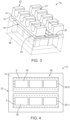
- FIGS. 1-5 are various views of one embodiment of an electronic package 10.
- the package 10 includes a substrate 12 that has a first major surface 14, a second major surface 16, and one or more openings 18 disposed through the substrate between the first major surface and the second major surface.
- the package 10 also includes one or more conductive layers 20 sealed to the first major surface 14 of the substrate 12 and over the opening 18; one or more conductor blocks 22 disposed in the openings and extending beyond the second major surface of the substrate, where the conductor blocks are electrically connected to the conductive layers; and one or more electronic devices 24 disposed adjacent to the first major surface of the substrate and electrically connected to the conductive layers.
- the package 10 includes a cover 26 disposed over the electronic devices 24 and the substrate 12 and sealed to the substrate, where the electronic devices are disposed within a cavity 40 of the cover.
- the substrate 12 can include any suitable material or materials.
- the substrate 12 can be a nonconductive substrate that includes any suitable nonconductive material or materials, e.g., sapphire, glass, ceramic, etc. Further, the substrate 12 can take any suitable shape or shapes and have any suitable dimensions. As shown in FIG. 1 , the first major surface 14 of the substrate 12 faces the electronic devices 24 and the cover 26, and the second major surface 16 faces the conductor blocks 22. Although depicted as including a single layer, the substrate 12 can include any suitable number of layers of the same material or differing materials. Further, the substrate 12 can be manufactured as a single part or singulated from a wafer as is further described herein.
- openings 18 Disposed through the substrate 12 between the first and second major surfaces 14, 16 are openings 18.
- Such openings 18 can have any suitable dimensions. Further, the openings 18 can take any suitable shape or shapes in a plane parallel to the first major surface 14 of the substrate, e.g., rectilinear, ovular, polygonal, etc. Any suitable number of openings 18 can be disposed through the substrate 12, e.g., one, two, three, four, five, or more openings.
- the openings 18 can be disposed through the substrate 12 using any suitable technique or techniques, e.g., grit blasting, mechanical machining, laser drilling, chemical etching, water jet, etc.
- the conductive layer 20 can be disposed on the first major surface 14 of the substrate 12 and over one or more of the openings 18. In one or more embodiments, the conductive layer 20 occludes one or more of the openings 18.
- the conductive layer 20 can include one or more layers. Further, the conductive layer 20 can include one or more discrete portions that are electrically connected together or electrically isolated. For example, as shown, e.g., in FIG. 4 , the conductive layer 20 includes a first portion 20-1 and a second portion 20-2. The first and second portions 20-1, 20-2 can be formed separately and disposed on the first major surface 14 of the substrate 12 as discrete portions, or formed as a unitary layer adjacent to the first major surface and patterned using any suitable technique or techniques.
- the conductive layer 20 can include any suitable conductive material or materials, e.g., titanium, copper, silver, gold, nickel, aluminum, niobium, etc. Further, the conductive layer 20 can take any suitable shape or shapes and have any suitable dimensions.
- the conductive layer 20 can be disposed on the first major surface 14 of the substrate 12 using any suitable technique or techniques, e.g., vapor deposition, chemical vapor deposition, ink jet printing, plating, etc. In one or more embodiments, the conductive layer 20 can include a foil that is disposed on the first major surface 14 of the substrate 12 as a sheet of material and then patterned using any suitable technique or techniques.
- the conductive layer 20 can be hermetically sealed to the first major surface 14 of the substrate 12 using any suitable technique or techniques, e.g., diffusion bonding, laser-assisted diffusion bonding, adhering, mechanically fastening, brazing, etc.
- the laser light can include light having a wavelength of at least 200 nm. In one or more embodiments, the laser light can include a wavelength of no greater than 2000 nm.
- laser light can include UV light, visible light, IR light, and combinations thereof.
- the UV light can be provided by a UV laser that has any suitable wavelength or range of wavelengths and any suitable pulse width. In one or more embodiments, a UV laser can be utilized to provide light having a wavelength in a range of 100-400 nm and a pulse width in a range of 1-100 ns.
- the materials for the substrate 12 and the conductive layer 20, and the power level and wavelength of the light used may be selected such that the light may not directly damage, ablate, warp, or cut the substrate and the housing, and such that the substrate and the housing retain their bulk properties.
- electromagnetic radiation can be provided by any suitable laser or laser system.
- the laser may generate electromagnetic radiation having a relatively narrow set of wavelengths (e.g., a single wavelength).
- the electromagnetic radiation emitted by the laser may form a collimated beam that may not be focused on a particular point.
- the electromagnetic radiation emitted by the laser may be focused on a focal point at a region between the first major surface 14 of the substrate 12 and the conductive layer 20 to generate a laser bond 2 ( FIG. 5 ).
- the laser may provide electromagnetic radiation that has a narrow range of wavelengths
- the laser may represent one or more devices that emit electromagnetic radiation having a wider range of wavelengths than a single typical laser.
- a wide variety of devices may be used to emit electromagnetic radiation having a narrow or wide range of wavelengths.
- the laser may include one or more laser devices including diode and fiber lasers.
- Laser sources may also include, e.g., Ti sapphire lasers, argon ion lasers, Nd:YAG lasers, XeF lasers, HeNe lasers, Dye lasers, GaAs/AlGaAs lasers, Alexandrite lasers, InGaAs lasers, InGaAsP lasers, Nd:glass lasers, Yb:YAG lasers, and Yb fiber lasers.
- the laser device may also include one of continuous wave, modulated, or pulsed modes. Accordingly, a wide variety of laser devices may be used in the bonding process.
- a power level of the laser may be set to approximately 1 W, distributed across the approximate focused beam diameter of 10 ⁇ m, with a top hat, Gaussian, or other suitable spatial energy profile.
- the bond 2 between the conductive layer 20 and the first major surface 14 can be a bonded region that surrounds one or more openings 18.
- the bonded region can take any suitable shape or combination of shapes.
- the bond 2 can include two or more shapes with one shape circumscribing the second shape.
- the bond 2 can include two or more concentric elliptical bond lines or rings.
- the two or more shapes may be isolated so that the shapes do not intersect or overlap.
- the two or more shapes may intersect or overlap along any suitable portion or portions of the shapes.
- the bond 2 can include two or more bond lines that together surround one or more openings 18.
- the bond can include a series of parallel lines that are intersected by two or more lines that are non-parallel to the series of parallel lines.
- the bond 2 can include an interfacial layer between the conductive layer 20 and the substrate 12. It should be understood that the thickness of the interfacial layer, is in part, a function of the desired strength of the bond 2 and the thickness of the conductive layer 20 and/or the substrate 12. Therefore, this interfacial layer can have any suitable thickness in a direction normal to the first major surface 14 of the substrate 12. In accordance with one or more example embodiments, a typical thickness of the interfacial layer in a direction normal to the first major surface 14 of the substrate 12 includes a thickness of no greater than 10 nm, 100 nm, 150 nm, 200 nm, 500 nm, 1000 nm, or 10 ⁇ m.
- conductor blocks 22 Disposed in one or more of the openings 18 are conductor blocks 22.
- the conductor blocks 22 extend beyond the second major surface 16 of the substrate 12 and are electrically connected to the conductive layer 20.
- the package 10 can include any suitable number of conductor blocks.
- one or more conductor blocks 22 can be disposed in each opening 18. In the embodiment illustrated in FIGS. 1-5 , one conductor block 22 is disposed in each opening 18 of the package 10.
- the conductor blocks 22 can include any suitable conductive material or materials, e.g., titanium, tantalum, niobium, zirconium, platinum, or other conductive, biocompatible, and biostable material. Further, the conductor blocks 22 can take any suitable shape or shapes and have any suitable dimensions. In one or more embodiments, one or more conductor blocks 22 can include a weld tab 28 and a wire terminal 30 connected to the tab. The weld tab 28 is inserted into the opening 18 such that it is electrically connected to the conductive layer 20. The weld tab 28 can take a shape and have dimensions that are complementary with the shape and dimensions of the opening 18 such that tab substantially fills a volume of the opening.
- the weld tab 28 can fill less than the entire volume of the opening 18, and any suitable material can be disposed in the opening to fill space within the opening that is not filled by the tab and provide mechanical support to the tab.
- any suitable material can be disposed in the opening to fill space within the opening that is not filled by the tab and provide mechanical support to the tab.
- an adhesive can be disposed within the opening 18, where the adhesive is adapted to connect the conductor block 22 to the conductive layer 20 and one or more walls of the opening 18 such that the weld tab 28 is mechanically connected to the opening and conductive layer 20 and electrically connected to the conductive layer.
- the conductor block 22 can be connected to the second major surface 16 using any suitable technique or technique, e.g., an adhesive can be disposed between the conductor block and the second major surface of the substrate.
- the wire terminal 30 of one or more of the conductor blocks 22 can take any suitable shape or shapes and have any suitable dimension.
- the wire terminal 30 is adapted to receive a wire or conductor, e.g., of a coil that is disposed within a housing of an implantable medical device as is further described herein.
- the wire terminal 30 can include one or more slots 31 that extend through the wire terminal and are adapted to receive a wire or other conductor.
- the wire terminal 30 can be electrically connected to the coil such that current that is induced in the wire by an electromagnetic field can be directed into the wire terminal.
- the wire terminal 30 is electrically connected to the weld tab 28.
- the current from the coil can, therefore, be directed from the wire terminal 30 to the weld tab 28 and subsequently to the conductive layer 20.
- the wire terminal 30 can be integral with the weld tab 28.
- the wire terminal 30 and weld tab 28 are manufactured separately and connected together using any suitable technique or techniques.
- the package 10 further includes the one or more electronic devices 24 that can be disposed adjacent to the first major surface 14 of the substrate 12 and electrically connected to the conductive layer 20.
- the phrase "adjacent to the first major surface” means that an element or component is disposed closer to the first major surface 14 of the substrate 12 than to the second major surface 16 of the substrate.
- one or more of the electronic devices 24 can be disposed on the conductive layer 20.
- one or more additional conductive layers, contacts, or pads can be disposed between one or more of the electronic devices 24 and the conductive layer 20.
- conductive pads 32 FIG. 4
- the conductive pads 32 can be electrically connected to one or more electronic devices 24 and the conductive layer 20. Such conductive pads 32 can be disposed between one or more electronic devices 24 and the conductive layer 20 using any suitable technique or techniques. Device contacts 25 ( FIG. 1 ) of electronic devices 24 can be electrically connected to the contact pads 32 of conductive layer 20 using any suitable technique or techniques.
- the package 10 can include any suitable number of electronic devices 24. Further, the electronic devices 24 can include any suitable electronic device or component, e.g., capacitors, resistors, diodes, integrated circuits, controllers, processors, sensors (e.g., temperature sensor), batteries, etc.
- the package 10 can include any combination of electronic devices 24. In one or more embodiments, two or more electronic devices 24 can be electrically connected by conductive layer 20 or other conductors.
- each of the electronic devices 24 can include one or more terminals that can be electrically connected to the conductive layer 20.
- each electronic device includes a first terminal 34 and a second terminal 36.
- the first terminal 34 can be electrically connected to the first portion 20-1 of the conductive layer 20, and the second terminal 36 of the device 24 can be electrically connected to the second portion 20-2 of the conductive layer.
- the first terminal 34 of the device 24 can be electrically connected to the first conductor block 22-1 via the first portion 20-1 of the conductive layer 20, and the second terminal 36 can be electrically connected to second conductor block 22-2 via the second portion 20-2 of the conductive layer.
- Current can, therefore, flow from a coil connected to the conductor blocks 22 between the first terminal 34 and the second terminal 36 of at least one of the electronic devices 24.
- the cover 26 can include any suitable material or materials.
- the cover 26 is a nonconductive cover that includes one or more nonconductive material or materials, e.g., glass, sapphire, ceramic, or other, nonconductive, biocompatible, biostable material.
- the cover 26 can be manufactured using any suitable technique or techniques, e.g., molding, etching, laminating, bonding, laser-assisted bonding, co-fired ceramic sintering, hot forming of glass, etc.
- the cover 26 can take any suitable shape or shapes and have any suitable dimensions. In one or more embodiments, a recessed surface 38 of the cover 26 forms a cavity 40 of the cover. The cavity 40 can have any suitable dimensions. In one or more embodiments, the electronic devices 24 are disposed within the cavity 40 of the cover 26 when the cover is sealed to the substrate 12.
- the cover 26 can be sealed to the substrate 12 using any suitable technique or techniques, e.g., diffusion bonding, laser assisted diffusion bonding, adhering, mechanically connecting, brazing, welding of weld rings, etc.
- any suitable diffusion bonding technique or techniques can be utilized to connect the cover 26 to the substrate 12, e.g., the same diffusion bonding techniques described herein regarding bonding of the conductive layer 20 to the substrate 12.
- a bond 4 FIG. 1
- the cover 26 is hermetically sealed to the substrate 12.
- an interfacial layer can be disposed between the cover 26 and the first major surface 14 of the substrate 12 as is further described herein regarding the interfacial layer disposed between the conductive layer 20 and the first major surface 14 of the substrate 12.
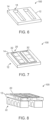
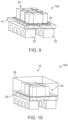
- FIGS. 6-10 are various perspective views of one embodiment of a method 100 of forming the package 10. Although described in regard to package 10, the method 100 can be utilized to form any suitable electronic package.
- one or more openings 18 can be disposed through the nonconductive substrate 12 using any suitable technique or techniques, e.g., laser drilling. Any suitable number of openings 18 can be disposed through the substrate 12. In a wafer-to-wafer bonding process, the openings 18 for a plurality of electronic packages 10 can be disposed through a nonconductive substrate wafer.
- the conductive layer 20 can be disposed adjacent to the first major surface 14 of the substrate 12 and over the openings 18 using any suitable technique or techniques, e.g., vapor deposition. In one or more embodiments, the conductive layer 20 is disposed on the first major surface 14 of the substrate 12. The conductive layer 20 can be hermetically sealed to the first major surface 14 of the substrate 12 and over the openings 18 using any suitable technique or techniques, e.g., diffusion bonding. Further, in one or more embodiments, one or more conductive pads 32 can be disposed on the conductive layer 20 using any suitable technique or techniques. In one or more embodiments, the conductive layer 20 can be patterned using any suitable technique or techniques.
- the nonconductive cover 26 can be disposed over the electronic devices 24 and the conductive layer 20 using any suitable technique or techniques such that the electronic devices and conductive layer are disposed within the cavity 40 of the cover. In wafer-to-wafer bonding processes, a nonconductive cover wafer can be disposed over the electronic devices 24 and the conductive layer 20.
- the cover 26 can also be sealed to the nonconductive substrate 12 using any suitable technique or techniques (e.g., diffusion bonding) to form the electronic package 10. In one or more embodiments, the cover 26 is hermetically sealed to the nonconductive substrate 12.
- the nonconductive cover wafer can be hermetically sealed to the nonconductive substrate wafer, and the wafers can be singulated using any suitable technique or techniques to form a plurality of electronic packages 10, e.g., mechanically sawing the nonconductive cover wafer and the nonconductive substrate wafer to form one or more electronic packages.
- FIG. 11 is a schematic cross-section view of another embodiment of an electronic package 200. All of the design considerations and possibilities described herein regarding the electronic package 10 of FIGS. 1-5 apply equally to the electronic package 200 of FIG. 11 .
- package 200 includes a second substrate 202 that faces substrate 212 and additional electronic devices 208 disposed on the substrate and electrically connected to conductive layer 220 using any suitable technique or techniques.
- the second substrate 202 can include any suitable substrate, e.g., substrate 12 of FIGS. 1-5 .
- the second substrate 202 can also include a conductive layer disposed on one or both of its major surfaces.
- the additional electronic devices 208 can include any suitable electronic devices, e.g., the same electronic devices described herein regarding electronic devices 24 of FIGS. 1-5 .
- Electronic devices 224 are disposed between the substrate 212 and the second substrate 202. Further, one or more of the electronic devices 224 can be electrically connected to a conductive layer of the second substrate 202 and conductive layer 220 of substrate 212.
- the substrate 212, electronic devices 224, second substrate 202, and additional electronic devices 208 can be disposed within a cavity 240 of cover 226 that is defined by a recessed surface 238 of the cover.
- cover 226 can be hermetically sealed to substrate 212 using any suitable technique or techniques.
- FIG. 12 Another embodiment of an electronic package 300 is illustrated in FIG. 12 . All of the design considerations and possibilities described herein regarding electronic package 10 of FIGS. 1-5 and electronic package 200 of FIG. 11 apply equally to electronic package 300 of FIG. 12 .
- One difference between package 300 and packages 10 and 200 is that additional electronic devices 308 of package 300 can be disposed on conductive layer 320 or on a second substrate 306 that is disposed on the conductive layer.
- the additional electronic devices 308 can be disposed adjacent to a first major surface 314 of substrate 312. In one or more embodiments, the additional electronic devices 308 are not disposed over an opening disposed through the substrate 312.
- cavity 340 of housing 326 has a volume that allows for the additional electronic devices to be disposed within the cavity along with electronic devices 324.
- Additional electronic devices 308 can be electrically connected to the conductive layer 320 using any suitable technique or techniques, e.g., the same techniques described herein regarding electrical connection of electronic devices 24 to conductive layer 20 of package 10. Further, additional electronic devices 308 can be electrically connected to devices 324 via the conductive layer 320 or one or more additional conductors disposed within the cavity 340.
- the additional electronic devices 308 can include any suitable electronic devices.
- the package 300 can include any suitable number of additional electronic devices 308, e.g., the same electronic devices described herein regarding electronic devices 24 of FIGS. 1-5 . Such additional electronic devices 308 may not be directly connected to conductor blocks 322 that are disposed within openings 318 of substrate 312.
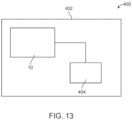
- FIG. 13 is a schematic plan view of one embodiment of a device 400.
- the device can be any suitable device 400, e.g., an implantable medical device.
- implantable medical device can include any suitable implantable medical device, e.g., defibrillator, LVAD, neurostimulator, pacemaker, drug pump, etc.
- the disclosed embodiments of implantable medical devices can be utilized with any suitable system or systems.
- one or more embodiments of implantable medical devices can be utilized with a wireless energy transfer system, e.g., one or more of the systems described in U.S. Patent No. 10,143,788 B2 , entitled TRANSCUTANEOUS ENERGY TRANSFER SYSTEMS.
- the device 400 can be an implantable medical device that includes a housing 402 and electronic package 10 of FIGS. 1-5 disposed within the housing. Although described in regard to package 10 of FIGS. 1-5 , the device 400 can include any suitable electronic package. In one or more embodiments, one or more additional electronic components or devices 404 can be disposed within the housing 402. Such additional components 404 can be electrically connected to the electronic package 10 using any suitable technique or techniques.
- the housing 402 can include any suitable housing that can take any suitable shape or shapes and have any suitable dimensions. Further, the housing 402 can include any suitable material or materials, e.g., metallic material such as titanium and steel, polymeric materials such as polyurethane, inorganic materials such as ceramics, glass, or combinations thereof.
- the device 400 can include any suitable device or devices.
- FIGS. 14-15 are various views of another embodiment of an implantable medical device 500.
- the device 500 can be a part of a wireless energy transfer system that can also include an external component that can provide an electromagnetic field to the implantable medical device 500 such that electromagnetic energy can be transferred from the external component to the medical device 500 to provide energy to one or more electronic components are packages disposed within a housing 502 of the device or electrically connected to the device by cable 544.
- the device 500 includes a housing 502 having a first major surface 504, a second major surface of 506, a sidewall 507 that extends between the first major surface and the second major surface, and a port 508 disposed in the sidewall.
- the device 500 also includes electronic package 300 of FIG.
- the device 500 can include any suitable electronic package described herein, e.g., package 10 of FIGS. 1-5 .
- the cable 544 is electrically connected to the electronic package 300 and extends through the port 508.
- the first and second major surfaces 504, 506 of the housing 502 can have any suitable dimensions and take any suitable shape or shapes. In one or more embodiments, at least one of the first major surface 504 or the second major surface 506 can take a planar shape. In one or more embodiments, at least one of the first major surface 504 or the second major surface 506 can take a curved shape.
- the cable 544 can include any suitable material or materials, e.g., urethane, silicone, carbothane, MP35N, MP35N/silver core, etc.
- the cable 544 can include one or more conductors disposed within a protective sheath or covering. Such conductors can be electrically connected to the electronic device 300 using any suitable technique or techniques.
- the cable 544 can include any suitable number of conductors. Further, the cable 544 can have any suitable dimensions.
- the cable 544 can also have any suitable cross-sectional shapes, e.g., elliptical, rectangular, etc.
- the cable 544 can be connected to two or more electronic components disposed within the housing 502 of the device 500. Further, the cable 544 can include a connector 546 electrically connected to cable end 548. Such connector 546 can include any suitable connector that is adapted to connect the electronic package 300 disposed within the housing 502 to any suitable component or element, e.g., a pump.
- the device 500 can also include a coil 550 disposed in any suitable location on or within the housing 502.
- the coil 550 can include any suitable material or materials and take any suitable shape or shapes. Further, the coil 550 can have any suitable dimensions and include any desired number of windings. In one or more embodiments, the coil 550 can be electrically connected to at least one of the electronic package 300 or the cable 544 using any suitable technique or techniques.
- the coil 550 can be electrically connected to one or more conductor blocks 322 of the electronic package 300 using any suitable technique or techniques.
- one or more of the wires of the coil 550 can be disposed within cleats 330 of conductor blocks 322 to provide electrical connections between electronic components 324 and the coil via conductor blocks 322.
- the coil 550 can also be electrically connected to additional electronic devices 308 using any suitable technique or techniques.
- current induced in the coil 550 by an electromagnetic field applied by an external component of an energy transfer system can charge electronic components 324 thereby storing energy within the package 300 or elsewhere within the body. Such energy can be utilized to provide power to additional electronic devices 308.
- FIGS. 16-17 are schematic views of one embodiment of a wireless energy transfer system 600.
- the system 600 includes the implantable medical device 500 of FIGS. 14-15 and external components 652.
- the external components 652 of the system 600 are illustrated, and in FIG. 17 , the implantable medical device 500 of the system is illustrated as being implanted within a body 602 of a patient 604.
- the external components 652 can include an external module 654 and a primary coil 656.
- the primary coil 656 can be disposed in a separate housing 658 from the external module 654.
- the external module 654 can be located in any suitable location relative to the patient's body 602, e.g., around the patient's hip (e.g., in a pocket of the patient's clothing, mounted to a belt of the patient, etc.), and the primary coil 656 can be located in any suitable location relative to the patient's body 602, e.g., on the patient's chest and secured in place by a garment worn by the patient, such as a sling or vest.
- the external module 654 and primary coil 656 are further connected to each other by a wire 660.
- a clinical monitor 662 which can be worn, e.g., on the patient's wrist. In other examples, the clinical monitor 662 can be located elsewhere, such as in the external module, or in the patient's smartphone, or not on the patient altogether.
- an external battery, and external electronics can be disposed in a housing 664 of the external module 654.
- the external battery may be disposed in a separate housing (e.g., separately mounted to the outside of the patient) and wired to the external module 654.
- the system 600 includes electronic device 500 of FIGS. 14-15
- the system can include any suitable electronic device or package described herein, e.g., electronic package 10 of FIGS. 1-5 .
- the implantable medical device 500 can include the coil 550 (i.e., secondary coil 550) disposed within the housing 502, a pump 566, and an electronic module 568 electrically connected to the housing and the pump.
- each of the housing 502, the pump 566, and the electronic module 568 can be disposed in a separate housing and dispersed throughout the patient's body 602 to accommodate the anatomy of the patient.
- the housing 502 is mounted in the patient's chest.
- the housing 502 can be mounted to the patient's rib, back, abdomen, or muscle in any subcutaneous plane.
- the housing 502 is electrically connected to the electronic module 568 by the cable 544, and the pump 566 is electrically connected to the electronics module 568 by a second cable 570.
- the pump 566 can be connected, e.g., to a heart of the patient.
- the implantable medical device 500 can also include an implanted battery disposed in any suitable location within the patient's body 602.
- the implanted battery is disposed within a housing 512 of the electronics module 568.
- the implanted battery may be separately housed, and an additional wire may connect the electronics module 568 to the implanted battery.
- the secondary coil 550 is disposed within the housing 502 of the implantable medical device 500 and is adapted to be electrically coupled to the primary coil 656.
- the secondary coil 550 can be adapted to be inductively coupled to the primary coil 656.
- Positioning of the secondary coil 550 within the patient 604 can be done in such a manner that makes mounting the primary coil 656 in proximity to the secondary coil easy for the patient.
- the secondary coil 550 can be positioned close to the skin of the patient 604.
- the secondary coil 550 can be positioned close to a relatively flat part of the patient's body 602 to make mounting the primary coil 656 easier. In the embodiment illustrated in FIG.
- the secondary coil 550 disposed within the housing 502 is positioned close to the front of the patient's chest such that mounting the primary coil 656 to the patient's chest places the primary coil proximate the secondary coil.
- the secondary coil 550 can similarly be located close to the patient's skin, such that the primary coil 656 can be mounted in close proximity.
- the described techniques may be implemented in hardware, software, firmware, or any combination thereof. If implemented in software, the functions may be stored as one or more instructions or code on a computer-readable medium and executed by a hardware-based processing unit.
- Computer-readable media may include computer-readable storage media, which corresponds to a tangible medium such as data storage media (e.g., RAM, ROM, EEPROM, flash memory, or any other medium that can be used to store desired program code in the form of instructions or data structures and that can be accessed by a computer).
- processors such as one or more digital signal processors (DSPs), general purpose microprocessors, application specific integrated circuits (ASICs), field programmable logic arrays (FPGAs), or other equivalent integrated or discrete logic circuitry.
- DSPs digital signal processors
- ASICs application specific integrated circuits
- FPGAs field programmable logic arrays
- processors may refer to any of the foregoing structure or any other physical structure suitable for implementation of the described techniques. Also, the techniques could be fully implemented in one or more circuits or logic elements.
Landscapes
- Health & Medical Sciences (AREA)
- Engineering & Computer Science (AREA)
- Heart & Thoracic Surgery (AREA)
- Veterinary Medicine (AREA)
- Biomedical Technology (AREA)
- Life Sciences & Earth Sciences (AREA)
- Animal Behavior & Ethology (AREA)
- General Health & Medical Sciences (AREA)
- Public Health (AREA)
- Cardiology (AREA)
- Radiology & Medical Imaging (AREA)
- Nuclear Medicine, Radiotherapy & Molecular Imaging (AREA)
- Hematology (AREA)
- Mechanical Engineering (AREA)
- Anesthesiology (AREA)
- Computer Networks & Wireless Communication (AREA)
- Neurology (AREA)
- Neurosurgery (AREA)
- Electrotherapy Devices (AREA)
Description
- This disclosure generally relates to an electronic package and in particular an implantable medical device that includes the electronic package.
- Various systems require electrical coupling between electrical devices disposed within a sealed enclosure or housing and devices or systems external to the enclosure. Oftentimes, such electrical coupling needs to withstand various environmental factors such that a conductive pathway or pathways from the external surface of the enclosure to within the enclosure remains stable. For example, implantable medical devices (IMDs), e.g., cardiac pacemakers, defibrillators, neurostimulators, and drug pumps, which include electronic circuitry and one or more power sources, require an enclosure or housing to contain and seal these elements within a body of a patient. Many of these IMDs include one or more electrical feedthroughs to provide electrical connections between the elements contained within the housing and components of the IMD external to the housing, for example, one or more conductors, sensors, electrodes, and lead wires mounted on an exterior surface of the housing, or electrical contacts housed within a connector header, which is mounted on the housing to provide coupling for one or more implantable leads.
- Transcutaneous energy transfer (TET) systems are used to supply power to implantable medical devices such as pumps that are implanted within a human body. An electromagnetic field generated by a transmitting coil outside the body can transmit power across a cutaneous (skin) barrier to a magnetic receiving coil implanted within the body. The receiving coil can then transfer the received power to the implanted pump or other implantable devices and to one or more power sources (e.g., batteries) implanted within the body to charge the power source. Such systems efficiently generate and wirelessly transmit a sufficient amount of energy to power one or more implanted devices while maintaining the system's efficiency and overall convenience of user.
- TET systems can be utilized, e.g., with ventricular assist devices (VADs) that include implantable blood pumps that are used when a patient's heart is unable to provide adequate circulation to the patient's body, thereby leading to heart failure. Such patients may use a VAD while awaiting a heart transplant or for longer periods of time. Further, some patients may use a VAD while recovering from heart surgery. Such VADs typically include implanted power sources that can be charged, e.g., by a TET system.
-
US 8 805 537 B1 describes a hybrid packing for implantable device. -
US 2014/335301 A1 describes a method of bonding two substrates and a device manufactured thereby. - The techniques of this disclosure generally relate to an electronic package and an implantable medical device that includes such electronic package. The package can include a nonconductive substrate and a conductive layer hermetically sealed to a first major surface of the substrate over an opening disposed through the substrate. The package can also include a conductor block disposed in the opening of the substrate that is electrically connected to the conductive layer, and an electronic device disposed adjacent to the first major surface of the substrate and electrically connected to the conductive layer. A nonconductive cover can be disposed over the electronic device and the nonconductive substrate such that the electronic device is disposed within a cavity of the cover. The cover can be sealed to the substrate.
- In one example, aspects of this disclosure relate to an electronic package that includes a nonconductive substrate having a first major surface, a second major surface, and an opening disposed through the substrate between the first major surface and the second major surface. The package also includes a conductive layer hermetically sealed to the first major surface of the substrate and over the opening; a conductor block disposed in the opening and extending beyond the second major surface of the substrate, where the conductor block is electrically connected to the conductive layer; and an electronic device disposed adjacent to the first major surface of the substrate and electrically connected to the conductive layer. The package also includes a nonconductive cover disposed over the electronic device and the nonconductive substrate and hermetically sealed to the substrate, where the electronic device is disposed within a cavity of the cover.
- In another example, aspects of this disclosure relate to an implantable medical device that includes a housing and an electronic package disposed within the housing. The electronic package includes a nonconductive substrate having a first major surface, a second major surface, and an opening disposed through the substrate between the first major surface and the second major surface. The package further includes a conductive layer hermetically sealed to the first major surface of the substrate and over the opening; a conductor block disposed in the opening and extending beyond the second major surface of the substrate, where the conductor block is electrically connected to the conductive layer; and an electronic device disposed adjacent to the first major surface of the substrate and electrically connected to the conductive layer. The package further includes a nonconductive cover disposed over the electronic device and the nonconductive substrate and hermetically sealed to the substrate, where the electronic device is disposed within a cavity of the cover.
- In another example, aspects of this disclosure relate to a method that includes disposing an opening through a nonconductive substrate, where the opening extends between a first major surface and a second major surface of the nonconductive substrate; hermetically sealing a conductive layer to the first major surface of the substrate and over the opening; and disposing a conductor block in the opening such that it extends beyond the second major surface of the substrate, where the conductor block is electrically connected to the conductive layer. The method further includes disposing an electronic device adjacent to the first major surface of the nonconductive substrate, where the electronic device is electrically connected to the conductive layer; disposing a nonconductive cover over the electronic device and the conductive layer, where the electronic device is disposed within a cavity of the cover; and hermetically sealing the nonconductive cover to the nonconductive substrate to form an electronic package.
- In another example, aspects of this disclosure relate to a method that includes disposing an opening through a nonconductive substrate wafer such that the opening extends between a first major surface and a second major surface of the nonconductive substrate wafer; hermetically sealing a conductive layer to the first major surface of the nonconductive substrate wafer; and patterning the conductive layer. The method further includes disposing a conductor block in the opening of the nonconductive substrate wafer such that it extends beyond the second major surface of the nonconductive substrate wafer, where the conductor block is electrically connected to the conductive layer; disposing an electronic device adjacent to the first major surface of the nonconductive substrate wafer, where the electronic device is electrically connected to the conductive layer; and disposing a nonconductive cover wafer over the electronic device and the conductive layer, where the electronic device is disposed within a cavity of the nonconductive cover wafer. The method further includes hermetically sealing the nonconductive cover wafer to the nonconductive substrate wafer, and singulating the nonconductive cover wafer and the nonconductive substrate wafer to form an electronic package.
- The details of one or more aspects of the disclosure are set forth in the accompanying drawings and the description below. Other features, objects, and advantages of the techniques described in this disclosure will be apparent from the description and drawings, and from the claims.
-
-
FIG. 1 is a schematic cross-section view of one embodiment of an electronic package. -
FIG. 2 is a schematic side perspective of the electronic package ofFIG. 1 with a cover and a substrate of the package made transparent for clarity. -
FIG. 3 is a schematic bottom perspective view of the electronic package ofFIG. 1 with the cover and the substrate of the package made transparent for clarity. -
FIG. 4 is a schematic plan view of a first major surface of the substrate of the electronic package ofFIG. 1 . -
FIG. 5 is a schematic exploded view of the electronic package ofFIG. 1 . -
FIG. 6 is a schematic perspective view of one element of a method of making the electronic package ofFIG. 1 . -
FIG. 7 is a schematic perspective view of another element of the method ofFIG. 6 . -
FIG. 8 is a schematic perspective view of another element of the method ofFIG. 6 . -
FIG. 9 is a schematic perspective view of another element of the method ofFIG. 6 . -
FIG. 10 is a schematic perspective view of another element of the method ofFIG. 6 with the cover and the substrate of the package made transparent for clarity. -
FIG. 11 is a schematic cross-section view of another embodiment of an electronic package. -
FIG. 12 is a schematic cross-section view of another embodiment of an electronic package. -
FIG. 13 is a schematic plan view of one embodiment of a device that includes the electronic package ofFIG. 1 . -
FIG. 14 is a schematic perspective view of one embodiment of an implantable medical device. -
FIG. 15 is a schematic cross-section view of a housing of the implantable medical device ofFIG. 14 . -
FIG. 16 is a schematic plan view of external components of a wireless energy transfer system. -
FIG. 17 is a schematic plan view of internal components of the wireless energy transfer system ofFIG. 16 and the implantable medical device ofFIG. 14 . - The techniques of this disclosure generally relate to an electronic package and an implantable medical device that includes such electronic package. The package can include a nonconductive substrate and a conductive layer hermetically sealed to a first major surface of the substrate over an opening disposed through the substrate. The package can also include a conductor block disposed in the opening of the substrate that is electrically connected to the conductive layer, and an electronic device disposed adjacent to the first major surface of the substrate and electrically connected to the conductive layer. A nonconductive cover can be disposed over the electronic device and the nonconductive substrate such that the electronic device is disposed within a cavity of the cover. The cover can be sealed to the substrate.
- Charging systems such as transcutaneous energy transfer systems can charge implantable medical devices by generating an electromagnetic field using an external transmitting coil and transmitting such field to a magnetic receiving coil implanted within a body of a patient and electrically connected to the implantable medical device. Such electromagnetic field can, however, undesirably produce eddy currents in portions of a housing of these implantable medical devices. Further, some housings of these implantable medical devices can reduce charging efficiency by interfering with the transmission of the electromagnetic radiation. Excessive heat can also be generated in metal materials of the housing or such materials disposed within the housing. Some housings of these systems can also lack hermeticity.
- Various embodiments of electronic packages and devices and systems that include such packages provide one or more advantages over currently-available packages and devices. For example, one or more embodiments of packages described herein include a feedthrough that has low resistance such that large electrical currents can pass from a conductor block disposed external to a housing of the device to one or more electrical components disposed within the housing. Low resistance can be provided by the direct connection between the conductor block and the conductive layer. Further, one or more embodiments include a nonconductive housing that can reduce eddy-current formation in the housing when the package is exposed to an electromagnetic field used to charge the device. The package can have a low profile with a small form factor. Further, one or more embodiments of packages described herein can be manufactured using a wafer to wafer process.
-
FIGS. 1-5 are various views of one embodiment of anelectronic package 10. Thepackage 10 includes asubstrate 12 that has a firstmajor surface 14, a secondmajor surface 16, and one ormore openings 18 disposed through the substrate between the first major surface and the second major surface. Thepackage 10 also includes one or moreconductive layers 20 sealed to the firstmajor surface 14 of thesubstrate 12 and over theopening 18; one or more conductor blocks 22 disposed in the openings and extending beyond the second major surface of the substrate, where the conductor blocks are electrically connected to the conductive layers; and one or moreelectronic devices 24 disposed adjacent to the first major surface of the substrate and electrically connected to the conductive layers. Further, thepackage 10 includes acover 26 disposed over theelectronic devices 24 and thesubstrate 12 and sealed to the substrate, where the electronic devices are disposed within acavity 40 of the cover. - The
substrate 12 can include any suitable material or materials. In one or more embodiments, thesubstrate 12 can be a nonconductive substrate that includes any suitable nonconductive material or materials, e.g., sapphire, glass, ceramic, etc. Further, thesubstrate 12 can take any suitable shape or shapes and have any suitable dimensions. As shown inFIG. 1 , the firstmajor surface 14 of thesubstrate 12 faces theelectronic devices 24 and thecover 26, and the secondmajor surface 16 faces the conductor blocks 22. Although depicted as including a single layer, thesubstrate 12 can include any suitable number of layers of the same material or differing materials. Further, thesubstrate 12 can be manufactured as a single part or singulated from a wafer as is further described herein. - Disposed through the
substrate 12 between the first and secondmajor surfaces openings 18.Such openings 18 can have any suitable dimensions. Further, theopenings 18 can take any suitable shape or shapes in a plane parallel to the firstmajor surface 14 of the substrate, e.g., rectilinear, ovular, polygonal, etc. Any suitable number ofopenings 18 can be disposed through thesubstrate 12, e.g., one, two, three, four, five, or more openings. Theopenings 18 can be disposed through thesubstrate 12 using any suitable technique or techniques, e.g., grit blasting, mechanical machining, laser drilling, chemical etching, water jet, etc. - The
conductive layer 20 can be disposed on the firstmajor surface 14 of thesubstrate 12 and over one or more of theopenings 18. In one or more embodiments, theconductive layer 20 occludes one or more of theopenings 18. Theconductive layer 20 can include one or more layers. Further, theconductive layer 20 can include one or more discrete portions that are electrically connected together or electrically isolated. For example, as shown, e.g., inFIG. 4 , theconductive layer 20 includes a first portion 20-1 and a second portion 20-2. The first and second portions 20-1, 20-2 can be formed separately and disposed on the firstmajor surface 14 of thesubstrate 12 as discrete portions, or formed as a unitary layer adjacent to the first major surface and patterned using any suitable technique or techniques. - The
conductive layer 20 can include any suitable conductive material or materials, e.g., titanium, copper, silver, gold, nickel, aluminum, niobium, etc. Further, theconductive layer 20 can take any suitable shape or shapes and have any suitable dimensions. Theconductive layer 20 can be disposed on the firstmajor surface 14 of thesubstrate 12 using any suitable technique or techniques, e.g., vapor deposition, chemical vapor deposition, ink jet printing, plating, etc. In one or more embodiments, theconductive layer 20 can include a foil that is disposed on the firstmajor surface 14 of thesubstrate 12 as a sheet of material and then patterned using any suitable technique or techniques. - The
conductive layer 20 can be hermetically sealed to the firstmajor surface 14 of thesubstrate 12 using any suitable technique or techniques, e.g., diffusion bonding, laser-assisted diffusion bonding, adhering, mechanically fastening, brazing, etc. - For example, the
conductive layer 20 can be hermetically sealed to the firstmajor surface 14 of thesubstrate 12 using one or more of the diffusion bonding techniques described in co-owned and co-filedU.S. Patent Application No. 10,124,559 to Sandlin et al. substrate 12 from its secondmajor surface 16 and focused on a region between the firstmajor surface 14 of thesubstrate 12 and theconductive layer 20. Any suitable electromagnetic radiation can be utilized to form the bond. In one or more embodiments, the electromagnetic radiation can include laser light that can include any suitable wavelength or range of wavelengths. In one or more embodiments, the laser light can include light having a wavelength of at least 200 nm. In one or more embodiments, the laser light can include a wavelength of no greater than 2000 nm. For example, laser light can include UV light, visible light, IR light, and combinations thereof. The UV light can be provided by a UV laser that has any suitable wavelength or range of wavelengths and any suitable pulse width. In one or more embodiments, a UV laser can be utilized to provide light having a wavelength in a range of 100-400 nm and a pulse width in a range of 1-100 ns. In one or more embodiments, the materials for thesubstrate 12 and theconductive layer 20, and the power level and wavelength of the light used may be selected such that the light may not directly damage, ablate, warp, or cut the substrate and the housing, and such that the substrate and the housing retain their bulk properties. - In general, electromagnetic radiation can be provided by any suitable laser or laser system. For example, the laser may generate electromagnetic radiation having a relatively narrow set of wavelengths (e.g., a single wavelength). In one or more embodiments, the electromagnetic radiation emitted by the laser may form a collimated beam that may not be focused on a particular point. In one or more embodiments, the electromagnetic radiation emitted by the laser may be focused on a focal point at a region between the first
major surface 14 of thesubstrate 12 and theconductive layer 20 to generate a laser bond 2 (FIG. 5 ). - Although the laser may provide electromagnetic radiation that has a narrow range of wavelengths, in one or more embodiments, the laser may represent one or more devices that emit electromagnetic radiation having a wider range of wavelengths than a single typical laser. A wide variety of devices may be used to emit electromagnetic radiation having a narrow or wide range of wavelengths. In one or more embodiments, the laser may include one or more laser devices including diode and fiber lasers. Laser sources may also include, e.g., Ti sapphire lasers, argon ion lasers, Nd:YAG lasers, XeF lasers, HeNe lasers, Dye lasers, GaAs/AlGaAs lasers, Alexandrite lasers, InGaAs lasers, InGaAsP lasers, Nd:glass lasers, Yb:YAG lasers, and Yb fiber lasers. The laser device may also include one of continuous wave, modulated, or pulsed modes. Accordingly, a wide variety of laser devices may be used in the bonding process. In one or more embodiments, a power level of the laser may be set to approximately 1 W, distributed across the approximate focused beam diameter of 10 µm, with a top hat, Gaussian, or other suitable spatial energy profile.
- In one or more embodiments, the
bond 2 can be a bond line or lines that can be formed between theconductive layer 20 and thesubstrate 12 such that the conductive layer is hermetically sealed to the substrate. Thebond line 2 can take any suitable shape or shapes. For example, thebond line 2 can form a closed shape in a plane parallel to the firstmajor surface 14 of thesubstrate 12 such that the bond surroundsopening 18. As used herein, the term "closed shape" means that the shape is entirely enclosed such that its perimeter is unbroken and continuous. Any suitable closed shape or shapes can be formed by thebond line 2, e.g., elliptical, rectilinear, triangular, polygonal, etc. - In one or more embodiments, the
bond 2 between theconductive layer 20 and the firstmajor surface 14 can be a bonded region that surrounds one ormore openings 18. The bonded region can take any suitable shape or combination of shapes. In one or more embodiments, thebond 2 can include two or more shapes with one shape circumscribing the second shape. For example, thebond 2 can include two or more concentric elliptical bond lines or rings. In such embodiments, the two or more shapes may be isolated so that the shapes do not intersect or overlap. In one or more embodiments, the two or more shapes may intersect or overlap along any suitable portion or portions of the shapes. In one or more embodiments, thebond 2 can include two or more bond lines that together surround one ormore openings 18. For example, the bond can include a series of parallel lines that are intersected by two or more lines that are non-parallel to the series of parallel lines. - In one or more embodiments, the
bond 2 can include an interfacial layer between theconductive layer 20 and thesubstrate 12. It should be understood that the thickness of the interfacial layer, is in part, a function of the desired strength of thebond 2 and the thickness of theconductive layer 20 and/or thesubstrate 12. Therefore, this interfacial layer can have any suitable thickness in a direction normal to the firstmajor surface 14 of thesubstrate 12. In accordance with one or more example embodiments, a typical thickness of the interfacial layer in a direction normal to the firstmajor surface 14 of thesubstrate 12 includes a thickness of no greater than 10 nm, 100 nm, 150 nm, 200 nm, 500 nm, 1000 nm, or 10 µm. - Disposed in one or more of the
openings 18 are conductor blocks 22. The conductor blocks 22 extend beyond the secondmajor surface 16 of thesubstrate 12 and are electrically connected to theconductive layer 20. Although depicted as including two conductor blocks 22, thepackage 10 can include any suitable number of conductor blocks. Further, one or more conductor blocks 22 can be disposed in eachopening 18. In the embodiment illustrated inFIGS. 1-5 , oneconductor block 22 is disposed in each opening 18 of thepackage 10. - The conductor blocks 22 can include any suitable conductive material or materials, e.g., titanium, tantalum, niobium, zirconium, platinum, or other conductive, biocompatible, and biostable material. Further, the conductor blocks 22 can take any suitable shape or shapes and have any suitable dimensions. In one or more embodiments, one or more conductor blocks 22 can include a
weld tab 28 and awire terminal 30 connected to the tab. Theweld tab 28 is inserted into theopening 18 such that it is electrically connected to theconductive layer 20. Theweld tab 28 can take a shape and have dimensions that are complementary with the shape and dimensions of theopening 18 such that tab substantially fills a volume of the opening. In one or more embodiments, theweld tab 28 can fill less than the entire volume of theopening 18, and any suitable material can be disposed in the opening to fill space within the opening that is not filled by the tab and provide mechanical support to the tab. For example, an adhesive can be disposed within theopening 18, where the adhesive is adapted to connect theconductor block 22 to theconductive layer 20 and one or more walls of theopening 18 such that theweld tab 28 is mechanically connected to the opening andconductive layer 20 and electrically connected to the conductive layer. In one or more embodiments, theconductor block 22 can be connected to the secondmajor surface 16 using any suitable technique or technique, e.g., an adhesive can be disposed between the conductor block and the second major surface of the substrate. - The
wire terminal 30 of one or more of the conductor blocks 22 can take any suitable shape or shapes and have any suitable dimension. In one or more embodiments, thewire terminal 30 is adapted to receive a wire or conductor, e.g., of a coil that is disposed within a housing of an implantable medical device as is further described herein. For example, thewire terminal 30 can include one ormore slots 31 that extend through the wire terminal and are adapted to receive a wire or other conductor. In embodiments where thepackage 10 is utilized with a charging coil (e.g.,coil 550 ofFIG. 15 ), thewire terminal 30 can be electrically connected to the coil such that current that is induced in the wire by an electromagnetic field can be directed into the wire terminal. Further, thewire terminal 30 is electrically connected to theweld tab 28. The current from the coil can, therefore, be directed from thewire terminal 30 to theweld tab 28 and subsequently to theconductive layer 20. Thewire terminal 30 can be integral with theweld tab 28. In one or more embodiments, thewire terminal 30 andweld tab 28 are manufactured separately and connected together using any suitable technique or techniques. - The
package 10 further includes the one or moreelectronic devices 24 that can be disposed adjacent to the firstmajor surface 14 of thesubstrate 12 and electrically connected to theconductive layer 20. As used herein, the phrase "adjacent to the first major surface" means that an element or component is disposed closer to the firstmajor surface 14 of thesubstrate 12 than to the secondmajor surface 16 of the substrate. In one or more embodiments, one or more of theelectronic devices 24 can be disposed on theconductive layer 20. In one or more embodiments, one or more additional conductive layers, contacts, or pads can be disposed between one or more of theelectronic devices 24 and theconductive layer 20. For example, conductive pads 32 (FIG. 4 ) can be disposed between one or more of theelectronic devices 24 and theconductive layer 20. Theconductive pads 32 can be electrically connected to one or moreelectronic devices 24 and theconductive layer 20. Suchconductive pads 32 can be disposed between one or moreelectronic devices 24 and theconductive layer 20 using any suitable technique or techniques. Device contacts 25 (FIG. 1 ) ofelectronic devices 24 can be electrically connected to thecontact pads 32 ofconductive layer 20 using any suitable technique or techniques. - The
package 10 can include any suitable number ofelectronic devices 24. Further, theelectronic devices 24 can include any suitable electronic device or component, e.g., capacitors, resistors, diodes, integrated circuits, controllers, processors, sensors (e.g., temperature sensor), batteries, etc. Thepackage 10 can include any combination ofelectronic devices 24. In one or more embodiments, two or moreelectronic devices 24 can be electrically connected byconductive layer 20 or other conductors. - In one or more embodiments, each of the
electronic devices 24 can include one or more terminals that can be electrically connected to theconductive layer 20. For example, as shown inFIG. 5 , each electronic device includes afirst terminal 34 and asecond terminal 36. Thefirst terminal 34 can be electrically connected to the first portion 20-1 of theconductive layer 20, and thesecond terminal 36 of thedevice 24 can be electrically connected to the second portion 20-2 of the conductive layer. Thefirst terminal 34 of thedevice 24 can be electrically connected to the first conductor block 22-1 via the first portion 20-1 of theconductive layer 20, and thesecond terminal 36 can be electrically connected to second conductor block 22-2 via the second portion 20-2 of the conductive layer. Current can, therefore, flow from a coil connected to the conductor blocks 22 between thefirst terminal 34 and thesecond terminal 36 of at least one of theelectronic devices 24. - Disposed over the one or more
electronic devices 24 and thesubstrate 12 is thecover 26. Thecover 26 can include any suitable material or materials. In one or more embodiments, thecover 26 is a nonconductive cover that includes one or more nonconductive material or materials, e.g., glass, sapphire, ceramic, or other, nonconductive, biocompatible, biostable material. Further, thecover 26 can be manufactured using any suitable technique or techniques, e.g., molding, etching, laminating, bonding, laser-assisted bonding, co-fired ceramic sintering, hot forming of glass, etc. - The
cover 26 can take any suitable shape or shapes and have any suitable dimensions. In one or more embodiments, a recessedsurface 38 of thecover 26 forms acavity 40 of the cover. Thecavity 40 can have any suitable dimensions. In one or more embodiments, theelectronic devices 24 are disposed within thecavity 40 of thecover 26 when the cover is sealed to thesubstrate 12. - The
cover 26 can be sealed to thesubstrate 12 using any suitable technique or techniques, e.g., diffusion bonding, laser assisted diffusion bonding, adhering, mechanically connecting, brazing, welding of weld rings, etc. For example, any suitable diffusion bonding technique or techniques can be utilized to connect thecover 26 to thesubstrate 12, e.g., the same diffusion bonding techniques described herein regarding bonding of theconductive layer 20 to thesubstrate 12. A bond 4 (FIG. 1 ) can be formed between anedge 42 of thecover 26 and the firstmajor surface 14 of thesubstrate 12. In one or more embodiments, thecover 26 is hermetically sealed to thesubstrate 12. In one or more embodiments, an interfacial layer can be disposed between thecover 26 and the firstmajor surface 14 of thesubstrate 12 as is further described herein regarding the interfacial layer disposed between theconductive layer 20 and the firstmajor surface 14 of thesubstrate 12. - Any suitable technique or techniques can be utilized to form the
package 10 ofFIGS. 1-5 . For example,FIGS. 6-10 are various perspective views of one embodiment of amethod 100 of forming thepackage 10. Although described in regard topackage 10, themethod 100 can be utilized to form any suitable electronic package. InFIG. 6 , one ormore openings 18 can be disposed through thenonconductive substrate 12 using any suitable technique or techniques, e.g., laser drilling. Any suitable number ofopenings 18 can be disposed through thesubstrate 12. In a wafer-to-wafer bonding process, theopenings 18 for a plurality ofelectronic packages 10 can be disposed through a nonconductive substrate wafer. - In
FIG. 7 , theconductive layer 20 can be disposed adjacent to the firstmajor surface 14 of thesubstrate 12 and over theopenings 18 using any suitable technique or techniques, e.g., vapor deposition. In one or more embodiments, theconductive layer 20 is disposed on the firstmajor surface 14 of thesubstrate 12. Theconductive layer 20 can be hermetically sealed to the firstmajor surface 14 of thesubstrate 12 and over theopenings 18 using any suitable technique or techniques, e.g., diffusion bonding. Further, in one or more embodiments, one or moreconductive pads 32 can be disposed on theconductive layer 20 using any suitable technique or techniques. In one or more embodiments, theconductive layer 20 can be patterned using any suitable technique or techniques. - As shown in
FIG. 8 , themethod 100 further includes disposing one or more conductor blocks 22 in theopenings 18 such that the conductor blocks extend beyond the secondmajor surface 16 of thesubstrate 12, where the conductor blocks are electrically connected to theconductive layer 20. Any suitable technique or techniques can be utilized to dispose the conductor blocks 22 in theopenings 18. In one or more embodiments, theweld tab 28 of eachconductor block 22 can be inserted into theopening 18 such that the tab is electrically connected to theconductive layer 20. The conductor blocks 22 are electrically connected to theconductive layer 20 using any suitable technique or techniques. In one or more embodiments, the conductor blocks 22 are mechanically connected to thesubstrate 12 using any suitable technique or techniques, e.g., each conductor block can be mechanically connected to the walls of theopening 18 or to the secondmajor surface 16 of thesubstrate 12 with an adhesive. - In
FIG. 9 , one or moreelectronic devices 24 can be disposed adjacent to the firstmajor surface 14 of thesubstrate 12 using any suitable technique or techniques. Theelectronic devices 24 can be electrically connected to theconductive layer 20 using any suitable technique or techniques, e.g.,device contacts 25 can electrically connect the devices to the conductive layer. In one or more embodiments, theelectronic devices 24 can, therefore, be electrically connected to the conductor blocks 22 via theconductive layer 20. - As shown in
FIG. 10 , thenonconductive cover 26 can be disposed over theelectronic devices 24 and theconductive layer 20 using any suitable technique or techniques such that the electronic devices and conductive layer are disposed within thecavity 40 of the cover. In wafer-to-wafer bonding processes, a nonconductive cover wafer can be disposed over theelectronic devices 24 and theconductive layer 20. Thecover 26 can also be sealed to thenonconductive substrate 12 using any suitable technique or techniques (e.g., diffusion bonding) to form theelectronic package 10. In one or more embodiments, thecover 26 is hermetically sealed to thenonconductive substrate 12. For wafer processing, the nonconductive cover wafer can be hermetically sealed to the nonconductive substrate wafer, and the wafers can be singulated using any suitable technique or techniques to form a plurality ofelectronic packages 10, e.g., mechanically sawing the nonconductive cover wafer and the nonconductive substrate wafer to form one or more electronic packages. -
FIG. 11 is a schematic cross-section view of another embodiment of anelectronic package 200. All of the design considerations and possibilities described herein regarding theelectronic package 10 ofFIGS. 1-5 apply equally to theelectronic package 200 ofFIG. 11 . One difference betweenpackage 200 ofFIG. 11 andpackage 10 ofFIGS. 1-5 is thatpackage 200 includes asecond substrate 202 that facessubstrate 212 and additionalelectronic devices 208 disposed on the substrate and electrically connected toconductive layer 220 using any suitable technique or techniques. Thesecond substrate 202 can include any suitable substrate, e.g.,substrate 12 ofFIGS. 1-5 . Thesecond substrate 202 can also include a conductive layer disposed on one or both of its major surfaces. The additionalelectronic devices 208 can include any suitable electronic devices, e.g., the same electronic devices described herein regardingelectronic devices 24 ofFIGS. 1-5 .Electronic devices 224 are disposed between thesubstrate 212 and thesecond substrate 202. Further, one or more of theelectronic devices 224 can be electrically connected to a conductive layer of thesecond substrate 202 andconductive layer 220 ofsubstrate 212. Thesubstrate 212,electronic devices 224,second substrate 202, and additionalelectronic devices 208 can be disposed within acavity 240 ofcover 226 that is defined by a recessedsurface 238 of the cover. As withelectronic package 10 ofFIGS. 1-5 , cover 226 can be hermetically sealed tosubstrate 212 using any suitable technique or techniques. - Another embodiment of an
electronic package 300 is illustrated inFIG. 12 . All of the design considerations and possibilities described herein regardingelectronic package 10 ofFIGS. 1-5 andelectronic package 200 ofFIG. 11 apply equally toelectronic package 300 ofFIG. 12 . One difference betweenpackage 300 andpackages electronic devices 308 ofpackage 300 can be disposed onconductive layer 320 or on asecond substrate 306 that is disposed on the conductive layer. The additionalelectronic devices 308 can be disposed adjacent to a firstmajor surface 314 ofsubstrate 312. In one or more embodiments, the additionalelectronic devices 308 are not disposed over an opening disposed through thesubstrate 312. To accommodate theelectronic devices 308,cavity 340 ofhousing 326 has a volume that allows for the additional electronic devices to be disposed within the cavity along withelectronic devices 324. Additionalelectronic devices 308 can be electrically connected to theconductive layer 320 using any suitable technique or techniques, e.g., the same techniques described herein regarding electrical connection ofelectronic devices 24 toconductive layer 20 ofpackage 10. Further, additionalelectronic devices 308 can be electrically connected todevices 324 via theconductive layer 320 or one or more additional conductors disposed within thecavity 340. The additionalelectronic devices 308 can include any suitable electronic devices. Further, thepackage 300 can include any suitable number of additionalelectronic devices 308, e.g., the same electronic devices described herein regardingelectronic devices 24 ofFIGS. 1-5 . Such additionalelectronic devices 308 may not be directly connected to conductor blocks 322 that are disposed withinopenings 318 ofsubstrate 312. - The various embodiments of electronic packages described herein can be utilized in any suitable device or system. For example,
FIG. 13 is a schematic plan view of one embodiment of adevice 400. The device can be anysuitable device 400, e.g., an implantable medical device. Such implantable medical device can include any suitable implantable medical device, e.g., defibrillator, LVAD, neurostimulator, pacemaker, drug pump, etc. Further, the disclosed embodiments of implantable medical devices can be utilized with any suitable system or systems. For example, one or more embodiments of implantable medical devices can be utilized with a wireless energy transfer system, e.g., one or more of the systems described inU.S. Patent No. 10,143,788 B2 - For example, the
device 400 can be an implantable medical device that includes ahousing 402 andelectronic package 10 ofFIGS. 1-5 disposed within the housing. Although described in regard to package 10 ofFIGS. 1-5 , thedevice 400 can include any suitable electronic package. In one or more embodiments, one or more additional electronic components ordevices 404 can be disposed within thehousing 402. Suchadditional components 404 can be electrically connected to theelectronic package 10 using any suitable technique or techniques. Thehousing 402 can include any suitable housing that can take any suitable shape or shapes and have any suitable dimensions. Further, thehousing 402 can include any suitable material or materials, e.g., metallic material such as titanium and steel, polymeric materials such as polyurethane, inorganic materials such as ceramics, glass, or combinations thereof. - The
device 400 can include any suitable device or devices. For example,FIGS. 14-15 are various views of another embodiment of an implantablemedical device 500. Thedevice 500 can be a part of a wireless energy transfer system that can also include an external component that can provide an electromagnetic field to the implantablemedical device 500 such that electromagnetic energy can be transferred from the external component to themedical device 500 to provide energy to one or more electronic components are packages disposed within ahousing 502 of the device or electrically connected to the device bycable 544. Thedevice 500 includes ahousing 502 having a firstmajor surface 504, a second major surface of 506, asidewall 507 that extends between the first major surface and the second major surface, and aport 508 disposed in the sidewall. Thedevice 500 also includeselectronic package 300 ofFIG. 12 disposed within thehousing 502. Although described in regard to package 300 ofFIG. 12 , thedevice 500 can include any suitable electronic package described herein, e.g.,package 10 ofFIGS. 1-5 . Thecable 544 is electrically connected to theelectronic package 300 and extends through theport 508. - The
housing 502 can take any suitable shape or shapes and have any suitable dimensions. Further, thehousing 502 can include any suitable material or materials, e.g., silicone, ceramic, polyurethane, or metal. In one or more embodiments, thehousing 502 includes a nonconductive matrix that encases theelectronic package 300. Any suitable material or materials can be utilized for the nonconductive matrix, e.g., polymers such as polyurethane, PEEK, silicone, polysulfone, epoxy, or any nonconductive, biocompatible, biostable material. In one or more embodiments, thehousing 502 can further include a shell that surrounds the polymer matrix. - The first and second
major surfaces housing 502 can have any suitable dimensions and take any suitable shape or shapes. In one or more embodiments, at least one of the firstmajor surface 504 or the secondmajor surface 506 can take a planar shape. In one or more embodiments, at least one of the firstmajor surface 504 or the secondmajor surface 506 can take a curved shape. - The
cable 544 can include any suitable material or materials, e.g., urethane, silicone, carbothane, MP35N, MP35N/silver core, etc. Thecable 544 can include one or more conductors disposed within a protective sheath or covering. Such conductors can be electrically connected to theelectronic device 300 using any suitable technique or techniques. Thecable 544 can include any suitable number of conductors. Further, thecable 544 can have any suitable dimensions. Thecable 544 can also have any suitable cross-sectional shapes, e.g., elliptical, rectangular, etc. - Although depicted as being connected to a single
electronic package 300, thecable 544 can be connected to two or more electronic components disposed within thehousing 502 of thedevice 500. Further, thecable 544 can include aconnector 546 electrically connected tocable end 548.Such connector 546 can include any suitable connector that is adapted to connect theelectronic package 300 disposed within thehousing 502 to any suitable component or element, e.g., a pump. - The
device 500 can also include acoil 550 disposed in any suitable location on or within thehousing 502. Thecoil 550 can include any suitable material or materials and take any suitable shape or shapes. Further, thecoil 550 can have any suitable dimensions and include any desired number of windings. In one or more embodiments, thecoil 550 can be electrically connected to at least one of theelectronic package 300 or thecable 544 using any suitable technique or techniques. - The
coil 550 can be electrically connected to one or more conductor blocks 322 of theelectronic package 300 using any suitable technique or techniques. In one or more embodiments, one or more of the wires of thecoil 550 can be disposed withincleats 330 of conductor blocks 322 to provide electrical connections betweenelectronic components 324 and the coil via conductor blocks 322. Further, in one or more embodiments, thecoil 550 can also be electrically connected to additionalelectronic devices 308 using any suitable technique or techniques. In general, current induced in thecoil 550 by an electromagnetic field applied by an external component of an energy transfer system can chargeelectronic components 324 thereby storing energy within thepackage 300 or elsewhere within the body. Such energy can be utilized to provide power to additionalelectronic devices 308. - The various embodiments of implantable medical devices described herein can be utilized with any suitable system. For example,
FIGS. 16-17 are schematic views of one embodiment of a wirelessenergy transfer system 600. Thesystem 600 includes the implantablemedical device 500 ofFIGS. 14-15 andexternal components 652. InFIG. 16 , theexternal components 652 of thesystem 600 are illustrated, and inFIG. 17 , the implantablemedical device 500 of the system is illustrated as being implanted within abody 602 of apatient 604. Theexternal components 652 can include anexternal module 654 and aprimary coil 656. In one or more embodiments, theprimary coil 656 can be disposed in aseparate housing 658 from theexternal module 654. Theexternal module 654 can be located in any suitable location relative to the patient'sbody 602, e.g., around the patient's hip (e.g., in a pocket of the patient's clothing, mounted to a belt of the patient, etc.), and theprimary coil 656 can be located in any suitable location relative to the patient'sbody 602, e.g., on the patient's chest and secured in place by a garment worn by the patient, such as a sling or vest. Theexternal module 654 andprimary coil 656 are further connected to each other by awire 660. Also shown inFIG. 16 is aclinical monitor 662, which can be worn, e.g., on the patient's wrist. In other examples, theclinical monitor 662 can be located elsewhere, such as in the external module, or in the patient's smartphone, or not on the patient altogether. - In the embodiment illustrated in
FIG. 16 , an external battery, and external electronics (not shown) can be disposed in ahousing 664 of theexternal module 654. In one or more embodiments, the external battery may be disposed in a separate housing (e.g., separately mounted to the outside of the patient) and wired to theexternal module 654. - Although the
system 600 includeselectronic device 500 ofFIGS. 14-15 , the system can include any suitable electronic device or package described herein, e.g.,electronic package 10 ofFIGS. 1-5 . As illustrated inFIG. 17 , the implantablemedical device 500 can include the coil 550 (i.e., secondary coil 550) disposed within thehousing 502, apump 566, and anelectronic module 568 electrically connected to the housing and the pump. In one or more embodiments, each of thehousing 502, thepump 566, and theelectronic module 568 can be disposed in a separate housing and dispersed throughout the patient'sbody 602 to accommodate the anatomy of the patient. For instance, in the embodiment illustrated inFIG. 17 , thehousing 502 is mounted in the patient's chest. In one or more embodiments, thehousing 502 can be mounted to the patient's rib, back, abdomen, or muscle in any subcutaneous plane. - The
housing 502 is electrically connected to theelectronic module 568 by thecable 544, and thepump 566 is electrically connected to theelectronics module 568 by asecond cable 570. Thepump 566 can be connected, e.g., to a heart of the patient. Although not shown, the implantablemedical device 500 can also include an implanted battery disposed in any suitable location within the patient'sbody 602. In one or more embodiments, the implanted battery is disposed within ahousing 512 of theelectronics module 568. In one or more embodiments, the implanted battery may be separately housed, and an additional wire may connect theelectronics module 568 to the implanted battery. - The
secondary coil 550 is disposed within thehousing 502 of the implantablemedical device 500 and is adapted to be electrically coupled to theprimary coil 656. For example, thesecondary coil 550 can be adapted to be inductively coupled to theprimary coil 656. Positioning of thesecondary coil 550 within thepatient 604 can be done in such a manner that makes mounting theprimary coil 656 in proximity to the secondary coil easy for the patient. For instance, thesecondary coil 550 can be positioned close to the skin of thepatient 604. Moreover, thesecondary coil 550 can be positioned close to a relatively flat part of the patient'sbody 602 to make mounting theprimary coil 656 easier. In the embodiment illustrated inFIG. 17 , thesecondary coil 550 disposed within thehousing 502 is positioned close to the front of the patient's chest such that mounting theprimary coil 656 to the patient's chest places the primary coil proximate the secondary coil. In those examples where thehousing 502 is mounted to the patient's rib, back, or abdomen, thesecondary coil 550 can similarly be located close to the patient's skin, such that theprimary coil 656 can be mounted in close proximity. - It should be understood that various aspects disclosed herein may be combined in different combinations than the combinations specifically presented in the description and accompanying drawings. It should also be understood that, depending on the example, certain acts or events of any of the processes or methods described herein may be performed in a different sequence, may be added, merged, or left out altogether (e.g., all described acts or events may not be necessary to carry out the techniques). In addition, while certain aspects of this disclosure are described as being performed by a single module or unit for purposes of clarity, it should be understood that the techniques of this disclosure may be performed by a combination of units or modules associated with, for example, a medical device.
- In one or more examples, the described techniques may be implemented in hardware, software, firmware, or any combination thereof. If implemented in software, the functions may be stored as one or more instructions or code on a computer-readable medium and executed by a hardware-based processing unit. Computer-readable media may include computer-readable storage media, which corresponds to a tangible medium such as data storage media (e.g., RAM, ROM, EEPROM, flash memory, or any other medium that can be used to store desired program code in the form of instructions or data structures and that can be accessed by a computer).
- Instructions may be executed by one or more processors, such as one or more digital signal processors (DSPs), general purpose microprocessors, application specific integrated circuits (ASICs), field programmable logic arrays (FPGAs), or other equivalent integrated or discrete logic circuitry. Accordingly, the term "processor" as used herein may refer to any of the foregoing structure or any other physical structure suitable for implementation of the described techniques. Also, the techniques could be fully implemented in one or more circuits or logic elements.
Claims (15)
- An electronic package (10) for a medical device comprising:a nonconductive substrate (12) comprising a first major surface (14), a second major surface (16), and an opening (18) disposed through the substrate between the first major surface and the second major surface;a conductive layer (20) hermetically sealed to the first major surface of the substrate and over the opening;a conductor block (22) disposed in the opening and extending beyond the second major surface of the substrate, wherein the conductor block is electrically connected to the conductive layer;an electronic device (24) disposed adjacent to the first major surface of the substrate and electrically connected to the conductive layer; anda nonconductive cover (26) disposed over the electronic device and the nonconductive substrate and hermetically sealed to the substrate, wherein the electronic device is disposed within a cavity (40) of the cover.
- The package of claim 1, further comprising a conductive pad (32) disposed between the electronic device and the conductive layer, wherein the conductive pad is electrically connected to the electronic device and the conductive layer.
- The package of claim 2, wherein the electronic device comprises a capacitor.
- The package of claim 3, wherein the conductor block comprises a weld tab (28) and a wire terminal (30) connected to the weld tab, wherein the weld tab is inserted into the opening of the nonconductive substrate, wherein the wire terminal is adapted to receive a wire.
- The package of any one of the above claims, wherein the nonconductive cover is diffusion bonded to the nonconductive substrate.
- The package of any one of claims 1-5, further comprising an adhesive disposed within the opening of the nonconductive substrate and adapted to connect the conductor block to the conductive layer and one or more walls of the opening.
- An implantable medical device (400) comprising:a housing (402); andan electronic package (10) according to claim 1 disposed within the housing.
- The device of claim 7, further comprising a coil (550) disposed within the housing and electrically connected to the electronic package.
- The device of claim 8, further comprising a cable (544) extending through a port (508) in the housing and electrically connected to the electronic package.
- The device of claim 9, wherein the housing comprises a nonconductive matrix that encases the electronic package.
- The device of claim 10, wherein the housing further comprises a shell surrounding the nonconductive matrix.
- The device of claim 11, wherein the shell comprises a titanium layer disposed on the nonconductive matrix.
- The device of claim 11, wherein the shell comprises a foil layer disposed on the nonconductive matrix.
- The device of claim 11, wherein the shell comprises silicone.
- The device of any one of claims 7 to 14, further comprising an additional electronic component disposed within the housing and electrically connected to the electronic package.
Applications Claiming Priority (3)
| Application Number | Priority Date | Filing Date | Title |
|---|---|---|---|
| US202163143990P | 2021-02-01 | 2021-02-01 | |
| US17/574,362 US12082354B2 (en) | 2021-02-01 | 2022-01-12 | Electronic package and device including same |
| PCT/US2022/014481 WO2022165295A1 (en) | 2021-02-01 | 2022-01-31 | Electronic package and device including same |
Publications (2)
| Publication Number | Publication Date |
|---|---|
| EP4284498A1 EP4284498A1 (en) | 2023-12-06 |
| EP4284498B1 true EP4284498B1 (en) | 2025-04-23 |
Family
ID=80787319
Family Applications (1)
| Application Number | Title | Priority Date | Filing Date |
|---|---|---|---|
| EP22704697.6A Active EP4284498B1 (en) | 2021-02-01 | 2022-01-31 | Electronic package and device including same |
Country Status (2)
| Country | Link |
|---|---|
| EP (1) | EP4284498B1 (en) |
| WO (1) | WO2022165295A1 (en) |
Families Citing this family (1)
| Publication number | Priority date | Publication date | Assignee | Title |
|---|---|---|---|---|
| EP4516347A1 (en) * | 2023-08-31 | 2025-03-05 | Dyconex AG | Partial pushing-in of conductive patterns in lcp |
Citations (2)
| Publication number | Priority date | Publication date | Assignee | Title |
|---|---|---|---|---|
| US20050245982A1 (en) * | 2004-04-30 | 2005-11-03 | Medtronic, Inc. | Connector block for an implantable medical device |
| US20210410340A1 (en) * | 2019-04-12 | 2021-12-30 | Cochlear Limited | Electromagnetic interference shielding of mems microphone via printed circuit board |
Family Cites Families (5)
| Publication number | Priority date | Publication date | Assignee | Title |
|---|---|---|---|---|
| CN104925744A (en) * | 2004-11-04 | 2015-09-23 | 微芯片生物技术公司 | Compression And Cold Weld Sealing Methods And Devices |
| EP2608255A1 (en) * | 2011-12-23 | 2013-06-26 | Micronit Microfluidics B.V. | Method of bonding two substrates and device manufactured thereby |
| US8805537B1 (en) * | 2013-03-13 | 2014-08-12 | Medtronic, Inc. | Hybrid packing for implantable device |
| CA2945711A1 (en) | 2014-04-15 | 2015-10-22 | Heartware, Inc. | Improvements in transcutaneous energy transfer systems |
| US12455905B1 (en) | 2022-12-16 | 2025-10-28 | Amazon Technologies, Inc. | Provider network user console with natural language querying feature |
-
2022
- 2022-01-31 EP EP22704697.6A patent/EP4284498B1/en active Active
- 2022-01-31 WO PCT/US2022/014481 patent/WO2022165295A1/en not_active Ceased
Patent Citations (2)
| Publication number | Priority date | Publication date | Assignee | Title |
|---|---|---|---|---|
| US20050245982A1 (en) * | 2004-04-30 | 2005-11-03 | Medtronic, Inc. | Connector block for an implantable medical device |
| US20210410340A1 (en) * | 2019-04-12 | 2021-12-30 | Cochlear Limited | Electromagnetic interference shielding of mems microphone via printed circuit board |
Also Published As
| Publication number | Publication date |
|---|---|
| EP4284498A1 (en) | 2023-12-06 |
| WO2022165295A1 (en) | 2022-08-04 |
Similar Documents
| Publication | Publication Date | Title |
|---|---|---|
| CN110234392B (en) | Leadless device with overmolded components | |
| EP4076635B1 (en) | Feedthrough assembly and device including same | |
| EP3370823B1 (en) | Sealed package including electronic device and power source | |
| US11647600B2 (en) | Sealed package and method of forming same | |
| US12233477B2 (en) | Hermetic assembly and device including same | |
| EP4284498B1 (en) | Electronic package and device including same | |
| Bjune et al. | Package architecture and component design for an implanted neural stimulator with closed loop control | |
| EP4284495B1 (en) | Feedthrough header assembly and device including same | |
| US12082354B2 (en) | Electronic package and device including same | |
| CN116829225A (en) | Electronic packages and devices including electronic packages | |
| EP4066885A1 (en) | Implantable medical device and method of forming same | |
| WO2026038093A1 (en) | Flexible implantable medical device | |
| WO2026043723A1 (en) | Modular non-hermetic implantable medical device | |
| WO2022165297A1 (en) | Feedthrough header assembly and device including same | |
| WO2025008125A1 (en) | Implantable medical device and assembly method for such device |
Legal Events
| Date | Code | Title | Description |
|---|---|---|---|
| STAA | Information on the status of an ep patent application or granted ep patent |
Free format text: STATUS: UNKNOWN |
|
| STAA | Information on the status of an ep patent application or granted ep patent |
Free format text: STATUS: THE INTERNATIONAL PUBLICATION HAS BEEN MADE |
|
| PUAI | Public reference made under article 153(3) epc to a published international application that has entered the european phase |
Free format text: ORIGINAL CODE: 0009012 |
|
| STAA | Information on the status of an ep patent application or granted ep patent |
Free format text: STATUS: REQUEST FOR EXAMINATION WAS MADE |
|
| 17P | Request for examination filed |
Effective date: 20230829 |
|
| AK | Designated contracting states |
Kind code of ref document: A1 Designated state(s): AL AT BE BG CH CY CZ DE DK EE ES FI FR GB GR HR HU IE IS IT LI LT LU LV MC MK MT NL NO PL PT RO RS SE SI SK SM TR |
|
| DAV | Request for validation of the european patent (deleted) | ||
| DAX | Request for extension of the european patent (deleted) | ||
| GRAP | Despatch of communication of intention to grant a patent |
Free format text: ORIGINAL CODE: EPIDOSNIGR1 |
|
| STAA | Information on the status of an ep patent application or granted ep patent |
Free format text: STATUS: GRANT OF PATENT IS INTENDED |
|
| INTG | Intention to grant announced |
Effective date: 20240730 |
|
| GRAJ | Information related to disapproval of communication of intention to grant by the applicant or resumption of examination proceedings by the epo deleted |
Free format text: ORIGINAL CODE: EPIDOSDIGR1 |
|
| STAA | Information on the status of an ep patent application or granted ep patent |
Free format text: STATUS: REQUEST FOR EXAMINATION WAS MADE |
|
| GRAP | Despatch of communication of intention to grant a patent |
Free format text: ORIGINAL CODE: EPIDOSNIGR1 |
|
| STAA | Information on the status of an ep patent application or granted ep patent |
Free format text: STATUS: GRANT OF PATENT IS INTENDED |
|
| INTC | Intention to grant announced (deleted) | ||
| INTG | Intention to grant announced |
Effective date: 20241120 |
|
| GRAS | Grant fee paid |
Free format text: ORIGINAL CODE: EPIDOSNIGR3 |
|
| GRAA | (expected) grant |
Free format text: ORIGINAL CODE: 0009210 |
|
| STAA | Information on the status of an ep patent application or granted ep patent |
Free format text: STATUS: THE PATENT HAS BEEN GRANTED |
|
| AK | Designated contracting states |
Kind code of ref document: B1 Designated state(s): AL AT BE BG CH CY CZ DE DK EE ES FI FR GB GR HR HU IE IS IT LI LT LU LV MC MK MT NL NO PL PT RO RS SE SI SK SM TR |
|
| REG | Reference to a national code |
Ref country code: GB Ref legal event code: FG4D |
|
| REG | Reference to a national code |
Ref country code: CH Ref legal event code: EP |
|
| REG | Reference to a national code |
Ref country code: DE Ref legal event code: R096 Ref document number: 602022013526 Country of ref document: DE |
|
| REG | Reference to a national code |
Ref country code: IE Ref legal event code: FG4D |
|
| REG | Reference to a national code |
Ref country code: NL Ref legal event code: MP Effective date: 20250423 |
|
| PG25 | Lapsed in a contracting state [announced via postgrant information from national office to epo] |
Ref country code: NL Free format text: LAPSE BECAUSE OF FAILURE TO SUBMIT A TRANSLATION OF THE DESCRIPTION OR TO PAY THE FEE WITHIN THE PRESCRIBED TIME-LIMIT Effective date: 20250423 |
|
| REG | Reference to a national code |
Ref country code: AT Ref legal event code: MK05 Ref document number: 1787235 Country of ref document: AT Kind code of ref document: T Effective date: 20250423 |
|
| PG25 | Lapsed in a contracting state [announced via postgrant information from national office to epo] |
Ref country code: FI Free format text: LAPSE BECAUSE OF FAILURE TO SUBMIT A TRANSLATION OF THE DESCRIPTION OR TO PAY THE FEE WITHIN THE PRESCRIBED TIME-LIMIT Effective date: 20250423 Ref country code: ES Free format text: LAPSE BECAUSE OF FAILURE TO SUBMIT A TRANSLATION OF THE DESCRIPTION OR TO PAY THE FEE WITHIN THE PRESCRIBED TIME-LIMIT Effective date: 20250423 Ref country code: PT Free format text: LAPSE BECAUSE OF FAILURE TO SUBMIT A TRANSLATION OF THE DESCRIPTION OR TO PAY THE FEE WITHIN THE PRESCRIBED TIME-LIMIT Effective date: 20250825 |
|
| REG | Reference to a national code |
Ref country code: LT Ref legal event code: MG9D |
|
| PG25 | Lapsed in a contracting state [announced via postgrant information from national office to epo] |
Ref country code: NO Free format text: LAPSE BECAUSE OF FAILURE TO SUBMIT A TRANSLATION OF THE DESCRIPTION OR TO PAY THE FEE WITHIN THE PRESCRIBED TIME-LIMIT Effective date: 20250723 Ref country code: GR Free format text: LAPSE BECAUSE OF FAILURE TO SUBMIT A TRANSLATION OF THE DESCRIPTION OR TO PAY THE FEE WITHIN THE PRESCRIBED TIME-LIMIT Effective date: 20250724 |
|
| PG25 | Lapsed in a contracting state [announced via postgrant information from national office to epo] |
Ref country code: PL Free format text: LAPSE BECAUSE OF FAILURE TO SUBMIT A TRANSLATION OF THE DESCRIPTION OR TO PAY THE FEE WITHIN THE PRESCRIBED TIME-LIMIT Effective date: 20250423 |
|
| PG25 | Lapsed in a contracting state [announced via postgrant information from national office to epo] |
Ref country code: BG Free format text: LAPSE BECAUSE OF FAILURE TO SUBMIT A TRANSLATION OF THE DESCRIPTION OR TO PAY THE FEE WITHIN THE PRESCRIBED TIME-LIMIT Effective date: 20250423 |
|
| PG25 | Lapsed in a contracting state [announced via postgrant information from national office to epo] |
Ref country code: HR Free format text: LAPSE BECAUSE OF FAILURE TO SUBMIT A TRANSLATION OF THE DESCRIPTION OR TO PAY THE FEE WITHIN THE PRESCRIBED TIME-LIMIT Effective date: 20250423 |
|
| PG25 | Lapsed in a contracting state [announced via postgrant information from national office to epo] |
Ref country code: AT Free format text: LAPSE BECAUSE OF FAILURE TO SUBMIT A TRANSLATION OF THE DESCRIPTION OR TO PAY THE FEE WITHIN THE PRESCRIBED TIME-LIMIT Effective date: 20250423 |
|
| PG25 | Lapsed in a contracting state [announced via postgrant information from national office to epo] |
Ref country code: RS Free format text: LAPSE BECAUSE OF FAILURE TO SUBMIT A TRANSLATION OF THE DESCRIPTION OR TO PAY THE FEE WITHIN THE PRESCRIBED TIME-LIMIT Effective date: 20250723 |
|
| PG25 | Lapsed in a contracting state [announced via postgrant information from national office to epo] |
Ref country code: IS Free format text: LAPSE BECAUSE OF FAILURE TO SUBMIT A TRANSLATION OF THE DESCRIPTION OR TO PAY THE FEE WITHIN THE PRESCRIBED TIME-LIMIT Effective date: 20250823 |
|
| PG25 | Lapsed in a contracting state [announced via postgrant information from national office to epo] |
Ref country code: LV Free format text: LAPSE BECAUSE OF FAILURE TO SUBMIT A TRANSLATION OF THE DESCRIPTION OR TO PAY THE FEE WITHIN THE PRESCRIBED TIME-LIMIT Effective date: 20250423 |
|
| PG25 | Lapsed in a contracting state [announced via postgrant information from national office to epo] |
Ref country code: DK Free format text: LAPSE BECAUSE OF FAILURE TO SUBMIT A TRANSLATION OF THE DESCRIPTION OR TO PAY THE FEE WITHIN THE PRESCRIBED TIME-LIMIT Effective date: 20250423 Ref country code: SM Free format text: LAPSE BECAUSE OF FAILURE TO SUBMIT A TRANSLATION OF THE DESCRIPTION OR TO PAY THE FEE WITHIN THE PRESCRIBED TIME-LIMIT Effective date: 20250423 |
|
| PGFP | Annual fee paid to national office [announced via postgrant information from national office to epo] |
Ref country code: FR Payment date: 20251217 Year of fee payment: 5 |
|
| PG25 | Lapsed in a contracting state [announced via postgrant information from national office to epo] |
Ref country code: CZ Free format text: LAPSE BECAUSE OF FAILURE TO SUBMIT A TRANSLATION OF THE DESCRIPTION OR TO PAY THE FEE WITHIN THE PRESCRIBED TIME-LIMIT Effective date: 20250423 |
|
| PG25 | Lapsed in a contracting state [announced via postgrant information from national office to epo] |
Ref country code: EE Free format text: LAPSE BECAUSE OF FAILURE TO SUBMIT A TRANSLATION OF THE DESCRIPTION OR TO PAY THE FEE WITHIN THE PRESCRIBED TIME-LIMIT Effective date: 20250423 |
|
| REG | Reference to a national code |
Ref country code: DE Ref legal event code: R097 Ref document number: 602022013526 Country of ref document: DE |
|
| PG25 | Lapsed in a contracting state [announced via postgrant information from national office to epo] |
Ref country code: SK Free format text: LAPSE BECAUSE OF FAILURE TO SUBMIT A TRANSLATION OF THE DESCRIPTION OR TO PAY THE FEE WITHIN THE PRESCRIBED TIME-LIMIT Effective date: 20250423 |
|
| PG25 | Lapsed in a contracting state [announced via postgrant information from national office to epo] |
Ref country code: IT Free format text: LAPSE BECAUSE OF FAILURE TO SUBMIT A TRANSLATION OF THE DESCRIPTION OR TO PAY THE FEE WITHIN THE PRESCRIBED TIME-LIMIT Effective date: 20250423 |
|
| PLBE | No opposition filed within time limit |
Free format text: ORIGINAL CODE: 0009261 |
|
| STAA | Information on the status of an ep patent application or granted ep patent |
Free format text: STATUS: NO OPPOSITION FILED WITHIN TIME LIMIT |
|
| REG | Reference to a national code |
Ref country code: CH Ref legal event code: L10 Free format text: ST27 STATUS EVENT CODE: U-0-0-L10-L00 (AS PROVIDED BY THE NATIONAL OFFICE) Effective date: 20260304 |
|
| 26N | No opposition filed |
Effective date: 20260126 |
|
| PGFP | Annual fee paid to national office [announced via postgrant information from national office to epo] |
Ref country code: DE Payment date: 20251217 Year of fee payment: 5 |