EP4284064A1 - Proactive approach to select xnap/ngap-based handover - Google Patents
Proactive approach to select xnap/ngap-based handover Download PDFInfo
- Publication number
- EP4284064A1 EP4284064A1 EP23174269.3A EP23174269A EP4284064A1 EP 4284064 A1 EP4284064 A1 EP 4284064A1 EP 23174269 A EP23174269 A EP 23174269A EP 4284064 A1 EP4284064 A1 EP 4284064A1
- Authority
- EP
- European Patent Office
- Prior art keywords
- gnb
- amf
- ngap
- procedure
- setup
- Prior art date
- Legal status (The legal status is an assumption and is not a legal conclusion. Google has not performed a legal analysis and makes no representation as to the accuracy of the status listed.)
- Granted
Links
Images



Classifications
-
- H—ELECTRICITY
- H04—ELECTRIC COMMUNICATION TECHNIQUE
- H04W—WIRELESS COMMUNICATION NETWORKS
- H04W36/00—Hand-off or reselection arrangements
- H04W36/0005—Control or signalling for completing the hand-off
- H04W36/0055—Transmission or use of information for re-establishing the radio link
- H04W36/0064—Transmission or use of information for re-establishing the radio link of control information between different access points
-
- H—ELECTRICITY
- H04—ELECTRIC COMMUNICATION TECHNIQUE
- H04W—WIRELESS COMMUNICATION NETWORKS
- H04W36/00—Hand-off or reselection arrangements
- H04W36/08—Reselecting an access point
-
- H—ELECTRICITY
- H04—ELECTRIC COMMUNICATION TECHNIQUE
- H04W—WIRELESS COMMUNICATION NETWORKS
- H04W92/00—Interfaces specially adapted for wireless communication networks
- H04W92/16—Interfaces between hierarchically similar devices
- H04W92/20—Interfaces between hierarchically similar devices between access points
Definitions
- the present disclosure relates to Radio Access Network (RAN) for 4G- and 5G-based mobile networks, and relates more particularly to handovers optimization when a user equipment (UE) moves from one cell to another cell in the RAN.
- RAN Radio Access Network
- UE user equipment
- gNB next Generation Node B
- NGAP Next Generation Application Protocol
- AMF Access & Mobility Function
- target gNB target gNB
- Source gNB receives the measurement report for the UE (for mobility) and then it identifies the target gNB.
- Source gNB sends the Xn handover request towards the target gNB.
- source gNB specifies the Globally Unique AMF Identifier (GUAMI) of the AMF which currently handles the UE.
- GUI Globally Unique AMF Identifier
- 3GPP 3rd Generation Partnership Project
- TS Technical Specification
- MCC Mobile Country Code
- MNC Mobile Network Code
- AMF Region ID shall be of 8 bits length.
- AMF Pointer shall be of 6 bits length.
- a proactive approach can be implemented, in which proactive approach the source gNB knows whether the AMF (which currently serves the UE) is supported by the target gNB or not. If the AMF is supported, then only the Xn handover should be initiated. If the AMF is not supported, the NGAP handover shall be directly initiated.
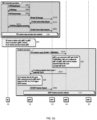
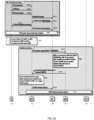
- the current call flows based on invalid AMF set Id is illustrated in FIGs. 1a and 1b , and the current call flows based on unknown GUAMI Id are illustrated in FIGs. 2a & 2b .
- gNB2 14 sends the Xn setup response (with AMF region ID of 32 for gNB2 14) to the gNB1 12, as shown by the process arrow 1006.
- UE 11 is connected to one of the cells in gNB1 12, as summarized in box 105.
- the call flow illustrated in FIG. 1a is continued in FIG. 1b , with the radio resource connection (RRC) procedure shown at the top, which starts with the UE 11 sending the RRC Setup Request message 1007 to the gNB1 12.
- the gNB1 12 sends the RRC Setup message 1008 to the UE 11, which in turn sends the RRC Setup Complete message 1009 to the gNB1 12.
- the Initial UE message 1010 is sent from the gNB1 12 to the AMF1 13, which in turn responds by sending the Initial Context Setup Request message 1011 to the gNB1 12.
- RRC Reconfiguration procedures 1012 are implemented between the gNB1 12 and the UE 11. This is followed by the Initial Context Setup Response message 1013 being sent from the gNB1 12 to the AMF1 13.
- the Protocol Data Unit (PDU) session setup procedure is completed, as summarized in box 106.
- PDU Protocol Data Unit
- the UE moves to another cell in gNB2 14, and gNB1 12 (which has Xn connection to gNB2 14) initiates the Xn handover procedure towards the gNB2 14.
- the Xn handover procedure starts with the gNB1 12 sending the Xn handover request (with GUAMI of 12345632800c) to the gNB2 14, as shown by the process arrow 1014.
- gNB2 14 is not connected to AMF1 13 (with GUAMI of 12345632800c), i.e., the respective AMF set IDs for gNB1 12 and gNB2 14 are different (800 and 400, respectively), as summarized in box 108. Therefore, the gNB2 14 sends to gNB1 12 a message indicating Xn handover preparation failure with cause, i.e., Invalid AMF Set ID, as shown by the process arrow 1015.
- Xn handover fails with the cause of Invalid AMF Set ID, and gNB1 12 understands that gNB2 14 doesn't support the AMF Set ID contained in GUAMI of 12345632800c, so gNB1 12 triggers NGAP handover.
- the NGAP handover is initiated by the gNB1 12 sending NGAP Handover Required message 1016 to the AMF1 13, and the NGAP handover procedure continues thereafter, as summarized in box 110.
- FIGs. 2a and 2b illustrate the call flow sequence of a scenario in which Xn handover failure occurs with unknown GUAMI ID, and NGAP handover is subsequently triggered.
- the call flow sequence starts at the top with the interface level procedures, the beginning of which is summarized in box 201 of FIG. 2a , i.e., first gNB (gNB1) 12, and a first AMF (AMF1) 13, are connected through the NGAP procedures (i.e., NG setup), with the GUAMI of the AMF1 13 being 12345632800c.
- the NGAP procedures start with the gNB1 12 sending the NG setup request to the AMF1 13, as shown by the process arrow 2001.
- NG setup response is sent by AMF1 13 to the gNB1 12, GUAMI of the AMF1 13 being 12345632800c, as shown by the process arrow 2002.
- second gNB (gNB2) 14, and a second AMF (AMF2) are connected through the NGAP procedures (i.e., NG setup), with the GUAMI of the AMF2 15 being 12345632800d.
- the NGAP procedures start with the gNB2 14 sending the NG setup request to the AMF2 15, as shown by the process arrow 2003.
- NG setup response is sent by AMF2 15 to the gNB2 14, GUAMI of the AMF2 15 being 12345632800d, as shown by the process arrow 2004.
- both AMF1 13 and AMF2 15 have (i.e., belong to) the same AMF region ID of 32, and the same AMF set ID of 800, but AMF1 13 and AMF2 15 have (i.e., belong to) different AMF pointers ("c" for AMF1 13, and "d” for AMF2 15).
- gNB1 12 and gNB2 14 are connected through the Xn procedures (i.e., Xn setup).
- the Xn procedures start with the gNB1 12 sending the Xn setup request (with AMF region ID of 32 for gNB1 12) to gNB2 14, as shown by the process arrow 2005.
- the call flow illustrated in FIG. 2a is continued in FIG. 2b , with the radio resource connection (RRC) procedure shown at the top, which starts with the UE 11 sending the RRC Setup Request message 2007 to the gNB1 12.
- the gNB1 12 sends the RRC Setup message 2008 to the UE 11, which in turn sends the RRC Setup Complete message 2009 to the gNB1 12.
- the Initial UE message 2010 is sent from the gNB1 12 to the AMF1 13, which in turn responds by sending the Initial Context Setup Request message 2011 to the gNB1 12.
- RRC Reconfiguration procedures 2012 are implemented between the gNB1 12 and the UE 11. This is followed by the Initial Context Setup Response message 2013 being sent from the gNB1 12 to the AMF1 13.
- the Protocol Data Unit (PDU) session setup procedure is completed, as summarized in box 206.
- PDU Protocol Data Unit
- the UE moves to another cell in gNB2 14, and gNB1 12 (which has Xn connection to gNB2 14) initiates the Xn handover procedure towards the gNB2 14.
- the Xn handover procedure starts with the gNB1 12 sending the Xn handover request (with GUAMI of 12345632800c) to the gNB2 14, as shown by the process arrow 2014.
- gNB2 14 is not connected to AMF1 13 (with GUAMI of 12345632800c), i.e., the respective AMF set IDs for gNB1 12 and gNB2 14 are the same, but the GUAMI of AMF1 13 is unknown to (i.e., is not recognized as being known to) gNB2 14, as summarized in box 208. Therefore, the gNB2 14 sends to gNB1 12 a message indicating Xn handover preparation failure with cause, i.e., Unknown GUAMI ID, as shown by the process arrow 2015.
- Xn handover fails with the cause of Unknown GUAMI ID, and gNB1 12 understands that gNB2 14 doesn't know the GUAMI of AMF1 13, so gNB1 12 triggers NGAP handover.
- the NGAP handover is initiated by the gNB1 12 sending NGAP Handover Required message 2016 to the AMF1 13, and the NGAP handover procedure continues thereafter, as summarized in box 210.
- each gNB doesn't know the supported GUAMI(s) of a peer (target) gNB.
- a method is presented in which, in addition to exchanging the respective AMF region Ids between two gNBs, all supported GUAMls shall be exchanged as part of the Xn setup request/response procedure, thereby enabling each gNB to know the supported GUAMI(s) of a peer (target) gNB.
- source gNB before initiating the Xn handover, source gNB shall check whether the target gNB supports the AMF (which currently serves the UE). If supported, the source gNB shall proceed with the Xnbased handover. If the AMF is not supported by the target gNB, the source gNB shall initiate the NGAP handover.
- AMF which currently serves the UE
- a method is presented in which the Xn setup request/response procedure as specified in 3GPP Xn specification TS 38.423 is modified such that all supported GUAMIs are exchanged as part of the Xn setup request/response procedure.
- all supported GUAMIs shall be added as part of the New Generation Radio Access Network (NG-RAN) Configuration Update procedure, as well.
- the gNB shall initiate the NG-RAN configuration update towards the peer (target) gNB with the whole list of GUAMIs.
- a method in which, in addition to exchanging the respective AMF region IDs between two gNBs, all supported GUAMls shall be exchanged as part of the Xn setup request/response procedure, thereby enabling each gNB to know the supported GUAMI(s) of a peer (target) gNB.
- the Xn setup request/response procedure as specified in 3GPP Xn specification TS 38.423 is modified to reflect the exchange of all supported GUAMIs in the Xn setup request/response procedure.
- the new IE List of GUAMIs (Served GUAMI List) needs to be added in the following messages: Xn setup request, Xn setup response, NG-RAN Node Configuration Update, NG-RAN Node Configuration Update acknowledge message in 3GPP Xn Application Protocol (XnAP) Technical Specification TS 38.423.
- Definition of GUAMI is same as section 9.3.3.3 in 3GPP NGAP 38.413 specification.
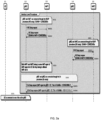
- FIGs. 3a and 3b illustrate an example call flow sequence for a proactive initiation of NGAP handover according to the present disclosure.
- the call flow sequence starts at the top with the interface level procedures, the beginning of which is summarized in box 301 of FIG. 3a , i.e., first gNB (gNB1) 12, and a first AMF (AMF1) 13, are connected through the NGAP procedures (i.e., NG setup), with the GUAMI of the AMF1 13 being 12345632800c.
- the NGAP procedures start with the gNB1 12 sending the NG setup request to the AMF1 13, as shown by the process arrow 3001.
- gNB2 14 sends the Xn setup response with i) AMF region ID of 32 and ii) the list of GUAMIs (12345632400a) for gNB2 14 to the gNB1 12, as shown by the process arrow 3006. Because GUAMls are exchanged between gNB1 12 and gNB2 14, each gNB knows the supported GUAMIs of the other gNB, which information can be used to determine whether an Xn handover would be rejected or not. At this point in the call flow, UE 11 is connected to one of the cells in gNB1 12, as summarized in box 305.
Landscapes
- Engineering & Computer Science (AREA)
- Computer Networks & Wireless Communication (AREA)
- Signal Processing (AREA)
- Mobile Radio Communication Systems (AREA)
Abstract
Description
- The present disclosure relates to Radio Access Network (RAN) for 4G- and 5G-based mobile networks, and relates more particularly to handovers optimization when a user equipment (UE) moves from one cell to another cell in the RAN.
- In 5G New Radio (NR) standards, handovers between a first next Generation Node B (gNB) and a second gNB are performed using an Xn interface or Next Generation Application Protocol (NGAP). Xn handover is performed through an Xn connection between two gNBs. NGAP handover is performed in the following sequence: the source gNB -> Access & Mobility Function (AMF) -> target gNB. Xn handover is preferred over NGAP handover due to less hop and typically faster speed.
- UE would be connected to the source gNB, and the source gNB would have selected a specific Access & Mobility Function (AMF) to handle this UE. Source gNB receives the measurement report for the UE (for mobility) and then it identifies the target gNB. Source gNB sends the Xn handover request towards the target gNB. As part of the Xn handover request, source gNB specifies the Globally Unique AMF Identifier (GUAMI) of the AMF which currently handles the UE. As per 3rd Generation Partnership Project (3GPP) Technical Specification (TS) 23.502, Xn handovers are only supported for intra-AMF mobility.
- As per 3GPP TS 23.003, the following are specified:
- <GUAMI> = <MCC><MNC><AMF Identifier>
and - <AMF Identifier> = <AMF Region ID><AMF Set ID><AMF Pointer>
- Mobile Country Code (MCC) and Mobile Network Code (MNC) shall have the same field size as in earlier 3GPP systems.
- AMF Region ID shall be of 8 bits length.
- AMF Set ID shall be of 10 bits length.
- AMF Pointer shall be of 6 bits length.
- On receiving the Xn handover request, the target gNB performs the following checks:
- 1. It checks whether it supports AMF set ID as received in handover request.
- a. If not supported, target gNB rejects the Xn handover request by sending handover preparation failure notification with cause as Invalid AMF Set ID.
- 2. If AMF set ID is supported, it checks whether it knows the GUAMI and has connection to this specified AMF or not.
- a. If not supported (or) not connected, target gNB rejects the Xn handover request by sending handover preparation failure notification with cause as Unknown GUAMI ID.
- Upon receiving the handover preparation failure with the above causes, source gNB understands that the current AMF (which serves the UE) is not supported by the target gNB. Subsequently, the source gNB triggers the NGAP handover procedure. As part of the NGAP handover procedure, AMF relocation could be needed.
- The above-described approach is a reactive approach because Xn AP handover is initially attempted, and only upon its failure is an NGAP handover initiated. This reactive approach has the following disadvantages:
- 1. This can actually increase the overall handover time.
- 2. This can lead to call drop due to delay in handover.
- 3. This leads to additional Xn signaling.
- 4. Xn handover preparation key performance indicators (KPIs) would be impacted negatively.
- To remedy the above-discussed disadvantages of the reactive approach, a proactive approach can be implemented, in which proactive approach the source gNB knows whether the AMF (which currently serves the UE) is supported by the target gNB or not. If the AMF is supported, then only the Xn handover should be initiated. If the AMF is not supported, the NGAP handover shall be directly initiated. The current call flows based on invalid AMF set Id is illustrated in
FIGs. 1a and1b , and the current call flows based on unknown GUAMI Id are illustrated inFIGs. 2a &2b . -
FIGs. 1a and1b illustrate the call flow sequence of a scenario in which Xn handover failure occurs with invalid AMF Set ID, and NGAP handover is subsequently triggered. The call flow sequence starts at the top with the interface level procedures, the beginning of which is summarized inbox 101 ofFIG. 1a , i.e., first gNB (gNB1) 12, and a first AMF (AMF1) 13, are connected through the NGAP procedures (i.e., NG setup), with the GUAMI of theAMF1 13 being 12345632800c. The NGAP procedures start with thegNB1 12 sending the NG setup request to theAMF1 13, as shown by theprocess arrow 1001. NG setup response is sent byAMF1 13 to thegNB1 12, GUAMI of theAMF1 13 being 12345632800c, as shown by the process arrow 1002. Next, as summarized inbox 102 ofFIG. 1a , second gNB (gNB2) 14, and a second AMF (AMF2) 15, are connected through the NGAP procedures (i.e., NG setup), with the GUAMI of theAMF2 15 being 12345632400a. The NGAP procedures start with thegNB2 14 sending the NG setup request to theAMF2 15, as shown by theprocess arrow 1003. NG setup response is sent byAMF2 15 to thegNB2 14, GUAMI of theAMF2 15 being 12345632400a, as shown by the process arrow 1004. - As summarized in
box 103 ofFIG. 1a , both AMF1 13 andAMF2 15 have (i.e., belong to) the same AMF region ID of 32, but AMF1 13 andAMF2 15 have (i.e., belong to) different AMF set IDs. Next, as summarized inbox 104,gNB1 12 andgNB2 14 are connected through the Xn procedures (i.e., Xn setup). The Xn procedures start with thegNB1 12 sending the Xn setup request (with AMF region ID of 32 for gNB1 12) togNB2 14, as shown by theprocess arrow 1005. Next,gNB2 14 sends the Xn setup response (with AMF region ID of 32 for gNB2 14) to thegNB1 12, as shown by theprocess arrow 1006. At this point in the call flow, UE 11 is connected to one of the cells ingNB1 12, as summarized inbox 105. - The call flow illustrated in
FIG. 1a is continued inFIG. 1b , with the radio resource connection (RRC) procedure shown at the top, which starts with theUE 11 sending the RRCSetup Request message 1007 to thegNB1 12. In response, thegNB1 12 sends theRRC Setup message 1008 to theUE 11, which in turn sends the RRCSetup Complete message 1009 to thegNB1 12. Next, the Initial UE message 1010 is sent from thegNB1 12 to theAMF1 13, which in turn responds by sending the Initial ContextSetup Request message 1011 to thegNB1 12. Subsequently,RRC Reconfiguration procedures 1012 are implemented between thegNB1 12 and theUE 11. This is followed by the Initial ContextSetup Response message 1013 being sent from thegNB1 12 to theAMF1 13. At this point in the call flow sequence, the Protocol Data Unit (PDU) session setup procedure is completed, as summarized inbox 106. - Next in the call flow sequence, as summarized in
box 107 shown inFIG. 1b , the UE moves to another cell ingNB2 14, and gNB1 12 (which has Xn connection to gNB2 14) initiates the Xn handover procedure towards thegNB2 14. The Xn handover procedure starts with thegNB1 12 sending the Xn handover request (with GUAMI of 12345632800c) to thegNB2 14, as shown by theprocess arrow 1014. At this point in the call flow sequence,gNB2 14 is not connected to AMF1 13 (with GUAMI of 12345632800c), i.e., the respective AMF set IDs forgNB1 12 andgNB2 14 are different (800 and 400, respectively), as summarized inbox 108. Therefore, thegNB2 14 sends to gNB1 12 a message indicating Xn handover preparation failure with cause, i.e., Invalid AMF Set ID, as shown by theprocess arrow 1015. As summarized inbox 109, Xn handover fails with the cause of Invalid AMF Set ID, andgNB1 12 understands thatgNB2 14 doesn't support the AMF Set ID contained in GUAMI of 12345632800c, sogNB1 12 triggers NGAP handover. The NGAP handover is initiated by thegNB1 12 sending NGAP Handover Requiredmessage 1016 to theAMF1 13, and the NGAP handover procedure continues thereafter, as summarized inbox 110. -
FIGs. 2a and2b illustrate the call flow sequence of a scenario in which Xn handover failure occurs with unknown GUAMI ID, and NGAP handover is subsequently triggered. The call flow sequence starts at the top with the interface level procedures, the beginning of which is summarized inbox 201 ofFIG. 2a , i.e., first gNB (gNB1) 12, and a first AMF (AMF1) 13, are connected through the NGAP procedures (i.e., NG setup), with the GUAMI of theAMF1 13 being 12345632800c. The NGAP procedures start with thegNB1 12 sending the NG setup request to theAMF1 13, as shown by theprocess arrow 2001. NG setup response is sent byAMF1 13 to thegNB1 12, GUAMI of theAMF1 13 being 12345632800c, as shown by theprocess arrow 2002. Next, as summarized inbox 202 ofFIG. 2a , second gNB (gNB2) 14, and a second AMF (AMF2) 15, are connected through the NGAP procedures (i.e., NG setup), with the GUAMI of theAMF2 15 being 12345632800d. The NGAP procedures start with thegNB2 14 sending the NG setup request to theAMF2 15, as shown by theprocess arrow 2003. NG setup response is sent byAMF2 15 to thegNB2 14, GUAMI of theAMF2 15 being 12345632800d, as shown by the process arrow 2004. - As summarized in
box 203 ofFIG. 2a , both AMF1 13 andAMF2 15 have (i.e., belong to) the same AMF region ID of 32, and the same AMF set ID of 800, but AMF1 13 andAMF2 15 have (i.e., belong to) different AMF pointers ("c" forAMF1 13, and "d" for AMF2 15). Next, as summarized inbox 204,gNB1 12 andgNB2 14 are connected through the Xn procedures (i.e., Xn setup). The Xn procedures start with thegNB1 12 sending the Xn setup request (with AMF region ID of 32 for gNB1 12) togNB2 14, as shown by theprocess arrow 2005. Next,gNB2 14 sends the Xn setup response (with AMF region ID of 32 for gNB2 14) to thegNB1 12, as shown by theprocess arrow 2006. At this point in the call flow,UE 11 is connected to one of the cells ingNB1 12, as summarized inbox 205. - The call flow illustrated in
FIG. 2a is continued inFIG. 2b , with the radio resource connection (RRC) procedure shown at the top, which starts with theUE 11 sending the RRCSetup Request message 2007 to thegNB1 12. In response, thegNB1 12 sends theRRC Setup message 2008 to theUE 11, which in turn sends the RRCSetup Complete message 2009 to thegNB1 12. Next, theInitial UE message 2010 is sent from thegNB1 12 to theAMF1 13, which in turn responds by sending the Initial ContextSetup Request message 2011 to thegNB1 12. Subsequently,RRC Reconfiguration procedures 2012 are implemented between thegNB1 12 and theUE 11. This is followed by the Initial ContextSetup Response message 2013 being sent from thegNB1 12 to theAMF1 13. At this point in the call flow sequence, the Protocol Data Unit (PDU) session setup procedure is completed, as summarized inbox 206. - Next in the call flow sequence, as summarized in
box 207 shown inFIG. 2b , the UE moves to another cell ingNB2 14, and gNB1 12 (which has Xn connection to gNB2 14) initiates the Xn handover procedure towards thegNB2 14. The Xn handover procedure starts with thegNB1 12 sending the Xn handover request (with GUAMI of 12345632800c) to thegNB2 14, as shown by theprocess arrow 2014. At this point in the call flow sequence,gNB2 14 is not connected to AMF1 13 (with GUAMI of 12345632800c), i.e., the respective AMF set IDs forgNB1 12 andgNB2 14 are the same, but the GUAMI ofAMF1 13 is unknown to (i.e., is not recognized as being known to)gNB2 14, as summarized inbox 208. Therefore, thegNB2 14 sends to gNB1 12 a message indicating Xn handover preparation failure with cause, i.e., Unknown GUAMI ID, as shown by theprocess arrow 2015. As summarized inbox 209, Xn handover fails with the cause of Unknown GUAMI ID, andgNB1 12 understands thatgNB2 14 doesn't know the GUAMI ofAMF1 13, sogNB1 12 triggers NGAP handover. The NGAP handover is initiated by thegNB1 12 sending NGAP Handover Requiredmessage 2016 to theAMF1 13, and the NGAP handover procedure continues thereafter, as summarized inbox 210. - As described above, only the AMF region Id is exchanged between two gNBs as part of the conventional Xn setup request/response procedure (e.g., as shown in
FIGS. 1a-1b and2a-2b ), but each gNB doesn't know the supported GUAMI(s) of a peer (target) gNB. - Therefore, there is a need for a solution that optimizes the handover procedure by providing the information regarding the supported GUAMI(s) of a peer (target) gNB.
- According to an example embodiment of the present disclosure, a method is presented in which, in addition to exchanging the respective AMF region Ids between two gNBs, all supported GUAMls shall be exchanged as part of the Xn setup request/response procedure, thereby enabling each gNB to know the supported GUAMI(s) of a peer (target) gNB.
- According to an example embodiment of the present disclosure, before initiating the Xn handover, source gNB shall check whether the target gNB supports the AMF (which currently serves the UE). If supported, the source gNB shall proceed with the Xnbased handover. If the AMF is not supported by the target gNB, the source gNB shall initiate the NGAP handover.
- According to an example embodiment of the present disclosure, a method is presented in which the Xn setup request/response procedure as specified in 3GPP Xn specification TS 38.423 is modified such that all supported GUAMIs are exchanged as part of the Xn setup request/response procedure.
- According to an example embodiment of the present disclosure, all supported GUAMIs shall be added as part of the New Generation Radio Access Network (NG-RAN) Configuration Update procedure, as well. Whenever there is any change in supported GUAMIs (addition/deletion/modification), the gNB shall initiate the NG-RAN configuration update towards the peer (target) gNB with the whole list of GUAMIs.
-
-
FIGs. 1a and1b illustrate the call flow sequence of a scenario in which Xn handover failure occurs with invalid AMF Set ID, and NGAP handover is subsequently triggered. -
FIGs. 2a and2b illustrate the call flow sequence of a scenario in which Xn handover failure occurs with unknown GUAMI ID, and NGAP handover is subsequently triggered. -
FIGs. 3a and3b illustrate an example call flow sequence for a proactive initiation of NGAP handover according to the present disclosure. - According to an example embodiment of the present disclosure, a method is presented in which, in addition to exchanging the respective AMF region IDs between two gNBs, all supported GUAMls shall be exchanged as part of the Xn setup request/response procedure, thereby enabling each gNB to know the supported GUAMI(s) of a peer (target) gNB. The Xn setup request/response procedure as specified in 3GPP Xn specification TS 38.423 is modified to reflect the exchange of all supported GUAMIs in the Xn setup request/response procedure. More specifically, the new IE List of GUAMIs (Served GUAMI List) needs to be added in the following messages: Xn setup request, Xn setup response, NG-RAN Node Configuration Update, NG-RAN Node Configuration Update acknowledge message in 3GPP Xn Application Protocol (XnAP) Technical Specification TS 38.423.
IE/Group Name Presence Range IE type and reference Semantics description Served GUAMI List O >Served GUAMI Item 1..<maxno ofServedG UAMIs> >>GUAMI M "maxnoofServedGUAMls" - Maximum no. of GUAMls served by an AMF; value is 256. Definition of GUAMI is same as section 9.3.3.3 in 3GPP NGAP 38.413 specification. -
FIGs. 3a and3b illustrate an example call flow sequence for a proactive initiation of NGAP handover according to the present disclosure. The call flow sequence starts at the top with the interface level procedures, the beginning of which is summarized inbox 301 ofFIG. 3a , i.e., first gNB (gNB1) 12, and a first AMF (AMF1) 13, are connected through the NGAP procedures (i.e., NG setup), with the GUAMI of theAMF1 13 being 12345632800c. The NGAP procedures start with thegNB1 12 sending the NG setup request to theAMF1 13, as shown by theprocess arrow 3001. NG setup response is sent byAMF1 13 to thegNB1 12, GUAMI of theAMF1 13 being 12345632800c, as shown by theprocess arrow 3002. Next, as summarized inbox 302 ofFIG. 3a , second gNB (gNB2) 14, and a second AMF (AMF2) 15, are connected through the NGAP procedures (i.e., NG setup), with the GUAMI of theAMF2 15 being 12345632400a. The NGAP procedures start with thegNB2 14 sending the NG setup request to theAMF2 15, as shown by theprocess arrow 3003. NG setup response is sent byAMF2 15 to thegNB2 14, GUAMI of theAMF2 15 being 12345632400a, as shown by theprocess arrow 3004. - As summarized in
box 303 ofFIG. 3a , both AMF1 13 andAMF2 15 have (i.e., belong to) the same AMF region ID of 32, but AMF1 13 andAMF2 15 have (i.e., belong to) different AMF set IDs. Next, as summarized inbox 304,gNB1 12 andgNB2 14 are connected through the Xn procedures (i.e., Xn setup). The Xn procedures start with thegNB1 12 sending the Xn setup request with i) AMF region ID of 32 and ii) the list of GUAMIs (i.e., 12345632800c in this case) forgNB1 12 togNB2 14, as shown by theprocess arrow 3005. Next,gNB2 14 sends the Xn setup response with i) AMF region ID of 32 and ii) the list of GUAMIs (12345632400a) forgNB2 14 to thegNB1 12, as shown by theprocess arrow 3006. Because GUAMls are exchanged betweengNB1 12 andgNB2 14, each gNB knows the supported GUAMIs of the other gNB, which information can be used to determine whether an Xn handover would be rejected or not. At this point in the call flow,UE 11 is connected to one of the cells ingNB1 12, as summarized inbox 305. - The call flow illustrated in
FIG. 3a is continued inFIG. 3b , with the radio resource connection (RRC) procedure shown at the top, which starts with theUE 11 sending the RRCSetup Request message 3007 to thegNB1 12. In response, thegNB1 12 sends theRRC Setup message 3008 to theUE 11, which in turn sends the RRCSetup Complete message 3009 to thegNB1 12. Next, theInitial UE message 3010 is sent from thegNB1 12 to theAMF1 13, which in turn responds by sending the Initial ContextSetup Request message 3011 to thegNB1 12. Subsequently,RRC Reconfiguration procedures 3012 are implemented between thegNB1 12 and theUE 11. This is followed by the Initial ContextSetup Response message 3013 being sent from thegNB1 12 to theAMF1 13. At this point in the call flow sequence, the Protocol Data Unit (PDU) session setup procedure is completed, as summarized in box 306. - Next in the call flow sequence, as summarized in box 307 shown in
FIG. 3b , the UE moves to another cell ingNB2 14. Because GUAMls were previously exchanged betweengNB1 12 andgNB2 14, each gNB knows the supported GUAMIs of the other gNB, and gNB1 12 (which has Xn connection to gNB2 14) checks whethergNB2 14 has connection to the currently connected AMF serving theUE 11, i.e.,gNB1 12 checks whether the current GUAMI (i.e., 12345632800c) of the AMF serving theUE 11 is supported by (i.e., included in the list of GUAMls for gNB2 14) or not. As gNB2 doesn't support theGUAMI 12345632800c (i.e.,gNB2 14 doesn't have connection to the currently connected AMF serving the UE 11),gNB1 12 knows that Xn handover would be rejected bygNB2 14 with the cause "Unknown GUAMI ID". Therefore,gNB1 12 doesn't initiate the Xn handover, but instead proceeds directly with the NGAP-based handover. The handover is initiated by thegNB1 12 sending NGAP Handover Requiredmessage 3014 to theAMF1 13, as shown by theprocess arrow 3014, and the NGAP handover procedure continues thereafter, as summarized inbox 308. In thehypothetical case gNB2 14 supports theGUAMI 12345632800c,gNB1 12 would initiate the Xn handover. - Although the above-described example method was presented mainly in the context of 5G NR, the method according to the present disclosure is applicable for Long Term Evolution (LTE) as well. In LTE, X2 handover is applicable only within the same Mobility Management Entity (MME). For LTE, X2AP procedures (X2AP is a control protocol found between eNBs on the X2 control plane), e.g., X2 setup request, X2 setup response, ENB configuration update, and ENB configuration Update Acknowledge messages in 3GPP X2AP specification (TS 36.423) shall be enhanced to include the new Information Element Served Globally Unique MME Identifiers (GUMMEIs).
Claims (15)
- A method of operating a Radio Access Network (RAN) to optimize a handover between a first next Generation Node B (gNB) and a second gNB, comprising:connecting the first gNB and the second gNB by implementing Xn setup procedure, wherein:i) the first gNB is associated with at least a first Access and Mobility Function (AMF);ii) the second gNB is associated with at least a second AMF; andiii) the Xn setup procedure includes:a) sending, by the first gNB to the second gNB, an Xn setup request including at least a list of Globally Unique AMF Identifiers (GUAMIs) associated with the first gNB; andb) sending, by the second gNB to the first gNB, an Xn setup response including at least a list of GUAMIs associated with the second gNB;in the case a user equipment (UE) moves from a first cell of the first gNB to a second cell of the second gNB,1) checking by the first gNB whether GUAMI of the first AMF is included in the list of GUAMIs associated with the second gNB; and2) if the GUAMI of the first AMF is not included in the list of GUAMIs associated with the second gNB, directly initiating a Next Generation Application Protocol (NGAP) handover procedure from the first gNB to the second gNB, without initiating an Xn-based handover from the first gNB to the second gNB.
- The method according to claim 1, wherein at least one of:a) the Xn setup request additionally includes AMF region identifier (ID) for the first gNB; andb) the Xn setup response additionally includes AMF region ID for the second gNB.
- The method according to claim 2, wherein at least one of:i) the first gNB is associated with the at least one first AMF by implementing a first Next Generation Application Protocol (NGAP) procedure; andii) the second gNB is associated with the at least one second AMF by implementing a second NGAP procedure.
- The method according to claim 3, wherein at least one of:i) the first NGAP procedure is initiated by the first gNB sending a first NG setup request to the first AMF; andii) the second NGAP procedure is initiated by the second gNB sending a second NG setup request to the second AMF.
- The method according to claim 4, wherein at least one of:a) the first AMF responds to the first NG setup request by sending a first NG setup response including the GUAMI of the first AMF to the first gNB; andb) the second AMF responds to the second NG setup request by sending a second NG setup response including the GUAMI of the second AMF to the second gNB.
- The method according to claim 1, further comprising:
if a change occurs to the list of Globally Unique AMF Identifiers (GUAMIs) associated with the first gNB, initiating a New Generation Radio Access Network (NG-RAN) Configuration Update procedure by the first gNB to inform the second gNB of the changed list of GUAMIs associated with the first gNB. - The method according to claim 6, further comprising:
if a change occurs to the list of Globally Unique AMF Identifiers (GUAMIs) associated with the second gNB, initiating a New Generation Radio Access Network (NG-RAN) Configuration Update procedure by the second gNB to inform the first gNB of the changed list of GUAMIs associated with the second gNB. - The method according to claim 6, wherein at least one of:a) the Xn setup request additionally includes AMF region identifier (ID) for the first gNB; andb) the Xn setup response additionally includes AMF region ID for the second gNB.
- The method according to claim 8, wherein at least one of:i) the first gNB is associated with the at least one first AMF by implementing a first Next Generation Application Protocol (NGAP) procedure; andii) the second gNB is associated with the at least one second AMF by implementing a second NGAP procedure.
- The method according to claim 9, wherein at least one of:i) the first NGAP procedure is initiated by the first gNB sending a first NG setup request to the first AMF; andii) the second NGAP procedure is initiated by the second gNB sending a second NG setup request to the second AMF.
- The method according to claim 10, wherein at least one of:a) the first AMF responds to the first NG setup request by sending a first NG setup response including the GUAMI of the first AMF to the first gNB; andb) the second AMF responds to the second NG setup request by sending a second NG setup response including the GUAMI of the second AMF to the second gNB.
- The method according to claim 7, wherein at least one of:a) the Xn setup request additionally includes AMF region identifier (ID) for the first gNB; andb) the Xn setup response additionally includes AMF region ID for the second gNB.
- The method according to claim 12, wherein at least one of:i) the first gNB is associated with the at least one first AMF by implementing a first Next Generation Application Protocol (NGAP) procedure; andii) the second gNB is associated with the at least one second AMF by implementing a second NGAP procedure.
- The method according to claim 13, wherein at least one of:i) the first NGAP procedure is initiated by the first gNB sending a first NG setup request to the first AMF; andii) the second NGAP procedure is initiated by the second gNB sending a second NG setup request to the second AMF.
- The method according to claim 14, wherein at least one of:a) the first AMF responds to the first NG setup request by sending a first NG setup response including the GUAMI of the first AMF to the first gNB; andb) the second AMF responds to the second NG setup request by sending a second NG setup response including the GUAMI of the second AMF to the second gNB.
Applications Claiming Priority (2)
| Application Number | Priority Date | Filing Date | Title |
|---|---|---|---|
| IN202221029606 | 2022-05-23 | ||
| US18/318,798 US20230379779A1 (en) | 2022-05-23 | 2023-05-17 | PROACTIVE APPROACH TO SELECT XnAP/NGAP-BASED HANDOVER |
Publications (2)
| Publication Number | Publication Date |
|---|---|
| EP4284064A1 true EP4284064A1 (en) | 2023-11-29 |
| EP4284064B1 EP4284064B1 (en) | 2026-07-08 |
Family
ID=86469088
Family Applications (1)
| Application Number | Title | Priority Date | Filing Date |
|---|---|---|---|
| EP23174269.3A Active EP4284064B1 (en) | 2022-05-23 | 2023-05-19 | Proactive approach to select xnap/ngap-based handover |
Country Status (1)
| Country | Link |
|---|---|
| EP (1) | EP4284064B1 (en) |
-
2023
- 2023-05-19 EP EP23174269.3A patent/EP4284064B1/en active Active
Non-Patent Citations (3)
| Title |
|---|
| 3GPP TS 38.413 V17.0.0: "3GPP TS 38.413 V17.0.0 (2022-04); 3rd Generation Partnership Project; Technical Specification Group Radio Access Network; NG-RAN; NG Application Protocol (NGAP) (Release 17)", vol. RAN WG3, no. V17.0.0, 6 April 2022 (2022-04-06), pages 1 - 561, XP052146521, Retrieved from the Internet <URL:https://ftp.3gpp.org/Specs/archive/38_series/38.413/38413-h00.zip 38413-h00.doc> [retrieved on 20220406] * |
| 3GPP TS 38.423 V17.0.0: "3GPP TS 38.423 V17.0.0 (2022-04); 3rd Generation Partnership Project; Technical Specification Group Radio Access Network; NG-RAN; Xn application protocol (XnAP) (Release 17)", vol. RAN WG3, no. V17.0.0, 6 April 2022 (2022-04-06), pages 1 - 609, XP052146526, Retrieved from the Internet <URL:https://ftp.3gpp.org/Specs/archive/38_series/38.423/38423-h00.zip 38423-h00.doc> [retrieved on 20220406] * |
| CATT: "3GPP TSG-RAN WG3 Meeting 3117e; R3-224634; Exchange of Served GUAMI List over XnAP", vol. RAN WG3, no. Online; 20220815 - 20220824, 9 August 2022 (2022-08-09), XP052264801, Retrieved from the Internet <URL:https://ftp.3gpp.org/tsg_ran/WG3_Iu/TSGR3_117-e/Docs/R3-224634.zip R3-224634 CR for TS 38.423 Exchange Served GUAMI List over XnAP.doc> [retrieved on 20220809] * |
Also Published As
| Publication number | Publication date |
|---|---|
| EP4284064B1 (en) | 2026-07-08 |
Similar Documents
| Publication | Publication Date | Title |
|---|---|---|
| US11463947B2 (en) | Communication method, access network device, and terminal device to facilitate communication in a network slice architecture | |
| US11464056B2 (en) | Method and apparatus for identifying user in radio access network communication system | |
| EP2139257B1 (en) | Synchronization method, radio network and node | |
| EP3820192B1 (en) | Communication method, access network device, and terminal device | |
| EP3811719B1 (en) | Integrity protection handling at the gnb-cu-up level | |
| KR102848649B1 (en) | Reselection of PGW-C/SMF in desired network slice | |
| US8913588B2 (en) | Handover method, communication device and communication system | |
| US11956636B2 (en) | Communication terminal, network device, communication method, and non-transitory computer readable medium | |
| US12349015B2 (en) | Self-optimization method and device | |
| US8885500B2 (en) | Interface setup for communications network with femtocells | |
| EP3496477B1 (en) | Paging method, device and system, and related computer-readable medium | |
| CN112788693A (en) | Method and device for supporting self-optimization | |
| US11399330B2 (en) | Routing selection method, apparatus, device and system, and storage medium | |
| US20240098148A1 (en) | Restoration of a pdn connection at pgw failure | |
| US20250016883A1 (en) | Enhancement to a gtp-u entity restart | |
| WO2020104925A1 (en) | First core network to second core network interworking while reducing usage of default second core network resources | |
| CN101494885B (en) | Multi-load-bearing shared AMBR switching control method | |
| CN118042540A (en) | Cell switching method between base stations, electronic device and storage medium | |
| CN116325907B (en) | Methods and apparatus for porting IAB nodes | |
| US10051513B2 (en) | Method and apparatus for obtaining authentication information | |
| US20250039745A1 (en) | Communication method, access network node, user equipment | |
| US20230379779A1 (en) | PROACTIVE APPROACH TO SELECT XnAP/NGAP-BASED HANDOVER | |
| WO2023109936A1 (en) | Cell handover method and communication device | |
| KR102753873B1 (en) | Method and device for provisioning improved packet detection rules | |
| US20260095971A1 (en) | Methods for mobile terminating data/signaling handling for ues in rrc inactive state, network node and radio network node |
Legal Events
| Date | Code | Title | Description |
|---|---|---|---|
| PUAI | Public reference made under article 153(3) epc to a published international application that has entered the european phase |
Free format text: ORIGINAL CODE: 0009012 |
|
| STAA | Information on the status of an ep patent application or granted ep patent |
Free format text: STATUS: REQUEST FOR EXAMINATION WAS MADE |
|
| 17P | Request for examination filed |
Effective date: 20230519 |
|
| AK | Designated contracting states |
Kind code of ref document: A1 Designated state(s): AL AT BE BG CH CY CZ DE DK EE ES FI FR GB GR HR HU IE IS IT LI LT LU LV MC ME MK MT NL NO PL PT RO RS SE SI SK SM TR |
|
| P01 | Opt-out of the competence of the unified patent court (upc) registered |
Effective date: 20231214 |
|
| RAP1 | Party data changed (applicant data changed or rights of an application transferred) |
Owner name: MAVENIR US INC. |
|
| GRAP | Despatch of communication of intention to grant a patent |
Free format text: ORIGINAL CODE: EPIDOSNIGR1 |
|
| STAA | Information on the status of an ep patent application or granted ep patent |
Free format text: STATUS: GRANT OF PATENT IS INTENDED |
|
| INTG | Intention to grant announced |
Effective date: 20260203 |
|
| GRAS | Grant fee paid |
Free format text: ORIGINAL CODE: EPIDOSNIGR3 |
|
| GRAA | (expected) grant |
Free format text: ORIGINAL CODE: 0009210 |
|
| STAA | Information on the status of an ep patent application or granted ep patent |
Free format text: STATUS: THE PATENT HAS BEEN GRANTED |
|
| RAP1 | Party data changed (applicant data changed or rights of an application transferred) |
Owner name: MAVENIR SYSTEMS, INC. |
|
| AK | Designated contracting states |
Kind code of ref document: B1 Designated state(s): AL AT BE BG CH CY CZ DE DK EE ES FI FR GB GR HR HU IE IS IT LI LT LU LV MC ME MK MT NL NO PL PT RO RS SE SI SK SM TR |
|
| REG | Reference to a national code |
Ref country code: CH Ref legal event code: F10 Free format text: ST27 STATUS EVENT CODE: U-0-0-F10-F00 (AS PROVIDED BY THE NATIONAL OFFICE) Effective date: 20260708 Ref country code: GB Ref legal event code: FG4D |
|
| REG | Reference to a national code |
Ref country code: IE Ref legal event code: FG4D |
|
| REG | Reference to a national code |
Ref country code: DE Ref legal event code: R096 Ref document number: 602023019483 Country of ref document: DE |