EP4283602A1 - Circadian lighting-enabled display system, method, and apparatus - Google Patents
Circadian lighting-enabled display system, method, and apparatus Download PDFInfo
- Publication number
- EP4283602A1 EP4283602A1 EP23172572.2A EP23172572A EP4283602A1 EP 4283602 A1 EP4283602 A1 EP 4283602A1 EP 23172572 A EP23172572 A EP 23172572A EP 4283602 A1 EP4283602 A1 EP 4283602A1
- Authority
- EP
- European Patent Office
- Prior art keywords
- emitter
- pixel
- backlight
- display
- cyan
- Prior art date
- Legal status (The legal status is an assumption and is not a legal conclusion. Google has not performed a legal analysis and makes no representation as to the accuracy of the status listed.)
- Pending
Links
Images



Classifications
-
- G—PHYSICS
- G09—EDUCATION; CRYPTOGRAPHY; DISPLAY; ADVERTISING; SEALS
- G09G—ARRANGEMENTS OR CIRCUITS FOR CONTROL OF INDICATING DEVICES USING STATIC MEANS TO PRESENT VARIABLE INFORMATION
- G09G3/00—Control arrangements or circuits, of interest only in connection with visual indicators other than cathode-ray tubes
- G09G3/20—Control arrangements or circuits, of interest only in connection with visual indicators other than cathode-ray tubes for presentation of an assembly of a number of characters, e.g. a page, by composing the assembly by combination of individual elements arranged in a matrix no fixed position being assigned to or needed to be assigned to the individual characters or partial characters
- G09G3/2003—Display of colours
-
- A—HUMAN NECESSITIES
- A61—MEDICAL OR VETERINARY SCIENCE; HYGIENE
- A61N—ELECTROTHERAPY; MAGNETOTHERAPY; RADIATION THERAPY; ULTRASOUND THERAPY
- A61N5/00—Radiation therapy
- A61N5/06—Radiation therapy using light
- A61N5/0613—Apparatus adapted for a specific treatment
- A61N5/0618—Psychological treatment
-
- G—PHYSICS
- G09—EDUCATION; CRYPTOGRAPHY; DISPLAY; ADVERTISING; SEALS
- G09G—ARRANGEMENTS OR CIRCUITS FOR CONTROL OF INDICATING DEVICES USING STATIC MEANS TO PRESENT VARIABLE INFORMATION
- G09G3/00—Control arrangements or circuits, of interest only in connection with visual indicators other than cathode-ray tubes
- G09G3/20—Control arrangements or circuits, of interest only in connection with visual indicators other than cathode-ray tubes for presentation of an assembly of a number of characters, e.g. a page, by composing the assembly by combination of individual elements arranged in a matrix no fixed position being assigned to or needed to be assigned to the individual characters or partial characters
- G09G3/34—Control arrangements or circuits, of interest only in connection with visual indicators other than cathode-ray tubes for presentation of an assembly of a number of characters, e.g. a page, by composing the assembly by combination of individual elements arranged in a matrix no fixed position being assigned to or needed to be assigned to the individual characters or partial characters by control of light from an independent source
- G09G3/3406—Control of illumination source
- G09G3/3413—Details of control of colour illumination sources
-
- A—HUMAN NECESSITIES
- A61—MEDICAL OR VETERINARY SCIENCE; HYGIENE
- A61N—ELECTROTHERAPY; MAGNETOTHERAPY; RADIATION THERAPY; ULTRASOUND THERAPY
- A61N5/00—Radiation therapy
- A61N5/06—Radiation therapy using light
- A61N2005/0626—Monitoring, verifying, controlling systems and methods
- A61N2005/0629—Sequential activation of light sources
-
- A—HUMAN NECESSITIES
- A61—MEDICAL OR VETERINARY SCIENCE; HYGIENE
- A61N—ELECTROTHERAPY; MAGNETOTHERAPY; RADIATION THERAPY; ULTRASOUND THERAPY
- A61N5/00—Radiation therapy
- A61N5/06—Radiation therapy using light
- A61N2005/0658—Radiation therapy using light characterised by the wavelength of light used
- A61N2005/0662—Visible light
- A61N2005/0663—Coloured light
-
- G—PHYSICS
- G09—EDUCATION; CRYPTOGRAPHY; DISPLAY; ADVERTISING; SEALS
- G09G—ARRANGEMENTS OR CIRCUITS FOR CONTROL OF INDICATING DEVICES USING STATIC MEANS TO PRESENT VARIABLE INFORMATION
- G09G2300/00—Aspects of the constitution of display devices
- G09G2300/04—Structural and physical details of display devices
- G09G2300/0439—Pixel structures
- G09G2300/0443—Pixel structures with several sub-pixels for the same colour in a pixel, not specifically used to display gradations
-
- G—PHYSICS
- G09—EDUCATION; CRYPTOGRAPHY; DISPLAY; ADVERTISING; SEALS
- G09G—ARRANGEMENTS OR CIRCUITS FOR CONTROL OF INDICATING DEVICES USING STATIC MEANS TO PRESENT VARIABLE INFORMATION
- G09G2300/00—Aspects of the constitution of display devices
- G09G2300/04—Structural and physical details of display devices
- G09G2300/0439—Pixel structures
- G09G2300/0452—Details of colour pixel setup, e.g. pixel composed of a red, a blue and two green components
-
- G—PHYSICS
- G09—EDUCATION; CRYPTOGRAPHY; DISPLAY; ADVERTISING; SEALS
- G09G—ARRANGEMENTS OR CIRCUITS FOR CONTROL OF INDICATING DEVICES USING STATIC MEANS TO PRESENT VARIABLE INFORMATION
- G09G2310/00—Command of the display device
- G09G2310/02—Addressing, scanning or driving the display screen or processing steps related thereto
- G09G2310/0235—Field-sequential colour display
-
- G—PHYSICS
- G09—EDUCATION; CRYPTOGRAPHY; DISPLAY; ADVERTISING; SEALS
- G09G—ARRANGEMENTS OR CIRCUITS FOR CONTROL OF INDICATING DEVICES USING STATIC MEANS TO PRESENT VARIABLE INFORMATION
- G09G2320/00—Control of display operating conditions
- G09G2320/06—Adjustment of display parameters
- G09G2320/0666—Adjustment of display parameters for control of colour parameters, e.g. colour temperature
Definitions
- the present disclosure relates generally to a display system, method, and apparatus and more particularly, to a circadian lighting-enabled display system, method, and apparatus.
- Display systems such as electronic display monitors frequently operate by combining red, green, and cyan light sources together to generate different colors of light to display text and images.
- cyan light has been demonstrated to cause specific physiological effects on viewers. For instance, cyan light may interact with a circadian rhythm of a viewer of the electronic display monitor.
- systems, methods, and apparatuses to generate different colors of light to display text and images without use or with reduced use of a cyan light sources and without causing or reducing corresponding distortions in the perceived color of the text and images.
- a circadian lighting-enabled display system may have a user interface device.
- the user interface device may have a device and a backlight.
- At least one of the display and backlight may include a pixel.
- the pixel may have a red emitter, a green emitter, and a deep blue emitter.
- the pixel may not have (may omit) a cyan emitter.
- the pixel may also include the cyan emitter.
- the deep blue emitter may emit light corresponding to a wavelength shorter than 470 nm.
- the circadian lighting-enabled display system may include a pixel controller connected to the cyan emitter and to the deep blue emitter and configured to selectably activate the cyan emitter or the deep blue emitter in concert with the red emitter and the green emitter to form colors.
- the pixel controller may operate to only activates one of the cyan emitter or the deep blue emitter at a same time.
- the pixel controller may operate to not activate both of the cyan emitter and the deep blue emitter at the same time.
- the pixel controller may operate to activate only one of the cyan emitter or the deep blue emitter at a same time and command the other of the cyan emitter or the deep blue emitter to be deactivated at the same time.
- the pixel may be located in the display.
- the pixel may be located in the backlight.
- the pixel may be located in the backlight and the display may include a further pixel.
- the pixel of the backlight may include the red emitter, the green emitter and the deep blue emitter while the pixel of the display includes a further red emitter, a further green emitter and a cyan emitter.
- the pixel may be located in the backlight and the backlight may be a white-light backlight that combines illumination of the red emitter, the green emitter, and the deep blue emitter to generate a white light.
- a circadian lighting-enabled display system may include a user interface device having a display and a backlight.
- the backlight may have a pixel including a red emitter, a green emitter, a cyan emitter and a deep blue emitter and no other emitters.
- a pixel controller may be configured to alternately activate the cyan emitter and the deep blue emitter in concert with the red emitter and the green emitter.
- the pixel controller may activate the cyan emitter during a daytime and activates the deep blue emitter during nighttime.
- the display may have a further pixel consisting of a further red emitter, a further green emitter, and a further cyan emitter.
- the pixel of the backlight may provide backlighting to the display and the pixel of the display may reproduce a moving image.
- the backlight may be a white-light backlight that combines illumination of the red emitter, the green emitter, and at least one of the cyan emitter and the deep blue emitter to generate a white light.
- the method may be a method of a circadian-enabled display of images by a display to generate moving images and a backlight to illuminate the display.
- the method may include activating, by a pixel controller, the display to generate the moving images.
- the method may include activating, by the pixel controller, a red emitter of a pixel of the backlight to illuminate the display.
- the method may include activating, by the pixel controller, a green emitter of the pixel of the backlight to illuminate the display.
- the method may include activating, by the pixel controller, a deep blue emitter of the pixel of the backlight to illuminate the display.
- the blue emitter may emit light corresponding to a wavelength shorter than 470 nm.
- the method also includes deactivating, by the pixel controller, a cyan emitter of the pixel of the backlight.
- the deactivating may be to refrain from illuminating the display with the cyan emitter.
- the method may include deactivating, by the pixel controller, the deep blue emitter of the pixel of the backlight and activating, by the pixel controller, a cyan emitter of the pixel of the backlight, wherein a color generated by the pixel with the red emitter, the green emitter, and the cyan emitter activated and a color generated by the pixel with the red emitter, the green emitter, and the deep blue emitter activated is a same color.
- the color may be white.
- the color generated by the pixel with the red emitter, the green emitter, and the cyan emitter activated may have a different power spectral distribution than the color generated by the pixel with the red emitter, the green emitter, and the deep blue emitter.
- the pixel controller may activate only one of the cyan emitter or the deep blue emitter at a same time.
- the pixel controller may not activate both of the cyan emitter and the deep blue emitter at the same time.
- the pixel controller may activate the cyan emitter during a daytime and activates the deep blue emitter during a nighttime.
- references to "a,” “an” or “the” may include one or more than one and that reference to an item in the singular may also include the item in the plural. Further, all ranges may include upper and lower values and all ranges and ratio limits disclosed herein may be combined.
- cyan blue light pixels or emitters
- deep blue pixels or emitters which is not referring to conventional blue pixels or emitters but a deep blue pixel or emitter with a spectrum that does not have significant melatonin suppressing effects.
- deep blue light may be about 430 nm to about 470 nm, or 430 nm to 470 nm, or 450 nm +/- 10 nm, or a wavelength shorter than about 470, or a wavelength shorter than 470 nm.
- cyan light may be about 470 nm to 520 nm, or 470 nm to 520 nm, or 495 nm +/- 10 nm, or a wavelength longer than about 470 nm or a wavelength longer than 470 nm.
- video displays for aerospace and other uses implement pixels with red, green, and cyan (conventional blue light) emitters.
- the video displays combine different amplitudes of red, green, and cyan light which, in combination, appear as different colors to a viewer.
- cyan light wavelengths affect circadian rhythms. For instance, cyan light exposure may suppress melatonin production in humans, promoting wakefulness. This may be problematic in personal entertainment devices (PEDs). In various prior instances, this is addressed by shifting the mixture of red, green, and cyan pixel illumination toward an orange color, distorting the reproduction of colors and images and creating an unaesthetic and inaccurately reproduced image.
- the system, method, and apparatus disclosed herein relate to generating images that have a more pleasing aesthetic and are accurately reproduced.
- the systems, methods, and apparatuses further allow the purposeful addition of high levels of cyan light to promote wakefulness or to eliminate cyan light when wakefulness is not desired to be promoted, such as during nighttime use of a PED.
- the mixture of cyan and other colors may be varied and may fade along a range.
- a metamer is color stimuli that has different spectral radiant power distributions that are perceived as identical for a given observer.
- metamerism is a perceived matching of colors with different (nonmatching) spectral power distributions.
- red, green, and cyan light in different combinations, or by mixing red, green, and deep blue light in different combinations, an identical perceived color may be generated, though one mix contains cyan light and the other contains deep blue light.
- Mixtures containing cyan light suppress melatonin production, while mixtures continuing deep blue light instead of cyan light cause less suppression of melatonin.
- the system, method, and apparatus can be implemented in an aircraft cabin lighting system, or in display screens in an aircraft cabin (such as seatback entertainment screens in a passenger cabin of an aircraft).
- a night mode may be implemented that avoids light wavelengths that suppress melatonin production and hamper sleep.
- a day mode may be implemented that achieves full brightness and increased melanopic response (melatonin production suppression) and encourages wakefulness.
- a circadian lighting-enabled display system 1 may include a user interface device 2.
- the user interface device 2 may comprise any device that generates visual sensory stimulation perceptible by a human.
- the user interface device 2 may comprise an electronic visual display.
- the user interface device may be a seatback entertainment screen in a passenger cabin of an aircraft.
- the user interface device 2 may be a flight deck instrument display in a cockpit of an aircraft.
- the user interface device 2 may be a display in a different vehicle, such as a land-based or sea-based vehicle.
- the user interface device 2 may be a human-machine interface device, such as a touchscreen, or a non-touch screen, or a smartphone display screen, or the like.
- the circadian lighting-enabled display system 1 may include a pixel controller 10.
- a pixel controller 10 comprises a computer, processor, microprocessor, control circuit, or any other machine or circuit configured to selectably turn emitters of the pixels of the user interface device 2 on or off and to vary the intensity of the light passing through or emitting from the emitters.
- the pixel controller 10 is integrated into a common housing with the user interface device 2.
- the pixel controller 10 is separate from the user interface device 2.
- the pixel controller 10 may include hardware and/or software components.
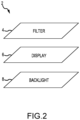
- the user interface device 2 may include various aspects. With ongoing attention to FIG. 1 and with additional attention to FIG. 2 , a user interface device 2 may include a backlight 8. A backlight 8 may comprise light emitting diodes or may be a fluorescent backlight, or any backlight 8 as desired.
- the user interface device 2 may also include a display 6.
- the display 6 may comprise a flat-panel display device generating text, graphics, and/or moving images for visual perception by a user.
- the user interface device 2 may include a filter 4.
- a filter 4 may comprise a light-transmissive panel adjacent to the display 6 and configured to reduce transmission of one or more wavelength of light from the user interface device 2 (e.g., from the backlight 8, the display 6, and/or the combination of the backlight 8 and the display 6) to a user for visual perception.
- the filter 4 may have multiple passbands of different center frequencies and of different (or same) bandwidths.
- FIG. 3 various different configurations of a display 6 and a backlight 8 are depicted. For ease of discussion, these different configurations are shown in a single figure, though one may appreciate that in a practical embodiment, the different configurations may be implemented in different displays or backlights, rather than in a same display and in a same backlight as shown in FIG. 3 .
- a backlight 8 may have a plurality of pixels.
- the pixels may be made up of emitters.
- the emitters may be light emitters, such as light emitting diodes to generate illumination that lights a display 6.
- collections of emitters comprising differently colored light emitters may be clustered as single pixels having variable color. For instance, a red light emitter, a green light emitter, and a cyan light emitter may be clustered as a single pixel capable of generating light of any color. Similarly, a red light emitter, a green light emitter, and a deep blue light emitter may be clustered as a single pixel capable of generating light of any color.
- a red light emitter, a green light emitter, a cyan light emitter, and a deep blue light emitter may be clustered as a single pixel capable of generating light of any color and generating those colors so that identical metamers have different spectral power distributions.
- the light emitters may be light emitting diodes (LEDs) or may be organic light-emitting diode (OLED) devices or may be organic electroluminescent (organic EL) diodes, or may be quantum dots, such as photo-emissive quantum dots.
- LEDs light emitting diodes
- OLED organic light-emitting diode
- organic EL organic electroluminescent
- quantum dots such as photo-emissive quantum dots.
- a display 6 may have a plurality of pixels.
- the pixels may have one or more emitter.
- the emitters may be liquid crystal elements.
- the liquid crystal elements may selectively pass or block illumination from the backlight 8.
- the emitters may selectively pass or block illumination from the backlight 8 according to different colors of the backlight.
- the backlight produces a white light and the emitters selectively pass or block different wavelengths of light to generate colors.
- the display 6 may be provided without a backlight and may be light emitting.
- the display 6 may be provided without a backlight and may be an diode display or may be a quantum display, such as a photo-emissive quantum dot display.
- the display 6 may have an emissive electroluminescent layer that emits light.
- emitters may emit different color light. While pixels are shown as a cluster of emitters that are light emitting elements emitting different colors, one may appreciate that a practical display 6 may operate according to various other principles, such as having a cluster of emitters that selectively pass or block light of different colors.
- the display 6 may have different light emitting or light blocking elements, which may be color specific, termed herein as emitters of a pixel.
- a display 6 may have pixels with a red emitter, a green emitter, and a cyan emitter clustered as a single pixel capable of generating light of different colors.
- a display 6 may have pixels with a red emitter, a green emitter, and a cyan emitter clustered as a single pixel capable of passing light generated by a backlight 8 of different colors.
- a display 6 may have pixels with a color-agnostic element that operates to pass or block light from a backlight 8.
- a display 6 may have pixels with a red emitter, a green emitter, and a deep blue emitter clustered as a single pixel capable of generating light of different colors.
- a display 6 may have pixels with a red emitter, a green emitter, and a deep blue emitter clustered as a single pixel capable of passing light generated by a backlight 8 of different colors.
- a display 6 may have pixels with a red emitter, a green emitter, a cyan emitter, and a deep blue emitter clustered as a single pixel capable of generating light of different colors.
- a display 6 may have pixels with a red emitter, a green emitter, a cyan emitter, and a deep blue emitter clustered as a single pixel capable of passing light generated by a backlight 8 of different colors.
- FIG. 3 shows a display 6 with a red emitter 62, a green emitter 64, a cyan emitter 66 and a deep blue emitter 68 making up a pixel 61.
- FIG. 3 shows a display 6 with a red emitter 62, a green emitter 64, and a deep blue emitter 68 making up a pixel 63.
- FIG. 3 also shows a backlight 8 with a red emitter 82, a green emitter 84, a cyan emitter 86 and a deep blue emitter 88 making up a pixel 81.
- FIG. 3 shows a display 6 with a red emitter 62, a green emitter 64, a cyan emitter 66 and a deep blue emitter 68 making up a pixel 61.
- FIG. 3 shows a display 6 with a red emitter 62, a green emitter 64, and a deep blue emitter 68 making up a pixel 63.
- FIG. 3 also shows a
- FIG. 3 shows a backlight 8 with a red emitter 82, a green emitter 84, and a deep blue emitter 88 making up a pixel 83.
- a red emitter 82 a green emitter 84
- a deep blue emitter 88 making up a pixel 83.
- Different combinations of pixels 61, 63, 81, and 81 may be implemented in a practical embodiment.
- a circadian lighting-enabled display system may include various of the features recited operating in various configurations.
- One example arrangement of features is discussed below.
- An example circadian lighting-enabled display system 1 has a user interface device 2 with a display 6 and a backlight 4.
- One or both of the display 6 and backlight 4 may have a plurality of pixels (pixel 61, 68, 81, or 83).
- pixel 61, 68, 81, or 83 As shown in FIG. 3 , various configurations are possible for each pixel of the plurality of pixels.
- the pixel may have a red emitter, a green emitter and a deep blue emitter, however, in some instances a cyan emitter is also present. In other instances, the pixel does not include a cyan emitter.
- a pixel controller 10 is connected to the user interface device 2.
- the pixel controller 10 connects to the emitters of the pixels of the user interface device 2.
- the pixel controller 10 connects to the cyan emitter and the deep blue emitter and operates to turn them on and off or change the amplitude of light passed through or emitted by the emitters.
- a backlight 8 may have a pixel 81 with a red emitter 82, a green emitter 84, a cyan emitter 86, and a deep blue emitter 88.
- the pixel controller 10 may selectably activate the cyan emitter 86 or the deep blue emitter 88 in concert with the red emitter 82 and the green emitter 84 to form colors.
- a pixel controller 10 may sometimes activate only one of the cyan emitter or the deep blue emitter at a same time and may not activate both of the cyan emitter and the deep blue emitter at the same time. This facilitates shifting of the power spectra density of the light without shifting the metamer of the perceived light.
- the backlight 6 is a white-light backlight that combines illumination of the emitters to generate a white light. The generated white light may have an apparent white color when perceived by a viewer but may have different power spectral densities depending on whether the deep blue emitter or the cyan emitter is illuminated.
- a backlight 8 includes a pixel having emitters and a display 6 also includes a pixel having emitters.
- the backlight 8 may have a backlight pixel 81, 83 with backlight emitters and the display 6 may have a display pixel 61, 68 with display emitters.
- the backlight 8 emitters may be a red emitter 82, a green emitter 84, and a deep blue emitter 88 and the display emitters may be a red emitter 62 a green emitter 64, and a cyan emitter 66.
- Other combinations are also possible.
- another example configuration may include a circadian lighting-enabled display system 2 with a user interface device 4 that has a display 6 and a backlight 8.
- the backlight 8 has pixels 81.
- a pixel 81 may consist of a red emitter 82, a green emitter 84, a cyan emitter 86 and a deep blue emitter 88 and no other emitters.
- the pixel controller 10 connected to the user interface device 4 alternately activates the cyan emitter 86 and the deep blue emitter 88, in concert with the red emitter 82 and the green emitter 84. For instance, the pixel controller 10 may activate the cyan emitter 86 during a daytime and may activate the deep blue emitter 88 during a nighttime.
- the display 6 may have a further set of pixels 61 that also include emitters 61.
- the display pixels 61 may be light emitting, or may be light transmissive, meaning they do not emit light but operate to transmit or suppress light of the backlight.
- the display may have a pixel 61 consisting of a red emitter 62, a green emitter 64, and a cyan emitter 66, but omitting a deep blue emitter 68 and not including any other emitters.
- the display may have a pixel 61 consisting of a red emitter 62, a green emitter 64, and a deep blue emitter 68, but omitting a cyan emitter 66 and not including any other emitters.
- the backlight pixels of the backlight 8 may provide backlighting to the display 6, while the display pixels of the display 6 reproduce moving images for viewing by a user.
- the backlight 6 may be a white-light backlight that combines illumination of the emitters of the pixel 81 to generate a white light.
- the backlight 6 may be controlled by the pixel controller 10 to alternately generate white light with greater or lesser melatonin suppressing effect by changing the composition of the white light to include a cyan component or a deep blue component.
- filter response 40 graph is illustrated showing frequency response curves associated with the filter 4 ( FIG. 2 ).
- the filter 4 may have various passbands for different wavelengths of light.
- the cyan passband associated with a cyan passband response curve 42 overlaps with both the cyan light spectra 41 emitted by a cyan emitter, and also the deep blue light spectra 43 emitted by a deep blue emitter.
- a filter 4 ( FIG. 2 ) can be characterized such that a pixel controller 10 adjusts the intensities of the cyan light and the deep blue light so that different spectral compositions create same metamers, allowing viewers to perceive an accurate color and brightness representation of text and images being generated by the user interface device 2 ( FIG.
- the filter 4 may have a green passband associated with a green passband response curve 44.
- the green passband response curve 44 overlaps the green light spectra 45 emitted by a green emitter.
- the filter 4 may have a red passband associated with a red passband response curve 46.
- the red passband response curve 46 overlaps the red light spectra 47 emitted by the red emitter.
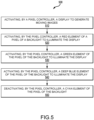
- a method of a circadian-enabled display of images 500 is provided.
- the images may be displayed by a display to generate moving images.
- a backlight may illuminate the display.
- the method may include activating, by a pixel controller, the display to generate the moving images (block 510).
- the method may include activating, by the pixel controller, a red element of a pixel of the backlight to illuminate the display (block 520).
- the method may include activating, by the pixel controller, a green emitter of the pixel of the backlight to illuminate the display (block 530).
- the method may include activating, by the pixel controller, a deep blue emitter of the pixel of the backlight to illuminate the display (block 540).
- the method also includes deactivating, by the pixel controller, a cyan emitter of the backlight (block 550).
- the pixel controller may refrain from illuminating the display with the cyan emitter.
- a color generated by the pixel with the red emitter, the green emitter, and the cyan emitter activated and a color generated by the pixel with the red emitter, the green emitter, and the deep blue emitter activated is a same color. For example, the same color may be white.
- the pixel controller only activates one of the cyan pixel or the deep blue pixel at a same time.
- the pixel controller may deactivate the other of the cyan pixel and the deep blue pixel so that it does not activate both of the cyan pixel and the deep blue pixel at the same time.
- the user interface device may switch between a mode that suppresses melatonin and a mode that does not suppress melatonin.
- the pixel controller may activate the cyan pixel during a daytime or other period during which melatonin suppression is favored and may activate the deep blue pixel during a nighttime or other period during which melatonin suppression is disfavored.
- a same perceived color may be generated while reducing or eliminating an amount of power emitted in a portion of the light spectrum associated with melatonin suppression.
- references to "one embodiment,” “an embodiment,” “various embodiments,” etc. indicate that the embodiment described may include a particular feature, structure, or characteristic, but every embodiment may not necessarily include the particular feature, structure, or characteristic. Moreover, such phrases are not necessarily referring to the same embodiment. Further, when a particular feature, structure, or characteristic is described in connection with an embodiment, it is submitted that it is within the knowledge of one skilled in the art to affect such feature, structure, or characteristic in connection with other embodiments whether or not explicitly described. After reading the description, it will be apparent to one skilled in the relevant art(s) how to implement the disclosure in alternative embodiments.
Landscapes
- Engineering & Computer Science (AREA)
- Health & Medical Sciences (AREA)
- Physics & Mathematics (AREA)
- Computer Hardware Design (AREA)
- General Physics & Mathematics (AREA)
- Theoretical Computer Science (AREA)
- Biomedical Technology (AREA)
- Psychology (AREA)
- Nuclear Medicine, Radiotherapy & Molecular Imaging (AREA)
- Psychiatry (AREA)
- Developmental Disabilities (AREA)
- Social Psychology (AREA)
- Child & Adolescent Psychology (AREA)
- Pathology (AREA)
- Hospice & Palliative Care (AREA)
- Radiology & Medical Imaging (AREA)
- Life Sciences & Earth Sciences (AREA)
- Animal Behavior & Ethology (AREA)
- General Health & Medical Sciences (AREA)
- Public Health (AREA)
- Veterinary Medicine (AREA)
- Circuit Arrangement For Electric Light Sources In General (AREA)
- Control Of Indicators Other Than Cathode Ray Tubes (AREA)
Abstract
Description
- The present disclosure relates generally to a display system, method, and apparatus and more particularly, to a circadian lighting-enabled display system, method, and apparatus.
- Display systems such as electronic display monitors frequently operate by combining red, green, and cyan light sources together to generate different colors of light to display text and images. However, cyan light has been demonstrated to cause specific physiological effects on viewers. For instance, cyan light may interact with a circadian rhythm of a viewer of the electronic display monitor. Thus, there is a need for systems, methods, and apparatuses to generate different colors of light to display text and images without use or with reduced use of a cyan light sources and without causing or reducing corresponding distortions in the perceived color of the text and images.
- A circadian lighting-enabled display system is provided. The system may have a user interface device. The user interface device may have a device and a backlight. At least one of the display and backlight may include a pixel. The pixel may have a red emitter, a green emitter, and a deep blue emitter. The pixel may not have (may omit) a cyan emitter. In further instances, the pixel may also include the cyan emitter. The deep blue emitter may emit light corresponding to a wavelength shorter than 470 nm.
- The circadian lighting-enabled display system may include a pixel controller connected to the cyan emitter and to the deep blue emitter and configured to selectably activate the cyan emitter or the deep blue emitter in concert with the red emitter and the green emitter to form colors. The pixel controller may operate to only activates one of the cyan emitter or the deep blue emitter at a same time. The pixel controller may operate to not activate both of the cyan emitter and the deep blue emitter at the same time. The pixel controller may operate to activate only one of the cyan emitter or the deep blue emitter at a same time and command the other of the cyan emitter or the deep blue emitter to be deactivated at the same time.
- The pixel may be located in the display. The pixel may be located in the backlight. The pixel may be located in the backlight and the display may include a further pixel. The pixel of the backlight may include the red emitter, the green emitter and the deep blue emitter while the pixel of the display includes a further red emitter, a further green emitter and a cyan emitter. The pixel may be located in the backlight and the backlight may be a white-light backlight that combines illumination of the red emitter, the green emitter, and the deep blue emitter to generate a white light.
- A circadian lighting-enabled display system is provided. The system may include a user interface device having a display and a backlight. The backlight may have a pixel including a red emitter, a green emitter, a cyan emitter and a deep blue emitter and no other emitters. A pixel controller may be configured to alternately activate the cyan emitter and the deep blue emitter in concert with the red emitter and the green emitter.
- The pixel controller may activate the cyan emitter during a daytime and activates the deep blue emitter during nighttime. The display may have a further pixel consisting of a further red emitter, a further green emitter, and a further cyan emitter. The pixel of the backlight may provide backlighting to the display and the pixel of the display may reproduce a moving image. The backlight may be a white-light backlight that combines illumination of the red emitter, the green emitter, and at least one of the cyan emitter and the deep blue emitter to generate a white light.
- A method is also provided. The method may be a method of a circadian-enabled display of images by a display to generate moving images and a backlight to illuminate the display. The method may include activating, by a pixel controller, the display to generate the moving images. The method may include activating, by the pixel controller, a red emitter of a pixel of the backlight to illuminate the display. The method may include activating, by the pixel controller, a green emitter of the pixel of the backlight to illuminate the display. The method may include activating, by the pixel controller, a deep blue emitter of the pixel of the backlight to illuminate the display. The blue emitter may emit light corresponding to a wavelength shorter than 470 nm.
- In various embodiments, the method also includes deactivating, by the pixel controller, a cyan emitter of the pixel of the backlight. The deactivating may be to refrain from illuminating the display with the cyan emitter. The method may include deactivating, by the pixel controller, the deep blue emitter of the pixel of the backlight and activating, by the pixel controller, a cyan emitter of the pixel of the backlight, wherein a color generated by the pixel with the red emitter, the green emitter, and the cyan emitter activated and a color generated by the pixel with the red emitter, the green emitter, and the deep blue emitter activated is a same color. The color may be white. The color generated by the pixel with the red emitter, the green emitter, and the cyan emitter activated may have a different power spectral distribution than the color generated by the pixel with the red emitter, the green emitter, and the deep blue emitter.
- The pixel controller may activate only one of the cyan emitter or the deep blue emitter at a same time. The pixel controller may not activate both of the cyan emitter and the deep blue emitter at the same time. The pixel controller may activate the cyan emitter during a daytime and activates the deep blue emitter during a nighttime.
- The forgoing features and elements may be combined in various combinations without exclusivity, unless expressly indicated herein otherwise. These features and elements as well as the operation of the disclosed embodiments will become more apparent in light of the following description and accompanying drawings.
- The subject matter of the present disclosure is particularly pointed out and distinctly claimed in the concluding portion of the specification. A more complete understanding of the present disclosure, however, may best be obtained by referring to the following detailed description and claims in connection with the following drawings. While the drawings illustrate various embodiments employing the principles described herein, the drawings do not limit the scope of the claims.
-
FIG. 1 illustrates a block diagram of a circadian lighting-enabled display system, in accordance with various embodiments; -
FIG. 2 illustrates a block diagram of aspects of a user interface device of the circadian lighting-enabled display system, in accordance with various embodiments; -
FIG. 3 illustrates multiple example configurations of pixels of a display and of a backlight of a user interface device, in accordance with various embodiments; -
FIG. 4 illustrates an example response curve of a filter of a user interface device, in accordance with various embodiments; and -
FIG. 5 illustrates a method of circadian-enabled display of images by a display to generate moving images and a backlight to illuminate the display, in accordance with various embodiments. - The following detailed description of various embodiments herein makes reference to the accompanying drawings, which show various embodiments by way of illustration. While these various embodiments are described in sufficient detail to enable those skilled in the art to practice the disclosure, it should be understood that other embodiments may be realized and that changes may be made without departing from the scope of the disclosure. Thus, the detailed description herein is presented for purposes of illustration only and not of limitation. Furthermore, any reference to singular includes plural embodiments, and any reference to more than one component or step may include a singular embodiment or step. Also, any reference to attached, fixed, connected, or the like may include permanent, removable, temporary, partial, full or any other possible attachment option. Additionally, any reference to without contact (or similar phrases) may also include reduced contact or minimal contact. It should also be understood that unless specifically stated otherwise, references to "a," "an" or "the" may include one or more than one and that reference to an item in the singular may also include the item in the plural. Further, all ranges may include upper and lower values and all ranges and ratio limits disclosed herein may be combined.
- Conventional blue light pixels or emitters are termed "cyan" light pixels or emitters herein due to the significant cyan component in their spectrum and/or blue spectrum sufficiently close to cyan to have significant melatonin suppressing effects. In contrast, reference is made throughout this document to "deep blue" pixels or emitters, which is not referring to conventional blue pixels or emitters but a deep blue pixel or emitter with a spectrum that does not have significant melatonin suppressing effects. As used herein, deep blue light may be about 430 nm to about 470 nm, or 430 nm to 470 nm, or 450 nm +/- 10 nm, or a wavelength shorter than about 470, or a wavelength shorter than 470 nm. As used herein, cyan light may be about 470 nm to 520 nm, or 470 nm to 520 nm, or 495 nm +/- 10 nm, or a wavelength longer than about 470 nm or a wavelength longer than 470 nm.
- Generally, video displays for aerospace and other uses implement pixels with red, green, and cyan (conventional blue light) emitters. To make different colors or to make white light, the video displays combine different amplitudes of red, green, and cyan light which, in combination, appear as different colors to a viewer. It is known that cyan light wavelengths affect circadian rhythms. For instance, cyan light exposure may suppress melatonin production in humans, promoting wakefulness. This may be problematic in personal entertainment devices (PEDs). In various prior instances, this is addressed by shifting the mixture of red, green, and cyan pixel illumination toward an orange color, distorting the reproduction of colors and images and creating an unaesthetic and inaccurately reproduced image.
- The system, method, and apparatus disclosed herein, in various embodiments, relate to generating images that have a more pleasing aesthetic and are accurately reproduced. The systems, methods, and apparatuses further allow the purposeful addition of high levels of cyan light to promote wakefulness or to eliminate cyan light when wakefulness is not desired to be promoted, such as during nighttime use of a PED. The mixture of cyan and other colors may be varied and may fade along a range. The systems, methods, and apparatuses, in various embodiments, maintain the same perceptual metamers along the range. A metamer is color stimuli that has different spectral radiant power distributions that are perceived as identical for a given observer. In colorimetry, metamerism is a perceived matching of colors with different (nonmatching) spectral power distributions. By mixing red, green, and cyan light in different combinations, or by mixing red, green, and deep blue light in different combinations, an identical perceived color may be generated, though one mix contains cyan light and the other contains deep blue light. Mixtures containing cyan light suppress melatonin production, while mixtures continuing deep blue light instead of cyan light cause less suppression of melatonin.
- The system, method, and apparatus can be implemented in an aircraft cabin lighting system, or in display screens in an aircraft cabin (such as seatback entertainment screens in a passenger cabin of an aircraft). A night mode may be implemented that avoids light wavelengths that suppress melatonin production and hamper sleep. A day mode may be implemented that achieves full brightness and increased melanopic response (melatonin production suppression) and encourages wakefulness.
- Directing attention to
FIG. 1 , a circadian lighting-enableddisplay system 1 may include auser interface device 2. Theuser interface device 2 may comprise any device that generates visual sensory stimulation perceptible by a human. In various embodiments, theuser interface device 2 may comprise an electronic visual display. For instance, the user interface device may be a seatback entertainment screen in a passenger cabin of an aircraft. Theuser interface device 2 may be a flight deck instrument display in a cockpit of an aircraft. In other embodiments, theuser interface device 2 may be a display in a different vehicle, such as a land-based or sea-based vehicle. Finally, theuser interface device 2 may be a human-machine interface device, such as a touchscreen, or a non-touch screen, or a smartphone display screen, or the like. - The circadian lighting-enabled
display system 1 may include apixel controller 10. Apixel controller 10 comprises a computer, processor, microprocessor, control circuit, or any other machine or circuit configured to selectably turn emitters of the pixels of theuser interface device 2 on or off and to vary the intensity of the light passing through or emitting from the emitters. In various embodiments, thepixel controller 10 is integrated into a common housing with theuser interface device 2. In further embodiments, thepixel controller 10 is separate from theuser interface device 2. Thepixel controller 10 may include hardware and/or software components. - The
user interface device 2 may include various aspects. With ongoing attention toFIG. 1 and with additional attention toFIG. 2 , auser interface device 2 may include abacklight 8. Abacklight 8 may comprise light emitting diodes or may be a fluorescent backlight, or anybacklight 8 as desired. Theuser interface device 2 may also include adisplay 6. Thedisplay 6 may comprise a flat-panel display device generating text, graphics, and/or moving images for visual perception by a user. Finally, theuser interface device 2 may include a filter 4. A filter 4 may comprise a light-transmissive panel adjacent to thedisplay 6 and configured to reduce transmission of one or more wavelength of light from the user interface device 2 (e.g., from thebacklight 8, thedisplay 6, and/or the combination of thebacklight 8 and the display 6) to a user for visual perception. In various embodiments, the filter 4 may have multiple passbands of different center frequencies and of different (or same) bandwidths. - Turning attention to
FIG. 3 , various different configurations of adisplay 6 and abacklight 8 are depicted. For ease of discussion, these different configurations are shown in a single figure, though one may appreciate that in a practical embodiment, the different configurations may be implemented in different displays or backlights, rather than in a same display and in a same backlight as shown inFIG. 3 . - A
backlight 8 may have a plurality of pixels. The pixels may be made up of emitters. The emitters may be light emitters, such as light emitting diodes to generate illumination that lights adisplay 6. In various instances, collections of emitters comprising differently colored light emitters may be clustered as single pixels having variable color. For instance, a red light emitter, a green light emitter, and a cyan light emitter may be clustered as a single pixel capable of generating light of any color. Similarly, a red light emitter, a green light emitter, and a deep blue light emitter may be clustered as a single pixel capable of generating light of any color. In yet further instances, a red light emitter, a green light emitter, a cyan light emitter, and a deep blue light emitter may be clustered as a single pixel capable of generating light of any color and generating those colors so that identical metamers have different spectral power distributions. The light emitters may be light emitting diodes (LEDs) or may be organic light-emitting diode (OLED) devices or may be organic electroluminescent (organic EL) diodes, or may be quantum dots, such as photo-emissive quantum dots. Thus, one may appreciate that a pixel may generate a color in such a manner as to suppress melatonin and may also generate the same color in such a manner as to not suppress melatonin in a viewer. - A
display 6 may have a plurality of pixels. The pixels may have one or more emitter. The emitters may be liquid crystal elements. The liquid crystal elements may selectively pass or block illumination from thebacklight 8. The emitters may selectively pass or block illumination from thebacklight 8 according to different colors of the backlight. In further instances, the backlight produces a white light and the emitters selectively pass or block different wavelengths of light to generate colors. In yet further instances, thedisplay 6 may be provided without a backlight and may be light emitting. For instance, thedisplay 6 may be provided without a backlight and may be an diode display or may be a quantum display, such as a photo-emissive quantum dot display. Thedisplay 6 may have an emissive electroluminescent layer that emits light. In various instances, emitters may emit different color light. While pixels are shown as a cluster of emitters that are light emitting elements emitting different colors, one may appreciate that apractical display 6 may operate according to various other principles, such as having a cluster of emitters that selectively pass or block light of different colors. - Thus, the
display 6 may have different light emitting or light blocking elements, which may be color specific, termed herein as emitters of a pixel. Adisplay 6 may have pixels with a red emitter, a green emitter, and a cyan emitter clustered as a single pixel capable of generating light of different colors. Adisplay 6 may have pixels with a red emitter, a green emitter, and a cyan emitter clustered as a single pixel capable of passing light generated by abacklight 8 of different colors. Adisplay 6 may have pixels with a color-agnostic element that operates to pass or block light from abacklight 8. - A
display 6 may have pixels with a red emitter, a green emitter, and a deep blue emitter clustered as a single pixel capable of generating light of different colors. Adisplay 6 may have pixels with a red emitter, a green emitter, and a deep blue emitter clustered as a single pixel capable of passing light generated by abacklight 8 of different colors. - A
display 6 may have pixels with a red emitter, a green emitter, a cyan emitter, and a deep blue emitter clustered as a single pixel capable of generating light of different colors. Adisplay 6 may have pixels with a red emitter, a green emitter, a cyan emitter, and a deep blue emitter clustered as a single pixel capable of passing light generated by abacklight 8 of different colors. - These different configurations are illustrated in
FIG. 3. FIG. 3 shows adisplay 6 with ared emitter 62, agreen emitter 64, acyan emitter 66 and a deepblue emitter 68 making up apixel 61. Alternatively,FIG. 3 shows adisplay 6 with ared emitter 62, agreen emitter 64, and a deepblue emitter 68 making up apixel 63.FIG. 3 also shows abacklight 8 with ared emitter 82, agreen emitter 84, acyan emitter 86 and a deepblue emitter 88 making up apixel 81. Alternatively,FIG. 3 shows abacklight 8 with ared emitter 82, agreen emitter 84, and a deepblue emitter 88 making up apixel 83. Different combinations ofpixels - With combined reference to
FIGs. 1 ,2 and3 , a circadian lighting-enabled display system may include various of the features recited operating in various configurations. One example arrangement of features is discussed below. - An example circadian lighting-enabled
display system 1 has auser interface device 2 with adisplay 6 and a backlight 4. One or both of thedisplay 6 and backlight 4 may have a plurality of pixels (pixel FIG. 3 , various configurations are possible for each pixel of the plurality of pixels. For instance, the pixel may have a red emitter, a green emitter and a deep blue emitter, however, in some instances a cyan emitter is also present. In other instances, the pixel does not include a cyan emitter. - A
pixel controller 10 is connected to theuser interface device 2. Thepixel controller 10 connects to the emitters of the pixels of theuser interface device 2. For example, thepixel controller 10 connects to the cyan emitter and the deep blue emitter and operates to turn them on and off or change the amplitude of light passed through or emitted by the emitters. Abacklight 8 may have apixel 81 with ared emitter 82, agreen emitter 84, acyan emitter 86, and a deepblue emitter 88. Thepixel controller 10 may selectably activate thecyan emitter 86 or the deepblue emitter 88 in concert with thered emitter 82 and thegreen emitter 84 to form colors. - A
pixel controller 10 may sometimes activate only one of the cyan emitter or the deep blue emitter at a same time and may not activate both of the cyan emitter and the deep blue emitter at the same time. This facilitates shifting of the power spectra density of the light without shifting the metamer of the perceived light. In some instances, thebacklight 6 is a white-light backlight that combines illumination of the emitters to generate a white light. The generated white light may have an apparent white color when perceived by a viewer but may have different power spectral densities depending on whether the deep blue emitter or the cyan emitter is illuminated. - In some instances, a
backlight 8 includes a pixel having emitters and adisplay 6 also includes a pixel having emitters. For instance, thebacklight 8 may have abacklight pixel display 6 may have adisplay pixel backlight 8 emitters may be ared emitter 82, agreen emitter 84, and a deepblue emitter 88 and the display emitters may be a red emitter 62 agreen emitter 64, and acyan emitter 66. Other combinations are also possible. - Continuing reference to
FIGs. 1-3 , another example configuration may include a circadian lighting-enableddisplay system 2 with a user interface device 4 that has adisplay 6 and abacklight 8. Thebacklight 8 haspixels 81. Apixel 81 may consist of ared emitter 82, agreen emitter 84, acyan emitter 86 and a deepblue emitter 88 and no other emitters. Thepixel controller 10 connected to the user interface device 4 alternately activates thecyan emitter 86 and the deepblue emitter 88, in concert with thered emitter 82 and thegreen emitter 84. For instance, thepixel controller 10 may activate thecyan emitter 86 during a daytime and may activate the deepblue emitter 88 during a nighttime. Thedisplay 6 may have a further set ofpixels 61 that also includeemitters 61. Thedisplay pixels 61 may be light emitting, or may be light transmissive, meaning they do not emit light but operate to transmit or suppress light of the backlight. The display may have apixel 61 consisting of ared emitter 62, agreen emitter 64, and acyan emitter 66, but omitting a deepblue emitter 68 and not including any other emitters. The display may have apixel 61 consisting of ared emitter 62, agreen emitter 64, and a deepblue emitter 68, but omitting acyan emitter 66 and not including any other emitters. The backlight pixels of thebacklight 8 may provide backlighting to thedisplay 6, while the display pixels of thedisplay 6 reproduce moving images for viewing by a user. Thebacklight 6 may be a white-light backlight that combines illumination of the emitters of thepixel 81 to generate a white light. Thebacklight 6 may be controlled by thepixel controller 10 to alternately generate white light with greater or lesser melatonin suppressing effect by changing the composition of the white light to include a cyan component or a deep blue component. - With attention to
FIG. 4 , filterresponse 40 graph is illustrated showing frequency response curves associated with the filter 4 (FIG. 2 ). For example, the filter 4 (FIG. 2 ) may have various passbands for different wavelengths of light. Notably the cyan passband associated with a cyanpassband response curve 42 overlaps with both thecyan light spectra 41 emitted by a cyan emitter, and also the deepblue light spectra 43 emitted by a deep blue emitter. A filter 4 (FIG. 2 ) can be characterized such that apixel controller 10 adjusts the intensities of the cyan light and the deep blue light so that different spectral compositions create same metamers, allowing viewers to perceive an accurate color and brightness representation of text and images being generated by the user interface device 2 (FIG. 2 ). Similarly, the filter 4 (FIG. 2 ) may have a green passband associated with a greenpassband response curve 44. The greenpassband response curve 44 overlaps thegreen light spectra 45 emitted by a green emitter. The filter 4 (FIG. 2 ) may have a red passband associated with a redpassband response curve 46. The redpassband response curve 46 overlaps thered light spectra 47 emitted by the red emitter. - Finally, directing attention to
FIG. 5 , a method of a circadian-enabled display ofimages 500 is provided. The images may be displayed by a display to generate moving images. A backlight may illuminate the display. The method may include activating, by a pixel controller, the display to generate the moving images (block 510). The method may include activating, by the pixel controller, a red element of a pixel of the backlight to illuminate the display (block 520). The method may include activating, by the pixel controller, a green emitter of the pixel of the backlight to illuminate the display (block 530). The method may include activating, by the pixel controller, a deep blue emitter of the pixel of the backlight to illuminate the display (block 540). - In various embodiments, the method also includes deactivating, by the pixel controller, a cyan emitter of the backlight (block 550). Thus, the pixel controller may refrain from illuminating the display with the cyan emitter. A color generated by the pixel with the red emitter, the green emitter, and the cyan emitter activated and a color generated by the pixel with the red emitter, the green emitter, and the deep blue emitter activated is a same color. For example, the same color may be white.
- In some instances, the pixel controller only activates one of the cyan pixel or the deep blue pixel at a same time. The pixel controller may deactivate the other of the cyan pixel and the deep blue pixel so that it does not activate both of the cyan pixel and the deep blue pixel at the same time. In this manner, the user interface device may switch between a mode that suppresses melatonin and a mode that does not suppress melatonin. For instance, the pixel controller may activate the cyan pixel during a daytime or other period during which melatonin suppression is favored and may activate the deep blue pixel during a nighttime or other period during which melatonin suppression is disfavored. By switching between cyan and deep blue, a same perceived color may be generated while reducing or eliminating an amount of power emitted in a portion of the light spectrum associated with melatonin suppression.
- Benefits, other advantages, and solutions to problems have been described herein with regard to specific embodiments. Furthermore, the connecting lines shown in the various figures contained herein are intended to represent exemplary functional relationships and/or physical couplings between the various elements. It should be noted that many alternative or additional functional relationships or physical connections may be present in a practical system. However, the benefits, advantages, solutions to problems, and any elements that may cause any benefit, advantage, or solution to occur or become more pronounced are not to be construed as critical, required, or essential features or elements of the disclosure. The scope of the disclosure is accordingly to be limited by nothing other than the appended claims, in which reference to an element in the singular is not intended to mean "one and only one" unless explicitly so stated, but rather "one or more." Moreover, where a phrase similar to "at least one of A, B, or C" is used in the claims, it is intended that the phrase be interpreted to mean that A alone may be present in an embodiment, B alone may be present in an embodiment, C alone may be present in an embodiment, or that any combination of the elements A, B and C may be present in a single embodiment; for example, A and B, A and C, B and C, or A and B and C. Different cross-hatching is used throughout the figures to denote different parts but not necessarily to denote the same or different materials.
- Systems, methods, and apparatus are provided herein. In the detailed description herein, references to "one embodiment," "an embodiment," "various embodiments," etc., indicate that the embodiment described may include a particular feature, structure, or characteristic, but every embodiment may not necessarily include the particular feature, structure, or characteristic. Moreover, such phrases are not necessarily referring to the same embodiment. Further, when a particular feature, structure, or characteristic is described in connection with an embodiment, it is submitted that it is within the knowledge of one skilled in the art to affect such feature, structure, or characteristic in connection with other embodiments whether or not explicitly described. After reading the description, it will be apparent to one skilled in the relevant art(s) how to implement the disclosure in alternative embodiments.
- Furthermore, no element, component, or method step in the present disclosure is intended to be dedicated to the public regardless of whether the element, component, or method step is explicitly recited in the claims. As used herein, the terms "comprises," "comprising," or any other variation thereof, are intended to cover a non-exclusive inclusion, such that a process, method, article, or apparatus that comprises a list of elements does not include only those elements but may include other elements not expressly listed or inherent to such process, method, article, or apparatus.
- Finally, it should be understood that any of the above described concepts can be used alone or in combination with any or all of the other above described concepts. Although various embodiments have been disclosed and described, one of ordinary skill in this art would recognize that certain modifications would come within the scope of this disclosure. Accordingly, the description is not intended to be exhaustive or to limit the principles described or illustrated herein to any precise form. Many modifications and variations are possible in light of the above teaching.
Claims (15)
- A circadian lighting-enabled display system comprising:a user interface device (2) having a display (6) and a backlight (8);at least one of the display (6) and the backlight (8) comprising a pixel; andthe pixel including a red emitter, a green emitter, and a deep blue emitter, the deep blue emitter emitting light corresponding to a wavelength shorter than 470 nm.
- The circadian lighting-enabled display system according to claim 1, wherein the pixel consists of the red emitter, the green emitter, and the deep blue emitter.
- The circadian lighting-enabled display system according to claim 1 or 2, wherein the pixel further includes a cyan emitter, and preferably further comprising a pixel controller (10) connected to the cyan emitter and to the deep blue emitter and configured to selectably activate the cyan emitter or the deep blue emitter in concert with the red emitter and the green emitter to form colors, and more preferably wherein the pixel controller (10) activates only one of the cyan emitter or the deep blue emitter at a same time and commands the other of the cyan emitter or the deep blue emitter to be deactivated at the same time.
- The circadian lighting-enabled display system according to claim 2, wherein the display (6) includes the pixel; and/or
wherein the backlight (8) includes the pixel. - The circadian lighting-enabled display system according to claim 2, wherein the backlight (8) includes the pixel and the display (6) includes a further pixel, wherein the pixel of the backlight includes the red emitter, the green emitter, and the deep blue emitter, and wherein the pixel of the display includes a further red emitter, a further green emitter, and a cyan emitter.
- The circadian lighting-enabled display system of any preceding claim, wherein the backlight (8) comprises the pixel, wherein the backlight is a white-light backlight that combines illumination of the red emitter, the green emitter, and the deep blue emitter to generate a white light.
- A circadian lighting-enabled display system comprising:a user interface device (2) having a display (6) and a backlight (8);the backlight (8) having a pixel consisting of a red emitter, a green emitter, a cyan emitter and a deep blue emitter; anda pixel controller (10) configured to alternately activate the cyan emitter and the deep blue emitter in concert with the red emitter and the green emitter.
- The circadian lighting-enabled display system of claim 7, wherein the pixel controller (10) activates the cyan emitter during a daytime and activates the deep blue emitter during a nighttime.
- The circadian lighting-enabled display system of claim 7 or 8, wherein the display (6) has a further pixel consisting of a further red emitter, a further green emitter, and a further cyan emitter, and preferably wherein the pixel of the backlight provides backlighting to the display (6) and wherein the pixel of the display reproduces moving images.
- The circadian lighting-enabled display system of any of claims 7-9, wherein the backlight (8) comprises a white-light backlight that combines illumination of the red emitter, the green emitter, and at least one of the cyan emitter and the deep blue emitter to generate a white light.
- A method of a circadian-enabled display of images by a display to generate moving images and a backlight to illuminate the display, the method comprising:activating, by a pixel controller, the display to generate the moving images;activating, by the pixel controller, a red emitter of a pixel of the backlight to illuminate the display,activating, by the pixel controller, a green emitter of the pixel of the backlight to illuminate the display; andactivating, by the pixel controller, a deep blue emitter of the pixel of the backlight to illuminate the display, the deep blue emitter emitting light corresponding to a wavelength shorter than 470 nm.
- The method according to claim 11, further comprising deactivating, by the pixel controller, a cyan emitter of the pixel of the backlight.
- The method according to claim 12, wherein a color generated by the pixel with the red emitter, the green emitter, and the cyan emitter activated and the color generated by the pixel with the red emitter, the green emitter, and the deep blue emitter activated is a same color.
- The method according to claim 13, wherein the color generated by the pixel with the red emitter, the green emitter, and the cyan emitter activated has a different power spectral distribution than the color generated by the pixel with the red emitter, the green emitter, and the deep blue emitter.
- The method according to claim 14, wherein the pixel controller activates only one of the cyan emitter or the deep blue emitter at a same time, and preferably wherein the pixel controller activates the cyan emitter during a daytime and activates the deep blue emitter during a nighttime.
Applications Claiming Priority (1)
| Application Number | Priority Date | Filing Date | Title |
|---|---|---|---|
| US17/827,238 US11929040B2 (en) | 2022-05-27 | 2022-05-27 | Circadian lighting-enabled display system, method, and apparatus |
Publications (1)
| Publication Number | Publication Date |
|---|---|
| EP4283602A1 true EP4283602A1 (en) | 2023-11-29 |
Family
ID=86331228
Family Applications (1)
| Application Number | Title | Priority Date | Filing Date |
|---|---|---|---|
| EP23172572.2A Pending EP4283602A1 (en) | 2022-05-27 | 2023-05-10 | Circadian lighting-enabled display system, method, and apparatus |
Country Status (3)
| Country | Link |
|---|---|
| US (1) | US11929040B2 (en) |
| EP (1) | EP4283602A1 (en) |
| CA (1) | CA3198751A1 (en) |
Families Citing this family (3)
| Publication number | Priority date | Publication date | Assignee | Title |
|---|---|---|---|---|
| WO2024259045A1 (en) * | 2023-06-13 | 2024-12-19 | Korrus, Inc. | Tunable light emissions for circadian moderation |
| US12499846B2 (en) * | 2024-05-28 | 2025-12-16 | Snap Inc. | Dynamic color uniformity correction display system |
| US12554136B2 (en) | 2024-05-28 | 2026-02-17 | Snap Inc. | Color correction for XR display |
Citations (3)
| Publication number | Priority date | Publication date | Assignee | Title |
|---|---|---|---|---|
| JP2005063687A (en) * | 2003-08-11 | 2005-03-10 | Sharp Corp | Light emitting device and display device |
| US20150009242A1 (en) * | 2013-07-05 | 2015-01-08 | Samsung Display Co., Ltd. | Display device and display device driving method |
| US20160121073A1 (en) * | 2014-11-03 | 2016-05-05 | Samsung Display Co., Ltd. | Display apparatus, and display control method and apparatus of the display apparatus |
Family Cites Families (13)
| Publication number | Priority date | Publication date | Assignee | Title |
|---|---|---|---|---|
| US7766517B2 (en) * | 2001-06-15 | 2010-08-03 | Apple Inc. | Active enclosure for computing device |
| US9913341B2 (en) | 2011-12-05 | 2018-03-06 | Biological Illumination, Llc | LED lamp for producing biologically-adjusted light including a cyan LED |
| US9039746B2 (en) * | 2013-02-08 | 2015-05-26 | Cree, Inc. | Solid state light emitting devices including adjustable melatonin suppression effects |
| US9488862B2 (en) * | 2013-02-12 | 2016-11-08 | Apple Inc. | Displays with organic light-emitting diode backlight structures |
| US9844116B2 (en) | 2015-09-15 | 2017-12-12 | Biological Innovation & Optimization Systems, LLC | Systems and methods for controlling the spectral content of LED lighting devices |
| WO2017131715A1 (en) | 2016-01-28 | 2017-08-03 | Ecosense Lighting Inc. | Methods for generating melatonin-response-tuned white light with high color rendering |
| EP3459860B1 (en) | 2017-09-22 | 2021-01-06 | Goodrich Lighting Systems GmbH | Aircraft cabin lighting arrangement for illuminating a common space of an aircraft, aircraft comprising the same, and method of operating an aircraft cabin lighting arrangement |
| EP3738412A4 (en) * | 2018-01-11 | 2022-02-09 | Ecosense Lighting Inc. | MULTI-CHANNEL SYSTEMS TO PROVIDE TUNABLE LIGHT WITH HIGH COLOR RENDERING AND BIOLOGICAL EFFECTS |
| EP4223366A3 (en) * | 2018-08-31 | 2023-09-20 | Signify Holding B.V. | Cyan enriched white light |
| US11295680B2 (en) * | 2019-04-11 | 2022-04-05 | PixelDisplay, Inc. | Method and apparatus of a multi-modal illumination and display for improved color rendering, power efficiency, health and eye-safety |
| WO2021127403A1 (en) | 2019-12-18 | 2021-06-24 | EcoSense Lighting, Inc. | Systems and methods for gaze-based lighting of displays |
| US20210309386A1 (en) | 2020-04-02 | 2021-10-07 | Goodrich Corporation | Spectra fill |
| CN115362760B (en) | 2020-04-09 | 2025-11-04 | 昕诺飞控股有限公司 | Black vision system using cyan pumps on white LEDs |
-
2022
- 2022-05-27 US US17/827,238 patent/US11929040B2/en active Active
-
2023
- 2023-05-04 CA CA3198751A patent/CA3198751A1/en active Pending
- 2023-05-10 EP EP23172572.2A patent/EP4283602A1/en active Pending
Patent Citations (3)
| Publication number | Priority date | Publication date | Assignee | Title |
|---|---|---|---|---|
| JP2005063687A (en) * | 2003-08-11 | 2005-03-10 | Sharp Corp | Light emitting device and display device |
| US20150009242A1 (en) * | 2013-07-05 | 2015-01-08 | Samsung Display Co., Ltd. | Display device and display device driving method |
| US20160121073A1 (en) * | 2014-11-03 | 2016-05-05 | Samsung Display Co., Ltd. | Display apparatus, and display control method and apparatus of the display apparatus |
Also Published As
| Publication number | Publication date |
|---|---|
| US20230386418A1 (en) | 2023-11-30 |
| US11929040B2 (en) | 2024-03-12 |
| CA3198751A1 (en) | 2023-11-27 |
Similar Documents
| Publication | Publication Date | Title |
|---|---|---|
| US11929040B2 (en) | Circadian lighting-enabled display system, method, and apparatus | |
| US7872659B2 (en) | Wide color gamut displays | |
| DE102006030890B4 (en) | System and method for generating white light using a combination of white phosphor conversion LEDs and non-phosphor conversion color LEDs | |
| CN101162299B (en) | Method, medium, and display system with enlarged apparent size | |
| US7852313B2 (en) | Display device | |
| US7411589B2 (en) | Liquid crystal color display system and method | |
| US20090207613A1 (en) | Light source system, light source device, and method of controlling light source | |
| JP2004529396A5 (en) | ||
| US20110134021A1 (en) | Method and apparatus for led driver color-sequential scan | |
| US8363182B2 (en) | Liquid crystal display device having illumination element emitting colors independently via time division | |
| US10210819B2 (en) | Tunable backlight device, a display device and a method of driving the same | |
| US9711096B2 (en) | Systems and methods of managing metameric effects in narrowband primary display systems | |
| US20150179111A1 (en) | Liquid crystal display device as well as backlight source and dimming method for the same | |
| US20120001964A1 (en) | Liquid crystal display apparatus | |
| CN113767327A (en) | Backlight device for display screen of television or mobile phone | |
| DE102007044476A1 (en) | Lighting unit and method for controlling the lighting unit | |
| CN100505015C (en) | Multi-primary display with spectrally adapted back-illumination | |
| EP2337014A1 (en) | Color display devices with backlights | |
| WO2018081395A1 (en) | Led lighting assembly using a dynamic color mixing scheme | |
| WO2013031363A1 (en) | Method of illuminating multi-primary display with area active backlight | |
| US11592710B2 (en) | Image enhanced liquid crystal display devices | |
| JP2000276115A (en) | Image display device | |
| WO2010125703A1 (en) | Liquid crystal display module, liquid crystal display device, mobile equipment, and drive method for liquid crystal display modules |
Legal Events
| Date | Code | Title | Description |
|---|---|---|---|
| PUAI | Public reference made under article 153(3) epc to a published international application that has entered the european phase |
Free format text: ORIGINAL CODE: 0009012 |
|
| STAA | Information on the status of an ep patent application or granted ep patent |
Free format text: STATUS: THE APPLICATION HAS BEEN PUBLISHED |
|
| AK | Designated contracting states |
Kind code of ref document: A1 Designated state(s): AL AT BE BG CH CY CZ DE DK EE ES FI FR GB GR HR HU IE IS IT LI LT LU LV MC ME MK MT NL NO PL PT RO RS SE SI SK SM TR |
|
| STAA | Information on the status of an ep patent application or granted ep patent |
Free format text: STATUS: REQUEST FOR EXAMINATION WAS MADE |
|
| 17P | Request for examination filed |
Effective date: 20240527 |
|
| RBV | Designated contracting states (corrected) |
Designated state(s): AL AT BE BG CH CY CZ DE DK EE ES FI FR GB GR HR HU IE IS IT LI LT LU LV MC ME MK MT NL NO PL PT RO RS SE SI SK SM TR |
|
| STAA | Information on the status of an ep patent application or granted ep patent |
Free format text: STATUS: EXAMINATION IS IN PROGRESS |
|
| 17Q | First examination report despatched |
Effective date: 20250901 |