EP4283536A1 - Signal identification device - Google Patents
Signal identification device Download PDFInfo
- Publication number
- EP4283536A1 EP4283536A1 EP21929078.0A EP21929078A EP4283536A1 EP 4283536 A1 EP4283536 A1 EP 4283536A1 EP 21929078 A EP21929078 A EP 21929078A EP 4283536 A1 EP4283536 A1 EP 4283536A1
- Authority
- EP
- European Patent Office
- Prior art keywords
- class
- signal
- learning
- data
- latent
- Prior art date
- Legal status (The legal status is an assumption and is not a legal conclusion. Google has not performed a legal analysis and makes no representation as to the accuracy of the status listed.)
- Granted
Links
Images


Classifications
-
- G—PHYSICS
- G06—COMPUTING OR CALCULATING; COUNTING
- G06F—ELECTRIC DIGITAL DATA PROCESSING
- G06F18/00—Pattern recognition
- G06F18/20—Analysing
- G06F18/24—Classification techniques
- G06F18/241—Classification techniques relating to the classification model, e.g. parametric or non-parametric approaches
- G06F18/2415—Classification techniques relating to the classification model, e.g. parametric or non-parametric approaches based on parametric or probabilistic models, e.g. based on likelihood ratio or false acceptance rate versus a false rejection rate
-
- G—PHYSICS
- G06—COMPUTING OR CALCULATING; COUNTING
- G06V—IMAGE OR VIDEO RECOGNITION OR UNDERSTANDING
- G06V10/00—Arrangements for image or video recognition or understanding
- G06V10/70—Arrangements for image or video recognition or understanding using pattern recognition or machine learning
- G06V10/82—Arrangements for image or video recognition or understanding using pattern recognition or machine learning using neural networks
-
- G—PHYSICS
- G06—COMPUTING OR CALCULATING; COUNTING
- G06N—COMPUTING ARRANGEMENTS BASED ON SPECIFIC COMPUTATIONAL MODELS
- G06N20/00—Machine learning
-
- G—PHYSICS
- G06—COMPUTING OR CALCULATING; COUNTING
- G06N—COMPUTING ARRANGEMENTS BASED ON SPECIFIC COMPUTATIONAL MODELS
- G06N5/00—Computing arrangements using knowledge-based models
- G06N5/04—Inference or reasoning models
-
- G—PHYSICS
- G06—COMPUTING OR CALCULATING; COUNTING
- G06V—IMAGE OR VIDEO RECOGNITION OR UNDERSTANDING
- G06V10/00—Arrangements for image or video recognition or understanding
- G06V10/70—Arrangements for image or video recognition or understanding using pattern recognition or machine learning
- G06V10/764—Arrangements for image or video recognition or understanding using pattern recognition or machine learning using classification, e.g. of video objects
-
- G—PHYSICS
- G06—COMPUTING OR CALCULATING; COUNTING
- G06V—IMAGE OR VIDEO RECOGNITION OR UNDERSTANDING
- G06V10/00—Arrangements for image or video recognition or understanding
- G06V10/70—Arrangements for image or video recognition or understanding using pattern recognition or machine learning
- G06V10/77—Processing image or video features in feature spaces; using data integration or data reduction, e.g. principal component analysis [PCA] or independent component analysis [ICA] or self-organising maps [SOM]; Blind source separation
- G06V10/774—Generating sets of training patterns; Bootstrap methods, e.g. bagging or boosting
-
- G—PHYSICS
- G06—COMPUTING OR CALCULATING; COUNTING
- G06N—COMPUTING ARRANGEMENTS BASED ON SPECIFIC COMPUTATIONAL MODELS
- G06N3/00—Computing arrangements based on biological models
- G06N3/02—Neural networks
- G06N3/04—Architecture, e.g. interconnection topology
- G06N3/045—Combinations of networks
- G06N3/0455—Auto-encoder networks; Encoder-decoder networks
Definitions
- the present disclosed technology relates to a signal identification device.
- An object of signal identification according to the present disclosed technology is to predict a category of a signal, that is, to classify a signal into a class to which the signal belongs.
- the signal handled here includes a signal obtained by electrically converting image data.
- machine learning is effective for a problem of classification, that is, a problem of predicting a category. It is also widely known that a neural network is used as a learning model to be machine-learned.
- a variational autoencoder is known as one of generation models using a neural network.
- a learning device that learns a feature of input data, which is learning data, using a variational autoencoder has also been proposed.
- the variational autoencoder outputs an average and a variance of a latent variable z expressed by a multidimensional normal distribution.
- a learning device in which learning accuracy of an average and a variance of a latent variable z being improved in a variational autoencoder is disclosed (for example, Patent Literature 1).
- Patent Literature 1 JP 2020-154561 A
- a human can view a certain image, determine what an object shown in the image represents, and classify the image.
- the determination of the classification performed by human beings is performed on the basis of words and concepts created by human beings.
- the human being associates the word "bird” with the concept "it has the body surface covered with specific feathers and has a beak and wings".
- creating a subordinate concept "sparrow” from a broader concept "bird” is also possible.
- the broader concept and the subordinate concept can be replaced with a large classification and a small classification in the classification problem.
- a human can make a prediction on the basis of a concept developed by human beings. For example, assume that there is a person who does not know "emu” but knows other birds. When the person looks at an image showing "emu”, the person can predict that it is a kind of bird because it has the body surface covered with specific feathers and has a beak and wings.
- An object of a signal identification device is to solve the above problem and to perform prediction on signal data of an unlearned class in accordance with a concept developed by human beings.
- a signal identification device includes an inference model that generates a latent variable in which a distribution for each class in a latent space is defined according to a class of classification, and a second latent variable in which a distribution for each large classification in the latent space is defined according to a large classification of a broader concept of the class.
- the signal identification device Since the signal identification device according to the present disclosed technology has the above-described configuration, prediction can be performed on signal data of an unlearned class in accordance with a concept developed by human beings.
- FIG. 1 is a configuration diagram illustrating a configuration of a signal identification device 3 according to Embodiment 1.
- the signal identification device 3 includes a learning unit 31 and an inference unit 36.
- the learning unit 31 includes a known signal learning unit 33.
- the signal identification device 3 further includes two input systems and one output system.
- the first input system is described in the upper left part of FIG. 1 and is an input system used by the learning unit 31 in a learning phase (hereinafter referred to as "input for learning”).
- the second input system is described in the lower left part of FIG. 1 and is an input system used by the inference unit 36 in an inference phase (hereinafter referred to as “input for inference”).
- the output system is described in the lower part of FIG. 1 , and is the system for the inference unit 36 to output an identification result (4) in the inference phase (hereinafter referred to as "output for inference").
- a signal data set (1) illustrated in FIG. 1 is characterized in that a plurality of pairs of signal data (32) and corresponding teacher data (34) are present.
- the signal data (32) may be a radio wave signal acquired by a radar or an optical image.
- the teacher data (34) includes information related to a class to which the signal data (32) to be learned belongs.
- the corresponding teacher data (34) is a label including information such as "Bird, Columbiformes, Columbidae". The above-described information on the concept developed by the human beings is included in the teacher data (34).
- the teacher data (34) may be simple data allocated for each label in an implementation manner in advance, for example, a letter, a number, an alphabet, a symbol, or a combination thereof.
- an integer of 1001 may be allocated in advance to the label of "Bird, Columbiformes, Columbidae".
- the integer allocated to the label may be an allocation method in accordance with the above-described concept developed by the human beings, such as 0 to 999 for mammals, 1000 to 1999 for birds, and 2000 to 2999 for fish.
- a label of a conceptually close class may be allocated with a close integer.
- the type of numbers allocated to the label is not limited to one-dimensional numbers, and may be multi-dimensional numbers such as (1001, B, ..., 0).
- a distance between the teacher data (34) and another teacher data (34) is defined, and the distance decreases when their concepts are close.
- the learning model generated by the known signal learning unit 33 of the learning unit 31 by learning is illustrated in the center of FIG. 1 and is indicated as a learned model (35).
- the known signal learning unit 33 generates the learned model (35) on the basis of the signal data (32) and the teacher data (34). Details of the learned model (35) will become more clear by the following description.
- Input signal data (2) illustrated in FIG. 1 is signal data to be identified by the signal identification device 3.
- the input signal data (2) and the signal data (32) may be a radio wave signal acquired by radar or an optical image according to the application of the signal identification device 3.
- the identification result (4) illustrated in FIG. 1 is a result of classification of the input signal data (2).
- the identification result (4) includes information of this class.
- the identification result (4) includes that the input signal data (2) is an unlearned class and a large classification result of a broader concept that the input signal data (2) would belong to.
- the identification result (4) includes that the class is an unlearned class and that a large classification of a broader concept to which the input signal data (2) would belong to is "bird".
- the signal identification device 3 may indicate a learned class having the closest conceptual property as the identification result (4) instead of the large classification result of the broader concept to which the input signal data (2) would belong to.
- another result (4) may be that the class is an unlearned class and that the class having the closest conceptual property is a learned class "ostrich”.
- FIG. 2 is a hardware configuration diagram in a case where the signal identification device 3 according to Embodiment 1 is implemented by a computer. As illustrated in FIG. 2 , the signal identification device 3 may be implemented by a computer.
- the signal identification device 3 in FIG 2 includes a processor 50, a memory 51, a signal input interface 52, a signal processing processor 53, and a display interface 54.
- the conventional machine learning is known to be developed from the viewpoint of how to draw a boundary for each class in a space with respect to a classification problem.
- One example of this viewpoint technology is Support Vector Machine.
- the support vector machine is designed to obtain a classification surface having a margin, and a non-linear classification surface such as a curved surface is also known.
- the space is called a feature amount space or a latent space.
- the signal identification device 3 considers not only a variable including features of input data but also a variable based on teacher data. Therefore, the present disclosed technology may consider a feature amount space including a variable including a feature of input data and a variable based on teacher data.
- the variable based on the teacher data may be a type of number allocated to the label described above. Taking the above-described "emu” and “capybaras” as an example, a plurality of variables including features of both input data have close values, but variables based on both teacher data do not have close values. Therefore, in the present disclosed technology, there is no fear that an undesirable classification for humans, such as "close to capybaras" for an unlearned image of "emu”, would occur.
- the dimension of the feature amount space may be obtained by adding the dimension of the variable including the features of the input data and the dimension of the variable based on the teacher data. Furthermore, in the present disclosed technology, a coordinate transformation may be performed to reflect the information of the teacher data while setting the dimension of the feature amount space as the dimension of the variable including the features of the input data.
- Such a structure in addition to having continuity with respect to continuous change of input data in the feature amount space or the latent space, having continuity with respect to continuous change of teacher data, is referred to as a "manifold structure" in the present disclosed technology.
- a method for implementing that a space has a manifold structure without changing a dimension becomes more clear by the following description.
- the expression "continuous change” herein may be paraphrased as “minute change” or "located in the vicinity".
- the difference between the conventional technology and the present disclosed technology also appears in a loss function used in the learning phase.
- the loss function is also referred to as a cost function (expressed in KATAKANA), a cost function, or an evaluation function.
- FIG. 3 is a schematic diagram illustrating a configuration example of the learning unit 31 in the learning phase.
- FIG. 3 clarifies a loss function used in the learning phase of the present disclosed technology.
- the learning unit 31 includes an inference model, a generation model, and an identification model.
- x represents signal data.
- t represents teacher data.
- the signal data (x) is input, and a latent variable z of the signal data (x) and a second latent variable m of the signal data (x) are output.
- the inference model illustrated in FIG. 3 is an autoencoder that outputs an average and a variance of the latent variable z expressed by a multidimensional normal distribution.
- the signal data (x) is image data, it can be said that the inference model is a mapping from the image space to the latent space.
- the latent variable z illustrated in FIG. 3 is generated so that the average is ⁇ and the variance is ⁇ 2 .
- the second latent variable m illustrated in FIG. 3 is generated so that the average is ⁇ H and the variance is ⁇ H 2 .
- the latent variable z may be obtained by sampling from a Gaussian distribution having an average of ⁇ and a variance of ⁇ 2 .
- the latent variable z is a variable having the same meaning as that according to the conventional technology.
- a plot of the latent variable z in the latent space representing the latent variable z is generated to be a Gaussian distribution for each class of the small classification.
- the second latent variable m which is a feature of the present disclosed technology, is generated so that a plurality of classes having the same large classification of the broader concept are put together into one Gaussian distribution.
- the second latent variable m is a representative value of each of a plurality of classes having the same large classification of the broader concept.
- the second latent variable m may be defined as an average value of the latent variables z in a certain class.
- the inference model may be, for example, a neural network or another mathematical model.
- the latent variable z is input, and an identification result (hereinafter referred to as "class identification result") for the class to which the signal data (x) belongs is output.
- the class identification result is represented by a symbol with a hat attached to y in FIG. 3 .
- the class identification result may be an integer allocated to the label described above.
- the identification model is a mapping from the latent space to the identification space.
- the identification model may be, for example, a neural network or another mathematical model.
- the latent variable z is input, and the estimated value of the signal data (x) is output so as to restore the signal data (x).
- the estimated value of the signal data (x) is represented by a symbol with a hat attached to x in FIG. 3 .
- the identification model is a mapping from the latent space to the image space.
- the generation model may be, for example, a neural network or another mathematical model.
- the inference model, the identification model, and the generation model change in the learning process so as to achieve the purpose of learning.
- the above-described loss function is obtained by quantifying the purpose of learning.
- the varying portions of the inference model, the identification model, and the generation model are referred to as weight parameters or simply parameters.
- the learning device includes a term related to a "reconfiguration error" illustrated in FIG. 3 as a loss function.
- the reconfiguration error is a difference between the signal data (x) and the estimated value of the signal data (x).
- Expression (1) is defined by 1-norm, the term related to the reconfiguration error is not limited thereto.
- the term related to the reconfiguration error may be defined by another norm such as 2-norm, or may be defined by the square of 2-norm that can be used by the least squares method.
- the loss function used by the learning unit 31 includes a term related to "identification error" in addition to the reconfiguration error.
- the identification error is a difference between the teacher data (t) and the class identification result.
- the term related to the identification error in the loss function is expressed by, for example, the following mathematical expression.
- Expression (2) is defined as a general expression using the cross entropy as an error function, but is not limited thereto.
- the loss function used by the learning unit 31 more preferably further includes two terms related to KL divergence.
- the two terms related to the KL divergence are expressed, for example, by the following mathematical expressions.
- L KLM : ⁇ D KL N ⁇ H , ⁇ H 2 I ⁇ N 0 I
- KL divergence is a measure of how similar two probability distributions are.
- ] expressed by Expression (3) and Expression (4) represents a function for obtaining KL divergence.
- "I" in Expression (4) represents an identity matrix.
- Expression (3) is a KL divergence of a Gaussian distribution having an average of ⁇ and a variance of ⁇ 2 and a Gaussian distribution having an average of m and a variance of I.
- Expression (4) is a KL divergence of a Gaussian distribution having an average of ⁇ H and a variance of ⁇ H 2 and a normal distribution having an average of 0 and a variance of I. The role of these two KL divergences will become more clear by the following.
- the signal identification device 3 may use a loss function expressed by the following mathematical expression as a loss function used for learning by the learning unit 31.
- L : ⁇ L r + ⁇ 2 L KL + L KLM + ⁇ L c
- ⁇ , ⁇ , and ⁇ are weights.
- the learning of the learning unit 31 is performed so as to minimize the loss function represented by Expression (5).
- an optimization method by a stochastic gradient descent method may be used for updating the parameters of the inference model, the identification model, and the generation model.
- Each of the learned inference model, identification model, and generation model is represented as a learned model (35) in FIG. 1 .
- an effect of the term of the L KLM illustrated in Expression (4) is that plots of a plurality of classes having the same large classification of the broader concept form one Gaussian distribution in the second latent space. In other words, those having the same large classification of the broader concept are close in distance in the second latent space. In the case of different large classifications of the broader concept, the distance in the second latent space is long even if the features of the images are similar.
- the learning unit 31 is learned to extract the manifold structure of the entire signal data set.
- L r illustrated in Expression (1) The effect of the term L r illustrated in Expression (1) is to update the generation model so that the generation model correctly restores the signal data (x).
- the center of each class is m having the manifold structure of the entire data set, the positional relationship of the Gaussian distribution of each class can take over the manifold structure of the second latent space.
- the latent space is of each signal data unit similar to that in the conventional technology, and the second latent space is of a class unit viewed macroscopically.
- FIG. 4 is a reference diagram illustrating an example of a plot in the latent space and the second latent space.
- the Gaussian distribution is formed for each class.
- the Gaussian distribution is formed for each class, and at the same time, the positional relationship of each class in the second latent space is reflected. That is, it can be said that the latent variable z according to the present disclosed technology is in a state of maintaining the manifold structure of the entire signal data set.
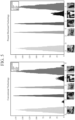
- FIG. 5 is a graph illustrating a comparative example of a result of learning according to the conventional technology and a result of learning according to the present disclosed technology.
- the left column shows a result of learning according to the conventional technology
- the right column shows a result of learning according to the present disclosed technology.
- the learned class is an automobile, a truck, a cat, and a bird
- the unlearned class is a dog.
- the result of learning according to the conventional technology has no regularity in the distribution of learned classes, and large classification according to a broader concept of "animal” and “machine” is not performed.
- the inference unit 36 uses the learned model (35) learned in the learning phase (see FIG. 3 ).
- the learned model (35) has each Gaussian distribution defined in the latent space for each learned class.
- the learned model (35) and the input signal data (2) are input to a signal identification unit 37 of the inference unit 36.
- the signal identification unit 37 plots the latent variable z of the input signal data (2) in the latent space and calculates a correlation with each Gaussian distribution of the learned class defined by the learned model (35).
- the Gaussian distribution is also referred to as the normal distribution and is a type of probability distributions.
- Abnormality detection is known as one of techniques using the normal distribution.
- a method for measuring the degree of deviation of a certain sample using the measurement result of the normal distribution a method using the Mahalanobis distance is known.
- the inference unit 36 also calculates the identification result (4) of the input signal data (2) using the Mahalanobis distance.
- D M z x p k ⁇ z x ⁇ ⁇ k , Train T ⁇ k , Train ⁇ 1 z x ⁇ ⁇ k , Train ⁇ 2
- D M z x p k Mahalanobis distance ⁇ k , Train : Average ⁇ k , Train : Covariance matrix p k : Gaussian distribition N ⁇ k , Train ⁇ k , Train where
- k represents a serial number of the learned class
- T represents transposition
- z x in Expression (6) represents the latent variable z of the input signal data (2).
- the signal identification unit 37 of the inference unit 36 may determine an equal probability curve representing an no section in the distribution for each class as a boundary for recognizing that the signal data belongs to the class. That is, if z x is inside an equal probability curve of a certain class, the signal identification unit 37 may determine that z x is likely to belong to the class as an identification result. In addition, if z x is not inside the equal probability curve of any class, the signal identification unit 37 may determine that z x is likely to belong to the unlearned class as the identification result.
- the signal identification unit 37 may output information of the closest class from the information of the distribution of the class having the closest Mahalanobis distance, or may output a large classification that is a broader concept.
- the signal identification device 3 according to Embodiment 1 since the signal identification device 3 according to Embodiment 1 has the above-described configuration and functions, prediction can be performed on signal data of an unlearned class in accordance with the concept developed by human beings.
- the signal identification device 3 can be used as a device that performs signal identification of a radio wave signal acquired by a radar, identification of an image acquired by a camera, and other signal identification, and thus has industrial applicability.
- signal identification device 31: learning unit, 33: known signal learning unit, 36: inference unit, 37: signal identification unit, 50: processor, 51: memory, 52: signal input interface, 53: signal processing processor, 54: display interface
Landscapes
- Engineering & Computer Science (AREA)
- Theoretical Computer Science (AREA)
- Physics & Mathematics (AREA)
- Evolutionary Computation (AREA)
- General Physics & Mathematics (AREA)
- Artificial Intelligence (AREA)
- Software Systems (AREA)
- Computer Vision & Pattern Recognition (AREA)
- Computing Systems (AREA)
- Data Mining & Analysis (AREA)
- Medical Informatics (AREA)
- General Engineering & Computer Science (AREA)
- Health & Medical Sciences (AREA)
- Multimedia (AREA)
- General Health & Medical Sciences (AREA)
- Databases & Information Systems (AREA)
- Mathematical Physics (AREA)
- Probability & Statistics with Applications (AREA)
- Life Sciences & Earth Sciences (AREA)
- Bioinformatics & Cheminformatics (AREA)
- Bioinformatics & Computational Biology (AREA)
- Evolutionary Biology (AREA)
- Computational Linguistics (AREA)
- Image Analysis (AREA)
- Control Of El Displays (AREA)
- Selective Calling Equipment (AREA)
Abstract
Description
- The present disclosed technology relates to a signal identification device.
- An object of signal identification according to the present disclosed technology is to predict a category of a signal, that is, to classify a signal into a class to which the signal belongs. The signal handled here includes a signal obtained by electrically converting image data.
- It is widely known that machine learning is effective for a problem of classification, that is, a problem of predicting a category. It is also widely known that a neural network is used as a learning model to be machine-learned.
- A variational autoencoder is known as one of generation models using a neural network. In the technical field of machine learning, a learning device that learns a feature of input data, which is learning data, using a variational autoencoder has also been proposed. The variational autoencoder outputs an average and a variance of a latent variable z expressed by a multidimensional normal distribution. A learning device in which learning accuracy of an average and a variance of a latent variable z being improved in a variational autoencoder is disclosed (for example, Patent Literature 1).
- Patent Literature 1:
JP 2020-154561 A - Incidentally, a human can view a certain image, determine what an object shown in the image represents, and classify the image. The determination of the classification performed by human beings is performed on the basis of words and concepts created by human beings. For example, the human being associates the word "bird" with the concept "it has the body surface covered with specific feathers and has a beak and wings". Furthermore, in the concept developed by human beings, for example, creating a subordinate concept "sparrow" from a broader concept "bird" is also possible. The broader concept and the subordinate concept can be replaced with a large classification and a small classification in the classification problem.
- Even if an object shown in an image is unknown, a human can make a prediction on the basis of a concept developed by human beings. For example, assume that there is a person who does not know "emu" but knows other birds. When the person looks at an image showing "emu", the person can predict that it is a kind of bird because it has the body surface covered with specific feathers and has a beak and wings.
- On the other hand, in the conventional learning model exemplified in
Patent Literature 1, for signal data belonging to an unlearned class, it is possible to calculate the closest one among learned classes as a candidate on the basis of a feature of an image such as color. However, the conventional learning model does not have the concept that has been developed by human beings. Therefore, in the conventional technology, there is a fear that, an unlearned image of "emu" is classified as "close to capybaras" that is not a bird on the basis of a feature of an image having a brown color, a classification not desirable for humans is performed. - An object of a signal identification device according to the present disclosed technology is to solve the above problem and to perform prediction on signal data of an unlearned class in accordance with a concept developed by human beings.
- A signal identification device according to the present disclosed technology includes an inference model that generates a latent variable in which a distribution for each class in a latent space is defined according to a class of classification, and a second latent variable in which a distribution for each large classification in the latent space is defined according to a large classification of a broader concept of the class.
- Since the signal identification device according to the present disclosed technology has the above-described configuration, prediction can be performed on signal data of an unlearned class in accordance with a concept developed by human beings.
-
-
FIG. 1 is a configuration diagram illustrating a configuration of a signal identification device according toEmbodiment 1. -
FIG. 2 is a hardware configuration diagram in a case where the signal identification device according toEmbodiment 1 is implemented by a computer. -
FIG. 3 is a schematic diagram illustrating a configuration example of a learning unit in a learning phase. -
FIG. 4 is a reference diagram illustrating an example of a plot in a latent space and a second latent space. -
FIG. 5 is a graph illustrating a comparative example of a result of learning according to the conventional technology and a result of learning according to the present disclosed technology. -
FIG. 1 is a configuration diagram illustrating a configuration of asignal identification device 3 according toEmbodiment 1. As illustrated inFIG. 1 , thesignal identification device 3 includes a learning unit 31 and aninference unit 36. The learning unit 31 includes a knownsignal learning unit 33. - As illustrated in
FIG. 1 , thesignal identification device 3 further includes two input systems and one output system. The first input system is described in the upper left part ofFIG. 1 and is an input system used by the learning unit 31 in a learning phase (hereinafter referred to as "input for learning"). The second input system is described in the lower left part ofFIG. 1 and is an input system used by theinference unit 36 in an inference phase (hereinafter referred to as "input for inference"). The output system is described in the lower part ofFIG. 1 , and is the system for theinference unit 36 to output an identification result (4) in the inference phase (hereinafter referred to as "output for inference"). - A signal data set (1) illustrated in
FIG. 1 is characterized in that a plurality of pairs of signal data (32) and corresponding teacher data (34) are present. Specifically, the signal data (32) may be a radio wave signal acquired by a radar or an optical image. The teacher data (34) includes information related to a class to which the signal data (32) to be learned belongs. For example, in a case where certain signal data (32) is an image of pigeon, the corresponding teacher data (34) is a label including information such as "Bird, Columbiformes, Columbidae". The above-described information on the concept developed by the human beings is included in the teacher data (34). - The teacher data (34) may be simple data allocated for each label in an implementation manner in advance, for example, a letter, a number, an alphabet, a symbol, or a combination thereof. For example, an integer of 1001 may be allocated in advance to the label of "Bird, Columbiformes, Columbidae". In addition, in the case of a label related to a living organism, the integer allocated to the label may be an allocation method in accordance with the above-described concept developed by the human beings, such as 0 to 999 for mammals, 1000 to 1999 for birds, and 2000 to 2999 for fish. A label of a conceptually close class may be allocated with a close integer. Further, the type of numbers allocated to the label is not limited to one-dimensional numbers, and may be multi-dimensional numbers such as (1001, B, ..., 0).
- In a preferred example of the teacher data (34) according to the present disclosed technology, a distance between the teacher data (34) and another teacher data (34) is defined, and the distance decreases when their concepts are close.
- The learning model generated by the known
signal learning unit 33 of the learning unit 31 by learning is illustrated in the center ofFIG. 1 and is indicated as a learned model (35). The knownsignal learning unit 33 generates the learned model (35) on the basis of the signal data (32) and the teacher data (34). Details of the learned model (35) will become more clear by the following description. - Input signal data (2) illustrated in
FIG. 1 is signal data to be identified by thesignal identification device 3. The input signal data (2) and the signal data (32) may be a radio wave signal acquired by radar or an optical image according to the application of thesignal identification device 3. - In addition, the identification result (4) illustrated in
FIG. 1 is a result of classification of the input signal data (2). As a result of the classification of the input signal data (2), when it is determined that the input signal data (2) belongs to a certain learned class, the identification result (4) includes information of this class. As a result of the classification of the input signal data (2), when it is determined that the input signal data (2) does not belong to any class and is unlearned, the identification result (4) includes that the input signal data (2) is an unlearned class and a large classification result of a broader concept that the input signal data (2) would belong to. For example, in the above-described example of "emu", the identification result (4) includes that the class is an unlearned class and that a large classification of a broader concept to which the input signal data (2) would belong to is "bird". Furthermore, thesignal identification device 3 according to the present disclosed technology may indicate a learned class having the closest conceptual property as the identification result (4) instead of the large classification result of the broader concept to which the input signal data (2) would belong to. For example, in the above-described example of "emu", another result (4) may be that the class is an unlearned class and that the class having the closest conceptual property is a learned class "ostrich". -
FIG. 2 is a hardware configuration diagram in a case where thesignal identification device 3 according toEmbodiment 1 is implemented by a computer. As illustrated inFIG. 2 , thesignal identification device 3 may be implemented by a computer. Thesignal identification device 3 inFIG 2 includes aprocessor 50, amemory 51, asignal input interface 52, asignal processing processor 53, and adisplay interface 54. - The operation of the
signal identification device 3 will become more clear by the following description divided into a learning phase and an inference phase. - The operation of the
signal identification device 3 in the learning phase becomes clear by comparison with conventional machine learning. - The conventional machine learning is known to be developed from the viewpoint of how to draw a boundary for each class in a space with respect to a classification problem. One example of this viewpoint technology is Support Vector Machine. The support vector machine is designed to obtain a classification surface having a margin, and a non-linear classification surface such as a curved surface is also known. Here, the space is called a feature amount space or a latent space.
- Conventional supervised learning machine learning considers a space in which only a feature of input data is a variable with respect to labeled input data. Taking the above-described "emu" and "capybara" as an example, both of the images have a feature that the color is brown, and thus, are plotted at close places in the feature amount space. For this reason, in the conventional technology, there is a fear that an unlearned image of "emu" is classified undesirably for humans such as "close to capybaras" on the basis of a feature of an image whose color is brown.
- The
signal identification device 3 according to the present disclosed technology considers not only a variable including features of input data but also a variable based on teacher data. Therefore, the present disclosed technology may consider a feature amount space including a variable including a feature of input data and a variable based on teacher data. The variable based on the teacher data may be a type of number allocated to the label described above. Taking the above-described "emu" and "capybaras" as an example, a plurality of variables including features of both input data have close values, but variables based on both teacher data do not have close values. Therefore, in the present disclosed technology, there is no fear that an undesirable classification for humans, such as "close to capybaras" for an unlearned image of "emu", would occur. - In the present disclosed technology, as described above, the dimension of the feature amount space may be obtained by adding the dimension of the variable including the features of the input data and the dimension of the variable based on the teacher data. Furthermore, in the present disclosed technology, a coordinate transformation may be performed to reflect the information of the teacher data while setting the dimension of the feature amount space as the dimension of the variable including the features of the input data.
- Such a structure, in addition to having continuity with respect to continuous change of input data in the feature amount space or the latent space, having continuity with respect to continuous change of teacher data, is referred to as a "manifold structure" in the present disclosed technology. A method for implementing that a space has a manifold structure without changing a dimension becomes more clear by the following description. The expression "continuous change" herein may be paraphrased as "minute change" or "located in the vicinity".
- The difference between the conventional technology and the present disclosed technology also appears in a loss function used in the learning phase. The loss function is also referred to as a cost function (expressed in KATAKANA), a cost function, or an evaluation function.
-
FIG. 3 is a schematic diagram illustrating a configuration example of the learning unit 31 in the learning phase.FIG. 3 clarifies a loss function used in the learning phase of the present disclosed technology. As illustrated inFIG. 3 , the learning unit 31 includes an inference model, a generation model, and an identification model. - In
FIG. 3 , x represents signal data. InFIG. 3 , t represents teacher data. - In the inference model in
FIG. 3 , the signal data (x) is input, and a latent variable z of the signal data (x) and a second latent variable m of the signal data (x) are output. The inference model illustrated inFIG. 3 is an autoencoder that outputs an average and a variance of the latent variable z expressed by a multidimensional normal distribution. When the signal data (x) is image data, it can be said that the inference model is a mapping from the image space to the latent space. - The latent variable z illustrated in
FIG. 3 is generated so that the average is µ and the variance is σ2. In addition, the second latent variable m illustrated inFIG. 3 is generated so that the average is µH and the variance is σH 2. More specifically, the latent variable z may be obtained by sampling from a Gaussian distribution having an average of µ and a variance of σ2. The latent variable z is a variable having the same meaning as that according to the conventional technology. A plot of the latent variable z in the latent space representing the latent variable z is generated to be a Gaussian distribution for each class of the small classification. On the other hand, the second latent variable m, which is a feature of the present disclosed technology, is generated so that a plurality of classes having the same large classification of the broader concept are put together into one Gaussian distribution. Specifically, the second latent variable m is a representative value of each of a plurality of classes having the same large classification of the broader concept. For example, the second latent variable m may be defined as an average value of the latent variables z in a certain class. - The inference model may be, for example, a neural network or another mathematical model.
- In the identification model in
FIG. 3 , the latent variable z is input, and an identification result (hereinafter referred to as "class identification result") for the class to which the signal data (x) belongs is output. The class identification result is represented by a symbol with a hat attached to y inFIG. 3 . For example, the class identification result may be an integer allocated to the label described above. In other words, the identification model is a mapping from the latent space to the identification space. - The identification model may be, for example, a neural network or another mathematical model.
- In the generation model in
FIG. 3 , the latent variable z is input, and the estimated value of the signal data (x) is output so as to restore the signal data (x). The estimated value of the signal data (x) is represented by a symbol with a hat attached to x inFIG. 3 . In other words, the identification model is a mapping from the latent space to the image space. - The generation model may be, for example, a neural network or another mathematical model.
- The inference model, the identification model, and the generation model change in the learning process so as to achieve the purpose of learning. The above-described loss function is obtained by quantifying the purpose of learning. The varying portions of the inference model, the identification model, and the generation model are referred to as weight parameters or simply parameters.
- The learning device according to the conventional technology includes a term related to a "reconfiguration error" illustrated in
FIG. 3 as a loss function. The reconfiguration error is a difference between the signal data (x) and the estimated value of the signal data (x). The term related to the reconfiguration error in the loss function is expressed by, for example, the following mathematical expression.
- Although Expression (1) is defined by 1-norm, the term related to the reconfiguration error is not limited thereto. The term related to the reconfiguration error may be defined by another norm such as 2-norm, or may be defined by the square of 2-norm that can be used by the least squares method.
- The loss function used by the learning unit 31 according to the present disclosed technology includes a term related to "identification error" in addition to the reconfiguration error. The identification error is a difference between the teacher data (t) and the class identification result. The term related to the identification error in the loss function is expressed by, for example, the following mathematical expression.

- Expression (2) is defined as a general expression using the cross entropy as an error function, but is not limited thereto.
- The loss function used by the learning unit 31 more preferably further includes two terms related to KL divergence. The two terms related to the KL divergence are expressed, for example, by the following mathematical expressions.


- KL divergence is a measure of how similar two probability distributions are. DKL [| |] expressed by Expression (3) and Expression (4) represents a function for obtaining KL divergence. Further, "I" in Expression (4) represents an identity matrix.
- Expression (3) is a KL divergence of a Gaussian distribution having an average of µ and a variance of σ2 and a Gaussian distribution having an average of m and a variance of I. Expression (4) is a KL divergence of a Gaussian distribution having an average of µH and a variance of σH 2 and a normal distribution having an average of 0 and a variance of I. The role of these two KL divergences will become more clear by the following.
- The
signal identification device 3 according toEmbodiment 1 may use a loss function expressed by the following mathematical expression as a loss function used for learning by the learning unit 31.
- Here, α, β, and γ are weights.
- The learning of the learning unit 31 is performed so as to minimize the loss function represented by Expression (5). For updating the parameters of the inference model, the identification model, and the generation model, for example, an optimization method by a stochastic gradient descent method may be used. Each of the learned inference model, identification model, and generation model is represented as a learned model (35) in
FIG. 1 . - The effect of the term Lc illustrated in Expression (2) is to update the identification model so that the
signal identification device 3 outputs a correct class identification result. - In addition, an effect of the term of the LKLM illustrated in Expression (4) is that plots of a plurality of classes having the same large classification of the broader concept form one Gaussian distribution in the second latent space. In other words, those having the same large classification of the broader concept are close in distance in the second latent space. In the case of different large classifications of the broader concept, the distance in the second latent space is long even if the features of the images are similar.
- By including the term of Lc and the term of LKLM in the loss function, the learning unit 31 is learned to extract the manifold structure of the entire signal data set.
- The effect of the term Lr illustrated in Expression (1) is to update the generation model so that the generation model correctly restores the signal data (x).
- In addition, the effect of the term of LKL shown in Expression (3) is to be in the latent space and form a Gaussian distribution for each class.
- In the present disclosed technology, since the center of each class is m having the manifold structure of the entire data set, the positional relationship of the Gaussian distribution of each class can take over the manifold structure of the second latent space.
- To summarize the above, it can be said that the latent space is of each signal data unit similar to that in the conventional technology, and the second latent space is of a class unit viewed macroscopically.
-
FIG. 4 is a reference diagram illustrating an example of a plot in the latent space and the second latent space. As illustrated inFIG. 4 , in the plot example of the latent space, it can be seen that the Gaussian distribution is formed for each class. In the plot example of the second latent space, it can be seen that a plurality of classes having the same large classification of the broader concept, that is, the entire data set is formed in one Gaussian distribution. Furthermore, in the plot example of the latent space, the Gaussian distribution is formed for each class, and at the same time, the positional relationship of each class in the second latent space is reflected. That is, it can be said that the latent variable z according to the present disclosed technology is in a state of maintaining the manifold structure of the entire signal data set. -
FIG. 5 is a graph illustrating a comparative example of a result of learning according to the conventional technology and a result of learning according to the present disclosed technology. InFIG. 5 , the left column shows a result of learning according to the conventional technology, and the right column shows a result of learning according to the present disclosed technology. - In the example illustrated in
FIG. 5 , the learned class is an automobile, a truck, a cat, and a bird, and the unlearned class is a dog. - The result of learning according to the conventional technology has no regularity in the distribution of learned classes, and large classification according to a broader concept of "animal" and "machine" is not performed.
- In contrast, large classification according to a broader concept of "animal" and "machine" is performed on the result of learning according to the present disclosed technology, and the distribution of dogs that are unlearned classes appears at a position close to the distribution of cats that are the same animals.
- The operation of the
signal identification device 3 in the inference phase will become more clear by the following description. - In the inference phase, the
inference unit 36 uses the learned model (35) learned in the learning phase (seeFIG. 3 ). - The learned model (35) has each Gaussian distribution defined in the latent space for each learned class.
- The learned model (35) and the input signal data (2) are input to a
signal identification unit 37 of theinference unit 36. Thesignal identification unit 37 plots the latent variable z of the input signal data (2) in the latent space and calculates a correlation with each Gaussian distribution of the learned class defined by the learned model (35). - Incidentally, the Gaussian distribution is also referred to as the normal distribution and is a type of probability distributions. Abnormality detection is known as one of techniques using the normal distribution. Furthermore, as a method for measuring the degree of deviation of a certain sample using the measurement result of the normal distribution, a method using the Mahalanobis distance is known.
- It is conceivable that the
inference unit 36 according to the present disclosed technology also calculates the identification result (4) of the input signal data (2) using the Mahalanobis distance.
- Mahalanobis distance
- Average
- Covariance
- Gaussian distribution
- Here, k represents a serial number of the learned class, and the lower subscript "Train" represents that learning has been completed. In addition, a superscript T represents transposition. In addition, zx in Expression (6) represents the latent variable z of the input signal data (2).
- On the basis of the Mahalanobis distance calculated by Expression (6), the
inference unit 36 outputs the identification result (4) expressed by the following Expression.
- The
signal identification unit 37 of theinference unit 36 may determine an equal probability curve representing an no section in the distribution for each class as a boundary for recognizing that the signal data belongs to the class. That is, if zx is inside an equal probability curve of a certain class, thesignal identification unit 37 may determine that zx is likely to belong to the class as an identification result. In addition, if zx is not inside the equal probability curve of any class, thesignal identification unit 37 may determine that zx is likely to belong to the unlearned class as the identification result. In a case where zx is not inside the equal probability curve of any class, thesignal identification unit 37 may output information of the closest class from the information of the distribution of the class having the closest Mahalanobis distance, or may output a large classification that is a broader concept. - As described above, since the
signal identification device 3 according toEmbodiment 1 has the above-described configuration and functions, prediction can be performed on signal data of an unlearned class in accordance with the concept developed by human beings. - The
signal identification device 3 according to the present disclosed technology can be used as a device that performs signal identification of a radio wave signal acquired by a radar, identification of an image acquired by a camera, and other signal identification, and thus has industrial applicability. - 3: signal identification device, 31: learning unit, 33: known signal learning unit, 36: inference unit, 37: signal identification unit, 50: processor, 51: memory, 52: signal input interface, 53: signal processing processor, 54: display interface
Claims (2)
- A signal identification device comprising an inference model to generate a latent variable in which a distribution for each class in a latent space is defined according to the class of classification, and a second latent variable in which a distribution for each large classification in the latent space is defined according to the large classification of a broader concept of the class.
- The signal identification device according to claim 1, wherein the inference model being learned using both signal data and teacher data, the teacher data including information of the class to which the signal data belongs and information of the broader concept of the class.
Applications Claiming Priority (1)
| Application Number | Priority Date | Filing Date | Title |
|---|---|---|---|
| PCT/JP2021/008581 WO2022185506A1 (en) | 2021-03-05 | 2021-03-05 | Signal identification device |
Publications (3)
| Publication Number | Publication Date |
|---|---|
| EP4283536A1 true EP4283536A1 (en) | 2023-11-29 |
| EP4283536A4 EP4283536A4 (en) | 2024-04-03 |
| EP4283536B1 EP4283536B1 (en) | 2025-05-21 |
Family
ID=83154151
Family Applications (1)
| Application Number | Title | Priority Date | Filing Date |
|---|---|---|---|
| EP21929078.0A Active EP4283536B1 (en) | 2021-03-05 | 2021-03-05 | Signal identification device |
Country Status (6)
| Country | Link |
|---|---|
| US (1) | US20230334123A1 (en) |
| EP (1) | EP4283536B1 (en) |
| JP (1) | JP7374375B2 (en) |
| AU (1) | AU2021430612B9 (en) |
| CA (1) | CA3204257A1 (en) |
| WO (1) | WO2022185506A1 (en) |
Family Cites Families (10)
| Publication number | Priority date | Publication date | Assignee | Title |
|---|---|---|---|---|
| US8811727B2 (en) * | 2012-06-15 | 2014-08-19 | Moataz A. Rashad Mohamed | Methods for efficient classifier training for accurate object recognition in images and video |
| US20160140438A1 (en) * | 2014-11-13 | 2016-05-19 | Nec Laboratories America, Inc. | Hyper-class Augmented and Regularized Deep Learning for Fine-grained Image Classification |
| JP7205327B2 (en) | 2019-03-19 | 2023-01-17 | 株式会社Ihi | learning device |
| EP3751467A1 (en) * | 2019-06-14 | 2020-12-16 | Robert Bosch GmbH | A machine learning system |
| GB201908598D0 (en) | 2019-06-14 | 2019-07-31 | Thinksono Ltd | Method and system for confidence estimation in devices using deep learning |
| US11580333B2 (en) * | 2019-11-12 | 2023-02-14 | Objectvideo Labs, Llc | Training image classifiers |
| US11145403B2 (en) * | 2019-11-14 | 2021-10-12 | Lawrence Livermore National Security, Llc | Universal image representation based on a multimodal graph |
| US11989262B2 (en) * | 2020-10-01 | 2024-05-21 | Nvidia Corporation | Unsupervised domain adaptation with neural networks |
| US11288542B1 (en) * | 2020-11-17 | 2022-03-29 | Sap Se | Learning graph-based priors for generalized zero-shot learning |
| CN113516665B (en) * | 2020-12-16 | 2026-04-03 | 腾讯科技(深圳)有限公司 | Image segmentation model training methods, image segmentation methods, devices, and equipment |
-
2021
- 2021-03-05 JP JP2023503306A patent/JP7374375B2/en active Active
- 2021-03-05 WO PCT/JP2021/008581 patent/WO2022185506A1/en not_active Ceased
- 2021-03-05 AU AU2021430612A patent/AU2021430612B9/en active Active
- 2021-03-05 CA CA3204257A patent/CA3204257A1/en active Pending
- 2021-03-05 EP EP21929078.0A patent/EP4283536B1/en active Active
-
2023
- 2023-06-21 US US18/212,501 patent/US20230334123A1/en active Pending
Also Published As
| Publication number | Publication date |
|---|---|
| WO2022185506A1 (en) | 2022-09-09 |
| AU2021430612B9 (en) | 2024-03-14 |
| JPWO2022185506A1 (en) | 2022-09-09 |
| EP4283536B1 (en) | 2025-05-21 |
| US20230334123A1 (en) | 2023-10-19 |
| AU2021430612A1 (en) | 2023-07-06 |
| JP7374375B2 (en) | 2023-11-06 |
| CA3204257A1 (en) | 2022-09-09 |
| AU2021430612B2 (en) | 2024-03-07 |
| EP4283536A4 (en) | 2024-04-03 |
Similar Documents
| Publication | Publication Date | Title |
|---|---|---|
| Kapteyn et al. | From physics-based models to predictive digital twins via interpretable machine learning | |
| Lughofer | Single-pass active learning with conflict and ignorance | |
| Parikh et al. | An ensemble-based incremental learning approach to data fusion | |
| JP4970408B2 (en) | An adaptive driver assistance system using robust estimation of object properties | |
| US11037027B2 (en) | Computer architecture for and-or neural networks | |
| US20080101705A1 (en) | System for pattern recognition with q-metrics | |
| Montazer et al. | Improvement of RBF neural networks using Fuzzy-OSD algorithm in an online radar pulse classification system | |
| Singhal et al. | Fault Coverage-Based Test Case Prioritization and Selection Using African Buffalo Optimization. | |
| CA3256280A1 (en) | Out-of-distribution detection with generative models | |
| Kuravsky et al. | New approaches for assessing the activities of operators of complex technical systems | |
| US11531832B2 (en) | Method for determining a confidence value of an object of a class | |
| CN112949524B (en) | Engine fault detection method based on empirical mode decomposition and multi-core learning | |
| EP4283536B1 (en) | Signal identification device | |
| Tibermacine et al. | Enhanced EEG classification via Riemannian normalizing flows and deep neural networks | |
| US20220019944A1 (en) | System and method for identifying and mitigating ambiguous data in machine learning architectures | |
| Anoop et al. | Bayesian inverse learning and online changepoint detection of cognitive radar strategies | |
| CN115280328A (en) | Method for quality assurance of sample-based systems | |
| Sheth et al. | Causal domain generalization | |
| Wu et al. | Vision-based target objects recognition and segmentation for unmanned systems task allocation | |
| Soares et al. | Semantic place labeling using a probabilistic decision list of AdaBoost classifiers | |
| JP7278763B2 (en) | State quantity data classification device and state quantity data classification method | |
| Bodyanskiy et al. | Online time series changes detection based on neuro-fuzzy approach | |
| Hajihosseini et al. | Decentralized fault isolation by a combination of transfer entropy and classification methods | |
| Siuly et al. | Injecting principal component analysis with the OA scheme in the epileptic EEG signal classification | |
| CN116324806A (en) | Method for quality assurance of example-based systems |
Legal Events
| Date | Code | Title | Description |
|---|---|---|---|
| STAA | Information on the status of an ep patent application or granted ep patent |
Free format text: STATUS: THE INTERNATIONAL PUBLICATION HAS BEEN MADE |
|
| PUAI | Public reference made under article 153(3) epc to a published international application that has entered the european phase |
Free format text: ORIGINAL CODE: 0009012 |
|
| STAA | Information on the status of an ep patent application or granted ep patent |
Free format text: STATUS: REQUEST FOR EXAMINATION WAS MADE |
|
| 17P | Request for examination filed |
Effective date: 20230725 |
|
| AK | Designated contracting states |
Kind code of ref document: A1 Designated state(s): AL AT BE BG CH CY CZ DE DK EE ES FI FR GB GR HR HU IE IS IT LI LT LU LV MC MK MT NL NO PL PT RO RS SE SI SK SM TR |
|
| A4 | Supplementary search report drawn up and despatched |
Effective date: 20240305 |
|
| RIC1 | Information provided on ipc code assigned before grant |
Ipc: G06N 3/0455 20230101ALN20240228BHEP Ipc: G06V 10/82 20220101ALI20240228BHEP Ipc: G06V 10/764 20220101ALI20240228BHEP Ipc: G06V 10/774 20220101ALI20240228BHEP Ipc: G06N 5/04 20060101ALI20240228BHEP Ipc: G06N 20/00 20190101AFI20240228BHEP |
|
| DAV | Request for validation of the european patent (deleted) | ||
| DAX | Request for extension of the european patent (deleted) | ||
| STAA | Information on the status of an ep patent application or granted ep patent |
Free format text: STATUS: EXAMINATION IS IN PROGRESS |
|
| 17Q | First examination report despatched |
Effective date: 20240909 |
|
| GRAP | Despatch of communication of intention to grant a patent |
Free format text: ORIGINAL CODE: EPIDOSNIGR1 |
|
| STAA | Information on the status of an ep patent application or granted ep patent |
Free format text: STATUS: GRANT OF PATENT IS INTENDED |
|
| RIC1 | Information provided on ipc code assigned before grant |
Ipc: G06N 3/0455 20230101ALN20250206BHEP Ipc: G06V 10/82 20220101ALI20250206BHEP Ipc: G06V 10/764 20220101ALI20250206BHEP Ipc: G06V 10/774 20220101ALI20250206BHEP Ipc: G06N 5/04 20230101ALI20250206BHEP Ipc: G06N 20/00 20190101AFI20250206BHEP |
|
| INTG | Intention to grant announced |
Effective date: 20250218 |
|
| GRAS | Grant fee paid |
Free format text: ORIGINAL CODE: EPIDOSNIGR3 |
|
| GRAA | (expected) grant |
Free format text: ORIGINAL CODE: 0009210 |
|
| STAA | Information on the status of an ep patent application or granted ep patent |
Free format text: STATUS: THE PATENT HAS BEEN GRANTED |
|
| AK | Designated contracting states |
Kind code of ref document: B1 Designated state(s): AL AT BE BG CH CY CZ DE DK EE ES FI FR GB GR HR HU IE IS IT LI LT LU LV MC MK MT NL NO PL PT RO RS SE SI SK SM TR |
|
| REG | Reference to a national code |
Ref country code: GB Ref legal event code: FG4D |
|
| REG | Reference to a national code |
Ref country code: CH Ref legal event code: EP |
|
| REG | Reference to a national code |
Ref country code: DE Ref legal event code: R096 Ref document number: 602021031316 Country of ref document: DE |
|
| REG | Reference to a national code |
Ref country code: IE Ref legal event code: FG4D |
|
| REG | Reference to a national code |
Ref country code: NL Ref legal event code: FP |
|
| PG25 | Lapsed in a contracting state [announced via postgrant information from national office to epo] |
Ref country code: PT Free format text: LAPSE BECAUSE OF FAILURE TO SUBMIT A TRANSLATION OF THE DESCRIPTION OR TO PAY THE FEE WITHIN THE PRESCRIBED TIME-LIMIT Effective date: 20250922 Ref country code: ES Free format text: LAPSE BECAUSE OF FAILURE TO SUBMIT A TRANSLATION OF THE DESCRIPTION OR TO PAY THE FEE WITHIN THE PRESCRIBED TIME-LIMIT Effective date: 20250521 Ref country code: FI Free format text: LAPSE BECAUSE OF FAILURE TO SUBMIT A TRANSLATION OF THE DESCRIPTION OR TO PAY THE FEE WITHIN THE PRESCRIBED TIME-LIMIT Effective date: 20250521 |
|
| REG | Reference to a national code |
Ref country code: LT Ref legal event code: MG9D |
|
| PG25 | Lapsed in a contracting state [announced via postgrant information from national office to epo] |
Ref country code: NO Free format text: LAPSE BECAUSE OF FAILURE TO SUBMIT A TRANSLATION OF THE DESCRIPTION OR TO PAY THE FEE WITHIN THE PRESCRIBED TIME-LIMIT Effective date: 20250821 Ref country code: GR Free format text: LAPSE BECAUSE OF FAILURE TO SUBMIT A TRANSLATION OF THE DESCRIPTION OR TO PAY THE FEE WITHIN THE PRESCRIBED TIME-LIMIT Effective date: 20250822 |
|
| PG25 | Lapsed in a contracting state [announced via postgrant information from national office to epo] |
Ref country code: PL Free format text: LAPSE BECAUSE OF FAILURE TO SUBMIT A TRANSLATION OF THE DESCRIPTION OR TO PAY THE FEE WITHIN THE PRESCRIBED TIME-LIMIT Effective date: 20250521 |
|
| PG25 | Lapsed in a contracting state [announced via postgrant information from national office to epo] |
Ref country code: BG Free format text: LAPSE BECAUSE OF FAILURE TO SUBMIT A TRANSLATION OF THE DESCRIPTION OR TO PAY THE FEE WITHIN THE PRESCRIBED TIME-LIMIT Effective date: 20250521 |
|
| PG25 | Lapsed in a contracting state [announced via postgrant information from national office to epo] |
Ref country code: HR Free format text: LAPSE BECAUSE OF FAILURE TO SUBMIT A TRANSLATION OF THE DESCRIPTION OR TO PAY THE FEE WITHIN THE PRESCRIBED TIME-LIMIT Effective date: 20250521 |
|
| PG25 | Lapsed in a contracting state [announced via postgrant information from national office to epo] |
Ref country code: RS Free format text: LAPSE BECAUSE OF FAILURE TO SUBMIT A TRANSLATION OF THE DESCRIPTION OR TO PAY THE FEE WITHIN THE PRESCRIBED TIME-LIMIT Effective date: 20250821 |
|
| PG25 | Lapsed in a contracting state [announced via postgrant information from national office to epo] |
Ref country code: IS Free format text: LAPSE BECAUSE OF FAILURE TO SUBMIT A TRANSLATION OF THE DESCRIPTION OR TO PAY THE FEE WITHIN THE PRESCRIBED TIME-LIMIT Effective date: 20250921 |
|
| PG25 | Lapsed in a contracting state [announced via postgrant information from national office to epo] |
Ref country code: LV Free format text: LAPSE BECAUSE OF FAILURE TO SUBMIT A TRANSLATION OF THE DESCRIPTION OR TO PAY THE FEE WITHIN THE PRESCRIBED TIME-LIMIT Effective date: 20250521 |
|
| REG | Reference to a national code |
Ref country code: AT Ref legal event code: MK05 Ref document number: 1797411 Country of ref document: AT Kind code of ref document: T Effective date: 20250521 |
|
| PG25 | Lapsed in a contracting state [announced via postgrant information from national office to epo] |
Ref country code: AT Free format text: LAPSE BECAUSE OF FAILURE TO SUBMIT A TRANSLATION OF THE DESCRIPTION OR TO PAY THE FEE WITHIN THE PRESCRIBED TIME-LIMIT Effective date: 20250521 Ref country code: DK Free format text: LAPSE BECAUSE OF FAILURE TO SUBMIT A TRANSLATION OF THE DESCRIPTION OR TO PAY THE FEE WITHIN THE PRESCRIBED TIME-LIMIT Effective date: 20250521 Ref country code: SM Free format text: LAPSE BECAUSE OF FAILURE TO SUBMIT A TRANSLATION OF THE DESCRIPTION OR TO PAY THE FEE WITHIN THE PRESCRIBED TIME-LIMIT Effective date: 20250521 |
|
| PG25 | Lapsed in a contracting state [announced via postgrant information from national office to epo] |
Ref country code: CZ Free format text: LAPSE BECAUSE OF FAILURE TO SUBMIT A TRANSLATION OF THE DESCRIPTION OR TO PAY THE FEE WITHIN THE PRESCRIBED TIME-LIMIT Effective date: 20250521 |
|
| PG25 | Lapsed in a contracting state [announced via postgrant information from national office to epo] |
Ref country code: EE Free format text: LAPSE BECAUSE OF FAILURE TO SUBMIT A TRANSLATION OF THE DESCRIPTION OR TO PAY THE FEE WITHIN THE PRESCRIBED TIME-LIMIT Effective date: 20250521 |
|
| PG25 | Lapsed in a contracting state [announced via postgrant information from national office to epo] |
Ref country code: SK Free format text: LAPSE BECAUSE OF FAILURE TO SUBMIT A TRANSLATION OF THE DESCRIPTION OR TO PAY THE FEE WITHIN THE PRESCRIBED TIME-LIMIT Effective date: 20250521 |
|
| REG | Reference to a national code |
Ref country code: DE Ref legal event code: R097 Ref document number: 602021031316 Country of ref document: DE |
|
| PGFP | Annual fee paid to national office [announced via postgrant information from national office to epo] |
Ref country code: NL Payment date: 20260213 Year of fee payment: 6 |
|
| PLBE | No opposition filed within time limit |
Free format text: ORIGINAL CODE: 0009261 |
|
| STAA | Information on the status of an ep patent application or granted ep patent |
Free format text: STATUS: NO OPPOSITION FILED WITHIN TIME LIMIT |
|
| REG | Reference to a national code |
Ref country code: CH Ref legal event code: L10 Free format text: ST27 STATUS EVENT CODE: U-0-0-L10-L00 (AS PROVIDED BY THE NATIONAL OFFICE) Effective date: 20260402 |
|
| PGFP | Annual fee paid to national office [announced via postgrant information from national office to epo] |
Ref country code: GB Payment date: 20260202 Year of fee payment: 6 |
|
| PGFP | Annual fee paid to national office [announced via postgrant information from national office to epo] |
Ref country code: DE Payment date: 20260128 Year of fee payment: 6 |
|
| PGFP | Annual fee paid to national office [announced via postgrant information from national office to epo] |
Ref country code: IT Payment date: 20260220 Year of fee payment: 6 |
|
| PGFP | Annual fee paid to national office [announced via postgrant information from national office to epo] |
Ref country code: FR Payment date: 20260209 Year of fee payment: 6 |
|
| 26N | No opposition filed |
Effective date: 20260224 |