EP4282857A1 - Radioactive halogen-labeled precursor compound - Google Patents
Radioactive halogen-labeled precursor compound Download PDFInfo
- Publication number
- EP4282857A1 EP4282857A1 EP22742564.2A EP22742564A EP4282857A1 EP 4282857 A1 EP4282857 A1 EP 4282857A1 EP 22742564 A EP22742564 A EP 22742564A EP 4282857 A1 EP4282857 A1 EP 4282857A1
- Authority
- EP
- European Patent Office
- Prior art keywords
- group
- general formula
- compound
- mmol
- methyl
- Prior art date
- Legal status (The legal status is an assumption and is not a legal conclusion. Google has not performed a legal analysis and makes no representation as to the accuracy of the status listed.)
- Granted
Links
Images

Classifications
-
- C—CHEMISTRY; METALLURGY
- C07—ORGANIC CHEMISTRY
- C07D—HETEROCYCLIC COMPOUNDS
- C07D319/00—Heterocyclic compounds containing six-membered rings having two oxygen atoms as the only ring hetero atoms
- C07D319/04—1,3-Dioxanes; Hydrogenated 1,3-dioxanes
- C07D319/06—1,3-Dioxanes; Hydrogenated 1,3-dioxanes not condensed with other rings
-
- A—HUMAN NECESSITIES
- A61—MEDICAL OR VETERINARY SCIENCE; HYGIENE
- A61K—PREPARATIONS FOR MEDICAL, DENTAL OR TOILETRY PURPOSES
- A61K51/00—Preparations containing radioactive substances for use in therapy or testing in vivo
- A61K51/02—Preparations containing radioactive substances for use in therapy or testing in vivo characterised by the carrier, i.e. characterised by the agent or material covalently linked or complexing the radioactive nucleus
- A61K51/04—Organic compounds
-
- C—CHEMISTRY; METALLURGY
- C07—ORGANIC CHEMISTRY
- C07B—GENERAL METHODS OF ORGANIC CHEMISTRY; APPARATUS THEREFOR
- C07B59/00—Introduction of isotopes of elements into organic compounds ; Labelled organic compounds per se
- C07B59/001—Acyclic or carbocyclic compounds
-
- C—CHEMISTRY; METALLURGY
- C07—ORGANIC CHEMISTRY
- C07B—GENERAL METHODS OF ORGANIC CHEMISTRY; APPARATUS THEREFOR
- C07B59/00—Introduction of isotopes of elements into organic compounds ; Labelled organic compounds per se
- C07B59/002—Heterocyclic compounds
-
- C—CHEMISTRY; METALLURGY
- C07—ORGANIC CHEMISTRY
- C07C—ACYCLIC OR CARBOCYCLIC COMPOUNDS
- C07C309/00—Sulfonic acids; Halides, esters, or anhydrides thereof
- C07C309/63—Esters of sulfonic acids
- C07C309/64—Esters of sulfonic acids having sulfur atoms of esterified sulfo groups bound to acyclic carbon atoms
- C07C309/70—Esters of sulfonic acids having sulfur atoms of esterified sulfo groups bound to acyclic carbon atoms of a carbon skeleton substituted by carboxyl groups
-
- C—CHEMISTRY; METALLURGY
- C07—ORGANIC CHEMISTRY
- C07C—ACYCLIC OR CARBOCYCLIC COMPOUNDS
- C07C309/00—Sulfonic acids; Halides, esters, or anhydrides thereof
- C07C309/78—Halides of sulfonic acids
- C07C309/79—Halides of sulfonic acids having halosulfonyl groups bound to acyclic carbon atoms
- C07C309/83—Halides of sulfonic acids having halosulfonyl groups bound to acyclic carbon atoms of a carbon skeleton substituted by nitrogen atoms, not being part of nitro or nitroso groups
-
- C—CHEMISTRY; METALLURGY
- C07—ORGANIC CHEMISTRY
- C07C—ACYCLIC OR CARBOCYCLIC COMPOUNDS
- C07C309/00—Sulfonic acids; Halides, esters, or anhydrides thereof
- C07C309/78—Halides of sulfonic acids
- C07C309/79—Halides of sulfonic acids having halosulfonyl groups bound to acyclic carbon atoms
- C07C309/84—Halides of sulfonic acids having halosulfonyl groups bound to acyclic carbon atoms of a carbon skeleton substituted by carboxyl groups
-
- C—CHEMISTRY; METALLURGY
- C07—ORGANIC CHEMISTRY
- C07D—HETEROCYCLIC COMPOUNDS
- C07D405/00—Heterocyclic compounds containing both one or more hetero rings having oxygen atoms as the only ring hetero atoms, and one or more rings having nitrogen as the only ring hetero atom
- C07D405/02—Heterocyclic compounds containing both one or more hetero rings having oxygen atoms as the only ring hetero atoms, and one or more rings having nitrogen as the only ring hetero atom containing two hetero rings
- C07D405/06—Heterocyclic compounds containing both one or more hetero rings having oxygen atoms as the only ring hetero atoms, and one or more rings having nitrogen as the only ring hetero atom containing two hetero rings linked by a carbon chain containing only aliphatic carbon atoms
-
- C—CHEMISTRY; METALLURGY
- C07—ORGANIC CHEMISTRY
- C07D—HETEROCYCLIC COMPOUNDS
- C07D407/00—Heterocyclic compounds containing two or more hetero rings, at least one ring having oxygen atoms as the only ring hetero atoms, not provided for by group C07D405/00
- C07D407/02—Heterocyclic compounds containing two or more hetero rings, at least one ring having oxygen atoms as the only ring hetero atoms, not provided for by group C07D405/00 containing two hetero rings
- C07D407/12—Heterocyclic compounds containing two or more hetero rings, at least one ring having oxygen atoms as the only ring hetero atoms, not provided for by group C07D405/00 containing two hetero rings linked by a chain containing hetero atoms as chain links
-
- C—CHEMISTRY; METALLURGY
- C07—ORGANIC CHEMISTRY
- C07B—GENERAL METHODS OF ORGANIC CHEMISTRY; APPARATUS THEREFOR
- C07B2200/00—Indexing scheme relating to specific properties of organic compounds
- C07B2200/05—Isotopically modified compounds, e.g. labelled
Definitions
- the present invention relates to a radioactive halogen labeling precursor compound, a compound used in the production of this precursor compound, and a method for producing a radioactive halogen-labeled compound from this precursor compound.
- Labeling reactions with radioactive halogens such as radioactive fluorine are often performed by synthesizing a compound with a leaving group bound to the halogen labeling site of a target substrate as a labeling precursor compound and then binding radioactive halogen to this labeling precursor compound.
- the structure of the leaving group in the labeling precursor compound greatly affects the reactivity of the labeling reaction.
- a trifluoromethanesulfonyloxy group, a benzenesulfonyloxy group, and the like are used as such leaving group.
- Patent Literatures 1 and 2 a radioactive fluorine labeling precursor compound containing as a leaving group a benzenesulfonyloxy group to which a hydrophobic amide tag has been introduced. Since this precursor compound contains a hydrophobic moiety, the labeled compound of interest can be separated from the unreacted precursor compound advantageously by a simple method after the reaction is completed.
- the present invention has been made based on such technical background, and aims to provide a radioactive halogen labeling precursor compound that is highly reactive and stable.
- a radioactive halogen labeling precursor compound containing as a leaving group a trifluoromethanesulfonyloxy group to which a hydrophobic amide tag has been introduced has high reactivity and stability, and thereby completed the present invention.
- the present invention provides the following (1) to (17).
- the present invention provides a novel radioactive halogen labeling precursor compound.
- This precursor compound is highly reactive and stable, allowing efficient production of a radioactive halogen-labeled compound.
- halogen atom is, for example, a fluorine atom, a chlorine atom, a bromine atom, an iodine atom, or an astatine atom.
- the "radioactive halogen atom” is, for example, 18 F, 75 Br, 76 Br, 77 Br, 82 Br, 123 I, 124 I, 125 I, 131 I, 133 I, 209 At, 210 At, or 211 At.
- the "radioactive halide ion" is, for example, 18 F - , 75 Br - , 76 Br - , 77 Br - , 82 Br - , 123 I - , 124 I - , 125 I - , 131 I - , 133 I - , 209 At - , 210 At - , or 211 At - .
- the "alkyl group having 5 to 20 carbon atoms” is a linear or branched alkyl group having 5 or more and 20 or less carbon atoms, and is, for example, a pentyl group, a hexyl group, a heptyl group, an octyl group, a nonyl group, a decyl group, an undecyl group, a dodecyl group, a tridecyl group, a tetradecyl group, a pentadecyl group, a hexadecyl group, a heptadecyl group, an octadecyl group, a nonadecyl group, or an icosyl group.
- the "alkyl group having 7 to 11 carbon atoms” is a linear or branched alkyl group having 7 or more and 11 or less carbon atoms, and is, for example, a heptyl group, an octyl group, a nonyl group, a decyl group, or an undecyl group.
- the "aryl group” is, for example, a phenyl group, a naphthalen-1-yl group, or a naphthalen-2-yl group.
- the "heteroaryl group” is, for example, a pyridin-2-yl group, a pyridin-3-yl group, a pyridin-4-yl group, a pyrimidin-2-yl group, a pyrimidin-4-yl group, a pyrimidin-5-yl group, a furan-2-yl group, a furan-3-yl group, a thiophen-2-yl group, a thiophen-3-yl group, an imidazol-1-yl group, an imidazol-2-yl group, an imidazol-4-yl group, or an imidazol-5-yl group.
- the "protective group" of an aminocarbonyl group is, for example, a tert-butoxycarbonyl group (Boc), a benzyloxycarbonyl group, a 9-fluorenylmethyloxycarbonyl group, a 2,2,2-trichloroethoxycarbonyl group, an allyloxycarbonyl group, a trifluoroacetyl group, a phthaloyl group, a p-toluenesulfonyl group, or a 2-nitrobenzenesulfonyl group.
- Boc tert-butoxycarbonyl group
- R 1 and R 2 each independently represent an alkyl group having 5 to 20 carbon atoms.
- R 1 and R 2 may be different groups, but are preferably the same group.
- R 1 and R 2 can be any of the groups mentioned above, but are each preferably an alkyl group having 7 to 11 carbon atoms, and more preferably an alkyl group having 7 or 11 carbon atoms.
- X 1 and X 2 each independently represent a halogen atom.
- X 1 and X 2 may be different atoms, but are preferably the same atom.
- X 1 and X 2 can be any halogen atoms, but are each preferably a fluorine atom or a chlorine atom, and more preferably a fluorine atom.
- X 3 represents a halogen atom.
- X 3 can be any halogen atom, but is preferably a fluorine atom.
- R 3 represents a monovalent group derived from a sugar, or a monovalent group derived from a peptide.
- a "monovalent group derived from a sugar” means, for example, a monovalent group obtained by removing one hydrogen atom in a sugar molecule
- a "monovalent group derived from a peptide” means, for example, a monovalent group obtained by removing one hydrogen atom in a peptide molecule.
- the hydrogen atom to be removed is, for example, a hydrogen atom in a hydroxy group contained in the sugar and peptide molecules.
- the type of sugar or peptide is not particularly limited, but one having the property of accumulating in specific organs and tissues in the body (such as cancer tissue) is preferred.
- R 3 in the general formula (II) may represent a group represented by the following general formula (A) or (B):
- L represents a divalent group that functions as a spacer.
- L may be a group having an aromatic ring, as long as it is a group that functions as a spacer.
- Specific examples of L include an alkylene group.
- one or more -CH 2 - of the alkylene group are optionally replaced with -O- or a phenylene group.
- the phenylene group may be an o-phenylene group, a m-phenylene group, or a p-phenylene group.
- L can be any of the groups mentioned above, but is preferably -CH 2 -O-, -CH 2 -O-CH 2 -, or -CH 2 -.
- the number of carbon atoms of the alkylene group is not particularly limited, but is preferably 1 to 7, and more preferably 1 to 3. If -CH 2 - is replaced with -O- or a phenylene group, the -O- or phenylene group is also included in the "number of carbon atoms of the alkylene group" mentioned above as one carbon atom.
- R 4 represents an aryl group optionally substituted with a substituent, a heteroaryl group optionally substituted with a substituent, or an aminocarbonyl group optionally protected by a protective group.
- the aryl group is not particularly limited, but a phenyl group or a naphthalen-2-yl group is preferred.
- the heteroaryl group is not particularly limited, but an imidazol-1-yl group is preferred.
- the substituent is also not particularly limited, but a nitro group, a 2,3-bis(tert-butoxycarbonyl)guanidinomethyl group, a sulfo group and a fluorine atom are preferred, and a nitro group and a 2,3-bis(tert-butoxycarbonyl)guanidinomethyl group are more preferred.
- the protective group of the aminocarbonyl group is not particularly limited, but a tert-butoxycarbonyl group is preferred.
- R 4 can be any of the groups mentioned above, but is preferably a 4-[2,3-bis(tert-butoxycarbonyl)guanidinomethyl]phenyl group, a naphthalen-2-yl group, or a 2-nitro-1H-imidazol-1-yl group.
- R 4 is an aminocarbonyl group optionally protected by a protective group, a functional moiety having an amino group can be easily bound thereto, and therefore when such functional moiety is to be bound
- R 4 is preferably an aminocarbonyl group optionally protected by a protective group, e.g., an aminocarbonyl group protected by a tert-butoxycarbonyl group.
- R 3a in the general formulae (IIa) and (IIIa) represents a monovalent group derived from a compound to be labeled with a radioactive halogen atom.
- the "monovalent group derived from a compound to be labeled with a radioactive halogen atom” means, for example, a monovalent group obtained by removing one hydrogen atom in the molecule of the compound, where the hydrogen atom to be removed is, for example, a hydrogen atom in a hydroxy group contained in the molecule of the compound.
- the monovalent group derived from a compound to be labeled with a radioactive halogen atom may be any group.
- the part of the compound used as a radioactive drug other than the radioactive halogen atom may be a monovalent group derived from the compound to be labeled with a radioactive halogen atom. Since such part other than the radioactive halogen atom often has the property of accumulating in specific organs and tissues in the body (such as cancer tissue), such part may be a monovalent group derived from the compound to be labeled with a radioactive halogen atom.
- such part may be a monovalent group derived from the compound to be labeled with a radioactive halogen atom.
- a monovalent group derived from the compound to be labeled with a radioactive halogen atom include the groups listed as examples of R 3 above.
- X 4 in the general formula (IIIa) represents a radioactive halogen atom.
- X 4 can be any radioactive halogen atom, but is preferably 18 F or 211 At, and more preferably 211 At.
- the compound represented by the general formula (I) can be used as a reagent for producing a labeling precursor compound, i.e., a starting material reagent for producing the compound represented by the general formula (II).
- the reagent for producing a labeling precursor compound usually consists solely of the compound represented by the general formula (I), but may also contain other substances.
- the compound represented by the general formula (I) can be produced according to the production method described in Example 1, in which 2,2-difluoro-2-(fluorosulfonyl)acetic acid and dioctylamine are used as starting materials, with modification and alteration as necessary.
- the compound represented by the general formula (II) can be used as a labeling precursor reagent for a radioactive halogen-labeled compound.
- the labeling precursor reagent for a radioactive halogen-labeled compound usually consists solely of the compound represented by the general formula (II), but may also contain other substances.
- the compound represented by the general formula (II) can be produced, for example, by reacting the compound represented by the general formula (I) with a sugar, a peptide, or a compound containing a group represented by the general formula (A) or (B).
- the compound represented by the general formula (II) has the following advantages as a precursor compound for a radioactive halogen-labeled compound.
- the labeling precursor compound represented by the general formula (IIa) can be produced, for example, by reacting the compound represented by the general formula (I) with a compound having a hydroxy group.
- the radioactive halogen-labeled compound represented by the general formula (IIIa) can be produced by reacting the labeling precursor compound represented by the general formula (IIa) with a radioactive halide ion.
- the radioactive halide ion used is not particularly limited, but is 18 F - or 211 At - , and more suitably 211 At - .
- the reaction conditions can be appropriately set according to the type of precursor compound and radioactive halide ion. Those skilled in the art can easily select the appropriate reaction temperature, reaction time, concentration of each substance, and the like.
- the target product was extracted from the remaining aqueous layer using ethyl acetate.
- the organic layer was washed with saturated brine, and then dried using magnesium sulfate. After removing the magnesium sulfate by filtration, the obtained solution was concentrated to give the title compound (7.38 g, 32.6 mmol, 52%).
- the aqueous layer was extracted using ethyl acetate, and the obtained organic layer was washed with saturated brine, then dried using magnesium sulfate. After removing the magnesium sulfate by filtration, the solution was concentrated under reduced pressure. The obtained residue was purified using silica gel column chromatography, then recrystallized using hexane and ethyl acetate to give the title compound (6.30 g, 23.6 mmol, 73%).
- reaction solution was poured into a saturated aqueous ammonium chloride solution. After extracting the aqueous layer with ethyl acetate, the organic layer was washed with saturated brine and dried using magnesium sulfate. After removing the magnesium sulfate by filtration, the solution was concentrated under reduced pressure. The obtained residue was purified by silica gel chromatography to give the title compound (2.84 g, 8.39 mmol, 40%).
- the reaction solution was poured into ethyl acetate and water. After extracting the aqueous layer using ethyl acetate, the organic layer was washed with saturated brine and then dried using magnesium sulfate. After removing the magnesium sulfate by filtration, the filtrate was concentrated under reduced pressure. The residue was purified using silica gel column chromatography to give the title compound (63.5 mg, 103 ⁇ mol, 24%).
- Astatine-211 ( 211 At) was produced via the nuclear reaction of 209 Bi( ⁇ ,2n) 211 At by irradiating a stable isotope of bismuth with an ⁇ beam by cyclotron.
- the isolation of 211 At from bismuth after irradiation was performed by distilling by heating in a furnace at 850°C using a gas mixture of 20% oxygen/nitrogen as the carrier gas, and washing downstream trapping tubes with an arbitrary solvent for collecting.
- the 211 At solution thus obtained was concentrated by the following method and used for labeling.
- Table 1 Residual ratio of 211 At in vials after solvent removal Type of base Residual ratio of 211 At Number of trials No base 37% ⁇ 25% 2 K 2 CO 3 (solid, 72.4 ⁇ mol) 98% ⁇ 2% 29 Cs 2 CO 3 (solid, 72.4 ⁇ mol) 99% ⁇ 1% 2 K 2 CO 3 (liquid, 3.6 ⁇ mol) 96% ⁇ 3% 3 Cs 2 CO 3 (liquid, 3.6 ⁇ mol) 96% ⁇ 3% 3
- labeling precursors A and B (2.2 ⁇ mol / 100 ⁇ L) dissolved in anhydrous acetonitrile were added to the concentrated 211 At and mixed therewith well by a vortex mixer.
- the labeling precursors were allowed to act at room temperature and 60°C, and the rate of formation of the 211 At-labeled compound (C) was determined by TLC.
- the changes in the TLC spots when exposed to 254 nm UV light were checked ( Figure 1 ).
- Table 2 Rate of formation of 211 At-labeled compound of labeling precursors A and B Carbonate salt Temperature Reaction time (min) Rate of formation (%) A B K 2 CO 3 Room temperature 1 30 11 5 49 19 15 57 30 30 52 43 60 57 56 60°C 10 70 80 30 69 83 Cs 2 CO 3 Room temperature 1 30 10 5 48 14 15 52 24 30 50 35 60 56 51 60°C 10 64 81 30 72 81
- TLC analysis confirmed that At labeling of the labeling precursor B proceeded sufficiently.
- a large number of spots on the TLC were confirmed over time for A, which had a triflate group, and it indicates degradation ( Figure 1 , top); in contrast, it was found that there was less damage of the precursor B ( Figure 1 , Bbottom).
- radioactive halogen-labeled compounds can be used in medicaments
- the present invention can be used in industries related to medicaments.
Landscapes
- Chemical & Material Sciences (AREA)
- Organic Chemistry (AREA)
- Health & Medical Sciences (AREA)
- Life Sciences & Earth Sciences (AREA)
- Pharmacology & Pharmacy (AREA)
- General Health & Medical Sciences (AREA)
- Medicinal Chemistry (AREA)
- Optics & Photonics (AREA)
- Proteomics, Peptides & Aminoacids (AREA)
- Epidemiology (AREA)
- Animal Behavior & Ethology (AREA)
- Physics & Mathematics (AREA)
- Public Health (AREA)
- Veterinary Medicine (AREA)
- Organic Low-Molecular-Weight Compounds And Preparation Thereof (AREA)
- Medicines Containing Antibodies Or Antigens For Use As Internal Diagnostic Agents (AREA)
- Heterocyclic Compounds That Contain Two Or More Ring Oxygen Atoms (AREA)
- Plural Heterocyclic Compounds (AREA)
- Medicines That Contain Protein Lipid Enzymes And Other Medicines (AREA)
Abstract

Description
- The present invention relates to a radioactive halogen labeling precursor compound, a compound used in the production of this precursor compound, and a method for producing a radioactive halogen-labeled compound from this precursor compound.
- Labeling reactions with radioactive halogens such as radioactive fluorine are often performed by synthesizing a compound with a leaving group bound to the halogen labeling site of a target substrate as a labeling precursor compound and then binding radioactive halogen to this labeling precursor compound. Here, the structure of the leaving group in the labeling precursor compound greatly affects the reactivity of the labeling reaction. As such leaving group, a trifluoromethanesulfonyloxy group, a benzenesulfonyloxy group, and the like are used.
- Recently, the present inventor has developed and filed a patent application for a radioactive fluorine labeling precursor compound containing as a leaving group a benzenesulfonyloxy group to which a hydrophobic amide tag has been introduced (
Patent Literatures 1 and 2). Since this precursor compound contains a hydrophobic moiety, the labeled compound of interest can be separated from the unreacted precursor compound advantageously by a simple method after the reaction is completed. -
- [Patent Literature 1] International Publication No.
WO 2018/164043 - [Patent Literature 2]
Japanese Patent Laid-Open No. 2017-52713 - To efficiently perform a labeling reaction with a radioactive halogen, it is necessary to use a highly reactive labeling precursor compound. However, even if the reactivity is high, the efficiency of the labeling reaction will not improve with a labeling precursor compound that is easily decomposed. The present invention has been made based on such technical background, and aims to provide a radioactive halogen labeling precursor compound that is highly reactive and stable.
- As a result of extensive studies to solve the above problem, the present inventor has found that a radioactive halogen labeling precursor compound containing as a leaving group a trifluoromethanesulfonyloxy group to which a hydrophobic amide tag has been introduced has high reactivity and stability, and thereby completed the present invention.
- That is, the present invention provides the following (1) to (17).
- (1) A compound represented by the following general formula (I):

- (2) The compound according to (1), wherein R1 and R2 in the general formula (I) are each an alkyl group having 7 to 11 carbon atoms.
- (3) The compound according to (1) or (2), wherein X1 and X2 in the general formula (I) are each a fluorine atom or a chlorine atom.
- (4) A compound represented by the following general formula (II):


- (5) The compound according to (4), wherein R1 and R2 in the general formula (II) are each an alkyl group having 7 to 11 carbon atoms.
- (6) The compound according to (4) or (5), wherein X1 and X2 in the general formula (II) are each a fluorine atom or a chlorine atom.
- (7) The compound according to any of (4) to (6), wherein L in the general formula (A) or (B) is an alkylene group, and one or more -CH2- of the alkylene group are optionally replaced with -O- or a phenylene group.
- (8) The compound according to any of (4) to (7), wherein R4 in the general formula (A) or (B) is a 4-[2,3-bis(tert-butoxycarbonyl)guanidinomethyl]phenyl group, a naphthalen-2-yl group, a 2-nitro-1H-imidazol-1-yl group, or an aminocarbonyl group protected by a tert-butoxycarbonyl group.
- (9) A method for producing a radioactive halogen-labeled compound represented by the following general formula (IIIa):
[Formula 5]
X4 -R3a (IIIa)
- wherein X4 represents a radioactive halogen atom and R3a represents a monovalent group derived from a compound to be labeled with a radioactive halogen atom;
- the method comprising a step of reacting a labeling precursor compound represented by the following general formula (IIa):


- wherein R1 and R2 each independently represent an alkyl group having 5 to 20 carbon atoms, X1 and X2 each independently represent a halogen atom, and R3a has the same meaning as above,
- with a radioactive halide ion to obtain a radioactive halogen-labeled compound represented by the general formula (IIIa).
- (10) The method according to (9), wherein R1 and R2 in the general formula (IIa) are each an alkyl group having 7 to 11 carbon atoms.
- (11) The method according to (9) or (10), wherein X1 and X2 in the general formula (IIa) are each a fluorine atom or a chlorine atom.
- (12) The method according to any of (9) to (11), wherein R3a in the general formulae (IIa) and (IIIa) is a monovalent group derived from a sugar, a monovalent group derived from a peptide, or a group represented by the following general formula (A) or (B):


- (13) The compound according to (12), wherein L in the general formula (A) or (B) is an alkylene group, and one or more -CH2- of the alkylene group are optionally replaced with -O- or a phenylene group.
- (14) The compound according to (12) or (13), wherein R4 in the general formula (A) or (B) is a 4-[2,3-bis(tert-butoxycarbonyl)guanidinomethyl]phenyl group, a naphthalen-2-yl group, a 2-nitro-1H-imidazol-1-yl group, or an aminocarbonyl group protected by a tert-butoxycarbonyl group.
- (15) The method according to any of (9) to (14), wherein X4 in the general formula (IIIa) is 211At.
- (16) A reagent for producing a labeling precursor compound, containing the compound according to any of (1) to (3).
- (17) A labeling precursor reagent for a radioactive halogen-labeled compound, containing the compound according to any of (4) to (8).
- The present application claims priority to
Japanese Patent Application No. 2021-006394 - The present invention provides a novel radioactive halogen labeling precursor compound. This precursor compound is highly reactive and stable, allowing efficient production of a radioactive halogen-labeled compound.
- [
Figure 1 ] Photograph of TLC of the reaction solution (left lane: sample (iodine-substituted form of C), right lane: reaction solution). - The following describes in detail the present invention.
- In the present invention, the "halogen atom" is, for example, a fluorine atom, a chlorine atom, a bromine atom, an iodine atom, or an astatine atom.
- In the present invention, the "radioactive halogen atom" is, for example, 18F, 75Br, 76Br, 77Br, 82Br, 123I, 124I, 125I, 131I, 133I, 209At, 210At, or 211At.
- In the present invention, the "radioactive halide ion" is, for example, 18F-, 75Br-, 76Br-, 77Br-, 82Br-, 123I-, 124I-, 125I-, 131I-, 133I-, 209At-, 210At-, or 211At-.
- In the present invention, the "alkyl group having 5 to 20 carbon atoms" is a linear or branched alkyl group having 5 or more and 20 or less carbon atoms, and is, for example, a pentyl group, a hexyl group, a heptyl group, an octyl group, a nonyl group, a decyl group, an undecyl group, a dodecyl group, a tridecyl group, a tetradecyl group, a pentadecyl group, a hexadecyl group, a heptadecyl group, an octadecyl group, a nonadecyl group, or an icosyl group.
- In the present invention, the "alkyl group having 7 to 11 carbon atoms" is a linear or branched alkyl group having 7 or more and 11 or less carbon atoms, and is, for example, a heptyl group, an octyl group, a nonyl group, a decyl group, or an undecyl group.
- In the present invention, the "aryl group" is, for example, a phenyl group, a naphthalen-1-yl group, or a naphthalen-2-yl group.
- In the present invention, the "heteroaryl group" is, for example, a pyridin-2-yl group, a pyridin-3-yl group, a pyridin-4-yl group, a pyrimidin-2-yl group, a pyrimidin-4-yl group, a pyrimidin-5-yl group, a furan-2-yl group, a furan-3-yl group, a thiophen-2-yl group, a thiophen-3-yl group, an imidazol-1-yl group, an imidazol-2-yl group, an imidazol-4-yl group, or an imidazol-5-yl group.
- In the present invention, the "protective group" of an aminocarbonyl group is, for example, a tert-butoxycarbonyl group (Boc), a benzyloxycarbonyl group, a 9-fluorenylmethyloxycarbonyl group, a 2,2,2-trichloroethoxycarbonyl group, an allyloxycarbonyl group, a trifluoroacetyl group, a phthaloyl group, a p-toluenesulfonyl group, or a 2-nitrobenzenesulfonyl group.
- In the general formulae (I), (II), and (IIa), R1 and R2 each independently represent an alkyl group having 5 to 20 carbon atoms. R1 and R2 may be different groups, but are preferably the same group. R1 and R2 can be any of the groups mentioned above, but are each preferably an alkyl group having 7 to 11 carbon atoms, and more preferably an alkyl group having 7 or 11 carbon atoms.
- In the general formulae (I), (II), and (IIa), X1 and X2 each independently represent a halogen atom. X1 and X2 may be different atoms, but are preferably the same atom. X1 and X2 can be any halogen atoms, but are each preferably a fluorine atom or a chlorine atom, and more preferably a fluorine atom.
- In the general formula (I), X3 represents a halogen atom. X3 can be any halogen atom, but is preferably a fluorine atom.
- In the general formula (II), R3 represents a monovalent group derived from a sugar, or a monovalent group derived from a peptide. Here, a "monovalent group derived from a sugar" means, for example, a monovalent group obtained by removing one hydrogen atom in a sugar molecule, and a "monovalent group derived from a peptide" means, for example, a monovalent group obtained by removing one hydrogen atom in a peptide molecule. The hydrogen atom to be removed is, for example, a hydrogen atom in a hydroxy group contained in the sugar and peptide molecules. The type of sugar or peptide is not particularly limited, but one having the property of accumulating in specific organs and tissues in the body (such as cancer tissue) is preferred.
- R3 in the general formula (II) may represent a group represented by the following general formula (A) or (B):


- In the general formulae (A) and (B), L represents a divalent group that functions as a spacer. L may be a group having an aromatic ring, as long as it is a group that functions as a spacer. Specific examples of L include an alkylene group. However, one or more -CH2- of the alkylene group are optionally replaced with -O- or a phenylene group. Here, the phenylene group may be an o-phenylene group, a m-phenylene group, or a p-phenylene group. L can be any of the groups mentioned above, but is preferably -CH2-O-, -CH2-O-CH2-, or -CH2-. The number of carbon atoms of the alkylene group is not particularly limited, but is preferably 1 to 7, and more preferably 1 to 3. If -CH2- is replaced with -O- or a phenylene group, the -O- or phenylene group is also included in the "number of carbon atoms of the alkylene group" mentioned above as one carbon atom.
- In the general formulae (A) and (B), R4 represents an aryl group optionally substituted with a substituent, a heteroaryl group optionally substituted with a substituent, or an aminocarbonyl group optionally protected by a protective group. Here, the aryl group is not particularly limited, but a phenyl group or a naphthalen-2-yl group is preferred. Here, the heteroaryl group is not particularly limited, but an imidazol-1-yl group is preferred. The substituent is also not particularly limited, but a nitro group, a 2,3-bis(tert-butoxycarbonyl)guanidinomethyl group, a sulfo group and a fluorine atom are preferred, and a nitro group and a 2,3-bis(tert-butoxycarbonyl)guanidinomethyl group are more preferred. The protective group of the aminocarbonyl group is not particularly limited, but a tert-butoxycarbonyl group is preferred. R4 can be any of the groups mentioned above, but is preferably a 4-[2,3-bis(tert-butoxycarbonyl)guanidinomethyl]phenyl group, a naphthalen-2-yl group, or a 2-nitro-1H-imidazol-1-yl group. When R4 is an aminocarbonyl group optionally protected by a protective group, a functional moiety having an amino group can be easily bound thereto, and therefore when such functional moiety is to be bound, R4 is preferably an aminocarbonyl group optionally protected by a protective group, e.g., an aminocarbonyl group protected by a tert-butoxycarbonyl group.
- R3a in the general formulae (IIa) and (IIIa) represents a monovalent group derived from a compound to be labeled with a radioactive halogen atom. Here, the "monovalent group derived from a compound to be labeled with a radioactive halogen atom" means, for example, a monovalent group obtained by removing one hydrogen atom in the molecule of the compound, where the hydrogen atom to be removed is, for example, a hydrogen atom in a hydroxy group contained in the molecule of the compound. The monovalent group derived from a compound to be labeled with a radioactive halogen atom may be any group. Since the compound labeled with a radioactive halogen atom will be used as a radioactive drug (e.g., PET reagent), the part of the compound used as a radioactive drug other than the radioactive halogen atom may be a monovalent group derived from the compound to be labeled with a radioactive halogen atom. Since such part other than the radioactive halogen atom often has the property of accumulating in specific organs and tissues in the body (such as cancer tissue), such part may be a monovalent group derived from the compound to be labeled with a radioactive halogen atom. Furthermore, since such part other than the radioactive halogen atom often has the property of stabilizing the radioactive halogen atom in the body (e.g., the structure described in International Publication No.
WO 2019/151384 ), such part may be a monovalent group derived from the compound to be labeled with a radioactive halogen atom. Specific examples of the monovalent group derived from the compound to be labeled with a radioactive halogen atom include the groups listed as examples of R3 above. - X4 in the general formula (IIIa) represents a radioactive halogen atom. X4 can be any radioactive halogen atom, but is preferably 18F or 211At, and more preferably 211At.
- The compound represented by the general formula (I) can be used as a reagent for producing a labeling precursor compound, i.e., a starting material reagent for producing the compound represented by the general formula (II). The reagent for producing a labeling precursor compound usually consists solely of the compound represented by the general formula (I), but may also contain other substances. The compound represented by the general formula (I) can be produced according to the production method described in Example 1, in which 2,2-difluoro-2-(fluorosulfonyl)acetic acid and dioctylamine are used as starting materials, with modification and alteration as necessary.
- The compound represented by the general formula (II) can be used as a labeling precursor reagent for a radioactive halogen-labeled compound. The labeling precursor reagent for a radioactive halogen-labeled compound usually consists solely of the compound represented by the general formula (II), but may also contain other substances. The compound represented by the general formula (II) can be produced, for example, by reacting the compound represented by the general formula (I) with a sugar, a peptide, or a compound containing a group represented by the general formula (A) or (B).
- The compound represented by the general formula (II) has the following advantages as a precursor compound for a radioactive halogen-labeled compound.
- 1) It has a higher reactivity than conventional precursor compounds (e.g., precursor compounds containing a benzenesulfonyloxy group as a leaving group), enabling highly efficient radioactive halogenation.
- 2) It has a higher stability and is easier to handle than conventional precursor compounds (e.g., precursor compounds containing a trifluoromethanesulfonyloxy group as a leaving group), making it storable.
- 3) Since it contains a hydrophobic moiety, the labeled compound of interest can be separated from the unreacted precursor compound by a simple method after the reaction is completed.
- The labeling precursor compound represented by the general formula (IIa) can be produced, for example, by reacting the compound represented by the general formula (I) with a compound having a hydroxy group.
- The radioactive halogen-labeled compound represented by the general formula (IIIa) can be produced by reacting the labeling precursor compound represented by the general formula (IIa) with a radioactive halide ion. The radioactive halide ion used is not particularly limited, but is 18F- or 211At-, and more suitably 211At-. The reaction conditions can be appropriately set according to the type of precursor compound and radioactive halide ion. Those skilled in the art can easily select the appropriate reaction temperature, reaction time, concentration of each substance, and the like.
- Hereafter, the present invention is described in further detail by way of Examples, but the present invention is not limited to these Examples.
-

- To a stirred solution of 2,2-difluoro-2-(fluorosulfonyl)acetic acid (1) (1.00 g, 5.62 mmol, 1.00 eq.) was added PCl5 (1.31 g, 6.29 mmol, 1.12 eq.) at room temperature. After stirring at 60°C for 3 hours, the reaction mixture was distilled to give 4-fluorosulfonylbenzoyl chloride (2) (1.03 g, 5.24 mmol, 93%) .
-

- To a stirred solution of dioctylamine (4.40 mL, 14.6 mmol, 2.60 eq.) in CH2Cl2 (2.00 mL) was added a solution of 4-fluorosulfonylbenzoyl chloride (2) (1.03 g, 5.24 mmol, 93%) in CH2Cl2 (2.50 mL) at 0°C. After stirring at the same temperature for 3 hours, the reaction mixture was poured into Et2O. The residue was filtered and concentrated in vacuo. The residue was purified by column chromatography on silica gel using toluene to give 2-(dioctylamino)-1,1-difluoro-2-oxoethane-1-sulfonyl fluoride (3) (534 mg, 1.33 mmol, 24 %).
-

- To a stirred solution of NEt3 (3.52 mL, 25.3 mmol, 3.00 eq.) and didodecylamine (3.58 g, 10.1 mmol, 1.20 eq.) in CH2Cl2 (5.80 mL) was added a solution of 4-fluorosulfonylbenzoyl chloride (2) (1.03 g, 5.24 mmol, 93%) at -40°C. After stirring at the same temperature for 40 minutes, the reaction mixture was poured into Et2O. The residue was filtered off and concentrated in vacuo. The residue was purified by column chromatography on silica gel using toluene to give 2-(didodecylamino)-1,1-difluoro-2-oxoethane-1-sulfonyl fluoride (4) (961 mg, 1.87 mmol, 22 %).
-


- To a stirred solution of 2-(dioctylamino)-1,1-difluoro-2-oxoethane-1-sulfonyl fluoride (3) (164.9 mg, 0.414 mmol, 2.00 eq.) and (2,2-dimethyl-(E)-(5-(4-(2,3-bis(tert-(butoxycarbonyl)guanidino)methyl)phenoxy)-1,3-dioxan-5-yl)methanol (5) (108.3 mg, 0.207 mmol, 1.00 eq.) in CH3CN (0.951 mL) was added MTBD (89.7 µL, 0.621 mmol, 3.00 eq.) at 0°C. After stirring at the same temperature for 20 minutes, the reaction mixture was poured into an NH4Cl aqueous solution and the aqueous layer was extracted twice with EtOAc. The combined extracts were washed with brine, dried over MgSO4, filtered, and concentrated in vacuo. The residue was purified by column chromatography on silica gel using hexane : EtOAc (80:20) to give (E)-(5-((4-((2,3-bis(tert-butoxycarbonyl)guanidino)methyl)phenoxy)methyl)-2,2-dimethyl-1,3-dioxan-5-yl)methyl 2-(dioctylamino)-1,1-difluoro-2-oxoethane-1-sulfonate (6) (47.4 mg, 0.0524 mmol, 25%).
-

- To a stirred solution of 2-(didodecylamino)-1,1-difluoro-2-oxoethane-1-sulfonyl fluoride (4) (103.5 mg, 0.202 mmol, 1.60 eq.) and (2,2-dimethyl-(E)-(5-(4-(2,3-bis(tert-(butoxycarbonyl)guanidino)methyl)phenoxy)-1,3-dioxan-5-yl)methanol (5) (66.1 mg, 0.207 mmol, 1.00 eq.) in CH3CN (0.624 mL) was added MTBD (54.7 µL, 0.379 mmol, 3.00 eq.) at 0°C. After stirring at the same temperature for 20 minutes, the reaction mixture was poured into an NH4Cl aqueous solution and the aqueous layer was extracted twice with EtOAc. The combined extracts were washed with brine, dried over MgSO4, filtered, and concentrated in vacuo. The residue was purified by column chromatography on silica gel with hexane : EtOAc (80:20) to give (E)-(5-(4-((2,3-bis(tert-butoxycarbonyl)guanidino)methyl)phenoxy)methyl)-2,2-dimethyl-1,3-dioxan-5-yl)methyl-2-(didodecylamino)-1,1-difluoro-2-oxoethane-1-sulfonate (7) (109.8 mg, 0.108 mmol, 86 %).
-

- To a stirred solution of (E)-(5-((4-((2,3-bis(tert-butoxycarbonyl)guanidino)methyl)phenoxy)methyl)-2,2-dimethyl-1,3-dioxan-5-yl)methyl 2-(didodecylamino)-1,1-difluoro-2-oxoethane-1-sulfonate (7) (50.6 mg, 0.0497 mmol, 1.00 eq.) in DMF (0.280 mL) was added potassium iodine (18.3 mg, 0.0995 mmol, 2.00 eq.) at 60°C. After stirring at the same temperature for 1.5 hours, the reaction mixture was poured into a 10% Na2SO4 aqueous solution. The aqueous layer was extracted twice with EtOAc. The combined extracts were washed with brine, dried over MgSO4, filtered, and concentrated in vacuo. The residue was purified by column chromatography on silica gel using hexane : EtOAc (80:20) to give 5-iodomethyl-(E)-(5-((4-((2,3-bis(tert-butoxycarbonyl)guanidino)methyl)phenoxy)methyl)-2,2-dimethyl-1,3-dioxane (8) (28.3 mg, 0.0447 mmol, 90%).
-

- To a stirred solution of (E)-(5-((4-((2,3-bis(tert-butoxycarbonyl)guanidino)methyl)phenoxy)methyl)-2,2-dimethyl-1,3-dioxan-5-yl)methyl 2-(didodecylamino)-1,1-difluoro-2-oxoethane-1-sulfonate (8) (12.0.0 mg.0189 mmol, 1.00 eq.) in EtOAc (0.150 mL) was added 3M HCl (0.150 mL) at 60°C. After stirring at the same temperature for 45 minutes, the reaction mixture was poured into MeOH and concentrated in vacuo. The residue was purified by Bond Elut with water to give 1-(4-(3-hydroxy-2-(hydroxymethyl)-2-(iodomethyl)propoxy)benzyl)guanidine (9) (4.9 mg, 0.00120 mmol, 66 %).
-


- To a stirred solution of 2-(dioctylamino)-1,1-difluoro-2-oxoethane-1-sulfonyl fluoride (3) (328 mg, 0.818 mmol, 2.00 eq.) and (2,2-dimethyl-5-((naphthalen-2-ylmethoxy)methyl)-1,3-dioxan-5-yl)methanol (10) (138 mg, 0.435 mmol, 1.00 eq.) in CH3CN (0.951 mL) was added MTBD (189 µL, 1.31 mmol, 3.00 eq.) at 0°C. After stirring at the same temperature for 20 minutes, the reaction mixture was poured into an NH4Cl aqueous solution and the aqueous layer was extracted twice with EtOAc. The combined extracts were washed with brine, dried over MgSO4, filtered, and concentrated in vacuo. The residue was purified by column chromatography on silica gel using hexane : EtOAc (80:20) to give (2,2-dimethyl-5-((naphthalen-2-ylmethoxy)methyl)-1,3-dioxan-5-yl)methyl 2-(dioctylamino)-1,1-difluoro-2-oxoethane-1-sulfonate (11) (23.1 mg, 0.0330 mmol, 8%).
-


- To a stirred solution of 2-(didodecylamino)-1,1-difluoro-2-oxoethane-1-sulfonyl fluoride (4) (103.2 mg, 0.201 mmol, 1.50 eq.) and (2,2-dimethyl-5-((naphthalen-2-ylmethoxy)methyl)-1,3-dioxan-5-yl)methanol (10) (43.0 mg, 0.134 mmol, 1.00 eq.) in CH3CN (0.624 mL) was added MTBD (38.7 µL, 0.268 mmol, 2.00 eq.) at 0°C. After stirring at the same temperature for 20 minutes, the reaction mixture was poured into an NH4Cl aqueous solution and the aqueous layer was extracted twice with EtOAc. The combined extracts were washed with brine, dried over MgSO4, filtered, and concentrated in vacuo. The residue was purified by column chromatography on silica gel using toluene : EtOAc (90:10) to give (2,2-dimethyl-5-((naphthalen-2-ylmethoxy)methyl)-1,3-dioxan-5-yl)methyl 2-(didodecylamino)-1,1-difluoro-2-oxoethane-1-sulfonate (12) (84.2 mg, 0.104 mmol, 78%).
-


- To a stirred solution of methyl (2,2-dimethyl-5-((naphthalen-2-ylmethoxy)methyl)-1,3-dioxan-5-yl)trifluoromethanesulfonate (13) (11.0 mg, 0.0245 mmol, 1.00 eq.) in CH3CN (0.350 mL) was added potassium iodine (5.20 mg, 0.0310 mmol, 1.30 eq.) at room temperature. After stirring at 60°C for 30 minutes, the reaction mixture was poured into a 10% Na2SO3 aqueous solution and the aqueous layer was extracted twice with EtOAc. The combined extracts were washed with brine, dried over MgSO4, filtered, and concentrated in vacuo. The residue was purified by column chromatography on silica gel using hexane : EtOAc (80:20) to give 5-iodomethyl-5-((naphthalen-2-ylmethoxy)methyl)-2,2-dimethyl-1,3-dioxane (14) (7.8 mg, 0.0180 mmol, 75%).
-


- To a stirred solution of 2-(dioctylamino)-1,1-difluoro-2-oxoethane-1-sulfonyl fluoride (3) (118 mg, 0.294 mmol, 1.50 eq.) and (2,2-dimethyl-5-((2-nitro-1H-imidazol-1-yl)methyl)-1,3-dioxan-5-yl)methanol (15) (52.6 mg, 0.194 mmol, 1.00 eq.) in CH3CN (0.725 mL) was added MTBD (56.6 µL, 0.392 mmol, 2.00 eq.) at 0°C. After stirring at the same temperature for 20 minutes, the reaction mixture was poured into an NH4Cl aqueous solution and the aqueous layer was extracted twice with EtOAc. The combined extracts were washed with brine, dried over MgSO4, filtered, and concentrated in vacuo. The residue was purified by column chromatography on silica gel using hexane : EtOAc (80:20) to give (2,2-dimethyl-5-((naphthalen-2-ylmethoxy)methyl)-1,3-dioxan-5-yl)methyl 2-(dioctylamino)-1,1-difluoro-2-oxoethane-1-sulfonate (16) (55.9 mg, 0.0856 mmol, 44 %).
-


- To a stirred solution of 2-(didodecylamino)-1,1-difluoro-2-oxoethane-1-sulfonyl fluoride (4) (124 mg, 0.241 mmol, 1.50 eq.) and (2,2-dimethyl-5-((2-nitro-1H-imidazol-1-yl)methyl)-1,3-dioxan-5-yl)methanol (15) (43.7 mg, 0.161 mmol, 1.00 eq.) in CH3CN (0.702 mL) was added MTBD (46.4 µL, 0.321 mmol, 2.00 eq.) at 0°C. After stirring at the same temperature for 20 minutes, the reaction mixture was poured into an NH4Cl aqueous solution and the aqueous layer was extracted twice with EtOAc. The combined extracts were washed with brine, dried over MgSO4, filtered, and concentrated in vacuo. The residue was purified by column chromatography on silica gel using toluene : EtOAc (90:10) to give (2,2-dimethyl-5-((2-nitro-1H-imidazol-1-yl)methyl)-1,3-dioxan-5-yl)methyl 2-(didodecylamino)-1,1-difluoro-2-oxoethane-1-sulfonate (17) (73.3 mg, 0.0958 mmol, 60%).
-


- To a stirred solution of (2,2-dimethyl-5-((2-nitro-1H-imidazol-1-yl)methyl)-1,3-dioxan-5-yl)methyl 4-methylbenzenesulfonate (18) (48.8 mg, 0.115 mmol, 1.00 eq.) in CH3CN (0.651 mL) was added potassium iodine (86.0 mg, 0.518 mmol, 4.50 eq.) at room temperature. After stirring at 60°C for 30 minutes, the reaction mixture was poured into a 10% Na2SO3 aqueous solution and the aqueous layer was extracted twice with EtOAc. The combined extracts were washed with brine, dried over MgSO4, filtered, and concentrated in vacuo. The residue was purified by column chromatography on silica gel using hexane : EtOAc (50:50) to give 5-iodomethyl-5-((naphthalen-2-ylmethoxy)methyl)-2,2-dimethyl-1,3-dioxane (19) (24.2 mg, 0.0635 mmol, 55%).
-

- To a stirred solution of 1-((5-(iodomethyl)-2,2-dimethyl-1,3-dioxan-5-yl)methyl)-2-nitro-1H-imidazole (19) (10.0 mg, 0.0262 mmol, 1.00 eq.) in MeOH (0.262 mL) was added TFA (0.606 µL) at 0°C. After stirring at 60°C for 1.5 hours, the reaction mixture was poured into toluene and then concentrated in vacuo. The residue was purified by column chromatography on silica gel using chloroform : MeOH (90:10) to give 2-(iodomethyl)-2-((2-nitro-1H-imidazol-1-yl)methyl)propane-1,3-diol (20) (8.9 mg, 0.0260 mmol, 99%).
-

- A solution of pentaerythritol (10.0 g, 73.4 mmol), 1,1,1-trimethoxyethane (28.7 mL, 220 mmol, 3.00 eq.) and p-toluenesulfonic acid monohydrate (140 mg, 0.734 mmol, 0.01 eq.) in toluene (36.5 mL) was reacted at 0°C for 12 hours. Then, pentaerythritol (10.0 g, 73.4 mmol, 1.00 eq.) was added thereto and reacted at 130°C for 3 hours, followed by the addition of triethylamine (1.0 mL) for neutralization. The product was concentrated under reduced pressure and recrystallized using toluene, diethyl ether and hexane to give the title compound (4.98 g, 31.1 mmol, 43%) as white crystals.

- Sodium hydride (3.17 g, 132 mmol, 2.12 eq.) was washed using dry hexane, then dry N,N-dimethylformamide (15.5 mL) was added thereto, followed by the addition of a solution of 4-(hydroxymethyl)-1-methyl-2,6,7-trioxabicyclo[2.2.2]octane in dry N,N-dimethylformamide (15.5 mL) at 0°C. After stirring at room temperature for 1 hour, benzyl bromide (11.1 mL, 93.7 mmol, 1.50 eq.) was added at 0°C. After reacting at room temperature for 2 hours, methanol (5.0 ml) was added, and then the mixture was poured into ethyl acetate and water. After extracting the aqueous layer with ethyl acetate, the organic layer was washed with saturated brine and dried using magnesium sulfate. The solution from which magnesium sulfate was removed by filtration was concentrated under reduced pressure. After diluting the obtained residue with methanol (100 mL), camphorsulfonic acid (1.45 g, 6.24 mmol, 0.01 eq.) was added and reacted at room temperature for 12 hours. After the reaction solution was emptied into water and washed with hexane/ethyl acetate = (9:1), the target product was extracted from the remaining aqueous layer using ethyl acetate. The organic layer was washed with saturated brine, and then dried using magnesium sulfate. After removing the magnesium sulfate by filtration, the obtained solution was concentrated to give the title compound (7.38 g, 32.6 mmol, 52%).

- To a solution of 2-(benzyloxymethyl)-2-(hydroxymethyl)propane-1,3-diol (7.34 g, 32.4 mmol, 1.0 eq.) and camphorsulfonic acid (7.54 mg, 0.0324 mmol, 0.001 eq.) in N,N-dimethylformamide (16.2 mL), 2,2-dimethoxypropane (4.8 mL, 38.9 mmol, 1.20 eq.) was added at room temperature. The reaction solution was reacted at 60°C for 40 minutes, then neutralized using triethylamine and poured into water and ethyl acetate. The aqueous layer was extracted using ethyl acetate, and the obtained organic layer was washed with saturated brine, then dried using magnesium sulfate. After removing the magnesium sulfate by filtration, the solution was concentrated under reduced pressure. The obtained residue was purified using silica gel column chromatography, then recrystallized using hexane and ethyl acetate to give the title compound (6.30 g, 23.6 mmol, 73%).

-
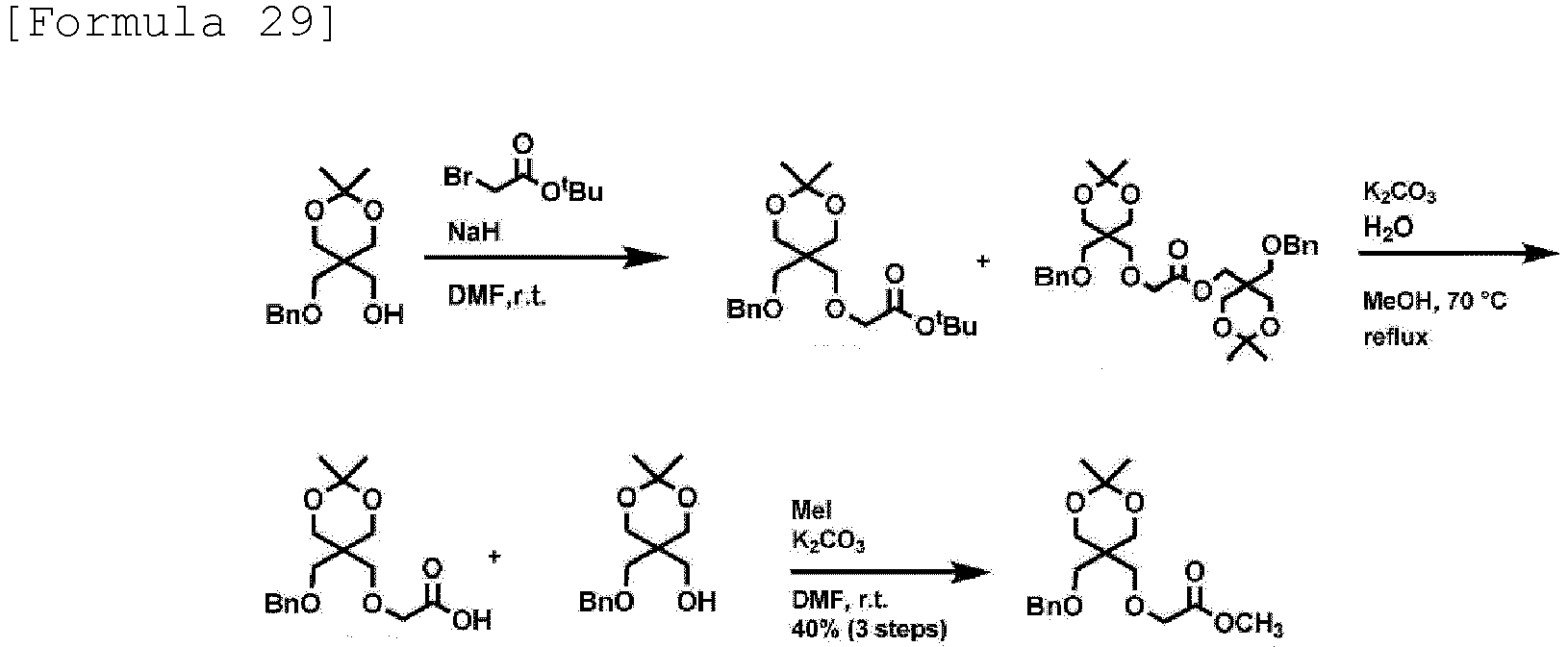
- Sodium hydride (1.75 g, 43.7 mmol, 2.00 eq.) was washed with dry hexane, and then dry N,N-dimethylformamide (16.4 mL) was added. Next, tert-butyl 2-bromoacetate (4.81 mL, 32.8 mmol, 1.50 eq.) was added at 0°C. After reacting at room temperature for 1 hour, ethanol was added to stop the reaction, and then the mixture was poured into ethyl acetate and water. After extracting the aqueous layer using ethyl acetate, the organic layer was washed with saturated brine and dried using magnesium sulfate. After removing the magnesium sulfate by filtration, the solution was concentrated under reduced pressure. The obtained residue was diluted with methanol (42 mL), and then potassium carbonate (5.83 g, 42.2 mmol, 2.0 eq.) and water (0.761 mL, 42.2 mmol, 2.0 eq.) were added at 0°C. After reacting at room temperature for 2.5 hours, the reaction solution was concentrated under reduced pressure. The obtained residue was diluted with dry N,N-dimethylformamide (60 mL), and then potassium carbonate (11.7 g, 84.5 mmol, 4.0 eq.) and iodomethane (3.96 mL, 63.4 mmol, 3.0 eq.) were added. After reacting at room temperature for 2 hours, the reaction solution was poured into a saturated aqueous ammonium chloride solution. After extracting the aqueous layer with ethyl acetate, the organic layer was washed with saturated brine and dried using magnesium sulfate. After removing the magnesium sulfate by filtration, the solution was concentrated under reduced pressure. The obtained residue was purified by silica gel chromatography to give the title compound (2.84 g, 8.39 mmol, 40%).

-


- To a solution of tert-butyl 2-((5-((benzyloxymethyl)-2,2-dimethyl-1,3-dioxan-5-yl)methoxy)acetate (8.75 g, 25.9 mmol, 1.0 eq.) in methanol (13.5 mL), ammonia (13.5 mL) was added at -30°C. After sealing the tube, the mixture was reacted at room temperature for 12 hours. After opening the tube, the mixture was stirred at room temperature to remove ammonia, and then methanol was removed under reduced pressure. The obtained residue was purified using silica gel column chromatography to give the title compound (7.48 g, 23.1 mmol, 89%) .

- To a suspension of Pd/C (6.93 g, 0.3 g/mmol, 10%) in tetrahydrofuran (348 mL) was added 2-((5-((benzyloxymethyl)-2,2-dimethyl-1,3-dioxan-5-yl)methoxy)acetamide (7.48 g, 23.1 mmol, 1.0 eq.). After placing the reaction vessel under a hydrogen atmosphere at normal pressure, the mixture was reacted at room temperature for 2 hours. After filtering the reaction solution, the filtrate was concentrated under reduced pressure. The obtained residue was purified using silica gel column chromatography to give the title compound (4.13 g, 17.7 mmol, 76%) .

-


- To a solution of 2-((5-(hydroxymethyl)-2,2-dimethyl-1,3-dioxiran-5-yl)methoxy)acetamide (100 mg, 429 µmol, 1.0 eq.) in dry acetonitrile (1.0 mL) was added a solution of 7-methyl-1,5,7-triazabicyclo[4.4.0]dec-5-ene (124 µL, 857 µmol, 2.0 eq.) and 2-(dioctylamino)-1,1-difluoro-2-oxaethane-1-sulfonyl fluoride (258 mg, 643 µmol, 1.5 eq.) in dry acetonitrile (1.0 mL) at 0°C. After reacting under ice cooling for 1.5 hours, the reaction solution was poured into ethyl acetate and water. After extracting the aqueous layer using ethyl acetate, the organic layer was washed with saturated brine and then dried using magnesium sulfate. After removing the magnesium sulfate by filtration, the filtrate was concentrated under reduced pressure. The residue was purified using silica gel column chromatography to give the title compound (63.5 mg, 103 µmol, 24%).


19F NMR (400 MHz, CDCl3) δ -98.0 (s, 2F, F-1) - To a solution of (5-((2-amino-2-oxaethoxy)methyl)-2,2-dimethyl-1,3-oxiran-5-yl)methyl 2-(didioctylamino)-1,1-difluoro-2-oxaethane-1-sulfonate (40 mg, 65 µmol, 1.0 eq.) in dry dichloromethane (2.0 mL) were added a 30% 1,4-dioxane solution of di-tert-butyl bicarbonate (110 µL, 160 µmol, 2.5 eq.) and N,N-dimethylaminopyridine (7.9 mg, 65 µmol, 1.0 eq.) at 0°C. After reacting at room temperature for 2 hours, the mixture was poured into a mixed solution of ethyl acetate and water. The aqueous layer was extracted using ethyl acetate, and the organic layer was washed with saturated brine, then dried using magnesium sulfate. The filtrate from which magnesium sulfate was removed by filtration was concentrated under reduced pressure. The residue was purified by silica gel column chromatography to give the title compound (47 mg, 58 µmol, 89%).

19F NMR (400 MHz, CDCl3) δ -98.1 (s, 2F, F-1) -

- To a solution of (2R,3R)-5,7-dihydroxy-2-(3,4,5-trihydroxy)chroman-3-yl 3,4,5-trihydroxybenzoate (5.00 g, 10.9 mmol, 1.0 eq.) in dry N,N,-dimethylformamide (50 mL) were added potassium carbonate (18.1 g, 131 mmol, 12.0 eq.) and iodomethane (6.79 mL, 109 mmol, 10.0 eq.) at 0°C. After reacting at room temperature for 12 hours, the mixture was poured into a mixed solution of ethyl acetate and saturated ammonium chloride. After extracting the aqueous layer with ethyl acetate, the organic layer was washed with saturated brine. After drying the obtained organic layer over magnesium sulfate, the filtrate from which magnesium sulfate was removed by filtration was concentrated under reduced pressure. The obtained residue was purified by silica gel column chromatography to give the title compound (5.28 g, 925 mmol, 85%).

- Phosphoryl chloride (180 µL, 1.93 mmol, 1.1 eq.) was added to dry N,N,-dimethylformamide (4.28 mL) at 0°C. After reacting at room temperature for 30 minutes, a solution of (2R,3R)-5,7-dimethoxy-2-(3,4,5-triphenoxyphenyl)chroman-3-yl 3,4,5-trimethoxybenzoate (1.00 g, 1.75 mmol, 1.0 eq.) in dry N,N-dimethylformamide was added at 0°C. After further stirring for 2 hours at room temperature, the reaction solution was poured into sodium bicarbonate water and ethyl acetate at 0°C. After extracting the aqueous layer with ethyl acetate, the organic layer was washed with saturated brine and then dried over magnesium sulfate. The filtrate from which magnesium sulfate was removed by filtration was concentrated under reduced pressure. The obtained residue was purified by silica gel column chromatography to give the title compound (788 mg, 1.29 mmol, 73%).

- (2R,3R)-8-Formyl-5,7-dimethoxy-2-(3,4,5-trimethoxy)chroman-3-yl 3,4,5-trimethoxybenzoate (1.00 g, 1.67 mmol) was reacted in a 40% methylamine aqueous solution (20 mL, 0.24 mol) at room temperature for 24 hours. The reaction solution was poured into a mixture of methylene chloride and water, and the organic layer was washed with water. The obtained organic layer was dried using magnesium sulfate, and then concentrated under reduced pressure. The obtained residue was dissolved in ethanol (7.0 mL) and then sodium borohydride (316 mg, 8.53 mmol, 5.0 eq.) was added at 0°C. After reacting at room temperature for 24 hours, the mixture was poured into methylene chloride and water. After extracting the aqueous layer with methylene chloride, the organic layer was extracted with 1M hydrochloric acid. The aqueous layer was adjusted to pH 9 using sodium bicarbonate and potassium carbonate, and extracted using dichloromethane. The obtained organic layer was filtered with magnesium sulfate and concentrated under reduced pressure to give the title compound (390 mg, 931 µmol, 56%) .


-

- To a solution of methyl 3,4,5-trihydroxybenzoate (1.00 g, 5.43 mmol, 1.0 eq.) in dichloromethane (54 mL) were added diisopropylethylamine (7.1 mL, 40.7 mmol, 7.5 eq.) and chloro(methoxy)methane (1.86 mL, 24.4 mmol, 4 5 eq.) at 0°C. After reacting at room temperature for 2 hours, the mixture was poured into a saturated aqueous ammonium chloride solution and ethyl acetate. The aqueous layer was extracted using ethyl acetate. The obtained organic layer was washed with saturated brine, and then dried using magnesium sulfate. The filtrate from which magnesium sulfate was removed by filtration was concentrated under reduced pressure. The obtained residue was purified by silica gel column chromatography to give the title compound (1.64 g, 5.21 mmol, 96%).

- To a solution of methyl 3,4,5-tris(methoxymethyl)benzoate (2-34) (623 mg, 1.97 mmol, 1.0 eq.) in methanol (3.2 mL) were added potassium carbonate (544 mg, 3.94 mmol, 2.0 eq.) and water (3.2 mL) at room temperature. After reacting at 70°C for 2 hours, the reaction solution was poured into ammonium chloride, 1M hydrochloric acid, and ethyl acetate. The aqueous layer was extracted with ethyl acetate, then washed with saturated sodium bicarbonate aqueous solution and dried over magnesium sulfate. The obtained residue was recrystallized using chloroform and hexane to give the title compound (518 mg, 1.71 mmol, 87%).

-


- To a solution of (5-((2-(bis(tert-butoxycarbonyl)amino)-2-oxoethyl)methyl)-2,2-dimethyl-1,3-dioxan-5-yl)methyl 2-(N,N-dioctylamino)-1,1-fluoro-2-oxoethane-1-sulfonate (40 mg, 48 µmol, 1.0 eq.) in dry dichloromethane (1.0 mL) were added (2R,3R)-5,7-dimethoxy-8-((N-methylamino)methyl)-2-(3,4,5-trimethoxy)chroman-3-ol (24 mg, 58 µmol, 1.2 eq.) and N,N-dimethylaminopyridine (5.9 mg, 48 µmol, 1.0 eq.) at 0°C. After reacting at room temperature for 2 hours, the mixture was poured into ethyl acetate and water, and the aqueous layer was extracted using ethyl acetate. The organic layer was washed using saturated brine, and then dried using magnesium sulfate. After filtering off the magnesium sulfate, the filtrate was concentrated under reduced pressure. The concentrated residue was purified using silica gel column chromatography to give the title compound (19.3 mg, 19.0 µmol, 40%).

- To a solution of (5-((2-((((2R,3R)-3-hydroxy-5,7-dimethoxy-2-(3,4,5-trimethoxyphenyl)chroman-8-yl)methyl)(N-methylamino)-2-oxoethyl)methyl)-2,2-dimethyl-1,3-dioxan-5-yl)methyl 2-(N,N-dioctylamino)-1,1-difluoro-2-oxoethane-1-sulfonate (23 mg, 23 µmol, 1.0 eq.) in dry dichloromethane (1.0 mL) were added 3,4,5-tris(methoxymethyl)benzoic acid (10 mg, 34 µmol, 1.5 eq.), bromo-tris-pyrrolidino-phosphonium hexafluorophosphate (21 mg, 45 µmol, 2.0 eq.), and N,N,-dimethylaminopyridine (2.8 mg, 23 µmol, 1.0 eq.) at 0°C. After stirring at room temperature for 15 minutes, the reaction solution was poured into a saturated aqueous ammonium chloride solution and ethyl acetate. After extracting the aqueous layer with ethyl acetate, the organic layer was washed with saturated brine and then dried using magnesium sulfate. After removing the magnesium sulfate by filtration, the filtrate was concentrated under reduced pressure. The obtained residue was purified by silica gel column chromatography to give the title compound (14.7 mg, 17 µmol, 50%).


19F NMR (400 MHz, CDCl3) δ -98.1 (s, 2F, F-1) - Astatine-211 (211At) was produced via the nuclear reaction of 209Bi(α,2n)211At by irradiating a stable isotope of bismuth with an α beam by cyclotron. The isolation of 211At from bismuth after irradiation was performed by distilling by heating in a furnace at 850°C using a gas mixture of 20% oxygen/nitrogen as the carrier gas, and washing downstream trapping tubes with an arbitrary solvent for collecting. The 211At solution thus obtained was concentrated by the following method and used for labeling.
- In a previous study, it had been confirmed that the addition of 72.4 µmol of bicarbonate and carbonate salts of sodium, potassium, cesium, and the like to 100 µL of a 211At solution collected with methanol enabled removal of the solvent with nitrogen gas while minimizing the volatilization of 211At. In the present study, potassium carbonate and cesium carbonate were dissolved in methanol and 3.6 µmol of the carbonate salt in liquid state was mixed with the 211At solution. Then, a venting needle connected to activated carbon was attached thereto and the solvent was removed with nitrogen gas. The radioactivity of 211At in the vials before and after solvent removal was measured to determine the residual ratio of 211At. The results are shown in Table 1. [Table 1]
Table 1: Residual ratio of 211At in vials after solvent removal Type of base Residual ratio of 211At Number of trials No base 37% ± 25% 2 K2CO3 (solid, 72.4 µmol) 98% ± 2% 29 Cs2CO3 (solid, 72.4 µmol) 99% ± 1% 2 K2CO3 (liquid, 3.6 µmol) 96% ± 3% 3 Cs2CO3 (liquid, 3.6 µmol) 96% ± 3% 3 - After the solvent removal under each of the two conditions of 3.6 µmol of a liquid carbonate salt in the bottom of Table 1, labeling precursors A and B (2.2 µmol / 100 µL) dissolved in anhydrous acetonitrile were added to the concentrated 211At and mixed therewith well by a vortex mixer. The labeling precursors were allowed to act at room temperature and 60°C, and the rate of formation of the 211At-labeled compound (C) was determined by TLC. 1 µL of the reaction solution was spotted on TLC over time, and then developed with hexane : ethyl acetate = 4:1 after 2 minutes, and the rate of formation of C was measured by autoradiography. The results are shown in Table 2. To confirm that the precursor was less damaged when B was used than when A was used, the changes in the TLC spots when exposed to 254 nm UV light were checked (
Figure 1 ).
-
Table 2: Rate of formation of 211At-labeled compound of labeling precursors A and B Carbonate salt Temperature Reaction time (min) Rate of formation (%) A B K2CO3 Room temperature 1 30 11 5 49 19 15 57 30 30 52 43 60 57 56 60°C 10 70 80 30 69 83 Cs2CO3 Room temperature 1 30 10 5 48 14 15 52 24 30 50 35 60 56 51 60°C 10 64 81 30 72 81 - The leaving group (CDf8) of the labeling precursor B, which was developed in the present study, was designed taking into account the expectation that it had a lower acidity than triflate, the leaving group of A, and a higher acidity than tosyl (acidity pKa: triflate = -14, tosyl = 0.7). Therefore, the labeling precursor B is expected to be a precursor that is more reactive than a precursor having a tosyl group and appropriately more stable than a precursor having a triflate group. In the present study, TLC analysis confirmed that At labeling of the labeling precursor B proceeded sufficiently. In addition, a large number of spots on the TLC were confirmed over time for A, which had a triflate group, and it indicates degradation (
Figure 1 , top); in contrast, it was found that there was less damage of the precursor B (Figure 1 , Bbottom). - All publications, patents and patent applications cited herein are incorporated by reference in their entirety.
- Since radioactive halogen-labeled compounds can be used in medicaments, the present invention can be used in industries related to medicaments.
Claims (17)
- A compound represented by the following general formula (I):

- The compound according to claim 1, wherein R1 and R2 in the general formula (I) are each an alkyl group having 7 to 11 carbon atoms.
- The compound according to claim 1 or 2, wherein X1 and X2 in the general formula (I) are each a fluorine atom or a chlorine atom.
- A compound represented by the following general formula (II):


- The compound according to claim 4, wherein R1 and R2 in the general formula (II) are each an alkyl group having 7 to 11 carbon atoms.
- The compound according to claim 4 or 5, wherein X1 and X2 in the general formula (II) are each a fluorine atom or a chlorine atom.
- The compound according to any one of claims 4 to 6, wherein L in the general formula (A) or (B) is an alkylene group, and one or more -CH2- of the alkylene group are optionally replaced with -O- or a phenylene group.
- The compound according to any one of claims 4 to 7, wherein R4 in the general formula (A) or (B) is a 4-[2,3-bis(tert-butoxycarbonyl)guanidinomethyl]phenyl group, a naphthalen-2-yl group, a 2-nitro-1H-imidazol-1-yl group, or an aminocarbonyl group protected by a tert-butoxycarbonyl group.
- A method for producing a radioactive halogen-labeled compound represented by the following general formula (IIIa) :
[Formula 5]
X4-R3a (IIIa)
wherein X4 represents a radioactive halogen atom and R3a represents a monovalent group derived from a compound to be labeled with a radioactive halogen atom; the method comprising a step of reacting a labeling precursor compound represented by the following general formula (IIa): wherein R1 and R2 each independently represent an alkyl group having 5 to 20 carbon atoms, X1 and X2 each independently represent a halogen atom, and R3a has the same meaning as above,with a radioactive halide ion to obtain a radioactive halogen-labeled compound represented by the general formula (IIIa).
 - The method according to claim 9, wherein R1 and R2 in the general formula (IIa) are each an alkyl group having 7 to 11 carbon atoms.
- The method according to claim 9 or 10, wherein X1 and X2 in the general formula (IIa) are each a fluorine atom or a chlorine atom.
- The method according to any one of claims 9 to 11, wherein R3a in the general formulae (IIa) and (IIIa) is a monovalent group derived from a sugar, a monovalent group derived from a peptide, or a group represented by the following general formula (A) or (B):


- The compound according to claim 12, wherein L in the general formula (A) or (B) is an alkylene group, and one or more -CH2- of the alkylene group are optionally replaced with -O- or a phenylene group.
- The compound according to claim 12 or 13, wherein R4 in the general formula (A) or (B) is a 4-[2,3-bis(tert-butoxycarbonyl)guanidinomethyl]phenyl group, a naphthalen-2-yl group, a 2-nitro-1H-imidazol-1-yl group, or an aminocarbonyl group protected by a tert-butoxycarbonyl group.
- The method according to any one of claims 9 to 14, wherein X4 in the general formula (IIIa) is 211At.
- A reagent for producing a labeling precursor compound, comprising the compound according to any one of claims 1 to 3.
- A labeling precursor reagent for a radioactive halogen-labeled compound, comprising the compound according to any one of claims 4 to 8.
Applications Claiming Priority (2)
| Application Number | Priority Date | Filing Date | Title |
|---|---|---|---|
| JP2021006394A JP7668480B2 (en) | 2021-01-19 | 2021-01-19 | Radioactive halogen-labeled precursor compounds |
| PCT/JP2022/001558 WO2022158442A1 (en) | 2021-01-19 | 2022-01-18 | Radioactive halogen-labeled precursor compound |
Publications (3)
| Publication Number | Publication Date |
|---|---|
| EP4282857A1 true EP4282857A1 (en) | 2023-11-29 |
| EP4282857A4 EP4282857A4 (en) | 2024-12-25 |
| EP4282857B1 EP4282857B1 (en) | 2026-04-15 |
Family
ID=82549450
Family Applications (1)
| Application Number | Title | Priority Date | Filing Date |
|---|---|---|---|
| EP22742564.2A Active EP4282857B1 (en) | 2021-01-19 | 2022-01-18 | Radioactive halogen-labeled precursor compound |
Country Status (4)
| Country | Link |
|---|---|
| US (1) | US20240034721A1 (en) |
| EP (1) | EP4282857B1 (en) |
| JP (1) | JP7668480B2 (en) |
| WO (1) | WO2022158442A1 (en) |
Family Cites Families (8)
| Publication number | Priority date | Publication date | Assignee | Title |
|---|---|---|---|---|
| US2852554A (en) * | 1956-07-12 | 1958-09-16 | Du Pont | Alpha-sulfopolyfluoromonocarboxylic acids and derivatives hydrolyzable thereto |
| GB0317920D0 (en) | 2003-07-31 | 2003-09-03 | Amersham Plc | Solid-phase synthesis |
| US9073802B2 (en) | 2010-02-12 | 2015-07-07 | Tokyo Institute Of Technology | Method for producing 18F-labeled compound and high molecular compound to be used in the method |
| EP2657213A1 (en) * | 2012-04-24 | 2013-10-30 | Institut National de la Santé et de la Recherche Medicale | Labelled quinoxaline derivatives as multimodal radiopharmaceuticals and their precursors |
| JP6523107B2 (en) | 2015-09-08 | 2019-05-29 | 日本メジフィジックス株式会社 | Radioactive fluorine labeled precursor compound and method for producing radioactive fluorine labeled compound using the same |
| WO2018164043A1 (en) | 2017-03-07 | 2018-09-13 | 日本メジフィジックス株式会社 | Radioactive fluorine-labeled precursor compound, and method for producing radioactive fluorine-labeled compound using same |
| JP7370520B2 (en) | 2018-01-31 | 2023-10-30 | 国立大学法人千葉大学 | radiopharmaceutical |
| JP2021006394A (en) | 2019-06-28 | 2021-01-21 | セイコーエプソン株式会社 | Print head, and liquid discharge device |
-
2021
- 2021-01-19 JP JP2021006394A patent/JP7668480B2/en active Active
-
2022
- 2022-01-18 US US18/037,038 patent/US20240034721A1/en active Pending
- 2022-01-18 WO PCT/JP2022/001558 patent/WO2022158442A1/en not_active Ceased
- 2022-01-18 EP EP22742564.2A patent/EP4282857B1/en active Active
Also Published As
| Publication number | Publication date |
|---|---|
| US20240034721A1 (en) | 2024-02-01 |
| JP2022110777A (en) | 2022-07-29 |
| WO2022158442A1 (en) | 2022-07-28 |
| JP7668480B2 (en) | 2025-04-25 |
| EP4282857A4 (en) | 2024-12-25 |
| EP4282857B1 (en) | 2026-04-15 |
Similar Documents
| Publication | Publication Date | Title |
|---|---|---|
| EP2003104B1 (en) | Reagent for organic synthesis and method of organic synthesis reaction with the reagent | |
| EP2854800B1 (en) | Substituted pyrrolidine-2-carboxamides | |
| EP3083630B1 (en) | Process methods for phosphatidylinositol 3-kinase inhibitors | |
| EP3150575B1 (en) | Method for preparing 2-amino-n-(2,2,2-trifluoroethyl) acetamide | |
| EA019040B1 (en) | Novel process for the preparation of amino acid derivatives | |
| EP3792269A1 (en) | Method for producing oligonucleic acid compound | |
| EP3141537B1 (en) | A labeling precursor compound and method for producing radioactive fluorine labeled compound using the same | |
| EP3560931B1 (en) | PROCESS FOR PREPARING 7H-PYRROLO[2,3-d]PYRIMIDINE DERIVATIVES AND CO-CRYSTALS THEREOF | |
| CN101307084A (en) | Synthetic process of Decitabine | |
| JP2025128175A (en) | Method for producing oligonucleic acid compound | |
| JP2025111536A (en) | Method for producing oligonucleic acid compound | |
| US20100280258A1 (en) | Methods for the preparation of amphillic nitrogen containing imidazolinium derivative compounds | |
| EP4282857B1 (en) | Radioactive halogen-labeled precursor compound | |
| KR102524773B1 (en) | Method for producing purine derivatives | |
| CN106146536A (en) | A kind of preparation method of everolimus | |
| Nekvinda et al. | Chemistry of cobalt bis (1, 2-dicarbollide) ion; the synthesis of carbon substituted alkylamino derivatives from hydroxyalkyl derivatives via methylsulfonyl or p-toluenesulfonyl esters | |
| KR101871567B1 (en) | METHOD FOR SYNTHESIZING β-AMINO-DITHIOESTER COMPOUND AND β-AMINO-DITHIOESTER COMPOUND SYNTHESIZED BY THE METHOD | |
| Jadhav et al. | Synthesis of azepane and nojirimycin iminosugars: the Sharpless asymmetric epoxidation of d-glucose-derived allyl alcohol and highly regioselective epoxide ring opening using sodium azide | |
| WO1994014778A1 (en) | Optically active 2-nitroimidazole derivative, process for producing the same, and intermediate for producing the same | |
| CN112341468A (en) | 1, 4-benzodiazepine compound and preparation and functionalization method thereof | |
| HK40038624A (en) | Method for producing oligonucleic acid compound | |
| KR20130140041A (en) | Preparation of pet precursor | |
| HK40072767A (en) | Method for producing oligonucleic acid compound | |
| CN107629039A (en) | The preparation method and intermediate of deuterated acrylamide | |
| HK1235763B (en) | Method for preparing 2-amino-n-(2,2,2-trifluoroethyl) acetamide |
Legal Events
| Date | Code | Title | Description |
|---|---|---|---|
| STAA | Information on the status of an ep patent application or granted ep patent |
Free format text: STATUS: THE INTERNATIONAL PUBLICATION HAS BEEN MADE |
|
| PUAI | Public reference made under article 153(3) epc to a published international application that has entered the european phase |
Free format text: ORIGINAL CODE: 0009012 |
|
| STAA | Information on the status of an ep patent application or granted ep patent |
Free format text: STATUS: REQUEST FOR EXAMINATION WAS MADE |
|
| 17P | Request for examination filed |
Effective date: 20230601 |
|
| AK | Designated contracting states |
Kind code of ref document: A1 Designated state(s): AL AT BE BG CH CY CZ DE DK EE ES FI FR GB GR HR HU IE IS IT LI LT LU LV MC MK MT NL NO PL PT RO RS SE SI SK SM TR |
|
| DAV | Request for validation of the european patent (deleted) | ||
| DAX | Request for extension of the european patent (deleted) | ||
| REG | Reference to a national code |
Ref country code: DE Ref legal event code: R079 Free format text: PREVIOUS MAIN CLASS: C07C0309840000 Ipc: C07B0059000000 Ref country code: DE Ref legal event code: R079 Ref document number: 602022034617 Country of ref document: DE Free format text: PREVIOUS MAIN CLASS: C07C0309840000 Ipc: C07B0059000000 |
|
| A4 | Supplementary search report drawn up and despatched |
Effective date: 20241121 |
|
| RIC1 | Information provided on ipc code assigned before grant |
Ipc: A61K 51/04 20060101ALI20241115BHEP Ipc: C07F 13/00 20060101ALI20241115BHEP Ipc: C07D 407/12 20060101ALI20241115BHEP Ipc: C07D 405/06 20060101ALI20241115BHEP Ipc: C07D 319/06 20060101ALI20241115BHEP Ipc: C07C 309/70 20060101ALI20241115BHEP Ipc: C07C 309/84 20060101ALI20241115BHEP Ipc: C07B 59/00 20060101AFI20241115BHEP |
|
| GRAP | Despatch of communication of intention to grant a patent |
Free format text: ORIGINAL CODE: EPIDOSNIGR1 |
|
| STAA | Information on the status of an ep patent application or granted ep patent |
Free format text: STATUS: GRANT OF PATENT IS INTENDED |
|
| INTG | Intention to grant announced |
Effective date: 20251110 |
|
| GRAS | Grant fee paid |
Free format text: ORIGINAL CODE: EPIDOSNIGR3 |
|
| GRAA | (expected) grant |
Free format text: ORIGINAL CODE: 0009210 |
|
| STAA | Information on the status of an ep patent application or granted ep patent |
Free format text: STATUS: THE PATENT HAS BEEN GRANTED |
|
| RAP3 | Party data changed (applicant data changed or rights of an application transferred) |
Owner name: INSTITUTE OF SCIENCE TOKYO Owner name: FUKUSHIMA MEDICAL UNIVERSITY Owner name: TAIYO NIPPON SANSO CORPORATION |
|
| AK | Designated contracting states |
Kind code of ref document: B1 Designated state(s): AL AT BE BG CH CY CZ DE DK EE ES FI FR GB GR HR HU IE IS IT LI LT LU LV MC MK MT NL NO PL PT RO RS SE SI SK SM TR |
|
| REG | Reference to a national code |
Ref country code: CH Ref legal event code: F10 Free format text: ST27 STATUS EVENT CODE: U-0-0-F10-F00 (AS PROVIDED BY THE NATIONAL OFFICE) Effective date: 20260415 |
|
| P01 | Opt-out of the competence of the unified patent court (upc) registered |
Free format text: CASE NUMBER: UPC_APP_0010120_4282857/2026 Effective date: 20260317 |
|
| REG | Reference to a national code |
Ref country code: DE Ref legal event code: R096 Ref document number: 602022034617 Country of ref document: DE |