EP4282841A1 - Surface treatment agent - Google Patents
Surface treatment agent Download PDFInfo
- Publication number
- EP4282841A1 EP4282841A1 EP22742442.1A EP22742442A EP4282841A1 EP 4282841 A1 EP4282841 A1 EP 4282841A1 EP 22742442 A EP22742442 A EP 22742442A EP 4282841 A1 EP4282841 A1 EP 4282841A1
- Authority
- EP
- European Patent Office
- Prior art keywords
- independently
- group
- occurrence
- integer
- treating agent
- Prior art date
- Legal status (The legal status is an assumption and is not a legal conclusion. Google has not performed a legal analysis and makes no representation as to the accuracy of the status listed.)
- Pending
Links
- 239000012756 surface treatment agent Substances 0.000 title 1
- -1 silane compound Chemical class 0.000 claims abstract description 93
- 229910000077 silane Inorganic materials 0.000 claims abstract description 39
- 125000000962 organic group Chemical group 0.000 claims description 133
- 239000003795 chemical substances by application Substances 0.000 claims description 107
- 125000004435 hydrogen atom Chemical group [H]* 0.000 claims description 79
- 125000002887 hydroxy group Chemical group [H]O* 0.000 claims description 50
- 125000000217 alkyl group Chemical group 0.000 claims description 44
- 229910052731 fluorine Inorganic materials 0.000 claims description 42
- 125000001153 fluoro group Chemical group F* 0.000 claims description 39
- 125000002947 alkylene group Chemical group 0.000 claims description 37
- 239000000758 substrate Substances 0.000 claims description 37
- 125000003161 (C1-C6) alkylene group Chemical group 0.000 claims description 34
- 125000004430 oxygen atom Chemical group O* 0.000 claims description 29
- 125000000008 (C1-C10) alkyl group Chemical group 0.000 claims description 24
- 125000004429 atom Chemical group 0.000 claims description 21
- YCKRFDGAMUMZLT-UHFFFAOYSA-N Fluorine atom Chemical compound [F] YCKRFDGAMUMZLT-UHFFFAOYSA-N 0.000 claims description 19
- 239000011737 fluorine Substances 0.000 claims description 19
- 229910052710 silicon Inorganic materials 0.000 claims description 19
- 229920002545 silicone oil Polymers 0.000 claims description 17
- 230000003287 optical effect Effects 0.000 claims description 16
- 239000002904 solvent Substances 0.000 claims description 16
- 239000011521 glass Substances 0.000 claims description 15
- 125000005010 perfluoroalkyl group Chemical group 0.000 claims description 15
- 239000003054 catalyst Substances 0.000 claims description 11
- 229910052801 chlorine Inorganic materials 0.000 claims description 8
- 125000001309 chloro group Chemical group Cl* 0.000 claims description 8
- 125000006551 perfluoro alkylene group Chemical group 0.000 claims description 8
- 239000011248 coating agent Substances 0.000 claims description 7
- 230000003373 anti-fouling effect Effects 0.000 claims description 6
- 125000005843 halogen group Chemical group 0.000 claims description 6
- 239000008188 pellet Substances 0.000 claims description 5
- 238000009835 boiling Methods 0.000 claims description 3
- 239000010410 layer Substances 0.000 description 64
- 125000002496 methyl group Chemical group [H]C([H])([H])* 0.000 description 44
- 125000004169 (C1-C6) alkyl group Chemical group 0.000 description 41
- 150000001875 compounds Chemical class 0.000 description 39
- 238000005299 abrasion Methods 0.000 description 22
- 125000001495 ethyl group Chemical group [H]C([H])([H])C([H])([H])* 0.000 description 21
- 125000003837 (C1-C20) alkyl group Chemical group 0.000 description 17
- 230000000052 comparative effect Effects 0.000 description 17
- 125000000816 ethylene group Chemical group [H]C([H])([*:1])C([H])([H])[*:2] 0.000 description 17
- 239000003921 oil Substances 0.000 description 17
- LCGLNKUTAGEVQW-UHFFFAOYSA-N Dimethyl ether Chemical compound COC LCGLNKUTAGEVQW-UHFFFAOYSA-N 0.000 description 16
- 125000001997 phenyl group Chemical group [H]C1=C([H])C([H])=C(*)C([H])=C1[H] 0.000 description 16
- 125000002023 trifluoromethyl group Chemical group FC(F)(F)* 0.000 description 15
- 125000004432 carbon atom Chemical group C* 0.000 description 14
- 238000000576 coating method Methods 0.000 description 14
- 150000002430 hydrocarbons Chemical group 0.000 description 14
- 238000000034 method Methods 0.000 description 14
- 239000000463 material Substances 0.000 description 12
- 125000001424 substituent group Chemical group 0.000 description 12
- 125000004178 (C1-C4) alkyl group Chemical group 0.000 description 11
- 125000006273 (C1-C3) alkyl group Chemical group 0.000 description 10
- 239000010408 film Substances 0.000 description 9
- 125000000882 C2-C6 alkenyl group Chemical group 0.000 description 8
- 125000003601 C2-C6 alkynyl group Chemical group 0.000 description 8
- LFQSCWFLJHTTHZ-UHFFFAOYSA-N Ethanol Chemical compound CCO LFQSCWFLJHTTHZ-UHFFFAOYSA-N 0.000 description 8
- 229910052736 halogen Inorganic materials 0.000 description 8
- 150000002367 halogens Chemical class 0.000 description 8
- 229930195733 hydrocarbon Natural products 0.000 description 8
- 238000001771 vacuum deposition Methods 0.000 description 8
- VYPSYNLAJGMNEJ-UHFFFAOYSA-N Silicium dioxide Chemical compound O=[Si]=O VYPSYNLAJGMNEJ-UHFFFAOYSA-N 0.000 description 7
- 230000006750 UV protection Effects 0.000 description 7
- 125000003709 fluoroalkyl group Chemical group 0.000 description 7
- 125000004191 (C1-C6) alkoxy group Chemical group 0.000 description 6
- QTBSBXVTEAMEQO-UHFFFAOYSA-N Acetic acid Chemical compound CC(O)=O QTBSBXVTEAMEQO-UHFFFAOYSA-N 0.000 description 6
- OKKJLVBELUTLKV-UHFFFAOYSA-N Methanol Chemical compound OC OKKJLVBELUTLKV-UHFFFAOYSA-N 0.000 description 6
- ZMXDDKWLCZADIW-UHFFFAOYSA-N N,N-Dimethylformamide Chemical compound CN(C)C=O ZMXDDKWLCZADIW-UHFFFAOYSA-N 0.000 description 6
- 150000001298 alcohols Chemical class 0.000 description 6
- 125000003545 alkoxy group Chemical group 0.000 description 6
- 125000004218 chloromethyl group Chemical group [H]C([H])(Cl)* 0.000 description 6
- RTZKZFJDLAIYFH-UHFFFAOYSA-N ether Substances CCOCC RTZKZFJDLAIYFH-UHFFFAOYSA-N 0.000 description 6
- 238000006460 hydrolysis reaction Methods 0.000 description 6
- 125000000959 isobutyl group Chemical group [H]C([H])([H])C([H])(C([H])([H])[H])C([H])([H])* 0.000 description 6
- 125000001449 isopropyl group Chemical group [H]C([H])([H])C([H])(*)C([H])([H])[H] 0.000 description 6
- 125000004108 n-butyl group Chemical group [H]C([H])([H])C([H])([H])C([H])([H])C([H])([H])* 0.000 description 6
- 125000001436 propyl group Chemical group [H]C([*])([H])C([H])([H])C([H])([H])[H] 0.000 description 6
- 239000000126 substance Substances 0.000 description 6
- 125000000547 substituted alkyl group Chemical group 0.000 description 6
- 125000001140 1,4-phenylene group Chemical group [H]C1=C([H])C([*:2])=C([H])C([H])=C1[*:1] 0.000 description 5
- 239000004215 Carbon black (E152) Substances 0.000 description 5
- 229910052799 carbon Inorganic materials 0.000 description 5
- 238000009833 condensation Methods 0.000 description 5
- 230000005494 condensation Effects 0.000 description 5
- 238000000151 deposition Methods 0.000 description 5
- LYCAIKOWRPUZTN-UHFFFAOYSA-N ethylene glycol Natural products OCCO LYCAIKOWRPUZTN-UHFFFAOYSA-N 0.000 description 5
- 229910052760 oxygen Inorganic materials 0.000 description 5
- 238000012360 testing method Methods 0.000 description 5
- XLYOFNOQVPJJNP-UHFFFAOYSA-N water Substances O XLYOFNOQVPJJNP-UHFFFAOYSA-N 0.000 description 5
- PSQZJKGXDGNDFP-UHFFFAOYSA-N 2,2,3,3,3-pentafluoropropan-1-ol Chemical compound OCC(F)(F)C(F)(F)F PSQZJKGXDGNDFP-UHFFFAOYSA-N 0.000 description 4
- QGZKDVFQNNGYKY-UHFFFAOYSA-N Ammonia Chemical compound N QGZKDVFQNNGYKY-UHFFFAOYSA-N 0.000 description 4
- IAZDPXIOMUYVGZ-UHFFFAOYSA-N Dimethylsulphoxide Chemical compound CS(C)=O IAZDPXIOMUYVGZ-UHFFFAOYSA-N 0.000 description 4
- KFZMGEQAYNKOFK-UHFFFAOYSA-N Isopropanol Chemical compound CC(C)O KFZMGEQAYNKOFK-UHFFFAOYSA-N 0.000 description 4
- DKGAVHZHDRPRBM-UHFFFAOYSA-N Tert-Butanol Chemical compound CC(C)(C)O DKGAVHZHDRPRBM-UHFFFAOYSA-N 0.000 description 4
- DTQVDTLACAAQTR-UHFFFAOYSA-N Trifluoroacetic acid Chemical compound OC(=O)C(F)(F)F DTQVDTLACAAQTR-UHFFFAOYSA-N 0.000 description 4
- RHQDFWAXVIIEBN-UHFFFAOYSA-N Trifluoroethanol Chemical compound OCC(F)(F)F RHQDFWAXVIIEBN-UHFFFAOYSA-N 0.000 description 4
- 230000008021 deposition Effects 0.000 description 4
- 239000000835 fiber Substances 0.000 description 4
- 229910052751 metal Inorganic materials 0.000 description 4
- 239000002184 metal Substances 0.000 description 4
- 239000000203 mixture Substances 0.000 description 4
- 238000002360 preparation method Methods 0.000 description 4
- 150000004756 silanes Chemical class 0.000 description 4
- 229910052717 sulfur Inorganic materials 0.000 description 4
- 239000010409 thin film Substances 0.000 description 4
- 239000005341 toughened glass Substances 0.000 description 4
- 125000000876 trifluoromethoxy group Chemical group FC(F)(F)O* 0.000 description 4
- ZWEHNKRNPOVVGH-UHFFFAOYSA-N 2-Butanone Chemical compound CCC(C)=O ZWEHNKRNPOVVGH-UHFFFAOYSA-N 0.000 description 3
- MSXVEPNJUHWQHW-UHFFFAOYSA-N 2-methylbutan-2-ol Chemical compound CCC(C)(C)O MSXVEPNJUHWQHW-UHFFFAOYSA-N 0.000 description 3
- CSCPPACGZOOCGX-UHFFFAOYSA-N Acetone Chemical compound CC(C)=O CSCPPACGZOOCGX-UHFFFAOYSA-N 0.000 description 3
- UHOVQNZJYSORNB-UHFFFAOYSA-N Benzene Chemical compound C1=CC=CC=C1 UHOVQNZJYSORNB-UHFFFAOYSA-N 0.000 description 3
- OKTJSMMVPCPJKN-UHFFFAOYSA-N Carbon Chemical compound [C] OKTJSMMVPCPJKN-UHFFFAOYSA-N 0.000 description 3
- XEKOWRVHYACXOJ-UHFFFAOYSA-N Ethyl acetate Chemical compound CCOC(C)=O XEKOWRVHYACXOJ-UHFFFAOYSA-N 0.000 description 3
- DNIAPMSPPWPWGF-UHFFFAOYSA-N Propylene glycol Chemical compound CC(O)CO DNIAPMSPPWPWGF-UHFFFAOYSA-N 0.000 description 3
- 230000002292 Radical scavenging effect Effects 0.000 description 3
- BLRPTPMANUNPDV-UHFFFAOYSA-N Silane Chemical compound [SiH4] BLRPTPMANUNPDV-UHFFFAOYSA-N 0.000 description 3
- YXFVVABEGXRONW-UHFFFAOYSA-N Toluene Chemical compound CC1=CC=CC=C1 YXFVVABEGXRONW-UHFFFAOYSA-N 0.000 description 3
- ZMANZCXQSJIPKH-UHFFFAOYSA-N Triethylamine Chemical compound CCN(CC)CC ZMANZCXQSJIPKH-UHFFFAOYSA-N 0.000 description 3
- 239000002585 base Substances 0.000 description 3
- 125000004122 cyclic group Chemical group 0.000 description 3
- VLKZOEOYAKHREP-UHFFFAOYSA-N n-Hexane Chemical compound CCCCCC VLKZOEOYAKHREP-UHFFFAOYSA-N 0.000 description 3
- 229920003023 plastic Polymers 0.000 description 3
- 238000002203 pretreatment Methods 0.000 description 3
- 239000000377 silicon dioxide Substances 0.000 description 3
- KSOCRXJMFBYSFA-UHFFFAOYSA-N 1,1,1,2,2,3,3,4,4,5,6,6,6-tridecafluoro-5-(1,1,1,2,3,3,4,4,5,5,6,6,6-tridecafluorohexan-2-yloxy)hexane Chemical compound FC(F)(F)C(F)(F)C(F)(F)C(F)(F)C(F)(C(F)(F)F)OC(F)(C(F)(F)F)C(F)(F)C(F)(F)C(F)(F)C(F)(F)F KSOCRXJMFBYSFA-UHFFFAOYSA-N 0.000 description 2
- PGISRKZDCUNMRX-UHFFFAOYSA-N 1,1,1,2,2,3,3,4,4-nonafluoro-4-(trifluoromethoxy)butane Chemical compound FC(F)(F)OC(F)(F)C(F)(F)C(F)(F)C(F)(F)F PGISRKZDCUNMRX-UHFFFAOYSA-N 0.000 description 2
- OKIYQFLILPKULA-UHFFFAOYSA-N 1,1,1,2,2,3,3,4,4-nonafluoro-4-methoxybutane Chemical compound COC(F)(F)C(F)(F)C(F)(F)C(F)(F)F OKIYQFLILPKULA-UHFFFAOYSA-N 0.000 description 2
- NOPJRYAFUXTDLX-UHFFFAOYSA-N 1,1,1,2,2,3,3-heptafluoro-3-methoxypropane Chemical compound COC(F)(F)C(F)(F)C(F)(F)F NOPJRYAFUXTDLX-UHFFFAOYSA-N 0.000 description 2
- BYEAHWXPCBROCE-UHFFFAOYSA-N 1,1,1,3,3,3-hexafluoropropan-2-ol Chemical compound FC(F)(F)C(O)C(F)(F)F BYEAHWXPCBROCE-UHFFFAOYSA-N 0.000 description 2
- 125000001989 1,3-phenylene group Chemical group [H]C1=C([H])C([*:1])=C([H])C([*:2])=C1[H] 0.000 description 2
- DFUYAWQUODQGFF-UHFFFAOYSA-N 1-ethoxy-1,1,2,2,3,3,4,4,4-nonafluorobutane Chemical compound CCOC(F)(F)C(F)(F)C(F)(F)C(F)(F)F DFUYAWQUODQGFF-UHFFFAOYSA-N 0.000 description 2
- 238000004293 19F NMR spectroscopy Methods 0.000 description 2
- FPZWZCWUIYYYBU-UHFFFAOYSA-N 2-(2-ethoxyethoxy)ethyl acetate Chemical compound CCOCCOCCOC(C)=O FPZWZCWUIYYYBU-UHFFFAOYSA-N 0.000 description 2
- XNWFRZJHXBZDAG-UHFFFAOYSA-N 2-METHOXYETHANOL Chemical compound COCCO XNWFRZJHXBZDAG-UHFFFAOYSA-N 0.000 description 2
- QQZOPKMRPOGIEB-UHFFFAOYSA-N 2-Oxohexane Chemical compound CCCCC(C)=O QQZOPKMRPOGIEB-UHFFFAOYSA-N 0.000 description 2
- ZNQVEEAIQZEUHB-UHFFFAOYSA-N 2-ethoxyethanol Chemical compound CCOCCO ZNQVEEAIQZEUHB-UHFFFAOYSA-N 0.000 description 2
- SVONRAPFKPVNKG-UHFFFAOYSA-N 2-ethoxyethyl acetate Chemical compound CCOCCOC(C)=O SVONRAPFKPVNKG-UHFFFAOYSA-N 0.000 description 2
- XLLIQLLCWZCATF-UHFFFAOYSA-N 2-methoxyethyl acetate Chemical compound COCCOC(C)=O XLLIQLLCWZCATF-UHFFFAOYSA-N 0.000 description 2
- IJGRMHOSHXDMSA-UHFFFAOYSA-N Atomic nitrogen Chemical compound N#N IJGRMHOSHXDMSA-UHFFFAOYSA-N 0.000 description 2
- XEEYBQQBJWHFJM-UHFFFAOYSA-N Iron Chemical compound [Fe] XEEYBQQBJWHFJM-UHFFFAOYSA-N 0.000 description 2
- FXHOOIRPVKKKFG-UHFFFAOYSA-N N,N-Dimethylacetamide Chemical compound CN(C)C(C)=O FXHOOIRPVKKKFG-UHFFFAOYSA-N 0.000 description 2
- LRHPLDYGYMQRHN-UHFFFAOYSA-N N-Butanol Chemical compound CCCCO LRHPLDYGYMQRHN-UHFFFAOYSA-N 0.000 description 2
- IMNFDUFMRHMDMM-UHFFFAOYSA-N N-Heptane Chemical compound CCCCCCC IMNFDUFMRHMDMM-UHFFFAOYSA-N 0.000 description 2
- PMDCZENCAXMSOU-UHFFFAOYSA-N N-ethylacetamide Chemical compound CCNC(C)=O PMDCZENCAXMSOU-UHFFFAOYSA-N 0.000 description 2
- UFWIBTONFRDIAS-UHFFFAOYSA-N Naphthalene Chemical compound C1=CC=CC2=CC=CC=C21 UFWIBTONFRDIAS-UHFFFAOYSA-N 0.000 description 2
- 229910003849 O-Si Inorganic materials 0.000 description 2
- 229910003872 O—Si Inorganic materials 0.000 description 2
- WCUXLLCKKVVCTQ-UHFFFAOYSA-M Potassium chloride Chemical compound [Cl-].[K+] WCUXLLCKKVVCTQ-UHFFFAOYSA-M 0.000 description 2
- FAPWRFPIFSIZLT-UHFFFAOYSA-M Sodium chloride Chemical compound [Na+].[Cl-] FAPWRFPIFSIZLT-UHFFFAOYSA-M 0.000 description 2
- WYURNTSHIVDZCO-UHFFFAOYSA-N Tetrahydrofuran Chemical compound C1CCOC1 WYURNTSHIVDZCO-UHFFFAOYSA-N 0.000 description 2
- GWEVSGVZZGPLCZ-UHFFFAOYSA-N Titan oxide Chemical compound O=[Ti]=O GWEVSGVZZGPLCZ-UHFFFAOYSA-N 0.000 description 2
- MCMNRKCIXSYSNV-UHFFFAOYSA-N Zirconium dioxide Chemical compound O=[Zr]=O MCMNRKCIXSYSNV-UHFFFAOYSA-N 0.000 description 2
- 239000002253 acid Substances 0.000 description 2
- 125000001931 aliphatic group Chemical group 0.000 description 2
- 239000005358 alkali aluminosilicate glass Substances 0.000 description 2
- 125000003368 amide group Chemical group 0.000 description 2
- 150000001408 amides Chemical class 0.000 description 2
- 150000001412 amines Chemical class 0.000 description 2
- 229910021529 ammonia Inorganic materials 0.000 description 2
- 125000000732 arylene group Chemical group 0.000 description 2
- 150000001558 benzoic acid derivatives Chemical class 0.000 description 2
- 150000001565 benzotriazoles Chemical class 0.000 description 2
- 239000005388 borosilicate glass Substances 0.000 description 2
- 239000004566 building material Substances 0.000 description 2
- BTANRVKWQNVYAZ-UHFFFAOYSA-N butan-2-ol Chemical compound CCC(C)O BTANRVKWQNVYAZ-UHFFFAOYSA-N 0.000 description 2
- DKPFZGUDAPQIHT-UHFFFAOYSA-N butyl acetate Chemical compound CCCCOC(C)=O DKPFZGUDAPQIHT-UHFFFAOYSA-N 0.000 description 2
- 150000001721 carbon Chemical group 0.000 description 2
- 239000000919 ceramic Substances 0.000 description 2
- 239000011247 coating layer Substances 0.000 description 2
- 229910052681 coesite Inorganic materials 0.000 description 2
- 230000008878 coupling Effects 0.000 description 2
- 238000010168 coupling process Methods 0.000 description 2
- 238000005859 coupling reaction Methods 0.000 description 2
- 229910052906 cristobalite Inorganic materials 0.000 description 2
- 125000002993 cycloalkylene group Chemical group 0.000 description 2
- JHIVVAPYMSGYDF-UHFFFAOYSA-N cyclohexanone Chemical compound O=C1CCCCC1 JHIVVAPYMSGYDF-UHFFFAOYSA-N 0.000 description 2
- DIOQZVSQGTUSAI-UHFFFAOYSA-N decane Chemical compound CCCCCCCCCC DIOQZVSQGTUSAI-UHFFFAOYSA-N 0.000 description 2
- SNRUBQQJIBEYMU-UHFFFAOYSA-N dodecane Chemical compound CCCCCCCCCCCC SNRUBQQJIBEYMU-UHFFFAOYSA-N 0.000 description 2
- 230000000694 effects Effects 0.000 description 2
- 150000002148 esters Chemical class 0.000 description 2
- LZCLXQDLBQLTDK-UHFFFAOYSA-N ethyl 2-hydroxypropanoate Chemical compound CCOC(=O)C(C)O LZCLXQDLBQLTDK-UHFFFAOYSA-N 0.000 description 2
- 238000010438 heat treatment Methods 0.000 description 2
- CATSNJVOTSVZJV-UHFFFAOYSA-N heptan-2-one Chemical compound CCCCCC(C)=O CATSNJVOTSVZJV-UHFFFAOYSA-N 0.000 description 2
- 125000000623 heterocyclic group Chemical group 0.000 description 2
- 229910052739 hydrogen Inorganic materials 0.000 description 2
- 239000001257 hydrogen Substances 0.000 description 2
- 230000007062 hydrolysis Effects 0.000 description 2
- 238000010884 ion-beam technique Methods 0.000 description 2
- ZXEKIIBDNHEJCQ-UHFFFAOYSA-N isobutanol Chemical compound CC(C)CO ZXEKIIBDNHEJCQ-UHFFFAOYSA-N 0.000 description 2
- 229960004592 isopropanol Drugs 0.000 description 2
- 239000004973 liquid crystal related substance Substances 0.000 description 2
- 238000005259 measurement Methods 0.000 description 2
- BDAGIHXWWSANSR-UHFFFAOYSA-N methanoic acid Natural products OC=O BDAGIHXWWSANSR-UHFFFAOYSA-N 0.000 description 2
- 125000000956 methoxy group Chemical group [H]C([H])([H])O* 0.000 description 2
- ZKATWMILCYLAPD-UHFFFAOYSA-N niobium pentoxide Chemical compound O=[Nb](=O)O[Nb](=O)=O ZKATWMILCYLAPD-UHFFFAOYSA-N 0.000 description 2
- 229910052757 nitrogen Inorganic materials 0.000 description 2
- 125000006340 pentafluoro ethyl group Chemical group FC(F)(F)C(F)(F)* 0.000 description 2
- AQIXEPGDORPWBJ-UHFFFAOYSA-N pentan-3-ol Chemical compound CCC(O)CC AQIXEPGDORPWBJ-UHFFFAOYSA-N 0.000 description 2
- 238000009832 plasma treatment Methods 0.000 description 2
- 239000004033 plastic Substances 0.000 description 2
- 229920001296 polysiloxane Polymers 0.000 description 2
- LLHKCFNBLRBOGN-UHFFFAOYSA-N propylene glycol methyl ether acetate Chemical compound COCC(C)OC(C)=O LLHKCFNBLRBOGN-UHFFFAOYSA-N 0.000 description 2
- 230000001681 protective effect Effects 0.000 description 2
- HNJBEVLQSNELDL-UHFFFAOYSA-N pyrrolidin-2-one Chemical group O=C1CCCN1 HNJBEVLQSNELDL-UHFFFAOYSA-N 0.000 description 2
- 239000011347 resin Substances 0.000 description 2
- 229920005989 resin Polymers 0.000 description 2
- 239000004065 semiconductor Substances 0.000 description 2
- LIVNPJMFVYWSIS-UHFFFAOYSA-N silicon monoxide Chemical compound [Si-]#[O+] LIVNPJMFVYWSIS-UHFFFAOYSA-N 0.000 description 2
- 239000002356 single layer Substances 0.000 description 2
- 238000004528 spin coating Methods 0.000 description 2
- 238000013112 stability test Methods 0.000 description 2
- 229910052682 stishovite Inorganic materials 0.000 description 2
- XOLBLPGZBRYERU-UHFFFAOYSA-N tin dioxide Chemical compound O=[Sn]=O XOLBLPGZBRYERU-UHFFFAOYSA-N 0.000 description 2
- 229910052905 tridymite Inorganic materials 0.000 description 2
- RIOQSEWOXXDEQQ-UHFFFAOYSA-N triphenylphosphine Chemical compound C1=CC=CC=C1P(C=1C=CC=CC=1)C1=CC=CC=C1 RIOQSEWOXXDEQQ-UHFFFAOYSA-N 0.000 description 2
- RSJKGSCJYJTIGS-UHFFFAOYSA-N undecane Chemical compound CCCCCCCCCCC RSJKGSCJYJTIGS-UHFFFAOYSA-N 0.000 description 2
- HJIAMFHSAAEUKR-UHFFFAOYSA-N (2-hydroxyphenyl)-phenylmethanone Chemical class OC1=CC=CC=C1C(=O)C1=CC=CC=C1 HJIAMFHSAAEUKR-UHFFFAOYSA-N 0.000 description 1
- 125000006545 (C1-C9) alkyl group Chemical group 0.000 description 1
- 125000006376 (C3-C10) cycloalkyl group Chemical group 0.000 description 1
- BRWBDEIUJSDQGV-UHFFFAOYSA-N 1,1,1,2,2,3,3,4,4,5,5,6,6-tridecafluoro-6-methoxyhexane Chemical compound COC(F)(F)C(F)(F)C(F)(F)C(F)(F)C(F)(F)C(F)(F)F BRWBDEIUJSDQGV-UHFFFAOYSA-N 0.000 description 1
- QIROQPWSJUXOJC-UHFFFAOYSA-N 1,1,2,2,3,3,4,4,5,5,6-undecafluoro-6-(trifluoromethyl)cyclohexane Chemical compound FC(F)(F)C1(F)C(F)(F)C(F)(F)C(F)(F)C(F)(F)C1(F)F QIROQPWSJUXOJC-UHFFFAOYSA-N 0.000 description 1
- IDBYQQQHBYGLEQ-UHFFFAOYSA-N 1,1,2,2,3,3,4-heptafluorocyclopentane Chemical compound FC1CC(F)(F)C(F)(F)C1(F)F IDBYQQQHBYGLEQ-UHFFFAOYSA-N 0.000 description 1
- AJDIZQLSFPQPEY-UHFFFAOYSA-N 1,1,2-Trichlorotrifluoroethane Chemical compound FC(F)(Cl)C(F)(Cl)Cl AJDIZQLSFPQPEY-UHFFFAOYSA-N 0.000 description 1
- AVQQQNCBBIEMEU-UHFFFAOYSA-N 1,1,3,3-tetramethylurea Chemical compound CN(C)C(=O)N(C)C AVQQQNCBBIEMEU-UHFFFAOYSA-N 0.000 description 1
- JXMGZLBGSDLPKN-UHFFFAOYSA-N 1,1-dichloro-1,2,2,3,3-pentafluoropropane Chemical compound FC(F)C(F)(F)C(F)(Cl)Cl JXMGZLBGSDLPKN-UHFFFAOYSA-N 0.000 description 1
- XXZOEDQFGXTEAD-UHFFFAOYSA-N 1,2-bis(trifluoromethyl)benzene Chemical compound FC(F)(F)C1=CC=CC=C1C(F)(F)F XXZOEDQFGXTEAD-UHFFFAOYSA-N 0.000 description 1
- DDMOUSALMHHKOS-UHFFFAOYSA-N 1,2-dichloro-1,1,2,2-tetrafluoroethane Chemical compound FC(F)(Cl)C(F)(F)Cl DDMOUSALMHHKOS-UHFFFAOYSA-N 0.000 description 1
- 150000000183 1,3-benzoxazoles Chemical class 0.000 description 1
- SJBBXFLOLUTGCW-UHFFFAOYSA-N 1,3-bis(trifluoromethyl)benzene Chemical compound FC(F)(F)C1=CC=CC(C(F)(F)F)=C1 SJBBXFLOLUTGCW-UHFFFAOYSA-N 0.000 description 1
- NQPJDJVGBDHCAD-UHFFFAOYSA-N 1,3-diazinan-2-one Chemical group OC1=NCCCN1 NQPJDJVGBDHCAD-UHFFFAOYSA-N 0.000 description 1
- RYHBNJHYFVUHQT-UHFFFAOYSA-N 1,4-Dioxane Chemical compound C1COCCO1 RYHBNJHYFVUHQT-UHFFFAOYSA-N 0.000 description 1
- ZFPGARUNNKGOBB-UHFFFAOYSA-N 1-Ethyl-2-pyrrolidinone Chemical compound CCN1CCCC1=O ZFPGARUNNKGOBB-UHFFFAOYSA-N 0.000 description 1
- KBPLFHHGFOOTCA-UHFFFAOYSA-N 1-Octanol Chemical compound CCCCCCCCO KBPLFHHGFOOTCA-UHFFFAOYSA-N 0.000 description 1
- RWNUSVWFHDHRCJ-UHFFFAOYSA-N 1-butoxypropan-2-ol Chemical compound CCCCOCC(C)O RWNUSVWFHDHRCJ-UHFFFAOYSA-N 0.000 description 1
- FUWDFGKRNIDKAE-UHFFFAOYSA-N 1-butoxypropan-2-yl acetate Chemical compound CCCCOCC(C)OC(C)=O FUWDFGKRNIDKAE-UHFFFAOYSA-N 0.000 description 1
- JOLQKTGDSGKSKJ-UHFFFAOYSA-N 1-ethoxypropan-2-ol Chemical compound CCOCC(C)O JOLQKTGDSGKSKJ-UHFFFAOYSA-N 0.000 description 1
- LIPRQQHINVWJCH-UHFFFAOYSA-N 1-ethoxypropan-2-yl acetate Chemical compound CCOCC(C)OC(C)=O LIPRQQHINVWJCH-UHFFFAOYSA-N 0.000 description 1
- ARXJGSRGQADJSQ-UHFFFAOYSA-N 1-methoxypropan-2-ol Chemical compound COCC(C)O ARXJGSRGQADJSQ-UHFFFAOYSA-N 0.000 description 1
- JUGSKHLZINSXPQ-UHFFFAOYSA-N 2,2,3,3,4,4,5,5-octafluoropentan-1-ol Chemical compound OCC(F)(F)C(F)(F)C(F)(F)C(F)F JUGSKHLZINSXPQ-UHFFFAOYSA-N 0.000 description 1
- SBASXUCJHJRPEV-UHFFFAOYSA-N 2-(2-methoxyethoxy)ethanol Chemical compound COCCOCCO SBASXUCJHJRPEV-UHFFFAOYSA-N 0.000 description 1
- POAOYUHQDCAZBD-UHFFFAOYSA-N 2-butoxyethanol Chemical compound CCCCOCCO POAOYUHQDCAZBD-UHFFFAOYSA-N 0.000 description 1
- HCGFUIQPSOCUHI-UHFFFAOYSA-N 2-propan-2-yloxyethanol Chemical compound CC(C)OCCO HCGFUIQPSOCUHI-UHFFFAOYSA-N 0.000 description 1
- 238000005133 29Si NMR spectroscopy Methods 0.000 description 1
- LVYXPOCADCXMLP-UHFFFAOYSA-N 3-butoxy-n,n-dimethylpropanamide Chemical compound CCCCOCCC(=O)N(C)C LVYXPOCADCXMLP-UHFFFAOYSA-N 0.000 description 1
- MFKRHJVUCZRDTF-UHFFFAOYSA-N 3-methoxy-3-methylbutan-1-ol Chemical compound COC(C)(C)CCO MFKRHJVUCZRDTF-UHFFFAOYSA-N 0.000 description 1
- LBVMWHCOFMFPEG-UHFFFAOYSA-N 3-methoxy-n,n-dimethylpropanamide Chemical compound COCCC(=O)N(C)C LBVMWHCOFMFPEG-UHFFFAOYSA-N 0.000 description 1
- VATRWWPJWVCZTA-UHFFFAOYSA-N 3-oxo-n-[2-(trifluoromethyl)phenyl]butanamide Chemical compound CC(=O)CC(=O)NC1=CC=CC=C1C(F)(F)F VATRWWPJWVCZTA-UHFFFAOYSA-N 0.000 description 1
- SJECZPVISLOESU-UHFFFAOYSA-N 3-trimethoxysilylpropan-1-amine Chemical compound CO[Si](OC)(OC)CCCN SJECZPVISLOESU-UHFFFAOYSA-N 0.000 description 1
- OSWFIVFLDKOXQC-UHFFFAOYSA-N 4-(3-methoxyphenyl)aniline Chemical compound COC1=CC=CC(C=2C=CC(N)=CC=2)=C1 OSWFIVFLDKOXQC-UHFFFAOYSA-N 0.000 description 1
- HQQTZCPKNZVLFF-UHFFFAOYSA-N 4h-1,2-benzoxazin-3-one Chemical class C1=CC=C2ONC(=O)CC2=C1 HQQTZCPKNZVLFF-UHFFFAOYSA-N 0.000 description 1
- ZCYVEMRRCGMTRW-UHFFFAOYSA-N 7553-56-2 Chemical group [I] ZCYVEMRRCGMTRW-UHFFFAOYSA-N 0.000 description 1
- LPEKGGXMPWTOCB-UHFFFAOYSA-N 8beta-(2,3-epoxy-2-methylbutyryloxy)-14-acetoxytithifolin Natural products COC(=O)C(C)O LPEKGGXMPWTOCB-UHFFFAOYSA-N 0.000 description 1
- DLFVBJFMPXGRIB-UHFFFAOYSA-N Acetamide Chemical compound CC(N)=O DLFVBJFMPXGRIB-UHFFFAOYSA-N 0.000 description 1
- WPYMKLBDIGXBTP-UHFFFAOYSA-N Benzoic acid Natural products OC(=O)C1=CC=CC=C1 WPYMKLBDIGXBTP-UHFFFAOYSA-N 0.000 description 1
- 239000005711 Benzoic acid Substances 0.000 description 1
- 125000001313 C5-C10 heteroaryl group Chemical group 0.000 description 1
- 125000000041 C6-C10 aryl group Chemical group 0.000 description 1
- RYGMFSIKBFXOCR-UHFFFAOYSA-N Copper Chemical compound [Cu] RYGMFSIKBFXOCR-UHFFFAOYSA-N 0.000 description 1
- XDTMQSROBMDMFD-UHFFFAOYSA-N Cyclohexane Chemical compound C1CCCCC1 XDTMQSROBMDMFD-UHFFFAOYSA-N 0.000 description 1
- 239000004593 Epoxy Substances 0.000 description 1
- XXRCUYVCPSWGCC-UHFFFAOYSA-N Ethyl pyruvate Chemical compound CCOC(=O)C(C)=O XXRCUYVCPSWGCC-UHFFFAOYSA-N 0.000 description 1
- 241000282575 Gorilla Species 0.000 description 1
- UFHFLCQGNIYNRP-UHFFFAOYSA-N Hydrogen Chemical compound [H][H] UFHFLCQGNIYNRP-UHFFFAOYSA-N 0.000 description 1
- NTIZESTWPVYFNL-UHFFFAOYSA-N Methyl isobutyl ketone Chemical compound CC(C)CC(C)=O NTIZESTWPVYFNL-UHFFFAOYSA-N 0.000 description 1
- UIHCLUNTQKBZGK-UHFFFAOYSA-N Methyl isobutyl ketone Natural products CCC(C)C(C)=O UIHCLUNTQKBZGK-UHFFFAOYSA-N 0.000 description 1
- XYVQFUJDGOBPQI-UHFFFAOYSA-N Methyl-2-hydoxyisobutyric acid Chemical compound COC(=O)C(C)(C)O XYVQFUJDGOBPQI-UHFFFAOYSA-N 0.000 description 1
- SECXISVLQFMRJM-UHFFFAOYSA-N N-Methylpyrrolidone Chemical compound CN1CCCC1=O SECXISVLQFMRJM-UHFFFAOYSA-N 0.000 description 1
- WPPOGHDFAVQKLN-UHFFFAOYSA-N N-Octyl-2-pyrrolidone Chemical compound CCCCCCCCN1CCCC1=O WPPOGHDFAVQKLN-UHFFFAOYSA-N 0.000 description 1
- CTQNGGLPUBDAKN-UHFFFAOYSA-N O-Xylene Chemical compound CC1=CC=CC=C1C CTQNGGLPUBDAKN-UHFFFAOYSA-N 0.000 description 1
- YIKSCQDJHCMVMK-UHFFFAOYSA-N Oxamide Chemical class NC(=O)C(N)=O YIKSCQDJHCMVMK-UHFFFAOYSA-N 0.000 description 1
- 239000004721 Polyphenylene oxide Substances 0.000 description 1
- XBDQKXXYIPTUBI-UHFFFAOYSA-M Propionate Chemical compound CCC([O-])=O XBDQKXXYIPTUBI-UHFFFAOYSA-M 0.000 description 1
- 229910052581 Si3N4 Inorganic materials 0.000 description 1
- 229910000831 Steel Inorganic materials 0.000 description 1
- BOTDANWDWHJENH-UHFFFAOYSA-N Tetraethyl orthosilicate Chemical compound CCO[Si](OCC)(OCC)OCC BOTDANWDWHJENH-UHFFFAOYSA-N 0.000 description 1
- DHXVGJBLRPWPCS-UHFFFAOYSA-N Tetrahydropyran Chemical compound C1CCOCC1 DHXVGJBLRPWPCS-UHFFFAOYSA-N 0.000 description 1
- 229910009973 Ti2O3 Inorganic materials 0.000 description 1
- TVJPBVNWVPUZBM-UHFFFAOYSA-N [diacetyloxy(methyl)silyl] acetate Chemical compound CC(=O)O[Si](C)(OC(C)=O)OC(C)=O TVJPBVNWVPUZBM-UHFFFAOYSA-N 0.000 description 1
- KXKVLQRXCPHEJC-UHFFFAOYSA-N acetic acid trimethyl ester Natural products COC(C)=O KXKVLQRXCPHEJC-UHFFFAOYSA-N 0.000 description 1
- 239000003377 acid catalyst Substances 0.000 description 1
- 150000001252 acrylic acid derivatives Chemical class 0.000 description 1
- 239000012790 adhesive layer Substances 0.000 description 1
- 239000003463 adsorbent Substances 0.000 description 1
- 150000001338 aliphatic hydrocarbons Chemical class 0.000 description 1
- PNEYBMLMFCGWSK-UHFFFAOYSA-N aluminium oxide Inorganic materials [O-2].[O-2].[O-2].[Al+3].[Al+3] PNEYBMLMFCGWSK-UHFFFAOYSA-N 0.000 description 1
- 125000006295 amino methylene group Chemical group [H]N(*)C([H])([H])* 0.000 description 1
- 229940072049 amyl acetate Drugs 0.000 description 1
- PGMYKACGEOXYJE-UHFFFAOYSA-N anhydrous amyl acetate Natural products CCCCCOC(C)=O PGMYKACGEOXYJE-UHFFFAOYSA-N 0.000 description 1
- 125000002029 aromatic hydrocarbon group Chemical group 0.000 description 1
- 150000004945 aromatic hydrocarbons Chemical class 0.000 description 1
- 125000003710 aryl alkyl group Chemical group 0.000 description 1
- 239000012298 atmosphere Substances 0.000 description 1
- QVGXLLKOCUKJST-UHFFFAOYSA-N atomic oxygen Chemical compound [O] QVGXLLKOCUKJST-UHFFFAOYSA-N 0.000 description 1
- 239000010953 base metal Substances 0.000 description 1
- 235000010233 benzoic acid Nutrition 0.000 description 1
- 239000012965 benzophenone Substances 0.000 description 1
- 150000008366 benzophenones Chemical class 0.000 description 1
- 230000015572 biosynthetic process Effects 0.000 description 1
- 125000005566 carbazolylene group Chemical group 0.000 description 1
- 239000011203 carbon fibre reinforced carbon Substances 0.000 description 1
- 125000005708 carbonyloxy group Chemical group [*:2]OC([*:1])=O 0.000 description 1
- 125000003178 carboxy group Chemical group [H]OC(*)=O 0.000 description 1
- 238000009125 cardiac resynchronization therapy Methods 0.000 description 1
- 229910010293 ceramic material Inorganic materials 0.000 description 1
- CETPSERCERDGAM-UHFFFAOYSA-N ceric oxide Chemical compound O=[Ce]=O CETPSERCERDGAM-UHFFFAOYSA-N 0.000 description 1
- 229910000422 cerium(IV) oxide Inorganic materials 0.000 description 1
- 238000005229 chemical vapour deposition Methods 0.000 description 1
- UUAGAQFQZIEFAH-UHFFFAOYSA-N chlorotrifluoroethylene Chemical group FC(F)=C(F)Cl UUAGAQFQZIEFAH-UHFFFAOYSA-N 0.000 description 1
- 229910052802 copper Inorganic materials 0.000 description 1
- 239000010949 copper Substances 0.000 description 1
- 229910052593 corundum Inorganic materials 0.000 description 1
- LDHQCZJRKDOVOX-NSCUHMNNSA-N crotonic acid Chemical class C\C=C\C(O)=O LDHQCZJRKDOVOX-NSCUHMNNSA-N 0.000 description 1
- 150000004292 cyclic ethers Chemical class 0.000 description 1
- 125000000753 cycloalkyl group Chemical group 0.000 description 1
- 235000014113 dietary fatty acids Nutrition 0.000 description 1
- WYACBZDAHNBPPB-UHFFFAOYSA-N diethyl oxalate Chemical compound CCOC(=O)C(=O)OCC WYACBZDAHNBPPB-UHFFFAOYSA-N 0.000 description 1
- HPNMFZURTQLUMO-UHFFFAOYSA-N diethylamine Chemical compound CCNCC HPNMFZURTQLUMO-UHFFFAOYSA-N 0.000 description 1
- 125000000118 dimethyl group Chemical group [H]C([H])([H])* 0.000 description 1
- BTVWZWFKMIUSGS-UHFFFAOYSA-N dimethylethyleneglycol Natural products CC(C)(O)CO BTVWZWFKMIUSGS-UHFFFAOYSA-N 0.000 description 1
- 238000003618 dip coating Methods 0.000 description 1
- GUVUOGQBMYCBQP-UHFFFAOYSA-N dmpu Chemical compound CN1CCCN(C)C1=O GUVUOGQBMYCBQP-UHFFFAOYSA-N 0.000 description 1
- ODQWQRRAPPTVAG-GZTJUZNOSA-N doxepin Chemical compound C1OC2=CC=CC=C2C(=C/CCN(C)C)/C2=CC=CC=C21 ODQWQRRAPPTVAG-GZTJUZNOSA-N 0.000 description 1
- 238000010894 electron beam technology Methods 0.000 description 1
- BITPLIXHRASDQB-UHFFFAOYSA-N ethenyl-[ethenyl(dimethyl)silyl]oxy-dimethylsilane Chemical compound C=C[Si](C)(C)O[Si](C)(C)C=C BITPLIXHRASDQB-UHFFFAOYSA-N 0.000 description 1
- GFUIDHWFLMPAGY-UHFFFAOYSA-N ethyl 2-hydroxy-2-methylpropanoate Chemical compound CCOC(=O)C(C)(C)O GFUIDHWFLMPAGY-UHFFFAOYSA-N 0.000 description 1
- KWWOQRSLYPHAMK-UHFFFAOYSA-N ethyl 2-hydroxybutanoate Chemical compound CCOC(=O)C(O)CC KWWOQRSLYPHAMK-UHFFFAOYSA-N 0.000 description 1
- IJUHLFUALMUWOM-UHFFFAOYSA-N ethyl 3-methoxypropanoate Chemical compound CCOC(=O)CCOC IJUHLFUALMUWOM-UHFFFAOYSA-N 0.000 description 1
- XYIBRDXRRQCHLP-UHFFFAOYSA-N ethyl acetoacetate Chemical compound CCOC(=O)CC(C)=O XYIBRDXRRQCHLP-UHFFFAOYSA-N 0.000 description 1
- 229940093858 ethyl acetoacetate Drugs 0.000 description 1
- 229940116333 ethyl lactate Drugs 0.000 description 1
- 229940117360 ethyl pyruvate Drugs 0.000 description 1
- 238000011156 evaluation Methods 0.000 description 1
- 229930195729 fatty acid Natural products 0.000 description 1
- 239000000194 fatty acid Substances 0.000 description 1
- 235000019253 formic acid Nutrition 0.000 description 1
- 230000006870 function Effects 0.000 description 1
- 229910052732 germanium Inorganic materials 0.000 description 1
- GNPVGFCGXDBREM-UHFFFAOYSA-N germanium atom Chemical compound [Ge] GNPVGFCGXDBREM-UHFFFAOYSA-N 0.000 description 1
- 150000002334 glycols Chemical class 0.000 description 1
- 238000007756 gravure coating Methods 0.000 description 1
- CJNBYAVZURUTKZ-UHFFFAOYSA-N hafnium(IV) oxide Inorganic materials O=[Hf]=O CJNBYAVZURUTKZ-UHFFFAOYSA-N 0.000 description 1
- 125000006341 heptafluoro n-propyl group Chemical group FC(F)(F)C(F)(F)C(F)(F)* 0.000 description 1
- MNWFXJYAOYHMED-UHFFFAOYSA-M heptanoate Chemical compound CCCCCCC([O-])=O MNWFXJYAOYHMED-UHFFFAOYSA-M 0.000 description 1
- WGCNASOHLSPBMP-UHFFFAOYSA-N hydroxyacetaldehyde Natural products OCC=O WGCNASOHLSPBMP-UHFFFAOYSA-N 0.000 description 1
- 239000012535 impurity Substances 0.000 description 1
- AMGQUBHHOARCQH-UHFFFAOYSA-N indium;oxotin Chemical compound [In].[Sn]=O AMGQUBHHOARCQH-UHFFFAOYSA-N 0.000 description 1
- 239000003112 inhibitor Substances 0.000 description 1
- 229910052500 inorganic mineral Inorganic materials 0.000 description 1
- 229910052740 iodine Inorganic materials 0.000 description 1
- 229910052742 iron Inorganic materials 0.000 description 1
- GJRQTCIYDGXPES-UHFFFAOYSA-N iso-butyl acetate Natural products CC(C)COC(C)=O GJRQTCIYDGXPES-UHFFFAOYSA-N 0.000 description 1
- FGKJLKRYENPLQH-UHFFFAOYSA-M isocaproate Chemical compound CC(C)CCC([O-])=O FGKJLKRYENPLQH-UHFFFAOYSA-M 0.000 description 1
- JMMWKPVZQRWMSS-UHFFFAOYSA-N isopropanol acetate Natural products CC(C)OC(C)=O JMMWKPVZQRWMSS-UHFFFAOYSA-N 0.000 description 1
- 229940011051 isopropyl acetate Drugs 0.000 description 1
- GWYFCOCPABKNJV-UHFFFAOYSA-N isovaleric acid Chemical compound CC(C)CC(O)=O GWYFCOCPABKNJV-UHFFFAOYSA-N 0.000 description 1
- OQAGVSWESNCJJT-UHFFFAOYSA-N isovaleric acid methyl ester Natural products COC(=O)CC(C)C OQAGVSWESNCJJT-UHFFFAOYSA-N 0.000 description 1
- 150000002576 ketones Chemical class 0.000 description 1
- 239000005355 lead glass Substances 0.000 description 1
- 239000010985 leather Substances 0.000 description 1
- 125000005647 linker group Chemical group 0.000 description 1
- 229910001635 magnesium fluoride Inorganic materials 0.000 description 1
- CPLXHLVBOLITMK-UHFFFAOYSA-N magnesium oxide Inorganic materials [Mg]=O CPLXHLVBOLITMK-UHFFFAOYSA-N 0.000 description 1
- 150000002690 malonic acid derivatives Chemical class 0.000 description 1
- 238000004519 manufacturing process Methods 0.000 description 1
- 239000011159 matrix material Substances 0.000 description 1
- 239000012567 medical material Substances 0.000 description 1
- XZWYZXLIPXDOLR-UHFFFAOYSA-N metformin Chemical compound CN(C)C(=N)NC(N)=N XZWYZXLIPXDOLR-UHFFFAOYSA-N 0.000 description 1
- BDJSOPWXYLFTNW-UHFFFAOYSA-N methyl 3-methoxypropanoate Chemical compound COCCC(=O)OC BDJSOPWXYLFTNW-UHFFFAOYSA-N 0.000 description 1
- 229940057867 methyl lactate Drugs 0.000 description 1
- BFXIKLCIZHOAAZ-UHFFFAOYSA-N methyltrimethoxysilane Chemical compound CO[Si](C)(OC)OC BFXIKLCIZHOAAZ-UHFFFAOYSA-N 0.000 description 1
- 239000011707 mineral Substances 0.000 description 1
- 239000012046 mixed solvent Substances 0.000 description 1
- YPEWWOUWRRQBAX-UHFFFAOYSA-N n,n-dimethyl-3-oxobutanamide Chemical compound CN(C)C(=O)CC(C)=O YPEWWOUWRRQBAX-UHFFFAOYSA-N 0.000 description 1
- MBHINSULENHCMF-UHFFFAOYSA-N n,n-dimethylpropanamide Chemical compound CCC(=O)N(C)C MBHINSULENHCMF-UHFFFAOYSA-N 0.000 description 1
- YKYONYBAUNKHLG-UHFFFAOYSA-N n-Propyl acetate Natural products CCCOC(C)=O YKYONYBAUNKHLG-UHFFFAOYSA-N 0.000 description 1
- QJQAMHYHNCADNR-UHFFFAOYSA-N n-methylpropanamide Chemical compound CCC(=O)NC QJQAMHYHNCADNR-UHFFFAOYSA-N 0.000 description 1
- 125000004123 n-propyl group Chemical group [H]C([H])([H])C([H])([H])C([H])([H])* 0.000 description 1
- 239000000025 natural resin Substances 0.000 description 1
- 229910052759 nickel Inorganic materials 0.000 description 1
- 125000004433 nitrogen atom Chemical group N* 0.000 description 1
- ZCYXXKJEDCHMGH-UHFFFAOYSA-N nonane Chemical compound CCCC[CH]CCCC ZCYXXKJEDCHMGH-UHFFFAOYSA-N 0.000 description 1
- 239000004745 nonwoven fabric Substances 0.000 description 1
- BKIMMITUMNQMOS-UHFFFAOYSA-N normal nonane Natural products CCCCCCCCC BKIMMITUMNQMOS-UHFFFAOYSA-N 0.000 description 1
- TVMXDCGIABBOFY-UHFFFAOYSA-N octane Chemical compound CCCCCCCC TVMXDCGIABBOFY-UHFFFAOYSA-N 0.000 description 1
- 239000013307 optical fiber Substances 0.000 description 1
- 239000005304 optical glass Substances 0.000 description 1
- 239000001301 oxygen Substances 0.000 description 1
- 230000000149 penetrating effect Effects 0.000 description 1
- 229960004624 perflexane Drugs 0.000 description 1
- LOQGSOTUHASIHI-UHFFFAOYSA-N perfluoro-1,3-dimethylcyclohexane Chemical compound FC(F)(F)C1(F)C(F)(F)C(F)(F)C(F)(F)C(F)(C(F)(F)F)C1(F)F LOQGSOTUHASIHI-UHFFFAOYSA-N 0.000 description 1
- ZJIJAJXFLBMLCK-UHFFFAOYSA-N perfluorohexane Chemical compound FC(F)(F)C(F)(F)C(F)(F)C(F)(F)C(F)(F)C(F)(F)F ZJIJAJXFLBMLCK-UHFFFAOYSA-N 0.000 description 1
- 239000010702 perfluoropolyether Substances 0.000 description 1
- 150000002989 phenols Chemical class 0.000 description 1
- ZQBAKBUEJOMQEX-UHFFFAOYSA-N phenyl salicylate Chemical class OC1=CC=CC=C1C(=O)OC1=CC=CC=C1 ZQBAKBUEJOMQEX-UHFFFAOYSA-N 0.000 description 1
- 125000000843 phenylene group Chemical group C1(=C(C=CC=C1)*)* 0.000 description 1
- 238000005268 plasma chemical vapour deposition Methods 0.000 description 1
- 229910052697 platinum Inorganic materials 0.000 description 1
- 229920003216 poly(methylphenylsiloxane) Polymers 0.000 description 1
- 229920000570 polyether Polymers 0.000 description 1
- 229920000642 polymer Polymers 0.000 description 1
- 238000006116 polymerization reaction Methods 0.000 description 1
- 239000011148 porous material Substances 0.000 description 1
- 239000001103 potassium chloride Substances 0.000 description 1
- 125000002924 primary amino group Chemical group [H]N([H])* 0.000 description 1
- 229940090181 propyl acetate Drugs 0.000 description 1
- 150000003254 radicals Chemical class 0.000 description 1
- 230000009257 reactivity Effects 0.000 description 1
- 230000009467 reduction Effects 0.000 description 1
- 229910052703 rhodium Inorganic materials 0.000 description 1
- 229910052707 ruthenium Inorganic materials 0.000 description 1
- YGSDEFSMJLZEOE-UHFFFAOYSA-N salicylic acid Chemical class OC(=O)C1=CC=CC=C1O YGSDEFSMJLZEOE-UHFFFAOYSA-N 0.000 description 1
- 229910052594 sapphire Inorganic materials 0.000 description 1
- 239000010980 sapphire Substances 0.000 description 1
- 229920006395 saturated elastomer Polymers 0.000 description 1
- 230000035807 sensation Effects 0.000 description 1
- 239000010703 silicon Substances 0.000 description 1
- 235000012239 silicon dioxide Nutrition 0.000 description 1
- 239000005361 soda-lime glass Substances 0.000 description 1
- 239000011780 sodium chloride Substances 0.000 description 1
- 238000001179 sorption measurement Methods 0.000 description 1
- 235000015096 spirit Nutrition 0.000 description 1
- 238000005507 spraying Methods 0.000 description 1
- 238000004544 sputter deposition Methods 0.000 description 1
- 239000010959 steel Substances 0.000 description 1
- 238000003756 stirring Methods 0.000 description 1
- 239000004575 stone Substances 0.000 description 1
- 125000000472 sulfonyl group Chemical group *S(*)(=O)=O 0.000 description 1
- 238000004381 surface treatment Methods 0.000 description 1
- 239000004094 surface-active agent Substances 0.000 description 1
- 210000004243 sweat Anatomy 0.000 description 1
- 229920003002 synthetic resin Polymers 0.000 description 1
- 239000000057 synthetic resin Substances 0.000 description 1
- PBCFLUZVCVVTBY-UHFFFAOYSA-N tantalum pentoxide Inorganic materials O=[Ta](=O)O[Ta](=O)=O PBCFLUZVCVVTBY-UHFFFAOYSA-N 0.000 description 1
- 239000005393 tempered soda-lime glass Substances 0.000 description 1
- YLQBMQCUIZJEEH-UHFFFAOYSA-N tetrahydrofuran Natural products C=1C=COC=1 YLQBMQCUIZJEEH-UHFFFAOYSA-N 0.000 description 1
- 238000002230 thermal chemical vapour deposition Methods 0.000 description 1
- 229910052718 tin Inorganic materials 0.000 description 1
- 229910052719 titanium Inorganic materials 0.000 description 1
- OGIDPMRJRNCKJF-UHFFFAOYSA-N titanium oxide Inorganic materials [Ti]=O OGIDPMRJRNCKJF-UHFFFAOYSA-N 0.000 description 1
- GQUJEMVIKWQAEH-UHFFFAOYSA-N titanium(III) oxide Chemical compound O=[Ti]O[Ti]=O GQUJEMVIKWQAEH-UHFFFAOYSA-N 0.000 description 1
- 229910052723 transition metal Inorganic materials 0.000 description 1
- 150000003624 transition metals Chemical class 0.000 description 1
- 150000003918 triazines Chemical class 0.000 description 1
- BPSIOYPQMFLKFR-UHFFFAOYSA-N trimethoxy-[3-(oxiran-2-ylmethoxy)propyl]silane Chemical compound CO[Si](OC)(OC)CCCOCC1CO1 BPSIOYPQMFLKFR-UHFFFAOYSA-N 0.000 description 1
- ZNOKGRXACCSDPY-UHFFFAOYSA-N tungsten(VI) oxide Inorganic materials O=[W](=O)=O ZNOKGRXACCSDPY-UHFFFAOYSA-N 0.000 description 1
- NQPDZGIKBAWPEJ-UHFFFAOYSA-N valeric acid Chemical compound CCCCC(O)=O NQPDZGIKBAWPEJ-UHFFFAOYSA-N 0.000 description 1
- 238000009423 ventilation Methods 0.000 description 1
- 239000002023 wood Substances 0.000 description 1
- 210000002268 wool Anatomy 0.000 description 1
- 239000002759 woven fabric Substances 0.000 description 1
- 239000008096 xylene Substances 0.000 description 1
- 229910001845 yogo sapphire Inorganic materials 0.000 description 1
- RUDFQVOCFDJEEF-UHFFFAOYSA-N yttrium(III) oxide Inorganic materials [O-2].[O-2].[O-2].[Y+3].[Y+3] RUDFQVOCFDJEEF-UHFFFAOYSA-N 0.000 description 1
- YVTHLONGBIQYBO-UHFFFAOYSA-N zinc indium(3+) oxygen(2-) Chemical compound [O--].[Zn++].[In+3] YVTHLONGBIQYBO-UHFFFAOYSA-N 0.000 description 1
Images

Classifications
-
- C—CHEMISTRY; METALLURGY
- C09—DYES; PAINTS; POLISHES; NATURAL RESINS; ADHESIVES; COMPOSITIONS NOT OTHERWISE PROVIDED FOR; APPLICATIONS OF MATERIALS NOT OTHERWISE PROVIDED FOR
- C09D—COATING COMPOSITIONS, e.g. PAINTS, VARNISHES OR LACQUERS; FILLING PASTES; CHEMICAL PAINT OR INK REMOVERS; INKS; CORRECTING FLUIDS; WOODSTAINS; PASTES OR SOLIDS FOR COLOURING OR PRINTING; USE OF MATERIALS THEREFOR
- C09D171/00—Coating compositions based on polyethers obtained by reactions forming an ether link in the main chain; Coating compositions based on derivatives of such polymers
- C09D171/02—Polyalkylene oxides
-
- C—CHEMISTRY; METALLURGY
- C08—ORGANIC MACROMOLECULAR COMPOUNDS; THEIR PREPARATION OR CHEMICAL WORKING-UP; COMPOSITIONS BASED THEREON
- C08K—Use of inorganic or non-macromolecular organic substances as compounding ingredients
- C08K5/00—Use of organic ingredients
- C08K5/16—Nitrogen-containing compounds
- C08K5/17—Amines; Quaternary ammonium compounds
-
- C—CHEMISTRY; METALLURGY
- C03—GLASS; MINERAL OR SLAG WOOL
- C03C—CHEMICAL COMPOSITION OF GLASSES, GLAZES OR VITREOUS ENAMELS; SURFACE TREATMENT OF GLASS; SURFACE TREATMENT OF FIBRES OR FILAMENTS MADE FROM GLASS, MINERALS OR SLAGS; JOINING GLASS TO GLASS OR OTHER MATERIALS
- C03C17/00—Surface treatment of glass, not in the form of fibres or filaments, by coating
- C03C17/28—Surface treatment of glass, not in the form of fibres or filaments, by coating with organic material
- C03C17/30—Surface treatment of glass, not in the form of fibres or filaments, by coating with organic material with silicon-containing compounds
-
- C—CHEMISTRY; METALLURGY
- C08—ORGANIC MACROMOLECULAR COMPOUNDS; THEIR PREPARATION OR CHEMICAL WORKING-UP; COMPOSITIONS BASED THEREON
- C08G—MACROMOLECULAR COMPOUNDS OBTAINED OTHERWISE THAN BY REACTIONS ONLY INVOLVING UNSATURATED CARBON-TO-CARBON BONDS
- C08G65/00—Macromolecular compounds obtained by reactions forming an ether link in the main chain of the macromolecule
- C08G65/02—Macromolecular compounds obtained by reactions forming an ether link in the main chain of the macromolecule from cyclic ethers by opening of the heterocyclic ring
- C08G65/04—Macromolecular compounds obtained by reactions forming an ether link in the main chain of the macromolecule from cyclic ethers by opening of the heterocyclic ring from cyclic ethers only
- C08G65/22—Cyclic ethers having at least one atom other than carbon and hydrogen outside the ring
- C08G65/223—Cyclic ethers having at least one atom other than carbon and hydrogen outside the ring containing halogens
- C08G65/226—Cyclic ethers having at least one atom other than carbon and hydrogen outside the ring containing halogens containing fluorine
-
- C—CHEMISTRY; METALLURGY
- C08—ORGANIC MACROMOLECULAR COMPOUNDS; THEIR PREPARATION OR CHEMICAL WORKING-UP; COMPOSITIONS BASED THEREON
- C08G—MACROMOLECULAR COMPOUNDS OBTAINED OTHERWISE THAN BY REACTIONS ONLY INVOLVING UNSATURATED CARBON-TO-CARBON BONDS
- C08G65/00—Macromolecular compounds obtained by reactions forming an ether link in the main chain of the macromolecule
- C08G65/02—Macromolecular compounds obtained by reactions forming an ether link in the main chain of the macromolecule from cyclic ethers by opening of the heterocyclic ring
- C08G65/32—Polymers modified by chemical after-treatment
- C08G65/329—Polymers modified by chemical after-treatment with organic compounds
- C08G65/336—Polymers modified by chemical after-treatment with organic compounds containing silicon
-
- C—CHEMISTRY; METALLURGY
- C08—ORGANIC MACROMOLECULAR COMPOUNDS; THEIR PREPARATION OR CHEMICAL WORKING-UP; COMPOSITIONS BASED THEREON
- C08L—COMPOSITIONS OF MACROMOLECULAR COMPOUNDS
- C08L71/00—Compositions of polyethers obtained by reactions forming an ether link in the main chain; Compositions of derivatives of such polymers
- C08L71/02—Polyalkylene oxides
-
- C—CHEMISTRY; METALLURGY
- C09—DYES; PAINTS; POLISHES; NATURAL RESINS; ADHESIVES; COMPOSITIONS NOT OTHERWISE PROVIDED FOR; APPLICATIONS OF MATERIALS NOT OTHERWISE PROVIDED FOR
- C09D—COATING COMPOSITIONS, e.g. PAINTS, VARNISHES OR LACQUERS; FILLING PASTES; CHEMICAL PAINT OR INK REMOVERS; INKS; CORRECTING FLUIDS; WOODSTAINS; PASTES OR SOLIDS FOR COLOURING OR PRINTING; USE OF MATERIALS THEREFOR
- C09D5/00—Coating compositions, e.g. paints, varnishes or lacquers, characterised by their physical nature or the effects produced; Filling pastes
-
- C—CHEMISTRY; METALLURGY
- C09—DYES; PAINTS; POLISHES; NATURAL RESINS; ADHESIVES; COMPOSITIONS NOT OTHERWISE PROVIDED FOR; APPLICATIONS OF MATERIALS NOT OTHERWISE PROVIDED FOR
- C09D—COATING COMPOSITIONS, e.g. PAINTS, VARNISHES OR LACQUERS; FILLING PASTES; CHEMICAL PAINT OR INK REMOVERS; INKS; CORRECTING FLUIDS; WOODSTAINS; PASTES OR SOLIDS FOR COLOURING OR PRINTING; USE OF MATERIALS THEREFOR
- C09D5/00—Coating compositions, e.g. paints, varnishes or lacquers, characterised by their physical nature or the effects produced; Filling pastes
- C09D5/16—Antifouling paints; Underwater paints
- C09D5/1656—Antifouling paints; Underwater paints characterised by the film-forming substance
- C09D5/1662—Synthetic film-forming substance
-
- C—CHEMISTRY; METALLURGY
- C09—DYES; PAINTS; POLISHES; NATURAL RESINS; ADHESIVES; COMPOSITIONS NOT OTHERWISE PROVIDED FOR; APPLICATIONS OF MATERIALS NOT OTHERWISE PROVIDED FOR
- C09D—COATING COMPOSITIONS, e.g. PAINTS, VARNISHES OR LACQUERS; FILLING PASTES; CHEMICAL PAINT OR INK REMOVERS; INKS; CORRECTING FLUIDS; WOODSTAINS; PASTES OR SOLIDS FOR COLOURING OR PRINTING; USE OF MATERIALS THEREFOR
- C09D5/00—Coating compositions, e.g. paints, varnishes or lacquers, characterised by their physical nature or the effects produced; Filling pastes
- C09D5/16—Antifouling paints; Underwater paints
- C09D5/1687—Use of special additives
-
- C—CHEMISTRY; METALLURGY
- C09—DYES; PAINTS; POLISHES; NATURAL RESINS; ADHESIVES; COMPOSITIONS NOT OTHERWISE PROVIDED FOR; APPLICATIONS OF MATERIALS NOT OTHERWISE PROVIDED FOR
- C09D—COATING COMPOSITIONS, e.g. PAINTS, VARNISHES OR LACQUERS; FILLING PASTES; CHEMICAL PAINT OR INK REMOVERS; INKS; CORRECTING FLUIDS; WOODSTAINS; PASTES OR SOLIDS FOR COLOURING OR PRINTING; USE OF MATERIALS THEREFOR
- C09D7/00—Features of coating compositions, not provided for in group C09D5/00; Processes for incorporating ingredients in coating compositions
- C09D7/40—Additives
- C09D7/60—Additives non-macromolecular
- C09D7/63—Additives non-macromolecular organic
-
- C—CHEMISTRY; METALLURGY
- C09—DYES; PAINTS; POLISHES; NATURAL RESINS; ADHESIVES; COMPOSITIONS NOT OTHERWISE PROVIDED FOR; APPLICATIONS OF MATERIALS NOT OTHERWISE PROVIDED FOR
- C09D—COATING COMPOSITIONS, e.g. PAINTS, VARNISHES OR LACQUERS; FILLING PASTES; CHEMICAL PAINT OR INK REMOVERS; INKS; CORRECTING FLUIDS; WOODSTAINS; PASTES OR SOLIDS FOR COLOURING OR PRINTING; USE OF MATERIALS THEREFOR
- C09D7/00—Features of coating compositions, not provided for in group C09D5/00; Processes for incorporating ingredients in coating compositions
- C09D7/40—Additives
- C09D7/65—Additives macromolecular
-
- C—CHEMISTRY; METALLURGY
- C09—DYES; PAINTS; POLISHES; NATURAL RESINS; ADHESIVES; COMPOSITIONS NOT OTHERWISE PROVIDED FOR; APPLICATIONS OF MATERIALS NOT OTHERWISE PROVIDED FOR
- C09K—MATERIALS FOR MISCELLANEOUS APPLICATIONS, NOT PROVIDED FOR ELSEWHERE
- C09K3/00—Materials not provided for elsewhere
- C09K3/18—Materials not provided for elsewhere for application to surfaces to minimize adherence of ice, mist or water thereto; Thawing or antifreeze materials for application to surfaces
-
- C—CHEMISTRY; METALLURGY
- C23—COATING METALLIC MATERIAL; COATING MATERIAL WITH METALLIC MATERIAL; CHEMICAL SURFACE TREATMENT; DIFFUSION TREATMENT OF METALLIC MATERIAL; COATING BY VACUUM EVAPORATION, BY SPUTTERING, BY ION IMPLANTATION OR BY CHEMICAL VAPOUR DEPOSITION, IN GENERAL; INHIBITING CORROSION OF METALLIC MATERIAL OR INCRUSTATION IN GENERAL
- C23C—COATING METALLIC MATERIAL; COATING MATERIAL WITH METALLIC MATERIAL; SURFACE TREATMENT OF METALLIC MATERIAL BY DIFFUSION INTO THE SURFACE, BY CHEMICAL CONVERSION OR SUBSTITUTION; COATING BY VACUUM EVAPORATION, BY SPUTTERING, BY ION IMPLANTATION OR BY CHEMICAL VAPOUR DEPOSITION, IN GENERAL
- C23C14/00—Coating by vacuum evaporation, by sputtering or by ion implantation of the coating forming material
- C23C14/06—Coating by vacuum evaporation, by sputtering or by ion implantation of the coating forming material characterised by the coating material
- C23C14/12—Organic material
-
- B—PERFORMING OPERATIONS; TRANSPORTING
- B05—SPRAYING OR ATOMISING IN GENERAL; APPLYING FLUENT MATERIALS TO SURFACES, IN GENERAL
- B05D—PROCESSES FOR APPLYING FLUENT MATERIALS TO SURFACES, IN GENERAL
- B05D1/00—Processes for applying liquids or other fluent materials
- B05D1/002—Processes for applying liquids or other fluent materials the substrate being rotated
- B05D1/005—Spin coating
-
- B—PERFORMING OPERATIONS; TRANSPORTING
- B05—SPRAYING OR ATOMISING IN GENERAL; APPLYING FLUENT MATERIALS TO SURFACES, IN GENERAL
- B05D—PROCESSES FOR APPLYING FLUENT MATERIALS TO SURFACES, IN GENERAL
- B05D2203/00—Other substrates
- B05D2203/30—Other inorganic substrates, e.g. ceramics, silicon
- B05D2203/35—Glass
-
- B—PERFORMING OPERATIONS; TRANSPORTING
- B05—SPRAYING OR ATOMISING IN GENERAL; APPLYING FLUENT MATERIALS TO SURFACES, IN GENERAL
- B05D—PROCESSES FOR APPLYING FLUENT MATERIALS TO SURFACES, IN GENERAL
- B05D2506/00—Halogenated polymers
- B05D2506/10—Fluorinated polymers
-
- B—PERFORMING OPERATIONS; TRANSPORTING
- B05—SPRAYING OR ATOMISING IN GENERAL; APPLYING FLUENT MATERIALS TO SURFACES, IN GENERAL
- B05D—PROCESSES FOR APPLYING FLUENT MATERIALS TO SURFACES, IN GENERAL
- B05D2518/00—Other type of polymers
- B05D2518/10—Silicon-containing polymers
-
- B—PERFORMING OPERATIONS; TRANSPORTING
- B05—SPRAYING OR ATOMISING IN GENERAL; APPLYING FLUENT MATERIALS TO SURFACES, IN GENERAL
- B05D—PROCESSES FOR APPLYING FLUENT MATERIALS TO SURFACES, IN GENERAL
- B05D5/00—Processes for applying liquids or other fluent materials to surfaces to obtain special surface effects, finishes or structures
- B05D5/08—Processes for applying liquids or other fluent materials to surfaces to obtain special surface effects, finishes or structures to obtain an anti-friction or anti-adhesive surface
- B05D5/083—Processes for applying liquids or other fluent materials to surfaces to obtain special surface effects, finishes or structures to obtain an anti-friction or anti-adhesive surface involving the use of fluoropolymers
-
- C—CHEMISTRY; METALLURGY
- C03—GLASS; MINERAL OR SLAG WOOL
- C03C—CHEMICAL COMPOSITION OF GLASSES, GLAZES OR VITREOUS ENAMELS; SURFACE TREATMENT OF GLASS; SURFACE TREATMENT OF FIBRES OR FILAMENTS MADE FROM GLASS, MINERALS OR SLAGS; JOINING GLASS TO GLASS OR OTHER MATERIALS
- C03C2217/00—Coatings on glass
- C03C2217/70—Properties of coatings
- C03C2217/76—Hydrophobic and oleophobic coatings
-
- C—CHEMISTRY; METALLURGY
- C08—ORGANIC MACROMOLECULAR COMPOUNDS; THEIR PREPARATION OR CHEMICAL WORKING-UP; COMPOSITIONS BASED THEREON
- C08K—Use of inorganic or non-macromolecular organic substances as compounding ingredients
- C08K5/00—Use of organic ingredients
- C08K5/16—Nitrogen-containing compounds
- C08K5/20—Carboxylic acid amides
Definitions
- the present disclosure relates to a surface-treating agent and an article having a layer formed of the surface-treating agent.
- fluoropolyether group-containing silane compounds are known to be capable of providing excellent water-repellency, oil-repellency, antifouling properties, and the like when used in surface treatment of a substrate.
- a layer obtained from a surface-treating agent containing a fluoropolyether group-containing silane compound (hereinafter, also referred to as a "surface-treating layer”) is applied as a so-called functional thin film to a large variety of substrates such as glass, plastics, fibers, sanitary articles, and building materials (Patent Literature 1).
- Patent Literature 1 JP 2014-218639 A
- the fluoropolyether group-containing silane compound described in Patent Literature 1 can provide a surface-treating layer having an excellent function, but a surface-treating layer having higher abrasion durability is required.
- An object of the present disclosure is to provide an article having a surface-treating layer having higher abrasion durability.
- the present disclosure includes the following embodiments.
- Figure 1 shows the results of a stability test in Examples.
- the term "monovalent organic group”, as used herein, refers to a monovalent group containing carbon.
- the monovalent organic group is not limited, and may be a hydrocarbon group or a derivative thereof.
- the derivative of the hydrocarbon group refers to a group that has one or more of N, O, S, Si, amide, sulfonyl, siloxane, carbonyl, carbonyloxy, and the like at the end or in the molecular chain of the hydrocarbon group.
- the simple term “organic group” refers to a monovalent organic group.
- di-to decavalent organic group means a di- to decavalent group containing a carbon.
- the di- to decavalent organic group may be, but is not limited to, a di- to decavalent group obtained by further removing 1 to 9 hydrogen atoms from an organic group.
- the divalent organic group is not limited, and examples thereof include divalent groups obtained by further removing one hydrogen atom from an organic group.
- hydrocarbon group refers to a group that contains carbon and hydrogen and that is obtained by removing one hydrogen atom from a hydrocarbon.
- the hydrocarbon group is not limited, and examples thereof include a C 1-20 hydrocarbon group optionally substituted with one or more substituents, such as an aliphatic hydrocarbon group and an aromatic hydrocarbon group.
- substituents such as an aliphatic hydrocarbon group and an aromatic hydrocarbon group.
- the above “aliphatic hydrocarbon group” may be either linear, branched, or cyclic, and may be either saturated or unsaturated.
- the hydrocarbon group may contain one or more ring structures.
- Each substituent of the "hydrocarbon group”, as used herein, is not limited, and examples thereof include a halogen atom; and one or more groups selected from a C 1-6 alkyl group, a C 2-6 alkenyl group, a C 2-6 alkynyl group, a C 3 - 10 cycloalkyl group, a C 3-10 unsaturated cycloalkyl group, a 5- to 10-membered heterocyclyl group, a 5- to 10-membered unsaturated heterocyclyl group, a C 6-10 aryl group, and a 5-to 10-membered heteroaryl group, each of which is optionally substituted with one or more halogen atoms.
- hydrolyzable group means a group which can undergo a hydrolysis reaction, namely, means a group which can be removed from a main backbone of the compound by a hydrolysis reaction.
- the surface-treating agent of the present disclosure contains a fluoropolyether group-containing silane compound and an amide compound.
- the surface-treating agent of the present disclosure can provide a surface-treating layer having improved friction resistance by further containing an amide compound in addition to the fluoropolyether group-containing silane compound.
- the fluoropolyether group-containing silane compound is a compound that contains fluorine and can form a surface-treating layer having antifouling properties.
- the fluoropolyether group-containing silane compound is at least one fluoropolyether group-containing silane compound represented by the following formula (1) or (2): R F1 ⁇ -X A -R Si ⁇ (1) R Si ⁇ -X A -R F2 -X A -R Si ⁇ (2) wherein
- R F1 is each independently at each occurrence Rf 1 -R F -O q -.
- R F2 is -Rf 2 p -R F -O q -.
- Rf 1 is each independently at each occurrence a C 1-16 alkyl group optionally substituted with one or more fluorine atoms.
- the "C 1-16 alkyl group” may be linear or branched, and is preferably a linear or branched C 1-6 alkyl group, in particular C 1-3 alkyl group, and more preferably a linear C 1-6 alkyl group, in particular C 1-3 alkyl group.
- Rf 1 is preferably a C 1-16 alkyl group substituted with one or more fluorine atoms, more preferably a CF 2 H-C 1-15 perfluoroalkylene group, still more preferably a C 1-16 perfluoroalkyl group.
- the C 1-16 perfluoroalkyl group may be linear or branched, and is preferably a linear or branched C 1-6 perfluoroalkyl group, in particular C 1-3 perfluoroalkyl group, more preferably a linear C 1-6 perfluoroalkyl group, in particular C 1-3 perfluoroalkyl group, and specifically -CF 3 , -CF 2 CF 3 , or -CF 2 CF 2 CF 3 .
- Rf 2 is a C 1-6 alkylene group optionally substituted with one or more fluorine atoms.
- the "C 1-6 alkylene group” may be linear or branched, and is preferably a linear or branched C 1-3 alkylene group, and more preferably a linear C 1-3 alkylene group.
- Rf 2 is preferably a C 1-6 alkylene group that is substituted with one or more fluorine atoms, more preferably a C 1-6 perfluoroalkylene group, and still more preferably a C 1-3 perfluoroalkylene group.
- the C 1-6 perfluoroalkylene group may be linear or branched, and is preferably a linear or branched C 1-3 perfluoroalkylene group, more preferably a linear C 1-3 perfluoroalkylene group, and specifically -CF 2 -, -CF 2 CF 2 -, or -CF 2 CF 2 CF 2 -.
- p is 0 or 1. In one embodiment, p is 0. In another embodiment, p is 1.
- q is each independently at each occurrence 0 or 1. In one embodiment, q is 0. In another embodiment, q is 1.
- R F is each independently at each occurrence a divalent fluoropolyether group.
- R F is preferably a group represented by the formula: - (OC 6 F 12 ) a -(OC 5 F 10 ) b -(OC 4 F 8 ) c -(OC 3 R Fa 6 ) d -(OC 2 F 4 ) e -(OCF 2 ) f - wherein
- R Fa is preferably a hydrogen atom or a fluorine atom, and more preferably a fluorine atom. However, when all R Fa are a hydrogen atom or a chlorine atom, at least one of a, b, c, e, and f is 1 or more.
- a, b, c, d, e, and f are each independently an integer of 0 to 100.
- the sum of a, b, c, d, e, and f is preferably 5 or more, and more preferably 10 or more, and may be, for example, 15 or more or 20 or more.
- the sum of a, b, c, d, e, and f is preferably 200 or less, more preferably 100 or less, and still more preferably 60 or less, and may be, for example, 50 or less or 30 or less.
- repeating units may be linear or branched.
- -(OC 6 F 12 )- may be -(OCF 2 CF 2 CF 2 CF 2 CF 2 CF 2 )-, - (OCF(CF 3 )CF 2 CF 2 CF 2 )-, -(OCF 2 CF(CF 3 )CF 2 CF 2 CF 2 )-, - (OCF 2 CF 2 CF(CF 3 )CF 2 CF 2 )-, -(OCF 2 CF 2 CF(CF 3 )CF 2 )-, - (OCF 2 CF 2 CF 2 CF(CF 3 )CF 2 )-, - (OCF 2 CF 2 CF 2 CF(CF 3 ))-, or the like.
- -(OC 5 F 10 )- may be - (OCF 2 CF 2 CF 2 CF 2 CF 2 )-, - (OCF(CF 3 )CF 2 CF 2 CF 2 )-, - (OCF 2 CF(CF 3 )CF 2 CF 2 )-, -(OCF 2 CF 2 CF(CF 3 )CF 2 )-, - (OCF 2 CF 2 CF(CF 3 ))-, or the like.
- (OC 4 F 8 )- may be any of - (OCF 2 CF 2 CF 2 CF 2 )-, -(OCF(CF 3 )CF 2 CF 2 )-, -(OCF 2 CF(CF 3 )CF 2 )-, - (OCF 2 CF 2 CF(CF 3 ))-, -(OCF 2 C(CF 3 ) 2 )-, - (OCF(CF 3 )CF(CF 3 ))-, -(OCF(C 2 F 5 )CF 2 )-, and -(OCF 2 CF(C 2 F 5 ))-.
- - (OC 3 F 6 )- (that is, in the formula, R Fa is a fluorine atom) may be any of -(OCF 2 CF 2 CF 2 )-, - (OCF (CF 3 )CF 2 )-, and - (OCF 2 CF(CF 3 )) -.
- -(OC 2 F 4 )- may be any of -(OCF 2 CF 2 )- and - (OCF (CF 3 )) -.
- the above repeating units are linear.
- the surface lubricity, abrasion durability, and the like of the surface-treating layer can be improved.
- the above repeating units are branched.
- the dynamic friction coefficient of the surface-treating layer can be increased.
- R F is each independently at each occurrence a group represented by any of the following formulae (f1) to (f5): - (OC 3 F 6 ) d -(OC 2 F 4 ) e - (f1) wherein d is an integer of 1 to 200, and e is 0 or 1; - (OC 4 F 8 ) c -(OC 3 F 6 ) d -(OC 2 F 4 ) e -(OCF 2 f - (f2) wherein c and d are each independently an integer of 0 or more and 30 or less, and e and f are each independently an integer of 1 or more and 200 or less;
- d is preferably 5 to 200, more preferably 10 to 100, and still more preferably 15 to 50, and is, for example, an integer of 25 to 35.
- e is 1.
- e is 0.
- OC 3 F 6 is preferably OCF 2 CF 2 CF 2 , OCF 2 CF(CF 3 ), or OCF(CF 3 )CF 2 , and more preferably OCF 2 CF 2 CF 2 .
- e and f are each independently an integer of preferably 5 to 200, and more preferably 10 to 200.
- the sum of c, d, e, and f is preferably 5 or more, and more preferably 10 or more, and it may be, for example, 15 or more or 20 or more.
- the formula (f2) is preferably a group represented by - (OCF 2 CF 2 CF 2 CF 2 ) c -(OCF 2 CF 2 CF 2 ) d -(OCF 2 CF 2 ) e -(OCF 2 f -.
- the formula (f2) may be a group represented by - (OC 2 F 4 ) e -(OCF 2 f -.
- R 6 is preferably OC 2 F 4 .
- R 7 is preferably a group selected from OC 2 F 4 , OC 3 F 6 , and OC 4 F 8 , or a combination of two or three groups independently selected from these groups, and is more preferably a group selected from OC 3 F 6 and OC 4 F 8 .
- Examples of the combination of two or three groups independently selected from OC 2 F 4 , OC 3 F 6 , and OC 4 F 8 are not limited, but include -OC 2 F 4 OC 3 F 6 -, -OC 2 F 4 OC 4 F 6 -, -OC 3 F 6 OC 2 F 4 -, -OC 3 F 6 OC 3 F 6 -, - OC 3 F 6 OC 4 F 6 -, -OC 4 F 8 OC 4 F 8 —, -OC 4 F 8 OC 3 F 6 -, -OC 4 F 8 OC 2 F 4 -, -OC 2 F 4 OC 2 F 4 OC 3 F 6 -, -OC 2 F 4 OC 2 F 4 OC 4 F 8 -, -OC 2 F 4 OC 3 F 6 -, -OC 2 F 4 OC 2 F 4 OC 4 F 8 -, -OC 2 F 4 OC 3 F 6 OC 2 F 4 -, -OC 2 F 4 OC 2 F 4 OC
- g is an integer of preferably 3 or more, and more preferably 5 or more. g is preferably an integer of 50 or less.
- OC 2 F 4 , OC 3 F 6 , OC 4 F 8 , OC 5 F 10 , and OC 6 F 12 may be either linear or branched, and they are preferably linear.
- the formula (f3) is preferably -(OC 2 F 4 -OC 3 F 6 ) g - or -(OC 2 F 4 -OC 4 F 8 ) g -.
- e is an integer of preferably 1 or more and 100 or less, and more preferably 5 or more and 100 or less.
- the sum of a, b, c, d, e, and f is preferably 5 or more, and more preferably 10 or more, and is, for example, 10 or more and 100 or less.
- f is an integer of preferably 1 or more and 100 or less, and more preferably 5 or more and 100 or less.
- the sum of a, b, c, d, e, and f is preferably 5 or more, and more preferably 10 or more, and is, for example, 10 or more and 100 or less.
- R F is a group represented by the formula (f1).
- R F is a group represented by the formula (f2).
- R F is a group represented by the formula (f3).
- R F is a group represented by the formula (f4).
- R F is a group represented by the formula (f5).
- the ratio of e to f (hereinafter, referred to as an "e/f ratio") is 0.1 to 10, preferably 0.2 to 5, more preferably 0.2 to 2, still more preferably 0.2 to 1.5, and further preferably 0.2 to 0.85.
- an e/f ratio of 10 or less the lubricity, abrasion durability, and chemical resistance (such as durability against artificial sweat) of a surface-treating layer obtained from the compound are further improved.
- an e/f ratio of 0.1 or more the stability of the compound can be further enhanced. The larger the e/f ratio is, the more improved the stability of the compound is.
- the e/f ratio is preferably 0.2 to 0.95, and more preferably 0.2 to 0.9.
- the e/f ratio is preferably 1.0 or more, and more preferably 1.0 to 2.0.
- the number average molecular weight of the R F1 and R F2 moieties is not limited, and is, for example, 500 to 30,000, preferably 1,500 to 30,000, and more preferably 2,000 to 10,000.
- the number average molecular weight of R F1 and R F2 is defined as a value obtained by 19 F-NMR measurement.
- the number average molecular weight of the R F1 and R F2 moieties is 500 to 30,000, preferably 1,000 to 20,000, more preferably 2,000 to 15,000, and still more preferably 2,000 to 10,000, and may be, for example, 3,000 to 6,000.
- the number average molecular weight of the R F1 and R F2 moieties may be 4,000 to 30,000, preferably 5,000 to 10,000, and more preferably 6,000 to 10,000.
- R Si is each independently at each occurrence a monovalent group containing a Si atom to which a hydroxyl group, a hydrolyzable group, a hydrogen atom, or a monovalent organic group is bonded, and at least one R Si is a monovalent group containing a Si atom to which a hydroxyl group or a hydrolyzable group is bonded.
- hydrolyzable group means a group which can undergo a hydrolysis reaction, namely, means a group which can be removed from a main backbone of the compound by a hydrolysis reaction.
- R Si is a monovalent group containing a Si atom to which a hydroxyl group or a hydrolyzable group is bonded.
- R Si is a group represented by the following formula (S1), (S2), (S3), or (S4): - SiR 11 n1 R 12 3-n1 (S2) - SiR a1 k1 R b1 l1 R c1 m1 (S3) - CR d1 k2 R e1 l2 R f1 m2 (S4) - NR g1 R h1 (S5)
- R 11 is each independently at each occurrence a hydroxyl group or a hydrolyzable group.
- R 11 is each independently at each occurrence a hydrolyzable group.
- R j include unsubstituted alkyl groups such as a methyl group, an ethyl group, a propyl group, an isopropyl group, a n-butyl group, and an isobutyl group; and substituted alkyl groups such as a chloromethyl group.
- an alkyl group particularly an unsubstituted alkyl group, is preferable, and a methyl group or an ethyl group is more preferable.
- R j is a methyl group, and in another embodiment, R j is an ethyl group.
- R 12 is each independently at each occurrence a hydrogen atom or a monovalent organic group.
- a monovalent organic group is a monovalent organic group excluding the above hydrolyzable group.
- the monovalent organic group is preferably a C 1 - 20 alkyl group, more preferably a C 1-6 alkyl group, and still more preferably a methyl group.
- n1 is each independently an integer of 0 to 3 for each (SiR 11 n1 R 12 3-n1 ) unit.
- R Si is a group represented by the formula (S1) or (S2)
- at least one (SiR 11 n1 R 12 3-n1 ) unit in which n1 is 1 to 3 is present in the end R Si moieties of the formula (1) and the formula (2) (hereinafter, also simply referred to as "ends" of the formula (1) and the formula (2)). That is, in such ends, not all n1 are 0 at the same time.
- at least one Si atom to which the hydroxyl group or the hydrolyzable group is bonded is present.
- n1 is each independently an integer of preferably 1 to 3, more preferably 2 to 3, still more preferably 3 for each (SiR 11 n1 R 12 3-n1 ) unit.
- X 11 is each independently at each occurrence a single bond or a divalent organic group.
- a divalent organic group is preferably -R 28 -O x -R 29 -, wherein R 28 and R 29 are each independently at each occurrence a single bond or a C 1-20 alkylene group, and x is 0 or 1.
- Such a C 1-20 alkylene group may be linear or branched, but is preferably linear.
- Such a C 1-20 alkylene group is preferably a C 1-10 alkylene group, more preferably a C 1-6 alkylene group, and still more preferably a C 1-3 alkylene group.
- X 11 is each independently at each occurrence -C 1-6 alkylene-O-C 1-6 alkylene- or -O-C 1-6 alkylene-.
- X 11 is each independently at each occurrence a single bond or a linear C 1-6 alkylene group, preferably a single bond or a linear C 1-3 alkylene group, more preferably a single bond or a linear C 1-2 alkylene group, and still more preferably a linear C 1-2 alkylene group.
- R 13 is each independently at each occurrence a hydrogen atom or a monovalent organic group.
- a monovalent organic group is preferably a C 1-20 alkyl group.
- Such a C 1-20 alkyl group may be linear or branched, but is preferably linear.
- R 13 is each independently at each occurrence a hydrogen atom or a linear C 1-6 alkyl group, preferably a hydrogen atom or a linear C 1-3 alkyl group, preferably a hydrogen atom or a methyl group.
- t is each independently at each occurrence an integer of 2 or more.
- t is each independently at each occurrence an integer of 2 to 10, preferably an integer of 2 to 6.
- R 14 is each independently at each occurrence a hydrogen atom, a halogen atom, or -X 11 -SiR 11 n1 R 12 3 - n1 .
- a halogen atom is preferably an iodine atom, a chlorine atom, or a fluorine atom, and more preferably a fluorine atom.
- R 14 is a hydrogen atom.
- the formula (S1) is the following formula (S1-a): wherein
- the formula (S1) is the following formula (S1-b): wherein R 11 , R 12 , R 13 , X 11 , n1, and t have the same definition as described for the formula (S1).
- R a1 is each independently at each occurrence -Z 1 -SiR 21 p1 R 22 q1 R 23 r1 .
- Z 1 is each independently at each occurrence an oxygen atom or a divalent organic group.
- the structure denoted as Z 1 hereinafter is bonded to (SiR 21 p1 R 22 q1 R 23 r1 ) on the right side.
- Z 1 is a divalent organic group.
- Z 1 does not include a group that forms a siloxane bond with a Si atom to which Z 1 is bonded.
- Si-Z 1 -Si does not contain a siloxane bond.
- Z 1 is preferably a C 1-6 alkylene group, - (CH 2 ) z1 -O-(CH 2 ) z2 -(wherein z1 is an integer of 0 to 6; for example, an integer of 1 to 6, and z2 is an integer of 0 to 6; for example, an integer of 1 to 6) or, - (CH 2 ) z3 -phenylene- (CH 2 ) z4 - (wherein z3 is an integer of 0 to 6; for example, an integer of 1 to 6, and z4 is an integer of 0 to 6; for example, an integer of 1 to 6) .
- Such a C 1-6 alkylene group may be linear or branched, and is preferably linear.
- These groups may be substituted with, for example, one or more substituents selected from a fluorine atom, a C 1-6 alkyl group, a C 2-6 alkenyl group, and a C 2-6 alkynyl group, but are preferably unsubstituted.
- Z 1 is a C 1-6 alkylene group or - (CH 2 ) z3 -phenylene- (CH 2 ) z4 -, and preferably -phenylene-(CH 2 ) z4 -.
- Z 1 is such a group, light resistance, in particular ultraviolet resistance, can be further enhanced.
- Z 1 is a C 1-3 alkylene group. In one embodiment, Z 1 may be -CH 2 CH 2 CH 2 -. In another embodiment, Z 1 may be -CH 2 CH 2 -.
- R 21 is each independently at each occurrence -Z 1' -SiR 21' p1 'R 22' q1' R 23' r1' .
- Z 1' is each independently at each occurrence an oxygen atom or a divalent organic group.
- the structure denoted as Z 1' hereinafter is bonded to (SiR 21' p1' R 22' q1' R 23' r1' ) on the right side.
- Z 1' is a divalent organic group.
- Z 1' does not include a group that forms a siloxane bond with a Si atom to which Z 1' is bonded.
- Si-Z 1' --Si does not contain a siloxane bond.
- Z 1' is preferably a C 1-6 alkylene group, - (CH 2 ) z1' -O-(CH 2 ) z2' - (wherein z1' is an integer of 0 to 6; for example, an integer of 1 to 6, and z2' is an integer of 0 to 6; for example, an integer of 1 to 6), or -(CH 2 ) z3' -phenylene-(CH 2 ) z4' - (wherein z3' is an integer of 0 to 6; for example, an integer of 1 to 6, z4' is an integer of 0 to 6; for example, an integer of 1 to 6) .
- Such a C 1-6 alkylene group may be linear or branched, and is preferably linear. These groups may be substituted with, for example, one or more substituents selected from a fluorine atom, a C 1-6 alkyl group, a C 2-6 alkenyl group, and a C 2-6 alkynyl group, but are preferably unsubstituted.
- Z 1' is a C 1-6 alkylene group or - (CH 2 ) z3' -phenylene-(CH 2 ) z4' -, preferably -phenylene-(CH 2 ) z4' -.
- Z 1' is such a group, light resistance, in particular ultraviolet resistance, can be further enhanced.
- Z 1' is a C 1-3 alkylene group. In one embodiment, Z 1' may be -CH 2 CH 2 CH 2 -. In another embodiment, Z 1' may be -CH 2 CH 2 -.
- R 21' is each independently at each occurrence -Z 1" -SiR 22" q 1" R 23" r1" .
- Z 1 " is each independently at each occurrence an oxygen atom or a divalent organic group.
- the structure denoted as Z 1 " hereinafter is bonded to (SiR 22" q1" R 23" r1" ) on the right side.
- Z 1" is a divalent organic group.
- Z 1" does not include a group that forms a siloxane bond with a Si atom to which Z 1" is bonded.
- Si-Z 1" -Si does not contain a siloxane bond.
- Z 1" is preferably a C 1-6 alkylene group, - (CH 2 ) z1" -O-(CH 2 ) z2" - (wherein z1" is an integer of 0 to 6; for example, an integer of 1 to 6, and z2" is an integer of 0 to 6; for example, an integer of 1 to 6), or - (CH 2 ) z3" -phenylene-(CH 2 ) z4" - (wherein z3" is an integer of 0 to 6; for example, 1 to 6, z4" is an integer of 0 to 6; for example, an integer of 1 to 6).
- Such a C 1-6 alkylene group may be linear or branched, and is preferably linear.
- These groups may be substituted with, for example, one or more substituents selected from a fluorine atom, a C 1-6 alkyl group, a C 2-6 alkenyl group, and a C 2-6 alkynyl group, but are preferably unsubstituted.
- Z 1" is a C 1-6 alkylene group or - (CH 2 ) z3" -phenylene- (CH 2 ) z4" -, preferably -phenylene-(CH 2 ) z4" -.
- Z 1" is such a group, light resistance, in particular ultraviolet resistance, can be further enhanced.
- Z 1" is a C 1-3 alkylene group. In one embodiment, Z 1" may be -CH 2 CH 2 CH 2 -. In another embodiment, Z 1" may be -CH 2 CH 2 -.
- R 22" is each independently at each occurrence a hydroxyl group or a hydrolyzable group.
- R 22" is each independently at each occurrence a hydrolyzable group.
- R j include unsubstituted alkyl groups such as a methyl group, an ethyl group, a propyl group, an isopropyl group, a n-butyl group, and an isobutyl group; and substituted alkyl groups such as a chloromethyl group.
- an alkyl group particularly an unsubstituted alkyl group, is preferable, and a methyl group or an ethyl group is more preferable.
- R j is a methyl group, and in another embodiment, R j is an ethyl group.
- R 23" is each independently at each occurrence a hydrogen atom or a monovalent organic group.
- a monovalent organic group is a monovalent organic group excluding the above hydrolyzable group.
- the monovalent organic group is preferably a C 1-20 alkyl group, more preferably a C 1-6 alkyl group, still more preferably a methyl group.
- q1" is each independently at each occurrence an integer of 0 to 3
- r1" is each independently at each occurrence an integer of 0 to 3.
- the sum of q1" and r1" is 3 in the (SiR 22" q1"R 23" r1" ) unit.
- q1" is each independently an integer of preferably 1 to 3, more preferably 2 to 3, still more preferably 3 for each (SiR 22" q1" R 23" r1" ) unit.
- R 22' is each independently at each occurrence a hydroxyl group or a hydrolyzable group.
- R 22' is each independently at each occurrence a hydrolyzable group.
- R j include unsubstituted alkyl groups such as a methyl group, an ethyl group, a propyl group, an isopropyl group, a n-butyl group, and an isobutyl group; and substituted alkyl groups such as a chloromethyl group.
- an alkyl group particularly an unsubstituted alkyl group, is preferable, and a methyl group or an ethyl group is more preferable.
- R j is a methyl group, and in another embodiment, R j is an ethyl group.
- R 23' is each independently at each occurrence a hydrogen atom or a monovalent organic group.
- a monovalent organic group is a monovalent organic group excluding the above hydrolyzable group.
- the monovalent organic group is preferably a C 1-20 alkyl group, more preferably a C 1-6 alkyl group, still more preferably a methyl group.
- p1' is each independently at each occurrence an integer 0 to 3
- q1' is each independently at each occurrence an integer of 0 to 3
- r1' is each independently at each occurrence an integer of 0 to 3.
- the sum of p', q1', and r1' is 3 in the (SiR 21' p1' R 22' q1' R 23' r1' ) unit.
- p1' is 0.
- p1' may be each independently an integer of 1 to 3, an integer of 2 to 3, or 3 for each (SiR 21' p1' R 22' q1' R 23' r1' ) unit. In a preferred embodiment, p1' is 3.
- q1' is each independently an integer of 1 to 3, preferably an integer of 2 to 3, more preferably 3 for each (SiR 21' p1' R 22' q1 'R 23' r1' ) unit.
- p1' is 0, and q1' is each independently an integer of 1 to 3, preferably an integer of 2 to 3, more preferably 3 for each (SiR 21' p1' R 22' q1' R 23' r1' ) unit.
- R 22 is each independently at each occurrence a hydroxyl group or a hydrolyzable group.
- R 22 is each independently at each occurrence a hydrolyzable group.
- R j include unsubstituted alkyl groups such as a methyl group, an ethyl group, a propyl group, an isopropyl group, a n-butyl group, and an isobutyl group; and substituted alkyl groups such as a chloromethyl group.
- an alkyl group particularly an unsubstituted alkyl group, is preferable, and a methyl group or an ethyl group is more preferable.
- R j is a methyl group, and in another embodiment, R j is an ethyl group.
- R 23 is each independently at each occurrence a hydrogen atom or a monovalent organic group.
- a monovalent organic group is a monovalent organic group excluding the above hydrolyzable group.
- the monovalent organic group is preferably a C 1 - 20 alkyl group, more preferably a C 1-6 alkyl group, and still more preferably a methyl group.
- p1 is each independently at each occurrence an integer of 0 to 3
- q1 is each independently at each occurrence an integer of 0 to 3
- r1 is each independently at each occurrence 0 to 3.
- the sum of p1, q1, and r1 is 3 in the (SiR 21 p1 R 22 q1 R 23 r1 ) unit.
- p1 is 0.
- p1 may be each independently an integer of 1 to 3, an integer of 2 to 3, or 3 for each (SiR 21 p1 R 22 q1 R 23 r1 ) unit. In a preferred embodiment, p1 is 3.
- q1 is each independently an integer of 1 to 3, preferably an integer of 2 to 3, more preferably 3 for each (SiR 21 p1 R 22 q1 R 23 r1 ) unit.
- p1 is 0, and q1 is each independently an integer of 1 to 3, preferably an integer of 2 to 3, still more preferably 3 for each (SiR 21 p1 R 22 q1 R 23 r1 ) unit.
- R b1 is each independently at each occurrence a hydroxyl group or a hydrolyzable group.
- R b1 is each independently at each occurrence a hydrolyzable group.
- R j examples include unsubstituted alkyl groups such as a methyl group, an ethyl group, a propyl group, an isopropyl group, a n-butyl group, and an isobutyl group; and substituted alkyl groups such as a chloromethyl group.
- an alkyl group, particularly an unsubstituted alkyl group is preferable, and a methyl group or an ethyl group is more preferable.
- R j is a methyl group, and in another embodiment, R j is an ethyl group.
- R c1 is each independently at each occurrence a hydrogen atom or a monovalent organic group.
- a monovalent organic group is a monovalent organic group excluding the above hydrolyzable group.
- the monovalent organic group is preferably a C 1-20 alkyl group, more preferably a C 1-6 alkyl group, still more preferably a methyl group.
- k1 is each independently at each occurrence an integer of 0 to 3
- 11 is each independently at each occurrence an integer of 0 to 3
- m1 is each independently at each occurrence an integer of 0 to 3.
- the sum of k1, 11, and m1 is 3 in the (SiR a1 k1 R b1 l1 R e1 m1 ) unit.
- k1 is each independently an integer of 1 to 3, preferably an integer of 2 or 3, more preferably 3 for each (SiR a1 k1 R b1 l1 R e1 m1 ) unit. In a preferred embodiment, k1 is 3.
- R Si is a group represented by the formula (S3), preferably, at least two Si atoms to which a hydroxyl group or a hydrolyzable group is bonded are present in the ends of the formulae (1) and (2).
- the group represented by the formula (S3) has one of -Z 1 -SiR 22 q1 R z3 r1 (wherein q1 is an integer of 1 to 3, preferably 2 or 3, more preferably 3, and r1 is an integer of 0 to 2), -Z 1' -SiR 22' q1' R 23' r1' (wherein q1' is an integer of 1 to 3, preferably 2 or 3, more preferably 3, and r1' is an integer of 0 to 2), and -Z 1" -SiR 22" q1" R 23" r1" (wherein q1" is an integer of 1 to 3, preferably 2 or 3, more preferably 3, and r1" is an integer of 0 to 2).
- Z 1 , Z 1' , Z 1" , R 22 , R 23 , R 22' , R 23' , R 22" , and R 23" have the same definition as above.
- q1" is an integer of 1 to 3, preferably 2 or 3, more preferably 3 in at least one, preferably all of R 21' groups.
- R 21 when R 21 is present in the formula (S3), p1' is 0, and q1' is an integer of 1 to 3, preferably 2 or 3, more preferably 3 in at least one, preferably all of R 21 groups.
- R a1 when R a1 is present in the formula (S3), p1 is 0, and q1 is an integer of 1 to 3, preferably 2 or 3, more preferably 3 in at least one, preferably all of R a1 groups.
- k1 is 2 or 3, preferably 3, p1 is 0, q1 is 2 or 3, preferably 3.
- R d1 is each independently at each occurrence -Z 2 -CR 31 p2 R 32 q2 R 33 r2 .
- Z 2 is each independently at each occurrence a single bond, an oxygen atom, or a divalent organic group.
- the structure denoted as Z 2 hereinafter is bonded to (CR 31 p2 R 32 q2 R 33 r2 ) on the right side.
- Z 2 is a divalent organic group.
- Z 2 is preferably a C 1-6 alkylene group, -(CH 2 ) z5 -O-(CH 2 ) z6 -(wherein z5 is an integer of 0 to 6; for example, an integer of 1 to 6, and z6 is an integer of 0 to 6; for example, an integer of 1 to 6), or -(CH 2 ) z7 -phenylene-(CH 2 ) z8 - (wherein z7 is an integer of 0 to 6; for example, an integer of 1 to 6, and z8 is an integer of 0 to 6; for example, an integer of 1 to 6) .
- Such a C 1-6 alkylene group may be linear or branched, and is preferably linear.
- These groups may be substituted with, for example, one or more substituents selected from a fluorine atom, a C 1-6 alkyl group, a C 2-6 alkenyl group, and a C 2-6 alkynyl group, but are preferably unsubstituted.
- Z 2 is a C 1-6 alkylene group or - (CH 2 ) z7 -phenylene- (CH 2 ) z8 -, preferably -phenylene- (CH 2 ) z8 -.
- Z 2 is such a group, light resistance, in particular ultraviolet resistance, can be further enhanced.
- Z 2 is a C 1-3 alkylene group. In one embodiment, Z 2 may be -CH 2 CH 2 CH 2 -. In another embodiment, Z 2 may be -CH 2 CH 2 -.
- R 31 is each independently at each occurrence -Z 2' -CR 32' q2' R 33' r2' .
- Z 2' is each independently at each occurrence a single bond, an oxygen atom, or a divalent organic group.
- the structure denoted as Z 2' hereinafter is bonded to (CR 32' q2' R 33' r2' ) on the right side.
- Z 2' is preferably a C 1-6 alkylene group, - (CH 2 ) z5' -O-(CH 2 ) z6' - (wherein z5' is an integer of 0 to 6; for example, an integer of 1 to 6, and z6' is an integer of 0 to 6; for example, an integer of 1 to 6), or - (CH 2 ) z7' -phenylene-(CH 2 ) zS' - (wherein z7' is an integer of 0 to 6; for example, an integer of 1 to 6, and z8' is an integer of 0 to 6; for example, an integer of 1 to 6) .
- Such a C 1-6 alkylene group may be linear or branched, and is preferably linear. These groups may be substituted with, for example, one or more substituents selected from a fluorine atom, a C 1-6 alkyl group, a C 2-6 alkenyl group, and a C 2-6 alkynyl group, but are preferably unsubstituted.
- Z 2' is a C 1-6 alkylene group or - (CH 2 ) z7' -phenylene- (CH 2 ) z8' -, preferably -phenylene-(CH 2 ) z8' -.
- Z 2' is such a group, light resistance, in particular ultraviolet resistance, can be further enhanced.
- Z 2' is a C 1-3 alkylene group. In one embodiment, Z 2' may be -CH 2 CH 2 CH 2 -. In another embodiment, Z 2' may be -CH 2 CH 2 -.
- R 32' is each independently at each occurrence -Z 3 -SiR 34 n2 R 35 3-n2 .
- Z 3 is each independently at each occurrence a single bond, an oxygen atom or a divalent organic group.
- the structure denoted as Z 3 hereinafter is bonded to (SiR 34 n2 R 35 3-n2 ) on the right side.
- Z 3 is an oxygen atom.
- Z 3 is a divalent organic group.
- Z 3 is preferably a C 1-6 alkylene group, - (CH 2 ) z5" -O-(CH 2 ) Z6" - (wherein z5" is an integer of 0 to 6; for example, an integer of 1 to 6, and z6" is an integer of 0 to 6; for example, an integer of 1 to 6), or - (CH 2 ) z7" -phenylene-(CH 2 ) Z8" - (wherein z7" is an integer of 0 to 6; for example, an integer of 1 to 6, and z8" is an integer of 0 to 6; for example, an integer of 1 to 6).
- Such a C 1-6 alkylene group may be linear or branched, and is preferably linear.
- These groups may be substituted with, for example, one or more substituents selected from a fluorine atom, a C 1-6 alkyl group, a C 2-6 alkenyl group, and a C 2-6 alkynyl group, but are preferably unsubstituted.
- Z 3 is a C 1-6 alkylene group or - (CH 2 ) z7" -phenylene- (CH 2 ) z8" -, preferably -phenylene-(CH 2 ) z8" -.
- Z 3 is such a group, light resistance, in particular ultraviolet resistance, can be further enhanced.
- Z 3 is a C 1-3 alkylene group. In one embodiment, Z 3 may be -CH 2 CH 2 CH 2 -. In another embodiment, Z 3 may be -CH 2 CH 2 -.
- R 34 is each independently at each occurrence a hydroxyl group or a hydrolyzable group.
- R 34 is each independently at each occurrence a hydrolyzable group.
- R j include unsubstituted alkyl groups such as a methyl group, an ethyl group, a propyl group, an isopropyl group, a n-butyl group, and an isobutyl group; and substituted alkyl groups such as a chloromethyl group.
- an alkyl group particularly an unsubstituted alkyl group, is preferable, and a methyl group or an ethyl group is more preferable.
- R j is a methyl group, and in another embodiment, R j is an ethyl group.
- R 35 is each independently at each occurrence a hydrogen atom or a monovalent organic group.
- a monovalent organic group is a monovalent organic group excluding the above hydrolyzable group.
- the monovalent organic group is preferably a C 1-20 alkyl group, more preferably a C 1-6 alkyl group, still more preferably a methyl group.
- n2 is each independently an integer of 0 to 3 for each (SiR 34 n2 R 35 3-n2 ) unit.
- R Si is a group represented by the formula (S4)
- at least one (SiR 34 n2 R 35 3-n2 ) unit with n2 of 1 to 3 is present in the ends of the formula (1) and the formula (2) . That is, in such ends, not all n2 are 0 at the same time.
- at least one Si atom to which the hydroxyl group or the hydrolyzable group is bonded is present.
- n2 is each independently an integer of preferably 1 to 3, more preferably 2 to 3, still more preferably 3 for each (SiR 34 n2 R 35 3-n2 ) unit.
- R 33' is each independently at each occurrence a hydrogen atom, a hydroxyl group, or a monovalent organic group.
- a monovalent organic group is a monovalent organic group excluding the above hydrolyzable group.
- the monovalent organic group is preferably a C 1-20 alkyl group or - (CsH 2s )t 1 -(O-C s H 2 s)t 2 (wherein s is an integer of 1 to 6, preferably an integer of 2 to 4, t1 is 1 or 0, preferably 0, and t2 is an integer of 1 to 20, preferably an integer of 2 to 10, more preferably an integer of 2 to 6), more preferably a C 1-20 alkyl group, more preferably a C 1-6 alkyl group, particularly preferably a methyl group.
- R 33' is a hydroxyl group.
- the monovalent organic group as R 33' is preferably a C 1-20 alkyl group, more preferably a C 1-6 alkyl group.
- q2' is each independently at each occurrence an integer of 0 to 3
- r2' is each independently at each occurrence an integer of 0 to 3.
- the sum of q2' and r2' is 3 in the (CR 32' q2' R 33' r2' ) unit.
- q2' is each independently an integer of preferably 1 to 3, more preferably 2 to 3, still more preferably 3 for each (CR 32' q21 R 33' r2' ) unit.
- R 32 is each independently at each occurrence -Z 3 -SiR 34 n2 R 35 3-n2 .
- Such -Z 3 -SiR 34 n2 R 35 3-n2 has the same definition as described in the above R 32' .
- R 33 is each independently at each occurrence a hydrogen atom, a hydroxyl group, or a monovalent organic group.
- a monovalent organic group is a monovalent organic group excluding the above hydrolyzable group.
- the monovalent organic group is preferably a C 1 - 20 alkyl group or -(C s H 2s ) t1 -(O-C s H 2s ) t2 (wherein s is an integer of 1 to 6, preferably an integer of 2 to 4, t1 is 1 or 0, preferably 0, and t2 is an integer of 1 to 20, preferably an integer of 2 to 10, more preferably an integer of 2 to 6), more preferably a C 1-20 alkyl group, more preferably a C 1-6 alkyl group, particularly preferably a methyl group.
- R 33 is a hydroxyl group.
- the monovalent organic group as R 33 is preferably a C 1-20 alkyl group, more preferably a C 1-6 alkyl group.
- p2 is each independently at each occurrence an integer of 0 to 3
- q2 is each independently at each occurrence an integer of 0 to 3
- r2 is each independently at each occurrence an integer of 0 to 3.
- the sum of p2, q2, and r2 is 3 in the (CR 31 p2 R 32 q2 R 33 r2 ) unit.
- p2 is 0.
- p2 may be each independently an integer of 1 to 3, an integer of 2 to 3, or 3 for each (CR 31 p2 R 32 q2 R 33 r2 ) unit. In a preferred embodiment, p2 is 3.
- q2 is each independently an integer of 1 to 3, preferably an integer of 2 to 3, more preferably 3 for each (CR 31 p2 R 32 q2 R 33 r2 ) unit.
- p2 is 0, and q2 is each independently an integer of 1 to 3, preferably an integer of 2 to 3, still more preferably 3 for each (CR 31 p2 R 32 q2 R 33 r2 ) unit.
- R e1 is each independently at each occurrence -Z 3 -SiR 34 n2 R 35 3-n2 .
- Such -Z 3 -SiR 34 n2 R 35 3-n2 has the same definition as described in the above R 32' .
- R f1 is each independently at each occurrence a hydrogen atom, a hydroxyl group, or a monovalent organic group.
- a monovalent organic group is a monovalent organic group excluding the above hydrolyzable group.
- the monovalent organic group is preferably a C 1-20 alkyl group or -(C s H 2s ) t1 -(O-C s H 2s ) t2 (wherein s is an integer of 1 to 6, preferably an integer of 2 to 4, t1 is 1 or 0, preferably 0, and t2 is an integer of 1 to 20, preferably an integer of 2 to 10, more preferably an integer of 2 to 6), more preferably a C 1-20 alkyl group, more preferably a C 1-6 alkyl group, particularly preferably a methyl group.
- R f1 is a hydroxyl group.
- the monovalent organic group as R f1 is preferably a C 1-20 alkyl group, more preferably a C 1-6 alkyl group.
- k2 is each independently at each occurrence an integer of 0 to 3
- l2 is each independently at each occurrence an integer of 0 to 3
- m2 is each independently at each occurrence 0 to 3.
- the sum of k2, l2, and m2 is 3 in the (CR d1 k2 R e1 l2 R f1 m2 ) unit.
- R Si is a group represented by the formula (S4), preferably, at least two Si atoms to which a hydroxyl group or a hydrolyzable group is bonded are present in the ends of the formulae (1) and (2).
- R Si is a group represented by the formula (S4)
- two or more, for example, 2 to 27, preferably 2 to 9, more preferably 2 to 6, further preferably 2 to 3, particularly preferably 3 (SiR 34 n2 R 35 3-n2 ) units in which n2 is 1 to 3, preferably 2 or 3, more preferably 3 are present in each end of the formula (1) and the formula (2).
- n2 is an integer of 1 to 3, preferably 2 or 3, more preferably 3 in at least one, preferably all of R 32' groups.
- n2 is an integer of 1 to 3, preferably 2 or 3, more preferably 3 in at least one, preferably all of R 32 groups.
- n2 is an integer of 1 to 3, preferably 2 or 3, more preferably 3 in at least one, preferably all of R a1 groups.
- k2 is 0, l2 is 2 or 3, preferably 3, and n2 is 2 or 3, preferably 3.
- R g1 and R h1 are each independently at each occurrence - Z 4 -SiR 11 n1 R 12 3-n1 , -Z 4 -SiR a1 k1 R b1 l1 R c1 m1 , or -Z 4 -CR d1 k2 R e1 l2 R f1 m2 .
- R 11 , R 12 , R a1 , R b2 , R c1 , R d1 , R e1 , R f1 , n1, k1, l1, m1, k2, l2, and m2 have the same definition as above.
- R g1 and R h1 are each independently at each occurrence - Z 4- SiR 11 n1 R 12 3-n1 .
- Z 4 is each independently at each occurrence a single bond, an oxygen atom or a divalent organic group.
- the structure denoted as Z 4 hereinafter is bonded to (SiR 11 n1 R 12 3-n1 ) on the right side.
- Z 4 is an oxygen atom.
- Z 4 is a divalent organic group.
- Z 4 is preferably a C 1-6 alkylene group, -(CH 2 ) z5" -O-(CH 2 ) z6" - (wherein z5" is an integer of 0 to 6; for example, an integer of 1 to 6, and z6" is an integer of 0 to 6; for example, an integer of 1 to 6), or - (CH 2 ) z7" -phenylene-(CH 2 ) z8" - (wherein z7" is an integer of 0 to 6; for example, an integer of 1 to 6, and z8" is an integer of 0 to 6; for example, an integer of 1 to 6) .
- Such a C 1-6 alkylene group may be linear or branched, and is preferably linear.
- These groups may be substituted with, for example, one or more substituents selected from a fluorine atom, a C 1-6 alkyl group, a C 2-6 alkenyl group, and a C 2-6 alkynyl group, but are preferably unsubstituted.
- Z 4 is a C 1-6 alkylene group or - (CH 2 ) z7" -phenylene- (CH 2 ) z8" -, preferably -phenylene-(CH 2 ) z8" -.
- Z 3 is such a group, light resistance, in particular ultraviolet resistance, can be further enhanced.
- Z 4 is a C 1-3 alkylene group. In one embodiment, Z 4 may be -CH 2 CH 2 CH 2 -. In another embodiment, Z 4 may be -CH 2 CH 2 -.
- R Si is a group represented by the formula (S2), (S3), (S4), or (S5). These compounds are capable of forming a surface-treating layer having high surface lubricity.
- R Si is a group represented by the formula (S1), (S3), (S4), or (S5). These compounds have a plurality of hydrolyzable groups at one end, and are therefore capable of forming a surface-treating layer which firmly adheres to a substrate and has high abrasion durability.
- R Si is a group represented by the formula (S1), (S3) or (S4). These compounds have a plurality of hydrolyzable groups at one end, and are therefore capable of forming a surface-treating layer which firmly adheres to a substrate and has high abrasion durability.
- R Si is a group represented by the formula (S3) or (S4). These compounds can have a plurality of hydrolyzable groups branched from one Si atom or C atom at one end, and are therefore capable of forming a surface-treating layer having higher abrasion durability.
- R Si is a group represented by the formula (S1).
- R Si is a group represented by the formula (S2).
- R Si is a group represented by the formula (S3).
- R Si is a group represented by the formula (S4).
- R Si is a group represented by the formula (S5).
- X A is interpreted as a linker connecting fluoropolyether moieties (R F1 and R F2 ), which mainly provide water-repellency, surface lubricity and the like, to a moiety (R Si ) providing a binding ability to a substrate. Accordingly, X A may be a single bond or any group as long as the compound represented by the formula (I) or (2) can stably exist.
- ⁇ is an integer of 1 to 9
- ⁇ is an integer of 1 to 9.
- ⁇ and ⁇ may vary depending on the valence of X A .
- the sum of ⁇ and ⁇ is the same as the valence of X A .
- X A is a decavalent organic group
- the sum of ⁇ and ⁇ is 10; for example, a case where ⁇ is 9 and ⁇ is 1, and ⁇ is 5 and ⁇ is 5, or ⁇ is 1 and ⁇ is 9, can be considered.
- ⁇ and ⁇ each are 1.
- ⁇ is an integer of 1 to 9. ⁇ may vary according to the valence of X A . That is, ⁇ is a value obtained by subtracting 1 from the valence of X A .
- X A is each independently a single bond or a di- to decavalent organic group.
- X A does not contain a siloxane bond (-Si-O-Si-).
- the di- to decavalent organic group in X A is preferably a di- to octavalent organic group.
- the di- to decavalent organic group is preferably a di- to tetravalent organic group, and more preferably a divalent organic group.
- the di- to decavalent organic group is preferably a tri- to octavalent organic group, and more preferably a tri- to hexavalent organic group.
- X A is a single bond or a divalent organic group, ⁇ is 1, and ⁇ is 1.
- X A is a single bond or a divalent organic group, ⁇ is 1.
- X A is a tri- to hexavalent organic group, ⁇ is 1, and ⁇ is 2 to 5.
- X A is a tri- to hexavalent organic group, and ⁇ is 2 to 5.
- X A is a trivalent organic group, ⁇ is 1, and ⁇ is 2.
- X A is a trivalent organic group, and ⁇ is 2.
- X A is a single bond.
- X A is a divalent organic group.
- examples of X A include a single bond or a divalent organic group represented by the following formula: -(R 51 ) p5 -(X 51 ) q5 - wherein
- X A (typically a hydrogen atom of X A ) may be substituted with one or more substituents selected from a fluorine atom, a C 1-3 alkyl group and a C 1-3 fluoroalkyl group. In a preferred embodiment, X A is not substituted with any of these groups.
- X A is each independently - (R 51 ) p5 -(X 51 ) q5 -R 52 -.
- R 52 represents a single bond, - (CH 2 )t 5 - or o-, m- or a p-phenylene group, and is preferably -(CH 2 ) t5 -.
- t5 is an integer of 1 to 20, preferably an integer of 2 to 6, and more preferably an integer of 2 to 3.
- R 52 (typically a hydrogen atom of R 52 ) may be substituted with one or more substituents selected from a fluorine atom, a C 1-3 alkyl group and a C 1-3 fluoroalkyl group.
- R 56 is not substituted with these groups.
- X A may each independently be
- X A is each independently
- X A may be each independently
- X A may each independently be
- X A may each independently be -(CH 2 ) s5 -O-(CH 2 ) t5 - or -CONR 54 -(CH 2 )t 5 -, wherein
- X A may each independently be
- -(C v H 2v )- may be linear or branched and may be, for example, -CH 2 CH 2 -, -CH 2 CH 2 CH 2 -, -CH(CH 3 )-, or - CH(CH 3 )CH 2 -.
- X A may be each independently substituted with one or more substituents selected from a fluorine atom, a C 1-3 alkyl group and a C 1-3 fluoroalkyl group (preferably a C 1-3 perfluoroalkyl group). In one embodiment, X A is unsubstituted.
- X A is bonded to R F1 or R F2 on the left side, and bonded to R Si on the right side.
- X A may each independently be a group other than an -O-C 1-6 alkylene group.
- examples of the X A group include the following groups: wherein R 41 is each independently a hydrogen atom, a phenyl group, an alkyl group having 1 to 6 carbon atoms or a C 1-6 alkoxy group, and preferably a methyl group;
- X A Specific examples include
- X A is each independently a group represented by formula: -(R 16 ) x1 -(CFR 17 ) y1 -(CH 2 ) z1 -.
- x1, y1 and z1 are each independently an integer of 0 to 10, and the sum of x1, y1 and z1 is 1 or more, the occurrence order of the respective repeating units enclosed in parentheses is not limited in the formula.
- R 16 is each independently at each occurrence an oxygen atom, phenylene, carbazolylene, -NR 18 -(in the formula, R 18 represents a hydrogen atom or an organic group), or a divalent organic group.
- R 18 is an oxygen atom or a divalent polar group.
- the "lower alkyl group” is, for example, an alkyl group having 1 to 6 carbon atoms, such as methyl, ethyl, and n-propyl that is optionally substituted with one or more fluorine atoms.
- R 17 is each independently at each occurrence a hydrogen atom, a fluorine atom, or a lower fluoroalkyl group, and is preferably a fluorine atom.
- the "lower fluoroalkyl group” is, for example, a fluoroalkyl group having 1 to 6 carbon atoms and preferably 1 to 3 carbon atoms, preferably a perfluoroalkyl group having 1 to 3 carbon atoms, more preferably a trifluoromethyl group or pentafluoroethyl group, and still more preferably a trifluoromethyl group.
- examples of X A include the following group: wherein
- the radical scavenging group is not limited as long as it can scavenge a radical generated by light irradiation, and examples thereof include residues of benzophenones, benzotriazoles, benzoates, phenyl salicylates, crotonic acids, malonates, organoacrylates, hindered amines, hindered phenols, and triazines.
- the UV absorbing group is not limited as long as it can absorb ultraviolet rays, and examples thereof include residues of benzotriazoles, hydroxybenzophenones, esters of substituted and unsubstituted benzoic acid or salicylic acid compounds, acrylates or alkoxy cinnamates, oxamides, oxanilides, benzoxazinones, and benzoxazoles.
- examples of the preferred radical scavenging group or UV absorbing group include:
- X A may each independently be a tri-to decavalent organic group.
- examples of X A include the following group: wherein R 25 , R 26 , and R 27 are each independently a di- to hexavalent organic group; and R 25 binds to at least one R F1 , and R 26 and R 27 each bind to at least one R Si .
- R 25 is a single bond, a C 1-20 alkylene group, a C 3-20 cycloalkylene group, a C 5-20 arylene group, - R 57 -X 58 -R 59 -, -X 58 -R 59 -, or -R 57 -X 58 -.
- R 57 and R 59 are each independently a single bond, a C 1-20 alkylene group, a C 3-20 cycloalkylene group, or a C 5-20 arylene group.
- X 58 is -O-, - S-, -CO-, -O-CO-, or -COO-.
- R 26 and R 27 are each independently a hydrocarbon, or a group having at least one atom selected from N, O and S at the end or in the main chain of a hydrocarbon, and preferred examples thereof include C 1-6 alkyl groups, -R 36 -R 37 -R 36 and -R 36 -CHR 38 2 -.
- R 36 is each independently a single bond or an alkyl group having 1 to 6 carbon atoms, preferably an alkyl group having 1 to 6 carbon atoms.
- R 37 is N, O or S, preferably N or O.
- R 38 is -R 45 -R 46 -R 45 -, -R 46 -R 45 - or -R 45 -R 46 -.
- R 45 is each independently an alkyl group having 1 to 6 carbon atoms.
- R 46 is N, O or S, preferably O.
- X A may each independently be a tri-to decavalent organic group.
- the fluoropolyether group-containing silane compound of formula (1) or (2) does not contain a siloxane bonds (-Si-O-Si-).
- the fluoropolyether group-containing silane compound represented by the formula (1) or the formula (2) is not limited, but may have an average molecular weight of 5 ⁇ 10 2 to 1 ⁇ 10 5 .
- the average molecular weight is preferably 2,000 to 32,000, more preferably 2,500 to 12,000, from the viewpoint of abrasion durability.
- the "average molecular weight” refers to a number average molecular weight, and the “average molecular weight” is a value obtained by 19 F-NMR measurement.
- the fluoropolyether group-containing silane compound in the surface-treating agent of the present disclosure is a compound represented by the formula (1).
- the fluoropolyether group-containing silane compound in the surface-treating agent of the present disclosure is a compound represented by the formula (2).
- the fluoropolyether group-containing silane compound in the surface-treating agent of the present disclosure is any of a compound represented by the formula (1) and a compound represented by the formula (2).
- the content of the compound represented by the formula (2) is preferably 0.1 mol% or more and 35 mol% or less based on the total of the compound represented by the formula (1) and the compound represented by the formula (2).
- the lower limit of the content of the compound represented by the formula (2) may be preferably 0.1 mol%, more preferably 0.2 mol%, still more preferably 0.5 mol%, further more preferably 1 mol%, particularly preferably 2 mol%, especially 5 mol%, based on the total of the compound represented by the formula (1) and the compound represented by the formula (2).
- the upper limit of the content of the compound represented by the formula (2) can be preferably 35 mol%, more preferably 30 mol%, still more preferably 20 mol%, further more preferably 15 mol% or 10 mol%, based on the total of the compound represented by the formula (1) and the compound represented by the formula (2).
- the compound represented by the formula (2) is preferably 0.1 mol% or more and 30 mol% or less, more preferably 0.1 mol% or more and 20 mol% or less, still more preferably 0.2 mol% or more and 10 mol% or less, further more preferably 0.5 mol% or more and 10 mol% or less, and particularly preferably 1 mol% or more and 10 mol% or less, for example, 2 mol% or more and 10 mol% or less, or 5 mol% or more and 10 mol% or less, based on the total of the compound represented by the formula (1) and the compound represented by the formula (2).
- abrasion durability can be further improved.
- the compound represented by the formula (1) or (2) can be obtained by a method described in, for example, Patent Literature 1.
- the content of the compound represented by the formula (1) or (2) may be preferably 0.1 to 50.0% by mass, more preferably 1.0 to 30.0% by mass, still more preferably 5.0 to 25.0% by mass, particularly preferably 10.0 to 20.0% by mass, based on the total amount of the surface-treating agent.
- content of the fluoropolyether group-containing silane compound falls within the above range, higher water- and oil-repellency can be obtained.
- the amide compound is a compound that contains an amide group and can improve the abrasion durability of the surface-treating layer formed from the surface-treating agent of the present disclosure.
- the amide compound is an amide compound represented by the following formula (A): NR 61 R 62 -COR 63 (A) wherein
- the alkyl group may be linear or branched.
- the alkyl group is preferably linear.
- the alkylene group may be linear or branched.
- the alkylene group is preferably linear.
- R 61 is a hydrogen atom or a C 1-10 alkyl group.
- R 61 is a hydrogen atom.
- R 61 is a C 1-10 alkyl group.
- the C 1-10 alkyl group is preferably a C 1-6 alkyl group, more preferably a C 1-3 alkyl group, and still more preferably a C 1-2 alkyl group.
- R 62 is a C 1-10 alkyl group, and is preferably a C 1-6 alkyl group, more preferably a C 1-3 alkyl group, and still more preferably a C 1-2 alkyl group.
- R 61 and R 62 are a C 1-2 alkyl group, preferably a methyl group or an ethyl group, and more preferably a methyl group.
- R 63 is a hydrogen atom, a C 1-10 alkyl group, NR 65 2 , or - R 66 x -R 67 y -R 68 ; or R 62 and R 63 are bonded to each other to form -R 62 -R 63 -, where -R 62 -R 63 - is a C 3-4 alkylene group or -C 2-3 alkylene-NR 65 -.
- R 63 is a hydrogen atom.
- R 63 is a C 1-10 alkyl group, and is preferably a C 1-6 alkyl group, more preferably a C 1-4 alkyl group, still more preferably a C 1-3 alkyl group, and particularly preferably a methyl group or an ethyl group.
- R 63 is NR 65 2 .
- R 65 is each independently a hydrogen atom or a C 1-10 alkyl group, preferably a C 1-10 alkyl group.
- the C 1-10 alkyl group is preferably a C 1-6 alkyl group, more preferably a C 1-4 alkyl group, still more preferably a C 1-3 alkyl group, and particularly preferably a methyl group.
- R 66 is each independently at each occurrence a C 1-6 alkylene group (preferably C 1-4 alkylene group, more preferably C 2-3 alkylene group); R 67 is an oxygen atom; R 68 is a C 1-6 alkyl group (preferably C 1-9 alkyl group) ; x is an integer of 1 to 6 (preferably an integer of 1 to 3); y is an integer of 1 to 6 (preferably an integer of 1 to 3); the occurrence order of R 66 and R 67 in -R 66 x -R 67 y -R 68 is not limited.
- -R 66 x -R 67 y -R 68 is bonded to the carbon atom of the amide group by R 66 .
- R 63 is -R 66 x -R 67 y -R 68 , preferably -R 66 -R 67 -R 68 . In one embodiment, R 63 is -R 66 -O-R 68 -. In another embodiment, R 63 is -R 66 -CO-R 68 -.
- R 62 and R 63 are bonded to each other to form -R 62 -R 63 -, where -R 62 -R 63 - is a C 3-4 alkylene group or -C 2-3 alkylene-NR 65 -. That is, R 62 and R 63 , together with the nitrogen atom and carbon atom to which they are bonded, form a 5- or 6-membered ring. In a preferred embodiment, such a 5- or 6-membered ring is a pyrrolidone ring or a tetrahydropyrimidinone ring that may be N-substituted.
- R 61 and R 62 are a C 1-2 alkyl group
- R 63 is -R 66 -O-R 68
- R 66 is a C 2-3 alkylene group
- R 68 is a C 1-4 alkyl group.
- R 61 is a C 1-2 alkyl group
- R 62 and R 63 are bonded to each other to form -R 62 -R 63 -, where -R 62 -R 63 - is a C 3 alkylene group.
- the boiling point of the above amide compound under atmospheric pressure is preferably 150 to 300°C, more preferably 180 to 260°C.
- the content of the amide compound is 0.5 to 10.0% by mass based on the total amount of the surface-treating agent.
- the surface-treating agent of the present disclosure can form a surface-treating layer having high abrasion durability by containing the amide compound in the content described above.
- the content of the amide compound is preferably 1.0 to 9.0% by mass based on the total amount of the surface-treating agent.
- the mass ratio of the fluoropolyether group-containing silane compound to the amide compound is preferably 1:100 to 50:1, more preferably 1:50 to 30:1, and still more preferably 1:30 to 20:1.
- the mass ratio of the fluoropolyether group-containing silane compound to the amide compound is preferably 1:1 to 50:1, more preferably 2:1 to 40:1, still more preferably 2:1 to 10:1, and further preferably 2:1 to 5:1.
- the surface-treating agent of the present disclosure imparts water- and oil-repellency to the surface-treating layer by containing the fluoropolyether group-containing silane compound, and imparts high abrasion durability to the surface-treating layer by containing the amide compound.
- the present invention is not bound by any theory, it is considered that this is because the fluoropolyether group-containing silane compound in the surface-treating agent suppresses condensation by the amide compound. Therefore, when the fluoropolyether group-containing silane compound has a plurality of Si atoms bonded to the hydrolyzable group, the effect can be more effectively obtained.
- the surface-treating agent of the present disclosure can contain a (unreactive) fluoropolyether compound which can be understood as solvent or fluorine-containing oil, preferably a perfluoro(poly)ether compound (hereinafter, referred to collectively as "fluorine-containing oil”), a (unreactive) silicone compound which can be understood as a silicone oil (hereinafter, referred to as "silicone oil”), an alcohol, a compatibilizing agent, a catalyst, a surfactant, a polymerization inhibitor, a sensitizer and the like.
- the solvent examples include aliphatic hydrocarbons such as hexane, cyclohexane, heptane, octane, nonane, decane, undecane, dodecane, and mineral spirits; aromatic hydrocarbons such as benzene, toluene, xylene, naphthalene, and solvent naphtha; esters such as methyl acetate, ethyl acetate, propyl acetate, n-butyl acetate, isopropyl acetate, isobutyl acetate, cellosolve acetate, propylene glycol methyl ether acetate, carbitol acetate, diethyl oxalate, ethyl pyruvate, ethyl 2-hydroxybutyrate, ethyl acetoacetate, amyl acetate, methyl lactate, ethyl lactate, methyl 3-methoxypropionate,
- the fluorine-containing oil is not limited, and examples thereof include a compound (perfluoro(poly)ether compound) represented by the following general formula (3).
- Rf 5 represents an alkyl group having 1 to 16 carbon atoms optionally substituted with one or more fluorine atoms (preferably, a C 1-16 perfluoroalkyl group)
- Rf 6 represents an alkyl group having 1 to 16 carbon atoms optionally substituted with one or more fluorine atoms (preferably, a C 1-16 perfluoroalkyl group), a fluorine atom, or a hydrogen atom
- Rf 5 and Rf 6 are each independently, more preferably, a C 1-3 perfluoroalkyl group.
- a', b', c', and d' represent the respective four numbers of repeating units in perfluoro(poly)ether constituting the main backbone of the polymer and are mutually independently an integer of 0 or more and 300 or less, and the sum of a', b', c', and d' is at least 1, preferably 1 to 300, more preferably 20 to 300.
- the occurrence order of the respective repeating units enclosed in parentheses provided with the subscript a', b', c', or d' is not limited in the formula.
- -(OC 4 F 8 )- may be any of-(OCF 2 CF 2 CF 2 CF 2 )-, -(OCF(CF 3 )CF 2 CF 2 )-, -(OCF 2 CF(CF 3 )CF 2 )-,-(OCF 2 CF 2 CF(CF 3 ))-, -(OC(CF 3 ) 2 CF 2 )-, -(OCF 2 C(CF 3 ) 2 )-,-(OCF(CF 3 )CF(CF 3 ))-, -(OCF(C 2 F 5 )CF 2 )-, and (OCF 2 CF(C 2 F 5 ))-, but it is preferably -(OCF 2 CF 2 CF 2 CF 2 )-.
- -(OC 3 F 6 )- may be any of -(OCF 2 CF 2 CF 2 )-, -(OCF(CF 3 )CF 2 )-, and (OCF 2 CF(CF 3 ))-, and it is preferably -(OCF 2 CF 2 CF 2 )-.
- -(OC 2 F 4 )- may be any of -(OCF 2 CF 2 )-and (OCF(CF 3 ))-, but it is preferably -(OCF 2 CF 2 )-.
- Examples of the perfluoro(poly)ether compound represented by the above general formula (3) include a compound represented by any of the following general formulae (3a) and (3b) (which may be used singly or as a mixture of two or more kinds thereof).
- Rf 5 and Rf 6 are as described above; in formula (3a), b" is an integer of 1 or more and 100 or less; and in formula (3b), a" and b" are each independently an integer of 0 or more and 30 or less, and c'' and d'' are each independently an integer of 1 or more and 300 or less.
- the occurrence order of the respective repeating units enclosed in parentheses provided with the subscript a", b", c", or d'' is not limited in the formula.
- the fluorine-containing oil may be a compound represented by general formula Rf 3 -F, wherein Rf 3 is a C 5-16 perfluoroalkyl group.
- the fluorine-containing oil may be a chlorotrifluoroethylene oligomer.
- the above fluorine-containing oil may have an average molecular weight of 500 to 10,000.
- the molecular weight of the fluorine-containing oil can be measured using GPC.
- the fluorine-containing oil may be contained in an amount of, for example, 0 to 50 mass%, preferably 0 to 30 mass%, and more preferably 0 to 5 mass% based on the surface-treating agent of the present disclosure.
- the surface-treating agent of the present disclosure is substantially free from the fluorine-containing oil. Being substantially free from the fluorine-containing oil means that the fluorine-containing oil is not contained at all, or an extremely small amount of the fluorine-containing oil may be contained.
- the average molecular weight of the fluorine-containing oil may be greater than the average molecular weight of the fluoropolyether group-containing silane compound. With such average molecular weights, better abrasion durability and surface lubricity can be obtained, in the case of forming the surface-treating layer by the vacuum deposition method.
- the average molecular weight of the fluorine-containing oil may be smaller than the average molecular weight of the fluoropolyether group-containing silane compound. With such average molecular weights, it is possible to form a cured product having high abrasion durability and high surface lubricity while suppressing reduction in the transparency of a surface-treating layer obtained from the compound.
- the fluorine-containing oil contributes to improving surface lubricity of the layer formed by the surface-treating agent of the present disclosure.
- a linear or cyclic silicone oil having 2,000 or less siloxane bonds can be used as the silicone oil.
- the linear silicone oil may be a so-called straight silicone oil or modified silicone oil.
- the straight silicone oil include dimethyl silicone oil, methyl phenyl silicone oil, and methyl hydrogen silicone oil.
- the modified silicone oil include those obtained by modifying a straight silicone oil with alkyl, aralkyl, polyether, higher fatty acid ester, fluoroalkyl, amino, epoxy, carboxyl, alcohol, or the like.
- the cyclic silicone oil include cyclic dimethylsiloxane oil.
- such a silicone oil may be contained in an amount of, for example, 0 to 300 parts by mass, and preferably 50 to 200 parts by mass, based on the total 100 parts by mass of the above fluoropolyether group-containing silane compound of the present disclosure (in the case of two or more kinds, the total thereof, and the same applies below).
- the silicone oil contributes to improving the surface lubricity of the surface-treating layer.
- the alcohols include alcohols having 1 to 6 carbon atoms optionally substituted with one or more fluorine atoms, such as methanol, ethanol, iso-propanol, tert-butanol, CF 3 CH 2 OH, CF 3 CF 2 CH 2 OH, and (CF 3 ) 2 CHOH.
- fluorine atoms such as methanol, ethanol, iso-propanol, tert-butanol, CF 3 CH 2 OH, CF 3 CF 2 CH 2 OH, and (CF 3 ) 2 CHOH.
- the compatibilizing agent examples include a fluorine-substituted alcohol such as 2,2,2-trifluoroethanol, 2,2,3,3,3-pentafluoro-1-propanol, or 2,2,3,3,4,4,5,5-octafluoro-1-pentanol, preferably a fluorine-substituted alcohol having a CF 2 H end, and a fluorine-substituted aryl such as 1,3-bis(trifluoromethyl)benzene, preferably a fluorine-substituted benzene.
- a fluorine-substituted alcohol such as 2,2,2-trifluoroethanol, 2,2,3,3,3-pentafluoro-1-propanol, or 2,2,3,3,4,4,5,5-octafluoro-1-pentanol
- a fluorine-substituted alcohol having a CF 2 H end preferably 1,3-bis(trifluoromethyl)benzene,
- Examples of the above catalyst include an acid (such as acetic acid and trifluoroacetic acid), a base (such as ammonia, triethylamine, and diethylamine), and a transition metal (such as Ti, Ni, and Sn).
- an acid such as acetic acid and trifluoroacetic acid
- a base such as ammonia, triethylamine, and diethylamine
- a transition metal such as Ti, Ni, and Sn
- the catalyst promotes hydrolysis and dehydrative condensation of the fluoropolyether group-containing silane compound of the present disclosure, and promotes formation of a layer formed of the surface-treating agent of the present disclosure.
- Examples of the other components include, in addition to those described above, tetraethoxysilane, methyltrimethoxysilane, 3-aminopropyltrimethoxysilane, 3-glycidoxypropyltrimethoxysilane, and methyltriacetoxysilane.
- the surface-treating agent of the present disclosure can be formed into pellets by impregnating a porous material such as a porous ceramic material or a metal fiber such as a fiber obtained by, for example, solidifying steel wool in a cotton-like form therewith.
- a porous material such as a porous ceramic material or a metal fiber such as a fiber obtained by, for example, solidifying steel wool in a cotton-like form therewith.
- Such pellets can be used in, for example, vacuum deposition.
- the surface-treating agent of the present disclosure may contain, in addition to the above-described components, a trace amount of impurities such as Pt, Rh, Ru, 1,3-divinyltetramethyldisiloxane, triphenylphosphine, NaCl, KCl, and silane condensates.
- impurities such as Pt, Rh, Ru, 1,3-divinyltetramethyldisiloxane, triphenylphosphine, NaCl, KCl, and silane condensates.
- the article of the present disclosure comprises a substrate and a layer (surface-treating layer) on a surface of the substrate, the layer being formed of the surface-treating agent according to the present disclosure.
- the substrate usable in the present disclosure may be composed of any suitable material such as glass, resin (which may be natural or synthetic resin such as a commonly used plastic material), metal, ceramics, semiconductors (such as silicon and germanium), fiber (such as woven fabric and nonwoven fabric), fur, leather, wood, pottery, stone, building materials, and sanitary articles.
- resin which may be natural or synthetic resin such as a commonly used plastic material
- metal ceramics
- semiconductors such as silicon and germanium
- fiber such as woven fabric and nonwoven fabric
- fur leather, wood, pottery, stone, building materials, and sanitary articles.
- the material constituting the surface of the substrate may be a material for an optical member, such as glass or a transparent plastic.
- some layer (or film) such as a hard coat layer or an antireflection layer may be formed on the surface (the outermost layer) of the substrate.
- the antireflection layer may be any of a single-layer antireflection layer and a multi-layer antireflection layer.
- Examples of inorganic substances usable in the antireflection layer include SiO 2 , SiO, ZrO 2 , TiO 2 , TiO, Ti 2 O 3 , Ti 2 O 5 , Al 2 O 3 , Ta 2 O 5 , Ta 3 O 5 , Nb 2 O 5 , HfO 2 , Si 3 N 4 , CeO 2 , MgO, Y 2 O 3 , SnO 2 , MgF 2 , and WO 3 .
- One of these inorganic substances may be used singly, or two or more kinds thereof may be used in combination (for example, as a mixture).
- a part of the surface of the substrate may have a transparent electrode such as a thin film in which indium tin oxide (ITO), indium zinc oxide, or the like is used.
- the substrate may have an insulating layer, an adhesive layer, a protecting layer, a decorated frame layer (I-CON), an atomizing film layer, a hard coating layer, a polarizing film, a phase difference film, a liquid crystal display module, or the like.
- the shape of the substrate is not limited, and may be, for example, in the form of a plate, a film, or the like.
- the surface region of the substrate on which a surface-treating layer is to be formed may be at least a part of the substrate surface, and may be suitably determined according to the application, specific configuration, and the like of an article to be produced.
- the substrate may be composed of a material originally having a hydroxyl group.
- the material include glass, as well as metal (in particular, base metal) where a natural oxidized film or a thermal oxidized film is formed on the surface, ceramics, and semiconductors.
- a pre-treatment may be performed on the substrate to thereby introduce or increase hydroxyl groups on the surface of the substrate. Examples of such a pre-treatment include a plasma treatment (for example, corona discharge) and ion beam irradiation.
- the plasma treatment can be suitably utilized to not only introduce or increase hydroxyl groups on the substrate surface, but also clean the substrate surface (remove foreign matter and the like).
- Another example of such a pre-treatment is a method wherein a monolayer of a surface adsorbent having a carbon-carbon unsaturated bonding group is formed on the surface of the substrate by a LB method (a Langmuir-Blodgett method), a chemical adsorption method, or the like beforehand, and thereafter cleaving the unsaturated bond under an atmosphere containing oxygen, nitrogen, or the like.
- the substrate may be that of which at least the surface portion be composed of a material comprising other reactive group such as a silicone compound having one or more Si-H group or alkoxysilane.
- the substrate is glass.
- the glass is preferably sapphire glass, soda-lime glass, alkali aluminosilicate glass, borosilicate glass, alkali-free glass, crystal glass, or quartz glass, particularly preferably chemically tempered soda-lime glass, chemically tempered alkali aluminosilicate glass, and chemically bonded borosilicate glass.
- the article of the present disclosure can be produced by forming a layer of the surface-treating agent of the present disclosure on the surface of the substrate and post-treating this layer as necessary to thereby form a layer from the surface-treating agent of the present disclosure.
- the layer of the surface-treating agent of the present disclosure can be formed by applying the above surface-treating agent on the surface of the substrate such that the surface-treating agent coats the surface.
- the coating method is not limited. For example, a wet coating method and a dry coating method can be used.
- wet coating method examples include dip coating, spin coating, flow coating, spray coating, roll coating, gravure coating, and similar methods.
- Examples of the dry coating method include deposition (usually, vacuum deposition), sputtering, CVD, and similar methods.
- Specific examples of the deposition method include resistive heating, highfrequency heating using electron beam, microwave or the like, ion beam, and similar methods.
- Specific examples of the CVD method include plasma-CVD, optical CVD, thermal CVD, and similar methods.
- coating by an atmospheric pressure plasma method can be performed.
- the surface-treating agent of the present disclosure can be applied to the substrate surface after being diluted with a solvent.
- the following solvents are preferably used: perfluoroaliphatic hydrocarbons having 5 to 12 carbon atoms (such as perfluorohexane, perfluoromethylcyclohexane, and perfluoro-1,3-dimethylcyclohexane); polyfluoroaromatic hydrocarbons (such as bis(trifluoromethyl)benzene); polyfluoroaliphatic hydrocarbons (such as C 6 F 13 CH 2 CH 3 (such as Asahiklin (registered trademark) AC-6000 manufactured by Asahi Glass Co., Ltd.), and 1,1,2,2,3,3,4-heptafluorocyclopentane (such as Zeorora (registered trademark) H manufactured by Zeon Corporation)); alkyl perfluoroalkyl ethers (the perfluoroalkyl ethers (the perfluoroalkyl ethers (the perflu
- hydrofluoroether is preferable, and perfluorobutyl methyl ether (C 4 F 9 OCH 3 ) and/or perfluorobutyl ethyl ether (C 4 F 9 OC 2 H 5 ) is particularly preferable.
- the surface-treating agent of the present disclosure may be directly subjected to the dry coating method, or may be diluted with the above solvent before being subjected to the dry coating method.
- a layer of the surface-treating agent is preferably formed such that the surface-treating agent of the present disclosure coexists in the layer with a catalyst for hydrolysis and dehydrative condensation.
- the surface-treating agent of the present disclosure is diluted with a solvent, and then, immediately before application to the substrate surface, a catalyst may be added to the diluted solution of the surface-treating agent of the present disclosure.
- the surface-treating agent of the present disclosure to which a catalyst has been added is directly used to a deposition (usually vacuum deposition) treatment, or a pellet-like material may be used to a deposition (usually vacuum deposition) treatment, wherein the pellets are obtained by impregnating a porous body of metal such as iron or copper with the surface-treating agent of the present disclosure to which the catalyst has been added.
- Any suitable acid or base can be used as a catalyst.
- acetic acid, formic acid, and trifluoroacetic acid can be used as the acid catalyst.
- ammonia and organic amines can be used as the base catalyst.
- the surface-treating layer contained in the article of the present disclosure has both high abrasion durability .
- the surface-treating layer may have not only high abrasion durability but also have, depending on the compositional features of the surface-treating agent used, water-repellency, oil-repellency, antifouling property (for example, preventing fouling such as fingerprints from adhering), waterproof property (preventing water from penetrating into electronic components and the like), surface lubricity (or lubricity, such as wiping property for fouling including fingerprints and the like and excellent tactile sensations to the fingers), chemical resistance, and the like, and may be suitably utilized as a functional thin film.
- the present disclosure further relates to an optical material having the surface-treating layer in the outermost layer.
- the optical material preferably includes a wide variety of optical materials in addition to optical materials relating to displays and the like as exemplified below: for example, displays such as cathode ray tubes (CRTs; for example, PC monitors), liquid crystal displays, plasma displays, organic EL displays, inorganic thin-film EL dot matrix displays, rear projection displays, vacuum fluorescent displays (VFDs), field emission displays (FEDs); protective plates for such displays; and those obtained by performing an antireflection film treatment on their surfaces.
- displays such as cathode ray tubes (CRTs; for example, PC monitors), liquid crystal displays, plasma displays, organic EL displays, inorganic thin-film EL dot matrix displays, rear projection displays, vacuum fluorescent displays (VFDs), field emission displays (FEDs); protective plates for such displays; and those obtained by performing an antireflection film treatment on their surfaces.
- displays such as cathode ray tubes (CRTs; for example, PC monitors), liquid crystal displays, plasma displays, organic EL displays, inorgan
- the article of the present disclosure may be, but is not limited to, an optical member.
- the optical member include lenses of glasses or the like; front surface protective plates, antireflection plates, polarizing plates, and anti-glare plates for displays such as PDPs and LCDs; touch panel sheets for devices such as mobile phones and personal digital assistants; disc surfaces of optical discs such as Blu-ray (registered trademark) discs, DVD discs, CD-Rs, and MOs; optical fibers; and display surfaces of watches and clocks.
- the article of the present disclosure may be medical equipment or a medical material.
- the thickness of the above layer is not limited.
- the thickness of the above layer in the case of an optical member is in the range of 1 to 50 nm, 1 to 30 nm, and preferably 1 to 15 nm, from the viewpoint of optical performance, abrasion durability, and antifouling property.
- the article of the present disclosure has been described in detail above.
- the article of the present disclosure, the method for producing the article, and the like are not limited to those exemplified above.
- the following compounds were used as the fluoropolyether group-containing silane compound and the amide compound.
- k 36
- l 22
- m 0.6
- n 0.2
- o 28.
- the surface-treating agents of Examples 1 to 32 and Comparative Examples 1 to 10 were prepared by adding the amide compound, the compatibilizing agent, and the like in the amounts shown in Table 1 below to Nor7200 solutions containing 20% by mass of the fluoropolyether group-containing silane compounds shown in Table 1 below.
- the surface-treating agents prepared as described above were each vacuum-deposited on a chemically tempered glass ("Gorilla" glass, manufactured by Corning Incorporated, thickness 0.7 mm).
- the treatment conditions for the vacuum deposition were set to pressures of 3.0 ⁇ 10 -3 Pa, and a silicon dioxide film was first formed on the surface of chemically tempered glass, followed by the deposition of 400 mg of a surface-treating agent to form a surface-treating layer.
- the surface-treating agents of Examples 29 to 32 and Comparative Examples 8 to 10 were prepared by dissolving 0.12% by mass of the fluoropolyether group-containing silane compounds shown in Table 2 below, and the amide compound, the compatibilizing agent, and the like in the amounts shown in Table 2 below in Nor7200.
- the intermolecular reactivity of the silane coupling site of the fluoropolyether group-containing silane compound was evaluated.
- 9 equivalents of water relative to the fluoropolyether group-containing silane compound was added, followed by stirring. Thereafter, 29 Si-NMR was measured over time, and with respect to the silane coupling site, peak changes were observed in the peaks indicating the non-condensed state (Mn), peaks indicating that one of trialkoxys are condensed (Dn), and peaks indicating that two of trialkoxys are condensed (Tn).
- Mn non-condensed state
- Dn peaks indicating that one of trialkoxys are condensed
- Tn two of trialkoxys are condensed
- the article of the present disclosure can be suitably used in various applications, for example, as an optical member of a touch panel or the like.
Landscapes
- Chemical & Material Sciences (AREA)
- Organic Chemistry (AREA)
- Engineering & Computer Science (AREA)
- Materials Engineering (AREA)
- Life Sciences & Earth Sciences (AREA)
- Chemical Kinetics & Catalysis (AREA)
- Wood Science & Technology (AREA)
- Health & Medical Sciences (AREA)
- Medicinal Chemistry (AREA)
- Polymers & Plastics (AREA)
- General Chemical & Material Sciences (AREA)
- Geochemistry & Mineralogy (AREA)
- Combustion & Propulsion (AREA)
- Mechanical Engineering (AREA)
- Metallurgy (AREA)
- Paints Or Removers (AREA)
- Polyethers (AREA)
- Materials Applied To Surfaces To Minimize Adherence Of Mist Or Water (AREA)
- Compositions Of Macromolecular Compounds (AREA)
- Preventing Corrosion Or Incrustation Of Metals (AREA)
Abstract
Description
- The present disclosure relates to a surface-treating agent and an article having a layer formed of the surface-treating agent.
- Certain types of fluoropolyether group-containing silane compounds are known to be capable of providing excellent water-repellency, oil-repellency, antifouling properties, and the like when used in surface treatment of a substrate. A layer obtained from a surface-treating agent containing a fluoropolyether group-containing silane compound (hereinafter, also referred to as a "surface-treating layer") is applied as a so-called functional thin film to a large variety of substrates such as glass, plastics, fibers, sanitary articles, and building materials (Patent Literature 1).
- Patent Literature 1:
JP 2014-218639 A - The fluoropolyether group-containing silane compound described in
Patent Literature 1 can provide a surface-treating layer having an excellent function, but a surface-treating layer having higher abrasion durability is required. - An object of the present disclosure is to provide an article having a surface-treating layer having higher abrasion durability.
- The present disclosure includes the following embodiments.
- [1] A surface-treating agent comprising a fluoropolyether group-containing silane compound and an amide compound, wherein the amide compound is contained in an amount of 0.5% by mass or more based on a total amount of the surface-treating agent.
- [2] The surface-treating agent according to [1], wherein the fluoropolyether group-containing silane compound is at least one fluoropolyether group-containing silane compound represented by the following formula (1) or (2):
RF1 α - XA - RSi β (1)
RSi γ - XA - RF2- XA -RSi γ (2)
wherein- RF1 is each independently at each occurrence Rf1-RF-Oq-;
- RF2 is -Rf2 p-RF-Oq-;
- Rf1 is each independently at each occurrence a C1-16 alkyl group optionally substituted with one or more fluorine atoms;
- Rf2 is a C1-6 alkylene group optionally substituted with one or more fluorine atoms;
- RF is each independently at each occurrence a divalent fluoropolyether group;
- p is 0 or 1;
- q is each independently at each
occurrence 0 or 1; - RSi is each independently at each occurrence a monovalent group containing a Si atom to which a hydroxyl group, a hydrolyzable group, a hydrogen atom, or a monovalent organic group is bonded;
- at least one RSi is a monovalent group containing a Si atom to which a hydroxyl group or a hydrolyzable group is bonded;
- XA is each independently a single bond or a di- to decavalent organic group;
- α is an integer of 1 to 9;
- β is an integer of 1 to 9; and
- γ is each independently an integer of 1 to 9.
- [3] The surface-treating agent according to [2], wherein Rf1 is each independently at each occurrence a C1-16 perfluoroalkyl group; and
Rf2 is each independently at each occurrence a C1-6 perfluoroalkylene group. - [4] The surface-treating agent according to [2] or [3], wherein RF is each independently at each occurrence a group represented by the formula:
- (OC6F12)a-(OC5F10)b-(OC4F8)c-(OC3RFa 6)d-(OC2F4)e-(OCF2)f-
wherein RFa is each independently at each occurrence a hydrogen atom, a fluorine atom, or a chlorine atom; and
a, b, c, d, e, and f are each independently an integer of 0 to 200, the sum of a, b, c, d, e, and f is 1 or more, the occurrence order of the respective repeating units enclosed in parentheses provided with a, b, c, d, e, or f is not limited in the formula, provided that when all RFa are a hydrogen atom or a chlorine atom, at least one of a, b, c, e, and f is 1 or more. - [5] The surface-treating agent according to [4], wherein RFa is a fluorine atom.
- [6] The surface-treating agent according to any one of [2] to [5], wherein RF is each independently at each occurrence a group represented by the following formula (f1), (f2), (f3), (f4), or (f5) :
-(OC3F6)d-(OC2F4)e- (f1)
wherein d is an integer of 1 to 200, and e is 0 or 1;
-(OC4F8)c-(OC3F6)d-(OC2F4)e-(OCF2)f- (f2)
wherein c and d are each independently an integer of 0 to 30;- e and f are each independently an integer of 1 to 200;
- the sum of c, d, e, and f is an integer of 10 to 200; and
- the occurrence order of the respective repeating units enclosed in parentheses provided with the subscript c, d, e, or f is not limited in the formula;
-(R6-R7)g- (f3)
wherein R6 is OCF2 or OC2F4; - R7 is a group selected from OC2F4, OC3F6, OC4F8, OC5F10, and OC6F12, or is a combination of two or three groups selected from these groups; and
- g is an integer of 2 to 100;
-(OC6F12)a-(OC5F10)b-(OC4F8)c-(OC3F6)d-(OC2F4)e-(OCF2)f- (f4)
wherein e is an integer of 1 or more and 200 or less, a, b, c, d, and f are each independently an integer of 0 or more and 200 or less, and the occurrence order of the respective repeating units enclosed in parentheses provided with a, b, c, d, e or f is not limited in the formula; and
-(OC6F12)a-(OC5F10)b-(OC4F8)c-(OC3F6)d-(OC2F4)e-(OCF2)f- (f5)
wherein f is an integer of 1 or more and 200 or less, a, b, c, d, and e are each independently an integer of 0 or more and 200 or less, and the occurrence order of the respective repeating units enclosed in parentheses provided with a, b, c, d, e or f is not limited in the formula.
- [7] The surface-treating agent according to any one of [2] to [6], wherein RSi is a group represented by the following formula (S1), (S2), (S3), (S4), or (S5):

- Si11 n1R12 3-n1 (S2)
- SiRa1 k1Rb1 11Rc1m1 (S3)
- CRd1 k2Re1 l2Rf1 m2 (S4)
- NRg1Rh1 (S5)
wherein- R11 is each independently at each occurrence a hydroxyl group or a hydrolyzable group;
- R12 is each independently at each occurrence a hydrogen atom or a monovalent organic group;
- n1 is each independently an integer of 0 to 3 for each (SiR11 n1R12 3-n1) unit;
- X11 is each independently at each occurrence a single bond or a divalent organic group;
- R13 is each independently at each occurrence a hydrogen atom or a monovalent organic group;
- t is each independently at each occurrence an integer of 2 or more;
- R14 is each independently at each occurrence a hydrogen atom, a halogen atom, or -X11-SiR11 n1R12 3-n1;
- Ra1 is each independently at each occurrence -Z1-SiR21p1R22q1R23 r1;
- Z1 is each independently at each occurrence an oxygen atom or a divalent organic group;
- R21 is each independently at each occurrence -Z1'-SiR21' p1'R22' q1R23' r1';
- R22 is each independently at each occurrence a hydroxyl group or a hydrolyzable group;
- R23 is each independently at each occurrence a hydrogen atom or a monovalent organic group;
- p1 is each independently at each occurrence an integer of 0 to 3;
- q1 is each independently at each occurrence an integer of 0 to 3;
- r1 is each independently at each occurrence an integer of 0 to 3;
- the sum of p1, q1, and r1 is 3;
- Z1' is each independently at each occurrence an oxygen atom or a divalent organic group;
- R21' is each independently at each occurrence -Z1"-SiR22"q1"R23" r1";
- R22' is each independently at each occurrence a hydroxyl group or a hydrolyzable group;
- R23' is each independently at each occurrence a hydrogen atom or a monovalent organic group;
- p1' is each independently at each occurrence an integer of 0 to 3;
- q1' is each independently at each occurrence an integer of 0 to 3;
- r1' is each independently at each occurrence an integer of 0 to 3;
- the sum of p1', q1', and r1' is 3;
- Z1" is each independently at each occurrence an oxygen atom or a divalent organic group;
- R22" is each independently at each occurrence a hydroxyl group or a hydrolyzable group;
- R23" is each independently at each occurrence a hydrogen atom or a monovalent organic group;
- q1" is each independently at each occurrence an integer of 0 to 3;
- r1" is each independently at each occurrence an integer of 0 to 3;
- the sum of q1" and r1" is 3;
- Rb1 is each independently at each occurrence a hydroxyl group or a hydrolyzable group;
- Rc1 is each independently at each occurrence a hydrogen atom or a monovalent organic group;
- k1 is each independently at each occurrence an integer of 0 to 3;
- 11 is each independently at each occurrence an integer of 0 to 3;
- m1 is each independently at each occurrence an integer of 0 to 3;
- the sum of k1, 11, and m1 is 3;
- Rd1 is each independently at each occurrence -Z2-CR31 p2R32 q2R33 r2;
- Z2 is each independently at each occurrence a single bond, an oxygen atom, or a divalent organic group;
- R31 is each independently at each occurrence -Z2'-CR32'q2'R33' r2';
- R32 is each independently at each occurrence -Z3-SiR34 n2R35 3-n2;
- R33 is each independently at each occurrence a hydrogen atom, a hydroxyl group, or a monovalent organic group;
- p2 is each independently at each occurrence an integer of 0 to 3;
- q2 is each independently at each occurrence an integer of 0 to 3;
- r2 is each independently at each occurrence an integer of 0 to 3;
- the sum of p2, q2, and r2 is 3;
- Z2' is each independently at each occurrence a single bond, an oxygen atom, or a divalent organic group;
- R32' is each independently at each occurrence -Z3-SiR34 n2R35 3-n2;
- R33' is each independently at each occurrence a hydrogen atom, a hydroxyl group, or a monovalent organic group;
- q2' is each independently at each occurrence an integer of 0 to 3;
- r2' is each independently at each occurrence an integer of 0 to 3;
- the sum of q2' and r2' is 3;
- Z3 is each independently at each occurrence a single bond, an oxygen atom, or a divalent organic group;
- R34 is each independently at each occurrence a hydroxyl group or a hydrolyzable group;
- R35 is each independently at each occurrence a hydrogen atom or a monovalent organic group;
- n2 is each independently at each occurrence an integer of 0 to 3;
- Re1 is each independently at each occurrence -Z3-SiR34 n2R35 3-n2;
- Rf1 is each independently at each occurrence a hydrogen atom, a hydroxyl group, or a monovalent organic group;
- k2 is each independently at each occurrence an integer of 0 to 3;
- 12 is each independently at each occurrence an integer of 0 to 3;
- m2 is each independently at each occurrence an integer of 0 to 3;
- the sum of k2, 12, and m2 is 3;
- Rg1 and Rh1 are each independently at each occurrence - Z4-SiR11 n1R12 3-n1, -Z4-SiRa1 k1Rb1 l1Rc1 m1, or -Z4-CRd1 k2Re1 l2Rf1 m2; and
- Z4 is each independently at each occurrence a single bond, an oxygen atom, or a divalent organic group,
- provided that in the formulae (S1), (S2), (S3), (S4), and (S5), at least one Si atom to which a hydroxyl group or a hydrolyzable group is bonded is present.
- [8] The surface-treating agent according to any one of [2] to [7], wherein each of α, β and γ is 1.
- [9] The surface-treating agent according to [7] or [8] wherein the group represented by the formula (S1) is a group represented by the following formula (S1-b):

- [10] The surface-treating agent according to any one of [1] to [9], wherein a content of the amide compound is 0.5 to 10.0% by mass based on the total amount of the surface-treating agent.
- [11] The surface-treating agent according to any one of [1] to [10], wherein a boiling point of the amide compound under atmospheric pressure is 150 to 300°C.
- [12] The surface-treating agent according to any one of [1] to [11], wherein the amide compound is an amide compound represented by the following formula (A):
NR61R62-COR63 (A)
wherein- R61 is a hydrogen atom or a C1-10 alkyl group;
- R62 is a C1-10 alkyl group;
- R63 is a hydrogen atom, a C1-10 alkyl group, NR65 2, or - R66 x-R67 y-R68;
- or, R62 and R63 are bonded to each other to form -R62-R63-, wherein -R62-R63- is a C3-4 alkylene group or -C2-3 alkylene-NR65-;
- R65 is each independently a hydrogen atom or a C1-10 alkyl group;
- R66 is each independently at each occurrence a C1-6 alkylene group;
- R67 is an oxygen atom or CO;
- R68 is a C1-10 alkyl group;
- x is an integer of 1 to 6; and
- y is an integer of 1 to 6,
- with the proviso that each occurrence order of R66 and R67 in -R66 x-R67 y-R68 is not limited.
- [13] The surface-treating agent according to [12], wherein R63 is -R66 x-R67 y-R68.
- [14] The surface-treating agent according to [12], wherein R63 is -R66-R67-R66-R68.
- [15] The surface-treating agent according to [12], wherein R62 and R63 are bonded to each other to form -R62-R63-, where -R62-R63- is a C3-4 alkylene group.
- [16] The surface-treating agent according to any one of [1] to [15], further comprising one or more other components selected from a fluorine-containing oil, a silicone oil, and a catalyst.
- [17] The surface-treating agent according to any one of [1] to [16], further comprising a solvent.
- [18] The surface-treating agent according to any one of [1] to [17], which is used as an antifouling coating agent or a water-proof coating agent.
- [19] A pellet comprising the surface-treating agent according to any one of [1] to [17].
- [20] An article comprising a substrate and a layer on the substrate, the layer being formed of the surface-treating agent according to any one of [1] to [18].
- [21] The article according to [20], wherein the substrate is a glass substrate.
- [22] The article according to [20], which is an optical member.
- According to the present disclosure, it is possible to provide a surface-treating agent capable of providing a surface-treating layer having higher abrasion durability.
-
Figure 1 shows the results of a stability test in Examples. - The term "monovalent organic group", as used herein, refers to a monovalent group containing carbon. The monovalent organic group is not limited, and may be a hydrocarbon group or a derivative thereof. The derivative of the hydrocarbon group refers to a group that has one or more of N, O, S, Si, amide, sulfonyl, siloxane, carbonyl, carbonyloxy, and the like at the end or in the molecular chain of the hydrocarbon group. The simple term "organic group" refers to a monovalent organic group. The term "di-to decavalent organic group" means a di- to decavalent group containing a carbon. The di- to decavalent organic group may be, but is not limited to, a di- to decavalent group obtained by further removing 1 to 9 hydrogen atoms from an organic group. The divalent organic group is not limited, and examples thereof include divalent groups obtained by further removing one hydrogen atom from an organic group.
- The term "hydrocarbon group", as used herein, refers to a group that contains carbon and hydrogen and that is obtained by removing one hydrogen atom from a hydrocarbon. The hydrocarbon group is not limited, and examples thereof include a C1-20 hydrocarbon group optionally substituted with one or more substituents, such as an aliphatic hydrocarbon group and an aromatic hydrocarbon group. The above "aliphatic hydrocarbon group" may be either linear, branched, or cyclic, and may be either saturated or unsaturated. The hydrocarbon group may contain one or more ring structures.
- Each substituent of the "hydrocarbon group", as used herein, is not limited, and examples thereof include a halogen atom; and one or more groups selected from a C1-6 alkyl group, a C2-6 alkenyl group, a C2-6 alkynyl group, a C3-10 cycloalkyl group, a C3-10 unsaturated cycloalkyl group, a 5- to 10-membered heterocyclyl group, a 5- to 10-membered unsaturated heterocyclyl group, a C6-10 aryl group, and a 5-to 10-membered heteroaryl group, each of which is optionally substituted with one or more halogen atoms.
- The term "hydrolyzable group", as used herein, means a group which can undergo a hydrolysis reaction, namely, means a group which can be removed from a main backbone of the compound by a hydrolysis reaction. Examples of the hydrolyzable group include -ORj, -OCORj, -O-N=CRj 2, -NRj 2, - NHRj, -NCO, and halogen (in these formulae, Rj represents a substituted or unsubstituted C1-4 alkyl group).
- The surface-treating agent of the present disclosure contains a fluoropolyether group-containing silane compound and an amide compound.
- The surface-treating agent of the present disclosure can provide a surface-treating layer having improved friction resistance by further containing an amide compound in addition to the fluoropolyether group-containing silane compound.
- The fluoropolyether group-containing silane compound is a compound that contains fluorine and can form a surface-treating layer having antifouling properties.
- In one embodiment, the fluoropolyether group-containing silane compound is at least one fluoropolyether group-containing silane compound represented by the following formula (1) or (2):
RF1 α-XA-RSi β (1)
RSi γ-XA-RF2-XA-RSi γ (2)
wherein - RF1 is each independently at each occurrence Rf1-RF-Oq-;
- RF2 is -Rf2 p-RF-Oq-;
- Rf1 is each independently at each occurrence a C1-16 alkyl group optionally substituted with one or more fluorine atoms;
- Rf2 is a C1-6 alkylene group optionally substituted with one or more fluorine atoms;
- RF is each independently at each occurrence a divalent fluoropolyether group;
- p is 0 or 1;
- q is each independently at each
occurrence 0 or 1; - RSi is each independently at each occurrence a monovalent group containing a Si atom to which a hydroxyl group, a hydrolyzable group, a hydrogen atom, or a monovalent organic group is bonded;
- at least one RSi is a monovalent group containing a Si atom to which a hydroxyl group or a hydrolyzable group is bonded;
- XA is each independently a single bond or a di- to decavalent organic group;
- α is an integer of 1 to 9;
- β is an integer of 1 to 9; and
- γ is each independently an integer of 1 to 9.
- In the formula (1), RF1 is each independently at each occurrence Rf1-RF-Oq-.
- In the formula (2), RF2 is -Rf2 p-RF-Oq-.
- In the formula, Rf1 is each independently at each occurrence a C1-16 alkyl group optionally substituted with one or more fluorine atoms.
- In the C1-16 alkyl group optionally substituted with one or more fluorine atoms, the "C1-16 alkyl group" may be linear or branched, and is preferably a linear or branched C1-6 alkyl group, in particular C1-3 alkyl group, and more preferably a linear C1-6 alkyl group, in particular C1-3 alkyl group.
- Rf1 is preferably a C1-16 alkyl group substituted with one or more fluorine atoms, more preferably a CF 2 H-C 1-15 perfluoroalkylene group, still more preferably a C1-16 perfluoroalkyl group.
- The C1-16 perfluoroalkyl group may be linear or branched, and is preferably a linear or branched C1-6 perfluoroalkyl group, in particular C1-3 perfluoroalkyl group, more preferably a linear C1-6 perfluoroalkyl group, in particular C1-3 perfluoroalkyl group, and specifically -CF3, -CF2CF3, or -CF2CF2CF3.
- In the formula, Rf2 is a C1-6 alkylene group optionally substituted with one or more fluorine atoms.
- In the C1-6 alkylene group optionally substituted with one or more fluorine atoms, the "C1-6 alkylene group" may be linear or branched, and is preferably a linear or branched C1-3 alkylene group, and more preferably a linear C1-3 alkylene group.
- Rf2 is preferably a C1-6 alkylene group that is substituted with one or more fluorine atoms, more preferably a C1-6 perfluoroalkylene group, and still more preferably a C1-3 perfluoroalkylene group.
- The C1-6 perfluoroalkylene group may be linear or branched, and is preferably a linear or branched C1-3 perfluoroalkylene group, more preferably a linear C1-3 perfluoroalkylene group, and specifically -CF2-, -CF2CF2-, or -CF2CF2CF2-.
- In the formula, p is 0 or 1. In one embodiment, p is 0. In another embodiment, p is 1.
- In the formulae, q is each independently at each
occurrence 0 or 1. In one embodiment, q is 0. In another embodiment, q is 1. - In the formulae (1) and (2), RF is each independently at each occurrence a divalent fluoropolyether group.
- RF is preferably a group represented by the formula:
- (OC6F12)a-(OC5F10)b-(OC4F8)c-(OC3RFa 6)d-(OC2F4)e-(OCF2)f-
wherein - RFa is each independently at each occurrence a hydrogen atom, a fluorine atom, or a chlorine atom;
- a, b, c, d, e, and f are each independently an integer of 0 to 200, and the sum of a, b, c, d, e, and f is 1 or more; and the occurrence order of the respective repeating units enclosed in parentheses provided with a, b, c, d, e, or f is not limited in the formula, provided that when all RFa are a hydrogen atom or a chlorine atom, at least one of a, b, c, e, and f is 1 or more.
- RFa is preferably a hydrogen atom or a fluorine atom, and more preferably a fluorine atom. However, when all RFa are a hydrogen atom or a chlorine atom, at least one of a, b, c, e, and f is 1 or more.
- Preferably, a, b, c, d, e, and f are each independently an integer of 0 to 100.
- The sum of a, b, c, d, e, and f is preferably 5 or more, and more preferably 10 or more, and may be, for example, 15 or more or 20 or more. The sum of a, b, c, d, e, and f is preferably 200 or less, more preferably 100 or less, and still more preferably 60 or less, and may be, for example, 50 or less or 30 or less.
- These repeating units may be linear or branched. For example, -(OC6F12)- may be -(OCF2CF2CF2CF2CF2CF2)-, - (OCF(CF3)CF2CF2CF2CF2)-, -(OCF2CF(CF3)CF2CF2CF2)-, - (OCF2CF2CF(CF3)CF2CF2)-, -(OCF2CF2CF2CF(CF3)CF2)-, - (OCF2CF2CF2CF2CF(CF3))-, or the like. -(OC5F10)- may be - (OCF2CF2CF2CF2CF2)-, - (OCF(CF3)CF2CF2CF2)-, - (OCF2CF(CF3)CF2CF2)-, -(OCF2CF2CF(CF3)CF2)-, - (OCF2CF2CF2CF(CF3))-, or the like. (OC4F8)- may be any of - (OCF2CF2CF2CF2)-, -(OCF(CF3)CF2CF2)-, -(OCF2CF(CF3)CF2)-, - (OCF2CF2CF(CF3))-, -(OC(CF3)2CF2)-, -(OCF2C(CF3)2)-, - (OCF(CF3)CF(CF3))-, -(OCF(C2F5)CF2)-, and -(OCF2CF(C2F5))-. - (OC3F6)- (that is, in the formula, RFa is a fluorine atom) may be any of -(OCF2CF2CF2)-, - (OCF (CF3)CF2)-, and - (OCF2CF(CF3)) -. -(OC2F4)- may be any of -(OCF2CF2)- and - (OCF (CF3)) -.
- In one embodiment, the above repeating units are linear. When the repeating units are linear, the surface lubricity, abrasion durability, and the like of the surface-treating layer can be improved.
- In one embodiment, the above repeating units are branched. When the above repeating units are branched, the dynamic friction coefficient of the surface-treating layer can be increased.
- In one embodiment, RF is each independently at each occurrence a group represented by any of the following formulae (f1) to (f5):
- (OC3F6)d-(OC2F4)e- (f1)
wherein d is an integer of 1 to 200, and e is 0 or 1;
- (OC4F8)c-(OC3F6)d-(OC2F4)e-(OCF2 f- (f2)
wherein c and d are each independently an integer of 0 or more and 30 or less, and e and f are each independently an integer of 1 or more and 200 or less; - the sum of c, d, e, and f is 2 or more; and
- the occurrence order of the respective repeating units enclosed in parentheses provided with the subscript c, d, e, or f is not limited in the formula;
- (R6-R7)g- (f3)
wherein R6 is OCF2 or OC2F4; - R7 is a group selected from OC2F4, OC3F6, OC4F8, OC5F10, and OC6F12, or alternatively a combination of two or three groups independently selected from these groups; and
- g is an integer of 2 to 100;
- (OC6F12)a-(OC5F10)b-(OC4F8)c-(OC3F6)d-(OC2F4)e-(OCF2 f- (f4)
wherein e is an integer of 1 or more and 200 or less, a, b, c, d, and f are each independently an integer of 0 or more and 200 or less, and the occurrence order of the respective repeating units enclosed in parentheses provided with a, b, c, d, e or f is not limited in the formula; and
- (OC6F12)a-(OC5F10)b-(OC4F8)c-(OC3F6)d-(OC2F4)e-(OCF2 f- (f5)
wherein f is an integer of 1 or more and 200 or less, a, b, c, d, and e are each independently an integer of 0 or more and 200 or less, and the occurrence order of the respective repeating units enclosed in parentheses provided with a, b, c, d, e or f is not limited in the formula. - In the formula (f1), d is preferably 5 to 200, more preferably 10 to 100, and still more preferably 15 to 50, and is, for example, an integer of 25 to 35. In one embodiment, e is 1. In another embodiment, e is 0. In the formula (f1), OC3F6 is preferably OCF2CF2CF2, OCF2CF(CF3), or OCF(CF3)CF2, and more preferably OCF2CF2CF2.
- In the formula (f2), e and f are each independently an integer of preferably 5 to 200, and more preferably 10 to 200. In addition, the sum of c, d, e, and f is preferably 5 or more, and more preferably 10 or more, and it may be, for example, 15 or more or 20 or more. In one embodiment, the formula (f2) is preferably a group represented by - (OCF2CF2CF2CF2)c-(OCF2CF2CF2)d-(OCF2CF2)e-(OCF2 f-. In another embodiment, the formula (f2) may be a group represented by - (OC2F4)e-(OCF2 f-.
- In the formula (f3), R6 is preferably OC2F4. In the formula (f3), R7 is preferably a group selected from OC2F4, OC3F6, and OC4F8, or a combination of two or three groups independently selected from these groups, and is more preferably a group selected from OC3F6 and OC4F8. Examples of the combination of two or three groups independently selected from OC2F4, OC3F6, and OC4F8 are not limited, but include -OC2F4OC3F6-, -OC2F4OC4F6-, -OC3F6OC2F4-, -OC3F6OC3F6-, - OC3F6OC4F6-, -OC4F8OC4F8—, -OC4F8OC3F6-, -OC4F8OC2F4-, - OC2F4OC2F4OC3F6-, -OC2F4OC2F4OC4F8-, -OC2F4OC3F6OC2F4-, - OC2F4OC3F6OC3F6-, -OC2F4OC4F8OC2F4-, -OC3F6OC2F4OC2F4-, - OC3F6OC2F4OC3F6-, -OC3F6OC3F6OC2F4-, and -OC4F8OC2F4OC2F4-. In the formula (f3), g is an integer of preferably 3 or more, and more preferably 5 or more. g is preferably an integer of 50 or less. In the formula (f3), OC2F4, OC3F6, OC4F8, OC5F10, and OC6F12 may be either linear or branched, and they are preferably linear. In this embodiment, the formula (f3) is preferably -(OC2F4-OC3F6)g- or -(OC2F4-OC4F8)g-.
- In the formula (f4), e is an integer of preferably 1 or more and 100 or less, and more preferably 5 or more and 100 or less. The sum of a, b, c, d, e, and f is preferably 5 or more, and more preferably 10 or more, and is, for example, 10 or more and 100 or less.
- In the formula (f5), f is an integer of preferably 1 or more and 100 or less, and more preferably 5 or more and 100 or less. The sum of a, b, c, d, e, and f is preferably 5 or more, and more preferably 10 or more, and is, for example, 10 or more and 100 or less.
- In one embodiment, RF is a group represented by the formula (f1).
- In one embodiment, RF is a group represented by the formula (f2).
- In one embodiment, RF is a group represented by the formula (f3).
- In one embodiment, RF is a group represented by the formula (f4).
- In one embodiment, RF is a group represented by the formula (f5).
- In RF, the ratio of e to f (hereinafter, referred to as an "e/f ratio") is 0.1 to 10, preferably 0.2 to 5, more preferably 0.2 to 2, still more preferably 0.2 to 1.5, and further preferably 0.2 to 0.85. With an e/f ratio of 10 or less, the lubricity, abrasion durability, and chemical resistance (such as durability against artificial sweat) of a surface-treating layer obtained from the compound are further improved. The lower the e/f ratio is, the more improved the lubricity and the abrasion durability of the surface-treating layer are. On the other hand, with an e/f ratio of 0.1 or more, the stability of the compound can be further enhanced. The larger the e/f ratio is, the more improved the stability of the compound is.
- In one embodiment, the e/f ratio is preferably 0.2 to 0.95, and more preferably 0.2 to 0.9.
- In one embodiment, from the viewpoint of heat resistance, the e/f ratio is preferably 1.0 or more, and more preferably 1.0 to 2.0.
- In the fluoropolyether group-containing silane compound, the number average molecular weight of the RF1 and RF2 moieties is not limited, and is, for example, 500 to 30,000, preferably 1,500 to 30,000, and more preferably 2,000 to 10,000. Herein, the number average molecular weight of RF1 and RF2 is defined as a value obtained by 19F-NMR measurement.
- In another embodiment, the number average molecular weight of the RF1 and RF2 moieties is 500 to 30,000, preferably 1,000 to 20,000, more preferably 2,000 to 15,000, and still more preferably 2,000 to 10,000, and may be, for example, 3,000 to 6,000.
- In another embodiment, the number average molecular weight of the RF1 and RF2 moieties may be 4,000 to 30,000, preferably 5,000 to 10,000, and more preferably 6,000 to 10,000.
- In the formulae (1) and (2), RSi is each independently at each occurrence a monovalent group containing a Si atom to which a hydroxyl group, a hydrolyzable group, a hydrogen atom, or a monovalent organic group is bonded, and at least one RSi is a monovalent group containing a Si atom to which a hydroxyl group or a hydrolyzable group is bonded.
- Here, the term "hydrolyzable group" means a group which can undergo a hydrolysis reaction, namely, means a group which can be removed from a main backbone of the compound by a hydrolysis reaction. Examples of the hydrolyzable group include -OR j, -OCORj, -O-N=CRj 2, -NRj 2, -NHRj, -NCO, and halogen (in these formulae, Rj represents a substituted or unsubstituted C1-4 alkyl group).
- In a preferred embodiment, RSi is a monovalent group containing a Si atom to which a hydroxyl group or a hydrolyzable group is bonded.
- In a preferred embodiment, RSi is a group represented by the following formula (S1), (S2), (S3), or (S4):

- SiR11 n1R12 3-n1 (S2)
- SiRa1 k1Rb1 l1Rc1 m1 (S3)
- CRd1 k2Re1 l2Rf1 m2 (S4)
- NRg1Rh1 (S5)
- In the above formula, R11 is each independently at each occurrence a hydroxyl group or a hydrolyzable group.
- Preferably, R11 is each independently at each occurrence a hydrolyzable group.
- R11 is each independently at each occurrence preferably -OR j, -OCORj, -O-N=CRj 2, -NRj 2, -NHRj, -NCO, or a halogen (wherein Rj represents a substituted or unsubstituted C1-4 alkyl group), more preferably -ORj (i.e. alkoxy group). Examples of Rj include unsubstituted alkyl groups such as a methyl group, an ethyl group, a propyl group, an isopropyl group, a n-butyl group, and an isobutyl group; and substituted alkyl groups such as a chloromethyl group. Of them, an alkyl group, particularly an unsubstituted alkyl group, is preferable, and a methyl group or an ethyl group is more preferable. In one embodiment, Rj is a methyl group, and in another embodiment, Rj is an ethyl group.
- In the formula, R12 is each independently at each occurrence a hydrogen atom or a monovalent organic group. Such a monovalent organic group is a monovalent organic group excluding the above hydrolyzable group.
- In R12, the monovalent organic group is preferably a C1-20 alkyl group, more preferably a C1-6 alkyl group, and still more preferably a methyl group.
- In the formula, n1 is each independently an integer of 0 to 3 for each (SiR11 n1R12 3-n1) unit. However, in a case where RSi is a group represented by the formula (S1) or (S2), at least one (SiR11 n1R12 3-n1) unit in which n1 is 1 to 3 is present in the end RSi moieties of the formula (1) and the formula (2) (hereinafter, also simply referred to as "ends" of the formula (1) and the formula (2)). That is, in such ends, not all n1 are 0 at the same time. In other words, in the ends of the formula (1) and the formula (2), at least one Si atom to which the hydroxyl group or the hydrolyzable group is bonded is present.
- n1 is each independently an integer of preferably 1 to 3, more preferably 2 to 3, still more preferably 3 for each (SiR11 n1R12 3-n1) unit.
- In the formula, X11 is each independently at each occurrence a single bond or a divalent organic group. Such a divalent organic group is preferably -R28-Ox-R29-, wherein R28 and R29 are each independently at each occurrence a single bond or a C1-20 alkylene group, and x is 0 or 1. Such a C1-20 alkylene group may be linear or branched, but is preferably linear. Such a C1-20 alkylene group is preferably a C1-10 alkylene group, more preferably a C1-6 alkylene group, and still more preferably a C1-3 alkylene group.
- In one embodiment, X11 is each independently at each occurrence -C1-6 alkylene-O-C1-6 alkylene- or -O-C1-6 alkylene-.
- In a preferable embodiment, X11 is each independently at each occurrence a single bond or a linear C1-6 alkylene group, preferably a single bond or a linear C1-3 alkylene group, more preferably a single bond or a linear C1-2 alkylene group, and still more preferably a linear C1-2 alkylene group.
- In the formula, R13 is each independently at each occurrence a hydrogen atom or a monovalent organic group. Such a monovalent organic group is preferably a C1-20 alkyl group. Such a C1-20 alkyl group may be linear or branched, but is preferably linear.
- In a preferred embodiment, R13 is each independently at each occurrence a hydrogen atom or a linear C1-6 alkyl group, preferably a hydrogen atom or a linear C1-3 alkyl group, preferably a hydrogen atom or a methyl group.
- In the above formula, t is each independently at each occurrence an integer of 2 or more.
- In a preferable embodiment, t is each independently at each occurrence an integer of 2 to 10, preferably an integer of 2 to 6.
- In the formula, R14 is each independently at each occurrence a hydrogen atom, a halogen atom, or -X11-SiR11 n1R12 3-n1. Such a halogen atom is preferably an iodine atom, a chlorine atom, or a fluorine atom, and more preferably a fluorine atom. In a preferred embodiment, R14 is a hydrogen atom.
- In one embodiment, the formula (S1) is the following formula (S1-a):

- R11, R12, R13, X11, and n1 have the same definition as described for the formula (S1);
- t1 and t2 are each independently at each occurrence an integer of 1 or more, preferably an integer of 1 to 10, more preferably an integer of 2 to 10, for example, an integer of 1 to 5 or an integer of 2 to 5; and
- the occurrence order of each repeating unit, which is enclosed in parenthesis provided with t1 and t2, is not limited in the formula.
- In a preferred embodiment, the formula (S1) is the following formula (S1-b):

- In the formula, Ra1 is each independently at each occurrence -Z1-SiR21 p1R22 q1R23 r1.
- Z1 is each independently at each occurrence an oxygen atom or a divalent organic group. The structure denoted as Z1 hereinafter is bonded to (SiR21 p1R22 q1R23 r1) on the right side.
- In a preferred embodiment, Z1 is a divalent organic group.
- In a preferred embodiment, Z1 does not include a group that forms a siloxane bond with a Si atom to which Z1 is bonded. Preferably, in the formula (S3), (Si-Z1-Si) does not contain a siloxane bond.
- Z1 is preferably a C1-6 alkylene group, - (CH2)z1-O-(CH2)z2-(wherein z1 is an integer of 0 to 6; for example, an integer of 1 to 6, and z2 is an integer of 0 to 6; for example, an integer of 1 to 6) or, - (CH2)z3-phenylene- (CH2)z4- (wherein z3 is an integer of 0 to 6; for example, an integer of 1 to 6, and z4 is an integer of 0 to 6; for example, an integer of 1 to 6) . Such a C1-6 alkylene group may be linear or branched, and is preferably linear. These groups may be substituted with, for example, one or more substituents selected from a fluorine atom, a C1-6 alkyl group, a C2-6 alkenyl group, and a C2-6 alkynyl group, but are preferably unsubstituted.
- In a preferred embodiment, Z1 is a C1-6 alkylene group or - (CH2)z3-phenylene- (CH2)z4-, and preferably -phenylene-(CH2)z4-. When Z1 is such a group, light resistance, in particular ultraviolet resistance, can be further enhanced.
- In another preferred embodiment, Z1 is a C1-3 alkylene group. In one embodiment, Z1 may be -CH2CH2CH2-. In another embodiment, Z1 may be -CH2CH2-.
- R21 is each independently at each occurrence -Z1'-SiR21' p1'R22' q1'R23' r1'.
- Z1' is each independently at each occurrence an oxygen atom or a divalent organic group. The structure denoted as Z1' hereinafter is bonded to (SiR21' p1'R22' q1'R23' r1') on the right side.
- In a preferred embodiment, Z1' is a divalent organic group.
- In a preferred embodiment, Z1' does not include a group that forms a siloxane bond with a Si atom to which Z1' is bonded. Preferably, in the formula (S3), (Si-Z1'--Si) does not contain a siloxane bond.
- Z1' is preferably a C1-6 alkylene group, - (CH2)z1'-O-(CH2)z2'- (wherein z1' is an integer of 0 to 6; for example, an integer of 1 to 6, and z2' is an integer of 0 to 6; for example, an integer of 1 to 6), or -(CH2)z3'-phenylene-(CH2)z4'- (wherein z3' is an integer of 0 to 6; for example, an integer of 1 to 6, z4' is an integer of 0 to 6; for example, an integer of 1 to 6) . Such a C1-6 alkylene group may be linear or branched, and is preferably linear. These groups may be substituted with, for example, one or more substituents selected from a fluorine atom, a C1-6 alkyl group, a C2-6 alkenyl group, and a C2-6 alkynyl group, but are preferably unsubstituted.
- In a preferred embodiment, Z1' is a C1-6 alkylene group or - (CH2)z3'-phenylene-(CH2)z4'-, preferably -phenylene-(CH2)z4'-. When Z1' is such a group, light resistance, in particular ultraviolet resistance, can be further enhanced.
- In another preferred embodiment, Z1' is a C1-3 alkylene group. In one embodiment, Z1' may be -CH2CH2CH2-. In another embodiment, Z1' may be -CH2CH2-.
- R21' is each independently at each occurrence -Z1"-SiR22"q1"R23" r1".
- Z1" is each independently at each occurrence an oxygen atom or a divalent organic group. The structure denoted as Z1" hereinafter is bonded to (SiR22" q1"R23" r1") on the right side.
- In a preferred embodiment, Z1" is a divalent organic group.
- In a preferred embodiment, Z1" does not include a group that forms a siloxane bond with a Si atom to which Z1" is bonded. Preferably, in the formula (S3), (Si-Z1"-Si) does not contain a siloxane bond.
- Z1" is preferably a C1-6 alkylene group, - (CH2)z1"-O-(CH2)z2"- (wherein z1" is an integer of 0 to 6; for example, an integer of 1 to 6, and z2" is an integer of 0 to 6; for example, an integer of 1 to 6), or - (CH2)z3"-phenylene-(CH2)z4"- (wherein z3" is an integer of 0 to 6; for example, 1 to 6, z4" is an integer of 0 to 6; for example, an integer of 1 to 6). Such a C1-6 alkylene group may be linear or branched, and is preferably linear. These groups may be substituted with, for example, one or more substituents selected from a fluorine atom, a C1-6 alkyl group, a C2-6 alkenyl group, and a C2-6 alkynyl group, but are preferably unsubstituted.
- In a preferred embodiment, Z1" is a C1-6 alkylene group or - (CH2)z3"-phenylene- (CH2)z4"-, preferably -phenylene-(CH2)z4"-. When Z1" is such a group, light resistance, in particular ultraviolet resistance, can be further enhanced.
- In another preferred embodiment, Z1" is a C1-3 alkylene group. In one embodiment, Z1" may be -CH2CH2CH2-. In another embodiment, Z1" may be -CH2CH2-.
- R22" is each independently at each occurrence a hydroxyl group or a hydrolyzable group.
- Preferably, R22" is each independently at each occurrence a hydrolyzable group.
- R22" is each independently at each occurrence preferably -OR j, -OCORj, -O-N=CRj 2, -NRj 2, -NHRj, -NCO, or a halogen (wherein Rj represents a substituted or unsubstituted C1-4 alkyl group), more preferably -ORj (i.e. alkoxy group). Examples of Rj include unsubstituted alkyl groups such as a methyl group, an ethyl group, a propyl group, an isopropyl group, a n-butyl group, and an isobutyl group; and substituted alkyl groups such as a chloromethyl group. Of them, an alkyl group, particularly an unsubstituted alkyl group, is preferable, and a methyl group or an ethyl group is more preferable. In one embodiment, Rj is a methyl group, and in another embodiment, Rj is an ethyl group.
- R23" is each independently at each occurrence a hydrogen atom or a monovalent organic group. Such a monovalent organic group is a monovalent organic group excluding the above hydrolyzable group.
- In R23", the monovalent organic group is preferably a C1-20 alkyl group, more preferably a C1-6 alkyl group, still more preferably a methyl group.
- q1" is each independently at each occurrence an integer of 0 to 3, and r1" is each independently at each occurrence an integer of 0 to 3. The sum of q1" and r1" is 3 in the (SiR22" q1"R 23" r1") unit.
- q1" is each independently an integer of preferably 1 to 3, more preferably 2 to 3, still more preferably 3 for each (SiR22" q1"R23" r1") unit.
- R22' is each independently at each occurrence a hydroxyl group or a hydrolyzable group.
- Preferably, R22' is each independently at each occurrence a hydrolyzable group.
- R22' is each independently at each occurrence preferably -ORj, -OCORj, -O-N=CRj 2, -NRj 2, -NHRj, -NCO, or a halogen (wherein Rj represents a substituted or unsubstituted C1-4 alkyl group), more preferably -ORj (i.e. alkoxy group). Examples of Rj include unsubstituted alkyl groups such as a methyl group, an ethyl group, a propyl group, an isopropyl group, a n-butyl group, and an isobutyl group; and substituted alkyl groups such as a chloromethyl group. Of them, an alkyl group, particularly an unsubstituted alkyl group, is preferable, and a methyl group or an ethyl group is more preferable. In one embodiment, Rj is a methyl group, and in another embodiment, Rj is an ethyl group.
- R23' is each independently at each occurrence a hydrogen atom or a monovalent organic group. Such a monovalent organic group is a monovalent organic group excluding the above hydrolyzable group.
- In R23', the monovalent organic group is preferably a C1-20 alkyl group, more preferably a C1-6 alkyl group, still more preferably a methyl group.
- p1' is each independently at each occurrence an integer 0 to 3, q1' is each independently at each occurrence an integer of 0 to 3, and r1' is each independently at each occurrence an integer of 0 to 3. The sum of p', q1', and r1' is 3 in the (SiR21' p1'R22' q1'R23' r1') unit.
- In one embodiment, p1' is 0.
- In one embodiment, p1' may be each independently an integer of 1 to 3, an integer of 2 to 3, or 3 for each (SiR21' p1'R22' q1'R23' r1') unit. In a preferred embodiment, p1' is 3.
- In one embodiment, q1' is each independently an integer of 1 to 3, preferably an integer of 2 to 3, more preferably 3 for each (SiR21' p1'R22' q1'R23' r1') unit.
- In one embodiment, p1' is 0, and q1' is each independently an integer of 1 to 3, preferably an integer of 2 to 3, more preferably 3 for each (SiR21' p1'R22' q1'R23' r1') unit.
- R22 is each independently at each occurrence a hydroxyl group or a hydrolyzable group.
- Preferably, R22 is each independently at each occurrence a hydrolyzable group.
- R22 is each independently at each occurrence preferably -OR j, -OCORj, -O-N=CRj 2, -NRj 2, -NHRj, -NCO, or a halogen (wherein Rj represents a substituted or unsubstituted C1-4 alkyl group), more preferably -ORj (i.e. alkoxy group). Examples of Rj include unsubstituted alkyl groups such as a methyl group, an ethyl group, a propyl group, an isopropyl group, a n-butyl group, and an isobutyl group; and substituted alkyl groups such as a chloromethyl group. Of them, an alkyl group, particularly an unsubstituted alkyl group, is preferable, and a methyl group or an ethyl group is more preferable. In one embodiment, Rj is a methyl group, and in another embodiment, Rj is an ethyl group.
- R23 is each independently at each occurrence a hydrogen atom or a monovalent organic group. Such a monovalent organic group is a monovalent organic group excluding the above hydrolyzable group.
- In R23, the monovalent organic group is preferably a C1-20 alkyl group, more preferably a C1-6 alkyl group, and still more preferably a methyl group.
- p1 is each independently at each occurrence an integer of 0 to 3, q1 is each independently at each occurrence an integer of 0 to 3, and r1 is each independently at each occurrence 0 to 3. The sum of p1, q1, and r1 is 3 in the (SiR21 p1R22 q1R23 r1) unit.
- In one embodiment, p1 is 0.
- In one embodiment, p1 may be each independently an integer of 1 to 3, an integer of 2 to 3, or 3 for each (SiR21 p1R22 q1R23 r1) unit. In a preferred embodiment, p1 is 3.
- In one embodiment, q1 is each independently an integer of 1 to 3, preferably an integer of 2 to 3, more preferably 3 for each (SiR21 p1R22 q1R23 r1) unit.
- In one embodiment, p1 is 0, and q1 is each independently an integer of 1 to 3, preferably an integer of 2 to 3, still more preferably 3 for each (SiR21 p1R22 q1R23 r1) unit.
- In the formula, Rb1 is each independently at each occurrence a hydroxyl group or a hydrolyzable group.
- Preferably, Rb1 is each independently at each occurrence a hydrolyzable group.
- Rb1 is each independently at each occurrence preferably -OR j, -OCORj, -O-N=CRj 2, -NRj 2, -NHRj, -NCO, or a halogen (wherein Rj represents a substituted or unsubstituted C1-4 alkyl group), more preferably -ORj (i.e. alkoxy group). Examples of Rj include unsubstituted alkyl groups such as a methyl group, an ethyl group, a propyl group, an isopropyl group, a n-butyl group, and an isobutyl group; and substituted alkyl groups such as a chloromethyl group. Of them, an alkyl group, particularly an unsubstituted alkyl group, is preferable, and a methyl group or an ethyl group is more preferable. In one embodiment, Rj is a methyl group, and in another embodiment, Rj is an ethyl group.
- In the formula, Rc1 is each independently at each occurrence a hydrogen atom or a monovalent organic group. Such a monovalent organic group is a monovalent organic group excluding the above hydrolyzable group.
- In Rc1, the monovalent organic group is preferably a C1-20 alkyl group, more preferably a C1-6 alkyl group, still more preferably a methyl group.
- k1 is each independently at each occurrence an integer of 0 to 3, 11 is each independently at each occurrence an integer of 0 to 3, and m1 is each independently at each occurrence an integer of 0 to 3. The sum of k1, 11, and m1 is 3 in the (SiRa1 k1Rb1 l1Re1 m1) unit.
- In one embodiment, k1 is each independently an integer of 1 to 3, preferably an integer of 2 or 3, more preferably 3 for each (SiRa1 k1Rb1 l1Re1 m1) unit. In a preferred embodiment, k1 is 3.
- In the formulae (1) and (2), when RSi is a group represented by the formula (S3), preferably, at least two Si atoms to which a hydroxyl group or a hydrolyzable group is bonded are present in the ends of the formulae (1) and (2).
- In a preferred embodiment, the group represented by the formula (S3) has one of -Z1-SiR22 q1Rz3 r1 (wherein q1 is an integer of 1 to 3, preferably 2 or 3, more preferably 3, and r1 is an integer of 0 to 2), -Z1'-SiR22' q1'R23' r1' (wherein q1' is an integer of 1 to 3, preferably 2 or 3, more preferably 3, and r1' is an integer of 0 to 2), and -Z1"-SiR22" q1"R23" r1" (wherein q1" is an integer of 1 to 3, preferably 2 or 3, more preferably 3, and r1" is an integer of 0 to 2). Z1, Z1', Z1", R22, R23, R22', R23', R22", and R23" have the same definition as above.
- In a preferred embodiment, when R21' is present in the formula (S3), q1" is an integer of 1 to 3, preferably 2 or 3, more preferably 3 in at least one, preferably all of R21' groups.
- In a preferred embodiment, when R21 is present in the formula (S3), p1' is 0, and q1' is an integer of 1 to 3, preferably 2 or 3, more preferably 3 in at least one, preferably all of R21 groups.
- In a preferred embodiment, when Ra1 is present in the formula (S3), p1 is 0, and q1 is an integer of 1 to 3, preferably 2 or 3, more preferably 3 in at least one, preferably all of Ra1 groups.
- In a preferred embodiment, in the formula (S3), k1 is 2 or 3, preferably 3, p1 is 0, q1 is 2 or 3, preferably 3.
- Rd1 is each independently at each occurrence -Z2-CR31 p2R32 q2R33 r2.
- Z2 is each independently at each occurrence a single bond, an oxygen atom, or a divalent organic group. The structure denoted as Z2 hereinafter is bonded to (CR31 p2R32 q2R33 r2) on the right side.
- In a preferred embodiment, Z2 is a divalent organic group.
- Z2 is preferably a C1-6 alkylene group, -(CH2)z5-O-(CH2)z6-(wherein z5 is an integer of 0 to 6; for example, an integer of 1 to 6, and z6 is an integer of 0 to 6; for example, an integer of 1 to 6), or -(CH2)z7-phenylene-(CH2)z8- (wherein z7 is an integer of 0 to 6; for example, an integer of 1 to 6, and z8 is an integer of 0 to 6; for example, an integer of 1 to 6) . Such a C1-6 alkylene group may be linear or branched, and is preferably linear. These groups may be substituted with, for example, one or more substituents selected from a fluorine atom, a C1-6 alkyl group, a C2-6 alkenyl group, and a C2-6 alkynyl group, but are preferably unsubstituted.
- In a preferred embodiment, Z2 is a C1-6 alkylene group or - (CH2)z7-phenylene- (CH2)z8-, preferably -phenylene- (CH2)z8-. When Z2 is such a group, light resistance, in particular ultraviolet resistance, can be further enhanced.
- In another preferred embodiment, Z2 is a C1-3 alkylene group. In one embodiment, Z2 may be -CH2CH2CH2-. In another embodiment, Z2 may be -CH2CH2-.
- R31 is each independently at each occurrence -Z2'-CR32' q2'R33' r2'.
- Z2' is each independently at each occurrence a single bond, an oxygen atom, or a divalent organic group. The structure denoted as Z2' hereinafter is bonded to (CR32' q2'R33' r2') on the right side.
- Z2' is preferably a C1-6 alkylene group, - (CH2)z5'-O-(CH2)z6'- (wherein z5' is an integer of 0 to 6; for example, an integer of 1 to 6, and z6' is an integer of 0 to 6; for example, an integer of 1 to 6), or - (CH2)z7'-phenylene-(CH2)zS'- (wherein z7' is an integer of 0 to 6; for example, an integer of 1 to 6, and z8' is an integer of 0 to 6; for example, an integer of 1 to 6) . Such a C1-6 alkylene group may be linear or branched, and is preferably linear. These groups may be substituted with, for example, one or more substituents selected from a fluorine atom, a C1-6 alkyl group, a C2-6 alkenyl group, and a C2-6 alkynyl group, but are preferably unsubstituted.
- In a preferred embodiment, Z2' is a C1-6 alkylene group or - (CH2)z7'-phenylene- (CH2)z8'-, preferably -phenylene-(CH2)z8'-. When Z2' is such a group, light resistance, in particular ultraviolet resistance, can be further enhanced.
- In another preferred embodiment, Z2' is a C1-3 alkylene group. In one embodiment, Z2' may be -CH2CH2CH2-. In another embodiment, Z2' may be -CH2CH2-.
- R32' is each independently at each occurrence -Z3-SiR34 n2R35 3-n2.
- Z3 is each independently at each occurrence a single bond, an oxygen atom or a divalent organic group. The structure denoted as Z3 hereinafter is bonded to (SiR34 n2R35 3-n2) on the right side.
- In one embodiment, Z3 is an oxygen atom.
- In one embodiment, Z3 is a divalent organic group.
- Z3 is preferably a C1-6 alkylene group, - (CH2)z5"-O-(CH2)Z6"- (wherein z5" is an integer of 0 to 6; for example, an integer of 1 to 6, and z6" is an integer of 0 to 6; for example, an integer of 1 to 6), or - (CH2)z7"-phenylene-(CH2)Z8"- (wherein z7" is an integer of 0 to 6; for example, an integer of 1 to 6, and z8" is an integer of 0 to 6; for example, an integer of 1 to 6). Such a C1-6 alkylene group may be linear or branched, and is preferably linear. These groups may be substituted with, for example, one or more substituents selected from a fluorine atom, a C1-6 alkyl group, a C2-6 alkenyl group, and a C2-6 alkynyl group, but are preferably unsubstituted.
- In a preferred embodiment, Z3 is a C1-6 alkylene group or - (CH2)z7"-phenylene- (CH2)z8"-, preferably -phenylene-(CH2)z8"-. When Z3 is such a group, light resistance, in particular ultraviolet resistance, can be further enhanced.
- In another preferred embodiment, Z3 is a C1-3 alkylene group. In one embodiment, Z3 may be -CH2CH2CH2-. In another embodiment, Z3 may be -CH2CH2-.
- R34 is each independently at each occurrence a hydroxyl group or a hydrolyzable group.
- Preferably, R34 is each independently at each occurrence a hydrolyzable group.
- R34 is each independently at each occurrence preferably -OR j, -OCORj, -O-N=CRj 2, -NRj 2, -NHRj, -NCO, or a halogen (wherein Rj represents a substituted or unsubstituted C1-4 alkyl group), more preferably -ORj (i.e. alkoxy group). Examples of Rj include unsubstituted alkyl groups such as a methyl group, an ethyl group, a propyl group, an isopropyl group, a n-butyl group, and an isobutyl group; and substituted alkyl groups such as a chloromethyl group. Of them, an alkyl group, particularly an unsubstituted alkyl group, is preferable, and a methyl group or an ethyl group is more preferable. In one embodiment, Rj is a methyl group, and in another embodiment, Rj is an ethyl group.
- R35 is each independently at each occurrence a hydrogen atom or a monovalent organic group. Such a monovalent organic group is a monovalent organic group excluding the above hydrolyzable group.
- In R35, the monovalent organic group is preferably a C1-20 alkyl group, more preferably a C1-6 alkyl group, still more preferably a methyl group.
- In the formula, n2 is each independently an integer of 0 to 3 for each (SiR34 n2R35 3-n2) unit. However, in a case where RSi is a group represented by the formula (S4), at least one (SiR34 n2R35 3-n2) unit with n2 of 1 to 3 is present in the ends of the formula (1) and the formula (2) . That is, in such ends, not all n2 are 0 at the same time. In other words, in the ends of the formula (1) and the formula (2), at least one Si atom to which the hydroxyl group or the hydrolyzable group is bonded is present.
- n2 is each independently an integer of preferably 1 to 3, more preferably 2 to 3, still more preferably 3 for each (SiR34 n2R35 3-n2) unit.
- R33' is each independently at each occurrence a hydrogen atom, a hydroxyl group, or a monovalent organic group. Such a monovalent organic group is a monovalent organic group excluding the above hydrolyzable group.
- In R33', the monovalent organic group is preferably a C1-20 alkyl group or - (CsH2s)t1-(O-CsH2s)t2 (wherein s is an integer of 1 to 6, preferably an integer of 2 to 4, t1 is 1 or 0, preferably 0, and t2 is an integer of 1 to 20, preferably an integer of 2 to 10, more preferably an integer of 2 to 6), more preferably a C1-20 alkyl group, more preferably a C1-6 alkyl group, particularly preferably a methyl group.
- In one embodiment, R33' is a hydroxyl group.
- In another embodiment, the monovalent organic group as R33' is preferably a C1-20 alkyl group, more preferably a C1-6 alkyl group.
- q2' is each independently at each occurrence an integer of 0 to 3, and r2' is each independently at each occurrence an integer of 0 to 3. The sum of q2' and r2' is 3 in the (CR32' q2'R33' r2') unit.
- q2' is each independently an integer of preferably 1 to 3, more preferably 2 to 3, still more preferably 3 for each (CR32' q21R33' r2') unit.
- R32 is each independently at each occurrence -Z3-SiR34 n2R35 3-n2. Such -Z3-SiR34 n2R35 3-n2 has the same definition as described in the above R32'.
- R33 is each independently at each occurrence a hydrogen atom, a hydroxyl group, or a monovalent organic group. Such a monovalent organic group is a monovalent organic group excluding the above hydrolyzable group.
- In R33, the monovalent organic group is preferably a C1-20 alkyl group or -(CsH2s)t1-(O-CsH2s)t2 (wherein s is an integer of 1 to 6, preferably an integer of 2 to 4, t1 is 1 or 0, preferably 0, and t2 is an integer of 1 to 20, preferably an integer of 2 to 10, more preferably an integer of 2 to 6), more preferably a C1-20 alkyl group, more preferably a C1-6 alkyl group, particularly preferably a methyl group.
- In one embodiment, R33 is a hydroxyl group.
- In another embodiment, the monovalent organic group as R33 is preferably a C1-20 alkyl group, more preferably a C1-6 alkyl group.
- p2 is each independently at each occurrence an integer of 0 to 3, q2 is each independently at each occurrence an integer of 0 to 3, and r2 is each independently at each occurrence an integer of 0 to 3. The sum of p2, q2, and r2 is 3 in the (CR31 p2R32 q2R33 r2) unit.
- In one embodiment, p2 is 0.
- In one embodiment, p2 may be each independently an integer of 1 to 3, an integer of 2 to 3, or 3 for each (CR31 p2R32 q2R33 r2) unit. In a preferred embodiment, p2 is 3.
- In one embodiment, q2 is each independently an integer of 1 to 3, preferably an integer of 2 to 3, more preferably 3 for each (CR31 p2R32 q2R33 r2) unit.
- In one embodiment, p2 is 0, and q2 is each independently an integer of 1 to 3, preferably an integer of 2 to 3, still more preferably 3 for each (CR31 p2R32 q2R33 r2) unit.
- Re1 is each independently at each occurrence -Z3-SiR34 n2R35 3-n2. Such -Z3-SiR34 n2R35 3-n2 has the same definition as described in the above R32'.
- Rf1 is each independently at each occurrence a hydrogen atom, a hydroxyl group, or a monovalent organic group. Such a monovalent organic group is a monovalent organic group excluding the above hydrolyzable group.
- In Rf1, the monovalent organic group is preferably a C1-20 alkyl group or -(CsH2s)t1-(O-CsH2s)t2 (wherein s is an integer of 1 to 6, preferably an integer of 2 to 4, t1 is 1 or 0, preferably 0, and t2 is an integer of 1 to 20, preferably an integer of 2 to 10, more preferably an integer of 2 to 6), more preferably a C1-20 alkyl group, more preferably a C1-6 alkyl group, particularly preferably a methyl group.
- In one embodiment, Rf1 is a hydroxyl group.
- In another embodiment, the monovalent organic group as Rf1 is preferably a C1-20 alkyl group, more preferably a C1-6 alkyl group.
- k2 is each independently at each occurrence an integer of 0 to 3, l2 is each independently at each occurrence an integer of 0 to 3, and m2 is each independently at each occurrence 0 to 3. The sum of k2, l2, and m2 is 3 in the (CRd1 k2Re1 l2Rf1 m2) unit.
- In the formulae (1) and (2), when RSi is a group represented by the formula (S4), preferably, at least two Si atoms to which a hydroxyl group or a hydrolyzable group is bonded are present in the ends of the formulae (1) and (2).
- In one embodiment, when RSi is a group represented by the formula (S4), two or more, for example, 2 to 27, preferably 2 to 9, more preferably 2 to 6, further preferably 2 to 3, particularly preferably 3 (SiR34 n2R35 3-n2) units in which n2 is 1 to 3, preferably 2 or 3, more preferably 3 are present in each end of the formula (1) and the formula (2).
- In a preferred embodiment, when R32' is present in the formula (S4), n2 is an integer of 1 to 3, preferably 2 or 3, more preferably 3 in at least one, preferably all of R32' groups.
- In a preferred embodiment, when R32 is present in the formula (S4), n2 is an integer of 1 to 3, preferably 2 or 3, more preferably 3 in at least one, preferably all of R32 groups.
- In a preferred embodiment, when Re1 is present in the formula (S4), n2 is an integer of 1 to 3, preferably 2 or 3, more preferably 3 in at least one, preferably all of Ra1 groups.
- In a preferred embodiment, in the formula (S4), k2 is 0, l2 is 2 or 3, preferably 3, and n2 is 2 or 3, preferably 3.
- Rg1 and Rh1 are each independently at each occurrence - Z4-SiR11 n1R12 3-n1, -Z4-SiRa1 k1Rb1 l1Rc1 m1, or -Z4-CRd1 k2Re1 l2Rf1 m2. Here, R11, R12, Ra1, Rb2, Rc1, Rd1, Re1, Rf1, n1, k1, l1, m1, k2, l2, and m2 have the same definition as above.
- Rg1 and Rh1 are each independently at each occurrence - Z4-SiR11 n1R12 3-n1.
- Z4 is each independently at each occurrence a single bond, an oxygen atom or a divalent organic group. The structure denoted as Z4 hereinafter is bonded to (SiR11 n1R12 3-n1) on the right side.
- In one embodiment, Z4 is an oxygen atom.
- In one embodiment, Z4 is a divalent organic group.
- Z4 is preferably a C1-6 alkylene group, -(CH2)z5"-O-(CH2)z6"- (wherein z5" is an integer of 0 to 6; for example, an integer of 1 to 6, and z6" is an integer of 0 to 6; for example, an integer of 1 to 6), or - (CH2)z7"-phenylene-(CH2)z8"- (wherein z7" is an integer of 0 to 6; for example, an integer of 1 to 6, and z8" is an integer of 0 to 6; for example, an integer of 1 to 6) . Such a C1-6 alkylene group may be linear or branched, and is preferably linear. These groups may be substituted with, for example, one or more substituents selected from a fluorine atom, a C1-6 alkyl group, a C2-6 alkenyl group, and a C2-6 alkynyl group, but are preferably unsubstituted.
- In a preferred embodiment, Z4 is a C1-6 alkylene group or - (CH2)z7"-phenylene- (CH2)z8"-, preferably -phenylene-(CH2)z8"-. When Z3 is such a group, light resistance, in particular ultraviolet resistance, can be further enhanced.
- In another preferred embodiment, Z4 is a C1-3 alkylene group. In one embodiment, Z4 may be -CH2CH2CH2-. In another embodiment, Z4 may be -CH2CH2-.
- In one embodiment, RSi is a group represented by the formula (S2), (S3), (S4), or (S5). These compounds are capable of forming a surface-treating layer having high surface lubricity.
- In one embodiment, RSi is a group represented by the formula (S1), (S3), (S4), or (S5). These compounds have a plurality of hydrolyzable groups at one end, and are therefore capable of forming a surface-treating layer which firmly adheres to a substrate and has high abrasion durability.
- In one embodiment, RSi is a group represented by the formula (S1), (S3) or (S4). These compounds have a plurality of hydrolyzable groups at one end, and are therefore capable of forming a surface-treating layer which firmly adheres to a substrate and has high abrasion durability.
- In one embodiment, RSi is a group represented by the formula (S3) or (S4). These compounds can have a plurality of hydrolyzable groups branched from one Si atom or C atom at one end, and are therefore capable of forming a surface-treating layer having higher abrasion durability.
- In one embodiment, RSi is a group represented by the formula (S1).
- In one embodiment, RSi is a group represented by the formula (S2).
- In one embodiment, RSi is a group represented by the formula (S3).
- In one embodiment, RSi is a group represented by the formula (S4).
- In one embodiment, RSi is a group represented by the formula (S5).
- In the formulae (1) and (2), XA is interpreted as a linker connecting fluoropolyether moieties (RF1 and RF2), which mainly provide water-repellency, surface lubricity and the like, to a moiety (RSi) providing a binding ability to a substrate. Accordingly, XA may be a single bond or any group as long as the compound represented by the formula (I) or (2) can stably exist.
- In the formula (1), α is an integer of 1 to 9, and β is an integer of 1 to 9. These α and β may vary depending on the valence of XA. The sum of α and β is the same as the valence of XA. For example, when XA is a decavalent organic group, the sum of α and β is 10; for example, a case where α is 9 and β is 1, and α is 5 and β is 5, or α is 1 and β is 9, can be considered. When XA is a divalent organic group, α and β each are 1.
- In the formula (2), γ is an integer of 1 to 9. γ may vary according to the valence of XA. That is, γ is a value obtained by subtracting 1 from the valence of XA.
- XA is each independently a single bond or a di- to decavalent organic group.
- In one embodiment, XA does not contain a siloxane bond (-Si-O-Si-).
- The di- to decavalent organic group in XA is preferably a di- to octavalent organic group. In one embodiment, the di- to decavalent organic group is preferably a di- to tetravalent organic group, and more preferably a divalent organic group. In another embodiment, the di- to decavalent organic group is preferably a tri- to octavalent organic group, and more preferably a tri- to hexavalent organic group.
- In one embodiment, XA is a single bond or a divalent organic group, α is 1, and β is 1.
- In one embodiment, XA is a single bond or a divalent organic group, γ is 1.
- In one embodiment, XA is a tri- to hexavalent organic group, α is 1, and β is 2 to 5.
- In one embodiment, XA is a tri- to hexavalent organic group, and γ is 2 to 5.
- In one embodiment, XA is a trivalent organic group, α is 1, and β is 2.
- In one embodiment, XA is a trivalent organic group, and γ is 2.
- When XA is a single bond or a divalent organic group, the formulae (1) and (2) are represented by the following formulae (1') and (2').
RF1-XA-RSi (1')
RSi-XA-RF2-XA-RSi (2')
- In one embodiment, XA is a single bond.
- In another embodiment, XA is a divalent organic group.
- In one embodiment, examples of XA include a single bond or a divalent organic group represented by the following formula:
-(R51)p5-(X51)q5-
wherein - R51 represents a single bond, -(CH2)s5- or o-, m- or a p-phenylene group, and is preferably -(CH2)s5-;
- s5 is an integer of 1 to 20, preferably 1 to 6, more preferably 1 to 3, and still more preferably 1 or 2;
- X51 represents -(X52)15-;
- X52 each independently at each occurrence represents a group selected from the group consisting of -O-, -S-, o-, m- or a p-phenylene group, -C(O)O-, -Si(R53)2-, -(Si(R53)2O)m5-Si(R53)2-, -CONR54-, -O-CONR54-, -NR54- and -(CH2)n5-;
- R53 each independently at each occurrence represents a phenyl group, a C1-6 alkyl group, or a C1-6 alkoxy group, is preferably a phenyl group or a C1-6 alkyl group, and is more preferably a methyl group;
- R54 each independently at each occurrence represents a hydrogen atom, a phenyl group, or a C1-6 alkyl group (preferably a methyl group);
- m5 is each independently at each occurrence an integer of 1 to 100 and preferably an integer of 1 to 20;
- n5 is each independently at each occurrence an integer of 1 to 20, preferably an integer of 1 to 6, and more preferably an integer of 1 to 3;
- 15 is an integer of 1 to 10, preferably an integer of 1 to 5, and more preferably an integer of 1 to 3;
- p5 is 0 or 1; and
- q5 is 0 or 1,
- where at least one of p5 and q5 is 1 and the occurrence order of the respective repeating units enclosed in parentheses provided with p5 or q5 is not limited.
- Here, XA (typically a hydrogen atom of XA) may be substituted with one or more substituents selected from a fluorine atom, a C1-3 alkyl group and a C1-3 fluoroalkyl group. In a preferred embodiment, XA is not substituted with any of these groups.
- In a preferred embodiment, XA is each independently - (R51)p5-(X51)q5-R52-. R52 represents a single bond, - (CH2)t5- or o-, m- or a p-phenylene group, and is preferably -(CH2)t5-. t5 is an integer of 1 to 20, preferably an integer of 2 to 6, and more preferably an integer of 2 to 3. Here, R52 (typically a hydrogen atom of R52) may be substituted with one or more substituents selected from a fluorine atom, a C1-3 alkyl group and a C1-3 fluoroalkyl group. In a preferred embodiment, R56 is not substituted with these groups.
- Preferably, XA may each independently be
- a single bond,
- a C1-20 alkylene group,
-R51-X53-R52-,
or
-X54-R5-
- wherein R51 and R52 have the same definition as above; and
X53 represents
-O-,
-S-,
-C(O)O-,
-CONR54-,
-O-CONR54-,
-Si(R53)2-,
-(Si(R53)2O)m5-Si(R53)2-,
-O-(CH2)u5-(Si(R53)2O)m5-Si(R53)2-,
-O-(CH2)u5-Si(R53)2-O-Si(R53)2-CH2CH2-Si(R53)2-O-Si(R53)2-,
-O-(CH2)u5-Si(OCH3)2OSi(OCH3)2-,
-CONR54-(CH2)u5-(Si(R53)2O)m5-Si(R53)2-,
-CONR54-(CH2)u5-N(R54)-,
or
-CONR54-(o-, m- or p-phenylene) -Si(R53)2-,
- wherein R53, R54, and m5 have the same definition as above, and
- u5 is an integer of 1 to 20, preferably an integer of 2 to 6, and more preferably an integer of 2 to 3;
- X54 represents
-S-,
-C(O)O-,
-CONR54-,
-O-CONR54-,
-CONR54-(CH2)u5-(Si (R54)2O)m5-Si(R54)2-,
-CONR54-(CH2)u5-N(R54)-,
or
-CONR54-(o-, m- or p-phenylene) -Si (R54)2-,
- wherein each symbol has the same definition as above.
- More preferably, XA is each independently
- a single bond,
- a C1-20 alkylene group,
- (CH2)s5-X53-,
-(CH2)s5-X53-(CH2)t5-,
-X54-,
or
-X54-(CH2)t5-,
- wherein X53, X54, s5, and t5 have the same definition as above.
- More preferably, XA may be each independently
- a single bond,
- a C1-20 alkylene group,
-
-(CH2)s5-X53-(CH2)t5-,
or
-X54-(CH2)t5-,
- wherein each symbol has the same definition as above.
- In a preferred embodiment, XA may each independently be
- a single bond,
- a C1-20 alkylene group,
-(CH2)s5-X53-,
or
-(CH2)s5-X53-(CH2)t5-,
- wherein
- X53 is -O-, -CONR54-, or -O-CONR54-;
- R54 each independently at each occurrence represents a hydrogen atom, a phenyl group, or a C1-6 alkyl group;
- s5 is an integer of 1 to 20; and
- t5 is an integer of 1 to 20.
- In a preferred embodiment, XA may each independently be
-(CH2)s5-O-(CH2)t5-
or
-CONR54-(CH2)t5-,
wherein - R54 each independently at each occurrence represents a hydrogen atom, a phenyl group, or a C1-6 alkyl group;
- s5 is an integer of 1 to 20; and
- t5 is an integer of 1 to 20.
- In one embodiment, XA may each independently be
- a single bond,
- a C1-20 alkylene group,
- (CH2)s5-O-(CH2)t5-,
- (CH2)s5-(Si(R53)2O)m5-Si(R53)2-(CH2)t5-,
- (CH2)s5-O-(CH2)u5-(Si(R53)2O)m5-Si(R53)2-(CH2)t5-,
or
- (CH2)s5-O-(CH2)t5-Si(R53)2-(CH2)u5-Si(R53)2-(CvH2v)-
- wherein R53, m5, s5, t5 and u5 have the same definition as above; v5 is an integer of 1 to 20, preferably an integer of 2 to 6, more preferably an integer of 2 to 3.
- In the formula, -(CvH2v)- may be linear or branched and may be, for example, -CH2CH2-, -CH2CH2CH2-, -CH(CH3)-, or - CH(CH3)CH2-.
- XA may be each independently substituted with one or more substituents selected from a fluorine atom, a C1-3 alkyl group and a C1-3 fluoroalkyl group (preferably a C1-3 perfluoroalkyl group). In one embodiment, XA is unsubstituted.
- XA is bonded to RF1 or RF2 on the left side, and bonded to RSi on the right side.
- In one embodiment, XA may each independently be a group other than an -O-C1-6 alkylene group.
- In another embodiment, examples of the XA group include the following groups:


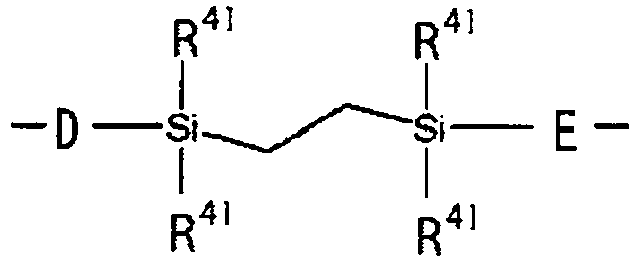


- D is a group selected from
-CH2O(CH2)2-,
-CH2O(CH2)3-,
-CF2O(CH2)3-,
-(CH2)2-,
-(CH2)3-,
-(CH2)4-,
-CONH- (CH2)3-,
-CON(CH3)-(CH2)3-,
and
-CON(Ph)-(CH2)3-
(wherein Ph means phenyl), and
- E is -(CH2)n- (n is an integer of 2 to 6); and
- D binds to RF1 or RF2 of the molecular backbone and E binds to RSi.
- Specific examples of XA include
- a single bond,
-CH2OCH2-,
-CH2O(CH2)2-,
-CH2O(CH2)3-,
-CH2O(CH2)4-,
-CH2O(CH2)5-,
-CH2O(CH2)6-,
-CH2O(CH2)3Si(CH3)2OSi(CH3)2(CH2)2-,
-CH2O(CH2)3Si(CH3)2OSi(CH3)2OSi(CH3)2(CH2)2-,
-CH2O(CH2)3Si(CH3)2O(Si(CH3)2O)2Si(CH3)2(CH2)2-,
-CH2O(CH2)3Si(CH3)2O(Si(CH3)2O)3Si(CH3)2(CH2)2-,
-CH2O(CH2)3Si(CH3)2O(Si(CH3)2O)10Si(CH3)2(CH2)2-,
-CH2O(CH2)3Si(CH3)2O(Si (CH3)2O)20Si(CH3)2(CH2)2-,
-CH2OCF2CHFOCF2-,
-CH2OCF2CHFOCF2CF2-,
-CH2OCF2CHFOCF2CF2CF2-,
-CH2OCH2CF2CF2OCF2-,
-CH2OCH2CF2CF2OCF2CF2-
-CH2OCH2CF2CF2OCF2CF2CF2-,
-CH2OCH2CF2CF2OCF(CF3)CF2OCF2-,
-CH2OCH2CF2CF2OCF(CF3)CF2OCF2CF2-,
-CH2OCH2CF2CF2OCF(CF3)CF2OCF2CF2CF2-,
-CH2OCH2CHFCF2OCF2-,
-CH2OCH2CHFCF2OCF2CF2-,
-CH2OCH2CHFCF2OCF2CF2CF2-,
-CH2OCH2CHFCF2OCF(CF3)CF2OCF2-,
-CH2OCH2CHFCF2OCF(CF3)CF2OCF2CF2-,
-CH2OCH2CHFCF2OCF(CF3)CF2OCF2CF2CF2-,
-CH2OCF2CHFOCF2CF2CF2-C(O)NH-CH2-,
CH2OCH2(CH2)7CH2Si(OCH3)2OSi(OCH3)2(CH2)2Si(OCH3)20Si(OCH3)2(CH2 )2-,
-CH2OCH2CH2CH2Si(OCH3)2OSi(OCH3)2(CH2)3-,
-CH2OCH2CH2CH2Si(OCH2CH3)2OSi(OCH2CH3)2(CH2)3-,
-CH2OCH2CH2CH2Si(OCH3)2OSi(OCH3)2(CH2)2-,
-CH2OCH2CH2CH2Si(OCH2CH3)2OSi(OCH2CH3)2(CH2)2-,
-(CH2)2-Si(CH3)2-(CH2)2-,
-CH2-,
-(CH2)2-,
-(CH2)3-,
-(CH2)4-,
-(CH2)5-,
-(CH2)6-,
-CO-,
-CONH-,
-CONH-CH2-,
-CONH-(CH2)2-,
-CONH-(CH2)3-,
-CONH-(CH2)4-,
-CONH-(CH2)5-,
-CONH-(CH2)6-,
-CON(CH3)-CH2-,
-CON(CH3)-(CH2)2-,
-CON(CH3)-(CH2)3-,
-CON(CH3)-(CH2)4-,
-CON(CH3)-(CH2)5-,
-CON(CH3)-(CH2)6-,
-CON(Ph)-CH2-
(wherein Ph means phenyl),
-CON(Ph)-(CH2)2-
(wherein Ph means phenyl),
-CON(Ph)-(CH2)3-
(wherein Ph means phenyl),
-CON(Ph)-(CH2)4-
(wherein Ph means phenyl),
-CON(Ph)-(CH2)5-
(wherein Ph means phenyl),
-CON(Ph)-(CH2)6-
(wherein Ph means phenyl),
-CONH-(CH2)2NH(CH2)3-,
-CONH-(CH2)6NH(CH2)3-,
-CH2O-CONH-(CH2)3-,
-CH2O-CONH-(CH2)6-,
-S-(CH2)3-,
- (CH2)2S(CH2)3-,
-CONH-(CH2)3Si(CH3)2OSi(CH3)2(CH2)2-,
-CONH-(CH2)3Si(CH3)2OSi(CH3)2OSi(CH3)2(CH2)2-,
-CONH-(CH2)3Si(CH3)2O(Si(CH3)2O)2Si(CH3)2(CH2)2-,
-CONH-(CH2)3Si(CH3)2O(Si(CH3)2O)3Si(CH3)2(CH2)2-,
-CONH-(CH2)3Si(CH3)2O(Si(CH3)2O)10Si(CH3)2(CH2)2-,
-CONH-(CH2)3Si(CH3)2O(Si(CH3)2O)20Si(CH3)2(CH2)2-,
-C(O)O-(CH2)3-,
-C(O)O-(CH2)6-,
-CH2-O-(CH2)3-Si(CH3)2-(CH2)2-Si(CH3)2-(CH2)2-,
-CH2-O-(CH2)3-Si(CH3)2-(CH2)2-Si(CH3)2-CH(CH3)-,
-CH2-O-(CH2)3-Si(CH3)2-(CH2)2-Si(CH3)2-(CH2)3-,
-CH2-O-(CH2)3-Si(CH3)2-(CH2)2-Si(CH3)2-CH(CH3)-CH2-,
-OCH2-,
-O(CH2)3-,
-OCFHCF2-,

- In still another embodiment, XA is each independently a group represented by formula: -(R16)x1-(CFR17)y1-(CH2)z1-. In the formula, x1, y1 and z1 are each independently an integer of 0 to 10, and the sum of x1, y1 and z1 is 1 or more, the occurrence order of the respective repeating units enclosed in parentheses is not limited in the formula.
- In the formula, R16 is each independently at each occurrence an oxygen atom, phenylene, carbazolylene, -NR18-(in the formula, R18 represents a hydrogen atom or an organic group), or a divalent organic group. Preferably, R18 is an oxygen atom or a divalent polar group.
- Examples of the "divalent polar group" include, but are not limited to, -C(O)-, -C(=NR19)- and -C(O)NR19- (wherein R19 represents a hydrogen atom or a lower alkyl group). The "lower alkyl group" is, for example, an alkyl group having 1 to 6 carbon atoms, such as methyl, ethyl, and n-propyl that is optionally substituted with one or more fluorine atoms.
- In the formulae, R17 is each independently at each occurrence a hydrogen atom, a fluorine atom, or a lower fluoroalkyl group, and is preferably a fluorine atom. The "lower fluoroalkyl group" is, for example, a fluoroalkyl group having 1 to 6 carbon atoms and preferably 1 to 3 carbon atoms, preferably a perfluoroalkyl group having 1 to 3 carbon atoms, more preferably a trifluoromethyl group or pentafluoroethyl group, and still more preferably a trifluoromethyl group.
- In still another embodiment, examples of XA include the following group:


- R41 is each independently a hydrogen atom, a phenyl group, an alkyl group having 1 to 6 carbon atoms, or a C1-6 alkoxy group, and is preferably a methyl group;
- some of the groups of T in each XA group are the following groups bonded to RF1 or RF2 of the molecular backbone:
-CH2O(CH2)2-,
-CH2O(CH2)3-,
-CF2O(CH2)3-,
-(CH2)2 -,
-(CH2)3-,
-(CH2)4-,
-CONH-(CH2)3-,
-CON(CH3)-(CH2)3-,
-CON(Ph)-(CH2)3-
(wherein Ph means phenyl), or
- wherein R42 each independently represents a hydrogen atom, a C1-6 alkyl group, or a C1-6 alkoxy group, preferably a methyl group or a methoxy group, and more preferably a methyl group; and
- some other groups of T are bonded to RSi of the molecular backbone, and the remaining groups of T, if present, are each independently a methyl group, a phenyl group, a C1-6 alkoxy group, or a radical scavenging group or a UV absorbing group.
- The radical scavenging group is not limited as long as it can scavenge a radical generated by light irradiation, and examples thereof include residues of benzophenones, benzotriazoles, benzoates, phenyl salicylates, crotonic acids, malonates, organoacrylates, hindered amines, hindered phenols, and triazines.
- The UV absorbing group is not limited as long as it can absorb ultraviolet rays, and examples thereof include residues of benzotriazoles, hydroxybenzophenones, esters of substituted and unsubstituted benzoic acid or salicylic acid compounds, acrylates or alkoxy cinnamates, oxamides, oxanilides, benzoxazinones, and benzoxazoles.
- In a preferred embodiment, examples of the preferred radical scavenging group or UV absorbing group include:

- In this embodiment, XA may each independently be a tri-to decavalent organic group.
- In still another embodiment, examples of XA include the following group:

R25 binds to at least one RF1, and R26 and R27 each bind to at least one RSi. - In one embodiment, R25 is a single bond, a C1-20 alkylene group, a C3-20 cycloalkylene group, a C5-20 arylene group, - R57-X58-R59-, -X58-R59-, or -R57-X58-. R57 and R59 are each independently a single bond, a C1-20 alkylene group, a C3-20 cycloalkylene group, or a C5-20 arylene group. X58 is -O-, - S-, -CO-, -O-CO-, or -COO-.
- In one embodiment, R26 and R27 are each independently a hydrocarbon, or a group having at least one atom selected from N, O and S at the end or in the main chain of a hydrocarbon, and preferred examples thereof include C1-6 alkyl groups, -R36-R37-R36 and -R36-CHR38 2-. Here, R36 is each independently a single bond or an alkyl group having 1 to 6 carbon atoms, preferably an alkyl group having 1 to 6 carbon atoms. R37 is N, O or S, preferably N or O. R38 is -R45-R46-R45-, -R46-R45- or -R45-R46-. where R45 is each independently an alkyl group having 1 to 6 carbon atoms. R46 is N, O or S, preferably O.
- In this embodiment, XA may each independently be a tri-to decavalent organic group.
- In one embodiment, the fluoropolyether group-containing silane compound of formula (1) or (2) does not contain a siloxane bonds (-Si-O-Si-).
- The fluoropolyether group-containing silane compound represented by the formula (1) or the formula (2) is not limited, but may have an average molecular weight of 5 × 10² to 1 × 10⁵. In particular, the average molecular weight is preferably 2,000 to 32,000, more preferably 2,500 to 12,000, from the viewpoint of abrasion durability. The "average molecular weight" refers to a number average molecular weight, and the "average molecular weight" is a value obtained by 19F-NMR measurement.
- In one embodiment, the fluoropolyether group-containing silane compound in the surface-treating agent of the present disclosure is a compound represented by the formula (1).
- In another embodiment, the fluoropolyether group-containing silane compound in the surface-treating agent of the present disclosure is a compound represented by the formula (2).
- In another embodiment, the fluoropolyether group-containing silane compound in the surface-treating agent of the present disclosure is any of a compound represented by the formula (1) and a compound represented by the formula (2).
- In the surface-treating agent of the present disclosure, the content of the compound represented by the formula (2) is preferably 0.1 mol% or more and 35 mol% or less based on the total of the compound represented by the formula (1) and the compound represented by the formula (2). The lower limit of the content of the compound represented by the formula (2) may be preferably 0.1 mol%, more preferably 0.2 mol%, still more preferably 0.5 mol%, further more preferably 1 mol%, particularly preferably 2 mol%, especially 5 mol%, based on the total of the compound represented by the formula (1) and the compound represented by the formula (2). The upper limit of the content of the compound represented by the formula (2) can be preferably 35 mol%, more preferably 30 mol%, still more preferably 20 mol%, further more preferably 15 mol% or 10 mol%, based on the total of the compound represented by the formula (1) and the compound represented by the formula (2). The compound represented by the formula (2) is preferably 0.1 mol% or more and 30 mol% or less, more preferably 0.1 mol% or more and 20 mol% or less, still more preferably 0.2 mol% or more and 10 mol% or less, further more preferably 0.5 mol% or more and 10 mol% or less, and particularly preferably 1 mol% or more and 10 mol% or less, for example, 2 mol% or more and 10 mol% or less, or 5 mol% or more and 10 mol% or less, based on the total of the compound represented by the formula (1) and the compound represented by the formula (2). When the content of the compound represented by the formula (2) is within the above-mentioned range, abrasion durability can be further improved.
- The compound represented by the formula (1) or (2) can be obtained by a method described in, for example,
Patent Literature 1. - The content of the compound represented by the formula (1) or (2) may be preferably 0.1 to 50.0% by mass, more preferably 1.0 to 30.0% by mass, still more preferably 5.0 to 25.0% by mass, particularly preferably 10.0 to 20.0% by mass, based on the total amount of the surface-treating agent. When the content of the fluoropolyether group-containing silane compound falls within the above range, higher water- and oil-repellency can be obtained.
- The amide compound is a compound that contains an amide group and can improve the abrasion durability of the surface-treating layer formed from the surface-treating agent of the present disclosure.
- In a preferred embodiment, the amide compound is an amide compound represented by the following formula (A):
NR61R62-COR63 (A)
wherein - R61 is a hydrogen atom or a C1-10 alkyl group (preferably a C1-6 alkyl group);
- R62 is a C1-10 alkyl group (preferably a C1-6 alkyl group) ;
- R63 is a hydrogen atom, a C1-10 alkyl group (preferably a C1-6 alkyl group), NR65 2, or -R66 x-R67 y-R68;
- or, R62 and R63 are bonded to each other to form -R62-R63-, wherein -R62-R63- is a C3-4 alkylene group or -C2-3 alkylene-NR65-;
- R65 is each independently a hydrogen atom or a C1-10 alkyl group (preferably a C1-6 alkyl group);
- R66 is each independently at each occurrence a C1-6 alkylene group;
- R67 is an oxygen atom or CO;
- R68 is a C1-10 alkyl group (preferably a C1-6 alkyl group) ;
- x is an integer of 1 to 6; and
- y is an integer of 1 to 6,
- with the proviso that each occurrence order of R66 and R67 in -R66 x-R67 y-R68 is not limited.
- In the formula (A), the alkyl group may be linear or branched. The alkyl group is preferably linear.
- In the formula (A), the alkylene group may be linear or branched. The alkylene group is preferably linear.
- R61 is a hydrogen atom or a C1-10 alkyl group.
- In one embodiment, R61 is a hydrogen atom.
- In another embodiment, R61 is a C1-10 alkyl group.
- The C1-10 alkyl group is preferably a C1-6 alkyl group, more preferably a C1-3 alkyl group, and still more preferably a C1-2 alkyl group.
- R62 is a C1-10 alkyl group, and is preferably a C1-6 alkyl group, more preferably a C1-3 alkyl group, and still more preferably a C1-2 alkyl group.
- In a preferred embodiment, R61 and R62 are a C1-2 alkyl group, preferably a methyl group or an ethyl group, and more preferably a methyl group.
- R63 is a hydrogen atom, a C1-10 alkyl group, NR65 2, or - R66 x-R67 y-R68; or R62 and R63 are bonded to each other to form -R62-R63-, where -R62-R63- is a C3-4 alkylene group or -C2-3 alkylene-NR65-.
- In one embodiment, R63 is a hydrogen atom.
- In one embodiment, R63 is a C1-10 alkyl group, and is preferably a C1-6 alkyl group, more preferably a C1-4 alkyl group, still more preferably a C1-3 alkyl group, and particularly preferably a methyl group or an ethyl group.
- In one embodiment, R63 is NR65 2.
- R65 is each independently a hydrogen atom or a C1-10 alkyl group, preferably a C1-10 alkyl group. The C1-10 alkyl group is preferably a C1-6 alkyl group, more preferably a C1-4 alkyl group, still more preferably a C1-3 alkyl group, and particularly preferably a methyl group.
- In -R66 x-R67 y-R68, R66 is each independently at each occurrence a C1-6 alkylene group (preferably C1-4 alkylene group, more preferably C2-3 alkylene group); R67 is an oxygen atom; R68 is a C1-6 alkyl group (preferably C1-9 alkyl group) ; x is an integer of 1 to 6 (preferably an integer of 1 to 3); y is an integer of 1 to 6 (preferably an integer of 1 to 3); the occurrence order of R66 and R67 in -R66 x-R67 y-R68 is not limited. Preferably, -R66 x-R67 y-R68 is bonded to the carbon atom of the amide group by R66.
- In one embodiment, R63 is -R66 x-R67 y-R68, preferably -R66-R67-R68. In one embodiment, R63 is -R66-O-R68-. In another embodiment, R63 is -R66-CO-R68-.
- In another embodiment, R62 and R63 are bonded to each other to form -R62-R63-, where -R62-R63- is a C3-4 alkylene group or -C2-3 alkylene-NR65-. That is, R62 and R63, together with the nitrogen atom and carbon atom to which they are bonded, form a 5- or 6-membered ring. In a preferred embodiment, such a 5- or 6-membered ring is a pyrrolidone ring or a tetrahydropyrimidinone ring that may be N-substituted.
- In a preferred embodiment, R61 and R62 are a C1-2 alkyl group, R63 is -R66-O-R68, R66 is a C2-3 alkylene group, and R68 is a C1-4 alkyl group.
- In another preferred embodiment, R61 is a C1-2 alkyl group, and R62 and R63 are bonded to each other to form -R62-R63-, where -R62-R63- is a C3 alkylene group.
- The boiling point of the above amide compound under atmospheric pressure is preferably 150 to 300°C, more preferably 180 to 260°C.
- The content of the amide compound is 0.5 to 10.0% by mass based on the total amount of the surface-treating agent. The surface-treating agent of the present disclosure can form a surface-treating layer having high abrasion durability by containing the amide compound in the content described above.
- In a preferred embodiment, the content of the amide compound is preferably 1.0 to 9.0% by mass based on the total amount of the surface-treating agent.
- In a preferred embodiment, in the surface-treating agent of the present disclosure, the mass ratio of the fluoropolyether group-containing silane compound to the amide compound is preferably 1:100 to 50:1, more preferably 1:50 to 30:1, and still more preferably 1:30 to 20:1.
- In one embodiment, in the surface-treating agent of the present disclosure, the mass ratio of the fluoropolyether group-containing silane compound to the amide compound is preferably 1:1 to 50:1, more preferably 2:1 to 40:1, still more preferably 2:1 to 10:1, and further preferably 2:1 to 5:1.
- The surface-treating agent of the present disclosure imparts water- and oil-repellency to the surface-treating layer by containing the fluoropolyether group-containing silane compound, and imparts high abrasion durability to the surface-treating layer by containing the amide compound. Although the present invention is not bound by any theory, it is considered that this is because the fluoropolyether group-containing silane compound in the surface-treating agent suppresses condensation by the amide compound. Therefore, when the fluoropolyether group-containing silane compound has a plurality of Si atoms bonded to the hydrolyzable group, the effect can be more effectively obtained.
- The surface-treating agent of the present disclosure can contain a (unreactive) fluoropolyether compound which can be understood as solvent or fluorine-containing oil, preferably a perfluoro(poly)ether compound (hereinafter, referred to collectively as "fluorine-containing oil"), a (unreactive) silicone compound which can be understood as a silicone oil (hereinafter, referred to as "silicone oil"), an alcohol, a compatibilizing agent, a catalyst, a surfactant, a polymerization inhibitor, a sensitizer and the like.
- Examples of the solvent include aliphatic hydrocarbons such as hexane, cyclohexane, heptane, octane, nonane, decane, undecane, dodecane, and mineral spirits; aromatic hydrocarbons such as benzene, toluene, xylene, naphthalene, and solvent naphtha; esters such as methyl acetate, ethyl acetate, propyl acetate, n-butyl acetate, isopropyl acetate, isobutyl acetate, cellosolve acetate, propylene glycol methyl ether acetate, carbitol acetate, diethyl oxalate, ethyl pyruvate, ethyl 2-hydroxybutyrate, ethyl acetoacetate, amyl acetate, methyl lactate, ethyl lactate, methyl 3-methoxypropionate, ethyl 3-methoxypropionate, methyl 2-hydroxyisobutyrate, and ethyl 2-hydroxyisobutyrate; ketones such as acetone, methyl ethyl ketone, methyl isobutyl ketone, 2-hexanone, cyclohexanone, methyl amino ketone, and 2-heptanone; glycol ethers such as ethyl cellosolve, methyl cellosolve, methyl cellosolve acetate, ethyl cellosolve acetate, propylene glycol monomethyl ether, propylene glycol monoethyl ether, propylene glycol monobutyl ether, propylene glycol monomethyl ether acetate, propylene glycol monoethyl ether acetate, propylene glycol monobutyl ether acetate, dipropylene glycol dimethyl ether, and ethylene glycol monoalkyl ether; alcohols such as methanol, ethanol, iso-propanol, n-butanol, isobutanol, tert-butanol, sec-butanol, 3-pentanol, octyl alcohol, 3-methyl-3-methoxybutanol, and tert-amyl alcohol; glycols such as ethylene glycol and propylene glycol; cyclic ethers such as tetrahydrofuran, tetrahydropyran, and dioxane; amides such as N,N-dimethylformamide and N,N-dimethylacetamide; ether alcohols such as methyl cellosolve, cellosolve, isopropyl cellosolve, butyl cellosolve, and diethylene glycol monomethyl ether; diethylene glycol monoethyl ether acetate; and fluorine-containing solvents such as 1,1,2-trichloro-1,2,2-trifluoroethane, 1,2-dichloro-1,1,2,2-tetrafluoroethane, dimethyl sulfoxide, 1,1-dichloro-1,2,2,3,3-pentafluoropropane (HCFC 225), Zeorora H, HFE 7100, HFE 7200, HFE 7300, CF3CH2OH, CF3CF2CH2OH, and (CF3)2CHOH. Alternatively, the solvent may be a mixed solvent of two or more of such solvents.
- The fluorine-containing oil is not limited, and examples thereof include a compound (perfluoro(poly)ether compound) represented by the following general formula (3).
Rf5-(OC4F8)a'-(OC3F6)b'-(OC2F4)c'-(OCF2)d'-Rf6 ... (3)
- In the formula, Rf5 represents an alkyl group having 1 to 16 carbon atoms optionally substituted with one or more fluorine atoms (preferably, a C1-16 perfluoroalkyl group), Rf6 represents an alkyl group having 1 to 16 carbon atoms optionally substituted with one or more fluorine atoms (preferably, a C1-16 perfluoroalkyl group), a fluorine atom, or a hydrogen atom, and Rf5 and Rf6 are each independently, more preferably, a C1-3 perfluoroalkyl group.
- a', b', c', and d' represent the respective four numbers of repeating units in perfluoro(poly)ether constituting the main backbone of the polymer and are mutually independently an integer of 0 or more and 300 or less, and the sum of a', b', c', and d' is at least 1, preferably 1 to 300, more preferably 20 to 300. The occurrence order of the respective repeating units enclosed in parentheses provided with the subscript a', b', c', or d' is not limited in the formula. Among such repeating units, -(OC4F8)- may be any of-(OCF2CF2CF2CF2)-, -(OCF(CF3)CF2CF2)-, -(OCF2CF(CF3)CF2)-,-(OCF2CF2CF(CF3))-, -(OC(CF3)2CF2)-, -(OCF2C(CF3)2)-,-(OCF(CF3)CF(CF3))-, -(OCF(C2F5)CF2)-, and (OCF2CF(C2F5))-, but it is preferably -(OCF2CF2CF2CF2)-. -(OC3F6)- may be any of -(OCF2CF2CF2)-, -(OCF(CF3)CF2)-, and (OCF2CF(CF3))-, and it is preferably -(OCF2CF2CF2)-. -(OC2F4)- may be any of -(OCF2CF2)-and (OCF(CF3))-, but it is preferably -(OCF2CF2)-.
- Examples of the perfluoro(poly)ether compound represented by the above general formula (3) include a compound represented by any of the following general formulae (3a) and (3b) (which may be used singly or as a mixture of two or more kinds thereof).
Rf5-(OCF2CF2CF2)b"-Rf6 ... (3a)
Rf5-(OCF2CF2CF2CF2)a"-(OCF2CF2CF2)b"-(OCF2CF2)c"-(OCF2)d"-Rf6 ... (3b)
- In these formulae, Rf5 and Rf6 are as described above; in formula (3a), b" is an integer of 1 or more and 100 or less; and in formula (3b), a" and b" are each independently an integer of 0 or more and 30 or less, and c'' and d'' are each independently an integer of 1 or more and 300 or less. The occurrence order of the respective repeating units enclosed in parentheses provided with the subscript a", b", c", or d'' is not limited in the formula.
- Alternatively, from another viewpoint, the fluorine-containing oil may be a compound represented by general formula Rf3-F, wherein Rf3 is a C5-16 perfluoroalkyl group. The fluorine-containing oil may be a chlorotrifluoroethylene oligomer.
- The above fluorine-containing oil may have an average molecular weight of 500 to 10,000. The molecular weight of the fluorine-containing oil can be measured using GPC.
- The fluorine-containing oil may be contained in an amount of, for example, 0 to 50 mass%, preferably 0 to 30 mass%, and more preferably 0 to 5 mass% based on the surface-treating agent of the present disclosure. In one embodiment, the surface-treating agent of the present disclosure is substantially free from the fluorine-containing oil. Being substantially free from the fluorine-containing oil means that the fluorine-containing oil is not contained at all, or an extremely small amount of the fluorine-containing oil may be contained.
- In one embodiment, the average molecular weight of the fluorine-containing oil may be greater than the average molecular weight of the fluoropolyether group-containing silane compound. With such average molecular weights, better abrasion durability and surface lubricity can be obtained, in the case of forming the surface-treating layer by the vacuum deposition method.
- In one embodiment, the average molecular weight of the fluorine-containing oil may be smaller than the average molecular weight of the fluoropolyether group-containing silane compound. With such average molecular weights, it is possible to form a cured product having high abrasion durability and high surface lubricity while suppressing reduction in the transparency of a surface-treating layer obtained from the compound.
- The fluorine-containing oil contributes to improving surface lubricity of the layer formed by the surface-treating agent of the present disclosure.
- For example, a linear or cyclic silicone oil having 2,000 or less siloxane bonds can be used as the silicone oil. The linear silicone oil may be a so-called straight silicone oil or modified silicone oil. Examples of the straight silicone oil include dimethyl silicone oil, methyl phenyl silicone oil, and methyl hydrogen silicone oil. Examples of the modified silicone oil include those obtained by modifying a straight silicone oil with alkyl, aralkyl, polyether, higher fatty acid ester, fluoroalkyl, amino, epoxy, carboxyl, alcohol, or the like. Examples of the cyclic silicone oil include cyclic dimethylsiloxane oil.
- In the surface-treating agent of the present disclosure, such a silicone oil may be contained in an amount of, for example, 0 to 300 parts by mass, and preferably 50 to 200 parts by mass, based on the total 100 parts by mass of the above fluoropolyether group-containing silane compound of the present disclosure (in the case of two or more kinds, the total thereof, and the same applies below).
- The silicone oil contributes to improving the surface lubricity of the surface-treating layer.
- Examples of the alcohols include alcohols having 1 to 6 carbon atoms optionally substituted with one or more fluorine atoms, such as methanol, ethanol, iso-propanol, tert-butanol, CF3CH2OH, CF3CF2CH2OH, and (CF3)2CHOH. By adding these alcohols to the surface-treating agent, the stability of the surface-treating agent is improved, and the miscibility between the perfluoropolyether group-containing silane compound and the solvent is improved.
- Examples of the compatibilizing agent include a fluorine-substituted alcohol such as 2,2,2-trifluoroethanol, 2,2,3,3,3-pentafluoro-1-propanol, or 2,2,3,3,4,4,5,5-octafluoro-1-pentanol, preferably a fluorine-substituted alcohol having a CF2H end, and a fluorine-substituted aryl such as 1,3-bis(trifluoromethyl)benzene, preferably a fluorine-substituted benzene.
- Examples of the above catalyst include an acid (such as acetic acid and trifluoroacetic acid), a base (such as ammonia, triethylamine, and diethylamine), and a transition metal (such as Ti, Ni, and Sn).
- The catalyst promotes hydrolysis and dehydrative condensation of the fluoropolyether group-containing silane compound of the present disclosure, and promotes formation of a layer formed of the surface-treating agent of the present disclosure.
- Examples of the other components include, in addition to those described above, tetraethoxysilane, methyltrimethoxysilane, 3-aminopropyltrimethoxysilane, 3-glycidoxypropyltrimethoxysilane, and methyltriacetoxysilane.
- The surface-treating agent of the present disclosure can be formed into pellets by impregnating a porous material such as a porous ceramic material or a metal fiber such as a fiber obtained by, for example, solidifying steel wool in a cotton-like form therewith. Such pellets can be used in, for example, vacuum deposition.
- The surface-treating agent of the present disclosure may contain, in addition to the above-described components, a trace amount of impurities such as Pt, Rh, Ru, 1,3-divinyltetramethyldisiloxane, triphenylphosphine, NaCl, KCl, and silane condensates.
- Hereinafter, an article of the present disclosure will be described.
- The article of the present disclosure comprises a substrate and a layer (surface-treating layer) on a surface of the substrate, the layer being formed of the surface-treating agent according to the present disclosure.
- The substrate usable in the present disclosure may be composed of any suitable material such as glass, resin (which may be natural or synthetic resin such as a commonly used plastic material), metal, ceramics, semiconductors (such as silicon and germanium), fiber (such as woven fabric and nonwoven fabric), fur, leather, wood, pottery, stone, building materials, and sanitary articles.
- For example, when the article to be produced is an optical member, the material constituting the surface of the substrate may be a material for an optical member, such as glass or a transparent plastic. When the article to be produced is an optical member, some layer (or film) such as a hard coat layer or an antireflection layer may be formed on the surface (the outermost layer) of the substrate. The antireflection layer may be any of a single-layer antireflection layer and a multi-layer antireflection layer. Examples of inorganic substances usable in the antireflection layer include SiO2, SiO, ZrO2, TiO2, TiO, Ti2O3, Ti2O5, Al2O3, Ta2O5, Ta3O5, Nb2O5, HfO2, Si3N4, CeO2, MgO, Y2O3, SnO2, MgF2, and WO3. One of these inorganic substances may be used singly, or two or more kinds thereof may be used in combination (for example, as a mixture). In the case of a multi-layer antireflection layer, it is preferable to use SiO2 and/or SiO for the outermost layer thereof. When the article to be produced is an optical glass component for a touch panel, a part of the surface of the substrate (glass) may have a transparent electrode such as a thin film in which indium tin oxide (ITO), indium zinc oxide, or the like is used. The substrate, according to its specific configuration or the like, may have an insulating layer, an adhesive layer, a protecting layer, a decorated frame layer (I-CON), an atomizing film layer, a hard coating layer, a polarizing film, a phase difference film, a liquid crystal display module, or the like.
- The shape of the substrate is not limited, and may be, for example, in the form of a plate, a film, or the like. The surface region of the substrate on which a surface-treating layer is to be formed may be at least a part of the substrate surface, and may be suitably determined according to the application, specific configuration, and the like of an article to be produced.
- In one embodiment, the substrate, or at least the surface portion thereof, may be composed of a material originally having a hydroxyl group. Examples of the material include glass, as well as metal (in particular, base metal) where a natural oxidized film or a thermal oxidized film is formed on the surface, ceramics, and semiconductors. Alternatively, when the substrate has an insufficient amount of hydroxyl groups or when the substrate originally has no hydroxyl group as in resin and the like, a pre-treatment may be performed on the substrate to thereby introduce or increase hydroxyl groups on the surface of the substrate. Examples of such a pre-treatment include a plasma treatment (for example, corona discharge) and ion beam irradiation. The plasma treatment can be suitably utilized to not only introduce or increase hydroxyl groups on the substrate surface, but also clean the substrate surface (remove foreign matter and the like). Another example of such a pre-treatment is a method wherein a monolayer of a surface adsorbent having a carbon-carbon unsaturated bonding group is formed on the surface of the substrate by a LB method (a Langmuir-Blodgett method), a chemical adsorption method, or the like beforehand, and thereafter cleaving the unsaturated bond under an atmosphere containing oxygen, nitrogen, or the like.
- In another embodiment, the substrate may be that of which at least the surface portion be composed of a material comprising other reactive group such as a silicone compound having one or more Si-H group or alkoxysilane.
- In a preferred embodiment, the substrate is glass. The glass is preferably sapphire glass, soda-lime glass, alkali aluminosilicate glass, borosilicate glass, alkali-free glass, crystal glass, or quartz glass, particularly preferably chemically tempered soda-lime glass, chemically tempered alkali aluminosilicate glass, and chemically bonded borosilicate glass.
- The article of the present disclosure can be produced by forming a layer of the surface-treating agent of the present disclosure on the surface of the substrate and post-treating this layer as necessary to thereby form a layer from the surface-treating agent of the present disclosure.
- The layer of the surface-treating agent of the present disclosure can be formed by applying the above surface-treating agent on the surface of the substrate such that the surface-treating agent coats the surface. The coating method is not limited. For example, a wet coating method and a dry coating method can be used.
- Examples of the wet coating method include dip coating, spin coating, flow coating, spray coating, roll coating, gravure coating, and similar methods.
- Examples of the dry coating method include deposition (usually, vacuum deposition), sputtering, CVD, and similar methods. Specific examples of the deposition method (usually, a vacuum deposition method) include resistive heating, highfrequency heating using electron beam, microwave or the like, ion beam, and similar methods. Specific examples of the CVD method include plasma-CVD, optical CVD, thermal CVD, and similar methods.
- Furthermore, coating by an atmospheric pressure plasma method can be performed.
- When using the wet coating method, the surface-treating agent of the present disclosure can be applied to the substrate surface after being diluted with a solvent. From the viewpoint of the stability of the composition of the present disclosure and the volatility of solvents, the following solvents are preferably used: perfluoroaliphatic hydrocarbons having 5 to 12 carbon atoms (such as perfluorohexane, perfluoromethylcyclohexane, and perfluoro-1,3-dimethylcyclohexane); polyfluoroaromatic hydrocarbons (such as bis(trifluoromethyl)benzene); polyfluoroaliphatic hydrocarbons (such as C6F13CH2CH3 (such as Asahiklin (registered trademark) AC-6000 manufactured by Asahi Glass Co., Ltd.), and 1,1,2,2,3,3,4-heptafluorocyclopentane (such as Zeorora (registered trademark) H manufactured by Zeon Corporation)); alkyl perfluoroalkyl ethers (the perfluoroalkyl group and the alkyl group may be linear or branched) such as hydrofluoroether (HFE) (such as perfluoropropyl methyl ether (C3F7OCH3) (such as Novec (trademark) 7000 manufactured by Sumitomo 3M Limited), perfluorobutyl methyl ether (C4F9OCH3) (such as Novec (trademark) 7100 manufactured by Sumitomo 3M Limited), perfluorobutyl ethyl ether (C4F9OC2H5) (such as Novec (trademark) 7200 manufactured by Sumitomo 3M Limited), and perfluorohexyl methyl ether (C2F5CF(OCH3)C3F7) (such as Novec (trademark) 7300 manufactured by Sumitomo 3M Limited), or CF3CH2OCF2CHF2 (such as Asahiklin (registered trademark) AE-3000 manufactured by Asahi Glass Co., Ltd.)). One of these solvents may be used singly, or two or more may be used as a mixture. In particular, hydrofluoroether is preferable, and perfluorobutyl methyl ether (C4F9OCH3) and/or perfluorobutyl ethyl ether (C4F9OC2H5) is particularly preferable.
- When using the dry coating method, the surface-treating agent of the present disclosure may be directly subjected to the dry coating method, or may be diluted with the above solvent before being subjected to the dry coating method.
- A layer of the surface-treating agent is preferably formed such that the surface-treating agent of the present disclosure coexists in the layer with a catalyst for hydrolysis and dehydrative condensation. Conveniently, in the case of a wet coating method, the surface-treating agent of the present disclosure is diluted with a solvent, and then, immediately before application to the substrate surface, a catalyst may be added to the diluted solution of the surface-treating agent of the present disclosure. In the case of a dry coating method, the surface-treating agent of the present disclosure to which a catalyst has been added is directly used to a deposition (usually vacuum deposition) treatment, or a pellet-like material may be used to a deposition (usually vacuum deposition) treatment, wherein the pellets are obtained by impregnating a porous body of metal such as iron or copper with the surface-treating agent of the present disclosure to which the catalyst has been added.
- Any suitable acid or base can be used as a catalyst. For example, acetic acid, formic acid, and trifluoroacetic acid can be used as the acid catalyst. For example, ammonia and organic amines can be used as the base catalyst.
- The surface-treating layer contained in the article of the present disclosure has both high abrasion durability. The surface-treating layer may have not only high abrasion durability but also have, depending on the compositional features of the surface-treating agent used, water-repellency, oil-repellency, antifouling property (for example, preventing fouling such as fingerprints from adhering), waterproof property (preventing water from penetrating into electronic components and the like), surface lubricity (or lubricity, such as wiping property for fouling including fingerprints and the like and excellent tactile sensations to the fingers), chemical resistance, and the like, and may be suitably utilized as a functional thin film.
- Therefore, the present disclosure further relates to an optical material having the surface-treating layer in the outermost layer.
- The optical material preferably includes a wide variety of optical materials in addition to optical materials relating to displays and the like as exemplified below: for example, displays such as cathode ray tubes (CRTs; for example, PC monitors), liquid crystal displays, plasma displays, organic EL displays, inorganic thin-film EL dot matrix displays, rear projection displays, vacuum fluorescent displays (VFDs), field emission displays (FEDs); protective plates for such displays; and those obtained by performing an antireflection film treatment on their surfaces.
- The article of the present disclosure may be, but is not limited to, an optical member. Examples of the optical member include lenses of glasses or the like; front surface protective plates, antireflection plates, polarizing plates, and anti-glare plates for displays such as PDPs and LCDs; touch panel sheets for devices such as mobile phones and personal digital assistants; disc surfaces of optical discs such as Blu-ray (registered trademark) discs, DVD discs, CD-Rs, and MOs; optical fibers; and display surfaces of watches and clocks.
- The article of the present disclosure may be medical equipment or a medical material.
- The thickness of the above layer is not limited. The thickness of the above layer in the case of an optical member is in the range of 1 to 50 nm, 1 to 30 nm, and preferably 1 to 15 nm, from the viewpoint of optical performance, abrasion durability, and antifouling property.
- The article of the present disclosure has been described in detail above. The article of the present disclosure, the method for producing the article, and the like are not limited to those exemplified above.
- Hereinafter, an article of the present disclosure will be described in Examples, but the present disclosure is not limited to the following Examples. In the Examples, the occurrence order of the repeating units constituting fluoropolyether is not limited, and all chemical formulae shown below indicate average compositional features.
- The following compounds were used as the fluoropolyether group-containing silane compound and the amide compound.
-
- A:
CF3O(CF2O)k(CF2CF2O)l(CF2CF2CF2O)m(CF2CF2CF2CF2O)nCF2CONHCH2C(CH2CH2CH2Si(OCH3)3)3
- B:
CF3O(CF2O)k(CF2CF2O)l(CF2CF2CF2O)m(CF2CF2CF2CF2O)nCF2CONHCH2CH(CH2CH2CH2Si(OCH3)3)2
- C:
CF3O(CF2O)k(CF2CF2O)l(CF2CF2CF2O)m(CF2CF2CF2CF2O)nCF2CONHCH2CH2CH2SiCH3(CH2CH2CH2Si(OCH3)3)2
- D:
CF3O(CF2O)k(CF2CF2O)l(CF2CF2CF2O)m(CF2CF2CF2CF2O)nC(OCH2CH2O)2CH3(CH2CH2CH2Si(OCH3)3)2
- E:
F(CF2CF2CF2O)oCF2CF2(CH2CHSi(OCH3)3)H
- In the formula, k is 36, l is 22, m is 0.6, n is 0.2, and o is 28.
-
- a: tetramethylurea
- b: N-ethylacetamide
- c: N-methylpropionamide
- d: N,N-dimethylpropionamide
- e: 1,3-dimethyl-3,4,5,6-tetrahydro-2(1H)-pyrimidinone
- f: N,N-dimethylacetoacetamide
- g: 2-pyrrolidone
- h: 1-methyl-2-pyrrolidone
- i: 3-methoxy-N,N-dimethylpropanamide
- j: N,N-dimethylformamide
- k: 3-butoxy-N,N-dimethylpropanamide
- l: 1-ethyl-2-pyrrolidone
- m: 1-octyl-2-pyrrolidone
- n: N,N-dimethylacetamide
- Novec (R) 7200 (manufactured by 3M Japan Limited)
-
- α: 2,2,3,3,3-pentafluoro-1-propanol
- β: 2,2,2-trifluoroethanol
- γ: dimethyl sulfoxide
- The surface-treating agents of Examples 1 to 32 and Comparative Examples 1 to 10 were prepared by adding the amide compound, the compatibilizing agent, and the like in the amounts shown in Table 1 below to Nor7200 solutions containing 20% by mass of the fluoropolyether group-containing silane compounds shown in Table 1 below.
- The surface-treating agents prepared as described above (Examples 1 to 28 and Comparative Examples 1 to 7) were each vacuum-deposited on a chemically tempered glass ("Gorilla" glass, manufactured by Corning Incorporated, thickness 0.7 mm). The treatment conditions for the vacuum deposition were set to pressures of 3.0 × 10⁻³ Pa, and a silicon dioxide film was first formed on the surface of chemically tempered glass, followed by the deposition of 400 mg of a surface-treating agent to form a surface-treating layer.
- The surface-treating agents of Examples 29 to 32 and Comparative Examples 8 to 10 were prepared by dissolving 0.12% by mass of the fluoropolyether group-containing silane compounds shown in Table 2 below, and the amide compound, the compatibilizing agent, and the like in the amounts shown in Table 2 below in Nor7200.
- Onto a chemically tempered glass (50 mm × 50 mm) set on a spin coater, 1 g of the surface-treating agent obtained above was dropped, and then the glass was rotated for 30 seconds in 3000 rpm to form a coating layer of the surface-treating agent. Thereafter, the glass was heated using a ventilation oven to form a surface-treating layer on the chemically tempered glass.
- Using a rubbing tester (manufactured by Shinto Scientific Co., Ltd.), the water resistance contact angle was measured every 2,500 rubs under the following conditions, and the test was continued until it reached 10,000 rubs or until the angle became less than 100°, and the final number of times of abrasion at which the contact angle of 100° was maintained was compared. The test environment conditions were 25°C and a humidity of 40% RH. The results are shown in Tables 1 and 2 below.
- Eraser: Raber Eraser (manufactured by Minoan)
- Contact area: 6 mmcp
- Moving distance (one way): 30 mm
- Moving speed: 3,600 mm/min
- Load: 1 kg/6 mmcp
- The intermolecular reactivity of the silane coupling site of the fluoropolyether group-containing silane compound was evaluated. To each of the solutions of Example 6 and Comparative Example 1, 9 equivalents of water relative to the fluoropolyether group-containing silane compound was added, followed by stirring. Thereafter, 29Si-NMR was measured over time, and with respect to the silane coupling site, peak changes were observed in the peaks indicating the non-condensed state (Mn), peaks indicating that one of trialkoxys are condensed (Dn), and peaks indicating that two of trialkoxys are condensed (Tn). The results are shown in
Figure 1 . - From the above results, it was confirmed that the condensation of the surface-treating agent in Comparative Example 1 proceeded after 14 hours of water addition and further after 37 hours. On the other hand, in the surface-treating agent of Example 6, a large amount of non-condensed components remained even 36 hours after the addition of water, which confirmed that the intermolecular condensation between the fluoropolyether group-containing silane compounds was suppressed.
- The article of the present disclosure can be suitably used in various applications, for example, as an optical member of a touch panel or the like.
| Fluorosilane compound | Amide compound | Amide compound concentration (wt%) | Compatibilizing agent | Compatibilizing agent concentration (wt%) | Eraser abrasion test result (times) | |
| Example 1 | A | j | 1 | - | - | 5000 |
| Example 2 | A | j | 9 | - | - | 7500 |
| Example 3 | A | h | 1 | - | - | 6667 |
| Example 4 | A | h | 9 | - | - | 8125 |
| Example 5 | A | i | 1 | - | - | 12500 |
| Example 6 | A | i | 9 | - | - | 15000 |
| Example 7 | A | i | 9 | α | 9 | 10000 |
| Example 8 | A | i | 9 | β | 9 | 12500 |
| Example 9 | B | h | 0.5 | - | - | 11250 |
| Example 10 | B | h | 9 | - | - | 13750 |
| Example 11 | C | i | 9 | - | - | 8750 |
| Example 12 | D | i | 9 | - | - | 11250 |
| Example 13 | E | h | 9 | - | - | 10000 |
| Example 14 | A | a | 9 | - | - | 6250 |
| Example 15 | A | b | 9 | - | - | 5000 |
| Example 16 | A | c | 9 | - | - | 7500 |
| Example 17 | A | d | 9 | - | - | 6250 |
| Example 18 | A | e | 9 | - | - | 6250 |
| Example 19 | A | n | 9 | - | - | 6250 |
| Example 20 | A | g | 9 | - | - | 6250 |
| Example 21 | A | h | 9 | - | - | 8250 |
| Example 22 | A | i | 9 | - | - | 10000 |
| Example 23 | A | j | 9 | - | - | 7500 |
| Example 24 | A | k | 9 | - | - | 5000 |
| Example 25 | A | l | 9 | - | - | 10000 |
| Example 26 | A | m | 9 | - | - | 8750 |
| Example 27 | E | h | 9 | - | - | 15000 |
| Example 28 | E | i | 9 | - | - | 8750 |
| Comparative Example 1 | A | not added | - | - | - | 3750 |
| Comparative Example 2 | B | not added | - | - | - | 8750 |
| Comparative Example 3 | C | not added | - | - | - | 3750 |
| Comparative Example 4 | D | not added | - | - | - | 6250 |
| Comparative Example 5 | E | not added | - | - | - | <2500 |
| Comparative Example 6 | E | not added | - | - | - | <2500 |
| Comparative Example 7 | A | not added | - | γ | g | 3750 |
| Fluorosilane compound | Amide compound | Amide compound concentration (wt%) | Compatibilizing agent | Compatibilizing agent concentration (wt%) | Eraser abrasion test result (times) | |
| Example 29 | A | n | 1 | - | - | 7500 |
| Example 30 | A | n | 1 | - | - | 12500 |
| Example 31 | A | n | 10 | - | - | 12500 |
| Example 32 | A | h | 1 | - | - | 15000 |
| Comparative Example 8 | A | not added | - | - | - | 2500 |
| Comparative Example 9 | A | not added | - | α | 1 | 3750 |
| Comparative Example 10 | A | not added | - | β | 1 | 2500 |
Claims (22)
- A surface-treating agent comprising a fluoropolyether group-containing silane compound and an amide compound, wherein the amide compound is contained in an amount of 0.5% by mass or more based on a total amount of the surface-treating agent.
- The surface-treating agent according to claim 1, wherein the fluoropolyether group-containing silane compound is at least one fluoropolyether group-containing silane compound represented by the following formula (1) or (2):
RF1 α-XA-RSiβ (1)
RSi γ-XA-RF2-XA-RSi γ (2)
whereinRF1 is each independently at each occurrence Rf1-RF-Oq-;RF2 is -Rf2 p-RF-Oq-;Rf1 is each independently at each occurrence a C1-16 alkyl group optionally substituted with one or more fluorine atoms;Rf2 is a C1-6 alkylene group optionally substituted with one or more fluorine atoms;RF is each independently at each occurrence a divalent fluoropolyether group;p is 0 or 1;q is each independently at each occurrence 0 or 1;RSi is each independently at each occurrence a monovalent group containing a Si atom to which a hydroxyl group, a hydrolyzable group, a hydrogen atom or a monovalent organic group is bonded;at least one RSi is a monovalent group containing a Si atom to which a hydroxyl group or a hydrolyzable group is bonded;XA is each independently a single bond or a di- to decavalent organic group;α is an integer of 1 to 9;β is an integer of 1 to 9; andγ is each independently an integer of 1 to 9. - The surface-treating agent according to claim 2, wherein Rf1 is each independently at each occurrence a C1-16 perfluoroalkyl group; and
Rf2 is each independently at each occurrence a C1-6 perfluoroalkylene group. - The surface-treating agent according to claim 2 or 3, wherein RF is each independently at each occurrence a group represented by the formula:
-(OC6F12)a-(OC5F10)b-(OC4F8)c-(OC3RFa 6)d-(OC2F4)e- (OCF2)f-
wherein RFa is each independently at each occurrence a hydrogen atom, a fluorine atom, or a chlorine atom; and
a, b, c, d, e, and f are each independently an integer of 0 to 200, the sum of a, b, c, d, e, and f is 1 or more, the occurrence order of the respective repeating units enclosed in parentheses provided with a, b, c, d, e, or f is not limited in the formula, provided that when all RFa are a hydrogen atom or a chlorine atom, at least one of a, b, c, e, and f is 1 or more. - The surface-treating agent according to claim 4, wherein RFa is a fluorine atom.
- The surface-treating agent according to any one of claims 2 to 5, wherein RF is each independently at each occurrence a group represented by the following formula (f1), (f2), (f3), (f4), or (f5):
-(OC3F6)d-(OC2F4)e- (f1)
wherein d is an integer of 1 to 200, and e is 0 or 1;
-(OC4F8)c-(OC3F6)d-(OC2F4)e-(OCF2)f- (f2)
wherein c and d are each independently an integer of 0 to 30;e and f are each independently an integer of 1 to 200;the sum of c, d, e, and f is an integer of 10 to 200; andthe occurrence order of the respective repeating units enclosed in parentheses provided with the subscript c, d, e, or f is not limited in the formula;
-(R6-R7)g- (f3)
wherein R6 is OCF2 or OC2F4;R7 is a group selected from OC2F4, OC3F6, OC4F8, OC5F10, and OC6F12, or is a combination of two or three groups selected from these groups; andg is an integer of 2 to 100;
-(OC6F12)a-(OC5F10)b-(OC4F8)c-(OC3F6)d-(OC2F4)e-(OCF2)f- (f4)
wherein e is an integer of 1 or more and 200 or less, a, b, c, d, and f are each independently an integer of 0 or more and 200 or less, and the occurrence order of the respective repeating units enclosed in parentheses provided with a, b, c, d, e or f is not limited in the formula; and
-(OC6F12)a-(OC5F10)b-(OC4F8)c-(OC3F6)d-(OC2F4)e-(OCF2)f- (f5)
wherein f is an integer of 1 or more and 200 or less, a, b, c, d, and e are each independently an integer of 0 or more and 200 or less, and the occurrence order of the respective repeating units enclosed in parentheses provided with a, b, c, d, e or f is not limited in the formula. - The surface-treating agent according to any one of claims 2 to 6, wherein RSi is a group represented by the following formula (S1), (S2), (S3), (S4), or (S5):

- SiR11 n1R12 3-n1 (S2)
- SiRa1 k1Rb1 11Rc1 m1 (S3)
- CRd1 k2Re1 12Rf1 m2 (S4)
- NRg1Rh1 (S3)
whereinR11 is each independently at each occurrence a hydroxyl group or a hydrolyzable group;R12 is each independently at each occurrence a hydrogen atom or a monovalent organic group;n1 is each independently an integer of 0 to 3 for each (SiR11 n1R12 3-n1) unit;X11 is each independently at each occurrence a single bond or a divalent organic group;R13 is each independently at each occurrence a hydrogen atom or a monovalent organic group;t is each independently at each occurrence an integer of 2 or more;R14 is each independently at each occurrence a hydrogen atom, a halogen atom, or -X11-SiR11 n1R12 3-n1;Ra1 is each independently at each occurrence -Z1-SiR21 p1R22 q1R23 r1;Z1 is each independently at each occurrence an oxygen atom or a divalent organic group;R21 is each independently at each occurrence -Z1'-SiR21' p1'R22' q1'R23' r1';R22 is each independently at each occurrence a hydroxyl group or a hydrolyzable group;R23 is each independently at each occurrence a hydrogen atom or a monovalent organic group;p1 is each independently at each occurrence an integer of 0 to 3;q1 is each independently at each occurrence an integer of 0 to 3;r1 is each independently at each occurrence an integer of 0 to 3;the sum of p1, q1, and r1 is 3;Z1' is each independently at each occurrence an oxygen atom or a divalent organic group;R21' is each independently at each occurrence -Z1"-SiR22" q1"R23" r1" ;R22' is each independently at each occurrence a hydroxyl group or a hydrolyzable group;R23' is each independently at each occurrence a hydrogen atom or a monovalent organic group;p1' is each independently at each occurrence an integer of 0 to 3;q1' is each independently at each occurrence an integer of 0 to 3;r1' is each independently at each occurrence an integer of 0 to 3;the sum of p1', q1', and r1' is 3;Z1" is each independently at each occurrence an oxygen atom or a divalent organic group;R22" is each independently at each occurrence a hydroxyl group or a hydrolyzable group;R23" is each independently at each occurrence a hydrogen atom or a monovalent organic group;q1" is each independently at each occurrence an integer of 0 to 3;r1" is each independently at each occurrence an integer of 0 to 3;the sum of q1" and r1" is 3;Rb1 is each independently at each occurrence a hydroxyl group or a hydrolyzable group;Rc1 is each independently at each occurrence a hydrogen atom or a monovalent organic group;k1 is each independently at each occurrence an integer of 0 to 3;l1 is each independently at each occurrence an integer of 0 to 3;m1 is each independently at each occurrence an integer of 0 to 3;the sum of k1, l1, and m1 is 3;Rd1 is each independently at each occurrence -Z2-CR31 p2R32 q2R33 r2;Z2 is each independently at each occurrence a single bond, an oxygen atom, or a divalent organic group;R31 is each independently at each occurrence -Z2'-CR32'q2'R33' r2';R32 is each independently at each occurrence -Z3-SiR34 n2R35 3-n2;R33 is each independently at each occurrence a hydrogen atom, a hydroxyl group, or a monovalent organic group;p2 is each independently at each occurrence an integer of 0 to 3;q2 is each independently at each occurrence an integer of 0 to 3;r2 is each independently at each occurrence an integer of 0 to 3;the sum of p2, q2, and r2 is 3;Z2' is each independently at each occurrence a single bond, an oxygen atom, or a divalent organic group;R32' is each independently at each occurrence -Z3-SiR34 n2R35 3-n2;R33' is each independently at each occurrence a hydrogen atom, a hydroxyl group, or a monovalent organic group;q2' is each independently at each occurrence an integer of 0 to 3;r2' is each independently at each occurrence an integer of 0 to 3;the sum of q2' and r2' is 3;Z3 is each independently at each occurrence a single bond, an oxygen atom, or a divalent organic group;R34 is each independently at each occurrence a hydroxyl group or a hydrolyzable group;R35 is each independently at each occurrence a hydrogen atom or a monovalent organic group;n2 is each independently at each occurrence an integer of 0 to 3;Re1 is each independently at each occurrence -Z3-SiR34 n2R35 3-n2;Rf1 is each independently at each occurrence a hydrogen atom, a hydroxyl group, or a monovalent organic group;k2 is each independently at each occurrence an integer of 0 to 3;l2 is each independently at each occurrence an integer of 0 to 3;m2 is each independently at each occurrence an integer of 0 to 3;the sum of k2, l2, and m2 is 3;Rg1 and Rh1 are each independently at each occurrence - Z4-SiR11 n1R12 3-n1, -Z4-SiRa1 k1Rb1 11Rc1 m1, or -Z4-CRd1 k2Re1 12Rf1 m2; andZ4 is each independently at each occurrence a single bond, an oxygen atom, or a divalent organic group,provided that in the formulae (S1), (S2), (S3), (S4), and (S5), at least one Si atom to which a hydroxyl group or a hydrolyzable group is bonded is present. - The surface-treating agent according to any one of claims 2 to 7, wherein each of α, β and γ is 1.
- The surface-treating agent according to claim 7 or 8, wherein the group represented by the formula (S1) is a group represented by the following formula (S1-b):

- The surface-treating agent according to any one of claims 1 to 9, wherein a content of the amide compound is 0.5 to 10.0% by mass based on the total amount of the surface-treating agent.
- The surface-treating agent according to any one of claims 1 to 10, wherein a boiling point of the amide compound under atmospheric pressure is 150 to 300°C.
- The surface-treating agent according to any one of claims 1 to 11, wherein the amide compound is an amide compound represented by the following formula (A):
NR61R62-COR63 (A)
whereinR61 is a hydrogen atom or a C1-10 alkyl group;R62 is a C1-10 alkyl group;R63 is a hydrogen atom, a C1-10 alkyl group, NR65 2, or - R66 x-R67 y-R68;or, R62 and R63 are bonded to each other to form -R62-R63-, wherein -R62-R63- is a C3-4 alkylene group or -C2-3 alkylene-NR65-;R65 is each independently a hydrogen atom or a C1-10 alkyl group;R66 is each independently at each occurrence a C1-6 alkylene group;R67 is an oxygen atom or CO;R68 is a C1-10 alkyl group;x is an integer of 1 to 6; andy is an integer of 1 to 6,with the proviso that each occurrence order of R66 and R67 in -R66 x-R67 y-R68 is not limited. - The surface-treating agent according to claim 12, wherein R63 is -R66 x-R67 y-R68.
- The surface-treating agent according to claim 12, wherein R63 is -R66-R67-R68.
- The surface-treating agent according to claim 12, wherein R62 and R63 are bonded to each other to form -R62-R63-, wherein -R62-R63- is a C3-4 alkylene group.
- The surface-treating agent according to any one of claims 1 to 15, further comprising one or more other components selected from a fluorine-containing oil, a silicone oil, and a catalyst.
- The surface-treating agent according to any one of claims 1 to 16, further comprising a solvent.
- The surface-treating agent according to any one of claims 1 to 17, which is used as an antifouling coating agent or a water-proof coating agent.
- A pellet comprising the surface-treating agent according to any one of claims 1 to 18.
- An article comprising a substrate and a layer on the substrate, the layer being formed of the surface-treating agent according to any one of claims 1 to 18.
- The article according to claim 20, wherein the substrate is a glass substrate.
- The article according to claim 20, which is an optical member.
Applications Claiming Priority (2)
| Application Number | Priority Date | Filing Date | Title |
|---|---|---|---|
| JP2021006477 | 2021-01-19 | ||
| PCT/JP2022/000394 WO2022158319A1 (en) | 2021-01-19 | 2022-01-07 | Surface treatment agent |
Publications (2)
| Publication Number | Publication Date |
|---|---|
| EP4282841A1 true EP4282841A1 (en) | 2023-11-29 |
| EP4282841A4 EP4282841A4 (en) | 2025-03-05 |
Family
ID=82548882
Family Applications (1)
| Application Number | Title | Priority Date | Filing Date |
|---|---|---|---|
| EP22742442.1A Pending EP4282841A4 (en) | 2021-01-19 | 2022-01-07 | SURFACE TREATMENT AGENT |
Country Status (6)
| Country | Link |
|---|---|
| US (1) | US20230365832A1 (en) |
| EP (1) | EP4282841A4 (en) |
| JP (1) | JP7252500B2 (en) |
| KR (1) | KR20230128334A (en) |
| CN (1) | CN116724094B (en) |
| WO (1) | WO2022158319A1 (en) |
Families Citing this family (1)
| Publication number | Priority date | Publication date | Assignee | Title |
|---|---|---|---|---|
| KR20250045260A (en) | 2023-09-25 | 2025-04-01 | 엘지디스플레이 주식회사 | Light Emitting Display Device |
Family Cites Families (9)
| Publication number | Priority date | Publication date | Assignee | Title |
|---|---|---|---|---|
| JP3078003B2 (en) * | 1990-08-30 | 2000-08-21 | 鐘淵化学工業株式会社 | Thermosetting composition |
| JP4706097B2 (en) * | 1999-11-16 | 2011-06-22 | 旭硝子株式会社 | Substrate having surface treatment layer and method for producing the same |
| WO2013146112A1 (en) * | 2012-03-30 | 2013-10-03 | ダイキン工業株式会社 | Fluoropolyether group-containing silicone compound |
| CN102746818B (en) * | 2012-07-26 | 2013-12-25 | 南京工业大学 | Waterborne polyurethane material and preparation method thereof |
| CN104769009B (en) | 2012-11-05 | 2017-08-11 | 大金工业株式会社 | Containing perfluor (poly-) ether silane compound |
| JP5835512B2 (en) * | 2014-04-30 | 2015-12-24 | ダイキン工業株式会社 | Perfluoro (poly) ether group-containing silane compound |
| JP6398500B2 (en) * | 2014-09-10 | 2018-10-03 | 信越化学工業株式会社 | Fluorine-containing coating agent and article treated with the coating agent |
| JP6707101B2 (en) * | 2017-03-14 | 2020-06-10 | ダイキン工業株式会社 | Surface treatment agent containing perfluoro(poly)ether group-containing silane compound, pellets and articles using the same |
| KR102869124B1 (en) * | 2019-02-13 | 2025-10-13 | 에이지씨 가부시키가이샤 | Fluorinated ether composition, coating solution, article and method for producing the same |
-
2022
- 2022-01-07 JP JP2022001439A patent/JP7252500B2/en active Active
- 2022-01-07 CN CN202280010438.0A patent/CN116724094B/en active Active
- 2022-01-07 EP EP22742442.1A patent/EP4282841A4/en active Pending
- 2022-01-07 WO PCT/JP2022/000394 patent/WO2022158319A1/en not_active Ceased
- 2022-01-07 KR KR1020237026112A patent/KR20230128334A/en active Pending
-
2023
- 2023-07-18 US US18/354,183 patent/US20230365832A1/en active Pending
Also Published As
| Publication number | Publication date |
|---|---|
| WO2022158319A1 (en) | 2022-07-28 |
| JP7252500B2 (en) | 2023-04-05 |
| CN116724094A (en) | 2023-09-08 |
| JP2022111078A (en) | 2022-07-29 |
| EP4282841A4 (en) | 2025-03-05 |
| US20230365832A1 (en) | 2023-11-16 |
| KR20230128334A (en) | 2023-09-04 |
| CN116724094B (en) | 2025-05-16 |
Similar Documents
| Publication | Publication Date | Title |
|---|---|---|
| US20220081574A1 (en) | Surface treating agent | |
| EP3950777B1 (en) | Fluoropolyether group-including compound | |
| US12351682B2 (en) | Surface-treating agent | |
| EP4177053B1 (en) | Curable composition | |
| EP3950778B1 (en) | Fluoropolyether-group-containing compound | |
| EP3950779B1 (en) | Fluoropolyether group-containing compound | |
| EP4001364A1 (en) | Surface treatment agent | |
| EP3950780B1 (en) | Fluoropolyether-group-containing compound | |
| EP3889205B1 (en) | Polyether group-containing compound | |
| US20220119592A1 (en) | Surface-treating agent | |
| US12516200B2 (en) | Surface treatment agent | |
| US11912888B2 (en) | Fluoropolyether group-containing compound | |
| US20230365832A1 (en) | Surface treatment agent | |
| JP2018150534A (en) | Surface treatment agent comprising silane compound containing perfluoro(poly)ether group, and pellets and article using the same | |
| EP4269468A1 (en) | Surface treatment agent | |
| EP4328256B1 (en) | Surface treatment agent | |
| TW202328278A (en) | Surface treatment agent | |
| CN116640498B (en) | Surface treatment agent |
Legal Events
| Date | Code | Title | Description |
|---|---|---|---|
| STAA | Information on the status of an ep patent application or granted ep patent |
Free format text: STATUS: THE INTERNATIONAL PUBLICATION HAS BEEN MADE |
|
| PUAI | Public reference made under article 153(3) epc to a published international application that has entered the european phase |
Free format text: ORIGINAL CODE: 0009012 |
|
| STAA | Information on the status of an ep patent application or granted ep patent |
Free format text: STATUS: REQUEST FOR EXAMINATION WAS MADE |
|
| 17P | Request for examination filed |
Effective date: 20230816 |
|
| AK | Designated contracting states |
Kind code of ref document: A1 Designated state(s): AL AT BE BG CH CY CZ DE DK EE ES FI FR GB GR HR HU IE IS IT LI LT LU LV MC MK MT NL NO PL PT RO RS SE SI SK SM TR |
|
| DAV | Request for validation of the european patent (deleted) | ||
| DAX | Request for extension of the european patent (deleted) | ||
| P01 | Opt-out of the competence of the unified patent court (upc) registered |
Free format text: CASE NUMBER: APP_38296/2024 Effective date: 20240627 |
|
| A4 | Supplementary search report drawn up and despatched |
Effective date: 20250131 |
|
| RIC1 | Information provided on ipc code assigned before grant |
Ipc: C23C 14/12 20060101ALI20250127BHEP Ipc: C08K 5/20 20060101ALI20250127BHEP Ipc: C08G 65/336 20060101ALI20250127BHEP Ipc: C08G 65/22 20060101ALI20250127BHEP Ipc: B05D 5/08 20060101ALI20250127BHEP Ipc: B05D 1/00 20060101ALI20250127BHEP Ipc: C09D 7/63 20180101ALI20250127BHEP Ipc: C08L 71/00 20060101ALI20250127BHEP Ipc: C09K 3/18 20060101ALI20250127BHEP Ipc: C09K 3/00 20060101ALI20250127BHEP Ipc: C09D 183/00 20060101ALI20250127BHEP Ipc: C08K 5/16 20060101ALI20250127BHEP Ipc: C09D 5/16 20060101ALI20250127BHEP Ipc: C03C 17/30 20060101AFI20250127BHEP |