EP4282629B1 - Desizing of reinforced composite materials - Google Patents
Desizing of reinforced composite materials Download PDFInfo
- Publication number
- EP4282629B1 EP4282629B1 EP22189530.3A EP22189530A EP4282629B1 EP 4282629 B1 EP4282629 B1 EP 4282629B1 EP 22189530 A EP22189530 A EP 22189530A EP 4282629 B1 EP4282629 B1 EP 4282629B1
- Authority
- EP
- European Patent Office
- Prior art keywords
- fabric
- desizing
- unit
- infrared
- air
- Prior art date
- Legal status (The legal status is an assumption and is not a legal conclusion. Google has not performed a legal analysis and makes no representation as to the accuracy of the status listed.)
- Active
Links
Images


Classifications
-
- B—PERFORMING OPERATIONS; TRANSPORTING
- B29—WORKING OF PLASTICS; WORKING OF SUBSTANCES IN A PLASTIC STATE IN GENERAL
- B29C—SHAPING OR JOINING OF PLASTICS; SHAPING OF MATERIAL IN A PLASTIC STATE, NOT OTHERWISE PROVIDED FOR; AFTER-TREATMENT OF THE SHAPED PRODUCTS, e.g. REPAIRING
- B29C70/00—Shaping composites, i.e. plastics material comprising reinforcements, fillers or preformed parts, e.g. inserts
- B29C70/04—Shaping composites, i.e. plastics material comprising reinforcements, fillers or preformed parts, e.g. inserts comprising reinforcements only, e.g. self-reinforcing plastics
- B29C70/28—Shaping operations therefor
- B29C70/40—Shaping or impregnating by compression not applied
- B29C70/50—Shaping or impregnating by compression not applied for producing articles of indefinite length, e.g. prepregs, sheet moulding compounds [SMC] or cross moulding compounds [XMC]
- B29C70/504—Shaping or impregnating by compression not applied for producing articles of indefinite length, e.g. prepregs, sheet moulding compounds [SMC] or cross moulding compounds [XMC] using rollers or pressure bands
- B29C70/506—Shaping or impregnating by compression not applied for producing articles of indefinite length, e.g. prepregs, sheet moulding compounds [SMC] or cross moulding compounds [XMC] using rollers or pressure bands and impregnating by melting a solid material, e.g. sheet, powder, fibres
-
- B—PERFORMING OPERATIONS; TRANSPORTING
- B29—WORKING OF PLASTICS; WORKING OF SUBSTANCES IN A PLASTIC STATE IN GENERAL
- B29B—PREPARATION OR PRETREATMENT OF THE MATERIAL TO BE SHAPED; MAKING GRANULES OR PREFORMS; RECOVERY OF PLASTICS OR OTHER CONSTITUENTS OF WASTE MATERIAL CONTAINING PLASTICS
- B29B15/00—Pretreatment of the material to be shaped, not covered by groups B29B7/00 - B29B13/00
- B29B15/08—Pretreatment of the material to be shaped, not covered by groups B29B7/00 - B29B13/00 of reinforcements or fillers
- B29B15/10—Coating or impregnating independently of the moulding or shaping step
- B29B15/12—Coating or impregnating independently of the moulding or shaping step of reinforcements of indefinite length
-
- B—PERFORMING OPERATIONS; TRANSPORTING
- B29—WORKING OF PLASTICS; WORKING OF SUBSTANCES IN A PLASTIC STATE IN GENERAL
- B29C—SHAPING OR JOINING OF PLASTICS; SHAPING OF MATERIAL IN A PLASTIC STATE, NOT OTHERWISE PROVIDED FOR; AFTER-TREATMENT OF THE SHAPED PRODUCTS, e.g. REPAIRING
- B29C35/00—Heating, cooling or curing, e.g. crosslinking or vulcanising; Apparatus therefor
- B29C35/002—Component parts, details or accessories; Auxiliary operations
-
- B—PERFORMING OPERATIONS; TRANSPORTING
- B29—WORKING OF PLASTICS; WORKING OF SUBSTANCES IN A PLASTIC STATE IN GENERAL
- B29C—SHAPING OR JOINING OF PLASTICS; SHAPING OF MATERIAL IN A PLASTIC STATE, NOT OTHERWISE PROVIDED FOR; AFTER-TREATMENT OF THE SHAPED PRODUCTS, e.g. REPAIRING
- B29C70/00—Shaping composites, i.e. plastics material comprising reinforcements, fillers or preformed parts, e.g. inserts
- B29C70/04—Shaping composites, i.e. plastics material comprising reinforcements, fillers or preformed parts, e.g. inserts comprising reinforcements only, e.g. self-reinforcing plastics
- B29C70/06—Fibrous reinforcements only
- B29C70/10—Fibrous reinforcements only characterised by the structure of fibrous reinforcements, e.g. hollow fibres
- B29C70/16—Fibrous reinforcements only characterised by the structure of fibrous reinforcements, e.g. hollow fibres using fibres of substantial or continuous length
- B29C70/22—Fibrous reinforcements only characterised by the structure of fibrous reinforcements, e.g. hollow fibres using fibres of substantial or continuous length oriented in at least two directions forming a two-dimensional [2D] structure
-
- B—PERFORMING OPERATIONS; TRANSPORTING
- B29—WORKING OF PLASTICS; WORKING OF SUBSTANCES IN A PLASTIC STATE IN GENERAL
- B29C—SHAPING OR JOINING OF PLASTICS; SHAPING OF MATERIAL IN A PLASTIC STATE, NOT OTHERWISE PROVIDED FOR; AFTER-TREATMENT OF THE SHAPED PRODUCTS, e.g. REPAIRING
- B29C70/00—Shaping composites, i.e. plastics material comprising reinforcements, fillers or preformed parts, e.g. inserts
- B29C70/04—Shaping composites, i.e. plastics material comprising reinforcements, fillers or preformed parts, e.g. inserts comprising reinforcements only, e.g. self-reinforcing plastics
- B29C70/28—Shaping operations therefor
- B29C70/54—Component parts, details or accessories; Auxiliary operations, e.g. feeding or storage of prepregs or SMC after impregnation or during ageing
-
- B—PERFORMING OPERATIONS; TRANSPORTING
- B29—WORKING OF PLASTICS; WORKING OF SUBSTANCES IN A PLASTIC STATE IN GENERAL
- B29C—SHAPING OR JOINING OF PLASTICS; SHAPING OF MATERIAL IN A PLASTIC STATE, NOT OTHERWISE PROVIDED FOR; AFTER-TREATMENT OF THE SHAPED PRODUCTS, e.g. REPAIRING
- B29C35/00—Heating, cooling or curing, e.g. crosslinking or vulcanising; Apparatus therefor
- B29C35/02—Heating or curing, e.g. crosslinking or vulcanizing during moulding, e.g. in a mould
- B29C35/08—Heating or curing, e.g. crosslinking or vulcanizing during moulding, e.g. in a mould by wave energy or particle radiation
- B29C35/0805—Heating or curing, e.g. crosslinking or vulcanizing during moulding, e.g. in a mould by wave energy or particle radiation using electromagnetic radiation
- B29C2035/0822—Heating or curing, e.g. crosslinking or vulcanizing during moulding, e.g. in a mould by wave energy or particle radiation using electromagnetic radiation using IR radiation
Definitions
- the invention is an in-situ method for desizing and lamination of fibers to be used in fabrics.
- In-situ desizing of carbon fiber and glass fiber eliminates the pre-process of fiber desizing which increase the mechanical properties of the laminate by preventing fiber breakage.
- continuous desizing of the fabric increased efficiency of the process, hence the cost.
- Market price of the desized fiber is higher than the regular sized fibers, therefore there is additional cost advantage.
- Sizing is a thin, homogenous coating applied to the surface of fibers during the manufacturing process to protect the filaments during handling, and processing, and during subsequent compounding and composite processing.
- the sizing plays an important role in determining the properties of the final composite, such as improved adhesion between the fiber and the matrix, mechanical properties, chemical or water resistance, and thermal stability. Sizing optimizes the processability of fiber.
- sizing is a small percentage of fiber reinforced composites-normally 0.5 - 5% of its weight-it affects the production and the processing of the fiber and has a significant impact on the interface properties between the fiber surface and the composite matrix. Since most of the sizing methods are compatible with the thermoset resin systems, they are not suitable to be used for thermoplastic resin systems. Therefore, in order to process thermoplastic film on the carbon/glass fabric, the sizing should be removed. There are unsized fibers available in the market, however those fibers are very complicated to process and it is more expensive compared to regular sized fibers.
- MITSCHANG P. ET AL "Processing technologies for continuous fibre reinforced thermoplastics with novel polymer blends", COMPOSITES SCIENCE AND TECHNOLOGY, vol. 63, no. 14, 1 November 2003 (2003-11-01), pages 2099-2110, AMSTERDAM, NL ISSN: 0266-3538, DOI: 10.1016/50266-3538(03)00107-6 discloses a weaving method having steps of guiding warp fibers into a weaving machine, deflecting the fibers to the weaving plane to obtain a fabric, desizing a specimen of the fabric into an infrared desizing process and heating the fabric by using an infrared-irradiation unit.
- the invention is a method as defined in claim 1 and an apparatus as defined in claim 12 where desizing is performed "in-situ" for eliminating the pre-processes. According to method of invention desizing is performed during production of the fabric.
- Method of invention comprises high-grade infrared heater placed after the fabric production or before the film lamination process. Since the sizing mostly consist of organic compounds, heating of the sizing evaporates it from surface of the fabric.
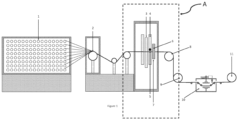
- FIG 1 shows the weaving process with "In-situ” desizing unit.
- the creel (1) stores the warp fibers and delivers them as needed.
- the warp fibers especially if they are carbon or glass fibers, must be guided to the weaving machine directly from a bobbin creel.
- the back rail (2) and the fabric take-off (8) deflect the warp fibers to the weaving plane (A).
- the back rail is usually mounted flexibly and compensates variations in warp fiber consumption by opening and closing the shed, which is particularly important when working with stiffer fibers.
- the warp fibers are mostly guided to a heald (3) individually.
- Weft insertion systems (5) transport the weft fiber through the shed.
- the reed (6) which is integrated into the sley (7) , arranges the warp fiber and sets the theoretical warp fiber density of the woven fabric. By the movement of the reed with the sley, the last weft fiber is beat-up to the fabric edge.
- the fabric take-off device provides the take-off of the woven fabric at a preset speed and adjusts its weft density. In the fabric storage (11) , the woven fabric is then stored temporarily before the next process steps.
- FIG 2 shows desizing process.
- Woven fabrics are fed into the desizing unit in order to get rid of the sizing of the fiber.
- the fabric enter the desizing unit (13) by controlling the tension on the fabric.
- the tension of the fabric precisely controlled with tensing means, preferably rollers located in the desizing unit (14,15,20 22).
- the tension of the fabric should be between 0,1 - 10 kN in order to have proper desizing.
- the desizing unit consist of industrial scale infrared-irradiation (IR) units located in both upper and lower side of the fabric (18) and (19).
- the fabric temperature should be between 150 to 400 °C in order to get rid of the sizing on the surface of the fiber.
- the fabric temperature controlled with the help of advanced surface thermometer (21).
- the distance of the IR unit precisely controlled with the help of hydraulic arms (16, 17).
- the distance of the IR unit should be 1 cm to 50 cm from the surface of the fabric. If the IR unit distance is lower than expected, there is great risk of damaging the fiber. If the IR unit distance is higher than expected, there is risk of decreasing the efficiency of desizing process.
- the line speed should be controlled and it should be between 0,5 m/sec and 10 m/sec.
- air fan 24,25
- the desizing unit constantly fed with air in order to prevent any chemical accumulation. Hot air then sucked by air ventilation units (26,27,28). Reference machine speeds closely controlled. Fan air speed controlled with the help of air temperature and humidity controllers.
- the oven internal temperature should be between 50 to 400 °C.
- Figure 3 shows the lamination process.
- Two films are placed top (29) and bottom (31) of the feeder and in between desized fabric (30) feed to the lamination line.
- the temperature and pressure controlled in the lamination line according to the type of polymer used.
- the lamination temperature should be between 150 to 400 °C in order to achieve expected lamination level.
- the pressure should be between 5 to 100 bars to fully integrate the resin film onto fibers.
- the pressure should be keep constant with the help of double belt presses (34, 35).
- Direct lamination of the film on the fabric allow higher mechanical performance due to high coverage and bonding of the fiber.
- the laminated prepreg cooled with the help of high performance coolers (33) after the lamination process.
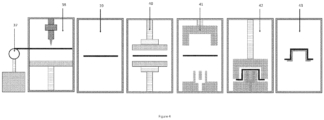
- Thermoplastic Composite Part Production Process is shown in Figure 4 .
- This process is used to produce final product (part) from prepreg obtained after lamination.
- Rolled prepreg fed to the cutter machine with the help of un-winder (37).
- Material then cut with a high precision cutter (38).
- the cut material stacked in order to get the desired thickness hence the desired mechanical performance (39).
- Material than heated with prepreg heater (40) before fed into pressing (41) on a mold.
- the temperature, time and pressure are defined according to polymer type.
- the heating can be applied directly from the molding surface and pressure can be applied to the material.
- a cooling process should be applied.
- Another option would be heating material outside of the mold and applying pressure with the cold molding surface.
- the prepreg heating temperature should be between 150 to 400 °C in order to achieve expected mechanical properties.
- the press pressure should be between 5 to 100 bars to get the final shape of the part.
- injection molding to the prepreg part can be used (42).
- First part can be produced in the mold after; melted polymer can be injected to the back structure of the part.
Landscapes
- Engineering & Computer Science (AREA)
- Mechanical Engineering (AREA)
- Chemical & Material Sciences (AREA)
- Composite Materials (AREA)
- Textile Engineering (AREA)
- Physics & Mathematics (AREA)
- Health & Medical Sciences (AREA)
- Oral & Maxillofacial Surgery (AREA)
- Thermal Sciences (AREA)
- Reinforced Plastic Materials (AREA)
Description
- The invention is an in-situ method for desizing and lamination of fibers to be used in fabrics. In-situ desizing of carbon fiber and glass fiber eliminates the pre-process of fiber desizing which increase the mechanical properties of the laminate by preventing fiber breakage. In addition, continuous desizing of the fabric increased efficiency of the process, hence the cost. Market price of the desized fiber is higher than the regular sized fibers, therefore there is additional cost advantage.
- Weaving process of unsized fiber is complicated and has many drawbacks like fiber breakage which causes decrease in the laminate mechanical properties. In addition, using unsuitable fiber sizing with thermoplastic materials decrease in the shear strength thus overall mechanical performance.
- "Sizing" is a thin, homogenous coating applied to the surface of fibers during the manufacturing process to protect the filaments during handling, and processing, and during subsequent compounding and composite processing. On the fiber surface, the sizing plays an important role in determining the properties of the final composite, such as improved adhesion between the fiber and the matrix, mechanical properties, chemical or water resistance, and thermal stability. Sizing optimizes the processability of fiber. Although sizing is a small percentage of fiber reinforced composites-normally 0.5 - 5% of its weight-it affects the production and the processing of the fiber and has a significant impact on the interface properties between the fiber surface and the composite matrix. Since most of the sizing methods are compatible with the thermoset resin systems, they are not suitable to be used for thermoplastic resin systems. Therefore, in order to process thermoplastic film on the carbon/glass fabric, the sizing should be removed. There are unsized fibers available in the market, however those fibers are very complicated to process and it is more expensive compared to regular sized fibers.
- In addition, during the processing, fiber breakage occurs hence the overall mechanical properties of the laminate decreases. Therefore, a sizing removal method needed after the fabric production process.
- "The effect of thermally desized carbon fibre reinforcement on the flexural and impact properties of PA6, PPS and PEEK composite laminates: A comparative study" by Peter Kiss et al, studied the effect of thermally de-sized carbon fiber reinforcement on the flexural and impact properties of polyamide 6 (PA6), olyphenylene sulfide (PPS) and Polyetheretherketone (PEEK)composite laminates (Composites Part B 215 (2021) 108844), ISSN: 1359-8368 DOI: 10.2016J.COMPOSITESB.2021.108844.
- This document discloses a method comprising a heat treatment in air atmosphere. MITSCHANG P. ET AL: "Processing technologies for continuous fibre reinforced thermoplastics with novel polymer blends", COMPOSITES SCIENCE AND TECHNOLOGY, vol. 63, no. 14, 1 November 2003 (2003-11-01), pages 2099-2110, AMSTERDAM, NL ISSN: 0266-3538, DOI: 10.1016/50266-3538(03)00107-6 discloses a weaving method having steps of guiding warp fibers into a weaving machine, deflecting the fibers to the weaving plane to obtain a fabric, desizing a specimen of the fabric into an infrared desizing process and heating the fabric by using an infrared-irradiation unit.
- The invention is a method as defined in
claim 1 and an apparatus as defined inclaim 12 where desizing is performed "in-situ" for eliminating the pre-processes. According to method of invention desizing is performed during production of the fabric. - The advantage of "in-situ" desizing using conventionally sized carbon or glass fibers and desizing during the production of the intermediate product which is woven fabric which eliminates all the drawbacks of unsized carbon fiber and opening the possibilities to achieve better mechanical properties.
- Method of invention comprises high-grade infrared heater placed after the fabric production or before the film lamination process. Since the sizing mostly consist of organic compounds, heating of the sizing evaporates it from surface of the fabric.
- The accompanying drawings, which are incorporated in and constitute a part of this disclosure, illustrate exemplary embodiments and, together with the description, to explain the disclosed principles:
-
FIG 1 . Weaving machine with "In-situ" desizing unit- 1. Creel
- 2 Back rail
- 3 Heald
- 4 Heald frames
- 5. Weft insertion svstem
- 6. Reed
- 7. Sley
- 8. Fabric take-off
- 9. Fabric beam
- 10. Desizing unit
- 11. Fabric storage
- A. Weaving Plane
-
FIG 2 . Desizing Unit- 12. Sized Fabric Beam
- 13. Desizing unit
- 14. First roller
- 15. Second roller
- 16. First hydraulic arm
- 17. Second hydraulic arm
- 18. First infrared-irradiation (IR) unit
- 19. Second infrared-irradiation (IR) unit
- 20. Third roller
- 21. Thermometer
- 22. Fourth roller
- 23. Desized fabric beam
- 24. First air fan
- 25. Second air fan
- 26. First air ventilation unit
- 27. Second air ventilation unit
- 28. Third air ventilation unit
-
FIG 3 . Lamination Unit- 29. First Thermoplastic Film
- 30. Desized Fabric
- 31. Second Thermoplastic Film
- 32. Heating platen
- 33. Cooling platen
- 34. First Belt Press
- 35. Second Belt Press
- 36. Thermoplastic Prepreg Roller
-
FIG 4 . Thermoplastic Composite Part Production Process- 37. Thermoplastic Prepreg Un-winder
- 38. Prepreg cutter machine
- 39. Direct shape prepreg
- 40. Prepreg Heater
- 41. Prepreg Press
- 42. Over-molding
- 43. Over-molded Thermoplastic Composite Part
-
Figure 1 shows the weaving process with "In-situ" desizing unit. The creel (1) stores the warp fibers and delivers them as needed. The warp fibers, especially if they are carbon or glass fibers, must be guided to the weaving machine directly from a bobbin creel. The back rail (2) and the fabric take-off (8) deflect the warp fibers to the weaving plane (A). The back rail is usually mounted flexibly and compensates variations in warp fiber consumption by opening and closing the shed, which is particularly important when working with stiffer fibers. The warp fibers are mostly guided to a heald (3) individually. Weft insertion systems (5) transport the weft fiber through the shed. The reed (6) , which is integrated into the sley (7) , arranges the warp fiber and sets the theoretical warp fiber density of the woven fabric. By the movement of the reed with the sley, the last weft fiber is beat-up to the fabric edge. The fabric take-off device provides the take-off of the woven fabric at a preset speed and adjusts its weft density. In the fabric storage (11) , the woven fabric is then stored temporarily before the next process steps. -
Figure 2 shows desizing process. Woven fabrics are fed into the desizing unit in order to get rid of the sizing of the fiber. The fabric enter the desizing unit (13) by controlling the tension on the fabric. The tension of the fabric precisely controlled with tensing means, preferably rollers located in the desizing unit (14,15,20 22). - The tension of the fabric should be between 0,1 - 10 kN in order to have proper desizing. The desizing unit consist of industrial scale infrared-irradiation (IR) units located in both upper and lower side of the fabric (18) and (19). The fabric temperature should be between 150 to 400 °C in order to get rid of the sizing on the surface of the fiber. The fabric temperature controlled with the help of advanced surface thermometer (21). The distance of the IR unit precisely controlled with the help of hydraulic arms (16, 17). The distance of the IR unit should be 1 cm to 50 cm from the surface of the fabric. If the IR unit distance is lower than expected, there is great risk of damaging the fiber. If the IR unit distance is higher than expected, there is risk of decreasing the efficiency of desizing process. The line speed should be controlled and it should be between 0,5 m/sec and 10 m/sec. With the help of air fan (24,25), the desizing unit constantly fed with air in order to prevent any chemical accumulation. Hot air then sucked by air ventilation units (26,27,28). Reference machine speeds closely controlled. Fan air speed controlled with the help of air temperature and humidity controllers. The oven internal temperature should be between 50 to 400 °C.
-
Figure 3 shows the lamination process. Thin film of the thermoplastic material produced and fed the lamination process. Two films are placed top (29) and bottom (31) of the feeder and in between desized fabric (30) feed to the lamination line. The temperature and pressure controlled in the lamination line according to the type of polymer used. The lamination temperature should be between 150 to 400 °C in order to achieve expected lamination level. In addition the pressure should be between 5 to 100 bars to fully integrate the resin film onto fibers. The pressure should be keep constant with the help of double belt presses (34, 35). Direct lamination of the film on the fabric allow higher mechanical performance due to high coverage and bonding of the fiber. The laminated prepreg cooled with the help of high performance coolers (33) after the lamination process. The processed prepreg rolled on the high precision prepreg rolls (36). - Thermoplastic Composite Part Production Process is shown in
Figure 4 . This process is used to produce final product (part) from prepreg obtained after lamination. Rolled prepreg fed to the cutter machine with the help of un-winder (37). Material then cut with a high precision cutter (38). The cut material stacked in order to get the desired thickness hence the desired mechanical performance (39). Material than heated with prepreg heater (40) before fed into pressing (41) on a mold. Heat and pressure applied to the material in order to get the final part geometry in the prepreg press (41). The temperature, time and pressure are defined according to polymer type. The heating can be applied directly from the molding surface and pressure can be applied to the material. In order to separate from the surface of the mold, a cooling process should be applied. Another option would be heating material outside of the mold and applying pressure with the cold molding surface. The temperature defined according to the polymer type. The prepreg heating temperature should be between 150 to 400 °C in order to achieve expected mechanical properties. In addition the press pressure should be between 5 to 100 bars to get the final shape of the part. In order to give better stiffness and mechanical properties injection molding to the prepreg part can be used (42). First part can be produced in the mold after; melted polymer can be injected to the back structure of the part.
Claims (13)
- Weaving method having the steps of• guiding warp fibers into a weaving machine (1),• deflecting the fibers to the weaving plane (A) to obtain a fabric• guiding the fabric into a desizing proces,• heating the fabric by using an infrared-irradiation unit (18, 19) characterized in that the distance of said infrared-irradiation unit from the fabric is controlled with a hydraulic arm (16, 17),• feeding air by an air fan (24,25 and• sucking hot air by an air ventilation unit (26, 27, 28).
- Method according to Claim 1 characterized in that said guiding step of the fabric into the desizing unit is performed with a tension between 0.1 - 10 kN and with a speed between 0.5-10 m/sec.
- Method according to Claim 1 characterized in that the infrared-irradiation unit (18, 19) is located below and/or above the fabric.
- Method according to Claim 1 characterized in that the heating temperature is between 150 to 400 °C
- Method according to Claim 1 characterized in that the distance of said infrared-irradiation unit is between 1-50 cm from the fabric
- Method according to Claim 1 further comprising a lamination process after the desizing process where said lamination process is characterized in• feeding desized fabric in between two thermoplastic films• setting the temperature between 150 to 400 °(,• keeping pressure constant between 5-100 bars by belt press (34, 35 and• cooling the laminated prepreg by a cooler (33)
- Method According to Claim 6 further comprising a part production process after the lamination process where said part production process is characterized by• feeding a prepreg which is a laminated desized fabric, into a cutter machine (38) by an un-winder (37),• stucking the cut material by direct shaping (39,• heating the cut material (40,• pressing the cut material (41) on a mold to obtain final par and• cooling the par.
- Method according to Claim 7 characterized in that said heating and pressing steps are applied on a molding surface.
- Method according to Claim 7 characterized in that said heating step is applied before molding and pressure is applied via a cold molding surface.
- Method according to Claim 7 characterized in that the heating temperature is between 150-400 °C.
- Method according to Claim 7 characterized in that the pressure in pressing step is between 5-100 bars.
- Weaving machine with an in-situ desizing unit, said desizing unit being located after the weaving plane (A) and comprising• an infrared-irradiation unit (18, 19) located preferably below and/or above a fabric,• a hydraulic arm (16, 17) for controlling the distance of infrared-irradiation unit (18, 19) to the fabric,• an air fan (24, 25) for feeding air,• an air ventilation unit (26,27,28) for sucking hot air,• an air temperature controller and• a humidity controller.
- Weaving machine according to Claim 12 characterized in further comprising a lamination unit.
Applications Claiming Priority (1)
| Application Number | Priority Date | Filing Date | Title |
|---|---|---|---|
| TR202208414 | 2022-05-24 |
Publications (2)
| Publication Number | Publication Date |
|---|---|
| EP4282629A1 EP4282629A1 (en) | 2023-11-29 |
| EP4282629B1 true EP4282629B1 (en) | 2025-02-19 |
Family
ID=88506057
Family Applications (1)
| Application Number | Title | Priority Date | Filing Date |
|---|---|---|---|
| EP22189530.3A Active EP4282629B1 (en) | 2022-05-24 | 2022-08-09 | Desizing of reinforced composite materials |
Country Status (1)
| Country | Link |
|---|---|
| EP (1) | EP4282629B1 (en) |
-
2022
- 2022-08-09 EP EP22189530.3A patent/EP4282629B1/en active Active
Non-Patent Citations (1)
| Title |
|---|
| MITSCHANG P. ET AL: "Processing technologies for continuous fibre reinforced thermoplastics with novel polymer blends", COMPOSITES SCIENCE AND TECHNOLOGY, vol. 63, no. 14, 1 November 2003 (2003-11-01), AMSTERDAM, NL, pages 2099 - 2110, XP093045667, ISSN: 0266-3538, DOI: 10.1016/S0266-3538(03)00107-6 * |
Also Published As
| Publication number | Publication date |
|---|---|
| EP4282629A1 (en) | 2023-11-29 |
Similar Documents
| Publication | Publication Date | Title |
|---|---|---|
| US20110159763A1 (en) | Method and apparatus for the manufacture of composite sheets | |
| EP1880819B1 (en) | Preform moulding material | |
| CN111479673B (en) | Production line and method for producing products made of fiber-reinforced plastic | |
| EP3256300B1 (en) | Pultrusion apparatus and method | |
| EP0417827A1 (en) | Fabric of thermoplastic fibre and continuous reinforcing fibre | |
| US20100107384A1 (en) | Spreading device for spreading out fiber filament bundles and spreading method carried out using the same | |
| CN110770006B (en) | Fiber placement apparatus and method for forming a fiber preform | |
| US20190240929A1 (en) | Tape-laying device and tape-laying method for flexibly and quickly laying tapes with different widths | |
| JP2013099948A (en) | Method and apparatus for pretreatment of slider layer for extruded composite handrail | |
| EP4282629A1 (en) | Desizing of reinforced composite materials | |
| CN108248074A (en) | The production system and technique of a kind of continuous fiber reinforced thermoplastic composite material | |
| KR20220159937A (en) | Method and apparatus for manufacturing composite material molded articles | |
| JP5301132B2 (en) | Prepreg manufacturing equipment | |
| US4816327A (en) | Fabric made from flat thermoplastic melt impregnated tow | |
| KR101470803B1 (en) | Thermoplastic carbon fiber reinforced composite and manufacturing method thereof | |
| JPH0442168B2 (en) | ||
| KR102050156B1 (en) | the manufacture system of large sized preform | |
| KR20180080406A (en) | Fiber opening apparatus for prepreg | |
| TR2022008414A2 (en) | DESIZING OF REINFORCED COMPOSITE MATERIALS | |
| US4947897A (en) | Method for producing a fabric made from thermoplastic melt impregnated tow | |
| GB2237583A (en) | Fibre reinforced thermoplastic composites | |
| JP2025010548A (en) | Sheet prepreg manufacturing method and sheet prepreg manufacturing device | |
| JP2024139873A (en) | Automatic lamination device and method for manufacturing thermoplastic resin composite sheet | |
| JP3289783B2 (en) | Composite reinforcing fiber material impregnated with thermoplastic resin | |
| JP2771692B2 (en) | Fiber flow control method and apparatus for thermoplastic resin high performance fiber reinforced composite sheet |
Legal Events
| Date | Code | Title | Description |
|---|---|---|---|
| PUAI | Public reference made under article 153(3) epc to a published international application that has entered the european phase |
Free format text: ORIGINAL CODE: 0009012 |
|
| STAA | Information on the status of an ep patent application or granted ep patent |
Free format text: STATUS: THE APPLICATION HAS BEEN PUBLISHED |
|
| AK | Designated contracting states |
Kind code of ref document: A1 Designated state(s): AL AT BE BG CH CY CZ DE DK EE ES FI FR GB GR HR HU IE IS IT LI LT LU LV MC MK MT NL NO PL PT RO RS SE SI SK SM TR |
|
| P01 | Opt-out of the competence of the unified patent court (upc) registered |
Effective date: 20240415 |
|
| STAA | Information on the status of an ep patent application or granted ep patent |
Free format text: STATUS: REQUEST FOR EXAMINATION WAS MADE |
|
| 17P | Request for examination filed |
Effective date: 20240527 |
|
| RBV | Designated contracting states (corrected) |
Designated state(s): AL AT BE BG CH CY CZ DE DK EE ES FI FR GB GR HR HU IE IS IT LI LT LU LV MC MK MT NL NO PL PT RO RS SE SI SK SM TR |
|
| GRAP | Despatch of communication of intention to grant a patent |
Free format text: ORIGINAL CODE: EPIDOSNIGR1 |
|
| STAA | Information on the status of an ep patent application or granted ep patent |
Free format text: STATUS: GRANT OF PATENT IS INTENDED |
|
| INTG | Intention to grant announced |
Effective date: 20241126 |
|
| GRAS | Grant fee paid |
Free format text: ORIGINAL CODE: EPIDOSNIGR3 |
|
| GRAA | (expected) grant |
Free format text: ORIGINAL CODE: 0009210 |
|
| STAA | Information on the status of an ep patent application or granted ep patent |
Free format text: STATUS: THE PATENT HAS BEEN GRANTED |
|
| AK | Designated contracting states |
Kind code of ref document: B1 Designated state(s): AL AT BE BG CH CY CZ DE DK EE ES FI FR GB GR HR HU IE IS IT LI LT LU LV MC MK MT NL NO PL PT RO RS SE SI SK SM TR |
|
| REG | Reference to a national code |
Ref country code: GB Ref legal event code: FG4D |
|
| REG | Reference to a national code |
Ref country code: CH Ref legal event code: EP |
|
| REG | Reference to a national code |
Ref country code: IE Ref legal event code: FG4D |
|
| REG | Reference to a national code |
Ref country code: DE Ref legal event code: R096 Ref document number: 602022010726 Country of ref document: DE |
|
| REG | Reference to a national code |
Ref country code: NL Ref legal event code: MP Effective date: 20250219 |
|
| PG25 | Lapsed in a contracting state [announced via postgrant information from national office to epo] |
Ref country code: RS Free format text: LAPSE BECAUSE OF FAILURE TO SUBMIT A TRANSLATION OF THE DESCRIPTION OR TO PAY THE FEE WITHIN THE PRESCRIBED TIME-LIMIT Effective date: 20250519 |
|
| PG25 | Lapsed in a contracting state [announced via postgrant information from national office to epo] |
Ref country code: FI Free format text: LAPSE BECAUSE OF FAILURE TO SUBMIT A TRANSLATION OF THE DESCRIPTION OR TO PAY THE FEE WITHIN THE PRESCRIBED TIME-LIMIT Effective date: 20250219 |
|
| PG25 | Lapsed in a contracting state [announced via postgrant information from national office to epo] |
Ref country code: PL Free format text: LAPSE BECAUSE OF FAILURE TO SUBMIT A TRANSLATION OF THE DESCRIPTION OR TO PAY THE FEE WITHIN THE PRESCRIBED TIME-LIMIT Effective date: 20250219 |
|
| PG25 | Lapsed in a contracting state [announced via postgrant information from national office to epo] |
Ref country code: ES Free format text: LAPSE BECAUSE OF FAILURE TO SUBMIT A TRANSLATION OF THE DESCRIPTION OR TO PAY THE FEE WITHIN THE PRESCRIBED TIME-LIMIT Effective date: 20250219 |
|
| REG | Reference to a national code |
Ref country code: LT Ref legal event code: MG9D |
|
| PG25 | Lapsed in a contracting state [announced via postgrant information from national office to epo] |
Ref country code: IS Free format text: LAPSE BECAUSE OF FAILURE TO SUBMIT A TRANSLATION OF THE DESCRIPTION OR TO PAY THE FEE WITHIN THE PRESCRIBED TIME-LIMIT Effective date: 20250619 Ref country code: NO Free format text: LAPSE BECAUSE OF FAILURE TO SUBMIT A TRANSLATION OF THE DESCRIPTION OR TO PAY THE FEE WITHIN THE PRESCRIBED TIME-LIMIT Effective date: 20250519 |
|
| PG25 | Lapsed in a contracting state [announced via postgrant information from national office to epo] |
Ref country code: NL Free format text: LAPSE BECAUSE OF FAILURE TO SUBMIT A TRANSLATION OF THE DESCRIPTION OR TO PAY THE FEE WITHIN THE PRESCRIBED TIME-LIMIT Effective date: 20250219 |
|
| PG25 | Lapsed in a contracting state [announced via postgrant information from national office to epo] |
Ref country code: HR Free format text: LAPSE BECAUSE OF FAILURE TO SUBMIT A TRANSLATION OF THE DESCRIPTION OR TO PAY THE FEE WITHIN THE PRESCRIBED TIME-LIMIT Effective date: 20250219 |
|
| PG25 | Lapsed in a contracting state [announced via postgrant information from national office to epo] |
Ref country code: PT Free format text: LAPSE BECAUSE OF FAILURE TO SUBMIT A TRANSLATION OF THE DESCRIPTION OR TO PAY THE FEE WITHIN THE PRESCRIBED TIME-LIMIT Effective date: 20250620 Ref country code: LV Free format text: LAPSE BECAUSE OF FAILURE TO SUBMIT A TRANSLATION OF THE DESCRIPTION OR TO PAY THE FEE WITHIN THE PRESCRIBED TIME-LIMIT Effective date: 20250219 |
|
| PG25 | Lapsed in a contracting state [announced via postgrant information from national office to epo] |
Ref country code: GR Free format text: LAPSE BECAUSE OF FAILURE TO SUBMIT A TRANSLATION OF THE DESCRIPTION OR TO PAY THE FEE WITHIN THE PRESCRIBED TIME-LIMIT Effective date: 20250520 Ref country code: BG Free format text: LAPSE BECAUSE OF FAILURE TO SUBMIT A TRANSLATION OF THE DESCRIPTION OR TO PAY THE FEE WITHIN THE PRESCRIBED TIME-LIMIT Effective date: 20250219 |
|
| REG | Reference to a national code |
Ref country code: AT Ref legal event code: MK05 Ref document number: 1767914 Country of ref document: AT Kind code of ref document: T Effective date: 20250219 |
|
| PG25 | Lapsed in a contracting state [announced via postgrant information from national office to epo] |
Ref country code: SE Free format text: LAPSE BECAUSE OF FAILURE TO SUBMIT A TRANSLATION OF THE DESCRIPTION OR TO PAY THE FEE WITHIN THE PRESCRIBED TIME-LIMIT Effective date: 20250219 |
|
| PG25 | Lapsed in a contracting state [announced via postgrant information from national office to epo] |
Ref country code: SM Free format text: LAPSE BECAUSE OF FAILURE TO SUBMIT A TRANSLATION OF THE DESCRIPTION OR TO PAY THE FEE WITHIN THE PRESCRIBED TIME-LIMIT Effective date: 20250219 |
|
| PG25 | Lapsed in a contracting state [announced via postgrant information from national office to epo] |
Ref country code: DK Free format text: LAPSE BECAUSE OF FAILURE TO SUBMIT A TRANSLATION OF THE DESCRIPTION OR TO PAY THE FEE WITHIN THE PRESCRIBED TIME-LIMIT Effective date: 20250219 |
|
| PGFP | Annual fee paid to national office [announced via postgrant information from national office to epo] |
Ref country code: DE Payment date: 20250827 Year of fee payment: 4 |
|
| PGFP | Annual fee paid to national office [announced via postgrant information from national office to epo] |
Ref country code: IT Payment date: 20250901 Year of fee payment: 4 |
|
| PG25 | Lapsed in a contracting state [announced via postgrant information from national office to epo] |
Ref country code: AT Free format text: LAPSE BECAUSE OF FAILURE TO SUBMIT A TRANSLATION OF THE DESCRIPTION OR TO PAY THE FEE WITHIN THE PRESCRIBED TIME-LIMIT Effective date: 20250219 |
|
| PGFP | Annual fee paid to national office [announced via postgrant information from national office to epo] |
Ref country code: FR Payment date: 20250825 Year of fee payment: 4 |
|
| PG25 | Lapsed in a contracting state [announced via postgrant information from national office to epo] |
Ref country code: EE Free format text: LAPSE BECAUSE OF FAILURE TO SUBMIT A TRANSLATION OF THE DESCRIPTION OR TO PAY THE FEE WITHIN THE PRESCRIBED TIME-LIMIT Effective date: 20250219 Ref country code: CZ Free format text: LAPSE BECAUSE OF FAILURE TO SUBMIT A TRANSLATION OF THE DESCRIPTION OR TO PAY THE FEE WITHIN THE PRESCRIBED TIME-LIMIT Effective date: 20250219 |
|
| PG25 | Lapsed in a contracting state [announced via postgrant information from national office to epo] |
Ref country code: RO Free format text: LAPSE BECAUSE OF FAILURE TO SUBMIT A TRANSLATION OF THE DESCRIPTION OR TO PAY THE FEE WITHIN THE PRESCRIBED TIME-LIMIT Effective date: 20250219 |
|
| PG25 | Lapsed in a contracting state [announced via postgrant information from national office to epo] |
Ref country code: SK Free format text: LAPSE BECAUSE OF FAILURE TO SUBMIT A TRANSLATION OF THE DESCRIPTION OR TO PAY THE FEE WITHIN THE PRESCRIBED TIME-LIMIT Effective date: 20250219 |
|
| REG | Reference to a national code |
Ref country code: DE Ref legal event code: R097 Ref document number: 602022010726 Country of ref document: DE |
|
| PLBE | No opposition filed within time limit |
Free format text: ORIGINAL CODE: 0009261 |
|
| STAA | Information on the status of an ep patent application or granted ep patent |
Free format text: STATUS: NO OPPOSITION FILED WITHIN TIME LIMIT |
|
| REG | Reference to a national code |
Ref country code: CH Ref legal event code: L10 Free format text: ST27 STATUS EVENT CODE: U-0-0-L10-L00 (AS PROVIDED BY THE NATIONAL OFFICE) Effective date: 20251231 |
|
| 26N | No opposition filed |
Effective date: 20251120 |
|
| REG | Reference to a national code |
Ref country code: CH Ref legal event code: H13 Free format text: ST27 STATUS EVENT CODE: U-0-0-H10-H13 (AS PROVIDED BY THE NATIONAL OFFICE) Effective date: 20260324 |
|
| PG25 | Lapsed in a contracting state [announced via postgrant information from national office to epo] |
Ref country code: MC Free format text: LAPSE BECAUSE OF FAILURE TO SUBMIT A TRANSLATION OF THE DESCRIPTION OR TO PAY THE FEE WITHIN THE PRESCRIBED TIME-LIMIT Effective date: 20250219 |
|
| PG25 | Lapsed in a contracting state [announced via postgrant information from national office to epo] |
Ref country code: LU Free format text: LAPSE BECAUSE OF NON-PAYMENT OF DUE FEES Effective date: 20250809 |
|
| PG25 | Lapsed in a contracting state [announced via postgrant information from national office to epo] |
Ref country code: CH Free format text: LAPSE BECAUSE OF NON-PAYMENT OF DUE FEES Effective date: 20250831 |