EP4282049B1 - Systems and methods for monitoring high charge levels in rechargeable batteries - Google Patents
Systems and methods for monitoring high charge levels in rechargeable batteries Download PDFInfo
- Publication number
- EP4282049B1 EP4282049B1 EP22703233.1A EP22703233A EP4282049B1 EP 4282049 B1 EP4282049 B1 EP 4282049B1 EP 22703233 A EP22703233 A EP 22703233A EP 4282049 B1 EP4282049 B1 EP 4282049B1
- Authority
- EP
- European Patent Office
- Prior art keywords
- voltage
- battery
- bits
- predefined
- value
- Prior art date
- Legal status (The legal status is an assumption and is not a legal conclusion. Google has not performed a legal analysis and makes no representation as to the accuracy of the status listed.)
- Active
Links
Images




Classifications
-
- H—ELECTRICITY
- H02—GENERATION; CONVERSION OR DISTRIBUTION OF ELECTRIC POWER
- H02J—ELECTRIC POWER NETWORKS; CIRCUIT ARRANGEMENTS OR SYSTEMS FOR SUPPLYING OR DISTRIBUTING ELECTRIC POWER; SYSTEMS FOR STORING ELECTRIC ENERGY
- H02J7/00—Circuit arrangements for charging or discharging batteries or for supplying loads from batteries
- H02J7/60—Circuit arrangements for charging or discharging batteries or for supplying loads from batteries including safety or protection arrangements
- H02J7/64—Circuit arrangements for charging or discharging batteries or for supplying loads from batteries including safety or protection arrangements against overvoltage
-
- H—ELECTRICITY
- H02—GENERATION; CONVERSION OR DISTRIBUTION OF ELECTRIC POWER
- H02J—ELECTRIC POWER NETWORKS; CIRCUIT ARRANGEMENTS OR SYSTEMS FOR SUPPLYING OR DISTRIBUTING ELECTRIC POWER; SYSTEMS FOR STORING ELECTRIC ENERGY
- H02J7/00—Circuit arrangements for charging or discharging batteries or for supplying loads from batteries
- H02J7/60—Circuit arrangements for charging or discharging batteries or for supplying loads from batteries including safety or protection arrangements
- H02J7/61—Circuit arrangements for charging or discharging batteries or for supplying loads from batteries including safety or protection arrangements against overcharge
-
- H—ELECTRICITY
- H02—GENERATION; CONVERSION OR DISTRIBUTION OF ELECTRIC POWER
- H02J—ELECTRIC POWER NETWORKS; CIRCUIT ARRANGEMENTS OR SYSTEMS FOR SUPPLYING OR DISTRIBUTING ELECTRIC POWER; SYSTEMS FOR STORING ELECTRIC ENERGY
- H02J7/00—Circuit arrangements for charging or discharging batteries or for supplying loads from batteries
- H02J7/60—Circuit arrangements for charging or discharging batteries or for supplying loads from batteries including safety or protection arrangements
- H02J7/663—Circuit arrangements for charging or discharging batteries or for supplying loads from batteries including safety or protection arrangements using battery or load disconnect circuits
-
- H—ELECTRICITY
- H02—GENERATION; CONVERSION OR DISTRIBUTION OF ELECTRIC POWER
- H02J—ELECTRIC POWER NETWORKS; CIRCUIT ARRANGEMENTS OR SYSTEMS FOR SUPPLYING OR DISTRIBUTING ELECTRIC POWER; SYSTEMS FOR STORING ELECTRIC ENERGY
- H02J7/00—Circuit arrangements for charging or discharging batteries or for supplying loads from batteries
- H02J7/80—Circuit arrangements for charging or discharging batteries or for supplying loads from batteries including monitoring or indicating arrangements
-
- H—ELECTRICITY
- H02—GENERATION; CONVERSION OR DISTRIBUTION OF ELECTRIC POWER
- H02J—ELECTRIC POWER NETWORKS; CIRCUIT ARRANGEMENTS OR SYSTEMS FOR SUPPLYING OR DISTRIBUTING ELECTRIC POWER; SYSTEMS FOR STORING ELECTRIC ENERGY
- H02J7/00—Circuit arrangements for charging or discharging batteries or for supplying loads from batteries
- H02J7/90—Regulation of charging or discharging current or voltage
- H02J7/96—Regulation of charging or discharging current or voltage in response to battery voltage
Definitions
- This application relates generally to battery technology including, but not limited to, methods and systems for monitoring charge levels of a rechargeable battery in an electronic device and protecting the rechargeable battery from damage caused by being kept on a charger for too long.
- Rechargeable batteries such as lithium-ion batteries
- Rechargeable batteries are commonly used in electronic devices.
- overcharge conditions can lead to battery swelling due to the build-up of heat and gas inside the battery. This failure state can cause fires, destroy the product, cause damage to a user's home, or injure the user.
- US 2013/041607 A1 and US 6,549,014 B1 disclose the use of a counter which counts the number of overvoltage events of a battary.
- US 5,672,953 A discloses a charging device and a control method for preventing recharging of a fully charged battery.
- the rechargeable battery includes a battery charger.
- the battery also includes a microcontroller unit (MCU) that compares a voltage of the battery against a predefined threshold voltage at each sampling period (e.g., every minute, every five minutes, etc.) over a time window (e.g., five days, a week, ten days, etc.).
- the MCU utilizes a bit array to implement a sliding window. Each bit of the array represents whether the battery voltage is above the threshold voltage while it is charging.
- the MCU sets the bit to "1" if the battery voltage is greater than the threshold voltage, and sets the bit to "0" if it is less than or equal to the threshold voltage.
- the number of bits (e.g., cells) in the bit array is based on a time duration for monitoring the battery. For example, a 11520-bit (or 1440-byte) array is used for monitoring a battery over eight days and at a sampling rate of one minute. The number of bits (and/or bytes) are allocated in the buffer for tracking the battery charging state for eight consecutive days. In some implementations, using a bit array helps keep the memory requirements low so it fits in the constraints of a small MCU. For each sample, all the bits in the bit array are shifted by one, thus making it a sliding window. In some implementations, when a number of bit "one" in the array is above a threshold (e.g., 50 % ), the MCU decreases the maximum voltage of a charger to a lower stepdown voltage.
- a threshold e.g. 50 %
- some implementations include determining whether the rechargeable battery is connected to a charger source.
- the predefined first value is added to the next bit position in accordance with a determination that the comparison result is true and that the rechargeable battery is connected to the charger source.
- the techniques add a predefined second value to the next bit position in the indexed sequence of bits.
- systems, devices, and methods are provided to monitor a voltage level of a rechargeable battery.
- Systems, devices, and methods that reduce a battery charge voltage are also disclosed.
- this application provides simple and cost-effective solutions for detecting rechargeable batteries that may be vulnerable to damage due to being charged for too long at high voltage (e.g., near their maximum voltage limit), thereby preventing the swelling problem.
- a user may control the connected devices in the operating environment 100 even if the user is not proximate to the devices.
- the user may use the display assistant device 104 to view or adjust a current set point temperature of the thermostat 110 (e.g., via the local network 150 and through a communication circuitry of the display assistant device 104).
- the display assistant device 104 includes program modules that can control the home devices 120 without user interaction.
- the camera 108 may store video data locally and wirelessly stream video data to the mobile device 102 or the display assistant device 104 via communication network(s) 160 and/or the local network 150.
- the user establishes a user account (e.g., a Google TM user account) with the server system 170 and associates (e.g., adds and/or links) one or more connected devices with the user account.
- a user account e.g., a Google TM user account
- the server system 170 stores information for the user account and associated devices in the device and account database 174.
- the server system 170 enables the user to control and monitor information from the connected home devices 120 via the connected device processing module 176 (e.g., using an application executing on the mobile device 102 or assistant capabilities of some of the home devices 120).
- the user can also link the display assistant device 104 to one or more of the connected home devices 120 via the user account. This allows program modules executing on the display assistant device 104 to receive information collected by the home devices 120 via the server system 170, or send commands via the server system 170 to the home devices 120.
- the memory 122 stores programs that, when executed by elements of the processing circuitry 124, perform one or more of the functions described with reference to Figures 1 to 8 .
- the stored programs include a battery charging module 180 that determines a battery charge voltage at which the rechargeable battery 140 is to be charged.
- the battery charging module 180 samples a voltage of the rechargeable battery 140 at a sampling rate (e.g., once every minute, once every three minutes, etc.). For each sampled battery voltage, the battery charging module 180 compares the battery voltage with a voltage threshold. The battery charging module 180 identifies in the bit array 138 a next bit position in the indexed sequence of bits.
- the stored programs include a battery setting adjustment module 182 for adjusting a setting (e.g., a threshold voltage, a battery charge voltage, etc.) of the rechargeable battery 140.
- the memory 122 also stores battery threshold data 184 and a setting register 186 of the rechargeable battery 140.
- the sensor(s) 130 are integrated into the connected doorbell/camera 106 and include one or more of: microphone(s) 132, motion sensor(s) 134, and a temperature sensor 136.
- the sensor(s) 130 detect and record sound, movement, and/or ambient conditions (e.g., temperature) in proximity to the connected doorbell/camera 106.
- the connected doorbell/camera 106 also includes an image capture device 146, for recording images and video footage of a region surrounding the connected doorbell/camera 106.
- each of the recorded events (e.g., from the sensor(s) 130 and the image capture device 146) is associated with a respective date stamp and timestamp.
- the recorded events are stored and processed locally on the connected doorbell/camera 106.
- the connected doorbell/camera 106 sends at least a subset of the recorded events to the server system 170 via the communication network(s) 160 for storage and processing.
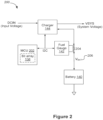
- the connected doorbell/camera 106 includes a microcontroller unit (MCU) 202 that is electrically coupled to a charger 144 and a fuel gauge 142.
- the MCU 202 includes various components of the connected doorbell/camera 106, including the memory 122, the processing circuitry 124, the communication circuitry 126, and the bit array 138 that are discussed with respect to Figure 1 .
- the fuel gauge 142 measures a voltage supplied to a battery 140 (e.g., V BAT 206) by measuring a voltage drop across a resistor 204.
- the MCU 202 regularly polls a state of the charger 144 to determine whether the charger is connected to the battery 140.
- the MCU 202 obtains from the fuel gauge 142 the voltage of the battery 140 (e.g., V BAT 206) and compares it with a threshold voltage (e.g., V TH 404).
- the MCU 202 tracks how long the voltage of the battery 140 has been above the threshold voltage by determining a ratio of a number of bits in an indexed sequence of bits in the bit array 138 that are filled with the predefined first value and a total number of bits in the indexed sequence of bits in the bit array 138, as discussed above with respect to Figure 1 .
- the MCU 202 regulates a maximum allowable voltage (e.g., V BC 402) of the charger 144 to a lower stepdown voltage (e.g., V SD 406) in accordance with a determination that the ratio exceeds a threshold ratio.
- V BC 402 maximum allowable voltage
- V SD 406 lower stepdown voltage
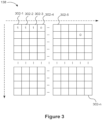
- Figure 3 illustrates a bit array 138 in accordance with some implementations.
- the bit array 138 contains an indexed sequence of n bits 302-1 to 302-n.
- Each of the bits 302 corresponds to a respective sampling period (e.g., one second).
- the entry in each bit 302 represents whether the battery voltage (e.g., V BAT 206) is above the threshold voltage (e.g., V TH 404) at the sampling period.
- an entry "1" (see, e.g., bits 302-1 to 302-3) denotes that the battery voltage is above the threshold voltage.
- An entry "0" indicates that the battery voltage is equal to or less than the threshold voltage.
- the number of bits in the array 138 is based on a fixed time duration that is monitored by the MCU 202. For example, a time duration of one week (e.g., 7 days), at a sampling rate of once per minute, uses an array of 10080 bits or 1260 bytes.
- the bits in the bit array 138 corresponds to a sliding time window in which the battery voltage is sampled at the sampling rate, and the sliding time window covers a fixed length of time determined based on the sampling rate.
- Figure 7 illustrates representative window durations/sizes for batteries of different applications, at a sampling rate (e.g., polling frequency) of one minute.
- 1440 bytes is used for a time window of 8 days at a sampling rate of one minute.
- the bits in the bit array are filled up sequentially, starting from 302-1.
- the oldest bits are replaced.
- the next bit replaces the oldest bit 302-1.
- Figure 4 is an exemplary plot 400 illustrating the effects of battery supply voltage 410 on the state of charge 420 of a battery 140 in accordance with some implementations.
- the battery supply voltage 410 is a voltage that is supplied by a charger 144.
- the battery 140 is configured to be charged by a solar-powered battery charger.
- the battery supply voltage includes a voltage limit 402 (e.g., V BC ), a threshold voltage 404 (e.g., V TH ), and a stepdown voltage 406 (e.g., V SD ).
- the voltage limit 402 is the maximum allowable voltage supplied by the charger 144 (e.g., V BC ⁇ 4.2 in Figure 4 ).
- the battery supply voltage is capped at the voltage limit 402.
- a battery can become fully charged (e.g., 100 % state of charge) when it is charged at the voltage limit 402.
- the threshold voltage 404 is the battery supply voltage used to achieve a 90% state of charge for the battery 140.
- the threshold voltage 404 is V TH ⁇ 4.1 V.
- the MCU 202 assigns a predefined first value (e.g., value "1") to a bit corresponding to the sampled voltage (e.g., a next bit position in the bit array 138). If the sampled battery voltage is equal to or less than the threshold voltage, the MCU 202 assigns a predefined second value (e.g., "0") to the bit.
- the MCU 202 further determines (e.g., by polling the charger 144), whether the rechargeable battery 140 is connected to a charger source. In some implementations, the predefined first value is added to the next bit position in accordance with the determination that sampled battery voltage is above the threshold voltage and that the rechargeable battery is connected to the charger source.
- the stepdown voltage 406 is the battery supply voltage used to achieve an 80 % state of charge for the battery 140.
- the stepdown voltage 406 is V SD ⁇ 3.9 V.
- the MCU 202 determines a ratio of a number of bits in the bit array 138 that have the predefined first value to the total number of bits in the bit array 138 that are filled (e.g., that contain either the first predefined value or the second predefined value).
- a threshold step-down ratio e.g., 50 %
- the processing circuitry 124 steps down the battery supply voltage from the voltage limit 402 to the stepdown voltage 406.
- the battery 140 does not become fully charged. Accordingly, the problem of battery swelling is reduced.
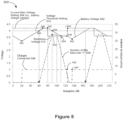
- FIG. 5 illustrates an exemplary charging cycle 500 of a battery 140 in accordance with some implementations.
- the battery 140 comprises a current maximum voltage setting 504 that includes a full charge voltage (e.g., 4.2 V) and a stepdown voltage 512 (e.g., 3.5 V).
- the battery 140 also comprises a threshold voltage setting 510 (e.g., 4.0 V).
- the initial battery voltage S 0 is about 3.5 V.
- a value (e.g., "0" or "1") is added to the bit array 138 in accordance with a determination that the battery 140 is connected to a charger source.
- the number of bits filled with "1" (508) remains at zero because the battery voltage 502 is less than the threshold voltage setting 510.
- the battery voltage 502 remains constant at the full charge voltage (e.g., voltage 526).
- the processing circuitry 124 decreases a current maximum voltage setting from the full charge voltage (e.g., 4.2 V) to a stepdown voltage 512 (e.g., 3.5 V).
- a current maximum voltage setting from the full charge voltage (e.g., 4.2 V) to a stepdown voltage 512 (e.g., 3.5 V).
- Figure 5 shows that the voltage of the battery decreases from voltage 528 as a result of the reduction in current maximum voltage setting.
- Figure 5 also illustrates that the charger is electrically disconnected at S ⁇ 125 (538).
- the maximum voltage setting is reset from the stepdown voltage 512 (e.g., 3.5 V) to the full charge voltage (e.g., 4.2).
- the disconnecting of the charger causes the maximum voltage setting to be restored to the full charge voltage of 4.2 V (540).
- the battery voltage continues to decrease from voltage 536 to voltage 542 due to discharge of the battery.
- S ⁇ 130 the charger is connected again. This restarts the battery charging cycle.
- FIG. 6 illustrates an exemplary charging cycle 600 of a battery 140 that is connected to a solar-powered charger in accordance with some implementations.
- the battery 140 comprises a current maximum voltage setting 604 that includes a full charge voltage (e.g., 4.2 V) and a stepdown voltage 614 (e.g., 3.5 V).
- the battery 140 also comprises a threshold voltage setting 612 (e.g., 4.0 V).
- the solar powered charger may cycle on and off during the day due to the presence or absence of sunlight.
- the charger is enabled and charges the battery 140.
- the number of bits filled with "1" also increases (e.g., from count 638 to count 640) due to the battery voltage 602 exceeding the threshold voltage 612.
- the ratio of the number of bits in the array 138 with value "1" to the number of bits in the array 138 that have been filled reaches a threshold ratio (e.g., 50 % , 60 % , or 80 % ).
- the processing circuitry 124 decreases the current maximum voltage setting from the full charge voltage (e.g., 4.2 V) to the stepdown voltage 614 (e.g., 3.5 V).
- the number of bits filled with "1" remains constant during this time due to the charger being disabled.
- Figure 7 illustrates exemplary product life expectancies, polling frequencies, window durations/sizes, maximum voltages, threshold voltages, stepdown voltages, and respective threshold ratios for switching a maximum charging voltage to a stepdown voltage for batteries of different applications, in accordance with some implementations.
- each of the applications includes a polling frequency of once per minute.
- one or more of the voltage threshold, stepdown voltage, sampling rate, value of first predefined bit, and threshold step-down ratio are customized for the rechargeable battery based on at least one of: a type, a location, and a season of the electronic device.
- a battery in a camera e.g., a connected doorbell/camera 106
- a total of 11520 bits (or 1440 bytes) is used.
- 1440 bytes are allocated in a buffer of the memory 122 for tracking the battery charging state for eight consecutive days.
- Figure 8 illustrates a flowchart of a method 800 in accordance with some implementations.
- Method 800 is, optionally, governed by instructions that are stored in a non-transitory computer-readable storage medium (e.g., memory 122 in Figure 1 ) and that are executed by one or more processors of an electronic device.
- the computer-readable storage medium may include a magnetic or optical disk storage device, solid-state storage devices such as Flash memory, or other non-volatile memory device or devices.
- the computer-readable instructions stored on the computer-readable storage medium may include one or more of: source code, assembly language code, object code, or other instruction format that is interpreted by one or more processors.
- the electronic device is disposed in an outdoor environment and includes a rechargeable battery 140.
- the electronic device is disconnected from an external power source and entirely powered by the rechargeable battery 140, which can be charged when the electronic device is connected to the external power source.
- the electronic device is constantly connected to the external power source and charged at a charge rate using the methods described with respect to Figures 2 to 6 .
- the electronic device allocates (802) an indexed sequence of bits in a buffer for tracking a battery charging state.
- the indexed sequence of bits has a first number of bits.
- the indexed sequence of bits are bits of a bit array 138.
- the first number of bits is based on a sampling rate and a time duration for which the battery 140 is to be monitored.
- the electronic device samples (804) a battery voltage of a rechargeable battery at a sampling rate (e.g., every minute, every three minutes, every five minutes, etc.).
- the electronic device For each sampled battery voltage, the electronic device compares (806) the battery voltage with a voltage threshold. The electronic device also identifies (808) a next bit position in the indexed sequence of bits.
- the electronic device adds (810) a predefined first value to the next bit position in the indexed sequence of bits.
- the electronic device determines (812), in the indexed sequence of bits, a second number of bits that are filled with the predefined first value.
- the electronic device also determines (814) a ratio between the second number and the first number.
- the electronic device steps down (816) a battery charge voltage to which the rechargeable battery is charged to a step-down voltage.
- a threshold step-down ratio e.g., 50 % , 60 % , 75 % , etc.
- the term “if” is, optionally, construed to mean “when” or “upon” or “in response to determining” or “in response to detecting” or “in accordance with a determination that,” depending on the context.
- the phrase “if it is determined” or “if [a stated condition or event] is detected” is, optionally, construed to mean “upon determining” or “in response to determining” or “upon detecting [the stated condition or event]” or “in response to detecting [the stated condition or event]” or “in accordance with a determination that [a stated condition or event] is detected," depending on the context.
- stages that are not order-dependent may be reordered and other stages may be combined or broken out. While some reordering or other groupings are specifically mentioned, others will be obvious to those of ordinary skill in the art, so the ordering and groupings presented herein are not an exhaustive list of alternatives. Moreover, it should be recognized that the stages can be implemented in hardware, firmware, software, or any combination thereof.
Landscapes
- Engineering & Computer Science (AREA)
- Power Engineering (AREA)
- Charge And Discharge Circuits For Batteries Or The Like (AREA)
- Secondary Cells (AREA)
Description
- This application claims benefit of
U.S. Provisional Application No. 63/140,720 filed January 22, 2021 - This application relates generally to battery technology including, but not limited to, methods and systems for monitoring charge levels of a rechargeable battery in an electronic device and protecting the rechargeable battery from damage caused by being kept on a charger for too long.
- Rechargeable batteries, such as lithium-ion batteries, are commonly used in electronic devices. When a battery is kept on a charger for too long, overcharge conditions can lead to battery swelling due to the build-up of heat and gas inside the battery. This failure state can cause fires, destroy the product, cause damage to a user's home, or injure the user.
- A rechargeable battery can be equipped with charger integrated circuits (ICs) and fuel gauge ICs, which inform a user about a charge state of the battery. When the battery is full, the ICs generally terminate the charge current but continue to supply a small trickle current to keep the battery full. When the battery is kept on a trickle charge for a long period of time, swelling occurs. Thus, currently available charger and field gauge technologies do not prevent battery swelling. Accordingly, there is a need for simple and cost-effective solutions to monitor a charge level of a rechargeable battery and to protect the battery and its accompanying device and user from damage caused by continuous periods of charging. A battery charging method is disclosed in
US 2007/075682 A1 .US 2013/041607 A1 andUS 6,549,014 B1 disclose the use of a counter which counts the number of overvoltage events of a battary.US 5,672,953 A discloses a charging device and a control method for preventing recharging of a fully charged battery. - This disclosure describes methods and systems for monitoring a charge level of a rechargeable battery. A claimed solution is specified by a method according to
claim 1 and by an electronic device according to claim 15. Dependent claims specify embodiments thereof. In some implementations, the rechargeable battery includes a battery charger. The battery also includes a microcontroller unit (MCU) that compares a voltage of the battery against a predefined threshold voltage at each sampling period (e.g., every minute, every five minutes, etc.) over a time window (e.g., five days, a week, ten days, etc.). The MCU utilizes a bit array to implement a sliding window. Each bit of the array represents whether the battery voltage is above the threshold voltage while it is charging. In some implementations, the MCU sets the bit to "1" if the battery voltage is greater than the threshold voltage, and sets the bit to "0" if it is less than or equal to the threshold voltage. - In some implementations, the number of bits (e.g., cells) in the bit array is based on a time duration for monitoring the battery. For example, a 11520-bit (or 1440-byte) array is used for monitoring a battery over eight days and at a sampling rate of one minute. The number of bits (and/or bytes) are allocated in the buffer for tracking the battery charging state for eight consecutive days. In some implementations, using a bit array helps keep the memory requirements low so it fits in the constraints of a small MCU. For each sample, all the bits in the bit array are shifted by one, thus making it a sliding window. In some implementations, when a number of bit "one" in the array is above a threshold (e.g., 50%), the MCU decreases the maximum voltage of a charger to a lower stepdown voltage.
- In one aspect of the present disclosure, a method is implemented for charging a battery. The method comprises allocating an indexed sequence of bits in a buffer for tracking a battery charging state. The indexed sequence of bits has a first number of bits. The method also comprises sampling a battery voltage of a rechargeable battery at a sampling rate. For each sampled battery voltage, the battery voltage is compared with a voltage threshold. A next bit position in the indexed sequence of bits is identified. In accordance with a determination that a comparison result is true, a predefined first value is added to the next bit position in the indexed sequence of bits. A second number of bits that are filled with the predefined first value is determined. A ratio between the second number and the first number is also determined. In accordance with a determination that the ratio exceeds a threshold step-down ratio, stepping down a battery charge voltage is stepped to, to which the rechargeable battery is charged to a step-down voltage.
- In another aspect, some implementations include determining whether the rechargeable battery is connected to a charger source. The predefined first value is added to the next bit position in accordance with a determination that the comparison result is true and that the rechargeable battery is connected to the charger source. For each sampled battery voltage, in accordance with a determination that the rechargeable battery is not connected to a charger source, the techniques add a predefined second value to the next bit position in the indexed sequence of bits.
- Thus, systems, devices, and methods are provided to monitor a voltage level of a rechargeable battery. Systems, devices, and methods that reduce a battery charge voltage are also disclosed. As such, this application provides simple and cost-effective solutions for detecting rechargeable batteries that may be vulnerable to damage due to being charged for too long at high voltage (e.g., near their maximum voltage limit), thereby preventing the swelling problem.
- For a better understanding of the various described implementations, reference should be made to the Detailed Description below, in conjunction with the following drawings in which like reference numerals refer to corresponding parts throughout the figures.
-
Figure 1 illustrates an exemplary operating environment in accordance with some implementations. -
Figure 2 illustrates a block diagram of a rechargeable battery in accordance with some implementations. -
Figure 3 illustrates a bit array in accordance with some implementations. -
Figure 4 is an exemplary plot illustrating the effects of battery supply voltage on the state of charge of a battery in accordance with some implementations. -
Figure 5 illustrates an exemplary charging cycle of a battery in accordance with some implementations -
Figure 6 illustrates an exemplary charging cycle of a battery that is connected to a solar-powered charger in accordance with some implementations. -
Figure 7 illustrates exemplary product life expectancies, polling frequencies, window durations/sizes, maximum voltages, threshold voltages, stepdown voltages, and respective threshold ratios for switching a maximum charging voltage to a stepdown voltage for batteries of different applications, in accordance with some implementations. -
Figure 8 illustrates a flowchart of a method in accordance with some implementations. - Like reference numerals refer to corresponding parts throughout the several views of the drawings.
-
Figure 1 illustrates anexample operating environment 100 in accordance with some implementations. In some implementations, theoperating environment 100 comprises a home environment that is connected to aremote server system 170. Theoperating environment 100 includes various devices (also referred to herein as "connected" or "integrated" devices) that are interconnected via alocal network 150. In some implementations, the devices include amobile device 102, adisplay assistant device 104, andhome devices 120. In some implementations, thehome devices 120 include one or more of: a connected doorbell/camera 106, acamera 108, and athermostat 110. The connected doorbell/camera 106 alerts the user to the presence of people and/or packages at the front door and monitors activity at the front door. Thecamera 108 may be part of a home security system that allows the user to track activity around the operatingenvironment 100. The thermostat 112 detects ambient climate characteristics (e.g., temperature and/or humidity) and controls a heating, ventilation, and air conditioning (HVAC) system (not shown) of the operatingenvironment 100 accordingly. - By virtue of network connectivity, a user may control the connected devices in the operating
environment 100 even if the user is not proximate to the devices. As one example, the user may use thedisplay assistant device 104 to view or adjust a current set point temperature of the thermostat 110 (e.g., via thelocal network 150 and through a communication circuitry of the display assistant device 104). In some implementations, thedisplay assistant device 104 includes program modules that can control thehome devices 120 without user interaction. As another example, thecamera 108 may store video data locally and wirelessly stream video data to themobile device 102 or thedisplay assistant device 104 via communication network(s) 160 and/or thelocal network 150. - In some implementations, at least a subset of the connected devices is also communicatively coupled to a
server system 170 through communication network(s) 160. The seversystem 170 includes one or more of: aninformation storage database 172, a device andaccount database 174, and a connecteddevice processing module 176. For example, thecamera 108 may stream video data to theserver system 170 via the communication network(s) 160 for storage on the server system 170 (e.g., the information storage database 172) or for additional processing by theserver system 170. The user may access the stored video data using the mobile device 102 (or the display assistant device 104) via the communication network(s) 160. - In some implementations, the user establishes a user account (e.g., a Google™ user account) with the
server system 170 and associates (e.g., adds and/or links) one or more connected devices with the user account. Theserver system 170 stores information for the user account and associated devices in the device andaccount database 174. - In some implementations, the
server system 170 enables the user to control and monitor information from theconnected home devices 120 via the connected device processing module 176 (e.g., using an application executing on themobile device 102 or assistant capabilities of some of the home devices 120). The user can also link thedisplay assistant device 104 to one or more of theconnected home devices 120 via the user account. This allows program modules executing on thedisplay assistant device 104 to receive information collected by thehome devices 120 via theserver system 170, or send commands via theserver system 170 to thehome devices 120. - In some implementations, the connected doorbell/
camera 106 includesmemory 122,processing circuitry 124, communication circuitry 126 (e.g., network interface(s)),speakers 128, and sensor(s) 130. Further, in some implementations, the connected doorbell/camera 106 includes abit array 138 that includes an indexed sequence of bits that is stored by thememory 122. The connected doorbell/camera 106 also includes arechargeable battery 140, acharger 144 for charging therechargeable battery 140, and a fuel gauge 142 (e.g., a fuel gauge IC) for determining a state of charge of thebattery 140. In some implementations, therechargeable battery 140 is built into the connected doorbell/camera 106 or is a replaceable module in the connected doorbell/camera 106. - The
memory 122 stores programs that, when executed by elements of theprocessing circuitry 124, perform one or more of the functions described with reference toFigures 1 to 8 . For example, in some implementations, the stored programs include abattery charging module 180 that determines a battery charge voltage at which therechargeable battery 140 is to be charged. Specifically, in some implementations, thebattery charging module 180 samples a voltage of therechargeable battery 140 at a sampling rate (e.g., once every minute, once every three minutes, etc.). For each sampled battery voltage, thebattery charging module 180 compares the battery voltage with a voltage threshold. Thebattery charging module 180 identifies in the bit array 138 a next bit position in the indexed sequence of bits. In accordance with a determination that a comparison result is true (e.g., the battery voltage exceeds the voltage threshold), thebattery charging module 180 adds a predefined first value (e.g., bit "1") to the next bit position in the indexed sequence of bits. Thebattery charging module 180 determines a ratio of (i) a number of bits in the indexed sequence of bits that are filled with the predefined first value and (ii) a total number of bits in the indexed sequence of bits. In accordance with a determination that the ratio exceeds a threshold step-down ratio (e.g., 1:2), thebattery charging module 180 steps down (e.g., decreases) a battery charge voltage to which therechargeable battery 140 is charged to a step-down voltage. - In some implementations, the stored programs include a battery setting adjustment module 182 for adjusting a setting (e.g., a threshold voltage, a battery charge voltage, etc.) of the
rechargeable battery 140. Thememory 122 also stores battery threshold data 184 and asetting register 186 of therechargeable battery 140. - The sensor(s) 130 are integrated into the connected doorbell/
camera 106 and include one or more of: microphone(s) 132, motion sensor(s) 134, and atemperature sensor 136. The sensor(s) 130 detect and record sound, movement, and/or ambient conditions (e.g., temperature) in proximity to the connected doorbell/camera 106. In some implementations, the connected doorbell/camera 106 also includes animage capture device 146, for recording images and video footage of a region surrounding the connected doorbell/camera 106. In some implementations, each of the recorded events (e.g., from the sensor(s) 130 and the image capture device 146) is associated with a respective date stamp and timestamp. In some implementations, the recorded events are stored and processed locally on the connected doorbell/camera 106. In some implementations, the connected doorbell/camera 106 sends at least a subset of the recorded events to theserver system 170 via the communication network(s) 160 for storage and processing. -
Figure 2 illustrates a block diagram 200 of a connected doorbell/camera 106 in accordance with some implementations. - In some implementations, the connected doorbell/
camera 106 includes a microcontroller unit (MCU) 202 that is electrically coupled to acharger 144 and afuel gauge 142. TheMCU 202 includes various components of the connected doorbell/camera 106, including thememory 122, theprocessing circuitry 124, thecommunication circuitry 126, and thebit array 138 that are discussed with respect toFigure 1 . Thefuel gauge 142 measures a voltage supplied to a battery 140 (e.g., VBAT 206) by measuring a voltage drop across aresistor 204. - In some implementations, the
MCU 202 regularly polls a state of thecharger 144 to determine whether the charger is connected to thebattery 140. - In some implementations, the
MCU 202 regularly polls thefuel gauge 142. - For example, at each sampling period (e.g., every second), the
MCU 202 obtains from thefuel gauge 142 the voltage of the battery 140 (e.g., VBAT 206) and compares it with a threshold voltage (e.g., VTH 404). TheMCU 202 tracks how long the voltage of thebattery 140 has been above the threshold voltage by determining a ratio of a number of bits in an indexed sequence of bits in thebit array 138 that are filled with the predefined first value and a total number of bits in the indexed sequence of bits in thebit array 138, as discussed above with respect toFigure 1 . In some implementations, theMCU 202 regulates a maximum allowable voltage (e.g., VBC 402) of thecharger 144 to a lower stepdown voltage (e.g., VSD 406) in accordance with a determination that the ratio exceeds a threshold ratio. -
Figure 3 illustrates abit array 138 in accordance with some implementations. - In the example of
Figure 3 , thebit array 138 contains an indexed sequence of n bits 302-1 to 302-n. Each of thebits 302 corresponds to a respective sampling period (e.g., one second). The entry in eachbit 302 represents whether the battery voltage (e.g., VBAT 206) is above the threshold voltage (e.g., VTH 404) at the sampling period. In some implementations, an entry "1" (see, e.g., bits 302-1 to 302-3) denotes that the battery voltage is above the threshold voltage. An entry "0" (see, e.g., bit 302-4) indicates that the battery voltage is equal to or less than the threshold voltage. - In some implementations, the number of bits in the
array 138 is based on a fixed time duration that is monitored by theMCU 202. For example, a time duration of one week (e.g., 7 days), at a sampling rate of once per minute, uses an array of 10080 bits or 1260 bytes. - In some implementations, the bits in the
bit array 138 corresponds to a sliding time window in which the battery voltage is sampled at the sampling rate, and the sliding time window covers a fixed length of time determined based on the sampling rate.Figure 7 illustrates representative window durations/sizes for batteries of different applications, at a sampling rate (e.g., polling frequency) of one minute. Using the "Battery in Camera" inFigure 7 as an example, a bit array of 11520 bits (e.g., n = 11520), or 1440 bytes, is used for a time window of 8 days at a sampling rate of one minute. In this example, the bits in the bit array are filled up sequentially, starting from 302-1. In some implementations, if the time monitored by theMCU 202 exceeds the time window, the oldest bits are replaced. Thus, in this example, after the bit 302-n is filled, the next bit replaces the oldest bit 302-1. -
Figure 4 is anexemplary plot 400 illustrating the effects ofbattery supply voltage 410 on the state ofcharge 420 of abattery 140 in accordance with some implementations. In some implementations, thebattery supply voltage 410 is a voltage that is supplied by acharger 144. In some implementations, thebattery 140 is configured to be charged by a solar-powered battery charger. -
Figure 4 illustrates that the battery supply voltage includes a voltage limit 402 (e.g., VBC), a threshold voltage 404 (e.g., VTH), and a stepdown voltage 406 (e.g., VSD). In some implementations, thevoltage limit 402 is the maximum allowable voltage supplied by the charger 144 (e.g., VBC ~ 4.2 inFigure 4 ). The battery supply voltage is capped at thevoltage limit 402. A battery can become fully charged (e.g., 100% state of charge) when it is charged at thevoltage limit 402. In some implementations, thethreshold voltage 404 is the battery supply voltage used to achieve a 90% state of charge for thebattery 140. In the example ofFigure 4 , thethreshold voltage 404 is VTH ~ 4.1 V. In some implementations, if a sampled battery voltage is above the threshold voltage, theMCU 202 assigns a predefined first value (e.g., value "1") to a bit corresponding to the sampled voltage (e.g., a next bit position in the bit array 138). If the sampled battery voltage is equal to or less than the threshold voltage, theMCU 202 assigns a predefined second value (e.g., "0") to the bit. - In some implementations, the
MCU 202 further determines (e.g., by polling the charger 144), whether therechargeable battery 140 is connected to a charger source. In some implementations, the predefined first value is added to the next bit position in accordance with the determination that sampled battery voltage is above the threshold voltage and that the rechargeable battery is connected to the charger source. - In some implementations, the
stepdown voltage 406 is the battery supply voltage used to achieve an 80% state of charge for thebattery 140. In the example ofFigure 4 , thestepdown voltage 406 is VSD ~ 3.9 V. In some implementations, theMCU 202 determines a ratio of a number of bits in thebit array 138 that have the predefined first value to the total number of bits in thebit array 138 that are filled (e.g., that contain either the first predefined value or the second predefined value). In accordance with a determination that the ratio exceeds a threshold step-down ratio (e.g., 50%), theprocessing circuitry 124 steps down the battery supply voltage from thevoltage limit 402 to thestepdown voltage 406. In some implementations, by limiting the battery supply voltage to less than the maximum allowable voltage, thebattery 140 does not become fully charged. Accordingly, the problem of battery swelling is reduced. -
Figure 5 illustrates anexemplary charging cycle 500 of abattery 140 in accordance with some implementations. In this example, thebattery 140 comprises a current maximum voltage setting 504 that includes a full charge voltage (e.g., 4.2 V) and a stepdown voltage 512 (e.g., 3.5 V). Thebattery 140 also comprises a threshold voltage setting 510 (e.g., 4.0 V). The initial battery voltage S = 0 is about 3.5 V. - In some implementations, a value (e.g., "0" or "1") is added to the
bit array 138 in accordance with a determination that thebattery 140 is connected to a charger source.Figure 5 shows that thebattery 140 is not connected to a charger source (e.g., the charger is not connected to a power source) from S = 0 to S = 20. Therefore, thebit array 138 has a count of zero from S = 0 to S = 20. At the same time, thebattery voltage 502 also decreases because it is not charged. - In the example of
Figure 5 , thebattery 140 starts charging from S = 20, when the charger is connected. Thebattery voltage 502 increases (e.g., linearly) fromvoltage 522 at S = 20, tovoltage 524 at S = 60. During the same time, the number of bits filled with "1" (508) remains at zero because thebattery voltage 502 is less than the threshold voltage setting 510. At S = 60, thebattery voltage 502 reaches the threshold voltage setting 510. Accordingly, theMCU 202 assigns a value of "1" to subsequent bits in thebit array 138 from S = 60. This corresponds to an increase in the number of bits filled with "1" starting from S = 60. Thebattery voltage 502 also increases fromvoltage 524 at S = 60 tovoltage 526 at S ≈ 70, where the full charge voltage of 4.2 V is reached. Thebattery voltage 502 remains constant at the full charge voltage (e.g., voltage 526). - With continued reference to the example of
Figure 5 , at S = 80 (e.g., voltage 528), the ratio of the number of bits in thearray 138 with value "1" to the number of bits in thearray 138 that have been filled reaches a threshold ratio (e.g., 50%, 60%, etc.). Accordingly, in some implementations, theprocessing circuitry 124 decreases a current maximum voltage setting from the full charge voltage (e.g., 4.2 V) to a stepdown voltage 512 (e.g., 3.5 V).Figure 5 shows that the voltage of the battery decreases fromvoltage 528 as a result of the reduction in current maximum voltage setting.Figure 5 also shows that the number of bits filled with "1" 508 continues to increase from S = 80 to S = 90, because the battery voltage at S = 80 (e.g., voltage 528) is still above the threshold voltage setting 510. At S = 90, the battery voltage decreases tovoltage 530, which is below the threshold voltage setting 510. Subsequent voltages that are sampled by theMCU 202 are assigned a bit value "0" due to the battery voltage being lower than the threshold voltage.Figure 5 shows that a number 532 of bits having the value "1" is constant from S ~ 90 to S ~ 100. Furthermore, with the reduction in the current maximum voltage setting at S = 80, the battery voltage decreases fromvoltage 528 at S = 80 tovoltage 534 at S ~ 110 and remains constant at thestepdown voltage 512 thereafter. -
Figure 5 also illustrates that the charger is electrically disconnected at S ~ 125 (538). In some implementations, when the charger is disconnected, the maximum voltage setting is reset from the stepdown voltage 512 (e.g., 3.5 V) to the full charge voltage (e.g., 4.2). In this example, the disconnecting of the charger causes the maximum voltage setting to be restored to the full charge voltage of 4.2 V (540). However, the battery voltage continues to decrease fromvoltage 536 tovoltage 542 due to discharge of the battery. At S ~ 130 (544), the charger is connected again. This restarts the battery charging cycle. -
Figure 6 illustrates anexemplary charging cycle 600 of abattery 140 that is connected to a solar-powered charger in accordance with some implementations. - In this example, the
battery 140 comprises a current maximum voltage setting 604 that includes a full charge voltage (e.g., 4.2 V) and a stepdown voltage 614 (e.g., 3.5 V). Thebattery 140 also comprises a threshold voltage setting 612 (e.g., 4.0 V). In some implementations, the solar powered charger may cycle on and off during the day due to the presence or absence of sunlight. In the example ofFigure 6 , the solar powered charger is enabled from S = 20 to S = 40, S = 60 to S = 80, S = 100 to S = 120, and S = 140 to S = 160, and disabled from S = 0 to S = 20, S = 40 to S = 60, S = 80 to S = 100, and S = 120 to S = 140. - The
battery 140 has a starting battery voltage of ~ 3.7 V (622) at S = 0. From S = 0 from S = 20, the charger is disabled (e.g., due to lack of sunlight). The battery voltage decreases fromvoltage 622 tovoltage 624 due to discharge of thebattery 140. From S = 20 to S = 40, the solar-powered charger is enabled (e.g., due to presence of sunlight) and charges thebattery 140, thus leading to an increase in the battery voltage from 624 to 626. During the same time period, the number of bits filled with "1" (610) remains at zero because the battery voltage is less than the threshold voltage setting 612. - At S = 40, the
battery voltage 602 reaches (e.g., exceeds) the threshold voltage setting 612.Figure 6 illustrates a slight increase in the number of bits filled with "1" (610) from S ~ 40 due to thebattery voltage 602 exceeding the threshold voltage setting 612 and the solar-powered charger being enabled. From S ~ 40 to S = 60, the number of bits filled with "1" (610) remains constant because the charger is not enabled. During the same time, there is a decrease in the battery voltage fromvoltage 626 tovoltage 628. - From S = 60 to S = 80, the charger is enabled.
Figure 6 shows that the number of bits filled with "1" (610) remains constant from S = 60 to S = 70 due to the battery voltage being lower than the threshold voltage setting 612. From S = 70 to S = 80, the number of bits filled with "1" (610) increases because the battery voltage (e.g.,voltage 630 at S = 70 andvoltage 632 at S = 80) exceeds the threshold voltage. - From S = 80 to S = 100, the solar-powered charger is disabled.
Figure 6 shows a decrease in the battery voltage fromvoltage 632 tovoltage 634 during this time. The number of bits filled with "1" remains constant during this time because the charger is disabled. - At S = 100, the charger is enabled and charges the
battery 140. The voltage of thebattery 140 increases fromvoltage 634 at S = 100 to the current maximum voltage setting at S ~ 110 (636). During this time, the number of bits filled with "1" also increases (e.g., fromcount 638 to count 640) due to thebattery voltage 602 exceeding thethreshold voltage 612. In some implementations, at count 640, the ratio of the number of bits in thearray 138 with value "1" to the number of bits in thearray 138 that have been filled reaches a threshold ratio (e.g., 50%, 60%, or 80%). In some implementations, in accordance with a determination that the ratio has reached (e.g., exceeded) a threshold ratio theprocessing circuitry 124 decreases the current maximum voltage setting from the full charge voltage (e.g., 4.2 V) to the stepdown voltage 614 (e.g., 3.5 V). - As also illustrated in
Figure 6 , the charger is disabled from S = 120 to S = 140 (e.g., due to the absence of sunlight). The number of bits filled with "1" remains constant during this time due to the charger being disabled. From S = 140 to S = 160, even though the charger is enabled (e.g., due to the presence of sunlight), the battery voltage continues to decrease (e.g., from voltage 642 to voltage 644) because the current maximum voltage setting is at the stepdown voltage value (e.g., 3.5 V). The battery voltage continues to decrease from S = 160 (e.g., voltage 644) to S = 200 because the charger is not enabled. - In some implementations, the
processing circuitry 124 steps up the battery charge voltage from thestepdown voltage 614 to the full charge voltage (e.g., 4.2) in accordance with a determination that therechargeable battery 140 is connected to a non-solar powered charger source.Figure 6 illustrates that at S = 200, thebattery 140 is connected to a USB charger (608). Accordingly, theprocessing circuitry 124 increases the current maximum voltage setting from thestepdown voltage 612 to full charge voltage (e.g., 4.2). -
Figure 7 illustrates exemplary product life expectancies, polling frequencies, window durations/sizes, maximum voltages, threshold voltages, stepdown voltages, and respective threshold ratios for switching a maximum charging voltage to a stepdown voltage for batteries of different applications, in accordance with some implementations. - In the example of
Figure 7 , each of the applications includes a polling frequency of once per minute. In some implementations, one or more of the voltage threshold, stepdown voltage, sampling rate, value of first predefined bit, and threshold step-down ratio are customized for the rechargeable battery based on at least one of: a type, a location, and a season of the electronic device. For instance, in some implementations, a battery in a camera (e.g., a connected doorbell/camera 106) includes a window duration of eight days. At a sampling rate of once per minute, a total of 11520 bits (or 1440 bytes) is used. In some implementations, 1440 bytes are allocated in a buffer of thememory 122 for tracking the battery charging state for eight consecutive days. -
Figure 8 illustrates a flowchart of amethod 800 in accordance with some implementations.Method 800 is, optionally, governed by instructions that are stored in a non-transitory computer-readable storage medium (e.g.,memory 122 inFigure 1 ) and that are executed by one or more processors of an electronic device. The computer-readable storage medium may include a magnetic or optical disk storage device, solid-state storage devices such as Flash memory, or other non-volatile memory device or devices. The computer-readable instructions stored on the computer-readable storage medium may include one or more of: source code, assembly language code, object code, or other instruction format that is interpreted by one or more processors. Some operations inmethod 800 may be combined and/or the order of some operations may be changed. In some implementations, the electronic device is disposed in an outdoor environment and includes arechargeable battery 140. Optionally, the electronic device is disconnected from an external power source and entirely powered by therechargeable battery 140, which can be charged when the electronic device is connected to the external power source. Optionally, the electronic device is constantly connected to the external power source and charged at a charge rate using the methods described with respect toFigures 2 to 6 . - The electronic device allocates (802) an indexed sequence of bits in a buffer for tracking a battery charging state. The indexed sequence of bits has a first number of bits. In some implementations, the indexed sequence of bits are bits of a
bit array 138. In some implementations, and as illustrated inFigure 7 , the first number of bits is based on a sampling rate and a time duration for which thebattery 140 is to be monitored. - The electronic device samples (804) a battery voltage of a rechargeable battery at a sampling rate (e.g., every minute, every three minutes, every five minutes, etc.).
- For each sampled battery voltage, the electronic device compares (806) the battery voltage with a voltage threshold. The electronic device also identifies (808) a next bit position in the indexed sequence of bits.
- In accordance with a determination that a comparison result is true, the electronic device adds (810) a predefined first value to the next bit position in the indexed sequence of bits.
- The electronic device determines (812), in the indexed sequence of bits, a second number of bits that are filled with the predefined first value.
- The electronic device also determines (814) a ratio between the second number and the first number.
- In accordance with a determination that the ratio exceeds a threshold step-down ratio (e.g., 50%, 60%, 75%, etc.), the electronic device steps down (816) a battery charge voltage to which the rechargeable battery is charged to a step-down voltage.
- The terminology used in the description of the various described implementations herein is for the purpose of describing particular implementations only and is not intended to be limiting. As used in the description of the various described implementations and the appended claims, the singular forms "a", "an", and "the" are intended to include the plural forms as well, unless the context clearly indicates otherwise. It will also be understood that the term "and/or" as used herein refers to and encompasses any and all possible combinations of one or more of the associated listed items. It will be further understood that the terms "includes," "including," "comprises," and/or "comprising," when used in this specification, specify the presence of stated features, integers, steps, operations, elements, and/or components, but do not preclude the presence or addition of one or more other features, integers, steps, operations, elements, components, and/or groups thereof. Additionally, it will be understood that, although the terms "first," "second," etc. may be used herein to describe various elements, these elements should not be limited by these terms. These terms are only used to distinguish one element from another.
- As used herein, the term "if" is, optionally, construed to mean "when" or "upon" or "in response to determining" or "in response to detecting" or "in accordance with a determination that," depending on the context. Similarly, the phrase "if it is determined" or "if [a stated condition or event] is detected" is, optionally, construed to mean "upon determining" or "in response to determining" or "upon detecting [the stated condition or event]" or "in response to detecting [the stated condition or event]" or "in accordance with a determination that [a stated condition or event] is detected," depending on the context.
- The foregoing description, for purpose of explanation, has been described with reference to specific embodiments. However, the illustrative discussions above are not intended to be exhaustive or to limit the claims to the precise forms disclosed. Many modifications and variations are possible in view of the above teachings. The embodiments were chosen and described in order to best explain principles of operation and practical applications, to thereby enable others skilled in the art.
- Although various drawings illustrate a number of logical stages in a particular order, stages that are not order-dependent may be reordered and other stages may be combined or broken out. While some reordering or other groupings are specifically mentioned, others will be obvious to those of ordinary skill in the art, so the ordering and groupings presented herein are not an exhaustive list of alternatives. Moreover, it should be recognized that the stages can be implemented in hardware, firmware, software, or any combination thereof.
Claims (15)
- A battery charging method, comprising:allocating (802) an indexed sequence of bits in a buffer for tracking a battery charging state, the indexed sequence of bits having a first number of bits;sampling (804) a battery voltage of a rechargeable battery (140) at a sampling rate;for each sampled battery voltage:comparing (806) the battery voltage with a voltage threshold;identifying (808) a next bit position in the indexed sequence of bits; andin accordance with a determination that a comparison result is true, adding (810) a predefined first value to the next bit position in the indexed sequence of bits;determining (812), in the indexed sequence of bits, a second number of bits that are filled with the predefined first value;determining (814) a ratio between the second number and the first number; andin accordance with a determination that the ratio exceeds a threshold step-down ratio, stepping down (816) a battery charge voltage to which the rechargeable battery (140) is charged to a step-down voltage.
- The method of claim 1, further comprising:determining whether the rechargeable battery (140) is connected to a charger source, wherein the predefined first value is added to the next bit position in accordance with a determination that the comparison result is true and that the rechargeable battery (140) is connected to the charger source; andfor each sampled battery voltage, in accordance with a determination that the rechargeable battery (140) is not connected to a charger source, adding a predefined second value to the next bit position in the indexed sequence of bits.
- The method of claim 1, wherein identifying the next bit position in the indexed sequence of bits further comprises:
in accordance with a determination that the indexed sequence of bits has been fully filled, identifying the next bit position as a position of an earliest bit that has been filled in the indexed sequence of bits, wherein a value stored in the earliest bit is replaced by the predefined first value. - The method of claim 1, wherein the indexed sequence of bits are filled and overwritten by samples of the battery voltage consecutively according to a predefined order.
- The method of claim 1, further comprising:
for each sampled battery voltage, in accordance with a determination that the comparison result is false, adding a predefined second value distinct from the predefined first value in the next bit position in the indexed sequence of bits. - The method of claim 5, wherein the predefined first value is "1", and the predefined second value is "0".
- The method of claim 1, wherein the battery voltage is consecutively sampled at the sampling rate regardless of whether the rechargeable battery (140) is being charged.
- The method of claim 1, wherein the rechargeable battery (140) is configured to be charged by a solar-powered battery charger (144).
- The method of claim 1, wherein determination that the comparison result is true further comprises determining that the battery voltage is one of: (a) greater than the voltage threshold and (b) greater than or equal to the voltage threshold.
- The method of claim 1, wherein the voltage threshold is greater than the step-down voltage.
- The method of claim 1, wherein the voltage threshold includes a first voltage threshold, further comprising:
in accordance with a determination that the rechargeable battery (140) is disconnected from a charger source, stepping up the battery charge voltage from the step-down voltage to a full charge voltage, the full charge voltage being greater than the voltage threshold. - The method of claim 1, wherein the indexed sequence of bits corresponds to a sliding time window in which the battery voltage is sampled at the sampling rate, and the sliding time window covers a fixed length of time determined based on the sampling rate and the first number of bits allocated to for tracking the battery charging state.
- The method of claim 1, wherein the rechargeable battery (140) is integrated in an electronic device having one or more processors, the buffer storing the indexed sequence of bits, and memory (122) having instructions stored thereon.
- The method of claim 13, wherein one or more of the voltage threshold, step-down voltage, sampling rate, first number, and threshold step-down ratio are customized for the rechargeable battery (140) based on at least one of: a type, a location, and a season of the electronic device.
- An electronic device, comprising:one or more processors; andmemory (122) having instructions stored thereon, which when executed by the one or more processors, cause the processors to perform the method of any one of claims 1 to 14.
Applications Claiming Priority (3)
| Application Number | Priority Date | Filing Date | Title |
|---|---|---|---|
| US202163140720P | 2021-01-22 | 2021-01-22 | |
| US17/319,815 US11901751B2 (en) | 2021-01-22 | 2021-05-13 | Systems and methods for monitoring high charge levels in rechargeable batteries |
| PCT/US2022/013304 WO2022159697A1 (en) | 2021-01-22 | 2022-01-21 | Systems and methods for monitoring high charge levels in rechargeable batteries |
Publications (2)
| Publication Number | Publication Date |
|---|---|
| EP4282049A1 EP4282049A1 (en) | 2023-11-29 |
| EP4282049B1 true EP4282049B1 (en) | 2024-12-11 |
Family
ID=80222217
Family Applications (1)
| Application Number | Title | Priority Date | Filing Date |
|---|---|---|---|
| EP22703233.1A Active EP4282049B1 (en) | 2021-01-22 | 2022-01-21 | Systems and methods for monitoring high charge levels in rechargeable batteries |
Country Status (3)
| Country | Link |
|---|---|
| US (1) | US12149106B2 (en) |
| EP (1) | EP4282049B1 (en) |
| WO (1) | WO2022159697A1 (en) |
Families Citing this family (2)
| Publication number | Priority date | Publication date | Assignee | Title |
|---|---|---|---|---|
| EP4282049B1 (en) | 2021-01-22 | 2024-12-11 | Google LLC | Systems and methods for monitoring high charge levels in rechargeable batteries |
| CA3247678A1 (en) * | 2022-01-31 | 2023-08-03 | Google Llc | Battery zero-voltage detection methodologies and applications thereof |
Family Cites Families (10)
| Publication number | Priority date | Publication date | Assignee | Title |
|---|---|---|---|---|
| KR960027134A (en) * | 1994-12-22 | 1996-07-22 | 김광호 | Charging device having a recharge prevention function of a full charge battery and its control method |
| US6983212B2 (en) | 2001-11-27 | 2006-01-03 | American Power Conversion Corporation | Battery management system and method |
| US6549014B1 (en) * | 2002-02-15 | 2003-04-15 | Power Designers, Llc | Battery monitoring method and apparatus |
| AU2003267882A1 (en) | 2002-09-26 | 2004-04-19 | Eaton Power Quality Limited | Modular battery management apparatus with cell sensing and energy redistribution capabilities |
| US7626362B2 (en) * | 2005-09-30 | 2009-12-01 | International Components Corporation | Rapid charge lithium ion battery charger |
| US9075090B2 (en) * | 2011-08-11 | 2015-07-07 | Qualcomm Incorporated | Battery monitoring circuit |
| US20160064960A1 (en) | 2014-09-02 | 2016-03-03 | Apple Inc. | User-behavior-driven battery charging |
| US10862175B2 (en) | 2017-05-29 | 2020-12-08 | Rohm Co., Ltd. | Battery fuel gauge circuit |
| EP4282049B1 (en) | 2021-01-22 | 2024-12-11 | Google LLC | Systems and methods for monitoring high charge levels in rechargeable batteries |
| US11901751B2 (en) | 2021-01-22 | 2024-02-13 | Google Llc | Systems and methods for monitoring high charge levels in rechargeable batteries |
-
2022
- 2022-01-21 EP EP22703233.1A patent/EP4282049B1/en active Active
- 2022-01-21 WO PCT/US2022/013304 patent/WO2022159697A1/en not_active Ceased
-
2024
- 2024-01-05 US US18/405,408 patent/US12149106B2/en active Active
Also Published As
| Publication number | Publication date |
|---|---|
| US20240154435A1 (en) | 2024-05-09 |
| US12149106B2 (en) | 2024-11-19 |
| WO2022159697A1 (en) | 2022-07-28 |
| EP4282049A1 (en) | 2023-11-29 |
Similar Documents
| Publication | Publication Date | Title |
|---|---|---|
| US12149106B2 (en) | Systems and methods for monitoring high charge levels in rechargeable batteries | |
| US11901751B2 (en) | Systems and methods for monitoring high charge levels in rechargeable batteries | |
| CN100568662C (en) | Battery pack, battery protection processing device and control method thereof | |
| CN112153216A (en) | Power early warning method and device, terminal device, and storage medium | |
| US20240152199A1 (en) | Low power continuous dashcam recording | |
| CN111915762B (en) | Vehicle feed data recording method and device | |
| WO2012088929A1 (en) | Method, device and system for battery charging control | |
| EP3993136A1 (en) | Geolocation based battery settings | |
| CN120963735A (en) | Vehicle wake-up control methods, electronic devices and vehicles | |
| JP2002142244A (en) | Communication base station service tour route providing system, communication base station service tour route providing method, and navigation device | |
| CN115954990A (en) | Method, system, device and storage medium for supplying power to satellite loads | |
| CN116231121A (en) | An energy storage battery management system | |
| CN120363786A (en) | Multi-mode timing wake-up system and method for battery management system | |
| US20250030942A1 (en) | Scalable in-vehicle video system and signal control apparatus | |
| US20110258409A1 (en) | Memory device, host device, and memory system | |
| CN112816886A (en) | DC standby power supply monitoring system | |
| CN106130101A (en) | A kind of Energy harvesting method of autonomous type monitoring device | |
| US11750777B2 (en) | Video management system and method for retrieving and storing data from surveillance cameras | |
| CN215186006U (en) | Power supply device applied to voltage quality monitoring recorder | |
| CN107561988B (en) | A kind of method of environmental monitoring | |
| CN109118608B (en) | Method for starting parking video and automobile data recorder | |
| CN117785038A (en) | Unmanned aerial vehicle battery operation data storage control method, device, computer equipment and storage medium | |
| EP4345469B1 (en) | A method of controlling power usage in a battery powered device | |
| CN113809803A (en) | Protection method and device suitable for energy storage power supply system | |
| US12244921B2 (en) | Low power continuous dashcam recording |
Legal Events
| Date | Code | Title | Description |
|---|---|---|---|
| STAA | Information on the status of an ep patent application or granted ep patent |
Free format text: STATUS: UNKNOWN |
|
| STAA | Information on the status of an ep patent application or granted ep patent |
Free format text: STATUS: THE INTERNATIONAL PUBLICATION HAS BEEN MADE |
|
| PUAI | Public reference made under article 153(3) epc to a published international application that has entered the european phase |
Free format text: ORIGINAL CODE: 0009012 |
|
| STAA | Information on the status of an ep patent application or granted ep patent |
Free format text: STATUS: REQUEST FOR EXAMINATION WAS MADE |
|
| 17P | Request for examination filed |
Effective date: 20230623 |
|
| AK | Designated contracting states |
Kind code of ref document: A1 Designated state(s): AL AT BE BG CH CY CZ DE DK EE ES FI FR GB GR HR HU IE IS IT LI LT LU LV MC MK MT NL NO PL PT RO RS SE SI SK SM TR |
|
| DAV | Request for validation of the european patent (deleted) | ||
| DAX | Request for extension of the european patent (deleted) | ||
| GRAP | Despatch of communication of intention to grant a patent |
Free format text: ORIGINAL CODE: EPIDOSNIGR1 |
|
| STAA | Information on the status of an ep patent application or granted ep patent |
Free format text: STATUS: GRANT OF PATENT IS INTENDED |
|
| INTG | Intention to grant announced |
Effective date: 20240731 |
|
| RIN1 | Information on inventor provided before grant (corrected) |
Inventor name: WANG, DAVID Inventor name: LIM, JAMES ROBERT Inventor name: SAPERSTEIN, WILLIAM ALAN Inventor name: CHEN, MICHAEL, JONATHON |
|
| GRAS | Grant fee paid |
Free format text: ORIGINAL CODE: EPIDOSNIGR3 |
|
| GRAA | (expected) grant |
Free format text: ORIGINAL CODE: 0009210 |
|
| STAA | Information on the status of an ep patent application or granted ep patent |
Free format text: STATUS: THE PATENT HAS BEEN GRANTED |
|
| AK | Designated contracting states |
Kind code of ref document: B1 Designated state(s): AL AT BE BG CH CY CZ DE DK EE ES FI FR GB GR HR HU IE IS IT LI LT LU LV MC MK MT NL NO PL PT RO RS SE SI SK SM TR |
|
| P01 | Opt-out of the competence of the unified patent court (upc) registered |
Free format text: CASE NUMBER: APP_59422/2024 Effective date: 20241031 |
|
| REG | Reference to a national code |
Ref country code: GB Ref legal event code: FG4D |
|
| REG | Reference to a national code |
Ref country code: CH Ref legal event code: EP |
|
| REG | Reference to a national code |
Ref country code: DE Ref legal event code: R096 Ref document number: 602022008617 Country of ref document: DE |
|
| REG | Reference to a national code |
Ref country code: IE Ref legal event code: FG4D |
|
| REG | Reference to a national code |
Ref country code: NL Ref legal event code: FP |
|
| REG | Reference to a national code |
Ref country code: LT Ref legal event code: MG9D |
|
| PG25 | Lapsed in a contracting state [announced via postgrant information from national office to epo] |
Ref country code: HR Free format text: LAPSE BECAUSE OF FAILURE TO SUBMIT A TRANSLATION OF THE DESCRIPTION OR TO PAY THE FEE WITHIN THE PRESCRIBED TIME-LIMIT Effective date: 20241211 |
|
| PG25 | Lapsed in a contracting state [announced via postgrant information from national office to epo] |
Ref country code: FI Free format text: LAPSE BECAUSE OF FAILURE TO SUBMIT A TRANSLATION OF THE DESCRIPTION OR TO PAY THE FEE WITHIN THE PRESCRIBED TIME-LIMIT Effective date: 20241211 |
|
| PG25 | Lapsed in a contracting state [announced via postgrant information from national office to epo] |
Ref country code: BG Free format text: LAPSE BECAUSE OF FAILURE TO SUBMIT A TRANSLATION OF THE DESCRIPTION OR TO PAY THE FEE WITHIN THE PRESCRIBED TIME-LIMIT Effective date: 20241211 |
|
| PG25 | Lapsed in a contracting state [announced via postgrant information from national office to epo] |
Ref country code: ES Free format text: LAPSE BECAUSE OF FAILURE TO SUBMIT A TRANSLATION OF THE DESCRIPTION OR TO PAY THE FEE WITHIN THE PRESCRIBED TIME-LIMIT Effective date: 20241211 |
|
| PG25 | Lapsed in a contracting state [announced via postgrant information from national office to epo] |
Ref country code: NO Free format text: LAPSE BECAUSE OF FAILURE TO SUBMIT A TRANSLATION OF THE DESCRIPTION OR TO PAY THE FEE WITHIN THE PRESCRIBED TIME-LIMIT Effective date: 20250311 |
|
| PG25 | Lapsed in a contracting state [announced via postgrant information from national office to epo] |
Ref country code: LV Free format text: LAPSE BECAUSE OF FAILURE TO SUBMIT A TRANSLATION OF THE DESCRIPTION OR TO PAY THE FEE WITHIN THE PRESCRIBED TIME-LIMIT Effective date: 20241211 Ref country code: GR Free format text: LAPSE BECAUSE OF FAILURE TO SUBMIT A TRANSLATION OF THE DESCRIPTION OR TO PAY THE FEE WITHIN THE PRESCRIBED TIME-LIMIT Effective date: 20250312 |
|
| PG25 | Lapsed in a contracting state [announced via postgrant information from national office to epo] |
Ref country code: RS Free format text: LAPSE BECAUSE OF FAILURE TO SUBMIT A TRANSLATION OF THE DESCRIPTION OR TO PAY THE FEE WITHIN THE PRESCRIBED TIME-LIMIT Effective date: 20250311 |
|
| REG | Reference to a national code |
Ref country code: AT Ref legal event code: MK05 Ref document number: 1751149 Country of ref document: AT Kind code of ref document: T Effective date: 20241211 |
|
| PG25 | Lapsed in a contracting state [announced via postgrant information from national office to epo] |
Ref country code: SM Free format text: LAPSE BECAUSE OF FAILURE TO SUBMIT A TRANSLATION OF THE DESCRIPTION OR TO PAY THE FEE WITHIN THE PRESCRIBED TIME-LIMIT Effective date: 20241211 |
|
| PG25 | Lapsed in a contracting state [announced via postgrant information from national office to epo] |
Ref country code: PL Free format text: LAPSE BECAUSE OF FAILURE TO SUBMIT A TRANSLATION OF THE DESCRIPTION OR TO PAY THE FEE WITHIN THE PRESCRIBED TIME-LIMIT Effective date: 20241211 |
|
| PG25 | Lapsed in a contracting state [announced via postgrant information from national office to epo] |
Ref country code: IS Free format text: LAPSE BECAUSE OF FAILURE TO SUBMIT A TRANSLATION OF THE DESCRIPTION OR TO PAY THE FEE WITHIN THE PRESCRIBED TIME-LIMIT Effective date: 20250411 |
|
| PG25 | Lapsed in a contracting state [announced via postgrant information from national office to epo] |
Ref country code: PT Free format text: LAPSE BECAUSE OF FAILURE TO SUBMIT A TRANSLATION OF THE DESCRIPTION OR TO PAY THE FEE WITHIN THE PRESCRIBED TIME-LIMIT Effective date: 20250411 |
|
| PG25 | Lapsed in a contracting state [announced via postgrant information from national office to epo] |
Ref country code: EE Free format text: LAPSE BECAUSE OF FAILURE TO SUBMIT A TRANSLATION OF THE DESCRIPTION OR TO PAY THE FEE WITHIN THE PRESCRIBED TIME-LIMIT Effective date: 20241211 |
|
| PG25 | Lapsed in a contracting state [announced via postgrant information from national office to epo] |
Ref country code: AT Free format text: LAPSE BECAUSE OF FAILURE TO SUBMIT A TRANSLATION OF THE DESCRIPTION OR TO PAY THE FEE WITHIN THE PRESCRIBED TIME-LIMIT Effective date: 20241211 Ref country code: RO Free format text: LAPSE BECAUSE OF FAILURE TO SUBMIT A TRANSLATION OF THE DESCRIPTION OR TO PAY THE FEE WITHIN THE PRESCRIBED TIME-LIMIT Effective date: 20241211 |
|
| PG25 | Lapsed in a contracting state [announced via postgrant information from national office to epo] |
Ref country code: SK Free format text: LAPSE BECAUSE OF FAILURE TO SUBMIT A TRANSLATION OF THE DESCRIPTION OR TO PAY THE FEE WITHIN THE PRESCRIBED TIME-LIMIT Effective date: 20241211 |
|
| PG25 | Lapsed in a contracting state [announced via postgrant information from national office to epo] |
Ref country code: CZ Free format text: LAPSE BECAUSE OF FAILURE TO SUBMIT A TRANSLATION OF THE DESCRIPTION OR TO PAY THE FEE WITHIN THE PRESCRIBED TIME-LIMIT Effective date: 20241211 |
|
| PG25 | Lapsed in a contracting state [announced via postgrant information from national office to epo] |
Ref country code: IT Free format text: LAPSE BECAUSE OF FAILURE TO SUBMIT A TRANSLATION OF THE DESCRIPTION OR TO PAY THE FEE WITHIN THE PRESCRIBED TIME-LIMIT Effective date: 20241211 |
|
| REG | Reference to a national code |
Ref country code: CH Ref legal event code: PL |
|
| PG25 | Lapsed in a contracting state [announced via postgrant information from national office to epo] |
Ref country code: SE Free format text: LAPSE BECAUSE OF FAILURE TO SUBMIT A TRANSLATION OF THE DESCRIPTION OR TO PAY THE FEE WITHIN THE PRESCRIBED TIME-LIMIT Effective date: 20241211 |
|
| REG | Reference to a national code |
Ref country code: DE Ref legal event code: R097 Ref document number: 602022008617 Country of ref document: DE |
|
| PG25 | Lapsed in a contracting state [announced via postgrant information from national office to epo] |
Ref country code: MC Free format text: LAPSE BECAUSE OF FAILURE TO SUBMIT A TRANSLATION OF THE DESCRIPTION OR TO PAY THE FEE WITHIN THE PRESCRIBED TIME-LIMIT Effective date: 20241211 Ref country code: LU Free format text: LAPSE BECAUSE OF NON-PAYMENT OF DUE FEES Effective date: 20250121 |
|
| PG25 | Lapsed in a contracting state [announced via postgrant information from national office to epo] |
Ref country code: DK Free format text: LAPSE BECAUSE OF FAILURE TO SUBMIT A TRANSLATION OF THE DESCRIPTION OR TO PAY THE FEE WITHIN THE PRESCRIBED TIME-LIMIT Effective date: 20241211 |
|
| PG25 | Lapsed in a contracting state [announced via postgrant information from national office to epo] |
Ref country code: BE Free format text: LAPSE BECAUSE OF NON-PAYMENT OF DUE FEES Effective date: 20250131 |
|
| PLBE | No opposition filed within time limit |
Free format text: ORIGINAL CODE: 0009261 |
|
| STAA | Information on the status of an ep patent application or granted ep patent |
Free format text: STATUS: NO OPPOSITION FILED WITHIN TIME LIMIT |
|
| PG25 | Lapsed in a contracting state [announced via postgrant information from national office to epo] |
Ref country code: CH Free format text: LAPSE BECAUSE OF NON-PAYMENT OF DUE FEES Effective date: 20250131 |
|
| REG | Reference to a national code |
Ref country code: BE Ref legal event code: MM Effective date: 20250131 |
|
| 26N | No opposition filed |
Effective date: 20250912 |
|
| PG25 | Lapsed in a contracting state [announced via postgrant information from national office to epo] |
Ref country code: IE Free format text: LAPSE BECAUSE OF NON-PAYMENT OF DUE FEES Effective date: 20250121 |
|
| PGFP | Annual fee paid to national office [announced via postgrant information from national office to epo] |
Ref country code: NL Payment date: 20260126 Year of fee payment: 5 |
|
| PGFP | Annual fee paid to national office [announced via postgrant information from national office to epo] |
Ref country code: GB Payment date: 20260127 Year of fee payment: 5 |
|
| PGFP | Annual fee paid to national office [announced via postgrant information from national office to epo] |
Ref country code: DE Payment date: 20260128 Year of fee payment: 5 |
|
| PGFP | Annual fee paid to national office [announced via postgrant information from national office to epo] |
Ref country code: FR Payment date: 20260126 Year of fee payment: 5 |