EP4282022B1 - Battery housing and battery module including the battery housing - Google Patents
Battery housing and battery module including the battery housing Download PDFInfo
- Publication number
- EP4282022B1 EP4282022B1 EP22704625.7A EP22704625A EP4282022B1 EP 4282022 B1 EP4282022 B1 EP 4282022B1 EP 22704625 A EP22704625 A EP 22704625A EP 4282022 B1 EP4282022 B1 EP 4282022B1
- Authority
- EP
- European Patent Office
- Prior art keywords
- battery
- housing
- battery housing
- base plate
- shelf
- Prior art date
- Legal status (The legal status is an assumption and is not a legal conclusion. Google has not performed a legal analysis and makes no representation as to the accuracy of the status listed.)
- Active
Links
Images




Classifications
-
- H—ELECTRICITY
- H01—ELECTRIC ELEMENTS
- H01M—PROCESSES OR MEANS, e.g. BATTERIES, FOR THE DIRECT CONVERSION OF CHEMICAL ENERGY INTO ELECTRICAL ENERGY
- H01M10/00—Secondary cells; Manufacture thereof
- H01M10/05—Accumulators with non-aqueous electrolyte
- H01M10/052—Li-accumulators
- H01M10/0525—Rocking-chair batteries, i.e. batteries with lithium insertion or intercalation in both electrodes; Lithium-ion batteries
-
- H—ELECTRICITY
- H01—ELECTRIC ELEMENTS
- H01M—PROCESSES OR MEANS, e.g. BATTERIES, FOR THE DIRECT CONVERSION OF CHEMICAL ENERGY INTO ELECTRICAL ENERGY
- H01M10/00—Secondary cells; Manufacture thereof
- H01M10/60—Heating or cooling; Temperature control
- H01M10/61—Types of temperature control
- H01M10/613—Cooling or keeping cold
-
- H—ELECTRICITY
- H01—ELECTRIC ELEMENTS
- H01M—PROCESSES OR MEANS, e.g. BATTERIES, FOR THE DIRECT CONVERSION OF CHEMICAL ENERGY INTO ELECTRICAL ENERGY
- H01M10/00—Secondary cells; Manufacture thereof
- H01M10/60—Heating or cooling; Temperature control
- H01M10/62—Heating or cooling; Temperature control specially adapted for specific applications
- H01M10/625—Vehicles
-
- H—ELECTRICITY
- H01—ELECTRIC ELEMENTS
- H01M—PROCESSES OR MEANS, e.g. BATTERIES, FOR THE DIRECT CONVERSION OF CHEMICAL ENERGY INTO ELECTRICAL ENERGY
- H01M10/00—Secondary cells; Manufacture thereof
- H01M10/60—Heating or cooling; Temperature control
- H01M10/65—Means for temperature control structurally associated with the cells
- H01M10/653—Means for temperature control structurally associated with the cells characterised by electrically insulating or thermally conductive materials
-
- H—ELECTRICITY
- H01—ELECTRIC ELEMENTS
- H01M—PROCESSES OR MEANS, e.g. BATTERIES, FOR THE DIRECT CONVERSION OF CHEMICAL ENERGY INTO ELECTRICAL ENERGY
- H01M10/00—Secondary cells; Manufacture thereof
- H01M10/60—Heating or cooling; Temperature control
- H01M10/65—Means for temperature control structurally associated with the cells
- H01M10/655—Solid structures for heat exchange or heat conduction
- H01M10/6551—Surfaces specially adapted for heat dissipation or radiation, e.g. fins or coatings
-
- H—ELECTRICITY
- H01—ELECTRIC ELEMENTS
- H01M—PROCESSES OR MEANS, e.g. BATTERIES, FOR THE DIRECT CONVERSION OF CHEMICAL ENERGY INTO ELECTRICAL ENERGY
- H01M10/00—Secondary cells; Manufacture thereof
- H01M10/60—Heating or cooling; Temperature control
- H01M10/65—Means for temperature control structurally associated with the cells
- H01M10/655—Solid structures for heat exchange or heat conduction
- H01M10/6554—Rods or plates
-
- H—ELECTRICITY
- H01—ELECTRIC ELEMENTS
- H01M—PROCESSES OR MEANS, e.g. BATTERIES, FOR THE DIRECT CONVERSION OF CHEMICAL ENERGY INTO ELECTRICAL ENERGY
- H01M10/00—Secondary cells; Manufacture thereof
- H01M10/60—Heating or cooling; Temperature control
- H01M10/65—Means for temperature control structurally associated with the cells
- H01M10/655—Solid structures for heat exchange or heat conduction
- H01M10/6556—Solid parts with flow channel passages or pipes for heat exchange
-
- H—ELECTRICITY
- H01—ELECTRIC ELEMENTS
- H01M—PROCESSES OR MEANS, e.g. BATTERIES, FOR THE DIRECT CONVERSION OF CHEMICAL ENERGY INTO ELECTRICAL ENERGY
- H01M50/00—Constructional details or processes of manufacture of the non-active parts of electrochemical cells other than fuel cells, e.g. hybrid cells
- H01M50/20—Mountings; Secondary casings or frames; Racks, modules or packs; Suspension devices; Shock absorbers; Transport or carrying devices; Holders
- H01M50/204—Racks, modules or packs for multiple batteries or multiple cells
- H01M50/207—Racks, modules or packs for multiple batteries or multiple cells characterised by their shape
- H01M50/209—Racks, modules or packs for multiple batteries or multiple cells characterised by their shape adapted for prismatic or rectangular cells
-
- H—ELECTRICITY
- H01—ELECTRIC ELEMENTS
- H01M—PROCESSES OR MEANS, e.g. BATTERIES, FOR THE DIRECT CONVERSION OF CHEMICAL ENERGY INTO ELECTRICAL ENERGY
- H01M50/00—Constructional details or processes of manufacture of the non-active parts of electrochemical cells other than fuel cells, e.g. hybrid cells
- H01M50/20—Mountings; Secondary casings or frames; Racks, modules or packs; Suspension devices; Shock absorbers; Transport or carrying devices; Holders
- H01M50/218—Mountings; Secondary casings or frames; Racks, modules or packs; Suspension devices; Shock absorbers; Transport or carrying devices; Holders characterised by the material
- H01M50/22—Mountings; Secondary casings or frames; Racks, modules or packs; Suspension devices; Shock absorbers; Transport or carrying devices; Holders characterised by the material of the casings or racks
- H01M50/222—Inorganic material
- H01M50/224—Metals
-
- H—ELECTRICITY
- H01—ELECTRIC ELEMENTS
- H01M—PROCESSES OR MEANS, e.g. BATTERIES, FOR THE DIRECT CONVERSION OF CHEMICAL ENERGY INTO ELECTRICAL ENERGY
- H01M50/00—Constructional details or processes of manufacture of the non-active parts of electrochemical cells other than fuel cells, e.g. hybrid cells
- H01M50/20—Mountings; Secondary casings or frames; Racks, modules or packs; Suspension devices; Shock absorbers; Transport or carrying devices; Holders
- H01M50/249—Mountings; Secondary casings or frames; Racks, modules or packs; Suspension devices; Shock absorbers; Transport or carrying devices; Holders specially adapted for aircraft or vehicles, e.g. cars or trains
-
- H—ELECTRICITY
- H01—ELECTRIC ELEMENTS
- H01M—PROCESSES OR MEANS, e.g. BATTERIES, FOR THE DIRECT CONVERSION OF CHEMICAL ENERGY INTO ELECTRICAL ENERGY
- H01M50/00—Constructional details or processes of manufacture of the non-active parts of electrochemical cells other than fuel cells, e.g. hybrid cells
- H01M50/20—Mountings; Secondary casings or frames; Racks, modules or packs; Suspension devices; Shock absorbers; Transport or carrying devices; Holders
- H01M50/262—Mountings; Secondary casings or frames; Racks, modules or packs; Suspension devices; Shock absorbers; Transport or carrying devices; Holders with fastening means, e.g. locks
-
- H—ELECTRICITY
- H01—ELECTRIC ELEMENTS
- H01M—PROCESSES OR MEANS, e.g. BATTERIES, FOR THE DIRECT CONVERSION OF CHEMICAL ENERGY INTO ELECTRICAL ENERGY
- H01M50/00—Constructional details or processes of manufacture of the non-active parts of electrochemical cells other than fuel cells, e.g. hybrid cells
- H01M50/20—Mountings; Secondary casings or frames; Racks, modules or packs; Suspension devices; Shock absorbers; Transport or carrying devices; Holders
- H01M50/289—Mountings; Secondary casings or frames; Racks, modules or packs; Suspension devices; Shock absorbers; Transport or carrying devices; Holders characterised by spacing elements or positioning means within frames, racks or packs
-
- H—ELECTRICITY
- H01—ELECTRIC ELEMENTS
- H01M—PROCESSES OR MEANS, e.g. BATTERIES, FOR THE DIRECT CONVERSION OF CHEMICAL ENERGY INTO ELECTRICAL ENERGY
- H01M50/00—Constructional details or processes of manufacture of the non-active parts of electrochemical cells other than fuel cells, e.g. hybrid cells
- H01M50/50—Current conducting connections for cells or batteries
- H01M50/502—Interconnectors for connecting terminals of adjacent batteries; Interconnectors for connecting cells outside a battery casing
- H01M50/519—Interconnectors for connecting terminals of adjacent batteries; Interconnectors for connecting cells outside a battery casing comprising printed circuit boards [PCB]
-
- H—ELECTRICITY
- H01—ELECTRIC ELEMENTS
- H01M—PROCESSES OR MEANS, e.g. BATTERIES, FOR THE DIRECT CONVERSION OF CHEMICAL ENERGY INTO ELECTRICAL ENERGY
- H01M50/00—Constructional details or processes of manufacture of the non-active parts of electrochemical cells other than fuel cells, e.g. hybrid cells
- H01M50/60—Arrangements or processes for filling or topping-up with liquids; Arrangements or processes for draining liquids from casings
- H01M50/691—Arrangements or processes for draining liquids from casings; Cleaning battery or cell casings
-
- B—PERFORMING OPERATIONS; TRANSPORTING
- B60—VEHICLES IN GENERAL
- B60R—VEHICLES, VEHICLE FITTINGS, OR VEHICLE PARTS, NOT OTHERWISE PROVIDED FOR
- B60R16/00—Electric or fluid circuits specially adapted for vehicles and not otherwise provided for; Arrangement of elements of electric or fluid circuits specially adapted for vehicles and not otherwise provided for
- B60R16/02—Electric or fluid circuits specially adapted for vehicles and not otherwise provided for; Arrangement of elements of electric or fluid circuits specially adapted for vehicles and not otherwise provided for electric constitutive elements
- B60R16/03—Electric or fluid circuits specially adapted for vehicles and not otherwise provided for; Arrangement of elements of electric or fluid circuits specially adapted for vehicles and not otherwise provided for electric constitutive elements for supply of electrical power to vehicle subsystems or for
- B60R16/033—Electric or fluid circuits specially adapted for vehicles and not otherwise provided for; Arrangement of elements of electric or fluid circuits specially adapted for vehicles and not otherwise provided for electric constitutive elements for supply of electrical power to vehicle subsystems or for characterised by the use of electrical cells or batteries
-
- H—ELECTRICITY
- H01—ELECTRIC ELEMENTS
- H01M—PROCESSES OR MEANS, e.g. BATTERIES, FOR THE DIRECT CONVERSION OF CHEMICAL ENERGY INTO ELECTRICAL ENERGY
- H01M2220/00—Batteries for particular applications
- H01M2220/20—Batteries in motive systems, e.g. vehicle, ship, plane
-
- Y—GENERAL TAGGING OF NEW TECHNOLOGICAL DEVELOPMENTS; GENERAL TAGGING OF CROSS-SECTIONAL TECHNOLOGIES SPANNING OVER SEVERAL SECTIONS OF THE IPC; TECHNICAL SUBJECTS COVERED BY FORMER USPC CROSS-REFERENCE ART COLLECTIONS [XRACs] AND DIGESTS
- Y02—TECHNOLOGIES OR APPLICATIONS FOR MITIGATION OR ADAPTATION AGAINST CLIMATE CHANGE
- Y02E—REDUCTION OF GREENHOUSE GAS [GHG] EMISSIONS, RELATED TO ENERGY GENERATION, TRANSMISSION OR DISTRIBUTION
- Y02E60/00—Enabling technologies; Technologies with a potential or indirect contribution to GHG emissions mitigation
- Y02E60/10—Energy storage using batteries
Definitions
- the disclosure relates generally to the field of batteries and battery modules. More specifically, the disclosure relates to a housing for a battery or battery module.
- a vehicle uses one or more battery systems.
- a vehicle e.g., an electric vehicle, a hybrid vehicle
- a vehicle may use a lithium-ion (Li-ion) battery in place of or in addition to a more traditional lead-acid battery.
- Li-ion lithium-ion
- hybrid electric vehicles also considered xEVs, combine an internal combustion engine propulsion system and a battery-powered electric propulsion system, such as 48 Volt (V) or 130V systems.
- V 48 Volt
- the lithium-ion battery supplies a majority of or all of the power used to propel the vehicle.
- WO 2020/214948 A1 relates to a battery housing for a battery module, comprising a plurality of exterior walls surrounding a base forming an internal section which is configured to receive one or more battery cells.
- a simple butt joint with alignment features may be used to couple a first housing portion to a second using portion.
- alignment features e.g., posts
- this method requires removal of excess adhesive from the outside of the joint and would increase manufacturing demands.
- Another method of coupling the housing components includes using an adhesive tape.
- adhesive tapes may not have sufficient bonding requirements for mechanical shocks, vibration, and temperature range over its life.
- Other manufacturing techniques are desired.
- a metal heat sink base may be coupled to the battery housing by overmolding the metal part with a plastic housing. This method relies on a strong chemical bond between the plastic and aluminum and, thus, requires additional expertise in bonding poly materials to metals. Additionally, this method of bonding may result in insufficient joint robustness at the plastic/aluminum joint. Other manufacturing techniques are also desired.
- the disclosure relates to batteries and battery modules. More specifically, the disclosure relates to lithium-ion battery cells that may be used in vehicles as well as other energy storage/expending applications.
- the disclosure relates to a battery module including a housing having a first interior surface and a second interior surface opposite the first interior surface.
- the battery module also includes a battery cell assembly disposed within an interior space of the housing between the first and second interior surfaces.
- the housing also includes a base portion that functions as a heat sink to draw heat away from the cell assembly.
- the base portion can be a metal base or metal base plate.
- the base portion can be coupled to the plastic portion of the housing using an adhesive dispensed in a groove of the housing.
- the disclosure also relates to a method for manufacturing a battery module.
- the method includes dispensing an adhesive in a groove on a perimeter of the bottom of the housing. Further, the method includes coupling the base portion to the housing using the dispensed adhesive.
- the disclosure further discloses a battery housing having a frame portion with a first material and a first thermal conductivity, and a base coupled to the frame portion.
- the base includes a second material with a second thermal conductivity greater than the first thermal conductivity, thereby facilitating better heat transfer from battery cells to the base.
- the first material can include a polymeric material and the second material includes a metal.
- the second base can be in the form of a plate and/or include a cooling feature.
- the disclosure also discloses a battery housing comprising an injection molded frame portion having a shelf comprising.
- Formed in the shelf can be a groove, a spillway, and a channel providing a pathway through the shelf from the groove to the spillway, thereby making the bonding operation between the base plate and the housing less messy. This may also limit or eliminate the need for a secondary manual cleaning process.
- the groove includes a rectangular portion and an arcuate portion.
- the shelf further comprises, formed in the shelf a plurality of spillways, and a plurality of channels.
- the battery systems described herein may be used to provide power to various types of electric vehicles (e.g., xEVs) and other high voltage energy storage/expending applications (e.g., electrical grid power storage systems).
- Such battery systems may include one or more battery modules.
- Each battery module has housing and a number of battery cells (e.g., Lithium-ion (Li-ion) electrochemical cells) arranged within the housing to provide particular voltages and/or currents useful to power a load (e.g., one or more components of a vehicle).
- battery modules in accordance with present embodiments may be incorporated with or provide power to stationary power systems (e.g., non-vehicle systems).
- the battery modules configured in accordance with present embodiments may be employed in any number of energy expending systems (e.g., vehicular contexts and stationary power contexts).
- energy expending systems e.g., vehicular contexts and stationary power contexts.
- constructions of the battery modules described herein are presented in the context of advanced battery modules (e.g., Li-ion battery modules) employed in vehicles (e.g., xEVs).
- advanced battery modules e.g., Li-ion battery modules
- vehicles e.g., xEVs
- the terms “battery” and “battery module” may be interchangeable.
- FIG. 1 is a perspective view of a vehicle 10 having a battery system 12.
- the battery system 12 includes an energy storage component 14.
- the energy storage component is coupled to an ignition system 16, an alternator 18, a vehicle console 20, and optionally to an electric motor 22.
- the energy storage component 14 may capture/store electrical energy generated in the vehicle 10 and output electrical energy to power electrical devices in the vehicle 10.
- the battery system 12 may supply power to components of the vehicle's electrical system.
- the energy storage component 14 supplies power to the vehicle console 20 and the ignition system 16, which may be used to start (e.g., crank) the internal combustion engine 24.
- the energy storage component 14 may capture electrical energy generated by the alternator 18 and/or the electric motor 22.
- the energy storage component 14 may be electrically coupled to the vehicle's electric system via a bus 26.
- the bus 26 enables the energy storage component 14 to receive electrical energy generated by the alternator 18 and/or the electric motor 22. Additionally, the bus 26 may enable the energy storage component 14 to output electrical energy to the ignition system 16 and/or the vehicle console 20.
- the energy storage component 14 includes multiple battery modules.
- the energy storage component 14 includes a lithium-ion (e.g., a first) battery module 28 and a lead-acid (e.g., a second) battery module 30, which each includes one or more battery cells.
- the energy storage component 14 includes any number of battery modules.
- the lithium-ion battery module 28 and lead-acid battery module 30 are depicted adjacent to one another, they may be positioned in different areas around the vehicle 10.
- the lead-acid battery module may be positioned in or about the interior of the vehicle 10 while the lithium-ion battery module 28 may be positioned under the hood of the vehicle 10.
- the energy storage component 14 includes multiple battery modules to utilize multiple different battery chemistries.
- the battery system 12 additionally includes a control module 32. More specifically, the control module 32 may control operations of components in the battery system 12, such as relays (e.g., switches) within the energy storage component 14, the alternator 18, and/or the electric motor 22.
- the control module 32 may regulate the amount of electrical energy captured/supplied by each battery module 28 or 30 (e.g., to de-rate and re-rate the battery system 12), perform load balancing between the battery modules 28 and 30, determine a state of charge of each battery module 28 or 30, determine temperature of each battery module 28 or 30, control voltage output by the alternator 18 and/or the electric motor 22, and the like.
- the control module 32 includes one or more processors 34 and one or more memories 36. More specifically, the one or more processors 34 may include one or more application-specific integrated circuits (ASICs), one or more field-programmable gate arrays (FPGAs), one or more general purpose processors, or any combination thereof. Additionally, the one or more memories 36 may include volatile memory, such as random-access memory (RAM), and/or non-volatile memory, such as read-only memory (ROM), optical drives, hard disc drives, or solid-state drives. In some embodiments, the control module 32 may include portions of a vehicle control unit (VCU) and/or a separate battery control module.
- VCU vehicle control unit
- FIG. 3 is a front top perspective view of one construction of a battery module 100, which can be the lithium-ion battery module 28.
- the battery module 100 includes a first terminal 105 (e.g., a negative terminal) and a second terminal 110 (e.g., a positive terminal) that may be coupled to an electrical load (e.g., circuit).
- a first terminal 105 e.g., a negative terminal
- a second terminal 110 e.g., a positive terminal
- an electrical load e.g., circuit
- the battery module 100 has more than two terminals, to provide different voltages for different loads via connections across different terminal combinations.
- the battery module 100 includes a housing 115 for packaging or containing a plurality of battery cells and other components of the battery module 100.
- the housing 115 includes two end portions 120 and 125, two side portions 130 and 135, a top portion 140 (e.g., fitted with a top cover 141), and a bottom portion 145.
- FIG. 3 shows the top portion 140, one 120 of the two end portions, and one 130 of the two side portions.
- the housing 115 may be polymeric (e.g., polypropylene, acrylonitrile butadiene styrene (ABS), a polystyrene (PS), a polyimide (PI), or another suitable polymer or plastic or combination thereof), or other suitable housing material or combination of materials. Examples of combination of materials are discussed below, such as with FIG. 4 .
- FIG. 4 is an alternative view of the example construction of the battery module 100 and depicts the bottom portion 145 of the battery module 100.
- the bottom portion 145 includes a base portion 150 (may also be referred to simply as a "base") made of metal (e.g., aluminum) rather than the same polymer or plastic material of the housing 115.
- the base portion 150 is shown as being a plate (may also be referred to as a "base plate”).
- the base portion functions as a heat sink or cooling plate to draw heat away from the plurality of battery cells disposed within the battery module.
- the base portion 150 is described in more detail in conjunction with FIGS. 6-8 below. While the shown base portion 150 is in the form of a plate, other shapes are envisioned for the base 150 including a base having cooling features (e.g., fins) for passive or active cooling.
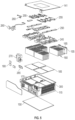
- FIG. 5 illustrates an exploded perspective view of an example construction of the battery module 100 of FIGS. 3 and 4 .
- the battery module 100 includes the housing 115 that is sized to facilitate, among other things, placement of a plurality of battery cells 155 in a desired manner.
- the battery module 100 may include a number of battery cells 155.
- the number of battery cells 155 can depend on the voltage and/or capacity requirements of the battery module 100, the individual voltage and capacity of each battery cell, and the manner in which the battery cells 155 are coupled. Accordingly, the number and/or arrangement of battery cells 155 may be variable from what is shown depending on the desired power of the battery module 100 and/or the desired dimensions (e.g., length, width, and/or height) of the battery module 100.
- the battery cells 155 used in the battery module 100 all have the same general shape (e.g., prismatic, cylindrical, pouch, or any other), the same electrochemistry (e.g., electrode active materials, electrolytes, additives), the same general dimensions (e.g., to within manufacturing tolerances), and other similar design features (e.g., electrical isolation).
- the battery module 100 includes a number of battery cells 155 sufficient to enable the battery module 100 to provide a 48V output, though the battery module 100 may output other voltages (e.g., 12 V) using different numbers and/or connections of battery cells 155.
- the battery cells 155 consist of four groups of six battery cells.
- the battery cells 155 are arranged in a cell stack 160. While four cell stacks 160 are shown, in other constructions, the battery cells 155 may be arranged in one, two, three, or more cell stacks. Further, the one or more cell stacks 160 may be oriented vertically (e.g., in a columnar arrangement with respect to cell terminals) or horizontally (e.g., in a row arrangement with respect to cell terminals).
- a spacer 165 may be used between each battery cell of the cell stack 160 to separate the battery cells from one another.
- an insulating or electrically isolating material e.g., an additional type of spacer
- film is disposed around the conductive surfaces of the battery cells 155.
- the cell isolation film may further require use of an adhesive.
- the stacks 160 of battery cells 155 are inserted into an opening 170 of the housing 115.
- the housing 115 is large enough to accommodate the desired number of battery cells 155 and other components. In the depicted construction, the housing 115 is divided into four quadrants. While four quadrants are depicted, various alternative housing arrangements should be understood as within the scope of this disclosure.
- the housing 115 also includes vehicle connection components, such as, but not limited to, positive and negative terminals 110 and 105 and a communication connector 175 ( Fig. 3 ).
- the terminals 105 and 110 may each be comprised of a bus bar 180 and a terminal post.
- the cells are provided on top of the base plate using an adhesive such as a layer of epoxy 185.
- the layer of epoxy 185 reflects the four-quadrant division of the housing 115.
- the battery cells 155 described herein are prismatic battery cells, where a prismatic battery cell, as defined herein, includes a prismatic case 190 ( FIG. 8 ) that is generally rectangular in shape.
- the prismatic casing is formed from a relatively inflexible, hard (e.g., metallic) material.
- each prismatic battery cell includes a prismatic cell casing 190.
- the casing 190 includes a top casing portion 200 where a set of cell terminals 205 and 210 (e.g., positive and negative cell terminals) are located.
- One or more cell vents are also located on the top casing portion 200.
- the cell casing 190 also includes a bottom casing portion 220 positioned opposite the top casing portion 200.
- Sides 225 and 230 may be straight or rounded, and extend between the top and bottom casing portions in respective positions corresponding to the cell terminals 205 and 210.
- First 235 and second faces which may be flat (as shown) or rounded, couple the first and second sides at opposing ends of each cell.
- the battery cell stacks are provided into the housing 115, as shown in FIG. 5 , atop the layer of epoxy 185 as well as the metal base plate 150. Conductors are then provided atop the battery cells 155 in order to transmit the power out of the terminals 105 and 110.
- carriers 245 holding cell bus bars 250 are provided to the cells 155. In some examples, the carriers 245 may hold electrical connection components as well as one or more control boards 255.
- These electrical connection components may include, but are not limited to, a flexible printed circuit (FPC) for facilitating the electrical connections, a battery management unit (BMU), wire harnesses 260, the one or more bus bars 250, shunts, fuses 265, relays 270, vehicle connector plugs, terminals, and/or covers.
- FPC flexible printed circuit
- BMU battery management unit
- wire harnesses 260 the one or more bus bars 250
- shunts fuses 265, relays 270
- vehicle connector plugs terminals, and/or covers.
- FIG. 6 depicts an example construction of the housing 115 with the base plate 150 attached.
- FIG. 7 is a more detailed exploded view of the housing 115 and base plate 150 than that of FIG. 5 .
- the example construction of the base portion e.g., the base plate 150
- the shown housing 115 has a hybrid construction including an injection molded plastic part (e.g., a frame portion or simply frame 300) and the base plate 150 (e.g., an aluminum sheet).
- the base plate 150 is coupled to the frame 300 using an adhesive 305.
- the adhesive 305 is dispensed along a perimeter of the frame 300. Alternatively, the adhesive 305 may be dispensed along a perimeter of the base plate 150.
- the construction of the housing 115 for the example battery module 100 differs from typical battery housings that have an integral bottom and a top that is sealed off with a similar material cover.
- an integral bottom is not included when the frame 300 is injection molded. Instead, an injection molded frame 300 that has the appearance of a "picture frame" is manufactured when it is produced by an injection molding tool. That is, a perimeter of the bottom 302 ( FIG. 8 ) of the plastic portion of the frame 300 is formed with picture-like edge in which the base plate 150 will later be positioned.
- the adhesive 305 is dispensed into a groove 310 formed in an edge 315 (or shelf) and extending around the perimeter of the bottom 302 of the frame 300.
- the base plate 150 is then placed onto the bottom 302 of the frame 300 of the housing 115.
- the edge 315 acts as a shelf to receive the base plate 150.
- the base plate 150 is bonded to the housing 115.
- the base plate 150 may be coupled to the frame 300 of the housing 115 using a suitable mechanical fastener(s) (e.g., screw, bolt, clamp, etc.) and a sealing ring.
- mechanical fasteners is typically perceived as less desirable than using other fastening methods because mechanical fasteners can puncture the cells 155 in a crush event.
- the shape of the base plate 150 is substantially rectangular or square.
- the example base plate 150 also has a small cutout in one corner.
- the base plate 150 is sized to fit completely within the perimeter of the bottom 302 of the frame 300.
- the base portion 150 may be any size and shape that corresponds with the perimeter.
- the base plate 150 in this example construction is an aluminum sheet. Alternatively, other metals or thermally conductive materials, even including other polymeric materials, may be used for the base plate 150.
- the base plate 150 acts as a heat sink (i.e., the path-of-least-resistance for heat in the battery pack to leave the system) to draw heat away from the plurality of battery cells disposed within the battery module.
- the base portion 150 is envisioned as having other designs distinct from a plate.
- the base can include cooling features (e.g., fins) for passive or active cooling.
- FIG. 8 is a cross-sectional view of the housing 115 with the base plate 150 attached and battery cells 155 disposed in the housing 115.
- the base plate 150 is attached to the housing 115 inside a wall 320 of the shelf 315.
- a bottom surface 325 e.g., exterior surface, exterior side
- the battery cells 155 are coupled to the base plate 150 and held in place with an adhesive (e.g., epoxy 185).
- an adhesive e.g., epoxy 185
- no intervening components are positioned between the base plate 150 and the battery cells 155 for the shown construction.
- This construction facilitates better heat transfer from the battery cells 155 to the base plate 150. Additionally, the example construction is an improvement over prior constructions that may imbed a metal plate in a plastic base of a housing because including only the metal plate 150 improves thermal conductivity between the battery cells 155 and the chassis of the vehicle 10. The example construction is also lighter and more cost effective than using an aluminum die cast housing. Thus, the hybrid housing construction described herein balances improved thermal conduction of using the metal base plate 150 with a cost and weight savings of a plastic for the remainder of the housing.
- the battery cells 155 are bonded on the interior side 330 of the base plate 150 and the exterior side 325 is to be in contact with the metal chassis of the vehicle 10 when the battery module 100 is installed or positioned within the vehicle 10. Accordingly, the base plate 150 will draw excess heat from the battery cells 155 and transfer heat to the chassis of the vehicle 10 via conductive heat transfer. The heat will further dissipate from the chassis via convective heat transfer.
- using an aluminum or other metal sheet as the base plate 150 for the housing 115 can improve mechanical robustness of the battery module 100.
- the example construction including the metal base plate 150 improves crush resistance over a construction using a completely plastic housing. Crush resistance is improved in five of the six directions from which crush forces may act on the battery. As a result, a need for an additional cover for the battery is eliminated, thus saving additional cost, time, weight, and space within the vehicle 10. The complexity of manufacturing the battery module 100 is also reduced by not needing and additional cover for the battery.
- FIG. 9 is a more detailed cross-sectional view depicting the groove 310 in which the adhesive 305 is placed to couple the base plate 150 to the frame 300 of the housing 115.
- the groove 310 is included around a perimeter of the frame 300 of the housing 115.
- the groove 310 includes a semi-circle or arcuate profile 335 and is molded into the shelf 315 of the molded frame 300 of the housing 115 (i.e., during the injection molding process of the housing).
- the groove 310 also has a minimum depth, which can be dictated at least in part by the specified strength of the adhesive 305 being dispensed in the groove 310.
- the adhesive 305 may be dispensed using a nozzle.
- the size of the nozzle dispensing the adhesive 305 can correspond with the width of the groove 310 or the arcuate profile 335 in which the adhesive 305 is being dispensed. While different nozzle sizes may be used, using a nozzle that is too small for the groove 310 may result in too little adhesive being dispensed. If too little adhesive is dispensed, the seal may be insufficient. Alternatively, using a nozzle that is too large may result in too much excess product being dispensed, which affects manufacturing since the excess product needs to be removed.
- the adhesive 305 is dispensed in excess (about 50% more than necessary) to ensure the groove 310 is completely filled. Dispensing excess adhesive ensures there is sufficient adhesive to support the joint between the housing 115 and the base plate 150. An insufficient amount of adhesive may lead to a weak spot in the joint. A weak spot makes the joint more susceptible to mechanical shock and vibration. A weak spot may also create a potential for a fluid leak path in the housing assembly.
- the battery module 100 should meet a certain level of water and air leak tightness to reduce hazards. Using excess adhesive mitigates the risk of potential leak paths forming in the housing assembly.
- the inclusion of the channels 375 and the voids 380 collect the spillover adhesive and makes the bonding operation between the base plate and the housing less messy, thereby eliminating the need for a secondary manual cleaning process.
- the inclusion of the channels 375 and the voids 380 may also prevent or reduce the likelihood that the spillover adhesive affects primary contact of the heat sink with the vehicle 10.
- the voids is a substantial size to accommodate any excess adhesive applied.
- the base plate may be coupled to the housing by overmolding the aluminum sheet into the bottom of the plastic part.
- This method relies on a strong chemical bond between the plastic and aluminum and, thus, requires additional expertise in bonding plastics to metals. Additionally, this method of bonding may result in insufficient joint robustness at the plastic/aluminum joint.
- references to relative positions e.g., “top,” “bottom,” “side,” “front,” and “back” in this description are merely used to identify various elements as are oriented in the Figures. It should be recognized that the orientation of particular components may vary greatly depending on the application in which they are used.
- the term “coupled” means the joining of two members directly or indirectly to one another. Such joining may be stationary in nature or moveable in nature. Such joining may be achieved with the two members or the two members and any additional intermediate members being integrally formed as a single unitary body with one another or with the two members or the two members and any additional intermediate members being attached to one another. Such joining may be permanent in nature or may be removable or releasable in nature.
- elements shown as integrally formed may be constructed of multiple parts or elements show as multiple parts may be integrally formed, the operation of the interfaces may be reversed or otherwise varied, the length or width of the structures and/or members or connector or other elements of the system may be varied, the nature or number of adjustment positions provided between the elements may be varied (e.g. by variations in the number of engagement slots or size of the engagement slots or type of engagement).
- the order or sequence of any process or method steps may be varied or re-sequenced according to alternative embodiments. "d?er
Landscapes
- Chemical & Material Sciences (AREA)
- Chemical Kinetics & Catalysis (AREA)
- Electrochemistry (AREA)
- General Chemical & Material Sciences (AREA)
- Engineering & Computer Science (AREA)
- Manufacturing & Machinery (AREA)
- Materials Engineering (AREA)
- Inorganic Chemistry (AREA)
- Aviation & Aerospace Engineering (AREA)
- Battery Mounting, Suspending (AREA)
Description
- The disclosure relates generally to the field of batteries and battery modules. More specifically, the disclosure relates to a housing for a battery or battery module.
- A vehicle uses one or more battery systems. In particular, a vehicle (e.g., an electric vehicle, a hybrid vehicle) may use a lithium-ion (Li-ion) battery in place of or in addition to a more traditional lead-acid battery. As will be appreciated by those skilled in the art, hybrid electric vehicles (HEVs), also considered xEVs, combine an internal combustion engine propulsion system and a battery-powered electric propulsion system, such as 48 Volt (V) or 130V systems. In some electric vehicles, the lithium-ion battery supplies a majority of or all of the power used to propel the vehicle.
- Many design aspects are considered when using a lithium-ion battery. For example, it may be beneficial for a lithium-ion battery to fit in a similar space as a lead-acid battery. Additional design considerations may include weight, crush-resistance, heat transfer from the lithium-ion cells to prevent overheating, materials cost, cost of manufacturing, and ease of manufacturing.
WO 2020/214948 A1 relates to a battery housing for a battery module, comprising a plurality of exterior walls surrounding a base forming an internal section which is configured to receive one or more battery cells. - Many different manufacturing techniques can be used for assembling a battery housing. For example, a simple butt joint with alignment features (e.g., posts) may be used to couple a first housing portion to a second using portion. However, this method requires removal of excess adhesive from the outside of the joint and would increase manufacturing demands. Another method of coupling the housing components includes using an adhesive tape. However, adhesive tapes may not have sufficient bonding requirements for mechanical shocks, vibration, and temperature range over its life. Other manufacturing techniques are desired.
- Additionally, a metal heat sink base may be coupled to the battery housing by overmolding the metal part with a plastic housing. This method relies on a strong chemical bond between the plastic and aluminum and, thus, requires additional expertise in bonding poly materials to metals. Additionally, this method of bonding may result in insufficient joint robustness at the plastic/aluminum joint. Other manufacturing techniques are also desired.
- The invention is defined in the appended claims. A battery module is accordingly disclosed. Summaries of various aspects are set forth below. It should be understood that these aspects are presented merely to provide the reader with a brief summary of these certain embodiments and that these aspects are not intended to limit the scope of this disclosure. Indeed, this disclosure may encompass a variety of aspects that may not be set forth below. The disclosure relates to batteries and battery modules. More specifically, the disclosure relates to lithium-ion battery cells that may be used in vehicles as well as other energy storage/expending applications.
- The disclosure relates to a battery module including a housing having a first interior surface and a second interior surface opposite the first interior surface. The battery module also includes a battery cell assembly disposed within an interior space of the housing between the first and second interior surfaces. The housing also includes a base portion that functions as a heat sink to draw heat away from the cell assembly. The base portion can be a metal base or metal base plate. The base portion can be coupled to the plastic portion of the housing using an adhesive dispensed in a groove of the housing.
- The disclosure also relates to a method for manufacturing a battery module. The method includes dispensing an adhesive in a groove on a perimeter of the bottom of the housing. Further, the method includes coupling the base portion to the housing using the dispensed adhesive.
- The disclosure further discloses a battery housing having a frame portion with a first material and a first thermal conductivity, and a base coupled to the frame portion. The base includes a second material with a second thermal conductivity greater than the first thermal conductivity, thereby facilitating better heat transfer from battery cells to the base. The first material can include a polymeric material and the second material includes a metal. The second base can be in the form of a plate and/or include a cooling feature.
- The disclosure also discloses a battery housing comprising an injection molded frame portion having a shelf comprising. Formed in the shelf can be a groove, a spillway, and a channel providing a pathway through the shelf from the groove to the spillway, thereby making the bonding operation between the base plate and the housing less messy. This may also limit or eliminate the need for a secondary manual cleaning process.
- In some constructions, the groove includes a rectangular portion and an arcuate portion. Also in some constructions, the shelf further comprises, formed in the shelf a plurality of spillways, and a plurality of channels.
- Various examples of embodiments of the systems, devices, and methods according to the invention will be described in detail, with reference to the following figures.
-
FIG. 1 is a perspective view of a vehicle (e.g., an xEV) having a battery system contributing all or a portion of the power for the vehicle, in accordance with an embodiment of the present application. -
FIG. 2 is a cutaway schematic view of the vehicle ofFIG. 1 , in the form of a hybrid electric vehicle (HEV) having a battery module. -
FIG. 3 is an isometric view of an example battery module used inFIG. 2 . -
FIG. 4 is an alternative isometric view of the battery module ofFIG. 3 , and more specifically shows a base plate of the battery module. -
FIG. 5 is an exploded view of the battery module ofFIG. 3 , illustrating one or more examples of arrangements of features which may be used to form the battery module. -
FIG. 6 is an isometric view of a battery housing with the base plate attached for the battery module ofFIG. 3 . -
FIG. 7 is an exploded view of a battery housing and the base plate of the battery module ofFIG. 3 . -
FIG. 8 is a cross-sectional view of the battery housing with the base plate ofFIGS. 6 and7 attached and battery cells disposed in the housing. -
FIG. 9 is a more detailed cross-sectional view depicting a groove in the housing ofFIG. 8 in which the adhesive is dispensed to couple the base plate to the housing. -
FIG. 10 is a more detailed view of the groove ofFIG. 9 of the housing. - It should be understood that the drawings are not necessarily to scale. In certain instances, details that are not necessary to the understanding of the invention or render other details difficult to perceive may have been omitted. It should be understood, of course, that the invention is not necessarily limited to the particular embodiments illustrated herein.
- One or more specific embodiments will be described below. In an effort to provide a concise description of these embodiments, not all features of an actual implementation are described in the specification. It should be appreciated that in the development of any such actual implementation, as in any engineering or design project, numerous implementation-specific decisions must be made to achieve the developers' specific goals, such as compliance with system-related and business-related constraints, which may vary from one implementation to another. Moreover, it should be appreciated that such a development effort might be complex and time consuming, but would nevertheless be a routine undertaking of design, fabrication, and manufacture for those of ordinary skill having the benefit of this disclosure.
- The battery systems described herein may be used to provide power to various types of electric vehicles (e.g., xEVs) and other high voltage energy storage/expending applications (e.g., electrical grid power storage systems). Such battery systems may include one or more battery modules. Each battery module has housing and a number of battery cells (e.g., Lithium-ion (Li-ion) electrochemical cells) arranged within the housing to provide particular voltages and/or currents useful to power a load (e.g., one or more components of a vehicle). As another example, battery modules in accordance with present embodiments may be incorporated with or provide power to stationary power systems (e.g., non-vehicle systems).
- Again, the battery modules configured in accordance with present embodiments may be employed in any number of energy expending systems (e.g., vehicular contexts and stationary power contexts). To facilitate discussion, constructions of the battery modules described herein are presented in the context of advanced battery modules (e.g., Li-ion battery modules) employed in vehicles (e.g., xEVs). As used herein, the terms "battery" and "battery module" may be interchangeable.
- With the foregoing in mind,
FIG. 1 is a perspective view of avehicle 10 having abattery system 12. A more detailed view of an example battery system is described inFIG. 2 . As depicted, thebattery system 12 includes anenergy storage component 14. The energy storage component is coupled to anignition system 16, analternator 18, avehicle console 20, and optionally to anelectric motor 22. Generally, theenergy storage component 14 may capture/store electrical energy generated in thevehicle 10 and output electrical energy to power electrical devices in thevehicle 10. - The
battery system 12 may supply power to components of the vehicle's electrical system. In the depicted construction, theenergy storage component 14 supplies power to thevehicle console 20 and theignition system 16, which may be used to start (e.g., crank) theinternal combustion engine 24. Theenergy storage component 14 may capture electrical energy generated by thealternator 18 and/or theelectric motor 22. - To facilitate capturing and supplying electric energy, the
energy storage component 14 may be electrically coupled to the vehicle's electric system via abus 26. For example, thebus 26 enables theenergy storage component 14 to receive electrical energy generated by thealternator 18 and/or theelectric motor 22. Additionally, thebus 26 may enable theenergy storage component 14 to output electrical energy to theignition system 16 and/or thevehicle console 20. - Additionally, as depicted, the
energy storage component 14 includes multiple battery modules. For example, in the depicted embodiment, theenergy storage component 14 includes a lithium-ion (e.g., a first)battery module 28 and a lead-acid (e.g., a second)battery module 30, which each includes one or more battery cells. In other constructions, theenergy storage component 14 includes any number of battery modules. Additionally, although the lithium-ion battery module 28 and lead-acid battery module 30 are depicted adjacent to one another, they may be positioned in different areas around thevehicle 10. For example, the lead-acid battery module may be positioned in or about the interior of thevehicle 10 while the lithium-ion battery module 28 may be positioned under the hood of thevehicle 10. In some implementations, theenergy storage component 14 includes multiple battery modules to utilize multiple different battery chemistries. - To facilitate controlling the capturing and storing of electrical energy, the
battery system 12 additionally includes acontrol module 32. More specifically, thecontrol module 32 may control operations of components in thebattery system 12, such as relays (e.g., switches) within theenergy storage component 14, thealternator 18, and/or theelectric motor 22. Thecontrol module 32 may regulate the amount of electrical energy captured/supplied by eachbattery module 28 or 30 (e.g., to de-rate and re-rate the battery system 12), perform load balancing between thebattery modules battery module battery module alternator 18 and/or theelectric motor 22, and the like. - For the construction shown in
FIG. 2 , thecontrol module 32 includes one ormore processors 34 and one ormore memories 36. More specifically, the one ormore processors 34 may include one or more application-specific integrated circuits (ASICs), one or more field-programmable gate arrays (FPGAs), one or more general purpose processors, or any combination thereof. Additionally, the one ormore memories 36 may include volatile memory, such as random-access memory (RAM), and/or non-volatile memory, such as read-only memory (ROM), optical drives, hard disc drives, or solid-state drives. In some embodiments, thecontrol module 32 may include portions of a vehicle control unit (VCU) and/or a separate battery control module. - The lithium-
ion battery module 28 may have any one of a variety of different shapes, sizes, output voltages, capacities, and so forth, and the present disclosure is generally intended to apply to different variations of the shapes and sizes of the modules illustrated in the figures. Keeping this in mind,FIG. 3 is a front top perspective view of one construction of abattery module 100, which can be the lithium-ion battery module 28. - The
battery module 100 includes a first terminal 105 (e.g., a negative terminal) and a second terminal 110 (e.g., a positive terminal) that may be coupled to an electrical load (e.g., circuit). In other constructions, thebattery module 100 has more than two terminals, to provide different voltages for different loads via connections across different terminal combinations. - The
battery module 100 includes ahousing 115 for packaging or containing a plurality of battery cells and other components of thebattery module 100. Thehousing 115 includes twoend portions side portions bottom portion 145.FIG. 3 shows thetop portion 140, one 120 of the two end portions, and one 130 of the two side portions. Thehousing 115 may be polymeric (e.g., polypropylene, acrylonitrile butadiene styrene (ABS), a polystyrene (PS), a polyimide (PI), or another suitable polymer or plastic or combination thereof), or other suitable housing material or combination of materials. Examples of combination of materials are discussed below, such as withFIG. 4 . -
FIG. 4 is an alternative view of the example construction of thebattery module 100 and depicts thebottom portion 145 of thebattery module 100. In this example construction, thebottom portion 145 includes a base portion 150 (may also be referred to simply as a "base") made of metal (e.g., aluminum) rather than the same polymer or plastic material of thehousing 115. Thebase portion 150 is shown as being a plate (may also be referred to as a "base plate"). The base portion functions as a heat sink or cooling plate to draw heat away from the plurality of battery cells disposed within the battery module. Thebase portion 150 is described in more detail in conjunction withFIGS. 6-8 below. While the shownbase portion 150 is in the form of a plate, other shapes are envisioned for the base 150 including a base having cooling features (e.g., fins) for passive or active cooling. -
FIG. 5 illustrates an exploded perspective view of an example construction of thebattery module 100 ofFIGS. 3 and4 . Thebattery module 100 includes thehousing 115 that is sized to facilitate, among other things, placement of a plurality ofbattery cells 155 in a desired manner. Thebattery module 100 may include a number ofbattery cells 155. The number ofbattery cells 155 can depend on the voltage and/or capacity requirements of thebattery module 100, the individual voltage and capacity of each battery cell, and the manner in which thebattery cells 155 are coupled. Accordingly, the number and/or arrangement ofbattery cells 155 may be variable from what is shown depending on the desired power of thebattery module 100 and/or the desired dimensions (e.g., length, width, and/or height) of thebattery module 100. - While any single type of battery cell may be utilized, the
battery cells 155 used in thebattery module 100 all have the same general shape (e.g., prismatic, cylindrical, pouch, or any other), the same electrochemistry (e.g., electrode active materials, electrolytes, additives), the same general dimensions (e.g., to within manufacturing tolerances), and other similar design features (e.g., electrical isolation). In the depicted construction, thebattery module 100 includes a number ofbattery cells 155 sufficient to enable thebattery module 100 to provide a 48V output, though thebattery module 100 may output other voltages (e.g., 12 V) using different numbers and/or connections ofbattery cells 155. In shown construction, thebattery cells 155 consist of four groups of six battery cells. - As shown in
FIG. 5 , thebattery cells 155 are arranged in acell stack 160. While fourcell stacks 160 are shown, in other constructions, thebattery cells 155 may be arranged in one, two, three, or more cell stacks. Further, the one ormore cell stacks 160 may be oriented vertically (e.g., in a columnar arrangement with respect to cell terminals) or horizontally (e.g., in a row arrangement with respect to cell terminals). - A
spacer 165 may be used between each battery cell of thecell stack 160 to separate the battery cells from one another. In various constructions, an insulating or electrically isolating material (e.g., an additional type of spacer) or film is disposed around the conductive surfaces of thebattery cells 155. The cell isolation film may further require use of an adhesive. - The
stacks 160 ofbattery cells 155 are inserted into anopening 170 of thehousing 115. Thehousing 115 is large enough to accommodate the desired number ofbattery cells 155 and other components. In the depicted construction, thehousing 115 is divided into four quadrants. While four quadrants are depicted, various alternative housing arrangements should be understood as within the scope of this disclosure. Thehousing 115 also includes vehicle connection components, such as, but not limited to, positive andnegative terminals Fig. 3 ). In various constructions, theterminals bus bar 180 and a terminal post. As shown inFIG. 5 , the cells are provided on top of the base plate using an adhesive such as a layer ofepoxy 185. The layer ofepoxy 185 reflects the four-quadrant division of thehousing 115. - The
battery cells 155 described herein are prismatic battery cells, where a prismatic battery cell, as defined herein, includes a prismatic case 190 (FIG. 8 ) that is generally rectangular in shape. In contrast to pouch cells, the prismatic casing is formed from a relatively inflexible, hard (e.g., metallic) material. However, it should be noted that certain constructions may incorporate pouch cells in addition to or in lieu of prismatic battery cells. In accordance with the shown constructions, each prismatic battery cell includes aprismatic cell casing 190. Thecasing 190 includes atop casing portion 200 where a set ofcell terminals 205 and 210 (e.g., positive and negative cell terminals) are located. One or more cell vents are also located on thetop casing portion 200. Thecell casing 190 also includes abottom casing portion 220 positioned opposite thetop casing portion 200.Sides cell terminals - As described above, the battery cell stacks are provided into the
housing 115, as shown inFIG. 5 , atop the layer ofepoxy 185 as well as themetal base plate 150. Conductors are then provided atop thebattery cells 155 in order to transmit the power out of theterminals carriers 245 holding cell bus bars 250 are provided to thecells 155. In some examples, thecarriers 245 may hold electrical connection components as well as one ormore control boards 255. These electrical connection components may include, but are not limited to, a flexible printed circuit (FPC) for facilitating the electrical connections, a battery management unit (BMU), wire harnesses 260, the one ormore bus bars 250, shunts, fuses 265, relays 270, vehicle connector plugs, terminals, and/or covers. -
FIG. 6 depicts an example construction of thehousing 115 with thebase plate 150 attached.FIG. 7 is a more detailed exploded view of thehousing 115 andbase plate 150 than that ofFIG. 5 . As shown inFIGS. 6 and7 , the example construction of the base portion (e.g., the base plate 150) has a perimeter shape corresponding to thebottom portion 145 of thehousing 115. The shownhousing 115 has a hybrid construction including an injection molded plastic part (e.g., a frame portion or simply frame 300) and the base plate 150 (e.g., an aluminum sheet). Thebase plate 150 is coupled to theframe 300 using an adhesive 305. The adhesive 305 is dispensed along a perimeter of theframe 300. Alternatively, the adhesive 305 may be dispensed along a perimeter of thebase plate 150. - The construction of the
housing 115 for theexample battery module 100 differs from typical battery housings that have an integral bottom and a top that is sealed off with a similar material cover. In the example construction of the figures, an integral bottom is not included when theframe 300 is injection molded. Instead, an injection moldedframe 300 that has the appearance of a "picture frame" is manufactured when it is produced by an injection molding tool. That is, a perimeter of the bottom 302 (FIG. 8 ) of the plastic portion of theframe 300 is formed with picture-like edge in which thebase plate 150 will later be positioned. - The adhesive 305 is dispensed into a
groove 310 formed in an edge 315 (or shelf) and extending around the perimeter of the bottom 302 of theframe 300. Thebase plate 150 is then placed onto thebottom 302 of theframe 300 of thehousing 115. Theedge 315 acts as a shelf to receive thebase plate 150. When the adhesive 305 cures, thebase plate 150 is bonded to thehousing 115. In some alternative example constructions, thebase plate 150 may be coupled to theframe 300 of thehousing 115 using a suitable mechanical fastener(s) (e.g., screw, bolt, clamp, etc.) and a sealing ring. However, using mechanical fasteners is typically perceived as less desirable than using other fastening methods because mechanical fasteners can puncture thecells 155 in a crush event. - In this example construction, the shape of the
base plate 150 is substantially rectangular or square. Theexample base plate 150 also has a small cutout in one corner. Thebase plate 150 is sized to fit completely within the perimeter of the bottom 302 of theframe 300. In other example constructions, thebase portion 150 may be any size and shape that corresponds with the perimeter. Thebase plate 150 in this example construction is an aluminum sheet. Alternatively, other metals or thermally conductive materials, even including other polymeric materials, may be used for thebase plate 150. Thebase plate 150 acts as a heat sink (i.e., the path-of-least-resistance for heat in the battery pack to leave the system) to draw heat away from the plurality of battery cells disposed within the battery module. Thebase portion 150 is envisioned as having other designs distinct from a plate. For example the base can include cooling features (e.g., fins) for passive or active cooling. -
FIG. 8 is a cross-sectional view of thehousing 115 with thebase plate 150 attached andbattery cells 155 disposed in thehousing 115. As shown inFIG. 8 , thebase plate 150 is attached to thehousing 115 inside awall 320 of theshelf 315. A bottom surface 325 (e.g., exterior surface, exterior side) of thebase plate 150 is completely exposed and not covered in any way by the plastic housing. On a top surface 330 (e.g., interior surface, interior side) of thebase plate 150, thebattery cells 155 are coupled to thebase plate 150 and held in place with an adhesive (e.g., epoxy 185). Other than the epoxy 185, no intervening components are positioned between thebase plate 150 and thebattery cells 155 for the shown construction. This construction facilitates better heat transfer from thebattery cells 155 to thebase plate 150. Additionally, the example construction is an improvement over prior constructions that may imbed a metal plate in a plastic base of a housing because including only themetal plate 150 improves thermal conductivity between thebattery cells 155 and the chassis of thevehicle 10. The example construction is also lighter and more cost effective than using an aluminum die cast housing. Thus, the hybrid housing construction described herein balances improved thermal conduction of using themetal base plate 150 with a cost and weight savings of a plastic for the remainder of the housing. - In one construction, the
battery cells 155 are bonded on theinterior side 330 of thebase plate 150 and theexterior side 325 is to be in contact with the metal chassis of thevehicle 10 when thebattery module 100 is installed or positioned within thevehicle 10. Accordingly, thebase plate 150 will draw excess heat from thebattery cells 155 and transfer heat to the chassis of thevehicle 10 via conductive heat transfer. The heat will further dissipate from the chassis via convective heat transfer. - In addition to providing improved heat transfer from the
battery cells 155, using an aluminum or other metal sheet as thebase plate 150 for thehousing 115 can improve mechanical robustness of thebattery module 100. The example construction including themetal base plate 150 improves crush resistance over a construction using a completely plastic housing. Crush resistance is improved in five of the six directions from which crush forces may act on the battery. As a result, a need for an additional cover for the battery is eliminated, thus saving additional cost, time, weight, and space within thevehicle 10. The complexity of manufacturing thebattery module 100 is also reduced by not needing and additional cover for the battery. -
FIG. 9 is a more detailed cross-sectional view depicting thegroove 310 in which the adhesive 305 is placed to couple thebase plate 150 to theframe 300 of thehousing 115. Thegroove 310 is included around a perimeter of theframe 300 of thehousing 115. Thegroove 310 includes a semi-circle orarcuate profile 335 and is molded into theshelf 315 of the moldedframe 300 of the housing 115 (i.e., during the injection molding process of the housing). Thegroove 310 also has a minimum depth, which can be dictated at least in part by the specified strength of the adhesive 305 being dispensed in thegroove 310. The adhesive 305 may be dispensed using a nozzle. The size of the nozzle dispensing the adhesive 305 can correspond with the width of thegroove 310 or thearcuate profile 335 in which the adhesive 305 is being dispensed. While different nozzle sizes may be used, using a nozzle that is too small for thegroove 310 may result in too little adhesive being dispensed. If too little adhesive is dispensed, the seal may be insufficient. Alternatively, using a nozzle that is too large may result in too much excess product being dispensed, which affects manufacturing since the excess product needs to be removed. - The example construction includes a
small gap 340 adjacent to thegroove 310 and between anedge 345 of thebase plate 150 and theperimeter wall 320 of thehousing 115. Thesmall gap 340 accommodates manufacturing tolerances of thebase plate 150 and/or thehousing 115 so that thebase plate 150 will fit fully within theframe portion 300 of thehousing 115 without interference. At the opening of thegap 340, a lead-inchamfer 355 can be included to aid assembly of thebase plate 150 and thehousing 115. Theheight 360 of thewall 320 andthickness 365 of thebase plate 150 is such that thebase plate 150 is always in contact with the vehicle chassis. In other words, amaximum wall height 360 will be less than a minimumbase plate thickness 365 based on typical manufacturing tolerances. Thus, thebase plate 150 protrudes out from theedge 370 of theframe portion 300 of thehousing 115 by adistance 372 to ensure that theplate 150 has primary contact with thevehicle 10 rather than thehousing 115. - Any air gap between the chassis of the
vehicle 10 and thebase plate 150 may impart more thermal resistance. Thus, thebase plate 150 is, preferably, as close contact with the vehicle chassis as possible to transfer heat through conduction. - The
example battery module 100 allows for many possible modular configurations of thebase 150. For example, different types of plates may be used in place of the example base plate 150 (e.g., different metal plates, different thermally conductive plates). Additionally or alternatively, for more demanding performance, an active cooler or cooling plate (e.g., a cooler using liquid or forced air) may be included in thehousing 115 attached to or in place of thebase plate 150. - The adhesive 305 is dispensed in excess (about 50% more than necessary) to ensure the
groove 310 is completely filled. Dispensing excess adhesive ensures there is sufficient adhesive to support the joint between thehousing 115 and thebase plate 150. An insufficient amount of adhesive may lead to a weak spot in the joint. A weak spot makes the joint more susceptible to mechanical shock and vibration. A weak spot may also create a potential for a fluid leak path in the housing assembly. Thebattery module 100 should meet a certain level of water and air leak tightness to reduce hazards. Using excess adhesive mitigates the risk of potential leak paths forming in the housing assembly. - The example construction of the
frame 300 is also formed with a plurality ofsmall channels 375 adjacent to and intersecting thegroove 310. Thesmall channels 375 are formed in theshelf 315. Thesmall channels 375 direct or channel overspill adhesive from thegroove 310 to voids 380 (e.g., spillway void) also formed in the shelf. The adhesive flows when thebase plate 150 is pressed onto theframe 300. A detailed view of thechannels 375 is shown inFIG. 10 . Thechannels 375 are equally spaced and provide paths between thegroove 310 and thevoids 380. Thevoids 380 collect the spillover adhesive so that the adhesive 305 does not disperse in an uncontrolled manner out through thegap 340 before the adhesive 305 cures. Thus, the inclusion of thechannels 375 and thevoids 380 collect the spillover adhesive and makes the bonding operation between the base plate and the housing less messy, thereby eliminating the need for a secondary manual cleaning process. The inclusion of thechannels 375 and thevoids 380 may also prevent or reduce the likelihood that the spillover adhesive affects primary contact of the heat sink with thevehicle 10. The voids is a substantial size to accommodate any excess adhesive applied. - Other methods of coupling the
base plate 150 to thehousing 115 may instead be used. For example, a simple butt joint with alignment features (e.g., posts) may be used to couple the plastic housing and the aluminum base plate. However, this method requires removal of excess adhesive from the outside of the joint and would increase manufacturing demands. Another method of coupling the base plate to the housing includes using an adhesive tape. However, adhesive tapes may not have sufficient bonding meet the requirements on for mechanical shocks, vibration, and temperature range over its life. Thus, the example construction using dispensed adhesive 305 has benefits over other methods of coupling thebase plate 150 to thehousing 115. - Alternatively, the base plate may be coupled to the housing by overmolding the aluminum sheet into the bottom of the plastic part. This method relies on a strong chemical bond between the plastic and aluminum and, thus, requires additional expertise in bonding plastics to metals. Additionally, this method of bonding may result in insufficient joint robustness at the plastic/aluminum joint.
- The technical effects and technical problems in the specification are exemplary and are not limiting. It should be noted that the embodiments described in the specification may have other technical effects and can solve other technical problems.
- As utilized herein, the terms "approximately," "about," "substantially", and similar terms are intended to have a broad meaning in harmony with the common and accepted usage by those of ordinary skill in the art to which the subject matter of this disclosure pertains. It should be understood by those of skill in the art who review this disclosure that these terms are intended to allow a description of certain features described and claimed without restricting the scope of these features to the precise numerical ranges provided. Accordingly, these terms should be interpreted as indicating that insubstantial or inconsequential modifications or alterations of the subject matter described and claimed are considered to be within the scope of the invention as recited in the appended claims.
- It should be noted that references to relative positions (e.g., "top," "bottom," "side," "front," and "back") in this description are merely used to identify various elements as are oriented in the Figures. It should be recognized that the orientation of particular components may vary greatly depending on the application in which they are used.
- For the purpose of this disclosure, the term "coupled" means the joining of two members directly or indirectly to one another. Such joining may be stationary in nature or moveable in nature. Such joining may be achieved with the two members or the two members and any additional intermediate members being integrally formed as a single unitary body with one another or with the two members or the two members and any additional intermediate members being attached to one another. Such joining may be permanent in nature or may be removable or releasable in nature.
- It is also important to note that the construction and arrangement of the system, methods, and devices as shown in the various examples of embodiments is illustrative only, and not limiting. Although only a few embodiments have been described in detail in this disclosure, those skilled in the art who review this disclosure will readily appreciate that many various alternatives, modifications, variations, improvements and/or substantial equivalents, whether known or that are or may be presently foreseen, are possible (e.g., variations in sizes, dimensions, structures, shapes and proportions of the various elements, values of parameters, mounting arrangements, use of materials, colors, orientations, etc.) without materially departing from the novel teachings and advantages of the subject matter recited. For example, elements shown as integrally formed may be constructed of multiple parts or elements show as multiple parts may be integrally formed, the operation of the interfaces may be reversed or otherwise varied, the length or width of the structures and/or members or connector or other elements of the system may be varied, the nature or number of adjustment positions provided between the elements may be varied (e.g. by variations in the number of engagement slots or size of the engagement slots or type of engagement). The order or sequence of any process or method steps may be varied or re-sequenced according to alternative embodiments. "d?er
Claims (14)
- A battery housing (115) comprising:- two end portions (120, 125), two side portions (130, 135), a top portion (140), and a bottom portion (145);- a frame portion (300) having a first material with a first thermal conductivity; and- a metal base (150) coupled to the frame portion (300), the metal base (150) having a second thermal conductivity greater than the first thermal conductivity,wherein the metal base (150) is attached to the bottom portion (145) of the battery housing (115).
- The battery housing (115) of claim 1,
wherein the first material includes a polymeric material. - The battery housing (115) of claim 1 or 2,
wherein the metal base (150) includes a flat plate. - The battery housing (115) of one of claims 1 to 3,
wherein the metal base (150) includes a cooling feature. - The battery housing (115) of one of claims 1 to 4 and further comprising
an epoxy cured to the frame portion (300) and the base portion (150). - The battery housing (115) of claim 5,
wherein the metal base (150) includes a groove (310), and wherein the epoxy is disposed in the groove (310). - The battery housing (115) of claim 6,
wherein the frame portion (300) includes a shelf (315), wherein the base portion (150) abuts the shelf (315). - The battery housing (115) of claim 7,
wherein the frame portion (300) further includes a groove (310) formed in the shelf (315). - The battery housing (115) of claim 7 or 8,
wherein the frame portion (300) further includes a wall (320) formed with the shelf (315) and extending away from the shelf (315). - The battery housing (115) of claim 9,wherein a gap is disposed between the base portion (150) and the wall (320); and/orwherein the wall (320) includes a chamfer (355).
- The battery housing (115) of one of claims 7 to 10,
wherein the frame portion (300) further includes a plurality of voids (380) formed in the shelf (315). - The battery housing (115) of claim 11,
wherein the frame portion (300) further includes a plurality of channels (375) formed in the shelf (315), the plurality of channels (375) providing a pathway through the shelf (315) from the groove (310) to the plurality of voids (380). - The battery housing (115) of one of claims 1 to 12,
further comprising a top cover (141) having the second material, the top cover (141) coupled to the frame (300). - A battery module (100) comprising:- the battery housing (115) of one of claims 1 to 13;- a plurality of battery cells (155) housed by the housing (115);- an adhesive (305) coupled to the plurality of battery cells (155) and to the base portion (150), the adhesive (305) to thermally couple the plurality of battery cells (155) and the base portion (150); and- optional a plurality of battery cells (155) coupled to the base portion (150), wherein the base portion (150) includes a heat sink to transfer heat from the battery cells (155).
Applications Claiming Priority (2)
| Application Number | Priority Date | Filing Date | Title |
|---|---|---|---|
| US202163140384P | 2021-01-22 | 2021-01-22 | |
| PCT/US2022/013386 WO2022159749A1 (en) | 2021-01-22 | 2022-01-21 | Battery housing and battery module including the battery housing |
Publications (2)
| Publication Number | Publication Date |
|---|---|
| EP4282022A1 EP4282022A1 (en) | 2023-11-29 |
| EP4282022B1 true EP4282022B1 (en) | 2025-03-05 |
Family
ID=80786841
Family Applications (1)
| Application Number | Title | Priority Date | Filing Date |
|---|---|---|---|
| EP22704625.7A Active EP4282022B1 (en) | 2021-01-22 | 2022-01-21 | Battery housing and battery module including the battery housing |
Country Status (3)
| Country | Link |
|---|---|
| US (1) | US20240322286A1 (en) |
| EP (1) | EP4282022B1 (en) |
| WO (1) | WO2022159749A1 (en) |
Families Citing this family (1)
| Publication number | Priority date | Publication date | Assignee | Title |
|---|---|---|---|---|
| WO2024136004A1 (en) * | 2022-12-22 | 2024-06-27 | 주식회사 엘지에너지솔루션 | Battery module, and battery pack and vehicle including same |
Family Cites Families (1)
| Publication number | Priority date | Publication date | Assignee | Title |
|---|---|---|---|---|
| EP3956933B1 (en) * | 2019-04-18 | 2025-07-23 | CPS Technology Holdings LLC | Heat sink fixation through plastic melting |
-
2022
- 2022-01-21 WO PCT/US2022/013386 patent/WO2022159749A1/en not_active Ceased
- 2022-01-21 US US18/355,647 patent/US20240322286A1/en active Pending
- 2022-01-21 EP EP22704625.7A patent/EP4282022B1/en active Active
Also Published As
| Publication number | Publication date |
|---|---|
| US20240322286A1 (en) | 2024-09-26 |
| EP4282022A1 (en) | 2023-11-29 |
| WO2022159749A1 (en) | 2022-07-28 |
Similar Documents
| Publication | Publication Date | Title |
|---|---|---|
| US12494527B2 (en) | Battery module, battery pack comprising battery module and vehicle comprising battery pack | |
| EP3660974B1 (en) | Battery module having heat dissipation plate | |
| EP4195364B1 (en) | Battery pack and vehicle comprising same | |
| CN107112453B (en) | Bus bar assembly carrier | |
| US10608219B2 (en) | Integrated cartridge and battery pack comprising same | |
| KR102317639B1 (en) | Battery module including insert injection molded busbar | |
| KR102892920B1 (en) | Battery pack and device including the same | |
| KR102908125B1 (en) | Battery pack and vehicle comprising the battery pack | |
| EP3792992A1 (en) | Battery module comprising module housing | |
| KR20130023039A (en) | Battery pack | |
| KR102693863B1 (en) | Battery Pack With Improved Vibration Resistance | |
| US20180053920A1 (en) | Cartridge for secondary battery | |
| EP3201975B1 (en) | Battery module bus bar connection assembly | |
| JP2023515857A (en) | Battery modules and battery packs containing the same | |
| EP4282022B1 (en) | Battery housing and battery module including the battery housing | |
| KR102844982B1 (en) | Battery module | |
| EP3514004B1 (en) | Battery module and battery pack including same | |
| US20240186642A1 (en) | Battery and method of allowing for volumetric expansion of battery cells within a battery | |
| EP4625683A1 (en) | Battery module and battery pack comprising same | |
| EP4661182A1 (en) | Power supply device and method for manufacturing power supply device | |
| EP4683047A1 (en) | Battery pack and vehicle comprising same | |
| KR20250134472A (en) | Battery module | |
| KR20260037819A (en) | Battery module and battery pack including the same | |
| KR20260061682A (en) | Busbar and battery pack including the same | |
| KR20260028264A (en) | Battery pack |
Legal Events
| Date | Code | Title | Description |
|---|---|---|---|
| STAA | Information on the status of an ep patent application or granted ep patent |
Free format text: STATUS: UNKNOWN |
|
| STAA | Information on the status of an ep patent application or granted ep patent |
Free format text: STATUS: THE INTERNATIONAL PUBLICATION HAS BEEN MADE |
|
| PUAI | Public reference made under article 153(3) epc to a published international application that has entered the european phase |
Free format text: ORIGINAL CODE: 0009012 |
|
| STAA | Information on the status of an ep patent application or granted ep patent |
Free format text: STATUS: REQUEST FOR EXAMINATION WAS MADE |
|
| 17P | Request for examination filed |
Effective date: 20230822 |
|
| AK | Designated contracting states |
Kind code of ref document: A1 Designated state(s): AL AT BE BG CH CY CZ DE DK EE ES FI FR GB GR HR HU IE IS IT LI LT LU LV MC MK MT NL NO PL PT RO RS SE SI SK SM TR |
|
| DAV | Request for validation of the european patent (deleted) | ||
| DAX | Request for extension of the european patent (deleted) | ||
| GRAP | Despatch of communication of intention to grant a patent |
Free format text: ORIGINAL CODE: EPIDOSNIGR1 |
|
| STAA | Information on the status of an ep patent application or granted ep patent |
Free format text: STATUS: GRANT OF PATENT IS INTENDED |
|
| INTG | Intention to grant announced |
Effective date: 20240919 |
|
| GRAS | Grant fee paid |
Free format text: ORIGINAL CODE: EPIDOSNIGR3 |
|
| GRAA | (expected) grant |
Free format text: ORIGINAL CODE: 0009210 |
|
| STAA | Information on the status of an ep patent application or granted ep patent |
Free format text: STATUS: THE PATENT HAS BEEN GRANTED |
|
| AK | Designated contracting states |
Kind code of ref document: B1 Designated state(s): AL AT BE BG CH CY CZ DE DK EE ES FI FR GB GR HR HU IE IS IT LI LT LU LV MC MK MT NL NO PL PT RO RS SE SI SK SM TR |
|
| REG | Reference to a national code |
Ref country code: GB Ref legal event code: FG4D |
|
| REG | Reference to a national code |
Ref country code: CH Ref legal event code: EP |
|
| REG | Reference to a national code |
Ref country code: IE Ref legal event code: FG4D |
|
| REG | Reference to a national code |
Ref country code: DE Ref legal event code: R096 Ref document number: 602022011436 Country of ref document: DE |
|
| PG25 | Lapsed in a contracting state [announced via postgrant information from national office to epo] |
Ref country code: RS Free format text: LAPSE BECAUSE OF FAILURE TO SUBMIT A TRANSLATION OF THE DESCRIPTION OR TO PAY THE FEE WITHIN THE PRESCRIBED TIME-LIMIT Effective date: 20250605 |
|
| PG25 | Lapsed in a contracting state [announced via postgrant information from national office to epo] |
Ref country code: FI Free format text: LAPSE BECAUSE OF FAILURE TO SUBMIT A TRANSLATION OF THE DESCRIPTION OR TO PAY THE FEE WITHIN THE PRESCRIBED TIME-LIMIT Effective date: 20250305 |
|
| REG | Reference to a national code |
Ref country code: NL Ref legal event code: MP Effective date: 20250305 |
|
| PG25 | Lapsed in a contracting state [announced via postgrant information from national office to epo] |
Ref country code: ES Free format text: LAPSE BECAUSE OF FAILURE TO SUBMIT A TRANSLATION OF THE DESCRIPTION OR TO PAY THE FEE WITHIN THE PRESCRIBED TIME-LIMIT Effective date: 20250305 |
|
| REG | Reference to a national code |
Ref country code: LT Ref legal event code: MG9D |
|
| PG25 | Lapsed in a contracting state [announced via postgrant information from national office to epo] |
Ref country code: NO Free format text: LAPSE BECAUSE OF FAILURE TO SUBMIT A TRANSLATION OF THE DESCRIPTION OR TO PAY THE FEE WITHIN THE PRESCRIBED TIME-LIMIT Effective date: 20250605 |
|
| PG25 | Lapsed in a contracting state [announced via postgrant information from national office to epo] |
Ref country code: HR Free format text: LAPSE BECAUSE OF FAILURE TO SUBMIT A TRANSLATION OF THE DESCRIPTION OR TO PAY THE FEE WITHIN THE PRESCRIBED TIME-LIMIT Effective date: 20250305 |
|
| PG25 | Lapsed in a contracting state [announced via postgrant information from national office to epo] |
Ref country code: LV Free format text: LAPSE BECAUSE OF FAILURE TO SUBMIT A TRANSLATION OF THE DESCRIPTION OR TO PAY THE FEE WITHIN THE PRESCRIBED TIME-LIMIT Effective date: 20250305 |
|
| PG25 | Lapsed in a contracting state [announced via postgrant information from national office to epo] |
Ref country code: GR Free format text: LAPSE BECAUSE OF FAILURE TO SUBMIT A TRANSLATION OF THE DESCRIPTION OR TO PAY THE FEE WITHIN THE PRESCRIBED TIME-LIMIT Effective date: 20250606 Ref country code: BG Free format text: LAPSE BECAUSE OF FAILURE TO SUBMIT A TRANSLATION OF THE DESCRIPTION OR TO PAY THE FEE WITHIN THE PRESCRIBED TIME-LIMIT Effective date: 20250305 |
|
| REG | Reference to a national code |
Ref country code: AT Ref legal event code: MK05 Ref document number: 1773806 Country of ref document: AT Kind code of ref document: T Effective date: 20250305 |
|
| PG25 | Lapsed in a contracting state [announced via postgrant information from national office to epo] |
Ref country code: NL Free format text: LAPSE BECAUSE OF FAILURE TO SUBMIT A TRANSLATION OF THE DESCRIPTION OR TO PAY THE FEE WITHIN THE PRESCRIBED TIME-LIMIT Effective date: 20250305 |
|
| PG25 | Lapsed in a contracting state [announced via postgrant information from national office to epo] |
Ref country code: SE Free format text: LAPSE BECAUSE OF FAILURE TO SUBMIT A TRANSLATION OF THE DESCRIPTION OR TO PAY THE FEE WITHIN THE PRESCRIBED TIME-LIMIT Effective date: 20250305 |
|
| PG25 | Lapsed in a contracting state [announced via postgrant information from national office to epo] |
Ref country code: SM Free format text: LAPSE BECAUSE OF FAILURE TO SUBMIT A TRANSLATION OF THE DESCRIPTION OR TO PAY THE FEE WITHIN THE PRESCRIBED TIME-LIMIT Effective date: 20250305 |
|
| PG25 | Lapsed in a contracting state [announced via postgrant information from national office to epo] |
Ref country code: PT Free format text: LAPSE BECAUSE OF FAILURE TO SUBMIT A TRANSLATION OF THE DESCRIPTION OR TO PAY THE FEE WITHIN THE PRESCRIBED TIME-LIMIT Effective date: 20250707 |
|
| PG25 | Lapsed in a contracting state [announced via postgrant information from national office to epo] |
Ref country code: IT Free format text: LAPSE BECAUSE OF FAILURE TO SUBMIT A TRANSLATION OF THE DESCRIPTION OR TO PAY THE FEE WITHIN THE PRESCRIBED TIME-LIMIT Effective date: 20250305 Ref country code: PL Free format text: LAPSE BECAUSE OF FAILURE TO SUBMIT A TRANSLATION OF THE DESCRIPTION OR TO PAY THE FEE WITHIN THE PRESCRIBED TIME-LIMIT Effective date: 20250305 |
|
| PG25 | Lapsed in a contracting state [announced via postgrant information from national office to epo] |
Ref country code: AT Free format text: LAPSE BECAUSE OF FAILURE TO SUBMIT A TRANSLATION OF THE DESCRIPTION OR TO PAY THE FEE WITHIN THE PRESCRIBED TIME-LIMIT Effective date: 20250305 |
|
| PG25 | Lapsed in a contracting state [announced via postgrant information from national office to epo] |
Ref country code: EE Free format text: LAPSE BECAUSE OF FAILURE TO SUBMIT A TRANSLATION OF THE DESCRIPTION OR TO PAY THE FEE WITHIN THE PRESCRIBED TIME-LIMIT Effective date: 20250305 Ref country code: CZ Free format text: LAPSE BECAUSE OF FAILURE TO SUBMIT A TRANSLATION OF THE DESCRIPTION OR TO PAY THE FEE WITHIN THE PRESCRIBED TIME-LIMIT Effective date: 20250305 |
|
| PG25 | Lapsed in a contracting state [announced via postgrant information from national office to epo] |
Ref country code: RO Free format text: LAPSE BECAUSE OF FAILURE TO SUBMIT A TRANSLATION OF THE DESCRIPTION OR TO PAY THE FEE WITHIN THE PRESCRIBED TIME-LIMIT Effective date: 20250305 |
|
| PG25 | Lapsed in a contracting state [announced via postgrant information from national office to epo] |
Ref country code: SK Free format text: LAPSE BECAUSE OF FAILURE TO SUBMIT A TRANSLATION OF THE DESCRIPTION OR TO PAY THE FEE WITHIN THE PRESCRIBED TIME-LIMIT Effective date: 20250305 |
|
| PG25 | Lapsed in a contracting state [announced via postgrant information from national office to epo] |
Ref country code: IS Free format text: LAPSE BECAUSE OF FAILURE TO SUBMIT A TRANSLATION OF THE DESCRIPTION OR TO PAY THE FEE WITHIN THE PRESCRIBED TIME-LIMIT Effective date: 20250705 |
|
| REG | Reference to a national code |
Ref country code: DE Ref legal event code: R097 Ref document number: 602022011436 Country of ref document: DE |
|
| PLBE | No opposition filed within time limit |
Free format text: ORIGINAL CODE: 0009261 |
|
| STAA | Information on the status of an ep patent application or granted ep patent |
Free format text: STATUS: NO OPPOSITION FILED WITHIN TIME LIMIT |
|
| PG25 | Lapsed in a contracting state [announced via postgrant information from national office to epo] |
Ref country code: DK Free format text: LAPSE BECAUSE OF FAILURE TO SUBMIT A TRANSLATION OF THE DESCRIPTION OR TO PAY THE FEE WITHIN THE PRESCRIBED TIME-LIMIT Effective date: 20250305 |
|
| REG | Reference to a national code |
Ref country code: CH Ref legal event code: L10 Free format text: ST27 STATUS EVENT CODE: U-0-0-L10-L00 (AS PROVIDED BY THE NATIONAL OFFICE) Effective date: 20260114 |
|
| 26N | No opposition filed |
Effective date: 20251208 |
|
| PGFP | Annual fee paid to national office [announced via postgrant information from national office to epo] |
Ref country code: GB Payment date: 20260127 Year of fee payment: 5 |
|
| PGFP | Annual fee paid to national office [announced via postgrant information from national office to epo] |
Ref country code: DE Payment date: 20260128 Year of fee payment: 5 |
|
| PGFP | Annual fee paid to national office [announced via postgrant information from national office to epo] |
Ref country code: FR Payment date: 20260126 Year of fee payment: 5 |