EP4280488A1 - Information transmission method and apparatus - Google Patents
Information transmission method and apparatus Download PDFInfo
- Publication number
- EP4280488A1 EP4280488A1 EP21925224.4A EP21925224A EP4280488A1 EP 4280488 A1 EP4280488 A1 EP 4280488A1 EP 21925224 A EP21925224 A EP 21925224A EP 4280488 A1 EP4280488 A1 EP 4280488A1
- Authority
- EP
- European Patent Office
- Prior art keywords
- data
- data packet
- data packets
- frame
- packets
- Prior art date
- Legal status (The legal status is an assumption and is not a legal conclusion. Google has not performed a legal analysis and makes no representation as to the accuracy of the status listed.)
- Granted
Links
Images





Classifications
-
- H—ELECTRICITY
- H04—ELECTRIC COMMUNICATION TECHNIQUE
- H04L—TRANSMISSION OF DIGITAL INFORMATION, e.g. TELEGRAPHIC COMMUNICATION
- H04L47/00—Traffic control in data switching networks
- H04L47/50—Queue scheduling
- H04L47/62—Queue scheduling characterised by scheduling criteria
- H04L47/625—Queue scheduling characterised by scheduling criteria for service slots or service orders
- H04L47/6275—Queue scheduling characterised by scheduling criteria for service slots or service orders based on priority
-
- H—ELECTRICITY
- H04—ELECTRIC COMMUNICATION TECHNIQUE
- H04L—TRANSMISSION OF DIGITAL INFORMATION, e.g. TELEGRAPHIC COMMUNICATION
- H04L47/00—Traffic control in data switching networks
- H04L47/10—Flow control; Congestion control
- H04L47/24—Traffic characterised by specific attributes, e.g. priority or QoS
-
- H—ELECTRICITY
- H04—ELECTRIC COMMUNICATION TECHNIQUE
- H04W—WIRELESS COMMUNICATION NETWORKS
- H04W72/00—Local resource management
- H04W72/12—Wireless traffic scheduling
- H04W72/1263—Mapping of traffic onto schedule, e.g. scheduled allocation or multiplexing of flows
-
- H—ELECTRICITY
- H04—ELECTRIC COMMUNICATION TECHNIQUE
- H04L—TRANSMISSION OF DIGITAL INFORMATION, e.g. TELEGRAPHIC COMMUNICATION
- H04L47/00—Traffic control in data switching networks
- H04L47/10—Flow control; Congestion control
- H04L47/24—Traffic characterised by specific attributes, e.g. priority or QoS
- H04L47/245—Traffic characterised by specific attributes, e.g. priority or QoS using preemption
-
- H—ELECTRICITY
- H04—ELECTRIC COMMUNICATION TECHNIQUE
- H04L—TRANSMISSION OF DIGITAL INFORMATION, e.g. TELEGRAPHIC COMMUNICATION
- H04L47/00—Traffic control in data switching networks
- H04L47/10—Flow control; Congestion control
- H04L47/28—Flow control; Congestion control in relation to timing considerations
- H04L47/283—Flow control; Congestion control in relation to timing considerations in response to processing delays, e.g. caused by jitter or round trip time [RTT]
-
- H—ELECTRICITY
- H04—ELECTRIC COMMUNICATION TECHNIQUE
- H04L—TRANSMISSION OF DIGITAL INFORMATION, e.g. TELEGRAPHIC COMMUNICATION
- H04L47/00—Traffic control in data switching networks
- H04L47/10—Flow control; Congestion control
- H04L47/43—Assembling or disassembling of packets, e.g. segmentation and reassembly [SAR]
-
- H—ELECTRICITY
- H04—ELECTRIC COMMUNICATION TECHNIQUE
- H04L—TRANSMISSION OF DIGITAL INFORMATION, e.g. TELEGRAPHIC COMMUNICATION
- H04L5/00—Arrangements affording multiple use of the transmission path
- H04L5/003—Arrangements for allocating sub-channels of the transmission path
- H04L5/0044—Allocation of payload; Allocation of data channels, e.g. PDSCH or PUSCH
- H04L5/0046—Determination of the number of bits transmitted on different sub-channels
-
- H—ELECTRICITY
- H04—ELECTRIC COMMUNICATION TECHNIQUE
- H04L—TRANSMISSION OF DIGITAL INFORMATION, e.g. TELEGRAPHIC COMMUNICATION
- H04L5/00—Arrangements affording multiple use of the transmission path
- H04L5/003—Arrangements for allocating sub-channels of the transmission path
- H04L5/0078—Timing of allocation
- H04L5/0085—Timing of allocation when channel conditions change
-
- H—ELECTRICITY
- H04—ELECTRIC COMMUNICATION TECHNIQUE
- H04W—WIRELESS COMMUNICATION NETWORKS
- H04W72/00—Local resource management
- H04W72/50—Allocation or scheduling criteria for wireless resources
- H04W72/56—Allocation or scheduling criteria for wireless resources based on priority criteria
- H04W72/566—Allocation or scheduling criteria for wireless resources based on priority criteria of the information or information source or recipient
- H04W72/569—Allocation or scheduling criteria for wireless resources based on priority criteria of the information or information source or recipient of the traffic information
-
- H—ELECTRICITY
- H04—ELECTRIC COMMUNICATION TECHNIQUE
- H04L—TRANSMISSION OF DIGITAL INFORMATION, e.g. TELEGRAPHIC COMMUNICATION
- H04L47/00—Traffic control in data switching networks
- H04L47/10—Flow control; Congestion control
- H04L47/24—Traffic characterised by specific attributes, e.g. priority or QoS
- H04L47/2425—Traffic characterised by specific attributes, e.g. priority or QoS for supporting services specification, e.g. SLA
- H04L47/2433—Allocation of priorities to traffic types
-
- H—ELECTRICITY
- H04—ELECTRIC COMMUNICATION TECHNIQUE
- H04L—TRANSMISSION OF DIGITAL INFORMATION, e.g. TELEGRAPHIC COMMUNICATION
- H04L67/00—Network arrangements or protocols for supporting network services or applications
- H04L67/01—Protocols
- H04L67/12—Protocols specially adapted for proprietary or special-purpose networking environments, e.g. medical networks, sensor networks, networks in vehicles or remote metering networks
Definitions
- This application relates to the field of communications technologies, and in particular, to an information transmission method and apparatus.
- information of different service types may correspond to different sizes of data packets, and different priorities may also be configured for the information of different service types.
- a size of a data packet is about 2000 bytes, and a low priority is configured.
- control information of a type such as an inter-integrated circuit (inter-integrated circuit, I2C), a general-purpose input/output (general-purpose input/output, GPIO), or a serial peripheral interface (serial peripheral interface, SPI)
- a size of a data packet is about 10 bytes, and a configured priority is higher than the priority of the data frame of the image type in the in-vehicle camera data transmission scenario.
- a size of a data packet is less than 8 bytes, and a configured priority is higher than the priority of the control information of the type such as the I2C, the GPIO, or the SPI.
- a higher priority of a data packet indicates a lower transmission delay and lower jitter.
- control information whose length is less than 64 bytes can be preferentially scheduled and transmitted, and a data frame with a high priority cannot be scheduled and transmitted in time, resulting in a high delay and high jitter of the information.
- This application provides an information transmission method and apparatus, to resolve a problem of a high delay and high jitter of information caused by the fact that a data frame with a high priority cannot be scheduled and transmitted in time.
- an embodiment of this application provides an information transmission method, including: sending N1 first data packets in a first data frame; and when a first condition is met, sending M second data packets in a second data frame before N2 first data packets in the first data frame are sent.
- the first condition includes that a priority of the second data frame is higher than a priority of the first data frame.
- the first data frame includes the N1 first data packets and the N2 first data packets, and N1, N2, and M are positive integers.
- the first condition further includes that data frame truncation is enabled.
- a first device can insert a high-priority data frame in a transmission process of a low-priority data frame when the data frame truncation is enabled.
- the M second data packets in the second data frame are sent after the N2 first data packets are sent.
- the second condition includes that the data frame truncation is disabled and/or the priority of the first data frame is not lower than the priority of the first data frame.
- the first device is not allowed to insert the high-priority data frame in the transmission process of the low-priority data frame when the data frame truncation is disabled.
- the first data packet includes an indicator bit and a payload, where the payload of the first data packet carries one of a start fragment, an intermediate fragment, or an end fragment of the first data frame, and the indicator bit of the first data packet indicates one of the start fragment, the intermediate fragment, or the end fragment of the first data frame; and the second data packet includes an indicator bit and a payload, where the payload of the second data packet carries one of a start fragment, an intermediate fragment, or an end fragment of the second data frame, and the indicator bit of the second data packet indicates one of the start fragment, the intermediate fragment, or the end fragment of the first data frame.
- a receiving node may determine a start, a continuation, and an end of a data frame based on an indicator bit.
- an indicator bit of a 1 st first data packet in the N1 first data packets indicates that the 1 st first data packet is a start fragment
- indicator bits of 2 nd to N1 th first data packets in the N1 first data packets and 1 st to (N2-1) th first data packets in the N2 first data packets indicate that the first data packets are intermediate fragments
- an indicator bit of an N2 th first data packet in the N2 first data packets indicates that the N2 th first data packet is an end fragment
- an indicator bit of a 1 st second data packet in the M second data packets indicates that the 1 st second data packet is a start fragment
- indicator bits of 2 nd to (M-1) th second data packets indicate that the second data packets are intermediate fragments
- an indicator bit of an M th second data packet indicates that the M th second data packet is an end fragment.
- an indicator bit of a 1 st first data packet in the N1 first data packets indicates that the 1 st first data packet is a start/end fragment of a low-priority data frame
- an indicator bit of an N2 th first data packet in the N2 first data packets indicates that the N2 th first data packet is a start/end fragment of the low-priority data frame
- indicator bits of 2 nd to N1 th first data packets in the N1 first data packets and 1 st to (N2-1) th first data packets in the N2 first data packets indicate that the first data packets are intermediate fragments
- an indicator bit of a 1 st second data packet in the M second data packets indicates that the 1 st second data packet is a start/end fragment of a high-priority data frame
- an indicator bit of an M th second data packet indicates that the M th second data packet is a start/end fragment of the high-priority data frame
- an indicator bit of a 1 st first data packet in the N1 first data packets indicates that the 1 st first data packet is a start fragment of a low-priority data frame, and indicator bits of 2 nd to N1 th first data packets in the N1 first data packets and indicator bits of the N2 first data packets indicate that the first data packets are intermediate fragments; and a 1 st second data packet in the M second data packets indicates that the 1 st second data packet is a start fragment of a high-priority data frame, and indicator bits of 2 nd to M th second data packets indicate that the second data packets are intermediate fragments.
- data packet ranges of the first data frame and the second data frame may be distinguished.
- the method further includes: sending a third data packet after the M second data packets in the second data frame are sent, where the third data packet includes an indicator bit and a payload, the indicator bit of the third data packet indicates that the third data packet is non-data information, and the payload of the third data packet indicates that data frame transmission ends; and sending a fourth data packet after the N2 first data packets in the first data frame are sent, where the fourth data packet includes an indicator bit and a payload, the indicator bit of the fourth data packet indicates that the fourth data packet is non-data information, and the payload of the fourth data packet indicates that data frame transmission ends.
- the end of the first data frame and the end of the second data frame may be determined.
- an indicator bit of a 1 st first data packet in the N1 first data packets indicates that the 1 st first data packet is a start fragment of a low-priority data frame, a payload of the 1 st first data packet indicates a length of the first data frame, and indicator bits of 2 nd to N1 th first data packets in the N1 first data packets and indicator bits of the N2 first data packets indicate that the first data packets are intermediate fragments; and an indicator bit of a 1 st second data packet in the M second data packets indicates that the 1 st second data packet is a start fragment of a high-priority data frame, a payload of the 1 st second data packet indicates a length of the second data frame, and indicator bits of 2 nd to M th second data packets in the M second data packets indicate that the second data packets are intermediate fragments.
- receiving ranges of the first data frame and the second data frame may be determined.
- K fifth data packets that are non-data information may be further sent, where the fifth data packet includes an indicator bit and a payload, the indicator bit of the fifth data packet indicates that the fifth data packet is the non-data information, the payload of the fifth data packet carries a fragment of the non-data information, and K is an integer greater than 0.
- non-data information can be sent, and the non-data information and the data frame can be distinguished.
- an indicator bit of a 1 st first data packet in the N1 first data packets indicates that the 1 st first data packet is a start fragment of a low-priority data frame, and indicator bits of 2 nd to N1 th first data packets in the N1 first data packets and indicator bits of the N2 first data packets indicate that the first data packets are intermediate fragments of the low-priority data frame; and an indicator bit of a 1 st second data packet in the M second data packets indicates that the 1 st second data packet is a start fragment of a high-priority data frame, and indicator bits of 2 nd to M th second data packets in the M second data packets indicate that the second data packets are intermediate fragments of the high-priority data frame.
- receiving ranges of the first data frame and the second data frame may be determined.
- the high-priority data frame is a data information frame or a non-data information frame.
- a sixth data packet is sent, where the sixth data packet includes an indicator bit and a payload, the indicator bit of the sixth data packet indicates that the sixth data packet is a start fragment of a high-priority data frame, and the payload of the sixth data packet indicates that the sixth data packet is a non-data information frame.
- non-data information can be sent, and the non-data information and the data frame can be distinguished.
- an embodiment of this application provides an information transmission method, including: receiving N1 first data packets; when a first condition is met, receiving M second data packets before N2 first data packets are received, where the first condition includes that a priority of a second data frame is higher than a priority of a first data frame, and N1, N2, and M are positive integers; determining the first data frame based on the N1 first data packets and the N2 first data packets; and determining the second data frame based on the M second data packets, where the priority of the second data frame is higher than the priority of the first data frame.
- a high-priority data frame can be preferentially scheduled and transmitted, so that a transmission delay and jitter of the high-priority data frame can be reduced.
- the first condition further includes that data frame truncation is enabled.
- a first device can insert a high-priority data frame in a transmission process of a low-priority data frame when the data frame truncation is enabled.
- the M second data packets in the second data frame are received after the N2 first data packets are received.
- the second condition includes that the data frame truncation is disabled and/or the priority of the first data frame is not lower than the priority of the first data frame.
- the first device is not allowed to insert the high-priority data frame in the transmission process of the low-priority data frame when the data frame truncation is disabled.
- the first data packet includes an indicator bit and a payload, where the payload of the first data packet carries one of a start fragment, an intermediate fragment, or an end fragment of the first data frame, and the indicator bit of the first data packet indicates one of the start fragment, the intermediate fragment, or the end fragment of the first data frame; and the second data packet includes an indicator bit and a payload, where the payload of the second data packet carries one of a start fragment, an intermediate fragment, or an end fragment of the second data frame, and the indicator bit of the second data packet indicates one of the start fragment, the intermediate fragment, or the end fragment of the first data frame.
- a receiving node may determine a start, a continuation, and an end of a data frame based on an indicator bit.
- an indicator bit of a 1 st first data packet in the N1 first data packets indicates that the 1 st first data packet is a start fragment
- indicator bits of 2 nd to N1 th first data packets in the N1 first data packets and 1 st to (N2-1) th first data packets in the N2 first data packets indicate that the first data packets are intermediate fragments
- an indicator bit of an N2 th first data packet in the N2 first data packets indicates that the N2 th first data packet is an end fragment
- an indicator bit of a 1 st second data packet in the M second data packets indicates that the 1 st second data packet is a start fragment
- indicator bits of 2 nd to (M-1) th second data packets indicate that the second data packets are intermediate fragments
- an indicator bit of an M th second data packet indicates that the M th second data packet is an end fragment.
- an indicator bit of a 1 st first data packet in the N1 first data packets indicates that the 1 st first data packet is a start/end fragment of a low-priority data frame
- an indicator bit of an N2 th first data packet in the N2 first data packets indicates that the N2 th first data packet is a start/end fragment of the low-priority data frame
- indicator bits of 2 nd to N1 th first data packets in the N1 first data packets and 1 st to (N2-1) th first data packets in the N2 first data packets indicate that the first data packets are intermediate fragments
- an indicator bit of a 1 st second data packet in the M second data packets indicates that the 1 st second data packet is a start/end fragment of a high-priority data frame
- an indicator bit of an M th second data packet indicates that the M th second data packet is a start/end fragment of the high-priority data frame
- an indicator bit of a 1 st first data packet in the N1 first data packets indicates that the 1 st first data packet is a start fragment of a low-priority data frame, and indicator bits of 2 nd to N1 th first data packets in the N1 first data packets and indicator bits of the N2 first data packets indicate that the first data packets are intermediate fragments; and a 1 st second data packet in the M second data packets indicates that the 1 st second data packet is a start fragment of a high-priority data frame, and indicator bits of 2 nd to M th second data packets indicate that the second data packets are intermediate fragments.
- data packet ranges of the first data frame and the second data frame may be distinguished.
- the method further includes: receiving a third data packet, where the third data packet includes an indicator bit and a payload, the indicator bit of the third data packet indicates that the third data packet is non-data information, and the payload of the third data packet indicates that data frame transmission ends; and after the N2 first data packets are received, the method further includes: receiving a fourth data packet, where the fourth data packet includes an indicator bit and a payload, the indicator bit of the fourth data packet indicates that the fourth data packet is non-data information, and the payload of the fourth data packet indicates that data frame transmission ends.
- the end of the first data frame and the end of the second data frame may be determined.
- an indicator bit of a 1 st first data packet in the N1 first data packets indicates that the 1 st first data packet is a start fragment of a low-priority data frame, a payload of the 1 st first data packet indicates a length of the first data frame, and indicator bits of 2 nd to N1 th first data packets in the N1 first data packets and indicator bits of the N2 first data packets indicate that the first data packets are intermediate fragments; and an indicator bit of a 1 st second data packet in the M second data packets indicates that the 1 st second data packet is a start fragment of a high-priority data frame, a payload of the 1 st second data packet indicates a length of the second data frame, and indicator bits of 2 nd to M th second data packets in the M second data packets indicate that the second data packets are intermediate fragments.
- receiving ranges of the first data frame and the second data frame may be determined.
- K fifth data packets are received, where each of the K fifth data packets includes an indicator bit and a payload, the indicator bit of each of the K fifth data packets indicates that the fifth data packet is non-data information, K is an integer greater than 0, and the payload of the fifth data packet carries a fragment of the non-data information; and the non-data information is determined based on the K fifth data packets.
- non-data information can be sent, and the non-data information and the data frame can be distinguished.
- an indicator bit of a 1 st first data packet in the N1 first data packets indicates that the 1 st first data packet is a start fragment of a low-priority data frame, and indicator bits of 2 nd to N1 th first data packets in the N1 first data packets and indicator bits of the N2 first data packets indicate that the first data packets are intermediate fragments of the low-priority data frame; and an indicator bit of a 1 st second data packet in the M second data packets indicates that the 1 st second data packet is a start fragment of a high-priority data frame, and indicator bits of 2 nd to M th second data packets in the M second data packets indicate that the second data packets are intermediate fragments of the high-priority data frame.
- receiving ranges of the first data frame and the second data frame may be determined.
- the high-priority data frame is a data information frame or a non-data information frame.
- a sixth data packet is received, where the sixth data packet includes an indicator bit and a payload, the sixth data packet includes the indicator bit and the payload, the indicator bit of the sixth data packet indicates that the sixth data packet is a start fragment of a high-priority data frame, and the payload of the sixth data packet indicates that the sixth data packet is a non-data information frame; and non-data information is determined based on the sixth data packet.
- non-data information can be sent, and the non-data information and the data frame can be distinguished.
- this application provides an information transmission apparatus.
- the apparatus may be a communications device, or may be a chip or a chip set in a communications device.
- the communications device may be a sending node or a receiving node.
- the apparatus may include a processing unit and a transceiver unit.
- the processing unit may be a processor
- the transceiver unit may be a transceiver.
- the apparatus may further include a storage module, and the storage module may be a memory.
- the storage module is configured to store instructions, and the processing unit executes the instructions stored in the storage module, to perform the method corresponding to any one of the first aspect or the designs of the first aspect, or to perform the method corresponding to any one of the second aspect or the designs of the second aspect.
- the processing unit may be a processor, and the transceiver unit may be an input/output interface, a pin, a circuit, or the like.
- the processing unit executes instructions stored in a storage module, to perform the method corresponding to any one of the first aspect or the designs of the first aspect, or to perform the method corresponding to any one of the second aspect or the designs of the second aspect.
- the storage module may be a storage module (for example, a register or a cache) in the chip or the chip set, or may be a storage module (for example, a read-only memory or a random access memory) outside the chip or the chip set in the communications device.
- a storage module for example, a register or a cache
- a storage module for example, a read-only memory or a random access memory
- this application provides an information transmission apparatus.
- the apparatus includes a processor, and may further include a communications interface and a memory.
- the communications interface is configured to transmit information, and/or a message, and/or data between the apparatus and another apparatus.
- the memory is configured to store computer-executable instructions.
- the processor executes the computer-executable instructions stored in the memory, so that the apparatus performs the method according to any one of the first aspect or the designs of the first aspect, or the second aspect or the designs of the second aspect.
- an embodiment of this application provides an information transmission system, including the information transmission apparatus according to the third aspect and the information transmission apparatus according to the fourth aspect.
- an embodiment of this application further provides a computer-readable storage medium.
- the computer-readable storage medium stores instructions, and when the instructions are run on a computer, the computer is enabled to perform the method according to any one of the first aspect or the designs of the first aspect, or the second aspect or the designs of the second aspect.
- an embodiment of this application further provides a computer program product including instructions.
- the computer program product runs on a computer, the computer is enabled to perform the method according to any one of the first aspect or the designs of the first aspect, or the second aspect or the designs of the second aspect.
- an embodiment of this application further provides a communications system.
- the system includes a sending node and a receiving node.
- the sending node may perform the method corresponding to any one of the first aspect or the designs of the first aspect
- the receiving node may perform the method corresponding to any one of the second aspect or the designs of the second aspect.
- an embodiment of this application provides a chip.
- the chip includes at least one processor and a communications interface.
- the processor is coupled to a memory, and is configured to read a computer program stored in the memory, to perform the method according to any one of the first aspect or the designs of the first aspect, or the second aspect or the designs of the second aspect of the embodiments of this application.
- an embodiment of this application provides a chip, including a communications interface and at least one processor.
- the processor runs to perform the method according to any one of the first aspect or the designs of the first aspect, or the second aspect or the designs of the second aspect of the embodiments of this application.
- an embodiment of this application provides a vehicle.
- the vehicle includes a first device and/or a second device, the first device is configured to perform the method according to any one of the first aspect or the designs of the first aspect, and the second device is configured to perform the method according to any one of the second aspect or the designs of the second aspect.
- Coupled in embodiments of this application means that two components are directly or indirectly combined with each other.
- Embodiments of this application is applicable to wired transmission, for example, is applicable to wired point-to-point high-speed transmission, for example, image and control transmission from a camera to a multi-domain controller (multi-domain controller, MDC) of an autonomous driving platform, and image transmission from a vehicle-mounted device like a vehicle-mounted camera or a cockpit domain controller (cockpit domain controller or control domain cockpit, CDC) to a large screen.
- MDC multi-domain controller
- CDC cockpit domain controller
- a communications apparatus in embodiments of this application may be a device, for example, a vehicle-mounted image sensor like a camera, a lidar, or the like, that can send information (such as a data frame or control information) to another device, or may be an image processing device, for example, an MDC or a CDC, or may be an image display device, for example, a large screen.
- the communications apparatus in embodiments of this application may be another transmission device in addition to a vehicle-mounted apparatus.
- "at least one” means one or more, and "a plurality of" means two or more.
- the term “and/or” describes an association relationship between associated objects and indicates that three relationships may exist.
- a and/or B may indicate the following three cases: Only A exists, both A and B exist, and only B exists.
- a and B each may be singular or plural.
- a character "/" usually indicates an "or” relationship between the associated objects.
- "at least one item (piece) of the following” or a similar expression thereof means any combination of these items, including a singular item (piece) or any combination of plural items (pieces).
- At least one of a, b, or c may indicate a, b, c, a and b, a and c, b and c, or a, b, and c, where a, b, and c may be singular or plural.
- ordinal numbers such as “first” and “second” in embodiments of this application are intended to distinguish between a plurality of objects, and are not intended to limit sizes, content, an order, a time sequence, priorities, or importance degrees of the plurality of obj ects.
- a first data packet and a second data packet are merely names given for ease of description, and the two data packets may be a same data packet, or may be different data packets.
- sizes of data packets corresponding to information of different service types may be different. Different priorities may also be configured for the information of different service types. For example, for a data frame of an image type in an in-vehicle camera data transmission scenario, a size of a data packet is about 2000 bytes, and a low priority is configured.
- a size of a data packet is about 10 bytes, and a configured priority is higher than the priority of the data frame of the image type in the in-vehicle camera data transmission scenario.
- a size of a data packet is less than 8 bytes, and a configured priority is higher than the priority of the control information of the type such as the I2C, the GPIO, or the SPI.
- a higher priority of a data packet indicates a lower transmission delay and lower jitter.
- control information whose length is less than 64 bytes can be preferentially scheduled and transmitted, and a data frame with a high priority cannot be scheduled and transmitted in time, resulting in a high delay and high jitter of the information.
- embodiments of this application provide an information transmission method and apparatus, to resolve a problem of a high delay and high jitter of information caused by the fact that a data frame with a high priority cannot be scheduled and transmitted in time.
- the method and the apparatus are based on the same technical concept.
- the method and the device have similar principles for resolving the problems. Therefore, for implementation of the apparatus and the method, refer to each other, and details of repeated parts are not described.
- Embodiments of this application provide an information transmission method and apparatus, which may be applied to an in-vehicle network, especially an in-vehicle network of an intelligent vehicle, and may also be applied to another wired transmission device.
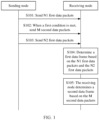
- This application provides an information transmission method, and the method may be applied to an information transmission system. As shown in FIG. 1 , the method includes the following steps.
- a sending node sends N1 first data packets in a first data frame.
- a receiving node receives the N1 first data packets in the first data frame.
- N1 is an integer greater than or equal to 1.
- the first condition may include that a priority of the second data frame is higher than a priority of the first data frame.
- the first condition may further include that data frame truncation is enabled.
- That the data frame truncation is disabled may mean that transmission of a low-priority data frame cannot be interrupted by a high-priority data frame, that is, insertion of the high-priority data frame is not allowed in a transmission process of the low-priority data frame.
- That the data frame truncation is enabled may mean that transmission of the low-priority data frame can be interrupted by the high-priority data frame, that is, insertion of one or more high-priority data frames is allowed in the transmission process of the low-priority data frame.
- the sending node may preferentially send the M second data packets in the second data frame, that is, may send the M second data packets in the second data frame before sending N2 first data packets in the first data frame.
- the first device when a second condition is met, sends the M second data packets in the second data frame after sending the N2 first data packets.
- the second condition may include that the data frame truncation is disabled and/or the priority of the first data frame is not lower than the priority of the first data frame.
- S103 The sending node sends the N2 first data packets in the first data frame.
- the receiving node receives the N2 first data packets in the first data frame.
- the first data frame includes the N1 first data packets and the N2 first data packets, where N2 is an integer greater than or equal to 0.
- the receiving node determines the first data frame based on the N1 first data packets and the N2 first data packets.
- the receiving node determines the second data frame based on the M second data packets.
- step S105 may alternatively be performed before step S103.
- the first data packet may include an indicator bit and a payload, where the payload of the first data packet carries one of a start fragment, an intermediate fragment, or an end fragment of the first data frame, and the indicator bit of the first data packet indicates one of the start fragment, the intermediate fragment, or the end fragment of the first data frame; and the second data packet may include an indicator bit and a payload, where the payload of the second data packet carries one of a start fragment, an intermediate fragment, or an end fragment of the second data frame, and the indicator bit of the second data packet indicates one of the start fragment, the intermediate fragment, or the end fragment of the first data frame.
- Example 1 An indicator bit of a 1 st first data packet in the N1 first data packets indicates that the 1 st first data packet is a start fragment, indicator bits of 2 nd to N1 th first data packets in the N1 first data packets and 1 st to (N2-1) th first data packets in the N2 first data packets indicate that the first data packets are intermediate fragments, and an indicator bit of an N2 th first data packet in the N2 first data packets indicates that the N2 th first data packet is an end fragment; and an indicator bit of a 1 st second data packet in the M second data packets indicates that the 1 st second data packet is a start fragment, indicator bits of 2 nd to (M-1) th second data packets indicate that the second data packets are intermediate fragments, and an indicator bit of an M th second data packet indicates that the M th second data packet is an end fragment.
- the receiving node may determine that a 2 nd data packet whose indicator bit indicates a start fragment is a 1 st data packet in the second data frame, and a 1 st data packet whose indicator bit indicates a start fragment is a 1 st data packet in the first data frame.
- the receiving node receives two data packets whose indicator bits indicate end fragments. The receiving node determines that a 1 st data packet whose indicator bit indicates an end fragment is a last data packet in the second data frame, and a 2 nd data packet whose indicator bit indicates an end fragment is a last data packet in the first data frame.
- an intermediate data packet in the second data frame includes a data packet whose indicator bit indicates an intermediate fragment and that is in data packets between the 2 nd data packet whose indicator bit indicates a start fragment and the 1 st data packet whose indicator bit indicates an end fragment
- an intermediate data packet in the first data frame includes a data packet whose indicator bit indicates an intermediate fragment and that is in data packets between the 1 st data packet whose indicator bit indicates a start fragment and the 2 nd data packet whose indicator bit indicates a start fragment and a data packet whose indicator bit indicates an intermediate fragment and that is in data packets between the 1 st data packet whose indicator bit indicates an end fragment and the 2 nd data packet whose indicator bit indicates an end fragment.
- an indicator bit of a data packet carrying a start fragment may be a first value
- an indicator bit of a data packet carrying an intermediate fragment may be a second value
- an indicator bit of a data packet carrying an end fragment may be a third value.
- the first value indicates the start fragment
- the second value indicates the intermediate fragment
- the third value indicates the end fragment.
- an indicator bit of a data packet carrying non-data information may be a fourth value
- the fourth value indicates the non-data information.
- the indicator bit of the 1 st first data packet in the N1 first data packets may be the first value
- the indicator bits of the 2 nd to N1 th first data packets in the N1 first data packets and the 1 st to (N2-1) th first data packets in the N2 first data packets each may be the second value
- the indicator bit of the N2 th first data packet in the N2 first data packets may be the third value
- the indicator bit of the 1 st second data packet in the M second data packets may be the first value
- the indicator bits of the 2 nd to (M-1) th second data packets each may be the second value
- the indicator bit of the M th second data packet may be the third value.
- the first value is 01
- the second value is 00
- the third value is 10
- the fourth value is 11.
- a size of the first data frame is 64B ⁇ 250
- a size of the second data frame is 64B ⁇ 4.
- the sending node after sending three data packets in the first data frame, the sending node sends four data packets in the second data frame, and after sending the four data packets in the second data frame, the sending node continues to send 247 data packets that are not sent in the first data frame.
- the receiving node may consider that a 2 nd data packet whose indicator bit is 01 is the 1 st data packet in the second data frame.
- the second data frame includes the 2 nd data packet whose indicator bit is 01, data packets whose indicator bits each are 00 and that are in data packets between the 2 nd data packet whose indicator bit is 01 and a 1 st data packet whose indicator bit is 10, and the 1 st data packet whose indicator bit is 10.
- the first data frame includes a 1 st data packet whose indicator bit is 01, data packets whose indicator bits each are 00 and that are in data packets between the 1 st data packet whose indicator bit is 01 and the 2 nd data packet whose indicator bit is 01, data packets whose indicator bits each are 00 and that are between the 1 st data packet whose indicator bit is 10 and a 2 nd data packet whose indicator bit is 10, and the 2 nd data packet whose indicator bit is 10.
- Example 2 An indicator bit of a 1 st first data packet in the N1 first data packets indicates that the 1 st first data packet is a start/end fragment of a low-priority data frame, an indicator bit of an N2 th first data packet in the N2 first data packets indicates that the N2 th first data packet is a start/end fragment of the low-priority data frame, and indicator bits of 2 nd to N1 th first data packets in the N1 first data packets and 1 st to (N2-1) th first data packets in the N2 first data packets indicate that the first data packets are intermediate fragments; and an indicator bit of a 1 st second data packet in the M second data packets indicates that the 1 st second data packet is a start/end fragment of a high-priority data frame, an indicator bit of an M th second data packet indicates that the M th second data packet is a start/end fragment of the high-priority data frame, and indicator bits of 2 nd to (M
- the receiving node may determine the following:
- the first data frame includes: a 1 st data packet whose indicator bit indicates a start/end fragment of a low-priority data frame, a data packet whose indicator bit indicates an intermediate fragment and that is in data packets between the 1 st data packet whose indicator bit indicates the start/end fragment of the low-priority data frame and a 1 st data packet whose indicator bit indicates a start/end fragment of a high-priority data frame, a data packet whose indicator bit indicates an intermediate fragment and that is in data packets between a 2 nd data packet whose indicator bit indicates a start/end fragment of the high-priority data frame and a 2 nd data packet whose indicator bit indicates a start/end fragment of the low-priority data frame, and the 2 nd data packet whose indicator bit indicates the start/end fragment of the low-priority data frame; and the second data frame includes: the 1 st data packet whose indicator bit indicates the start/end fragment of the high
- an indicator bit of a data packet carrying a start/end fragment of the first data frame may be a first value
- an indicator bit of a data packet carrying an intermediate fragment may be a second value
- an indicator bit of a data packet carrying a start/end fragment of the second data frame may be a third value.
- the first value indicates a start fragment of a low-priority data frame
- the second value indicates an intermediate fragment
- the third value indicates a start/end fragment of a high-priority data frame.
- an indicator bit of a data packet carrying non-data information may be a fourth value
- the fourth value indicates the non-data information.
- the indicator bit of the 1 st first data packet in the N1 first data packets may be the first value
- the indicator bits of the 2 nd to N1 th first data packets in the N1 first data packets and the 1 st to (N2-1) th first data packets in the N2 first data packets each may be the second value
- the indicator bit of the N2 th first data packet in the N2 first data packets may be the first value
- the indicator bit of the 1 st second data packet in the M second data packets may be the third value
- the indicator bits of the 2 nd to (M-1) th second data packets each may be the second value
- the indicator bit of the M th second data packet may be the third value.
- the first value is 00
- the second value is 01
- the third value is 10
- the fourth value is 11.
- a size of the first data frame is 64B ⁇ 250
- a size of the second data frame is 64B ⁇ 4.
- the sending node after sending three data packets in the first data frame, the sending node sends four data packets in the second data frame, and after sending the four data packets in the second data frame, the sending node continues to send 247 data packets that are not sent in the first data frame.
- a third data frame may be further sent after the first data frame is sent, where a size of the third data frame is 64B ⁇ 3.
- the receiving node may determine the following:
- the second data frame includes: a 1 st data packet whose indicator bit is 10, data packets whose indicator bits each are 01 and that are in data packets between the 1 st data packet whose indicator bit is 10 and a 2 nd data packet whose indicator bit is 10, and the 2 nd data packet whose indicator bit is 10;
- the first data frame includes: a 1 st data packet whose indicator bit is 00, data packets whose indicator bits each are 01 and that are in data packets between the 1 st data packet whose indicator bit is 00 and the 1 st data packet whose indicator bit is 10, data packets whose indicator bits each are 01 and that are in data packets between the 2 nd data packet whose indicator bit is 10 and a 2 nd data packet whose indicator bit is 00, and the 2 nd data packet whose indicator bit is 00; and the third data frame is a 3 rd data packet whose indicator bit is 00, a data packet whose indicator bit is 01 and
- Example 3 An indicator bit of a 1 st first data packet in the N1 first data packets indicates that the 1 st first data packet is a start fragment of a low-priority data frame, and indicator bits of 2 nd to N1 th first data packets in the N1 first data packets and indicator bits of the N2 first data packets indicate that the first data packets are intermediate fragments; and a 1 st second data packet in the M second data packets indicates that the 1 st second data packet is a start fragment of a high-priority data frame, and indicator bits of 2 nd to M th second data packets indicate that the second data packets are intermediate fragments.
- the sending node may send a third data packet after sending the M second data packets in the second data frame.
- the third data packet includes an indicator bit and a payload, the indicator bit of the third data packet indicates that the third data packet is non-data information, and the payload of the third data packet indicates that data frame transmission ends.
- the sending node may send a fourth data packet after sending the N2 first data packets in the first data frame.
- the fourth data packet includes an indicator bit and a payload, the indicator bit of the fourth data packet indicates that the fourth data packet is non-data information, and the payload of the fourth data packet indicates that data frame transmission ends. Manners in which the third data packet and the fourth data packet indicate that the data frame transmission ends may be the same or may be different. This is not specifically limited herein.
- the receiving node may determine the following:
- the first data frame includes: a data packet whose indicator bit indicates a start fragment of a low-priority data frame, a data packet whose indicator bit indicates an intermediate fragment and that is in data packets between the data packet whose indicator bit indicates a start fragment of a low-priority data frame and a data packet whose indicator bit indicates a start fragment of a high-priority data frame, and a data packet whose indicator bit indicates an intermediate fragment and that is in data packets between a 1 st data packet (namely, the third data packet) whose indicator bit indicates non-data information and whose payload indicates that data frame transmission ends and a 2 nd data packet (namely, the fourth data packet) whose indicator bit indicates non-data information and whose payload indicates that data frame transmission ends; and the second data frame includes: the data packet whose indicator bit indicates a start fragment of a high-priority data frame, and a data packet whose indicator bit indicates an intermediate fragment and that is in data packets between the
- an indicator bit of a data packet carrying a start fragment of the first data frame may be a first value
- an indicator bit of a data packet carrying an intermediate/end fragment may be a second value
- an indicator bit of a data packet carrying a start fragment of the second data frame may be a third value
- an indicator bit of a data packet carrying non-data information may be a fourth value.
- the first value indicates a start fragment of a low-priority data frame
- the second value indicates an intermediate fragment
- the third value indicates a start fragment of a high-priority data frame
- the fourth value indicates the non-data information.
- the indicator bit of the 1 st first data packet in the N1 first data packets may be the first value
- the indicator bits of the 2 nd to N1 th first data packets in the N1 first data packets and the indicator bits of the N2 first data packets each may be the second value
- the indicator bit of the 1 st second data packet in the M second data packets may be the third value
- the indicator bits of the 2 nd to M th second data packets each may be the second value
- the indicator bit of the third data packet and the indicator bit of the fourth data packet each may be the fourth value.
- the first value is 00
- the second value is 01
- the third value is 10
- the fourth value is 11.
- a size of the first data frame is 64B ⁇ 250
- a size of the second data frame is 64B ⁇ 4.
- the sending node after sending three data packets in the first data frame, the sending node sends four data packets in the second data frame, and after sending the four data packets in the second data frame, the sending node continues to send 247 data packets that are not sent in the first data frame.
- the receiving node may determine the following:
- the second data frame includes: a data packet whose indicator bit is 10, and a data packet whose indicator bit is 01 and that is in data packets between the data packet whose indicator bit is 10 and a 1 st data packet whose indicator bit is 11 and whose payload indicates that data frame transmission ends;
- the first data frame includes: a data packet whose indicator bit is 00, a data packet whose indicator bit is 01 and that is in data packets between the data packet whose indicator bit is 00 and the data packet whose indicator bit is 10, and a data packet whose indicator bit is 01 and that is in data packets between the 1 st data packet whose indicator bit is 11 and whose payload indicates that data frame transmission ends and a 2 nd data packet whose indicator bit is 11 and whose payload indicates that data frame transmission ends.
- Example 4 An indicator bit of a 1 st first data packet in the N1 first data packets indicates that the 1 st first data packet is a start fragment of a low-priority data frame, a payload of the 1 st first data packet indicates a length of the first data frame, and indicator bits of 2 nd to N1 th first data packets in the N1 first data packets and indicator bits of the N2 first data packets indicate that the first data packets are intermediate fragments; and an indicator bit of a 1 st second data packet in the M second data packets indicates that the 1 st second data packet is a start fragment of a high-priority data frame, a payload of the 1 st second data packet indicates a length of the second data frame, and indicator bits of 2 nd to M th second data packets in the M second data packets indicate that the second data packets are intermediate fragments.
- an indicator bit of a data packet carrying a start fragment of the first data frame may be a first value
- an indicator bit of a data packet carrying an intermediate/end fragment may be a second value
- an indicator bit of a data packet carrying a start fragment of the second data frame may be a third value.
- the first value indicates a start fragment of a low-priority data frame
- the second value indicates an intermediate fragment
- the third value indicates a start fragment of a high-priority data frame.
- an indicator bit of a data packet carrying non-data information may be a fourth value, and the fourth value indicates the non-data information.
- the indicator bit of the 1 st first data packet in the N1 first data packets may be the first value
- the 1 st first data packet may carry the length of the first data frame
- the indicator bits of the 2 nd to N1 th first data packets in the N1 first data packets and the indicator bits of the N2 first data packets each may be the second value
- the indicator bit of the 1 st second data packet in the M second data packets may be the third value
- the 1 st second data packet may carry the length of the first data frame
- the indicator bits of the 2 nd to M th second data packets each may be the second value.
- the first value is 00
- the second value is 01
- the third value is 10
- the fourth value is 11.
- a size of the first data frame is 64B ⁇ 250
- a size of the second data frame is 64B ⁇ 4.
- the sending node after sending three data packets in the first data frame, the sending node sends four data packets in the second data frame, and after sending the four data packets in the second data frame, the sending node continues to send 247 data packets that are not sent in the first data frame.
- the receiving node may determine the following:
- the first data frame includes: a data packet whose indicator bit is 00, two data packets whose indicator bits each are 01 after the data packet whose indicator bit is 10, and 247 data packets whose indicator bits each are 01 in data packets after the second data frame; and the second data frame includes a data packet whose indicator bit is 10 and three data packets whose indicator bits each are 01 and that are in data packets after the data packet whose indicator bit is 10.
- the sending node may further send K fifth data packets that are non-data information, where the fifth data packet includes an indicator bit and a payload, the indicator bit of the fifth data packet indicates that the fifth data packet is the non-data information, the payload of the fifth data packet carries a fragment of the non-data information, and K is an integer greater than 0.
- the non-data information may be sent after or before any data packet in the first data frame and the second data frame.
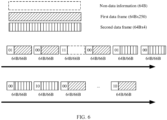
- a size of non-data information is 64B.
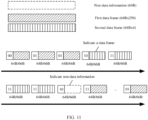
- a manner of sending the non-data information may be shown in FIG. 6 .
- a manner of sending the non-data information may be shown in FIG. 7 .
- a manner of sending the non-data information may be shown in FIG. 8 .
- a manner of sending the non-data information may be shown in FIG. 9 .
- Example 5 An indicator bit of a 1 st first data packet in the N1 first data packets indicates that the 1 st first data packet is a start fragment of a low-priority data frame, and indicator bits of 2 nd to N1 th first data packets in the N1 first data packets and indicator bits of the N2 first data packets indicate that the first data packets are intermediate fragments of the low-priority data frame; and an indicator bit of a 1 st second data packet in the M second data packets indicates that the 1 st second data packet is a start fragment of a high-priority data frame, and indicator bits of 2 nd to M th second data packets in the M second data packets indicate that the second data packets are intermediate fragments of the high-priority data frame.
- the high-priority data frame is a data information frame or a non-data information frame.
- the receiving node may determine the following:
- the first data frame includes: a data packet whose indicator bit indicates a start fragment of a low-priority data frame, and a data packet whose indicator bit indicates an intermediate fragment of the low-priority data frame; and the second data frame includes: a data packet that is not non-data information and whose indicator bit indicates a start fragment of a high-priority data frame, and a data packet whose indicator bit indicates an intermediate fragment of the high-priority data frame.
- an indicator bit of a data packet carrying a start fragment of the first data frame may be a first value
- an indicator bit of a data packet carrying an intermediate/end fragment of the first data frame may be a second value
- an indicator bit of a data packet carrying a start fragment of the second data frame may be a third value
- an indicator bit of a data packet carrying an intermediate/end fragment of the second data frame may be a fourth value
- an indicator bit of a data packet carrying non-data information is a third value.
- the first value indicates a start fragment of a low-priority data frame
- the second value indicates an intermediate fragment of a low-priority data frame
- the third value indicates a start fragment of a high-priority data frame
- the fourth value indicates an intermediate fragment of a high-priority data frame.
- the indicator bit of the 1 st first data packet in the N1 first data packets may be the first value
- the indicator bits of the 2 nd to N1 th first data packets in the N1 first data packets and the indicator bits of the N2 first data packets each may be the second value
- the indicator bit of the 1 st second data packet in the M second data packets may be the third value
- the indicator bits of the 2 nd to M th second data packets each may be the fourth value
- an indicator bit of a data packet that is non-data information may be the third value.
- the first value is 00
- the second value is 01
- the third value is 10
- the fourth value is 11.
- a size of the first data frame is 64B ⁇ 250
- a size of the second data frame is 64B ⁇ 4.
- the sending node after sending three data packets in the first data frame, the sending node sends four data packets in the second data frame, and after sending the four data packets in the second data frame, the sending node continues to send 247 data packets that are not sent in the first data frame.
- the receiving node may determine the following:
- the second data frame includes: a data packet that is non-data information and whose indicator bit is 10, and a data packet whose indicator bit is 11; and the first data frame includes: a data packet whose indicator bit is 00 and a data packet whose indicator bit is 01.
- the values of the first value to the fourth value and the size of the data frame are merely examples. This is not limited in embodiments of this application.
- the receiving node may determine end of a data frame in either of the following two manners:
- the sending node may also send a seventh data packet after sending the M second data packets in the second data frame.
- the seventh data packet includes an indicator bit and a payload, the indicator bit of the seventh data packet is a third value, and the payload of the seventh data packet indicates that data frame transmission ends.
- the sending node may send an eighth data packet after sending the N2 first data packets in the first data frame.
- the eighth data packet includes an indicator bit and a payload, the indicator bit of the eighth data packet is the third value, and the payload of the eighth data packet indicates that data frame transmission ends.
- Manners in which the seventh data packet and the eighth data packet indicate that the data frame transmission ends may be the same or may be different. This is not specifically limited herein. In the foregoing manner, after the seventh data packet in the second data frame is received, it may be determined that transmission of the second data frame ends, and after the eighth data packet is received, it may be determined that transmission of the first data frame ends.
- the receiving node may determine that an end data packet in the first data frame is a data packet previous to a 2 nd data packet whose indicator bit is a first value, and an end data packet in the second data frame is a data packet previous to a data packet whose indicator bit is a second value, where receiving time of the data packet whose indicator bit is the second value is later than receiving time of a data packet whose indicator bit is a third value.
- the sending node may further send a sixth data packet carrying non-data information, where the sixth data packet includes an indicator bit and a payload, and the indicator bit of the sixth data packet indicates that the sixth data packet is a start fragment of a high-priority data frame.
- a payload of a 1 st second data packet may indicate a data frame; and/or a payload of a data packet carrying non-data information may indicate the non-data information.
- the start fragment of the high-priority data frame and the non-data information may be distinguished.
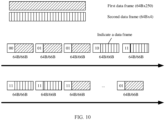
- the sixth data packet may be sent after or before any data packet in the first data frame and the second data frame. For example, based on the information transmission method shown in FIG. 10 , a manner of sending the non-data information may be shown in FIG. 11 .
- the non-data information may be but is not limited to a physical layer padding bit, a sub-indicator bit, control information, or the like.
- a quantity of bits included in the indicator bit may be another quantity, for example, 3 bits or 4 bits. This is not specifically limited herein. If the quantity of bits included in the indicator bit is greater than 2, another value of the indicator bit may alternatively be used to indicate other content, or may be reserved. This is not specifically limited herein.
- insertion of a high-priority data frame is not allowed in a transmission process of a low-priority data frame.
- the data frame truncation is enabled, insertion of one or more high-priority data frames is allowed in the transmission process of the low-priority data frame. That the data frame truncation is disabled may mean that transmission of the low-priority data frame cannot be interrupted by the high-priority data frame, that is, insertion of the high-priority data frame is not allowed in the transmission process of the low-priority data frame.
- That the data frame truncation is enabled may mean that transmission of the low-priority data frame can be interrupted by the high-priority data frame, that is, insertion of one or more high-priority data frames is allowed in the transmission process of the low-priority data frame.
- Example 1 When an indicator bit is 01, it indicates that a data packet carries a start fragment, that is, the data packet is start of a data frame; and when an indicator bit is 10, it indicates that a data packet carries an end fragment, that is, the data packet is end of a data frame. If the data frame truncation is disabled, the data packet whose indicator bit is 01 and the data packet whose indicator bit is 10 may appear in pairs in sequence, that is, there is no other data packet whose indicator bit is 01 or other data packet whose indicator bit is 10 between the data packet whose indicator bit is 01 and the data packet whose indicator bit is 10.
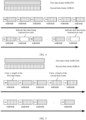
- transmission of a low-priority data frame may not be interrupted by a high-priority data frame. If the data frame truncation is enabled, insertion of one or more high-priority data frames is allowed in the transmission process of the low-priority data frame. Therefore, there may be another data packet whose indicator bit is 01 and another data packet whose indicator bit is 10 between the data packet whose indicator bit is 01 and the data packet whose indicator bit is 10, for example, this is shown in FIG. 2 .
- Example 2 Descriptions are provided based on Example 2.
- an indicator bit is 00, it indicates that a data packet carries a start fragment or an end fragment of a low-priority data frame, that is, the data packet is start or end of transmission of the low-priority data frame; and when an indicator bit is 10, it indicates that a data packet carries a start fragment or an end fragment of a high-priority data frame, that is, the data packet is start or end of transmission of the high-priority data frame. If the data frame truncation is disabled, the data packet whose indicator bit is 00 may appear in pairs in sequence, that is, there is no data packet whose indicator bit is 10 between two data packets whose indicator bits each are 00.
- transmission of a low-priority data frame may not be interrupted by a high-priority data frame. If the data frame truncation is enabled, insertion of one or more high-priority data frames is allowed in the transmission process of the low-priority data frame. Therefore, there may be the data packet whose indicator bit is 10 between the two data packets whose indicator bits each are 00, for example, this is shown in FIG. 3 .
- Example 3 When an indicator bit is 00, it indicates that a data packet carries a start fragment of a low-priority data frame, that is, the data packet is start of transmission of the low-priority data frame; when an indicator bit is 10, it indicates that a data packet carries a start fragment of a high-priority data frame, that is, the data packet is start of transmission of the high-priority data frame; and when an indicator bit is 11, it indicates that a data packet carries non-data information.
- the data packet whose indicator bit is 00 and the data packet whose indicator bit is 11 and whose payload indicates that data frame transmission ends may appear in pairs in sequence, that is, there is no data packet whose indicator bit is 10 and the data packet whose indicator bit is 11 and whose payload indicates that data frame transmission ends between the data packet whose indicator bit is 00 and the data packet whose indicator bit is 11 and whose payload indicates that data frame transmission ends. In this manner, it can be ensured that transmission of a low-priority data frame may not be interrupted by a high-priority data frame.
- Embodiments of this application describe a process of sending two data frames with different priorities. It should be understood that the method is also applicable to sending of a plurality of data frames with different priorities. For example, it is assumed that a third data frame is to be sent, where a priority of the third data frame is higher than a priority of a second data frame, and the third data frame may be inserted into any data packet in the second data frame for sending. In this process, a process of sending the third data frame is similar to the foregoing process of sending the second data frame, a process of sending the second data frame is similar to the foregoing process of sending the first data frame, and details are not repeated.
- the indicator bit has different meanings when being set to different values, so that a high-priority data frame can be preferentially scheduled and transmitted. This can reduce a transmission delay and jitter of the high-priority data frame.
- an embodiment of this application provides a communications apparatus.
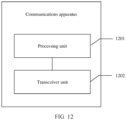
- a structure of the apparatus may be shown in FIG. 12 , and includes a processing unit 1201 and a transceiver unit 1202.
- the communications apparatus may be specifically configured to implement the method performed by the sending node in the embodiments in FIG. 1 to FIG. 11 .
- the apparatus may be the sending node, or may be a chip or a chip set in the sending node, or a part of a chip that is configured to perform a related method function.
- the transceiver unit 1202 is configured to receive and send information.
- the processing unit 1201 is configured to: send N1 first data packets in a first data frame via the transceiver unit 1202; and when a first condition is met, send M second data packets in a second data frame via the transceiver unit 1202 before sending N2 first data packets in the first data frame via the transceiver unit 1202.
- the first condition includes that a priority of the second data frame is higher than a priority of the first data frame.
- the first data frame includes the N1 first data packets and the N2 first data packets, and N1, N2, and M are positive integers.
- the first condition further includes that data frame truncation is enabled.
- the M second data packets in the second data frame are sent after the N2 first data packets are sent.
- the second condition includes that the data frame truncation is disabled and/or the priority of the first data frame is not lower than the priority of the first data frame.
- the first data packet includes an indicator bit and a payload, where the payload of the first data packet carries one of a start fragment, an intermediate fragment, or an end fragment of the first data frame, and the indicator bit of the first data packet indicates one of the start fragment, the intermediate fragment, or the end fragment of the first data frame; and the second data packet includes an indicator bit and a payload, where the payload of the second data packet carries one of a start fragment, an intermediate fragment, or an end fragment of the second data frame, and the indicator bit of the second data packet indicates one of the start fragment, the intermediate fragment, or the end fragment of the first data frame.
- an indicator bit of a 1 st first data packet in the N1 first data packets indicates that the 1 st first data packet is a start fragment
- indicator bits of 2 nd to N1 th first data packets in the N1 first data packets and 1 st to (N2-1) th first data packets in the N2 first data packets indicate that the first data packets are intermediate fragments
- an indicator bit of an N2 th first data packet in the N2 first data packets indicates that the N2 th first data packet is an end fragment
- an indicator bit of a 1 st second data packet in the M second data packets indicates that the 1 st second data packet is a start fragment
- indicator bits of 2 nd to (M-1) th second data packets indicate that the second data packets are intermediate fragments
- an indicator bit of an M th second data packet indicates that the M th second data packet is an end fragment.
- an indicator bit of a 1 st first data packet in the N1 first data packets indicates that the 1 st first data packet is a start/end fragment of a low-priority data frame
- an indicator bit of an N2 th first data packet in the N2 first data packets indicates that the N2 th first data packet is a start/end fragment of the low-priority data frame
- indicator bits of 2 nd to N1 th first data packets in the N1 first data packets and 1 st to (N2-1) th first data packets in the N2 first data packets indicate that the first data packets are intermediate fragments
- an indicator bit of a 1 st second data packet in the M second data packets indicates that the 1 st second data packet is a start/end fragment of a high-priority data frame
- an indicator bit of an M th second data packet indicates that the M th second data packet is a start/end fragment of the high-priority data frame
- an indicator bit of a 1 st first data packet in the N1 first data packets indicates that the 1 st first data packet is a start fragment of a low-priority data frame, and indicator bits of 2 nd to N1 th first data packets in the N1 first data packets and indicator bits of the N2 first data packets indicate that the first data packets are intermediate fragments; and a 1 st second data packet in the M second data packets indicates that the 1 st second data packet is a start fragment of a high-priority data frame, and indicator bits of 2 nd to M th second data packets indicate that the second data packets are intermediate fragments.
- the processing unit 1201 is further configured to: send a third data packet after sending the M second data packets in the second data frame via the transceiver unit 1202, where the third data packet includes an indicator bit and a payload, the indicator bit of the third data packet indicates that the third data packet is non-data information, and the payload of the third data packet indicates that data frame transmission ends; and send a fourth data packet after sending the N2 first data packets in the first data frame via the transceiver unit 1202, where the fourth data packet includes an indicator bit and a payload, the indicator bit of the fourth data packet indicates that the fourth data packet is non-data information, and the payload of the fourth data packet indicates that data frame transmission ends.
- an indicator bit of a 1 st first data packet in the N1 first data packets indicates that the 1 st first data packet is a start fragment of a low-priority data frame, a payload of the 1 st first data packet indicates a length of the first data frame, and indicator bits of 2 nd to N1 th first data packets in the N1 first data packets and indicator bits of the N2 first data packets indicate that the first data packets are intermediate fragments; and an indicator bit of a 1 st second data packet in the M second data packets indicates that the 1 st second data packet is a start fragment of a high-priority data frame, a payload of the 1 st second data packet indicates a length of the second data frame, and indicator bits of 2 nd to M th second data packets in the M second data packets indicate that the second data packets are intermediate fragments.
- the processing unit 1201 is further configured to send K fifth data packets that are non-data information via the transceiver unit 1202, where the fifth data packet includes an indicator bit and a payload, the indicator bit of the fifth data packet indicates that the fifth data packet is the non-data information, the payload of the fifth data packet carries a fragment of the non-data information, and K is an integer greater than 0.
- an indicator bit of a 1 st first data packet in the N1 first data packets indicates that the 1 st first data packet is a start fragment of a low-priority data frame, and indicator bits of 2 nd to N1 th first data packets in the N1 first data packets and indicator bits of the N2 first data packets indicate that the first data packets are intermediate fragments of the low-priority data frame; and an indicator bit of a 1 st second data packet in the M second data packets indicates that the 1 st second data packet is a start fragment of a high-priority data frame, and indicator bits of 2 nd to M th second data packets in the M second data packets indicate that the second data packets are intermediate fragments of the high-priority data frame.
- the high-priority data frame is a data information frame or a non-data information frame.
- the processing unit 1201 is further configured to send a sixth data packet carrying non-data information via the transceiver unit 1202, where the sixth data packet includes an indicator bit and a payload, the indicator bit of the sixth data packet indicates that the sixth data packet is a start fragment of a high-priority data frame, and the payload of the sixth data packet indicates that the sixth data packet is a non-data information frame.
- the communications apparatus may be specifically configured to implement the method performed by the receiving node in the embodiments in FIG. 1 to FIG. 11 .
- the apparatus may be the receiving node, or may be a chip or a chip set in the receiving node, or a part of a chip that is configured to perform a related method function.
- the transceiver unit 1202 is configured to: receive N1 first data packets; and when a first condition is met, receive M second data packets before receiving N2 first data packets, where the first condition includes that a priority of a second data frame is higher than a priority of a first data frame, and N1, N2, and M are positive integers; and the processing unit 1201 is configured to determine the first data frame based on the N1 first data packets and the N2 first data packets; and determine the second data frame based on the M second data packets.
- the first condition further includes that data frame truncation is enabled.
- the M second data packets are received after the N2 first data packets are received, where the second condition includes that the data frame truncation is disabled and/or the priority of the first data frame is not lower than the priority of the first data frame.
- the first data packet includes an indicator bit and a payload, where the payload of the first data packet carries one of a start fragment, an intermediate fragment, or an end fragment of the first data frame, and the indicator bit of the first data packet indicates one of the start fragment, the intermediate fragment, or the end fragment of the first data frame; and the second data packet includes an indicator bit and a payload, where the payload of the second data packet carries one of a start fragment, an intermediate fragment, or an end fragment of the second data frame, and the indicator bit of the second data packet indicates one of the start fragment, the intermediate fragment, or the end fragment of the first data frame.
- an indicator bit of a 1 st first data packet in the N1 first data packets indicates that the 1 st first data packet is a start fragment
- indicator bits of 2 nd to N1 th first data packets in the N1 first data packets and 1 st to (N2-1) th first data packets in the N2 first data packets indicate that the first data packets are intermediate fragments
- an indicator bit of an N2 th first data packet in the N2 first data packets indicates that the N2 th first data packet is an end fragment
- an indicator bit of a 1 st second data packet in the M second data packets indicates that the 1 st second data packet is a start fragment
- indicator bits of 2 nd to (M-1) th second data packets indicate that the second data packets are intermediate fragments
- an indicator bit of an M th second data packet indicates that the M th second data packet is an end fragment.
- an indicator bit of a 1 st first data packet in the N1 first data packets indicates that the 1 st first data packet is a start/end fragment of a low-priority data frame
- an indicator bit of an N2 th first data packet in the N2 first data packets indicates that the N2 th first data packet is a start/end fragment of the low-priority data frame
- indicator bits of 2 nd to N1 th first data packets in the N1 first data packets and 1 st to (N2-1) th first data packets in the N2 first data packets indicate that the first data packets are intermediate fragments
- an indicator bit of a 1 st second data packet in the M second data packets indicates that the 1 st second data packet is a start/end fragment of a high-priority data frame
- an indicator bit of an M th second data packet indicates that the M th second data packet is a start/end fragment of the high-priority data frame
- an indicator bit of a 1 st first data packet in the N1 first data packets indicates that the 1 st first data packet is a start fragment of a low-priority data frame, and indicator bits of 2 nd to N1 th first data packets in the N1 first data packets and indicator bits of the N2 first data packets indicate that the first data packets are intermediate fragments; and a 1 st second data packet in the M second data packets indicates that the 1 st second data packet is a start fragment of a high-priority data frame, and indicator bits of 2 nd to M th second data packets indicate that the second data packets are intermediate fragments.
- the transceiver unit 1202 is further configured to: receive a third data packet after receiving the M second data packets, where the third data packet includes an indicator bit and a payload, the indicator bit of the third data packet indicates that the third data packet is non-data information, and the payload of the third data packet indicates that data frame transmission ends; and receive a fourth data packet after receiving the N2 first data packets, where the fourth data packet includes an indicator bit and a payload, the indicator bit of the fourth data packet indicates that the fourth data packet is non-data information, and the payload of the fourth data packet indicates that data frame transmission ends.
- an indicator bit of a 1 st first data packet in the N1 first data packets indicates that the 1 st first data packet is a start fragment of a low-priority data frame, a payload of the 1 st first data packet indicates a length of the first data frame, and indicator bits of 2 nd to N1 th first data packets in the N1 first data packets and indicator bits of the N2 first data packets indicate that the first data packets are intermediate fragments; and an indicator bit of a 1 st second data packet in the M second data packets indicates that the 1 st second data packet is a start fragment of a high-priority data frame, a payload of the 1 st second data packet indicates a length of the second data frame, and indicator bits of 2 nd to M th second data packets in the M second data packets indicate that the second data packets are intermediate fragments.
- the transceiver unit 1202 is further configured to: receive K fifth data packets, where each of the K fifth data packets includes an indicator bit and a payload, the indicator bit of each of the K fifth data packets indicates that the fifth data packet is non-data information, K is an integer greater than 0, and the payload of the fifth data packet carries a fragment of the non-data information; and determine the non-data information based on the K fifth data packets.
- an indicator bit of a 1 st first data packet in the N1 first data packets indicates that the 1 st first data packet is a start fragment of a low-priority data frame, and indicator bits of 2 nd to N1 th first data packets in the N1 first data packets and indicator bits of the N2 first data packets indicate that the first data packets are intermediate fragments of the low-priority data frame; and an indicator bit of a 1 st second data packet in the M second data packets indicates that the 1 st second data packet is a start fragment of a high-priority data frame, and indicator bits of 2 nd to M th second data packets in the M second data packets indicate that the second data packets are intermediate fragments of the high-priority data frame.
- the high-priority data frame is a data information frame or a non-data information frame.
- the transceiver unit 1202 is further configured to: receive a sixth data packet, where the sixth data packet includes an indicator bit and a payload, the indicator bit of the sixth data packet indicates that the sixth data packet is a start fragment of a high-priority data frame, and the payload of the sixth data packet indicates that the sixth data packet is a non-data information frame; and determine non-data information based on the sixth data packet.
- Division into modules in this embodiment of this application is an example, is merely logical function division, and may be other division during actual implementation.
- functional modules in embodiments of this application may be integrated into one processor, or each of the modules may exist alone physically, or two or more modules are integrated into one module.
- the integrated module may be implemented in a form of hardware, or may be implemented in a form of a software functional module. It may be understood that for functions or implementations of the modules in this embodiment of this application, further refer to related description in the method embodiments.
- the communications apparatus may be shown in FIG. 13 , and the apparatus may be a sending node or a chip in a sending node.
- the apparatus may include a processor 1301, a communications interface 1302, and a memory 1303.
- the processing unit 1201 may be the processor 1301.
- the transceiver unit 1202 may be the communications interface 1302.
- the processor 1301 may be a central processing unit (Central Processing Unit, CPU), a digital processing unit, or the like.
- the communications interface 1302 may be a transceiver, an interface circuit like a transceiver circuit, a transceiver chip, or the like.
- the apparatus further includes the memory 1303, configured to store a program executed by the processor 1301.
- the memory 1303 may be a nonvolatile memory such as a hard disk drive (hard disk drive, HDD) or a solid-state drive (solid-state drive, SSD), or may be a volatile memory (volatile memory) such as a random access memory (random access memory, RAM).
- the memory 1303 is any other medium that can be used to carry or store expected program code in a form of an instruction or a data structure and that can be accessed by a computer, but is not limited thereto.
- the processor 1301 is configured to execute the program code stored in the memory 1303, and is specifically configured to perform an action of the processing unit 1201. Details are not described herein again in this application.
- the communications interface 1302 is specifically configured to perform an action of the transceiver unit 1202. Details are not described in this application again.
- a specific connection medium among the communications interface 1302, the processor 1301, and the memory 1303 is not limited in this embodiment of this application.
- the memory 1303, the processor 1301, and the communications interface 1302 are connected through a bus 1304 in FIG. 13 .
- the bus is indicated by using a bold line.
- a manner of connection between other components is merely an example for description, and imposes no limitation.
- the bus may be classified into an address bus, a data bus, a control bus, and the like. For ease of representation, only one bold line is used to represent the bus in FIG. 13 , but this does not mean that there is only one bus or only one type of bus.
- An embodiment of this application further provides a communications system, including a communications apparatus configured to implement functions of the sending node in embodiments in FIG. 1 and FIG. 11 and a communications apparatus configured to implement functions of the receiving node in embodiments in FIG. 1 and FIG. 11 .
- An embodiment of this application further provides a computer-readable storage medium, configured to store computer software instructions that need to be executed by the processor, and the computer software instructions include a program that needs to be executed by the processor.
- An embodiment of this application further provides a vehicle.
- the vehicle includes a first device and/or a second device.
- the first device and the second device are configured to separately or jointly implement the information transmission method in FIG. 1 .
- the first device and the second device may be the communications apparatus shown in FIG. 12 .
- An embodiment of this application further provides a chip.
- the chip includes at least one processor and a communications interface.
- the processor is coupled to a memory, and is configured to read a computer program stored in the memory, to perform the method shown in FIG. 1 or implement the functions in the embodiments in FIG. 2 to FIG. 11 .
- An embodiment of this application further provides a chip, including a communications interface and at least one processor.
- the processor runs to perform the method shown in FIG. 1 or implement the functions in the embodiments in FIG. 2 to FIG. 11 .
- this application may be provided as a method, a system, or a computer program product. Therefore, this application may use a form of a hardware-only embodiment, a software-only embodiment, or an embodiment with a combination of software and hardware. In addition, this application may use a form of a computer program product that is implemented on one or more computer-usable storage media (including but not limited to a disk memory, a CD-ROM, an optical memory, and the like) that include computer-usable program code.
- a computer-usable storage media including but not limited to a disk memory, a CD-ROM, an optical memory, and the like
- These computer program instructions may be provided for a general-purpose computer, a dedicated computer, an embedded processor, or a processor of another programmable data processing device to generate a machine, so that the instructions executed by a computer or the processor of another programmable data processing device generate an apparatus for implementing a specific function in one or more procedures in the flowcharts and/or in one or more blocks in the block diagrams.
- These computer program instructions may alternatively be stored in a computer-readable memory that can instruct the computer or another programmable data processing device to work in a specific manner, so that the instructions stored in the computer-readable memory generate an artifact that includes an instruction apparatus.
- the instruction apparatus implements a specified function in one or more procedures in the flowcharts and/or in one or more blocks in the block diagrams.
- These computer program instructions may alternatively be loaded onto a computer or another programmable data processing device, so that a series of operation steps are performed on the computer or another programmable device, thereby generating computer-implemented processing. Therefore, the instructions executed on the computer or another programmable device provide steps for implementing a specific function in one or more procedures in the flowcharts and/or in one or more blocks in the block diagrams.
Landscapes
- Engineering & Computer Science (AREA)
- Signal Processing (AREA)
- Computer Networks & Wireless Communication (AREA)
- Data Exchanges In Wide-Area Networks (AREA)
- Communication Control (AREA)
Abstract
Description
- This application relates to the field of communications technologies, and in particular, to an information transmission method and apparatus.
- In a communications system, information of different service types may correspond to different sizes of data packets, and different priorities may also be configured for the information of different service types. For example, for a data frame of an image type in an in-vehicle camera data transmission scenario, a size of a data packet is about 2000 bytes, and a low priority is configured. For control information of a type such as an inter-integrated circuit (inter-integrated circuit, I2C), a general-purpose input/output (general-purpose input/output, GPIO), or a serial peripheral interface (serial peripheral interface, SPI), a size of a data packet is about 10 bytes, and a configured priority is higher than the priority of the data frame of the image type in the in-vehicle camera data transmission scenario. In addition, for control information of some types (such as retraining and sleep), a size of a data packet is less than 8 bytes, and a configured priority is higher than the priority of the control information of the type such as the I2C, the GPIO, or the SPI. A higher priority of a data packet indicates a lower transmission delay and lower jitter. However, in a current information transmission mechanism, only control information whose length is less than 64 bytes can be preferentially scheduled and transmitted, and a data frame with a high priority cannot be scheduled and transmitted in time, resulting in a high delay and high jitter of the information.
- This application provides an information transmission method and apparatus, to resolve a problem of a high delay and high jitter of information caused by the fact that a data frame with a high priority cannot be scheduled and transmitted in time.
- According to a first aspect, an embodiment of this application provides an information transmission method, including: sending N1 first data packets in a first data frame; and when a first condition is met, sending M second data packets in a second data frame before N2 first data packets in the first data frame are sent. The first condition includes that a priority of the second data frame is higher than a priority of the first data frame. The first data frame includes the N1 first data packets and the N2 first data packets, and N1, N2, and M are positive integers. According to the method provided in this embodiment of this application, a high-priority data frame can be preferentially scheduled and transmitted, so that a transmission delay and jitter of the high-priority data frame can be reduced.
- In a possible design, the first condition further includes that data frame truncation is enabled. According to the foregoing design, a first device can insert a high-priority data frame in a transmission process of a low-priority data frame when the data frame truncation is enabled.
- In a possible design, when a second condition is met, the M second data packets in the second data frame are sent after the N2 first data packets are sent. The second condition includes that the data frame truncation is disabled and/or the priority of the first data frame is not lower than the priority of the first data frame. According to the foregoing design, the first device is not allowed to insert the high-priority data frame in the transmission process of the low-priority data frame when the data frame truncation is disabled.
- In a possible design, the first data packet includes an indicator bit and a payload, where the payload of the first data packet carries one of a start fragment, an intermediate fragment, or an end fragment of the first data frame, and the indicator bit of the first data packet indicates one of the start fragment, the intermediate fragment, or the end fragment of the first data frame; and the second data packet includes an indicator bit and a payload, where the payload of the second data packet carries one of a start fragment, an intermediate fragment, or an end fragment of the second data frame, and the indicator bit of the second data packet indicates one of the start fragment, the intermediate fragment, or the end fragment of the first data frame. According to the foregoing design, a receiving node may determine a start, a continuation, and an end of a data frame based on an indicator bit.
- In a possible design, an indicator bit of a 1 st first data packet in the N1 first data packets indicates that the 1st first data packet is a start fragment, indicator bits of 2nd to N1th first data packets in the N1 first data packets and 1st to (N2-1)th first data packets in the N2 first data packets indicate that the first data packets are intermediate fragments, and an indicator bit of an N2th first data packet in the N2 first data packets indicates that the N2th first data packet is an end fragment; and an indicator bit of a 1st second data packet in the M second data packets indicates that the 1st second data packet is a start fragment, indicator bits of 2nd to (M-1)th second data packets indicate that the second data packets are intermediate fragments, and an indicator bit of an Mth second data packet indicates that the Mth second data packet is an end fragment. According to the foregoing design, after receiving two data packets indicating the start fragment, the receiving node may determine that a 2nd data packet indicating the start fragment is a start data packet in the second data frame.
- In a possible design, an indicator bit of a 1 st first data packet in the N1 first data packets indicates that the 1st first data packet is a start/end fragment of a low-priority data frame, an indicator bit of an N2th first data packet in the N2 first data packets indicates that the N2th first data packet is a start/end fragment of the low-priority data frame, and indicator bits of 2nd to N1th first data packets in the N1 first data packets and 1st to (N2-1)th first data packets in the N2 first data packets indicate that the first data packets are intermediate fragments; and an indicator bit of a 1st second data packet in the M second data packets indicates that the 1st second data packet is a start/end fragment of a high-priority data frame, an indicator bit of an Mth second data packet indicates that the Mth second data packet is a start/end fragment of the high-priority data frame, and indicator bits of 2nd to (M-1)th second data packets in the M second data packets indicate that the second data packets are intermediate fragments. According to the foregoing design, data packet ranges of the first data frame and the second data frame may be distinguished.
- In a possible design, an indicator bit of a 1st first data packet in the N1 first data packets indicates that the 1st first data packet is a start fragment of a low-priority data frame, and indicator bits of 2nd to N1th first data packets in the N1 first data packets and indicator bits of the N2 first data packets indicate that the first data packets are intermediate fragments; and a 1st second data packet in the M second data packets indicates that the 1st second data packet is a start fragment of a high-priority data frame, and indicator bits of 2nd to Mth second data packets indicate that the second data packets are intermediate fragments. According to the foregoing design, data packet ranges of the first data frame and the second data frame may be distinguished.
- In a possible design, the method further includes: sending a third data packet after the M second data packets in the second data frame are sent, where the third data packet includes an indicator bit and a payload, the indicator bit of the third data packet indicates that the third data packet is non-data information, and the payload of the third data packet indicates that data frame transmission ends; and sending a fourth data packet after the N2 first data packets in the first data frame are sent, where the fourth data packet includes an indicator bit and a payload, the indicator bit of the fourth data packet indicates that the fourth data packet is non-data information, and the payload of the fourth data packet indicates that data frame transmission ends. According to the foregoing design, the end of the first data frame and the end of the second data frame may be determined.
- In a possible design, an indicator bit of a 1st first data packet in the N1 first data packets indicates that the 1st first data packet is a start fragment of a low-priority data frame, a payload of the 1st first data packet indicates a length of the first data frame, and indicator bits of 2nd to N1th first data packets in the N1 first data packets and indicator bits of the N2 first data packets indicate that the first data packets are intermediate fragments; and an indicator bit of a 1st second data packet in the M second data packets indicates that the 1st second data packet is a start fragment of a high-priority data frame, a payload of the 1st second data packet indicates a length of the second data frame, and indicator bits of 2nd to Mth second data packets in the M second data packets indicate that the second data packets are intermediate fragments. According to the foregoing design, receiving ranges of the first data frame and the second data frame may be determined.
- In a possible design, K fifth data packets that are non-data information may be further sent, where the fifth data packet includes an indicator bit and a payload, the indicator bit of the fifth data packet indicates that the fifth data packet is the non-data information, the payload of the fifth data packet carries a fragment of the non-data information, and K is an integer greater than 0. According to the foregoing design, non-data information can be sent, and the non-data information and the data frame can be distinguished.
- In a possible design, an indicator bit of a 1st first data packet in the N1 first data packets indicates that the 1st first data packet is a start fragment of a low-priority data frame, and indicator bits of 2nd to N1th first data packets in the N1 first data packets and indicator bits of the N2 first data packets indicate that the first data packets are intermediate fragments of the low-priority data frame; and an indicator bit of a 1st second data packet in the M second data packets indicates that the 1st second data packet is a start fragment of a high-priority data frame, and indicator bits of 2nd to Mth second data packets in the M second data packets indicate that the second data packets are intermediate fragments of the high-priority data frame. According to the foregoing design, receiving ranges of the first data frame and the second data frame may be determined.
- In a possible design, the high-priority data frame is a data information frame or a non-data information frame.
- In a possible design, a sixth data packet is sent, where the sixth data packet includes an indicator bit and a payload, the indicator bit of the sixth data packet indicates that the sixth data packet is a start fragment of a high-priority data frame, and the payload of the sixth data packet indicates that the sixth data packet is a non-data information frame. According to the foregoing design, non-data information can be sent, and the non-data information and the data frame can be distinguished.
- According to a second aspect, an embodiment of this application provides an information transmission method, including: receiving N1 first data packets; when a first condition is met, receiving M second data packets before N2 first data packets are received, where the first condition includes that a priority of a second data frame is higher than a priority of a first data frame, and N1, N2, and M are positive integers; determining the first data frame based on the N1 first data packets and the N2 first data packets; and determining the second data frame based on the M second data packets, where the priority of the second data frame is higher than the priority of the first data frame.
- According to the method provided in this embodiment of this application, a high-priority data frame can be preferentially scheduled and transmitted, so that a transmission delay and jitter of the high-priority data frame can be reduced.
- In a possible design, the first condition further includes that data frame truncation is enabled. According to the foregoing design, a first device can insert a high-priority data frame in a transmission process of a low-priority data frame when the data frame truncation is enabled.
- In a possible design, when a second condition is met, the M second data packets in the second data frame are received after the N2 first data packets are received. The second condition includes that the data frame truncation is disabled and/or the priority of the first data frame is not lower than the priority of the first data frame. According to the foregoing design, the first device is not allowed to insert the high-priority data frame in the transmission process of the low-priority data frame when the data frame truncation is disabled.
- In a possible design, the first data packet includes an indicator bit and a payload, where the payload of the first data packet carries one of a start fragment, an intermediate fragment, or an end fragment of the first data frame, and the indicator bit of the first data packet indicates one of the start fragment, the intermediate fragment, or the end fragment of the first data frame; and the second data packet includes an indicator bit and a payload, where the payload of the second data packet carries one of a start fragment, an intermediate fragment, or an end fragment of the second data frame, and the indicator bit of the second data packet indicates one of the start fragment, the intermediate fragment, or the end fragment of the first data frame. According to the foregoing design, a receiving node may determine a start, a continuation, and an end of a data frame based on an indicator bit.
- In a possible design, an indicator bit of a 1st first data packet in the N1 first data packets indicates that the 1st first data packet is a start fragment, indicator bits of 2nd to N1th first data packets in the N1 first data packets and 1st to (N2-1)th first data packets in the N2 first data packets indicate that the first data packets are intermediate fragments, and an indicator bit of an N2th first data packet in the N2 first data packets indicates that the N2th first data packet is an end fragment; and an indicator bit of a 1st second data packet in the M second data packets indicates that the 1st second data packet is a start fragment, indicator bits of 2nd to (M-1)th second data packets indicate that the second data packets are intermediate fragments, and an indicator bit of an Mth second data packet indicates that the Mth second data packet is an end fragment. According to the foregoing design, after receiving two data packets indicating the start fragment, the receiving node may determine that a 2nd data packet indicating the start fragment is a start data packet in the second data frame.
- In a possible design, an indicator bit of a 1st first data packet in the N1 first data packets indicates that the 1st first data packet is a start/end fragment of a low-priority data frame, an indicator bit of an N2th first data packet in the N2 first data packets indicates that the N2th first data packet is a start/end fragment of the low-priority data frame, and indicator bits of 2nd to N1th first data packets in the N1 first data packets and 1st to (N2-1)th first data packets in the N2 first data packets indicate that the first data packets are intermediate fragments; and an indicator bit of a 1st second data packet in the M second data packets indicates that the 1st second data packet is a start/end fragment of a high-priority data frame, an indicator bit of an Mth second data packet indicates that the Mth second data packet is a start/end fragment of the high-priority data frame, and indicator bits of 2nd to (M-1)th second data packets in the M second data packets indicate that the second data packets are intermediate fragments. According to the foregoing design, data packet ranges of the first data frame and the second data frame may be distinguished.
- In a possible design, an indicator bit of a 1st first data packet in the N1 first data packets indicates that the 1st first data packet is a start fragment of a low-priority data frame, and indicator bits of 2nd to N1th first data packets in the N1 first data packets and indicator bits of the N2 first data packets indicate that the first data packets are intermediate fragments; and a 1st second data packet in the M second data packets indicates that the 1st second data packet is a start fragment of a high-priority data frame, and indicator bits of 2nd to Mth second data packets indicate that the second data packets are intermediate fragments. According to the foregoing design, data packet ranges of the first data frame and the second data frame may be distinguished.
- In a possible design, after the M second data packets are received, the method further includes: receiving a third data packet, where the third data packet includes an indicator bit and a payload, the indicator bit of the third data packet indicates that the third data packet is non-data information, and the payload of the third data packet indicates that data frame transmission ends; and after the N2 first data packets are received, the method further includes: receiving a fourth data packet, where the fourth data packet includes an indicator bit and a payload, the indicator bit of the fourth data packet indicates that the fourth data packet is non-data information, and the payload of the fourth data packet indicates that data frame transmission ends. According to the foregoing design, the end of the first data frame and the end of the second data frame may be determined.
- In a possible design, an indicator bit of a 1st first data packet in the N1 first data packets indicates that the 1st first data packet is a start fragment of a low-priority data frame, a payload of the 1st first data packet indicates a length of the first data frame, and indicator bits of 2nd to N1th first data packets in the N1 first data packets and indicator bits of the N2 first data packets indicate that the first data packets are intermediate fragments; and an indicator bit of a 1st second data packet in the M second data packets indicates that the 1st second data packet is a start fragment of a high-priority data frame, a payload of the 1st second data packet indicates a length of the second data frame, and indicator bits of 2nd to Mth second data packets in the M second data packets indicate that the second data packets are intermediate fragments. According to the foregoing design, receiving ranges of the first data frame and the second data frame may be determined.
- In a possible design, K fifth data packets are received, where each of the K fifth data packets includes an indicator bit and a payload, the indicator bit of each of the K fifth data packets indicates that the fifth data packet is non-data information, K is an integer greater than 0, and the payload of the fifth data packet carries a fragment of the non-data information; and the non-data information is determined based on the K fifth data packets. According to the foregoing design, non-data information can be sent, and the non-data information and the data frame can be distinguished.
- In a possible design, an indicator bit of a 1 st first data packet in the N1 first data packets indicates that the 1st first data packet is a start fragment of a low-priority data frame, and indicator bits of 2nd to N1th first data packets in the N1 first data packets and indicator bits of the N2 first data packets indicate that the first data packets are intermediate fragments of the low-priority data frame; and an indicator bit of a 1st second data packet in the M second data packets indicates that the 1st second data packet is a start fragment of a high-priority data frame, and indicator bits of 2nd to Mth second data packets in the M second data packets indicate that the second data packets are intermediate fragments of the high-priority data frame. According to the foregoing design, receiving ranges of the first data frame and the second data frame may be determined.
- In a possible design, the high-priority data frame is a data information frame or a non-data information frame.
- In a possible design, a sixth data packet is received, where the sixth data packet includes an indicator bit and a payload, the sixth data packet includes the indicator bit and the payload, the indicator bit of the sixth data packet indicates that the sixth data packet is a start fragment of a high-priority data frame, and the payload of the sixth data packet indicates that the sixth data packet is a non-data information frame; and non-data information is determined based on the sixth data packet. According to the foregoing design, non-data information can be sent, and the non-data information and the data frame can be distinguished.
- According to a third aspect, this application provides an information transmission apparatus. The apparatus may be a communications device, or may be a chip or a chip set in a communications device. The communications device may be a sending node or a receiving node. The apparatus may include a processing unit and a transceiver unit. When the apparatus is the communications device, the processing unit may be a processor, and the transceiver unit may be a transceiver. The apparatus may further include a storage module, and the storage module may be a memory. The storage module is configured to store instructions, and the processing unit executes the instructions stored in the storage module, to perform the method corresponding to any one of the first aspect or the designs of the first aspect, or to perform the method corresponding to any one of the second aspect or the designs of the second aspect. When the apparatus is the chip or the chip set in the communications device, the processing unit may be a processor, and the transceiver unit may be an input/output interface, a pin, a circuit, or the like. The processing unit executes instructions stored in a storage module, to perform the method corresponding to any one of the first aspect or the designs of the first aspect, or to perform the method corresponding to any one of the second aspect or the designs of the second aspect. The storage module may be a storage module (for example, a register or a cache) in the chip or the chip set, or may be a storage module (for example, a read-only memory or a random access memory) outside the chip or the chip set in the communications device.
- According to a fourth aspect, this application provides an information transmission apparatus. The apparatus includes a processor, and may further include a communications interface and a memory. The communications interface is configured to transmit information, and/or a message, and/or data between the apparatus and another apparatus. The memory is configured to store computer-executable instructions. When the apparatus runs, the processor executes the computer-executable instructions stored in the memory, so that the apparatus performs the method according to any one of the first aspect or the designs of the first aspect, or the second aspect or the designs of the second aspect.
- According to a fifth aspect, an embodiment of this application provides an information transmission system, including the information transmission apparatus according to the third aspect and the information transmission apparatus according to the fourth aspect.
- According to a sixth aspect, an embodiment of this application further provides a computer-readable storage medium. The computer-readable storage medium stores instructions, and when the instructions are run on a computer, the computer is enabled to perform the method according to any one of the first aspect or the designs of the first aspect, or the second aspect or the designs of the second aspect.
- According to a seventh aspect, an embodiment of this application further provides a computer program product including instructions. When the computer program product runs on a computer, the computer is enabled to perform the method according to any one of the first aspect or the designs of the first aspect, or the second aspect or the designs of the second aspect.
- According to an eighth aspect, an embodiment of this application further provides a communications system. The system includes a sending node and a receiving node. The sending node may perform the method corresponding to any one of the first aspect or the designs of the first aspect, and the receiving node may perform the method corresponding to any one of the second aspect or the designs of the second aspect.
- According to a ninth aspect, an embodiment of this application provides a chip. The chip includes at least one processor and a communications interface. The processor is coupled to a memory, and is configured to read a computer program stored in the memory, to perform the method according to any one of the first aspect or the designs of the first aspect, or the second aspect or the designs of the second aspect of the embodiments of this application.
- According to a tenth aspect, an embodiment of this application provides a chip, including a communications interface and at least one processor. The processor runs to perform the method according to any one of the first aspect or the designs of the first aspect, or the second aspect or the designs of the second aspect of the embodiments of this application.
- According to an eleventh aspect, an embodiment of this application provides a vehicle. The vehicle includes a first device and/or a second device, the first device is configured to perform the method according to any one of the first aspect or the designs of the first aspect, and the second device is configured to perform the method according to any one of the second aspect or the designs of the second aspect.
- It should be noted that "coupling" in embodiments of this application means that two components are directly or indirectly combined with each other.
-
-
FIG. 1 is a schematic flowchart of an information transmission method according to an embodiment of this application; -
FIG. 2 is a schematic diagram of transmission of a data frame according to an embodiment of this application; -
FIG. 3 is a schematic diagram of transmission of a data frame according to an embodiment of this application; -
FIG. 4 is a schematic diagram of transmission of a data frame according to an embodiment of this application; -
FIG. 5 is a schematic diagram of transmission of a data frame according to an embodiment of this application; -
FIG. 6 is a schematic diagram of transmission of non-data information according to an embodiment of this application; -
FIG. 7 is a schematic diagram of transmission of non-data information according to an embodiment of this application; -
FIG. 8 is a schematic diagram of transmission of non-data information according to an embodiment of this application; -
FIG. 9 is a schematic diagram of transmission of non-data information according to an embodiment of this application; -
FIG. 10 is a schematic diagram of transmission of a data frame according to an embodiment of this application; -
FIG. 11 is a schematic diagram of transmission of non-data information according to an embodiment of this application; -
FIG. 12 is a schematic diagram of a structure of a communications apparatus according to an embodiment of this application; and -
FIG. 13 is a schematic diagram of a structure of a communications apparatus according to an embodiment of this application. - The terms "comprising", "including", or any other variant thereof mentioned in the specification, claims, and accompanying drawings of embodiments of this application are intended to cover a non-exclusive inclusion. For example, a process, method, system, product, or device that includes a list of steps or units is not necessarily limited to those expressly listed steps or units, but may include other steps or units not expressly listed or inherent to such a process, method, product, or device.
- Embodiments of this application is applicable to wired transmission, for example, is applicable to wired point-to-point high-speed transmission, for example, image and control transmission from a camera to a multi-domain controller (multi-domain controller, MDC) of an autonomous driving platform, and image transmission from a vehicle-mounted device like a vehicle-mounted camera or a cockpit domain controller (cockpit domain controller or control domain cockpit, CDC) to a large screen.
- For example, a communications apparatus in embodiments of this application may be a device, for example, a vehicle-mounted image sensor like a camera, a lidar, or the like, that can send information (such as a data frame or control information) to another device, or may be an image processing device, for example, an MDC or a CDC, or may be an image display device, for example, a large screen. For another example, the communications apparatus in embodiments of this application may be another transmission device in addition to a vehicle-mounted apparatus.
- In embodiments of this application, "at least one" means one or more, and "a plurality of" means two or more. The term "and/or" describes an association relationship between associated objects and indicates that three relationships may exist. For example, A and/or B may indicate the following three cases: Only A exists, both A and B exist, and only B exists. A and B each may be singular or plural. A character "/" usually indicates an "or" relationship between the associated objects. In addition, "at least one item (piece) of the following" or a similar expression thereof means any combination of these items, including a singular item (piece) or any combination of plural items (pieces). For example, at least one of a, b, or c may indicate a, b, c, a and b, a and c, b and c, or a, b, and c, where a, b, and c may be singular or plural.
- In addition, unless otherwise stated, ordinal numbers such as "first" and "second" in embodiments of this application are intended to distinguish between a plurality of objects, and are not intended to limit sizes, content, an order, a time sequence, priorities, or importance degrees of the plurality of obj ects. For example, a first data packet and a second data packet are merely names given for ease of description, and the two data packets may be a same data packet, or may be different data packets.
- The following describes technical features in embodiments of this application.
- In a communications system, sizes of data packets corresponding to information of different service types may be different. Different priorities may also be configured for the information of different service types. For example, for a data frame of an image type in an in-vehicle camera data transmission scenario, a size of a data packet is about 2000 bytes, and a low priority is configured. For control information of a type such as an inter-integrated circuit (inter-integrated circuit, I2C), a general-purpose input/output (general-purpose input/output, GPIO), or a serial peripheral interface (serial peripheral interface, SPI), a size of a data packet is about 10 bytes, and a configured priority is higher than the priority of the data frame of the image type in the in-vehicle camera data transmission scenario. In addition, for control information of some types (such as retraining and sleep), a size of a data packet is less than 8 bytes, and a configured priority is higher than the priority of the control information of the type such as the I2C, the GPIO, or the SPI. A higher priority of a data packet indicates a lower transmission delay and lower jitter. However, in a current information transmission mechanism, only control information whose length is less than 64 bytes can be preferentially scheduled and transmitted, and a data frame with a high priority cannot be scheduled and transmitted in time, resulting in a high delay and high jitter of the information.
- Based on this, embodiments of this application provide an information transmission method and apparatus, to resolve a problem of a high delay and high jitter of information caused by the fact that a data frame with a high priority cannot be scheduled and transmitted in time. The method and the apparatus are based on the same technical concept. The method and the device have similar principles for resolving the problems. Therefore, for implementation of the apparatus and the method, refer to each other, and details of repeated parts are not described. Embodiments of this application provide an information transmission method and apparatus, which may be applied to an in-vehicle network, especially an in-vehicle network of an intelligent vehicle, and may also be applied to another wired transmission device.
- The following describes an embodiment of this application in detail with reference to
FIG. 1 . - This application provides an information transmission method, and the method may be applied to an information transmission system. As shown in
FIG. 1 , the method includes the following steps. - S101: A sending node sends N1 first data packets in a first data frame. Correspondingly, a receiving node receives the N1 first data packets in the first data frame.
- N1 is an integer greater than or equal to 1.
- S102: When a first condition is met, the sending node sends M second data packets in a second data frame. Correspondingly, the receiving node receives the M second data packets in the second data frame.
- The first condition may include that a priority of the second data frame is higher than a priority of the first data frame. Optionally, the first condition may further include that data frame truncation is enabled.
- That the data frame truncation is disabled may mean that transmission of a low-priority data frame cannot be interrupted by a high-priority data frame, that is, insertion of the high-priority data frame is not allowed in a transmission process of the low-priority data frame. That the data frame truncation is enabled may mean that transmission of the low-priority data frame can be interrupted by the high-priority data frame, that is, insertion of one or more high-priority data frames is allowed in the transmission process of the low-priority data frame.
- According to step S102, when the first condition is met, the sending node may preferentially send the M second data packets in the second data frame, that is, may send the M second data packets in the second data frame before sending N2 first data packets in the first data frame.
- In a possible implementation, when a second condition is met, the first device sends the M second data packets in the second data frame after sending the N2 first data packets. The second condition may include that the data frame truncation is disabled and/or the priority of the first data frame is not lower than the priority of the first data frame.
- S103: The sending node sends the N2 first data packets in the first data frame. Correspondingly, the receiving node receives the N2 first data packets in the first data frame.
- The first data frame includes the N1 first data packets and the N2 first data packets, where N2 is an integer greater than or equal to 0.
- S104: The receiving node determines the first data frame based on the N1 first data packets and the N2 first data packets.
- S105: The receiving node determines the second data frame based on the M second data packets.
- It should be noted that step S105 may alternatively be performed before step S103.
- In a possible implementation, the first data packet may include an indicator bit and a payload, where the payload of the first data packet carries one of a start fragment, an intermediate fragment, or an end fragment of the first data frame, and the indicator bit of the first data packet indicates one of the start fragment, the intermediate fragment, or the end fragment of the first data frame; and the second data packet may include an indicator bit and a payload, where the payload of the second data packet carries one of a start fragment, an intermediate fragment, or an end fragment of the second data frame, and the indicator bit of the second data packet indicates one of the start fragment, the intermediate fragment, or the end fragment of the first data frame.
- Example 1: An indicator bit of a 1st first data packet in the N1 first data packets indicates that the 1st first data packet is a start fragment, indicator bits of 2nd to N1th first data packets in the N1 first data packets and 1st to (N2-1)th first data packets in the N2 first data packets indicate that the first data packets are intermediate fragments, and an indicator bit of an N2th first data packet in the N2 first data packets indicates that the N2th first data packet is an end fragment; and an indicator bit of a 1st second data packet in the M second data packets indicates that the 1st second data packet is a start fragment, indicator bits of 2nd to (M-1)th second data packets indicate that the second data packets are intermediate fragments, and an indicator bit of an Mth second data packet indicates that the Mth second data packet is an end fragment.
- After receiving two data packets whose indicator bits indicate start fragments, the receiving node may determine that a 2nd data packet whose indicator bit indicates a start fragment is a 1st data packet in the second data frame, and a 1st data packet whose indicator bit indicates a start fragment is a 1st data packet in the first data frame. In addition, after receiving the two data packets whose indicator bits indicate start fragments, the receiving node receives two data packets whose indicator bits indicate end fragments. The receiving node determines that a 1st data packet whose indicator bit indicates an end fragment is a last data packet in the second data frame, and a 2nd data packet whose indicator bit indicates an end fragment is a last data packet in the first data frame. In addition, the receiving node determines that an intermediate data packet in the second data frame includes a data packet whose indicator bit indicates an intermediate fragment and that is in data packets between the 2nd data packet whose indicator bit indicates a start fragment and the 1st data packet whose indicator bit indicates an end fragment, and an intermediate data packet in the first data frame includes a data packet whose indicator bit indicates an intermediate fragment and that is in data packets between the 1st data packet whose indicator bit indicates a start fragment and the 2nd data packet whose indicator bit indicates a start fragment and a data packet whose indicator bit indicates an intermediate fragment and that is in data packets between the 1st data packet whose indicator bit indicates an end fragment and the 2nd data packet whose indicator bit indicates an end fragment.
- There is no data packet whose indicator bit indicates an end fragment between the two data packets whose indicator bits indicate start fragments.
- For example, an indicator bit of a data packet carrying a start fragment may be a first value, an indicator bit of a data packet carrying an intermediate fragment may be a second value, and an indicator bit of a data packet carrying an end fragment may be a third value. The first value indicates the start fragment, the second value indicates the intermediate fragment, and the third value indicates the end fragment. Optionally, an indicator bit of a data packet carrying non-data information may be a fourth value, and the fourth value indicates the non-data information.
- Therefore, the indicator bit of the 1st first data packet in the N1 first data packets may be the first value, the indicator bits of the 2nd to N1th first data packets in the N1 first data packets and the 1st to (N2-1)th first data packets in the N2 first data packets each may be the second value, and the indicator bit of the N2th first data packet in the N2 first data packets may be the third value; and the indicator bit of the 1st second data packet in the M second data packets may be the first value, the indicator bits of the 2nd to (M-1)th second data packets each may be the second value, and the indicator bit of the Mth second data packet may be the third value.
- For example, the first value is 01, the second value is 00, the third value is 10, and the fourth value is 11. A size of the first data frame is 64B×250, and a size of the second data frame is 64B×4. As shown in
FIG. 2 , after sending three data packets in the first data frame, the sending node sends four data packets in the second data frame, and after sending the four data packets in the second data frame, the sending node continues to send 247 data packets that are not sent in the first data frame. - After receiving two data packets whose indicator bits each are 01, the receiving node may consider that a 2nd data packet whose indicator bit is 01 is the 1st data packet in the second data frame. The second data frame includes the 2nd data packet whose indicator bit is 01, data packets whose indicator bits each are 00 and that are in data packets between the 2nd data packet whose indicator bit is 01 and a 1st data packet whose indicator bit is 10, and the 1st data packet whose indicator bit is 10. The first data frame includes a 1st data packet whose indicator bit is 01, data packets whose indicator bits each are 00 and that are in data packets between the 1st data packet whose indicator bit is 01 and the 2nd data packet whose indicator bit is 01, data packets whose indicator bits each are 00 and that are between the 1st data packet whose indicator bit is 10 and a 2nd data packet whose indicator bit is 10, and the 2nd data packet whose indicator bit is 10.
- Example 2: An indicator bit of a 1st first data packet in the N1 first data packets indicates that the 1st first data packet is a start/end fragment of a low-priority data frame, an indicator bit of an N2th first data packet in the N2 first data packets indicates that the N2th first data packet is a start/end fragment of the low-priority data frame, and indicator bits of 2nd to N1th first data packets in the N1 first data packets and 1st to (N2-1)th first data packets in the N2 first data packets indicate that the first data packets are intermediate fragments; and an indicator bit of a 1st second data packet in the M second data packets indicates that the 1st second data packet is a start/end fragment of a high-priority data frame, an indicator bit of an Mth second data packet indicates that the Mth second data packet is a start/end fragment of the high-priority data frame, and indicator bits of 2nd to (M-1)th second data packets in the M second data packets indicate that the second data packets are intermediate fragments.
- The receiving node may determine the following: The first data frame includes: a 1st data packet whose indicator bit indicates a start/end fragment of a low-priority data frame, a data packet whose indicator bit indicates an intermediate fragment and that is in data packets between the 1st data packet whose indicator bit indicates the start/end fragment of the low-priority data frame and a 1st data packet whose indicator bit indicates a start/end fragment of a high-priority data frame, a data packet whose indicator bit indicates an intermediate fragment and that is in data packets between a 2nd data packet whose indicator bit indicates a start/end fragment of the high-priority data frame and a 2nd data packet whose indicator bit indicates a start/end fragment of the low-priority data frame, and the 2nd data packet whose indicator bit indicates the start/end fragment of the low-priority data frame; and the second data frame includes: the 1st data packet whose indicator bit indicates the start/end fragment of the high-priority data frame, a data packet whose indicator bit indicates an intermediate fragment and that is in data packets between the 1st data packet whose indicator bit indicates the start/end fragment of the high-priority data frame and the 2nd data packet whose indicator bit indicates the start/end fragment of the high-priority data frame, and the 2nd data packet whose indicator bit indicates the start/end fragment of the high-priority data frame.
- For example, an indicator bit of a data packet carrying a start/end fragment of the first data frame may be a first value, an indicator bit of a data packet carrying an intermediate fragment may be a second value, and an indicator bit of a data packet carrying a start/end fragment of the second data frame may be a third value. The first value indicates a start fragment of a low-priority data frame, the second value indicates an intermediate fragment, and the third value indicates a start/end fragment of a high-priority data frame. Optionally, an indicator bit of a data packet carrying non-data information may be a fourth value, and the fourth value indicates the non-data information.
- Therefore, the indicator bit of the 1st first data packet in the N1 first data packets may be the first value, the indicator bits of the 2nd to N1th first data packets in the N1 first data packets and the 1st to (N2-1)th first data packets in the N2 first data packets each may be the second value, and the indicator bit of the N2th first data packet in the N2 first data packets may be the first value; and the indicator bit of the 1st second data packet in the M second data packets may be the third value, the indicator bits of the 2nd to (M-1)th second data packets each may be the second value, and the indicator bit of the Mth second data packet may be the third value.
- For example, the first value is 00, the second value is 01, the third value is 10, and the fourth value is 11. A size of the first data frame is 64B×250, and a size of the second data frame is 64B×4. As shown in
FIG. 3 , after sending three data packets in the first data frame, the sending node sends four data packets in the second data frame, and after sending the four data packets in the second data frame, the sending node continues to send 247 data packets that are not sent in the first data frame. Optionally, a third data frame may be further sent after the first data frame is sent, where a size of the third data frame is 64B×3. - The receiving node may determine the following: The second data frame includes: a 1st data packet whose indicator bit is 10, data packets whose indicator bits each are 01 and that are in data packets between the 1st data packet whose indicator bit is 10 and a 2nd data packet whose indicator bit is 10, and the 2nd data packet whose indicator bit is 10; the first data frame includes: a 1st data packet whose indicator bit is 00, data packets whose indicator bits each are 01 and that are in data packets between the 1st data packet whose indicator bit is 00 and the 1st data packet whose indicator bit is 10, data packets whose indicator bits each are 01 and that are in data packets between the 2nd data packet whose indicator bit is 10 and a 2nd data packet whose indicator bit is 00, and the 2nd data packet whose indicator bit is 00; and the third data frame is a 3rd data packet whose indicator bit is 00, a data packet whose indicator bit is 01 and that is in data packets between the 3rd data packet whose indicator bit is 00 and a 4th data packet whose indicator bit is 00, and the 4th data packet whose indicator bit is 00.
- Example 3: An indicator bit of a 1st first data packet in the N1 first data packets indicates that the 1st first data packet is a start fragment of a low-priority data frame, and indicator bits of 2nd to N1th first data packets in the N1 first data packets and indicator bits of the N2 first data packets indicate that the first data packets are intermediate fragments; and a 1st second data packet in the M second data packets indicates that the 1st second data packet is a start fragment of a high-priority data frame, and indicator bits of 2nd to Mth second data packets indicate that the second data packets are intermediate fragments.
- Optionally, the sending node may send a third data packet after sending the M second data packets in the second data frame. The third data packet includes an indicator bit and a payload, the indicator bit of the third data packet indicates that the third data packet is non-data information, and the payload of the third data packet indicates that data frame transmission ends. The sending node may send a fourth data packet after sending the N2 first data packets in the first data frame. The fourth data packet includes an indicator bit and a payload, the indicator bit of the fourth data packet indicates that the fourth data packet is non-data information, and the payload of the fourth data packet indicates that data frame transmission ends. Manners in which the third data packet and the fourth data packet indicate that the data frame transmission ends may be the same or may be different. This is not specifically limited herein.
- The receiving node may determine the following: The first data frame includes: a data packet whose indicator bit indicates a start fragment of a low-priority data frame, a data packet whose indicator bit indicates an intermediate fragment and that is in data packets between the data packet whose indicator bit indicates a start fragment of a low-priority data frame and a data packet whose indicator bit indicates a start fragment of a high-priority data frame, and a data packet whose indicator bit indicates an intermediate fragment and that is in data packets between a 1st data packet (namely, the third data packet) whose indicator bit indicates non-data information and whose payload indicates that data frame transmission ends and a 2nd data packet (namely, the fourth data packet) whose indicator bit indicates non-data information and whose payload indicates that data frame transmission ends; and the second data frame includes: the data packet whose indicator bit indicates a start fragment of a high-priority data frame, and a data packet whose indicator bit indicates an intermediate fragment and that is in data packets between the data packet whose indicator bit indicates a start fragment of a high-priority data frame and the 1st data packet (namely, the third data packet) whose indicator bit indicates non-data information and whose payload indicates that data frame transmission ends.
- For example, an indicator bit of a data packet carrying a start fragment of the first data frame may be a first value, an indicator bit of a data packet carrying an intermediate/end fragment may be a second value, an indicator bit of a data packet carrying a start fragment of the second data frame may be a third value, and an indicator bit of a data packet carrying non-data information may be a fourth value. The first value indicates a start fragment of a low-priority data frame, the second value indicates an intermediate fragment, the third value indicates a start fragment of a high-priority data frame, and the fourth value indicates the non-data information.
- Therefore, the indicator bit of the 1st first data packet in the N1 first data packets may be the first value, the indicator bits of the 2nd to N1th first data packets in the N1 first data packets and the indicator bits of the N2 first data packets each may be the second value; the indicator bit of the 1st second data packet in the M second data packets may be the third value, and the indicator bits of the 2nd to Mth second data packets each may be the second value; and the indicator bit of the third data packet and the indicator bit of the fourth data packet each may be the fourth value.
- For example, the first value is 00, the second value is 01, the third value is 10, and the fourth value is 11. A size of the first data frame is 64B×250, and a size of the second data frame is 64B×4. As shown in
FIG. 4 , after sending three data packets in the first data frame, the sending node sends four data packets in the second data frame, and after sending the four data packets in the second data frame, the sending node continues to send 247 data packets that are not sent in the first data frame. - The receiving node may determine the following: The second data frame includes: a data packet whose indicator bit is 10, and a data packet whose indicator bit is 01 and that is in data packets between the data packet whose indicator bit is 10 and a 1st data packet whose indicator bit is 11 and whose payload indicates that data frame transmission ends; and the first data frame includes: a data packet whose indicator bit is 00, a data packet whose indicator bit is 01 and that is in data packets between the data packet whose indicator bit is 00 and the data packet whose indicator bit is 10, and a data packet whose indicator bit is 01 and that is in data packets between the 1st data packet whose indicator bit is 11 and whose payload indicates that data frame transmission ends and a 2nd data packet whose indicator bit is 11 and whose payload indicates that data frame transmission ends.
- Example 4: An indicator bit of a 1st first data packet in the N1 first data packets indicates that the 1st first data packet is a start fragment of a low-priority data frame, a payload of the 1st first data packet indicates a length of the first data frame, and indicator bits of 2nd to N1th first data packets in the N1 first data packets and indicator bits of the N2 first data packets indicate that the first data packets are intermediate fragments; and an indicator bit of a 1st second data packet in the M second data packets indicates that the 1st second data packet is a start fragment of a high-priority data frame, a payload of the 1st second data packet indicates a length of the second data frame, and indicator bits of 2nd to Mth second data packets in the M second data packets indicate that the second data packets are intermediate fragments.
- For example, an indicator bit of a data packet carrying a start fragment of the first data frame may be a first value, an indicator bit of a data packet carrying an intermediate/end fragment may be a second value, and an indicator bit of a data packet carrying a start fragment of the second data frame may be a third value. The first value indicates a start fragment of a low-priority data frame, the second value indicates an intermediate fragment, and the third value indicates a start fragment of a high-priority data frame.
- Optionally, an indicator bit of a data packet carrying non-data information may be a fourth value, and the fourth value indicates the non-data information.
- Therefore, the indicator bit of the 1st first data packet in the N1 first data packets may be the first value, the 1st first data packet may carry the length of the first data frame, and the indicator bits of the 2nd to N1th first data packets in the N1 first data packets and the indicator bits of the N2 first data packets each may be the second value; and the indicator bit of the 1st second data packet in the M second data packets may be the third value, the 1st second data packet may carry the length of the first data frame, the indicator bits of the 2nd to Mth second data packets each may be the second value.
- For example, the first value is 00, the second value is 01, the third value is 10, and the fourth value is 11. A size of the first data frame is 64B×250, and a size of the second data frame is 64B×4. As shown in
FIG. 5 , after sending three data packets in the first data frame, the sending node sends four data packets in the second data frame, and after sending the four data packets in the second data frame, the sending node continues to send 247 data packets that are not sent in the first data frame. - The receiving node may determine the following: The first data frame includes: a data packet whose indicator bit is 00, two data packets whose indicator bits each are 01 after the data packet whose indicator bit is 10, and 247 data packets whose indicator bits each are 01 in data packets after the second data frame; and the second data frame includes a data packet whose indicator bit is 10 and three data packets whose indicator bits each are 01 and that are in data packets after the data packet whose indicator bit is 10.
- Optionally, the sending node may further send K fifth data packets that are non-data information, where the fifth data packet includes an indicator bit and a payload, the indicator bit of the fifth data packet indicates that the fifth data packet is the non-data information, the payload of the fifth data packet carries a fragment of the non-data information, and K is an integer greater than 0.
- The non-data information may be sent after or before any data packet in the first data frame and the second data frame. For example, a size of non-data information is 64B. Based on the information transmission method shown in
FIG. 2 , a manner of sending the non-data information may be shown inFIG. 6 . Based on the information transmission method shown inFIG. 3 , a manner of sending the non-data information may be shown inFIG. 7 . Based on the information transmission method shown inFIG. 4 , a manner of sending the non-data information may be shown inFIG. 8 . Based on the information transmission method shown inFIG. 5 , a manner of sending the non-data information may be shown inFIG. 9 . - Example 5: An indicator bit of a 1st first data packet in the N1 first data packets indicates that the 1st first data packet is a start fragment of a low-priority data frame, and indicator bits of 2nd to N1th first data packets in the N1 first data packets and indicator bits of the N2 first data packets indicate that the first data packets are intermediate fragments of the low-priority data frame; and an indicator bit of a 1st second data packet in the M second data packets indicates that the 1st second data packet is a start fragment of a high-priority data frame, and indicator bits of 2nd to Mth second data packets in the M second data packets indicate that the second data packets are intermediate fragments of the high-priority data frame. The high-priority data frame is a data information frame or a non-data information frame.
- The receiving node may determine the following: The first data frame includes: a data packet whose indicator bit indicates a start fragment of a low-priority data frame, and a data packet whose indicator bit indicates an intermediate fragment of the low-priority data frame; and the second data frame includes: a data packet that is not non-data information and whose indicator bit indicates a start fragment of a high-priority data frame, and a data packet whose indicator bit indicates an intermediate fragment of the high-priority data frame.
- For example, an indicator bit of a data packet carrying a start fragment of the first data frame may be a first value, an indicator bit of a data packet carrying an intermediate/end fragment of the first data frame may be a second value, an indicator bit of a data packet carrying a start fragment of the second data frame may be a third value, an indicator bit of a data packet carrying an intermediate/end fragment of the second data frame may be a fourth value, and an indicator bit of a data packet carrying non-data information is a third value. The first value indicates a start fragment of a low-priority data frame, the second value indicates an intermediate fragment of a low-priority data frame, the third value indicates a start fragment of a high-priority data frame, and the fourth value indicates an intermediate fragment of a high-priority data frame.
- Therefore, the indicator bit of the 1st first data packet in the N1 first data packets may be the first value, the indicator bits of the 2nd to N1th first data packets in the N1 first data packets and the indicator bits of the N2 first data packets each may be the second value; the indicator bit of the 1st second data packet in the M second data packets may be the third value, and the indicator bits of the 2nd to Mth second data packets each may be the fourth value; and an indicator bit of a data packet that is non-data information may be the third value.
- For example, the first value is 00, the second value is 01, the third value is 10, and the fourth value is 11. A size of the first data frame is 64B×250, and a size of the second data frame is 64B×4. As shown in
FIG. 10 , after sending three data packets in the first data frame, the sending node sends four data packets in the second data frame, and after sending the four data packets in the second data frame, the sending node continues to send 247 data packets that are not sent in the first data frame. - The receiving node may determine the following: The second data frame includes: a data packet that is non-data information and whose indicator bit is 10, and a data packet whose indicator bit is 11; and the first data frame includes: a data packet whose indicator bit is 00 and a data packet whose indicator bit is 01.
- It may be understood that the values of the first value to the fourth value and the size of the data frame are merely examples. This is not limited in embodiments of this application.
- Optionally, in the foregoing example descriptions, the receiving node may determine end of a data frame in either of the following two manners:
- Manner 1: The sending node may also send a seventh data packet after sending the M second data packets in the second data frame. The seventh data packet includes an indicator bit and a payload, the indicator bit of the seventh data packet is a third value, and the payload of the seventh data packet indicates that data frame transmission ends. The sending node may send an eighth data packet after sending the N2 first data packets in the first data frame. The eighth data packet includes an indicator bit and a payload, the indicator bit of the eighth data packet is the third value, and the payload of the eighth data packet indicates that data frame transmission ends. Manners in which the seventh data packet and the eighth data packet indicate that the data frame transmission ends may be the same or may be different. This is not specifically limited herein. In the foregoing manner, after the seventh data packet in the second data frame is received, it may be determined that transmission of the second data frame ends, and after the eighth data packet is received, it may be determined that transmission of the first data frame ends.
- Manner 2: The receiving node may determine that an end data packet in the first data frame is a data packet previous to a 2nd data packet whose indicator bit is a first value, and an end data packet in the second data frame is a data packet previous to a data packet whose indicator bit is a second value, where receiving time of the data packet whose indicator bit is the second value is later than receiving time of a data packet whose indicator bit is a third value.
- Optionally, the sending node may further send a sixth data packet carrying non-data information, where the sixth data packet includes an indicator bit and a payload, and the indicator bit of the sixth data packet indicates that the sixth data packet is a start fragment of a high-priority data frame.
- Optionally, a payload of a 1st second data packet may indicate a data frame; and/or a payload of a data packet carrying non-data information may indicate the non-data information. In the foregoing manner, the start fragment of the high-priority data frame and the non-data information may be distinguished.
- The sixth data packet may be sent after or before any data packet in the first data frame and the second data frame. For example, based on the information transmission method shown in
FIG. 10 , a manner of sending the non-data information may be shown inFIG. 11 . - For example, the non-data information may be but is not limited to a physical layer padding bit, a sub-indicator bit, control information, or the like.
- It should be understood that in embodiments of this application, only a 2-bit indicator bit is used as an example for description. In specific implementation, a quantity of bits included in the indicator bit may be another quantity, for example, 3 bits or 4 bits. This is not specifically limited herein. If the quantity of bits included in the indicator bit is greater than 2, another value of the indicator bit may alternatively be used to indicate other content, or may be reserved. This is not specifically limited herein.
- In a possible implementation, if the data frame truncation is disabled, insertion of a high-priority data frame is not allowed in a transmission process of a low-priority data frame. If the data frame truncation is enabled, insertion of one or more high-priority data frames is allowed in the transmission process of the low-priority data frame. That the data frame truncation is disabled may mean that transmission of the low-priority data frame cannot be interrupted by the high-priority data frame, that is, insertion of the high-priority data frame is not allowed in the transmission process of the low-priority data frame. That the data frame truncation is enabled may mean that transmission of the low-priority data frame can be interrupted by the high-priority data frame, that is, insertion of one or more high-priority data frames is allowed in the transmission process of the low-priority data frame.
- Descriptions are provided based on Example 1. When an indicator bit is 01, it indicates that a data packet carries a start fragment, that is, the data packet is start of a data frame; and when an indicator bit is 10, it indicates that a data packet carries an end fragment, that is, the data packet is end of a data frame. If the data frame truncation is disabled, the data packet whose indicator bit is 01 and the data packet whose indicator bit is 10 may appear in pairs in sequence, that is, there is no other data packet whose indicator bit is 01 or other data packet whose indicator bit is 10 between the data packet whose indicator bit is 01 and the data packet whose indicator bit is 10. In this manner, it can be ensured that transmission of a low-priority data frame may not be interrupted by a high-priority data frame. If the data frame truncation is enabled, insertion of one or more high-priority data frames is allowed in the transmission process of the low-priority data frame. Therefore, there may be another data packet whose indicator bit is 01 and another data packet whose indicator bit is 10 between the data packet whose indicator bit is 01 and the data packet whose indicator bit is 10, for example, this is shown in
FIG. 2 . - Descriptions are provided based on Example 2. When an indicator bit is 00, it indicates that a data packet carries a start fragment or an end fragment of a low-priority data frame, that is, the data packet is start or end of transmission of the low-priority data frame; and when an indicator bit is 10, it indicates that a data packet carries a start fragment or an end fragment of a high-priority data frame, that is, the data packet is start or end of transmission of the high-priority data frame. If the data frame truncation is disabled, the data packet whose indicator bit is 00 may appear in pairs in sequence, that is, there is no data packet whose indicator bit is 10 between two data packets whose indicator bits each are 00. In this manner, it can be ensured that transmission of a low-priority data frame may not be interrupted by a high-priority data frame. If the data frame truncation is enabled, insertion of one or more high-priority data frames is allowed in the transmission process of the low-priority data frame. Therefore, there may be the data packet whose indicator bit is 10 between the two data packets whose indicator bits each are 00, for example, this is shown in
FIG. 3 . - Descriptions are provided based on Example 3. When an indicator bit is 00, it indicates that a data packet carries a start fragment of a low-priority data frame, that is, the data packet is start of transmission of the low-priority data frame; when an indicator bit is 10, it indicates that a data packet carries a start fragment of a high-priority data frame, that is, the data packet is start of transmission of the high-priority data frame; and when an indicator bit is 11, it indicates that a data packet carries non-data information. If the data frame truncation is disabled, the data packet whose indicator bit is 00 and the data packet whose indicator bit is 11 and whose payload indicates that data frame transmission ends may appear in pairs in sequence, that is, there is no data packet whose indicator bit is 10 and the data packet whose indicator bit is 11 and whose payload indicates that data frame transmission ends between the data packet whose indicator bit is 00 and the data packet whose indicator bit is 11 and whose payload indicates that data frame transmission ends. In this manner, it can be ensured that transmission of a low-priority data frame may not be interrupted by a high-priority data frame. If the data frame truncation is enabled, insertion of one or more high-priority data frames is allowed in the transmission process of the low-priority data frame. Therefore, there may be the data packet whose indicator bit is 10 and the data packet whose indicator bit is 11 and whose payload indicates that data frame transmission ends between the data packet whose indicator bit is 00 and the data packet whose indicator bit is 11 and whose payload indicates that data frame transmission ends, for example, this is shown in
FIG. 4 . - Embodiments of this application describe a process of sending two data frames with different priorities. It should be understood that the method is also applicable to sending of a plurality of data frames with different priorities. For example, it is assumed that a third data frame is to be sent, where a priority of the third data frame is higher than a priority of a second data frame, and the third data frame may be inserted into any data packet in the second data frame for sending. In this process, a process of sending the third data frame is similar to the foregoing process of sending the second data frame, a process of sending the second data frame is similar to the foregoing process of sending the first data frame, and details are not repeated.
- In embodiments of this application, the indicator bit has different meanings when being set to different values, so that a high-priority data frame can be preferentially scheduled and transmitted. This can reduce a transmission delay and jitter of the high-priority data frame.
- Based on a same technical concept of the method embodiments, an embodiment of this application provides a communications apparatus. A structure of the apparatus may be shown in
FIG. 12 , and includes aprocessing unit 1201 and atransceiver unit 1202. - In an implementation, the communications apparatus may be specifically configured to implement the method performed by the sending node in the embodiments in
FIG. 1 to FIG. 11 . The apparatus may be the sending node, or may be a chip or a chip set in the sending node, or a part of a chip that is configured to perform a related method function. Thetransceiver unit 1202 is configured to receive and send information. Theprocessing unit 1201 is configured to: send N1 first data packets in a first data frame via thetransceiver unit 1202; and when a first condition is met, send M second data packets in a second data frame via thetransceiver unit 1202 before sending N2 first data packets in the first data frame via thetransceiver unit 1202. The first condition includes that a priority of the second data frame is higher than a priority of the first data frame. The first data frame includes the N1 first data packets and the N2 first data packets, and N1, N2, and M are positive integers. - Optionally, the first condition further includes that data frame truncation is enabled.
- Optionally, when a second condition is met, the M second data packets in the second data frame are sent after the N2 first data packets are sent. The second condition includes that the data frame truncation is disabled and/or the priority of the first data frame is not lower than the priority of the first data frame.
- For example, the first data packet includes an indicator bit and a payload, where the payload of the first data packet carries one of a start fragment, an intermediate fragment, or an end fragment of the first data frame, and the indicator bit of the first data packet indicates one of the start fragment, the intermediate fragment, or the end fragment of the first data frame; and the second data packet includes an indicator bit and a payload, where the payload of the second data packet carries one of a start fragment, an intermediate fragment, or an end fragment of the second data frame, and the indicator bit of the second data packet indicates one of the start fragment, the intermediate fragment, or the end fragment of the first data frame.
- For example, an indicator bit of a 1st first data packet in the N1 first data packets indicates that the 1st first data packet is a start fragment, indicator bits of 2nd to N1th first data packets in the N1 first data packets and 1st to (N2-1)th first data packets in the N2 first data packets indicate that the first data packets are intermediate fragments, and an indicator bit of an N2th first data packet in the N2 first data packets indicates that the N2th first data packet is an end fragment; and an indicator bit of a 1st second data packet in the M second data packets indicates that the 1st second data packet is a start fragment, indicator bits of 2nd to (M-1)th second data packets indicate that the second data packets are intermediate fragments, and an indicator bit of an Mth second data packet indicates that the Mth second data packet is an end fragment.
- For example, an indicator bit of a 1st first data packet in the N1 first data packets indicates that the 1st first data packet is a start/end fragment of a low-priority data frame, an indicator bit of an N2th first data packet in the N2 first data packets indicates that the N2th first data packet is a start/end fragment of the low-priority data frame, and indicator bits of 2nd to N1th first data packets in the N1 first data packets and 1st to (N2-1)th first data packets in the N2 first data packets indicate that the first data packets are intermediate fragments; and an indicator bit of a 1st second data packet in the M second data packets indicates that the 1st second data packet is a start/end fragment of a high-priority data frame, an indicator bit of an Mth second data packet indicates that the Mth second data packet is a start/end fragment of the high-priority data frame, and indicator bits of 2nd to (M-1)th second data packets in the M second data packets indicate that the second data packets are intermediate fragments.
- For example, an indicator bit of a 1st first data packet in the N1 first data packets indicates that the 1st first data packet is a start fragment of a low-priority data frame, and indicator bits of 2nd to N1th first data packets in the N1 first data packets and indicator bits of the N2 first data packets indicate that the first data packets are intermediate fragments; and a 1st second data packet in the M second data packets indicates that the 1st second data packet is a start fragment of a high-priority data frame, and indicator bits of 2nd to Mth second data packets indicate that the second data packets are intermediate fragments.
- Optionally, the
processing unit 1201 is further configured to: send a third data packet after sending the M second data packets in the second data frame via thetransceiver unit 1202, where the third data packet includes an indicator bit and a payload, the indicator bit of the third data packet indicates that the third data packet is non-data information, and the payload of the third data packet indicates that data frame transmission ends; and send a fourth data packet after sending the N2 first data packets in the first data frame via thetransceiver unit 1202, where the fourth data packet includes an indicator bit and a payload, the indicator bit of the fourth data packet indicates that the fourth data packet is non-data information, and the payload of the fourth data packet indicates that data frame transmission ends. - For example, an indicator bit of a 1st first data packet in the N1 first data packets indicates that the 1st first data packet is a start fragment of a low-priority data frame, a payload of the 1st first data packet indicates a length of the first data frame, and indicator bits of 2nd to N1th first data packets in the N1 first data packets and indicator bits of the N2 first data packets indicate that the first data packets are intermediate fragments; and an indicator bit of a 1st second data packet in the M second data packets indicates that the 1st second data packet is a start fragment of a high-priority data frame, a payload of the 1st second data packet indicates a length of the second data frame, and indicator bits of 2nd to Mth second data packets in the M second data packets indicate that the second data packets are intermediate fragments.
- Optionally, the
processing unit 1201 is further configured to send K fifth data packets that are non-data information via thetransceiver unit 1202, where the fifth data packet includes an indicator bit and a payload, the indicator bit of the fifth data packet indicates that the fifth data packet is the non-data information, the payload of the fifth data packet carries a fragment of the non-data information, and K is an integer greater than 0. - For example, an indicator bit of a 1st first data packet in the N1 first data packets indicates that the 1st first data packet is a start fragment of a low-priority data frame, and indicator bits of 2nd to N1th first data packets in the N1 first data packets and indicator bits of the N2 first data packets indicate that the first data packets are intermediate fragments of the low-priority data frame; and an indicator bit of a 1st second data packet in the M second data packets indicates that the 1st second data packet is a start fragment of a high-priority data frame, and indicator bits of 2nd to Mth second data packets in the M second data packets indicate that the second data packets are intermediate fragments of the high-priority data frame.
- For example, the high-priority data frame is a data information frame or a non-data information frame.
- Optionally, the
processing unit 1201 is further configured to send a sixth data packet carrying non-data information via thetransceiver unit 1202, where the sixth data packet includes an indicator bit and a payload, the indicator bit of the sixth data packet indicates that the sixth data packet is a start fragment of a high-priority data frame, and the payload of the sixth data packet indicates that the sixth data packet is a non-data information frame. - In an implementation, the communications apparatus may be specifically configured to implement the method performed by the receiving node in the embodiments in
FIG. 1 to FIG. 11 . The apparatus may be the receiving node, or may be a chip or a chip set in the receiving node, or a part of a chip that is configured to perform a related method function. Thetransceiver unit 1202 is configured to: receive N1 first data packets; and when a first condition is met, receive M second data packets before receiving N2 first data packets, where the first condition includes that a priority of a second data frame is higher than a priority of a first data frame, and N1, N2, and M are positive integers; and theprocessing unit 1201 is configured to determine the first data frame based on the N1 first data packets and the N2 first data packets; and determine the second data frame based on the M second data packets. - Optionally, the first condition further includes that data frame truncation is enabled.
- Optionally, when a second condition is met, the M second data packets are received after the N2 first data packets are received, where the second condition includes that the data frame truncation is disabled and/or the priority of the first data frame is not lower than the priority of the first data frame.
- For example, the first data packet includes an indicator bit and a payload, where the payload of the first data packet carries one of a start fragment, an intermediate fragment, or an end fragment of the first data frame, and the indicator bit of the first data packet indicates one of the start fragment, the intermediate fragment, or the end fragment of the first data frame; and the second data packet includes an indicator bit and a payload, where the payload of the second data packet carries one of a start fragment, an intermediate fragment, or an end fragment of the second data frame, and the indicator bit of the second data packet indicates one of the start fragment, the intermediate fragment, or the end fragment of the first data frame.
- For example, an indicator bit of a 1st first data packet in the N1 first data packets indicates that the 1st first data packet is a start fragment, indicator bits of 2nd to N1th first data packets in the N1 first data packets and 1st to (N2-1)th first data packets in the N2 first data packets indicate that the first data packets are intermediate fragments, and an indicator bit of an N2th first data packet in the N2 first data packets indicates that the N2th first data packet is an end fragment; and an indicator bit of a 1st second data packet in the M second data packets indicates that the 1st second data packet is a start fragment, indicator bits of 2nd to (M-1)th second data packets indicate that the second data packets are intermediate fragments, and an indicator bit of an Mth second data packet indicates that the Mth second data packet is an end fragment.
- For example, an indicator bit of a 1st first data packet in the N1 first data packets indicates that the 1st first data packet is a start/end fragment of a low-priority data frame, an indicator bit of an N2th first data packet in the N2 first data packets indicates that the N2th first data packet is a start/end fragment of the low-priority data frame, and indicator bits of 2nd to N1th first data packets in the N1 first data packets and 1st to (N2-1)th first data packets in the N2 first data packets indicate that the first data packets are intermediate fragments; and an indicator bit of a 1st second data packet in the M second data packets indicates that the 1st second data packet is a start/end fragment of a high-priority data frame, an indicator bit of an Mth second data packet indicates that the Mth second data packet is a start/end fragment of the high-priority data frame, and indicator bits of 2nd to (M-1)th second data packets in the M second data packets indicate that the second data packets are intermediate fragments.
- For example, an indicator bit of a 1st first data packet in the N1 first data packets indicates that the 1st first data packet is a start fragment of a low-priority data frame, and indicator bits of 2nd to N1th first data packets in the N1 first data packets and indicator bits of the N2 first data packets indicate that the first data packets are intermediate fragments; and a 1st second data packet in the M second data packets indicates that the 1st second data packet is a start fragment of a high-priority data frame, and indicator bits of 2nd to Mth second data packets indicate that the second data packets are intermediate fragments.
- Optionally, the
transceiver unit 1202 is further configured to: receive a third data packet after receiving the M second data packets, where the third data packet includes an indicator bit and a payload, the indicator bit of the third data packet indicates that the third data packet is non-data information, and the payload of the third data packet indicates that data frame transmission ends; and receive a fourth data packet after receiving the N2 first data packets, where the fourth data packet includes an indicator bit and a payload, the indicator bit of the fourth data packet indicates that the fourth data packet is non-data information, and the payload of the fourth data packet indicates that data frame transmission ends. - For example, an indicator bit of a 1st first data packet in the N1 first data packets indicates that the 1st first data packet is a start fragment of a low-priority data frame, a payload of the 1st first data packet indicates a length of the first data frame, and indicator bits of 2nd to N1th first data packets in the N1 first data packets and indicator bits of the N2 first data packets indicate that the first data packets are intermediate fragments; and an indicator bit of a 1st second data packet in the M second data packets indicates that the 1st second data packet is a start fragment of a high-priority data frame, a payload of the 1st second data packet indicates a length of the second data frame, and indicator bits of 2nd to Mth second data packets in the M second data packets indicate that the second data packets are intermediate fragments.
- For example, the
transceiver unit 1202 is further configured to: receive K fifth data packets, where each of the K fifth data packets includes an indicator bit and a payload, the indicator bit of each of the K fifth data packets indicates that the fifth data packet is non-data information, K is an integer greater than 0, and the payload of the fifth data packet carries a fragment of the non-data information; and determine the non-data information based on the K fifth data packets. - For example, an indicator bit of a 1st first data packet in the N1 first data packets indicates that the 1st first data packet is a start fragment of a low-priority data frame, and indicator bits of 2nd to N1th first data packets in the N1 first data packets and indicator bits of the N2 first data packets indicate that the first data packets are intermediate fragments of the low-priority data frame; and an indicator bit of a 1st second data packet in the M second data packets indicates that the 1st second data packet is a start fragment of a high-priority data frame, and indicator bits of 2nd to Mth second data packets in the M second data packets indicate that the second data packets are intermediate fragments of the high-priority data frame.
- For example, the high-priority data frame is a data information frame or a non-data information frame.
- Optionally, the
transceiver unit 1202 is further configured to: receive a sixth data packet, where the sixth data packet includes an indicator bit and a payload, the indicator bit of the sixth data packet indicates that the sixth data packet is a start fragment of a high-priority data frame, and the payload of the sixth data packet indicates that the sixth data packet is a non-data information frame; and determine non-data information based on the sixth data packet. - Division into modules in this embodiment of this application is an example, is merely logical function division, and may be other division during actual implementation. In addition, functional modules in embodiments of this application may be integrated into one processor, or each of the modules may exist alone physically, or two or more modules are integrated into one module. The integrated module may be implemented in a form of hardware, or may be implemented in a form of a software functional module. It may be understood that for functions or implementations of the modules in this embodiment of this application, further refer to related description in the method embodiments.
- In a possible manner, the communications apparatus may be shown in
FIG. 13 , and the apparatus may be a sending node or a chip in a sending node. The apparatus may include aprocessor 1301, acommunications interface 1302, and amemory 1303. Theprocessing unit 1201 may be theprocessor 1301. Thetransceiver unit 1202 may be thecommunications interface 1302. - The
processor 1301 may be a central processing unit (Central Processing Unit, CPU), a digital processing unit, or the like. Thecommunications interface 1302 may be a transceiver, an interface circuit like a transceiver circuit, a transceiver chip, or the like. The apparatus further includes thememory 1303, configured to store a program executed by theprocessor 1301. Thememory 1303 may be a nonvolatile memory such as a hard disk drive (hard disk drive, HDD) or a solid-state drive (solid-state drive, SSD), or may be a volatile memory (volatile memory) such as a random access memory (random access memory, RAM). Thememory 1303 is any other medium that can be used to carry or store expected program code in a form of an instruction or a data structure and that can be accessed by a computer, but is not limited thereto. - The
processor 1301 is configured to execute the program code stored in thememory 1303, and is specifically configured to perform an action of theprocessing unit 1201. Details are not described herein again in this application. Thecommunications interface 1302 is specifically configured to perform an action of thetransceiver unit 1202. Details are not described in this application again. - A specific connection medium among the
communications interface 1302, theprocessor 1301, and thememory 1303 is not limited in this embodiment of this application. In this embodiment of this application, thememory 1303, theprocessor 1301, and thecommunications interface 1302 are connected through abus 1304 inFIG. 13 . InFIG. 13 , the bus is indicated by using a bold line. A manner of connection between other components is merely an example for description, and imposes no limitation. The bus may be classified into an address bus, a data bus, a control bus, and the like. For ease of representation, only one bold line is used to represent the bus inFIG. 13 , but this does not mean that there is only one bus or only one type of bus. - An embodiment of this application further provides a communications system, including a communications apparatus configured to implement functions of the sending node in embodiments in
FIG. 1 andFIG. 11 and a communications apparatus configured to implement functions of the receiving node in embodiments inFIG. 1 andFIG. 11 . - An embodiment of this application further provides a computer-readable storage medium, configured to store computer software instructions that need to be executed by the processor, and the computer software instructions include a program that needs to be executed by the processor.
- An embodiment of this application further provides a vehicle. The vehicle includes a first device and/or a second device. The first device and the second device are configured to separately or jointly implement the information transmission method in
FIG. 1 . For example, the first device and the second device may be the communications apparatus shown inFIG. 12 . - An embodiment of this application further provides a chip. The chip includes at least one processor and a communications interface. The processor is coupled to a memory, and is configured to read a computer program stored in the memory, to perform the method shown in
FIG. 1 or implement the functions in the embodiments inFIG. 2 to FIG. 11 . - An embodiment of this application further provides a chip, including a communications interface and at least one processor. The processor runs to perform the method shown in
FIG. 1 or implement the functions in the embodiments inFIG. 2 to FIG. 11 . - A person skilled in the art should understand that embodiments of this application may be provided as a method, a system, or a computer program product. Therefore, this application may use a form of a hardware-only embodiment, a software-only embodiment, or an embodiment with a combination of software and hardware. In addition, this application may use a form of a computer program product that is implemented on one or more computer-usable storage media (including but not limited to a disk memory, a CD-ROM, an optical memory, and the like) that include computer-usable program code.
- This application is described with reference to the flowcharts and/or block diagrams of the method, the device (system), and the computer program product according to this application. It should be understood that computer program instructions may be used to implement each procedure and/or each block in the flowcharts and/or the block diagrams and a combination of a procedure and/or a block in the flowcharts and/or the block diagrams. These computer program instructions may be provided for a general-purpose computer, a dedicated computer, an embedded processor, or a processor of another programmable data processing device to generate a machine, so that the instructions executed by a computer or the processor of another programmable data processing device generate an apparatus for implementing a specific function in one or more procedures in the flowcharts and/or in one or more blocks in the block diagrams.
- These computer program instructions may alternatively be stored in a computer-readable memory that can instruct the computer or another programmable data processing device to work in a specific manner, so that the instructions stored in the computer-readable memory generate an artifact that includes an instruction apparatus. The instruction apparatus implements a specified function in one or more procedures in the flowcharts and/or in one or more blocks in the block diagrams.
- These computer program instructions may alternatively be loaded onto a computer or another programmable data processing device, so that a series of operation steps are performed on the computer or another programmable device, thereby generating computer-implemented processing. Therefore, the instructions executed on the computer or another programmable device provide steps for implementing a specific function in one or more procedures in the flowcharts and/or in one or more blocks in the block diagrams.
- It is clear that a person skilled in the art can make various modifications and variations to this application without departing from the protection scope of this application. This application is intended to cover these modifications and variations of this application provided that they fall within the scope of protection defined by the following claims and their equivalent technologies.
Claims (58)
- An information transmission method, wherein the method comprises:sending N1 first data packets in a first data frame; andwhen a first condition is met, sending M second data packets in a second data frame before N2 first data packets in the first data frame are sent, whereinthe first condition comprises that a priority of the second data frame is higher than a priority of the first data frame; andthe first data frame comprises the N1 first data packets and the N2 first data packets, and N1, N2, and M are positive integers.
- The method according to claim 1, wherein the first condition further comprises that data frame truncation is enabled.
- The method according to claim 1 or 2, wherein when a second condition is met, the M second data packets in the second data frame are sent after the N2 first data packets are sent, wherein
the second condition comprises that the data frame truncation is disabled and/or the priority of the first data frame is not lower than the priority of the first data frame. - The method according to any one of claims 1 to 3, whereinthe first data packet comprises an indicator bit and a payload, wherein the payload of the first data packet carries one of a start fragment, an intermediate fragment, or an end fragment of the first data frame, and the indicator bit of the first data packet indicates one of the start fragment, the intermediate fragment, or the end fragment of the first data frame; andthe second data packet comprises an indicator bit and a payload, wherein the payload of the second data packet carries one of a start fragment, an intermediate fragment, or an end fragment of the second data frame, and the indicator bit of the second data packet indicates one of the start fragment, the intermediate fragment, or the end fragment of the second data frame.
- The method according to claim 4, wherein an indicator bit of a 1st first data packet in the N1 first data packets indicates that the 1st first data packet is a start fragment, indicator bits of 2nd to N1th first data packets in the N1 first data packets and 1st to (N2-1)th first data packets in the N2 first data packets indicate that the first data packets are intermediate fragments, and an indicator bit of an N2th first data packet in the N2 first data packets indicates that the N2th first data packet is an end fragment; and
an indicator bit of a 1st second data packet in the M second data packets indicates that the 1st second data packet is a start fragment, indicator bits of 2nd to (M-1)th second data packets indicate that the second data packets are intermediate fragments, and an indicator bit of an Mth second data packet indicates that the Mth second data packet is an end fragment. - The method according to claim 4, wherein an indicator bit of a 1st first data packet in the N1 first data packets indicates that the 1st first data packet is a start/end fragment of a low-priority data frame, an indicator bit of an N2th first data packet in the N2 first data packets indicates that the N2th first data packet is a start/end fragment of the low-priority data frame, and indicator bits of 2nd to N1th first data packets in the N1 first data packets and 1st to (N2-1)th first data packets in the N2 first data packets indicate that the first data packets are intermediate fragments; and
an indicator bit of a 1st second data packet in the M second data packets indicates that the 1st second data packet is a start/end fragment of a high-priority data frame, an indicator bit of an Mth second data packet indicates that the Mth second data packet is a start/end fragment of the high-priority data frame, and indicator bits of 2nd to (M-1)th second data packets in the M second data packets indicate that the second data packets are intermediate fragments. - The method according to claim 4, wherein an indicator bit of a 1st first data packet in the N1 first data packets indicates that the 1st first data packet is a start fragment of a low-priority data frame, and indicator bits of 2nd to N1th first data packets in the N1 first data packets and indicator bits of the N2 first data packets indicate that the first data packets are intermediate fragments; and
a 1st second data packet in the M second data packets indicates that the 1st second data packet is a start fragment of a high-priority data frame, and indicator bits of 2nd to Mth second data packets indicate that the second data packets are intermediate fragments. - The method according to claim 7, wherein the method further comprises:sending a third data packet after the M second data packets in the second data frame are sent, wherein the third data packet comprises an indicator bit and a payload, the indicator bit of the third data packet indicates that the third data packet is non-data information, and the payload of the third data packet indicates that data frame transmission ends; andsending a fourth data packet after the N2 first data packets in the first data frame are sent, wherein the fourth data packet comprises an indicator bit and a payload, the indicator bit of the fourth data packet indicates that the fourth data packet is non-data information, and the payload of the fourth data packet indicates that data frame transmission ends.
- The method according to claim 4, wherein an indicator bit of a 1st first data packet in the N1 first data packets indicates that the 1st first data packet is a start fragment of a low-priority data frame, a payload of the 1st first data packet indicates a length of the first data frame, and indicator bits of 2nd to N1th first data packets in the N1 first data packets and indicator bits of the N2 first data packets indicate that the first data packets are intermediate fragments; and
an indicator bit of a 1st second data packet in the M second data packets indicates that the 1st second data packet is a start fragment of a high-priority data frame, a payload of the 1st second data packet indicates a length of the second data frame, and indicator bits of 2nd to Mth second data packets in the M second data packets indicate that the second data packets are intermediate fragments. - The method according to any one of claims 5 to 9, wherein the method further comprises:
sending K fifth data packets, wherein the fifth data packet comprises an indicator bit and a payload, the indicator bit of the fifth data packet indicates that the fifth data packet is non-data information, the payload of the fifth data packet carries a fragment of the non-data information, and K is an integer greater than 0. - The method according to claim 4, wherein an indicator bit of a 1st first data packet in the N1 first data packets indicates that the 1st first data packet is a start fragment of a low-priority data frame, and indicator bits of 2nd to N1th first data packets in the N1 first data packets and indicator bits of the N2 first data packets indicate that the first data packets are intermediate fragments of the low-priority data frame; and
an indicator bit of a 1st second data packet in the M second data packets indicates that the 1st second data packet is a start fragment of a high-priority data frame, and indicator bits of 2nd to Mth second data packets in the M second data packets indicate that the second data packets are intermediate fragments of the high-priority data frame. - The method according to claim 10, wherein the high-priority data frame is a data information frame or a non-data information frame.
- The method according to claim 12, wherein the method further comprises:
sending a sixth data packet, wherein the sixth data packet comprises an indicator bit and a payload, the indicator bit of the sixth data packet indicates that the sixth data packet is a start fragment of a high-priority data frame, and the payload of the sixth data packet indicates that the sixth data packet is a non-data information frame. - An information transmission method, wherein the method comprises:receiving N1 first data packets;when a first condition is met, receiving M second data packets before N2 first data packets are received, wherein the first condition comprises that a priority of a second data frame is higher than a priority of a first data frame, and N1, N2, and M are positive integers;determining the first data frame based on the N1 first data packets and the N2 first data packets; anddetermining the second data frame based on the M second data packets, wherein the priority of the second data frame is higher than the priority of the first data frame.
- The method according to claim 14, wherein the first condition further comprises that data frame truncation is enabled.
- The method according to claim 14 or 15, wherein when a second condition is met, the M second data packets are received after the N2 first data packets are received, wherein
the second condition comprises that the data frame truncation is disabled and/or the priority of the first data frame is not lower than the priority of the first data frame. - The method according to any one of claims 14 to 16, whereinthe first data packet comprises an indicator bit and a payload, wherein the payload of the first data packet carries one of a start fragment, an intermediate fragment, or an end fragment of the first data frame, and the indicator bit of the first data packet indicates one of the start fragment, the intermediate fragment, or the end fragment of the first data frame; andthe second data packet comprises an indicator bit and a payload, wherein the payload of the second data packet carries one of a start fragment, an intermediate fragment, or an end fragment of the second data frame, and the indicator bit of the second data packet indicates one of the start fragment, the intermediate fragment, or the end fragment of the first data frame.
- The method according to claim 17, wherein an indicator bit of a 1st first data packet in the N1 first data packets indicates that the 1st first data packet is a start fragment, indicator bits of 2nd to N1th first data packets in the N1 first data packets and 1st to (N2-1)th first data packets in the N2 first data packets indicate that the first data packets are intermediate fragments, and an indicator bit of an N2th first data packet in the N2 first data packets indicates that the N2th first data packet is an end fragment; and
an indicator bit of a 1st second data packet in the M second data packets indicates that the 1st second data packet is a start fragment, indicator bits of 2nd to (M-1)th second data packets indicate that the second data packets are intermediate fragments, and an indicator bit of an Mth second data packet indicates that the Mth second data packet is an end fragment. - The method according to claim 17, wherein an indicator bit of a 1st first data packet in the N1 first data packets indicates that the 1st first data packet is a start/end fragment of a low-priority data frame, an indicator bit of an N2th first data packet in the N2 first data packets indicates that the N2th first data packet is a start/end fragment of the low-priority data frame, and indicator bits of 2nd to N1th first data packets in the N1 first data packets and 1st to (N2-1)th first data packets in the N2 first data packets indicate that the first data packets are intermediate fragments; and
an indicator bit of a 1st second data packet in the M second data packets indicates that the 1st second data packet is a start/end fragment of a high-priority data frame, an indicator bit of an Mth second data packet indicates that the Mth second data packet is a start/end fragment of the high-priority data frame, and indicator bits of 2nd to (M-1)th second data packets in the M second data packets indicate that the second data packets are intermediate fragments. - The method according to claim 17, wherein an indicator bit of a 1st first data packet in the N1 first data packets indicates that the 1st first data packet is a start fragment of a low-priority data frame, and indicator bits of 2nd to N1th first data packets in the N1 first data packets and indicator bits of the N2 first data packets indicate that the first data packets are intermediate fragments; and
a 1st second data packet in the M second data packets indicates that the 1st second data packet is a start fragment of a high-priority data frame, and indicator bits of 2nd to Mth second data packets indicate that the second data packets are intermediate fragments. - The method according to claim 20, wherein the method further comprises:receiving a third data packet after the M second data packets are received, wherein the third data packet comprises an indicator bit and a payload, the indicator bit of the third data packet indicates that the third data packet is non-data information, and the payload of the third data packet indicates that data frame transmission ends; andreceiving a fourth data packet after the N2 first data packets are received, wherein the fourth data packet comprises an indicator bit and a payload, the indicator bit of the fourth data packet indicates that the fourth data packet is non-data information, and the payload of the fourth data packet indicates that data frame transmission ends.
- The method according to claim 17, wherein an indicator bit of a 1st first data packet in the N1 first data packets indicates that the 1st first data packet is a start fragment of a low-priority data frame, a payload of the 1st first data packet indicates a length of the first data frame, and indicator bits of 2nd to N1th first data packets in the N1 first data packets and indicator bits of the N2 first data packets indicate that the first data packets are intermediate fragments; and
an indicator bit of a 1st second data packet in the M second data packets indicates that the 1st second data packet is a start fragment of a high-priority data frame, a payload of the 1st second data packet indicates a length of the second data frame, and indicator bits of 2nd to Mth second data packets in the M second data packets indicate that the second data packets are intermediate fragments. - The method according to any one of claims 17 to 22, wherein the method further comprises:receiving K fifth data packets, wherein each of the K fifth data packets comprises an indicator bit and a payload, the indicator bit of each of the K fifth data packets indicates that the fifth data packet is non-data information, K is an integer greater than 0, and the payload of the fifth data packet carries a fragment of the non-data information; anddetermining the non-data information based on the K fifth data packets.
- The method according to claim 17, wherein an indicator bit of a 1st first data packet in the N1 first data packets indicates that the 1st first data packet is a start fragment of a low-priority data frame, and indicator bits of 2nd to N1th first data packets in the N1 first data packets and indicator bits of the N2 first data packets indicate that the first data packets are intermediate fragments of the low-priority data frame; and
an indicator bit of a 1st second data packet in the M second data packets indicates that the 1st second data packet is a start fragment of a high-priority data frame, and indicator bits of 2nd to Mth second data packets in the M second data packets indicate that the second data packets are intermediate fragments of the high-priority data frame. - The method according to claim 24, wherein the high-priority data frame is a data information frame or a non-data information frame.
- The method according to claim 24 or 25, wherein the method further comprises:receiving a sixth data packet, wherein the sixth data packet comprises an indicator bit and a payload, the indicator bit of the sixth data packet indicates that the sixth data packet is a start fragment of a high-priority data frame, and the payload of the sixth data packet indicates that the sixth data packet is a non-data information frame; anddetermining non-data information based on the sixth data packet.
- An information transmission apparatus, wherein the apparatus comprises:a transceiver unit, configured to receive and send information; anda processing unit, configured to: send N1 first data packets in a first data frame via the transceiver unit; andwhen a first condition is met, send M second data packets in a second data frame via the transceiver unit before sending N2 first data packets in the first data frame via the transceiver unit, whereinthe first condition comprises that a priority of the second data frame is higher than a priority of the first data frame; andthe first data frame comprises the N1 first data packets and the N2 first data packets, and N1, N2, and M are positive integers.
- The apparatus according to claim 27, wherein the first condition further comprises that data frame truncation is enabled.
- The apparatus according to claim 27 or 28, wherein when a second condition is met, the M second data packets in the second data frame are sent after the N2 first data packets are sent, wherein
the second condition comprises that the data frame truncation is disabled and/or the priority of the first data frame is not lower than the priority of the first data frame. - The apparatus according to any one of claims 27 to 29, wherein the first data packet comprises an indicator bit and a payload, wherein the payload of the first data packet carries one of a start fragment, an intermediate fragment, or an end fragment of the first data frame, and the indicator bit of the first data packet indicates one of the start fragment, the intermediate fragment, or the end fragment of the first data frame; and
the second data packet comprises an indicator bit and a payload, wherein the payload of the second data packet carries one of a start fragment, an intermediate fragment, or an end fragment of the second data frame, and the indicator bit of the second data packet indicates one of the start fragment, the intermediate fragment, or the end fragment of the first data frame. - The apparatus according to claim 30, wherein an indicator bit of a 1st first data packet in the N1 first data packets indicates that the 1st first data packet is a start fragment, indicator bits of 2nd to N1th first data packets in the N1 first data packets and 1st to (N2-1)th first data packets in the N2 first data packets indicate that the first data packets are intermediate fragments, and an indicator bit of an N2th first data packet in the N2 first data packets indicates that the N2th first data packet is an end fragment; and
an indicator bit of a 1st second data packet in the M second data packets indicates that the 1st second data packet is a start fragment, indicator bits of 2nd to (M-1)th second data packets indicate that the second data packets are intermediate fragments, and an indicator bit of an Mth second data packet indicates that the Mth second data packet is an end fragment. - The apparatus according to claim 30, wherein an indicator bit of a 1st first data packet in the N1 first data packets indicates that the 1st first data packet is a start/end fragment of a low-priority data frame, an indicator bit of an N2th first data packet in the N2 first data packets indicates that the N2th first data packet is a start/end fragment of the low-priority data frame, and indicator bits of 2nd to N1th first data packets in the N1 first data packets and 1st to (N2-1)th first data packets in the N2 first data packets indicate that the first data packets are intermediate fragments; and
an indicator bit of a 1st second data packet in the M second data packets indicates that the 1st second data packet is a start/end fragment of a high-priority data frame, an indicator bit of an Mth second data packet indicates that the Mth second data packet is a start/end fragment of the high-priority data frame, and indicator bits of 2nd to (M-1)th second data packets in the M second data packets indicate that the second data packets are intermediate fragments. - The apparatus according to claim 30, wherein an indicator bit of a 1st first data packet in the N1 first data packets indicates that the 1st first data packet is a start fragment of a low-priority data frame, and indicator bits of 2nd to N1th first data packets in the N1 first data packets and indicator bits of the N2 first data packets indicate that the first data packets are intermediate fragments; and
a 1st second data packet in the M second data packets indicates that the 1st second data packet is a start fragment of a high-priority data frame, and indicator bits of 2nd to Mth second data packets indicate that the second data packets are intermediate fragments. - The apparatus according to claim 33, wherein the processing unit is further configured to:send a third data packet after sending the M second data packets in the second data frame via the transceiver unit, wherein the third data packet comprises an indicator bit and a payload, the indicator bit of the third data packet indicates that the third data packet is non-data information, and the payload of the third data packet indicates that data frame transmission ends; andsend a fourth data packet after sending the N2 first data packets in the first data frame via the transceiver unit, wherein the fourth data packet comprises an indicator bit and a payload, the indicator bit of the fourth data packet indicates that the fourth data packet is non-data information, and the payload of the fourth data packet indicates that data frame transmission ends.
- The apparatus according to claim 30, wherein an indicator bit of a 1st first data packet in the N1 first data packets indicates that the 1st first data packet is a start fragment of a low-priority data frame, a payload of the 1st first data packet indicates a length of the first data frame, and indicator bits of 2nd to N1th first data packets in the N1 first data packets and indicator bits of the N2 first data packets indicate that the first data packets are intermediate fragments; and
an indicator bit of a 1st second data packet in the M second data packets indicates that the 1st second data packet is a start fragment of a high-priority data frame, a payload of the 1st second data packet indicates a length of the second data frame, and indicator bits of 2nd to Mth second data packets in the M second data packets indicate that the second data packets are intermediate fragments. - The apparatus according to any one of claims 31 to 35, wherein the processing unit is further configured to:
send K fifth data packets via the transceiver unit, wherein the fifth data packet comprises an indicator bit and a payload, the indicator bit of the fifth data packet indicates that the fifth data packet is non-data information, the payload of the fifth data packet carries a fragment of the non-data information, and K is an integer greater than 0. - The apparatus according to claim 30, wherein an indicator bit of a 1st first data packet in the N1 first data packets indicates that the 1st first data packet is a start fragment of a low-priority data frame, and indicator bits of 2nd to N1th first data packets in the N1 first data packets and indicator bits of the N2 first data packets indicate that the first data packets are intermediate fragments of the low-priority data frame; and
an indicator bit of a 1st second data packet in the M second data packets indicates that the 1st second data packet is a start fragment of a high-priority data frame, and indicator bits of 2nd to Mth second data packets in the M second data packets indicate that the second data packets are intermediate fragments of the high-priority data frame. - The apparatus according to claim 37, wherein the high-priority data frame is a data information frame or a non-data information frame.
- The apparatus according to claim 37 or 38, wherein the processing unit is further configured to:
send a sixth data packet carrying non-data information via the transceiver unit, wherein the sixth data packet comprises an indicator bit and a payload, the indicator bit of the sixth data packet indicates that the sixth data packet is a start fragment of a high-priority data frame, and the payload of the sixth data packet indicates that the sixth data packet is a non-data information frame. - An information transmission apparatus, wherein the apparatus comprises:a transceiver unit, configured to: receive N1 first data packets; andwhen a first condition is met, receive M second data packets before receiving N2 first data packets, wherein the first condition comprises that a priority of a second data frame is higher than a priority of a first data frame, and N1, N2, and M are positive integers; anda processing unit, configured to: determine the first data frame based on the N1 first data packets and the N2 first data packets; anddetermine the second data frame based on the M second data packets.
- The apparatus according to claim 40, wherein the first condition further comprises that data frame truncation is enabled.
- The apparatus according to claim 40 or 41, wherein when a second condition is met, the M second data packets are received after the N2 first data packets are received, wherein
the second condition comprises that the data frame truncation is disabled and/or the priority of the first data frame is not lower than the priority of the first data frame. - The apparatus according to any one of claims 40 to 42, wherein the first data packet comprises an indicator bit and a payload, wherein the payload of the first data packet carries one of a start fragment, an intermediate fragment, or an end fragment of the first data frame, and the indicator bit of the first data packet indicates one of the start fragment, the intermediate fragment, or the end fragment of the first data frame; and
the second data packet comprises an indicator bit and a payload, wherein the payload of the second data packet carries one of a start fragment, an intermediate fragment, or an end fragment of the second data frame, and the indicator bit of the second data packet indicates one of the start fragment, the intermediate fragment, or the end fragment of the first data frame. - The apparatus according to claim 43, wherein an indicator bit of a 1st first data packet in the N1 first data packets indicates that the 1st first data packet is a start fragment, indicator bits of 2nd to N1th first data packets in the N1 first data packets and 1st to (N2-1)th first data packets in the N2 first data packets indicate that the first data packets are intermediate fragments, and an indicator bit of an N2th first data packet in the N2 first data packets indicates that the N2th first data packet is an end fragment; and
an indicator bit of a 1st second data packet in the M second data packets indicates that the 1st second data packet is a start fragment, indicator bits of 2nd to (M-1)th second data packets indicate that the second data packets are intermediate fragments, and an indicator bit of an Mth second data packet indicates that the Mth second data packet is an end fragment. - The apparatus according to claim 43, wherein an indicator bit of a 1st first data packet in the N1 first data packets indicates that the 1st first data packet is a start/end fragment of a low-priority data frame, an indicator bit of an N2th first data packet in the N2 first data packets indicates that the N2th first data packet is a start/end fragment of the low-priority data frame, and indicator bits of 2nd to N1th first data packets in the N1 first data packets and 1st to (N2-1)th first data packets in the N2 first data packets indicate that the first data packets are intermediate fragments; and
an indicator bit of a 1st second data packet in the M second data packets indicates that the 1st second data packet is a start/end fragment of a high-priority data frame, an indicator bit of an Mth second data packet indicates that the Mth second data packet is a start/end fragment of the high-priority data frame, and indicator bits of 2nd to (M-1)th second data packets in the M second data packets indicate that the second data packets are intermediate fragments. - The apparatus according to claim 43, wherein an indicator bit of a 1st first data packet in the N1 first data packets indicates that the 1st first data packet is a start fragment of a low-priority data frame, and indicator bits of 2nd to N1th first data packets in the N1 first data packets and indicator bits of the N2 first data packets indicate that the first data packets are intermediate fragments; and
a 1st second data packet in the M second data packets indicates that the 1st second data packet is a start fragment of a high-priority data frame, and indicator bits of 2nd to Mth second data packets indicate that the second data packets are intermediate fragments. - The apparatus according to claim 46, wherein the transceiver unit is further configured to:receive a third data packet after receiving the M second data packets, wherein the third data packet comprises an indicator bit and a payload, the indicator bit of the third data packet indicates that the third data packet is non-data information, and the payload of the third data packet indicates that data frame transmission ends; andreceive a fourth data packet after receiving the N2 first data packets, wherein the fourth data packet comprises an indicator bit and a payload, the indicator bit of the fourth data packet indicates that the fourth data packet is non-data information, and the payload of the fourth data packet indicates that data frame transmission ends.
- The apparatus according to claim 43, wherein an indicator bit of a 1st first data packet in the N1 first data packets indicates that the 1st first data packet is a start fragment of a low-priority data frame, a payload of the 1st first data packet indicates a length of the first data frame, and indicator bits of 2nd to N1th first data packets in the N1 first data packets and indicator bits of the N2 first data packets indicate that the first data packets are intermediate fragments; and
an indicator bit of a 1st second data packet in the M second data packets indicates that the 1st second data packet is a start fragment of a high-priority data frame, a payload of the 1st second data packet indicates a length of the second data frame, and indicator bits of 2nd to Mth second data packets in the M second data packets indicate that the second data packets are intermediate fragments. - The apparatus according to any one of claims 44 to 48, wherein the transceiver unit is further configured to:receive K fifth data packets, wherein each of the K fifth data packets comprises an indicator bit and a payload, the indicator bit of each of the K fifth data packets indicates that the fifth data packet is non-data information, K is an integer greater than 0, and the payload of the fifth data packet carries a fragment of the non-data information; anddetermine the non-data information based on the K fifth data packets.
- The apparatus according to claim 43, wherein an indicator bit of a 1st first data packet in the N1 first data packets indicates that the 1st first data packet is a start fragment of a low-priority data frame, and indicator bits of 2nd to N1th first data packets in the N1 first data packets and indicator bits of the N2 first data packets indicate that the first data packets are intermediate fragments of the low-priority data frame; and
an indicator bit of a 1st second data packet in the M second data packets indicates that the 1st second data packet is a start fragment of a high-priority data frame, and indicator bits of 2nd to Mth second data packets in the M second data packets indicate that the second data packets are intermediate fragments of the high-priority data frame. - The apparatus according to claim 50, wherein the high-priority data frame is a data information frame or a non-data information frame.
- The apparatus according to claim 50 or 51, wherein the transceiver unit is further configured to:receive a sixth data packet, wherein the sixth data packet comprises an indicator bit and a payload, the indicator bit of the sixth data packet indicates that the sixth data packet is a start fragment of a high-priority data frame, and the payload of the sixth data packet indicates that the sixth data packet is a non-data information frame; anddetermine non-data information based on the sixth data packet.
- A communications device, wherein the device comprises a processor and a communications interface, the communications interface is configured to receive computer program code or instructions and transmit the computer program code or the instructions to the processor, and the processor runs the computer program code or the instructions, so that the apparatus implements the method according to any one of claims 1 to 13.
- A communications device, wherein the device comprises a processor and a communications interface, the communications interface is configured to receive computer program code or instructions and transmit the computer program code or the instructions to the processor, and the processor runs the computer program code or the instructions, so that the apparatus implements the method according to any one of claims 14 to 26.
- A computer-readable storage medium, wherein the computer-readable storage medium stores a program or instructions, and when the program or the instructions are read and executed by one or more processors, the method according to any one of claims 1 to 13 is implemented, or when the program or the instructions are read and executed by one or more processors, the method according to any one of claims 14 to 26 is implemented.
- A computer program product, wherein when the computer program product runs on a device, the device is enabled to perform the method according to any one of claims 1 to 13 or the method according to any one of claims 14 to 26.
- A vehicle, wherein the vehicle comprises a first device and/or a second device, the first device is configured to perform the method according to any one of claims 1 to 13, and the second device is configured to perform the method according to any one of claims 14 to 26.
- An information transmission system, wherein the system comprises the apparatus according to any one of claims 27 to 39 and the apparatus according to any one of claims 40 to 52.
Priority Applications (1)
| Application Number | Priority Date | Filing Date | Title |
|---|---|---|---|
| EP25213163.6A EP4730743A2 (en) | 2021-02-10 | 2021-02-10 | Information transmission method and apparatus |
Applications Claiming Priority (1)
| Application Number | Priority Date | Filing Date | Title |
|---|---|---|---|
| PCT/CN2021/076521 WO2022170561A1 (en) | 2021-02-10 | 2021-02-10 | Information transmission method and apparatus |
Related Child Applications (2)
| Application Number | Title | Priority Date | Filing Date |
|---|---|---|---|
| EP25213163.6A Division-Into EP4730743A2 (en) | 2021-02-10 | 2021-02-10 | Information transmission method and apparatus |
| EP25213163.6A Division EP4730743A2 (en) | 2021-02-10 | 2021-02-10 | Information transmission method and apparatus |
Publications (4)
| Publication Number | Publication Date |
|---|---|
| EP4280488A1 true EP4280488A1 (en) | 2023-11-22 |
| EP4280488A4 EP4280488A4 (en) | 2024-02-14 |
| EP4280488B1 EP4280488B1 (en) | 2025-12-10 |
| EP4280488C0 EP4280488C0 (en) | 2025-12-10 |
Family
ID=76876013
Family Applications (2)
| Application Number | Title | Priority Date | Filing Date |
|---|---|---|---|
| EP21925224.4A Active EP4280488B1 (en) | 2021-02-10 | 2021-02-10 | Information transmission method and apparatus |
| EP25213163.6A Pending EP4730743A2 (en) | 2021-02-10 | 2021-02-10 | Information transmission method and apparatus |
Family Applications After (1)
| Application Number | Title | Priority Date | Filing Date |
|---|---|---|---|
| EP25213163.6A Pending EP4730743A2 (en) | 2021-02-10 | 2021-02-10 | Information transmission method and apparatus |
Country Status (5)
| Country | Link |
|---|---|
| US (1) | US20230389003A1 (en) |
| EP (2) | EP4280488B1 (en) |
| CN (2) | CN113170500B (en) |
| ES (1) | ES3059513T3 (en) |
| WO (1) | WO2022170561A1 (en) |
Families Citing this family (1)
| Publication number | Priority date | Publication date | Assignee | Title |
|---|---|---|---|---|
| CN114866185B (en) * | 2022-03-25 | 2023-08-29 | 天津瑞发科半导体技术有限公司 | Method for transmitting multi-priority data frame |
Family Cites Families (13)
| Publication number | Priority date | Publication date | Assignee | Title |
|---|---|---|---|---|
| US5168495A (en) * | 1991-05-10 | 1992-12-01 | Ibm Corporation | Nested frame communication protocol |
| US7464180B1 (en) * | 2001-10-16 | 2008-12-09 | Cisco Technology, Inc. | Prioritization and preemption of data frames over a switching fabric |
| DE602005010252D1 (en) * | 2005-09-20 | 2008-11-20 | Matsushita Electric Industrial Co Ltd | Method and apparatus for packet segmentation and link signaling in a communication system |
| CN101141408A (en) * | 2007-10-22 | 2008-03-12 | 中兴通讯股份有限公司 | A method for regularizing network multimedia data packets |
| EP2538619B1 (en) * | 2011-06-22 | 2013-12-18 | Siemens Aktiengesellschaft | Method for transferring data packets |
| US9166917B2 (en) * | 2011-07-17 | 2015-10-20 | Broadcom Corporation | Link layer preemption |
| WO2016134774A1 (en) * | 2015-02-26 | 2016-09-01 | Siemens Aktiengesellschaft | Data transmission in a communications network |
| CN109151612B (en) * | 2017-06-27 | 2020-10-16 | 华为技术有限公司 | A video transmission method, device and system |
| DE102018208895B4 (en) * | 2018-06-06 | 2022-06-09 | Continental Automotive Gmbh | Method for operating a network device, network device and motor vehicle with the network device |
| CN108964823B (en) * | 2018-07-05 | 2024-04-30 | 湖南铁路科技职业技术学院 | Ethernet dual-engine data processing method and system |
| WO2020020784A1 (en) * | 2018-07-25 | 2020-01-30 | Sony Corporation | Base station, user equipment, circuitry, mobile telecommunications system and method |
| US10728134B2 (en) * | 2018-11-14 | 2020-07-28 | Keysight Technologies, Inc. | Methods, systems, and computer readable media for measuring delivery latency in a frame-preemption-capable network |
| CN112311496B (en) * | 2019-07-26 | 2025-01-07 | 华为技术有限公司 | Data transmission method and device |
-
2021
- 2021-02-10 WO PCT/CN2021/076521 patent/WO2022170561A1/en not_active Ceased
- 2021-02-10 EP EP21925224.4A patent/EP4280488B1/en active Active
- 2021-02-10 CN CN202180001448.3A patent/CN113170500B/en active Active
- 2021-02-10 ES ES21925224T patent/ES3059513T3/en active Active
- 2021-02-10 CN CN202310745403.8A patent/CN117255069A/en active Pending
- 2021-02-10 EP EP25213163.6A patent/EP4730743A2/en active Pending
-
2023
- 2023-08-09 US US18/232,255 patent/US20230389003A1/en active Pending
Also Published As
| Publication number | Publication date |
|---|---|
| WO2022170561A1 (en) | 2022-08-18 |
| CN117255069A (en) | 2023-12-19 |
| CN113170500A (en) | 2021-07-23 |
| EP4280488B1 (en) | 2025-12-10 |
| CN113170500B (en) | 2023-06-23 |
| ES3059513T3 (en) | 2026-03-20 |
| EP4730743A2 (en) | 2026-04-22 |
| US20230389003A1 (en) | 2023-11-30 |
| EP4280488A4 (en) | 2024-02-14 |
| EP4280488C0 (en) | 2025-12-10 |
Similar Documents
| Publication | Publication Date | Title |
|---|---|---|
| EP3614253B1 (en) | Data processing method and storage system | |
| US5434976A (en) | Communications controller utilizing an external buffer memory with plural channels between a host and network interface operating independently for transferring packets between protocol layers | |
| US20080209089A1 (en) | Packet-Based Parallel Interface Protocol For A Serial Buffer Having A Parallel Processor Port | |
| US7860120B1 (en) | Network interface supporting of virtual paths for quality of service with dynamic buffer allocation | |
| US20190288961A1 (en) | Communications network controller module | |
| US20170093596A1 (en) | User station for a bus system and method for increasing the transmission capacity in a bus system | |
| US20230389003A1 (en) | Information transmission method and apparatus | |
| WO2021017667A1 (en) | Service data transmission method and device | |
| CN118484406A (en) | Data processing device and data processing system | |
| US8230137B2 (en) | Network processor, reception controller and data reception processing method performing direct memory access transfer | |
| EP2038744B1 (en) | Method and system of grouping interrupts from a time-dependent data storage means | |
| US6073181A (en) | Multi-buffer error detection for an open data-link interface LAN adapter | |
| EP4404514A1 (en) | Controller area network extra-long (can-xl) low latency hardware and software partitioned architecture for message handler | |
| US8631085B2 (en) | Method for exchanging data | |
| CN106776393B (en) | uninterrupted serial port data receiving method and device | |
| CN117640881A (en) | Video transmission method, system, device and storage medium | |
| JP2009502072A (en) | FlexRay communication module, FlexRay communication control device, and method for transmitting a message between a FlexRay communication connection and a FlexRay subscriber device | |
| CN116886872A (en) | A camera data sharing method, device, vehicle and storage medium | |
| CN116112456B (en) | BAP protocol-based data caching method, device, equipment and medium | |
| CN116055422B (en) | A device and method for controlling the order of sending data packets | |
| CN118519926B (en) | Data processing device and data processing system | |
| JP2025099279A (en) | Data transfer device and data transfer program | |
| JP2000259523A (en) | Data transfer device, lan communication system and data transfer method | |
| US7239640B1 (en) | Method and apparatus for controlling ATM streams | |
| CN118057340A (en) | Electronic device for managing available pointers for packet buffering and control method |
Legal Events
| Date | Code | Title | Description |
|---|---|---|---|
| STAA | Information on the status of an ep patent application or granted ep patent |
Free format text: STATUS: THE INTERNATIONAL PUBLICATION HAS BEEN MADE |
|
| PUAI | Public reference made under article 153(3) epc to a published international application that has entered the european phase |
Free format text: ORIGINAL CODE: 0009012 |
|
| STAA | Information on the status of an ep patent application or granted ep patent |
Free format text: STATUS: REQUEST FOR EXAMINATION WAS MADE |
|
| 17P | Request for examination filed |
Effective date: 20230816 |
|
| AK | Designated contracting states |
Kind code of ref document: A1 Designated state(s): AL AT BE BG CH CY CZ DE DK EE ES FI FR GB GR HR HU IE IS IT LI LT LU LV MC MK MT NL NO PL PT RO RS SE SI SK SM TR |
|
| REG | Reference to a national code |
Ref country code: DE Ref legal event code: R079 Free format text: PREVIOUS MAIN CLASS: H99Z9999999999 Ipc: H04L0047240000 Ref document number: 602021044371 Country of ref document: DE |
|
| A4 | Supplementary search report drawn up and despatched |
Effective date: 20240116 |
|
| RIC1 | Information provided on ipc code assigned before grant |
Ipc: H04L 67/12 20220101ALN20240110BHEP Ipc: H04L 47/2425 20220101ALN20240110BHEP Ipc: H04L 47/283 20220101ALI20240110BHEP Ipc: H04L 47/24 20220101AFI20240110BHEP |
|
| DAV | Request for validation of the european patent (deleted) | ||
| DAX | Request for extension of the european patent (deleted) | ||
| RAP1 | Party data changed (applicant data changed or rights of an application transferred) |
Owner name: SHENZHEN YINWANG INTELLIGENTTECHNOLOGIES CO., LTD. |
|
| STAA | Information on the status of an ep patent application or granted ep patent |
Free format text: STATUS: EXAMINATION IS IN PROGRESS |
|
| 17Q | First examination report despatched |
Effective date: 20250117 |
|
| GRAP | Despatch of communication of intention to grant a patent |
Free format text: ORIGINAL CODE: EPIDOSNIGR1 |
|
| STAA | Information on the status of an ep patent application or granted ep patent |
Free format text: STATUS: GRANT OF PATENT IS INTENDED |
|
| RIC1 | Information provided on ipc code assigned before grant |
Ipc: H04L 67/12 20220101ALN20250605BHEP Ipc: H04L 47/2425 20220101ALN20250605BHEP Ipc: H04L 47/283 20220101ALI20250605BHEP Ipc: H04L 47/24 20220101AFI20250605BHEP |
|
| INTG | Intention to grant announced |
Effective date: 20250702 |
|
| GRAS | Grant fee paid |
Free format text: ORIGINAL CODE: EPIDOSNIGR3 |
|
| GRAA | (expected) grant |
Free format text: ORIGINAL CODE: 0009210 |
|
| STAA | Information on the status of an ep patent application or granted ep patent |
Free format text: STATUS: THE PATENT HAS BEEN GRANTED |
|
| AK | Designated contracting states |
Kind code of ref document: B1 Designated state(s): AL AT BE BG CH CY CZ DE DK EE ES FI FR GB GR HR HU IE IS IT LI LT LU LV MC MK MT NL NO PL PT RO RS SE SI SK SM TR |
|
| REG | Reference to a national code |
Ref country code: CH Ref legal event code: F10 Free format text: ST27 STATUS EVENT CODE: U-0-0-F10-F00 (AS PROVIDED BY THE NATIONAL OFFICE) Effective date: 20251210 Ref country code: GB Ref legal event code: FG4D |
|
| REG | Reference to a national code |
Ref country code: DE Ref legal event code: R096 Ref document number: 602021044371 Country of ref document: DE |
|
| REG | Reference to a national code |
Ref country code: IE Ref legal event code: FG4D |
|
| U01 | Request for unitary effect filed |
Effective date: 20251210 |
|
| U07 | Unitary effect registered |
Designated state(s): AT BE BG DE DK EE FI FR IT LT LU LV MT NL PT RO SE SI Effective date: 20251216 |
|
| U20 | Renewal fee for the european patent with unitary effect paid |
Year of fee payment: 6 Effective date: 20260106 |
|
| REG | Reference to a national code |
Ref country code: ES Ref legal event code: FG2A Ref document number: 3059513 Country of ref document: ES Kind code of ref document: T3 Effective date: 20260320 |
|
| PGFP | Annual fee paid to national office [announced via postgrant information from national office to epo] |
Ref country code: GB Payment date: 20260106 Year of fee payment: 6 |
|
| PGFP | Annual fee paid to national office [announced via postgrant information from national office to epo] |
Ref country code: ES Payment date: 20260311 Year of fee payment: 6 |
|
| PG25 | Lapsed in a contracting state [announced via postgrant information from national office to epo] |
Ref country code: NO Free format text: LAPSE BECAUSE OF FAILURE TO SUBMIT A TRANSLATION OF THE DESCRIPTION OR TO PAY THE FEE WITHIN THE PRESCRIBED TIME-LIMIT Effective date: 20260310 |
|
| PG25 | Lapsed in a contracting state [announced via postgrant information from national office to epo] |
Ref country code: HR Free format text: LAPSE BECAUSE OF FAILURE TO SUBMIT A TRANSLATION OF THE DESCRIPTION OR TO PAY THE FEE WITHIN THE PRESCRIBED TIME-LIMIT Effective date: 20251210 |
|
| PG25 | Lapsed in a contracting state [announced via postgrant information from national office to epo] |
Ref country code: RS Free format text: LAPSE BECAUSE OF FAILURE TO SUBMIT A TRANSLATION OF THE DESCRIPTION OR TO PAY THE FEE WITHIN THE PRESCRIBED TIME-LIMIT Effective date: 20260310 |
|
| REG | Reference to a national code |
Ref country code: CH Ref legal event code: W10 Free format text: ST27 STATUS EVENT CODE: U-0-0-W10-W00 (AS PROVIDED BY THE NATIONAL OFFICE) Effective date: 20260507 |