EP4280118A1 - Method and system for generating a data model for text extraction from documents - Google Patents
Method and system for generating a data model for text extraction from documents Download PDFInfo
- Publication number
- EP4280118A1 EP4280118A1 EP23165277.7A EP23165277A EP4280118A1 EP 4280118 A1 EP4280118 A1 EP 4280118A1 EP 23165277 A EP23165277 A EP 23165277A EP 4280118 A1 EP4280118 A1 EP 4280118A1
- Authority
- EP
- European Patent Office
- Prior art keywords
- data model
- structured
- pruned
- accuracy
- model
- Prior art date
- Legal status (The legal status is an assumption and is not a legal conclusion. Google has not performed a legal analysis and makes no representation as to the accuracy of the status listed.)
- Granted
Links
Images





Classifications
-
- G—PHYSICS
- G06—COMPUTING OR CALCULATING; COUNTING
- G06V—IMAGE OR VIDEO RECOGNITION OR UNDERSTANDING
- G06V30/00—Character recognition; Recognising digital ink; Document-oriented image-based pattern recognition
- G06V30/10—Character recognition
- G06V30/19—Recognition using electronic means
- G06V30/191—Design or setup of recognition systems or techniques; Extraction of features in feature space; Clustering techniques; Blind source separation
- G06V30/1916—Validation; Performance evaluation
-
- G—PHYSICS
- G06—COMPUTING OR CALCULATING; COUNTING
- G06N—COMPUTING ARRANGEMENTS BASED ON SPECIFIC COMPUTATIONAL MODELS
- G06N3/00—Computing arrangements based on biological models
- G06N3/02—Neural networks
- G06N3/08—Learning methods
- G06N3/096—Transfer learning
-
- G—PHYSICS
- G06—COMPUTING OR CALCULATING; COUNTING
- G06N—COMPUTING ARRANGEMENTS BASED ON SPECIFIC COMPUTATIONAL MODELS
- G06N3/00—Computing arrangements based on biological models
- G06N3/02—Neural networks
- G06N3/04—Architecture, e.g. interconnection topology
- G06N3/045—Combinations of networks
-
- G—PHYSICS
- G06—COMPUTING OR CALCULATING; COUNTING
- G06N—COMPUTING ARRANGEMENTS BASED ON SPECIFIC COMPUTATIONAL MODELS
- G06N3/00—Computing arrangements based on biological models
- G06N3/02—Neural networks
- G06N3/08—Learning methods
- G06N3/082—Learning methods modifying the architecture, e.g. adding, deleting or silencing nodes or connections
-
- G—PHYSICS
- G06—COMPUTING OR CALCULATING; COUNTING
- G06V—IMAGE OR VIDEO RECOGNITION OR UNDERSTANDING
- G06V10/00—Arrangements for image or video recognition or understanding
- G06V10/70—Arrangements for image or video recognition or understanding using pattern recognition or machine learning
- G06V10/82—Arrangements for image or video recognition or understanding using pattern recognition or machine learning using neural networks
-
- G—PHYSICS
- G06—COMPUTING OR CALCULATING; COUNTING
- G06V—IMAGE OR VIDEO RECOGNITION OR UNDERSTANDING
- G06V10/00—Arrangements for image or video recognition or understanding
- G06V10/94—Hardware or software architectures specially adapted for image or video understanding
-
- G—PHYSICS
- G06—COMPUTING OR CALCULATING; COUNTING
- G06V—IMAGE OR VIDEO RECOGNITION OR UNDERSTANDING
- G06V30/00—Character recognition; Recognising digital ink; Document-oriented image-based pattern recognition
- G06V30/10—Character recognition
- G06V30/19—Recognition using electronic means
- G06V30/191—Design or setup of recognition systems or techniques; Extraction of features in feature space; Clustering techniques; Blind source separation
- G06V30/19147—Obtaining sets of training patterns; Bootstrap methods, e.g. bagging or boosting
Definitions
- the disclosure herein generally relates to the field of text processing, and, more particularly, to a method and system for generating a data model for text extraction from documents.
- Text regions can be used to label and train automatic layout learning systems or to detect and locate relevant fields in the document including title, keywords, subheadings, paragraphs and other structured regions (image/table). Segmenting text regions in the image, therefore, is a fundamental step before tasks like text recognition are performed.
- a processor implemented method of obtaining a data model for text detection includes obtaining a) a training dataset, b) a test dataset, c) a pre-trained base model, d) a plurality of pre-trained weights, and e) an acceptable drop in accuracy with respect to the baseline model, as input.
- the pre-trained base model is pruned using a Lottery Ticket Hypothesis (LTH) algorithm to generate a LTH pruned data model.
- LTH pruned data model is trimmed to obtain a structured pruned data model.
- Trimming the LTH pruned data model to obtain a structured pruned data model includes iteratively performing the following steps till an accuracy drop of the structured pruned data model is below the acceptable drop in accuracy.
- a filter sparsity of every filter of each of a plurality of layers of the structured pruned data model obtained after a preliminary pruning of the LTH pruned data model is determined.
- the determined filter sparsity is compared with a threshold of filter sparsity. Further, all filters for which the determined filter sparsity exceeds the threshold of filter sparsity are discarded, wherein discarding the filters causes structured pruning.
- the plurality of pre-trained weights are fine-tuned by training the structured pruned data model for a pre-defined number of iterations.
- the accuracy drop of the structured pruned data model is determined based on the fine-tuned plurality of pre-trained weights. After every iteration if the accuracy drop is still exceeding the acceptable drop in accuracy, a pruning rate affecting rate of pruning of the LTH pruned data model is increased by a pre-defined percentage and for a resulting pruned data model the aforementioned steps are performed.
- the structured pruned data model is then trained from a teacher model in a Knowledge Distillation algorithm, wherein a resultant data model obtained after training the structured pruned data model forms the data model for text detection.
- discarding the filters includes initially determining number of zeros in every layer of the structured pruned data model. Further, zero percentage in every layer of the structured pruned data model is determined. Further, number of zeros in all layers having the determined zero percentage exceeding a threshold of zero percentage is determined. Further, zero percentage of all filters in all the layers for which the determined number of zeros exceeds a threshold of zeros is determined. Further, all filters for which the determined zero percentage exceeds the threshold of zero percentage are discarded, wherein the filters are discarded by setting corresponding non-zero weights to zero.
- a system for obtaining a data model for text detection includes one or more hardware processors, a communication interface, and a memory (104) storing a plurality of instructions.
- the plurality of instructions when executed, cause the one or more hardware processors to initially obtain a) a training dataset, b) a test dataset, c) a pre-trained base model, d) a plurality of pre-trained weights, and e) an acceptable drop in accuracy with respect to the baseline model, as input.
- the system then prunes the pre-trained base model using a Lottery Ticket Hypothesis (LTH) algorithm to generate a LTH pruned data model.
- LTH Lottery Ticket Hypothesis
- the system further trims the LTH pruned data model to obtain a structured pruned data model, by iteratively performing the following steps till an accuracy drop of the structured pruned data model is below the acceptable drop in accuracy.
- a filter sparsity of every filter of each of a plurality of layers of the structured pruned data model obtained after a preliminary pruning of the LTH pruned data model is determined.
- the determined filter sparsity is compared with a threshold of filter sparsity. Further, all filters for which the determined filter sparsity exceeds the threshold of filter sparsity are discarded, wherein discarding the filters causes structured pruning.
- the plurality of pre-trained weights are fine-tuned by training the structured pruned data model for a pre-defined number of iterations.
- the accuracy drop of the structured pruned data model is determined based on the fine-tuned plurality of pre-trained weights. After every iteration if the accuracy drop is still exceeding the acceptable drop in accuracy, a pruning rate affecting rate of pruning of the LTH pruned data model is increased by a pre-defined percentage and for a resulting pruned data model the aforementioned steps are performed.
- the structured pruned data model is then trained from a teacher model in a Knowledge Distillation algorithm, wherein a resultant data model obtained after training the structured pruned data model forms the data model for text detection.
- the system discards the filters by initially determining number of zeros in every layer of the structured pruned data model. Further, zero percentage in every layer of the structured pruned data model is determined. Further, number of zeros in all layers having the determined zero percentage exceeding a threshold of zero percentage is determined. Further, zero percentage of all filters in all the layers for which the determined number of zeros exceeds a threshold of zeros is determined. Further, all filters for which the determined zero percentage exceeds the threshold of zero percentage are discarded, wherein the filters are discarded by setting corresponding non-zero weights to zero.
- a non-transitory computer readable medium for obtaining a data model for text detection.
- the non-transitory computer readable medium includes a plurality of instructions which when executed, cause one or more hardware processors to perform the following steps to obtain the data model.
- a) a training dataset, b) a test dataset, c) a pre-trained base model, d) a plurality of pre-trained weights, and e) an acceptable drop in accuracy with respect to the baseline model are obtained as input.
- the pre-trained base model is pruned using a Lottery Ticket Hypothesis (LTH) algorithm to generate a LTH pruned data model.
- LTH Lottery Ticket Hypothesis
- the LTH pruned data model is trimmed to obtain a structured pruned data model. Trimming the LTH pruned data model to obtain a structured pruned data model includes iteratively performing the following steps till an accuracy drop of the structured pruned data model is below the acceptable drop in accuracy. In this process, initially a filter sparsity of every filter of each of a plurality of layers of the structured pruned data model obtained after a preliminary pruning of the LTH pruned data model is determined. The determined filter sparsity is compared with a threshold of filter sparsity. Further, all filters for which the determined filter sparsity exceeds the threshold of filter sparsity are discarded, wherein discarding the filters causes structured pruning.
- the plurality of pre-trained weights are fine-tuned by training the structured pruned data model for a pre-defined number of iterations. Further, the accuracy drop of the structured pruned data model is determined based on the fine-tuned plurality of pre-trained weights. After every iteration if the accuracy drop is still exceeding the acceptable drop in accuracy, a pruning rate affecting rate of pruning of the LTH pruned data model is increased by a pre-defined percentage and for a resulting pruned data model the aforementioned steps are performed. The structured pruned data model is then trained from a teacher model in a Knowledge Distillation algorithm, wherein a resultant data model obtained after training the structured pruned data model forms the data model for text detection.
- the non-transitory computer readable medium causes discarding of the filters by initially determining number of zeros in every layer of the structured pruned data model. Further, zero percentage in every layer of the structured pruned data model is determined. Further, number of zeros in all layers having the determined zero percentage exceeding a threshold of zero percentage is determined. Further, zero percentage of all filters in all the layers for which the determined number of zeros exceeds a threshold of zeros is determined. Further, all filters for which the determined zero percentage exceeds the threshold of zero percentage are discarded, wherein the filters are discarded by setting corresponding non-zero weights to zero.
- FIG. 1 through FIG. 7C where similar reference characters denote corresponding features consistently throughout the figures, there are shown preferred embodiments and these embodiments are described in the context of the following exemplary system and/or method.
- FIG. 1 is a block diagram of a system 100 for generating a data model for text processing, according to some embodiments of the present disclosure.
- the system 100 includes or is otherwise in communication with hardware processors 102, at least one memory such as a memory 104, an I/O interface 112.
- the hardware processors 102, memory 104, and the Input /Output (I/O) interface 112 may be coupled by a system bus such as a system bus 108 or a similar mechanism.
- the hardware processors 102 can be one or more hardware processors.
- the I/O interface 112 may include a variety of software and hardware interfaces, for example, a web interface, a graphical user interface, and the like.
- the I/O interface 112 may include a variety of software and hardware interfaces, for example, interfaces for peripheral device(s), such as a keyboard, a mouse, an external memory, a printer and the like. Further, the I/O interface 112 may enable the system 100 to communicate with other devices, such as web servers, and external databases.
- the I/O interface 112 can facilitate multiple communications within a wide variety of networks and protocol types, including wired networks, for example, local area network (LAN), cable, etc., and wireless networks, such as Wireless LAN (WLAN), cellular, or satellite.
- the I/O interface 112 may include one or more ports for connecting several computing systems with one another or to another server computer.
- the I/O interface 112 may include one or more ports for connecting several devices to one another or to another server.
- the one or more hardware processors 102 may be implemented as one or more microprocessors, microcomputers, microcontrollers, digital signal processors, central processing units, node machines, logic circuitries, and/or any devices that manipulate signals based on operational instructions.
- the one or more hardware processors 102 is configured to fetch and execute computer-readable instructions stored in the memory 104.
- the memory 104 may include any computer-readable medium known in the art including, for example, volatile memory, such as static random-access memory (SRAM) and dynamic random-access memory (DRAM), and/or non-volatile memory, such as read only memory (ROM), erasable programmable ROM, flash memories, hard disks, optical disks, and magnetic tapes.
- volatile memory such as static random-access memory (SRAM) and dynamic random-access memory (DRAM)
- non-volatile memory such as read only memory (ROM), erasable programmable ROM, flash memories, hard disks, optical disks, and magnetic tapes.
- ROM read only memory
- erasable programmable ROM erasable programmable ROM
- flash memories hard disks
- optical disks optical disks
- magnetic tapes magnetic tapes
- the plurality of modules 106 include programs or coded instructions that supplement applications or functions performed by the system 100 for executing different steps involved in the process of generating the data model for text extraction from documents, being performed by the system 100.
- the plurality of modules 106 can include routines, programs, objects, components, and data structures, which performs particular tasks or implement particular abstract data types.
- the plurality of modules 106 may also be used as, signal processor(s), node machine(s), logic circuitries, and/or any other device or component that manipulates signals based on operational instructions.
- the plurality of modules 106 can be used by hardware, by computer-readable instructions executed by the one or more hardware processors 102, or by a combination thereof.
- the plurality of modules 106 can include various sub-modules (not shown).
- the plurality of modules 106 may include computer-readable instructions that supplement applications or functions performed by the system 100 for generating the data model for text extraction from documents.
- the data repository (or repository) 110 may include a plurality of abstracted piece of code for refinement and data that is processed, received, or generated as a result of the execution of the plurality of modules in the module(s) 106.
- the data repository 110 is shown internal to the system 100, it will be noted that, in alternate embodiments, the data repository 110 can also be implemented external to the system 100, where the data repository 110 may be stored within a database (repository 110) communicatively coupled to the system 100.
- the data contained within such external database may be periodically updated. For example, new data may be added into the database (not shown in FIG. 1 ) and/or existing data may be modified and/or non-useful data may be deleted from the database.
- the data may be stored in an external system, such as a Lightweight Directory Access Protocol (LDAP) directory and a Relational Database Management System (RDBMS). Functions of the components of the system 100 are now explained with reference to steps in flow diagrams in FIG. 2 and FIG. 3 .
- LDAP Lightweight Directory Access Protocol
- RDBMS Relational Database Management System
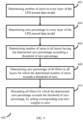
- FIG. 2 is a flow diagram depicting steps of a method 200 involved in the process of generating a data model for text processing, using the system of FIG. 1 , according to some embodiments of the present disclosure.
- step 202 of the method 200 in the system 100 obtains a) a training dataset, b) a test dataset, c) a pre-trained base model, d) a plurality of pre-trained weights, and e) an acceptable drop in accuracy with respect to the baseline model, as input.
- the training dataset contains one or more documents which may contain one or more images which may contain information/data.
- the test dataset may contain similar documents and data as in the training data, that may be fed as input to data models for determining efficiency and for various other purposes.
- For training the pre-trained data model a variety of documents containing images maybe used.
- the pre-trained weights maybe used during training of the pre-trained data model, and may be decided based on any standard neural network training approach.
- the acceptable drop in accuracy with respect to the baseline model indicates extent of accuracy drop permitted or may be tolerated.
- the pre-trained base model is pruned using a Lottery Ticket Hypothesis (LTH) algorithm, to obtain/generate a LTH pruned data model.
- LTH Lottery Ticket Hypothesis
- the system 100 trims the LTH pruned data model to obtain a structured pruned data model. By doing so, a smaller version of the LTH pruned data model is obtained.
- steps involved in the process of trimming the LTH pruned data model by the system 100 are depicted in method 300 in FIG. 3 , and are explained hereafter.
- a filter sparsity of every filter of each of a plurality of layers of the LTH pruned data model is determined.
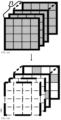
- the filter sparsity refers to extent/amount of values that are not significant, and are represented as zero. For example, in FIG. 6A , where there is no sparsity, all cells have been filled, whereas in FIG. 6B which depicts structural sparsity, empty cells maybe observed. Number of such cells are determined/calculated at step 302.
- the determined filter sparsity is compared with a threshold of filter sparsity, and at step 306 of the method 300, all filters for which the determined filter sparsity exceeds the threshold of filter sparsity are discarded. Discarding the filters causes structured pruning and a resulting data model after discarding the filters form the structured pruned data model. Various steps involved in the process of discarding the filters are depicted in FIG. 4 and are explained hereafter.
- the system 100 determines number of zeros in every layer of the LTH pruned data model. Further, at step 404 of the method 400, the system 100 determines value of zero percentage in every layer of the LTH pruned data model.
- the system 100 determines number of zeros in all layers having the determined zero percentage exceeding a threshold of zero percentage. Further, at step 408 of the method 400, the system 100 determines zero percentage of all filters in all the layers for which the determined number of zeros exceeds a threshold of zeros. Further, at step 410 of the method 400, the system 100 discards all filters for which the determined zero percentage exceeds the threshold of zero percentage, wherein the filters are discarded by setting corresponding non-zero weights to zero. For the filters discarded, the system 100 set gradient as zero, so that the zeroed weights set while discarding the filters remain as zero even after further training. In an embodiment, value of the threshold of zeros is decided after checking the zero percentage of every layer and by choosing the threshold of zeros as minimum zero percentage among all the layers.
- the system 100 fine-tunes the plurality of pre-trained weights which are obtained as input, by training the structured pruned data model for a pre-defined number of iterations.
- the pre-defined value of the number of iterations may be changed/adjusted as per requirements.
- Various steps involved in the process of fine-tuning the plurality of pre-trained weights are depicted in method 500 in FIG. 5 , and are explained hereafter.
- the system 100 initializes the structured pruned data model as a model to be trained. While initializing, the system 100 may use the plurality of pre-trained weights. Further, at step 504 of the method 500, the system 100 fine-tunes the structured pruned data model in a plurality of iterations, based on a calculated training loss, to obtain a plurality of trained data models.
- the system 100 evaluates a model_epoch model and the baseline model to generate results.
- the system 100 further determines Mean Square Error (MSE) loss between the model_epoch model results and baseline model results. This is referred to as MSEloss_results.
- MSEloss_results The MSEloss_results is then compared pixel-wise with the baseline results as:
- the system 100 determines value of sum_loss through positive loss (denoted as “posi_loss”) and negative loss (denoted as “nega_loss”)
- the system 100 determines accuracy in terms of precision and recall, for each of the plurality of trained models, for a test data fed as input.
- the system 100 retrains a data model that has been identified as having highest accuracy from among the plurality of trained models, to obtain a retrained data model. Further, at step 510 of the method 500, the system 100 determines accuracy drop of the retrained data model, for the test data fed as input, in comparison with accuracy of a previous model. Further, at step 512 of the method 500, the system 100 retrains the data model if the accuracy drop is exceeding a threshold of accuracy drop, in iterations, till the accuracy drop is below the threshold of accuracy drop.
- the system 100 determines the accuracy drop of the structured pruned data model based on the fine-tuned plurality of pre-trained weights. In an embodiment, the system 100 determines the accuracy drop of the structured pruned data model with reference to accuracy of a previous version of the structured pruned data model or with reference to accuracy of the baseline model. After every iteration if the accuracy drop is still exceeding the acceptable drop in accuracy, at step 312 of the method 300, the system 100 increases a pruning rate affecting rate of pruning of the LTH pruned data model by a pre-defined percentage and for a resulting structured pruned data model the aforementioned steps are performed.
- the system 100 trains the structured pruned data model (i.e. latest version for which the accuracy drop is below the acceptable drop in accuracy) is then trained using data from a teacher model in a Knowledge Distillation algorithm, wherein a resultant data model obtained after training the structured pruned data model forms the data model for text detection.
- the structured pruned data model i.e. latest version for which the accuracy drop is below the acceptable drop in accuracy
- the data model for text detection when deployed for real-time applications obtains and processes document(s) from which text detection is to be done as input, and outputs the identified text. Results obtained in such an implementation are given in the experimental data section below.
- a native CRAFT model was designed as teacher and compressed CRAFT networks as student with weight initialized by xavier initialization.
- the training was done on Nvidia A100 GPU with a batch size of 10.
- the distillation loss, ADAM Optimizer and L2 regularization with a decay of 10-4 is used.
- Down-scaled models for 500 epochs and LTH+channel pruned network for 150 epochs were trained.
- the model was put in evaluation mode and tested it on IC 15 and IC 19 datasets.
- test images were scaled to 1280 ⁇ 720 ⁇ 3 followed by image normalization using mean and variance.
- the model produced output sized (h/2,w/2,2) i.e (640,360,2), region and affinity feature maps.
- the output was converted to heat maps and polygons created over predicted textual regions.
- C8 model exhibited high compression with 5% accuracy drop.
- the data model generated by the system 100 suffered lower accuracy drop despite high compression.
- the data model generated by the system 100 have higher accuracy as compared to down-scaled models. For instance, 60 ⁇ compressed model, C8 has lower accuracy as compared to C18Pr model that is 80 ⁇ compressed.
- C6Pr offered the same accuracy as C8 model but offered higher (2.6 ⁇ ) compression.
- the precision of computation denotes the number of bits and datatype used in calculations.
- Lower precision compute offers higher computational power (in terms of GOP/S) which translated to performance improvements.
- V100 GPU supports FP32 and FP16 computations but the latter has 2 ⁇ the computational power [43].
- reducing the precision affects the prediction accuracy since the number of bits used in computation reduces. Effect on accuracy due to compute precision reduction was analyzed for native and compressed CRAFT models on V100 GPU, U280 FPGA DPU and Xeon CPU. Among the selected hardware platforms, all supported INT8 precision.
- Xeon supports FP32 and V100 supports both FP32 and FP16.
- the CRAFT and its compressed models were compiled for FPGA using VITISAI quantizer.
- TensorRT maps computation to tensor cores
- Pytorch are used for quantizing models on GPU and CPU, respectively.
- F1-score was chosen as the accuracy metric to capture the essence of both Precision and Recall. It takes a value between [0,1] where higher score denotes high precision and recall.
- the accuracy variation with compute precision on IC15 dataset is shown in FIG. 7A . It was observed that all CRAFT models: native and compressed, suffered 1-2% accuracy loss from their respective FP32 accuracy due to reduced precision. However, with respect to native CRAFT, the accuracy loss of compressed models is upto 8%. Among the compressed models, ChPr+LTH models suffered lower accuracy loss ( ⁇ 5%) than the down sampled models. This indicates that ChPr+LTH models perform better on accuracy than downsampled models after reducing precision.
- VITIS AI quantizer and GPU compiler are able to compress models from FP32 to INT8 with an accuracy drop of 0.3-1.7%.
- VITIS AI quantizer a calibration step is carried out that uses a small portion of test data to manipulate the quantized weights so that the accuracy drop can be minimized.
- smaller models C6Pr, C4 suffer lower accuracy loss with precision variation. This can be attributed to the lesser parameters and computational load of small models.
- the native and compressed CRAFT models were tested for inference time on GPU (A100, V100), FPGA (U280 DPU) and Xeon CPU. The performance of CRAFT model was tested for all supported precisions on target hardware platforms.
- Apex library is used to compile models for A100. The Apex library introduces 2:4 sparsity into models. 2:4 sparse models were supported on A100 GPU owing to its special hardware.
- the maximum throughput achieved by CRAFT models was on A100 GPU with INT8 precision in Apex and TensorRT compile (see Table IV).
- the native CRAFT model achieved the highest throughput of 23 fps on A100 with INT8 precision and Apex compilation.
- the INT8 C6Pr model gets 10 ⁇ speed-up w.r.t. FP32 implementation of native CRAFT. Additionally, C8 and C4 models showed 4-14 ⁇ significant performance improvement on CPU. The compressed models offered 5-8 ⁇ speed-up over native CRAFT and GPU implementations providing highest throughput. The FPGA DPU offers throughput between 88-98 fps. However, this observation alone did not rule out the usability of FPGA DPUs as preferable neural processors.
- the embodiments of present disclosure herein address unresolved problem of document processing and text detection using low memory footprint and non-process intensive approach.
- the embodiment thus provides a method and system for generating a data model for text identification from documents.
- the embodiments herein further provides a mechanism of pruning a baseline data model which involves discarding filters that have sparsity exceeding a threshold of sparsity.
- Such computer-readable storage means contain program-code means for implementation of one or more steps of the method, when the program runs on a server or mobile device or any suitable programmable device.
- the hardware device can be any kind of device which can be programmed including e.g., any kind of computer like a server or a personal computer, or the like, or any combination thereof.
- the device may also include means which could be e.g., hardware means like e.g., an application-specific integrated circuit (ASIC), a field-programmable gate array (FPGA), or a combination of hardware and software means, e.g., an ASIC and an FPGA, or at least one microprocessor and at least one memory with software processing components located therein.
- the means can include both hardware means and software means.
- the method embodiments described herein could be implemented in hardware and software.
- the device may also include software means. Alternatively, the embodiments may be implemented on different hardware devices, e.g., using a plurality of CPUs.
- the embodiments herein can comprise hardware and software elements.
- the embodiments that are implemented in software include but are not limited to, firmware, resident software, microcode, etc.
- the functions performed by various components described herein may be implemented in other components or combinations of other components.
- a computer-usable or computer readable medium can be any apparatus that can comprise, store, communicate, propagate, or transport the program for use by or in connection with the instruction execution system, apparatus, or device.
- a computer-readable storage medium refers to any type of physical memory on which information or data readable by a processor may be stored.
- a computer-readable storage medium may store instructions for execution by one or more processors, including instructions for causing the processor(s) to perform steps or stages consistent with the embodiments described herein.
- the term "computer-readable medium” should be understood to include tangible items and exclude carrier waves and transient signals, i.e., be non-transitory. Examples include random access memory (RAM), read-only memory (ROM), volatile memory, nonvolatile memory, hard drives, CD ROMs, DVDs, flash drives, disks, and any other known physical storage media.
Landscapes
- Engineering & Computer Science (AREA)
- Theoretical Computer Science (AREA)
- Physics & Mathematics (AREA)
- General Physics & Mathematics (AREA)
- Software Systems (AREA)
- Evolutionary Computation (AREA)
- General Health & Medical Sciences (AREA)
- Health & Medical Sciences (AREA)
- Artificial Intelligence (AREA)
- Computing Systems (AREA)
- Multimedia (AREA)
- Biomedical Technology (AREA)
- Molecular Biology (AREA)
- General Engineering & Computer Science (AREA)
- Computational Linguistics (AREA)
- Mathematical Physics (AREA)
- Biophysics (AREA)
- Life Sciences & Earth Sciences (AREA)
- Data Mining & Analysis (AREA)
- Computer Vision & Pattern Recognition (AREA)
- Medical Informatics (AREA)
- Databases & Information Systems (AREA)
- Machine Translation (AREA)
- Complex Calculations (AREA)
- Image Analysis (AREA)
Abstract
Description
- The present application claims priority to
Indian application no. 202221028692, filed on May 18, 2022 - The disclosure herein generally relates to the field of text processing, and, more particularly, to a method and system for generating a data model for text extraction from documents.
- Documents contain many images which in turn may contain a lot of information such as but not limited to texts, pictures and graphics. The texts in the images of physical documents is considered as the main data source for analysis task. Text regions can be used to label and train automatic layout learning systems or to detect and locate relevant fields in the document including title, keywords, subheadings, paragraphs and other structured regions (image/table). Segmenting text regions in the image, therefore, is a fundamental step before tasks like text recognition are performed.
- State of the art techniques used for document processing and particularly for handling processing of images for data extraction have the disadvantage that they are performance sensitive and computationally complex. They have large computational load and memory footprint, which causes data processing to take long time for inference and in turn makes them not suitable for real-time requirements.
- Embodiments of the present disclosure present technological improvements as solutions to one or more of the above-mentioned technical problems recognized by the inventors in conventional systems. For example, in one embodiment, a processor implemented method of obtaining a data model for text detection is provided. The method includes obtaining a) a training dataset, b) a test dataset, c) a pre-trained base model, d) a plurality of pre-trained weights, and e) an acceptable drop in accuracy with respect to the baseline model, as input. Further, the pre-trained base model is pruned using a Lottery Ticket Hypothesis (LTH) algorithm to generate a LTH pruned data model. Further, the LTH pruned data model is trimmed to obtain a structured pruned data model. Trimming the LTH pruned data model to obtain a structured pruned data model includes iteratively performing the following steps till an accuracy drop of the structured pruned data model is below the acceptable drop in accuracy. In this process, initially a filter sparsity of every filter of each of a plurality of layers of the structured pruned data model obtained after a preliminary pruning of the LTH pruned data model is determined. The determined filter sparsity is compared with a threshold of filter sparsity. Further, all filters for which the determined filter sparsity exceeds the threshold of filter sparsity are discarded, wherein discarding the filters causes structured pruning. Further, the plurality of pre-trained weights are fine-tuned by training the structured pruned data model for a pre-defined number of iterations. Further, the accuracy drop of the structured pruned data model is determined based on the fine-tuned plurality of pre-trained weights. After every iteration if the accuracy drop is still exceeding the acceptable drop in accuracy, a pruning rate affecting rate of pruning of the LTH pruned data model is increased by a pre-defined percentage and for a resulting pruned data model the aforementioned steps are performed. The structured pruned data model is then trained from a teacher model in a Knowledge Distillation algorithm, wherein a resultant data model obtained after training the structured pruned data model forms the data model for text detection.
- In another embodiment, discarding the filters includes initially determining number of zeros in every layer of the structured pruned data model. Further, zero percentage in every layer of the structured pruned data model is determined. Further, number of zeros in all layers having the determined zero percentage exceeding a threshold of zero percentage is determined. Further, zero percentage of all filters in all the layers for which the determined number of zeros exceeds a threshold of zeros is determined. Further, all filters for which the determined zero percentage exceeds the threshold of zero percentage are discarded, wherein the filters are discarded by setting corresponding non-zero weights to zero.
- In yet another embodiment, a system for obtaining a data model for text detection is provided. The system includes one or more hardware processors, a communication interface, and a memory (104) storing a plurality of instructions. The plurality of instructions when executed, cause the one or more hardware processors to initially obtain a) a training dataset, b) a test dataset, c) a pre-trained base model, d) a plurality of pre-trained weights, and e) an acceptable drop in accuracy with respect to the baseline model, as input. The system then prunes the pre-trained base model using a Lottery Ticket Hypothesis (LTH) algorithm to generate a LTH pruned data model. The system further trims the LTH pruned data model to obtain a structured pruned data model, by iteratively performing the following steps till an accuracy drop of the structured pruned data model is below the acceptable drop in accuracy. In this process, initially a filter sparsity of every filter of each of a plurality of layers of the structured pruned data model obtained after a preliminary pruning of the LTH pruned data model is determined. The determined filter sparsity is compared with a threshold of filter sparsity. Further, all filters for which the determined filter sparsity exceeds the threshold of filter sparsity are discarded, wherein discarding the filters causes structured pruning. Further, the plurality of pre-trained weights are fine-tuned by training the structured pruned data model for a pre-defined number of iterations. Further, the accuracy drop of the structured pruned data model is determined based on the fine-tuned plurality of pre-trained weights. After every iteration if the accuracy drop is still exceeding the acceptable drop in accuracy, a pruning rate affecting rate of pruning of the LTH pruned data model is increased by a pre-defined percentage and for a resulting pruned data model the aforementioned steps are performed. The structured pruned data model is then trained from a teacher model in a Knowledge Distillation algorithm, wherein a resultant data model obtained after training the structured pruned data model forms the data model for text detection.
- In yet another embodiment, the system discards the filters by initially determining number of zeros in every layer of the structured pruned data model. Further, zero percentage in every layer of the structured pruned data model is determined. Further, number of zeros in all layers having the determined zero percentage exceeding a threshold of zero percentage is determined. Further, zero percentage of all filters in all the layers for which the determined number of zeros exceeds a threshold of zeros is determined. Further, all filters for which the determined zero percentage exceeds the threshold of zero percentage are discarded, wherein the filters are discarded by setting corresponding non-zero weights to zero.
- In yet another embodiment, a non-transitory computer readable medium for obtaining a data model for text detection is provided. The non-transitory computer readable medium includes a plurality of instructions which when executed, cause one or more hardware processors to perform the following steps to obtain the data model. In this method, a) a training dataset, b) a test dataset, c) a pre-trained base model, d) a plurality of pre-trained weights, and e) an acceptable drop in accuracy with respect to the baseline model, are obtained as input. Further, the pre-trained base model is pruned using a Lottery Ticket Hypothesis (LTH) algorithm to generate a LTH pruned data model. Further, the LTH pruned data model is trimmed to obtain a structured pruned data model. Trimming the LTH pruned data model to obtain a structured pruned data model includes iteratively performing the following steps till an accuracy drop of the structured pruned data model is below the acceptable drop in accuracy. In this process, initially a filter sparsity of every filter of each of a plurality of layers of the structured pruned data model obtained after a preliminary pruning of the LTH pruned data model is determined. The determined filter sparsity is compared with a threshold of filter sparsity. Further, all filters for which the determined filter sparsity exceeds the threshold of filter sparsity are discarded, wherein discarding the filters causes structured pruning. Further, the plurality of pre-trained weights are fine-tuned by training the structured pruned data model for a pre-defined number of iterations. Further, the accuracy drop of the structured pruned data model is determined based on the fine-tuned plurality of pre-trained weights. After every iteration if the accuracy drop is still exceeding the acceptable drop in accuracy, a pruning rate affecting rate of pruning of the LTH pruned data model is increased by a pre-defined percentage and for a resulting pruned data model the aforementioned steps are performed. The structured pruned data model is then trained from a teacher model in a Knowledge Distillation algorithm, wherein a resultant data model obtained after training the structured pruned data model forms the data model for text detection.
- In another embodiment, the non-transitory computer readable medium causes discarding of the filters by initially determining number of zeros in every layer of the structured pruned data model. Further, zero percentage in every layer of the structured pruned data model is determined. Further, number of zeros in all layers having the determined zero percentage exceeding a threshold of zero percentage is determined. Further, zero percentage of all filters in all the layers for which the determined number of zeros exceeds a threshold of zeros is determined. Further, all filters for which the determined zero percentage exceeds the threshold of zero percentage are discarded, wherein the filters are discarded by setting corresponding non-zero weights to zero.
- It is to be understood that both the foregoing general description and the following detailed description are exemplary and explanatory only and are not restrictive of the invention, as claimed.
- The accompanying drawings, which are incorporated in and constitute a part of this disclosure, illustrate exemplary embodiments and, together with the description, serve to explain the disclosed principles:
-
FIG. 1 is a block diagram of a system for generating a data model for text processing, according to some embodiments of the present disclosure. -
FIG. 2 is a flow diagram depicting steps involved in the process of generating a data model for text processing, using the system ofFIG. 1 , according to some embodiments of the present disclosure. -
FIG. 3 is a flow diagram depicting steps involved in the process of obtaining a structured pruned data model from a LTH pruned data model, using the system ofFIG. 1 , according to some embodiments of the present disclosure. -
FIG. 4 is a flow diagram depicting steps involved in the process of discarding filters while generating the structured pruned data model, using the system ofFIG. 1 , according to some embodiments of the present disclosure. -
FIG. 5 is a flow diagram depicting steps involved in the process of fine-tuning the plurality of pre-trained weights and determining the accuracy drop, using the system ofFIG. 1 , according to some embodiments of the present disclosure. -
FIGS. 6A and 6B depict obtaining structured sparsity from no sparsity, while obtaining the pruned data model by the system ofFIG. 1 , according to some embodiments of the present disclosure. -
FIGS. 7A and7B depict accuracy variation and throughput variation in an experimental setup of the system ofFIG. 1 , according to some embodiments of the present disclosure. -
FIG. 7C depicts throughput variation with batch size in an experimental setup, according to some embodiments of the present disclosure. - Exemplary embodiments are described with reference to the accompanying drawings. In the figures, the left-most digit(s) of a reference number identifies the figure in which the reference number first appears. Wherever convenient, the same reference numbers are used throughout the drawings to refer to the same or like parts. While examples and features of disclosed principles are described herein, modifications, adaptations, and other implementations are possible without departing from the scope of the disclosed embodiments.
- Referring now to the drawings, and more particularly to
FIG. 1 through FIG. 7C , where similar reference characters denote corresponding features consistently throughout the figures, there are shown preferred embodiments and these embodiments are described in the context of the following exemplary system and/or method. -
FIG. 1 is a block diagram of asystem 100 for generating a data model for text processing, according to some embodiments of the present disclosure. Thesystem 100 includes or is otherwise in communication withhardware processors 102, at least one memory such as amemory 104, an I/O interface 112. Thehardware processors 102,memory 104, and the Input /Output (I/O)interface 112 may be coupled by a system bus such as asystem bus 108 or a similar mechanism. In an embodiment, thehardware processors 102 can be one or more hardware processors. - The I/
O interface 112 may include a variety of software and hardware interfaces, for example, a web interface, a graphical user interface, and the like. The I/O interface 112 may include a variety of software and hardware interfaces, for example, interfaces for peripheral device(s), such as a keyboard, a mouse, an external memory, a printer and the like. Further, the I/O interface 112 may enable thesystem 100 to communicate with other devices, such as web servers, and external databases. - The I/
O interface 112 can facilitate multiple communications within a wide variety of networks and protocol types, including wired networks, for example, local area network (LAN), cable, etc., and wireless networks, such as Wireless LAN (WLAN), cellular, or satellite. For the purpose, the I/O interface 112 may include one or more ports for connecting several computing systems with one another or to another server computer. The I/O interface 112 may include one or more ports for connecting several devices to one another or to another server. - The one or
more hardware processors 102 may be implemented as one or more microprocessors, microcomputers, microcontrollers, digital signal processors, central processing units, node machines, logic circuitries, and/or any devices that manipulate signals based on operational instructions. Among other capabilities, the one ormore hardware processors 102 is configured to fetch and execute computer-readable instructions stored in thememory 104. - The
memory 104 may include any computer-readable medium known in the art including, for example, volatile memory, such as static random-access memory (SRAM) and dynamic random-access memory (DRAM), and/or non-volatile memory, such as read only memory (ROM), erasable programmable ROM, flash memories, hard disks, optical disks, and magnetic tapes. In an embodiment, thememory 104 includes a plurality ofmodules 106. - The plurality of
modules 106 include programs or coded instructions that supplement applications or functions performed by thesystem 100 for executing different steps involved in the process of generating the data model for text extraction from documents, being performed by thesystem 100. The plurality ofmodules 106, amongst other things, can include routines, programs, objects, components, and data structures, which performs particular tasks or implement particular abstract data types. The plurality ofmodules 106 may also be used as, signal processor(s), node machine(s), logic circuitries, and/or any other device or component that manipulates signals based on operational instructions. Further, the plurality ofmodules 106 can be used by hardware, by computer-readable instructions executed by the one ormore hardware processors 102, or by a combination thereof. The plurality ofmodules 106 can include various sub-modules (not shown). The plurality ofmodules 106 may include computer-readable instructions that supplement applications or functions performed by thesystem 100 for generating the data model for text extraction from documents. - The data repository (or repository) 110 may include a plurality of abstracted piece of code for refinement and data that is processed, received, or generated as a result of the execution of the plurality of modules in the module(s) 106.
- Although the
data repository 110 is shown internal to thesystem 100, it will be noted that, in alternate embodiments, thedata repository 110 can also be implemented external to thesystem 100, where thedata repository 110 may be stored within a database (repository 110) communicatively coupled to thesystem 100. The data contained within such external database may be periodically updated. For example, new data may be added into the database (not shown inFIG. 1 ) and/or existing data may be modified and/or non-useful data may be deleted from the database. In one example, the data may be stored in an external system, such as a Lightweight Directory Access Protocol (LDAP) directory and a Relational Database Management System (RDBMS). Functions of the components of thesystem 100 are now explained with reference to steps in flow diagrams inFIG. 2 andFIG. 3 . -
FIG. 2 is a flow diagram depicting steps of amethod 200 involved in the process of generating a data model for text processing, using the system ofFIG. 1 , according to some embodiments of the present disclosure. - At
step 202 of themethod 200 in thesystem 100 obtains a) a training dataset, b) a test dataset, c) a pre-trained base model, d) a plurality of pre-trained weights, and e) an acceptable drop in accuracy with respect to the baseline model, as input. The training dataset contains one or more documents which may contain one or more images which may contain information/data. The test dataset may contain similar documents and data as in the training data, that may be fed as input to data models for determining efficiency and for various other purposes. For training the pre-trained data model, a variety of documents containing images maybe used. The pre-trained weights maybe used during training of the pre-trained data model, and may be decided based on any standard neural network training approach. The acceptable drop in accuracy with respect to the baseline model indicates extent of accuracy drop permitted or may be tolerated. - Further, at
step 204 of themethod 200, the pre-trained base model is pruned using a Lottery Ticket Hypothesis (LTH) algorithm, to obtain/generate a LTH pruned data model. Further, atstep 206 of themethod 200, thesystem 100 trims the LTH pruned data model to obtain a structured pruned data model. By doing so, a smaller version of the LTH pruned data model is obtained. Various steps involved in the process of trimming the LTH pruned data model by thesystem 100 are depicted inmethod 300 inFIG. 3 , and are explained hereafter. - The steps in the
method 300 are iteratively performed till an accuracy drop of the structured pruned data model is below the acceptable drop in accuracy. In this process, atstep 302 of themethod 300, a filter sparsity of every filter of each of a plurality of layers of the LTH pruned data model is determined. The filter sparsity refers to extent/amount of values that are not significant, and are represented as zero. For example, inFIG. 6A , where there is no sparsity, all cells have been filled, whereas inFIG. 6B which depicts structural sparsity, empty cells maybe observed. Number of such cells are determined/calculated atstep 302. Further, atstep 304 of themethod 300, the determined filter sparsity is compared with a threshold of filter sparsity, and atstep 306 of themethod 300, all filters for which the determined filter sparsity exceeds the threshold of filter sparsity are discarded. Discarding the filters causes structured pruning and a resulting data model after discarding the filters form the structured pruned data model. Various steps involved in the process of discarding the filters are depicted inFIG. 4 and are explained hereafter. - At
step 402 ofmethod 400 inFIG. 4 , thesystem 100 determines number of zeros in every layer of the LTH pruned data model. Further, atstep 404 of themethod 400, thesystem 100 determines value of zero percentage in every layer of the LTH pruned data model. The term "zero percentage" refers to percentage of zero values in each layer, and is determined as:
- Further, at
step 406 of themethod 400, thesystem 100 determines number of zeros in all layers having the determined zero percentage exceeding a threshold of zero percentage. Further, atstep 408 of themethod 400, thesystem 100 determines zero percentage of all filters in all the layers for which the determined number of zeros exceeds a threshold of zeros. Further, atstep 410 of themethod 400, thesystem 100 discards all filters for which the determined zero percentage exceeds the threshold of zero percentage, wherein the filters are discarded by setting corresponding non-zero weights to zero. For the filters discarded, thesystem 100 set gradient as zero, so that the zeroed weights set while discarding the filters remain as zero even after further training. In an embodiment, value of the threshold of zeros is decided after checking the zero percentage of every layer and by choosing the threshold of zeros as minimum zero percentage among all the layers. - Referring back
FIG. 3 , atstep 308 of themethod 300, thesystem 100 fine-tunes the plurality of pre-trained weights which are obtained as input, by training the structured pruned data model for a pre-defined number of iterations. The pre-defined value of the number of iterations may be changed/adjusted as per requirements. Various steps involved in the process of fine-tuning the plurality of pre-trained weights are depicted inmethod 500 inFIG. 5 , and are explained hereafter. - At
step 502 of themethod 500, thesystem 100 initializes the structured pruned data model as a model to be trained. While initializing, thesystem 100 may use the plurality of pre-trained weights. Further, atstep 504 of themethod 500, thesystem 100 fine-tunes the structured pruned data model in a plurality of iterations, based on a calculated training loss, to obtain a plurality of trained data models. - To calculate the training loss, the
system 100 evaluates a model_epoch model and the baseline model to generate results. Thesystem 100 further determines Mean Square Error (MSE) loss between the model_epoch model results and baseline model results. This is referred to as MSEloss_results. The MSEloss_results is then compared pixel-wise with the baseline results as:
  positive_pixel = len(MSEloss_results[i][(baseline_results[i] >= 0.1)])
      and positive_pixel is recorded.
  if positive_pixel != 0:
  for all pixel in the test_image:
  posi_loss[i] = torch.mean(MSEloss_results[i][(baseline_results[i] >= 0.1)])
  if len(MSEloss_results[i][(baseline_results[i] < 0.1)]) < 3 * positive_pixel:
  For all pixels in the test image:
  nega_loss[i]= torch.mean(MSEloss_results[i][(baseline_results[i] < 0.1)])< 0.1)])
  if len(MSEloss_results[i][(baseline_results[i] < 0.1)]) ≥ 3 * positive_pixel:
  nega_loss=torch.mean(torch.topk(MSEloss_results[i][(baseline_results[i]< 0.1)],
  3 * positive_pixel)[0])
  sum_loss = summation of (posi_loss[i]+nega_loss[i]) over all pixels in the test
  image.
  if positive_pixel == 0:
  for all pixels in the test image:
  nega_loss[i] = torch.mean(torch.topk(MSEloss_results[i], 500)[0])
  Step j: sum_loss = summation of (nega _loss[i]) over all pixels in test image.
  sum_loss is the final total loss used in backward propagation during training i.e.
  training loss.


- true positive (TP) :- A test result that correctly indicates the presence of a condition or characteristic
- true negative (TN) :- A test result that correctly indicates the absence of a condition or characteristic
- false positive (FP):- A test result which wrongly indicates that a particular condition or attribute is present
- false negative (FN):- A test result which wrongly indicates that a particular condition or attribute is absent
- ICDAR 2015 dataset which consists of 1000 training images and 500 testing images with texts in English and RGB format with a resolution of 720×1280. The text instances are labelled at the word level and ground truth consists of quadrilateral boxes in 8-point coordinate system for every word.
- ICDAR 2019 which is a Scanned Receipts OCR and Information Extraction (SROIE) dataset consists of 626 and 361 scanned receipt images for training and testing, respectively, with text bounding box annotation in 8-point coordinate form.
- 1) Effect of Batch-size on throughput: For throughput measurement experiments, average time to run n calls to a batch of b images was measured. It was observed that it took large time to run the first batch whereas the subsequent batches were able to finish in three order lesser time. This behaviour was seen dominantly in GPUs for all CRAFT variants. The large time (in order of sec) taken during first run is spent in transferring the model parameters, loading library engines (TensorRT, Pytorch, Apex etc.) and prepare the GPU for upcoming workload. This was defined as a priming time. The throughput data did not include GPU priming time. However, in a real-deployment scenario priming time cannot be neglected especially since it ranges in few seconds. Variation of throughput with batch size for C6Pr INT8 model on IC15 dataset in
FIG. 7C . It was observed that DPU have higher throughput as compared to GPUs for batch size upto 12 images (indicated as DPUGPU crossover). For batch size upto 20 (indicated as A100-V100 crossover1) images, A100 and V100 had similar throughput beyond which A100 offers higher throughput than V100. The two GPUs performed similar for batch size upto 80 (indicated as A100-V100 crossover2) if priming time is accounted for in throughput. For large batch sizes, the priming time gets amortized over large number of images and consequently the throughput improves consistently. This observation indicated that hardware platform with best throughput changes with batch size, which further depends on the workload and nature of application.
Claims (9)
- A processor implemented method (200) of obtaining a data model for text detection, comprising:obtaining (202), via one or more hardware processors, a) a training dataset, b) a test dataset, c) a pre-trained base model, d) a plurality of pre-trained weights, and e) an acceptable drop in accuracy with respect to the baseline model, as input;pruning (204), via the one or more hardware processors, the pre-trained base model using a Lottery Ticket Hypothesis (LTH) algorithm to generate a LTH pruned data model;trimming (206), via the one or more hardware processors, the LTH pruned data model to obtain a structured pruned data model, comprising iteratively performing till an accuracy drop of the structured pruned data model is below the acceptable drop in accuracy:determining (302) a filter sparsity of every filter of each of a plurality of layers of the LTH pruned data model;comparing (304) the determined filter sparsity with a threshold of filter sparsity;discarding (306) all filters for which the determined filter sparsity exceeds the threshold of filter sparsity, whereindiscarding the filters causes structured pruning and a resulting data model after discarding the filters form the structured pruned data model;fine-tuning (308) the plurality of pre-trained weights by training the structured pruned data model for a pre-defined number of iterations;determining (310) the accuracy drop of the structured pruned data model based on the fine-tuned plurality of pre-trained weights; andincreasing (312) a pruning rate affecting rate of the preliminary pruning of the LTH pruned data model, by a pre-defined percentage; andtraining (208), via the one or more hardware processors, the structured pruned data model from a teacher model in a Knowledge Distillation algorithm, wherein a resultant data model obtained after training the structured pruned data model forms the data model for text detection.
- The method of claim 1, wherein discarding the filters comprises:determining (402) number of zeros in every layer of the LTH pruned data model;determining (404) zero percentage in every layer of the LTH pruned data model;determining (406) number of zeros in all layers having the determined zero percentage exceeding a threshold of zero percentage;determining (408) zero percentage of all filters in all the layers for which the determined number of zeros exceeds a threshold of zeros; anddiscarding (410) all filters for which the determined zero percentage exceeds the threshold of zero percentage, wherein the filters are discarded by setting corresponding non-zero weights to zero.
- The method of claim 1, wherein fine-tuning the plurality of pre-trained weights and determining the accuracy drop comprises:initializing (502) the structured pruned data model as a model to be trained;fine-tuning (504) the structured pruned data model in a plurality of iterations, based on a calculated training loss, to obtain a plurality of trained data models;determining (506) accuracy in terms of precision and recall, for each of the plurality of trained models, for a test data fed as input;retraining (508) a data model that has been identified as having highest accuracy from among the plurality of trained models;determining (510) accuracy drop of the retrained data model, for the test data fed as input; andretraining (512) the data model if the accuracy drop is exceeding a threshold of accuracy drop, in iterations, till the accuracy drop is below the threshold of accuracy drop.
- A system (100) for obtaining a data model for text detection, comprising:one or more hardware processors (102);a communication interface (112); anda memory (104) storing a plurality of instructions, wherein the plurality of instructions when executed, cause the one or more hardware processors to:obtain a) a training dataset, b) a test dataset, c) a pre-trained base model, d) a plurality of pre-trained weights, and e) an acceptable drop in accuracy with respect to the baseline model, as input;prune the pre-trained base model using a Lottery Ticket Hypothesis (LTH) algorithm to generate a LTH pruned data model;trim the LTH pruned data model to obtain a structured pruned data model, comprising iteratively performing till an accuracy drop of the structured pruned data model is below the acceptable drop in accuracy:determining a filter sparsity of every filter of each of a plurality of layers of the LTH pruned data model;comparing the determined filter sparsity with a threshold of filter sparsity;discarding all filters for which the determined filter sparsity exceeds the threshold of filter sparsity, whereindiscarding the filters causes structured pruning and a resulting data model after discarding the filters forms the structured pruned data model;fine-tuning the plurality of pre-trained weights by training the structured pruned data model for a pre-defined number of iterations;determining the accuracy drop of the structured pruned data model based on the fine-tuned plurality of pre-trained weights; andincreasing a pruning rate affecting rate of the preliminary pruning of the LTH pruned data model, by a pre-defined percentage; andtrain the structured pruned data model from a teacher model in a Knowledge Distillation algorithm, wherein a resultant data model obtained after training the structured pruned data model forms the data model for text detection.
- The system as claimed in claim 4, wherein the one or more hardware processors are configured to discard the filters by:determining number of zeros in every layer of the structured pruned data model;determining zero percentage in every layer of the structured pruned data model;determining number of zeros in all layers having the determined zero percentage exceeding a threshold of zero percentage;determining zero percentage of all filters in all the layers for which the determined number of zeros exceeds a threshold of zeros; anddiscarding all filters for which the determined zero percentage exceeds the threshold of zero percentage, wherein the filters are discarded by setting corresponding non-zero weights to zero.
- The system as claimed in claim 4, wherein the one or more hardware processors are configured to fine-tune the plurality of pre-trained weights and determining the accuracy drop by:initializing the structured pruned data model as a model to be trained;fine-tuning the structured pruned data model in a plurality of iterations, based on a calculated training loss, to obtain a plurality of trained data models;determining accuracy in terms of precision and recall, for each of the plurality of trained models, for a test data fed as input;retraining a data model that has been identified as having highest accuracy from among the plurality of trained models;determining accuracy drop of the retrained data model, for the test data fed as input; andretraining the data model if the accuracy drop is exceeding a threshold of accuracy drop, in iterations, till the accuracy drop is below the threshold of accuracy drop.
- One or more non-transitory machine-readable information storage mediums comprising one or more instructions which when executed by one or more hardware processors cause:obtaining a) a training dataset, b) a test dataset, c) a pre-trained base model, d) a plurality of pre-trained weights, and e) an acceptable drop in accuracy with respect to the baseline model, as input;pruning the pre-trained base model using a Lottery Ticket Hypothesis (LTH) algorithm to generate a LTH pruned data model;trimming the LTH pruned data model to obtain a structured pruned data model, comprising iteratively performing till an accuracy drop of the structured pruned data model is below the acceptable drop in accuracy:determining a filter sparsity of every filter of each of a plurality of layers of the LTH pruned data model;comparing the determined filter sparsity with a threshold of filter sparsity;discarding all filters for which the determined filter sparsity exceeds the threshold of filter sparsity, wherein discarding the filters causes structured pruning and a resulting data model after discarding the filters form the structured pruned data model;fine-tuning the plurality of pre-trained weights by training the structured pruned data model for a pre-defined number of iterations;determining the accuracy drop of the structured pruned data model based on the fine-tuned plurality of pre-trained weights; andincreasing a pruning rate affecting rate of the preliminary pruning of the LTH pruned data model, by a pre-defined percentage; andtraining the structured pruned data model from a teacher model in a Knowledge Distillation algorithm, wherein a resultant data model obtained after training the structured pruned data model forms the data model for text detection.
- The one or more non-transitory machine-readable information storage mediums of claim 7, wherein discarding the filters comprises:determining number of zeros in every layer of the LTH pruned data model;determining zero percentage in every layer of the LTH pruned data model;determining number of zeros in all layers having the determined zero percentage exceeding a threshold of zero percentage;determining zero percentage of all filters in all the layers for which the determined number of zeros exceeds a threshold of zeros; anddiscarding all filters for which the determined zero percentage exceeds the threshold of zero percentage, wherein the filters are discarded by setting corresponding non-zero weights to zero.
- The one or more non-transitory machine-readable information storage mediums of claim 7, wherein fine-tuning the plurality of pre-trained weights and determining the accuracy drop comprises:initializing the structured pruned data model as a model to be trained;fine-tuning the structured pruned data model in a plurality of iterations, based on a calculated training loss, to obtain a plurality of trained data models;determining accuracy in terms of precision and recall, for each of the plurality of trained models, for a test data fed as input;retraining a data model that has been identified as having highest accuracy from among the plurality of trained models;determining accuracy drop of the retrained data model, for the test data fed as input; andretraining the data model if the accuracy drop is exceeding a threshold of accuracy drop, in iterations, till the accuracy drop is below the threshold of accuracy drop.
Applications Claiming Priority (1)
| Application Number | Priority Date | Filing Date | Title |
|---|---|---|---|
| IN202221028692 | 2022-05-18 |
Publications (3)
| Publication Number | Publication Date |
|---|---|
| EP4280118A1 true EP4280118A1 (en) | 2023-11-22 |
| EP4280118C0 EP4280118C0 (en) | 2024-11-20 |
| EP4280118B1 EP4280118B1 (en) | 2024-11-20 |
Family
ID=85792671
Family Applications (1)
| Application Number | Title | Priority Date | Filing Date |
|---|---|---|---|
| EP23165277.7A Active EP4280118B1 (en) | 2022-05-18 | 2023-03-30 | Method and system for generating a data model for text extraction from documents |
Country Status (2)
| Country | Link |
|---|---|
| US (1) | US12367697B2 (en) |
| EP (1) | EP4280118B1 (en) |
Citations (1)
| Publication number | Priority date | Publication date | Assignee | Title |
|---|---|---|---|---|
| US20190362235A1 (en) * | 2018-05-23 | 2019-11-28 | Xiaofan Xu | Hybrid neural network pruning |
Family Cites Families (1)
| Publication number | Priority date | Publication date | Assignee | Title |
|---|---|---|---|---|
| US11200497B1 (en) * | 2021-03-16 | 2021-12-14 | Moffett Technologies Co., Limited | System and method for knowledge-preserving neural network pruning |
-
2023
- 2023-03-30 EP EP23165277.7A patent/EP4280118B1/en active Active
- 2023-03-31 US US18/129,155 patent/US12367697B2/en active Active
Patent Citations (1)
| Publication number | Priority date | Publication date | Assignee | Title |
|---|---|---|---|---|
| US20190362235A1 (en) * | 2018-05-23 | 2019-11-28 | Xiaofan Xu | Hybrid neural network pruning |
Non-Patent Citations (5)
| Title |
|---|
| CHEN LIYANG ET AL: "Knowledge from the original network: restore a better pruned network with knowledge distillation", COMPLEX & INTELLIGENT SYSTEMS, 10 January 2021 (2021-01-10), pages 1 - 10, XP055899292, ISSN: 2199-4536, Retrieved from the Internet <URL:https://link.springer.com/content/pdf/10.1007/s40747-020-00248-y.pdf> DOI: 10.1007/s40747-020-00248-y * |
| JONATHAN FRANKLE ET AL: "The Lottery Ticket Hypothesis: Finding Sparse, Trainable Neural Networks", ARXIV.ORG, CORNELL UNIVERSITY LIBRARY, 201 OLIN LIBRARY CORNELL UNIVERSITY ITHACA, NY 14853, 9 March 2018 (2018-03-09), XP081127758 * |
| KAIQI ZHAO ET AL: "Iterative Activation-based Structured Pruning", ARXIV.ORG, CORNELL UNIVERSITY LIBRARY, 201 OLIN LIBRARY CORNELL UNIVERSITY ITHACA, NY 14853, 22 January 2022 (2022-01-22), XP091139739 * |
| SUMEET NUPUR ET AL: "High-Performance Deployment of Text Detection Model: Compression and Hardware Platform considerations", 2022 IEEE INTERNATIONAL SYMPOSIUM ON PERFORMANCE ANALYSIS OF SYSTEMS AND SOFTWARE (ISPASS), IEEE, 22 May 2022 (2022-05-22), pages 159 - 161, XP034140882, DOI: 10.1109/ISPASS55109.2022.00022 * |
| YANG PENG ET AL: "A Fast Scene Text Detector Using Knowledge Distillation", IEEE ACCESS, vol. 7, 25 January 2019 (2019-01-25), pages 22588 - 22598, XP011712091, DOI: 10.1109/ACCESS.2019.2895330 * |
Also Published As
| Publication number | Publication date |
|---|---|
| EP4280118C0 (en) | 2024-11-20 |
| EP4280118B1 (en) | 2024-11-20 |
| US20240005686A1 (en) | 2024-01-04 |
| US12367697B2 (en) | 2025-07-22 |
Similar Documents
| Publication | Publication Date | Title |
|---|---|---|
| US12174871B2 (en) | Systems and methods for parsing log files using classification and a plurality of neural networks | |
| US10482174B1 (en) | Systems and methods for identifying form fields | |
| US20190385054A1 (en) | Text field detection using neural networks | |
| US20200134382A1 (en) | Neural network training utilizing specialized loss functions | |
| US12148131B2 (en) | Generating an inpainted image from a masked image using a patch-based encoder | |
| CN113435594B (en) | Security detection model training method, device, equipment and storage medium | |
| CN112132279A (en) | Convolutional neural network model compression method, device, equipment and storage medium | |
| WO2024060684A1 (en) | Model training method, image processing method, device, and storage medium | |
| CN113159013A (en) | Paragraph identification method and device based on machine learning, computer equipment and medium | |
| US12536251B2 (en) | Adaptive learning based systems and methods for optimization of unsupervised clustering | |
| US11410016B2 (en) | Selective performance of deterministic computations for neural networks | |
| EP4089568A1 (en) | Cascade pooling for natural language document processing | |
| CN118864876A (en) | Zero-sample anomaly detection method and device based on image and text pre-training model | |
| CN117710295A (en) | Image processing method, device, apparatus, medium, and program product | |
| US20240013516A1 (en) | Method and system for deep learning based image feature extraction | |
| US11715288B2 (en) | Optical character recognition using specialized confidence functions | |
| CN111784031A (en) | Logistics vehicle classification and prediction method, device, equipment and storage medium | |
| US20240020517A1 (en) | Real-time inference of temporal down-sampling convolutional networks | |
| CN111160368A (en) | Method, device and equipment for detecting target in image and storage medium | |
| US12367697B2 (en) | Method and system for generating a data model for text extraction from documents | |
| CN117058692B (en) | Character recognition error correction method, device, equipment and medium based on artificial intelligence | |
| EP4303769B1 (en) | Method and system for identifying and mitigating bias while training deep learning models | |
| CN118115749A (en) | Graphic code identification method, device, equipment and storage medium | |
| CN116777947B (en) | User track recognition prediction method and device and electronic equipment | |
| US12632486B2 (en) | Systems and methods for parsing log files using classification and a plurality of neural networks |
Legal Events
| Date | Code | Title | Description |
|---|---|---|---|
| PUAI | Public reference made under article 153(3) epc to a published international application that has entered the european phase |
Free format text: ORIGINAL CODE: 0009012 |
|
| STAA | Information on the status of an ep patent application or granted ep patent |
Free format text: STATUS: THE APPLICATION HAS BEEN PUBLISHED |
|
| STAA | Information on the status of an ep patent application or granted ep patent |
Free format text: STATUS: REQUEST FOR EXAMINATION WAS MADE |
|
| AK | Designated contracting states |
Kind code of ref document: A1 Designated state(s): AL AT BE BG CH CY CZ DE DK EE ES FI FR GB GR HR HU IE IS IT LI LT LU LV MC ME MK MT NL NO PL PT RO RS SE SI SK SM TR |
|
| 17P | Request for examination filed |
Effective date: 20231027 |
|
| RBV | Designated contracting states (corrected) |
Designated state(s): AL AT BE BG CH CY CZ DE DK EE ES FI FR GB GR HR HU IE IS IT LI LT LU LV MC ME MK MT NL NO PL PT RO RS SE SI SK SM TR |
|
| STAA | Information on the status of an ep patent application or granted ep patent |
Free format text: STATUS: EXAMINATION IS IN PROGRESS |
|
| 17Q | First examination report despatched |
Effective date: 20240112 |
|
| GRAP | Despatch of communication of intention to grant a patent |
Free format text: ORIGINAL CODE: EPIDOSNIGR1 |
|
| STAA | Information on the status of an ep patent application or granted ep patent |
Free format text: STATUS: GRANT OF PATENT IS INTENDED |
|
| GRAS | Grant fee paid |
Free format text: ORIGINAL CODE: EPIDOSNIGR3 |
|
| GRAA | (expected) grant |
Free format text: ORIGINAL CODE: 0009210 |
|
| STAA | Information on the status of an ep patent application or granted ep patent |
Free format text: STATUS: THE PATENT HAS BEEN GRANTED |
|
| INTG | Intention to grant announced |
Effective date: 20240926 |
|
| AK | Designated contracting states |
Kind code of ref document: B1 Designated state(s): AL AT BE BG CH CY CZ DE DK EE ES FI FR GB GR HR HU IE IS IT LI LT LU LV MC ME MK MT NL NO PL PT RO RS SE SI SK SM TR |
|
| REG | Reference to a national code |
Ref country code: GB Ref legal event code: FG4D |
|
| REG | Reference to a national code |
Ref country code: CH Ref legal event code: EP |
|
| REG | Reference to a national code |
Ref country code: DE Ref legal event code: R096 Ref document number: 602023001060 Country of ref document: DE |
|
| REG | Reference to a national code |
Ref country code: IE Ref legal event code: FG4D |
|
| U01 | Request for unitary effect filed |
Effective date: 20241120 |
|
| U07 | Unitary effect registered |
Designated state(s): AT BE BG DE DK EE FI FR IT LT LU LV MT NL PT RO SE SI Effective date: 20241126 |
|
| PG25 | Lapsed in a contracting state [announced via postgrant information from national office to epo] |
Ref country code: IS Free format text: LAPSE BECAUSE OF FAILURE TO SUBMIT A TRANSLATION OF THE DESCRIPTION OR TO PAY THE FEE WITHIN THE PRESCRIBED TIME-LIMIT Effective date: 20250320 Ref country code: HR Free format text: LAPSE BECAUSE OF FAILURE TO SUBMIT A TRANSLATION OF THE DESCRIPTION OR TO PAY THE FEE WITHIN THE PRESCRIBED TIME-LIMIT Effective date: 20241120 |
|
| PG25 | Lapsed in a contracting state [announced via postgrant information from national office to epo] |
Ref country code: ES Free format text: LAPSE BECAUSE OF FAILURE TO SUBMIT A TRANSLATION OF THE DESCRIPTION OR TO PAY THE FEE WITHIN THE PRESCRIBED TIME-LIMIT Effective date: 20241120 |
|
| PG25 | Lapsed in a contracting state [announced via postgrant information from national office to epo] |
Ref country code: NO Free format text: LAPSE BECAUSE OF FAILURE TO SUBMIT A TRANSLATION OF THE DESCRIPTION OR TO PAY THE FEE WITHIN THE PRESCRIBED TIME-LIMIT Effective date: 20250220 |
|
| PG25 | Lapsed in a contracting state [announced via postgrant information from national office to epo] |
Ref country code: GR Free format text: LAPSE BECAUSE OF FAILURE TO SUBMIT A TRANSLATION OF THE DESCRIPTION OR TO PAY THE FEE WITHIN THE PRESCRIBED TIME-LIMIT Effective date: 20250221 |
|
| PG25 | Lapsed in a contracting state [announced via postgrant information from national office to epo] |
Ref country code: PL Free format text: LAPSE BECAUSE OF FAILURE TO SUBMIT A TRANSLATION OF THE DESCRIPTION OR TO PAY THE FEE WITHIN THE PRESCRIBED TIME-LIMIT Effective date: 20241120 |
|
| PG25 | Lapsed in a contracting state [announced via postgrant information from national office to epo] |
Ref country code: RS Free format text: LAPSE BECAUSE OF FAILURE TO SUBMIT A TRANSLATION OF THE DESCRIPTION OR TO PAY THE FEE WITHIN THE PRESCRIBED TIME-LIMIT Effective date: 20250220 |
|
| U20 | Renewal fee for the european patent with unitary effect paid |
Year of fee payment: 3 Effective date: 20250325 |
|
| PG25 | Lapsed in a contracting state [announced via postgrant information from national office to epo] |
Ref country code: SM Free format text: LAPSE BECAUSE OF FAILURE TO SUBMIT A TRANSLATION OF THE DESCRIPTION OR TO PAY THE FEE WITHIN THE PRESCRIBED TIME-LIMIT Effective date: 20241120 |
|
| PG25 | Lapsed in a contracting state [announced via postgrant information from national office to epo] |
Ref country code: SK Free format text: LAPSE BECAUSE OF FAILURE TO SUBMIT A TRANSLATION OF THE DESCRIPTION OR TO PAY THE FEE WITHIN THE PRESCRIBED TIME-LIMIT Effective date: 20241120 |
|
| PG25 | Lapsed in a contracting state [announced via postgrant information from national office to epo] |
Ref country code: CZ Free format text: LAPSE BECAUSE OF FAILURE TO SUBMIT A TRANSLATION OF THE DESCRIPTION OR TO PAY THE FEE WITHIN THE PRESCRIBED TIME-LIMIT Effective date: 20241120 |
|
| PLBE | No opposition filed within time limit |
Free format text: ORIGINAL CODE: 0009261 |
|
| STAA | Information on the status of an ep patent application or granted ep patent |
Free format text: STATUS: NO OPPOSITION FILED WITHIN TIME LIMIT |
|
| PG25 | Lapsed in a contracting state [announced via postgrant information from national office to epo] |
Ref country code: MC Free format text: LAPSE BECAUSE OF FAILURE TO SUBMIT A TRANSLATION OF THE DESCRIPTION OR TO PAY THE FEE WITHIN THE PRESCRIBED TIME-LIMIT Effective date: 20241120 |
|
| 26N | No opposition filed |
Effective date: 20250821 |
|
| PG25 | Lapsed in a contracting state [announced via postgrant information from national office to epo] |
Ref country code: IE Free format text: LAPSE BECAUSE OF NON-PAYMENT OF DUE FEES Effective date: 20250330 |
|
| REG | Reference to a national code |
Ref country code: CH Ref legal event code: U11 Free format text: ST27 STATUS EVENT CODE: U-0-0-U10-U11 (AS PROVIDED BY THE NATIONAL OFFICE) Effective date: 20260401 |
|
| U20 | Renewal fee for the european patent with unitary effect paid |
Year of fee payment: 4 Effective date: 20260323 |