EP4280114A1 - Machine learning device, machine learning method, and machine learning program - Google Patents
Machine learning device, machine learning method, and machine learning program Download PDFInfo
- Publication number
- EP4280114A1 EP4280114A1 EP21919627.6A EP21919627A EP4280114A1 EP 4280114 A1 EP4280114 A1 EP 4280114A1 EP 21919627 A EP21919627 A EP 21919627A EP 4280114 A1 EP4280114 A1 EP 4280114A1
- Authority
- EP
- European Patent Office
- Prior art keywords
- filters
- task
- weights
- learned
- filter
- Prior art date
- Legal status (The legal status is an assumption and is not a legal conclusion. Google has not performed a legal analysis and makes no representation as to the accuracy of the status listed.)
- Granted
Links
Images



Classifications
-
- G—PHYSICS
- G06—COMPUTING OR CALCULATING; COUNTING
- G06N—COMPUTING ARRANGEMENTS BASED ON SPECIFIC COMPUTATIONAL MODELS
- G06N20/00—Machine learning
-
- G—PHYSICS
- G06—COMPUTING OR CALCULATING; COUNTING
- G06N—COMPUTING ARRANGEMENTS BASED ON SPECIFIC COMPUTATIONAL MODELS
- G06N3/00—Computing arrangements based on biological models
- G06N3/02—Neural networks
- G06N3/08—Learning methods
- G06N3/09—Supervised learning
-
- G—PHYSICS
- G06—COMPUTING OR CALCULATING; COUNTING
- G06N—COMPUTING ARRANGEMENTS BASED ON SPECIFIC COMPUTATIONAL MODELS
- G06N3/00—Computing arrangements based on biological models
- G06N3/02—Neural networks
- G06N3/04—Architecture, e.g. interconnection topology
- G06N3/0464—Convolutional networks [CNN, ConvNet]
-
- G—PHYSICS
- G06—COMPUTING OR CALCULATING; COUNTING
- G06N—COMPUTING ARRANGEMENTS BASED ON SPECIFIC COMPUTATIONAL MODELS
- G06N3/00—Computing arrangements based on biological models
- G06N3/02—Neural networks
- G06N3/08—Learning methods
- G06N3/082—Learning methods modifying the architecture, e.g. adding, deleting or silencing nodes or connections
-
- G—PHYSICS
- G06—COMPUTING OR CALCULATING; COUNTING
- G06N—COMPUTING ARRANGEMENTS BASED ON SPECIFIC COMPUTATIONAL MODELS
- G06N3/00—Computing arrangements based on biological models
- G06N3/02—Neural networks
- G06N3/08—Learning methods
- G06N3/096—Transfer learning
Definitions
- the present invention relates to machine learning technologies.
- CNN convolutional neutral network
- Incremental learning or continual learning is proposed as a scheme to avoid catastrophic forgetting.
- One scheme for continual learning is PackNet.
- the present invention addresses the issue, and a purpose thereof is to provide a machine learning technology capable of mitigating saturation of filters.
- a machine learning device includes: a weight storage unit that stores weights of a plurality of filters used to detect a feature of a task; a continual learning unit that trains the weights of the plurality of filters in response to an input task in continual learning; a filter processing unit that, of a plurality of filters that have learned one task, locks the weights of a predetermined proportion of the filters to prevent the predetermined proportion of the filters from being used to learn a further task and initializes the weights of other filters to use the other filters to learn a further task; and a comparison unit that compares the weights of a plurality of filters that have learned two or more tasks and extracts overlap filters having a similarity in weight equal to or greater than a predetermined threshold value as shared filters shared by tasks.
- Figs. 1A-1E show continual learning by PackNet, which is defined as a base technology.
- PackNet the weights of multiple filters in a model are trained in response to a given task.
- the figures show multiple filters in each layer of a convolutional neural network arranged in a lattice.
- Fig. 2 shows a configuration of a machine learning device 100 according to the embodiment.
- the machine learning device 100 includes an input unit 10, a continual learning unit 20, a filter processing unit 30, a comparison unit 40, a weight storage unit 50, an inference unit 60, and an output unit 70.
- the input unit 10 supplies a supervised task to the continual learning unit 20 and supplies an unknown task to the inference unit 60.
- the task is image recognition.
- the task is set to recognize a particular object. For example, task 1 is recognition of a cat, task 2 is recognition of a dog, etc.
- the weight storage unit 50 stores the weights of multiple filters used to detect a feature of the task. By running an image through multiple filters, the feature of the image can be captured.
- the filter processing unit 30 locks, of the multiple filters that have learned one task, the weights of a predetermined proportion of the filters to prevent them from being used to learn a further task and initializes the weights of the rest of the filters to use them to learn a further task.
- the filters are arranged in the descending order of filter weight.
- the weights of 40% of the filters are locked in the descending order of weight value, and the weights of the remaining 60% of the filters are initialized to use them to learn a further task.
- the comparison unit 40 compares the weights of multiples filters that have learned two or more tasks and extracts overlap filters for which a similarity in weight is equal to or greater than a threshold value as shared filters shared by tasks.
- the model is a multi-layer convolutional neural network so that a similarly between the weights of multiple filters are calculated in each layer.
- the comparison unit 40 leaves one filter as a shared filter, initializes the weights of the filters other than the shared filter, and saves the weights in the weight storage unit 50.
- the continual learning unit 20 continually trains the initialized weights of the filters other than the shared filter in response to a new task.
- the inference unit 60 uses the filter weight saved in the weight storage unit 50 to infer from an input unknown task.
- the output unit 70 outputs a result of inference by the inference unit 60.
- Figs. 3A-3E show continual learning performed by the machine learning device 100 of Fig. 2 .
- Multiple filters in each layer of a convolutional neural network are shown arranged in a lattice, where (i,j) denote a filter in the i-th row and the j-th column.
- the learning process in the machine learning device 100 proceeds in the following steps (A)-(E).
- the hatched filter (1,3) can be substituted for by the similar black filter (1,2) for use so that the weight of the hatched filter (1,3) is initialized to turn it into a white filter
- the black filter (1,2) is defined as a shared filter shared by task 1 and task 2.
- the hatched filter (3,1) is substituted for by the similar black filter (3,2) for use.
- the weight of the hatched filter (3,1) is initialized to turn it into a white filter.
- the black filter (3,2) is defined as a shared filter shared by task 1 and task 2.
- the hatched filter (3,5) is substituted for by the similar black filter (4,5) for use.
- the weight of the hatched filter (3,5) is initialized to turn it into a white filter.
- the black filter (4,5) is defined as a shared filter shared by task 1 and task 2.
- Fig. 3E shows a final state of the filters that have learned task 2.
- the initialized white filters are used to learn task 3, and the weights thereof are changed accordingly.
- filters having a small weight value are initialized in the initial state of the filters that have learned task 3.
- the weights are compared between the filters that have learned task 3, the filters that have learned task 1, and the filters that have learned task 2.
- the filters for task 3 are initialized. This is repeated through task N.
- Fig. 4 shows an operation of the comparison unit 40 of the machine learning device 100 of Fig. 2 .
- the model includes multiple layers, comparison is made in each layer. For example, one layer includes 128 filters. Given that there are 51 filters that have learned task 1 and 30 filters that have learned task 2, and the remaining filters are initialized, a similarity between the 51 filters for task 1 and the 30 filters for task 2 are calculated.
- a similarity is calculated by comparing the absolute values of the filter weight values. In the case of 3 ⁇ 3 filters, for example, the absolute values of the nine weights are compared. A threshold value is defined. When the similarity exceeds the threshold value, it is determined that two filters overlap, and the weight of the filter for task 2 is initialized to 0.
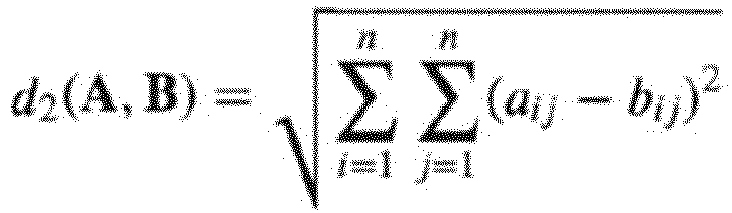
- each component of filter A is defined by a ij and each component of filter B is defined by b ij .
- a difference in absolute value between the values at the same position in the two filters A, B is calculated as given by d 1 (A,B), d 2 (A,B), d ⁇ (A,B), and d m (A,B).
- a similarly between filters is calculated by calculating a difference in absolute value between the values at the same position in the two filters.
- a similarly may be calculated by a method other than this.
- components of a 3 ⁇ 3 filter in the first row are a1, a2, a3, the components in the second row are a4, a5, a6, and the components in the third row are a7, a8, a9, the horizontal sum of absolute difference SAD_H and the vertical sum of absolute difference SAD_V are given by the following expression.
- SAD _ H a 1 ⁇ a 2 + a 2 ⁇ a 3 + a 4 ⁇ a 5 + a 5 ⁇ a 6 + a 7 ⁇ a 8 + a 8 ⁇ a 9
- SAD _ V a 1 ⁇ a 4 + a 2 ⁇ a 5 + a 3 ⁇ a 6 + a 4 ⁇ a 7 + a 5 ⁇ a 8 + a 6 ⁇ a 9
- comparison of a Euclid distance or a cosine distance may be used.
- the filters When filters have a high similarity in weight, the filters are determined to have identical of hardly different characteristics across tasks so that there is no need to maintain a filter that overlaps. Accordingly, one of such filters is initialized and used to learn a further task.
- the weight is defined as that of one component in a filter. In the case of the 3 ⁇ 3 filter of Fig. 4 , the weight is defined as that of one cell in the matrix. Alternatively, the weight may be defined in units of filters, i.e., in units of matrices.
- the weight of the filter for task N+1 is initialized to 0 in order to maintain the performance at task N at the maximum level. This makes it possible to utilize limited filter resources maximally.
- Fig. 5 is a flowchart showing a sequence of steps of continual learning performed by the machine learning device 100 of Fig. 2 .
- the continual learning unit 20 continually trains the weight of multiple filters in response a current task (S20) .
- the filter processing unit 30 initializes a predetermined proportion of the multiple filters that have learned the current task in the ascending order of weight value (S30).
- the comparison unit 40 compares the filters that have learned the current task and the filters that have learned the past task and calculates a similarity in weight (S40) .
- the comparison unit 40 initializes the filter for the current task having a high similarity with the filter for the past task (S50).
- control is returned to step S10, and the next task is input (N in S60).
- continual learning is terminated (Y in S60) .
- the above-described various processes in the machine learning device 100 can of course be implemented by hardware-based devices such as a CPU and a memory and can also be implemented by firmware stored in a read-only memory (ROM), a flash memory, etc., or by software on a computer, etc.
- the firmware program or the software program may be made available on, for example, a computer readable recording medium.
- the program may be transmitted and received to and from a server via a wired or wireless network.
- the program may be transmitted and received in the form of data broadcast over terrestrial or satellite digital broadcast systems.
- the machine learning device 100 makes it possible to mitigate the speed of saturation of filters in a continual learning model and to learn more tasks by using filters efficiently.
Landscapes
- Engineering & Computer Science (AREA)
- Theoretical Computer Science (AREA)
- Physics & Mathematics (AREA)
- Software Systems (AREA)
- Computing Systems (AREA)
- Artificial Intelligence (AREA)
- Mathematical Physics (AREA)
- General Physics & Mathematics (AREA)
- Data Mining & Analysis (AREA)
- Evolutionary Computation (AREA)
- General Engineering & Computer Science (AREA)
- Biomedical Technology (AREA)
- Molecular Biology (AREA)
- General Health & Medical Sciences (AREA)
- Computational Linguistics (AREA)
- Biophysics (AREA)
- Life Sciences & Earth Sciences (AREA)
- Health & Medical Sciences (AREA)
- Computer Vision & Pattern Recognition (AREA)
- Medical Informatics (AREA)
- Image Analysis (AREA)
Abstract
Description
- The present invention relates to machine learning technologies.
- Human beings can learn new knowledge through experiences over a long period of time and can maintain old knowledge without forgetting it. Meanwhile, the knowledge of a convolutional neutral network (CNN) depends on the dataset used in learning. To adapt to a change in data distribution, it is necessary to re-train CNN parameters in response to the entirety of the dataset. In CNN, the precision estimation for old tasks will be decreased as new tasks are learned. Thus, catastrophic forgetting cannot be avoided in CNN. Namely, the result of learning old tasks is forgotten as new tasks are being learned in successive learning.
- Incremental learning or continual learning is proposed as a scheme to avoid catastrophic forgetting. One scheme for continual learning is PackNet.
-
Patent document 1 discloses a learning device configured to cause two or more learning modules to share model parameters updated by multiple learning modules. - [Patent Literature 1]
JP2010-20446 - The problem of catastrophic forgetting can be avoided in PackNet, which is one scheme for continual learning. In PackNet, however, the number of filters in a model is limited, and there is a problem in that filters will be saturated as new tasks are learned so that the number of tasks that can be learned is limited.
- The present invention addresses the issue, and a purpose thereof is to provide a machine learning technology capable of mitigating saturation of filters.
- A machine learning device according to an aspect of the embodiment includes: a weight storage unit that stores weights of a plurality of filters used to detect a feature of a task; a continual learning unit that trains the weights of the plurality of filters in response to an input task in continual learning; a filter processing unit that, of a plurality of filters that have learned one task, locks the weights of a predetermined proportion of the filters to prevent the predetermined proportion of the filters from being used to learn a further task and initializes the weights of other filters to use the other filters to learn a further task; and a comparison unit that compares the weights of a plurality of filters that have learned two or more tasks and extracts overlap filters having a similarity in weight equal to or greater than a predetermined threshold value as shared filters shared by tasks.
- Another aspect of the embodiment relates to a machine learning method. The method includes: training weights of a plurality of filters used to detect a feature of a task in response to an input task in continual learning; of a plurality of filters that have learned one task, locking the weights of a predetermined proportion of the filters to prevent the predetermined proportion of the filters from being used to learn a further task and initializing the weights of other filters to use the other filters to learn a further task; and comparing the weights of a plurality of filters that have learned two or more tasks, leaving one of overlap filters having a similarity in weight equal to or higher than a predetermined threshold value, and initializing the weights of other filters to use the other filters to learn a further task.
- Optional combinations of the aforementioned constituting elements, and implementations of the embodiment in the form of methods, apparatuses, systems, recording mediums, and computer programs may also be practiced as additional modes of the present invention.
- According to the embodiment, it is possible to provide a machine learning technology capable of mitigating saturation of filters.
-
-
Figs. 1A-1E show continual learning, which is defined as a base technology; -
Fig. 2 shows a configuration of a machine learning device according to the embodiment; -
Figs. 3A-3E show continual learning performed by the machine learning device ofFig. 2 ; -
Fig. 4 shows an operation of the comparison unit of the machine learning device ofFig. 2 ; and -
Fig. 5 is a flowchart showing a sequence of steps of continual learning performed by the machine learning device ofFig. 2 . -
Figs. 1A-1E show continual learning by PackNet, which is defined as a base technology. In PackNet, the weights of multiple filters in a model are trained in response to a given task. The figures show multiple filters in each layer of a convolutional neural network arranged in a lattice. - The learning process in PackNet proceeds in the following steps (A)-(E).
- (A) The model learns
task 1.Fig. 1A shows an initial state of the filters that have learnedtask 1. All filters have learnedtask 1 and are shown in black. - (B) The filters are arranged in the descending order of weight value of the filter. The values of 60% of the entire filters are initialized in the ascending order of weight value.
Fig. 1B shows a final state of the filters that have learnedtask 1. The initialized filters are shown in white. - (C)
Task 2 is then learned. In this step, the weight values of the black filters ofFig. 1B are locked. The weight values of only the white filters can be changed.Fig. 1C shows an initial state of the filters that have learnedtask 2. All filters shown in white inFig. 1B have learnedtask 2 and are shown in hatched lines inFig. 1C . - (D) As in step (B), the hatched filters that have learned
task 2 are arranged in the descending order of weight value of the filter. The values of 60% of the entire filters are initialized in the ascending order weight value.Fig. 1D shows a final state of the filters that have learnedtask 2. The initialized filters are shown in white. - (E) Further,
task 3 is learned. In this step, the weight values of the black and hatched filters ofFig. 1D are locked. The weight values of only the white filters can be changed.Fig. 1E shows an initial state of the filters that have learnedtask 3. All filters shown in white inFig. 1D have learnedtask 3 and are shown in horizontal stripes inFig. 1E . - As learning continues through task N in the learning process according to PackNet in this way, the number of initialized white filters will be increasingly smaller, resulting in saturation. When the filters are saturated, it will no longer be possible to learn a new task.
- Saturation of the PackNet filters at some point of time cannot be avoided. However, the speed of saturation of the filters can be mitigated. The embodiment addresses the issue by extracting, every time a new task is learned, overlap filters having a high similarity in weight as shared filters shared by tasks. Of the overlap filters, one filter is left as a shared filter, and the weight of the filters other than the shared filter is initialized to 0. This makes it possible to increase filters that can be learn a new task, mitigate the speed of saturation of the filters, and increase the number of filters that can learn a task.
-
Fig. 2 shows a configuration of amachine learning device 100 according to the embodiment. Themachine learning device 100 includes aninput unit 10, acontinual learning unit 20, afilter processing unit 30, acomparison unit 40, aweight storage unit 50, aninference unit 60, and anoutput unit 70. - The
input unit 10 supplies a supervised task to thecontinual learning unit 20 and supplies an unknown task to theinference unit 60. By way of one example, the task is image recognition. The task is set to recognize a particular object. For example,task 1 is recognition of a cat,task 2 is recognition of a dog, etc. - The
weight storage unit 50 stores the weights of multiple filters used to detect a feature of the task. By running an image through multiple filters, the feature of the image can be captured. - The
continual learning unit 20 continually trains the weights of the multiple filters in theweight storage unit 50 in response to the input supervised task and saves the updated filter weights in theweight storage unit 50. - The
filter processing unit 30 locks, of the multiple filters that have learned one task, the weights of a predetermined proportion of the filters to prevent them from being used to learn a further task and initializes the weights of the rest of the filters to use them to learn a further task. For example, the filters are arranged in the descending order of filter weight. The weights of 40% of the filters are locked in the descending order of weight value, and the weights of the remaining 60% of the filters are initialized to use them to learn a further task. - When the initialization by the
filter processing unit 30 is completed, thecomparison unit 40 compares the weights of multiples filters that have learned two or more tasks and extracts overlap filters for which a similarity in weight is equal to or greater than a threshold value as shared filters shared by tasks. The model is a multi-layer convolutional neural network so that a similarly between the weights of multiple filters are calculated in each layer. Of the overlap filters, thecomparison unit 40 leaves one filter as a shared filter, initializes the weights of the filters other than the shared filter, and saves the weights in theweight storage unit 50. - The
continual learning unit 20 continually trains the initialized weights of the filters other than the shared filter in response to a new task. - The
inference unit 60 uses the filter weight saved in theweight storage unit 50 to infer from an input unknown task. Theoutput unit 70 outputs a result of inference by theinference unit 60. -
Figs. 3A-3E show continual learning performed by themachine learning device 100 ofFig. 2 . Multiple filters in each layer of a convolutional neural network are shown arranged in a lattice, where (i,j) denote a filter in the i-th row and the j-th column. - The learning process in the
machine learning device 100 proceeds in the following steps (A)-(E). - (A) The model learns
task 1.Fig. 3A shows an initial state of the filters that have learnedtask 1. All filters have learnedtask 1 and are shown in black. - (B) The filters are arranged in the descending order of weight value of the filter. The values of 60% of the entire filters are initialized in the ascending order of weight value.
Fig. 3B shows a final state of the filters that have learnedtask 1. The initialized filters are shown in white. - (C)
Task 2 is then learned. In this step, the weight values of the black filters ofFig. 3B are locked. The weight values of only the white filters can be changed.Fig. 3C shows an initial state of the filters that have learnedtask 2. All filters shown in white inFig. 3B have learnedtask 2 and are shown in hatched lines inFig. 3C . - (D) As in step (B), the hatched filters that have learned
task 2 are arranged in the descending order of weight value of the filter. The values of 60% of the entire filters are initialized in the ascending order of weight value.Fig. 3D shows an intermediate state of the filters that have learnedtask 2. The initialized filters are shown in white. - (E) The weights are compared between the black filters that have learned
task 1 and the hatched filters that have learnedtask 2. Those filters for which the similarity exceeds a predetermined threshold value are extracted as overlap filters. Referring toFig. 3D , for example, the hatched filter (1,3) is similar to the black filter (1,2) so that these filters are determined to be overlap filters. Similarly, the hatched filter (3,1) and the black filter (3,2) are similar overlap filters, and the hatched filter (3,5) and the black filter (4,5) are similar overlap filters. - As shown in
Fig. 3E , the hatched filter (1,3) can be substituted for by the similar black filter (1,2) for use so that the weight of the hatched filter (1,3) is initialized to turn it into a white filter, and the black filter (1,2) is defined as a shared filter shared bytask 1 andtask 2. Similarly, the hatched filter (3,1) is substituted for by the similar black filter (3,2) for use. The weight of the hatched filter (3,1) is initialized to turn it into a white filter. The black filter (3,2) is defined as a shared filter shared bytask 1 andtask 2. Further, the hatched filter (3,5) is substituted for by the similar black filter (4,5) for use. The weight of the hatched filter (3,5) is initialized to turn it into a white filter. The black filter (4,5) is defined as a shared filter shared bytask 1 andtask 2. -
Fig. 3E shows a final state of the filters that have learnedtask 2. The initialized white filters are used to learntask 3, and the weights thereof are changed accordingly. Similarly, filters having a small weight value are initialized in the initial state of the filters that have learnedtask 3. The weights are compared between the filters that have learnedtask 3, the filters that have learnedtask 1, and the filters that have learnedtask 2. When there are overlap filters that have similarity, the filters fortask 3 are initialized. This is repeated through task N. -
Fig. 4 shows an operation of thecomparison unit 40 of themachine learning device 100 ofFig. 2 . - In the intermediate state, shown in
Fig. 3D , of the filters that have learnedtask 2, the weights of the filters that have learnedtask 1 and the weights of the filters that have learnedtask 2 are compared. Filters having a high similarity in weight are extracted and are defined as targets of initialization. - Since the model includes multiple layers, comparison is made in each layer. For example, one layer includes 128 filters. Given that there are 51 filters that have learned
task task 2, and the remaining filters are initialized, a similarity between the 51 filters fortask 1 and the 30 filters fortask 2 are calculated. - A similarity is calculated by comparing the absolute values of the filter weight values. In the case of 3×3 filters, for example, the absolute values of the nine weights are compared. A threshold value is defined. When the similarity exceeds the threshold value, it is determined that two filters overlap, and the weight of the filter for
task 2 is initialized to 0. - Given that each component of filter A is defined by aij and each component of filter B is defined by bij, a difference in absolute value between the values at the same position in the two filters A, B is calculated as given by d1(A,B), d2(A,B), d∞(A,B), and dm(A,B).



- In the above description, a similarly between filters is calculated by calculating a difference in absolute value between the values at the same position in the two filters. A similarly may be calculated by a method other than this. For example, a filter sum of absolute difference is defined for each filter as a sum of a horizontal sum of absolute difference SAD_H and a vertical sum of absolute difference SAD_V such that SAD=SAD_H+SAD_V. When a difference between the filter sum of absolute difference SAD_A of filter A and the filter sum of absolute difference SAD_B of filter B is smaller than a threshold value, it may be determined that filter A and filter B overlap. Given here that components of a 3×3 filter in the first row are a1, a2, a3, the components in the second row are a4, a5, a6, and the components in the third row are a7, a8, a9, the horizontal sum of absolute difference SAD_H and the vertical sum of absolute difference SAD_V are given by the following expression.


- As an alternative method of calculating a similarity, comparison of a Euclid distance or a cosine distance may be used.
- When filters have a high similarity in weight, the filters are determined to have identical of hardly different characteristics across tasks so that there is no need to maintain a filter that overlaps. Accordingly, one of such filters is initialized and used to learn a further task. The weight is defined as that of one component in a filter. In the case of the 3×3 filter of
Fig. 4 , the weight is defined as that of one cell in the matrix. Alternatively, the weight may be defined in units of filters, i.e., in units of matrices. - More generally speaking, when there is a filter that overlaps across task N and task N+1, the weight of the filter for task N+1 is initialized to 0 in order to maintain the performance at task N at the maximum level. This makes it possible to utilize limited filter resources maximally.
-
Fig. 5 is a flowchart showing a sequence of steps of continual learning performed by themachine learning device 100 ofFig. 2 . - The
input unit 10 inputs a current supervised task to the continual learning unit 20 (S10). - The
continual learning unit 20 continually trains the weight of multiple filters in response a current task (S20) . - The
filter processing unit 30 initializes a predetermined proportion of the multiple filters that have learned the current task in the ascending order of weight value (S30). - The
comparison unit 40 compares the filters that have learned the current task and the filters that have learned the past task and calculates a similarity in weight (S40) . - The
comparison unit 40 initializes the filter for the current task having a high similarity with the filter for the past task (S50). - When a task remains, control is returned to step S10, and the next task is input (N in S60). When the tasks have been completed, continual learning is terminated (Y in S60) .
- The above-described various processes in the
machine learning device 100 can of course be implemented by hardware-based devices such as a CPU and a memory and can also be implemented by firmware stored in a read-only memory (ROM), a flash memory, etc., or by software on a computer, etc. The firmware program or the software program may be made available on, for example, a computer readable recording medium. Alternatively, the program may be transmitted and received to and from a server via a wired or wireless network. Still alternatively, the program may be transmitted and received in the form of data broadcast over terrestrial or satellite digital broadcast systems. - As described above, the
machine learning device 100 according to the embodiment makes it possible to mitigate the speed of saturation of filters in a continual learning model and to learn more tasks by using filters efficiently. - The present invention has been described above based on an embodiment. The embodiment is intended to be illustrative only and it will be understood by those skilled in the art that various modifications to combinations of constituting elements and processes are possible and that such modifications are also within the scope of the present invention.
- The present invention is applicable to machine learning technologies.
- 10 input unit, 20 continual learning unit, 30 filter processing unit, 40 comparison unit, 50 weight storage unit, 60 inference unit, 70 output unit, 100 machine learning device
Claims (5)
- A machine learning device comprising:a weight storage unit that stores weights of a plurality of filters used to detect a feature of a task;a continual learning unit that trains the weights of the plurality of filters in response to an input task in continual learning;a filter processing unit that, of a plurality of filters that have learned one task, locks the weights of a predetermined proportion of the filters to prevent the predetermined proportion of the filters from being used to learn a further task and initializes the weights of other filters to use the other filters to learn a further task; anda comparison unit that compares the weights of a plurality of filters that have learned two or more tasks and extracts overlap filters having a similarity in weight equal to or greater than a predetermined threshold value as shared filters shared by tasks.
- The machine learning device according to claim 1, wherein
the comparison unit leaves one of the overlap filters as the shared filter and initializes the weights of filters other than the shared filter. - The machine learning device according to claim 2, wherein
the continual learning unit trains initialized weights of filters other than the shared filter in response to a further task in continual learning. - A machine learning method comprising:training weights of a plurality of filters used to detect a feature of a task in response to an input task in continual learning;of a plurality of filters that have learned one task, locking the weights of a predetermined proportion of the filters to prevent the predetermined proportion of the filters from being used to learn a further task and initializing the weights of other filters to use the other filters to learn a further task; andcomparing the weights of a plurality of filters that have learned two or more tasks, leaving one of overlap filters having a similarity in weight equal to or higher than a predetermined threshold value, and initializing the weights of other filters to use the other filters to learn a further task.
- A machine learning program comprising computer-implemented modules including:a module that trains weights of a plurality of filters used to detect a feature of a task in response to an input task in continual learning;a module that, of a plurality of filters that have learned one task, locks the weights of a predetermined proportion of the filters to prevent the predetermined proportion of the filters from being used to learn a further task and initializes the weights of other filters to use the other filters to learn a further task; anda module that compares the weights of a plurality of filters that have learned two or more tasks, leaves one of overlap filters having a similarity in weight equal to or higher than a predetermined threshold value, and initializes the weights of other filters to use the other filters to learn a further task.
Applications Claiming Priority (2)
| Application Number | Priority Date | Filing Date | Title |
|---|---|---|---|
| JP2021003240A JP7631815B2 (en) | 2021-01-13 | 2021-01-13 | Machine learning device, machine learning method, and machine learning program |
| PCT/JP2021/045339 WO2022153738A1 (en) | 2021-01-13 | 2021-12-09 | Machine learning device, machine learning method, and machine learning program |
Publications (3)
| Publication Number | Publication Date |
|---|---|
| EP4280114A1 true EP4280114A1 (en) | 2023-11-22 |
| EP4280114A4 EP4280114A4 (en) | 2024-07-10 |
| EP4280114B1 EP4280114B1 (en) | 2026-02-11 |
Family
ID=82448355
Family Applications (1)
| Application Number | Title | Priority Date | Filing Date |
|---|---|---|---|
| EP21919627.6A Active EP4280114B1 (en) | 2021-01-13 | 2021-12-09 | Machine learning device, machine learning method, and machine learning program |
Country Status (5)
| Country | Link |
|---|---|
| US (1) | US20230351266A1 (en) |
| EP (1) | EP4280114B1 (en) |
| JP (1) | JP7631815B2 (en) |
| CN (1) | CN116368498A (en) |
| WO (1) | WO2022153738A1 (en) |
Family Cites Families (4)
| Publication number | Priority date | Publication date | Assignee | Title |
|---|---|---|---|---|
| JP4710933B2 (en) | 2008-07-09 | 2011-06-29 | ソニー株式会社 | Learning device, learning method, and program |
| WO2018017546A1 (en) * | 2016-07-18 | 2018-01-25 | Google Llc | Training machine learning models on multiple machine learning tasks |
| JP2018055259A (en) * | 2016-09-27 | 2018-04-05 | キヤノン株式会社 | Information processing apparatus, information processing method and program |
| JP2020204909A (en) * | 2019-06-17 | 2020-12-24 | アイシン精機株式会社 | Machine learning device |
-
2021
- 2021-01-13 JP JP2021003240A patent/JP7631815B2/en active Active
- 2021-12-09 EP EP21919627.6A patent/EP4280114B1/en active Active
- 2021-12-09 CN CN202180074118.7A patent/CN116368498A/en active Pending
- 2021-12-09 WO PCT/JP2021/045339 patent/WO2022153738A1/en not_active Ceased
-
2023
- 2023-07-10 US US18/349,198 patent/US20230351266A1/en active Pending
Also Published As
| Publication number | Publication date |
|---|---|
| JP7631815B2 (en) | 2025-02-19 |
| WO2022153738A1 (en) | 2022-07-21 |
| US20230351266A1 (en) | 2023-11-02 |
| EP4280114A4 (en) | 2024-07-10 |
| JP2022108331A (en) | 2022-07-26 |
| CN116368498A (en) | 2023-06-30 |
| EP4280114B1 (en) | 2026-02-11 |
Similar Documents
| Publication | Publication Date | Title |
|---|---|---|
| AU2024201361B2 (en) | Processing images using self-attention based neural networks | |
| EP3459017B1 (en) | Progressive neural networks | |
| JP6610278B2 (en) | Machine learning apparatus, machine learning method, and machine learning program | |
| CN111898735B (en) | Distillation learning method, device, computer equipment and storage medium | |
| EP3871155A1 (en) | Artificial neural network and method of training an artificial neural network with epigenetic neurogenesis | |
| DE112021004714T5 (en) | ORDINAL TIME SERIES CLASSIFICATION WITH MISSING INFORMATION | |
| CN106599900A (en) | Method and device for recognizing character string in image | |
| DE112021001521T5 (en) | OPTIMIZATION OF CONTROL ACTIONS OF A CONTROL SYSTEM THROUGH AUTOMATIC DIMENSION REDUCTION OF A MATHEMATICAL REPRESENTATION OF THE CONTROL SYSTEM | |
| DE202017007528U1 (en) | Difference metric for machine learning based processing systems | |
| US20180247183A1 (en) | Method and system for generative model learning, and recording medium | |
| CN111104831A (en) | A visual tracking method, apparatus, computer equipment and medium | |
| CN113435525B (en) | Classification network training method, device, computer equipment and storage medium | |
| CN112215298A (en) | Model training method, apparatus, device and readable storage medium | |
| DE102024103309A1 (en) | CONDITIONAL DIFFUSION MODEL FOR DATA-TO-DATA TRANSLATION | |
| DE102024202568A1 (en) | Methods for object detection in image data | |
| EP4280114B1 (en) | Machine learning device, machine learning method, and machine learning program | |
| CN118212461A (en) | Model domain adaptive method, device, terminal and medium based on dual-layer vision | |
| EP4280115B1 (en) | Machine learning device, machine learning method, and machine learning program | |
| CN110765870B (en) | Confidence degree determination method and device of OCR recognition result and electronic equipment | |
| CN114821019B (en) | License plate number recognition method, device, equipment and readable storage medium | |
| US20190370651A1 (en) | Deep Co-Clustering | |
| US11645519B2 (en) | Filtering data in orthogonal directions through a convolutional neural network | |
| KR20230051952A (en) | Method and Device for Learning Image against Image Adversarial Attack | |
| US20240127030A1 (en) | Machine learning systems and methods for classification | |
| US12450490B2 (en) | Neural network construction method and apparatus having average quantization mechanism |
Legal Events
| Date | Code | Title | Description |
|---|---|---|---|
| STAA | Information on the status of an ep patent application or granted ep patent |
Free format text: STATUS: THE INTERNATIONAL PUBLICATION HAS BEEN MADE |
|
| PUAI | Public reference made under article 153(3) epc to a published international application that has entered the european phase |
Free format text: ORIGINAL CODE: 0009012 |
|
| STAA | Information on the status of an ep patent application or granted ep patent |
Free format text: STATUS: REQUEST FOR EXAMINATION WAS MADE |
|
| 17P | Request for examination filed |
Effective date: 20230706 |
|
| AK | Designated contracting states |
Kind code of ref document: A1 Designated state(s): AL AT BE BG CH CY CZ DE DK EE ES FI FR GB GR HR HU IE IS IT LI LT LU LV MC MK MT NL NO PL PT RO RS SE SI SK SM TR |
|
| DAV | Request for validation of the european patent (deleted) | ||
| DAX | Request for extension of the european patent (deleted) | ||
| A4 | Supplementary search report drawn up and despatched |
Effective date: 20240607 |
|
| RIC1 | Information provided on ipc code assigned before grant |
Ipc: G06N 3/0464 20230101ALI20240603BHEP Ipc: G06N 3/096 20230101ALI20240603BHEP Ipc: G06N 3/09 20230101ALI20240603BHEP Ipc: G06N 20/00 20190101ALI20240603BHEP Ipc: G06N 3/08 20230101AFI20240603BHEP |
|
| STAA | Information on the status of an ep patent application or granted ep patent |
Free format text: STATUS: EXAMINATION IS IN PROGRESS |
|
| 17Q | First examination report despatched |
Effective date: 20250324 |
|
| GRAP | Despatch of communication of intention to grant a patent |
Free format text: ORIGINAL CODE: EPIDOSNIGR1 |
|
| STAA | Information on the status of an ep patent application or granted ep patent |
Free format text: STATUS: GRANT OF PATENT IS INTENDED |
|
| INTG | Intention to grant announced |
Effective date: 20250905 |
|
| GRAS | Grant fee paid |
Free format text: ORIGINAL CODE: EPIDOSNIGR3 |
|
| GRAA | (expected) grant |
Free format text: ORIGINAL CODE: 0009210 |
|
| STAA | Information on the status of an ep patent application or granted ep patent |
Free format text: STATUS: THE PATENT HAS BEEN GRANTED |
|
| AK | Designated contracting states |
Kind code of ref document: B1 Designated state(s): AL AT BE BG CH CY CZ DE DK EE ES FI FR GB GR HR HU IE IS IT LI LT LU LV MC MK MT NL NO PL PT RO RS SE SI SK SM TR |
|
| RAP3 | Party data changed (applicant data changed or rights of an application transferred) |
Owner name: JVCKENWOOD CORPORATION |
|
| REG | Reference to a national code |
Ref country code: CH Ref legal event code: F10 Free format text: ST27 STATUS EVENT CODE: U-0-0-F10-F00 (AS PROVIDED BY THE NATIONAL OFFICE) Effective date: 20260211 Ref country code: GB Ref legal event code: FG4D |
|
| REG | Reference to a national code |
Ref country code: DE Ref legal event code: R096 Ref document number: 602021047968 Country of ref document: DE |
|
| REG | Reference to a national code |
Ref country code: IE Ref legal event code: FG4D |