EP4280063A1 - Systems and methods for identifying solutions for errors in log files obtained from execution environments - Google Patents
Systems and methods for identifying solutions for errors in log files obtained from execution environments Download PDFInfo
- Publication number
- EP4280063A1 EP4280063A1 EP22210122.2A EP22210122A EP4280063A1 EP 4280063 A1 EP4280063 A1 EP 4280063A1 EP 22210122 A EP22210122 A EP 22210122A EP 4280063 A1 EP4280063 A1 EP 4280063A1
- Authority
- EP
- European Patent Office
- Prior art keywords
- word
- error
- sentences
- comprised
- unique
- Prior art date
- Legal status (The legal status is an assumption and is not a legal conclusion. Google has not performed a legal analysis and makes no representation as to the accuracy of the status listed.)
- Granted
Links
Images

Classifications
-
- G—PHYSICS
- G06—COMPUTING OR CALCULATING; COUNTING
- G06F—ELECTRIC DIGITAL DATA PROCESSING
- G06F11/00—Error detection; Error correction; Monitoring
- G06F11/07—Responding to the occurrence of a fault, e.g. fault tolerance
- G06F11/0703—Error or fault processing not based on redundancy, i.e. by taking additional measures to deal with the error or fault not making use of redundancy in operation, in hardware, or in data representation
- G06F11/0793—Remedial or corrective actions
-
- G—PHYSICS
- G06—COMPUTING OR CALCULATING; COUNTING
- G06F—ELECTRIC DIGITAL DATA PROCESSING
- G06F11/00—Error detection; Error correction; Monitoring
- G06F11/07—Responding to the occurrence of a fault, e.g. fault tolerance
- G06F11/0703—Error or fault processing not based on redundancy, i.e. by taking additional measures to deal with the error or fault not making use of redundancy in operation, in hardware, or in data representation
- G06F11/0706—Error or fault processing not based on redundancy, i.e. by taking additional measures to deal with the error or fault not making use of redundancy in operation, in hardware, or in data representation the processing taking place on a specific hardware platform or in a specific software environment
- G06F11/0709—Error or fault processing not based on redundancy, i.e. by taking additional measures to deal with the error or fault not making use of redundancy in operation, in hardware, or in data representation the processing taking place on a specific hardware platform or in a specific software environment in a distributed system consisting of a plurality of standalone computer nodes, e.g. clusters, client-server systems
-
- G—PHYSICS
- G06—COMPUTING OR CALCULATING; COUNTING
- G06F—ELECTRIC DIGITAL DATA PROCESSING
- G06F11/00—Error detection; Error correction; Monitoring
- G06F11/07—Responding to the occurrence of a fault, e.g. fault tolerance
- G06F11/0703—Error or fault processing not based on redundancy, i.e. by taking additional measures to deal with the error or fault not making use of redundancy in operation, in hardware, or in data representation
- G06F11/0751—Error or fault detection not based on redundancy
-
- G—PHYSICS
- G06—COMPUTING OR CALCULATING; COUNTING
- G06F—ELECTRIC DIGITAL DATA PROCESSING
- G06F11/00—Error detection; Error correction; Monitoring
- G06F11/07—Responding to the occurrence of a fault, e.g. fault tolerance
- G06F11/0703—Error or fault processing not based on redundancy, i.e. by taking additional measures to deal with the error or fault not making use of redundancy in operation, in hardware, or in data representation
- G06F11/0766—Error or fault reporting or storing
- G06F11/0778—Dumping, i.e. gathering error/state information after a fault for later diagnosis
-
- G—PHYSICS
- G06—COMPUTING OR CALCULATING; COUNTING
- G06F—ELECTRIC DIGITAL DATA PROCESSING
- G06F11/00—Error detection; Error correction; Monitoring
- G06F11/07—Responding to the occurrence of a fault, e.g. fault tolerance
- G06F11/0703—Error or fault processing not based on redundancy, i.e. by taking additional measures to deal with the error or fault not making use of redundancy in operation, in hardware, or in data representation
- G06F11/0766—Error or fault reporting or storing
- G06F11/0787—Storage of error reports, e.g. persistent data storage, storage using memory protection
-
- G—PHYSICS
- G06—COMPUTING OR CALCULATING; COUNTING
- G06F—ELECTRIC DIGITAL DATA PROCESSING
- G06F11/00—Error detection; Error correction; Monitoring
- G06F11/07—Responding to the occurrence of a fault, e.g. fault tolerance
- G06F11/0703—Error or fault processing not based on redundancy, i.e. by taking additional measures to deal with the error or fault not making use of redundancy in operation, in hardware, or in data representation
- G06F11/079—Root cause analysis, i.e. error or fault diagnosis
-
- G—PHYSICS
- G06—COMPUTING OR CALCULATING; COUNTING
- G06F—ELECTRIC DIGITAL DATA PROCESSING
- G06F18/00—Pattern recognition
- G06F18/20—Analysing
- G06F18/22—Matching criteria, e.g. proximity measures
-
- G—PHYSICS
- G06—COMPUTING OR CALCULATING; COUNTING
- G06F—ELECTRIC DIGITAL DATA PROCESSING
- G06F40/00—Handling natural language data
- G06F40/20—Natural language analysis
- G06F40/205—Parsing
-
- G—PHYSICS
- G06—COMPUTING OR CALCULATING; COUNTING
- G06F—ELECTRIC DIGITAL DATA PROCESSING
- G06F40/00—Handling natural language data
- G06F40/20—Natural language analysis
- G06F40/279—Recognition of textual entities
-
- G—PHYSICS
- G06—COMPUTING OR CALCULATING; COUNTING
- G06F—ELECTRIC DIGITAL DATA PROCESSING
- G06F40/00—Handling natural language data
- G06F40/20—Natural language analysis
- G06F40/279—Recognition of textual entities
- G06F40/284—Lexical analysis, e.g. tokenisation or collocates
-
- G—PHYSICS
- G06—COMPUTING OR CALCULATING; COUNTING
- G06F—ELECTRIC DIGITAL DATA PROCESSING
- G06F11/00—Error detection; Error correction; Monitoring
- G06F11/07—Responding to the occurrence of a fault, e.g. fault tolerance
- G06F11/0703—Error or fault processing not based on redundancy, i.e. by taking additional measures to deal with the error or fault not making use of redundancy in operation, in hardware, or in data representation
- G06F11/0766—Error or fault reporting or storing
- G06F11/0769—Readable error formats, e.g. cross-platform generic formats, human understandable formats
Definitions
- the disclosure herein generally relates to analysis of log files from execution environments, and, more particularly, to systems and methods for identifying solutions for errors in log files obtained from execution environments.
- testing teams use thousands of automated testcases to test a product in a regression testing running daily.
- the testing suite of such number of testcases generates thousands of log files per run, in various distributed environment with different formats (log4j, Server logs, Process logs, etc.). Every day, several testers consolidate the errors that occurred in that run by manually scavenging the log files.
- the respective developers/subject matter experts (SMEs) also had to manually scan the log files apart from the testing report to provide solutions to the errors/defects.
- the solutions depend on SMEs and the impact of solution in many cases lead to rework of the defect/errors and high degree of heterogeneity. This leads to huge bottleneck in automation of DevOps process leading to loss of productivity and agility.
- Embodiments of the present disclosure present technological improvements as solutions to one or more of the above-mentioned technical problems recognized by the inventors in conventional systems.
- a processor implemented method for identifying solutions for errors in log files obtained from execution environments comprises obtaining, via one or more hardware processors, a plurality of log files from at least one of a first execution environment, and a second execution environment, wherein the plurality of log files correspond to one or more file formats; pre-processing, via the one or more hardware processors, the plurality of log files to obtain a plurality of pre-processed log files comprising one or more unique error sentences; tokenizing, via the one or more hardware processors, the one or more unique error sentences by using a Natural Language Processing (NLP) library; removing, via the one or more hardware processors, stop words comprised in the one or more unique error sentences; calculating, via the one or more hardware processors, a frequency of each word comprised in the one or more unique error sentences; calculating, by using a word vector model via the one or more hardware processors, a word weight for each word comprised in the one or more unique error sentences based on the calculated frequency
- NLP Natural Language Processing
- the first execution environment and the second execution environment are different from each other.
- the one or more of solutions are identified for the one or more unique error sentences when the cosine similarity is greater than or equal to the pre-defined threshold value.
- the cosine similarity is computed as a simple mean of projection weight vectors of the one or more unique error sentences and the one or more error sentence vectors for each sentence vector comprised in the pre-defined database.
- the modified Smooth Inverse Frequency (mSIF) model is obtained by: removing stops words from the plurality of error sentences by removing one or more influential non-relevant words comprised in the plurality of error sentences; calculating a frequency of each word comprised in the plurality of error sentences; calculating, by using a word vector model, a word weight for each word comprised in the plurality of error sentences based on the calculated frequency; and generating one or more error sentence vectors for the plurality of error sentences using the calculated word weight for each word to obtain the modified Smooth Inverse Frequency (mSIF) model.
- a processor implemented system for identifying solutions for errors in log files obtained from execution environments.
- the first execution environment and the second execution environment are different from each other.
- the one or more of solutions are identified for the one or more unique error sentences when the cosine similarity is greater than or equal to the pre-defined threshold value.
- the cosine similarity is computed as a simple mean of projection weight vectors of the one or more unique error sentences and the one or more error sentence vectors for each sentence vector comprised in the pre-defined database.
- the modified Smooth Inverse Frequency (mSIF) model is obtained by: removing stops words from the plurality of error sentences by removing one or more influential non-relevant words comprised in the plurality of error sentences; calculating a frequency of each word comprised in the plurality of error sentences; calculating, by using a word vector model, a word weight for each word comprised in the plurality of error sentences based on the calculated frequency; and generating one or more error sentence vectors for the plurality of error sentences using the calculated word weight for each word to obtain the modified Smooth Inverse Frequency (mSIF) model.
- the first execution environment and the second execution environment are different from each other.
- the one or more of solutions are identified for the one or more unique error sentences when the cosine similarity is greater than or equal to the pre-defined threshold value.
- the cosine similarity is computed as a simple mean of projection weight vectors of the one or more unique error sentences and the one or more error sentence vectors for each sentence vector comprised in the pre-defined database.
- the modified Smooth Inverse Frequency (mSIF) model is obtained by: removing stops words from the plurality of error sentences by removing one or more influential non-relevant words comprised in the plurality of error sentences; calculating a frequency of each word comprised in the plurality of error sentences; calculating, by using a word vector model, a word weight for each word comprised in the plurality of error sentences based on the calculated frequency; and generating one or more error sentence vectors for the plurality of error sentences using the calculated word weight for each word to obtain the modified Smooth Inverse Frequency (mSIF) model.
- testing teams use thousands of automated testcases to test a product in a regression testing running daily, which generate thousands of log files per run, in various distributed environment with different formats.
- Errors are consolidated and subject matter experts (SMEs) have to manually scan the log files apart from the testing report to provide solutions to the errors/defects.
- the solutions depend on SMEs and the impact of solution in many cases lead to rework of the defect/errors and high degree of heterogeneity. This leads to huge bottleneck in automation of DevOps process leading to loss of productivity and agility.
- Embodiments of the present disclosure address the challenges by providing systems and methods that auto capture the log files of different formats (log4j, Jenkins, Maven, HTML, etc.) efficiently in a scalable, extendible, and plug-able way.
- the system mines and parses the log files based on given identifiers to standardize and de-duplicate to create unique error records with detail description including cause, position, module, timestamp, etc.
- the system predicts the solutions leveraging the knowledge base by using natural language processing (NLP) techniques (MSiF or mSIF) which is faster and accurate from the known algorithms.
- NLP natural language processing
- MSiF or mSIF natural language processing
- the system stores the processed log files in a structured log files platform so that any customizable report can be generated.
- the system and method as implemented by the present disclosure bring automated, intelligent, homogeneous integrated log analysis solution in every stage of distributed or non-distributed DevOps environment.
- FIG. 1 through 2 where similar reference characters denote corresponding features consistently throughout the figures, there are shown preferred embodiments and these embodiments are described in the context of the following exemplary system and/or method.
- FIG. 1 depicts an exemplary system for identifying solutions for errors in log files obtained from execution environments, in accordance with an embodiment of the present disclosure.
- the system 100 includes one or more hardware processors 104, communication interface device(s) or input/output (I/O) interface(s) 106 (also referred as interface(s)), and one or more data storage devices or memory 102 operatively coupled to the one or more hardware processors 104.
- the one or more processors 104 may be one or more software processing components and/or hardware processors.
- the hardware processors can be implemented as one or more microprocessors, microcomputers, microcontrollers, digital signal processors, central processing units, state machines, logic circuitries, and/or any devices that manipulate signals based on operational instructions.
- the processor(s) is/are configured to fetch and execute computer-readable instructions stored in the memory.
- the system 100 can be implemented in a variety of computing systems, such as laptop computers, notebooks, hand-held devices (e.g., smartphones, tablet phones, mobile communication devices, and the like), workstations, mainframe computers, servers, a network cloud, and the like.
- the I/O interface device(s) 106 can include a variety of software and hardware interfaces, for example, a web interface, a graphical user interface, and the like and can facilitate multiple communications within a wide variety of networks N/W and protocol types, including wired networks, for example, LAN, cable, etc., and wireless networks, such as WLAN, cellular, or satellite.
- the I/O interface device(s) can include one or more ports for connecting a number of devices to one another or to another server.
- the memory 102 may include any computer-readable medium known in the art including, for example, volatile memory, such as static random-access memory (SRAM) and dynamic-random access memory (DRAM), and/or non-volatile memory, such as read only memory (ROM), erasable programmable ROM, flash memories, hard disks, optical disks, and magnetic tapes.
- volatile memory such as static random-access memory (SRAM) and dynamic-random access memory (DRAM)
- DRAM dynamic-random access memory
- non-volatile memory such as read only memory (ROM), erasable programmable ROM, flash memories, hard disks, optical disks, and magnetic tapes.
- a database 108 is comprised in the memory 102, wherein the database 108 comprises information such as a plurality of log files, execution environments, a plurality of pre-processed log files, unique error records (also referred as unique error sentences and interchangeably used herein), corresponding unique error sentence vectors (also referred as vectors and interchangeably used herein), cosine similarities computed for vectors, pre-defined threshold, one or more solutions for the unique errors, and the like.
- the database 108 further comprises a modified Smooth Inverse Frequency (mSIF/MSiF) model, other pre-processing techniques, and the like.
- mSIF/MSiF Smooth Inverse Frequency
- the memory 102 further comprises (or may further comprise) information pertaining to input(s)/output(s) of each step performed by the systems and methods of the present disclosure.
- input(s) fed at each step and output(s) generated at each step are comprised in the memory 102 and can be utilized in further processing and analysis.
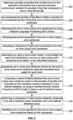
- FIG. 2 depicts an exemplary flow chart illustrating a method for identifying solutions for errors in log files obtained from execution environments, using the system 100 of FIG. 1 , in accordance with an embodiment of the present disclosure.
- the system(s) 100 comprises one or more data storage devices or the memory 102 operatively coupled to the one or more hardware processors 104 and is configured to store instructions for execution of steps of the method by the one or more processors 104.
- the steps of the method of the present disclosure will now be explained with reference to components of the system 100 of FIG. 1 , and the flow diagram as depicted in FIG. 2 .
- the one or more hardware processors 104 obtain a plurality of log files from at least one of a first execution environment and a second execution environment.
- the plurality of log files corresponds to one or more file formats.
- the first execution environment and the second execution environment are different from each other, in one example embodiment.
- Executable files can be generated in two types of environments:
- log files obtained from various execution environments are few examples. Such exemplary log files shall not be construed as limiting the scope of the present disclosure.
- the one or more hardware processors 104 pre-process the plurality of log files to obtain a plurality of pre-processed log files (also referred as pre-processed log files and interchangeably used herein) comprising one or more unique error sentences.
- the pre-processing of log files includes various steps such as parsing or reading the log files, extracting information that is relevant to processing of log files for further analysis, standardizing the log files to a specific format, and performing de-duplication of the log files to eliminate duplicate log files, and the like.
- the duplicate log files may be obtained from various execution environments.
- a log file LF1 is obtained from a distributed execution environment DEE1
- a log file LF2 is obtained from another distributed execution environment DEE2
- a log file LF3 is obtained from a non-distributed execution environment NDEE1.
- all the log files LF1, LF2 and LF3 may contain few information or errors that are common in each other. Such information corresponds to duplicate records and are eliminated by the system 100.
- Post pre-processing of the log files one or more unique error sentences (also referred as unique error sentences and interchangeably used herein) from one or more log files amongst the pre-processed log files may be obtained.
- the expression 'unique error sentence' refers to 'an error sentence that is distinct from other error sentence and has not been previously identified by the system 100.
- Table 1 illustrates exemplary one or more unique error sentences post pre-processing of the log files.
- Table 1 erro rPI D errorFna me erro rCo unte r errorT ime errorD ate errorTitle cause Title Proc ess id: P107 0806 9
- Error LogFile C: ⁇ U sers ⁇ a bc ⁇ Downl oads ⁇ Lobo tv2 ⁇ LOG_ FILES ⁇ Co mmonMas kerError_1 23456_P1 0708069_ 15-Oct-2020 - Copy.log 46 08:52:2 1 15-Oct-2020 Unsupported encoding NA Proc ess id: P108 0806 Error LogFile: C: ⁇ U sers ⁇ a bc ⁇ D
- Proc ess id P106 0806 Error LogFile: C: ⁇ Users ⁇ 1 060806 ⁇ D ownloads ⁇ Lobotv2 ⁇ L OG_FILE S ⁇ Commo nMaskerE rror_1234 56_P1060 806_25-Nov-2021.log 3 not given in log file. not given in log file. relation "John.301_11 _L2Match" does not exist No cause found. please review the log file.
- the one or more hardware processors 104 tokenize the one or more unique error sentences by using a Natural Language Processing (NLP) library.
- NLP Natural Language Processing
- the NLP library is stored in the database 108 comprised in the memory 102.
- the NLP library is invoked by the one or more hardware processors 104 for performing tokenization of the one or more unique error sentences.
- the one or more unique error sentences comprise strings of characters that are tokenized.
- Table 2 illustrates exemplary tokenized unique error sentences. Such tokens serving as output from tokenization of the one or more unique error sentences shall not be construed as limiting the scope of the present disclosure. Table 2 Sl.
- the one or more hardware processors 104 remove stop words comprised in the one or more unique error sentences.
- Table 3 illustrates exemplary stop words removal, and such examples shall not be construed as limiting the scope of the present disclosure.
- the one or more hardware processors 104 calculate a frequency of each word comprised in the one or more unique error sentences. Below illustrated are examples of word frequency:
- the one or more hardware processors 104 calculate, by using a word vector model, a word weight for each word comprised in the one or more unique error sentences based on the calculated frequency.
- the word weight is automatically calculated based on given knowledge database by the word vector model (e.g., also referred as word2vec model and interchangeably used herein). It is to be understood by a person having ordinary skill in the art or person skilled in the art that the word vector model itself is very complex and replication of intermediate steps will alone be very huge. Hence, the calculation of word weight is not illustrated and omitted for the sake of brevity. Below Table 4 illustrates examples of word weights calculated using the word vector model.
- the one or more hardware processors 104 generate one or more unique error sentence vectors for the one or more unique error sentences using the calculated word weight for each word.
- the one or more hardware processors 104 compute a cosine similarity between the one or more unique error sentence vectors of the plurality of log files and a plurality of error sentence vectors comprised in the pre-defined database, by using a modified Smooth Inverse Frequency (mSIF) model to obtain a set of matched cosine similarities.
- mSIF Smooth Inverse Frequency
- the modified Smooth Inverse Frequency (mSIF) model is obtained by: removing stops words from the plurality of error sentences by removing one or more influential non-relevant words comprised in the plurality of error sentences; calculating a frequency of each word comprised in the plurality of error sentences; calculating, by using a word vector model, a word weight for each word comprised in the plurality of error sentences based on the calculated frequency; and generating one or more error sentence vectors for the plurality of error sentences using the calculated word weight for each word to obtain the modified Smooth Inverse Frequency (mSIF) model. Stop words are a predefined list of non-relevant words which can be modified. For instance, is, am, are, to, etc.
- Table 5 depicts examples of cosine similarity score (also referred as cosine similarity and interchangeably used herein) between the one or more unique error sentence vectors of the plurality of log files and a plurality of error sentence vectors comprised in the pre-defined database Table 5 Input Prediction score Unsupported Encoding Unsupported Encoding 1.00 Unsupported Encoding ORA-00936: missing expression 0.11 Failed to write to the file abc.txt Failed to write to the file JVO6.MASK.RM.T 00.RMCSTM.SAM 100.MSK, 0.86 Failed to write to the file abc.txt Failed to get ROWCOUNT for Table 301_11_L2Match.
- the one or more hardware processors 104 perform a comparison of each cosine similarity comprised in the set of matched cosine similarities with a pre-defined threshold value.
- the cosine similarity is computed as a simple mean of projection weight vectors of the one or more unique error sentences and the one or more error sentence vectors for each sentence vector comprised in the pre-defined database.
- Table 6 depicts exemplary comparison of each cosine similarity comprised in the set of matched cosine similarities with the pre-defined threshold value.
- the pre-defined threshold value may also be empirically determined during the analysis of log files for generating/identifying solutions.
- the one or more hardware processors 104 identify one or more solutions (also referred as solutions and interchangeably used herein) to the one or more unique error sentences based on the comparison.
- the one or more of solutions are identified for the one or more unique error sentences when the cosine similarity is greater than or equal to the pre-defined threshold value.
- Table 7 illustrates examples of cosine similarity greater than or equal to the threshold value: Table 7 Sl.
- Schema name and catalog name is null for datasource No cause found. please review the log file. Please check datasource details if schema name and catalog both are null, please connect with product Support team Proce ss id: P106 0806 Error LogFile: C: ⁇ U sers ⁇ 18946 32 ⁇ Downloads ⁇ Lobotv2 ⁇ LOG_ FILES ⁇ Commo nMaskerError_ 123456_P1060 806_25-Nov-2021.log 2 Failed to open writer D: ⁇ Privacy ⁇ PrivacyN ew ⁇ plugins ⁇ technique s ⁇ Randomi zation ⁇ data set ⁇ LDs1_ 75269357 6_STRIN G.ds D: ⁇ Priva cy ⁇ Priva cyNew ⁇ plugins ⁇ techniq ues ⁇ Ran domizat ion ⁇ data set ⁇ LDs 1_7526 93576_ STRIN G.ds (The system cannot find the file specifie d) Please check dataset file at given location
- Proce ss id P106 0806 Error LogFile: C: ⁇ U sers ⁇ 18946 32 ⁇ Downloads ⁇ Lobotv2 ⁇ LOG_ FILES ⁇ Commo nMaskerError_ 123456_P1060 806_25-Nov-2021.log 2 Failed to complete mask & export operation in batch mode. unable to rename file D: ⁇ Priva cy ⁇ Priva cyNew ⁇ project ⁇ P71128 06 ⁇ 1234 56_P71 12806 ⁇ masked File ⁇ Inp lace_Li nux_DB _New_ UDRM 1_First Name_ UserDefinedRep lacemen t.dat. Please check permission on given location to rename file.
- the solutions generated or identified may be in real-time, near-real time. or offline after obtaining the log files at a specific time instance/interval.
- the system 100 has an option wherein users may provide inputs such as identifiers and based on the identifiers the system 100 captures the different log files and chunks the data to divide the large log file (on average hundreds/thousands of lines and to say x MB log file) data into small processable units of data.
- the chunked units are further mined and parsed to extract the minute identifier related details such as title, description, position, module of occurrence, file path, timestamp, etc. which are again customizable as input and can be added or removed based on need.
- the parsed data is then standardized and de-duplicated while retaining the frequency of the unique identifier (e.g., also referred as unique error sentences or unique error records) related data across the distributed/non-distributed environment.
- the processed data is stored in a structured format for easy retrieval.
- the MSiF/mSIF model as implemented by the system and method described herein is an artificial intelligence-based model or machine learning based model that is initiated to train on error database information.
- the mSIF model creates training data by converting the error records into vector formats using the Modified Smooth Inverse Frequency methodology. The training may happen in periodic manner whenever there is an update on unique error sentences.
- the MSiF model converts the unique identifier related data into vectors and provide the best possible similarity solutions with the error sentences.
- Such computer-readable storage means contain program-code means for implementation of one or more steps of the method, when the program runs on a server or mobile device or any suitable programmable device.
- the hardware device can be any kind of device which can be programmed including e.g., any kind of computer like a server or a personal computer, or the like, or any combination thereof.
- the device may also include means which could be e.g., hardware means like e.g., an application-specific integrated circuit (ASIC), a field-programmable gate array (FPGA), or a combination of hardware and software means, e.g., an ASIC and an FPGA, or at least one microprocessor and at least one memory with software processing components located therein.
- the means can include both hardware means and software means.
- the method embodiments described herein could be implemented in hardware and software.
- the device may also include software means. Alternatively, the embodiments may be implemented on different hardware devices, e.g., using a plurality of CPUs.
- the embodiments herein can comprise hardware and software elements.
- the embodiments that are implemented in software include but are not limited to, firmware, resident software, microcode, etc.
- the functions performed by various components described herein may be implemented in other components or combinations of other components.
- a computer-usable or computer readable medium can be any apparatus that can comprise, store, communicate, propagate, or transport the program for use by or in connection with the instruction execution system, apparatus, or device.
- a computer-readable storage medium refers to any type of physical memory on which information or data readable by a processor may be stored.
- a computer-readable storage medium may store instructions for execution by one or more processors, including instructions for causing the processor(s) to perform steps or stages consistent with the embodiments described herein.
- the term "computer-readable medium” should be understood to include tangible items and exclude carrier waves and transient signals, i.e., be non-transitory. Examples include random access memory (RAM), read-only memory (ROM), volatile memory, nonvolatile memory, hard drives, CD ROMs, DVDs, flash drives, disks, and any other known physical storage media.
Landscapes
- Engineering & Computer Science (AREA)
- Theoretical Computer Science (AREA)
- General Engineering & Computer Science (AREA)
- Physics & Mathematics (AREA)
- General Physics & Mathematics (AREA)
- Quality & Reliability (AREA)
- Health & Medical Sciences (AREA)
- Artificial Intelligence (AREA)
- Computational Linguistics (AREA)
- Audiology, Speech & Language Pathology (AREA)
- General Health & Medical Sciences (AREA)
- Biomedical Technology (AREA)
- Data Mining & Analysis (AREA)
- Computer Hardware Design (AREA)
- Evolutionary Computation (AREA)
- Evolutionary Biology (AREA)
- Computer Vision & Pattern Recognition (AREA)
- Bioinformatics & Computational Biology (AREA)
- Bioinformatics & Cheminformatics (AREA)
- Life Sciences & Earth Sciences (AREA)
- Debugging And Monitoring (AREA)
Abstract
Description
- The present application claims priority to
Indian application no. 202221028622, filed on May 18, 2022 - The disclosure herein generally relates to analysis of log files from execution environments, and, more particularly, to systems and methods for identifying solutions for errors in log files obtained from execution environments.
- In the DevOps process, testing teams use thousands of automated testcases to test a product in a regression testing running daily. The testing suite of such number of testcases generates thousands of log files per run, in various distributed environment with different formats (log4j, Server logs, Process logs, etc.). Every day, several testers consolidate the errors that occurred in that run by manually scavenging the log files. The respective developers/subject matter experts (SMEs) also had to manually scan the log files apart from the testing report to provide solutions to the errors/defects. The solutions depend on SMEs and the impact of solution in many cases lead to rework of the defect/errors and high degree of heterogeneity. This leads to huge bottleneck in automation of DevOps process leading to loss of productivity and agility.
- Embodiments of the present disclosure present technological improvements as solutions to one or more of the above-mentioned technical problems recognized by the inventors in conventional systems.
- For example, in one aspect, there is provided a processor implemented method for identifying solutions for errors in log files obtained from execution environments. The method comprises obtaining, via one or more hardware processors, a plurality of log files from at least one of a first execution environment, and a second execution environment, wherein the plurality of log files correspond to one or more file formats; pre-processing, via the one or more hardware processors, the plurality of log files to obtain a plurality of pre-processed log files comprising one or more unique error sentences; tokenizing, via the one or more hardware processors, the one or more unique error sentences by using a Natural Language Processing (NLP) library; removing, via the one or more hardware processors, stop words comprised in the one or more unique error sentences; calculating, via the one or more hardware processors, a frequency of each word comprised in the one or more unique error sentences; calculating, by using a word vector model via the one or more hardware processors, a word weight for each word comprised in the one or more unique error sentences based on the calculated frequency; generating, via the one or more hardware processors, one or more error sentence vectors for the one or more unique error sentences using the calculated word weight for each word; computing, via the one or more hardware processors, a cosine similarity between the one or more unique error sentence vectors of the plurality of log files and a plurality of error sentence vectors comprised in a pre-defined database, by using a modified Smooth Inverse Frequency (mSIF) model to obtain a set of matched cosine similarities; performing, via the one or more hardware processors, a comparison of each cosine similarity comprised in the set of matched cosine similarities with a pre-defined threshold value; and identifying, via the one or more hardware processors, one or more solutions to the one or more unique error sentences based on the comparison.
- In an embodiment, the first execution environment and the second execution environment are different from each other.
- In an embodiment, the one or more of solutions are identified for the one or more unique error sentences when the cosine similarity is greater than or equal to the pre-defined threshold value.
- In an embodiment, the one or more unique error sentence vectors are generated based on an equation:

- In an embodiment, the cosine similarity is computed as a simple mean of projection weight vectors of the one or more unique error sentences and the one or more error sentence vectors for each sentence vector comprised in the pre-defined database.
- In an embodiment, the modified Smooth Inverse Frequency (mSIF) model is obtained by: removing stops words from the plurality of error sentences by removing one or more influential non-relevant words comprised in the plurality of error sentences; calculating a frequency of each word comprised in the plurality of error sentences; calculating, by using a word vector model, a word weight for each word comprised in the plurality of error sentences based on the calculated frequency; and generating one or more error sentence vectors for the plurality of error sentences using the calculated word weight for each word to obtain the modified Smooth Inverse Frequency (mSIF) model.
- In another aspect, there is provided a processor implemented system for identifying solutions for errors in log files obtained from execution environments. The system comprises: a memory storing instructions; one or more communication interfaces; and one or more hardware processors coupled to the memory via the one or more communication interfaces, wherein the one or more hardware processors are configured by the instructions to: obtain a plurality of log files from at least one of a first execution environment, and a second execution environment, wherein the plurality of log files correspond to one or more file formats; pre-process the plurality of log files to obtain a plurality of pre-processed log files comprising one or more unique error sentences; tokenize the one or more unique error sentences by using a Natural Language Processing (NLP) library; remove stop words comprised in the one or more unique error sentences; calculate a frequency of each word comprised in the one or more unique error sentences; calculating, by using a word vector model via the one or more hardware processors, a word weight for each word comprised in the one or more unique error sentences based on the calculated frequency; generate one or more error sentence vectors for the one or more unique error sentences using the calculated word weight for each word; compute a cosine similarity between the one or more unique error sentence vectors of the plurality of log files and a plurality of error sentence vectors comprised in a pre-defined database, by using a modified Smooth Inverse Frequency (mSIF) model to obtain a set of matched cosine similarities; perform a comparison of each cosine similarity comprised in the set of matched cosine similarities with a pre-defined threshold value; and identify one or more solutions to the one or more unique error sentences based on the comparison.
- In an embodiment, the first execution environment and the second execution environment are different from each other.
- In an embodiment, the one or more of solutions are identified for the one or more unique error sentences when the cosine similarity is greater than or equal to the pre-defined threshold value.
- In an embodiment, the one or more unique error sentence vectors are generated based on an equation:

- In an embodiment, the cosine similarity is computed as a simple mean of projection weight vectors of the one or more unique error sentences and the one or more error sentence vectors for each sentence vector comprised in the pre-defined database.
- In an embodiment, the modified Smooth Inverse Frequency (mSIF) model is obtained by: removing stops words from the plurality of error sentences by removing one or more influential non-relevant words comprised in the plurality of error sentences; calculating a frequency of each word comprised in the plurality of error sentences; calculating, by using a word vector model, a word weight for each word comprised in the plurality of error sentences based on the calculated frequency; and generating one or more error sentence vectors for the plurality of error sentences using the calculated word weight for each word to obtain the modified Smooth Inverse Frequency (mSIF) model.
- In yet another aspect, there are provided one or more non-transitory machine-readable information storage mediums comprising one or more instructions which when executed by one or more hardware processors cause identifying solutions for errors in log files obtained from execution environments by obtaining a plurality of log files from at least one of a first execution environment, and a second execution environment, wherein the plurality of log files correspond to one or more file formats; pre-processing the plurality of log files to obtain a plurality of pre-processed log files comprising one or more unique error sentences; tokenizing the one or more unique error sentences by using a Natural Language Processing (NLP) library; removing stop words comprised in the one or more unique error sentences; calculating a frequency of each word comprised in the one or more unique error sentences; calculating, by using a word vector model, a word weight for each word comprised in the one or more unique error sentences based on the calculated frequency; generating one or more error sentence vectors for the one or more unique error sentences using the calculated word weight for each word; computing a cosine similarity between the one or more unique error sentence vectors of the plurality of log files and a plurality of error sentence vectors comprised in a pre-defined database, by using a modified Smooth Inverse Frequency (mSIF) model to obtain a set of matched cosine similarities; performing a comparison of each cosine similarity comprised in the set of matched cosine similarities with a pre-defined threshold value; and identifying one or more solutions to the one or more unique error sentences based on the comparison.
- In an embodiment, the first execution environment and the second execution environment are different from each other.
- In an embodiment, the one or more of solutions are identified for the one or more unique error sentences when the cosine similarity is greater than or equal to the pre-defined threshold value.
- In an embodiment, the one or more unique error sentence vectors are generated based on an equation:

- In an embodiment, the cosine similarity is computed as a simple mean of projection weight vectors of the one or more unique error sentences and the one or more error sentence vectors for each sentence vector comprised in the pre-defined database.
- In an embodiment, the modified Smooth Inverse Frequency (mSIF) model is obtained by: removing stops words from the plurality of error sentences by removing one or more influential non-relevant words comprised in the plurality of error sentences; calculating a frequency of each word comprised in the plurality of error sentences; calculating, by using a word vector model, a word weight for each word comprised in the plurality of error sentences based on the calculated frequency; and generating one or more error sentence vectors for the plurality of error sentences using the calculated word weight for each word to obtain the modified Smooth Inverse Frequency (mSIF) model.
- It is to be understood that both the foregoing general description and the following detailed description are exemplary and explanatory only and are not restrictive of the invention, as claimed.
- The accompanying drawings, which are incorporated in and constitute a part of this disclosure, illustrate exemplary embodiments and, together with the description, serve to explain the disclosed principles:
-
FIG. 1 depicts an exemplary system for identifying solutions for errors in log files obtained from execution environments, in accordance with an embodiment of the present disclosure. -
FIG. 2 depicts an exemplary flow chart illustrating a method for identifying solutions for errors in log files obtained from execution environments, using the system ofFIG. 1 , in accordance with an embodiment of the present disclosure. - Exemplary embodiments are described with reference to the accompanying drawings. In the figures, the left-most digit(s) of a reference number identifies the figure in which the reference number first appears. Wherever convenient, the same reference numbers are used throughout the drawings to refer to the same or like parts. While examples and features of disclosed principles are described herein, modifications, adaptations, and other implementations are possible without departing from the scope of the disclosed embodiments.
- In the DevOps process, testing teams use thousands of automated testcases to test a product in a regression testing running daily, which generate thousands of log files per run, in various distributed environment with different formats. Errors are consolidated and subject matter experts (SMEs) have to manually scan the log files apart from the testing report to provide solutions to the errors/defects. The solutions depend on SMEs and the impact of solution in many cases lead to rework of the defect/errors and high degree of heterogeneity. This leads to huge bottleneck in automation of DevOps process leading to loss of productivity and agility.
- Embodiments of the present disclosure address the challenges by providing systems and methods that auto capture the log files of different formats (log4j, Jenkins, Maven, HTML, etc.) efficiently in a scalable, extendible, and plug-able way. The system then mines and parses the log files based on given identifiers to standardize and de-duplicate to create unique error records with detail description including cause, position, module, timestamp, etc. The system predicts the solutions leveraging the knowledge base by using natural language processing (NLP) techniques (MSiF or mSIF) which is faster and accurate from the known algorithms. The system stores the processed log files in a structured log files platform so that any customizable report can be generated. The system and method as implemented by the present disclosure bring automated, intelligent, homogeneous integrated log analysis solution in every stage of distributed or non-distributed DevOps environment.
- Referring now to the drawings, and more particularly to
FIG. 1 through 2 , where similar reference characters denote corresponding features consistently throughout the figures, there are shown preferred embodiments and these embodiments are described in the context of the following exemplary system and/or method. -
FIG. 1 depicts an exemplary system for identifying solutions for errors in log files obtained from execution environments, in accordance with an embodiment of the present disclosure. In an embodiment, thesystem 100 includes one ormore hardware processors 104, communication interface device(s) or input/output (I/O) interface(s) 106 (also referred as interface(s)), and one or more data storage devices ormemory 102 operatively coupled to the one ormore hardware processors 104. The one ormore processors 104 may be one or more software processing components and/or hardware processors. In an embodiment, the hardware processors can be implemented as one or more microprocessors, microcomputers, microcontrollers, digital signal processors, central processing units, state machines, logic circuitries, and/or any devices that manipulate signals based on operational instructions. Among other capabilities, the processor(s) is/are configured to fetch and execute computer-readable instructions stored in the memory. In an embodiment, thesystem 100 can be implemented in a variety of computing systems, such as laptop computers, notebooks, hand-held devices (e.g., smartphones, tablet phones, mobile communication devices, and the like), workstations, mainframe computers, servers, a network cloud, and the like. - The I/O interface device(s) 106 can include a variety of software and hardware interfaces, for example, a web interface, a graphical user interface, and the like and can facilitate multiple communications within a wide variety of networks N/W and protocol types, including wired networks, for example, LAN, cable, etc., and wireless networks, such as WLAN, cellular, or satellite. In an embodiment, the I/O interface device(s) can include one or more ports for connecting a number of devices to one another or to another server.
- The
memory 102 may include any computer-readable medium known in the art including, for example, volatile memory, such as static random-access memory (SRAM) and dynamic-random access memory (DRAM), and/or non-volatile memory, such as read only memory (ROM), erasable programmable ROM, flash memories, hard disks, optical disks, and magnetic tapes. In an embodiment, adatabase 108 is comprised in thememory 102, wherein thedatabase 108 comprises information such as a plurality of log files, execution environments, a plurality of pre-processed log files, unique error records (also referred as unique error sentences and interchangeably used herein), corresponding unique error sentence vectors (also referred as vectors and interchangeably used herein), cosine similarities computed for vectors, pre-defined threshold, one or more solutions for the unique errors, and the like. Thedatabase 108 further comprises a modified Smooth Inverse Frequency (mSIF/MSiF) model, other pre-processing techniques, and the like. Thememory 102 further comprises (or may further comprise) information pertaining to input(s)/output(s) of each step performed by the systems and methods of the present disclosure. In other words, input(s) fed at each step and output(s) generated at each step are comprised in thememory 102 and can be utilized in further processing and analysis. -
FIG. 2 depicts an exemplary flow chart illustrating a method for identifying solutions for errors in log files obtained from execution environments, using thesystem 100 ofFIG. 1 , in accordance with an embodiment of the present disclosure. In an embodiment, the system(s) 100 comprises one or more data storage devices or thememory 102 operatively coupled to the one ormore hardware processors 104 and is configured to store instructions for execution of steps of the method by the one ormore processors 104. The steps of the method of the present disclosure will now be explained with reference to components of thesystem 100 ofFIG. 1 , and the flow diagram as depicted inFIG. 2 . - At
step 202 of the method of the present disclosure, the one ormore hardware processors 104 obtain a plurality of log files from at least one of a first execution environment and a second execution environment. In an embodiment, the plurality of log files corresponds to one or more file formats. The first execution environment and the second execution environment are different from each other, in one example embodiment. Executable files can be generated in two types of environments: - 1. Distributed execution environment: Application is deployed on multiple machines, but the testing is done for all the instances simultaneously. The logs (or log files) are generated for different cases on different machine but belong to single testing execution cycle. Multiple processes of one instance of testing cycle can run in parallel on multiple machines simultaneously. For example, One Machine can have windows® operating system installation and some specific features of product, whereas other machine is Linux® operating system and has different product features.
- 2. Non-distributed execution environment: The application is deployed on single machine and is tested also on the same machine. The logs generated in such cases are present in that single execution environment.
- Below are few examples of log files obtained from various execution environments. Such exemplary log files shall not be construed as limiting the scope of the present disclosure.
- Information contained in the log files:
 15-Oct-2020 18:29:11 398809 ERROR - Mask Mplus:110 - Process failed for
 execution id:22902. Schema name and catalog name is null for mplussource
 15-Oct-2020 18:29:13 401490 DEBUG -
 com.abc.mplus.beans.exception.DSException: Schema name and catalog name is null
 for mplussource
 at
 com.abc.mplus.services.common.maskerutils.MplusMaskerUtility.populateModel(M
 plusMaskerUtility.java:927)
 at
 com.abc.mplus.services.common.maskerutils.MplusMaskerUtility.addMplusbase(Mp
 lusMaskerUtility.java: 826)
 at
 com.abc.mplus.services.common.maskerutils.MplusMaskerUtility.addMplusBaseToP
 roject(MplusMaskerUtility.java:532)
 at
 com.abc.mplus.services.mask.MaskMplusServiceProvider.setupServiceSetting(Mask
 MplusServiceProvider.java:652)
 at
 com.abc.mplus.services.common.maskerutils.MplusMaskerUtility.init(MplusMasker
 Utility.java:327)
 at
 com.abc.mplus.services.mask.MaskMplusServiceProvider.processInputs(MaskMplus
 ServiceProvider.java:431)
 at
 com.abc.mplus.services.common.framework.ServiceProvider$ServiceRunner.run(Ser
 viceProvider.java:189).
 Caused by: java.io.FileNotFoundException:
 D:\Privacy\PrivacyNew\plugins\techniques\Randomization\mplusset\LDs1_7526935
 76_STRING.ds (The system cannot find the file specified)
 at java.io.FileInputStream.open0(Native Method)
 at java.io.FileInputStream.open(FileInputStream.java:195)
 at java.io.FileInputStream.<init>(FileInputStream.java:138)
 at java.io.FileInputStream.<init>(FileInputStream.java:93)
 at java.io.FileReader.<init>(FileReader.java:58)
 at
 com.abc.masketeer.server.utils.ExcelMplusMaskingReportGenerator.getTechParams
 Property (ExcelMplusMaskingReportGenerator.java:1518)
 ... 56 more
 15-Oct-2020 18:29:13 401723 ERROR - Mask Mplus:110 - Process failed for
 execution id:7112638.
Started by upstream project
 "[8mha:////4Fk20kR/87VpLVsfCp82JJzY5FaT81QzhwdkNkU9+Wy7AAAAqB+LC
 AAAAAAAAP9b85aBtbiIQTGjNKU4P08vOT+vOD8nVc83PyU1x6OyILUoJzMv2
 y+/JJUBAhiZGBgqihhk0NSjKDWzXb3RdlLBUSYGJk8GtpzUvPSSDB8G5tKinBI
 GIZ+sxLJE/ZzEvHT94JKizLxOa6BxUmjGOUNodHsLgAyxEgYZ/az8JH2XxJLEgJ
 zS4viAzIJUn8y81PiwzNRyfQDT/GYC0QAAAA==[0mMplusPlus_PipeLine_View"
 build number
 [8mha:////4MMJ2vahRk8ESXF0wJqWqDkyLSRwrKsfGfyFKnBeFsZkAAAArB+L
 CAAAAAAAAP9b85aBtbiIQTGjNKU4P08vOT+vOD8nVc83PyUlx6OyILUoJzM
 v2y+/JJUBAhiZGBgqihhk0NSjKDWzXb3RdlLBUSYGJk8GtpzUvPSSDB8G5tKin
 BIGIZ+sxLJE/ZzEvHT94JKizLx0a6BxUmjGOUNodHsLgAyWEgYF/az8JH2XxJL
 EgJzS4viAzIJUn8y81PiwzNRyfUMDcyMAh2gsVtUAAAA=[0m1072
 originally caused by:
 Started by timer
 Building in workspace C:\Users\172049\.jenkins\workspace\MplusPlus_Main
 Checking out a fresh workspace because
 C:\Users\172049\.jenkins\workspace\MplusPlus_Main\Maven\mplusplus_internal_ja
 rs doesn't exist
 Cleaning local Directory Maven\mplusplus_internal_jars
 Checking out
 svn://10.23.156.60/MplusPlus/Source/1_0/1_0/Branch/Branch_MplusPlus_2_5/mplu
 splus_internal_jars at revision '2020-07-18T16:33:36.648 +0530' --quiet
 ERROR: Failed to check out
 svn://10.23.156.60/MplusPlus/Source/1_0/1_0/Branch/Branch_MplusPlus_2_5/mplu
 splus_internal_jars
 org.tmatesoft.svn.core.SVNException: svn: E210003: No route to host: connect
 at
 org.tmatesoft.svn.core.internal.wc.SVNErrorManager.error(SVNErrorManager.java:9
 1)
 at
 org.tmatesoft.svn.core.internal.wc.SVNErrorManager.error(SVNErrorManager.java:7
 5)
 at
 org.tmatesoft.svn.core.internal.io.svn.SVNPlainConnector.open(SVNPlainConnector.
 java:65)
 at
 org.tmatesoft.svn.core.internal.io.svn.SVNConnection.open(SVNConnection.java:79)
 at
 org.tmatesoft.svn.core.internal.io.svn.SVNRepositoryImpl.openConnection(SVNRep
 ositoryImpl.java:1282)
 at
 org.tmatesoft.svn.core.internal.io.svn.SVNRepositoryImpl.getLatestRevision(SVNRe
 positorylmpl.java: 173)
 at
 org.tmatesoft.svn.core.internal.wc16.SVNBasicDelegate.getRevisionNumber(SVNBa
 sicDelegate.java:480)
 at
 org.tmatesoft.svn.core.internal.wc16.SVNBasicDelegate.getLocations(SVNBasicDel
 egate.java:833)
 at
 org.tmatesoft.svn.core.internal.wc16.SVNBasicDelegate.createRepository(SVNBasic
 Delegate.java:527)
 at
 org.tmatesoft.svn.core.internal.wc16.SVNUpdateClient16.doCheckout(SVNUpdateC
 lient16.java:875)
 at
 org.tmatesoft.svn.core.internal.wc2.old.SvnOldCheckout.run(SvnOldCheckout.java:6
 6)
 at
 org.tmatesoft.svn.core.internal.wc2.old.SvnOldCheckout.run(SvnOldCheckout.java:1
 8)
 at
 org.tmatesoft.svn.core.internal.wc2.SvnOperationRunner.run(SvnOperationRunner.ja
 va:21)
 at
 org.tmatesoft.svn.core.wc2.SvnOperationFactory.run(SvnOperationFactory.java:1239
 )
 at org.tmatesoft.svn.core.wc2.SvnOperation.run(SvnOperation.java:294)
 at
 hudson.scm.subversion.CheckoutUpdater$SubversionUpdateTask.perform(Checkout
 Updater.java:130)
 at
 org.tmatesoft.svn.core.wc2.SvnOperationFactory.run(SvnOperationFactory.java:1239
 )
 at org.tmatesoft.svn.core.wc2.SvnOperation.run(SvnOperation.java:294)
 !DOCTYPE html>
 <html>
 <head>
 <!--
 ExtentReports Library 2.41.1 | http://relevantcodes.com/extentreports-for-selenium/ |
 https://github.com/JohnDoe/
 Documentation: http://www.xyz.com
 <span class='weight-light'><span class='s-fail-count weight-normal'></span> step(s)
 failed, <span class='s-others-count weight-normal'> </span> others</span>
 </div>
 </div>
 </div>
| erro rPI D | errorFna me | erro rCo unte r | errorT ime | errorD ate | errorTitle | cause Title |
| Proc ess id: P107 0806 9 | Error LogFile: C:\U sers\a bc\Downl oads\Lobo tv2\LOG_ FILES\Co mmonMas kerError_1 23456_P1 0708069_ 15-Oct-2020 - Copy.log | 46 | 08:52:2 1 | 15-Oct-2020 | Unsupported encoding | NA |
| Proc ess id: P108 0806 | Error LogFile: C:\U sers\a bc\Downl oads\Lobo tv2\LOG_ FILES\Co mmonMas kerError_1 23456_P1 080806_2 5-Nov-2021.log | 3 | 18:39:1 1 | 18-Oct-2020 | ask Data: 110 - Process failed for execution id:22902. Schema name and catalog name is null for datasource | No cause found. please review the log file. |
| Proc ess id: P125 0896 | Error LogFile: C:\U sers\a bc\Downl oads\Lobo tv2\LOG_ FILES\Co mmonMas kerError_1 23456_P2 50896_25-Nov-2021.log | 5 | 22:29:1 4 | 10-Oct-2020 | Failed to open writer D:\Privacy\Pri vacyNew\plug ins\techniques \Randomizati on \dataset\LD s1_75269357 6_STRING.ds | D:\Privacy\Pri vacyNew\plu gins\techniqu es\Randomiza tion \dataset\L Dsl_7526935 76_STRING. ds (The system cannot find the file specified) |
| Proc ess id: P445 632 | Error LogFile: C:\U sers\d ef\Downlo ads\Lobot v2\LOG_F ILES\Com monMask erError_12 3456_P44 5632_25-Nov-2021.log | 8 | 12:29:1 3 | 12-Oct-2020 | Failed to complete mask and export operation in batch mode. | Updating Failed for table CM50 while Inplace Masking |
| Proc ess id: P445 632 | Error LogFile: C:\Users\d ef\Downlo ads\Lobot v2\LOG_F ILES\Com monMask erError_12 3456_P44 5632_25-Nov-2021.log | 92 | 23:29:1 4 | 19-Dec-2020 | Failed to complete mask and export operation in batch mode. | unable to rename file D:\Privacy\Pri vacyNew\proj ect\445632\12 3_P7121311\ maskedFile\In place_Linux_ DB_New_UD RM1_FirstNa me_UserDefi nedReplacem ent.dat . |
| Proc ess id: P445 632 | Error LogFile: C:\U sers\d ef\Downlo ads\Lobot v2\LOG_F ILES\Com monMask erError_12 3456_P44 5632_25-Nov-2021.log | 2 | 13:29:1 8 | 15-Oct-2020 | ask Data: 110 - Process failed for execution id:60282. Failed to get ROWCOUNT for Table 301_11_L2M atch. | No cause found. please review the log file. |
| Proc ess id: P106 0806 | Error LogFile: C:\Users\1 060806\D ownloads\ Lobotv2\L OG_FILE S\Commo nMaskerE rror_1234 56_P1060 806_25-Nov-2021.log | 3 | not given in log file. | not given in log file. | relation "John.301_11 _L2Match" does not exist | No cause found. please review the log file. |
| Sl. No | String | After Tokenization (tokens) |
| 1 | 'No specific error message available for error id : ERR EXECUTE MASKING' | ['No','specific','error','message',' available','for','error','id,':','ERR _EXECUTE_MASKING'] |
| 2 | 'Failed to write to the file JVO6.MASK.RM.T00.RMCSTM .SAM100.MSK,' | ['Failed','to','write','to','file','JV O6.MASK.RM.T00.RMCSTM.SA M100.MSK,'] |
| 3 | 'Failed to complete mask & export operation in batch mode' | ['Failed','to'complete','mask',' &' , 'export' , 'operation' ,'in','batch' ,'mode |
| 4 | 'Failed to open writer D: \Pri vacy\Pri vacy N ew\plugins\t echniques\Randomization\dataset \LDs1_752693576_STRING.ds' | ['Failed','to','open','writer','D:\P ri vacy\Pri vacy N ew\plugins\techni ques\Randomization\dataset\LDs1 _752693576_STRING.ds'] |
| 5 | 'Schema name and catalog name is null for datasource' | ['Schema','name','and','catalog',' name','is','null','for','datasource' ] |
| Sl. No | Tokens | Removal of stop words |
| 1 | ['No','specific','error',' message',' available','for',' error','id',':', 'ERR_EXECUTE_MASKING'] | ['No','specific','error','mess age','available', 'error','id','ERR_EXECUTE _MASKING'] |
| 2 | ['Failed','to','write','to','file','J VO6.MASK.RM.T00.RMCSTM .SAM100.MSK,'] | ['Failed','write','file','JVO6. MASK.RM.T00.RMCSTM.S AM100.MSK,'] |
| 3 | ['Failed','to','complete','mask',' &','export','operation','in','batc h','mode'] | ['Failed','complete','mask',' export','operation', 'batch', 'mode'] |
| 4 | ['Failed','to','open','writer','D:\ Privacy\PrivacyNew\plugins\tech niques\Randomization\dataset\L Ds1_752693576_STRING.ds'] | ['Failed','open','writer','D:\P rivacy\Privacy N ew\plugins\te chniques\Randomization\data set\LDs1_752693576_STRIN G.ds'] |
| 5 | ['Schema','name','and','catalog' ,'name','is','null','for','datasour ce'] | ['Schema','name','catalog',' name','null','datasource'] |
 'No': 1, 'specific': 1, 'error': 2, 'message': 1, 'available': 1, 'for': 6,
 'id:ERR_EXECUTE_MASKING': 1, 'Failed': 5, 'to': 6, 'write': 1, 'the': 2, 'file': 1,
 'JVO6.MASK.RM.T00.RMCSTM.SAM100.MSK,': 1, 'Either': 1, 'Recovery': 1,
 'Option': 1, 'was': 1, 'not': 1, 'selected': 1, 'project': 1, 'P14325976': 1, 'while': 1, 'in-
 place': 1, 'masking': 1, 'or': 1, 'Clean': 1,
'Up': 1, 'action': 1, 'already': 1, 'performed.': 1,
 'Hence': 1, "can't": 1, 'recover.': 1, 'ORA-00936:': 1, 'missing': 1, 'expression': 1,
 'Unsupported': 1, 'encoding': 1, 'Mask': 1, 'Data:110': 1, '-': 1, 'Process': 1, 'failed': 1,
 'execution': 1, 'id:22902.': 1, 'Schema': 2,
 'name': 4, 'and': 2, 'catalog': 2, 'is': 2, 'null': 2,
 'datasource': 2, 'open': 1, 'writer': 1.
 D:\\Privacy\\PrivacyNew\\plugins\\techniques\\Randomization\\dataset\\LDs1_75269
 3576_STRING.ds': 1, 'complete': 2, 'mask': 2, '&': 2, 'export': 2, 'operation': 2, 'in': 2,
 'batch': 2, 'mode.': 2, 'get': 1, 'ROWCOUNT': 1, 'Table': 1, '301_11_L2Match.': 1
| Word | weights |
| Cause | 1.9999996 |
| Title | 1.0340933 |
| /u/msk/DP/configuration/inplaceError_log4j.txt | 1.9922426 |
| (EDC5129I | 1.6978192 |
| No | 1.9991848 |
| such | 1.9999996 |
| file | 1.9834878 |
| directory | 1.9987665 |
| //'JVO6.MASK.RM.T00.RMCSTM.SAM100.MSK' | 1.5107183 |
| fwrite() | 1.9980458 |
| failed | 1.9999996 |
| EDC5003I | 1.9999996 |
| ... | ... |
| exist: 115326 | 1.9981335 |

 No specific error message available for error id:ERR_EXECUTE_MASKING
 1.093219267204403877e-03 -1.157637452706694603e-03 2.883101347833871841e-
 03 -1.645658980123698711e-03 -2.967183943837881088e-03 -
 1.781555125489830971e-03 1.266585895791649818e-03 -2.324724104255437851e-
 03 -3.701899666339159012e-03 -5.149022210389375687e-03 -
 4.243601579219102859e-03 -4.043525084853172302e-03 -
 2.181784249842166901e-03 2.096608048304915428e-03 -1.546526182210072875e-
 04
 2.088355133309960365e-03 -6.433184607885777950e-04 -
 7.636090740561485291e-04 -2.836767816916108131e-04 1.925212796777486801e-
 03 -1.368026598356664181e-03 1.020882511511445045e-03 -
 5.600135773420333862e-03 -1.501560560427606106e-03 -
 4.134815826546400785e-04
 Failed to write to the file JVO6.MASK.RM.T00.RMCSTM.SAM100.MSK,
 -3.096813452430069447e-04 -2.723520388826727867e-03
 1.425287919119000435e-03 1.704886926745530218e-05 -1.560071599669754505e-
 03 1.148213166743516922e-03 -9.480873995926231146e-05 -
 1.505139400251209736e-03 -5.168286152184009552e-04 -
 2.024535788223147392e-04 1.062977011315524578e-03 1.384696457535028458e-
 03
 -1.278773765079677105e-03 -4.918259219266474247e-04
 7.149900775402784348e-04 1.505849184468388557e-03 2.529370365664362907e-
 03 7.716204854659736156e-04 5.798098281957209110e-04
 -1.225239248014986515e-03 1.047582045430317521e-04 2.840709406882524490e-
 03 1.318703521974384785e-03 1.538885291665792465e-03 -
 1.030884566716849804e-03 1.686190022155642509e-03 -2.663390478119254112e-
 03 -7.389253587462007999e-04
 - 1.354076783172786236e-03 2.205115888500586152e-04 -
 6.530607934109866619e-04 2.478933893144130707e-04 -1.403669361025094986e-
 03 7.711195503361523151e-04 -8.497562957927584648e-04
 ORA-00936: missing expression
 -1.225239248014986515e-03 1.047582045430317521e-04 2.840709406882524490e-
 03 1.318703521974384785e-03 1.538885291665792465e-03 -
 1.030884566716849804e-03 1.686190022155642509e-03 -2.663390478119254112e-
 03 -7.389253587462007999e-04 -
 2.478933893144130707e-04 -1.403669361025094986e-03 7.711195503361523151e-
 04 -8.497562957927584648e-04
 Unsupported encoding
 -1.225239248014986515e-03 1.047582045430317521e-04 2.840709406882524490e-
 03 1.318703521974384785e-03 1.538885291665792465e-03 -
 1.030884566716849804e-03 1.686190022155642509e-03 -2.663390478119254112e-
 03 -7.389253587462007999e-04 -
 2.478933893144130707e-04 -1.403669361025094986e-03 7.711195503361523151e-
 04 -8.497562957927584648e-04
| Input | Prediction | score |
| Unsupported Encoding | Unsupported Encoding | 1.00 |
| Unsupported Encoding | ORA-00936: missing expression | 0.11 |
| Failed to write to the file abc.txt | Failed to write to the file JVO6.MASK.RM.T 00.RMCSTM.SAM 100.MSK, | 0.86 |
| Failed to write to the file abc.txt | Failed to get ROWCOUNT for Table 301_11_L2Match. | 0.35 |
| Failed to write to the file abc.txt | Failed to complete mask & export operation in batch mode. | 0.32 |
| Failed to write to the file abc.txt | Failed to open writer D:\Privacy\Privacy New\plugins\techniq ues\Randomization\ dataset\LDs1_75269 3576_STRING.ds | 0.55 |
| Input | Prediction | score | Threshold (0.8) |
| Unsupport ed Encoding | Unsupported Encoding | 1.00 | matched |
| Unsupport ed Encoding | ORA-00936: missing expression | 0.11 | Not matched |
| Failed to write to the file abc.txt | Failed to write to the file JVO6.MASK.RM.T00.RMCS TM.SAM100.MSK, | 0.86 | matched |
| Failed to write to the file abc.txt | Failed to get ROWCOUNT for Table 301_11_L2Match. | 0.35 | Not matched |
| Failed to write to the file abc.txt | Failed to complete mask & export operation in batch mode. | 0.32 | Not matched |
| Failed to write to the file abc.txt | Failed to open writer D:\Privacy\PrivacyNew\plugi ns\techniques\Randomization\ dataset\LDs 1_752693576_ST RING.ds | 0.55 | Not matched |
| Sl. No | Input | Predicted | score |
| 1 | Failed to write to the file abc.txt | Failed to write to the file JVO6.MASK.RM.T00.R MCSTM.SAM100.MSK , | 0.9999999403 95355 |
| 2 | Failed to write to the file JVO6.MASK.RM.T00. RMCSTM.SAM100.M SK, | Failed to write to the file JVO6.MASK.RM.T00.R MCSTM.SAM100.MSK , | 0.9999999403 95355 |
| 3 | No specific error message available for error id | No specific error message available for error id:ERR_EXECUTE_M ASKING | 0.9468449354 17175 |
| 4 | Failed to open writer xyz.ds | Failed to open writer D:\Privacy\PrivacyNew\ plugins\techniques\Rand omization\dataset\LDs1_ 752693576_STRING.ds | 0.9039430618 28613 |
| 5. | Process failed for execution id:22902. Schema name and catalog name is null for datasource | Mask Data: 110 - Process failed for execution id:22902. Schema name and catalog name is null for datasource | 0.9568449354 17175 |
| error PID | errorFname | err orC oun ter | errorTitle | causeTi tle | errorSolution |
| Proce ss id: P107 0806 9 | Error LogFile: C:\U sers\abc\D ownloads\Lobo tv2\LOG_FILE S\CommonMas kerError_1234 56_P10708069 _15-Oct-2020 - Copy.log | 46 | Unsupport ed encoding | Please check datasource encoding and update accordingly in product | |
| Proce ss id: P445 632 | Error LogFile: C:\U sers\def\D ownloads\Lobo tv2\LOG_FILE S\CommonMas kerError_1234 56_P445632_2 5-Nov-2021.log | 2 | ask Data: 110 - Process failed for execution id:22902. Schema name and catalog name is null for datasource | No cause found. please review the log file. | Please check datasource details if schema name and catalog both are null, please connect with product Support team |
| Proce ss id: P106 0806 | Error LogFile: C:\U sers\18946 32\Downloads\ Lobotv2\LOG_ FILES\Commo nMaskerError_ 123456_P1060 806_25-Nov-2021.log | 2 | Failed to open writer D:\Privacy \PrivacyN ew\plugins \technique s\Randomi zation\data set\LDs1_ 75269357 6_STRIN G.ds | D:\Priva cy\Priva cyNew\ plugins\ techniq ues\Ran domizat ion\data set\LDs 1_7526 93576_ STRIN G.ds (The system cannot find the file specifie d) | Please check dataset file at given location. Upload dataset in jobflow configuration. |
| Proce ss id: P106 0806 | Error LogFile: C:\U sers\18946 32\Downloads\ Lobotv2\LOG_FILES\Commo nMaskerError_ 123456_P1060 806_25-Nov-2021.log | 2 | Failed to complete mask & export operation in batch mode. | Updatin g Failed for table CM50 while Inplace Masking | Please check database connectivity. If able to connect to the database check whether user is having permission to update table. Also check unique or primary constraint. |
| Proce ss id: P106 0806 | Error LogFile: C:\U sers\18946 32\Downloads\ Lobotv2\LOG_ FILES\Commo nMaskerError_ 123456_P1060 806_25-Nov-2021.log | 2 | Failed to complete mask & export operation in batch mode. | unable to rename file D:\Priva cy\Priva cyNew\ project\ P71128 06\1234 56_P71 12806\ masked File\Inp lace_Li nux_DB _New_ UDRM 1_First Name_ UserDefinedRep lacemen t.dat. | Please check permission on given location to rename file. |
Claims (15)
- A processor implemented method, comprising:obtaining, via one or more hardware processors, a plurality of log files from at least one of a first execution environment and a second execution environment, wherein the plurality of log files correspond to one or more file formats (202);pre-processing, via the one or more hardware processors, the plurality of log files to obtain a plurality of pre-processed log files further comprising one or more unique error sentences (204);tokenizing, via the one or more hardware processors, the one or more unique error sentences by using a Natural Language Processing (NLP) library (206);removing, via the one or more hardware processors, stop words comprised in the one or more unique error sentences (208);calculating, via the one or more hardware processors, a frequency of each word comprised in the one or more unique error sentences (210);calculating, by using a word vector model via the one or more hardware processors, a word weight for each word comprised in the one or more unique error sentences based on the calculated frequency (212);generating, via the one or more hardware processors, one or more error sentence vectors for the one or more unique error sentences using the calculated word weight for each word (214);computing, via the one or more hardware processors, a cosine similarity between the one or more unique error sentence vectors of the plurality of log files and a plurality of error sentence vectors comprised in a pre-defined database, by using a modified Smooth Inverse Frequency (mSIF) model to obtain a set of matched cosine similarities (216);performing, via the one or more hardware processors, a comparison of each cosine similarity comprised in the set of matched cosine similarities with a pre-defined threshold value (218); andidentifying, via the one or more hardware processors, one or more solutions to the one or more unique error sentences based on the comparison (220).
- The processor implemented method of claim 1, wherein the first execution environment and the second execution environment are different from each other.
- The processor implemented method of claim 1, wherein the one or more of solutions are identified for the one or more unique error sentences when the cosine similarity is greater than or equal to the pre-defined threshold value.
- The processor implemented method of claim 1, wherein the one or more unique error sentence vectors are generated based on an equation:


- The processor implemented method of claim 1, wherein the cosine similarity is computed as a simple mean of projection weight vectors of the one or more unique error sentences and the one or more error sentence vectors for each sentence vector comprised in the pre-defined database.
- The processor implemented method of claim 1, wherein the modified Smooth Inverse Frequency (mSIF) model is obtained by:removing stops words from the plurality of error sentences by removing one or more influential non-relevant words comprised in the plurality of error sentences;calculating a frequency of each word comprised in the plurality of error sentences;calculating, by using a word vector model, a word weight for each word comprised in the plurality of error sentences based on the calculated frequency; andgenerating one or more error sentence vectors for the plurality of error sentences using the calculated word weight for each word to obtain the modified Smooth Inverse Frequency (mSIF) model.
- A system (100), further comprising:a memory (102) storing instructions;one or more communication interfaces (106); andone or more hardware processors (104) coupled to the memory (102) via the one or more communication interfaces (106), wherein the one or more hardware processors (104) are configured by the instructions to:obtain a plurality of log files from at least one of a first execution environment and a second execution environment, wherein the plurality of log files correspond to one or more file formats;pre-process the plurality of log files to obtain a plurality of pre-processed log files further comprising one or more unique error sentences;tokenize the one or more unique error sentences by using a Natural Language Processing (NLP) library;remove stop words comprised in the one or more unique error sentences;calculate a frequency of each word comprised in the one or more unique error sentences;calculate, by using a word vector model, a word weight for each word comprised in the one or more unique error sentences error based on the calculated frequency;generate one or more error sentence vectors for the one or more unique error sentences using the calculated word weight for each word;compute a cosine similarity between the one or more unique error sentence vectors of the plurality of log files and a plurality of error sentence vectors comprised in a pre-defined database, by using a modified Smooth Inverse Frequency (mSIF) model to obtain a set of matched cosine similarities;perform a comparison of each cosine similarity comprised in the set of matched cosine similarities with a pre-defined threshold value; andidentify one or more solutions to the one or more unique error sentences based on the comparison.
- The system of claim 7, wherein the first execution environment and the second execution environment are different from each other.
- The system of claim 7, wherein the one or more of solutions are identified for the one or more unique error sentences when the cosine similarity is greater than or equal to the pre-defined threshold value.
- The system of claim 7, wherein the one or more unique error sentence vectors are generated based on an equation:

- The system of claim 7, wherein the cosine similarity is computed as a simple mean of projection weight vectors of the one or more unique error sentences and the one or more error sentence vectors for each sentence vector comprised in the pre-defined database.
- The system of claim 7, wherein the modified Smooth Inverse Frequency (mSIF) model is obtained by:removing stops words from the plurality of error sentences by removing one or more influential non-relevant words comprised in the plurality of error sentences;calculating a frequency of each word comprised in the plurality of error sentences;calculating, by using a word vector model, a word weight for each word comprised in the plurality of error sentences based on the calculated frequency; andgenerating one or more error sentence vectors for the plurality of error sentences using the calculated word weight for each word to obtain the modified Smooth Inverse Frequency (mSIF) model.
- One or more non-transitory machine-readable information storage mediums comprising one or more instructions which when executed by one or more hardware processors cause:obtaining a plurality of log files from at least one of a first execution environment and a second execution environment, wherein the plurality of log files correspond to one or more file formats;pre-processing the plurality of log files to obtain a plurality of pre-processed log files further comprising one or more unique error sentences;tokenizing the one or more unique error sentences by using a Natural Language Processing (NLP) library;removing stop words comprised in the one or more unique error sentences;calculating a frequency of each word comprised in the one or more unique error sentences;calculating, by using a word vector model, a word weight for each word comprised in the one or more unique error sentences based on the calculated frequency;generating one or more error sentence vectors for the one or more unique error sentences using the calculated word weight for each word;computing a cosine similarity between the one or more unique error sentence vectors of the plurality of log files and a plurality of error sentence vectors comprised in a pre-defined database, by using a modified Smooth Inverse Frequency (mSIF) model to obtain a set of matched cosine similarities;performing a comparison of each cosine similarity comprised in the set of matched cosine similarities with a pre-defined threshold value; andidentifying one or more solutions to the one or more unique error sentences based on the comparison.
- The one or more non-transitory machine-readable information storage mediums of claim 13, wherein the first execution environment and the second execution environment are different from each other, wherein the one or more of solutions are identified for the one or more unique error sentences when the cosine similarity is greater than or equal to the pre-defined threshold value, wherein the one or more unique error sentence vectors are generated based on an equation: v(s) =

- The one or more non-transitory machine-readable information storage mediums of claim 13, wherein the modified Smooth Inverse Frequency (mSIF) model is obtained by:removing stops words from the plurality of error sentences by removing one or more influential non-relevant words comprised in the plurality of error sentences;calculating a frequency of each word comprised in the plurality of error sentences;calculating, by using a word vector model, a word weight for each word comprised in the plurality of error sentences based on the calculated frequency; andgenerating one or more error sentence vectors for the plurality of error sentences using the calculated word weight for each word to obtain the modified Smooth Inverse Frequency (mSIF) model.
Applications Claiming Priority (1)
| Application Number | Priority Date | Filing Date | Title |
|---|---|---|---|
| IN202221028622 | 2022-05-18 |
Publications (3)
| Publication Number | Publication Date |
|---|---|
| EP4280063A1 true EP4280063A1 (en) | 2023-11-22 |
| EP4280063C0 EP4280063C0 (en) | 2024-07-24 |
| EP4280063B1 EP4280063B1 (en) | 2024-07-24 |
Family
ID=84367017
Family Applications (1)
| Application Number | Title | Priority Date | Filing Date |
|---|---|---|---|
| EP22210122.2A Active EP4280063B1 (en) | 2022-05-18 | 2022-11-29 | Systems and methods for identifying solutions for errors in log files obtained from execution environments |
Country Status (2)
| Country | Link |
|---|---|
| US (1) | US12530252B2 (en) |
| EP (1) | EP4280063B1 (en) |
Cited By (1)
| Publication number | Priority date | Publication date | Assignee | Title |
|---|---|---|---|---|
| US20250291929A1 (en) * | 2024-03-13 | 2025-09-18 | T-Mobile Usa, Inc. | Identifying and handling vulnerable information in log files using large language models |
Families Citing this family (2)
| Publication number | Priority date | Publication date | Assignee | Title |
|---|---|---|---|---|
| CN112445912B (en) * | 2020-11-06 | 2022-06-07 | 苏州浪潮智能科技有限公司 | Fault log classification method, system, device and medium |
| US20260093573A1 (en) * | 2024-09-30 | 2026-04-02 | Bank Of America Corporation | System and method for identifying and remediating small part files in data file systems processing large datasets |
Citations (3)
| Publication number | Priority date | Publication date | Assignee | Title |
|---|---|---|---|---|
| US20200133756A1 (en) * | 2018-10-26 | 2020-04-30 | EMC IP Holding Company LLC | Method, apparatus and computer storage medium for error diagnostics of an application |
| US20210064657A1 (en) * | 2019-08-27 | 2021-03-04 | Bank Of America Corporation | Identifying similar sentences for machine learning |
| US20210240691A1 (en) * | 2020-01-30 | 2021-08-05 | International Business Machines Corporation | Anomaly identification in log files |
Family Cites Families (5)
| Publication number | Priority date | Publication date | Assignee | Title |
|---|---|---|---|---|
| JP7159016B2 (en) * | 2018-11-20 | 2022-10-24 | キヤノン株式会社 | Network client and its control method |
| CN109948143B (en) | 2019-01-25 | 2023-04-07 | 网经科技(苏州)有限公司 | Answer extraction method of community question-answering system |
| US20210191798A1 (en) * | 2019-12-18 | 2021-06-24 | Vmware, Inc. | Root cause identification of a problem in a distributed computing system using log files |
| CN114077663B (en) | 2020-08-10 | 2025-04-04 | 中国移动通信集团浙江有限公司 | Application log analysis method and device |
| US11226858B1 (en) * | 2020-12-24 | 2022-01-18 | Salesforce.Com, Inc. | Root cause analysis of logs generated by execution of a system |
-
2022
- 2022-11-29 EP EP22210122.2A patent/EP4280063B1/en active Active
- 2022-11-30 US US18/060,368 patent/US12530252B2/en active Active
Patent Citations (3)
| Publication number | Priority date | Publication date | Assignee | Title |
|---|---|---|---|---|
| US20200133756A1 (en) * | 2018-10-26 | 2020-04-30 | EMC IP Holding Company LLC | Method, apparatus and computer storage medium for error diagnostics of an application |
| US20210064657A1 (en) * | 2019-08-27 | 2021-03-04 | Bank Of America Corporation | Identifying similar sentences for machine learning |
| US20210240691A1 (en) * | 2020-01-30 | 2021-08-05 | International Business Machines Corporation | Anomaly identification in log files |
Cited By (1)
| Publication number | Priority date | Publication date | Assignee | Title |
|---|---|---|---|---|
| US20250291929A1 (en) * | 2024-03-13 | 2025-09-18 | T-Mobile Usa, Inc. | Identifying and handling vulnerable information in log files using large language models |
Also Published As
| Publication number | Publication date |
|---|---|
| EP4280063C0 (en) | 2024-07-24 |
| US20230297458A1 (en) | 2023-09-21 |
| EP4280063B1 (en) | 2024-07-24 |
| US12530252B2 (en) | 2026-01-20 |
Similar Documents
| Publication | Publication Date | Title |
|---|---|---|
| EP4280063B1 (en) | Systems and methods for identifying solutions for errors in log files obtained from execution environments | |
| US10621212B2 (en) | Language tag management on international data storage | |
| US9400733B2 (en) | Pattern matching framework for log analysis | |
| CN112905613B (en) | A bidirectional data synchronization method and device for heterogeneous databases | |
| CN112463737A (en) | System and method for rapidly acquiring data aiming at multi-format data intelligent matching template | |
| CA3148074A1 (en) | Text information extracting method, device, computer equipment and storage medium | |
| CN114840177A (en) | Software product acceptance method and device and electronic equipment | |
| CN111338632A (en) | A cloud platform image construction method and device | |
| JP2018092361A (en) | Test script correction device and test script correction program | |
| CN103955429A (en) | Method and device for determining regression testing range | |
| CN114490594A (en) | A database management method, device, electronic device and computer storage medium | |
| US9166619B2 (en) | Method and system for pattern-based compression | |
| JP2018092362A (en) | Test script correction device and test script correction program | |
| EP4430477A1 (en) | System and method for identifying performance bottlenecks | |
| CN120910023A (en) | Data table migration method, device, equipment and medium | |
| CN120687087A (en) | A system, method and medium for automatically generating code for data services in a data center | |
| CN117707987B (en) | Test case detection method and device, electronic equipment and storage medium | |
| CN111427902B (en) | Metadata management method, device, equipment and medium based on lightweight database | |
| CN119415378A (en) | Exception handling method, device, equipment, storage medium and program product | |
| EP4202642B1 (en) | Method and system for feature specification and dependency information extraction from requirement specification documents | |
| CN119515520B (en) | Event fault source positioning method and device | |
| CN115543815A (en) | Test data initialization method and device | |
| CN116166534A (en) | Regression testing method, device and equipment | |
| US12130845B2 (en) | Method and system for validation of calculation code against calculation specification | |
| US20250377986A1 (en) | Automated drift detection and reconciliation |
Legal Events
| Date | Code | Title | Description |
|---|---|---|---|
| PUAI | Public reference made under article 153(3) epc to a published international application that has entered the european phase |
Free format text: ORIGINAL CODE: 0009012 |
|
| STAA | Information on the status of an ep patent application or granted ep patent |
Free format text: STATUS: THE APPLICATION HAS BEEN PUBLISHED |
|
| STAA | Information on the status of an ep patent application or granted ep patent |
Free format text: STATUS: REQUEST FOR EXAMINATION WAS MADE |
|
| AK | Designated contracting states |
Kind code of ref document: A1 Designated state(s): AL AT BE BG CH CY CZ DE DK EE ES FI FR GB GR HR HU IE IS IT LI LT LU LV MC ME MK MT NL NO PL PT RO RS SE SI SK SM TR |
|
| 17P | Request for examination filed |
Effective date: 20231026 |
|
| RBV | Designated contracting states (corrected) |
Designated state(s): AL AT BE BG CH CY CZ DE DK EE ES FI FR GB GR HR HU IE IS IT LI LT LU LV MC ME MK MT NL NO PL PT RO RS SE SI SK SM TR |
|
| GRAP | Despatch of communication of intention to grant a patent |
Free format text: ORIGINAL CODE: EPIDOSNIGR1 |
|
| STAA | Information on the status of an ep patent application or granted ep patent |
Free format text: STATUS: GRANT OF PATENT IS INTENDED |
|
| RIC1 | Information provided on ipc code assigned before grant |
Ipc: G06F 40/30 20200101ALI20240117BHEP Ipc: G06F 40/279 20200101ALI20240117BHEP Ipc: G06F 40/284 20200101ALI20240117BHEP Ipc: G06F 11/07 20060101AFI20240117BHEP |
|
| INTG | Intention to grant announced |
Effective date: 20240216 |
|
| GRAS | Grant fee paid |
Free format text: ORIGINAL CODE: EPIDOSNIGR3 |
|
| GRAA | (expected) grant |
Free format text: ORIGINAL CODE: 0009210 |
|
| STAA | Information on the status of an ep patent application or granted ep patent |
Free format text: STATUS: THE PATENT HAS BEEN GRANTED |
|
| AK | Designated contracting states |
Kind code of ref document: B1 Designated state(s): AL AT BE BG CH CY CZ DE DK EE ES FI FR GB GR HR HU IE IS IT LI LT LU LV MC ME MK MT NL NO PL PT RO RS SE SI SK SM TR |
|
| REG | Reference to a national code |
Ref country code: GB Ref legal event code: FG4D |
|
| REG | Reference to a national code |
Ref country code: CH Ref legal event code: EP |
|
| REG | Reference to a national code |
Ref country code: DE Ref legal event code: R096 Ref document number: 602022004813 Country of ref document: DE |
|
| REG | Reference to a national code |
Ref country code: IE Ref legal event code: FG4D |
|
| U01 | Request for unitary effect filed |
Effective date: 20240724 |
|
| U07 | Unitary effect registered |
Designated state(s): AT BE BG DE DK EE FI FR IT LT LU LV MT NL PT SE SI Effective date: 20240731 |
|
| U20 | Renewal fee for the european patent with unitary effect paid |
Year of fee payment: 3 Effective date: 20241127 |
|
| PG25 | Lapsed in a contracting state [announced via postgrant information from national office to epo] |
Ref country code: NO Free format text: LAPSE BECAUSE OF FAILURE TO SUBMIT A TRANSLATION OF THE DESCRIPTION OR TO PAY THE FEE WITHIN THE PRESCRIBED TIME-LIMIT Effective date: 20241024 |
|
| PG25 | Lapsed in a contracting state [announced via postgrant information from national office to epo] |
Ref country code: PL Free format text: LAPSE BECAUSE OF FAILURE TO SUBMIT A TRANSLATION OF THE DESCRIPTION OR TO PAY THE FEE WITHIN THE PRESCRIBED TIME-LIMIT Effective date: 20240724 Ref country code: GR Free format text: LAPSE BECAUSE OF FAILURE TO SUBMIT A TRANSLATION OF THE DESCRIPTION OR TO PAY THE FEE WITHIN THE PRESCRIBED TIME-LIMIT Effective date: 20241025 |
|
| PG25 | Lapsed in a contracting state [announced via postgrant information from national office to epo] |
Ref country code: IS Free format text: LAPSE BECAUSE OF FAILURE TO SUBMIT A TRANSLATION OF THE DESCRIPTION OR TO PAY THE FEE WITHIN THE PRESCRIBED TIME-LIMIT Effective date: 20241124 |
|
| PG25 | Lapsed in a contracting state [announced via postgrant information from national office to epo] |
Ref country code: HR Free format text: LAPSE BECAUSE OF FAILURE TO SUBMIT A TRANSLATION OF THE DESCRIPTION OR TO PAY THE FEE WITHIN THE PRESCRIBED TIME-LIMIT Effective date: 20240724 |
|
| PG25 | Lapsed in a contracting state [announced via postgrant information from national office to epo] |
Ref country code: RS Free format text: LAPSE BECAUSE OF FAILURE TO SUBMIT A TRANSLATION OF THE DESCRIPTION OR TO PAY THE FEE WITHIN THE PRESCRIBED TIME-LIMIT Effective date: 20241024 Ref country code: ES Free format text: LAPSE BECAUSE OF FAILURE TO SUBMIT A TRANSLATION OF THE DESCRIPTION OR TO PAY THE FEE WITHIN THE PRESCRIBED TIME-LIMIT Effective date: 20240724 |
|
| PG25 | Lapsed in a contracting state [announced via postgrant information from national office to epo] |
Ref country code: RS Free format text: LAPSE BECAUSE OF FAILURE TO SUBMIT A TRANSLATION OF THE DESCRIPTION OR TO PAY THE FEE WITHIN THE PRESCRIBED TIME-LIMIT Effective date: 20241024 Ref country code: PL Free format text: LAPSE BECAUSE OF FAILURE TO SUBMIT A TRANSLATION OF THE DESCRIPTION OR TO PAY THE FEE WITHIN THE PRESCRIBED TIME-LIMIT Effective date: 20240724 Ref country code: NO Free format text: LAPSE BECAUSE OF FAILURE TO SUBMIT A TRANSLATION OF THE DESCRIPTION OR TO PAY THE FEE WITHIN THE PRESCRIBED TIME-LIMIT Effective date: 20241024 Ref country code: IS Free format text: LAPSE BECAUSE OF FAILURE TO SUBMIT A TRANSLATION OF THE DESCRIPTION OR TO PAY THE FEE WITHIN THE PRESCRIBED TIME-LIMIT Effective date: 20241124 Ref country code: HR Free format text: LAPSE BECAUSE OF FAILURE TO SUBMIT A TRANSLATION OF THE DESCRIPTION OR TO PAY THE FEE WITHIN THE PRESCRIBED TIME-LIMIT Effective date: 20240724 Ref country code: GR Free format text: LAPSE BECAUSE OF FAILURE TO SUBMIT A TRANSLATION OF THE DESCRIPTION OR TO PAY THE FEE WITHIN THE PRESCRIBED TIME-LIMIT Effective date: 20241025 Ref country code: ES Free format text: LAPSE BECAUSE OF FAILURE TO SUBMIT A TRANSLATION OF THE DESCRIPTION OR TO PAY THE FEE WITHIN THE PRESCRIBED TIME-LIMIT Effective date: 20240724 |
|
| PG25 | Lapsed in a contracting state [announced via postgrant information from national office to epo] |
Ref country code: RO Free format text: LAPSE BECAUSE OF FAILURE TO SUBMIT A TRANSLATION OF THE DESCRIPTION OR TO PAY THE FEE WITHIN THE PRESCRIBED TIME-LIMIT Effective date: 20240724 Ref country code: SM Free format text: LAPSE BECAUSE OF FAILURE TO SUBMIT A TRANSLATION OF THE DESCRIPTION OR TO PAY THE FEE WITHIN THE PRESCRIBED TIME-LIMIT Effective date: 20240724 |
|
| PG25 | Lapsed in a contracting state [announced via postgrant information from national office to epo] |
Ref country code: CZ Free format text: LAPSE BECAUSE OF FAILURE TO SUBMIT A TRANSLATION OF THE DESCRIPTION OR TO PAY THE FEE WITHIN THE PRESCRIBED TIME-LIMIT Effective date: 20240724 |
|
| PG25 | Lapsed in a contracting state [announced via postgrant information from national office to epo] |
Ref country code: SK Free format text: LAPSE BECAUSE OF FAILURE TO SUBMIT A TRANSLATION OF THE DESCRIPTION OR TO PAY THE FEE WITHIN THE PRESCRIBED TIME-LIMIT Effective date: 20240724 |
|
| PLBE | No opposition filed within time limit |
Free format text: ORIGINAL CODE: 0009261 |
|
| STAA | Information on the status of an ep patent application or granted ep patent |
Free format text: STATUS: NO OPPOSITION FILED WITHIN TIME LIMIT |
|
| 26N | No opposition filed |
Effective date: 20250425 |
|
| PG25 | Lapsed in a contracting state [announced via postgrant information from national office to epo] |
Ref country code: MC Free format text: LAPSE BECAUSE OF FAILURE TO SUBMIT A TRANSLATION OF THE DESCRIPTION OR TO PAY THE FEE WITHIN THE PRESCRIBED TIME-LIMIT Effective date: 20240724 |
|
| PG25 | Lapsed in a contracting state [announced via postgrant information from national office to epo] |
Ref country code: IE Free format text: LAPSE BECAUSE OF NON-PAYMENT OF DUE FEES Effective date: 20241129 |
|
| REG | Reference to a national code |
Ref country code: CH Ref legal event code: U11 Free format text: ST27 STATUS EVENT CODE: U-0-0-U10-U11 (AS PROVIDED BY THE NATIONAL OFFICE) Effective date: 20251201 |
|
| U20 | Renewal fee for the european patent with unitary effect paid |
Year of fee payment: 4 Effective date: 20251126 |
|
| PGFP | Annual fee paid to national office [announced via postgrant information from national office to epo] |
Ref country code: CH Payment date: 20251201 Year of fee payment: 4 |
|
| PG25 | Lapsed in a contracting state [announced via postgrant information from national office to epo] |
Ref country code: HU Free format text: LAPSE BECAUSE OF FAILURE TO SUBMIT A TRANSLATION OF THE DESCRIPTION OR TO PAY THE FEE WITHIN THE PRESCRIBED TIME-LIMIT; INVALID AB INITIO Effective date: 20221129 |
|
| PG25 | Lapsed in a contracting state [announced via postgrant information from national office to epo] |
Ref country code: CY Free format text: LAPSE BECAUSE OF FAILURE TO SUBMIT A TRANSLATION OF THE DESCRIPTION OR TO PAY THE FEE WITHIN THE PRESCRIBED TIME-LIMIT; INVALID AB INITIO Effective date: 20221129 |