EP4278420B1 - Adaptable consumption heating or cooling system - Google Patents
Adaptable consumption heating or cooling system Download PDFInfo
- Publication number
- EP4278420B1 EP4278420B1 EP22700255.7A EP22700255A EP4278420B1 EP 4278420 B1 EP4278420 B1 EP 4278420B1 EP 22700255 A EP22700255 A EP 22700255A EP 4278420 B1 EP4278420 B1 EP 4278420B1
- Authority
- EP
- European Patent Office
- Prior art keywords
- power
- conditioning
- cond
- temperature
- target
- Prior art date
- Legal status (The legal status is an assumption and is not a legal conclusion. Google has not performed a legal analysis and makes no representation as to the accuracy of the status listed.)
- Active
Links
Images


Classifications
-
- F—MECHANICAL ENGINEERING; LIGHTING; HEATING; WEAPONS; BLASTING
- F24—HEATING; RANGES; VENTILATING
- F24D—DOMESTIC- OR SPACE-HEATING SYSTEMS, e.g. CENTRAL HEATING SYSTEMS; DOMESTIC HOT-WATER SUPPLY SYSTEMS; ELEMENTS OR COMPONENTS THEREFOR
- F24D19/00—Details
- F24D19/10—Arrangement or mounting of control or safety devices
- F24D19/1006—Arrangement or mounting of control or safety devices for water heating systems
- F24D19/1051—Arrangement or mounting of control or safety devices for water heating systems for domestic hot water
- F24D19/1063—Arrangement or mounting of control or safety devices for water heating systems for domestic hot water counting of energy consumption
-
- H—ELECTRICITY
- H02—GENERATION; CONVERSION OR DISTRIBUTION OF ELECTRIC POWER
- H02J—ELECTRIC POWER NETWORKS; CIRCUIT ARRANGEMENTS OR SYSTEMS FOR SUPPLYING OR DISTRIBUTING ELECTRIC POWER; SYSTEMS FOR STORING ELECTRIC ENERGY
- H02J13/00—Circuit arrangements for providing remote monitoring or remote control of equipment in a power distribution network
- H02J13/12—Monitoring network conditions, e.g. electrical magnitudes or operational status
-
- H—ELECTRICITY
- H02—GENERATION; CONVERSION OR DISTRIBUTION OF ELECTRIC POWER
- H02J—ELECTRIC POWER NETWORKS; CIRCUIT ARRANGEMENTS OR SYSTEMS FOR SUPPLYING OR DISTRIBUTING ELECTRIC POWER; SYSTEMS FOR STORING ELECTRIC ENERGY
- H02J13/00—Circuit arrangements for providing remote monitoring or remote control of equipment in a power distribution network
- H02J13/14—Circuit arrangements for providing remote monitoring or remote control of equipment in a power distribution network the power network being locally controlled, e.g. home energy management systems [HEMS]
-
- H—ELECTRICITY
- H02—GENERATION; CONVERSION OR DISTRIBUTION OF ELECTRIC POWER
- H02J—ELECTRIC POWER NETWORKS; CIRCUIT ARRANGEMENTS OR SYSTEMS FOR SUPPLYING OR DISTRIBUTING ELECTRIC POWER; SYSTEMS FOR STORING ELECTRIC ENERGY
- H02J3/00—Circuit arrangements for AC mains or AC distribution networks
- H02J3/17—Demand-responsive operation of AC power transmission or distribution networks
-
- F—MECHANICAL ENGINEERING; LIGHTING; HEATING; WEAPONS; BLASTING
- F24—HEATING; RANGES; VENTILATING
- F24D—DOMESTIC- OR SPACE-HEATING SYSTEMS, e.g. CENTRAL HEATING SYSTEMS; DOMESTIC HOT-WATER SUPPLY SYSTEMS; ELEMENTS OR COMPONENTS THEREFOR
- F24D2200/00—Heat sources or energy sources
- F24D2200/02—Photovoltaic energy
-
- F—MECHANICAL ENGINEERING; LIGHTING; HEATING; WEAPONS; BLASTING
- F24—HEATING; RANGES; VENTILATING
- F24D—DOMESTIC- OR SPACE-HEATING SYSTEMS, e.g. CENTRAL HEATING SYSTEMS; DOMESTIC HOT-WATER SUPPLY SYSTEMS; ELEMENTS OR COMPONENTS THEREFOR
- F24D2200/00—Heat sources or energy sources
- F24D2200/08—Electric heater
-
- H—ELECTRICITY
- H02—GENERATION; CONVERSION OR DISTRIBUTION OF ELECTRIC POWER
- H02J—ELECTRIC POWER NETWORKS; CIRCUIT ARRANGEMENTS OR SYSTEMS FOR SUPPLYING OR DISTRIBUTING ELECTRIC POWER; SYSTEMS FOR STORING ELECTRIC ENERGY
- H02J2101/00—Supply or distribution of decentralised, dispersed or local electric power generation
- H02J2101/20—Dispersed power generation using renewable energy sources
-
- H—ELECTRICITY
- H02—GENERATION; CONVERSION OR DISTRIBUTION OF ELECTRIC POWER
- H02J—ELECTRIC POWER NETWORKS; CIRCUIT ARRANGEMENTS OR SYSTEMS FOR SUPPLYING OR DISTRIBUTING ELECTRIC POWER; SYSTEMS FOR STORING ELECTRIC ENERGY
- H02J2103/00—Details of circuit arrangements for mains or AC distribution networks
- H02J2103/30—Simulating, planning, modelling, reliability check or computer assisted design [CAD] of electric power networks
-
- H—ELECTRICITY
- H02—GENERATION; CONVERSION OR DISTRIBUTION OF ELECTRIC POWER
- H02J—ELECTRIC POWER NETWORKS; CIRCUIT ARRANGEMENTS OR SYSTEMS FOR SUPPLYING OR DISTRIBUTING ELECTRIC POWER; SYSTEMS FOR STORING ELECTRIC ENERGY
- H02J2105/00—Networks for supplying or distributing electric power characterised by their spatial reach or by the load
- H02J2105/40—Networks for supplying or distributing electric power characterised by their spatial reach or by the load characterised by the loads connecting to the networks or being supplied by the networks
- H02J2105/42—Home appliances
-
- H—ELECTRICITY
- H02—GENERATION; CONVERSION OR DISTRIBUTION OF ELECTRIC POWER
- H02J—ELECTRIC POWER NETWORKS; CIRCUIT ARRANGEMENTS OR SYSTEMS FOR SUPPLYING OR DISTRIBUTING ELECTRIC POWER; SYSTEMS FOR STORING ELECTRIC ENERGY
- H02J3/00—Circuit arrangements for AC mains or AC distribution networks
- H02J3/004—Generation forecast, e.g. methods or systems for forecasting future energy generation
Definitions
- the object of the present invention is a method and apparatus consisting of a conditioning device of a fluid in a storage configured to condition the fluid to reach a predetermined temperature at a predetermined usage time, where:
- the present invention may belong to the class:
- the power that may be supplied by the grid is subject to a limit, set by the energy supply companies and determined by the distribution infrastructure and the availability of power in certain time periods; exceeding the maximum power for more than a predefined time leads to an energy disconnection; or in other cases it could trigger a rate with a higher energy cost.
- renewable energy now constitutes a non-negligible share of the domestic supply; this may come both from local generators also dedicated to single users and from large renewable energy systems connected to the distribution grids. In both cases it is advantageous to be able to change the power consumption profile to use renewable energy when it is available.
- the advantage generally translates into savings for the user and certainly in the greater ability to replace fossil energies with renewable ones. Therefore, we will also consider a system in which the supply of renewable energy increases the maximum usable power in a variable and not necessarily predictable way.
- Water heaters capable of preparing hot water at the temperature and quantity needed for predefined moments are known, these assume to be able to use all their nominal power, but in the case of being switched off to guarantee the power to a device having greater priority such as for example an oven, the availability of hot water could not be guaranteed.
- Document WO0101542A1 describes another method in which an energy meter, when detecting that the maximum threshold has been exceeded, communicates the instant consumption level to all appliances; the appliances, in a substantially autonomous way, begin reducing their consumption starting from those with a lower priority until consumption falls below a threshold and the system returns to normal operation.
- Document JP5853747B2 describes a control system for electrical heaters that prevents the activation of the heating function if this would cause an over consumption.
- the user has the possibility of bypassing the limitation.
- Document EP2830184A1 makes the forecast of the energy requirement and of the available power provided from a renewable energy system and, based on the information on usage needs of different electric loads and of a statistical analysis, programs their activation.
- a drawback common to some of the methods described is that they need an external controller, to which the management of the consumption of any household appliance is entrusted, in order to guarantee the best solution to the o4ptimization problem; such controller should know the parameters and control algorithms of all the controlled devices. This requires the same communication protocol between all the devices and a central controller that is always in step with devices of the ever-increasing intelligence.
- Document EP3508800A1 describes a method for staggering the activation of a plurality of water heaters in a large system with water heaters manageable by a same controller. In paragraph [0033] it is said that the water heater alternates heating periods (in staggered mode) with periods in which it restores the temperature. So EP3508800 (A1 ) teaches away from completing the conditioning just in time for the usage, thus increasing the standing heat losses.
- EP3382297A1 proposes a random staggering criterium based on the serial number of every water heater. Here too, there is a teaching away from optimizating heat losses.
- JP2008267708 uses heuristic techniques for staggering such as, for example, switching off the device that has been on for the longest time, or the one with a greater storage volume, if necessary.
- US2026216007A1 teaches a method to reduce power consumption peaks, where an electrical network has an associated controller configured to send requests to reduce power consumption, a controller of a water heater is configured to respond to the request by switching off the heating function based on the heat reserve and heat requested.
- a general object of the present invention is to at least partially eliminate such drawbacks.
- an object of the present invention is to prevent the over consumption by a forecast and planning that takes into account the comfort requirements.
- a further object, at least of some variants of the invention, is to optimise this anticipated activation in order not to increase the energy consumption for standing heat losses.
- Another object is to maximise the self-consumption of renewable energy; yet another object is to detect in advance the situation in which the available power does not allow to reach the set temperature within the usage time and possibly notify the need for more power.
- Another purpose of at least some variants is to devise a method and a device that allow to avoid prolonged over-consumption, to forecast the available power and to optimize the self-consumption of renewable energy without the need for a power meter.
- the conditioning device estimates the activation time as a function of the target temperature and the usage time. On the basis of an available power provided for the conditioning.
- the conditioning device is able to vary its power and from activation it uses all the available power until reaching its nominal power, if there is an over consumption it reduces its power up to the level that does not cause an over consumption. Note that if the available power estimate is correct, the target temperature is reached at the usage time.
- the conditioning device 101 object of the invention provides at least one storage of a fluid to be conditioned at a target temperature T.target within a usage time t.target, through at least one element, adapted to condition, said element is powered by electrical energy.
- Said fluid may be in particular water for hygienic-sanitary uses and as such it will always be indicated below, being it understood that the invention applies to any fluid, including air, which has characteristics suitable for being treated according to the methods and apparatuses of the invention.
- the device 101 may also be an electric heat pump water heater and said element then consists of the condenser or evaporator of the heat pump.
- said elements may be understood as any heating or cooling element fed directly or indirectly by electrical energy.
- the device 101 comprises a control card 2 which is capable at least of:
- the device 101 is further able to receive information from other devices such as:
- conditioning process may comprise a thermostating step in which the temperature control takes place as per the prior art with a hysteresis.
- the heating power may be varied with pulse width modulation, or in the case of a heat pump with a variable speed compressor.
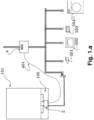
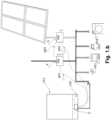
- the device 101 is part of a set of electrical loads "501" - "504" (hereinafter referred to as user) see figures 1.a , 1.b , 1.c with which it shares the electric power.
- One advantage of the inventive solution is the applicability to different installation conditions which may include the availability of power from renewable source and any combination of control units for measuring the absorbed power P.abs or the overall used power P.used or the power from renewable source P.pv.
- the minimum requirement at least for some embodiments, is that there is at least one control unit 4 capable of detecting the over consumption condition.
- Meters capable of communicating through known means, to other devices 101, 501 - 504 of the user facility, for example information and sometimes, at least for some models, of receiving information and/or commands have long been known.
- control unit 4 which may be the electrical energy meter of the user, or a modified meter with added modules or an ad-hoc device.
- said control unit 4 uses the communication channel 401 and is able to detect and communicate, according to the variants:
- a renewable power control unit Pv 5 placed on the branch of the renewable energy system and suitable for measuring power from renewable sources, or with reference to fig. 1.c a used power control unit Pu 6 located downstream of any renewable energy system and adapted to measure the power used by the user P.used.
- a renewable power control unit Pv 5 is preferably able to send signals to other devices through channels 402 or 403, as in fig. 1.b , and such used power control unit Pu 6 through, for example, channels 404 or 405.
- a meter or control unit for the energy used and a meter of the energy produced from renewable sources, even with communication capabilities, are part of the prior art, but are part of the invention:
- Said communication channels 401, and/or 402, 403, 404, 405 use known means and are represented in the figures 1.a , 1.b , 1.c as connections between two points, but without loss of generality they may be direct or wireless indirect transmissions or in broadcast mode, between the same points.
- the over consumption detection may be made directly with a measurement by said control unit 4, that in the simplest case is limited to detect an over consumption with known electronic means and may not have the capacity of communicating externally any other value other than the over consumption condition.
- said detection may be made with a calculation by any one among said control unit 4, said control card 2 or said used power control unit Pu 6 or renewable power control unit Pv 5 if present.
- a non-negative tolerance P.toll may preferably be defined, and the over consumption may be detected when P .abs + P .toll > P .contr
- the detections may be made with means equivalent to the control unit 4.
- the control unit if a renewable energy source is not present; in this case the absorbed power P.abs is equal to the used power P.used, measured by the used power control unit Pu 6 that may communicate it to one among said control unit 4, said control card 2 that may make the calculation.
- the used power control unit Pu 6 measures the power used P. used, while the absorbed power P.abs is measured by the control unit 4.
- P .pv P .used ⁇ P .abs
- control unit 4, or if present, the renewable power control unit Pv 5 or the used power control unit Pu 6 are provided at least with detection or communication means such as to enable the control card 2 to detect (either because received or because calculated by it) at least over consumption conditions.
- detection or communication means such as to enable the control card 2 to detect (either because received or because calculated by it) at least over consumption conditions.
- the devices control unit 4, renewable power control unit Pv 5 or used power control unit Pu 6 may have even only essential measurement and communication functions because the control capacity may be in the control card 2.
- the over consumption condition may be expressed with: P .used + P .toll > P .em with P .toll ⁇ 0 or equivalently: P .abs + P .toll > P .contr
- the first expression corresponds to a possible calculation in the case in which the used power P.used is known (because the power from renewable source P.pv is either known or null);
- the second expression corresponds to a possible calculation in the case in which the absorbed power P.abs is known (the power from renewable source P.pv may be unknown).
- the conditions are however equivalent.
- the over consumption may be detected directly also with the control unit 4, with known methods, without the need for said control unit 4 to detect or know any power value.
- the first of the two expressions will be used in the following to indicate the condition of over consumption. Therefore, where we say "used power P.used plus said tolerance P.toll does not exceed said deliverable power P.em" it does not imply the knowledge of any power value, while other optional functions described below need some power values to be known as it is explained below.
- control card 2 may revert back from an over consumption condition continuing to guarantee reaching said target temperature T.target within the usage time t.target.
- the control card 2 determines the activation time t.ON that allows said target temperature T.target to be reached within the usage time t.target with values of said conditioning power P.cond lower than said nominal power P.nom and preferably equal to a forecast power P.f. Possible embodiments for estimating said forecast power P.f. are described below.
- a conditioning step begins, this lasts for a conditioning time t.cond, and ends when a conditioning end temperature T.end.cond equal to the set temperature T.target is reached, and during said conditioning step the following controls are periodically made:
- the control card 2 may use a preset table in which a conditioning time corresponds to each target temperature T.target, or preferably to each temperature range from a current value to a target temperature T.target; or it can use a linear function with a preset coefficient in said control card 2 that takes into account the heat capacity and a conditioning power P.cond, lower than the nominal power P.nom by a quantity that may be set by the person skilled in the art, and higher as the greater the risk of over consumption and possibly modifiable or set with learning algorithms as described below for some embodiments.
- said preset linearity coefficient may consist only in the thermal capacity while the actual conditioning power may be estimated in the operation step with known methods.
- the available power P.av is the residual power that can be used to increase the conditioning power P.cond.
- the control card 2 knows the value of the available power P.av and, during conditioning, if at a generic instant of time it detects that the available power P.av is negative, then it recognizes an over consumption and, before said limited time ⁇ t.max has elapsed from the over consumption time t.sovr, it reduces the overall conditioning power P.cond for said device 101 by a quantity equal to at least the absolute value
- the device 101 may use all the available power at each moment in time, including renewable energy sources,-.
- the control card 2 suspends the conditioning function. Therefore, the system thus described will not cause an over consumption for more than a limited time ⁇ t.max.
- control card 2 knows the available power P.av, when it detects the need to activate its own element, it sets the relative conditioning power P.cond to the minimum value between nominal power P.nom and available power P.av minus any tolerance value P.toll.
- P .cond minimum P .av ⁇ P .toll , P .nom
- the control card 2 may increase the conditioning power P.cond by an equal amount until reaching the nominal power P.nom.
- the conditioning power P.cond is always kept at the maximum value that allows the available power P.av to be not less than zero and possibly not less than a predefined tolerance value P.toll.
- conditioning power can be assigned among the various heating elements according to predefined priorities with methods known to the person skilled in the art.
- the conditioning whose management is the object of the invention consists of a water conditioning process in one or more storages.
- the target temperature T.target is the minimum necessary to ensure the service, but it may be increased, for example, to store more heat energy from a renewable source up to the maximum values allowed by safety standards and provided that this does not lead to unnecessary heat losses.
- the target temperature T.target may be changed, increasing it in case of heating or reducing it for cooling, without considerably affecting comfort.
- control card 2 may detect in any of the described ways or with equivalent methods if the surplus P.sur is positive, possibly for a predefined tolerance threshold in said control card 2. As long as it detects that said power surplus P.sur is positive, the control card 2 adds the following controls to the thermostating operation:
- the same purpose of regulating the conditioning power P.cond to revert from an over consumption condition may be obtained even if the available power in general is not known, but alternative signals are available sent by an over consumption detector 4 whose control logic is described below.
- control card 2 when carries out a reduction subsequent to an over consumption, it also initialises a stabilisation meter t.stab with a time interval within which no power increases may be made. Such time value and the extent of power increase may be set by the man skilled in the art.
- control card 2 upon receiving a first over consumption signal, the control card 2 begins to decrease the conditioning power P.cond, up to the first of the two events: a predefined time has elapsed without receiving over consumption signals or the conditioning system P.cond is cleared.
- control card 2 may increase the conditioning power P.cond until it reaches the nominal power P.nom, but unlike the previous case, the control card 2 does not know neither the entity of the available power P.av nor that of the over consumption and therefore always proceeds by trial and error; therefore, a further expedient is needed to avoid instability between increases and decreases.
- a possible solution is that the control card 2 recognises the decrease which has eliminated the over consumption and maintains that level of conditioning power for a period of time.
- the control card 2 has in memory a stabilisation meter t.stab and a status variable; when it receives a first over consumption signal, if the conditioning function is active, it decreases the conditioning power P.cond and initialises the status variable with the value over_P; at each subsequent over consumption signal, the control card 2 performs a further decrease, when a sampling interval elapses without receiving the over consumption signal, the control card 2 switches the status variable into a value below the threshold below_P and initialises the stabilisation meter t.stab which has the same role already described.
- An equivalent solution to avoid instability is that the control card 2 recognises the increase that led to the over consumption, cancels said increase and maintains said power level for a period of time.
- the control card 2 may estimate the time required for conditioning in a storage tank on the basis of the nominal power, heat capacity, efficiency and target temperature T.target.
- the case in which the thermal capacity Cap.ter is preset in the memory of said control card 2 and then the case in which it is learned during operation are described below.
- the time over temperature curve may be approximate to a linear curve, see Figure 4 .
- the efficiency coefficient eff is substantially equal to one, in the case of a heat pump the efficiency coefficient eff is equal to the COP (Coefficient of Performance). Cap.ter is the heat capacity of the storage in which the power is dissipated.
- a forecast power P.f is considered, which may be set equal to the nominal power P.nom times a reduction coefficient K lower than 1.
- P . f P . nom * K
- the conditioning time t.cond is directly proportional to the temperature variation and to the thermal capacity Cap.ter and inversely proportional to the heating efficiency eff and to the forecast power P.f.
- the thermal capacity Cap.ter and the efficiency eff are two system parameters that may be represented by a single parameter which will now be called linearity coefficient Coeff.lin and corresponds to the heat capacity over efficiency ratio.
- Coeff . lin Cap . ter / eff
- Said linearity coefficient Coeff.lin may be preset in the memory of the control card 2; the value may be characterised in laboratory with known means the conditioning time t.cond is directly proportional to the linearity coefficient Coeff.lin.
- the linear formula described is an acceptable approximation; alternatively, it is also possible to further improve the time estimate, and take into account that the COP, and therefore the linearity coefficient Coeff.lin, is affected by the difference between the evaporator temperature Te and condenser temperature and therefore varies during conditioning.
- the description refers to the case in which the storage is to be heated and exchanges heat with the condenser while the external source (evaporator at temperature Te) is the heat source.
- the same considerations apply if the storage temperature Ta is to be cooled exchanges heat with the evaporator and the external source (condenser at temperature Tc) is the one that absorbs heat.
- a value for said evaporator temperature Te is available, for example a detection with an external ambient sensor even not in the proximity of the evaporator or as an alternative preset values as a function of the season and time or even a fixed value that represents a reliable estimate of the average value. It is however preferable to have at least two values, for example a value representative of the day rather than the night or of the summer rather than winter months.
- the linearity coefficient Coeff.lin.k is not considered as constant per a predefined storage temperature segment k, but constant for a segment kd, of the delta between the condenser temperature Tc (in the case of heating can be approximated to the storage temperature Ta) and evaporator temperature Te.
- the segments k of the storage temperature Ta are calculated such that when the delta is comprised in a segment kd, the storage temperature is comprised in a segment k to which the linearity coefficient Coeff.lin.k corresponding to the segment kd is associated.
- the temperature of the evaporator is considered as constant during the heating process.
- a possible improvement consists of repeating the segments k definition procedure if the temperature of the evaporator varies beyond a predefined threshold.
- a variable speed ⁇ compressor it is possible to correct said linearity coefficient Coeff.lin.k based on said speed ⁇ using tables, experimental formulas or theoretical calculations always with methods known to the person skilled in the art.
- the values ⁇ T.kd, ⁇ T.kd+1 are the extremes of the segments kd of the delta between storage temperature Ta and evaporator temperature Te; the control card 2 on the basis of such parameters which it reads from its memory, calculates the extremes T.in.k of the segments k of the storage temperature Ta with the same linearity coefficient Coeff.lin.k.
- Figure 3 shows, for a specific temporal trend of the temperatures, how the extremes of the segments k of the storage temperature Ta coincide with the preset extremes ⁇ T.kd of the delta between said storage temperature Ta and evaporator temperature Te.
- the difference with respect to the previous method consists in the fact that the extremes of the storage temperature segments Ta are not preset but calculated as a function of the evaporator temperature Te.
- control card 2 determines the activation time t.ON.
- the precautionary estimate reduces the risk of failure to reach the target temperature T.target within the usage time t.target, in fact an overestimated conditioning time and therefore an early activation, allows reducing the conditioning power, if necessary, without compromising the performance.
- the linearity coefficients Coeff.lin, Coeff.lin.k have the physical meaning of the ratio of heat capacity to efficiency for each storage and may be estimated by the person skilled in the art with a characterisation in laboratory or through mathematical models; according to this solution these coefficients are preset in the control card 2.
- the estimation of the conditioning time t.cond may be further improved by using temperature gradients learned on the basis of the real temperature trend rather than linearity coefficients Coeff.lin, Coeff.lin.k preset in memory for all the devices of a same model.
- the method requires that the conditioning power remains equal to the value P.cond.ip for a time defined by the person skilled in the art, an event that may occur either naturally either forcibly if the control card 2 keeps said conditioning power as constant for the time necessary to make the estimate. Therefore, a possible procedure is to divide the possible excursion by the conditioning power into np intervals and to calculate the valid conditioning gradient Grad.T.ip with sufficient approximation in a power interval ip with known methods.
- the estimation and usage of the actual gradient rather than a calculation based on the factory value and on the nominal power, advantageously cancels tolerances in the consumption of the conditioning elements and partly the errors deriving from variations in the supply voltage that modify the actual heat power delivered by the conditioning elements 103.
- the described linearity coefficient method may also be applied to estimate the conditioning time with a heat pump.
- an even better estimate precision may be obtained if the linearity coefficients Coeff.lin.k are calculated for temperature segments defined each time by the control card 2 so that the difference between the storage temperature Ta and current evaporator temperature Te belongs to preset segments kd, as already described.
- the calculation of the linearity coefficients Coeff.lin.k also takes into account the speed ⁇ of the compressor, therefore when estimating the time an expected value foreseen for said speed is used.
- the performance of the control algorithm depends on the parameter K used for the estimated conditioning power Pf: an advance in reaching the target temperature T.target leads to an increase in heat standing losses caused by the longer time for which the target temperature T.target needs to be maintained, but it increases the risk of not reaching the set temperature within the time required in case of unforeseen needs to reduce the conditioning power.
- the parameter K may be modified by the user, who may increase it to decrease any heat standing losses and reduce it if the conditioning device 101 does not reach the target temperature T.target within the usage time t.target.
- the control card 2 modifies the value of K, reducing it in the event that the target temperature T.target is not reached within the usage time t.target, and increasing it if the time within which the target temperature T.target is reached is much earlier than the usage time t.target.
- Consumption patterns in the user facility depend on the consumers habits which follow a daily and weekly routine; therefore it is possible to learn the recurring pattern represented by the power absorbed as an average over time intervals i.
- Said time intervals may be preset in the memory of said control card 2 or self-learned for example by identifying periods in which the used power P.used undergoes limited variations or alternatively other known methods.
- the forecast power P.f.i is deduced from the average values detected in the same interval in the previous cycles; therefore, the forecast power P.f.i is considered equal to the total power available for the conditioning on average in an interval i, and the estimation problem leads back to the problem of detecting said total power available.
- the forecast power P.f.i in an interval i is substantially the sum of said used conditioning power P.cond and said residual available power P.av averaged over at least one previous interval i. It will be shown that there are several ways to determine the forecast power P.f.i and that this is possible even in the more general case in which the available power P.av is not known to the control card 2.
- the control card 2 has preset a breakdown of the day in at least two time intervals, for each day of the week, in which t.i is the starting instant of the time interval i and it is stored in said control card 2. For each interval i of the division, said control card 2 has set in memory the start time and the end time.
- conditioning power is momentarily reduced, perhaps by other algorithms, may not be excluded.
- the index i indicates averaged quantities in the interval i with known methods
- P.toll is a tolerance value set by a person skilled in the art with a value greater than or equal to zero. Said average values may be obtained with known methods without detracting anything from the inventiveness of the method.
- the conditioning power P.cond corresponds to the sum of the conditioning powers for the active tanks, and in the step of estimating the conditioning time, with the priority of the tanks being equal, if the forecast power P.f is less than the nominal power P.nom of the tanks, it is possible to calculate a forecast power for each storage P.f.i.j for example by recognising for each storage a share of power proportional to its own nominal power or, alternatively, the person skilled in the art may set appropriate algorithms.
- the forecast power P.f could be less than the available power, but the probability of this happening is low enough that the object of the invention can be still achieved. It should also be noted that with such method it is possible to learn the available power only in the periods in which a conditioning request is active (i.e. the period that begins at the activation time t.ON of the conditioning and ends when the temperature T.end.cond is reached), while in the other periods it is preferable to assign a predefined value to said forecast power P.f.i and to disable the calculation.
- P.cond(h) is the conditioning power read at the sampling instant h in the interval i
- t.n is the number of samples relative to the interval i
- P.cond.i is the average among all the values sampled in the interval i.
- Another possible method for determining the activation time is by trial and error and consists in repeatedly calculating the temperature reachable at the usage time t.target in the case in which the conditioning activates at the current time t.curr. As long as a temperature higher than the target temperature T.target is obtained for the usage time t.target, is too early to activate the conditioning; when repeating the calculation for the first time a temperature at the usage time t.target close to the target temperature T.target is obtained, then t.curr is an instant close to the correct activation time t.ON and it is possible to activate the conditioning.
- This method suffers from an error that may be reduced by increasing the frequency of the calculation, but the disadvantage remains that it is basically a trial-and-error method, so it is necessary to repeat the calculation.
- the control card 2 performs the following steps:
- step 4 it is possible to use the real available power P.av in place of the forecast power P.f.i and this is preferable in the case in which said available power P.av is lower than the forecast power P.f.i.
- the linearity coefficient Coeff.lin.k may be advantageously selected for the segment k to which the final temperature of the interval i belongs.
- the temperature excursion in the time interval i at constant power includes temperature segments k to which different linearity coefficients Coeff.lin.k. are assigned, linearity coefficients k; for the value of linearity coefficients Coeff.lin.k in the formula it is possible to take the average between the linearity coefficients assigned to the temperature segments crossed with the thermal excursion during said time interval i, preferably the weighted average with the percentage overlap of each segment k on said heat excursion.
- an average linearity coefficient may be calculated as a weighted average linearity coefficient among the linearity coefficients: Coeff.lin.k 'and Coeff.lin.k", with the weights respectively proportional to the overlap between the temperature segment (Ti, Ti + 1) and the segments k' and k" and any linearity coefficients Coeff.lin.k corresponding to any intermediate segments k' and k" with unit weight.
- the quantities target temperature T.target, current temperature T.curr, usage time t.target, conditioning time t.cond, nominal power P.nom, conditioning power P.cond and temperature are referred to the single storages and may be indicated respectively with T.target.j, t.target.j, t.cond.j, P.nom.j, P.cond.j, T.curr.j, where P.cond corresponds to the sum of the conditioning powers P.cond.j by storage.
- the preset or estimated parameters such as efficiency of the conditioning process eff and linearity coefficients Coeff.lin and Coeff.lin.k, and relative extremes of the temperature segments T.k.
- control card 2 may be preset with priority values by storage or the division of the available power may be equal in absolute value or in proportion to the value of each storage j.
- the estimated power may advantageously be divided by single storage by following similar priority or equal division logics.
- the calculation of the activation time may be repeated to take into account updated values of the current temperature and of the available power P.av.
- step 2 of verification of the previous method the control unit detects that T . in . i > T . curr , and t . i ⁇ t . curr it has substantially found that in order to reach the target temperature T.target at the usage time t.target the conditioning should have started previously.
- the control card 2 knows in advance that it will probably not be possible to reach the target temperature T.target, and may advantageously carry out notification strategies, such as by way of a non-limiting example, calculate and communicate externally the temperature foreseen for the usage time t.target or the estimated time to reach the set temperature, signal the risk of not reaching said target temperature T.target.
- Said actions may be complemented by a notification on user interface, such as showing a suitable message on any display, turning on or flashing a warning light or emitting a notification signal; the notification to the user is disabled if the user intervenes on the user interface.
- the control card 2 could have communication means with other household or remote devices to which a message may be sent for the user, or alternatively if the user has intelligent loads, the control card 2 is able to send an energy request signal; the reception of the signal could cause the switching off of some loads and free up the power necessary for the conditioning function.
- Electricity supply contracts are possible in which, instead of providing for a single maximum threshold of power that can be drawn, more intermediate thresholds of ever-increasing power are envisaged, exceeding each of which the cost of the drawn energy increases until reaching the power maximum threshold which for the determined period mentioned above, the power supply is disconnected.
- a method is possible according to which, in addition to taking care not to exceed the maximum absorbable contractual power P.contr for more than the limited time interval ⁇ t.max allowed without causing the power supply to be disconnected, it is decided, at predetermined time intervals, whether it is necessary to switch to a more expensive power threshold or vice versa it is possible to go below a cheaper power threshold.
- P.rate.i.th is the maximum power threshold in the range i.th.
- control card 2 before activating a conditioning step or in any case before increasing the conditioning power verifies that the available power P.av is greater than the increase in the conditioning power.
- conditioning process in a storage may be generalised to the case of cooling, for example carried out with a heat pump.
- the temperature is conditioned in a room rather than in a tank. Therefore, the method described is true by replacing the term storage with the term environment or room, a conditioning element may be an air conditioning resistance or an exchanger of a heat pump.
- a conditioning element may be an air conditioning resistance or an exchanger of a heat pump.
- the thermodynamic processes follow the same rules and possibilities for estimating times.
- the adjustment of the conditioning power may also be done in this case with, for example, a variable speed heat pump as already described.
Landscapes
- Engineering & Computer Science (AREA)
- Power Engineering (AREA)
- Physics & Mathematics (AREA)
- Thermal Sciences (AREA)
- Chemical & Material Sciences (AREA)
- Combustion & Propulsion (AREA)
- Mechanical Engineering (AREA)
- General Engineering & Computer Science (AREA)
- Air Conditioning Control Device (AREA)
- Supply And Distribution Of Alternating Current (AREA)
Description
- The object of the present invention is a method and apparatus consisting of a conditioning device of a fluid in a storage configured to condition the fluid to reach a predetermined temperature at a predetermined usage time, where:
- the term "conditioning" indifferently means "heating" or "cooling";
- said conditioning is by electrical energy;
- the electrical power is supplied by the grid in a limited quantity;
- optionally there is an energy system from renewable sources that supplies energy in variable quantities;
- the conditioning device is equipped with electronic logic means, some of which are also capable of allowing a preset temperature to be reached at a predefined time, having sufficient power available for the entire activation time;
- In particular, the present invention may belong to the class:
- of electric water heaters equipped with one or more storage tanks, suitable in particular for hygienic-sanitary uses, such as both traditional electric and heat pump water heaters;
- of air conditioning systems in which:
- a fluid, which exchanges heat with an environment through a heat exchanger is conditioned in a buffer, in this case the storage is the buffer that determines the inertia of the system.
- in the absence of a buffer:
- the heat capacity of the storage is represented by the heat capacity of the vector fluid and the heat capacity of the emitters,
- without loss of generality, nothing prevents from considering the overall heat capacity of the ambient to be conditioned, in this case the fluid to be conditioned is represented by the air in said ambient.
- In users, in particular domestic users, the power that may be supplied by the grid is subject to a limit, set by the energy supply companies and determined by the distribution infrastructure and the availability of power in certain time periods; exceeding the maximum power for more than a predefined time leads to an energy disconnection; or in other cases it could trigger a rate with a higher energy cost.
- Currently, in some countries including Italy, for energy supply contracts there is an energy disconnection for power usage thresholds in the order of 3, 4,5 or 6 kW, therefore it is not always possible to use two or more high-absorption household appliances such as oven, washing machine, dishwasher or water heater. The problem is particularly felt for storage water heaters which have an impact on users' comfort, and which may require a long activation time.
- As mentioned, exceeding the consumption threshold given by the contractual power for a limited period is admissible since the disconnection of power supply does not occur instantaneously and, even if the case of exceeding of the contractual power involves a rate variation, the increase for a limited time does not significantly affect the costs.
- To complete the picture, it must be considered that renewable energy now constitutes a non-negligible share of the domestic supply; this may come both from local generators also dedicated to single users and from large renewable energy systems connected to the distribution grids. In both cases it is advantageous to be able to change the power consumption profile to use renewable energy when it is available. The advantage generally translates into savings for the user and certainly in the greater ability to replace fossil energies with renewable ones. Therefore, we will also consider a system in which the supply of renewable energy increases the maximum usable power in a variable and not necessarily predictable way.
- Water heaters, capable of preparing hot water at the temperature and quantity needed for predefined moments are known, these assume to be able to use all their nominal power, but in the case of being switched off to guarantee the power to a device having greater priority such as for example an oven, the availability of hot water could not be guaranteed.
- Document
WO0101542A1 - Document
JP5853747B2 - Document
EP2830184A1 makes the forecast of the energy requirement and of the available power provided from a renewable energy system and, based on the information on usage needs of different electric loads and of a statistical analysis, programs their activation. - Document
US2016274556A1 reduces the activation percentage of the heating function of an air heating system up to a limit that does not affect the user comfort. - A drawback common to some of the methods described is that they need an external controller, to which the management of the consumption of any household appliance is entrusted, in order to guarantee the best solution to the o4ptimization problem; such controller should know the parameters and control algorithms of all the controlled devices. This requires the same communication protocol between all the devices and a central controller that is always in step with devices of the ever-increasing intelligence.
- A drawback of other methods such as
WO0101542A1 JP5853747B2 US2016274556A1 is that they do not do anything to prevent an over consumption. Only when the threshold is exceeded, they intervene in order to reduce the consumption with an interruption or reduction of already ongoing functions and therefore there is a sensitive impact on the user comfort - Methods aimed at preventing a plurality of electric water heaters from activating simultaneously causing a peak in consumption are described in the prior art. Three documents mentioned below belong to this area.
- Document
EP3508800A1 describes a method for staggering the activation of a plurality of water heaters in a large system with water heaters manageable by a same controller. In paragraph [0033] it is said that the water heater alternates heating periods (in staggered mode) with periods in which it restores the temperature. SoEP3508800 (A1 ) teaches away from completing the conditioning just in time for the usage, thus increasing the standing heat losses. -
EP3382297A1 proposes a random staggering criterium based on the serial number of every water heater. Here too, there is a teaching away from optimizating heat losses. -
JP2008267708 -
US2026216007A1 teaches a method to reduce power consumption peaks, where an electrical network has an associated controller configured to send requests to reduce power consumption, a controller of a water heater is configured to respond to the request by switching off the heating function based on the heat reserve and heat requested. - Such methods, by staggering the activations of different water heaters over time, solve an optimization problem over a large quantity of loads and they work as long as correct criteria are established to access energy the shared scarce resource. However, these methods do not teach how to adapt to a consumption value variable over time such as the value of power available in a home when other household appliances are activated in an uncontrollable way. Furthermore, they teach that heating may be anticipated without constraints and do not address the problem of heat losses which are so greatly increased.
- A general object of the present invention is to at least partially eliminate such drawbacks.
- In particular, an object of the present invention is to prevent the over consumption by a forecast and planning that takes into account the comfort requirements.
- A further object, at least of some variants of the invention, is to optimise this anticipated activation in order not to increase the energy consumption for standing heat losses.
- Another object, at least of some variants of the invention, is to maximise the self-consumption of renewable energy; yet another object is to detect in advance the situation in which the available power does not allow to reach the set temperature within the usage time and possibly notify the need for more power.
- Another purpose of at least some variants is to devise a method and a device that allow to avoid prolonged over-consumption, to forecast the available power and to optimize the self-consumption of renewable energy without the need for a power meter.
- These and other objects, which shall become clear from the following description, are achieved with the invention in accordance with the provisions of claim 1.
- Other objects may also be achieved by means of the additional features of the dependent claims.
- Further objects and advantages of the present invention shall be better highlighted by the following description of a basic version of the method and apparatus for the optimization of the conditioning time.
- According to the invention, the conditioning device estimates the activation time as a function of the target temperature and the usage time. On the basis of an available power provided for the conditioning. The conditioning device is able to vary its power and from activation it uses all the available power until reaching its nominal power, if there is an over consumption it reduces its power up to the level that does not cause an over consumption. Note that if the available power estimate is correct, the target temperature is reached at the usage time.
- The figures are purely schematic but compatible with possible embodiments. As for
figure 1.a ,1.b ,1.c , spatial terms such as "high", "low" refer, unless otherwise indicated, to the position of the object as shown in the figure. -
Figure 1.a shows, by way of an example, a user facility consisting of several electrical loads powered exclusively by a conventional electrical source with detection means in the user input. -
Figure 1. b shows a user facility as infigure 1.a but powered by both conventional and renewable sources equipped with means for detecting the conventional part and measuring means for the renewable part. -
Figure 1.c shows a user facility as shown infigure 1.a but powered by both conventional and renewable sources equipped with means for detecting the conventional part and means for measuring the power used by the user. -
Figure 2 shows a possible temporal trend of the power variables that will be used in the description of the invention. -
Figure 3 shows a possible estimate of the temperature trend with respect to the time in the storage. -
Figure 4 shows another possible estimate of the temperature in the storage with respect to time according to other variants of the invention. - With reference to
figures 1.a ,1.b ,1.c , theconditioning device 101 object of the invention provides at least one storage of a fluid to be conditioned at a target temperature T.target within a usage time t.target, through at least one element, adapted to condition, said element is powered by electrical energy. - Said fluid may be in particular water for hygienic-sanitary uses and as such it will always be indicated below, being it understood that the invention applies to any fluid, including air, which has characteristics suitable for being treated according to the methods and apparatuses of the invention.
- The
device 101 may also be an electric heat pump water heater and said element then consists of the condenser or evaporator of the heat pump. In other words, in the following description, said elements may be understood as any heating or cooling element fed directly or indirectly by electrical energy. - The
device 101 comprises acontrol card 2 which is capable at least of: - detecting the storage temperature "Ta" in a storage,
- saving in memory parameters such as target temperature "T.target" and usage time "t.target" and performing calculations on said parameters,
- modulating the conditioning power of said conditioning elements 103 by selecting an appropriate activation duty cycle within a control period or with the selection of the half-waves by switching at the zero voltage crossing.
- According to the invention, the
device 101 is further able to receive information from other devices such as: - a
control unit 4 placed on the power supply branch of the electrical grid (seefigs 1.a ,1.b ,1.c ), which may detect and report through thecommunication channel 401 the power delivered by the grid towards all user loads. If the user also has its own renewable energy generation system, such power is "negative" in the periods in which the renewable energy produced is in excess of the needs for self-consumption, that is, power is fed into the grid rather than absorbed from it; - if a local renewable source is available:
- a renewable power control unit Pv 5 placed on the power supply branch from the renewable source (see
fig. 1.b ) which may directly detect and report the power sent to users for self-consumption throughchannel 402 or channels 403-401; - or a used power control unit Pu 6 placed on the user power supply branch from the grid, downstream of the connection with any renewable source power generator, said used power control unit Pu 6 may directly detect and report via
channel 404 or channels 405-401 the power currently used by the user and therefore, indirectly, by difference with respect to the power detected by thecontrol unit 4, the power drawn from the renewable source.
- a renewable power control unit Pv 5 placed on the power supply branch from the renewable source (see
- It is clear that the conditioning process may comprise a thermostating step in which the temperature control takes place as per the prior art with a hysteresis.
- By way of an example and without any limiting intent, in the case of electric resistance the heating power may be varied with pulse width modulation, or in the case of a heat pump with a variable speed compressor.
- The
device 101 is part of a set of electrical loads "501" - "504" (hereinafter referred to as user) seefigures 1.a ,1.b ,1.c with which it shares the electric power. - With reference to
fig. 2 the following terms are used to indicate the power variables used below: - "P.contr" contractual power is the maximum power, predetermined or contractual, that may be supplied by the grid as per the supply contract;
- "P.pv" is the power from renewable source;
- "P.em" = P.contr + P.pv is the total deliverable power, sum of the contractual power P.contr and of the power from renewable source P.pv;
- "P.abs" absorbed power is the power delivered by the grid, absorbed by the user net of any power from renewable source P.pv, which may be detectable by the
control unit 4; - "P.sur" surplus power is the net power fed back into the grid, it is essentially the opposite in value of the power absorbed P.abs from the grid and as such it may be detectable by the
control unit 4; - "P.used" = P.abs + P.pv is the overall used power, absorbed by the user electric loads which in the absence of power from renewable source corresponds to the absorbed power P.abs, in the presence of power from a renewable source it may be detected by a meter placed at the used power control unit Pu 6.
- It may be seen that the absorbed power P.abs is equal to the used power minus the power from renewable source P.pv:


figure 2 , it may be seen that if power from renewable source P.pv is available, it is possible that the used power P.used exceeds the contractual power P.contr without causing over consumption. When the power from renewable source P.pv is greater than the used power P.used, there is a surplus power P.sur fed into the grid

- In general, there is an over consumption if the absorbed power P.abs exceeds the contractual power P.contr


- The available power "P.av" is defined as the difference between the deliverable power P.em and the used power P.used or equivalently as the difference between the contractual power P.contr and the absorbed power P.abs:

P.em - P.used = (P.contr + P.pv) - (P.abs + P.pv) = P.contr - P.abs The following is valid
- It will be seen how, according to the methods of the invention, it is possible to avoid causing an over consumption for more than a limited time interval Δt.max while continuing to meet the user setting of reaching the target temperature T.target within the usage time t.target.
- Additional values defined are:
- "P.cond" as the conditioning power used by said
device 101 for the conditioning; - "P.nom" as the nominal power or rated power which is the maximum power that may be absorbed by the
device 101, possibly depending on the working conditions as in the case of a heat pump; - with "T.target" and "t.target" respectively the target temperature and usage time;
- with "t.cond" the conditioning time;
- the index "j" indicates a generic storage j and "P.nom.j", "P.cond.j", "T.target.j" and "t.target.j" respectively nominal power, conditioning power, set temperature and usage time for a generic storage j. The "j" index shall be used in those variants that provide for multiple storages between which it is necessary to distinguish.
- the index i is used to indicate a generic time interval;
- the index k to indicate a generic temperature segment and m to indicate the number of temperature segments;
- the index h for a generic conditioning element.
- The method of the invention in its general principle and according to one or more of its possible embodiments.
- One advantage of the inventive solution is the applicability to different installation conditions which may include the availability of power from renewable source and any combination of control units for measuring the absorbed power P.abs or the overall used power P.used or the power from renewable source P.pv. The minimum requirement, at least for some embodiments, is that there is at least one
control unit 4 capable of detecting the over consumption condition. - Meters (or detectors) called "smart meters", capable of communicating through known means, to
other devices 101, 501 - 504 of the user facility, for example information and sometimes, at least for some models, of receiving information and/or commands have long been known. - Therefore, the invention presupposes the presence of a
control unit 4 which may be the electrical energy meter of the user, or a modified meter with added modules or an ad-hoc device. In any case, saidcontrol unit 4 uses thecommunication channel 401 and is able to detect and communicate, according to the variants: - at least the condition in which the used power P.used exceeds the deliverable power P.em;
- preferably at least the absorbed power P.abs in excess of the contractual power P.contr;
- preferably the absorbed power P.abs (power supplied by the grid);
- even more preferably the available power P.av;
- and even more preferably, when power from a renewable source P.pv is present, the surplus power P.sur is fed back into the grid.
- In the event that the user is provided with a renewable energy system, there may be additional control units in addition to said
control unit 4, such as for example with reference tofig. 1.b a renewable power control unit Pv 5 placed on the branch of the renewable energy system and suitable for measuring power from renewable sources, or with reference tofig. 1.c a used power control unit Pu 6 located downstream of any renewable energy system and adapted to measure the power used by the user P.used. If present, such renewable power control unit Pv 5 is preferably able to send signals to other devices throughchannels fig. 1.b , and such used power control unit Pu 6 through, for example,channels - It will be seen how, according to the invention it is always possible to achieve the intended purposes even with different versions of said
control unit 4 responding to the minimum characteristics indicated above or even with alternative means to acontrol unit 4. - A meter or control unit for the energy used and a meter of the energy produced from renewable sources, even with communication capabilities, are part of the prior art, but are part of the invention:
- the way in which said meters, even legacy meters, are used as control units to achieve the objects of the invention;
- the solutions described to reach said objects even with simpler version of said control units;
- and, for some variants, the preferred characteristics of said
control unit 4, renewable power control unit Pv 5 and used power control unit Pu 6 are comparable to smart meters with communication channels. -
Said communication channels 401, and/or 402, 403, 404, 405 use known means and are represented in thefigures 1.a ,1.b ,1.c as connections between two points, but without loss of generality they may be direct or wireless indirect transmissions or in broadcast mode, between the same points. - The over consumption detection may be made directly with a measurement by said
control unit 4, that in the simplest case is limited to detect an over consumption with known electronic means and may not have the capacity of communicating externally any other value other than the over consumption condition. - As an alternative, said detection may be made with a calculation by any one among said
control unit 4, saidcontrol card 2 or said used power control unit Pu 6 or renewable power control unit Pv 5 if present. To this end, it is sufficient to know the absorbed power P.abs and the contractual power P.contr and verify if

- Not only the calculation, but also the detections may be made with means equivalent to the
control unit 4. For example, with the said control unit, if a renewable energy source is not present; in this case the absorbed power P.abs is equal to the used power P.used, measured by the used power control unit Pu 6 that may communicate it to one among saidcontrol unit 4, saidcontrol card 2 that may make the calculation. - If a renewable source is present, the used power control unit Pu 6 measures the power used P. used, while the absorbed power P.abs is measured by the
control unit 4. By comparing the two values, it is advantageously possible to determine the power from renewable source P.pv with the formula:
- If there is a renewable power control unit Pv 5 with a
communication channel control unit 4 consisting of an old model meter, not of the smart meter type). In this case there is an over consumption if the used power P.used detected by said used power control unit Pu 6 is greater than the deliverable power P.em:
- Or

control card 2, saidcontrol unit 4, saidcontrol unit 4, said renewable power control unit Pv 5, said used power control unit Pu 6 and the calculation may be made completely from one or distributed on more of saiddevices - In general, therefore, the
control unit 4, or if present, the renewable power control unit Pv 5 or the used power control unit Pu 6 are provided at least with detection or communication means such as to enable thecontrol card 2 to detect (either because received or because calculated by it) at least over consumption conditions. To this end, thedevices control unit 4, renewable power control unit Pv 5 or used power control unit Pu 6 may have even only essential measurement and communication functions because the control capacity may be in thecontrol card 2. - Therefore, the over consumption condition may be expressed with:


- In the particular case in which said tolerance P.toll is equal to zero, the over consumption may be detected directly also with the
control unit 4, with known methods, without the need for saidcontrol unit 4 to detect or know any power value. Without loss of generality, with respect to the way in which an over consumption is detected, the first of the two expressions will be used in the following to indicate the condition of over consumption. Therefore, where we say "used power P.used plus said tolerance P.toll does not exceed said deliverable power P.em" it does not imply the knowledge of any power value, while other optional functions described below need some power values to be known as it is explained below. - Following the description of consumption detection methods according to different embodiments , the method with which the
control card 2 may revert back from an over consumption condition continuing to guarantee reaching said target temperature T.target within the usage time t.target will be described. - According to the invention, the
control card 2 determines the activation time t.ON that allows said target temperature T.target to be reached within the usage time t.target with values of said conditioning power P.cond lower than said nominal power P.nom and preferably equal to a forecast power P.f. Possible embodiments for estimating said forecast power P.f. are described below. At the activation time t.ON a conditioning step begins, this lasts for a conditioning time t.cond, and ends when a conditioning end temperature T.end.cond equal to the set temperature T.target is reached, and during said conditioning step the following controls are periodically made: - detecting and communicating to said
control card 2 at least if an over consumption takes place using any of the described methods and in a positive case: - detecting the over consumption time "t.sovr" at which this occurs;
- from said over consumption time t.sovr, within a limited time interval Δt.max, defined in the memory of said
control card 2 and until said conditioning time P.cond is greater than zero, reducing said conditioning power P.cond until said used power no longer exceeds said deliverable power P.em; - if instead said used power does not exceed said deliverable power P.em and if said conditioning power P.cond is lower than said nominal power P.nom the
control card 2 may advantageously increase said conditioning power; - if said temperature T.end.cond is reached, it ends said conditioning step.
- To estimate the conditioning time t.cond, the
control card 2 may use a preset table in which a conditioning time corresponds to each target temperature T.target, or preferably to each temperature range from a current value to a target temperature T.target; or it can use a linear function with a preset coefficient in saidcontrol card 2 that takes into account the heat capacity and a conditioning power P.cond, lower than the nominal power P.nom by a quantity that may be set by the person skilled in the art, and higher as the greater the risk of over consumption and possibly modifiable or set with learning algorithms as described below for some embodiments. Alternatively said preset linearity coefficient may consist only in the thermal capacity while the actual conditioning power may be estimated in the operation step with known methods. - The methods that may be used to revert from over consumption will now be described based on the characteristics of said
control unit 4. - Note that the available power P.av is the residual power that can be used to increase the conditioning power P.cond. According to a preferred embodiment, the
control card 2 knows the value of the available power P.av and, during conditioning, if at a generic instant of time it detects that the available power P.av is negative, then it recognizes an over consumption and, before said limited time Δt.max has elapsed from the over consumption time t.sovr, it reduces the overall conditioning power P.cond for saiddevice 101 by a quantity equal to at least the absolute value |P.av|. - In formulas, if P.av <0, we set:

in order to restore the available power P.av to a non-negative value. - Note that, it being understood that it must be P.cond ≤ P.nom, this formula actually has a general value in the sense that, regardless of whether P.av is positive or negative, its application:
- if P.av <0 , reduces P.cond;
- if instead P.av > 0, P.cond increases (according to a possible embodiment described below);
- if instead P.av = 0, P.cond is not changed by the algorithm.
- The result is that the
device 101, according to a preferred embodiment, may use all the available power at each moment in time, including renewable energy sources,-. - The goal of avoiding prolonged over consumption is achieved even if it is imposed that P.av is not only greater than zero, but greater than a minimum tolerance value. So, in general to avoid a prolonged over consumption,


- In the event that the over consumption exceeds the conditioning power P.cond, the
control card 2 suspends the conditioning function. Therefore, the system thus described will not cause an over consumption for more than a limited time Δt.max. - According to a possible embodiment, if the
control card 2 knows the available power P.av, when it detects the need to activate its own element, it sets the relative conditioning power P.cond to the minimum value between nominal power P.nom and available power P.av minus any tolerance value P.toll. Upon activation, we have:
- Advantageously, if it detects that the available power P.av is greater than said tolerance value P.toll, the
control card 2 may increase the conditioning power P.cond by an equal amount until reaching the nominal power P.nom. In other words, thecontrol card 2 adjusts the power P.cond to the maximum value such that the available power P.av, minus any tolerance value P.toll, is not negative; this is accomplished by imposing a variation ΔP.cond in the conditioning power as follows:
- As mentioned, the second formulation has a more general validity and is equal to the first when said tolerance P.toll is set equal to zero.
- Therefore, the conditioning power P.cond is always kept at the maximum value that allows the available power P.av to be not less than zero and possibly not less than a predefined tolerance value P.toll.
- Note that, while an increase in conditioning power P.cond is preferably made as soon as available power is detected, a reduction may be made with a certain delay within the limited time Δt.max from the beginning of the over consumption.
- The system described remains valid even if there are more conditioning elements controlled by the
same control card 2, in this case the conditioning power can be assigned among the various heating elements according to predefined priorities with methods known to the person skilled in the art. - In case a renewable source is present, advantageously, according to the invention, it is useful to maximise the self-consumption by storing heat energy at least for that part for which thermodynamically more efficient uses are not available.
- This is almost always possible if the conditioning whose management is the object of the invention consists of a water conditioning process in one or more storages. In fact, the target temperature T.target is the minimum necessary to ensure the service, but it may be increased, for example, to store more heat energy from a renewable source up to the maximum values allowed by safety standards and provided that this does not lead to unnecessary heat losses.
- But even if the air conditioning concerns a room, the target temperature T.target may be changed, increasing it in case of heating or reducing it for cooling, without considerably affecting comfort.
- As said, the
control card 2 may detect in any of the described ways or with equivalent methods if the surplus P.sur is positive, possibly for a predefined tolerance threshold in saidcontrol card 2. As long as it detects that said power surplus P.sur is positive, thecontrol card 2 adds the following controls to the thermostating operation: - The
control card 2 sets T.end.cond equal to a predefined maximum temperature T.lim in saidcontrol card 2, (greater than the target temperature T.target in case of heating and lower in case of cooling); - if the target temperature T.target is reached or if there is not an active conditioning step, it continues or starts conditioning up to the maximum temperature T.lim by adjusting the power P.cond such that the power surplus is not negative; this may be achieved by imposing a variation ΔP.cond in the conditioning power:

- alternatively, P.cond is varied with one of the methods already described to keep the available power P.av at a value close to zero but not negative, however, by using the surplus power P.sur instead of the available power P.av as a quantity to be maintained not negative;
- if the temperature T.end.cond is reached, the conditioning step ends.
- If necessary, it is possible to define a maximum time within which the start of conditioning may be anticipated by activating the self-consumption; with this method it is possible to avoid a thermodynamically less efficient use: when conditioning is switched on for self-consumption in advance P.cond is set equal to said surplus power P.sur, and the start of conditioning is periodically recalculated until the moment of start of conditioning arrives, then the conditioning power is set equal to P.nom, and the conditioning step begins.
- The same purpose of regulating the conditioning power P.cond to revert from an over consumption condition, may be obtained even if the available power in general is not known, but alternative signals are available sent by an over
consumption detector 4 whose control logic is described below. - There is a first alternative signal if the
control unit 4 detects only the over consumption condition and the entity of the over consumption, but not the available power P.av in general. In the event of over consumption, thecontrol card 2 therefore behaves as in the previous case. If there is no over consumption and the conditioning power P.cond is lower than the nominal value, thecontrol card 2 does not know if and how much said conditioning power P.cond may increase, but it may advantageously carry out progressive power increases until it occurs that
In order to avoid oscillations among power, reductions and increases, advantageously thecontrol card 2, when carries out a reduction subsequent to an over consumption, it also initialises a stabilisation meter t.stab with a time interval within which no power increases may be made. Such time value and the extent of power increase may be set by the man skilled in the art. - In the most basic embodiment in which the
control unit 4 detects only the over consumption condition, but not the extent of the over consumption nor the available power, according to the invention thecontrol card 2 may proceed by successive decreases until the over consumption condition is exited. - More specifically, upon receiving a first over consumption signal, the
control card 2 begins to decrease the conditioning power P.cond, up to the first of the two events: a predefined time has elapsed without receiving over consumption signals or the conditioning system P.cond is cleared. - As in the previous case, in the absence of an over consumption signal, the
control card 2 may increase the conditioning power P.cond until it reaches the nominal power P.nom, but unlike the previous case, thecontrol card 2 does not know neither the entity of the available power P.av nor that of the over consumption and therefore always proceeds by trial and error; therefore, a further expedient is needed to avoid instability between increases and decreases. A possible solution is that thecontrol card 2 recognises the decrease which has eliminated the over consumption and maintains that level of conditioning power for a period of time. To achieve this purpose, according to the invention, thecontrol card 2 has in memory a stabilisation meter t.stab and a status variable; when it receives a first over consumption signal, if the conditioning function is active, it decreases the conditioning power P.cond and initialises the status variable with the value over_P; at each subsequent over consumption signal, thecontrol card 2 performs a further decrease, when a sampling interval elapses without receiving the over consumption signal, thecontrol card 2 switches the status variable into a value below the threshold below_P and initialises the stabilisation meter t.stab which has the same role already described. An equivalent solution to avoid instability is that thecontrol card 2 recognises the increase that led to the over consumption, cancels said increase and maintains said power level for a period of time. - With the alternative means described by way of an example, it has been seen how it is possible to optimise the power so as not to cause the deliverable power P.em to be exceeded even for different types of simpler or more advanced over
consumption detector 4. - The
control card 2 may estimate the time required for conditioning in a storage tank on the basis of the nominal power, heat capacity, efficiency and target temperature T.target. The case in which the thermal capacity Cap.ter is preset in the memory of saidcontrol card 2 and then the case in which it is learned during operation are described below. For the purposes of the invention, the time over temperature curve may be approximate to a linear curve, seeFigure 4 . The time curve of the temperature is solved to obtain the time:


- The parameter K, representing the fraction of nominal power P.nom that is forecasted to be available, may be set by the person skilled in the art, and may be constant or variable during conditioning or set with learning algorithms as described below for some embodiments; in essence, it is sufficient that it is foreseen not to be possible to use all the nominal power and consequently the start of conditioning is anticipated.
So, in general, by combining the formulas and solving for the time we have:

- Said linearity coefficient Coeff.lin may be preset in the memory of the
control card 2; the value may be characterised in laboratory with known means the conditioning time t.cond is directly proportional to the linearity coefficient Coeff.lin. - For greater precision, it is possible to use a linear curve for m segments of storage temperature Ta; the extremes of each segment are preset in said
control card 2 and each segment k corresponds to a linearity coefficient Coeff.lin.k; the conditioning time in a segment k of said storage temperature Ta is given by:
In the particular case in which there is a single segment or the current temperature T.curr and the set temperature belong to the same segment, the conditioning time is given by:


- If the thermal range from the current temperature T.curr to the target temperature T.target embraces several temperatures segments, there are corresponding different linearity coefficients. It is possible to approximate this with a single linear segment, an adequate result is obtained with a linearity coefficient equal to the average of the coefficients of each segment, even better if it is equal to the weighted average with the percentage overlap of each segment k on said actual heat excursion from an initial temperature T.in to a final temperature T.end.
- In the case of a single segment, the formula is simplified by the calculation:

- Even in the case of a heat pump for the purposes of the invention, the linear formula described is an acceptable approximation; alternatively, it is also possible to further improve the time estimate, and take into account that the COP, and therefore the linearity coefficient Coeff.lin, is affected by the difference between the evaporator temperature Te and condenser temperature and therefore varies during conditioning.
- Note that in general the person skilled in the art knows how to obtain the current COP through tables, experimental curves or formulas, the temperatures at the evaporator Te and at the condenser and the speed of the compressor being known ω. If the temperatures of the evaporator Te or of the condenser Tc are not known, for the purposes of the invention:
- in the case of the heating process, the storage temperature Ta (heat sink) may approximate the temperature of the condenser Tc and the temperature of the heat source well may approximate the temperature of the evaporator (Te);
- vice versa, in the case of the cooling process, the storage temperature Ta (cold sink) may approximate the temperature of the evaporator Te and the temperature of the cold source may approximate the temperature of the condenser (Tc).
- However, calculating the conditioning time taking into account that the COP varies during the conditioning is an integral mathematical problem, complex to carry out in a microcontroller. An advantageous method is indicated below for updating the COP as the storage temperature Ta varies by selecting suitable values of the linearity coefficients Coeff.lin.k on segments of the storage temperature Ta defined on the basis of the temperature value of the external source. Note that the linearity coefficient Coeff.lin.k dimensionally corresponds to the ratio of heat capacity to efficiency, this parameter also describes the effect of standing heat losses. Therefore, it is correct to use different linearity coefficient values Coeff.lin.k as the storage temperature Ta varies as well as its difference to the external source temperature.
- By way of an example, the description refers to the case in which the storage is to be heated and exchanges heat with the condenser while the external source (evaporator at temperature Te) is the heat source. The same considerations apply if the storage temperature Ta is to be cooled exchanges heat with the evaporator and the external source (condenser at temperature Tc) is the one that absorbs heat.
- It is possible to use the following method if a value for said evaporator temperature Te is available, for example a detection with an external ambient sensor even not in the proximity of the evaporator or as an alternative preset values as a function of the season and time or even a fixed value that represents a reliable estimate of the average value. It is however preferable to have at least two values, for example a value representative of the day rather than the night or of the summer rather than winter months.
- Advantageously the linearity coefficient Coeff.lin.k, and therefore the COP, is not considered as constant per a predefined storage temperature segment k, but constant for a segment kd, of the delta between the condenser temperature Tc (in the case of heating can be approximated to the storage temperature Ta) and evaporator temperature Te. Once the current values of the delta and storage temperature Ta are known, the segments k of the storage temperature Ta are calculated such that when the delta is comprised in a segment kd, the storage temperature is comprised in a segment k to which the linearity coefficient Coeff.lin.k corresponding to the segment kd is associated. In practice the temperature of the evaporator is considered as constant during the heating process. A possible improvement consists of repeating the segments k definition procedure if the temperature of the evaporator varies beyond a predefined threshold. In the case of a variable speed ω compressor, it is possible to correct said linearity coefficient Coeff.lin.k based on said speed ω using tables, experimental formulas or theoretical calculations always with methods known to the person skilled in the art. With reference to
Figure 3 , the values ΔT.kd, ΔT.kd+1 are the extremes of the segments kd of the delta between storage temperature Ta and evaporator temperature Te; thecontrol card 2 on the basis of such parameters which it reads from its memory, calculates the extremes T.in.k of the segments k of the storage temperature Ta with the same linearity coefficient Coeff.lin.k.Figure 3 shows, for a specific temporal trend of the temperatures, how the extremes of the segments k of the storage temperature Ta coincide with the preset extremes ΔT.kd of the delta between said storage temperature Ta and evaporator temperature Te. - It should be noted that advantageously, during the estimation, even in the case in which the evaporator temperature Te is acquired through a sensor, said value can be considered as constant. Therefore, the difference with respect to the previous method consists in the fact that the extremes of the storage temperature segments Ta are not preset but calculated as a function of the evaporator temperature Te.
- The forecast conditioning time and the usage time t.target being known, the
control card 2 determines the activation time t.ON. - The precautionary estimate reduces the risk of failure to reach the target temperature T.target within the usage time t.target, in fact an overestimated conditioning time and therefore an early activation, allows reducing the conditioning power, if necessary, without compromising the performance.
- The linearity coefficients Coeff.lin, Coeff.lin.k have the physical meaning of the ratio of heat capacity to efficiency for each storage and may be estimated by the person skilled in the art with a characterisation in laboratory or through mathematical models; according to this solution these coefficients are preset in the
control card 2. - The estimation of the conditioning time t.cond may be further improved by using temperature gradients learned on the basis of the real temperature trend rather than linearity coefficients Coeff.lin, Coeff.lin.k preset in memory for all the devices of a same model.
- A preferred method for calculating the conditioning gradient is described in
WO 2019/025850 , which has the advantage of detecting the overall conditioning speed not affected by turbulence at the temperature measuring point, therefore, it removes one of the main error causes.
The conditioning here is approximated with a linear curve with a conditioning gradient Grad.T:
- For the purposes of the present invention, according to a possible solution, said gradient may be approximated with a vector of gradients Grad.T.ip each valid for a power interval ip with average value P.cond.ip, therefore given a conditioning forecast power P.f included in said power interval ip, said gradient Grad.T.ip learned on the specific model of said
device 101 and possibly on the installation configuration during use is used. - For gradients Grad.T.ip, the method requires that the conditioning power remains equal to the value P.cond.ip for a time defined by the person skilled in the art, an event that may occur either naturally either forcibly if the
control card 2 keeps said conditioning power as constant for the time necessary to make the estimate. Therefore, a possible procedure is to divide the possible excursion by the conditioning power into np intervals and to calculate the valid conditioning gradient Grad.T.ip with sufficient approximation in a power interval ip with known methods. Calculated and appropriately saved in the memory, said conditioning gradient Grad.T.ip, to estimate the conditioning time t.cond needed to condition from the current temperature T.curr to the target temperature T.target with a forecast power P.f for conditioning comprised within said interval ip it is possible to calculate:

- Advantageously, it is possible to avoid repeating the calculation for different power values, by estimating the linearity coefficient Coeff.lin, rather than said gradient Grad.T.ip. The advantage is that said coefficient is independent of the power; in fact, it is equal to the ratio of a specific conditioning power P.cond.ip to the corresponding conditioning gradient Grad.T.ip; we have:


- For greater accuracy, instead of a single linearity coefficient Lin.Coeff, it is possible to estimate a vector of linearity coefficients, in which each linearity coefficient Lin.Coeff.k is valid for each segment k of temperature, thus for a gradient detected in a segment k of temperature the formula holds:

- The estimation and usage of the actual gradient rather than a calculation based on the factory value and on the nominal power, advantageously cancels tolerances in the consumption of the conditioning elements and partly the errors deriving from variations in the supply voltage that modify the actual heat power delivered by the conditioning elements 103.
- The described linearity coefficient method may also be applied to estimate the conditioning time with a heat pump. Alternatively, an even better estimate precision may be obtained if the linearity coefficients Coeff.lin.k are calculated for temperature segments defined each time by the
control card 2 so that the difference between the storage temperature Ta and current evaporator temperature Te belongs to preset segments kd, as already described. In the case of a variable speed compressor, the calculation of the linearity coefficients Coeff.lin.k also takes into account the speed ω of the compressor, therefore when estimating the time an expected value foreseen for said speed is used. - The performance of the control algorithm depends on the parameter K used for the estimated conditioning power Pf: an advance in reaching the target temperature T.target leads to an increase in heat standing losses caused by the longer time for which the target temperature T.target needs to be maintained, but it increases the risk of not reaching the set temperature within the time required in case of unforeseen needs to reduce the conditioning power.
- Here some possible alternatives to improve the estimate and overcome the mentioned drawbacks that may derive from incorrect settings of the parameter K are described.
- According to a first method, the parameter K may be modified by the user, who may increase it to decrease any heat standing losses and reduce it if the
conditioning device 101 does not reach the target temperature T.target within the usage time t.target. In a second method that may also coexist with the first thecontrol card 2 modifies the value of K, reducing it in the event that the target temperature T.target is not reached within the usage time t.target, and increasing it if the time within which the target temperature T.target is reached is much earlier than the usage time t.target. - Advantageously, to obtain a more accurate forecast of the conditioning time and therefore of the activation time t.ON, it is possible to process a reliable estimate of the forecast power P.f for conditioning, even more preferably an estimate P.f.i for specific time intervals i.
- Consumption patterns in the user facility depend on the consumers habits which follow a daily and weekly routine; therefore it is possible to learn the recurring pattern represented by the power absorbed as an average over time intervals i.
- Said time intervals may be preset in the memory of said
control card 2 or self-learned for example by identifying periods in which the used power P.used undergoes limited variations or alternatively other known methods. - Therefore, in an interval i the forecast power P.f.i is deduced from the average values detected in the same interval in the previous cycles; therefore, the forecast power P.f.i is considered equal to the total power available for the conditioning on average in an interval i, and the estimation problem leads back to the problem of detecting said total power available. How to learn this forecast power P.f for the installation cases already considered will be described, starting from the case in which the deliverable power P.em is constant, for example because it is supplied exclusively by the grid without the supply of energy from variable renewable sources. In this case the forecast power P.f.i in an interval i is substantially the sum of said used conditioning power P.cond and said residual available power P.av averaged over at least one previous interval i. It will be shown that there are several ways to determine the forecast power P.f.i and that this is possible even in the more general case in which the available power P.av is not known to the
control card 2. - The
control card 2 has preset a breakdown of the day in at least two time intervals, for each day of the week, in which t.i is the starting instant of the time interval i and it is stored in saidcontrol card 2. For each interval i of the division, saidcontrol card 2 has set in memory the start time and the end time. - A possible solution for the estimation is to directly set the forecast power equal to the conditioning power:

- However, the possibility that the conditioning power is momentarily reduced, perhaps by other algorithms, may not be excluded. Furthermore, it is preferred to be able to estimate the forecast power even at times when there is no active conditioning phase.
- Therefore, according to a preferred and possible solution, in the case in which the available power P.av is known to the
control card 2, the forecast power P.f.i is calculated with the relation:
- Once the forecast power for each time interval i has been learned, in the estimation step to calculate a conditioning time interval within the time interval i, the linear or piecewise formula is used for the time:

- In the event that several tanks are active, in the learning phase the conditioning power P.cond corresponds to the sum of the conditioning powers for the active tanks, and in the step of estimating the conditioning time, with the priority of the tanks being equal, if the forecast power P.f is less than the nominal power P.nom of the tanks, it is possible to calculate a forecast power for each storage P.f.i.j for example by recognising for each storage a share of power proportional to its own nominal power or, alternatively, the person skilled in the art may set appropriate algorithms.
- In the more general case in which there is also a power supply from a renewable source, nothing prevents the same calculation from being replicated, as even the renewable source, at least in stable weather conditions follows a foreseeable daily trend. Alternatively, if a current measurement and a forecast of the power from renewable sources P.pv are provided, it is possible to take them into account with the following method:
- step 1: the
control card 2 estimates only the forecast power share coming from the grid P.f_contr.i by separating the power from renewable source P.pv, which is known because it is communicated by said renewable power control unit Pv 5; the formula in this case is:
- Step 2: when estimating the conditioning time t.cond, the
control card 2 receives an estimate of the forecast power expected from the renewable source P.f_pv.i, this value may be communicated by other devices external to the object of the invention or alternatively, the control card may use a fixed or predetermined default value based on time and season; - step 3: the
control card 2 calculates the total estimated power P.f.i with the sum:
- If the
control unit 4 is unable to detect or communicate the available power P.av, thecontrol card 2 may use the conditioning power P.cond.i as an indicator and calculate the forecast power as:
- It should be noted that in this case the forecast power P.f could be less than the available power, but the probability of this happening is low enough that the object of the invention can be still achieved. It should also be noted that with such method it is possible to learn the available power only in the periods in which a conditioning request is active (i.e. the period that begins at the activation time t.ON of the conditioning and ends when the temperature T.end.cond is reached), while in the other periods it is preferable to assign a predefined value to said forecast power P.f.i and to disable the calculation.
- For the calculation of the average values, the
control card 2 applies known methods, 2 by way of an example it may carry out a current average at each sampling instant with the usual formula:
- The described method allows to obtain the conditioning time t.cond at least in a temperature segment k to which said linearity coefficient Coeff.lin.k is associated and a time interval i to which a forecast power P.f.i is associated:

figure 4 . - To calculate the activation time t.ON of the conditioning, we could proceed with an iterative method starting from a generic instant, but this would be complex. Alternatively, average values could be used and obtain in any case acceptable results for the purposes of the invention.
- Several methods are possible to calculate average values; by way of an example a possible method is described: instead of the values P.f.i, it is possible to calculate an average forecast power P.f.m equal to the average of the values P.f.i associated with the time intervals comprised between the current time t.curr and the usage time t.target with extreme intervals included. Instead of the linearity coefficients Coeff.lin.k it is possible to use a single average linearity coefficient Coeff.lin.m equal to the weighted average of said linearity coefficients Coeff.lin.k where the weight for each segment k is proportional to the overlap between said temperature segment k and said excursion between current temperature T.curr and target temperature T.target.
- Therefore, according to this possible solution, the
control card 2 calculates the conditioning time t.cond as a linear function of the difference between the target temperature T.target and current temperature T.curr having as forecast power the average of the forecast powers P.f.i. weighted with the lengths of the relative time intervals comprised between the current time t.curr and the usage time with extreme intervals included and as a linearity coefficient the average of the linearity coefficients weighted with the lengths of the temperature segments k comprised between the current temperature T.curr and the target temperature T.target


- Another possible method for determining the activation time is by trial and error and consists in repeatedly calculating the temperature reachable at the usage time t.target in the case in which the conditioning activates at the current time t.curr. As long as a temperature higher than the target temperature T.target is obtained for the usage time t.target, is too early to activate the conditioning; when repeating the calculation for the first time a temperature at the usage time t.target close to the target temperature T.target is obtained, then t.curr is an instant close to the correct activation time t.ON and it is possible to activate the conditioning. This method suffers from an error that may be reduced by increasing the frequency of the calculation, but the disadvantage remains that it is basically a trial-and-error method, so it is necessary to repeat the calculation.
- As an alternative to the calculation using said average values and trial methods, it is possible to obtain the activation time t.ON starting from the final point (t.target, T.target) and reconstruct the heat excursion backwards by calculating the initial temperatures for each time interval at constant power. See
Figure 4 for an example of a piecewise linear curve from point (t.ON, T.curr) to point (t.target, T.target). A possible algorithm that applies the backward reconstruction with the linearity coefficient method is illustrated below. - The
control card 2 performs the following steps: - step 1: initialising the parameters:
- identifying i.target the interval in which the usage time t.target falls,
- calculating the initial temperature T.in.i.target necessary at the beginning of said interval, to reach the target temperature T.target on the basis of the linearity coefficient Coeff.lin.k, associated with the interval k in which said target temperature T.target falls and on the basis of said forecast power P.f.i.target for the interval i.target interval as:

- if T.in.i = T.in.i.target, setting t.i = t.i.target and switching to step 2 for the verification.
- step 2: verifying if the initial temperature T.in.i of the current inteval is greater than the current temperature T.curr and the initial time t.i is greater than the current time t.curr, a circumstance in which the conditioning should have started at least in the previous interval, i.e.:
- if T.in.i > T.curr and t.i > t.curr setting i = i - 1 and going to step 3 to scroll to the next interval i,
- otherwise
- if T.in.i > T.curr, and t.i < t.curr,
- setting t.ON = t.curr, activating the conditioning and ending the procedure,
- if T.in.i < T.curr setting i = i - 1 and going to step 4 to calculate said activation time t.ON;
- if T.in.i > T.curr, and t.i < t.curr,
- step 3: calculating the initial temperature T.in.i in said current interval i with the formula:

- going to step 2;
- step 4: calculating the time necessary for conditioning from T.curr to said initial temperature of said successive interval T.in.i+i and obtaining said activation time t.ON with the formula:


- and ending the procedure.
- According to a possible variant at
step 4 it is possible to use the real available power P.av in place of the forecast power P.f.i and this is preferable in the case in which said available power P.av is lower than the forecast power P.f.i. - For each iteration, the linearity coefficient Coeff.lin.k may be advantageously selected for the segment k to which the final temperature of the interval i belongs.
- If the temperature excursion in the time interval i at constant power includes temperature segments k to which different linearity coefficients Coeff.lin.k. are assigned, linearity coefficients k; for the value of linearity coefficients Coeff.lin.k in the formula it is possible to take the average between the linearity coefficients assigned to the temperature segments crossed with the thermal excursion during said time interval i, preferably the weighted average with the percentage overlap of each segment k on said heat excursion.
- More specifically, given a subdivision of the storage temperature Ta into segments k such that each corresponds to a linearity coefficient Coeff.lin.k and given a final temperature T.i + 1 and an initial temperature T.i such that T.i and T.i+i respectively belong to segments k' and k‴ to which the linearity coefficients Coeff.lin.k' and Coeff.lin.k" respectively correspond, an average linearity coefficient may be calculated as a weighted average linearity coefficient among the linearity coefficients: Coeff.lin.k 'and Coeff.lin.k", with the weights respectively proportional to the overlap between the temperature segment (Ti, Ti + 1) and the segments k' and k" and any linearity coefficients Coeff.lin.k corresponding to any intermediate segments k' and k" with unit weight.
- In the description, reference has been made to the storage as if consisting of a single storage, but water heaters consisting of multiple storages are increasingly used; the design choice may be dictated by both aesthetic and functional reasons. Similarly, if the conditioning consists of room heating or cooling, each room could be considered as a distinct storage.
- All the methods described also apply to the case of multiple storages, with the following variants: the quantities target temperature T.target, current temperature T.curr, usage time t.target, conditioning time t.cond, nominal power P.nom, conditioning power P.cond and temperature are referred to the single storages and may be indicated respectively with T.target.j, t.target.j, t.cond.j, P.nom.j, P.cond.j, T.curr.j, where P.cond corresponds to the sum of the conditioning powers P.cond.j by storage. The preset or estimated parameters such as efficiency of the conditioning process eff and linearity coefficients Coeff.lin and Coeff.lin.k, and relative extremes of the temperature segments T.k. may be indicated respectively with eff.j, Coeff.lin.j and Coeff.lin.j.k. In this case the pre-setting and estimate are made by single storage. In all the cases in which the conditioning power must be reduced with respect to the nominal value, it is clear that different strategies are possible, by way of an example, the
control card 2 may be preset with priority values by storage or the division of the available power may be equal in absolute value or in proportion to the value of each storage j. In the estimation step, the estimated power may advantageously be divided by single storage by following similar priority or equal division logics. - Advantageously, the calculation of the activation time may be repeated to take into account updated values of the current temperature and of the available power P.av.
- In case in
step 2 of verification of the previous method the control unit detects that
control card 2 knows in advance that it will probably not be possible to reach the target temperature T.target, and may advantageously carry out notification strategies, such as by way of a non-limiting example, calculate and communicate externally the temperature foreseen for the usage time t.target or the estimated time to reach the set temperature, signal the risk of not reaching said target temperature T.target. - Said actions may be complemented by a notification on user interface, such as showing a suitable message on any display, turning on or flashing a warning light or emitting a notification signal; the notification to the user is disabled if the user intervenes on the user interface. According to alternative methods, the
control card 2 could have communication means with other household or remote devices to which a message may be sent for the user, or alternatively if the user has intelligent loads, thecontrol card 2 is able to send an energy request signal; the reception of the signal could cause the switching off of some loads and free up the power necessary for the conditioning function. - Electricity supply contracts are possible in which, instead of providing for a single maximum threshold of power that can be drawn, more intermediate thresholds of ever-increasing power are envisaged, exceeding each of which the cost of the drawn energy increases until reaching the power maximum threshold which for the determined period mentioned above, the power supply is disconnected.
- A method is possible according to which, in addition to taking care not to exceed the maximum absorbable contractual power P.contr for more than the limited time interval Δt.max allowed without causing the power supply to be disconnected, it is decided, at predetermined time intervals, whether it is necessary to switch to a more expensive power threshold or vice versa it is possible to go below a cheaper power threshold.
- Advantageously, it is possible to switch to a more expensive threshold if it is found that it is not possible to reach the target temperature T.target within the usage time t.target with the forecast power P.f. By way of an example, this case is considered in
step 2 of the method of calculation of the switching on time t.ON. - Defined i.th as the consumption band index in general is
if t.cond> remaining time for t.target i.th = i.th + 1
control card 2 sets

- All the solutions described up to now assume that the over consumption can persist for a limited time Δt.max since this is compatible with the purposes. It is also possible to avoid said over consumption.
- Advantageously, the
control card 2 before activating a conditioning step or in any case before increasing the conditioning power, verifies that the available power P.av is greater than the increase in the conditioning power. - Up to now, we have talked about conditioning process in a storage but what has been said finds similar application and may be generalised to the case of cooling, for example carried out with a heat pump. In this case the temperature is conditioned in a room rather than in a tank. Therefore, the method described is true by replacing the term storage with the term environment or room, a conditioning element may be an air conditioning resistance or an exchanger of a heat pump. Clearly, the thermodynamic processes follow the same rules and possibilities for estimating times. The adjustment of the conditioning power may also be done in this case with, for example, a variable speed heat pump as already described.
- From the description the achievable advantages are clear, in particular if the available power prediction is correct, the target temperature is reached at the usage time
Claims (15)
- Method for conditioning a fluid at a target temperature (T.target) within a desired usage time (t.target), by means of a device (101) that controls a conditioning element adapted to condition a fluid in a storage where said device is powered by electrical energy, and is part of an electrical user facility wherein it shares the deliverable power (P.em) with other electrical loads,- where said deliverable power (P.em) is defined as the sum of the contractual power (P.contr) that is the maximum power deliverable by the grid and, if present, of power coming from a renewable source (P.pv),- and where in said user facility there is the restriction that the overall used power (P.used) by said loads does not exceed said deliverable power (P.em) for more than a limited time interval (Δt.max),- and said user facility being equipped with means capable of detecting at least whether said used power (P.used) is greater than said deliverable power (P.em),- and said device (101) being equipped with a control card (2) adapted at least to:the method being characterized in comprising the following steps:- detect the storage temperature (Ta) in said storage,- keep in a memory parameters comprising said target temperature (T.target) and said usage time (t.target) and perform calculations on said parameters,- modulate a conditioning power (P.cond) of said conditioning element;- determine an activation time (t.ON) such that said fluid reaches said target temperature (T.target) within said usage time (t.target) and said conditioning power (P.cond) is a forecast power (P.f) lower than or equal to the nominal power (P.nom) of said conditioning element- at said activation time (t.ON) start a conditioning step and set the conditioning end temperature (T.end.cond) equal to said target temperature (T.target);- during said conditioning step, periodically carry out the following checks:- if said used power (P.used) plus a tolerance value (P.toll) not lower than zero exceeds said deliverable power (P.em) then- detect the time of over consumption (t.sovr) at which that occurs and- reduce said conditioning power (P.cond) until said used power (P.used) added to said tolerance (P.toll) no longer exceeds said deliverable power (P.em), within said limited time interval (Δt.max) from said time of over consumption (t.sovr), defined in the memory of said control card (2) and as long as said conditioning power (P.cond) remains greater than zero;- if said conditioning end temperature (T.end.cond) is reached, end said conditioning step.
- Method according to claim 1,
characterised by the fact of
detecting an available power (P.av) defined by the difference between the deliverable power (P.em) and the used power (P.used) and adjusting said conditioning power (P.cond) as follows:- during said conditioning step, detecting said available power (P.av) given by the difference between said deliverable power (P.em) and said used power (P.used);- if said available power P.av is lower than said tolerance P.toll:- detecting said time of over consumption (t.sovr) at which this occurs and before said limited time (Δt.max) has elapsed from said time of over consumption (t.sovr), reducing said conditioning power (P.cond) by an amount ΔP.cond at least equal to said available power (P.av) minus said tolerance (P.toll) and in any case at most equal to said conditioning power (P.cond), a reduction obtainable with a complete shutdown; in formulas: - alternatively, adjusting said conditioning power (P.cond) to the maximum value such that said available power P.av, minus said possible tolerance value P.toll, is not negative, setting a variation ΔP.cond for said conditioning power as follows:
- Method according to any one of the previous claims,where the activation time (t.ON) is calculated as the usage time (t.target), saved in memory, minus a conditioning time (t.cond), which is estimated as a function of the difference between the target temperature T.target and the current temperature T.curr, with a piecewise linear curve for at least one segment with a gradient equal to the ratio of a linearity coefficient (Coeff.lin; Coeff.lin.k) to a forecast power P.f (P.f.i), which is lower than or equal to said nominal power (P.nom), where said linearity coefficient Coeff.lin; Coeff.lin.k is equal to the ratio of thermal capacity Cap.ter to conditioning efficiency (eff; eff.k),
 and where eff.k is the efficiency of the conditioning process in an interval k of storage temperature (Ta), and Coeff.lin.k is the linearity coefficient. Said linearity coefficient Coeff.lin; Coeff.lin.k is known and independent of said forecast power (P.f); the method comprising the following steps:- if the piecewise linear curve has a single segment (k), only one linearity coefficient is defined,- reading from the memory said linearity coefficient Coeff.lin.k, available either because it is factory preset or because it is estimated, for which the following formula is valid:
 - otherwise, ifthe piecewise linear curve has at least two temperature segments (k) with different linearity coefficients Coeff.lin.k, estimating said conditioning time t.cond as the sum of the conditioning time for each temperature segment (k) with the following method:- identifying among those in memory the initial segment k.in and the end segment k.end to which respectively said current temperature (T.curr) and said target temperature (T.target) belong;- if said segments coincide, reverting to the previous case of only one linearity coefficient, otherwise:- reading from the memory the two linearity coefficientsCoeff.lin.k.in and Coeff.lin.k.end relating to said initial k.in and final segment k.end;- reading from the memory the final temperature T.k.in+1 of the initial segment k.in of the conditioning, which is the segment including the current temperature T.curr and the initial temperature T.k.end of the end k.end segment at the end of conditioning which includes the target temperature T.target (in case of two segments such values coincide)- calculating the time interval t.cond.k.in corresponding to said initial segment k.in as:
 - calculating the time interval corresponding to said end segment k.end as:
 - if it has been divided into more than two segments- reading from the memory the extremes T.k.in+1, ..., T.k.end-1 that define the further subdivision of said temperature range;- for each of said segments k reading from the memory said linearity coefficient Coeff.lin.k and calculating:
 - calculating said conditioning time (t.cond) as a sum of all of said segments t.cond.k with k =k.in, ..., k.end.
 - Method according to the previous claim,
characterised by the fact of estimating said activation time (t.ON) for a heat pump according to the following steps:- reading from the memory the endpoints (ΔT.1, ..., ΔT.kd, ..., ΔT.m) of consecutive segments that constitute a subdivision of the difference between a temperature representative of the condenser temperature (Tc) and a temperature representative of the evaporator temperature (Te), such extremes are preset in the memory such that to every said segment (kd) corresponds a linearity coefficient Coeff.lin.k;- if said at least one conditioning element is a variable speed (ω) heat pump, correcting said linearity coefficient Coeff.lin.k on the basis of said speed (ω);- detecting a representative value of said difference between a temperature representative of the condenser temperature (Tc) and a temperature representative of the evaporator temperature (Te), and detecting said storage temperature (Ta);- calculating and saving in memory the segments (k) where said storage temperature (Ta) belongs when said difference is comprised in a segment (kd),- at each segment (k), of said storage temperature (Ta) associating the relative linearity coefficient (Coeff.lin.k). - Method according to any one of the previous claims 1 or 2, characterised by the fact of determining said activation time (t.ON) on the basis of an estimate of said conditioning time (t.cond) based on a temperature gradient (Grad.T; Grad.T.ip) or a vector of gradients (Grad.T.ip) each valid for a power interval (ip) of the conditioning power and learned on the specific model of said device (101) and dependent on said forecast power (P.f), , the method comprising the following steps:- subdividing the range for said conditioning power (P.cond) into (np) intervals and for each one of said intervals (ip):- starting a conditioning step with said conditioning power (P.cond) equal to the average value of the conditioning power (P.cond.ip) in said interval (ip);- learning and saving in memory said conditioning gradient Grad.T.ip, equal to the temperature variation per units of time;- given said forecast conditioning power (P.f) comprised in said interval (ip), calculating the corresponding said conditioning time t.cond from the current temperature T.curr to said target temperature T.target with the formula
 - reading from the memory said desired usage time (t.target);- calculating said activation time (t.ON) as said desired time (t.target) minus said conditioning time t.cond.
 - Method according to any one of claims 3 or 4,
characterised by the fact of
learning said one or more linearity coefficients (Coeff.lin; Coeff.lin.k) on the specific model of said device (101) and possibly on the installation conditions, during use, through the following steps:- learning and saving in memory a conditioning gradient Grad.T.ip corresponding to a current conditioning power P.cond.ip and to a temperature range comprised in a segment (k) of temperatures;- calculating a linearity coefficient (Coeff.lin; Coeff.lin.k), equal to the ratio of said current value of conditioning power P.cond.ip to said gradient Grad.T.ip with the formula:
- Method according to any one among claims 1 to 6, characterised by the fact of- estimating said conditioning time (t.cond) having learned said forecast power (P.f) according to the following steps:- having preset and/or self-learned with known methods a division of the day into at least two time intervals, for each day of the week, wherein for each interval (i) of the division, the start time and the end time are known;- learning the forecast power (P.f.i) for every said time interval (i) according to the following steps:- detecting the beginning of a new interval (i);- calculating and saving in memory said forecast power P.f.i in said interval (i) by applying the formula:
 - where P.cond.i is the conditioning power average during a time interval i;- estimating said part of the conditioning time (t.cond.i) falling within an interval (i) of time using said P.f.i as said forecast power (P.f).
 - Method according to any one among claims 2 to 6,
characterised by the fact of estimating said conditioning time (t.cond) having learned said forecast power (P.f) comprising the following steps:- having preset and/or self-learned with known methods a division of the day into at least two time intervals, for each day of the week, wherein for each interval i of the division, the start time and the end time are known;- for every time interval (i), learning the forecast power P.f.i according to the following steps:- detecting the beginning of a new interval (i);- obtaining the average value P.av.i for said available power (P.av) and the average value P.cond.i for said conditioning power (P.cond) both in said interval (i) with known methods;- calculating and saving in memory said forecast power, P.f.i, in said interval (i) by applying the formula:
P.toll is a tolerance value, P.nom is the nominal power of the heating element;- estimating said conditioning time t.cond.i within a time interval (i) using said value P.f.i as said forecast power (P.f). - Method according to the previous claim,
characterised by the fact of
further including, in said forecast power (P.f.i) for said time interval (i), a forecast power from renewable source (P.pv.i) for the same said period (i) by carrying out the following steps:- detecting the average power from renewable source P.pv.i for any period i and calculating a forecast contractual power P.f.contr.i, wherefrom said average power from renewable source P.pv.i is subtracted, by applying the formula: - receiving a forecast power from renewable source P.f_pv.i or using a fixed or predetermined default value based on time and season;- calculating said forecast power P.f.i for said time interval (i) with the sum:
- Method according to any one of claims 7, 8, or 9
characterised by the fact of
estimating the conditioning time (t.cond) given an average forecast power (P.f) and an average linearity coefficient (Coeff.lin), as follows:- determining an average forecast power P.f.m as the average of the forecast powers per each time interval i (P.f.i) possibly weighted with the lengths of the relative time intervals i occurring between the current time (t.curr) and the usage time t.target with extreme intervals included;- determining an average linearity coefficient Coeff.lin.m, if linearity coefficients (Coeff.lin.k) are known for each of said temperature segments k, said average linearity coefficient Coeff.lin.m can be calculated as an average of the linearity coefficients (Coeff.lin.k) possibly weighted with the lengths of the temperature segments k comprised between the current temperature T.curr and the target temperature T.target;- calculating said conditioning time t.cond with the formula: - calculating said activation time t.ON as:
- Method according to any one of the claims 7, 8, or 9
characterised by the fact of
calculating said activation time t.ON to reach said target temperature T.target for said usage time t.target) by reconstructing the temperature excursion backwards as follows:- step 1: initialising the parameters:- identifying the time interval i.target within which said usage time t.target falls,- for said time interval i.target calculating the initial temperature T.in.i.target necessary, to reach said target temperature (T.target) on the basis of said linearity coefficient Coeff.lin.k, associated with the temperature interval k to which said target temperature T.target belongs and on the basis of said forecast power P.f.i.target for said time interval i.targetas: - setting T.in.i = T.in.i.target, t.i = t.i.target and going to step 2 for verification;- step 2: checking if said initial temperature T.in.i of the current period i is greater than said current temperature (T.curr) and said initial time t.i is greater than said current time (t.curr), in this case the conditioning must start at least in the previous period, i.e.:- if T.in.i > T.curr and t.i > t.curr setting i = i - 1 and going to step 3 to skip by an interval i,- otherwise- if T.in.i > T.curr, and t.i < t.curr, setting t.ON = t.curr, activating the conditioning and ending the procedure,- if T.in.i < T.currsetting i = i - 1 and going to step 4 to calculate said activation time (t.ON);- step 3: calculating said initial temperature T.in.i of said current interval i with the formula:
 - going to step 2;- step 4: calculating the time needed to condition from said current temperature T.curr to said initial temperature of said subsequent interval T.in.i+1 and obtaining said activation time t.ON with the formula:

- Method according to claim 11
characterised by the fact of
using for said linearity coefficients (Coeff.lin.k) the specific values associated with said temperature segments k according to the following steps:- given a subdivision of the storage temperature (Ta) into segments k such that each one corresponds to a linearity coefficient (Coeff.lin.k),- given a final temperature (T.i+1) and an initial temperature (T.i) such that (T.i) and (T.i+1) belong respectively to the temperature segments k' and k" to which the linearity coefficients Coeff.lin.k' and Coeff.lin.k" respectively correspond, calculating an average linearity coefficient as a weighted average between:- Coeff.lin.k' and Coeff.lin.k", with the weights respectively proportional to the overlap between the temperature segment [Ti, T.i+1] and the segments k' and k" and- any linearity coefficients Coeff.lin.k corresponding to any intermediate segments between k' and k" with weight equal to 1. - Method according to one of the claims 10,11 or 12 characterised by the fact of- detecting whether during the calculation of said activation time (t.ON) it is verified that T.in.i > T.curr, and t.i < t.curr where T.in.i is the initial temperature in the interval i, and t.i is the initial time of the interval i, and T.in.i and t.i represent a point in a stepwise linear temperature curve that allows reaching the target temperature by the usage time or following a new calculation said activation time (t.ON) is preceding the current time;- if so, signalling that the remaining time for said usage time (t.target) is lower than said estimated conditioning time (t.cond).
- Method according to any one of the claims from 2 to 13, characterised by the fact of comprising the following steps:- detecting if the difference between said renewable source power (P.pv) and said used power (P.used), equal to the surplus power (P.sur), is greater than zero;- if so:- setting said conditioning-end temperature (T.end.cond) equal to a predefined maximum temperature (T.lim) set in said control card (2) and greater than or equal to said target temperature (T.target) in case of heating and lower or equal in case of cooling;- if one of the conditions occurs: (a) said target temperature (T.target) is reached or (b) there is no active conditioning step, but less than a possibly settable time is missing for the activation,- starting or continuing a conditioning step by performing an adjustment of said conditioning power P.cond such that said surplus power P.sur is non-negative, imposing a variation ΔP.cond in the conditioning power as follows:
 - if said conditioning end temperature (T.end.cond) is reached, ending said conditioning step.
 - Device (101) for conditioning the temperature of a fluid in a storage suitable for installation in a facility, the device (101) comprising:- the storage, a conditioning element powered by electrical energy, and a control card (2), the control card comprising:- means to detect a condition of over consumption based on signals from a communication channel (401; 402; 404);- means to modulate a conditioning power (P.cond) of said conditioning element;- memory means to store parameters comprising said target temperature (T.target) and said usage time (t.target) and perform calculations on said parameters;- means to detect a temperature "Ta" in the storage;and further configured to- determine an activation time (t.ON) such that said fluid reaches said target temperature (T.target) within said usage time (t.target) and said conditioning power (P.cond) is a forecast power (P.f) lower than or equal to the nominal power (P.nom) of said conditioning element;- reduce said conditioning power (P.cond) until said used power (P.used) added to said tolerance (P.toll) no longer exceeds said deliverable power (P.em), within said limited time interval (Δt.max) from said time of over consumption (t.sovr), defined in the memory of said control card (2) and as long as said conditioning power (P.cond) remains greater than zero;- and apply the method according to any of the claims from 1 to 14.
Applications Claiming Priority (2)
| Application Number | Priority Date | Filing Date | Title |
|---|---|---|---|
| IT202100000590 | 2021-01-14 | ||
| PCT/IB2022/050231 WO2022153199A1 (en) | 2021-01-14 | 2022-01-13 | Adaptable consumption heating or cooling system |
Publications (3)
| Publication Number | Publication Date |
|---|---|
| EP4278420A1 EP4278420A1 (en) | 2023-11-22 |
| EP4278420C0 EP4278420C0 (en) | 2024-12-04 |
| EP4278420B1 true EP4278420B1 (en) | 2024-12-04 |
Family
ID=75111841
Family Applications (1)
| Application Number | Title | Priority Date | Filing Date |
|---|---|---|---|
| EP22700255.7A Active EP4278420B1 (en) | 2021-01-14 | 2022-01-13 | Adaptable consumption heating or cooling system |
Country Status (4)
| Country | Link |
|---|---|
| EP (1) | EP4278420B1 (en) |
| ES (1) | ES3004695T3 (en) |
| PL (1) | PL4278420T3 (en) |
| WO (1) | WO2022153199A1 (en) |
Family Cites Families (4)
| Publication number | Priority date | Publication date | Assignee | Title |
|---|---|---|---|---|
| JP4951396B2 (en) * | 2007-04-20 | 2012-06-13 | パナソニック株式会社 | Operation method of hot water storage hot water supply system and hot water storage hot water supply system |
| US10168073B2 (en) * | 2008-07-01 | 2019-01-01 | Carina Technology, Inc. | Water heater demand side management system |
| JP6584524B2 (en) * | 2015-11-27 | 2019-10-02 | 三菱電機株式会社 | Water heater |
| JP6594554B2 (en) * | 2016-08-31 | 2019-10-23 | 三菱電機株式会社 | Hot water supply system, control device, control method and program |
-
2022
- 2022-01-13 WO PCT/IB2022/050231 patent/WO2022153199A1/en not_active Ceased
- 2022-01-13 PL PL22700255.7T patent/PL4278420T3/en unknown
- 2022-01-13 EP EP22700255.7A patent/EP4278420B1/en active Active
- 2022-01-13 ES ES22700255T patent/ES3004695T3/en active Active
Also Published As
| Publication number | Publication date |
|---|---|
| EP4278420A1 (en) | 2023-11-22 |
| PL4278420T3 (en) | 2025-02-24 |
| EP4278420C0 (en) | 2024-12-04 |
| ES3004695T3 (en) | 2025-03-12 |
| WO2022153199A1 (en) | 2022-07-21 |
Similar Documents
| Publication | Publication Date | Title |
|---|---|---|
| EP3382298B1 (en) | Water heater control system | |
| US9261284B2 (en) | Operation planning method, and heat pump hot water supply and heating system operation method | |
| EP2639922B1 (en) | Operation planning method and operation planning device | |
| US11106228B2 (en) | Thermal energy storage apparatus, controllers and thermal energy storage control methods | |
| KR101408404B1 (en) | System and method for estimating and providing dispatchable operating reserve energy capacity through use of active load management | |
| US20120060829A1 (en) | Energy management system with solar water heater | |
| CA2935852C (en) | Power consumption management through energy storage devices | |
| JP5660863B2 (en) | Control apparatus and control method | |
| CA2801938C (en) | Energy storage device control | |
| WO2013154803A1 (en) | Distributed electricity demand-reserve prediction | |
| JP7540879B2 (en) | Control device, control method, and power control system | |
| EP4278420B1 (en) | Adaptable consumption heating or cooling system | |
| JP7537328B2 (en) | Hot water system | |
| US10727691B2 (en) | Methods and systems for adaptive load control |
Legal Events
| Date | Code | Title | Description |
|---|---|---|---|
| STAA | Information on the status of an ep patent application or granted ep patent |
Free format text: STATUS: UNKNOWN |
|
| STAA | Information on the status of an ep patent application or granted ep patent |
Free format text: STATUS: THE INTERNATIONAL PUBLICATION HAS BEEN MADE |
|
| PUAI | Public reference made under article 153(3) epc to a published international application that has entered the european phase |
Free format text: ORIGINAL CODE: 0009012 |
|
| STAA | Information on the status of an ep patent application or granted ep patent |
Free format text: STATUS: REQUEST FOR EXAMINATION WAS MADE |
|
| 17P | Request for examination filed |
Effective date: 20230714 |
|
| AK | Designated contracting states |
Kind code of ref document: A1 Designated state(s): AL AT BE BG CH CY CZ DE DK EE ES FI FR GB GR HR HU IE IS IT LI LT LU LV MC MK MT NL NO PL PT RO RS SE SI SK SM TR |
|
| DAV | Request for validation of the european patent (deleted) | ||
| DAX | Request for extension of the european patent (deleted) | ||
| P01 | Opt-out of the competence of the unified patent court (upc) registered |
Effective date: 20240318 |
|
| REG | Reference to a national code |
Ref country code: DE Ref legal event code: R079 Free format text: PREVIOUS MAIN CLASS: H02J0003140000 Ipc: H02J0013000000 Ref country code: DE Ref legal event code: R079 Ref document number: 602022008405 Country of ref document: DE Free format text: PREVIOUS MAIN CLASS: H02J0003140000 Ipc: H02J0013000000 |
|
| GRAP | Despatch of communication of intention to grant a patent |
Free format text: ORIGINAL CODE: EPIDOSNIGR1 |
|
| STAA | Information on the status of an ep patent application or granted ep patent |
Free format text: STATUS: GRANT OF PATENT IS INTENDED |
|
| RIC1 | Information provided on ipc code assigned before grant |
Ipc: H02J 3/14 20060101ALI20240612BHEP Ipc: F24D 19/10 20060101ALI20240612BHEP Ipc: H02J 13/00 20060101AFI20240612BHEP |
|
| INTG | Intention to grant announced |
Effective date: 20240712 |
|
| GRAS | Grant fee paid |
Free format text: ORIGINAL CODE: EPIDOSNIGR3 |
|
| GRAA | (expected) grant |
Free format text: ORIGINAL CODE: 0009210 |
|
| STAA | Information on the status of an ep patent application or granted ep patent |
Free format text: STATUS: THE PATENT HAS BEEN GRANTED |
|
| AK | Designated contracting states |
Kind code of ref document: B1 Designated state(s): AL AT BE BG CH CY CZ DE DK EE ES FI FR GB GR HR HU IE IS IT LI LT LU LV MC MK MT NL NO PL PT RO RS SE SI SK SM TR |
|
| REG | Reference to a national code |
Ref country code: CH Ref legal event code: EP |
|
| REG | Reference to a national code |
Ref country code: DE Ref legal event code: R096 Ref document number: 602022008405 Country of ref document: DE |
|
| REG | Reference to a national code |
Ref country code: IE Ref legal event code: FG4D |
|
| U01 | Request for unitary effect filed |
Effective date: 20241209 |
|
| P04 | Withdrawal of opt-out of the competence of the unified patent court (upc) registered |
Free format text: CASE NUMBER: APP_66591/2024 Effective date: 20241216 |
|
| U07 | Unitary effect registered |
Designated state(s): AT BE BG DE DK EE FI FR IT LT LU LV MT NL PT RO SE SI Effective date: 20241219 |
|
| U20 | Renewal fee for the european patent with unitary effect paid |
Year of fee payment: 4 Effective date: 20241217 |
|
| REG | Reference to a national code |
Ref country code: ES Ref legal event code: FG2A Ref document number: 3004695 Country of ref document: ES Kind code of ref document: T3 Effective date: 20250312 |
|
| PG25 | Lapsed in a contracting state [announced via postgrant information from national office to epo] |
Ref country code: HR Free format text: LAPSE BECAUSE OF FAILURE TO SUBMIT A TRANSLATION OF THE DESCRIPTION OR TO PAY THE FEE WITHIN THE PRESCRIBED TIME-LIMIT Effective date: 20241204 |
|
| PG25 | Lapsed in a contracting state [announced via postgrant information from national office to epo] |
Ref country code: NO Free format text: LAPSE BECAUSE OF FAILURE TO SUBMIT A TRANSLATION OF THE DESCRIPTION OR TO PAY THE FEE WITHIN THE PRESCRIBED TIME-LIMIT Effective date: 20250304 |
|
| PG25 | Lapsed in a contracting state [announced via postgrant information from national office to epo] |
Ref country code: GR Free format text: LAPSE BECAUSE OF FAILURE TO SUBMIT A TRANSLATION OF THE DESCRIPTION OR TO PAY THE FEE WITHIN THE PRESCRIBED TIME-LIMIT Effective date: 20250305 |
|
| PG25 | Lapsed in a contracting state [announced via postgrant information from national office to epo] |
Ref country code: RS Free format text: LAPSE BECAUSE OF FAILURE TO SUBMIT A TRANSLATION OF THE DESCRIPTION OR TO PAY THE FEE WITHIN THE PRESCRIBED TIME-LIMIT Effective date: 20250304 |
|
| PG25 | Lapsed in a contracting state [announced via postgrant information from national office to epo] |
Ref country code: SM Free format text: LAPSE BECAUSE OF FAILURE TO SUBMIT A TRANSLATION OF THE DESCRIPTION OR TO PAY THE FEE WITHIN THE PRESCRIBED TIME-LIMIT Effective date: 20241204 |
|
| PG25 | Lapsed in a contracting state [announced via postgrant information from national office to epo] |
Ref country code: IS Free format text: LAPSE BECAUSE OF FAILURE TO SUBMIT A TRANSLATION OF THE DESCRIPTION OR TO PAY THE FEE WITHIN THE PRESCRIBED TIME-LIMIT Effective date: 20250404 |
|
| PG25 | Lapsed in a contracting state [announced via postgrant information from national office to epo] |
Ref country code: SK Free format text: LAPSE BECAUSE OF FAILURE TO SUBMIT A TRANSLATION OF THE DESCRIPTION OR TO PAY THE FEE WITHIN THE PRESCRIBED TIME-LIMIT Effective date: 20241204 |
|
| PG25 | Lapsed in a contracting state [announced via postgrant information from national office to epo] |
Ref country code: CZ Free format text: LAPSE BECAUSE OF FAILURE TO SUBMIT A TRANSLATION OF THE DESCRIPTION OR TO PAY THE FEE WITHIN THE PRESCRIBED TIME-LIMIT Effective date: 20241204 |
|
| REG | Reference to a national code |
Ref country code: CH Ref legal event code: PL |
|
| PG25 | Lapsed in a contracting state [announced via postgrant information from national office to epo] |
Ref country code: MC Free format text: LAPSE BECAUSE OF FAILURE TO SUBMIT A TRANSLATION OF THE DESCRIPTION OR TO PAY THE FEE WITHIN THE PRESCRIBED TIME-LIMIT Effective date: 20241204 |
|
| PLBE | No opposition filed within time limit |
Free format text: ORIGINAL CODE: 0009261 |
|
| STAA | Information on the status of an ep patent application or granted ep patent |
Free format text: STATUS: NO OPPOSITION FILED WITHIN TIME LIMIT |
|
| PG25 | Lapsed in a contracting state [announced via postgrant information from national office to epo] |
Ref country code: CH Free format text: LAPSE BECAUSE OF NON-PAYMENT OF DUE FEES Effective date: 20250131 |
|
| 26N | No opposition filed |
Effective date: 20250905 |
|
| PG25 | Lapsed in a contracting state [announced via postgrant information from national office to epo] |
Ref country code: IE Free format text: LAPSE BECAUSE OF NON-PAYMENT OF DUE FEES Effective date: 20250113 |
|
| U20 | Renewal fee for the european patent with unitary effect paid |
Year of fee payment: 5 Effective date: 20260113 |
|
| PGFP | Annual fee paid to national office [announced via postgrant information from national office to epo] |
Ref country code: ES Payment date: 20260227 Year of fee payment: 5 |
|
| PGFP | Annual fee paid to national office [announced via postgrant information from national office to epo] |
Ref country code: PL Payment date: 20260113 Year of fee payment: 5 |