EP4277242A2 - Information centric networking for long term evolution - Google Patents
Information centric networking for long term evolution Download PDFInfo
- Publication number
- EP4277242A2 EP4277242A2 EP23186051.1A EP23186051A EP4277242A2 EP 4277242 A2 EP4277242 A2 EP 4277242A2 EP 23186051 A EP23186051 A EP 23186051A EP 4277242 A2 EP4277242 A2 EP 4277242A2
- Authority
- EP
- European Patent Office
- Prior art keywords
- icn
- protocol
- transport
- transport protocol
- requests
- Prior art date
- Legal status (The legal status is an assumption and is not a legal conclusion. Google has not performed a legal analysis and makes no representation as to the accuracy of the status listed.)
- Granted
Links
Images




Classifications
-
- H—ELECTRICITY
- H04—ELECTRIC COMMUNICATION TECHNIQUE
- H04L—TRANSMISSION OF DIGITAL INFORMATION, e.g. TELEGRAPHIC COMMUNICATION
- H04L69/00—Network arrangements, protocols or services independent of the application payload and not provided for in the other groups of this subclass
- H04L69/22—Parsing or analysis of headers
-
- H—ELECTRICITY
- H04—ELECTRIC COMMUNICATION TECHNIQUE
- H04L—TRANSMISSION OF DIGITAL INFORMATION, e.g. TELEGRAPHIC COMMUNICATION
- H04L61/00—Network arrangements, protocols or services for addressing or naming
- H04L61/50—Address allocation
- H04L61/5007—Internet protocol [IP] addresses
-
- H—ELECTRICITY
- H04—ELECTRIC COMMUNICATION TECHNIQUE
- H04L—TRANSMISSION OF DIGITAL INFORMATION, e.g. TELEGRAPHIC COMMUNICATION
- H04L67/00—Network arrangements or protocols for supporting network services or applications
- H04L67/50—Network services
- H04L67/56—Provisioning of proxy services
- H04L67/568—Storing data temporarily at an intermediate stage, e.g. caching
-
- H—ELECTRICITY
- H04—ELECTRIC COMMUNICATION TECHNIQUE
- H04L—TRANSMISSION OF DIGITAL INFORMATION, e.g. TELEGRAPHIC COMMUNICATION
- H04L67/00—Network arrangements or protocols for supporting network services or applications
- H04L67/50—Network services
- H04L67/60—Scheduling or organising the servicing of application requests, e.g. requests for application data transmissions using the analysis and optimisation of the required network resources
- H04L67/63—Routing a service request depending on the request content or context
-
- H—ELECTRICITY
- H04—ELECTRIC COMMUNICATION TECHNIQUE
- H04L—TRANSMISSION OF DIGITAL INFORMATION, e.g. TELEGRAPHIC COMMUNICATION
- H04L69/00—Network arrangements, protocols or services independent of the application payload and not provided for in the other groups of this subclass
- H04L69/04—Protocols for data compression, e.g. ROHC
-
- H—ELECTRICITY
- H04—ELECTRIC COMMUNICATION TECHNIQUE
- H04W—WIRELESS COMMUNICATION NETWORKS
- H04W76/00—Connection management
- H04W76/10—Connection setup
- H04W76/12—Setup of transport tunnels
-
- H—ELECTRICITY
- H04—ELECTRIC COMMUNICATION TECHNIQUE
- H04W—WIRELESS COMMUNICATION NETWORKS
- H04W76/00—Connection management
- H04W76/20—Manipulation of established connections
- H04W76/28—Discontinuous transmission [DTX]; Discontinuous reception [DRX]
Definitions
- the present invention generally relates to the deployment of information centric networking (ICN) in long term evolution (LTE) mobile networks.
- ICN information centric networking
- LTE long term evolution
- LTE Long Term Evolution
- GSMA Global System Mobile Association'
- 3GPP 3rd Generation Partnership Project
- IP Internet Protocol
- a method for improving content delivery for a user equipment is implemented on a computing device and includes: receiving a request from an application layer on the UE, determining whether said request is an ICN-based request using Information Centric Networking (ICN) transport protocol or an IP-based request using Internet Protocol (IP) transport protocol, and for each ICN-based request according to the determining: forwarding the ICN-based request to an ICN function on the UE, and compressing ICN headers in the ICN-based request using robust header (RoHC) compression.
- ICN Information Centric Networking
- IP Internet Protocol
- a method for improving content delivery is performed on a mobile base station and includes: configuring the mobile base station to support ICN transport protocol, and storing content for delivery over the ICN transport protocol in an ICN content cache on the mobile base station.
- a method for supporting ICN on a long term evolution (LTE) evolved packet core (EPC) device includes: receiving an initial attach request from a user equipment (UE), where the initial attach request includes an indication of support for ICN transport protocol on the UE, authenticating the UE, creating a session for the UE, where a Packet Data Network (PDN) type is assigned for the session is ICN.
- UE user equipment
- PDN Packet Data Network
- ICN Information Centric Networking
- ICN may remedy some of the deficiencies of IP in an LTE environment.
- resource names are transitory, thereby necessitating redundant setup for requests for the same resource from different network entities.
- resource names are persistent, regardless of physical storage location. Accordingly, a given resource may be allocated a unique name that may be used consistently and uniformly throughout a network.
- LTE architecture may therefore be modified to support ICN for content delivery by implementing ICN in mobile user equipments (UEs), base stations (BSs), and/or the evolved packet core (EPC), sometimes referred to as a mobile packet core (MPC).
- UEs mobile user equipments
- BSs base stations
- EPC evolved packet core
- MPC mobile packet core
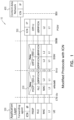
- Fig. 1 depicts a 3GPP environment, where the control plane uses IP based Non-Access Stratum (NAS) signaling on S-1 Mobility Management Entity (MME), and General Packet Radio Service Tunneling Protocol-Control (GTP-C) messages on S11 interfaces, for mobility management and session management respectively.
- NAS Non-Access Stratum
- MME Mobility Management Entity
- GTP-C General Packet Radio Service Tunneling Protocol-Control
- IP based, S1-U, S5, and S8 interfaces are used in unicast for content delivery.
- ICN enabled LTE architecture 10 comprises UE protocol stack 100, mobile base station protocol stack 200 (e.g., implemented on an eNodeB as depicted in Fig. 1 ), Evolved Packet Core/Packet Data Network Gateway (EPC/PGW) protocol stack 300, and CDN 400.
- EPC/PGW Evolved Packet Core/Packet Data Network Gateway
- CDN 400 CDN 400.
- ICN may be implemented instead of, or in parallel with IP, as a dual stack protocol stack for a UE and PGW.
- a UE is any type of device which attaches to a cellular network using 3G/UMTS or LTE technologies.
- the protocols and software stack used inside an LTE capable UE may therefore support both 3G and LTE software inter-working and handover.
- the latest 3GPP Release 13 (Rel.13) (and subsequent) specifications describe the use of both IP and non-IP protocols to establish logical/session connectivity. In accordance with embodiments described herein, this specified functionality may be leveraged to deploy an ICN protocol stack in a UE.
- ICN may be implemented in a UE by inclusion of a forwarding agent function inserted between the application and network layers.
- This forwarding agent function may interface with the application layer, and may be configured to provide forwarding decision algorithms to route requests. For example, forwarding decisions may be based on criteria such as application preference (e.g., ICN vs IP transport), content locations, content types, publisher's details, cost, network congestion, quality of service (QoS) and/or any other customizable parameters.
- the forwarding agent function may, in at least one embodiment, monitor application layer parameters through software probes to discover network status, preference etc. and apply this to forwarding decision algorithms.
- ICN may be implemented in a dual stack arrangement in parallel with IP for a UE as represented in UE protocol stack 100.
- the UE ICN transport protocol may communicate with either the ICN function in EPC/PGW protocol stack 300 (if, for example, ICN is implemented in the PGW), and/or an ICN function in CDN 400, depending upon how, and to what extent, ICN is implemented in the network.
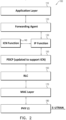
- FIG. 2 is a simplified schematic diagram of an exemplary dual stack UE protocol stack 100 for implementing ICN in parallel with IP for a UE in accordance with embodiments described herein.
- UE protocol stack 100 comprises application layer 110, forwarding agent 120, IP function 130, ICN function 140, Packet Data Convergence Protocol (PDCP) 150, Radio Link Control (RLC) 160, Medium Access Control (MAC) 170 and physical layer (PHY L1) 180.
- PDCP Packet Data Convergence Protocol
- RLC Radio Link Control
- MAC Medium Access Control
- PHY L1 physical layer
- Application layer 110 may refer to the protocol layer for any of a variety of software and/or hardware applications implemented on a UE in system 10, for example, but not limited to, applications for the provision and display of content on the UE. It will be appreciated that the applications in application layer 110 may not be uniformly configured to support the use of a given transport protocol. Specifically, some of the applications may be configured to support the use of IP, some may be configured to support the use of ICN, and some may be configured to support both.
- forwarding agent 120 may be configured to route outgoing traffic (e.g., fetch requests from CDN 400, communications with other UEs, etc.) from application layer 110 via either IP function 130 or ICN function 140 based on the capabilities of the originating applications in application layer 110.
- forwarding agent 120 may be implemented as a software based router implemented using any suitable mechanism such as, for example, Representational State Transfer (REST), TCP/IP socket and/or Extensible Markup Language (XML), etc.
- REST Representational State Transfer
- XML Extensible Markup Language
- Forwarding agent 120 may be configured to handle any one of three types of requests from application layer 110: IP-specific, where the application requests IP transport (either because the application doesn't support ICN or has, for whatever reason, been configured to prefer IP); ICN-specific, where the application requests ICN transport (either because the application doesn't support IP or has, for whatever reason, been configured to prefer ICN); or IP/ICN, where the application supports both IP and ICN and allows forwarding agent 120 to determine which transport protocol to use.
- Forwarding agent 120 may then forward the application request to either IP function 130 or ICN function 140.
- IP function 130 may represent already existing functionality in the LTE standard, such that minimal changes, if any, may be needed to implement IP function 130 in architecture 10.
- forwarding agent 120 may use a TCP/IP socket mechanism to communicate with IP function 130.
- ICN may typically be more efficient than IP, such that forwarding agent 120 may be configured to prefer to route communications through ICN function 140 if a request from application layer 110 does not specify a preference for transport protocol.
- ICN function 140 may forward ICN interest packets and/or data packets using ICN overlay over IP to IP function 130.
- ICN interest packets are typically packets in which a request for content is included, whereas ICN data packets are response packets including requested content.
- PDCP 150 may comprise existing PDCP functionality as currently implemented in existing LTE architecture. IP function 130 may therefore forward native IP traffic to PDCP 150, using a known header compression mechanism for IP. In accordance with embodiments described herein, PDCP 150 may also comprise additional functionality to support ICN overlaid over IP. PDCP 150 may also be configured to support header compression for ICN. For example, current PDCP implementations for LTE use robust header compression (RoHC) on air interface. In accordance with embodiments described herein, header compression for ICN may be implemented in PDCP 150 using a generally similar RoHC (RFC3095) header compression technique with enhanced algorithms that also support ICN.
- RoHC RoHC
- RLC 160, MAC 170, and PHY L1 180 may be generally unaffected by the implementation of ICN protocol in UE protocol stack 100.
- Communications received by RLC 160 from PDCP 150 may be in the form of either native IP or ICN over IP; in either case, continued processing with UE protocol stack 100 may be consistent with existing IP only implementations.
- a UE may be implemented with native ICN functionality to connect to a mobile network, where the mobile network may fetch content from internet/application servers within mobile provider to send some data to UE/application servers.
- native ICN functionality is provided, significant changes may be needed in device modem firmware and other software upgrades to support NAS signaling, mobility and/or session management.
- Protocol stack 101 is a simplified schematic diagram of an exemplary native ICN UE protocol stack 101 for implementing ICN on a UE in accordance with embodiments described herein.
- Protocol stack 101 may be generally similar to protocol stack 100 except as noted herein.
- protocol stack 110 may comprise application layer 110, RLC 160, MAC layer 170 and physical layer 180, each of which may respectively function in a generally similar manner as similarly referenced elements in protocol stack 100.
- Protocol stack 101 also comprises forwarding agent 121 and ICN function 140.
- Forwarding agent 121 may be a modified version of forwarding agent 120 configured to support communication between applications in application layer 110 and ICN function 140. Similar to forwarding agent 120, forwarding agent 121 may be implemented as a software based router implemented using any suitable mechanism such as, for example, Representational State Transfer (REST), TCP/IP socket and/or Extensible Markup Language (XML), etc.
- REST Representational State Transfer
- XML Extensible Markup Language
- forwarding agent 121 may be configured to handle any one of three types of requests from application layer 110: IP-specific, where the application requests IP transport (either because the application doesn't support ICN or has, for whatever reason, been configured to prefer IP); ICN-specific, where the application requests ICN transport (either because the application doesn't support IP or has, for whatever reason, been configured to prefer ICN); or IP/ICN, where the application supports both IP and ICN and allows forwarding agent 121 to determine which transport protocol to use.
- Forwarding agent 121 may therefore be operative to forward native ICN-based requests from application layer 110 to ICN function 140. Forwarding agent 121 may also be operative to forward protocol agnostic (i.e., where no transport protocol is specified) requests to ICN function 140. Forwarding agent 121 may also be operative to overlay ICN over IP-based requests and to forward the overlaid requests to ICN function 140.
- Protocol stack 101 also comprises PDCP 150, which may be modified to support ICN as in the embodiment of Fig. 2 . Accordingly, PDCP 150 may be operative to support both native IP and ICN overlaid over. As discussed with respect to the embodiment of Fig. 2 , ICN may be supported using a RoHC (RFC3095) header compression technique having enhanced algorithms to implement ICN.
- RoHC RoHC3095
- the mobile network may employ ICN functionality to fetch content from intemet/application servers serviced by the mobile provider to provide data to the UE.
- ICN IP-based LTE
- the UE may perform the attach procedures using ICN protocol.
- the UE may be configured to use a Protocol Configuration Option Information Element (PCO IE) field to communicate its ICN capability during attach procedures.
- PCO IE Protocol Configuration Option Information Element
- NAS signaling may be maintained using IP, whereas ICN may be implemented and used natively for content delivery.
- the term 'user equipment' may be inclusive of devices used to initiate a communication, such as a computer, an electronic device such as a parking meter, vending machine, appliance, Internet of Things (IoT) device, etc., a personal digital assistant (PDA), a laptop or electronic notebook, a cellular telephone, an iPhone TM , iPad TM , a Google Android TM phone, an IP phone, a wearable electronic device, or any other device, component, element, or object capable of initiating voice, audio, video, media, or data exchanges within communication system 10.
- PDA personal digital assistant
- a UE may also include a suitable interface to a human user such as a microphone, a display, a keyboard, or other terminal equipment.
- UEs may comprise a processor configured to operate the UE's software, firmware, and/or hardware components.
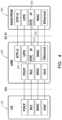
- Fig. 4 is a simplified schematic diagram illustrating an exemplary mobile base station protocol stack 200 (e.g., as implemented on an eNB as depicted in Fig.4 ) aligned opposite a UE protocol stack 100 and an exemplary EPC protocol stack 300 (e.g., as implemented on an SGW/PGW as depicted in Fig.4 ), in accordance with embodiments described herein.
- Fig. 5 illustrates a logical flow for requests received by mobile base station 201 from UE 105 and forwarded to mobile gateway 301.
- UE 105 may be an IP-only UE, or configured with protocol stack 100 or 101 as described with respect to Figs. 2 and 3 ;
- base station 201 may be configured with mobile base station protocol stack 200; and mobile gateway 301 (e.g., an SGW or PGW) may configured with EPC protocol stack 300.
- UE 105 when UE 105 powers up, it may perform attach procedures using IP protocol to send control messages. Depending on the configuration of UE 105, on successful attachment, UE 105 may have an ICN-based identity, IP-based identity, or dual ICN + IP identity. When a user of UE 105 initiates a content request via an application on UE, the request may subsequently be sent to base station 201, and then forwarded to mobile gateway 301 according to the following logic:
- base station 201 may forward the request to mobile gateway 301 either using native ICN (if such transport is supported), or ICN as overlay on IP where native ICN support is unavailable.
- base station 201 may forward the request to mobile gateway 301 using native IP.
- UE 105 may also send a non-specified "ICN or IP" request (step 206) accompanied by additional qualifying parameters such as weight, priority, cost, network congestion. It will be appreciated that the additional qualifying parameters may be configurable. Base station 201 may use the parameters to determine the most resource efficient option for forwarding the request from among native IP, native ICN, or ICN over IP, depending on the supported transport
- protocol stack 200 may be implemented in a mobile base station (e.g. an eNodeB or eNB) and may comprise IP function 230 and ICN function 240 incorporated at the network layer on an S1-U interface between the mobile base station and an EPC element (e.g. SGW or PGW).
- an existing IP based S1-U interface may be modified to support a dual stack with both ICN and IP routing; this interface may be used to carry user plane traffic through a GPRS Transport Protocol (GTP) tunnel to either IP function 330 or ICN function 340 in protocol stack 300.
- GTP GPRS Transport Protocol
- ICN functionality may be incorporated into protocol stack 200 without disturbing the MAC layer.
- ICN function 240 may be used to process the received packets. If S1-U supports only IP routing, i.e., not ICN, ICN messages may be overlaid on top of IP. Similarly, when an IP-based request for content delivery is received, it will use the standard S1-U interface.
- ICN function 240 in protocol stack 200 may facilitate content caching for local delivery using the ICN transport protocol.
- ICN function 340 in protocol stack 300 is implemented at a SGW or PGW to support ICN based routing for the protocol stack 200 of base station.
- ICN function 340 may facilitate servicing content cached at the SGW or PGW. Similar ICN functionality may also be implemented at CDN 400.
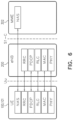
- Fig. 6 is a simplified schematic diagram illustrating an exemplary mobile base station protocol stack 200 aligned opposite either UE protocol stack 100 or 101 and an exemplary MME 302, in accordance with embodiments described herein.
- NAS signaling may also be implemented with ICN transport.
- ICN ICN for NAS signaling and mobility management, the following steps may be performed:
- a UE using protocol stack 100 or 101 may send NAS messages using a radio interface.
- the receiving base station e.g. eNB
- the S1-C interface may be configured to support IP, ICN, or dual stack (IP+ICN). If the NAS message was received using ICN protocol, then the base station may process the message and forward it to MME 302 using ICN transport. If ICN transport is not supported between the base station and MME 302, the base station may forward the NAS message using ICN overlay on IP transport. If the NAS message was received using IP protocol, then the base station may process the message and forward it to MME 302 using IP transport.
- Fig. 7 is a simplified schematic diagram illustrating an exemplary mobile base station protocol stack 200 aligned opposite either UE protocol stack 100 or 101, and either another protocol stack 200 or MME 302, in accordance with embodiments described herein.
- a UE sends mobility management messages such as location updates, handover requests, etc. Handover requests may be sent when the UE moves or it detects a better signal from another base station.
- the associated handover messages are processed via either X2 interface (for eNB to eNB handovers), or S1 interface (for eNB to MME/SGW handovers).
- ICN has built-in functionality to support mobility by re-expressing Interest when the UE moves or detects a better signal from another base station. The following steps may be used to implement ICN for mobility management:
- the base station may process and forward the message to MME 302 using ICN transport via the S1-C interface. If ICN transport is not supported between the base station and MME 302, the base station may forward the message using ICN overlay on IP transport.
- the base station may send handover control messages as well as user data using ICN protocol via an X2 interface. If ICN is not supported on the X2 interface, then the base station may use ICN overlay over IP transport via the X2 interface.
- the base station may process the message and forward it using IP transport to either MME 302 using S1-C interface, or to another base station using X2 interface.
- IP transport For eNB to eNB handover, both handover control messages and user data may be sent by the base station.
- the base station may determine which protocol, IP or ICN, to be used. The base station may factor weight, priority, cost, etc. into the determination process.
- a base station may include any subset of base station functionalities for a Radio Access Network (RAN), such as for example: NodeB functionalities, Radio Network Controller (RNC) functionalities, Home NodeB (HNB), and base transceiver station (BTS) functionalities for 2nd Generation (2G) and/or 3rd Generation (3G) mobile access network technologies such as Global System for Mobile Communications (GSM), Enhanced Data Rates for GSM (EDGE), radio access network (GERAN), and/or Universal Mobile Telecommunications System (UMTS) Terrestrial radio access network (UTRAN); evolved Node B (eNodeB or eNB) functionalities and/or Home eNodeB (HeNB) functionalities for 4th Generation (4G) LTE mobile access network technologies such as evolved UTRAN (E-UTRAN), 5th Generation (5G) access network base station functionalities; combinations thereof, or the like.
- RAN Radio Access Network
- NodeB functionalities Radio Network Controller (RNC) functionalities, Home NodeB (HNB), and base transceiver station
- the Evolved Packet Core provides session management functionality for a UE.
- a UE When a UE is powered-on, it performs NAS signaling and after successful authentication it attaches with either a PGW for LTE networks or a Gateway GPRS Support Node (GGSN) for 3G cellular network.
- the PGW or GGSN is the anchoring point for the UE and is responsible for service creations, authorization, session maintenance, eventual termination upon UE power-off, etc.
- ICN functionality may be implemented in the EPC.
- ICN function 340 may be inserted at the session management layer of protocol stack 300 in parallel with existing IP functionality.
- the session management layer is used for performing attach procedures and assigning a logical identity to the UE user.
- the MME may send a Create Session Request (CSR) to the SGW, and the SGW may send the CSR to the PGW.
- CSR Create Session Request
- a CSR may be enhanced to include a Protocol Configuration Option Information Element (PCO IE), which may be used to indicate ICN support by the UE providing the request, according to the embodiments of Figs. 3 and 4 .
- PCO IE Protocol Configuration Option Information Element
- the PGW may support attachment in terms of both IP and ICN based transport; the UE name may be registered and used for session management.
- the PGW may be configured to provide ICN attachment.
- the PGW may use known IP functionality for attachment.
- ICN function 340 may be configured with full ICN functionality, such as, for example, forwarding capabilities (e.g., Content Store (CS), Pending Interest Table (PIT) and Forwarding Information Base (FIB) tables).
- CS Content Store
- PIT Pending Interest Table
- FIB Forwarding Information Base
- the PGW may cache contents locally according to ICN protocol using CS functionality provided therein.
- Fig. 8 illustrates a 3GPP protocol configuration field layout 400 that may be leveraged to provide support for ICN in LTE according to embodiments described herein.
- Octet 3 may be used to carry configuration protocol information (where configuration protocols define a PDN type) which may be enhanced to contain details about IP (either IPv4, IPv6, or both) or ICN.
- configuration protocol information where configuration protocols define a PDN type
- IP either IPv4, IPv6, or both
- combinations of Octet 4 to Z may be used to provide additional information related to ICN capability.
- the PCO IE parameter (as discussed hereinabove) may be matched between UE and EPC gateways (e.g., MME, SGW, PGW) so that a UE may attach successfully.
- steps 1 and 12 - 22 may be enhanced to include additional parameters to facilitate ICN implementation.
- ICN capability may be indicated in a PCO IE using a Tag Length Value (TLV) format.
- TLV Tag Length Value
- Enhanced functionality may be added to the existing steps of the attach procedure to support enhanced ICN capabilities in a PGW in addition to normal IP attach procedures.
- a given UE may send an initial attach request. If the UE is ICN capable, the initial attach request may include the PCO IE field populated with an indication of ICN capability.
- CSR create session request
- the PGW will register the UE with a name according to the ICN protocol. This ICN-based name may then be used for the creation of session and context related functions (e.g., billing, mediation, enhanced charging function/deep packet inspection, lawful intercept, etc.) for the UE during the session.
- context related functions e.g., billing, mediation, enhanced charging function/deep packet inspection, lawful intercept, etc.
- an EPC may include one or more mobile gateways hosting any or all functionalities for any combination of: Serving Gateway (SGW), Serving General Packet Radio Service (GPRS) Support Node (SGSN), Packet Data Network (PDN) Gateway (PGW), and/or Gateway GPRS Support Node (GGSN) operations.
- SGW Serving Gateway
- GPRS General Packet Radio Service
- SGSN Serving General Packet Radio Service
- PDN Packet Data Network Gateway
- GGSN Gateway GPRS Support Node
- an SGW is a data-plane element that can provide functionality for managing user mobility and interfaces with RAN nodes (e.g., eNodeBs, NodeBs, HeNBs, HNBs, etc.).
- An SGW may also maintain data paths between RAN nodes and one or more PGWs.
- a PGW typically provides IP connectivity access network (IP-CAN) session connectivity for UEs to external Packet Data Networks (PDNs) (e.g., the Internet).
- a user can be associated with the operation of a corresponding UE for one or more voice and/or data sessions.
- a subscriber associated with a given UE can be identified using one or more identifiers such as, for example, an International Mobile Subscriber Identity (IMSI) or a Temporary IMSI (T-IMSI).
- IMSI International Mobile Subscriber Identity
- T-IMSI Temporary IMSI
- An IMSI for a given subscriber is typically stored on a Subscriber Identity Module (SIM) (e.g., a SIM card) within the subscriber's UE.
- SIM Subscriber Identity Module
- software components of the present invention may, if desired, be implemented in ROM (read only memory) form.
- the software components may, generally, be implemented in hardware, if desired, using conventional techniques.
- the software components may be instantiated, for example: as a computer program product or on a tangible medium. In some cases, it may be possible to instantiate the software components as a signal interpretable by an appropriate computer, although such an instantiation may be excluded in certain embodiments of the present invention.
- a non-transient computer readable medium carrying computer readable instructions that when executed by a computing device cause the computing device to carry out any of the methods described herein.
Landscapes
- Engineering & Computer Science (AREA)
- Computer Networks & Wireless Communication (AREA)
- Signal Processing (AREA)
- Computer Security & Cryptography (AREA)
- Mobile Radio Communication Systems (AREA)
Abstract
Description
- The present invention generally relates to the deployment of information centric networking (ICN) in long term evolution (LTE) mobile networks.
- Globally, over 1.3 billion subscribers use Long Term Evolution (LTE) technology, with annual growth of ~100% annually. Existing LTE networks are based on 'Global System Mobile Association' (GSMA), 3rd Generation Partnership Project (3GPP) standards and various specifications providing architectural details. LTE network architectures typically use Internet Protocol (IP) as the main transport protocol for control plane (signaling messages), user plane (content delivery) and management plane (Operations, administration and management functions) communications.
- The present invention will be understood and appreciated more fully from the following detailed description, taken in conjunction with the drawings in which:
-
Fig. 1 is a simplified schematic illustration of an exemplary ICN enabled LTE architecture, constructed and operative in accordance with embodiments described herein; -
Figs 2 and3 are simplified schematic diagrams of exemplary user equipment (UE) protocol stacks for implementing ICN according to the architecture ofFig. 1 ; -
Fig. 4 and6 are simplified schematic diagrams illustrating an exemplary mobile base station protocol stack aligned opposite a UE protocol stack, and an exemplary evolved packet core (EPC) protocol stack, according to the architecture ofFig. 1 ; -
Fig. 5 is a simplified schematic diagram which illustrates a logical flow for requests received by a mobile base station from a UE and forwarded to mobile gateway according to the architecture ofFig. 1 ; -
Fig. 7 is a simplified schematic diagram illustrating an exemplary mobile base station protocol stack aligned opposite a UE protocol stack, and either another mobile base station protocol stack or a Mobility Management Entity (MME) according to the architecture ofFig. 1 ; -
Fig. 8 illustrates a 3GPP protocol configuration field layout; and -
Figs. 9A and9B illustrate an exemplary attach procedure for a UE according to the architecture ofFig. 1 . - A method for improving content delivery for a user equipment (UE) is implemented on a computing device and includes: receiving a request from an application layer on the UE, determining whether said request is an ICN-based request using Information Centric Networking (ICN) transport protocol or an IP-based request using Internet Protocol (IP) transport protocol, and for each ICN-based request according to the determining: forwarding the ICN-based request to an ICN function on the UE, and compressing ICN headers in the ICN-based request using robust header (RoHC) compression.
- A method for improving content delivery is performed on a mobile base station and includes: configuring the mobile base station to support ICN transport protocol, and storing content for delivery over the ICN transport protocol in an ICN content cache on the mobile base station.
- A method for supporting ICN on a long term evolution (LTE) evolved packet core (EPC) device includes: receiving an initial attach request from a user equipment (UE), where the initial attach request includes an indication of support for ICN transport protocol on the UE, authenticating the UE, creating a session for the UE, where a Packet Data Network (PDN) type is assigned for the session is ICN.
- It will be appreciated by persons of ordinary skill in the art that the reliance on IP as the main transport protocol for LTE's user plane may be inefficient primarily due to IP's optimization for layer-3 payload transfer. The optimization for network layer-3 effectively renders IP less efficient for application layer-7 content delivery (offline video, real-time streaming video or time sensitive online gaming etc.). For example, when delivering content in unicast, each mobile unit receives a separate stream from a content server, thereby making redundant use of limited network resources. It will be appreciated that there have been recent advances in multicast and broadcast technologies for content delivery in LTE networks, but actual deployment in the field is limited or considered experimental due to a complex signaling architecture. Furthermore, such technologies require separate frequency spectrums, which are also limited resources in the mobile environment. It will therefore be appreciated that LTE's current architecture may be inefficient and non-optimal for high volume content delivery to mobile devices.
- Information Centric Networking (ICN) is a rapidly evolving technology for efficient multimedia content delivery to end devices using Content Delivery Network (CDN) engines, caches, servers, and/or repositories. Existing research and development for ICN has primarily focused on fixed wireline networks and limited wireless networks using Wi-Fi, etc. No specification or standard is currently in use for including ICN in LTE architecture.
- It will be appreciated that ICN may remedy some of the deficiencies of IP in an LTE environment. For example, in IP, resource names are transitory, thereby necessitating redundant setup for requests for the same resource from different network entities. In ICN, resource names are persistent, regardless of physical storage location. Accordingly, a given resource may be allocated a unique name that may be used consistently and uniformly throughout a network.
- In accordance with embodiments described herein, LTE architecture may therefore be modified to support ICN for content delivery by implementing ICN in mobile user equipments (UEs), base stations (BSs), and/or the evolved packet core (EPC), sometimes referred to as a mobile packet core (MPC). Reference is now made to
Fig. 1 which represents a simplified schematic illustration of an exemplary ICN enabledLTE architecture 10, constructed and operative in accordance with embodiments described herein. -
Fig. 1 depicts a 3GPP environment, where the control plane uses IP based Non-Access Stratum (NAS) signaling on S-1 Mobility Management Entity (MME), and General Packet Radio Service Tunneling Protocol-Control (GTP-C) messages on S11 interfaces, for mobility management and session management respectively. Similarly, for the user plane, IP based, S1-U, S5, and S8 interfaces are used in unicast for content delivery. - ICN enabled
LTE architecture 10 comprises UEprotocol stack 100, mobile base station protocol stack 200 (e.g., implemented on an eNodeB as depicted inFig. 1 ), Evolved Packet Core/Packet Data Network Gateway (EPC/PGW)protocol stack 300, and CDN 400. As depicted inFig. 1 , in order to improve efficiency for user plane content delivery from ICN enabled CDN 400, ICN may be implemented instead of, or in parallel with IP, as a dual stack protocol stack for a UE and PGW. - As referred to herein, a UE is any type of device which attaches to a cellular network using 3G/UMTS or LTE technologies. The protocols and software stack used inside an LTE capable UE may therefore support both 3G and LTE software inter-working and handover. The latest 3GPP Release 13 (Rel.13) (and subsequent) specifications describe the use of both IP and non-IP protocols to establish logical/session connectivity. In accordance with embodiments described herein, this specified functionality may be leveraged to deploy an ICN protocol stack in a UE.
- In accordance with embodiments described herein, ICN may be implemented in a UE by inclusion of a forwarding agent function inserted between the application and network layers. This forwarding agent function may interface with the application layer, and may be configured to provide forwarding decision algorithms to route requests. For example, forwarding decisions may be based on criteria such as application preference (e.g., ICN vs IP transport), content locations, content types, publisher's details, cost, network congestion, quality of service (QoS) and/or any other customizable parameters. For example, the forwarding agent function may, in at least one embodiment, monitor application layer parameters through software probes to discover network status, preference etc. and apply this to forwarding decision algorithms.
- For example, ICN may be implemented in a dual stack arrangement in parallel with IP for a UE as represented in UE
protocol stack 100. In accordance with embodiments described herein, the UE ICN transport protocol may communicate with either the ICN function in EPC/PGW protocol stack 300 (if, for example, ICN is implemented in the PGW), and/or an ICN function in CDN 400, depending upon how, and to what extent, ICN is implemented in the network. - It will be appreciated by one of ordinary skill in the art that such an arrangement may not require changes to device (i.e., the UE) modem firmware because ICN may be overlaid on top of IP without modification of the native environment. This approach may minimize the resources required to provide ICN functionality while also maintaining full support for legacy IP functionality. Reference is now made to
Fig. 2 which is a simplified schematic diagram of an exemplary dual stackUE protocol stack 100 for implementing ICN in parallel with IP for a UE in accordance with embodiments described herein. - UE
protocol stack 100 comprisesapplication layer 110,forwarding agent 120,IP function 130, ICNfunction 140, Packet Data Convergence Protocol (PDCP) 150, Radio Link Control (RLC) 160, Medium Access Control (MAC) 170 and physical layer (PHY L1) 180. -
Application layer 110 may refer to the protocol layer for any of a variety of software and/or hardware applications implemented on a UE insystem 10, for example, but not limited to, applications for the provision and display of content on the UE. It will be appreciated that the applications inapplication layer 110 may not be uniformly configured to support the use of a given transport protocol. Specifically, some of the applications may be configured to support the use of IP, some may be configured to support the use of ICN, and some may be configured to support both. - Accordingly,
forwarding agent 120 may be configured to route outgoing traffic (e.g., fetch requests from CDN 400, communications with other UEs, etc.) fromapplication layer 110 via eitherIP function 130 orICN function 140 based on the capabilities of the originating applications inapplication layer 110. In accordance with embodiments described herein,forwarding agent 120 may be implemented as a software based router implemented using any suitable mechanism such as, for example, Representational State Transfer (REST), TCP/IP socket and/or Extensible Markup Language (XML), etc. -
Forwarding agent 120 may be configured to handle any one of three types of requests from application layer 110: IP-specific, where the application requests IP transport (either because the application doesn't support ICN or has, for whatever reason, been configured to prefer IP); ICN-specific, where the application requests ICN transport (either because the application doesn't support IP or has, for whatever reason, been configured to prefer ICN); or IP/ICN, where the application supports both IP and ICN and allowsforwarding agent 120 to determine which transport protocol to use. -
Forwarding agent 120 may then forward the application request to eitherIP function 130 orICN function 140. It will be appreciated thatIP function 130 may represent already existing functionality in the LTE standard, such that minimal changes, if any, may be needed to implementIP function 130 inarchitecture 10. For example, in accordance with at least one embodiment described herein,forwarding agent 120 may use a TCP/IP socket mechanism to communicate withIP function 130. - It will be appreciated that as described hereinabove, ICN may typically be more efficient than IP, such that
forwarding agent 120 may be configured to prefer to route communications throughICN function 140 if a request fromapplication layer 110 does not specify a preference for transport protocol. - In accordance with embodiments described herein,
ICN function 140 may forward ICN interest packets and/or data packets using ICN overlay over IP toIP function 130. ICN interest packets are typically packets in which a request for content is included, whereas ICN data packets are response packets including requested content. - It will be appreciated that
PDCP 150 may comprise existing PDCP functionality as currently implemented in existing LTE architecture.IP function 130 may therefore forward native IP traffic toPDCP 150, using a known header compression mechanism for IP. In accordance with embodiments described herein,PDCP 150 may also comprise additional functionality to support ICN overlaid over IP.PDCP 150 may also be configured to support header compression for ICN. For example, current PDCP implementations for LTE use robust header compression (RoHC) on air interface. In accordance with embodiments described herein, header compression for ICN may be implemented inPDCP 150 using a generally similar RoHC (RFC3095) header compression technique with enhanced algorithms that also support ICN. - It will be appreciated that
RLC 160,MAC 170, andPHY L1 180 may be generally unaffected by the implementation of ICN protocol inUE protocol stack 100. Communications received byRLC 160 fromPDCP 150 may be in the form of either native IP or ICN over IP; in either case, continued processing withUE protocol stack 100 may be consistent with existing IP only implementations. - In accordance with some embodiments described herein, a UE may be implemented with native ICN functionality to connect to a mobile network, where the mobile network may fetch content from internet/application servers within mobile provider to send some data to UE/application servers. For embodiments in which native ICN functionality is provided, significant changes may be needed in device modem firmware and other software upgrades to support NAS signaling, mobility and/or session management.
- Reference is now made to
Fig. 3 which is a simplified schematic diagram of an exemplary native ICNUE protocol stack 101 for implementing ICN on a UE in accordance with embodiments described herein.Protocol stack 101 may be generally similar toprotocol stack 100 except as noted herein. Accordingly,protocol stack 110 may compriseapplication layer 110,RLC 160,MAC layer 170 andphysical layer 180, each of which may respectively function in a generally similar manner as similarly referenced elements inprotocol stack 100. -
Protocol stack 101 also comprises forwardingagent 121 andICN function 140.Forwarding agent 121 may be a modified version of forwardingagent 120 configured to support communication between applications inapplication layer 110 andICN function 140. Similar to forwardingagent 120, forwardingagent 121 may be implemented as a software based router implemented using any suitable mechanism such as, for example, Representational State Transfer (REST), TCP/IP socket and/or Extensible Markup Language (XML), etc. - It will be appreciated that similar to the
application layer 110 inFig. 2 , the applications installed inapplication layer 110 ofFig. 3 may be compatible with either IP and/or ICN functionality. Accordingly, forwardingagent 121 may be configured to handle any one of three types of requests from application layer 110: IP-specific, where the application requests IP transport (either because the application doesn't support ICN or has, for whatever reason, been configured to prefer IP); ICN-specific, where the application requests ICN transport (either because the application doesn't support IP or has, for whatever reason, been configured to prefer ICN); or IP/ICN, where the application supports both IP and ICN and allows forwardingagent 121 to determine which transport protocol to use. -
Forwarding agent 121 may therefore be operative to forward native ICN-based requests fromapplication layer 110 toICN function 140.Forwarding agent 121 may also be operative to forward protocol agnostic (i.e., where no transport protocol is specified) requests toICN function 140.Forwarding agent 121 may also be operative to overlay ICN over IP-based requests and to forward the overlaid requests toICN function 140. -
Protocol stack 101 also comprisesPDCP 150, which may be modified to support ICN as in the embodiment ofFig. 2 . Accordingly,PDCP 150 may be operative to support both native IP and ICN overlaid over. As discussed with respect to the embodiment ofFig. 2 , ICN may be supported using a RoHC (RFC3095) header compression technique having enhanced algorithms to implement ICN. - In accordance with the embodiment of
Fig. 3 , when the UE connects to a mobile network, the mobile network may employ ICN functionality to fetch content from intemet/application servers serviced by the mobile provider to provide data to the UE. In existing, IP-based LTE, when a given UE is powered up, it establishes a radio link connection with a base station and starts attach procedures with the LTE network according to procedures described in the 3GPP Technical Specification (TS) 23.401. Since there is no IP function in the embodiment ofFig. 3 , the UE may perform the attach procedures using ICN protocol. For example, the UE may be configured to use a Protocol Configuration Option Information Element (PCO IE) field to communicate its ICN capability during attach procedures. - It will be appreciated that in order to support native ICN functionality for NAS signaling, mobility and/or session management, significant changes may be needed in device modem firmware and software upgrades. Accordingly, in order to limit the impact on NAS signaling - due to dependencies on the Mobility Management Entity (MME), Home Subscriber Server (HSS) and other elements - in accordance with some embodiments described herein, NAS signaling may be maintained using IP, whereas ICN may be implemented and used natively for content delivery.
- It will be appreciated that as referred to herein, the term 'user equipment' (UE) may be inclusive of devices used to initiate a communication, such as a computer, an electronic device such as a parking meter, vending machine, appliance, Internet of Things (IoT) device, etc., a personal digital assistant (PDA), a laptop or electronic notebook, a cellular telephone, an iPhone™, iPad™, a Google Android™ phone, an IP phone, a wearable electronic device, or any other device, component, element, or object capable of initiating voice, audio, video, media, or data exchanges within
communication system 10. A UE may also include a suitable interface to a human user such as a microphone, a display, a keyboard, or other terminal equipment. It will further be appreciated that UEs may comprise a processor configured to operate the UE's software, firmware, and/or hardware components. - Reference is now made to
Fig. 4 which is a simplified schematic diagram illustrating an exemplary mobile base station protocol stack 200 (e.g., as implemented on an eNB as depicted inFig.4 ) aligned opposite aUE protocol stack 100 and an exemplary EPC protocol stack 300 (e.g., as implemented on an SGW/PGW as depicted inFig.4 ), in accordance with embodiments described herein. Reference is made also toFig. 5 which illustrates a logical flow for requests received bymobile base station 201 fromUE 105 and forwarded tomobile gateway 301. It will be appreciated thatUE 105 may be an IP-only UE, or configured withprotocol stack Figs. 2 and3 ;base station 201 may be configured with mobile basestation protocol stack 200; and mobile gateway 301 (e.g., an SGW or PGW) may configured withEPC protocol stack 300. - As illustrated in
Fig. 5 , whenUE 105 powers up, it may perform attach procedures using IP protocol to send control messages. Depending on the configuration ofUE 105, on successful attachment,UE 105 may have an ICN-based identity, IP-based identity, or dual ICN + IP identity. When a user ofUE 105 initiates a content request via an application on UE, the request may subsequently be sent tobase station 201, and then forwarded tomobile gateway 301 according to the following logic: - If
UE 105 sends an ICN request (step 202),base station 201 may forward the request tomobile gateway 301 either using native ICN (if such transport is supported), or ICN as overlay on IP where native ICN support is unavailable. - If
UE 105 sends an IP request (step 204),base station 201 may forward the request tomobile gateway 301 using native IP. -
UE 105 may also send a non-specified "ICN or IP" request (step 206) accompanied by additional qualifying parameters such as weight, priority, cost, network congestion. It will be appreciated that the additional qualifying parameters may be configurable.Base station 201 may use the parameters to determine the most resource efficient option for forwarding the request from among native IP, native ICN, or ICN over IP, depending on the supported transport - Returning to
Fig. 4 ,protocol stack 200 may be implemented in a mobile base station (e.g. an eNodeB or eNB) and may comprise IP function 230 and ICN function 240 incorporated at the network layer on an S1-U interface between the mobile base station and an EPC element (e.g. SGW or PGW). It will be appreciated that an existing IP based S1-U interface may be modified to support a dual stack with both ICN and IP routing; this interface may be used to carry user plane traffic through a GPRS Transport Protocol (GTP) tunnel to eitherIP function 330 orICN function 340 inprotocol stack 300. It will be appreciated that in such manner, ICN functionality may be incorporated intoprotocol stack 200 without disturbing the MAC layer. - When ICN Interest or Data packets are received from a dual stack ICN/IP or native ICN UE (e.g., according to the embodiments of
Figs. 2 and3 ),ICN function 240 may be used to process the received packets. If S1-U supports only IP routing, i.e., not ICN, ICN messages may be overlaid on top of IP. Similarly, when an IP-based request for content delivery is received, it will use the standard S1-U interface. - It will be appreciated that the implementation of
ICN function 240 inprotocol stack 200 may facilitate content caching for local delivery using the ICN transport protocol. It will be appreciated thatICN function 340 inprotocol stack 300 is implemented at a SGW or PGW to support ICN based routing for theprotocol stack 200 of base station.ICN function 340 may facilitate servicing content cached at the SGW or PGW. Similar ICN functionality may also be implemented atCDN 400. - Reference is now made to
Fig. 6 which is a simplified schematic diagram illustrating an exemplary mobile basestation protocol stack 200 aligned opposite eitherUE protocol stack exemplary MME 302, in accordance with embodiments described herein. As will be described with respect to the embodiment ofFig. 6 , depending on the configuration of the devices involved, NAS signaling may also be implemented with ICN transport. To implement ICN for NAS signaling and mobility management, the following steps may be performed: - A UE using
protocol stack MME 302 using a S1-C interface. The S1-C interface may be configured to support IP, ICN, or dual stack (IP+ICN). If the NAS message was received using ICN protocol, then the base station may process the message and forward it toMME 302 using ICN transport. If ICN transport is not supported between the base station andMME 302, the base station may forward the NAS message using ICN overlay on IP transport. If the NAS message was received using IP protocol, then the base station may process the message and forward it toMME 302 using IP transport. - Reference is now made to
Fig. 7 which is a simplified schematic diagram illustrating an exemplary mobile basestation protocol stack 200 aligned opposite eitherUE protocol stack protocol stack 200 orMME 302, in accordance with embodiments described herein. It will be appreciated that in operation, a UE sends mobility management messages such as location updates, handover requests, etc. Handover requests may be sent when the UE moves or it detects a better signal from another base station. The associated handover messages are processed via either X2 interface (for eNB to eNB handovers), or S1 interface (for eNB to MME/SGW handovers). ICN has built-in functionality to support mobility by re-expressing Interest when the UE moves or detects a better signal from another base station. The following steps may be used to implement ICN for mobility management: - For a handover to
MME 302, if a mobility management message is received using ICN protocol, then the base station may process and forward the message toMME 302 using ICN transport via the S1-C interface. If ICN transport is not supported between the base station andMME 302, the base station may forward the message using ICN overlay on IP transport. For a handover to another base station (i.e., eNB to eNB), the base station may send handover control messages as well as user data using ICN protocol via an X2 interface. If ICN is not supported on the X2 interface, then the base station may use ICN overlay over IP transport via the X2 interface. - If the mobility management message is received using IP protocol, the base station may process the message and forward it using IP transport to either
MME 302 using S1-C interface, or to another base station using X2 interface. For eNB to eNB handover, both handover control messages and user data may be sent by the base station. - If the mobility management message is received using ICN or IP protocol, then the base station may determine which protocol, IP or ICN, to be used. The base station may factor weight, priority, cost, etc. into the determination process.
- It will be appreciated that as referred to herein, a base station may include any subset of base station functionalities for a Radio Access Network (RAN), such as for example: NodeB functionalities, Radio Network Controller (RNC) functionalities, Home NodeB (HNB), and base transceiver station (BTS) functionalities for 2nd Generation (2G) and/or 3rd Generation (3G) mobile access network technologies such as Global System for Mobile Communications (GSM), Enhanced Data Rates for GSM (EDGE), radio access network (GERAN), and/or Universal Mobile Telecommunications System (UMTS) Terrestrial radio access network (UTRAN); evolved Node B (eNodeB or eNB) functionalities and/or Home eNodeB (HeNB) functionalities for 4th Generation (4G) LTE mobile access network technologies such as evolved UTRAN (E-UTRAN), 5th Generation (5G) access network base station functionalities; combinations thereof, or the like.
- In general, the Evolved Packet Core (EPC) provides session management functionality for a UE. When a UE is powered-on, it performs NAS signaling and after successful authentication it attaches with either a PGW for LTE networks or a Gateway GPRS Support Node (GGSN) for 3G cellular network. The PGW or GGSN is the anchoring point for the UE and is responsible for service creations, authorization, session maintenance, eventual termination upon UE power-off, etc. In accordance with embodiments described herein, ICN functionality may be implemented in the EPC.
- Returning to
Fig. 1 ,ICN function 340 may be inserted at the session management layer ofprotocol stack 300 in parallel with existing IP functionality. The session management layer is used for performing attach procedures and assigning a logical identity to the UE user. After successful authentication by HSS, the MME may send a Create Session Request (CSR) to the SGW, and the SGW may send the CSR to the PGW. - In accordance with embodiments described herein, a CSR may be enhanced to include a Protocol Configuration Option Information Element (PCO IE), which may be used to indicate ICN support by the UE providing the request, according to the embodiments of
Figs. 3 and4 . - For a dual stack UE (e.g., the UE of
Fig. 3 ), the PGW may support attachment in terms of both IP and ICN based transport; the UE name may be registered and used for session management. For an ICN capable UE, the PGW may be configured to provide ICN attachment. For a native IP UE, the PGW may use known IP functionality for attachment. - It will be appreciated that in accordance with embodiments described herein,
ICN function 340 may be configured with full ICN functionality, such as, for example, forwarding capabilities (e.g., Content Store (CS), Pending Interest Table (PIT) and Forwarding Information Base (FIB) tables). In accordance with at least one embodiment, the PGW may cache contents locally according to ICN protocol using CS functionality provided therein. - Reference is now made to
Fig. 8 which illustrates a 3GPP protocolconfiguration field layout 400 that may be leveraged to provide support for ICN in LTE according to embodiments described herein. -
Octet 3, as denoted byreference numeral 410, may be used to carry configuration protocol information (where configuration protocols define a PDN type) which may be enhanced to contain details about IP (either IPv4, IPv6, or both) or ICN. Furthermore, combinations ofOctet 4 to Z, as denoted byreference numeral 420, may be used to provide additional information related to ICN capability. The PCO IE parameter (as discussed hereinabove) may be matched between UE and EPC gateways (e.g., MME, SGW, PGW) so that a UE may attach successfully. - Reference is now made to
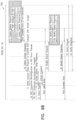
Figs. 9A and9B which together illustrate an attach procedure according to 3GPP TS 23.401 V13.6.1 (2016-03) section 5.3.2.1. In accordance with embodiments described herein, steps 1 and 12 - 22 may be enhanced to include additional parameters to facilitate ICN implementation. As described hereinabove, ICN capability may be indicated in a PCO IE using a Tag Length Value (TLV) format. Enhanced functionality may be added to the existing steps of the attach procedure to support enhanced ICN capabilities in a PGW in addition to normal IP attach procedures. - At
Step 1, a given UE may send an initial attach request. If the UE is ICN capable, the initial attach request may include the PCO IE field populated with an indication of ICN capability. Once the attach request is successful, the PGW assigns an address for the UE. For an IP-based UE, i.e., PDN=IP, the PGW may assign either an IPv4 or IPv6 (Link local) address in the create session request (CSR) instep 13. For PDN type= ICN, the PGW will register the UE with a name according to the ICN protocol. This ICN-based name may then be used for the creation of session and context related functions (e.g., billing, mediation, enhanced charging function/deep packet inspection, lawful intercept, etc.) for the UE during the session. - As referred to herein, an EPC may include one or more mobile gateways hosting any or all functionalities for any combination of: Serving Gateway (SGW), Serving General Packet Radio Service (GPRS) Support Node (SGSN), Packet Data Network (PDN) Gateway (PGW), and/or Gateway GPRS Support Node (GGSN) operations. Traditionally, an SGW is a data-plane element that can provide functionality for managing user mobility and interfaces with RAN nodes (e.g., eNodeBs, NodeBs, HeNBs, HNBs, etc.). An SGW may also maintain data paths between RAN nodes and one or more PGWs. A PGW typically provides IP connectivity access network (IP-CAN) session connectivity for UEs to external Packet Data Networks (PDNs) (e.g., the Internet).
- As referred to herein in this Specification, the terms 'user', 'subscriber', 'UE' and 'user/UE' can be used interchangeably. It should be understood that a user, or more particularly, a subscriber, can be associated with the operation of a corresponding UE for one or more voice and/or data sessions. In various embodiments, a subscriber associated with a given UE can be identified using one or more identifiers such as, for example, an International Mobile Subscriber Identity (IMSI) or a Temporary IMSI (T-IMSI). An IMSI for a given subscriber is typically stored on a Subscriber Identity Module (SIM) (e.g., a SIM card) within the subscriber's UE.
- It is appreciated that software components of the present invention may, if desired, be implemented in ROM (read only memory) form. The software components may, generally, be implemented in hardware, if desired, using conventional techniques. It is further appreciated that the software components may be instantiated, for example: as a computer program product or on a tangible medium. In some cases, it may be possible to instantiate the software components as a signal interpretable by an appropriate computer, although such an instantiation may be excluded in certain embodiments of the present invention. It is further appreciated that there is provided a non-transient computer readable medium carrying computer readable instructions that when executed by a computing device cause the computing device to carry out any of the methods described herein.
- It is appreciated that various features of the invention which are, for clarity, described in the contexts of separate embodiments may also be provided in combination in a single embodiment. Conversely, various features of the invention which are, for brevity, described in the context of a single embodiment may also be provided separately or in any suitable subcombination.
- It will be appreciated by persons skilled in the art that the present invention is not limited by what has been particularly shown and described hereinabove. Rather the scope of the invention is defined by the appended claims and equivalents thereof.
- 1. A method for improving content delivery, the method performed on a mobile base station and comprising:
- configuring said mobile base station to support Information Centric Networking (ICN) transport protocol; and
- storing content for delivery over said ICN transport protocol in an ICN content cache on said mobile base station.
- 2. The method according to
clause 1 and further comprising:- configuring said mobile base station to support Internet Protocol (IP) transport protocol;
- receiving requests using either said ICN transport protocol or said IP transport protocol from a user equipment (UE); and
- forwarding said requests to an evolved packet core (EPC) device according to said ICN transport protocol or said IP transport protocol.
- 3. The method according to
clause 2 and wherein said forwarding comprises:
forwarding said requests to an EPC device using said ICN transport protocol overlaid over said IP transport protocol. - 4. The method according to clause2 or 3 and further comprising:
- receiving ICN+IP requests associated with both said ICN transport protocol and said IP transport protocol from said UE; and
- determining which of said ICN transport protocol or said IP transport protocol to use for said ICN+IP requests, wherein said forwarding is according to said determining.
- 5. The method according to
clause 4 and wherein said determining comprises:
minimizing network resource usage for forwarding said ICN+IP requests and providing content to said UE according to said ICN+IP requests. - 6. The method according to
clause 5 and wherein said minimizing comprises:
factoring impact of at least one of weight, priority, or cost of said ICN+IP requests. - 7. The method according to
clause
minimizing network congestion. - 8. The method according to any preceding claim and wherein said mobile base station is a long term evolution (LTE) mobile base station.
- 9. The method according to any preceding clause and further comprising:
- receiving non access stratum (NAS) signaling messages using either said ICN transport protocol or IP transport protocol from said UE; and
- forwarding said NAS signaling messages to a Mobility Management Entity (MME) according to said ICN transport protocol or said IP transport protocol.
- 10. The method according to
clause 9 and wherein said forwarding comprises:
forwarding said NAS signaling messages to said MME using said ICN transport protocol overlaid over said IP transport protocol. - 11. A method for supporting Information Centric Networking (ICN) on a long term evolution (LTE) evolved packet core (EPC) device and comprising:
- receiving an initial attach request from a user equipment (UE), wherein said initial attach request includes an indication of support for ICN transport protocol on said UE;
- authenticating said UE; and
- creating a session for said UE, wherein a Packet Data Network (PDN) type is assigned for said session is ICN.
- 12. The method according to
clause 11 and wherein said indication is provided in a Protocol Configuration Option Information Element (PCO IE) field in said initial attach request. - 13. The method according to
clause - said receiving further comprises receiving an indication of support for IP transport protocol on said UE; and
- said creating a session further comprises assigning a second PDN type as a version of IP for said session.
- 14. The method according to any of
clauses 11 to 13 and further comprising assigning an ICN-based identity to said UE. - 15. The method according to
clause 13 or 14 and further comprising assigning a dual ICN+IP identity to said UE, wherein said dual ICN+IP identity indicates that said UE supports using either said ICN transport protocol or said IP transport protocol. - 16. The method according to any of
clauses 11 to 15 and further comprising:
storing content in an ICN cache for delivery over said ICN transport protocol. - 17. A mobile network comprising:
- at least one Information Centric Networking (ICN) enabled mobile base station configured to support ICN transport protocol; and
- at least one ICN enabled evolved packet core (EPC) device configured to support ICN transport protocol, wherein said ICN enabled EPC device is operative to assign an ICN based identity to a user equipment (UE) according to an attach request, wherein said attach request indicates that said UE supports said ICN transport protocol.
- 18. The mobile network according to clause 17 and wherein at least one of said ICN enabled mobile base station or said ICN enabled EPC device comprises an ICN content cache to store content for delivery over said ICN transport protocol.
- 19. The mobile network according to clause 17 or 18 and wherein said ICN enabled mobile base station is further configured to support Internet Protocol (IP) transport protocol, and said mobile base station is operative to:
- receive user-plane requests using either said ICN transport protocol or said IP transport protocol from a user equipment (UE); and
- forward said user-plane requests to said ICN enabled EPC device according to said ICN transport protocol or said IP transport protocol.
- 20. The mobile network according to clause 19 and wherein ICN enabled mobile base station is further operative to:
- receive ICN+IP requests associated with both said ICN transport protocol and said IP transport protocol from said UE; and
- determine a determination for which of said ICN transport protocol or said IP transport protocol to use for said ICN+IP requests, in accordance with parameters for minimizing network resource usage, for forwarding said ICN+IP requests and providing content to said UE according to said ICN+IP requests, wherein said mobile base station is operative to forward said user-plane requests according to said determination.
- 21. A user equipment (UE) comprising:
- a processor; and
- a protocol stack operative to be used by said processor comprising:
- an application layer,
- an Information Centric Networking (ICN) transport function,
- a forwarding agent, wherein said forwarding agent is operative to receive ICN-based requests and Internet Protocol (IP) based requests from said application layer, and to forward said ICN-based requests to said ICN transport function, and
- a Packet Data Convergence Protocol (PDCP) operative to receive said ICN-based requests from said ICN transport function, and forward said ICN-based requests to a Radio Link Control (RLC) protocol.
- 22. The UE according toclause 21 and wherein said protocol stack further comprises:
an IP transport function implemented in parallel to said ICN transport function, wherein:- said forwarding agent is further operative to forward said IP based requests to said IP transport function;
- said ICN transport function is operative to forward said ICN-based requests to said IP transport function; and
- said IP transport function is operative to forward said ICN-based requests as ICN over IP to said PDCP.
- 23. The UE according to
clause 22 and wherein said forwarding agent is further operative to:- receive ICN+IP requests from said application layer, wherein said ICN+IP requests are associated with both said ICN transport protocol and said IP transport protocol;
- determine a preferred transport protocol from among said ICN transport protocol and said IP transport protocol according to parameters for limiting network resource usage; and
- forward said ICN+IP requests according to said preferred transport protocol.
- 24. The UE according to any of clauses1 to 23 and wherein:
- said ICN transport function is implemented as native ICN without implementation of an IP transport function in said protocol stack; and
- said forwarding agent is operative to send said IP based requests to said ICN transport function.
- 25. The UE according to any of
clauses 21 to 24 and wherein said PDCP is further operative to use robust header (RoHC) compression to compress headers in said ICN-based requests. - 26. The UE according to any of
clauses 21 to 25 and wherein Non-Access Stratum (NAS) signaling for said UE is IP-based. - 27. The UE according to any of
clauses 21 to 26 and wherein said UE is operative to communicate via a Long Term Evolution (LTE) network. - 28. A method for improving content delivery for a user equipment (UE), the method implemented on a computing device and comprising:
- receiving a request from an application layer on said UE;
- determining whether said request is an ICN-based request using Information Centric Networking (ICN) transport protocol or an IP-based request using Internet Protocol (IP) transport protocol; and
- upon determining that said request comprises an ICN-based request:
- forwarding said ICN-based request to an ICN transport function on said UE, and
- compressing ICN headers in said ICN-based request using robust header (RoHC) compression.
- 29. The method according to clause 28 and further comprising:
receiving content from a content distribution network (CDN) via said ICN transport protocol. - 30. The method according to clause29 and wherein said receiving content comprises receiving said content from a cache on an ICN-enabled mobile base station.
- 31. The method according to clause29 and wherein said receiving content comprises receiving said content from a cache on an ICN-enabled evolved packet core (EPC) gateway.
- 32. The method according to any of clauses 29 to 31 and wherein said content is received from an ICN multicast to more than one said UE.
- 33. The method according to any of clauses 28 to 32and further comprising:
indicating in an initial attach request sent by said UE that said UE is ICN capable. - 34. The method according to clause 33 and wherein said indicating is via insertion of an ICN indication in a Protocol Configuration Option Information Element (PCO IE) field in said initial attach request.
- 35. The method according to clause 34 and wherein said initial attach request is associated with attaching to a Long Term Evolution (LTE) mobile network.
- 36. The method according to any of clauses 28 to 3 5 and further comprising receiving an assigned ICN name upon success of said initial attach request.
- 37. The method according to any of clauses 28 to 36 and further comprising overlaying said ICN-based request over said IP transport protocol, wherein said UE is implemented with support for both said ICN transport protocol and said IP transport protocol.
- 38. The method according to clause28 and further comprising:
- using said ICN transport protocol for content delivery; and
- using said IP transport protocol for Non-Access Stratum (NAS) signaling.
- 39. The method according to any of clauses 28 to 38 and wherein:
- said receiving comprises receiving ICN+IP requests from said application layer, wherein said ICN+IP requests are associated with both said ICN transport protocol and said IP transport protocol; and
- said determining comprises determining a preferred transport protocol from among said ICN transport protocol and said IP transport protocol according to parameters for limiting network resource usage.
- 40. A user equipment (UE) comprising:
- means for receiving a request from an application layer on said UE;
- means for determining whether said request is an ICN-based request using Information Centric Networking (ICN) transport protocol or an IP-based request using Internet Protocol (IP) transport protocol;
- means for forwarding each said ICN-based request to an ICN function on said UE; and
- means for compressing ICN headers in said each ICN-based request using robust header (RoHC) compression.
- 41. A non-transient computer readable medium carrying computer readable instructions that when executed by a computing device cause the computing device to carry out the method of any of
clauses 1 to 16 and 28 to 39.
Claims (15)
- A method, performed by a user equipment, UE, comprising:a processor; anda protocol stack operative to be used by said processor comprising:an application layer,an Information Centric Networking, ICN, transport function,a forwarding agent, anda Packet Data Convergence Protocol, PDCP,the method comprising:at said forwarding agent, receiving ICN-based requests and Internet Protocol, IP, based requests from said application layer;from said forwarding agent, forwarding said ICN-based requests to said ICN transport function;at said PDCP, receiving said ICN-based requests from said ICN transport function; andfrom said PDCP, forwarding said ICN-based requests to a Radio Link Control, RLC, protocol.
- The method according to claim 1 wherein said protocol stack further comprises:
an IP transport function implemented in parallel to said ICN transport function, the method further comprising:from said forwarding agent, forwarding said IP based requests to said IP transport function;from said ICN transport function forwarding said ICN-based requests to said IP transport function; andfrom said IP transport function forwarding said ICN-based requests as ICN over IP to said PDCP. - The method according to claim 2 further comprising, at said forwarding agent:receiving ICN+IP requests from said application layer, wherein said ICN+IP requests are associated with both said ICN transport protocol and said IP transport protocol;determining a preferred transport protocol from among said ICN transport protocol and said IP transport protocol according to parameters for limiting network resource usage; andforwarding said ICN+IP requests according to said preferred transport protocol.
- The method according to any of claims 1 to 3 and wherein:said ICN transport function is implemented as native ICN without implementation of an IP transport function in said protocol stack; andsaid forwarding agent sends said IP based requests to said ICN transport function.
- The method according to any of claims 1 to 4 further comprising, at said PDCP: using robust header, RoHC, compression to compress headers in said ICN-based requests.
- The method according to any of claims 1 to 5 wherein Non-Access Stratum, NAS, signaling for said UE is IP-based.
- The method according to any of claims 1 to 6 and wherein said UE communicates via a Long Term Evolution, LTE, network.
- A method for improving content delivery for a user equipment, UE, the method implemented on a computing device and comprising:receiving a request from an application layer on said UE;determining whether said request is an ICN-based request using Information Centric Networking, ICN, transport protocol or an IP-based request using Internet Protocol, IP, transport protocol; andupon determining that said request comprises an ICN-based request:forwarding said ICN-based request to an ICN transport function on said UE, andcompressing ICN headers in said ICN-based request using robust header, RoHC, compression.
- The method according to claim 8 and further comprising:
receiving content from a content distribution network, CDN, via said ICN transport protocol, optionally wherein:said receiving content comprises receiving said content from a cache on an ICN-enabled mobile base station; and/orsaid receiving content comprises receiving said content from a cache on an ICN-enabled evolved packet core, EPC, gateway. - The method according to claim 9 and wherein said content is received from an ICN multicast to more than one said UE.
- The method according to any of claims 8 to 10 and further comprising:indicating in an initial attach request sent by said UE that said UE is ICN capable,optionally wherein said indicating is via insertion of an ICN indication in a Protocol Configuration Option Information Element, PCO IE, field in said initial attach request,further optionally wherein said initial attach request is associated with attaching to a Long Term Evolution, LTE, mobile network.
- The method according to any of claims 8 to 11 wherein at least one of:the method further comprises receiving an assigned ICN name upon success of said initial attach request;the method further comprises overlaying said ICN-based request over said IP transport protocol, wherein said UE is implemented with support for both said ICN transport protocol and said IP transport protocol; orwherein:said receiving comprises receiving ICN+IP requests from said application layer, wherein said ICN+IP requests are associated with both said ICN transport protocol and said IP transport protocol; andsaid determining comprises determining a preferred transport protocol from among said ICN transport protocol and said IP transport protocol according to parameters for limiting network resource usage.
- The method according to any of claims 8 to 12 and further comprising:using said ICN transport protocol for content delivery; andusing said IP transport protocol for Non-Access Stratum, NAS, signaling.
- A user equipment, UE, comprising:a processor; anda protocol stack operative to be used by said processor comprising:an application layer,an Information Centric Networking, ICN, transport function,a forwarding agent, anda Packet Data Convergence Protocol, PDCP,and configured to perform the method of any preceding claim.
- A computer readable medium carrying computer readable instructions which, when executed by a computing device, cause the computing device to carry out the method of any of claims 1 to 13.
Applications Claiming Priority (5)
| Application Number | Priority Date | Filing Date | Title |
|---|---|---|---|
| US201662356283P | 2016-06-29 | 2016-06-29 | |
| US15/470,934 US10257327B2 (en) | 2016-06-29 | 2017-03-28 | Information centric networking for long term evolution |
| US15/470,938 US10447824B2 (en) | 2016-06-29 | 2017-03-28 | Information centric networking for long term evolution |
| PCT/IB2017/053557 WO2018002758A1 (en) | 2016-06-29 | 2017-06-15 | Information centric networking for long term evolution |
| EP17734486.8A EP3479549B1 (en) | 2016-06-29 | 2017-06-15 | Information centric networking for long term evolution |
Related Parent Applications (1)
| Application Number | Title | Priority Date | Filing Date |
|---|---|---|---|
| EP17734486.8A Division EP3479549B1 (en) | 2016-06-29 | 2017-06-15 | Information centric networking for long term evolution |
Publications (3)
| Publication Number | Publication Date |
|---|---|
| EP4277242A2 true EP4277242A2 (en) | 2023-11-15 |
| EP4277242A3 EP4277242A3 (en) | 2024-01-17 |
| EP4277242B1 EP4277242B1 (en) | 2026-02-18 |
Family
ID=60806219
Family Applications (2)
| Application Number | Title | Priority Date | Filing Date |
|---|---|---|---|
| EP23186051.1A Active EP4277242B1 (en) | 2016-06-29 | 2017-06-15 | Information centric networking for lte |
| EP17734486.8A Active EP3479549B1 (en) | 2016-06-29 | 2017-06-15 | Information centric networking for long term evolution |
Family Applications After (1)
| Application Number | Title | Priority Date | Filing Date |
|---|---|---|---|
| EP17734486.8A Active EP3479549B1 (en) | 2016-06-29 | 2017-06-15 | Information centric networking for long term evolution |
Country Status (2)
| Country | Link |
|---|---|
| US (4) | US10447824B2 (en) |
| EP (2) | EP4277242B1 (en) |
Families Citing this family (13)
| Publication number | Priority date | Publication date | Assignee | Title |
|---|---|---|---|---|
| US10447824B2 (en) | 2016-06-29 | 2019-10-15 | Cisco Technology, Inc. | Information centric networking for long term evolution |
| WO2018170748A1 (en) * | 2017-03-21 | 2018-09-27 | 华为技术有限公司 | Method and apparatus for selecting core network device |
| FR3064437A1 (en) * | 2017-03-24 | 2018-09-28 | Orange | METHOD FOR RECOMMENDING A COMMUNICATION STACK |
| CN111149331B (en) * | 2017-09-29 | 2023-10-13 | 交互数字专利控股公司 | Transport protocol used for communication between edge termination points |
| US10462052B2 (en) * | 2017-12-26 | 2019-10-29 | Futurewei Technologies, Inc. | Method and apparatus for incremental deployment of information centric network |
| US11277280B2 (en) * | 2018-03-19 | 2022-03-15 | Cable Television Laboratories, Inc. | Content centric networking systems and methods |
| WO2019194735A1 (en) * | 2018-04-06 | 2019-10-10 | Telefonaktiebolaget Lm Ericsson (Publ) | First unit, second unit and methods in a wireless communications network |
| US11930471B2 (en) * | 2018-11-02 | 2024-03-12 | Apple Inc. | Supporting information centric networking in next generation cellular networks |
| US11902036B2 (en) | 2018-11-02 | 2024-02-13 | Apple Inc. | Policy and charging control (PCC) in information centric networking |
| US12004006B2 (en) | 2019-02-28 | 2024-06-04 | Apple Inc. | Methods and systems for compression and decompression of information centric networking names at the packet data convergence protocol (PDCP) |
| US11979315B2 (en) * | 2019-06-28 | 2024-05-07 | Intel Corporation | Information centric network interworking techniques |
| WO2023184548A1 (en) * | 2022-04-02 | 2023-10-05 | 北京小米移动软件有限公司 | Information processing method and apparatus, communication device, and storage medium |
| CN114726924B (en) * | 2022-05-17 | 2022-10-21 | 北京安盟信息技术股份有限公司 | Method for improving network bandwidth utilization rate based on TCP/IP protocol stack characteristics |
Family Cites Families (27)
| Publication number | Priority date | Publication date | Assignee | Title |
|---|---|---|---|---|
| US8515421B2 (en) * | 2005-11-12 | 2013-08-20 | Interdigital Technology Corporation | IMS enabled attach procedure for LTE |
| US9210579B2 (en) * | 2009-10-14 | 2015-12-08 | Huawei Technologies Co., Ltd. | System and method for communicating in a wireless communications system |
| US10264029B2 (en) * | 2009-10-30 | 2019-04-16 | Time Warner Cable Enterprises Llc | Methods and apparatus for packetized content delivery over a content delivery network |
| US9781197B2 (en) * | 2009-11-30 | 2017-10-03 | Samsung Electronics Co., Ltd. | Methods and apparatus for selection of content delivery network (CDN) based on user location |
| KR101935785B1 (en) * | 2011-08-16 | 2019-04-03 | 삼성전자 주식회사 | Method and appratus for receiving multimedia broadcast/multicast service in mobile communication system |
| US8694675B2 (en) * | 2011-09-01 | 2014-04-08 | Futurewei Technologies, Inc. | Generalized dual-mode data forwarding plane for information-centric network |
| CN103959741B (en) * | 2011-09-12 | 2017-09-08 | Sca艾普拉控股有限公司 | Content-data is communicated to the method and apparatus of communication terminal from local data memory |
| KR101913313B1 (en) * | 2011-12-28 | 2018-10-31 | 삼성전자주식회사 | A implementation method of contents centric network in a gateway using internet protocol based networks and a gateway thereof |
| US9049251B2 (en) | 2012-02-28 | 2015-06-02 | Futurewei Technologies, Inc. | Method and apparatus for internet protocol based content router |
| CN104350725B (en) * | 2012-06-06 | 2019-01-11 | 华为技术有限公司 | The Seamless integration- and independent evolution method of information centre's network are carried out by software defined network |
| US20140020102A1 (en) * | 2012-07-16 | 2014-01-16 | Infosys Limited | Integrated network architecture |
| US10194414B2 (en) | 2013-01-07 | 2019-01-29 | Futurewei Technologies, Inc. | Information centric networking based service centric networking |
| EP2932694B1 (en) * | 2013-01-07 | 2017-08-23 | Huawei Technologies Co., Ltd. | Contextualized information bus |
| US9124525B2 (en) * | 2013-06-24 | 2015-09-01 | Cisco Technology, Inc. | User-equipment-initiated framed routes on customer-premises equipment for wireless wide area networks |
| US20150195764A1 (en) * | 2014-01-07 | 2015-07-09 | Electronics And Telecommunications Research Institute | Network service system and method for providing network service in multiple mobile network environment |
| US9756681B2 (en) | 2014-08-21 | 2017-09-05 | Mavenir Systems, Inc. | System and method for providing IP version interworking for IMS access through EPC |
| US9609574B2 (en) * | 2014-09-29 | 2017-03-28 | At&T Mobility Ii Llc | Apparatus and method for accessing a back-end service |
| CN107113536B (en) * | 2014-10-01 | 2020-10-30 | 瑞典爱立信有限公司 | Node and method for handling information center networking based communications |
| EP3205064A2 (en) | 2014-10-07 | 2017-08-16 | Interdigital Patent Holdings, Inc. | Supporting internet protocol (ip) clients in an information centric network (icn) |
| US10122632B2 (en) | 2014-10-14 | 2018-11-06 | Idac Holdings, Inc. | Anchoring IP devices in ICN networks |
| EP3032803B1 (en) * | 2014-12-12 | 2021-08-25 | Tata Consultancy Services Limited | Providing requested content in an overlay information centric networking (o-icn) architecture |
| US9736263B2 (en) * | 2015-02-16 | 2017-08-15 | Telefonaktiebolaget L M Ericsson (Publ) | Temporal caching for ICN |
| US20180075149A1 (en) * | 2015-04-13 | 2018-03-15 | Interdigital Patent Holdings, Inc. | Methods, apparatus and systems for use with information-centric networking (icn) |
| EP3356934A1 (en) * | 2015-10-02 | 2018-08-08 | IDAC Holdings, Inc. | Methods, apparatus and systems for information-centric networking (icn) based surrogate server management under dynamic conditions and varying constraints |
| US10932151B2 (en) * | 2016-05-31 | 2021-02-23 | Telefonaktiebolaget Lm Ericsson (Publ) | Distinguishing ICN from non-ICN traffic in a mobile network |
| EP3466185B1 (en) * | 2016-05-31 | 2021-09-22 | Telefonaktiebolaget LM Ericsson (publ) | Icn connectivity awareness |
| US10447824B2 (en) | 2016-06-29 | 2019-10-15 | Cisco Technology, Inc. | Information centric networking for long term evolution |
-
2017
- 2017-03-28 US US15/470,938 patent/US10447824B2/en active Active
- 2017-03-28 US US15/470,934 patent/US10257327B2/en active Active
- 2017-06-15 EP EP23186051.1A patent/EP4277242B1/en active Active
- 2017-06-15 EP EP17734486.8A patent/EP3479549B1/en active Active
-
2019
- 2019-02-22 US US16/283,009 patent/US10834242B2/en active Active
- 2019-08-12 US US16/538,120 patent/US11005978B2/en active Active
Non-Patent Citations (1)
| Title |
|---|
| 3GPP TS 23.401, March 2016 (2016-03-01) |
Also Published As
| Publication number | Publication date |
|---|---|
| EP3479549A1 (en) | 2019-05-08 |
| US11005978B2 (en) | 2021-05-11 |
| US20190191016A1 (en) | 2019-06-20 |
| US20190364138A1 (en) | 2019-11-28 |
| EP4277242B1 (en) | 2026-02-18 |
| EP4277242A3 (en) | 2024-01-17 |
| EP3479549B1 (en) | 2023-07-19 |
| US20180007176A1 (en) | 2018-01-04 |
| US10257327B2 (en) | 2019-04-09 |
| US10834242B2 (en) | 2020-11-10 |
| US10447824B2 (en) | 2019-10-15 |
| US20180007177A1 (en) | 2018-01-04 |
Similar Documents
| Publication | Publication Date | Title |
|---|---|---|
| US11005978B2 (en) | Information centric networking for long term evolution | |
| US10608842B2 (en) | GTP-U downlink packet sending method and apparatus | |
| US20220217604A1 (en) | Session context conversion | |
| US12477593B2 (en) | To core network functions | |
| CN103430516B (en) | Business providing system and method,mobile edge application server and support node thereof | |
| US20220294855A1 (en) | Apparatus, method and computer program for user plane function control by a set of controllers | |
| WO2018145657A1 (en) | Method and apparatus for inter-system handover in wireless communication | |
| US20210058458A1 (en) | Network element system | |
| WO2019033920A1 (en) | Method and device enabling network side to identify and control remote user equipment | |
| EP4456663A2 (en) | Transmission channel establishment method, device and storage medium | |
| US9455910B2 (en) | Exchanging internet protocol version capability information between client devices over a communications network | |
| KR102897874B1 (en) | Improvements to GTP-U entity restart | |
| CN106470465A (en) | WIFI speech business initiating method, LTE communication equipment, terminal and communication system | |
| CN101136853B (en) | Data routing method | |
| WO2018002758A1 (en) | Information centric networking for long term evolution |
Legal Events
| Date | Code | Title | Description |
|---|---|---|---|
| PUAI | Public reference made under article 153(3) epc to a published international application that has entered the european phase |
Free format text: ORIGINAL CODE: 0009012 |
|
| STAA | Information on the status of an ep patent application or granted ep patent |
Free format text: STATUS: THE APPLICATION HAS BEEN PUBLISHED |
|
| REG | Reference to a national code |
Ref country code: DE Ref legal event code: R079 Free format text: PREVIOUS MAIN CLASS: H04L0067630000 Ipc: H04L0061500700 Ref country code: DE Ref legal event code: R079 Ref document number: 602017093992 Country of ref document: DE Free format text: PREVIOUS MAIN CLASS: H04L0067630000 Ipc: H04L0061500700 |
|
| AC | Divisional application: reference to earlier application |
Ref document number: 3479549 Country of ref document: EP Kind code of ref document: P |
|
| AK | Designated contracting states |
Kind code of ref document: A2 Designated state(s): AL AT BE BG CH CY CZ DE DK EE ES FI FR GB GR HR HU IE IS IT LI LT LU LV MC MK MT NL NO PL PT RO RS SE SI SK SM TR |
|
| RIC1 | Information provided on ipc code assigned before grant |
Ipc: H04L 67/63 20220101ALI20231103BHEP Ipc: H04W 76/12 20180101ALI20231103BHEP Ipc: H04L 67/568 20220101ALI20231103BHEP Ipc: H04L 61/5007 20220101AFI20231103BHEP |
|
| PUAL | Search report despatched |
Free format text: ORIGINAL CODE: 0009013 |
|
| AK | Designated contracting states |
Kind code of ref document: A3 Designated state(s): AL AT BE BG CH CY CZ DE DK EE ES FI FR GB GR HR HU IE IS IT LI LT LU LV MC MK MT NL NO PL PT RO RS SE SI SK SM TR |
|
| RIC1 | Information provided on ipc code assigned before grant |
Ipc: H04L 67/63 20220101ALI20231214BHEP Ipc: H04W 76/12 20180101ALI20231214BHEP Ipc: H04L 67/568 20220101ALI20231214BHEP Ipc: H04L 61/5007 20220101AFI20231214BHEP |
|
| STAA | Information on the status of an ep patent application or granted ep patent |
Free format text: STATUS: REQUEST FOR EXAMINATION WAS MADE |
|
| 17P | Request for examination filed |
Effective date: 20240717 |
|
| RBV | Designated contracting states (corrected) |
Designated state(s): AL AT BE BG CH CY CZ DE DK EE ES FI FR GB GR HR HU IE IS IT LI LT LU LV MC MK MT NL NO PL PT RO RS SE SI SK SM TR |
|
| GRAP | Despatch of communication of intention to grant a patent |
Free format text: ORIGINAL CODE: EPIDOSNIGR1 |
|
| STAA | Information on the status of an ep patent application or granted ep patent |
Free format text: STATUS: GRANT OF PATENT IS INTENDED |
|
| INTG | Intention to grant announced |
Effective date: 20250924 |
|
| P01 | Opt-out of the competence of the unified patent court (upc) registered |
Free format text: CASE NUMBER: UPC_APP_0010318_4277242/2025 Effective date: 20251020 |
|
| GRAS | Grant fee paid |
Free format text: ORIGINAL CODE: EPIDOSNIGR3 |
|
| GRAA | (expected) grant |
Free format text: ORIGINAL CODE: 0009210 |
|
| STAA | Information on the status of an ep patent application or granted ep patent |
Free format text: STATUS: THE PATENT HAS BEEN GRANTED |
|
| AC | Divisional application: reference to earlier application |
Ref document number: 3479549 Country of ref document: EP Kind code of ref document: P |
|
| AK | Designated contracting states |
Kind code of ref document: B1 Designated state(s): AL AT BE BG CH CY CZ DE DK EE ES FI FR GB GR HR HU IE IS IT LI LT LU LV MC MK MT NL NO PL PT RO RS SE SI SK SM TR |
|
| REG | Reference to a national code |
Ref country code: CH Ref legal event code: F10 Free format text: ST27 STATUS EVENT CODE: U-0-0-F10-F00 (AS PROVIDED BY THE NATIONAL OFFICE) Effective date: 20260218 Ref country code: GB Ref legal event code: FG4D |
|
| REG | Reference to a national code |
Ref country code: IE Ref legal event code: FG4D |
|
| REG | Reference to a national code |
Ref country code: DE Ref legal event code: R096 Ref document number: 602017093992 Country of ref document: DE |