EP4277077A1 - An electrical charger to charge the rechargeable battery of a wearable device - Google Patents
An electrical charger to charge the rechargeable battery of a wearable device Download PDFInfo
- Publication number
- EP4277077A1 EP4277077A1 EP23163844.6A EP23163844A EP4277077A1 EP 4277077 A1 EP4277077 A1 EP 4277077A1 EP 23163844 A EP23163844 A EP 23163844A EP 4277077 A1 EP4277077 A1 EP 4277077A1
- Authority
- EP
- European Patent Office
- Prior art keywords
- charger
- crown
- side wall
- base
- enclosure
- Prior art date
- Legal status (The legal status is an assumption and is not a legal conclusion. Google has not performed a legal analysis and makes no representation as to the accuracy of the status listed.)
- Pending
Links
Images








Classifications
-
- H—ELECTRICITY
- H02—GENERATION; CONVERSION OR DISTRIBUTION OF ELECTRIC POWER
- H02J—ELECTRIC POWER NETWORKS; CIRCUIT ARRANGEMENTS OR SYSTEMS FOR SUPPLYING OR DISTRIBUTING ELECTRIC POWER; SYSTEMS FOR STORING ELECTRIC ENERGY
- H02J7/00—Circuit arrangements for charging or discharging batteries or for supplying loads from batteries
- H02J7/70—Circuit arrangements for charging or discharging batteries or for supplying loads from batteries characterised by the mechanical construction
- H02J7/731—Circuit arrangements for charging or discharging batteries or for supplying loads from batteries characterised by the mechanical construction specially adapted for holding portable devices containing batteries
-
- G—PHYSICS
- G04—HOROLOGY
- G04C—ELECTROMECHANICAL CLOCKS OR WATCHES
- G04C10/00—Arrangements of electric power supplies in time-pieces
-
- G—PHYSICS
- G04—HOROLOGY
- G04G—ELECTRONIC TIME-PIECES
- G04G17/00—Structural details; Housings
- G04G17/02—Component assemblies
- G04G17/06—Electric connectors, e.g. conductive elastomers
-
- G—PHYSICS
- G04—HOROLOGY
- G04G—ELECTRONIC TIME-PIECES
- G04G19/00—Electric power supply circuits specially adapted for use in electronic time-pieces
-
- H—ELECTRICITY
- H02—GENERATION; CONVERSION OR DISTRIBUTION OF ELECTRIC POWER
- H02J—ELECTRIC POWER NETWORKS; CIRCUIT ARRANGEMENTS OR SYSTEMS FOR SUPPLYING OR DISTRIBUTING ELECTRIC POWER; SYSTEMS FOR STORING ELECTRIC ENERGY
- H02J7/00—Circuit arrangements for charging or discharging batteries or for supplying loads from batteries
- H02J7/70—Circuit arrangements for charging or discharging batteries or for supplying loads from batteries characterised by the mechanical construction
Definitions
- the present invention relates to an electrical charger.
- the electrical charger is configured to charge a rechargeable battery of a wearable device.
- the wearable device is in particular a watch, notably a connected watch.
- watch it is meant a portable device whose preferred position is at the wrist ("wrist wearable").
- the present invention also relates to such a wearable device configured to cooperate with the electrical charger.
- a wearable device comprises a battery to supply the various components of the device with electrical power.
- the battery is configured to convert the stored chemical energy into electricity.
- the battery may be a rechargeable battery. By providing energy to the rechargeable battery, the electrochemical reaction is reversed to recharge the chemical energy stored in the battery.
- the energy used to charge rechargeable batteries usually comes from an electrical charger using AC mains electricity.
- the watch may be placed onto a charger, the case back of the watch and the charger comprising connecting pins cooperating with each other.
- the watch may be maintained in position onto the charger via magnets, to ensure good mechanical and electrical contact.
- magnets may disturb the electronics inside the watch and take up space in the internal volume of the watch.
- the connecting pins may be arranged on the side wall of the enclosure and the watch may be rotated and placed on the charger so that to exert more pressure.
- the balance of the watch is unstable, and the electrical contact may be easily lost.
- document WO2019/093637 describes a watch with connecting pins on the case back and a charger comprising a support surface and charging connectors on a vertical seating surface. The watch is placed on its side on the support surface to recharge its battery.
- the charger may have the form of a clamp comprising two legs and a spring between the legs.
- the clamp requires the user to open the legs to enable the cooperation with the pins of the watch, making such a charger tedious to use.
- an inductive charger for example to charge an Apple Watch.
- Such a charger uses electromagnetic induction to provide electricity to portable devices wirelessly.
- Such a charger may lead to unstable connection between the device and the charger and may face issues as electromagnetic interference or heat generation.
- An aim of the disclosure is to provide an electrical charger enabling an efficient electrical charge while presenting a simple mechanical architecture and providing a good mechanical and electrical contact with the device.
- the disclosure relates to an electrical charger configured to charge a battery of a wearable device configured to be positioned on a user's wrist, the wearable device further comprising an enclosure, a crown protruding through the enclosure, the crown being a hardware input for the user, and a case back configured to be at least partially in contact with the skin of the wrist, wherein the charger comprises:
- the side wall enables to enclose the device to protect it and provide an aesthetical impression.
- the charger provides a good mechanical and electrical contact with the device, without a need of magnets.
- the absence of magnets reduces the need for rare earths and reduces the magnetic disturbances with the device.
- the second connector element is configured to be in contact with the enclosure or the case back in the charging configuration.
- the second connector element is configured to be in contact with the bezel in the charging configuration.
- the charger further comprises a base configured to be in contact with the wearable device in the charging configuration, and wherein the side wall protrudes out of the base.
- the base is configured to be in contact with the case back in the charging configuration.
- the base is configured to be in contact with the glass in the charging configuration.
- the charger comprises another side wall, protruding from the base, wherein the base and the two side walls form a watch reception volume configured to receive at least partially the device in a charging configuration.
- At least one of the side walls is configured to be movable with respect to the base.
- At least one of the side walls is configured to be movable in translation with respect to the base, the charger comprising advantageously a spring forcing the moveable side wall in direction of the base.
- At least one of the side walls is movable by flexion.
- At least one of the side walls is hinged to the base.
- the flexible side wall comprises at least a finger support arranged at the free second end.
- the flexible side wall comprises two finger supports, respectively arranged at the free second end and at the first end.
- the or each side wall extends higher than the height of the device in the charging configuration and includes a rim configured to maintain the device on the charger.
- the rim is configured to cooperate with a bezel of the device.
- each electrical connector is an electrical pin connector.
- the first electrical connector is deformable along a direction of insertion of the crown in the crown insertion volume.
- the first electrical connector is positioned at the bottom of the crown insertion volume along the direction of insertion of the crown in the crown insertion volume.
- each electrical connector extends along a respective main axis, each electrical connector being deformable along the associated main axis and along at least an additional axis different from the associated main axis.
- each electrical connector is a soft conductive material, notably a conductive foam, a doped silicone or an elastomer filled with conductive particles, or a spring, notably an accordion spring.
- the crown insertion volume is an insertion blind hole.
- the first electrical connector protrudes horizontally.
- the insertion volume is an insertion slot.
- the slot is an open insertion slot, open at the top of the slot for the insertion of the crown in the slot.
- the insertion slot has a dovetail shape to retain the crown in the insertion slot.
- the first electrical connector protrudes in the direction of insertion of the crown in the open insertion slot.
- the crow insertion volume has a shape complementary to the shape of the crown, with a functional clearance.
- the second electrical connector is arranged on one of the side walls or is arranged on the base.
- the invention also concerns an assembly comprising a charger as defined above and a wearable device, the assembly being configured to switch from a separated configuration in which the charger is away from the device to a charging configuration in which the charger cooperates with the device to electrically charge the rechargeable battery.
- the invention also concerns a method of charging with an assembly as defined above, wherein the assembly is initially in the separated configuration, the method comprising the following steps:
- the invention also concerns an electrical charger configured to charge a battery of a wearable device configured to be positioned on a user's wrist, the wearable device further comprising an enclosure, a crown protruding through the enclosure, the crown being a hardware input for the user, and a case back configured to be at least partially in contact with the skin of the wrist,
- This electrical charger may include any of the features of the previously described electrical charger.
- top and bottom are defined in relation to the Z direction.
- the top is in the direction of the glass and the bottom is in the direction of the case back, which will be described below.
- the vertical direction is along the Z direction and any horizontal direction is orthogonal to the Z direction.
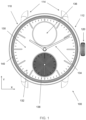
- a wearable device 100 (also referred as "the device 100" in the following) is represented on Figure 1 .
- the device 100 is configured to be positioned on a user's wrist.
- the device is a watch.
- the watch may comprise a wristband. Nevertheless, in the context of the present description, the term watch does not necessarily include the strap, which is generally manufactured elsewhere and may be assembled at points of sale.
- the wearable device 100 could also be an activity tracker for example.
- Figures 1 to 7 illustrate an electronic watch 100, of the hybrid type with a dial, mechanical hands, and possibly a display integrated into the dial.
- a standard reference mark (XYZ) is shown in these figures.
- the watch may be a non-hybrid watch without mechanical hands but with a display.
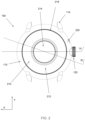
- the watch 100 may comprise an enclosure 110 and a case back 210 shown on Figure 2 .
- the enclosure 110 forms an enclosure that defines an internal volume suitable for receiving various components, such as electronic components, as it will be explained more in details below.
- the enclosure 110 protects the internal volume from notably dust, water, dampness, and shocks.
- the enclosure 110 may include a lateral wall 112, which is generally visible when the watch 100 is worn on the wrist.
- the enclosure 110 may include lugs 114 for attaching a strap (not shown in the figures).
- the enclosure 110 may comprise two pairs of lugs 110, on both side of the enclosure 110.
- the enclosure 110 may include a plurality of parts.
- the watch 100 further comprises a crown 120 protruding through the enclosure 110. As visible on Figures 1 to 3 , the crown protrudes orthogonally to the Z axis, along an X axis.
- the crown 120 will be described more in detail below.
- the case back 210 is the back side of the watch 100.
- the case back 210 is configured to be at least partially in contact with the skin of the user's wrist.
- the case back 210 may comprise an annular member 212.
- the annular member 212 may surround a physiological sensor 214.
- the physiological sensor 214 will be described more in detail below.
- the enclosure 110 and the case back 210 are two separate pieces. In this embodiment, the enclosure 110 and the case back 210 may be separated by a seal 216.
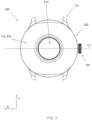
- the enclosure 110 and the case back 210 are integral with each other.
- the enclosure 110 and the case back 210 are a single mechanical piece.
- the watch 100 may further include a glass 130, typically mounted on the enclosure 110, such that the glass 130 is fixed.
- the glass 130 may comprise a typically transparent protective glass and may be made of glass, ceramic, plastic or any transparent material.
- the outline of the glass 130 is here typically circular in shape.
- the watch 100 further comprises a dial 132 with physical hands 134.
- the dial 132 may further accommodate a display 136 (e.g., with an opening in the dial that allows a display positioned just below the dial to be visible), which occupies, for example, a small space below or within the dial 132.
- the watch 100 may further comprise an additional dial 138 for displaying for example the daily number of steps made by the user or another physical activity amount indicator.
- the glass 130 protects these parts and allows them to be seen through.
- the watch 100 comprises a screen that occupies a width close to the width of the watch 100.
- the screen may display hands.
- the glass 130 is then the protective glass of the display.
- the watch 100 may further comprise a bezel 140, mounted on the enclosure 110.
- the bezel 140 is positioned around the glass 130 (radially external to the glass around the Z direction).
- the bezel 140 is mounted in a fixed way with respect to the enclosure 110.
- the bezel 140 may be rotatably mounted with respect to the enclosure 110.
- the device 100 comprises a unique crown 120.
- the device 100 may comprise a plurality of crowns 120.
- the crown 120 is a hardware input for the user.
- the crown 120 may be used by the user to set the time, to navigate in the menu displayed on the display 136, to launch the recording of an activity, etc.
- the crown 120 may a push-button and/or a rotary wheel.
- the crown 120 is a push-button and a rotary wheel, i.e. the crown 120 may be rotated around a crown axis A, parallel to the X axis and may be translated along the crown axis A.
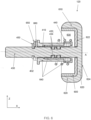
- the crown 120 protrudes through the enclosure 110 along the crown axis A, in particular through the lateral wall 112 of the enclosure 110.
- the enclosure 110 comprises an opening 410 through which the crown 120 extends.
- the opening 410 may present a generally cylindrical shape.
- the crown 120 comprises a head 420 arranged outside the enclosure 110 and a stem 430 extending from the head 420 through the enclosure 110.
- the stem 430 is configured to slide and/or rotate inside the opening 410.
- the crown 120 When the crown 120 is a push-button, the crown 120 is configured to switch from a pressed configuration in which the head of crown 120 is pushed towards the enclosure 110, to a rest configuration in which the head of the crown 120 is further away from the enclosure 110.
- the crown 120 is configured to be electrically conductive.
- the head 420 and the stem 430 are electrically conductive.
- the head 420 and the stem 430 may be made of metal.
- the crown 120 may further comprise a spring 440 arranged around the stem 430 and between the head 420 and the enclosure 110.
- the crown 120 is configured to move axially, along the crown axis A, in the opening 410 against the return force of the spring 440, in particular when a push is applied onto the head 420 by the user.
- the spring 430 constrained the crown 120 in the rest configuration.
- the stem 430 comprises an annular groove 432, such as two annular grooves 432, in which at least a sealing gasket 434 is housed.
- two sealing gaskets 434 are arranged directly on the stem 430 without an annular groove.
- Each gasket 434 provides a water-resistant sealing of the opening 410 when the crown 120 is in the rest configuration or even when the stem 430 slides into it when the crown 120 is activated by a user.
- Each sealing gasket 434 may be made in rubber, for example nitrile rubber to provide an efficient sealing while provided an extended life span.
- the crown 120 may further comprise an abutment 450 which prevents the stem 430 from escaping from the opening 410 in which the stem 430 slides.
- the retaining means 450 may be a circlip which is engaged in another annular groove 432 arranged on the stem 430, towards the end of the stem 430 opposite to the head 420 (so that it is located inside the enclosure 110). In the rest configuration, the circlip is pressed towards the enclosure 110. The circlip is moved away from the enclosure 110 in the pressed configuration.
- the crown 120 may further comprise an isolation ring 600 configured to electrically isolate the head 420 of the crown 120 from the enclosure 110.
- the isolation ring 600 is made of an electrical insulation material, for example a thermoplastic polyester elastomer.
- the head 420 comprises a cylinder portion 610 extending along the crown axis A, closed at an end of the cylinder portion 610 by an end wall portion 620.
- the cylinder portion 610 and the end wall portion 620 define an inner volume 630.
- the end wall portion 620 comprises an inner surface 622 facing the inner volume 630 and comprises an outer surface 624 configured to be touched by the user when pushing the crown 120.
- the stem 430 protrudes from the inner surface 622 and extends inside the inner volume 630.
- the isolation ring 600 may be arranged inside the inner volume 630 of the head 420.
- the isolation ring 600 may be arranged against the inner surface 622 of the end wall portion 620.
- the isolation ring 610 may extend against the cylinder portion 610.
- the enclosure 110 may further comprise an isolation sleeve 640 configured to electrically isolate the stem 430 of the crown 120 from the enclosure 110.
- the isolation sleeve 640 is arranged around the stem 430.
- the isolation sleeve 640 may be formed of a plurality of parts. In a variant (non-represented), the isolation sleeve 640 is made of a single piece.
- the isolation sleeve 640 extends at least along the length of the opening 410 to ensure an efficient electrical isolation with the enclosure 110.
- the at least one sealing gasket 434 is surrounded on both side along the crown axis A by two parts of the isolation sleeve 600.
- the isolation sleeve 640 may be made of thermoplastic, for example polyoxymethylene to ensure an efficient isolation.
- the crown 120 may comprise a glass-to-metal seal.
- the crown 120 comprises a glass-to-metal seal surrounding the stem 430.
- the glass-to-metal seal is made by melting glass in contact with the stem, made of metal, to be joined or sealed. Such a seal ensures an enhanced mechanical resistance while guaranteeing good electrical insulation.
- the device 100 may further comprise a pusher detector 490 arranged inside the enclosure 110 at the extremity of the stem 430 and configured to detect the translation of the stem 430.
- the stem 430 is away from the pusher detector 490 in the rest configuration and the stem 430 is in contact with the pusher detector 490 in the pressed configuration.
- the device 100 may further comprise a stem rotation detector 495 configured to detect the rotation of the stem 430 along the crown axis A.
- the device 100 comprises at least a circuit board 460 (also called PCB for "printed circuit board").
- the circuit board 460 is a thin rigid board containing a printed circuit.
- the circuit board 460 may comprise a ground plane.
- the ground plane is typically a large area of metal connected to the circuit ground.
- the circuit board comprises a control unit 800, schematically illustrated on Figure 5 .
- Other components may also be mounted on the circuit board 460 as it will be explained below.
- the control unit 800 is used to control the on-board electronics of the device 100.
- the control unit 800 may for example include or partially include an ECG module and a PPG module, as it will be explained below.
- the device 100 is connected, so that it may exchange data remotely (wirelessly) in a bidirectional way with a terminal, such as a smartphone.
- a terminal such as a smartphone.
- the connection may be made via Bluetooth, such as Bluetooth Low Energy (BLE).
- BLE Bluetooth Low Energy
- the watch may also receive data from the terminal (time, alarm data, notifications, etc.).
- the device 100 comprises a wireless communication module 810, such as a Bluetooth or Bluetooth Low Energy module or a Wi-Fi module or a cellular module (GSM, 2G, 3G,4G, 5G, Sigfox, etc.), which allows it to communicate bidirectionally with at least one external terminal 820, such as a smartphone.
- the external terminal 820 may then communicate (bidirectionally) with a remote server 830 for data storage and processing.
- the wireless communication module 810 may communicate directly with the remote server 830, such as via the cellular network or via a Wi-Fi network.
- Data obtained by the watch 100 such as an electrocardiogram, but also indications of heart rate, activity or oxygen saturation, are transmitted to the external terminal 820 via the wireless communication module 810.
- the control unit 800 may process certain signals before sending them, to limit the size of the transmitted data.
- the device 100 may be configured to measure an electrocardiogram (also called "ECG") of the user.
- ECG electrocardiogram
- the watch 100 comprises an ECG sensor.
- the ECG sensor comprises a set of electrodes (referred to as ECG electrodes) and an ECG electronic module 840, to which the ECG electrodes are electrically connected.
- electrode is meant a conductive part capable of receiving an electric current or voltage.
- the part may be made of a conductive material or comprise a conductive coating.
- conductor is meant “electrically conductive”.
- the device 100 comprises only two ECG electrodes, referred as ECG1 and ECG2.
- the device 100 may comprise a third ECG electrode, for example arranged on the case back 210.
- the first ECG electrode ECG1 is located on the case back 210 so as to be in contact with the skin of the user's wrist on which the user is wearing the watch 100.
- the first ECG electrode is electrically connected to the ECG module 840.
- the case back 210 is the first ECG electrode.
- the case back 210 is made of an electrically conductive material, such as metal.
- the first ECG electrode in arranged on the lens 470, for example with a metallic coating.
- the second ECG electrode ECG2 may be arranged on the bezel 140, such that the user may touch any portion of the bezel 140 to perform an ECG. Any portion of the bezel 140 means any portion of the surface of the bezel accessible to a user by touching. In this embodiment, the crown 120 is not an ECG electrode.
- the second ECG electrode is arranged on the crown 120.
- the two electrodes are electrically connected to the ECG module 840.
- the ECG module 840 is configured for example to impose a potential on one of the two ECG electrodes and to measure a potential of the other of the two ECG electrodes.
- the ECG module 840 is configured to retrieve electrical signals from the human body and to, after processing, generate an electrocardiogram signal or a datum representative of information about the electrocardiogram.
- the ECG module 840 may be mounted on the circuit board 460.
- the physiological sensor 214 is arranged on the case back 210.
- the first ECG electrode may at least partially surround the physiological sensor 214.
- the physiological sensor 214 may be an optical sensor.
- the optical sensor is typically a PPG (photoplethysmography) sensor, comprising LEDs to emit light and photodiodes to recover light.
- the optical sensor may be positioned behind a lens 470, such as a glass lens, which interfaces with the skin of the wrist.
- PCT/EP2021/058955 in the name of Withings TM , and incorporated by reference, describes in detail the optical sensor, which is found on the Withings ScanWatch TM .
- the optical sensor is connected to a PPG module 850, which may be mounted on the circuit board 460.
- the PPG module 850 is configured to generate the instructions for the LEDs and to recover the electrical signals from the photodiodes.
- the physiological sensor 214 may be a temperature sensor configured to measure skin temperature.
- the temperature sensor may be a thermistor sensor or an infrared thermal sensor.
- the device 100 may further comprise an altimeter.
- the altimeter may be a barometer configured to measure the pressure of the air in a cavity fluidically connected with the outside through openings 220 in the enclosure 110 visible on Figure 2 .
- the device 100 further comprises a rechargeable battery 480 configured to provide energy for the device 100, and in particular for the electronic components of the device 100.
- the rechargeable battery 480 is configured to store chemical energy and to convert this chemical energy into electrical energy.
- the battery 480 is configured to be recharged a plurality of times, i.e. reversing the electrochemical reaction to recharge the chemical energy stored into the battery 480.
- the device 100 is configured to cooperate with an electrical charger 900, as visible on Figure 14 to 20 and as it will be explained below.
- the battery 480 may be for example a Lithium Ion battery or a Lithium Polymer battery.
- the tension delivered by the battery 480 is for example comprised between 3V and 5V, notably 4.35V.
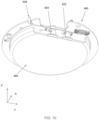
- the battery 480 may be arranged between the circuit board 460 and the case back 210. As illustrated on Figure 10 , the battery 480 has in the illustrated a button shape but may also present a parallelepiped shape.
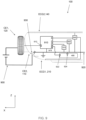
- the device 100 further comprises a battery charging module 910 configured to control the charging of the rechargeable battery 480.
- the battery charging module 910 comprises an input port 912 and a battery output port 914.
- the crown 120 is connected to the input port 912 and the battery 480 is connected to the battery output port 914.
- the charging module 910 is further configured to prevent electrical current to circulate from the battery 480 towards the crown 120, and as a consequence, prevent the user from receiving electrical current from the battery 480.
- the battery charging module 910 is further connected to the ground of the device 100, in particular to the ground plane 920 of the circuit board 460.
- the charging module 910 comprises other outputs to deliver electrical energy from the battery 480 to the different electronic components of the device 100.
- the charging module 910 is configured to notably power the wireless communication module 810, the ECG module and the PPG module 850.
- the battery 480 comprises a first pole 922 and a second pole 924.
- the first pole 922 is the positive pole and the second pole 924 is the negative pole.
- the first pole 922 has in this case a higher electrical potential than the second pole 924.
- the poles of the battery 480 may be inverted.
- the crown 120 serves here as a charging electrode CE1 (i.e. a physical interface) with the electrical charger 900 for the conduction of electricity from the electrical charger 900 to the battery 480 (said in other words, the crown 120 is on the electrical path between the charger 900 and the battery 480).
- the crown 120 is made of an electrically conductive material, such as metal.
- the enclosure 110 is electrically connected to the second pole 924, so that the enclosure 110 serves as charging electrode CE2 (i.e. physical interface) with the electrical charger 900 for the conduction of electricity from the electrical charger 900 to the battery 480 (said in other words, the enclosure 110 is on the electrical path between the charger 900 and the battery 480).
- the enclosure 110 is made of an electrically conductive material, such as metal.
- the case back 210 is electrically connected to the second pole 924.
- the bezel 140 is electrically connected to the second pole 924.
- the device 100 comprises a switch configured to disconnect the first ECG electrode ECG1 from the ECG module 840 when the battery 480 is charging.
- the device 100 comprises a switch configured to disconnect the second ECG electrode ECG2 from the ECG module 840 when the battery 480 is charging.
- the circuit board 460 may be electrically arranged respectively between the first pole 922 and the crown 120, and between the second pole 924 and the enclosure 110, so as to control the charge of the battery 480.
- the enclosure 110 is directly connected to the ground of the device 100, i.e. to the ground plane 920
- the second pole 924 is directly connected to the ground of the device 100, in particular to the ground plane 920.
- the enclosure 110 and the second pole 924 are both connected to the ground plane 920 and therefore are connected with each other.
- the enclosure 110 is connected to the ground plane 920 through a conductive contact 930, in particular a metallic conductive contact 930.
- the conductive contact 930 is a metallic spring, notably a fat spring fixed at one end to the ground plane 920 and comprising a free V-shaped opposite end. The opposite end is folded and constrained towards the enclosure 110.
- the conductive element 930 may be a metallic pin.
- the enclosure 110 and the case back 210 are integral, the enclosure 110 and the case back 210 are both electrically connected to the second pole 924.
- the case back 210 may be electrically connected to the second pole 920 in a non-represented embodiment.
- the case back 210 is directly connected to the ground of the device 100, i.e. to the ground plane 920, and the second pole 924 is directly connected to the ground of the device 100, in particular to the ground plane 920.
- the case back 210 is connected to the ground plane 920 through a conductive contact 930.
- the crown 120 When the crown 120 is a push-button, the crown 120 may be connected to the first pole 922 of the battery 480 when the crown 120 is in the rest configuration. The crown 120 may be disconnected from the first pole 922 when the crown 120 is in the pressed configuration.
- the crown 120 may be permanently connected to the first pole 922.
- the crown 210 may only be connected to the first pole 922 when the crown 120 is in the pressed configuration.
- the first pole 922 and the second pole 924 are configured to be connected to the electrical charger 900 to recharge the battery 480.
- the charger 900 is configured to be in electrical contact with the crown 120 and with the enclosure 110 (or the case back 210) to charge the battery 480.
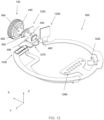
- the crown 120 is connected to the circuit board 460, and especially to the battery control module 910, through a flexible printed circuit 650 (also called "FPC").
- the FPC 650 comprises a metallic layer of traces, usually copper, bonded to a dielectric layer, usually polyimide.
- the thickness of the metal layer may be comprised between 0.001 mm to 0.01 mm and the dielectric thickness may be comprised between 0.01 mm to 0.2 mm.
- An adhesive may be used to bond the metal to the substrate, but other types of bonding such as vapor deposition may be used to attach the metal.
- the FPC 650 may bend without cracking or breaking enabling an easier assembling of the device 100 during the manufacturing process.
- the FPC 650 extends generally along a circle shape and comprises at least two branches, in particular three branches extending respectively until a first end 1220, a second end 1230 and advantageously a third end 1240.
- the FPC 650 is directly connected to the crown 120 at the first end 1220.
- the FPC 650 is directly connected to the circuit board 460. As a consequence, the FPC 650 connects the crown 120 to the circuit board 460.
- the FPC 650 may be further connected to at least one of: the altimeter, one of the ECG electrodes, the temperature sensor, the optical sensor, the stem rotation detector.
- the FPC 650 is connected to the altimeter at the third end 1240, to the second ECG electrode at connection 1250, to the optical sensor at connection 1260 and at the stem rotation detector 495 at connection 1270.
- the FPC 650 and in particular the first end 1220, comprises a hook shaped extremity configured to cooperate with the stem 430 (i.e. partially surrounding it) to electrically connect the crown 120 to the FPC 650.
- the hook is oriented towards the case back 210.
- the first end 1220 extends along a vertical plan and comprises a slot facing the case back 210 for receiving the stem 430.
- the FPC 650 defines a disc opening at the first end 1220 in which the stem 430 is inserted to electrically connect the crown 120 to the FPC 650.
- the device 100 further comprises a seal 660 configured to electrically isolate the FPC 650, in particular the hook arranged at the first end 1220, from the enclosure 110.
- the seal 660 may be bonded through an adhesive to the enclosure 110, in particular to the isolation sleeve 630 of the enclosure 110.
- the abutment 450 is configured to maintain the FPC 650, in particular the hook, against the seal 660.
- the stem 430 When the crown 120 is pushed by the user, the stem 430 translates along the crown axis A and the abutment 450 moves with the stem 430. As the seal 660 is bonded to the enclosure 110, the seal 660 does not move with the stem 430. The hook of the FPC 650 remains in contact with the seal 660 and does not move with the stem 430. Vibration tests have been carried out by the inventors which show that it seems to be no risk for the hook to dissociate with the stem 430 in operation of the watch.
- the device 100 includes an enclosure 110, a case back 210, a bezel 140 and a crown 120.
- the case back 210 and the bezel 140 are ECG electrodes ECG1, ECG2 and the crown 120 and the enclosure 110 are charging electrodes CE1, CE2.
- ECG1, ECG2, CE1, CE2 ECG electrodes
- CE1, CE2 ECG electrodes
- This arrangement drastically simplifies the conception of the device 100, as none of those electrodes requires the additional of the specific independent part of the device 100. Electrical sealing is however required between the four electrodes ECG1, ECG2, CE1, CE2.
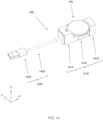
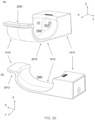
- FIG. 14 and 18 An assembly comprising a device 100 and an electric charger 900 is illustrated on Figures 14 and 18 . Eight different embodiments of the electric charger 900 are respectively illustrated on Figures 14-16 , Figure 17 , Figures 18-19 , Figure 20 , Figure 21 , Figure 22 , Figure 23 and Figure 24 .
- the assembly is configured to alternate between a separated configuration and a charging configuration.
- the charger 900 In the separated configuration, the charger 900 is away from the device 100.
- the charger 900 In the charging configuration, illustrated on Figures 14 and 16 , the charger 900 cooperates with the device 100 to electrically charge the rechargeable battery 480 (when the charge 900 is plugged).
- the assembly when the user wears the watch 100 at the wrist, the assembly is in the separated configuration.
- the charger 900 may rest on a table and when the battery 480 is empty, the user may grab and couple the device 100 to the charger 900 to alternate to the charging configuration in order to recharge the battery 480.
- the charger 900 may extend along a length comprised between 2 cm and 10 cm, along the X axis.
- the charger 900 may extend along a width comprised between 1 cm and 4 cm, along the Y axis.
- the charger 900 may extend along a height comprised between 1 cm and 3 cm, along the Z axis.
- the charger 900 comprises a support 1410 and a connection system 1420.
- connection system 1420 may comprise a connection wire 1422 and a plug 1424, notably an USB plug.
- the connection wire 1422 may be permanently connected to the support 1410 or may be connected in a removable way to the support 1410, for example through an USB connection.
- the plug 1424 may be connected to an electrical adapter, non-represented, to connect the charger 900 to an electrical network.
- the plug 1424 may also be directly connected to an external battery.
- the support 1410 comprises at least one side wall 1414.
- the side wall 1414 is configured to engage the wearable device 100 when it is in the charging configuration.
- the support 1410 also comprises a base 1412, from which the at least one side wall 1414 extends.
- the support 1410 comprises two side walls 1414, 1416 and a base 1412.
- the support 1410 comprises a single side wall 1414 and a base 1412.
- the support 1410 only comprises the side wall 1414 (and no base 1412).
- the wall is called "side wall" as it is facing a side of the wearable device 100, notably the lateral wall 112 of the enclosure 110.
- the side wall 1414 may have a shape that is complementary to the shape of the enclosure 110 or at least partially complementary.
- the side wall 1414 may also include a curved shape to fit the enclosure 110.
- the fit may be more or less loose (for example the radius of the circular shape of the side 1414 may be greater than the radius of the curved shape of the enclosure 110).
- Figures 15-20 and Figures 21-22 , and Figure 24 show such a curved side wall 1414.
- the base 1412 extends along a horizontal plan, orthogonally to the Z axis.
- the base 1412 may present a mainly flat parallelepipedic shape.
- the base 1412 may configured to rest on a flat surface as a table for example.
- the base 1412 comprises an upper surface 1610 configured to be in contact with the device 100 and a flat bottom surface 1612 configured to be in contact with an external surface as a table.
- the base 1412 may extend along a length comprised between 1 cm and 5 cm, along the X axis.
- the base 1412 may extend along a width comprised between 1 cm and 4 cm, along the Y axis.
- the base 1412 may extend along a height comprised between a 0.1 cm and 2 cm, along the Z axis.
- At least a side wall 1414 is configurated to rest on a flat surface as a table for example.
- the charger 900 comprises here two parallel bases 1412 protruding vertically from each side of the side wall 1414.
- the charger 900 may further comprise two additional walls 2300 protruding vertically from the side wall 1414 and orthogonally to the two bases 1412.
- the two additional walls 2300 and the side wall 1414 define a watch reception volume into which the wearable device 100 is be inserted.
- the two side walls 1414, 1416 face each other and protrude out of the base 1412. In particular, each side wall 1414, 1416 protrudes along a vertical direction, parallel to the Z axis when the assembly is in the charging configuration.
- the two sides wall 1414, 1416 are arranged at two opposite ends of the base 1412.
- Each side wall 1414, 1416 may extend along a length comprised between 0.1 cm and 3 cm, along the X axis.
- Each side wall 1414, 1416 may extend along a width comprised between 1 cm and 4 cm, along the Y axis.
- Each side wall 1414, 1416 may extend along a height comprised between 1 cm and 3 cm, along the Z axis.
- the base 1412 and the two sides walls 1414, 1416 form a watch reception volume 1500 to receive at least partially the device 100.
- the device 100 is at least partially inserted inside the watch reception volume 1500 in the charging configuration.
- the two bases 1412 and the side wall 1414 defines the reception volume 1500.
- the reception volume 1500 is configured to receive the device 100 which rest by gravity in the charger.
- the base 1412 is configured to be in contact with the case back 210 of the watch 100 in the charging configuration.
- the base 1412 comprises a case back reception area 1505, presenting a complementary shape of the case back 210.
- the side walls 1414, 1416 are configured to be in contact with the enclosure 110 in the charging configuration. In particular, the side walls 1414, 1416 are configured to contact two opposite sides of the enclosure 110.
- the base 1412 and in particular the upper surface 1610 of the base 1412, may be configured to be in contact with the glass 130 of the watch 100 in the charging configuration.
- the charger 1400 is therefore configured to charge the watch 100 in both side (with the case back 210 against the base 1412 or with the glass 130 against the base 1412), enabling an easy and intuitive charging for the user.
- Each side wall 1414, 1416 may extend higher along the Z axis than the height of the device 100 in the charging configuration.
- each side wall may comprise a rim 1600 configured to cooperate with the bezel 140 of the device 100 in the charging configuration.
- the rim 1600 is arranged at the free end of the respective side wall and enables to tightly keep the device 100 in the watch reception volume 1500 in the charging configuration.
- the rim 1600 slightly closes the watch reception volume 1500.
- the side walls may comprise a first side wall 1414 and a second side wall 1416.
- the connection system 1420 may be arranged on the first side wall 1414.
- the watch reception volume 1500 is configured to be extended to receive the device 100.
- at least one side wall is movable to change the watch reception volume.
- the movable side wall may have two configurations, one allowing the device to be inserted in the charger 900 and one maintaining the device in the charger 900.
- the side walls is configured to be movable in translation with respect to the base 1412.
- the second wall 1416 may be the movable side wall.
- the movable side wall is configured to be movable in translation with respect to the base 1412 along the X axis.
- the base 1412 comprises an opening 1620 and the movable side wall comprises an insert 1630 protruding along the X axis and able to be inserted in the opening 1620.
- the charger 900 may further comprise a spring 1640 resting between a first stopper 1650 of the base 1410 and a second stopper 1652 of the insert 1630.
- the charger 900 may comprise two springs 1640 arranged in parallel along the X axis.
- the spring 1640 forces the movable side wall in direction of the base 1412.
- the insert 1630 is configured to move axially, along the X axis, in the opening 1620 against the return force of the spring 1640 when the movable side wall is pulled back by the user.
- the watch reception volume 1500 is expanded and the device 100 may be easily inserted inside the reception volume 1500.
- the movable side wall is let free to return to its rest position, the movable side wall contacts the enclosure 110 so as to maintain the device 100 in position.
- the second side wall 1416 is the flexible side wall.
- the flexible side wall comprises a first end 2010 fixed to the base 1412 and a free second end 2012, opposite to the first end 2010.
- the second end 2012 is configured to be moved with respect to the base 1412, notably along the X axis.
- the flexible side wall comprises at least a finger support 2020 arranged at the free second end 2012.
- the finger support 2020 extends horizontally from the second end 2012. The finger support 2020 enables the user to easily bend the flexible wall 1416.
- the flexible side wall comprises two finger supports 2020, respectively arranged at the free second end 2012 and at the first end 2010.
- the two finger supports 2020 form a clamp enabling the user to bend even more easily the flexible wall 1416.
- the user may then remove the device 100 from the charger 900 just by pulling the device 100 slightly, without a need to directly move or bend the side wall.
- the movable side wall 1416 may be hinged to the base 1412.
- the second side wall 1416 comprise two parts hinged together, a first part being arranged at the first end 2010 and a second part arranged at the free second end 2012.
- the second side wall 1416 is configured to switch from a deployed configuration, illustrated on Figure 21 (a) , to a folded configuration, illustrated on Figure 21 (b) .
- the second side wall 1416 may comprise a flat spring 2210 extending from the first end 2010 to the second end 2012 and enabling to maintain the side wall 1416 in each configuration.
- the side wall 1416 is in the deployed configuration when the assembly is in the separated configuration to enable the device to be inserted in the reception volume 1500.
- the side wall 1416 is in the folded configuration when the assembly is in the charging configuration to maintain the device 100 in position inside the reception volume 1500.
- the charger 900 may receive different types of devices.
- different type of devices it is understood devices which present different shapes (e.g., sizes) of enclosures, in particular different widths of enclosures.
- the charger 900 may be compatible with watches presenting a diameter of 38mm and with watches presenting a diameter of 42 mm.
- One of the side walls may define a crown insertion volume 1510 to receive the crown 120.
- the crown 120 is at least partially inserted inside the crown insertion volume 1510 in the charging configuration.
- the crown insertion volume 1510 enables to maintain the device 100 in the good charging configuration to provide an efficient mechanical and electrical contact between the device 100 and the charger 900.
- the crown insertion volume 1510 is arranged on the base 1412.
- the crown insertion volume 1510 may be an insertion blind hole.
- the shape of the insertion blind hole may be complimentary from that of the crown 120, with a functional clearance therebetween.
- the insertion blind hole 1510 may be of a circular shape, with slightly bigger a radius (for example between 10% and 50% bigger).
- the first electrical connector 1520 may thus be at the bottom of the blind hole, along the direction of insertion of the crown 120 in the blind hole.
- the first electrical connector 1520 may be on a side of the blind hole and gets deformed along the direction of insertion of the crown 120 in the blind hole when the crown 120 is inserted in the blind hole.
- the crown insertion volume 1510 is an insertion slot.
- the insertion slot may be an open insertion slot. By open, it is meant as open towards the top along the Z axis to allow a vertical insertion of the device 100, by having the crown 120 slide in the slot.
- the insertion slot could be a closed insertion slot, according to which the slot is not open towards the top along the Z axis.
- the insertion of the crown 120 in the slot may be possible through a direction transverse to the direction of the slot.
- the insertion slot may be a through slot, open in the direction of the crown axis A (when the device 100 is placed in the electric charger 900).
- the insertion slot may be a blind slot, closed in the direction of the crown axis A (when the device 100 is placed in the electric charger 900).
- the first electrical connector 1520 may thus be at the bottom of the through slot, along the direction of insertion of the crown 120 in the through slot.
- the first electrical connector 1520 may be on a side of the through slot and gets deformed along the direction of insertion of the crown 120 in the through slot when the crown 120 is inserted in the through slot.
- the dimension of the open insertion slot transversally to the crown axis A may be complimentary of the shape of the crown 120, with a functional clearance therebetween.
- the shape of the insertion slot may also vary.
- the insertion slot may also comprise a dovetail shape so that the crown 120 abuts against the slot when inserted therein.
- Figure 24 illustrates such a dovetail shape.
- the insertion slot may comprise a shape which does not prevent the crown to get out. Said otherwise Figure 19 illustrates such a shape.
- the charger 900 comprises two electrical connectors, in particular a first electrical connector 1520 and a second electrical connector 1530.
- the first electrical connector 1520 is configured to be in contact with the crown 120 of the device 100 in the charging configuration.
- the first electrical connector 1520 may protrude inside the crown insertion volume 1510.
- the crown 120 is inserted in the crown insertion volume 1510 and is in contact with the first connector 1520.
- the first electrical connector 1520 may be deformable along the direction of insertion of the crown in the crown insertion volume. This allows maintaining an electrical contact therebetween.
- the first electrical connector 1520 is placed at the bottom of the crown insertion volume 1510 along the direction of insertion of the crown 120. In other words, the crown 120 abuts against said first electrical connector 1520 when inserted in the crown insertion volume 1510.
- the first electrical connector 1520 may extend along said direction and translates or may be compressed along that direction.
- the first electrical connector 1520 may extend transversally along the direction of insertion but may be deformable along that direction (e.g., a bendable connector).
- the second electrical connector 1530 may be similar defined as the first electrical connector 1520, with the same properties as disclosed, except that it is located outside the crow insertion volume 1510.
- the first electrical connector 1520 protrudes horizontally from the first side wall 1414 inside the crown insertion volume 1510.
- horizontally it is meant parallel, or essentially parallel, to the crown axis A when the device 100 is placed on the electric charger 900.
- This configuration allows an insertion of the crown 120 that is along the direction of the first electrical connector 1520. Therefore, this reduces the risk to damage the first electrical connector 1520.
- the first connector 1520 protrudes vertically from the bottom of the insertion slot 1510, that is to say along the direction of the insertion slot.
- the second electrical connector 1530 may be configured to be in contact with the enclosure 110 in the charging configuration, when the enclosure 110 is connected to the second pole of the battery 480.
- the second electrical connector element 1530 may be configured to be in contact with the case back 210 in the charging configuration, in the embodiment in which the case back 210 is connected to the second pole of the battery 480.
- the second electrical connector 1530 is arranged on the same side walls.
- the second electrical connector 1530 may be arranged on the first side wall 1414.
- the second electrical connector 1530 is arranged next to the crown insertion volume 1510 in a horizontal direction.
- the second electrical connector 1530 may be sensibly arranged at the same height along the Z axis than the first electrical connector 1530.
- the second electrical connector 1530 may be arranged on the base 1412. In particular, the second electrical connector 1530 may be arranged next to the first electrical connector 1520, along the X direction.
- the second electrical connector 1530 may also be deformable along the direction of approach of the wearable device.
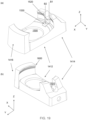
- Each electrical connector 1520, 1530 may be an electrical pin connector. As illustrated on Figures 15 and 20 , each electrical connector may be a metallic pogo pin. Each electrical connector is in particular a spring-loaded pin comprising an integrated spring in the pin which enables a good mechanical and electrical connection with the device 100.
- each electrical connector 1520, 1530 may extend from the support 1410 along a respective main axis B1, B2.
- Each electrical connector may be deformable along the associated main axis B1, B2 and along at least an additional axis different from the associated main axis B1, B2.
- the electrical connector may here move along at least two axes.
- the first electrical connector may be made of a soft conductive material.
- the soft conductive material may be for example a conductive foam, a doped silicone or an elastomer filled with conductive particles.
- the electrical connector may be a spring, in particular an accordion spring able to move along at least two axes. Such an electrical connector prevents scratches on the enclosure which may occur with pins and provides better adaptability and better mechanical contact with different shapes of devices 100 or crown 120, while providing an efficient electrical contact.
- the second electrical connector is made of the same material.
- the first electrical connector 1520 and the second electrical connector 1530 are made of different material, for example a pin and a soft conductive material.
- the two side walls of the charger 900 enables to enclose the device 100 so as to protect it and provides an esthetical impression.
- the charger 900 provides a good mechanical and electrical contact with the device 100, without a need of magnets.
- the charger 900 may be compatible with multiple types of watches.
- a method of charging a battery 480 of a device 100 with a charger 900 will now be described.
- the assembly is initially in the separated configuration, the device 100 being away from the charger 900.
- the device 100 may be worn at the wrist of the user.
- the user may follow the level of charge of the battery 480 through the display 136.
- the user may want to recharge the battery 480.
- the user then switches the assembly from the separated configuration to the charging configuration.
- the user may pull back or bend one of the side walls to enlarge the watch reception volume 1500.
- the device 100 may be then easily inserted inside the watch reception volume 1500.
- the crown 120 is inserted into the insertion volume 1510 and the case back 210 rests on the base 1412.
- the side wall is then let free by the user and it returns to its rest position.
- the movable side wall then contacts the enclosure 110 so as to maintain the device 100 in position.
- the first electrical connector 1520 is then in contact with the crown 120 and the second connector element 1530 is in contact with the enclosure 110 or the case back 210.
- the charger 900 then electrically charges the rechargeable battery 480 of the device 100.
- the user may follow the recharge level of the battery 480 through the display 136.
- the device 100 may send a notification to an external terminal 820 informing the user when the battery 480 is fully charge.
- the user may then switch the assembly from the charging configuration to the separated configuration.
- the user may then remove the device 100 from the charger 900 just by pulling the device 100 slightly, without a need to move or bend the side wall.
- the device 100 may be again worn at the wrist of the user.
- the charging method is therefore simple for the user and enables an efficient charge of the device 100 by providing a good mechanical and electrical contact between the charger 900 and the device 100.
Landscapes
- Engineering & Computer Science (AREA)
- Power Engineering (AREA)
- Physics & Mathematics (AREA)
- General Physics & Mathematics (AREA)
- Electric Clocks (AREA)
Abstract
- a first electrical connector protruding inside the crown insertion volume and configured to be in contact with the crown in the charging configuration, and
- a second connector element configured to be in contact with the wearable device in the charging configuration.
Description
- The present invention relates to an electrical charger. The electrical charger is configured to charge a rechargeable battery of a wearable device. The wearable device is in particular a watch, notably a connected watch. By watch, it is meant a portable device whose preferred position is at the wrist ("wrist wearable").
- The present invention also relates to such a wearable device configured to cooperate with the electrical charger.
- Conventionally, a wearable device comprises a battery to supply the various components of the device with electrical power. The battery is configured to convert the stored chemical energy into electricity.
- The battery may be a rechargeable battery. By providing energy to the rechargeable battery, the electrochemical reaction is reversed to recharge the chemical energy stored in the battery.
- The energy used to charge rechargeable batteries usually comes from an electrical charger using AC mains electricity.
- Different charging mechanisms are known.
- For example, the watch may be placed onto a charger, the case back of the watch and the charger comprising connecting pins cooperating with each other. The watch may be maintained in position onto the charger via magnets, to ensure good mechanical and electrical contact. However, these magnets may disturb the electronics inside the watch and take up space in the internal volume of the watch.
- Alternatively, the connecting pins may be arranged on the side wall of the enclosure and the watch may be rotated and placed on the charger so that to exert more pressure. However, the balance of the watch is unstable, and the electrical contact may be easily lost.
- Alternatively, document
WO2019/093637 describes a watch with connecting pins on the case back and a charger comprising a support surface and charging connectors on a vertical seating surface. The watch is placed on its side on the support surface to recharge its battery. - In another variant, the charger may have the form of a clamp comprising two legs and a spring between the legs. The clamp requires the user to open the legs to enable the cooperation with the pins of the watch, making such a charger tedious to use.
- It is also known to provide an inductive charger, for example to charge an Apple Watch. Such a charger uses electromagnetic induction to provide electricity to portable devices wirelessly. However, such a charger may lead to unstable connection between the device and the charger and may face issues as electromagnetic interference or heat generation.
- An aim of the disclosure is to provide an electrical charger enabling an efficient electrical charge while presenting a simple mechanical architecture and providing a good mechanical and electrical contact with the device.
- To solve at least one of these issues, the disclosure relates to an electrical charger configured to charge a battery of a wearable device configured to be positioned on a user's wrist, the wearable device further comprising an enclosure, a crown protruding through the enclosure, the crown being a hardware input for the user, and a case back configured to be at least partially in contact with the skin of the wrist, wherein the charger comprises:
- at least one side wall, configured to be in contact with the wearable device in ta charging configuration,
- wherein the at least one side wall defines a crown insertion volume, so that the crown may be at least partially inserted inside the crown insertion volume in the charging configuration,
- wherein the charger further comprises:
- a first electrical connector protruding inside the crown insertion volume and configured to be in contact with the crown in the charging configuration and
- a second connector element configured to be in contact with the wearable device in the charging configuration.
- Thanks to this electrical charger, the side wall enables to enclose the device to protect it and provide an aesthetical impression. The charger provides a good mechanical and electrical contact with the device, without a need of magnets. The absence of magnets reduces the need for rare earths and reduces the magnetic disturbances with the device.
- In one embodiment, the second connector element is configured to be in contact with the enclosure or the case back in the charging configuration.
- In one embodiment, the second connector element is configured to be in contact with the bezel in the charging configuration.
- In one embodiment, the charger further comprises a base configured to be in contact with the wearable device in the charging configuration, and wherein the side wall protrudes out of the base.
- In one embodiment, the base is configured to be in contact with the case back in the charging configuration.
- In one embodiment, the base is configured to be in contact with the glass in the charging configuration.
- In one embodiment, the charger comprises another side wall, protruding from the base, wherein the base and the two side walls form a watch reception volume configured to receive at least partially the device in a charging configuration.
- In one embodiment, at least one of the side walls is configured to be movable with respect to the base.
- More precisely, in one embodiment, at least one of the side walls is configured to be movable in translation with respect to the base, the charger comprising advantageously a spring forcing the moveable side wall in direction of the base.
- Alternatively, or complementarily, in one embodiment, at least one of the side walls is movable by flexion.
- Alternatively, or complementarily, in one embodiment, at least one of the side walls is hinged to the base.
- In one embodiment, the flexible side wall comprises at least a finger support arranged at the free second end.
- In one embodiment, the flexible side wall comprises two finger supports, respectively arranged at the free second end and at the first end.
- In one embodiment, the or each side wall extends higher than the height of the device in the charging configuration and includes a rim configured to maintain the device on the charger.
- In one embodiment, the rim is configured to cooperate with a bezel of the device.
- In one embodiment, each electrical connector is an electrical pin connector.
- In one embodiment, the first electrical connector is deformable along a direction of insertion of the crown in the crown insertion volume.
- In one embodiment, the first electrical connector is positioned at the bottom of the crown insertion volume along the direction of insertion of the crown in the crown insertion volume.
- In one embodiment, each electrical connector extends along a respective main axis, each electrical connector being deformable along the associated main axis and along at least an additional axis different from the associated main axis.
- In one embodiment, each electrical connector is a soft conductive material, notably a conductive foam, a doped silicone or an elastomer filled with conductive particles, or a spring, notably an accordion spring.
- In one embodiment, the crown insertion volume is an insertion blind hole.
- In one embodiment, the first electrical connector protrudes horizontally.
- In one embodiment, the insertion volume is an insertion slot.
- In one embodiment, the slot is an open insertion slot, open at the top of the slot for the insertion of the crown in the slot.
- In one embodiment, the insertion slot has a dovetail shape to retain the crown in the insertion slot.
- In one embodiment, the first electrical connector protrudes in the direction of insertion of the crown in the open insertion slot.
- In one embodiment, the crow insertion volume has a shape complementary to the shape of the crown, with a functional clearance.
- In one embodiment, the second electrical connector is arranged on one of the side walls or is arranged on the base.
- The invention also concerns an assembly comprising a charger as defined above and a wearable device, the assembly being configured to switch from a separated configuration in which the charger is away from the device to a charging configuration in which the charger cooperates with the device to electrically charge the rechargeable battery.
- The invention also concerns a method of charging with an assembly as defined above, wherein the assembly is initially in the separated configuration, the method comprising the following steps:
- switching the assembly from the separated configuration to the charging configuration,
- electrically charging the rechargeable battery of the device by the charger.
- The invention also concerns an electrical charger configured to charge a battery of a wearable device configured to be positioned on a user's wrist, the wearable device further comprising an enclosure, a crown protruding through the enclosure, the crown being a hardware input for the user, and a case back configured to be at least partially in contact with the skin of the wrist,
- wherein the charger comprises a base and two sides walls facing each other and protruding from the base, the base and the two sides walls forming a reception volume configured to receive at least partially the device in a charging configuration,
- wherein the charger comprises a first electrical connector configured to be in contact with the crown in the charging configuration.
- This electrical charger may include any of the features of the previously described electrical charger.
- These features and advantages of the invention will appear more clearly upon reading the following description, provided solely as a non-limiting example, and done in reference to the appended drawings, in which:
-
Figure 1 shows a top view (along a Z direction) of a wearable device according to an embodiment. -
Figure 2 shows a view from below (along a Z direction) of the wearable device according to an embodiment. -
Figure 3 shows a view from below (along a Z direction) of a wearable device according to another embodiment. -
Figure 4 shows a cross sectional view along the XZ plane of the wearable device ofFigure 2 . -
Figure 5 shows a cross sectional view along the XZ plane of the wearable device ofFigure 3 . -
Figure 6 shows a view of a partial view of a crown cooperating with the enclosure of the wearable device according to an embodiment. -
Figure 7 shows a view of a partial view of a crown cooperating with the enclosure of the wearable device according to another embodiment. -
Figure 8 shows a diagram of the device with some components, especially electronic components. -
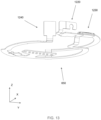
Figure 9 shows a schematic view of an assembly in the charging configuration according to an embodiment. -
Figure 10 shows a three-dimensional view of the battery and the circuit board of the wearable device according to an embodiment. -
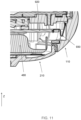
Figure 11 shows a partial cross sectional view of the device ofFigure 2 along a different plan thanFigure 4 . -
Figure 12 shows a three-dimensional view of the crown and the flexible printed circuit of the wearable device according to an embodiment. -
Figure 13 shows a three-dimensional view of the flexible printed circuit ofFigure 12 . -
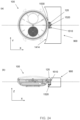
Figure 14 shows a three-dimensional view of an assembly in the charging configuration according to an embodiment. -
Figure 15 shows two different three-dimensional views of the charger of the assembly ofFigure 14 . -
Figure 16 shows a cross sectional view along the plane XZ of the charger ofFigure 15 . -
Figure 17 shows a three-dimensional view of a charger according to another embodiment. -
Figure 18 shows a three-dimensional view of an assembly in the charging configuration according to another embodiment. -
Figure 19 shows two different three-dimensional views of the charger of the assembly ofFigure 18 . -
Figure 20 shows a three-dimensional view of an assembly in the charging configuration according to another embodiment. -
Figure 21 shows a side view of the charger of the assembly according to another embodiment. -
Figure 22 shows two different three-dimensional views of the charger of the assembly according to another embodiment. -
Figure 23 shows a side view (a) and a top view (b) of the charger of the assembly according to another embodiment. -
Figure 24 shows a top view (a) and a side view (b) of the charger of the assembly according to another embodiment. - In the following description, the notions of "top" and "bottom", "horizontal" and "vertical" are defined in relation to the Z direction. The top is in the direction of the glass and the bottom is in the direction of the case back, which will be described below. The vertical direction is along the Z direction and any horizontal direction is orthogonal to the Z direction.
- In the following description, it is to be understood that when an element is referred to as being "connected" or "connected" to another element, it may be directly connected or indirectly connected to the other element, with other elements in between. On the other hand, when an element is referred to as being "directly connected" or "directly connected" to another element, it should be understood that there are no other elements in between.
- A wearable device 100 (also referred as "the
device 100" in the following) is represented onFigure 1 . Thedevice 100 is configured to be positioned on a user's wrist. In a particular embodiment, which is the one illustrated, the device is a watch. The watch may comprise a wristband. Nevertheless, in the context of the present description, the term watch does not necessarily include the strap, which is generally manufactured elsewhere and may be assembled at points of sale. Thewearable device 100 could also be an activity tracker for example. - In particular,
Figures 1 to 7 illustrate anelectronic watch 100, of the hybrid type with a dial, mechanical hands, and possibly a display integrated into the dial. A standard reference mark (XYZ) is shown in these figures. - In a non-represented variant, the watch may be a non-hybrid watch without mechanical hands but with a display.
- The
watch 100 may comprise anenclosure 110 and a case back 210 shown onFigure 2 . - When the
device 100 is a watch, the enclosure may also referred to as a watchcase. Theenclosure 110 forms an enclosure that defines an internal volume suitable for receiving various components, such as electronic components, as it will be explained more in details below. Theenclosure 110 protects the internal volume from notably dust, water, dampness, and shocks. Theenclosure 110 may include alateral wall 112, which is generally visible when thewatch 100 is worn on the wrist. Theenclosure 110 may includelugs 114 for attaching a strap (not shown in the figures). In particular, theenclosure 110 may comprise two pairs oflugs 110, on both side of theenclosure 110. Theenclosure 110 may include a plurality of parts. - The
watch 100 further comprises acrown 120 protruding through theenclosure 110. As visible onFigures 1 to 3 , the crown protrudes orthogonally to the Z axis, along an X axis. Thecrown 120 will be described more in detail below. - The case back 210 is the back side of the
watch 100. The case back 210 is configured to be at least partially in contact with the skin of the user's wrist. The case back 210 may comprise anannular member 212. Theannular member 212 may surround aphysiological sensor 214. Thephysiological sensor 214 will be described more in detail below. - In one embodiment illustrated on
Figures 2 and4 , theenclosure 110 and the case back 210 are two separate pieces. In this embodiment, theenclosure 110 and the case back 210 may be separated by a seal 216. - In a variant illustrated on
Figures 3 and5 , theenclosure 110 and the case back 210 are integral with each other. In this embodiment, theenclosure 110 and the case back 210 are a single mechanical piece. - The
watch 100 may further include aglass 130, typically mounted on theenclosure 110, such that theglass 130 is fixed. Theglass 130 may comprise a typically transparent protective glass and may be made of glass, ceramic, plastic or any transparent material. The outline of theglass 130 is here typically circular in shape. - In the case of a hybrid watch, below the
glass 130, thewatch 100 further comprises adial 132 withphysical hands 134. Thedial 132 may further accommodate a display 136 (e.g., with an opening in the dial that allows a display positioned just below the dial to be visible), which occupies, for example, a small space below or within thedial 132. Thewatch 100 may further comprise anadditional dial 138 for displaying for example the daily number of steps made by the user or another physical activity amount indicator. Theglass 130 protects these parts and allows them to be seen through. - In the case of an Apple Watch™-like "smartwatch", non-represented on the Figures, under the
glass 130, thewatch 100 comprises a screen that occupies a width close to the width of thewatch 100. In one embodiment, the screen may display hands. Theglass 130 is then the protective glass of the display. - The
watch 100 may further comprise abezel 140, mounted on theenclosure 110. Thebezel 140 is positioned around the glass 130 (radially external to the glass around the Z direction). In the illustrated embodiments, thebezel 140 is mounted in a fixed way with respect to theenclosure 110. In a non-represented embodiment, thebezel 140 may be rotatably mounted with respect to theenclosure 110. - In the illustrated embodiments, the
device 100 comprises aunique crown 120. In a non-represented embodiment, thedevice 100 may comprise a plurality ofcrowns 120. - The
crown 120 is a hardware input for the user. In particular, thecrown 120 may be used by the user to set the time, to navigate in the menu displayed on thedisplay 136, to launch the recording of an activity, etc. Thecrown 120 may a push-button and/or a rotary wheel. In the illustrated embodiment, thecrown 120 is a push-button and a rotary wheel, i.e. thecrown 120 may be rotated around a crown axis A, parallel to the X axis and may be translated along the crown axis A. - In reference to
Figures 4 to 7 , thecrown 120 protrudes through theenclosure 110 along the crown axis A, in particular through thelateral wall 112 of theenclosure 110. To that end, theenclosure 110 comprises anopening 410 through which thecrown 120 extends. Theopening 410 may present a generally cylindrical shape. - The
crown 120 comprises ahead 420 arranged outside theenclosure 110 and astem 430 extending from thehead 420 through theenclosure 110. In particular, thestem 430 is configured to slide and/or rotate inside theopening 410. - When the
crown 120 is a push-button, thecrown 120 is configured to switch from a pressed configuration in which the head ofcrown 120 is pushed towards theenclosure 110, to a rest configuration in which the head of thecrown 120 is further away from theenclosure 110. - As it will be explained more in detail below, the
crown 120 is configured to be electrically conductive. In particular, thehead 420 and thestem 430 are electrically conductive. For example, thehead 420 and thestem 430 may be made of metal. - The
crown 120 may further comprise aspring 440 arranged around thestem 430 and between thehead 420 and theenclosure 110. Thecrown 120 is configured to move axially, along the crown axis A, in theopening 410 against the return force of thespring 440, in particular when a push is applied onto thehead 420 by the user. In other words, thespring 430 constrained thecrown 120 in the rest configuration. - In the embodiment illustrated on
Figures 4 and6 , thestem 430 comprises anannular groove 432, such as twoannular grooves 432, in which at least a sealinggasket 434 is housed. In the embodiment illustrated onFigures 5 and7 , two sealinggaskets 434 are arranged directly on thestem 430 without an annular groove. Eachgasket 434 provides a water-resistant sealing of theopening 410 when thecrown 120 is in the rest configuration or even when thestem 430 slides into it when thecrown 120 is activated by a user. Each sealinggasket 434 may be made in rubber, for example nitrile rubber to provide an efficient sealing while provided an extended life span. - The
crown 120 may further comprise anabutment 450 which prevents thestem 430 from escaping from theopening 410 in which thestem 430 slides. The retaining means 450 may be a circlip which is engaged in anotherannular groove 432 arranged on thestem 430, towards the end of thestem 430 opposite to the head 420 (so that it is located inside the enclosure 110). In the rest configuration, the circlip is pressed towards theenclosure 110. The circlip is moved away from theenclosure 110 in the pressed configuration. - The
crown 120 may further comprise anisolation ring 600 configured to electrically isolate thehead 420 of thecrown 120 from theenclosure 110. Theisolation ring 600 is made of an electrical insulation material, for example a thermoplastic polyester elastomer. Thehead 420 comprises acylinder portion 610 extending along the crown axis A, closed at an end of thecylinder portion 610 by anend wall portion 620. Thecylinder portion 610 and theend wall portion 620 define aninner volume 630. Theend wall portion 620 comprises aninner surface 622 facing theinner volume 630 and comprises anouter surface 624 configured to be touched by the user when pushing thecrown 120. Thestem 430 protrudes from theinner surface 622 and extends inside theinner volume 630. Theisolation ring 600 may be arranged inside theinner volume 630 of thehead 420. In particular, theisolation ring 600 may be arranged against theinner surface 622 of theend wall portion 620. In addition or in variant, theisolation ring 610 may extend against thecylinder portion 610. - The
enclosure 110 may further comprise anisolation sleeve 640 configured to electrically isolate thestem 430 of thecrown 120 from theenclosure 110. Theisolation sleeve 640 is arranged around thestem 430. As illustrated onFigures 6 et 7 , theisolation sleeve 640 may be formed of a plurality of parts. In a variant (non-represented), theisolation sleeve 640 is made of a single piece. Theisolation sleeve 640 extends at least along the length of theopening 410 to ensure an efficient electrical isolation with theenclosure 110. In the embodiment illustrated onFigure 7 , the at least one sealinggasket 434 is surrounded on both side along the crown axis A by two parts of theisolation sleeve 600. Theisolation sleeve 640 may be made of thermoplastic, for example polyoxymethylene to ensure an efficient isolation. - In a variant or in complement, the
crown 120 may comprise a glass-to-metal seal. In particular, thecrown 120 comprises a glass-to-metal seal surrounding thestem 430. The glass-to-metal seal is made by melting glass in contact with the stem, made of metal, to be joined or sealed. Such a seal ensures an enhanced mechanical resistance while guaranteeing good electrical insulation. - When the
crown 120 is a push-button, thedevice 100 may further comprise apusher detector 490 arranged inside theenclosure 110 at the extremity of thestem 430 and configured to detect the translation of thestem 430. In particular, thestem 430 is away from thepusher detector 490 in the rest configuration and thestem 430 is in contact with thepusher detector 490 in the pressed configuration. - When the
crown 120 is a rotary wheel, thedevice 100 may further comprise astem rotation detector 495 configured to detect the rotation of thestem 430 along the crown axis A. - The
device 100 comprises at least a circuit board 460 (also called PCB for "printed circuit board"). Thecircuit board 460 is a thin rigid board containing a printed circuit. Thecircuit board 460 may comprise a ground plane. The ground plane is typically a large area of metal connected to the circuit ground. The circuit board comprises acontrol unit 800, schematically illustrated onFigure 5 . Other components may also be mounted on thecircuit board 460 as it will be explained below. - The
control unit 800 is used to control the on-board electronics of thedevice 100. Thecontrol unit 800 may for example include or partially include an ECG module and a PPG module, as it will be explained below. - The
device 100 is connected, so that it may exchange data remotely (wirelessly) in a bidirectional way with a terminal, such as a smartphone. The connection may be made via Bluetooth, such as Bluetooth Low Energy (BLE). The watch may also receive data from the terminal (time, alarm data, notifications, etc.). - In reference to
Figure 8 , thedevice 100 comprises awireless communication module 810, such as a Bluetooth or Bluetooth Low Energy module or a Wi-Fi module or a cellular module (GSM, 2G, 3G,4G, 5G, Sigfox, etc.), which allows it to communicate bidirectionally with at least oneexternal terminal 820, such as a smartphone. Theexternal terminal 820 may then communicate (bidirectionally) with aremote server 830 for data storage and processing. Alternatively or additionally, thewireless communication module 810 may communicate directly with theremote server 830, such as via the cellular network or via a Wi-Fi network. Data obtained by thewatch 100, such as an electrocardiogram, but also indications of heart rate, activity or oxygen saturation, are transmitted to theexternal terminal 820 via thewireless communication module 810. Thecontrol unit 800 may process certain signals before sending them, to limit the size of the transmitted data. - The
device 100 may be configured to measure an electrocardiogram (also called "ECG") of the user. - To retrieve electrical signals generated by the human body, the
watch 100 comprises an ECG sensor. In particular, the ECG sensor comprises a set of electrodes (referred to as ECG electrodes) and an ECGelectronic module 840, to which the ECG electrodes are electrically connected. By electrode is meant a conductive part capable of receiving an electric current or voltage. The part may be made of a conductive material or comprise a conductive coating. By "conductor" is meant "electrically conductive". - In the illustrated embodiment, the
device 100 comprises only two ECG electrodes, referred as ECG1 and ECG2. In a non-represented embodiment, thedevice 100 may comprise a third ECG electrode, for example arranged on the case back 210. - As represented on
Figure 9 , the first ECG electrode ECG1 is located on the case back 210 so as to be in contact with the skin of the user's wrist on which the user is wearing thewatch 100. The first ECG electrode is electrically connected to theECG module 840. In one embodiment, the case back 210 is the first ECG electrode. In that embodiment, the case back 210 is made of an electrically conductive material, such as metal. - In a variant, the first ECG electrode in arranged on the
lens 470, for example with a metallic coating. - The second ECG electrode ECG2 may be arranged on the
bezel 140, such that the user may touch any portion of thebezel 140 to perform an ECG. Any portion of thebezel 140 means any portion of the surface of the bezel accessible to a user by touching. In this embodiment, thecrown 120 is not an ECG electrode. - In a variant, the second ECG electrode is arranged on the
crown 120. - The two electrodes are electrically connected to the
ECG module 840. TheECG module 840 is configured for example to impose a potential on one of the two ECG electrodes and to measure a potential of the other of the two ECG electrodes. - The
ECG module 840 is configured to retrieve electrical signals from the human body and to, after processing, generate an electrocardiogram signal or a datum representative of information about the electrocardiogram. TheECG module 840 may be mounted on thecircuit board 460. - The
physiological sensor 214 is arranged on the case back 210. The first ECG electrode may at least partially surround thephysiological sensor 214. - The
physiological sensor 214 may be an optical sensor. The optical sensor is typically a PPG (photoplethysmography) sensor, comprising LEDs to emit light and photodiodes to recover light. The optical sensor may be positioned behind alens 470, such as a glass lens, which interfaces with the skin of the wrist.PCT/EP2021/058955 - The optical sensor is connected to a
PPG module 850, which may be mounted on thecircuit board 460. ThePPG module 850 is configured to generate the instructions for the LEDs and to recover the electrical signals from the photodiodes. - In a variant or in complement, the
physiological sensor 214 may be a temperature sensor configured to measure skin temperature. The temperature sensor may be a thermistor sensor or an infrared thermal sensor. - The
device 100 may further comprise an altimeter. The altimeter may be a barometer configured to measure the pressure of the air in a cavity fluidically connected with the outside throughopenings 220 in theenclosure 110 visible onFigure 2 . - The
device 100 further comprises arechargeable battery 480 configured to provide energy for thedevice 100, and in particular for the electronic components of thedevice 100. - The
rechargeable battery 480 is configured to store chemical energy and to convert this chemical energy into electrical energy. Thebattery 480 is configured to be recharged a plurality of times, i.e. reversing the electrochemical reaction to recharge the chemical energy stored into thebattery 480. To that end, thedevice 100 is configured to cooperate with anelectrical charger 900, as visible onFigure 14 to 20 and as it will be explained below. - The
battery 480 may be for example a Lithium Ion battery or a Lithium Polymer battery. The tension delivered by thebattery 480 is for example comprised between 3V and 5V, notably 4.35V. - The
battery 480 may be arranged between thecircuit board 460 and the case back 210. As illustrated onFigure 10 , thebattery 480 has in the illustrated a button shape but may also present a parallelepiped shape. - The
device 100 further comprises abattery charging module 910 configured to control the charging of therechargeable battery 480. As schematically illustrated onFigure 9 , thebattery charging module 910 comprises aninput port 912 and abattery output port 914. Thecrown 120 is connected to theinput port 912 and thebattery 480 is connected to thebattery output port 914. Thecharging module 910 is further configured to prevent electrical current to circulate from thebattery 480 towards thecrown 120, and as a consequence, prevent the user from receiving electrical current from thebattery 480. Thebattery charging module 910 is further connected to the ground of thedevice 100, in particular to theground plane 920 of thecircuit board 460. - As represented on
Figure 9 , thecharging module 910 comprises other outputs to deliver electrical energy from thebattery 480 to the different electronic components of thedevice 100. In particular, thecharging module 910 is configured to notably power thewireless communication module 810, the ECG module and thePPG module 850. - The
battery 480 comprises afirst pole 922 and asecond pole 924. In the following, thefirst pole 922 is the positive pole and thesecond pole 924 is the negative pole. Thefirst pole 922 has in this case a higher electrical potential than thesecond pole 924. However, in a variant, the poles of thebattery 480 may be inverted. - The
crown 120 serves here as a charging electrode CE1 (i.e. a physical interface) with theelectrical charger 900 for the conduction of electricity from theelectrical charger 900 to the battery 480 (said in other words, thecrown 120 is on the electrical path between thecharger 900 and the battery 480). To that end, thecrown 120 is made of an electrically conductive material, such as metal. - In the embodiment illustrated on
Figure 9 , theenclosure 110 is electrically connected to thesecond pole 924, so that theenclosure 110 serves as charging electrode CE2 (i.e. physical interface) with theelectrical charger 900 for the conduction of electricity from theelectrical charger 900 to the battery 480 (said in other words, theenclosure 110 is on the electrical path between thecharger 900 and the battery 480). To that end, theenclosure 110 is made of an electrically conductive material, such as metal. - In a variant, the case back 210 is electrically connected to the
second pole 924. In another variant, thebezel 140 is electrically connected to thesecond pole 924. In the following, the embodiment with thesecond pole 924 connected to theenclosure 110 will be described in detail. This description may be adapted in a similar way to the embodiment with thesecond pole 924 connected to the case back 210 or to thebezel 140. In the embodiment in which the case back 210 is connected to thesecond pole 924, thedevice 100 comprises a switch configured to disconnect the first ECG electrode ECG1 from theECG module 840 when thebattery 480 is charging. In the embodiment in which thebezel 140 is connected to thesecond pole 924, thedevice 100 comprises a switch configured to disconnect the second ECG electrode ECG2 from theECG module 840 when thebattery 480 is charging. - The
circuit board 460 may be electrically arranged respectively between thefirst pole 922 and thecrown 120, and between thesecond pole 924 and theenclosure 110, so as to control the charge of thebattery 480. In particular, in reference toFigure 9 , theenclosure 110 is directly connected to the ground of thedevice 100, i.e. to theground plane 920, and thesecond pole 924 is directly connected to the ground of thedevice 100, in particular to theground plane 920. As a consequence, theenclosure 110 and thesecond pole 924 are both connected to theground plane 920 and therefore are connected with each other. - As visible on
Figures 9 and11 , theenclosure 110 is connected to theground plane 920 through aconductive contact 930, in particular a metallicconductive contact 930. In the illustrated embodiment, theconductive contact 930 is a metallic spring, notably a fat spring fixed at one end to theground plane 920 and comprising a free V-shaped opposite end. The opposite end is folded and constrained towards theenclosure 110. In a non-represented variant, theconductive element 930 may be a metallic pin. - In the embodiment illustrated on
Figure 5 , as theenclosure 110 and the case back 210 are integral, theenclosure 110 and the case back 210 are both electrically connected to thesecond pole 924. - In the embodiment in which the case back 210 is not integral with the
enclosure 110, the case back 210 may be electrically connected to thesecond pole 920 in a non-represented embodiment. In particular, the case back 210 is directly connected to the ground of thedevice 100, i.e. to theground plane 920, and thesecond pole 924 is directly connected to the ground of thedevice 100, in particular to theground plane 920. The case back 210 is connected to theground plane 920 through aconductive contact 930. - When the
crown 120 is a push-button, thecrown 120 may be connected to thefirst pole 922 of thebattery 480 when thecrown 120 is in the rest configuration. Thecrown 120 may be disconnected from thefirst pole 922 when thecrown 120 is in the pressed configuration. - In a variant, the
crown 120 may be permanently connected to thefirst pole 922. In another variant, thecrown 210 may only be connected to thefirst pole 922 when thecrown 120 is in the pressed configuration. - The
first pole 922 and thesecond pole 924 are configured to be connected to theelectrical charger 900 to recharge thebattery 480. In particular, thecharger 900 is configured to be in electrical contact with thecrown 120 and with the enclosure 110 (or the case back 210) to charge thebattery 480. - As visible on the Figures, no connecting pins are arranged on the
enclosure 110 or the case back 210. The mechanical structure of thedevice 100 is therefore simplified, enabling an easier manufacturing and saving space inside thedevice 100. The absence of charging pins, usually as cylindrical inserts in the case back or the enclosure, in the also improves the watertightness as there are fewer openings and provides a better global aesthetic of thedevice 100. - Moreover, no magnets are arranged in the inner volume of the
device 100. This absence of magnets reduces the need for rare earths, reduces the magnetic disturbances, enabling better ECG measures for example, reduces the need for magnetic insulation inside the device and therefore lightens thedevice 100, while diminishing the thickness thereof. - As represented on
Figure 12 , thecrown 120 is connected to thecircuit board 460, and especially to thebattery control module 910, through a flexible printed circuit 650 (also called "FPC"). TheFPC 650 comprises a metallic layer of traces, usually copper, bonded to a dielectric layer, usually polyimide. The thickness of the metal layer may be comprised between 0.001 mm to 0.01 mm and the dielectric thickness may be comprised between 0.01 mm to 0.2 mm. An adhesive may be used to bond the metal to the substrate, but other types of bonding such as vapor deposition may be used to attach the metal. TheFPC 650 may bend without cracking or breaking enabling an easier assembling of thedevice 100 during the manufacturing process. - As visible on
Figures 12 and13 , theFPC 650 extends generally along a circle shape and comprises at least two branches, in particular three branches extending respectively until afirst end 1220, asecond end 1230 and advantageously athird end 1240. TheFPC 650 is directly connected to thecrown 120 at thefirst end 1220. TheFPC 650 is directly connected to thecircuit board 460. As a consequence, theFPC 650 connects thecrown 120 to thecircuit board 460. - The
FPC 650 may be further connected to at least one of: the altimeter, one of the ECG electrodes, the temperature sensor, the optical sensor, the stem rotation detector. In particular, in the illustrated embodiment ofFigures 12 and13 , theFPC 650 is connected to the altimeter at thethird end 1240, to the second ECG electrode atconnection 1250, to the optical sensor atconnection 1260 and at thestem rotation detector 495 atconnection 1270. - The
FPC 650, and in particular thefirst end 1220, comprises a hook shaped extremity configured to cooperate with the stem 430 (i.e. partially surrounding it) to electrically connect thecrown 120 to theFPC 650. As visible onFigure 13 , the hook is oriented towards the case back 210. In other words, thefirst end 1220 extends along a vertical plan and comprises a slot facing the case back 210 for receiving thestem 430. In a non-represented variant, theFPC 650 defines a disc opening at thefirst end 1220 in which thestem 430 is inserted to electrically connect thecrown 120 to theFPC 650. - In reference to
Figures 6 and7 , thedevice 100 further comprises aseal 660 configured to electrically isolate theFPC 650, in particular the hook arranged at thefirst end 1220, from theenclosure 110. Theseal 660 may be bonded through an adhesive to theenclosure 110, in particular to theisolation sleeve 630 of the enclosure 110.Theabutment 450 is configured to maintain theFPC 650, in particular the hook, against theseal 660. - When the
crown 120 is pushed by the user, thestem 430 translates along the crown axis A and theabutment 450 moves with thestem 430. As theseal 660 is bonded to theenclosure 110, theseal 660 does not move with thestem 430. The hook of theFPC 650 remains in contact with theseal 660 and does not move with thestem 430. Vibration tests have been carried out by the inventors which show that it seems to be no risk for the hook to dissociate with thestem 430 in operation of the watch. - As already described above, the
device 100 includes anenclosure 110, a case back 210, abezel 140 and acrown 120. As disclosed above, in one embodiment, the case back 210 and thebezel 140 are ECG electrodes ECG1, ECG2 and thecrown 120 and theenclosure 110 are charging electrodes CE1, CE2. This arrangement drastically simplifies the conception of thedevice 100, as none of those electrodes requires the additional of the specific independent part of thedevice 100. Electrical sealing is however required between the four electrodes ECG1, ECG2, CE1, CE2. - An assembly comprising a
device 100 and anelectric charger 900 is illustrated onFigures 14 and18 . Eight different embodiments of theelectric charger 900 are respectively illustrated onFigures 14-16 ,Figure 17 ,Figures 18-19 ,Figure 20 ,Figure 21 ,Figure 22 ,Figure 23 andFigure 24 . - The assembly is configured to alternate between a separated configuration and a charging configuration. In the separated configuration, the
charger 900 is away from thedevice 100. In the charging configuration, illustrated onFigures 14 and16 , thecharger 900 cooperates with thedevice 100 to electrically charge the rechargeable battery 480 (when thecharge 900 is plugged). - In particular, when the user wears the
watch 100 at the wrist, the assembly is in the separated configuration. Thecharger 900 may rest on a table and when thebattery 480 is empty, the user may grab and couple thedevice 100 to thecharger 900 to alternate to the charging configuration in order to recharge thebattery 480. - The
charger 900 may extend along a length comprised between 2 cm and 10 cm, along the X axis. Thecharger 900 may extend along a width comprised between 1 cm and 4 cm, along the Y axis. Thecharger 900 may extend along a height comprised between 1 cm and 3 cm, along the Z axis. - The
charger 900 comprises asupport 1410 and aconnection system 1420. - The
connection system 1420 may comprise aconnection wire 1422 and aplug 1424, notably an USB plug. Theconnection wire 1422 may be permanently connected to thesupport 1410 or may be connected in a removable way to thesupport 1410, for example through an USB connection. Theplug 1424 may be connected to an electrical adapter, non-represented, to connect thecharger 900 to an electrical network. Theplug 1424 may also be directly connected to an external battery. - The
support 1410 comprises at least oneside wall 1414. Theside wall 1414 is configured to engage thewearable device 100 when it is in the charging configuration. In some embodiments, illustrated byFigures 14 to 23 , thesupport 1410 also comprises abase 1412, from which the at least oneside wall 1414 extends. In some embodiments, illustrated byFigures 14 to 16 and18 to 22 , thesupport 1410 comprises twoside walls base 1412. In some embodiments, illustrated byFigure 17 , thesupport 1410 comprises asingle side wall 1414 and abase 1412. In some embodiments, illustrated byFigure 24 , thesupport 1410 only comprises the side wall 1414 (and no base 1412). The wall is called "side wall" as it is facing a side of thewearable device 100, notably thelateral wall 112 of theenclosure 110. - Where it engages the
wearable device 100, theside wall 1414 may have a shape that is complementary to the shape of theenclosure 110 or at least partially complementary. For example, when theenclosure 110 has a circular shape, theside wall 1414 may also include a curved shape to fit theenclosure 110. To be compatible with different sizes of enclosure, the fit may be more or less loose (for example the radius of the circular shape of theside 1414 may be greater than the radius of the curved shape of the enclosure 110).Figures 15-20 andFigures 21-22 , andFigure 24 show such acurved side wall 1414. - The
base 1412 extends along a horizontal plan, orthogonally to the Z axis. Thebase 1412 may present a mainly flat parallelepipedic shape. Thebase 1412 may configured to rest on a flat surface as a table for example. In particular, thebase 1412 comprises anupper surface 1610 configured to be in contact with thedevice 100 and aflat bottom surface 1612 configured to be in contact with an external surface as a table. Thebase 1412 may extend along a length comprised between 1 cm and 5 cm, along the X axis. Thebase 1412 may extend along a width comprised between 1 cm and 4 cm, along the Y axis. Thebase 1412 may extend along a height comprised between a 0.1 cm and 2 cm, along the Z axis. - In a variant illustrated on
Figure 23 , at least aside wall 1414 is configurated to rest on a flat surface as a table for example. Thecharger 900 comprises here twoparallel bases 1412 protruding vertically from each side of theside wall 1414. Thecharger 900 may further comprise twoadditional walls 2300 protruding vertically from theside wall 1414 and orthogonally to the twobases 1412. The twoadditional walls 2300 and theside wall 1414 define a watch reception volume into which thewearable device 100 is be inserted. - The two
side walls base 1412. In particular, eachside wall sides wall base 1412. Eachside wall side wall side wall - The
base 1412 and the twosides walls watch reception volume 1500 to receive at least partially thedevice 100. In particular, thedevice 100 is at least partially inserted inside thewatch reception volume 1500 in the charging configuration. - In the variant of
Figure 23 , the twobases 1412 and theside wall 1414 defines thereception volume 1500. Thereception volume 1500 is configured to receive thedevice 100 which rest by gravity in the charger. - As visible on
Figures 14 and18 , thebase 1412, and in particular theupper surface 1610 of thebase 1412, is configured to be in contact with the case back 210 of thewatch 100 in the charging configuration. To that effect, thebase 1412 comprises a case backreception area 1505, presenting a complementary shape of the case back 210. Theside walls enclosure 110 in the charging configuration. In particular, theside walls enclosure 110. - In variant or in complement, the
base 1412, and in particular theupper surface 1610 of thebase 1412, may be configured to be in contact with theglass 130 of thewatch 100 in the charging configuration. The charger 1400 is therefore configured to charge thewatch 100 in both side (with the case back 210 against thebase 1412 or with theglass 130 against the base 1412), enabling an easy and intuitive charging for the user. - Each
side wall device 100 in the charging configuration. - As visible on
Figure 16 , each side wall may comprise arim 1600 configured to cooperate with thebezel 140 of thedevice 100 in the charging configuration. In particular, therim 1600 is arranged at the free end of the respective side wall and enables to tightly keep thedevice 100 in thewatch reception volume 1500 in the charging configuration. Therim 1600 slightly closes thewatch reception volume 1500. - The side walls may comprise a
first side wall 1414 and asecond side wall 1416. Theconnection system 1420 may be arranged on thefirst side wall 1414. - The
watch reception volume 1500 is configured to be extended to receive thedevice 100. In particular, in the embodiments ofFigure 14 to 20 , at least one side wall is movable to change the watch reception volume. In particular, the movable side wall may have two configurations, one allowing the device to be inserted in thecharger 900 and one maintaining the device in thecharger 900. - In the embodiments represented on
Figures 14 to 19 , at least one of the side walls is configured to be movable in translation with respect to thebase 1412. In particular, in the illustrated embodiments, thesecond wall 1416 may be the movable side wall. The movable side wall is configured to be movable in translation with respect to thebase 1412 along the X axis. As visible onFigure 16 , thebase 1412 comprises anopening 1620 and the movable side wall comprises aninsert 1630 protruding along the X axis and able to be inserted in theopening 1620. Thecharger 900 may further comprise aspring 1640 resting between afirst stopper 1650 of thebase 1410 and asecond stopper 1652 of theinsert 1630. In particular, thecharger 900 may comprise twosprings 1640 arranged in parallel along the X axis. Thespring 1640 forces the movable side wall in direction of thebase 1412. Theinsert 1630 is configured to move axially, along the X axis, in theopening 1620 against the return force of thespring 1640 when the movable side wall is pulled back by the user. When the movable side wall is pulled back by the user, thewatch reception volume 1500 is expanded and thedevice 100 may be easily inserted inside thereception volume 1500. When the movable side wall is let free to return to its rest position, the movable side wall contacts theenclosure 110 so as to maintain thedevice 100 in position. - In a variant illustrated on
Figure 20 and in a variant illustrated onFigure 21 , at least one of the side walls is movable by flexion. In the illustrated embodiments, thesecond side wall 1416 is the flexible side wall. In particular, the flexible side wall comprises afirst end 2010 fixed to thebase 1412 and a freesecond end 2012, opposite to thefirst end 2010. Thesecond end 2012 is configured to be moved with respect to thebase 1412, notably along the X axis. To that end, the flexible side wall comprises at least afinger support 2020 arranged at the freesecond end 2012. In particular, thefinger support 2020 extends horizontally from thesecond end 2012. Thefinger support 2020 enables the user to easily bend theflexible wall 1416. In the embodiment illustrated onFigure 21 , the flexible side wall comprises two finger supports 2020, respectively arranged at the freesecond end 2012 and at thefirst end 2010. The twofinger supports 2020 form a clamp enabling the user to bend even more easily theflexible wall 1416. When the flexible side wall is pulled and bended by the user, thewatch reception volume 1500 is expanded and thedevice 100 may be easily inserted inside thewatch reception volume 1500. When the flexible side wall is let free to return to its rest position, the flexible side wall contacts theenclosure 110 so as to maintain thedevice 100 in position. - The user may then remove the
device 100 from thecharger 900 just by pulling thedevice 100 slightly, without a need to directly move or bend the side wall. - In a variant illustrated on
Figure 22 , themovable side wall 1416 may be hinged to thebase 1412. In particular, thesecond side wall 1416 comprise two parts hinged together, a first part being arranged at thefirst end 2010 and a second part arranged at the freesecond end 2012. Thesecond side wall 1416 is configured to switch from a deployed configuration, illustrated onFigure 21 (a) , to a folded configuration, illustrated onFigure 21 (b) . Thesecond side wall 1416 may comprise aflat spring 2210 extending from thefirst end 2010 to thesecond end 2012 and enabling to maintain theside wall 1416 in each configuration. Theside wall 1416 is in the deployed configuration when the assembly is in the separated configuration to enable the device to be inserted in thereception volume 1500. Theside wall 1416 is in the folded configuration when the assembly is in the charging configuration to maintain thedevice 100 in position inside thereception volume 1500. - Thanks to the movable side wall, the
charger 900 may receive different types of devices. By different type of devices, it is understood devices which present different shapes (e.g., sizes) of enclosures, in particular different widths of enclosures. For example, thecharger 900 may be compatible with watches presenting a diameter of 38mm and with watches presenting a diameter of 42 mm. - One of the side walls may define a
crown insertion volume 1510 to receive thecrown 120. In particular, thecrown 120 is at least partially inserted inside thecrown insertion volume 1510 in the charging configuration. Thecrown insertion volume 1510 enables to maintain thedevice 100 in the good charging configuration to provide an efficient mechanical and electrical contact between thedevice 100 and thecharger 900. - In a non-illustrated variant, the
crown insertion volume 1510 is arranged on thebase 1412. - As illustrated on
Figures 15 ,17 ,20 and23 , thecrown insertion volume 1510 may be an insertion blind hole. The shape of the insertion blind hole may be complimentary from that of thecrown 120, with a functional clearance therebetween. For example, when thecrown 120 is of circular shape, theinsertion blind hole 1510 may be of a circular shape, with slightly bigger a radius (for example between 10% and 50% bigger). - The first
electrical connector 1520 may thus be at the bottom of the blind hole, along the direction of insertion of thecrown 120 in the blind hole. Alternatively (not illustrated), the firstelectrical connector 1520 may be on a side of the blind hole and gets deformed along the direction of insertion of thecrown 120 in the blind hole when thecrown 120 is inserted in the blind hole. - As illustrated on
Figures 18 ,19 ,22 and24 , thecrown insertion volume 1510 is an insertion slot. The insertion slot may be an open insertion slot. By open, it is meant as open towards the top along the Z axis to allow a vertical insertion of thedevice 100, by having thecrown 120 slide in the slot. Alternatively, the insertion slot could be a closed insertion slot, according to which the slot is not open towards the top along the Z axis. The insertion of thecrown 120 in the slot may be possible through a direction transverse to the direction of the slot. - Also, as illustrated on
Figures 18 and19 , the insertion slot may be a through slot, open in the direction of the crown axis A (when thedevice 100 is placed in the electric charger 900). Conversely, as illustrated onFigures 24 , the insertion slot may be a blind slot, closed in the direction of the crown axis A (when thedevice 100 is placed in the electric charger 900). - The first
electrical connector 1520 may thus be at the bottom of the through slot, along the direction of insertion of thecrown 120 in the through slot. Alternatively (not illustrated), the firstelectrical connector 1520 may be on a side of the through slot and gets deformed along the direction of insertion of thecrown 120 in the through slot when thecrown 120 is inserted in the through slot. - So that the open insertion slot may guide the
crown 120 in translation, the dimension of the open insertion slot transversally to the crown axis A may be complimentary of the shape of thecrown 120, with a functional clearance therebetween. - The shape of the insertion slot may also vary. For example, transversally to the direction of insertion of the
crown 120 in the insertion slot, the insertion slot may also comprise a dovetail shape so that thecrown 120 abuts against the slot when inserted therein.Figure 24 illustrates such a dovetail shape. Alternatively, transversally to the direction of insertion of thecrown 120 in the insertion slot, the insertion slot may comprise a shape which does not prevent the crown to get out. Said otherwiseFigure 19 illustrates such a shape. - The
charger 900 comprises two electrical connectors, in particular a firstelectrical connector 1520 and a secondelectrical connector 1530. - The first
electrical connector 1520 is configured to be in contact with thecrown 120 of thedevice 100 in the charging configuration. - More precisely, the first
electrical connector 1520 may protrude inside thecrown insertion volume 1510. In particular, in the charging configuration, thecrown 120 is inserted in thecrown insertion volume 1510 and is in contact with thefirst connector 1520. - The first
electrical connector 1520 may be deformable along the direction of insertion of the crown in the crown insertion volume. This allows maintaining an electrical contact therebetween. In one implementation, the firstelectrical connector 1520 is placed at the bottom of thecrown insertion volume 1510 along the direction of insertion of thecrown 120. In other words, thecrown 120 abuts against said firstelectrical connector 1520 when inserted in thecrown insertion volume 1510. For example, as illustrated onFigures 15 and20 , the firstelectrical connector 1520 may extend along said direction and translates or may be compressed along that direction. For example (not illustrated), the firstelectrical connector 1520 may extend transversally along the direction of insertion but may be deformable along that direction (e.g., a bendable connector). - The second
electrical connector 1530 may be similar defined as the firstelectrical connector 1520, with the same properties as disclosed, except that it is located outside thecrow insertion volume 1510. - More precisely, in the embodiments illustrated on
Figures 15 and20 , the firstelectrical connector 1520 protrudes horizontally from thefirst side wall 1414 inside thecrown insertion volume 1510. By horizontally, it is meant parallel, or essentially parallel, to the crown axis A when thedevice 100 is placed on theelectric charger 900. This configuration allows an insertion of thecrown 120 that is along the direction of the firstelectrical connector 1520. Therefore, this reduces the risk to damage the firstelectrical connector 1520. - More precisely, in the embodiment illustrated on
Figure 19 , thefirst connector 1520 protrudes vertically from the bottom of theinsertion slot 1510, that is to say along the direction of the insertion slot. - The second
electrical connector 1530 may be configured to be in contact with theenclosure 110 in the charging configuration, when theenclosure 110 is connected to the second pole of thebattery 480. In a variant (not illustrated), the secondelectrical connector element 1530 may be configured to be in contact with the case back 210 in the charging configuration, in the embodiment in which the case back 210 is connected to the second pole of thebattery 480. - In the embodiments illustrated on
Figures 15 and20 , the secondelectrical connector 1530 is arranged on the same side walls. In particular, the secondelectrical connector 1530 may be arranged on thefirst side wall 1414. In particular, the secondelectrical connector 1530 is arranged next to thecrown insertion volume 1510 in a horizontal direction. The secondelectrical connector 1530 may be sensibly arranged at the same height along the Z axis than the firstelectrical connector 1530. - In the embodiment illustrated on
Figure 19 , the secondelectrical connector 1530 may be arranged on thebase 1412. In particular, the secondelectrical connector 1530 may be arranged next to the firstelectrical connector 1520, along the X direction. - The second
electrical connector 1530 may also be deformable along the direction of approach of the wearable device. - Each
electrical connector Figures 15 and20 , each electrical connector may be a metallic pogo pin. Each electrical connector is in particular a spring-loaded pin comprising an integrated spring in the pin which enables a good mechanical and electrical connection with thedevice 100. - In a variant, each
electrical connector support 1410 along a respective main axis B1, B2. Each electrical connector may be deformable along the associated main axis B1, B2 and along at least an additional axis different from the associated main axis B1, B2. In other words, contrary to a pogo pin which is only able to move along a single axis, the electrical connector may here move along at least two axes. - In an embodiment illustrated on
Figure 19 and24 , at least the first electrical connector may be made of a soft conductive material. By "soft" it is understood that it may be deformed by the weight of thedevice 100 placed on thecharger 900. The soft conductive material may be for example a conductive foam, a doped silicone or an elastomer filled with conductive particles. In a variant, the electrical connector may be a spring, in particular an accordion spring able to move along at least two axes. Such an electrical connector prevents scratches on the enclosure which may occur with pins and provides better adaptability and better mechanical contact with different shapes ofdevices 100 orcrown 120, while providing an efficient electrical contact. In one implementation, the second electrical connector is made of the same material. - In a variation, notably illustrated by
Figure 24 , the firstelectrical connector 1520 and the secondelectrical connector 1530 are made of different material, for example a pin and a soft conductive material. - The two side walls of the
charger 900 enables to enclose thedevice 100 so as to protect it and provides an esthetical impression. Thecharger 900 provides a good mechanical and electrical contact with thedevice 100, without a need of magnets. Moreover, thecharger 900 may be compatible with multiple types of watches. - A method of charging a
battery 480 of adevice 100 with acharger 900 will now be described. - The assembly is initially in the separated configuration, the
device 100 being away from thecharger 900. Thedevice 100 may be worn at the wrist of the user. The user may follow the level of charge of thebattery 480 through thedisplay 136. - When the
battery 480 is low or empty, the user may want to recharge thebattery 480. - The user then switches the assembly from the separated configuration to the charging configuration. In particular, the user may pull back or bend one of the side walls to enlarge the
watch reception volume 1500. Thedevice 100 may be then easily inserted inside thewatch reception volume 1500. In particular, thecrown 120 is inserted into theinsertion volume 1510 and the case back 210 rests on thebase 1412. - Then the side wall is then let free by the user and it returns to its rest position. The movable side wall then contacts the
enclosure 110 so as to maintain thedevice 100 in position. - The first
electrical connector 1520 is then in contact with thecrown 120 and thesecond connector element 1530 is in contact with theenclosure 110 or the case back 210. - The
charger 900 then electrically charges therechargeable battery 480 of thedevice 100. - The user may follow the recharge level of the
battery 480 through thedisplay 136. In addition or in complement, thedevice 100 may send a notification to anexternal terminal 820 informing the user when thebattery 480 is fully charge. - The user may then switch the assembly from the charging configuration to the separated configuration. In particular, the user may then remove the
device 100 from thecharger 900 just by pulling thedevice 100 slightly, without a need to move or bend the side wall. - The
device 100 may be again worn at the wrist of the user. - The charging method is therefore simple for the user and enables an efficient charge of the
device 100 by providing a good mechanical and electrical contact between thecharger 900 and thedevice 100.
Claims (15)
- An electrical charger (900) configured to charge a battery (480) of a wearable device (100) configured to be positioned on a user's wrist, the wearable device (100) further comprising an enclosure (110), a crown (120) protruding through the enclosure (110), the crown (120) being a hardware input for the user, and a case back (210) configured to be at least partially in contact with the skin of the wrist,wherein the charger (900) comprises:- at least one side wall (1414, 1416), configured to be in contact with the wearable device (110) in a charging configuration,wherein the at least one side wall (1414) defines a crown insertion volume (1510), so that the crown (120) may be at least partially inserted inside the crown insertion volume (1510) in the charging configuration,wherein the charger (900) further comprises:- a first electrical connector (1520) protruding inside the crown insertion volume (1510) and configured to be in contact with the crown (120) in the charging configuration, and- a second connector element (1530) configured to be in contact with the wearable device (100) in the charging configuration.
- The charger (900) according to claim 1, further comprising a base (1412) configured to be in contact with the wearable device (100) in the charging configuration, and wherein the side wall protrudes out of the base (1412).
- The charger (900) according to claim 2, comprising another side wall (1416), protruding from the base, wherein the base (1412) and the two side walls (1414, 1416) form a watch reception volume (1500) configured to receive at least partially the device (100) in a charging configuration.
- The charger (900) according to claim 2 or 3, wherein at least one of the side walls (1416) is configured to be movable with respect to the base (1412), wherein for example:- at least one of the side walls is configured to be movable in translation with respect to the base, the charger (900) comprising advantageously a spring (1640) forcing the moveable side wall (1416) in direction of the base (1412), or- at least one of the side walls (1416) is movable by flexion, or- at least one of the side walls (1416) is hinged to the base.
- The charger (900) according to any of claims 1 to 4, wherein the or each side wall (1414, 1416) extends higher than the height of the device (100) in the charging configuration and includes a rim (1600) configured to maintain the device (100) on the charger.
- The charger (900) according to any of claims 1 to 5, wherein the first electrical connector (1520) is deformable along a direction of insertion of the crown (120) in the crown insertion volume (1510).
- The charger (900) according to any of claims 1 to 6, wherein the first electrical connector (1520) is positioned at the bottom of the crown insertion volume (1510) along the direction of insertion of the crown (120) in the crown insertion volume (1510).
- The charger (900) according to any of claims 1 to 7, wherein each electrical connector (1520, 1530) is a soft conductive material, notably a conductive foam, a doped silicone or an elastomer filled with conductive particles, or a spring, notably an accordion spring.
- The charger (900) according to any of claims 1 to 8, wherein the crown insertion volume (1510) is an insertion blind hole.
- The charger (900) according to any of claims 1 to 8, wherein the insertion volume (1510) is an insertion slot.
- The charger (900) according to claim 10, wherein the insertion slot has a dovetail shape to retain the crown in the insertion slot.
- The charger (900) according to any of claims 1 to 11, wherein the crow insertion volume (1510) has a shape complementary to the shape of the crown (120), with a functional clearance.
- The charger (900) according to any of claims 1 to 12, wherein the second electrical connector (1530) is arranged on one of the side walls (1414) or is arranged on the base (1412).
- An assembly comprising a charger (900) according to any of the claims 1 to 13 and a wearable device (100), the assembly being configured to switch from a separated configuration in which the charger (900) is away from the device (100) to a charging configuration in which the charger (900) cooperates with the device (100) to electrically charge the rechargeable battery (480).
- Method of charging with an assembly according to claim 14, wherein the assembly is initially in the separated configuration, the method comprising the following steps:- switching the assembly from the separated configuration to the charging configuration,- electrically charging the rechargeable battery (480) of the device (100) by the charger (900).
Priority Applications (2)
| Application Number | Priority Date | Filing Date | Title |
|---|---|---|---|
| EP23163844.6A EP4277077A1 (en) | 2023-03-23 | 2023-03-23 | An electrical charger to charge the rechargeable battery of a wearable device |
| US18/488,590 US20240322579A1 (en) | 2023-03-23 | 2023-10-17 | Electrical charger to charge the rechargeable battery of a wearable device |
Applications Claiming Priority (1)
| Application Number | Priority Date | Filing Date | Title |
|---|---|---|---|
| EP23163844.6A EP4277077A1 (en) | 2023-03-23 | 2023-03-23 | An electrical charger to charge the rechargeable battery of a wearable device |
Publications (1)
| Publication Number | Publication Date |
|---|---|
| EP4277077A1 true EP4277077A1 (en) | 2023-11-15 |
Family
ID=85727100
Family Applications (1)
| Application Number | Title | Priority Date | Filing Date |
|---|---|---|---|
| EP23163844.6A Pending EP4277077A1 (en) | 2023-03-23 | 2023-03-23 | An electrical charger to charge the rechargeable battery of a wearable device |
Country Status (2)
| Country | Link |
|---|---|
| US (1) | US20240322579A1 (en) |
| EP (1) | EP4277077A1 (en) |
Families Citing this family (2)
| Publication number | Priority date | Publication date | Assignee | Title |
|---|---|---|---|---|
| USD1089077S1 (en) * | 2019-08-12 | 2025-08-19 | Qi Lin | Wireless charger |
| US12362596B2 (en) * | 2021-08-19 | 2025-07-15 | Masimo Corporation | Wearable physiological monitoring devices |
Citations (3)
| Publication number | Priority date | Publication date | Assignee | Title |
|---|---|---|---|---|
| US20050064751A1 (en) * | 2003-09-23 | 2005-03-24 | Yvan Ferri | Adapter for portable electronic instrument and transmission system between these two elements |
| KR20170033162A (en) * | 2015-09-16 | 2017-03-24 | 엘지전자 주식회사 | Watch type terminal assembly |
| WO2019093637A1 (en) | 2017-11-10 | 2019-05-16 | 삼성전자 주식회사 | Electronic device and charging module system comprising same |
-
2023
- 2023-03-23 EP EP23163844.6A patent/EP4277077A1/en active Pending
- 2023-10-17 US US18/488,590 patent/US20240322579A1/en active Pending
Patent Citations (3)
| Publication number | Priority date | Publication date | Assignee | Title |
|---|---|---|---|---|
| US20050064751A1 (en) * | 2003-09-23 | 2005-03-24 | Yvan Ferri | Adapter for portable electronic instrument and transmission system between these two elements |
| KR20170033162A (en) * | 2015-09-16 | 2017-03-24 | 엘지전자 주식회사 | Watch type terminal assembly |
| WO2019093637A1 (en) | 2017-11-10 | 2019-05-16 | 삼성전자 주식회사 | Electronic device and charging module system comprising same |
Also Published As
| Publication number | Publication date |
|---|---|
| US20240322579A1 (en) | 2024-09-26 |
Similar Documents
| Publication | Publication Date | Title |
|---|---|---|
| US20240322579A1 (en) | Electrical charger to charge the rechargeable battery of a wearable device | |
| JP5918201B2 (en) | Wristwatch with electrical connector | |
| KR101548465B1 (en) | Battery Device For Smart Watch | |
| EP3149808B1 (en) | Data and power connector | |
| US9189023B2 (en) | Wearable electronic device | |
| EP3300386A1 (en) | Bluetooth headset and watch including same | |
| CN111685456B (en) | Wearable intelligent terminal | |
| US20230048160A1 (en) | Connected watch with rotating bezel | |
| CN104541213A (en) | Watches with backup batteries for conveniently powering external mobile electronic devices | |
| US11803162B2 (en) | Watch with sealed housing and sensor module | |
| JP2010205437A (en) | Terminal conversion adapter and portable terminal | |
| CN111973174B (en) | Electrocardiogram detection device | |
| US12560894B2 (en) | Wearable device comprising a rechargeable battery and associated electrical charger | |
| KR100931164B1 (en) | Transmission device and adapter for transmitting electric signal between portable electronic device and adapter | |
| CN208590093U (en) | A kind of bluetooth headset bracelet, bluetooth headset and bluetooth headset component | |
| CN220307384U (en) | Wearable device | |
| KR101669018B1 (en) | Electric Charger Cradle With USB Interface And Wearable Device Comprising The Same | |
| CN206696625U (en) | Detachable wrist-watch | |
| CN205385317U (en) | charging system | |
| WO2008080591A1 (en) | Transmission module for a portable medical device | |
| CN220673034U (en) | Wearable devices and watch strap components | |
| CN111184507B (en) | Micro ECG acquisition equipment, collector and host | |
| CN217542122U (en) | Disconnect-type electronic scale | |
| CN216697000U (en) | Primary and secondary clock | |
| EP4512314A1 (en) | A wearable device comprising optical and temperature sensors |
Legal Events
| Date | Code | Title | Description |
|---|---|---|---|
| PUAI | Public reference made under article 153(3) epc to a published international application that has entered the european phase |
Free format text: ORIGINAL CODE: 0009012 |
|
| STAA | Information on the status of an ep patent application or granted ep patent |
Free format text: STATUS: THE APPLICATION HAS BEEN PUBLISHED |
|
| AK | Designated contracting states |
Kind code of ref document: A1 Designated state(s): AL AT BE BG CH CY CZ DE DK EE ES FI FR GB GR HR HU IE IS IT LI LT LU LV MC ME MK MT NL NO PL PT RO RS SE SI SK SM TR |
|
| STAA | Information on the status of an ep patent application or granted ep patent |
Free format text: STATUS: REQUEST FOR EXAMINATION WAS MADE |
|
| 17P | Request for examination filed |
Effective date: 20231123 |
|
| RBV | Designated contracting states (corrected) |
Designated state(s): AL AT BE BG CH CY CZ DE DK EE ES FI FR GB GR HR HU IE IS IT LI LT LU LV MC ME MK MT NL NO PL PT RO RS SE SI SK SM TR |