EP4276770A1 - Object re-identification in video streams - Google Patents
Object re-identification in video streams Download PDFInfo
- Publication number
- EP4276770A1 EP4276770A1 EP22172349.7A EP22172349A EP4276770A1 EP 4276770 A1 EP4276770 A1 EP 4276770A1 EP 22172349 A EP22172349 A EP 22172349A EP 4276770 A1 EP4276770 A1 EP 4276770A1
- Authority
- EP
- European Patent Office
- Prior art keywords
- feature vector
- feature
- features
- weights
- detected
- Prior art date
- Legal status (The legal status is an assumption and is not a legal conclusion. Google has not performed a legal analysis and makes no representation as to the accuracy of the status listed.)
- Granted
Links
Images





Classifications
-
- G—PHYSICS
- G06—COMPUTING OR CALCULATING; COUNTING
- G06V—IMAGE OR VIDEO RECOGNITION OR UNDERSTANDING
- G06V10/00—Arrangements for image or video recognition or understanding
- G06V10/40—Extraction of image or video features
- G06V10/44—Local feature extraction by analysis of parts of the pattern, e.g. by detecting edges, contours, loops, corners, strokes or intersections; Connectivity analysis, e.g. of connected components
- G06V10/443—Local feature extraction by analysis of parts of the pattern, e.g. by detecting edges, contours, loops, corners, strokes or intersections; Connectivity analysis, e.g. of connected components by matching or filtering
-
- G—PHYSICS
- G06—COMPUTING OR CALCULATING; COUNTING
- G06V—IMAGE OR VIDEO RECOGNITION OR UNDERSTANDING
- G06V10/00—Arrangements for image or video recognition or understanding
- G06V10/40—Extraction of image or video features
-
- G—PHYSICS
- G06—COMPUTING OR CALCULATING; COUNTING
- G06V—IMAGE OR VIDEO RECOGNITION OR UNDERSTANDING
- G06V20/00—Scenes; Scene-specific elements
- G06V20/50—Context or environment of the image
Definitions
- the present invention generally relates to the field of camera surveillance, and in particular to object re-identification in video streams.
- object detection and object tracking are important functionalities.
- object detection and object tracking are important functionalities.
- an object is observed at several instances and need to be re-identified as being the same object between instances by an algorithm.
- Object re-identification is a technology that can be used to compare object observations of object instances to decide if two observations are of the same object instance or not.
- the observations of one object instance may be accumulated over a so called tracklet.
- the comparison can be done within one camera field of view or across different camera field of views.
- Object re-identification algorithms rely on off-line training. Based on their training the algorithms typically extract feature vectors, sometimes referred to as appearance vectors or re-identification vectors, from each object observation.
- the task becomes to compare feature vectors accumulated over tracklets, and if two feature vectors are considered similar, the corresponding objects are assumed to be the same. Consequently, a detected object of a first instance can be re-identified as corresponding to a detected object of a second instance.
- an object of the present invention to provide improvements with regards to object re-identification that can better adapt to the context of the monitored scene. More specifically, an object of the present invention is to provide a method for weighting of features in a feature vector so that object re-identification in a video stream capturing the scene is improved.
- a method for weighting of features in a feature vector of an object detected in a video stream capturing a scene comprising: determining a feature vector comprising a set of features for a detected object in the video stream; acquiring at least one reference feature vector of a reference model of the scene; and assigning a weight to at least one feature of the determined feature vector, wherein the weight for a feature of the determined feature vector depends on a deviation measure indicative of a degree of deviation of the feature from a corresponding feature of the acquired reference feature vector of the reference model.
- the present invention is based upon the realization to weight features of the feature vector depending on the contrast of that specific feature to that feature of other objects in the scene.
- contrasting traits of an object relative other detected objects in the scene are identified by determining a deviation between the feature vector of the object and the at least one reference feature vector of the other objects in the scene. More specifically, features of the feature vector of the object are evaluated in view of corresponding features of the reference feature vector of the reference model. If the objects in the scene are replaced or the collection of objects is varied, the reference model to which the feature vector of the detected object is compared is adapted accordingly. Thereby, the weighting of the features will adapt to the present context of the scene even if the collection of objects in the scene changes.
- one weight is assigned to each one of the features of the determined feature vector, i.e., one weight per feature.
- the weights provide for enhancing features that deviate more from features of other objects in the scene than features that deviate less from features of the other objects in the scene.
- a higher weighted feature can be given more emphasis than features with lower weights.
- the weighting of features advantageously provides for object re-identification that is adapted to the other objects that set the present context of the scene. In other words, even if the overall appearance of the scene is adapted due to new objects entering the scene or objects leaving the scene, the weights are still adapted for efficient re-identification.
- a video stream is generally a set of consecutive image frames captured over time. The consecutive image frames collectively form the video stream.
- a feature vector is generally an n-dimensional vector of numerical features that represent an object. This is a common representation of an object for e.g., machine learning algorithms which typically require a numerical representation of objects for facilitating for example data processing and statistical analysis.
- the reference model includes one or more reference feature vectors representing objects detected in the monitored scene.
- the reference model is descriptive of a present collection of objects in the monitored scene including natural scene variations such as light conditions and weather variations.
- the reference model is constructed by collecting and saving reference feature vectors of the observed object instances in the scene.
- the collected reference feature vectors of the reference model are indicative of a typical reference feature vector acquirable from the scene.
- Using the collected reference feature vectors enables generating a measure of the variations of specific features.
- a reference feature vector may be created by calculating an average reference feature vector of a set of feature vectors of the reference model and the corresponding variance of the average feature vector.
- the average reference feature vector may be acquired and used for the step of assigning weights.
- the reference model represents detections made in the video stream of the scene and more specifically represents at least one reference feature vector of detections in the video stream.
- the reference model is constructed from detections that may be made from the acquired video stream for a given time period during which the collection of objects in the scene are expected to be relatively constant.
- the reference feature vector of the reference model since the detections made in the video stream will consequently, also change. In one possible implementation, this may result in an updated or further reference model valid for a second time period.
- the reference feature vectors may adapt as the scene is varied by for example further or new objects entering the scene. Therefore, the weights assigned to the determined feature vector of the detected object are altered depending on the present context of the scene.
- the deviation measure may be a direct comparison between corresponding features of the reference model and the determined feature vector from a single object observation.
- a more accurate comparison may be to compare the features of the determined feature vector to a corresponding feature of the reference model over an entire tracklet. In such case, the average or the median of all observations of a specific feature can be compared to the corresponding average or median feature of the reference model feature vectors.
- an object may herein refer to a material object, a person, or an animal, in other words, any type of object that may be captured in a video stream and that may be tracked.
- a material object may for example be a vehicle.
- features in the determined feature vector with large deviations from the corresponding feature of the acquired reference feature vector may be assigned higher weights than features in the determined feature vector with smaller deviations from the corresponding feature of the acquired reference feature vector.
- a feature that is considered sufficiently unique compared to the reference model is assigned with a large weight compared to a less unique feature. This advantageously provides for distinguishing unique features that facilitates for tracking of an object in the video stream.
- the reference model may include multiple reference feature vectors representing all or some of the objects detected in the monitored scene.
- a collective feature vector may be calculated from all or some of the reference feature vectors.
- the reference model may be a median feature vector of all or some of the reference feature vectors along with a variation for each feature.
- the acquired reference feature vector may be a collective feature vector calculated from all or some of multiple reference feature vectors of the reference model.
- the reference model provides an overall representation of objects present and detectable in the video stream to thereby further improve an adaptable weighting that depends on the appearance of multiple detected objects in the scene.
- the acquired reference feature vector may be a collective median feature vector of all the observed objects along with the variance for each feature.
- the collective feature vector may represent multiple detected objects during a time duration, where the collective feature vector is updated for subsequent time durations.
- the adaptive nature of the reference model and the weighting is further improved.
- the determined feature vector may be a first feature vector for the detected first object
- the method may further comprise: determining at least one further feature vector comprising a set of features for the detected first object
- the step of assigning may comprise: assigning the weights to at least one feature of the determined first feature vector further depending on a degree of similarity with a corresponding feature of the determined at least one further feature vector.
- the video stream may be captured by an image acquisition device configured to monitor a single scene.
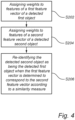
- a method for performing re-identification of an object detected in a video stream capturing a scene comprising: assigning weights to features of a first feature vector of a detected first object using the method according to first aspect; assigning weights to features of a second feature vector of a detected second object using the method according to first aspect; and re-identifying the detected second object as being the detected first object when the first feature vector is determined to correspond to the second feature vector according to a similarity measure between the first and second feature vector, the similarity measure is calculated using the assigned weights so that features with higher weights are emphasized more than features with lower weights.
- the invention is further based on a similarity measure that takes the assigned weights into account when comparing two feature vectors. If corresponding features of the two feature vectors are assigned high weights due to large deviations from the reference model, their similarity are considered more important since they are more unique compared to the objects in the scene given by the reference model. Due to the uniqueness, the higher weighted features are more easily distinguished and more appropriate to use for re-identification compared to less unique features.
- Re-identifying generally includes to tag or in some other way identify that the two detections belong to the same object or e.g., object ID.
- the method may comprise assigning the same weights to features of the first feature vector and to corresponding features of the second feature vector, the weights being determined from an evaluation of the weights assigned to the first feature vector and the weights assigned to the second feature vector.
- the evaluation may be to calculate an average weight of the two weights for corresponding features from the two feature vectors.
- the evaluation may be to select the largest of the two weights for corresponding features from the two feature vectors.
- the weights for the first feature vector of the detected first object may be generated using a first reference model
- the weights for the second feature vector of the detected second object may be generated using a second reference model.
- two separate reference models are used for different scenes. This provides for re-identification of an object detected in two different locations, e.g., monitored by different image acquisition devices.
- the weights assigned to a feature of the first feature vector and to a corresponding feature of the second feature vector depend on the feature of the first feature vector and the feature of the second feature vector that deviates most from the respective acquired reference feature vector. In other words, it is sufficient that one of the features of two corresponding features of the first and second feature vector deviates significantly from its reference model to provide a larger weight to both features.
- the weights assigned to a feature of the first feature vector and to a corresponding feature of the second feature vector may depend on the deviation from the acquired reference feature vector of the feature of the first feature vector and the feature of the second feature vector that deviates the least from the respective acquired reference feature vector.
- higher weights are assigned for features that deviate from both reference models that those that do not deviate from both reference models.
- the weights depend on the feature of the first feature vector and the feature of the second feature vector that deviates the least from the respective acquired reference feature vector.
- the method may comprise determining a first similarity measure using the first reference model, and a second similarity measure using a second reference model, wherein re-identifying may comprise: determining that the second object corresponds to the first object if any one of the first similarity measure and the second similarity measure indicates that the first feature vector corresponds to the second feature vector.
- control unit configured to execute the steps of the method according to anyone of the herein disclosed embodiments.
- a system comprising a control unit according to the third aspect, and an image acquisition device for capturing images of a scene including objects.
- the image acquisition device may be a camera, such as a surveillance camera.
- a computer program product is further provided including a computer readable storage medium storing the computer program.
- the computer readable storage medium may for example be non-transitory, and be provided as e.g. a hard disk drive (HDD), solid state drive (SDD), USB flash drive, SD card, CD/DVD, and/or as any other storage medium capable of non-transitory storage of data.
- a scene 1 being monitored by an image capturing device 100, e.g., a camera or more specifically a surveillance camera.
- an image capturing device 100 e.g., a camera or more specifically a surveillance camera.
- an image capturing device 100 e.g., a camera or more specifically a surveillance camera.
- objects 102a-b, and 104 here exemplified as people present in the scene.
- the camera 100 is continuously monitoring the scene 1 by capturing a video stream of images of the scene 1 and the objects 102, 104 therein.
- the camera 100 and a control unit 106 are part of a system 110, where the control unit 106 may either be a separate stand-alone control unit or be part of the camera 100. It is also conceivable that the control unit 106 is remotely located such as on a server and thus operates as a Cloud-based service.
- the camera 100 may be mounted on a building, on a pole, or in any other suitable position depending on the specific application at hand. Further the camera 100 may be a fixed camera or a movable camera such as pan, tilt and zoom, or even a body worn camera. Further, the camera 100 may be a visible light camera, an infrared (IR) sensitive camera or a thermal (long-wavelength infrared (LWIR)) camera. Further, image acquisition devices employing LIDAR and radar functionalities may also be conceivable. It is also envisaged that the camera 100 is a combination of the mentioned camera technologies.
- the captured instance in fig. 1A may be considered a first frame 112 and the captured instance in fig. 1B may be considered a second frame 114.
- the video stream is captured by a camera 100 configured to monitor a single scene.
- fig. 1A there is among the people 102a, 104 within the field of view of the camera 100, a set of people 104 all wearing plain patterned clothes, and one person 102 wearing a striped sweatshirt.
- this simplified scene 1 if person 102a is to be distinguished and tracked, it is advantageous to use the striped sweatshirt as a contrasting trait. Note that this is only a simplified example used for clarity and understanding of embodiments herein.
- the striped sweatshirt of person 102a is easily distinguishable from the rest of the objects in the scene 1 since, in this context, no one else is wearing a striped sweatshirt.
- tracking the person 102a may work as expected.
- the inventors propose means for adapting object tracking methods to the local surroundings, or more specifically to the other objects of the scene. For example, as striped sweatshirts are becoming common, the proposed method weights other features higher than the features common in the scene 1.
- the person 102b is wearing a hat which is a contrast to the other persons 104.
- the herein proposed methods will weight this feature higher than other more common features when tracking the person 102a-b.
- the method adapts to the other objects in the scene that define the present context thereof for tracking an object.
- the method detects any contrasting features that can distinguish the new object 105 from the other detected features in the scene 1.
- the new object being a person 105
- the new object is wearing boots which is a deviation from the features of the other detectable objects 104, 102b in the scene 1 that are considered commonplace.
- a reference model is constructed for the specific scene to provide a representation of the commonplace traits for that scene and is typically generated using object detections over a predetermined time period for generating an accurate model. That reference model, or several reference models, is/are later used for acquiring one or more reference feature vectors.
- a first feature vector of the person 102a at a first instance in fig. 1A may be compared to the feature vector of the person 102b at the second instance shown in fig. 1B . If they are similar according to a similarity measure, the detections of person 102a-b are considered to belong to the same person, whereby person 102b can be re-identified as being the same as 102a.
- Fig. 1C is a more detailed conceptual view of the camera 100 that further comprises an image capturing module 202, an image processing pipeline 204, an encoder 206, a data storage 208, and an input and output interface 210 configured as a communication interface between the camera 100 and the network 114 via the radio link 112.
- the image capturing module 202 comprises various components such as a lens and an image sensor, where the lens is adapted to project an image onto the image sensor comprising multiple pixels.
- the image processing pipeline 204 is configured to perform a range of various operations on image frames received from the image sensor.
- Such operations may include filtering, demosaicing, color correction, noise filtering for eliminating spatial and/or temporal noise, distortion correction for eliminating effects of e.g., barrel distortion, global and/or local tone mapping, e.g., enabling imaging of scenes containing a wide range of intensities, transformation, e.g., rotation, flat-field correction, e.g., for removal of the effects of vignetting, application of overlays, e.g., privacy masks, explanatory text, etc.
- transformation operations such as correction of barrel distortion, rotation, etc.
- the image frames are forwarded to the encoder 206, in which the image frames are encoded according to an encoding protocol and forwarded to a receiver, e.g., the client 116 and/or the server 118, over the network 114 using the input/output interface 210.
- a receiver e.g., the client 116 and/or the server 118
- the camera 100 illustrated in fig. 1 also includes numerous other components, such as processors, memories, etc., which are common in conventional camera systems and whose purpose and operations are well known to those having ordinary skill in the art. Such components have been omitted from the illustration and description of fig. 1 for clarity reasons.
- the camera 100 may also comprise the data storage 208 for storing data relating to the capturing of the video stream.
- the data storage may store the captured video stream.
- the data storage may be a non-volatile memory, such as an SD card.
- Some common video encoding formats that work with the various embodiments of the present invention include: JPEG, Motion JPEG (MJPEG), High Efficiency Video Coding (HEVC), also known as H.265 and MPEG-H Part 2; Advanced Video Coding (AVC), also known as H.264 and MPEG-4 Part 10; Versatile Video Coding (WC), also known as H.266, MPEG-I Part 3 and Future Video Coding (FVC); VP9, VP10 and AOMedia Video 1 (AV1), just to give some examples.
- JPEG Joint JPEG
- Motion JPEG Motion JPEG
- HEVC High Efficiency Video Coding
- AVC Advanced Video Coding
- WC Versatile Video Coding
- FVC Future Video Coding
- VP9, VP10 and AOMedia Video 1 (AV1) just to give some examples.
- control unit 106 operates algorithms for object detection and for determining feature vectors of detected objects.
- algorithms may be selected from a range of algorithms including convolutional neural networks (CNNs), recurrent neural networks, decision tree classifiers such as random forest classifiers that are alos efficient for classification.
- classifiers such as support vector machine classifiers and logistic regression classifiers are also conceivable.
- the algorithms for object detection and for determining feature vectors of detected objects may run downstream of the image processing pipeline 204. However, it is envisaged that the algorithms run within the image processing pipeline 204 or even upstream of the image processing pipeline 204 depending on what type of image data the algorithm or algorithms have been trained on.
- the control unit may operate the algorithm which may have been trained on annotated training data representing different classes of features, for classifying features in the scene to belong to certain feature classes according to its training.
- Each classification is provided with a location, e.g., coordinates in the image frame and a confidence value.
- the classification is typically performed downstream of the image processing pipeline 204 but upstream of the encoder 206, or even on the server 114. It is also possible to perform classification upstream of the image processing pipeline 204 depending on what type of image data the algorithm has been trained on.
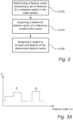
- Fig. 2 is a flow-chart of method steps according to embodiments of the present invention.
- the method is for weighting of features in a feature vector of an object detected in a video stream capturing a scene 1.
- the video stream is acquired by an image acquisition device 100 of the system 110.
- step S102 determining a feature vector comprising a set of features for a detected object 102 in the video stream.
- the number of features in a feature vector is often in the range of 100-1000 and may be fixed for each use case.
- the feature vector comprises n feature indices x.
- the feature, a 1 -a n may represent e.g., "striped shirt”, “suit”, “hat”, “sneakers”, “boots”, “hair color”, “color of socks” etc., i.e., any features that may be used in recognizing an individual or an object.
- the vector instances a 1 -a n are numeric values. But in practice the meaning of a features is something e.g., a convolutional neural network has learnt implicitly and is typically not possible to concretely describe.
- a reference feature vector of a reference model of the scene 1 is acquired in step S104.
- the reference feature vector comprises a collective feature vector calculated from all or some of multiple reference feature vectors of the reference model.
- the reference model may thus be a reference feature vector representative of multiple detections from a plurality of detected objects, or even all detections, made by the system 110 from the scene 1 when constructing the reference model.
- the reference feature vector may be generated or determined by the control unit 106 by detections made in the image frames of a video stream of the scene and is typically pre-constructed prior entering the method step S102.
- the collective feature vector is updated for subsequent or consecutive time durations to thereby alter the reference model as objects in the scene are replaced.
- one reference model may be applicable for a first time duration where a first object collection is expected and a second reference model may be applicable for a second time duration where second object collection is expected different from the first object collection.
- the control unit 106 receives the reference feature vector from another detection circuitry or module 107 adapted for continuously updating the reference model and provide updated reference feature vectors to the control unit 106.
- the reference feature vector may comprise information about features detected from a plurality of the objects 102a-b, 104 and 105, and where the reference feature vector provides a representation of the general appearance of objects in the scene 1 for a given time duration.
- the reference model may include a collective median feature vector of all the observed objects along with the variation for each feature.
- the reference feature vector comprises n features indices analogously with the above feature vector A.
- Corresponding features a k and r k are indicated in the feature vector A and in the reference feature vector.
- the feature a k of the feature vector A of the detected object is better distinguished from the corresponding feature r k of reference feature vector r compared to the other features of vector A that lie close to their corresponding reference features of vector r .
- the feature a k of the feature vector A is indicated also in fig. 3B .
- a weight to at least one, or preferably to each of the features of the determined feature vector in step S106.
- all features of the determined feature vector are assigned a respective weight, stated otherwise, one weight is assigned per feature.
- the weight for a feature of the determined feature vector, A depends on a deviation measure indicative of a degree of deviation of the feature from a corresponding feature of the acquired reference feature vector, r , of the reference model.
- the acquired reference feature vector may be an average of multiple reference feature vectors of the reference model along with the variance.
- This average reference feature vector may be the average of all or some of the reference feature vectors of the reference model.
- Two different reference feature vectors may represent two different types of objects in the scene having different distinguishing features from the rest of the scene.
- the deviation may be determined in different ways, but with the intention to provide a measure to what degree a feature of a feature vector of a detected object deviates from a corresponding feature of the reference feature vector representing a majority of the detected objects in the scene. For example, if a feature of a feature vector of a detected object deviates significantly from a corresponding feature of the reference feature vector having small variance, this feature may be provided a higher weight than if the variance of the corresponding feature of the reference feature vector is small.
- the deviation may be an absolute difference, e.g., subtraction between corresponding features numeric values can be made.
- a deviation may be a relative relationship between corresponding features, e.g., by considering the ratio between corresponding feature numeric values of the object feature vector and the reference feature vector.
- features in the determined feature vector with large deviations from the corresponding feature of the acquired reference feature vector are assigned higher weights than features in the determined feature vector with smaller deviations from the corresponding feature of the acquired reference feature vector.
- the feature at a k which deviation from the corresponding reference feature at r k is relatively high is assigned a higher weight compared to the feature at a l which deviates less from its corresponding feature r l .
- the indices 1 -n correspond to the indices of the feature vector A and B .
- the method may comprise determining at least one further feature vector comprising a set of features for the detected first object.
- the step of assigning then comprise assigning the weights to at least one feature of the determined first feature vector further depending on a degree of similarity with a corresponding feature of the determined at least one further feature vector. For example, if feature a k is similar to the corresponding feature of a consecutive further feature vector, then the weight w k is adapted. Preferably, the weight w k is increased as a result of the similarity.
- features with assigned weights that are persistent over subsequent or consecutive object detections are assigned higher weights than features that are less persistent over consecutive object detections. This further enhances the unique features of the detected object.
- a method for performing re-identification of an object detected in a video stream capturing a scene is provided.
- the method steps are shown in the flow-chart of fig. 4 which will be discussed also with reference to figs 1A-B .
- step S202 assigning weights to features of a first feature vector of a detected first object 102a using the method described with reference to the flow-chart of fig. 2 and embodiments thereof.
- step S204 assigning weights to features of a second feature vector of a detected second object 102b using the method described with reference to the flow-chart of fig. 2 and embodiments thereof.
- Step S202 and S204 may be performed simultaneously as a single step so that the same weights are assigned to the first feature vector and to the second feature vector.
- the similarity measure is calculated using the assigned weights so that features with higher weights are emphasized more than features with lower weights as will be exemplified in more detail below.
- the second feature vector B is conceptually represented in fig. 3C .
- the feature b k is distinguished from the reference feature vector r.
- the metric function is configured to emphasize the features that distinguished the two objects from the acquired reference feature vector.
- the similarity measure would emphasize the feature b k more than other features such as feature b l which is similar to the corresponding feature r l in the reference model shown in fig. 3B .
- control unit 106 is configured to determine the first feature vector A and the second feature vector B , and to calculate and assign weights to both feature vectors A and B using a single reference model.
- the control unit 106 is configured to calculate the similarity measure and to re-identify the detected second object 102b as being the detected first object 102a when the first feature vector is determined to correspond to the second feature vector according to the similarity measure.
- the same weights w are assigned to features of the first feature vector A and to the corresponding features of the second feature vector B .
- the weights being determined from an evaluation of the weights assigned to the first feature vector and the weights assigned to the second feature vector.
- the deviation of the first feature vector from the reference feature vector and a deviation of the second feature vector from the reference feature vector may be determined. Based on these deviations a common weight vector w is assigned.
- the common weight vector may be determined from the average deviations of the feature vectors from the reference feature vector.
- the common weight vector may be determined using the feature vector of the two feature vectors that deviates the most from the reference feature vector.
- a single common weight vector is advantageous because it makes the calculation of the similarity measure in the metric function more straight forward without the need for re-scaling weights and/or feature vectors.
- d is the similarity measure
- a and B are the feature vectors comprising features a i and b i
- w i is the common weight vector. If a similarity measure, d, is less than a threshold, two object detections are of the same object and re-identification may be performed. Note that a feature a i and b i , is herein represented by a numeric value from the respective feature vector.
- the above metric function d ( A,B ) in has the preferred characteristics that for a weight w i larger than 1, small deviations between corresponding features (values for that index, i ) are suppressed, leading to that the detected objects appear more similar, whereas larger deviations between corresponding features values for an index, k , are enhanced further, making the detected objects appear more dissimilar.
- the larger deviation feature gets more discriminating power than other features.
- a single image acquisition device is used and re-identification for object tracking is performed on the video stream of the single monitored scene as discussed above.
- more than one image acquisition device is used and re-identification for object tracking is performed using more than one video stream.
- fig. 5 conceptually illustrating two scenes 1 and 2, and image acquisition devices 100 and 500 included in a respective system 110, 510 comprising a respective control unit 106 and 506.
- the two image acquisition devices 100 and 500 are monitoring two different scenes 1 and 2.
- two different reference models are used. More specifically, the weights for the first feature vector of the detected first object 102a is generated by the control unit 106 using a first reference model. Further, the weights for the second feature vector of the detected second object 102b is generated by the control unit 506 using a second reference model. It is conceivable that the two image acquisition devices 100 and 500 are connected to a common single control unit that is configured to calculate the feature vectors and the weights, and to perform the re-identification.
- the weights assigned to a feature of the first feature vector and to a corresponding feature of the second feature vector depend on the feature of the first feature vector and the feature of the second feature vector that deviates most from the respective acquired reference feature vector.
- a first reference feature vector r as described above is associated with scene 1 and a second reference feature vector r2 is associated with scene 2.
- the weights assigned to a feature of the first feature vector and to a corresponding feature of the second feature vector depend on the deviation of the feature of the first feature vector and the feature of the second feature vector that deviates the least from the respective acquired reference feature vector. If a feature of the first feature vector determined from scene 1 deviates from the reference feature vector r more than the deviation of the corresponding feature of the second feature vector from the second reference feature vector r2 , then the smaller of the deviations, in contrast to the larger deviation as described above, precedes whereby a weight is assigned to both the features of the first and second feature based on the smaller deviation.
- both corresponding features deviate to some relatively high degree from their corresponding reference models.
- the feature related to "boots" of the person 105 in the second scene would be assigned lower weights than striped sweatshirts of the object 102a-b which is present in both scenes 1 and 2. This provides for excluding, by means of the assigned weights that the object 105 was also present in scene 1.
- the method for re-identifying may comprising determining a first similarity measure using a first reference model r, and a second similarity measure r2 using a second reference model.
- Re-identifying may then comprise determining that the second object corresponds to the first object if any one of the first similarity measure and the second similarity measure indicates that the first feature vector corresponds to the second feature vector.
- a computer program comprising instructions which, when the program is executed by a computer, cause the computer to carry out the method of any one of the herein disclosed embodiments.
- the computer program may be stored or distributed on a data carrier.
- a “data carrier” may be a transitory data carrier, such as modulated electromagnetic or optical waves, or a non-transitory data carrier.
- Non-transitory data carriers include volatile and non-volatile memories, such as permanent and non-permanent storage media of magnetic, optical or solid-state type. Still within the scope of "data carrier”, such memories may be fixedly mounted or portable.
- the instructions comprising code for determining a feature vector comprising a set of features for a detected object in the video stream; and code for assigning a weight to at least one, or preferably each feature of the determined feature vector, wherein the weight for a feature of the determined feature vector depends on a deviation measure indicative of a degree of deviation of the feature from a corresponding feature of an acquired reference feature vector of a reference model of the scene.
- instruction of another embodiment may include code for assigning weights to features of a first feature vector of a detected first object; code for assigning weights to features of a second feature vector of a detected second object; and code for re-identifying the detected second object as being the detected first object when the first feature vector is determined to correspond to the second feature vector according to a similarity measure between the first and second feature vector, the similarity measure is calculated using the assigned weights so that features with higher weights are emphasized more than features with lower weights.
- the control unit includes a microprocessor, microcontrol unit, programmable digital signal processor or another programmable device.
- the control unit may also, or instead, include an application specific integrated circuit, a programmable gate array or programmable array logic, a programmable logic device, or a digital signal processor.
- the control unit includes a programmable device such as the microprocessor, microcontrol unit or programmable digital signal processor mentioned above, the processor may further include computer executable code that controls operation of the programmable device.
- control functionality of the present disclosure may be implemented using existing computer processors, or by a special purpose computer processor for an appropriate system, incorporated for this or another purpose, or by a hardwire system.
- Embodiments within the scope of the present disclosure include program products comprising machine-readable medium for carrying or having machine-executable instructions or data structures stored thereon.
- Such machine-readable media can be any available media that can be accessed by a general purpose or special purpose computer or other machine with a processor.
- machine-readable media can comprise RAM, ROM, EPROM, EEPROM, CD-ROM or other optical disk storage, magnetic disk storage or other magnetic storage devices, or any other medium which can be used to carry or store desired program code in the form of machine-executable instructions or data structures and which can be accessed by a general purpose or special purpose computer or other machine with a processor.
- a network or another communications connection either hardwired, wireless, or a combination of hardwired or wireless
- any such connection is properly termed a machine-readable medium.
- Machine-executable instructions include, for example, instructions and data which cause a general-purpose computer, special purpose computer, or special purpose processing machines to perform a certain function or group of functions.
Landscapes
- Engineering & Computer Science (AREA)
- Physics & Mathematics (AREA)
- General Physics & Mathematics (AREA)
- Multimedia (AREA)
- Theoretical Computer Science (AREA)
- Computer Vision & Pattern Recognition (AREA)
- Image Analysis (AREA)
Abstract
Description
- The present invention generally relates to the field of camera surveillance, and in particular to object re-identification in video streams.
- In camera surveillance object detection and object tracking are important functionalities. When tracking an object in a video stream an object is observed at several instances and need to be re-identified as being the same object between instances by an algorithm.
- Object re-identification is a technology that can be used to compare object observations of object instances to decide if two observations are of the same object instance or not. The observations of one object instance may be accumulated over a so called tracklet. The comparison can be done within one camera field of view or across different camera field of views.
- Object re-identification algorithms rely on off-line training. Based on their training the algorithms typically extract feature vectors, sometimes referred to as appearance vectors or re-identification vectors, from each object observation.
- For re-identification, the task becomes to compare feature vectors accumulated over tracklets, and if two feature vectors are considered similar, the corresponding objects are assumed to be the same. Consequently, a detected object of a first instance can be re-identified as corresponding to a detected object of a second instance.
- However, traditional object re-identification algorithms are not aware of the other objects in the scene and lack the ability to adapt to changes in the collection or distribution of the other objects in the monitored scene.
- Accordingly, it would be desirable to improve object re-identification algorithms to better adapt a present context of the monitored scene.
- In view of above-mentioned and other drawbacks of the prior art, it is an object of the present invention to provide improvements with regards to object re-identification that can better adapt to the context of the monitored scene. More specifically, an object of the present invention is to provide a method for weighting of features in a feature vector so that object re-identification in a video stream capturing the scene is improved.
- According to a first aspect of the present invention, it is therefore provided a method for weighting of features in a feature vector of an object detected in a video stream capturing a scene, comprising: determining a feature vector comprising a set of features for a detected object in the video stream; acquiring at least one reference feature vector of a reference model of the scene; and assigning a weight to at least one feature of the determined feature vector, wherein the weight for a feature of the determined feature vector depends on a deviation measure indicative of a degree of deviation of the feature from a corresponding feature of the acquired reference feature vector of the reference model.
- The present invention is based upon the realization to weight features of the feature vector depending on the contrast of that specific feature to that feature of other objects in the scene. In other words, contrasting traits of an object relative other detected objects in the scene are identified by determining a deviation between the feature vector of the object and the at least one reference feature vector of the other objects in the scene. More specifically, features of the feature vector of the object are evaluated in view of corresponding features of the reference feature vector of the reference model. If the objects in the scene are replaced or the collection of objects is varied, the reference model to which the feature vector of the detected object is compared is adapted accordingly. Thereby, the weighting of the features will adapt to the present context of the scene even if the collection of objects in the scene changes.
- Preferably, one weight is assigned to each one of the features of the determined feature vector, i.e., one weight per feature.
- The weights provide for enhancing features that deviate more from features of other objects in the scene than features that deviate less from features of the other objects in the scene. Thus, it was further realized that for object re-identification, when two feature vectors are compared, a higher weighted feature can be given more emphasis than features with lower weights. Thus, the weighting of features advantageously provides for object re-identification that is adapted to the other objects that set the present context of the scene. In other words, even if the overall appearance of the scene is adapted due to new objects entering the scene or objects leaving the scene, the weights are still adapted for efficient re-identification.
- A video stream is generally a set of consecutive image frames captured over time. The consecutive image frames collectively form the video stream.
- A feature vector is generally an n-dimensional vector of numerical features that represent an object. This is a common representation of an object for e.g., machine learning algorithms which typically require a numerical representation of objects for facilitating for example data processing and statistical analysis.
- The reference model includes one or more reference feature vectors representing objects detected in the monitored scene. Thus, the reference model is descriptive of a present collection of objects in the monitored scene including natural scene variations such as light conditions and weather variations. The reference model is constructed by collecting and saving reference feature vectors of the observed object instances in the scene. The collected reference feature vectors of the reference model are indicative of a typical reference feature vector acquirable from the scene. Using the collected reference feature vectors enables generating a measure of the variations of specific features. For example, a reference feature vector may be created by calculating an average reference feature vector of a set of feature vectors of the reference model and the corresponding variance of the average feature vector. The average reference feature vector may be acquired and used for the step of assigning weights.
- Accordingly, the reference model represents detections made in the video stream of the scene and more specifically represents at least one reference feature vector of detections in the video stream. The reference model is constructed from detections that may be made from the acquired video stream for a given time period during which the collection of objects in the scene are expected to be relatively constant.
- It may be possible to include that, as the collection of objects in the scene changes, so may the reference feature vector of the reference model since the detections made in the video stream will consequently, also change. In one possible implementation, this may result in an updated or further reference model valid for a second time period. In other words, the reference feature vectors may adapt as the scene is varied by for example further or new objects entering the scene. Therefore, the weights assigned to the determined feature vector of the detected object are altered depending on the present context of the scene.
- The deviation measure may be a direct comparison between corresponding features of the reference model and the determined feature vector from a single object observation. However, a more accurate comparison may be to compare the features of the determined feature vector to a corresponding feature of the reference model over an entire tracklet. In such case, the average or the median of all observations of a specific feature can be compared to the corresponding average or median feature of the reference model feature vectors.
- It is appreciated that an object may herein refer to a material object, a person, or an animal, in other words, any type of object that may be captured in a video stream and that may be tracked. A material object may for example be a vehicle.
- In one embodiment, features in the determined feature vector with large deviations from the corresponding feature of the acquired reference feature vector may be assigned higher weights than features in the determined feature vector with smaller deviations from the corresponding feature of the acquired reference feature vector. In other words, a feature that is considered sufficiently unique compared to the reference model is assigned with a large weight compared to a less unique feature. This advantageously provides for distinguishing unique features that facilitates for tracking of an object in the video stream.
- The reference model may include multiple reference feature vectors representing all or some of the objects detected in the monitored scene. A collective feature vector may be calculated from all or some of the reference feature vectors. For example, the reference model may be a median feature vector of all or some of the reference feature vectors along with a variation for each feature.
- Accordingly, in one embodiment, the acquired reference feature vector may be a collective feature vector calculated from all or some of multiple reference feature vectors of the reference model. In this way, the reference model provides an overall representation of objects present and detectable in the video stream to thereby further improve an adaptable weighting that depends on the appearance of multiple detected objects in the scene. As an example, the acquired reference feature vector may be a collective median feature vector of all the observed objects along with the variance for each feature.
- In one embodiment, the collective feature vector may represent multiple detected objects during a time duration, where the collective feature vector is updated for subsequent time durations. Hereby, the adaptive nature of the reference model and the weighting is further improved.
- In one embodiment, the determined feature vector may be a first feature vector for the detected first object, the method may further comprise: determining at least one further feature vector comprising a set of features for the detected first object, wherein the step of assigning may comprise: assigning the weights to at least one feature of the determined first feature vector further depending on a degree of similarity with a corresponding feature of the determined at least one further feature vector. Hereby, if a feature is similar across at least two object instance observations, and especially if this feature deviates from the reference model, the specific feature is assigned higher weights than other features of the feature vector. This advantageously provides more robust weighting with regards to temporary occlusions, image noise and other nuisances including scene light changes and weather. More specifically, features with assigned weights that are persistent over consecutive or subsequent object detections, i.e., consecutive, or subsequent feature vectors, are preferably assigned higher weights than features that are less persistent over consecutive or subsequent object detections or feature vectors.
- In one embodiment, the video stream may be captured by an image acquisition device configured to monitor a single scene.
- According to a second aspect of the present invention, there is provided a method for performing re-identification of an object detected in a video stream capturing a scene, the method comprising: assigning weights to features of a first feature vector of a detected first object using the method according to first aspect; assigning weights to features of a second feature vector of a detected second object using the method according to first aspect; and re-identifying the detected second object as being the detected first object when the first feature vector is determined to correspond to the second feature vector according to a similarity measure between the first and second feature vector, the similarity measure is calculated using the assigned weights so that features with higher weights are emphasized more than features with lower weights.
- The invention is further based on a similarity measure that takes the assigned weights into account when comparing two feature vectors. If corresponding features of the two feature vectors are assigned high weights due to large deviations from the reference model, their similarity are considered more important since they are more unique compared to the objects in the scene given by the reference model. Due to the uniqueness, the higher weighted features are more easily distinguished and more appropriate to use for re-identification compared to less unique features.
- Re-identifying generally includes to tag or in some other way identify that the two detections belong to the same object or e.g., object ID.
- In one embodiment, the method may comprise assigning the same weights to features of the first feature vector and to corresponding features of the second feature vector, the weights being determined from an evaluation of the weights assigned to the first feature vector and the weights assigned to the second feature vector. For example, the evaluation may be to calculate an average weight of the two weights for corresponding features from the two feature vectors. As a further example, the evaluation may be to select the largest of the two weights for corresponding features from the two feature vectors.
- In one embodiment, wherein the weights for the first feature vector of the detected first object may be generated using a first reference model, and the weights for the second feature vector of the detected second object may be generated using a second reference model. Thus, in this case, two separate reference models are used for different scenes. This provides for re-identification of an object detected in two different locations, e.g., monitored by different image acquisition devices.
- In one embodiment, the weights assigned to a feature of the first feature vector and to a corresponding feature of the second feature vector depend on the feature of the first feature vector and the feature of the second feature vector that deviates most from the respective acquired reference feature vector. In other words, it is sufficient that one of the features of two corresponding features of the first and second feature vector deviates significantly from its reference model to provide a larger weight to both features.
- In one embodiment, the weights assigned to a feature of the first feature vector and to a corresponding feature of the second feature vector may depend on the deviation from the acquired reference feature vector of the feature of the first feature vector and the feature of the second feature vector that deviates the least from the respective acquired reference feature vector. Thus, it may be required that a deviation from a corresponding reference model is present for both corresponding features of the first feature vector and the second feature vector to provide a large weight. In this way, higher weights are assigned for features that deviate from both reference models that those that do not deviate from both reference models. Phrased differently, the weights depend on the feature of the first feature vector and the feature of the second feature vector that deviates the least from the respective acquired reference feature vector.
- In one embodiment, the method may comprise determining a first similarity measure using the first reference model, and a second similarity measure using a second reference model, wherein re-identifying may comprise: determining that the second object corresponds to the first object if any one of the first similarity measure and the second similarity measure indicates that the first feature vector corresponds to the second feature vector. This advantageously allows for using two separate reference models. It is envisaged that the two reference models may be associated with two different image acquisition devices without the need for combining the reference models.
- Further embodiments of, and effects obtained through this second aspect of the present invention are largely analogous to those described above for the first aspect and the second aspect of the invention.
- According to a third aspect, there is provided a control unit configured to execute the steps of the method according to anyone of the herein disclosed embodiments.
- Further embodiments of, and effects obtained through this third aspect of the present invention are largely analogous to those described above for the first aspect and the second aspect of the invention.
- According to a fourth aspect of the present invention, there is provided a system comprising a control unit according to the third aspect, and an image acquisition device for capturing images of a scene including objects.
- The image acquisition device may be a camera, such as a surveillance camera.
- Further embodiments of, and effects obtained through this fourth aspect of the present invention are largely analogous to those described above for the other aspects of the invention.
- According to a fifth aspect of the present invention, there is provided computer program comprising instructions which, when the program is executed by a computer, cause the computer to carry out the method of any of the herein discussed embodiments.
- Further embodiments of, and effects obtained through this fifth aspect of the present invention are largely analogous to those described above for the other aspects of the invention.
- A computer program product is further provided including a computer readable storage medium storing the computer program. The computer readable storage medium may for example be non-transitory, and be provided as e.g. a hard disk drive (HDD), solid state drive (SDD), USB flash drive, SD card, CD/DVD, and/or as any other storage medium capable of non-transitory storage of data.
- Further features of, and advantages with, the present invention will become apparent when studying the appended claims and the following description. The skilled addressee realize that different features of the present invention may be combined to create embodiments other than those described in the following, without departing from the scope of the present invention.
- The various aspects of the invention, including its particular features and advantages, will be readily understood from the following detailed description and the accompanying drawings, in which:
-
Figs. 1A conceptually illustrates a first instance of a scene being monitored by an image capturing device as an example application of embodiments of the invention; -
Figs. 1B conceptually illustrates a second instance of the scene being monitored by an image capturing device as an example application of embodiments of the invention; -
Fig. 1C is a conceptual view of an image capturing device according to embodiments of the invention; -
Fig. 2 is a flow-chart of method steps according to embodiments of the invention; -
Fig. 3A is a conceptual illustration of a feature vector of a detected object; -
Fig. 3B is a conceptual illustration of a reference feature vector; -
Fig. 3C is a conceptual illustration of a feature vector of a detected object; -
Fig. 4 is a flow-chart of method steps according to embodiments of the invention; and -
Fig. 5 is a graph conceptually represetning a similarity measure function; and -
Fig. 6 conceptually illustrates use of two image acquisition devices monitoring difference scenes according to embodiments of the invention - The present invention will now be described more fully hereinafter with reference to the accompanying drawings, in which currently preferred embodiments of the invention are shown. This invention may, however, be embodied in many different forms and should not be construed as limited to the embodiments set forth herein; rather, these embodiments are provided for thoroughness and completeness, and fully convey the scope of the invention to the skilled person. Like reference characters refer to like elements throughout.
- Turning now to the drawings and to
fig 1A-B in particular, there is shown ascene 1 being monitored by animage capturing device 100, e.g., a camera or more specifically a surveillance camera. In thescene 1, there is a set ofobjects 102a-b, and 104, here exemplified as people present in the scene. - The
camera 100 is continuously monitoring thescene 1 by capturing a video stream of images of thescene 1 and theobjects camera 100 and acontrol unit 106 are part of asystem 110, where thecontrol unit 106 may either be a separate stand-alone control unit or be part of thecamera 100. It is also conceivable that thecontrol unit 106 is remotely located such as on a server and thus operates as a Cloud-based service. - The
camera 100 may be mounted on a building, on a pole, or in any other suitable position depending on the specific application at hand. Further thecamera 100 may be a fixed camera or a movable camera such as pan, tilt and zoom, or even a body worn camera. Further, thecamera 100 may be a visible light camera, an infrared (IR) sensitive camera or a thermal (long-wavelength infrared (LWIR)) camera. Further, image acquisition devices employing LIDAR and radar functionalities may also be conceivable. It is also envisaged that thecamera 100 is a combination of the mentioned camera technologies. - The captured instance in
fig. 1A may be considered afirst frame 112 and the captured instance infig. 1B may be considered asecond frame 114. Preferably, the video stream is captured by acamera 100 configured to monitor a single scene. - Turning now specifically to
fig. 1A , there is among thepeople camera 100, a set ofpeople 104 all wearing plain patterned clothes, and oneperson 102 wearing a striped sweatshirt. In thissimplified scene 1, ifperson 102a is to be distinguished and tracked, it is advantageous to use the striped sweatshirt as a contrasting trait. Note that this is only a simplified example used for clarity and understanding of embodiments herein. - The striped sweatshirt of
person 102a is easily distinguishable from the rest of the objects in thescene 1 since, in this context, no one else is wearing a striped sweatshirt. In other words, for tracking theperson 102a, it would be advantageous to continuously track the striped sweatshirt, instead of the common plain shirts or sweatshirts of theother persons 104. As a further example, it would not be advantageous to track prison clothing at a prison or the general sportswear at a sport practice since they are common to the respective scene. Instead, the contrasting traits are more easily tracked. - Accordingly, in this
scene 1 shown infig. 1A , as long as the employed re-identification algorithm is trained to detect striped shirts and that striped shirts are not commonplace for the scene, tracking theperson 102a may work as expected. - However, as the scene is changing and striped sweatshirts are becoming very common as shown in
fig. 1B , they may not provide a sufficient contrast for accurate tracking. To alleviate this problem, the inventors propose means for adapting object tracking methods to the local surroundings, or more specifically to the other objects of the scene. For example, as striped sweatshirts are becoming common, the proposed method weights other features higher than the features common in thescene 1. Infig. 1B , theperson 102b is wearing a hat which is a contrast to theother persons 104. In other words, since the hat feature deviates from theother objects 104 in the scene as a whole, the herein proposed methods will weight this feature higher than other more common features when tracking theperson 102a-b. In other words, the method adapts to the other objects in the scene that define the present context thereof for tracking an object. - In a similar way, if a
new object 105 is detected shown infig. 1B , the method detects any contrasting features that can distinguish thenew object 105 from the other detected features in thescene 1. Here, the new object, being aperson 105, is wearing boots which is a deviation from the features of the otherdetectable objects scene 1 that are considered commonplace. A reference model is constructed for the specific scene to provide a representation of the commonplace traits for that scene and is typically generated using object detections over a predetermined time period for generating an accurate model. That reference model, or several reference models, is/are later used for acquiring one or more reference feature vectors. - Embodiments of the present invention will now be described in more detail with reference to subsequent drawings.
- For re-identification, subsequent feature vectors are compared, and if they are sufficiently similar the corresponding objects are considered the same. For example, a first feature vector of the
person 102a at a first instance infig. 1A , may be compared to the feature vector of theperson 102b at the second instance shown infig. 1B . If they are similar according to a similarity measure, the detections ofperson 102a-b are considered to belong to the same person, wherebyperson 102b can be re-identified as being the same as 102a. -
Fig. 1C is a more detailed conceptual view of thecamera 100 that further comprises animage capturing module 202, animage processing pipeline 204, anencoder 206, adata storage 208, and an input andoutput interface 210 configured as a communication interface between thecamera 100 and thenetwork 114 via theradio link 112. - The
image capturing module 202 comprises various components such as a lens and an image sensor, where the lens is adapted to project an image onto the image sensor comprising multiple pixels. - The
image processing pipeline 204 is configured to perform a range of various operations on image frames received from the image sensor. Such operations may include filtering, demosaicing, color correction, noise filtering for eliminating spatial and/or temporal noise, distortion correction for eliminating effects of e.g., barrel distortion, global and/or local tone mapping, e.g., enabling imaging of scenes containing a wide range of intensities, transformation, e.g., rotation, flat-field correction, e.g., for removal of the effects of vignetting, application of overlays, e.g., privacy masks, explanatory text, etc. However, it should be noted that some of these operations, e.g., transformation operations, such as correction of barrel distortion, rotation, etc., may be performed by one or more modules, components or circuits arranged outside theimage processing pipeline 204, for example in one or more units between theimage processing pipeline 204 and theencoder 206. - Following the
image processing pipeline 204, the image frames are forwarded to theencoder 206, in which the image frames are encoded according to an encoding protocol and forwarded to a receiver, e.g., theclient 116 and/or theserver 118, over thenetwork 114 using the input/output interface 210. It should be noted that thecamera 100 illustrated infig. 1 also includes numerous other components, such as processors, memories, etc., which are common in conventional camera systems and whose purpose and operations are well known to those having ordinary skill in the art. Such components have been omitted from the illustration and description offig. 1 for clarity reasons. - The
camera 100 may also comprise thedata storage 208 for storing data relating to the capturing of the video stream. Thus, the data storage may store the captured video stream. The data storage may be a non-volatile memory, such as an SD card. - There are a number of conventional video encoding formats. Some common video encoding formats that work with the various embodiments of the present invention include: JPEG, Motion JPEG (MJPEG), High Efficiency Video Coding (HEVC), also known as H.265 and MPEG-
H Part 2; Advanced Video Coding (AVC), also known as H.264 and MPEG-4 Part 10; Versatile Video Coding (WC), also known as H.266, MPEG-I Part 3 and Future Video Coding (FVC); VP9, VP10 and AOMedia Video 1 (AV1), just to give some examples. - Generally, the
control unit 106 operates algorithms for object detection and for determining feature vectors of detected objects. Such algorithms may be selected from a range of algorithms including convolutional neural networks (CNNs), recurrent neural networks, decision tree classifiers such as random forest classifiers that are alos efficient for classification. In addition, classifiers such as support vector machine classifiers and logistic regression classifiers are also conceivable. The algorithms for object detection and for determining feature vectors of detected objects may run downstream of theimage processing pipeline 204. However, it is envisaged that the algorithms run within theimage processing pipeline 204 or even upstream of theimage processing pipeline 204 depending on what type of image data the algorithm or algorithms have been trained on. - The control unit may operate the algorithm which may have been trained on annotated training data representing different classes of features, for classifying features in the scene to belong to certain feature classes according to its training. Each classification is provided with a location, e.g., coordinates in the image frame and a confidence value. The classification is typically performed downstream of the
image processing pipeline 204 but upstream of theencoder 206, or even on theserver 114. It is also possible to perform classification upstream of theimage processing pipeline 204 depending on what type of image data the algorithm has been trained on. -
Fig. 2 is a flow-chart of method steps according to embodiments of the present invention. The method is for weighting of features in a feature vector of an object detected in a video stream capturing ascene 1. The video stream is acquired by animage acquisition device 100 of thesystem 110. - In step S102, determining a feature vector comprising a set of features for a detected
object 102 in the video stream. The number of features in a feature vector is often in the range of 100-1000 and may be fixed for each use case. A feature is a trait or detail that a detection algorithm is trained to detect. Determining the feature vector may be executed by thecontrol unit 106 connected to theimage acquisition device 100 to receive the image frames of the video stream. - An example plot of a feature vector A(x) is shown in
fig. 3A , where the vector A is represented by:
- The feature vector comprises n feature indices x. Purely as a simplified example, the feature, a1-an, may represent e.g., "striped shirt", "suit", "hat", "sneakers", "boots", "hair color", "color of socks" etc., i.e., any features that may be used in recognizing an individual or an object. The vector instances a1-an are numeric values. But in practice the meaning of a features is something e.g., a convolutional neural network has learnt implicitly and is typically not possible to concretely describe.
- A reference feature vector of a reference model of the
scene 1 is acquired in step S104. The reference feature vector comprises a collective feature vector calculated from all or some of multiple reference feature vectors of the reference model. The reference model may thus be a reference feature vector representative of multiple detections from a plurality of detected objects, or even all detections, made by thesystem 110 from thescene 1 when constructing the reference model. The reference feature vector may be generated or determined by thecontrol unit 106 by detections made in the image frames of a video stream of the scene and is typically pre-constructed prior entering the method step S102. Preferably, the collective feature vector is updated for subsequent or consecutive time durations to thereby alter the reference model as objects in the scene are replaced. For example, one reference model may be applicable for a first time duration where a first object collection is expected and a second reference model may be applicable for a second time duration where second object collection is expected different from the first object collection. In other possible implementations, thecontrol unit 106 receives the reference feature vector from another detection circuitry ormodule 107 adapted for continuously updating the reference model and provide updated reference feature vectors to thecontrol unit 106. - With reference to the example illustrated in
figs. 1A-B , the reference feature vector may comprise information about features detected from a plurality of theobjects 102a-b, 104 and 105, and where the reference feature vector provides a representation of the general appearance of objects in thescene 1 for a given time duration. The reference model may include a collective median feature vector of all the observed objects along with the variation for each feature. - An example plot of a reference feature vector r(x) is shown in
fig. 3B , where the vector r is represented by:
- The reference feature vector comprises n features indices analogously with the above feature vector A.
- Corresponding features ak and rk are indicated in the feature vector A and in the reference feature vector. The feature ak of the feature vector A of the detected object is better distinguished from the corresponding feature rk of reference feature vector r compared to the other features of vector A that lie close to their corresponding reference features of vector r. The feature ak of the feature vector A is indicated also in
fig. 3B . - Subsequently, assigning a weight to at least one, or preferably to each of the features of the determined feature vector in step S106. Thus, it is preferred that all features of the determined feature vector are assigned a respective weight, stated otherwise, one weight is assigned per feature. The weight for a feature of the determined feature vector, A, depends on a deviation measure indicative of a degree of deviation of the feature from a corresponding feature of the acquired reference feature vector, r, of the reference model.
- The acquired reference feature vector may be an average of multiple reference feature vectors of the reference model along with the variance. This average reference feature vector may be the average of all or some of the reference feature vectors of the reference model.
- Further, it may be possible to form two or more different reference feature vectors from the reference model. Two different reference feature vectors may represent two different types of objects in the scene having different distinguishing features from the rest of the scene.
- The deviation may be determined in different ways, but with the intention to provide a measure to what degree a feature of a feature vector of a detected object deviates from a corresponding feature of the reference feature vector representing a majority of the detected objects in the scene. For example, if a feature of a feature vector of a detected object deviates significantly from a corresponding feature of the reference feature vector having small variance, this feature may be provided a higher weight than if the variance of the corresponding feature of the reference feature vector is small. The deviation may be an absolute difference, e.g., subtraction between corresponding features numeric values can be made. As a further example, a deviation may be a relative relationship between corresponding features, e.g., by considering the ratio between corresponding feature numeric values of the object feature vector and the reference feature vector.
- By assigning weights to features of the feature vector A depending on how unique they are compared to features of the reference feature vector representing other objects in the scene, it is possible to adaptively enhance features that are presently unique in the scene for re-identification purposes.
- Preferable, features in the determined feature vector with large deviations from the corresponding feature of the acquired reference feature vector are assigned higher weights than features in the determined feature vector with smaller deviations from the corresponding feature of the acquired reference feature vector. For example, the feature at ak which deviation from the corresponding reference feature at rk is relatively high is assigned a higher weight compared to the feature at al which deviates less from its corresponding feature rl .
- An example weight vector w may be represented by:

- The indices 1-n correspond to the indices of the feature vector A and B.
- As further frames are collected by the
image acquisition device 100, further detections are made resulting in feature vector accumulated over tracklets. Thus, feature vectors of detected objects are extracted at consecutive time steps corresponding to the image frames. By registering what features are similar across consecutive object instance observations and what features most often are different from the reference model, the weight vector can be created which will be robust with regard to e.g., temporary occlusions, image noise and other nuisances. - If the above determined feature vector is considered a first feature vector for the detected first object, and with regards to detecting features of the detected object that are similar between detections, the method may comprise determining at least one further feature vector comprising a set of features for the detected first object. The step of assigning then comprise assigning the weights to at least one feature of the determined first feature vector further depending on a degree of similarity with a corresponding feature of the determined at least one further feature vector. For example, if feature ak is similar to the corresponding feature of a consecutive further feature vector, then the weight wk is adapted. Preferably, the weight wk is increased as a result of the similarity. Thus, features with assigned weights that are persistent over subsequent or consecutive object detections are assigned higher weights than features that are less persistent over consecutive object detections. This further enhances the unique features of the detected object.
- According to a further aspect of the invention, a method for performing re-identification of an object detected in a video stream capturing a scene is provided. The method steps are shown in the flow-chart of
fig. 4 which will be discussed also with reference tofigs 1A-B . - In step S202, assigning weights to features of a first feature vector of a detected
first object 102a using the method described with reference to the flow-chart offig. 2 and embodiments thereof. - In step S204, assigning weights to features of a second feature vector of a detected
second object 102b using the method described with reference to the flow-chart offig. 2 and embodiments thereof. - Step S202 and S204 may be performed simultaneously as a single step so that the same weights are assigned to the first feature vector and to the second feature vector.
- Subsequently, re-identifying the detected
second object 102b as being the detectedfirst object 102a when the first feature vector is determined to correspond to the second feature vector according to a similarity measure between the first and second feature vector. The similarity measure is calculated using the assigned weights so that features with higher weights are emphasized more than features with lower weights as will be exemplified in more detail below. - The second feature vector B is conceptually represented in
fig. 3C . As with the first feature vector A, the feature b k is distinguished from the reference feature vector r. The feature vector B is represented by:
- With the proposed method, when feature vectors are compared the feature vectors B and A are fed into a metric function that also receive the corresponding weight vectors. The metric function is configured to emphasize the features that distinguished the two objects from the acquired reference feature vector. In the presently discussed example, the similarity measure would emphasize the feature b k more than other features such as feature b l which is similar to the corresponding feature rl in the reference model shown in
fig. 3B . - In possible implementations, with a single camera and scene, the
control unit 106 is configured to determine the first feature vector A and the second feature vector B, and to calculate and assign weights to both feature vectors A and B using a single reference model. Thecontrol unit 106 is configured to calculate the similarity measure and to re-identify the detectedsecond object 102b as being the detectedfirst object 102a when the first feature vector is determined to correspond to the second feature vector according to the similarity measure. - Preferably, the same weights w are assigned to features of the first feature vector A and to the corresponding features of the second feature vector B. The weights being determined from an evaluation of the weights assigned to the first feature vector and the weights assigned to the second feature vector.
- Firstly, the deviation of the first feature vector from the reference feature vector and a deviation of the second feature vector from the reference feature vector may be determined. Based on these deviations a common weight vector w is assigned. For example, the common weight vector may be determined from the average deviations of the feature vectors from the reference feature vector. As a further example, the common weight vector may be determined using the feature vector of the two feature vectors that deviates the most from the reference feature vector.
- A single common weight vector is advantageous because it makes the calculation of the similarity measure in the metric function more straight forward without the need for re-scaling weights and/or feature vectors.
- When the feature vectors A and B and the corresponding weights are established, they are fed into the metric function for determining a similarity measure. As an example, the metric function may be given by:

- Here, d is the similarity measure, A and B are the feature vectors comprising features a i and bi, and wi is the common weight vector. If a similarity measure, d, is less than a threshold, two object detections are of the same object and re-identification may be performed. Note that a feature ai and bi, is herein represented by a numeric value from the respective feature vector. The above metric function d(A,B) is plotted in
fig. 5 for two different weights, w=1 and w=3 as function of deviation between features, |ai - bi |. As can be conclude from the graph infig. 5 , the above metric function d(A,B) in has the preferred characteristics that for a weight wi larger than 1, small deviations between corresponding features (values for that index, i) are suppressed, leading to that the detected objects appear more similar, whereas larger deviations between corresponding features values for an index, k, are enhanced further, making the detected objects appear more dissimilar. Thus, the larger deviation feature gets more discriminating power than other features. - In some cases, a single image acquisition device is used and re-identification for object tracking is performed on the video stream of the single monitored scene as discussed above. In other cases, more than one image acquisition device is used and re-identification for object tracking is performed using more than one video stream.
- Turning to
fig. 5 conceptually illustrating twoscenes image acquisition devices respective system respective control unit image acquisition devices different scenes object 102a moves between the twoscenes first object 102a is generated by thecontrol unit 106 using a first reference model. Further, the weights for the second feature vector of the detectedsecond object 102b is generated by thecontrol unit 506 using a second reference model. It is conceivable that the twoimage acquisition devices - It is also possible to use two different reference models for a single image acquisition device, for example where different parts of the field of view have different light, or shadowing effects that affect the reference feature vectors of the reference model.
- When more than one image acquisition device is used and where more than one scene is monitored, there are several advantageous ways to form reference models.
- In one possible implementation, the weights assigned to a feature of the first feature vector and to a corresponding feature of the second feature vector depend on the feature of the first feature vector and the feature of the second feature vector that deviates most from the respective acquired reference feature vector. In other words, a first reference feature vector r as described above is associated with
scene 1 and a second reference feature vector r2 is associated withscene 2. Overall, reference feature vectors r and r2 may be represented by:

- If a feature of the first feature vector determined from
scene 1 deviates from the reference feature vector r more than the deviation of the corresponding feature of the second feature vector from the second reference feature vector r2, then the larger of the deviation precedes whereby a weight is assigned to both the features of the first and second feature based on the larger deviation. - In a further possible implementation, the weights assigned to a feature of the first feature vector and to a corresponding feature of the second feature vector depend on the deviation of the feature of the first feature vector and the feature of the second feature vector that deviates the least from the respective acquired reference feature vector. If a feature of the first feature vector determined from
scene 1 deviates from the reference feature vector r more than the deviation of the corresponding feature of the second feature vector from the second reference feature vector r2, then the smaller of the deviations, in contrast to the larger deviation as described above, precedes whereby a weight is assigned to both the features of the first and second feature based on the smaller deviation. In other words, in order for a large weight to be assigned it is required that both corresponding features deviate to some relatively high degree from their corresponding reference models. For example, the feature related to "boots" of theperson 105 in the second scene would be assigned lower weights than striped sweatshirts of theobject 102a-b which is present in bothscenes object 105 was also present inscene 1. - In some possible implementations, the method for re-identifying may comprising determining a first similarity measure using a first reference model r, and a second similarity measure r2 using a second reference model. In other words, two separate similarity measures are determined independently of each other using two different reference models. Re-identifying may then comprise determining that the second object corresponds to the first object if any one of the first similarity measure and the second similarity measure indicates that the first feature vector corresponds to the second feature vector.
- There is further provided a computer program comprising instructions which, when the program is executed by a computer, cause the computer to carry out the method of any one of the herein disclosed embodiments. The computer program may be stored or distributed on a data carrier. As used herein, a "data carrier" may be a transitory data carrier, such as modulated electromagnetic or optical waves, or a non-transitory data carrier. Non-transitory data carriers include volatile and non-volatile memories, such as permanent and non-permanent storage media of magnetic, optical or solid-state type. Still within the scope of "data carrier", such memories may be fixedly mounted or portable.
- For example, the instructions comprising code for determining a feature vector comprising a set of features for a detected object in the video stream; and code for assigning a weight to at least one, or preferably each feature of the determined feature vector, wherein the weight for a feature of the determined feature vector depends on a deviation measure indicative of a degree of deviation of the feature from a corresponding feature of an acquired reference feature vector of a reference model of the scene.
- Further, instruction of another embodiment may include code for assigning weights to features of a first feature vector of a detected first object; code for assigning weights to features of a second feature vector of a detected second object; and code for re-identifying the detected second object as being the detected first object when the first feature vector is determined to correspond to the second feature vector according to a similarity measure between the first and second feature vector, the similarity measure is calculated using the assigned weights so that features with higher weights are emphasized more than features with lower weights.
- The control unit includes a microprocessor, microcontrol unit, programmable digital signal processor or another programmable device. The control unit may also, or instead, include an application specific integrated circuit, a programmable gate array or programmable array logic, a programmable logic device, or a digital signal processor. Where the control unit includes a programmable device such as the microprocessor, microcontrol unit or programmable digital signal processor mentioned above, the processor may further include computer executable code that controls operation of the programmable device.
- The control functionality of the present disclosure may be implemented using existing computer processors, or by a special purpose computer processor for an appropriate system, incorporated for this or another purpose, or by a hardwire system. Embodiments within the scope of the present disclosure include program products comprising machine-readable medium for carrying or having machine-executable instructions or data structures stored thereon. Such machine-readable media can be any available media that can be accessed by a general purpose or special purpose computer or other machine with a processor. By way of example, such machine-readable media can comprise RAM, ROM, EPROM, EEPROM, CD-ROM or other optical disk storage, magnetic disk storage or other magnetic storage devices, or any other medium which can be used to carry or store desired program code in the form of machine-executable instructions or data structures and which can be accessed by a general purpose or special purpose computer or other machine with a processor. When information is transferred or provided over a network or another communications connection (either hardwired, wireless, or a combination of hardwired or wireless) to a machine, the machine properly views the connection as a machine-readable medium. Thus, any such connection is properly termed a machine-readable medium. Combinations of the above are also included within the scope of machine-readable media. Machine-executable instructions include, for example, instructions and data which cause a general-purpose computer, special purpose computer, or special purpose processing machines to perform a certain function or group of functions.
- Although the figures may show a sequence the order of the steps may differ from what is depicted. Also, two or more steps may be performed concurrently or with partial concurrence. Such variation will depend on the software and hardware systems chosen and on designer choice. All such variations are within the scope of the disclosure. Likewise, software implementations could be accomplished with standard programming techniques with rule-based logic and other logic to accomplish the various connection steps, processing steps, comparison steps and decision steps. Additionally, even though the invention has been described with reference to specific exemplifying embodiments thereof, many different alterations, modifications and the like will become apparent for those skilled in the art.
- In addition, variations to the disclosed embodiments can be understood and effected by the skilled addressee in practicing the claimed invention, from a study of the drawings, the disclosure, and the appended claims. Furthermore, in the claims, the word "comprising" does not exclude other elements or steps, and the indefinite article "a" or "an" does not exclude a plurality.
Claims (15)
- A method for weighting of features in a feature vector of an object detected in a video stream capturing a scene (1), comprising:determining (S102) a feature vector (A, B) comprising a set of features for a detected object (102a;102b) in the video stream;acquiring (S104) a reference feature vector (r) of a reference model of the scene; andassigning (S106) a weight (w) to at least one feature of the determined feature vector, wherein the weight for a feature of the determined feature vector depends on a deviation measure indicative of a degree of deviation of the feature from a corresponding feature of the acquired reference feature vector of the reference model.
- The method according to claim 1, wherein features in the determined feature vector with large deviations from the corresponding feature of the acquired reference feature vector are assigned higher weights than features in the determined feature vector with smaller deviations from the corresponding feature of the acquired reference feature vector.
- The method according to any one of the preceding claims, wherein the acquired reference feature is a collective feature vector calculated from all or some of multiple reference feature vectors of the reference model.
- The method according to claim 3, wherein the collective feature vector represents multiple detected objects during a time duration, where the collective feature vector is updated for subsequent time durations.
- The method according to any one of the preceding claims, wherein the determined feature vector is a first feature vector for the detected first object, the method further comprises:
determining at least one further feature vector comprising a set of features for the detected first object, wherein the step of assigning comprises:
assigning the weights to at least one feature of the determined first feature vector further depending on a degree of similarity with a corresponding feature of the determined at least one further feature vector. - The method according to claim 5, wherein features with assigned weights that are persistent over consecutive object detections are assigned higher weights than features that are less persistent over subsequent object detections.
- The method according to any one of the preceding claims, wherein the video stream is captured by an image acquisition device configured to monitor a single scene.
- A method for performing re-identification of an object detected in a video stream capturing a scene, the method comprising:assigning (S202) weights to features of a first feature vector of a detected first object using the method according to any one of the preceding claims;assigning (S204) weights to features of a second feature vector of a detected second object using the method according to any one of the preceding claims;re-identifying (S206) the detected second object as being the detected first object when the first feature vector is determined to correspond to the second feature vector according to a similarity measure between the first and second feature vector, the similarity measure is calculated using the assigned weights so that features with higher weights are emphasized more than features with lower weights.
- The method according to claim 8, comprising assigning the same weights to features of the first feature vector and to corresponding features of the second feature vector, the weights being determined from an evaluation of the weights assigned to the first feature vector and the weights assigned to the second feature vector.
- The method according to any one of claims 8 and 9, wherein the weights for the first feature vector of the detected first object is generated using a first reference model, and the weights for the second feature vector of the detected second object is generated using a second reference model.
- The method according to claim to claim 10, wherein the weights assigned to a feature of the first feature vector and to a corresponding feature of the second feature vector depend on the feature of the first feature vector and the feature of the second feature vector that deviates most from the respective acquired reference feature vector.
- The method according to claim 10, wherein the weights assigned to a feature of the first feature vector and to a corresponding feature of the second feature vector depend on the deviation from the acquired reference feature vector of the feature of the first feature vector and the feature of the second feature vector that deviates the least from the respective acquired reference feature vector.
- The method according to claim 10, comprising determining a first similarity measure using the first reference model, and a second similarity measure using the second reference model, wherein re-identifying comprises:
determining that the second object corresponds to the first object if any one of the first similarity measure and the second similarity measure indicates that the first feature vector corresponds to the second feature vector. - A control unit (106) configured to execute the steps of the method according to anyone of the preceding claims.
- A system (110) comprising a control unit according to claim 14, and an image acquisition device for capturing images of a scene (1) including objects (102a-b, 105, 104).
Priority Applications (2)
| Application Number | Priority Date | Filing Date | Title |
|---|---|---|---|
| EP22172349.7A EP4276770B1 (en) | 2022-05-09 | 2022-05-09 | Object re-identification in video streams |
| US18/312,126 US12450864B2 (en) | 2022-05-09 | 2023-05-04 | Object re-identification in video streams |
Applications Claiming Priority (1)
| Application Number | Priority Date | Filing Date | Title |
|---|---|---|---|
| EP22172349.7A EP4276770B1 (en) | 2022-05-09 | 2022-05-09 | Object re-identification in video streams |
Publications (3)
| Publication Number | Publication Date |
|---|---|
| EP4276770A1 true EP4276770A1 (en) | 2023-11-15 |
| EP4276770B1 EP4276770B1 (en) | 2024-10-09 |
| EP4276770C0 EP4276770C0 (en) | 2024-10-09 |
Family
ID=81595664
Family Applications (1)
| Application Number | Title | Priority Date | Filing Date |
|---|---|---|---|
| EP22172349.7A Active EP4276770B1 (en) | 2022-05-09 | 2022-05-09 | Object re-identification in video streams |
Country Status (2)
| Country | Link |
|---|---|
| US (1) | US12450864B2 (en) |
| EP (1) | EP4276770B1 (en) |
Families Citing this family (5)
| Publication number | Priority date | Publication date | Assignee | Title |
|---|---|---|---|---|
| US12573201B2 (en) * | 2022-11-29 | 2026-03-10 | Microsoft Technology Licensing, Llc | Signature-based object tracking in video feed |
| CN118736540A (en) * | 2023-03-29 | 2024-10-01 | 富士通株式会社 | Object identification device and method and electronic device |
| US12400442B2 (en) * | 2023-11-22 | 2025-08-26 | Worlds Enterprises, Inc. | Systems and methods for identifying and labeling objects in images using an index |
| EP4576020B1 (en) * | 2023-12-19 | 2025-11-12 | Axis AB | Method and system for re-identification |
| WO2026072441A1 (en) * | 2024-09-30 | 2026-04-02 | Objectvideo Labs, Llc | Share sensor data feature vectors |
Family Cites Families (19)
| Publication number | Priority date | Publication date | Assignee | Title |
|---|---|---|---|---|
| JP4533836B2 (en) * | 2005-12-01 | 2010-09-01 | 株式会社東芝 | Fluctuating region detection apparatus and method |
| JP5752585B2 (en) * | 2011-12-16 | 2015-07-22 | 株式会社東芝 | Video processing apparatus, method and program |
| CN103065126B (en) | 2012-12-30 | 2017-04-12 | 信帧电子技术(北京)有限公司 | Re-identification method of different scenes on human body images |
| AU2014240213B2 (en) * | 2014-09-30 | 2016-12-08 | Canon Kabushiki Kaisha | System and Method for object re-identification |
| US10795928B2 (en) * | 2015-04-08 | 2020-10-06 | Hitachi, Ltd. | Image search apparatus, system, and method |
| US10963893B1 (en) * | 2016-02-23 | 2021-03-30 | Videomining Corporation | Personalized decision tree based on in-store behavior analysis |
| US10395385B2 (en) * | 2017-06-27 | 2019-08-27 | Qualcomm Incorporated | Using object re-identification in video surveillance |
| CN110414294B (en) * | 2018-04-26 | 2023-09-26 | 北京京东尚科信息技术有限公司 | Pedestrian re-identification method and device |
| JP7018001B2 (en) * | 2018-09-20 | 2022-02-09 | 株式会社日立製作所 | Information processing systems, methods and programs for controlling information processing systems |
| US10872424B2 (en) * | 2018-11-19 | 2020-12-22 | Accenture Global Solutions Limited | Object tracking using object attributes |
| EP3667557B1 (en) | 2018-12-13 | 2021-06-16 | Axis AB | Method and device for tracking an object |
| CN109948425B (en) | 2019-01-22 | 2023-06-09 | 中国矿业大学 | A pedestrian search method and device based on structure-aware self-attention and online instance aggregation and matching |
| AU2019200976A1 (en) * | 2019-02-12 | 2020-08-27 | Canon Kabushiki Kaisha | Method, system and apparatus for generating training samples for matching objects in a sequence of images |
| CN109934177A (en) | 2019-03-15 | 2019-06-25 | 艾特城信息科技有限公司 | Pedestrian recognition methods, system and computer readable storage medium again |
| US11914638B2 (en) * | 2019-04-09 | 2024-02-27 | Hewlett-Packard Development Company, L.P. | Image selection from a database |
| CN112288865B (en) * | 2019-07-23 | 2024-07-16 | 比亚迪股份有限公司 | Map construction method, device, equipment and storage medium |
| US20220331028A1 (en) * | 2019-08-30 | 2022-10-20 | Metralabs Gmbh Neue Technologien Und Systeme | System for Capturing Movement Patterns and/or Vital Signs of a Person |
| US11157742B2 (en) * | 2019-09-04 | 2021-10-26 | NEX Team Inc. | Methods and systems for multiplayer tagging for ball game analytics generation with a mobile computing device |
| US11676383B2 (en) * | 2021-03-15 | 2023-06-13 | Sensormatic Electronics, LLC | Object counting system for high volume traffic |
-
2022
- 2022-05-09 EP EP22172349.7A patent/EP4276770B1/en active Active
-
2023
- 2023-05-04 US US18/312,126 patent/US12450864B2/en active Active
Non-Patent Citations (1)
| Title |
|---|
| ORGANISCIAK DANIEL ET AL: "Triplet Loss with Channel Attention for Person Re-identification", JOURNAL OF WSCG, vol. 27, no. 2, 1 January 2019 (2019-01-01), Plzen, Czech Republic, XP055972957, ISSN: 1213-6972, Retrieved from the Internet <URL:https://dspace5.zcu.cz/bitstream/11025/35600/1/Organisciak.pdf> DOI: 10.24132/JWSCG.2019.27.2.9 * |
Also Published As
| Publication number | Publication date |
|---|---|
| US20230360360A1 (en) | 2023-11-09 |
| EP4276770B1 (en) | 2024-10-09 |
| EP4276770C0 (en) | 2024-10-09 |
| US12450864B2 (en) | 2025-10-21 |
Similar Documents
| Publication | Publication Date | Title |
|---|---|---|
| EP4276770B1 (en) | Object re-identification in video streams | |
| KR101964397B1 (en) | Information processing apparatus and information processing method | |
| US9036039B2 (en) | Apparatus and method for acquiring face image using multiple cameras so as to identify human located at remote site | |
| CN104303193B (en) | Target classification based on cluster | |
| JP7101805B2 (en) | Systems and methods for video anomaly detection | |
| US10032283B2 (en) | Modification of at least one parameter used by a video processing algorithm for monitoring of a scene | |
| JP5106356B2 (en) | Image monitoring device | |
| EP2549759B1 (en) | Method and system for facilitating color balance synchronization between a plurality of video cameras as well as method and system for obtaining object tracking between two or more video cameras | |
| Manfredi et al. | Detection of static groups and crowds gathered in open spaces by texture classification | |
| EP2867860A1 (en) | Unsupervised learning of feature anomalies for a video surveillance system | |
| US10445885B1 (en) | Methods and systems for tracking objects in videos and images using a cost matrix | |
| EP4399689B1 (en) | Object detection systems and methods including an object detection model using a tailored training dataset | |
| JP5388829B2 (en) | Intruder detection device | |
| US8923552B2 (en) | Object detection apparatus and object detection method | |
| CN110008795A (en) | Image object method for tracing and its system and computer-readable storage medium | |
| CN107480653A (en) | passenger flow volume detection method based on computer vision | |
| McIvor et al. | The background subtraction problem for video surveillance systems | |
| Jeong et al. | Probabilistic method to determine human subjects for low-resolution thermal imaging sensor | |
| JP6275022B2 (en) | Image monitoring device | |
| Denman et al. | Multi-spectral fusion for surveillance systems | |
| JP7074174B2 (en) | Discriminator learning device, discriminator learning method and computer program | |
| US20240420466A1 (en) | Image parameter adapted object re-identification in video streams | |
| KR20160106957A (en) | System for searching face | |
| Komagal et al. | Region MoG and texture descriptor-based motion segmentation under sudden illumination in continuous pan and excess zoom | |
| EP4576020B1 (en) | Method and system for re-identification |
Legal Events
| Date | Code | Title | Description |
|---|---|---|---|
| STAA | Information on the status of an ep patent application or granted ep patent |
Free format text: STATUS: EXAMINATION IS IN PROGRESS |
|
| PUAI | Public reference made under article 153(3) epc to a published international application that has entered the european phase |
Free format text: ORIGINAL CODE: 0009012 |
|
| 17P | Request for examination filed |
Effective date: 20221212 |
|
| AK | Designated contracting states |
Kind code of ref document: A1 Designated state(s): AL AT BE BG CH CY CZ DE DK EE ES FI FR GB GR HR HU IE IS IT LI LT LU LV MC MK MT NL NO PL PT RO RS SE SI SK SM TR |
|
| GRAP | Despatch of communication of intention to grant a patent |
Free format text: ORIGINAL CODE: EPIDOSNIGR1 |
|
| STAA | Information on the status of an ep patent application or granted ep patent |
Free format text: STATUS: GRANT OF PATENT IS INTENDED |
|
| INTG | Intention to grant announced |
Effective date: 20240718 |
|
| GRAS | Grant fee paid |
Free format text: ORIGINAL CODE: EPIDOSNIGR3 |
|
| GRAA | (expected) grant |
Free format text: ORIGINAL CODE: 0009210 |
|
| STAA | Information on the status of an ep patent application or granted ep patent |
Free format text: STATUS: THE PATENT HAS BEEN GRANTED |
|
| AK | Designated contracting states |
Kind code of ref document: B1 Designated state(s): AL AT BE BG CH CY CZ DE DK EE ES FI FR GB GR HR HU IE IS IT LI LT LU LV MC MK MT NL NO PL PT RO RS SE SI SK SM TR |
|
| REG | Reference to a national code |
Ref country code: CH Ref legal event code: EP |
|
| REG | Reference to a national code |
Ref country code: DE Ref legal event code: R096 Ref document number: 602022006609 Country of ref document: DE |
|
| REG | Reference to a national code |
Ref country code: IE Ref legal event code: FG4D |
|
| U01 | Request for unitary effect filed |
Effective date: 20241009 |
|
| U07 | Unitary effect registered |
Designated state(s): AT BE BG DE DK EE FI FR IT LT LU LV MT NL PT RO SE SI Effective date: 20241015 |
|
| PG25 | Lapsed in a contracting state [announced via postgrant information from national office to epo] |
Ref country code: HR Free format text: LAPSE BECAUSE OF FAILURE TO SUBMIT A TRANSLATION OF THE DESCRIPTION OR TO PAY THE FEE WITHIN THE PRESCRIBED TIME-LIMIT Effective date: 20241009 Ref country code: IS Free format text: LAPSE BECAUSE OF FAILURE TO SUBMIT A TRANSLATION OF THE DESCRIPTION OR TO PAY THE FEE WITHIN THE PRESCRIBED TIME-LIMIT Effective date: 20250209 |
|
| PG25 | Lapsed in a contracting state [announced via postgrant information from national office to epo] |
Ref country code: ES Free format text: LAPSE BECAUSE OF FAILURE TO SUBMIT A TRANSLATION OF THE DESCRIPTION OR TO PAY THE FEE WITHIN THE PRESCRIBED TIME-LIMIT Effective date: 20241009 |
|
| PG25 | Lapsed in a contracting state [announced via postgrant information from national office to epo] |
Ref country code: NO Free format text: LAPSE BECAUSE OF FAILURE TO SUBMIT A TRANSLATION OF THE DESCRIPTION OR TO PAY THE FEE WITHIN THE PRESCRIBED TIME-LIMIT Effective date: 20250109 |
|
| PG25 | Lapsed in a contracting state [announced via postgrant information from national office to epo] |
Ref country code: GR Free format text: LAPSE BECAUSE OF FAILURE TO SUBMIT A TRANSLATION OF THE DESCRIPTION OR TO PAY THE FEE WITHIN THE PRESCRIBED TIME-LIMIT Effective date: 20250110 |
|
| PG25 | Lapsed in a contracting state [announced via postgrant information from national office to epo] |
Ref country code: PL Free format text: LAPSE BECAUSE OF FAILURE TO SUBMIT A TRANSLATION OF THE DESCRIPTION OR TO PAY THE FEE WITHIN THE PRESCRIBED TIME-LIMIT Effective date: 20241009 |
|
| PG25 | Lapsed in a contracting state [announced via postgrant information from national office to epo] |
Ref country code: RS Free format text: LAPSE BECAUSE OF FAILURE TO SUBMIT A TRANSLATION OF THE DESCRIPTION OR TO PAY THE FEE WITHIN THE PRESCRIBED TIME-LIMIT Effective date: 20250109 |
|
| U20 | Renewal fee for the european patent with unitary effect paid |
Year of fee payment: 4 Effective date: 20250423 |
|
| PG25 | Lapsed in a contracting state [announced via postgrant information from national office to epo] |
Ref country code: SM Free format text: LAPSE BECAUSE OF FAILURE TO SUBMIT A TRANSLATION OF THE DESCRIPTION OR TO PAY THE FEE WITHIN THE PRESCRIBED TIME-LIMIT Effective date: 20241009 |
|
| PG25 | Lapsed in a contracting state [announced via postgrant information from national office to epo] |
Ref country code: SK Free format text: LAPSE BECAUSE OF FAILURE TO SUBMIT A TRANSLATION OF THE DESCRIPTION OR TO PAY THE FEE WITHIN THE PRESCRIBED TIME-LIMIT Effective date: 20241009 |
|
| PG25 | Lapsed in a contracting state [announced via postgrant information from national office to epo] |
Ref country code: CZ Free format text: LAPSE BECAUSE OF FAILURE TO SUBMIT A TRANSLATION OF THE DESCRIPTION OR TO PAY THE FEE WITHIN THE PRESCRIBED TIME-LIMIT Effective date: 20241009 |
|
| PLBE | No opposition filed within time limit |
Free format text: ORIGINAL CODE: 0009261 |
|
| STAA | Information on the status of an ep patent application or granted ep patent |
Free format text: STATUS: NO OPPOSITION FILED WITHIN TIME LIMIT |
|
| 26N | No opposition filed |
Effective date: 20250710 |
|
| REG | Reference to a national code |
Ref country code: CH Ref legal event code: H13 Free format text: ST27 STATUS EVENT CODE: U-0-0-H10-H13 (AS PROVIDED BY THE NATIONAL OFFICE) Effective date: 20251223 |
|
| PG25 | Lapsed in a contracting state [announced via postgrant information from national office to epo] |
Ref country code: CH Free format text: LAPSE BECAUSE OF NON-PAYMENT OF DUE FEES Effective date: 20250531 |
|
| PG25 | Lapsed in a contracting state [announced via postgrant information from national office to epo] |
Ref country code: MC Free format text: LAPSE BECAUSE OF FAILURE TO SUBMIT A TRANSLATION OF THE DESCRIPTION OR TO PAY THE FEE WITHIN THE PRESCRIBED TIME-LIMIT Effective date: 20241009 |
|
| PG25 | Lapsed in a contracting state [announced via postgrant information from national office to epo] |
Ref country code: IE Free format text: LAPSE BECAUSE OF NON-PAYMENT OF DUE FEES Effective date: 20250509 |