EP4276736A1 - Using integrated system to enhance a reference image - Google Patents
Using integrated system to enhance a reference image Download PDFInfo
- Publication number
- EP4276736A1 EP4276736A1 EP23170354.7A EP23170354A EP4276736A1 EP 4276736 A1 EP4276736 A1 EP 4276736A1 EP 23170354 A EP23170354 A EP 23170354A EP 4276736 A1 EP4276736 A1 EP 4276736A1
- Authority
- EP
- European Patent Office
- Prior art keywords
- reference image
- image data
- network
- residual blocks
- layers
- Prior art date
- Legal status (The legal status is an assumption and is not a legal conclusion. Google has not performed a legal analysis and makes no representation as to the accuracy of the status listed.)
- Granted
Links
Images






Classifications
-
- G—PHYSICS
- G06—COMPUTING OR CALCULATING; COUNTING
- G06V—IMAGE OR VIDEO RECOGNITION OR UNDERSTANDING
- G06V20/00—Scenes; Scene-specific elements
- G06V20/50—Context or environment of the image
- G06V20/52—Surveillance or monitoring of activities, e.g. for recognising suspicious objects
-
- G—PHYSICS
- G06—COMPUTING OR CALCULATING; COUNTING
- G06T—IMAGE DATA PROCESSING OR GENERATION, IN GENERAL
- G06T5/00—Image enhancement or restoration
- G06T5/90—Dynamic range modification of images or parts thereof
- G06T5/92—Dynamic range modification of images or parts thereof based on global image properties
-
- G—PHYSICS
- G06—COMPUTING OR CALCULATING; COUNTING
- G06N—COMPUTING ARRANGEMENTS BASED ON SPECIFIC COMPUTATIONAL MODELS
- G06N3/00—Computing arrangements based on biological models
- G06N3/02—Neural networks
- G06N3/04—Architecture, e.g. interconnection topology
- G06N3/045—Combinations of networks
-
- G—PHYSICS
- G06—COMPUTING OR CALCULATING; COUNTING
- G06N—COMPUTING ARRANGEMENTS BASED ON SPECIFIC COMPUTATIONAL MODELS
- G06N3/00—Computing arrangements based on biological models
- G06N3/02—Neural networks
- G06N3/04—Architecture, e.g. interconnection topology
- G06N3/0464—Convolutional networks [CNN, ConvNet]
-
- G—PHYSICS
- G06—COMPUTING OR CALCULATING; COUNTING
- G06N—COMPUTING ARRANGEMENTS BASED ON SPECIFIC COMPUTATIONAL MODELS
- G06N3/00—Computing arrangements based on biological models
- G06N3/02—Neural networks
- G06N3/04—Architecture, e.g. interconnection topology
- G06N3/0475—Generative networks
-
- G—PHYSICS
- G06—COMPUTING OR CALCULATING; COUNTING
- G06N—COMPUTING ARRANGEMENTS BASED ON SPECIFIC COMPUTATIONAL MODELS
- G06N3/00—Computing arrangements based on biological models
- G06N3/02—Neural networks
- G06N3/04—Architecture, e.g. interconnection topology
- G06N3/048—Activation functions
-
- G—PHYSICS
- G06—COMPUTING OR CALCULATING; COUNTING
- G06N—COMPUTING ARRANGEMENTS BASED ON SPECIFIC COMPUTATIONAL MODELS
- G06N3/00—Computing arrangements based on biological models
- G06N3/02—Neural networks
- G06N3/08—Learning methods
-
- G—PHYSICS
- G06—COMPUTING OR CALCULATING; COUNTING
- G06N—COMPUTING ARRANGEMENTS BASED ON SPECIFIC COMPUTATIONAL MODELS
- G06N3/00—Computing arrangements based on biological models
- G06N3/02—Neural networks
- G06N3/08—Learning methods
- G06N3/094—Adversarial learning
-
- G—PHYSICS
- G06—COMPUTING OR CALCULATING; COUNTING
- G06T—IMAGE DATA PROCESSING OR GENERATION, IN GENERAL
- G06T3/00—Geometric image transformations in the plane of the image
- G06T3/40—Scaling of whole images or parts thereof, e.g. expanding or contracting
-
- G—PHYSICS
- G06—COMPUTING OR CALCULATING; COUNTING
- G06T—IMAGE DATA PROCESSING OR GENERATION, IN GENERAL
- G06T5/00—Image enhancement or restoration
-
- G—PHYSICS
- G06—COMPUTING OR CALCULATING; COUNTING
- G06T—IMAGE DATA PROCESSING OR GENERATION, IN GENERAL
- G06T5/00—Image enhancement or restoration
- G06T5/50—Image enhancement or restoration using two or more images, e.g. averaging or subtraction
-
- G—PHYSICS
- G06—COMPUTING OR CALCULATING; COUNTING
- G06T—IMAGE DATA PROCESSING OR GENERATION, IN GENERAL
- G06T5/00—Image enhancement or restoration
- G06T5/60—Image enhancement or restoration using machine learning, e.g. neural networks
-
- G—PHYSICS
- G06—COMPUTING OR CALCULATING; COUNTING
- G06V—IMAGE OR VIDEO RECOGNITION OR UNDERSTANDING
- G06V10/00—Arrangements for image or video recognition or understanding
- G06V10/40—Extraction of image or video features
-
- G—PHYSICS
- G06—COMPUTING OR CALCULATING; COUNTING
- G06V—IMAGE OR VIDEO RECOGNITION OR UNDERSTANDING
- G06V10/00—Arrangements for image or video recognition or understanding
- G06V10/70—Arrangements for image or video recognition or understanding using pattern recognition or machine learning
- G06V10/82—Arrangements for image or video recognition or understanding using pattern recognition or machine learning using neural networks
-
- G—PHYSICS
- G06—COMPUTING OR CALCULATING; COUNTING
- G06T—IMAGE DATA PROCESSING OR GENERATION, IN GENERAL
- G06T2207/00—Indexing scheme for image analysis or image enhancement
- G06T2207/20—Special algorithmic details
- G06T2207/20081—Training; Learning
-
- G—PHYSICS
- G06—COMPUTING OR CALCULATING; COUNTING
- G06T—IMAGE DATA PROCESSING OR GENERATION, IN GENERAL
- G06T2207/00—Indexing scheme for image analysis or image enhancement
- G06T2207/20—Special algorithmic details
- G06T2207/20084—Artificial neural networks [ANN]
Definitions
- the present disclosure pertains generally to video processing and more particularly to video processing for enhancing poor quality video frames.
- Video cameras are widely used for monitoring an area of interest.
- the video frames provided by at least some of the video cameras may be of poor quality due to a variety of reasons. For example, poor lighting may make it difficult to easily see objects or other details within the video frames, particularly if the video frames are captured at night or under other low lighting conditions. Atmospheric conditions such as air pollution, smoke, fog, heavy rain or even snow can also affect the quality of video frames.
- a need remains for improved systems and methods for improving the quality of video frames produced under sub-optimal conditions such as poor lighting and poor atmospheric conditions.
- This disclosure relates generally to systems and methods for improving the quality of video frames produced under sub-optimal conditions such as poor lighting and poor atmospheric conditions.
- An example may be found in a method for enhancing a reference image.
- the method includes processing the reference image via a generator network to provide an enhanced image by applying a first pre-processing to the reference image, resulting in a first pre-processed reference image data, and applying a plurality of first layers of residual blocks to the first pre-processed reference image data to extract features from the first pre-processed reference image data.
- Processing the reference image via the generator network further includes applying a first post-processing to an output of the plurality of first layers of residual blocks, resulting in a first post processed reference image data, and applying one of a night vision conversion layer and an air pollution conversion layer to the first post processed reference image data, resulting in a converted first post processed reference image data.
- Processing the reference image via the generator network further includes applying a plurality of second layers of residual blocks to the converted first post processed reference image data to extract features from the converted first post processed reference image data and applying a second post-processing to an output of the plurality of second layers of residual blocks, the second post-processing comprising upscaling the output of the plurality of second layers of residual blocks, resulting in the enhanced image.
- the illustrative method further includes processing the enhanced image and the reference image as inputs to a discriminator network, wherein the discriminator network attempts to identify at least a threshold dissimilarity between the enhanced image and the reference image.
- the discriminator network attempts to identify at least a threshold dissimilarity between the enhanced image and the reference image.
- the discriminator network identifies at least the threshold dissimilarity between the enhanced image and the reference image
- the enhanced image is rejected.
- the discriminator network does not identify at least the threshold dissimilarity between the enhanced image and the reference image, the enhanced image is accepted.
- a non-transient computer readable medium that stores instructions.
- the one or more processors are caused to process a reference image via a generator network to provide an enhanced image, which includes extracting features from at least part of the reference image, resulting in a first set of reference image data, and applying at least one of a night vision conversion layer and an air pollution conversion layer to at least part of the first set of reference image data, resulting in a second set of reference image data.
- the one or more processors are further caused to extract features from at least part of the second set of reference image data, and to produce an enhanced image based at least in part on the second set of reference image data.
- the system includes a generator network for processing the reference image.
- the generator network is configured to extract features from at least part of the reference image, resulting in a first set of reference image data, apply at least one of a night vision conversion layer and an air pollution conversion layer to at least part of the first set of reference image data, resulting in a second set of reference image data, extract features from at least part of the second set of reference image data, and produce an enhanced image based at least in part on the second set of reference image data.
- references in the specification to "an embodiment”, “some embodiments”, “other embodiments”, etc., indicate that the embodiment described may include a particular feature, structure, or characteristic, but every embodiment may not necessarily include the particular feature, structure, or characteristic. Moreover, such phrases are not necessarily referring to the same embodiment. Further, when a particular feature, structure, or characteristic is described in connection with an embodiment, it is contemplated that the feature, structure, or characteristic may be applied to other embodiments whether or not explicitly described unless clearly stated to the contrary.
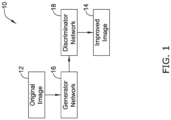
- FIG. 1 is a schematic block diagram showing an illustrative system 10 for improving an image, such as an original image 12, to convert the original image 12 into an improved image 14.
- the system 10 includes a generator network 16 and a discriminator network 18.
- the generator network 16 may be a Generative Adversarial Network (GAN), but this is not required.
- GAN Generative Adversarial Network
- the generator network 16 may be configured to process a reference image such as the original image 12 to provide an enhanced image.
- processing a reference image includes a number of steps, including applying a first pre-processing to the reference image, resulting in a first pre-processed reference image data, and applying a plurality of first layers of residual blocks to the first pre-processed reference image data to extract features from the first pre-processed reference image data.
- the generator network 16 may be further configured to apply a first post-processing to an output of the plurality of first layers of residual blocks, resulting in a first post processed reference image data, and to apply one or more conversion layers such as one of a night vision conversion layer and an air pollution conversion layer, to the first post processed reference image data, resulting in a converted first post processed reference image data.
- the generator network 16 may be configured to apply a night vision conversion layer that is configured to enhance low lighting pixels in the first post processed reference image data.
- the night vision conversion layer may be configured to invert the first post processed reference image data, resulting in an inverted image data, apply non-linear corrections to the inverted image data, resulting in a corrected inverted image data, and invert the corrected inverted image data.
- the generator network 16 may be configured to apply an air pollution conversion layer that is configured to remove haze from the first post processed reference image data. It is contemplated that the haze may be caused by, for example, one or more atmospheric conditions such as air pollution, smoke, fog, rain, snow and/or other condition.
- the air pollution conversion layer may be configured to receive one or more air pollution parameters from one or more pollution sensors, determine an air pollution index based at least in part on the one or more air pollution parameters, and use to the air pollution index in defining a constraint in removing haze from the first post processed reference image data.
- the generator network 16 may be configured to apply a plurality of second layers of residual blocks to the converted first post processed reference image data to extract features from the converted first post processed reference image data, and to apply a second post-processing to an output of the plurality of second layers of residual blocks, resulting in an enhanced image.
- the second post-processing may include upscaling the output of the plurality of second layers of residual blocks.
- Applying the night vision conversion layer and/or the air pollution conversion layer before upscaling the image may help reduce the processing power needed to perform the night vision conversion layer and/or the air pollution conversion. Also, applying the plurality of second layers of residual blocks after applying the night vision conversion layer and/or the air pollution conversion layer may help identify features that are enhanced by the night vision conversion layer and/or the air pollution conversion.
- the generator network 16 may include artificial intelligence, and the generator network 16 may be trained using a set of training images.
- the set of training images may include a set of night vision training images and/or a set of air pollution training images.
- the discriminator network 18 is configured to process the enhanced image and the reference image as inputs to determine whether at least a threshold dissimilarity between the enhanced image and the reference image can be identified. When the discriminator network 18 identifies at least the threshold dissimilarity between the enhanced image and the reference image, the discriminator network rejects the enhanced image. When the discriminator network 18 does not identify at least the threshold dissimilarity between the enhanced image and the reference image, the discriminator network 18 accepts the enhanced image and provides the accepted enhanced image as the improved image 14. In some cases, the discriminator network 18 may be configured to determine a content loss in the enhanced image relative to the reference image, and the threshold dissimilarity may correspond to a threshold content loss. In some cases, the discriminator network 18 includes artificial intelligence, and the discriminator network 18 may be trained using a set of training images.
- FIG 2 is a schematic block diagram of an illustrative generator network 20.
- the illustrative generator network 20 may be considered as being an example of the generator network 16 shown in Figure 1 .
- the illustrative generator network 20 includes a first residual blocks 22 that may include any number of individual residual blocks.
- the generator network 20 also includes a conversion layer 24 that is configured to receive an output from the first residual blocks 22.
- the conversion layer 24 may include a night vision conversion layer that is configured to improve an image that was taken under poor lighting conditions, for example.
- the conversion layer 24 may include an air pollution conversion layer that is configured to improve an image that was taken during high air pollution, heavy fog, heavy rain, snow, or dust storm conditions, for example. These are just example conversion layers.
- the conversion layer 24 outputs to a second residual blocks 26 that may include any number of residual blocks.
- the second residual blocks 26 output to an upscale block 28.
- the upscale block 28 may include several blocks, with each block including layers such as a convolutional layer, a first pixel shuffler layer, a second pixel shuffler layer, and a Parametric Rectified Linear Activation Function (PReLU) layer.
- PReLU Parametric Rectified Linear Activation Function
- the first residual blocks 22 include a neural network (e.g. a Generative Adversarial Network (GAN)) with one or more activation maps, and when the discriminator network 18 identifies at least the threshold dissimilarity between the enhanced image and the reference image, the discriminator network 18 notifies the generator network 16, and in response, the generator network 16 modifies one or more of the activation maps of the plurality of first layers of residual blocks.
- the second residual blocks 26 include a neural network (e.g.
- GAN Generative Adversarial Network
- Figure 3 is a schematic block diagram of a set 30 of residual blocks.
- the set 30 of residual blocks may be considered as representing the first residual blocks 22 or the second residual blocks 26, for example.
- a first instance of set 30 of residual blocks represents the first residual block
- a second instance of set 30 of residual blocks represents the second residual block.
- the set 30 of residual blocks includes a number of residual blocks 32, individually labeled as 32a, 32b, 32c, 32d, 32e, 32f, 32g and 32h.
- the set 30 of residual blocks may include less than eight blocks 32, or may include nine or more blocks 32.
- each of the blocks 32 may include the same layers.
- Figure 4 is a schematic block diagram of one of the residual blocks 32 that may be considered as representing a block within the first residual blocks 22 and/or the second residual blocks 26.
- each of the blocks within the first residual blocks 22 is identical to each of the blocks within the second residual blocks 26.
- the block 32 includes a convolutional layer 34, a batch normalization layer 36, a Parametric Rectified Linear Activation Function (PReLU) layer 38, a convolutional layer 40, a batch normalization layer 42 and an elementwise sum layer 44.
- PReLU Parametric Rectified Linear Activation Function
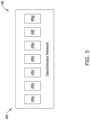
- FIG. 5 is a schematic block diagram of an illustrative discriminator network 46.
- the illustrative discriminator network 46 may be considered as being an example of the discriminator network 18, for example, and may be a neural network that is trained to differentiate between the enhanced images and the corresponding reference images.
- the discriminator network 46 may include any number of blocks 48, individually labeled as 48a, 48b, 48c, 48d, 48e, 48f and 48g. In some cases, the discriminator network 46 may include six or fewer blocks 48. In some cases, the discriminator network 46 may include eight or more blocks 48.
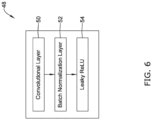
- Figure 6 is a schematic block diagram of one of the blocks 48 of Figure 5 .
- the block 48 includes a convolutional layer 50, a batch normalization layer 52 and a Leaky ReLU layer 54.
- Each of the blocks 48 within the illustrative discriminator network 46 may include the same layers.
- FIG. 7 is a flow diagram showing an illustrative method 56 for enhancing a reference image.
- the method 56 includes processing the reference image via a generator network (such as the generator network 16 or the generator network 20) to provide an enhanced image, as indicated at block 58.
- the enhanced image and the reference image are processed via a discriminator network (such as the discriminator network 18 or the discriminator network 46) to determine whether the discriminator network identifies at least a threshold dissimilarity between the enhanced image and the reference image, as referenced at block 60.
- the discriminator network identifies at least the threshold dissimilarity between the enhanced image and the reference image, the enhanced image is rejected, as indicated at block 62.
- the discriminator network When the discriminator network does not identify at least the threshold dissimilarity between the enhanced image and the reference image, the enhanced image is accepted, as indicated at block 64.
- the method 56 may further include determining a content loss in the enhanced image relative to the reference image, and the threshold dissimilarity may at least in part correspond to a threshold content loss, as indicated at block 66.
- the generator network may include artificial intelligence
- the method 56 may include training the generator network using a set of training images.
- the set of training images may include a set of night vision training images and/or a set of air pollution training images, for example.
- the discriminator network may include artificial intelligence, and the method 56 may include training the discriminator network using a set of training images.
- FIG 8 is a flow diagram showing an illustrative method 58 of processing the reference image via the generator network (such as the generator network 16 or the generator network 20), providing greater detail regarding the block 58 shown in Figure 7 .
- processing the reference image via the generator network includes applying a first pre-processing to the reference image, resulting in a first pre-processed reference image data, as indicated at block 68.
- First pre-processing may include applying a convolution layer and a Parametric Rectified Linear Activation Function (PReLU) layer 38.
- PReLU Parametric Rectified Linear Activation Function
- a plurality of first layers of residual blocks are applied to the first pre-processed reference image data to extract features from the first pre-processed reference image data, as indicated at block 70.
- each of the plurality of first layers of residual blocks include a first convolutional layer, a first batch normalization layer, a Parametric Rectified Linear Activation Function (PReLU), a second convolutional layer, a second batch normalization layer, and an elementwise sum layer.
- a first post-processing is applied to an output of the plurality of first layers of residual blocks, resulting in a first post processed reference image data, as indicated at block 72.
- First post-processing may include applying a convolutional layer, a batch normalization layer and an elementwise sum layer.
- One of a night vision conversion layer and an air pollution conversion layer are then applied to the first post processed reference image data, resulting in a converted first post processed reference image data, as indicated at block 74.
- the night vision conversion layer when applied, may be configured to enhance low lighting pixels in the first post processed reference image data.
- the night vision conversion layer may, for example, be configured to invert the first post processed reference image data, resulting in an inverted image data, apply non-linear corrections to the inverted image data, resulting in a corrected inverted image data, and invert the corrected inverted image data.
- the air pollution conversion layer when applied, may be configured to remove haze from the first post processed reference image data.
- the air pollution conversion layer may, in some cases, be configured to receive one or more air pollution parameters from one or more pollution sensors, determine an air pollution index based at least in part on the one or more air pollution parameters, and use to the air pollution index in defining one or more constraints in removing haze from the first post processed reference image data.
- a plurality of second layers of residual blocks are applied to the converted first post processed reference image data to extract features from the converted first post processed reference image data, as indicated at block 76.
- a second post-processing is applied to an output of the plurality of second layers of residual blocks.
- Second post-processing may include applying a convolutional layer, a batch normalization layer and an elementwise sum layer. The second post-processing resulting in the enhanced image.
- the second post-processing includes upscaling, as indicated at block 78.
- each of the plurality of second layers of residual blocks include a first convolutional layer, a first batch normalization layer, a Parametric Rectified Linear Activation Function (PReLU), a second convolutional layer, a second batch normalization layer, and an elementwise sum layer.
- PReLU Parametric Rectified Linear Activation Function
- the plurality of first layers of residual blocks may include a neural network with one or more activation maps, and when the discriminator network identifies at least the threshold dissimilarity between the enhanced image and the reference image, the discriminator network notifies the generator network, and in response, the generator network modifies one or more of the activation maps of the plurality of first layers of residual blocks.
- the plurality of second layers of residual blocks may include a neural network with one or more activation maps, and when the discriminator network identifies at least the threshold dissimilarity between the enhanced image and the reference image, the discriminator network notifies the generator network, and in response, the generator network modifies one or more of the activation maps of the plurality of second layers of residual blocks.
- Figure 9 is a flow diagram showing an illustrative series of steps 80 that may be carried out by one or more processors that are executing executable instructions stored on a non-transient, computer-readable storage medium.
- the one or more processors may be caused to process a reference image via a generator network (such as the generator network 16 or the generator network 20) to provide an enhanced image, as indicated at block 82.
- this may include extracting features from at least part of the reference image, resulting in a first set of reference image data, as indicated at block 82a.
- This may further include applying at least one of a night vision conversion layer and an air pollution conversion layer to at least part of the first set of reference image data, resulting in a second set of reference image data, as indicated at block 82b.
- Features may be extracted from at least part of the second set of reference image data, as indicated at block 82c.
- An enhanced image may be produced based at least in part on the second set of reference image data, as indicated at block 82d.
- the one or more processors may be caused to process the enhanced image and the reference image via a discriminator network (such as the discriminator network 18 or the discriminator network 46) to determine whether the discriminator network identifies at least a threshold dissimilarity between the enhanced image and the reference image.
- the one or more processors may be caused to determine a content loss in the enhanced image relative to the reference image, wherein the threshold dissimilarity corresponds at least in part to a threshold content loss.
- the generator network may include a neural network with one or more activation maps, and when the discriminator network identifies at least the threshold dissimilarity between the enhanced image and the reference image, the instructions cause the one or more processors to have the discriminator network notify the generator network, and in response, the generator network modifies one or more of the activation maps of the generator network.
- the generator network may include artificial intelligence, and wherein the instructions cause the one or more processors to train the generator network using a set of training images.
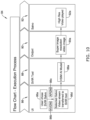
- FIG. 10 is a flow diagram showing an illustrative method 84 for processing video images.
- the method 84 is divided into sections based on where the individual steps are carried out, including a UI (user interface) section 86, an SVIR (super video image resolution) section 88, an Output section 90 and a Salvo section 92, with process flow flowing left to right as indicated.
- UI user interface
- SVIR super video image resolution
- a Salvo section 92 with process flow flowing left to right as indicated.
- a user chooses to utilize the SVIR tool, as indicated at block 86a.
- the user is able to select between NVI2NI (Night Vision Image to Normal Image) at block 86b, or API2NI (Air Pollution Image to Normal Image) at block 86c.
- NVI2NI Near Vision Image to Normal Image
- API2NI Air Pollution Image to Normal Image
- a VSIM AI (artificial intelligence) model is used, as indicated at block 88a.
- a Super Image Resolution Video Image is created within block 90a of the Output section 90.
- the Salvo section 92 the resulting high resolution video is played, as indicated at block 92a.
- FIG 11 is a schematic block diagram of an illustrative architecture 94 for processing night vision images.
- the illustrative architecture 94 includes a generator 96 that may be considered as an example of the generator network 16 or the generator network 20.
- the generator 96 includes an Input Frame 98 and a CNN (Convolution Neural Network) with Residual Blocks 100.
- Output from the CNN with Residual Blocks 100 passes to a Night Vision Algorithm 102.
- the Night Vision Algorithm 102 includes a CNN Layer 102a that is configured to filter dark features and a CNN Layer 102b that is configured to filter dark features.
- Output from the Night Vision Algorithm 102 passes to a CNN with Residual Blocks 104 and then to a CNN with Upscaling Block 106. Output from the CNN with Upscaling Block 106 is now a high resolution image 108.
- the high resolution image 108 passes to a discriminator 110 that may be considered as an example of the discriminator network 18 or the discriminator network 46.
- the discriminator 110 includes an HR Input Image Frame 112 and a CNN Layers block 114. Output form the discriminator 110 is a super high resolution image 116.
- FIG 12 is a schematic block diagram of an illustrative architecture 118 for processing air pollution images.
- the illustrative architecture 118 includes a generator 120 that may be considered as an example of the generator network 16 or the generator network 20.
- the generator 96 includes an Input Frame 122 and a CNN (Convolution Neural Network) with Residual Blocks 124. Output from the CNN with Residual Blocks 124 passes to a Pollution Converter Algorithm 126.
- the Pollution Converter Algorithm 126 includes a CNN Layer 126a that is configured to filter with respect to color map features and a CNN Layer 126b that is configured to filter with respect to color map features.
- Output from the Pollution Converter Algorithm 126 passes to a CNN with Residual Blocks 128 and then to a CNN with Upscaling Block 130. Output from the CNN with Upscaling Block 130 is now a high resolution image 132.
- the high resolution image 132 passes to a discriminator 134 that may be considered as an example of the discriminator network 18 or the discriminator network 46.
- the discriminator 134 includes an HR Input Image Frame 136 and a CNN Layers block 138. Output form the discriminator 134 is a super high resolution image 140.
Landscapes
- Engineering & Computer Science (AREA)
- Theoretical Computer Science (AREA)
- Physics & Mathematics (AREA)
- General Physics & Mathematics (AREA)
- Evolutionary Computation (AREA)
- General Health & Medical Sciences (AREA)
- Artificial Intelligence (AREA)
- Software Systems (AREA)
- Computing Systems (AREA)
- Health & Medical Sciences (AREA)
- Data Mining & Analysis (AREA)
- Biomedical Technology (AREA)
- Computational Linguistics (AREA)
- Molecular Biology (AREA)
- Biophysics (AREA)
- General Engineering & Computer Science (AREA)
- Mathematical Physics (AREA)
- Life Sciences & Earth Sciences (AREA)
- Multimedia (AREA)
- Computer Vision & Pattern Recognition (AREA)
- Databases & Information Systems (AREA)
- Medical Informatics (AREA)
- Image Analysis (AREA)
- Image Processing (AREA)
Abstract
Description
- The present disclosure pertains generally to video processing and more particularly to video processing for enhancing poor quality video frames.
- Video cameras are widely used for monitoring an area of interest. In some cases, the video frames provided by at least some of the video cameras may be of poor quality due to a variety of reasons. For example, poor lighting may make it difficult to easily see objects or other details within the video frames, particularly if the video frames are captured at night or under other low lighting conditions. Atmospheric conditions such as air pollution, smoke, fog, heavy rain or even snow can also affect the quality of video frames. A need remains for improved systems and methods for improving the quality of video frames produced under sub-optimal conditions such as poor lighting and poor atmospheric conditions.
- This disclosure relates generally to systems and methods for improving the quality of video frames produced under sub-optimal conditions such as poor lighting and poor atmospheric conditions. An example may be found in a method for enhancing a reference image. The method includes processing the reference image via a generator network to provide an enhanced image by applying a first pre-processing to the reference image, resulting in a first pre-processed reference image data, and applying a plurality of first layers of residual blocks to the first pre-processed reference image data to extract features from the first pre-processed reference image data. Processing the reference image via the generator network further includes applying a first post-processing to an output of the plurality of first layers of residual blocks, resulting in a first post processed reference image data, and applying one of a night vision conversion layer and an air pollution conversion layer to the first post processed reference image data, resulting in a converted first post processed reference image data. Processing the reference image via the generator network further includes applying a plurality of second layers of residual blocks to the converted first post processed reference image data to extract features from the converted first post processed reference image data and applying a second post-processing to an output of the plurality of second layers of residual blocks, the second post-processing comprising upscaling the output of the plurality of second layers of residual blocks, resulting in the enhanced image.
- The illustrative method further includes processing the enhanced image and the reference image as inputs to a discriminator network, wherein the discriminator network attempts to identify at least a threshold dissimilarity between the enhanced image and the reference image. When the discriminator network identifies at least the threshold dissimilarity between the enhanced image and the reference image, the enhanced image is rejected. When the discriminator network does not identify at least the threshold dissimilarity between the enhanced image and the reference image, the enhanced image is accepted.
- Another example may be found in a non-transient computer readable medium that stores instructions. When the instructions are executed by one or more processors, the one or more processors are caused to process a reference image via a generator network to provide an enhanced image, which includes extracting features from at least part of the reference image, resulting in a first set of reference image data, and applying at least one of a night vision conversion layer and an air pollution conversion layer to at least part of the first set of reference image data, resulting in a second set of reference image data. The one or more processors are further caused to extract features from at least part of the second set of reference image data, and to produce an enhanced image based at least in part on the second set of reference image data.
- Another example may be found in a system for enhancing a reference image. The system includes a generator network for processing the reference image. The generator network is configured to extract features from at least part of the reference image, resulting in a first set of reference image data, apply at least one of a night vision conversion layer and an air pollution conversion layer to at least part of the first set of reference image data, resulting in a second set of reference image data, extract features from at least part of the second set of reference image data, and produce an enhanced image based at least in part on the second set of reference image data.
- The preceding summary is provided to facilitate an understanding of some of the features of the present disclosure and is not intended to be a full description. A full appreciation of the disclosure can be gained by taking the entire specification, claims, drawings, and abstract as a whole.
- The disclosure may be more completely understood in consideration of the following description of various illustrative embodiments of the disclosure in connection with the accompanying drawings, in which:
-
Figure 1 is a schematic block diagram of an illustrative system for enhancing a reference image; -
Figure 2 is a schematic block diagram of a portion of the illustrative system ofFigure 1 ; -
Figure 3 is a schematic block diagram of a portion ofFigure 2 ; -
Figure 4 is a schematic block diagram of a portion ofFigure 3 ; -
Figure 5 is a schematic block diagram of a portion of the illustrative system ofFigure 1 ; -
Figure 6 is a schematic block diagram of a portion ofFigure 5 ; -
Figure 7 is a flow diagram showing an illustrative method for enhancing a reference image; -
Figure 8 is a flow diagram showing an illustrative method for processing a reference image via a generator network; -
Figure 9 is a flow diagram showing an illustrative series of steps that may be carried out via one or more processors when the one or more processors execute a set of instructions; -
Figure 10 is a flow diagram showing an illustrative method; -
Figure 11 is a schematic block diagram of an illustrative architecture for processing night vision images; and -
Figure 12 is a schematic block diagram of an illustrative architecture for processing air pollution images. - While the disclosure is amenable to various modifications and alternative forms, specifics thereof have been shown by way of example in the drawings and will be described in detail. It should be understood, however, that the intention is not to limit aspects of the disclosure to the particular illustrative embodiments described. On the contrary, the intention is to cover all modifications, equivalents, and alternatives falling within the spirit and scope of the disclosure.
- The following description should be read with reference to the drawings wherein like reference numerals indicate like elements. The drawings, which are not necessarily to scale, are not intended to limit the scope of the disclosure. In some of the figures, elements not believed necessary to an understanding of relationships among illustrated components may have been omitted for clarity.
- All numbers are herein assumed to be modified by the term "about", unless the content clearly dictates otherwise. The recitation of numerical ranges by endpoints includes all numbers subsumed within that range (e.g., 1 to 5 includes 1, 1.5, 2, 2.75, 3, 3.80, 4, and 5).
- As used in this specification and the appended claims, the singular forms "a", "an", and "the" include the plural referents unless the content clearly dictates otherwise. As used in this specification and the appended claims, the term "or" is generally employed in its sense including "and/or" unless the content clearly dictates otherwise.
- It is noted that references in the specification to "an embodiment", "some embodiments", "other embodiments", etc., indicate that the embodiment described may include a particular feature, structure, or characteristic, but every embodiment may not necessarily include the particular feature, structure, or characteristic. Moreover, such phrases are not necessarily referring to the same embodiment. Further, when a particular feature, structure, or characteristic is described in connection with an embodiment, it is contemplated that the feature, structure, or characteristic may be applied to other embodiments whether or not explicitly described unless clearly stated to the contrary.
-
Figure 1 is a schematic block diagram showing anillustrative system 10 for improving an image, such as anoriginal image 12, to convert theoriginal image 12 into an improvedimage 14. Thesystem 10 includes agenerator network 16 and adiscriminator network 18. Thegenerator network 16 may be a Generative Adversarial Network (GAN), but this is not required. Thegenerator network 16 may be configured to process a reference image such as theoriginal image 12 to provide an enhanced image. In some instances, processing a reference image includes a number of steps, including applying a first pre-processing to the reference image, resulting in a first pre-processed reference image data, and applying a plurality of first layers of residual blocks to the first pre-processed reference image data to extract features from the first pre-processed reference image data. Thegenerator network 16 may be further configured to apply a first post-processing to an output of the plurality of first layers of residual blocks, resulting in a first post processed reference image data, and to apply one or more conversion layers such as one of a night vision conversion layer and an air pollution conversion layer, to the first post processed reference image data, resulting in a converted first post processed reference image data. - In some cases, the
generator network 16 may be configured to apply a night vision conversion layer that is configured to enhance low lighting pixels in the first post processed reference image data. The night vision conversion layer may be configured to invert the first post processed reference image data, resulting in an inverted image data, apply non-linear corrections to the inverted image data, resulting in a corrected inverted image data, and invert the corrected inverted image data. In some cases, thegenerator network 16 may be configured to apply an air pollution conversion layer that is configured to remove haze from the first post processed reference image data. It is contemplated that the haze may be caused by, for example, one or more atmospheric conditions such as air pollution, smoke, fog, rain, snow and/or other condition. In some cases, the air pollution conversion layer may be configured to receive one or more air pollution parameters from one or more pollution sensors, determine an air pollution index based at least in part on the one or more air pollution parameters, and use to the air pollution index in defining a constraint in removing haze from the first post processed reference image data. - The
generator network 16 may be configured to apply a plurality of second layers of residual blocks to the converted first post processed reference image data to extract features from the converted first post processed reference image data, and to apply a second post-processing to an output of the plurality of second layers of residual blocks, resulting in an enhanced image. The second post-processing may include upscaling the output of the plurality of second layers of residual blocks. - Applying the night vision conversion layer and/or the air pollution conversion layer before upscaling the image may help reduce the processing power needed to perform the night vision conversion layer and/or the air pollution conversion. Also, applying the plurality of second layers of residual blocks after applying the night vision conversion layer and/or the air pollution conversion layer may help identify features that are enhanced by the night vision conversion layer and/or the air pollution conversion.
- In some instances, the
generator network 16 may include artificial intelligence, and thegenerator network 16 may be trained using a set of training images. As an example, the set of training images may include a set of night vision training images and/or a set of air pollution training images. - The
discriminator network 18 is configured to process the enhanced image and the reference image as inputs to determine whether at least a threshold dissimilarity between the enhanced image and the reference image can be identified. When thediscriminator network 18 identifies at least the threshold dissimilarity between the enhanced image and the reference image, the discriminator network rejects the enhanced image. When thediscriminator network 18 does not identify at least the threshold dissimilarity between the enhanced image and the reference image, thediscriminator network 18 accepts the enhanced image and provides the accepted enhanced image as theimproved image 14. In some cases, thediscriminator network 18 may be configured to determine a content loss in the enhanced image relative to the reference image, and the threshold dissimilarity may correspond to a threshold content loss. In some cases, thediscriminator network 18 includes artificial intelligence, and thediscriminator network 18 may be trained using a set of training images. -
Figure 2 is a schematic block diagram of anillustrative generator network 20. Theillustrative generator network 20 may be considered as being an example of thegenerator network 16 shown inFigure 1 . Theillustrative generator network 20 includes a firstresidual blocks 22 that may include any number of individual residual blocks. Thegenerator network 20 also includes aconversion layer 24 that is configured to receive an output from the firstresidual blocks 22. Theconversion layer 24 may include a night vision conversion layer that is configured to improve an image that was taken under poor lighting conditions, for example. Theconversion layer 24 may include an air pollution conversion layer that is configured to improve an image that was taken during high air pollution, heavy fog, heavy rain, snow, or dust storm conditions, for example. These are just example conversion layers. - The
conversion layer 24 outputs to a secondresidual blocks 26 that may include any number of residual blocks. The secondresidual blocks 26 output to anupscale block 28. Theupscale block 28 may include several blocks, with each block including layers such as a convolutional layer, a first pixel shuffler layer, a second pixel shuffler layer, and a Parametric Rectified Linear Activation Function (PReLU) layer. - In some cases, the first
residual blocks 22 include a neural network (e.g. a Generative Adversarial Network (GAN)) with one or more activation maps, and when thediscriminator network 18 identifies at least the threshold dissimilarity between the enhanced image and the reference image, thediscriminator network 18 notifies thegenerator network 16, and in response, thegenerator network 16 modifies one or more of the activation maps of the plurality of first layers of residual blocks. In some cases, the secondresidual blocks 26 include a neural network (e.g. a Generative Adversarial Network (GAN)) with one or more activation maps, and when thediscriminator network 18 identifies at least the threshold dissimilarity between the enhanced image and the reference image, thediscriminator network 18 notifies thegenerator network 16, and in response, thegenerator network 16 modifies one or more of the activation maps of the plurality of second layers of residual blocks. -
Figure 3 is a schematic block diagram of aset 30 of residual blocks. Theset 30 of residual blocks may be considered as representing the firstresidual blocks 22 or the secondresidual blocks 26, for example. In some cases, a first instance ofset 30 of residual blocks represents the first residual block, and a second instance ofset 30 of residual blocks represents the second residual block. Theset 30 of residual blocks includes a number ofresidual blocks 32, individually labeled as 32a, 32b, 32c, 32d, 32e, 32f, 32g and 32h. In some cases, theset 30 of residual blocks may include less than eightblocks 32, or may include nine or more blocks 32. In some cases, each of theblocks 32 may include the same layers. -
Figure 4 is a schematic block diagram of one of theresidual blocks 32 that may be considered as representing a block within the firstresidual blocks 22 and/or the secondresidual blocks 26. In some cases, each of the blocks within the firstresidual blocks 22 is identical to each of the blocks within the secondresidual blocks 26. In the example shown, theblock 32 includes aconvolutional layer 34, abatch normalization layer 36, a Parametric Rectified Linear Activation Function (PReLU)layer 38, aconvolutional layer 40, abatch normalization layer 42 and anelementwise sum layer 44. -
Figure 5 is a schematic block diagram of anillustrative discriminator network 46. Theillustrative discriminator network 46 may be considered as being an example of thediscriminator network 18, for example, and may be a neural network that is trained to differentiate between the enhanced images and the corresponding reference images. Thediscriminator network 46 may include any number ofblocks 48, individually labeled as 48a, 48b, 48c, 48d, 48e, 48f and 48g. In some cases, thediscriminator network 46 may include six orfewer blocks 48. In some cases, thediscriminator network 46 may include eight or more blocks 48. -
Figure 6 is a schematic block diagram of one of theblocks 48 ofFigure 5 . In this example, theblock 48 includes aconvolutional layer 50, abatch normalization layer 52 and aLeaky ReLU layer 54. Each of theblocks 48 within theillustrative discriminator network 46 may include the same layers. -
Figure 7 is a flow diagram showing anillustrative method 56 for enhancing a reference image. Themethod 56 includes processing the reference image via a generator network (such as thegenerator network 16 or the generator network 20) to provide an enhanced image, as indicated atblock 58. The enhanced image and the reference image are processed via a discriminator network (such as thediscriminator network 18 or the discriminator network 46) to determine whether the discriminator network identifies at least a threshold dissimilarity between the enhanced image and the reference image, as referenced atblock 60. When the discriminator network identifies at least the threshold dissimilarity between the enhanced image and the reference image, the enhanced image is rejected, as indicated atblock 62. When the discriminator network does not identify at least the threshold dissimilarity between the enhanced image and the reference image, the enhanced image is accepted, as indicated atblock 64. In some cases, themethod 56 may further include determining a content loss in the enhanced image relative to the reference image, and the threshold dissimilarity may at least in part correspond to a threshold content loss, as indicated atblock 66. - In some instances, the generator network may include artificial intelligence, and the
method 56 may include training the generator network using a set of training images. The set of training images may include a set of night vision training images and/or a set of air pollution training images, for example. In some instances, the discriminator network may include artificial intelligence, and themethod 56 may include training the discriminator network using a set of training images. -
Figure 8 is a flow diagram showing anillustrative method 58 of processing the reference image via the generator network (such as thegenerator network 16 or the generator network 20), providing greater detail regarding theblock 58 shown inFigure 7 . In this example, processing the reference image via the generator network includes applying a first pre-processing to the reference image, resulting in a first pre-processed reference image data, as indicated atblock 68. First pre-processing may include applying a convolution layer and a Parametric Rectified Linear Activation Function (PReLU)layer 38. A plurality of first layers of residual blocks are applied to the first pre-processed reference image data to extract features from the first pre-processed reference image data, as indicated atblock 70. In some instances, each of the plurality of first layers of residual blocks include a first convolutional layer, a first batch normalization layer, a Parametric Rectified Linear Activation Function (PReLU), a second convolutional layer, a second batch normalization layer, and an elementwise sum layer. A first post-processing is applied to an output of the plurality of first layers of residual blocks, resulting in a first post processed reference image data, as indicated atblock 72. First post-processing may include applying a convolutional layer, a batch normalization layer and an elementwise sum layer. - One of a night vision conversion layer and an air pollution conversion layer are then applied to the first post processed reference image data, resulting in a converted first post processed reference image data, as indicated at
block 74. In some instances, the night vision conversion layer, when applied, may be configured to enhance low lighting pixels in the first post processed reference image data. The night vision conversion layer may, for example, be configured to invert the first post processed reference image data, resulting in an inverted image data, apply non-linear corrections to the inverted image data, resulting in a corrected inverted image data, and invert the corrected inverted image data. The air pollution conversion layer, when applied, may be configured to remove haze from the first post processed reference image data. The air pollution conversion layer may, in some cases, be configured to receive one or more air pollution parameters from one or more pollution sensors, determine an air pollution index based at least in part on the one or more air pollution parameters, and use to the air pollution index in defining one or more constraints in removing haze from the first post processed reference image data. - In the example shown, a plurality of second layers of residual blocks are applied to the converted first post processed reference image data to extract features from the converted first post processed reference image data, as indicated at
block 76. A second post-processing is applied to an output of the plurality of second layers of residual blocks. Second post-processing may include applying a convolutional layer, a batch normalization layer and an elementwise sum layer. The second post-processing resulting in the enhanced image. In some cases, the second post-processing includes upscaling, as indicated atblock 78. In some cases, each of the plurality of second layers of residual blocks include a first convolutional layer, a first batch normalization layer, a Parametric Rectified Linear Activation Function (PReLU), a second convolutional layer, a second batch normalization layer, and an elementwise sum layer. - In some instances, the plurality of first layers of residual blocks may include a neural network with one or more activation maps, and when the discriminator network identifies at least the threshold dissimilarity between the enhanced image and the reference image, the discriminator network notifies the generator network, and in response, the generator network modifies one or more of the activation maps of the plurality of first layers of residual blocks. In some cases, the plurality of second layers of residual blocks may include a neural network with one or more activation maps, and when the discriminator network identifies at least the threshold dissimilarity between the enhanced image and the reference image, the discriminator network notifies the generator network, and in response, the generator network modifies one or more of the activation maps of the plurality of second layers of residual blocks.
-
Figure 9 is a flow diagram showing an illustrative series ofsteps 80 that may be carried out by one or more processors that are executing executable instructions stored on a non-transient, computer-readable storage medium. The one or more processors may be caused to process a reference image via a generator network (such as thegenerator network 16 or the generator network 20) to provide an enhanced image, as indicated atblock 82. In some cases, this may include extracting features from at least part of the reference image, resulting in a first set of reference image data, as indicated atblock 82a. This may further include applying at least one of a night vision conversion layer and an air pollution conversion layer to at least part of the first set of reference image data, resulting in a second set of reference image data, as indicated atblock 82b. Features may be extracted from at least part of the second set of reference image data, as indicated atblock 82c. An enhanced image may be produced based at least in part on the second set of reference image data, as indicated atblock 82d. - In some instances, the one or more processors may be caused to process the enhanced image and the reference image via a discriminator network (such as the
discriminator network 18 or the discriminator network 46) to determine whether the discriminator network identifies at least a threshold dissimilarity between the enhanced image and the reference image. In some instances, the one or more processors may be caused to determine a content loss in the enhanced image relative to the reference image, wherein the threshold dissimilarity corresponds at least in part to a threshold content loss. - In some cases, the generator network may include a neural network with one or more activation maps, and when the discriminator network identifies at least the threshold dissimilarity between the enhanced image and the reference image, the instructions cause the one or more processors to have the discriminator network notify the generator network, and in response, the generator network modifies one or more of the activation maps of the generator network. The generator network may include artificial intelligence, and wherein the instructions cause the one or more processors to train the generator network using a set of training images.
-
Figure 10 is a flow diagram showing anillustrative method 84 for processing video images. Themethod 84 is divided into sections based on where the individual steps are carried out, including a UI (user interface)section 86, an SVIR (super video image resolution)section 88, anOutput section 90 and aSalvo section 92, with process flow flowing left to right as indicated. In theUI section 86, a user chooses to utilize the SVIR tool, as indicated atblock 86a. The user is able to select between NVI2NI (Night Vision Image to Normal Image) atblock 86b, or API2NI (Air Pollution Image to Normal Image) atblock 86c. Next, the selected video is transferred to the SVIR tool, as indicated atblock 86d. In theSCIR section 88, a VSIM AI (artificial intelligence) model is used, as indicated atblock 88a. A Super Image Resolution Video Image is created withinblock 90a of theOutput section 90. In theSalvo section 92, the resulting high resolution video is played, as indicated atblock 92a. -
Figure 11 is a schematic block diagram of anillustrative architecture 94 for processing night vision images. Theillustrative architecture 94 includes agenerator 96 that may be considered as an example of thegenerator network 16 or thegenerator network 20. Thegenerator 96 includes anInput Frame 98 and a CNN (Convolution Neural Network) withResidual Blocks 100. Output from the CNN withResidual Blocks 100 passes to aNight Vision Algorithm 102. In some cases, theNight Vision Algorithm 102 includes aCNN Layer 102a that is configured to filter dark features and aCNN Layer 102b that is configured to filter dark features. Output from theNight Vision Algorithm 102 passes to a CNN withResidual Blocks 104 and then to a CNN withUpscaling Block 106. Output from the CNN withUpscaling Block 106 is now ahigh resolution image 108. Thehigh resolution image 108 passes to adiscriminator 110 that may be considered as an example of thediscriminator network 18 or thediscriminator network 46. Thediscriminator 110 includes an HRInput Image Frame 112 and a CNN Layersblock 114. Output form thediscriminator 110 is a superhigh resolution image 116. -
Figure 12 is a schematic block diagram of anillustrative architecture 118 for processing air pollution images. Theillustrative architecture 118 includes agenerator 120 that may be considered as an example of thegenerator network 16 or thegenerator network 20. Thegenerator 96 includes anInput Frame 122 and a CNN (Convolution Neural Network) withResidual Blocks 124. Output from the CNN withResidual Blocks 124 passes to aPollution Converter Algorithm 126. In some cases, thePollution Converter Algorithm 126 includes aCNN Layer 126a that is configured to filter with respect to color map features and aCNN Layer 126b that is configured to filter with respect to color map features. Output from thePollution Converter Algorithm 126 passes to a CNN withResidual Blocks 128 and then to a CNN withUpscaling Block 130. Output from the CNN withUpscaling Block 130 is now ahigh resolution image 132. Thehigh resolution image 132 passes to adiscriminator 134 that may be considered as an example of thediscriminator network 18 or thediscriminator network 46. Thediscriminator 134 includes an HRInput Image Frame 136 and a CNN Layersblock 138. Output form thediscriminator 134 is a superhigh resolution image 140. - Those skilled in the art will recognize that the present disclosure may be manifested in a variety of forms other than the specific embodiments described and contemplated herein. Accordingly, departure in form and detail may be made without departing from the scope and spirit of the present disclosure as described in the appended claims.
Claims (15)
- A method for enhancing a reference image, the method comprising:processing the reference image via a generator network to provide an enhanced image, wherein processing the reference image via the generator network comprises:applying a first pre-processing to the reference image, resulting in a first pre-processed reference image data;applying a plurality of first layers of residual blocks to the first pre-processed reference image data to extract features from the first pre-processed reference image data;applying a first post-processing to an output of the plurality of first layers of residual blocks, resulting in a first post processed reference image data;applying one of a night vision conversion layer and an air pollution conversion layer to the first post processed reference image data, resulting in a converted first post processed reference image data;applying a plurality of second layers of residual blocks to the converted first post processed reference image data to extract features from the converted first post processed reference image data;applying a second post-processing to an output of the plurality of second layers of residual blocks, the second post-processing comprising upscaling the output of the plurality of second layers of residual blocks, resulting in the enhanced image;processing the enhanced image and the reference image via a discriminator network to determine whether the discriminator network identifies at least a threshold dissimilarity between the enhanced image and the reference image;when the discriminator network identifies at least the threshold dissimilarity between the enhanced image and the reference image, rejecting the enhanced image; andwhen the discriminator network does not identify at least the threshold dissimilarity between the enhanced image and the reference image, accepting the enhanced image.
- The method of claim 1, wherein each of the plurality of first layers of residual blocks comprises:applying a first convolutional layer;applying a first batch normalization layer;apply a Parametric Rectified Linear Activation Function (PReLU);applying a second convolutional layer;applying a second batch normalization layer; andapplying an elementwise sum layer.
- The method of claim 1, wherein the night vision conversion layer is configured to enhance low lighting pixels in the first post processed reference image data.
- The method of claim 3, wherein the night vision conversion layer is configured to:invert the first post processed reference image data, resulting in an inverted image data;apply non-linear corrections to the inverted image data, resulting in a corrected inverted image data; andinvert the corrected inverted image data.
- The method of claim 1, wherein the air pollution conversion layer is configured to remove haze from the first post processed reference image data.
- The method of claim 5, wherein the air pollution conversion layer is configured to:receive one or more air pollution parameters from a pollution sensor;determine an air pollution index based at least in part on the one or more air pollution parameters; anduse to the air pollution index in defining a constraint in removing haze from the first post processed reference image data.
- The method of claim 1, further comprising:determining a content loss in the enhanced image relative to the reference image; andwherein the threshold dissimilarity corresponds to a threshold content loss.
- The method of claim 1, wherein the plurality of first layers of residual blocks comprise a neural network with one or more activation maps, and when the discriminator network identifies at least the threshold dissimilarity between the enhanced image and the reference image, the discriminator network notifies the generator network, and in response, the generator network modifies one or more of the activation maps of the plurality of first layers of residual blocks.
- The method of claim 1, wherein the plurality of second layers of residual blocks comprise a neural network with one or more activation maps, and when the discriminator network identifies at least the threshold dissimilarity between the enhanced image and the reference image, the discriminator network notifies the generator network, and in response, the generator network modifies one or more of the activation maps of the plurality of second layers of residual blocks.
- The method of claim 1, wherein the generator network comprises artificial intelligence, and wherein the method includes training the generator network using a set of training images.
- The method of claim 10, wherein the set of training images includes a set of night vision training images and/or a set of air pollution training images.
- The method of claim 1, wherein the discriminator network comprises artificial intelligence, and wherein the method includes training the discriminator network using a set of training images.
- A system for enhancing a reference image, the system comprising:
a generator network for processing the reference image, the generator network configured to:extract features from at least part of the reference image, resulting in a first set of reference image data;apply at least one of a night vision conversion layer and an air pollution conversion layer to at least part of the first set of reference image data, resulting in a second set of reference image data;extract features from at least part of the second set of reference image data; andproduce an enhanced image based at least in part on the second set of reference image data. - The system of claim 13, further comprising:
a discriminator network configured to process the enhanced image and the reference image to determine whether there is at least a threshold dissimilarity between the enhanced image and the reference image. - The system of claim 14, wherein the generator network comprises a neural network with one or more activation maps, and when the discriminator network identifies at least the threshold dissimilarity between the enhanced image and the reference image, the discriminator network is configured to notify the generator network, and in response, the generator network modifies one or more of the activation maps of the generator network.
Applications Claiming Priority (1)
| Application Number | Priority Date | Filing Date | Title |
|---|---|---|---|
| US17/743,138 US12315110B2 (en) | 2022-05-12 | 2022-05-12 | Using integrated system to enhance a reference image |
Publications (2)
| Publication Number | Publication Date |
|---|---|
| EP4276736A1 true EP4276736A1 (en) | 2023-11-15 |
| EP4276736B1 EP4276736B1 (en) | 2026-03-18 |
Family
ID=86271968
Family Applications (1)
| Application Number | Title | Priority Date | Filing Date |
|---|---|---|---|
| EP23170354.7A Active EP4276736B1 (en) | 2022-05-12 | 2023-04-27 | Using integrated system to enhance a reference image |
Country Status (3)
| Country | Link |
|---|---|
| US (1) | US12315110B2 (en) |
| EP (1) | EP4276736B1 (en) |
| CN (1) | CN117058609A (en) |
Families Citing this family (1)
| Publication number | Priority date | Publication date | Assignee | Title |
|---|---|---|---|---|
| KR20240076570A (en) * | 2022-11-22 | 2024-05-30 | 삼성전자주식회사 | Apparatus and method for upscaling resolution of an image |
Citations (2)
| Publication number | Priority date | Publication date | Assignee | Title |
|---|---|---|---|---|
| CN110503610A (en) * | 2019-07-16 | 2019-11-26 | 江苏大学 | A kind of image sleet trace minimizing technology based on GAN network |
| WO2021035629A1 (en) * | 2019-08-29 | 2021-03-04 | 深圳市大疆创新科技有限公司 | Method for acquiring image quality enhancement network, image quality enhancement method and apparatus, mobile platform, camera, and storage medium |
Family Cites Families (6)
| Publication number | Priority date | Publication date | Assignee | Title |
|---|---|---|---|---|
| US7308154B1 (en) * | 2003-10-20 | 2007-12-11 | Rockwell Collins, Inc. | Method and apparatus for enhancing a degraded digital image |
| WO2020227179A1 (en) * | 2019-05-03 | 2020-11-12 | Amazon Technologies, Inc. | Video enhancement using a neural network |
| US11521011B2 (en) * | 2019-06-06 | 2022-12-06 | Samsung Electronics Co., Ltd. | Method and apparatus for training neural network model for enhancing image detail |
| US12136189B2 (en) * | 2021-02-10 | 2024-11-05 | Adobe Inc. | Media enhancement using discriminative and generative models with feedback |
| US20220261958A1 (en) * | 2021-02-17 | 2022-08-18 | Qualcomm Incorporated | Generating super resolution images using non-color information with a deep-learning neural network |
| CN113807497B (en) * | 2021-09-02 | 2023-09-15 | 电子科技大学 | An unpaired image translation method that enhances texture details |
-
2022
- 2022-05-12 US US17/743,138 patent/US12315110B2/en active Active
-
2023
- 2023-04-21 CN CN202310435223.XA patent/CN117058609A/en active Pending
- 2023-04-27 EP EP23170354.7A patent/EP4276736B1/en active Active
Patent Citations (2)
| Publication number | Priority date | Publication date | Assignee | Title |
|---|---|---|---|---|
| CN110503610A (en) * | 2019-07-16 | 2019-11-26 | 江苏大学 | A kind of image sleet trace minimizing technology based on GAN network |
| WO2021035629A1 (en) * | 2019-08-29 | 2021-03-04 | 深圳市大疆创新科技有限公司 | Method for acquiring image quality enhancement network, image quality enhancement method and apparatus, mobile platform, camera, and storage medium |
Non-Patent Citations (2)
| Title |
|---|
| KIM GUISIK ET AL: "Deep Illumination-Aware Dehazing With Low-Light and Detail Enhancement", IEEE TRANSACTIONS ON INTELLIGENT TRANSPORTATION SYSTEMS, IEEE, PISCATAWAY, NJ, USA, vol. 23, no. 3, 12 October 2021 (2021-10-12), pages 2494 - 2508, XP011902524, ISSN: 1524-9050, [retrieved on 20220309], DOI: 10.1109/TITS.2021.3117868 * |
| MALAV RAMAVTAR ET AL: "DHSGAN: An End to End Dehazing Network for Fog and Smoke", 26 May 2019, ADVANCES IN DATABASES AND INFORMATION SYSTEMS; [LECTURE NOTES IN COMPUTER SCIENCE; LECT.NOTES COMPUTER], SPRINGER INTERNATIONAL PUBLISHING, CHAM, PAGE(S) 593 - 608, ISBN: 978-3-319-10403-4, XP047508288 * |
Also Published As
| Publication number | Publication date |
|---|---|
| US20230368336A1 (en) | 2023-11-16 |
| CN117058609A (en) | 2023-11-14 |
| US12315110B2 (en) | 2025-05-27 |
| EP4276736B1 (en) | 2026-03-18 |
Similar Documents
| Publication | Publication Date | Title |
|---|---|---|
| CN108304813B (en) | A method for intelligently identifying the status of circular traffic lights | |
| CN116188307B (en) | A joint method and system for low-light image enhancement and semantic segmentation applicable throughout the day | |
| CN201788344U (en) | System for detecting and processing red-eye defects in digital images and embedded image acquisition and processing system | |
| CN109753913B (en) | Computationally Efficient Multimodal Video Semantic Segmentation Method | |
| CN112766195A (en) | Electrified railway bow net arcing visual detection method | |
| CN116757988B (en) | Infrared and visible light image fusion method based on semantic enrichment and segmentation tasks | |
| CN115527096A (en) | A small target detection method based on improved YOLOv5 | |
| CN117078591B (en) | Real-time road defect detection method, system, equipment and storage medium | |
| CN118967550B (en) | Lightweight insulator defect detection method based on improved YOLOv network | |
| CN113869433A (en) | A deep learning method for rapid detection and classification of concrete damage | |
| CN114821452B (en) | Colored drawing train number identification method, system and medium | |
| CN116704476A (en) | A Traffic Sign Detection Method Based on Improved Yolov4-tiny Algorithm | |
| EP4276736B1 (en) | Using integrated system to enhance a reference image | |
| CN114821510A (en) | Lane line detection method and device based on improved U-Net network | |
| CN107358803A (en) | A kind of traffic signal control system and its control method | |
| CN110097110A (en) | A kind of semantic image restorative procedure based on objective optimization | |
| CN112446292A (en) | 2D image salient target detection method and system | |
| CN120953839A (en) | AI-based vision-based drone intelligent inspection system and switch cabinet inspection | |
| CN113657183A (en) | Vehicle 24 color identification method under smooth neural network based on multilayer characteristics | |
| CN114241344A (en) | A deep learning-based method for assessing the severity of plant leaf diseases and insect pests | |
| CN119649355A (en) | A license plate detection and license plate recognition method and system | |
| CN109886900B (en) | A Synthetic Rain Map Rain Removal Method Based on Dictionary Training and Sparse Representation | |
| CN119313959A (en) | Railway fastener abnormality detection method, device, medium and product | |
| CN119068182A (en) | Salient object detection method based on hybrid feature superposition and cross attention | |
| CN116452482B (en) | Infrared and visible light image fusion method and system based on primary and secondary feature separation |
Legal Events
| Date | Code | Title | Description |
|---|---|---|---|
| PUAI | Public reference made under article 153(3) epc to a published international application that has entered the european phase |
Free format text: ORIGINAL CODE: 0009012 |
|
| STAA | Information on the status of an ep patent application or granted ep patent |
Free format text: STATUS: REQUEST FOR EXAMINATION WAS MADE |
|
| 17P | Request for examination filed |
Effective date: 20230427 |
|
| AK | Designated contracting states |
Kind code of ref document: A1 Designated state(s): AL AT BE BG CH CY CZ DE DK EE ES FI FR GB GR HR HU IE IS IT LI LT LU LV MC ME MK MT NL NO PL PT RO RS SE SI SK SM TR |
|
| REG | Reference to a national code |
Ref country code: DE Ref legal event code: R079 Ipc: G06T0005600000 Ref country code: DE Ref legal event code: R079 Ref document number: 602023013577 Country of ref document: DE Free format text: PREVIOUS MAIN CLASS: G06T0005000000 Ipc: G06T0005600000 |
|
| GRAP | Despatch of communication of intention to grant a patent |
Free format text: ORIGINAL CODE: EPIDOSNIGR1 |
|
| STAA | Information on the status of an ep patent application or granted ep patent |
Free format text: STATUS: GRANT OF PATENT IS INTENDED |
|
| RIC1 | Information provided on ipc code assigned before grant |
Ipc: G06T 5/60 20240101AFI20251015BHEP Ipc: G06T 5/92 20240101ALI20251015BHEP |
|
| INTG | Intention to grant announced |
Effective date: 20251023 |
|
| GRAS | Grant fee paid |
Free format text: ORIGINAL CODE: EPIDOSNIGR3 |
|
| GRAA | (expected) grant |
Free format text: ORIGINAL CODE: 0009210 |
|
| STAA | Information on the status of an ep patent application or granted ep patent |
Free format text: STATUS: THE PATENT HAS BEEN GRANTED |
|
| AK | Designated contracting states |
Kind code of ref document: B1 Designated state(s): AL AT BE BG CH CY CZ DE DK EE ES FI FR GB GR HR HU IE IS IT LI LT LU LV MC ME MK MT NL NO PL PT RO RS SE SI SK SM TR |
|
| REG | Reference to a national code |
Ref country code: CH Ref legal event code: F10 Free format text: ST27 STATUS EVENT CODE: U-0-0-F10-F00 (AS PROVIDED BY THE NATIONAL OFFICE) Effective date: 20260318 Ref country code: GB Ref legal event code: FG4D |
|
| REG | Reference to a national code |
Ref country code: IE Ref legal event code: FG4D |
|
| REG | Reference to a national code |
Ref country code: DE Ref legal event code: R096 Ref document number: 602023013577 Country of ref document: DE |