EP4274012A2 - Power storage device - Google Patents
Power storage device Download PDFInfo
- Publication number
- EP4274012A2 EP4274012A2 EP23161814.1A EP23161814A EP4274012A2 EP 4274012 A2 EP4274012 A2 EP 4274012A2 EP 23161814 A EP23161814 A EP 23161814A EP 4274012 A2 EP4274012 A2 EP 4274012A2
- Authority
- EP
- European Patent Office
- Prior art keywords
- housing
- insulating sheet
- stack
- power storage
- storage device
- Prior art date
- Legal status (The legal status is an assumption and is not a legal conclusion. Google has not performed a legal analysis and makes no representation as to the accuracy of the status listed.)
- Pending
Links
- 238000003860 storage Methods 0.000 title claims abstract description 31
- 230000002093 peripheral effect Effects 0.000 claims description 19
- 239000000463 material Substances 0.000 claims description 12
- 239000008151 electrolyte solution Substances 0.000 claims description 10
- 238000005452 bending Methods 0.000 claims description 6
- 239000007788 liquid Substances 0.000 description 22
- 238000003466 welding Methods 0.000 description 11
- 239000011347 resin Substances 0.000 description 10
- 229920005989 resin Polymers 0.000 description 10
- 238000009413 insulation Methods 0.000 description 8
- 230000007547 defect Effects 0.000 description 5
- 238000004519 manufacturing process Methods 0.000 description 5
- 239000000853 adhesive Substances 0.000 description 3
- 230000001070 adhesive effect Effects 0.000 description 3
- 239000011248 coating agent Substances 0.000 description 3
- 238000000576 coating method Methods 0.000 description 3
- 238000000034 method Methods 0.000 description 3
- -1 nickel metal hydride Chemical class 0.000 description 3
- 229910000838 Al alloy Inorganic materials 0.000 description 1
- HBBGRARXTFLTSG-UHFFFAOYSA-N Lithium ion Chemical compound [Li+] HBBGRARXTFLTSG-UHFFFAOYSA-N 0.000 description 1
- 239000004952 Polyamide Substances 0.000 description 1
- 239000004743 Polypropylene Substances 0.000 description 1
- 238000003763 carbonization Methods 0.000 description 1
- 238000009833 condensation Methods 0.000 description 1
- 230000005494 condensation Effects 0.000 description 1
- 239000004020 conductor Substances 0.000 description 1
- IEJIGPNLZYLLBP-UHFFFAOYSA-N dimethyl carbonate Chemical compound COC(=O)OC IEJIGPNLZYLLBP-UHFFFAOYSA-N 0.000 description 1
- 230000000694 effects Effects 0.000 description 1
- 239000012777 electrically insulating material Substances 0.000 description 1
- 239000000446 fuel Substances 0.000 description 1
- 239000011796 hollow space material Substances 0.000 description 1
- 238000005304 joining Methods 0.000 description 1
- 229910001416 lithium ion Inorganic materials 0.000 description 1
- 229910052987 metal hydride Inorganic materials 0.000 description 1
- 239000007769 metal material Substances 0.000 description 1
- 238000012986 modification Methods 0.000 description 1
- 230000004048 modification Effects 0.000 description 1
- 229910052759 nickel Inorganic materials 0.000 description 1
- PXHVJJICTQNCMI-UHFFFAOYSA-N nickel Substances [Ni] PXHVJJICTQNCMI-UHFFFAOYSA-N 0.000 description 1
- 229920002647 polyamide Polymers 0.000 description 1
- 229920001155 polypropylene Polymers 0.000 description 1
- 229920001343 polytetrafluoroethylene Polymers 0.000 description 1
- 239000004810 polytetrafluoroethylene Substances 0.000 description 1
- 239000002904 solvent Substances 0.000 description 1
- 238000004804 winding Methods 0.000 description 1
Images

Classifications
-
- H—ELECTRICITY
- H01—ELECTRIC ELEMENTS
- H01M—PROCESSES OR MEANS, e.g. BATTERIES, FOR THE DIRECT CONVERSION OF CHEMICAL ENERGY INTO ELECTRICAL ENERGY
- H01M50/00—Constructional details or processes of manufacture of the non-active parts of electrochemical cells other than fuel cells, e.g. hybrid cells
- H01M50/50—Current conducting connections for cells or batteries
- H01M50/502—Interconnectors for connecting terminals of adjacent batteries; Interconnectors for connecting cells outside a battery casing
- H01M50/514—Methods for interconnecting adjacent batteries or cells
- H01M50/516—Methods for interconnecting adjacent batteries or cells by welding, soldering or brazing
-
- H—ELECTRICITY
- H01—ELECTRIC ELEMENTS
- H01M—PROCESSES OR MEANS, e.g. BATTERIES, FOR THE DIRECT CONVERSION OF CHEMICAL ENERGY INTO ELECTRICAL ENERGY
- H01M50/00—Constructional details or processes of manufacture of the non-active parts of electrochemical cells other than fuel cells, e.g. hybrid cells
- H01M50/30—Arrangements for facilitating escape of gases
- H01M50/392—Arrangements for facilitating escape of gases with means for neutralising or absorbing electrolyte; with means for preventing leakage of electrolyte through vent holes
-
- H—ELECTRICITY
- H01—ELECTRIC ELEMENTS
- H01M—PROCESSES OR MEANS, e.g. BATTERIES, FOR THE DIRECT CONVERSION OF CHEMICAL ENERGY INTO ELECTRICAL ENERGY
- H01M50/00—Constructional details or processes of manufacture of the non-active parts of electrochemical cells other than fuel cells, e.g. hybrid cells
- H01M50/50—Current conducting connections for cells or batteries
- H01M50/572—Means for preventing undesired use or discharge
- H01M50/584—Means for preventing undesired use or discharge for preventing incorrect connections inside or outside the batteries
- H01M50/59—Means for preventing undesired use or discharge for preventing incorrect connections inside or outside the batteries characterised by the protection means
- H01M50/593—Spacers; Insulating plates
-
- H—ELECTRICITY
- H01—ELECTRIC ELEMENTS
- H01M—PROCESSES OR MEANS, e.g. BATTERIES, FOR THE DIRECT CONVERSION OF CHEMICAL ENERGY INTO ELECTRICAL ENERGY
- H01M50/00—Constructional details or processes of manufacture of the non-active parts of electrochemical cells other than fuel cells, e.g. hybrid cells
- H01M50/10—Primary casings; Jackets or wrappings
- H01M50/102—Primary casings; Jackets or wrappings characterised by their shape or physical structure
- H01M50/103—Primary casings; Jackets or wrappings characterised by their shape or physical structure prismatic or rectangular
-
- H—ELECTRICITY
- H01—ELECTRIC ELEMENTS
- H01M—PROCESSES OR MEANS, e.g. BATTERIES, FOR THE DIRECT CONVERSION OF CHEMICAL ENERGY INTO ELECTRICAL ENERGY
- H01M50/00—Constructional details or processes of manufacture of the non-active parts of electrochemical cells other than fuel cells, e.g. hybrid cells
- H01M50/20—Mountings; Secondary casings or frames; Racks, modules or packs; Suspension devices; Shock absorbers; Transport or carrying devices; Holders
- H01M50/204—Racks, modules or packs for multiple batteries or multiple cells
-
- H—ELECTRICITY
- H01—ELECTRIC ELEMENTS
- H01M—PROCESSES OR MEANS, e.g. BATTERIES, FOR THE DIRECT CONVERSION OF CHEMICAL ENERGY INTO ELECTRICAL ENERGY
- H01M50/00—Constructional details or processes of manufacture of the non-active parts of electrochemical cells other than fuel cells, e.g. hybrid cells
- H01M50/20—Mountings; Secondary casings or frames; Racks, modules or packs; Suspension devices; Shock absorbers; Transport or carrying devices; Holders
- H01M50/204—Racks, modules or packs for multiple batteries or multiple cells
- H01M50/207—Racks, modules or packs for multiple batteries or multiple cells characterised by their shape
- H01M50/209—Racks, modules or packs for multiple batteries or multiple cells characterised by their shape adapted for prismatic or rectangular cells
-
- H—ELECTRICITY
- H01—ELECTRIC ELEMENTS
- H01M—PROCESSES OR MEANS, e.g. BATTERIES, FOR THE DIRECT CONVERSION OF CHEMICAL ENERGY INTO ELECTRICAL ENERGY
- H01M50/00—Constructional details or processes of manufacture of the non-active parts of electrochemical cells other than fuel cells, e.g. hybrid cells
- H01M50/20—Mountings; Secondary casings or frames; Racks, modules or packs; Suspension devices; Shock absorbers; Transport or carrying devices; Holders
- H01M50/204—Racks, modules or packs for multiple batteries or multiple cells
- H01M50/207—Racks, modules or packs for multiple batteries or multiple cells characterised by their shape
- H01M50/211—Racks, modules or packs for multiple batteries or multiple cells characterised by their shape adapted for pouch cells
-
- H—ELECTRICITY
- H01—ELECTRIC ELEMENTS
- H01M—PROCESSES OR MEANS, e.g. BATTERIES, FOR THE DIRECT CONVERSION OF CHEMICAL ENERGY INTO ELECTRICAL ENERGY
- H01M50/00—Constructional details or processes of manufacture of the non-active parts of electrochemical cells other than fuel cells, e.g. hybrid cells
- H01M50/20—Mountings; Secondary casings or frames; Racks, modules or packs; Suspension devices; Shock absorbers; Transport or carrying devices; Holders
- H01M50/218—Mountings; Secondary casings or frames; Racks, modules or packs; Suspension devices; Shock absorbers; Transport or carrying devices; Holders characterised by the material
- H01M50/22—Mountings; Secondary casings or frames; Racks, modules or packs; Suspension devices; Shock absorbers; Transport or carrying devices; Holders characterised by the material of the casings or racks
- H01M50/222—Inorganic material
- H01M50/224—Metals
-
- H—ELECTRICITY
- H01—ELECTRIC ELEMENTS
- H01M—PROCESSES OR MEANS, e.g. BATTERIES, FOR THE DIRECT CONVERSION OF CHEMICAL ENERGY INTO ELECTRICAL ENERGY
- H01M50/00—Constructional details or processes of manufacture of the non-active parts of electrochemical cells other than fuel cells, e.g. hybrid cells
- H01M50/20—Mountings; Secondary casings or frames; Racks, modules or packs; Suspension devices; Shock absorbers; Transport or carrying devices; Holders
- H01M50/218—Mountings; Secondary casings or frames; Racks, modules or packs; Suspension devices; Shock absorbers; Transport or carrying devices; Holders characterised by the material
- H01M50/22—Mountings; Secondary casings or frames; Racks, modules or packs; Suspension devices; Shock absorbers; Transport or carrying devices; Holders characterised by the material of the casings or racks
- H01M50/227—Organic material
-
- H—ELECTRICITY
- H01—ELECTRIC ELEMENTS
- H01M—PROCESSES OR MEANS, e.g. BATTERIES, FOR THE DIRECT CONVERSION OF CHEMICAL ENERGY INTO ELECTRICAL ENERGY
- H01M50/00—Constructional details or processes of manufacture of the non-active parts of electrochemical cells other than fuel cells, e.g. hybrid cells
- H01M50/20—Mountings; Secondary casings or frames; Racks, modules or packs; Suspension devices; Shock absorbers; Transport or carrying devices; Holders
- H01M50/218—Mountings; Secondary casings or frames; Racks, modules or packs; Suspension devices; Shock absorbers; Transport or carrying devices; Holders characterised by the material
- H01M50/22—Mountings; Secondary casings or frames; Racks, modules or packs; Suspension devices; Shock absorbers; Transport or carrying devices; Holders characterised by the material of the casings or racks
- H01M50/231—Mountings; Secondary casings or frames; Racks, modules or packs; Suspension devices; Shock absorbers; Transport or carrying devices; Holders characterised by the material of the casings or racks having a layered structure
-
- H—ELECTRICITY
- H01—ELECTRIC ELEMENTS
- H01M—PROCESSES OR MEANS, e.g. BATTERIES, FOR THE DIRECT CONVERSION OF CHEMICAL ENERGY INTO ELECTRICAL ENERGY
- H01M50/00—Constructional details or processes of manufacture of the non-active parts of electrochemical cells other than fuel cells, e.g. hybrid cells
- H01M50/20—Mountings; Secondary casings or frames; Racks, modules or packs; Suspension devices; Shock absorbers; Transport or carrying devices; Holders
- H01M50/233—Mountings; Secondary casings or frames; Racks, modules or packs; Suspension devices; Shock absorbers; Transport or carrying devices; Holders characterised by physical properties of casings or racks, e.g. dimensions
- H01M50/24—Mountings; Secondary casings or frames; Racks, modules or packs; Suspension devices; Shock absorbers; Transport or carrying devices; Holders characterised by physical properties of casings or racks, e.g. dimensions adapted for protecting batteries from their environment, e.g. from corrosion
-
- H—ELECTRICITY
- H01—ELECTRIC ELEMENTS
- H01M—PROCESSES OR MEANS, e.g. BATTERIES, FOR THE DIRECT CONVERSION OF CHEMICAL ENERGY INTO ELECTRICAL ENERGY
- H01M50/00—Constructional details or processes of manufacture of the non-active parts of electrochemical cells other than fuel cells, e.g. hybrid cells
- H01M50/20—Mountings; Secondary casings or frames; Racks, modules or packs; Suspension devices; Shock absorbers; Transport or carrying devices; Holders
- H01M50/249—Mountings; Secondary casings or frames; Racks, modules or packs; Suspension devices; Shock absorbers; Transport or carrying devices; Holders specially adapted for aircraft or vehicles, e.g. cars or trains
-
- H—ELECTRICITY
- H01—ELECTRIC ELEMENTS
- H01M—PROCESSES OR MEANS, e.g. BATTERIES, FOR THE DIRECT CONVERSION OF CHEMICAL ENERGY INTO ELECTRICAL ENERGY
- H01M50/00—Constructional details or processes of manufacture of the non-active parts of electrochemical cells other than fuel cells, e.g. hybrid cells
- H01M50/20—Mountings; Secondary casings or frames; Racks, modules or packs; Suspension devices; Shock absorbers; Transport or carrying devices; Holders
- H01M50/271—Lids or covers for the racks or secondary casings
- H01M50/273—Lids or covers for the racks or secondary casings characterised by the material
- H01M50/278—Organic material
-
- H—ELECTRICITY
- H01—ELECTRIC ELEMENTS
- H01M—PROCESSES OR MEANS, e.g. BATTERIES, FOR THE DIRECT CONVERSION OF CHEMICAL ENERGY INTO ELECTRICAL ENERGY
- H01M50/00—Constructional details or processes of manufacture of the non-active parts of electrochemical cells other than fuel cells, e.g. hybrid cells
- H01M50/20—Mountings; Secondary casings or frames; Racks, modules or packs; Suspension devices; Shock absorbers; Transport or carrying devices; Holders
- H01M50/271—Lids or covers for the racks or secondary casings
- H01M50/273—Lids or covers for the racks or secondary casings characterised by the material
- H01M50/282—Lids or covers for the racks or secondary casings characterised by the material having a layered structure
-
- H—ELECTRICITY
- H01—ELECTRIC ELEMENTS
- H01M—PROCESSES OR MEANS, e.g. BATTERIES, FOR THE DIRECT CONVERSION OF CHEMICAL ENERGY INTO ELECTRICAL ENERGY
- H01M50/00—Constructional details or processes of manufacture of the non-active parts of electrochemical cells other than fuel cells, e.g. hybrid cells
- H01M50/50—Current conducting connections for cells or batteries
- H01M50/502—Interconnectors for connecting terminals of adjacent batteries; Interconnectors for connecting cells outside a battery casing
-
- H—ELECTRICITY
- H01—ELECTRIC ELEMENTS
- H01M—PROCESSES OR MEANS, e.g. BATTERIES, FOR THE DIRECT CONVERSION OF CHEMICAL ENERGY INTO ELECTRICAL ENERGY
- H01M50/00—Constructional details or processes of manufacture of the non-active parts of electrochemical cells other than fuel cells, e.g. hybrid cells
- H01M50/50—Current conducting connections for cells or batteries
- H01M50/502—Interconnectors for connecting terminals of adjacent batteries; Interconnectors for connecting cells outside a battery casing
- H01M50/503—Interconnectors for connecting terminals of adjacent batteries; Interconnectors for connecting cells outside a battery casing characterised by the shape of the interconnectors
-
- H—ELECTRICITY
- H01—ELECTRIC ELEMENTS
- H01M—PROCESSES OR MEANS, e.g. BATTERIES, FOR THE DIRECT CONVERSION OF CHEMICAL ENERGY INTO ELECTRICAL ENERGY
- H01M50/00—Constructional details or processes of manufacture of the non-active parts of electrochemical cells other than fuel cells, e.g. hybrid cells
- H01M50/50—Current conducting connections for cells or batteries
- H01M50/502—Interconnectors for connecting terminals of adjacent batteries; Interconnectors for connecting cells outside a battery casing
- H01M50/509—Interconnectors for connecting terminals of adjacent batteries; Interconnectors for connecting cells outside a battery casing characterised by the type of connection, e.g. mixed connections
- H01M50/51—Connection only in series
-
- H—ELECTRICITY
- H01—ELECTRIC ELEMENTS
- H01M—PROCESSES OR MEANS, e.g. BATTERIES, FOR THE DIRECT CONVERSION OF CHEMICAL ENERGY INTO ELECTRICAL ENERGY
- H01M2220/00—Batteries for particular applications
- H01M2220/20—Batteries in motive systems, e.g. vehicle, ship, plane
-
- Y—GENERAL TAGGING OF NEW TECHNOLOGICAL DEVELOPMENTS; GENERAL TAGGING OF CROSS-SECTIONAL TECHNOLOGIES SPANNING OVER SEVERAL SECTIONS OF THE IPC; TECHNICAL SUBJECTS COVERED BY FORMER USPC CROSS-REFERENCE ART COLLECTIONS [XRACs] AND DIGESTS
- Y02—TECHNOLOGIES OR APPLICATIONS FOR MITIGATION OR ADAPTATION AGAINST CLIMATE CHANGE
- Y02E—REDUCTION OF GREENHOUSE GAS [GHG] EMISSIONS, RELATED TO ENERGY GENERATION, TRANSMISSION OR DISTRIBUTION
- Y02E60/00—Enabling technologies; Technologies with a potential or indirect contribution to GHG emissions mitigation
- Y02E60/10—Energy storage using batteries
Definitions
- the present disclosure relates to a power storage device.
- JP 2013-229266 A discloses a battery module as a power storage device.
- the battery module includes stacked batteries.
- a housing that surrounds the batteries is made of a pair of end plates and a pair of bus bar modules.
- an electrode tab and the housing may be short-circuited through the electrolytic solution, and the housing may have a potential.
- the housings of the adjacent battery modules constituting a battery assembly have potentials, a circuit may be created and heat may be generated. In addition, workability may deteriorate when handling the housing having a potential.
- the present disclosure proposes a power storage device capable of improving the insulation of a housing that houses battery cells.
- a power storage device includes a stack in which a plurality of battery cells is stacked together, a housing that houses the stack, and an insulating sheet disposed between a ceiling surface of the housing and the stack.
- the ceiling surface includes an exposed area that is not covered with the insulating sheet.
- the insulating sheet includes a projecting portion projecting downward. The projecting portion is disposed between the stack and the exposed area in plan view.
- the projecting portion may have an extending rib shape. As a result, it is possible to surely suppress the conductive liquid from reaching the exposed area.
- the insulating sheet may include a bent portion made by bending a peripheral edge of the insulating sheet, and the bent portion may constitute the projecting portion. In this way, the projecting portion will be easily manufactured. In addition, it is possible to surely provide the projecting portion with a rib shape.
- the stack may include a connecting portion that connects two of the battery cells, and the projecting portion may be disposed between the connecting portion and the exposed area in plan view. Since it is possible to suppress the conductive liquid from falling from the projecting portion to the connecting portion, it is possible to suppress short-circuiting of connecting portions adjacent to each other in a stacking direction of the battery cells.
- the housing may include a side wall constituting a side surface of the housing and a top wall constituting an upper surface of the housing, a lower surface of the top wall may constitute the ceiling surface, and the housing may further include a welded portion where the side wall and the top wall are welded together, and the exposed area may be provided on a peripheral edge portion of the top wall. Since the insulating sheet is not present at the welded portion, welding defects can be suppressed.
- the insulation of the housing that houses the battery cells can be improved.
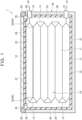
- FIG. 1 is a sectional view showing a schematic configuration of a power storage device 1 according to the embodiment.
- the power storage device 1 is, for example, mounted on a vehicle for use. Examples of the vehicle include hybrid electric vehicles, plug-in hybrid electric vehicles, battery electric vehicles, and fuel cell electric vehicles.
- a battery assembly that is an assembly in which the power storage devices 1 are arranged side by side is mounted on the vehicle.
- the power storage device 1 shown in FIG. 1 includes a stack 10 in which a plurality of battery cells 11 is stacked together in a stacking direction.
- the stacking direction of the battery cells 11 is an up-down direction.
- Each of the battery cells 11 is a secondary battery such as a lithium ion battery or a nickel metal hydride battery.
- An electrode body 12 is housed inside the exterior body of each battery cell 11.
- the electrode body 12 is made, for example, by stacking a positive electrode and a negative electrode with a separator interposed therebetween and then winding them into a cylindrical shape.
- the electrode body is not limited to that of a wound type, and may be of a stacked type.
- the electrode body 12 is immersed in an electrolytic solution.
- the electrolytic solution is sealed inside the exterior body of the battery cell 11.
- the stack 10 includes connecting portions 13 that electrically connect two battery cells 11 adjacent to each other in the stacking direction. When the two battery cells 11 are connected in series, a positive electrode terminal of one of the two battery cells 11 and a negative electrode terminal of the other of the two battery cells 11 are electrically connected.
- the connecting portion 13 is welded to, for example, the positive electrode terminal and the negative electrode terminal.
- the stack 10 includes a pair of general terminals 14, 14.
- One of the general terminals 14 is a positive electrode-side output terminal of the stack 10 and the other of the general terminals 14 is a negative electrode-side output terminal of the stack 10.
- the battery cells 11 provided with the general terminals 14 are arranged furthest apart in the stacking direction.
- the general terminals 14 are arranged so as to pass through a housing 20.
- Gaskets 15 are provided to locations where the general terminals 14 pass through the housing 20. The gaskets 15 electrically insulate the general terminals 14 from the housing 20, and seal through holes made in the housing 20 for the general terminals 14 to pass through, thereby obstructing entry of external moisture to the housing 20.
- the power storage device 1 includes the housing 20 that houses the stack 10.
- the housing 20 includes a bottom wall 21, side walls 22, and a top wall 23.
- the bottom wall 21, the side walls 22, and the top wall 23 are made of a conductive material.
- the bottom wall 21, the side walls 22, and the top wall 23 are made of, for example, a metal material as represented by an aluminum alloy.
- the bottom wall 21 is disposed below the stack 10.
- the bottom wall 21 constitutes a lower surface of the housing 20.
- the side walls 22 cover the stack 10 from the sides.
- the side walls 22 constitute side surfaces of the housing 20.
- the side walls 22 include inner wall surfaces 26.
- the inner wall surfaces 26 face the internal space of the housing 20.
- the inner wall surfaces 26 face the stack 10.
- the bottom wall 21 and the side walls 22 are made integrally.
- a housing case that opens upward is made by the bottom wall 21 and the side walls 22.
- the stack 10 is housed in the housing case.
- the top wall 23 is disposed above the stack 10.
- the top wall 23 constitutes an upper surface of the housing 20.
- the top wall 23 is made as a cover that closes the opening of the housing case made by the bottom wall 21 and the side walls 22.
- the top wall 23 covers the stack 10 from above.
- a lower surface of the top wall 23 constitutes a ceiling surface 24 of the housing 20.
- the ceiling surface 24 faces the internal space of the housing 20.
- the ceiling surface 24 faces downward.
- the ceiling surface 24 faces the stack 10.
- FIG. 2 is an enlarged perspective view showing the vicinity of one of the welded portions 25 shown in FIG. 1 .
- FIG. 2 shows the vicinity of a joint portion between one of the side walls 22 and the top wall 23 of the housing 20 that is vertically inverted.
- the stack 10 is not shown in FIG. 2 for simplification.
- the welded portion 25 extends along the upper edge of the side wall 22 and extends along the peripheral edge of the top wall 23.
- the power storage device 1 further includes insulating sheets 31, 32.
- the insulating sheets 31, 32 are interposed between the stack 10 and inner surfaces of the housing 20 to electrically insulate the stack 10 from the housing 20.
- the insulating sheets 31, 32 are made of an electrically insulating material as represented by a resin material.
- the insulating sheets 31, 32 are made of an electrolytic-solution-resistant material, such as polypropylene, polyamide, and polytetrafluoroethylene.
- the insulating sheets 31, 32 are made of a material that is chemically stable against a solvent used in the electrolytic solution, such as dimethyl carbonate.
- the insulating sheet 31 is disposed between the ceiling surface 24 of the housing 20 and the stack 10.
- the insulating sheet 31 partially covers the ceiling surface 24 of the housing 20.
- the insulating sheet 32 covers a floor surface of the housing 20 and partially covers the inner wall surfaces 26 of the housing 20.
- the insulating sheets 31, 32 may be made by attaching a sheet-shaped resin material to the inner surfaces of the housing 20 with an adhesive.
- the insulating sheets 31, 32 may be made by coating the inner surfaces of the housing 20 with a resin material.
- the ceiling surface 24 includes exposed areas 35 that are not covered with the insulating sheet 31.
- the inner wall surfaces 26 include exposed areas 36 that are not covered with the insulating sheet 32.
- the exposed areas 35 are provided on peripheral edge portions of the top wall 23.
- the exposed areas 36 are provided on upper edge portions of the side walls 22. As shown in FIG. 2 , the exposed area 35 is provided along the peripheral edge of the top wall 23, and the exposed area 36 is provided along the upper edge of the side wall 22.
- the welded portion 25 that joins the upper edge of the side wall 22 and the peripheral edge of the top wall 23 is not covered with the insulating sheet 31 and is not covered with the insulating sheet 32.
- the insulating sheet 31 includes projecting portions 34 projecting downward. As shown in FIG. 2 , the projecting portion 34 has a rib shape extending along the peripheral edge of the top wall 23. The projecting portions 34 are arranged between the stack 10 of the battery cells 11 and the exposed areas 35 in plan view. The projecting portions 34 are arranged between the connecting portions 13 and the exposed areas 35 in plan view. The projecting portions 34 are arranged between the stack 10 of the battery cells 11 and the welded portions 25. The projecting portions 34 are arranged between the connecting portions 13 and the welded portions 25.
- the insulating sheet 31 includes bent portions 33 made by bending peripheral edges of the insulating sheet 31 downward, and the projecting portions 34 are made up of the bent portions 33.
- the bent portions 33 are bent with respect to the ceiling surface 24 with a planar shape.
- the bent portions 33 are bent perpendicularly with respect to the ceiling surface 24.
- the power storage device 1 of the embodiment described above includes the insulating sheet 31 as shown in FIG. 1 .
- the insulating sheet 31 is disposed between the stack 10 of the battery cells 11 and the ceiling surface 24 of the housing 20 that houses the stack 10.
- the ceiling surface 24 of the housing 20 includes the exposed areas 35 that are not covered with the insulating sheet 31.
- the insulating sheet 31 includes projecting portions 34 projecting downward. The projecting portions 34 are arranged between the stack 10 and the exposed areas 35 in plan view.
- the ceiling surface 24 is covered with the insulating sheet 31, and the floor surface and the inner wall surfaces 26 are covered with the insulating sheet 32.
- the stack 10 of the battery cells 11 and the housing 20 can be electrically insulated by the insulating sheets 31, 32 in an appropriate manner. Conductive liquid such as the electrolytic solution leaking from the battery cell 11 and moisture entering from the outside may be present in the housing 20. Even in this case, short-circuiting between the connecting portion 13 that connects the battery cells 11 and the housing 20 through the liquid is suppressed.
- the resin material attached to the inner surfaces of the housing 20 may obtain conductivity by carbonization due to welding heat and the insulation may deteriorate. Further, the resin may be dissolved and vaporized gas may be caught during welding to cause defects, such as perforation in a welded portion.
- the exposed areas 35 on which the insulating sheet 31 is not made are provided on the peripheral edge portions of the top wall 23, the exposed areas 36 on which the insulating sheet 32 is not made are provided on the upper edge portions of the side walls 22, and there is no resin material at the welded portions 25. As a result, even when the side walls 22 and the top wall 23 are joined by welding, the occurrence of welding defects can be suppressed.
- the projecting portions 34 are arranged between the stack 10 of the battery cells 11 and the exposed areas 35 in which the inner surface of the housing 20 are not covered with the insulating sheet 31. Even if a conductive liquid such as an electrolytic solution flows along the insulating sheet 31 toward the exposed areas 35, the liquid is guided by the projecting portion 34 and falls downward when the liquid reaches the projecting portion 34. When the conductive liquid reaches the exposed area 35, the connecting portion 13 and the housing 20 may be short-circuited and the housing 20 may have a potential. However, the projecting portion 34 suppresses the liquid from reaching the exposed area 35. Therefore, short-circuiting of the connecting portion 13 and the housing 20 can be suppressed. Accordingly, the insulation of the housing 20 that houses the battery cells 11 can be improved.
- the projecting portion 34 may have an extending rib shape.
- the projecting portion 34 with a rib shape functions as a weir that keeps back the conductive liquid flowing along the insulating sheet 31 toward the exposed area 35. As a result, it is possible to surely suppress the conductive liquid from reaching the exposed area 35.
- the insulating sheet 31 may include the bent portion 33 in which the peripheral edge of the insulating sheet 31 is bent, and the projecting portion 34 may be made up by the bent portion 33. In this way, the projecting portion 34 will be easily manufactured. In addition, it is possible to surely provide the projecting portion 34 with a rib shape.
- the stack 10 may include the connecting portions 13 that connect the two battery cells 11, and the projecting portions 34 may be arranged between the connecting portions 13 and the exposed areas 35 in plan view.
- the projecting portions 34 By arranging the projecting portions 34 in this way, it is possible to suppress the conductive liquid from falling from the projecting portion 34 to the connecting portion 13, and to suppress short-circuiting of the connecting portions 13 adj acent to each other in the stacking direction of the battery cells 11.
- the housing 20 may include the welded portions 25 in which the side walls 22 constituting the side surfaces of the housing 20 and the top wall 23 constituting the upper surface of the housing 20 are welded together, and may be provided with the exposed areas 35 on the peripheral edge portions of the top wall 23.
- a configuration in which the insulating sheet 31 is not present at the welded portions 25 is realized, thereby welding defects can be more surely suppressed.
- the battery cell 11 is not limited to a liquid battery in which an electrolytic solution is sealed inside. Even when the battery cell 11 is an all-solid-state battery, the conductive liquid may be present inside the housing 20, due to dew condensation inside the housing 20 or unintentional entry of moisture from the outside. Even in this case, by arranging the projecting portions 34 between the battery cell 11 and the exposed areas 35, it is possible to suppress the conductive liquid from reaching the exposed areas 35, thereby improving the insulation of the housing 20.
- the stacking direction of the battery cells 11 in the stack 10 is not limited to the up-down direction.
- the insulating sheet 31 of the embodiment may be applied to the ceiling surface 24 of the housing 20 that houses the stack 10 in which the battery cells 11 are stacked in a horizontal direction.
- the projecting portion 34 is not limited to the example in which the projecting portion 34 is made by bending the peripheral edge of the insulating sheet 31.
- the projecting shape can guide the liquid to fall downward.
- the projecting portion 34 need not have a rib shape.
- columnar projecting portions 34 may be arranged with intervals along the peripheral edge of the insulating sheet 31.
- FIG. 3 is a flowchart showing the method for manufacturing the power storage device 1.
- step S1 the housing case is made.
- a box-shaped housing case with one side opened can be made.
- the insulating sheet 32 is made on the inner surfaces of the housing case.
- the insulating sheet 32 may be made by attaching a sheet-shaped resin material to the inner surfaces of the housing case with an adhesive, or the insulating sheet 32 may be made by coating the inner surfaces of the housing case with a resin material. In edge portions of the opening of the housing case, the exposed areas 36 in which the inner surfaces of the housing case are not covered with the insulating sheet 32 are made.
- step S3 A plate-shaped member that constitutes the top wall 23 shown in FIG. 1 is prepared.
- the insulating sheet 31 is made on a surface of the cover that constitutes the ceiling surface 24.
- the insulating sheet 31 may be made by attaching a sheet-shaped resin material to the surface of the cover with an adhesive, or the insulating sheet 31 may be made by coating the surface of the cover with a resin material.
- the bent portions 33 are made by bending the peripheral edges of the insulating sheet 31 that has been made.
- the exposed areas 35 that are not covered with the insulating sheet 31 are made on peripheral edge portions of the cover. By bending the insulating sheet 31 to make the projecting portions 34, positioning of the projecting portions 34 with respect to the cover can be easily performed.
- step S5 the battery cells 11 are stacked on the cover disposed so that the surface on which the insulating sheet 31 is made faces upward. Terminals of the two adjacent battery cells 11 are electrically connected to each other at the connecting portion 13, whereby the stack 10 is made.
- step S6 the stack 10 of the battery cells 11 is covered with the housing case.
- step S7 the opening of the housing case is sealed by welding the cover to the housing case, whereby the housing 20 is made.
- the general terminals 14 are arranged so as to pass through the side walls 22 of the housing 20 and to be pulled out to the outside, and the gaskets 15 are provided around the general terminals 14.
- the housing 20 is vertically inverted, and the manufacturing of the power storage device 1 shown in FIG. 1 is completed.
- the stack 10 it is possible to make the stack 10 by sequentially storing the battery cells 11 inside the housing case. In that case, however, there will be a space between the stack 10 and the inner surfaces of the housing case as a hollow space for a device to pass when the battery cells 11 are moved into the housing case. According to the manufacturing method shown in FIG. 3 in which the battery cells 11 are stacked on the cover to make the stack 10, the space between the stack 10 and the inner surfaces of the housing 20 can be reduced. Therefore, the power storage device 1 can be miniaturized, and the energy density can be improved.
Landscapes
- Chemical & Material Sciences (AREA)
- Chemical Kinetics & Catalysis (AREA)
- Electrochemistry (AREA)
- General Chemical & Material Sciences (AREA)
- Inorganic Chemistry (AREA)
- Engineering & Computer Science (AREA)
- Aviation & Aerospace Engineering (AREA)
- Battery Mounting, Suspending (AREA)
- Connection Of Batteries Or Terminals (AREA)
- Sealing Battery Cases Or Jackets (AREA)
Abstract
Description
- The present disclosure relates to a power storage device.
-
Japanese Unexamined Patent Application Publication No. 2013-229266 JP 2013-229266 A - When an electrolytic solution leaks from the batteries, an electrode tab and the housing may be short-circuited through the electrolytic solution, and the housing may have a potential. When the housings of the adjacent battery modules constituting a battery assembly have potentials, a circuit may be created and heat may be generated. In addition, workability may deteriorate when handling the housing having a potential.
- The present disclosure proposes a power storage device capable of improving the insulation of a housing that houses battery cells.
- According to the present disclosure, a power storage device is proposed that includes a stack in which a plurality of battery cells is stacked together, a housing that houses the stack, and an insulating sheet disposed between a ceiling surface of the housing and the stack. The ceiling surface includes an exposed area that is not covered with the insulating sheet. The insulating sheet includes a projecting portion projecting downward. The projecting portion is disposed between the stack and the exposed area in plan view.
- Even when a conductive liquid in the housing flows along the insulating sheet toward the exposed area, the liquid is guided by the projecting portion and falls downward when the liquid reaches the projecting portion. Since the liquid is suppressed from reaching the exposed area by the projecting portion, it is possible to suppress short-circuiting of the stack and the housing. Accordingly, the insulation of the housing that houses the battery cells can be improved.
- In the power storage device described above, the projecting portion may have an extending rib shape. As a result, it is possible to surely suppress the conductive liquid from reaching the exposed area.
- In the power storage device described above, the insulating sheet may include a bent portion made by bending a peripheral edge of the insulating sheet, and the bent portion may constitute the projecting portion. In this way, the projecting portion will be easily manufactured. In addition, it is possible to surely provide the projecting portion with a rib shape.
- In the power storage device described above, the stack may include a connecting portion that connects two of the battery cells, and the projecting portion may be disposed between the connecting portion and the exposed area in plan view. Since it is possible to suppress the conductive liquid from falling from the projecting portion to the connecting portion, it is possible to suppress short-circuiting of connecting portions adjacent to each other in a stacking direction of the battery cells.
- In the power storage device described above, the housing may include a side wall constituting a side surface of the housing and a top wall constituting an upper surface of the housing, a lower surface of the top wall may constitute the ceiling surface, and the housing may further include a welded portion where the side wall and the top wall are welded together, and the exposed area may be provided on a peripheral edge portion of the top wall. Since the insulating sheet is not present at the welded portion, welding defects can be suppressed.
- With the power storage device of the present disclosure, the insulation of the housing that houses the battery cells can be improved.
- Features, advantages, and technical and industrial significance of exemplary embodiments of the invention will be described below with reference to the accompanying drawings, in which like signs denote like elements, and wherein:
-
FIG. 1 is a sectional view showing a schematic configuration of a power storage device according to an embodiment; -
FIG. 2 is an enlarged perspective view showing the vicinity of a welded portion shown inFIG. 1 ; and -
FIG. 3 is a flowchart showing a method for manufacturing the power storage device. - An embodiment will be described below based on the drawings. In the following description, the same reference signs are given to the same parts. Their names and functions are also the same. Therefore, detailed description of the same parts will not be repeated.
-
FIG. 1 is a sectional view showing a schematic configuration of apower storage device 1 according to the embodiment. Thepower storage device 1 is, for example, mounted on a vehicle for use. Examples of the vehicle include hybrid electric vehicles, plug-in hybrid electric vehicles, battery electric vehicles, and fuel cell electric vehicles. A battery assembly that is an assembly in which thepower storage devices 1 are arranged side by side is mounted on the vehicle. - The
power storage device 1 shown inFIG. 1 includes astack 10 in which a plurality ofbattery cells 11 is stacked together in a stacking direction. The stacking direction of thebattery cells 11 is an up-down direction. Each of thebattery cells 11 is a secondary battery such as a lithium ion battery or a nickel metal hydride battery. Anelectrode body 12 is housed inside the exterior body of eachbattery cell 11. Theelectrode body 12 is made, for example, by stacking a positive electrode and a negative electrode with a separator interposed therebetween and then winding them into a cylindrical shape. The electrode body is not limited to that of a wound type, and may be of a stacked type. Theelectrode body 12 is immersed in an electrolytic solution. The electrolytic solution is sealed inside the exterior body of thebattery cell 11. - The
stack 10 includes connectingportions 13 that electrically connect twobattery cells 11 adjacent to each other in the stacking direction. When the twobattery cells 11 are connected in series, a positive electrode terminal of one of the twobattery cells 11 and a negative electrode terminal of the other of the twobattery cells 11 are electrically connected. The connectingportion 13 is welded to, for example, the positive electrode terminal and the negative electrode terminal. - The
stack 10 includes a pair ofgeneral terminals general terminals 14 is a positive electrode-side output terminal of thestack 10 and the other of thegeneral terminals 14 is a negative electrode-side output terminal of thestack 10. Thebattery cells 11 provided with thegeneral terminals 14 are arranged furthest apart in the stacking direction. Thegeneral terminals 14 are arranged so as to pass through ahousing 20.Gaskets 15 are provided to locations where thegeneral terminals 14 pass through thehousing 20. Thegaskets 15 electrically insulate thegeneral terminals 14 from thehousing 20, and seal through holes made in thehousing 20 for thegeneral terminals 14 to pass through, thereby obstructing entry of external moisture to thehousing 20. - The
power storage device 1 includes thehousing 20 that houses thestack 10. Thehousing 20 includes abottom wall 21,side walls 22, and atop wall 23. Thebottom wall 21, theside walls 22, and thetop wall 23 are made of a conductive material. Thebottom wall 21, theside walls 22, and thetop wall 23 are made of, for example, a metal material as represented by an aluminum alloy. - The
bottom wall 21 is disposed below thestack 10. Thebottom wall 21 constitutes a lower surface of thehousing 20. Theside walls 22 cover thestack 10 from the sides. Theside walls 22 constitute side surfaces of thehousing 20. Theside walls 22 include inner wall surfaces 26. The inner wall surfaces 26 face the internal space of thehousing 20. The inner wall surfaces 26 face thestack 10. In thehousing 20 shown inFIG. 1 , thebottom wall 21 and theside walls 22 are made integrally. A housing case that opens upward is made by thebottom wall 21 and theside walls 22. Thestack 10 is housed in the housing case. - The
top wall 23 is disposed above thestack 10. Thetop wall 23 constitutes an upper surface of thehousing 20. Thetop wall 23 is made as a cover that closes the opening of the housing case made by thebottom wall 21 and theside walls 22. Thetop wall 23 covers thestack 10 from above. A lower surface of thetop wall 23 constitutes aceiling surface 24 of thehousing 20. Theceiling surface 24 faces the internal space of thehousing 20. Theceiling surface 24 faces downward. Theceiling surface 24 faces thestack 10. - Upper edges of the
side walls 22 and peripheral edges of thetop wall 23 are joined by welding. Thehousing 20 includes weldedportions 25 where theside walls 22 and thetop wall 23 are welded together. The housing case is sealed by welding thetop wall 23 to the housing case.FIG. 2 is an enlarged perspective view showing the vicinity of one of the weldedportions 25 shown inFIG. 1 .FIG. 2 shows the vicinity of a joint portion between one of theside walls 22 and thetop wall 23 of thehousing 20 that is vertically inverted. Thestack 10 is not shown inFIG. 2 for simplification. The weldedportion 25 extends along the upper edge of theside wall 22 and extends along the peripheral edge of thetop wall 23. - The
power storage device 1 further includes insulatingsheets sheets stack 10 and inner surfaces of thehousing 20 to electrically insulate thestack 10 from thehousing 20. The insulatingsheets sheets sheets - The insulating
sheet 31 is disposed between theceiling surface 24 of thehousing 20 and thestack 10. The insulatingsheet 31 partially covers theceiling surface 24 of thehousing 20. The insulatingsheet 32 covers a floor surface of thehousing 20 and partially covers the inner wall surfaces 26 of thehousing 20. By integrally covering the entire bottom surface of thehousing 20 and the inner wall surfaces 26 with the insulatingsheet 32, the insulation of thehousing 20 is improved. The insulatingsheets housing 20 with an adhesive. The insulatingsheets housing 20 with a resin material. - The
ceiling surface 24 includes exposedareas 35 that are not covered with the insulatingsheet 31. The inner wall surfaces 26 include exposedareas 36 that are not covered with the insulatingsheet 32. Specifically, the exposedareas 35 are provided on peripheral edge portions of thetop wall 23. The exposedareas 36 are provided on upper edge portions of theside walls 22. As shown inFIG. 2 , the exposedarea 35 is provided along the peripheral edge of thetop wall 23, and the exposedarea 36 is provided along the upper edge of theside wall 22. The weldedportion 25 that joins the upper edge of theside wall 22 and the peripheral edge of thetop wall 23 is not covered with the insulatingsheet 31 and is not covered with the insulatingsheet 32. - The insulating
sheet 31 includes projectingportions 34 projecting downward. As shown inFIG. 2 , the projectingportion 34 has a rib shape extending along the peripheral edge of thetop wall 23. The projectingportions 34 are arranged between thestack 10 of thebattery cells 11 and the exposedareas 35 in plan view. The projectingportions 34 are arranged between the connectingportions 13 and the exposedareas 35 in plan view. The projectingportions 34 are arranged between thestack 10 of thebattery cells 11 and the weldedportions 25. The projectingportions 34 are arranged between the connectingportions 13 and the weldedportions 25. - The insulating
sheet 31 includesbent portions 33 made by bending peripheral edges of the insulatingsheet 31 downward, and the projectingportions 34 are made up of thebent portions 33. Thebent portions 33 are bent with respect to theceiling surface 24 with a planar shape. Thebent portions 33 are bent perpendicularly with respect to theceiling surface 24. - The
power storage device 1 of the embodiment described above includes the insulatingsheet 31 as shown inFIG. 1 . The insulatingsheet 31 is disposed between thestack 10 of thebattery cells 11 and theceiling surface 24 of thehousing 20 that houses thestack 10. Theceiling surface 24 of thehousing 20 includes the exposedareas 35 that are not covered with the insulatingsheet 31. The insulatingsheet 31 includes projectingportions 34 projecting downward. The projectingportions 34 are arranged between thestack 10 and the exposedareas 35 in plan view. - In the
housing 20, theceiling surface 24 is covered with the insulatingsheet 31, and the floor surface and the inner wall surfaces 26 are covered with the insulatingsheet 32. Thestack 10 of thebattery cells 11 and thehousing 20 can be electrically insulated by the insulatingsheets battery cell 11 and moisture entering from the outside may be present in thehousing 20. Even in this case, short-circuiting between the connectingportion 13 that connects thebattery cells 11 and thehousing 20 through the liquid is suppressed. - When the
side walls 22 and thetop wall 23 of thehousing 20 are joined by welding, the resin material attached to the inner surfaces of thehousing 20 may obtain conductivity by carbonization due to welding heat and the insulation may deteriorate. Further, the resin may be dissolved and vaporized gas may be caught during welding to cause defects, such as perforation in a welded portion. The exposedareas 35 on which the insulatingsheet 31 is not made are provided on the peripheral edge portions of thetop wall 23, the exposedareas 36 on which the insulatingsheet 32 is not made are provided on the upper edge portions of theside walls 22, and there is no resin material at the weldedportions 25. As a result, even when theside walls 22 and thetop wall 23 are joined by welding, the occurrence of welding defects can be suppressed. - The projecting
portions 34 are arranged between thestack 10 of thebattery cells 11 and the exposedareas 35 in which the inner surface of thehousing 20 are not covered with the insulatingsheet 31. Even if a conductive liquid such as an electrolytic solution flows along the insulatingsheet 31 toward the exposedareas 35, the liquid is guided by the projectingportion 34 and falls downward when the liquid reaches the projectingportion 34. When the conductive liquid reaches the exposedarea 35, the connectingportion 13 and thehousing 20 may be short-circuited and thehousing 20 may have a potential. However, the projectingportion 34 suppresses the liquid from reaching the exposedarea 35. Therefore, short-circuiting of the connectingportion 13 and thehousing 20 can be suppressed. Accordingly, the insulation of thehousing 20 that houses thebattery cells 11 can be improved. - As shown in
FIG. 2 , the projectingportion 34 may have an extending rib shape. The projectingportion 34 with a rib shape functions as a weir that keeps back the conductive liquid flowing along the insulatingsheet 31 toward the exposedarea 35. As a result, it is possible to surely suppress the conductive liquid from reaching the exposedarea 35. - As shown in
FIGS. 1 and2 , the insulatingsheet 31 may include thebent portion 33 in which the peripheral edge of the insulatingsheet 31 is bent, and the projectingportion 34 may be made up by thebent portion 33. In this way, the projectingportion 34 will be easily manufactured. In addition, it is possible to surely provide the projectingportion 34 with a rib shape. - As shown in
FIG. 1 , thestack 10 may include the connectingportions 13 that connect the twobattery cells 11, and the projectingportions 34 may be arranged between the connectingportions 13 and the exposedareas 35 in plan view. By arranging the projectingportions 34 in this way, it is possible to suppress the conductive liquid from falling from the projectingportion 34 to the connectingportion 13, and to suppress short-circuiting of the connectingportions 13 adj acent to each other in the stacking direction of thebattery cells 11. - As shown in
FIGS. 1 and2 , thehousing 20 may include the weldedportions 25 in which theside walls 22 constituting the side surfaces of thehousing 20 and thetop wall 23 constituting the upper surface of thehousing 20 are welded together, and may be provided with the exposedareas 35 on the peripheral edge portions of thetop wall 23. A configuration in which the insulatingsheet 31 is not present at the weldedportions 25 is realized, thereby welding defects can be more surely suppressed. - In the description so far, an example in which the exposed
areas 35 are made at the weldedportions 25 to suppress welding defects has been described. When there is a location, other than the weldedportions 25, in which the inner surface of thehousing 20 is not covered with the insulatingsheets housing 20 can be similarly obtained. - The
battery cell 11 is not limited to a liquid battery in which an electrolytic solution is sealed inside. Even when thebattery cell 11 is an all-solid-state battery, the conductive liquid may be present inside thehousing 20, due to dew condensation inside thehousing 20 or unintentional entry of moisture from the outside. Even in this case, by arranging the projectingportions 34 between thebattery cell 11 and the exposedareas 35, it is possible to suppress the conductive liquid from reaching the exposedareas 35, thereby improving the insulation of thehousing 20. - The stacking direction of the
battery cells 11 in thestack 10 is not limited to the up-down direction. The insulatingsheet 31 of the embodiment may be applied to theceiling surface 24 of thehousing 20 that houses thestack 10 in which thebattery cells 11 are stacked in a horizontal direction. - The projecting
portion 34 is not limited to the example in which the projectingportion 34 is made by bending the peripheral edge of the insulatingsheet 31. When the insulatingsheet 31 has a projecting shape projecting downward at a peripheral edge portion, the projecting shape can guide the liquid to fall downward. The projectingportion 34 need not have a rib shape. For example,columnar projecting portions 34 may be arranged with intervals along the peripheral edge of the insulatingsheet 31. - Next, an outline of a method for manufacturing the
power storage device 1 of the embodiment will be described.FIG. 3 is a flowchart showing the method for manufacturing thepower storage device 1. - In step S1, the housing case is made. By preparing a plate-shaped member constituting the
bottom wall 21 and plate-shaped members constituting theside walls 22 shown inFIG. 1 and joining these plate-shaped members, a box-shaped housing case with one side opened can be made. - In step S2, the insulating
sheet 32 is made on the inner surfaces of the housing case. The insulatingsheet 32 may be made by attaching a sheet-shaped resin material to the inner surfaces of the housing case with an adhesive, or the insulatingsheet 32 may be made by coating the inner surfaces of the housing case with a resin material. In edge portions of the opening of the housing case, the exposedareas 36 in which the inner surfaces of the housing case are not covered with the insulatingsheet 32 are made. - In parallel with steps S1 and S2, the cover is prepared in step S3. A plate-shaped member that constitutes the
top wall 23 shown inFIG. 1 is prepared. - In step S4, the insulating
sheet 31 is made on a surface of the cover that constitutes theceiling surface 24. The insulatingsheet 31 may be made by attaching a sheet-shaped resin material to the surface of the cover with an adhesive, or the insulatingsheet 31 may be made by coating the surface of the cover with a resin material. Thebent portions 33 are made by bending the peripheral edges of the insulatingsheet 31 that has been made. The exposedareas 35 that are not covered with the insulatingsheet 31 are made on peripheral edge portions of the cover. By bending the insulatingsheet 31 to make the projectingportions 34, positioning of the projectingportions 34 with respect to the cover can be easily performed. - In step S5, the
battery cells 11 are stacked on the cover disposed so that the surface on which the insulatingsheet 31 is made faces upward. Terminals of the twoadjacent battery cells 11 are electrically connected to each other at the connectingportion 13, whereby thestack 10 is made. - In step S6, the
stack 10 of thebattery cells 11 is covered with the housing case. In step S7, the opening of the housing case is sealed by welding the cover to the housing case, whereby thehousing 20 is made. Thegeneral terminals 14 are arranged so as to pass through theside walls 22 of thehousing 20 and to be pulled out to the outside, and thegaskets 15 are provided around thegeneral terminals 14. Thehousing 20 is vertically inverted, and the manufacturing of thepower storage device 1 shown inFIG. 1 is completed. - It is possible to make the
stack 10 by sequentially storing thebattery cells 11 inside the housing case. In that case, however, there will be a space between thestack 10 and the inner surfaces of the housing case as a hollow space for a device to pass when thebattery cells 11 are moved into the housing case. According to the manufacturing method shown inFIG. 3 in which thebattery cells 11 are stacked on the cover to make thestack 10, the space between thestack 10 and the inner surfaces of thehousing 20 can be reduced. Therefore, thepower storage device 1 can be miniaturized, and the energy density can be improved. - The embodiment disclosed herein should be considered as illustrative and not restrictive in all respects. The scope of the present invention is shown by the claims rather than the above description, and is intended to include all modifications within the meaning and the scope equivalent to those of the claims.
Claims (7)
- A power storage device (1) comprising:a stack (10) in which a plurality of battery cells (11) is stacked together;a housing (20) that houses the stack (10); andan insulating sheet (31) disposed between a ceiling surface of the housing (20) and the stack (10), whereinthe ceiling surface includes an exposed area (35) that is not covered with the insulating sheet (31), andthe insulating sheet (31) includes a projecting portion (34) projecting downward, and the projecting portion (34) is disposed between the stack (10) and the exposed area (35) in plan view.
- The power storage device according to claim 1, wherein the projecting portion (34) has an extending rib shape.
- The power storage device according to claim 2, wherein:the insulating sheet (31) includes a bent portion (33) made by bending a peripheral edge of the insulating sheet (31); andthe bent portion (33) constitutes the projecting portion (34).
- The power storage device according to any one of claims 1 to 3, wherein:the stack (10) includes a connecting portion (13) that connects two of the battery cells (11); andthe projecting portion (34) is disposed between the connecting portion (13) and the exposed area (35) in plan view.
- The power storage device according to any one of claims 1 to 3, wherein:the housing (20) includes a side wall (22) constituting a side surface of the housing (20) and a top wall (23) constituting an upper surface of the housing (20);a lower surface of the top wall (23) constitutes the ceiling surface (24); andthe housing (20) further includes a welded portion (25) where the side wall (22) and the top wall (23) are welded together, and the exposed area (35) is provided on a peripheral edge portion of the top wall (23).
- The power storage device according to claim 1, wherein the insulating sheet (31) are made of an electrolytic-solution-resistant material.
- The power storage device according to claim 5, wherein:the side wall (22) are covered with an insulating sheet (32) and includes an exposed area (36) that is not covered with the insulating sheet (32) covering the side wall (22); andthe exposed area (36) of the side wall (22) is provided along the upper edge of the side wall (22).
Applications Claiming Priority (1)
| Application Number | Priority Date | Filing Date | Title |
|---|---|---|---|
| JP2022075886A JP7697405B2 (en) | 2022-05-02 | 2022-05-02 | Power storage device |
Publications (2)
| Publication Number | Publication Date |
|---|---|
| EP4274012A2 true EP4274012A2 (en) | 2023-11-08 |
| EP4274012A3 EP4274012A3 (en) | 2024-04-03 |
Family
ID=85641095
Family Applications (1)
| Application Number | Title | Priority Date | Filing Date |
|---|---|---|---|
| EP23161814.1A Pending EP4274012A3 (en) | 2022-05-02 | 2023-03-14 | Power storage device |
Country Status (4)
| Country | Link |
|---|---|
| US (1) | US20230352803A1 (en) |
| EP (1) | EP4274012A3 (en) |
| JP (1) | JP7697405B2 (en) |
| CN (1) | CN116995372A (en) |
Cited By (1)
| Publication number | Priority date | Publication date | Assignee | Title |
|---|---|---|---|---|
| WO2026052249A1 (en) * | 2024-09-06 | 2026-03-12 | HOPPECKE Systemtechnik GmbH | Battery housing, in particular underfloor housing for trains |
Families Citing this family (1)
| Publication number | Priority date | Publication date | Assignee | Title |
|---|---|---|---|---|
| WO2025197526A1 (en) * | 2024-03-21 | 2025-09-25 | Tdk株式会社 | All-solid-state battery and method for manufacturing all-solid-state battery |
Citations (1)
| Publication number | Priority date | Publication date | Assignee | Title |
|---|---|---|---|---|
| JP2013229266A (en) | 2012-04-27 | 2013-11-07 | Automotive Energy Supply Corp | Battery pack |
Family Cites Families (9)
| Publication number | Priority date | Publication date | Assignee | Title |
|---|---|---|---|---|
| CN103563340B (en) | 2011-06-10 | 2016-08-17 | 富士通株式会社 | Portable electric appts and waterproof cover |
| JP5451694B2 (en) | 2011-07-05 | 2014-03-26 | 株式会社日立製作所 | Non-aqueous electrolyte battery module |
| JP5679208B2 (en) | 2011-10-12 | 2015-03-04 | 信越ポリマー株式会社 | Waterproof cover and electronic device using the same |
| KR101935013B1 (en) * | 2015-09-25 | 2019-01-03 | 주식회사 엘지화학 | Battery module, battery pack comprising the battery module and vehicle comprising the battery pack |
| KR102698904B1 (en) * | 2018-09-13 | 2024-08-23 | 주식회사 엘지에너지솔루션 | Battery module with improved insulation structure and Battery Pack comprising the battry module |
| CN209592168U (en) * | 2019-01-11 | 2019-11-05 | 孚能科技(赣州)股份有限公司 | Battery module, battery system and electric vehicle with the battery module |
| KR102802977B1 (en) | 2020-08-14 | 2025-04-30 | 주식회사 엘지에너지솔루션 | Battery module and battery pack including the same |
| KR102937927B1 (en) * | 2020-09-22 | 2026-03-10 | 주식회사 엘지에너지솔루션 | Battery module and battery pack including the same |
| KR102945051B1 (en) | 2020-09-22 | 2026-03-26 | 주식회사 엘지에너지솔루션 | Battery module and battery pack including the same |
-
2022
- 2022-05-02 JP JP2022075886A patent/JP7697405B2/en active Active
-
2023
- 2023-03-01 US US18/176,834 patent/US20230352803A1/en active Pending
- 2023-03-02 CN CN202310193118.XA patent/CN116995372A/en active Pending
- 2023-03-14 EP EP23161814.1A patent/EP4274012A3/en active Pending
Patent Citations (1)
| Publication number | Priority date | Publication date | Assignee | Title |
|---|---|---|---|---|
| JP2013229266A (en) | 2012-04-27 | 2013-11-07 | Automotive Energy Supply Corp | Battery pack |
Cited By (1)
| Publication number | Priority date | Publication date | Assignee | Title |
|---|---|---|---|---|
| WO2026052249A1 (en) * | 2024-09-06 | 2026-03-12 | HOPPECKE Systemtechnik GmbH | Battery housing, in particular underfloor housing for trains |
Also Published As
| Publication number | Publication date |
|---|---|
| US20230352803A1 (en) | 2023-11-02 |
| JP2023165174A (en) | 2023-11-15 |
| JP7697405B2 (en) | 2025-06-24 |
| EP4274012A3 (en) | 2024-04-03 |
| CN116995372A (en) | 2023-11-03 |
Similar Documents
| Publication | Publication Date | Title |
|---|---|---|
| JP7743892B2 (en) | Energy storage module | |
| US8765291B2 (en) | Rechargeable battery | |
| US9767965B2 (en) | Electric storage device, and electric storage apparatus | |
| US9099691B2 (en) | Rechargeable battery | |
| US10637035B2 (en) | Energy storage device | |
| US8647759B2 (en) | Secondary battery | |
| US20170365839A1 (en) | Energy storage device | |
| CN103490039A (en) | Rechargeable battery | |
| WO2018142809A1 (en) | Power storage device | |
| CN108028348A (en) | The manufacture method of charge storage element and charge storage element | |
| EP4274012A2 (en) | Power storage device | |
| US9755219B2 (en) | Electrical storage apparatus | |
| EP3139425A1 (en) | Method for manufacturing rechargeable battery and rechargeable battery manufactured using the same | |
| CN110199404B (en) | Energy storage device | |
| US20150111094A1 (en) | Storage battery | |
| US11929510B2 (en) | Secondary battery and manufacturing method thereof, battery module, and apparatus | |
| US20130095369A1 (en) | Rechargeable battery and module thereof | |
| JP2023502199A (en) | SECONDARY BATTERY AND METHOD FOR MANUFACTURING SECONDARY BATTERY | |
| EP4451431A1 (en) | Secondary battery | |
| US9209436B2 (en) | Secondary battery | |
| US20240322391A1 (en) | Power storage module | |
| JP2021158070A (en) | Method for manufacturing secondary battery and secondary battery | |
| US20140023913A1 (en) | Prismatic secondary battery | |
| US20250329890A1 (en) | Energy storage device | |
| JPH0864233A (en) | Square battery |
Legal Events
| Date | Code | Title | Description |
|---|---|---|---|
| PUAI | Public reference made under article 153(3) epc to a published international application that has entered the european phase |
Free format text: ORIGINAL CODE: 0009012 |
|
| STAA | Information on the status of an ep patent application or granted ep patent |
Free format text: STATUS: REQUEST FOR EXAMINATION WAS MADE |
|
| 17P | Request for examination filed |
Effective date: 20230331 |
|
| AK | Designated contracting states |
Kind code of ref document: A2 Designated state(s): AL AT BE BG CH CY CZ DE DK EE ES FI FR GB GR HR HU IE IS IT LI LT LU LV MC ME MK MT NL NO PL PT RO RS SE SI SK SM TR |
|
| REG | Reference to a national code |
Ref country code: DE Ref legal event code: R079 Free format text: PREVIOUS MAIN CLASS: H01M0050227000 Ipc: H01M0050211000 |
|
| PUAL | Search report despatched |
Free format text: ORIGINAL CODE: 0009013 |
|
| AK | Designated contracting states |
Kind code of ref document: A3 Designated state(s): AL AT BE BG CH CY CZ DE DK EE ES FI FR GB GR HR HU IE IS IT LI LT LU LV MC ME MK MT NL NO PL PT RO RS SE SI SK SM TR |
|
| RIC1 | Information provided on ipc code assigned before grant |
Ipc: H01M 50/593 20210101ALI20240226BHEP Ipc: H01M 50/211 20210101AFI20240226BHEP |