EP4273013A2 - Individual characteristics management device, individual characteristics management method, non-transitory storage medium storing a program, and method of generating learned model - Google Patents
Individual characteristics management device, individual characteristics management method, non-transitory storage medium storing a program, and method of generating learned model Download PDFInfo
- Publication number
- EP4273013A2 EP4273013A2 EP23163691.1A EP23163691A EP4273013A2 EP 4273013 A2 EP4273013 A2 EP 4273013A2 EP 23163691 A EP23163691 A EP 23163691A EP 4273013 A2 EP4273013 A2 EP 4273013A2
- Authority
- EP
- European Patent Office
- Prior art keywords
- individual characteristics
- driving
- data
- management device
- vehicle
- Prior art date
- Legal status (The legal status is an assumption and is not a legal conclusion. Google has not performed a legal analysis and makes no representation as to the accuracy of the status listed.)
- Granted
Links
Images



Classifications
-
- B—PERFORMING OPERATIONS; TRANSPORTING
- B60—VEHICLES IN GENERAL
- B60W—CONJOINT CONTROL OF VEHICLE SUB-UNITS OF DIFFERENT TYPE OR DIFFERENT FUNCTION; CONTROL SYSTEMS SPECIALLY ADAPTED FOR HYBRID VEHICLES; ROAD VEHICLE DRIVE CONTROL SYSTEMS FOR PURPOSES NOT RELATED TO THE CONTROL OF A PARTICULAR SUB-UNIT
- B60W40/00—Estimation or calculation of non-directly measurable driving parameters for road vehicle drive control systems not related to the control of a particular sub unit, e.g. by using mathematical models
- B60W40/08—Estimation or calculation of non-directly measurable driving parameters for road vehicle drive control systems not related to the control of a particular sub unit, e.g. by using mathematical models related to drivers or passengers
- B60W40/09—Driving style or behaviour
-
- G—PHYSICS
- G06—COMPUTING OR CALCULATING; COUNTING
- G06N—COMPUTING ARRANGEMENTS BASED ON SPECIFIC COMPUTATIONAL MODELS
- G06N20/00—Machine learning
-
- G—PHYSICS
- G06—COMPUTING OR CALCULATING; COUNTING
- G06N—COMPUTING ARRANGEMENTS BASED ON SPECIFIC COMPUTATIONAL MODELS
- G06N3/00—Computing arrangements based on biological models
- G06N3/02—Neural networks
- G06N3/08—Learning methods
-
- G—PHYSICS
- G06—COMPUTING OR CALCULATING; COUNTING
- G06V—IMAGE OR VIDEO RECOGNITION OR UNDERSTANDING
- G06V20/00—Scenes; Scene-specific elements
- G06V20/50—Context or environment of the image
- G06V20/59—Context or environment of the image inside of a vehicle, e.g. relating to seat occupancy, driver state or inner lighting conditions
- G06V20/597—Recognising the driver's state or behaviour, e.g. attention or drowsiness
-
- B—PERFORMING OPERATIONS; TRANSPORTING
- B60—VEHICLES IN GENERAL
- B60W—CONJOINT CONTROL OF VEHICLE SUB-UNITS OF DIFFERENT TYPE OR DIFFERENT FUNCTION; CONTROL SYSTEMS SPECIALLY ADAPTED FOR HYBRID VEHICLES; ROAD VEHICLE DRIVE CONTROL SYSTEMS FOR PURPOSES NOT RELATED TO THE CONTROL OF A PARTICULAR SUB-UNIT
- B60W2420/00—Indexing codes relating to the type of sensors based on the principle of their operation
- B60W2420/40—Photo, light or radio wave sensitive means, e.g. infrared sensors
- B60W2420/403—Image sensing, e.g. optical camera
-
- B—PERFORMING OPERATIONS; TRANSPORTING
- B60—VEHICLES IN GENERAL
- B60W—CONJOINT CONTROL OF VEHICLE SUB-UNITS OF DIFFERENT TYPE OR DIFFERENT FUNCTION; CONTROL SYSTEMS SPECIALLY ADAPTED FOR HYBRID VEHICLES; ROAD VEHICLE DRIVE CONTROL SYSTEMS FOR PURPOSES NOT RELATED TO THE CONTROL OF A PARTICULAR SUB-UNIT
- B60W2520/00—Input parameters relating to overall vehicle dynamics
- B60W2520/10—Longitudinal speed
- B60W2520/105—Longitudinal acceleration
-
- B—PERFORMING OPERATIONS; TRANSPORTING
- B60—VEHICLES IN GENERAL
- B60W—CONJOINT CONTROL OF VEHICLE SUB-UNITS OF DIFFERENT TYPE OR DIFFERENT FUNCTION; CONTROL SYSTEMS SPECIALLY ADAPTED FOR HYBRID VEHICLES; ROAD VEHICLE DRIVE CONTROL SYSTEMS FOR PURPOSES NOT RELATED TO THE CONTROL OF A PARTICULAR SUB-UNIT
- B60W2540/00—Input parameters relating to occupants
- B60W2540/10—Accelerator pedal position
-
- B—PERFORMING OPERATIONS; TRANSPORTING
- B60—VEHICLES IN GENERAL
- B60W—CONJOINT CONTROL OF VEHICLE SUB-UNITS OF DIFFERENT TYPE OR DIFFERENT FUNCTION; CONTROL SYSTEMS SPECIALLY ADAPTED FOR HYBRID VEHICLES; ROAD VEHICLE DRIVE CONTROL SYSTEMS FOR PURPOSES NOT RELATED TO THE CONTROL OF A PARTICULAR SUB-UNIT
- B60W2540/00—Input parameters relating to occupants
- B60W2540/12—Brake pedal position
-
- B—PERFORMING OPERATIONS; TRANSPORTING
- B60—VEHICLES IN GENERAL
- B60W—CONJOINT CONTROL OF VEHICLE SUB-UNITS OF DIFFERENT TYPE OR DIFFERENT FUNCTION; CONTROL SYSTEMS SPECIALLY ADAPTED FOR HYBRID VEHICLES; ROAD VEHICLE DRIVE CONTROL SYSTEMS FOR PURPOSES NOT RELATED TO THE CONTROL OF A PARTICULAR SUB-UNIT
- B60W2540/00—Input parameters relating to occupants
- B60W2540/18—Steering angle
-
- B—PERFORMING OPERATIONS; TRANSPORTING
- B60—VEHICLES IN GENERAL
- B60W—CONJOINT CONTROL OF VEHICLE SUB-UNITS OF DIFFERENT TYPE OR DIFFERENT FUNCTION; CONTROL SYSTEMS SPECIALLY ADAPTED FOR HYBRID VEHICLES; ROAD VEHICLE DRIVE CONTROL SYSTEMS FOR PURPOSES NOT RELATED TO THE CONTROL OF A PARTICULAR SUB-UNIT
- B60W2540/00—Input parameters relating to occupants
- B60W2540/22—Psychological state; Stress level or workload
-
- B—PERFORMING OPERATIONS; TRANSPORTING
- B60—VEHICLES IN GENERAL
- B60W—CONJOINT CONTROL OF VEHICLE SUB-UNITS OF DIFFERENT TYPE OR DIFFERENT FUNCTION; CONTROL SYSTEMS SPECIALLY ADAPTED FOR HYBRID VEHICLES; ROAD VEHICLE DRIVE CONTROL SYSTEMS FOR PURPOSES NOT RELATED TO THE CONTROL OF A PARTICULAR SUB-UNIT
- B60W2554/00—Input parameters relating to objects
- B60W2554/80—Spatial relation or speed relative to objects
- B60W2554/802—Longitudinal distance
-
- B—PERFORMING OPERATIONS; TRANSPORTING
- B60—VEHICLES IN GENERAL
- B60W—CONJOINT CONTROL OF VEHICLE SUB-UNITS OF DIFFERENT TYPE OR DIFFERENT FUNCTION; CONTROL SYSTEMS SPECIALLY ADAPTED FOR HYBRID VEHICLES; ROAD VEHICLE DRIVE CONTROL SYSTEMS FOR PURPOSES NOT RELATED TO THE CONTROL OF A PARTICULAR SUB-UNIT
- B60W2555/00—Input parameters relating to exterior conditions, not covered by groups B60W2552/00, B60W2554/00
- B60W2555/60—Traffic rules, e.g. speed limits or right of way
Definitions
- the present disclosure relates to an individual characteristics management device, an individual characteristics management method, a non-transitory storage medium that stores a program, and a method of generating a learned model.
- JP-A Japanese Patent Application Laid-Open ( JP-A) No. 2007-327872 discloses a driver personality judging device that judges a "degree of impatience” in accordance with the relative frequency of times of refueling, and judges the "adherence to regulations" from the traveling history of the vehicle.
- JP-A No. 2007-327872 estimates the personality of the driver based on the timing of refueling and the traveling history of the vehicle, individual characteristics of the driver cannot be estimated with high accuracy.
- the present disclosure provides an individual characteristics management device, an individual characteristics management method, a non-transitory storage medium that stores a program, and a method of generating a learned model that can estimate individual characteristics with high accuracy.
- a first aspect of the present disclosure is an individual characteristics management device of a including: a data acquiring section acquiring driving data relating to a plurality of driving evaluation items that are set in advance; and an individual characteristics estimating section estimating individual characteristics of a driver based on the driving data acquired by the data acquiring section.
- individual characteristics of the driver are estimated based on driving data relating to plural driving evaluation items that are set in advance. Therefore, highly accurate estimation can be carried out.
- an individual characteristics management device of a second aspect in the first aspect, t he individual characteristics estimating section estimates characteristics including a driving characteristic and a cognitive characteristic, as the individual characteristics.
- the user can grasp characteristics that include a driving characteristic and a cognitive characteristic.
- driving characteristics are characteristics expressing tendencies relating to driving operations by the user.
- cognitive characteristics are characteristics expressing a degree to which the user recognizes the peripheral situation.
- the data acquiring section acquires driving data, which includes at least acceleration and steering of a vehicle, as the driving evaluation items.
- individual characteristics of the driver are estimated based on driving data that includes acceleration and steering of the vehicle.
- the data acquiring section further acquires, as the driving evaluation items, information captured by peripheral cameras that capture images of a periphery of the vehicle and information captured by a camera for a driver that captures images of a driver.
- individual characteristics of the driver are estimated based on information captured by the peripheral cameras and the camera for the driver, in addition to driving data relating to vehicle operations such as acceleration and steering and the like of the vehicle.
- the individual characteristics estimating section estimates the individual characteristics by inputting driving data acquired by the data acquiring section into a learned model on which machine learning for estimating individual characteristics has been carried out, and executing computing processing of the learned model.
- the individual characteristics management device of the fifth aspect by estimating the individual characteristics by using the learned model on which machine learning for estimating individual characteristics has been carried out, the individual characteristics can be estimated highly accurately without necessitating complex computation.
- a sixth aspect of the present disclosure is an individual characteristics management method including: acquiring driving data relating to a plurality of driving evaluation items that are set in advance; and estimating individual characteristics of a driver based on the acquired driving data.
- a non-transitory storage medium storing a program of a seventh aspect is a non-transitory storage medium storing a program executable by a computer to execute a processing, the processing including: acquiring driving data relating to a plurality of driving evaluation items that are set in advance; and estimating individual characteristics of a driver based on the acquired driving data.
- a method of generating a learned model of an eighth aspect acquiring teacher data in which information relating to a plurality of driving evaluation items that are set in advance, and correct answer values of a driving characteristic and a cognitive characteristic respectively, are set in correspondence with one another; and in a case in which data relating to a driving evaluation item is received, causing a computer to execute processing of generating a learned model that estimates individual characteristics including a driving characteristic and a cognitive characteristic, based on acquired teacher data.
- individual characteristics management device In accordance with the individual characteristics management device, individual characteristics management method, non-transitory storage medium that stores a program, and method of generating a learned model that relate to the present disclosure, individual characteristics can be estimated with high accuracy.
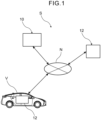
- a system S that includes an individual characteristics management device 10 relating to an embodiment is described with reference to the drawings.
- the system S of the present embodiment is structured to include the individual characteristics management device 10, a server 12, and vehicles V.
- the individual characteristics management device 10, the server 12 and the vehicles V are connected by network N. Note that, although the plural vehicles V are connected to the network N, only the one vehicle V is illustrated in Fig. 1 for convenience of explanation.
- a control device that is provided at the exterior of the vehicle V is an example of the individual characteristics management device 10 of the present embodiment. Further, an onboard device 14 is installed in the vehicle V.
- the server 12 is a server that is possessed by the manager of the plural vehicles V. Namely, the manager who manages the plural vehicles V possesses the server 12, and, in the present embodiment, as an example, the vehicles V are vehicles that are used as taxis that users ride and travel in. Further, the server 12 is possessed by a taxi company.
- the individual characteristics management device 10 of the present embodiment estimates individual characteristics of drivers who drive the respective vehicles V, based on driving data of the drivers.
- Fig. 2 is a block drawing illustrating hardware structures of the individual characteristics management device 10.
- the individual characteristics management device 10 has an ECU (Electronic Control Unit) 11 serving as a control section.
- the ECU 11 is structured to include a CPU (Central Processing Unit: processor) 20, a ROM (Read Only Memory) 22, a RAM (Random Access Memory) 24, a storage 26, a communication I/F (communication interface) 28 and an input/output I/F (input/output interface) 30.
- CPU Central Processing Unit: processor
- ROM Read Only Memory
- RAM Random Access Memory
- storage 26 a communication I/F (communication interface) 28
- I/F communication interface
- I/F input/output interface
- the CPU 20 is a central computing processing unit, and executes various programs and controls respective sections. Namely, the CPU 20 reads-out a program from the ROM 22 or the storage 26, and executes the program by using the RAM 24 as a workspace. The CPU 20 carries out control of the above-described respective structures, and various types of computing processings, in accordance with programs that are recorded in the ROM 22 or the storage 26.
- the ROM 22 stores various programs and various data.
- the RAM 24 temporarily stores programs and data as a workspace.
- the storage 26 is structured by an HDD (Hard Disk Drive) or an SSD (Solid State Drive), and stores various programs, including the operating system, and various data.
- a program for carrying out individual characteristics estimating processing, and various data and the like are stored in the ROM 22 or the storage 26.
- the communication I/F 28 is an interface for the individual characteristics management device 10 to communicate with the server 12 and other equipment, and standards such as, for example, CAN (Controller Area Network), Ethernet ® , LTE (Long Term Evolution), FDDI (Fiber Distributed Data Interface), Wi-Fi ® , or the like are used thereat.
- CAN Controller Area Network
- Ethernet ® Long Term Evolution
- LTE Long Term Evolution
- FDDI Fiber Distributed Data Interface
- Wi-Fi ® Wireless Fidelity
- the input/output I/F 30 is electrically connected to an input device 34 and a display device 36.
- the input device 34 is a device for inputting predetermined instructions to the individual characteristics management device 10, and is structured to include, for example, a mouse and a keyboard and the like.
- the display device 36 is a device such as a display or the like for displaying information outputted from the individual characteristics management device 10.
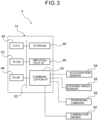
- Fig. 3 is a block drawing illustrating hardware structures of the onboard device 14.
- the onboard device 14 is structured to include a CPU (Central Processing Unit: processor) 40, a ROM (Read Only Memory) 42, a RAM (Random Access Memory) 44, a storage 46, a communication I/F (communication interface) 48 and an input/output I/F (input/output interface) 50.
- CPU Central Processing Unit
- ROM Read Only Memory
- RAM Random Access Memory
- storage 46 a storage 46
- communication I/F communication interface
- I/F input/output interface
- the CPU 40 is a central computing processing unit, and executes various programs and controls respective sections. Namely, the CPU 40 reads-out a program from the ROM 42 or the storage 46, and executes the program by using the RAM 44 as a workspace.
- the CPU 40 carries out control of the above-described respective structures, and various types of computing processings, in accordance with programs that are recorded in the ROM 42 or the storage 46.
- the ROM 42 stores various programs and various data.
- the RAM 44 temporarily stores programs and data as a workspace.
- the storage 46 is structured by an HDD (Hard Disk Drive) or an SSD (Solid State Drive), and stores various programs, including the operating system, and various data. In the present embodiment, programs for carrying out various processings, and various data and the like are stored in the ROM 42 or the storage 46.
- the communication I/F 48 is an interface for the onboard device 14 to communicate with the server 12 and other equipment, and standards such as, for example, CAN, Ethernet ® , LTE, FDDI, Wi-Fi ® , or the like are used thereat.
- the input/output I/F 50 is electrically connected to an acceleration sensor 54, a steering angle sensor 56, peripheral cameras 58, and a camera 60 for the driver.
- the acceleration sensor 54 detects the acceleration of the vehicle V.
- the steering angle sensor 56 detects the steering angle of the vehicle V.
- the data of the acceleration that is sensed by the acceleration sensor 54 is used, for example, in order to judge the absence/presence of sudden acceleration of the vehicle V.
- the data of the steering angle that is sensed by the steering angle sensor 56 is used, for example, in order to judge the absence/presence of sudden steering or a U-turn.
- the amounts of operation of the accelerator pedal and the brake pedal or the like may be detected directly from sensors such as an accelerator position sensor and a brake sensor or the like, instead of the acceleration sensor 54.
- the peripheral cameras 58 are provided at the periphery of the vehicle V, and capture images of the surroundings of the vehicle V.
- the peripheral cameras 58 are structured to include a front camera that captures images of the region in front of the vehicle V, a rear camera that captures images of the region at the rear of the vehicle V, side cameras that capture images of the regions at the lateral sides of the vehicle V, and the like.
- the image data captured by the peripheral cameras 58 is used, for example, in order to calculate the inter-vehicle distance between the vehicle V and a preceding vehicle.
- the image data captured by the peripheral cameras 58 is used, for example, in order to detect signs.
- the camera 60 for the driver is a camera for capturing images of the driver, and is provided at the instrument panel for example, and is disposed so as to face the driver.
- the image data captured by the camera 60 for the driver is used, for example, in order to detect driving while taking one's eyes off the road, or the like.
- the individual characteristics management device 10 realizes various functions by using the above-described hardware resources.
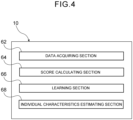
- the functional structures that are realized by the individual characteristics management device 10 are described with reference to Fig. 4 .
- the individual characteristics management device 10 is structured to include, as the functional structures thereof, a data acquiring section 62, a score calculating section 64, a learning section 66, and an individual characteristics estimating section 68. Note that these respective functional structures are realized due to the CPU 20 reading-out a program stored in the ROM 22 or the storage 26 and executing the program.
- the data acquiring section 62 acquires driving data that relates to plural driving evaluation items that are set in advance.
- driving data are transmitted from the vehicle V to the server 12, and the driving data are accumulated in the server 12. Therefore, the data acquiring section 62 acquires driving data from the server 12.
- the driving data acquired by the data acquiring section 62 is, for example, information relating to the acceleration and steering of the vehicle V, information captured by the peripheral cameras 58, information captured by the camera 60 for the driver, and the like. Further, the data acquiring section 62 acquires, as driving data, data that includes scores and numbers of times of measurement that are calculated by the score calculating section 64.
- the score calculating section 64 Based on the driving data acquired by the data acquiring section 62, the score calculating section 64 carries out calculating of the score or measurement of the number of times, for each of the driving evaluation items.
- the driving evaluation items is described with reference to Fig. 6 .
- the diagnostic categories of the driving evaluation items are divided into safety, compliance with laws/regulations, and driver state.
- the diagnostic category that is safety is divided into acceleration operations, braking operations, steering operations, and dangerous operations.
- Takeoff and sudden acceleration are respectively evaluated as acceleration operations. Specifically, in the takeoff item, the acceleration operation from a stopped state of the vehicle V until a predetermined speed is reached is evaluated based on data sensed by the acceleration sensor 54 provided at the vehicle V. Further, a score from 0 to 100 is calculated as the evaluation of the takeoff. Scores from 0 to 100 are similarly calculated for the evaluations of sudden acceleration, sudden braking, stopping, right turn, and left turn.
- the score for the takeoff item may be calculated based on the time from the stopped state of the vehicle V until a predetermined speed is reached, and the amount of change in the acceleration during the time until the predetermined speed is reached. Further, the score for the most ideal takeoff state may be set to be 100, and the score for the takeoff state in which the accelerator is fully opened from the stopped state may be set to be 0, and the score may be calculated by comparison with the actual takeoff state.
- the degree to which sudden acceleration is carried out is calculated as the score for the item of sudden acceleration.
- the score may be calculated to be low in a case in which the amount of increase in the acceleration in a relatively short time is large, based on the acceleration sensed by the acceleration sensor 54 provided at the vehicle V.
- the degree to which sudden braking is carried out is calculated as the score.
- the score may be calculated to be low in a case in which the amount of decrease in the acceleration in a relatively short time is large, based on the data sensed by the acceleration sensor 54 provided at the vehicle V.
- the score may be calculated based on the time until the vehicle V stops from a predetermined speed, and the amount of change in the acceleration during the time period until the vehicle V stops.
- both right turns and left turns are evaluated as steering operations.
- the score may be set based on the steering angle of the vehicle V sensed by the steering angle sensor 56 such that, the closer that the amount of change in the steering angle during a predetermined time period is to a preset ideal state, the higher the score.
- the score is calculated similarly to the right turns item.
- U-turns, failure to use turn signals, and inter-vehicle distance are respectively evaluated as dangerous operations. These items do not have scores, and are evaluated based on the number of times of detection.
- the number of times that a U-turn is carried out is counted. For example, it may be judged that a U-turn has been carried out based on the steering angle of the vehicle V sensed by the steering angle sensor 56 and the traveled distance.
- the number of times that a turn signal light was not turned on before a left or right turn is counted. For example, in a state in which it is judged that a left or right turn has been carried out based on the steering angle of the vehicle V sensed by the steering angle sensor 56, if an unillustrated turn signal switch installed in the vehicle V was not turned on in advance thereof, it may be judged that there was failure to use a turn signal.
- the number of times that the inter-vehicle distance to the preceding vehicle became short is counted. For example, in a case in which the inter-vehicle distance between the vehicle V and the preceding vehicle that is calculated based on image data captured by the peripheral cameras 58 is less than or equal to a predetermined inter-vehicle distance, it may be judged that the inter-vehicle distance to the preceding vehicle has become short.
- the diagnostic category of compliance with laws/regulations is divided into signals and signs. For signals, the number of times that a signal was ignored is counted. For signs, evaluation is carried out for each of violating the speed limit, violating a temporary stoppage regulation, and parking in a no parking zone.
- the number of times that the speed limit was exceeded is counted. For example, based on the image data captured by the peripheral cameras 58, speed limits displayed on signs are detected, and, if the vehicle speed detected by an unillustrated vehicle speed sensor installed in the vehicle V is greater than the speed limit, it may be judged that the speed limit has been exceeded.
- the number of times that the vehicle V did not stop at a position where temporary stoppage is mandated is counted.
- signs prescribing temporary stoppage may be detected based on the image data captured by the peripheral cameras 58, and, if the vehicle speed is not 0 at a position of temporary stoppage, it may be judged that there is a temporary stoppage violation.
- the number of times that parking in a no parking zone was carried out is counted. For example, based on the image data captured by the peripheral cameras 58, no parking signs may be detected, and, if the shift position is set to park at a place where parking is prohibited, it may be judged that there is a no parking violation.
- speed limit information of the road on which the vehicle V is traveling may be acquired from the current position of the vehicle V and information registered in the navigation system.
- places of temporary stoppage and no parking may be sensed from the current position of the vehicle V and information registered in the navigation system.
- current position information of the vehicle V is acquired based on radio waves received by an unillustrated GPS (Global Positioning System) device that is installed in the vehicle V.
- GPS Global Positioning System
- the diagnostic category of driver state items that are low vigilance and driving while taking one's eyes off the road are both evaluated.
- the low vigilance item the number of times that it was judged that the vigilance of the driver was low is counted.
- the degree of vigilance of the driver may be calculated based on image data of the face of the driver captured by the camera 60 for the driver, and, if the degree of vigilance is lower than a preset threshold value, it may be judged that the level of vigilance is low.
- the number of times that the driver looked away during driving is counted.
- the sightline direction of the driver may be detected from image data of the face of the driver captured by the camera 60 for the driver, and, if the sightline direction of the driver is directed in a direction different than the advancing direction for a predetermined time period or more, it may be judged that driving while taking one's eyes off the road is being carried out.
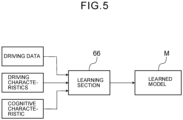
- the learning section 66 illustrated in Fig. 4 has the function of generating a learned model M by machine learning.
- the learning section 66 acquires teacher data in which driving data, which serves as information relating to plural driving evaluation items, and correct answer values for driving characteristics and a cognitive characteristic respectively, are set in correspondence with one another. Based on the acquired teacher data, when data relating to a driving evaluation item is inputted, the learning section 66 generates the learned model M that estimates individual characteristics that include driving characteristics and a cognitive characteristic.
- the driving characteristics and the cognitive characteristic are described hereafter.
- a deep neural network for example is used as the learned model M.
- LSTM Long Short-Term Memory
- RNN Recursive Neural Network
- error back propagation is used in generating the learned model M.
- the learned model M is generated due to the deep neural network model being machine-trained such that driving characteristics and the cognitive characteristic are outputted.
- diagnostic results of a diagnosis of the appropriateness of the driver that is carried out by an external organization such as the National Agency for Automotive Safety & Victims' Aid or the like may be used as the correct answer values of the driving characteristics.
- test results of a test that evaluates cognitive functions such as the MMSE (Mini-Mental State Examination) or the like may be used as the correct answer value of the cognitive characteristic.
- the individual characteristics estimating section 68 estimates individual characteristics of the driver based on driving data that includes the scores and that is acquired by the data acquiring section 62. Concretely, the individual characteristics estimating section 68 inputs the driving data acquired by the data acquiring section 62 into the learned model M generated at the learning section 66, and executes the computing processing of the learned model M, and thereby estimates the individual characteristics. Further, in the present embodiment, as an example, the individual characteristics estimating section 68 estimates driving characteristics and a cognitive characteristic as the individual characteristics.
- Fig. 7 examples of the driving characteristics and the cognitive characteristic that serve as the individual characteristics are explained with reference to Fig. 7 .
- timing of judgment, correctness of operation, safe driving, emotional stability, danger sensitivity, and polite driving are respectively estimated as the driving characteristics.
- the estimated results are calculated as scores from 0 to 100.
- a characteristic relating to the degree to which the driver can quickly judge the situation at the periphery of the vehicle V and the degree to which the driver can carry out an operation quickly is estimated.
- a characteristic relating to the degree of correctness of the operation of the vehicle V is estimated.
- a characteristic relating to the degree to which the driver is mindful of safe driving is estimated.
- a characteristic relating to the degree of calmness without carrying out emotional driving is estimated.
- a characteristic relating to the degree to which the driver can quickly judge a dangerous situation is estimated.
- the polite driving item a characteristic relating to the consideration that the driver gives to vehicles and pedestrians at the periphery of the own vehicle is estimated.
- a cognitive ability item is calculated as a score from 0 to 100.
- step S102 driving data is transmitted from the vehicle V to the server 12. Specifically, signals detected at the sensors such as the acceleration sensor 54 and the steering angle sensor 56 and the like that are installed in the vehicle V are transmitted to the server 12 as driving data. Further, image data captured by the peripheral cameras 58 and the camera 60 for the driver as transmitted to the server 12 as driving data. At this time, data that has been processed in advance at the vehicle V side may be transmitted to the server 12 as the driving data.
- the driving data received from the vehicles V is accumulated per vehicle V or per driver.
- step S104 by the function of the data acquiring section 62, the individual characteristics management device 10 asks the server 12 for driving data.
- step S106 driving data is transmitted from the server 12 to the individual characteristics management device 10.
- step S108 the individual characteristics management device 10 carries out score calculating processing. Specifically, by the function of the score calculating section 64, the individual characteristics management device 10 carries out calculation of the score or counting of the number of times for each of the driving evaluation items and from the driving data. In the present embodiment, formulas for calculating the scores and the like are stored in advance in the storage 26 of the individual characteristics management device 10, and the scores are calculated by using these formulas.
- step S110 the individual characteristics management device 10 carries out individual characteristics estimating processing. Specifically, by the function of the individual characteristics estimating section 68, the individual characteristics management device 10 inputs the driving data, which was acquired by the data acquiring section 62, and the scores, which were calculated by the score calculating section 64, into the learned model M, and executes the computing processing of the learned model M, and thereby estimates the individual characteristics.
- step S112 the data of the individual characteristics that was estimated by the individual characteristics estimating processing is transmitted to the server 12.
- the individual characteristics data that are accumulated in the server 12 can be used for various applications. For example, advice on driving may be given by an appropriate method per driver based on the individual characteristics data. Further, the method of controlling the vehicle V may be changed per driver based on the individual characteristics data.
- individual characteristics management device 10 relating to the present embodiment, individual characteristics of a driver are estimated based on driving data that relates to plural driving evaluation items that are set in advance. Therefore, highly accurate estimation can be carried out.
- characteristics that include driving characteristics and a cognitive characteristic are estimated as the individual characteristics. Therefore, a user can grasp characteristics that include driving characteristics and a cognitive characteristic.
- the individual characteristics of a driver can be estimated based on information captured by the peripheral cameras and the camera for the driver, in addition to the driving data that includes the acceleration and the steering of the vehicle V. Further, by estimating the individual characteristics by using the learned model on which machine learning for estimating individual characteristics has been carried out, the individual characteristics can be estimated highly accurately without necessitating complex computation.
- the technique of the present disclosure can, of course, be implemented in various forms within a scope that does not depart from the gist of the present disclosure.
- the individual characteristics management device 10 is provided at the exterior of the vehicle V in the above-described embodiment, the present disclosure is not limited to this and may be structured such that the individual characteristics management device 10 is installed in the vehicle V. In this case, the individual characteristics management device 10 may acquire the driving data directly from the vehicle V, without the driving data of the vehicle V being transmitted to the server 12.
- the score calculating processing by the score calculating section 64 may be executed within the individual characteristics management device 10, or the necessary data may be transmitted to the server 12 and the score calculating processing executed at the server 12 side.
- the individual characteristics estimating processing by the individual characteristics estimating section 68 may be executed within the individual characteristics management device 10, or the necessary data may be transmitted to the server 12 and the individual characteristics estimating processing executed at the server 12 side.
- the data such as the formulas and the like needed for score calculation, and the learned model M, may be stored in the server 12.
- the individual characteristics estimating section 68 estimates the individual characteristics by inputting the driving data and the like into the learned model M, and executing computing processing of the learned model M.
- individual characteristics may be estimated without using the learned model M.
- a method may be used in which a table, in which the individual characteristics and the scores and number of times of measurement of the driving data are associated with one another, is stored in advance, and the individual characteristics are estimated by referring to this table.
- the present disclosure is not limited to this.
- psychological characteristics, visual functions, and states of health may be estimated as individual characteristics.
- Intellectual curiosity, conscientiousness, extroversion, cooperativity, emotional instability and the like are included as psychological characteristics.
- Static vision, dynamic vision, night vision, horizontal field of vision and the like are included as visual functions.
- data that includes acceleration operations, braking operations, steering operations, dangerous operations, compliance with signals, compliance with signs, and the driver state are used as the driving data, but the present disclosure is not limited to this.
- some of the above-described data may be used as the driving data.
- data that includes the absence/presence of road rage, the absence/presence of deviating from the vehicle lane, the absence/presence of minor collisions, or the like may be used as the driving data.
- processors other than the CPU 20 may execute the processing that is executed due to the CPU 20 reading-in a program in the above-described embodiment.
- processors in this case include PLDs (Programmable Logic Devices) whose circuit structure can be changed after production such as FPGAs (Field-Programmable Gate Arrays) and the like, and dedicated electrical circuits that are processors having circuit structures that are designed for the sole purpose of executing specific processings such as ASICs (Application Specific Integrated Circuits) and the like, and the like.
- PLDs Programmable Logic Devices
- FPGAs Field-Programmable Gate Arrays
- dedicated electrical circuits that are processors having circuit structures that are designed for the sole purpose of executing specific processings such as ASICs (Application Specific Integrated Circuits) and the like, and the like.
- processing may be executed by one of these various types of processors, or may be executed by a combination of two or more of the same type or different types of processors, e.g., plural FPGAs, or a combination of a CPU and an FPGA, or the like.
- the hardware structures of these various types of processors are, more specifically, electrical circuits that combine circuit elements such as semiconductor elements and the like.
- a non-transitory recording medium such as, for example, a CD (Compact Disk), a DVD (Digital Versatile Disk), a USB (Universal Serial Bus) memory, or the like may be used as the storage.
- various programs and data and the like are stored on these recording media.
Landscapes
- Engineering & Computer Science (AREA)
- Physics & Mathematics (AREA)
- Theoretical Computer Science (AREA)
- Mathematical Physics (AREA)
- General Physics & Mathematics (AREA)
- Mechanical Engineering (AREA)
- Transportation (AREA)
- Automation & Control Theory (AREA)
- Software Systems (AREA)
- Multimedia (AREA)
- Evolutionary Computation (AREA)
- Computing Systems (AREA)
- Artificial Intelligence (AREA)
- Data Mining & Analysis (AREA)
- General Engineering & Computer Science (AREA)
- Biophysics (AREA)
- Molecular Biology (AREA)
- General Health & Medical Sciences (AREA)
- Biomedical Technology (AREA)
- Computer Vision & Pattern Recognition (AREA)
- Medical Informatics (AREA)
- Computational Linguistics (AREA)
- Life Sciences & Earth Sciences (AREA)
- Health & Medical Sciences (AREA)
- Traffic Control Systems (AREA)
Abstract
Description
- The present disclosure relates to an individual characteristics management device, an individual characteristics management method, a non-transitory storage medium that stores a program, and a method of generating a learned model.
- Japanese Patent Application Laid-Open (
JP-A) No. 2007-327872 - However, because the device disclosed in
JP-A No. 2007-327872 - The present disclosure provides an individual characteristics management device, an individual characteristics management method, a non-transitory storage medium that stores a program, and a method of generating a learned model that can estimate individual characteristics with high accuracy.
- A first aspect of the present disclosure is an individual characteristics management device of a including: a data acquiring section acquiring driving data relating to a plurality of driving evaluation items that are set in advance; and an individual characteristics estimating section estimating individual characteristics of a driver based on the driving data acquired by the data acquiring section.
- In the individual characteristics management device of the first aspect, individual characteristics of the driver are estimated based on driving data relating to plural driving evaluation items that are set in advance. Therefore, highly accurate estimation can be carried out.
- In an individual characteristics management device of a second aspect, in the first aspect, t he individual characteristics estimating section estimates characteristics including a driving characteristic and a cognitive characteristic, as the individual characteristics.
- In the individual characteristics management device of the second aspect, the user can grasp characteristics that include a driving characteristic and a cognitive characteristic. Note that what are called "driving characteristics" here are characteristics expressing tendencies relating to driving operations by the user. What are called "cognitive characteristics" here are characteristics expressing a degree to which the user recognizes the peripheral situation.
- In an individual characteristics management device of a third aspect, in the first aspect, the data acquiring section acquires driving data, which includes at least acceleration and steering of a vehicle, as the driving evaluation items.
- In the individual characteristics management device of the third aspect, individual characteristics of the driver are estimated based on driving data that includes acceleration and steering of the vehicle.
- In an individual characteristics management device of a fourth aspect, in the third aspect, the data acquiring section further acquires, as the driving evaluation items, information captured by peripheral cameras that capture images of a periphery of the vehicle and information captured by a camera for a driver that captures images of a driver.
- In the individual characteristics management device of the fourth aspect, individual characteristics of the driver are estimated based on information captured by the peripheral cameras and the camera for the driver, in addition to driving data relating to vehicle operations such as acceleration and steering and the like of the vehicle.
- In an individual characteristics management device of a fifth aspect, in any one of the first aspect through the fourth aspect, the individual characteristics estimating section estimates the individual characteristics by inputting driving data acquired by the data acquiring section into a learned model on which machine learning for estimating individual characteristics has been carried out, and executing computing processing of the learned model.
- In the individual characteristics management device of the fifth aspect, by estimating the individual characteristics by using the learned model on which machine learning for estimating individual characteristics has been carried out, the individual characteristics can be estimated highly accurately without necessitating complex computation.
- A sixth aspect of the present disclosure is an individual characteristics management method including: acquiring driving data relating to a plurality of driving evaluation items that are set in advance; and estimating individual characteristics of a driver based on the acquired driving data.
- A non-transitory storage medium storing a program of a seventh aspect is a non-transitory storage medium storing a program executable by a computer to execute a processing, the processing including: acquiring driving data relating to a plurality of driving evaluation items that are set in advance; and estimating individual characteristics of a driver based on the acquired driving data.
- A method of generating a learned model of an eighth aspect: acquiring teacher data in which information relating to a plurality of driving evaluation items that are set in advance, and correct answer values of a driving characteristic and a cognitive characteristic respectively, are set in correspondence with one another; and in a case in which data relating to a driving evaluation item is received, causing a computer to execute processing of generating a learned model that estimates individual characteristics including a driving characteristic and a cognitive characteristic, based on acquired teacher data.
- In accordance with the individual characteristics management device, individual characteristics management method, non-transitory storage medium that stores a program, and method of generating a learned model that relate to the present disclosure, individual characteristics can be estimated with high accuracy.
- An exemplary embodiment of the present disclosure will be described in detail based on the following figures, wherein:
-
Fig. 1 is a schematic drawing illustrating the overall structure of an individual characteristics management system relating to an embodiment; -
Fig. 2 is a block drawing illustrating hardware structures of an individual characteristics management device relating to the embodiment; -
Fig. 3 is a block drawing illustrating hardware structures of an onboard device relating to the embodiment; -
Fig. 4 is a block drawing illustrating functional structures of the individual characteristics management device relating to the embodiment; -
Fig. 5 is a block drawing for explaining a learning phase in the embodiment; -
Fig. 6 is a table illustrating examples of driving evaluation items; -
Fig. 7 is a table illustrating examples of driving characteristics and a cognitive characteristic; and -
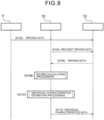
Fig. 8 is a sequence drawing illustrating an example of the flow of individual characteristics estimating processing in the embodiment. - A system S that includes an individual
characteristics management device 10 relating to an embodiment is described with reference to the drawings. - As illustrated in
Fig. 1 , the system S of the present embodiment is structured to include the individualcharacteristics management device 10, aserver 12, and vehicles V. The individualcharacteristics management device 10, theserver 12 and the vehicles V are connected by network N. Note that, although the plural vehicles V are connected to the network N, only the one vehicle V is illustrated inFig. 1 for convenience of explanation. - A control device that is provided at the exterior of the vehicle V is an example of the individual
characteristics management device 10 of the present embodiment. Further, anonboard device 14 is installed in the vehicle V. - The
server 12 is a server that is possessed by the manager of the plural vehicles V. Namely, the manager who manages the plural vehicles V possesses theserver 12, and, in the present embodiment, as an example, the vehicles V are vehicles that are used as taxis that users ride and travel in. Further, theserver 12 is possessed by a taxi company. - Here, the individual
characteristics management device 10 of the present embodiment estimates individual characteristics of drivers who drive the respective vehicles V, based on driving data of the drivers. -
Fig. 2 is a block drawing illustrating hardware structures of the individualcharacteristics management device 10. As illustrated inFig. 2 , the individualcharacteristics management device 10 has an ECU (Electronic Control Unit) 11 serving as a control section. The ECU 11 is structured to include a CPU (Central Processing Unit: processor) 20, a ROM (Read Only Memory) 22, a RAM (Random Access Memory) 24, astorage 26, a communication I/F (communication interface) 28 and an input/output I/F (input/output interface) 30. These respective structures are connected so as to be able to communicate with one another viabus 32. - The
CPU 20 is a central computing processing unit, and executes various programs and controls respective sections. Namely, theCPU 20 reads-out a program from theROM 22 or thestorage 26, and executes the program by using theRAM 24 as a workspace. TheCPU 20 carries out control of the above-described respective structures, and various types of computing processings, in accordance with programs that are recorded in theROM 22 or thestorage 26. - The
ROM 22 stores various programs and various data. TheRAM 24 temporarily stores programs and data as a workspace. Thestorage 26 is structured by an HDD (Hard Disk Drive) or an SSD (Solid State Drive), and stores various programs, including the operating system, and various data. In the present embodiment, a program for carrying out individual characteristics estimating processing, and various data and the like are stored in theROM 22 or thestorage 26. - The communication I/
F 28 is an interface for the individualcharacteristics management device 10 to communicate with theserver 12 and other equipment, and standards such as, for example, CAN (Controller Area Network), Ethernet®, LTE (Long Term Evolution), FDDI (Fiber Distributed Data Interface), Wi-Fi®, or the like are used thereat. - The input/output I/
F 30 is electrically connected to aninput device 34 and adisplay device 36. Theinput device 34 is a device for inputting predetermined instructions to the individualcharacteristics management device 10, and is structured to include, for example, a mouse and a keyboard and the like. Thedisplay device 36 is a device such as a display or the like for displaying information outputted from the individualcharacteristics management device 10. -
Fig. 3 is a block drawing illustrating hardware structures of theonboard device 14. As illustrated inFig. 3 , theonboard device 14 is structured to include a CPU (Central Processing Unit: processor) 40, a ROM (Read Only Memory) 42, a RAM (Random Access Memory) 44, astorage 46, a communication I/F (communication interface) 48 and an input/output I/F (input/output interface) 50. These respective structures are connected so as to be able to communicate with one another viabus 52. - The
CPU 40 is a central computing processing unit, and executes various programs and controls respective sections. Namely, theCPU 40 reads-out a program from theROM 42 or thestorage 46, and executes the program by using theRAM 44 as a workspace. TheCPU 40 carries out control of the above-described respective structures, and various types of computing processings, in accordance with programs that are recorded in theROM 42 or thestorage 46. - The
ROM 42 stores various programs and various data. TheRAM 44 temporarily stores programs and data as a workspace. Thestorage 46 is structured by an HDD (Hard Disk Drive) or an SSD (Solid State Drive), and stores various programs, including the operating system, and various data. In the present embodiment, programs for carrying out various processings, and various data and the like are stored in theROM 42 or thestorage 46. - The communication I/
F 48 is an interface for theonboard device 14 to communicate with theserver 12 and other equipment, and standards such as, for example, CAN, Ethernet®, LTE, FDDI, Wi-Fi®, or the like are used thereat. - The input/output I/
F 50 is electrically connected to anacceleration sensor 54, asteering angle sensor 56,peripheral cameras 58, and acamera 60 for the driver. - The
acceleration sensor 54 detects the acceleration of the vehicle V. Thesteering angle sensor 56 detects the steering angle of the vehicle V. The data of the acceleration that is sensed by theacceleration sensor 54 is used, for example, in order to judge the absence/presence of sudden acceleration of the vehicle V. Further, the data of the steering angle that is sensed by thesteering angle sensor 56 is used, for example, in order to judge the absence/presence of sudden steering or a U-turn. Note that the amounts of operation of the accelerator pedal and the brake pedal or the like may be detected directly from sensors such as an accelerator position sensor and a brake sensor or the like, instead of theacceleration sensor 54. - The
peripheral cameras 58 are provided at the periphery of the vehicle V, and capture images of the surroundings of the vehicle V. For example, theperipheral cameras 58 are structured to include a front camera that captures images of the region in front of the vehicle V, a rear camera that captures images of the region at the rear of the vehicle V, side cameras that capture images of the regions at the lateral sides of the vehicle V, and the like. Further, the image data captured by theperipheral cameras 58 is used, for example, in order to calculate the inter-vehicle distance between the vehicle V and a preceding vehicle. Further, the image data captured by theperipheral cameras 58 is used, for example, in order to detect signs. - The
camera 60 for the driver is a camera for capturing images of the driver, and is provided at the instrument panel for example, and is disposed so as to face the driver. The image data captured by thecamera 60 for the driver is used, for example, in order to detect driving while taking one's eyes off the road, or the like. - The individual
characteristics management device 10 realizes various functions by using the above-described hardware resources. The functional structures that are realized by the individualcharacteristics management device 10 are described with reference toFig. 4 . - As illustrated in
Fig. 4 , the individualcharacteristics management device 10 is structured to include, as the functional structures thereof, adata acquiring section 62, ascore calculating section 64, alearning section 66, and an individualcharacteristics estimating section 68. Note that these respective functional structures are realized due to theCPU 20 reading-out a program stored in theROM 22 or thestorage 26 and executing the program. - The
data acquiring section 62 acquires driving data that relates to plural driving evaluation items that are set in advance. In the present embodiment, as an example, driving data are transmitted from the vehicle V to theserver 12, and the driving data are accumulated in theserver 12. Therefore, thedata acquiring section 62 acquires driving data from theserver 12. The driving data acquired by thedata acquiring section 62 is, for example, information relating to the acceleration and steering of the vehicle V, information captured by theperipheral cameras 58, information captured by thecamera 60 for the driver, and the like. Further, thedata acquiring section 62 acquires, as driving data, data that includes scores and numbers of times of measurement that are calculated by thescore calculating section 64. - Based on the driving data acquired by the
data acquiring section 62, thescore calculating section 64 carries out calculating of the score or measurement of the number of times, for each of the driving evaluation items. Here, an example of the driving evaluation items is described with reference toFig. 6 . - As illustrated in
Fig. 6 , in the present embodiment, as an example, the diagnostic categories of the driving evaluation items are divided into safety, compliance with laws/regulations, and driver state. - The diagnostic category that is safety is divided into acceleration operations, braking operations, steering operations, and dangerous operations. Takeoff and sudden acceleration are respectively evaluated as acceleration operations. Specifically, in the takeoff item, the acceleration operation from a stopped state of the vehicle V until a predetermined speed is reached is evaluated based on data sensed by the
acceleration sensor 54 provided at the vehicle V. Further, a score from 0 to 100 is calculated as the evaluation of the takeoff. Scores from 0 to 100 are similarly calculated for the evaluations of sudden acceleration, sudden braking, stopping, right turn, and left turn. - For example, the score for the takeoff item may be calculated based on the time from the stopped state of the vehicle V until a predetermined speed is reached, and the amount of change in the acceleration during the time until the predetermined speed is reached. Further, the score for the most ideal takeoff state may be set to be 100, and the score for the takeoff state in which the accelerator is fully opened from the stopped state may be set to be 0, and the score may be calculated by comparison with the actual takeoff state.
- The degree to which sudden acceleration is carried out is calculated as the score for the item of sudden acceleration. For example, the score may be calculated to be low in a case in which the amount of increase in the acceleration in a relatively short time is large, based on the acceleration sensed by the
acceleration sensor 54 provided at the vehicle V. - Evaluation of both sudden braking and stopping is carried out for the braking operations. For the sudden braking item, the degree to which sudden braking is carried out is calculated as the score. For example, the score may be calculated to be low in a case in which the amount of decrease in the acceleration in a relatively short time is large, based on the data sensed by the
acceleration sensor 54 provided at the vehicle V. Further, for the stopping item, the score may be calculated based on the time until the vehicle V stops from a predetermined speed, and the amount of change in the acceleration during the time period until the vehicle V stops. - Both right turns and left turns are evaluated as steering operations. For example, for the item of right turns, the score may be set based on the steering angle of the vehicle V sensed by the
steering angle sensor 56 such that, the closer that the amount of change in the steering angle during a predetermined time period is to a preset ideal state, the higher the score. For the item of left turns as well, the score is calculated similarly to the right turns item. - U-turns, failure to use turn signals, and inter-vehicle distance are respectively evaluated as dangerous operations. These items do not have scores, and are evaluated based on the number of times of detection.
- For the U-turn item, the number of times that a U-turn is carried out is counted. For example, it may be judged that a U-turn has been carried out based on the steering angle of the vehicle V sensed by the
steering angle sensor 56 and the traveled distance. For the item that is failure to use turn signals, the number of times that a turn signal light was not turned on before a left or right turn is counted. For example, in a state in which it is judged that a left or right turn has been carried out based on the steering angle of the vehicle V sensed by thesteering angle sensor 56, if an unillustrated turn signal switch installed in the vehicle V was not turned on in advance thereof, it may be judged that there was failure to use a turn signal. - For the inter-vehicle distance item, the number of times that the inter-vehicle distance to the preceding vehicle became short is counted. For example, in a case in which the inter-vehicle distance between the vehicle V and the preceding vehicle that is calculated based on image data captured by the
peripheral cameras 58 is less than or equal to a predetermined inter-vehicle distance, it may be judged that the inter-vehicle distance to the preceding vehicle has become short. - The diagnostic category of compliance with laws/regulations is divided into signals and signs. For signals, the number of times that a signal was ignored is counted. For signs, evaluation is carried out for each of violating the speed limit, violating a temporary stoppage regulation, and parking in a no parking zone.
- For the speed limit item, the number of times that the speed limit was exceeded is counted. For example, based on the image data captured by the
peripheral cameras 58, speed limits displayed on signs are detected, and, if the vehicle speed detected by an unillustrated vehicle speed sensor installed in the vehicle V is greater than the speed limit, it may be judged that the speed limit has been exceeded. - For the item of violating a temporary stoppage regulation, the number of times that the vehicle V did not stop at a position where temporary stoppage is mandated is counted. For example, signs prescribing temporary stoppage may be detected based on the image data captured by the
peripheral cameras 58, and, if the vehicle speed is not 0 at a position of temporary stoppage, it may be judged that there is a temporary stoppage violation. - For the item of parking in a no parking zone, the number of times that parking in a no parking zone was carried out is counted. For example, based on the image data captured by the
peripheral cameras 58, no parking signs may be detected, and, if the shift position is set to park at a place where parking is prohibited, it may be judged that there is a no parking violation. Note that, for the item of speed limit violations, instead of a method of detecting signs based on the image data captured by theperipheral cameras 58, speed limit information of the road on which the vehicle V is traveling may be acquired from the current position of the vehicle V and information registered in the navigation system. Similarly, places of temporary stoppage and no parking may be sensed from the current position of the vehicle V and information registered in the navigation system. Note that current position information of the vehicle V is acquired based on radio waves received by an unillustrated GPS (Global Positioning System) device that is installed in the vehicle V. - In the diagnostic category of driver state, items that are low vigilance and driving while taking one's eyes off the road are both evaluated. For the low vigilance item, the number of times that it was judged that the vigilance of the driver was low is counted. For example, the degree of vigilance of the driver may be calculated based on image data of the face of the driver captured by the
camera 60 for the driver, and, if the degree of vigilance is lower than a preset threshold value, it may be judged that the level of vigilance is low. - For the item of driving while taking one's eyes off the road, the number of times that the driver looked away during driving is counted. For example, the sightline direction of the driver may be detected from image data of the face of the driver captured by the
camera 60 for the driver, and, if the sightline direction of the driver is directed in a direction different than the advancing direction for a predetermined time period or more, it may be judged that driving while taking one's eyes off the road is being carried out. - The
learning section 66 illustrated inFig. 4 has the function of generating a learned model M by machine learning. Concretely, as illustrated inFig. 5 , thelearning section 66 acquires teacher data in which driving data, which serves as information relating to plural driving evaluation items, and correct answer values for driving characteristics and a cognitive characteristic respectively, are set in correspondence with one another. Based on the acquired teacher data, when data relating to a driving evaluation item is inputted, thelearning section 66 generates the learned model M that estimates individual characteristics that include driving characteristics and a cognitive characteristic. The driving characteristics and the cognitive characteristic are described hereafter. - Note that a deep neural network for example is used as the learned model M. LSTM (Long Short-Term Memory) that is a type of an RNN (Recursive Neural Network) is used as an example of the learned model M of the present embodiment. Further, for example, error back propagation is used in generating the learned model M. When driving data is inputted, the learned model M is generated due to the deep neural network model being machine-trained such that driving characteristics and the cognitive characteristic are outputted.
- For example, diagnostic results of a diagnosis of the appropriateness of the driver that is carried out by an external organization such as the National Agency for Automotive Safety & Victims' Aid or the like may be used as the correct answer values of the driving characteristics. Further, test results of a test that evaluates cognitive functions such as the MMSE (Mini-Mental State Examination) or the like may be used as the correct answer value of the cognitive characteristic.
- The individual
characteristics estimating section 68 estimates individual characteristics of the driver based on driving data that includes the scores and that is acquired by thedata acquiring section 62. Concretely, the individualcharacteristics estimating section 68 inputs the driving data acquired by thedata acquiring section 62 into the learned model M generated at thelearning section 66, and executes the computing processing of the learned model M, and thereby estimates the individual characteristics. Further, in the present embodiment, as an example, the individualcharacteristics estimating section 68 estimates driving characteristics and a cognitive characteristic as the individual characteristics. - Here, examples of the driving characteristics and the cognitive characteristic that serve as the individual characteristics are explained with reference to
Fig. 7 . As illustrated inFig. 7 , in the present embodiment, timing of judgment, correctness of operation, safe driving, emotional stability, danger sensitivity, and polite driving are respectively estimated as the driving characteristics. The estimated results are calculated as scores from 0 to 100. - For the item of timing of judgment, a characteristic relating to the degree to which the driver can quickly judge the situation at the periphery of the vehicle V and the degree to which the driver can carry out an operation quickly is estimated. For the item that is correctness of operation, a characteristic relating to the degree of correctness of the operation of the vehicle V is estimated.
- For the safe driving item, a characteristic relating to the degree to which the driver is mindful of safe driving is estimated. Further, for the emotional stability item, a characteristic relating to the degree of calmness without carrying out emotional driving is estimated. For the danger sensitivity item, a characteristic relating to the degree to which the driver can quickly judge a dangerous situation is estimated. For the polite driving item, a characteristic relating to the consideration that the driver gives to vehicles and pedestrians at the periphery of the own vehicle is estimated.
- As the cognitive characteristic, a cognitive ability item is calculated as a score from 0 to 100.
- Operation of the present embodiment is described next.
- An example of the flow of individual characteristics estimating processing is described by using the sequence drawing shown in
Fig. 8 . Note that the processing at the individualcharacteristics management device 10 is realized by theCPU 20 functioning as thedata acquiring section 62, thescore calculating section 64, and the individualcharacteristics estimating section 68. - In step S102, driving data is transmitted from the vehicle V to the
server 12. Specifically, signals detected at the sensors such as theacceleration sensor 54 and thesteering angle sensor 56 and the like that are installed in the vehicle V are transmitted to theserver 12 as driving data. Further, image data captured by theperipheral cameras 58 and thecamera 60 for the driver as transmitted to theserver 12 as driving data. At this time, data that has been processed in advance at the vehicle V side may be transmitted to theserver 12 as the driving data. - At the
server 12, the driving data received from the vehicles V is accumulated per vehicle V or per driver. - In step S104, by the function of the
data acquiring section 62, the individualcharacteristics management device 10 asks theserver 12 for driving data. In step S106, driving data is transmitted from theserver 12 to the individualcharacteristics management device 10. - In step S108, the individual
characteristics management device 10 carries out score calculating processing. Specifically, by the function of thescore calculating section 64, the individualcharacteristics management device 10 carries out calculation of the score or counting of the number of times for each of the driving evaluation items and from the driving data. In the present embodiment, formulas for calculating the scores and the like are stored in advance in thestorage 26 of the individualcharacteristics management device 10, and the scores are calculated by using these formulas. - In step S110, the individual
characteristics management device 10 carries out individual characteristics estimating processing. Specifically, by the function of the individualcharacteristics estimating section 68, the individualcharacteristics management device 10 inputs the driving data, which was acquired by thedata acquiring section 62, and the scores, which were calculated by thescore calculating section 64, into the learned model M, and executes the computing processing of the learned model M, and thereby estimates the individual characteristics. - In step S112, the data of the individual characteristics that was estimated by the individual characteristics estimating processing is transmitted to the
server 12. Note that the individual characteristics data that are accumulated in theserver 12 can be used for various applications. For example, advice on driving may be given by an appropriate method per driver based on the individual characteristics data. Further, the method of controlling the vehicle V may be changed per driver based on the individual characteristics data. - As described above, in the individual
characteristics management device 10 relating to the present embodiment, individual characteristics of a driver are estimated based on driving data that relates to plural driving evaluation items that are set in advance. Therefore, highly accurate estimation can be carried out. - Further, in the present embodiment, characteristics that include driving characteristics and a cognitive characteristic are estimated as the individual characteristics. Therefore, a user can grasp characteristics that include driving characteristics and a cognitive characteristic.
- Moreover, in the present embodiment, the individual characteristics of a driver can be estimated based on information captured by the peripheral cameras and the camera for the driver, in addition to the driving data that includes the acceleration and the steering of the vehicle V. Further, by estimating the individual characteristics by using the learned model on which machine learning for estimating individual characteristics has been carried out, the individual characteristics can be estimated highly accurately without necessitating complex computation.
- Although the individual
characteristics management device 10 relating to an embodiment has been described above, the technique of the present disclosure can, of course, be implemented in various forms within a scope that does not depart from the gist of the present disclosure. For example, although the individualcharacteristics management device 10 is provided at the exterior of the vehicle V in the above-described embodiment, the present disclosure is not limited to this and may be structured such that the individualcharacteristics management device 10 is installed in the vehicle V. In this case, the individualcharacteristics management device 10 may acquire the driving data directly from the vehicle V, without the driving data of the vehicle V being transmitted to theserver 12. - Further, the score calculating processing by the
score calculating section 64 may be executed within the individualcharacteristics management device 10, or the necessary data may be transmitted to theserver 12 and the score calculating processing executed at theserver 12 side. Moreover, the individual characteristics estimating processing by the individualcharacteristics estimating section 68 may be executed within the individualcharacteristics management device 10, or the necessary data may be transmitted to theserver 12 and the individual characteristics estimating processing executed at theserver 12 side. In cases in which the score calculating processing and the individual characteristics estimating processing are executed at theserver 12 side, the data such as the formulas and the like needed for score calculation, and the learned model M, may be stored in theserver 12. - Moreover, in the above-described embodiment, the individual
characteristics estimating section 68 estimates the individual characteristics by inputting the driving data and the like into the learned model M, and executing computing processing of the learned model M. However, the present disclosure is not limited to this. For example, individual characteristics may be estimated without using the learned model M. In this case, a method may be used in which a table, in which the individual characteristics and the scores and number of times of measurement of the driving data are associated with one another, is stored in advance, and the individual characteristics are estimated by referring to this table. - Still further, although the above embodiment describes a structure in which driving characteristics and a cognitive characteristic are estimated as the individual characteristics, the present disclosure is not limited to this. For example, in addition to the driving characteristics and the cognitive characteristic, psychological characteristics, visual functions, and states of health may be estimated as individual characteristics. Intellectual curiosity, conscientiousness, extroversion, cooperativity, emotional instability and the like are included as psychological characteristics. Static vision, dynamic vision, night vision, horizontal field of vision and the like are included as visual functions.
- Further, in the above-described embodiment, data that includes acceleration operations, braking operations, steering operations, dangerous operations, compliance with signals, compliance with signs, and the driver state are used as the driving data, but the present disclosure is not limited to this. For example, some of the above-described data may be used as the driving data. Or, in addition to the above-described data, data that includes the absence/presence of road rage, the absence/presence of deviating from the vehicle lane, the absence/presence of minor collisions, or the like may be used as the driving data.
- Further, any of various types of processors other than the
CPU 20 may execute the processing that is executed due to theCPU 20 reading-in a program in the above-described embodiment. Examples of processors in this case include PLDs (Programmable Logic Devices) whose circuit structure can be changed after production such as FPGAs (Field-Programmable Gate Arrays) and the like, and dedicated electrical circuits that are processors having circuit structures that are designed for the sole purpose of executing specific processings such as ASICs (Application Specific Integrated Circuits) and the like, and the like. Further, the above-described processing may be executed by one of these various types of processors, or may be executed by a combination of two or more of the same type or different types of processors, e.g., plural FPGAs, or a combination of a CPU and an FPGA, or the like. Further, the hardware structures of these various types of processors are, more specifically, electrical circuits that combine circuit elements such as semiconductor elements and the like. - Moreover, although the above-described embodiment is structured such that the various data are stored in the
storage 26 and thestorage 46, the present disclosure is not limited to this. A non-transitory recording medium such as, for example, a CD (Compact Disk), a DVD (Digital Versatile Disk), a USB (Universal Serial Bus) memory, or the like may be used as the storage. In this case, various programs and data and the like are stored on these recording media.
Claims (8)
- An individual characteristics management device (10) comprising:a data acquiring section (62) acquiring driving data relating to a plurality of driving evaluation items that are set in advance; andan individual characteristics estimating section (68) estimating individual characteristics of a driver based on the driving data acquired by the data acquiring section.
- The individual characteristics management device (10) of claim 1, wherein the individual characteristics estimating section (68) estimates characteristics including a driving characteristic and a cognitive characteristic, as the individual characteristics.
- The individual characteristics management device (10) of claim 1, wherein the data acquiring section (62) acquires driving data, which includes at least acceleration and steering of a vehicle, as the driving evaluation items.
- The individual characteristics management device of claim 3, wherein the data acquiring section (62) further acquires, as the driving evaluation items, information captured by peripheral cameras that capture images of a periphery of the vehicle and information captured by a camera for a driver (60) that captures images of a driver.
- The individual characteristics management device (10) of any one of claims 1 through 4, wherein the individual characteristics estimating section (68) estimates the individual characteristics by inputting driving data acquired by the data acquiring section (62) into a learned model on which machine learning for estimating individual characteristics has been carried out, and executing computing processing of the learned model.
- An individual characteristics management method comprising:acquiring driving data relating to a plurality of driving evaluation items that are set in advance; andestimating individual characteristics of a driver based on the acquired driving data.
- A non-transitory storage medium storing a program executable by a computer to execute processing, the processing comprising:acquiring driving data relating to a plurality of driving evaluation items that are set in advance; andestimating individual characteristics of a driver based on the acquired driving data.
- A method of generating a learned model, comprising:acquiring teacher data in which information relating to a plurality of driving evaluation items that are set in advance, and correct answer values of a driving characteristic and a cognitive characteristic respectively, are set in correspondence with one another; andin a case in which data relating to a driving evaluation item is received, causing a computer to execute processing of generating a learned model that estimates individual characteristics including a driving characteristic and a cognitive characteristic, based on acquired teacher data.
Applications Claiming Priority (1)
| Application Number | Priority Date | Filing Date | Title |
|---|---|---|---|
| JP2022076205A JP2023165316A (en) | 2022-05-02 | 2022-05-02 | Personal characteristics management device, personal characteristics management method, program and learned model generation method |
Publications (3)
| Publication Number | Publication Date |
|---|---|
| EP4273013A2 true EP4273013A2 (en) | 2023-11-08 |
| EP4273013A3 EP4273013A3 (en) | 2024-01-10 |
| EP4273013B1 EP4273013B1 (en) | 2025-03-05 |
Family
ID=85726925
Family Applications (1)
| Application Number | Title | Priority Date | Filing Date |
|---|---|---|---|
| EP23163691.1A Active EP4273013B1 (en) | 2022-05-02 | 2023-03-23 | Individual characteristics management device, individual characteristics management method, non-transitory storage medium storing a program |
Country Status (4)
| Country | Link |
|---|---|
| US (1) | US20240075940A1 (en) |
| EP (1) | EP4273013B1 (en) |
| JP (1) | JP2023165316A (en) |
| CN (1) | CN116985823A (en) |
Citations (1)
| Publication number | Priority date | Publication date | Assignee | Title |
|---|---|---|---|---|
| JP2007327872A (en) | 2006-06-08 | 2007-12-20 | Denso Corp | Driver personality determination device and vehicle navigation device |
Family Cites Families (10)
| Publication number | Priority date | Publication date | Assignee | Title |
|---|---|---|---|---|
| DE102006015332A1 (en) * | 2005-04-04 | 2006-11-16 | Denso Corp., Kariya | Guest service system for vehicle users |
| JP6033838B2 (en) * | 2012-02-27 | 2016-11-30 | ヤマハ発動機株式会社 | Operating state sharing device and operating state sharing system |
| WO2014034779A1 (en) * | 2012-08-31 | 2014-03-06 | 日産自動車株式会社 | Individual characteristic estimation unit and individual characteristic estimation method |
| EP3566201A4 (en) * | 2016-12-22 | 2020-11-25 | Xevo Inc. | PROCESS AND SYSTEM FOR PROVIDING SERVICES OF ANALYSIS OF ARTIFICIAL INTELLIGENCE (AIA) FOR PERFORMANCE PREDICTION |
| JP6817685B2 (en) * | 2017-07-07 | 2021-01-20 | Kddi株式会社 | Estimators, programs and methods for estimating road sections from driving vehicle signals that make it easy to identify personal characteristics |
| US10322728B1 (en) * | 2018-02-22 | 2019-06-18 | Futurewei Technologies, Inc. | Method for distress and road rage detection |
| JP7555181B2 (en) * | 2019-03-27 | 2024-09-24 | Hoya株式会社 | ENDOSCOPE PROCESSOR, INFORMATION PROCESSING APPARATUS, PROGRAM, INFORMATION PROCESSING METHOD, AND METHOD FOR GENERATING LEARNING MODEL |
| CN110533094B (en) * | 2019-08-26 | 2022-11-15 | 汉纳森(厦门)数据股份有限公司 | Evaluation method and system for driver |
| US11810373B2 (en) * | 2019-09-19 | 2023-11-07 | Mitsubishi Electric Corporation | Cognitive function estimation device, learning device, and cognitive function estimation method |
| JP7263997B2 (en) * | 2019-09-20 | 2023-04-25 | トヨタ自動車株式会社 | DRIVING ACTION EVALUATION DEVICE, METHOD AND PROGRAM |
-
2022
- 2022-05-02 JP JP2022076205A patent/JP2023165316A/en active Pending
-
2023
- 2023-03-23 EP EP23163691.1A patent/EP4273013B1/en active Active
- 2023-03-29 CN CN202310317649.5A patent/CN116985823A/en active Pending
- 2023-04-27 US US18/307,808 patent/US20240075940A1/en active Pending
Patent Citations (1)
| Publication number | Priority date | Publication date | Assignee | Title |
|---|---|---|---|---|
| JP2007327872A (en) | 2006-06-08 | 2007-12-20 | Denso Corp | Driver personality determination device and vehicle navigation device |
Also Published As
| Publication number | Publication date |
|---|---|
| CN116985823A (en) | 2023-11-03 |
| EP4273013A3 (en) | 2024-01-10 |
| JP2023165316A (en) | 2023-11-15 |
| EP4273013B1 (en) | 2025-03-05 |
| US20240075940A1 (en) | 2024-03-07 |
Similar Documents
| Publication | Publication Date | Title |
|---|---|---|
| US11713046B2 (en) | Driving assistance apparatus and data collection system | |
| US9064419B2 (en) | Driver condition assessment device | |
| US9082285B2 (en) | System and method for determining vehicle driving status information-based driving concentration | |
| US20190344714A1 (en) | Lane changer warning system and method of the same | |
| CN112193252A (en) | Early warning method, device, computing device and storage medium for driving risk | |
| CN105388021A (en) | ADAS virtual development and test system | |
| US20200175474A1 (en) | Information processing system, program, and control method | |
| CN118430239A (en) | Intelligent driving risk warning method, device, electronic equipment, medium and product | |
| CN113460062A (en) | Driving behavior analysis system | |
| US20240208496A1 (en) | Methods and systems for controlling a vehicle having a lane support system | |
| JP2024026499A (en) | Information providing device, control method, and program | |
| CN113879313A (en) | Driver fatigue detection method and device | |
| EP4273013A2 (en) | Individual characteristics management device, individual characteristics management method, non-transitory storage medium storing a program, and method of generating learned model | |
| EP4273014B1 (en) | Individual characteristics management system | |
| US12609048B2 (en) | Driving diagnostic device, driving diagnostic system, machine learning device and generation method of learned model | |
| JP2020154375A (en) | Vehicle hazardous condition identification device, vehicle hazardous condition identification method, and program | |
| JP7831399B2 (en) | Information processing device | |
| US11760362B2 (en) | Positive and negative reinforcement systems and methods of vehicles for driving | |
| Ghasemi et al. | Traffic Lane Change Detection using mobile phone sensors and geolocation | |
| JP7826875B2 (en) | Information processing device, information processing method, and information processing program | |
| JP7684132B2 (en) | Processing device, program, recording medium and processing method | |
| Bm | Comfort Backup Assist Function | |
| EP4296989A1 (en) | Information processing device, output control method, and output control program | |
| Taylor | Development of a Bayesian decision theory framework to enhance the design of rear-end collision warning systems | |
| CN119821412A (en) | Method and device for monitoring attention of driver with embedded driving style |
Legal Events
| Date | Code | Title | Description |
|---|---|---|---|
| PUAI | Public reference made under article 153(3) epc to a published international application that has entered the european phase |
Free format text: ORIGINAL CODE: 0009012 |
|
| STAA | Information on the status of an ep patent application or granted ep patent |
Free format text: STATUS: REQUEST FOR EXAMINATION WAS MADE |
|
| 17P | Request for examination filed |
Effective date: 20230323 |
|
| AK | Designated contracting states |
Kind code of ref document: A2 Designated state(s): AL AT BE BG CH CY CZ DE DK EE ES FI FR GB GR HR HU IE IS IT LI LT LU LV MC ME MK MT NL NO PL PT RO RS SE SI SK SM TR |
|
| PUAL | Search report despatched |
Free format text: ORIGINAL CODE: 0009013 |
|
| AK | Designated contracting states |
Kind code of ref document: A3 Designated state(s): AL AT BE BG CH CY CZ DE DK EE ES FI FR GB GR HR HU IE IS IT LI LT LU LV MC ME MK MT NL NO PL PT RO RS SE SI SK SM TR |
|
| RIC1 | Information provided on ipc code assigned before grant |
Ipc: B60W 50/10 20120101ALI20231204BHEP Ipc: B60W 50/00 20060101ALI20231204BHEP Ipc: B60W 30/18 20120101ALI20231204BHEP Ipc: B60W 30/095 20120101ALI20231204BHEP Ipc: B60W 40/09 20120101AFI20231204BHEP |
|
| GRAP | Despatch of communication of intention to grant a patent |
Free format text: ORIGINAL CODE: EPIDOSNIGR1 |
|
| STAA | Information on the status of an ep patent application or granted ep patent |
Free format text: STATUS: GRANT OF PATENT IS INTENDED |
|
| INTG | Intention to grant announced |
Effective date: 20241119 |
|
| GRAS | Grant fee paid |
Free format text: ORIGINAL CODE: EPIDOSNIGR3 |
|
| GRAA | (expected) grant |
Free format text: ORIGINAL CODE: 0009210 |
|
| STAA | Information on the status of an ep patent application or granted ep patent |
Free format text: STATUS: THE PATENT HAS BEEN GRANTED |
|
| AK | Designated contracting states |
Kind code of ref document: B1 Designated state(s): AL AT BE BG CH CY CZ DE DK EE ES FI FR GB GR HR HU IE IS IT LI LT LU LV MC ME MK MT NL NO PL PT RO RS SE SI SK SM TR |
|
| REG | Reference to a national code |
Ref country code: GB Ref legal event code: FG4D |
|
| REG | Reference to a national code |
Ref country code: CH Ref legal event code: EP |
|
| REG | Reference to a national code |
Ref country code: DE Ref legal event code: R096 Ref document number: 602023002264 Country of ref document: DE |
|
| REG | Reference to a national code |
Ref country code: IE Ref legal event code: FG4D |
|
| PGFP | Annual fee paid to national office [announced via postgrant information from national office to epo] |
Ref country code: AT Payment date: 20250417 Year of fee payment: 3 |
|
| P01 | Opt-out of the competence of the unified patent court (upc) registered |
Free format text: CASE NUMBER: APP_20540/2025 Effective date: 20250430 |
|
| PG25 | Lapsed in a contracting state [announced via postgrant information from national office to epo] |
Ref country code: RS Free format text: LAPSE BECAUSE OF FAILURE TO SUBMIT A TRANSLATION OF THE DESCRIPTION OR TO PAY THE FEE WITHIN THE PRESCRIBED TIME-LIMIT Effective date: 20250605 |
|
| PG25 | Lapsed in a contracting state [announced via postgrant information from national office to epo] |
Ref country code: FI Free format text: LAPSE BECAUSE OF FAILURE TO SUBMIT A TRANSLATION OF THE DESCRIPTION OR TO PAY THE FEE WITHIN THE PRESCRIBED TIME-LIMIT Effective date: 20250305 |
|
| REG | Reference to a national code |
Ref country code: NL Ref legal event code: MP Effective date: 20250305 |
|
| PG25 | Lapsed in a contracting state [announced via postgrant information from national office to epo] |
Ref country code: ES Free format text: LAPSE BECAUSE OF FAILURE TO SUBMIT A TRANSLATION OF THE DESCRIPTION OR TO PAY THE FEE WITHIN THE PRESCRIBED TIME-LIMIT Effective date: 20250305 |
|
| REG | Reference to a national code |
Ref country code: LT Ref legal event code: MG9D |
|
| PG25 | Lapsed in a contracting state [announced via postgrant information from national office to epo] |
Ref country code: NO Free format text: LAPSE BECAUSE OF FAILURE TO SUBMIT A TRANSLATION OF THE DESCRIPTION OR TO PAY THE FEE WITHIN THE PRESCRIBED TIME-LIMIT Effective date: 20250605 |
|
| PG25 | Lapsed in a contracting state [announced via postgrant information from national office to epo] |
Ref country code: HR Free format text: LAPSE BECAUSE OF FAILURE TO SUBMIT A TRANSLATION OF THE DESCRIPTION OR TO PAY THE FEE WITHIN THE PRESCRIBED TIME-LIMIT Effective date: 20250305 |
|
| PG25 | Lapsed in a contracting state [announced via postgrant information from national office to epo] |
Ref country code: LV Free format text: LAPSE BECAUSE OF FAILURE TO SUBMIT A TRANSLATION OF THE DESCRIPTION OR TO PAY THE FEE WITHIN THE PRESCRIBED TIME-LIMIT Effective date: 20250305 |
|
| PG25 | Lapsed in a contracting state [announced via postgrant information from national office to epo] |
Ref country code: BG Free format text: LAPSE BECAUSE OF FAILURE TO SUBMIT A TRANSLATION OF THE DESCRIPTION OR TO PAY THE FEE WITHIN THE PRESCRIBED TIME-LIMIT Effective date: 20250305 Ref country code: GR Free format text: LAPSE BECAUSE OF FAILURE TO SUBMIT A TRANSLATION OF THE DESCRIPTION OR TO PAY THE FEE WITHIN THE PRESCRIBED TIME-LIMIT Effective date: 20250606 |
|
| REG | Reference to a national code |
Ref country code: AT Ref legal event code: MK05 Ref document number: 1772703 Country of ref document: AT Kind code of ref document: T Effective date: 20250305 |
|
| PG25 | Lapsed in a contracting state [announced via postgrant information from national office to epo] |
Ref country code: NL Free format text: LAPSE BECAUSE OF FAILURE TO SUBMIT A TRANSLATION OF THE DESCRIPTION OR TO PAY THE FEE WITHIN THE PRESCRIBED TIME-LIMIT Effective date: 20250305 |
|
| PG25 | Lapsed in a contracting state [announced via postgrant information from national office to epo] |
Ref country code: SE Free format text: LAPSE BECAUSE OF FAILURE TO SUBMIT A TRANSLATION OF THE DESCRIPTION OR TO PAY THE FEE WITHIN THE PRESCRIBED TIME-LIMIT Effective date: 20250305 |
|
| REG | Reference to a national code |
Ref country code: DE Ref legal event code: R084 Ref document number: 602023002264 Country of ref document: DE |
|
| PG25 | Lapsed in a contracting state [announced via postgrant information from national office to epo] |
Ref country code: SM Free format text: LAPSE BECAUSE OF FAILURE TO SUBMIT A TRANSLATION OF THE DESCRIPTION OR TO PAY THE FEE WITHIN THE PRESCRIBED TIME-LIMIT Effective date: 20250305 |
|
| PG25 | Lapsed in a contracting state [announced via postgrant information from national office to epo] |
Ref country code: PT Free format text: LAPSE BECAUSE OF FAILURE TO SUBMIT A TRANSLATION OF THE DESCRIPTION OR TO PAY THE FEE WITHIN THE PRESCRIBED TIME-LIMIT Effective date: 20250707 |
|
| PG25 | Lapsed in a contracting state [announced via postgrant information from national office to epo] |
Ref country code: IT Free format text: LAPSE BECAUSE OF FAILURE TO SUBMIT A TRANSLATION OF THE DESCRIPTION OR TO PAY THE FEE WITHIN THE PRESCRIBED TIME-LIMIT Effective date: 20250305 Ref country code: PL Free format text: LAPSE BECAUSE OF FAILURE TO SUBMIT A TRANSLATION OF THE DESCRIPTION OR TO PAY THE FEE WITHIN THE PRESCRIBED TIME-LIMIT Effective date: 20250305 |
|
| PG25 | Lapsed in a contracting state [announced via postgrant information from national office to epo] |
Ref country code: AT Free format text: LAPSE BECAUSE OF FAILURE TO SUBMIT A TRANSLATION OF THE DESCRIPTION OR TO PAY THE FEE WITHIN THE PRESCRIBED TIME-LIMIT Effective date: 20250305 |
|
| PG25 | Lapsed in a contracting state [announced via postgrant information from national office to epo] |
Ref country code: EE Free format text: LAPSE BECAUSE OF FAILURE TO SUBMIT A TRANSLATION OF THE DESCRIPTION OR TO PAY THE FEE WITHIN THE PRESCRIBED TIME-LIMIT Effective date: 20250305 Ref country code: CZ Free format text: LAPSE BECAUSE OF FAILURE TO SUBMIT A TRANSLATION OF THE DESCRIPTION OR TO PAY THE FEE WITHIN THE PRESCRIBED TIME-LIMIT Effective date: 20250305 |
|
| PG25 | Lapsed in a contracting state [announced via postgrant information from national office to epo] |
Ref country code: RO Free format text: LAPSE BECAUSE OF FAILURE TO SUBMIT A TRANSLATION OF THE DESCRIPTION OR TO PAY THE FEE WITHIN THE PRESCRIBED TIME-LIMIT Effective date: 20250305 |
|
| PG25 | Lapsed in a contracting state [announced via postgrant information from national office to epo] |
Ref country code: SK Free format text: LAPSE BECAUSE OF FAILURE TO SUBMIT A TRANSLATION OF THE DESCRIPTION OR TO PAY THE FEE WITHIN THE PRESCRIBED TIME-LIMIT Effective date: 20250305 |
|
| PG25 | Lapsed in a contracting state [announced via postgrant information from national office to epo] |
Ref country code: IS Free format text: LAPSE BECAUSE OF FAILURE TO SUBMIT A TRANSLATION OF THE DESCRIPTION OR TO PAY THE FEE WITHIN THE PRESCRIBED TIME-LIMIT Effective date: 20250705 |
|
| PG25 | Lapsed in a contracting state [announced via postgrant information from national office to epo] |
Ref country code: LU Free format text: LAPSE BECAUSE OF NON-PAYMENT OF DUE FEES Effective date: 20250323 |
|
| REG | Reference to a national code |
Ref country code: DE Ref legal event code: R097 Ref document number: 602023002264 Country of ref document: DE |
|
| REG | Reference to a national code |
Ref country code: BE Ref legal event code: MM Effective date: 20250331 |
|
| PG25 | Lapsed in a contracting state [announced via postgrant information from national office to epo] |
Ref country code: MC Free format text: LAPSE BECAUSE OF FAILURE TO SUBMIT A TRANSLATION OF THE DESCRIPTION OR TO PAY THE FEE WITHIN THE PRESCRIBED TIME-LIMIT Effective date: 20250305 |
|
| PLBE | No opposition filed within time limit |
Free format text: ORIGINAL CODE: 0009261 |
|
| STAA | Information on the status of an ep patent application or granted ep patent |
Free format text: STATUS: NO OPPOSITION FILED WITHIN TIME LIMIT |
|
| PG25 | Lapsed in a contracting state [announced via postgrant information from national office to epo] |
Ref country code: DK Free format text: LAPSE BECAUSE OF FAILURE TO SUBMIT A TRANSLATION OF THE DESCRIPTION OR TO PAY THE FEE WITHIN THE PRESCRIBED TIME-LIMIT Effective date: 20250305 |
|
| REG | Reference to a national code |
Ref country code: CH Ref legal event code: L10 Free format text: ST27 STATUS EVENT CODE: U-0-0-L10-L00 (AS PROVIDED BY THE NATIONAL OFFICE) Effective date: 20260114 |
|
| PG25 | Lapsed in a contracting state [announced via postgrant information from national office to epo] |
Ref country code: BE Free format text: LAPSE BECAUSE OF NON-PAYMENT OF DUE FEES Effective date: 20250331 |
|
| PG25 | Lapsed in a contracting state [announced via postgrant information from national office to epo] |
Ref country code: IE Free format text: LAPSE BECAUSE OF NON-PAYMENT OF DUE FEES Effective date: 20250323 |
|
| REG | Reference to a national code |
Ref country code: GB Ref legal event code: 746 Effective date: 20260106 |
|
| 26N | No opposition filed |
Effective date: 20251208 |
|
| PGFP | Annual fee paid to national office [announced via postgrant information from national office to epo] |
Ref country code: DE Payment date: 20260128 Year of fee payment: 4 |
|
| PGFP | Annual fee paid to national office [announced via postgrant information from national office to epo] |
Ref country code: FR Payment date: 20260209 Year of fee payment: 4 |