EP4271674B1 - Carboxy-benzimidazole glp-1r modulating compounds - Google Patents
Carboxy-benzimidazole glp-1r modulating compounds Download PDFInfo
- Publication number
- EP4271674B1 EP4271674B1 EP22723850.8A EP22723850A EP4271674B1 EP 4271674 B1 EP4271674 B1 EP 4271674B1 EP 22723850 A EP22723850 A EP 22723850A EP 4271674 B1 EP4271674 B1 EP 4271674B1
- Authority
- EP
- European Patent Office
- Prior art keywords
- alkyl
- heterocyclyl
- cycloalkyl
- heteroaryl
- nhc
- Prior art date
- Legal status (The legal status is an assumption and is not a legal conclusion. Google has not performed a legal analysis and makes no representation as to the accuracy of the status listed.)
- Active
Links
Images

Classifications
-
- A—HUMAN NECESSITIES
- A61—MEDICAL OR VETERINARY SCIENCE; HYGIENE
- A61K—PREPARATIONS FOR MEDICAL, DENTAL OR TOILETRY PURPOSES
- A61K31/00—Medicinal preparations containing organic active ingredients
- A61K31/33—Heterocyclic compounds
- A61K31/395—Heterocyclic compounds having nitrogen as a ring hetero atom, e.g. guanethidine or rifamycins
- A61K31/535—Heterocyclic compounds having nitrogen as a ring hetero atom, e.g. guanethidine or rifamycins having six-membered rings with at least one nitrogen and one oxygen as the ring hetero atoms, e.g. 1,2-oxazines
- A61K31/5375—1,4-Oxazines, e.g. morpholine
- A61K31/5383—1,4-Oxazines, e.g. morpholine ortho- or peri-condensed with heterocyclic ring systems
-
- A—HUMAN NECESSITIES
- A61—MEDICAL OR VETERINARY SCIENCE; HYGIENE
- A61K—PREPARATIONS FOR MEDICAL, DENTAL OR TOILETRY PURPOSES
- A61K31/00—Medicinal preparations containing organic active ingredients
- A61K31/13—Amines
- A61K31/135—Amines having aromatic rings, e.g. ketamine, nortriptyline
-
- A—HUMAN NECESSITIES
- A61—MEDICAL OR VETERINARY SCIENCE; HYGIENE
- A61K—PREPARATIONS FOR MEDICAL, DENTAL OR TOILETRY PURPOSES
- A61K31/00—Medicinal preparations containing organic active ingredients
- A61K31/13—Amines
- A61K31/135—Amines having aromatic rings, e.g. ketamine, nortriptyline
- A61K31/137—Arylalkylamines, e.g. amphetamine, epinephrine, salbutamol, ephedrine or methadone
-
- A—HUMAN NECESSITIES
- A61—MEDICAL OR VETERINARY SCIENCE; HYGIENE
- A61K—PREPARATIONS FOR MEDICAL, DENTAL OR TOILETRY PURPOSES
- A61K31/00—Medicinal preparations containing organic active ingredients
- A61K31/33—Heterocyclic compounds
- A61K31/335—Heterocyclic compounds having oxygen as the only ring hetero atom, e.g. fungichromin
- A61K31/357—Heterocyclic compounds having oxygen as the only ring hetero atom, e.g. fungichromin having two or more oxygen atoms in the same ring, e.g. crown ethers, guanadrel
-
- A—HUMAN NECESSITIES
- A61—MEDICAL OR VETERINARY SCIENCE; HYGIENE
- A61K—PREPARATIONS FOR MEDICAL, DENTAL OR TOILETRY PURPOSES
- A61K31/00—Medicinal preparations containing organic active ingredients
- A61K31/33—Heterocyclic compounds
- A61K31/395—Heterocyclic compounds having nitrogen as a ring hetero atom, e.g. guanethidine or rifamycins
- A61K31/41—Heterocyclic compounds having nitrogen as a ring hetero atom, e.g. guanethidine or rifamycins having five-membered rings with two or more ring hetero atoms, at least one of which being nitrogen, e.g. tetrazole
- A61K31/4164—1,3-Diazoles
- A61K31/4188—1,3-Diazoles condensed with other heterocyclic ring systems, e.g. biotin, sorbinil
-
- A—HUMAN NECESSITIES
- A61—MEDICAL OR VETERINARY SCIENCE; HYGIENE
- A61K—PREPARATIONS FOR MEDICAL, DENTAL OR TOILETRY PURPOSES
- A61K31/00—Medicinal preparations containing organic active ingredients
- A61K31/33—Heterocyclic compounds
- A61K31/395—Heterocyclic compounds having nitrogen as a ring hetero atom, e.g. guanethidine or rifamycins
- A61K31/41—Heterocyclic compounds having nitrogen as a ring hetero atom, e.g. guanethidine or rifamycins having five-membered rings with two or more ring hetero atoms, at least one of which being nitrogen, e.g. tetrazole
- A61K31/42—Oxazoles
- A61K31/423—Oxazoles condensed with carbocyclic rings
-
- A—HUMAN NECESSITIES
- A61—MEDICAL OR VETERINARY SCIENCE; HYGIENE
- A61K—PREPARATIONS FOR MEDICAL, DENTAL OR TOILETRY PURPOSES
- A61K31/00—Medicinal preparations containing organic active ingredients
- A61K31/33—Heterocyclic compounds
- A61K31/395—Heterocyclic compounds having nitrogen as a ring hetero atom, e.g. guanethidine or rifamycins
- A61K31/41—Heterocyclic compounds having nitrogen as a ring hetero atom, e.g. guanethidine or rifamycins having five-membered rings with two or more ring hetero atoms, at least one of which being nitrogen, e.g. tetrazole
- A61K31/425—Thiazoles
- A61K31/427—Thiazoles not condensed and containing further heterocyclic rings
-
- A—HUMAN NECESSITIES
- A61—MEDICAL OR VETERINARY SCIENCE; HYGIENE
- A61K—PREPARATIONS FOR MEDICAL, DENTAL OR TOILETRY PURPOSES
- A61K31/00—Medicinal preparations containing organic active ingredients
- A61K31/33—Heterocyclic compounds
- A61K31/395—Heterocyclic compounds having nitrogen as a ring hetero atom, e.g. guanethidine or rifamycins
- A61K31/41—Heterocyclic compounds having nitrogen as a ring hetero atom, e.g. guanethidine or rifamycins having five-membered rings with two or more ring hetero atoms, at least one of which being nitrogen, e.g. tetrazole
- A61K31/433—Thidiazoles
-
- A—HUMAN NECESSITIES
- A61—MEDICAL OR VETERINARY SCIENCE; HYGIENE
- A61K—PREPARATIONS FOR MEDICAL, DENTAL OR TOILETRY PURPOSES
- A61K31/00—Medicinal preparations containing organic active ingredients
- A61K31/33—Heterocyclic compounds
- A61K31/395—Heterocyclic compounds having nitrogen as a ring hetero atom, e.g. guanethidine or rifamycins
- A61K31/435—Heterocyclic compounds having nitrogen as a ring hetero atom, e.g. guanethidine or rifamycins having six-membered rings with one nitrogen as the only ring hetero atom
- A61K31/4353—Heterocyclic compounds having nitrogen as a ring hetero atom, e.g. guanethidine or rifamycins having six-membered rings with one nitrogen as the only ring hetero atom ortho- or peri-condensed with heterocyclic ring systems
- A61K31/437—Heterocyclic compounds having nitrogen as a ring hetero atom, e.g. guanethidine or rifamycins having six-membered rings with one nitrogen as the only ring hetero atom ortho- or peri-condensed with heterocyclic ring systems the heterocyclic ring system containing a five-membered ring having nitrogen as a ring hetero atom, e.g. indolizine, beta-carboline
-
- A—HUMAN NECESSITIES
- A61—MEDICAL OR VETERINARY SCIENCE; HYGIENE
- A61K—PREPARATIONS FOR MEDICAL, DENTAL OR TOILETRY PURPOSES
- A61K31/00—Medicinal preparations containing organic active ingredients
- A61K31/33—Heterocyclic compounds
- A61K31/395—Heterocyclic compounds having nitrogen as a ring hetero atom, e.g. guanethidine or rifamycins
- A61K31/435—Heterocyclic compounds having nitrogen as a ring hetero atom, e.g. guanethidine or rifamycins having six-membered rings with one nitrogen as the only ring hetero atom
- A61K31/44—Non condensed pyridines; Hydrogenated derivatives thereof
- A61K31/4427—Non condensed pyridines; Hydrogenated derivatives thereof containing further heterocyclic ring systems
- A61K31/4439—Non condensed pyridines; Hydrogenated derivatives thereof containing further heterocyclic ring systems containing a five-membered ring with nitrogen as a ring hetero atom, e.g. omeprazole
-
- A—HUMAN NECESSITIES
- A61—MEDICAL OR VETERINARY SCIENCE; HYGIENE
- A61K—PREPARATIONS FOR MEDICAL, DENTAL OR TOILETRY PURPOSES
- A61K31/00—Medicinal preparations containing organic active ingredients
- A61K31/33—Heterocyclic compounds
- A61K31/395—Heterocyclic compounds having nitrogen as a ring hetero atom, e.g. guanethidine or rifamycins
- A61K31/435—Heterocyclic compounds having nitrogen as a ring hetero atom, e.g. guanethidine or rifamycins having six-membered rings with one nitrogen as the only ring hetero atom
- A61K31/44—Non condensed pyridines; Hydrogenated derivatives thereof
- A61K31/4427—Non condensed pyridines; Hydrogenated derivatives thereof containing further heterocyclic ring systems
- A61K31/444—Non condensed pyridines; Hydrogenated derivatives thereof containing further heterocyclic ring systems containing a six-membered ring with nitrogen as a ring heteroatom, e.g. amrinone
-
- A—HUMAN NECESSITIES
- A61—MEDICAL OR VETERINARY SCIENCE; HYGIENE
- A61K—PREPARATIONS FOR MEDICAL, DENTAL OR TOILETRY PURPOSES
- A61K31/00—Medicinal preparations containing organic active ingredients
- A61K31/33—Heterocyclic compounds
- A61K31/395—Heterocyclic compounds having nitrogen as a ring hetero atom, e.g. guanethidine or rifamycins
- A61K31/435—Heterocyclic compounds having nitrogen as a ring hetero atom, e.g. guanethidine or rifamycins having six-membered rings with one nitrogen as the only ring hetero atom
- A61K31/44—Non condensed pyridines; Hydrogenated derivatives thereof
- A61K31/445—Non condensed piperidines, e.g. piperocaine
- A61K31/4523—Non condensed piperidines, e.g. piperocaine containing further heterocyclic ring systems
- A61K31/4545—Non condensed piperidines, e.g. piperocaine containing further heterocyclic ring systems containing a six-membered ring with nitrogen as a ring hetero atom, e.g. pipamperone, anabasine
-
- A—HUMAN NECESSITIES
- A61—MEDICAL OR VETERINARY SCIENCE; HYGIENE
- A61K—PREPARATIONS FOR MEDICAL, DENTAL OR TOILETRY PURPOSES
- A61K31/00—Medicinal preparations containing organic active ingredients
- A61K31/33—Heterocyclic compounds
- A61K31/395—Heterocyclic compounds having nitrogen as a ring hetero atom, e.g. guanethidine or rifamycins
- A61K31/495—Heterocyclic compounds having nitrogen as a ring hetero atom, e.g. guanethidine or rifamycins having six-membered rings with two or more nitrogen atoms as the only ring heteroatoms, e.g. piperazine or tetrazines
- A61K31/4965—Non-condensed pyrazines
- A61K31/497—Non-condensed pyrazines containing further heterocyclic rings
-
- A—HUMAN NECESSITIES
- A61—MEDICAL OR VETERINARY SCIENCE; HYGIENE
- A61K—PREPARATIONS FOR MEDICAL, DENTAL OR TOILETRY PURPOSES
- A61K31/00—Medicinal preparations containing organic active ingredients
- A61K31/33—Heterocyclic compounds
- A61K31/395—Heterocyclic compounds having nitrogen as a ring hetero atom, e.g. guanethidine or rifamycins
- A61K31/495—Heterocyclic compounds having nitrogen as a ring hetero atom, e.g. guanethidine or rifamycins having six-membered rings with two or more nitrogen atoms as the only ring heteroatoms, e.g. piperazine or tetrazines
- A61K31/4985—Pyrazines or piperazines ortho- or peri-condensed with heterocyclic ring systems
-
- A—HUMAN NECESSITIES
- A61—MEDICAL OR VETERINARY SCIENCE; HYGIENE
- A61K—PREPARATIONS FOR MEDICAL, DENTAL OR TOILETRY PURPOSES
- A61K31/00—Medicinal preparations containing organic active ingredients
- A61K31/33—Heterocyclic compounds
- A61K31/395—Heterocyclic compounds having nitrogen as a ring hetero atom, e.g. guanethidine or rifamycins
- A61K31/495—Heterocyclic compounds having nitrogen as a ring hetero atom, e.g. guanethidine or rifamycins having six-membered rings with two or more nitrogen atoms as the only ring heteroatoms, e.g. piperazine or tetrazines
- A61K31/4995—Pyrazines or piperazines forming part of bridged ring systems
-
- A—HUMAN NECESSITIES
- A61—MEDICAL OR VETERINARY SCIENCE; HYGIENE
- A61K—PREPARATIONS FOR MEDICAL, DENTAL OR TOILETRY PURPOSES
- A61K31/00—Medicinal preparations containing organic active ingredients
- A61K31/33—Heterocyclic compounds
- A61K31/395—Heterocyclic compounds having nitrogen as a ring hetero atom, e.g. guanethidine or rifamycins
- A61K31/495—Heterocyclic compounds having nitrogen as a ring hetero atom, e.g. guanethidine or rifamycins having six-membered rings with two or more nitrogen atoms as the only ring heteroatoms, e.g. piperazine or tetrazines
- A61K31/505—Pyrimidines; Hydrogenated pyrimidines, e.g. trimethoprim
- A61K31/519—Pyrimidines; Hydrogenated pyrimidines, e.g. trimethoprim ortho- or peri-condensed with heterocyclic rings
-
- A—HUMAN NECESSITIES
- A61—MEDICAL OR VETERINARY SCIENCE; HYGIENE
- A61K—PREPARATIONS FOR MEDICAL, DENTAL OR TOILETRY PURPOSES
- A61K31/00—Medicinal preparations containing organic active ingredients
- A61K31/33—Heterocyclic compounds
- A61K31/395—Heterocyclic compounds having nitrogen as a ring hetero atom, e.g. guanethidine or rifamycins
- A61K31/535—Heterocyclic compounds having nitrogen as a ring hetero atom, e.g. guanethidine or rifamycins having six-membered rings with at least one nitrogen and one oxygen as the ring hetero atoms, e.g. 1,2-oxazines
- A61K31/5375—1,4-Oxazines, e.g. morpholine
-
- A—HUMAN NECESSITIES
- A61—MEDICAL OR VETERINARY SCIENCE; HYGIENE
- A61K—PREPARATIONS FOR MEDICAL, DENTAL OR TOILETRY PURPOSES
- A61K31/00—Medicinal preparations containing organic active ingredients
- A61K31/33—Heterocyclic compounds
- A61K31/395—Heterocyclic compounds having nitrogen as a ring hetero atom, e.g. guanethidine or rifamycins
- A61K31/535—Heterocyclic compounds having nitrogen as a ring hetero atom, e.g. guanethidine or rifamycins having six-membered rings with at least one nitrogen and one oxygen as the ring hetero atoms, e.g. 1,2-oxazines
- A61K31/5375—1,4-Oxazines, e.g. morpholine
- A61K31/5377—1,4-Oxazines, e.g. morpholine not condensed and containing further heterocyclic rings, e.g. timolol
-
- A—HUMAN NECESSITIES
- A61—MEDICAL OR VETERINARY SCIENCE; HYGIENE
- A61K—PREPARATIONS FOR MEDICAL, DENTAL OR TOILETRY PURPOSES
- A61K35/00—Medicinal preparations containing materials or reaction products thereof with undetermined constitution
- A61K35/56—Materials from animals other than mammals
- A61K35/60—Fish, e.g. seahorses; Fish eggs
-
- A—HUMAN NECESSITIES
- A61—MEDICAL OR VETERINARY SCIENCE; HYGIENE
- A61K—PREPARATIONS FOR MEDICAL, DENTAL OR TOILETRY PURPOSES
- A61K38/00—Medicinal preparations containing peptides
- A61K38/16—Peptides having more than 20 amino acids; Gastrins; Somatostatins; Melanotropins; Derivatives thereof
- A61K38/17—Peptides having more than 20 amino acids; Gastrins; Somatostatins; Melanotropins; Derivatives thereof from animals; from humans
- A61K38/22—Hormones
-
- A—HUMAN NECESSITIES
- A61—MEDICAL OR VETERINARY SCIENCE; HYGIENE
- A61K—PREPARATIONS FOR MEDICAL, DENTAL OR TOILETRY PURPOSES
- A61K38/00—Medicinal preparations containing peptides
- A61K38/16—Peptides having more than 20 amino acids; Gastrins; Somatostatins; Melanotropins; Derivatives thereof
- A61K38/17—Peptides having more than 20 amino acids; Gastrins; Somatostatins; Melanotropins; Derivatives thereof from animals; from humans
- A61K38/22—Hormones
- A61K38/2264—Obesity-gene products, e.g. leptin
-
- A—HUMAN NECESSITIES
- A61—MEDICAL OR VETERINARY SCIENCE; HYGIENE
- A61K—PREPARATIONS FOR MEDICAL, DENTAL OR TOILETRY PURPOSES
- A61K45/00—Medicinal preparations containing active ingredients not provided for in groups A61K31/00 - A61K41/00
- A61K45/06—Mixtures of active ingredients without chemical characterisation, e.g. antiphlogistics and cardiaca
-
- A—HUMAN NECESSITIES
- A61—MEDICAL OR VETERINARY SCIENCE; HYGIENE
- A61P—SPECIFIC THERAPEUTIC ACTIVITY OF CHEMICAL COMPOUNDS OR MEDICINAL PREPARATIONS
- A61P1/00—Drugs for disorders of the alimentary tract or the digestive system
- A61P1/16—Drugs for disorders of the alimentary tract or the digestive system for liver or gallbladder disorders, e.g. hepatoprotective agents, cholagogues, litholytics
-
- A—HUMAN NECESSITIES
- A61—MEDICAL OR VETERINARY SCIENCE; HYGIENE
- A61P—SPECIFIC THERAPEUTIC ACTIVITY OF CHEMICAL COMPOUNDS OR MEDICINAL PREPARATIONS
- A61P3/00—Drugs for disorders of the metabolism
- A61P3/04—Anorexiants; Antiobesity agents
-
- A—HUMAN NECESSITIES
- A61—MEDICAL OR VETERINARY SCIENCE; HYGIENE
- A61P—SPECIFIC THERAPEUTIC ACTIVITY OF CHEMICAL COMPOUNDS OR MEDICINAL PREPARATIONS
- A61P3/00—Drugs for disorders of the metabolism
- A61P3/08—Drugs for disorders of the metabolism for glucose homeostasis
- A61P3/10—Drugs for disorders of the metabolism for glucose homeostasis for hyperglycaemia, e.g. antidiabetics
-
- C—CHEMISTRY; METALLURGY
- C07—ORGANIC CHEMISTRY
- C07D—HETEROCYCLIC COMPOUNDS
- C07D401/00—Heterocyclic compounds containing two or more hetero rings, having nitrogen atoms as the only ring hetero atoms, at least one ring being a six-membered ring with only one nitrogen atom
- C07D401/02—Heterocyclic compounds containing two or more hetero rings, having nitrogen atoms as the only ring hetero atoms, at least one ring being a six-membered ring with only one nitrogen atom containing two hetero rings
- C07D401/10—Heterocyclic compounds containing two or more hetero rings, having nitrogen atoms as the only ring hetero atoms, at least one ring being a six-membered ring with only one nitrogen atom containing two hetero rings linked by a carbon chain containing aromatic rings
-
- C—CHEMISTRY; METALLURGY
- C07—ORGANIC CHEMISTRY
- C07D—HETEROCYCLIC COMPOUNDS
- C07D401/00—Heterocyclic compounds containing two or more hetero rings, having nitrogen atoms as the only ring hetero atoms, at least one ring being a six-membered ring with only one nitrogen atom
- C07D401/14—Heterocyclic compounds containing two or more hetero rings, having nitrogen atoms as the only ring hetero atoms, at least one ring being a six-membered ring with only one nitrogen atom containing three or more hetero rings
-
- C—CHEMISTRY; METALLURGY
- C07—ORGANIC CHEMISTRY
- C07D—HETEROCYCLIC COMPOUNDS
- C07D403/00—Heterocyclic compounds containing two or more hetero rings, having nitrogen atoms as the only ring hetero atoms, not provided for by group C07D401/00
- C07D403/02—Heterocyclic compounds containing two or more hetero rings, having nitrogen atoms as the only ring hetero atoms, not provided for by group C07D401/00 containing two hetero rings
- C07D403/12—Heterocyclic compounds containing two or more hetero rings, having nitrogen atoms as the only ring hetero atoms, not provided for by group C07D401/00 containing two hetero rings linked by a chain containing hetero atoms as chain links
-
- C—CHEMISTRY; METALLURGY
- C07—ORGANIC CHEMISTRY
- C07D—HETEROCYCLIC COMPOUNDS
- C07D405/00—Heterocyclic compounds containing both one or more hetero rings having oxygen atoms as the only ring hetero atoms, and one or more rings having nitrogen as the only ring hetero atom
- C07D405/14—Heterocyclic compounds containing both one or more hetero rings having oxygen atoms as the only ring hetero atoms, and one or more rings having nitrogen as the only ring hetero atom containing three or more hetero rings
-
- C—CHEMISTRY; METALLURGY
- C07—ORGANIC CHEMISTRY
- C07D—HETEROCYCLIC COMPOUNDS
- C07D409/00—Heterocyclic compounds containing two or more hetero rings, at least one ring having sulfur atoms as the only ring hetero atoms
- C07D409/14—Heterocyclic compounds containing two or more hetero rings, at least one ring having sulfur atoms as the only ring hetero atoms containing three or more hetero rings
-
- C—CHEMISTRY; METALLURGY
- C07—ORGANIC CHEMISTRY
- C07D—HETEROCYCLIC COMPOUNDS
- C07D413/00—Heterocyclic compounds containing two or more hetero rings, at least one ring having nitrogen and oxygen atoms as the only ring hetero atoms
- C07D413/14—Heterocyclic compounds containing two or more hetero rings, at least one ring having nitrogen and oxygen atoms as the only ring hetero atoms containing three or more hetero rings
-
- C—CHEMISTRY; METALLURGY
- C07—ORGANIC CHEMISTRY
- C07D—HETEROCYCLIC COMPOUNDS
- C07D417/00—Heterocyclic compounds containing two or more hetero rings, at least one ring having nitrogen and sulfur atoms as the only ring hetero atoms, not provided for by group C07D415/00
- C07D417/14—Heterocyclic compounds containing two or more hetero rings, at least one ring having nitrogen and sulfur atoms as the only ring hetero atoms, not provided for by group C07D415/00 containing three or more hetero rings
-
- C—CHEMISTRY; METALLURGY
- C07—ORGANIC CHEMISTRY
- C07D—HETEROCYCLIC COMPOUNDS
- C07D471/00—Heterocyclic compounds containing nitrogen atoms as the only ring hetero atoms in the condensed system, at least one ring being a six-membered ring with one nitrogen atom, not provided for by groups C07D451/00 - C07D463/00
- C07D471/02—Heterocyclic compounds containing nitrogen atoms as the only ring hetero atoms in the condensed system, at least one ring being a six-membered ring with one nitrogen atom, not provided for by groups C07D451/00 - C07D463/00 in which the condensed system contains two hetero rings
- C07D471/04—Ortho-condensed systems
-
- C—CHEMISTRY; METALLURGY
- C07—ORGANIC CHEMISTRY
- C07D—HETEROCYCLIC COMPOUNDS
- C07D487/00—Heterocyclic compounds containing nitrogen atoms as the only ring hetero atoms in the condensed system, not provided for by groups C07D451/00 - C07D477/00
- C07D487/02—Heterocyclic compounds containing nitrogen atoms as the only ring hetero atoms in the condensed system, not provided for by groups C07D451/00 - C07D477/00 in which the condensed system contains two hetero rings
- C07D487/04—Ortho-condensed systems
-
- C—CHEMISTRY; METALLURGY
- C07—ORGANIC CHEMISTRY
- C07D—HETEROCYCLIC COMPOUNDS
- C07D491/00—Heterocyclic compounds containing in the condensed ring system both one or more rings having oxygen atoms as the only ring hetero atoms and one or more rings having nitrogen atoms as the only ring hetero atoms, not provided for by groups C07D451/00 - C07D459/00, C07D463/00, C07D477/00 or C07D489/00
- C07D491/02—Heterocyclic compounds containing in the condensed ring system both one or more rings having oxygen atoms as the only ring hetero atoms and one or more rings having nitrogen atoms as the only ring hetero atoms, not provided for by groups C07D451/00 - C07D459/00, C07D463/00, C07D477/00 or C07D489/00 in which the condensed system contains two hetero rings
- C07D491/08—Bridged systems
-
- C—CHEMISTRY; METALLURGY
- C07—ORGANIC CHEMISTRY
- C07D—HETEROCYCLIC COMPOUNDS
- C07D495/00—Heterocyclic compounds containing in the condensed system at least one hetero ring having sulfur atoms as the only ring hetero atoms
- C07D495/02—Heterocyclic compounds containing in the condensed system at least one hetero ring having sulfur atoms as the only ring hetero atoms in which the condensed system contains two hetero rings
- C07D495/04—Ortho-condensed systems
-
- C—CHEMISTRY; METALLURGY
- C07—ORGANIC CHEMISTRY
- C07D—HETEROCYCLIC COMPOUNDS
- C07D498/00—Heterocyclic compounds containing in the condensed system at least one hetero ring having nitrogen and oxygen atoms as the only ring hetero atoms
- C07D498/02—Heterocyclic compounds containing in the condensed system at least one hetero ring having nitrogen and oxygen atoms as the only ring hetero atoms in which the condensed system contains two hetero rings
- C07D498/04—Ortho-condensed systems
-
- C—CHEMISTRY; METALLURGY
- C07—ORGANIC CHEMISTRY
- C07D—HETEROCYCLIC COMPOUNDS
- C07D513/00—Heterocyclic compounds containing in the condensed system at least one hetero ring having nitrogen and sulfur atoms as the only ring hetero atoms, not provided for in groups C07D463/00, C07D477/00 or C07D499/00 - C07D507/00
- C07D513/02—Heterocyclic compounds containing in the condensed system at least one hetero ring having nitrogen and sulfur atoms as the only ring hetero atoms, not provided for in groups C07D463/00, C07D477/00 or C07D499/00 - C07D507/00 in which the condensed system contains two hetero rings
- C07D513/04—Ortho-condensed systems
Definitions
- the present disclosure relates to compounds that bind to and act as agonists or modulators of the glucagon-like peptide-1 receptor (GLP-1R) and act as agonists or modulators of GLP-1R.
- GLP-1R glucagon-like peptide-1 receptor
- the disclosure further relates to the compounds for use in the treatment and/or prevention of a liver disease or a metabolic disease.
- Glucagon-like peptide-1 is a peptide hormone that is secreted from the enteroendocrine cells in the gut in response to a meal. GLP-1 is believed to play a role in regulation of post-prandial glycemia, via directly augmenting meal-induced insulin secretion from the pancreatic beta-cells, as well as in promoting satiety by delaying the transit of food through the gut. GLP-1 mediates intracellular signaling via the GLP-1 receptor (GLP-1R) which belongs to a family of G-protein coupled receptors that are present on the cell membrane and can result in accumulation of the secondary messenger cyclic adenosine monophosphate (cAMP) upon activation.
- GLP-1R GLP-1 receptor
- Non-alcoholic steatohepatitis can be associated with features of metabolic syndrome, including obesity, type 2 diabetes, insulin resistance and cardiovascular disease.
- GLP-1R agonists are currently being investigated in connection with diabetes, obesity, and NASH.
- GLP-1R agonists include peptides, such as exenatide, liraglutide, and dulaglutide, that have been approved for the management of type 2 diabetes. Such peptides are predominantly administered by subcutaneous injection. Oral GLP-1 agonists are also under investigation for treatment of type 2 diabetes.
- Some GLP-1R agonists, such as liraglutide, dulaglutide, and exenatide are resistant to rapid degradation by dipeptidyl peptidase 4, resulting in longer half-lives than endogenous GLP-1.
- US 2020/0325121 A1 and WO 2020/207474 A1 disclose certain compounds and pharmaceutical compositions for use in, for instance, treating type 2 diabetes mellitus, pre-diabetes, obesity, non-alcoholic fatty liver disease, non-alcoholic steatohepatitis, and cardiovascular disease.
- WO 2021/081207 A1 discloses certain compounds which are GLP-1R agonists and are generally useful for treating a GLP-1R mediated disease or condition in a human, as well as compositions, methods, and kits containing or using such compounds.
- WO 2021/112538 A1 discloses certain compounds which serve as GLP-1 receptor agonists and may be useful in the prevention or treatment of a disease associated with GLP-1 activity.
- a pharmaceutical composition comprising a therapeutically effective amount of a compound of Formula (I), or a pharmaceutically acceptable salt thereof, and a pharmaceutically acceptable excipient.
- Some examples of the compound of Formula (I), or pharmaceutically acceptable salt thereof, have the structure of a compound in Table 2.
- novel and unobvious compounds produced by a process comprising contacting a compound with a mammal for a period of time sufficient to yield a metabolic product thereof.
- Such products typically are identified by preparing a radiolabeled (e.g. 14C or 3H) compound, administering it parenterally in a detectable dose (e.g. greater than about 0.
- a prodrug is understood to be a compound that is chemically designed to efficiently liberate the parent drug after overcoming biological barriers to oral delivery.
- FIG. 1 Graph depicting plasma concentration as a function of time in cynomolgus monkey.
- Alkyl is a monovalent or divalent linear or branched saturated hydrocarbon radical.
- an alkyl group can have 1 to 10 carbon atoms (i.e. , C 1-10 alkyl) or 1 to 8 carbon atoms (i.e. , C 1-8 alkyl) or 1 to 6 carbon atoms (i.e. , C 1-6 alkyl) or 1 to 4 carbon atoms (i.e. , C 1-4 alkyl).
- alkyl groups include, but are not limited to, methyl (Me, -CH 3 ), ethyl (Et, -CH 2 CH 3 ), 1-propyl ( n -Pr, n -propyl, -CH 2 CH 2 CH 3 ), 2-propyl ( i -Pr, i -propyl, -CH(CH 3 ) 2 ), 1 - butyl ( n -Bu, n -butyl, -CH 2 CH 2 CH 2 CH 3 ), 2-methyl-1-propyl ( i -Bu, i -butyl, -CH 2 CH(CH 3 ) 2 ), 2-butyl ( s -Bu, s -butyl, -CH(CH 3 )CH 2 CH 3 ), 2-methyl-2-propyl ( t -Bu, t -butyl, -C(CH 3 ) 3 ), 1-pentyl ( n -pentyl, -CH
- Alkoxy refers to the group -O-alkyl, where alkyl is as defined above.
- C 1-4 alkoxy refers to an -O-alkyl group having 1 to 4 carbons.
- Alkoxy groups can be unsubstituted or substituted as defined in claim 1.
- Alkoxyalkyl is an alkoxy group attached to an alkyl as defined above, such that the alkyl is divalent.
- C 2-6 alkoxyalkyl includes -CH 2 -OMe, -CH 2 -O-iPr, -CH 2 -CH 2 -OMe, -CH 2 -CH 2 -O-CH 2 -CH 3 , and -CH 2 -CH 2 -O-tBu.
- Alkoxyalkyl groups can be unsubstituted or substituted as defined in claim 1.
- Hydroalkyl is a hydroxy group attached to an alkyl as defined above, such that the alkyl is divalent.
- C 1-6 hydroxyalkyl includes -CH 2 -OH, and -CH 2 -CH 2 -OH. Hydroxyalkyl groups can be unsubstituted or substituted as defined in claim 1.
- Alkenyl is a monovalent or divalent linear or branched hydrocarbon radical with at least one carbon-carbon double bond.
- an alkenyl group can have 2 to 8 carbon atoms (i.e. , C 2-8 alkenyl) or 2 to 6 carbon atoms (i.e. , C 2-6 alkenyl) or 2 to 4 carbon atoms (i.e. , C 2-4 alkenyl).
- Alkenyl groups can be unsubstituted or substituted as defined in claim 1.
- Alkynyl is a monovalent or divalent linear or branched hydrocarbon radical with at least one carbon-carbon triple bond.
- an alkynyl group can have 2 to 8 carbon atoms (i.e., C 2-8 alkynyl) or 2 to 6 carbon atoms (i.e., C 2-6 alkynyl) or 2 to 4 carbon atoms (i.e. , C 2-4 alkynyl).
- Alkynyl groups can be unsubstituted or substituted as defined in claim 1.
- Halogen refers to fluoro (-F), chloro (-Cl), bromo (-Br) and iodo (-I).
- Haloalkyl is an alkyl as defined herein, wherein one or more hydrogen atoms of the alkyl are independently replaced by a halogen, which may be the same or different, such that the alkyl is divalent.
- the alkyl group and the halogen can be any of those described above.
- the haloalkyl defines the number of carbon atoms in the alkyl portion, e.g., C 1-4 haloalkyl includes CF 3 , CH 2 F, CHF 2 , CH 2 CF 3 , CH 2 CH 2 CF 3 , CCl 2 CH 2 CH 2 CH 3 , and C(CH 3 ) 2 (CF 2 H).
- Haloalkyl groups can be unsubstituted or substituted as defined in claim 1.
- Haloalkoxy is an alkoxy as defined herein, wherein one or more hydrogen atoms of the alkyl in the alkyoxy are independently replaced by a halogen, which may be the same or different, such that the alkyl is divalent.
- the alkoxy group and the halogen can be any of those described above.
- the haloalkoxy defines the number of carbon atoms in the alkyl portion, e.g., C 1-4 haloalkoxy includes OCF 3 , OCH 2 F, OCH 2 CF 3 , OCH 2 CH 2 CF 3 , OCCl 2 CH 2 CH 2 CH 3 , and OC(CH 3 ) 2 (CF 2 H).
- Haloalkoxy groups can be unsubstituted or substituted as defined in claim 1.
- Cycloalkyl is a monovalent or divalent single all carbon ring or a multiple condensed all carbon ring system wherein the ring in each instance is a non-aromatic saturated or unsaturated ring.
- a cycloalkyl group has 3 to 12 carbon atoms, 3 to 10 carbon atoms, 3 to 8 carbon atoms, 3 to 6 carbon atoms, 3 to 5 carbon atoms, or 3 to 4 carbon atoms.
- Exemplary single ring cycloalkyl groups include cyclopropyl, cyclobutyl, cyclopentyl, cyclohexyl, cyclohexenyl, cycloheptyl, cycloheptenyl, and cyclooctyl.
- Cycloalkyl also includes multiple condensed ring systems (e.g., ring systems comprising 2 rings) having about 7 to 12 carbon atoms. The rings of the multiple condensed ring system can be connected to each other via fused, spiro, or bridged bonds when allowed by valency requirements.
- Exemplary multiple ring cycloalkyl groups include octahydropentalene, bicyclo[2. 2.
- Cycloalkyl groups can be unsubstituted or substituted as defined in claim 1.
- Alkylcycloalkyl refers to an alkyl as defined herein, wherein one or more hydrogen atoms of the alkyl are independently replaced by a cycloalkyl group, which may be the same or different.
- the alkyl group and the cycloalkyl group can be any of those described above.
- the number of carbon atoms in the alkyl and cycloalkyl portion can be designated separately, e.g., C 1-6 alkyl-C 3-12 cycloalkyl.
- Alkylcycloalkyl groups can be unsubstituted or substituted as defined in claim 1.
- Aryl refers to a monovalent or divalent single all carbon aromatic ring or a multiple condensed all carbon ring system wherein the ring is aromatic.
- an aryl group has 6 to 20 carbon atoms, 6 to 14 carbon atoms, 6 to 12 carbon atoms, or 6 to 10 carbon atoms.
- Aryl includes a phenyl radical.
- Aryl also includes multiple condensed ring systems (e.g., ring systems comprising 2, 3 or 4 rings) having about 9 to 20 carbon atoms in which multiple rings are aromatic.
- the rings of the multiple condensed ring system can be connected to each other via fused, spiro, or bridged bonds when allowed by valency requirements.
- aryl e.g., 6-10 membered aryl
- the atom range is for the total ring atoms of the aryl.
- a 6-membered aryl would include phenyl and a 10-membered aryl would include naphthyl.
- aryl groups include, but are not limited to, phenyl, naphthyl, anthracenyl, and the like.
- Aryl groups can be unsubstituted or substituted as defined in claim 1.
- Alkylaryl refers to an alkyl as defined herein, wherein one or more hydrogen atoms of the alkyl are independently replaced by an aryl group, which may be the same or different.
- the alkyl group and the aryl group can be any of those described above, such that the alkyl is divalent.
- an alkylaryl group has 7 to 24 carbon atoms, 7 to 16 carbon atoms, 7 to 13 carbon atoms, or 7 to 11 carbon atoms.
- An alkylaryl group defined by the number of carbon atoms refers to the total number of carbon atoms present in the constitutive alkyl and aryl groups combined.
- C 7 alkylaryl refers to benzyl
- C 11 alkylaryl includes 1-methylnaphthyl and n-pentylphenyl.
- the number of carbon atoms in the alkyl and aryl portion can be designated separately, e.g ., C 1-6 alkyl-C 6-10 aryl.
- alkylaryl groups include, but are not limited to, benzyl, 2,2-dimethylphenyl, n-pentylphenyl, 1-methylnaphthyl, 2-ethylnaphthyl, and the like.
- Alkylaryl groups can be unsubstituted or substituted as defined in claim 1.
- Heterocyclyl or “heterocycle” or “heterocycloalkyl” as used herein refers to a single saturated or partially unsaturated non-aromatic ring or a non-aromatic multiple ring system that has at least one heteroatom in the ring (i.e. , at least one annular (i.e., ring-shaped) heteroatom selected from oxygen, nitrogen, and sulfur).
- a heterocyclyl group has from 3 to about 20 annular atoms, for example from 3 to 12 annular atoms, for example from 4 to 12 annular atoms, 4 to 10 annular atoms, or 3 to 8 annular atoms, or 3 to 6 annular atoms, or 3 to 5 annular atoms, or 4 to 6 annular atoms, or 4 to 5 annular atoms.
- the term includes single saturated or partially unsaturated rings (e.g., 3, 4, 5, 6 or 7-membered rings) having from about 1 to 6 annular carbon atoms and from about 1 to 3 annular heteroatoms selected from the group consisting of oxygen, nitrogen and sulfur in the ring.
- the rings of the multiple condensed ring (e.g . bicyclic heterocyclyl) system can be connected to each other via fused, spiro and bridged bonds when allowed by valency requirements.
- Heterocycles include, but are not limited to, azetidine, aziridine, imidazolidine, morpholine, oxirane (epoxide), oxetane, thietane, piperazine, piperidine, pyrazolidine, piperidine, pyrrolidine, pyrrolidinone, tetrahydrofuran, tetrahydrothiophene, dihydropyridine, tetrahydropyridine, quinuclidine, 2-oxa-6-azaspiro[3.
- Heterocyclyl groups can be unsubstituted or substituted as defined in claim 1.
- Alkylheterocyclyl refers to an alkyl as defined herein, wherein one or more hydrogen atoms of the alkyl are independently replaced by a heterocyclyl group, which may be the same or different.
- the alkyl group and the heterocyclyl group can be any of those described above, such that the alkyl is divalent.
- the number of atoms in the alkyl and heterocyclyl portion can be designated separately, e.g ., C 1-6 alkyl-3 to 12 membered heterocyclyl having one to three heteroatoms each independently N, O, or S.
- Alkylheterocyclyl groups can be unsubstituted or substituted as defined in claim 1.
- Heteroaryl refers to a single aromatic ring that has at least one atom other than carbon in the ring, wherein the atom is selected from the group consisting of oxygen, nitrogen and sulfur; “heteroaryl” also includes multiple condensed ring systems that have at least one such aromatic ring, which multiple condensed ring systems are further described below. Thus, “heteroaryl” includes single aromatic rings of from about 1 to 6 carbon atoms and about 1-4 heteroatoms selected from the group consisting of oxygen, nitrogen and sulfur. The sulfur and nitrogen atoms may also be present in an oxidized form provided the ring is aromatic.
- heteroaryl ring systems include but are not limited to pyridyl, pyrimidinyl, oxazolyl or furyl.
- Heteroaryl also includes multiple condensed ring systems (e.g ., ring systems comprising 2, 3 or 4 rings) wherein a heteroaryl group, as defined above, is condensed with one or more rings selected from heteroaryls (to form for example 1,8-naphthyridinyl) and aryls (to form, for example, benzimidazolyl or indazolyl) to form the multiple condensed ring system.
- a heteroaryl (a single aromatic ring or multiple condensed ring system) can have about 1-20 carbon atoms and about 1-6 heteroatoms within the heteroaryl ring.
- tetrazolyl has 1 carbon atom and 4 nitrogen heteroatoms within the ring.
- the rings of the multiple condensed ring system can be connected to each other via fused, spiro, or bridged bonds when allowed by valency requirements. It is to be understood that the individual rings of the multiple condensed ring system may be connected in any order relative to one another.
- the point of attachment for a heteroaryl or heteroaryl multiple condensed ring system can be at any suitable atom of the heteroaryl or heteroaryl multiple condensed ring system including a carbon atom and a heteroatom (e.g ., a nitrogen). It also to be understood that when a reference is made to a certain atom-range membered heteroaryl (e.g ., a 5 to 10 membered heteroaryl), the atom range is for the total ring atoms of the heteroaryl and includes carbon atoms and heteroatoms.
- the rings of the multiple condensed ring system may include an aryl ring fused to a heterocyclic ring with saturated or partially unsaturated bonds (e.g., 3, 4, 5, 6 or 7-membered rings) having from about 1 to 6 annular carbon atoms and from about 1 to 3 annular heteroatoms selected from the group consisting of oxygen, nitrogen and sulfur in the ring.
- a 5-membered heteroaryl includes thiazolyl and a 10-membered heteroaryl includes quinolinyl.
- heteroaryls include but are not limited to pyridyl, pyrrolyl, pyrazinyl, pyrimidinyl, pyridazinyl, pyrazolyl, thienyl, indolyl, imidazolyl, oxazolyl, isoxazolyl, thiazolyl, furyl, oxadiazolyl, thiadiazolyl, quinolyl, isoquinolyl, benzothiazolyl, benzoxazolyl, indazolyl, quinoxalyl, quinazolyl, benzofuranyl, benzimidazolyl, thianaphthenyl, pyrrolo[2,3-b]pyridinyl, quinazolinyl-4(3H)-one, triazolyl, and tetrazolyl.
- Heteroaryl groups can be unsubstituted or substituted as defined in claim 1.
- Alkylheteroaryl refers to an alkyl as defined herein, wherein one or more hydrogen atoms of the alkyl are independently replaced by a heteroaryl group, which may be the same or different, such that the alkyl is divalent.
- the alkyl group and the heteroaryl group can be any of those described above.
- the number of atoms in the alkyl and heteroaryl portion are designated separately, e.g ., C 1-6 alkyl-5 to 10 membered heteroaryl having one to four heteroatoms each independently N, O, or S.
- Alkylheteroaryl groups can be unsubstituted or substituted as defined in claim 1.
- Substituted refers to wherein one or more hydrogen atoms of the group are independently replaced by one or more substituents (e.g., 1, 2, 3, or 4 or more) as indicated.
- a “compound of the present disclosure” includes compounds disclosed herein, for example a compound of the present disclosure includes compounds of Formula (I), including the compounds of the Examples. In some embodiments, a “compound of the present disclosure” includes compounds of Formula (I).
- “Pharmaceutically acceptable excipient” includes without limitation any adjuvant, carrier, excipient, glidant, sweetening agent, diluent, preservative, dye/colorant, flavor enhancer, surfactant, wetting agent, dispersing agent, suspending agent, stabilizer, isotonic agent, solvent, or emulsifier which has been approved by the United States Food and Drug Administration as being acceptable for use in humans or domestic animals.
- “Therapeutically effective amount” or “effective amount” as used herein refers to an amount that is effective to elicit the desired biological or medical response, including the amount of a compound that, when administered to a subject for treating a disease, is sufficient to affect such treatment for the disease.
- the effective amount will vary depending on the compound, the disease, and its severity and the age, weight, etc., of the subject to be treated.
- the effective amount can include a range of amounts.
- an effective amount may be in one or more doses, i.e., a single dose or multiple doses may be required to achieve the desired treatment endpoint.
- An effective amount may be considered in the context of administering one or more therapeutic agents, and a single agent may be considered to be given in an effective amount if, in conjunction with one or more other agents, a desirable or beneficial result may be or is achieved.
- Suitable doses of any co-administered compounds may optionally be lowered due to the combined action (e.g., additive or synergistic effects) of the compounds.
- Co-administration refers to administration of unit dosages of the compounds disclosed herein before or after administration of unit dosages of one or more additional therapeutic agents, for example, administration of the compound disclosed herein within seconds, minutes, or hours of the administration of one or more additional therapeutic agents.
- a unit dose of a compound of the present disclosure is administered first, followed within seconds or minutes by administration of a unit dose of one or more additional therapeutic agents.
- a unit dose of one or more additional therapeutic agents is administered first, followed by administration of a unit dose of a compound of the present disclosure within seconds or minutes.
- a unit dose of a compound of the present disclosure is administered first, followed, after a period of hours (e.g., 1-12 hours), by administration of a unit dose of one or more additional therapeutic agents.
- a unit dose of one or more additional therapeutic agents is administered first, followed, after a period of hours (e.g., 1-12 hours), by administration of a unit dose of a compound of the present disclosure.
- Co-administration of a compound disclosed herein with one or more additional therapeutic agents generally refers to simultaneous or sequential administration of a compound disclosed herein and one or more additional therapeutic agents, such that therapeutically effective amounts of each agent are present in the body of the subject.
- “Pharmaceutically acceptable” or “physiologically acceptable” refer to compounds, salts, compositions, dosage forms and other materials which are useful in preparing a pharmaceutical composition that is suitable for veterinary or human pharmaceutical use.
- the compounds described herein may be prepared and/or formulated as pharmaceutically acceptable salts or when appropriate as a free base.
- Pharmaceutically acceptable salts are nontoxic salts of a free base form of a compound that possesses the desired pharmacological activity of the free base. These salts may be derived from inorganic or organic acids or bases. For example, a compound that contains a basic nitrogen may be prepared as a pharmaceutically acceptable salt by contacting the compound with an inorganic or organic acid.
- Non-limiting examples of pharmaceutically acceptable salts include sulfates, pyrosulfates, bisulfates, sulfites, bisulfites, phosphates, monohydrogen-phosphates, dihydrogenphosphates, metaphosphates, pyrophosphates, chlorides, bromides, iodides, acetates, propionates, decanoates, caprylates, acrylates, formates, isobutyrates, caproates, heptanoates, propiolates, oxalates, malonates, succinates, suberates, sebacates, fumarates, maleates, butyne-1,4-dioates, hexyne-1,6-dioates, benzoates, chlorobenzoates, methylbenzoates, dinitrobenzoates, hydroxybenzoates, methoxybenzoates, phthalates, sulfonates, methylsulfonates, propylsulfonates
- Examples of “pharmaceutically acceptable salts” of the compounds disclosed herein also include salts derived from an appropriate base, such as an alkali metal (for example, sodium, potassium), an alkaline earth metal (for example, magnesium), ammonium and N(C 1 ⁇ C 4 alkyl) 4+ . Also included are base addition salts, such as sodium or potassium salts.
- an appropriate base such as an alkali metal (for example, sodium, potassium), an alkaline earth metal (for example, magnesium), ammonium and N(C 1 ⁇ C 4 alkyl) 4+ .
- base addition salts such as sodium or potassium salts.
- n is the number of hydrogen atoms in the molecule.
- the deuterium atom is a non-radioactive isotope of the hydrogen atom.
- Such compounds may increase resistance to metabolism, and thus may be useful for increasing the half-life of the compounds described herein or pharmaceutically acceptable salts, isomer, or a mixture thereof when administered to a mammal. See, e.g., Foster, "Deuterium Isotope Effects in Studies of Drug Metabolism", Trends Pharmacol. Sci., 5(12):524-527 (1984 ).
- Such compounds are synthesized by means well known in the art, for example by employing starting materials in which one or more hydrogen atoms have been replaced by deuterium.
- isotopes that can be incorporated into the disclosed compounds also include isotopes of hydrogen, carbon, nitrogen, oxygen, phosphorous, fluorine, chlorine, and iodine, such as 2 H, 3 H, 11 C, 13 C, 14 C, 13 N, 15 N, 15 O, 17 O, 18 O, 31 P, 32 P, 35 S, 18 F, 36 Cl, 123 I, and 125 I, respectively.
- isotopes of hydrogen, carbon, nitrogen, oxygen, phosphorous, fluorine, chlorine, and iodine such as 2 H, 3 H, 11 C, 13 C, 14 C, 13 N, 15 N, 15 O, 17 O, 18 O, 31 P, 32 P, 35 S, 18 F, 36 Cl, 123 I, and 125 I, respectively.
- Substitution with positron emitting isotopes, such as 11 C, 18 F, 15 O and 13 N can be useful in Positron Emission Topography (PET) studies for examining substrate receptor occupancy.
- PET Positron E
- Isotopically-labeled compounds of Formula (I) can generally be prepared by conventional techniques known to those skilled in the art or by processes analogous to those described in the Examples as set out below using an appropriate isotopically-labeled reagent in place of the non-labeled reagent previously employed.
- the compounds of the embodiments disclosed herein, or their pharmaceutically acceptable salts may contain one or more asymmetric centers and may thus give rise to enantiomers, diastereomers, and other stereoisomeric forms that may be defined, in terms of absolute stereochemistry, as ( R )- or ( S )- or, as (D)- or (L)- for amino acids.
- the present disclosure is meant to include all such possible isomers, as well as their racemic and optically pure forms.
- Optically active (+) and (-), ( R )- and ( S )-, or (D)- and (L)- isomers may be prepared using chiral synthons or chiral reagents, or resolved using conventional techniques, for example, chromatography and fractional crystallization.
- scalemic mixture is a mixture of stereoisomers at a ratio other than 1: 1.
- Stepoisomer refers to a compound made up of the same atoms bonded by the same bonds but having different three-dimensional structures, which are not interchangeable.
- the present disclosure contemplates various stereoisomers and mixtures thereof and includes “enantiomers”, which refers to two stereoisomers whose molecules are non-superimposable mirror images of one another.
- Tautomer refers to a proton shift from one atom of a molecule to another atom of the same molecule.
- the present disclosure includes tautomers of said compounds.
- Solvate refers to the result of the interaction of a solvent and a compound. Solvates of salts of the compounds described herein are also provided. Hydrates of the compounds described herein are also provided.
- Hydrophilate refers to a compound of the disclosure that is chemically associated with one or more molecules of water.
- Prevention means any treatment of a disease or condition that causes the clinical symptoms of the disease or condition not to develop.
- Compounds may, in some embodiments, be administered to a subject (including a human) who is at risk or has a family history of the disease or condition.
- Prodrug refers to a derivative of a drug that upon administration to the human body is converted to the parent drug according to some chemical or enzymatic pathway.
- a prodrug is a biologically inactive derivative of a drug that upon administration to the human body is converted to the biologically active parent drug according to some chemical or enzymatic pathway.
- Treatment or “treat” or “treating” as used herein refers to an approach for obtaining beneficial or desired results.
- beneficial or desired results include, but are not limited to, alleviation of a symptom and/or diminishment of the extent of a symptom and/or preventing a worsening of a symptom associated with a disease or condition.
- treatment includes one or more of the following: a) inhibiting the disease or condition (e.g., decreasing one or more symptoms resulting from the disease or condition, and/or diminishing the extent of the disease or condition); b) slowing or arresting the development of one or more symptoms associated with the disease or condition (e.g., stabilizing the disease or condition, delaying the worsening or progression of the disease or condition); and c) relieving the disease or condition, e.g., causing the regression of clinical symptoms, ameliorating the disease state, delaying the progression of the disease, increasing the quality of life, and/or prolonging survival.
- “At risk individual” as used herein refers to an individual who is at risk of developing a condition to be treated.
- An individual “at risk” may or may not have detectable disease or condition and may or may not have displayed detectable disease prior to the treatment of methods described herein.
- At risk denotes that an individual has one or more so-called risk factors, which are measurable parameters that correlate with development of a disease or condition and are known in the art. An individual having one or more of these risk factors has a higher probability of developing the disease or condition than an individual without these risk factor(s).
- the compound of the present disclosure is a compound of Formula (I): or a pharmaceutically acceptable salt thereof, wherein
- R 1 is
- R 1 is pyrrolyl, pyrazolyl, thienyl, indolyl, imidazolyl, oxazolyl, isoxazolyl, thiazolyl, furyl, oxadiazolyl, thiadiazolyl, benzothiazolyl, benzoxazolyl, indazolyl, benzofuranyl, benzimidazolyl, pyrrolo[2,3- b ]pyridinyl, triazolyl, tetrazolyl, thiazolo[5,4- b ]pyridinyl, pyrazolo[1,5- a ]pyridinyl, imidazo[1,2- a ]pyrimidinyl, imidazo[1,2- a ]pyridinyl, imidazo[1,2- a ]pyrazinyl, or 1 ⁇ 2 -thieno[3,2- d ]pyrazolyl, optionally substituted with one to
- R 1 is pyrazolyl, thienyl, imidazolyl, oxazolyl, isoxazolyl, thiazolyl, furyl, oxadiazolyl, thiadiazolyl, benzimidazolyl, triazolyl, thiazolo[5,4- b ]pyridinyl, pyrazolo[1,5- a ]pyridinyl, imidazo[1,2- a ]pyrimidinyl, imidazo[1,2- a ]pyridinyl, imidazo[1,2- a ]pyrazinyl, or 1 ⁇ 2 -thieno[3,2- d ]pyrazolyl, optionally substituted with one to four R 4 ; or pyrazolyl substituted with two to four R 4 , wherein two R 4 groups attached to adjacent pyrazolyl atoms are combined with the atoms to which they are attached to form a C 5-6 cycloalkyl or
- R 1 is 5-membered heteroaryl, optionally substituted with one to four R 4 .
- R 1 is pyrrolyl, pyrazolyl, thienyl, indolyl, imidazolyl, oxazolyl, isoxazolyl, thiazolyl, furyl, oxadiazolyl, thiadiazolyl, triazolyl, or tetrazolyl, optionally substituted with one to four R 4 .
- R 1 is thiazolyl, pyrrolyl, imidazolyl, oxazolyl, or triazolyl optionally substituted with one to four R 4 .
- R 1 is pyrrolyl optionally substituted with one to four R 4 .
- R 1 is imidazolyl optionally substituted with one to four R 4 .
- R 1 is oxazolyl optionally substituted with one to four R 4 .
- R 1 is triazolyl optionally substituted with one to four R 4 .
- R 1 is thiazolyl optionally substituted with one to four R 4 .
- R 1 is optionally substituted with one or two R 4 .
- R 1 is substituted with one or two R 4 . In some embodiments, R 1 is optionally substituted with one R 4 . In some embodiments, R 1 is substituted with one R 4 . In some embodiments, R 1 is unsubstituted.
- R 1 is which is each substituted with one R 4 .
- R 1 is N-(2-aminoethyl)-2-aminoethyl-N-(2-aminoethyl)-2-aminoethyl-N-(2-aminoethyl)-2-aminoethyl-N-(2-aminoethyl)-2-aminoethyl-N-(2-aminoethyl)-2-aminoethyl
- R 1 is
- R 1 is
- R 1 is
- R 1 is
- R 1 is 5-membered heteroaryl fused to a heteroaryl or aryl to form a heteroaryl ring system, wherein the heteroaryl ring system is optionally substituted with one to four R 4 .
- R 1 is benzothiazolyl, benzoxazolyl, indazolyl, benzofuranyl, benzimidazolyl, pyrrolo[2,3- b ]pyridinyl, thiazolo[5,4- b ]pyridinyl, pyrazolo[1,5- a ]pyridinyl, imidazo[1,2- a ]pyrimidinyl, imidazo[1,2- a ]pyridinyl, imidazo[1,2- a ]pyrazinyl, or 1 ⁇ 2 -thieno[3,2- d ]pyrazolyl, optionally substituted with one to four R 4 .
- R 1 is optionally substituted with one or two R 4 . In some embodiments, R 1 is optionally substituted with one R 4 . In some embodiments, R 1 is substituted with one R 4 . In some embodiments, R 1 is unsubstituted. In some embodiments, R 1 is
- R 1 is 5-membered heteroaryl substituted with two R 4 groups attached to adjacent ring atoms and optionally substituted with one or two additional R 4 , wherein the two R 4 groups attached to adjacent ring atoms are combined with the atoms to which they are attached to form a C 5-10 cycloalkyl or heterocyclyl, which is each optionally substituted with one to four R 6 .
- R 1 is 5-membered heteroaryl substituted with two R 4 groups attached to adjacent ring atoms and optionally substituted with one or two additional R 4 , wherein the two R 4 groups attached to adjacent ring atoms are combined with the atoms to which they are attached to form a C 5 or C 6 cycloalkyl or heterocyclyl, which is each optionally substituted with one to four R 6 .
- R 1 is 5-membered heteroaryl substituted with two R 4 groups attached to adjacent ring atoms and optionally substituted with one or two additional R 4 , wherein the two R 4 groups attached to adjacent ring atoms are combined with the atoms to which they are attached to form a C 5 or C 6 cycloalkyl or heterocyclyl, which is each optionally substituted with one or two R 6 .
- R 1 is 5-membered heteroaryl substituted with two R 4 groups attached to adjacent ring atoms and optionally substituted with one or two additional R 4 , wherein the two R 4 groups attached to adjacent ring atoms are combined with the atoms to which they are attached to form a C 5 or C 6 cycloalkyl or heterocyclyl, which is each optionally substituted with one or two R 6 .
- R 1 is
- R 1 is 6-membered heteroaryl or phenyl substituted with C 2 -alkynyl, wherein the 6-membered heteroaryl or phenyl is optionally substituted with one to three R 4 , wherein the C 2 -alkynyl is substituted with -C(CH 3 ) 2 SO 2 CH 3 , aryl, heteroaryl, or heterocyclyl, wherein the aryl, heteroaryl or heterocyclyl is optionally substituted with one to four R 5 .
- R 1 is pyridyl, pyrazinyl, pyrimidinyl, or phenyl substituted with C 2 -alkynyl, wherein the pyridyl, pyrazinyl, pyrimidinyl, or phenyl is optionally substituted with one to three R 4 , wherein the C 2 -alkynyl is substituted with -C(CH 3 ) 2 SO 2 CH 3 , aryl, heteroaryl, or heterocyclyl, wherein the aryl, heteroaryl or heterocyclyl is optionally substituted with one to four R 5 .
- the pyridyl, pyrazinyl, pyrimidinyl, or phenyl is optionally substituted with one or two R 4 . In some embodiments, the pyridyl, pyrazinyl, pyrimidinyl, or phenyl is optionally substituted with one R 4 . In some embodiments, the pyridyl, pyrazinyl, pyrimidinyl, or phenyl is substituted with one R 4 . In some embodiments, the pyridyl, pyrazinyl, pyrimidinyl, or phenyl is unsubstituted. In some embodiments, R 1 is
- R 1 is 6-membered heteroaryl or phenyl substituted with -C(O)NR a R b , wherein the heteroaryl or phenyl is optionally substituted with one to four R 4 .
- R 1 is pyridyl, pyrazinyl, pyrimidinyl, or phenyl substituted with -C(O)NR a R b , wherein the pyridyl, pyrazinyl, pyrimidinyl, or phenyl is optionally substituted with one to four R 4 .
- R 1 is pyridyl, pyrazinyl, or phenyl substituted with -C(O)NR a R b , wherein the pyridyl, pyrazinyl, or phenyl is optionally substituted with one to four R 4 .
- the pyridyl, pyrazinyl, or phenyl is optionally substituted with one or two R 4 .
- the pyridyl, pyrazinyl, or phenyl is optionally substituted with one R 4 .
- the pyridyl, pyrazinyl, or phenyl is substituted with one R 4 .
- the pyridyl, pyrazinyl, or phenyl is unsubstituted.
- R 1 is or
- R 1 is 6-membered heteroaryl or phenyl, wherein the 6-membered heteroaryl or phenyl is substituted with heteroaryl, C 3-10 cycloalkyl, or heterocycle and optionally substituted with one to three R 4 , wherein the heteroaryl, C 3-10 cycloalkyl, or heterocycle is each substituted with C 3-10 cycloalkyl, heterocyclyl, C 1-6 alkyl-C 3-10 cycloalkyl, C 1-6 alkyl-heterocyclyl, or C 1-6 alkyl-heteroaryl, wherein the C 3-10 cycloalkyl, heterocyclyl, C 1-6 alkyl-C 3-10 cycloalkyl, C 1-6 alkyl-heterocyclyl, or C 1-6 alkyl-heteroaryl is optionally substituted with one to four R 6 .
- R 1 is pyridyl, pyrazinyl, pyrimidinyl, or phenyl, wherein the pyridyl, pyrazinyl, pyrimidinyl, or phenyl is substituted with heteroaryl, C 3-10 cycloalkyl, or heterocycle and optionally substituted with one to three R 4 , wherein the heteroaryl, C 3-10 cycloalkyl, or heterocycle is each substituted with C 1-6 alkyl, C 3-10 cycloalkyl or heterocyclyl, wherein the C 1-6 alkyl, C 3-10 cycloalkyl or heterocyclyl, is optionally substituted with one to four R 6 .
- R 1 is pyridyl or phenyl, wherein the pyridyl or phenyl is substituted with heteroaryl, C 3-10 cycloalkyl, or heterocycle and optionally substituted with one to three R 4 , wherein the heteroaryl, C 3-10 cycloalkyl, or heterocycle is each substituted with C 1-6 alkyl, C 3-10 cycloalkyl or heterocyclyl, wherein the C 1-6 alkyl, C 3-10 cycloalkyl or heterocyclyl, is optionally substituted with one to four R 6 .
- R 1 is pyridyl, pyrazinyl, pyrimidinyl, or phenyl, wherein the pyridyl, pyrazinyl, pyrimidinyl, or phenyl is substituted with heteroaryl, and optionally substituted with one to three R 4 , wherein the heteroaryl, is substituted with C 1-6 alkyl, C 3-10 cycloalkyl or heterocyclyl, wherein the C 1-6 alkyl, C 3-10 cycloalkyl or heterocyclyl, is optionally substituted with one to four R 6 .
- R 1 is or
- ring A is each optionally substituted with one to three Z 1a groups. In some embodiments, ring A is each optionally substituted with one to three Z 1a groups.
- ring A is optionally substituted with one to three Z 1a groups.
- ring A is optionally substituted with one halogen.
- ring A is substituted with one halogen. In some embodiments, ring A is substituted with F or Cl. In some embodiments, ring A is substituted with F. In some embodiments, ring A is substituted with Cl. In some embodiments, ring A is unsubstituted
- ring A is optionally substituted with one Z 1a group. In some embodiments, ring A is optionally substituted with one halogen. In some embodiments, ring A is unsubstituted
- ring A is optionally substituted with one Z 1a group. In some embodiments, ring A is optionally substituted with one halogen.
- ring B is C 6-10 aryl or 5-to 10-membered heteroaryl having one to three heteroatoms each independently N, O or S, wherein the aryl or heteroaryl is optionally substituted with one to four R 4 . In some embodiments of the compound of Formula (I), or a pharmaceutically acceptable salt thereof, ring B is C 6-10 aryl having one to three heteroatoms each independently N, O or S, wherein the aryl is optionally substituted with one to four R 4 .
- ring B is phenyl or 5- to 6-membered heteroaryl having one to three heteroatoms each independently N, O or S. In some embodiments, ring B is 5- to 6-membered heteroaryl having one to three heteroatoms each independently N, O or S. In some embodiments, ring B is phenyl. In some embodiments, ring B is phenyl optionally substituted with one to three R 4 . In some embodiments, ring B is phenyl optionally substituted with one or two R 4 . In some embodiments, ring B is phenyl optionally substituted with three R 4 . In some embodiments, ring B is phenyl optionally substituted with two R 4 . In some embodiments, ring B is phenyl optionally substituted with ring B is phenyl optionally substituted with one R 4 . In some embodiments, ring B is phenyl substituted with two R 4 . In some embodiments, ring B is substituted with two R 4 . In some embodiments
- V is -O- or -C(R 6b )(R 6c )-. In some embodiments, V is -O-. In some embodiments, V is -C(R 6b )(R 6c )-. In some embodiments, V is -CH 2 -.
- R 2 is C 1-6 alkyl or heterocyclyl, wherein the alkyl or heterocyclyl is each optionally substituted with one to four Z 1 , wherein each Z 1 is independently C 1-6 alkyl, C 1-6 alkoxy, C 1-6 hydroxyalkyl, C 2-6 alkoxyalkyl, halogen, C 1-6 haloalkyl, C 1-6 haloalkoxy, -OH, -CN, C 1-6 alkyl-CN, -O-C 3-6 cycloalkyl, heterocyclyl, C 3-10 cycloalkyl, or heteroaryl optionally substituted with 1 to 4 groups each independently C 1-6 alkyl, C 1-6 alkoxy, halogen, -CN, C 1-6 haloalkyl, or C 1-6 haloalkoxy.
- R 2 is C 1-6 alkyl or heterocyclyl, wherein the alkyl or heterocyclyl is each optionally substituted with one to four Z 1 , wherein each Z 1 is independently C 1-6 alkyl, C 1-6 alkoxy, or heterocyclyl In some embodiments, each Z 1 is independently C 1-6 alkyl, C 1-6 alkoxy, heterocyclyl, or C 3-10 cycloalkyl. In some embodiments, R 2 is C 1-6 alkyl or heterocyclyl, wherein the alkyl or heterocyclyl is each optionally substituted with one to four Z 1 , wherein each Z 1 is independently C 1-6 alkyl, C 1-6 alkoxy, or heterocyclyl In some embodiments, each Z 1 is independently C 1-6 alkyl, C 1-6 alkoxy, heterocyclyl, or C 3-10 cycloalkyl. In some embodiments, R 2 is
- R 2 is
- R 2 is
- R 3 is -C(O)OH.
- each R 4 is independently C 1-9 alkyl or halogen. In some embodiments, each R 4 is independently halogen. In some embodiments, each R 4 is independently methyl or F. In some embodiments, each R 4 is F.
- each R 5 is independently C 1-9 alkyl, C 1-8 haloalkyl, C 1-6 alkoxy, C 1-6 haloalkoxy, C 2-6 alkoxyalkyl, C 2-6 alkenyl, C 2-6 alkynyl, C 3-15 cycloalkyl, halogen, C 3-15 cycloalkyl, heterocyclyl, C 6-10 aryl, heteroaryl, oxo, -NO 2 , -N 3 , -CN, -O- R 10a , -C(O)-R 10a , -C(O)OR 10a , -C(O)N(R 10a )(R 10b ), -N(R 10a )(R 10b ), -N(R 10a )C(O)R 10b , -N(R 10a )C(O)OR 10b , -N(R
- each R 6 or R 8 is independently C 1-9 alkyl, C 1-8 haloalkyl, C 2-6 alkenyl, C 2-6 alkynyl, halogen, C 3-15 cycloalkyl, heterocyclyl, C 6-10 aryl, heteroaryl, oxo, -OH, -CN, -NO 2 , -NH 2 , -N 3 , - SH, -O(C 1-9 alkyl), -O(C 1-8 haloalkyl), -O(C 2-6 alkenyl), -O(C 2-6 alkynyl), -O(C 3-15 cycloalkyl), - O(heterocyclyl), -O(C 6-10 aryl), -O(heteroaryl), -NH(C 1-9 alkyl), -NH(C 1-8 haloalkyl), -NH(C 2-6 alkenyl, C 2-6 alkynyl, halogen, C
- R 6a is H, C 1-6 alkyl, C 3-10 cycloalkyl, heterocyclyl, -S(O) 2 R 6a1 , or - S(O) 2 N(R 6a1 )(NR 6a2 ), wherein the cycloalkyl or heterocyclyl is each optionally substituted with C 1-6 alkyl, F, or -CN.
- each R 6b and R 6c is independently H, C 1-6 alkyl, C 1-6 haloalkyl, C 2-6 alkoxyalkyl, halogen, C 3-10 cycloalkyl, heterocyclyl, -C 1-6 alkyl-N(R 9a )(R 9b ), -CN, -OR 6c1 , or -N(R 6c2 )(R 6c3 ), wherein the alkyl, cycloalkyl, or heterocyclyl is each optionally substituted with one to four R 6b1 .
- R 6b and R 6c are combined with the atom to which they are attached to form a C 3-10 cycloalkyl or heterocyclyl, which is each optionally substituted with one to four R 6b1 .
- R 6a or R 6c is combined with one R 4 group and the atoms to which they are attached to form a C 5-10 cycloalkyl or heterocyclyl, which is each optionally substituted with one to four R 10 .
- each R 6b1 and R 10 is independently C 1-6 alkyl, C 1-6 haloalkyl, C 1-6 alkoxy, C 1-6 haloalkoxy, C 2-6 alkoxyalkyl, C 2-6 alkenyl, C 2-6 alkynyl, halogen, C 3-10 cycloalkyl, heterocyclyl, C 6-10 aryl, heteroaryl, oxo, -OH, -CN, CO 2 R 30 , -NO 2 , or -C(O)N(R 2a )(R 2b ), wherein the heterocyclyl or heteroaryl is optionally substituted with C 1-6 alkyl, C 1-6 haloalkyl, or C 1-6 haloalkoxy.
- each R 6a1 , R 6a2 , R 6c1 , R 6c2 , and R 6c3 is independently H, C 1-6 alkyl or C 3-10 cycloalkyl.
- each R 9a and R 9b is independently H, C 1-6 alkyl, or C 1-6 haloalkyl, or R 9a and R 9b together form a 6-membered heterocyclyl.
- each R 9c , R 9a , R 10a , R 10b , and R 10c is independently H, C 1-9 alkyl, C 2-6 alkenyl, C 2-6 alkynyl, C 3-15 cycloalkyl, heterocyclyl, C 6-10 aryl, or heteroaryl, wherein the alkyl, alkenyl, alkynyl, cycloalkyl, heterocyclyl, aryl, or heteroaryl is each optionally substituted with one to four R 6 .
- R a and R b are independently H, C 1-9 alkyl, C 2-6 alkenyl, C 2-6 alkynyl, C 3-15 cycloalkyl, heterocyclyl, C 6-10 aryl, or heteroaryl, wherein the alkyl, alkenyl, alkynyl, cycloalkyl, heterocyclyl, aryl, or heteroaryl is each optionally substituted with one to four R 6 .
- R a and R b are combined with the atom to which they are attached to form a 5- or 6-membered heterocyclyl, which is optionally substituted with one to four R 6 .
- each R 2a , R 2b , R 12a , R 12b , and R 12c is independently H, C 1-9 alkyl, C 2-6 alkenyl, C 2-6 alkynyl, C 3-15 cycloalkyl, heterocyclyl, C 6-10 aryl, or heteroaryl, wherein the alkyl, alkenyl, alkynyl, cycloalkyl, heterocyclyl, aryl, or heteroaryl is each optionally substituted with one to four R 6 .
- each R 3e is independently H, C 1-6 alkyl, C 1-6 haloalkyl, -C 1-4 alkyl-N(R 9a )(R 9b ), -C 1-4 alkyl-C(O)N(R 9a )(R 9b ), -C 1-4 alkyl-O-C(O)-C 1-4 alkyl, -C 1-4 alkyl-O-C(O)-O-C 1-4 alkyl, -C 1-4 alkyl-O-C(O)-C 1-4 alkyl, -C 1-4 alkyl-O-C(O)-C 1-4 alkyl-N(R 9a )(R 9b ), -C 1-4 alkyl-C 3-8 cycloalkyl, -C 1-4 alkyl-heterocyclyl, C 3-10 cycloalkyl, heterocyclyl, C 6-10 aryl, heteroaryl, -P(O)(OR 9c ) 2
- each heteroaryl has five to twelve ring members and one to four heteroatoms, each independently N, O, or S.
- a compound of Formula (II) is provided: or a pharmaceutically acceptable salt thereof, wherein
- a compound of Formula (I) is a compound according to Formula (II).
- R 1 is which is each substituted with C 1-8 haloalkyl.
- R 1 is
- R 8 is F or Cl
- the compound of Formula (II), or a pharmaceutically acceptable salt thereof has the structure of a compound in Table 2.
- novel and unobvious compounds produced by a process comprising contacting a compound with a mammal for a period of time sufficient to yield a metabolic product thereof.
- Such products typically are identified by preparing a radiolabeled (e.g. 14C or 3H) compound, administering it parenterally in a detectable dose (e.g. greater than about 0.
- a prodrug is understood to be a compound that is chemically designed to efficiently liberate the parent drug after overcoming biological barriers to oral delivery.
- the compounds of the present disclosure can be prepared by any method known in the art.
- the following exemplary general methods illustrate routes that may be used to obtain a compound of the present disclosure.
- Intermediate 1.3 may be assembled by reacting an amine with Intermediate 1.1, wherein X is a halogen, and R is an alkyl, alkylaryl, or aryl, in the presence of a suitable base (e.g. DIPEA, KOtBu, etc.) to give Intermediate 1.2.
- Intermediate 1.2 can be converted to Intermediate 1. 3 using suitable reducing conditions (e.g . H 2 and Pd/C, Fe and HCl, etc.).
- Intermediate X 21 and X 22 is each a leaving group, e.g., a halogen such as Cl or Br
- a suitable base e.g ., DIPEA, KOtBu, etc.
- metal mediated cross-coupling a suitable palladium catalyst
- the Intermediate 1.3 can be added using standard amide bond forming conditions (e.g. DIPEA with HATU, etc.) to give Intermediate 2.7, which can, in turn, be converted to the corresponding benzimidazole Intermediate 2.8 under the influence of an acid catalyst (e.g. HCl, AcOH, etc.)
- This intermediate can be converted to the compound of Formula (I) using standard ester hydrolysis conditions (e.g ., LiOH, LiI and pyridine, etc.).
- a suitable acid catalyst e.g. HCl, AcOH, etc.
- Halogen metal exchange of -X 31 to -M can be achieved using a suitable reagent (e.g .
- a compound of Formula 2.9 can be formed by first conversion of Intermediate 2.3 to the metallated variant Intermediate 4.1 using a suitable palladium catalyst and metal source, e.g . B 2 Pin 2 , Bu 6 Sn 2 , etc. (Scheme 4).
- Intermediate 4.1 can be coupled to Intermediate 3.3 using a suitable palladium catalyst to deliver Intermediate 2.8 which can then be converted to the compound of Formula (I) using standard ester hydrolysis conditions, e.g . LiOH, LiI and pyridine, etc.
- a compound of Formula (I-A-1) and/or Formula (I) having the structure of a compound of Formula 5.3 can be assembled via first coupling to the halogen -X (wherein X is Cl, Br, or I) of Intermediate 5.1 using a suitable coupling partner and palladium catalyst to deliver Intermediate 5.2 which can be converted to a compound of Formula 5.3 using standard ester hydrolysis conditions, e.g. LiOH, LiI and pyridine, etc. (Scheme 5).
- a compound of Formula (I) having the structure of a compound of Formula 6.1 can be obtained through the reaction of Intermediate 2.9 with a sulfonamide under suitable coupling conditions (e.g . EDCI and DMAP, etc.) (Scheme 6).
- a compound of Formula (I) having the structure of a compound of Formula 7.3 can be assembled via first coupling to the halogen -X of Intermediate 7.1 using a suitable coupling partner and palladium catalyst to deliver Intermediate 7.2, which can be converted to a compound of Formula 7.3 using standard ester hydrolysis conditions (e.g . LiOH, LiI and pyridine, etc.) (Scheme 7).
- Intermediate 2.8 can be converted to the compound of Formula (I) having the structure of a compound of Formula 2.9 using standard ester hydrolysis conditions (e.g. LiOH, LiI and pyridine, etc.).
- a compound of Formula (I) having the structure of a compound of Formula 2.9 can be assembled through first cross-coupling of an Intermediate 3.4 with Intermediate 9.1 using a suitable transition metal catalyst (e.g . palladium, etc.) (Scheme 9). The benzyl ether can then be removed through reduction using H 2 and a suitable catalyst (Pd/C, etc.) to yield intermediate 9.2.
- Intermediate 9.2 can then be alkylated using a suitable base (K 2 CO 3 , Cs 2 CO 3 , Ag 2 CO 3 , etc.) a suitable electrophile represented by intermediate 9.3 where X 91 can be -Cl, -Br, I, or -OTs.
- Intermediate 2.8 can be converted to the compound of Formula (I) having the structure of a compound of Formula 2.9 using standard ester hydrolysis conditions (e.g . LiOH, LiI and pyridine, etc.).
- Intermediate 10.2 is then converted to intermediate 10.3 using a suitable transition metal catalyst (e.g . palladium, etc.).
- Intermediate 10.3 can be converted to the compound of Formula (I) having the structure of a compound of Formula 10.4 using standard ester hydrolysis conditions (e.g . LiOH, LiI and pyridine, etc.).
- the present disclosure provides a pharmaceutical composition
- a pharmaceutical composition comprising a compound of the present disclosure (e.g . a compound of Formula (II)), or a pharmaceutically acceptable salt thereof, and a pharmaceutically acceptable carrier or excipient.
- the pharmaceutical composition comprises a compound of Formula (II), or a pharmaceutically acceptable salt thereof, and one or more additional therapeutic agents, as more fully set forth below.
- compositions comprising the compounds disclosed herein, or pharmaceutically acceptable salts thereof, may be prepared with one or more pharmaceutically acceptable excipients which may be selected in accord with ordinary practice. Tablets may contain excipients including glidants, fillers, binders and the like. Aqueous compositions may be prepared in sterile form, and when intended for delivery by other than oral administration generally may be isotonic. In some embodiments, compositions may contain excipients such as those set forth in the Rowe et al, Handbook of Pharmaceutical Excipients, 6th edition, American Pharmacists Association, 2009 .
- Excipients can include ascorbic acid and other antioxidants, chelating agents such as EDTA, carbohydrates such as dextrin, hydroxyalkylcellulose, hydroxyalkylmethylcellulose, stearic acid and the like.
- the composition is provided as a solid dosage form, including a solid oral dosage form.
- compositions include those suitable for various administration routes, including oral administration.
- the compositions may be presented in unit dosage form and may be prepared by any of the methods well known in the art of pharmacy. Such methods include the step of bringing into association the active ingredient (e.g., a compound of the present disclosure or a pharmaceutical salt thereof) with one or more pharmaceutically acceptable excipients.
- the compositions may be prepared by uniformly and intimately bringing into association the active ingredient with liquid excipients or finely divided solid excipients or both, and then, if desired, shaping the product. Techniques and formulations generally are found in Remington: The Science and Practice of Pharmacy, 21st Edition, Lippincott Wiliams and Wilkins, Philadelphia, Pa., 2006 .
- compositions described herein that are suitable for oral administration may be presented as discrete units (a unit dosage form) including but not limited to capsules, sachets or tablets each containing a predetermined amount of the active ingredient.
- the pharmaceutical composition of the disclosure is a tablet.
- compositions disclosed herein comprise one or more compounds disclosed herein, or a pharmaceutically acceptable salt thereof, together with a pharmaceutically acceptable excipient and optionally other therapeutic agents.
- Pharmaceutical compositions containing the active ingredient may be in any form suitable for the intended method of administration. When used for oral use for example, tablets, troches, lozenges, aqueous or oil suspensions, dispersible powders or granules, emulsions, hard or soft capsules, syrups or elixirs may be prepared.
- Compositions intended for oral use may be prepared according to any method known to the art for the manufacture of pharmaceutical compositions and such compositions may contain one or more excipients including sweetening agents, flavoring agents, coloring agents and preserving agents, in order to provide a palatable preparation.
- excipients which are suitable for manufacture of tablets are acceptable.
- excipients may be, for example, inert diluents, such as calcium or sodium carbonate, lactose, lactose monohydrate, croscarmellose sodium, povidone, calcium or sodium phosphate; granulating and disintegrating agents, such as maize starch, or alginic acid; binding agents, such as cellulose, microcrystalline cellulose, starch, gelatin or acacia; and lubricating agents, such as magnesium stearate, stearic acid or talc.
- inert diluents such as calcium or sodium carbonate, lactose, lactose monohydrate, croscarmellose sodium, povidone, calcium or sodium phosphate
- granulating and disintegrating agents such as maize starch, or alginic acid
- binding agents such as cellulose, microcrystalline cellulose, starch, gelatin or acacia
- lubricating agents such as magnesium
- Tablets may be uncoated or may be coated by known techniques including microencapsulation to delay disintegration and adsorption in the gastrointestinal tract and thereby provide a sustained action over a longer period.
- a time delay material such as glyceryl monostearate or glyceryl distearate alone or with a wax may be employed.
- a dosage form for oral administration to humans may contain approximately 1 to 1000 mg of active material formulated with an appropriate and convenient amount of a pharmaceutically acceptable excipient.
- the pharmaceutically acceptable excipient varies from about 5 to about 95% of the total compositions (weight:weight).
- compositions comprising a compound of the present disclosure, or a pharmaceutically acceptable salt thereof in one variation does not contain an agent that affects the rate at which the active ingredient is metabolized.
- compositions comprising a compound of the present disclosure in one aspect do not comprise an agent that would affect (e.g., slow, hinder or retard) the metabolism of a compound of the present disclosure or any other active ingredient administered separately, sequentially or simultaneously with a compound of the present disclosure.
- any of the methods, kits, articles of manufacture and the like detailed herein in one aspect do not comprise an agent that would affect (e.g., slow, hinder or retard) the metabolism of a compound of the present disclosure or any other active ingredient administered separately, sequentially or simultaneously with a compound of the present disclosure.
- compositions described above are for use in a human or an animal.
- the disclosure further includes a compound of the present disclosure for administration as a single active ingredient of a pharmaceutically acceptable composition which can be prepared by conventional methods known in the art, for example by binding the active ingredient to a pharmaceutically acceptable, therapeutically inert organic and/or inorganic carrier or excipient, or by mixing therewith.
- a compound of the present disclosure for use as a second or other active ingredient having a synergistic effect with other active ingredients in known drugs, or for administration together with such drugs.
- the compounds of the present disclosure can be administered by any route appropriate to the condition to be treated. Suitable routes include oral, rectal, nasal, topical (including buccal and sublingual), transdermal, vaginal and parenteral (including subcutaneous, intramuscular, intravenous, intradermal, intratumoral, intrathecal and epidural), and the like. It will be appreciated that the preferred route may vary with for example the condition of the recipient.
- An advantage of certain compounds disclosed herein is that they are orally bioavailable and can be dosed orally.
- a compound of the present disclosure may be administered to an individual in accordance with an effective dosing regimen for a desired period of time or duration, such as at least about one month, at least about 2 months, at least about 3 months, at least about 6 months, or at least about 12 months or longer.
- the compound is administered on a daily or intermittent schedule for the duration of the individual's life.
- the dosage or dosing frequency of a compound of the present disclosure may be adjusted over the course of the treatment, based on the judgment of the administering physician.
- the compound may be administered to an individual (e.g., a human) in an effective amount. In some embodiments, the compound is administered once daily.
- the compound can be administered by any useful route and means, such as by oral or parenteral (e.g., intravenous) administration.
- Therapeutically effective amounts of the compound may include from about 0. 00001 mg/kg body weight per day to about 10 mg/kg body weight per day, such as from about 0. 0001 mg/kg body weight per day to about 10 mg/kg body weight per day, or such as from about 0. 001 mg/kg body weight per day to about 1 mg/kg body weight per day, or such as from about 0. 01 mg/kg body weight per day to about 1 mg/kg body weight per day, or such as from about 0. 05 mg/kg body weight per day to about 0. 5 mg/kg body weight per day, or such as from about 0. 3 mg to about 30 mg per day, or such as from about 30 mg to about 300 mg per day.
- a compound of the present disclosure may be combined with one or more additional therapeutic agents in any dosage amount of the compound of the present disclosure (e.g., from 1 mg to 1000 mg of compound).
- Therapeutically effective amounts may include from about 1 mg per dose to about 1000 mg per dose, such as from about 50 mg per dose to about 500 mg per dose, or such as from about 100 mg per dose to about 400 mg per dose, or such as from about 150 mg per dose to about 350 mg per dose, or such as from about 200 mg per dose to about 300 mg per dose.
- Other therapeutically effective amounts of the compound of the present disclosure are about 100, 125, 150, 175, 200, 225, 250, 275, 300, 325, 350, 375, 400, 425, 450, 475, or about 500 mg per dose.
- a single dose can be administered hourly, daily, or weekly. For example, a single dose can be administered once every 1 hour, 2, 3, 4, 6, 8, 12, 16 or once every 24 hours. A single dose can also be administered once every 1 day, 2, 3, 4, 5, 6, or once every 7 days. A single dose can also be administered once every 1 week, 2, 3, or once every 4 weeks. In some embodiments, a single dose can be administered once every week. A single dose can also be administered once every month.
- Kits that comprise a compound of the present disclosure, or an enantiomer, or pharmaceutically acceptable salt thereof, or a pharmaceutical composition containing any of the above, are also included in the present disclosure.
- a kit further includes instructions for use.
- a kit includes a compound of the disclosure, or a pharmaceutically acceptable salt, tautomer, stereoisomer, mixture of stereoisomers, or deuterated analog thereof, and a label and/or instructions for use of the compounds in the treatment of the indications, such as the diseases or conditions, described herein.
- kits comprising a compound of the present disclosure, or a pharmaceutically acceptable salt thereof, in combination with one or more (e.g., one, two, three, four, one or two, or one to three, or one to four) additional therapeutic agents are provided.
- one or more e.g., one, two, three, four, one or two, or one to three, or one to four
- articles of manufacture that include a compound of the present disclosure or a pharmaceutically acceptable salt, tautomer, stereoisomer, mixture of stereoisomers, or deuterated analog thereof in a suitable container.
- the container may be a vial, jar, ampoule, preloaded syringe, and intravenous bag.
- a compound of the present disclosure, or a pharmaceutically acceptable salt thereof can be combined with a therapeutically effective amount of one or more (e.g., one, two, three, four, one or two, one to three, or one to four) additional therapeutic agents.
- the additional therapeutic agent comprises an apoptotic signal-regulating kinase (ASK-1) inhibitor, a farnesoid X receptor (FXR) agonist, a peroxisome proliferator-activated receptor alpha (PPAR ⁇ ) agonist, fish oil, an acetyl-coA carboxylase (ACC) inhibitor, a TGF ⁇ antagonist, a LPAR antagonist, a SGLT2 inhibitor, a Tpl2 inhibitor, or a GLP-1 agonist combination thereof.
- ASK-1 apoptotic signal-regulating kinase
- FXR farnesoid X receptor
- PPAR ⁇ peroxisome proliferator-activated receptor alpha
- ACC acetyl-coA carboxylase
- the benefit of combination may be increased efficacy and/or reduced side effects for a component as the dose of that component may be adjusted down to reduce its side effects while benefiting from its efficacy augmented by the efficacy of the compound of the present disclosure.
- the therapeutic agent are a(n) ACE inhibitor, 2-Acylglycerol O-acyltransferase 2 (DGAT2) inhibitor, Acetaldehyde dehydrogenase inhibitor, Acetyl CoA carboxylase inhibitor, Adrenergic receptor agonist, Alstrom syndrome protein 1(ALMS1)/PKC alpha protein interaction inhibitor, Apelin receptor agonist, Diacylglycerol O acyltransferase 2 inhibitor, Adenosine A3 receptor agonist, Adenosine A3 receptor antagonist, Adiponectin receptor agonist, Aldehyde dehydrogenase 2 stimulator, AKT protein kinase inhibitor, AMP-activated protein kinases (AMPK), AMP kinase activator, ATP citrate lyase inhibitor, AMP activated protein kinase stimulator, Endothelial nitric oxide synthase stimulator, NAD-dependent deacety
- Non-limiting examples of the one or more additional therapeutic agents include:
- the one or more additional therapeutic agents are selected from A-4250, AC-3174, acetylsalicylic acid, AK-20, alipogene tiparvovec, AMX-342, AN-3015, anti-CXCR3 antibodies, anti-TAGE antibody, aramchol, ARI-3037MO, ASP-8232, AXA-1125, bertilimumab, Betaine anhydrous, BI-1467335, BMS-986036, BMS-986171, BMT-053011, BOT-191, BTT-1023, budesonide, BX-003, CAT-2003, cenicriviroc, CBW-511, CER-209, CF-102, CGS21680, CNX-014, CNX-023, CNX-024, CNX-025, cobiprostone, colesevelam, dabigatran etexilate mesylate, dapagliflozin, DCR-LIV1, deuterated
- the compound of the present disclosure is combined with one or more thereapeutic agents selected from an anti-obesity agent including but not limited to peptide YY or an analogue thereof, a neuropeptide Y receptor type 2 (NPYR2) agonist, a NPYR1 agonist, an NPYR5 antagonist, a cannabinoid receptor type 1 (CB1 R) antagonist, a lipase inhibitor ( e.g., orlistat), a human proislet peptide (HIP), a melanocortin receptor 4 agonist (e.g., setmelanotide), a melanin concentrating hormone receptor 1 antagonist, a famesoid X receptor (FXR) agonist (e.g.
- an anti-obesity agent including but not limited to peptide YY or an analogue thereof, a neuropeptide Y receptor type 2 (NPYR2) agonist, a NPYR1 agonist, an NPYR5 antagonist, a
- obeticholic acid apoptotic signal-regulating kinase (ASK-1) inhibitor, zonisamide, phentermine (alone or in combination with topiramate), a norepinephrine/dopamine reuptake inhibitor (e.g., buproprion), an opioid receptor antagonist (e.g., naltrexone), a combination of norepinephrine/dopamine reuptake inhibitor and opioid receptor antagonist (e.g ., a combination of bupropion and naltrexone), a GDF-15 analog, sibutramine, a cholecystokinin agonist, amylin and analogues thereof ( e.g., pramlintide), leptin and analogues thereof (e.g., metroleptin), a serotonergic agent (e.g ., lorcaserin), a methionine aminopeptidase 2 (MetAP2) inhibitor (
- compounds of Formula (II), or pharmaceutically acceptable salts thereof are useful in a method of treating and/or preventing a liver disease or a metabolic disease.
- a compound of the present disclosure or pharmaceutically acceptable salt thereof is administered to a subject in need thereof.
- compounds of the present disclosure have desirable properties, including for example advantageous pharmacokinetic properties, physicochemical properties such as hepatic uptake properties, and/or bile salt export pump (BSEP) inhibition characteristics.
- compounds of the present disclosure have desirable pharmacokinetic properties, such as prolonged exposures and/or higher oral bioavailability.
- compounds of the present disclosure have desirable hepatic uptake properties, such as reduced transporter-mediated hepatic uptake.
- compounds of the present disclosure demonstrate desirable BSEP inhibition.
- the disease or condition comprises a liver disease or related diseases or conditions, e.g., liver fibrosis, non-alcoholic fatty liver disease (NAFLD), non-alcoholic steatohepatitis (NASH), liver cirrhosis, compensated liver fibrosis, decompensated liver fibrosis, hepatocellular carcinoma, Primary Biliary Cirrhosis (PBC), or Primary Sclerosing Cholangitis (PSC).
- the disease or condition comprises a metabolic disease or related diseases or conditions, such as diabetes mellitus, obesity, or cardiometabolic diseases.
- GLP-1R agonists are currently being investigated in connection with certain disorders and conditions, including for example diabetes.
- GLP-1 analogs that are DPP4 resistant and have longer half-lives than endogenous GLP-1 have been reported to be associated with weight loss and improved insulin action.
- Liraglutide a peptide GLP-1R agonist approved in connection with treatment of diabetes, has been reported to show favorable improvements in outcomes in NASH subjects.
- the present disclosure relates to the use of compounds of Formula (II), or a pharmaceutically acceptable salt thereof in the preparation of a medicament for the prevention and/or treatment of a liver disease or metabolic disease.
- some embodiments provide a compound of Formula (II), or a pharmaceutically acceptable salt thereof, for use in the treatment and/or prevention of chronic intrahepatic or some forms of extrahepatic cholestatic conditions, of liver fibrosis, of acute intrahepatic cholestatic conditions, of obstructive or chronic inflammatory disorders that arise out of improper bile composition, of gastrointestinal conditions with a reduced uptake of dietary fat and fat-soluble dietary vitamins, of inflammatory bowel diseases, of lipid and lipoprotein disorders, of type II diabetes and clinical complications of type I and type II diabetes, of conditions and diseases which result from chronic fatty and fibrotic degeneration of organs due to enforced lipid and specifically triglyceride accumulation and subsequent activation of profibrotic pathways, of obesity and metabolic syndrome (combined conditions of dys
- a compound of the present disclosure or a pharmaceutically acceptable salt thereof is for use in a method of treating and/or preventing a non-alcoholic fatty liver disease (NAFLD), which comprises administering the compound or a pharmaceutically acceptable salt thereof to a subject in need thereof.
- NAFLD non-alcoholic fatty liver disease
- the disclosure also relates to a compound according to Formula (II) or a pharmaceutical composition comprising said compound for use in preventive and posttraumatic treatment of a cardiovascular disorder, such as acute myocardial infarction, acute stroke, or thrombosis which occur as an endpoint of chronic obstructive atherosclerosis.
- a compound of Formula (II) is for use in a method for treating and/or preventing cardiovascular disorder which comprises administering a compound of Formula (II) to a subject in need thereof.
- the disclosure further relates to a compound or pharmaceutical composition for the treatment and/or prevention of obesity and associated disorders such as metabolic syndrome (combined conditions of dyslipidemias, diabetes and abnormally high body-mass index) which can be overcome by GLP1R-mediated lowering of serum triglycerides, blood glucose and increased insulin sensitivity and GLP1R-mediated weight loss.
- a compound of Formula (II) is for use in a method for treating and/or preventing a metabolic disease which comprises administering a compound of Formula (II) to a subject in need thereof.
- the compounds or pharmaceutical composition of the present disclosure are useful in preventing and/or treating clinical complications of Type I and Type II Diabetes.
- Such complications include diabetic nephropathy, diabetic retinopathy, diabetic neuropathies, or Peripheral Arterial Occlusive Disease (PAOD).
- PAOD Peripheral Arterial Occlusive Disease
- Other clinical complications of diabetes are also encompassed by the present disclosure.
- a compound of Formula (II) is for use in a method for treating and/or preventing complications of Type I and Type II Diabetes which comprises administering a compound of Formula (II) to a subject in need thereof.
- conditions and diseases which result from chronic fatty and fibrotic degeneration of organs due to enforced lipid and/or triglyceride accumulation and subsequent activation of profibrotic pathways may also be prevented and/or treated by administering the compounds or pharmaceutical composition of the present disclosure.
- Such conditions and diseases can include NASH and chronic cholestatic conditions in the liver, Glomerulosclerosis and Diabetic Nephropathy in the kidney, Macular degeneration and Diabetic Retinopathy in the eye and neurodegenerative diseases, such as Alzheimer's Disease in the brain, or Diabetic Neuropathies in the peripheral nervous system.
- a compound of Formula (II) is for use in a method for treating and/or preventing conditions and diseases which result from chronic fatty and fibrotic degeneration of organs due to enforced lipid and/or triglyceride accumulation and subsequent activation of profibrotic pathways which comprises administering a compound of Formula (II) to a subject in need thereof.
- a compound of Formula (II) is for use in a method for treating and/or preventing NASH which comprises administering a compound of Formula (II) to a subject in need thereof.
- compositions for use in treating a liver disease or a metabolic disease described herein comprising a compound of the present disclosure or a pharmaceutically acceptable salt thereof.
- the present disclosure also describes a use for the manufacture of a medicament in treating a liver disease or a metabolic disease comprising a compound of the present disclosure or a pharmaceutically acceptable salt thereof.
- Medicaments as referred to herein may be prepared by conventional processes, including the combination of a compound according to the present disclosure and a pharmaceutically acceptable carrier.
- a compound of the present disclosure or a pharmaceutically acceptable salt thereof for use in the treatment of a liver disease or a metabolic disease. Also disclosed is a compound of the present disclosure or a pharmaceutically acceptable salt thereof for the prevention of a liver disease or a metabolic disease.
- Compounds as described herein can be purified by any of the means known in the art, including chromatographic means, such as high-performance liquid chromatography (HPLC), preparative thin layer chromatography, flash column chromatography and ion exchange chromatography. Any suitable stationary phase can be used, including normal and reversed phases as well as ionic resins.
- HPLC high-performance liquid chromatography
- Any suitable stationary phase can be used, including normal and reversed phases as well as ionic resins.
- the disclosed compounds can be purified via silica gel and/or alumina chromatography. See, e.g., Introduction to Modern Liquid Chromatography, 2nd ed., ed. L. R. Snyder and J. J. Kirkland, John Wiley and Sons, 1979 ; and Thin Layer Chromatography, E. Stahl (ed.), Springer-Verlag, New York, 1969 .
- any of the processes for preparation of the subject compounds it may be desirable to protect sensitive or reactive groups on any of the molecules concerned. This may be achieved by means of conventional protecting groups as described in standard works, such as T. W. Greene and P. G. M. Wuts, "Protective Groups in Organic Synthesis," 4th ed., Wiley, New York 2006 .
- the protecting groups may be removed at a convenient subsequent stage using methods known from the art.
- the present disclosure generally provides a specific enantiomer or diastereomer as the desired product, although the stereochemistry of the enantiomer or diastereomer was not determined in all cases.
- the stereochemistry of the specific stereocenter in the enantiomer or diastereomer is not determined, the compound is drawn without showing any stereochemistry at that specific stereocenter even though the compound can be substantially enantiomerically or disatereomerically pure.
- Methyl 4-amino-3-(2-methoxyethylamino)benzoate (I-1): To a solution of methyl 3-fluoro-4-nitro-benzoate (50. 0 g, 251 mmol) in THF (400 mL) was added diisopropylethylamine (70. 0 mL, 402 mmol) and 2-Methoxyethylamine (34. 9 mL, 402 mmol). The resulting solution was heated to 55 °C for 6 hrs. Upon completion the solvent was removed, and the resulting residue taken up in EtOAc (150 mL), washed with brine (30 mL), concentrated and carried forward without further purification.
- EtOAc 150 mL
- Methyl 3-(2-methoxyethylamino)-4-nitro-benzoate (20. 0 g, 78. 7 mmol) was then dissolved in EtOAc:EtOH (1: 1, 140 mL) after which 10% palladium on carbon (5. 02 g, 4. 72 mmol) was then added. The resulting suspension was stirred under a hydrogen balloon at room temperature for 16 hrs. The reaction mixture was filtered through Celite washing with EtOAc (100 mL) and concentrated to give the desired compound without further purification: ES/MS: 225. 2 (M+H + ).
- Ethyl 3,5-difluoro-4-nitrobenzoate Ethyl 4-amino-3,5-difluorobenzoate (5.00 g, 24.9 mmol) was taken up in acetic acid (50.0 mL) and sulfuric acid (12.1 M, 2.05 mL, 24.9 mmol) and hydrogen peroxide (30% aqueous solution, 46.7 mL, 74.6 mmol) were added sequentially. The mixture was heated to 100 °C for 1 hour. The mixture was then cooled to room temperature and then slowly poured into 300 mL of ice water while swirling. The mixture was then diluted with EtOAc (200 mL), transferred to a separatory funnel, and the organic phase collected.
- EtOAc 200 mL
- Ethyl (S)-3-fluoro-4-nitro-5-((oxetan-2-ylmethyl)amino)benzoate Ethyl 3,5-difluoro-4-nitro-benzoate (2.50 g, 10.8 mmol) and (S)-oxetan-2-ylmethanamine (989 mg, 11.4 mol) were taken up in tetrahydrofuran (12.0 mL) and N,N-dimethylformamide (6.0 mL), and N,N-diisopropylethylamine (9.42 mL, 54.1 mmol) was added. The mixture was heated to 50 °C for 16 hours. Following this time, the mixture was concentrated in vacuo and the residue purified by column chromatography (eluent: 0 - 25% EtOAc/Hexanes) to afford the product. ES/MS: 299.2 (M+H + ).
- Ethyl (S)-4-amino-3-fluoro-5-((oxetan-2-ylmethyl)amino)benzoate (I-5) Ethyl (S)-3-fluoro-4-nitro-5-((oxetan-2-ylmethyl)amino)benzoate (2.20 g, 7.38 mmol) was taken up in ethanol (10 mL) and tetrahydrofuran (5 mL) and the mixture sparged with nitrogen for 5 minutes. Palladium on carbon (10 wt. % loading, 785 mg, 0.74 mmol) was then added and sparging continued for 5 minutes. Hydrogen was then bubbled through the solution for one minute and then the mixture was set up under balloon hydrogen atmosphere for 21 hours.
- Methyl 2-(4-(6-((4-cyano-2-fluorobenzyl)oxy)pyridin-2-yl)-2,5-difluorophenyl)acetate A suspension of methyl 2-(4-bromo-2,5-difluorophenyl)acetate (10.5 g, 39.6 mmol), Bis(neopentyl glycolato)diboron (17.9 g, 79.2 mmol), [1,1'-Bis(diphenylphosphino)ferrocene] dichloropalladium(II) ;PdCl 2 (dppf) (2.94 g, 3.96 mmol), and potassium propionate (15.6 g, 139 mmol) in dioxane (50 mL) was degassed with Ar for 20 min.
- Methyl (S)-2-(4-(6-(benzyloxy)pyridin-2-yl)-2,5-difluorobenzyl)-1-(oxetan-2-ylmethyl)-1H-benzo[d]imidazole-6-carboxylate Methyl (S)-2-(4-bromo-2,5-difluorobenzyl)-1-(oxetan-2-ylmethyl)-1H-benzo[d]imidazole-6-carboxylate ( I-8 ) (450 mg, 0.997 mmol), Pd(dppf)Cl 2 (74.0 mg, 0.100 mmol), potassium propionate (336 mg, 2.99 mmol), and bis(pinacolato)diboron (304 mg, 2.99 mmol) were taken up in 1,4-dioxane (4.00 mL) and the mixture sparged with argon for 5 minutes.
- Ethyl (S)-2-(4-bromo-2,5-difluorobenzyl)-4-fluoro-1-(oxetan-2-ylmethyl)-1H-benzo[d]imidazole-6-carboxylate ( I-14 ): Ethyl (S)-2-(4-bromo-2,5-difluorobenzyl)-4-fluoro-1-(oxetan-2-ylmethyl)-1H-benzo[d]imidazole-6-carboxylate was prepared in a manner as described for Intermediate I-13 substituting 2-(4-bromo-2,5-difluorophenyl)acetic acid for 2-(4-bromo-2-fluorophenyl)acetic acid. ES/MS: 483.0, 485.0 (M+H + ).
- Methyl (S)-2-(4-(6-chloropyridin-2-yl)-2,5-difluorobenzyl)-1-(oxetan-2-ylmethyl)-1H-benzo[d]imidazole-6-carboxylate (I-16): Methyl (S)-2-(4-(6-chloropyridin-2-yl)-2,5-difluorobenzyl)-1-(oxetan-2-ylmethyl)-1H-benzo[d]imidazole-6-carboxylate was prepared in a manner a described for Intermediate I-12 substituting I-4 for I-6. ES/MS: 484.0 (M+H + ).
- Methyl (S)-2-(4-(6-((4-bromo-2-fluorobenzyl)oxy)pyridin-2-yl)-2,5-difluorobenzyl)-1-(oxetan-2-ylmethyl)-1H-benzo[d]imidazole-6-carboxylate (I-19): Methyl (S)-2-(4-(6-((4-bromo-2-fluorobenzyl)oxy)pyridin-2-yl)-2,5-difluorobenzyl)-1-(oxetan-2-ylmethyl)-1H-benzo[d]imidazole-6-carboxylate was prepared in a manner as described for Intermediate I-18 substituting I-9 for I-17 . ES/MS: 652.3 (M+H + ).
- Methyl 4-amino-3-((4,4-dimethyltetrahydrofuran-3-yl)amino)benzoate was prepared in a manner as described for Intermediate I-1 substituting ( ⁇ )-4,4-dimethyltetrahydrofuran-3-amine for 2-methoxyethylamine, with the following modifications: to a solution of methyl 3-fluoro-4-nitro-benzoate (3.94 g, 19.8 mmol) and 4,4-dimethyltetrahydrofuran-3-amine hydrochloride (3.00 g, 19.8 mmol) in 2-methyltetrahydrofuran (40 mL) under argon was added DIPEA (17.2 mL, 98.9 mmol).
- the resulting solution was refluxed at 80 °C for 3 days.
- the mixture was concentrated in vacuo and partitioned between EtOAc and water.
- the aqueous phase was extracted with additional EtOAc.
- the combined organic phase was washed with brine, dried over MgSO 4 , filtered and concentrated in vacuo.
- the resulting residue was redissolved in EtOH (52 ml) and tetrahydrofuran (26 mL) under argon, then 10% palladium on carbon (2.1 g, 1.98 mmol).
- the mixture was cycled between argon and vacuum, then placed under hydrogen atmosphere and stirred at rt for 18 hr.
- the mixture was filtered through Celite and concentrated in vacuo.
- [5-(difluoromethyl)thiazol-2-yl]methanol To a solution of [5-(difluoromethyl)thiazole-2-carbonyl]oxysodium (200 mg, 1.08 mmol) in DCM (5 mL), at RT, was added oxalyl chloride (2.0 M in DCM, 0.65 mL, 1.3 mmol). After stirring for 1 hour at RT, MeOH (1 mL) was added and the mixture was stirred for additional 30 minutes before pouring into H 2 O (10 mL) and extracted with EtOAc (2 ⁇ 20 mL). The organic layers were combined, washed with brine (5 mL), dried over MgSO 4 , filtered, and concentrated.
- oxalyl chloride 2.0 M in DCM, 0.65 mL, 1.3 mmol
- [5-(2,2-difluoroethoxy)thiazol-2-yl]methanol A suspension of methyl 5-hydroxythiazole-2-carboxylate (200 mg, 1.3 mmol), 2,2-difluoroethyl trifluoromethanesulfonate (300 mg, 1.4 mmol), and cesium carbonate (610 mg, 1.9 mmol) in MeCN (5 mL) was stirred at RT for 16 h. Upon completion, the mixture was filtered through a plug of Celite and concentrated. The residue was re-dissolved in THF (5 mL) and cooled to 0 °C.
- Diisobutylaluminium hydride (1.0 M in DCM, 2.8 mL, 2.8 mmol) was added, and the mixture was warmed to RT and stirred for 1 hour. Upon completion, the reaction was quenched with 2 M NaOH (0.4 mL), H 2 O (0.4 mL) and diluted with EtOAc (10 mL). The mixture was then filtered through a plug of Celite. The organic layers were combined, washed with brine (5 mL), dried over MgSO 4 , filtered, concentrated, and purified by flash chromatography (Eluent: EtOAc/hexane) to give the desired product.
- Methyl 6-(4-cyclopropyltriazol-1-yl)pyridine-3-carboxylate A suspension of methyl 6-chloropyridine-3-carboxylate (300 mg, 1.75 mmol) and sodium azide (227 mg, 3.5 mmol) in THF, was heated to 60 °C for 5 hours. Upon completion, the mixture was diluted with EtOAc and washed with saturated solution of sodium bicarbonate (20 mL) and brine. The combined organic extracts were dried over sodium sulfate, filtered and the filtrate was concentrated in vacuo. To the crude residue, ethynylcyclopropane (145 mg, 2.2 mmol) in tert-butanol (5 mL) was added.
- Methyl 6-(3-cyclopropyl-1,2,4-triazol-1-yl)pyridine-3-carboxylate A suspension of methyl 6-chloropyridine-3-carboxylate (300 mg, 1.75 mmol), 3-cyclopropyl-1H-1,2,4-triazole (191 mg, 1.75 mmol) and potassium carbonate (483 mg, 3.5 mmol) in THF, was heated to reflux for 8 hours. Following this time, the solution was diluted with EtOAc and washed with saturated solution of sodium bicarbonate (20 mL) and brine. The combined organic extracts were dried over sodium sulfate, filtered and the filtrate was concentrated in vacuo. The crude residue was purified by flash chromatography on silica gel (0-100% EtOAc in hexane) to give the title compound: ES/MS m/z: 245.2 (M+H+).
- N-(1-cyanocyclopropyl)-4-methoxy-5-methyl-pyridine-2-carboxamide N,N-Diisopropylethylamine (2.14 mL, 12.3 mmol) was added to a solution of 4-methoxy-5-methylpyridine-2-carboxylic acid;hydrochloride (500 mg, 2.46 mmol), 1-aminocyclopropanecarbonitrile;hydrochloride (349 mg, 2.95 mmol), and O-(7-Azabenzotriazol-1-yl)-N,N,N',N'-tetramethyluronium hexafluorophosphate (1373 mg, 3.61 mmol) in DMF (10 mL).
- [1-(oxetan-3-yl)pyrazol-3-yl]methanol Diisobutylaluminium hydride (1000 mmol/L in DCM, 2.40 mL, 2.40 mmol) was added to a solution of methyl 1-(oxetan-3-yl)pyrazole-3-carboxylate (175 mg, 0.961 mmol) in THF (5 mL) at 0 °C and stirred for 1 hr. Following this time, the mixture was diluted with 5 mL Et 2 O and cooled to 0 °C. Upon completion of the time, 0.100 mL water, 0.100 mL 15% NaOH, and 0.240 mL water was added.
- Methyl 1-(4-pyridyl)pyrazole-3-carboxylate In a 40 mL reaction vial, a mixture of methyl 1H-pyrazole-3-carboxylate (472 mg, 3.74 mmol), 4-fluoropyridine;hydrochloride (500 mg, 3.74 mmol), and potassium carbonate (1358 mg, 9.83 mmol) in NMP (10 mL) was heated at 120 °C for 48 hr. Following this time, the mixture was diluted with EtOAc and washed with LiCl 5% 2x and brine. The organic extract was dried over sodium sulfate, concentrated, and purified by flash chromatography (eluent: EtOAc/hexanes) to give the title compound. ES/MS: 204.2 (M+H + ).
- [1-(trifluoromethyl)pyrazol-3-yl]methanol To a solution of 1-(trifluoromethyl)pyrazole-3-carboxylic acid (321 mg, 1.78 mmol) in THF (10 mL) at 0 °C, was added lithium aluminum hydride (2.0M in THF) (2.00 mmol/L, 980 mL, 1.96 mmol). The solution was gradually warmed to rt and stirred for 1 hr. Following this time, the solution was diluted with Et 2 O, and cooled to 0 °C.
- lithium aluminum hydride 2.0M in THF
- Methyl 4-nitro-3-(spiro[2.2]pentan-2-ylamino)benzoate A solution of methyl 3-fluoro-4-nitro-benzoate (0.205 g, 1.03 mmol), spiro[2.2]pentan-2-amine;hydrochloride (0.151 g, 1.26 mmol) and N,N-Diisopropylethylamine (0.538 mL, 3.09 mmol) in NMP (3 mL) was heated at 90 °C for 12 hr. Following this time, the mixture was diluted with EtOAc, washed with 5%LiCl, brine and water.
- Methyl 4-amino-3-(spiro[2.2]pentan-2-ylamino)benzoate (I-59): A solution of methyl 4-nitro-3-(spiro[2.2]pentan-2-ylamino)benzoate (101 mg, 0.4385mmol) in EtOAc (8 mL) was degassed by cycling the mixture between argon and vacuum 3x. To the mixture was added platinum (1%), vanadium (2%) on carbon (50-70% wetted) and I-59 was carried onto the next step without further purification. ES/MS: 233.2 (M+H + ).
- Ethyl 1-(1-methylpyrazol-4-yl)pyrazole-3-carboxylate In a 40 mL reaction vial, a mixture of ethyl 1H-pyrazole-3-carboxylate (1000 mg, 7.14 mmol), 4-iodo-1-methyl-pyrazole (1484 mg, 7.14 mmol), cesium carbonate (5812 mg, 17.8 mmol), copper(I) oxide (60.0 mg, 0.419 mmol), and salicylaldoxime (120 mg, 0.875 mmol) in DMF (20 mL) was heated at 110 °C for 48 hr.
- [1-(1-methylpyrazol-4-yl)pyrazol-3-yl]methanol To a solution of ethyl 1-(1-methylpyrazol-4-yl)pyrazole-3-carboxylate (287 mg, 1.30 mmol) in THF (6 mL) at 0 °C, was added diisobutylaluminium hydride (1.0 M in DCM, 3.26 mL, 3.26 mmol). The solution was stirred for 1 hr. while gradually warming to rt. Following this time, the solution was diluted with Et 2 O and cooled to 0 °C.
- reaction mixture was cooled in an ice bath and treated with 3M HCl (5 mL). The solution was heated for 1 h at 50 °C. Upon completion of the time, the solution was washed with EtOAc (2x) and the aqueous layer was cooled in an ice bath and neutralized with 3M NaOH. The solution was extracted with EtOAc (3x), the combined organic layers were washed with brine, dried (Na 2 SO 4 ) and concentrated in vacuo to obtain (5,5-difluoro-5,6-dihydro-4H-pyrrolo[1,2-b]pyrazol-2-yl)methanol (I-65-1) .
- Methyl 3-bromo-5-fluoro-4-nitrobenzoate (0.5 g, 1.8 mmol) was dissolved in a 100 mL round bottom flask containing DMF (10mL), Next, 4,4-dimethyltetrahydrofuran-3-amine hydrochloride (0.46 g, 3 mmol) and N,N-diisopropylethylamine (0.63 mL, 3.6mmol) was added to the solution. The mixture was stirred at 50 °C overnight. Afterward, the mixture was concentrated to remove most of the THF, and the crude material was dissolved in EtOAc (40 mL).
- Methyl 2-(5-bromo-3-fluoropyridin-2-yl)acetate was added dropwise to a suspension of NaH (60% in mineral oil, 1.3g, 34 mmol) in DMF (20 mL) at 5 °C, and the suspension was stirred for 5 min. Next, 5-bromo-2,3-difluoropyridine was added dropwise, and the resulting suspension was warmed to 60 °C and stirred at that temperature overnight. Following this time, NH 4 Cl was added, and the mixture was extracted with ether. The organic phase was rinsed with brine, and concentrated. The residue was redissolved in DCM (10 mL).
- Methyl 4-amino-3-iodo-5-((2-methoxyethyl)amino)benzoate The title compound was prepared in a manner as described for intermediate I-1. Reduction was executed by stirring Iron (603 mg, 10.8 mmol), acetic acid (12.0 mL, 1.8 mmol), and crude methyl 3-iodo-5-(2-methoxyethylamino)-4-nitro-benzoate (821 mg, 2.16 mmol) in methanol (5.0 mL) at reflux for 1 hour. The mixture was diluted with DCM, filtered, and organics were dried, filtered, concentrated, and carried on crude.
- Methyl 2-(4-(6-((4-bromo-2-fluorobenzyl)oxy)pyridin-2-yl)-2-fluorobenzyl)-1-(2-methoxyethyl)-1H-benzo[d]imidazole-6-carboxylate (I-75): Methyl 2-(4-(6-((4-bromo-2-fluorobenzyl)oxy)pyridin-2-yl)-2-fluorobenzyl)-1-(2-methoxyethyl)-1H-benzo[d]imidazole-6-carboxylate was prepared in a manner as described for Intermediate I-19 substituting I-2 for I-96 . ES/MS: 623.3 (M+H + ).
- Methyl (S)-4-amino-3-((4,4-dimethyltetrahydrofuran-3-yl)amino)benzoate isomer 1 (I-80): Isolated as the earlier eluting of two isomers by chiral SFC (4.6 ⁇ 100 mm 5 ⁇ m IB column, 10% EtOH in CO 2 ). ES/MS: 265.2 (M+H + ).
- I-82 and I-83 were prepared separately in a manner as described for Intermediate I-8 substituting I-80 (for Intermediate I-82 ) and I-81 (for Intermediate I-83 ) for I-4 .
- ES/MS 621.2 (M
- 5-(bromomethyl)-4-chloro-N-methylpicolinamide (I-87): 5-(bromomethyl)-4-chloro-N-methylpicolinamide was prepared in a manner as described for Intermediate I-53 substituting methylamine HCl for 1-aminocyclopropane-1-carbonitrile and 4-chloro-5-methylpicolinic acid for 4-methoxy-5-methylpicolinic acid.
- ES/MS 263.0, 265.0 (M+H + ).
- Methyl 4-amino-3-(((3R,4S)-4-(dimethylcarbamoyl)tetrahydrofuran-3-yl)amino)benzoate (I-90): Methyl 4-amino-3-(((3R,4S)-4-(dimethylcarbamoyl)tetrahydrofuran-3-yl)amino)benzoate was prepared in a manner as described for Intermediate I-89 substituting dimethylamine for methylamine. ES/MS: 308.2 (M+H + ).
- 4-bromo-1-[2-[2-(2-methoxyethoxy)ethoxy]ethyl]pyrazole To a solution of 4-bromo-1H-pyrazole (100 mg, 0.68 mmol) in 2-Me tetrahydrofuran (2 mL) was added Potassium Bis(trimethylsilyl)amide (204 mg, 1.0 mmol) and 1-[2-(2-bromoethoxy)ethoxy]-2-methoxyethane (309 mg, 1.4 mmol) and heated to 50 °C for 2 hours.
- Methyl 2-(4-(6-chloropyridin-2-yl)-2,5-difluorobenzyl)-1-(2-methoxyethyl)-1H-benzo[d]imidazole-6-carboxylate (I-95): Methyl (S)-2-(4-(6-chloropyridin-2-yl)-2,5-difluorobenzyl)-1-(oxetan-2-ylmethyl)-1H-benzo[d]imidazole-6-carboxylate was prepared in a manner as described for Intermediate I-12 substituting I-1 for I-6 . ES/MS: 472.8 (M+H + ).
- Methyl 2-(4-bromo-2,5-difluorobenzyl)-1-(2-methoxyethyl)-1H-benzo[d]imidazole-6-carboxylate (I-96).
- Methyl 2-(2,5-difluoro-4-(4,4,5,5-tetramethyl-1,3,2-dioxaborolan-2-yl)benzyl)-1-(2-methoxyethyl)-1H-benzo[d]imidazole-6-carboxylate was prepared in a manner as described for Intermediate I-2 substituting 2-(4-bromo-2,5-difluorophenyl)acetic acid for 2-(4-bromo-2-fluorophenyl)acetic acid.
- ES/MS 439.8 (M+H + ).
- 5-(hydroxymethyl)-N-methyl-pyridine-2-carboxamide 5-(hydroxymethyl)pyridine-2-carboxylic acid (400 mg, 2.61 mmol), methanamine hydrochloride (194 mg, 2.87 mmol), and o-(7-Azabenzotriazol-1-yl)-N,N,N',N'-tetramethyluronium hexafluorophosphate (1192 mg, 3.14 mmol) were taken up in DMF (5.00 mL), N,N-Diisopropylethylamine (2.27 mL, 13.1 mmol) was added after which the reaction mixture was stirred for 30 min.
- 3-azido-4,4-dimethyltetrahydrofuran-2-ol (I-99-3): 3-azido-4,4-dimethyldihydrofuran-2(3H)-one (4.16 g, 26.8 mmol) was taken in dichloromethane (40 mL), cooled to -78 °C then diisobutylaluminum hydride (1.0 M in toluene) (32.2 mL, 32.2 mmol, 1.2 equivalent) was added slowly followed at same temperature. The mixture was stirred at -78 °C for 2 hrs. until no starting material remained. The reaction was quenched by adding saturated solution of potassium sodium tartarate (100 mL).
- Methyl (S)-4-amino-3-((4,4-dimethyltetrahydrofuran-3-yl)amino)-5-fluorobenzoate (Intermediate I-104): Methyl (S)-3-((4,4-dimethyltetrahydrofuran-3-yl)amino)-5-fluoro-4-nitrobenzoate (Intermediate I-103, 2.88 g, 10.2 mmol) was dissolved in EtOAc, and put under argon. To this mixture was added 10% palladium on carbon (1.08 g, 1.02 mmol), and then the mixture was placed under hydrogen gas. The mixture was stirred overnight, then the mixture filtered through celite, and concentrated in vacuo.
- the solution was heated to 80 °C for 24 h, then cooled to rt. An aliquot of 20 mL of water was added and stirring for 1 h, then aqueous sodium hydroxide (26 mL, 51 mmol, 2 M) was added. The mixture was diluted with DCM, layers separated, and the organic phase washed with brine, dried with MgSO 4 , filtered, and concentrated.
- TCFH (3.76 g, 13.4 mmol, 1.2 equivalent) was added slowly, and the mixture was warmed to rt and stirred for 2 h before diluting with EtOAc (100 mL) and water (100 mL). The layers were separated, and the combined organic extracts were washed with saturated aqueous NH 4 Cl, (100 mL), saturated aqueous NaHCO 3 (100 mL), and brine (50 mL), respectively. The resulting solution was dried over MgSO 4 , filtered, and concentrated in vacuo. The resulting crude residue was dissolved in dichloroethane (60 mL) followed by acetic acid (10 mL). The mixture was heated to 60 °C and stirred for 48 h.
- tert-Butyl (1R,3R,5R)-3-[(2-amino-5-methoxycarbonyl-anilino)methyl]-2-azabicyclo[3.1.0]hexane-2-carboxylate was prepared in a manner as described for Intermediate I-1 substituting tert-butyl (1R,3R,5R)-3-(aminomethyl)-2-azabicyclo[3.1.0]hexane-2-carboxylate for 2-methoxyethylamine.
- ES/MS 362.2 (M+H+).
- Ethyl 2-[(6-bromo-2-pyridyl)oxymethyl]thiazole-4-carboxylate A suspension of ethyl 2-(bromomethyl)thiazole-4-carboxylate (500 mg, 2.0 mmol), 6-bromopyridin-2-ol (350 mg, 2.0 mmol), and silver carbonate (1186 mg, 4.3 mmol) in CH 3 CN (15 mL) was heated at 50 ° C overnight. The reaction was diluted with EtOAc and brine. The mixture was filtered over Celite frit. The layers were partitioned, and the organic layer was washed with brine once more. The mixture was dried over sodium sulfate, concentrated, and purified by chromatography (eluent: EtOAc/hexanes) to give desired product.
- Ethyl (S)-4-amino-3-fluoro-5-((oxetan-2-ylmethyl)amino)benzoate (I-1032): Ethyl (S)-4-amino-3-fluoro-5-((oxetan-2-ylmethyl)amino)benzoate was prepared in a manner as described for Intermediate I-1 substituting ethyl 3,5-difluoro-4-nitrobenzoate for methyl 3-fluoro-4-nitro-benzoate.
- Ethyl 2-(4-bromo-2,5-difluorobenzyl)-4-fluoro-1-(2-methoxyethyl)-1H-benzo[d]imidazole-6-carboxylate (I-1033): Ethyl 2-(4-bromo-2,5-difluorobenzyl)-4-fluoro-1-(2-methoxyethyl)-IH-benzo[d]imidazole-6-carboxylate was prepared in a manner as described for Intermediate I-2 substituting ethyl 4-amino-3-fluoro-5-((2-methoxyethyl)amino)benzoate (I- 1032) for I-1 and 2-(4-bromo-2,5-difluorophenyl)acetic acid for 2-(4-bromo-2-fluorophenyl)acetic acid.
- Methyl 4-amino-3-chloro-5-[[(3S)-4,4-dimethyltetrahydrofuran-3-yl]amino]benzoate (I-1038): Methyl 4-amino-3-chloro-5-[[(3S)-4,4-dimethyltetrahydrofuran-3-yl]amino]benzoate was prepared in a manner as described for Intermediate I-68 substituting methyl 3-chloro-5-fluoro-4-nitro-benzoate for methyl 3-bromo-5-fluoro-4-nitro-benzoate. ES/MS: 299.2 (M+).
- Methyl 5-bromo-3-fluoro-thiophene-2-carboxylate To a suspension of 5-bromo-3-fluoro-thiophene-2-carboxylic acid (1000 mg, 4.44 mmol) in DCM (20 mL) at 0 °C, oxalyl dichloride (2000 mmol/L, 2.67 mL, 5.33 mmol) and 10 drops of DMF were added. the mixture was then stirred for 1 hr. Upon completion, 10 mL MeOH was added and the resulting mixture was stirred overnight at rt.
- tert-butyl 3-[[(3S)-4,4-dimethyltetrahydrofuran-3-yl]amino]-4-nitro-benzoate To a suspension of tert-butyl 3-fluoro-4-nitro-benzoate (3.50 g, 14.5 mmol), (3S)-4,4-dimethyltetrahydrofuran-3-amine;hydrochloride (2.50 g, 16.5 mmol) and (3S)-4,4-dimethyltetrahydrofuran-3-amine;hydrochloride (2.50 g, 16.5 mmol) in THF (30 mL) and DMF (15 mL), N,N-diisopropylethylamine (12.6 mL, 72.5 mmol) was added.
- tert-butyl 4-amino-3-[[(3S)-4,4-dimethyltetrahydrofuran-3-yl]amino]benzoate (I-1042): A solution of tert-butyl 3-[[(3S)-4,4-dimethyltetrahydrofuran-3-yl]amino]-4-nitro-benzoate (4.35 g, 12.9 mmol) in EtOAc (86 mL) was degassed by cycling the mixture between argon and vacuum 3x. Next, palladium on carbon (10.0 %, 1.38 g, 1.29 mmol) was added followed by degassing by cycling the mixture between argon and vacuum.
- Methyl 2-(4-bromo-2,5-difluorobenzyl)-1-(4,4-dimethyltetrahydrofuran-3-yl)-7-fluoro-1H-benzo[d]imidazole-6-carboxylate Methyl 2-(4-bromo-2,5-difluorobenzyl)-1-(4,4-dimethyltetrahydrofuran-3-yl)-7-fluoro-1H-benzo[d]imidazole-6-carboxylate was prepared in a manner as described for Intermediate I-13 substituting methyl 4-amino-3-((4,4-dimethyltetrahydrofuran-3-yl)amino)-2-fluorobenzoate for ethyl (S)-4-amino-3-fluoro-5-((oxetan-2-ylmethyl)amino)benzoate and 2-(4-bromo-2,5-difluoro-phenyl)acetic
- Methyl 4-amino-3-(((1-(fluoromethyl)cyclopropyl)methyl)amino)benzoate (I-1065-1-1): To a suspension of methyl 3-fluoro-4-nitro-benzoate (120mg, 0.603 mmol), racemic cis 4-aminotetrahydrofuran-3-yl]methanol (77.7 mg, 0.66 mmol) in THF (4 mL) and DMF (2 mL), N,N-diisopropylethylamine (0.525 mL, 3.01 mmol) was added. The solution was heated at 80 °C for 18 hr.
- Methyl 3-[[-4-(difluoromethoxymethyl)tetrahydrofuran-3-yl]amino]-4-nitro-benzoate To a solution of methyl 3-[[-4-(hydroxymethyl)tetrahydrofuran-3-yl]amino]-4-nitro-benzoate(75 mg, 0.253 mmol) in DCM (2 mL) and water (2 mL), trimethyl(bromodifluoromethyl)silane (308 mg, 1.52 mmol, 0.237 mL) and potassium hydrogen fluoride (356, 4.56 mmol) were added. The solution was stirred vigorously overnight at rt.
- Methyl 4-amino-3-[(2,2,5,5-tetramethyltetrahydrofuran-3-yl)amino]benzoate (I-1070) Methyl 4-amino-3-[(2,2,5,5-tetramethyltetrahydrofuran-3-yl)amino]benzoate (I-1070) was prepared in a manner as described for Intermediate I-1 substituting 2,2,5,5-tetramethyltetrahydrofuran-3-amine for 2-methoxyethylamine. ES/MS: 293.2 (M+H + ).
- Methyl 4-amino-3-(2,5-dioxaspiro[3.4]octan-7-ylamino)benzoate (I-1071) Methyl 4-amino-3-(2,5-dioxaspiro[3.4]octan-7-ylamino)benzoate (I-1071) was prepared in a manner as described for Intermediate I-1 substituting 2,5-dioxaspiro[3.4]octan-7-amine for 2-methoxyethylamine. ES/MS: 279.2 (M+H + ).
- Methyl 4-amino-3-(4-oxaspiro[2.4]heptan-6-ylamino)benzoate (I-1072) Methyl 4-amino-3-(4-oxaspiro[2.4]heptan-6-ylamino)benzoate (I-1072) was prepared in a manner as described for Intermediate I-1 substituting 4-oxaspiro[2.4]heptan-6-amine for 2-methoxyethylamine. ES/MS: 263.2 (M+H + ).
- (2-chloro-4-(4-(trimethylsilyl)-1H-1,2,3-triazol-1-yl)phenyl)methanol (I-1101) (2-chloro-4-(4-(trimethylsilyl)-1H-1,2,3-triazol-1-yl)phenyl)methanol (I-1101) was prepared in a manner as described for I-50 substituting methyl 6-chloropyridine-3-carboxylate with methyl 2-chloro-4-fluoro-benzoate and ethynylcyclopropane with ethynyl(trimethyl)silane. ES/MS: 282.0 (M+H+).
- ES/MS 500.0, 502.0 (M+H+).
- tert-butyl 4-amino-3-(((2-cyclopropyltetrahydrofuran-2-yl)methyl)amino)benzoate (I-1114): tert-butyl 3-(((5-oxaspiro[2.4]heptan-6-yl)methyl)amino)-4-aminobenzoate was prepared in a manner as described for Intermediate I-6 substituting (2-cyclopropyltetrahydrofuran-2-yl)methanamine for 2-methoxyethylamine.
- ES/MS 333.3 (M+H+)
Landscapes
- Chemical & Material Sciences (AREA)
- Health & Medical Sciences (AREA)
- Organic Chemistry (AREA)
- Life Sciences & Earth Sciences (AREA)
- Veterinary Medicine (AREA)
- Medicinal Chemistry (AREA)
- Pharmacology & Pharmacy (AREA)
- Animal Behavior & Ethology (AREA)
- General Health & Medical Sciences (AREA)
- Public Health (AREA)
- Epidemiology (AREA)
- Engineering & Computer Science (AREA)
- Bioinformatics & Cheminformatics (AREA)
- Diabetes (AREA)
- Nuclear Medicine, Radiotherapy & Molecular Imaging (AREA)
- Chemical Kinetics & Catalysis (AREA)
- General Chemical & Material Sciences (AREA)
- Obesity (AREA)
- Gastroenterology & Hepatology (AREA)
- Endocrinology (AREA)
- Hematology (AREA)
- Emergency Medicine (AREA)
- Proteomics, Peptides & Aminoacids (AREA)
- Zoology (AREA)
- Immunology (AREA)
- Child & Adolescent Psychology (AREA)
- Genetics & Genomics (AREA)
- Marine Sciences & Fisheries (AREA)
- Pharmaceuticals Containing Other Organic And Inorganic Compounds (AREA)
- Medicines That Contain Protein Lipid Enzymes And Other Medicines (AREA)
- Nitrogen Condensed Heterocyclic Rings (AREA)
- Plural Heterocyclic Compounds (AREA)
- Heterocyclic Carbon Compounds Containing A Hetero Ring Having Oxygen Or Sulfur (AREA)
- Nitrogen And Oxygen Or Sulfur-Condensed Heterocyclic Ring Systems (AREA)
- Acyclic And Carbocyclic Compounds In Medicinal Compositions (AREA)
Description
- This application claims the benefit under 35 U.S.C. § 119(e) of
U.S. Provisional Application No. 63/177,775, filed on April 21, 2021 U.S. Provisional Application No. 63/285,410, filed on December 2, 2021 - The present disclosure relates to compounds that bind to and act as agonists or modulators of the glucagon-like peptide-1 receptor (GLP-1R) and act as agonists or modulators of GLP-1R. The disclosure further relates to the compounds for use in the treatment and/or prevention of a liver disease or a metabolic disease.
- Glucagon-like peptide-1 (GLP-1) is a peptide hormone that is secreted from the enteroendocrine cells in the gut in response to a meal. GLP-1 is believed to play a role in regulation of post-prandial glycemia, via directly augmenting meal-induced insulin secretion from the pancreatic beta-cells, as well as in promoting satiety by delaying the transit of food through the gut. GLP-1 mediates intracellular signaling via the GLP-1 receptor (GLP-1R) which belongs to a family of G-protein coupled receptors that are present on the cell membrane and can result in accumulation of the secondary messenger cyclic adenosine monophosphate (cAMP) upon activation. Non-alcoholic steatohepatitis (NASH) can be associated with features of metabolic syndrome, including obesity,
type 2 diabetes, insulin resistance and cardiovascular disease. - GLP-1R agonists are currently being investigated in connection with diabetes, obesity, and NASH. GLP-1R agonists include peptides, such as exenatide, liraglutide, and dulaglutide, that have been approved for the management of
type 2 diabetes. Such peptides are predominantly administered by subcutaneous injection. Oral GLP-1 agonists are also under investigation for treatment oftype 2 diabetes. Some GLP-1R agonists, such as liraglutide, dulaglutide, and exenatide, are resistant to rapid degradation by dipeptidyl peptidase 4, resulting in longer half-lives than endogenous GLP-1. -
US 2020/0325121 A1 andWO 2020/207474 A1 disclose certain compounds and pharmaceutical compositions for use in, for instance, treatingtype 2 diabetes mellitus, pre-diabetes, obesity, non-alcoholic fatty liver disease, non-alcoholic steatohepatitis, and cardiovascular disease.WO 2021/081207 A1 discloses certain compounds which are GLP-1R agonists and are generally useful for treating a GLP-1R mediated disease or condition in a human, as well as compositions, methods, and kits containing or using such compounds. -
WO 2021/112538 A1 discloses certain compounds which serve as GLP-1 receptor agonists and may be useful in the prevention or treatment of a disease associated with GLP-1 activity. - There remains a need for compounds, such as agonists of GLP-1R, with desirable therapeutic properties, metabolic properties, and/or easy administration in the treatment of metabolic diseases and related diseases, including but not limited to NASH, obesity, and
Type 2 diabetes. - The present disclosure provides a compound of Formula (I) which is not according to the invention:

- R1 is
- i) 5-membered heteroaryl, optionally substituted with one to four R4;
- ii) 5-membered heteroaryl fused to a heteroaryl or aryl to form a heteroaryl ring system, wherein the heteroaryl ring system is optionally substituted with one to four R4;
- iii) 5-membered heteroaryl substituted with two R4 groups attached to adjacent ring atoms and optionally substituted with one or two additional R4, wherein the two R4 groups attached to adjacent ring atoms are combined with the atoms to which they are attached to form a C5-10 cycloalkyl or heterocyclyl, which is each optionally substituted with one to four R6;
- iv) 6-membered heteroaryl or phenyl substituted with C2-alkynyl, wherein the 6-membered heteroaryl or phenyl is optionally substituted with one to three R4, wherein the C2-alkynyl is substituted with -C(CH3)2SO2CH3, aryl, heteroaryl, or heterocyclyl, wherein the aryl, heteroaryl or heterocyclyl is optionally substituted with one to four R5;
- v) 6-membered heteroaryl or phenyl substituted with -C(O)NRaRb, wherein the heteroaryl or phenyl is optionally substituted with one to four R4; or
- vi) 6- membered heteroaryl or phenyl, wherein the 6-membered heteroaryl or phenyl is substituted with heteroaryl, C3-10 cycloalkyl, or heterocycle and optionally substituted with one to three R4, wherein the heteroaryl, C3-10 cycloalkyl, or heterocycle is each substituted with C3-10 cycloalkyl, heterocyclyl, C1-6 alkyl-C3-10 cycloalkyl, C1-6 alkyl-heterocyclyl, or C1-6 alkyl-heteroaryl, wherein the C3-10 cycloalkyl, heterocyclyl, C1-6 alkyl-C3-10 cycloalkyl, C1-6 alkyl-heterocyclyl, or C1-6 alkyl-heteroaryl is optionally substituted with one to four R6;
- X1, X2, and X3 are each independently -C(H)=, or -C(R8)=;
- ring A is

- ring B is C6-10 aryl or heteroaryl, which is each optionally substituted with one to four R4; V is -C(O)-, -O-, -N(R6a)-, or -C(R6b)(R6c)-;
- R2 is H, C1-6 alkyl, C2-6 alkynyl, C1-6 haloalkyl, C3-10 cycloalkyl, or heterocyclyl,
wherein the alkyl, alkynyl, cycloalkyl, or heterocyclyl is each optionally substituted with one to four Z1, wherein each Z1 is independently C1-6 alkyl, C1-6 alkoxy, C1-6 hydroxyalkyl, C2-6 alkoxyalkyl, halogen, C1-6 haloalkyl, C1-6 haloalkoxy, -OH, -CN, C1-6 alkyl-CN, -O-C3-6 cycloalkyl, heterocyclyl, C3-10 cycloalkyl, or heteroaryl optionally substituted with 1 to 4 groups each independently C1-6 alkyl, C1-6 alkoxy, halogen, -CN, C1-6 haloalkyl, or C1-6 haloalkoxy; - R3 is -C(O)OR3a;
- R3a is H, C1-4 alkyl-N(R9a)(R9b), -C1-4 alkyl-N(R9a)C(O)-O-C1-4 alkyl-OP(O)(OR9c)2, C1-4 alkyl-C(O)N(R9a)(R9b), -C1-4 alkyl-O-C(O)-C1-4 alkyl, -C1-4 alkyl-O-C(O)-O-C1-4alkyl, -C1-4 alkyl-O-C(O)-C1-4 alkyl-N(R9a)(R9b), -C1-4 alkyl-O-C(O)-C1-4 alkyl-OP(O)(OR9c)2, -CH2CH(N(R9a)2)C(O)OR9b, -P(O)(OR9c)2, -OP(O)(OR9c)2, - CH2P(O)(OR9c)2, -CH2OP(O)(OR9c)2, -OCH2P(O)(OR9c)2, C(O)OCH2P(O)(OR9c)2, -P(O)(R9c)(OR9d), -OP(O)(R9c)(OR9d), - CH2P(O)(R9c)(OR9d), -OCH2P(O)(R9c)(OR9d), -C(O)OCH2P(O)(R9c)(OR9d), - P(O)(N(R9c 2)2, -OP(O)(N(R9c)2)2, -CH2P(O)(N(R9c)2)2, -OCH2P(O)(N(R9c)2)2, - C(O)OCH2P(O)(N(R9c)2)2, -P(O)(N(R9c)2)(OR9d), -OP(O)(N(R9c)2)(OR9d), - CH2P(O)(N(R9c)2)(OR9d), -OCH2P(O)(N(R9c)2)(OR9d), - C(O)OCH2P(O)(N(R9c)2)(OR9d), -P(O)(R9c)(N(R9d)2), -OP(O)(R9c)(N(R9d)2), - CH2P(O)(R9c)(N(R9d)2), -OCH2P(O)(R9c)(N(R9d)2), - C(O)OCH2P(O)(R9c)(N(R9d)2), or C1-6 alkyl-heterocyclyl,
wherein the alkyl or heterocyclyl is each optionally substituted with one to four halogens; - each R4 is independently C1-9 alkyl, C1-8 haloalkyl, C1-6 alkoxy, C1-6 haloalkoxy, C2-6 alkoxyalkyl, C2-6 alkenyl, C2-6 alkynyl, halogen, C3-15 cycloalkyl, heterocyclyl, C6-10 aryl, heteroaryl, oxo, -NO2, -N3, -CN, -OR10a, -C(O)R10a, -C(O)O-R10a, -C(O)-N(R10a)(R10b), -N(R10a)(R10b), -N(R10a)2(R10b)+, -N(R10a)C(O)-R10b, -N(R10a)C(O)OR10b, -N(R10a)C(O)N(R10b)(R10c), -N(R10a)S(O)2(R10b), -N R10aS(O)2N(R10b)(R10c), -NR10aS(O)2O(R10b), O-OC(O)R10a, -OC(O)O R10a, -OC(O)-N(R10a)(R10b), -S-R10a, -S(O)R10a, -S(O)(NH)R10a, - S(O)2R10a, -S(O)2N(R10a)(R10b), -S(O)(NR10a) R10b, or -Si(R10a)3;
wherein each alkyl, haloalkyl, alkenyl, alkynyl, cycloalkyl, heterocyclyl, aryl, or heteroaryl is optionally substituted with one to four R5 ; - each R5 is independently C1-9 alkyl, C1-8 haloalkyl, C1-6 alkoxy, C1-6 haloalkoxy, C2-6 alkoxyalkyl, C2-6 alkenyl, C2-6 alkynyl, C3-15 cycloalkyl, halogen, C3-15 cycloalkyl, heterocyclyl, C6-10 aryl, heteroaryl, oxo, -NO2, -N3, -CN, -O- R1a, -C(O)-R10a, - C(O)OR10a, -C(O)N(R10a)(R10b), - N(R10a)(R10b), -N(R10a)C(O)R10b, -N(R10a)C(O)OR10b, -N(R10a)C(O)N(R10b)(R10c), -N(R10a)S(O)2(R10b), -NR10aS(O)2N(R10b)(R10c), -NR10aS(O)2O(R10b), O-OC(O)R10a, -OC(O)OR10a, -OC(O)-N(R10a)(R10b), -S-R10a, -S(O)R10a, -S(O)(NH)R10a, -S(O)2R10a, -S(O)2N(R10a)(R10b), -S(O)(NR10a)R10b, or -Si(R10a)3,
wherein each alkyl, haloalkyl, alkenyl, alkynyl, cycloalkyl, heterocyclyl, aryl, or heteroaryl is optionally substituted with one to four R6; - each R6 and R8 is independently C1-9 alkyl, C1-8 haloalkyl, C2-6 alkenyl, C2-6 alkynyl, halogen, C3-15 cycloalkyl, heterocyclyl, C6-10 aryl, heteroaryl, oxo, -OH, -CN, - NO2, -NH2, -N3, -SH, -O(C1-9 alkyl), -O(C1-8 haloalkyl), -O(C2-6 alkenyl), -O(C2-6 alkynyl), -O(C3-15 cycloalkyl), -O(heterocyclyl), -O(C6-10 aryl), - O(heteroaryl), -NH(C1-9 alkyl), -NH(C1-8 haloalkyl), -NH(C2-6 alkenyl), -NH(C2-6 alkynyl), -NH(C3-15 cycloalkyl), -NH(heterocyclyl), -NH(C6-10 aryl), - NH(heteroaryl), -N(C1-9 alkyl)2, -N(C1-8 haloalkyl)2, -N(C2-6 alkenyl)2, -N(C2-6 alkynyl)2, -N(C3-15 cycloalkyl)2, -N(heterocyclyl)2, -N(C6-10 aryl)2, - N(heteroaryl)2, -N(C1-9 alkyl)(C1-8 haloalkyl), -N(C1-9 alkyl)(C2-6 alkenyl), -N(C1-9 alkyl)(C2-6 alkynyl), -N(C1-9 alkyl)(C3-15 cycloalkyl), -N(C1-9 alkyl)(heterocyclyl), -N(C1-9 alkyl)(C6-10 aryl), -N(C1-9 alkyl)(heteroaryl), -C(O)(C1-9 alkyl), -C(O)(C1-8 haloalkyl), -C(O)(C2-6 alkenyl), - C(O)(C2-6 alkynyl), -C(O)(C3-15 cycloalkyl), -C(O)(heterocyclyl), -C(O)(C6-10 aryl), -C(O)(heteroaryl), -C(O)O(C1-9 alkyl), -C(O)O(C1-8 haloalkyl), -C(O)O(C2-6 alkenyl), -C(O)O(C2-6 alkynyl), -C(O)O(C3-15 cycloalkyl), - C(O)O(heterocyclyl), -C(O)O(C6-10 aryl), -C(O)O(heteroaryl), -C(O)NH2, -C(O)NH(C1-9 alkyl), -C(O)NH(C1-8 haloalkyl), -C(O)NH(C2-6 alkenyl), -C(O)NH(C2-6 alkynyl), -C(O)NH(C3-15 cycloalkyl), -C(O)NH(heterocyclyl), -C(O)NH(C6-10 aryl), -C(O)NH(heteroaryl), -C(O)N(C1-9 alkyl)2, -C(O)N(C1-8 haloalkyl)2, -C(O)N(C2-6 alkenyl)2, -C(O)N(C2-6 alkynyl)2, -C(O)N(C3-15 cycloalkyl)2, -C(O)N(heterocyclyl)2, -C(O)N(C6-10 aryl)2, -C(O)N(heteroaryl)2, -NHC(O)(C1-9 alkyl), -NHC(O)(C1-8 haloalkyl), -NHC(O)(C2-6 alkenyl), -NHC(O)(C2-6 alkynyl), -NHC(O)(C3-15 cycloalkyl), -NHC(O)(heterocyclyl), -NHC(O)(C6-10 aryl), -NHC(O)(heteroaryl), -NHC(O)O(C1-9 alkyl), -NHC(O)O(C1-8 haloalkyl), -NHC(O)O(C2-6 alkenyl), -NHC(O)O(C2-6 alkynyl), -NHC(O)O(C3-15 cycloalkyl), -NHC(O)O(heterocyclyl),-NHC(O)O(C6-10 aryl), -NHC(O)O(heteroaryl), -NHC(O)NH(C1-9 alkyl), -NHC(O)NH(C1-8 haloalkyl), -NHC(O)NH(C2-6 alkenyl), -NHC(O)NH(C2-6 alkynyl), -NHC(O)NH(C3-15 cycloalkyl), -NHC(O)NH(heterocyclyl), -NHC(O)NH(C6-10 aryl), -NHC(O)NH(heteroaryl), -NHS(O)(C1-9 alkyl), -N(C1-9 alkyl)(S(O)(C1-9 alkyl), - S(C1-9 alkyl), -S(C1-8 haloalkyl), -S(C2-6 alkenyl), -S(C2-6 alkynyl), -S(C3-15 cycloalkyl), -S(heterocyclyl), -S(C6-10 aryl), -S(heteroaryl), -S(O)N(C1-9 alkyl)2, -S(O)(C1-9 alkyl), -S(O)(C1-8 haloalkyl), -S(O)(C2-6 alkenyl), -S(O)(C2-6 alkynyl), -S(O)(C3-15 cycloalkyl), -S(O)(heterocyclyl), -S(O)(C6-10 aryl), -S(O)(heteroaryl), -S(O)2(C1-9 alkyl), -S(O)2(C1-8 haloalkyl), - S(O)2(C2-6 alkenyl), -S(O)2(C2-6 alkynyl), -S(O)2(C3-15 cycloalkyl), -S(O)2(heterocyclyl), -S(O)2(C6-10 aryl), -S(O)2(heteroaryl), -S(O)(NH)(C1-9 alkyl), -S(O)2NH(C1-9 alkyl), or -S(O)2N(C1-9 alkyl)2,
wherein each alkyl, cycloalkyl, heterocyclyl, aryl, or heteroaryl is optionally substituted with 1 to 3 C1-9 alkyl, C1-8 haloalkyl, halogen, -OH, -NH2, CO2H,-O(C1-9 alkyl), -O(C1-8 haloalkyl), -O(C3-15 cycloalkyl), - O(heterocyclyl), -O(aryl), -O(heteroaryl), -NH(C1-9 alkyl), -NH(C1-8 haloalkyl), -NH(C3-15 cycloalkyl), -NH(heterocyclyl), -NH(aryl), - NH(heteroaryl), -N(C1-9 alkyl)2, -N(C3-15 cycloalkyl)2, -NHC(O)(C1-8 haloalkyl), -NHC(O)(C3-15 cycloalkyl), -NHC(O)(heterocyclyl), - NHC(O)(aryl), -NHC(O)(heteroaryl),- -NHC(O)O(C1-9 alkyl), -NHC(O)O(C1-8 haloalkyl), -NHC(O)O(C2-6 alkynyl), -NHC(O)O(C3-15 cycloalkyl), -NHC(O)O(heterocyclyl), - NHC(O)O(aryl), -NHC(O)O(heteroaryl), -NHC(O)NH(C1-9 alkyl), S(O)2(C1-9 alkyl), -S(O)2(C1-8 haloalkyl), -S(O)2(C3-15 cycloalkyl), - S(O)2(heterocyclyl), -S(O)2(aryl), -S(O)2(heteroaryl), -S(O)(NH)(C1-9 alkyl), -S(O)2NH(C1-9 alkyl), or -S(O)2N(C1-9 alkyl)2,
- wherein the alkyl or heterocyclyl is each optionally substituted with one to four halogens;
- R6a is H, C1-6 alkyl, C3-10 cycloalkyl, heterocyclyl, -S(O)2R6a1, or -S(O)2N(R6a1)(NR6a2), wherein the cycloalkyl or heterocyclyl is each optionally substituted with C1-6 alkyl, F, or -CN;
- each R6b and R6c is independently H, C1-6 alkyl, C1-6 haloalkyl, C2-6 alkoxyalkyl, halogen, C3-10 cycloalkyl, heterocyclyl, -C1-6 alkyl-N(R9a)(R9b), -CN, -OR6c1, or - N(R6c2)(R6c3),
wherein the alkyl, cycloalkyl, or heterocyclyl is each optionally substituted with one to four R6b1; or - R6b and R6c are combined with the atom to which they are attached to form a C3-10 cycloalkyl or heterocyclyl, which is each optionally substituted with one to four R6b1; or
- R6a or R6c is combined with one R4 group and the atoms to which they are attached to form a C5-10 cycloalkyl or heterocyclyl, which is each optionally substituted with one to four R10;
- each R6b1 and R10 is independently C1-6 alkyl, C1-6 haloalkyl, C1-6 alkoxy, C1-6 haloalkoxy, C2-6 alkoxyalkyl, C2-6 alkenyl, C2-6 alkynyl, halogen, C3-10 cycloalkyl, heterocyclyl, C6-10 aryl, heteroaryl, oxo, -OH, -CN, CO2R3e, -NO2, or - C(O)N(R2a)(R2b),
wherein the heterocyclyl or heteroaryl is optionally substituted with C1-6 alkyl, C1-6 haloalkyl, or C1-6 haloalkoxy; - each R6a1, R6a2, R6c1, R6c2, and R6c3 is independently H, C1-6 alkyl or C3-10 cycloalkyl;
- each R9a and R9b is independently H, C1-6 alkyl, or C1-6 haloalkyl, or R9a and R9b together form a 6-membered heterocyclyl;
- each R9c, R9a, R10a, R10b, and R10c is independently H, C1-9 alkyl, C2-6 alkenyl, C2-6 alkynyl, C3-15 cycloalkyl, heterocyclyl, C6-10 aryl, or heteroaryl,
wherein the alkyl, alkenyl, alkynyl, cycloalkyl, heterocyclyl, aryl, or heteroaryl is each optionally substituted with one to four R6; - Ra and Rb are independently H, C1-9 alkyl, C2-6 alkenyl, C2-6 alkynyl, C3-15 cycloalkyl, heterocyclyl, C6-10 aryl, or heteroaryl, wherein the alkyl, alkenyl, alkynyl, cycloalkyl, heterocyclyl, aryl, or heteroaryl is each optionally substituted with one to four R6;
- optionally Ra and Rb are combined with the atom to which they are attached to form a 5- or 6-membered heterocyclyl, which is optionally substituted with one to four R6;
- each R2a, R2b, R12a, R12b, and R12c is independently H, C1-9 alkyl, C2-6 alkenyl, C2-6 alkynyl, C3-15 cycloalkyl, heterocyclyl, C6-10 aryl, or heteroaryl
wherein the alkyl, alkenyl, alkynyl, cycloalkyl, heterocyclyl, aryl, or heteroaryl is each optionally substituted with one to four R6; - each R3e is independently H, C1-6 alkyl, C1-6 haloalkyl, -C1-4 alkyl-N(R9a)(R9b), -C1-4 alkyl-C(O)N(R9a)(R9b), -C1-4 alkyl-O-C(O)-C1-4 alkyl, -C1-4 alkyl-O-C(O)-O-C1-4alkyl, -C1-4 alkyl-O-C(O)-C1-4 alkyl-N(R9a)(R9b), -C1-4 alkyl-C3-8 cycloalkyl, -C1-4 alkyl-heterocyclyl, C3-10 cycloalkyl, heterocyclyl, C6-10 aryl, heteroaryl, - P(O)(OR9c)2, -CH2P(O)(OR9c)2, -OCH2P(O)(OR9c)2, -C(O)OCH2P(O)(OR9c)2, - P(O)(R9c)(OR9d), -OP(O)(R9c)(OR9d), -CH2P(O)(R9c)(OR9d), - C(O)OCH2P(O)(R9c)(OR9d), -P(O)(N(R9c)2)2, -CH2P(O)(N(R9c)2)2, - C(O)OCH2P(O)(N(R9c)2)2, -P(O)(N(R9c)2)(OR9d), -CH2P(O)(N(R9c)2)(OR9d), - C(O)OCH2P(O)(N(R9c)2)(OR9d), -P(O)(R9c)(N(R9d)2), -CH2P(O)(R9c)(N(R9d )2), or -C(O)OCH2P(O)(R9c)(N(R9d)2);
wherein the alkyl, alkenyl, cycloalkyl, heterocyclyl, aryl, or heteroaryl is each optionally substituted with one to four R6; wherein each heteroaryl has 5 to 12 ring members and has one to four heteroatoms each independently N, O, or S; - wherein each heterocyclyl has three to twelve ring members and has one to four heteroatoms, each independently N, O, or S; and
- A pharmaceutical composition is provided comprising a therapeutically effective amount of a compound of Formula (I), or a pharmaceutically acceptable salt thereof, and a pharmaceutically acceptable excipient.
- Some examples of the compound of Formula (I), or pharmaceutically acceptable salt thereof, have the structure of a compound in Table 2.
- Also disclosed herein, but not forming part of the invention, are the in vivo metabolic products of the compounds described herein, to the extent such products are novel and unobvious over the prior art. Such products may result for example from the oxidation, reduction, hydrolysis, amidation, esterification and the like of the administered compound, primarily due to enzymatic processes. Accordingly, included are novel and unobvious compounds produced by a process comprising contacting a compound with a mammal for a period of time sufficient to yield a metabolic product thereof. Such products typically are identified by preparing a radiolabeled (e.g. 14C or 3H) compound, administering it parenterally in a detectable dose (e.g. greater than about 0. 5 mg/kg) to an animal such as rat, mouse, guinea pig, monkey, or to man, allowing sufficient time for metabolism to occur (typically about 30 seconds to 30 hours) and isolating its conversion products from the urine, blood or other biological samples. These products can be easily isolated since they are labeled (others are isolated by the use of antibodies capable of binding epitopes surviving in the metabolite). The metabolite structures are determined in conventional fashion, e.g. by MS or NMR analysis. In general, analysis of metabolites can be done in the same way as conventional drug metabolism studies well-known to those skilled in the art. The conversion products, so long as they are not otherwise found in vivo, can be useful in diagnostic assays for therapeutic dosing of the compounds even if they possess no GLP-1R activity of their own.
- Recipes and methods for determining stability of compounds in surrogate gastrointestinal secretions are known. Compounds are defined herein as stable in the gastrointestinal tract where less than about 50 mole percent of the protected groups are deprotected in surrogate intestinal or gastric juice upon incubation for 1 hour at 37 °C. Simply because the compounds are stable to the gastrointestinal tract does not mean that they cannot be hydrolyzed in vivo. The prodrugs typically will be stable in the digestive system but may be substantially hydrolyzed to the parental drug in the digestive lumen, liver, lung or other metabolic organ, or within cells in general. As used herein, a prodrug is understood to be a compound that is chemically designed to efficiently liberate the parent drug after overcoming biological barriers to oral delivery.
-
FIG. 1 : Graph depicting plasma concentration as a function of time in cynomolgus monkey. - Unless defined otherwise, all technical and scientific terms used herein have the same meaning as commonly understood by one of ordinary skill in the art. A dash at the front or end of a chemical group is a matter of convenience to indicate the point of attachment to a parent moiety; chemical groups may be depicted with or without one or more dashes without losing their ordinary meaning. A prefix such as "Cu-v" or "Cu-Cv" indicates that the following group has from u to v carbon atoms, where u and v are integers. For example, "C1-6 alkyl" or "C1-C6 alkyl" indicates that the alkyl group has from 1 to 6 carbon atoms.
- "Alkyl" is a monovalent or divalent linear or branched saturated hydrocarbon radical. For example, an alkyl group can have 1 to 10 carbon atoms (i.e. , C1-10 alkyl) or 1 to 8 carbon atoms (i.e. , C1-8 alkyl) or 1 to 6 carbon atoms (i.e. , C1-6 alkyl) or 1 to 4 carbon atoms (i.e. , C1-4 alkyl). Examples of alkyl groups include, but are not limited to, methyl (Me, -CH3), ethyl (Et, -CH2CH3), 1-propyl (n-Pr, n-propyl, -CH2CH2CH3), 2-propyl (i-Pr, i-propyl, -CH(CH3)2), 1 - butyl (n-Bu, n-butyl, -CH2CH2CH2CH3), 2-methyl-1-propyl (i-Bu, i-butyl, -CH2CH(CH3)2), 2-butyl (s-Bu, s-butyl, -CH(CH3)CH2CH3), 2-methyl-2-propyl (t-Bu, t-butyl, -C(CH3)3), 1-pentyl (n-pentyl, -CH2CH2CH2CH2CH3), 2-pentyl (-CH(CH3)CH2CH2CH3), 3-pentyl (-CH(CH2CH3)2), 2-methyl-2-butyl (-C(CH3)2CH2CH3), 3-methyl-2-butyl (-CH(CH3)CH(CH3)2), 3-methyl-1-butyl (-CH2CH2CH(CH3)2), 2-methyl-1-butyl (-CH2CH(CH3)CH2CH3), 1-hexyl (-CH2CH2CH2CH2CH2CH3), 2-hexyl (-CH(CH3)CH2CH2CH2CH3), 3-hexyl (-CH(CH2CH3)(CH2CH2CH3)), 2-methyl-2-pentyl (-C(CH3)2CH2CH2CH3), 3-methyl-2-pentyl (-CH(CH3)CH(CH3)CH2CH3), 4-methyl-2-pentyl (-CH(CH3)CH2CH(CH3)2), 3-methyl-3-pentyl (-C(CH3)(CH2CH3)2), 2-methyl-3-pentyl (-CH(CH2CH3)CH(CH3)2), 2,3-dimethyl-2-butyl (-C(CH3)2CH(CH3)2), 3,3-dimethyl-2-butyl (-CH(CH3)C(CH3)3, and octyl (-(CH2)7CH3). Alkyl groups can be unsubstituted or substituted as defined in
claim 1. - "Alkoxy" refers to the group -O-alkyl, where alkyl is as defined above. For example, C1-4 alkoxy refers to an -O-alkyl group having 1 to 4 carbons. Alkoxy groups can be unsubstituted or substituted as defined in
claim 1. - "Alkoxyalkyl" is an alkoxy group attached to an alkyl as defined above, such that the alkyl is divalent. For example, C2-6 alkoxyalkyl includes -CH2-OMe, -CH2-O-iPr, -CH2-CH2-OMe, -CH2-CH2-O-CH2-CH3, and -CH2-CH2-O-tBu. Alkoxyalkyl groups can be unsubstituted or substituted as defined in
claim 1. - "Hydroxyalkyl" is a hydroxy group attached to an alkyl as defined above, such that the alkyl is divalent. For example, C1-6 hydroxyalkyl includes -CH2-OH, and -CH2-CH2-OH. Hydroxyalkyl groups can be unsubstituted or substituted as defined in
claim 1. - "Alkenyl" is a monovalent or divalent linear or branched hydrocarbon radical with at least one carbon-carbon double bond. For example, an alkenyl group can have 2 to 8 carbon atoms (i.e. , C2-8 alkenyl) or 2 to 6 carbon atoms (i.e. , C2-6 alkenyl) or 2 to 4 carbon atoms (i.e. , C2-4 alkenyl). Examples of alkenyl groups include, but are not limited to, ethenyl (-CH=CH2), allyl (-CH2CH=CH2), and -CH2-CH=CH-CH3. Alkenyl groups can be unsubstituted or substituted as defined in
claim 1. - "Alkynyl" is a monovalent or divalent linear or branched hydrocarbon radical with at least one carbon-carbon triple bond. For example, an alkynyl group can have 2 to 8 carbon atoms (i.e., C2-8 alkynyl) or 2 to 6 carbon atoms (i.e., C2-6 alkynyl) or 2 to 4 carbon atoms (i.e. , C2-4 alkynyl). Examples of alkynyl groups include, but are not limited to, acetylenyl (-C=CH), propargyl (-CH2C=CH), and -CH2-C=C-CH3. Alkynyl groups can be unsubstituted or substituted as defined in
claim 1. - "Halogen" refers to fluoro (-F), chloro (-Cl), bromo (-Br) and iodo (-I).
- "Haloalkyl" is an alkyl as defined herein, wherein one or more hydrogen atoms of the alkyl are independently replaced by a halogen, which may be the same or different, such that the alkyl is divalent. The alkyl group and the halogen can be any of those described above. In some embodiments, the haloalkyl defines the number of carbon atoms in the alkyl portion, e.g., C1-4 haloalkyl includes CF3, CH2F, CHF2, CH2CF3, CH2CH2CF3, CCl2CH2CH2CH3, and C(CH3)2(CF2H). Haloalkyl groups can be unsubstituted or substituted as defined in
claim 1. - "Haloalkoxy" is an alkoxy as defined herein, wherein one or more hydrogen atoms of the alkyl in the alkyoxy are independently replaced by a halogen, which may be the same or different, such that the alkyl is divalent. The alkoxy group and the halogen can be any of those described above. In some embodiments, the haloalkoxy defines the number of carbon atoms in the alkyl portion, e.g., C1-4 haloalkoxy includes OCF3, OCH2F, OCH2CF3, OCH2CH2CF3, OCCl2CH2CH2CH3, and OC(CH3)2(CF2H). Haloalkoxy groups can be unsubstituted or substituted as defined in
claim 1. - "Cycloalkyl" is a monovalent or divalent single all carbon ring or a multiple condensed all carbon ring system wherein the ring in each instance is a non-aromatic saturated or unsaturated ring. For example, in some embodiments, a cycloalkyl group has 3 to 12 carbon atoms, 3 to 10 carbon atoms, 3 to 8 carbon atoms, 3 to 6 carbon atoms, 3 to 5 carbon atoms, or 3 to 4 carbon atoms. Exemplary single ring cycloalkyl groups include cyclopropyl, cyclobutyl, cyclopentyl, cyclohexyl, cyclohexenyl, cycloheptyl, cycloheptenyl, and cyclooctyl. Cycloalkyl also includes multiple condensed ring systems (e.g., ring systems comprising 2 rings) having about 7 to 12 carbon atoms. The rings of the multiple condensed ring system can be connected to each other via fused, spiro, or bridged bonds when allowed by valency requirements. Exemplary multiple ring cycloalkyl groups include octahydropentalene, bicyclo[2. 2. 1]heptane, bicyclo[2. 2. 2]octane, bicyclo[2. 2. 2]oct-2-ene, and spiro[2. 5]octane. Cycloalkyl groups can be unsubstituted or substituted as defined in
claim 1. - "Alkylcycloalkyl" refers to an alkyl as defined herein, wherein one or more hydrogen atoms of the alkyl are independently replaced by a cycloalkyl group, which may be the same or different. The alkyl group and the cycloalkyl group can be any of those described above. In some embodiments, the number of carbon atoms in the alkyl and cycloalkyl portion can be designated separately, e.g., C1-6 alkyl-C3-12 cycloalkyl. Alkylcycloalkyl groups can be unsubstituted or substituted as defined in
claim 1. - "Aryl" as used herein refers to a monovalent or divalent single all carbon aromatic ring or a multiple condensed all carbon ring system wherein the ring is aromatic. For example, in some embodiments, an aryl group has 6 to 20 carbon atoms, 6 to 14 carbon atoms, 6 to 12 carbon atoms, or 6 to 10 carbon atoms. Aryl includes a phenyl radical. Aryl also includes multiple condensed ring systems (e.g., ring systems comprising 2, 3 or 4 rings) having about 9 to 20 carbon atoms in which multiple rings are aromatic. The rings of the multiple condensed ring system can be connected to each other via fused, spiro, or bridged bonds when allowed by valency requirements. It is also understood that when reference is made to a certain atom-range membered aryl (e.g., 6-10 membered aryl), the atom range is for the total ring atoms of the aryl. For example, a 6-membered aryl would include phenyl and a 10-membered aryl would include naphthyl. Non-limiting examples of aryl groups include, but are not limited to, phenyl, naphthyl, anthracenyl, and the like. Aryl groups can be unsubstituted or substituted as defined in
claim 1. - "Alkylaryl" refers to an alkyl as defined herein, wherein one or more hydrogen atoms of the alkyl are independently replaced by an aryl group, which may be the same or different. The alkyl group and the aryl group can be any of those described above, such that the alkyl is divalent. In some embodiments, an alkylaryl group has 7 to 24 carbon atoms, 7 to 16 carbon atoms, 7 to 13 carbon atoms, or 7 to 11 carbon atoms. An alkylaryl group defined by the number of carbon atoms refers to the total number of carbon atoms present in the constitutive alkyl and aryl groups combined. For example, C7 alkylaryl refers to benzyl, while C11 alkylaryl includes 1-methylnaphthyl and n-pentylphenyl. In some embodiments the number of carbon atoms in the alkyl and aryl portion can be designated separately, e.g., C1-6 alkyl-C6-10 aryl. Non-limiting examples of alkylaryl groups include, but are not limited to, benzyl, 2,2-dimethylphenyl, n-pentylphenyl, 1-methylnaphthyl, 2-ethylnaphthyl, and the like. Alkylaryl groups can be unsubstituted or substituted as defined in
claim 1. - "Heterocyclyl" or "heterocycle" or "heterocycloalkyl" as used herein refers to a single saturated or partially unsaturated non-aromatic ring or a non-aromatic multiple ring system that has at least one heteroatom in the ring (i.e. , at least one annular (i.e., ring-shaped) heteroatom selected from oxygen, nitrogen, and sulfur). Unless otherwise specified, a heterocyclyl group has from 3 to about 20 annular atoms, for example from 3 to 12 annular atoms, for example from 4 to 12 annular atoms, 4 to 10 annular atoms, or 3 to 8 annular atoms, or 3 to 6 annular atoms, or 3 to 5 annular atoms, or 4 to 6 annular atoms, or 4 to 5 annular atoms. Thus, the term includes single saturated or partially unsaturated rings (e.g., 3, 4, 5, 6 or 7-membered rings) having from about 1 to 6 annular carbon atoms and from about 1 to 3 annular heteroatoms selected from the group consisting of oxygen, nitrogen and sulfur in the ring. The rings of the multiple condensed ring (e.g. bicyclic heterocyclyl) system can be connected to each other via fused, spiro and bridged bonds when allowed by valency requirements. Heterocycles include, but are not limited to, azetidine, aziridine, imidazolidine, morpholine, oxirane (epoxide), oxetane, thietane, piperazine, piperidine, pyrazolidine, piperidine, pyrrolidine, pyrrolidinone, tetrahydrofuran, tetrahydrothiophene, dihydropyridine, tetrahydropyridine, quinuclidine, 2-oxa-6-azaspiro[3. 3]heptan-6-yl, 6-oxa-1-azaspiro[3. 3]heptan-1-yl, 2-thia-6-azaspiro[3. 3]heptan-6-yl, 2,6-diazaspiro[3. 3]heptan-2-yl, 2-azabicyclo[3. 1. 0]hexan-2-yl, 3-azabicyclo[3. 1. 0]hexanyl, 2-azabicyclo[2. 1. 1]hexanyl, 2-azabicyclo[2. 2. 1]heptan-2-yl, 4-azaspiro[2. 4]heptanyl, 5-azaspiro[2. 4]heptanyl, and the like. Heterocyclyl groups can be unsubstituted or substituted as defined in
claim 1. - "Alkylheterocyclyl" refers to an alkyl as defined herein, wherein one or more hydrogen atoms of the alkyl are independently replaced by a heterocyclyl group, which may be the same or different. The alkyl group and the heterocyclyl group can be any of those described above, such that the alkyl is divalent. In some embodiments, the number of atoms in the alkyl and heterocyclyl portion can be designated separately, e.g., C1-6 alkyl-3 to 12 membered heterocyclyl having one to three heteroatoms each independently N, O, or S. Alkylheterocyclyl groups can be unsubstituted or substituted as defined in
claim 1. - "Heteroaryl" refers to a single aromatic ring that has at least one atom other than carbon in the ring, wherein the atom is selected from the group consisting of oxygen, nitrogen and sulfur; "heteroaryl" also includes multiple condensed ring systems that have at least one such aromatic ring, which multiple condensed ring systems are further described below. Thus, "heteroaryl" includes single aromatic rings of from about 1 to 6 carbon atoms and about 1-4 heteroatoms selected from the group consisting of oxygen, nitrogen and sulfur. The sulfur and nitrogen atoms may also be present in an oxidized form provided the ring is aromatic. Exemplary heteroaryl ring systems include but are not limited to pyridyl, pyrimidinyl, oxazolyl or furyl. "Heteroaryl" also includes multiple condensed ring systems (e.g., ring systems comprising 2, 3 or 4 rings) wherein a heteroaryl group, as defined above, is condensed with one or more rings selected from heteroaryls (to form for example 1,8-naphthyridinyl) and aryls (to form, for example, benzimidazolyl or indazolyl) to form the multiple condensed ring system. Thus, a heteroaryl (a single aromatic ring or multiple condensed ring system) can have about 1-20 carbon atoms and about 1-6 heteroatoms within the heteroaryl ring. For example, tetrazolyl has 1 carbon atom and 4 nitrogen heteroatoms within the ring. The rings of the multiple condensed ring system can be connected to each other via fused, spiro, or bridged bonds when allowed by valency requirements. It is to be understood that the individual rings of the multiple condensed ring system may be connected in any order relative to one another. It is to be understood that the point of attachment for a heteroaryl or heteroaryl multiple condensed ring system can be at any suitable atom of the heteroaryl or heteroaryl multiple condensed ring system including a carbon atom and a heteroatom (e.g., a nitrogen). It also to be understood that when a reference is made to a certain atom-range membered heteroaryl (e.g., a 5 to 10 membered heteroaryl), the atom range is for the total ring atoms of the heteroaryl and includes carbon atoms and heteroatoms. It is also to be understood that the rings of the multiple condensed ring system may include an aryl ring fused to a heterocyclic ring with saturated or partially unsaturated bonds (e.g., 3, 4, 5, 6 or 7-membered rings) having from about 1 to 6 annular carbon atoms and from about 1 to 3 annular heteroatoms selected from the group consisting of oxygen, nitrogen and sulfur in the ring. For example, a 5-membered heteroaryl includes thiazolyl and a 10-membered heteroaryl includes quinolinyl. Exemplary heteroaryls include but are not limited to pyridyl, pyrrolyl, pyrazinyl, pyrimidinyl, pyridazinyl, pyrazolyl, thienyl, indolyl, imidazolyl, oxazolyl, isoxazolyl, thiazolyl, furyl, oxadiazolyl, thiadiazolyl, quinolyl, isoquinolyl, benzothiazolyl, benzoxazolyl, indazolyl, quinoxalyl, quinazolyl, benzofuranyl, benzimidazolyl, thianaphthenyl, pyrrolo[2,3-b]pyridinyl, quinazolinyl-4(3H)-one, triazolyl, and tetrazolyl. Heteroaryl groups can be unsubstituted or substituted as defined in
claim 1. - "Alkylheteroaryl" refers to an alkyl as defined herein, wherein one or more hydrogen atoms of the alkyl are independently replaced by a heteroaryl group, which may be the same or different, such that the alkyl is divalent. The alkyl group and the heteroaryl group can be any of those described above. In some embodiments, the number of atoms in the alkyl and heteroaryl portion are designated separately, e.g., C1-6 alkyl-5 to 10 membered heteroaryl having one to four heteroatoms each independently N, O, or S. Alkylheteroaryl groups can be unsubstituted or substituted as defined in
claim 1. - "Oxo" as used herein refers to =O.
- "Substituted" as used herein refers to wherein one or more hydrogen atoms of the group are independently replaced by one or more substituents (e.g., 1, 2, 3, or 4 or more) as indicated.
- A "compound of the present disclosure" includes compounds disclosed herein, for example a compound of the present disclosure includes compounds of Formula (I), including the compounds of the Examples. In some embodiments, a "compound of the present disclosure" includes compounds of Formula (I).
- "Pharmaceutically acceptable excipient" includes without limitation any adjuvant, carrier, excipient, glidant, sweetening agent, diluent, preservative, dye/colorant, flavor enhancer, surfactant, wetting agent, dispersing agent, suspending agent, stabilizer, isotonic agent, solvent, or emulsifier which has been approved by the United States Food and Drug Administration as being acceptable for use in humans or domestic animals.
- "Therapeutically effective amount" or "effective amount" as used herein refers to an amount that is effective to elicit the desired biological or medical response, including the amount of a compound that, when administered to a subject for treating a disease, is sufficient to affect such treatment for the disease. The effective amount will vary depending on the compound, the disease, and its severity and the age, weight, etc., of the subject to be treated. The effective amount can include a range of amounts. As is understood in the art, an effective amount may be in one or more doses, i.e., a single dose or multiple doses may be required to achieve the desired treatment endpoint. An effective amount may be considered in the context of administering one or more therapeutic agents, and a single agent may be considered to be given in an effective amount if, in conjunction with one or more other agents, a desirable or beneficial result may be or is achieved. Suitable doses of any co-administered compounds may optionally be lowered due to the combined action (e.g., additive or synergistic effects) of the compounds.
- "Co-administration" as used herein refers to administration of unit dosages of the compounds disclosed herein before or after administration of unit dosages of one or more additional therapeutic agents, for example, administration of the compound disclosed herein within seconds, minutes, or hours of the administration of one or more additional therapeutic agents. For example, in some embodiments, a unit dose of a compound of the present disclosure is administered first, followed within seconds or minutes by administration of a unit dose of one or more additional therapeutic agents. Alternatively, in other embodiments, a unit dose of one or more additional therapeutic agents is administered first, followed by administration of a unit dose of a compound of the present disclosure within seconds or minutes. In some embodiments, a unit dose of a compound of the present disclosure is administered first, followed, after a period of hours (e.g., 1-12 hours), by administration of a unit dose of one or more additional therapeutic agents. In other embodiments, a unit dose of one or more additional therapeutic agents is administered first, followed, after a period of hours (e.g., 1-12 hours), by administration of a unit dose of a compound of the present disclosure. Co-administration of a compound disclosed herein with one or more additional therapeutic agents generally refers to simultaneous or sequential administration of a compound disclosed herein and one or more additional therapeutic agents, such that therapeutically effective amounts of each agent are present in the body of the subject.
- Provided are also pharmaceutically acceptable salts, hydrates, solvates, tautomeric forms, and polymorphs of the compounds described herein. "Pharmaceutically acceptable" or "physiologically acceptable" refer to compounds, salts, compositions, dosage forms and other materials which are useful in preparing a pharmaceutical composition that is suitable for veterinary or human pharmaceutical use.
- The compounds described herein may be prepared and/or formulated as pharmaceutically acceptable salts or when appropriate as a free base. Pharmaceutically acceptable salts are nontoxic salts of a free base form of a compound that possesses the desired pharmacological activity of the free base. These salts may be derived from inorganic or organic acids or bases. For example, a compound that contains a basic nitrogen may be prepared as a pharmaceutically acceptable salt by contacting the compound with an inorganic or organic acid. Non-limiting examples of pharmaceutically acceptable salts include sulfates, pyrosulfates, bisulfates, sulfites, bisulfites, phosphates, monohydrogen-phosphates, dihydrogenphosphates, metaphosphates, pyrophosphates, chlorides, bromides, iodides, acetates, propionates, decanoates, caprylates, acrylates, formates, isobutyrates, caproates, heptanoates, propiolates, oxalates, malonates, succinates, suberates, sebacates, fumarates, maleates, butyne-1,4-dioates, hexyne-1,6-dioates, benzoates, chlorobenzoates, methylbenzoates, dinitrobenzoates, hydroxybenzoates, methoxybenzoates, phthalates, sulfonates, methylsulfonates, propylsulfonates, besylates, xylenesulfonates, naphthalene-1-sulfonates, naphthalene-2-sulfonates, phenylacetates, phenylpropionates, phenylbutyrates, citrates, lactates, γ-hydroxybutyrates, glycolates, tartrates, and mandelates. Lists of other suitable pharmaceutically acceptable salts are found in Remington: The Science and Practice of Pharmacy, 21 st Edition, Lippincott Wiliams and Wilkins, Philadelphia, Pa., 2006.
- Examples of "pharmaceutically acceptable salts" of the compounds disclosed herein also include salts derived from an appropriate base, such as an alkali metal (for example, sodium, potassium), an alkaline earth metal (for example, magnesium), ammonium and N(C1≡C4 alkyl)4+. Also included are base addition salts, such as sodium or potassium salts.
- Provided are also compounds described herein or pharmaceutically acceptable salts, isomers, or a mixture thereof, in which from 1 to n hydrogen atoms attached to a carbon atom may be replaced by a deuterium atom or D, in which n is the number of hydrogen atoms in the molecule. As known in the art, the deuterium atom is a non-radioactive isotope of the hydrogen atom. Such compounds may increase resistance to metabolism, and thus may be useful for increasing the half-life of the compounds described herein or pharmaceutically acceptable salts, isomer, or a mixture thereof when administered to a mammal. See, e.g., Foster, "Deuterium Isotope Effects in Studies of Drug Metabolism", Trends Pharmacol. Sci., 5(12):524-527 (1984). Such compounds are synthesized by means well known in the art, for example by employing starting materials in which one or more hydrogen atoms have been replaced by deuterium.
- Examples of isotopes that can be incorporated into the disclosed compounds also include isotopes of hydrogen, carbon, nitrogen, oxygen, phosphorous, fluorine, chlorine, and iodine, such as 2H, 3H, 11C, 13C, 14C, 13N, 15N, 15O, 17O, 18O, 31P, 32P, 35S, 18F, 36Cl, 123I, and 125I, respectively. Substitution with positron emitting isotopes, such as 11C, 18F, 15O and 13N, can be useful in Positron Emission Topography (PET) studies for examining substrate receptor occupancy. Isotopically-labeled compounds of Formula (I) can generally be prepared by conventional techniques known to those skilled in the art or by processes analogous to those described in the Examples as set out below using an appropriate isotopically-labeled reagent in place of the non-labeled reagent previously employed.
- The compounds of the embodiments disclosed herein, or their pharmaceutically acceptable salts may contain one or more asymmetric centers and may thus give rise to enantiomers, diastereomers, and other stereoisomeric forms that may be defined, in terms of absolute stereochemistry, as (R)- or (S)- or, as (D)- or (L)- for amino acids. The present disclosure is meant to include all such possible isomers, as well as their racemic and optically pure forms. Optically active (+) and (-), (R)- and (S)-, or (D)- and (L)- isomers may be prepared using chiral synthons or chiral reagents, or resolved using conventional techniques, for example, chromatography and fractional crystallization. Conventional techniques for the preparation/isolation of individual enantiomers include chiral synthesis from a suitable optically pure precursor or resolution of the racemate (or the racemate of a salt or derivative) using, for example, chiral high pressure liquid chromatography (HPLC). When the compounds described herein contain olefinic double bonds or other centers of geometric asymmetry, and unless specified otherwise, it is intended that the compounds include both E and Z geometric isomers. Likewise, all tautomeric forms are also intended to be included. Where compounds are represented in their chiral form, it is understood that the embodiment encompasses, but is not limited to, the specific diastereomerically or enantiomerically enriched form. Where chirality is not specified but is present, it is understood that the embodiment is directed to either the specific diastereomerically or enantiomerically enriched form; or a racemic or scalemic mixture of such compound(s). As used herein, "scalemic mixture" is a mixture of stereoisomers at a ratio other than 1: 1.
- "Stereoisomer" as used herein refers to a compound made up of the same atoms bonded by the same bonds but having different three-dimensional structures, which are not interchangeable. The present disclosure contemplates various stereoisomers and mixtures thereof and includes "enantiomers", which refers to two stereoisomers whose molecules are non-superimposable mirror images of one another.
- "Tautomer" as used herein refers to a proton shift from one atom of a molecule to another atom of the same molecule. In some embodiments, the present disclosure includes tautomers of said compounds.
- "Solvate" as used herein refers to the result of the interaction of a solvent and a compound. Solvates of salts of the compounds described herein are also provided. Hydrates of the compounds described herein are also provided.
- "Hydrate" as used herein refers to a compound of the disclosure that is chemically associated with one or more molecules of water.
- "Prevention" or "preventing" means any treatment of a disease or condition that causes the clinical symptoms of the disease or condition not to develop. Compounds may, in some embodiments, be administered to a subject (including a human) who is at risk or has a family history of the disease or condition.
- "Prodrug" as used herein refers to a derivative of a drug that upon administration to the human body is converted to the parent drug according to some chemical or enzymatic pathway. In some embodiments, which are not part of the invention, a prodrug is a biologically inactive derivative of a drug that upon administration to the human body is converted to the biologically active parent drug according to some chemical or enzymatic pathway.
- "Treatment" or "treat" or "treating" as used herein refers to an approach for obtaining beneficial or desired results. For purposes of the present disclosure, beneficial or desired results include, but are not limited to, alleviation of a symptom and/or diminishment of the extent of a symptom and/or preventing a worsening of a symptom associated with a disease or condition. In one embodiment, "treatment" or "treating" includes one or more of the following: a) inhibiting the disease or condition (e.g., decreasing one or more symptoms resulting from the disease or condition, and/or diminishing the extent of the disease or condition); b) slowing or arresting the development of one or more symptoms associated with the disease or condition (e.g., stabilizing the disease or condition, delaying the worsening or progression of the disease or condition); and c) relieving the disease or condition, e.g., causing the regression of clinical symptoms, ameliorating the disease state, delaying the progression of the disease, increasing the quality of life, and/or prolonging survival. "At risk individual" as used herein refers to an individual who is at risk of developing a condition to be treated. An individual "at risk" may or may not have detectable disease or condition and may or may not have displayed detectable disease prior to the treatment of methods described herein. "At risk" denotes that an individual has one or more so-called risk factors, which are measurable parameters that correlate with development of a disease or condition and are known in the art. An individual having one or more of these risk factors has a higher probability of developing the disease or condition than an individual without these risk factor(s).
- In some embodiments, not according to the invention, the compound of the present disclosure is a compound of Formula (I):

- R1 is
- i) 5-membered heteroaryl, optionally substituted with one to four R4;
- ii) 5-membered heteroaryl fused to a heteroaryl or aryl to form a heteroaryl ring system, wherein the heteroaryl ring system is optionally substituted with one to four R4;
- iii) 5-membered heteroaryl substituted with two R4 groups attached to adjacent ring atoms and optionally substituted with one or two additional R4, wherein the two R4 groups attached to adjacent ring atoms are combined with the atoms to which they are attached to form a C5-10 cycloalkyl or heterocyclyl, which is each optionally substituted with one to four R6;
- iv) 6-membered heteroaryl or phenyl substituted with C2-alkynyl, wherein the 6-membered heteroaryl or phenyl is optionally substituted with one to three R4, wherein the C2-alkynyl is substituted with -C(CH3)2SO2CH3, aryl, heteroaryl, or heterocyclyl, wherein the aryl, heteroaryl or heterocyclyl is optionally substituted with one to four R5;
- v) 6-membered heteroaryl or phenyl substituted with -C(O)NRaRb, wherein the heteroaryl or phenyl is optionally substituted with one to four R4; or
- vi) 6- membered heteroaryl or phenyl, wherein the 6-membered heteroaryl or phenyl is substituted with heteroaryl, C3-10 cycloalkyl, or heterocycle and optionally substituted with one to three R4, wherein the heteroaryl, C3-10 cycloalkyl, or heterocycle is each substituted with C3-10 cycloalkyl, heterocyclyl, C1-6 alkyl-C3-10 cycloalkyl, C1-6 alkyl-heterocyclyl, or C1-6 alkyl-heteroaryl, wherein the C3-10 cycloalkyl, heterocyclyl, C1-6 alkyl-C3-10 cycloalkyl, C1-6 alkyl-heterocyclyl, or C1-6 alkyl-heteroaryl is optionally substituted with one to four R6;
- X1, X2, and X3 are each independently -C(H)=, or -C(R8)=;
- ring A is

- ring B is C6-10 aryl or heteroaryl, which is each optionally substituted with one to four R4;
- V is -C(O)-, -O-, -N(R6a)-, or -C(R6b)(R6c)-;
- R2 is H, C1-6 alkyl, C2-6 alkynyl, C1-6 haloalkyl, C3-10 cycloalkyl, or heterocyclyl,
wherein the alkyl, alkynyl, cycloalkyl, or heterocyclyl is each optionally substituted with one to four Z1, wherein each Z1 is independently C1-6 alkyl, C1-6 alkoxy, C1-6 hydroxyalkyl, C2-6 alkoxyalkyl, halogen, C1-6 haloalkyl, C1-6 haloalkoxy, -OH, -CN, C1-6 alkyl-CN, -O-C3-6 cycloalkyl, heterocyclyl, C3-10 cycloalkyl, or heteroaryl optionally substituted with 1 to 4 groups each independently C1-6 alkyl, C1-6 alkoxy, halogen, -CN, C1-6 haloalkyl, or C1-6 haloalkoxy; - R3 is -C(O)OR3a;
- R3a is H, C1-4 alkyl-N(R9a)(R9b), -C1-4 alkyl-N(R9a)C(O)-O-C1-4 alkyl-OP(O)(OR9c)2, C1-4 alkyl-C(O)N(R9a)(R9b), -C1-4 alkyl-O-C(O)-C1-4 alkyl, -C1-4 alkyl-O-C(O)-O-C1-4alkyl, -C1-4 alkyl-O-C(O)-C1-4 alkyl-N(R9a)(R9b), -C1-4 alkyl-O-C(O)-C1-4 alkyl-OP(O)(OR9c)2, -CH2CH(N(R9a)2)C(O)OR9b, -P(O)(OR9c)2, -OP(O)(OR9c)2, - CH2P(O)(OR9c)2, -CH2OP(O)(OR9c)2, -OCH2P(O)(OR9c)2, C(O)OCH2P(O)(OR9C)2, O-P(O)(R9c)(OR9d), -OP(O)(R9c)(OR9d), - CH2P(O)(R9c)(OR9d), -OCH2P(O)(R9c)(OR9d), -C(O)OCH2P(O)(R9c)(OR9d), - P(O)(N(R9c)2)2, -OP(O)(N(R9c)2)2, -CH2P(O)(N(R9c)2)2, -OCH2P(O)(N(R9c)2)2, - C(O)OCH2P(O)(N(R9c)2)2, -P(O)(N(R9c)2)(OR9d), -OP(O)(N(R9c)2)(OR9d), - CH2P(O)(N(R9c)2)(OR9d), -OCH2P(O)(N(R9c)2)(OR9d), - C(O)OCH2P(O)(N(R9c)2)(OR9d), -P(O)(R9c)(N(R9d)2), -OP(O)(R9c)(N(R9d)2), - CH2P(O)(R9c)(N(R9d)2), -OCH2P(O)(R9c)(N(R9d)2), - C(O)OCH2P(O)(R9c)(N(R9d)2), or C1-6 alkyl-heterocyclyl,
wherein the alkyl or heterocyclyl is each optionally substituted with one to four halogens; - each R4 is independently C1-9 alkyl, C1-8 haloalkyl, C1-6 alkoxy, C1-6 haloalkoxy, C2-6 alkoxyalkyl, C2-6 alkenyl, C2-6 alkynyl, halogen, C3-15 cycloalkyl, heterocyclyl, C6-10 aryl, heteroaryl, oxo, -NO2, -N3, -CN, -OR10a, -C(O)R10a, -C(O)O-R10a, -C(O)-N(R10a)(R10b), -N(R10a)(R10b), -N(R10a)2(R10b)+, -N(R10a)C(O)-R10b, -N(R10a)C(O)OR10b, -N(R10a)C(O)N(R10b)(R10c), -N(R10a)S(O)2(R10b), -N R10aS(O)2N(R10b)(R10c), -NR10aS(O)2O(R10b), O-OC(O)R10a, -OC(O)O R10a, -OC(O)-N(R10a)(R10b), -S-R10a, -S(O)R10a, -S(O)(NH)R10a, - S(O)2R10a, -S(O)2N(R10a)(R10b), -S(O)(NR10a) R10b, or -Si(R10a)3;
wherein each alkyl, haloalkyl, alkenyl, alkynyl, cycloalkyl, heterocyclyl, aryl, or heteroaryl is optionally substituted with one to four R5; - each R5 is independently C1-9 alkyl, C1-8 haloalkyl, C1-6 alkoxy, C1-6 haloalkoxy, C2-6 alkoxyalkyl, C2-6 alkenyl, C2-6 alkynyl, C3-15 cycloalkyl, halogen, C3-15 cycloalkyl, heterocyclyl, C6-10 aryl, heteroaryl, oxo, -NO2, -N3, -CN, -O- R10a, -C(O)-R10a, - C(O)OR10a, -C(O)N(R10a)(R10b), - N(R10a)(R10b), -N(R10a)C(O)R10b, -N(R10a)C(O)OR10b, -N(R10a)C(O)N(R10b)(R10c), -N(R10a)S(O)2(R10b), -NR10aS(O)2N(R10b)(R10c), -NR10aS(O)2O(R10b), O-OC(O)R10a, -OC(O)OR10a, -OC(O)-N(R10a)(R10b), -S-R10a, -S(O)R10a, -S(O)(NH)R10a, -S(O)2R10a, -S(O)2N(R10a)(R10b), -S(O)(NR10a)R10b, or -Si(R10a)3,
wherein each alkyl, haloalkyl, alkenyl, alkynyl, cycloalkyl, heterocyclyl, aryl, or heteroaryl is optionally substituted with one to four R6; - each R6 and R8 is independently C1-9 alkyl, C1-8 haloalkyl, C2-6 alkenyl, C2-6 alkynyl, halogen, C3-15 cycloalkyl, heterocyclyl, C6-10 aryl, heteroaryl, oxo, -OH, -CN, - NO2, -NH2, -N3, -SH, -O(C1-9 alkyl), -O(C1-8 haloalkyl), -O(C2-6 alkenyl), -O(C2-6 alkynyl), -O(C3-15 cycloalkyl), -O(heterocyclyl), -O(C6-10 aryl), - O(heteroaryl), -NH(C1-9 alkyl), -NH(C1-8 haloalkyl), -NH(C2-6 alkenyl), -NH(C2-6 alkynyl), -NH(C3-15 cycloalkyl), -NH(heterocyclyl), -NH(C6-10 aryl), - NH(heteroaryl), -N(C1-9 alkyl)2, -N(C1-8 haloalkyl)2, -N(C2-6 alkenyl)2, -N(C2-6 alkynyl)2, -N(C3-15 cycloalkyl)2, -N(heterocyclyl)2, -N(C6-10 aryl)2, - N(heteroaryl)2, -N(C1-9 alkyl)(C1-8 haloalkyl), -N(C1-9 alkyl)(C2-6 alkenyl), -N(C1-9 alkyl)(C2-6 alkynyl), -N(C1-9 alkyl)(C3-15 cycloalkyl), -N(C1-9 alkyl)(heterocyclyl), -N(C1-9 alkyl)(C6-10 aryl), -N(C1-9 alkyl)(heteroaryl), -C(O)(C1-9 alkyl), -C(O)(C1-8 haloalkyl), -C(O)(C2-6 alkenyl), - C(O)(C2-6 alkynyl), -C(O)(C3-15 cycloalkyl), -C(O)(heterocyclyl), -C(O)(C6-10 aryl), -C(O)(heteroaryl), -C(O)O(C1-9 alkyl), -C(O)O(C1-8 haloalkyl), -C(O)O(C2-6 alkenyl), -C(O)O(C2-6 alkynyl), -C(O)O(C3-15 cycloalkyl), - C(O)O(heterocyclyl), -C(O)O(C6-10 aryl), -C(O)O(heteroaryl), -C(O)NH2, -C(O)NH(C1-9 alkyl), -C(O)NH(C1-8 haloalkyl), -C(O)NH(C2-6 alkenyl), -C(O)NH(C2-6 alkynyl), -C(O)NH(C3-15 cycloalkyl), -C(O)NH(heterocyclyl), -C(O)NH(C6-10 aryl), -C(O)NH(heteroaryl), -C(O)N(C1-9 alkyl)2, -C(O)N(C1-8 haloalkyl)2, -C(O)N(C2-6 alkenyl)2, -C(O)N(C2-6 alkynyl)2, -C(O)N(C3-15 cycloalkyl)2, -C(O)N(heterocyclyl)2, -C(O)N(C6-10 aryl)2, -C(O)N(heteroaryl)2, -NHC(O)(C1-9 alkyl), -NHC(O)(C1-8 haloalkyl), -NHC(O)(C2-6 alkenyl), -NHC(O)(C2-6 alkynyl), -NHC(O)(C3-15 cycloalkyl), -NHC(O)(heterocyclyl), -NHC(O)(C6-10 aryl), -NHC(O)(heteroaryl), -NHC(O)O(C1-9 alkyl), -NHC(O)O(C1-8 haloalkyl), -NHC(O)O(C2-6 alkenyl), -NHC(O)O(C2-6 alkynyl), -NHC(O)O(C3-15 cycloalkyl), -NHC(O)O(heterocyclyl),-NHC(O)O(C6-10 aryl), -NHC(O)O(heteroaryl), -NHC(O)NH(C1-9 alkyl), -NHC(O)NH(C1-8 haloalkyl), -NHC(O)NH(C2-6 alkenyl), -NHC(O)NH(C2-6 alkynyl), -NHC(O)NH(C3-15 cycloalkyl), -NHC(O)NH(heterocyclyl), -NHC(O)NH(C6-10 aryl), -NHC(O)NH(heteroaryl), -NHS(O)(C1-9 alkyl), -N(C1-9 alkyl)(S(O)(C1-9 alkyl), - S(C1-9 alkyl), -S(C1-8 haloalkyl), -S(C2-6 alkenyl), -S(C2-6 alkynyl), -S(C3-15 cycloalkyl), -S(heterocyclyl), -S(C6-10 aryl), -S(heteroaryl), -S(O)N(C1-9 alkyl)2, -S(O)(C1-9 alkyl), -S(O)(C1-8 haloalkyl), -S(O)(C2-6 alkenyl), -S(O)(C2-6 alkynyl), -S(O)(C3-15 cycloalkyl), -S(O)(heterocyclyl), -S(O)(C6-10 aryl), -S(O)(heteroaryl), -S(O)2(C1-9 alkyl), -S(O)2(C1-8 haloalkyl), - S(O)2(C2-6 alkenyl), -S(O)2(C2-6 alkynyl), -S(O)2(C3-15 cycloalkyl), -S(O)2(heterocyclyl), -S(O)2(C6-10 aryl), -S(O)2(heteroaryl), -S(O)(NH)(C1-9 alkyl), -S(O)2NH(C1-9 alkyl), or -S(O)2N(C1-9 alkyl)2,
wherein each alkyl, cycloalkyl, heterocyclyl, aryl, or heteroaryl is optionally substituted with 1 to 3 C1-9 alkyl, C1-8 haloalkyl, halogen, -OH, -NH2, CO2H,-O(C1-9 alkyl), -O(C1-8 haloalkyl), -O(C3-15 cycloalkyl), - O(heterocyclyl), -O(aryl), -O(heteroaryl), -NH(C1-9 alkyl), -NH(C1-8 haloalkyl), -NH(C3-15 cycloalkyl), -NH(heterocyclyl), -NH(aryl), - NH(heteroaryl), -N(C1-9 alkyl)2, -N(C3-15 cycloalkyl)2, -NHC(O)(C1-8 haloalkyl), -NHC(O)(C3-15 cycloalkyl), -NHC(O)(heterocyclyl), - NHC(O)(aryl), -NHC(O)(heteroaryl),- -NHC(0)O(C1-9 alkyl), -NHC(O)O(C1-8 haloalkyl), -NHC(O)O(C2-6 alkynyl), -NHC(O)O(C3-15 cycloalkyl), -NHC(O)O(heterocyclyl), - NHC(O)O(aryl), -NHC(O)O(heteroaryl), -NHC(O)NH(C1-9 alkyl), S(O)2(C1-9 alkyl), -S(O)2(C1-8 haloalkyl), -S(O)2(C3-15 cycloalkyl), - S(O)2(heterocyclyl), -S(O)2(aryl), -S(O)2(heteroaryl), -S(O)(NH)(C1-9 alkyl), -S(O)2NH(C1-9 alkyl), or -S(O)2N(C1-9 alkyl)2,
- wherein the alkyl or heterocyclyl is each optionally substituted with one to four halogens;
- R6a is H, C1-6 alkyl, C3-10 cycloalkyl, heterocyclyl, -S(O)2R6a1, or -S(O)2N(R6a1)(NR6a2), wherein the cycloalkyl or heterocyclyl is each optionally substituted with C1-6 alkyl, F, or -CN;
- each R6b and R6c is independently H, C1-6 alkyl, C1-6 haloalkyl, C2-6 alkoxyalkyl, halogen, C3-10 cycloalkyl, heterocyclyl, -C1-6 alkyl-N(R9a)(R9b), -CN, -OR6c1, or - N(R6c2)(R6c3),
wherein the alkyl, cycloalkyl, or heterocyclyl is each optionally substituted with one to four R6b1; or - R6b and R6c are combined with the atom to which they are attached to form a C3-10 cycloalkyl or heterocyclyl, which is each optionally substituted with one to four R6b1; or
- R6a or R6c is combined with one R4 group and the atoms to which they are attached to form a C5-10 cycloalkyl or heterocyclyl, which is each optionally substituted with one to four R10;
- each R6b1 and R10 is independently C1-6 alkyl, C1-6 haloalkyl, C1-6 alkoxy, C1-6 haloalkoxy, C2-6 alkoxyalkyl, C2-6 alkenyl, C2-6 alkynyl, halogen, C3-10 cycloalkyl, heterocyclyl, C6-10 aryl, heteroaryl, oxo, -OH, -CN, CO2R3e, -NO2, or - C(O)N(R2a)(R2b),
wherein the heterocyclyl or heteroaryl is optionally substituted with C1-6 alkyl, C1-6 haloalkyl, or C1-6 haloalkoxy; - each R6a1, R6a2, R6c1, R6c2, and R6c3 is independently H, C1-6 alkyl or C3-10 cycloalkyl;
- each R9a and R9b is independently H, C1-6 alkyl, or C1-6 haloalkyl, or R9a and R9b together form a 6-membered heterocyclyl;
- each R9c, R9a, R10a, R10b, and R10c is independently H, C1-9 alkyl, C2-6 alkenyl, C2-6 alkynyl, C3-15 cycloalkyl, heterocyclyl, C6-10 aryl, or heteroaryl,
wherein the alkyl, alkenyl, alkynyl, cycloalkyl, heterocyclyl, aryl, or heteroaryl is each optionally substituted with one to four R6; - Ra and Rb are independently H, C1-9 alkyl, C2-6 alkenyl, C2-6 alkynyl, C3-15 cycloalkyl, heterocyclyl, C6-10 aryl, or heteroaryl, wherein the alkyl, alkenyl, alkynyl, cycloalkyl, heterocyclyl, aryl, or heteroaryl is each optionally substituted with one to four R6;
- optionally Ra and Rb are combined with the atom to which they are attached to form a 5- or 6-membered heterocyclyl, which is optionally substituted with one to four R6;
- each R2a, R2b, R12a, R12b, and R12c is independently H, C1-9 alkyl, C2-6 alkenyl, C2-6 alkynyl, C3-15 cycloalkyl, heterocyclyl, C6-10 aryl, or heteroaryl
wherein the alkyl, alkenyl, alkynyl, cycloalkyl, heterocyclyl, aryl, or heteroaryl is each optionally substituted with one to four R6; - each R3e is independently H, C1-6 alkyl, C1-6 haloalkyl, -C1-4 alkyl-N(R9a)(R9b), -C1-4 alkyl-C(O)N(R9a)(R9b), -C1-4 alkyl-O-C(O)-C1-4 alkyl, -C1-4 alkyl-O-C(O)-O-C1-4alkyl, -C1-4 alkyl-O-C(O)-C1-4 alkyl-N(R9a)(R9b), -C1-4 alkyl-C3-8 cycloalkyl, -C1-4 alkyl-heterocyclyl, C3-10 cycloalkyl, heterocyclyl, C6-10 aryl, heteroaryl, - P(O)(OR9c)2, -CH2P(O)(OR9c)2, -OCH2P(O)(OR9c)2, -C(O)OCH2P(O)(OR9c)2, - P(O)(R9c)(OR9d), -OP(O)(R9c)(OR9d), -CH2P(O)(R9c)(OR9d), - C(O)OCH2P(O)(R9c)(OR9d), -P(O)(N(R9c)2)2, -CH2P(O)(N(R9c)2)2,-C(O)OCH2P(O)(N(R9c)2)2, -P(O)(N(R9c)2)(OR9d), -CH2P(O)(N(R9c)2)(OR9d), - C(O)OCH2P(O)(N(R9c)2)(OR9d), -P(O)(R9c)(N(R9d)2), -CH2P(O)(R9c)(N(R9d)2), or -C(O)OCH2P(O)(R9c)(N(R9d)2);
- wherein the alkyl, alkenyl, cycloalkyl, heterocyclyl, aryl, or heteroaryl is each optionally substituted with one to four R6;
- wherein each heteroaryl has 5 to 12 ring members and has one to four heteroatoms each independently N, O, or S;
- wherein each heterocyclyl has three to twelve ring members and has one to four heteroatoms, each independently N, O, or S; and
- wherein each heteroaryl has five to twelve ring members and one to four heteroatoms, each independently N, O, or S.
- In some embodiments of the compound of Formula (I), or a pharmaceutically acceptable salt thereof, R1 is
- i) 5-membered heteroaryl, optionally substituted with one to four R4;
- ii) 5-membered heteroaryl fused to a heteroaryl or aryl to form a heteroaryl ring system, wherein the heteroaryl ring system is optionally substituted with one to four R4; or
- iii) 5-membered heteroaryl substituted with two R4 groups attached to adjacent ring atoms and optionally substituted with one or two additional R4, wherein the two R4 groups attached to adjacent ring atoms are combined with the atoms to which they are attached to form a C5-10 cycloalkyl or heterocyclyl, which is each optionally substituted with one to four R6.
- In some embodiments, R1 is pyrrolyl, pyrazolyl, thienyl, indolyl, imidazolyl, oxazolyl, isoxazolyl, thiazolyl, furyl, oxadiazolyl, thiadiazolyl, benzothiazolyl, benzoxazolyl, indazolyl, benzofuranyl, benzimidazolyl, pyrrolo[2,3-b]pyridinyl, triazolyl, tetrazolyl, thiazolo[5,4-b]pyridinyl, pyrazolo[1,5-a]pyridinyl, imidazo[1,2-a]pyrimidinyl, imidazo[1,2-a]pyridinyl, imidazo[1,2-a]pyrazinyl, or 1λ2-thieno[3,2-d]pyrazolyl, optionally substituted with one to four R4; or 5-membered heteroaryl substituted with two to four R4, wherein two R4 groups attached to adjacent ring atoms are combined with the atoms to which they are attached to form a C5-6 cycloalkyl or heterocyclyl, which is each optionally substituted with one to four R6. In some embodiments, R1 is pyrazolyl, thienyl, imidazolyl, oxazolyl, isoxazolyl, thiazolyl, furyl, oxadiazolyl, thiadiazolyl, benzimidazolyl, triazolyl, thiazolo[5,4-b]pyridinyl, pyrazolo[1,5-a]pyridinyl, imidazo[1,2-a]pyrimidinyl, imidazo[1,2-a]pyridinyl, imidazo[1,2-a]pyrazinyl, or 1λ2-thieno[3,2-d]pyrazolyl, optionally substituted with one to four R4; or pyrazolyl substituted with two to four R4, wherein two R4 groups attached to adjacent pyrazolyl atoms are combined with the atoms to which they are attached to form a C5-6 cycloalkyl or heterocyclyl, which is each optionally substituted with one to four R6.
- In some embodiments of the compound of Formula (I), or a pharmaceutically acceptable salt thereof, R1 is 5-membered heteroaryl, optionally substituted with one to four R4. In some embodiments, R1 is pyrrolyl, pyrazolyl, thienyl, indolyl, imidazolyl, oxazolyl, isoxazolyl, thiazolyl, furyl, oxadiazolyl, thiadiazolyl, triazolyl, or tetrazolyl, optionally substituted with one to four R4. In some embodiments R1 is thiazolyl, pyrrolyl, imidazolyl, oxazolyl, or triazolyl optionally substituted with one to four R4. In some embodiments R1 is pyrrolyl optionally substituted with one to four R4. In some embodiments R1 is imidazolyl optionally substituted with one to four R4. In some embodiments R1 is oxazolyl optionally substituted with one to four R4. In some embodiments R1 is triazolyl optionally substituted with one to four R4. In some embodiments R1 is thiazolyl optionally substituted with one to four R4. In some embodiments, R1 is optionally substituted with one or two R4. In some embodiments, R1 is substituted with one or two R4. In some embodiments, R1 is optionally substituted with one R4. In some embodiments, R1 is substituted with one R4. In some embodiments, R1 is unsubstituted.
- In some embodiments, R1 is

- In some embodiments, R1 is





- In some embodiments of the compound of Formula (I), or a pharmaceutically acceptable salt thereof, R1 is

- In some embodiments R1 is

- In some embodiments R1 is

- In some embodiments R1 is

- In some embodiments of the compound of Formula (I), or a pharmaceutically acceptable salt thereof, R1 is 5-membered heteroaryl fused to a heteroaryl or aryl to form a heteroaryl ring system, wherein the heteroaryl ring system is optionally substituted with one to four R4. In some embodiments, R1 is benzothiazolyl, benzoxazolyl, indazolyl, benzofuranyl, benzimidazolyl, pyrrolo[2,3-b]pyridinyl, thiazolo[5,4-b]pyridinyl, pyrazolo[1,5-a]pyridinyl, imidazo[1,2-a]pyrimidinyl, imidazo[1,2-a]pyridinyl, imidazo[1,2-a]pyrazinyl, or 1λ2-thieno[3,2-d]pyrazolyl, optionally substituted with one to four R4. In some embodiments, R1 is optionally substituted with one or two R4. In some embodiments, R1 is optionally substituted with one R4. In some embodiments, R1 is substituted with one R4. In some embodiments, R1 is unsubstituted. In some embodiments, R1 is


- In some embodiments of the compound of Formula (I), or a pharmaceutically acceptable salt thereof, R1 is 5-membered heteroaryl substituted with two R4 groups attached to adjacent ring atoms and optionally substituted with one or two additional R4, wherein the two R4 groups attached to adjacent ring atoms are combined with the atoms to which they are attached to form a C5-10 cycloalkyl or heterocyclyl, which is each optionally substituted with one to four R6. In some embodiments, R1 is 5-membered heteroaryl substituted with two R4 groups attached to adjacent ring atoms and optionally substituted with one or two additional R4, wherein the two R4 groups attached to adjacent ring atoms are combined with the atoms to which they are attached to form a C5 or C6 cycloalkyl or heterocyclyl, which is each optionally substituted with one to four R6. In some embodiments, R1 is 5-membered heteroaryl substituted with two R4 groups attached to adjacent ring atoms and optionally substituted with one or two additional R4, wherein the two R4 groups attached to adjacent ring atoms are combined with the atoms to which they are attached to form a C5 or C6 cycloalkyl or heterocyclyl, which is each optionally substituted with one or two R6. In some embodiments, R1 is

- In some embodiments of the compound of Formula (I), or a pharmaceutically acceptable salt thereof, R1 is 6-membered heteroaryl or phenyl substituted with C2-alkynyl, wherein the 6-membered heteroaryl or phenyl is optionally substituted with one to three R4, wherein the C2-alkynyl is substituted with -C(CH3)2SO2CH3, aryl, heteroaryl, or heterocyclyl, wherein the aryl, heteroaryl or heterocyclyl is optionally substituted with one to four R5. In some embodiments, R1 is pyridyl, pyrazinyl, pyrimidinyl, or phenyl substituted with C2-alkynyl, wherein the pyridyl, pyrazinyl, pyrimidinyl, or phenyl is optionally substituted with one to three R4, wherein the C2-alkynyl is substituted with -C(CH3)2SO2CH3, aryl, heteroaryl, or heterocyclyl, wherein the aryl, heteroaryl or heterocyclyl is optionally substituted with one to four R5. In some embodiments, the pyridyl, pyrazinyl, pyrimidinyl, or phenyl is optionally substituted with one or two R4. In some embodiments, the pyridyl, pyrazinyl, pyrimidinyl, or phenyl is optionally substituted with one R4. In some embodiments, the pyridyl, pyrazinyl, pyrimidinyl, or phenyl is substituted with one R4. In some embodiments, the pyridyl, pyrazinyl, pyrimidinyl, or phenyl is unsubstituted. In some embodiments, R1 is


- In some embodiments of the compound of Formula (I), or a pharmaceutically acceptable salt thereof, R1 is 6-membered heteroaryl or phenyl substituted with -C(O)NRaRb, wherein the heteroaryl or phenyl is optionally substituted with one to four R4. In some embodiments, R1 is pyridyl, pyrazinyl, pyrimidinyl, or phenyl substituted with -C(O)NRaRb, wherein the pyridyl, pyrazinyl, pyrimidinyl, or phenyl is optionally substituted with one to four R4. In some embodiments, R1 is pyridyl, pyrazinyl, or phenyl substituted with -C(O)NRaRb, wherein the pyridyl, pyrazinyl, or phenyl is optionally substituted with one to four R4. In some embodiments, the pyridyl, pyrazinyl, or phenyl is optionally substituted with one or two R4. In some embodiments, the pyridyl, pyrazinyl, or phenyl is optionally substituted with one R4. In some embodiments, the pyridyl, pyrazinyl, or phenyl is substituted with one R4. In some embodiments, the pyridyl, pyrazinyl, or phenyl is unsubstituted. In some embodiments, R1 is


- In some embodiments of the compound of Formula (I), or a pharmaceutically acceptable salt thereof, R1 is 6-membered heteroaryl or phenyl, wherein the 6-membered heteroaryl or phenyl is substituted with heteroaryl, C3-10 cycloalkyl, or heterocycle and optionally substituted with one to three R4, wherein the heteroaryl, C3-10 cycloalkyl, or heterocycle is each substituted with C3-10 cycloalkyl, heterocyclyl, C1-6 alkyl-C3-10 cycloalkyl, C1-6 alkyl-heterocyclyl, or C1-6 alkyl-heteroaryl, wherein the C3-10 cycloalkyl, heterocyclyl, C1-6 alkyl-C3-10 cycloalkyl, C1-6 alkyl-heterocyclyl, or C1-6 alkyl-heteroaryl is optionally substituted with one to four R6.
- In some embodiments, R1 is pyridyl, pyrazinyl, pyrimidinyl, or phenyl, wherein the pyridyl, pyrazinyl, pyrimidinyl, or phenyl is substituted with heteroaryl, C3-10 cycloalkyl, or heterocycle and optionally substituted with one to three R4, wherein the heteroaryl, C3-10 cycloalkyl, or heterocycle is each substituted with C1-6 alkyl, C3-10 cycloalkyl or heterocyclyl, wherein the C1-6 alkyl, C3-10 cycloalkyl or heterocyclyl, is optionally substituted with one to four R6. In some embodiments, R1 is pyridyl or phenyl, wherein the pyridyl or phenyl is substituted with heteroaryl, C3-10 cycloalkyl, or heterocycle and optionally substituted with one to three R4, wherein the heteroaryl, C3-10 cycloalkyl, or heterocycle is each substituted with C1-6 alkyl, C3-10 cycloalkyl or heterocyclyl, wherein the C1-6 alkyl, C3-10 cycloalkyl or heterocyclyl, is optionally substituted with one to four R6. In some embodiments, R1 is pyridyl, pyrazinyl, pyrimidinyl, or phenyl, wherein the pyridyl, pyrazinyl, pyrimidinyl, or phenyl is substituted with heteroaryl, and optionally substituted with one to three R4, wherein the heteroaryl, is substituted with C1-6 alkyl, C3-10 cycloalkyl or heterocyclyl, wherein the C1-6 alkyl, C3-10 cycloalkyl or heterocyclyl, is optionally substituted with one to four R6. In some embodiments, R1 is



- In some embodiments of the compound of Formula (I), or a pharmaceutically acceptable salt thereof, X1, X2, and X3 are each independently -CH=, -C(F)=, -C(Cl)=, -C(Br)=, or - C(CN)=. In some embodiments, X1, X2, and X3 are each independently -CH= or -C(F)=. In some embodiments, two of X1, X2, and X3 are -CH= and one is -C(F)=. In some embodiments X1 is -C(F)=, and X2, and X3 are each -CH=. In some embodiments X2 is -C(F)=, and X1, and X3 are each -CH=. In some embodiments X1, and X2 are each -CH=, and X3 is -C(F)=. In some embodiments, X1, X2, and X3 is each -CH=.
- In some embodiments of the compound of Formula (I), or a pharmaceutically acceptable salt thereof, ring A is


- In some embodiments, ring A is

- In some embodiments, ring A is

- In some embodiments, ring A is


- In some embodiments, ring A is


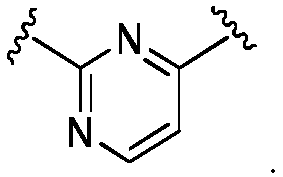
- In some embodiments, ring A is optionally substituted with one Z1a group. In some embodiments, ring A is optionally substituted with one halogen. In some embodiments of the compound of Formula (I), or a pharmaceutically acceptable salt thereof, ring B is C6-10 aryl or 5-to 10-membered heteroaryl having one to three heteroatoms each independently N, O or S, wherein the aryl or heteroaryl is optionally substituted with one to four R4. In some embodiments of the compound of Formula (I), or a pharmaceutically acceptable salt thereof, ring B is C6-10 aryl having one to three heteroatoms each independently N, O or S, wherein the aryl is optionally substituted with one to four R4. In some embodiments, ring B is phenyl or 5- to 6-membered heteroaryl having one to three heteroatoms each independently N, O or S. In some embodiments, ring B is 5- to 6-membered heteroaryl having one to three heteroatoms each independently N, O or S. In some embodiments, ring B is phenyl. In some embodiments, ring B is phenyl optionally substituted with one to three R4. In some embodiments, ring B is phenyl optionally substituted with one or two R4. In some embodiments, ring B is phenyl optionally substituted with three R4. In some embodiments, ring B is phenyl optionally substituted with two R4. In some embodiments, ring B is phenyl optionally substituted with one R4. In some embodiments, ring B is phenyl substituted with two R4. In some embodiments, ring B is substituted with two R4.
- In some embodiments of the compound of Formula (I), or a pharmaceutically acceptable salt thereof, V is -O- or -C(R6b)(R6c)-. In some embodiments, V is -O-. In some embodiments, V is -C(R6b)(R6c)-. In some embodiments, V is -CH2-.
- In some embodiments of the compound of Formula (I), or a pharmaceutically acceptable salt thereof, R2 is C1-6 alkyl or heterocyclyl, wherein the alkyl or heterocyclyl is each optionally substituted with one to four Z1, wherein each Z1 is independently C1-6 alkyl, C1-6 alkoxy, C1-6 hydroxyalkyl, C2-6 alkoxyalkyl, halogen, C1-6 haloalkyl, C1-6 haloalkoxy, -OH, -CN, C1-6 alkyl-CN, -O-C3-6 cycloalkyl, heterocyclyl, C3-10 cycloalkyl, or heteroaryl optionally substituted with 1 to 4 groups each independently C1-6 alkyl, C1-6 alkoxy, halogen, -CN, C1-6 haloalkyl, or C1-6 haloalkoxy. In some embodiments, R2 is C1-6 alkyl or heterocyclyl, wherein the alkyl or heterocyclyl is each optionally substituted with one to four Z1, wherein each Z1 is independently C1-6 alkyl, C1-6 alkoxy, or heterocyclyl In some embodiments, each Z1 is independently C1-6 alkyl, C1-6 alkoxy, heterocyclyl, or C3-10 cycloalkyl. In some embodiments, R2 is

- In some embodiments, R2 is

- In some embodiments, R2 is

- In some embodiments of the compound of Formula (I), or a pharmaceutically acceptable salt thereof, R3 is -C(O)OH.
- In some embodiments of the compound of Formula (I), or a pharmaceutically acceptable salt thereof, each R4 is independently C1-9 alkyl or halogen. In some embodiments, each R4 is independently halogen. In some embodiments, each R4 is independently methyl or F. In some embodiments, each R4 is F.
- In some embodiments of the compound of Formula (I), or a pharmaceutically acceptable salt thereof, each R5 is independently C1-9 alkyl, C1-8 haloalkyl, C1-6 alkoxy, C1-6 haloalkoxy, C2-6 alkoxyalkyl, C2-6 alkenyl, C2-6 alkynyl, C3-15 cycloalkyl, halogen, C3-15 cycloalkyl, heterocyclyl, C6-10 aryl, heteroaryl, oxo, -NO2, -N3, -CN, -O- R10a, -C(O)-R10a, -C(O)OR10a, -C(O)N(R10a)(R10b), -N(R10a)(R10b), -N(R10a)C(O)R10b, -N(R10a)C(O)OR10b, -N(R10a)C(O)N(R10b)(R10c), - N(R10a)S(O)2(R10b), -NR10aS(O)2N(R10b)(R10c), -NR10aS(O)2O(R10b), -OC(O)R10a, - OC(O)OR10a, -OC(O)-N(R10a)(R10b), -S-R10a, -S(O)R10a, -S(O)(NH)R10a, - S(O)2R10a, -S(O)2N(R10a)(R10b), -S(O)(NR10a)R10b, or -Si(R10a)3, wherein each alkyl, haloalkyl, alkenyl, alkynyl, cycloalkyl, heterocyclyl, aryl, or heteroaryl is optionally substituted with one to four R6.
- In some embodiments of the compound of Formula (I), or a pharmaceutically acceptable salt thereof, each R6 or R8 is independently C1-9 alkyl, C1-8 haloalkyl, C2-6 alkenyl, C2-6 alkynyl, halogen, C3-15 cycloalkyl, heterocyclyl, C6-10 aryl, heteroaryl, oxo, -OH, -CN, -NO2, -NH2, -N3, - SH, -O(C1-9 alkyl), -O(C1-8 haloalkyl), -O(C2-6 alkenyl), -O(C2-6 alkynyl), -O(C3-15 cycloalkyl), - O(heterocyclyl), -O(C6-10 aryl), -O(heteroaryl), -NH(C1-9 alkyl), -NH(C1-8 haloalkyl), -NH(C2-6 alkenyl), -NH(C2-6 alkynyl), -NH(C3-15 cycloalkyl), -NH(heterocyclyl), -NH(C6-10 aryl), - NH(heteroaryl), -N(C1-9 alkyl)2, -N(C1-8 haloalkyl)2, -N(C2-6 alkenyl)2, -N(C2-6 alkynyl)2, -N(C3-15 cycloalkyl)2, -N(heterocyclyl)2, -N(C6-10 aryl)2, -N(heteroaryl)2, -N(C1-9 alkyl)(C1-8 haloalkyl), -N(C1-9 alkyl)(C2-6 alkenyl), -N(C1-9 alkyl)(C2-6 alkynyl), -N(C1-9 alkyl)(C3-15 cycloalkyl), -N(C1-9 alkyl)(heterocyclyl), -N(C1-9 alkyl)(C6-10 aryl), -N(C1-9 alkyl)(heteroaryl), -C(O)(C1-9 alkyl), -C(O)(C1-8 haloalkyl), -C(O)(C2-6 alkenyl), -C(O)(C2-6 alkynyl), -C(O)(C3-15 cycloalkyl), -C(O)(heterocyclyl), -C(O)(C6-10 aryl), -C(O)(heteroaryl), - C(O)O(C1-9 alkyl), -C(O)O(C1-8 haloalkyl), -C(O)O(C2-6 alkenyl), -C(O)O(C2-6 alkynyl), -C(O)O(C3-15 cycloalkyl), -C(O)O(heterocyclyl), -C(O)O(C6-10 aryl), - C(O)O(heteroaryl), -C(O)NH2, -C(O)NH(C1-9 alkyl), -C(O)NH(C1-8 haloalkyl), -C(O)NH(C2-6 alkenyl), -C(O)NH(C2-6 alkynyl), -C(O)NH(C3-15 cycloalkyl), -C(O)NH(heterocyclyl), - C(O)NH(C6-10 aryl), -C(O)NH(heteroaryl), -C(O)N(C1-9 alkyl)2, -C(O)N(C1-8 haloalkyl)2, -C(O)N(C2-6 alkenyl)2, -C(O)N(C2-6 alkynyl)2, -C(O)N(C3-15 cycloalkyl)2, - C(O)N(heterocyclyl)2, -C(O)N(C6-10 aryl)2, -C(O)N(heteroaryl)2, -NHC(O)(C1-9 alkyl), -NHC(O)(C1-8 haloalkyl), -NHC(O)(C2-6 alkenyl), -NHC(O)(C2-6 alkynyl), -NHC(O)(C3-15 cycloalkyl), -NHC(O)(heterocyclyl), -NHC(O)(C6-10 aryl), -NHC(O)(heteroaryl), - NHC(O)O(C1-9 alkyl), -NHC(O)O(C1-8 haloalkyl), -NHC(O)O(C2-6 alkenyl), -NHC(O)O(C2-6 alkynyl), -NHC(O)O(C3-15 cycloalkyl), -NHC(O)O(heterocyclyl),-NHC(O)O(C6-10 aryl), - NHC(O)O(heteroaryl), -NHC(O)NH(C1-9 alkyl), -NHC(O)NH(C1-8 haloalkyl), -NHC(O)NH(C2-6 alkenyl), -NHC(O)NH(C2-6 alkynyl), -NHC(O)NH(C3-15 cycloalkyl), -NHC(O)NH(heterocyclyl), -NHC(O)NH(C6-10 aryl), -NHC(O)NH(heteroaryl), - NHS(O)(C1-9 alkyl), -N(C1-9 alkyl)(S(O)(C1-9 alkyl), -S(C1-9 alkyl), -S(C1-8 haloalkyl), -S(C2-6 alkenyl), -S(C2-6 alkynyl), -S(C3-15 cycloalkyl), -S(heterocyclyl), -S(C6-10 aryl), -S(heteroaryl), - S(O)N(C1-9 alkyl)2, -S(O)(C1-9 alkyl), -S(O)(C1-8 haloalkyl), -S(O)(C2-6 alkenyl), -S(O)(C2-6 alkynyl), -S(O)(C3-15 cycloalkyl), -S(O)(heterocyclyl), -S(O)(C6-10 aryl), -S(O)(heteroaryl), - S(O)2(C1-9 alkyl), -S(O)2(C1-8 haloalkyl), -S(O)2(C2-6 alkenyl), -S(O)2(C2-6 alkynyl), -S(O)2(C3-15 cycloalkyl), -S(O)2(heterocyclyl), -S(O)2(C6-10 aryl), -S(O)2(heteroaryl), -S(O)(NH)(C1-9 alkyl), - S(O)2NH(C1-9 alkyl), or -S(O)2N(C1-9 alkyl)2, wherein each alkyl, cycloalkyl, heterocyclyl, aryl, or heteroaryl is optionally substituted with 1 to 3 C1-9 alkyl, C1-8 haloalkyl, halogen, -OH, -NH2, CO2H,-O(C1-9 alkyl), -O(C1-8 haloalkyl), -O(C3-15 cycloalkyl), -O(heterocyclyl), -O(aryl), - O(heteroaryl), -NH(C1-9 alkyl), -NH(C1-8 haloalkyl), -NH(C3-15 cycloalkyl), -NH(heterocyclyl), - NH(aryl), -NH(heteroaryl), -N(C1-9 alkyl)2, -N(C3-15 cycloalkyl)2, -NHC(O)(C1-8 haloalkyl), -NHC(O)(C3-15 cycloalkyl), -NHC(O)(heterocyclyl), -NHC(O)(aryl), - NHC(O)(heteroaryl), -NHC(O)O(C1-9 alkyl), -NHC(O)O(C1-8 haloalkyl), -NHC(O)O(C2-6 alkynyl), -NHC(O)O(C3-15 cycloalkyl), -NHC(O)O(heterocyclyl), -NHC(O)O(aryl), - NHC(O)O(heteroaryl), -NHC(O)NH(C1-9 alkyl), S(O)2(C1-9 alkyl), -S(O)2(C1-8 haloalkyl), -S(O)2(C3-15 cycloalkyl), -S(O)2(heterocyclyl), -S(O)2(aryl), -S(O)2(heteroaryl), - S(O)(NH)(C1-9 alkyl), -S(O)2NH(C1-9 alkyl), or -S(O)2N(C1-9 alkyl)2, wherein the alkyl or heterocyclyl is each optionally substituted with one to four halogens.
- In some embodiments of the compound of Formula (I), or a pharmaceutically acceptable salt thereof, R6a is H, C1-6 alkyl, C3-10 cycloalkyl, heterocyclyl, -S(O)2R6a1, or - S(O)2N(R6a1)(NR6a2), wherein the cycloalkyl or heterocyclyl is each optionally substituted with C1-6 alkyl, F, or -CN.
- In some embodiments of the compound of Formula (I), or a pharmaceutically acceptable salt thereof, each R6b and R6c is independently H, C1-6 alkyl, C1-6 haloalkyl, C2-6 alkoxyalkyl, halogen, C3-10 cycloalkyl, heterocyclyl, -C1-6 alkyl-N(R9a)(R9b), -CN, -OR6c1, or -N(R6c2)(R6c3), wherein the alkyl, cycloalkyl, or heterocyclyl is each optionally substituted with one to four R6b1.
- In some embodiments of the compound of Formula (I), or a pharmaceutically acceptable salt thereof, R6b and R6c are combined with the atom to which they are attached to form a C3-10 cycloalkyl or heterocyclyl, which is each optionally substituted with one to four R6b1.
- In some embodiments of the compound of Formula (I), or a pharmaceutically acceptable salt thereof, R6a or R6c is combined with one R4 group and the atoms to which they are attached to form a C5-10 cycloalkyl or heterocyclyl, which is each optionally substituted with one to four R10.
- In some embodiments of the compound of Formula (I), or a pharmaceutically acceptable salt thereof, each R6b1 and R10 is independently C1-6 alkyl, C1-6 haloalkyl, C1-6 alkoxy, C1-6 haloalkoxy, C2-6 alkoxyalkyl, C2-6 alkenyl, C2-6 alkynyl, halogen, C3-10 cycloalkyl, heterocyclyl, C6-10 aryl, heteroaryl, oxo, -OH, -CN, CO2R30, -NO2, or -C(O)N(R2a)(R2b), wherein the heterocyclyl or heteroaryl is optionally substituted with C1-6 alkyl, C1-6 haloalkyl, or C1-6 haloalkoxy.
- In some embodiments of the compound of Formula (I), or a pharmaceutically acceptable salt thereof, each R6a1, R6a2, R6c1, R6c2, and R6c3 is independently H, C1-6 alkyl or C3-10 cycloalkyl.
- In some embodiments of the compound of Formula (I), or a pharmaceutically acceptable salt thereof, each R9a and R9b is independently H, C1-6 alkyl, or C1-6 haloalkyl, or R9a and R9b together form a 6-membered heterocyclyl.
- In some embodiments of the compound of Formula (I), or a pharmaceutically acceptable salt thereof, each R9c, R9a, R10a, R10b, and R10c is independently H, C1-9 alkyl, C2-6 alkenyl, C2-6 alkynyl, C3-15 cycloalkyl, heterocyclyl, C6-10 aryl, or heteroaryl, wherein the alkyl, alkenyl, alkynyl, cycloalkyl, heterocyclyl, aryl, or heteroaryl is each optionally substituted with one to four R6.
- In some embodiments of the compound of Formula (I), or a pharmaceutically acceptable salt thereof, Ra and Rb are independently H, C1-9 alkyl, C2-6 alkenyl, C2-6 alkynyl, C3-15 cycloalkyl, heterocyclyl, C6-10 aryl, or heteroaryl, wherein the alkyl, alkenyl, alkynyl, cycloalkyl, heterocyclyl, aryl, or heteroaryl is each optionally substituted with one to four R6.
- In some embodiments of the compound of Formula (I), or a pharmaceutically acceptable salt thereof, optionally Ra and Rb are combined with the atom to which they are attached to form a 5- or 6-membered heterocyclyl, which is optionally substituted with one to four R6.
- In some embodiments of the compound of Formula (I), or a pharmaceutically acceptable salt thereof, each R2a, R2b, R12a, R12b, and R12c is independently H, C1-9 alkyl, C2-6 alkenyl, C2-6 alkynyl, C3-15 cycloalkyl, heterocyclyl, C6-10 aryl, or heteroaryl, wherein the alkyl, alkenyl, alkynyl, cycloalkyl, heterocyclyl, aryl, or heteroaryl is each optionally substituted with one to four R6.
- In some embodiments of the compound of Formula (I), or a pharmaceutically acceptable salt thereof, each R3e is independently H, C1-6 alkyl, C1-6 haloalkyl, -C1-4 alkyl-N(R9a)(R9b), -C1-4 alkyl-C(O)N(R9a)(R9b), -C1-4 alkyl-O-C(O)-C1-4 alkyl, -C1-4 alkyl-O-C(O)-O-C1-4alkyl, -C1-4 alkyl-O-C(O)-C1-4 alkyl-N(R9a)(R9b), -C1-4 alkyl-C3-8 cycloalkyl, -C1-4 alkyl-heterocyclyl, C3-10 cycloalkyl, heterocyclyl, C6-10 aryl, heteroaryl, -P(O)(OR9c)2, -CH2P(O)(OR9c)2, - OCH2P(O)(OR9c)2, -C(O)OCH2P(O)(OR9c)2, -P(O)(R9c)(OR9d), -OP(O)(R9c)(OR9d), - CH2P(O)(R9c)(OR9d), -C(O)OCH2P(O)(R9c)(OR9d), -P(O)(N(R9c)2)2, -CH2P(O)(N(R9c)2)2, - C(O)OCH2P(O)(N(R9c)2)2, -P(O)(N(R9c)2)(OR9d), -CH2P(O)(N(R9c)2)(OR9d), - C(O)OCH2P(O)(N(R9c)2)(OR9d), -P(O)(R9c)(N(R9d)2), -CH2P(O)(R9c)(N(R9d)2), or - C(O)OCH2P(O)(R9c)(N(R9d)2); wherein the alkyl, alkenyl, cycloalkyl, heterocyclyl, aryl, or heteroaryl is each optionally substituted with one to four R6;wherein each heteroaryl has 5 to 12 ring members and has one to four heteroatoms each independently N, O, or S; wherein each heterocyclyl has three to twelve ring members and has one to four heteroatoms, each independently N, O, or S.
- In some embodiments of the compound of Formula (I), or a pharmaceutically acceptable salt thereof, each heteroaryl has five to twelve ring members and one to four heteroatoms, each independently N, O, or S.
- In some embodiments according to the invention, a compound of Formula (II) is provided:

- R1 is thiazolyl optionally substituted with R4;
- X1 is -C(H)= or -C(R8)=;
- X4 is -C(H)=, -C(R8)= or N;
- each RB is independently C1-9 alkyl, C1-8 haloalkyl, or halogen;
- each R8 is independently halogen; and
- n is 0, 1, 2, or 3.
- In some embodiments according to the invention, a compound of Formula (I) is a compound according to Formula (II).
- In some embodiments of a compound of Formula (II), or a pharmaceutically acceptable salt thereof,
R1 is
- In some embodiments of a compound of Formula (II), or a pharmaceutically acceptable salt thereof, R1 is

- In some embodiments of a compound of Formula (II), or a pharmaceutically acceptable salt thereof, R8 is F or Cl
- In some embodiments, the compound of Formula (II), or a pharmaceutically acceptable salt thereof, has the structure of a compound in Table 2.
- Also disclosed herein, but not forming part of the invention, are the in vivo metabolic products of the compounds described herein, to the extent such products are novel and unobvious over the prior art. Such products may result for example from the oxidation, reduction, hydrolysis, amidation, esterification and the like of the administered compound, primarily due to enzymatic processes. Accordingly, included, but not forming part of the invention, are novel and unobvious compounds produced by a process comprising contacting a compound with a mammal for a period of time sufficient to yield a metabolic product thereof. Such products typically are identified by preparing a radiolabeled (e.g. 14C or 3H) compound, administering it parenterally in a detectable dose (e.g. greater than about 0. 5 mg/kg) to an animal such as rat, mouse, guinea pig, monkey, or to man, allowing sufficient time for metabolism to occur (typically about 30 seconds to 30 hours) and isolating its conversion products from the urine, blood or other biological samples. These products can be easily isolated since they are labeled (others are isolated by the use of antibodies capable of binding epitopes surviving in the metabolite). The metabolite structures are determined in conventional fashion, e.g. by MS or NMR analysis. In general, analysis of metabolites can be done in the same way as conventional drug metabolism studies well-known to those skilled in the art. The conversion products, so long as they are not otherwise found in vivo, can be useful in diagnostic assays for therapeutic dosing of the compounds even if they possess no GLP-1R activity of their own.
- Recipes and methods for determining stability of compounds in surrogate gastrointestinal secretions are known. Compounds are defined herein as stable in the gastrointestinal tract where less than about 50 mole percent of the protected groups are deprotected in surrogate intestinal or gastric juice upon incubation for 1 hour at 37 °C. Simply because the compounds are stable to the gastrointestinal tract does not mean that they cannot be hydrolyzed in vivo. The prodrugs typically will be stable in the digestive system but may be substantially hydrolyzed to the parental drug in the digestive lumen, liver, lung or other metabolic organ, or within cells in general. As used herein, a prodrug is understood to be a compound that is chemically designed to efficiently liberate the parent drug after overcoming biological barriers to oral delivery.
- The compounds of the present disclosure can be prepared by any method known in the art. The following exemplary general methods illustrate routes that may be used to obtain a compound of the present disclosure.

- Intermediate 1.3 may be assembled by reacting an amine with Intermediate 1.1, wherein X is a halogen, and R is an alkyl, alkylaryl, or aryl, in the presence of a suitable base (e.g. DIPEA, KOtBu, etc.) to give Intermediate 1.2. Intermediate 1.2 can be converted to
Intermediate 1. 3 using suitable reducing conditions (e.g. H2 and Pd/C, Fe and HCl, etc.).
- Compounds of Formula (I) having the structure of a compound of Formula 2.9 can be assembled by first coupling Intermediate 2.1, wherein X21 and X22 is each a leaving group, e.g., a halogen such as Cl or Br, with a heteroatom containing Intermediate 2.2 (where Y = O, NH, or S) using either a suitable base (e.g., DIPEA, KOtBu, etc.) or through metal mediated cross-coupling using a suitable palladium catalyst to give Intermediate 2.3 (Scheme 2). Intermediate 2. 4 (where M = Li, MgBr, MgCl, or MgI, purchased commercially or obtained through metalation of a corresponding halide) can be combined with Intermediate 2.3 using a suitable palladium catalyst to deliver Intermediate 2.5. Following conversion to the acid Intermediate 2.6 using standard conditions (e.g. LiOH, LiI and pyridine, etc.), the Intermediate 1.3 can be added using standard amide bond forming conditions (e.g. DIPEA with HATU, etc.) to give Intermediate 2.7, which can, in turn, be converted to the corresponding benzimidazole Intermediate 2.8 under the influence of an acid catalyst (e.g. HCl, AcOH, etc.) This intermediate can be converted to the compound of Formula (I) using standard ester hydrolysis conditions (e.g., LiOH, LiI and pyridine, etc.).
- While the
above Scheme 2 is illustrated using Intermediate 2.1 as a dihalopyridine, any dihalogenated A-ring starting material can be used to obtain the analogous compound of Formula (I).
- In some embodiments, a compound of Formula (I) having the structure of a compound of Formula 2.9 can be assembled first by the combination of Intermediate 3.1 (wherein X31 is Cl, Br, or I) with Intermediate 1.3 (wherein R = alkyl, alkylaryl, or aryl) under standard amide bond forming conditions, e.g. DIPEA with HATU, etc. (Scheme 3). Treatment with a suitable acid catalyst (e.g. HCl, AcOH, etc.) can deliver Intermediate 3.3. Halogen metal exchange of -X31 to -M can be achieved using a suitable reagent (e.g. iPrMgBr, etc.) or transition metal coupling using a suitable palladium catalyst and metal source (e.g. B2Pin2, Bu6Sn2, etc.) to give Intermediate 2.8 which can be converted to the compound of Formula (I) using standard ester hydrolysis conditions (e.g. LiOH, LiI and pyridine, etc.).

- In some embodiments, a compound of Formula 2.9 can be formed by first conversion of Intermediate 2.3 to the metallated variant Intermediate 4.1 using a suitable palladium catalyst and metal source, e.g. B2Pin2, Bu6Sn2, etc. (Scheme 4). Intermediate 4.1 can be coupled to Intermediate 3.3 using a suitable palladium catalyst to deliver Intermediate 2.8 which can then be converted to the compound of Formula (I) using standard ester hydrolysis conditions, e.g. LiOH, LiI and pyridine, etc.

- A compound of Formula (I-A-1) and/or Formula (I) having the structure of a compound of Formula 5.3 can be assembled via first coupling to the halogen -X (wherein X is Cl, Br, or I) of Intermediate 5.1 using a suitable coupling partner and palladium catalyst to deliver Intermediate 5.2 which can be converted to a compound of Formula 5.3 using standard ester hydrolysis conditions, e.g. LiOH, LiI and pyridine, etc. (Scheme 5).

- A compound of Formula (I) having the structure of a compound of Formula 6.1 can be obtained through the reaction of Intermediate 2.9 with a sulfonamide under suitable coupling conditions (e.g. EDCI and DMAP, etc.) (Scheme 6).

- A compound of Formula (I) having the structure of a compound of Formula 7.3 can be assembled via first coupling to the halogen -X of Intermediate 7.1 using a suitable coupling partner and palladium catalyst to deliver Intermediate 7.2, which can be converted to a compound of Formula 7.3 using standard ester hydrolysis conditions (e.g. LiOH, LiI and pyridine, etc.) (Scheme 7).
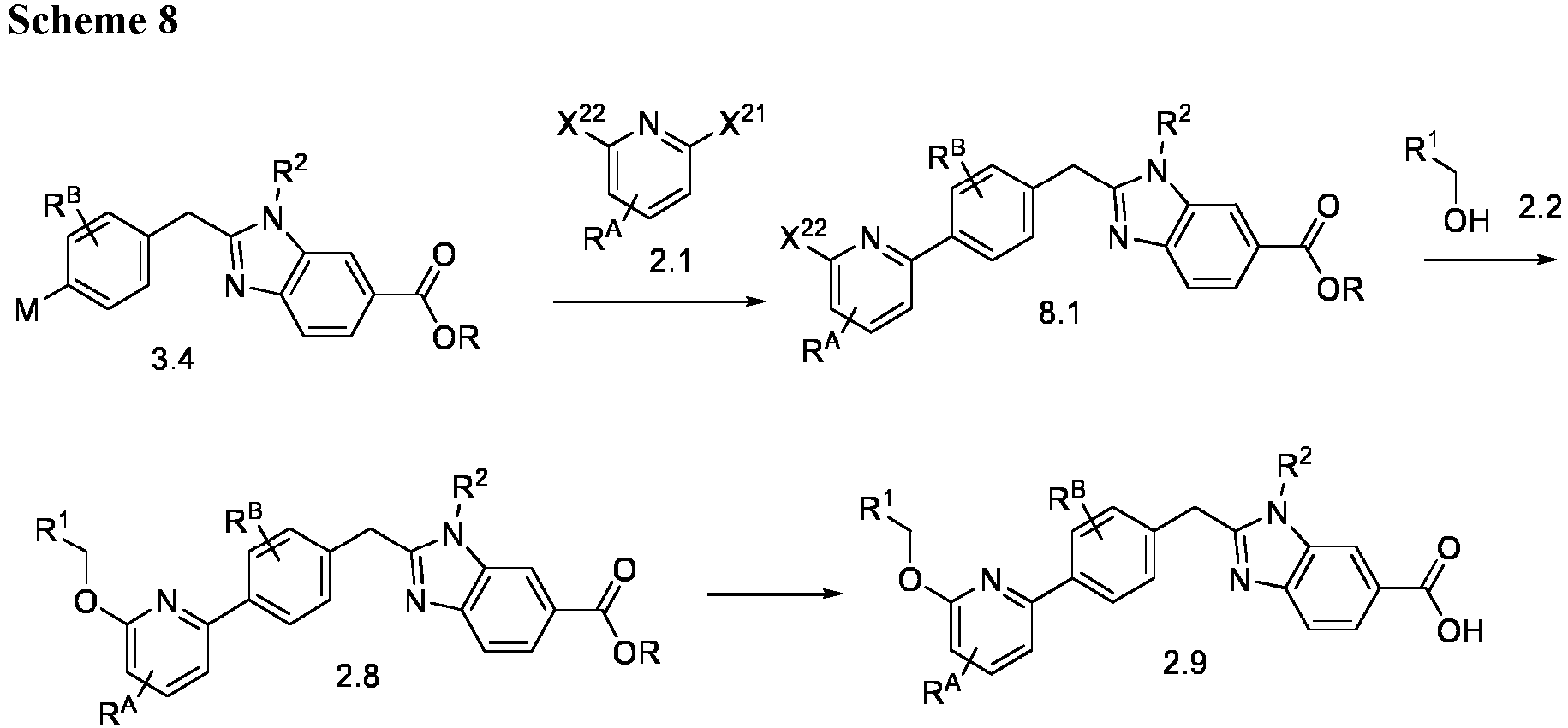
- A compound of Formula (I) having the structure of a compound of Formula 2.9 can be assembled through first cross-coupling of an Intermediate 3.4 with Intermediate 2.1 using a suitable transition metal catalyst (e.g. palladium, etc.) (Scheme 8). This can then be coupled with a heteroatom containing Intermediate 2.2 (where Y = O, N or S) using either a suitable base (e.g. DIPEA, KOtBu, etc.) or through metal mediated cross-coupling using a suitable palladium catalyst to give Intermediate 2.8. Intermediate 2.8 can be converted to the compound of Formula (I) having the structure of a compound of Formula 2.9 using standard ester hydrolysis conditions (e.g. LiOH, LiI and pyridine, etc.).

- A compound of Formula (I) having the structure of a compound of Formula 2.9 can be assembled through first cross-coupling of an Intermediate 3.4 with Intermediate 9.1 using a suitable transition metal catalyst (e.g. palladium, etc.) (Scheme 9). The benzyl ether can then be removed through reduction using H2 and a suitable catalyst (Pd/C, etc.) to yield intermediate 9.2. Intermediate 9.2 can then be alkylated using a suitable base (K2CO3, Cs2CO3, Ag2CO3, etc.) a suitable electrophile represented by intermediate 9.3 where X91 can be -Cl, -Br, I, or -OTs. Intermediate 2.8 can be converted to the compound of Formula (I) having the structure of a compound of Formula 2.9 using standard ester hydrolysis conditions (e.g. LiOH, LiI and pyridine, etc.).

- A compound of Formula (I) having the structure of a compound of Formula 10.4 can be assembled through first alkylation if intermediate 9.2 with an intermediate of the type 10.1 using a suitable base (K2CO3, Cs2CO3, Ag2CO3, etc.) where X101 and X102 are each independently -Cl, -Br, -I, -OTs, or -OTf and Y1, Y2, Y3, and Y4 are each independently -CH= or -N=. Intermediate 10.2 is then converted to intermediate 10.3 using a suitable transition metal catalyst (e.g. palladium, etc.). Intermediate 10.3 can be converted to the compound of Formula (I) having the structure of a compound of Formula 10.4 using standard ester hydrolysis conditions (e.g. LiOH, LiI and pyridine, etc.).
- In some embodiments, the present disclosure provides a pharmaceutical composition comprising a compound of the present disclosure (e.g. a compound of Formula (II)), or a pharmaceutically acceptable salt thereof, and a pharmaceutically acceptable carrier or excipient.
- In some embodiments of the disclosure, the pharmaceutical composition comprises a compound of Formula (II), or a pharmaceutically acceptable salt thereof, and one or more additional therapeutic agents, as more fully set forth below.
- Pharmaceutical compositions comprising the compounds disclosed herein, or pharmaceutically acceptable salts thereof, may be prepared with one or more pharmaceutically acceptable excipients which may be selected in accord with ordinary practice. Tablets may contain excipients including glidants, fillers, binders and the like. Aqueous compositions may be prepared in sterile form, and when intended for delivery by other than oral administration generally may be isotonic. In some embodiments, compositions may contain excipients such as those set forth in the Rowe et al, Handbook of Pharmaceutical Excipients, 6th edition, American Pharmacists Association, 2009. Excipients can include ascorbic acid and other antioxidants, chelating agents such as EDTA, carbohydrates such as dextrin, hydroxyalkylcellulose, hydroxyalkylmethylcellulose, stearic acid and the like. In some embodiments, the composition is provided as a solid dosage form, including a solid oral dosage form.
- The compositions include those suitable for various administration routes, including oral administration. The compositions may be presented in unit dosage form and may be prepared by any of the methods well known in the art of pharmacy. Such methods include the step of bringing into association the active ingredient (e.g., a compound of the present disclosure or a pharmaceutical salt thereof) with one or more pharmaceutically acceptable excipients. The compositions may be prepared by uniformly and intimately bringing into association the active ingredient with liquid excipients or finely divided solid excipients or both, and then, if desired, shaping the product. Techniques and formulations generally are found in Remington: The Science and Practice of Pharmacy, 21st Edition, Lippincott Wiliams and Wilkins, Philadelphia, Pa., 2006.
- Compositions described herein that are suitable for oral administration may be presented as discrete units (a unit dosage form) including but not limited to capsules, sachets or tablets each containing a predetermined amount of the active ingredient. In one embodiment, the pharmaceutical composition of the disclosure is a tablet.
- Pharmaceutical compositions disclosed herein comprise one or more compounds disclosed herein, or a pharmaceutically acceptable salt thereof, together with a pharmaceutically acceptable excipient and optionally other therapeutic agents. Pharmaceutical compositions containing the active ingredient may be in any form suitable for the intended method of administration. When used for oral use for example, tablets, troches, lozenges, aqueous or oil suspensions, dispersible powders or granules, emulsions, hard or soft capsules, syrups or elixirs may be prepared. Compositions intended for oral use may be prepared according to any method known to the art for the manufacture of pharmaceutical compositions and such compositions may contain one or more excipients including sweetening agents, flavoring agents, coloring agents and preserving agents, in order to provide a palatable preparation. Tablets containing the active ingredient in admixture with non-toxic pharmaceutically acceptable excipients which are suitable for manufacture of tablets are acceptable. These excipients may be, for example, inert diluents, such as calcium or sodium carbonate, lactose, lactose monohydrate, croscarmellose sodium, povidone, calcium or sodium phosphate; granulating and disintegrating agents, such as maize starch, or alginic acid; binding agents, such as cellulose, microcrystalline cellulose, starch, gelatin or acacia; and lubricating agents, such as magnesium stearate, stearic acid or talc. Tablets may be uncoated or may be coated by known techniques including microencapsulation to delay disintegration and adsorption in the gastrointestinal tract and thereby provide a sustained action over a longer period. For example, a time delay material such as glyceryl monostearate or glyceryl distearate alone or with a wax may be employed.
- The amount of active ingredient that may be combined with the inactive ingredients to produce a dosage form may vary depending upon the intended treatment subject and the mode of administration. For example, in some embodiments, a dosage form for oral administration to humans may contain approximately 1 to 1000 mg of active material formulated with an appropriate and convenient amount of a pharmaceutically acceptable excipient. In some embodiments, the pharmaceutically acceptable excipient varies from about 5 to about 95% of the total compositions (weight:weight).
- In some embodiments, a composition comprising a compound of the present disclosure, or a pharmaceutically acceptable salt thereof in one variation does not contain an agent that affects the rate at which the active ingredient is metabolized. Thus, it is understood that compositions comprising a compound of the present disclosure in one aspect do not comprise an agent that would affect (e.g., slow, hinder or retard) the metabolism of a compound of the present disclosure or any other active ingredient administered separately, sequentially or simultaneously with a compound of the present disclosure. It is also understood that any of the methods, kits, articles of manufacture and the like detailed herein in one aspect do not comprise an agent that would affect (e.g., slow, hinder or retard) the metabolism of a compound of the present disclosure or any other active ingredient administered separately, sequentially or simultaneously with a compound of the present disclosure.
- In some embodiments, the pharmaceutical compositions described above are for use in a human or an animal.
- The disclosure further includes a compound of the present disclosure for administration as a single active ingredient of a pharmaceutically acceptable composition which can be prepared by conventional methods known in the art, for example by binding the active ingredient to a pharmaceutically acceptable, therapeutically inert organic and/or inorganic carrier or excipient, or by mixing therewith.
- In one aspect, provided herein is a compound of the present disclosure for use as a second or other active ingredient having a synergistic effect with other active ingredients in known drugs, or for administration together with such drugs.
- The compounds of the present disclosure (also referred to herein as the active ingredients), can be administered by any route appropriate to the condition to be treated. Suitable routes include oral, rectal, nasal, topical (including buccal and sublingual), transdermal, vaginal and parenteral (including subcutaneous, intramuscular, intravenous, intradermal, intratumoral, intrathecal and epidural), and the like. It will be appreciated that the preferred route may vary with for example the condition of the recipient. An advantage of certain compounds disclosed herein is that they are orally bioavailable and can be dosed orally.
- A compound of the present disclosure may be administered to an individual in accordance with an effective dosing regimen for a desired period of time or duration, such as at least about one month, at least about 2 months, at least about 3 months, at least about 6 months, or at least about 12 months or longer. In one variation, the compound is administered on a daily or intermittent schedule for the duration of the individual's life.
- The dosage or dosing frequency of a compound of the present disclosure may be adjusted over the course of the treatment, based on the judgment of the administering physician.
- The compound may be administered to an individual (e.g., a human) in an effective amount. In some embodiments, the compound is administered once daily.
- The compound can be administered by any useful route and means, such as by oral or parenteral (e.g., intravenous) administration. Therapeutically effective amounts of the compound may include from about 0. 00001 mg/kg body weight per day to about 10 mg/kg body weight per day, such as from about 0. 0001 mg/kg body weight per day to about 10 mg/kg body weight per day, or such as from about 0. 001 mg/kg body weight per day to about 1 mg/kg body weight per day, or such as from about 0. 01 mg/kg body weight per day to about 1 mg/kg body weight per day, or such as from about 0. 05 mg/kg body weight per day to about 0. 5 mg/kg body weight per day, or such as from about 0. 3 mg to about 30 mg per day, or such as from about 30 mg to about 300 mg per day.
- A compound of the present disclosure may be combined with one or more additional therapeutic agents in any dosage amount of the compound of the present disclosure (e.g., from 1 mg to 1000 mg of compound). Therapeutically effective amounts may include from about 1 mg per dose to about 1000 mg per dose, such as from about 50 mg per dose to about 500 mg per dose, or such as from about 100 mg per dose to about 400 mg per dose, or such as from about 150 mg per dose to about 350 mg per dose, or such as from about 200 mg per dose to about 300 mg per dose. Other therapeutically effective amounts of the compound of the present disclosure are about 100, 125, 150, 175, 200, 225, 250, 275, 300, 325, 350, 375, 400, 425, 450, 475, or about 500 mg per dose. Other therapeutically effective amounts of the compound of the present disclosure are about 100 mg per dose, or about 125, 150, 175, 200, 225, 250, 275, 300, 350, 400, 450, or about 500 mg per dose. A single dose can be administered hourly, daily, or weekly. For example, a single dose can be administered once every 1 hour, 2, 3, 4, 6, 8, 12, 16 or once every 24 hours. A single dose can also be administered once every 1 day, 2, 3, 4, 5, 6, or once every 7 days. A single dose can also be administered once every 1 week, 2, 3, or once every 4 weeks. In some embodiments, a single dose can be administered once every week. A single dose can also be administered once every month.
- Kits that comprise a compound of the present disclosure, or an enantiomer, or pharmaceutically acceptable salt thereof, or a pharmaceutical composition containing any of the above, are also included in the present disclosure. In one embodiment, a kit further includes instructions for use. In one aspect, a kit includes a compound of the disclosure, or a pharmaceutically acceptable salt, tautomer, stereoisomer, mixture of stereoisomers, or deuterated analog thereof, and a label and/or instructions for use of the compounds in the treatment of the indications, such as the diseases or conditions, described herein. In one embodiment, kits comprising a compound of the present disclosure, or a pharmaceutically acceptable salt thereof, in combination with one or more (e.g., one, two, three, four, one or two, or one to three, or one to four) additional therapeutic agents are provided.
- Provided herein are also articles of manufacture that include a compound of the present disclosure or a pharmaceutically acceptable salt, tautomer, stereoisomer, mixture of stereoisomers, or deuterated analog thereof in a suitable container. The container may be a vial, jar, ampoule, preloaded syringe, and intravenous bag.
- In some embodiments, a compound of the present disclosure, or a pharmaceutically acceptable salt thereof, can be combined with a therapeutically effective amount of one or more (e.g., one, two, three, four, one or two, one to three, or one to four) additional therapeutic agents. In some embodiments, the additional therapeutic agent comprises an apoptotic signal-regulating kinase (ASK-1) inhibitor, a farnesoid X receptor (FXR) agonist, a peroxisome proliferator-activated receptor alpha (PPARα) agonist, fish oil, an acetyl-coA carboxylase (ACC) inhibitor, a TGFβ antagonist, a LPAR antagonist, a SGLT2 inhibitor, a Tpl2 inhibitor, or a GLP-1 agonist combination thereof.
- The benefit of combination may be increased efficacy and/or reduced side effects for a component as the dose of that component may be adjusted down to reduce its side effects while benefiting from its efficacy augmented by the efficacy of the compound of the present disclosure.
- In some embodiments, the therapeutic agent, or combination of therapeutic agents, are a(n) ACE inhibitor, 2-Acylglycerol O-acyltransferase 2 (DGAT2) inhibitor, Acetaldehyde dehydrogenase inhibitor, Acetyl CoA carboxylase inhibitor, Adrenergic receptor agonist, Alstrom syndrome protein 1(ALMS1)/PKC alpha protein interaction inhibitor, Apelin receptor agonist, Diacylglycerol O acyltransferase 2 inhibitor, Adenosine A3 receptor agonist, Adenosine A3 receptor antagonist, Adiponectin receptor agonist, Aldehyde dehydrogenase 2 stimulator, AKT protein kinase inhibitor, AMP-activated protein kinases (AMPK), AMP kinase activator, ATP citrate lyase inhibitor, AMP activated protein kinase stimulator, Endothelial nitric oxide synthase stimulator, NAD-dependent deacetylase sirtuin-1 stimulator, Adrenergic receptor antagonist, Androgen receptor agonist, Amylin receptor agonist, Angiotensin II AT-1 receptor antagonist, Apical sodium-dependent bile acid transport inhibitor, Autophagy protein modulator, Autotaxin inhibitors, Axl tyrosine kinase receptor inhibitor, Bax protein stimulator, Beta-catenin inhibitor, Bioactive lipid, Calcitonin agonist, Cannabinoid receptor modulator, Caspase inhibitor, Caspase-3 stimulator, Cathepsin inhibitor, Caveolin 1 inhibitor, CCK receptor antagonist, CCL26 gene inhibitor, CCR2 chemokine antagonist, CCR2 chemokine antagonist, Angiotensin II AT-1 receptor antagonist, CCR3 chemokine antagonist, CCR5 chemokine antagonist, CD3 antagonist, CDGSH iron sulfur domain protein modulator, chitinase inhibitor, Chloride channel stimulator, Chitotriosidase 1 inhibitor, CNR1 inhibitor, Connective tissue growth factor ligand inhibitor, COT protein kinase inhibitor, Cyclin D1 inhibitor, Cytochrome P450 7A1 inhibitor, Cytochrome P450 reductase inhibitors, DGAT1/2 inhibitor, Diacylglycerol O acyltransferase 1 inhibitor (DGAT1), Cytochrome P450 2E1 inhibitor (CYP2E1), CXCR3 chemokine antagonist, CXCR4 chemokine antagonist, Dihydroceramide delta 4 desaturase inhibitor, Dihydroorotate dehydrogenase inhibitor, Dipeptidyl peptidase IV inhibitor, Endosialin modulator, Eotaxin ligand inhibitor, Extracellular matrix protein modulator, Farnesoid X receptor agonist, Fatty acid synthase inhibitors, FGF1 receptor agonist, Fibroblast growth factor (FGF-15, FGF-19, FGF-21) ligands, fibroblast activation protein inhibitor, Free fatty acid receptor 1 agonist, Galectin-3 inhibitor, GDNF family receptor alpha like agonist, Glucagon receptor agonist, Glucagon-like peptide 1 agonist, Glucocorticoid receptor antagonist, Glucose 6-phosphate 1-dehydrogenase inhibitor, G-protein coupled bile acid receptor 1 agonist, G-protein coupled receptor-119 agonist, G-protein coupled receptor 84 antagonist, Hedgehog (Hh) modulator, Hepatitis C virus NS3 protease inhibitor, Hepatocyte nuclear factor 4 alpha modulator (HNF4A), Hepatocyte growth factor modulator, Histone deacetylase inhibitor, STAT-3 modulator, HMG CoA reductase inhibitor, HSD17B13 gene inhibitor, 5-HT 2a receptor antagonist, Hydrolase inhibitor, Hypoxia inducible factor-2 alpha inhibitor, IL-10 agonist, IL-17 antagonist, IL-22 agonist, Ileal sodium bile acid cotransporter inhibitor, Insulin sensitizer, Insulin ligand agonist, Insulin receptor agonist, integrin modulator, Integrin Antagonist, Integrin alpha-V/beta-1 antagonist, Integrin alpha-V/beta-6 antagonist, intereukin-1 receptor-associated kinase 4 (IRAK4) inhibitor, IL-6 receptor agonist, interleukin 17 ligand inhibitor, Jak2 tyrosine kinase inhibitor, Jun N terminal kinase-1 inhibitor, Kelch like ECH associated protein 1 modulator, Ketohexokinase (KHK) inhibitor, Klotho beta stimulator, Leukotriene A4 hydrolase inhibitor, 5-Lipoxygenase inhibitor, Lipoprotein lipase inhibitor, Liver X receptor, LPL gene stimulator, Lysophosphatidate-1 receptor antagonist, Lysyl oxidase homolog 2 inhibitor, LXR inverse agonists, Macrophage mannose receptor 1 modulator, Matrix metalloproteinases (MMPs) inhibitor, MEKK-5 protein kinase inhibitor, MCH receptor-1 antagonist, Membrane copper amine oxidase (VAP-1) inhibitor, Methionine aminopeptidase-2 inhibitor, Methyl CpG binding protein 2 modulator, MicroRNA-132 (miR-132) antagonist, MicroRNA-21(miR-21) inhibitor, Mitochondrial uncoupler, Mixed lineage kinase-3 inhibitor, Motile sperm domain protein 2 inhibitor, Myelin basic protein stimulator, NACHT LRR PYD domain protein 3 (NLRP3) inhibitor, NAD-dependent deacetylase sirtuin stimulator, NADPH oxidase inhibitor (NOX), NFE2L2 gene inhibitor, Nicotinic acid receptor 1 agonist, Opioid receptor mu antagonist, P2Y13 purinoceptor stimulator, Nuclear erythroid 2-related factor 2 stimulator, Nuclear receptor modulators, Nuclear transport of transcription factor modulator, P2X7 purinoceptor modulator, PACAP type I receptor agonist, PDE 3 inhibitor, PDE 4 inhibitor, PDE 5 inhibitor, PDGF receptor beta modulator, Phenylalanine hydroxylase stimulator, Phospholipase C inhibitor, Phosphoric diester hydrolase inhibitor, PPAR alpha agonist, PPAR delta agonist, PPAR gamma agonist, Peptidyl-prolyl cis-trans isomerase A inhibitor, PNPLA3 gene inhibitor, PPAR gamma modulator, Protease-activated receptor-2 antagonist, Protein kinase modulator, Protein NOV homolog modulator, PTGS2 gene inhibitor, renin inhibitor, Resistin/CAP1 (adenylyl cyclase associated protein 1) interaction inhibitor, Rho associated protein kinase inhibitor, RNA polymerase inhibitors, S-nitrosoglutathione reductase (GSNOR) enzyme inhibitor, Sodium glucose transporter-2 inhibitor, Sphingolipid delta 4 desaturase DES1 inhibitor, SREBP transcription factor inhibitor, STAT-1 inhibitor, Stearoyl CoA desaturase-1 inhibitor, STK25 inhibitor, Suppressor of cytokine signalling-1 stimulator, Suppressor of cytokine signalling-3 stimulator, Taste receptor type 2 agonist, Telomerase stimulator, TERT gene modulator, TGF beta (TGFB1) ligand inhibitor, TNF antagonist, Transforming growth factor β (TGF-β), Transforming growth factor β activated Kinase 1 (TAK1), Thyroid hormone receptor beta agonist, TLR-4 antagonist, Transglutaminase inhibitor, Tyrosine kinase receptor modulator, GPCR modulator, nuclear hormone receptor modulator, TLR-9 antagonist, VDR agonist, Vitamin D3 receptor modulators, WNT modulators, YAP/TAZ modulator or a Zonulin inhibitor, and combinations thereof.
- Non-limiting examples of the one or more additional therapeutic agents include:
- - ACE inhibitors, such as enalapril;
- - Acetaldehyde dehydrogenase inhibitors, such as ADX-629;
- - Acetyl CoA carboxylase (ACC) inhibitors, such as NDI-010976 (firsocostat), DRM-01, gemcabene, GS-834356, PF-05175157, QLT-091382, PF-05221304;
- - Acetyl CoA carboxylase/Diacylglycerol O acyltransferase 2 inhibitors, such as PF-07055341;
- - Adenosine receptor agonists, such as CF-102 (namodenoson), CF-101 (piclidenoson), CF-502, CGS21680;
- - Adenosine A3 receptor antagonist, such as FM-101;
- - Adiponectin receptor agonists, such as ADP-355, ADP-399, ALY668-SR;
- - Adrenergic receptor antagonist, such as bromocriptine, phentermine, VI-0521;
- -
Aldehyde dehydrogenase 2 stimulators, such as FP-045; - - Amylin/calcitonin receptor agonists, such as KBP-042, KBP-089;
- - AMP activated protein kinase stimulators, such as C-455, PXL-770, O-304;
- - AMP kinase activators/ATP citrate lyase inhibitors, such as bempedoic acid (ETC-1002, ESP-55016);
- - AMP activated protein kinase/Endothelial nitric oxide synthase/NAD-dependent deacetylase sirtuin-1 stimulators, such as NS-0200 (leucine + metformin + sildenafil);
- - Androgen receptor agonists, such as LPCN-1144, LPCN-1148, testosterone prodrug;
- - Angiotensin II AT-1 receptor antagonists, such as irbesartan; Angiopoietin-related protein-3 inhibitors, such as vupanorsen (IONIS-ANGPTL3-LRx);
- - Apelin receptor agonist, such as CB-5064, MBT-2;
- - Apical sodium-dependent bile acid transport inhibitors, such as A-3907
- - Autophagy protein modulators, such as A-2906, GM-90194;
- - Autotaxin (ectonucleotide pyrophosphatase/phosphodiesterase 2 (NPP2 or ENPP2)) inhibitors, such as FP10.47, PAT-505, PAT-048, GLPG-1690, X-165, PF-8380, TJC-0265, TJC-0316, AM-063, BBT-877;
- - Axl tyrosine kinase receptor inhibitors, such as bemcentinib (BGB-324, R-428);
- - Bax protein stimulators, such as CBL-514;
- - Bioactive lipids, such as DS-102;
- - Cannabinoid receptor modulators, such as namacizumab (nimacimab), GWP-42004, REV-200, CRB-4001, INV-101, SCN-002;
- - Caspase inhibitors, such as emricasan;
- - Pan cathepsin B inhibitors, such as VBY-376;
- - Pan cathepsin inhibitors, such as VBY-825;
- - CCK receptor antagonist, such as proglumide;
- - CCL26 gene inhibitor, such as mosedipimod, KDDF-201410-10;
- - CCR2/CCR5 chemokine antagonists, such as BMS-687681, cenicriviroc, maraviroc, CCX-872, leronlimab, WXSH-0213;
- - CCR2/CCR5 chemokine antagonists and FXR agonists, such as LJC-242 (tropifexor + cenivriviroc);
- - CCR2 chemokine antagonists, such as propagermanium;
- - CCR2 chemokine/Angiotensin II AT-1 receptor antagonists, such as DMX-200, DMX-250;
- - CCR3 chemokine antagonists, such as bertilimumab;
- - CD3 antagonists, such as NI-0401 (foralumab);
- - CDGSH iron sulfur domain protein modulators, such as EYP-002;
- - Chitinase inhibitor, such as OATD-01;
- -
Chitotriosidase 1 inhibitors, such as OAT-2068; - - Chloride channel stimulators, such as cobiprostone, and lubiprostone;
- - Casein kinase-1 (CK1) delta/epsilon inhibitors, such as PF-05006739;
- - Connective tissue growth factor ligand inhibitor, such as PBI-4050;
- - COT protein kinase inhibitors, such as GS-4875, GS-5290;
- - CXCR4 chemokine antagonists, such as AD-214;
- - Cytochrome P450 reductase inhibitors, such as SNP-630;
- - Diglyceride acyltransferase 2 (DGAT2) inhibitors, such as IONIS-DGAT2Rx, PF-06865571;
- - Diglyceride acyltransferase 1 (DGAT1) inhibitors, such as GSK-3008356;
- - Diacylglycerol O acyltransferase 1 (DGAT1)/ Cytochrome P450 2E1 inhibitors (CYP2E1), such as SNP-610;
- - Dihydroorotate dehydrogenase inhibitor, such as vidofludimus;
- - Dipeptidyl peptidase IV inhibitors, such as linagliptin, evogliptin;
- - Eotaxin ligand inhibitors, such as bertilimumab, CM-101;
- - Extracellular matrix protein modulators, such as CNX-024;
- - Farnesoid X receptor (FXR) agonists, such as AGN-242266, AGN-242256, ASC-42, EDP-297 (EP-024297), RDX-023, BWL-200, AKN-083, EDP-305, GNF-5120, cilofexor tromethamine (GS-9674), HPG-1860, IOT-022, LMB-763, obeticholic acid, Px-102, Px-103, M790, M780, M450, M-480, MET-409, MET-642, PX20606, SYHA-1805, vonafexor (EYP-001), TERN-101, TC-100, INT-2228, TQA-3526, ZG-5266, HPD-001, alendronate;
- - Farnesoid X receptor (FXR)/ G-protein coupled bile acid receptor 1(TGR5) agonists, such as INT-767;
- - Fatty acid synthase inhibitors, such as TVB-2640, FT-8225;
- - Fibroblast growth factor 19 (rhFGF19)/cytochrome P450 (CYP) 7A1 inhibitors, such as aldafermin (NGM-282);
- - Fibroblast growth factor 21(FGF-21) ligand modulators, such as AP-025, BMS-986171, B-1654, BIO89-100, BOS-580, Pegbelfermin (BMS-986036), B-1344, NN-9499;
- - Fibroblast growth factor 21 (FGF-21)/glucagon like peptide 1 (GLP-1) agonists, such as YH-25723 (YH-25724; YH-22241), efruxifermin (AKR-001);
- - FGF receptor agonists/Klotho beta stimulators, such as BFKB-8488A (RG-7992);
- - Free
fatty acid receptor 1 agonist, such as SCO-267; - - Galectin-3 inhibitors, such as belapectin (GR-MD-02), GB-1107 (Gal-300), GB-1211 (Gal-400), IMT-001;
- - GDNF family receptor alpha like agonist, such as NGM-395;
- - Glucagon-like peptide 1 (GLP1R) agonists, such as ALT-801, AC-3174, liraglutide, cotadutide (MEDI-0382), SAR-425899, LY-3305677, HM-15211, YH-25723, YH-GLP1, RPC-8844, PB-718, PF-06882961, semaglutide;
- - Glucagon-
like peptide 1 receptor agonist; Oxyntomodulin ligand; Glucagon receptor agonist, such as efinopegdutide; - - Gastric inhibitory polypeptide/Glucagon-like peptide-1 (GIP/GLP-1) receptor co-agonist, such as tirzepatide (LY-3298176);
- - PEGylated long-acting glucagon-like peptide-1/glucagon (GLP-1R/GCGR) receptor dual agonist, such as DD-01;
- - Glucagon/GLP1-receptor agonist, such as BI-456906, NN-6177;
- - Glucocorticoid receptor antagonists, such as CORT-118335 (miricorilant);
- - Glucose 6-phosphate 1-dehydrogenase inhibitors, such as ST001;
- - Glucokinase stimulator, such as dorzagliatin, sinogliatin (RO-5305552);
- - G-protein coupled bile acid receptor 1(TGR5) agonists, such as RDX-009, INT-777, HY-209;
- - G-protein coupled receptor 84 antagonist, such as PBI-4547;
- - G-protein coupled receptor-119 agonist, such as DA-1241;
- - Heat shock protein 47 (HSP47) inhibitors, such as ND-L02-s0201;
- - Hedgehog protein TGF beta ligand inhibitors, such as Oxy-210;
- - Histone deacetylase inhibitors/ STAT-3 modulators, such as SFX-01;
- - HMG CoA reductase inhibitors, such as atorvastatin, fluvastatin, pitavastatin, pravastatin, rosuvastatin, simvastatin;
- - HSD17B13 gene inhibitor, such as ALN-HSD, ARO-HSD;
- - Hydrolase inhibitor, such as ABD-X;
- - Hypoxia inducible factor-2 alpha inhibitors, such as PT-2567;
- - IL-10 agonists, such as peg-ilodecakin;
- - Ileal sodium bile acid cotransporter inhibitors, such as odevixibat (A-4250), volixibat potassium ethanolate hydrate (SHP-262), GSK2330672, CJ-14199, elobixibat (A-3309);
- - Insulin sensitizers, such as, KBP-042, azemiglitazone potassium (MSDC-0602K), ION-224, MSDC-5514, Px-102, RG-125 (AZD4076), Tolimidone, VVP-100X, CB-4211, ETI-101;
- - Insulin ligand/dsInsulin receptor agonists, such as ORMD-0801;
- - Integrin antagonists, such as IDL-2965;
- - IL-6 receptor agonists, such as KM-2702;
- - Integrin alpha-V/beta-6 and alpha-V/beta-1 dual inhibitor; such as PLN-74809;
- - Interleukin 17 ligand inhibitor, such as netakimab;
- - Jak1/2 tyrosine kinase inhibitor, such as baricitinib;
- - Jun N terminal kinase-1 inhibitor, such as CC-90001;
- - Kelch like ECH associated
protein 1 modulator, such as alpha-cyclodextrin-stabilized sulforaphane; - - Ketohexokinase (KHK) inhibitors, such as PF-06835919, LY-3478045, LY-3522348;
- - beta Klotho (KLB)- FGF1c agonists, such as MK-3655 (NGM-313);
- - Leukotriene A4 hydrolase inhibitor, such as LYS-006;
- - 5-Lipoxygenase inhibitors, such as tipelukast (MN-001), epeleuton (DS-102, AF-102);
- - Lipoprotein lipase inhibitors, such as CAT-2003;
- - LPL gene stimulators, such as alipogene tiparvovec;
- - Liver X receptor (LXR) inhibitors, such as PX-665, PX-L603, PX-L493, BMS-852927, T-0901317, GW-3965, SR-9238;
- - Lysophosphatidate-1 receptor antagonists, such as BMT-053011, UD-009 (CP-2090), AR-479, ITMN-10534, BMS-986020, KI-16198;
- -
Lysyl oxidase homolog 2 inhibitors, such as simtuzumab, PXS-5382A (PXS-5338); - -
Macrophage mannose receptor 1 modulators, such as tilmanocept-Cy3 (technetium Tc 99m tilmanocept); - - Matrix metalloprotease inhibitors, such as ALS-L1023;
- - Membrane copper amine oxidase (VAP-1) inhibitors, such as TERN-201, TT-01025;
- - MEKK-5 protein kinase (ASK-1) inhibitors, such as CJ-16871, CS-17919, selonsertib (GS-4997), SRT-015, GS-444217, GST-HG-151, TERN-301;
- - MCH receptor-1 antagonists, such as CSTI-100 (ALB-127158);
- - Semicarbazide-Sensitive Amine Oxidase/Vascular Adhesion Protein-1 (SSAO/VAP-1) Inhibitors, such as PXS-4728A (BI-1467335);
- - Methionine aminopeptidase-2 inhibitors, such as ZGN-1061, ZGN-839, ZN-1345;
- - Methyl
CpG binding protein 2 modulators, such as mercaptamine; - - Mineralocorticoid receptor antagonists (MCRA), such as MT-3995 (apararenone);
- - Mitochondrial uncouplers, such as 2,4-dinitrophenol, HU6, Mito-99-0053;
- - Mixed lineage kinase-3 inhibitors, such as URMC-099-C;
- - Motile
sperm domain protein 2 inhibitors, such as VB-601; - - Myelin basic protein stimulators, such as olesoxime;
- - Myeloperoxidase inhibitors, such as PF-06667272, AZM-198;
- - NADPH oxidase inhibitors, such as GKT-831, GenKyoTex, APX-311, setanaxib;
- -
Nicotinic acid receptor 1 agonists, such as ARI-3037MO; - - NACHT LRR PYD domain protein 3 (NLRP3) inhibitors, such as KDDF-201406-03, NBC-6, IFM-514, JT-194 (JT-349);
- - NFE2L2 gene inhibitor, such as GeRP-amiR-144;
- - Nuclear transport of transcription factor modulators, such as AMTX-100;
- - Nuclear receptor modulators, such as DUR-928 (DV-928);
- - Opioid receptor mu antagonists, such as methylnaltrexone;
- - P2X7 purinoceptor modulators, such as SGM-1019;
- - P2Y13 purinoceptor stimulators, such as CER-209;
- - PDE 3/4 inhibitors, such as tipelukast (MN-001);
- - PDE 5 inhibitors, such as sildenafil, MSTM-102;
- - PDGF receptor beta modulators, such as BOT-191, BOT-509;
- - Peptidyl-prolyl cis-trans isomerase inhibitors, such as CRV-431 (CPI-432-32), NVP-018, NV-556 (NVP-025);
- - Phenylalanine hydroxylase stimulators, such as HepaStem;
- - Phosphoric diester hydrolase inhibitor, such as ZSP-1601;
- - PNPLA3 gene inhibitor, such as AZD-2693;
- - PPAR agonists, such as Chiglitazar, elafibranor (GFT-505), seladelpar lysine (MBX-8025), deuterated pioglitazone R-enantiomer, pioglitazone, PXL-065 (DRX-065), saroglitazar, lanifibranor (IVA-337), CHS-131, pemafibrate (K-877), ZG-0588, ZSP-0678; ZSYM-008;
- - Protease-activated receptor-2 antagonists, such as PZ-235;
- - Protein kinase modulators, such as CNX-014;
- - Protein NOV homolog modulators, such as BLR-200;
- - PTGS2 gene inhibitors, such as STP-705, STP-707;
- - Renin inhibitors, such as PRO-20;
- - Resistin/CAP1 (adenylyl cyclase associated protein 1) interaction inhibitors, such as DWJ-211;
- - Rev protein modulator, such as ABX-464;
- - Rho associated protein kinase (ROCK) inhibitors, such as REDX-10178 (REDX-10325), KD-025, RXC-007, TDI-01;
- - RNA polymerase inhibitors, such as rifaximin;
- - Snitrosoglutathione reductase (GSNOR) enzyme inhibitors, such as SL-891;
- - Sodium glucose transporter-2 (SGLT2) inhibitors, such as ipragliflozin, remogliflozin etabonate, ertugliflozin, dapagliflozin, tofogliflozin, sotagliflozin;
- - Sodium glucose transporter-1/2 (
SGLT 1/2) inhibitors, such as licogliflozin bis(prolinate) (LIK-066); - - SREBP transcription factor inhibitors, such as CAT-2003, HPN-01, MDV-4463;
- - Stearoyl CoA desaturase-1 inhibitors, such as aramchol;
- -
Taste receptor type 2 agonists, such as ARD-101; - - Thyroid hormone receptor beta agonists, such as ALG-009, ASC-41, CNPT-101101; CNPT-101207, CS-27186, KY-41111, resmetirom (MGL-3196), MGL-3745, TERN-501, VK-2809, HP-515;
- - TLR-2/TLR-4 antagonists, such as VB-201 (CI-201);
- - TLR-4 antagonists, such as JKB-121, JKB-122, naltrexone;
- - Tyrosine kinase receptor modulators, such as CNX-025, GFE-2137 (repurposed nitazoxanide);
- - TLR-9 antagonist, such as GNKS-356, AVO-101;
- - TNF antagonist, such as ALF-421;
- - GPCR modulators, such as CNX-023;
- - Nuclear hormone receptor modulators, such as Px-102;
- - VDR agonist, such as CK-15;
- - Xanthine oxidase inhibitors, such as ACQT-1127;
- - Xanthine oxidase/Urate anion exchanger 1 (URAT1) inhibitors, such as RLBN-1001, RLBN-1127; or
- - Zonulin Inhibitors, such as larazotide acetate (INN-202).
- In certain specific embodiments, the one or more additional therapeutic agents are selected from A-4250, AC-3174, acetylsalicylic acid, AK-20, alipogene tiparvovec, AMX-342, AN-3015, anti-CXCR3 antibodies, anti-TAGE antibody, aramchol, ARI-3037MO, ASP-8232, AXA-1125, bertilimumab, Betaine anhydrous, BI-1467335, BMS-986036, BMS-986171, BMT-053011, BOT-191, BTT-1023, budesonide, BX-003, CAT-2003, cenicriviroc, CBW-511, CER-209, CF-102, CGS21680, CNX-014, CNX-023, CNX-024, CNX-025, cobiprostone, colesevelam, dabigatran etexilate mesylate, dapagliflozin, DCR-LIV1, deuterated pioglitazone R-enantiomer, 2,4-dinitrophenol, DRX-065, DS-102, DUR-928, edaravone (TTYP-01), EDP-305, elafibranor (GFT-505), emricasan, enalapril, ertugliflozin, evogliptin, F-351, fluasterone (ST-002), FT-4101, GDD-3898, GH-509, GKT-831, GNF-5120, GRI-0621, GR-MD-02, GS-300, GS-4997, GS-9674, GS-4875, GS-5290, HEC-96719, HTD-1801, HS-10356, HSG-4112, HST-202, HST-201, HU-6, hydrochlorothiazide, icosabutate (PRC-4016), icosapent ethyl ester, IMM-124-E, INT-767, INV-240, ION-455, IONIS-DGAT2Rx, ipragliflozin, Irbesarta, propagermanium, IVA-337, J2H-1702, JKB-121, KB-GE-001, KBLP-004, KBLP-009, KBP-042, KD-025, M790, M780, M450, metformin, sildenafil, LB-700, LC-280126, linagliptin, liraglutide, (LJN-452) tropifexor, LM-011, LM-002 (CVI-LM-002), LMB-763, LYN-100, MB-N-008, MBX-8025, MDV-4463, mercaptamine, MGL-3196, MGL-3745, MP-301, MSDC-0602K, namacizumab, NC-101, NDI-010976, ND-L02-s0201 (BMS-986263), NGM-282, NGM-313, NGM-386, NGM-395, NP-011, NP-135, NP-160, norursodeoxycholic acid, NV-422, NVP-022, O-304, obeticholic acid (OCA), 25HC3S, olesoxime, PAT-505, PAT-048, peg-ilodecakin, pioglitazone, pirfenidone, PRI-724, PX20606, Px-102, PX-L603, PX-L493, PXS-4728A, PZ-235, PZH-2109, RCYM-001, RDX-009, remogliflozin etabonate, RG-125 (AZD4076), RP-005, RPI-500, S-723595, saroglitazar, SBP-301, semaglutide, SH-2442, SHC-028, SHC-023, simtuzumab, solithromycin, sotagliflozin, statins (atorvastatin, fluvastatin, pitavastatin, pravastatin, rosuvastatin, simvastatin), TCM-606F, TEV-45478, TQA-3526, TQA-3563, tipelukast (MN-001), TLY-012, TRX-318, TVB-2640, TXR-611, TXR-612, TS-20004, UD-009, UN-03, ursodeoxycholic acid, VBY-376, VBY-825, VK-2809, vismo°Cib, volixibat potassium ethanolate hydrate (SHP-626), VVP-100X, WAV-301, WNT-974, WXSH-0038, WXSH-0078, XEN-103, XRx-117, XTYW-003, XW-003, XW-004, XZP-5610, ZGN-839, ZG-5216, ZSYM-008, or ZYSM-007.
- In some embodiments, the compound of the present disclosure is combined with one or more thereapeutic agents selected from an anti-obesity agent including but not limited to peptide YY or an analogue thereof, a neuropeptide Y receptor type 2 (NPYR2) agonist, a NPYR1 agonist, an NPYR5 antagonist, a cannabinoid receptor type 1 (CB1 R) antagonist, a lipase inhibitor (e.g., orlistat), a human proislet peptide (HIP), a melanocortin receptor 4 agonist (e.g., setmelanotide), a melanin concentrating hormone receptor 1 antagonist, a famesoid X receptor (FXR) agonist (e.g. obeticholic acid), apoptotic signal-regulating kinase (ASK-1) inhibitor, zonisamide, phentermine (alone or in combination with topiramate), a norepinephrine/dopamine reuptake inhibitor (e.g., buproprion), an opioid receptor antagonist (e.g., naltrexone), a combination of norepinephrine/dopamine reuptake inhibitor and opioid receptor antagonist (e.g., a combination of bupropion and naltrexone), a GDF-15 analog, sibutramine, a cholecystokinin agonist, amylin and analogues thereof (e.g., pramlintide), leptin and analogues thereof (e.g., metroleptin), a serotonergic agent (e.g., lorcaserin), a methionine aminopeptidase 2 (MetAP2) inhibitor (e.g., beloranib or ZGN-1061), phendimetrazine, diethylpropion, benzphetamine, an SGLT2 inhibitor (e.g., empagliflozin, canagliflozin, dapagliflozin, ipragliflozin, tofogliflozin, sergliflozin etabonate, remogliflozin etabonate, or ertugliflozin), an SGLTL1 inhibitor, a dual SGLT2/SGLT1 inhibitor, a fibroblast growth factor receptor (FGFR) modulator, an AMP-activated protein kinase (AMPK) activator, biotin, a MAS receptor modulator, or a glucagon receptor agonist (alone or in combination with another GLP-1 R agonist, e.g., liraglutide, exenatide, dulaglutide, albiglutide, lixisenatide, or semaglutide), an insulin sensitizer such as thiazolidinediones (TZDs), a peroxisome proliferator-activated receptor alpha (PPARα) agonist, fish oil, an acetyl-coA carboxylase (ACC) inhibitor, a transforming growth factor beta (TGFβ) antagonist, a GDNF family receptor alpha like (GFRAL) agonist, a melanocortin-4 receptor (MC4R) agonist, including the pharmaceutically acceptable salts of the specifically named agents and the pharmaceutically acceptable solvates of said agents and salts.
- In some embodiments, compounds of Formula (II), or pharmaceutically acceptable salts thereof, are useful in a method of treating and/or preventing a liver disease or a metabolic disease. In some embodiments, a compound of the present disclosure or pharmaceutically acceptable salt thereof is administered to a subject in need thereof. In some embodiments, compounds of the present disclosure have desirable properties, including for example advantageous pharmacokinetic properties, physicochemical properties such as hepatic uptake properties, and/or bile salt export pump (BSEP) inhibition characteristics. In one embodiment, compounds of the present disclosure have desirable pharmacokinetic properties, such as prolonged exposures and/or higher oral bioavailability. In one embodiment, compounds of the present disclosure have desirable hepatic uptake properties, such as reduced transporter-mediated hepatic uptake. In one embodiment, compounds of the present disclosure demonstrate desirable BSEP inhibition.
- In some embodiments, the disease or condition comprises a liver disease or related diseases or conditions, e.g., liver fibrosis, non-alcoholic fatty liver disease (NAFLD), non-alcoholic steatohepatitis (NASH), liver cirrhosis, compensated liver fibrosis, decompensated liver fibrosis, hepatocellular carcinoma, Primary Biliary Cirrhosis (PBC), or Primary Sclerosing Cholangitis (PSC). In some embodiments, the disease or condition comprises a metabolic disease or related diseases or conditions, such as diabetes mellitus, obesity, or cardiometabolic diseases.
- GLP-1R agonists are currently being investigated in connection with certain disorders and conditions, including for example diabetes. GLP-1 analogs that are DPP4 resistant and have longer half-lives than endogenous GLP-1 have been reported to be associated with weight loss and improved insulin action. Liraglutide, a peptide GLP-1R agonist approved in connection with treatment of diabetes, has been reported to show favorable improvements in outcomes in NASH subjects.
- In some embodiments, the present disclosure relates to the use of compounds of Formula (II), or a pharmaceutically acceptable salt thereof in the preparation of a medicament for the prevention and/or treatment of a liver disease or metabolic disease. For example, some embodiments provide a compound of Formula (II), or a pharmaceutically acceptable salt thereof, for use in the treatment and/or prevention of chronic intrahepatic or some forms of extrahepatic cholestatic conditions, of liver fibrosis, of acute intrahepatic cholestatic conditions, of obstructive or chronic inflammatory disorders that arise out of improper bile composition, of gastrointestinal conditions with a reduced uptake of dietary fat and fat-soluble dietary vitamins, of inflammatory bowel diseases, of lipid and lipoprotein disorders, of type II diabetes and clinical complications of type I and type II diabetes, of conditions and diseases which result from chronic fatty and fibrotic degeneration of organs due to enforced lipid and specifically triglyceride accumulation and subsequent activation of profibrotic pathways, of obesity and metabolic syndrome (combined conditions of dyslipidemia, diabetes and abnormally high body-mass index), of acute myocardial infarction, of acute stroke, of thrombosis which occurs as an endpoint of chronic obstructive atherosclerosis, of persistent infections by intracellular bacteria or parasitic protozoae, of non-malignant hyperproliferative disorders, of malignant hyperproliferative disorders, of colon adenocarcinoma and hepatocellular carcinoma for instance, of liver steatosis and associated syndromes, of liver failure or liver malfunction as an outcome of chronic liver diseases or of surgical liver resection, of Hepatitis B infection, of Hepatitis C infection and/or of cholestatic and fibrotic effects that are associated with alcohol-induced cirrhosis or with viral-borne forms of hepatitis, of type I diabetes, pre-diabetes, idiopathic type 1 diabetes, latent autoimmune diabetes, maturity onset diabetes of the young, early onset diabetes, malnutrition-related diabetes, gestational diabetes, hyperglycemia, insulin resistance, hepatic insulin resistance, impaired glucose tolerance, diabetic neuropathy, diabetic nephropathy, kidney disease, diabetic retinopathy, adipocyte dysfunction, visceral adipose deposition, obesity, eating disorders, sleep apnea, weight gain, sugar craving, dyslipidemia, hyperinsulinemia, congestive heart failure, myocardial infarction, stroke, hemorrhagic stroke, ischemic stroke, traumatic brain injury, pulmonary hypertension, restenosis after angioplasty, intermittent claudication, post-prandial lipemia, metabolic acidosis, ketosis, arthritis, left ventricular hypertrophy, Parkinson's Disease, peripheral arterial disease, macular degeneration, cataract, glomerulosclerosis, chronic renal failure, metabolic syndrome, angina pectoris, premenstrual syndrome, thrombosis, atherosclerosis, impaired glucose metabolism, or vascular restenosis.
- In some embodiments, a compound of the present disclosure or a pharmaceutically acceptable salt thereof is for use in a method of treating and/or preventing a non-alcoholic fatty liver disease (NAFLD), which comprises administering the compound or a pharmaceutically acceptable salt thereof to a subject in need thereof.
- The disclosure also relates to a compound according to Formula (II) or a pharmaceutical composition comprising said compound for use in preventive and posttraumatic treatment of a cardiovascular disorder, such as acute myocardial infarction, acute stroke, or thrombosis which occur as an endpoint of chronic obstructive atherosclerosis. In some embodiments, a compound of Formula (II) is for use in a method for treating and/or preventing cardiovascular disorder which comprises administering a compound of Formula (II) to a subject in need thereof.
- The disclosure further relates to a compound or pharmaceutical composition for the treatment and/or prevention of obesity and associated disorders such as metabolic syndrome (combined conditions of dyslipidemias, diabetes and abnormally high body-mass index) which can be overcome by GLP1R-mediated lowering of serum triglycerides, blood glucose and increased insulin sensitivity and GLP1R-mediated weight loss. In some embodiments, a compound of Formula (II) is for use in a method for treating and/or preventing a metabolic disease which comprises administering a compound of Formula (II) to a subject in need thereof.
- In a further embodiment, the compounds or pharmaceutical composition of the present disclosure are useful in preventing and/or treating clinical complications of Type I and Type II Diabetes. Examples of such complications include diabetic nephropathy, diabetic retinopathy, diabetic neuropathies, or Peripheral Arterial Occlusive Disease (PAOD). Other clinical complications of diabetes are also encompassed by the present disclosure. In some embodiments, a compound of Formula (II) is for use in a method for treating and/or preventing complications of Type I and Type II Diabetes which comprises administering a compound of Formula (II) to a subject in need thereof.
- Furthermore, conditions and diseases which result from chronic fatty and fibrotic degeneration of organs due to enforced lipid and/or triglyceride accumulation and subsequent activation of profibrotic pathways may also be prevented and/or treated by administering the compounds or pharmaceutical composition of the present disclosure. Such conditions and diseases can include NASH and chronic cholestatic conditions in the liver, Glomerulosclerosis and Diabetic Nephropathy in the kidney, Macular degeneration and Diabetic Retinopathy in the eye and neurodegenerative diseases, such as Alzheimer's Disease in the brain, or Diabetic Neuropathies in the peripheral nervous system. In some embodiments, a compound of Formula (II) is for use in a method for treating and/or preventing conditions and diseases which result from chronic fatty and fibrotic degeneration of organs due to enforced lipid and/or triglyceride accumulation and subsequent activation of profibrotic pathways which comprises administering a compound of Formula (II) to a subject in need thereof. In some embodiments, a compound of Formula (II) is for use in a method for treating and/or preventing NASH which comprises administering a compound of Formula (II) to a subject in need thereof.
- Further provided herein is a pharmaceutical composition for use in treating a liver disease or a metabolic disease described herein, comprising a compound of the present disclosure or a pharmaceutically acceptable salt thereof.
- The present disclosure also describes a use for the manufacture of a medicament in treating a liver disease or a metabolic disease comprising a compound of the present disclosure or a pharmaceutically acceptable salt thereof. Medicaments as referred to herein may be prepared by conventional processes, including the combination of a compound according to the present disclosure and a pharmaceutically acceptable carrier.
- Also disclosed is a compound of the present disclosure or a pharmaceutically acceptable salt thereof for use in the treatment of a liver disease or a metabolic disease. Also disclosed is a compound of the present disclosure or a pharmaceutically acceptable salt thereof for the prevention of a liver disease or a metabolic disease.
- Many general references providing commonly known chemical synthetic schemes and conditions useful for synthesizing the disclosed compounds are available (see, e.g., Smith, March's Advanced Organic Chemistry: Reactions, Mechanisms, and Structure, 7th edition, Wiley-Interscience, 2013.).
- Compounds as described herein can be purified by any of the means known in the art, including chromatographic means, such as high-performance liquid chromatography (HPLC), preparative thin layer chromatography, flash column chromatography and ion exchange chromatography. Any suitable stationary phase can be used, including normal and reversed phases as well as ionic resins. For example, the disclosed compounds can be purified via silica gel and/or alumina chromatography. See, e.g., Introduction to Modern Liquid Chromatography, 2nd ed., ed. L. R. Snyder and J. J. Kirkland, John Wiley and Sons, 1979; and Thin Layer Chromatography, E. Stahl (ed.), Springer-Verlag, New York, 1969.
- During any of the processes for preparation of the subject compounds, it may be desirable to protect sensitive or reactive groups on any of the molecules concerned. This may be achieved by means of conventional protecting groups as described in standard works, such as T. W. Greene and P. G. M. Wuts, "Protective Groups in Organic Synthesis," 4th ed., Wiley, New York 2006. The protecting groups may be removed at a convenient subsequent stage using methods known from the art.
- Exemplary chemical entities useful in methods of the embodiments will now be described by reference to illustrative synthetic schemes for their general preparation herein and the specific examples that follow. Artisans will recognize that, to obtain the various compounds herein, starting materials may be suitably selected so that the ultimately desired substituents will be carried through the reaction scheme with or without protection as appropriate to yield the desired product. Alternatively, it may be desirable to employ, in the place of the ultimately desired substituent, a suitable group that may be carried through the reaction scheme and replaced as appropriate with the desired substituent. Furthermore, one of skill in the art will recognize that the transformations shown in the schemes below may be performed in any order that is compatible with the functionality of the pendant groups. Each of the reactions depicted in the general schemes can be run at a temperature from about 0 °C to the reflux temperature of the organic solvent used.
- The Examples provided herein describe the synthesis of compounds disclosed herein as well as intermediates used to prepare the compounds. It is to be understood that individual steps described herein may be combined. It is also to be understood that separate batches of a compound may be combined and then carried forth in the next synthetic step.
- In the following description of the Examples, specific embodiments are described. These embodiments are described in sufficient detail to enable those skilled in the art to practice certain embodiments of the present disclosure. Other embodiments may be utilized, and logical and other changes may be made without departing from the scope of the disclosure. The embodiments are also directed to processes and intermediates useful for preparing the subject compounds or pharmaceutically acceptable salts thereof. The following description is, therefore, not intended to limit the scope of the present disclosure.
- In some embodiments, the present disclosure generally provides a specific enantiomer or diastereomer as the desired product, although the stereochemistry of the enantiomer or diastereomer was not determined in all cases. When the stereochemistry of the specific stereocenter in the enantiomer or diastereomer is not determined, the compound is drawn without showing any stereochemistry at that specific stereocenter even though the compound can be substantially enantiomerically or disatereomerically pure.
- Representative syntheses of compounds of the present disclosure are described in schemes below, and the examples that follow.
- The compounds detailed in the Examples were synthesized according to the general synthetic methods described below. Compounds were named using
ChemDraw version 18. 1. 0. 535 (PerkinElmer Informatics, Inc.) unless otherwise indicated. - Certain abbreviations and acronyms are used in describing the experimental details. Although most of these would be understood by one skilled in the art, Table 1 contains a list of many of these abbreviations and acronyms.
Table 1. List of Abbreviations and Acronyms Abbreviation Meaning Ac acetate AcOH Acetic acid ACN acetonitrile AmPhos di-tert-butyl(4-dimethylaminophenyl)phosphine Aq. aqueous Bn benzyl Bpin (pinacolato)boron B2Pin2 bis(pinacolato)diboron Bu butyl Bz benzoyl BzCl benzoyl chloride cataCXium® A Pd G3 Mesylate[(di(1-adamantyl)-n-butylphosphine)-2-(2'-amino-1,1'-biphenyl)]palladium(II) CAN Cerium Ammonium Nitrate CDI 1,1'-carbonyldiimidazole DBA dibenzalacetone DBU 1,8-Diazabicyclo[5. 4. 0]undec-7-ene DCM dichloromethane DCE dichlorethane DEA diethylamine Deoxofluor Bis(2-methoxyethyl)aminosulfur trifluoride DIPEA diisopropylethylamine DMAP 4-dimethylaminopyridine DME dimethoxyethane DMEM Dulbecco's Modified Eagle Medium DMF dimethylformamide DMSO dimethylsulfoxide dppf 1,1'-Ferrocenediyl-bis(diphenylphosphine) EDCI N-(3-dimethylaminopropyl)-N'-ethylcarbodiimide hydrochloride ES/MS electron spray mass spectrometry Et ethyl FBS fetal bovine serum HATU 1-[Bis(dimethylamino)methylene]-1H-1,2,3-triazolo[4,5-b]pyridinium 3-oxide hexafluorophosphate IPA isopropanol JohnPhos (2-Biphenyl)di-tert-butylphosphine KOtBu potassium tert-butoxide LC liquid chromatography LCMS liquid chromatography / mass spectrometry MCPBA meta-chloroperbenzoic acid Me methyl m/z mass to charge ratio MS or ms mass spectrum NMP N-methyl-2-pyrrolidone OTs Tosylate, p-toluenesulfonate OTf Triflate, trifluoromethanesulfonate Pd Rockphos G3 [(2-Di-tert-butylphosphino-3-methoxy-6-methyl-2',4',6'-triisopropyl-1,1'-biphenyl)-2-(2-aminobiphenyl)]palladium(II) methanesulfonate Ph phenyl Ph3P triphenylphosphine pin pinacol PO By mouth/orally Pyr pyridine RBF round bottom flask RP-HPLC reverse phase high performance liquid chromatography RT/rt room temperature SFC supercritical fluid chromatography tBuXPhos Pd G3 [(2-Di-tert-butylphosphino-2',4',6'-triisopropyl-1,1'-biphenyl)-2-(2'-amino-1,1'-biphenyl)] palladium(II) methanesulfonate TEA triethylamine TFA trifluoroacetic acid THF tetrahydrofuran TLC Thin layer chromatography Ts 4-toluenesulfonyl XPhos Pd G2 Chloro(2-dicyclohexylphosphino-2',4',6'-triisopropyl-1,1'-biphenyl)[2-(2'-amino-1,1'-biphenyl)]palladium(II) δ parts per million referenced to residual solvent peak δ parts per million referenced to residual solvent peak -
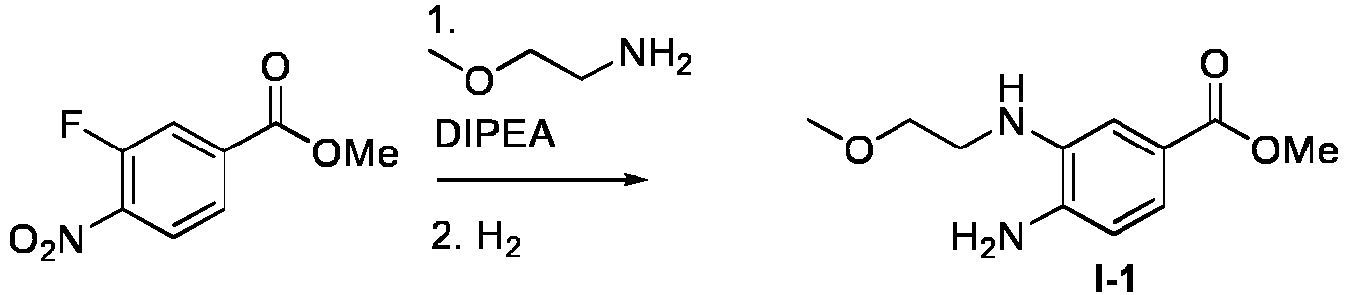
- Methyl 4-amino-3-(2-methoxyethylamino)benzoate (I-1): To a solution of methyl 3-fluoro-4-nitro-benzoate (50. 0 g, 251 mmol) in THF (400 mL) was added diisopropylethylamine (70. 0 mL, 402 mmol) and 2-Methoxyethylamine (34. 9 mL, 402 mmol). The resulting solution was heated to 55 °C for 6 hrs. Upon completion the solvent was removed, and the resulting residue taken up in EtOAc (150 mL), washed with brine (30 mL), concentrated and carried forward without further purification. Methyl 3-(2-methoxyethylamino)-4-nitro-benzoate (20. 0 g, 78. 7 mmol) was then dissolved in EtOAc:EtOH (1: 1, 140 mL) after which 10% palladium on carbon (5. 02 g, 4. 72 mmol) was then added. The resulting suspension was stirred under a hydrogen balloon at room temperature for 16 hrs. The reaction mixture was filtered through Celite washing with EtOAc (100 mL) and concentrated to give the desired compound without further purification: ES/MS: 225. 2 (M+H+).
-

- Methyl 4-{[2-(4-bromo-2-fluoro-phenyl)acetyl]amino}-3-(2-methoxyethylamino)benzoate: To a solution of 2-(4-bromo-2-fluoro-phenyl)acetic acid (1.00 g, 4. 29 mmol) in DMF (20. 0 mL) was added methyl 4-amino-3-(2-methoxyethylamino)benzoate (1. 18 g, 5. 28 mmol) and O-(7-Azabenzotriazol-1-yl)-N,N,N',N'-tetramethyluronium hexafluorophosphate (1. 96 g, 5. 15 mmol) followed by N,N-diisopropylethylamine (3. 74 mL, 21. 5 mmol) and the reaction mixture was stirred for 2 h at room temperature. The mixture was concentrated in vacuo, the residue was taken up in EtOAc and washed with water (1x) and brine (1x). The organic layer was dried over sodium sulfate, filtered and concentrated in vacuo. The crude residue was taken forward without further purification, assuming full conversion: ES/MS m/z: 441.2 (M+H+).
- Methyl 2-[(4-bromo-2-fluoro-phenyl)methyl]-3-(2-methoxyethyl)benzimidazole-5-carboxylate (I-2): The crude product from the previous step, methyl 4-{[2-(4-bromo-2-fluorophenyl)acetyl]amino}-3-(2-methoxyethylamino)benzoate (1. 89 g, 4. 29 mmol) was dissolved in AcOH (40. 0 mL) and the reaction mixture was heated to 60 °C for 2 h. The reaction mixture was concentrated in vacuo and the crude residue was taken up in DCM and washed with saturated aqueous sodium bicarbonate. The layers were separated, and the aqueous layer was extracted with DCM (2x). The combined organic extracts were dried over sodium sulfate, filtered and the filtrate was concentrated in vacuo. The crude residue was purified by column chromatography (0-100% EtOAc in hexane) to give the title compound: ES/MS m/z: 421. 9 (M+H+).
-

- 4-[(6-bromo-2-pyridyl)oxymethyl]-3-fluoro-benzonitrile (I-3): To a dried 100 mL RBF was added 3-fluoro-4-(hydroxymethyl)benzonitrile (2 g, 13. 2 mmol). The material was dissolved in dry THF (20 mL) under a nitrogen atmosphere at 0 °C. Sodium hydride (60% dispersion in mineral oil, 0. 507 g, 13. 2 mmol) was added in one portion, and the mixture was stirred for 30 mins at 0 °C under N2. Subsequently, 2,6-dibromopyridine (3. 13g, 13. 2 mmol) was added, and the reaction mixture was stirred room temperature overnight. The mixture was diluted with EtOAc (100 mL) and water (20 mL). The layers were separated, and the aqueous layer was extracted with ethyl acetate (2x 30 mL). The combined organic layers were dried over MgSO4, filtered, and concentrated under reduced pressure. The crude material was purified by silica gel column chromatography (eluent: EtOAc/hexanes) to afford the Intermediate 1-6: ES/MS: 307. 058 (M+H+); 1H NMR (400 MHz, Chloroform-d) δ 7. 72 - 7. 63 (m, 1H), 7. 52 - 7.46 (m, 2H), 7. 41 (dd, J = 9. 2, 1. 5 Hz, 1H), 7. 14 (dd, J = 7.5, 0.7 Hz, 1H), 6. 79 (dd, J = 8. 2, 0. 7 Hz, 1H), 5. 50 (t, J = 0.9 Hz, 2H).
-

- Methyl (S)-4-amino-3-((oxetan-2-ylmethyl)amino)benzoate (I-4): Methyl (S)-4-amino-3-((oxetan-2-ylmethyl)amino)benzoate was prepared following procedure Intermediate I-1 substituting (S)-oxetan-2-ylmethanamine for 2-methoxyethylamine. ES/MS: 237.2 (M+H+).
-

- Ethyl 3,5-difluoro-4-nitrobenzoate: Ethyl 4-amino-3,5-difluorobenzoate (5.00 g, 24.9 mmol) was taken up in acetic acid (50.0 mL) and sulfuric acid (12.1 M, 2.05 mL, 24.9 mmol) and hydrogen peroxide (30% aqueous solution, 46.7 mL, 74.6 mmol) were added sequentially. The mixture was heated to 100 °C for 1 hour. The mixture was then cooled to room temperature and then slowly poured into 300 mL of ice water while swirling. The mixture was then diluted with EtOAc (200 mL), transferred to a separatory funnel, and the organic phase collected. The aqueous phase was extracted with EtOAc (2 x 100 mL) and the combined organics were dried over MgSO4 and concentrated in vacuo. The residue was purified by column chromatography (eluent: EtOAc/Hexanes gradient) to afford the product.
- Ethyl (S)-3-fluoro-4-nitro-5-((oxetan-2-ylmethyl)amino)benzoate: Ethyl 3,5-difluoro-4-nitro-benzoate (2.50 g, 10.8 mmol) and (S)-oxetan-2-ylmethanamine (989 mg, 11.4 mol) were taken up in tetrahydrofuran (12.0 mL) and N,N-dimethylformamide (6.0 mL), and N,N-diisopropylethylamine (9.42 mL, 54.1 mmol) was added. The mixture was heated to 50 °C for 16 hours. Following this time, the mixture was concentrated in vacuo and the residue purified by column chromatography (eluent: 0 - 25% EtOAc/Hexanes) to afford the product. ES/MS: 299.2 (M+H+).
- Ethyl (S)-4-amino-3-fluoro-5-((oxetan-2-ylmethyl)amino)benzoate (I-5): Ethyl (S)-3-fluoro-4-nitro-5-((oxetan-2-ylmethyl)amino)benzoate (2.20 g, 7.38 mmol) was taken up in ethanol (10 mL) and tetrahydrofuran (5 mL) and the mixture sparged with nitrogen for 5 minutes. Palladium on carbon (10 wt. % loading, 785 mg, 0.74 mmol) was then added and sparging continued for 5 minutes. Hydrogen was then bubbled through the solution for one minute and then the mixture was set up under balloon hydrogen atmosphere for 21 hours. Following this time, the reaction was stopped, and the mixture was filtered through Celite. The filter was washed with EtOAc (2 × 20 mL) and methanol (2 × 10 mL) and the filtrate concentrated in vacuo to afford ethyl (S)-4-amino-3-fluoro-5-((oxetan-2-ylmethyl)amino)benzoate (I-5). ES/MS: 269.2 (M+H+); 1H NMR (400 MHz, chloroform) δ 7.44 - 7.30 (m, 2H), 5.13 (qd, J = 7.1, 3.4 Hz, 1H), 4.72 (ddd, J = 8.7, 7.4, 6.0 Hz, 1H), 4.62 (dt, J = 9.1, 6.1 Hz, 1H), 4.33 (q, J = 7.1 Hz, 2H), 3.58 - 3.30 (m, 2H), 2.76 (dtd, J = 11.4, 8.0, 6.1 Hz, 1H), 2.56 (ddt, J = 11.3, 9.0, 7.1 Hz, 1H), 1.37 (t, J = 7.1 Hz, 3H).
-

- Tert-butyl 3-((2-methoxyethyl)amino)-4-nitrobenzoate: To a 500 mL RBF was added tert-butyl 3-fluoro-4-nitrobenzoate (10 g, 41.5 mmol). The material was dissolved in THF (150 mL), and 2-methoxyethanamine (7.2 mL, 82.9 mmol) and N,N-diisopropylethylamine (21.7 mL, 124 mmol) were added. The mixture was stirred at 50 °C overnight. Afterward, the mixture was concentrated to remove most of the THF, and the crude material was dissolved in EtOAc (400 mL). The organics were washed with 50% NH4Cl (2× 100 mL) and with brine (1× 50 mL). The organics were subsequently dried over MgSO4, filtered, and concentrated under reduced pressure. The crude material was carried forward without further purification: ES/MS: 297.1 (M+H+); 1H NMR (400 MHz, Chloroform-d) δ 8.21 (d, J = 8.9 Hz, 1H), 7.55 (d, J = 1.7 Hz, 1H), 7.20 (dd, J = 8.9, 1.7 Hz, 1H), 3.72 (dd, J = 5.8, 4.8 Hz, 2H), 3.57 (q, J = 5.2 Hz, 2H), 3.46 (s, 3H), 1.62 (s, 9H).
- Tert-butyl 4-amino-3-((2-methoxyethyl)amino)benzoate (I-6): To a 1L RBF was added tert-butyl 3-((2-methoxyethyl)amino)-4-nitrobenzoate (13 g, 43.9 mmol), ethanol (100 mL), and EtOAc (50 mL). The mixture was stirred and sonicated until all material was dissolved. Nitrogen was bubbled through the mixture for 5 minutes, and then palladium on carbon (10% wt, 2.33 g, 2.19 mmol) was added. Hydrogen was bubbled through the mixture for 5 minutes, and the mixture was stirred overnight under a hydrogen balloon. Nitrogen was subsequently bubbled through the flask for 10 minutes, and then the mixture was filtered through Celite to remove the catalyst. The filtrate was concentrated under reduced pressure and was used without further purification: ES/MS: 267.2 (M+H+).
-

- Methyl 2-(4-(6-((4-cyano-2-fluorobenzyl)oxy)pyridin-2-yl)-2,5-difluorophenyl)acetate: A suspension of methyl 2-(4-bromo-2,5-difluorophenyl)acetate (10.5 g, 39.6 mmol), Bis(neopentyl glycolato)diboron (17.9 g, 79.2 mmol), [1,1'-Bis(diphenylphosphino)ferrocene] dichloropalladium(II) ;PdCl2(dppf) (2.94 g, 3.96 mmol), and potassium propionate (15.6 g, 139 mmol) in dioxane (50 mL) was degassed with Ar for 20 min. The mixture was sealed and heated at 100 °C for 2 hours. Sodium carbonate (2.0 M, 39.6 mL, 79.2 mmol) was added and the mixture was stirred at RT for 10 min. [1,1'-Bis(diphenylphosphino)ferrocene] dichloropalladium(II) ;PdCl2(dppf) (1.47 g, 1.98 mmol) and I-3 (14 g, 45.6 mmol) were added, the mixture was degassed for 10 min with Ar, then sealed and heated at 100 °C for 1 hour. The mixture was diluted with EtOAc and washed with brine. The organic extract was dried over sodium sulfate and chromatographed (eluent: EtOAc/hexanes) to give the title product: ES/MS: 413.2 (M+H+).
- 2-(4-(6-((4-cyano-2-fluorobenzyl)oxy)pyridin-2-yl)-2,5-difluorophenyl)acetic acid (I-7). A solution of methyl 2-(4-(6-((4-cyano-2-fluorobenzyl)oxy)pyridin-2-yl)-2,5-difluorophenyl)acetate (12.5 g, 30.3 mmol) and lithium hydroxide (0.2 M, 19.7 mL, 39.4 mmol) in CH3CN (50 mL) was heated at 50 °C for 2 hours. The mixture was acidified with 1 N of hydrochloride to pH= 6-7. The material crashed out and was filtered by filter funnel. The solid was washed with water and dried overnight to yield the product: ES/MS: 399.2 (M+H+); 1H NMR (400 MHz, Methanol-d4) δ 7.83 - 7.77 (m, 1H), 7.78 - 7.65 (m, 2H), 7.64 - 7.59 (m, 2H), 7.58 - 7.51 (m, 1H), 7.26 - 7.14 (m, 1H), 6.91 (d, J = 8.2 Hz, 1H), 5.63 (s, 2H), 3.73 (d, J = 1.2 Hz, 2H).
-

- Methyl (S)-2-(4-bromo-2,5-difluorobenzyl)-1-(oxetan-2-ylmethyl)-1H-benzo[d]imidazole-6-carboxylate (I-8): Methyl (S)-2-(4-bromo-2,5-difluorobenzyl)-1-(oxetan-2-ylmethyl)-1H-benzo[d]imidazole-6-carboxylate was prepared following procedure Intermediate I-2 substituting I-4 for I-1 and 2-(4-bromo-2,5-difluorophenyl)acetic acid for 2-(4-bromo-2-fluoro-phenyl)acetic acid. ES/MS: 451.0, 453.0 (M+H+).
-

- Methyl (S)-2-(4-(6-(benzyloxy)pyridin-2-yl)-2,5-difluorobenzyl)-1-(oxetan-2-ylmethyl)-1H-benzo[d]imidazole-6-carboxylate: Methyl (S)-2-(4-bromo-2,5-difluorobenzyl)-1-(oxetan-2-ylmethyl)-1H-benzo[d]imidazole-6-carboxylate (I-8) (450 mg, 0.997 mmol), Pd(dppf)Cl2 (74.0 mg, 0.100 mmol), potassium propionate (336 mg, 2.99 mmol), and bis(pinacolato)diboron (304 mg, 2.99 mmol) were taken up in 1,4-dioxane (4.00 mL) and the mixture sparged with argon for 5 minutes. The mixture was then heated to 110 °C for one hour. Following this time, complete conversion to the intermediate boronate ester was observed. The mixture was cooled to r.t. and aqueous sodium carbonate (2.0 M, 0.997 mL, 1.99 mmol) was added. The mixture was stirred for 5 minutes, then 2-(benzyloxy)-6-bromopyridine (290 mg, 1.10 mmol) and Pd(dppf)Cl2 (37.0 mg, 0.050 mmol) were added and the mixture heated to 90 °C for 1 hour. The mixture was then loaded directly onto SiO2 for purification with normal phase column chromatography (eluent: EtOAc/CH2Cl2 gradient) which afforded the desired product. ES/MS: 556.2 (M+H+).
- Methyl (S)-2-(2,5-difluoro-4-(6-hydroxypyridin-2-yl)benzyl)-1-(oxetan-2-ylmethyl)-1H-benzo[d]imidazole-6-carboxylate (I-9): Methyl (S)-2-(4-(6-(benzyloxy)pyridin-2-yl)-2,5-difluorobenzyl)-1-(oxetan-2-ylmethyl)-1H-benzo[d]imidazole-6-carboxylate (426.0 mg, 0.767 mmol) was taken up in ethanol (6.0 mL) and tetrahydrofuran (3.0 mL) and the solution sparged with nitrogen for 5 minutes. Pd/C (408 mg, 0.383 mmol) was added and nitrogen bubbled through the suspension for an additional 5 minutes. Hydrogen was then bubbled through the solution for 5 minutes before the reaction was set up under balloon hydrogen atmosphere. The mixture was stirred at RT for 30 minutes. Following this time, the suspension was filtered through celite, washed with EtOAc (3 × 10 mL). The filtrate was concentrated in vacuo to afford the methyl (S)-2-(2,5-difluoro-4-(6-hydroxypyridin-2-yl)benzyl)-1-(oxetan-2-ylmethyl)-1H-benzo[d]imidazole-6-carboxylate (I-9). ES/MS: 466.2 (M+H+).
-
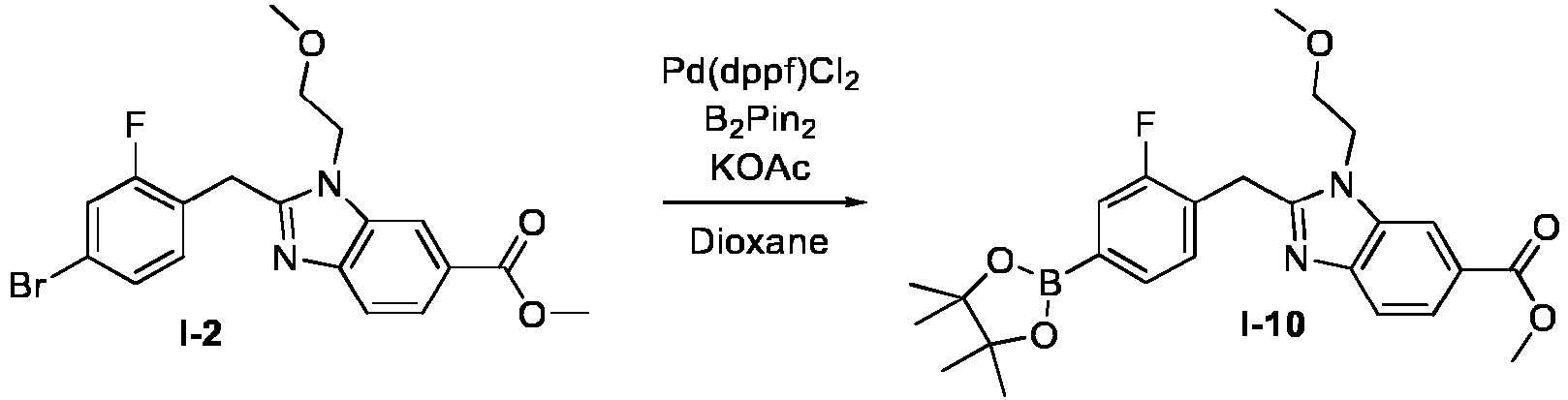
- Methyl 2-[[2-fluoro-4-(4,4,5,5-tetramethyl-1,3,2-dioxaborolan-2-yl)phenyl]methyl]-3-(2-methoxyethyl)benzimidazole-5-carboxylate (I-10): To a vial, methyl 2-[(4-bromo-2-fluoro-phenyl)methyl]-3-(2-methoxyethyl)benzimidazole-5-carboxylate (I-2) (200 mg, 0.475 mmol), 4,4,5,5-tetramethyl-2-(4,4,5,5-tetramethyl-1,3,2-dioxaborolan-2-yl)-1,3,2-dioxaborolane (145 mg, 0.570 mmol), (1,1'-bis(diphenylphosphino)ferrocene)-dichloropalladium(II) (33.6 mg, 0.0475 mmol) and potassium acetate (0.140 g, 1.42 mmol) was added. Next, 1,4-dioxane (4.80 mL) was added and the mixture was heated to 100 °C for 24 hr. The reaction mixture was filtered through celite, eluting with DCM and the filtrate was concentrated in vacuo. The crude residue was purified by column chromatography (0-100% EtOAc in hexane) to give methyl 2-[[2-fluoro-4-(4,4,5,5-tetramethyl-1,3,2-dioxaborolan-2-yl)phenyl]methyl]-3-(2-methoxyethyl)benzimidazole-5-carboxylate (I-10). ES/MS m/z: 469.4 (M+H+).
-

- Tert-butyl 2-(2,5-difluoro-4-(4,4,5,5-tetramethyl-1,3,2-dioxaborolan-2-yl)benzyl)-1-(2-methoxyethyl)-1H-benzo[d]imidazole-6-carboxylate (I-11): tert-butyl 2-(2,5-difluoro-4-(4,4,5,5-tetramethyl-1,3,2-dioxaborolan-2-yl)benzyl)-1-(2-methoxyethyl)-1H-benzo[d]imidazole-6-carboxylate was prepared in a manner as described for Intermediate I-10 substituting 2-(4-bromo-2,5-difluorophenyl)acetic acid for 2-(4-bromo-2-fluorophenyl)acetic acid and tert-butyl 4-amino-3-((2-methoxyethyl)amino)benzoate (I-6) for methyl 4-amino-3-(2-methoxyethylamino)benzoate. ES/MS: 529.3 (M+H+); 1H NMR (400 MHz, DMSO-d 6) δ 8.13 (s, 1H), 7.74 (dd, J = 8.4, 1.6 Hz, 1H), 7.56 (d, J = 8.4 Hz, 1H), 7.33 (dd, J = 9.3, 4.6 Hz, 1H), 7.17 (dd, J = 9.1, 5.5 Hz, 1H), 4.54 (t, J = 5.1 Hz, 2H), 4.39 (s, 2H), 3.65 (t, J = 5.1 Hz, 2H), 3.20 (s, 3H), 1.57 (s, 9H), 1.31 (s, 12H).
-

- Tert-butyl 2-[[4-(6-chloropyridin-2-yl)-2,5-difluorophenyl]methyl]-3-(2-methoxyethyl)-1,3-benzodiazole-5-carboxylate (I-12): tert-butyl 2-[[2,5-difluoro-4-(4,4,5,5-tetramethyl-1,3,2-dioxaborolan-2-yl)phenyl]methyl]-3-(2-methoxyethyl)-1,3-benzodiazole-5-carboxylate (I-11) (30.0 g, 56.7 mmol, 1.00 equivalent) and 2-bromo-6-chloropyridine (14.2 g, 73.8 mmol, 1.30 equivalent) were dissolved in 1,4-dioxane (600 mL) and H2O (60 mL). To the solution Pd(dppf)Cl2 (4.15 g, 5.68 mmol, 0.1 equivalent) and K2CO3 (15.7 g, 114 mmol, 2.0 equivalent) were added. The resulting solution was heated to 90 °C overnight under nitrogen atmosphere. The resulting mixture was concentrated under reduced pressure. The residue was purified by silica gel column chromatography, eluted with petroleum ether /EtOAc (2/1) to afford tert-butyl 2-[[4-(6-chloropyridin-2-yl)-2,5-difluorophenyl]methyl]-3-(2-methoxyethyl)-1,3-benzodiazole-5-carboxylate (I-12). ES/MS: 513.8 (M+H+); 1H NMR (400 MHz, DMSO-d6) δ 8.14 (s, 1H), 8.02 (t, J = 7.9 Hz, 1H), 7.87 (d, J = 7.7 Hz, 1H), 7.78 -7.69 (m, 2H), 7.59 (d, J = 8.2 Hz, 2H), 7.41 (dd, J = 11.4, 6.0 Hz, 1H), 4.58 (t, J = 5.1 Hz, 2H), 4.44 (s, 2H), 3.68 (t, J = 5.1 Hz, 2H), 3.22 (s, 3H), 1.58 (s, 9H).
-

- Ethyl (S)-4-(2-(4-bromo-2-fluorophenyl)acetamido)-3-fluoro-5-((oxetan-2-ylmethyl)amino)benzoate: A solution of I-5 (500 mg, 1.86 mmol) and 2-(4-bromo-2-fluorophenyl)acetic acid (521 mg, 2.24 mmol) in MeCN (9.0 mL) was cooled to 0 °C and 1-methylimidazole (765 mg, 0.74 mL, 9.32 mmol) was added followed by N,N,N',N'-Tetramethylchloroformamidinium Hexafluorophosphate (732 mg, 2.61 mmol). The mixture was warmed to RT and stirred for 30 minutes. The crude mixture was concentrated in vacuo, then partitioned between water and EtOAc. The organic layer was isolated and washed with an additional portion of water and then brine. The isolated organic layer was dried over sodium sulfate, isolated by vacuum filtration, concentrated in vacuo, and purified by silica gel column chromatography (eluent: EtOAc/hexanes) to provide ethyl (S)-4-(2-(4-bromo-2-fluorophenyl)acetamido)-3-fluoro-5-((oxetan-2-ylmethyl)amino)benzoate. ES/MS: 483.0, 485.0 [M+H]+.
- Ethyl (S)-2-(4-bromo-2-fluorobenzyl)-4-fluoro-1-(oxetan-2-ylmethyl)-1H-benzo[d]imidazole-6-carboxylate (I-13): To a solution of ethyl (S)-4-(2-(4-bromo-2-fluorophenyl)acetamido)-3-fluoro-5-((oxetan-2-ylmethyl)amino)benzoate (530 mg, 1.10 mmol) in DCE (12.0 mL) was added acetic acid (1.88 mL, 32.9 mmol). The mixture was heated to 60 °C for 12 hours. The mixture was concentrated and partitioned between EtOAc and saturated aqueous sodium bicarbonate. The organic layer was isolated and dried over sodium sulfate, isolated by vacuum filtration, concentrated in vacuo, and purified by silica gel column chromatography (eluent: EtOAc/hexanes) to provide ethyl (S)-2-(4-bromo-2-fluorobenzyl)-4-fluoro-1-(oxetan-2-ylmethyl)-1H-benzo[d]imidazole-6-carboxylate (I-13). ES/MS: 465.0, 467.0 [M+H]+.
-

- Ethyl (S)-2-(4-bromo-2,5-difluorobenzyl)-4-fluoro-1-(oxetan-2-ylmethyl)-1H-benzo[d]imidazole-6-carboxylate (I-14): Ethyl (S)-2-(4-bromo-2,5-difluorobenzyl)-4-fluoro-1-(oxetan-2-ylmethyl)-1H-benzo[d]imidazole-6-carboxylate was prepared in a manner as described for Intermediate I-13 substituting 2-(4-bromo-2,5-difluorophenyl)acetic acid for 2-(4-bromo-2-fluorophenyl)acetic acid. ES/MS: 483.0, 485.0 (M+H+).
-

- Ethyl (S)-2-(2,5-difluoro-4-(6-hydroxypyridin-2-yl)benzyl)-4-fluoro-1-(oxetan-2-ylmethyl)-1H-benzo[d]imidazole-6-carboxylate (I-15): Ethyl (S)-2-(2,5-difluoro-4-(6-hydroxypyridin-2-yl)benzyl)-4-fluoro-1-(oxetan-2-ylmethyl)-1H-benzo[d]imidazole-6-carboxylate was prepared in a manner as described for Intermediate I-9 substituting I-14 for I-8. ES/MS: 498.2 (M+H+).
-

- Methyl (S)-2-(4-(6-chloropyridin-2-yl)-2,5-difluorobenzyl)-1-(oxetan-2-ylmethyl)-1H-benzo[d]imidazole-6-carboxylate (I-16): Methyl (S)-2-(4-(6-chloropyridin-2-yl)-2,5-difluorobenzyl)-1-(oxetan-2-ylmethyl)-1H-benzo[d]imidazole-6-carboxylate was prepared in a manner a described for Intermediate I-12 substituting I-4 for I-6. ES/MS: 484.0 (M+H+).
-

- Tert-butyl 2-(2,5-difluoro-4-(6-hydroxypyridin-2-yl)benzyl)-1-(2-methoxyethyl)-1H-benzo[d]imidazole-6-carboxylate (I-17): Tert-butyl 2-(2,5-difluoro-4-(6-hydroxypyridin-2-yl)benzyl)-1-(2-methoxyethyl)-1H-benzo[d]imidazole-6-carboxylate was prepared in a manner as described for Intermediate I-9 substituting tert-butyl 2-(4-bromo-2,5-difluorobenzyl)-1-(2-methoxyethyl)-1H-benzo[d]imidazole-6-carboxylate (prepared in a manner as described for intermediate I-2 substituting 2-(4-bromo-2,5-difluorophenyl)acetic acid for 2-(4-bromo-2-fluorophenyl)acetic acid) and I-6 for I-1. ES/MS: 496.9 (M+H+).
-

- Tert-butyl 2-(4-(6-((4-bromo-2-fluorobenzyl)oxy)pyridin-2-yl)-2,5-difluorobenzyl)-1-(2-methoxyethyl)-1H-benzo[d]imidazole-6-carboxylate (I-18): To a solution of tert-butyl 2-[[2,5-difluoro-4-(6-hydroxy-2-pyridyl)phenyl]methyl]-3-(2-methoxyethyl)benzimidazole-5-carboxylate (I-17) (500 mg, 1.0 mmol) in toluene (5 ml), 4-bromo-1-(bromomethyl)-2-fluorobenzene (406 mg, 1.5 mmol) and Silver carbonate (835 mg, 3 mmol) were added. The solution was stirred at 70 °C for 8 hrs., cooled and filtered. The solution was concentrated and purified by silica gel column chromatography (eluent: EtOAc/hexanes) to provide tert-butyl 2-(4-(6-((4-bromo-2-fluorobenzyl)oxy)pyridin-2-yl)-2,5-difluorobenzyl)-1-(2-methoxyethyl)-1H-benzo[d]imidazole-6-carboxylate (I-18):. ES/MS: 683.2, 684.1 (M+H+).
-

- Methyl (S)-2-(4-(6-((4-bromo-2-fluorobenzyl)oxy)pyridin-2-yl)-2,5-difluorobenzyl)-1-(oxetan-2-ylmethyl)-1H-benzo[d]imidazole-6-carboxylate (I-19): Methyl (S)-2-(4-(6-((4-bromo-2-fluorobenzyl)oxy)pyridin-2-yl)-2,5-difluorobenzyl)-1-(oxetan-2-ylmethyl)-1H-benzo[d]imidazole-6-carboxylate was prepared in a manner as described for Intermediate I-18 substituting I-9 for I-17. ES/MS: 652.3 (M+H+).
-
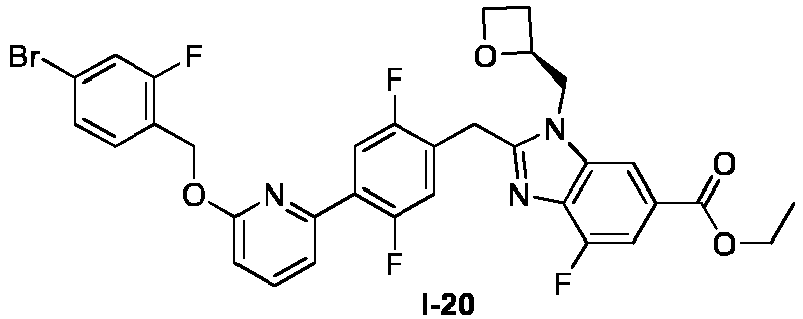
- Ethyl (S)-2-(4-(6-((4-bromo-2-fluorobenzyl)oxy)pyridin-2-yl)-2,5-difluorobenzyl)-4-fluoro-1-(oxetan-2-ylmethyl)-1H-benzo[d]imidazole-6-carboxylate (I-20): Ethyl (S)-2-(4-(6-((4-bromo-2-fluorobenzyl)oxy)pyridin-2-yl)-2,5-difluorobenzyl)-4-fluoro-1-(oxetan-2-ylmethyl)-1H-benzo[d]imidazole-6-carboxylate was prepared in a manner as described for Intermediate I-18 substituting I-15 for I-17. ES/MS: 684.2 (M+H+).
-

- Methyl (S)-2-(4-(6-((5-bromothiazol-2-yl)methoxy)pyridin-2-yl)-2,5-difluorobenzyl)-1-(oxetan-2-ylmethyl)-1H-benzo[d]imidazole-6-carboxylate (I-21): To a solution of methyl (S)-2-(2,5-difluoro-4-(6-hydroxypyridin-2-yl)benzyl)-1-(oxetan-2-ylmethyl)-1H-benzo[d]imidazole-6-carboxylate (I-9) (500 mg, 1.07 mmol) in acetonitrile (15 mL) was added cesium carbonate (560 mg, 1.72 mmol) and 5-bromo-2-(bromomethyl)thiazole (290 mg, 1.13 mmol) and the resulting mixture stirred for 1 hr at 50 °C. Upon completion the crude reaction mixture was filtered through celite, rinsing with DCM. The filtrate was concentrated, and the crude residue purified by silica gel column chromatography (eluent: EtOAc/hexanes) to provide methyl (S)-2-(4-(6-((5-bromothiazol-2-yl)methoxy)pyridin-2-yl)-2,5-difluorobenzyl)-1-(oxetan-2-ylmethyl)-1H-benzo[d]imidazole-6-carboxylate (I-21). ES/MS: 643.0 (M+H+).
-

- Ethyl (S)-2-(4-(6-((5-bromothiazol-2-yl)methoxy)pyridin-2-yl)-2,5-difluorobenzyl)-4-fluoro-1-(oxetan-2-ylmethyl)-1H-benzo[d]imidazole-6-carboxylate (I-22): Ethyl (S)-2-(4-(6-((5-bromothiazol-2-yl)methoxy)pyridin-2-yl)-2,5-difluorobenzyl)-4-fluoro-1-(oxetan-2-ylmethyl)-1H-benzo[d]imidazole-6-carboxylate was prepared in a manner as described for Intermediate I-21 substituting I-15 for I-17. ES/MS: 673.0 (M+H+).
-

- Methyl (S)-2-(4-(6-((6-chloro-4-fluoropyridin-3-yl)methoxy)pyridin-2-yl)-2,5-difluorobenzyl)-1-(oxetan-2-ylmethyl)-1H-benzo[d]imidazole-6-carboxylate (I-23): Methyl (S)-2-(4-(6-((6-chloro-4-fluoropyridin-3-yl)methoxy)pyridin-2-yl)-2,5-difluorobenzyl)-1-(oxetan-2-ylmethyl)-1H-benzo[d]imidazole-6-carboxylate was prepared in a manner as described for Intermediate I-19 substituting 5-(bromomethyl)-2-chloro-4-fluoropyridine for 4-bromo-1-(bromomethyl)-2-fluoro-benzene ES/MS: 609.2 (M+H+).
-

- Methyl (S)-2-(4-(6-((6-bromo-4-chloropyridin-3-yl)methoxy)pyridin-2-yl)-2,5-difluorobenzyl)-1-(oxetan-2-ylmethyl)-1H-benzo[d]imidazole-6-carboxylate (I-24): Methyl (S)-2-(4-(6-((6-bromo-4-chloropyridin-3-yl)methoxy)pyridin-2-yl)-2,5-difluorobenzyl)-1-(oxetan-2-ylmethyl)-1H-benzo[d]imidazole-6-carboxylate was prepared in a manner as described for Intermediate I-19 substituting 2-bromo-5-(bromomethyl)-4-chloropyridine for 4-bromo-1-(bromomethyl)-2-fluoro-benzene ES/MS: 654.0, 656.0 (M+H+).
-

- Methyl 4-amino-3-((4,4-dimethyltetrahydrofuran-3-yl)amino)benzoate was prepared in a manner as described for Intermediate I-1 substituting (±)-4,4-dimethyltetrahydrofuran-3-amine for 2-methoxyethylamine, with the following modifications: to a solution of methyl 3-fluoro-4-nitro-benzoate (3.94 g, 19.8 mmol) and 4,4-dimethyltetrahydrofuran-3-amine hydrochloride (3.00 g, 19.8 mmol) in 2-methyltetrahydrofuran (40 mL) under argon was added DIPEA (17.2 mL, 98.9 mmol). The resulting solution was refluxed at 80 °C for 3 days. The mixture was concentrated in vacuo and partitioned between EtOAc and water. The aqueous phase was extracted with additional EtOAc. The combined organic phase was washed with brine, dried over MgSO4, filtered and concentrated in vacuo. The resulting residue was redissolved in EtOH (52 ml) and tetrahydrofuran (26 mL) under argon, then 10% palladium on carbon (2.1 g, 1.98 mmol). The mixture was cycled between argon and vacuum, then placed under hydrogen atmosphere and stirred at rt for 18 hr. The mixture was filtered through Celite and concentrated in vacuo. The crude was purified by silica gel flash column chromatography (EtOAc/hexane gradient) to yield methyl 4-amino-3-((4,4-dimethyltetrahydrofuran-3-yl)amino)benzoate (Intermediate I-25). ES/MS: 265.2 (M+H+).
-

- Tert-butyl (R)-4-amino-3-((2-methoxypropyl)amino)benzoate (I-26): Tert-butyl (R)-4-amino-3-((2-methoxypropyl)amino)benzoate was prepared in a manner as described for Intermediate I-6 substituting (R)-2-methoxypropan-1-amine for 2-methoxyethylamine. ES/MS: 281.1 (M+H+).
-

- Methyl 5-(((6-bromopyridin-2-yl)oxy)methyl)picolinate: To a solution of 6-bromopyridin-2-ol (3.00 g, 17 mmol) in acetonitrile (100 mL) was added silver carbonate (10.2 g, 37 mmol) and methyl 5-(bromomethyl)pyridine-2-carboxylate (5.00g, 22 mmol) and the resultant mixture heated to 60 °C for 3 hours. Upon completion the reaction mixture was filtered through celite, concentrated and purified by silica gel column chromatography (eluent: EtOAc/hexanes) to provide the desired product. ES/MS: 325.2 (M+H+).
- 5-(((6-bromopyridin-2-yl)oxy)methyl)picolinic acid (I-27): To a solution of methyl 5-(((6-bromopyridin-2-yl)oxy)methyl)picolinate (5.57 g, 17 mmol) in acetonitrile (75mL) was added lithium hydroxide (2.17 g, 51.7 mmol) as an solution in water (25 mL) and mixture stirred at RT temperature for 1 hr. pH was adjusted to ~6 with 1N HCl, after which the reaction mixture was diluted with EtOAc (200 mL) and the layers separated. The organic layer was washed with brine, dried over MgSO4, filtered and concentrated to give 5-(((6-bromopyridin-2-yl)oxy)methyl)picolinic acid (I-27)without further purification. ES/MS: 309.1 (M+H+).
-

- To a solution of 5-(((6-bromopyridin-2-yl)oxy)methyl)picolinic acid (I-27) (5.32 g, 17 mmol) in DMF (80 mL) , 1-aminocyclopropanecarbonitrile hydrochloride (3.14 g, 26 mmol), HATU (9.62 g, 25 mmol), and diisopropylethylamine (12 mL, 69 mmol) was added sequentially. The resultant solution was stirred at RT temperature for 30 minutes. Upon completion the mixture contents were diluted with EtOAc (250 mL, wash with water (2 × 50 mL), brine (1 × 40 mL), dried over MgSO4, filtered and concentrated to give 5-(((6-bromopyridin-2-yl)oxy)methyl)-N-(1-cyanocyclopropyl)picolinamide (I-28) without further purification. ES/MS: 375.1 (M+H+).
- The following intermediates were synthesized in an analogous manner as described for Intermediate I-28


-

- Tert-butyl 3-(((3aS,6aR)-hexahydrofuro[2,3-b]furan-3-yl)amino)-4-nitrobenzoate: A solution of tert-butyl 3-fluoro-4-nitro-benzoate (0.150 g, 0.622 mmol), (3aS,6aR)-2,3,3a,4,5,6a-hexahydrofuro[2,3-b]furan-4-amine (0.0984 g, 0.762 mmol), and N-ethyl-N-isopropyl-propan-2-amine (0.325 mL, 1.87 mmol) in NMP (4 mL) was heated at 90 C overnight . The mixture was diluted with EtOAc and washed with 5% LiCl and brine. The organic extract was dried over sodium sulfate and purified by flash chromatography (eluent: EtOAc/hexanes) to give tert-butyl 3-(((3aS,6aR)-hexahydrofuro[2,3-b]furan-3-yl)amino)-4-nitrobenzoate as an un-separable mixture of 2 compounds. ES/MS: 351.0 (M+H+).
- Tert-butyl 4-amino-3-(((3aS,6aR)-hexahydrofuro[2,3-b]furan-3-yl)amino)benzoate (I-29 and I-30): A solution of tert-butyl 3-[[(3aS,6aR)-2,3,3a,4,5,6a-hexahydrofuro[2,3-b]furan-4-yl]amino]-4-nitro-benzoate (156 mg, 0.445 mmol) in EtOH (15 mL) was degassedby cycling the mixture between argon and vacuum 3x. Pd/C (10.0 %, 47.4 mg, 0.0445 mmol) was added to the solution and then the solution was degassed 1x by cycling the mixture between argon and vacuum and stirred at RT with a balloon of hydrogen overnight. The reaction mixture was filtered over a Celite plug and rinsed with EtOAc. Concentrated and purified by flash chromatography (eluent: 30 to 40% EtOAc/hexanes) to give two distinct isomers of tert-butyl 4-amino-3-(((3aS,6aR)-hexahydrofuro[2,3-b]furan-3-yl)amino)benzoate (I-29 and I-30).
- ES/MS: 321.0 (M+H+). 1H NMR (400 MHz, Chloroform-d) δ 7.45 (dd, J = 8.1, 1.8 Hz, 1H), 7.37 (d, J = 1.8 Hz, 1H), 6.74 (d, J = 8.1 Hz, 1H), 5.87 (d, J = 5.1 Hz, 1H), 4.32 - 4.06 (m, 2H), 4.05 - 3.81 (m, 2H), 3.66 (t, J = 8.7 Hz, 1H), 3.24 (tt, J = 8.7, 4.2 Hz, 1H), 2.03 - 1.90 (m, 1H), 1.90 - 1.79 (m, 1H), 1.60 (s, 9H).
- ES/MS: 321.0 (M+H+). 1H NMR (400 MHz, Chloroform-d) δ 7.45 (dd, J = 8.1, 1.8 Hz, 1H), 7.38 (d, J = 1.8 Hz, 1H), 6.75 (d, J = 8.0 Hz, 1H), 5.87 (d, J = 5.1 Hz, 1H), 4.34 - 4.05 (m, 2H), 4.02 - 3.82 (m, 2H), 3.67 (t, J = 8.6 Hz, 1H), 3.24 (tt, J = 8.6, 4.2 Hz, 1H), 2.02 - 1.81 (m, 2H), 1.60 (s, 9H).
-

- (5-bromo-3-fluoropyridin-2-yl)methyl 4-methylbenzenesulfonate (I-31): (5-bromo-3-fluoro-2-pyridyl)methanol (200 mg, 0.97 mmol), p-Toluenesulfonic anhydride (350 mg, 1.1 mmol), diisopropylethylamine (0.34 mL, 1.9 mmol), and DCM (10 mL were combined and stirred at ambient temperature for 16 hours. Upon completion the reaction mixture was washed with saturated aqueous NaHCO3 (5 mL) and brine (5 mL), dried over MgSO4, filtered and concentrated to give (5-bromo-3-fluoropyridin-2-yl)methyl 4-methylbenzenesulfonate (I-31), which was used without further purification.
- The following intermediate was prepared in a manner as described for Intermediate I-31:

-

- (5-chloropyrazin-2-yl)methyl 4-methylbenzenesulfonate (I-32): (5-chloropyrazin-2-yl)methyl 4-methylbenzenesulfonate was prepared in a manner as described for Intermediate I-31 substituting (5-chloropyrazin-2-yl)methanol for (5-bromo-3-fluoro-2-pyridyl)methanol.
-

- Tert-butyl 2-[[4-[6-[(5-bromo-3-fluoro-2-pyridyl)methoxy]-2-pyridyl]-2,5-difluorophenyl]methyl]-3-(2-methoxyethyl)benzimidazole-5-carboxylate (I-33): To a solution of tert-butyl 2-[[2,5-difluoro-4-(6-hydroxy-2-pyridyl)phenyl]methyl]-3-(2-methoxyethyl)benzimidazole-5-carboxylate (I-17) (400 mg, 0.80 mmol) and (5-bromo-3-fluoro-2-pyridyl)methyl 4-methylbenzenesulfonate (I-31) (350 mg, 0.97 mmol) in 15 mL of acetonitrile was added Cs2CO3 (400 mg, 1.20 mmol). The solution was then heated to 50 °C for 30 minutes. The solution was cooled to RT, filtered, and then concentrated. The crude material was purified by silica gel column chromatography (eluent: EtOAc/hexanes) to provide tert-butyl 2-[[4-[6-[(5-bromo-3-fluoro-2-pyridyl)methoxy]-2-pyridyl]-2,5-difluoro-phenyl]methyl]-3-(2-methoxyethyl)benzimidazole-5-carboxylate (I-33): product. ES/MS: 686.0 (M+H+).
-

- Tert-butyl 2-[[4-[6-[(5-chloropyrazin-2-yl)methoxy]-2-pyridyl]-2,5-difluorophenyl]methyl]-3-(2-methoxyethyl)benzimidazole-5-carboxylate(I-34): tert-butyl 2-[[4-[6-[(5-chloropyrazin-2-yl)methoxy]-2-pyridyl]-2,5-difluoro-phenyl]methyl]-3-(2-methoxyethyl)benzimidazole-5-carboxylate was prepared in a manner as described for Intermediate I-33 substituting I-31 for I-32. ES/MS: 566.0 (M+H+).
-

- 4-fluoro-5-(hydroxymethyl)thiophene-2-carbonitrile: (5-bromo-3-fluoro-2-thienyl)methanol (220 mg, 1.04 mmol), zinc cyanide (182 mg, 1.55 mmol), zinc powder (3 mg, 0.05 mmol), and Pd(PPh3)4 (300 mg, 0.26 mmol) in DMF (10 mL) was degassed by bubbling argon for 1 minute, sealed and heated to 100 °C for 20 hours. Upon completion, the mixture contents were poured into H2O (10 mL) and extracted with EtOAc (2 × 20 mL). The organic layers were combined, washed with brine (5 mL), dried over MgSO4, filtered, concentrated, and purified by flash chromatography (Eluent: EtOAc/hexane) to give 4-fluoro-5-(hydroxymethyl)thiophene-2-carbonitrile. ES/MS: 158.2 (M+1).
- 5-(bromomethyl)-4-fluoro-thiophene-2-carbonitrile (I-35): Carbon tetrabromide (111 mg, 0.34 mmol was added to a solution comprising 4-fluoro-5-(hydroxymethyl)thiophene-2-carbonitrile (48 mg, 0.31 mmol), triphenylphosphine (88 mg, 0.34 mmol) in DCM (3 mL) at RT. The mixture was stirred for 30 min at RT. Upon completion the mixture was concentrated and purified by flash chromatography (Eluent: EtOAc/hexane) to give 5-(bromomethyl)-4-fluoro-thiophene-2-carbonitrile (I-35). ES/MS: 221.2 (M+1).
-

- [5-(difluoromethyl)thiazol-2-yl]methanol: To a solution of [5-(difluoromethyl)thiazole-2-carbonyl]oxysodium (200 mg, 1.08 mmol) in DCM (5 mL), at RT, was added oxalyl chloride (2.0 M in DCM, 0.65 mL, 1.3 mmol). After stirring for 1 hour at RT, MeOH (1 mL) was added and the mixture was stirred for additional 30 minutes before pouring into H2O (10 mL) and extracted with EtOAc (2 × 20 mL). The organic layers were combined, washed with brine (5 mL), dried over MgSO4, filtered, and concentrated. The residue was re-dissolved in THF (5 mL) and cooled to 0 °C. Diisobutylaluminium hydride (1.0 M in DCM, 3.3 mL, 3.3 mmol) was added, and the mixture was warmed to RT and stirred for 1 hour. Upon completion, the reaction was quenched with 2M NaOH (0.4 mL), H2O (0.4 mL), and diluted with EtOAc (10 mL). The mixture was then filtered through a plug of Celite. The organic layers were combined, washed with brine (5 mL), dried over MgSO4, filtered, concentrated, and purified by flash chromatography (Eluent: EtOAc/hexane) to give the desired product. ES/MS: 166.2 (M+1).
- 2-(bromomethyl)-5-(difluoromethyl)thiazole (I-36): [5-(difluoromethyl)thiazol-2-yl]methanol (88 mg, 0.53 mmol), triphenylphosphine (150 mg, 0.56 mmol) in DCM (3 mL) was added carbon tetrabromide (190 mg, 0.56 mmol) at rt. The mixture was stirred at rt for 30 min. Upon completion the mixture was concentrated and purified by flash chromatography (Eluent: EtOAc/hexane) to give I-36. ES/MS: 229.2 (M+1).
-

- [5-(2,2-difluoroethoxy)thiazol-2-yl]methanol: A suspension of methyl 5-hydroxythiazole-2-carboxylate (200 mg, 1.3 mmol), 2,2-difluoroethyl trifluoromethanesulfonate (300 mg, 1.4 mmol), and cesium carbonate (610 mg, 1.9 mmol) in MeCN (5 mL) was stirred at RT for 16 h. Upon completion, the mixture was filtered through a plug of Celite and concentrated. The residue was re-dissolved in THF (5 mL) and cooled to 0 °C. Diisobutylaluminium hydride (1.0 M in DCM, 2.8 mL, 2.8 mmol) was added, and the mixture was warmed to RT and stirred for 1 hour. Upon completion, the reaction was quenched with 2 M NaOH (0.4 mL), H2O (0.4 mL) and diluted with EtOAc (10 mL). The mixture was then filtered through a plug of Celite. The organic layers were combined, washed with brine (5 mL), dried over MgSO4, filtered, concentrated, and purified by flash chromatography (Eluent: EtOAc/hexane) to give the desired product.
- 2-(bromomethyl)-5-(2,2-difluoroethoxy)thiazole (I-37): [5-(2,2-difluoroethoxy)thiazol-2-yl]methanol (91 mg, 0.47 mmol), triphenylphosphine (125 mg, 0.48 mmol) in DCM (5 mL) was added carbon tetrabromide (160 mg, 0.48 mmol) at RT. The mixture was stirred for 30 min at RT. Upon completion the mixture was concentrated and purified by flash chromatography (Eluent: EtOAc/hexane) to give I-37. ES/MS: 258.2 (M+1).
-

- 2-(bromomethyl)-5-(2,2,2-trifluoroethoxy)thiazole (I-38): 2-(bromomethyl)-5-(2,2,2-trifluoroethoxy)thiazole was prepared in a manner as described for Intermediate I-37 substituting 2,2-difluoroethyl trifluoromethanesulfonate for 2,2,2-trifluoroethyl trifluoromethanesulfonate. ES/MS: 277.2 (M+1).
-

- Methyl (S)-2-(4-(6-((5-bromothiophen-2-yl)methoxy)pyridin-2-yl)-2,5-difluorobenzyl)-1-(oxetan-2-ylmethyl)-1H-benzo[d]imidazole-6-carboxylate (I-39): Methyl (S)-2-(4-(6-((5-bromothiophen-2-yl)methoxy)pyridin-2-yl)-2,5-difluorobenzyl)-1-(oxetan-2-ylmethyl)-1H-benzo[d]imidazole-6-carboxylate was prepared in a manner as described for Intermediate I-19 substituting 5-(bromomethyl)-2-chloro-4-fluoropyridine for 2-bromo-5-(bromomethyl)thiophene ES/MS: 642.0 (M+H+).
-
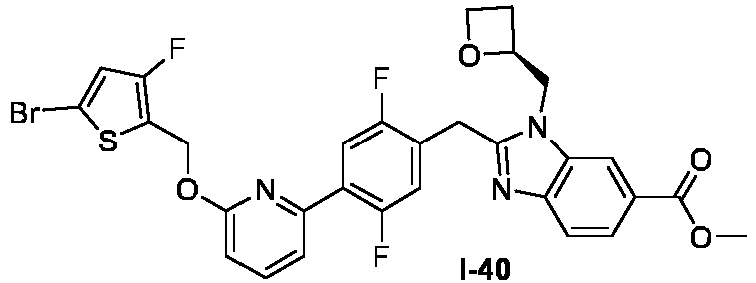
- Methyl (S)-2-(4-(6-((5-bromo-3-fluorothiophen-2-yl)methoxy)pyridin-2-yl)-2,5-difluorobenzyl)-1-(oxetan-2-ylmethyl)-1H-benzo[d]imidazole-6-carboxylate (I-40): Methyl (S)-2-(4-(6-((5-bromo-3-fluorothiophen-2-yl)methoxy)pyridin-2-yl)-2,5-difluorobenzyl)-1-(oxetan-2-ylmethyl)-1H-benzo[d]imidazole-6-carboxylate was prepared in a manner as described for Intermediate I-19 substituting 5-(bromomethyl)-2-chloro-4-fluoropyridine for 5-bromo-2-(bromomethyl)-3-fluorothiophene ES/MS: 660.0 (M+H+).
-

- Methyl 2-[[4-[6-[(5-bromo-1,3,4-thiadiazol-2-yl)methoxy]-2-pyridyl]-2,5-difluorophenyl]methyl]-3-[[(2S)-oxetan-2-yl]methyl]benzimidazole-5-carboxylate (I-41): methyl 2-[[4-[6-[(5-bromo-1,3,4-thiadiazol-2-yl)methoxy]-2-pyridyl]-2,5-difluoro-phenyl]methyl]-3-[[(2S)-oxetan-2-yl]methyl]benzimidazole-5-carboxylate was prepared in a manner as described for Intermediate I-19 substituting 5-(bromomethyl)-2-chloro-4-fluoropyridine for 2-bromo-5-(bromomethyl)-1,3,4-thiadiazole ES/MS: 660.0 (M+H+).
-

- Thiazolo[5,4-b]pyridin-2-ylmethanol: methyl thiazolo[5,4-b]pyridine-2-carboxylate (100 mg, 0.52 mmol) in THF (5 mL) was cooled to 0 °C. Diisobutylaluminium hydride (1.0 M in DCM, 1.5 mL, 1.5 mmol) was added, and the mixture was warmed to rt and stirred for 1 hour. Upon completion, the reaction was quenched with 2 M NaOH (0.4 mL), H2O (0.4 mL), and diluted with EtOAc (10 mL). The mixture was then filtered through a plug of Celite. The organic layers were combined, washed with brine (5 mL), dried over MgSO4, filtered, concentrated, and purified by flash chromatography (Eluent: EtOAc/hexane) to give the titled product. ES/MS: 167.2 (M+1).
- Thiazolo[5,4-b]pyridin-2-ylmethyl 4-methylbenzenesulfonate (I-42): To a solution of thiazolo[5,4-b]pyridin-2-ylmethanol (40 mg, 0.24 mmol), triethylamine (0.07 mL, 0.5 mmol) in DCM (5 mL) was added toluene-4-sulfonyl chloride (46 mg, 0.24 mmol) at rt. The mixture was stirred at rt for 20 hours. Upon completion the mixture was concentrated and purified by flash chromatography (Eluent: EtOAc/hexane) to give the title product. ES/MS: 321.2 (M+1).
-

- 2-bromo-6-[(1-methylimidazol-4-yl)methoxy]pyridine (I-43): To a solution of 2-bromo-6-fluoro-pyridine (90.7 mg, 0.52 mmol) and (1-methylimidazol-4-yl)methanol (75.1 mg, 0.67 mmol) in 2.0 mL of acetonitrile was added Cs2CO3 (338 mg, 1.04 mmol). The solution was then heated to 50 °C for 30 minutes. The solution was cooled to rt, filtered, then concentrated. The crude material was purified by normal phase chromatography 1-12 % DCM/MeOH. The product containing fractions were combined and concentrated to give the title product. ES/MS m/z: 268.0, 270.2 (M+H+).
The following intermediates were synthesized in a manner as described for intermediate I-43:
-

- This intermediate was prepared in a manner as described for Intermediate I-43 substituting [1-(difluoromethyl)-2-methyl-imidazol-4-yl]methanol for (1-methylimidazol-4-yl)methanol. ES/MS m/z: 318.2 (M+H+).
-

- Methyl 2-[(7-bromo-1,3-dihydroisobenzofuran-4-yl)methyl]-3-(2-methoxyethyl)benzimidazole-5-carboxylate (I-45): This intermediate was prepared in a manner as described for Intermediate I-13 substituting 2-(7-bromo-1,3-dihydroisobenzofuran-4-yl)acetic acid for (2-(4-bromo-2-fluorophenyl)acetic acid. ES/MS m/z: 447.1 (M+H+).
-

- Tert-butyl (3R,4R)-3-(2-amino-5-methoxycarbonyl-anilino)-4-fluoro-pyrrolidine-1-carboxylate (I-46): This intermediate was prepared in a manner as described for Intermediate I-6 substituting tert-butyl (3R,4R)-3-amino-4-fluoro-pyrrolidine-1-carboxylate for 2-methoxyethanamine. ES/MS m/z: 418.4 (M+Na+).
-

- Tert-butyl N-tert-butoxycarbonyl-N-(6-chloro-2-methylsulfanyl-pyrimidin-4-yl)carbamate: A solution of methylsulfanyl-pyrimidin-4-amine (1 g, 5.7 mmol), tert-butoxycarbonyl tert-butyl carbonate (2.61 g, 12 mmol), ethyldiisopropylamine (3 mL, 17.1 mmol) and 4-dimethylaminopyridine (140 mg, 1.14 mmol) in 20 mL of DCM, was stirred overnight. The mixture was washed with H2O and brine. The combined organic extracts were dried over sodium sulfate, filtered and the filtrate was concentrated in vacuo. The crude residue was purified by column chromatography (0-50% EtOAc in hexane) to give the title compound: ES/MS m/z: 375.2 (M+H+).
- Tert-butyl N-tert-butoxycarbonyl-N-[6-chloro-2-[(4-cyano-2-fluorophenyl)methoxy]pyrimidin-4-yl]carbamate (I-47): A solution of tert-butyl N-tert-butoxycarbonyl-N-(6-chloro-2-methylsulfanyl-pyrimidin-4-yl)carbamate (0.5 g, 1.33 mmol) and 3-chloroperoxybenzoic acid (0.6 g, 2.7 mmol, 77%) in 5 mL of DCM, was stirred for overnight. The mixture was washed with H2O and brine. The solvent was removed, and the resulting residue was dried in vacuo. The crude product was dissolved in 3 mL of DMF; to this solution 3-fluoro-4-(hydroxymethyl)benzonitrile (220 mg, 1.46 mmol) and potassium carbonate (366 mg, 2.65 mmol) was added and let sit at rt for 2 hr. After the 2 hours, the resulting solution was diluted with EtOAc (50 mL) and washed with H2O. The combined organic extracts were dried over sodium sulfate, filtered and the filtrate was concentrated in vacuo. The crude residue was purified by column chromatography (0-50% EtOAc in hexane) to give the title compound: ES/MS m/z: 479.1(M+H+).
-

- 2-[(2,6-dichloro-4-pyridyl)oxymethoxy]ethyl-trimethyl-silane: A solution of 2,6-dichloropyridin-4-ol (1 g, 6.1 mmol) and 2-(chloromethoxy)ethyl-trimethyl-silane (1.07 g, 6.4 mmol) in 10 mL of THF, lithium bis(trimethylsilyl)amide (6.4 mL, 6,4 mmol) was stirred overnight. The solution was washed with H2O and brine. The combined organic extracts were dried over sodium sulfate, filtered and the filtrate was concentrated in vacuo. The crude residue was purified by column chromatography (0-50% EtOAc in hexane) to give the title compound: ES/MS m/z: 294.1 (M+H+).
- 4-[(6-chloro-4-hydroxy-2-pyridyl)oxymethyl]-3-fluoro-benzonitrile (I-48): To a solution of 2-[(2,6-dichloro-4-pyridyl)oxymethoxy]ethyl-trimethyl-silane (1.0 g, 3.4 mmol) was dissolved in 5 mL of DMF, 3-fluoro-4-(hydroxymethyl)benzonitrile (0.77 g, 5.1 mmol) and potassium carbonate (0.94 g, 6.8 mmol) was added. The solution was heated to 120 °C for 6 hours. Upon completion, the solution was diluted with EtOAc (50 mL) and washed with H2O. The combined organic extracts were dried over sodium sulfate, filtered and the filtrate was concentrated in vacuo. The crude product was dissolved in 2 mL of THF. To the resulting solution tetrabutylammonium fluoride (4.0 mL, 4 mmol) was added. The mixture was stirred for 3 hr. The solvent was removed, and the resulting residue was purified by column chromatography (0-80% EtOAc in hexane) to give the title compound: ES/MS m/z: 279.2 (M+H+).
-

- To a solution of 2,6-dichloro-4-(difluoromethyl)pyridine (927 mg, 4.68 mmol) was dissolved in 10 mL of DMF, 3-fluoro-4-(hydroxymethyl)benzonitrile (708 mg, 4.68 mmol) and potassium carbonate (971 mg, 7 mmol) was added to the solution. It was heated to 60 °C overnight and diluted with EtOAc (50 mL) and washed with water. The combined organic extracts were dried over sodium sulfate, filtered and the filtrate was concentrated in vacuo. The solvent was removed, and the resulting residue was purified by column chromatography (0-60% EtOAc in hexane) to give the title compound: ES/MS m/z: 313.1 (M+H+).
-

- Methyl 6-(4-cyclopropyltriazol-1-yl)pyridine-3-carboxylate: A suspension of methyl 6-chloropyridine-3-carboxylate (300 mg, 1.75 mmol) and sodium azide (227 mg, 3.5 mmol) in THF, was heated to 60 °C for 5 hours. Upon completion, the mixture was diluted with EtOAc and washed with saturated solution of sodium bicarbonate (20 mL) and brine. The combined organic extracts were dried over sodium sulfate, filtered and the filtrate was concentrated in vacuo. To the crude residue, ethynylcyclopropane (145 mg, 2.2 mmol) in tert-butanol (5 mL) was added. To the resulting mixtures, solutions of sodium ascorbate (0.19 mmol, 38 mg) in water (2.5 mL) and copper sulfate pentahydrate (0.19 mmol, 48 mg) in H2O (2.5 mL) were sequentially added. The reaction mixture was stirred at rt conditions for 18 hr. Upon completion the mixture was diluted with 5 mL 1M aq. NH4OH and extracted with EtOAc (2x30 mL). The combined organic extracts were washed with brine, dried over Na2SO4 and concentrated under reduced pressure. Crude product was purified by flash chromatography on silica gel (0-100% EtOAc in hexane) to give the title compound: ES/MS m/z: 245.2 (M+H+).
- [6-(4-cyclopropyltriazol-1-yl)-3-pyridyl]methyl 4-methylbenzenesulfonate (I-50): To a solution of methyl 6-(4-cyclopropyltriazol-1-yl)pyridine-3-carboxylate (300 mg, 1.23 mmol) in 2 mL of THF, 0.92 mL of 2 N of lithium borohydride in THF was added. The resulting solution was stirred for 8 hours and then diluted with 50 mL of EtOAc and washed with H2O and brine. The combined organic extracts were washed with brine, dried over Na2SO4 and concentrated under reduced pressure. The resulting crude product was dissolved in 5 mL of DCM. Next, p-tolylsulfonyl 4-methylbenzenesulfonate (365 mg, 1.12 mmol) and ethyldiisopropylamine (0.37 mL, 2.13 mmol) was added to the solution. The mixture was stirred for overnight. Upon completion the resulting solution was diluted with 20 mL of DCM and washed with H2O and brine. The organic layer was dried over Na2SO4 and concentrated under reduced pressure. The crude product was purified by flash chromatography on silica gel (0-100% EtOAc in hexane) to give the title compound: ES/MS m/z: 371.2 (M+H+).
-

- Methyl 6-(3-cyclopropyl-1,2,4-triazol-1-yl)pyridine-3-carboxylate: A suspension of methyl 6-chloropyridine-3-carboxylate (300 mg, 1.75 mmol), 3-cyclopropyl-1H-1,2,4-triazole (191 mg, 1.75 mmol) and potassium carbonate (483 mg, 3.5 mmol) in THF, was heated to reflux for 8 hours. Following this time, the solution was diluted with EtOAc and washed with saturated solution of sodium bicarbonate (20 mL) and brine. The combined organic extracts were dried over sodium sulfate, filtered and the filtrate was concentrated in vacuo. The crude residue was purified by flash chromatography on silica gel (0-100% EtOAc in hexane) to give the title compound: ES/MS m/z: 245.2 (M+H+).
- [6-(3-cyclopropyl-1,2,4-triazol-1-yl)-3-pyridyl]methyl 4-methylbenzenesulfonate (I-51): To a solution of methyl 6-(3-cyclopropyl-1,2,4-triazol-1-yl)pyridine-3-carboxylate (300 mg, 1.23 mmol) in 2 mL of THF, 0.92 mL of 2 N of lithium borohydride in THF was added. The solution was stirred overnight and diluted with 50 mL of EtOAc and washed with water and brine. The combined organic extracts were washed with brine, dried over Na2SO4 and concentrated under reduced pressure. The crude product was dissolved in 5 mL of DCM, 4-methylbenzenesulfonyl chloride (241 mg, 1.26 mmol) and triethylamine (0.34 mL, 2.4 mmol) was added to the solution. The mixture was stirred for overnight and diluted with 20 mL of DCM and then washed with water and brine. The organic layer was dried over sodium sulfate, filtered and the filtrate was concentrated in vacuo. The crude residue was purified by flash chromatography on silica gel (0-100% EtOAc in hexane) to give I-51: ES/MS m/z: 371.1 (M+H+).
-

- [2-fluoro-4-(2-trimethylsilylethynyl)phenyl]methyl 4-methylbenzenesulfonate: (2-fluoro-4-iodo-phenyl)methanol (2 g, 7.94 mmol), ethynyl(trimethyl)silane (1.17 g, 11.9 mmol), copper iodide (75.6 mg, 0.4 mmol), bis(triphenylphosphine)palladium chloride (280 mg, 0.4 mmole) and triethylamine (3.3 mL, 23.8 mmol) was suspended in THF (15 mL). The mixture was degassed with nitrogen and stirred for 16 hours at ambient temperature. Following this, the mixture was filtered with celite and washed with 20 mL of DCM three times. The solvent was removed, and the resulting crude product was dried in vacuo. Next, the crude product was dissolved in 20 mL of DCM, followed by the addition of p-tolylsulfonyl 4-methylbenzenesulfonate (2.58 g, 7.92 mmol) and ethyldiisopropylamine (2.76 mL, 15.8 mmol) to the solution. The mixture was stirred for 5 hours and checked via LC/MS. Then the mixture was diluted with 20 mL of DCM and washed with water and brine. The organic layer was dried over sodium sulfate, filtered and the filtrate was concentrated in vacuo. The crude residue was purified by flash chromatography on silica gel (0-50% EtOAc in hexane) to give the title compound: ES/MS m/z: 377.1 (M+H+).
- Methyl 2-[[4-[6-[(4-ethynyl-2-fluoro-phenyl)methoxy]-2-pyridyl]-2,5-difluorophenyl]methyl]-3-[[(2S)-oxetan-2-yl]methyl]benzimidazole-5-carboxylate (I-52): Potassium carbonate (742 mg, 5.37 mmol) was added to a solution of methyl 2-[[2,5-difluoro-4-(6-hydroxy-2-pyridyl)phenyl]methyl]-3-[[(2S)-oxetan-2-yl]methyl]benzimidazole-5-carboxylate (500 mg, 1.07 mmol) and [2-fluoro-4-(2-trimethylsilylethynyl)phenyl]methyl 4-methylbenzenesulfonate (420 mg, 1.12 mmol) in 5 mL of DMF, and stirred for 3 hours. Following this time, 50 mL of water was added to the solution and the aqueous phase was extracted 2X EtOAc. The combined organic phase was dried over sodium sulfate, filtered and the filtrate was concentrated in vacuo. The crude product was dissolved in MeOH (20 mL) and potassium carbonate (51.6 mg, 0.37 mmol) was added to the solution. After 2 hours, the solution was filtered, and the filtrate was concentrated in vacuo. The crude residue was purified by flash chromatography on silica gel (0-80% EtOAc in hexane) to give I-52. ES/MS m/z: 598.2 (M+H+).
-

- N-(1-cyanocyclopropyl)-4-methoxy-5-methyl-pyridine-2-carboxamide: N,N-Diisopropylethylamine (2.14 mL, 12.3 mmol) was added to a solution of 4-methoxy-5-methylpyridine-2-carboxylic acid;hydrochloride (500 mg, 2.46 mmol), 1-aminocyclopropanecarbonitrile;hydrochloride (349 mg, 2.95 mmol), and O-(7-Azabenzotriazol-1-yl)-N,N,N',N'-tetramethyluronium hexafluorophosphate (1373 mg, 3.61 mmol) in DMF (10 mL). The mixture was stirred at rt overnight. Following this time, the mixture was diluted with EtOAc and washed with 5%LiCl, saturated NaHCO3, and brine. The organic extract was dried over sodium sulfate and purified by flash chromatography (eluent: EtOAc/hexanes) to give the title compound.
- 5-(bromomethyl)-N-(1-cyanocyclopropyl)-4-methoxy-pyridine-2-carboxamide: To a suspension of N-(1-cyanocyclopropyl)-4-methoxy-5-methyl-pyridine-2-carboxamide (400 mg, 1.73 mmol) in CCl4 (10 mL), was added N-Bromosuccinimide (403 mg, 2.26 mmol) followed by benzoyl peroxide (45.1 mg, 0.186 mmol). The resulting solution was heated at 90 °C for 1 hr. Upon completion the mixture was cooled to rt, diluted with 5 mL hexanes and the suspension was filtered. The filtrate was concentrated and purified by flash chromatography (eluent: EtOAc/hexanes) to give the title compound. ES/MS: 310, 312 (M+H+).
- 5-[(6-bromo-2-pyridyl)oxymethyl]-N-(1-cyanocyclopropyl)-4-methoxy-pyridine-2-carboxamide (Intermediate I-53): A suspension of 5-(bromomethyl)-N-(1-cyanocyclopropyl)-4-methoxy-pyridine-2-carboxamide (112 mg, 0.36 mmol), 6-bromopyridin-2-ol (50 mg, 0.29 mmol), and silver carbonate (169 mg, 0.61 mmol) in CH3CN (5 mL) was heated at 50 °C overnight. Upon completion, the mixture was diluted with EtOAc and brine filtered over Celite frit. The reaction mixture was partitioned, and the organic phase was washed one more time with brine. The crude produced was dried over sodium sulfate, concentrated, and purified by flash chromatography (eluent: EtOAc/hexanes) to give I-53. ES/MS: 403, 405 (M+H+).
-

- 3-(bromomethyl)-1-cyclopropyl-pyrazole (I-54): Carbon tetrabromide (0.541 g, 0.00163 mol) was added to a solution of (1-cyclopropylpyrazol-3-yl)methanol (0.188 g, 1.36 mmol) and (4-diphenylphosphanylphenyl polymer bound) (78.7 %, 0.542 g, 0.00163 mol) in DCM (10 mL) at 0 °C. The mixture was gradually warmed to rt and stirred overnight. The resulting suspension was filtered, and the filtrate was diluted with DCM and washed with brine. The organic extract was dried over sodium sulfate, concentrated, and purified by flash chromatography (eluent: EtOAc/hexanes) to give I-54. ES/MS: 201.2, 203.2 (M+H+).
The following intermediates were prepared in a manner as described for intermediate I-54
-

- [1-(oxetan-3-yl)pyrazol-3-yl]methanol: Diisobutylaluminium hydride (1000 mmol/L in DCM, 2.40 mL, 2.40 mmol) was added to a solution of methyl 1-(oxetan-3-yl)pyrazole-3-carboxylate (175 mg, 0.961 mmol) in THF (5 mL) at 0 °C and stirred for 1 hr. Following this time, the mixture was diluted with 5 mL Et2O and cooled to 0 °C. Upon completion of the time, 0.100 mL water, 0.100 mL 15% NaOH, and 0.240 mL water was added. The solution was warmed to rt and stirred for 15 min. Following this time, MgSO4 was added and the solution was stirred for an additional 15 min, then filtered to give title product that was carried onto the next step without further purification. ES/MS: 155.2 (M+H+).
- 3-(bromomethyl)-1-(oxetan-3-yl)pyrazole (I-55): Carbon tetrabromide (0.281 g, 0.000848 mol) was added to a solution of [1-(oxetan-3-yl)pyrazol-3-yl]methanol (0.109 g, 0.707 mmol) and (4-diphenylphosphanylphenyl polymer bound) (78.7 %, 0.282 g, 0.000848 mol) in DCM (10 mL) at 0 °C. The mixture was gradually warmed to rt and stirred overnight. The resulting suspension was filtered, and the filtrate was diluted with DCM and washed with brine. The organic extract was dried over sodium sulfate, concentrated, and purified by flash chromatography (eluent: Et2O/hexanes) to give I-55. ES/MS: 217.2, 219.2 (M+H+).
-

- Methyl 1-(4-pyridyl)pyrazole-3-carboxylate: In a 40 mL reaction vial, a mixture of methyl 1H-pyrazole-3-carboxylate (472 mg, 3.74 mmol), 4-fluoropyridine;hydrochloride (500 mg, 3.74 mmol), and potassium carbonate (1358 mg, 9.83 mmol) in NMP (10 mL) was heated at 120 °C for 48 hr. Following this time, the mixture was diluted with EtOAc and washed with LiCl 5% 2x and brine. The organic extract was dried over sodium sulfate, concentrated, and purified by flash chromatography (eluent: EtOAc/hexanes) to give the title compound. ES/MS: 204.2 (M+H+).
- [1-(4-pyridyl)pyrazol-3-yl]methanol (I-56): To a solution of methyl 1-(4-pyridyl)pyrazole-3-carboxylate (106 mg, 0.520 mmol) in THF (5 mL) at 0 °C, was added diisobutylaluminium hydride (1.0 M in DCM, 1.30 mL, 1.30 mmol). The solution was stirred for 1 hr. Following this time, the mixture was diluted with 5 mL Et2O and cooled to 0 °C. Upon completion of the cooling, 0.05 mL water, 0.05 mL 15% NaOH, and 0.130 mL water was added to the solution. The solution was then warmed to rt and stirred for 15 min, followed by the addition of MgSO4. The solution was stirred and additional 15 min, and then filtered. The crude product was purified by flash chromatography (eluent: EtOAc/hexanes) to give I-56. ES/MS: 176.2 (M+H+).
-

- [1-(trifluoromethyl)pyrazol-3-yl]methanol: To a solution of 1-(trifluoromethyl)pyrazole-3-carboxylic acid (321 mg, 1.78 mmol) in THF (10 mL) at 0 °C, was added lithium aluminum hydride (2.0M in THF) (2.00 mmol/L, 980 mL, 1.96 mmol). The solution was gradually warmed to rt and stirred for 1 hr. Following this time, the solution was diluted with Et2O, and cooled to 0 °C. Upon completion of the cooling, 0.075 mL water, 0.075 mL 15% aqueous NaOH, and 0.225 mL water was added to the solution, which was then warmed to rt and stirred for an additional 15 min. Following the additional 15 min. MgSO4, was added and the solution was stirred another 15 min, then filtered to give title product that was carried onto the next step without further purification. ES/MS: 167.2 (M+H+).
- 3-(bromomethyl)-1-(trifluoromethyl)pyrazole (I-57): Carbon tetrabromide (0.465 g, 0.00140 mol) was added to a solution of [1-(trifluoromethyl)pyrazol-3-yl]methanol (0.194 g, 1.17 mmol) and (4-diphenylphosphanylphenyl polymer bound) (78.7 %, 0.465 g, 0.00140 mol) in DCM (10 mL) at 0 °C. The mixture was gradually warmed to rt and stirred overnight. The resulting suspension was filtered, and the filtrate was diluted with DCM and washed with brine. The organic extract was dried over sodium sulfate, concentrated, and purified by flash chromatography (eluent: Et2O/hexanes) to give I-57. ES/MS: 230.2 (M+H+).
-

- Methyl 3-(trifluoromethyl)isothiazole-5-carboxylate: To a solution of 3-(trifluoromethyl)isothiazole-5-carboxylic acid (303 mg, 1.54 mmol) in MeOH (3 mL) at 0 °C, was added thionyl chloride (0.125 mL, 1.69 mmol). The resulting solution was gradually warmed to rt and stirred overnight. Following this time, more thionyl chloride (0.125 mL, 1.69 mmol) was added and stirred for 9 hr. Upon completion of this time, the mixture was concentrated and purified by flash chromatography (eluent: EtOAc/hexanes) to give the title compound. 1H NMR (400 MHz, Chloroform-d) δ 8.01 (s, 1H), 4.01 (s, 3H).
- [3-(trifluoromethyl)isothiazol-5-yl]methanol: To a solution of methyl 3-(trifluoromethyl)isothiazole-5-carboxylate (136 mg, 0.644 mmol) in THF (5 mL) at 0 °C, was added diisobutylaluminium hydride (1.0 M in DCM, 1.61 mL, 1.61 mmol). The resulting solution was stirred for 3 hr. Upon completion of this time the mixture was diluted with 5 mL Et2O and cooled to 0 °C. Once the mixture was cooled, 0.064 mL water, 0.064 mL 15% NaOH, and 0.161 mL water, was added and the solution was warmed to rt and stirred for 15 min. Following this time, MgSO4 was added and the solution was, stirred an additional 15 min, then filtered. The crude product was purified by flash chromatography (eluent: EtOAc/hexanes) to give the title compound. ES/MS: 184.2 (M+H+).
- 5-(bromomethyl)-3-(trifluoromethyl)isothiazole (I-58): To a solution of [3-(trifluoromethyl)isothiazol-5-yl]methanol (85 mg, 0.464 mmol) and (4-diphenylphosphanylphenyl polymer bound) (78.7 %, 185 mg, 0.557 mol) in DCM (10 mL) at 0 °C, was added carbon tetrabromide (185 mg, 0.557 mmol). The mixture was gradually warmed to rt and stirred overnight. The resulting suspension was filtered, and the filtrate was diluted with DCM and washed with brine. The organic extract was dried over sodium sulfate, concentrated, and purified by flash chromatography (eluent: Et2O/hexanes) to give I-58. 1H NMR (400 MHz, Chloroform-d) δ 7.49 (d, J = 0.8 Hz, 1H), 4.72 (d, J = 0.8 Hz, 2H).
-

- Methyl 4-nitro-3-(spiro[2.2]pentan-2-ylamino)benzoate: A solution of methyl 3-fluoro-4-nitro-benzoate (0.205 g, 1.03 mmol), spiro[2.2]pentan-2-amine;hydrochloride (0.151 g, 1.26 mmol) and N,N-Diisopropylethylamine (0.538 mL, 3.09 mmol) in NMP (3 mL) was heated at 90 °C for 12 hr. Following this time, the mixture was diluted with EtOAc, washed with 5%LiCl, brine and water. The organic extract was dried over sodium sulfate, concentrated, and purified by flash chromatography (eluent: EtOAc/hexanes) to give the title compound. ES/MS: 263.2 (M+H+); 1H NMR (400 MHz, Chloroform-d) δ 8.22 (d, J = 8.8 Hz, 1H), 8.06 (s, 1H), 7.79 (d, J = 1.8 Hz, 1H), 7.29 (dd, J = 8.9, 1.8 Hz, 1H), 3.98 (s, 3H), 3.01 (dd, J = 6.3, 3.1 Hz, 1H), 1.54 - 1.42 (m, 1H), 1.14 (ddd, J = 9.0, 5.5, 4.1 Hz, 1H), 1.06 - 0.98 (m, 2H), 0.95 (td, J = 8.5, 4.7 Hz, 2H).
- Methyl 4-amino-3-(spiro[2.2]pentan-2-ylamino)benzoate (I-59): A solution of methyl 4-nitro-3-(spiro[2.2]pentan-2-ylamino)benzoate (101 mg, 0.4385mmol) in EtOAc (8 mL) was degassed by cycling the mixture between argon and vacuum 3x. To the mixture was added platinum (1%), vanadium (2%) on carbon (50-70% wetted) and I-59 was carried onto the next step without further purification. ES/MS: 233.2 (M+H+).
-

- Tert-butyl 3-[(6-bromo-2-pyridyl)oxymethyl]pyrazole-1-carboxylate: A suspension of tert-butyl 3-(bromomethyl)pyrazole-1-carboxylate (946 mg, 3.6 mmol), 6-bromopyridin-2-ol (500 mg, 2.9 mmol), and silver carbonate (1694 mg, 6.1 mmol) in CH3CN (15 mL) was heated at 50 °C for 15 hr. Following this time, 335 mg more of 6-bromopyridin-2-ol and 5 mL CH3CN was added and the solution was heated at 50 °C for 5 hr. Upon completion 500 mg of 6-bromopyridin-2-ol was added and heating was resumed for 2 hr. Following this time, the mixture was diluted with EtOAc and brine. The mixture was filtered over a plug of Celite. The reaction mixture was partitioned, and the organic phase was washed with brine. The organic extract was dried over sodium sulfate, concentrated, and purified by flash chromatography (eluent: EtOAc/hexanes) to give the title compound. ES/MS: 298, 300 (M+H+).
- 2-bromo-6-(1H-pyrazol-3-ylmethoxy)pyridine: A solution of tert-butyl 3-[(6-bromo-2-pyridyl)oxymethyl]pyrazole-1-carboxylate (456 mg, 1.3 mmol) and TFA (0.49 mL, 6.4 mmol) in DCM (5 mL) was stirred at rt overnight. Following this time, the solution was diluted with DCM and washed with saturated sodium bicarbonate solution, dried over sodium sulfate, concentrated, and carried onto the next step without further purification. ES/MS: 254, 256 (M+H+).
- 2-[3-[(6-bromo-2-pyridyl)oxymethyl]pyrazol-1-yl]acetonitrile (I-60) and 2-[5-[(6-bromo-2-pyridyl)oxymethyl]pyrazol-1-yl]acetonitrile (I-61): To a suspension of 2-bromo-6-(1H-pyrazol-3-ylmethoxy)pyridine (0.115 g, 0.453 mmol) and cesium carbonate (0.177 g, 0.543 mmol) in DMF (3 mL), was added 2-chloroacetonitrile (0.0314 mL, 0.498 mmol). The solution was stirred at rt overnight. Following this time, the solution was then warmed to 40 °C for 2 hr., then diluted with EtOAc and washed with 5% LiCl 2x and brine. The organic extract was dried over sodium sulfate, concentrated, and purified by flash chromatography (eluent: EtOAc/hexanes) to give the I-60 and 1-61.
- 2-[3-[(6-bromo-2-pyridyl)oxymethyl]pyrazol-1-yl]acetonitrile (I-60): ES/MS: 293.2, 295.1 (M+H+); 1H NMR (400 MHz, Chloroform-d) δ 7.55 (d, J = 2.4 Hz, 1H), 7.45 (dd, J = 8.2, 7.5 Hz, 1H), 7.11 (dd, J = 7.5, 0.7 Hz, 1H), 6.76 (dd, J = 8.2, 0.7 Hz, 1H), 6.52 (d, J = 2.4 Hz, 1H), 5.39 (s, 2H), 5.10 (s, 2H).
- 2-[5-[(6-bromo-2-pyridyl)oxymethyl]pyrazol-1-yl]acetonitrile (I-61): ES/MS: 293.2, 295.0 (M+H+); 1H NMR (400 MHz, Chloroform-d) δ 7.57 (d, J = 1.9 Hz, 1H), 7.50 (dd, J = 8.2, 7.5 Hz, 1H), 7.15 (d, J = 7.4 Hz, 1H), 6.80 (d, J = 8.1 Hz, 1H), 6.48 (d, J = 1.9 Hz, 1H), 5.47 (s, 2H), 5.35 (s, 2H).
-

- Ethyl 1-(1-methylpyrazol-4-yl)pyrazole-3-carboxylate: In a 40 mL reaction vial, a mixture of ethyl 1H-pyrazole-3-carboxylate (1000 mg, 7.14 mmol), 4-iodo-1-methyl-pyrazole (1484 mg, 7.14 mmol), cesium carbonate (5812 mg, 17.8 mmol), copper(I) oxide (60.0 mg, 0.419 mmol), and salicylaldoxime (120 mg, 0.875 mmol) in DMF (20 mL) was heated at 110 °C for 48 hr. Following this time, the mixture was diluted with EtOAc and washed with 5% LiCl, saturated sodium bicarbonate, and brine. The organic extract was dried over sodium sulfate and purified by flash chromatography (eluent: EtOAc/hexanes) to give the title compound. ES/MS: 221.2 (M+H+).
- [1-(1-methylpyrazol-4-yl)pyrazol-3-yl]methanol: To a solution of ethyl 1-(1-methylpyrazol-4-yl)pyrazole-3-carboxylate (287 mg, 1.30 mmol) in THF (6 mL) at 0 °C, was added diisobutylaluminium hydride (1.0 M in DCM, 3.26 mL, 3.26 mmol). The solution was stirred for 1 hr. while gradually warming to rt. Following this time, the solution was diluted with Et2O and cooled to 0 °C. Upon completion of the cooling 0.130 mL water, 0.130 mL 15% aqueous NaOH, and 0.326 mL water was added to the solution and then the resulting solution was warmed to rt. Following the warming, the solution was stirred for 15 min, then MgSO4 was added and the solution was stirred for an additional 15 min, then filtered. The filtrate was concentrated and purified by flash chromatography (eluent: EtOAc/hexanes) to give the title compound. ES/MS: 179.2 (M+H+).
- 3-(bromomethyl)-1-(1-methylpyrazol-4-yl)pyrazole (I-62): To a solution of [1-(1-methylpyrazol-4-yl)pyrazol-3-yl]methanol (136 mg, 0.762 mmol) and (4-diphenylphosphanylphenyl polymer bound) (78.7 %, 303 mg, 0.914 mmol) in DCM (10 mL) at 0 °C, was added carbon tetrabromide (303 mg, 0.914 mmol). The mixture was gradually warmed to rt and stirred overnight. The resulting suspension was filtered, and the filtrate was diluted with DCM and washed with brine. The organic extract was dried over sodium sulfate, concentrated, and purified by flash chromatography (eluent: Et2O/hexanes) to give I-62. ES/MS: 241.2, 243.2 (M+H+); 1H NMR (400 MHz, Chloroform-d) δ 7.71 (s, 1H), 7.69 (d, J = 0.8 Hz, 1H), 7.61 (d, J = 2.4 Hz, 1H), 6.47 (d, J = 2.4 Hz, 1H), 4.56 (s, 2H), 3.96 (s, 3H).
The following intermediate was prepared in a manner as described for intermediate I-62
-

- 2-(bromomethyl)thiazole-5-carbonitrile (I-63): To a solution of 2-methylthiazole-5-carbonitrile (200 mg, 1.61 mmol) in CCl4 (8 mL), was added N-Bromosuccinimide (375 mg, 2.11 mmol), followed by benzoyl peroxide (42.0 mg, 0.173 mmol). The solution was heated at 90 °C for 9 hrs. Following this time, the mixture was cooled to rt and 5 mL hexanes was added. The suspension was filtered, and the filtrate was concentrated, and purified by flash chromatography (eluent: EtOAc/hexanes) to give I-63. ES/MS: 203.0, 205.2 (M+H+); 1H NMR (400 MHz, Chloroform-d) δ 8.23 (s, 1H), 4.74 (s, 2H).
The following intermediates were prepared in a manner as described for intermediate I-63
-

- 3-(bromomethyl)-5-methoxy-1-methyl-1H-pyrazole (I-64): To a stirring solution of (5-methoxy-1-methyl-1H-pyrazol-3-yl)methanol (1.42 g, 10 mmol, 1.0 eq) in DCM (15 mL),was added at rt, CBr4 (7.2 g, 21mmol, 2.0 eq) and triphenylphosphine (5.7 g, 21 mmol, 2.0 eq). The mixture was stirred for an additional 16 h. Upon completion, the reaction mixture was diluted with water (150 mL), extracted with DCM (3×150 mL), washed with brine (50 mL), dried over Na2SO4 and concentrated to get the crude product which was purified by column chromatography ( 0 to 2% MeOH-DCM) to afford 3-(bromomethyl)-5-methoxy-1-methyl-1H-pyrazole (I-64).
The following intermediates were prepared in a manner as describe for intermediate I-64

-

- (5,5-difluoro-5,6-dihydro-4H-pyrrolo[1,2-b]pyrazol-2-yl)methanol (I-65-1): 5,5-difluoro-5,6-dihydro-4H-pyrrolo[1,2-b]pyrazole-2-carboxylic acid (105 mg, 0.56 mmol) was dissolved in THF (3 mL) and stirred at 0° C for 5 min. Next, 1M Borane (3.4 mL) solution was added dropwise to the reaction mixture at 0 °C over a period of 30 min. The ice bath was removed and stirring continued at rt for 7 hours. Following this time, the reaction mixture was cooled in an ice bath and treated with 3M HCl (5 mL). The solution was heated for 1 h at 50 °C. Upon completion of the time, the solution was washed with EtOAc (2x) and the aqueous layer was cooled in an ice bath and neutralized with 3M NaOH. The solution was extracted with EtOAc (3x), the combined organic layers were washed with brine, dried (Na2SO4) and concentrated in vacuo to obtain (5,5-difluoro-5,6-dihydro-4H-pyrrolo[1,2-b]pyrazol-2-yl)methanol (I-65-1).
- 2-(bromomethyl)-5,5-difluoro-5,6-dihydro-4H-pyrrolo[1,2-b]pyrazole (I-65): The title compound was prepared in a manner described for Intermediate I-64, using Intermediate I-65-1. ES/MS m/z 237 (M+H+).
-

- Methyl 2-[[4-[6-[(5-bromopyrimidin-2-yl)methoxy]-2-pyridyl]-2,5-difluoro-phenyl]methyl]-3-[[(2S)-oxetan-2-yl]methyl]benzimidazole-5-carboxylate (I-66): Methyl 2-[[4-[6-[(5-bromopyrimidin-2-yl)methoxy]-2-pyridyl]-2,5-difluoro-phenyl]methyl]-3-[[(2S)-oxetan-2-yl]methyl]benzimidazole-5-carboxylate was prepared in a manner as described for Intermediate I-21 to provide I-66. ES/MS: 637.4 (M+H+).
-

- Methyl 2-[[4-[6-[(5-chloropyrazin-2-yl)methoxy]-2-pyridyl]-2,5-difluorophenyl]methyl]-3-[[(2S)-oxetan-2-yl]methyl]benzimidazole-5-carboxylate (I-67): Methyl 2-[[4-[6-[(5-chloropyrazin-2-yl)methoxy]-2-pyridyl]-2,5-difluoro-phenyl]methyl]-3-[[(2S)-oxetan-2-yl]methyl]benzimidazole-5-carboxylate was prepared in a manner as described for Intermediate I-21 to provide I-67. ES/MS: 593 (M+H+).
-

- Methyl 3-bromo-5-fluoro-4-nitrobenzoate (0.5 g, 1.8 mmol) was dissolved in a 100 mL round bottom flask containing DMF (10mL), Next, 4,4-dimethyltetrahydrofuran-3-amine hydrochloride (0.46 g, 3 mmol) and N,N-diisopropylethylamine (0.63 mL, 3.6mmol) was added to the solution. The mixture was stirred at 50 °C overnight. Afterward, the mixture was concentrated to remove most of the THF, and the crude material was dissolved in EtOAc (40 mL). The organics were washed with 50% NH4Cl (
2x 10 mL) and with brine (1x 50mL). The organics were subsequently dried over MgSO4, filtered, and concentrated under reduced pressure. The crude material was carried forward without further purification: ES/MS: 374.2 (M+H+). - Methyl 4-amino-3-bromo-5-[(4,4-dimethyltetrahydrofuran-3-yl)amino]benzoate (I-68): To a 100 mL round bottom flask, methyl 3-bromo-5-((4,4-dimethyltetrahydrofuran-3-yl) amino-4-nitrobenzoate (0.58 g, 1.6 mmol), Iron (0.43 g, 7.8 mmol), and Acetic acid (10 mL) were added. The mixture was stirred and heated at 100 °C for 1h Following this time, the mixture was filtered through Celite to remove the catalyst. The filtrate was concentrated under reduced pressure to give I-68 which was used without further purification: ES/MS: 344.2 (M+H+).
-

- Methyl 3-bromo-4-[[2-[4-[6-[(4-cyano-2-fluoro-phenyl)methoxy]-2-pyridyl]-2,5-difluoro-phenyl]acetyl]amino]-5-[(4,4-dimethyltetrahydrofuran-3-yl)amino]benzoate: To a solution of I-68 (200 mg, 0.58 mmol) and I-7 (180 mg, 0.45 mmol) in MeCN (5 mL) and cooled to 0 °C was added 1-methylimidazole (239 mg, 0.23 mL, 2.9 mmol) followed by N,N,N',N'-Tetramethylchloroformamidinium Hexafluorophosphate (204 mg, 0.73 mmol). The reaction mixture was warmed to rt and stirred for 30 min. Upon completion of the 30 min, the crude mixture was concentrated in vacuo, then partitioned between water and EtOAc. The organic layer was isolated and washed with an additional portion of water and then brine. The isolated organic layer was dried over sodium sulfate, isolated by vacuum filtration, concentrated in vacuo, and purified by silica gel column chromatography (eluent: EtOAc/hexanes) to provide the desired product. ES/MS: 724.4 [M+H]+.
- Methyl 7-bromo-2-[[4-[6-[(4-cyano-2-fluoro-phenyl)methoxy]-2-pyridyl]-2,5-difluoro-phenyl]methyl]-3-(4,4-dimethyltetrahydrofuran-3-yl)benzimidazole-5-carboxylate (I-69): A solution of methyl 3-bromo-4-[[2-[4-[6-[(4-cyano-2-fluoro-phenyl)methoxy]-2-pyridyl]-2,5-difluoro-phenyl]acetyl]amino]-5-[(4,4-dimethyltetrahydrofuran-3-yl)amino]benzoate (100mg, 0.14 mmol) in acetic acid (2 mL ) was heated to 80 °C for 5 days. The mixture was concentrated and partitioned between EtOAc and saturated aqueous sodium bicarbonate. The organic layer was isolated and dried over sodium sulfate, isolated by vacuum filtration, concentrated in vacuo, and purified by silica gel column chromatography (eluent: EtOAc/hexanes) to provide I-69. ES/MS: 706.5 [M+H]+.
-

- Methyl 2-(5-bromo-3-fluoropyridin-2-yl)acetate: Tert-butyl methyl malonate was added dropwise to a suspension of NaH (60% in mineral oil, 1.3g, 34 mmol) in DMF (20 mL) at 5 °C, and the suspension was stirred for 5 min. Next, 5-bromo-2,3-difluoropyridine was added dropwise, and the resulting suspension was warmed to 60 °C and stirred at that temperature overnight. Following this time, NH4Cl was added, and the mixture was extracted with ether. The organic phase was rinsed with brine, and concentrated. The residue was redissolved in DCM (10 mL). Next, TFA (10 mL) was added, and the resulting solution was warmed to 40 °C and stirred for 5 hours. Upon completion of time, the mixture was concentrated and purified by flash chromatography (EtOAc/hexanes) to give title product: ES/MS: 248.2 (M+H+).
- 5-bromo-3-fluoro-2-(2-methoxy-2-oxoethyl)pyridine 1-oxide: MCPBA (3.51 g, 16 mmol) was added to a solution of methyl 2-(5-bromo-3-fluoropyridin-2-yl)acetate (2.68 g, 11 mmol) in DCM (30 mL) at 0 °C, and the resulting solution was allowed to warm to rt and stirred overnight. Next, the mixture was diluted with hexanes (20 mL) and filtered. The filtrate was concentrated and purified by flash chromatography (EtOAc/hexanes) to give title product: ES/MS: 265.2 (M+H+).
- Methyl 2-(6-amino-5-bromo-3-fluoropyridin-2-yl)acetate: P-toluenesulfonic anhydride (1.5 g) was added over the course of 1.5 hours to a solution of 5-bromo-3-fluoro-2-(2-methoxy-2-oxoethyl)pyridine 1-oxide (1.24 g, 4.7 mmol), saccharin (6.3g, 34 mmol), and DIPEA (6.5 mL, 38 mmol) in chloroform (5 mL). The resulting solution was stirred at rt for 2 hours. Following this time, an additional amount of p-toluenesulfonic anhydride (1.3 g) was added and stirred for 1 hr. After the one hour, a further additional amount of p-toluenesulfonic anhydride (2.0 g) was added and stirred over the weekend. The reaction was quenched with Na2CO3 and filtered. The phases were separated, and the aqueous phase was extracted with DCM. The combined organics were washed with 10% citric acid, dried, filtered, concentrated, and purified by flash chromatography (EtOAc/hexanes). The resulting product was suspended in 2M H2SO4 (4 mL), and stirred at 90 °C for 18 hours, warmed to reflux, and stirred for 24 hours. The mixture was filtered, and filtrate washed with CHCl3. The aqueous phase was basified with NaOH to pH ~ 7 and filtered. Filtrate was acidified to pH ~5 and extracted with CHCl3 (3x). Organics were dried and concentrated to give title product: ES/MS: 249.0 (M+H+). 1H NMR (400 MHz, Chloroform-d) δ 7.59 (d, J = 7.7 Hz, 1H), 5.05 (s, 2H), 3.80 (d, J = 2.2 Hz, 2H). 19F NMR (376 MHz, Chloroform-d) δ -137.76 (d, J = 7.5 Hz).
- 2-(6-amino-5-bromo-3-fluoropyridin-2-yl)acetic acid: The title intermediate was prepared in a manner as described for intermediate I-7 (step 2) substituting methyl 2-(6-amino-5-bromo-3-fluoropyridin-2-yl)acetate for methyl 2-(4-(6-((4-cyano-2-fluorobenzyl)oxy)pyridin-2-yl)-2,5-difluorophenyl)acetate.
- Tert-butyl 2-((6-amino-5-bromo-3-fluoropyridin-2-yl)methyl)-1-(2-methoxyethyl)-1H-benzo[d]imidazole-6-carboxylate: The title compound was prepared in a manner as described for Intermediate I-2, using 2-(6-amino-5-bromo-3-fluoropyridin-2-yl)acetic acid in place of 2-(4-bromo-2-fluoro-phenyl)acetic acid, and tert-butyl 4-amino-3-((2-methoxyethyl)amino)benzoate in place of methyl 4-amino-3-(2-methoxyethylamino)benzoate. ES/MS: 481.1 (M+H+). 1H NMR (400 MHz, Chloroform-d) δ 8.07 (d, J = 1.5 Hz, 1H), 7.94 (d, J = 8.6 Hz, 1H), 7.78 (d, J = 8.5 Hz, 1H), 7.51 (d, J = 7.8 Hz, 1H), 4.79 (s, 2H), 4.57 - 4.39 (m, 4H), 3.70 (t, J = 5.3 Hz, 2H), 3.30 (s, 3H), 1.65 (s, 9H).
- Tert-butyl 2-((2'-amino-6-((4-cyano-2-fluorobenzyl)oxy)-5'-fluoro-[2,3'-bipyridin]-6'-yl)methyl)-1-(2-methoxyethyl)-1H-benzo[d]imidazole-6-carboxylate (I-70): 1-70 was prepared in a manner as described for Intermediate I-7, using dichlorobis(di-tert-butylphenylphosphine)palladium(II) in place of Pd(dppf)Cl2 in
step 1, and tert-butyl 2-((6-amino-5-bromo-3-fluoropyridin-2-yl)methyl)-1-(2-methoxyethyl)-1H-benzo[d]imidazole-6-carboxylate in place of methyl 2-(4-bromo-2,5-difluorophenyl)acetate. ES/MS: 627.5 (M+H+). -

- Tert-butyl 2-(4-(6-((4-cyano-2-fluorobenzyl)oxy)pyridin-2-yl)-2,5-difluorobenzyl)-1-(2-methoxyethyl)-1H-benzo[d]imidazole-6-carboxylate (I-71): The title compound was prepared in a manner as described for Intermediate I-2, using Intermediate I-6 and Intermediate I-7. ES/MS: 629.5 (M+H+).
-

- Methyl 4-amino-3-iodo-5-((2-methoxyethyl)amino)benzoate: The title compound was prepared in a manner as described for intermediate I-1. Reduction was executed by stirring Iron (603 mg, 10.8 mmol), acetic acid (12.0 mL, 1.8 mmol), and crude methyl 3-iodo-5-(2-methoxyethylamino)-4-nitro-benzoate (821 mg, 2.16 mmol) in methanol (5.0 mL) at reflux for 1 hour. The mixture was diluted with DCM, filtered, and organics were dried, filtered, concentrated, and carried on crude.
- Methyl 2-(4-(6-((4-cyano-2-fluorobenzyl)oxy)pyridin-2-yl)-2,5-difluorobenzyl)-4-iodo-1-(2-methoxyethyl)-1H-benzo[d]imidazole-6-carboxylate: The title compound was prepared in a manner as described for Intermediate I-13, using methyl 4-amino-3-iodo-5-((2-methoxyethyl)amino)benzoate and Intermediate I-7.
- 2-[[4-[6-[(4-cyano-2-fluoro-phenyl)methoxy]-2-pyridyl]-2,5-difluoro-phenyl]methyl]-7-iodo-3-(2-methoxyethyl)benzimidazole-5-carboxylic acid (I-72): In an 8 mL reaction vial, a solution of methyl 2-[[4-[6-[(4-cyano-2-fluoro-phenyl)methoxy]-2-pyridyl]-2,5-difluoro-phenyl]methyl]-7-iodo-3-(2-methoxyethyl)benzimidazole-5-carboxylate (105 mg, 0.15 mmol) and lithium hydroxide, monohydrate (25 mg, 0.59 mmol) in THF/water (2:1, 3 mL) was heated at 70 °C until completion (15 min). Following completion of the reaction, trifluoroacetic anhydride (0.3 mL) was added and the solution purified directly by RP-HPLC (eluent: MeCN/H2O) to give I-72. ES/MS: 699.1.
-

- Tert-butyl (R)-2-(4-(6-((5-bromothiazol-2-yl)methoxy)pyridin-2-yl)-2,5-difluorobenzyl)-1-(2-methoxypropyl)-1H-benzo[d]imidazole-6-carboxylate (I-73): tert-butyl (R)-2-(4-(6-((5-bromothiazol-2-yl)methoxy)pyridin-2-yl)-2,5-difluorobenzyl)-1-(2-methoxypropyl)-1H-benzo[d]imidazole-6-carboxylate was prepared in a manner as described for Intermediate I-21 substituting I-26 for I-4. ES/MS: 686.8 (M+H+).
-

- (1-methylthieno[2,3-c]pyrazol-5-yl)methanol: To a solution of 1-methylthieno[2,3-c]pyrazole-5-carboxylic acid (140 mg, 0.77 mmol) in THF (6 mL) was added CDI (249 mg, 1.54 mmol) and the resultant slurry stirred for 2 hours at ambient temperature. Following this time, NaBH4 (145 mg, 3.84 mmol) was added portion-wise and the mixture stirred overnight. Upon completion MeOH was added (2 mL) and the crude mixture concentrated directly. The crude residue purified by silica gel column chromatography (eluent: EtOAc/hexanes) to provide desired product. ES/MS: 169.1(M+H+).
- 5-[(6-bromo-2-pyridyl)oxymethyl]-1-methyl-thieno[2,3-c]pyrazole (I-74): To a solution of 2-bromo-6-fluoro-pyridine (122 mg, 0.69 mmol) in acetonitrile (2 mL) was added (1-methylthieno[2,3-c]pyrazol-5-yl)methanol (106 mg, 0.63 mmol) and cesium carbonate (411 mg, 1.26 mmol) and the resultant mixture stirred for 2 hours at 80 °C. Upon completion the reaction mixture was diluted with EtOAc (25 mL), washed with water (5 mL) and brine (5 mL). The organic layer was dried over MgSO4, filtered, concentrated and purified by silica gel column chromatography (eluent: EtOAc/hexanes) to provide I-74. ES/MS: 326.1 (M+H+).
-

- Methyl 2-(4-(6-((4-bromo-2-fluorobenzyl)oxy)pyridin-2-yl)-2-fluorobenzyl)-1-(2-methoxyethyl)-1H-benzo[d]imidazole-6-carboxylate (I-75): Methyl 2-(4-(6-((4-bromo-2-fluorobenzyl)oxy)pyridin-2-yl)-2-fluorobenzyl)-1-(2-methoxyethyl)-1H-benzo[d]imidazole-6-carboxylate was prepared in a manner as described for Intermediate I-19 substituting I-2 for I-96. ES/MS: 623.3 (M+H+).
-

- Methyl 2-(4-(6-((6-chloro-4-fluoropyridin-3-yl)methoxy)pyridin-2-yl)-2,5-difluorobenzyl)-1-(4,4-dimethyltetrahydrofuran-3-yl)-1H-benzo[d]imidazole-6-carboxylate (I-76): Methyl 2-(4-(6-((6-chloro-4-fluoropyridin-3-yl)methoxy)pyridin-2-yl)-2,5-difluorobenzyl)-1-(4,4-dimethyltetrahydrofuran-3-yl)-1H-benzo[d]imidazole-6-carboxylate was prepared in a manner as described for Intermediate I-23 substituting I-25 for I-4. ES/MS:638.0 (M+H+).
-

- 2-bromo-6-(1H-pyrazol-3-ylmethoxy)pyridine (I-77): To a solution of 6-bromopyridin-2-ol (180 mg, 1.0 mmol) in acetonitrile (4 mL) was added cesium carbonate (482 mg, 1.5 mmol) and tert-butyl 3-(bromomethyl)pyrazole-1-carboxylate (378 mg, 1.4 mmol) after which the reaction mixture was heated to 65 °C for 30 minutes. Upon completion the reaction mixture was filtered through celite, concentrated and purified by silica gel column chromatography (eluent: EtOAc/hexanes) to provide desired product. The so obtained tert-butyl 3-[(6-bromo-2-pyridyl)oxymethyl]pyrazole-1-carboxylate (343 mg, 0.97 mmol) was dissolved in DCM (4.4 mL) and TFA (1.1 mL) and stirred at ambient temperature for 2 hours. Upon completion the reaction mixture was diluted with EtOAc (25 mL) washed with saturated aqueous NaHCO3 until gas evolution ceased, dried over MgSO4, filtered and concentrated to give I-77 which was used without further purification. ES/MS: 254.2, 256.2 (M+H+).
-

- Methyl (S)-2-(4-(6-((5-bromo-1-methyl-1H-pyrazol-3-yl)methoxy)pyridin-2-yl)-2,5-difluorobenzyl)-1-(oxetan-2-ylmethyl)-1H-benzo[d]imidazole-6-carboxylate (I-78): Methyl (S)-2-(4-(6-((5-bromo-1-methyl-1H-pyrazol-3-yl)methoxy)pyridin-2-yl)-2,5-difluorobenzyl)-1-(oxetan-2-ylmethyl)-1H-benzo[d]imidazole-6-carboxylate was prepared in a manner as described for Intermediate I-21 substituting 5-bromo-3-(bromomethyl)-1-methyl-1H-pyrazole for 5-bromo-2-(bromomethyl)thiazole. ES/MS: 638.0, 640.0 (M+H+).
-

- 2-[5-(hydroxymethyl)-2-methyl-pyrazol-3-yl]acetonitrile: To a solution of methyl 5-(bromomethyl)-1-methyl-pyrazole-3-carboxylate (750 mg, 3.22 mmol) in DMF (9.5 mL) and water (1.2 mL), was added sodium cyanide (241 mg, 4.83 mmol) and the resultant mixture stirred at rt for 3.5 hours. Upon completion the reaction mixture was diluted with EtOAc (50 mL), washed with water (10 mL) and brine (10 mL). The organic layer was dried over MgSO4, filtered, concentrated and purified by silica gel column chromatography (eluent: EtOAc/hexanes) to provide desired product. The so obtained methyl 5-(cyanomethyl)-1-methylpyrazole-3-carboxylate (328 mg, 1.83 mmol), was dissolved in THF (10 mL) and lithium borohydride (2.0M in THF, 1.83 mL, 3.66 mmol) was added at 0 °C. The reaction mixture was allowed to warm to rt and stir for 6 hr at which point additional lithium borohydride (2.0M in THF, 1.83 mL, 3.66 mmol) was added and the mixture stirred for 2 hr. Upon completion the reaction was quenched by the addition of water (5 mL), diluted with EtOAc (50 mL) and the layers separated. The organic layer was dried over MgSO4, filtered, concentrated and purified by silica gel column chromatography (eluent: EtOAc/hexanes) to provide desired product.
- 2-[5-(bromomethyl)-2-methyl-pyrazol-3-yl]acetonitrile (I-79): 2-[5-(Hydroxymethyl)-2-methyl-pyrazol-3-yl]acetonitrile (100 mg, 0.662 mmol) was taken up in dichloromethane (2.65 mL) and triphenylphosphine (0.208 g, 0.794 mmol) was added followed by the addition of carbontetrabromide (0.263 g, 0.794 mmol). The reaction mixture was left to stir at rt for 5 minutes at which point the reaction was quenched by the addition of water (5 mL), diluted with EtOAc (25 mL) and the layers separated. The organic layer was dried over MgSO4, filtered, concentrated and purified by silica gel column chromatography (eluent: EtOAc/hexanes) to provide I-79. ES/MS: 214.0, 216.0 (M+H+).
-

- Methyl 4-amino-3-((4,4-dimethyltetrahydrofuran-3-yl)amino)benzoate as a mixture of 2 stereoisomers were separated by chiral SFC (SFC IB column with EtOH cosolvent) to give two distinct stereoisomers.
- Methyl (S)-4-amino-3-((4,4-dimethyltetrahydrofuran-3-yl)amino)benzoate isomer 1 (I-80): Isolated as the earlier eluting of two isomers by chiral SFC (4.6 × 100 mm 5µm IB column, 10% EtOH in CO2). ES/MS: 265.2 (M+H+).
- Methyl (R)-4-amino-3-((4,4-dimethyltetrahydrofuran-3-yl)amino)benzoate, isomer 2 (I-81): Isolated as the later eluting of two isomers by chiral SFC (4.6 × 100 mm 5µm IB column, 10% EtOHin CO2). ES/MS: 265.2 (M+H+).
- Methyl 4-amino-3-[[(3S)-4,4-dimethyltetrahydrofuran-3-yl]amino]benzoate isomer 2 (I-80): A solution of methyl 3-[[(3S)-4,4-dimethyltetrahydrofuran-3-yl]amino]-4-nitrobenzoate (Intermediate I-100, 17.8 g, 60.5 mmol) in EtOAc (380 mL) was degassed with argon then vacuum 3x. Palladium on carbon (10.0 %, 6.07 g, 5.70 mmol) was added. The mixture was degassed with argon then vacuum 3 times and stirred at rt under an atmosphere of hydrogen until completion. The suspension was filtered over a Celite plug and rinsed with EtOAc. The mixture was concentrated to yield methyl 4-amino-3-[[(3S)-4,4-dimethyltetrahydrofuran-3-yl]amino]benzoate, which was carried forward to subsequent steps without further purification. ES/MS: 265.0 (M+H+). 1HNMR (400 MHz, Chloroform-d) δ 7.49 (dd, J = 8.0, 1.8 Hz, 1H), 7.35 (d, J = 1.8 Hz, 1H), 6.73 (d, J = 8.1 Hz, 1H), 4.36 (dd, J = 9.1, 6.4 Hz, 1H), 3.89 (s, 3H), 3.76 (t, J = 5.9 Hz, 1H), 3.72 - 3.63 (m, 2H), 3.63 - 3.59 (m, 1H), 1.22 (s, 3H), 1.15 (s, 3H).
-

- Methyl 2-(4-bromo-2,5-difluorobenzyl)-1-(4,4-dimethyltetrahydrofuran-3-yl)-1H-benzo[d]imidazole-6-carboxylate (I-82, I-83): I-82 and I-83 were prepared separately in a manner as described for Intermediate I-8 substituting I-80 (for Intermediate I-82) and I-81 (for Intermediate I-83) for I-4.
- Methyl (S)-2-(4-bromo-2,5-difluorobenzyl)-1-(4,4-dimethyltetrahydrofuran-3-yl)-1H-benzo[d]imidazole-6-carboxylate isomer 1 (I-82): ES/MS: 479.0, 481.0 (M+H+).
- Methyl (R)-2-(4-bromo-2,5-difluorobenzyl)-1-(4,4-dimethyltetrahydrofuran-3-yl)-1H-benzo[d]imidazole-6-carboxylate isomer 2 (I-83): ES/MS: 479.0, 481.0 (M+H+).
- Methyl 2-[(4-bromo-2,5-difluoro-phenyl)methyl]-3-[(3S)-4,4-dimethyltetrahydrofuran-3-yl]benzimidazole-5-carboxylate (Intermediate I-82): To a solution of 2-(4-bromo-2,5-difluorophenyl)acetic acid (3301 mg, 13.2 mmol), methyl 4-amino-3-[[(3S)-4,4-dimethyltetrahydrofuran-3-yl]amino]benzoate (Intermediate I-80, 3.16 g, 12.0 mmol),and o-(7-Azabenzotriazol-1-yl)-N,N,N',N'-tetramethyluronium hexafluorophosphate (6360 mg, 16.7 mmol) in DMF (20 mL) and CH3CN (20 mL), was added N,N-Diisopropylethylamine (10.2 mL, 58.4 mmol). The solution was stirred at rt overnight. Then to the mixture was added 0.2 eq of 2-(4-bromo-2,5-difluoro-phenyl)acetic acid (600 mg, 2.39 mmol) and o-(7-Azabenzotriazol-1-yl)-N,N,N',N'-tetramethyluronium hexafluorophosphate (930 mg, 2.39 mmol) and continued stirring until complete conversion to product. The crude reaction mixture was diluted with 200 mL EtOAc and washed with saturated NH4Cl (200 mL), 5% LiCl (100 mL), saturated NaHCO3 (100 mL), and brine (100 mL). The organic extract was dried over sodium sulfate to give methyl 4-[[2-(4-bromo-2,5-difluoro-phenyl)acetyl]amino]-3-[[(3S)-4,4-dimethyltetrahydrofuran-3-yl]amino]benzoate.
- A solution of methyl 4-[[2-(4-bromo-2,5-difluoro-phenyl)acetyl]amino]-3-[[(3S)-4,4-dimethyltetrahydrofuran-3-yl]amino]benzoate (5.96 g, 12.0 mmol) in AcOH (60 mL) was heated to 180 °C for 90 minutes in a microwave reactor. The mixture was concentrated, then diluted with EtOAc and washed with saturated NaHCO3, and brine. The mixture was dried over sodium sulfate and purified by silica gel column chromatography (eluent: EtOAc/hexanes) to afford methyl 2-[(4-bromo-2,5-difluoro-phenyl)methyl]-3-[(3S)-4,4-dimethyltetrahydrofuran-3-yl]benzimidazole-5-carboxylate (Intermediate I-82). ES/MS: 478.6, 480.6 (M+H+). 1H NMR (400 MHz, Chloroform-d) δ 8.55 (s, 1H), 8.02 (dd, J = 8.5, 1.5 Hz, 1H), 7.78 (d, J = 8.5 Hz, 1H), 7.37 (dd, J = 8.7, 5.6 Hz, 1H), 7.12 (dd, J = 8.4, 6.3 Hz, 1H), 4.59 (d, J = 10.5 Hz, 2H), 4.40 (dd, J = 11.1, 7.3 Hz, 1H), 4.31 (s, 2H), 3.97 (s, 4H), 3.80 (d, J = 8.8 Hz, 1H), 1.35 (s, 3H), 0.67 (s, 3H).
-

- 2-[(6-bromo-2-pyridyl)oxymethyl]thiazole-5-carbonitrile (I-84): To a solution of 6-bromopyridin-2-ol (500 mg, 2.9 mmol) in acetonitrile (10 mL) was added 2-(bromomethyl)thiazole-5-carbonitrile (I-63) (584 mg, 2.9 mmol) and cesium carbonate (1.34 g, 4.1 mmol) and the resultant mixture stirred at 65 °C for 1 hour. Upon completion the reaction mixture was filtered through celite, concentrated and purified by silica gel column chromatography (eluent: EtOAc/hexanes) to provide I-84. ES/MS: 296.0, 298.0 (M+H+).
-

- Methyl 2-[[4-[6-[(6-chloro-4-methoxy-3-pyridyl)methoxy]-2-pyridyl]-2,5-difluorophenyl]methyl]-3-[[(2S)-oxetan-2-yl]methyl]benzimidazole-5-carboxylate (I-85): Methyl 2-[[4-[6-[(6-chloro-4-methoxy-3-pyridyl)methoxy]-2-pyridyl]-2,5-difluoro-phenyl]methyl]-3-[[(2S)-oxetan-2-yl]methyl]benzimidazole-5-carboxylate was prepared in a manner as described for Intermediate I-23 substituting 5-(bromomethyl)-2-chloro-4-methoxypyridine for 5-(bromomethyl)-2-chloro-4-fluoropyridine. ES/MS: 621.2 (M+H+).
-

- 5-(bromomethyl)-4-methoxy-N-methylpicolinamide (I-86): 5-(bromomethyl)-4-methoxy-N-methylpicolinamide was prepared in a manner as described for Intermediate I-53 substituting methylamine HCl for 1-aminocyclopropane-1-carbonitrile. ES/MS: 259.2, 261.2 (M+H+).
-

- 5-(bromomethyl)-4-chloro-N-methylpicolinamide (I-87): 5-(bromomethyl)-4-chloro-N-methylpicolinamide was prepared in a manner as described for Intermediate I-53 substituting methylamine HCl for 1-aminocyclopropane-1-carbonitrile and 4-chloro-5-methylpicolinic acid for 4-methoxy-5-methylpicolinic acid. ES/MS: 263.0, 265.0 (M+H+).
-

- Tert-butyl 2-[[2,5-difluoro-4-[6-[[2-fluoro-4-(4,4,5,5-tetramethyl-1,3,2-dioxaborolan-2-yl)phenyl]methoxy]-2-pyridyl]phenyl]methyl]-3-(2-methoxyethyl)benzimidazole-5-carboxylate (I-88): To a solution of tert-butyl 2-[[4-[6-[(4-bromo-2-fluoro-phenyl)methoxy]-2-pyridyl]-2,5-difluoro-phenyl]methyl]-3-(2-methoxyethyl)benzimidazole-5-carboxylate (300 mg, 0.44 mmol) in 1,4-dioxane (20 mL) was added Bis(pinacolato)diboron (179 mg, 0.70 mmol), Pd(dppf)Cl2 (33 mg, 0.044 mmol), and potassium propionate (148 mg, 1.3 mmol). Argon was bubbled through the reaction mixture for 1 minute after which the reaction vessel was sealed and heated to 110 °C for 45 minutes in a microwave reactor. Upon completion the reaction mixture was concentrated directly and purified by silica gel column chromatography (eluent: EtOAc/hexanes) to provide I-88. ES/MS: 730.8 (M+H+).
-

- To a solution of methyl 3-fluoro-4-nitro-benzoate (700 mg, 3.52 mmol) and (3S,4R)-4-aminotetrahydrofuran-3-carboxylic acid;hydrochloride (648 mg, 17.6 mmol) in DMF (2.5 mL) and THF (5 mL) was added diisopropylethylamine (3.1 mL, 17.6 mmol) and the resultant solution heated to 70 °C for 3 days. Upon completion, the reaction mixture was diluted with EtOAc (50 mL), washed with water (10 mL), brine (10 mL), dried over MgSO4, filtered, concentrated to give the desired product which was used without further purification. ES/MS: 311.2 (M+H+).
- Methyl 3-[[(3R,4S)-4-(methylcarbamoyl)tetrahydrofuran-3-yl]amino]-4-nitrobenzoate: (3S,4R)-4-(5-methoxycarbonyl-2-nitro-anilino)tetrahydrofuran-3-carboxylic acid (370 mg, 0.00119 mol), 1-hydroxybenzotriazole hydrate (0.192 g, 0.00125 mol), and methylamine (2000 mmol/L in THF, 1.19 mL, 0.00239 mol) were taken up in tetrahydrofuran (8.00 mL) and triethylamine (0.151 g, 0.00149 mol) was added followed by 1-(3-dimethylaminopropyl)-3-ethylcarbodiimide hydrochloride (0.251 g, 0.00131 mol). The mixture was stirred at rt overnight. Upon completion the mixture was diluted with EtOAc (50 mL), washed with water (10 mL), brine (10 mL), dried over MgSO4, filtered, and concentrated to give the desired product which was used without further purification. ES/MS: 324.2 (M+H+).
- Methyl 4-amino-3-[[(3R,4S)-4-(methylcarbamoyl)tetrahydrofuran-3-yl]amino]benzoate (I-89): To a solution of methyl 3-[[(3R,4S)-4-(methylcarbamoyl)tetrahydrofuran-3-yl]amino]-4-nitro-benzoate (168 mg, 0.52 mmol) in EtOH (2 mL) and THF (1 mL) was added palladium on carbon (10%, 111 mg, 0.10 mmol). The reaction mixture was then purged with H2 gas and stirred under 1 atm of H2 for 1 hr. Upon completion the reaction mixture was filtered through celite, concentrated and the crude residue, I-89, was used without further purification. ES/MS: 294.2 (M+H+).
-

- Methyl 4-amino-3-(((3R,4S)-4-(dimethylcarbamoyl)tetrahydrofuran-3-yl)amino)benzoate (I-90): Methyl 4-amino-3-(((3R,4S)-4-(dimethylcarbamoyl)tetrahydrofuran-3-yl)amino)benzoate was prepared in a manner as described for Intermediate I-89 substituting dimethylamine for methylamine. ES/MS: 308.2 (M+H+).
-

- 4-bromo-1-[2-[2-(2-methoxyethoxy)ethoxy]ethyl]pyrazole: To a solution of 4-bromo-1H-pyrazole (100 mg, 0.68 mmol) in 2-Me tetrahydrofuran (2 mL) was added Potassium Bis(trimethylsilyl)amide (204 mg, 1.0 mmol) and 1-[2-(2-bromoethoxy)ethoxy]-2-methoxyethane (309 mg, 1.4 mmol) and heated to 50 °C for 2 hours. Upon completion, the reaction mixture was diluted with EtOAc (25 mL), washed with water (5 mL), brine (5 mL), dried over MgSO4, filtered and concentrated to give the desired product which was used without further purification. ES/MS: 293.3 (M+H+).
- 1-[2-[2-(2-methoxyethoxy)ethoxy]ethyl]-4-(4,4,5,5-tetramethyl-1,3,2-dioxaborolan-2-yl)pyrazole (I-91): 4-bromo-1-[2-[2-(2-methoxyethoxy)ethoxy]ethyl]pyrazole was converted to 1-[2-[2-(2-methoxyethoxy)ethoxy]ethyl -4-(4,4,5,5-tetramethyl-1,3,2-dioxaborolan-2-yl)pyrazole (I-91) in a manner as described for intermediate I-88. ES/MS: 341.1 (M+H+).
-

- Tert-butyl 2-(4-(6-((6-chloropyridin-3-yl)methoxy)pyridin-2-yl)-2,5-difluorobenzyl)-1-(2-methoxyethyl)-1H-benzo[d]imidazole-6- (I-92): Tert-butyl 2-(4-(6-((6-chloropyridin-3-yl)methoxy)pyridin-2-yl)-2,5-difluorobenzyl)-1-(2-methoxyethyl)-1H-benzo[d]imidazole-6- was prepared in manner as described for Intermediate I-18 substituting 5-(bromomethyl)-2-chloropyridine for 4-bromo-1-(bromomethyl)-2-fluoro-benzene. ES/MS: 621.2 (M+H+).
-

- Methyl (S)-2-(4-(6-((6-bromo-4-fluoropyridin-3-yl)methoxy)pyridin-2-yl)-2,5-difluorobenzyl)-1-(oxetan-2-ylmethyl)-1H-benzo[d]imidazole-6-carboxylate (I-93): Methyl (S)-2-(4-(6-((6-bromo-4-fluoropyridin-3-yl)methoxy)pyridin-2-yl)-2,5-difluorobenzyl)-1-(oxetan-2-ylmethyl)-1H-benzo[d]imidazole-6-carboxylate was prepared in manner as described for Intermediate I-19 substituting 2-bromo-5-(bromomethyl)-4-fluoropyridine for 4-bromo-1-(bromomethyl)-2-fluoro-benzene ES/MS: 654.0, 656.0 (M+H+).
-

- 4-[(4-bromopyrimidin-2-yl)oxymethyl]-3-fluoro-benzonitrile (I-94): 4-bromo-2-chloro-pyrimidine (1.7 g, 8.8 mmol), 3-fluoro-4-(hydroxymethyl)benzonitrile (1.46 g, 9.7 mmol), potassium hydroxide (542 mg, 9.7 mmol), 18-crown-6 (116 mg, 0.44 mmol), and toluene (20 mL) were combined and heated to 110 °C for 2 hours. Upon completion the reaction mixture was diluted with EtOAc (100 mL) washed with water (25 mL), washed with brine (25 mL), dried over MgSO4, filtered, concentrated and purified by silica gel chromatography (eluent: EtOAc/hexanes) to give I-94. ES/MS: 309.2 (M+H+).
-

- Methyl 2-(4-(6-chloropyridin-2-yl)-2,5-difluorobenzyl)-1-(2-methoxyethyl)-1H-benzo[d]imidazole-6-carboxylate (I-95): Methyl (S)-2-(4-(6-chloropyridin-2-yl)-2,5-difluorobenzyl)-1-(oxetan-2-ylmethyl)-1H-benzo[d]imidazole-6-carboxylate was prepared in a manner as described for Intermediate I-12 substituting I-1 for I-6. ES/MS: 472.8 (M+H+).
-

- Methyl 2-(4-bromo-2,5-difluorobenzyl)-1-(2-methoxyethyl)-1H-benzo[d]imidazole-6-carboxylate (I-96). Methyl 2-(2,5-difluoro-4-(4,4,5,5-tetramethyl-1,3,2-dioxaborolan-2-yl)benzyl)-1-(2-methoxyethyl)-1H-benzo[d]imidazole-6-carboxylate was prepared in a manner as described for Intermediate I-2 substituting 2-(4-bromo-2,5-difluorophenyl)acetic acid for 2-(4-bromo-2-fluorophenyl)acetic acid. ES/MS: 439.8 (M+H+).
-

- (5-chloro-1-methyl-pyrazol-3-yl)methanol: 5-chloro-1-methyl-pyrazole-3-carboxylic acid (700 mg, 4.36 mmol) was taken up in THF (20.0 mL) and 1,1'-Carbonyldiimidazole (1.41 g, 8.72 mmol) was added. The mixture was stirred at rt for 2 hours. Upon completion, the mixture was cooled to 0 °C and a solution of sodium borohydride (0.825 g, 21.8 mmol) in water (3.30 mL) was added slowly, after which the mixture was allowed to warm to rt over 40 minutes. Upon completion methanol (5 mL) was added, the reaction mixture was concentrated directly and purified by flash chromatography (Eluent: EtOAc/hexane) to give the desired product.
- 3-(bromomethyl)-5-chloro-1-methyl-pyrazole (I-97): (5-chloro-1-methyl-pyrazol-3-yl)methanol (550 mg, 3.75 mmol) was taken up in DCM (25.0 mL) and (4-diphenylphosphanylphenyl) polymer bound (78.7 %, 1.50 g, 0.00450 mol) was added. The reaction mixture was cooled to 0 °C and carbon tetrabromide (1.49 g, 0.00450 mol) was added as a single portion. The mixture was stirred for 16hr at rt. Upon completion mixture was filtered, concentrated, and purified by flash chromatography (Eluent: EtOAc/hexane) to give I-97. ES/MS: 209.0, 211.0 (M+H+).
- The following intermediates were prepared in a manner as described for intermediate I-97

-

- 5-(hydroxymethyl)-N-methyl-pyridine-2-carboxamide: 5-(hydroxymethyl)pyridine-2-carboxylic acid (400 mg, 2.61 mmol), methanamine hydrochloride (194 mg, 2.87 mmol), and o-(7-Azabenzotriazol-1-yl)-N,N,N',N'-tetramethyluronium hexafluorophosphate (1192 mg, 3.14 mmol) were taken up in DMF (5.00 mL), N,N-Diisopropylethylamine (2.27 mL, 13.1 mmol) was added after which the reaction mixture was stirred for 30 min. Upon completion the reaction mixture was diluted with EtOAc (50 mL) washed with water (10 mL), washed with brine (10 mL), dried over MgSO4, filtered, concentrated and purified by silica gel chromatography (eluent: MeOH/EtOAc/hexanes) to give desired product. ES/MS: 167.2 (M+H+).
- 5-(bromomethyl)-N-methyl-pyridine-2-carboxamide (I-98): 5-(hydroxymethyl)-N-methylpyridine-2-carboxamide (106 mg, 0.638 mmol) and triphenylphosphine (0.167 g, 0.638 mmol) were taken up in dichloromethane (2.60 mL) and carbon tetrabromide (0.212 g, 0.638 mmol). was added. The reaction mixture was stirred for 15 min. Upon completion the reaction mixture was filtered, concentrated, and purified by flash chromatography (Eluent: EtOAc/hexane) to give I-98. ES/MS: 229.0 (M+H+).
- The following intermediate was prepared in a manner as described for intermediate I-98

-

- (R)-4,4-dimethyl-2-oxotetrahydrofuran-3-yl trifluoromethanesulfonate (1-99-1): A round-bottom flask was charged with (D)-(-)-pantolactone (4.20 g, 32.3 mmol, 1.0 equivalent). Anhydrous dichloromethane (20 mL) and pyridine (3.39 mL, 42.0 mmol, 1.30 equivalent) were added, and the resulting solution was cooled to -78 °C. A solution of trifluoromethanesulfonic anhydride (5.96 mL, 35.4 mmol, 1.10 equivalent) in dichloromethane (100 mL) was added slowly to the reaction mixture via an addition funnel while stirring at -78 °C. Following the addition, the mixture was maintained with stirring at -78 °C for 30 minutes before the cooling bath was removed. The mixture was maintained with stirring at rt for an additional 3 hours. The solvent was removed in vacuo, and the residue was dissolved in ethyl ether (200 mL) and washed with 10 % aqueous sodium bicarbonate (100 mL), and brine (100 mL). The organic layer was dried over anhydrous sodium sulfate, filtered, and concentrated in vacuo to afford (R)-4,4-dimethyl-2-oxotetrahydrofuran-3-yl trifluoromethanesulfonate. 1H NMR (500 MHz, CDCl3) δ = 5.10 (s, 1 H), 4.13 (d, J = 9.5 Hz, 1 H), 4.07 (d, J = 9.5 Hz, 1 H), 1.28 (s, 3 H), 1.18 (s, 3 H).
- (S)-3-azido-4,4-dimethyldihydrofuran-2(3H)-one (I-99-2): A round-bottom flask was charged with tetrabutylammonium azide (10.5 g, 36.8 mmol, 1.15 equivalent). Anhydrous toluene (50 mL) was added, and the resulting solution was cooled to 0 °C. A solution of (R)-4,4-dimethyl-2-oxotetrahydrofuran-3-yl trifluoromethanesulfonate (8.40 g, 32 mmol, 1.0 equivalent) in toluene (50 mL) was added slowly via an addition funnel at 0 °C. The mixture was maintained at 0 °C for 30 minutes before the cooling bath was removed and the mixture was stirred at rt for 4 hours. The reaction mixture was diluted with ethyl ether (200 mL) and washed with 10 % aqueous sodium bicarbonate (200 mL), and brine (100 mL). The organic layer was dried over anhydrous sodium sulfate, filtered, and concentrated in vacuo to afford (S)-3-azido-4,4-dimethyldihydrofuran-2(3H)-one. The crude material was carried forward immediately to the next step without purification.
- 3-azido-4,4-dimethyltetrahydrofuran-2-ol (I-99-3): 3-azido-4,4-dimethyldihydrofuran-2(3H)-one (4.16 g, 26.8 mmol) was taken in dichloromethane (40 mL), cooled to -78 °C then diisobutylaluminum hydride (1.0 M in toluene) (32.2 mL, 32.2 mmol, 1.2 equivalent) was added slowly followed at same temperature. The mixture was stirred at -78 °C for 2 hrs. until no starting material remained. The reaction was quenched by adding saturated solution of potassium sodium tartarate (100 mL). The mixture was extracted with dichloromethane (3 X 50 mL). The organic extract was dried with anhydrous Na2SO4 and concentrated under reduced pressure. The crude compound was purified by column chromatography (silica gel) to yield 3-azido-4,4-dimethyltetrahydrofuran-2-ol. 1H NMR (400 MHz, CDCl3) δ = 5.58-5.29 (m, 1 H), 3.93-3.76 (m, 2 H), 3.66-3.50 (m, 2 H), 1.19-1.08 (m, 6 H)
- 4-azido-3,3-dimethyltetrahydrofuran (I-99-4):_3-azido-4,4-dimethyltetrahydrofuran-2-ol was taken in dichloromethane (80 mL), cooled to -78 °C then BF3·Et2O (3.6 mL, 28.7 mmol, 1.5 equivalent) was added slowly followed by addition of triethylsilane (6.1 mL, 2.0 mmol) at same temperature. The mixture was stirred at 0 °C for 4 h until no starting material remained. Then water (100 mL) was added to reaction mixture. The resulting phases were separated, then the aqueous phase was extracted with dichloromethane (2 X 50 mL). The organic extract was dried with anhydrous Na2SO4 and concentrated under reduced pressure. The crude compound was purified by column chromatography (silica gel) to yield (S)-4-azido-3,3-dimethyltetrahydrofuran. 1H NMR (400 MHz, CDCl3) = 4.17 (dd, J = 6.1, 9.8 Hz, 1 H), 3.77 (dd, J = 3.9, 9.8 Hz, 1 H), 3.65 (dd, J = 3.9, 6.1 Hz, 1 H), 3.58-3.50 (m, 2 H), 1.13 (d, J = 6.1 Hz, 6 H).
- 4,4-dimethyltetrahydrofuran-3-amine (I-99): 4-azido-3,3-dimethyltetrahydrofuran (1.89 g, 13.4 mmol) dissolved in ethyl acetate (50 mL) was added 10% palladium on carbon (2.14 g, 2.0 mmol, 0.15 equivalent). The mixture was stirred at rt for 16 h under 1 atm of hydrogen before filtering through a plug of celite. The solution was acidified 4 M HCl in methanol (5.0 mL) before concentrating in vacuo to afford (S)-4,4-dimethyltetrahydrofuran-3-amine as the hydrochloride salt. 1H NMR (400 MHz, CDCl3) = 4.09-4.05 (m, 1H), 3.72-3.68 (m, 1H), 3.59-3.56 (m, 1H), 3.44-3.42 (m, 1H), 3.35 (m, 1H), 1.07 (s, 6H).
-

- To a suspension of methyl 3-fluoro-4-nitrobenzoate (15.0 g, 75.3 mmol) and (3S)-4,4-dimethyltetrahydrofuran-3-amine hydrochloride (Intermediate I-99, 12.6 g, 82.9 mmol) in THF (100 mL) and DMF (50 mL), was added N,N-diisopropylethylamine (65.6 mL, 377 mmol). The resulting solution was heated at 80 °C overnight. The crude reaction mixture was diluted with EtOAc (300 mL), washed with 5% LiCl (250 mL) and brine (250 mL). The organic extract was dried over sodium sulfate and purified by silica gel column chromatography (eluent: EtOAc/hexanes) to afford methyl 3-[[(3S)-4,4-dimethyltetrahydrofuran-3-yl]amino]-4-nitrobenzoate. 1H NMR (400 MHz, Chloroform-d) δ 8.24 (d, J = 8.8 Hz, 2H), 7.57 (d, J = 1.6 Hz, 1H), 7.27 (dd, J = 8.9, 1.7 Hz, 1H), 4.41 (dd, J = 9.2, 6.8 Hz, 1H), 4.02 (s, 1H), 3.97 (s, 3H), 3.76 - 3.64 (m, 3H), 1.26 (s, 3H), 1. 18 (s, 3H). ES/MS: 295.0 (M+H+).
-

- 2-(bromomethyl)-5-(trifluoromethyl)thiazole (I-101). To [5-(trifluoromethyl)thiazol-2-yl]methanol (100 mg, 0.546 mmol) under argon was added DCM (5.5 mL). The mixture was cooled to 0 °C. Then triphenylphosphine (150 mg, 0.573 mmol) was added, followed by carbon tetrabromide (190 mg, 0.573 mmol). The cooling bath was removed, and the mixture was stirred at 20 °C for 30 min. The mixture was purified directly by silica gel flash column chromatography (EtOAc in hexane gradient) to yield 2-(bromomethyl)-5-(trifluoromethyl)thiazole (Intermediate I-101). 1H NMR (400 MHz, Chloroform-d) δ 8.04 (d, J = 1.2 Hz, 1H), 4.72 (s, 2H).
-

- 2-[(6-bromo-3-fluoro-2-pyridyl)oxymethyl]-5-(trifluoromethyl)thiazole (Intermediate I-102). 6-bromo-2-chloro-3-fluoro-pyridine (3.00 g, 14.3 mmol) was taken up in acetonitrile (20.0 mL), then [5-(trifluoromethyl)thiazol-2-yl]methanol (1.52 mL, 14.7 mmol) and cesium carbonate (9.29 g, 28.5 mmol) were added. The mixture was heated to 60 °C until all starting material was consumed as determined by LCMS. The mixture was filtered to remove Cs2CO3, washing with EtOAc, and concentrated in vacuo. Silica gel flash column chromatography (EtOAc in hexane gradient) yielded 2-[(6-bromo-3-fluoro-2-pyridyl)oxymethyl]-5-(trifluoromethyl)thiazole (Intermediate I-102). ES/MS m/z: 358 (M+H+).
-

- Methyl (S)-3-((4,4-dimethyltetrahydrofuran-3-yl)amino)-5-fluoro-4-nitrobenzoate (Intermediate I-103): To a solution of methyl 3,5-difluoro-4-nitro-benzoate (2.21 g, 10.2 mmol) and (S)-4,4-dimethyltetrahydrofuran-3-amine hydrochloride (Intermediate I-99, 1.70 g, 11.2 mmol) in tetrahydrofuran (12.5 mL) and N,N-dimethylformamide (6.0 mL) was added N,N-diisopropylethylamine (8.86 mL, 50.9 mmol). The mixture was stirred at 70 °C overnight before being cooled to rt. The mixture was diluted with water, extracted with EtOAc, washed with brine, dried over sodium sulfate, filtered, and concentrated to yield the title compound, which was carried forward to subsequent steps without further purification. ES/MS m/z: 313.3 (M+H+).
-

- Methyl (S)-4-amino-3-((4,4-dimethyltetrahydrofuran-3-yl)amino)-5-fluorobenzoate (Intermediate I-104): Methyl (S)-3-((4,4-dimethyltetrahydrofuran-3-yl)amino)-5-fluoro-4-nitrobenzoate (Intermediate I-103, 2.88 g, 10.2 mmol) was dissolved in EtOAc, and put under argon. To this mixture was added 10% palladium on carbon (1.08 g, 1.02 mmol), and then the mixture was placed under hydrogen gas. The mixture was stirred overnight, then the mixture filtered through celite, and concentrated in vacuo. Purification by silica gel flash column chromatography (EtOAc / Hexane gradient) yielded methyl (S)-4-amino-3-((4,4-dimethyltetrahydrofuran-3-yl)amino)-5-fluorobenzoate (Intermediate I-104). ES/MS m/z: 283.2 (M + H)+.
-

- Methyl (S)-4-(2-(4-bromo-2,5-difluorophenyl)acetamido)-3-((4,4-dimethyltetrahydrofuran-3-yl)amino)-5-fluorobenzoate (I-105-1): To a solution of methyl (S)-4-amino-3-((4,4-dimethyltetrahydrofuran-3-yl)amino)-5-fluorobenzoate (Intermediate I-104, 2000 mg, 7.08 mmol) and 2-(4-bromo-2,5-difluoro-phenyl)acetic acid (1867 mg, 7.44 mmol) in MeCN (10.0 mL) and cooled to 0 °C was added 1-methylimidazole (2.91 g, 2.82 mL, 35.4 mmol) followed by N,N,N',N'-Tetramethylchloroformamidinium Hexafluorophosphate (2.39 g, 8.50 mmol). The reaction mixture was warmed to rt and stirred for 30 minutes. The mixture was concentrated in vacuo to yield methyl (S)-4-(2-(4-bromo-2,5-difluorophenyl)acetamido)-3-((4,4-dimethyltetrahydrofuran-3-yl)amino)-5-fluorobenzoate (I-105-1), which was carried forward to the next step without further purification.
- Methyl 2-[(4-bromo-2,5-difluoro-phenyl)methyl]-3-[(3S)-4,4-dimethyltetrahydrofuran-3-yl]-7-fluorobenzimidazole-5-carboxylate (Intermediate I-105): To methyl (S)-4-(2-(4-bromo-2,5-difluorophenyl)acetamido)-3-((4,4-dimethyltetrahydrofuran-3-yl)amino)-5-fluorobenzoate (I-105-1, 2.2 g, 4.3 mmol) in 21 mL of 1,2-dichloroethane was added phosphoryl trichloride (2.6 g, 17 mmol, 1.6 mL). The solution was heated to 80 °C for 24 h, then cooled to rt. An aliquot of 20 mL of water was added and stirring for 1 h, then aqueous sodium hydroxide (26 mL, 51 mmol, 2 M) was added. The mixture was diluted with DCM, layers separated, and the organic phase washed with brine, dried with MgSO4, filtered, and concentrated. Purification by silica chromatography (EtOAc/hexane gradient) yielded methyl 2-[(4-bromo-2,5-difluorophenyl)methyl]-3-[(3S)-4,4-dimethyltetrahydrofuran-3-yl]-7-fluorobenzimidazole-5-carboxylate (Intermediate I-105). ES/MS m/z: 497.0 (M+H)+.
-

- Methyl 2-[[2,5-difluoro-4-[5-fluoro-6-[[5-(trifluoromethyl)thiazol-2-yl]methoxy]-2-pyridyl]phenyl]methyl]-3-[(3S)-4,4-dimethyltetrahydrofuran-3-yl]-7-fluoro-benzimidazole-5-carboxylate (Intermediate I-106). To a vial was added methyl (S)-2-(4-bromo-2,5-difluorobenzyl)-1-(4,4-dimethyltetrahydrofuran-3-yl)-1H-benzo[d]imidazole-6-carboxylate (Intermediate I-105, 50 mg, 0.101 mmol), [1,1'-Bis(diphenylphosphino)ferrocene] dichloropalladium(II) (7.6 mg, 0.010 mmol), Bis(pinacolato)diboron (28 mg, 0.111 mmol) and potassium propionate (34 mg, 0.302 mmol) followed by 1,4-Dioxane (1.5 mL). Argon was bubbled through the solution for 3 min then the mixture was heated to 120 °C for 60 min. To the mixture was added aqueous sodium carbonate (2.00 M, 0.10 mL, 0.20 mmol), [1,1'-Bis(diphenylphosphino)ferrocene] dichloropalladium(II) (3.8 mg, 0.050 mmol), and 2-[(6-bromo-3-fluoro-2-pyridyl)oxymethyl]-5-(trifluoromethyl)thiazole (Intermediate I-102, 40 mg, 0.111 mmol). Argon was bubbled through the solution for 3 min then the mixture was heated to 110 °C for 60 min. The reaction mixture was filtered through celite, eluting with DCM and the filtrate was concentrated in vacuo. The crude residue was purified by silica gel flash column chromatography (EtOAc / Hex gradient) to give methyl 2-[[2,5-difluoro-4-[5-fluoro-6-[[5-(trifluoromethyl)thiazol-2-yl]methoxy]-2-pyridyl]phenyl]methyl]-3-[(3 S)-4,4-dimethyltetrahydrofuran-3-yl]-7-fluoro-benzimidazole-5-carboxylate (Intermediate I-106). ES/MS m/z: 694.2 (M+H+).
-
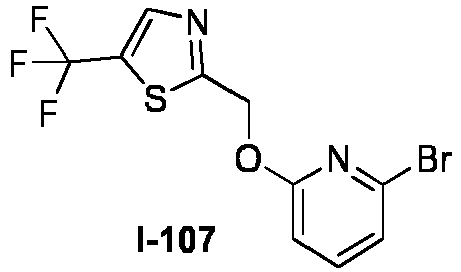
- 2-[(6-bromo-2-pyridyl)oxymethyl]-5-(trifluoromethyl)thiazole (I-107): A round-bottom flask was charged with [5-(trifluoromethyl)thiazol-2-yl]methanol (570 mg, 3.1 mmol, 1.1 equivalent), 2-bromo-6-fluoropyridine (500 mg, 2.8 mol, 1.0 equivalent), and cesium carbonate (1.3 g, 4.0 mmol, 1.4 equivalent). Anhydrous acetonitrile (10 mL) was added, and the resulting mixture was heated to reflux and stirred for 12 h. After cooling down to rt, the mixture was filtered through a plug of Celite and the and concentrated in vacuo. The residue was purified by silica gel flash column chromatography (EtOAc/hexane gradient) to yield the title compound. ES/MS m/z: 339.8 (M+H)+.
-

- Ethyl (S)-2-(4-bromo-2,5-difluorobenzyl)-4-fluoro-1-(oxetan-2-ylmethyl)-1H-benzo[d]imidazole-6-carboxylate (Intermediate I-108). A round-bottom flask was charged with 2-(4-bromo-2,5-difluoro-phenyl)acetic acid (3.37 g, 13.4 mmol, 1.2 equivalent), ethyl 4-amino-3-fluoro-5-[[(2S)-oxetan-2-yl]methylamino]benzoate (Intermediate I-5, 3.00 g, 11.2 mmol, 1.0 equivalent), and 1-methylimidazole (2.7 mL, 33 mmol, 3.0 equivalent). Anhydrous acetonitrile (40 mL) was added and the mixture was cooled to 0 °C. TCFH (3.76 g, 13.4 mmol, 1.2 equivalent) was added slowly, and the mixture was warmed to rt and stirred for 2 h before diluting with EtOAc (100 mL) and water (100 mL). The layers were separated, and the combined organic extracts were washed with saturated aqueous NH4Cl, (100 mL), saturated aqueous NaHCO3 (100 mL), and brine (50 mL), respectively. The resulting solution was dried over MgSO4, filtered, and concentrated in vacuo. The resulting crude residue was dissolved in dichloroethane (60 mL) followed by acetic acid (10 mL). The mixture was heated to 60 °C and stirred for 48 h. After cooling to rt, the solution was concentrated and purified by silica gel column chromatography (EtOAc / hexane gradient) to yield ethyl (S)-2-(4-bromo-2,5-difluorobenzyl)-4-fluoro-1-(oxetan-2-ylmethyl)-1H-benzo[d]imidazole-6-carboxylate (Intermediate I-108). ES/MS m/z: 483.6 (M+H)+.
-

- Ethyl (S)-2-(2,5-difluoro-4-(6-((5-(trifluoromethyl)thiazol-2-yl)methoxy)pyridin-2-yl)benzyl)-4-fluoro-1-(oxetan-2-ylmethyl)-1H-benzo[d]imidazole-6-carboxylate (Intermediate I-109): To a 25-mL microwave vial was charged with methyl 2-[(4-bromo-2,5-difluoro-phenyl)methyl]-3-[(3S)-4,4-dimethyltetrahydrofuran-3-yl]benzimidazole-5-carboxylate (Intermediate I-108, 1.3 g, 2.70 mmol, 1.0 equivalent), PdCl2(dppf)2 (300 mg, 0.400 mmol, 0.15 equivalent), potassium propionate (900 mg, 8.07 mmol, 3.0 equivalent), and B2Pin2 (820 mg, 3.23 mol, 1.2 equivalent). Anhydrous 1,4-dioxane (15 mL) was added and the resulting mixture was purged with argon for 2 minutes. The mixture was sealed and heated to 120 °C by microwave and stirred for 1 h. After cooling down to rt, 2-[(6-bromo-2-pyridyl)oxymethyl]-5-(trifluoromethyl)thiazole (Intermediate I-107, 1100 mg, 3.23 mmol, 1.2 equivalent), PdCl2(dppf)2 (100 mg, 0.134 mmol, 0.05 equivalent), 2 M aqueous Na2CO3 (3.4 mL, 6.72 mmol, 2.5 equivalent) were added, respectively. The resulting mixture was heated to 100°C under argon and stirred for 3 h before cooling to rt and filtered through a plug of Celite and MgSO4. The filtrate was concentrated and purified by silica gel column chromatography (EtOAc/hexane gradient) to yield ethyl (S)-2-(2,5-difluoro-4-(6-((5-(trifluoromethyl)thiazol-2-yl)methoxy)pyridin-2-yl)benzyl)-4-fluoro-1-(oxetan-2-ylmethyl)-1H-benzo[d]imidazole-6-carboxylate (Intermediate I-109). ES/MS m/z: 662.6 (M+H)+.
-

- 4-[(6-bromo-3-fluoro-2-pyridyl)oxymethyl]-3-fluoro-benzonitrile (Intermediate I-109a): To a solution of 6-bromo-2-chloro-3-fluoro-pyridine ( 4.90 g, 23.3 mmol) and 3-fluoro-4-(hydroxymethyl)benzonitrile (3.87 g, 25.6 mmol) in acetonitrile (40 mL) was added cesium carbonate ( 15.2 g, 25.6 mmol). The mixture was stirred at 60 °C overnight before being cooled to rt. The mixture was diluted with water, extracted three times with EtOAc, washed with brine, dried over sodium sulfate, filtered, and concentrated. Purification by silica gel flash column chromatography (EtOAc in Hexane gradient) yielded 4-[(6-bromo-3-fluoro-2-pyridyl)oxymethyl]-3-fluoro-benzonitrile (Intermediate I-109a). ES/MS m/z: 326.1 (M + H)+.
-

- tert-Butyl (1R,3R,5R)-3-[(2-amino-5-methoxycarbonyl-anilino)methyl]-2-azabicyclo[3.1.0]hexane-2-carboxylate was prepared in a manner as described for Intermediate I-1 substituting tert-butyl (1R,3R,5R)-3-(aminomethyl)-2-azabicyclo[3.1.0]hexane-2-carboxylate for 2-methoxyethylamine. ES/MS: 362.2 (M+H+). 1H NMR (400 MHz, Chloroform-d) δ 7.39 (d, J = 8.1 Hz, 1H), 7.15 (s, 1H), 6.63 (d, J = 8.1 Hz, 1H), 4.58 (t, J = 11.0 Hz, 1H), 3.87 (s, 3H), 3.64 (d, J = 7.3 Hz, 1H), 3.27 - 3.09 (m, 1H), 3.00 (t, J = 11.0 Hz, 1H), 2.56 (q, J = 11.7 Hz, 1H), 1.95 - 1.70 (m, 1H), 1.53 (s, 10H), 0.81 (q, J = 7.1 Hz, 1H), 0.57 (d, J = 5.7 Hz, 1H).
-

- 5-[(6-bromo-2-pyridyl)oxymethyl]-N-(2-cyanoethyl)pyridine-2-carboxamide was prepared in a manner as described for Intermediate I-28 substituting 3-aminopropanenitrile for 1-aminocyclopropanecarbonitrile hydrochloride. ES/MS: 361.0, 363.0 (M+H+). 1H NMR (400 MHz, Chloroform-d) δ 8.68 (d, J = 2.0 Hz, 1H), 8.46 (d, J = 6.7 Hz, 1H), 8.20 (d, J = 8.0 Hz, 1H), 7.98 (dd, J = 8.0, 2.1 Hz, 1H), 7.48 (t, J = 7.8 Hz, 1H), 7.13 (d, J = 7.5 Hz, 1H), 6.79 (d, J = 8.1 Hz, 1H), 5.48 (s, 2H), 3.78 (q, J = 6.5 Hz, 2H), 2.77 (t, J = 6.5 Hz, 2H).
-

- (4-bromo-2-fluoro-3-methyl-phenyl)methanol: To a solution of methyl 4-bromo-2-fluoro-3-methyl-benzoate (500 mg, 2.02 mmol) in THF (10 mL) at 0 °, was added diisobutylaluminum hydride (1000 mmol/L, 5.06 mL, 5.06 mmol). The mixture was stirred for 1 hr. The reaction was diluted with 25 mL Et2O and cooled to 0 °C. 0.200 mL water and 0.200 mL 15% NaOH were added, and an additional 0.500 mL water was added. The mixture was warmed to rt and stirred for 15 min. To this was added MgSO4 and the mixture was stirred 15 min, then filtered and rinsed with Et2O to give crude residue which was purified by chromatography (eluent: EtOAc/hexanes) to give desired product. 1H NMR (400 MHz, Chloroform-d) δ 7.37 (dd, J = 8.2, 1.3 Hz, 1H), 7.16 (t, J = 7.9 Hz, 1H), 4.73 (s, 2H), 2.36 (d, J = 2.5 Hz, 3H).
- 1-bromo-4-(bromomethyl)-3-fluoro-2-methyl-benzene: To a solution of (4-bromo-2-fluoro-3-methyl-phenyl)methanol (358 mg, 1.63 mmol) and (4-diphenylphosphanylphenyl) polymer bound (78.7 %, 651 mg, 1.966 mmol), in DCM (10 mL) at 0 °, was added carbon tetrabromide (650 mg, 1.96 mmol). The mixture was gradually warmed to rt overnight. The suspension was filtered, diluted with DCM and washed with brine. The organic extract was dried over sodium sulfate, concentrated and purified by chromatography (eluent: EtOAc/hexanes) to give desired product. 1H NMR (400 MHz, Chloroform-d) δ 7.35 (dd, J = 8.3, 1.3 Hz, 1H), 7.12 (t, J = 8.0 Hz, 1H), 4.49 (d, J = 1.2 Hz, 2H), 2.37 (d, J = 2.5 Hz, 3H).
- 2-(4-bromo-2-fluoro-3-methyl-phenyl)acetonitrile: To a solution of 1-bromo-4-(bromomethyl)-3-fluoro-2-methyl-benzene (299 mg, 1.06 mmol) in DMSO (6 ml) at rt, was added potassium cyanide (138 mg, 2.12 mmol). The mixture was stirred at rt overnight. The reaction was diluted with EtOAc and washed with 10% Na2CO3. The organic layer was then washed with brine. The mixture was dried over sodium sulfate to give desired product. 1H NMR (400 MHz, Chloroform-d) δ 7.41 (dd, J = 8.3, 1.4 Hz, 1H), 7.17 (t, J = 8.0 Hz, 1H), 3.73 (d, J = 1.0 Hz, 2H), 2.37 (d, J = 2.6 Hz, 3H).
- 2-(4-bromo-2-fluoro-3-methyl-phenyl)acetic acid (I-1011): A solution of 2-(4-bromo-2-fluoro-3-methyl-phenyl)acetonitrile (164 mg, 0.717 mmol) in concentrated HCl (2 mL) was heated at 100 overnight. The reaction was cooled to rt, diluted with EtOAc and neutralized carefully with 6 NaOH (4 mL). The organic extract was dried organic extract over sodium sulfate, filtered and concentrated to give desired product. 1H NMR (400 MHz, Methanol-d4) δ 7.35 (dd, J = 8.3, 1.3 Hz, 1H), 7.08 (t, J = 8.0 Hz, 1H), 3.64 (d, J = 1.8 Hz, 2H), 2.35 (d, J = 2.5 Hz, 3H).
-

- Methyl 2-[(4-bromo-2-fluoro-3-methyl-phenyl)methyl]-3-[[(2S)-oxetan-2-yl]methyl]benzimidazole-5-carboxylate was prepared in a manner as described for Intermediate I-2 substituting I-4 for I-1 and 2-(4-bromo-2-fluoro-3-methyl-phenyl)acetic acid (I-1011) for 2-(4-bromo-2-fluoro-phenyl)acetic acid. ES/MS: 447.0, 449.0 (M+H+). 1H NMR (400 MHz, Chloroform-d) δ 8.11 (d, J = 1.7 Hz, 1H), 7.98 (dd, J = 8.5, 1.6 Hz, 1H), 7.75 (d, J = 8.5 Hz, 1H), 7.29 (dd, J = 8.3, 1.3 Hz, 1H), 6.99 (t, J = 8.0 Hz, 1H), 5.14 (qd, J = 6.8, 2.9 Hz, 1H), 4.72 - 4.51 (m, 1H), 4.51 - 4.27 (m, 5H), 3.96 (s, 3H), 2.73 (dtd, J = 11.4, 8.1, 6.1 Hz, 1H), 2.51 - 2.38 (m, 1H), 2.35 (d, J = 2.6 Hz, 3H).
-

- Ethyl 2-[(6-bromo-2-pyridyl)oxymethyl]thiazole-4-carboxylate: A suspension of ethyl 2-(bromomethyl)thiazole-4-carboxylate (500 mg, 2.0 mmol), 6-bromopyridin-2-ol (350 mg, 2.0 mmol), and silver carbonate (1186 mg, 4.3 mmol) in CH3CN (15 mL) was heated at 50 ° C overnight. The reaction was diluted with EtOAc and brine. The mixture was filtered over Celite frit. The layers were partitioned, and the organic layer was washed with brine once more. The mixture was dried over sodium sulfate, concentrated, and purified by chromatography (eluent: EtOAc/hexanes) to give desired product.
- ES/MS: 343, 345 (M+H+). 1H NMR (400 MHz, Chloroform-d) δ 8.22 (s, 1H), 7.51 (dd, J = 8.2, 7.5 Hz, 1H), 7.17 (dd, J = 7.5, 0.7 Hz, 1H), 6.82 (dd, J = 8.2, 0.7 Hz, 1H), 5.73 (s, 2H), 4.46 (q, J = 7.1 Hz, 2H), 1.43 (t, J = 7.1 Hz, 3H).
- 2-[(6-bromo-2-pyridyl)oxymethyl]thiazole-4-carboxylic acid: A solution of ethyl 2-[(6-bromo-2-pyridyl)oxymethyl]thiazole-4-carboxylate (114 mg, 0.332 mmol) and Lithium hydroxide, monohydrate (43.3 mg, 1.03 mmol) in CH3CN (3 mL) and water (1 mL) was prepared. The mixture was stirred at rt for 2 hr. The reaction mixture was diluted with EtOAc. The mixture was adjusted to pH~6 with 1N HCl (1.05 mL). The organic layer was dried over sodium sulfate to give desired product. ES/MS: 315, 317 (M+H+). 1H NMR (400 MHz, Methanol-d4) δ 8.40 (d, J = 1.0 Hz, 1H), 7.71 - 7.57 (m, 1H), 7.25 (d, J = 7.5 Hz, 1H), 6.93 (d, J = 8.1 Hz, 1H), 5.68 (d, J = 1.0 Hz, 2H).
- 2-[(6-bromo-2-pyridyl)oxymethyl]-N-methyl-thiazole-4-carboxamide (I-1017): To a solution of 2-[(6-bromo-2-pyridyl)oxymethyl]thiazole-4-carboxylic acid (47.7 mg, 0.151 mmol), methanamine;hydrochloride (26.0 mg, 0.385 mmol), and o-(7-Azabenzotriazol-1-yl)-N,N,N',N'-tetramethyluronium hexafluorophosphate (84.6 mg, 0.223 mmol) in DMF (3 mL), was added N,N-diisopropylethylamine (0.105 mL, 0.605 mmol). The mixture was stirred at rt overnight. The reaction was diluted with EtOAc, washed with 5%LiCl, saturated NaHCO3, and brine. The mixture was dried over sodium sulfate, concentrated, and purified by chromatography (eluent: EtOAc/hexanes) to give desired product. MR (400 MHz, Chloroform-d) δ 8.13 (s, 1H), 7.51 (t, J = 7.8 Hz, 1H), 7.34 (s, 1H), 7.18 (d, J = 7.5 Hz, 1H), 6.83 (d, J = 8.2 Hz, 1H), 5.64 (s, 2H), 3.04 (d, J = 5.0 Hz, 3H).
-

- Methyl 2-(chloromethyl)-3-(4,4-dimethyltetrahydrofuran-3-yl)-7-fluoro-benzimidazole-5-carboxylate: To a solution of methyl 4-amino-3-[(4,4-dimethyltetrahydrofuran-3-yl)amino]-5-fluoro-benzoate (I-104 ) (1.13 g, 4.00 mmol) in CH3CN (20 mL), was added p-Toluenesulfonic Acid, monohydrate (0.0345 g, 0.200 mmol), and 2-Chloro-1,1,1-trimethoxyethane (0.547 mL, 5.20 mmol). The mixture was heated at 60 °C overnight. To this was added 2-Chloro-1,1,1-trimethoxyethane (0.547 mL, 5.20 mmol) and p-Toluenesulfonic Acid monohydrate (0.0345 g, 0.200 mmol) and the mixture was then heated at 60 °C for 3 hr. The reaction was diluted with EtOAc washed with brine, dried over sodium sulfate, concentrated, and purified by chromatography (eluent: EtOAc/hexanes) to give desired product. ES/MS: 341.2 (M+H+). 1H NMR (400 MHz, Chloroform-d) δ 8.41 (s, 1H), 7.71 (dd, J = 10.6, 1.4 Hz, 1H), 4.96 (d, J = 12.6 Hz, 1H), 4.90 - 4.76 (m, 2H), 4.61 (dd, J = 11.2, 1.9 Hz, 1H), 4.50 (dd, J = 11.2, 7.0 Hz, 1H), 3.97 (d, J = 1.2 Hz, 4H), 3.83 (d, J = 9.3 Hz, 1H), 1.43 (s, 3H), 0.73 (s, 3H).
- Methyl 2-[(4-bromo-5-fluoro-2-oxo-1-pyridyl)methyl]-3-(4,4-dimethyltetrahydrofuran-3-yl)-7-fluoro-benzimidazole-5-carboxylate (I-1018): A suspension of 4-bromo-5-fluoro-1H-pyridin-2-one (115 mg, 0.599 mmol), methyl 2-(chloromethyl)-3-(4,4-dimethyltetrahydrofuran-3-yl)-7-fluoro-benzimidazole-5-carboxylate (205 mg, 0.602 mmol), and Potassium carbonate (414 mg, 3.00 mmol) in DMF (3 mL) was heated at 60 °C for 24 hr. The mixture was cooled to rt, diluted with EtOAc, filtered, and concentrated. The mixture was diluted with EtOAc and washed with 5% LiCl and brine. The mixture was dried over sodium sulfate, concentrated, and purified by chromatography (eluent: EtOAc/hexanes) to give desired product. Submitted for chiral-SFC separation (SFC IG column with EtOH cosolvent) gave 2 distinct stereoisomers. ES/MS: 497, 499 (M+H+). 1H NMR (400 MHz, Chloroform-d) δ 8.45 (s, 1H), 7.82 (d, J = 3.9 Hz, 1H), 7.72 (dd, J = 10.8, 1.2 Hz, 1H), 6.93 (d, J = 6.4 Hz, 1H), 5.73 (d, J = 14.8 Hz, 1H), 5.28 (d, J = 6.6 Hz, 1H), 5.11 (d, J = 14.8 Hz, 1H), 4.69 - 4.36 (m, 2H), 3.97 (s, 3H), 3.90 - 3.72 (m, 2H), 1.43 (s, 3H), 0.61 (s, 3H).
-

- Methyl 2-[(4-bromo-5-fluoro-2-oxo-1-pyridyl)methyl]-3-(4,4-dimethyltetrahydrofuran-3-yl)-7-fluoro-benzimidazole-5-carboxylate was subjected to chiral-SFC separation (SFC IG column with EtOH cosolvent) and gave two distinct stereoisomers.
- Methyl 2-[(4-bromo-5-fluoro-2-oxo-1-pyridyl)methyl]-3-(4,4-dimethyltetrahydrofuran-3-yl)-7-fluoro-benzimidazole-5-carboxylate (I-1019 isomer 1): RT 2.46 min. ES/MS: 496, 498 (M+H+). 1H NMR (400 MHz, Chloroform-d) δ 8.46 (s, 1H), 7.82 (d, J = 3.9 Hz, 1H), 7.73 (dd, J = 10.8, 1.2 Hz, 1H), 6.94 (d, J = 6.4 Hz, 1H), 5.74 (d, J = 14.8 Hz, 1H), 5.29 (d, J = 6.5 Hz, 1H), 5.10 (d, J = 14.8 Hz, 1H), 4.68 - 4.45 (m, 2H), 3.97 (s, 3H), 3.93 - 3.77 (m, 2H), 1.44 (s, 3H), 0.62 (s, 3H).
- Methyl 2-[(4-bromo-5-fluoro-2-oxo-1-pyridyl)methyl]-3-(4,4-dimethyltetrahydrofuran-3-yl)-7-fluoro-benzimidazole-5-carboxylate (I-1020 isomer 2): RT 5.88 min. ES/MS: 496, 498 (M+H+). 1H NMR (400 MHz, Chloroform-d) δ 8.46 (s, 1H), 7.82 (d, J = 3.9 Hz, 1H), 7.73 (dd, J = 10.8, 1.2 Hz, 1H), 6.94 (d, J = 6.4 Hz, 1H), 5.74 (d, J = 14.8 Hz, 1H), 5.29 (d, J = 6.5 Hz, 1H), 5.10 (d, J = 14.8 Hz, 1H), 4.68 - 4.45 (m, 2H), 3.97 (s, 3H), 3.93 - 3.77 (m, 2H), 1.44 (s, 3H), 0.62 (s, 3H).
-

- To a solution of 4-bromo-2-chloro-5-methyl-benzoic acid (996 mg, 3.99 mmol) in DCM (10 mL) at 0 °C, was added oxalyl dichloride (2000 mmol/L, 2.40 mL, 4.79 mmol) and 5 drops of DMF. The mixture was stirred for 1 hr. Upon completion of time, 10 mL MeOH was added and the resulting mixture stirred overnight at rt. Next, the mixture was diluted with DCM, washed with saturated NaHCO3 dried over sodium sulfate, concentrated, and purified by chromatography (eluent: EtOAc/hexanes) to give desired product. 1H NMR (400 MHz, Chloroform-d) δ 7.74 (s, 1H), 7.68 (d, J = 1.1 Hz, 1H), 3.94 (d, J = 1.2 Hz, 3H), 2.42 (s, 3H).
- (4-bromo-2-chloro-5-methyl-phenyl)methanol: To a solution of methyl 4-bromo-2-chloro-5-methyl-benzoate (931 mg, 3.53 mmol) in THF (15 mL) at 0 °C, diisobutylaluminium hydride (1000 mmol/L, 8.83 mL, 8.83 mmol) was added and the resulting mixture was stirred for 1 hr. Upon completion of time, the mixture was diluted with 25 mL Et2O and cooled to 0 °C. Then 0.350 mL water, 0.350 mL 15% NaOH was added, then and additional 0.900 mL water was added. The resulting mixture was warmed to rt and stirred for 15 min. Next, MgSO4 was added and stirred for 15 min. The mixture was then filtered and rinsed with Et2O to give crude residue which was purified by chromatography (eluent: EtOAc/hexanes) to give desired product.1H MR (400 MHz, Chloroform-d) δ 7.56 (d, J = 1.4 Hz, 1H), 7.38 (s, 1H), 4.73 (s, 2H), 2.41 (d, J = 1.3 Hz, 4H).
- 1-bromo-4-(bromomethyl)-5-chloro-2-methyl-benzene: To a solution of (4-bromo-2-chloro-5-methyl-phenyl)methanol (639 mg, 2.71 mmol) and (4-diphenylphosphanylphenyl) polymer bound (78.7 %, 1081 mg, 3.26 mmol), in DCM (10 mL) at 0 °C, was added carbon tetrabromide (1080 mg, 3.26 mmol). The mixture was gradually warmed to rt overnight. The suspension was filtered, diluted with DCM and washed with brine. The organic extract was dried over sodium sulfate, concentrated and purified by chromatography (eluent: EtOAc/hexanes) to give desired product. 1H NMR (400 MHz, Chloroform-d) δ 7.60 (s, 1H), 7.32 (s, 1H), 4.53 (s, 2H), 2.39 (s, 3H).
- 2-(4-bromo-2-chloro-5-methyl-phenyl)acetonitrile: To a solution of 1-bromo-4-(bromomethyl)-5-chloro-2-methyl-benzene (721 mg, 2.42 mmol) in DMSO (12 ml) at rt, was added potassium cyanide (315 mg, 4.83 mmol). The resulting mixture was stirred at rt overnight. The mixture was diluted with EtOAc and washed with 10% Na2CO3. The organic extract was washed once more with brine, then dried over sodium sulfate to give desired product. 1H NMR (400 MHz, Chloroform-d) δ 7.62 (s, 1H), 7.52 - 7.33 (m, 1H), 3.78 (s, 2H), 2.42 (s, 3H).
- 2-(4-bromo-2-chloro-5-methyl-phenyl)acetic acid (I-1023): A solution of 2-(4-bromo-2-chloro-5-methyl-phenyl)acetonitrile (179 mg, 0.732 mmol) in conc HCl (5 mL) was heated at 100 °C overnight. The mixture was cooled to rt, then diluted with EtOAc, and neutralized carefully with 6 N NaOH (10 mL). The organic extract was dried over sodium sulfate to give desired product. 1H NMR (400 MHz, Methanol-d4) δ 7.59 (s, 1H), 7.29 (s, 1H), 3.71 (s, 2H), 2.37 (s, 3H).
-

- Methyl 2-[(4-bromo-2-chloro-5-methyl-phenyl)methyl]-3-[[(2S)-oxetan-2-yl]methyl]benzimidazole-5-carboxylate (I-1024): Methyl 2-[(4-bromo-2-chloro-5-methylphenyl)methyl]-3-[[(2S)-oxetan-2-yl]methyl]benzimidazole-5-carboxylate was prepared in a manner as described for Intermediate I-2 substituting I-4 for I-1 and 2-(4-bromo-2-chloro-5-methyl-phenyl)acetic acid (I-1023) for 2-(4-bromo-2-fluoro-phenyl)acetic acid. ES/MS: 463, 465 (M+H+). 1H NMR (400 MHz, Chloroform-d) δ 8.12 (d, J = 1.6 Hz, 1H), 8.00 (dd, J = 8.5, 1.4 Hz, 1H), 7.78 (d, J = 8.5 Hz, 1H), 7.62 (s, 1H), 7.13 (s, 1H), 5.13 (dd, J = 7.1, 2.9 Hz, 1H), 4.77 - 4.59 (m, 1H), 4.59 - 4.23 (m, 5H), 3.97 (d, J = 1.0 Hz, 3H), 2.74 (ddt, J = 14.1, 11.7, 6.6 Hz, 1H), 2.52 - 2.35 (m, 1H), 2.29 (s, 3H).
-

- Ethyl 4-[[2-(4-bromo-2-chloro-5-methyl-phenyl)acetyl]amino]-3-fluoro-5-[[(2S)-oxetan-2-yl]methylamino]benzoate: To a solution of 2-(4-bromo-2-chloro-5-methylphenyl)acetic acid (501 mg, 1.90 mmol) and ethyl 4-amino-3-fluoro-5-[[(2S)-oxetan-2-yl]methylamino]benzoate (510 mg, 1.90 mmol) in CH3CN (19 mL) at 0 °C, was added 1-Methylimidazole (0.758 mL, 9.50 mmol), followed by TCFH (640 mg, 2.28 mmol). The mixture was stirred at rt overnight. The mixture was diluted with EtOAc, washed with saturated NH4Cl, 1N NaOH, and brine and subsequently dried over sodium sulfate, concentrated, and carried onto next step below. ES/MS: 513, 515 (M+H+).
- Ethyl 2-[(4-bromo-2-chloro-5-methyl-phenyl)methyl]-7-fluoro-3-[[(2S)-oxetan-2-yl]methyl]benzimidazole-5-carboxylate (I-1026): A solution of ethyl 4-[[2-(4-bromo-2-chloro-5-methyl-phenyl)acetyl]amino]-3-fluoro-5-[[(2S)-oxetan-2-yl]methylamino]benzoate (977 mg, 1.90 mmol) and acetic acid (3426 mg, 57.0 mmol) in DCE (15 mL) was heated at 60 °C overnight. The mixture was cooled to rt, diluted with EtOAc and carefully neutralized with NaHCO3 (4.78 g). Washed organic layer with brine and dried over sodium sulfate and concentrated. Purification by chromatography (eluent: EtOAc/hexanes) gave desired product. ES/MS: 495, 497 (M+H+). 1H NMR (400 MHz, Chloroform-d) δ 7.94 (d, J = 1.3 Hz, 1H), 7.69 (dd, J = 11.0, 1.3 Hz, 1H), 7.62 (s, 1H), 7.12 (s, 1H), 5.08 (qd, J = 6.9, 2.8 Hz, 1H), 4.74 - 4.59 (m, 1H), 4.59 - 4.24 (m, 8H), 2.73 (dtd, J = 11.4, 8.1, 6.1 Hz, 1H), 2.39 (ddt, J = 11.5, 9.0, 7.2 Hz, 1H), 2.29 (s, 3H), 1.44 (t, J = 7.2 Hz, 3H).
-

- Methyl 2-[(4-bromo-2-chloro-5-methyl-phenyl)methyl]-3-[(3S)-4,4-dimethyltetrahydrofuran-3-yl]benzimidazole-5-carboxylate (I-1030): Methyl 2-[(4-bromo-2-chloro-5-methyl-phenyl)methyl]-3-[(3S)-4,4-dimethyltetrahydrofuran-3-yl]benzimidazole-5-carboxylate was prepared in a manner as described for Intermediate I-2 substituting I-80 for I-1 and 2-(4-bromo-2-chloro-5-methyl-phenyl)acetic acid (I-1023) for 2-(4-bromo-2-fluorophenyl)acetic acid. ES/MS: 490.6, 492.6 (M+H+). 1H NMR (400 MHz, Chloroform-d) δ 8.56 (s, 1H), 8.02 (dd, J = 8.5, 1.4 Hz, 1H), 7.80 (d, J = 8.5 Hz, 1H), 7.64 (s, 1H), 7.06 (s, 1H), 4.60 - 4.47 (m, 2H), 4.45 - 4.26 (m, 3H), 3.95 (d, J = 10.4 Hz, 5H), 3.78 (d, J = 8.8 Hz, 1H), 2.28 (s, 3H), 2.07 (s, 1H), 1.31 (s, 3H), 0.67 (s, 3H).
-

- methyl 4-[[2-(4-bromo-2-chloro-5-methyl-phenyl)acetyl]amino]-3-[[(3S)-4,4-dimethyltetrahydrofuran-3-yl]amino]-5-fluoro-benzoate: To a solution of 2-(4-bromo-2-chloro-5-methyl-phenyl)acetic acid (399 mg, 1.51 mmol) and methyl 4-amino-3-[[(3S)-4,4-dimethyltetrahydrofuran-3-yl]amino]-5-fluoro-benzoate (427 mg, 1.51 mmol) in CH3CN (7 mL) at 0 °C, 1-Methylimidazole (0.603 mL, 7.56 mmol) was added, followed by the addition of TCFH (509 mg, 1.82 mmol). The resulting mixture was stirred at rt overnight. The mixture was then diluted with EtOAc and washed with saturated NH4Cl, 1N NaOH, and brine. Next, the mixture was dried over sodium sulfate, concentrated and carried onto next step below without purification. ES/MS: 527, 529 (M+H+).
- Methyl 2-[(4-bromo-2-chloro-5-methyl-phenyl)methyl]-3-[(3S)-4,4-dimethyltetrahydrofuran-3-yl]-7-fluoro-benzimidazole-5-carboxylate (I-1031): To a solution of methyl 4-[[2-(4-bromo-2-chloro-5-methyl-phenyl)acetyl]amino]-3-[[(3S)-4,4-dimethyltetrahydrofuran-3-yl]amino]-5-fluoro-benzoate (798 mg, 1.51 mmol) and Triphenylphosphine oxide (1262 mg, 4.54 mmol) in DCM (15 mL) at 0 °C, Triflic anhydride (1000 mmol/L, 2.27 mL, 2.27 mmol) was added. The mixture was gradually warmed to rt and stirred for 1 hr. Upon completion, the mixture was diluted with DCM and washed with saturated NaHCO3 solution and brine. Next, the mixture was dried over sodium sulfate, concentrated and purified by chromatography (eluent: EtOAc/hexanes) to give desired product. ES/MS: 508.6, 510.6 (M+H+). 1H NMR (400 MHz, Chloroform-d) δ 8.38 (s, 1H), 7.71 (dd, J = 10.8, 1.2 Hz, 1H), 7.64 (s, 1H), 7.06 (s, 1H), 4.55 - 4.42 (m, 2H), 4.41 (d, J = 2.8 Hz, 2H), 4.32 (dd, J = 11.0, 7.0 Hz, 1H), 3.97 (s, 3H), 3.92 (d, J = 8.8 Hz, 1H), 3.77 (d, J = 8.8 Hz, 1H), 2.27 (s, 3H), 1.29 (s, 3H), 0.64 (s, 3H).
-

- Ethyl (S)-4-amino-3-fluoro-5-((oxetan-2-ylmethyl)amino)benzoate (I-1032): Ethyl (S)-4-amino-3-fluoro-5-((oxetan-2-ylmethyl)amino)benzoate was prepared in a manner as described for Intermediate I-1 substituting ethyl 3,5-difluoro-4-nitrobenzoate for methyl 3-fluoro-4-nitro-benzoate. ES/MS: 257.2 (M+H+); 'H NMR (400 MHz, CDCl3) δ 7.32 (dd, J = 10.8, 1.7 Hz, 1H), 7.20 (t, J = 1.4 Hz, 1H), 4.35 (q, J = 7.1 Hz, 2H), 3.78 (s, 3H), 3.68 (dd, J = 5.6, 4.5 Hz, 2H), 3.43 (s, 3H), 3.35 (dd, J = 5.6, 4.5 Hz, 2H), 1.39 (t, J = 7.1 Hz, 3H).
-

- Ethyl 2-(4-bromo-2,5-difluorobenzyl)-4-fluoro-1-(2-methoxyethyl)-1H-benzo[d]imidazole-6-carboxylate (I-1033): Ethyl 2-(4-bromo-2,5-difluorobenzyl)-4-fluoro-1-(2-methoxyethyl)-IH-benzo[d]imidazole-6-carboxylate was prepared in a manner as described for Intermediate I-2 substituting ethyl 4-amino-3-fluoro-5-((2-methoxyethyl)amino)benzoate (I-1032) for I-1 and 2-(4-bromo-2,5-difluorophenyl)acetic acid for 2-(4-bromo-2-fluorophenyl)acetic acid. ES/MS: 471.0, 473.0 (M+H+). 1H NMR (400 MHz, CDCl3) δ 7.91 (d, J = 1.3 Hz, 1H), 7.70 (dd, J = 10.8, 1.3 Hz, 1H), 7.34 (dd, J = 8.7, 5.5 Hz, 1H), 7.12 (dd, J = 8.6, 6.3 Hz, 1H), 4.44 (q, J = 7.1 Hz, 2H), 4.39 (s, 2H), 4.37 - 4.29 (m, 2H), 3.66 (t, J = 5.1 Hz, 2H), 3.25 (s, 3H), 1.45 (t, J = 7.1 Hz, 3H).
-

- Methyl 2-[(4-bromo-2,5-difluoro-phenyl)methyl]-7-chloro-3-[(3S)-4,4-dimethyltetrahydrofuran-3-yl]benzimidazole-5-carboxylate (I-1037): Methyl 2-[(4-bromo-2,5-difluoro-phenyl)methyl]-7-chloro-3-[(3S)-4,4-dimethyltetrahydrofuran-3-yl]benzimidazole-5-carboxylate was prepared in a manner as described for Intermediate I-1031 substituting 2-(4-bromo-2,5-difluoro-phenyl)acetic acid for 2-(4-bromo-2-chloro-5-methyl-phenyl)acetic acid and methyl 4-amino-3-chloro-5-[[(3S)-4,4-dimethyltetrahydrofuran-3-yl]amino]benzoate I-1038 for methyl 4-amino-3-[[(3S)-4,4-dimethyltetrahydrofuran-3-yl]amino]-5-fluoro-benzoate. ES/MS: 513.0, 514.9 (M+H+). 1H NMR (400 MHz, Chloroform-d) δ 8.50 (s, 1H), 8.07 (d, J = 1.3 Hz, 1H), 7.38 (dd, J = 8.7, 5.6 Hz, 1H), 7.23 - 7.07 (m, 1H), 4.61 - 4.40 (m, 3H), 4.40 - 4.29 (m, 2H), 3.97 (s, 3H), 3.92 (d, J = 8.9 Hz, 1H), 3.78 (d, J = 8.9 Hz, 1H), 1.32 (s, 3H), 0.63 (s, 3H).
-

- Methyl 4-amino-3-chloro-5-[[(3S)-4,4-dimethyltetrahydrofuran-3-yl]amino]benzoate (I-1038): Methyl 4-amino-3-chloro-5-[[(3S)-4,4-dimethyltetrahydrofuran-3-yl]amino]benzoate was prepared in a manner as described for Intermediate I-68 substituting methyl 3-chloro-5-fluoro-4-nitro-benzoate for methyl 3-bromo-5-fluoro-4-nitro-benzoate. ES/MS: 299.2 (M+).
-

- Methyl 5-bromo-3-fluoro-thiophene-2-carboxylate: To a suspension of 5-bromo-3-fluoro-thiophene-2-carboxylic acid (1000 mg, 4.44 mmol) in DCM (20 mL) at 0 °C, oxalyl dichloride (2000 mmol/L, 2.67 mL, 5.33 mmol) and 10 drops of DMF were added. the mixture was then stirred for 1 hr. Upon completion, 10 mL MeOH was added and the resulting mixture was stirred overnight at rt. Next, the mixture was diluted with DCM, washed with saturated NaHCO3 and dried over sodium sulfate, concentrated to dryness, and purified by chromatography (eluent: EtOAc/hexanes) to give desired product. 1H NMR (400 MHz, Chloroform-d) δ 6.91 (s, 1H), 3.89 (s, 3H).
- (5-bromo-3-fluoro-2-thienyl)methanol: To a solution of methyl 5-bromo-3-fluoro-thiophene-2-carboxylate (907 mg, 3.79 mmol) in THF (15 mL) at 0 °C, was added diisobutylaluminium hydride (1000 mmol/L, 9.48 mL, 9.48 mmol). The mixture was gradually warmed to rt and stirred for 1 hr. Next, the mixture was diluted with 25 mL Et2O and cooled to 0 °C. Then 0.380 mL water, 0.380 mL 15% NaOH were added and an additional 0.948 mL water was further added. The resulting mixture was warmed to rt and stirred for 15 min. Next, MgSO4 was added and resulting mixture was stirred for 15 min. Upon completion of time, the mixture was then filtered and rinsed with Et2O to give crude residue which was purified by chromatography (eluent: EtOAc/hexanes) to give desired product. 1H NMR (400 MHz, Chloroform-d) δ 6.81 (s, 1H), 4.77 - 4.55 (m, 2H).
- 4-fluoro-5-(hydroxymethyl)thiophene-2-carbonitrile (I-1039): A suspension of (5-bromo-3-fluoro-2-thienyl)methanol (300 mg, 1.42 mmol), tetrakis(triphenylphosphine)palladium(O) (411 mg, 0.355 mmol), Zinc cyanide (334 mg, 2.84 mmol) and Zinc powder (4.65 mg, 0.0711 mmol) in DMF (3.5 mL) was degassed with argon, then heated at 100 °C for 16 hr. The mixture was concentrated to dryness and purified by chromatography (eluent: EtOAc/hexanes) to give desired product. 1H NMR (400 MHz, CDCl3) δ 7.36 - 7.31 (m, 1H), 4.89 (s, 2H). 19F NMR (376 MHz, CDCl3) δ -129.96.
-

- A solution of 4-bromo-2-fluoro-pyrimidine (40.0 mg, 0.226 mmol), 4-fluoro-5-(hydroxymethyl)thiophene-2-carbonitrile (37.3 mg, 0.237 mmol), and cesium carbonate (147 mg, 0.452 mmol) in CH3CN (5 mL) was heated at 50 °C overnight. The mixture was diluted with EtOAc and washed with brine, then dried over sodium sulfate, concentrated to dryness, and purified by chromatography ES/MS: 314, 316 (M+H+). 1H NMR (400 MHz, Chloroform-d) δ 8.35 (d, J = 5.2 Hz, 1H), 7.30 - 7.22 (m, 2H), 5.57 (d, J = 1.0 Hz, 2H). 19F NMR (377 MHz, Chloroform-d) δ -127.05.
-

- tert-butyl 4-[[2-(4-bromo-2,5-difluoro-phenyl)acetyl]amino]-3-[[(3S)-4,4-dimethyltetrahydrofuran-3-yl]amino]benzoate: To a solution of 2-(4-bromo-2,5-difluorophenyl)acetic acid (575 mg, 2.29 mmol), tert-butyl 4-amino-3-[[(3S)-4,4-dimethyltetrahydrofuran-3-yl]amino]benzoate (696 mg, 2.27 mmol), and o-(7-Azabenzotriazol-1-yl)-N,N,N',N'-tetramethyluronium hexafluorophosphate (1292 mg, 3.40 mmol) in DMF (10 mL), was added N,N-diisopropylethylamine (1.22 mL, 6.98 mmol). The mixture was stirred at rt overnight. Next, the mixture was diluted with EtOAc and washed with 5% LiCl, saturated NaHCO3, and brine, dried over sodium sulfate, concentrated and carried onto next step below without purification. ES/MS: 539, 541 (M+H+).
- tert-butyl 2-[(4-bromo-2,5-difluoro-phenyl)methyl]-3-[(3S)-4,4-dimethyltetrahydrofuran-3-yl]benzimidazole-5-carboxylate (I-1041): To a solution of tert-butyl 4-[[2-(4-bromo-2,5-difluoro-phenyl)acetyl]amino]-3-[[(3S)-4,4-dimethyltetrahydrofuran-3-yl]amino]-5-fluoro-benzoate (1236 mg, 2.22 mmol) and Triphenylphosphine oxide, 99% (1851 mg, 6.65 mmol) in DCM (20 mL) at 0 °C, Triflic anhydride (0.559 mL, 3.33 mmol) was added. the mixture was then gradually warmed to rt and stirred for 1 hr. Upon completion the mixture was diluted with DCM and washed with saturated NaHCO3 solution and brine. Next, the mixture was dried over sodium sulfate, concentrated and purified by chromatography (eluent: EtOAc/hexanes) to give desired product. ES/MS: 521, 523 (M+H+). 1H NMR (400 MHz, Chloroform-d) δ 8.55 (s, 1H), 7.97 (dd, J = 8.5, 1.5 Hz, 1H), 7.77 (d, J = 8.5 Hz, 1H), 7.37 (dd, J = 8.7, 5.5 Hz, 1H), 7.15 (t, J = 7.4 Hz, 1H), 4.59 (t, J = 8.9 Hz, 2H), 4.47 - 4.25 (m, 3H), 3.96 (d, J = 8.8 Hz, 1H), 3.81 (d, J = 8.8 Hz, 1H), 1.34 (s, 3H), 0.66 (s, 3H).
-

- tert-butyl 3-[[(3S)-4,4-dimethyltetrahydrofuran-3-yl]amino]-4-nitro-benzoate: To a suspension of tert-butyl 3-fluoro-4-nitro-benzoate (3.50 g, 14.5 mmol), (3S)-4,4-dimethyltetrahydrofuran-3-amine;hydrochloride (2.50 g, 16.5 mmol) and (3S)-4,4-dimethyltetrahydrofuran-3-amine;hydrochloride (2.50 g, 16.5 mmol) in THF (30 mL) and DMF (15 mL), N,N-diisopropylethylamine (12.6 mL, 72.5 mmol) was added. The solution was heated at 80 °C for 18 hr. The crude reaction mixture was diluted with EtOAc (300 mL), washed with 5% LiCl (250 mL) and brine (250 mL). The organic extract was dried over sodium sulfate and purified by silica gel column chromatography (eluent: EtOAc/hexanes) to afford desired product. ES/MS: 337.2 (M+H+); 1H NMR (400 MHz, Chloroform-d) δ 8.21 (t, J = 7.8 Hz, 2H), 7.54 (d, J = 1.6 Hz, 1H), 7.22 (dd, J = 8.9, 1.7 Hz, 1H), 4.41 (dd, J = 9.2, 6.8 Hz, 1H), 4.00 (q, J = 7.0 Hz, 1H), 3.81 - 3.59 (m, 3H), 1.63 (s, 9H), 1.26 (s, 3H), 1.18 (s, 3H).
- tert-butyl 4-amino-3-[[(3S)-4,4-dimethyltetrahydrofuran-3-yl]amino]benzoate (I-1042): A solution of tert-butyl 3-[[(3S)-4,4-dimethyltetrahydrofuran-3-yl]amino]-4-nitro-benzoate (4.35 g, 12.9 mmol) in EtOAc (86 mL) was degassed by cycling the mixture between argon and vacuum 3x. Next, palladium on carbon (10.0 %, 1.38 g, 1.29 mmol) was added followed by degassing by cycling the mixture between argon and vacuum. Next, the mixture was stirred at rt with a balloon of hydrogen for 24 hr. The mixture was filtered through Celite and concentrated in vacuo to give desired product. ES/MS m/z: 307.2 (M + H)+. 1H NMR (400 MHz, Chloroform-d) δ 7.40 (d, J = 16.5 Hz, 2H), 6.81 (s, 1H), 4.33 (d, J = 8.6 Hz, 1H), 3.82 - 3.54 (m, 4H), 1.60 (s, 9H), 1.23 (s, 3H), 1.17 (s, 2H).
-

- Methyl (S)-2-(2,5-difluoro-4-(6-((2-fluoro-4-iodobenzyl)oxy)pyridin-2-yl)benzyl)-1-(oxetan-2-ylmethyl)-1H-benzo[d]imidazole-6-carboxylate (Intermediate I-1043): A slurry of methyl (S)-2-(2,5-difluoro-4-(6-hydroxypyridin-2-yl)benzyl)-1-(oxetan-2-ylmethyl)-1H-benzo[d]imidazole-6-carboxylate (250 mg, 0.54 mmol), 1-(bromomethyl)-2-fluoro-4-iodobenzene (203 mg, 0.65 mmol), and silver carbonate (370 mg, 1.3 mmol) in toluene (5 mL) was heated at 70 °C for 1 hr. The mixture was filtered through celite, washing with EtOAc, concentrated, and purified (24g GOLD, 0-100% EtOAc in Hex). ES/MS: 700.1 (M+H+).
-

- Methyl (S)-2-(4-(6-((6-bromo-2-chloropyridin-3-yl)methoxy)pyridin-2-yl)-2,5-difluorobenzyl)-1-(oxetan-2-ylmethyl)-1H-benzo[d]imidazole-6-carboxylate was prepared in a manner as described for Intermediate I-18 substituting 6-bromo-3-(bromomethyl)-2-chloropyridine for 4-bromo-1-(bromomethyl)-2-fluorobenzene and methyl (S)-2-(2,5-difluoro-4-(6-hydroxypyridin-2-yl)benzyl)-1-(oxetan-2-ylmethyl)-1H-benzo[d]imidazole-6-carboxylate (I-9) for tert-butyl 2-[[2,5-difluoro-4-(6-hydroxy-2-pyridyl)phenyl]methyl]-3-(2-methoxyethyl)benzimidazole-5-carboxylate (I-17). ES/MS: 671.1 (M+H+).
-

- Methyl (S)-2-(4-(6-((6-bromo-2-fluoropyridin-3-yl)methoxy)pyridin-2-yl)-2,5-difluorobenzyl)-1-(oxetan-2-ylmethyl)-1H-benzo[d]imidazole-6-carboxylate was prepared in a manner as described for Intermediate I-18 substituting 6-bromo-3-(bromomethyl)-2-fluoropyridine for 4-bromo-1-(bromomethyl)-2-fluorobenzene and methyl (S)-2-(2,5-difluoro-4-(6-hydroxypyridin-2-yl)benzyl)-1-(oxetan-2-ylmethyl)-1H-benzo[d]imidazole-6-carboxylate (I-9) for tert-butyl 2-[[2,5-difluoro-4-(6-hydroxy-2-pyridyl)phenyl]methyl]-3-(2-methoxyethyl)benzimidazole-5-carboxylate (I-17). ES/MS: 653.2 (M+H+).
-

- Methyl (S)-2-(4-(6-((6-bromo-2-methoxypyridin-3-yl)methoxy)pyridin-2-yl)-2,5-difluorobenzyl)-1-(oxetan-2-ylmethyl)-1H-benzo[d]imidazole-6-carboxylate was prepared in a manner as described for Intermediate I-18 substituting 6-bromo-3-(chloromethyl)-2-methoxypyridine for 4-bromo-1-(bromomethyl)-2-fluorobenzene and methyl (S)-2-(2,5-difluoro-4-(6-hydroxypyridin-2-yl)benzyl)-1-(oxetan-2-ylmethyl)-1H-benzo[d]imidazole-6-carboxylate (I-9) for tert-butyl 2-[[2,5-difluoro-4-(6-hydroxy-2-pyridyl)phenyl]methyl]-3-(2-methoxyethyl)benzimidazole-5-carboxylate (I-17). ES/MS: 665.2 (M+H+).
-

- Methyl (S)-2-(4-(6-((6-bromo-2-methoxypyridin-3-yl)methoxy)pyridin-2-yl)-2,5-difluorobenzyl)-1-(oxetan-2-ylmethyl)-1H-benzo[d]imidazole-6-carboxylate was prepared in a manner as described for Intermediate I-21 substituting 3-bromo-2-chloro-6-(chloromethyl)pyridine for 5-bromo-2-(bromomethyl)thiazole. ES/MS: 671.1 (M+H+).
-

- 4-formyl-1-methyl-1H-pyrazole-5-carbonitrile (I-1048): n-BuLi (2.5M, 0.645 mL, 1.61 mmol) was added dropwise to a solution of 4-bromo-2-methyl-pyrazole-3-carbonitrile (250 mg, 1.34 mmol) in THF (12 mL) at -78 °C. Next the solution was stirred for 15 min. Next, DMF (0.21 mL, 2.69 mmol) was added dropwise, followed by stirring for 20 min. Upon completion of time, the mixture was quenched with saturated NH4Cl and water, and warmed to rt. The desired product was extracted with EtOAc (2x) and organic was washed with brine, dried over MgSO4, filtered, concentrated, and purified (ISCO 12g, 0-80% EtOAc in Hex).
-

- Methyl 3-((cis-4-(fluoromethyl)tetrahydrofuran-3-yl)amino)-4-nitrobenzoate: To a solution of methyl 3-((cis-4-(hydroxymethyl)tetrahydrofuran-3-yl)amino)-4-nitrobenzoate (100 mg, 0.338 mmol) in 1,2-dimethoxyethane (4 mL) at -50° C, DAST (0.054 mL, 0.41 mmol) in 1,2-dimethoxyethane (2 mL) was added. The reaction was stirred for 10 min at -50 °C, then warmed up to rt and stirred for an additional 4 hr. Next, cold saturated NaHCO3 (20 mL) was added to the mixture. The product was extracted with EtOAc (3x). The combined organic layers were washed with brine, dried over MgSO4, filtered, concentrated, redissolved in DMSO, and purified (RP HPLC, 0-100% ACN in H2O). ES/MS: 299.0 (M+H+).
-

- Methyl 4-amino-3-((4,4-dimethyltetrahydrofuran-3-yl)amino)-2-fluorobenzoate (I-1055) was prepared in a manner as described for Intermediate I-1 substituting
methyl 2,3-difluoro-4-nitrobenzoate for methyl 3-fluoro-4-nitro-benzoate and 4,4-dimethyltetrahydrofuran-3-amine hydrochloride for 2-methoxyethylamine. ES/MS: 283.0 (M+H+). -

- Methyl 2-(4-bromo-2,5-difluorobenzyl)-1-(4,4-dimethyltetrahydrofuran-3-yl)-7-fluoro-1H-benzo[d]imidazole-6-carboxylate: Methyl 2-(4-bromo-2,5-difluorobenzyl)-1-(4,4-dimethyltetrahydrofuran-3-yl)-7-fluoro-1H-benzo[d]imidazole-6-carboxylate was prepared in a manner as described for Intermediate I-13 substituting methyl 4-amino-3-((4,4-dimethyltetrahydrofuran-3-yl)amino)-2-fluorobenzoate for ethyl (S)-4-amino-3-fluoro-5-((oxetan-2-ylmethyl)amino)benzoate and 2-(4-bromo-2,5-difluoro-phenyl)acetic acid for 2-(4-bromo-2-fluorophenyl)acetic acid, separating the two enantiomers (
Peak 1, I-1056) and (Peak 2, I-1057) by chiral SFC. ES/MS: 497.0 (M+H+). -

- 5-(((6-bromopyridin-2-yl)oxy)methyl)-4-chloro-N-((1-methyl-1H-pyrazol-3-yl)methyl)picolinamide: 5-(((6-bromopyridin-2-yl)oxy)methyl)-4-chloro-N-((1-methyl-1H-pyrazol-3-yl)methyl)picolinamide was prepared in a manner as described for Intermediate I-1273 substituting (1-methylpyrazol-3-yl)methanamine for methylamine hydrochloride. ES/MS: 437.9 (M+H+).
-

- Methyl 4-amino-3-(((1-(fluoromethyl)cyclopropyl)methyl)amino)benzoate (I-1065-1-1): To a suspension of methyl 3-fluoro-4-nitro-benzoate (120mg, 0.603 mmol), racemic cis 4-aminotetrahydrofuran-3-yl]methanol (77.7 mg, 0.66 mmol) in THF (4 mL) and DMF (2 mL), N,N-diisopropylethylamine (0.525 mL, 3.01 mmol) was added. The solution was heated at 80 °C for 18 hr. Upon completion of time the crude mixture was diluted with EtOAc, washed with 5% LiCl and brine. The organic extract was dried over sodium sulfate and purified by silica gel column chromatography (eluent: EtOAc/hexanes) to afford the title compound. ES/MS: 297.2 (M+H+).
- To a solution of methyl 3-[[4-(hydroxymethyl)tetrahydrofuran-3-yl]amino]-4-nitro-benzoate(75 mg, 0.253 mmol) in DMF (4 mL) was added NaH (24.2 mg, 0.633 mmol, 60% dispersion) at 0 °C. To this solution methyl iodide (35.9 mg, 0.253 mmol) was added and the resulting solution stirred for1 hour at rt. Next, the solution was then split between saturated aqueous ammonium chloride and EtOAc, the aqueous layer was extracted with EtOAc five times and washed with brine. The organic extract was dried over sodium sulfate and purified by silica gel column chromatography (eluent: EtOAc/hexanes) to afford the title compound. ES/MS: 311.2 (M+H+)
- Methyl 4-amino-3-[[-4-(methoxymethyl)tetrahydrofuran-3-yl]amino]benzoate(I-1065, racemic, relative stereochemistry known): A solution of methyl 3-[[-4-(methoxymethyl)tetrahydrofuran-3-yl]amino]-4-nitro-benzoate (80 mg, 0.258 mmol) in EtOAc (5 mL) was degassed by cycling between argon and vacuum 3x. Then palladium on carbon (10.0 %, 27.4 mg, 0.258 mmol) was added to the mixture and the mixture was degassed with Ar/vac and stirred at rt with a balloon of hydrogen for 24 hr. The mixture was filtered through Celite and concentrated in vacuo to give the title compound. ES/MS: 281.2 (M+H+)
-

- Methyl 4-amino-3-(((1-(fluoromethyl)cyclopropyl)methyl)amino)benzoate (cis, relative stereochemistry known): To a suspension of methyl 3-fluoro-4-nitro-benzoate (120mg, 0.603 mmol), 4-aminotetrahydrofuran-3-yl]methanol (77.7 mg, 0.66 mmol) in THF (4 mL) and DMF (2 mL), N,N-diisopropylethylamine (0.525 mL, 3.01 mmol) was added. The resulting solution was heated at 80 °C for 18 hr. The crude mixture was diluted with EtOAc, washed with 5% LiCl and brine. The organic extract was dried over sodium sulfate and purified by silica gel column chromatography (eluent: EtOAc/hexanes) to afford desired product. ES/MS: 297.2 (M+H+)
- Methyl 3-[[-4-(difluoromethoxymethyl)tetrahydrofuran-3-yl]amino]-4-nitro-benzoate: To a solution of methyl 3-[[-4-(hydroxymethyl)tetrahydrofuran-3-yl]amino]-4-nitro-benzoate(75 mg, 0.253 mmol) in DCM (2 mL) and water (2 mL), trimethyl(bromodifluoromethyl)silane (308 mg, 1.52 mmol, 0.237 mL) and potassium hydrogen fluoride (356, 4.56 mmol) were added. The solution was stirred vigorously overnight at rt. The solution was then split between water and DCM, washed with brine, and dried over sodium sulfate and purified by silica gel column chromatography (eluent: EtOAc/hexanes) to afford desired product. ES/MS: 347.6 (M+H+)
- Methyl 4-amino-3-[[-4-(difluoromethoxymethyl)tetrahydrofuran-3-yl]amino]benzoate (I-1066): A solution of methyl 3-[[-4-(difluoromethoxymethyl)tetrahydrofuran-3-yl]amino]-4-nitro-benzoate (88 mg, 0.254 mmol) in EtOAc (5 mL) was degassed by cycling the mixture between argon and vacuum 3x. Next, palladium on carbon (10.0 %, 27.0 mg, 0.254 mmol) was added and then the mixture was degassed by cycling the mixture between argon and vacuum and stirred at rt with a balloon of hydrogen for 24 hr. The mixture was filtered through Celite and concentrated in vacuo to give desired product. ES/MS: 317.2 (M+H+)
-

- Methyl 4-amino-3-[[(1R,2R,4S)-7-oxabicyclo[2.2.1]heptan-2-yl]amino]benzoate (I-1067) was prepared in a manner as described for Intermediate I-1 substituting (1R,2R,4S)-7-oxabicyclo[2.2.1]heptan-2-amine for 2-methoxyethylamine. ES/MS: 263.5 (M+H+).
-

- 2-[[4-[6-[(4-cyano-2-fluoro-phenyl)methoxy]-2-pyridyl]-2,5-difluorophenyl]methyl]-3-(4-cyclopropyltetrahydrofuran-3-yl)benzimidazole-5-carboxylic acid (I-1068): Methyl 4-amino-3-[(4-cyclopropyltetrahydrofuran-3-yl)amino]benzoate (I-1068) as a mixture of four different stereoisomers was prepared in a manner as described for Intermediate I-72 substituting 4-cyclopropyltetrahydrofuran-3-amine hydrochloride for 2-methoxyethylamine and methyl 3-fluoro-4-nitro-benzoate for methyl 3-fluoro-5-iodo-4-nitrobenzoate. ES/MS: 624.6 (M+H+).
-

- Methyl 4-amino-3-[[(2S,3R)-2-ethyltetrahydrofuran-3-yl]amino]benzoate (I-1069): methyl 4-amino-3-[[(2S,3R)-2-ethyltetrahydrofuran-3-yl]amino]benzoate (I-1069) was prepared in a manner as described for Intermediate I-1 substituting (2S,3R)-2-ethyltetrahydrofuran-3-amine for 2-methoxyethylamine. ES/MS: 265.2 (M+H+).
-

- Methyl 4-amino-3-[(2,2,5,5-tetramethyltetrahydrofuran-3-yl)amino]benzoate (I-1070): Methyl 4-amino-3-[(2,2,5,5-tetramethyltetrahydrofuran-3-yl)amino]benzoate (I-1070) was prepared in a manner as described for Intermediate I-1 substituting 2,2,5,5-tetramethyltetrahydrofuran-3-amine for 2-methoxyethylamine. ES/MS: 293.2 (M+H+).
-

- Methyl 4-amino-3-(2,5-dioxaspiro[3.4]octan-7-ylamino)benzoate (I-1071): Methyl 4-amino-3-(2,5-dioxaspiro[3.4]octan-7-ylamino)benzoate (I-1071) was prepared in a manner as described for Intermediate I-1 substituting 2,5-dioxaspiro[3.4]octan-7-amine for 2-methoxyethylamine. ES/MS: 279.2 (M+H+).
-

- Methyl 4-amino-3-(4-oxaspiro[2.4]heptan-6-ylamino)benzoate (I-1072): Methyl 4-amino-3-(4-oxaspiro[2.4]heptan-6-ylamino)benzoate (I-1072) was prepared in a manner as described for Intermediate I-1 substituting 4-oxaspiro[2.4]heptan-6-amine for 2-methoxyethylamine. ES/MS: 263.2 (M+H+).
-

- Methyl 2-[(4-bromo-2-fluoro-5-methyl-phenyl)methyl]-3-[(3S)-4,4-dimethyltetrahydrofuran-3-yl]-7-fluoro-benzimidazole-5-carboxylate(I-1075): This compound was prepared in a manner as described for I-103, substituting 2-(4-bromo-2-chloro-5-methyl-phenyl)acetic acid for 2-(4-bromo-2-fluoro-5-methyl-phenyl)acetic acid. ES/MS: 493.1, 495.0 (M+H+).
-

- Methyl 2-[(4-bromo-2-fluoro-S-methyl-phenyl)methyl]-3-[(3S)-4,4-dimethyltetrahydrofuran-3-yl]benzimidazole-5-carboxylate (I-1076): This compound was in a manner as described for I-2 substituting 2-(4-bromo-2-fluoro-phenyl)acetic acid with 2-(4-bromo-2-fluoro-5-methyl-phenyl)acetic acid and I-1 with I-80. ES/MS: 492.6, 494.6 (M+H+).
-

- 2-[(6-bromo-3-fluoro-2-pyridyl)oxymethyl]-5-(1,1-difluoroethyl)thiazole (I-1078) was prepared in a manner as described for intermediate I-1034 substituting 2-(bromomethyl)-5-(1,1-difluoroethyl)thiazole for 6-(bromomethyl)-1-methyl-benzotriazole and 6-bromo-3-fluoro-pyridin-2-ol for 6-bromopyridin-2-ol. ES/MS: 351.2, 353.2 (M+H+).
-

- 2-[(6-bromo-2-pyridyl)oxymethyl]-5-chloro-1,3,4-thiadiazole (I-1079): 2-[(6-bromo-2-pyridyl)oxymethyl]-5-chloro-1,3,4-thiadiazole (I-1079) was prepared in a manner as described for intermediate I-1040 substituting (5-chloro-1,3,4-thiadiazol-2-yl)methanol for 6-(bromomethyl)-1-methyl-benzotriazole and 2-bromo-6-fluoro-pyridine for 4-bromo-2-fluoro-pyrimidine. ES/MS: 308.0, 310.0 (M+H+).
-

- 2-[(6-bromo-2-pyridyl)oxymethyl]-5-[3-(difluoromethyl)cyclobutoxy]-1,3,4-thiadiazole (I-1080): 2-[(6-bromo-2-pyridyl)oxymethyl]-5-chloro-1,3,4-thiadiazole (45.0 mg, 0.15 mmol), 3-(difluoromethyl)cyclobutanol(27.0 mg, 0.22 mmol), and cesium carbonate (95.7 mg, 0.294 mmol) were added to 4 mL of acetonitrile and the resulting mixture was heated to 50 °C Celsius for 4 hours. The mixture was cooled to rt, filtered, concentrated, and purified by column chromatography to give the product. ES/MS: 392.0, 394.0 (M+H+).
-

- 1-[3-[[5-[(6-bromo-2-pyridyl)oxymethyl]-1,3,4-thiadiazol-2-yl]oxy]azetidin-1-yl]ethenone (I-1081): 1-[3-[[5-[(6-bromo-2-pyridyl)oxymethyl]-1,3,4-thiadiazol-2-yl]oxy]azetidin-1-yl]ethenone (I-1081) was made in a manner as describe for I-1080 substituting 3-(difluoromethyl)cyclobutanol with 1-(3-hydroxyazetidin-1-yl)ethenone. ES/MS: 385.0, 387.0 (M+H+).
-

- 2-[(6-bromo-2-pyridyl)oxymethyl]-5-(2,2,2-trifluoroethoxy)-1,3,4-thiadiazole (I-1082) was prepared in a manner as described for I-1080 substituting 3-(difluoromethyl)cyclobutanol with 2,2,2-trifluoroethanol. ES/MS: 370.0, 372.0 (M+H+).
-

- 2-[(6-bromo-2-pyridyl)oxymethyl]-5-(2,2-difluoroethoxy)-1,3,4-thiadiazole (I-1083) was prepared in a manner as described for I-1080 substituting 3-(difluoromethyl)cyclobutanol with 2,2-difluoroethanol. ES/MS: 352.0, 354.0 (M+H+).
-

- 2-[(6-bromo-2-pyridyl)oxymethyl]-5-(cyclobutoxy)-1,3,4-thiadiazole (I-1084) was prepared in a manner as described for I-1080 substituting 3-(difluoromethyl)cyclobutanol with cyclobutanol. ES/MS: 344.0, 346.0 (M+H+).
-

- 2-[(6-bromo-2-pyridyl)oxymethyl]-5-[(1-methylcyclopropyl)methoxy]-1,3,4-thiadiazole (I-1085): 2-[(6-bromo-2-pyridyl)oxymethyl]-5-[(1-methylcyclopropyl)methoxy]-1,3,4-thiadiazole (I-1085) was prepared in a manner as described for I-1080 substituting 3-(difluoromethyl)cyclobutanol with (1-methylcyclopropyl)methanol. ES/MS: 356.0, 358.0 (M+H+).
-

- 2-(((6-chloro-3-fluoropyridin-2-yl)oxy)methyl)-5-methoxy-1,3,4-thiadiazole (I-1089): 2-(((6-chloro-3-fluoropyridin-2-yl)oxy)methyl)-5-methoxy-1,3,4-thiadiazole (I-1089) was prepared in a manner as described for intermediate I-1034 substituting 2-(chloromethyl)-5-methoxy-1,3,4-thiadiazole for 6-(bromomethyl)-1-methyl-benzotriazol and 6-bromo-3-fluoro-pyridin-2-ol for 6-bromopyridin-2-ol. ES/MS: 275.2, 277.2 (M+H+).
-

- 2-(((6-bromopyridin-2-yl)oxy)methyl)-5-methoxy-1,3,4-thiadiazole (I-1090): 2-(((6-bromopyridin-2-yl)oxy)methyl)-5-methoxy-1,3,4-thiadiazole (I-1090) was prepared in a manner as described for intermediate I-1034 substituting 2-(chloromethyl)-5-methoxy-1,3,4-thiadiazole for 6-(bromomethyl)-1-methyl-benzotriazole. ES/MS: 302.2, 304.2 (M+H+).
-

- 5-[(6-bromo-2-pyridyl)oxymethyl]-2-ethoxy-4-methyl-thiazole (I-1093): 5-[(6-bromo-2-pyridyl)oxymethyl]-2-ethoxy-4-methyl-thiazole (I-1093) was prepared in a manner as described for intermediate I-1040 substituting (2-ethoxy-4-methyl-thiazol-5-yl)methanol for 6-(bromomethyl)-1-methyl-benzotriazole and 2-bromo-6-fluoro-pyridine for 4-bromo-2-fluoro-pyrimidine. ES/MS: 327.0, 329.0 (M+H+).
-

- 5-[(6-bromo-2-pyridyl)oxymethyl]-4-chloro-2-ethoxy-thiazole (I-1094): 5-[(6-bromo-2-pyridyl)oxymethyl]-4-chloro-2-ethoxy-thiazole (I-1094) was prepared in a manner as described for intermediate I-1040 substituting (4-chloro-2-ethoxy-thiazol-5-yl)methanol for 6-(bromomethyl)-1-methyl-benzotriazole and 2-bromo-6-fluoro-pyridine for 4-bromo-2-fluoro-pyrimidine. ES/MS: 349.0, 351.0 (M+H+).
-

- Methyl 2-[[4-[6-[(2,4-dimethylthiazol-5-yl)methoxy]-2-pyridyl]-2,5-difluorophenyl]methyl]-3-[[(2S)-oxetan-2-yl]methyl]benzimidazole-5-carboxylate (I-1095): methyl 2-[[4-[6-[(2,4-dimethylthiazol-5-yl)methoxy]-2-pyridyl]-2,5-difluoro-phenyl]methyl]-3-[[(2S)-oxetan-2-yl]methyl]benzimidazole-5-carboxylate (I-1095) was prepared in a manner as described for intermediate I-1269 substituting methyl 2-[[2,5-difluoro-4-(6-hydroxy-2-pyridyl)phenyl]methyl]-3-[[(2S)-oxetan-2-yl] methyl]benzimidazole-5-carboxylate for ethyl 2-[[2,5-difluoro-4-(6-hydroxy-2-pyridyl)phenyl]methyl]-7-fluoro-3-[[(2S)-oxetan-2-yl]methyl]benzimidazole-5-carboxylate and 5-(chloromethyl)-2,4-dimethyl-thiazole for 5-bromo-2-(chloromethyl)-3-fluoro-pyridine. ES/MS: 591.2 (M+H+).
-

- Methyl 2-[[4-[6-[(2-bromothiazol-5-yl)methoxy]-2-pyridyl]-2,5-difluorophenyl]methyl]-3-[[(2S)-oxetan-2-yl]methyl]benzimidazole-5-carboxylate (I-1096): methyl 2-[[4-[6-[(2-bromothiazol-5-yl)methoxy]-2-pyridyl]-2,5-difluoro-phenyl]methyl]-3-[[(2S)-oxetan-2-yl]methyl]benzimidazole-5-carboxylate (I-1096) was prepared in a manner as described for intermediate I-21 substituting 2-bromo-5-(bromomethyl)thiazole for 5-bromo-2-(bromomethyl)thiazole. ES/MS: 641.0, 643.0 (M+H+).
-

- 2-(((6-bromopyridin-2-yl)oxy)methyl)-4-(trifluoromethyl)thiazole (I-1097): 2-(((6-bromopyridin-2-yl)oxy)methyl)-4-(trifluoromethyl)thiazole (I-1097) was prepared in a manner as described for intermediate I-1040 substituting (4-(trifluoromethyl)thiazol-2-yl)methanol for 6-(bromomethyl)-1-methyl-benzotriazole and 2-bromo-6-fluoro-pyridine for 4-bromo-2-fluoro-pyrimidine. ES/MS: 337.0, 340.0 (M+H+).
-

- (2-chloro-4-(4-(trimethylsilyl)-1H-1,2,3-triazol-1-yl)phenyl)methanol (I-1101): (2-chloro-4-(4-(trimethylsilyl)-1H-1,2,3-triazol-1-yl)phenyl)methanol (I-1101) was prepared in a manner as described for I-50 substituting methyl 6-chloropyridine-3-carboxylate with methyl 2-chloro-4-fluoro-benzoate and ethynylcyclopropane with ethynyl(trimethyl)silane. ES/MS: 282.0 (M+H+).
-

- tert-butyl 2-[(4-bromo-2,3,6-trifluoro-phenyl)methyl]-3-(2-methoxyethyl)benzimidazole-5-carboxylate (I-1103): tert-butyl 2-[(4-bromo-2,3,6-trifluorophenyl)methyl]-3-(2-methoxyethyl)benzimidazole-5-carboxylate (I-1103) was prepared in a manner as described for I-2 substituting 2-(4-bromo-2-fluoro-phenyl)acetic acid with 2-(4-bromo-2,3,6-trifluorophenyl)acetic acid and I-1 with I-6. ES/MS: 500.0, 502.0 (M+H+).
-

- Ethyl 4-amino-5-[[(3S)-4,4-dimethyltetrahydrofuran-3-yl]amino]-2-methoxybenzoate (I-1104): ethyl 4-amino-5-[[(3S)-4,4-dimethyltetrahydrofuran-3-yl]amino]-2-methoxy-benzoate (I-1104) was prepared in a manner as described for I-1 substituting methyl 3-fluoro-4-nitro-benzoate with methyl 5-fluoro-2-methoxy-4-nitro-benzoate and 2-Methoxyethylamine with (3S)-4,4-dimethyltetrahydrofuran-3-amine;hydrochloride. ES/MS: 309.0 (M+H+).
-

- Ethyl 4-amino-2-chloro-5-[[(3S)-4,4-dimethyltetrahydrofuran-3-yl]amino]benzoate (I-1105): ethyl 4-amino-2-chloro-5-[[(3S)-4,4-dimethyltetrahydrofuran-3-yl]amino]benzoate (I-1105) was prepared in a manner as described for I-1 substituting methyl 3-fluoro-4-nitrobenzoate with ethyl 2-chloro-5-fluoro-4-nitro-benzoate and 2-Methoxyethylamine with (3S)-4,4-dimethyltetrahydrofuran-3-amine;hydrochloride. ES/MS: 313.0 (M+H+).
-

- Methyl 2-[(4-bromo-2,5-difluoro-phenyl)methyl]-3-[(3S)-4,4-dimethyltetrahydrofuran-3-yl]-6-methoxy-benzimidazole-5-carboxylate (I-1106): methyl 2-[(4-bromo-2,5-difluoro-phenyl)methyl]-3-[(3S)-4,4-dimethyltetrahydrofuran-3-yl]-6-methoxy-benzimidazole-5-carboxylate (I-1106) was prepared in a manner as described for I-2 substituting 2-(4-bromo-2-fluoro-phenyl)acetic acid with 2-(4-bromo-2,5-difluoro-phenyl)acetic acid and I-1 with I-1104. ES/MS: 510.0 (M+H+).
-

- Ethyl 2-[(4-bromo-2,5-difluoro-phenyl)methyl]-6-chloro-3-[(3S)-4,4-dimethyltetrahydrofuran-3-yl]benzimidazole-5-carboxylate (I-1107): ethyl 2-[(4-bromo-2,5-difluoro-phenyl)methyl]-6-chloro-3-[(3S)-4,4-dimethyltetrahydrofuran-3-yl]benzimidazole-5-carboxylate (I-1107) was prepared in a manner as described for I-2 substituting 2-(4-bromo-2-fluoro-phenyl)acetic acid with 2-(4-bromo-2,5-difluoro-phenyl)acetic acid and I-1 with I-1105. ES/MS: 528.0 (M+H+).
-

- Methyl (R)-4-amino-3-((tetrahydrofuran-3-yl)amino)benzoate (I-1110): methyl (R)-4-amino-3-((tetrahydrofuran-3-yl)amino)benzoate (I-1110) was prepared in a manner as described for Intermediate I-1 substituting 4-methylbenzenesulfonic acid;(3R)-tetrahydrofuran-3-amine for 2-methoxyethylamine. ES/MS: 237.2 (M+H+).
-
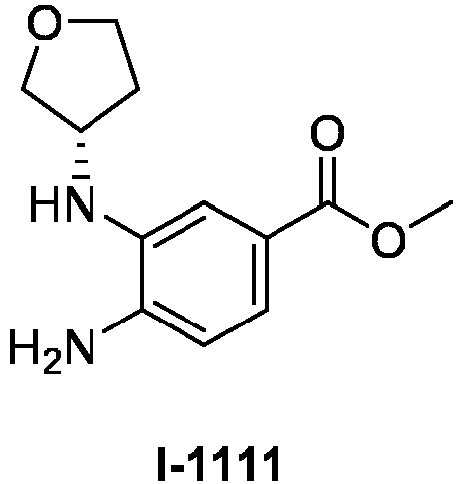
- Methyl (S)-4-amino-3-((tetrahydrofuran-3-yl)amino)benzoate (I-1111): methyl (S)-4-amino-3-((tetrahydrofuran-3-yl)amino)benzoate (I-1111) was prepared in a manner as described for Intermediate I-1 substituting 4-methylbenzenesulfonic acid;(3S)-tetrahydrofuran-3-amine for 2-methoxyethylamine. ES/MS: 237.1 (M+H+).
-

- methyl 4-amino-3-((cis-4-methoxytetrahydrofuran-3-yl)amino)benzoate was prepared in a manner as described for Intermediate I-1 substituting cis-4-methoxytetrahydrofuran-3-amine hydrochloride for 2-methoxyethylamine. ES/MS: 367.2 (M+H+)
-

- tert-butyl 3-(((5-oxaspiro[2.4]heptan-6-yl)methyl)amino)-4-aminobenzoate was prepared in a manner as described for Intermediate I-6 substituting (5-oxaspiro[2.4]heptan-6-yl)methanamine hydrochloride for 2-methoxyethylamine. ES/MS: 319.0 (M+H+)
-

- tert-butyl 4-amino-3-(((2-cyclopropyltetrahydrofuran-2-yl)methyl)amino)benzoate (I-1114): tert-butyl 3-(((5-oxaspiro[2.4]heptan-6-yl)methyl)amino)-4-aminobenzoate was prepared in a manner as described for Intermediate I-6 substituting (2-cyclopropyltetrahydrofuran-2-yl)methanamine for 2-methoxyethylamine. ES/MS: 333.3 (M+H+)
-

- tert-butyl 3-(((2,6-dioxabicyclo[3.2.1]octan-1-yl)methyl)amino)-4-aminobenzoate (I-1115): tert-butyl 3-(((2,6-dioxabicyclo[3.2.1]octan-1-yl)methyl)amino)-4-aminobenzoate was prepared in a manner as described for Intermediate I-6 substituting 2,6-dioxabicyclo[3.2.1]octan-1-ylmethanamine hydrochloride for 2-methoxyethylamine. ES/MS: 335.2 (M+H+)
-

- methyl 4-amino-3-(((2-((tert-butoxycarbonyl)amino)tetrahydrofuran-2-yl)methyl)amino)benzoate (I-1116): methyl 4-amino-3-(((2-((tert-butoxycarbonyl)amino)tetrahydrofuran-2-yl)methyl)amino)benzoate was prepared in a manner as described for Intermediate I-1 substituting tert-butyl (2-(aminomethyl)tetrahydrofuran-2-yl)carbamate hydrochloride for 2-methoxyethylamine. ES/MS: 333.3 (M+H+)
-

- Methyl 4-amino-3-(2-oxabicyclo[2.1.1]hexan-4-ylamino)benzoate (I-1117): methyl 4-amino-3-(2-oxabicyclo[2.1.1]hexan-4-ylamino)benzoate was prepared in a manner as described for Intermediate I-1 substituting 2-oxabicyclo[2.1.1]hexan-4-amine hydrochloride for 2-methoxyethylamine. ES/MS: 249.2 (M+H+)
-

- methyl 4-amino-3-[(1-methyl-2-oxabicyclo[2.1.1]hexan-4-yl)amino]benzoate (I-1118): methyl 4-amino-3-[(1-methyl-2-oxabicyclo[2.1.1]hexan-4-yl)amino]benzoate was prepared in a manner as described for Intermediate I-1 substituting 1-methyl-2-oxabicyclo[2.1.1]hexan-4-amine hydrochloride for 2-methoxyethylamine. ES/MS: 249.2 (M+H+)
-

- Methyl 4-amino-3-(2-oxabicyclo[3.1.1]heptan-4-ylamino)benzoate (I-1119): methyl 4-amino-3-(2-oxabicyclo[3.1.1]heptan-4-ylamino)benzoate was prepared in a manner as described for Intermediate I-1 substituting 2-oxabicyclo[3.1.1]heptan-4-amine for 2-methoxyethylamine. ES/MS: 263.2 (M+H+)
-

- Methyl 4-amino-3-(3-oxabicyclo[3.1.0]hexan-1-ylamino)benzoate (I-1120): methyl 4-amino-3-(3-oxabicyclo[3.1.0]hexan-1-ylamino)benzoate was prepared in a manner as described for Intermediate I-1 substituting 3-oxabicyclo[3.1.0]hexan-1-amine hydrochloride for 2-methoxyethylamine. ES/MS: 249.2 (M+H+)
-

- methyl 4-amino-3-[[cis-4-methoxytetrahydropyran-3-yl]amino]benzoate was prepared in a manner as described for Intermediate I-1 substituting cis-4-methoxytetrahydropyran-3-amine hydrochloride for 2-methoxyethylamine. ES/MS: 281.1 (M+H+)
-

- Methyl 4-amino-3-[[(1r,4r,6s)-2-oxabicyclo[2.2.1]heptan-6-yl]amino]benzoate (I-1122): methyl 4-amino-3-[[(1r,4r,6s)-2-oxabicyclo[2.2.1]heptan-6-yl]amino]benzoate was prepared in a manner as described for Intermediate I-1 substituting (1r,4r,6s)-2-oxabicyclo[2.2.1]heptan-6-amine hydrochloride for 2-methoxyethylamine. ES/MS: 263.2 (M+H+)
-

- Methyl 4-amino-3-[[trans-4-(difluoromethyl)tetrahydrofuran-3-yl]amino]benzoate (I-1123): methyl 4-amino-3-[[trans-4-(difluoromethyl)tetrahydrofuran-3-yl]amino]benzoate was prepared in a manner as described for Intermediate I-1 substituting trans-4-(difluoromethyl)tetrahydrofuran-3-amine hydrochloride for 2-methoxyethylamine. ES/MS: 287.2 (M+H+)
-

- Methyl 4-amino-3-(5-oxaspiro[2.4]heptan-7-ylamino)benzoate (I-1124): methyl 4-amino-3-(5-oxaspiro[2.4]heptan-7-ylamino)benzoate was prepared in a manner as described for Intermediate I-69 substituting 5-oxaspiro[2.4]heptan-7-amine hydrochloride for 4,4-dimethyltetrahydrofuran-3-amine hydrochloride. ES/MS: 263.2 (M+H+)
-

- Methyl 4-amino-3-[[cis-4-(difluoromethyl)tetrahydrofuran-3-yl]amino]benzoate (I-1125): methyl 4-amino-3-[[trans-4-(difluoromethyl)tetrahydrofuran-3-yl]amino]benzoate was prepared in a manner as described for Intermediate I-1 substituting cis-4-(difluoromethyl)tetrahydrofuran-3-amine hydrochloride for 2-methoxyethylamine. ES/MS: 287.2 (M+H+)
-

- methyl 4-amino-3-[[trans-4-methyltetrahydrofuran-3-yl]amino]benzoate was prepared in a manner as described for Intermediate I-1 substituting trans-4-methyltetrahydrofuran-3-amine hydrochloride for 2-methoxyethylamine. ES/MS: 251.2 (M+H+)
-

- [5-(1,1-difluoroethyl)thiazol-2-yl]methanol: 2-bromo-5-(1,1-difluoroethyl)thiazole (1.0 g, 4.4 mmol) in THF (15 mL) was cooled to -78 °C, and nBuLi (2.2 M, 2.5 mL, 5.5 mmol) was added dropwise. The mixture was stirred at -78 °C for 30 min before addition of DMF (1 mL) and the resulting mixture was slowly warmed to rt. The mixture was quenched with saturated aqueous NH4Cl and diluted with EtOAc, and the layers were separated. The combined organic extracts were washed with brine, dried over MgSO4, filtered, and concentrated. The residue was dissolved in DCM/MeOH (1:1, 15 mL) and NaBH4 (0.17 mg, 4.4 mmol) was added in small portions at rt. The mixture was stirred at rt for 1 h before quenching with saturated aqueous and diluting with DCM. The layers were separated, and the combined organic extracts were washed with brine, dried over MgSO4, filtered, and concentrated. The concentrate was then purification by flash chromatography (eluent: EtOAc/hexanes) yielded the desired product. ES/MS: 180.2 (M+H+)
- 2-(bromomethyl)-5-(1,1-difluoroethyl)thiazole (I-1127): [5-(1,1-difluoroethyl)thiazol-2-yl]methanol (540 mg, 3.0 mmol) in DCM (10 mL) was cooled to 0 °C, and triphenylphosphine (870 mg, 3.33 mmol) and CBr4 (1.1 g, 3.33 mmol) were added, respectively. The mixture was warmed to rt and stirred for 2 h before concentrating in vacuo. Purification by flash chromatography (eluent: EtOAc/hexanes) yielded the desired product. ES/MS: 244.0 (M+H+)
-

- 2-[(6-chloro-3-fluoro-2-pyridyl)oxymethyl]-5-(trifluoromethyl)thiazole: 2-[(6-chloro-3-fluoro-2-pyridyl)oxymethyl]-5-(trifluoromethyl)thiazole (I-1130): 2-[(6-chloro-3-fluoro-2-pyridyl)oxymethyl]-5-(trifluoromethyl)thiazole was prepared in a manner as described for Intermediate I-1129 substituting 2-(bromomethyl)-5-(trifluoromethyl)thiazole for 2-(bromomethyl)-3-fluoro-5-(trifluoromethyl)pyridine and 6-chloro-3-fluoro-pyridin-2-ol for 6-bromopyridin-2-ol. ES/MS: 313.1 (M+H+)
-

- Ethyl 5-[(6-bromo-2-pyridyl)oxymethyl]isoindoline-2-carboxylate (I-1131): 5-[(6-bromo-2-pyridyl)oxymethyl]isoindoline;2,2,2-trifluoroacetic acid (60 mg, 0.14 mmol) in DCM was added DIPEA (0.075 mL, 0.43 mmol) and ethyl chloroformate (0.016 mL, 0.17 mmol) at rt, respectively. The mixture was stirred at rt for 2 h before concentrating in vacuo. Purification by flash chromatography (eluent: EtOAc/hexanes) yielded the desired product. ES/MS: 379.0 (M+H+)
-
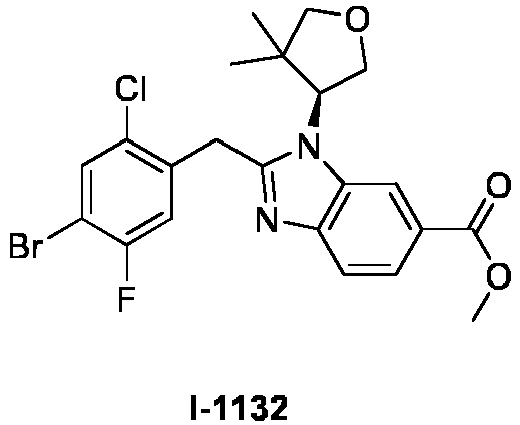
- Methyl 2-[(4-bromo-2-chloro-5-fluoro-phenyl)methyl]-3-[(3S)-4,4-dimethyltetrahydrofuran-3-yl]benzimidazole-5-carboxylate (I-1132): Methyl 2-[(4-bromo-2-chloro-5-fluoro-phenyl)methyl]-3-[(3S)-4,4-dimethyltetrahydrofuran-3-yl]benzimidazole-5-carboxylate was prepared in a manner as described for Intermediate I-2 substituting methyl 4-amino-3-((4,4-dimethyltetrahydrofuran-3-yl)amino)benzoate I-80 for methyl 4-amino-3-(2-methoxyethylamino)benzoate I-1 and 2-(4-bromo-2-chloro-5-fluoro-phenyl)acetic acid for 2-(4-bromo-2-fluoro-phenyl)acetic acid. ES/MS: 497.3 (M+H+).
-

- Methyl 4-amino-3-fluoro-5-((cis-4-methoxytetrahydrofuran-3-yl)amino)benzoate (I-1133): methyl 4-amino-3-fluoro-5-((cis-4-methoxytetrahydrofuran-3-yl)amino)benzoate was prepared in a manner as described for Intermediate I-1 substituting trans-4-methoxytetrahydrofuran-3-amine hydrochloride for 2-methoxyethylamine and methyl 3,5-difluoro-4-nitro-benzoate for methyl 3-fluoro-4-nitro-benzoate. ES/MS: 285.2 (M+H+)
-

- Ethyl 2-[[2,5-difluoro-4-(5-fluoro-6-hydroxy-2-pyridyl)phenyl]methyl]-7-fluoro-3-[[(2S)-oxetan-2-yl]methyl]benzimidazole-5-carboxylate (I-1134): ethyl 2-[[2,5-difluoro-4-(5-fluoro-6-hydroxy-2-pyridyl)phenyl]methyl]-7-fluoro-3-[[(2S)-oxetan-2-yl]methyl]benzimidazole-5-carboxylate was prepared in a manner as described for Intermediate I-9 substituting I-14 for I-8 and 2-benzyloxy-6-bromo-3-fluoro-pyridine for 2-benzyloxy-6-bromopyridine. ES/MS: 516.1 (M+H+).
-

- Ethyl 2-(4-bromo-2,3,6-trifluorobenzyl)-4-fluoro-1-(2-methoxyethyl)-1H-benzo[d]imidazole-6-carboxylate (I-1135): ethyl 2-(4-bromo-2,3,6-trifluorobenzyl)-4-fluoro-1-(2-methoxyethyl)-1H-benzo[d]imidazole-6-carboxylate was prepared in a manner as described for I-2 substituting ethyl 4-amino-3-fluoro-5-((2-methoxyethyl)amino)benzoate I-1032 for methyl 4-amino-3-(2 methoxyethylamino)benzoate I-1 and 2-(4-bromo-2,5,6-trifluorophenyl)acetic acid for 2-(4-bromo-2,5-difluorophenyl)acetic acid. ES/MS: 490.2. M+H+).
-

- Ethyl 7-fluoro-3-(2-methoxyethyl)-2-[[2,3,6-trifluoro-4-(6-hydroxy-2-pyridyl)phenyl]methyl]benzimidazole-5-carboxylate (I-1136): ethyl 7-fluoro-3-(2-methoxyethyl)-2-[[2,3,6-trifluoro-4-(6-hydroxy-2-pyridyl)phenyl]methyl]benzimidazole-5-carboxylate was prepared in a manner as described for Intermediate I-9 substituting ethyl 2-(4-bromo-2,3,6-trifluorobenzyl)-4-fluoro-1-(2-methoxyethyl)-1H-benzo[d]imidazole-6-carboxylate I-1135 for I-8. ES/MS: 504.1 (M+H+).
-

- 4-bromo-2-[(5-chloro-2-thienyl)methoxy]pyrimidine (I-1137): 4-bromo-2-[(5-chloro-2-thienyl)methoxy]pyrimidine was prepared in a manner as described for Intermediate I-43 substituting (5-chloro-2-thienyl)methanol for (1-methylimidazol-4-yl)methanol and 4-bromo-2-fluoro-pyrimidine for 2-bromo-6-fluoropyridine. ES/MS: 307.0 (M+H+)
-

- 5-[(6-bromo-2-pyridyl)oxymethyl]-4-fluoro-thiophene-2-carbonitrile (I-1138): 5-[(6-bromo-2-pyridyl)oxymethyl]-4-fluoro-thiophene-2-carbonitrile was prepared in a manner as described for Intermediate I-43 substituting 4-fluoro-5-(hydroxymethyl)thiophene-2-carbonitrile for (1-methylimidazol-4-yl)methanol. ES/MS: 313.1 (M+H+)
-

- 2-[(6-bromo-3-fluoro-2-pyridyl)oxymethyl]-5-ethoxy-1,3,4-thiadiazole (I-1139): 2-[(6-bromo-3-fluoro-2-pyridyl)oxymethyl]-5-ethoxy-1,3,4-thiadiazole was prepared in a manner as described for Intermediate I-1129 substituting 2-(chloromethyl)-5-ethoxy-1,3,4-thiadiazole for 2-(bromomethyl)-3-fluoro-5-(trifluoromethyl)pyridine and 6-bromo-3-fluoro-pyridin-2-ol for 6-bromopyridin-2-ol. ES/MS: 335.0 (M+H+)
-

- tert-butyl 4-amino-3-((cis-4-(hydroxymethyl)tetrahydrofuran-3-yl)amino)benzoate (I-1140): tert-butyl 4-amino-3-((cis-4-(hydroxymethyl)tetrahydrofuran-3-yl)amino)benzoate was prepared in a manner as described for Intermediate I-6 substituting (cis-4-aminotetrahydrofuran-3-yl)methanol for 2-methoxyethylamine. ES/MS: 339.2 (M+H+)
-

- tert-butyl 4-amino-3-((trans-4-(hydroxymethyl)tetrahydrofuran-3-yl)amino)benzoate (I-1141): tert-butyl 4-amino-3-((trans-4-(hydroxymethyl)tetrahydrofuran-3-yl)amino)benzoate was prepared in a manner as described for Intermediate I-6 substituting (trans-4-aminotetrahydrofuran-3-yl)methanol for 2-methoxyethylamine. ES/MS: 339.2 (M+H+)
-
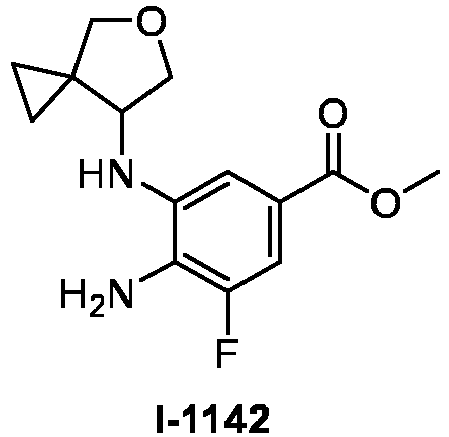
- methyl 3-((5-oxaspiro[2.4]heptan-7-yl)amino)-4-amino-5-fluorobenzoate was prepared in a manner as described for Intermediate I-1 substituting 5-oxaspiro[2.4]heptan-7-amine hydrochloride for 2-methoxyethylamine and methyl 3,5-difluoro-4-nitro-benzoate for methyl 3-fluoro-4-nitro-benzoate. ES/MS: 281.2 (M+H+)
-

- Methyl 4-amino-3-fluoro-5-((cis-4-methoxytetrahydrofuran-3-yl)amino)benzoate (I-1144): methyl 4-amino-3-fluoro-5-((cis-4-methoxytetrahydrofuran-3-yl)amino)benzoate was prepared in a manner as described for Intermediate I-1 substituting 5-oxaspiro[2.4]heptan-7-amine hydrochloride for 2-methoxyethylamine and methyl 3,5-difluoro-4-nitro-benzoate for methyl 3-fluoro-4-nitro-benzoate. ES/MS: 281.2 (M+H+)
-

- 2-[(6-bromo-2-pyridyl)oxymethyl]-5-ethoxy-1,3,4-thiadiazole (I-1145): 2-(chloromethyl)-5-ethoxy-1,3,4-thiadiazole (113 mg, 0.63 mmol), 6-bromopyridin-2-ol (100 mg, 0.58 mmol), and cesium carbonate (300 mg, 0.92 mmol) in MeCN (7 mL) was stirred at 60 °C for 2 h. The mixture was cooled to rt and filtered through a Celite plug. The resulting solution was concentrated and purified by flash chromatography (eluent: EtOAc/hexanes) to yield the desired product. ES/MS: 316.8 (M+H+).
-

- 2-[(6-bromo-2-pyridyl)oxymethyl]-5-cyclopropyl-1,3,4-thiadiazole (I-1146): 2-[(6-bromo-2-pyridyl)oxymethyl]-5-cyclopropyl-1,3,4-thiadiazole was prepared in a manner as described for Intermediate I-1145 substituting 2-(chloromethyl)-5-cyclopropyl-1,3,4-thiadiazole for 2-(chloromethyl)-5-ethoxy-1,3,4-thiadiazole. ES/MS: 312.8 (M+H+)
-

- 2-[(6-bromo-2-pyridyl)oxymethyl]-5-(difluoromethyl)-1,3,4-thiadiazole (I-1147): 2-[(6-bromo-2-pyridyl)oxymethyl]-5-(difluoromethyl)-1,3,4-thiadiazole was prepared in a manner as described for Intermediate I-1145 substituting 2-(chloromethyl)-5-(difluoromethyl)-1,3,4-thiadiazole for 2-(chloromethyl)-5-ethoxy-1,3,4-thiadiazole. ES/MS: 322.8 (M+H+)
-

- 2-[(6-bromo-2-pyridyl)oxymethyl]-5-(trifluoromethyl)-1,3,4-thiadiazole (I-1148): 2-[(6-bromo-2-pyridyl)oxymethyl]-5-(difluoromethyl)-1,3,4-thiadiazole was prepared in a manner as described for Intermediate I-1145 substituting 2-(chloromethyl)-5-(trifluoromethyl)-1,3,4-thiadiazole for 2-(chloromethyl)-5-ethoxy-1,3,4-thiadiazole. ES/MS: 341.8 (M+H+)
-

- methyl (S)-4-amino-3-chloro-5-((oxetan-2-ylmethyl)amino)benzoate was prepared in a manner as described for Intermediate 1378-I-68 substituting (S)-oxetan-2-ylmethanamine for 2-methoxyethylamine and methyl 3-chloro-5-fluoro-4-nitrobenzoate for methyl 3-fluoro-4-nitrobenzoate. ES/MS: 271.0 (M+H+).
-

- Methyl (S)-2-(4-bromo-2,5-difluorobenzyl)-4-chloro-1-(oxetan-2-ylmethyl)-1H-benzo[d]imidazole-6-carboxylate (I-1150): Methyl (S)-2-(4-bromo-2,5-difluorobenzyl)-4-chloro-1-(oxetan-2-ylmethyl)-1H-benzo[d]imidazole-6-carboxylate was prepared in a manner as described for Intermediate I-2 substituting methyl (S)-4-amino-3-chloro-5-((oxetan-2-ylmethyl)amino)benzoate I-1149 for methyl 4-amino-3-(2-methoxyethylamino)benzoate-I-1 and 2-(4-bromo-2,5-difluoro-phenyl)acetic acid for 2-(4-bromo-2-fluoro-phenyl)acetic acid. ES/MS: 504.9 (M+H+).
-

- 2-[(6-bromo-3-chloro-2-pyridyl)oxymethyl]-5-(trifluoromethyl)thiazole (I-1151): 2-[(6-bromo-3-chloro-2-pyridyl)oxymethyl]-5-(trifluoromethyl)thiazole was prepared in a manner as described for Intermediate I-1129 substituting 2-(bromomethyl)-5-(trifluoromethyl)thiazole for 2-(bromomethyl)-3-fluoro-5-(trifluoromethyl)pyridine and 6-bromo-3-chloro-pyridin-2-ol for 6-bromopyridin-2-ol. ES/MS: 374.8 (M+H+)
-
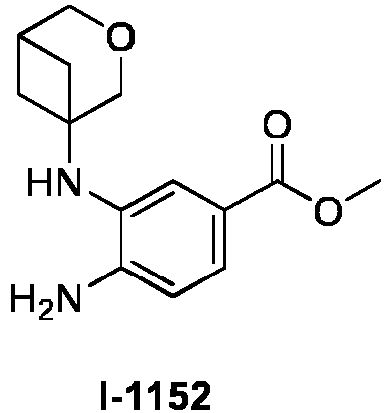
- Methyl 4-nitro-3-(3-oxabicyclo[3.1.1]heptan-1-ylamino)benzoate was prepared in a manner as described for Intermediate I-1 substituting 3-oxabicyclo[3.1.1]heptan-1-amine hydrochloride for 2-methoxyethylamine. ES/MS: 293.0 (M+H+).
-

- Methyl 2-[(4-bromo-2,5-difluoro-phenyl)methyl]-3-(3-oxabicyclo[3.1.1]heptan-1-yl)benzimidazole-5-carboxylate (I-1153): Methyl 2-[(4-bromo-2,5-difluoro-phenyl)methyl]-3-(3-oxabicyclo[3.1.1]heptan-1-yl)benzimidazole-5-carboxylate was prepared in a manner as described for Intermediate I-2 substituting methyl 4-nitro-3-(3-oxabicyclo[3.1.1]heptan-1-ylamino)benzoate I-1152 for methyl 4-amino-3-(2-methoxyethylamino)benzoate I-1 and 2-(4-bromo-2,5-difluoro-phenyl)acetic acid for 2-(4-bromo-2-fluoro-phenyl)acetic acid. ES/MS: 477.0 (M+H+).
-

- Methyl 4-amino-3-[[cis-4-(cyclopropoxy)tetrahydrofuran-3-yl]amino]benzoate (I-1155): Methyl 4-amino-3-[[cis-4-(cyclopropoxy)tetrahydrofuran-3-yl]amino]benzoate was prepared in a manner as described for Intermediate I-68 substituting cis-4-(cyclopropoxy)tetrahydrofuran-3-amine hydrochloride for 2-methoxyethylamine. ES/MS: 293.0 (M+H+)
-

- Methyl 3-[[cis-4-(2,2-difluoroethoxy)tetrahydrofuran-3-yl]amino]-4-nitro-benzoate (I-1156): Methyl 3-[[cis-4-(2,2-difluoroethoxy)tetrahydrofuran-3-yl]amino]-4-nitro-benzoate was prepared in a manner as described for Intermediate I-1 substituting cis-4-(2,2-difluoroethoxy)tetrahydrofuran-3-amine hydrochloride for 2-methoxyethylamine. ES/MS: 317.2 (M+H+).
-

- 4-[(6-bromo-3-chloro-2-pyridyl)oxymethyl]-3-fluoro-benzonitrile (I-1159): 4-[(6-bromo-3-chloro-2-pyridyl)oxymethyl]-3-fluoro-benzonitrile was prepared in a manner as described for Intermediate I-1129 substituting 4-(bromomethyl)-3-fluorobenzonitrile for 2-(bromomethyl)-3-fluoro-5-(trifluoromethyl)pyridine and 6-bromo-3-chloro-pyridin-2-ol for 6-bromopyridin-2-ol. ES/MS: 342.0 (M+H+)
-

- methyl (S)-4-amino-5-((4,4-dimethyltetrahydrofuran-3-yl)amino)-2-fluorobenzoate (I-1160): Methyl (S)-4-amino-5-((4,4-dimethyltetrahydrofuran-3-yl)amino)-2-fluorobenzoate was prepared in a manner as described for Intermediate I-1 substituting (S)-4,4-dimethyltetrahydrofuran-3-amine hydrochloride for 2-methoxyethylamine and
methyl 2,5-difluoro-4-nitrobenzoate for methyl 3-fluoro-4-nitrobenzoate. ES/MS: 283.2 (M+H+) -

- Methyl 2-[(4-bromo-2,5-difluoro-phenyl)methyl]-3-[(3S)-4,4-dimethyltetrahydrofuran-3-yl]-6-fluoro-benzimidazole-5-carboxylate (I-1161): Methyl 2-[(4-bromo-2,5-difluoro-phenyl)methyl]-3-[(3S)-4,4-dimethyltetrahydrofuran-3-yl]-6-fluoro-benzimidazole-5-carboxylate was prepared in a manner as described for Intermediate I-2 substituting methyl (S)-4-amino-5-((4,4-dimethyltetrahydrofuran-3-yl)amino)-2-fluorobenzoate I-1160 for methyl 4-amino-3-(2-methoxyethylamino)benzoate I-1 and 2-(4-bromo-2,5-difluorophenyl)acetic acid for 2-(4-bromo-2-fluoro-phenyl)acetic acid. ES/MS: 498.0 (M+H+).
-

- ethyl (S)-5-amino-4-((4,4-dimethyltetrahydrofuran-3-yl)amino)picolinate was prepared in a manner as described for Intermediate I-1 substituting (S)-4,4-dimethyltetrahydrofuran-3-amine hydrochloride for 2-methoxyethylamine and ethyl 4-chloro-5-nitropicolinate for methyl 3-fluoro-4-nitrobenzoate. ES/MS: 280.0 (M+H+)
-

- Ethyl 2-[(4-bromo-2,5-difluoro-phenyl)methyl]-1-[(3S)-4,4-dimethyltetrahydrofuran-3-yl]imidazo[4,5-c]pyridine-6-carboxylate (I-1163): Ethyl 2-[(4-bromo-2,5-difluoro-phenyl)methyl]-1-[(3S)-4,4-dimethyltetrahydrofuran-3-yl]imidazo[4,5-c]pyridine-6-carboxylate was prepared in a manner as described for Intermediate I-2 substituting ethyl (S)-5-amino-4-((4,4-dimethyltetrahydrofuran-3-yl)amino)picolinate I-1162 for methyl 4-amino-3-(2-methoxyethylamino)benzoate I-1 and 2-(4-bromo-2,5-difluoro-phenyl)acetic acid for 2-(4-bromo-2-fluoro-phenyl)acetic acid. ES/MS: 495.0 (M+H+).
-

- Ethyl (S)-5-amino-6-((4,4-dimethyltetrahydrofuran-3-yl)amino)picolinate was prepared in a manner as described for Intermediate I-1 substituting (S)-4,4-dimethyltetrahydrofuran-3-amine hydrochloride for 2-methoxyethylamine and ethyl 6-chloro-5-nitropicolinate for methyl 3-fluoro-4-nitrobenzoate. ES/MS: 280.0 (M+H+)
-

- Ethyl 2-[(4-bromo-2,5-difluoro-phenyl)methyl]-3-[(3S)-4,4-dimethyltetrahydrofuran-3-yl]imidazo[4,5-b]pyridine-5-carboxylate (I-1167): Ethyl 2-[(4-bromo-2,5-difluoro-phenyl)methyl]-3-[(3S)-4,4-dimethyltetrahydrofuran-3-yl]imidazo[4,5-b]pyridine-5-carboxylate was prepared in a manner as described for Intermediate I-2 substituting ethyl (S)-5-amino-6-((4,4-dimethyltetrahydrofuran-3-yl)amino)picolinate I-1166 for methyl 4-amino-3-(2-methoxyethylamino)benzoate I-1 and 2-(4-bromo-2,5-difluoro-phenyl)acetic acid for 2-(4-bromo-2-fluoro-phenyl)acetic acid. ES/MS: 495.0 (M+H+).
-

- 2-(((6-bromopyridin-2-yl)oxy)methyl)-5-(1,1-difluoroethyl)thiazole (I-1173): 2-(((6-bromopyridin-2-yl)oxy)methyl)-5-(1,1-difluoroethyl)thiazole was prepared in a manner as described for Intermediate I-1129 substituting 2-(bromomethyl)-5-(1,1-difluoroethyl)thiazole for 2-(bromomethyl)-3-fluoro-5-(trifluoromethyl)pyridine. ES/MS: 335.0 (M+H+)
-

- Methyl (S)-2-(4-(6-((5-bromothiazol-2-yl)methoxy)pyridin-2-yl)-2,5-difluorobenzyl)-1-(oxetan-2-ylmethyl)-1H-benzo[d]imidazole-6-carboxylate (I-1176): Methyl (S)-2-(4-(6-((5-bromothiazol-2-yl)methoxy)pyridin-2-yl)-2,5-difluorobenzyl)-1-(oxetan-2-ylmethyl)-1H-benzo[d]imidazole-6-carboxylate was prepared in a manner as described for Intermediate I-1096 substituting 5-bromo-2-(bromomethyl)thiazole for 2-bromo-5-(bromomethyl)thiazole. ES/MS: 641.2 (M+H+)
-

- Methyl (S)-2-(4-(6-((5-bromo-1,3,4-thiadiazol-2-yl)methoxy)pyridin-2-yl)-2,5-difluorobenzyl)-1-(oxetan-2-ylmethyl)-1H-benzo[d]imidazole-6-carboxylate was prepared in a manner as described for Intermediate I-1096 substituting 2-bromo-5-(chloromethyl)-1,3,4-thiadiazole for 2-bromo-5-(bromomethyl)thiazole. ES/MS: 642.1 (M+H+)
-

- Methyl 4-amino-3-(((1-(fluoromethyl)cyclopropyl)methyl)amino)benzoate was prepared in a manner as described for Intermediate I-1 substituting (1-(fluoromethyl)cyclopropyl)methanamine for 2-methoxyethylamine. ES/MS: 253.2 (M+H+).
-

- tert-butyl 4-amino-3-(((1-(fluoromethyl)cyclopropyl)methyl)amino)benzoate (I-1179): tert-butyl 4-amino-3-(((1-(fluoromethyl)cyclopropyl)methyl)amino)benzoate was prepared in a manner as described for Intermediate I-6 substituting (1-(fluoromethyl)cyclopropyl)methanamine for 2-methoxyethylamine. ES/MS: 295.2 (M+H+).
-

- tert-butyl 2-[(4-bromo-2,5-difluoro-phenyl)methyl]-3-[[1-(fluoromethyl)cyclopropyl]methyl]benzimidazole-5-carboxylate (I-1180): tert-butyl 2-[(4-bromo-2,5-difluoro-phenyl)methyl]-3-[[1-(fluoromethyl)cyclopropyl]methyl]benzimidazole-5-carboxylate was prepared in a manner as described for Intermediate I-2 substituting I-1179 for I-1 and 2-(4-bromo-2,5-difluorophenyl)acetic acid for 2-(4-bromo-2-fluoro-phenyl)acetic acid. ES/MS: 509, 511 (M+H+).
-

- Methyl 2-[(4-bromo-2-fluoro-5-methyl-phenyl)methyl]-3-[(3S)-4,4-dimethyltetrahydrofuran-3-yl]benzimidazole-5-carboxylate (I-1076): Methyl 2-[(4-bromo-2-fluoro-5-methyl-phenyl)methyl]-3-[(3S)-4,4-dimethyltetrahydrofuran-3-yl]benzimidazole-5-carboxylate was prepared in a manner as described for Intermediate I-2 substituting I-80 for I-1 and 2-(4-bromo-2-fluoro-5-methyl-phenyl)acetic acid I-1277 for 2-(4-bromo-2-fluorophenyl)acetic acid. ES/MS: 475, 477 (M+H+).
-

- Methyl 2-[(4-bromophenyl)methyl]-3-[(3S)-4,4-dimethyltetrahydrofuran-3-yl]benzimidazole-5-carboxylate (I-1182): Methyl 2-[(4-bromophenyl)methyl]-3-[(3S)-4,4-dimethyltetrahydrofuran-3-yl]benzimidazole-5-carboxylate was prepared in a manner as described for Intermediate I-2 substituting I-80 for I-1 and 2-(4-bromophenyl)acetic acid for 2-(4-bromo-2-fluoro-phenyl)acetic acid. ES/MS: 443, 445 (M+H+).
-

- 2-[(5-bromo-2-fluoro-phenoxy)methyl]-5-ethoxy-1,3,4-thiadiazole (I-1183): 2-[(5-bromo-2-fluoro-phenoxy)methyl]-5-ethoxy-1,3,4-thiadiazole was prepared in a manner as described for Intermediate I-84 substituting 2-(chloromethyl)-5-ethoxy-1,3,4-thiadiazole for 2-(bromomethyl)thiazole-5-carbonitrile (I-63) and 5-bromo-2-fluoro-phenol for 6-bromopyridin-2-ol. ES/MS: 333, 335 (M+H+).
-

- Methyl 3-[(3S)-4,4-dimethyltetrahydrofuran-3-yl]-2-[[2-fluoro-4-(3-hydroxyphenyl)-5-methyl-phenyl]methyl]benzimidazole-5-carboxylate (I-1184): A suspension of methyl 2-[(4-bromo-2-fluoro-5-methyl-phenyl)methyl]-3-[(3S)-4,4-dimethyltetrahydrofuran-3-yl]benzimidazole-5-carboxylate (130 mg, 0.273 mmol) (I-1076), (3-hydroxyphenyl)boronic acid (75.4 mg, 0.547 mmol), [1,1'-Bis(diphenylphosphino)ferrocene] dichloropalladium(II) ;PdCl2(dppf) (20.3 mg, 0.0273 mmol, sodium carbonate (2000 mmol/L, 0.273 mL, 0.547 mmol) was degassed. The mixture was heated at 100 °C for 1 hr. Next, the mixture was diluted with EtOAc and water. The organic extract was dried over magnesium sulfate, filtered and concentrated. The crude residue was purified by flash chromatography (eluent: EtOAc/hexanes) to yield desired product. ES/MS: 489.1 (M+H+)
-

- Methyl 2-(4-bromo-2,3,6-trifluorobenzyl)-1-(4,4-dimethyltetrahydrofuran-3-yl)-1H-benzo[d]imidazole-6-carboxylate (I-1185): Methyl 2-(4-bromo-2,3,6-trifluorobenzyl)-1-(4,4-dimethyltetrahydrofuran-3-yl)-1H-benzo[d]imidazole-6-carboxylate was prepared in a manner as described for Intermediate I-2 substituting I-25 for I-1 and 2-(4-bromo-2,3,6-trifluorophenyl)acetic acid for 2-(4-bromo-2-fluoro-phenyl)acetic acid. ES/MS: 497, 499 (M+H+).
-

- tert-butyl 2-(4-bromo-2,3,6-trifluorobenzyl)-1-(2-methoxyethyl)-1H-benzo[d]imidazole-6-carboxylate (I-1186): tert-butyl 2-(4-bromo-2,3,6-trifluorobenzyl)-1-(2-methoxyethyl)-1H-benzo[d]imidazole-6-carboxylate was prepared in a manner as described for Intermediate I-2 substituting I-6 for I-1 and 2-(4-bromo-2,3,6-trifluorophenyl)acetic acid for 2-(4-bromo-2-fluoro-phenyl)acetic acid. ES/MS: 499, 501 (M+H+).
-

- Tert-butyl 2-(2,5-difluoro-4-(6-hydroxypyridin-2-yl)benzyl)-1-((1-(fluoromethyl)cyclopropyl)methyl)-1H-benzo[d]imidazole-6-carboxylate (I-1187): A suspension of tert-butyl 2-[(4-bromo-2,5-difluoro-phenyl)methyl]-3-[[1-(fluoromethyl)cyclopropyl]methyl]benzimidazole-5-carboxylate (500 mg, 0.98 mmol), [1,1'-Bis(diphenylphosphino)ferrocene] dichloropalladium(II) ;PdCl2(dppf) (72.8 mg, 0.098 mmol), potassium propionate (330 mg, 2.94 mmol), and Bis(pinacolato)diboron (324 mg, 1.28 mmol) was degassed and then heated at 110 °C for 2hr. Upon completion of time, sodium carbonate (2000 mmol/L, 0.98 mL, 1.96 mmol), 6-bromopyridin-2-ol 256 mg, 1.47 mmol), and [1,1'-Bis(diphenylphosphino)ferrocene] dichloropalladium(II) ;PdCl2(dppf) (30.4 mg, 0.04 mmol) were added and resulting mixture was degassed. The mixture was then heated at 100 °C for 1 hr. Next, the mixture was diluted with EtOAc and water. The organic extract was dried over magnesium sulfate, filtered and concentrated. The crude residue was purified by flash chromatography (eluent: EtOAc/hexanes) to yield desired product. ES/MS: 523.7 (M+H+)
-

- Tert-butyl 2-[(4-bromo-2,3,6-trifluoro-phenyl)methyl]-3-[[1-(fluoromethyl)cyclopropyl]methyl]benzimidazole-5-carboxylate (I-1188): tert-butyl 2-[(4-bromo-2,3,6-trifluoro-phenyl)methyl]-3-[[1-(fluoromethyl)cyclopropyl]methyl]benzimidazole-5-carboxylate was prepared in a manner as described for Intermediate I-2 substituting I-1179 for I-1 and 2-(4-bromo-2,3,6-trifluorophenyl)acetic acid for 2-(4-bromo-2-fluoro-phenyl)acetic acid. ES/MS: 527, 529 (M+H+).
-
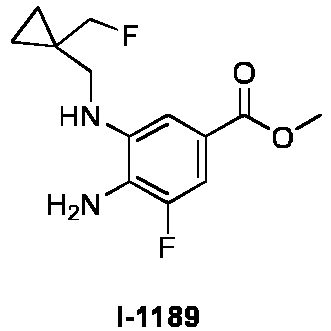
- Methyl 4-amino-3-fluoro-5-[[1-(fluoromethyl)cyclopropyl]methylamino]benzoate (I-1189): Methyl 4-amino-3-fluoro-5-[[1-(fluoromethyl)cyclopropyl]methylamino]benzoate was prepared in a manner as described for Intermediate I-1 substituting (1-(fluoromethyl)cyclopropyl)methanamine for 2-methoxyethylamine and methyl 3,5-difluoro-4-nitrobenzoate for methyl 3-fluoro-4-nitrobenzoate.ES/MS: 270.2 (M+H+).
-

- Methyl 2-[(4-bromo-2,5-difluoro-phenyl)methyl]-7-fluoro-3-[[1-(fluoromethyl)cyclopropyl]methyl]benzimidazole-5-carboxylate (I-1190): Methyl 2-[(4-bromo-2,5-difluoro-phenyl)methyl]-7-fluoro-3-[[1-(fluoromethyl)cyclopropyl]methyl]benzimidazole-5-carboxylate was prepared in a manner as described for Intermediate I-13 substituting I-1189 for I-5 and 2-(4-bromo-2,5-difluorophenyl)acetic acid for 2-(4-bromo-2-fluoro-phenyl)acetic acid. ES/MS: 485, 487 (M+H+).
-

- Methyl 2-[[2,5-difluoro-4-(6-hydroxy-2-pyridyl)phenyl]methyl]-7-fluoro-3-[[1-(fluoromethyl)cyclopropyl]methyl]benzimidazole-5-carboxylate (I-1191): Methyl 2-[[2,5-difluoro-4-(6-hydroxy-2-pyridyl)phenyl]methyl]-7-fluoro-3-[[1-(fluoromethyl)cyclopropyl]methyl]benzimidazole-5-carboxylate was prepared in a manner as described for Intermediate I-1187 substituting I-1190 for I-1180. ES/MS: 499, 501 (M+H+).
-
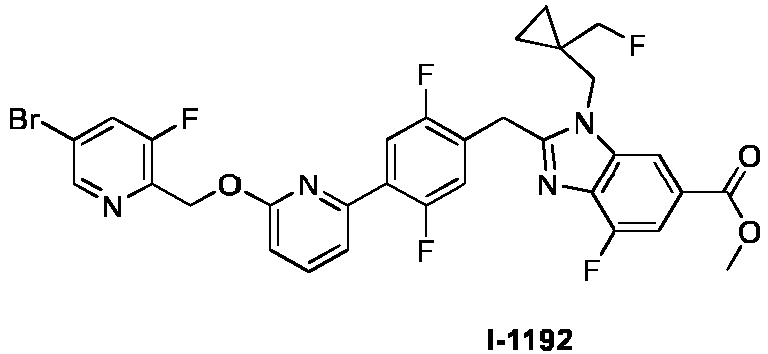
- Methyl 2-[[4-[6-[(5-bromo-3-fluoro-2-pyridyl)methoxy]-2-pyridyl]-2,5-difluorophenyl]methyl]-7-fluoro-3-[[1-(fluoromethyl)cyclopropyl]methyl]benzimidazole-5-carboxylate (I-1192): Methyl 2-[[4-[6-[(5-bromo-3-fluoro-2-pyridyl)methoxy]-2-pyridyl]-2,5-difluoro-phenyl]methyl]-7-fluoro-3-[[1-(fluoromethyl)cyclopropylmethyl[benzimidazole-5-carboxylate was prepared in a manner as described for Intermediate 1-21 substituting I-1191 for I-9 and 5-bromo-2-(chloromethyl)-3-fluoro-pyridine for 5-bromo-2-(bromomethyl)thiazole. ES/MS: 687, 689 (M+H+).
-

- Ethyl 3-[[1-(difluoromethyl)cyclopropyl]methylamino]-5-fluoro-4-nitro-benzoate (I-1193): Ethyl 3-[[1-(difluoromethyl)cyclopropyl]methylamino]-5-fluoro-4-nitro-benzoate was prepared in a manner as described for Intermediate I-1 substituting [1-(difluoromethyl)cyclopropyl]methanamine for 2-methoxyethylamine and ethyl 3,5-difluoro-4-nitrobenzoate for methyl 3-fluoro-4-nitrobenzoate.ES/MS: 302.2 (M+H+).
-

- Ethyl 2-[(4-bromo-2,5-difluoro-phenyl)methyl]-3-[[1-(difluoromethyl)cyclopropyl]methyl]-7-fluoro-benzimidazole-5-carboxylate (I-1194): Ethyl 2-[(4-bromo-2,5-difluoro-phenyl)methyl]-3-[[1-(difluoromethyl)cyclopropyl]methyl]-7-fluoro-benzimidazole-5-carboxylate was prepared in a manner as described for Intermediate I-13 substituting I-1193 for I-5 and 2-(4-bromo-2,5-difluorophenyl)acetic acid for 2-(4-bromo-2-fluoro-phenyl)acetic acid. ES/MS: 517.1, 519 (M+H+).
-

- tert-butyl 4-amino-3-(((1-(difluoromethyl)cyclopropyl)methyl)amino)benzoate (I-1195): tert-butyl 4-amino-3-(((1-(difluoromethyl)cyclopropyl)methyl)amino)benzoate was prepared in a manner as described for Intermediate I-6 substituting (1-(difluoromethyl)cyclopropyl)methanamine for 2-methoxyethylamine. ES/MS: 295.2 (M+H+).
-

- tert-butyl 2-[(4-bromo-2,5-difluoro-phenyl)methyl]-3-[[1-(difluoromethyl)cyclopropyl]methyl]benzimidazole-5-carboxylate (I-1196): tert-butyl 2-[(4-bromo-2,5-difluoro-phenyl)methyl]-3-[[1-(difluoromethyl)cyclopropyl]methyl]benzimidazole-5-carboxylate was prepared in a manner as described for Intermediate I-2 substituting I-1195 for I-1 and 2-(4-bromo-2,5-difluorophenyl)acetic acid for 2-(4-bromo-2-fluoro-phenyl)acetic acid. ES/MS: 527, 529 (M+H+).
-

- Methyl 2-[[4-[6-[(6-bromo-2-fluoro-3-pyridyl)methoxy]-2-pyridyl]-2,5-difluorophenyl]methyl]-3-[[(2S)-oxetan-2-yl]methyl]benzimidazole-5-carboxylate (I-1197): Methyl 2-[[4-[6-[(6-bromo-2-fluoro-3-pyridyl)methoxy]-2-pyridyl]-2,5-difluoro-phenyl]methyl]-3-[[(2S)-oxetan-2-yl]methyl]benzimidazole-5-carboxylate was prepared in a manner as described for Intermediate I-21 substituting 6-bromo-3-(bromomethyl)-2-fluoropyridine for 5-bromo-2-(bromomethyl)thiazole. ES/MS: 653, 655 (M+H+).
-

- Methyl 2-[(4-bromo-2,5-difluoro-phenyl)methyl]-3-(4,4-dimethyltetrahydrofuran-3-yl)benzimidazole-5-carboxylate (I-1198): Methyl 2-[(4-bromo-2,5-difluoro-phenyl)methyl]-3-(4,4-dimethyltetrahydrofuran-3-yl)benzimidazole-5-carboxylate was prepared in a manner as described for Intermediate I-2 substituting I-25 for I-1 and 2-(4-bromo-2,5-difluorophenyl)acetic acid for 2-(4-bromo-2-fluoro-phenyl)acetic acid. ES/MS: 479, 481 (M+H+).
-

- Methyl 2-[[2,5-difluoro-4-(6-hydroxy-2-pyridyl)phenyl]methyl]-3-(4,4-dimethyltetrahydrofuran-3-yl)benzimidazole-5-carboxylate (I-1199): methyl 2-[[2,5-difluoro-4-(6-hydroxy-2-pyridyl)phenyl]methyl]-3-(4,4-dimethyltetrahydrofuran-3-yl)benzimidazole-5-carboxylate was prepared in a manner as described for Intermediate I-1187 substituting I-1198 for I-1180. ES/MS: 493, 495 (M+H+).
-

- Methyl 2-[[4-[6-[(4-bromo-2-fluoro-phenyl)methoxy]-2-pyridyl]-2,5-difluorophenyl]methyl]-3-(4,4-dimethyltetrahydrofuran-3-yl)benzimidazole-5-carboxylate (I-1200): Methyl 2-[[4-[6-[(4-bromo-2-fluoro-phenyl)methoxy]-2-pyridyl]-2,5-difluorophenyl]methyl]-3-(4,4-dimethyltetrahydrofuran-3-yl)benzimidazole-5-carboxylate was prepared in a manner as described for Intermediate I-21 substituting I-1199 for I-9 and 4-bromo-1-(bromomethyl)-2-fluoro-benzene for 5-bromo-2-(bromomethyl)thiazole. ES/MS: 680, 682 (M+H+).
-

- Methyl 2-(4-bromo-2,3,6-trifluorobenzyl)-4-fluoro-1-((1-(fluoromethyl)cyclopropyl)methyl)-1H-benzo[d]imidazole-6-carboxylate (I-1201): Methyl 2-(4-bromo-2,3,6-trifluorobenzyl)-4-fluoro-1-((1-(fluoromethyl)cyclopropyl)methyl)-1H-benzo[d]imidazole-6-carboxylate was prepared in a manner as described for Intermediate I-13 substituting I-1189 for I-5 and 2-(4-bromo-2,3,6-trifluorophenyl)acetic acid for 2-(4-bromo-2-fluoro-phenyl)acetic acid. ES/MS: 485, 487 (M+H+).
-

- Methyl 7-fluoro-3-[[1-(fluoromethyl)cyclopropyl]methyl]-2-[[2,3,6-trifluoro-4-(6-hydroxy-2-pyridyl)phenyl]methyl]benzimidazole-5-carboxylate (I-1202): Methyl 7-fluoro-3-[[1-(fluoromethyl)cyclopropyl]methyl]-2-[[2,3,6-trifluoro-4-(6-hydroxy-2-pyridyl)phenyl]methyl]benzimidazole-5-carboxylate was prepared in a manner as described for Intermediate I-1187 substituting I-1201 for I-1180. ES/MS: 517, 519 (M+H+).
-

- Methyl 2-[[4-[6-[(6-bromo-3-pyridyl)methoxy]-2-pyridyl]-2,5-difluorophenyl]methyl]-3-[[(2S)-oxetan-2-yl]methyl]benzimidazole-5-carboxylate (I-1203): Methyl 2-[[4-[6-[(6-bromo-3-pyridyl)methoxy]-2-pyridyl]-2,5-difluoro-phenyl]methyl]-3-[[(2S)-oxetan-2-yl]methyl]benzimidazole-5-carboxylate was prepared in a manner as described for Intermediate I-21 substituting 2-bromo-5-(bromomethyl)pyridine for 5-bromo-2-(bromomethyl)thiazole. ES/MS: 635, 637 (M+H+).
-

- Methyl 2-[[4-[6-[(6-bromo-3-pyridyl)methoxy]-2-pyridyl]-2,5-difluorophenyl]methyl]-3-[[(2S)-oxetan-2-yl]methyl]benzimidazole-5-carboxylate (I-1204): Methyl 2-[[4-[6-[(6-bromo-3-pyridyl)methoxy]-2-pyridyl]-2,5-difluoro-phenyl]methyl]-3-[[(2S)-oxetan-2-yl]methyl]benzimidazole-5-carboxylate was prepared in a manner as described for Intermediate I-21 substituting I-31 for 5-bromo-2-(bromomethyl)thiazole. ES/MS: 653, 655 (M+H+).
-

- Methyl 2-[[4-[6-[(5-bromo-3-methyl-2-pyridyl)methoxy]-2-pyridyl]-2,5-difluorophenyl]methyl]-3-[[(2S)-oxetan-2-yl]methyl]benzimidazole-5-carboxylate (I-1205): Methyl 2-[[4-[6-[(5-bromo-3-methyl-2-pyridyl)methoxy]-2-pyridyl]-2,5-difluoro-phenyl]methyl]-3-[[(2S)-oxetan-2-yl]methyl]benzimidazole-5-carboxylate was prepared in a manner as described for Intermediate I-21 substituting 5-bromo-2-(chloromethyl)-3-methyl-pyridine for 5-bromo-2-(bromomethyl)thiazole. ES/MS: 649, 651 (M+H+).
-

- Ethyl 2-[[2,5-difluoro-4-(6-hydroxy-2-pyridyl)phenyl]methyl]-7-fluoro-3-(2-methoxyethyl)benzimidazole-5-carboxylate (I-1206): Ethyl 2-[[2,5-difluoro-4-(6-hydroxy-2-pyridyl)phenyl]methyl]-7-fluoro-3-(2-methoxyethyl)benzimidazole-5-carboxylate was prepared in a manner as described for Intermediate I-1187 substituting I-1033 for I-1180. ES/MS: 485, 487 (M+H+).
-

- 2-[(6-bromo-2-pyridyl)oxymethyl]-5-methyl-1,3,4-thiadiazole (I-1207): 2-[(6-bromo-2-pyridyl)oxymethyl]-5-methyl-1,3,4-thiadiazole was prepared in a manner as described for Intermediate I-1034 substituting 2-(chloromethyl)-5-methyl-1,3,4-thiadiazole for 6-(bromomethyl)-1-methyl-benzotriazole. ES/MS: 286, 288 (M+H+).
-

- Ethyl 2-[[4-[6-[(6-bromo-3-pyridyl)methoxy]-5-fluoro-2-pyridyl]-2,5-difluoro-phenyl]methyl]-7-fluoro-3-[[(2S)-oxetan-2-yl]methyl]benzimidazole-5-carboxylate was prepared in a manner as described for Intermediate I-21 substituting ethyl 2-[[2,5-difluoro-4-(5-fluoro-6-hydroxy-2-pyridyl)phenyl]methyl]-7-fluoro-3-[[(2S)-oxetan-2-yl]methyl]benzimidazole-5-carboxylate for I-9 and 2-bromo-5-(bromomethyl)pyridine for 5-bromo-2-(bromomethyl)thiazole. ES/MS: 686, 687 (M+H+).
-

- Ethyl 2-[[4-[6-[(5-bromo-3-fluoro-2-pyridyl)methoxy]-5-fluoro-2-pyridyl]-2,5-difluoro-phenyl]methyl]-7-fluoro-3-[[(2S)-oxetan-2-yl]methyl]benzimidazole-5-carboxylate (I-1209): Ethyl 2-[[4-[6-[(5-bromo-3-fluoro-2-pyridyl)methoxy]-5-fluoro-2-pyridyl]-2,5-difluoro-phenyl]methyl]-7-fluoro-3-[[(2S)-oxetan-2-yl]methyl]benzimidazole-5-carboxylate was prepared in a manner as described for Intermediate I-21 substituting ethyl 2-[[2,5-difluoro-4-(5-fluoro-6-hydroxy-2-pyridyl)phenyl]methyl]-7-fluoro-3-[[(2S)-oxetan-2-yl]methyl]benzimidazole-5-carboxylate for I-9 and 5-bromo-2-(chloromethyl)-3-fluoro-pyridine for 5-bromo-2-(bromomethyl)thiazole. ES/MS: 703, 705 (M+H+).
-

- Methyl 2-[[4-[6-[(5-bromo-3-chloro-2-pyridyl)methoxy]-2-pyridyl]-2,5-difluorophenyl]methyl]-3-[[(2S)-oxetan-2-yl]methyl]benzimidazole-5-carboxylate (I-1210): Methyl 2-[[4-[6-[(5-bromo-3-chloro-2-pyridyl)methoxy]-2-pyridyl]-2,5-difluoro-phenyl]methyl]-3-[[(2S)-oxetan-2-yl]methyl]benzimidazole-5-carboxylate was prepared in a manner as described for Intermediate I-21 substituting 5-bromo-3-chloro-2-(chloromethyl)pyridine for 5-bromo-2-(bromomethyl)thiazole. ES/MS: 670, 672 (M+H+).
-

- Methyl 2-[[4-[6-[(4-bromo-2-methoxy-phenyl)methoxy]-2-pyridyl]-2,5-difluorophenyl]methyl]-3-[[(2S)-oxetan-2-yl]methyl]benzimidazole-5-carboxylate (I-1211): Methyl 2-[[4-[6-[(4-bromo-2-methoxy-phenyl)methoxy]-2-pyridyl]-2,5-difluoro-phenyl]methyl]-3-[[(2S)-oxetan-2-yl]methyl]benzimidazole-5-carboxylate was prepared in a manner as described for Intermediate I-21 substituting 4-bromo-1-(bromomethyl)-2-methoxy-benzene for 5-bromo-2-(bromomethyl)thiazole. ES/MS: 664, 666 (M+H+).
-

- Methyl 2-[[4-[6-[(4-bromophenyl)methoxy]-2-pyridyl]-2,5-difluoro-phenyl]methyl]-3-[[(2S)-oxetan-2-yl]methyl]benzimidazole-5-carboxylate (I-1212): Methyl 2-[[4-[6-[(4-bromophenyl)methoxy]-2-pyridyl]-2,5-difluoro-phenyl]methyl]-3-[[(2S)-oxetan-2-yl]methyl]benzimidazole-5-carboxylate was prepared in a manner as described for Intermediate I-21 substituting 1-bromo-4-(bromomethyl)benzene for 5-bromo-2-(bromomethyl)thiazole. ES/MS: 634, 636 (M+H+).
-

- Methyl (S)-2-(2,5-difluoro-4-(6-hydroxypyridin-2-yl)benzyl)-1-(4,4-dimethyltetrahydrofuran-3-yl)-1H-benzo[d]imidazole-6-carboxylate (I-1219): Methyl (S)-2-(2,5-difluoro-4-(6-hydroxypyridin-2-yl)benzyl)-1-(4,4-dimethyltetrahydrofuran-3-yl)-1H-benzo[d]imidazole-6-carboxylate was prepared in a manner as described for Intermediate I-1187 substituting I-82 for I-1180. ES/MS: 493, 495 (M+H+).
-

- Methyl (S)-2-(4-(6-((4-bromo-2-fluorobenzyl)oxy)pyridin-2-yl)-2,5-difluorobenzyl)-1-(4,4-dimethyltetrahydrofuran-3-yl)-1H-benzo[d]imidazole-6-carboxylate was prepared in a manner as described for Intermediate I-21 substituting I-1219 for I-9 and 4-bromo-1-(bromomethyl)-2-fluoro-benzene for 5-bromo-2-(bromomethyl)thiazole. ES/MS: 680, 682 (M+H+).
-

- 2-[(6-bromo-2-pyridyl)oxymethyl]-5-chloro-thiazole (I-1223): 2-[(6-bromo-2-pyridyl)oxymethyl]-5-chloro-thiazole was prepared in a manner as described for Intermediate I-84 substituting 5-chloro-2-(chloromethyl)thiazole for 2-(bromomethyl)thiazole-5-carbonitrile. ES/MS: 305 (M+H+).
-

- 2-[(6-bromo-3-fluoro-2-pyridyl)oxymethyl]-5-chloro-thiazole (I-1224): 2-[(6-bromo-3-fluoro-2-pyridyl)oxymethyl]-5-chloro-thiazole was prepared in a manner as described for Intermediate I-84 substituting 5-chloro-2-(chloromethyl)thiazole for 2-(bromomethyl)thiazole-5-carbonitrile and 6-bromo-3-fluoro-pyridin-2-ol for 6-bromopyridin-2-ol. ES/MS: 323 (M+H+).
-

- Methyl (S)-4-amino-3-((4,4-dimethyltetrahydrofuran-3-yl)amino)-5-fluorobenzoate was prepared in a manner as described for I-5 substituting (3S)-4,4'-dimethyltetrahydrofuran-3-amine hydrochloride for (S)-oxetan-2-ylmethanamine. ES/MS: 338.5 (M+Na+):
-

- Methyl (S)-2-(4-bromo-2-fluorobenzyl)-1-(4,4-dimethyltetrahydrofuran-3-yl)-1H-benzo[d]imidazole-6-carboxylate (I-1229): Methyl (S)-2-(4-bromo-2-fluorobenzyl)-1-(4,4-dimethyltetrahydrofuran-3-yl)-1H-benzo[d]imidazole-6-carboxylate was prepared in a manner as described for I-1041 substituting Intermediate I-80 for I-1042 and 2-(4-bromo-2-fluorophenyl)acetic acid for 2-(4-bromo-2,5-difluoro-phenyl)acetic acid. ES/MS: 469.8 (M+H+).
-

- Methyl (S)-2-(4-bromo-2-fluorobenzyl)-1-(4,4-dimethyltetrahydrofuran-3-yl)-4-fluoro-1H-benzo[d]imidazole-6-carboxylate (I-1230): Methyl (S)-2-(4-bromo-2-fluorobenzyl)-1-(4,4-dimethyltetrahydrofuran-3-yl)-4-fluoro-1H-benzo[d]imidazole-6-carboxylate was prepared in a manner as described for I-2 substituting I-1226 for I-1042 and 2-(4-bromo-2-fluoro-phenyl)acetic acid for 2-(4-bromo-2,5-di-fluoro-phenyl)acetic acid. ES/MS: 479.6 (M+H+);
-

- Methyl (S)-2-(4-bromo-2,3,6-trifluorobenzyl)-1-(4,4-dimethyltetrahydrofuran-3-yl)-1H-benzo[d]imidazole-6-carboxylate: Methyl (S)-2-(4-bromo-2,3,6-trifluorobenzyl)-1-(4,4-dimethyltetrahydrofuran-3-yl)-1H-benzo[d]imidazole-6-carboxylate was prepared in a manner as described for I-1041 substituting I-80 for I-1042 and 2-(4-bromo-2,3,6-trifluorophenyl)acetic acid for 2-(4-bromo-2,5-difluorophenyl)acetic acid. ES/MS: 498.0 (M+H+);
-

- Methyl (S)-2-(4-bromo-2,3,6-trifluorobenzyl)-1-(4,4-dimethyltetrahydrofuran-3-yl)-4-fluoro-1H-benzo[d]imidazole-6-carboxylate: Methyl (S)-2-(4-bromo-2,3,6-trifluorobenzyl)-1-(4,4-dimethyltetrahydrofuran-3-yl)-4-fluoro-1H-benzo[d]imidazole-6-carboxylate was prepared in a manner as described for I-2 substituting I-1226 for I-1042 and 2-(4-bromo-2,3,6-trifluorophenyl)acetic acid for 2-(4-bromo-2,5-difluorophenyl)acetic acid. ES/MS: 515.7 (M+H+);
-

- Methyl (S)-2-(4-bromo-2,6-difluorobenzyl)-1-(4,4-dimethyltetrahydrofuran-3-yl)-1H-benzo[d]imidazole-6-carboxylate: Methyl (S)-2-(4-bromo-2,6-difluorobenzyl)-1-(4,4-dimethyltetrahydrofuran-3-yl)-1H-benzo[d]imidazole-6-carboxylate was prepared in a manner as described for I-1041 substituting I-80 for I-1042 and 2-(4-bromo-2,6-difluorophenyl)acetic acid for 2-(4-bromo-2,5-difluorophenyl)acetic acid. ES/MS: 479.9 (M+H+);
-

- Methyl (S)-2-(4-bromo-2,6-difluorobenzyl)-1-(4,4-dimethyltetrahydrofuran-3-yl)-4-fluoro-1H-benzo[d]imidazole-6-carboxylate: Methyl (S)-2-(4-bromo-2,6-difluorobenzyl)-1-(4,4-dimethyltetrahydrofuran-3-yl)-4-fluoro-1H-benzo[d]imidazole-6-carboxylate was prepared in a manner as described for I-2 substituting I-1226 for I-1042 and 2-(4-bromo-2,6-trifluorophenyl)acetic acid for 2-(4-bromo-2,6-difluorophenyl)acetic acid. ES/MS: 497.6 (M+H+);
-

- Ethyl (S)-2-(4-bromo-2,3,6-trifluorobenzyl)-4-fluoro-1-(oxetan-2-ylmethyl)-1H-benzo[d]imidazole-6-carboxylate: Ethyl (S)-2-(4-bromo-2,3,6-trifluorobenzyl)-4-fluoro-1-(oxetan-2-ylmethyl)-1H-benzo[d]imidazole-6-carboxylate was in a manner as described for I-2 substituting I-5 for I-1 and 2-(4-bromo-2,3,6-trifluorophenyl)acetic acid for 2-(4-bromo-2-fluoro-phenyl)acetic acid. ES/MS: 501.3 (M+H+);
-

- Methyl (S)-2-((4-bromo-5-fluoro-2-oxopyridin-1(2H)-yl)methyl)-1-(4,4-dimethyltetrahydrofuran-3-yl)-1H-benzo[d]imidazole-6-carboxylate: Methyl (S)-2-((4-bromo-5-fluoro-2-oxopyridin-1(2H)-yl)methyl)-1-(4,4-dimethyltetrahydrofuran-3-yl)-1H-benzo[d]imidazole-6-carboxylate was prepared in a manner as described for I-1018 substituting I-80 for I-104 . ES/MS: 322.5 (M+H+).
-

- Methyl (S)-2-((4-bromo-5-chloro-2-oxopyridin-1(2H)-yl)methyl)-1-(4,4-dimethyltetrahydrofuran-3-yl)-4-fluoro-1H-benzo[d]imidazole-6-carboxylate: Methyl (S)-2-((4-bromo-5-chloro-2-oxopyridin-1(2H)-yl)methyl)-1-(4,4-dimethyltetrahydrofuran-3-yl)-4-fluoro-1H-benzo[d]imidazole-6-carboxylate was prepared in a manner as described for I-1018 substituting I-1226 for I-104 and 4-chloro-5-fluoro-1H-pyridin-2-one for 4-bromo-5-fluoro-1H-pyridin-2-one . ES/MS: 514.4 (M+H+).
-
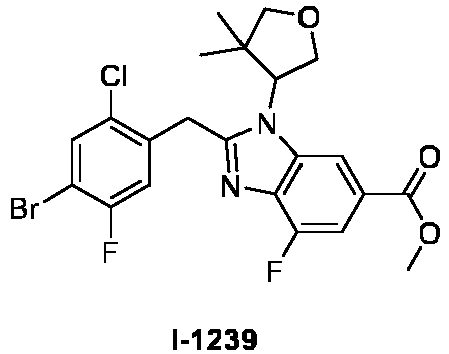
- Methyl 2-(4-bromo-2-chloro-5-fluorobenzyl)-1-(4,4-dimethyltetrahydrofuran-3-yl)-4-fluoro-1H-benzo[d]imidazole-6-carboxylate: Methyl 2-(4-bromo-2-chloro-5-fluorobenzyl)-1-(4,4-dimethyltetrahydrofuran-3-yl)-4-fluoro- 1H-benzo[d]imidazole-6-carboxylate was prepared in a manner as described for I-1031 substituting methyl 4-amino-3-[(4,4-dimethyltetrahydrofuran-3-yl)amino]-5-fluoro-benzoate I-104 for ethyl 4-amino-3-fluoro-5-[[(2S)-oxetan-2-yl]methylamino]benzoate and 2-(4-bromo-2-chloro-5-fluoro-phenyl)acetic acid for 2-(4-bromo-2-chloro-5-methyl-phenyl)acetic acid. ES/MS: 513.8 (M+H+).
-
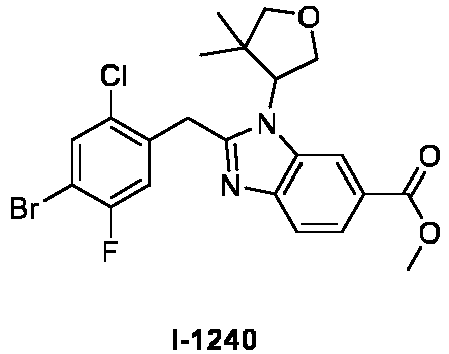
- Methyl 2-(4-bromo-2-chloro-5-fluorobenzyl)-1-(4,4-dimethyltetrahydrofuran-3-yl)-1H-benzo[d]imidazole-6-carboxylate: Methyl 2-(4-bromo-2-chloro-5-fluorobenzyl)-1-(4,4-dimethyltetrahydrofuran-3-yl)-1H-benzo[d]imidazole-6-carboxylate was prepared in a manner as described for I-1031 substituting methyl 4-amino-3-[(4,4-dimethyltetrahydrofuran-3-yl)amino]-benzoate I-104 for ethyl 4-amino-3-fluoro-5-[[(2S)-oxetan-2-yl]methylamino]benzoate and 2-(4-bromo-2-chloro-5-fluoro-phenyl)acetic acid for 2-(4-bromo-2-chloro-5-methyl-phenyl)acetic acid. ES/MS: 494.6 (M+H+).
-

- 2-(((6-bromo-3-fluoropyridin-2-yl)oxy)methyl)-5-methoxy-1,3,4-thiadiazole: 2-(((6-bromo-3-fluoropyridin-2-yl)oxy)methyl)-5-methoxy-1,3,4-thiadiazole was prepared in a manner as described for Intermediate I-1034 substituting 2-(chloromethyl)-5-methoxy-1,3,4-thiadiazole for 6-(bromomethyl)-1-methyl-benzotriazole and 6-bromo-3-fluoro-pyridin-2-ol for 6-bromopyridin-2-ol. ES/MS: 320.7 (M+H+).
-

- 2-(((4-bromopyrimidin-2-yl)oxy)methyl)-4-(trifluoromethyl)thiazole: 2-(((4-bromopyrimidin-2-yl)oxy)methyl)-4-(trifluoromethyl)thiazole was prepared in a manner as described for Intermediate I-1034 substituting 2-(bromomethyl)-4-(trifluoromethyl)thiazole for 6-(bromomethyl)-1-methyl-benzotriazole and 6-bromo-3-fluoro-pyrimidin-2-ol for 6-bromopyridin-2-ol. ES/MS: 340.1 (M+H+).
-

- 5-bromo-2-(((tert-butyldimethylsilyl)oxy)methyl)-3-chloropyridine: A suspension of 5-bromo-3-chloropyridin-2-yl)methanol (500 mg, 2.25 mmol), tert-Butylchlorodimethylsilane (508 mg, 3.37 mmol), Imidazole (459 mg, 6.74 mmol) and 4-(Dimethylamino)pyridine (55 mg, 0.45 mmol) ) in DCM (15 mL) was stirred at 25 °C for 16h. Then the mixture was diluted with DCM and washed with brine. Next, the mixture was dried over sodium sulfate, concentrated, and purified by chromatography (eluent: EtOAc/hexanes) to give desired product. ES/MZ: 336.7 (M+H+).
- 2-(((tert-butyldimethylsilyl)oxy)methyl)-3-chloro-5-((1-methylcyclopropyl)ethynyl)pyridine: A suspension of 5-bromo-2-(((tertbutyldimethylsilyl)oxy)methyl)-3-chloropyridine (250 mg, 0.742 mmol), 1-ethynyl-1-methyl-cyclopropane (178 mg, 2.23 mmol), Bis(triphenylphosphine)palladium Chloride (104 mg, 0.15 mmol), Cuprous Iodide (28 mg, 0.15 mmol) and Diisopropylamine (2.15 ml, 14.8 mmol) in THF (2 mL) was sparged with Argon for 5 min then heated at 80 °Cs for 2 h. Next, the mixture was diluted with EtOAC and washed with brine. The mixture was then dried over sodium sulfate, concentrated, and purified by chromatography (eluent: EtOAc/hexanes) to give desired product. ES/MZ: 336.7 (M+H+).
- (3-chloro-5-((1-methylcyclopropyl)ethynyl)pyridin-2-yl)methanol: A suspension of 2-(((tertbutyldimethylsilyl)oxy)methyl)-3-chloro-5-((1-methylcyclopropyl)ethynyl)pyridine in THF (2 mL) and Tetrabutylammonium fluoride (1.11 mL, 1.11 mmol) was stirred at 25 °C for 16 h. The mixture was then diluted with EtOAC and washed with brine. Next, the mixture was dried over sodium sulfate, concentrated, and purified by chromatography (eluent: EtOAc/hexanes) to give desired product. ES/MZ: 222.6 (M+H+).
- 2-(bromomethyl)-3-chloro-5-((1-methylcyclopropyl)ethynyl)pyridine (I-1250): A suspension of (3-chloro-5-((1-methylcyclopropyl)ethynyl)pyridin-2-yl)methanol (165 mg, 0.742 mmol), carbon tetrabromide (295 mg, 0.90 mmol) and triphenylphosphine oxide (234 mg, 0.90 mmol) in DCM (3 ml) was stirred at 25 °C for 16 h. Then the mixture was diluted with DCM and washed with brine. Then the mixture was dried over sodium sulfate, concentrated, and purified by chromatography (eluent: EtOAc/hexanes) to give desired product. ES/MZ: 285.9 (M+H+).
-

- 2-(bromomethyl)-3-chloro-5-((1-(fluoromethyl)cyclopropyl)ethynyl)pyridine: 2-(bromomethyl)-3-chloro-5-((1-(fluoromethyl)cyclopropyl)ethynyl)pyridine was prepared in a manner as described for the intermediate I-1250 substituting 1-ethynyl-1-(fluoromethyl)cyclopropane for 1-ethynyl-1methyl-cyclopropane. ES/MZ: 302.6 (M+H+).
-
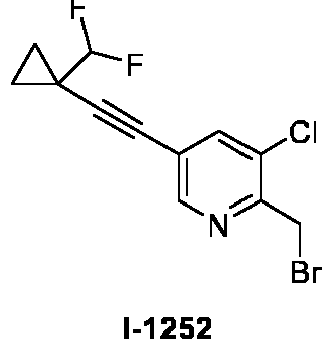
- 2-(bromomethyl)-3-chloro-5-((1-(difluoromethyl)cyclopropyl)ethynyl)pyridine: 2-(bromomethyl)-3-chloro-5-((1-(difluoromethyl)cyclopropyl)ethynyl)pyridine was prepared in a manner as described for the intermediate I-1250 substituting 1-ethynyl-1-(difluoromethyl)cyclopropane for 1-ethynyl-1methyl-cyclopropane. ES/MZ: 320.6 (M+H+).
-

- tert-butyl (4-hydroxy-4-methyltetrahydrofuran-3-yl)carbamate: A suspension of tert-butyl (4-oxotetrahydrofuran-3-yl)carbamate (500 mg, 2.5 mmol) in diethyl ether (212.5 mL) was cooled to 0 °C, then methylmagnesium bromide (2.48 mL, 3.0 Min diethyl ether, 7.45 mmol) was added slowly. The mixture was allowed to warm to 25 °C and then stirred for 16 h. Next, the mixture was diluted with diethyl ether and washed with brine. Then the mixture was dried over sodium sulfate, concentrated, and used without further purification. 1H NMR (400 MHz, CDCl3) δ 5.02 (s, 1H), 4.68 (d, J = 8.1 Hz, 1H), 4.32 - 4.24 (m, 1H), 4.21 - 4.13 (m, 1H), 4.06 - 3.91 (m, 1H), 3.85 - 3.72 (m, 2H), 3.62 - 3.46 (m, 1H), 1.47 (d, J = 3.5 Hz, 12H), 1.38 (s, 2H).
- 4-amino-3-methyltetrahydrofuran-3-ol: A suspension of tert-butyl (4-hydroxy-4-methyltetrahydrofuran-3-yl)carbamate (491 mg, 2.26 mmol) and hydrochloric acid (1.25 mL, 4.0M in dioxane, 5.00 mmol) in DCM (5.00 mL) was stirred overnight. The mixture was diluted in EtOAc and washed with brine, dried over sodium sulfate, concentrated and used without further purification. 1H NMR (400 MHz, CDCl3) δ 3.95 (ddt, J = 7.8, 3.8, 2.0 Hz, 1H), 3.77 (tq, J = 7.2, 5.3, 3.7 Hz, 2H), 3.72 - 3.60 (m, 2H), 3.55 (dd, J = 9.4, 2.0 Hz, 2H), 3.52 - 3.41 (m, 2H), 3.38 (t, J = 1.8 Hz, 0H), 3.33 - 3.23 (m, 2H), 3.09 (t, J = 6.2 Hz, 2H), 1.20 (t, J = 1.8 Hz, 5H), 1.17 (d, J = 2.0 Hz, 4H), 1.02 - 0.92 (m, 6H).
- Methyl 3-((4-hydroxy-4-methyltetrahydrofuran-3-yl)amino)-4-nitrobenzoate: A suspension of 4-amino-3-methyltetrahydrofuran-3-ol (424 mg, 2.76 mmol), methyl 3-fluoro-4-nitrobenzoate (500 mg, 2.51 mmol) and N,N-Diisopropylethylamine (2.19 mL, 1.26 mmol) in THF (4 mL) and DMF (2 mL) was stirred at 82 °C for 16 h. The mixture was then diluted in EtOAc and washed with brine, dried over sodium sulfate, concentrated, and purified by chromatography (eluent: EtOAc/hexanes) to give desired product. ES/MZ: 297.1 (M+H+). Isomer 1: 1H NMR (400 MHz, CDCl3) δ 3.95 (ddt, J = 7.8, 3.8, 2.0 Hz, 1H), 3.77 (tq, J = 7.2, 5.3, 3.7 Hz, 2H), 3.72 - 3.60 (m, 2H), 3.55 (dd, J = 9.4, 2.0 Hz, 2H), 3.52 - 3.41 (m, 2H), 3.38 (t, J = 1.8 Hz, 0H), 3.33 - 3.23 (m, 2H), 3.09 (t, J = 6.2 Hz, 2H), 1.20 (t, J = 1.8 Hz, 5H), 1.17 (d, J = 2.0 Hz, 4H), 1.02 - 0.92 (m, 6H). Isomer 2: 1H NMR (400 MHz, CDCl3) δ 8.27 (d, J = 8.9 Hz, 1H), 8.11 (d, J = 7.7 Hz, 1H), 7.75 (d, J = 1.7 Hz, 1H), 7.33 (dd, J = 8.9, 1.7 Hz, 1H), 4.53 (dd, J = 9.6, 6.3 Hz, 1H), 4.24 (q, J = 7.0, 6.4 Hz, 1H), 3.98 (s, 3H), 3.91 (d, J = 9.8 Hz, 1H), 3.80 (d, J = 9.8 Hz, 1H), 3.73 (dd, J = 9.6, 4.6 Hz, 1H), 1.42 (s, 3H).
- Methyl 3-((4-methoxy-4-methyltetrahydrofuran-3-yl)amino)-4-nitrobenzoate: A suspension of methyl 3-((4-hydroxy-4-methyltetrahydrofuran-3-yl)amino)-4-nitrobenzoate (144 mg, 0.49 mmol), sodium hydride (20.5 mg, 0.54 mmol) and iodomethane (33 uL, 0.54 mmol) in DMF (1.00 mL) was stirred at 0 °C for 15 min then warmed to 25 °C and stirred for 16h. The mixture was then diluted in EtOAc and washed with brine, dried over sodium sulfate, concentrated, and purified by chromatography (eluent: EtOAc/hexanes) to give desired product EZ/MS: 311.3 (M+H+).
- Methyl 4-amino-3-((4-methoxy-4-methyltetrahydrofuran-3-yl)amino)benzoate: A suspension of methyl 3-((4-methoxy-4-methyltetrahydrofuran-3-yl)amino)-4-nitrobenzoate (133 mg, 0.43 mmol), and Palladium on carbon (10% loading, 45.5 mg, 0.43 mmol) in ethanol (5.0 mL) and placed under hydrogen at 25 °C for 5 h. Next, the mixture was diluted in EtOAc and washed with brine. Then the mixture was dried over sodium sulfate, concentrated and used without further purification. EZ/MS: 281.1 (M+H+)
-

- Tert-butyl (4-hydroxy-4-methyltetrahydrofuran-3-yl)carbamate) (Isomer 1 I-1257, Isomer 2 I-1258-1): was obtained via preparative chiral HPLC (Chiralpak IH column, Hexanes/iPrOH eluent) on racemic I-1257-0, giving two distinct stereoisomers (I-1257-1 as the earlier eluting isomer, I-1258-1 as the later eluting isomer).

- Tert-butyl (4-hydroxy-4-methyltetrahydrofuran-3-yl)carbamate (I-1257-2): A mixture of tert-butyl (4-oxotetrahydrofuran-3-yl)carbamate (500 mg, 2.5 mmol) (Peak 1 I-1257-1) in diethyl ether (212.5 mL) was cooled to 0 °C, then methylmagnesium bromide (2.48 mL, 3.0 M in diethyl ether, 7.45 mmol) was added slowly. The mixture was allowed to warm to 25 °C and allowed to stir for 16 h. Then the mixture was diluted with diethyl ether and washed with brine. Then, the mixture was dried over sodium sulfate, and concentrated to yield the title compound. 1H NMR (400 MHz, CDCl3) δ 5.02 (s, 1H), 4.68 (d, J = 8.1 Hz, 1H), 4.32 - 4.24 (m, 1H), 4.21 - 4.13 (m, 1H), 4.06 - 3.91 (m, 1H), 3.85 - 3.72 (m, 2H), 3.62 - 3.46 (m, 1H), 1.47 (d, J = 3.5 Hz, 12H), 1.38 (s, 2H).
- 4-amino-3-methyltetrahydrofuran-3-ol (I-1257-3): A suspension of tert-butyl (4-hydroxy-4-methyltetrahydrofuran-3-yl)carbamate (491 mg, 2.26 mmol) (I-1257-2) and hydrochloric acid (1.25 mL, 4.0M in dioxane, 5.00 mmol) in DCM (5.00 mL) was stirred overnight. The mixture was diluted in EtOAc and washed with brine, dried over sodium sulfate, and concentrated to yield the title compound. 1H NMR (400 MHz, CDCl3) δ 3.95 (ddt, J = 7.8, 3.8, 2.0 Hz, 1H), 3.77 (tq, J = 7.2, 5.3, 3.7 Hz, 2H), 3.72 - 3.60 (m, 2H), 3.55 (dd, J = 9.4, 2.0 Hz, 2H), 3.52 - 3.41 (m, 2H), 3.38 (t, J = 1.8 Hz, 0H), 3.33 - 3.23 (m, 2H), 3.09 (t, J = 6.2 Hz, 2H), 1.20 (t, J = 1.8 Hz, 5H), 1.17 (d, J = 2.0 Hz, 4H), 1.02 - 0.92 (m, 6H).
- Methyl 3-((4-hydroxy-4-methyltetrahydrofuran-3-yl)amino)-4-nitrobenzoate (cis-
isomer Peak 1, 1-1257-4A, relative stereochemistry established): A suspension of 4-amino-3-methyltetrahydrofuran-3-ol (424 mg, 2.76 mmol) (I-1257-3), methyl 3-fluoro-4-nitro-benzoate (500 mg, 2.51 mmol) and N,N-Diisopropylethylamine (2.19 mL, 1.26 mmol) in THF (4 mL) and DMF (2 mL) was stirred at 82 °C for 16 hr. Next, the mixture was purified by silica gel flash column chromatography (EtOAc/hexane) providing both cis (I-1257-4A,Isomer 1, the earlier eluting of two diastereomers) and trans (I-1257-4B,Isomer 2, the later eluting of two diastereomers) isomers. ES/MZ: 297.1 (M+H+).Isomer 1, I-1257-4A: 1H NMR (400 MHz, CDCl3) δ 3.95 (ddt, J = 7.8, 3.8, 2.0 Hz, 1H), 3.77 (tq, J = 7.2, 5.3, 3.7 Hz, 2H), 3.72 - 3.60 (m, 2H), 3.55 (dd, J = 9.4, 2.0 Hz, 2H), 3.52 - 3.41 (m, 2H), 3.38 (t, J = 1.8 Hz, 0H), 3.33 - 3.23 (m, 2H), 3.09 (t, J = 6.2 Hz, 2H), 1.20 (t, J = 1.8 Hz, 5H), 1.17 (d, J = 2.0 Hz, 4H), 1.02 - 0.92 (m, 6H). Two dimensional NOESY NMR identified a O17-OH to N11-NH NOE correlation and a C12-CH to C21-CH3 NOE correlation to confirm relative stereochemistry of I-1257-4A as the cis diastereomer.Isomer 2, I-1257-4B: 1H NMR (400 MHz, CDCl3) δ 8.27 (d, J = 8.9 Hz, 1H), 8.11 (d, J = 7.7 Hz, 1H), 7.75 (d, J = 1.7 Hz, 1H), 7.33 (dd, J = 8.9, 1.7 Hz, 1H), 4.53 (dd, J = 9.6, 6.3 Hz, 1H), 4.24 (q, J = 7.0, 6.4 Hz, 1H), 3.98 (s, 3H), 3.91 (d, J = 9.8 Hz, 1H), 3.80 (d, J = 9.8 Hz, 1H), 3.73 (dd, J = 9.6, 4.6 Hz, 1H), 1.42 (s, 3H).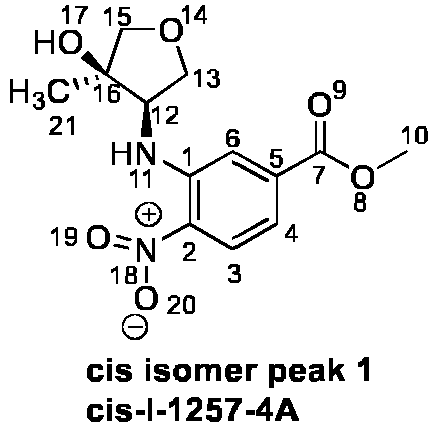

- methyl 3-((cis-4-methoxy-4-methyltetrahydrofuran-3-yl)amino)-4-nitrobenzoate (cis-
isomer peak 1, I-1257-5, relative stereochemistry established): A mixture of methyl 3-((4-hydroxy-4-methyltetrahydrofuran-3-yl)amino)-4-nitrobenzoate (144 mg, 0.49 mmol) (cis-isomer peak 1, I-1257-4A), sodium hydride (20.5 mg, 0.54 mmol) and iodomethane (33 uL, 0.54 mmol) in DMF (1.00 mL) was stirred at 0 °C for 15 min then warmed to 25 °C and stirred for 16h. The mixture was diluted in EtOAc and washed with brine, Dried over sodium sulfate, concentrated, and purified by silica gel flash column chromatography (eluent: EtOAc/hexanes) to give the title compound. ES/MS: 311.3 (M+H+). - methyl 4-amino-3-((4-methoxy-4-methyltetrahydrofuran-3-yl)amino)benzoate (cis-
isomer peak 1, I-1257, relative stereochemistry established): A mixture of methyl 3-((4-methoxy-4-methyltetrahydrofuran-3-yl)amino)-4-nitrobenzoate (133 mg, 0.43 mmol) (cis-isomer peak 1,I-1257-5), and 10% palladium on carbon (45.5 mg, 0.043 mmol) in ethanol (5.0 mL) and placed under hydrogen at 25 °C for 5 h. The mixture was diluted in EtOAc and washed with brine, dried over sodium sulfate, and concentrated to yield the title compound. ES/MS: 281.1 (M+H+) -

- Methyl 4-amino-3-((4-methoxy-4-methyltetrahydrofuran-3-yl)amino)benzoate (cis-
isomer 2, I-1258, relative stereochemistry established): Methyl 4-amino-3-((4-methoxy-4-methyltetrahydrofuran-3-yl)amino)benzoate (cis-isomer 2, I-1258, relative stereochemistry established) was prepared in a manner as described for cis-isomer peak 1 I-1257, using Intermediate isomer 2 I-1258-1 in place of isomer 1 I-1257-1. -

- Methyl rac-cis-4-amino-3-(((1-(fluoromethyl)cyclopropyl)methyl)amino)benzoate (I-1065-1): To a mixture of methyl 3-fluoro-4-nitro-benzoate (120mg, 0.603 mmol), racemic cis-4-aminotetrahydrofuran-3-yl]methanol (77.7 mg, 0.66 mmol) in THF (4 mL) and DMF (2 mL), was added N,N-diisopropylethylamine (0.525 mL, 3.01 mmol). The mixture was heated at 80 °C for 18 hr. The crude mixture was diluted with EtOAc, washed with 5% LiCl and brine. The organic extract was dried over sodium sulfate and purified by silica gel column chromatography (eluent: EtOAc/hexanes) to afford the title compound. ES/MS: 297.2 (M+H+).

- Methyl 3-((cis-4-(hydroxymethyl)tetrahydrofuran-3-yl)amino)-4-nitrobenzoate (Peak 1-I-1266-1A, Peak 2-I-1266-1B, relative stereochemistry established): Methyl 3-((cis-4-(hydroxymethyl)tetrahydrofuran-3-yl)amino)-4-nitrobenzoate (Peak 1-I-1266-1A, Peak 2-I-1266-1B) was obtained via preparative chiral SFC (Daicel Chiralpak AD-H column with EtOH/CO2 eluent) on I-1065-1, which gave 2 distinct stereoisomers.
- Methyl 3-(((3R,4R)-4-(hydroxymethyl)tetrahydrofuran-3-yl)amino)-4-nitrobenzoate (
Peak 1, I-1266-1A): the earlier eluting of the two stereoisomers. - Methyl 3-(((3S,4S)-4-(hydroxymethyl)tetrahydrofuran-3-yl)amino)-4-nitrobenzoate (
Peak 2, I-1266-1B): the later eluting of the two stereoisomers.
- Methyl 3-(((3S,4S)-4-(methoxymethyl)tetrahydrofuran-3-yl)amino)-4-nitrobenzoate (I-1266-2): To a mixture of methyl 3-(((3S,4S)-4-(hydroxymethyl)tetrahydrofuran-3-yl)amino)-4-nitrobenzoate (I-1266-1A) (75 mg, 0.253 mmol) in DMF (4 mL) was added NaH (24.2 mg, 0.633 mmol, 60% dispersion) at 0 °C. To this mixture was added methyl iodide (35.9 mg, 0.253 mmol) and the mixture stirred for 1 hour at rt. The mixture was then split between saturated aqueous ammonium chloride and EtOAc. The aqueous layer was extracted with EtOAc five times, and then washed with brine. The organic extract was dried over sodium sulfate and purified by silica gel column chromatography (eluent: EtOAc/hexanes) to afford the title compound. ES/MS: 311.2 (M+H+)
- Methyl 4-amino-3-(((3S,4S)-4-(methoxymethyl)tetrahydrofuran-3-yl)amino)benzoate (I-1266, relative stereochemistry established): A mixture of methyl 3-(((3S,4S)-4-(methoxymethyl)tetrahydrofuran-3-yl)amino)-4-nitrobenzoate (I-1266-2) (80 mg, 0.258 mmol) in EtOAc (5 mL) was degassed with cycles of argon then vacuum 3x. Palladium on carbon (10.0 %, 27.4 mg, 0.258 mmol) was added. The mixture was degassed with cycles of argon then vacuum and stirred at rt with a balloon of hydrogen for 24 hr. The mixture was filtered through Celite and concentrated in vacuo to give the title compound. ES/MS: 280.1 (M+H+).
-

- Methyl 2-(4-bromo-2,5-difluorobenzyl)-1-((3S,4S)-4-(methoxymethyl)tetrahydrofuran-3-yl)-1H-benzo[d]imidazole-6-carboxylate: Methyl 2-(4-bromo-2,5-difluorobenzyl)-1-((3S,4S)-4-(methoxymethyl)tetrahydrofuran-3-yl)-1H-benzo[d]imidazole-6-carboxylate was prepared in a manner as described for -I-82, substituting methyl 4-amino-3-(((3S,4S)-4-(methoxymethyl)tetrahydrofuran-3-yl)amino)benzoate for I-80.
-

- 2-bromo-6-[[6-(triazol-1-yl)-3-pyridyl]methoxy]pyridine (I-1268): 2-bromo-6-[[6-(triazol-1-yl)-3-pyridyl]methoxy]pyridine was prepared in a manner as described for I-84 substituting 5-(bromomethyl)-2-(triazol-1-yl)pyridine for 2-(bromomethyl)thiazole-5-carbonitrile. ES/MS: 332, 334 (M+H+).
-

- A suspension of ethyl 2-[[2,5-difluoro-4-(6-hydroxy-2-pyridyl)phenyl]methyl]-7-fluoro-3-[[(2S)-oxetan-2-yl]methyl]benzimidazole-5-carboxylate (300 mg, 0.603 mmol), 5-bromo-2-(chloromethyl)-3-fluoro-pyridine (162 mg, 0.724 mmol), and cesium carbonate (491 mg, 1.51 mmol) in CH3CN was heated at 70 °C for 1 hr. Next, the mixture was filtered, concentrated, and purified by silica gel column chromatography (eluent: EtOAc/hexanes) to give desired product. ES/MS: 686.0 (M+H+).
-

- Methyl 4-amino-3-fluoro-5-[[(2S)-2-methoxypropyl]amino]benzoate was prepared in a manner as described for I-5 substituting (S)-2-methoxypropan-1-amine for (S)-oxetan-2-ylmethanamine and methyl 3,5-difluoro-4-nitrobenzoate for Ethyl 3,5-difluoro-4-nitrobenzoate. ES/MS: 257.1 (M+H+).
-

- Ethyl 4-amino-3-fluoro-5-[[(2R)-2-methoxypropyl]amino]benzoate (I-1271): Ethyl 4-amino-3-fluoro-5-[[(2R)-2-methoxypropyl]amino]benzoate was prepared in a manner as described for I-5 substituting (R)-2-methoxypropan-1-amine for (S)-oxetan-2-ylmethanamine. ES/MS: 271.2 (M+H+).
-

- Ethyl 2-[(4-bromo-2,5-difluoro-phenyl)methyl]-7-fluoro-3-[(2R)-2-methoxypropyl]benzimidazole-5-carboxylate (I-1272): Ethyl 2-[(4-bromo-2,5-difluorophenyl)methyl]-7-fluoro-3-[(2R)-2-methoxypropyl]benzimidazole-5-carboxylate was prepared in a manner as described for I-2 substituting Ethyl 4-amino-3-fluoro-5-[[(2R)-2-methoxypropyl]amino] (I-1271) for I-1 and 2-(4-bromo-2,5-difluorophenyl)acetic acid for 2-(4-bromo-2-fluoro-phenyl)acetic acid. ES/MS: 485, 487 (M+H+).
-

- Methyl 5-(bromomethyl)-4-chloro-pyridine-2-carboxylate (I-1273-1): Methyl 4-chloro-5-methyl-pyridine-2-carboxylate (1.00 g, 5.39 mmol) was taken up in carbon tetrachloride (10.0 mL) and then N-Bromosuccinimide (1255 mg, 7.05 mmol) was added followed by Benzoyl peroxide (140 mg, 0.580 mmol). Next, the mixture was heated to 90° C for 45 min. Upon completion of time, the mixture was concentrated. in vacuo. The crude residue was purified by chromatography (eluent: EtOAc/hexanes) to give desired product. ES/MS: 264, 266 (M+H+).
- Methyl 5-[(6-bromo-2-pyridyl)oxymethyl]-4-chloro-pyridine-2-carboxylate (I-1273-2): 6-Bromopyridin-2-ol (600 mg, 3.4 mmol), methyl 5-(bromomethyl)-4-chloro-pyridine-2-carboxylate (1003 mg, 3.8 mmol), and cesium carbonate (1685 mg, 5.2 mmol) were taken up in acetonitrile (12 mL) and the reaction heated to 65°C for 1 hr. Next, the mixture was filtered through Celite and concentrated in vacuo. The crude residue was purified by chromatography (eluent: EtOAc/hexanes) to give desired product. ES/MS: 357, 359 (M+H+).
- 5-[(6-bromo-2-pyridyl)oxymethyl]-4-chloro-pyridine-2-carboxylic acid (I-1273-3): Methyl 5-[(6-bromo-2-pyridyl)oxymethyl]-4-chloro-pyridine-2-carboxylate (1.17 g, 3.27 mmol) was taken up in CH3CN (15.0 mL) and water (5.00 mL). Next, lithium hydroxide, monohydrate (408 mg, 9.72 mmol) was added to the mixture and stirred at rt for 1hr. The mixture was then diluted with EtOAc, acidified to pH~6 with 1N HCl. A precipitate formed and the precipitate was collected and washed with H2O and Et2O. The remaining material was extracted into EtOAc (dried over MgSO4 and conc. in vacuo). The combined solids were used in subsequent reactions without purification. ES/MS: 343, 345 (M+H+).
- 5-[(6-bromo-2-pyridyl)oxymethyl]-4-chloro-N-methyl-pyridine-2-carboxamide (I-1273): To a solution of 5-[(6-bromo-2-pyridyl)oxymethyl]-4-chloro-pyridine-2-carboxylic acid (600 mg, 1.75 mmol), methanamine; hydrochloride (236 mg, 3.49 mmol), and o-(7-Azabenzotriazol-1-yl)-N,N,N',N'-tetramethyluronium hexafluorophosphate (976 mg, 2.57 mmol) in DMF (10 mL), N,N-Diisopropylethylamine (1.22 mL, 6.99 mmol) was added. The mixture was stirred at rt for 10 min. Next, the mixture was partitioned with EtOAc and water. The organic extract was dried over MgSO4, filtered, and concentrated to give desired product. ES/MS: 356, 358 (M+H+).
-

- Methyl 5-[(5-bromo-2-fluoro-phenoxy)methyl]-4-chloro-pyridine-2-carboxylate (I-1274): Methyl 5-[(5-bromo-2-fluoro-phenoxy)methyl]-4-chloro-pyridine-2-carboxylate was prepared in a similar manner as described for I-1273 substituting 5-bromo-2-fluoro-phenol for 6-bromopyridin-2-ol in
step 2. ES/MS: 374, 376 (M+H+). -

- Ethyl 2-[(4-bromo-2-fluoro-5-methyl-phenyl)methyl]-7-fluoro-3-[[(2S)-oxetan-2-yl]methyl]benzimidazole-5-carboxylate (I-1275): Ethyl 2-[(4-bromo-2-fluoro-5-methylphenyl)methyl]-7-fluoro-3-[[(2S)-oxetan-2-yl]methyl]benzimidazole-5-carboxylate was prepared in a similar manner as described for I-2 substituting I-5 for I-1 and 2-(4-bromo-2-fluoro-5-methyl-phenyl)acetic acid I-1277 for 2-(4-bromo-2-fluoro-phenyl)acetic acid. ES/MS: 479, 481 (M+H+).
-

- (4-bromo-2-fluoro-5-methyl-phenyl)methanol (I-1276): To a solution of 4-bromo-2-fluoro-5-methyl-benzaldehyde (5.0 g, 23.0 mmol) in EtOH (115 mL) at 0 °C, sodium borohydride (436 mg, 11.5 mmol) was added in one portion. The mixture was placed under an inert atmosphere of argon and allowed to warm to room temperature and stirred for 2 h. The mixture was then quenched with saturated sodium NaHCO3 (2x 30 ml), extracted with EtOAc (2x 30 ml) and dried over magnesium sulfate. The mixture was then filtered and concentrated in vacuo. The crude residue was purified by chromatography (eluent: EtOAc/hexanes) to give desired product. 1HNMR (400 MHz, CDCl3) δ 7.29 (d, J = 7.8 Hz, 1H), 7.25 (d, J = 9.3 Hz, 1H), 4.68 (s, 2H), 2.36 (s, 3H). 19F NMR (376 MHz, Chloroform-d) δ -122.82.
-

- 2-(4-bromo-2-fluoro-5-methyl-phenyl)acetic acid (I-1277): 2-(4-bromo-2-fluoro-5-methyl-phenyl)acetic acid was prepared in a manner as described for I-1023 substituting (4-bromo-2-fluoro-5-methyl-phenyl)methanol I-1276 for (4-bromo-2-chloro-5-methylphenyl)methanol in step 3. 1H NMR (400 MHz, CDCl3) δ 7.28 (d, J = 9.0 Hz, 1H), 7.12 (d, J = 7.8 Hz, 1H), 3.64 (s, 2H), 2.34 (s, 3H). 19F NMR (376 MHz, CDCl3) δ -119.92.
-

- Ethyl 2-[(4-bromo-2-chloro-5-fluoro-phenyl)methyl]-7-fluoro-3-(2-methoxyethyl)benzimidazole-5-carboxylate (I-1278): Ethyl 2-[(4-bromo-2-chloro-5-fluorophenyl)methyl]-7-fluoro-3-(2-methoxyethyl)benzimidazole-5-carboxylate was prepared in a manner as described for I-26 substituting ethyl 4-amino-3-fluoro-5-((2-methoxyethyl)amino)benzoate I-1032 for ethyl 4-amino-3-fluoro-5-[[(2S)-oxetan-2-yl]methylamino]benzoate and 2-(4-bromo-2-chloro-5-fluoro-phenyl)acetic acid for 2-(4-bromo-2-chloro-5-methyl-phenyl)acetic acid. ES/MS: 488, 489 (M+H+).
-

- 2-benzyloxy-4-bromo-1-fluoro-benzene: A suspension of 5-bromo-2-fluoro-phenol (5.00 g, 0.0262 mol), Benzyl bromide, reagent grade, 98% (3.74 mL, 0.0314 mol), and potassium carbonate (7.96 g, 0.0576 mol) in acetone (30 mL) was heated at 70 °C for 1 hr. The mixture was partitioned with EtOAc and water. The organic extract was dried over MgSO4, concentrated and purified by chromatography (eluent: EtOAc/hexanes) to give desired product.
- Ethyl 2-[[4-(3-benzyloxy-4-fluoro-phenyl)-2,5-difluoro-phenyl]methyl]-7-fluoro-3-[[(2S)-oxetan-2-yl]methyl]benzimidazole-5-carboxylate: A suspension of ethyl 2-[(4-bromo-2,5-difluoro-phenyl)methyl]-7-fluoro-3-[[(2S)-oxetan-2-yl]methyl]benzimidazole-5-carboxylate (500 mg, 1.03 mmol) (I-14), [1,1'-Bis(diphenylphosphino)ferrocene] dichloropalladium(II) ;PdCl2(dppf) (76.7 mg, 0.103 mmol), potassium propionate (348 mg, 3.10 mmol), and Bis(pinacolato)diboron (394 mg, 1.55 mmol) was degassed, then heated at 110 °C for 2hr. Next, sodium carbonate (2000 mmol/L, 1.03 mL, 2.07 mmol), 2-benzyloxy-4-bromo-1-fluoro-benzene (320 mg, 1.14 mmol), and [1,1'-Bis(diphenylphosphino)ferrocene] dichloropalladium(II) ;PdCl2(dppf) (38.4 mg, 0.0517 mmol) were added. Next the mixture was degassed. The mixture was then heated at 100 °C for 1 hr. Upon completion of time, the mixture was diluted with EtOAc and water. The organic extract was dried over magnesium sulfate, filtered and concentrated. The crude residue was purified by flash chromatography (eluent: EtOAc/hexanes) to yield desired product. ES/MS: 606.1 (M+H+).
- Ethyl 2-[[2,5-difluoro-4-(4-fluoro-3-hydroxy-phenyl)phenyl]methyl]-7-fluoro-3-[[(2S)-oxetan-2-yl]methyl]benzimidazole-5-carboxylate (I-1279): A suspension of ethyl 2-[[4-(3-benzyloxy-4-fluoro-phenyl)-2,5-difluoro-phenyl]methyl]-7-fluoro-3-[[(2S)-oxetan-2-yl]methyl]benzimidazole-5-carboxylate (626 mg, 1.04 mmol) and Palladium on
carbon 10 wt. % (5.00 %, 2204 mg, 1.04 mmol) was degassed by cycling the mixture between argon and vacuum 3x. Next the mixture was stirred at rt with a balloon of hydrogen for 2 hr. The mixture was then filtered through Celite and concentrated in vacuo to give desired product. ES/MS: 515.6 (M+H+) -

- A suspension of 5-bromo-2-(bromomethyl)thiazole (40.0 mg, 0.156 mmol), ethyl 2-[[2,5-difluoro-4-(4-fluoro-3-hydroxy-phenyl)phenyl]methyl]-7-fluoro-3-[[(2S)-oxetan-2-yl]methyl]benzimidazole-5-carboxylate (80.0 mg, 0.156 mmol), and cesium carbonate (152 mg, 0.467 mmol) in CH3CN was heated at 60 °C for 1 hr. The mixture was filtered, concentrated, and purified by chromatography (eluent: EtOAc/hexanes) to give desired product. ES/MS: 692.3 (M+H+)
-

- Ethyl 2-[[4-[6-[(6-bromo-3-pyridyl)methoxy]-2-pyridyl]-2,5-difluoro-phenyl]methyl]-7-fluoro-3-[[(2S)-oxetan-2-yl]methyl]benzimidazole-5-carboxylate was prepared in a manner as described for Intermediate I-1269 substituting 2-bromo-5-(bromomethyl)pyridine for 5-bromo-2-(chloromethyl)-3-fluoro-pyridine. ES/MS: 667, 669 (M+H+).
-
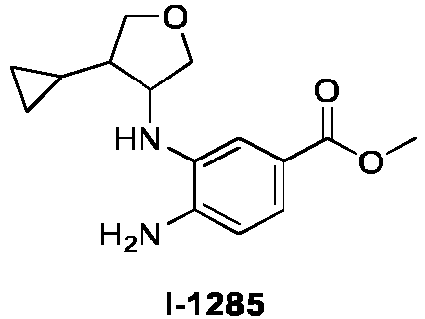
- Methyl 4-amino-3-((4-cyclopropyltetrahydrofuran-3-yl)amino)benzoate was prepared in a manner as described for I-69 substituting 4-cyclopropyltetrahydrofuran-3-amine hydrochloride for 2-methoxyethylamine. ES/MS: 277.2 (M+H+).
-

- To a vial containing 6-chloro-3-fluoro-pyridin-2-ol (20 mg, 1.0 equivalent) under argon, Cs2CO3 (66 mg, 1.5 equivalent) was added. Next, MeCN (1.3 mL) was added followed by the addition of 2-(bromomethyl)-5-(difluoromethyl)thiazole (I-36). The mixture was sealed under argon and stirred in a metal heating block at 90 °C for 90 min or until the reaction as complete as determined by LCMS. The mixture was then diluted with EtOAc, filtered, and concentrated in vacuo. Silica gel flash column chromatography (EtOAc in hexane) yielded the title compound. 1H NMR (400 MHz, Chloroform-d) δ 7.94 (t, J = 2.3 Hz, 1H), 7.38 (dd, J = 9.0, 8.2 Hz, 1H), 6.96 (dd, J = 8.2, 2.6 Hz, 1H), 6.90 (t, J = 55.3 Hz, 1H), 5.73 (s, 2H). ES/MS m/z: 294.9 (M+H+).
-

- To 6-chloro-3-fluoro-pyridin-2-ol (20 mg, 1.0 equivalent) under argon was added Cs2CO3 (66 mg, 1.5 equivalent) followed by the addition of MeCN (1.3 mL), and then 2-(bromomethyl)-5-(trifluoromethyl)thiazole (I-101). The mixture was sealed under argon and stirred in a metal heating block at 90 °C for 30 min or until the reaction as complete as determined by LCMS. The mixture was then diluted with EtOAc, filtered, and concentrated in vacuo. Silica gel flash column chromatography (EtOAc in hexane) yielded the title compound. 1H NMR (400 MHz, Chloroform-d) δ 8.09 (d, J = 1.3 Hz, 1H), 7.40 (dd, J = 9.0, 8.2 Hz, 1H), 6.98 (dd, J = 8.2, 2.6 Hz, 1H), 5.74 (s, 2H). ES/MS m/z: 313.0 (M+H+).
-

- 2-(((4-bromopyrimidin-2-yl)oxy)methyl)-5-(difluoromethyl)thiazole (I-1317): To (5-(difluoromethyl)thiazol-2-yl)methanol (I-36-2 from preparation of I-36, 4.0g, 1.0 equivalent) in acetonitrile (150 mL), 2-bromo-6-fluoropyridine (4.69g, 1.1 equivalent) and cesium carbonate (11.8g, 1.5 equivalent) were added. The mixture was stirred at 60 °C for 3 hr, or until complete as determined by LCMS. The mixture was then filtered and concentrated in vacuo, then purified by silica gel flash column chromatography to yield the title compound. 1H NMR (400MHz,CDCl3) δ 7.94 (t, J = 1.2 Hz, 1H), 7.50 (t, J = 7.8 Hz, 1H),7.17 (d, J = 8 Hz, 1H), 6.90 (t, J = 56 Hz, 1H), 6.79 (d, J = 8 Hz, 1H), 5.68 (s, 2H). ES/MS m/z: 322.8 (M+H+).
-

- 2-(((4-bromopyrimidin-2-yl)oxy)methyl)-5-(difluoromethyl)thiazole (I-1317): To (5-(trifluoromethyl)thiazol-2-yl)methanol (I-101-2 from preparation of Intermediate 101, 212 mg, 1.1 equivalent) in THF (4 mL) at 0 °C , potassium tert-butoxide (1 M in THF, 1.05 mL, 1.0 equivalent) was added. The mixture was stirred at 0 °C for 5 min, then it was added dropwise to a mixture of 4-bromo-2-(methylsulfonyl)pyrimidine (250 mg, 1.0 equivalent) in THF (4 mL) pre-cooled to -80 °C. The resulting mixture was then stirred at -80 °C for 90 min. Upon completion of time, the mixture was quenched with addition of saturated aqueous ammonium chloride. Next, the mixture was allowed to warm to room temperature, then partitioned between ethyl acetate and saturated aqueous ammonium chloride. The organic phase was washed with brine, then dried over magnesium sulfate, filtered, and concentrated in vacuo. Purification by silica gel flash column chromatography yielded the title compound. 1H NMR (400 MHz, Chloroform-d) δ 8.34 (d, J = 5.2 Hz, 1H), 8.08 (d, J = 1.2 Hz, 1H), 7.28 - 7.26 (m, 1H), 5.74 (s, 2H). ES/MS m/z: 339.9 (M+H+).
-

- Racemic (3S,4R)-4-methyltetrahydrofuran-3-amine (I-1288): To a mixture of racemic (3R,4S)-4-methyltetrahydrofuran-3-ol (320 mg, 1.0 equivalent), triphenylphosphine (985 mg, 1.2 equivalent), diisopropylethylamine (0.56 mL, 1.02 equivalent) in THF (15 mL) precooled to 0 °C, diisopropyl azodicarboxylate (0.74 mL, 1.2 equivalent) was added. The mixture was then stirred at 0 °C for 15 min. Upon completion of timediphenylphosphoryl azide (0.81 mL, 1.2 equivalent) was added. The mixture was allowed to warm to 20 °C with stirring for 3 hr, then cooled back to 0 °C. Additional triphenylphosphine (1.06 g, 1.3 equivalent) as a solution in THF (6 mL) was added to the mixture, and the mixture was allowed to stir at 20 °C for 2.5 hr. Upon completion of time, water (1.5 mL) was added, and the mixture was stirred at 65 °C for 18 hr (OPERATIONAL NOTE: significant gas evolution was observed). The mixture was cooled and partitioned between ethyl acetate and a mixture of 1 N aqueous NaOH, saturated aqueous NaHCO3 and brine; extracted aqueous phase twice more with EtOAc. The combined organic phases were dried over MgSO4, filtered, concentrated in vacuo to yield the title compound, which was carried forward crude without further purification. ES/MS m/z: 101.9 (M+H+).
-

- Racemic methyl 3-[[(3R,4S)-4-methyltetrahydrofuran-3-yl]amino]-4-nitrobenzoate (I-1289-1): To crude racemic (3R,4S)-4-methyltetrahydrofuran-3-amine (I-1288, 317 mg, 1.0 equivalent), methyl 3-fluoro-4-nitrobenzoate (687 mg, 1.1 equivalent), THF (8.8 mL), DMF (4.4 mL), and diisopropylethylamine (2.73 mL, 5.0 equivalent) were added. The mixture was stirred at 80 °C for 16 hr, or until completion as determined by LCMS. The mixture was then diluted with ethyl acetate and washed with saturated aqueous NH4Cl, then brine. Next, the mixture was dried over magnesium sulfate, filtered and concentrated in vacuo to yield the title compound.
- Racemic methyl 4-amino-3-[[(3R,4S)-4-methyltetrahydrofuran-3-yl]amino]benzoate (I-1289): A mixture of crude racemic methyl 3-[[(3R,4S)-4-methyltetrahydrofuran-3-yl]amino]-4-nitrobenzoate (I-1289-1, 878 mg, 1.0 equivalent), 10% palladium on carbon (333 mg, 0.10 equivalent) and ethanol (60 mL) was stirred under an atmosphere of hydrogen for 6 hr, or until completion as determined by LCMS. The mixture was filtered, concentrated in vacuo and purified by silica gel flash column chromatography (hexane/EtOAc) to yield the title compound. 1H NMR (400 MHz, Chloroform-d) δ 7.45 (dd, J = 8.1, 1.8 Hz, 1H), 7.34 (d, J = 1.9 Hz, 1H), 6.69 (d, J = 8.1 Hz, 1H), 4.09 - 4.02 (m, 3H), 3.85 (s, 3H), 3.68 (h, J = 3.8 Hz, 1H), 3.57 (dd, J = 8.5, 7.2 Hz, 1H), 2.66 - 2.54 (m, 1H), 1.01 (d, J = 7.0 Hz, 3H). ES/MS m/z: 251.0 (M+H+).
-

- Methyl 4-amino-3-[[(3S,4R)-4-methyltetrahydrofuran-3-yl]amino]benzoate (I-1290), Methyl 4-amino-3-[[(3R,4S)-4-methyltetrahydrofuran-3-yl]amino]benzoate (I-1291): Racemic I-1289 was purified by preparative chiral SFC (IG, 20% MeOH) to yield methyl 4-amino-3-[[(3S,4R)-4-methyltetrahydrofuran-3-yl]amino]benzoate (I-1290) as the earlier eluting isomer (Peak 1) and methyl 4-amino-3-[[(3R,4S)-4-methyltetrahydrofuran-3-yl]amino]benzoate (I-1291) as the later-eluting isomer (Peak 2).
- ES/MS m/z: 251.0 (M+H+).
- ES/MS m/z: 251.0 (M+H+).
-

- Methyl 4-[[2-(4-bromo-2,5-difluoro-phenyl)acetyl]amino]-3-[[(3S,4R)-4-methyltetrahydrofuran-3-yl]amino]benzoate (I-1292-1): A mixture of methyl 4-amino-3-[[(3S,4R)-4-methyltetrahydrofuran-3-yl]amino]benzoate (I-1290, 57 mg, 1.0 equivalent), 2-(4-bromo-2,5-difluorophenyl)acetic acid (63 mg, 1.1 equivalent), chloro-N,N,N',N'-tetramethylformamidinium hexafluorophosphate (77 mg, 1.2 equivalent), 1-methylimidazole (94 mg, 5.0 equivalent) and acetonitrile (2.3 mL) was stirred at 20 °C for 1 hr. The mixture was then diluted with EtOAc, washed with saturated aqueous NH4Cl. Next, the mixture was saturated with aqueous NaHCO3, then brine. The organic phase was then dried over MgSO4, filtered, and concentrated in vacuo to yield the title compound, which was carried forward without further purification. ES/MS m/z: 483.2 (M+H+).
- Methyl 2-[(4-bromo-2,5-difluoro-phenyl)methyl]-3-[(3S,4R)-4-methyltetrahydrofuran-3-yl]benzimidazole-5-carboxylate (I-1292): A mixture of methyl 4-[[2-(4-bromo-2,5-difluorophenyl)acetyl]amino]-3-[[(3S,4R)-4-methyltetrahydrofuran-3-yl]amino]benzoate (I-1292-1, 110 mg, 1.0 equivalent), glacial acetic acid (0.91 mL) and 1,2-dichloroethane (4.6 mL) was stirred at 80-95 °C for 48 hr, or until completion as determined by LCMS. The mixture was diluted with EtOAc. Next the mixture was quenched with saturated aqueous NaHCO3 and batchwise addition of solid NaHCO3. The organic phase was washed with brine, dried over MgSO4, filtered, and concentrated in vacuo to yield the title compound. ES/MS m/z: 465.2 (M+H+).
-

- Methyl 2-[(4-bromo-2,5-difluoro-phenyl)methyl]-3-[(3R,4S)-4-methyltetrahydrofuran-3-yl]benzimidazole-5-carboxylate (I-1293): The title compound was prepared in a manner similar to Intermediate I-1292, substituting Intermediate I-1291 in place of Intermediate I-1290. ES/MS m/z: 465.2 (M+H+).
-

- Racemic methyl 3-[(2-methoxy-1,2-dimethyl-propyl)amino]-4-nitrobenzoate (I-1306-1): To racemic 3-methoxy-3-methylbutan-2-amine hydrochloride (251 mg, 1.05 equivalent), methyl 3-fluoro-4-nitrobenzoate (310 mg, 1.0 equivalent), THF (2.0 mL), DMF (1.0 mL), and diisopropylethylamine (1.36 mL, 5.0 equivalent) were added. The mixture was then stirred at 80 °C for 20 hr, or until reaction completion as determined by LCMS. The mixture was diluted with ethyl acetate and washed with saturated aqueous NH4Cl, and then brine. Next the mixture was dried over magnesium sulfate, filtered and concentrated in vacuo to yield the title compound. ES/MS m/z: 296.9 (M+H)+.
- Racemic methyl 4-amino-3-((3-methoxy-3-methylbutan-2-yl)amino)benzoate (I-1306): A mixture of crude racemic methyl 3-[(2-methoxy-1,2-dimethyl-propyl)amino]-4-nitrobenzoate (I-1306-1, 461 mg, 1.0 equivalent), 10% palladium on carbon (83 mg, 0.10 equivalent) and ethanol (16 mL) was stirred under an atmosphere of hydrogen for 16 hr, or until reaction completion as determined by LCMS. The mixture was filtered, concentrated in vacuo and purified by silica gel flash column chromatography (hexane/EtOAc) to yield the title compound. 1H NMR (400 MHz, Methanol-d4) δ 7.34 - 7.26 (m, 2H), 6.68 (d, J = 8.0 Hz, 1H), 3.82 (s, 3H), 3.47 (q, J = 6.5 Hz, 1H), 3.25 (s, 3H), 1.27 (s, 6H), 1.16 (d, J = 6.5 Hz, 3H). ES/MS m/z: 266.9 (M+H)+.
-

- Racemic methyl 4-[[2-(4-bromo-2,5-difluoro-phenyl)acetyl]amino]-3-[(2-methoxy-1,2-dimethyl-propyl)amino]benzoate (I-1307-1): A mixture of racemic methyl 4-amino-3-((3-methoxy-3-methylbutan-2-yl)amino)benzoate (I-1306, 440 mg, 1.00 equivalent), 2-(4-bromo-2,5-difluorophenyl)acetic acid (435 mg, 1.05 equivalent), chloro-N,N,N',N'-tetramethylformamidinium hexafluorophosphate (487 mg, 1.05 equivalent), 1-methylimidazole (678 mg, 5.0 equivalent) and acetonitrile (8.1 mL) was stirred at 20 °C for 1 hr, or until reaction completion as determined by LCMS. The mixture was then diluted with EtOAc, washed with saturated aqueous NH4Cl, then saturated aqueous NaHCO3, and then brine. The organic phase was dried over MgSO4, filtered, and concentrated in vacuo to yield the title compound, which was carried forward without further purification. ES/MS m/z: 499.0 (M+H+).
- Racemic methyl 2-(4-bromo-2,5-difluorobenzyl)-1-(3-methoxy-3-methylbutan-2-yl)-1H-benzo[d]imidazole-6-carboxylate (I-1307): A mixture of racemic methyl 4-[[2-(4-bromo-2,5-difluoro-phenyl)acetyl]amino]-3-[(2-methoxy-1,2-dimethyl-propyl)amino]benzoate (I-1307-1, 825 mg, 1.0 equivalent), glacial acetic acid (3.3 mL) and 1,2-dichloroethane (8.3 mL) was stirred at 80-95 °C for 96 hr, or until completion as determined by LCMS. The mixture was diluted with EtOAc, quenched with saturated aqueous NaHCO3 and batchwise addition of solid NaHCO3. The organic phase was washed with brine, dried over MgSO4, filtered, and concentrated in vacuo to yield the title compound. 1H NMR (400 MHz, Chloroform-d) δ 8.56 - 8.50 (m, 1H), 7.91 (dd, J = 8.5, 1.5 Hz, 1H), 7.69 (d, J = 8.5 Hz, 1H), 7.29 (dd, J = 8.6, 5.6 Hz, 1H), 7.03 (dd, J = 8.6, 6.3 Hz, 1H), 4.39 - 4.22 (m, 3H), 3.90 (s, 3H), 3.15 (s, 3H), 1.56 (d, J = 7.1 Hz, 3H), 1.26 (s, 3H), 0.98 (s, 3H). ES/MS m/z: 481.2 (M+H+).
-

- Methyl 3-[(2-methoxy-2-methyl-propyl)amino]-4-nitrobenzoate (I-1310-1): To 2-methoxy-2-methyl-propan-1-amine (285 mg, 1.1 equivalent), methyl 3-fluoro-4-nitrobenzoate (500 mg, 1.0 equivalent), 2-methyltetrahydrofuran (3.4 mL), DMF (1.7 mL), and diisopropylethylamine (2.2 mL, 5.0 equivalent) were added. The mixture was then stirred at 80 °C for 16 hr, or until reaction completion as determined by LCMS. Upon completion, the mixture was diluted with ethyl acetate and washed with saturated aqueous NH4Cl, then brine. Next, the mixture was dried over magnesium sulfate, filtered and concentrated in vacuo to yield the title compound. ES/MS m/z: 282.8 (M+H)+.
- Methyl 4-amino-3-[(2-methoxy-2-methylpropyl)amino]benzoate (I-1310): A mixture of crude methyl 3-[(2-methoxy-2-methyl-propyl)amino]-4-nitrobenzoate (I-13010-1, 555 mg, 1.0 equivalent), 10% palladium on carbon (105 mg, 0.10 equivalent) and ethanol (20 mL) was stirred under an atmosphere of hydrogen for 16 hr, or until reaction completion as determined by LCMS. The mixture was filtered, concentrated in vacuo and purified by silica gel flash column chromatography (hexane/EtOAc) to yield the title compound. 1H NMR (400 MHz, Methanol-d4) δ 7.32 (d, J = 8.0 Hz, 1H), 7.24 (d, J = 1.8 Hz, 1H), 6.68 (d, J = 8.1 Hz, 1H), 3.82 (s, 3H), 3.25 (s, 3H), 3.11 (s, 2H), 1.31 (s, 6H). ES/MS m/z: 252.9 (M+H)+.
-

- Methyl 4-[[2-(4-bromo-2,5-difluorophenyl)acetyl]amino]-3-[(2-methoxy-2-methylpropyl)amino]benzoate (I-1311-1): A mixture of methyl 4-amino-3-[(2-methoxy-2-methylpropyl)amino]benzoate (I-1310, 655 mg, 1.00 equivalent), 2-(4-bromo-2,5-difluorophenyl)acetic acid (684 mg, 1.05 equivalent), chloro-N,N,N',N'-tetramethylformamidinium hexafluorophosphate (765 mg, 1.05 equivalent), 1-methylimidazole (1066 mg, 5.0 equivalent) and acetonitrile (13 mL) was stirred at 20 °C for 2.5 hr, or until reaction completion as determined by LCMS. The mixture was then diluted with EtOAc, washed with saturated aqueous NH4Cl, then saturated aqueous NaHCO3, and then a final wash with brine. The organic phase was dried over MgSO4, filtered, and concentrated in vacuo to yield the title compound, which was carried forward without further purification. ES/MS m/z: 485.0 (M+H+).
- Methyl 2-(4-bromo-2,5-difluorobenzyl)-1-(2-methoxy-2-methylpropyl)-1H-benzo[d]imidazole-6-carboxylate (I-1311): A mixture of methyl 4-[[2-(4-bromo-2,5-difluorophenyl)acetyl]amino]-3-[(2-methoxy-2-methylpropyl)amino]benzoate (I-1311-1, 1260 mg, 1.0 equivalent), glacial acetic acid (5.3 mL) and 1,2-dichloroethane (13 mL) was stirred at 80 °C for 16 hr, or until completion as determined by LCMS. The mixture was diluted with EtOAc, quenched with saturated aqueous NaHCO3 and batchwise addition of solid NaHCO3. The organic phase was washed with brine, dried over MgSO4, filtered, and concentrated in vacuo to yield the title compound. 1H NMR (400 MHz, Chloroform-d) δ 8.16 (s, 1H), 8.05 (d, J = 8.6 Hz, 1H), 7.86 (d, J = 8.4 Hz, 1H), 7.35 (s, 1H), 7.30 (dd, J = 8.7, 5.5 Hz, 1H), 4.62 (s, 2H), 4.20 (s, 2H), 3.96 (s, 3H), 3.14 (s, 3H), 1.23 (s, 6H). ES/MS m/z: 467.2 (M+H+).
-

- Tert-butyl 2-(4-(6-(benzyloxy)pyridin-2-yl)-2,5-difluorobenzyl)-7-fluoro-1-(2-methoxyethyl)-1H-benzo[d]imidazole-6-carboxylate (I-1324-1): A mixture of tert-butyl 2-(4-bromo-2,5-difluorobenzyl)-7-fluoro-1-(2-methoxyethyl)-1H-benzo[d]imidazole-6-carboxylate (49 mg, 0.965 equivalent), PdCl2(dppf) (11.4 mg, 0.15 equivalent), potassium propionate (34 mg, 3.0 equivalent), and bis(pinacolato)diboron (34 mg, 1.3 equivalent) in 1,4-dioxane (2.0 mL) was purged with argon for 1 min. The mixture was then sealed and heated to 100 °C for 2 h. After cooling down to room temperature, 2-(benzyloxy)-6-bromopyridine (27 mg, 1.1 equivalent), PdCl2(dppf) (5.7 mg, 0.075 equivalent), 2 M aqueous Na2CO3 (0.10 mL, 2.0 equivalent) were added, respectively. The resulting mixture was heated to 90 °C under argon and stirred for 2 hr, with monitoring by LCMS. The mixture was filtered and concentrated in vacuo. Purification by silica gel flash column chromatography (EtOAc/hexane gradient) yielded the title compound.
- Tert-butyl 2-(2,5-difluoro-4-(6-hydroxypyridin-2-yl)benzyl)-7-fluoro-1-(2-methoxyethyl)-1H-benzo[d]imidazole-6-carboxylate (I-1324): A mixture of tert-butyl 2-(4-(6-(benzyloxy)pyridin-2-yl)-2,5-difluorobenzyl)-7-fluoro-1-(2-methoxyethyl)-1H-benzo[d]imidazole-6-carboxylate (I-1324-1, 40 mg, 1.0 equivalent), 10% palladium on carbon (10 mg, 0.14 equivalent), and ethanol (3.0 mL) was stirred under an atmosphere of hydrogen for 3 hr. The mixture was filtered and concentrated in vacuo to yield the title compound. ES/MS m/z: 514.7 (M+H+).
-

- Tert-butyl 2-fluoro-3-((2-methoxyethyl)amino)-4-nitrobenzoate (I-1325-1): To a vial containing 2-methoxyethanamine (191 mg, 1.1 equivalent), tert-
butyl 2,3-difluoro-4-nitrobenzoate (600 mg, 1.0 equivalent), THF (10 mL), and diisopropylethylamine (2.0 mL, 5.0 equivalent) were added. The mixture was stirred at 60 °C for 16 hr, with monitoring LCMS. The mixture was then diluted with ethyl acetate and washed with saturated aqueous NH4Cl, and then brine. Next, the mixture was dried over magnesium sulfate, filtered and concentrated in vacuo to yield the title compound, which was carried forward without further purification. - Tert-butyl 4-amino-2-fluoro-3-((2-methoxyethyl)amino)benzoate (I-1325-2): A mixture of crude tert-butyl 2-fluoro-3-((2-methoxyethyl)amino)-4-nitrobenzoate (I-1325-1, 560 mg, 1.0 equivalent), 10% palladium on carbon (190 mg, 0.10 equivalent) and ethanol (15 mL) was stirred under an atmosphere of hydrogen for 4 hr, with monitoring LCMS. The mixture was filtered, concentrated in vacuo and purified by silica gel flash column chromatography (hexane/EtOAc) to yield the title compound.
- Tert-butyl 4-(2-(4-bromo-2,5-difluorophenyl)acetamido)-2-fluoro-3-((2-methoxyethyl)amino)benzoate (I-1325-3): A mixture of tert-butyl 4-amino-2-fluoro-3-((2-methoxyethyl)amino)benzoate (I-1325-2, 250 mg, 1.00 equivalent), 2-(4-bromo-2,5-difluorophenyl)acetic acid (318 mg, 1.44 equivalent), chloro-N,N,N',N'-tetramethylformamidinium hexafluorophosphate (300 mg, 1.22 equivalent), 1-methylimidazole (360 mg, 5.0 equivalent) and acetonitrile (8 mL) was stirred at 20 °C for 2 hr, with monitoring by LCMS. The mixture was then diluted with EtOAc, and then washed with 1 N HCl. The organic phase was dried over MgSO4, filtered, and concentrated in vacuo to yield the title compound, which was carried forward without further purification.
- Tert-butyl 2-(4-bromo-2,5-difluorobenzyl)-7-fluoro-1-(2-methoxyethyl)-1H-benzo[d]imidazole-6-carboxylate (I-1325): A mixture of tert-butyl 4-(2-(4-bromo-2,5-difluorophenyl)acetamido)-2-fluoro-3-((2-methoxyethyl)amino)benzoate (I-1325-3, 331 mg, 1.0 equivalent), glacial acetic acid (0.38 mL) and 1,2-dichloroethane (5 mL) was stirred at 60 °C for 4 hr, or until completion as determined by LCMS. The mixture was diluted with EtOAc, quenched with saturated aqueous NaHCO3. The organic phase was washed with brine, dried over MgSO4, filtered, and concentrated in vacuo to yield the title compound. 1H NMR (400 MHz, Chloroform-d) δ 7.86 (dd, J = 8.6, 6.7 Hz, 1H), 7.65 (d, J = 8.6 Hz, 1H), 7.35 (dd, J = 8.7, 5.6 Hz, 1H), 7.13 (dd, J = 8.3, 6.4 Hz, 1H), 4.62 - 4.40 (m, 4H), 3.78 (t, J = 5.1 Hz, 2H), 3.29 (s, 3H), 1.64 (s, 9H).
-

- Methyl (S)-4-(2-(4-bromo-3-fluorophenyl)acetamido)-3-((4,4-dimethyltetrahydrofuran-3-yl)amino)benzoate (I-1326-1): A mixture of methyl (S)-4-amino-3-((4,4-dimethyltetrahydrofuran-3-yl)amino)benzoate (I-80, 200 mg, 1.0 equivalent), 2-(4-bromo-3-fluorophenyl)acetic acid (83 mg, 1.1 equivalent), chloro-N,N,N',N'-tetramethylformamidinium hexafluorophosphate (265 mg, 1.25 equivalent), 1-methylimidazole (311 mg, 5.0 equivalent) and acetonitrile (3.0 mL) was stirred at 20 °C for 2 hr, with monitoring by LCMS. The mixture was then diluted with EtOAc, then washed with 1 N HCl. The organic phase was dried over MgSO4, filtered, and concentrated in vacuo to yield the title compound, which was carried forward without further purification.
- Methyl (S)-2-(4-bromo-3-fluorobenzyl)-1-(4,4-dimethyltetrahydrofuran-3-yl)-1H-benzo[d]imidazole-6-carboxylate (I-1326): A mixture of methyl (S)-4-(2-(4-bromo-3-fluorophenyl)acetamido)-3-((4,4-dimethyltetrahydrofuran-3-yl)amino)benzoate (I-1326-1, 250 mg, 1.0 equivalent) and glacial acetic acid (0.2 mL) was stirred at 180 °C for 2 hr, or until completion as determined by LCMS. The mixture was diluted with EtOAc, quenched with saturated aqueous NaHCO3 and batchwise addition of solid NaHCO3. The organic phase was washed with brine, dried over MgSO4, filtered, and concentrated in vacuo to yield the title compound. ES/MS m/z: 462.9 (M+H+).
-

- Methyl (S)-2-(4-(6-((4-cyano-2-fluorobenzyl)oxy)-5-fluoropyridin-2-yl)-2-fluorobenzyl)-1-(4,4-dimethyltetrahydrofuran-3-yl)-1H-benzo[d]imidazole-6-carboxylate (330-1): A mixture of methyl (S)-2-(4-bromo-2-fluorobenzyl)-1-(4,4-dimethyltetrahydrofuran-3-yl)-1H-benzo[d]imidazole-6-carboxylate (Intermediate I-1229, 800 mg, 1.67 mmol, 1.0 equivalent), PdCl2(dppf) (186 mg, 0.25 mmol, 0.15 equivalent), potassium propionate (560 mg, 5.01 mmol, 3.0 equivalent), and bis(pinacolato)diboron (510 mg, 2.00 mol, 1.2 equivalent) was mixed with 1,4-dioxane (10 mL) and the resulting mixture was purged with argon for 2 min. The mixture was sealed and heated to 120 °C by microwave. The mixture was then stirred for 1 h. After cooling down to room temperature, 4-[(6-bromo-3-fluoro-2-pyridyl)oxymethyl]-3-fluoro-benzonitrile (Intermediate I-109a, 580 mg, 1.84 mmol, 1.1 equivalent), PdCl2(dppf) (62 mg, 0.0834 mmol, 0.05 equivalent), 2 M aqueous Na2CO3 (2.0 mL, 4.17 mmol, 2.5 equivalent) were added, respectively. The resulting mixture was heated to 100 °C under argon and stirred for 3 hrs. before cooling to rt. Once cooled the mixture was filtered through a plug of Celite and MgSO4. The filtrate was concentrated and purified by column chromatography (silica gel, EtOAc/hexane gradient) to yield the title compound. ES/MS m/z: 627.7 (M+H+).
- Methyl (S)-1-(4,4-dimethyltetrahydrofuran-3-yl)-2-(2-fluoro-4-(5-fluoro-6-hydroxypyridin-2-yl)benzyl)-1H-benzo[d]imidazole-6-carboxylate (I-1327): A mixture of methyl (S)-2-(4-(6-((4-cyano-2-fluorobenzyl)oxy)-5-fluoropyridin-2-yl)-2-fluorobenzyl)-1-(4,4-dimethyltetrahydrofuran-3-yl)-1H-benzo[d]imidazole-6-carboxylate (Intermediate 330-1, 200 mg, 1.0 equivalent) in 4M HCl solution in dioxane (8.0 mL, 10 equivalent) was heated at 80 °C overnight. The mixture was diluted with EtOAc and washed with brine, saturated aqueous NaHCO3 and water. The organic phase was dried, concentrated in vacuo, and purified by preparative reverse-phase HPLC (CH3CN/water, 0.1%TFA) to yield the title compound. ES/MS m/z: 494.7 (M+H+).
-

- Methyl (S)-1-(4,4-dimethyltetrahydrofuran-3-yl)-2-(2-fluoro-4-(6-hydroxypyridin-2-yl)benzyl)-1H-benzo[d]imidazole-6-carboxylate (Intermediate I-1328): Methyl (S)-1-(4,4-dimethyltetrahydrofuran-3-yl)-2-(2-fluoro-4-(6-hydroxypyridin-2-yl)benzyl)-1H-benzo[d]imidazole-6-carboxylate was prepared in a manner similar to Intermediate I-1327. ES/MS m/z: 476.6 (M+H+).
-

- Tert-butyl 2-(4-bromo-2-fluorobenzyl)-1-((1-(fluoromethyl)cyclopropyl)methyl)-1H-benzo[d]imidazole-6-carboxylate (Intermediate I-1330): Tert-butyl 2-(4-bromo-2-fluorobenzyl)-1-((1-(fluoromethyl)cyclopropyl)methyl)-1H-benzo[d]imidazole-6-carboxylate was prepared in a manner described for Intermediate I-2 using Intermediate I-1196 and 2-(4-bromo-2-fluorophenyl)acetic acid. ES/MS m/z: 509.7 (M+H)+.
-

- Methyl (S)-2-(2,5-difluoro-4-(6-((4-iodobenzyl)oxy)pyridin-2-yl)benzyl)-1-(oxetan-2-ylmethyl)-1H-benzo[d]imidazole-6-carboxylate (I-1332): A mixture of methyl (S)-2-(2,5-difluoro-4-(6-hydroxypyridin-2-yl)benzyl)-1-(oxetan-2-ylmethyl)-1H-benzo[d]imidazole-6-carboxylate (I-9,157 mg, 1.0 equivalent), 1-(bromomethyl)-4-iodobenzene (100 mg, 1.0 equivalent), cesium carbonate (150 mg, 1.4 equivalent) and acetonitrile (3.0 mL) was stirred at 50 °C for 1.5 hr or until reaction completion as determined by LCMS. The mixture was then filtered and concentrated in vacuo. Silica gel flash column chromatography (EtOAc/hexane) yielded the title compound. ES/MS m/z: 683.2 (M+H+).
-

- Methyl (S)-2-(4-(6-((5-bromopyrimidin-2-yl)methoxy)pyridin-2-yl)-2,5-difluorobenzyl)-1-(oxetan-2-ylmethyl)-1H-benzo[d]imidazole-6-carboxylate was prepared in a manner described for preparation of Intermediate I-1332, using Intermediate I-9. ES/MS m/z: 638 (M+H+).
-

- Methyl 2-[(6-bromo-2-pyridyl)oxy]acetate: A mixture of 6-bromopyridin-2-ol (1000 mg, 1.0 equivalent), methyl 2-bromoacetate (0.65 mL, 1.2 equivalent), cesium carbonate (3.75g, 2.0 equivalent), and acetonitrile (10 mL) was stirred at 70 °C until completion as determined by LCMS. Silica gel flash chromatography yielded the title compound. ES/MS m/z: 246.3 (M+H+).
- 2-[(6-bromo-2-pyridyl)oxy]acetohydrazide: A mixture of methyl 2-[(6-bromo-2-pyridyl)oxy]acetate (100 mg, 1.0 equivalent), hydrazine hydrate (100 µL, 5.0 equivalent), and ethanol (2 mL) was stirred at 50 °C overnight. The mixture was partitioned between ethyl acetate and water. The organic phase was dried, filtered and concentrated in vacuo to yield the title compound. ES/MS m/z: 247.9 (M+H+).
- N'-[2-[(6-bromo-2-pyridyl)oxy]acetyl]-3,3-difluoro-azetidine-1-carbohydrazide: A mixture of 3,3-difluorocyclobutanecarboxylic acid (72 mg, 1.3 equivalent), 2-[(6-bromo-2-pyridyl)oxy]acetohydrazide (100 mg, 1.0 equivalent), HATU (189 mg, 1.3 equivalent), diisopropylethylamine (0.21 mL, 3.0 equivalent), and DMF (2 mL) was stirred at 20 °C until completion as determined by LCMS. The aqueous layer was worked up and then purified by silica gel flash column chromatography which yielded the title compound. ES/MS m/z: 364.0 (M+).
- 2-[(6-bromo-2-pyridyl)oxymethyl]-5-(3,3-difluorocyclobutyl)-1,3,4-thiadiazole (I-1334): A mixture of N'-[2-[(6-bromo-2-pyridyl)oxy]acetyl]-3,3-difluoro-azetidine-1-carbohydrazide (60 mg, 1.0 equivalent), Lawesson's reagent (80 mg, 1.2 equivalent), and THF was stirred at 70 °C until completion as determined by LCMS. The resulting mixture was purified by silica gel flash column chromatography yielded the title compound. ES/MS m/z: 364.0 (M+H+).
-

- 5-(((6-bromopyridin-2-yl)oxy)methyl)-4-chloro-N-((1-methyl-1H-pyrazol-3-yl)methyl)picolinamide (I-1335): A mixture of Intermediate 1-1273-3 (from Intermediate I-1273, 50 mg, 1.0 equivalent), (1-methylpyrazol-3-yl)methanamine (24 mg, 1.5 equivalent), HATU (83 mg, 1.5 equivalent), diisopropylethylamine (60 µL, 2.5 equivalent) in DMF (2 mL) was stirred at room temperature for 2 hr. The mixture was diluted with EtOAc, washed with 10% LiCl. Next, a mixture of saturated aqueous NaHCO3 and brine was added. The mixture was then dried over MgSO4, filtered, and concentrated in vacuo. Silica gel flash column chromatography (EtOAc/hexane) yielded the title compound. ES/MS m/z: 435.9 (M+H+).
-

- Methyl 2-(4-bromo-2,5-difluorobenzyl)-1-(4,4-dimethyltetrahydrofuran-3-yl)-4-fluoro-1H-benzo[d]imidazole-6-carboxylate (I-1336): Methyl 2-(4-bromo-2,5-difluorobenzyl)-1-(4,4-dimethyltetrahydrofuran-3-yl)-4-fluoro-1H-benzo[d]imidazole-6-carboxylate (I-1336) was prepared in a manner described for I-105 substituting 4,4-dimethyltetrahydrofuran-3-amine hydrochloride for (S)-4,4-dimethyltetrahydrofuran-3-amine hydrochloride. ES/MS: 338.5 (M+Na+).
-

- Racemic methyl 2-(4-bromo-2,5-difluorobenzyl)-4-fluoro-1-((3R,4R)-4-methoxytetrahydrofuran-3-yl)-1H-benzo[d]imidazole-6-carboxylate was prepared in a manner described for preparation of Intermediate I-1326, using Intermediate I-1133. ES/MS: 499.0 (M+H+).
-

- Ethyl 2-(4-bromo-2-chloro-5-methylbenzyl)-4-fluoro-1-(2-methoxyethyl)-1H-benzo[d]imidazole-6-carboxylate (I-1339-1): A mixture of ethyl 4-amino-3-fluoro-5-(2-methoxyethylamino)benzoate (I-1032, 73 mg, 1.0 equivalent), 2-(4-bromo-2-chloro-5-methylphenyl)acetic acid (I-1023, 90 mg, 1.2 equivalent), chloro-N,N,N',N'-tetramethylformamidinium hexafluorophosphate (100 mg, 1.25 equivalent), 1-methylimidazole (70 mg, 3.0 equivalent) and DMF (5.0 mL) was stirred at 20 °C for 5 hr, with monitoring by LCMS. The mixture was then diluted with EtOAc. Next the mixture was washed with water, followed by brine. The organic phase was dried over MgSO4, filtered, and concentrated in vacuo to yield the title compound, which was carried forward without further purification.
- Ethyl 2-[(4-bromo-2-chloro-5-methyl-phenyl)methyl]-7-fluoro-3-(2-methoxyethyl)benzimidazole-5-carboxylate (I-1339): A mixture of crude ethyl 2-(4-bromo-2-chloro-5-methylbenzyl)-4-fluoro-1-(2-methoxyethyl)-1H-benzo[d]imidazole-6-carboxylate (I-1339-1, 143 mg, 1.0 equivalent) and glacial acetic acid (5.0 mL) was stirred at reflux for 20 hr, or until completion as determined by LCMS. The mixture was concentrated in vacuo and purified by silica gel flash column chromatography (EtOAc/hexane) to yield the title compound. ES/MS m/z: 483.3 (M+H+).
-

- 5-[(3-bromophenoxy)methyl]-4-chloro-N-methyl-pyridine-2-carboxamide was prepared in a manner as described for Intermediate I-1273 substituting 3-bromophenol for 6-bromopyridin-2-ol in
step 2. ES/MS: 355, 357 (M+H+). -

- Methyl 4-[[2-[4-[6-[(4-cyano-2-fluoro-phenyl)methoxy]-2-pyridyl]-2-fluorophenyl]acetyl]amino]-3-(2-methoxyethylamino)benzoate (I-1344): The title compound was prepared in a manner as described for Intermediate I-2, using Intermediate I-4 and 2-(4-bromo-2,3,6-trifluoro-phenyl)acetic acid. ES/MS m/z: 469.0 (M+H+).
-

- 2-(((6-bromo-3-fluoropyridin-2-yl)oxy)methyl)-5-(trifluoromethyl)thiazole: 2-(((6-bromo-3-fluoropyridin-2-yl)oxy)methyl)-5-(trifluoromethyl)thiazole was prepared in a manner as described for Intermediate I-1034 substituting 2-(bromomethyl)-5-(trifluoromethyl)thiazole for 6-(bromomethyl)-1-methyl-benzotriazole. ES/MS m/z: 356.6 (M+H+).
-

- [5-[2-(3,3-difluorocyclobutyl)ethynyl]-1,3,4-thiadiazol-2-yl]methanol (I-1388-1): A mixture of 3-ethynyl-1,1-difluoro-cyclobutane (74.4 mg, 5.0 equivalent), (5-bromo-1,3,4-thiadiazol-2-yl)methanol (25 mg, 1.0 equivalent), bis(triphenylphosphine)palladium chloride (45 mg, 0.50 equivalent), copper(I) iodide (12.2 mg, 0.50 equivalent), diisopropylamine (0.37 mL, 20 equivalent), and THF (1.6 mL) was degassed by bubbling through argon, then heated at 105 °C for 3 hr. The mixture was diluted with water, extracted with EtOAc, and the resulting organic phase was dried over MgSO4, filtered, and concentrated in vacuo. Silica gel flash column chromatography (EtOAc/hexane) yielded the title compound. ES/MS m/z: 231.2 (M+H+).
- 2-(bromomethyl)-5-[2-(3,3-difluorocyclobutyl)ethynyl]-1,3,4-thiadiazole (I-1388): A mixture of [5-[2-(3,3-difluorocyclobutyl)ethynyl]-1,3,4-thiadiazol-2-yl]methanol (8.2 mg, 1.0 equivalent), triphenylphosphine (11.2 mg, 1.2 equivalent), carbon tetrabromide (14.2 mg, 1.2 equivalent) and DCM (5 mL) was stirred at 20 C for 20 hr. The mixture was concentrated and purified by silica gel flash column chromatography (EtOAc/hexane) to yield the title compound. ES/MS m/z: 293.1 (M+H+).
-
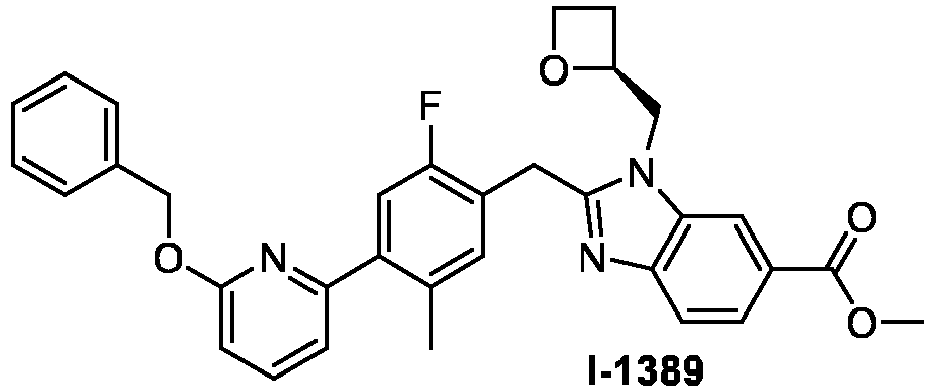
- Methyl (S)-2-(4-(6-(benzyloxy)pyridin-2-yl)-2-fluoro-5-methylbenzyl)-1-(oxetan-2-ylmethyl)-1H-benzo[d]imidazole-6-carboxylate (I-1389): methyl (S)-2-(4-(6-(benzyloxy)pyridin-2-yl)-2-fluoro-5-methylbenzyl)-1-(oxetan-2-ylmethyl)-1H-benzo[d]imidazole-6-carboxylate was prepared in a manner similar to Intermediate I-7, using Intermediate I-1276 and 2-(benzyloxy)-6-bromopyridine. ES/MS m/z: 552.2 (M+H+).
-

- Methyl (S)-2-(2-fluoro-4-(6-hydroxypyridin-2-yl)-5-methylbenzyl)-1-(oxetan-2-ylmethyl)-1H-benzo[d]imidazole-6-carboxylate (I-1390): A mixture of methyl 2-[[4-(6-benzyloxy-2-pyridyl)-2-fluoro-5-methyl-phenyl]methyl]-3-[[(2S)-oxetan-2-yl]methyl]benzimidazole-5-carboxylate (Intermediate I-1389, 150 mg, 1.0 equivalent), 10% Pd on carbon (49.8 mg, 0.20 equivalent), ethyl acetate and ethanol was stirred under an atmosphere of hydrogen at 20 °C for 10 hr. The mixture was filtered and concentrated to yield the title compound. ES/MS m/z: 462.2 (M+H+).
-

- Methyl 2-[[4-[6-[(5-bromothiazol-2-yl)methoxy]-2-pyridyl]-2-fluoro-5-methylphenyl]methyl]-3-[[(2S)-oxetan-2-yl]methyl]benzimidazole-5-carboxylate (I-1391): A mixture of methyl (S)-2-(2-fluoro-4-(6-hydroxypyridin-2-yl)-5-methylbenzyl)-1-(oxetan-2-ylmethyl)-1H-benzo[d]imidazole-6-carboxylate (I-1390, 34 mg, 1.0 equivalent), 5-bromo-2-(bromomethyl)thiazole (19.9 mg, 1.05 equivalent), cesium carbonate (38 mg, 1.6 equivalent), and toluene was stirred at 50 C for 40 min. The mixture was filtered, concentrated and purified by silica gel flash column chromatography to yield the title compound. ES/MS m/z: 638.0 (M+H+).
-

- 2-(bromomethyl)-5,6-dihydro-4H-cyclopenta[d]thiazole (I-1392): A mixture of 5,6-dihydro-4H-cyclopenta[d]thiazol-2-ylmethanol (112 mg, 1.0 equivalent), triphenylphosphine (199 mg, 1.05 equivalent), carbon tetrabromide (251 mg, 1.05 equivalent) and DCM (8 mL) was stirred at RT for 1 hr. The mixture was concentrated and purified by silica gel flash column chromatography to yield the title compound. ES/MS m/z: 218.2 (M+H+).
-

- 5-chloro-4-ethynyl-1-methyl-pyrazole (I-1393): To a mixture of 5-chloro-1-methylpyrazole-4-carbaldehyde (145 mg, 1.0 equivalent) and dimethyl (1-diazo-2-oxopropyl)phosphonate (Ohira-Bestmann reagent, 480 mg, 2.5 equivalent), and MeOH (20 mL) precooled to 0 °C was added cesium carbonate (977 mg, 3.0 equivalent). The mixture was allowed to warm to RT and stirred overnight. The mixture was concentrated and purified by silica gel flash column chromatography (EtOAc/hexane) to yield the title compound.
-

- Asdf4-ethynyl-1,5-dimethyl-pyrazole (I-1394): Asdf4-ethynyl-1,5-dimethyl-pyrazole (I-1394) was prepared in a manner as described for Intermediate I-1393, using 1,5-dimethylpyrazole-4-carbaldehyde
- In the following Examples, compounds that are not according to the invention are designated as Reference Examples.
-

- Methyl 2-[[2,5-difluoro-4-[6-[(5-methoxy-1,3,4-thiadiazol-2-yl)methoxy]-2-pyridyl]phenyl]methyl]-3-[[(2S)-oxetan-2-yl]methyl]benzimidazole-5-carboxylate: To a solution of methyl 2-[[2,5-difluoro-4-(6-hydroxy-2-pyridyl)phenyl]methyl]-3-[[(2S)-oxetan-2-yl]methyl]benzimidazole-5-carboxylate (60.0 mg, 0.13 mmol) and 2-(chloromethyl)-5-methoxy-1,3,4-thiadiazole (23.5 mg, 0.14 mmol) in 11 mL of acetonitrile was added Cs2CO3 (67 mg, 0.21 mmol). The solution was then heated to 50 °C for 30 minutes. Upon completion of the time, the solution was cooled to rt, filtered, then concentrated. The crude material was purified by normal phase chromatography 1-12 % DCM/MeOH. The product containing fractions were combined and concentrated to give the titled product. ES/MS m/z: 594.0 (M+H+).
- 2-[[2,5-difluoro-4-[6-[(5-methoxy-1,3,4-thiadiazol-2-yl)methoxy]-2-pyridyl]phenyl]methyl]-3-[[(2S)-oxetan-2-yl]methyl]benzimidazole-5-carboxylic acid (Reference Example 1): To a solution of methyl 2-[[2,5-difluoro-4-[6-[(5-methoxy-1,3,4-thiadiazol-2-yl)methoxy]-2-pyridyl]phenyl]methyl]-3-[[(2S)-oxetan-2-yl]methyl]benzimidazole-5-carboxylate (36.0 mg, 0.06 mmol) in 3 mL of acetonitrile, 1 mL of water and aqueous LiOH (0.04 mL, 0.09 mmol, 2 M) were added. The solution was then stirred at rt overnight. The following day, a drop of TFA was added, then concentrated into 1 mL of DMF. The crude material was purified by reverse phase chromatography 10-58 % ACN/water with 0.1 % TFA added. The product containing fractions were combined, diluted with EtOAc, and 1 mg of sodium bicarbonate was added per mL of HPLC solvent. The aqueous layer was separated and the organic washed twice with water, then brine. The organic layer was dried over MgSO4, filtered, and concentrated to give Reference Example 1. ES/MS m/z: 580.2 (M+H+); 1H NMR (400 MHz, DMSO) δ 12.78 (s, 1H), 8.26 (d, J = 1.6 Hz, 1H), 8.00 - 7.87 (m, 2H), 7.79 (dd, J = 8.4, 1.6 Hz, 1H), 7.60 (t, J = 8.2 Hz, 2H), 7.40 (dd, J = 11.6, 6.0 Hz, 1H), 6.98 (d, J = 8.2 Hz, 1H), 5.74 (s, 2H), 5.13 - 5.03 (m, 1H), 4.76 (dd, J = 15.6, 7.0 Hz, 1H), 4.63 (dd, J = 15.5, 2.8 Hz, 1H), 4.57 - 4.42 (m, 3H), 4.36 (dt, J = 9.0, 5.9 Hz, 1H), 4.10 (s, 3H), 2.72 (dq, J = 11.2, 7.7 Hz, 1H), 2.46 - 2.31 (m, 1H).
- (S)-2-(4-(6-((5-cyanothiazol-2-yl)methoxy)pyridin-2-yl)-2,5-difluorobenzyl)-1-(oxetan-2-ylmethyl)-1H-benzo[d]imidazole-6-carboxylic acid was prepared in a manner as described in
Procedure 1. 1H NMR (400 MHz, Methanol-d4) δ 8.42 (s, 1H), 8.33 - 8.27 (m, 1H), 7.98 (dd, J = 8.5, 1.5 Hz, 1H), 7.92 - 7.78 (m, 2H), 7.67 (d, J = 8.5 Hz, 1H), 7.64 - 7.58 (m, 1H), 7.20 (dd, J = 11.5, 6.0 Hz, 1H), 7.03 - 6.93 (m, 1H), 5.20 (qd, J = 7.1, 2.6 Hz, 1H), 4.73 (dd, J = 15.7, 6.9 Hz, 1H), 4.68 - 4.39 (m, 6H), 2.83 - 2.66 (m, 1H), 2.61 - 2.38 (m, 1H). - (S)-2-(4-(6-((5-carbamoylthiazol-2-yl)methoxy)pyridin-2-yl)-2,5-difluorobenzyl)-1-(oxetan-2-ylmethyl)-1H-benzo[d]imidazole-6-carboxylic acid was prepared in a manner as described in
Procedure 1. 1H NMR (400 MHz, Methanol-d4) δ 8.30 (d, J = 3.0 Hz, 2H), 7.98 (dd, J = 8.5, 1.6 Hz, 1H), 7.85 (dd, J = 9.6, 6.0 Hz, 2H), 7.66 (d, J = 8.5 Hz, 1H), 7.63 - 7.54 (m, 1H), 7.18 (dd, J = 11.6, 5.9 Hz, 1H), 6.97 (d, J = 8.1 Hz, 1H), 5.79 (s, 2H), 5.19 (d, J = 6.2 Hz, 1H), 4.80 - 4.35 (m, 7H), 2.88 - 2.69 (m, 1H), 2.50 (q, J = 9.8, 8.6 Hz, 1H). - (S)-2-(4-(6-((4-cyanothiazol-2-yl)methoxy)pyridin-2-yl)-2,5-difluorobenzyl)-1-(oxetan-2-ylmethyl)-1H-benzo[d]imidazole-6-carboxylic acid was prepared in a manner as described in
Procedure 1. 1H NMR (400 MHz, Methanol-d4) δ 8.47 (s, 1H), 8.30 (d, J = 1.5 Hz, 1H), 7.98 (dd, J = 8.5, 1.5 Hz, 1H), 7.91 - 7.75 (m, 2H), 7.66 (d, J = 8.5 Hz, 1H), 7.61 (dd, J = 7.4, 1.5 Hz, 1H), 7.19 (dd, J = 11.5, 6.0 Hz, 1H), 6.96 (d, J = 8.2 Hz, 1H), 5.81 (s, 2H), 5.20 (qd, J = 7.0, 2.6 Hz, 1H), 4.73 (dd, J = 15.7, 7.0 Hz, 1H), 4.68 - 4.39 (m, 6H), 2.90 - 2.71 (m, 1H), 2.50 (ddt, J = 11.4, 9.2, 7.2 Hz, 1H). - (S)-2-(4-(6-((4-carbamoylthiazol-2-yl)methoxy)pyridin-2-yl)-2,5-difluorobenzyl)-1-(oxetan-2-ylmethyl)-1H-benzo[d]imidazole-6-carboxylic acid was prepared in a manner as described in
Procedure 1. 1H NMR (400 MHz, Methanol-d4) δ 8.30 (d, J = 1.5 Hz, 1H), 8.21 (s, 1H), 7.98 (dd, J = 8.5, 1.5 Hz, 1H), 7.92 - 7.75 (m, 2H), 7.66 (d, J = 8.5 Hz, 1H), 7.61 (dd, J = 7.4, 1.5 Hz, 1H), 7.19 (dd, J = 11.6, 6.0 Hz, 1H), 6.95 (d, J = 8.2 Hz, 1H), 5.81 (s, 2H), 5.19 (qd, J = 7.0, 2.6 Hz, 1H), 4.72 (dd, J = 15.7, 7.0 Hz, 1H), 4.68 - 4.38 (m, 6H), 2.88 - 2.71 (m, 1H), 2.49 (ddt, J = 11.4, 9.1, 7.2 Hz, 1H). - (S)-2-(4-(6-((1-cyclopropyl-1H-pyrazol-3-yl)methoxy)pyridin-2-yl)-2,5-difluorobenzyl)-1-(oxetan-2-ylmethyl)-1H-benzo[d]imidazole-6-carboxylic acid was prepared in a manner as described in
Procedure 1. 1H NMR (400 MHz, Methanol-d4) δ 8.30 (d, J = 1.4 Hz, 1H), 7.98 (dd, J = 8.5, 1.5 Hz, 1H), 7.94 (dd, J = 10.8, 6.4 Hz, 1H), 7.76 (t, J = 7.9 Hz, 1H), 7.66 (d, J = 8.5 Hz, 1H), 7.62 (d, J = 2.3 Hz, 1H), 7.52 (dd, J = 7.4, 1.6 Hz, 1H), 7.18 (dd, J = 11.5, 6.0 Hz, 1H), 6.82 (d, J = 8.2 Hz, 1H), 6.33 (d, J = 2.4 Hz, 1H), 5.43 (s, 2H), 5.19 (tt, J = 7.0, 3.5 Hz, 1H), 4.78 - 4.29 (m, 7H), 3.66 - 3.52 (m, 1H), 2.95 - 2.71 (m, 1H), 2.61 - 2.39 (m, 1H), 1.17 - 0.93 (m, 4H). - (S)-2-(4-(6-((6,7-dihydro-4H-pyrazolo[5,1-c][1,4]oxazin-2-yl)methoxy)pyridin-2-yl)-2,5-difluorobenzyl)-1-(oxetan-2-ylmethyl)-1H-benzo[d]imidazole-6-carboxylic acid was prepared in a manner as described in
Procedure 1. 1H NMR (400 MHz, Methanol-d4) δ 8.31 (d, J = 1.4 Hz, 1H), 7.99 (dd, J = 8.5, 1.5 Hz, 1H), 7.93 (dd, J = 10.8, 6.4 Hz, 1H), 7.76 (t, J = 7.9 Hz, 1H), 7.67 (d, J = 8.5 Hz, 1H), 7.53 (dd, J = 7.5, 1.6 Hz, 1H), 7.18 (dd, J = 11.5, 6.1 Hz, 1H), 6.83 (d, J = 8.2 Hz, 1H), 6.17 (s, 1H), 5.45 (s, 2H), 5.20 (dd, J = 7.4, 2.5 Hz, 1H), 4.82 (s, 2H), 4.78 - 4.39 (m, 6H), 4.17 - 4.02 (m, 4H), 2.80 (dtd, J = 11.5, 8.1, 6.1 Hz, 1H), 2.50 (ddt, J = 11.4, 9.1, 7.1 Hz, 1H). - (S)-2-(4-(6-((2-carbamoylthiazol-4-yl)methoxy)pyridin-2-yl)-2,5-difluorobenzyl)-1-(oxetan-2-ylmethyl)-1H-benzo[d]imidazole-6-carboxylic acid was prepared in a manner as described in
Procedure 1. 1H NMR (400 MHz, Methanol-d4) δ 8.32 (s, 1H), 7.99 (dd, J = 8.5, 1.5 Hz, 1H), 7.88 (dd, J = 10.7, 6.4 Hz, 1H), 7.84 - 7.75 (m, 2H), 7.68 (d, J = 8.5 Hz, 1H), 7.60 - 7.52 (m, 1H), 7.19 (dd, J = 11.5, 6.1 Hz, 1H), 6.91 (d, J = 8.2 Hz, 1H), 5.64 (d, J = 0.9 Hz, 2H), 5.20 (tt, J = 7.1, 3.7 Hz, 1H), 4.80 - 4.37 (m, 7H), 2.91 - 2.71 (m, 1H), 2.59 - 2.39 (m, 1H). - (S)-2-(4-(6-((1-(difluoromethyl)-1H-pyrazol-3-yl)methoxy)pyridin-2-yl)-2,5-difluorobenzyl)-1-(oxetan-2-ylmethyl)-1H-benzo[d]imidazole-6-carboxylic acid was prepared in a manner as described in
Procedure 1. 1H NMR (400 MHz, Methanol-d4) δ 8.34 (d, J = 1.4 Hz, 1H), 8.07 - 7.98 (m, 2H), 7.94 (dd, J = 10.8, 6.4 Hz, 1H), 7.78 (t, J = 7.9 Hz, 1H), 7.68 (d, J = 8.5 Hz, 1H), 7.55 (dd, J = 7.4, 1.6 Hz, 1H), 7.47 (t, J = 59.8 Hz, 1H), 7.20 (dd, J = 11.5, 6.0 Hz, 1H), 6.87 (d, J = 8.2 Hz, 1H), 6.59 (d, J = 2.7 Hz, 1H), 5.52 (s, 2H), 5.20 (qd, J = 7.1, 2.5 Hz, 1H), 4.80 - 4.30 (m, 7H), 2.81 (dtd, J = 11.4, 8.2, 6.1 Hz, 1H), 2.50 (ddt, J = 11.5, 9.2, 7.2 Hz, 1H). - (S)-2-(2,5-difluoro-4-(6-((1-(oxetan-3-yl)-1H-pyrazol-3-yl)methoxy)pyridin-2-yl)benzyl)-1-(oxetan-2-ylmethyl)-1H-benzo[d]imidazole-6-carboxylic acid was prepared in a manner as described in
Procedure 1. 1H NMR (400 MHz, Methanol-d4) δ 8.31 (d, J = 1.4 Hz, 1H), 8.01 - 7.90 (m, 2H), 7.81 - 7.69 (m, 2H), 7.67 (d, J = 8.4 Hz, 1H), 7.53 (dd, J = 7.4, 1.5 Hz, 1H), 7.18 (dd, J = 11.5, 6.0 Hz, 1H), 6.84 (d, J = 8.2 Hz, 1H), 6.42 (d, J = 2.3 Hz, 1H), 5.63 - 5.53 (m, 1H), 5.51 (s, 2H), 5.19 (dt, J = 7.1, 3.5 Hz, 1H), 5.11 - 4.98 (m, 5H), 4.78 - 4.30 (m, 7H), 2.80 (ddd, J = 10.4, 5.6, 2.6 Hz, 1H), 2.50 (ddt, J = 9.2, 7.4, 1.9 Hz, 1H). - (S)-2-(2,5-difluoro-4-(6-(thiazol-2-ylmethoxy)pyridin-2-yl)benzyl)-1-(oxetan-2-ylmethyl)-1H-benzo[d]imidazole-6-carboxylic acid was prepared in a manner as described in
Procedure 1. 1H NMR (400 MHz, Methanol-d4) δ 8.31 (d, J = 1.4 Hz, 1H), 7.99 (dd, J = 8.5, 1.5 Hz, 1H), 7.92 - 7.78 (m, 4H), 7.67 (d, J = 8.5 Hz, 1H), 7.62 - 7.55 (m, 2H), 7.19 (dd, J = 11.5, 6.0 Hz, 1H), 6.93 (d, J = 8.2 Hz, 1H), 5.81 (s, 2H), 5.19 (qd, J = 7.1, 2.5 Hz, 1H), 4.79 - 4.37 (m, 8H), 2.87 - 2.67 (m, 1H), 2.49 (dq, J = 11.2, 7.6 Hz, 1H). - (S)-2-(2,5-difluoro-4-(6-((1-(trifluoromethyl)-1H-pyrazol-3-yl)methoxy)pyridin-2-yl)benzyl)-1-(oxetan-2-ylmethyl)-1H-benzo[d]imidazole-6-carboxylic acid was prepared in a manner as described in
Procedure 1. 1H NMR (400 MHz, Methanol-d4) δ 8.31 (d, J = 1.5 Hz, 1H), 8.15 (d, J = 2.8 Hz, 1H), 7.99 (dd, J = 8.5, 1.5 Hz, 1H), 7.93 (dd, J = 10.8, 6.4 Hz, 1H), 7.79 (t, J = 7.9 Hz, 1H), 7.67 (d, J = 8.5 Hz, 1H), 7.56 (dd, J = 7.4, 1.6 Hz, 1H), 7.18 (dd, J = 11.5, 6.0 Hz, 1H), 6.88 (d, J = 8.2 Hz, 1H), 6.64 (d, J = 2.8 Hz, 1H), 5.54 (s, 2H), 5.19 (tt, J = 7.1, 3.5 Hz, 1H), 4.77 - 4.32 (m, 7H), 2.80 (dtd, J = 11.5, 8.2, 6.1 Hz, 1H), 2.50 (ddt, J = 11.5, 9.1, 7.2 Hz, 1H). - (S)-2-(2,5-difluoro-4-(6-((5-(trifluoromethyl)isothiazol-3-yl)methoxy)pyridin-2-yl)benzyl)-1-(oxetan-2-ylmethyl)-1H-benzo[d]imidazole-6-carboxylic acid was prepared in a manner as described in
Procedure 1. 1H NMR (400 MHz, Methanol-d4) δ 8.31 (d, J = 1.4 Hz, 1H), 7.99 (dd, J = 8.5, 1.6 Hz, 1H), 7.87 (d, J = 1.1 Hz, 1H), 7.82 (t, J = 7.9 Hz, 1H), 7.76 (dd, J = 10.8, 6.4 Hz, 1H), 7.67 (d, J = 8.5 Hz, 1H), 7.57 (dd, J = 7.4, 1.5 Hz, 1H), 7.17 (dd, J = 11.5, 6.0 Hz, 1H), 6.95 (d, J = 8.2 Hz, 1H), 5.64 (s, 2H), 5.20 (qd, J = 7.1, 2.6 Hz, 1H), 4.73 (dd, J = 15.7, 7.0 Hz, 1H), 4.68 - 4.40 (m, 6H), 2.80 (dtd, J = 11.4, 8.1, 6.1 Hz, 1H), 2.59 - 2.43 (m, 1H). - (S)-2-(4-(6-((5-cyanofuran-2-yl)methoxy)pyridin-2-yl)-2,5-difluorobenzyl)-1-(oxetan-2-ylmethyl)-1H-benzo[d]imidazole-6-carboxylic acid was prepared in a manner as described in
Procedure 1. 1H NMR (400 MHz, DMSO) δ 8.25 (s, 1H), 7.96 - 7.85 (m, 2H), 7.79 (dd, J = 8.5, 1.5 Hz, 1H), 7.66 - 7.49 (m, 3H), 7.40 (dd, J = 11.5, 6.0 Hz, 1H), 6.96 (d, J = 8.2 Hz, 1H), 6.86 (d, J = 3.6 Hz, 1H), 5.54 (s, 2H), 5.08 (d, J = 6.5 Hz, 1H), 4.76 (dd, J = 15.6, 7.1 Hz, 1H), 4.70 - 4.41 (m, 4H), 4.36 (dt, J = 9.0, 5.9 Hz, 1H), 2.82 - 2.64 (m, 1H), 2.46 - 2.29 (m, 1H). - (S)-2-(4-(6-((5-(difluoromethyl)-1,3,4-thiadiazol-2-yl)methoxy)pyridin-2-yl)-2,5-difluorobenzyl)-1-(oxetan-2-ylmethyl)-1H-benzo[d]imidazole-6-carboxylic acid was prepared in a manner as described in
Procedure 1. 1H NMR (400 MHz, DMSO) δ 12.77 (s, 1H), 8.26 (d, J = 1.5 Hz, 1H), 7.95 (t, J = 7.9 Hz, 1H), 7.88 (dd, J = 10.5, 6.5 Hz, 1H), 7.79 (dd, J = 8.4, 1.5 Hz, 1H), 7.66 - 7.54 (m, 3H), 7.46 - 7.35 (m, 1H), 7.04 (d, J = 8.2 Hz, 1H), 6.02 (s, 2H), 5.07 (qd, J = 7.0, 2.7 Hz, 1H), 4.76 (dd, J = 15.6, 7.0 Hz, 1H), 4.62 (dd, J = 15.6, 2.8 Hz, 1H), 4.58 - 4.40 (m, 3H), 4.35 (dt, J = 9.0, 5.9 Hz, 1H), 2.73 (ddd, J = 11.4, 8.3, 6.3 Hz, 1H), 2.39 (ddt, J = 11.2, 9.1, 7.0 Hz, 1H). - (S)-2-(2,5-difluoro-4-(6-((3-(methoxymethyl)-1,2,4-oxadiazol-5-yl)methoxy)pyridin-2-yl)benzyl)-1-(oxetan-2-ylmethyl)-1H-benzo[d]imidazole-6-carboxylic acid was prepared in a manner as described in
Procedure 1. 1H NMR (400 MHz, DMSO) δ 12.80 (s, 1H), 8.25 (d, J = 1.6 Hz, 1H), 7.98 - 7.90 (m, 1H), 7.79 (dd, J = 8.4, 1.6 Hz, 1H), 7.66 - 7.54 (m, 3H), 7.37 (dd, J = 11.6, 6.1 Hz, 1H), 7.07 (d, J = 8.2 Hz, 1H), 5.78 (s, 2H), 5.07 (qd, J = 6.9, 2.6 Hz, 1H), 4.75 (dd, J = 15.6, 7.1 Hz, 1H), 4.62 (dd, J = 15.6, 2.8 Hz, 1H), 4.52 (d, J = 17.1 Hz, 4H), 4.43 (d, J = 16.8 Hz, 1H), 4.35 (dt, J = 9.0, 5.9 Hz, 1H), 3.27 (s, 3H), 2.78 - 2.65 (m, 1H), 2.39 (ddt, J = 11.3, 9.0, 7.0 Hz, 1H). - (S)-2-(2,5-difluoro-4-(6-((5-methyl-1,2,4-oxadiazol-3-yl)methoxy)pyridin-2-yl)benzyl)-1-(oxetan-2-ylmethyl)-1H-benzo[d]imidazole-6-carboxylic acid was prepared in a manner as described in
Procedure 1. 1H NMR (400 MHz, DMSO) δ 12.78 (s, 1H), 8.26 (d, J = 1.6 Hz, 1H), 8.00 - 7.87 (m, 2H), 7.79 (dd, J = 8.4, 1.6 Hz, 1H), 7.60 (t, J = 8.2 Hz, 2H), 7.40 (dd, J = 11.6, 6.0 Hz, 1H), 6.98 (d, J = 8.2 Hz, 1H), 5.74 (s, 2H), 5.13 - 5.03 (m, 1H), 4.76 (dd, J = 15.6, 7.0 Hz, 1H), 4.63 (dd, J = 15.5, 2.8 Hz, 1H), 4.57 - 4.42 (m, 3H), 4.36 (dt, J = 9.0, 5.9 Hz, 1H), 4.10 (s, 3H), 2.72 (dq, J = 11.2, 7.7 Hz, 1H), 2.46 - 2.31 (m, 1H). - (S)-2-(2,5-difluoro-4-(6-((4-(trifluoromethyl)furan-2-yl)methoxy)pyridin-2-yl)benzyl)-1-(oxetan-2-ylmethyl)-1H-benzo[d]imidazole-6-carboxylic acid was prepared in a manner as described in
Procedure 1. 1H NMR (400 MHz, DMSO) δ 12.78 (s, 1H), 8.47 (p, J = 1.5 Hz, 1H), 8.26 (d, J = 1.5 Hz, 1H), 7.95 - 7.85 (m, 2H), 7.79 (dd, J = 8.4, 1.5 Hz, 1H), 7.60 (d, J = 8.4 Hz, 1H), 7.54 (dd, J = 7.5, 1.8 Hz, 1H), 7.40 (dd, J = 11.5, 6.1 Hz, 1H), 6.99 (s, 1H), 6.93 (d, J = 8.2 Hz, 1H), 5.49 (s, 2H), 5.08 (qd, J = 7.0, 2.7 Hz, 1H), 4.76 (dd, J = 15.6, 7.1 Hz, 1H), 4.63 (dd, J = 15.5, 2.7 Hz, 1H), 4.58 - 4.41 (m, 3H), 4.36 (dt, J = 8.9, 5.9 Hz, 1H), 2.79 - 2.68 (m, 1H), 2.39 (ddt, J = 11.1, 9.0, 6.9 Hz, 1H). - (S)-2-(4-(6-((1-(difluoromethyl)-1H-imidazol-2-yl)methoxy)pyridin-2-yl)-2,5-difluorobenzyl)-1-(oxetan-2-ylmethyl)-1H-benzo[d]imidazole-6-carboxylic acid was prepared in a manner as described in
Procedure 1. 1H NMR (400 MHz, DMSO) δ 12.78 (s, 1H), 8.26 (d, J = 1.5 Hz, 1H), 8.00 - 7.84 (m, 3H), 7.83 - 7.76 (m, 1H), 7.68 - 7.58 (m, 2H), 7.55 (dd, J = 7.4, 1.8 Hz, 1H), 7.39 (dd, J = 11.5, 6.1 Hz, 1H), 7.11 (d, J = 1.5 Hz, 1H), 6.93 (d, J = 8.2 Hz, 1H), 5.63 (s, 2H), 5.08 (qd, J = 7.0, 2.7 Hz, 1H), 4.76 (dd, J = 15.6, 7.1 Hz, 1H), 4.63 (dd, J = 15.6, 2.8 Hz, 1H), 4.58 - 4.41 (m, 3H), 4.36 (dt, J = 9.0, 5.9 Hz, 1H), 2.73 (dtd, J = 11.3, 8.2, 6.3 Hz, 1H), 2.46 - 2.35 (m, 1H). - (S)-2-(4-(6-((2-chlorothiazol-5-yl)methoxy)pyridin-2-yl)-2,5-difluorobenzyl)-1-(oxetan-2-ylmethyl)-1H-benzo[d]imidazole-6-carboxylic acid was prepared in a manner as described in
Procedure 1. 1H NMR (400 MHz, DMSO) δ 8.25 (d, J = 1.6 Hz, 1H), 8.01 - 7.87 (m, 2H), 7.85 (s, 1H), 7.79 (dd, J = 8.4, 1.5 Hz, 1H), 7.63 - 7.53 (m, 2H), 7.42 (dd, J = 11.6, 6.1 Hz, 1H), 6.93 (d, J = 8.3 Hz, 1H), 5.69 (s, 2H), 5.11 - 5.04 (m, 1H), 4.76 (dd, J = 15.5, 7.1 Hz, 1H), 4.63 (dd, J = 15.5, 2.8 Hz, 1H), 4.59 - 4.42 (m, 3H), 4.36 (dt, J = 8.9, 5.9 Hz, 1H), 2.78 - 2.68 (m, 1H), 2.39 (s, 1H). - (S)-2-(4-(6-((2-bromothiazol-5-yl)methoxy)pyridin-2-yl)-2,5-difluorobenzyl)-1-(oxetan-2-ylmethyl)-1H-benzo[d]imidazole-6-carboxylic acid was prepared in a manner as described in
Procedure 1. 1H NMR (400 MHz, DMSO-d6) δ 8.30 (d, J = 1.5 Hz, 1H), 7.97 (dd, J = 10.5, 6.4 Hz, 1H), 7.90 (t, J = 7.9 Hz, 1H), 7.86 - 7.80 (m, 2H), 7.63 (d, J = 8.4 Hz, 1H), 7.57 (dd, J = 7.4, 1.6 Hz, 1H), 7.44 (dd, J = 11.6, 6.0 Hz, 1H), 6.93 (d, J = 8.2 Hz, 1H), 5.70 (s, 2H), 5.08 (d, J = 6.9 Hz, 1H), 4.80 (dd, J = 15.5, 7.1 Hz, 1H), 4.66 (dd, J = 15.8, 2.7 Hz, 1H), 4.62 - 4.45 (m, 3H), 4.37 (dt, J = 9.2, 6.0 Hz, 1H), 2.78 - 2.70 (m, 1H), 2.43 - 2.37 (m, 1H). - (S)-2-(4-(6-((5-bromothiazol-2-yl)methoxy)pyridin-2-yl)-2,5-difluorobenzyl)-1-(oxetan-2-ylmethyl)-1H-benzo[d]imidazole-6-carboxylic acid was prepared in a manner as described in
Procedure 1. 1H NMR (400 MHz, DMSO-d6) δ 8.31 (d, J = 1.5 Hz, 1H), 7.97 - 7.86 (m, 3H), 7.83 (dd, J = 8.5, 1.5 Hz, 1H), 7.64 (d, J = 8.5 Hz, 1H), 7.59 (dd, J = 7.4, 1.6 Hz, 1H), 7.42 (dd, J = 11.6, 6.1 Hz, 1H), 7.01 (d, J = 8.2 Hz, 1H), 5.75 (s, 2H), 5.08 (dt, J = 9.3, 4.6 Hz, 1H), 4.80 (dd, J = 15.6, 7.2 Hz, 1H), 4.66 (dd, J = 15.6, 2.8 Hz, 1H), 4.63 - 4.44 (m, 3H), 4.37 (dt, J = 9.1, 6.0 Hz, 1H), 2.81 - 2.65 (m, 1H), 2.44 - 2.30 (m, 1H). - (S)-2-(4-(6-((4-cyanothiazol-2-yl)methoxy)pyridin-2-yl)-2,5-difluorobenzyl)-1-(oxetan-2-ylmethyl)-1H-benzo[d]imidazole-6-carboxylic acid was prepared in a manner as described in
Procedure 1. 1H NMR (400 MHz, Methanol-d4) δ 8.47 (s, 1H), 8.30 (d, J = 1.5 Hz, 1H), 7.98 (dd, J = 8.5, 1.5 Hz, 1H), 7.91 - 7.75 (m, 2H), 7.66 (d, J = 8.5 Hz, 1H), 7.61 (dd, J = 7.4, 1.5 Hz, 1H), 7.19 (dd, J = 11.5, 6.0 Hz, 1H), 6.96 (d, J = 8.2 Hz, 1H), 5.81 (s, 2H), 5.20 (qd, J = 7.0, 2.6 Hz, 1H), 4.73 (dd, J = 15.7, 7.0 Hz, 1H), 4.68 - 4.39 (m, 6H), 2.90 - 2.71 (m, 1H), 2.50 (ddt, J = 11.4, 9.2, 7.2 Hz, 1H). - (S)-2-(2,5-difluoro-4-(6-((5-(trifluoromethyl)isoxazol-3-yl)methoxy)pyridin-2-yl)benzyl)-1-(oxetan-2-ylmethyl)-1H-benzo[d]imidazole-6-carboxylic acid was prepared in a manner as described in
Procedure 1. 1H NMR (400 MHz, DMSO-d6) δ 8.26 (d, J = 1.5 Hz, 1H), 7.92 (t, J = 7.9 Hz, 1H), 7.82 - 7.74 (m, 2H), 7.60 (dd, J = 4.8, 3.7 Hz, 2H), 7.56 (dd, J = 7.5, 1.6 Hz, 1H), 7.39 (dd, J = 11.6, 6.0 Hz, 1H), 7.00 (d, J = 8.2 Hz, 1H), 5.66 (s, 2H), 5.08 (qd, J = 7.0, 2.7 Hz, 1H), 4.76 (dd, J = 15.6, 7.0 Hz, 1H), 4.62 (dd, J = 15.6, 2.8 Hz, 1H), 4.58 - 4.40 (m, 3H), 4.36 (dt, J = 9.0, 5.9 Hz, 1H), 2.83 - 2.63 (m, 1H), 2.39 (ddt, J = 11.2, 9.0, 7.1 Hz, 1H). - (S)-2-(2,5-difluoro-4-(6-((5-(trifluoromethyl)-1,3,4-thiadiazol-2-yl)methoxy)pyridin-2-yl)benzyl)-1-(oxetan-2-ylmethyl)-1H-benzo[d]imidazole-6-carboxylic acid was prepared in a manner as described in
Procedure 1. 1H NMR (400 MHz, DMSO-d6) δ 8.25 (d, J = 1.5 Hz, 1H), 7.95 (t, J = 7.9 Hz, 1H), 7.85 (dd, J = 10.5, 6.5 Hz, 1H), 7.79 (dd, J = 8.4, 1.6 Hz, 1H), 7.60 (td, J = 5.8, 5.4, 2.9 Hz, 2H), 7.39 (dd, J = 11.5, 6.0 Hz, 1H), 7.05 (d, J = 8.3 Hz, 1H), 6.05 (s, 2H), 5.07 (d, J = 7.6 Hz, 1H), 4.75 (dd, J = 15.6, 7.0 Hz, 1H), 4.62 (dd, J = 15.6, 2.8 Hz, 1H), 4.58 - 4.41 (m, 3H), 4.35 (dt, J = 9.1, 5.9 Hz, 1H), 2.79 - 2.68 (m, 1H), 2.39 (q, J = 10.0, 8.6 Hz, 1H). - (S)-2-(2,5-difluoro-4-(6-(thiazolo[5,4-b]pyridin-2-ylmethoxy)pyridin-2-yl)benzyl)-1-(oxetan-2-ylmethyl)-1H-benzo[d]imidazole-6-carboxylic acid was prepared in a manner as described in
Procedure 1. 1H NMR (400 MHz, Chloroform-d) δ 8.61 (dd, J = 4.7, 1.5 Hz, 1H), 8.32 (dd, J = 8.2, 1.5 Hz, 1H), 8.19 (d, J = 1.5 Hz, 1H), 8.08 (dd, J = 8.5, 1.5 Hz, 1H), 7.90 - 7.82 (m, 2H), 7.74 (t, J = 7.8 Hz, 1H), 7.57 (d, J = 7.4 Hz, 1H), 7.47 (dd, J = 8.2, 4.6 Hz, 1H), 7.13 (dd, J = 11.3, 6.0 Hz, 1H), 6.94 (d, J = 8.2 Hz, 1H), 5.90 (s, 2H), 5.26 - 5.12 (m, 1H), 4.65 (q, J = 7.4 Hz, 1H), 4.62 - 4.34 (m, 5H), 2.74 (dt, J = 14.7, 6.9 Hz, 1H), 2.43 (ddd, J = 15.5, 10.4, 7.2 Hz, 1H). - (S)-2-(4-(6-((5-bromo-4-methylthiazol-2-yl)methoxy)pyridin-2-yl)-2,5-difluorobenzyl)-1-(oxetan-2-ylmethyl)-1H-benzo[d]imidazole-6-carboxylic acid was prepared in a manner as described in
Procedure 1. 1H NMR (400 MHz, DMSO-d6) δ 8.25 (d, J = 1.5 Hz, 1H), 7.96 - 7.85 (m, 2H), 7.79 (dd, J = 8.4, 1.5 Hz, 1H), 7.63 - 7.5 6 (m, 2H), 7.39 (dd, J = 11.6, 6.0 Hz, 1H), 7.00 (d, J = 8.3 Hz, 1H), 5.70 (s, 2H), 5.07 (tt, J = 7.3, 4.1 Hz, 1H), 4.75 (dd, J = 15.6, 7.1 Hz, 1H), 4.62 (dd, J = 15.5, 2.8 Hz, 1H), 4.58 - 4.41 (m, 3H), 4.36 (dt, J = 9.0, 5.9 Hz, 1H), 2.79 - 2.68 (m, 1H), 2.40 (dt, J = 11.3, 8.0 Hz, 1H), 2.34 (s, 3H). - (S)-2-(2,5-difluoro-4-(6-(pyrazolo[1,5-a]pyridin-2-ylmethoxy)pyridin-2-yl)benzyl)-1-(oxetan-2-ylmethyl)-1H-benzo[d]imidazole-6-carboxylic acid was prepared in a manner as described in
Procedure 1. 1H NMR (400 MHz, Methanol-d4) δ 8.57 (d, J = 1.4 Hz, 1H), 8.53 - 8.46 (m, 1H), 8.21 (dd, J = 8.6, 1.4 Hz, 1H), 7.99 (dd, J = 10.9, 6.3 Hz, 1H), 7.89 - 7.73 (m, 2H), 7.67 - 7.53 (m, 2H), 7.36 (dd, J = 11.3, 6.0 Hz, 1H), 7.21 (ddd, J = 8.9, 6.8, 1.1 Hz, 1H), 6.93 (d, J = 8.3 Hz, 1H), 6.88 (td, J = 6.9, 1.4 Hz, 1H), 6.65 (s, 1H), 5.68 (s, 2H), 5.26 (qd, J = 7.4, 2.4 Hz, 1H), 4.99 (dd, J = 15.5, 7.5 Hz, 1H), 4.86 - 4.76 (m, 3H), 4.76 - 4.65 (m, 1H), 4.54 (dt, J = 9.2, 6.0 Hz, 1H), 2.87 (dtd, J = 11.5, 8.2, 6.1 Hz, 1H), 2.73 - 2.50 (m, 1H). - (S)-2-(2,5-difluoro-4-(6-(imidazo[1,2-a]pyrimidin-2-ylmethoxy)pyridin-2-yl)benzyl)-1-(oxetan-2-ylmethyl)-1H-benzo[d]imidazole-6-carboxylic acid was prepared in a manner as described in
Procedure 1. 1H NMR (400 MHz, Methanol-d4) δ 9.16 (dd, J = 6.8, 1.8 Hz, 1H), 8.98 (dd, J = 4.4, 1.8 Hz, 1H), 8.52 (d, J = 1.4 Hz, 1H), 8.23 (s, 1H), 8.16 (dd, J = 8.6, 1.5 Hz, 1H), 7.98 (dd, J = 10.6, 6.3 Hz, 1H), 7.89 (t, J = 7.9 Hz, 1H), 7.76 (d, J = 8.6 Hz, 1H), 7.64 (dd, J = 7.5, 1.5 Hz, 1H), 7.56 (dd, J = 6.8, 4.3 Hz, 1H), 7.36 (dd, J = 11.2, 6.0 Hz, 1H), 7.00 (d, J = 8.2 Hz, 1H), 5.80 (s, 2H), 5.26 (tt, J = 7.4, 3.8 Hz, 1H), 5.00 - 4.92 (m, 1H), 4.84 - 4.64 (m, 4H), 4.52 (dt, J = 9.2, 5.9 Hz, 1H), 2.87 (ddd, J = 14.1, 9.7, 6.9 Hz, 1H), 2.69 - 2.46 (m, 1H). - (S)-2-(2,5-difluoro-4-(6-(imidazo[1,2-a]pyridin-2-ylmethoxy)pyridin-2-yl)benzyl)-1-(oxetan-2-ylmethyl)-1H-benzo[d]imidazole-6-carboxylic acid was prepared in a manner as described in
Procedure 1. 1H NMR (400 MHz, Methanol-d4) δ 8.80 (dt, J = 6.8, 1.2 Hz, 1H), 8.50 (d, J = 1.3 Hz, 1H), 8.33 (s, 1H), 8.15 (dd, J = 8.6, 1.5 Hz, 1H), 8.05 - 7.84 (m, 4H), 7.75 (d, J = 8.5 Hz, 1H), 7.64 (dd, J = 7.5, 1.5 Hz, 1H), 7.51 (td, J = 6.9, 1.2 Hz, 1H), 7.36 (dd, J = 11.3, 6.0 Hz, 1H), 7.00 (d, J = 8.3 Hz, 1H), 5.81 (d, J = 0.8 Hz, 2H), 5.26 (qd, J = 7.4, 2.5 Hz, 1H), 4.99 - 4.91 (m, 1H), 4.85 - 4.61 (m, 4H), 4.51 (dt, J = 9.2, 5.9 Hz, 1H), 2.86 (dtd, J = 11.5, 8.2, 6.1 Hz, 1H), 2.56 (ddt, J = 11.6, 9.1, 7.2 Hz, 1H). - (S)-2-(4-(6-((6-cyanoimidazo[1,2-a]pyridin-2-yl)methoxy)pyridin-2-yl)-2,5-difluorobenzyl)-1-(oxetan-2-ylmethyl)-1H-benzo[d]imidazole-6-carboxylic acid was prepared in a manner as described in
Procedure 1. 1H NMR (400 MHz, Methanol-d4) δ 9.24 (t, J = 1.3 Hz, 1H), 8.58 (t, J = 1.0 Hz, 1H), 8.29 - 8.12 (m, 2H), 7.97 (dd, J = 10.7, 6.3 Hz, 1H), 7.86 (t, J = 7.9 Hz, 1H), 7.84 - 7.77 (m, 2H), 7.74 (dd, J = 9.4, 1.6 Hz, 1H), 7.61 (dd, J = 7.6, 1.6 Hz, 1H), 7.39 (dd, J = 11.2, 6.0 Hz, 1H), 6.97 (d, J = 8.2 Hz, 1H), 5.80 - 5.68 (m, 2H), 5.26 (td, J = 7.4, 2.4 Hz, 1H), 4.99 (dd, J = 15.5, 7.5 Hz, 1H), 4.87 - 4.76 (m, 3H), 4.76 - 4.64 (m, 1H), 4.54 (dt, J = 9.1, 6.0 Hz, 1H), 2.99 - 2.80 (m, 1H), 2.59 (ddt, J = 11.6, 9.1, 7.2 Hz, 1H). - (S)-2-(4-(6-((6-chloroimidazo[1,2-a]pyridin-2-yl)methoxy)pyridin-2-yl)-2,5-difluorobenzyl)-1-(oxetan-2-ylmethyl)-1H-benzo[d]imidazole-6-carboxylic acid was prepared in a manner as described in
Procedure 1. 1H NMR (400 MHz, Methanol-d4) δ 8.99 (dd, J = 1.9, 0.9 Hz, 1H), 8.52 (d, J = 1.4 Hz, 1H), 8.26 (s, 1H), 8.17 (dd, J = 8.6, 1.5 Hz, 1H), 8.04 - 7.93 (m, 2H), 7.93 - 7.83 (m, 2H), 7.76 (d, J = 8.5 Hz, 1H), 7.63 (dd, J = 7.4, 1.5 Hz, 1H), 7.37 (dd, J = 11.2, 6.0 Hz, 1H), 6.99 (d, J = 8.2 Hz, 1H), 5.83 - 5.71 (m, 2H), 5.26 (qd, J = 7.3, 2.4 Hz, 1H), 5.02 - 4.92 (m, 1H), 4.84 - 4.62 (m, 4H), 4.52 (dt, J = 9.2, 5.9 Hz, 1H), 2.87 (dtd, J = 11.5, 8.2, 6.1 Hz, 1H), 2.57 (ddt, J = 11.5, 9.0, 7.2 Hz, 1H). - (S)-2-(2,5-difluoro-4-(6-(imidazo[1,2-a]pyrazin-2-ylmethoxy)pyridin-2-yl)benzyl)-1-(oxetan-2-ylmethyl)-1H-benzo[d]imidazole-6-carboxylic acid was prepared in a manner as described in
Procedure 1. 1H NMR (400 MHz, Methanol-d4) δ 9.09 (s, 1H), 8.61 (s, 1H), 8.57 (dd, J = 4.6, 1.5 Hz, 1H), 8.31 - 8.20 (m, 2H), 8.08 - 7.92 (m, 2H), 7.90 - 7.76 (m, 2H), 7.61 (dd, J = 7.5, 1.6 Hz, 1H), 7.45 - 7.36 (m, 1H), 6.98 (d, J = 8.3 Hz, 1H), 5.76 (s, 2H), 5.27 (td, J = 7.3, 2.4 Hz, 1H), 5.02 (dd, J = 15.4, 7.6 Hz, 1H), 4.85 - 4.76 (m, 2H), 4.71 (td, J = 8.2, 6.2 Hz, 1H), 4.66 - 4.59 (m, 1H), 4.56 (dt, J = 9.1, 6.0 Hz, 1H), 2.96 - 2.82 (m, 1H), 2.59 (ddt, J = 11.7, 9.2, 7.2 Hz, 1H). - (S)-2-(4-(6-(benzo[d]thiazol-2-ylmethoxy)pyridin-2-yl)-2,5-difluorobenzyl)-1-(oxetan-2-ylmethyl)-1H-benzo[d]imidazole-6-carboxylic acid was prepared in a manner as described in
Procedure 1. 1H NMR (400 MHz, Methanol-d4) δ 8.46 (t, J = 0.9 Hz, 1H), 8.15 (dd, J = 8.6, 1.5 Hz, 1H), 8.00 (d, J = 8.3 Hz, 1H), 7.95 (d, J = 7.9 Hz, 1H), 7.87 (dd, J = 10.8, 6.8 Hz, 2H), 7.73 (d, J = 8.6 Hz, 1H), 7.67 - 7.59 (m, 1H), 7.51 (ddd, J = 8.3, 7.3, 1.3 Hz, 1H), 7.43 (ddd, J = 8.3, 7.2, 1.2 Hz, 1H), 7.26 (dd, J = 11.3, 6.0 Hz, 1H), 7.01 (d, J = 8.1 Hz, 1H), 5.90 (s, 2H), 5.29 - 5.16 (m, 1H), 4.88 (d, J = 7.5 Hz, 1H), 4.80 - 4.61 (m, 4H), 4.50 (dt, J = 9.1, 6.0 Hz, 1H), 2.90 - 2.76 (m, 1H), 2.66 - 2.45 (m, 1H). - (S)-2-(4-(6-((5-chlorobenzo[d]thiazol-2-yl)methoxy)pyridin-2-yl)-2,5-difluorobenzyl)-1-(oxetan-2-ylmethyl)-1H-benzo[d]imidazole-6-carboxylic acid was prepared in a manner as described in
Procedure 1. 1H NMR (400 MHz, Methanol-d4) δ 8.44 (d, J = 1.4 Hz, 1H), 8.14 (dd, J = 8.6, 1.5 Hz, 1H), 7.91 (d, J = 8.6 Hz, 1H), 7.84 (dd, J = 9.7, 5.8 Hz, 2H), 7.78 (s, 2H), 7.73 (d, J = 8.5 Hz, 1H), 7.61 (d, J = 7.6 Hz, 1H), 7.41 (dd, J = 8.6, 2.1 Hz, 1H), 7.24 (dd, J = 11.3, 6.0 Hz, 1H), 7.00 (d, J = 8.2 Hz, 1H), 5.89 (s, 2H), 5.27 - 5.12 (m, 1H), 4.85 (d, J = 7.4 Hz, 1H), 4.77 - 4.57 (m, 4H), 4.50 (dt, J = 9.3, 6.0 Hz, 1H), 2.94 - 2.76 (m, 1H), 2.64 - 2.46 (m, 1H). - (S)-2-(2,5-difluoro-4-(6-((1-methyl-1H-pyrazol-5-yl)methoxy)pyridin-2-yl)benzyl)-1-(oxetan-2-ylmethyl)-1H-benzo[d]imidazole-6-carboxylic acid was prepared in a manner as described in
Procedure 1. 1H NMR (400 MHz, DMSO-d6) δ 8.27 (d, J = 1.5 Hz, 1H), 7.96 - 7.84 (m, 2H), 7.80 (dd, J = 8.4, 1.6 Hz, 1H), 7.61 (d, J = 8.4 Hz, 1H), 7.53 (dd, J = 7.4, 1.7 Hz, 1H), 7.47 - 7.35 (m, 2H), 6.93 (d, J = 8.2 Hz, 1H), 6.38 (d, J = 1.8 Hz, 1H), 5.54 (s, 2H), 5.08 (qd, J = 7.0, 2.7 Hz, 1H), 4.76 (dd, J = 15.6, 7.1 Hz, 1H), 4.63 (dd, J = 15.5, 2.8 Hz, 1H), 4.58 - 4.40 (m, 3H), 4.36 (dt, J = 9.0, 5.9 Hz, 1H), 3.87 (s, 3H), 2.72 (dddd, J = 14.2, 11.2, 6.5, 4.1 Hz, 1H), 2.40 (ddt, J = 11.2, 9.0, 7.0 Hz, 1H). - (S)-2-(4-(6-((5-(cyanomethyl)-1-methyl-1H-pyrazol-3-yl)methoxy)pyridin-2-yl)-2,5-difluorobenzyl)-1-(oxetan-2-ylmethyl)-1H-benzo[d]imidazole-6-carboxylic acid was prepared in a manner as described in
Procedure 1. 1H NMR (400 MHz, DMSO-d6) δ 8.25 (d, J = 1.5 Hz, 1H), 7.94 (dd, J = 10.5, 6.5 Hz, 1H), 7.90 - 7.75 (m, 2H), 7.59 (d, J = 8.4 Hz, 1H), 7.50 (dd, J = 7.5, 1.7 Hz, 1H), 7.38 (dd, J = 11.5, 6.1 Hz, 1H), 6.88 (d, J = 8.3 Hz, 1H), 6.33 (s, 1H), 5.35 (s, 2H), 5.08 (qd, J = 7.1, 2.7 Hz, 1H), 4.75 (dd, J = 15.6, 7.0 Hz, 1H), 4.62 (dd, J = 15.5, 2.8 Hz, 1H), 4.58 - 4.45 (m, 2H), 4.45 (d, J = 16.9 Hz, 1H), 4.36 (dt, J = 9.0, 5.9 Hz, 1H), 4.22 (s, 2H), 3.78 (s, 3H), 2.79 - 2.67 (m, 1H), 2.46 - 2.35 (m, 1H).;1H NMR (400 MHz, DMSO-d6) δ 8.32 (d, J = 1.5 Hz, 1H), 7.97 (dd, J = 10.6, 6.3 Hz, 1H), 7.91 - 7.80 (m, 2H), 7.65 (d, J = 8.4 Hz, 1H), 7.50 (dd, J = 7.6, 1.8 Hz, 2H), 7.42 (dd, J = 11.5, 6.1 Hz, 1H), 7.02 (s, 1H), 6.88 (d, J = 8.3 Hz, 1H), 6.17 (s, 1H), 5.32 (s, 2H), 5.14 - 5.05 (m, 1H), 4.81 (dd, J = 15.5, 7.1 Hz, 1H), 4.72 - 4.63 (m, 1H), 4.64 - 4.46 (m, 3H), 4.38 (dt, J = 8.9, 5.8 Hz, 1H), 3.74 (s, 3H), 3.51 (s, 2H), 2.80 - 2.69 (m, 1H), 2.46 - 2.34 (m, 1H). - (S)-2-(4-(6-((5-chloro-1-methyl-1H-pyrazol-3-yl)methoxy)pyridin-2-yl)-2,5-difluorobenzyl)-1-(oxetan-2-ylmethyl)-1H-benzo[d]imidazole-6-carboxylic acid was prepared in a manner as described in
Procedure 1. 1H NMR (400 MHz, DMSO-d6) δ 8.26 (d, J = 1.5 Hz, 1H), 7.93 (dd, J = 10.6, 6.4 Hz, 1H), 7.90 - 7.76 (m, 2H), 7.60 (d, J = 8.4 Hz, 1H), 7.51 (dd, J = 7.4, 1.7 Hz, 1H), 7.39 (dd, J = 11.5, 6.1 Hz, 1H), 6.89 (d, J = 8.2 Hz, 1H), 6.48 (s, 1H), 5.34 (s, 2H), 5.08 (qd, J = 6.9, 2.6 Hz, 1H), 4.76 (dd, J = 15.6, 7.1 Hz, 1H), 4.63 (dd, J = 15.6, 2.7 Hz, 1H), 4.58 - 4.45 (m, 2H), 4.45 (d, J = 16.8 Hz, 1H), 4.36 (dt, J = 9.0, 5.9 Hz, 1H), 3.80 (s, 3H), 2.72 (dtd, J = 11.2, 8.2, 6.2 Hz, 1H), 2.40 (ddd, J = 11.2, 9.1, 5.5 Hz, 1H). - (S)-2-(4-(6-((5-cyclopropyl-1-methyl-1H-pyrazol-3-yl)methoxy)pyridin-2-yl)-2,5-difluorobenzyl)-1-(oxetan-2-ylmethyl)-1H-benzo[d]imidazole-6-carboxylic acid was prepared in a manner as described in
Procedure 1. 1H NMR (400 MHz, Methanol-d4) δ 8.31 (d, J = 1.5 Hz, 1H), 7.98 (dd, J = 8.5, 1.5 Hz, 1H), 7.92 (dd, J = 10.8, 6.4 Hz, 1H), 7.75 (t, J = 7.9 Hz, 1H), 7.67 (d, J = 8.5 Hz, 1H), 7.51 (dd, J = 7.4, 1.6 Hz, 1H), 7.18 (dd, J = 11.5, 6.0 Hz, 1H), 6.81 (d, J = 8.2 Hz, 1H), 5.98 (s, 1H), 5.35 (s, 2H), 5.20 (qd, J = 7.1, 2.6 Hz, 1H), 4.78 - 4.40 (m, 6H), 3.88 (s, 3H), 2.80 (dtd, J = 11.5, 8.2, 6.1 Hz, 1H), 2.49 (ddt, J = 11.6, 9.3, 7.2 Hz, 1H), 1.83 (tt, J = 8.4, 5.0 Hz, 1H), 1.06 - 0.93 (m, 2H), 0.72 - 0.58 (m, 2H). - (S)-2-(4-(6-((5-(difluoromethyl)-1-methyl-1H-pyrazol-3-yl)methoxy)pyridin-2-yl)-2,5-difluorobenzyl)-1-(oxetan-2-ylmethyl)-1H-benzo[d]imidazole-6-carboxylic acid was prepared in a manner as described in
Procedure 1. 1H NMR (400 MHz, DMSO-d6) δ 8.55 (s, 1H), 8.26 (d, J = 1.5 Hz, 1H), 7.89 (t, J = 7.9 Hz, 1H), 7.83 - 7.72 (m, 2H), 7.68 (d, J = 8.0 Hz, 2H), 7.60 (d, J = 8.3 Hz, 2H), 7.51 (dd, J = 7.6, 1.8 Hz, 1H), 7.38 (dd, J = 11.5, 6.1 Hz, 1H), 6.98 (d, J = 8.2 Hz, 1H), 5.59 (s, 2H), 5.08 (qd, J = 7.0, 2.7 Hz, 1H), 4.75 (dd, J = 15.6, 7.0 Hz, 1H), 4.62 (dd, J = 15.5, 2.8 Hz, 1H), 4.57 - 4.44 (m, 3H), 4.44 - 4.30 (m, 3H), 2.72 (dtd, J = 11.3, 8.2, 6.3 Hz, 1H), 2.47 - 2.35 (m, 1H). - (S)-2-(4-(6-((6-((1-cyanocyclopropyl)carbamoyl)-4-methoxypyridin-3-yl)methoxy)pyridin-2-yl)-2,5-difluorobenzyl)-1-(oxetan-2-ylmethyl)-1H-benzo[d]imidazole-6-carboxylic acid was prepared in a manner as described in
Procedure 1. 1H NMR (400 MHz, Methanol-d4) δ 8.54 (s, 1H), 8.31 (d, J = 1.5 Hz, 1H), 7.99 (dd, J = 8.5, 1.6 Hz, 1H), 7.86 - 7.75 (m, 3H), 7.67 (d, J = 8.5 Hz, 1H), 7.54 (dd, J = 7.5, 1.5 Hz, 1H), 7.18 (dd, J = 11.5, 6.0 Hz, 1H), 6.89 (d, J = 8.2 Hz, 1H), 5.59 (s, 2H), 5.19 (tt, J = 7.1, 3.5 Hz, 1H), 4.73 (dd, J = 15.7, 6.9 Hz, 1H), 4.68 - 4.39 (m, 5H), 4.07 (s, 3H), 2.80 (dtd, J = 11.4, 8.2, 6.1 Hz, 1H), 2.49 (ddt, J = 11.5, 9.2, 7.2 Hz, 1H), 1.68 - 1.52 (m, 2H), 1.44 - 1.36 (m, 2H). - (S)-2-(4-(6-((6-((1-cyanocyclopropyl)carbamoyl)-4-methoxypyridin-3-yl)methoxy)pyridin-2-yl)-2,5-difluorobenzyl)-4-fluoro-1-(oxetan-2-ylmethyl)-1H-benzo[d]imidazole-6-carboxylic acid was prepared in a manner as described in
Procedure 1. 1H NMR (400 MHz, Methanol-d4) δ 8.53 (s, 1H), 8.16 (d, J = 1.3 Hz, 1H), 7.86 - 7.70 (m, 3H), 7.65 (dd, J = 11.2, 1.2 Hz, 1H), 7.52 (dd, J = 7.5, 1.5 Hz, 1H), 7.17 (dd, J = 11.5, 6.1 Hz, 1H), 6.88 (d, J = 8.2 Hz, 1H), 5.57 (s, 2H), 5.15 (qd, J = 7.1, 2.5 Hz, 1H), 4.72 (dd, J = 15.7, 7.1 Hz, 1H), 4.66 - 4.47 (m, 5H), 4.43 (dt, J = 9.2, 6.0 Hz, 1H), 4.06 (s, 3H), 2.78 (dtd, J = 11.5, 8.2, 6.1 Hz, 1H), 2.56 - 2.33 (m, 1H), 1.76 - 1.48 (m, 2H), 1.47 - 1.32 (m, 2H). - (S)-2-(2,5-difluoro-4-(6-((6-(methylcarbamoyl)pyridin-3-yl)methoxy)pyridin-2-yl)benzyl)-1-(oxetan-2-ylmethyl)-1H-benzo[d]imidazole-6-carboxylic acid was prepared in a manner as described in
Procedure 1. 1H NMR (400 MHz, DMSO-d6) δ 8.84 - 8.72 (m, 2H), 8.26 (d, J = 1.5 Hz, 1H), 8.14 - 8.02 (m, 2H), 7.97 - 7.86 (m, 1H), 7.86 - 7.76 (m, 2H), 7.60 (d, J = 8.4 Hz, 1H), 7.53 (dd, J = 7.5, 1.7 Hz, 1H), 7.39 (dd, J = 11.5, 6.1 Hz, 1H), 6.99 (d, J = 8.3 Hz, 1H), 5.61 (s, 2H), 5.08 (qd, J = 7.0, 2.7 Hz, 1H), 4.76 (dd, J = 15.6, 7.0 Hz, 1H), 4.63 (dd, J = 15.5, 2.8 Hz, 1H), 4.58 - 4.40 (m, 3H), 4.36 (dt, J = 9.0, 5.9 Hz, 1H), 2.82 (d, J = 4.8 Hz, 3H), 2.79 - 2.65 (m, 1H), 2.39 (ddt, J = 11.2, 9.0, 7.0 Hz, 1H). - (S)-2-(4-(6-((6-(dimethylcarbamoyl)pyridin-3-yl)methoxy)pyridin-2-yl)-2,5-difluorobenzyl)-1-(oxetan-2-ylmethyl)-1H-benzo[d]imidazole-6-carboxylic acid was prepared in a manner as described in
Procedure 1. s1H NMR (400 MHz, DMSO-d6) δ 8.73 (d, J = 2.1 Hz, 1H), 8.25 (d, J = 1.5 Hz, 1H), 8.02 (dd, J = 8.0, 2.2 Hz, 1H), 7.89 (t, J = 7.9 Hz, 1H), 7.84 - 7.76 (m, 2H), 7.59 (dd, J = 8.2, 4.2 Hz, 2H), 7.52 (dd, J = 7.6, 1.7 Hz, 1H), 7.39 (dd, J = 11.5, 6.0 Hz, 1H), 6.98 (d, J = 8.3 Hz, 1H), 5.57 (s, 2H), 5.07 (tt, J = 7.1, 3.7 Hz, 1H), 4.75 (dd, J = 15.6, 7.0 Hz, 1H), 4.62 (dd, J = 15.6, 2.8 Hz, 1H), 4.58 - 4.40 (m, 3H), 4.36 (dt, J = 9.0, 5.9 Hz, 1H), 3.00 (s, 3H), 2.93 (s, 3H), 2.72 (dq, J = 12.1, 8.4 Hz, 1H), 2.48 - 2.30 (m, 1H). - (S)-2-(2,5-difluoro-4-(6-((4-methoxy-6-(methylcarbamoyl)pyridin-3-yl)methoxy)pyridin-2-yl)benzyl)-1-(oxetan-2-ylmethyl)-1H-benzo[d]imidazole-6-carboxylic acid was prepared in a manner as described in
Procedure 1. 1H NMR (400 MHz, DMSO-d6) δ 8.76 (q, J = 4.7 Hz, 1H), 8.55 (s, 1H), 8.26 (d, J = 1.4 Hz, 1H), 7.92 - 7.76 (m, 3H), 7.69 (s, 1H), 7.60 (d, J = 8.4 Hz, 1H), 7.52 (dd, J = 7.5, 1.7 Hz, 1H), 7.40 (dd, J = 11.5, 6.1 Hz, 1H), 6.96 (d, J = 8.3 Hz, 1H), 5.52 (s, 2H), 5.08 (qd, J = 7.0, 2.7 Hz, 1H), 4.76 (dd, J = 15.6, 7.0 Hz, 1H), 4.63 (dd, J = 15.6, 2.8 Hz, 1H), 4.58 - 4.40 (m, 3H), 4.36 (dt, J = 9.0, 5.9 Hz, 1H), 4.00 (s, 3H), 2.81 (d, J = 4.8 Hz, 3H), 2.77 - 2.66 (m, 1H), 2.40 (ddt, J = 11.2, 8.8, 6.9 Hz, 1H). - (S)-2-(4-(6-((4-chloro-6-(methylcarbamoyl)pyridin-3-yl)methoxy)pyridin-2-yl)-2,5-difluorobenzyl)-1-(oxetan-2-ylmethyl)-1H-benzo[d]imidazole-6-carboxylic acid was prepared in a manner as described in
Procedure 1. 1H NMR (400 MHz, DMSO-d6) δ 8.85 (d, J = 19.7 Hz, 2H), 8.28 (s, 1H), 8.09 (s, 1H), 7.91 (t, J = 7.9 Hz, 1H), 7.87 - 7.77 (m, 2H), 7.62 (d, J = 8.4 Hz, 1H), 7.55 (d, J = 7.3 Hz, 1H), 7.41 (dd, J = 11.5, 6.0 Hz, 1H), 7.01 (d, J = 8.3 Hz, 1H), 5.67 (s, 2H), 5.12 - 5.04 (m, 1H), 4.77 (dd, J = 15.6, 7.1 Hz, 1H), 4.64 (d, J = 14.7 Hz, 1H), 4.59 - 4.42 (m, 3H), 4.36 (dt, J = 9.0, 5.9 Hz, 1H), 2.82 (d, J = 4.7 Hz, 3H), 2.78 - 2.64 (m, 1H), 2.44 - 2.28 (m, 1H). - (S)-1-(4,4-dimethyltetrahydrofuran-3-yl)-2-((3'-((5-ethoxy-1,3,4-thiadiazol-2-yl)methoxy)-5-fluoro-2-methyl-[1,1'-biphenyl]-4-yl)methyl)-1H-benzo[d]imidazole-6-carboxylic acid was prepared in a manner as described in
Procedure 1 using Intermediates I-1184 and 2-(chloromethyl)-5-ethoxy-1,3,4-thiadiazole. ES/MS m/z: 617.3 (M+H+). 1H NMR (400 MHz, Methanol-d4) δ 8.68 (s, 1H), 7.99 (dd, J = 8.5, 1.5 Hz, 1H), 7.69 (d, J = 8.6 Hz, 1H), 7.40 (t, J = 7.9 Hz, 1H), 7.21 (d, J = 7.6 Hz, 1H), 7.12 - 6.92 (m, 4H), 5.40 (s, 2H), 4.93 (d, J = 7.1 Hz, 1H), 4.56 (q, J = 7.4 Hz, 3H), 4.52 - 4.41 (m, 3H), 3.96 (d, J = 8.7 Hz, 1H), 3.80 (d, J = 8.7 Hz, 1H), 2.17 (s, 3H), 1.47 (t, J = 7.1 Hz, 3H), 1.33 (s, 3H), 0.65 (s, 3H). - (S)-2-(2,5-difluoro-4-(5-fluoro-6-((5-methyl-1,3,4-thiadiazol-2-yl)methoxy)pyridin-2-yl)benzyl)-4-fluoro-1-(oxetan-2-ylmethyl)-1H-benzo[d]imidazole-6-carboxylic acid was prepared in a manner as described in
Procedure 1 using Intermediate I-1134 and 2-(chloromethyl)-5-methyl-1,3,4-thiadiazole. ES/MS m/z: 600.1 (M+H+). 1H NMR (400 MHz, Methanol-d4) δ 8.16 (s, 1H), 7.86 (dd, J = 10.6, 6.4 Hz, 1H), 7.75 - 7.57 (m, 3H), 7.21 (dd, J = 11.6, 6.0 Hz, 1H), 5.96 (s, 2H), 5.18 (d, J = 7.5 Hz, 1H), 4.74 (dd, J = 15.7, 7.0 Hz, 1H), 4.69 - 4.39 (m, 5H), 2.76 (s, 4H), 2.65 - 2.41 (m, 1H). - (S)-2-(2,5-difluoro-4-(6-((5-(methoxymethyl)-1,3,4-thiadiazol-2-yl)methoxy)pyridin-2-yl)benzyl)-1-(oxetan-2-ylmethyl)-1H-benzo[d]imidazole-6-carboxylic acid was prepared in a manner as described in
Procedure 1 using Intermediate I-9 and 2-(chloromethyl)-5-(methoxymethyl)-1,3,4-thiadiazole. ES/MS m/z: 594.2 (M+H+). 1H NMR (400 MHz, Methanol-d4) δ 8.55 (d, J = 1.4 Hz, 1H), 8.19 (dd, J = 8.6, 1.5 Hz, 1H), 7.95 (dd, J = 10.8, 6.3 Hz, 1H), 7.88 (t, J = 7.9 Hz, 1H), 7.77 (d, J = 8.6 Hz, 1H), 7.65 (dd, J = 7.5, 1.5 Hz, 1H), 7.38 (dd, J = 11.3, 6.0 Hz, 1H), 6.98 (d, J = 8.3 Hz, 1H), 5.92 (s, 2H), 5.26 (qd, J = 7.4, 2.4 Hz, 1H), 4.97 (dd, J = 15.5, 7.5 Hz, 1H), 4.86 - 4.75 (m, 4H), 4.77 - 4.65 (m, 2H), 4.54 (dt, J = 9.1, 5.9 Hz, 1H), 3.44 (s, 3H), 2.87 (dtd, J = 11.6, 8.2, 6.2 Hz, 1H), 2.58 (ddt, J = 11.5, 9.1, 7.2 Hz, 1H). - (S)-2-(4-(6-((5-ethyl-1,3,4-thiadiazol-2-yl)methoxy)pyridin-2-yl)-2,5-difluorobenzyl)-1-(oxetan-2-ylmethyl)-1H-benzo[d]imidazole-6-carboxylic acid was prepared in a manner as described in
Procedure 1 using Intermediate I-9 and 2-(chloromethyl)-5-ethyl-1,3,4-thiadiazole. ES/MS m/z: 578.2 (M+H+). 1H NMR (400 MHz, Methanol-d4) δ 8.56 (d, J = 1.5 Hz, 1H), 8.20 (dd, J = 8.6, 1.4 Hz, 1H), 7.95 (dd, J = 10.7, 6.3 Hz, 1H), 7.87 (t, J = 7.9 Hz, 1H), 7.77 (d, J = 8.6 Hz, 1H), 7.64 (dd, J = 7.4, 1.5 Hz, 1H), 7.38 (dd, J = 11.3, 6.0 Hz, 1H), 6.97 (d, J = 8.2 Hz, 1H), 5.89 (s, 2H), 5.26 (qd, J = 7.4, 2.4 Hz, 1H), 4.97 (dd, J = 15.6, 7.5 Hz, 1H), 4.85 - 4.76 (m, 3H), 4.76 - 4.64 (m, 1H), 4.54 (dt, J = 9.1, 6.0 Hz, 1H), 3.12 (q, J = 7.6 Hz, 2H), 2.95 - 2.81 (m, 1H), 2.58 (ddt, J = 11.5, 9.1, 7.2 Hz, 1H), 1.38 (t, J = 7.6 Hz, 3H). - (S)-2-(4-(6-((5-cyclopropyl-1,3,4-thiadiazol-2-yl)methoxy)pyridin-2-yl)-2,5-difluorobenzyl)-1-(oxetan-2-ylmethyl)-1H-benzo[d]imidazole-6-carboxylic acid was prepared in a manner as described in
Procedure 1 using Intermediate I-9 and 2-(chloromethyl)-5-cyclopropyl-1,3,4-thiadiazole. ES/MS m/z: 590.2 (M+H+). 1H NMR (400 MHz, Methanol-d4) δ 8.58 (d, J = 1.3 Hz, 1H), 8.22 (dd, J = 8.6, 1.4 Hz, 1H), 7.96 (dd, J = 10.8, 6.4 Hz, 1H), 7.88 (t, J = 7.9 Hz, 1H), 7.79 (d, J = 8.6 Hz, 1H), 7.64 (dd, J = 7.5, 1.5 Hz, 1H), 7.40 (dd, J = 11.2, 6.0 Hz, 1H), 6.96 (d, J = 8.2 Hz, 1H), 5.85 (s, 2H), 5.27 (qd, J = 7.5, 2.3 Hz, 1H), 5.00 (dd, J = 15.5, 7.5 Hz, 1H), 4.86 - 4.75 (m, 3H), 4.75 - 4.63 (m, 1H), 4.55 (dt, J = 9.2, 6.0 Hz, 1H), 2.88 (dtd, J = 11.6, 8.1, 6.1 Hz, 1H), 2.59 (ddt, J = 11.7, 9.1, 7.2 Hz, 1H), 2.45 (tt, J = 8.3, 4.9 Hz, 1H), 1.33 - 1.19 (m, 2H), 1.07 (dt, J = 7.2, 4.5 Hz, 2H). - (S)-2-(2,5-difluoro-4-(6-((5-methyl-1,3,4-thiadiazol-2-yl)methoxy)pyridin-2-yl)benzyl)-1-(oxetan-2-ylmethyl)-1H-benzo[d]imidazole-6-carboxylic acid was prepared in a manner as described in
Procedure 1 using Intermediate I-9 and 2-(chloromethyl)-5-methyl-1,3,4-thiadiazole. ES/MS m/z: 564.2 (M+H+). 1H NMR (400 MHz, Methanol-d4) δ 8.60 (d, J = 1.3 Hz, 1H), 8.24 (dd, J = 8.6, 1.4 Hz, 1H), 7.98 (dd, J = 10.7, 6.3 Hz, 1H), 7.88 (t, J = 7.9 Hz, 1H), 7.80 (d, J = 8.6 Hz, 1H), 7.68 - 7.55 (m, 1H), 7.41 (dd, J = 11.2, 6.0 Hz, 1H), 6.97 (d, J = 8.2 Hz, 1H), 5.88 (s, 2H), 5.27 (dt, J = 7.4, 3.7 Hz, 1H), 5.02 (dd, J = 15.5, 7.6 Hz, 1H), 4.85 - 4.74 (m, 2H), 4.74 - 4.62 (m, 1H), 4.55 (dt, J = 9.1, 6.0 Hz, 1H), 2.95 - 2.80 (m, 1H), 2.75 (s, 3H), 2.59 (ddt, J = 11.6, 9.1, 7.2 Hz, 1H). - (S)-2-(4-(6-((5-(1,1-difluoroethyl)thiazol-2-yl)methoxy)-5-fluoropyridin-2-yl)-2,5-difluorobenzyl)-4-fluoro-1-(oxetan-2-ylmethyl)-1H-benzo[d]imidazole-6-carboxylic acid was prepared in a manner as described in Procedure 32 using Intermediate I-1127 and I-1134. ES/MS m/z: 468.6 (M+H+). 1H NMR (400 MHz, DMSO-d6) δ 8.22 - 8.10 (m, 2H), 7.91 (dd, J = 10.2, 8.2 Hz, 1H), 7.83 (dd, J = 10.5, 6.5 Hz, 1H), 7.68 - 7.57 (m, 1H), 7.51 (dd, J = 11.4, 1.3 Hz, 1H), 7.41 (dd, J = 11.5, 6.0 Hz, 1H), 5.91 (s, 2H), 5.07 (d, J = 7.6 Hz, 1H), 4.79 (dd, J = 15.6, 7.1 Hz, 1H), 4.71 - 4.61 (m, 1H), 4.60 - 4.42 (m, 3H), 4.36 (dt, J = 9.0, 6.0 Hz, 1H), 2.72 (dt, J = 16.1, 7.7 Hz, 1H), 2.37 (dd, J = 18.9, 8.9 Hz, 1H), 2.13 (t, J = 18.7 Hz, 3H).
- (S)-2-(4-(6-((5-cyano-3-fluorothiophen-2-yl)methoxy)-5-fluoropyridin-2-yl)-2,5-difluorobenzyl)-4-fluoro-1-(oxetan-2-ylmethyl)-1H-benzo[d]imidazole-6-carboxylic acid was prepared in a manner as described in
Procedure 1 using Intermediate I-1127 and I-1134. ES/MS m/z: 468.6 (M+H+). 1H NMR (400 MHz, DMSO-d6) δ 8.16 (s, 1H), 8.03 (s, 1H), 7.91 (ddd, J = 18.4, 10.3, 7.3 Hz, 2H), 7.60 (d, J = 8.2 Hz, 1H), 7.51 (d, J = 11.4 Hz, 1H), 7.43 (dd, J = 11.5, 6.1 Hz, 1H), 5.79 (s, 2H), 5.07 (d, J = 6.5 Hz, 1H), 4.80 (dd, J = 15.6, 7.1 Hz, 1H), 4.66 (d, J = 15.4 Hz, 1H), 4.52 (q, J = 16.7 Hz, 3H), 4.43 - 4.29 (m, 1H), 2.79 - 2.68 (m, 1H), 2.37 (dd, J = 19.7, 9.7 Hz, 1H). - (S)-2-(4-(6-((5-chlorothiazol-2-yl)methoxy)-5-fluoropyridin-2-yl)-2,5-difluorobenzyl)-4-fluoro-1-(oxetan-2-ylmethyl)-1H-benzo[d]imidazole-6-carboxylic acid was prepared in a manner as described in
Procedure 1 using Intermediate I-1134 and 5-chloro-2-(chloromethyl)thiazole. ES/MS m/z: 620.0 (M+H+). 1H NMR (400 MHz, DMSO-d6) δ 8.16 (d, J = 1.3 Hz, 1H), 7.94 - 7.83 (m, 3H), 7.64 - 7.57 (m, 1H), 7.51 (dd, J = 11.4, 1.3 Hz, 1H), 7.42 (dd, J = 11.5, 6.1 Hz, 1H), 5.83 (s, 2H), 5.07 (d, J = 7.3 Hz, 1H), 4.79 (dd, J = 15.6, 7.1 Hz, 1H), 4.72 - 4.60 (m, 1H), 4.51 (q, J = 16.9 Hz, 3H), 4.36 (dt, J = 9.0, 5.9 Hz, 1H), 2.79 - 2.68 (m, 1H), 2.39 (q, J = 9.3, 8.3 Hz, 1H). - (S)-2-(4-(6-((5-ethoxy-1,3,4-thiadiazol-2-yl)methoxy)pyridin-2-yl)-2,5-difluorobenzyl)-4-fluoro-1-(oxetan-2-ylmethyl)-1H-benzo[d]imidazole-6-carboxylic acid was prepared in a manner as described in
Procedure 1 using Intermediate I-9 and 2-(chloromethyl)-5-ethoxy-1,3,4-thiadiazole. ES/MS m/z: 612.3 (M+H+). 1H NMR (400 MHz, DMSO-d6) δ 8.16 (d, J = 1.3 Hz, 1H), 8.01 - 7.89 (m, 2H), 7.59 (dd, J = 7.5, 1.6 Hz, 1H), 7.51 (dd, J = 11.4, 1.3 Hz, 1H), 7.42 (dd, J = 11.5, 6.0 Hz, 1H), 6.98 (d, J = 8.3 Hz, 1H), 5.73 (s, 2H), 5.07 (tt, J = 7.0, 3.7 Hz, 1H), 4.80 (dd, J = 15.6, 7.1 Hz, 1H), 4.66 (dd, J = 15.5, 2.7 Hz, 1H), 4.61 - 4.43 (m, 5H), 4.36 (dt, J = 9.0, 6.0 Hz, 1H), 2.71 (ddt, J = 13.6, 10.2, 5.1 Hz, 1H), 2.44 - 2.33 (m, 1H), 1.36 (t, J = 7.0 Hz, 3H). - (S)-2-(4-(6-((5-chlorothiophen-2-yl)methoxy)pyridin-2-yl)-2,5-difluorobenzyl)-4-fluoro-1-(oxetan-2-ylmethyl)-1H-benzo[d]imidazole-6-carboxylic acid was prepared in a manner as described in
Procedure 1 using Intermediate I-15 and 5-chloro-2-(chloromethyl)thiophene. ES/MS m/z: 600.0 (M+H+). 1H NMR (400 MHz, DMSO-d6) δ 8.16 (d, J = 1.3 Hz, 1H), 7.98 (dd, J = 10.5, 6.5 Hz, 1H), 7.89 (t, J = 7.9 Hz, 1H), 7.56 (dd, J = 7.7, 1.7 Hz, 1H), 7.51 (dd, J = 11.4, 1.3 Hz, 1H), 7.43 (dd, J = 11.6, 6.0 Hz, 1H), 7.15 (d, J = 3.8 Hz, 1H), 7.04 (d, J = 3.8 Hz, 1H), 6.91 (d, J = 8.2 Hz, 1H), 5.61 (s, 2H), 5.14 - 5.02 (m, 1H), 4.80 (dd, J = 15.5, 7.1 Hz, 1H), 4.71 - 4.63 (m, 1H), 4.53 (q, J = 17.0 Hz, 3H), 4.36 (dt, J = 8.9, 6.0 Hz, 1H), 2.78 - 2.66 (m, 1H), 2.45 - 2.32 (m, 1H). - (S)-2-(4-(6-((5-chlorothiophen-2-yl)methoxy)pyridin-2-yl)-2,5-difluorobenzyl)-1-(oxetan-2-ylmethyl)-1H-benzo[d]imidazole-6-carboxylic acid was prepared in a manner as described in
Procedure 1 using Intermediate I-9 and 5-chloro-2-(chloromethyl)thiophene. ES/MS m/z: 582.2 (M+H+). 1H NMR (400 MHz, DMSO-d6) δ 8.26 (d, J = 1.5 Hz, 1H), 7.96 (dd, J = 10.5, 6.5 Hz, 1H), 7.89 (t, J = 7.9 Hz, 1H), 7.79 (dd, J = 8.4, 1.5 Hz, 1H), 7.61 (d, J = 8.4 Hz, 1H), 7.55 (dd, J = 7.7, 1.7 Hz, 1H), 7.41 (dd, J = 11.6, 6.1 Hz, 1H), 7.15 (d, J = 3.8 Hz, 1H), 7.04 (d, J = 3.8 Hz, 1H), 6.91 (d, J = 8.2 Hz, 1H), 5.61 (s, 2H), 5.13 - 5.01 (m, 1H), 4.76 (dd, J = 15.6, 7.1 Hz, 1H), 4.69 - 4.60 (m, 1H), 4.60 - 4.41 (m, 3H), 4.36 (dt, J = 9.0, 6.0 Hz, 1H), 2.80 - 2.69 (m, 1H), 2.44 - 2.32 (m, 1H). - (S)-2-(4-(6-((5-(1,1-difluoroethyl)thiazol-2-yl)methoxy)pyridin-2-yl)-2,5-difluorobenzyl)-4-fluoro-1-(oxetan-2-ylmethyl)-1H-benzo[d]imidazole-6-carboxylic acid was prepared in a manner as described in
Procedure 1 using Intermediate I-1127 and I-15. ES/MS m/z: 631.0 (M+H+). 1H NMR (400 MHz, DMSO-d6) δ 8.22 - 8.08 (m, 2H), 7.94 (t, J = 7.9 Hz, 1H), 7.86 (dd, J = 10.5, 6.4 Hz, 1H), 7.59 (dd, J = 7.7, 1.7 Hz, 1H), 7.50 (dd, J = 11.4, 1.2 Hz, 1H), 7.41 (dd, J = 11.5, 6.1 Hz, 1H), 7.03 (d, J = 8.2 Hz, 1H), 5.82 (s, 2H), 5.07 (td, J = 8.0, 5.4 Hz, 1H), 4.78 (dd, J = 15.6, 7.1 Hz, 1H), 4.71 - 4.61 (m, 1H), 4.60 - 4.42 (m, 3H), 4.35 (dt, J = 9.0, 6.0 Hz, 1H), 2.80 - 2.69 (m, 1H), 2.39 (q, J = 10.1, 8.7 Hz, 1H), 2.12 (t, J = 18.7 Hz, 3H). - (S)-2-(4-(6-((5-chlorothiazol-2-yl)methoxy)pyridin-2-yl)-2,5-difluorobenzyl)-4-fluoro-1-(oxetan-2-ylmethyl)-1H-benzo[d]imidazole-6-carboxylic acid was prepared in a manner as described in
Procedure 1 using Intermediate I-15 and 5-chloro-2-(chloromethyl)thiazole. ES/MS m/z: 601.0 (M+H+). 1H NMR (400 MHz, DMSO-d6) δ 8.09 (s, 1H), 7.96 - 7.83 (m, 3H), 7.59 (dd, J = 7.6, 1.6 Hz, 1H), 7.49 (dd, J = 11.5, 1.2 Hz, 1H), 7.41 (dd, J = 11.6, 6.0 Hz, 1H), 7.01 (d, J = 8.3 Hz, 1H), 5.73 (s, 2H), 5.07 (qd, J = 7.0, 2.7 Hz, 1H), 4.76 (dd, J = 15.6, 7.0 Hz, 1H), 4.63 (dd, J = 15.5, 2.8 Hz, 1H), 4.60 - 4.41 (m, 3H), 4.35 (dt, J = 9.0, 5.9 Hz, 1H), 2.81 - 2.65 (m, 1H), 2.38 (ddt, J = 16.5, 13.3, 4.9 Hz, 1H). - (S)-2-(4-(6-((5-(difluoromethyl)thiazol-2-yl)methoxy)pyridin-2-yl)-2,5-difluorobenzyl)-4-fluoro-1-(oxetan-2-ylmethyl)-1H-benzo[d]imidazole-6-carboxylic acid was prepared in a manner as described in
Procedure 1 using Intermediate I-15 and I-36. ES/MS m/z: 617.0 (M+H+). 1H NMR (400 MHz, DMSO-d6) δ 8.17 (t, J = 2.4 Hz, 1H), 8.05 (s, 1H), 7.94 (t, J = 7.9 Hz, 1H), 7.85 (dd, J = 10.6, 6.4 Hz, 1H), 7.65 - 7.58 (m, 1H), 7.57 - 7.23 (m, 3H), 7.04 (d, J = 8.3 Hz, 1H), 5.84 (s, 2H), 5.07 (d, J = 6.9 Hz, 1H), 4.74 (dd, J = 15.6, 7.0 Hz, 1H), 4.61 (d, J = 15.3 Hz, 1H), 4.57 - 4.41 (m, 3H), 4.35 (dt, J = 9.1, 6.0 Hz, 1H), 2.80 - 2.65 (m, 1H), 2.43 - 2.33 (m, 1H). - (S)-2-(2,5-difluoro-4-(6-((5-methylthiazol-2-yl)methoxy)pyridin-2-yl)benzyl)-1-(oxetan-2-ylmethyl)-1H-benzo[d]imidazole-6-carboxylic acid was prepared in a manner as described in
Procedure 1 using Intermediate I-9 and 2-(chloromethyl)5-methylthiazole. ES/MS m/z: 563.0 (M+H+). 1H NMR (400 MHz, DMSO-d6) δ 8.25 (s, 1H), 7.96 - 7.84 (m, 2H), 7.79 (dd, J = 8.4, 1.5 Hz, 1H), 7.59 (d, J = 8.4 Hz, 1H), 7.56 (d, J = 7.2 Hz, 1H), 7.49 (d, J = 1.4 Hz, 1H), 7.39 (dd, J = 11.6, 6.0 Hz, 1H), 6.97 (d, J = 8.2 Hz, 1H), 5.70 (s, 2H), 5.07 (qd, J = 7.1, 2.6 Hz, 1H), 4.75 (dd, J = 15.6, 7.0 Hz, 1H), 4.62 (dd, J = 15.6, 2.8 Hz, 1H), 4.57 - 4.41 (m, 3H), 4.36 (dt, J = 9.0, 5.9 Hz, 1H), 2.80 - 2.67 (m, 1H), 2.46 - 2.31 (m, 4H). - (S)-2-(4-(6-((5,6-dihydro-4H-cyclopenta[d]thiazol-2-yl)methoxy)pyridin-2-yl)-2,5-difluorobenzyl)-1-(oxetan-2-ylmethyl)-1H-benzo[d]imidazole-6-carboxylic acid was prepared in a manner as described in
Procedure 1 using Intermediate I-9 and I-1392. ES/MS m/z: 589.2 (M+H+). 1H NMR (400 MHz, DMSO-d6) δ 8.26 (d, J = 1.5 Hz, 1H), 7.95 - 7.87 (m, 2H), 7.79 (dd, J = 8.4, 1.6 Hz, 1H), 7.61 (d, J = 8.4 Hz, 1H), 7.56 (d, J = 7.2 Hz, 1H), 7.39 (dd, J = 11.6, 6.0 Hz, 1H), 6.97 (d, J = 8.3 Hz, 1H), 5.70 (s, 2H), 5.19 - 4.93 (m, 1H), 4.76 (dd, J = 15.6, 7.1 Hz, 1H), 4.63 (dd, J = 15.6, 2.7 Hz, 1H), 4.58 - 4.41 (m, 3H), 4.36 (dt, J = 9.0, 5.9 Hz, 1H), 2.85 (t, J = 7.2 Hz, 2H), 2.80 - 2.66 (m, 3H), 2.47 - 2.29 (m, 3H). - (S)-2-(4-(6-((2,4-dimethylthiazol-5-yl)methoxy)pyridin-2-yl)-2,5-difluorobenzyl)-1-(oxetan-2-ylmethyl)-1H-benzo[d]imidazole-6-carboxylic acid was prepared in a manner as described in
Procedure 1 using Intermediate I-9 and 5-(chloromethyl)-2,4-dimethylthiazole. ES/MS m/z: 577.2 (M+H+). 1H NMR (400 MHz, DMSO) δ 12.79 (s, 1H), 8.26 (d, J = 1.6 Hz, 1H), 7.95 (dd, J = 10.5, 6.4 Hz, 1H), 7.86 (t, J = 7.9 Hz, 1H), 7.80 (dd, J = 8.5, 1.5 Hz, 1H), 7.61 (d, J = 8.4 Hz, 1H), 7.52 (dd, J = 7.6, 1.8 Hz, 1H), 7.40 (dd, J = 11.5, 6.0 Hz, 1H), 6.88 (d, J = 8.3 Hz, 1H), 5.60 (s, 2H), 5.08 (qd, J = 7.0, 2.7 Hz, 1H), 4.76 (dd, J = 15.5, 7.0 Hz, 1H), 4.63 (dd, J = 15.5, 2.8 Hz, 1H), 4.52 (s, 1H), 4.59 - 4.47 (m, 1H), 4.46 (d, J = 16.8 Hz, 1H), 4.36 (dt, J = 8.9, 5.9 Hz, 1H), 2.73 (ddd, J = 11.5, 8.4, 6.2 Hz, 1H), 2.55 (s, 3H), 2.46 - 2.38 (m, 1H), 2.37 (s, 3H). - (S)-2-(4-(6-((6-carbamoylpyridin-2-yl)methoxy)pyridin-2-yl)-2,5-difluorobenzyl)-1-(oxetan-2-ylmethyl)-1H-benzo[d]imidazole-6-carboxylic acid was prepared in a manner as described in
Procedure 1 using Intermediate I-9 and 2-(bromomethyl)-6-cyanopyridine. ES/MS m/z: 586.2 (M+H+). 1H NMR (400 MHz, Methanol-d4) δ 8.30 (d, J = 1.4 Hz, 1H), 8.04 (d, J = 7.7 Hz, 1H), 8.01 - 7.90 (m, 2H), 7.82 (t, J = 7.8 Hz, 1H), 7.74 - 7.60 (m, 3H), 7.56 (d, J = 7.4 Hz, 1H), 7.15 (dd, J = 11.5, 6.0 Hz, 1H), 6.98 (d, J = 8.2 Hz, 1H), 5.66 (s, 2H), 5.29 - 5.09 (m, 1H), 4.71 (dd, J = 15.7, 6.9 Hz, 1H), 4.67 - 4.37 (m, 5H), 2.86 - 2.63 (m, 1H), 2.49 (t, J = 9.8 Hz, 1H). - (S)-4-fluoro-1-(oxetan-2-ylmethyl)-2-((2,4',5-trifluoro-3'-((5-methoxy-1,3,4-thiadiazol-2-yl)methoxy)-[1,1'-biphenyl]-4-yl)methyl)-1H-benzo[d]imidazole-6-carboxylic acid was prepared in a manner as described in
Procedure 1 using Intermediate I-1279 and 2-(chloromethyl)-5-methoxy-1,3,4-thiadiazole. ES/MS m/z: 615.7 (M+H+). 1H NMR (400 MHz, DMSO-d6) δ 8.16 (d, J = 1.2 Hz, 1H), 7.60 (dd, J = 8.3, 2.0 Hz, 1H), 7.56 - 7.48 (m, 2H), 7.44 - 7.35 (m, 2H), 7.32 - 7.23 (m, 1H), 5.59 (s, 2H), 5.08 (qd, J = 7.1, 2.6 Hz, 1H), 4.80 (dd, J = 15.6, 7.1 Hz, 1H), 4.66 (dd, J = 15.5, 2.7 Hz, 1H), 4.59 - 4.42 (m, 3H), 4.36 (dt, J = 9.0, 6.0 Hz, 1H), 4.15 (s, 3H), 2.79 - 2.64 (m, 1H), 2.45 - 2.31 (m, 1H). - (S)-1-(4,4-dimethyltetrahydrofuran-3-yl)-2-(4-(6-((5-ethoxy-1,3,4-thiadiazol-2-yl)methoxy)-5-fluoropyridin-2-yl)-2-fluorobenzyl)-1H-benzo[d]imidazole-6-carboxylic acid was prepared in a manner as described in
Procedure 1 using Intermediate I-1327 and 2-(chloromethyl)-5-ethoxy-1,3,4-thiadiazole. ES/MS m/z: 622.8 (M+H+). 1H NMR (400 MHz, Methanol-d4) δ 8.89 (s, 1H), 8.18 (dd, J = 8.6, 1.4 Hz, 1H), 8.11 - 7.90 (m, 2H), 7.79 (d, J = 8.6 Hz, 1H), 7.74 - 7.62 (m, 2H), 7.56 (t, J = 8.0 Hz, 1H), 5.82 (s, 2H), 5.12 (d, J = 6.6 Hz, 1H), 4.68 (dd, J = 25.0, 2.1 Hz, 2H), 4.61 - 4.45 (m, 3H), 3.99 (d, J = 8.9 Hz, 1H), 3.83 (d, J = 8.9 Hz, 1H), 1.45 (d, J = 7.1 Hz, 3H), 1.35 (s, 3H), 0.72 (s, 3H). - (S)-1-(4,4-dimethyltetrahydrofuran-3-yl)-2-(2-fluoro-4-(6-((5-methoxy-1,3,4-thiadiazol-2-yl)methoxy)pyridin-2-yl)benzyl)-1H-benzo[d]imidazole-6-carboxylic acid was prepared in a manner as described in
Procedure 1 using Intermediates I-1328 and 2-(chloromethyl)-5-ethoxy-1,3,4-thiadiazole. ES/MS m/z: 590.4 (M+H+). 1H NMR (400 MHz, Methanol-d4) δ 8.92 (s, 1H), 8.21 (dd, J = 8.6, 1.4 Hz, 1H), 8.11 - 7.97 (m, 2H), 7.93 - 7.76 (m, 2H), 7.72 - 7.50 (m, 2H), 6.91 (dd, J = 8.2, 5.1 Hz, 1H), 5.75 (s, 2H), 5.15 (d, J = 6.4 Hz, 1H), 4.80 - 4.71 (m, 2H), 4.64 (dd, J = 11.7, 1.4 Hz, 1H), 4.51 (dd, J = 11.7, 6.7 Hz, 1H), 4.15 (s, 3H), 4.08 - 3.93 (m, 1H), 3.83 (d, J = 8.9 Hz, 1H), 1.36 (s, 3H), 0.73 (s, 3H). -

- Methyl (S)-2-(4-(6-((5-chlorothiazol-2-yl)methoxy)pyridin-2-yl)-2,5-difluorobenzyl)-1-(oxetan-2-ylmethyl)-1H-benzo[d]imidazole-6-carboxylate: To a solution of methyl (S)-2-(2,5-difluoro-4-(6-hydroxypyridin-2-yl)benzyl)-1-(oxetan-2-ylmethyl)-1H-benzo[d]imidazole-6-carboxylate (50 mg, 0.11 mmol) in toluene (2 mL) , 2-(bromomethyl)-5-chloro-thiazole (69 mg, 0.32 mmol) and silver carbonate (89 mg, 0.32 mmol) were added. The resulting mixture stirred at 80 °C for 16 hrs. Upon completion, the reaction mixture was filtered through celite, the filter washed with EtOAc (10 mL), and the filtrate subsequently concentrated. The crude residue was purified by silica gel chromatography (eluent: EtOAc/hexanes) to give titled product. ES/MS: 597.1 (M+H+).
- (S)-2-(4-(6-((5-chlorothiazol-2-yl)methoxy)pyridin-2-yl)-2,5-difluorobenzyl)-1-(oxetan-2-ylmethyl)-1H-benzo[d]imidazole-6-carboxylic acid (Example 47): Methyl (S)-2-(4-(6-((5-chlorothiazol-2-yl)methoxy)pyridin-2-yl)-2,5-difluorobenzyl)-1-(oxetan-2-ylmethyl)-1H-benzo[d]imidazole-6-carboxylate (76 mg, 0.13 mmol) was taken up in acetonitrile (0.8 mL), to this, aqueous lithium hydroxide (1.0 M, 0.38 mL, 0.38 mmol) was added. The mixture was heated to 100 °C for 4 minutes then cooled to rt and diluted with 5% aqueous citric acid to a pH ~5. The mixture was extracted with EtOAc (2 x 5 mL) and the combined organic extracts dried over MgSO4 and concentrated in vacuo. The material was purified by RP-HPLC (eluent: MeCN/water gradient with 0.1% TFA), which was then diluted with EtOAc (50 mL) and washed with water (5 x 20 mL). The combined organic extracts were washed with brine (15 mL), dried over MgSO4, filtered, and concentrated to yield Example 47 as the free base form. ES/MS: 583.3 (M+H+); 1H NMR (400 MHz, DMSO-d6) δ 8.26 (d, J = 1.5 Hz, 1H), 7.97 - 7.83 (m, 3H), 7.79 (dd, J = 8.4, 1.5 Hz, 1H), 7.65 - 7.55 (m, 2H), 7.40 (dd, J = 11.6, 6.0 Hz, 1H), 7.01 (d, J = 8.2 Hz, 1H), 5.73 (s, 2H), 5.07 (qd, J = 7.0, 2.7 Hz, 1H), 4.76 (dd, J = 15.6, 7.1 Hz, 1H), 4.63 (dd, J = 15.6, 2.8 Hz, 1H), 4.58 - 4.42 (m, 3H), 4.36 (dt, J = 9.0, 5.9 Hz, 1H), 2.83 - 2.64 (m, 1H), 2.47 - 2.32 (m, 1H).
- (S)-2-(2,5-difluoro-4-(6-((1-methyl-1H-benzo[d]imidazol-2-yl)methoxy)pyridin-2-yl)benzyl)-1-(oxetan-2-ylmethyl)-1H-benzo[d]imidazole-6-carboxylic acid was prepared in a manner as described in
Procedure 2. 1H NMR (400 MHz, Methanol-d4) δ 8.31 (s, 1H), 7.98 (dd, J = 8.5, 1.5 Hz, 1H), 7.87 (t, J = 7.9 Hz, 1H), 7.76 (d, J = 7.8 Hz, 1H), 7.72 (d, J = 8.0 Hz, 1H), 7.64 (d, J = 8.5 Hz, 1H), 7.60 (dd, J = 10.4, 6.3 Hz, 1H), 7.57 (dd, J = 7.5, 1.5 Hz, 1H), 7.55 - 7.44 (m, 2H), 7.17 (dd, J = 11.3, 6.0 Hz, 1H), 7.04 (d, J = 8.2 Hz, 1H), 5.90 (s, 2H), 5.19 (qd, J = 7.2, 2.5 Hz, 1H), 4.73 (dd, J = 15.7, 6.9 Hz, 1H), 4.67 - 4.54 (m, 3H), 4.51 (s, 1H), 4.46 - 4.38 (m, 1H), 4.07 (s, 3H), 2.78 (dtd, J = 11.5, 8.1, 6.0 Hz, 1H), 2.48 (ddt, J = 11.5, 9.3, 7.1 Hz, 1H). - (S)-2-(4-(6-((5-chloro-1,3,4-thiadiazol-2-yl)methoxy)pyridin-2-yl)-2,5-difluorobenzyl)-1-(oxetan-2-ylmethyl)-1H-benzo[d]imidazole-6-carboxylic acid was prepared in a manner as described in
Procedure 2. 1H NMR (400 MHz, DMSO) δ 12.78 (s, 1H), 8.25 (s, 1H), 8.02 - 7.84 (m, 2H), 7.79 (dd, J = 8.4, 1.6 Hz, 1H), 7.65 - 7.56 (m, 2H), 7.40 (dd, J = 11.6, 6.0 Hz, 1H), 7.02 (d, J = 8.2 Hz, 1H), 5.90 (s, 2H), 5.76 (s, 1H), 5.07 (d, J = 7.1 Hz, 1H), 4.76 (dd, J = 15.5, 7.0 Hz, 1H), 4.67 - 4.59 (m, 1H), 4.58 - 4.41 (m, 3H), 4.35 (dt, J = 9.0, 5.9 Hz, 1H), 2.81 - 2.65 (m, 1H), 2.44 - 2.34 (m, 1H). - (S)-2-(4-(6-((2-chlorothiazol-4-yl)methoxy)pyridin-2-yl)-2,5-difluorobenzyl)-1-(oxetan-2-ylmethyl)-1H-benzo[d]imidazole-6-carboxylic acid was prepared in a manner as described in
Procedure 2. 1H NMR (400 MHz, DMSO-d6) δ 8.35 (d, J = 1.5 Hz, 1H), 7.92 - 7.85 (m, 4H), 7.74 (s, 1H), 7.66 (d, J = 8.4 Hz, 1H), 7.53 (dd, J = 7.5, 1.7 Hz, 1H), 7.43 (dd, J = 11.4, 6.0 Hz, 1H), 6.96 (d, J = 8.2 Hz, 1H), 5.48 (s, 2H), 5.09 (qd, J = 7.1, 2.7 Hz, 1H), 4.83 (dd, J = 15.5, 7.2 Hz, 1H), 4.69 (dd, J = 15.5, 2.7 Hz, 1H), 4.64 - 4.54 (m, 2H), 4.52 - 4.48 (m, 1H), 4.38 (dt, J = 9.0, 6.0 Hz, 1H), 2.79 - 2.67 (m, 1H), 2.41 (ddt, J = 11.2, 8.9, 6.9 Hz, 1H). - (S)-2-(4-(6-((5-bromo-4-fluorothiophen-2-yl)methoxy)pyridin-2-yl)-2,5-difluorobenzyl)-1-(oxetan-2-ylmethyl)-1H-benzo[d]imidazole-6-carboxylic acid was prepared in a manner as described in
Procedure 2. 1H NMR (400 MHz, DMSO-d6) δ 8.26 (d, J = 1.5 Hz, 1H), 7.98 - 7.86 (m, 2H), 7.80 (dd, J = 8.4, 1.6 Hz, 1H), 7.61 (d, J = 8.4 Hz, 1H), 7.56 (dd, J = 7.4, 1.6 Hz, 1H), 7.41 (dd, J = 11.6, 6.1 Hz, 1H), 7.31 - 7.21 (m, 1H), 6.93 (d, J = 8.2 Hz, 1H), 5.59 (s, 2H), 5.08 (qd, J = 7.0, 2.7 Hz, 1H), 4.76 (dd, J = 15.6, 7.0 Hz, 1H), 4.63 (dd, J = 15.6, 2.8 Hz, 1H), 4.59 - 4.42 (m, 3H), 4.36 (dt, J = 9.0, 5.9 Hz, 1H), 2.81 - 2.65 (m, 1H), 2.47 - 2.35 (m, 1H). - (S)-2-(4-(6-((5-cyano-3-fluorothiophen-2-yl)methoxy)pyridin-2-yl)-2,5-difluorobenzyl)-1-(oxetan-2-ylmethyl)-1H-benzo[d]imidazole-6-carboxylic acid was prepared in a manner as described in
Procedure 2. 1H NMR (400 MHz, DMSO-d6) δ 8.26 (d, J = 1.5 Hz, 1H), 8.02 (s, 1H), 7.96 (dd, J = 10.6, 6.6 Hz, 1H), 7.91 (t, J = 7.9 Hz, 1H), 7.79 (dd, J = 8.4, 1.6 Hz, 1H), 7.61 (d, J = 8.5 Hz, 1H), 7.58 (dd, J = 7.5, 1.7 Hz, 1H), 7.41 (dd, J = 11.6, 6.1 Hz, 1H), 6.95 (d, J = 8.3 Hz, 1H), 5.70 (s, 2H), 5.08 (qd, J = 7.0, 2.7 Hz, 1H), 4.76 (dd, J = 15.6, 7.1 Hz, 1H), 4.63 (dd, J = 15.5, 2.8 Hz, 1H), 4.58 - 4.43 (m, 3H), 4.36 (dt, J = 9.0, 5.9 Hz, 1H), 2.72 (dtd, J = 11.2, 8.2, 6.2 Hz, 1H), 2.39 (ddt, J = 11.2, 9.0, 6.9 Hz, 1H). - (S)-2-(2,5-difluoro-4-(6-((4-(trifluoromethyl)thiazol-2-yl)methoxy)pyridin-2-yl)benzyl)-1-(oxetan-2-ylmethyl)-1H-benzo[d]imidazole-6-carboxylic acid was prepared in a manner as described in
Procedure 2. 1H NMR (400 MHz, DMSO-d6) δ 8.51 (d, J = 1.0 Hz, 1H), 8.25 (d, J = 1.5 Hz, 1H), 7.94 (t, J = 7.9 Hz, 1H), 7.85 (dd, J = 10.5, 6.5 Hz, 1H), 7.79 (dd, J = 8.4, 1.6 Hz, 1H), 7.59 (dd, J = 8.1, 2.5 Hz, 2H), 7.39 (dd, J = 11.6, 6.0 Hz, 1H), 7.05 (d, J = 8.3 Hz, 1H), 5.84 (s, 2H), 5.07 (qd, J = 7.1, 2.7 Hz, 1H), 4.75 (dd, J = 15.6, 7.1 Hz, 1H), 4.62 (dd, J = 15.5, 2.8 Hz, 1H), 4.57 - 4.41 (m, 3H), 4.36 (dt, J = 9.0, 5.9 Hz, 1H), 2.77 - 2.68 (m, 1H), 2.44 - 2.35 (m, 1H). - (S)-2-(2,5-difluoro-4-(6-((5-(trifluoromethyl)thiazol-2-yl)methoxy)pyridin-2-yl)benzyl)-1-(oxetan-2-ylmethyl)-1H-benzo[d]imidazole-6-carboxylic acid was prepared in a manner as described in
Procedure 2. 1H NMR (400 MHz, DMSO-d6) δ 8.47 (d, J = 1.4 Hz, 1H), 8.25 (d, J = 1.5 Hz, 1H), 7.95 (t, J = 7.9 Hz, 1H), 7.87 - 7.75 (m, 2H), 7.66 - 7.53 (m, 2H), 7.39 (dd, J = 11.6, 6.0 Hz, 1H), 7.06 (d, J = 8.2 Hz, 1H), 5.88 (s, 2H), 5.07 (qd, J = 7.1, 2.7 Hz, 1H), 4.75 (dd, J = 15.6, 7.0 Hz, 1H), 4.62 (dd, J = 15.6, 2.8 Hz, 1H), 4.57 - 4.40 (m, 3H), 4.35 (dt, J = 8.9, 5.9 Hz, 1H), 2.72 (dtd, J = 10.8, 8.1, 6.1 Hz, 1H), 2.39 (ddt, J = 11.3, 9.0, 7.0 Hz, 1H). - (S)-2-(2,5-difluoro-4-(6-((4-(trifluoromethyl)thiophen-2-yl)methoxy)pyridin-2-yl)benzyl)-1-(oxetan-2-ylmethyl)-1H-benzo[d]imidazole-6-carboxylic acid was prepared in a manner as described in
Procedure 2. 1H NMR (400 MHz, DMSO-d6) δ 8.30 - 8.18 (m, 2H), 7.95 (dd, J = 10.5, 6.5 Hz, 1H), 7.90 (t, J = 7.9 Hz, 1H), 7.80 (dd, J = 8.4, 1.5 Hz, 1H), 7.60 (d, J = 8.4 Hz, 1H), 7.56 (d, J = 8.8 Hz, 2H), 7.41 (dd, J = 11.6, 6.1 Hz, 1H), 6.94 (d, J = 8.2 Hz, 1H), 5.70 (s, 2H), 5.08 (qd, J = 7.1, 2.7 Hz, 1H), 4.76 (dd, J = 15.6, 7.1 Hz, 1H), 4.63 (dd, J = 15.6, 2.8 Hz, 1H), 4.59 - 4.41 (m, 3H), 4.36 (dt, J = 9.0, 5.9 Hz, 1H), 2.72 (dtd, J = 11.0, 8.1, 6.2 Hz, 1H), 2.48 - 2.30 (m, 1H). - (S)-2-(4-(6-((5-(2,2-difluoroethoxy)thiazol-2-yl)methoxy)pyridin-2-yl)-2,5-difluorobenzyl)-1-(oxetan-2-ylmethyl)-1H-benzo[d]imidazole-6-carboxylic acid was prepared in a manner as described in
Procedure 2. 1H NMR (400 MHz, DMSO-d6) δ 8.26 (d, J = 1.5 Hz, 1H), 7.94 (dd, J = 10.5, 6.5 Hz, 1H), 7.88 (t, J = 7.9 Hz, 1H), 7.79 (dd, J = 8.4, 1.6 Hz, 1H), 7.60 (d, J = 8.4 Hz, 1H), 7.54 (dd, J = 7.5, 1.7 Hz, 1H), 7.40 (dd, J = 11.6, 6.1 Hz, 1H), 7.28 (s, 1H), 6.90 (d, J = 8.3 Hz, 1H), 6.29 (tt, J = 54.6, 3.3 Hz, 1H), 5.40 (s, 2H), 5.07 (qd, J = 7.0, 2.7 Hz, 1H), 4.76 (dd, J = 15.6, 7.1 Hz, 1H), 4.63 (dd, J = 15.5, 2.8 Hz, 1H), 4.57 - 4.40 (m, 3H), 4.36 (dt, J = 9.0, 5.9 Hz, 1H), 4.16 (td, J = 16.0, 3.3 Hz, 2H), 2.72 (dtd, J = 11.3, 8.3, 6.4 Hz, 1H), 2.44 - 2.28 (m, 1H). - (S)-2-(2,5-difluoro-4-(6-((5-(2,2,2-trifluoroethoxy)thiazol-2-yl)methoxy)pyridin-2-yl)benzyl)-1-(oxetan-2-ylmethyl)-1H-benzo[d]imidazole-6-carboxylic acid was prepared in a manner as described in
Procedure 2. 1H NMR (400 MHz, DMSO-d6) δ 8.26 (d, J = 1.5 Hz, 1H), 7.98 - 7.84 (m, 2H), 7.79 (dd, J = 8.4, 1.5 Hz, 1H), 7.60 (d, J = 8.4 Hz, 1H), 7.55 (dd, J = 7.5, 1.7 Hz, 1H), 7.40 (dd, J = 11.5, 6.1 Hz, 1H), 7.33 (s, 1H), 6.92 (d, J = 8.3 Hz, 1H), 5.42 (s, 2H), 5.08 (dd, J = 8.1, 5.5 Hz, 1H), 4.76 (dd, J = 15.6, 7.1 Hz, 1H), 4.71 - 4.58 (m, 3H), 4.58 - 4.41 (m, 3H), 4.36 (dt, J = 9.1, 5.9 Hz, 1H), 2.81 - 2.69 (m, 1H), 2.40 (q, J = 10.2, 8.8 Hz, 1H). - (S)-2-(4-(6-((5-(difluoromethyl)thiazol-2-yl)methoxy)pyridin-2-yl)-2,5-difluorobenzyl)-1-(oxetan-2-ylmethyl)-1H-benzo[d]imidazole-6-carboxylic acid was prepared in a manner as described in
Procedure 2. 1H NMR (400 MHz, DMSO-d6) δ 8.26 (d, J = 1.5 Hz, 1H), 8.17 (t, J = 2.4 Hz, 1H), 7.94 (t, J = 7.9 Hz, 1H), 7.84 (dd, J = 10.5, 6.5 Hz, 1H), 7.79 (dd, J = 8.4, 1.5 Hz, 1H), 7.64 - 7.57 (m, 2H), 7.57 - 7.22 (m, 2H), 7.04 (d, J = 8.3 Hz, 1H), 5.84 (s, 2H), 5.07 (qd, J = 7.0, 2.6 Hz, 1H), 4.75 (dd, J = 15.6, 7.0 Hz, 1H), 4.62 (dd, J = 15.6, 2.8 Hz, 1H), 4.56 - 4.40 (m, 3H), 4.35 (dt, J = 9.0, 5.9 Hz, 1H), 2.81 - 2.63 (m, 1H), 2.40 (ddd, J = 10.4, 8.4, 5.2 Hz, 1H). - (S)-2-(4-(6-((1,3,4-thiadiazol-2-yl)methoxy)pyridin-2-yl)-2,5-difluorobenzyl)-1-(oxetan-2-ylmethyl)-1H-benzo[d]imidazole-6-carboxylic acid was prepared in a manner as described in
Procedure 2. 1H NMR (400 MHz, DMSO-d6) δ 9.60 (s, 1H), 8.26 (d, J = 1.5 Hz, 1H), 7.98 - 7.84 (m, 2H), 7.79 (dd, J = 8.4, 1.5 Hz, 1H), 7.60 (dd, J = 7.9, 5.4 Hz, 2H), 7.40 (dd, J = 11.6, 6.1 Hz, 1H), 7.02 (d, J = 8.2 Hz, 1H), 5.97 (s, 2H), 5.08 (qd, J = 7.1, 2.7 Hz, 1H), 4.76 (dd, J = 15.6, 7.0 Hz, 1H), 4.63 (dd, J = 15.6, 2.8 Hz, 1H), 4.57 - 4.41 (m, 3H), 4.35 (dt, J = 9.0, 5.9 Hz, 1H), 2.81 - 2.65 (m, 1H), 2.46 - 2.31 (m, 1H). - (S)-2-(2,5-difluoro-4-(6-((3-(trifluoromethyl)isoxazol-5-yl)methoxy)pyridin-2-yl)benzyl)-1-(oxetan-2-ylmethyl)-1H-benzo[d]imidazole-6-carboxylic acid was prepared in a manner as described in
Procedure 2. 1H NMR (400 MHz, DMSO-d6) δ 8.26 (d, J = 1.5 Hz, 1H), 7.93 (t, J = 7.9 Hz, 1H), 7.83 - 7.74 (m, 2H), 7.59 (dd, J = 10.8, 8.1 Hz, 2H), 7.39 (dd, J = 11.5, 6.0 Hz, 1H), 7.30 (s, 1H), 7.01 (d, J = 8.3 Hz, 1H), 5.74 (s, 2H), 5.08 (qd, J = 7.1, 2.7 Hz, 1H), 4.76 (dd, J = 15.6, 7.0 Hz, 1H), 4.63 (dd, J = 15.6, 2.8 Hz, 1H), 4.57 - 4.40 (m, 3H), 4.36 (dt, J = 9.0, 5.9 Hz, 1H), 2.72 (ddt, J = 13.8, 10.7, 5.3 Hz, 1H), 2.47 - 2.30 (m, 1H). - (S)-2-(2,5-difluoro-4-(6-((5-(trifluoromethyl)furan-2-yl)methoxy)pyridin-2-yl)benzyl)-1-(oxetan-2-ylmethyl)-1H-benzo[d]imidazole-6-carboxylic acid was prepared in a manner as described in
Procedure 2. 1H NMR (400 MHz, Methanol-d4) δ 8.23 (d, J = 1.4 Hz, 1H), 8.04 - 7.89 (m, 2H), 7.78 (t, J = 7.9 Hz, 1H), 7.62 (d, J = 8.5 Hz, 1H), 7.55 (dd, J = 7.5, 1.6 Hz, 1H), 7.17 (dd, J = 11.5, 6.0 Hz, 1H), 6.95 (dd, J = 3.4, 1.4 Hz, 1H), 6.85 (d, J = 8.2 Hz, 1H), 6.65 (d, J = 3.4 Hz, 1H), 5.50 (s, 2H), 5.21 (qd, J = 7.0, 2.6 Hz, 1H), 4.78 - 4.32 (m, 7H), 2.80 (dtd, J = 11.5, 8.2, 6.1 Hz, 1H), 2.50 (ddt, J = 11.5, 9.0, 7.1 Hz, 1H). - (S)-2-(2,5-difluoro-4-(6-((1-(4-fluorophenyl)-1H-pyrazol-3-yl)methoxy)pyridin-2-yl)benzyl)-1-(oxetan-2-ylmethyl)-1H-benzo[d]imidazole-6-carboxylic acid was prepared in a manner as described in
Procedure 2. 1H NMR (400 MHz, Methanol-d4) δ 8.58 (d, J = 1.3 Hz, 1H), 8.22 (dd, J = 8.6, 1.4 Hz, 1H), 8.15 (d, J = 2.5 Hz, 1H), 8.08 (dd, J = 10.8, 6.3 Hz, 1H), 7.87 - 7.68 (m, 4H), 7.58 (dd, J = 7.5, 1.5 Hz, 1H), 7.38 (dd, J = 11.2, 6.0 Hz, 1H), 7.28 - 7.09 (m, 2H), 6.91 (d, J = 8.2 Hz, 1H), 6.60 (d, J = 2.5 Hz, 1H), 5.57 (s, 2H), 5.26 (qd, J = 7.4, 2.4 Hz, 1H), 4.99 (dd, J = 15.5, 7.5 Hz, 1H), 4.87 - 4.64 (m, 4H), 4.54 (dt, J = 9.2, 5.9 Hz, 1H), 2.98 - 2.76 (m, 1H), 2.68 - 2.41 (m, 1H). - (S)-2-(4-(6-((5-cyclopropyloxazol-2-yl)methoxy)pyridin-2-yl)-2,5-difluorobenzyl)-1-(oxetan-2-ylmethyl)-1H-benzo[d]imidazole-6-carboxylic acid was prepared in a manner as described in
Procedure 2. 1H NMR (400 MHz, Methanol-d4) δ 8.57 (d, J = 1.3 Hz, 1H), 8.21 (dd, J = 8.6, 1.4 Hz, 1H), 7.94 (dd, J = 10.8, 6.3 Hz, 1H), 7.87 - 7.69 (m, 2H), 7.60 (dd, J = 7.5, 1.5 Hz, 1H), 7.37 (dd, J = 11.3, 6.0 Hz, 1H), 6.93 (d, J = 8.2 Hz, 1H), 6.79 (s, 1H), 5.47 (s, 2H), 5.26 (qd, J = 7.4, 2.4 Hz, 1H), 4.99 (dd, J = 15.5, 7.5 Hz, 1H), 4.85 - 4.64 (m, 4H), 4.55 (dt, J = 9.3, 6.0 Hz, 1H), 2.87 (dtd, J = 14.1, 8.1, 6.7, 4.1 Hz, 1H), 2.58 (ddt, J = 9.1, 7.2, 2.0 Hz, 1H), 1.95 (td, J = 8.5, 4.2 Hz, 1H), 0.94 (dt, J = 8.5, 3.3 Hz, 2H), 0.81 - 0.65 (m, 2H). - (S)-2-(4-(6-((1-(2,2-difluoroethyl)-1H-pyrazol-3-yl)methoxy)pyridin-2-yl)-2,5-difluorobenzyl)-1-(oxetan-2-ylmethyl)-1H-benzo[d]imidazole-6-carboxylic acid was prepared in a manner as described in
Procedure 2. 1H NMR (400 MHz, Methanol-d4) δ 8.56 (s, 1H), 8.20 (dd, J = 8.6, 1.4 Hz, 1H), 8.02 (dd, J = 10.8, 6.3 Hz, 1H), 7.87 - 7.74 (m, 2H), 7.68 (d, J = 2.3 Hz, 1H), 7.56 (dd, J = 7.5, 1.5 Hz, 1H), 7.36 (dd, J = 11.3, 6.0 Hz, 1H), 6.87 (d, J = 8.2 Hz, 1H), 6.44 (d, J = 2.3 Hz, 1H), 6.18 (t, J = 3.9 Hz, 1H), 5.47 (s, 2H), 5.26 (qd, J = 7.4, 2.4 Hz, 1H), 4.97 (dd, J = 15.5, 7.5 Hz, 1H), 4.87 - 4.76 (m, 4H), 4.64 - 4.48 (m, 4H), 2.96 - 2.77 (m, 1H), 2.67 - 2.45 (m, 1H). - (S)-2-(4-(6-((5,6-dihydro-4H-pyrrolo[1,2-b]pyrazol-2-yl)methoxy)pyridin-2-yl)-2,5-difluorobenzyl)-1-(oxetan-2-ylmethyl)-1H-benzo[d]imidazole-6-carboxylic acid was prepared in a manner as described in
Procedure 2. 1H NMR (400 MHz, Methanol-d4) δ 8.60 (s, 1H), 8.23 (dd, J = 8.5, 1.3 Hz, 1H), 8.01 (dd, J = 10.8, 6.3 Hz, 1H), 7.79 (dt, J = 7.9, 3.6 Hz, 2H), 7.60 - 7.48 (m, 1H), 7.39 (dd, J = 11.2, 6.0 Hz, 1H), 6.85 (d, J = 8.2 Hz, 1H), 6.11 (s, 1H), 5.41 (s, 2H), 5.27 (dt, J = 7.3, 3.7 Hz, 1H), 5.02 (dd, J = 15.5, 7.6 Hz, 1H), 4.90 - 4.77 (m, 3H), 4.70 (td, J = 8.0, 6.4 Hz, 1H), 4.56 (dt, J = 9.3, 6.0 Hz, 1H), 4.12 (t, J = 7.2 Hz, 2H), 2.89 (q, J = 7.0 Hz, 3H), 2.61 (h, J = 7.3 Hz, 3H). - (S)-2-(2,5-difluoro-4-(6-((1-(2,2,2-trifluoroethyl)-1H-pyrazol-3-yl)methoxy)pyridin-2-yl)benzyl)-1-(oxetan-2-ylmethyl)-1H-benzo[d]imidazole-6-carboxylic acid was prepared in a manner as described in
Procedure 2. 1H NMR (400 MHz, Methanol-d4) δ 8.58 (s, 1H), 8.22 (dd, J = 8.6, 1.4 Hz, 1H), 8.03 (dd, J = 10.8, 6.3 Hz, 1H), 7.90 - 7.67 (m, 3H), 7.65 - 7.47 (m, 1H), 7.38 (dd, J = 11.2, 6.0 Hz, 1H), 6.89 (d, J = 8.2 Hz, 1H), 6.49 (d, J = 2.4 Hz, 1H), 5.49 (s, 2H), 5.35 - 5.17 (m, 1H), 5.08 - 4.92 (m, 3H), 4.86 - 4.78 (m, 3H), 4.78 - 4.64 (m, 1H), 4.63 - 4.47 (m, 1H), 3.04 - 2.74 (m, 1H), 2.59 (s, 1H). - (S)-2-(4-(6-((5-cyclopropyl-1,3,4-oxadiazol-2-yl)methoxy)pyridin-2-yl)-2,5-difluorobenzyl)-1-(oxetan-2-ylmethyl)-1H-benzo[d]imidazole-6-carboxylic acid was prepared in a manner as described in
Procedure 2. 1H NMR (400 MHz, Methanol-d4) δ 8.58 (s, 1H), 8.22 (d, J = 8.5 Hz, 1H), 8.03 - 7.93 (m, 1H), 7.87 (d, J = 7.9 Hz, 1H), 7.78 (d, J = 8.6 Hz, 1H), 7.64 (d, J = 7.4 Hz, 1H), 7.38 (dd, J = 11.3, 6.0 Hz, 1H), 6.97 (d, J = 8.2 Hz, 1H), 5.63 (s, 2H), 5.27 (qd, J = 7.3, 2.3 Hz, 1H), 5.00 (dd, J = 15.5, 7.6 Hz, 1H), 4.85 - 4.65 (m, 3H), 4.55 (dt, J = 9.2, 5.9 Hz, 1H), 3.12 (q, J = 8.8, 7.4 Hz, 1H), 2.96 - 2.77 (m, 1H), 2.69 - 2.46 (m, 1H), 2.35 - 2.04 (m, 2H),&nb sp; 1.17 (dt, J = 7.2, 3.4 Hz, 2H), 1.07 (p, J = 4.6 Hz, 2H. - (S)-2-(2,5-difluoro-4-(6-((5-methoxy-1-methyl-1H-pyrazol-3-yl)methoxy)pyridin-2-yl)benzyl)-1-(oxetan-2-ylmethyl)-1H-benzo[d]imidazole-6-carboxylic acid was prepared in a manner as described in
Procedure 2. 1H NMR (400 MHz, Methanol-d4) δ 8.65 - 8.53 (m, 1H), 8.23 (dd, J = 8.6, 1.4 Hz, 1H), 8.02 (dd, J = 10.9, 6.4 Hz, 1H), 7.88 - 7.70 (m, 2H), 7.57 (dd, J = 7.2, 1.6 Hz, 1H), 7.39 (dd, J = 11.2, 6.1 Hz, 1H), 6.94 - 6.80 (m, 1H), 5.79 (s, 1H), 5.34 (s, 2H), 5.27 (qd, J = 7.5, 2.4 Hz, 1H), 5.01 (dd, J = 15.5, 7.6 Hz, 1H), 4.87 - 4.65 (m, 4H), 4.55 (dt, J = 9.2, 6.0 Hz, 1H), 3.92 (s, 3H), 3.62 (s, 3H), 2.88 (ddt, J = 10.2, 5.5, 2.8 Hz, 1H), 2.68 - 2.47 (m, 1H). - (S)-2-(4-(6-((5,6-dihydro-4H-pyrrolo[1,2-b]pyrazol-2-yl)methoxy)pyridin-2-yl)-3-fluorobenzyl)-4-fluoro-1-(oxetan-2-ylmethyl)-1H-benzo[d]imidazole-6-carboxylic acid was prepared in a manner as described in
Procedure 2. 1H NMR (400 MHz, Methanol-d4) δ 8.23 (d, J = 1.2 Hz, 1H), 8.12 (t, J = 8.2 Hz, 1H), 7.84 - 7.67 (m, 2H), 7.47 (dd, J = 7.5, 1.8 Hz, 1H), 7.35 - 7.08 (m, 2H), 6.80 (d, J = 8.2 Hz, 1H), 6.12 (s, 1H), 5.40 (s, 2H), 5.14 - 5.01 (m, 1H), 4.81 - 4.52 (m, 5H), 4.47 (d, J = 9.2 Hz, 1H), 4.11 (t, J = 7.2 Hz, 2H), 2.90 (t, J = 7.3 Hz, 2H), 2.76 (dtd, J = 11.5, 8.2, 6.0 Hz, 1H), 2.69 - 2.55 (m, 2H), 2.47 (ddt, J = 11.6, 9.2, 7.1 Hz, 1H). - (S)-2-(2,5-difluoro-4-(6-((4,5,6,7-tetrahydropyrazolo[1,5-a]pyridin-2-yl)methoxy)pyridin-2-yl)benzyl)-1-(oxetan-2-ylmethyl)-1H-benzo[d]imidazole-6-carboxylic acid was prepared in a manner as described in
Procedure 2. 1H NMR (400 MHz, Methanol-d4) δ 8.62 (d, J = 1.4 Hz, 1H), 8.25 (dd, J = 8.6, 1.4 Hz, 1H), 8.00 (dd, J = 10.8, 6.3 Hz, 1H), 7.85 - 7.73 (m, 2H), 7.56 (dd, J = 7.5, 1.6 Hz, 1H), 7.41 (dd, J = 11.2, 6.1 Hz, 1H), 6.86 (d, J = 8.2 Hz, 1H), 6.13 (s, 1H), 5.41 (s, 2H), 5.28 (qd, J = 7.6, 2.4 Hz, 1H), 5.04 (dd, J = 15.4, 7.6 Hz, 1H), 4.88 - 4.80 (m, 3H), 4.71 (ddd, J = 8.5, 7.4, 5.9 Hz, 1H), 4.56 (dt, J = 9.2, 6. 0 Hz, 1H), 4.12 (t, J = 6.1 Hz, 2H), 2.89 (dtd, J = 11.5, 8.2, 6.1 Hz, 1H), 2.81 (t, J = 6.4 Hz, 2H), 2.60 (ddt, J = 11.6, 9.2, 7.2 Hz, 1H), 2.14 - 2.00 (m, 2H), 1.93 - 1.79 (m, 2H). - (S)-2-(2,5-difluoro-4-(6-((1-methyl-5-(trifluoromethyl)-1H-pyrazol-3-yl)methoxy)pyridin-2-yl)benzyl)-1-(oxetan-2-ylmethyl)-1H-benzo[d]imidazole-6-carboxylic acid was prepared in a manner as described in
Procedure 2. 1H NMR (400 MHz, Methanol-d4) δ 8.55 (d, J = 1.4 Hz, 1H), 8.19 (dd, J = 8.6, 1.4 Hz, 1H), 8.01 (dd, J = 10.9, 6.3 Hz, 1H), 7.89 - 7.66 (m, 2H), 7.57 (dd, J = 7.5, 1.6 Hz, 1H), 7.36 (dd, J = 11.3, 6.0 Hz, 1H), 6.88 (d, J = 8.2 Hz, 1H), 6.83 (s, 1H), 5.46 (s, 2H), 5.26 (qd, J = 7.4, 2.4 Hz, 1H), 4.97 (dd, J = 15.5, 7.5 Hz, 1H), 4.87 - 4.63 (m, 4H), 4.54 (dt, J = 9.2, 6.0 Hz, 1H), 4.01 (d, J = 1.0 Hz, 3H), 2.87 (dtd, J = 11.5, 8.2, 6.1 Hz, 1H), 2.67 - 2.45 (m, 1H). - (S)-2-(4-(6-((1,5-dimethyl-1H-pyrazol-3-yl)methoxy)pyridin-2-yl)-2,5-difluorobenzyl)-1-(oxetan-2-ylmethyl)-1H-benzo[d]imidazole-6-carboxylic acid was prepared in a manner as described in
Procedure 2. 1H NMR (400 MHz, Methanol-d4) δ 8.60 (d, J = 1.4 Hz, 1H), 8.24 (dd, J = 8.6, 1.4 Hz, 1H), 8.02 (dd, J = 10.8, 6.3 Hz, 1H), 7.87 - 7.72 (m, 2H), 7.56 (dd, J = 7.5, 1.6 Hz, 1H), 7.39 (dd, J = 11.2, 6.0 Hz, 1H), 6.86 (d, J = 8.2 Hz, 1H), 6.16 (s, 1H), 5.51 (s, 1H), 5.38 (s, 2H), 5.28 (qd, J = 7.4, 2.4 Hz, 1H), 5.02 (dd, J = 15.5, 7.6 Hz, 1H), 4.87 - 4.76 (m, 2H), 4.71 (ddd, J = 8.4, 7.4, 5.9 Hz, 1H), 4.56 (dt, J = 9.1, 6.0 Hz, 1H), 3.78 (s, 3H), 2.98 - 2.77 (m, 1H), 2.69 - 2.50 (m, 1H), 2.29 (s, 3H). - (S)-2-(2,5-difluoro-4-(6-((1-methyl-1,4,5,6-tetrahydrocyclopenta[c]pyrazol-3-yl)methoxy)pyridin-2-yl)benzyl)-1-(oxetan-2-ylmethyl)-1H-benzo[d]imidazole-6-carboxylic acid was prepared in a manner as described in
Procedure 2. 1H NMR (400 MHz, Methanol-d4) δ 8.58 (d, J = 1.6 Hz, 1H), 8.21 (dd, J = 8.6, 1.4 Hz, 1H), 7.96 (dd, J = 10.8, 6.3 Hz, 1H), 7.87 - 7.71 (m, 2H), 7.55 (dd, J = 7.5, 1.6 Hz, 1H), 7.38 (dd, J = 11.2, 6.0 Hz, 1H), 6.86 (d, J = 8.2 Hz, 1H), 5.39 (s, 2H), 5.26 (qd, J = 7.5, 2.4 Hz, 1H), 4.99 (dd, J = 15.5, 7.6 Hz, 1H), 4.88 - 4.64 (m, 4H), 4.55 (dt, J = 9.2, 6.0 Hz, 1H), 3.76 (s, 3H), 2.88 (dtd, J = 11.5, 8.2, 6.1 Hz, 1H), 2.72 (dd, J = 7.9, 6.3 Hz, 2H), 2.64 - 2.42 (m, 5H). - (S)-2-(4-(6-((5,5-difluoro-5,6-dihydro-4H-pyrrolo[1,2-b]pyrazol-2-yl)methoxy)pyridin-2-yl)-2,5-difluorobenzyl)-1-(oxetan-2-ylmethyl)-1H-benzo[d]imidazole-6-carboxylic acid was prepared in a manner as described in
Procedure 2. 1H NMR (400 MHz, Methanol-d4) δ 8.63 - 8.52 (m, 1H), 8.21 (dd, J = 8.6, 1.4 Hz, 1H), 8.00 (dd, J = 10.8, 6.3 Hz, 1H), 7.86 - 7.69 (m, 2H), 7.56 (dd, J = 7.5, 1.7 Hz, 1H), 7.37 (dd, J = 11.2, 6.0 Hz, 1H), 6.86 (d, J = 8.3 Hz, 1H), 6.26 (s, 1H), 5.46 (s, 2H), 5.27 (qd, J = 7.4, 2.4 Hz, 1H), 4.98 (dd, J = 15.5, 7.5 Hz, 1H), 4.87 - 4.66 (m, 4H), 4.63 - 4.46 (m, 3H), 3.53 (td, J = 13.9, 0.8 Hz, 2H), 2.88 (dtd, J = 11.6, 8.2, 6.1 Hz, 1H), 2.58 (ddt, J = 11.5, 9.2, 7.2 Hz, 1H). - (S)-2-(4-(6-((4',6'-dihydrospiro[cyclopropane-1,5'-pyrrolo[1,2-b]pyrazol]-2'-yl)methoxy)pyridin-2-yl)-2,5-difluorobenzyl)-1-(oxetan-2-ylmethyl)-1H-benzo[d]imidazole-6-carboxylic acid was prepared in a manner as described in
Procedure 2. 1H NMR (400 MHz, Methanol-d4) δ 8.58 (d, J = 1.3 Hz, 1H), 8.21 (dd, J = 8.6, 1.4 Hz, 1H), 8.00 (dd, J = 10.8, 6.3 Hz, 1H), 7.85 - 7.69 (m, 2H), 7.54 (dd, J = 7.5, 1.6 Hz, 1H), 7.39 (dd, J = 11.2, 6.0 Hz, 1H), 6.85 (d, J = 8.2 Hz, 1H), 6.12 (s, 1H), 5.43 (s, 2H), 5.27 (td, J = 7.3, 2.4 Hz, 1H), 5.08 - 4.98 (m, 1H), 4.92 - 4.77 (m, 3H), 4.70 (td, J = 8.1, 6.1 Hz, 1H), 4.55 (dt, J = 9.2, 6.0 Hz, 1H), 4.04 (s, 2H), 2.97 - 2.76 (m, 3H), 2.58 (ddt, J = 11.6, 9.2, 7.1 Hz, 1H), 0.95 - 0.68 (m, 4H). - (S)-2-(4-(6-((4-chloro-1-ethyl-1H-pyrazol-3-yl)methoxy)pyridin-2-yl)-2,5-difluorobenzyl)-1-(oxetan-2-ylmethyl)-1H-benzo[d]imidazole-6-carboxylic acid was prepared in a manner as described in
Procedure 2. 1H NMR (400 MHz, Methanol-d4) δ 8.56 (d, J = 1.3 Hz, 1H), 8.19 (dd, J = 8.6, 1.4 Hz, 1H), 8.08 (dd, J = 10.8, 6.3 Hz, 1H), 7.87 - 7.67 (m, 3H), 7.55 (dd, J = 7.5, 1.6 Hz, 1H), 7.37 (dd, J = 11.2, 6.0 Hz, 1H), 6.85 (d, J = 8.2 Hz, 1H), 5.43 (s, 2H), 5.26 (qd, J = 7.4, 2.4 Hz, 1H), 5.05 - 4.96 (m, 1H), 4.90 - 4.66 (m, 4H), 4.55 (dt, J = 9.3, 6.0 Hz, 1H), 4.16 (q, J = 7.3 Hz, 2H), 2.99 - 2.76 (m, 1H), 2.70 - 2.47 (m, 1H), 1.44 (t, J = 7.3 Hz, 3H). - (S)-2-(4-(6-((1,4-dimethyl-1H-pyrazol-3-yl)methoxy)pyridin-2-yl)-2,5-difluorobenzyl)-1-(oxetan-2-ylmethyl)-1H-benzo[d]imidazole-6-carboxylic acid was prepared in a manner as described in
Procedure 2. 1H NMR (400 MHz, Methanol-d4) δ 8.60 (d, J = 1.3 Hz, 1H), 8.23 (dd, J = 8.6, 1.4 Hz, 1H), 8.04 (dd, J = 10.8, 6.3 Hz, 1H), 7.91 - 7.67 (m, 2H), 7.54 (dd, J = 7.5, 1.6 Hz, 1H), 7.46 - 7.29 (m, 2H), 6.85 (d, J = 8.3 Hz, 1H), 5.41 (s, 2H), 5.27 (qd, J = 7.5, 2.4 Hz, 1H), 5.02 (dd, J = 15.5, 7.6 Hz, 1H), 4.90 - 4.76 (m, 3H), 4.71 (td, J = 8.1, 6.1 Hz, 1H), 4.56 (dt, J = 9.2, 6.0 Hz, 1H), 3.84 (s, 3H), 2.89 (dtd, J = 11.5, 8.2, 6.1 Hz, 1H), 2.59 (ddt, J = 11.6, 9.1, 7.1 Hz, 1H), 2.10 (s, 3H). - (S)-2-(4-(6-((4-chloro-1-methyl-1H-pyrazol-3-yl)methoxy)pyridin-2-yl)-2,5-difluorobenzyl)-1-(oxetan-2-ylmethyl)-1H-benzo[d]imidazole-6-carboxylic acid was prepared in a manner as described in
Procedure 2. 1H NMR (400 MHz, Methanol-d4) δ 8.54 (d, J = 1.3 Hz, 1H), 8.18 (dd, J = 8.6, 1.4 Hz, 1H), 8.08 (dd, J = 10.8, 6.3 Hz, 1H), 7.86 - 7.73 (m, 2H), 7.69 (d, J = 12.6 Hz, 2H), 7.56 (dd, J = 7.5, 1.6 Hz, 1H), 7.35 (dd, J = 11.3, 6.0 Hz, 1H), 6.85 (d, J = 8.2 Hz, 1H), 5.43 (s, 2H), 5.26 (qd, J = 7.4, 2.4 Hz, 1H), 5.00 - 4.94 (m, 1H), 4.79 - 4.65 (m, 3H), 4.61 - 4.44 (m, 3H), 3.86 (s, 3H), 2.87 (ddd, J = 10.3, 5.7, 2.7 Hz, 1H), 2.67 - 2.43 (m, 1H). - (S)-2-(4-(6-((3-chloro-5-((1-methylcyclopropyl)ethynyl)pyridin-2-yl)methoxy)pyridin-2-yl)-2,5-difluorobenzyl)-4-fluoro-1-(oxetan-2-ylmethyl)-1H-benzo[d]imidazole-6-carboxylic acid was prepared in a manner as describe in
Procedure 2 using Intermediate I-1250 and I-15. ES/MS m/z: 673.4 (M+H+). 1H NMR (400 MHz, MeOD) δ 8.39 (d, J = 1.8 Hz, 1H), 7.99 (d, J = 1.2 Hz, 1H), 7.87 (d, J = 1.8 Hz, 1H), 7.78 (t, J = 7.9 Hz, 1H), 7.74 - 7.61 (m, 2H), 7.53 (d, J = 7.4 Hz, 1H), 7.11 (dd, J = 11.5, 6.0 Hz, 1H), 6.91 (d, J = 8.2 Hz, 1H), 5.66 (s, 2H), 5.18 (d, J = 6.7 Hz, 1H), 4.73 - 4.38 (m, 7H), 2.78 (p, J = 7.5 Hz, 1H), 2.55 - 2.43 (m, 1H). - (S)-2-(4-(6-((3-chloro-5-((1-(fluoromethyl)cyclopropyl)ethynyl)pyridin-2-yl)methoxy)pyridin-2-yl)-2,5-difluorobenzyl)-4-fluoro-1-(oxetan-2-ylmethyl)-1H-benzo[d]imidazole-6-carboxylic acid was prepared in a manner as described in
Procedure 2 using Intermediate I-1251 and I-15. ES/MS m/z: 691.9 (M+H+). 1H NMR (400 MHz, MeOD) δ 8.44 (d, J = 1.8 Hz, 1H), 7.92 (d, J = 1.8 Hz, 1H), 7.79 (t, J = 7.9 Hz, 1H), 7.76 - 7.61 (m, 2H), 7.54 (d, J = 7.5 Hz, 1H), 7.13 (dd, J = 11.5, 5.9 Hz, 1H), 6.91 (d, J = 8.2 Hz, 1H), 5.67 (s, 2H), 5.17 (d, J = 7.9 Hz, 1H), 4.77 - 4.25 (m, 7H), 2.78 (t, J = 9.4 Hz, 1H), 2.48 (p, J = 8.0 Hz, 1H). - (S)-2-(4-(6-((3-chloro-5-((1-(difluoromethyl)cyclopropyl)ethynyl)pyridin-2-yl)methoxy)pyridin-2-yl)-2,5-difluorobenzyl)-4-fluoro-1-(oxetan-2-ylmethyl)-1H-benzo[d]imidazole-6-carboxylic acid was prepared in a manner as described in
Procedure 2 using Intermediate I-1252 and I-15. ES/MS m/z: 709.3 (M+H+). 1H NMR (400 MHz, DMSO) δ 8.53 (d, J = 1.8 Hz, 1H), 8.09 (d, J = 1.9 Hz, 1H), 7.96 - 7.78 (m, 2H), 7.65 (dd, J = 10.6, 6.4 Hz, 1H), 7.51 (d, J = 7.4 Hz, 1H), 7.44 (d, J = 12.1 Hz, 1H), 7.33 (dd, J = 11.6, 6.1 Hz, 1H), 6.97 (d, J = 8.3 Hz, 1H), 5.64 (s, 2H), 5.06 (s, 1H), 4.76 - 4.27 (m, 5H). -

- Methyl 2-[[2,5-difluoro-4-[6-[[5-(1-methylpyrazol-4-yl)thiazol-2-yl]methoxy]-2-pyridyl]phenyl]methyl]-3-[[(2S)-oxetan-2-yl]methyl]benzimidazole-5-carboxylate:Toa suspension of methyl 2-[[4-[6-[(5-bromothiazol-2-yl)methoxy]-2-pyridyl]-2,5-difluorophenyl]methyl]-3-[[(2S)-oxetan-2-yl]methyl]benzimidazole-5-carboxylate I-21 (50 mg, 0.078 mmol), (1-methylpyrazol-4-yl)boronic acid (12 mg, 0.10 mmol), and bis(diphenylphosphino)ferrocene] dichloropalladium(II) (12 mg, 0.0016 mmol) in 1,4-dioxane (1.5 mL) was added aqueous sodium carbonate solution (0.13 mL, 0.2 mmol). The resulting solution was degassed by bubbling argon for 1 min, sealed and heated to 100 °C for 2 hrs. Upon completion of the time, the mixture was poured into water (5 mL) and extracted with EtOAc (2 x 5 mL). The organic layers were combined, washed with brine (5 mL), dried over MgSO4, filtered, concentrated, and purified by flash chromatography (Eluent: EtOAc/hexane) to give the titled product. ES/MS: 643.2 (M+1).
- 2-[[2,5-difluoro-4-[6-[[5-(1-methylpyrazol-4-yl)thiazol-2-yl]methoxy]-2-pyridyl]phenyl]methyl]-3-[[(2S)-oxetan-2-yl]methyl]benzimidazole-5-carboxylic acid (Example 79): Methyl 2-[[2,5-difluoro-4-[6-[[5-(1-methylpyrazol-4-yl)thiazol-2-yl]methoxy]-2-pyridyl]phenyl]methyl]-3-[[(2S)-oxetan-2-yl]methyl]benzimidazole-5-carboxylate (35 mg, 0.055 mmol) was taken up in acetonitrile (0.4 mL), followed by the addition of aqueous lithium hydroxide (0.3 M, 0.55 mL, 0.16 mmol). The mixture was heated to 100 °C for 4 min then cooled to rt and diluted with 5% aqueous citric acid to a pH ~5. The mixture was extracted with EtOAc (2 x 5 mL) and the combined organic extracts dried over MgSO4 and concentrated in vacuo. The material was purified by RP-HPLC (eluent: MeCN/water gradient with 0.1% TFA), which was then diluted with EtOAc (50 mL) and washed with water (5 x 20 mL). The combined organic extracts were washed with brine (15 mL), dried over MgSO4, filtered, and concentrated to yield Example 79 as the free bass form. ES/MS: 629.2 (M+H+); 1H NMR (400 MHz, DMSO-d6) δ 8.26 (d, J = 1.4 Hz, 1H), 8.07 (s, 1H), 7.95 - 7.87 (m, 3H), 7.79 (dd, J = 8.4, 1.5 Hz, 1H), 7.75 (s, 1H), 7.63 - 7.53 (m, 2H), 7.39 (dd, J = 11.6, 6.0 Hz, 1H), 7.00 (d, J = 8.2 Hz, 1H), 5.75 (s, 2H), 5.07 (qd, J = 7.0, 2.7 Hz, 1H), 4.75 (dd, J = 15.6, 7.1 Hz, 1H), 4.62 (dd, J = 15.6, 2.8 Hz, 1H), 4.58 - 4.41 (m, 3H), 4.35 (dt, J = 9.0, 5.9 Hz, 1H), 3.83 (s, 3H), 2.71 (dtd, J = 11.2, 8.1, 6.3 Hz, 1H), 2.39 (ddt, J = 11.3, 9.1, 7.0 Hz, 1H).
- (S)-2-(2,5-difluoro-4-(6-((5-(1-(oxetan-3-yl)-1H-pyrazol-4-yl)thiazol-2-yl)methoxy)pyridin-2-yl)benzyl)-1-(oxetan-2-ylmethyl)-1H-benzo[d]imidazole-6-carboxylic acid was prepared in a manner as described in Procedure 3. 1H NMR (400 MHz, Methanol-d4) δ 8.31 (d, J = 1.4 Hz, 1H), 8.10 (s, 1H), 7.99 (dd, J = 8.5, 1.5 Hz, 1H), 7.91 (dd, J = 10.8, 6.4 Hz, 1H), 7.87 - 7.80 (m, 3H), 7.66 (d, J = 8.5 Hz, 1H), 7.61 (dd, J = 7.6, 1.5 Hz, 1H), 7.20 (dd, J = 11.6, 6.0 Hz, 1H), 6.94 (d, J = 8.2 Hz, 1H), 5.78 (s, 2H), 5.56 (p, J = 6.8 Hz, 1H), 5.19 (td, J = 7.4, 4.8 Hz, 1H), 5.04 (d, J = 6.9 Hz, 5H), 4.73 (dd, J = 15.6, 7.0 Hz, 1H), 4.68 - 4.40 (m, 6H), 2.89 - 2.69 (m, 1H), 2.59 - 2.39 (m, 1H).
- (S)-2-(2,5-difluoro-4-(6-((3-(trifluoromethyl)isothiazol-5-yl)methoxy)pyridin-2-yl)benzyl)-1-(oxetan-2-ylmethyl)-1H-benzo[d]imidazole-6-carboxylic acid was prepared in a manner as described in Procedure 3. 1H NMR (400 MHz, Methanol-d4) δ 8.32 (d, J = 1.4 Hz, 1H), 7.99 (dd, J = 8.5, 1.6 Hz, 1H), 7.92 (dd, J = 10.6, 6.4 Hz, 1H), 7.86 (t, J = 7.9 Hz, 1H), 7.75 (s, 1H), 7.68 (d, J = 8.5 Hz, 1H), 7.62 (dd, J = 7.5, 1.5 Hz, 1H), 7.22 (dd, J = 11.5, 6.1 Hz, 1H), 6.94 (d, J = 8.2 Hz, 1H), 5.86 (s, 2H), 5.27 - 5.12 (m, 1H), 4.74 (dd, J = 15.7, 6.9 Hz, 1H), 4.69 - 4.39 (m, 5H), 2.94 - 2.71 (m, 1H), 2.60 - 2.38 (m, 1H).
- (S)-2-(2,5-difluoro-4-(6-((1'-methyl-1'H-[1,4'-bipyrazol]-3-yl)methoxy)pyridin-2-yl)benzyl)-1-(oxetan-2-ylmethyl)-1H-benzo[d]imidazole-6-carboxylic acid was prepared in a manner as described in Procedure 3. 1H NMR (400 MHz, Methanol-d4) δ 8.31 (d, J = 1.4 Hz, 1H), 8.05 - 7.94 (m, 3H), 7.91 (d, J = 2.4 Hz, 1H), 7.81 (d, J = 0.8 Hz, 1H), 7.77 (t, J = 7.9 Hz, 1H), 7.67 (d, J = 8.5 Hz, 1H), 7.54 (dd, J = 7.5, 1.5 Hz, 1H), 7.19 (dd, J = 11.5, 6.1 Hz, 1H), 6.86 (d, J = 8.2 Hz, 1H), 6.53 (d, J = 2.4 Hz, 1H), 5.53 (s, 2H), 5.20 (qd, J = 7.0, 2.5 Hz, 1H), 4.83 - 4.34 (m, 7H), 3.91 (s, 3H), 2.96 - 2.63 (m, 1H), 2.63 - 2.32 (m, 1H).
- (S)-2-(4-(6-((1'-(difluoromethyl)-1'H-[1,4'-bipyrazol]-3-yl)methoxy)pyridin-2-yl)-2,5-difluorobenzyl)-1-(oxetan-2-ylmethyl)-1H-benzo[d]imidazole-6-carboxylic acid was prepared in a manner as described in Procedure 3. 1H NMR (400 MHz, Methanol-d4) δ 8.48 (s, 1H), 8.31 (d, J = 1.4 Hz, 1H), 8.12 (s, 1H), 8.05 (d, J = 2.5 Hz, 1H), 8.02 - 7.93 (m, 2H), 7.78 (t, J = 7.9 Hz, 1H), 7.70 - 7.64 (m, 1H), 7.55 (dd, J = 7.5, 1.5 Hz, 1H), 7.44 (d, J = 59.6 Hz, 1H), 7.19 (dd, J = 11.6, 6.1 Hz, 1H), 6.86 (d, J = 8.2 Hz, 1H), 6.57 (d, J = 2.5 Hz, 1H), 5.55 (s, 2H), 5.19 (tt, J = 7.1, 3.6 Hz, 1H), 4.79 - 4.33 (m, 7H), 2.80 (dtd, J = 11.3, 8.1, 6.0 Hz, 1H), 2.49 (ddt, J = 11.5, 9.1, 7.2 Hz, 1H).
- (S)-2-(4-(6-((5-(1-(difluoromethyl)-1H-pyrazol-4-yl)thiazol-2-yl)methoxy)pyridin-2-yl)-2,5-difluorobenzyl)-1-(oxetan-2-ylmethyl)-1H-benzo[d]imidazole-6-carboxylic acid was prepared in a manner as described in Procedure 3. 1H NMR (400 MHz, DMSO-d6) δ 8.68 (s, 1H), 8.25 (d, J = 1.5 Hz, 1H), 8.18 (s, 1H), 8.09 (s, 1H), 7.98 - 7.89 (m, 2H), 7.85 - 7.79 (m, 1H), 7.74 (d, J = 44.0 Hz, 1H), 7.59 (t, J = 7.2 Hz, 2H), 7.39 (dd, J = 11.6, 6.0 Hz, 1H), 7.02 (d, J = 8.2 Hz, 1H), 5.79 (s, 2H), 5.07 (qd, J = 7.1, 2.7 Hz, 1H), 4.75 (dd, J = 15.6, 7.0 Hz, 1H), 4.62 (dd, J = 15.6, 2.8 Hz, 1H), 4.56 - 4.41 (m, 3H), 4.35 (dt, J = 9.1, 5.9 Hz, 1H), 2.71 (dtd, J = 11.3, 8.1, 6.1 Hz, 1H), 2.39 (ddt, J = 11.6, 9.3, 7.1 Hz, 1H).
- (S)-2-(4-(6-((5-(1-(difluoromethyl)-1H-pyrazol-4-yl)thiazol-2-yl)methoxy)pyridin-2-yl)-2,5-difluorobenzyl)-4-fluoro-1-(oxetan-2-ylmethyl)-1H-benzo[d]imidazole-6-carboxylic acid was prepared in a manner as described in Procedure 3. 1H NMR (400 MHz, DMSO-d6) δ 8.68 (s, 1H), 8.18 (s, 1H), 8.09 (s, 1H), 7.98 - 7.64 (m, 4H), 7.58 (dd, J = 7.5, 1.6 Hz, 1H), 7.45 (d, J = 12.0 Hz, 1H), 7.37 (dd, J = 11.6, 6.1 Hz, 1H), 7.01 (d, J = 8.3 Hz, 1H), 5.79 (s, 2H), 5.06 (dt, J = 9.5, 4.7 Hz, 1H), 4.68 (dd, J = 15.6, 6.8 Hz, 1H), 4.61 - 4.38 (m, 4H), 4.34 (dt, J = 9.1, 5.9 Hz, 1H), 2.75 - 2.64 (m, 1H), 2.41 - 2.31 (m, 1H).
- (S)-2-(2,5-difluoro-4-(6-((3-fluoro-5-(1-methyl-1H-pyrazol-4-yl)thiophen-2-yl)methoxy)pyridin-2-yl)benzyl)-1-(oxetan-2-ylmethyl)-1H-benzo[d]imidazole-6-carboxylic acid was prepared in a manner as described in Procedure 3. 1H NMR (400 MHz, DMSO-d6) δ 8.25 (d, J = 1.5 Hz, 1H), 8.04 (s, 1H), 7.99 (dd, J = 10.6, 6.5 Hz, 1H), 7.88 (t, J = 7.9 Hz, 1H), 7.79 (dd, J = 8.4, 1.6 Hz, 1H), 7.71 (s, 1H), 7.60 (d, J = 8.4 Hz, 1H), 7.55 (dd, J = 7.5, 1.7 Hz, 1H), 7.40 (dd, J = 11.6, 6.1 Hz, 1H), 7.11 (s, 1H), 6.91 (d, J = 8.2 Hz, 1H), 5.58 (s, 2H), 5.08 (qd, J = 7.0, 2.7 Hz, 1H), 4.76 (dd, J = 15.6, 7.0 Hz, 1H), 4.63 (dd, J = 15.6, 2.8 Hz, 1H), 4.58 - 4.42 (m, 3H), 4.36 (dt, J = 9.0, 5.9 Hz, 1H), 3.82 (s, 3H), 2.72 (ddt, J = 14.4, 11.4, 7.1 Hz, 1H), 2.46 - 2.29 (m, 1H).
- (S)-2-(2,5-difluoro-4-(6-((5-(1-methyl-1H-pyrazol-4-yl)thiazol-2-yl)methoxy)pyridin-2-yl)benzyl)-4-fluoro-1-(oxetan-2-ylmethyl)-1H-benzo[d]imidazole-6-carboxylic acid was prepared in a manner as described in Procedure 3. 1H NMR (400 MHz, DMSO-d6) δ 8.16 (d, J = 1.3 Hz, 1H), 8.07 (s, 1H), 7.96 - 7.86 (m, 3H), 7.75 (s, 1H), 7.58 (dd, J = 7.6, 1.7 Hz, 1H), 7.51 (dd, J = 11.4, 1.3 Hz, 1H), 7.41 (dd, J = 11.6, 6.1 Hz, 1H), 7.01 (d, J = 8.2 Hz, 1H), 5.75 (s, 2H), 5.08 (dd, J = 8.2, 5.7 Hz, 1H), 4.79 (dd, J = 15.6, 7.1 Hz, 1H), 4.65 (dd, J = 15.7, 2.8 Hz, 1H), 4.58 - 4.40 (m, 3H), 4.35 (dt, J = 9.0, 5.9 Hz, 1H), 3.83 (s, 3H), 2.76 - 2.65 (m, 1H), 2.47 - 2.31 (m, 1H).
- (S)-2-(4-(6-((5-(1-(cyclopropylmethyl)-1H-pyrazol-4-yl)thiazol-2-yl)methoxy)pyridin-2-yl)-2,5-difluorobenzyl)-1-(oxetan-2-ylmethyl)-1H-benzo[d]imidazole-6-carboxylic acid was prepared in a manner as described in Procedure 3. 1H NMR (400 MHz, DMSO-d6) δ 8.26 (d, J = 1.5 Hz, 1H), 8.14 (s, 1H), 7.91 (q, J = 7.3, 6.8 Hz, 3H), 7.83 - 7.73 (m, 2H), 7.59 (dd, J = 10.7, 7.3 Hz, 2H), 7.39 (dd, J = 11.6, 6.1 Hz, 1H), 7.01 (d, J = 8.3 Hz, 1H), 5.76 (s, 2H), 5.14 - 4.99 (m, 1H), 4.75 (dd, J = 15.6, 7.1 Hz, 1H), 4.62 (dd, J = 15.6, 2.8 Hz, 1H), 4.58 - 4.41 (m, 3H), 4.35 (dt, J = 9.0, 5.9 Hz, 1H), 3.95 (d, J = 7.2 Hz, 2H), 2.88 - 2.61 (m, 1H), 2.46 - 2.28 (m, 1H), 1.24 (td, J = 8.1, 7.6, 4.1 Hz, 1H), 0.58 - 0.45 (m, 2H), 0.36 (dt, J = 6.3, 4.4 Hz, 2H).
- (S)-2-(2,5-difluoro-4-(6-((5-(1-methyl-1H-1,2,3-triazol-4-yl)thiazol-2-yl)methoxy)pyridin-2-yl)benzyl)-1-(oxetan-2-ylmethyl)-1H-benzo[d]imidazole-6-carboxylic acid was prepared in a manner as described in Procedure 3. 1H NMR (400 MHz, DMSO-d6) δ 8.26 (d, J = 1.5 Hz, 1H), 8.23 (s, 1H), 8.05 (s, 1H), 7.94 (t, J = 7.9 Hz, 1H), 7.89 (dd, J = 10.5, 6.5 Hz, 1H), 7.79 (dd, J = 8.4, 1.6 Hz, 1H), 7.63 - 7.54 (m, 2H), 7.40 (dd, J = 11.5, 6.0 Hz, 1H), 7.04 (d, J = 8.2 Hz, 1H), 5.86 (s, 2H), 5.07 (d, J = 7.4 Hz, 1H), 4.76 (dd, J = 15.6, 7.0 Hz, 1H), 4.68 - 4.57 (m, 1H), 4.56 - 4.39 (m, 3H), 4.35 (dt, J = 9.0, 5.9 Hz, 1H), 4.11 (s, 3H), 2.78 - 2.62 (m, 1H), 2.40 (q, J = 10.2, 8.9 Hz, 1H).
- (S)-2-(4-(6-((5-(1-cyclopropyl-1H-pyrazol-4-yl)thiazol-2-yl)methoxy)pyridin-2-yl)-2,5-difluorobenzyl)-1-(oxetan-2-ylmethyl)-1H-benzo[d]imidazole-6-carboxylic acid was prepared in a manner as described in Procedure 3. 1H NMR (400 MHz, DMSO-d6) δ 8.26 (d, J = 1.5 Hz, 1H), 8.17 (s, 1H), 7.96 - 7.85 (m, 3H), 7.79 (dd, J = 8.4, 1.6 Hz, 1H), 7.74 (d, J = 0.8 Hz, 1H), 7.60 (d, J = 8.5 Hz, 1H), 7.57 (dd, J = 7.5, 1.7 Hz, 1H), 7.39 (dd, J = 11.6, 6.0 Hz, 1H), 7.00 (d, J = 8.2 Hz, 1H), 5.75 (s, 2H), 5.15 - 4.98 (m, 1H), 4.75 (dd, J = 15.6, 7.1 Hz, 1H), 4.62 (dd, J = 15.5, 2.8 Hz, 1H), 4.58 - 4.41 (m, 3H), 4.35 (dt, J = 9.0, 5.9 Hz, 1H), 3.72 (tt, J = 7.4, 3.9 Hz, 1H), 2.71 (dd, J = 16.2, 8.5 Hz, 1H), 2.40 (q, J = 10.3, 8.7 Hz, 1H), 1.05 (dq, J = 6.0, 3.9 Hz, 2H), 1.02 - 0.92 (m, 2H).
- (S)-2-(2,5-difluoro-4-(6-((5-(1-methyl-1H-pyrazol-4-yl)-1,3,4-thiadiazol-2-yl)methoxy)pyridin-2-yl)benzyl)-1-(oxetan-2-ylmethyl)-1H-benzo[d]imidazole-6-carboxylic acid was prepared in a manner as described in Procedure 3. 1H NMR (400 MHz, DMSO-d6) δ 8.43 (s, 1H), 8.26 (d, J = 1.5 Hz, 1H), 7.98 (d, J = 0.8 Hz, 1H), 7.97 - 7.90 (m, 2H), 7.79 (dd, J = 8.4, 1.5 Hz, 1H), 7.65 - 7.54 (m, 2H), 7.40 (dd, J = 11.6, 6.0 Hz, 1H), 7.02 (d, J = 8.2 Hz, 1H), 5.93 (s, 2H), 5.07 (d, J = 7.0 Hz, 1H), 4.75 (dd, J = 15.6, 7.1 Hz, 1H), 4.62 (d, J = 14.4 Hz, 1H), 4.57 - 4.39 (m, 3H), 4.35 (dt, J = 9.0, 6.0 Hz, 1H), 3.89 (s, 3H), 2.82 - 2.66 (m, 1H), 2.40 (q, J = 10.1, 8.6 Hz, 1H).
- (S)-2-(4-(6-((5-(1-(difluoromethyl)-1H-pyrazol-4-yl)-1,3,4-thiadiazol-2-yl)methoxy)pyridin-2-yl)-2,5-difluorobenzyl)-1-(oxetan-2-ylmethyl)-1H-benzo[d]imidazole-6-carboxylic acid was prepared in a manner as described in Procedure 3. 1H NMR (400 MHz, DMSO-d6) δ 9.03 (s, 1H), 8.38 (s, 1H), 8.25 (d, J = 1.5 Hz, 1H), 8.07 - 7.69 (m, 4H), 7.60 (td, J = 5.6, 5.2, 2.9 Hz, 2H), 7.40 (dd, J = 11.6, 6.0 Hz, 1H), 7.03 (d, J = 8.3 Hz, 1H), 5.98 (s, 2H), 5.07 (qd, J = 7.0, 2.7 Hz, 1H), 4.75 (dd, J = 15.6, 7.1 Hz, 1H), 4.62 (dd, J = 15.5, 2.8 Hz, 1H), 4.58 - 4.40 (m, 3H), 4.35 (dt, J = 9.0, 5.9 Hz, 1H), 2.78 - 2.62 (m, 1H), 2.38 (ddt, J = 17.1, 9.2, 4.3 Hz, 1H).
- (S)-2-(2,5-difluoro-4-(6-((5-(oxazol-5-yl)thiazol-2-yl)methoxy)pyridin-2-yl)benzyl)-1-(oxetan-2-ylmethyl)-1H-benzo[d]imidazole-6-carboxylic acid was prepared in a manner as described in Procedure 3. 1H NMR (400 MHz, DMSO-d6) δ 8.48 (s, 1H), 8.25 (d, J = 1.5 Hz, 1H), 8.18 (s, 1H), 7.94 (t, J = 7.9 Hz, 1H), 7.88 (dd, J = 10.5, 6.5 Hz, 1H), 7.79 (dd, J = 8.4, 1.5 Hz, 1H), 7.64 - 7.55 (m, 3H), 7.39 (dd, J = 11.6, 6.0 Hz, 1H), 7.04 (d, J = 8.2 Hz, 1H), 5.83 (s, 2H), 5.08 (dd, J = 9.6, 6.8 Hz, 1H), 4.75 (dd, J = 15.6, 7.1 Hz, 1H), 4.62 (dd, J = 15.5, 2.7 Hz, 1H), 4.57 - 4.40 (m, 3H), 4.35 (dt, J = 9.0, 5.9 Hz, 1H), 2.76 - 2.68 (m, 1H), 2.40 (q, J = 10.6, 9.2 Hz, 1H).
- (S)-2-(2,5-difluoro-4-(6-((5-(1-methyl-1H-pyrazol-5-yl)thiazol-2-yl)methoxy)pyridin-2-yl)benzyl)-1-(oxetan-2-ylmethyl)-1H-benzo[d]imidazole-6-carboxylic acid was prepared in a manner as described in Procedure 3. 1H NMR (400 MHz, DMSO-d6) δ 8.25 (d, J = 1.5 Hz, 1H), 8.10 (s, 1H), 7.99 - 7.85 (m, 2H), 7.79 (dd, J = 8.5, 1.6 Hz, 1H), 7.62 - 7.52 (m, 2H), 7.47 (d, J = 2.0 Hz, 1H), 7.39 (dd, J = 11.5, 6.0 Hz, 1H), 7.03 (d, J = 8.2 Hz, 1H), 6.54 (d, J = 2.0 Hz, 1H), 5.82 (s, 2H), 5.06 (dd, J = 8.1, 5.6 Hz, 1H), 4.75 (dd, J = 15.6, 7.0 Hz, 1H), 4.67 - 4.57 (m, 1H), 4.57 - 4.40 (m, 3H), 4.35 (dt, J = 8.9, 5.9 Hz, 1H), 3.91 (s, 3H), 2.73 (dt, J = 11.5, 7.8 Hz, 1H), 2.44 - 2.31 (m, 1H).
- (S)-2-(2,5-difluoro-4-(6-((5-(isothiazol-4-yl)thiazol-2-yl)methoxy)pyridin-2-yl)benzyl)-1-(oxetan-2-ylmethyl)-1H-benzo[d]imidazole-6-carboxylic acid was prepared in a manner as described in Procedure 3. 1H NMR (400 MHz, DMSO-d6) δ 9.29 (s, 1H), 8.97 (s, 1H), 8.26 (d, J = 5.4 Hz, 2H), 7.97 - 7.85 (m, 2H), 7.79 (dd, J = 8.4, 1.5 Hz, 1H), 7.63 - 7.55 (m, 2H), 7.39 (dd, J = 11.6, 6.0 Hz, 1H), 7.03 (d, J = 8.2 Hz, 1H), 5.81 (s, 2H), 5.07 (d, J = 6.6 Hz, 1H), 4.75 (dd, J = 15.7, 7.0 Hz, 1H), 4.62 (d, J = 14.3 Hz, 1H), 4.56 - 4.41 (m, 3H), 4.35 (dt, J = 9.1, 5.9 Hz, 1H), 2.72 (d, J = 13.0 Hz, 1H), 2.37 (dd, J = 19.4, 10.0 Hz, 1H).
- (S)-2-(4-(6-((5-(1-cyclopropyl-1H-pyrazol-4-yl)-1,3,4-thiadiazol-2-yl)methoxy)pyridin-2-yl)-2,5-difluorobenzyl)-1-(oxetan-2-ylmethyl)-1H-benzo[d]imidazole-6-carboxylic acid was prepared in a manner as described in Procedure 3. 1H NMR (400 MHz, DMSO-d6) δ 8.52 (s, 1H), 8.25 (d, J = 1.5 Hz, 1H), 7.98 (s, 1H), 7.96 - 7.88 (m, 2H), 7.79 (dd, J = 8.4, 1.6 Hz, 1H), 7.63 - 7.52 (m, 2H), 7.39 (dd, J = 11.6, 6.1 Hz, 1H), 7.02 (d, J = 8.3 Hz, 1H), 5.93 (s, 2H), 5.07 (qd, J = 7.0, 2.6 Hz, 1H), 4.75 (dd, J = 15.6, 7.0 Hz, 1H), 4.62 (dd, J = 15.6, 2.8 Hz, 1H), 4.58 - 4.40 (m, 3H), 4.35 (dt, J = 9.0, 6.0 Hz, 1H), 3.80 (tt, J = 7.5, 3.9 Hz, 1H), 2.81 - 2.63 (m, 1H), 2.44 - 2.31 (m, 1H), 1.10 (q, J = 4.0 Hz, 2H), 1.04 - 0.94 (m, 2H).
- (R)-2-(2,5-difluoro-4-(6-((5-(1-methyl-1H-pyrazol-4-yl)thiazol-2-yl)methoxy)pyridin-2-yl)benzyl)-1-(4,4-dimethyltetrahydrofuran-3-yl)-1H-benzo[d]imidazole-6-carboxylic acid was prepared in a manner as described in Procedure 3. 1H NMR (400 MHz, DMSO-d6) δ 8.50 (s, 1H), 8.07 (s, 1H), 7.97 - 7.90 (m, 2H), 7.89 (s, 1H), 7.82 (dd, J = 8.5, 1.5 Hz, 1H), 7.74 (d, J = 0.8 Hz, 1H), 7.63 (d, J = 8.5 Hz, 1H), 7.59 (dd, J = 7.5, 1.6 Hz, 1H), 7.47 (dd, J = 11.5, 6.1 Hz, 1H), 7.02 (d, J = 8.2 Hz, 1H), 5.76 (s, 2H), 5.02 (d, J = 6.7 Hz, 1H), 4.61 - 4.49 (m, 2H), 4.49 - 4.32 (m, 2H), 3.83 (s, 3H), 3.78 (d, J = 8.6 Hz, 1H), 3.72 (d, J = 8.6 Hz, 1H), 1.33 (s, 3H), 0.60 (s, 3H).
- (S)-2-(2,5-difluoro-4-(5-fluoro-6-((5-(1-methyl-1H-pyrazol-4-yl)thiazol-2-yl)methoxy)pyridin-2-yl)benzyl)-4-fluoro-1-(oxetan-2-ylmethyl)-1H-benzo[d]imidazole-6-carboxylic acid was prepared in a manner as described in Procedure 3. 1H NMR (400 MHz, DMSO-d6) δ 8.15 (d, J = 1.3 Hz, 1H), 8.09 (s, 1H), 7.95 - 7.83 (m, 3H), 7.76 (s, 1H), 7.62 - 7.56 (m, 1H), 7.51 (dd, J = 11.4, 1.2 Hz, 1H), 7.41 (dd, J = 11.5, 6.1 Hz, 1H), 5.85 (s, 2H), 5.15 - 4.97 (m, 1H), 4.79 (dd, J = 15.6, 7.1 Hz, 1H), 4.65 (dd, J = 15.5, 2.7 Hz, 1H), 4.59 - 4.40 (m, 3H), 4.35 (dt, J = 9.0, 5.9 Hz, 1H), 3.84 (s, 3H), 2.81 - 2.62 (m, 1H), 2.44 - 2.29 (m, 1H).
- (S)-2-(2,5-difluoro-4-(5-fluoro-6-((5-(1-methyl-1H-pyrazol-4-yl)thiazol-2-yl)methoxy)pyridin-2-yl)benzyl)-1-(oxetan-2-ylmethyl)-1H-benzo[d]imidazole-6-carboxylic acid was prepared in a manner as described in Procedure 3. 1H NMR (400 MHz, DMSO-d6) δ 8.26 (d, J = 1.5 Hz, 1H), 8.09 (s, 1H), 7.92 - 7.83 (m, 3H), 7.79 (dd, J = 8.4, 1.5 Hz, 1H), 7.76 (d, J = 0.8 Hz, 1H), 7.63 - 7.55 (m, 2H), 7.40 (dd, J = 11.5, 6.1 Hz, 1H), 5.84 (s, 2H), 5.07 (qd, J = 7.0, 2.6 Hz, 1H), 4.75 (dd, J = 15.6, 7.1 Hz, 1H), 4.62 (dd, J = 15.6, 2.8 Hz, 1H), 4.56 - 4.41 (m, 3H), 4.35 (dt, J = 9.0, 5.9 Hz, 1H), 3.84 (s, 3H), 2.72 (ddt, J = 14.0, 11.3, 6.9 Hz, 1H), 2.39 (ddt, J = 11.2, 8.9, 7.0 Hz, 1H).
- (S)-2-(2,5-difluoro-4-(6-((5-(isothiazol-5-yl)thiazol-2-yl)methoxy)pyridin-2-yl)benzyl)-1-(oxetan-2-ylmethyl)-1H-benzo[d]imidazole-6-carboxylic acid was prepared in a manner as described in Procedure 3. 1H NMR (400 MHz, DMSO-d6) δ 8.58 (d, J = 1.8 Hz, 1H), 8.30 (s, 1H), 8.25 (d, J = 1.5 Hz, 1H), 7.94 (t, J = 7.9 Hz, 1H), 7.87 (dd, J = 10.5, 6.4 Hz, 1H), 7.79 (dd, J = 8.4, 1.5 Hz, 1H), 7.70 (d, J = 1.8 Hz, 1H), 7.62 - 7.55 (m, 2H), 7.39 (dd, J = 11.5, 6.0 Hz, 1H), 7.05 (d, J = 8.3 Hz, 1H), 5.84 (s, 2H), 5.07 (qd, J = 7.0, 2.7 Hz, 1H), 4.75 (dd, J = 15.6, 7.0 Hz, 1H), 4.62 (dd, J = 15.5, 2.8 Hz, 1H), 4.58 - 4.40 (m, 3H), 4.35 (dt, J = 9.0, 5.9 Hz, 1H), 2.78 - 2.64 (m, 1H), 2.39 (ddd, J = 17.9, 12.2, 8.3 Hz, 1H).
- (S)-2-(4-(6-([5,5'-bithiazol]-2-ylmethoxy)pyridin-2-yl)-2,5-difluorobenzyl)-1-(oxetan-2-ylmethyl)-1H-benzo[d]imidazole-6-carboxylic acid was prepared in a manner as described in Procedure 3. 1H NMR (400 MHz, DMSO-d6) δ 9.12 (s, 1H), 8.23 (s, 1H), 8.19 (s, 1H), 8.12 (s, 1H), 7.96 - 7.85 (m, 2H), 7.78 (dd, J = 8.4, 1.6 Hz, 1H), 7.58 (td, J = 6.3, 5.7, 3.1 Hz, 2H), 7.39 (dd, J = 11.5, 6.0 Hz, 1H), 7.03 (d, J = 8.3 Hz, 1H), 5.81 (s, 2H), 5.13 - 5.03 (m, 1H), 4.74 (dd, J = 15.6, 7.0 Hz, 1H), 4.61 (d, J = 14.6 Hz, 1H), 4.56 - 4.39 (m, 3H), 4.35 (dt, J = 8.9, 5.9 Hz, 1H), 2.79 - 2.64 (m, 1H), 2.46 - 2.34 (m, 1H).
- (S)-2-(2,5-difluoro-4-(6-((5-(1-methyl-1H-imidazol-5-yl)thiazol-2-yl)methoxy)pyridin-2-yl)benzyl)-1-(oxetan-2-ylmethyl)-1H-benzo[d]imidazole-6-carboxylic acid was prepared in a manner as described in Procedure 3. 1H NMR (400 MHz, DMSO-d6) δ 8.26 (d, J = 1.5 Hz, 1H), 8.00 (s, 1H), 7.97 - 7.85 (m, 3H), 7.79 (dd, J = 8.4, 1.5 Hz, 1H), 7.64 - 7.52 (m, 2H), 7.40 (dd, J = 11.5, 6.0 Hz, 1H), 7.25 (s, 1H), 7.03 (d, J = 8.2 Hz, 1H), 5.81 (s, 2H), 5.07 (dd, J = 7.2, 2.7 Hz, 1H), 4.76 (dd, J = 15.6, 7.1 Hz, 1H), 4.62 (dd, J = 15.5, 2.7 Hz, 1H), 4.56 - 4.40 (m, 3H), 4.35 (dt, J = 9.0, 5.9 Hz, 1H), 3.71 (s, 3H), 2.78 - 2.68 (m, 1H), 2.45 - 2.36 (m, 1H).
- (S)-2-(2,5-difluoro-4-(6-((5-(1-methyl-1H-pyrazol-3-yl)thiazol-2-yl)methoxy)pyridin-2-yl)benzyl)-1-(oxetan-2-ylmethyl)-1H-benzo[d]imidazole-6-carboxylic acid was prepared in a manner as described in Procedure 3. 1H NMR (400 MHz, DMSO-d6) δ 8.25 (d, J = 1.5 Hz, 1H), 8.07 (s, 1H), 8.00 - 7.85 (m, 2H), 7.79 (dd, J = 8.4, 1.5 Hz, 1H), 7.75 (d, J = 2.3 Hz, 1H), 7.59 (dd, J = 8.1, 6.3 Hz, 2H), 7.39 (dd, J = 11.6, 6.0 Hz, 1H), 7.02 (d, J = 8.3 Hz, 1H), 6.66 (d, J = 2.3 Hz, 1H), 5.77 (s, 2H), 5.15 - 4.99 (m, 1H), 4.75 (dd, J = 15.6, 7.1 Hz, 1H), 4.62 (dd, J = 15.6, 2.8 Hz, 1H), 4.57 - 4.41 (m, 3H), 4.35 (dt, J = 8.9, 6.0 Hz, 1H), 3.83 (s, 3H), 2.78 - 2.68 (m, 1H), 2.44 - 2.35 (m, 1H).
- (R)-2-(2,5-difluoro-4-(6-((4-methyl-5-(1-methyl-1H-pyrazol-4-yl)thiazol-2-yl)methoxy)pyridin-2-yl)benzyl)-1-(oxetan-2-ylmethyl)-1H-benzo[d]imidazole-6-carboxylic acid was prepared in a manner as described in Procedure 3. 1H NMR (400 MHz, DMSO-d6) δ 8.25 (d, J = 1.5 Hz, 1H), 8.00 (s, 1H), 7.95 - 7.86 (m, 2H), 7.79 (dd, J = 8.4, 1.6 Hz, 1H), 7.62 - 7.53 (m, 3H), 7.38 (dd, J = 11.7, 6.0 Hz, 1H), 6.99 (d, J = 8.3 Hz, 1H), 5.70 (s, 2H), 5.07 (td, J = 7.3, 4.7 Hz, 1H), 4.75 (dd, J = 15.6, 7.1 Hz, 1H), 4.62 (dd, J = 15.6, 2.8 Hz, 1H), 4.56 - 4.41 (m, 3H), 4.35 (dt, J = 9.0, 5.9 Hz, 1H), 3.86 (s, 3H), 2.80 - 2.64 (m, 1H), 2.42 (s, 4H).
- (S)-2-(2,5-difluoro-4-(6-((5-(pyrimidin-5-yl)thiazol-2-yl)methoxy)pyridin-2-yl)benzyl)-1-(oxetan-2-ylmethyl)-1H-benzo[d]imidazole-6-carboxylic acid was prepared in a manner as described in Procedure 3. 1H NMR (400 MHz, Methanol-d4) δ 9.11 (s, 1H), 8.99 (s, 2H), 8.42 (d, J = 1.4 Hz, 1H), 8.19 (s, 1H), 8.16 (dd, J = 8.5, 1.5 Hz, 1H), 7.91 (dd, J = 10.7, 6.3 Hz, 1H), 7.82 (t, J = 7.9 Hz, 1H), 7.75 (d, J = 8.6 Hz, 1H), 7.61 (dd, J = 7.5, 1.4 Hz, 1H), 7.26 (dd, J = 11.1, 6.0 Hz, 1H), 6.96 (d, J = 8.2 Hz, 1H), 5.82 (s, 2H), 5.22 (qd, J = 7.4, 2.4 Hz, 1H), 4.83 (dd, J = 15.6, 7.4 Hz, 1H), 4.72 - 4.60 (m, 3H), 4.51 (dt, J = 9.1, 6.0 Hz, 1H), 2.85 (dtd, J = 11.5, 8.2, 6.1 Hz, 1H), 2.62 - 2.47 (m, 1H).
- (S)-2-(2,5-difluoro-4-(6-((5-(pyrazin-2-yl)thiazol-2-yl)methoxy)pyridin-2-yl)benzyl)-1-(oxetan-2-ylmethyl)-1H-benzo[d]imidazole-6-carboxylic acid was prepared in a manner as described in Procedure 3. 1H NMR (400 MHz, Methanol-d4) δ 9.05 (d, J = 1.5 Hz, 1H), 8.56 (dd, J = 2.6, 1.5 Hz, 1H), 8.47 (d, J = 2.6 Hz, 1H), 8.42 (d, J = 2.2 Hz, 2H), 8.15 (dd, J = 8.6, 1.5 Hz, 1H), 7.91 (dd, J = 10.7, 6.3 Hz, 1H), 7.82 (t, J = 7.9 Hz, 1H), 7.74 (d, J = 8.5 Hz, 1H), 7.61 (d, J = 7.4 Hz, 1H), 7.25 (dd, J = 11.2, 6.0 Hz, 1H), 6.97 (d, J = 8.2 Hz, 1H), 5.81 (s, 2H), 5.22 (q, J = 6.2, 5.7 Hz, 1H), 4.82 (dd, J = 15.5, 7.4 Hz, 1H), 4.74 - 4.60 (m, 4H), 4.51 (dt, J = 9.1, 6.0 Hz, 1H), 2.98 - 2.75 (m, 1H), 2.53 (dq, J = 11.3, 7.4 Hz, 1H).
- (S)-2-(2,5-difluoro-4-(6-((5-(pyridin-2-yl)thiazol-2-yl)methoxy)pyridin-2-yl)benzyl)-1-(oxetan-2-ylmethyl)-1H-benzo[d]imidazole-6-carboxylic acid was prepared in a manner as described in Procedure 3. 1H NMR (400 MHz, Methanol-d4) δ 8.53 (s, 1H), 8.50 (d, J = 5.0 Hz, 1H), 8.33 (s, 1H), 8.18 (dd, J = 8.6, 1.4 Hz, 1H), 7.96 (dd, J = 10.8, 6.3 Hz, 1H), 7.93 - 7.81 (m, 3H), 7.75 (d, J = 8.6 Hz, 1H), 7.64 (d, J = 7.3 Hz, 1H), 7.34 (dt, J = 13.0, 6.8 Hz, 2H), 7.01 (d, J = 8.3 Hz, 1H), 5.82 (s, 2H), 5.24 (d, J = 7.0 Hz, 1H), 5.01 - 4.89 (m, 1H), 4.83 - 4.71 (m, 3H), 4.67 (dd, J = 13.2, 6.5 Hz, 1H), 4.51 (dt, J = 9.2, 6.0 Hz, 1H), 2.96 - 2.77 (m, 1H), 2.71 - 2.50 (m, 1H).
- (S)-2-(2,5-difluoro-4-(6-((5-(pyridin-3-yl)thiazol-2-yl)methoxy)pyridin-2-yl)benzyl)-1-(oxetan-2-ylmethyl)-1H-benzo[d]imidazole-6-carboxylic acid was prepared in a manner as described in Procedure 3. 1H NMR (400 MHz, Methanol-d4) δ 8.92 (d, J = 2.3 Hz, 1H), 8.66 - 8.59 (m, 1H), 8.56 (d, J = 1.3 Hz, 1H), 8.29 (dt, J = 8.0, 1.8 Hz, 1H), 8.25 (s, 1H), 8.20 (dd, J = 8.6, 1.4 Hz, 1H), 7.97 (dd, J = 10.8, 6.3 Hz, 1H), 7.89 (t, J = 7.9 Hz, 1H), 7.76 (d, J = 8.6 Hz, 1H), 7.66 (td, J = 8.1, 7.5, 3.3 Hz, 2H), 7.37 (dd, J = 11.3, 6.0 Hz, 1H), 7.01 (d, J = 8.2 Hz, 1H), 5.85 (s, 2H), 5.25 (td, J = 7.2, 2.3 Hz, 1H), 4.97 (dd, J = 15.5, 7.5 Hz, 1H), 4.86 - 4.62 (m, 4H), 4.53 (dt, J = 9.2, 6.0 Hz, 1H), 2.94 - 2.78 (m, 1H), 2.67 - 2.48 (m, 1H).
- (S)-2-(4-(6-((1',2-dimethyl-1'H,2H-[3,4'-bipyrazol]-5-yl)methoxy)pyridin-2-yl)-2,5-difluorobenzyl)-1-(oxetan-2-ylmethyl)-1H-benzo[d]imidazole-6-carboxylic acid was prepared in a manner as described in Procedure 3. 1H NMR (400 MHz, DMSO-d6) δ 8.24 (d, J = 1.4 Hz, 1H), 8.09 (s, 1H), 7.96 (dd, J = 10.5, 6.4 Hz, 1H), 7.85 (t, J = 7.8 Hz, 1H), 7.79 (dd, J = 8.4, 1.5 Hz, 1H), 7.74 (s, 1H), 7.59 (d, J = 8.4 Hz, 1H), 7.50 (dd, J = 7.6, 1.7 Hz, 1H), 7.38 (dd, J = 11.5, 6.1 Hz, 1H), 6.89 (d, J = 8.3 Hz, 1H), 6.44 (s, 1H), 5.36 (s, 2H), 5.08 (qd, J = 7.1, 2.6 Hz, 1H), 4.75 (dd, J = 15.6, 7.1 Hz, 1H), 4.61 (dd, J = 15.6, 2.8 Hz, 1H), 4.58 - 4.40 (m, 3H), 4.36 (dt, J = 9.0, 5.9 Hz, 1H), 3.88 (s, 3H), 3.87 (s, 3H), 2.79 - 2.67 (m, 1H), 2.39 (ddt, J = 11.2, 9.0, 6.9 Hz, 1H).
- (S)-2-(4-(6-((1'-(difluoromethyl)-2-methyl-1'H,2H-[3,4'-bipyrazol]-5-yl)methoxy)pyridin-2-yl)-2,5-difluorobenzyl)-1-(oxetan-2-ylmethyl)-1H-benzo[d]imidazole-6-carboxylic acid was prepared in a manner as described in Procedure 3. 1H NMR (400 MHz, DMSO-d6) δ 8.66 (s, 1H), 8.24 - 8.14 (m, 2H), 8.04 - 7.92 (m, 1H), 7.90 - 7.75 (m, 3H), 7.59 - 7.47 (m, 2H), 7.38 (dd, J = 11.6, 6.0 Hz, 1H), 6.89 (d, J = 8.3 Hz, 1H), 6.61 (s, 1H), 5.39 (s, 2H), 5.08 (qd, J = 7.0, 2.7 Hz, 1H), 4.73 (dd, J = 15.6, 7.0 Hz, 1H), 4.61 (dd, J = 15.5, 2.8 Hz, 1H), 4.57 - 4.45 (m, 2H), 4.44 (d, J = 16.8 Hz, 1H), 4.36 (dt, J = 9.0, 5.8 Hz, 1H), 3.92 (s, 3H), 2.79 - 2.67 (m, 1H), 2.40 (dq, J = 11.1, 7.3 Hz, 1H).
- (S)-2-(4-(6-((5-(1-(difluoromethyl)-1H-pyrazol-4-yl)thiazol-2-yl)methoxy)pyridin-2-yl)-2-fluoro-5-methylbenzyl)-1-(oxetan-2-ylmethyl)-1H-benzo[d]imidazole-6-carboxylic acid was prepared in a manner as described in Procedure 3 using Intermediate I-1391 and 1-(difluoromethyl)-4-(4,4,5,5-tetramethyl-1,3,2-dioxaborolan-2-yl)pyrazole. ES/MS m/z: 661.2 (M+H+). 1H NMR (400 MHz, DMSO-d6) δ 8.67 (s, 1H), 8.23 (s, 1H), 8.18 (s, 1H), 8.07 (s, 1H), 8.01 - 7.66 (m, 3H), 7.58 (d, J = 8.3 Hz, 1H), 7.35 - 7.21 (m, 3H), 6.98 (d, J = 8.2 Hz, 1H), 5.70 (s, 2H), 5.05 (d, J = 5.8 Hz, 1H), 4.72 (dd, J = 15.5, 7.1 Hz, 1H), 4.60 (d, J = 15.3 Hz, 1H), 4.54 - 4.28 (m, 4H), 2.77 - 2.69 (m, 1H), 2.40 (q, J = 10.3, 8.8 Hz, 1H), 2.26 (s, 3H).
- (S)-2-(2,5-difluoro-4-(6-((2-(1-methyl-1H-pyrazol-4-yl)thiazol-5-yl)methoxy)pyridin-2-yl)benzyl)-1-(oxetan-2-ylmethyl)-1H-benzo[d]imidazole-6-carboxylic acid was prepared in a manner as described in Procedure 3 using Intermediate I-1096 and (1-methylpyrazol-4-yl)boronic acid. ES/MS m/z: 629.2 (M+H+). 1H NMR (400 MHz, DMSO) δ 8.26 (d, J = 9.1 Hz, 1H), 7.98 (dd, J = 10.5, 6.4 Hz, 1H), 7.93 - 7.85 (m, 1H), 7.86 (s, 2H), 7.79 (dd, J = 8.4, 1.6 Hz, 1H), 7.58 (dd, J = 17.7, 7.8 Hz, 2H), 7.41 (dd, J = 11.6, 6.0 Hz, 1H), 6.92 (d, J = 8.3 Hz, 1H), 5.74 (d, J = 15.8 Hz, 3H), 5.08 (d, J = 7.5 Hz, 1H), 4.76 (dd, J = 15.6, 7.1 Hz, 1H), 4.63 (d, J = 13.4 Hz, 1H), 4.59 - 4.41 (m, 3H), 4.36 (dt, J = 9.0, 5.9 Hz, 1H), 3.87 (s, 3H), 2.72 (t, J = 8.9 Hz, 1H), 2.40 (q, J = 8.7 Hz, 1H), 1.36 - 1.22 (m, 3H).
- (R)-2-(2,5-difluoro-4-(6-((5-(4-(trifluoromethyl)phenyl)thiazol-2-yl)methoxy)pyridin-2-yl)benzyl)-1-(oxetan-2-ylmethyl)-1H-benzo[d]imidazole-6-carboxylic acid was prepared in a manner as described in Procedure 3 using Intermediate I-21 and 4,4,5,5-tetramethyl-2-[4-(trifluoromethyl)phenyl]-1,3,2-dioxaborolane. ES/MS m/z: 693.0 (M+H+). 1H NMR (400 MHz, MeOD) δ 8.18 (d, J = 16.9 Hz, 2H), 7.96 (dd, J = 8.5, 1.5 Hz, 1H), 7.93 - 7.86 (m, 1H), 7.86 - 7.78 (m, 3H), 7.72 (d, J = 8.1 Hz, 2H), 7.61 (d, J = 7.4 Hz, 1H), 7.58 (d, J = 8.4 Hz, 1H), 7.14 (dd, J = 11.6, 6.0 Hz, 1H), 6.96 (d, J = 8.2 Hz, 1H), 5.82 (s, 2H), 5.21 (dt, J = 8.5, 4.2 Hz, 1H), 4.74 - 4.53 (m, 4H), 4.51 (d, J = 6.4 Hz, 1H), 4.48 - 4.36 (m, 1H), 2.78 (dt, J = 16.1, 7.7 Hz, 1H), 2.50 (q, J = 9.5, 8.7 Hz, 1H).
- (S)-2-(4-(6-((5-(4-cyanophenyl)thiazol-2-yl)methoxy)pyridin-2-yl)-2,5-difluorobenzyl)-1-(oxetan-2-ylmethyl)-1H-benzo[d]imidazole-6-carboxylic acid was prepared in a manner as described in Procedure 3 using Intermediate I-21 and 4-(4,4,5,5-tetramethyl-1,3,2-dioxaborolan-2-yl)benzonitrile. ES/MS m/z: 650.2 (M+H+). 1H NMR (400 MHz, MeOD) δ 8.23 (s, 1H), 8.15 (s, 1H), 7.96 (dd, J = 8.5, 1.5 Hz, 1H), 7.92 - 7.74 (m, 6H), 7.59 (dd, J = 13.8, 7.9 Hz, 2H), 7.14 (dd, J = 11.6, 6.0 Hz, 1H), 6.96 (d, J = 8.2 Hz, 1H), 5.82 (s, 2H), 5.30 - 5.10 (m, 1H), 4.77 - 4.36 (m, 7H), 2.78 (dq, J = 14.5, 7.6 Hz, 1H), 2.60 - 2.42 (m, 1H).
- (S)-2-(4-(6-((5-(4-chlorophenyl)thiazol-2-yl)methoxy)pyridin-2-yl)-2,5-difluorobenzyl)-1-(oxetan-2-ylmethyl)-1H-benzo[d]imidazole-6-carboxylic acid was prepared in a manner as described in Procedure 3 using Intermediate I-21 and 2-(4-chlorophenyl)-4,4,5,5-tetramethyl-1,3,2-dioxaborolane. ES/MS m/z: 659.0 (M+H+). 1H NMR (400 MHz, MeOD) δ 8.06 (s, 1H), 7.98 (dd, J = 8.5, 1.5 Hz, 1H), 7.91 (dd, J = 10.8, 6.4 Hz, 1H), 7.85 (t, J = 7.9 Hz, 1H), 7.69 - 7.57 (m, 4H), 7.50 - 7.34 (m, 2H), 7.18 (dd, J = 11.6, 6.0 Hz, 1H), 6.96 (d, J = 8.2 Hz, 1H), 5.80 (s, 2H), 5.19 (td, J = 7.9, 5.3 Hz, 1H), 4.78 - 4.34 (m, 7H), 2.77 (dt, J = 11.4, 7.1 Hz, 1H), 2.49 (dq, J = 11.0, 7.3 Hz, 1H).
-

- Ethyl 2-[[2,5-difluoro-4-[6-[[5-[2-(1-methylpyrazol-4-yl)ethynyl]thiazol-2-yl]methoxy]-2-pyridyl]phenyl]methyl]-7-fluoro-3-[[(2S)-oxetan-2-yl]methyl]benzimidazole-5-carboxylate: To a suspension of ethyl 2-[[4-[6-[(5-bromothiazol-2-yl)methoxy]-2-pyridyl]-2,5-difluoro-phenyl]methyl]-7-fluoro-3-[[(2S)-oxetan-2-yl]methyl]benzimidazole-5-carboxylate I-22 (60 mg, 0.089 mmol), 4-ethynyl-1-methyl-pyrazole (66 mg, 0.62 mmol), cuprous iodide (8.5 mg, 0.0045 mmol), and bis(triphenylphosphine)palladium chloride (31 mg, 0.0045 mmol) in DMF (1.6 mL) was added diisopropylamine (0.26 mL, 1.8 mmol). The resulting solution was degassed by bubbling argon for 1 minute, sealed and heated to 100 °C for 3 hrs. Upon completion of the time, the mixture was poured into water (5 mL) and extracted with EtOAc (2 x 5 mL). The organic layers were combined, washed with brine (5 mL), dried over MgSO4, filtered, concentrated, and purified by flash chromatography (Eluent: EtOAc/hexane) to give the desired product. ES/MS: 699.0 (M+1).
- 2-[[2,5-difluoro-4-[6-[[5-[2-(1-methylpyrazol-4-yl)ethynyl]thiazol-2-yl]methoxy]-2-pyridyl]phenyl]methyl]-7-fluoro-3-[[(2S)-oxetan-2-yl]methyl]benzimidazole-5-carboxylic acid (Example 111): Ethyl 2-[[2,5-difluoro-4-[6-[[5-[2-(1-methylpyrazol-4-yl)ethynyl]thiazol-2-yl]methoxy]-2-pyridyl]phenyl]methyl]-7-fluoro-3-[[(2S)-oxetan-2-yl]methyl]benzimidazole-5-carboxylate (43 mg, 0.062 mmol) was taken up in acetonitrile (0.8 mL) and then aqueous lithium hydroxide (1.0 M, 0.19 mL, 0.19 mmol) was added. The mixture was heated to 100 °C for 4 min then cooled to r.t. and diluted with 5% aqueous citric acid to a pH ~5. The mixture was extracted with EtOAc (2 x 5 mL) and the combined organic extracts dried over MgSO4 and concentrated in vacuo. The material was purified by RP-HPLC (eluent: MeCN/water gradient with 0.1% TFA), which was then diluted with EtOAc (50 mL) and washed with water (5 x 20 mL). The combined organic extracts were washed with brine (15 mL), dried over MgSO4, filtered, and concentrated to yield Example 111 as the free base form. ES/MS: 671.0 (M+H+); 1H NMR (400 MHz, DMSO-d6) δ 8.15 (d, J = 1.3 Hz, 1H), 8.10 (s, 1H), 8.02 (s, 1H), 7.96 - 7.83 (m, 2H), 7.71 (s, 1H), 7.59 (dd, J = 7.5, 1.6 Hz, 1H), 7.50 (dd, J = 11.4, 1.3 Hz, 1H), 7.41 (dd, J = 11.6, 6.1 Hz, 1H), 7.02 (d, J = 8.2 Hz, 1H), 5.79 (s, 2H), 5.07 (qd, J = 7.0, 2.7 Hz, 1H), 4.79 (dd, J = 15.6, 7.1 Hz, 1H), 4.65 (dd, J = 15.5, 2.8 Hz, 1H), 4.56 - 4.45 (m, 3H), 4.35 (dt, J = 9.0, 5.9 Hz, 1H), 3.85 (s, 3H), 2.71 (dtd, J = 11.0, 8.1, 6.1 Hz, 1H), 2.38 (dddd, J = 14.4, 9.8, 8.3, 4.3 Hz, 1H).
- (S)-2-(2,5-difluoro-4-(6-((5-((1-methyl-1H-pyrazol-4-yl)ethynyl)thiophen-2-yl)methoxy)pyridin-2-yl)benzyl)-1-(oxetan-2-ylmethyl)-1H-benzo[d]imidazole-6-carboxylic acid was prepared in a manner as described in Procedure 4. 1H NMR (400 MHz, DMSO-d6) δ 8.26 (d, J = 1.5 Hz, 1H), 8.07 (s, 1H), 7.97 (dd, J = 10.5, 6.5 Hz, 1H), 7.89 (t, J = 7.9 Hz, 1H), 7.78 (dd, J = 8.4, 1.6 Hz, 1H), 7.68 (s, 1H), 7.63 - 7.52 (m, 2H), 7.41 (dd, J = 11.6, 6.0 Hz, 1H), 7.22 (q, J = 3.7 Hz, 2H), 6.92 (d, J = 8.3 Hz, 1H), 5.66 (s, 2H), 5.07 (qd, J = 7.1, 2.7 Hz, 1H), 4.76 (dd, J = 15.6, 7.1 Hz, 1H), 4.63 (dd, J = 15.5, 2.8 Hz, 1H), 4.57 - 4.41 (m, 3H), 4.35 (dt, J = 9.0, 5.9 Hz, 1H), 3.84 (s, 3H), 2.80 - 2.65 (m, 1H), 2.45 - 2.30 (m, 1H).
- (S)-2-(2,5-difluoro-4-(6-((5-((3-methyloxetan-3-yl)ethynyl)thiophen-2-yl)methoxy)pyridin-2-yl)benzyl)-1-(oxetan-2-ylmethyl)-1H-benzo[d]imidazole-6-carboxylic acid was prepared in a manner as described in Procedure 4. 1H NMR (400 MHz, DMSO-d6) δ 8.26 (d, J = 1.6 Hz, 1H), 7.95 (dd, J = 10.5, 6.5 Hz, 1H), 7.89 (t, J = 7.9 Hz, 1H), 7.79 (dd, J = 8.5, 1.6 Hz, 1H), 7.60 (d, J = 8.5 Hz, 1H), 7.55 (dd, J = 7.5, 1.7 Hz, 1H), 7.41 (dd, J = 11.6, 6.1 Hz, 1H), 7.19 (s, 2H), 6.92 (d, J = 8.2 Hz, 1H), 5.65 (s, 2H), 5.14 - 5.00 (m, 1H), 4.76 (dd, J = 15.6, 7.0 Hz, 1H), 4.70 (d, J = 5.5 Hz, 2H), 4.63 (dd, J = 15.6, 2.8 Hz, 1H), 4.59 - 4.43 (m, 3H), 4.40 (d, J = 5.6 Hz, 2H), 4.36 (dt, J = 9.1, 5.9 Hz, 1H), 2.78 - 2.66 (m, 1H), 2.44 - 2.32 (m, 1H), 1.60 (s, 3H).
- (S)-2-(2,5-difluoro-4-(6-((5-((1-methyl-1H-pyrazol-4-yl)ethynyl)thiazol-2-yl)methoxy)pyridin-2-yl)benzyl)-1-(oxetan-2-ylmethyl)-1H-benzo[d]imidazole-6-carboxylic acid was prepared in a manner as described in Procedure 4. 1H NMR (400 MHz, DMSO-d6) δ 8.25 (d, J = 1.5 Hz, 1H), 8.11 (s, 1H), 8.02 (s, 1H), 7.96 - 7.90 (m, 1H), 7.88 (dd, J = 10.5, 6.5 Hz, 1H), 7.78 (dd, J = 8.4, 1.5 Hz, 1H), 7.71 (s, 1H), 7.59 (dd, J = 7.9, 2.0 Hz, 2H), 7.39 (dd, J = 11.6, 6.1 Hz, 1H), 7.02 (d, J = 8.2 Hz, 1H), 5.79 (s, 2H), 5.07 (qd, J = 7.0, 2.8 Hz, 1H), 4.75 (dd, J = 15.6, 7.0 Hz, 1H), 4.62 (dd, J = 15.6, 2.8 Hz, 1H), 4.57 - 4.40 (m, 3H), 4.35 (dt, J = 9.0, 5.9 Hz, 1H), 3.85 (s, 3H), 2.71 (dtd, J = 11.1, 8.1, 6.1 Hz, 1H), 2.45 - 2.35 (m, 1H).
- (S)-2-(2,5-difluoro-4-(6-((5-((3-methyloxetan-3-yl)ethynyl)thiazol-2-yl)methoxy)pyridin-2-yl)benzyl)-1-(oxetan-2-ylmethyl)-1H-benzo[d]imidazole-6-carboxylic acid was prepared in a manner as described in Procedure 4. 1H NMR (400 MHz, DMSO-d6) δ 8.26 (d, J = 1.5 Hz, 1H), 7.98 (s, 1H), 7.93 (t, J = 7.9 Hz, 1H), 7.86 (dd, J = 10.5, 6.5 Hz, 1H), 7.79 (dd, J = 8.4, 1.6 Hz, 1H), 7.59 (t, J = 7.3 Hz, 2H), 7.40 (dd, J = 11.6, 6.0 Hz, 1H), 7.01 (d, J = 8.3 Hz, 1H), 5.78 (s, 2H), 5.07 (qd, J = 7.0, 2.7 Hz, 1H), 4.80 - 4.68 (m, 3H), 4.62 (dd, J = 15.6, 2.8 Hz, 1H), 4.57 - 4.39 (m, 5H), 4.35 (dt, J = 9.0, 5.9 Hz, 1H), 2.72 (dq, J = 10.7, 7.5 Hz, 1H), 2.45 - 2.32 (m, 1H), 1.61 (s, 3H).
- (S)-2-(2,5-difluoro-4-(6-((5-(thiazol-5-ylethynyl)thiazol-2-yl)methoxy)pyridin-2-yl)benzyl)-1-(oxetan-2-ylmethyl)-1H-benzo[d]imidazole-6-carboxylic acid was prepared in a manner as described in Procedure 4. 1H NMR (400 MHz, DMSO-d6) δ 9.22 (s, 1H), 8.27 (s, 1H), 8.25 (d, J = 1.5 Hz, 1H), 8.19 (s, 1H), 7.94 (t, J = 7.9 Hz, 1H), 7.87 (dd, J = 10.5, 6.4 Hz, 1H), 7.78 (dd, J = 8.4, 1.5 Hz, 1H), 7.59 (d, J = 8.3 Hz, 2H), 7.40 (dd, J = 11.6, 6.0 Hz, 1H), 7.03 (d, J = 8.3 Hz, 1H), 5.82 (s, 2H), 5.07 (qd, J = 7.1, 2.6 Hz, 1H), 4.75 (dd, J = 15.6, 7.0 Hz, 1H), 4.62 (dd, J = 15.5, 2.8 Hz, 1H), 4.58 - 4.40 (m, 3H), 4.35 (dt, J = 9.0, 5.9 Hz, 1H), 2.82 - 2.64 (m, 1H), 2.39 (ddt, J = 11.2, 9.0, 7.0 Hz, 1H).
- (S)-2-(2,5-difluoro-4-(6-((3-fluoro-5-((1-methyl-1H-pyrazol-4-yl)ethynyl)thiophen-2-yl)methoxy)pyridin-2-yl)benzyl)-1-(oxetan-2-ylmethyl)-1H-benzo[d]imidazole-6-carboxylic acid was prepared in a manner as described in Procedure 4. 1H NMR (400 MHz, DMSO-d6) δ 8.26 (s, 1H), 8.10 (s, 1H), 7.99 (dd, J = 10.5, 6.4 Hz, 1H), 7.89 (t, J = 7.9 Hz, 1H), 7.78 (d, J = 8.4 Hz, 1H), 7.70 (s, 1H), 7.58 (t, J = 7.3 Hz, 2H), 7.41 (dd, J = 11.7, 6.0 Hz, 1H), 7.29 (s, 1H), 6.93 (d, J = 8.3 Hz, 1H), 5.61 (s, 2H), 5.17 = 5.00 (m, 1H), 4.76 (dd, J = 15.7, 7.1 Hz, 1H), 4.63 (dd, J = 15.2, 2.7 Hz, 1H), 4.59 - 4.42 (m, 3H), 4.35 (dt, J = 9.0, 6.1 Hz, 1H), 3.85 (s, 3H), 2.71 (dd, J = 16.7, 8.2 Hz, 1H), 2.45 - 2.33 (m, 1H).
- (S)-2-(4-(6-((5-((1-cyclopropyl-1H-pyrazol-4-yl)ethynyl)thiazol-2-yl)methoxy)pyridin-2-yl)-2,5-difluorobenzyl)-1-(oxetan-2-ylmethyl)-1H-benzo[d]imidazole-6-carboxylic acid was prepared in a manner as described in Procedure 4. 1H NMR (400 MHz, DMSO-d6) δ 8.26 (d, J = 1.5 Hz, 1H), 8.22 (s, 1H), 8.01 (s, 1H), 7.93 (t, J = 7.9 Hz, 1H), 7.88 (dd, J = 10.5, 6.4 Hz, 1H), 7.78 (dd, J = 8.4, 1.6 Hz, 1H), 7.71 (s, 1H), 7.59 (dd, J = 8.2, 2.7 Hz, 2H), 7.40 (dd, J = 11.6, 6.0 Hz, 1H), 7.02 (d, J = 8.2 Hz, 1H), 5.78 (s, 2H), 5.07 (tt, J = 6.9, 3.7 Hz, 1H), 4.75 (dd, J = 15.6, 7.0 Hz, 1H), 4.62 (dd, J = 15.5, 2.8 Hz, 1H), 4.57 - 4.41 (m, 3H), 4.35 (dt, J = 9.0, 5.9 Hz, 1H), 3.76 (tt, J = 7.4, 3.9 Hz, 1H), 2.80 - 2.65 (m, 1H), 2.43 - 2.33 (m, 1H), 1.15 - 1.02 (m, 2H), 1.02 - 0.93 (m, 2H).
- (S)-2-(4-(6-((5-((3-cyanophenyl)ethynyl)thiazol-2-yl)methoxy)pyridin-2-yl)-2,5-difluorobenzyl)-1-(oxetan-2-ylmethyl)-1H-benzo[d]imidazole-6-carboxylic acid was prepared in a manner as described in Procedure 4 using Intermediate I-1176 and 3-ethynylbenzonitrile. ES/MS m/z: 674.0 (M+H+). 1H NMR (400 MHz, DMSO-d6) δ 8.21 (s, 1H), 8.17 (s, 1H), 8.09 (d, J = 1.7 Hz, 1H), 7.98 - 7.83 (m, 4H), 7.77 (dd, J = 8.3, 1.5 Hz, 1H), 7.65 (t, J = 7.9 Hz, 1H), 7.60 (d, J = 7.0 Hz, 1H), 7.54 (d, J = 8.3 Hz, 1H), 7.39 (dd, J = 11.6, 6.0 Hz, 1H), 7.04 (d, J = 8.3 Hz, 1H), 5.83 (s, 2H), 5.07 (d, J = 7.1 Hz, 1H), 4.73 (dd, J = 15.9, 7.2 Hz, 1H), 4.60 (d, J = 15.2 Hz, 1H), 4.55 - 4.40 (m, 3H), 4.40 - 4.27 (m, 1H), 2.77 - 2.70 (m, 1H), 2.42 - 2.31 (m, 1H).
- (S)-2-(4-(6-((5-(3,3-dimethylbut-1-yn-1-yl)thiazol-2-yl)methoxy)pyridin-2-yl)-2,5-difluorobenzyl)-1-(oxetan-2-ylmethyl)-1H-benzo[d]imidazole-6-carboxylic acid was prepared in a manner as described in Procedure 4 using Intermediate 1176 and 3,3-dimethylbut-1-yne. ES/MS m/z: 629.2 (M+H+). 1H NMR (400 MHz, DMSO-d6) δ 8.20 (s, 1H), 7.92 (t, J = 7.9 Hz, 1H), 7.89 - 7.82 (m, 2H), 7.78 (dd, J = 8.4, 1.5 Hz, 1H), 7.62 - 7.50 (m, 2H), 7.38 (dd, J = 11.6, 6.0 Hz, 1H), 7.00 (d, J = 8.3 Hz, 1H), 5.75 (s, 2H), 5.07 (dd, J = 7.3, 2.7 Hz, 1H), 4.73 (dd, J = 15.6, 6.9 Hz, 1H), 4.60 (d, J = 14.7 Hz, 1H), 4.56 - 4.40 (m, 3H), 4.35 (dt, J = 9.0, 6.0 Hz, 1H), 2.78 - 2.63 (m, 1H), 2.44 - 2.30 (m, 1H), 1.26 (s, 9H).
- (S)-2-(2,5-difluoro-4-(6-((5-((1-methylcyclopropyl)ethynyl)-1,3,4-thiadiazol-2-yl)methoxy)pyridin-2-yl)benzyl)-1-(oxetan-2-ylmethyl)-1H-benzo[d]imidazole-6-carboxylic acid was prepared in a manner as described in Procedure 4 using Intermediate I-1177 and 1-ethynyl-1-methylcyclopropane. ES/MS m/z: 628.2 (M+H+). 1H NMR (400 MHz, DMSO-d6) δ 8.24 (s, 1H), 7.97 - 7.85 (m, 2H), 7.79 (dd, J = 8.4, 1.5 Hz, 1H), 7.64 - 7.54 (m, 2H), 7.40 (dd, J = 11.6, 6.1 Hz, 1H), 7.01 (d, J = 8.2 Hz, 1H), 5.92 (s, 2H), 5.13 - 5.00 (m, 1H), 4.75 (dd, J = 15.6, 7.0 Hz, 1H), 4.62 (dd, J = 15.6, 2.8 Hz, 1H), 4.57 - 4.41 (m, 3H), 4.35 (dt, J = 8.9, 5.9 Hz, 1H), 2.79 - 2.68 (m, 1H), 2.45 - 2.30 (m, 1H), 1.33 (s, 3H), 1.08 (q, J = 4.2 Hz, 2H), 0.86 (q, J = 4.2 Hz, 2H).
- 2-(2,5-difluoro-4-(6-((5-((tetrahydrofuran-3-yl)ethynyl)thiazol-2-yl)methoxy)pyridin-2-yl)benzyl)-1-(((S)-oxetan-2-yl)methyl)-1H-benzo[d]imidazole-6-carboxylic acid was prepared in a manner as described in Procedure 4 using Intermediate I-1176 and 3-ethynyltetrahydrofuran. ES/MS m/z: 643.2 (M+H+). 1H NMR (400 MHz, DMSO-d6) δ 8.25 (d, J = 1.5 Hz, 1H), 7.96 - 7.88 (m, 2H), 7.85 (dd, J = 10.5, 6.5 Hz, 1H), 7.79 (dd, J = 8.4, 1.6 Hz, 1H), 7.59 (dd, J = 8.0, 6.3 Hz, 2H), 7.39 (dd, J = 11.6, 6.0 Hz, 1H), 7.01 (d, J = 8.2 Hz, 1H), 5.76 (s, 2H), 5.07 (tt, J = 7.0, 3.9 Hz, 1H), 4.75 (dd, J = 15.5, 7.0 Hz, 1H), 4.62 (dd, J = 15.6, 2.8 Hz, 1H), 4.57 - 4.40 (m, 3H), 4.35 (dt, J = 9.0, 5.9 Hz, 1H), 3.93 (t, J = 7.7 Hz, 1H), 3.80 (td, J = 8.1, 5.9 Hz, 1H), 3.77 - 3.67 (m, 1H), 3.57 (dd, J = 8.1, 6.5 Hz, 1H), 3.30 - 3.27 (m, 1H), 2.80 - 2.66 (m, 1H), 2.40 (tt, J = 8.8, 5.3 Hz, 1H), 2.23 (ddt, J = 16.1, 8.2, 6.0 Hz, 1H), 1.92 (ddd, J = 11.9, 7.6, 6.0 Hz, 1H).
- (S)-2-(2,5-difluoro-4-(6-((5-((1-hydroxycyclobutyl)ethynyl)thiazol-2-yl)methoxy)pyridin-2-yl)benzyl)-1-(oxetan-2-ylmethyl)-1H-benzo[d]imidazole-6-carboxylic acid was prepared in a manner as described in Procedure 4 using Intermediate I-1176 and 1-ethynylcyclobutanol. ES/MS m/z: 643.2 (M+H+). 1H NMR (400 MHz, DMSO-d6) δ 8.25 (d, J = 1.5 Hz, 1H), 7.98 (s, 1H), 7.93 (t, J = 7.9 Hz, 1H), 7.86 (dd, J = 10.6, 6.5 Hz, 1H), 7.79 (dd, J = 8.4, 1.5 Hz, 1H), 7.59 (dd, J = 8.2, 2.7 Hz, 2H), 7.39 (dd, J = 11.6, 6.0 Hz, 1H), 7.02 (d, J = 8.2 Hz, 1H), 5.99 (s, 1H), 5.77 (s, 2H), 5.07 (qd, J = 7.1, 2.6 Hz, 1H), 4.75 (dd, J = 15.6, 7.0 Hz, 1H), 4.62 (dd, J = 15.6, 2.8 Hz, 1H), 4.57 - 4.41 (m, 3H), 4.35 (dt, J = 9.0, 5.9 Hz, 1H), 2.80 - 2.64 (m, 1H), 2.44 - 2.28 (m, 3H), 2.19 (qd, J = 9.2, 2.6 Hz, 2H), 1.86 - 1.63 (m, 2H).
- (S)-2-(4-(6-((5-((4-cyanophenyl)ethynyl)thiazol-2-yl)methoxy)pyridin-2-yl)-2,5-difluorobenzyl)-1-(oxetan-2-ylmethyl)-1H-benzo[d]imidazole-6-carboxylic acid was prepared in a manner as described in Procedure 4 using Intermediate I-1176 and 4-ethynylbenzonitrile. ES/MS m/z: 674.0 (M+H+). 1H NMR (400 MHz, DMSO-d6) δ 8.24 (s, 1H), 8.20 (s, 1H), 7.98 - 7.89 (m, 3H), 7.86 (dd, J = 10.6, 6.5 Hz, 1H), 7.80 - 7.69 (m, 3H), 7.58 (t, J = 7.6 Hz, 2H), 7.39 (dd, J = 11.7, 6.2 Hz, 1H), 7.04 (d, J = 8.2 Hz, 1H), 5.83 (s, 2H), 5.06 (d, J = 6.2 Hz, 1H), 4.74 (dd, J = 15.6, 7.1 Hz, 1H), 4.61 (d, J = 15.1 Hz, 1H), 4.57 - 4.39 (m, 3H), 4.39 - 4.25 (m, 1H), 2.72 (d, J = 10.3 Hz, 1H), 2.44 - 2.32 (m, 1H).
- (S)-2-(4-(6-((5-((1-(difluoromethyl)cyclopropyl)ethynyl)thiazol-2-yl)methoxy)pyridin-2-yl)-2,5-difluorobenzyl)-1-(oxetan-2-ylmethyl)-1H-benzo[d]imidazole-6-carboxylic acid was prepared in a manner as described in Procedure 4 using Intermediate I-1176 and 1-(difluoromethyl)-1-ethynylcyclopropane. ES/MS m/z: 663.2 (M+H+). 1H NMR (400 MHz, DMSO-d6) δ 8.22 (s, 1H), 8.00 (s, 1H), 7.93 (t, J = 7.9 Hz, 1H), 7.85 (dd, J = 10.5, 6.5 Hz, 1H), 7.78 (dd, J = 8.4, 1.5 Hz, 1H), 7.63 - 7.53 (m, 2H), 7.38 (dd, J = 11.6, 6.1 Hz, 1H), 7.01 (d, J = 8.2 Hz, 1H), 5.99 - 5.59 (m, 3H), 5.11 - 5.01 (m, 1H), 4.74 (dd, J = 15.5, 7.0 Hz, 1H), 4.61 (d, J = 15.4 Hz, 1H), 4.57 - 4.40 (m, 3H), 4.35 (dt, J = 9.1, 6.0 Hz, 1H), 2.73 (q, J = 7.7 Hz, 1H), 2.40 (q, J = 9.4, 8.5 Hz, 1H), 1.23 (dt, J = 5.9, 2.8 Hz, 4H).
- (S)-2-(4-(6-((5-(3-cyano-3-methylbut-1-yn-1-yl)thiazol-2-yl)methoxy)pyridin-2-yl)-2,5-difluorobenzyl)-1-(oxetan-2-ylmethyl)-1H-benzo[d]imidazole-6-carboxylic acid was prepared in a manner as described in Procedure 4 using Intermediate I-1176 and 2,2-dimethylbut-3-ynenitrile. ES/MS m/z: 640.2 (M+H+). 1H NMR (400 MHz, DMSO-d6) δ 8.25 (d, J = 1.5 Hz, 1H), 8.09 (s, 1H), 7.93 (t, J = 7.9 Hz, 1H), 7.84 (dd, J = 10.5, 6.4 Hz, 1H), 7.79 (dd, J = 8.5, 1.4 Hz, 1H), 7.63 - 7.53 (m, 2H), 7.39 (dd, J = 11.6, 6.0 Hz, 1H), 7.02 (d, J = 8.2 Hz, 1H), 5.80 (s, 2H), 5.07 (qd, J = 7.0, 2.7 Hz, 1H), 4.75 (dd, J = 15.6, 7.0 Hz, 1H), 4.62 (dd, J = 15.6, 2.8 Hz, 1H), 4.58 - 4.40 (m, 3H), 4.35 (dt, J = 9.0, 5.9 Hz, 1H), 2.82 - 2.63 (m, 1H), 2.46 - 2.34 (m, 1H), 1.70 (s, 6H).; 1H NMR (400 MHz, DMSO-d6) δ 8.31 (d, J = 1.4 Hz, 1H), 7.99 - 7.78 (m, 4H), 7.63 (d, J = 8.4 Hz, 1H), 7.58 (d, J = 7.3 Hz, 1H), 7.46 - 7.33 (m, 2H), 7.19 (s, 1H), 7.01 (d, J = 8.3 Hz, 1H), 5.77 (s, 2H), 5.07 (dt, J = 8.4, 4.3 Hz, 1H), 4.80 (dd, J = 15.5, 7.1 Hz, 1H), 4.66 (dd, J = 15.4, 2.8 Hz, 1H), 4.61 - 4.44 (m, 3H), 4.37 (dt, J = 9.1, 5.9 Hz, 1H), 2.72 (dq, J = 12.3, 8.9, 8.3 Hz, 1H), 2.48 - 2.34 (m, 1H), 1.39 (s, 6H).
- (S)-2-(2,5-difluoro-4-(6-((5-((1-methylcyclopropyl)ethynyl)thiazol-2-yl)methoxy)pyridin-2-yl)benzyl)-1-(oxetan-2-ylmethyl)-1H-benzo[d]imidazole-6-carboxylic acid was prepared in a manner as described in Procedure 4 using Intermediate I-1176 and 1-ethynyl-1-methylcyclopropane. ES/MS m/z: 627.2 (M+H+). 1H NMR (400 MHz, DMSO-d6) δ 8.26 (d, J = 1.5 Hz, 1H), 7.92 (t, J = 7.9 Hz, 1H), 7.88 (s, 1H), 7.87 - 7.82 (m, 1H), 7.79 (dd, J = 8.4, 1.5 Hz, 1H), 7.59 (dd, J = 9.9, 7.4 Hz, 2H), 7.39 (dd, J = 11.6, 6.0 Hz, 1H), 7.00 (d, J = 8.2 Hz, 1H), 5.74 (s, 2H), 5.14 - 5.00 (m, 1H), 4.75 (dd, J = 15.6, 7.1 Hz, 1H), 4.62 (dd, J = 15.4, 2.7 Hz, 1H), 4.57 - 4.41 (m, 3H), 4.35 (dt, J = 9.0, 5.9 Hz, 1H), 2.79 - 2.68 (m, 1H), 2.45 - 2.34 (m, 1H), 1.28 (s, 3H), 0.95 (q, J = 4.0 Hz, 2H), 0.76 (q, J = 4.1 Hz, 2H).
- (S)-2-(4-(6-((5-((3,3-difluorocyclobutyl)ethynyl)-1,3,4-thiadiazol-2-yl)methoxy)pyridin-2-yl)-2,5-difluorobenzyl)-1-(oxetan-2-ylmethyl)-1H-benzo[d]imidazole-6-carboxylic acid was prepared in a manner as described in Procedure 4 using Intermediate I-1177 and I-1388. ES/MS m/z: 664.0 (M+H+). 1H NMR (400 MHz, DMSO-d6) δ 8.16 (s, 1H), 7.99 - 7.83 (m, 2H), 7.77 (d, J = 8.4 Hz, 1H), 7.60 (d, J = 7.4 Hz, 1H), 7.51 (s, 1H), 7.38 (dd, J = 11.6, 6.3 Hz, 1H), 7.02 (dd, J = 8.3, 4.1 Hz, 1H), 5.95 (d, J = 4.2 Hz, 2H), 5.07 (d, J = 6.6 Hz, 1H), 4.71 (dd, J = 15.4, 7.2 Hz, 1H), 4.62 - 4.38 (m, 4H), 4.38 - 4.29 (m, 1H), 3.06 (ddd, J = 22.9, 13.3, 9.4 Hz, 2H), 2.92 - 2.65 (m, 3H), 2.43 - 2.33 (m, 1H). One signal overlapping with solvent.
- (S)-2-(4-(6-((5-(cyclobutylethynyl)thiazol-2-yl)methoxy)pyridin-2-yl)-2,5-difluorobenzyl)-1-(oxetan-2-ylmethyl)-1H-benzo[d]imidazole-6-carboxylic acid was prepared in a manner as described in Procedure 4 using Intermediate I-1176 and ethynylcyclobutane. ES/MS m/z: 627.2 (M+H+). 1H NMR (400 MHz, DMSO-d6) δ 8.26 (d, J = 1.5 Hz, 1H), 7.96 - 7.83 (m, 3H), 7.79 (dd, J = 8.4, 1.6 Hz, 1H), 7.64 - 7.52 (m, 2H), 7.40 (dd, J = 11.6, 6.0 Hz, 1H), 7.01 (d, J = 8.2 Hz, 1H), 5.75 (s, 2H), 5.13 - 4.99 (m, 1H), 4.75 (dd, J = 15.6, 7.1 Hz, 1H), 4.62 (dd, J = 15.5, 2.8 Hz, 1H), 4.58 - 4.41 (m, 3H), 4.35 (dt, J = 9.0, 5.9 Hz, 1H), 2.79 - 2.68 (m, 1H), 2.44 - 2.32 (m, 1H), 2.28 (qt, J = 8.4, 2.9 Hz, 2H), 2.18 - 2.04 (m, 2H), 2.00 - 1.76 (m, 2H), 1 signal overlapping with solvent.
- (S)-2-(2,5-difluoro-4-(6-((5-(3-hydroxy-3-methylbut-1-yn-1-yl)thiazol-2-yl)methoxy)pyridin-2-yl)benzyl)-1-(oxetan-2-ylmethyl)-1H-benzo[d]imidazole-6-carboxylic acid was prepared in a manner as described in Procedure 4 using Intermediate I-1176 and 2-methyl-2-but-3-yn-2-ol. ES/MS m/z: 631.2 (M+H+). 1H NMR (400 MHz, DMSO-d6) δ 8.22 (s, 1H), 7.97 - 7.89 (m, 2H), 7.86 (dd, J = 10.5, 6.4 Hz, 1H), 7.78 (dd, J = 8.4, 1.5 Hz, 1H), 7.63 - 7.51 (m, 2H), 7.39 (dd, J = 11.6, 6.1 Hz, 1H), 7.01 (d, J = 8.2 Hz, 1H), 5.77 (s, 2H), 5.58 (s, 1H), 5.07 (tt, J = 7.2, 3.6 Hz, 1H), 4.74 (dd, J = 15.6, 7.0 Hz, 1H), 4.61 (d, J = 13.4 Hz, 1H), 4.56 - 4.40 (m, 3H), 4.35 (dt, J = 9.1, 5.9 Hz, 1H), 2.81 - 2.66 (m, 1H), 2.45 - 2.31 (m, 1H), 1.43 (s, 6H).
- (S)-2-(2,5-difluoro-4-(6-((5-((1-(trifluoromethyl)cyclopropyl)ethynyl)thiazol-2-yl)methoxy)pyridin-2-yl)benzyl)-1-(oxetan-2-ylmethyl)-1H-benzo[d]imidazole-6-carboxylic acid was prepared in a manner as described in Procedure 4 using Intermediate I-1176 and 1-ethynyl-1-(trifluoromethyl)cyclopropane. ES/MS m/z: 681.0 (M+H+). 1H NMR (400 MHz, DMSO-d6) δ 8.25 (d, J = 1.5 Hz, 1H), 8.07 (s, 1H), 7.93 (t, J = 7.9 Hz, 1H), 7.84 (dd, J = 10.5, 6.5 Hz, 1H), 7.79 (dd, J = 8.4, 1.6 Hz, 1H), 7.62 - 7.56 (m, 2H), 7.39 (dd, J = 11.6, 6.1 Hz, 1H), 7.02 (d, J = 8.3 Hz, 1H), 5.78 (s, 2H), 5.07 (tt, J = 6.9, 4.1 Hz, 1H), 4.75 (dd, J = 15.5, 7.0 Hz, 1H), 4.62 (dd, J = 15.6, 2.8 Hz, 1H), 4.58 - 4.40 (m, 3H), 4.35 (dt, J = 9.0, 5.9 Hz, 1H), 2.80 - 2.64 (m, 1H), 2.40 (dt, J = 10.7, 7.9 Hz, 1H), 1.51 - 1.33 (m, 4H).
- (S)-2-(4-(6-((5-((3,3-difluorocyclobutyl)ethynyl)thiazol-2-yl)methoxy)pyridin-2-yl)-2,5-difluorobenzyl)-1-(oxetan-2-ylmethyl)-1H-benzo[d]imidazole-6-carboxylic acid was prepared in a manner as described in Procedure 4 using Intermediate I-1176 and 3-ethynyl-1,1-difluorocyclobutane. ES/MS m/z: 663.1 (M+H+). 1H NMR (400 MHz, DMSO-d6) δ 8.25 (d, J = 1.5 Hz, 1H), 7.97 (s, 1H), 7.93 (t, J = 7.9 Hz, 1H), 7.85 (dd, J = 10.6, 6.5 Hz, 1H), 7.79 (dd, J = 8.4, 1.5 Hz, 1H), 7.64 - 7.51 (m, 2H), 7.39 (dd, J = 11.6, 6.0 Hz, 1H), 7.01 (d, J = 8.2 Hz, 1H), 5.77 (s, 2H), 5.08 (dd, J = 8.3, 5.7 Hz, 1H), 4.75 (dd, J = 15.6, 7.0 Hz, 1H), 4.69 - 4.58 (m, 1H), 4.56 - 4.41 (m, 3H), 4.35 (dt, J = 9.0, 6.0 Hz, 1H), 3.01 (dddd, J = 14.4, 13.0, 10.6, 9.0 Hz, 2H), 2.77 - 2.64 (m, 3H), 2.40 (q, J = 10.0, 8.7 Hz, 1H).
- (S)-2-(4-(6-((6-((1H-pyrazol-4-yl)ethynyl)pyridin-3-yl)methoxy)pyridin-2-yl)-2,5-difluorobenzyl)-1-(oxetan-2-ylmethyl)-1H-benzo[d]imidazole-6-carboxylic acid was prepared in a manner as described in Procedure 4 using Intermediates I-1203 and 4-ethynyl-1H-pyrazole. ES/MS m/z: 633.4 (M+H+). 1H NMR (400 MHz, Methanol-d4) δ 8.69 - 8.61 (m, 1H), 8.27 (dd, J = 1.5, 0.7 Hz, 1H), 7.99 (dd, J = 8.5, 1.5 Hz, 1H), 7.94 (dd, J = 8.1, 2.2 Hz, 1H), 7.87 (s, 2H), 7.85 - 7.78 (m, 2H), 7.76 (d, J = 8.0 Hz, 1H), 7.71 - 7.63 (m, 1H), 7.57 (dd, J = 8.0, 0.9 Hz, 1H), 7.55 - 7.49 (m, 1H), 7.14 (dd, J = 11.4, 6.0 Hz, 1H), 6.88 (dd, J = 8.3, 0.7 Hz, 1H), 5.56 (s, 2H), 5.18 (tt, J = 7.0, 3.5 Hz, 1H), 4.74 - 4.49 (m, 5H), 4.49 - 4.39 (m, 1H), 2.87 - 2.72 (m, 1H), 2.48 (ddt, J = 11.5, 9.1, 7.2 Hz, 1H).
-

- Methyl (S)-2-(2,5-difluoro-4-(6-((1-phenyl-1H-pyrazol-3-yl)methoxy)pyridin-2-yl)benzyl)-1-(oxetan-2-ylmethyl)-1H-benzo[d]imidazole-6-carboxylate: A suspension of methyl 2-[[4-(6-chloro-2-pyridyl)-2,5-difluoro-phenyl]methyl]-3-[[(2S)-oxetan-2-yl]methyl]benzimidazole-5-carboxylate (30.0 mg, 0.0620 mmol), (1-phenylpyrazol-3-yl)methanol (16.2 mg, 0.0930 mmol), Pd RockPhos G3 (7.00 mg, 0.00835 mmol), and cesium carbonate (60.6 mg, 0.186 mmol) in toluene (1.5 mL) was degassed with Ar for 5 min, then heated at 100 °C overnight. Following this time, the mixture was diluted with EtOAc and washed with brine. The organic extract was dried over sodium sulfate and purified by flash chromatography (eluent: EtOAc/hexanes) to give the title compound. ES/MS: 622.2 (M+H+).
- (S)-2-(2,5-difluoro-4-(6-((1-phenyl-1H-pyrazol-3-yl)methoxy)pyridin-2-yl)benzyl)-1-(oxetan-2-ylmethyl)-1H-benzo[d]imidazole-6-carboxylic acid (Reference Example 120): A suspension of methyl 2-[[2,5-difluoro-4-[6-[(1-phenylpyrazol-3-yl)methoxy]-2-pyridyl]phenyl]methyl]-3-[[(2S)-oxetan-2-yl]methyl]benzimidazole-5-carboxylate (13.0 mg, 0.0209 mmol) and lithium hydroxide, monohydrate (300 mmol/L, 0.209 mL, 0.0627 mmol) in CH3CN (3 mL) in a 40 mL reaction vial was heated at 100 °C for 6 min. Upon completion of the time, an additional solution of lithium hydroxide, monohydrate (0.300 M, 0.209 mL, 0.06275 mmol) was added followed by heating the mixture until reaction is complete (20 min). Upon completion the reaction mixture was diluted with EtOAc and brine. Next 0.130 mL of 1M citric acid was added to the reaction mixture. The organic extract was dried over sodium sulfate, filtered and concentrated. The crude residue was purified by RP-HPLC (eluent: MeCN/H2O). The resulting product fractions were diluted with EtOAc and neutralized with sodium bicarbonate solution. The organic extract was dried over sodium sulfate, filtered and concentrated to give Reference Example 120. ES/MS: 608.2 (M+H+); 1H NMR (400 MHz, Methanol-d4) δ 8.33 (d, J = 1.5 Hz, 1H), 8.18 (d, J = 2.5 Hz, 1H), 8.04 - 7.96 (m, 2H), 7.82 - 7.73 (m, 3H), 7.67 (d, J = 8.5 Hz, 1H), 7.55 (dd, J = 7.5, 1.6 Hz, 1H), 7.51 - 7.38 (m, 2H), 7.36 - 7.25 (m, 1H), 7.19 (dd, J = 11.5, 6.0 Hz, 1H), 6.91 - 6.84 (m, 1H), 6.60 (d, J = 2.5 Hz, 1H), 5.58 (s, 2H), 5.19 (qd, J = 7.0, 2.6 Hz, 1H), 4.73 (dd, J = 15.7, 7.0 Hz, 1H), 4.69 - 4.47 (m, 4H), 4.44 (dt, J = 9.2, 6.0 Hz, 1H), 2.86 - 2.65 (m, 1H), 2.49 (ddt, J = 11.5, 9.2, 7.1 Hz, 1H).
- 2-(2,5-difluoro-4-(6-((1-phenyl-1H-pyrazol-4-yl)methoxy)pyridin-2-yl)benzyl)-1-(2-methoxyethyl)-1H-benzo[d]imidazole-6-carboxylic acid was prepared in a manner as described in Procedure 5. 1H NMR (400 MHz, DMSO-d6) δ 8.64 (s, 1H), 8.21 (s, 1H), 7.97 - 7.76 (m, 6H), 7.60 (d, J = 8.4 Hz, 1H), 7.50 (t, J = 7.9 Hz, 3H), 7.39 (dd, J = 11.5, 6.0 Hz, 1H), 7.31 (t, J = 7.6 Hz, 1H), 6.91 (d, J = 8.3 Hz, 1H), 5.43 (s, 2H), 4.60 (t, J = 5.0 Hz, 2H), 4.44 (d, J = 10.0 Hz, 2H), 3.69 (t, J = 5.0 Hz, 2H), 3.30 (s, 2H), 3.22 (d, J = 2.8 Hz, 3H).
- 2-(2,5-difluoro-4-(6-((1-phenyl-1H-imidazol-4-yl)methoxy )pyridin-2-yl)benzyl)-1-(2-methoxyethyl)-1H-benzo[d]imidazole-6-carboxylic acid was prepared in a manner as described in Procedure 5. 1H NMR (400 MHz, DMSO-d6) δ 12.78 (s, 1H), 8.31 (s, 1H), 8.20 (d, J = 1.5 Hz, 1H), 7.95 (dd, J = 10.4, 6.5 Hz, 1H), 7.91 - 7.82 (m, 2H), 7.79 (dd, J = 8.4, 1.6 Hz, 1H), 7.70 - 7.63 (m, 2H), 7.60 (d, J = 8.4 Hz, 1H), 7.56 - 7.45 (m, 3H), 7.45 - 7.26 (m, 2H), 6.91 (d, J = 8.3 Hz, 1H), 5.38 (s, 2H), 4.59 (t, J = 5.2 Hz, 2H), 4.45 (s, 2H), 3.69 (t, J = 5.1 Hz, 2H), 3.22 (s, 3H).
- (S)-2-(2,5-difluoro-4-(6-((5-(trifluoromethyl)thiophen-2-yl)methoxy)pyridin-2-yl)benzyl)-1-(oxetan-2-ylmethyl)-1H-benzo[d]imidazole-6-carboxylic acid was prepared in a manner as described in Procedure 5. 1H NMR (400 MHz, Methanol-d4) δ 8.31 (d, J = 1.5 Hz, 1H), 8.02 - 7.90 (m, 2H), 7.81 (t, J = 7.9 Hz, 1H), 7.67 (d, J = 8.5 Hz, 1H), 7.58 (dd, J = 7.3, 1.5 Hz, 1H), 7.45 (dt, J = 3.8, 1.2 Hz, 1H), 7.25 (dd, J = 3.8, 1.3 Hz, 1H), 7.20 (dd, J = 11.5, 6.0 Hz, 1H), 6.87 (d, J = 8.2 Hz, 1H), 5.73 (s, 2H), 5.21 (qd, J = 7.1, 2.6 Hz, 1H), 4.74 (dd, J = 15.7, 6.9 Hz, 1H), 4.68 - 4.48 (m, 4H), 4.45 (dt, J = 9.2, 5.9 Hz, 1H), 2.80 (dtd, J = 11.5, 8.2, 6.1 Hz, 1H), 2.61 - 2.41 (m, 1H).
- (S)-2-(2,5-difluoro-4-(6-((1-methyl-1H-pyrazol-3-yl)methoxy)pyridin-2-yl)benzyl)-1-(oxetan-2-ylmethyl)-1H-benzo[d]imidazole-6-carboxylic acid was prepared in a manner as described in Procedure 5. 1H NMR (400 MHz, Methanol-d4) δ 8.32 (d, J = 1.4 Hz, 1H), 7.99 (dd, J = 8.5, 1.5 Hz, 1H), 7.95 (dd, J = 10.8, 6.4 Hz, 1H), 7.76 (t, J = 7.9 Hz, 1H), 7.68 (d, J = 8.5 Hz, 1H), 7.55 (d, J = 2.3 Hz, 1H), 7.53 (dd, J = 7.5, 1.6 Hz, 1H), 7.19 (dd, J = 11.5, 6.1 Hz, 1H), 6.83 (d, J = 8.2 Hz, 1H), 6.36 (d, J = 2.3 Hz, 1H), 5.45 (s, 2H), 5.20 (tt, J = 7.1, 3.5 Hz, 1H), 4.74 (dd, J = 15.7, 7.0 Hz, 1H), 4.69 - 4.40 (m, 5H), 3.91 (s, 2H), 2.81 (dtd, J = 11.4, 8.2, 6.1 Hz, 1H), 2.50 (ddt, J = 11.4, 9.1, 7.2 Hz, 1H).
- (S)-2-(2,5-difluoro-4-(6-((1-(pyridin-4-yl)-1H-pyrazol-3-yl)methoxy)pyridin-2-yl)benzyl)-1-(oxetan-2-ylmethyl)-1H-benzo[d]imidazole-6-carboxylic acid was prepared in a manner as described in Procedure 5. 1H NMR (400 MHz, Methanol-d4) δ 8.68 - 8.55 (m, 2H), 8.44 (d, J = 2.6 Hz, 1H), 8.31 (d, J = 1.4 Hz, 1H), 8.05 - 7.94 (m, 2H), 7.94 - 7.87 (m, 2H), 7.79 (t, J = 7.9 Hz, 1H), 7.67 (d, J = 8.5 Hz, 1H), 7.56 (dd, J = 7.3, 1.5 Hz, 1H), 7.18 (dd, J = 11.6, 6.1 Hz, 1H), 6.89 (d, J = 8.2 Hz, 1H), 6.69 (d, J = 2.7 Hz, 1H), 5.60 (s, 2H), 5.19 (tt, J = 7.1, 3.7 Hz, 1H), 4.76 - 4.30 (m, 6H), 2.92 - 2.69 (m, 1H), 2.59 - 2.45 (m, 1H).
- (S)-2-(4-(6-((5-cyanothiophen-2-yl)methoxy)pyridin-2-yl)-2,5-difluorobenzyl)-1-(oxetan-2-ylmethyl)-1H-benzo[d]imidazole-6-carboxylic acid was prepared in a manner as described in Procedure 5. 1H NMR (400 MHz, DMSO-d6) δ 8.33 (d, J = 1.5 Hz, 1H), 7.98 - 7.88 (m, 3H), 7.85 (dd, J = 8.5, 1.5 Hz, 1H), 7.65 (d, J = 8.4 Hz, 1H), 7.57 (dd, J = 7.5, 1.6 Hz, 1H), 7.48 - 7.39 (m, 2H), 6.97 (d, J = 8.3 Hz, 1H), 5.76 (s, 2H), 5.13 - 5.04 (m, 1H), 4.82 (dd, J = 15.5, 7.2 Hz, 1H), 4.68 (dd, J = 15.6, 2.8 Hz, 1H), 4.64 - 4.47 (m, 3H), 4.38 (dt, J = 9.1, 5.9 Hz, 1H), 2.79 - 2.66 (m, 1H), 2.46 - 2.32 (m, 1H).
- (S)-2-(4-(6-((5-carbamoylthiophen-2-yl)methoxy)pyridin-2-yl)-2,5-difluorobenzyl)-1-(oxetan-2-ylmethyl)-1H-benzo[d]imidazole-6-carboxylic acid was prepared in a manner as described in Procedure 5. 1H NMR (400 MHz, DMSO-d6) δ 8.32 (d, J = 1.5 Hz, 1H), 7.99 - 7.90 (m, 2H), 7.88 (d, J = 7.9 Hz, 1H), 7.84 (dd, J = 8.4, 1.5 Hz, 1H), 7.68 - 7.62 (m, 2H), 7.55 (dd, J = 7.5, 1.7 Hz, 1H), 7.43 (dd, J = 11.6, 6.1 Hz, 1H), 7.38 (s, 1H), 7.23 (d, J = 3.8 Hz, 1H), 6.93 (d, J = 8.3 Hz, 1H), 5.66 (s, 2H), 5.16 - 5.00 (m, 1H), 4.81 (dd, J = 15.6, 7.1 Hz, 1H), 4.73 - 4.60 (m, 1H), 4.60 - 4.46 (m, 3H), 4.38 (dt, J = 9.0, 5.9 Hz, 1H), 2.79 - 2.66 (m, 1H), 2.46 - 2.31 (m, 1H).
- (S)-2-(4-(6-((5-cyanothiophen-3-yl)methoxy)pyridin-2-yl)-2,5-difluorobenzyl)-1-(oxetan-2-ylmethyl)-1H-benzo[d]imidazole-6-carboxylic acid was prepared in a manner as described in Procedure 5. 1H NMR (400 MHz, DMSO-d6) δ 8.39 - 8.28 (m, 1H), 8.10 (d, J = 1.4 Hz, 1H), 8.06 (d, J = 1.4 Hz, 1H), 7.90 (d, J = 7.9 Hz, 1H), 7.88 - 7.81 (m, 2H), 7.65 (t, J = 8.4 Hz, 1H), 7.53 (dd, J = 7.5, 1.7 Hz, 1H), 7.43 (dd, J = 11.4, 6.0 Hz, 1H), 6.95 (d, J = 8.3 Hz, 1H), 5.48 (s, 2H), 5.09 (qd, J = 7.0, 2.6 Hz, 1H), 4.81 (dd, J = 15.5, 7.1 Hz, 1H), 4.67 (dd, J = 15.4, 2.8 Hz, 1H), 4.64 - 4.46 (m, 3H), 4.38 (dt, J = 8.8, 5.8 Hz, 1H), 2.80 - 2.64 (m, 1H), 2.46 - 2.30 (m, 1H).
- (S)-2-(4-(6-((5-carbamoylthiophen-3-yl)methoxy)pyridin-2-yl)-2,5-difluorobenzyl)-1-(oxetan-2-ylmethyl)-1H-benzo[d]imidazole-6-carboxylic acid was prepared in a manner as described in Procedure 5. 1H NMR (400 MHz, DMSO-d6) δ 8.30 (d, J = 1.5 Hz, 1H), 7.98 (s, 1H), 7.92 - 7.81 (m, 4H), 7.78 (d, J = 1.3 Hz, 1H), 7.63 (dd, J = 8.5, 5.1 Hz, 1H), 7.55 - 7.49 (m, 1H), 7.41 (dd, J = 11.5, 6.0 Hz, 2H), 6.93 (d, J = 8.2 Hz, 1H), 5.43 (s, 2H), 5.08 (d, J = 7.6 Hz, 1H), 4.80 (dd, J = 15.5, 7.0 Hz, 1H), 4.69 - 4.61 (m, 1H), 4.60 - 4.43 (m, 3H), 4.37 (dt, J = 9.0, 5.9 Hz, 1H), 2.80 - 2.69 (m, 1H), 2.45 - 2.36 (m, 1H).
- (S)-2-(4-(6-((4-cyanothiophen-2-yl)methoxy)pyridin-2-yl)-2,5-difluorobenzyl)-1-(oxetan-2-ylmethyl)-1H-benzo[d]imidazole-6-carboxylic acid was prepared in a manner as described in Procedure 5. 1H NMR (400 MHz, DMSO-d6) δ 8.53 (d, J = 1.5 Hz, 1H), 8.30 (d, J = 1.5 Hz, 1H), 7.98 - 7.87 (m, 2H), 7.82 (dd, J = 8.5, 1.6 Hz, 1H), 7.67 - 7.60 (m, 2H), 7.56 (dd, J = 7.6, 1.7 Hz, 1H), 7.42 (dd, J = 11.6, 6.1 Hz, 1H), 6.94 (d, J = 8.2 Hz, 1H), 5.69 (s, 2H), 5.13 - 5.02 (m, 1H), 4.79 (dd, J = 15.5, 7.2 Hz, 1H), 4.65 (dd, J = 15.6, 2.8 Hz, 1H), 4.60 - 4.43 (m, 3H), 4.37 (dt, J = 9.0, 5.9 Hz, 1H), 2.79 - 2.69 (m, 1H), 2.46 - 2.33 (m, 1H).
- (S)-2-(4-(6-((4-carbamoylthiophen-2-yl)methoxy)pyridin-2-yl)-2,5-difluorobenzyl)-1-(oxetan-2-ylmethyl)-1H-benzo[d]imidazole-6-carboxylic acid was prepared in a manner as described in Procedure 5. 1H NMR (400 MHz, DMSO-d6) δ 8.29 (d, J = 1.5 Hz, 1H), 8.08 (d, J = 1.5 Hz, 1H), 7.97 (dd, J = 10.5, 6.4 Hz, 1H), 7.89 (t, J = 7.8 Hz, 1H), 7.82 (dd, J = 8.4, 1.6 Hz, 1H), 7.77 (s, 1H), 7.63 (d, J = 8.5 Hz, 1H), 7.58 (d, J = 1.4 Hz, 1H), 7.57 - 7.52 (m, 1H), 7.42 (dd, J = 11.6, 6.0 Hz, 1H), 7.21 (s, 1H), 6.92 (d, J = 8.2 Hz, 1H), 5.65 (s, 2H), 5.08 (d, J = 7.2 Hz, 1H), 4.79 (dd, J = 15.4, 7.2 Hz, 1H), 4.69 - 4.61 (m, 1H), 4.61 - 4.44 (m, 3H), 4.37 (dt, J = 8.9, 5.8 Hz, 1H), 2.81 - 2.65 (m, 1H), 2.45 - 2.30 (m, 1H).
- 2-(4-(6-((5-ethoxy-1,3,4-thiadiazol-2-yl)methoxy)pyridin-2-yl)-2,5-difluorobenzyl)-1-((1-(fluoromethyl)cyclopropyl)methyl)-1H-benzo[d]imidazole-6-carboxylic acid was prepared in a manner as described in Procedure 5 using Intermediate I-1187 and 2-(chloromethyl)-5-ethoxy-1,3,4-thiadiazole. ES/MS m/z: 610.3 (M+H+). 1H NMR (400 MHz, Methanol-d4) δ 8.57 (s, 1H), 8.19 (dd, J = 8.5, 1.4 Hz, 1H), 8.00 (dd, J = 10.7, 6.3 Hz, 1H), 7.87 (t, J = 7.9 Hz, 1H), 7.77 (d, J = 8.6 Hz, 1H), 7.65 (dd, J = 7.5, 1.6 Hz, 1H), 7.37 (dd, J = 11.3, 6.0 Hz, 1H), 6.95 (d, J = 8.3 Hz, 1H), 5.73 (s, 2H), 4.74 (d, J = 1.8 Hz, 4H), 4.53 (q, J = 7.1 Hz, 2H), 4.24 (d, J = 48.7 Hz, 2H), 1.44 (t, J = 7.1 Hz, 3H), 1.02 (t, J = 5.3 Hz, 2H), 0.90 (d, J = 5.4 Hz, 2H).
- 2-(4-(6-((5-chlorothiazol-2-yl)methoxy)pyridin-2-yl)-2,5-difluorobenzyl)-1-((1-(fluoromethyl)cyclopropyl)methyl)-1H-benzo[d]imidazole-6-carboxylic acid was prepared in a manner as described in Procedure 5 using Intermediates I-1187 and I-1188. ES/MS m/z: 614.3 (M+H+). 1H NMR (400 MHz, Methanol-d4) δ 8.58 (d, J = 1.4 Hz, 1H), 8.20 (dd, J = 8.6, 1.4 Hz, 1H), 7.96 (dd, J = 10.8, 6.3 Hz, 1H), 7.88 (t, J = 7.9 Hz, 1H), 7.77 (d, J = 8.6 Hz, 1H), 7.70 - 7.58 (m, 2H), 7.37 (dd, J = 11.3, 6.0 Hz, 1H), 6.97 (d, J = 8.2 Hz, 1H), 5.72 (s, 2H), 4.75 (d, J = 1.7 Hz, 4H), 4.24 (d, J = 48.7 Hz, 2H), 1.02 (t, J = 5.2 Hz, 2H), 0.90 (d, J = 5.4 Hz, 2H).
-

- Methyl 2-[[2,5-difluoro-4-[6-[[2-fluoro-4-[2-(1-methylpyrazol-4-yl)ethynyl]phenyl]methoxy]-2-pyridyl]phenyl]methyl]-3-[[(2S)-oxetan-2-yl]methyl]benzimidazole-5-carboxylate: Methyl 2-[[4-[6-[(4-bromo-2-fluorophenyl)methoxy]-2-pyridyl]-2,5-difluoro-phenyl]methyl]-3-[[(2S)-oxetan-2-yl]methyl]benzimidazole-5-carboxylate (50 mg, 0.077 mmol), 4-ethynyl-1-methyl-pyrazole (82 mg, 0.77 mmol), copper iodide(3 mg, 0.16 mmol), bis(triphenylphosphine)palladium chloride (11.3 mg, 0.016 mmol) and diisopropylamine (0.11 mL, 0.8 mmol) was suspended in THF (0.5 mL). The reaction mixture was degassed by nitrogen. After which, the reaction mixture was heated to 80 °C for 1.5 hrs. Upon completion of the time, the solvent was removed, and the crude product was dissolved in 1 mL of DMF. The mixture was filtered and purified by RP-HPLC (eluent: water / MeCN 0.1% TFA) to give the desired product. ES/MS: 678.3 (M+H+).
- (S)-2-(2,5-difluoro-4-(6-((2-fluoro-4-((1-methyl-1H-pyrazol-4-yl)ethynyl)benzyl)oxy)pyridin-2-yl)benzyl)-1-(oxetan-2-ylmethyl)-1H-benzo[d]imidazole-6-carboxylic acid (Reference Example 132): To methyl 2-[[2,5-difluoro-4-[6-[[2-fluoro-4-[2-(1-methylpyrazol-4-yl)ethynyl]phenyl]methoxy]-2-pyridyl]phenyl]methyl]-3-[[(2S)-oxetan-2-yl]methyl]benzimidazole-5-carboxylate (30 mg, 0.044 mmol) was added 1 mL of ACN and 0.4 mL of 1 N lithium hydroxide. The mixture was heated to 80 °C for 45 min. Upon completion of the time, the filtrate was purified by RP-HPLC (eluent: water / MeCN *0.1% TFA) to give Reference Example 132. ES/MS: 664.3 (M+H+). 1H NMR (400 MHz, Methanol-d4) δ 8.55 (d, J = 12.7 Hz, 1H), 8.19 (d, J = 12.9 Hz, 1H), 7.95 - 7.86 (m, 1H), 7.86 - 7.70 (m, 3H), 7.66 - 7.57 (m, 1H), 7.52 (dt, J = 12.7, 7.3 Hz, 2H), 7.36 (d, J = 11.6 Hz, 1H), 7.25 (dd, J = 16.6, 9.5 Hz, 2H), 6.98 - 6.78 (m, 1H), 5.68 - 5.45 (m, 2H), 5.23 (s, 1H), 4.95 (t, J = 10.3 Hz, 1H), 4.75 - 4.61 (m, 1H), 4.52 (d, J = 7.5 Hz, 1H), 4.01 - 3.82 (m, 3H), 3.32 (p, J = 1.7 Hz, 3H), 2.84 (s, 1H), 2.55 (s, 1H).
- (S)-2-(2,5-difluoro-4-(6-((2-fluoro-4-((3-methyloxetan-3-yl)ethynyl)benzyl)oxy)pyridin-2-yl)benzyl)-1-(oxetan-2-ylmethyl)-1H-benzo[d]imidazole-6-carboxylic acid was prepared in a manner as described in
Procedure 6. 1H NMR (400 MHz, Methanol-d4) δ 8.59 - 8.50 (m, 1H), 8.21 (dd, J = 8.6, 1.5 Hz, 1H), 7.90 (dd, J = 10.8, 6.3 Hz, 1H), 7.86 - 7.73 (m, 2H), 7.57 (dd, J = 7.3, 1.6 Hz, 1H), 7.51 (t, J = 7.8 Hz, 1H), 7.36 (dd, J = 11.2, 6.0 Hz, 1H), 7.29 - 7.14 (m, 2H), 6.92 (d, J = 8.3 Hz, 1H), 5.55 (s, 2H), 5.38 - 5.21 (m, 1H), 4.98 (dd, J = 15.6, 7.5 Hz, 1H), 4.86 (s, 1H), 4.85 - 4.63 (m, 4H), 4.63 - 4.43 (m, 3H), 2.96 - 2.82 (m, 1H), 2.58 (dq, J = 11.5, 7.3 Hz, 1H), 1.70 (s, 4H). - (S)-2-(2,5-difluoro-4-(6-((2-fluoro-4-((1-methyl-1H-pyrazol-3-yl)ethynyl)benzyl)oxy)pyridin-2-yl)benzyl)-1-(oxetan-2-ylmethyl)-1H-benzo[d]imidazole-6-carboxylic acid was prepared in a manner as described in
Procedure 6. 1H NMR (400 MHz, Methanol-d4) δ 8.57 (t, J = 1.0 Hz, 1H), 8.20 (dd, J = 8.6, 1.4 Hz, 1H), 7.89 (dd, J = 10.8, 6.3 Hz, 1H), 7.82 (t, J = 7.9 Hz, 1H), 7.77 (d, J = 8.6 Hz, 1H), 7.64 (d, J = 2.3 Hz, 1H), 7.62 - 7.56 (m, 1H), 7.54 (d, J = 7.8 Hz, 1H), 7.41 - 7.27 (m, 3H), 6.97 - 6.90 (m, 1H), 6.49 (d, J = 2.3 Hz, 1H), 5.57 (s, 2H), 5.26 (tt, J = 7.4, 3.8 Hz, 1H), 4.99 (dd, J = 15.5, 7.6 Hz, 1H), 4.87-4.81 (m, 2H), 4.82 - 4.75 (m, 1H), 4.75 - 4.65 (m, 1H), 4.54 (dt, J = 9.2, 6.0 Hz, 1H), 3.92 (s, 3H), 2.96 - 2.78 (m, 1H), 2.58 (tt, J = 11.5, 7.2 Hz, 1H). - (S)-2-(2,5-difluoro-4-(6-((2-fluoro-4-((1-methyl-1H-pyrazol-5-yl)ethynyl)benzyl)oxy)pyridin-2-yl)benzyl)-1-(oxetan-2-ylmethyl)-1H-benzo[d]imidazole-6-carboxylic acid was prepared in a manner as described in
Procedure 6. 1H NMR (400 MHz, Methanol-d4) δ 8.56 (d, J = 1.2 Hz, 1H), 8.20 (dd, J = 8.6, 1.4 Hz, 1H), 7.89 (dd, J = 10.8, 6.3 Hz, 1H), 7.82 (d, J = 8.1 Hz, 1H), 7.77 (d, J = 8.6 Hz, 1H), 7.64 - 7.55 (m, 2H), 7.51 (d, J = 2.1 Hz, 1H), 7.43 - 7.33 (m, 3H), 6.94 (d, J = 8.3 Hz, 1H), 6.56 (d, J = 2.1 Hz, 1H), 5.60 (s, 2H), 5.31 - 5.21 (m, 1H), 4.98 (dd, J = 15.5, 7.5 Hz, 1H), 4.86 - 4.82 (m, 2H), 4.79 (d, J = 11.6 Hz, 1H), 4.76 - 4.65 (m, 1H), 4.54 (dt, J = 9.1, 5.9 Hz, 1H), 3.99 (s, 3H), 2.97 - 2.79 (m, 1H), 2.76 - 2.47 (m, 1H). - (S)-2-(2,5-difluoro-4-(6-((2-fluoro-4-((2-methyloxazol-5-yl)ethynyl)benzyl)oxy)pyridin-2-yl)benzyl)-1-(oxetan-2-ylmethyl)-1H-benzo[d]imidazole-6-carboxylic acid was prepared in a manner as described in
Procedure 6. 1H NMR (400 MHz, Methanol-d4) δ 8.57 (t, J = 1.0 Hz, 1H), 8.20 (dd, J = 8.6, 1.4 Hz, 1H), 7.93 - 7.73 (m, 3H), 7.59 (dd, J = 8.7, 6.8 Hz, 2H), 7.42 - 7.26 (m, 4H), 6.94 (d, J = 8.2 Hz, 1H), 5.59 (s, 2H), 5.26 (q, J = 6.5 Hz, 1H), 4.98 (dd, J = 15.5, 7.5 Hz, 1H), 4.85 - 4.82 (m, 1H), 4.82 - 4.77 (m, 1H), 4.76 - 4.61 (m, 1H), 4.54 (dt, J = 9.2, 6.0 Hz, 1H), 2.93 - 2.79 (m, 1H), 2.64 - 2.53 (m, 1H), 2.51 (s, 3H). - (S)-2-(2,5-difluoro-4-(6-((2-fluoro-4-(thiazol-5-ylethynyl)benzyl)oxy)pyridin-2-yl)benzyl)-1-(oxetan-2-ylmethyl)-1H-benzo[d]imidazole-6-carboxylic acid was prepared in a manner as described in
Procedure 6. 1H NMR (400 MHz, Methanol-d4) δ 9.03 (s, 1H), 8.49 (s, 1H), 8.19 - 8.08 (m, 2H), 7.92 - 7.78 (m, 2H), 7.75 (d, J = 8.6 Hz, 1H), 7.67 - 7.49 (m, 2H), 7.43 - 7.24 (m, 3H), 6.93 (d, J = 8.3 Hz, 1H), 5.59 (s, 2H), 5.52 (d, J = 5.8 Hz, 1H), 5.24 (d, J = 6.9 Hz, 1H), 4.81 - 4.63 (m, 5H), 4.51 (dt, J = 9.0, 5.9 Hz, 1H), 2.84 (q, J = 9.2, 8.1 Hz, 1H), 2.67 - 2.44 (m, 1H). - (S)-2-(2,5-difluoro-4-(6-((2-fluoro-4-(pyrimidin-5-ylethynyl)benzyl)oxy)pyridin-2-yl)benzyl)-1-(oxetan-2-ylmethyl)-1H-benzo[d]imidazole-6-carboxylic acid was prepared in a manner as described in
Procedure 6. 1H NMR (400 MHz, Methanol-d4) δ 9.14 (s, 1H), 8.95 (s, 2H), 8.54 (s, 1H), 8.18 (dd, J = 8.6, 1.4 Hz, 1H), 7.93 - 7.87 (m, 1H), 7.87 - 7.81 (m, 1H), 7.77 (d, J = 8.6 Hz, 1H), 7.71 - 7.66 (m, 1H), 7.62 - 7.56 (m, 3H), 7.46 - 7.40 (m, 2H), 7.35 (dd, J = 11.3, 6.1 Hz, 1H), 6.94 (d, J = 8.3 Hz, 1H), 5.60 (s, 2H), 5.26 (q, J = 7.5, 6.8 Hz, 1H), 4.96 (dd, J = 15.5, 7.5 Hz, 1H), 4.86 - 4.74 (m, 3H), 4.74 - 4.64 (m, 1H), 4.53 (dt, J = 9.1, 5.9 Hz, 1H), 2.87 (dt, J = 16.6, 7.9 Hz, 1H), 2.66 - 2.43 (m, 1H). - (S)-2-(2,5-difluoro-4-(6-((2-fluoro-4-(pyridin-3-ylethynyl)benzyl)oxy)pyridin-2-yl)benzyl)-1-(oxetan-2-ylmethyl)-1H-benzo[d]imidazole-6-carboxylic acid was prepared in a manner as described in
Procedure 6. 1H NMR (400 MHz, Methanol-d4) δ 8.81 - 8.74 (m, 1H), 8.62 - 8.54 (m, 2H), 8.20 (dd, J = 8.6, 1.4 Hz, 1H), 8.09 (dt, J = 8.0, 1.9 Hz, 1H), 7.90 (dd, J = 10.8, 6.3 Hz, 1H), 7.83 (t, J = 7.9 Hz, 1H), 7.78 (d, J = 8.6 Hz, 1H), 7.71 - 7.54 (m, 3H), 7.48 - 7.34 (m, 3H), 6.94 (d, J = 8.2 Hz, 1H), 5.60 (s, 2H), 5.34 - 5.20 (m, 1H), 4.99 (dd, J = 15.5, 7.5 Hz, 1H), 4.85 - 4.75 (m, 3H), 4.75 - 4.64 (m, 1H), 4.54 (dt, J = 9.2, 6.0 Hz, 1H), 2.94 - 2.79 (m, 1H), 2.58 (tt, J = 11.5, 7.3 Hz, 1H). - (S)-2-(2,5-difluoro-4-(6-((2-fluoro-4-(pyridin-4-ylethynyl)benzyl)oxy)pyridin-2-yl)benzyl)-1-(oxetan-2-ylmethyl)-1H-benzo[d]imidazole-6-carboxylic acid was prepared in a manner as described in
Procedure 6. 1H NMR (400 MHz, Methanol-d4) δ 8.77 - 8.67 (m, 2H), 8.53 (d, J = 1.3 Hz, 1H), 8.16 (dd, J = 8.6, 1.4 Hz, 1H), 7.92 - 7.79 (m, 4H), 7.76 (d, J = 8.5 Hz, 1H), 7.65 (t, J = 7.8 Hz, 1H), 7.58 (dd, J = 7.5, 1.6 Hz, 1H), 7.53 - 7.41 (m, 2H), 7.34 (dd, J = 11.3, 6.0 Hz, 1H), 6.94 (d, J = 8.2 Hz, 1H), 5.61 (s, 2H), 5.35 - 5.16 (m, 1H), 4.94 (dd, J = 15.5, 7.4 Hz, 1H), 4.86 - 4.63 (m, 4H), 4.53 (dt, J = 9.1, 6.0 Hz, 1H), 2.94 - 2.78 (m, 1H), 2.57 (ddd, J = 11.6, 9.0, 5.5 Hz, 1H). - (S)-2-(2,5-difluoro-4-(6-((2-fluoro-4-(thiazol-2-ylethynyl)benzyl)oxy)pyridin-2-yl)benzyl)-1-(oxetan-2-ylmethyl)-1H-benzo[d]imidazole-6-carboxylic acid was prepared in a manner as described in
Procedure 6. 1H NMR (400 MHz, Methanol-d4) δ 8.57 (d, J = 1.4 Hz, 1H), 8.20 (dd, J = 8.6, 1.4 Hz, 1H), 7.92 (d, J = 3.4 Hz, 1H), 7.90 - 7.86 (m, 1H), 7.86 - 7.79 (m, 1H), 7.79 - 7.72 (m, 2H), 7.66 - 7.53 (m, 2H), 7.48 - 7.40 (m, 2H), 7.37 (dd, J = 11.2, 6.0 Hz, 1H), 6.95 (d, J = 8.2 Hz, 1H), 5.60 (s, 2H), 5.26 (q, J = 7.4 Hz, 1H), 4.98 (dd, J = 15.5, 7.5 Hz, 1H), 4.85 - 4.76 (m, 3H), 4.76 - 4.63 (m, 1H), 4.54 (dt, J = 9.2, 6.0 Hz, 1H), 2.97 - 2.79 (m, 1H), 2.69 - 2.48 (m, 1H). - (S)-2-(2,5-difluoro-4-(6-((2-fluoro-4-((1-methyl-1H-imidazol-5-yl)ethynyl)benzyl)oxy)pyridin-2-yl)benzyl)-1-(oxetan-2-ylmethyl)-1H-benzo[d]imidazole-6-carboxylic acid was prepared in a manner as described in
Procedure 6. 1H NMR (400 MHz, Methanol-d4) δ 8.93 (s, 1H), 8.49 (d, J = 1.2 Hz, 1H), 8.13 (dd, J = 8.6, 1.5 Hz, 1H), 7.93 - 7.78 (m, 3H), 7.74 (d, J = 8.5 Hz, 1H), 7.65 (t, J = 7.8 Hz, 1H), 7.58 (dd, J = 7.4, 1.6 Hz, 1H), 7.51 - 7.41 (m, 2H), 7.32 (dd, J = 11.3, 6.0 Hz, 1H), 6.98 - 6.89 (m, 1H), 5.61 (s, 2H), 5.25 (qd, J = 7.3, 2.4 Hz, 1H), 4.93 (d, J = 7.4 Hz, 1H), 4.83 - 4.62 (m, 4H), 4.51 (dt, J = 9.1, 6.0 Hz, 1H), 3.99 (s, 3H), 2.99 - 2.78 (m, 1H), 2.65 - 2.44 (m, 1H). - (S)-2-(2,5-difluoro-4-(6-((3-fluoro-5-((1-methyl-1H-pyrazol-4-yl)ethynyl)pyridin-2-yl)methoxy)pyridin-2-yl)benzyl)-1-(oxetan-2-ylmethyl)-1H-benzo[d]imidazole-6-carboxylic acid was prepared in a manner as described in
Procedure 6. 1H NMR (400 MHz, Methanol-d4) δ 8.58 (d, J = 1.1 Hz, 1H), 8.46 (t, J = 1.3 Hz, 1H), 8.21 (dd, J = 8.6, 1.4 Hz, 1H), 7.91 (s, 1H), 7.90 - 7.70 (m, 4H), 7.68 (s, 1H), 7.61 - 7.54 (m, 1H), 7.36 (dd, J = 11.3, 6.1 Hz, 1H), 6.94 (d, J = 8.2 Hz, 1H), 5.64 (d, J = 1.8 Hz, 2H), 5.27 (q, J = 7.0, 6.6 Hz, 1H), 4.99 (dd, J = 15.5, 7.5 Hz, 1H), 4.86 - 4.64 (m, 4H), 4.54 (dt, J = 9.2, 5.9 Hz, 1H), 3.93 (s, 2H), 2.98 - 2.80 (m, 1H), 2.69 - 2.50 (m, 1H). - (S)-2-(2,5-difluoro-4-(6-((4-fluoro-6-((1-methyl-1H-pyrazol-4-yl)ethynyl)pyridin-3-yl)methoxy)pyridin-2-yl)benzyl)-1-(oxetan-2-ylmethyl)-1H-benzo[d]imidazole-6-carboxylic acid was prepared in a manner as described in
Procedure 6. 1H NMR (400 MHz, Methanol-d4) δ 8.70 (d, J = 9.6 Hz, 1H), 8.60 (t, J = 1.1 Hz, 1H), 8.23 (dd, J = 8.6, 1.4 Hz, 1H), 8.00 - 7.89 (m, 2H), 7.89 - 7.76 (m, 2H), 7.75 - 7.70 (m, 1H), 7.59 (dd, J = 7.5, 1.6 Hz, 1H), 7.48 - 7.34 (m, 2H), 6.94 (d, J = 8.3 Hz, 1H), 5.63 (s, 2H), 5.36 - 5.22 (m, 1H), 5.02 (dd, J = 15.5, 7.6 Hz, 1H), 4.85 - 4.76 (m, 1H), 4.76 - 4.66 (m, 1H), 4.55 (dt, J = 9.1, 6.0 Hz, 1H), 3.98 - 3.89 (m, 5H), 2.96 - 2.81 (m, 1H), 2.59 (dq, J = 11.5, 7.4 Hz, 1H). - (S)-2-(2,5-difluoro-4-(6-((4-methoxy-6-((1-methyl-1H-pyrazol-4-yl)ethynyl)pyridin-3-yl)methoxy)pyridin-2-yl)benzyl)-1-(oxetan-2-ylmethyl)-1H-benzo[d]imidazole-6-carboxylic acid was prepared in a manner as described in
Procedure 6. 1H NMR (400 MHz, Methanol-d4) δ 8.59 (s, 1H), 8.47 (d, J = 1.4 Hz, 1H), 8.15 - 8.05 (m, 2H), 7.91 - 7.83 (m, 2H), 7.83 - 7.79 (m, 1H), 7.79 - 7.67 (m, 2H), 7.66 - 7.55 (m, 1H), 7.33 (dd, J = 11.3, 6.0 Hz, 1H), 6.98 (d, J = 8.4 Hz, 1H), 5.60 (s, 2H), 5.25 (qd, J = 7.2, 2.5 Hz, 1H), 4.95 - 4.89 (m, 1H), 4.80 - 4.62 (m, 4H), 4.50 (dt, J = 9.2, 5.9 Hz, 1H), 4.21 (s, 3H), 3.97 (s, 3H), 2.94 - 2.78 (m, 1H), 2.56 (tt, J = 11.3, 7.2 Hz, 1H). - (S)-2-(2,5-difluoro-4-(6-((2-fluoro-4-((2-methylpyrimidin-5-yl)ethynyl)benzyl)oxy)pyridin-2-yl)benzyl)-1-(oxetan-2-ylmethyl)-1H-benzo[d]imidazole-6-carboxylic acid was prepared in a manner as described in
Procedure 6. 1H NMR (400 MHz, Methanol-d4) δ 8.78 (s, 2H), 8.36 (d, J = 1.3 Hz, 1H), 8.12 (dd, J = 8.6, 1.4 Hz, 1H), 7.85 (dd, J = 10.7, 6.3 Hz, 1H), 7.79 - 7.68 (m, 2H), 7.60 - 7.50 (m, 2H), 7.43 - 7.30 (m, 2H), 7.19 (dd, J = 11.2, 6.0 Hz, 1H), 6.87 (d, J = 8.2 Hz, 1H), 5.56 (s, 2H), 5.38 (s, 1H), 5.29 - 5.16 (m, 1H), 4.76 (dd, J = 15.6, 7.3 Hz, 1H), 4.65 - 4.55 (m, 2H), 4.50 (dt, J = 9.1, 6.0 Hz, 1H), 3.37 (s, 1H), 2.93 - 2.79 (m, 1H), 2.75 (s, 3H), 2.52 (dq, J = 11.0, 7.3 Hz, 1H). - (S)-2-(2,5-difluoro-4-(6-((6-((1-methyl-1H-pyrazol-4-yl)ethynyl)pyridin-3-yl)methoxy)pyridin-2-yl)benzyl)-1-(oxetan-2-ylmethyl)-1H-benzo[d]imidazole-6-carboxylic acid was prepared in a manner as described in
Procedure 6. 1H NMR (400 MHz, Methanol-d4) δ 8.64 (d, J = 2.1 Hz, 1H), 8.24 (d, J = 1.4 Hz, 1H), 7.99 (dd, J = 8.5, 1.5 Hz, 1H), 7.94 (dd, J = 8.1, 2.2 Hz, 1H), 7.89 (s, 1H), 7.86 - 7.74 (m, 3H), 7.65 (d, J = 8.5 Hz, 1H), 7.61 - 7.48 (m, 2H), 7.14 (dd, J = 11.4, 6.0 Hz, 1H), 6.89 (d, J = 8.2 Hz, 1H), 5.56 (s, 2H), 5.19 (td, J = 7.5, 5.1 Hz, 1H), 4.75 - 4.53 (m, 4H), 4.51 (d, J = 7.1 Hz, 1H), 4.48 - 4.41 (m, 1H), 3.93 (s, 3H), 2.86 - 2.72 (m, 1H), 2.55 - 2.39 (m, 1H). - (S)-2-(2,5-difluoro-4-(6-((2-fluoro-4-((1-methyl-1H-imidazol-2-yl)ethynyl)benzyl)oxy)pyridin-2-yl)benzyl)-1-(oxetan-2-ylmethyl)-1H-benzo[d]imidazole-6-carboxylic acid was prepared in a manner as described in
Procedure 6. 1H NMR (400 MHz, Methanol-d4) δ 8.52 (d, J = 1.4 Hz, 1H), 8.16 (dd, J = 8.6, 1.5 Hz, 1H), 7.92 - 7.79 (m, 2H), 7.79 - 7.64 (m, 3H), 7.60 (dd, J = 5.9, 1.8 Hz, 2H), 7.58 (s, 1H), 7.56 (d, J = 1.6 Hz, 1H), 7.34 (dd, J = 11.3, 6.1 Hz, 1H), 6.95 (d, J = 8.2 Hz, 1H), 5.64 (s, 2H), 5.25 (dd, J = 7.2, 2.3 Hz, 1H), 5.00 - 4.92 (m, 1H), 4.83 - 4.64 (m, 4H), 4.52 (dt, J = 9.2, 5.9 Hz, 1H), 4.01 (s, 3H), 2.86 (dd, J = 6.8, 4.7 Hz, 1H), 2.57 (ddt, J = 9.0, 6.9, 2.0 Hz, 1H). - (S)-2-(4-(6-((4-((1,2-dimethyl-1H-imidazol-5-yl)ethynyl)-2-fluorobenzyl)oxy)pyridin-2-yl)-2,5-difluorobenzyl)-1-(oxetan-2-ylmethyl)-1H-benzo[d]imidazole-6-carboxylic acid was prepared in a manner as described in
Procedure 6. 1H NMR (400 MHz, DMSO-d6) δ 8.29 (d, J = 1.5 Hz, 1H), 8.02 (s, 1H), 7.90 (t, J = 7.9 Hz, 1H), 7.86 - 7.74 (m, 2H), 7.71 - 7.58 (m, 3H), 7.53 (ddd, J = 7.8, 4.3, 1.6 Hz, 2H), 7.41 (dd, J = 11.5, 6.1 Hz, 1H), 6.98 (d, J = 8.3 Hz, 1H), 5.58 (s, 2H), 5.08 (qd, J = 7.1, 2.6 Hz, 1H), 4.79 (dd, J = 15.6, 7.1 Hz, 1H), 4.71 - 4.42 (m, 4H), 4.37 (dt, J = 9.0, 6.0 Hz, 1H), 3.77 (s, 3H), 2.80 - 2.66 (m, 1H), 2.61 (s, 3H), 2.40 (ddt, J = 11.1, 8.7, 6.9 Hz, 1H). - 2-(2-fluoro-4-(6-((2-fluoro-4-((2-(8-(oxetan-3-yl)-3,8-diazabicyclo[3.2.1]octan-3-yl)pyrimidin-5-yl)ethynyl)benzyl)oxy)pyridin-2-yl)benzyl)-1-(2-methoxyethyl)-1H-benzo[d]imidazole-6-carboxylic acid was prepared in a manner as described in
Procedure 6. 1H NMR (400 MHz, DMSO-d6) δ 8.65 (s, 2H), 8.23 (d, J = 1.5 Hz, 1H), 7.97 - 7.76 (m, 4H), 7.71 - 7.56 (m, 3H), 7.50 - 7.32 (m, 3H), 6.91 (d, J = 8.2 Hz, 1H), 5.57 (s, 2H), 4.80 (q, J = 8.5, 8.0 Hz, 4H), 4.60 (q, J = 6.6, 5.1 Hz, 4H), 4.47 (s, 2H), 4.38 (s, 1H), 4.10 (s, 2H), 3.67 (t, J = 5.1 Hz, 2H), 3.49 (d, J = 14.2 Hz, 2H), 3.21 (s, 3H), 2.09 (s, 2H), 1.75 (d, J = 9.6 Hz, 2H). - (S)-2-(2,5-difluoro-4-(6-((2-fluoro-4-((1-methyl-1H-pyrazol-4-yl)ethynyl)benzyl)oxy)pyridin-2-yl)benzyl)-4-fluoro-1-(oxetan-2-ylmethyl)-1H-benzo[d]imidazole-6-carboxylic acid was prepared in a manner as described in
Procedure 6. Multiplet Report 1H NMR (400 MHz, DMSO-d6) δ 8.16 (d, J = 1.3 Hz, 1H), 8.09 (s, 1H), 7.88 (t, J = 7.8 Hz, 1H), 7.83 (dd, J = 10.5, 6.4 Hz, 1H), 7.70 (s, 1H), 7.58 (t, J = 7.9 Hz, 1H), 7.55 - 7.48 (m, 2H), 7.45 - 7.29 (m, 3H), 6.96 (d, J = 8.2 Hz, 1H), 5.53 (s, 2H), 5.07 (qd, J = 7.0, 2.6 Hz, 1H), 4.79 (dd, J = 15.6, 7.1 Hz, 1H), 4.66 (dd, J = 15.4, 2.7 Hz, 1H), 4.60 - 4.42 (m, 3H), 4.36 (dt, J = 9.0, 5.9 Hz, 1H), 3.86 (s, 3H), 2.78 - 2.64 (m, 1H), 2.45 - 2.31 (m, 1H). - 2-(2,5-difluoro-4-(6-((2-fluoro-4-((2-(8-(oxetan-3-yl)-3,8-diazabicyclo[3.2.1]octan-3-yl)pyrimidin-5-yl)ethynyl)benzyl)oxy)pyridin-2-yl)benzyl)-4-fluoro-1-(((S)-oxetan-2-yl)methyl)-1H-benzo[d]imidazol e-6-carboxylic acid was prepared in a manner as described in
Procedure 6. Multiplet Report 1H NMR (400 MHz, DMSO-d6) δ 8.54 (s, 2H), 8.16 (d, J = 1.2 Hz, 1H), 7.89 (t, J = 7.9 Hz, 1H), 7.83 (dd, J = 10.5, 6.4 Hz, 1H), 7.67 - 7.48 (m, 7H), 7.46 - 7.33 (m, 3H), 6.97 (d, J = 8.2 Hz, 1H), 5.54 (s, 2H), 5.07 (qd, J = 7.1, 2.7 Hz, 1H), 4.79 (dd, J = 15.6, 7.1 Hz, 1H), 4.66 (dd, J = 15.5, 2.7 Hz, 1H), 4.59 (t, J = 6.2 Hz, 2H), 4.55 - 4.43 (m, 3H), 4.43 - 4.32 (m, 3H), 4.30 (d, J = 2.4 Hz, 1H), 4.27 (d, J = 2.4 Hz, 1H), 3.63 (p, J = 5.9 Hz, 1H), 3.20 (d, J = 4.5 Hz, 2H), 3.16 - 3.07 (m, 2H), 2.82 - 2.64 (m, 1H), 2.45 - 2.32 (m, 1H), 1.90 - 1.72 (m, 2H), 1.50 - 1.38 (m, 2H). - (S)-4-fluoro-2-(2-fluoro-4-(6-((2-fluoro-4-((1-methyl-1H-pyrazol-4-yl)ethynyl)benzyl)oxy)pyridin-2-yl)-5-methylbenzyl)-1-(oxetan-2-ylmethyl)-1H-benzo[d]imidazole-6-carboxylic acid was prepared in a manner as described in
Procedure 6. Multiplet Report 1H NMR (400 MHz, DMSO-d6) δ 8.13 (s, 1H), 8.10 (s, 1H), 7.86 (t, J = 7.8 Hz, 1H), 7.71 (s, 1H), 7.59 - 7.45 (m, 2H), 7.42 - 7.19 (m, 5H), 6.92 (d, J = 8.3 Hz, 1H), 5.45 (s, 2H), 5.06 (qd, J = 7.1, 2.6 Hz, 1H), 4.77 (dd, J = 15.6, 7.1 Hz, 1H), 4.63 (dd, J = 15.6, 2.7 Hz, 1H), 4.56 - 4.30 (m, 4H), 3.86 (s, 3H), 2.80 - 2.62 (m, 1H), 2.45 - 2.34 (m, 1H), 2.29 (s, 3H). - (S)-2-(2,5-difluoro-4-(6-((5-((1-methyl-1H-pyrazol-4-yl)ethynyl)pyrimidin-2-yl)methoxy)pyridin-2-yl)benzyl)-1-(oxetan-2-ylmethyl)-1H-benzo[d]imidazole-6-carboxylic acid was prepared in a manner as described in
Procedure 6. 1H NMR (400 MHz, Methanol-d4) δ 8.83 (s, 2H), 8.57 (d, J = 1.3 Hz, 1H), 8.19 (dd, J = 8.6, 1.4 Hz, 1H), 7.89 (s, 1H), 7.83 (t, J = 7.9 Hz, 1H), 7.75 (d, J = 8.6 Hz, 1H), 7.66 (s, 1H), 7.64 - 7.50 (m, 2H), 7.33 (dd, J = 11.3, 6.0 Hz, 1H), 7.01 (d, J = 8.2 Hz, 1H), 5.64 (s, 2H), 5.25 (qd, J = 7.5, 2.4 Hz, 1H), 4.98 (dd, J = 15.5, 7.6 Hz, 1H), 4.84 - 4.63 (m, 4H), 4.53 (dt, J = 9.2, 5.9 Hz, 1H), 3.92 (s, 3H), 2.92 - 2.78 (m, 1H), 2.56 (ddt, J = 9.0, 7.0, 2.0 Hz, 1H). - (S)-2-(2,5-difluoro-4-(6-((5-((1-methyl-1H-pyrazol-4-yl)ethynyl)pyrazin-2-yl)methoxy)pyridin-2-yl)benzyl)-1-(oxetan-2-ylmethyl)-1H-benzo[d]imidazole-6-carboxylic acid was prepared in a manner as described in
Procedure 6. 1H NMR (400 MHz, Methanol-d4) δ 8.97 - 8.79 (m, 3H), 8.50 (s, 1H), 8.14 (dd, J = 8.6, 1.4 Hz, 1H), 7.96 (d, J = 1.3 Hz, 1H), 7.86 (t, J = 7.9 Hz, 1H), 7.83 - 7.66 (m, 2H), 7.60 (dd, J = 7.5, 1.4 Hz, 1H), 7.32 (dd, J = 11.3, 6.0 Hz, 1H), 7.02 (d, J = 8.2 Hz, 1H), 5.70 (s, 2H), 5.24 (dd, J = 7.3, 2.4 Hz, 1H), 4.94 (d, J = 7.4 Hz, 1H), 4.84 - 4.62 (m, 4H), 4.51 (dt, J = 9.2, 5.9 Hz, 1H), 4.01 (s, 3H), 2.94 - 2.74 (m, 1H), 2.55 (ddt, J = 9.2, 7.3, 2.0 Hz, 1H). - (S)-2-(2,5-difluoro-4-(6-((5-((1-methyl-1H-imidazol-5-yl)ethynyl)pyrazin-2-yl)methoxy)pyridin-2-yl)benzyl)-1-(oxetan-2-ylmethyl)-1H-benzo[d]imidazole-6-carboxylic acid was prepared in a manner as described in
Procedure 6. 1H NMR (400 MHz, Methanol-d4) δ 8.96 - 8.79 (m, 3H), 8.50 (s, 1H), 8.14 (dd, J = 8.6, 1.4 Hz, 1H), 7.96 (d, J = 1.3 Hz, 1H), 7.86 (t, J = 7.9 Hz, 1H), 7.83 - 7.66 (m, 2H), 7.60 (dd, J = 7.5, 1.4 Hz, 1H), 7.32 (dd, J = 11.3, 6.0 Hz, 1H), 7.02 (d, J = 8.2 Hz, 1H), 5.70 (s, 2H), 5.24 (tt, J = 7.3, 3.7 Hz, 1H), 4.83 - 4.60 (m, 5H), 4.51 (dt, J = 9.2, 5.9 Hz, 1H), 4.01 (s, 3H), 2.85 (ddd, J = 10.5, 5.8, 2.7 Hz, 1H), 2.56 (ddd, J = 11.6, 8.1, 4.6 Hz, 1H). - 2-(2,5-difluoro-4-(6-((3-fluoro-5-((1-methyl-1H-pyrazol-4-yl)ethynyl)pyridin-2-yl)methoxy)pyridin-2-yl)benzyl)-4-fluoro-1-((1-(fluoromethyl)cyclopropyl)methyl)-1H-benzo[d]imidazole-6-carboxylic acid was prepared in a manner as described in
Procedure 6 using Intermediate I-1192 and 4-ethynyl-1-methyl-pyrazole. ES/MS m/z: 699.3 (M+H+). 1H NMR (400 MHz, Methanol-d4) δ 8.45 (t, J = 1.2 Hz, 1H), 8.11 (d, J = 1.2 Hz, 1H), 7.88 - 7.76 (m, 2H), 7.75 - 7.64 (m, 3H), 7.60 (d, J = 1.7 Hz, 1H), 7.53 - 7.46 (m, 1H), 7.06 (dd, J = 11.3, 6.0 Hz, 1H), 6.87 (d, J = 8.2 Hz, 1H), 5.61 (d, J = 1.8 Hz, 2H), 4.46 (d, J = 12.6 Hz, 4H), 4.18 (s, 1H), 4.06 (s, 1H), 3.93 (s, 3H), 0.84 (t, J = 4.4 Hz, 2H), 0.80 (d, J = 4.5 Hz, 2H). - (S)-2-(2,5-difluoro-4-(6-((2-fluoro-6-((2-methoxythiazol-5-yl)ethynyl)pyridin-3-yl)methoxy)pyridin-2-yl)benzyl)-1-(oxetan-2-ylmethyl)-1H-benzo[d]imidazole-6-carboxylic acid was prepared in a manner as described in
Procedure 6 using Intermediate I-1197 and 5-ethynyl-2-methoxythiazole. ES/MS m/z: 698.7 (M+H+). 1H NMR (400 MHz, Methanol-d4) δ 8.29 (d, J = 1.4 Hz, 1H), 8.12 - 7.95 (m, 2H), 7.86 - 7.76 (m, 2H), 7.69 (d, J = 8.5 Hz, 1H), 7.59 - 7.51 (m, 1H), 7.48 - 7.35 (m, 2H), 7.15 (dd, J = 11.3, 6.0 Hz, 1H), 6.90 (d, J = 8.2 Hz, 1H), 5.56 (s, 2H), 5.19 (qd, J = 7.3, 2.3 Hz, 1H), 4.74 - 4.37 (m, 6H), 4.13 (s, 3H), 2.80 (dq, J = 14.1, 7.6 Hz, 1H), 2.49 (p, J = 7.9 Hz, 1H). - (S)-2-(2,5-difluoro-4-(6-((2-fluoro-6-((1-methyl-1H-1,2,3-triazol-5-yl)ethynyl)pyridin-3-yl)methoxy)pyridin-2-yl)benzyl)-1-(oxetan-2-ylmethyl)-1H-benzo[d]imidazole-6-carboxylic acid was prepared in a manner as described in
Procedure 6 using Intermediate I-1197 and 5-ethynyl-1-methyltriazole. ES/MS m/z: 666.6 (M+H+). 1H NMR (400 MHz, Methanol-d4) δ 8.29 (s, 1H), 8.12 (t, J = 8.5 Hz, 1H), 8.05 - 7.95 (m, 2H), 7.84 - 7.74 (m, 2H), 7.69 (d, J = 8.5 Hz, 1H), 7.64 - 7.51 (m, 2H), 7.15 (dd, J = 11.2, 6.0 Hz, 1H), 6.91 (d, J = 8.3 Hz, 1H), 5.59 (s, 2H), 5.19 (d, J = 6.4 Hz, 1H), 4.75 - 4.41 (m, 6H), 4.21 (s, 3H), 2.81 (dd, J = 19.2, 8.9 Hz, 1H), 2.54 - 2.44 (m, 1H). - 2-(2,5-difluoro-4-(6-((2-fluoro-4-((1-methyl-1H-1,2,3-triazol-5-yl)ethynyl)benzyl)oxy)pyridin-2-yl)benzyl)-1-(4,4-dimethyltetrahydrofuran-3-yl)-1H-benzo[d]imidazole-6-carboxylic acid was prepared in a manner as described in
Procedure 6 using Intermediates I-1200 and 5-ethynyl-1-methyltriazole. ES/MS m/z: 693.6 (M+H+). 1H NMR (400 MHz, Methanol-d4) δ 8.88 (s, 1H), 8.16 (dd, J = 8.6, 1.4 Hz, 1H), 7.95 (s, 1H), 7.90 (dd, J = 10.8, 6.3 Hz, 1H), 7.84 (t, J = 7.9 Hz, 1H), 7.77 (d, J = 8.6 Hz, 1H), 7.68 - 7.55 (m, 2H), 7.49 - 7.32 (m, 3H), 6.95 (d, J = 8.2 Hz, 1H), 5.61 (s, 2H), 5.13 (d, J = 6.6 Hz, 1H), 4.77 - 4.60 (m, 3H), 4.52 (dd, J = 11.6, 6.7 Hz, 1H), 4.19 (s, 3H), 4.00 (d, J = 8.9 Hz, 1H), 3.84 (d, J = 8.9 Hz, 1H), 1.41 (s, 3H), 0.76 (s, 3H). - (S)-2-(2,5-difluoro-4-(6-((3-fluoro-5-((4-fluorophenyl)ethynyl)pyridin-2-yl)methoxy)pyridin-2-yl)benzyl)-1-(oxetan-2-ylmethyl)-1H-benzo[d]imidazole-6-carboxylic acid was prepared in a manner as described in
Procedure 6 using Intermediate I-1204 and 1-ethynyl-4-fluorobenzene. ES/MS m/z: 679.8 (M+H+). 1H NMR (400 MHz, Methanol-d4) δ 8.50 (s, 1H), 8.20 (s, 1H), 7.99 (d, J = 8.5 Hz, 1H), 7.79 (dd, J = 10.8, 6.3 Hz, 1H), 7.69 (dt, J = 16.1, 8.4 Hz, 3H), 7.59 - 7.44 (m, 3H), 7.08 (dt, J = 14.2, 7.2 Hz, 3H), 6.86 (d, J = 8.2 Hz, 1H), 5.62 (s, 2H), 5.16 (q, J = 7.5, 6.8 Hz, 1H), 4.61 - 4.51 (m, 3H), 4.45 (dt, J = 15.1, 7.4 Hz, 3H), 2.76 (dq, J = 13.9, 7.6 Hz, 1H), 2.45 (t, J = 9.5 Hz, 1H). - (S)-2-(2,5-difluoro-4-(6-((3-fluoro-5-(isothiazol-4-ylethynyl)pyridin-2-yl)methoxy)pyridin-2-yl)benzyl)-1-(oxetan-2-ylmethyl)-1H-benzo[d]imidazole-6-carboxylic acid was prepared in a manner as described in
Procedure 6 using Intermediate I-1204 and 4-ethynylisothiazole. ES/MS m/z: 668.7 (M+H+). 1H NMR (400 MHz, Methanol-d4) δ 9.02 (s, 1H), 8.61 (s, 1H), 8.53 (s, 1H), 8.20 (s, 1H), 7.99 (d, J = 8.5 Hz, 1H), 7.78 (dd, J = 10.9, 6.4 Hz, 1H), 7.75 - 7.65 (m, 3H), 7.51 (d, J = 7.6 Hz, 1H), 7.06 (dd, J = 11.4, 6.0 Hz, 1H), 6.87 (d, J = 8.1 Hz, 1H), 5.64 (s, 2H), 5.17 (d, J = 7.0 Hz, 1H), 4.60 - 4.52 (m, 3H), 4.45 (dt, J = 15.4, 7.8 Hz, 3H), 2.77 (t, J = 9.1 Hz, 1H), 2.46 (p, J = 8.8 Hz, 1H). - (S)-2-(4-(6-((5-((1H-pyrazol-4-yl)ethynyl)-3-fluoropyridin-2-yl)methoxy)pyridin-2-yl)-2,5-difluorobenzyl)-1-(oxetan-2-ylmethyl)-1H-benzo[d]imidazole-6-carboxylic acid was prepared in a manner as described in
Procedure 6 using Intermediate I-1204 and 4-ethynyl-1H-pyrazole. ES/MS m/z: 651.7 (M+H+). 1H NMR (400 MHz, Methanol-d4) δ 8.47 (t, J = 1.3 Hz, 1H), 8.20 (dd, J = 1.4, 0.7 Hz, 1H), 7.99 (dd, J = 8.5, 1.5 Hz, 1H), 7.86 - 7.75 (m, 3H), 7.70 (t, J = 8.0 Hz, 2H), 7.61 (dd, J = 10.0, 1.7 Hz, 1H), 7.52 - 7.46 (m, 1H), 7.06 (dd, J = 11.3, 6.0 Hz, 1H), 6.86 (d, J = 8.2 Hz, 1H), 5.61 (d, J = 1.9 Hz, 2H), 5.17 (qd, J = 7.0, 2.5 Hz, 1H), 4.60 - 4.51 (m, 3H), 4.51 - 4.39 (m, 3H), 2.86 - 2.62 (m, 1H), 2.56 - 2.34 (m, 1H). - (S)-2-(4-(6-((4-((1-(difluoromethyl)-1H-pyrazol-4-yl)ethynyl)-2-fluorobenzyl)oxy)pyridin-2-yl)-2,5-difluorobenzyl)-1-(oxetan-2-ylmethyl)-1H-benzo[d]imidazole-6-carboxylic acid was prepared in a manner as described in Procedure 6 using Intermediate I-52 and 1-(difluoromethyl)-4-iodopyrazole. ES/MS m/z: 700.4 (M+H+). 1H NMR (400 MHz, Methanol-d4) δ 8.17 (d, J = 9.3 Hz, 2H), 8.00 (d, J = 8.5 Hz, 1H), 7.83 (d, J = 15.5 Hz, 2H), 7.70 (q, J = 7.9 Hz, 2H), 7.50 (d, J = 7.2 Hz, 2H), 7.43 - 7.15 (m, 3H), 7.06 (dd, J = 11.3, 6.0 Hz, 1H), 6.83 (d, J = 8.2 Hz, 1H), 5.54 (s, 2H), 5.30 - 5.10 (m, 1H), 4.60 - 4.51 (m, 3H), 4.51 - 4.37 (m, 3H), 2.77 (t, J = 9.3 Hz, 1H), 2.47 (h, J = 8.3, 7.8 Hz, 1H).
- (S)-2-(2,5-difluoro-4-(6-((3-fluoro-5-((1-methyl-1H-1,2,3-triazol-5-yl)ethynyl)pyridin-2-yl)methoxy)pyridin-2-yl)benzyl)-1-(oxetan-2-ylmethyl)-1H-benzo[d]imidazole-6-carboxylic acid was prepared in a manner as described in Procedure 6 using Intermediate I-1204 and 5-ethynyl-1-methyltriazole. ES/MS m/z: 666.3 (M+H+). 1H NMR (400 MHz, Methanol-d4) δ 8.61 - 8.56 (m, 1H), 8.22 (d, J = 1.4 Hz, 1H), 8.02 - 7.89 (m, 2H), 7.88 - 7.71 (m, 3H), 7.68 (s, 1H), 7.51 (dd, J = 7.5, 1.4 Hz, 1H), 7.08 (dd, J = 11.4, 6.0 Hz, 1H), 6.88 (d, J = 8.2 Hz, 1H), 5.66 (d, J = 1.8 Hz, 2H), 5.18 (qd, J = 6.9, 2.5 Hz, 1H), 4.71 - 4.57 (m, 2H), 4.56 - 4.40 (m, 4H), 4.19 (s, 3H), 2.78 (dtd, J = 11.5, 8.2, 6.1 Hz, 1H), 2.47 (ddt, J = 11.3, 8.9, 7.2 Hz, 1H).
- (S)-2-(2,5-difluoro-4-(6-((3-methyl-5-((1-methyl-1H-pyrazol-4-yl)ethynyl)pyridin-2-yl)methoxy)pyridin-2-yl)benzyl)-1-(oxetan-2-ylmethyl)-1H-benzo[d]imidazole-6-carboxylic acid was prepared in a manner as described in Procedure 6 using Intermediate I-1205 and 4-ethynyl-1-methylpyrazole. ES/MS m/z: 661.2 (M+H+). 1H NMR (400 MHz, Methanol-d4) δ 8.44 (s, 1H), 8.23 (s, 1H), 7.99 (d, J = 8.3 Hz, 1H), 7.79 (s, 1H), 7.78 - 7.66 (m, 4H), 7.64 (s, 1H), 7.50 (dd, J = 7.6, 1.5 Hz, 1H), 7.10 (dd, J = 11.3, 5.9 Hz, 1H), 6.87 (d, J = 8.2 Hz, 1H), 5.56 (s, 2H), 5.18 (qd, J = 7.1, 2.5 Hz, 1H), 4.72 - 4.58 (m, 2H), 4.58 - 4.39 (m, 4H), 3.92 (s, 3H), 2.77 (dtd, J = 11.4, 8.1, 6.1 Hz, 1H), 2.47 (s, 4H).
- (S)-2-(2,5-difluoro-4-(6-((3-fluoro-5-((2-methylthiazol-4-yl)ethynyl)pyridin-2-yl)methoxy)pyridin-2-yl)benzyl)-1-(oxetan-2-ylmethyl)-1H-benzo[d]imidazole-6-carboxylic acid was prepared in a manner as described in Procedure 6 using Intermediate I-1204 and 4-ethynyl-2-methylthiazole. ES/MS m/z: 682.1 (M+H+). 1H NMR (400 MHz, Methanol-d4) δ 8.60 - 8.50 (m, 2H), 8.20 (dd, J = 8.6, 1.4 Hz, 1H), 7.91 - 7.74 (m, 5H), 7.63 - 7.54 (m, 1H), 7.36 (dd, J = 11.3, 6.0 Hz, 1H), 6.95 (d, J = 8.3 Hz, 1H), 5.66 (d, J = 1.8 Hz, 2H), 5.26 (q, J = 7.0 Hz, 1H), 4.98 (dd, J = 15.5, 7.5 Hz, 1H), 4.86 - 4.76 (m, 3H), 4.70 (dd, J = 15.5, 8.8 Hz, 1H), 4.54 (dt, J = 9.0, 5.9 Hz, 1H), 2.95 - 2.80 (m, 1H), 2.74 (s, 3H), 2.65 - 2.51 (m, 1H).
- (S)-2-(2,5-difluoro-4-(6-((3-fluoro-5-(thiazol-4-ylethynyl)pyridin-2-yl)methoxy)pyridin-2-yl)benzyl)-1-(oxetan-2-ylmethyl)-1H-benzo[d]imidazole-6-carboxylic acid was prepared in a manner as described in Procedure 6 using Intermediate I-1204 and 4-ethynylthiazole. ES/MS m/z: 668.0 (M+H+). 1H NMR (400 MHz, Methanol-d4) δ 8.99 (s, 1H), 8.56 (s, 1H), 8.20 (s, 1H), 7.99 (s, 1H), 7.87 (s, 1H), 7.76-7.56 (m, 4H), 7.52 (s, 1H), 7.07 (s, 1H), 6.88 (s, 1H), 5.64 (s, 2H), 5.18 (s, 1H), 4.75-4.47 (m, 6H), 2.92 - 2.67 (m, 1H), 2.47 (s, 1H).
- (S)-2-(2,5-difluoro-4-(6-((3-fluoro-5-((1-methyl-1H-imidazol-5-yl)ethynyl)pyridin-2-yl)methoxy)pyridin-2-yl)benzyl)-1-(oxetan-2-ylmethyl)-1H-benzo[d]imidazole-6-carboxylic acid was prepared in a manner as described in Procedure 6 using Intermediate I-1204 and 5-ethynyl-1-methylthiazole. ES/MS m/z: 665.2 (M+H+). 1H NMR (400 MHz, Methanol-d4) δ 8.52 (s, 1H), 8.17 (s, 1H), 8.00 (dd, J = 8.5, 1.5 Hz, 1H), 7.78 (dd, J = 10.8, 6.3 Hz, 1H), 7.75 - 7.57 (m, 5H), 7.33 (s, 1H), 7.04 (dd, J = 11.3, 6.0 Hz, 1H), 6.86 (d, J = 8.2 Hz, 1H), 5.63 (d, J = 1.9 Hz, 2H), 5.16 (dt, J = 9.0, 4.6 Hz, 1H), 4.64 (q, J = 7.4 Hz, 1H), 4.57 (d, J = 6.0 Hz, 1H), 4.47 - 4.38 (m, 3H), 3.77 (s, 3H), 2.77 (dq, J = 14.5, 7.5 Hz, 1H), 2.46 (d, J = 9.2 Hz, 1H).
- (S)-2-(2,5-difluoro-4-(6-((3-fluoro-5-((2-methoxythiazol-5-yl)ethynyl)pyridin-2-yl)methoxy)pyridin-2-yl)benzyl)-1-(oxetan-2-ylmethyl)-1H-benzo[d]imidazole-6-carboxylic acid was prepared in a manner as described in procedure 6 using Intermediate I-1204 and 5-ethynyl-2-methoxythiazole. ES/MS m/z: 698.0 (M+H+). 1H NMR (400 MHz, Methanol-d4) δ 8.48 (s, 1H), 8.20 (d, J = 1.4 Hz, 1H), 8.00 (dd, J = 8.5, 1.5 Hz, 1H), 7.77 (dd, J = 10.8, 6.3 Hz, 1H), 7.74 - 7.67 (m, 2H), 7.64 (dd, J = 9.8, 1.7 Hz, 1H), 7.51 (d, J = 7.4 Hz, 1H), 7.39 (s, 1H), 7.06 (dd, J = 11.3, 6.0 Hz, 1H), 6.86 (d, J = 8.2 Hz, 1H), 5.62 (d, J = 1.9 Hz, 2H), 5.37 (s, 1H), 5.24 - 5.07 (m, 1H), 4.57 (dd, J = 15.9, 8.9 Hz, 2H), 4.52 - 4.39 (m, 3H), 4.11 (s, 3H), 2.77 (dq, J = 15.2, 7.8 Hz, 1H), 2.46 (dt, J = 18.6, 8.1 Hz, 1H).
- (S)-2-(2,5-difluoro-4-(5-fluoro-6-((6-((1-methyl-1H-pyrazol-4-yl)ethynyl)pyridin-3-yl)methoxy)pyridin-2-yl)benzyl)-4-fluoro-1-(oxetan-2-ylmethyl)-1H-benzo[d]imidazole-6-carboxylic acid was prepared in a manner as described in Procedure 6 using Intermediate I-1208 and 4-ethynyl-1-methylpyrazole. ES/MS m/z: 683.2 (M+H+). 1H NMR (400 MHz, Methanol-d4) δ 8.65 (s, 1H), 8.00 (s, 1H), 7.91 (d, J = 8.0 Hz, 1H), 7.84 - 7.61 (m, 3H), 7.49 (d, J = 6.3 Hz, 2H), 7.09 (dd, J = 11.8, 5.9 Hz, 1H), 5.59 (s, 2H), 5.14 (d, J = 7.2 Hz, 1H), 4.57 - 4.38 (m, 6H), 3.92 (s, 3H), 2.77 (t, J = 9.4 Hz, 1H), 2.44 (s, 1H).
- (S)-2-(2,5-difluoro-4-(5-fluoro-6-((3-fluoro-5-((1-methyl-1H-pyrazol-4-yl)ethynyl)pyridin-2-yl)methoxy)pyridin-2-yl)benzyl)-4-fluoro-1-(oxetan-2-ylmethyl)-1H-benzo[d]imidazole-6-carboxylic acid was prepared in a manner as described in Procedure 6 using Intermediate I-1209 and 4-ethynyl-1-methylpyrazole. ES/MS m/z: 701.2 (M+H+). 1H NMR (400 MHz, Methanol-d4) δ 8.48 (s, 1H), 8.03 (s, 1H), 7.78 (d, J = 26.4 Hz, 3H), 7.72-7.55 (m, 2H), 7.51 (d, J = 7.6 Hz, 2H), 7.09 (s, 1H), 5.71 (s, 2H), 5.16 (s, 1H), 4.78-4.49 (m, J = 14.8 Hz, 3H), 4.47 (d, J = 15.9 Hz, 3H), 3.94 (s, 3H), 2.77 (d, J = 10.5 Hz, 1H), 2.58 - 2.38 (m, 1H).
- (S)-2-(4-(6-((4-chloro-6-((1-methyl-1H-pyrazol-4-yl)ethynyl)pyridin-3-yl)methoxy)pyridin-2-yl)-2,5-difluorobenzyl)-1-(oxetan-2-ylmethyl)-1H-benzo[d]imidazole-6-carboxylic acid was prepared in a manner as described in Procedure 6 using Intermediate I-24 and 4-ethynyl-1-methylpyrazole. ES/MS m/z: 681.0 (M+H+). 1H NMR (400 MHz, Methanol-d4) δ 8.66 (s, 1H), 8.52 (d, J = 1.3 Hz, 1H), 8.16 (dd, J = 8.6, 1.5 Hz, 1H), 7.96 (s, 1H), 7.93 - 7.79 (m, 2H), 7.76 (d, J = 8.6 Hz, 1H), 7.72 (s, 1H), 7.67 (dd, J = 12.5, 7.4 Hz, 1H), 7.59 (d, J = 7.6 Hz, 1H), 7.35 (dd, J = 11.3, 6.1 Hz, 1H), 6.97 (d, J = 8.2 Hz, 1H), 5.67 (s, 2H), 5.25 (q, J = 6.4, 5.8 Hz, 1H), 4.94 (dd, J = 15.6, 7.5 Hz, 1H), 4.85 - 4.63 (m, 4H), 4.52 (dt, J = 9.2, 5.9 Hz, 1H), 3.94 (s, 3H), 2.86 (dt, J = 19.4, 7.8 Hz, 1H), 2.66 - 2.46 (m, 1H).
- (S)-2-(2,5-difluoro-4-(6-((2-fluoro-4-((1-methyl-1H-1,2,3-triazol-4-yl)ethynyl)benzyl)oxy)pyridin-2-yl)benzyl)-1-(oxetan-2-ylmethyl)-1H-benzo[d]imidazole-6-carboxylic acid was prepared in a manner as described in Procedure 6 using Intermediate I-52 and 4-bromo-1-methyltriazole. ES/MS m/z: 665.2 (M+H+). 1H NMR (400 MHz, Methanol-d4) δ 8.58 (d, J = 1.3 Hz, 1H), 8.25 - 8.16 (m, 2H), 7.96 - 7.73 (m, 3H), 7.65 (m, 2H), 7.46 - 7.30 (m, 3H), 6.94 (d, J = 8.2 Hz, 1H), 5.58 (s, 2H), 5.27 (q, J = 6.8 Hz, 1H), 5.00 (dd, J = 15.5, 7.6 Hz, 1H), 4.84 - 4.58 (m, 3H), 4.55 (dt, J = 9.2, 6.0 Hz, 1H), 4.15 (s, 3H), 2.96 - 2.80 (m, 1H), 2.65 - 2.47 (m, 1H).
- (S)-2-(4-(6-((3-chloro-5-((1-methyl-1H-pyrazol-4-yl)ethynyl)pyridin-2-yl)methoxy)pyridin-2-yl)-2,5-difluorobenzyl)-1-(oxetan-2-ylmethyl)-1H-benzo[d]imidazole-6-carboxylic acid was prepared in a manner as described in Procedure 6 using Intermediate I-1210 and 4-ethynyl-1-methylpyrazole. ES/MS m/z: 681.0 (M+H+). 1H NMR (400 MHz, Methanol-d4) δ 8.56 (d, J = 1.4 Hz, 1H), 8.52 (d, J = 1.8 Hz, 1H), 8.19 (dd, J = 8.6, 1.4 Hz, 1H), 7.99 (d, J = 1.8 Hz, 1H), 7.90 (s, 1H), 7.88 - 7.73 (m, 3H), 7.64 (d, J = 1.6 Hz, 2H), 7.34 (dd, J = 11.3, 6.0 Hz, 1H), 6.96 (d, J = 8.3 Hz, 1H), 5.69 (s, 2H), 5.25 (dd, J = 8.1, 5.9 Hz, 1H), 4.97 (dd, J = 15.5, 7.5 Hz, 1H), 4.85 - 4.75 (m, 3H), 4.75 - 4.63 (m, 1H), 4.53 (dt, J = 9.1, 5.9 Hz, 1H), 3.93 (s, 3H), 2.93 - 2.78 (m, 1H), 2.68 - 2.51 (m, 1H).
- (S)-2-(2,5-difluoro-4-(6-((3-fluoro-5-(thiazol-5-ylethynyl)pyridin-2-yl)methoxy)pyridin-2-yl)benzyl)-1-(oxetan-2-ylmethyl)-1H-benzo[d]imidazole-6-carboxylic acid was prepared in a manner as described in Procedure 6 using Intermediate I-1204 and 5-ethynylthiazole. ES/MS m/z: 668.2 (M+H+). 1H NMR (400 MHz, Methanol-d4) δ 9.07 (s, 1H), 8.56 (s, 1H), 8.30 (s, 1H), 8.18 (s, 1H), 7.98 (dd, J = 8.5, 1.5 Hz, 1H), 7.86 (dd, J = 10.1, 1.6 Hz, 1H), 7.84 - 7.72 (m, 2H), 7.66 (d, J = 8.5 Hz, 1H), 7.55 (d, J = 7.4 Hz, 1H), 7.17 (dd, J = 11.5, 6.0 Hz, 1H), 6.91 (d, J = 8.2 Hz, 1H), 5.67 (d, J = 1.7 Hz, 2H), 5.20 (d, J = 8.0 Hz, 1H), 4.77 - 4.51 (m, 5H), 4.51 - 4.35 (m, 1H), 2.79 (dt, J = 16.5, 7.6 Hz, 1H), 2.50 (dd, J = 10.5, 8.1 Hz, 1H).
- (S)-2-(2,5-difluoro-4-(6-((2-methoxy-4-((1-methyl-1H-pyrazol-4-yl)ethynyl)benzyl)oxy)pyridin-2-yl)benzyl)-1-(oxetan-2-ylmethyl)-1H-benzo[d]imidazole-6-carboxylic acid was prepared in a manner as described in Procedure 6 using Intermediate I-1211 and 4-ethynyl-1-methylpyrazole. ES/MS m/z: 676.2 (M+H+). 1H NMR (400 MHz, Methanol-d4) δ 8.54 (s, 1H), 8.17 (dd, J = 8.6, 1.4 Hz, 1H), 7.89 (dd, J = 10.9, 6.3 Hz, 1H), 7.86 - 7.72 (m, 3H), 7.63 (s, 1H), 7.56 (d, J = 7.6 Hz, 1H), 7.39 (d, J = 7.8 Hz, 1H), 7.33 (dd, J = 11.3, 6.0 Hz, 1H), 7.10 (d, J = 1.4 Hz, 1H), 7.05 (dd, J = 7.7, 1.4 Hz, 1H), 6.91 (d, J = 8.2 Hz, 1H), 5.52 (s, 2H), 5.25 (q, J = 6.6 Hz, 1H), 4.95 (dd, J = 15.6, 7.5 Hz, 1H), 4.86 - 4.65 (m, 4H), 4.53 (dt, J = 9.0, 5.9 Hz, 1H), 3.92 (s, 6H), 2.86 (dt, J = 16.4, 7.8 Hz, 1H), 2.70 - 2.48 (m, 1H).
- (S)-2-(2,5-difluoro-4-(6-((4-((2-methylpyrimidin-5-yl)ethynyl)benzyl)oxy)pyridin-2-yl)benzyl)-1-(oxetan-2-ylmethyl)-1H-benzo[d]imidazole-6-carboxylic acid was prepared in a manner as described in Procedure 6 using Intermediate I-1212 and 5-ethynyl-2-methylpyrimidine. ES/MS m/z: 658.2 (M+H+). 1H NMR (400 MHz, Methanol-d4) δ 8.82 (s, 2H), 8.56 (s, 1H), 8.20 (dd, J = 8.6, 1.4 Hz, 1H), 7.90 - 7.73 (m, 3H), 7.62 - 7.49 (m, 6H), 7.36 (dd, J = 11.2, 6.0 Hz, 1H), 6.95 (d, J = 8.3 Hz, 1H), 5.54 (s, 2H), 5.26 (q, J = 6.7 Hz, 1H), 4.98 (dd, J = 15.5, 7.5 Hz, 1H), 4.86 - 4.75 (m, 3H), 4.70 (dd, J = 14.7, 8.1 Hz, 1H), 4.54 (dt, J = 9.1, 6.0 Hz, 1H), 2.87 (dt, J = 19.7, 8.1 Hz, 1H), 2.73 (s, 3H), 2.65 - 2.53 (m, 1H).
- (S)-2-(2,5-difluoro-4-(6-((4-((1-methyl-1H-pyrazol-4-yl)ethynyl)benzyloxy)pyridin-2-yl)benzyl)-1-(oxetan-2-ylmethyl)-1H-benzo[d]imidazole-6-carboxylic acid was prepared in a manner as described in Procedure 6 using Intermediate I-1212 and 4-ethynyl-1-methylpyrazole. ES/MS m/z: 646.2 (M+H+). 1H NMR (400 MHz, Methanol-d4) δ 8.63 - 8.57 (m, 1H), 8.23 (dd, J = 8.6, 1.4 Hz, 1H), 7.89 (dd, J = 10.8, 6.3 Hz, 1H), 7.86 - 7.75 (m, 3H), 7.74 - 7.52 (m, 6H), 7.39 (dd, J = 11.2, 6.0 Hz, 1H), 6.93 (d, J = 8.2 Hz, 1H), 5.51 (s, 2H), 5.27 (qd, J = 7.6, 2.4 Hz, 1H), 5.01 (dd, J = 15.5, 7.6 Hz, 1H), 4.85 - 4.75 (m, 2H), 4.70 (td, J = 7.8, 6.0 Hz, 1H), 4.55 (dt, J = 9.2, 6.0 Hz, 1H), 3.92 (s, 3H), 2.97 - 2.82 (m, 1H), 2.70 - 2.52 (m, 1H).
- (S)-2-(2,5-difluoro-4-(6-((2-fluoro-4-((2-oxo-1,2-dihydropyridin-4-yl)ethynyl)benzyl)oxy)pyridin-2-yl)benzyl)-1-(oxetan-2-ylmethyl)-1H-benzo[d]imidazole-6-carboxylic acid was prepared in a manner as described in Procedure 6 using Intermediate I-52 and 4-bromo-1H-pyridin-2-one. ES/MS m/z: 677.3 (M+H+). 1H NMR (400 MHz, DMSO-d6) δ 8.27 (d, J = 1.5 Hz, 1H), 7.88 (t, J = 7.8 Hz, 1H), 7.84 - 7.76 (m, 2H), 7.68 - 7.58 (m, 2H), 7.58 - 7.49 (m, 2H), 7.47 - 7.44 (m, 1H), 7.41 (td, J = 11.6, 5.3 Hz, 2H), 6.97 (d, J = 8.3 Hz, 1H), 6.51 (d, J = 1.6 Hz, 1H), 6.24 (d, J = 6.8 Hz, 1H), 5.55 (s, 2H), 5.07 (d, J = 6.3 Hz, 1H), 4.77 (dd, J = 15.6, 7.1 Hz, 1H), 4.63 (d, J = 14.6 Hz, 1H), 4.58 - 4.42 (m, 3H), 4.36 (dt, J = 9.1, 5.9 Hz, 1H), 2.77 - 2.68 (m, 1H), 2.39 (t, J = 9.9 Hz, 1H).
- (S)-2-(2,5-difluoro-4-(6-((2-fluoro-4-((1-methyl-2-oxo-1,2-dihydropyridin-4-yl)ethynyl)benzyl)oxy)pyridin-2-yl)benzyl)-1-(oxetan-2-ylmethyl)-1H-benzo[d]imidazole-6-carboxylic acid was prepared in a manner as described in Procedure 6 using Intermediate I-52 and 4-bromo-1methylpyridin-2-one. ES/MS m/z: 691.2 (M+H+). 1H NMR (400 MHz, DMSO-d6) δ 8.28 (s, 1H), 7.88 (t, J = 7.9 Hz, 1H), 7.81 (t, J = 3.2 Hz, 1H), 7.80 - 7.77 (m, 1H), 7.75 (d, J = 6.9 Hz, 1H), 7.67 - 7.60 (m, 2H), 7.55 - 7.50 (m, 2H), 7.45 (dd, J = 7.8, 1.5 Hz, 1H), 7.39 (dd, J = 11.5, 6.1 Hz, 1H), 6.97 (d, J = 8.3 Hz, 1H), 6.57 (d, J = 1.8 Hz, 1H), 6.30 (dd, J = 7.0, 1.9 Hz, 1H), 5.55 (s, 2H), 5.07 (d, J = 7.0 Hz, 1H), 4.77 (dd, J = 15.6, 7.1 Hz, 1H), 4.71 - 4.59 (m, 1H), 4.59 - 4.42 (m, 3H), 4.42 - 4.29 (m, 1H), 3.43 (s, 3H), 2.72 (t, J = 9.1 Hz, 1H), 2.45 - 2.29 (m, 1H).
- (S)-2-(4-(6-((6-chloro-5-((1-methyl-1H-pyrazol-4-yl)ethynyl)pyridin-2-yl)methoxy)pyridin-2-yl)-2,5-difluorobenzyl)-1-(oxetan-2-ylmethyl)-1H-benzo[d]imidazole-6-carboxylic acid was prepared in a manner as described in Procedure 6 using Intermediate I-1047 and 4-ethynyl-1-methylpyrazole. ES/MS m/z: 681.1 (M+H+). 1H NMR (400 MHz, DMSO-d6) δ 8.26 (d, J = 1.6 Hz, 1H), 8.15 (s, 1H), 8.05 (d, J = 7.9 Hz, 1H), 7.91 (t, J = 7.9 Hz, 1H), 7.79 (dd, J = 8.5, 1.5 Hz, 1H), 7.73 (s, 1H), 7.67 (dd, J = 10.5, 6.4 Hz, 1H), 7.60 (d, J = 8.5 Hz, 1H), 7.52 (dd, J = 7.7, 4.7 Hz, 2H), 7.36 (dd, J = 11.5, 6.1 Hz, 1H), 7.04 (d, J = 8.2 Hz, 1H), 5.54 (s, 2H), 5.06 (d, J = 6.6 Hz, 1H), 4.75 (dd, J = 15.5, 7.1 Hz, 1H), 4.62 (d, J = 15.4 Hz, 1H), 4.57 - 4.40 (m, 3H), 4.35 (dt, J = 9.0, 5.9 Hz, 1H), 3.86 (s, 3H), 2.72 (d, J = 9.7 Hz, 1H), 2.39 (q, J = 10.1, 9.0 Hz, 1H).
- (S)-2-(4-(6-((4-((5-carbamoyl-1-methyl-1H-pyrazol-4-yl)ethynyl)-2-fluorobenzyl)oxy)pyridin-2-yl)-2,5-difluorobenzyl)-1-(oxetan-2-ylmethyl)-1H-benzo[d]imidazole-6-carboxylic acid was prepared in a manner as described in Procedure 6 using Intermediate I-1043 and I-1048. ES/MS m/z: 707.3 (M+H+). 1H NMR (400 MHz, DMSO-d6) δ 8.26 (d, J = 1.5 Hz, 1H), 7.99 (s, 1H), 7.88 (t, J = 7.9 Hz, 1H), 7.84 - 7.78 (m, 2H), 7.77 (s, 1H), 7.69 (s, 1H), 7.63 - 7.58 (m, 2H), 7.56 - 7.49 (m, 1H), 7.44 (dd, J = 10.7, 1.5 Hz, 1H), 7.41 - 7.35 (m, 2H), 6.96 (d, J = 8.3 Hz, 1H), 5.54 (s, 2H), 5.07 (d, J = 7.0 Hz, 1H), 4.76 (dd, J = 15.6, 7.2 Hz, 1H), 4.63 (d, J = 15.1 Hz, 1H), 4.56 - 4.41 (m, 3H), 4.35 (dt, J = 9.1, 6.0 Hz, 1H), 3.99 (s, 3H), 2.77 - 2.68 (m, 1H), 2.39 (t, J = 10.0 Hz, 1H).
- (S)-2-(2,5-difluoro-4-(6-((2-methoxy-6-((1-methyl-1H-pyrazol-4-yl)ethynyl)pyridin-3-yl)methoxy)pyridin-2-yl)benzyl)-1-(oxetan-2-ylmethyl)-1H-benzo[d]imidazole-6-carboxylic acid was prepared in a manner as described in Procedure 6 using Intermediate I-1046 and 4-ethynyl-1-methylpyrazole. ES/MS m/z: 677.2 (M+H+). 1H NMR (400 MHz, DMSO-d6) δ 8.28 (d, J = 1.5 Hz, 1H), 8.15 (s, 1H), 7.88 (t, J = 7.9 Hz, 1H), 7.84 - 7.73 (m, 4H), 7.61 (d, J = 8.4 Hz, 1H), 7.51 (dd, J = 7.5, 1.7 Hz, 1H), 7.39 (dd, J = 11.5, 6.1 Hz, 1H), 7.19 (d, J = 7.4 Hz, 1H), 6.98 (d, J = 8.2 Hz, 1H), 5.44 (s, 2H), 5.12 - 5.02 (m, 1H), 4.77 (dd, J = 15.5, 7.1 Hz, 1H), 4.71 - 4.55 (m, 1H), 4.55 - 4.41 (m, 3H), 4.36 (dt, J = 8.9, 5.9 Hz, 1H), 3.94 (s, 3H), 3.86 (s, 3H), 2.72 (dd, J = 12.2, 5.9 Hz, 1H), 2.39 (t, J = 9.9 Hz, 1H).
- (S)-2-(4-(6-((4-((5-chloro-1-methyl-1H-pyrazol-4-yl)ethynyl)-2-fluorobenzyl)oxy)pyridin-2-yl)-2,5-difluorobenzyl)-1-(oxetan-2-ylmethyl)-1H-benzo[d]imidazole-6-carboxylic acid was prepared in a manner as described in Procedure 6 using Intermediates I-1043 and I-1393. ES/MS m/z: 698.3 (M+H+). 1H NMR (400 MHz, DMSO-d6) δ 8.28 (d, J = 1.5 Hz, 1H), 7.88 (t, J = 7.9 Hz, 1H), 7.85 (s, 1H), 7.84 - 7.77 (m, 2H), 7.60 (dd, J = 9.6, 8.2 Hz, 2H), 7.52 (dd, J = 7.6, 1.7 Hz, 1H), 7.46 - 7.33 (m, 3H), 6.96 (d, J = 8.3 Hz, 1H), 5.54 (s, 2H), 5.08 (dd, J = 9.3, 6.6 Hz, 1H), 4.77 (dd, J = 15.6, 7.1 Hz, 1H), 4.64 (dd, J = 15.5, 2.7 Hz, 1H), 4.60 - 4.43 (m, 3H), 4.36 (dt, J = 9.1, 6.0 Hz, 1H), 3.84 (s, 3H), 2.72 (dt, J = 9.9, 7.0 Hz, 1H), 2.39 (ddd, J = 17.3, 8.9, 7.1 Hz, 1H).
- (S)-2-(2,5-difluoro-4-(6-((2-fluoro-6-((1-methyl-1H-pyrazol-4-yl)ethynyl)pyridin-3-yl)methoxy)pyridin-2-yl)benzyl)-1-(oxetan-2-ylmethyl)-1H-benzo[d]imidazole-6-carboxylic acid was prepared in a manner as described in Procedure 6 using Intermediate I-1045 and 4-ethynyl-1-methylpyrazole. ES/MS m/z: 665.2 (M+H+). 1H NMR (400 MHz, DMSO-d6) δ 8.27 (d, J = 1.5 Hz, 1H), 8.19 (s, 1H), 8.11 (dd, J = 9.8, 7.6 Hz, 1H), 7.90 (t, J = 7.9 Hz, 1H), 7.87 - 7.74 (m, 3H), 7.61 (d, J = 8.4 Hz, 1H), 7.54 (dt, J = 7.5, 1.8 Hz, 2H), 7.40 (dd, J = 11.5, 6.1 Hz, 1H), 6.99 (d, J = 8.2 Hz, 1H), 5.54 (s, 2H), 5.07 (d, J = 7.6 Hz, 1H), 4.77 (dd, J = 15.6, 7.0 Hz, 1H), 4.68 - 4.60 (m, 1H), 4.59 - 4.40 (m, 3H), 4.36 (dt, J = 9.0, 6.0 Hz, 1H), 3.88 (s, 3H), 2.73 (q, J = 8.1 Hz, 1H), 2.41 (q, J = 9.9, 8.9 Hz, 1H).
- (S)-2-(4-(6-((2-chloro-6-((1-methyl-1H-pyrazol-4-yl)ethynyl)pyridin-3-yl)methoxy)pyridin-2-yl)-2,5-difluorobenzyl)-1-(oxetan-2-ylmethyl)-1H-benzo[d]imidazole-6-carboxylic acid was prepared in a manner as described in Procedure 6 using Intermediate I-1044 and 4-ethynyl-1-methylpyrazole. ES/MS m/z: 681.2 (M+H+). 1H NMR (400 MHz, DMSO-d6) δ 8.27 (d, J = 1.5 Hz, 1H), 8.20 (s, 1H), 8.02 (d, J = 7.8 Hz, 1H), 7.92 (t, J = 7.9 Hz, 1H), 7.83 - 7.74 (m, 3H), 7.67 - 7.59 (m, 3H), 7.59 - 7.52 (m, 1H), 7.39 (dd, J = 11.5, 6.0 Hz, 1H), 7.03 (d, J = 8.2 Hz, 1H), 5.57 (s, 2H), 5.13 - 5.03 (m, 1H), 4.77 (dd, J = 15.6, 7.1 Hz, 1H), 4.63 (d, J = 14.6 Hz, 1H), 4.56 - 4.42 (m, 3H), 4.36 (dt, J = 9.0, 5.9 Hz, 1H), 3.88 (s, 3H), 2.72 (dq, J = 13.0, 6.7, 5.9 Hz, 1H), 2.43 - 2.31 (m, 1H).
- (S)-2-(4-(6-((4-((1,5-dimethyl-1H-pyrazol-4-yl)ethynyl)-2-fluorobenzyl)oxy)pyridin-2-yl)-2,5-difluorobenzyl)-1-(oxetan-2-ylmethyl)-1H-benzo[d]imidazole-6-carboxylic acid was prepared in a manner as described in Procedure 6 using Intermediate I-1043 and I-1394. ES/MS m/z: 678.2 (M+H+). 1H NMR (400 MHz, DMSO-d6) δ 8.26 (s, 1H), 7.88 (t, J = 7.9 Hz, 1H), 7.84 - 7.76 (m, 2H), 7.62 - 7.54 (m, 4H), 7.51 (d, J = 7.3 Hz, 1H), 7.38 (dd, J = 11.3, 6.3 Hz, 2H), 7.33 (d, J = 7.9 Hz, 1H), 6.96 (d, J = 8.3 Hz, 1H), 5.52 (s, 2H), 5.06 (dt, J = 9.6, 4.8 Hz, 1H), 4.75 (dd, J = 15.5, 7.1 Hz, 1H), 4.62 (dd, J = 15.6, 2.8 Hz, 1H), 4.57 - 4.40 (m, 3H), 4.36 (dd, J = 9.0, 5.9 Hz, 1H), 3.75 (s, 3H), 2.76 - 2.69 (m, 1H), 2.39 (s, 1H), 2.35 (s, 3H).
- (S)-2-(2,5-difluoro-4-(6-((3-fluoro-5-(thiazol-5-ylethynyl)pyridin-2-yl)methoxy)pyiidin-2-yl)benzyl)-4-fluoro-1-(oxetan-2-ylmethyl)-1H-benzo[d]imidazole-6-carboxylic acid was prepared in a manner as described in Procedure 6 using Intermediate I-1269 and 5-ethynylthiazole. ES/MS m/z: 686.0 (M+H+). 1H NMR (400 MHz, DMSO-d6) δ 9.24 (d, J = 0.7 Hz, 1H), 8.63 (t, J = 1.4 Hz, 1H), 8.30 (d, J = 0.7 Hz, 1H), 8.15 (d, J = 1.3 Hz, 1H), 8.09 (dd, J = 10.4, 1.7 Hz, 1H), 7.88 (t, J = 7.9 Hz, 1H), 7.73 (dd, J = 10.6, 6.5 Hz, 1H), 7.60 - 7.45 (m, 2H), 7.39 (dd, J = 11.6, 6.1 Hz, 1H), 6.97 (d, J = 8.2 Hz, 1H), 5.64 (d, J = 1.8 Hz, 2H), 5.17 - 4.98 (m, 1H), 4.79 (dd, J = 15.6, 7.1 Hz, 1H), 4.65 (dd, J = 15.5, 2.7 Hz, 1H), 4.59 - 4.42 (m, 3H), 4.35 (dt, J = 9.0, 5.9 Hz, 1H), 2.71 (ddd, J = 16.8, 9.5, 4.9 Hz, 1H), 2.45 - 2.26 (m, 1H).
- (S)-2-(2,5-difluoro-4-(6-((6-((1-methyl-1H-pyrazol-4-yl)ethynyl)pyridin-3-yl)methoxy)pyridin-2-yl)benzyl)-4-fluoro-1-(oxetan-2-ylmethyl)-1H-benzo[d]imidazole-6-carboxylic acid was prepared in a manner as described in Procedure 6 using Intermediate I-1281 and 4-ethynyl-1-methylpyrazole. ES/MS m/z: 665.2 (M+H+). 1H NMR (400 MHz, DMSO-d6) δ 8.71 (d, J = 2.2 Hz, 1H), 8.25 - 8.08 (m, 2H), 7.98 - 7.80 (m, 3H), 7.75 (s, 1H), 7.69 - 7.48 (m, 6H), 7.41 (dd, J = 11.4, 6.1 Hz, 1H), 6.98 (d, J = 8.2 Hz, 1H), 5.54 (s, 2H), 5.14 - 5.02 (m, 1H), 4.80 (dd, J = 15.6, 7.1 Hz, 1H), 4.66 (dd, J = 15.5, 2.7 Hz, 1H), 4.61 - 4.43 (m, 3H), 4.36 (dt, J = 9.0, 5.9 Hz, 1H), 3.87 (s, 3H), 2.83 - 2.62 (m, 1H), 2.45 - 2.31 (m, 1H).
- (S)-2-(2,5-difluoro-4-(6-((3-fluoro-5-((1-methyl-1H-pyrazol-4-yl)ethynyl)pyridin-2-yl)methoxy)pyridin-2-yl)benzyl)-4-fluoro-1-(oxetan-2-ylmethyl)-1H-benzo[d]imidazole-6-carboxylic acid was prepared in a manner as described in Procedure 6 using Intermediate I-1269 and 4-ethynyl-1-methylpyrazole. ES/MS m/z: 683.2 (M+H+). 1H NMR (400 MHz, DMSO-d6) δ 8.53 (t, J = 1.4 Hz, 1H), 8.22 - 8.07 (m, 2H), 7.94 (dd, J = 10.5, 1.7 Hz, 1H), 7.88 (t, J = 7.9 Hz, 1H), 7.80 - 7.68 (m, 2H), 7.55 - 7.45 (m, 2H), 7.39 (dd, J = 11.6, 6.1 Hz, 1H), 6.96 (d, J = 8.3 Hz, 1H), 5.61 (d, J = 1.8 Hz, 2H), 5.07 (qd, J = 7.0, 2.6 Hz, 1H), 4.79 (dd, J = 15.6, 7.1 Hz, 1H), 4.65 (dd, J = 15.6, 2.7 Hz, 1H), 4.60 - 4.42 (m, 3H), 4.36 (dt, J = 9.0, 5.9 Hz, 1H), 3.87 (s, 3H), 2.76 - 2.61 (m, 1H), 2.38 (ddt, J = 11.1, 8.7, 7.0 Hz, 1H).
- (S)-2-(2,5-difluoro-4-(6-((2-fluoro-4-((1-methyl-1H-imidazol-5-yl)ethynyl)benzyl)oxy)pyridin-2-yl)benzyl)-4-fluoro-1-(oxetan-2-ylmethyl)-1H-benzo[d]imidazole-6-carboxylic acid was prepared in a manner as described in Procedure 6 using Intermediate I-20 and 5-ethynyl-1-methyl-1H-imidazole. ES/MS m/z: 682.2 (M+H+). 1H NMR (400 MHz, DMSO-d6) δ 8.16 (d, J = 1.3 Hz, 1H), 7.94 - 7.77 (m, 3H), 7.62 (t, J = 7.8 Hz, 1H), 7.60 - 7.46 (m, 3H), 7.46 - 7.37 (m, 2H), 7.35 (s, 1H), 6.97 (d, J = 8.2 Hz, 1H), 5.55 (s, 2H), 5.07 (d, J = 7.0 Hz, 1H), 4.80 (dd, J = 15.6, 7.1 Hz, 1H), 4.71 - 4.62 (m, 1H), 4.60 - 4.43 (m, 3H), 4.36 (dt, J = 9.0, 6.0 Hz, 1H), 3.72 (s, 3H), 2.72 (dd, J = 12.3, 6.2 Hz, 1H), 2.40 (q, J = 9.8, 8.5 Hz, 1H).
- (S)-2-(4-(6-((5-((4-cyanophenyl)ethynyl)pyrimidin-2-yl)methoxy)pyridin-2-yl)-2,5-difluorobenzyl)-1-(oxetan-2-ylmethyl)-1H-benzo[d]imidazole-6-carboxylic acid was prepared in a manner described in Procedure 6 using Intermediates I-1333 and 4-ethynylbenzonitrile. ES/MS m/z: 669.4 (M+H+). 1H NMR (400 MHz, Methanol-d4) δ 8.94 (d, J = 1.0 Hz, 2H), 8.54 (s, 1H), 8.16 (dd, J = 8.6, 1.5 Hz, 1H), 7.91 - 7.76 (m, 3H), 7.76 - 7.63 (m, 3H), 7.63 - 7.49 (m, 2H), 7.31 (dd, J = 11.3, 6.0 Hz, 1H), 7.02 (d, J = 8.2 Hz, 1H), 5.67 (s, 2H), 5.24 (qd, J = 7.4, 2.3 Hz, 1H), 5.02 - 4.93 (m, 1H), 4.82 - 4.65 (m, 4H), 4.51 (dt, J = 9.4, 6.0 Hz, 1H), 2.98 - 2.75 (m, 1H), 2.62 - 2.42 (m, 1H).
- (S)-2-(2,5-difluoro-4-(6-((4-(pyrimidin-5-ylethynyl)benzyl)oxy)pyridin-2-yl)benzyl)-1-(oxetan-2-ylmethyl)-1H-benzo[d]imidazole-6-carboxylic acid was prepared in a manner as described in Procedure 6 using Intermediates I-1332 and 5-ethynylpyrimidine. ES/MS m/z: 644.2 (M+H+). 1H NMR (400 MHz, Methanol-d4) δ 9.12 (s, 1H), 8.93 (s, 2H), 8.58 (d, J = 1.3 Hz, 1H), 8.21 (dd, J = 8.6, 1.4 Hz, 1H), 7.93 - 7.74 (m, 4H), 7.67 - 7.52 (m, 4H), 7.37 (dd, J = 11.2, 6.0 Hz, 1H), 6.95 (d, J = 8.2 Hz, 1H), 5.55 (s, 2H), 5.33 - 5.19 (m, 1H), 4.99 (dd, J = 15.5, 7.5 Hz, 1H), 4.85 - 4.66 (m, 4H), 4.54 (dt, J = 9.2, 6.0 Hz, 1H), 2.96 - 2.77 (m, 1H), 2.58 (ddt, J = 9.0, 7.1, 2.0 Hz, 1H).
-

- Methyl 2-[[4-[6-[[4-(2-cyclopropylthiazol-4-yl)-2-fluoro-phenyl]methoxy]-2-pyridyl]-2,5-difluoro-phenyl]methyl]-3-[[(2S)-oxetan-2-yl]methyl]benzimidazole-5-carboxylate: Methyl 2-[[4-[6-[(4-bromo-2-fluoro-phenyl)methoxy]-2-pyridyl]-2,5-difluorophenyl]methyl]-3-[[(2S)-oxetan-2-yl]methyl]benzimidazole-5-carboxylate (50 mg, 0.077 mmol), 2-cyclopropyl-4-(4,4,5,5-tetramethyl-1,3,2-dioxaborolan-2-yl)thiazole (38.5 mg, 0.15 mmol), 2 N of sodium carbonate (0.08 mL, 0.16 mmol) and (1,1'-bis(diphenylphosphino)ferrocene)-dichloropalladium(II) (5.7 mg, 0.008 mmole) was suspended in dioxane (0.5 mL). The reaction mixture was degassed by nitrogen. After which, the reaction mixture was heated to 120 °C in the microwave reactor for 30 min. Upon completion the solvent was removed, and the crude residue was dissolved in 1 mL of DMF. The mixture was then filtered and purified by RP-HPLC (eluent: water / MeCN 0.1% TFA) to give the desired product. ES/MS: 697.3 (M+H+).
- 2-[[4-[6-[[4-(2-cyclopropylthiazol-4-yl)-2-fluoro-phenyl]methoxy]-2-pyridyl]-2,5-difluoro-phenyl]methyl]-3-[[(2S)-oxetan-2-yl]methyl]benzimidazole-5-carboxylic acid (Reference Example 158): 1 mL of ACN and 0.3 mL of 1 N lithium hydroxide was added to methyl 2-[[4-[6-[[4-(2-cyclopropylthiazol-4-yl)-2-fluoro-phenyl]methoxy]-2-pyridyl]-2,5-difluoro-phenyl]methyl]-3-[[(2S)-oxetan-2-yl]methyl]benzimidazole-5-carboxylate (20.0 mg, 0.029 mmol). The mixture was heated to 80 °C for 30 min. Upon completion the filtrate was purified by RP-HPLC (eluent: water / MeCN *0.1% TFA) to give Reference Example 158. ES/MS: 683.2 (M+H+).
- 1H NMR (400 MHz, Methanol-d4) δ 8.53 (d, J = 1.1 Hz, 1H), 8.18 (dd, J = 8.6, 1.4 Hz, 1H), 7.94 (dd, J = 10.8, 6.3 Hz, 1H), 7.81 (t, J = 7.9 Hz, 1H), 7.76 (d, J = 8.6 Hz, 1H), 7.72 - 7.64 (m, 2H), 7.61 (s, 1H), 7.56 (ddd, J = 7.9, 5.0, 3.4 Hz, 2H), 7.34 (dd, J = 11.3, 6.0 Hz, 1H), 6.92 (d, J = 8.2 Hz, 1H), 5.57 (s, 2H), 5.31 - 5.17 (m, 1H), 4.95 (dd, J = 15.6, 7.5 Hz, 1H), 4.85 - 4.73 (m, 3H), 4.73 - 4.64 (m, 1H), 4.54 - 4.44 (m, 1H), 2.94 - 2.78 (m, 1H), 2.68 - 2.48 (m, 1H), 2.48 - 2.31 (m, 1H), 1.19 (dt, J = 8.2, 3.3 Hz, 2H), 1.14 - 1.04 (m, 2H).
- (S)-2-(4-(6-((4-(1-((1-cyanocyclopropyl)methyl)-1H-pyrazol-4-yl)-2-fluorobenzyl)oxy)pyridin-2-yl)-2,5-difluorobenzyl)-1-(oxetan-2-ylmethyl)-1H-benzo[d]imidazole-6-carboxylic acid was prepared in a manner as described in Procedure 7. 1H NMR (400 MHz, Methanol-d4) δ 8.52 (d, J = 1.1 Hz, 1H), 8.16 (td, J = 5.1, 4.6, 1.5 Hz, 2H), 8.01 - 7.85 (m, 2H), 7.81 (t, J = 7.9 Hz, 1H), 7.75 (d, J = 8.6 Hz, 1H), 7.61 - 7.47 (m, 2H), 7.47 - 7.36 (m, 2H), 7.33 (dd, J = 11.3, 6.0 Hz, 1H), 6.90 (d, J = 8.3 Hz, 1H), 5.55 (s, 2H), 5.33 - 5.18 (m, 1H), 4.97 - 4.90 (m, 1H), 4.82 - 4.63 (m, 4H), 4.52 (dt, J = 9.2, 6.0 Hz, 1H), 4.31 (s, 2H), 2.93 - 2.75 (m, 1H), 2.67 - 2.46 (m, 1H), 1.38 (dd, J = 7.4, 5.3 Hz, 2H), 1.32 (dd, J = 7.4, 5.3 Hz, 2H).
- (S)-2-(4-(6-((4-(2-cyclopropyloxazol-5-yl)-2-fluorobenzyl)oxy)pyridin-2-yl)-2,5-difluorobenzyl)-1-(oxetan-2-ylmethyl)-1H-benzo[d]imidazole-6-carboxylic acid was prepared in a manner as described in Procedure 7. 1H NMR (400 MHz, Methanol-d4) δ 8.54 (d, J = 1.4 Hz, 1H), 8.19 (dd, J = 8.6, 1.4 Hz, 1H), 7.91 (dd, J = 10.8, 6.3 Hz, 1H), 7.81 (t, J = 7.9 Hz, 1H), 7.76 (d, J = 8.5 Hz, 1H), 7.67 - 7.53 (m, 2H), 7.53 - 7.38 (m, 3H), 7.35 (dd, J = 11.3, 6.1 Hz, 1H), 6.92 (d, J = 8.3 Hz, 1H), 5.57 (s, 2H), 5.33 - 5.18 (m, 1H), 4.96 (dd, J = 15.5, 7.5 Hz, 1H), 4.83 - 4.73 (m, 3H), 4.73 - 4.64 (m, 1H), 4.53 (dt, J = 9.2, 5.9 Hz, 1H), 2.95 - 2.80 (m, 1H), 2.57 (dq, J = 11.6, 7.4 Hz, 1H), 2.18 (tt, J = 8.2, 5.2 Hz, 1H), 1.22 - 1.05 (m, 4H).
- (S)-2-(4-(6-((6-(1-cyclopropyl-1H-pyrazol-4-yl)-4-fluoropyridin-3-yl)methoxy)pyridin-2-yl)-2,5-difluorobenzyl)-1-(oxetan-2-ylmethyl)-1H-benzo[d]imidazole-6-carboxylic acid was prepared in a manner as described in Procedure 7. Multiplet Report 1H NMR (400 MHz, DMSO-d6) δ 8.68 (d, J = 10.5 Hz, 1H), 8.44 (s, 1H), 8.26 (d, J = 1.5 Hz, 1H), 8.04 (s, 1H), 7.96 - 7.83 (m, 2H), 7.79 (dd, J = 8.4, 1.5 Hz, 1H), 7.68 (d, J = 11.4 Hz, 1H), 7.61 (d, J = 8.4 Hz, 1H), 7.53 (dd, J = 7.5, 1.7 Hz, 1H), 7.40 (dd, J = 11.5, 6.1 Hz, 1H), 6.94 (d, J = 8.2 Hz, 1H), 5.54 (s, 2H), 5.08 (qd, J = 7.1, 2.7 Hz, 1H), 4.76 (dd, J = 15.6, 7.1 Hz, 1H), 4.63 (dd, J = 15.6, 2.8 Hz, 1H), 4.59 - 4.40 (m, 3H), 4.36 (dt, J = 9.0, 5.9 Hz, 1H), 3.78 (tt, J = 7.5, 3.9 Hz, 1H), 2.82 - 2.63 (m, 1H), 2.40 (ddt, J = 11.3, 9.1, 7.0 Hz, 1H), 1.15 - 1.04 (m, 2H), 1.03 - 0.94 (m, 2H).
- (S)-2-(2,5-difluoro-4-(6-((4-fluoro-6-(1-(oxetan-3-yl)-1H-pyrazol-4-yl)pyridin-3-yl)methoxy)pyridin-2-yl)benzyl)-1-(oxetan-2-ylmethyl)-1H-benzo[d]imidazole-6-carboxylic acid was prepared in a manner as described in Procedure 7. Multiplet Report 1H NMR (400 MHz, DMSO-d6) δ 8.71 (d, J = 10.4 Hz, 1H), 8.56 (s, 1H), 8.26 (d, J = 1.5 Hz, 1H), 8.22 (s, 1H), 7.96 - 7.84 (m, 2H), 7.79 (dd, J = 8.5, 1.5 Hz, 1H), 7.73 (d, J = 11.3 Hz, 1H), 7.61 (d, J = 8.4 Hz, 1H), 7.53 (dd, J = 7.5, 1.7 Hz, 1H), 7.40 (dd, J = 11.5, 6.1 Hz, 1H), 6.94 (d, J = 8.2 Hz, 1H), 5.62 (p, J = 6.9 Hz, 1H), 5.55 (s, 2H), 5.08 (qd, J = 7.0, 2.7 Hz, 1H), 5.01 - 4.87 (m, 4H), 4.76 (dd, J = 15.6, 7.1 Hz, 1H), 4.63 (dd, J = 15.5, 2.8 Hz, 1H), 4.58 - 4.41 (m, 3H), 4.36 (dt, J = 9.0, 5.9 Hz, 1H), 2.81 - 2.65 (m, 1H), 2.45 - 2.34 (m, 1H).
- (S)-2-(4-(6-((4-chloro-6-(1-cyclopropyl-1H-pyrazol-4-yl)pyridin-3-yl)methoxy)pyridin-2-yl)-2-fluoro-5-methylbenzyl)-4-fluoro-1-(oxetan-2-ylmethyl)-1H-benzo[d]imidazole-6-carboxylic acid was prepared in a manner as described in Procedure 7. Multiplet Report 1H NMR (400 MHz, DMSO-d6) δ 8.63 (s, 1H), 8.46 (s, 1H), 8.15 (d, J = 1.3 Hz, 1H), 8.06 (s, 1H), 7.92 (s, 1H), 7.86 (t, J = 7.8 Hz, 1H), 7.58 - 7.41 (m, 1H), 7.37 - 7.20 (m, 3H), 6.92 (d, J = 8.3 Hz, 1H), 5.47 (s, 2H), 5.06 (qd, J = 7.1, 2.6 Hz, 1H), 4.78 (dd, J = 15.6, 7.1 Hz, 1H), 4.64 (dd, J = 15.6, 2.7 Hz, 1H), 4.56 - 4.29 (m, 4H), 3.78 (tt, J = 7.5, 3.9 Hz, 1H), 2.80 - 2.65 (m, 1H), 2.47 - 2.34 (m, 1H), 2.33 (s, 3H), 1.12 - 0.93 (m, 4H).
- (S)-2-((3'-((5-(1-(difluoromethyl)-1H-pyrazol-4-yl)thiazol-2-yl)methoxy)-2,4',5-trifluoro-[1,1'-biphenyl]-4-yl)methyl)-4-fluoro-1-(oxetan-2-ylmethyl)-1H-benzo[d]imidazole-6-carboxylic acid was prepared in a manner as described in Procedure 7 using Intermediates I-1280 and 1-(difluoromethyl)-4-(4,4,5,5-tetramethyl-1,3,2-dioxaborolan-2-yl)pyrazole. ES/MS m/z: 700.6 (M+H+). 1H NMR (400 MHz, DMSO-d6) δ 8.74 (s, 1H), 8.23 (s, 1H), 8.15 (d, J = 1.2 Hz, 1H), 8.12 (s, 1H), 7.84 (t, J = 59.1 Hz, 1H), 7.60 (dd, J = 8.2, 2.0 Hz, 1H), 7.57 - 7.48 (m, 2H), 7.46 - 7.34 (m, 2H), 7.31 - 7.20 (m, 1H), 5.63 (s, 2H), 5.11 - 5.02 (m, 1H), 4.79 (dd, J = 15.6, 7.1 Hz, 1H), 4.66 (dd, J = 15.5, 2.7 Hz, 1H), 4.59 - 4.42 (m, 3H), 4.41 - 4.32 (m, 1H), 2.72 (ddt, J = 15.8, 12.4, 6.0 Hz, 1H), 2.47 - 2.31 (m, 1H).
-

- Methyl (S)-2-(2,5-difluoro-4-(6-((2-fluoro-4-(1-(oxetan-3-yl)-1H-pyrazol-4-yl)benzyl)oxy)pyridin-2-yl)benzyl)-1-(oxetan-2-ylmethyl)-1H-benzo[d]imidazole-6-carboxylate: To a solution of methyl 2-[[2,5-difluoro-4-(6-oxo-1H-pyridin-2-yl)phenyl]methyl]-3-[[(2S)-oxetan-2-yl]methyl]benzimidazole-5-carboxylate (50.0 mg, 0.107 mmol), [2-fluoro-4-[1-(oxetan-3-yl)pyrazol-4-yl]phenyl]methanol (35.4 mg, 0.143 mmol), and triphenylphosphine (84.5 mg, 0.322 mmol) in THF (4 mL) at 0 °C, was added dropwise a solution of diisopropyl azodicarboxylate (1000 mmol/L, 0.322 mL, 0.322 mmol). Next, the solution was gradually warmed to rt and stirred for 2 hr. Upon completion of the time, the mixture was diluted with EtOAc and washed with brine. The organic extract was dried over sodium sulfate and purified by flash chromatography (eluent: EtOAc/hexanes) to give the title compound. ES/MS: 696.2 (M+H+).
- (S)-2-(2,5-difluoro-4-(6-((2-fluoro-4-(1-(oxetan-3-yl)-1H-pyrazol-4-yl)benzyl)oxy)pyridin-2-yl)benzyl)-1-(oxetan-2-ylmethyl)-1H-benzo[d]imidazole-6-carboxylic acid (Example 164): A suspension of methyl 2-[[2,5-difluoro-4-[6-[[2-fluoro-4-[1-(oxetan-3-yl)pyrazol-4-yl]phenyl]methoxy]-2-pyridyl]phenyl]methyl]-3-[[(2S)-oxetan-2-yl]methyl]benzimidazole-5-carboxylate (42.4 mg, 0.0609 mmol) and lithium hydroxide, monohydrate (300 mmol/L, 0.609 mL, 0.183 mmol) in CH3CN (3 mL) in a 40 mL reaction vial was heated at 100 °C for 20 min. Upon completion of the time, 0.180 mL of 1M citric acid was added to the solution. The organic extract was dried over sodium sulfate, filtered and concentrated. Next, the crude product was purified by RP-HPLC (eluent: MeCN/H2O). The resulting product fractions were diluted with EtOAc and neutralized with sodium bicarbonate solution. The organic extract was dried over sodium sulfate, filtered and concentrated to give Example 164. ES/MS: 682.2 (M+H+); 1H NMR (400 MHz, Methanol-d4) δ 8.49 (d, J = 1.4 Hz, 1H), 8.20 (d, J = 0.8 Hz, 1H), 8.15 - 8.08 (m, 1H), 7.99 (s, 1H), 7.93 (dd, J = 10.7, 6.3 Hz, 1H), 7.80 (t, J = 7.9 Hz, 1H), 7.74 (d, J = 8.5 Hz, 1H), 7.58 - 7.46 (m, 2H), 7.46 - 7.34 (m, 2H), 7.31 (dd, J = 11.3, 6.1 Hz, 1H), 6.90 (d, J = 8.2 Hz, 1H), 5.63 - 5.57 (m, 1H), 5.55 (s, 2H), 5.24 (qd, J = 7.3, 2.4 Hz, 1H), 5.08 (s, 2H), 5.06 (s, 2H), 4.83 - 4.63 (m, 5H), 4.51 (dt, J = 9.1, 6.0 Hz, 1H), 2.94 - 2.75 (m, 1H), 2.63 - 2.44 (m, 1H).
-

- Methyl (S)-2-(4-(6-((2-cyanothiazol-5-yl)methoxy)pyridin-2-yl)-2,5-difluorobenzyl)-1-(oxetan-2-ylmethyl)-1H-benzo[d]imidazole-6-carboxylate: A suspension of 5-(bromomethyl)thiazole-2-carbonitrile (96 mg, 0.47 mmol), methyl 2-[[2,5-difluoro-4-(6-hydroxy-2-pyridyl)phenyl]methyl]-3-[[(2S)-oxetan-2-yl]methyl]benzimidazole-5-carboxylate (165 mg, 0.35 mmol), and cesium carbonate (185 mg, 0.57 mmol) in CH3CN (3 mL) was heated at 60 °C for 1 hr. Upon completion of the time, the mixture was diluted with EtOAc and washed with brine. The organic extract was dried over sodium sulfate and purified by flash chromatography (eluent: EtOAc/hexanes) to give the title compound. ES/MS: 588.0 (M+H+).
- (S)-2-(4-(6-((2-carbamoylthiazol-5-yl)methoxy)pyridin-2-yl)-2,5-difluorobenzyl)-1-(oxetan-2-ylmethyl)-1H-benzo[d]imidazole-6-carboxylic acid (Example 165): A suspension of methyl 2-[[4-[6-[(2-cyanothiazol-5-yl)methoxy]-2-pyridyl]-2,5-difluoro-phenyl]methyl]-3-[[(2S)-oxetan-2-yl]methyl]benzimidazole-5-carboxylate (121 mg, 0.206 mmol) and lithium hydroxide, monohydrate (300 mmol/L, 2.06 mL, 0.617 mmol) in CH3CN (5 mL) in a 40 mL reaction vial was heated at 100 °C until full conversion of nitrile to amide. Upon conversion 0.617 mL of 1M citric acid was added. The organic extract was dried over sodium sulfate, filtered and concentrated and then purified by RP-HPLC (eluent: MeCN/H2O). The resulting product fractions were diluted with EtOAc and neutralized with sodium bicarbonate solution. The organic extract was dried over sodium sulfate, filtered and concentrated to give Example 165. ES/MS: 592.2 (M+H+); 1H NMR (400 MHz, Methanol-d4) δ 8.32 (d, J = 1.5 Hz, 1H), 8.02 - 7.94 (m, 4H), 7.85 - 7.73 (m, 1H), 7.68 (d, J = 8.5 Hz, 1H), 7.59 (dd, J = 7.2, 1.5 Hz, 1H), 7.21 (dd, J = 11.5, 6.0 Hz, 1H), 6.87 (d, J = 8.2 Hz, 1H), 5.79 (d, J = 0.8 Hz, 2H), 5.29 - 5.16 (m, 1H), 4.74 (dd, J = 15.7, 7.0 Hz, 1H), 4.69 - 4.41 (m, 6H), 2.88 - 2.67 (m, 1H), 2.59 - 2.41 (m, 1H).
- (S)-2-(4-(6-((2-cyanothiazol-5-yl)methoxy)pyridin-2-yl)-2,5-difluorobenzyl)-1-(oxetan-2-ylmethyl)-1H-benzo[d]imidazole-6-carboxylic acid (Example 166) and (S)-2-(2,5-difluoro-4-(6-(thiazol-5-ylmethoxy)pyridin-2-yl)benzyl)-1-(oxetan-2-ylmethyl)-1H-benzo[d]imidazole-6-carboxylic acid (Example 167): To a suspension of 2-[[4-[6-[(2-carbamoylthiazol-5-yl)methoxy]-2-pyridyl]-2,5-difluoro-phenyl]methyl]-3-[[(2S)-oxetan-2-yl]methyl]benzimidazole-5-carboxylic acid (78.2 mg, 0.132 mmol) in THF (3 mL) at 0 °C, was added pyridine (0.0539 mL, 0.667 mmol). Next, a solution of trifluoroacetic anhydride (TFAA-0.0372 mL, 0.267 mmol) in THF (1.0 mL) was slowly added. Next, aliquots of Trifluoroacetic anhydride were continuously added until complete conversion of amide to nitrile. Upon conversion the mixture was carefully neutralized with 2M sodium carbonate solution (650 uL). Once neutralized the solution was partitioned with EtOAc and water. The organic extract was dried over sodium sulfate, filtered and concentrated. Purified by RP-HPLC (eluent: MeCN/H2O). The resulting product fractions were diluted with EtOAc and neutralized with sodium bicarbonate solution. The organic extract was dried over sodium sulfate, filtered and concentrated to give title products.
- (S)-2-(4-(6-((2-cyanothiazol-5-yl)methoxy)pyridin-2-yl)-2,5-difluorobenzyl)-1-(oxetan-2-ylmethyl)-1H-benzo[d]imidazole-6-carboxylic acid (Example 166):ES/MS: 574.1 (M+H+); 1H NMR (400 MHz, Methanol-d4) δ 8.31 (d, J = 1.4 Hz, 1H), 8.19 (s, 1H), 7.99 (dd, J = 8.5, 1.5 Hz, 1H), 7.94 (dd, J = 10.6, 6.4 Hz, 1H), 7.84 (t, J = 7.9 Hz, 1H), 7.68 (d, J = 8.5 Hz, 1H), 7.61 (dd, J = 7.4, 1.5 Hz, 1H), 7.23 (dd, J = 11.5, 6.1 Hz, 1H), 6.89 (d, J = 8.2 Hz, 1H), 5.84 (d, J = 0.8 Hz, 2H), 5.21 (qd, J = 7.1, 2.6 Hz, 1H), 4.75 (dd, J = 15.7, 7.0 Hz, 1H), 4.69 - 4.48 (m, 5H), 4.45 (dt, J = 9.2, 5.9 Hz, 1H), 2.81 (dtd, J = 11.5, 8.2, 6.0 Hz, 1H), 2.62 - 2.42 (m, 1H).
- (S)-2-(2,5-difluoro-4-(6-(thiazol-5-ylmethoxy)pyridin-2-yl)benzyl)-1-(oxetan-2-ylmethyl)-1H-benzo[d]imidazole-6-carboxylic acid (Example 167):ES/MS: 549.1 (M+H+); 1H NMR (400 MHz, Methanol-d4) δ 8.97 (d, J = 0.8 Hz, 1H), 8.31 (d, J = 1.5 Hz, 1H), 8.01 - 7.95 (m, 4H), 7.85 - 7.75 (m, 1H), 7.67 (d, J = 8.5 Hz, 1H), 7.57 (dd, J = 7.3, 1.6 Hz, 1H), 7.21 (dd, J = 11.5, 6.1 Hz, 1H), 6.84 (d, J = 8.2 Hz, 1H), 5.78 (d, J = 0.8 Hz, 2H), 5.20 (qd, J = 7.1, 2.5 Hz, 1H), 4.74 (dd, J = 15.7, 6.9 Hz, 1H), 4.69 - 4.48 (m, 5H), 4.45 (dt, J = 9.2, 5.9 Hz, 1H), 2.80 (dtd, J = 11.5, 8.1, 6.0 Hz, 1H), 2.50 (ddt, J = 11.4, 9.2, 7.2 Hz, 1H).
- (S)-2-(4-(6-((2-cyanooxazol-5-yl)methoxy)pyridin-2-yl)-2,5-difluorobenzyl)-1-(oxetan-2-ylmethyl)-1H-benzo[d]imidazole-6-carboxylic acid was prepared in a manner as described in Procedure 9. 1H NMR (400 MHz, Methanol-d4) δ 8.32 (d, J = 1.5 Hz, 1H), 7.99 (dd, J = 8.5, 1.5 Hz, 1H), 7.94 (dd, J = 10.7, 6.3 Hz, 1H), 7.83 (t, J = 7.9 Hz, 1H), 7.68 (d, J = 8.5 Hz, 1H), 7.59 (dd, J = 7.4, 1.5 Hz, 1H), 7.51 (s, 1H), 7.30 - 7.15 (m, 1H), 6.89 (d, J = 8.2 Hz, 1H), 5.63 (d, J = 0.7 Hz, 2H), 5.21 (tt, J = 7.2, 3.6 Hz, 1H), 4.74 (dd, J = 15.7, 6.9 Hz, 1H), 4.68 - 4.37 (m, 7H), 2.81 (dtd, J = 11.4, 8.2, 6.1 Hz, 1H), 2.50 (ddt, J = 11.5, 9.2, 7.1 Hz, 1H).
- (S)-2-(2,5-difluoro-4-(6-(oxazol-5-ylmethoxy)pyridin-2-yl)benzyl)-1-(oxetan-2-ylmethyl)-1H-benzo[d]imidazole-6-carboxylic acid was prepared in a manner as described in Procedure 9. 1H NMR (400 MHz, Methanol-d4) δ 8.31 (d, J = 1.4 Hz, 1H), 8.23 (s, 1H), 8.06 - 7.90 (m, 2H), 7.79 (t, J = 7.9 Hz, 1H), 7.67 (d, J = 8.5 Hz, 1H), 7.56 (dd, J = 7.4, 1.5 Hz, 1H), 7.25 (s, 1H), 7.20 (dd, J = 11.5, 6.1 Hz, 1H), 6.84 (d, J = 8.2 Hz, 1H), 5.56 (s, 2H), 5.20 (qd, J = 7.0, 2.6 Hz, 1H), 4.74 (dd, J = 15.7, 6.9 Hz, 1H), 4.69 - 4.40 (m, 6H), 2.80 (dtd, J = 11.4, 8.1, 6.1 Hz, 1H), 2.50 (ddt, J = 11.4, 9.2, 7.2 Hz, 1H).
- (S)-2-(4-(6-((2-cyanothiazol-4-yl)methoxy)pyridin-2-yl)-2,5-difluorobenzyl)-1-(oxetan-2-ylmethyl)-1H-benzo[d]imidazole-6-carboxylic acid was prepared in a manner as described in Procedure 9. 1H NMR (400 MHz, Methanol-d4) δ 8.31 (d, J = 1.4 Hz, 1H), 8.04 (d, J = 0.9 Hz, 1H), 7.98 (dd, J = 8.5, 1.5 Hz, 1H), 7.84 (dd, J = 10.3, 3.9 Hz, 1H), 7.79 (d, J = 7.9 Hz, 1H), 7.67 (d, J = 8.5 Hz, 1H), 7.56 (dd, J = 7.5, 1.5 Hz, 1H), 7.19 (dd, J = 11.5, 6.0 Hz, 1H), 6.91 (d, J = 8.2 Hz, 1H), 5.67 (d, J = 0.8 Hz, 2H), 5.20 (qd, J = 7.1, 2.5 Hz, 1H), 4.73 (dd, J = 15.7, 7.0 Hz, 1H), 4.69 - 4.39 (m, 6H), 2.80 (dtd, J = 11.4, 8.2, 6.1 Hz, 1H), 2.50 (ddt, J = 11.5, 9.1, 7.2 Hz, 1H).
- (S)-2-(4-(6-((5-carbamoylfuran-2-yl)methoxy)pyridin-2-yl)-2,5-difluorobenzyl)-1-(oxetan-2-ylmethyl)-1H-benzo[d]imidazole-6-carboxylic acid was prepared in a manner as described in Procedure 9. 1H NMR (400 MHz, DMSO) δ 8.26 (d, J = 1.5 Hz, 1H), 7.99 - 7.84 (m, 2H), 7.80 (dd, J = 8.5, 1.6 Hz, 2H), 7.61 (d, J = 8.4 Hz, 1H), 7.54 (dd, J = 7.5, 1.8 Hz, 1H), 7.40 (dd, J = 11.5, 5.9 Hz, 2H), 7.11 (d, J = 3.4 Hz, 1H), 6.94 (d, J = 8.2 Hz, 1H), 6.69 (d, J = 3.4 Hz, 1H), 5.47 (s, 2H), 5.08 (qd, J = 7.0, 2.7 Hz, 1H), 4.76 (dd, J = 15.6, 7.1 Hz, 1H), 4.69 - 4.24 (m, 5H), 2.87 - 2.62 (m, 1H), 2.45 - 2.29 (m, 1H).
- (S)-2-(4-(6-((4-carbamoyl-2,5-difluorobenzyl)oxy)pyridin-2-yl)-2,5-difluorobenzyl)-1-(oxetan-2-ylmethyl)-1H-benzo[d]imidazole-6-carboxylic acid was prepared in a manner as described in Procedure 9. 1H NMR (400 MHz, Methanol-d4) δ 8.56 (t, J = 1.0 Hz, 1H), 8.20 (dd, J = 8.6, 1.4 Hz, 1H), 7.93 - 7.80 (m, 2H), 7.77 (d, J = 8.5 Hz, 1H), 7.66 - 7.53 (m, 2H), 7.38 (ddd, J = 16.7, 11.0, 5.8 Hz, 2H), 6.97 (d, J = 8.4 Hz, 1H), 5.59 (s, 2H), 5.35 - 5.18 (m, 1H), 4.97 (dd, J = 15.5, 7.5 Hz, 1H), 4.84 - 4.75 (m, 3H), 4.74 - 4.63 (m, 1H), 4.53 (dt, J = 9.2, 6.0 Hz, 1H), 2.94 - 2.80 (m, 1H), 2.57 (dq, J = 11.5, 7.4 Hz, 1H).
- (S)-2-(4-(6-((6-carbamoylpyridin-3-yl)methoxy)pyridin-2-yl)-3-fluorobenzyl)-1-(oxetan-2-ylmethyl)-1H-benzo[d]imidazole-6-carboxylic acid was prepared in a manner as described in Procedure 9. 1H NMR (400 MHz, DMSO-d6) δ 12.03 (s, 1H), 8.75 (dd, J = 2.0, 1.0 Hz, 1H), 8.32 - 8.17 (m, 1H), 8.17 - 8.01 (m, 3H), 7.96 (t, J = 8.3 Hz, 1H), 7.91 - 7.76 (m, 2H), 7.64 (d, J = 8.6 Hz, 2H), 7.46 (dd, J = 7.5, 1.8 Hz, 1H), 7.41 - 7.23 (m, 2H), 6.94 (d, J = 8.2 Hz, 1H), 5.58 (s, 2H), 5.06 - 4.96 (m, 1H), 4.84 (t, J = 2.6 Hz, 1H), 4.71 (dd, J = 15.5, 7.2 Hz, 1H), 4.53 - 4.42 (m, 2H), 4.38 - 4.29 (m, 1H), 4.00 (ddd, J = 12.1, 7.5, 5.1 Hz, 1H), 2.82 - 2.64 (m, 1H), 2.44 - 2.29 (m, 1H).
- 2-(4-(6-((6-carbamoylpyridin-3-yl)methoxy)pyridin-2-yl)-2,5-difluorobenzyl)-1-(2-methoxyethyl)-1H-benzo[d]imidazole-6-carboxylic acid was prepared in a manner as described in Procedure 9. 1H NMR (400 MHz, Methanol-d4) δ 8.76 (dd, J = 2.0, 0.9 Hz, 1H), 8.56 (s, 1H), 8.22 (dd, J = 8.6, 1.4 Hz, 1H), 8.17 - 7.99 (m, 2H), 7.93 - 7.72 (m, 3H), 7.58 (dd, J = 7.5, 1.6 Hz, 1H), 7.36 (dd, J = 11.2, 6.0 Hz, 1H), 6.96 (d, J = 8.2 Hz, 1H), 5.63 (s, 2H), 4.86 - 4.70 (m, 4H), 3.84 (t, J = 4.9 Hz, 2H), 3.33 (s,, 3H), 2.67 (s, 3H).
-

- Methyl (S)-2-(4-(6-((6-((cyanomethyl)carbamoyl)pyridin-3-yl)methoxy)pyridin-2-yl)-2,5-difluorobenzyl)-1-(oxetan-2-ylmethyl)-1H-benzo[d]imidazole-6-carboxylate: In a 8 mL reaction vial, a suspension of methyl 2-[(4-bromo-2,5-difluoro-phenyl)methyl]-3-[[(2S)-oxetan-2-yl]methyl]benzimidazole-5-carboxylate (80.0 mg, 0.177 mmol), Bis(pinacolato)diboron (54.9 mg, 0.216 mmol), [1,1'-Bis(diphenylphosphino)ferrocene] dichloropalladium(II); PdCl2(dppf) (19.7 mg, 0.0266 mmol), and potassium propionate (59.7 mg, 0.532 mmol) in dioxane (1.5 mL) was degassed with Ar for 5 min. Upon completion of the time, the mixture was heated at 110 °C thermally for 1 hr. Following this time LCMS shows complete conversion of bromide. The mixture was cooled to rt. Sodium carbonate (2.00 M, 0.233 mL, 0.467 mmol) was added and the reaction mixture was stirred at rt for 5 min. Upon completion of this time [1,1'-Bis(diphenylphosphino)ferrocene] dichloropalladium(II); PdCl2(dppf) (13.1 mg, 0.0176 mmol) and a solution of 5-[(6-bromo-2-pyridyl)oxymethyl]-N-(cyanomethyl)pyridine-2-carboxamide (85.1 mg, 0.245 mmol) in dioxane (1.5 mL) was added to the reaction mixture. The reaction mixture was degassed for 5 min with argon, then heated at 90 °C for 2 hr. Next, the reaction mixture was diluted with EtOAc and washed with brine and saturated sodium bicarbonate solution. The organic extract was dried over sodium sulfate, filtered and concentrated. The crude residue was purified by flash chromatography (eluent: EtOAc/hexanes) to yield the desired compound. ES/MS: 639.2.
- (S)-2-(4-(6-((6-((cyanomethyl)carbamoyl)pyridin-3-yl)methoxy)pyridin-2-yl)-2,5-difluorobenzyl)-1-(oxetan-2-ylmethyl)-1H-benzo[d]imidazole-6-carboxylic acid (Reference Example 175) and (S)-2-(4-(6-((6-((2-amino-2-oxoethyl)carbamoyl)pyridin-3-yl)methoxy)pyridin-2-yl)-2,5-difluorobenzyl)-1-(oxetan-2-ylmethyl)-1H-benzo[d]imidazole-6-carboxylic acid (Reference Example 176): A suspension of methyl 2-[[4-[6-[[6-(cyanomethylcarbamoyl)-3-pyridyl]methoxy]-2-pyridyl]-2,5-difluoro-phenyl]methyl]-3-[[(2S)-oxetan-2-yl]methyl]benzimidazole-5-carboxylate (86.4 mg, 0.135 mmol) and lithium hydroxide, monohydrate (300 mmol/L, 1.35 mL, 0.406 mmol) in CH3CN (5 mL) in a 40 mL reaction vial was heated at 100 °C for 5 min. Upon completion of the time more LiOH (0.406 mL) was added and heating was resumed for 25 min. Following this time, the solution was diluted with EtOAc and brine. Once the solution was diluted, 0.406 mL 1M citric acid was added. The organic extract was dried over sodium sulfate, filtered and concentrated. Purified by RP-HPLC (eluent: MeCN/H2O). The resulting product fractions were diluted with EtOAc and neutralized with sodium bicarbonate solution. The organic extract was dried over sodium sulfate, filtered and concentrated to give title products.
- (S)-2-(4-(6-((6-((cyanomethyl)carbamoyl)pyridin-3-yl)methoxy)pyridin-2-yl)-2,5-difluorobenzyl)-1-(oxetan-2-ylmethyl)-1H-benzo[d]imidazole-6-carboxylic acid (Reference Example 175): ES/MS: 625.2 (M+H+); 1H NMR (400 MHz, Methanol-d4) δ 8.79 (d, J = 2.0 Hz, 1H), 8.31 (d, J = 1.4 Hz, 1H), 8.16 - 8.02 (m, 2H), 7.99 (dd, J = 8.5, 1.6 Hz, 1H), 7.85 - 7.70 (m, 2H), 7.67 (d, J = 8.5 Hz, 1H), 7.54 (dd, J = 7.5, 1.5 Hz, 1H), 7.19 (dd, J = 11.5, 6.1 Hz, 1H), 6.92 (d, J = 8.2 Hz, 1H), 5.63 (s, 2H), 5.19 (qd, J = 7.1, 2.5 Hz, 1H), 4.78 - 4.40 (m, 7H), 4.37 (s, 2H), 2.79 (dtd, J = 11.4, 8.2, 6.1 Hz, 1H), 2.49 (ddt, J = 11.5, 9.2, 7.2 Hz, 1H).
- (S)-2-(4-(6-((6-((2-amino-2-oxoethyl)carbamoyl)pyridin-3-yl)methoxy)pyridin-2-yl)-2,5-difluorobenzyl)-1-(oxetan-2-ylmethyl)-1H-benzo[d]imidazole-6-carboxylic acid (Reference Example 176): ES/MS: 643.2 (M+H+); 1H NMR (400 MHz, Methanol-d4) δ 8.80 (t, J = 1.4 Hz, 1H), 8.32 (d, J = 1.4 Hz, 1H), 8.11 (qd, J = 8.0, 1.5 Hz, 2H), 7.99 (dd, J = 8.5, 1.5 Hz, 1H), 7.85 - 7.71 (m, 2H), 7.67 (d, J = 8.5 Hz, 1H), 7.55 (dd, J = 7.4, 1.5 Hz, 1H), 7.19 (dd, J = 11.5, 6.0 Hz, 1H), 6.93 (d, J = 8.2 Hz, 1H), 5.65 (s, 2H), 5.29 - 5.14 (m, 1H), 4.77 - 4.48 (m, 6H), 4.45 (dt, J = 9.1, 5.9 Hz, 1H), 4.10 (s, 2H), 2.86 - 2.67 (m, 1H), 2.58 - 2.40 (m, 1H).
- (S)-2-(2,5-difluoro-4-(6-((1-methyl-1H-imidazol-4-yl)methoxy)pyridin-2-yl)benzyl)-1-(oxetan-2-ylmethyl)-1H-benzo[d]imidazole-6-carboxylic acid was prepared in a manner as described in Procedure 10. 1H NMR (400 MHz, CDCl3) δ 8.16 (d, J = 1.5 Hz, 1H), 8.07 (dd, J = 8.5, 1.5 Hz, 1H), 7.98 (dd, J = 10.7, 6.3 Hz, 1H), 7.81 (d, J = 8.5 Hz, 1H), 7.67 - 7.56 (m, 2H), 7.50 - 7.38 (m, 1H), 7.12 (dd, J = 11.3, 6.0 Hz, 1H), 7.01 (d, J = 1.4 Hz, 1H), 6.78 (dd, J = 8.2, 0.7 Hz, 1H), 5.48 (s, 2H), 5.13 (qd, J = 6.8, 2.8 Hz, 1H), 4.66 - 4.27 (m, 6H), 3.71 (s, 3H), 2.69 (dtd, J = 11.5, 8.1, 6.0 Hz, 1H), 2.37 (ddt, J = 11.5, 9.0, 7.2 Hz, 1H).
- (S)-2-(2,5-difluoro-4-(6-((1-methyl-1H-imidazol-5-yl)methoxy)pyridin-2-yl)benzyl)-1-(oxetan-2-ylmethyl)-1H-benzo[d]imidazole-6-carboxylic acid was prepared in a manner as described in Procedure 10. 1H NMR (400 MHz, CDCl3) δ 8.18 (d, J = 1.5 Hz, 1H), 8.09 (dd, J = 8.5, 1.5 Hz, 1H), 7.91 (dd, J = 10.5, 6.2 Hz, 1H), 7.84 (d, J = 8.5 Hz, 1H), 7.72 (s, 1H), 7.66 (t, J = 7.9 Hz, 1H), 7.53 - 7.44 (m, 1H), 7.31 - 7.22 (m, 2H), 7.17 (dd, J = 11.3, 6.0 Hz, 1H), 6.74 (d, J = 8.2 Hz, 1H), 5.48 (s, 2H), 5.18 (qd, J = 6.9, 2.7 Hz, 1H), 4.72 - 4.57 (m, 2H), 4.57 - 4.35 (m, 4H), 2.89 - 2.66 (m, 1H), 2.43 (ddt, J = 11.3, 8.9, 7.2 Hz, 1H).
- (S)-2-(4-(6-((1,2-dimethyl-1H-imidazol-5-yl)methoxy)pyridin-2-yl)-2,5-difluorobenzyl)-1-(oxetan-2-ylmethyl)-1H-benzo[d]imidazole-6-carboxylic acid was prepared in a manner as described in Procedure 10. 1H NMR (400 MHz, CDCl3) δ 8.18 (d, J = 1.5 Hz, 1H), 8.09 (dd, J = 8.4, 1.5 Hz, 1H), 7.90 (dd, J = 10.5, 6.3 Hz, 1H), 7.82 (d, J = 8.5 Hz, 1H), 7.65 (t, J = 7.9 Hz, 1H), 7.49 (dd, J = 7.6, 1.4 Hz, 1H), 7.17 (d, J = 6.3 Hz, 2H), 6.73 (d, J = 8.1 Hz, 1H), 5.43 (s, 2H), 5.17 (qd, J = 6.8, 2.8 Hz, 1H), 4.68 - 4.56 (m, 2H), 4.56 - 4.34 (m, 4H), 3.63 (s, 3H), 2.81 - 2.64 (m, 1H), 2.52 (s, 3H), 2.47 - 2.35 (m, 1H).
- (S)-2-(4-(6-((1-(difluoromethyl)-2-methyl-1H-imidazol-4-yl)methoxy)pyridin-2-yl)-2,5-difluorobenzyl)-1-(oxetan-2-ylmethyl)-1H-benzo[d]imidazole-6-carboxylic acid was prepared in a manner as described in Procedure 10. 1H NMR (400 MHz, DMSO) δ 12.78 (s, 1H), 8.26 (d, J = 1.6 Hz, 1H), 7.98 - 7.89 (m, 1H), 7.85 (t, J = 7.9 Hz, 1H), 7.82 - 7.72 (m, 2H), 7.61 (d, J = 8.6 Hz, 1H), 7.50 (d, J = 6.0 Hz, 2H), 7.39 (dd, J = 11.5, 6.0 Hz, 1H), 6.88 (d, J = 8.3 Hz, 1H), 5.28 (s, 2H), 5.08 (qd, J = 7.1, 2.6 Hz, 1H), 4.76 (dd, J = 15.6, 7.0 Hz, 1H), 4.63 (dd, J = 15.5, 2.7 Hz, 1H), 4.58 - 4.42 (m, 3H), 4.36 (dt, J = 9.0, 5.9 Hz, 1H), 2.80 - 2.65 (m, 1H), 2.49 - 2.28 (m, 1H).
- (S)-2-(4-(6-((1H-pyrazol-3-yl)methoxy)pyridin-2-yl)-2,5-difluorobenzyl)-1-(oxetan-2-ylmethyl)-1H-benzo[d]imidazole-6-carboxylic acid was prepared in a manner as described in Procedure 10. 1H NMR (400 MHz, DMSO-d6) δ 8.25 (d, J = 1.5 Hz, 1H), 7.92 (dd, J = 10.5, 6.5 Hz, 1H), 7.86 (t, J = 7.9 Hz, 1H), 7.79 (dd, J = 8.4, 1.6 Hz, 1H), 7.69 - 7.62 (m, 1H), 7.60 (d, J = 8.4 Hz, 1H), 7.51 (dd, J = 7.5, 1.7 Hz, 1H), 7.39 (dd, J = 11.6, 6.1 Hz, 1H), 6.89 (d, J = 8.2 Hz, 1H), 6.34 (d, J = 2.1 Hz, 1H), 5.44 (s, 2H), 5.08 (qd, J = 6.9, 2.7 Hz, 1H), 4.75 (dd, J = 15.5, 7.0 Hz, 1H), 4.62 (dd, J = 15.6, 2.8 Hz, 1H), 4.58 - 4.41 (m, 3H), 4.36 (dt, J = 9.0, 5.9 Hz, 1H), 2.72 (tdd, J = 9.8, 8.0, 4.1 Hz, 1H), 2.40 (ddt, J = 11.1, 8.8, 6.9 Hz, 1H).
- (R)-2-(4-(6-((5-cyanothiazol-2-yl)methoxy)pyridin-2-yl)-2,5-difluorobenzyl)-1-(4,4-dimethyltetrahydrofuran-3-yl)-1H-benzo[d]imidazole-6-carboxylic acid was prepared in a manner as described in Procedure 10. 1H NMR (400 MHz, DMSO-d6) δ 8.69 (s, 1H), 8.48 (s, 1H), 7.96 (t, J = 7.8 Hz, 1H), 7.92 - 7.76 (m, 2H), 7.66 - 7.58 (m, 2H), 7.46 (dd, J = 11.3, 6.2 Hz, 1H), 7.07 (d, J = 8.3 Hz, 1H), 5.89 (s, 2H), 5.01 (d, J = 6.7 Hz, 1H), 4.58 - 4.48 (m, 2H), 4.49 - 4.31 (m, 2H), 3.82 - 3.72 (m, 2H), 1.33 (s, 3H), 0.60 (s, 3H).
- (S)-2-(4-(6-((6-((1-cyanocyclopropyl)carbamoyl)pyridin-3-yl)methoxy)pyridin-2-yl)-2,5-difluorobenzyl)-1-(oxetan-2-ylmethyl)-1H-benzo[d]imidazole-6-carboxylic acid was prepared in a manner as described in Procedure 10. 1H NMR (400 MHz, Methanol-d4) δ 8.77 (d, J = 2.0 Hz, 1H), 8.31 (d, J = 1.4 Hz, 1H), 8.18 - 8.02 (m, 2H), 7.99 (dd, J = 8.5, 1.5 Hz, 1H), 7.87 - 7.71 (m, 2H), 7.67 (d, J = 8.5 Hz, 1H), 7.54 (dd, J = 7.5, 1.5 Hz, 1H), 7.19 (dd, J = 11.4, 6.0 Hz, 1H), 6.92 (d, J = 8.2 Hz, 1H), 5.63 (s, 2H), 5.19 (tt, J = 7.1, 3.5 Hz, 1H), 4.80 - 4.36 (m, 7H), 2.80 (dtd, J = 10.8, 7.9, 5.8 Hz, 1H), 2.59 - 2.41 (m, 1H), 1.70 - 1.52 (m, 2H), 1.44 - 1.31 (m, 2H).
- (S)-2-(4-(6-((4-chloro-6-((1-cyanocyclopropyl)carbamoyl)pyridin-3-yl)methoxy)pyridin-2-yl)-2,5-difluorobenzyl)-1-(oxetan-2-ylmethyl)-1H-benzo[d]imidazole-6-carboxylic acid was prepared in a manner as described in Procedure 10. 1H NMR (400 MHz, Methanol-d4) δ 8.77 (s, 1H), 8.31 (d, J = 1.4 Hz, 1H), 8.17 (s, 1H), 7.98 (dd, J = 8.5, 1.5 Hz, 1H), 7.82 (t, J = 7.9 Hz, 1H), 7.76 (dd, J = 10.7, 6.4 Hz, 1H), 7.66 (d, J = 8.5 Hz, 1H), 7.56 (dd, J = 7.5, 1.5 Hz, 1H), 7.18 (dd, J = 11.5, 6.0 Hz, 1H), 6.94 (d, J = 8.3 Hz, 1H), 5.72 (s, 2H), 5.18 (tt, J = 7.2, 3.7 Hz, 1H), 4.73 (dd, J = 15.7, 7.0 Hz, 1H), 4.68 - 4.38 (m, 5H), 2.91 - 2.65 (m, 1H), 2.56 - 2.36 (m, 1H), 1.67 - 1.54 (m, 2H), 1.46 - 1.35 (m, 2H).
- (S)-2-(4-(6-((4-chloro-6-((1-cyanocyclopropyl)carbamoyl)pyridin-3-yl)methoxy)pyridin-2-yl)-2,5-difluorobenzyl)-4-fluoro-1-(oxetan-2-ylmethyl)-1H-benzo[d]imidazole-6-carboxylic acid was prepared in a manner as described in Procedure 10. 1H NMR (400 MHz, Methanol-d4) δ 8.76 (s, 1H), 8.29 - 8.03 (m, 2H), 7.81 (t, J = 7.9 Hz, 1H), 7.75 (dd, J = 10.7, 6.3 Hz, 1H), 7.65 (dd, J = 11.2, 1.2 Hz, 1H), 7.55 (dd, J = 7.5, 1.5 Hz, 1H), 7.18 (dd, J = 11.5, 6.0 Hz, 1H), 6.93 (d, J = 8.2 Hz, 1H), 5.70 (s, 2H), 5.15 (qd, J = 7.1, 2.5 Hz, 1H), 4.72 (dd, J = 15.7, 7.1 Hz, 1H), 4.67 - 4.46 (m, 4H), 4.43 (dt, J = 9.2, 6.0 Hz, 1H), 2.78 (dtd, J = 11.4, 8.2, 6.1 Hz, 1H), 2.47 (ddt, J = 11.5, 9.1, 7.2 Hz, 1H), 1.66 - 1.51 (m, 2H), 1.44 - 1.34 (m, 2H).
- (S)-2-(4-(6-((4-chloro-6-((1-(difluoromethyl)cyclopropyl)carbamoyl)pyridin-3-yl)methoxy)pyridin-2-yl)-2,5-difluorobenzyl)-1-(oxetan-2-ylmethyl)-1H-benzo[d]imidazole-6-carboxylic acid was prepared in a manner as described in Procedure 10. 1H NMR (400 MHz, Methanol-d4) δ 8.77 (s, 1H), 8.31 (d, J = 1.4 Hz, 1H), 8.14 (s, 1H), 7.98 (dd, J = 8.5, 1.5 Hz, 1H), 7.82 (t, J = 7.9 Hz, 1H), 7.77 (dd, J = 10.7, 6.4 Hz, 1H), 7.66 (d, J = 8.5 Hz, 1H), 7.56 (dd, J = 7.4, 1.5 Hz, 1H), 7.18 (dd, J = 11.4, 6.0 Hz, 1H), 6.94 (d, J = 8.2 Hz, 1H), 5.99 (t, J = 57.3 Hz, 1H), 5.71 (s, 2H), 5.19 (qd, J = 7.1, 2.6 Hz, 1H), 4.72 (dd, J = 15.7, 7.0 Hz, 1H), 4.68 - 4.33 (m, 5H), 2.79 (dtd, J = 11.4, 8.1, 6.1 Hz, 1H), 2.49 (ddt, J = 11.5, 9.1, 7.2 Hz, 1H), 1.23 - 1.15 (m, 2H), 1.05 (p, J = 2.5 Hz, 2H).
- (S)-2-(4-(6-((4-chloro-6-((3-cyanooxetan-3-yl)carbamoyl)pyridin-3-yl)methoxy)pyridin-2-yl)-2,5-difluorobenzyl)-1-(oxetan-2-ylmethyl)-1H-benzo[d]imidazole-6-carboxylic acid was prepared in a manner as described in Procedure 10. 1H NMR (400 MHz, Methanol-d4) δ 8.82 (s, 1H), 8.31 (d, J = 1.4 Hz, 1H), 8.17 (s, 1H), 7.98 (dd, J = 8.5, 1.5 Hz, 1H), 7.83 (t, J = 7.9 Hz, 1H), 7.77 (dd, J = 10.7, 6.3 Hz, 1H), 7.67 (d, J = 8.5 Hz, 1H), 7.56 (dd, J = 7.4, 1.5 Hz, 1H), 7.19 (dd, J = 11.5, 6.0 Hz, 1H), 6.96 (d, J = 8.2 Hz, 1H), 5.73 (s, 2H), 5.19 (qd, J = 7.1, 2.5 Hz, 1H), 5.03 (d, J = 7.3 Hz, 2H), 4.90 (dd, J = 8.8, 1.9 Hz, 2H), 4.73 (dd, J = 15.7, 7.0 Hz, 1H), 4.68 - 4.35 (m, 6H), 2.97 - 2.68 (m, 1H), 2.49 (ddt, J = 11.5, 9.1, 7.1 Hz, 1H).
- (S)-2-(4-(6-((4-chloro-6-((3-cyanooxetan-3-yl)carbamoyl)pyridin-3-yl)methoxy)pyridin-2-yl)-2,5-difluorobenzyl)-4-fluoro-1-(oxetan-2-ylmethyl)-1H-benzo[d]imidazole-6-carboxylic acid was prepared in a manner as described in Procedure 10. 1H NMR (400 MHz, Methanol-d4) δ 8.82 (s, 1H), 8.17 (s, 1H), 8.16 (d, J = 1.3 Hz, 1H), 7.83 (t, J = 7.9 Hz, 1H), 7.77 (dd, J = 10.7, 6.3 Hz, 1H), 7.65 (dd, J = 11.1, 1.2 Hz, 1H), 7.56 (dd, J = 7.4, 1.5 Hz, 1H), 7.19 (dd, J = 11.5, 6.1 Hz, 1H), 6.96 (d, J = 8.2 Hz, 1H), 5.73 (s, 2H), 5.16 (tt, J = 7.6, 3.8 Hz, 1H), 5.03 (d, J = 7.3 Hz, 2H), 4.93 - 4.89 (m, 2H), 4.73 (dd, J = 15.7, 7.1 Hz, 1H), 4.68 - 4.34 (m, 6H), 2.91 - 2.66 (m, 1H), 2.57 - 2.37 (m, 1H).
- (S)-2-(4-(6-((4-chloro-6-((1-cyanocyclobutyl)carbamoyl)pyridin-3-yl)methoxy)pyridin-2-yl)-2,5-difluorobenzyl)-1-(oxetan-2-ylmethyl)-1H-benzo[d]imidazole-6-carboxylic acid was prepared in a manner as described in Procedure 10. 1H NMR (400 MHz, Methanol-d4) δ 8.80 (s, 1H), 8.32 (d, J = 1.4 Hz, 1H), 8.15 (s, 1H), 7.99 (dd, J = 8.5, 1.5 Hz, 1H), 7.83 (t, J = 7.9 Hz, 1H), 7.77 (dd, J = 10.7, 6.3 Hz, 1H), 7.67 (d, J = 8.5 Hz, 1H), 7.57 (dd, J = 7.4, 1.5 Hz, 1H), 7.19 (dd, J = 11.5, 6.0 Hz, 1H), 6.96 (d, J = 8.2 Hz, 1H), 5.73 (s, 2H), 5.19 (qd, J = 7.0, 2.5 Hz, 1H), 4.74 (dd, J = 15.7, 7.0 Hz, 1H), 4.68 - 4.32 (m, 6H), 2.92 - 2.70 (m, 3H), 2.70 - 2.41 (m, 3H), 2.21 (dt, J = 11.6, 8.6 Hz, 1H), 2.16 - 2.04 (m, 1H).
- (S)-2-(4-(6-((4-chloro-6-((1-cyanocyclobutyl)carbamoyl)pyridin-3-yl)methoxy)pyridin-2-yl)-2,5-difluorobenzyl)-4-fluoro-1-(oxetan-2-ylmethyl)-1H-benzo[d]imidazole-6-carboxylic acid was prepared in a manner as described in Procedure 10. 1H NMR (400 MHz, Methanol-d4) δ 8.78 (s, 1H), 8.15 (d, J = 1.2 Hz, 1H), 8.13 (s, 1H), 7.81 (t, J = 7.9 Hz, 1H), 7.75 (dd, J = 10.7, 6.3 Hz, 1H), 7.63 (d, J = 1.2 Hz, 1H), 7.54 (dd, J = 7.5, 1.5 Hz, 1H), 7.18 (dd, J = 11.5, 6.1 Hz, 1H), 6.94 (d, J = 8.2 Hz, 1H), 5.70 (s, 2H), 5.15 (qd, J = 7.2, 2.5 Hz, 1H), 4.72 (dd, J = 15.7, 7.1 Hz, 1H), 4.67 - 4.35 (m, 6H), 2.79 (ddt, J = 11.2, 8.6, 4.7 Hz, 3H), 2.65 - 2.52 (m, 2H), 2.52 - 2.38 (m, 1H), 2.32 - 2.15 (m, 1H), 2.10 (tdd, J = 9.4, 6.9, 4.7 Hz, 1H).
- (S)-2-(4-(6-((4-chloro-6-((2,2,2-trifluoroethyl)carbamoyl)pyridin-3-yl)methoxy)pyridin-2-yl)-2,5-difluorobenzyl)-1-(oxetan-2-ylmethyl)-1H-benzo[d]imidazole-6-carboxylic acid was prepared in a manner as described in Procedure 10. 1H NMR (400 MHz, DMSO-d6) δ 12.75 (s, 1H), 9.43 (t, J = 6.6 Hz, 1H), 8.87 (s, 1H), 8.25 (d, J = 1.5 Hz, 1H), 8.14 (s, 1H), 7.90 (t, J = 7.9 Hz, 1H), 7.84 - 7.74 (m, 2H), 7.60 (d, J = 8.4 Hz, 1H), 7.54 (dd, J = 7.5, 1.6 Hz, 1H), 7.39 (dd, J = 11.5, 6.0 Hz, 1H), 7.00 (d, J = 8.3 Hz, 1H), 5.68 (s, 2H), 5.07 (qd, J = 7.1, 2.7 Hz, 1H), 4.75 (dd, J = 15.6, 7.1 Hz, 1H), 4.62 (dd, J = 15.6, 2.8 Hz, 1H), 4.57 - 4.40 (m, 3H), 4.35 (dt, J = 9.0, 5.9 Hz, 1H), 4.07 (qd, J = 9.6, 6.5 Hz, 2H).
- (S)-2-(4-(6-((4-chloro-6-((2,2-difluoroethyl)carbamoyl)pyridin-3-yl)methoxy)pyridin-2-yl)-2,5-difluorobenzyl)-1-(oxetan-2-ylmethyl)-1H-benzo[d]imidazole-6-carboxylic acid was prepared in a manner as described in Procedure 10. 1H NMR (400 MHz, Methanol-d4) δ 8.78 (s, 1H), 8.31 (s, 1H), 8.15 (s, 1H), 8.02 - 7.94 (m, 1H), 7.88 - 7.71 (m, 2H), 7.66 (d, J = 8.4 Hz, 1H), 7.55 (d, J = 7.1 Hz, 1H), 7.18 (dd, J = 11.5, 6.0 Hz, 1H), 6.94 (d, J = 8.2 Hz, 1H), 6.20 - 5.80 (m, 1H), 5.71 (s, 2H), 5.18 (d, J = 7.6 Hz, 1H), 4.66 - 4.55 (m, 2H), 4.55 - 4.37 (m, 2H), 3.84 - 3.67 (m, 2H), 3.03 - 2.71 (m, 1H), 2.48 (s, 1H).
- (S)-2-(4-(6-((4-chloro-6-(((1-methyl-1H-pyrazol-4-yl)methyl)carbamoyl)pyridin-3-yl)methoxy)pyridin-2-yl)-2,5-difluorobenzyl)-1-(oxetan-2-ylmethyl)-1H-benzo[d]imidazole-6-carboxylic acid was prepared in a manner as described in Procedure 10. 1H NMR (400 MHz, Methanol-d4) δ 8.74 (s, 1H), 8.35 (d, J = 1.4 Hz, 1H), 8.14 (s, 1H), 8.01 (dd, J = 8.5, 1.5 Hz, 1H), 7.88 - 7.73 (m, 2H), 7.67 (d, J = 8.5 Hz, 1H), 7.55 (d, J = 7.9 Hz, 2H), 7.45 (s, 1H), 7.20 (dd, J = 11.4, 6.0 Hz, 1H), 6.93 (d, J = 8.2 Hz, 1H), 5.69 (s, 2H), 5.18 (td, J = 7.7, 7.3, 5.2 Hz, 1H), 4.76 (dd, J = 15.7, 7.1 Hz, 1H), 4.62 (dt, J = 15.4, 3.6 Hz, 3H), 4.53 (d, J = 16.8 Hz, 1H), 4.43 (d, J = 4.6 Hz, 3H), 3.82 (s, 3H), 2.89 - 2.38 (m, 2H).
- (S)-2-(4-(6-((4-chloro-6-((1-methyl-1H-pyrazol-4-yl)carbamoyl)pyridin-3-yl)methoxy)pyridin-2-yl)-2,5-difluorobenzyl)-1-(oxetan-2-ylmethyl)-1H-benzo[d]imidazole-6-carboxylic acid was prepared in a manner as described in Procedure 10. 1H NMR (400 MHz, DMSO-d6) δ 11.00 (s, 1H), 8.88 (s, 1H), 8.26 (s, 1H), 8.17 (s, 1H), 8.07 (s, 1H), 7.91 (t, J = 7.9 Hz, 1H), 7.85 - 7.76 (m, 2H), 7.71 (s, 1H), 7.60 (d, J = 8.4 Hz, 1H), 7.55 (d, J = 7.3 Hz, 1H), 7.40 (dd, J = 11.5, 6.0 Hz, 1H), 7.01 (d, J = 8.2 Hz, 1H), 5.70 (s, 2H), 5.10 - 5.01 (m, 1H), 4.75 (dd, J = 15.7, 7.0 Hz, 1H), 4.66 - 4.57 (m, 1H), 4.57 - 4.40 (m, 3H), 4.35 (dt, J = 8.8, 5.9 Hz, 1H), 3.82 (s, 3H), 2.69 - 2.65 (m, 1H), 2.41 - 2.29 (m, 1H).
- (S)-2-(4-(6-((4-chloro-6-(((1-methyl-1H-pyrazol-5-yl)methyl)carbamoyl)pyridin-3-yl)methoxy)pyridin-2-yl)-2,5-difluorobenzyl)-1-(oxetan-2-ylmethyl)-1H-benzo[d]imidazole-6-carboxylic acid was prepared in a manner as described in Procedure 10. H NMR (400 MHz, DMSO-d6) δ 12.74 (s, 1H), 9.39 (t, J = 6.2 Hz, 1H), 8.83 (s, 1H), 8.25 (d, J = 1.5 Hz, 1H), 8.10 (s, 1H), 7.90 (t, J = 7.9 Hz, 1H), 7.84 - 7.76 (m, 2H), 7.59 (d, J = 8.4 Hz, 1H), 7.54 (dd, J = 7.6, 1.7 Hz, 1H), 7.39 (dd, J = 11.5, 6.1 Hz, 1H), 7.26 (d, J = 1.8 Hz, 1H), 6.99 (d, J = 8.3 Hz, 1H), 6.13 (d, J = 1.8 Hz, 1H), 5.67 (s, 2H), 5.07 (qd, J = 6.9, 2.6 Hz, 1H), 4.75 (dd, J = 15.6, 7.1 Hz, 1H), 4.62 (dd, J = 15.5, 2.7 Hz, 1H), 4.55 - 4.47 (m, 4H), 4.47 - 4.40 (m, 1H), 4.35 (dt, J = 9.0, 5.9 Hz, 1H), 3.82 (s, 3H), 2.75 - 2.66 (m, 1H), 2.43 - 2.28 (m, 1H).
- (S)-2-(4-(6-((4-chloro-6-((1-methyl-1H-pyrazol-5-yl)carbamoyl)pyridin-3-yl)methoxy)pyridin-2-yl)-2,5-difluorobenzyl)-1-(oxetan-2-ylmethyl)-1H-benzo[d]imidazole-6-carboxylic acid was prepared in a manner as described in Procedure 10. 1H NMR (400 MHz, DMSO-d6) δ 10.74 (s, 1H), 8.91 (s, 1H), 8.25 (d, J = 1.5 Hz, 1H), 8.20 (s, 1H), 7.91 (t, J = 7.9 Hz, 1H), 7.86 - 7.74 (m, 2H), 7.59 (d, J = 8.4 Hz, 1H), 7.55 (dd, J = 7.5, 1.6 Hz, 1H), 7.44 - 7.33 (m, 2H), 7.02 (d, J = 8.3 Hz, 1H), 6.25 (d, J = 2.0 Hz, 1H), 5.72 (s, 2H), 5.07 (d, J = 7.3 Hz, 1H), 4.75 (dd, J = 15.5, 7.0 Hz, 1H), 4.62 (dd, J = 15.6, 2.8 Hz, 1H), 4.56 - 4.39 (m, 3H), 4.35 (dt, J = 8.9, 5.9 Hz, 1H), 3.68 (s, 3H), 2.79 - 2.62 (m, 1H), 2.44 - 2.30 (m, 1H).
- (S)-2-(4-(6-((6-((1-cyanocyclopropyl)carbamoyl)pyridin-3-yl)methoxy)pyridin-2-yl)-2,5-difluorobenzyl)-4-fluoro-1-(oxetan-2-ylmethyl)-1H-benzo[d]imidazole-6-carboxylic acid was prepared in a manner as described in Procedure 10. Multiplet Report 1H NMR (400 MHz, DMSO-d6) δ 9.73 (s, 1H), 8.79 (d, J = 1.9 Hz, 1H), 8.22 - 8.03 (m, 3H), 7.90 (t, J = 7.9 Hz, 1H), 7.83 (dd, J = 10.4, 6.4 Hz, 1H), 7.57 - 7.47 (m, 2H), 7.41 (dd, J = 11.5, 6.1 Hz, 1H), 7.00 (d, J = 8.3 Hz, 1H), 5.63 (s, 2H), 5.08 (qd, J = 7.1, 2.6 Hz, 1H), 4.80 (dd, J = 15.6, 7.1 Hz, 1H), 4.66 (dd, J = 15.6, 2.7 Hz, 1H), 4.60 - 4.42 (m, 3H), 4.36 (dt, J = 9.0, 5.9 Hz, 1H), 2.72 (dtd, J = 11.4, 8.3, 6.4 Hz, 1H), 2.39 (ddt, J = 11.3, 9.1, 7.1 Hz, 1H), 1.62 - 1.48 (m, 2H), 1.45 - 1.27 (m, 2H).
- (S)-2-(4-(6-((4-chloro-6-(methylcarbamoyl)pyridin-3-yl)methoxy)pyridin-2-yl)-2,5-difluorobenzyl)-4-fluoro-1-(oxetan-2-ylmethyl)-1H-benzo[d]imidazole-6-carboxylic acid was prepared in a manner as described in Procedure 10. Multiplet Report 1H NMR (400 MHz, DMSO-d6) δ 8.86 (q, J = 4.8 Hz, 1H), 8.82 (s, 1H), 8.16 (d, J = 1.3 Hz, 1H), 8.08 (s, 1H), 7.91 (t, J = 7.9 Hz, 1H), 7.83 (dd, J = 10.4, 6.4 Hz, 1H), 7.60 - 7.45 (m, 2H), 7.41 (dd, J = 11.5, 6.1 Hz, 1H), 7.00 (d, J = 8.2 Hz, 1H), 5.67 (s, 2H), 5.07 (qd, J = 7.1, 2.6 Hz, 1H), 4.80 (dd, J = 15.6, 7.1 Hz, 1H), 4.66 (dd, J = 15.5, 2.7 Hz, 1H), 4.60 - 4.41 (m, 3H), 4.36 (dt, J = 9.0, 5.9 Hz, 1H), 2.82 (d, J = 4.8 Hz, 3H), 2.78 - 2.63 (m, 1H), 2.45 - 2.31 (m, 1H).
- (S)-2-(4-(6-((4-chloro-6-((2-cyanopropan-2-yl)carbamoyl)pyridin-3-yl)methoxy)pyridin-2-yl)-2,5-difluorobenzyl)-1-(oxetan-2-ylmethyl)-1H-benzo[d]imidazole-6-carboxylic acid was prepared in a manner as described in Procedure 10. 1H NMR (400 MHz, DMSO-d6) δ 9.03 (s, 1H), 8.84 (s, 1H), 8.25 (d, J = 1.5 Hz, 1H), 8.14 (s, 1H), 7.91 (t, J = 7.9 Hz, 1H), 7.85 - 7.72 (m, 2H), 7.66 - 7.52 (m, 2H), 7.39 (dd, J = 11.5, 6.1 Hz, 1H), 7.01 (d, J = 8.2 Hz, 1H), 5.70 (s, 2H), 5.07 (qd, J = 7.1, 2.7 Hz, 1H), 4.75 (dd, J = 15.6, 7.0 Hz, 1H), 4.62 (dd, J = 15.5, 2.8 Hz, 1H), 4.58 - 4.40 (m, 3H), 4.36 (dt, J = 9.0, 5.9 Hz, 1H), 2.72 (dtd, J = 11.3, 8.2, 6.3 Hz, 1H), 2.44 - 2.25 (m, 1H), 1.72 (s, 6H).
- 2-(4-(6-((4-chloro-6-(((R)-1-cyanoethyl)carbamoyl)pyridin-3-yl)methoxy)pyridin-2-yl)-2,5-difluorobenzyl)-1-(((S)-oxetan-2-yl)methyl)-1H-benzo[d]imidazole-6-carboxylic acid was prepared in a manner as described in Procedure 10. 1H NMR (400 MHz, DMSO-d6) δ 9.65 (d, J = 8.0 Hz, 1H), 8.86 (s, 1H), 8.25 (d, J = 1.5 Hz, 1H), 8.14 (s, 1H), 7.92 (d, J = 7.9 Hz, 1H), 7.89 - 7.74 (m, 2H), 7.72 - 7.50 (m, 2H), 7.40 (dd, J = 11.5, 6.0 Hz, 1H), 7.01 (d, J = 8.2 Hz, 1H), 5.69 (s, 2H), 5.17 - 4.94 (m, 2H), 4.75 (dd, J = 15.6, 7.0 Hz, 1H), 4.62 (dd, J = 15.5, 2.8 Hz, 1H), 4.58 - 4.41 (m, 3H), 4.36 (dt, J = 9.1, 5.9 Hz, 1H), 2.86 - 2.65 (m, 1H), 2.39 (ddt, J = 11.2, 9.0, 6.9 Hz, 1H), 1.55 (d, J = 7.2 Hz, 3H).
- 2-(4-(6-((4-chloro-6-(((S)-1-cyanoethyl)carbamoyl)pyridin-3-yl)methoxy)pyridin-2-yl)-2,5-difluorobenzyl)-1-(((S)-oxetan-2-yl)methyl)-1H-benzo[d]imidazole-6-carboxylic acid was prepared in a manner as described in Procedure 10. 1H NMR (400 MHz, DMSO-d6) δ 9.65 (d, J = 8.0 Hz, 1H), 8.87 (s, 1H), 8.23 (s, 1H), 8.14 (s, 1H), 7.91 (t, J = 7.9 Hz, 1H), 7.88 - 7.75 (m, 2H), 7.56 (t, J = 7.3 Hz, 2H), 7.39 (dd, J = 11.5, 6.0 Hz, 1H), 7.01 (d, J = 8.2 Hz, 1H), 5.69 (s, 2H), 5.20 - 4.95 (m, 2H), 4.74 (dd, J = 15.6, 7.0 Hz, 1H), 4.61 (dd, J = 15.6, 2.8 Hz, 1H), 4.58 - 4.40 (m, 3H), 4.36 (dt, J = 9.1, 5.9 Hz, 1H), 2.84 - 2.65 (m, 1H), 2.47 - 2.27 (m, 1H), 1.55 (d, J = 7.2 Hz, 3H).
- (R)-2-(4-(6-((6-((1-cyanocyclopropyl)carbamoyl)pyridin-3-yl)methoxy)pyridin-2-yl)-2,5-difluorobenzyl)-1-(4,4-dimethyltetrahydrofuran-3-yl)-1H-benzo[d]imidazole-6-carboxylic acid was prepared in a manner as described in Procedure 10. 1H NMR (400 MHz, DMSO-d6) δ 9.73 (s, 1H), 8.79 (d, J = 1.9 Hz, 1H), 8.51 (s, 1H), 8.17 - 8.03 (m, 2H), 7.95 - 7.79 (m, 3H), 7.64 (d, J = 8.4 Hz, 1H), 7.55 (dd, J = 7.6, 1.5 Hz, 1H), 7.48 (dd, J = 11.2, 6.3 Hz, 1H), 7.01 (d, J = 8.3 Hz, 1H), 5.64 (s, 2H), 5.04 (d, J = 6.6 Hz, 1H), 4.60 - 4.50 (m, 2H), 4.49 - 4.36 (m, 2H), 3.83 - 3.70 (m, 2H), 1.58 - 1.50 (m, 2H), 1.33 (d, J = 4.1 Hz, 5H), 0.61 (s, 3H).
- (S)-2-(4-(2-((4-carbamoyl-2-fluorobenzyl)oxy)pyrimidin-4-yl)-2,5-difluorobenzyl)-1-(oxetan-2-ylmethyl)-1H-benzo[d]imidazole-6-carboxylic acid was prepared in a manner as described in Procedure 10. 1H NMR (400 MHz, Methanol-d4) δ 8.72 (d, J = 5.2 Hz, 1H), 8.53 (dd, J = 1.5, 0.7 Hz, 1H), 8.18 (dd, J = 8.6, 1.4 Hz, 1H), 8.04 (dd, J = 10.4, 6.1 Hz, 1H), 7.82 - 7.62 (m, 5H), 7.43 (dd, J = 11.3, 5.9 Hz, 1H), 5.69 (s, 2H), 5.27 (tt, J = 7.5, 3.8 Hz, 1H), 5.01 - 4.92 (m, 1H), 4.85 - 4.64 (m, 4H), 4.52 (dt, J = 9.1, 6.0 Hz, 1H), 2.87 (dtd, J = 11.5, 8.2, 6.2 Hz, 1H), 2.57 (ddt, J = 11.6, 9.1, 7.2 Hz, 1H), 1.96 (s, 1H).
- (S)-2-(4-(6-((5-chlorothiazol-2-yl)methoxy)pyridin-2-yl)-2,5-difluorobenzyl)-1-(4,4-dimethyltetrahydrofuran-3-yl)-1H-benzo[d]imidazole-6-carboxylic acid was prepared in a manner as described in Procedure 10 using Intermediates I-1223 and I-82. ES/MS m/z: 611.1 (M+H+). 1H NMR (400 MHz, Methanol-d4) δ 8.89 (s, 1H), 8.17 (dd, J = 8.6, 1.4 Hz, 1H), 7.98 (dd, J = 10.8, 6.3 Hz, 1H), 7.88 (t, J = 7.9 Hz, 1H), 7.78 (d, J = 8.6 Hz, 1H), 7.70 - 7.59 (m, 2H), 7.41 (dd, J = 11.2, 6.1 Hz, 1H), 6.97 (d, J = 8.3 Hz, 1H), 5.72 (s, 2H), 5.13 (d, J = 6.5 Hz, 1H), 4.79 - 4.59 (m, 3H), 4.53 (dd, J = 11.6, 6.7 Hz, 1H), 4.00 (d, J = 8.9 Hz, 1H), 3.84 (d, J = 8.9 Hz, 1H), 1.41 (s, 3H), 0.75 (s, 3H).
- (S)-2-(4-(6-((5-chlorothiazol-2-yl)methoxy)-5-fluoropyridin-2-yl)-2,5-difluorobenzyl)-1-(4,4-dimethyltetrahydrofuran-3-yl)-1H-benzo[d]imidazole-6-carboxylic acid was prepared in a manner as described in Procedure 10 using Intermediates I-1224 and I-82. ES/MS m/z: 629.1 (M+H+). 1H NMR (400 MHz, Methanol-d4) δ 8.85 (s, 1H), 8.13 (dd, J = 8.6, 1.4 Hz, 1H), 7.93 (dd, J = 10.8, 6.4 Hz, 1H), 7.76 (d, J = 8.5 Hz, 1H), 7.73 - 7.61 (m, 3H), 7.38 (dd, J = 11.3, 6.0 Hz, 1H), 5.80 (s, 2H), 5.10 (d, J = 6.5 Hz, 1H), 4.74 - 4.56 (m, 3H), 4.52 (dd, J = 11.5, 6.8 Hz, 1H), 3.99 (d, J = 8.9 Hz, 1H), 3.84 (d, J = 8.9 Hz, 1H), 1.40 (s, 3H), 0.74 (s, 3H).
- 2-(4-(6-((5-ethoxy-1,3,4-thiadiazol-2-yl)methoxy)-5-fluoropyridin-2-yl)-2,5-difluorobenzyl)-1-((1-(fluoromethyl)cyclopropyl)methyl)-1H-benzo[d]imidazole-6-carboxylic acid was prepared in a manner as described in Procedure 10 using Intermediates I-1139 and I-1180. ES/MS m/z: 628.4 (M+H+). 1H NMR (400 MHz, DMSO-d6) δ 8.24 (d, J = 1.5 Hz, 1H), 7.90 (ddd, J = 10.0, 7.5, 2.3 Hz, 2H), 7.79 (dd, J = 8.4, 1.5 Hz, 1H), 7.61 (d, J = 8.5 Hz, 2H), 7.43 (dd, J = 11.6, 6.1 Hz, 1H), 5.83 (s, 2H), 4.67 - 4.37 (m, 6H), 4.24 (s, 1H), 4.11 (d, J = 6.3 Hz, 1H), 1.37 (t, J = 7.0 Hz, 3H), 0.90 - 0.78 (m, 2H), 0.73 (d, J = 5.0 Hz, 2H).
- (S)-2-(4-(6-((5-chlorothiazol-2-yl)methoxy)pyridin-2-yl)-2-fluoro-5-methylbenzyl)-1-(4,4-dimethyltetrahydrofuran-3-yl)-1H-benzo[d]imidazole-6-carboxylic acid was prepared in a manner as described in Procedure 10 using Intermediates I-1223 and I-1076. ES/MS m/z: 607.5 (M+H+). 1H NMR (400 MHz, Methanol-d4) δ 8.93 (s, 1H), 8.22 (dd, J = 8.6, 1.4 Hz, 1H), 7.88 (dd, J = 8.3, 7.4 Hz, 1H), 7.82 (d, J = 8.6 Hz, 1H), 7.65 (s, 1H), 7.42 (d, J = 7.6 Hz, 1H), 7.35 (d, J = 10.8 Hz, 1H), 7.23 (d, J = 7.3 Hz, 1H), 6.96 (d, J = 8.3 Hz, 1H), 5.64 (s, 2H), 5.16 (d, J = 6.4 Hz, 1H), 4.79 - 4.61 (m, 3H), 4.52 (dd, J = 11.7, 6.6 Hz, 1H), 4.01 (d, J = 9.0 Hz, 1H), 3.84 (d, J = 8.9 Hz, 1H), 2.38 (s, 3H), 1.37 (s, 3H), 0.73 (s, 3H).
- (S)-1-(4,4-dimethyltetrahydrofuran-3-yl)-2-(2-fluoro-4-(5-fluoro-6-((5-methoxy-1,3,4-thiadiazol-2-yl)methoxy)pyridin-2-yl)-5-methylbenzyl)-1H-benzo[d]imidazole-6-carboxylic acid was prepared in a manner as described in Procedure 10 using Intermediates I-1244 and I-1076. ES/MS m/z: 622.3 (M+H+). 1H NMR (400 MHz, Methanol-d4) δ 8.93 (s, 1H), 8.22 (dd, J = 8.6, 1.4 Hz, 1H), 7.88 (dd, J = 8.3, 7.4 Hz, 1H), 7.82 (d, J = 8.6 Hz, 1H), 7.65 (s, 1H), 7.42 (d, J = 7.6 Hz, 1H), 7.35 (d, J = 10.8 Hz, 1H), 7.23 (d, J = 7.3 Hz, 1H), 6.96 (d, J = 8.3 Hz, 1H), 5.64 (s, 2H), 5.16 (d, J = 6.4 Hz, 1H), 4.79 - 4.61 (m, 3H), 4.52 (dd, J = 11.7, 6.6 Hz, 1H), 4.01 (d, J = 9.0 Hz, 1H), 3.84 (d, J = 8.9 Hz, 1H), 2.38 (s, 3H), 1.37 (s, 3H), 0.73 (s, 3H).
- (S)-1-(4,4-dimethyltetrahydrofuran-3-yl)-2-((3'-((5-ethoxy-1,3,4-thiadiazol-2-yl)methoxy)-4',5-difluoro-2-methyl-[1,1'-biphenyl]-4-yl)methyl)-1H-benzo[d]imidazole-6-carboxylic acid was prepared in a manner as described in Procedure 10 using Intermediates I-1183 and I-1076. ES/MS m/z: 635.2 (M+H+). 1H NMR (400 MHz, Methanol-d4) δ 8.69 (s, 1H), 7.99 (dd, J = 8.5, 1.5 Hz, 1H), 7.69 (d, J = 8.5 Hz, 1H), 7.29 - 7.15 (m, 3H), 7.04 (d, J = 10.5 Hz, 1H), 6.98 (ddd, J = 8.3, 4.3, 2.1 Hz, 1H), 5.45 (s, 2H), 4.94 (s, 1H), 4.64 - 4.52 (m, 3H), 4.52 - 4.40 (m, 3H), 3.96 (d, J = 8.7 Hz, 1H), 3.80 (d, J = 8.8 Hz, 1H), 2.16 (s, 3H), 1.47 (t, J = 7.1 Hz, 3H), 1.34 (s, 3H), 0.66 (s, 3H).
- (S)-1-(4,4-dimethyltetrahydrofuran-3-yl)-2-(2-fluoro-4-(6-((5-methoxy-1,3,4-thiadiazol-2-yl)methoxy)pyridin-2-yl)-5-methylbenzyl)-1H-benzo[d]imidazole-6-carboxylic acid was prepared in a manner as described in Procedure 10 using Intermediates I-1090 and I-1076. ES/MS m/z: 604.4 (M+H+). 1H NMR (400 MHz, Methanol-d4) δ 8.67 (s, 1H), 7.99 (dd, J = 8.5, 1.5 Hz, 1H), 7.85 (t, J = 7.8 Hz, 1H), 7.70 (d, J = 8.5 Hz, 1H), 7.31 (d, J = 10.7 Hz, 1H), 7.22 (dd, J = 9.3, 7.5 Hz, 2H), 6.90 (d, J = 8.3 Hz, 1H), 5.62 (s, 2H), 4.52 - 4.42 (m, 3H), 4.14 (s, 3H), 3.97 (d, J = 8.7 Hz, 1H), 3.79 (d, J = 8.7 Hz, 1H), 2.34 (s, 3H), 1.32 (s, 3H), 0.64 (s, 3H).
- (S)-1-(4,4-dimethyltetrahydrofuran-3-yl)-2-(4-(6-((5-ethoxy-1,3,4-thiadiazol-2-yl)methoxy)-5-fluoropyridin-2-yl)-2-fluoro-5-methylbenzyl)-1H-benzo[d]imidazole-6-carboxylic acid was prepared in a manner as described in Procedure 10 using Intermediates I-1139 and I-1076. ES/MS m/z: 636.3 (M+H+). 1H NMR (400 MHz, Methanol-d4) δ 8.68 (s, 1H), 7.99 (dd, J = 8.5, 1.5 Hz, 1H), 7.79 - 7.60 (m, 2H), 7.30 (d, J = 10.6 Hz, 1H), 7.27 - 7.18 (m, 2H), 5.69 (s, 2H), 4.93 (s, 1H), 4.67 - 4.49 (m, 3H), 4.49 - 4.35 (m, 3H), 3.96 (d, J = 8.8 Hz, 1H), 3.79 (d, J = 8.8 Hz, 1H), 2.33 (s, 3H), 1.44 (t, J = 7.1 Hz, 3H), 1.32 (s, 3H), 0.64 (s, 3H).
- (S)-1-(4,4-dimethyltetrahydrofuran-3-yl)-2-(4-(6-((5-ethoxy-1,3,4-thiadiazol-2-yl)methoxy)pyridin-2-yl)-2,3,6-trifluorobenzyl)-1H-benzo[d]imidazole-6-carboxylic acid was prepared in a manner as described in Procedure 10 using Intermediates I-1145 and I-1231. ES/MS m/z: 640.4 (M+H+). 1H NMR (400 MHz, Methanol-d4) δ 8.69 (s, 1H), 7.95 (dd, J = 8.5, 1.5 Hz, 1H), 7.91 (t, J = 7.9 Hz, 1H), 7.81 (ddd, J = 10.6, 5.7, 2.1 Hz, 1H), 7.67 (dd, J = 7.6, 1.6 Hz, 1H), 7.61 (d, J = 8.5 Hz, 1H), 6.97 (d, J = 8.3 Hz, 1H), 5.73 (s, 2H), 5.09 (d, J = 6.7 Hz, 1H), 4.71 (dd, J = 11.1, 1.6 Hz, 1H), 4.67 - 4.56 (m, 2H), 4.56 - 4.50 (m, 2H), 4.43 (d, J = 17.0 Hz, 1H), 3.97 (d, J = 8.7 Hz, 1H), 3.84 (d, J = 8.7 Hz, 1H), 1.54 - 1.39 (m, 6H), 0.77 (s, 3H).
- (S)-1-(4,4-dimethyltetrahydrofuran-3-yl)-2-(4-(6-((5-ethoxy-1,3,4-thiadiazol-2-yl)methoxy)pyridin-2-yl)-2-fluoro-5-methylbenzyl)-1H-benzo[d]imidazole-6-carboxylic acid was prepared in a manner as described in Procedure 10 using Intermediates I-1145 and I-1076. ES/MS m/z: 618.3 (M+H+). 1H NMR (400 MHz, Methanol-d4) δ 8.68 (s, 1H), 7.99 (dd, J = 8.6, 1.4 Hz, 1H), 7.85 (t, J = 7.8 Hz, 1H), 7.70 (d, J = 8.5 Hz, 1H), 7.31 (d, J = 10.6 Hz, 1H), 7.22 (t, J = 7.9 Hz, 2H), 6.89 (d, J = 8.3 Hz, 1H), 5.61 (s, 2H), 4.92 (d, J = 7.9 Hz, 1H), 4.64 - 4.40 (m, 6H), 3.97 (d, J = 8.8 Hz, 1H), 3.79 (d, J = 8.8 Hz, 1H), 2.34 (s, 3H), 1.44 (t, J = 7.1 Hz, 3H), 1.32 (s, 3H), 0.64 (s, 3H).
- (S)-1-(4,4-dimethyltetrahydrofuran-3-yl)-2-(4-(6-((5-ethoxy-1,3,4-thiadiazol-2-yl)methoxy)-5-fluoropyridin-2-yl)-2,3,6-trifluorobenzyl)-1H-benzo[d]imidazole-6-carboxylic acid was prepared in a manner as described in Procedure 10 using Intermediates I-1139 and I-1185. ES/MS m/z: 658.6 (M+H+). 1H NMR (400 MHz, Methanol-d4) δ 8.67 (s, 1H), 7.95 (dd, J = 8.6, 1.5 Hz, 1H), 7.82 - 7.64 (m, 3H), 7.59 (d, J = 8.5 Hz, 1H), 5.82 (s, 2H), 5.08 (d, J = 6.8 Hz, 1H), 4.72 (d, J = 11.0 Hz, 1H), 4.68 - 4.51 (m, 4H), 4.42 (d, J = 17.1 Hz, 1H), 3.99 (d, J = 8.7 Hz, 1H), 3.84 (d, J = 8.7 Hz, 1H), 1.50 - 1.40 (m, 6H), 0.77 (s, 3H).
- (S)-1-(4,4-dimethyltetrahydrofuran-3-yl)-2-(2,3,6-trifluoro-4-(5-fluoro-6-((5-methoxy-1,3,4-thiadiazol-2-yl)methoxy)pyridin-2-yl)benzyl)-1H-benzo[d]imidazole-6-carboxylic acid was prepared in a manner as described in Procedure 10 using Intermediates I-1244 and I-1231. ES/MS m/z: 644.2 (M+H+). 1H NMR (400 MHz, Methanol-d4) δ 8.83 (s, 1H), 8.09 (dd, J = 8.5, 1.5 Hz, 1H), 7.88 - 7.79 (m, 1H), 7.79 - 7.66 (m, 3H), 5.82 (s, 2H), 5.16 (d, J = 6.6 Hz, 1H), 4.82 - 4.66 (m, 2H), 4.66 - 4.47 (m, 2H), 4.18 (s, 3H), 3.99 (d, J = 8.7 Hz, 1H), 3.86 (d, J = 8.8 Hz, 1H), 1.48 (s, 3H), 0.81 (s, 3H).
- (S)-1-(4,4-dimethyltetrahydrofuran-3-yl)-2-(2,3,6-trifluoro-4-(6-((5-methoxy-1,3,4-thiadiazol-2-yl)methoxy)pyridin-2-yl)benzyl)-1H-benzo[d]imidazole-6-carboxylic acid was prepared in a manner as described in Procedure 10 using Intermediates I-1090 and I-1231. ES/MS m/z: 626.9 (M+H+). 1H NMR (400 MHz, Methanol-d4) δ 8.85 (s, 1H), 8.11 (dd, J = 8.6, 1.4 Hz, 1H), 7.98 - 7.82 (m, 2H), 7.76 - 7.63 (m, 2H), 6.99 (d, J = 8.2 Hz, 1H), 5.74 (s, 2H), 5.17 (d, J = 6.5 Hz, 1H), 4.84 - 4.64 (m, 3H), 4.57 (dd, J = 11.6, 6.8 Hz, 1H), 4.16 (s, 3H), 4.00 (d, J = 8.8 Hz, 1H), 3.87 (d, J = 8.8 Hz, 1H), 1.48 (s, 3H), 0.81 (s, 3H).
- (S)-1-(4,4-dimethyltetrahydrofuran-3-yl)-2-(2,3,6-trifluoro-4-(6-((5-methyl-1,3,4-thiadiazol-2-yl)methoxy)pyridin-2-yl)benzyl)-1H-benzo[d]imidazole-6-carboxylic acid was prepared in a manner as described in Procedure 10 using Intermediates I-1207 and I-1185, then performing preparative chiral SFC (Daicel Chiralpak AD-H column, EtOH/CO2 eluent) on the resulting racemic product; Reference Example 281A was the later-eluting of two stereoisomers. ES/MS m/z: 610.5 (M+H+). 1H NMR (400 MHz, Methanol-d4) δ 8.83 (s, 1H), 8.09 (dd, J = 8.5, 1.4 Hz, 1H), 7.92 (t, J = 7.9 Hz, 1H), 7.83 (ddd, J = 10.6, 5.6, 2.1 Hz, 1H), 7.74 - 7.64 (m, 2H), 7.01 (d, J = 8.2 Hz, 1H), 5.89 (s, 2H), 5.17 (d, J = 6.5 Hz, 1H), 4.78 (d, J = 17.4 Hz, 1H), 4.75 - 4.67 (m, 1H), 4.64 - 4.52 (m, 2H), 3.99 (d, J = 8.9 Hz, 1H), 3.87 (d, J = 8.8 Hz, 1H), 2.75 (s, 3H), 1.48 (s, 3H), 0.81 (s, 3H).
- (R)-1-(4,4-dimethyltetrahydrofuran-3-yl)-2-(2,3,6-trifluoro-4-(6-((5-methyl-1,3,4-thiadiazol-2-yl)methoxy)pyridin-2-yl)benzyl)-1H-benzo[d]imidazole-6-carboxylic acid was prepared in a manner as described in Procedure 10 using Intermediates I-1207 and I-1185, then performing preparative chiral SFC (Daicel Chiralpak AD-H column, EtOH/CO2 eluent) on the resulting racemic product; Reference Example 281B was the earlier-eluting of two stereoisomers. ES/MS m/z: 610.3 (M+H+). 1H NMR (400 MHz, Methanol-d4) δ 8.84 (s, 1H), 8.10 (dd, J = 8.6, 1.4 Hz, 1H), 7.96 - 7.78 (m, 2H), 7.74 - 7.64 (m, 2H), 7.04 - 6.91 (m, 1H), 5.89 (s, 2H), 5.17 (d, J = 6.5 Hz, 1H), 4.78 (d, J = 17.4 Hz, 1H), 4.71 (d, J = 11.3 Hz, 1H), 4.65 - 4.52 (m, 2H), 4.00 (d, J = 8.8 Hz, 1H), 3.87 (d, J = 8.8 Hz, 1H), 2.75 (s, 3H), 1.48 (s, 3H), 0.81 (s, 3H).
- 1-(4,4-dimethyltetrahydrofuran-3-yl)-2-(2,3,6-trifluoro-4-(6-((5-methoxy-1,3,4-thiadiazol-2-yl)methoxy)pyridin-2-yl)benzyl)-1H-benzo[d]imidazole-6-carboxylic acid was prepared in a manner as described in Procedure 10 using Intermediates I-1090 and I-1185. ES/MS m/z: 626.7 (M+H+). 1H NMR (400 MHz, Methanol-d4) δ 8.79 (s, 1H), 8.05 (dd, J = 8.5, 1.5 Hz, 1H), 7.97 - 7.83 (m, 2H), 7.68 (d, J = 8.6 Hz, 2H), 6.98 (d, J = 8.2 Hz, 1H), 5.51 (s, 2H), 5.14 (d, J = 6.5 Hz, 1H), 4.77 - 4.66 (m, 2H), 4.66 - 4.51 (m, 2H), 4.06 (s, 1H), 3.99 (d, J = 8.8 Hz, 1H), 3.86 (d, J = 8.8 Hz, 1H), 1.48 (d, J = 2.3 Hz, 3H), 0.80 (s, 3H).
- (S)-2-(2,5-difluoro-4-(6-((5-methyl-1,3,4-thiadiazol-2-yl)methoxy)pyridin-2-yl)benzyl)-1-(4,4-dimethyltetrahydrofuran-3-yl)-4-fluoro-1H-benzo[d]imidazole-6-carboxylic acid was prepared in a manner as described in Procedure 10 using Intermediates I-1207 and I-105. ES/MS m/z: 610.4 (M+H+). 1H NMR (400 MHz, Methanol-d4) δ 8.57 (s, 1H), 7.94 (dd, J = 10.8, 6.4 Hz, 1H), 7.85 (t, J = 7.9 Hz, 1H), 7.69 (dd, J = 11.0, 1.2 Hz, 1H), 7.62 (dd, J = 7.5, 1.5 Hz, 1H), 7.26 (dd, J = 11.4, 6.0 Hz, 1H), 6.94 (d, J = 8.2 Hz, 1H), 5.88 (s, 2H), 4.98 (d, J = 6.6 Hz, 1H), 4.65 - 4.43 (m, 4H), 3.94 (d, J = 8.8 Hz, 1H), 3.80 (d, J = 8.8 Hz, 1H), 2.74 (s, 3H), 1.36 (s, 3H), 0.68 (s, 3H).
- (S)-2-(2,5-difluoro-4-(6-((5-methyl-1,3,4-thiadiazol-2-yl)methoxy)pyridin-2-yl)benzyl)-1-(4,4-dimethyltetrahydrofuran-3-yl)-1H-benzo[d]imidazole-6-carboxylic acid was prepared in a manner as described in Procedure 10 using Intermediate I-1207 and I-82. ES/MS m/z: 592.2 (M+H+). 1H NMR (400 MHz, Methanol-d4) δ 8.87 (s, 1H), 8.15 (dd, J = 8.6, 1.4 Hz, 1H), 7.98 (dd, J = 10.8, 6.3 Hz, 1H), 7.88 (t, J = 7.9 Hz, 1H), 7.77 (d, J = 8.5 Hz, 1H), 7.65 (dd, J = 7.6, 1.5 Hz, 1H), 7.39 (dd, J = 11.3, 6.0 Hz, 1H), 6.97 (d, J = 8.3 Hz, 1H), 5.88 (s, 2H), 5.12 (d, J = 6.6 Hz, 1H), 4.80 - 4.59 (m, 3H), 4.52 (dd, J = 11.5, 6.8 Hz, 1H), 4.00 (d, J = 8.9 Hz, 1H), 3.84 (d, J = 8.9 Hz, 1H), 2.75 (s, 3H), 1.41 (s, 3H), 0.75 (s, 3H).
- (S)-2-(2, 5-difluoro-4-(5-fluoro-6-((5-(trifluoromethyl)thiazol-2-yl)methoxy)pyridin-2-yl)benzyl)-4-fluoro-1-(oxetan-2-ylmethyl)-1H-benzo[d]imidazole-6-carboxylic acid was prepared in a manner as described in Procedure 10 using Intermediate I-1130 and I-14. ES/MS m/z: 653.0 (M+H+). 1H NMR (400 MHz, DMSO-d6) δ 8.49 (t, J = 1.3 Hz, 1H), 8.16 (d, J = 1.3 Hz, 1H), 7.93 (dd, J = 10.2, 8.3 Hz, 1H), 7.79 (dd, J = 10.5, 6.5 Hz, 1H), 7.66 - 7.56 (m, 1H), 7.51 (dd, J = 11.4, 1.3 Hz, 1H), 7.41 (dd, J = 11.6, 6.1 Hz, 1H), 5.97 (s, 2H), 5.07 (d, J = 7.0 Hz, 1H), 4.79 (dd, J = 15.6, 7.1 Hz, 1H), 4.65 (d, J = 14.5 Hz, 1H), 4.59 - 4.42 (m, 3H), 4.35 (dt, J = 8.9, 5.9 Hz, 1H), 2.71 (dd, J = 16.8, 8.9 Hz, 1H), 2.37 (dd, J = 19.2, 8.8 Hz, 1H).
- 2-(2-chloro-5-fluoro-4-(6-((5-methoxy-1,3,4-thiadiazol-2-yl)methoxy)pyridin-2-yl)benzyl)-4-fluoro-1-(2-methoxyethyl)-1H-benzo[d]imidazole-6-carboxylic acid was prepared in a manner as described in Procedure 10 using Intermediate I-1090 and I-1278. ES/MS m/z: 602.0 (M+H+). 1H NMR (400 MHz, DMSO-d6) δ 8.16 (d, J = 7.2 Hz, 1H), 8.11 (d, J = 1.3 Hz, 1H), 7.93 (t, J = 7.9 Hz, 1H), 7.58 (dd, J = 7.5, 1.7 Hz, 1H), 7.51 (dd, J = 11.4, 1.3 Hz, 1H), 7.45 (d, J = 11.8 Hz, 1H), 7.00 (d, J = 8.3 Hz, 1H), 5.73 (s, 2H), 4.63 (t, J = 5.1 Hz, 2H), 4.54 (s, 2H), 4.11 (s, 3H), 3.70 (t, J = 5.0 Hz, 2H), 3.22 (s, 3H).
- (S)-2-(4-(6-((5-(1,1-difluoroethyl)thiazol-2-yl)methoxy)-5-fluoropyridin-2-yl)-2-fluoro-5-methylbenzyl)-1-(4,4-dimethyltetrahydrofuran-3-yl)-1H-benzo[d]imidazole-6-carboxylic acid was prepared in a manner as describe in Procedure 10 using Intermediate I-1076 and I-1078. ES/MS m/z: 655.0 (M+H+). 1H NMR (400 MHz, DMSO) δ 8.48 (s, 1H), 8.17 (t, J = 1.8 Hz, 1H), 7.89 (dd, J = 10.4, 8.1 Hz, 1H), 7.81 (dd, J = 8.4, 1.5 Hz, 1H), 7.63 (d, J = 8.5 Hz, 1H), 7.37 - 7.27 (m, 3H), 5.81 (s, 2H), 5.00 (d, J = 6.6 Hz, 1H), 4.56 - 4.38 (m, 3H), 4.33 (d, J = 16.8 Hz, 1H), 3.92 (s, 26H), 3.78 (d, J = 8.6 Hz, 1H), 3.73 (d, J = 8.6 Hz, 1H), 2.24 (s, 3H), 2.17 (s, 1H), 2.13 (s, 2H), 2.08 (s, 1H), 1.31 (s, 3H), 0.59 (s, 3H).
- (S)-2-(4-(6-((5-(1,1-difluoroethyl)thiazol-2-yl)methoxy)-5-fluoropyridin-2-yl)-2,5-difluorobenzyl)-1-(4,4-dimethyltetrahydrofuran-3-yl)-4-fluoro-1H-benzo[d]imidazole-6-carboxylic acid was prepared in a manner as described in Procedure 10 using Intermediate I-108 and I-1078. ES/MS m/z: 677.0 (M+H+). 1H NMR (400 MHz, DMSO) δ 8.35 (s, 1H), 8.19 (d, J = 1.8 Hz, 1H), 7.96 - 7.81 (m, 2H), 7.62 (dd, J = 7.4, 2.7 Hz, 1H), 7.56 - 7.43 (m, 2H), 5.92 (s, 2H), 5.03 (d, J = 6.5 Hz, 1H), 4.59 - 4.48 (m, 2H), 4.47 - 4.35 (m, 2H), 3.91 (s, 33H), 3.74 (q, J = 8.7 Hz, 2H), 2.25 - 2.01 (m, 3H), 1.33 (s, 3H), 0.61 (s, 3H).
- (S)-2-(2,5-difluoro-4-(5-fluoro-6-((5-methoxy-1,3,4-thiadiazol-2-yl)methoxy)pyridin-2-yl)benzyl)-1-(4,4-dimethyltetrahydrofuran-3-yl)-1H-benzo[d]imidazole-6-carboxylic acid was prepared in a manner as described in Procedure 10 using Intermediate I-82 and I-1089. ES/MS m/z: 625.6 (M+H+). 1H NMR (400 MHz, DMSO) δ 12.78 (s, 1H), 8.48 (s, 1H), 7.98 - 7.86 (m, 2H), 7.79 (dd, J = 8.4, 1.5 Hz, 1H), 7.62 (dd, J = 8.2, 3.2 Hz, 2H), 7.47 (dd, J = 11.5, 6.1 Hz, 1H), 5.84 (s, 2H), 5.01 (d, J = 6.6 Hz, 1H), 4.57 - 4.48 (m, 2H), 4.44 (dd, J = 11.1, 6.8 Hz, 1H), 4.38 (d, J = 16.9 Hz, 1H), 4.12 (s, 3H), 3.81 - 3.70 (m, 2H), 1.33 (s, 3H), 0.60 (s, 3H).
- (S)-2-(4-(6-((5-(1,1-difluoroethyl)thiazol-2-yl)methoxy)-5-fluoropyridin-2-yl)-2,5-difluorobenzyl)-1-(4,4-dimethyltetrahydrofuran-3-yl)-1H-benzo[d]imidazole-6-carboxylic acid was prepared in a manner as described in Procedure 10 using Intermediate I-82 and I-1078. ES/MS m/z: 658.6 (M+H+). 1H NMR (400 MHz, DMSO) δ 12.79 (s, 1H), 8.48 (s, 1H), 8.19 (t, J = 1.8 Hz, 1H), 7.96 - 7.76 (m, 3H), 7.62 (dd, J = 8.4, 2.9 Hz, 2H), 7.46 (dd, J = 11.4, 6.2 Hz, 1H), 5.91 (s, 2H), 5.01 (d, J = 6.6 Hz, 1H), 4.57 - 4.48 (m, 2H), 4.48 - 4.33 (m, 2H), 3.81 - 3.70 (m, 2H), 2.18 (s, 1H), 2.13 (s, 2H), 2.08 (s, 1H), 1.33 (s, 3H), 0.60 (s, 3H).
- 2-(4-(6-((5-(difluoromethyl)thiazol-2-yl)methoxy)pyridin-2-yl)-2,5-difluorobenzyl)-1-(4,4-dimethyltetrahydrofuran-3-yl)-4-fluoro-1H-benzo[d]imidazole-6-carboxylic acid was prepared in a manner as described in Procedure 10 using Intermediate I-108 and I-1336. ES/MS m/z: 644.6 (M+H+). 1H NMR (400 MHz, DMSO) δ 8.35 (s, 1H), 8.17 (t, J = 2.4 Hz, 1H), 7.99 - 7.84 (m, 2H), 7.61 (dd, J = 7.6, 1.6 Hz, 1H), 7.56 - 7.38 (m, 3H), 7.05 (d, J = 8.2 Hz, 1H), 5.84 (s, 2H), 5.03 (d, J = 6.6 Hz, 1H), 4.59 - 4.48 (m, 2H), 4.47 - 4.35 (m, 2H), 3.75 (q, J = 8.7 Hz, 2H), 1.33 (s, 3H), 0.61 (s, 3H).
- (S)-2-(2,5-difluoro-4-(6-((5-methoxy-1,3,4-thiadiazol-2-yl)methoxy)pyridin-2-yl)benzyl)-1-(4,4-dimethyltetrahydrofuran-3-yl)-1H-benzo[d]imidazole-6-carboxylic acid was prepared in a manner as described in Procedure 10 using Intermediate I-82 and I-1090. ES/MS m/z: 608.0 (M+H+). 1H NMR (400 MHz, DMSO) δ 12.78 (s, 1H), 8.47 (s, 1H), 8.01 - 7.89 (m, 2H), 7.79 (dd, J = 8.4, 1.5 Hz, 1H), 7.65 - 7.57 (m, 2H), 7.46 (dd, J = 11.5, 6.1 Hz, 1H), 6.99 (d, J = 8.2 Hz, 1H), 5.74 (s, 2H), 5.01 (d, J = 6.7 Hz, 1H), 4.57 - 4.48 (m, 2H), 4.48 - 4.34 (m, 2H), 4.10 (s, 3H), 3.82 - 3.70 (m, 2H), 1.33 (s, 3H), 1.36 - 1.22 (m, 1H), 0.60 (s, 3H).
- (S)-2-(2,5-difluoro-4-(6-((5-((1-methylcyclopropyl)methoxy)-1,3,4-thiadiazol-2-yl)methoxy)pyridin-2-yl)benzyl)-1-(oxetan-2-ylmethyl)-1H-benzo[d]imidazole-6-carboxylic acid was prepared in a manner as described in Procedure 10 using Intermediate I-1085 and I-8. ES/MS m/z: 634.3 (M+H+). 1H NMR (400 MHz, DMSO) δ 12.78 (s, 2H), 8.26 (d, J = 1.6 Hz, 1H), 7.92 (dd, J = 9.5, 6.1 Hz, 2H), 7.79 (dd, J = 8.4, 1.6 Hz, 1H), 7.64 - 7.55 (m, 2H), 7.40 (dd, J = 11.6, 6.1 Hz, 1H), 6.98 (d, J = 8.2 Hz, 1H), 5.50 (s, 2H), 5.07 (tt, J = 7.1, 3.7 Hz, 1H), 4.76 (dd, J = 15.5, 7.0 Hz, 1H), 4.63 (dd, J = 15.5, 2.8 Hz, 1H), 4.58 - 4.41 (m, 3H), 4.36 (dt, J = 9.0, 5.9 Hz, 1H), 3.30 (s, 2H), 2.72 (s, 1H), 2.40 (ddd, J = 11.4, 8.9, 5.6 Hz, 1H), 1.24 (s, 1H).
- (S)-2-(4-(6-((5-cyclobutoxy-1,3,4-thiadiazol-2-yl)methoxy)pyridin-2-yl)-2,5-difluorobenzyl)-1-(oxetan-2-ylmethyl)-1H-benzo[d]imidazole-6-carboxylic acid was prepared in a manner as described in Procedure 10 using Intermediate I-1084 and I-8. ES/MS m/z: 620.2 (M+H+). 1H NMR (400 MHz, DMSO) δ 12.78 (s, 1H), 8.26 (d, J = 1.5 Hz, 1H), 7.97 - 7.88 (m, 2H), 7.79 (dd, J = 8.4, 1.6 Hz, 1H), 7.64 - 7.55 (m, 2H), 7.40 (dd, J = 11.6, 6.0 Hz, 1H), 6.98 (d, J = 8.2 Hz, 1H), 5.72 (s, 2H), 5.19 - 5.04 (m, 2H), 4.76 (dd, J = 15.6, 7.1 Hz, 1H), 4.63 (dd, J = 15.5, 2.8 Hz, 1H), 4.58 - 4.41 (m, 3H), 4.36 (dt, J = 9.0, 5.9 Hz, 1H), 3.30 (s, 1H), 2.73 (dt, J = 11.6, 7.7 Hz, 1H), 2.40 (ddt, J = 9.4, 7.3, 5.0 Hz, 3H), 2.22 - 2.07 (m, 2H), 1.78 (q, J = 10.3 Hz, 1H), 1.68 - 1.52 (m, 1H), 1.24 (s, 1H).
- (S)-2-(2,5-difluoro-4-(6-((5-methoxy-1,3,4-thiadiazol-2-yl)methoxy)pyridin-2-yl)benzyl)-1-(4,4-dimethyltetrahydrofuran-3-yl)-4-fluoro-1H-benzo[d]imidazole-6-carboxylic acid was prepared in a manner as described in Procedure 10 using Intermediate I-108 and I-1090. ES/MS m/z: 626.2 (M+H+). 1H NMR (400 MHz, DMSO) δ 8.36 (s, 1H), 8.05 - 7.88 (m, 2H), 7.61 (dd, J = 7.6, 1.7 Hz, 1H), 7.50 (ddd, J = 17.4, 11.3, 3.7 Hz, 2H), 6.99 (dd, J = 8.3, 2.1 Hz, 1H), 5.74 (s, 2H), 5.03 (d, J = 6.6 Hz, 1H), 4.60 - 4.49 (m, 2H), 4.48 - 4.37 (m, 2H), 4.10 (s, 2H), 3.75 (q, J = 8.7 Hz, 2H), 1.33 (s, 3H), 0.60 (s, 3H).
- (S)-2-(2,5-difluoro-4-(5-fluoro-6-((5-methoxy-1,3,4-thiadiazol-2-yl)methoxy)pyridin-2-yl)benzyl)-1-(4,4-dimethyltetrahydrofuran-3-yl)-4-fluoro-1H-benzo[d]imidazole-6-carboxylic acid was prepared in a manner as described in Procedure 10 using Intermediate I-108 and I-1089. ES/MS m/z: 644.0 (M+H+). 1H NMR (400 MHz, DMSO) δ 13.11 (s, 1H), 8.36 (s, 1H), 7.99 - 7.86 (m, 2H), 7.63 (dt, J = 7.6, 1.7 Hz, 1H), 7.56 - 7.44 (m, 2H), 5.84 (s, 2H), 5.03 (d, J = 6.6 Hz, 1H), 4.59 - 4.49 (m, 2H), 4.48 - 4.36 (m, 2H), 4.11 (s, 3H), 1.33 (s, 3H), 0.61 (s, 3H).
- (S)-2-(4-(6-((5-(3-(difluoromethyl)cyclobutoxy)-1,3,4-thiadiazol-2-yl)methoxy)pyridin-2-yl)-2,5-difluorobenzyl)-1-(oxetan-2-ylmethyl)-1H-benzo[d]imidazole-6-carboxylic acid was prepared in a manner as described in Procedure 10 using Intermediate I-1080 and I-8. ES/MS m/z: 670.0 (M+H+). 1H NMR (400 MHz, DMSO) δ 12.77 (s, 1H), 8.26 (d, J = 1.6 Hz, 1H), 7.98 - 7.88 (m, 2H), 7.79 (dd, J = 8.4, 1.6 Hz, 1H), 7.64 - 7.55 (m, 2H), 7.41 (dd, J = 11.6, 6.0 Hz, 1H), 6.98 (d, J = 8.3 Hz, 1H), 6.29 - 5.86 (m, 1H), 5.73 (s, 2H), 5.20 - 5.05 (m, 1H), 4.76 (dd, J = 15.5, 7.0 Hz, 1H), 4.63 (dd, J = 15.5, 2.7 Hz, 1H), 4.58 - 4.41 (m, 3H), 4.36 (dt, J = 8.9, 5.9 Hz, 1H), 2.79 - 2.68 (m, 1H), 2.55 (dd, J = 7.2, 2.4 Hz, 1H), 2.39 (s, 1H), 2.20 - 2.11 (m, 2H).
- (S)-2-(4-(6-((5-((1-acetylazetidin-3-yl)oxy)-1,3,4-thiadiazol-2-yl)methoxy)pyridin-2-yl)-2,5-difluorobenzyl)-1-(oxetan-2-ylmethyl)-1H-benzo[d]imidazole-6-carboxylic acid was prepared in a manner as described in Procedure 10 using Intermediate I-1081 and I-8. ES/MS m/z: 663.2 (M+H+). 1H NMR (400 MHz, DMSO) δ 12.78 (s, 1H), 8.27 (s, 1H), 7.99 - 7.89 (m, 2H), 7.80 (dd, J = 8.5, 1.5 Hz, 1H), 7.60 (t, J = 7.5 Hz, 2H), 7.41 (dd, J = 11.5, 5.9 Hz, 1H), 6.99 (d, J = 8.3 Hz, 1H), 5.75 (s, 2H), 5.45 (dt, J = 6.5, 3.0 Hz, 1H), 5.08 (d, J = 7.4 Hz, 1H), 4.76 (dd, J = 15.5, 7.1 Hz, 1H), 4.63 (d, J = 13.7 Hz, 1H), 4.59 - 4.41 (m, 4H), 4.36 (dt, J = 8.8, 5.9 Hz, 1H), 4.23 (t, J = 9.4 Hz, 2H), 3.92 - 3.85 (m, 1H), 2.72 (s, 1H), 2.39 (s, 1H), 1.77 (s, 3H), 1.24 (s, 1H), 0.94 (d, J = 6.7 Hz, 1H).
- (S)-2-(4-(6-((2-ethoxy-4-methylthiazol-5-yl)methoxy)pyridin-2-yl)-2,5-difluorobenzyl)-1-(oxetan-2-ylmethyl)-1H-benzo[d]imidazole-6-carboxylic acid was prepared in a manner as described in Procedure 10 using Intermediate I-1093 and I-8. ES/MS m/z: 607.2 (M+H+). 1H NMR (400 MHz, DMSO) δ 12.79 (s, 1H), 8.26 (d, J = 1.5 Hz, 1H), 8.24 (s, 0H), 7.95 (dd, J = 10.5, 6.4 Hz, 1H), 7.86 (t, J = 7.9 Hz, 1H), 7.79 (ddd, J = 8.4, 4.2, 1.5 Hz, 1H), 7.60 (dd, J = 8.4, 5.8 Hz, 1H), 7.52 (dd, J = 7.6, 1.8 Hz, 1H), 7.40 (dd, J = 11.5, 6.1 Hz, 1H), 7.33 - 7.15 (m, 1H), 6.88 (d, J = 8.3 Hz, 1H), 5.51 (s, 2H), 5.08 (dd, J = 8.4, 5.8 Hz, 2H), 4.74 (td, J = 15.6, 7.1 Hz, 1H), 4.68 - 4.55 (m, 2H), 4.55 - 4.47 (m, 3H), 4.46 - 4.38 (m, 1H), 4.34 (q, J = 7.1 Hz, 3H), 2.72 (dt, J = 16.1, 7.5 Hz, 1H), 2.38 (td, J = 15.1, 6.4 Hz, 1H), 2.26 (s, 3H), 1.31 (t, J = 7.0 Hz, 3H).
- (S)-2-(2,5-difluoro-4-(6-((5-(2,2,2-trifluoroethoxy)-1,3,4-thiadiazol-2-yl)methoxy)pyridin-2-yl)benzyl)-1-(oxetan-2-ylmethyl)-1H-benzo[d]imidazole-6-carboxylic acid was prepared in a manner as described in Procedure 10 using Intermediate I-1082 and I-8. ES/MS m/z: 648.2 (M+H+). 1H NMR (400 MHz, DMSO) δ 12.80 (s, 1H), 8.25 (d, J = 1.5 Hz, 1H), 8.00 - 7.89 (m, 2H), 7.79 (dd, J = 8.4, 1.5 Hz, 1H), 7.63 - 7.56 (m, 2H), 7.40 (dd, J = 11.6, 6.0 Hz, 1H), 7.00 (d, J = 8.2 Hz, 1H), 5.78 (s, 2H), 5.24 (q, J = 8.7 Hz, 2H), 5.07 (d, J = 5.2 Hz, 1H), 4.76 (dd, J = 15.6, 7.1 Hz, 1H), 4.62 (dd, J = 15.5, 2.7 Hz, 1H), 4.58 - 4.41 (m, 3H), 4.35 (dt, J = 8.9, 5.9 Hz, 1H), 2.82 - 2.60 (m, 1H), 2.40 (q, J = 9.0 Hz, 1H).
- (S)-2-(2,5-difluoro-4-(6-((5-methoxy-1,3,4-thiadiazol-2-yl)methoxy)pyridin-2-yl)benzyl)-4-fluoro-1-(oxetan-2-ylmethyl)-1H-benzo[d]imidazole-6-carboxylic acid was prepared in a manner as described in Procedure 10 using Intermediate I-1090 and I-14. ES/MS m/z: 598.2 (M+H+). 1H NMR (400 MHz, DMSO) δ 8.11 (s, 1H), 8.03 - 7.87 (m, 2H), 7.59 (d, J = 7.4 Hz, 1H), 7.50 (d, J = 11.5 Hz, 1H), 7.41 (dd, J = 11.5, 6.0 Hz, 1H), 6.99 (d, J = 8.2 Hz, 1H), 5.74 (s, 2H), 5.07 (d, J = 5.8 Hz, 2H), 4.76 (s, 1H), 4.70 - 4.42 (m, 4H), 4.41 - 4.29 (m, 1H), 4.10 (s, 3H), 2.68 (s, 1H), 2.34 (d, J = 1.9 Hz, 1H).
- (S)-2-(4-(6-((5-(2,2-difluoroethoxy)-1,3,4-thiadiazol-2-yl)methoxy)pyridin-2-yl)-2,5-difluorobenzyl)-1-(oxetan-2-ylmethyl)-1H-benzo[d]imidazole-6-carboxylic acid was prepared in a manner as described in Procedure 10 using Intermediate I-1083 and I-8. ES/MS m/z: 630.2 (M+H+). 1H NMR (400 MHz, DMSO-d6) δ 12.76 (s, 1H), 8.25 (d, J = 1.5 Hz, 1H), 8.00 - 7.88 (m, 2H), 7.78 (dd, J = 8.4, 1.5 Hz, 1H), 7.62 - 7.56 (m, 2H), 7.40 (dd, J = 11.6, 6.0 Hz, 1H), 6.98 (d, J = 8.3 Hz, 1H), 6.42 (tt, J = 53.8, 3.1 Hz, 1H), 5.75 (s, 2H), 5.11 - 5.02 (m, 1H), 4.85 - 4.71 (m, 3H), 4.62 (dd, J = 15.5, 2.7 Hz, 1H), 4.58 - 4.41 (m, 3H), 4.40 - 4.30 (m, 1H), 2.76 - 2.65 (m, 1H), 2.42 - 2.30 (m, 1H).
- (S)-2-(4-(6-((4-chloro-2-ethoxythiazol-5-yl)methoxy)pyridin-2-yl)-2,5-difluorobenzyl)-1-(oxetan-2-ylmethyl)-1H-benzo[d]imidazole-6-carboxylic acid was prepared in a manner as described in Procedure 10 using Intermediate I-1094 and I-8. ES/MS m/z: 627.0 (M+H+). 1H NMR (400 MHz, DMSO) δ 12.79 (s, 1H), 8.27 (dd, J = 7.2, 1.5 Hz, 1H), 8.01 - 7.74 (m, 2H), 7.65 - 7.52 (m, 2H), 7.41 (dd, J = 11.6, 6.0 Hz, 1H), 7.34 - 7.14 (m, 1H), 6.92 (d, J = 8.2 Hz, 1H), 5.53 (s, 1H), 5.06 (dqd, J = 13.5, 7.0, 2.6 Hz, 1H), 4.75 (td, J = 15.3, 7.1 Hz, 1H), 4.68 - 4.55 (m, 1H), 4.55 - 4.29 (m, 5H), 2.78 - 2.67 (m, 1H), 2.39 (dq, J = 10.8, 7.5 Hz, 1H), 1.32 (t, J = 7.0 Hz, 2H).
- (S)-2-(4-(6-((4-chloro-6-(methylcarbamoyl)pyridin-3-yl)methoxy)pyridin-2-yl)-2,5-difluorobenzyl)-1-(4,4-dimethyltetrahydrofuran-3-yl)-4-fluoro-1H-benzo[d]imidazole-6-carboxylic acid was prepared in a manner as described in Procedure 10 using Intermediate I-1273 and I-108. ES/MS m/z: 680.2 (M+H+). 1H NMR (400 MHz, DMSO-d6) δ 8.85 (d, J = 5.0 Hz, 1H), 8.81 (s, 1H), 8.35 (s, 1H), 8.07 (s, 1H), 7.91 (t, J = 7.9 Hz, 1H), 7.84 (dd, J = 10.4, 6.4 Hz, 1H), 7.61 - 7.54 (m, 1H), 7.54 - 7.49 (m, 1H), 7.47 (dd, J = 11.4, 6.1 Hz, 1H), 7.01 (d, J = 8.3 Hz, 1H), 5.67 (s, 2H), 5.03 (d, J = 6.7 Hz, 1H), 4.58 - 4.48 (m, 2H), 4.46 - 4.34 (m, 2H), 3.74 (q, J = 8.7 Hz, 1H), 2.81 (d, J = 4.8 Hz, 3H), 1.33 (s, 3H), 0.60 (s, 3H).
- (S)-2-(4-(6-((4-chloro-6-(((1-methyl-1H-pyrazol-3-yl)methyl)carbamoyl)pyridin-3-yl)methoxy)pyridin-2-yl)-2,5-difluorobenzyl)-1-(oxetan-2-ylmethyl)-1H-benzo[d]imidazole-6-carboxylic acid was prepared in a manner as described in Procedure 10 using Intermediate I-1059 and I-8. ES/MS m/z: 714.3 (M+H+). 1H NMR (400 MHz, DMSO-d6) δ 9.08 (t, J = 6.1 Hz, 1H), 8.82 (s, 1H), 8.24 (s, 1H), 8.10 (s, 1H), 7.98 - 7.86 (m, 1H), 7.82 - 7.73 (m, 2H), 7.64 - 7.48 (m, 3H), 7.38 (dd, J = 11.5, 6.0 Hz, 1H), 7.00 (d, J = 8.2 Hz, 1H), 6.11 (d, J = 2.2 Hz, 1H), 5.67 (s, 2H), 5.06 (d, J = 4.6 Hz, 1H), 4.74 (dd, J = 15.6, 6.9 Hz, 1H), 4.67 - 4.53 (m, 1H), 4.53 - 4.45 (m, 2H), 4.42 (d, J = 6.1 Hz, 2H), 4.35 (dd, J = 9.1, 5.9 Hz, 1H), 3.76 (s, 3H), 2.72 (d, J = 10.4 Hz, 1H), 2.44 - 2.32 (m, 1H), 1.23 (s, 2H).
- (S)-1-(oxetan-2-ylmethyl)-2-(2,3,6-trifluoro-4-(6-((4-(trifluoromethyl)thiazol-2-yl)methoxy)pyridin-2-yl)benzyl)-1H-benzo[d]imidazole-6-carboxylic acid was prepared in a manner as described in Procedure 10 using Intermediate I-1097 and I-1344. ES/MS m/z: 653.2 (M+H+). 1H NMR (400 MHz, DMSO) δ 8.51 (d, J = 1.2 Hz, 1H), 7.99 (t, J = 7.9 Hz, 1H), 7.77 (d, J = 1.9 Hz, 1H), 7.65 (d, J = 7.2 Hz, 1H), 7.51 (d, J = 25.6 Hz, 1H), 7.10 (d, J = 8.3 Hz, 1H), 5.85 (s, 2H), 5.13 (s, 1H), 4.88 - 4.23 (m, 5H), 2.74 (s, 1H), 2.38 (s, 1H)
- (S)-4-fluoro-1-(oxetan-2-ylmethyl)-2-(2,3,6-trifluoro-4-(2-((4-(trifluoromethyl)thiazol-2-yl)methoxy)pyrimidin-4-yl)benzyl)-1H-benzo[d]imidazole-6-carboxylic acid was prepared in a manner as described in Procedure 10 using Intermediate I-1245 and I-1235. ES/MS m/z: 654.1 (M+H+). 1H NMR (400 MHz, DMSO) δ 8.88 (d, J = 5.2 Hz, 1H), 8.50 (s, 1H), 8.08 (s, 1H), 7.86 (d, J = 8.5 Hz, 1H), 7.76 (d, J = 5.0 Hz, 1H), 7.49 (d, J = 11.6 Hz, 1H), 5.91 (s, 2H), 5.13 (d, J = 6.0 Hz, 1H), 4.99 - 4.25 (m, 5H), 2.71 (d, J = 27.8 Hz, 1H), 2.42 - 2.25 (m, 1H).
- (S)-2-(4-(6-((5-(1,1-difluoroethyl)thiazol-2-yl)methoxy)-5-fluoropyridin-2-yl)-2,3,6-trifluorobenzyl)-4-fluoro-1-(oxetan-2-ylmethyl)-1H-benzo[d]imidazole-6-carboxylic acid was prepared in a manner as described in Procedure 10 using Intermediate I-1078 and I-1235. ES/MS m/z: 667.1 (M+H+). 1H NMR (400 MHz, DMSO) δ 8.19 (s, 1H), 8.08 (s, 1H), 8.02 - 7.91 (m, 1H), 7.83 - 7.60 (m, 1H), 7.49 (d, J = 10.6 Hz, 1H), 5.92 (s, 2H), 5.12 (s, 1H), 4.95 - 4.21 (m, 5H), 2.55 (s, 1H), 2.33 (s, 1H), 2.13 (t, J = 18.7 Hz, 3H).
- 2-(4-(6-((4-chloro-6-(methylcarbamoyl)pyridin-3-yl)methoxy)pyridin-2-yl)-2,3,6-trifluorobenzyl)-4-fluoro-1-((1-(fluoromethyl)cyclopropyl)methyl)-1H-benzo[d]imidazole-6-carboxylic acid was prepared in a manner as described in Procedure 10 using Intermediates I-1273 and I-1201. ES/MS m/z: 686.8 (M+H+). 1H NMR (400 MHz, Methanol-d4) δ 8.77 (s, 1H), 8.19 (d, J = 1.2 Hz, 1H), 8.14 (s, 1H), 7.88 (t, J = 7.9 Hz, 1H), 7.75 - 7.50 (m, 3H), 7.00 (d, J = 8.3 Hz, 1H), 5.72 (s, 2H), 4.63 (s, 2H), 4.56 (s, 2H), 4.26 (s, 1H), 4.14 (s, 1H), 3.79 - 3.62 (m, 2H), 2.96 (s, 3H), 1.04 - 0.92 (m, 2H), 0.86 (d, J = 4.8 Hz, 2H).
- (S)-2-(4-(6-((4-chloro-6-(methylcarbamoyl)pyridin-3-yl)methoxy)pyridin-2-yl)-2-fluorobenzyl)-1-(4,4-dimethyltetrahydrofuran-3-yl)-1H-benzo[d]imidazole-6-carboxylic acid was prepared in a manner as described in Procedure 10 using Intermediates I-1273 and I-1229. ES/MS m/z: 645.5 (M+H+). 1H NMR (400 MHz, Methanol-d4) δ 8.88 (s, 1H), 8.75 (s, 1H), 8.32 - 8.10 (m, 2H), 8.04 - 7.91 (m, 2H), 7.90 - 7.71 (m, 2H), 7.59 (d, J = 7.5 Hz, 1H), 7.52 (t, J = 8.0 Hz, 1H), 6.95 (d, J = 8.2 Hz, 1H), 5.74 (s, 2H), 5.51 (s, 1H), 5.10 (d, J = 6.5 Hz, 1H), 4.78 - 4.58 (m, 3H), 4.49 (dd, J = 11.6, 6.7 Hz, 1H), 3.99 (d, J = 8.9 Hz, 1H), 3.82 (d, J = 8.9 Hz, 1H), 2.96 (s, 3H), 1.35 (s, 3H), 0.71 (s, 3H).
- (S)-1-(4,4-dimethyltetrahydrofuran-3-yl)-2-(3-fluoro-4-(6-((5-methoxy-1,3,4-thiadiazol-2-yl)methoxy)pyridin-2-yl)benzyl)-1H-benzo[d]imidazole-6-carboxylic acid was prepared in a manner as described in Procedure 10 using Intermediates I-1090 and I-1326. ES/MS m/z: 590.7 (M+H+). 1H NMR (400 MHz, Methanol-d4) δ 8.87 (s, 1H), 8.29 - 8.12 (m, 2H), 7.95 - 7.75 (m, 2H), 7.59 (dd, J = 7.4, 1.7 Hz, 1H), 7.46 - 7.25 (m, 2H), 6.90 (d, J = 8.2 Hz, 1H), 5.70 (s, 2H), 5.07 (d, J = 6.6 Hz, 1H), 4.80 - 4.55 (m, 3H), 4.46 (dd, J = 11.5, 6.8 Hz, 1H), 4.14 (s, 3H), 3.99 (d, J = 8.9 Hz, 1H), 3.80 (d, J = 8.9 Hz, 1H), 3.77 - 3.68 (m, 1H), 1.31 (s, 3H), 0.66 (s, 3H).
- (S)-2-(4-(6-((5-(difluoromethyl)thiazol-2-yl)methoxy)-5-fluoropyridin-2-yl)-2,5-difluorobenzyl)-1-(oxetan-2-ylmethyl)-1H-benzo[d]imidazole-6-carboxylic acid was prepared in a manner as described in Procedure 10 using Intermediates I-8 and I-1314. ES/MS m/z: 617.2 (M+H+). 1H NMR (400 MHz, Acetonitrile-d3) δ 8.22 (s, 1H), 8.02 (t, J = 2.3 Hz, 1H), 7.87 (dd, J = 8.4, 1.5 Hz, 1H), 7.80 (dd, J = 10.7, 6.5 Hz, 1H), 7.68 - 7.56 (m, 3H), 7.19 (dd, J = 11.1, 5.7 Hz, 1H), 7.07 (t, J = 54.8 Hz, 1H), 5.86 (s, 2H), 5.16 - 5.05 (m, 1H), 4.58 (tt, J = 14.4, 7.0 Hz, 2H), 4.49 (d, J = 2.8 Hz, 1H), 4.44 (d, J = 11.3 Hz, 2H), 4.36 (dt, J = 9.0, 5.7 Hz, 1H), 2.78 - 2.64 (m, 1H), 2.47 - 2.34 (m, 1H).
- (S)-2-(4-(6-((5-(difluoromethyl)thiazol-2-yl)methoxy)-5-fluoropyridin-2-yl)-2,5-difluorobenzyl)-4-fluoro-1-(oxetan-2-ylmethyl)-1H-benzo[d]imidazole-6-carboxylic acid was prepared in a manner as described in Procedure 10 using Intermediates I-108 and I-1314. ES/MS m/z: 635.1 (M+H+). 1H NMR (400 MHz, Acetonitrile-d3) δ 8.11 (d, J = 1.3 Hz, 1H), 8.05 (t, J = 2.4 Hz, 1H), 7.84 (dd, J = 10.7, 6.5 Hz, 1H), 7.70 - 7.55 (m, 3H), 7.29 - 7.21 (m, 1H), 7.10 (t, J = 54.9 Hz, 1H), 5.89 (s, 2H), 5.14 (ddd, J = 14.5, 7.0, 2.6 Hz, 1H), 4.70 - 4.51 (m, 3H), 4.48 (d, J = 10.6 Hz, 2H), 4.40 (dt, J = 9.2, 5.8 Hz, 1H), 2.82 - 2.72 (m, 1H), 2.44 (ddd, J = 16.2, 9.1, 4.0 Hz, 1H).
- (S)-2-(2,5-difluoro-4-(2-((5-(trifluoromethyl)thiazol-2-yl)methoxy)pyrimidin-4-yl)benzyl)-4-fluoro-1-(oxetan-2-ylmethyl)-1H-benzo[d]imidazole-6-carboxylic acid was prepared in a manner as described in Procedure 10 using Intermediates I-108 and I-1317. ES/MS m/z: 636.2 (M+H+). 1H NMR (400 MHz, Acetonitrile-d3) δ 8.72 (d, J = 5.2 Hz, 1H), 8.24 (s, 1H), 8.12 (d, J = 1.2 Hz, 1H), 7.99 (dd, J = 10.4, 6.3 Hz, 1H), 7.69 (d, J = 5.3 Hz, 1H), 7.60 (d, J = 11.4 Hz, 1H), 7.31 (dd, J = 11.6, 5.9 Hz, 1H), 5.85 (s, 2H), 5.14 (d, J = 7.1 Hz, 2H), 4.74 - 4.56 (m, 3H), 4.56 - 4.48 (m, 2H), 4.45 - 4.36 (m, 1H), 2.82 - 2.71 (m, 1H), 2.47 - 2.39 (m, 1H).
- 2-(2,5-difluoro-4-(5-fluoro-6-((5-(trifluoromethyl)thiazol-2-yl)methoxy)pyridin-2-yl)benzyl)-1-((3S,4R)-4-methyltetrahydrofuran-3-yl)-1H-benzo[d]imidazole-6-carboxylic acid was prepared in a manner as described in Procedure 10 using Intermediates I-1292 and I-1315. ES/MS m/z: 649.2 (M+H+). 1H NMR (400 MHz, Acetonitrile-d3) δ 8.57 (s, 1H), 8.20 (d, J = 1.4 Hz, 1H), 7.86 (dd, J = 8.5, 1.5 Hz, 1H), 7.80 (dd, J = 10.8, 6.5 Hz, 1H), 7.69 - 7.56 (m, 3H), 7.21 (dd, J = 11.6, 6.1 Hz, 1H), 5.88 (s, 2H), 5.24 (t, J = 7.2 Hz, 1H), 4.55 (dd, J = 10.9, 1.4 Hz, 1H), 4.37 (s, 2H), 4.23 (dd, J = 11.0, 6.7 Hz, 1H), 4.13 (t, J = 8.5 Hz, 1H), 3.67 (t, J = 8.4 Hz, 1H), 2.88 (hept, J = 7.1 Hz, 1H), 0.57 (d, J = 7.0 Hz, 3H). Example 410: 2-(2,5-difluoro-4-(5-fluoro-6-((5-methoxy-1,3,4-thiadiazol-2-yl)methoxy)pyridin-2-yl)benzyl)-4-fluoro-1-((1-(fluoromethyl)cyclopropyl)methyl)-1H-benzo[d]imidazole-6-carboxylic acid
- 2-(2,5-difluoro-4-(5-fluoro-6-((5-methoxy-1,3,4-thiadiazol-2-yl)methoxy)pyridin-2-yl)benzyl)-4-fluoro-1-((1-(fluoromethyl)cyclopropyl)methyl)-1H-benzo[d]imidazole-6-carboxylic acid was prepared in a manner as described in Procedure 10 using Intermediates I-1190 and I-1089. ES/MS m/z: 632.2 (M+H+). 1H NMR (400 MHz, Acetonitrile-d3) δ 8.09 (d, J = 1.2 Hz, 1H), 7.89 (dd, J = 10.8, 6.5 Hz, 1H), 7.66 - 7.53 (m, 3H), 7.23 (dd, J = 11.6, 6.1 Hz, 1H), 5.76 (s, 2H), 4.44 (s, 2H), 4.39 (s, 2H), 4.20 (s, 1H), 4.12 (s, 3H), 4.08 (s, 1H), 0.85 - 0.79 (m, 2H), 0.79 - 0.72 (m, 2H).
- 2-(2, 5-difluoro-4-(6-((5-methoxy-1,3,4-thiadiazol-2-yl)methoxy)pyridin-2-yl)benzyl)-4-fluoro-1-((1-(fluoromethyl)cyclopropyl)methyl)-1H-benzo[d]imidazole-6-carboxylic acid was prepared in a manner as described in Procedure 10, using Intermediates I-1190 and I-1090. ES/MS m/z: 614.2 (M+H+). 1H NMR (400 MHz, Methanol-d4) δ 8.11 (d, J = 1.2 Hz, 1H), 7.90 (dd, J = 10.7, 6.4 Hz, 1H), 7.81 (t, J = 7.9 Hz, 1H), 7.66 - 7.56 (m, 2H), 7.15 (dd, J = 11.5, 6.1 Hz, 1H), 6.88 (d, J = 8.2 Hz, 1H), 5.70 (s, 2H), 4.50 (s, 2H), 4.49 (s, 2H), 4.20 (s, 1H), 4.13 (s, 3H), 4.08 (s, 1H), 0.89 - 0.84 (m, 2H), 0.77 (q, J = 4.8 Hz, 2H).
- 2-(2,5-difluoro-4-(6-((5-(trifluoromethyl)thiazol-2-yl)methoxy)pyridin-2-yl)benzyl)-4-fluoro-1-((1-(fluoromethyl)cyclopropyl)methyl)-1H-benzo[d]imidazole-6-carboxylic acid was prepared in a manner as described in Procedure 10 using Intermediates I-1190 and I-107. ES/MS m/z: 651.1 (M+H+). 1H NMR (400 MHz, Acetonitrile-d3) δ 8.18 (d, J = 1.3 Hz, 1H), 8.09 (d, J = 1.3 Hz, 1H), 7.88 - 7.79 (m, 2H), 7.64 - 7.52 (m, 2H), 7.22 (dd, J = 11.6, 6.1 Hz, 1H), 6.95 (dd, J = 8.3, 0.7 Hz, 1H), 5.83 - 5.77 (m, 2H), 4.44 (s, 2H), 4.39 (s, 2H), 4.20 (s, 1H), 4.08 (s, 1H), 0.85 - 0.79 (m, 2H), 0.78 - 0.73 (m, 2H).
- 2-(4-(6-((5-(difluoromethyl)thiazol-2-yl)methoxy)pyridin-2-yl)-2,5-difluorobenzyl)-4-fluoro-1-((1-(fluoromethyl)cyclopropyl)methyl)-1H-benzo[d]imidazole-6-carboxylic acid was prepared in a manner as described in Procedure 10 using Intermediates I-1190 and I-1316. ES/MS m/z: 663.0 (M+H+). 1H NMR (400 MHz, Acetonitrile-d3) δ 8.11 (d, J = 1.3 Hz, 1H), 8.03 (t, J = 2.4 Hz, 1H), 7.92 - 7.83 (m, 2H), 7.65 - 7.57 (m, 2H), 7.29 - 6.90 (m, 3H), 5.82 (s, 2H), 4.47 (s, 2H), 4.42 (s, 2H), 4.23 (s, 1H), 4.11 (s, 1H), 0.85 (d, J = 5.0 Hz, 2H), 0.80 - 0.74 (m, 2H).
- (S)-2-(2,5-difluoro-4-(6-((5-(trifluoromethyl)thiazol-2-yl)methoxy)pyridin-2-yl)benzyl)-1-(4,4-dimethyltetrahydrofuran-3-yl)-1H-benzo[d]imidazole-6-carboxylic acid was prepared in a manner as described in Procedure 10 using Intermediates I-82 and I-107. ES/MS m/z: 645.2 (M+H+). 1H NMR (400 MHz, Acetonitrile-d3) δ 8.55 (s, 1H), 8.18 (d, J = 1.4 Hz, 1H), 7.90 - 7.79 (m, 3H), 7.59 (d, J = 8.3 Hz, 2H), 7.23 (dd, J = 11.6, 6.1 Hz, 1H), 6.94 (d, J = 8.3 Hz, 1H), 5.81 (s, 2H), 4.84 (d, J = 6.8 Hz, 1H), 4.56 (dd, J = 11.2, 1.6 Hz, 1H), 4.42 (dd, J = 11.1, 6.9 Hz, 1H), 4.36 (d, J = 5.9 Hz, 2H), 3.85 (d, J = 8.7 Hz, 1H), 3.74 (d, J = 8.7 Hz, 1H), 1.34 (s, 3H), 0.65 (s, 3H).
- (S)-2-(2,5-difluoro-4-(5-fluoro-6-((5-(trifluoromethyl)thiazol-2-yl)methoxy)pyridin-2-yl)benzyl)-1-(4,4-dimethyltetrahydrofuran-3-yl)-1H-benzo[d]imidazole-6-carboxylic acid was prepared in a manner as described in Procedure 10 using Intermediates I-82 and I-1315. ES/MS m/z: 663.2 (M+H+). 1H NMR (400 MHz, Acetonitrile-d3) δ 8.55 (s, 1H), 8.21 (d, J = 1.4 Hz, 1H), 7.86 (dd, J = 8.5, 1.6 Hz, 1H), 7.81 (dd, J = 10.7, 6.5 Hz, 1H), 7.69 - 7.56 (m, 3H), 7.23 (dd, J = 11.6, 6.1 Hz, 1H), 5.88 (s, 2H), 4.84 (d, J = 6.6 Hz, 1H), 4.57 (dd, J = 11.2, 1.6 Hz, 1H), 4.43 (dd, J = 11.3, 7.0 Hz, 1H), 4.35 (d, J = 6.3 Hz, 2H), 3.86 (d, J = 8.7 Hz, 1H), 3.75 (d, J = 8.7 Hz, 1H), 1.34 (s, 3H), 0.65 (s, 3H).
- (S)-2-(4-(6-((5-(difluoromethyl)thiazol-2-yl)methoxy)-5-fluoropyridin-2-yl)-2,5-difluorobenzyl)-1-(4,4-dimethyltetrahydrofuran-3-yl)-1H-benzo[d]imidazole-6-carboxylic acid was prepared in a manner as described in Procedure 10 using Intermediates I-82 and I-1314. ES/MS m/z: 645.2 (M+H+). 1H NMR (400 MHz, Acetonitrile-d3) δ 8.55 (s, 1H), 8.02 (t, J = 2.4 Hz, 1H), 7.86 (dd, J = 8.5, 1.5 Hz, 1H), 7.82 (dd, J = 10.7, 6.5 Hz, 1H), 7.68 - 7.54 (m, 3H), 7.22 (dd, J = 12.0, 5.7 Hz, 1H), 7.08 (t, J = 54.9 Hz, 1H), 5.86 (s, 2H), 4.84 (d, J = 6.7 Hz, 1H), 4.57 (dd, J = 11.2, 1.6 Hz, 1H), 4.43 (dd, J = 11.3, 7.0 Hz, 1H), 4.35 (d, J = 6.2 Hz, 2H), 3.86 (d, J = 8.7 Hz, 1H), 3.75 (d, J = 8.7 Hz, 1H), 1.34 (s, 3H), 0.65 (s, 3H).
- 2-(4-(6-((4-chloro-6-(methylcarbamoyl)pyridin-3-yl)methoxy)pyridin-2-yl)-2,5-difluorobenzyl)-4-fluoro-1-((1-(fluoromethyl)cyclopropyl)methyl)-1H-benzo[d]imidazole-6-carboxylic acid was prepared in a manner as described in Procedure 10 using Intermediates I-1190 and I-1273. ES/MS m/z: 668.2 (M+H+). 1H NMR (400 MHz, DMSO-d6) δ 13.10 (s, 1H), 8.86 (q, J = 4.8 Hz, 1H), 8.81 (s, 1H), 8.13 (d, J = 1.3 Hz, 1H), 8.07 (s, 1H), 7.94 - 7.87 (m, 1H), 7.83 (dd, J = 10.4, 6.4 Hz, 1H), 7.55 (dd, J = 7.5, 1.7 Hz, 1H), 7.51 (dd, J = 11.3, 1.2 Hz, 1H), 7.43 (dd, J = 11.5, 6.1 Hz, 1H), 7.00 (d, J = 8.2 Hz, 1H), 5.66 (s, 2H), 4.57 (s, 2H), 4.46 (s, 2H), 4.24 (s, 1H), 4.11 (s, 1H), 2.81 (d, J = 4.9 Hz, 3H), 0.90 - 0.81 (m, 2H), 0.76 - 0.68 (m, 2H).
-

- Methyl 2-[[4-[6-[(5-bromo-4-fluoro-2-thienyl)methoxy]-2-pyridyl]-2,5-difluorophenyl]methyl]-3-[[(2S)-oxetan-2-yl]methyl]benzimidazole-5-carboxylate: To a solution of methyl (S)-2-(2,5-difluoro-4-(6-hydroxypyridin-2-yl)benzyl)-1-(oxetan-2-ylmethyl)-1H-benzo[d]imidazole-6-carboxylate (150 mg, 0.32 mmol) in toluene (5 mL) was added 2-bromo-5-(bromomethyl)-3-fluoro-thiophene (106 mg, 0.39 mmol) and silver carbonate (270 mg, 0.97 mmol) and the resultant mixture stirred at 90 °C for 2 hours. Upon completion the reaction mixture was filtered through celite, the filter washed with EtOAc (10 mL), and the filtrate subsequently concentrated. The crude residue was purified by silica gel chromatography (eluent: EtOAc/hexanes) to give desired product. ES/MS: 660.0 (M+H+).
- Methyl 2-[[4-[6-[(5-cyano-4-fluoro-2-thienyl)methoxy]-2-pyridyl]-2,5-difluorophenyl]methyl]-3-[[(2S)-oxetan-2-yl]methyl]benzimidazole-5-carboxylate: Methyl 2-[[4-[6-[(5-bromo-4-fluoro-2-thienyl)methoxy]-2-pyridyl]-2,5-difluoro-phenyl]methyl]-3-[[(2S)-oxetan-2-yl]methyl]benzimidazole-5-carboxylate (60 mg, 0.09 mmol), zinc cyanide (16 mg, 0.14 mmol), zinc powder (0.3 mg, 0.005 mmol), and Pd(PPh3)4 (42 mg, 0.037 mmol) in DMF (1.5 mL) was degassed by bubbling argon for 1 min, sealed and heated to 100 °C for 20 hours. Upon completion the mixture was poured into water (5 mL) and extracted with EtOAc (2 x 5 mL). The organic layers were combined, washed with brine (5 mL), dried over MgSO4, filtered, concentrated, and purified by flash chromatography (Eluent: EtOAc/hexane) to give the desired product. ES/MS: 605.1 (M+1).
- 2-[[4-[6-[(5-carbamoyl-4-fluoro-2-thienyl)methoxy]-2-pyridyl]-2,5-difluorophenyl]methyl]-3-[[(2S)-oxetan-2-yl]methyl]benzimidazole-5-carboxylic acid_(Reference Example 204) and 2-[[4-[6-[(5-cyano-4-fluoro-2-thienyl)methoxy]-2-pyridyl]-2,5-difluorophenyl]methyl]-3-[[(2S)-oxetan-2-yl]methyl]benzimidazole-5-carboxylic acid (Reference Example 205): Methyl 2-[[4-[6-[(5-cyano-4-fluoro-2-thienyl)methoxy]-2-pyridyl]-2,5-difluorophenyl]methyl]-3-[[(2S)-oxetan-2-yl]methyl]benzimidazole-5-carboxylate (7.0 mg, 0.012 mmol) was taken up in acetonitrile (0.4 mL) and aqueous lithium hydroxide (0.3 M, 0.12 mL, 0.035 mmol) was added. The mixture was heated to 100 °C for 4 minutes then cooled to r.t. and diluted with 5% aqueous citric acid to a pH ~5. The mixture was extracted with EtOAc (2 x 5 mL) and the combined organic extracts dried over MgSO4 and concentrated in vacuo. The material was purified by RP-HPLC (eluent: MeCN/water gradient with 0.1% TFA), which was then diluted with EtOAc (50 mL) and washed with water (5 x 20 mL). The combined organic extracts were washed with brine (15 mL), dried over MgSO4, filtered, and concentrated to yield the products.
- 2-[[4-[6-[(5-carbamoyl-4-fluoro-2-thienyl)methoxy]-2-pyridyl]-2,5-difluorophenyl]methyl]-3-[[(2S)-oxetan-2-yl]methyl]benzimidazole-5-carboxylic acid_(Reference Example 204): ES/MS: 609.0 (M+H+). 1H NMR (400 MHz, DMSO-d6) δ 8.25 (d, J = 1.5 Hz, 1H), 7.97 - 7.87 (m, 2H), 7.83 - 7.76 (m, 1H), 7.67 (s, 1H), 7.63 - 7.53 (m, 2H), 7.40 (dd, J = 11.6, 6.0 Hz, 1H), 7.29 (s, 1H), 7.24 (s, 1H), 6.96 (d, J = 8.3 Hz, 1H), 5.63 (s, 2H), 5.07 (d, J = 6.9 Hz, 1H), 4.75 (dd, J = 15.6, 7.0 Hz, 1H), 4.62 (d, J = 14.3 Hz, 1H), 4.58 - 4.41 (m, 3H), 4.36 (dt, J = 8.9, 5.9 Hz, 1H), 2.78 - 2.69 (m, 1H), 2.41 (d, J = 9.4 Hz, 1H).
- 2-[[4-[6-[(5-cyano-4-fluoro-2-thienyl)methoxy]-2-pyridyl]-2,5-difluorophenyl]methyl]-3-[[(2S)-oxetan-2-yl]methyl]benzimidazole-5-carboxylic acid (Reference Example 205): ES/MS: 591.1 (M+H+). 1H NMR (400 MHz, Methanol-d4) δ 8.31 (d, J = 1.4 Hz, 1H), 7.99 (dd, J = 8.5, 1.5 Hz, 1H), 7.91 (dd, J = 10.7, 6.4 Hz, 1H), 7.84 (t, J = 7.9 Hz, 1H), 7.67 (d, J = 8.5 Hz, 1H), 7.60 (dd, J = 7.6, 1.6 Hz, 1H), 7.25 - 7.16 (m, 2H), 6.91 (d, J = 8.4 Hz, 1H), 5.69 (s, 2H), 5.20 (qd, J = 7.2, 2.7 Hz, 1H), 4.74 (dd, J = 15.7, 6.9 Hz, 1H), 4.69 - 4.56 (m, 3H), 4.51 (d, J = 16.7 Hz, 1H), 4.44 (dt, J = 9.2, 6.0 Hz, 1H), 2.88 - 2.71 (m, 1H), 2.56 - 2.43 (m, 1H).
- (S)-2-(4-(6-((5-carbamoyl-1-methyl-1H-pyrazol-3-yl)methoxy)pyridin-2-yl)-2,5-difluorobenzyl)-1-(oxetan-2-ylmethyl)-1H-benzo[d]imidazole-6-carboxylic acid was prepared in a manner as described in Procedure 11. 1H NMR (400 MHz, DMSO-d6) δ 8.26 (d, J = 1.5 Hz, 1H), 7.99 - 7.90 (m, 2H), 7.86 (t, J = 7.9 Hz, 1H), 7.79 (dd, J = 8.4, 1.5 Hz, 1H), 7.61 (d, J = 8.4 Hz, 1H), 7.51 (dd, J = 7.5, 1.7 Hz, 1H), 7.48 (s, 1H), 7.38 (dd, J = 11.5, 6.1 Hz, 1H), 6.93 (s, 1H), 6.89 (d, J = 8.3 Hz, 1H), 5.39 (s, 2H), 5.08 (qd, J = 7.0, 2.7 Hz, 1H), 4.76 (dd, J = 15.6, 7.0 Hz, 1H), 4.63 (dd, J = 15.5, 2.8 Hz, 1H), 4.59 - 4.40 (m, 3H), 4.36 (dt, J = 9.0, 5.9 Hz, 1H), 4.05 (s, 3H), 2.72 (dtd, J = 11.1, 8.2, 6.4 Hz, 1H), 2.39 (ddt, J = 11.2, 8.9, 7.0 Hz, 1H).
- (S)-2-(4-(6-((5-cyano-1-methyl-1H-pyrazol-3-yl)methoxy)pyridin-2-yl)-2,5-difluorobenzyl)-1-(oxetan-2-ylmethyl)-1H-benzo[d]imidazole-6-carboxylic acid was prepared in a manner as described in Procedure 11. 1H NMR (400 MHz, DMSO-d6) δ 8.25 (d, J = 1.5 Hz, 1H), 7.95 - 7.83 (m, 2H), 7.79 (dd, J = 8.4, 1.6 Hz, 1H), 7.60 (d, J = 8.5 Hz, 1H), 7.52 (dd, J = 7.5, 1.7 Hz, 1H), 7.39 (dd, J = 11.6, 6.0 Hz, 1H), 7.21 (s, 1H), 6.90 (d, J = 8.2 Hz, 1H), 5.44 (s, 2H), 5.08 (qd, J = 7.1, 2.7 Hz, 1H), 4.75 (dd, J = 15.6, 7.0 Hz, 1H), 4.62 (dd, J = 15.6, 2.8 Hz, 1H), 4.57 - 4.41 (m, 3H), 4.36 (dt, J = 9.0, 5.9 Hz, 1H), 4.02 (s, 3H), 2.79 - 2.62 (m, 1H), 2.40 (ddt, J = 11.3, 9.1, 7.0 Hz, 1H).
- (S)-2-(4-(6-((6-carbamoyl-4-fluoropyridin-3-yl)methoxy)-5-fluoropyridin-2-yl)-2,5-difluorobenzyl)-4-fluoro-1-(oxetan-2-ylmethyl)-1H-benzo[d]imidazole-6-carboxylic acid was prepared in a manner as described in Procedure 11. 1H NMR (400 MHz, MeOD) δ 8.84 (d, J = 9.3 Hz, 1H), 8.18 (s, 1H), 7.95 - 7.84 (m, 1H), 7.81 (t, J = 8.6 Hz, 1H), 7.73 - 7.46 (m, 3H), 7.20 (t, J = 9.1 Hz, 1H), 5.76 (s, J = 2.5 Hz, 2H), 5.17 (d, J = 7.6 Hz, 1H), 4.74 (dd, J = 15.9, 7.0 Hz, 1H), 4.69 - 4.57 (m, 2H), 4.52 (d, J = 16.2 Hz, 1H), 4.45 (d, J = 7.4 Hz, 1H), 2.78 (d, J = 9.4 Hz, 1H), 2.49 (t, J = 9.2 Hz, 1H).
- (S)-2-(4-(6-((5-carbamoylpyrazin-2-yl)methoxy)pyridin-2-yl)-2,5-difluorobenzyl)-1-(oxetan-2-ylmethyl)-1H-benzo[d]imidazole-6-carboxylic acid was prepared in a manner as described in Procedure 11. 1H NMR (400 MHz, DMSO-d6) δ 9.17 (d, J = 1.4 Hz, 1H), 8.83 (d, J = 1.4 Hz, 1H), 8.31 (d, J = 1.5 Hz, 1H), 8.24 (s, 1H), 7.92 (t, J = 7.9 Hz, 1H), 7.87 - 7.80 (m, 2H), 7.71 - 7.60 (m, 2H), 7.54 (dd, J = 7.6, 1.6 Hz, 1H), 7.39 (dd, J = 11.5, 6.1 Hz, 1H), 7.06 (d, J = 8.3 Hz, 1H), 5.70 (s, 2H), 5.16 - 4.98 (m, 1H), 4.80 (dd, J = 15.5, 7.2 Hz, 1H), 4.70 - 4.60 (m, 1H), 4.58 - 4.42 (m, 3H), 4.37 (dt, J = 9.0, 5.9 Hz, 1H), 2.79 - 2.62 (m, 1H), 2.44 - 2.33 (m, 1H).
-

- Methyl 2-[[2,5-difluoro-4-(6-prop-2-ynoxy-2-pyridyl)phenyl]methyl]-3-[[(2S)-oxetan-2-yl]methyl]benzimidazole-5-carboxylate: To a solution of methyl 2-[[2,5-difluoro-4-(6-hydroxy-2-pyridyl)phenyl]methyl]-3-[[(2S)-oxetan-2-yl]methyl]benzimidazole-5-carboxylate (100 mg, 0.21 mmol) in toluene (2 mL) was added 3-bromoprop-1-yne (35 mg, 0.23 mmol) and silver carbonate (117 mg, 0.42 mmol) and the resultant mixture stirred at 80 °C for 16 hrs. Following this time, the reaction mixture was filtered through celite, the filter washed with EtOAc (10 mL), and the filtrate subsequently concentrated. The crude residue was purified by silica gel chromatography (eluent: EtOAc/hexanes) to give desired product. ES/MS: 504.2 (M+H+).
- Methyl 2-[[4-[6-[(1-cyclopropyltriazol-4-yl)methoxy]-2-pyridyl]-2,5-difluorophenyl]methyl]-3-[[(2S)-oxetan-2-yl]methyl]benzimidazole-5-carboxylate: To a solution of methyl 2-[[2,5-difluoro-4-(6-prop-2-ynoxy-2-pyridyl)phenyl]methyl]-3-[[(2S)-oxetan-2-yl]methyl]benzimidazole-5-carboxylate (66.0 mg, 0.13 mmol) in tert-butanol (1 mL) was added Copper(II) sulfate pentahydrate (6.55 mg, 0.02 mmol), L-Ascorbic acid sodium salt ( 5.19 mg, 0.02 mmol), and azidocyclopropane (33.5 mg, 0.26 mmol). The reaction mixture was then stirred at 40 °C for 16 hrs. Following this time, the reaction mixture wad diluted with EtOAc and ammonium chloride, the organic layer was washed with bicarb, dried over MgSO4, and the filtrate subsequently concentrated. The crude residue was purified by silica gel chromatography (eluent: EtOAc/hexanes) to give desired product. ES/MS: 587.2 (M+H+).
- 2-[[4-[6-[(1-cyclopropyltriazol-4-yl)methoxy]-2-pyridyl]-2,5-difluorophenyl]methyl]-3-[[(2S)-oxetan-2-yl]methyl]benzimidazole-5-carboxylic acid (Reference Example 210): To a solution of methyl 2-[[4-[6-[(1-cyclopropyltriazol-4-yl)methoxy]-2-pyridyl]-2,5-difluoro-phenyl]methyl]-3-[[(2S)-oxetan-2-yl]methyl]benzimidazole-5-carboxylate (98.0 mg, 0.06 mmol) in 3 mL of acetonitrile and 1 mL of water was added aqueous LiOH (0.04 mL, 0.17 mmol, 2 M). The solution was then stirred at rt overnight. The following day, a drop of TFA was added, then concentrated into 1 mL of DMF. The crude material was purified by reverse phase chromatography 10-58 % ACN/water with 0.1 % TFA added. The product containing fractions were combined, diluted with EtOAc, and 1 mg of sodium bicarbonate was added per mL of HPLC solvent. The aqueous layer was separated and the organic washed twice with water, then brine. The organic layer was dried over MgSO4, filtered, and concentrated to give 26.0 mg of 2-[[4-[6-[(1-cyclopropyltriazol-4-yl)methoxy]-2-pyridyl]-2,5-difluorophenyl]methyl]-3-[[(2S)-oxetan-2-yl]methyl]benzimidazole-5-carboxylic acid. Reference Example 210. ES/MS m/z: 573.2 (M+H+); 1H NMR (400 MHz, DMSO) δ 12.78 (s, 1H), 8.25 (d, J = 4.5 Hz, 2H), 7.94 (dd, J = 10.4, 6.4 Hz, 1H), 7.87 (t, J = 7.9 Hz, 1H), 7.79 (dd, J = 8.4, 1.6 Hz, 1H), 7.60 (d, J = 8.4 Hz, 1H), 7.55 - 7.47 (m, 1H), 7.39 (dd, J = 11.5, 6.1 Hz, 1H), 6.89 (d, J = 8.2 Hz, 1H), 5.76 (s, 2H), 5.48 (s, 2H), 5.08 (d, J = 5.5 Hz, 1H), 4.76 (dd, J = 15.6, 7.1 Hz, 1H), 4.63 (d, J = 14.5 Hz, 1H), 4.57 - 4.41 (m, 3H), 4.36 (dt, J = 9.0, 6.0 Hz, 1H), 3.99 (tt, J = 7.3, 3.9 Hz, 1H), 3.30 (s, 2H), 2.80 - 2.69 (m, 1H), 2.46 - 2.35 (m, 1H), 1.21 - 1.13 (m, 2H), 1.14 - 1.04 (m, 2H).
-

- 2-[[4-[6-[[6-(3-cyclopropyl-1,2,4-triazol-1-yl)-3-pyridyl]methoxy]-2-pyridyl]-2,5-difluoro-phenyl]methyl]-3-[[(2S)-oxetan-2-yl]methyl]benzimidazole-5-carboxylic acid (Reference Example 211): To a solution of methyl 2-[[2,5-difluoro-4-(6-hydroxy-2-pyridyl)phenyl]methyl]-3-[[(2S)-oxetan-2-yl]methyl]benzimidazole-5-carboxylate (47 mg, 0.1 mmol) was dissolved in 1 mL of DMF, [6-(3-cyclopropyl-1,2,4-triazol-1-yl)-3-pyridyl]methyl 4-methylbenzenesulfonate (I-51) (37.4 mg, 0.1 mmol) and potassium carbonate (70 mg, 0.5 mmol) was added to the solution. It was stirred for 2 hrs. Following this time, the solution was diluted with EtOAc (10 mL) and washed with water. The organic extracts were dried over sodium sulfate, filtered and the filtrate was concentrated in vacuo. To the crude product was added 1 mL of ACN and 0.3 mL of 2 N lithium hydroxide. The mixture was heated to 80 °C for 30 min., followed by the addition of 0.3 mL of acetic acid to the mixture. The mixture was filtered and purified by RP-HPLC (eluent: water / MeCN 0.1% TFA) to give Reference Example 211. ES/MS: 650.3 (M+H+). 1H NMR (400 MHz, Methanol-d4) δ 9.14 (s, 1H), 8.63 (d, J = 2.2 Hz, 1H), 8.51 (d, J = 1.3 Hz, 1H), 8.15 (td, J = 8.7, 1.8 Hz, 2H), 7.98 - 7.78 (m, 3H), 7.76 (d, J = 8.6 Hz, 1H), 7.57 (d, J = 7.1 Hz, 1H), 7.34 (dd, J = 11.3, 6.0 Hz, 1H), 6.94 (d, J = 8.2 Hz, 1H), 5.61 (s, 2H), 5.25 (q, J = 7.1 Hz, 1H), 5.00 - 4.91 (m, 1H), 4.84 - 4.64 (m, 4H), 4.52 (dt, J = 9.1, 5.9 Hz, 1H), 2.95 - 2.75 (m, 1H), 2.65 - 2.43 (m, 1H), 2.14 (ddd, J = 13.3, 8.3, 5.1 Hz, 1H), 1.15 - 0.97 (m, 4H).
- (S)-2-(4-(6-((6-(4-cyclopropyl-1H-1,2,3-triazol-1-yl)pyridin-3-yl)methoxy)pyridin-2-yl)-2,5-difluorobenzyl)-1-(oxetan-2-ylmethyl)-1H-benzo[d]imidazole-6-carboxylic acid was prepared in a manner as described in Procedure 13. 1H NMR (400 MHz, Methanol-d4) δ 8.66 (d, J = 2.1 Hz, 1H), 8.55 (d, J = 1.4 Hz, 1H), 8.45 (s, 1H), 8.24 - 8.04 (m, 3H), 7.90 (dd, J = 10.7, 6.3 Hz, 1H), 7.82 (t, J = 7.9 Hz, 1H), 7.76 (d, J = 8.6 Hz, 1H), 7.56 (dd, J = 7.5, 1.6 Hz, 1H), 7.35 (dd, J = 11.2, 6.0 Hz, 1H), 6.94 (d, J = 8.2 Hz, 1H), 5.61 (s, 2H), 5.36 - 5.16 (m, 1H), 5.05 - 4.91 (m, 1H), 4.82 - 4.74 (m, 3H), 4.68 (ddd, J = 13.2, 9.3, 5.3 Hz, 1H), 4.52 (dt, J = 9.1, 5.9 Hz, 1H), 2.85 (dq, J = 11.5, 8.0 Hz, 1H), 2.56 (tt, J = 11.0, 7.2 Hz, 1H), 2.06 (ddd, J = 13.4, 8.7, 5.0 Hz, 1H), 1.09 - 0.96 (m, 2H), 0.94 - 0.78 (m, 2H).
-

- 2-[[4-[6-[[6-(4-cyclopropyltriazol-1-yl)-3-pyridyl]methoxy]-2-pyridyl]-2,5-difluorophenyl]methyl]-3-[[(2S)-oxetan-2-yl]methyl]benzimidazole-5-carboxylic acid (Reference Example 213): To a suspension of (3R)-tetrahydrofuran-3-amine (12 mg, 0.14 mmol), 1H-imidazole-1-sulfonyl azide hydrochloride (36 mg, 0.17 mmol), potassium carbonate (38 mg, 0.28 mmol), and cupric sulfate pentahydrate (3.5 mg, 0.014 mmol) in 1 mL of MeOH, was stirred for overnight. Acetic acid (33 mg, 0.55 mmol) was added to the suspension. Methyl 2-[[4-[6-[(4-ethynyl-2-fluoro-phenyl)methoxy]-2-pyridyl]-2,5-difluoro-phenyl]methyl]-3-[[(2S)-oxetan-2-yl]methyl]benzimidazole-5-carboxylate (60 mg, 0.1 mmol), copper sulfate (2 mg in 0.1 mL of water) and copper power (20 mg) were added to the mixture which was then stirred overnight. The next day the reaction mixture was filtered with celite and washed with EtOAc. The organic layer was dried over sodium sulfate, filtered and the filtrate was concentrated in vacuo. To the crude product was added 1 mL of ACN and 0.3 mL of 2 N lithium hydroxide. The mixture was heated to 80 °C for 30 min. 0.3 mL of acetic acid was added to the mixture. The mixture was filtered and purified by RP-HPLC (eluent: water / MeCN 0.1% TFA) to give Reference Example 213.ES/MS: 697.2 (M+H+): 1H NMR (400 MHz, Methanol-d4) δ 8.60 (t, J = 1.0 Hz, 1H), 8.42 (s, 1H), 8.24 (dd, J = 8.6, 1.4 Hz, 1H), 7.94 (dd, J = 10.8, 6.3 Hz, 1H), 7.87 - 7.74 (m, 2H), 7.74 - 7.54 (m, 5H), 7.39 (dd, J = 11.2, 6.0 Hz, 1H), 6.93 (d, J = 8.3 Hz, 1H), 5.58 (s, 2H), 5.40 (ddt, J = 8.2, 5.6, 2.9 Hz, 1H), 5.27 (qd, J = 7.5, 2.4 Hz, 1H), 5.02 (dd, J = 15.5, 7.6 Hz, 1H), 4.90 (s, 1H), 4.85 - 4.74 (m, 1H), 4.74 - 4.62 (m, 1H), 4.55 (dt, J = 9.1, 6.0 Hz, 1H), 4.20 (q, J = 7.8 Hz, 1H), 4.16 - 4.07 (m, 2H), 3.97 (td, J = 8.6, 5.5 Hz, 1H), 2.94 - 2.82 (m, 1H), 2.76 - 2.49 (m, 2H), 2.43 (dddd, J = 13.6, 8.1, 5.6, 2.9 Hz, 1H).
- (S)-2-(4-(6-((4-(1-cyclopropyl-1H-1,2,3-triazol-4-yl)-2-fluorobenzyl)oxy)pyridin-2-yl)-2,5-difluorobenzyl)-1-(oxetan-2-ylmethyl)-1H-benzo[d]imidazole-6-carboxylic acid was prepared in a manner as described in Procedure 14. 1H NMR (400 MHz, Methanol-d4) δ 8.58 (t, J = 1.0 Hz, 1H), 8.42 (s, 1H), 8.22 (dd, J = 8.6, 1.5 Hz, 1H), 7.94 (dd, J = 10.8, 6.3 Hz, 1H), 7.82 (t, J = 7.9 Hz, 1H), 7.78 (d, J = 8.6 Hz, 1H), 7.66 - 7.61 (m, 2H), 7.61 - 7.54 (m, 2H), 7.37 (dd, J = 11.2, 6.1 Hz, 1H), 6.99 - 6.82 (m, 1H), 5.59 (s, 2H), 5.27 (qd, J = 7.4, 2.4 Hz, 1H), 4.99 (dd, J = 15.5, 7.5 Hz, 1H), 4.86 - 4.73 (m, 3H), 4.73 - 4.66 (m, 1H), 4.54 (dt, J = 9.2, 6.0 Hz, 1H), 3.98 (tt, J = 7.4, 3.7 Hz, 1H), 2.97 - 2.78 (m, 1H), 2.72 - 2.47 (m, 1H), 1.36 - 1.27 (m, 2H), 1.27 - 1.19 (m, 2H).;1H NMR (400 MHz, Chloroform-d) δ 7.89 - 7.76 (m, 2H), 7.46 - 7.32 (m, 2H), 7.25 (d, 1H), 7.21 (dd, J = 7.9, 1.5 Hz, 1H), 7.10 (dd, J = 10.3, 1.4 Hz, 1H), 5.20 - 4.98 (m, 2H), 2.47 (s, 3H), 0.27 (s, 10H).
- (S)-2-(2,5-difluoro-4-(6-((2-fluoro-4-(1-(oxetan-3-yl)-1H-1,2,3-triazol-4-yl)benzyl)oxy)pyridin-2-yl)benzyl)-1-(oxetan-2-ylmethyl)-1H-benzo[d]imidazole-6-carboxylic acid was prepared in a manner as described in Procedure 14. 1H NMR (400 MHz, Methanol-d4) δ 8.63 (s, 1H), 8.56 (d, J = 1.4 Hz, 1H), 8.20 (dd, J = 8.7, 1.4 Hz, 1H), 7.94 (dd, J = 10.8, 6.3 Hz, 1H), 7.82 (t, J = 7.9 Hz, 1H), 7.77 (d, J = 8.6 Hz, 1H), 7.72 - 7.60 (m, 3H), 7.57 (dd, J = 7.5, 1.6 Hz, 1H), 7.36 (dd, J = 11.2, 6.0 Hz, 1H), 6.93 (d, J = 8.3 Hz, 1H), 5.89 (tt, J = 7.5, 5.9 Hz, 1H), 5.59 (s, 2H), 5.33 - 5.21 (m, 1H), 5.22 - 5.12 (m, 2H), 5.12 - 5.03 (m, 2H), 4.97 (dd, J = 15.5, 7.5 Hz, 1H), 4.84 - 4.73 (m, 3H), 4.73 - 4.62 (m, 1H), 4.53 (dt, J = 9.1, 6.0 Hz, 1H), 2.87 (dq, J = 11.5, 8.0 Hz, 1H), 2.67 - 2.45 (m, 1H).
- (S)-2-(4-(6-((4-(1-(bicyclo[1.1.1]pentan-1-yl)-1H-1,2,3-triazol-4-yl)-2-fluorobenzyl)oxy)pyridin-2-yl)-2,5-difluorobenzyl)-1-(oxetan-2-ylmethyl)-1H-benzo[d]imidazole-6-carboxylic acid was prepared in a manner as described in Procedure 14. 1H NMR (400 MHz, Methanol-d4) δ 8.59 (d, J = 1.4 Hz, 1H), 8.45 (s, 1H), 8.23 (dd, J = 8.6, 1.4 Hz, 1H), 7.94 (dd, J = 10.8, 6.3 Hz, 1H), 7.88 - 7.75 (m, 2H), 7.74 - 7.50 (m, 5H), 7.38 (dd, J = 11.2, 6.0 Hz, 1H), 6.93 (d, J = 8.2 Hz, 1H), 5.59 (s, 2H), 5.27 (qd, J = 7.5, 2.4 Hz, 1H), 5.00 (dd, J = 15.5, 7.5 Hz, 1H), 4.87 - 4.75 (m, 2H), 4.75 - 4.64 (m, 1H), 4.55 (dt, J = 9.2, 6.0 Hz, 1H), 2.88 (dtd, J = 11.5, 8.2, 6.1 Hz, 1H), 2.76 (s, 1H), 2.58 (ddt, J = 11.7, 10.0, 7.2 Hz, 1H).
- 2-(2,5-difluoro-4-(6-((2-fluoro-4-(1-((S)-tetrahydrofuran-3-yl)-1H-1,2,3-triazol-4-yl)benzyl)oxy)pyridin-2-yl)benzyl)-1-(((S)-oxetan-2-yl)methyl)-1H-benzo[d]imidazole-6-carboxylic acid was prepared in a manner as described in Procedure 14. 1H NMR (400 MHz, Methanol-d4) δ 8.57 (t, J = 1.0 Hz, 1H), 8.42 (s, 1H), 8.21 (dd, J = 8.6, 1.5 Hz, 1H), 7.93 (dd, J = 10.8, 6.3 Hz, 1H), 7.86 - 7.73 (m, 2H), 7.72 - 7.52 (m, 5H), 7.37 (dd, J = 11.2, 6.0 Hz, 1H), 6.93 (d, J = 8.3 Hz, 1H), 5.59 (s, 2H), 5.40 (ddt, J = 8.1, 5.5, 2.9 Hz, 1H), 5.33 - 5.19 (m, 1H), 4.99 (dd, J = 15.5, 7.5 Hz, 1H), 4.85 - 4.75 (m, 3H), 4.75 - 4.62 (m, 1H), 4.54 (dt, J = 9.2, 6.0 Hz, 1H), 4.20 (q, J = 7.6 Hz, 1H), 4.17 - 4.04 (m, 2H), 3.97 (td, J = 8.6, 5.5 Hz, 1H), 2.87 (dq, J = 11.5, 7.9 Hz, 1H), 2.70 - 2.52 (m, 2H), 2.43 (dtd, J = 14.6, 9.5, 8.9, 4.7 Hz, 1H).
- (S)-2-(2,5-difluoro-4-(6-((2-fluoro-4-(1-(tetrahydro-2H-pyran-4-yl)-1H-1,2,3-triazol-4-yl)benzyl)oxy)pyridin-2-yl)benzyl)-1-(oxetan-2-ylmethyl)-1H-benzo[d]imidazole-6-carboxylic acid was prepared in a manner as described in Procedure 14. 1H NMR (400 MHz, Methanol-d4) δ 8.58 (d, J = 1.5 Hz, 1H), 8.49 (s, 1H), 8.21 (dd, J = 8.6, 1.4 Hz, 1H), 7.94 (dd, J = 10.8, 6.3 Hz, 1H), 7.89 - 7.73 (m, 2H), 7.72 - 7.61 (m, 3H), 7.61 - 7.55 (m, 1H), 7.37 (dd, J = 11.2, 6.0 Hz, 1H), 6.93 (d, J = 8.2 Hz, 1H), 5.59 (s, 2H), 5.32 - 5.18 (m, 1H), 4.99 (dd, J = 15.5, 7.5 Hz, 1H), 4.86 - 4.77 (m, 3H), 4.77 - 4.64 (m, 1H), 4.54 (dt, J = 9.2, 6.0 Hz, 1H), 4.12 (dt, J = 11.5, 3.3 Hz, 2H), 3.65 (ddd, J = 11.9, 8.4, 6.3 Hz, 2H), 2.97 - 2.78 (m, 1H), 2.74 - 2.49 (m, 1H), 2.25 - 2.11 (m, 4H).
- 2-(4-(6-((4-(1-((1s,3s)-3-((tert-butoxycarbonyl)amino)cyclobutyl)-1H-1,2,3-triazol-4-yl)-2-fluorobenzyl)oxy)pyridin-2-yl)-2,5-difluorobenzyl)-1-(((S)-oxetan-2-yl)methyl)-1H-benzo[d]imidazole-6-carboxylic acid was prepared in a manner as described in Procedure 14. 1H NMR (400 MHz, Methanol-d4) δ 8.53 (s, 1H), 8.45 (s, 1H), 8.18 (d, J = 8.7 Hz, 1H), 7.93 (dd, J = 10.8, 6.3 Hz, 1H), 7.78 (dd, J = 19.3, 8.3 Hz, 2H), 7.68 - 7.60 (m, 2H), 7.58 (t, J = 7.4 Hz, 1H), 7.34 (dd, J = 11.3, 5.9 Hz, 1H), 6.92 (d, J = 8.3 Hz, 1H), 5.59 (s, 2H), 5.25 (d, J = 7.4 Hz, 1H), 4.99 - 4.89 (m, 3H), 4.84 - 4.64 (m, 4H), 4.52 (dt, J = 9.2, 6.0 Hz, 1H), 4.02 (d, J = 8.7 Hz, 1H), 3.07 - 2.94 (m, 2H), 2.86 (dt, J = 17.0, 7.8 Hz, 1H), 2.71 - 2.44 (m, 2H), 1.47 (s, 9H).
- (S)-2-(2,5-difluoro-4-(6-((2-fluoro-4-(1-(1-methylazetidin-3-yl)-1H-1,2,3-triazol-4-yl)benzyl)oxy)pyridin-2-yl)benzyl)-1-(oxetan-2-ylmethyl)-1H-benzo[d]imidazole-6-carboxylic acid was prepared in a manner as described in Procedure 14. 1H NMR (400 MHz, Methanol-d4) δ 8.49 (d, J = 6.2 Hz, 2H), 8.14 (dd, J = 8.5, 1.5 Hz, 1H), 7.94 (dd, J = 10.8, 6.3 Hz, 1H), 7.82 (t, J = 7.9 Hz, 1H), 7.75 (d, J = 8.5 Hz, 1H), 7.72 - 7.62 (m, 3H), 7.57 (d, J = 7.4 Hz, 1H), 7.32 (dd, J = 11.3, 6.0 Hz, 1H), 6.92 (d, J = 8.2 Hz, 1H), 5.68 (p, J = 7.0 Hz, 1H), 5.60 (s, 2H), 5.25 (q, J = 7.0 Hz, 1H), 5.04 - 4.89 (m, 1H), 4.86 (s, 1H), 4.83 - 4.60 (m, 4H), 4.51 (dt, J = 9.3, 5.9 Hz, 1H), 3.59 - 3.40 (m, 1H), 3.37 (s, 1H), 3.21 - 3.09 (m, 3H), 2.84 (dd, J = 16.3, 9.1 Hz, 1H), 2.63 - 2.46 (m, 1H), 2.05 (s, 1H).
-

- 2-[[2,5-difluoro-4-[6-[[6-(3-methyl-3-methylsulfonyl-but-1-ynyl)-3-pyridyl]methoxy]-2-pyridyl]phenyl]methyl]-3-(2-methoxyethyl)benzimidazole-5-carboxylic acid (Reference Example 221): Tert-butyl 2-[[4-[6-[(6-chloro-3-pyridyl)methoxy]-2-pyridyl]-2,5-difluoro-phenylmethyl]-3-(2-methoxyethyl)benzimidazole-5-carboxylate (I-92) (50 mg, 0.08 mmol), 3-methyl-3-methylsulfonyl-but-1-yne (35 mg, 0.24 mmol), copper iodide (3 mg, 0.16 mmol), bis(triphenylphosphine)palladium chloride (11.3 mg, 0.016 mmole) and diisopropylamine (0.11 mL, 0.8 mmol) was suspended in DMF (0.5 mL). The reaction mixture was degassed by nitrogen. After which, the mixture was heated to 80 °C for 2 hrs. Upon completion of the time, the mixture was filter with celite and washed with EtOAc. The organic layer was washed with water and brine. The organic layer was filtered, and the filtrate was concentrated in vacuo. Next, 1 mL of DCM and 0.4 mL of TFA was added to the crude product. The mixture was then stirred for 3 hrs. The solvent was removed and remaining crude product was dissolved in 1 mL of DMF. The resulting mixture was then filtered and purified by RP-HPLC (eluent: water / MeCN 0.1% TFA) to give Reference Example 221. ES/MS: 675.5 (M+H+): 1H NMR (400 MHz, Methanol-d4) δ 8.64 (s, 1H), 8.14 (d, J = 1.4 Hz, 1H), 8.01 (dd, J = 8.5, 1.5 Hz, 1H), 7.84 (dd, J = 8.1, 2.2 Hz, 1H), 7.78 - 7.73 (m, 1H), 7.73 - 7.62 (m, 2H), 7.48 (dd, J = 14.3, 7.7 Hz, 2H), 7.09 - 7.01 (m, 1H), 6.80 (d, J = 8.2 Hz, 1H), 5.49 (s, 2H), 4.43 (s, 2H), 4.40 (t, J = 5.2 Hz, 2H), 3.68 (t, J = 5.0 Hz, 2H), 3.24 (s, 3H), 3.11 (s, 3H), 1.74 (s, 6H).
-

- 4-bromo-2-((6-chloropyridin-3-yl)methoxy)pyrimidine: Potassium tert-butoxide (1M in THF, 2.11 mL, 2.11 mmol) was added dropwise to a solution of (6-chloropyridin-3-yl)methanol (333 mg, 2.32 mmol) in THF (5 mL) at 0 °C and the solution was stirred for 15 min. Next, the resulting solution was added dropwise to a solution of 4-bromo-2-(methylsulfonyl)pyrimidine (500 mg, 2.11 mmol) in THF (5 mL) at -78 °C. The resulting solution was stirred for 1 hr. Following this time, the mixture was warmed to 0 °C, and water was added dropwise. The mixture was warmed to rt and diluted with EtOAc, and saturated NH4Cl. The phases were separated, and the organic phase was dried over Na2SO4, filtered, concentrated, and purified by flash chromatography (EtOAc/hexanes) to give title product.
- Methyl (S)-2-(4-(2-((6-chloropyridin-3-yl)methoxy)pyrimidin-4-yl)-2,5-difluorobenzyl)-1-(oxetan-2-ylmethyl)-1H-benzo[d]imidazole-6-carboxylate: The title compound was prepared in a manner as described for Intermediate I-7, using methyl (S)-2-(4-bromo-2,5-difluorobenzyl)-1-(oxetan-2-ylmethyl)-1H-benzo[d]imidazole-6-carboxylate in place of methyl 2-(4-bromo-2,5-difluorophenyl)acetate, and 4-bromo-2-((6-chloropyridin-3-yl)methoxy)pyrimidine in place of 4-[(6-bromo-2-pyridyl)oxymethyl]-3-fluoro-benzonitrile.
- Methyl (S)-2-(4-(2-((6-cyanopyridin-3-yl)methoxy)pyrimidin-4-yl)-2,5-difluorobenzyl)-1-(oxetan-2-ylmethyl)-1H-benzo[d]imidazole-6-carboxylate: Methyl (S)-2-(4-(2-((6-chloropyridin-3-yl)methoxy)pyrimidin-4-yl)-2,5-difluorobenzyl)-1-(oxetan-2-ylmethyl)-1H-benzo[d]imidazole-6-carboxylate (50 mg, 0.0845 mmol), Zn(CN)2 (11.9 mg, 0.101 mmol), and Pd(dppf)Cl2 (69.1 mg, 0.0845 mmol) were taken up in DMF (1 mL), and degassed with bubbling argon for 60 seconds, and heated at 100 °C overnight. The next day the reaction mixture was cooled, diluted with EtOAc, filtered through celite, concentrated, and partitioned between EtOAc and water. Aqueous layer was extracted an additional time with EtOAc, then combined organic layers were washed twice with water and once with brine, concentrated, and purified by flash chromatography (EtOAc/hexanes) to give title product.
- (S)-2-(4-(2-((6-carbamoylpyridin-3-yl)methoxy)pyrimidin-4-yl)-2,5-difluorobenzyl)-1-(oxetan-2-ylmethyl)-1H-benzo[d]imidazole-6-carboxylic acid (Reference Example 222): LiOH (2M in H2O, 0.23 mL, 0.461 mmol) was added to a solution of methyl (S)-2-(4-(2-((6-cyanopyridin-3-yl)methoxy)pyrimidin-4-yl)-2,5-difluorobenzyl)-1-(oxetan-2-ylmethyl)-1H-benzo[d]imidazole-6-carboxylate (26.8 mg, 0.0461 mmol) in THF (0.5 mL) and MeOH (0.5 mL). The mixture was stirred at 40 °C for 30 min. Following this time, the mixture was concentrated, taken up in DMF (1.5 mL), acidified with AcOH (0.1 mL), diluted with water (0.5 mL), purified by RP-HPLC (eluent: water / MeCN 0.1% TFA) to give Reference Example 222. ES/MS: 587.2 (M+H+); 1H NMR (400 MHz, DMSO) δ 8.86 - 8.75 (m, 2H), 8.27 (d, J = 1.5 Hz, 1H), 8.17 - 8.03 (m, 3H), 7.93 (dd, J = 10.2, 6.2 Hz, 1H), 7.80 (dd, J = 8.5, 1.6 Hz, 1H), 7.69 - 7.57 (m, 3H), 7.49 (dd, J = 11.5, 5.9 Hz, 1H), 5.63 (s, 2H), 5.18 - 5.01 (m, 1H), 4.77 (dd, J = 15.6, 7.1 Hz, 1H), 4.70 - 4.43 (m, 4H), 4.35 (dt, J = 9.1, 6.0 Hz, 1H), 2.79 - 2.68 (m, 1H), 2.44 - 2.32 (m, 1H).
- Reference Example 223: (S)-2-(4-(2-((6-carbamoyl-2-(difluoromethoxy)pyridin-3-yl)methoxy)pyrimidin-4-yl)-2,5-difluorobenzyl)-1-(oxetan-2-ylmethyl)-1H-benzo[d]imidazole-6-carboxylic acid(S)-2-(4-(2-((6-carbamoyl-2-(difluoromethoxy)pyridin-3-yl)methoxy)pyrimidin-4-yl)-2,5-difluorobenzyl)-1-(oxetan-2-ylmethyl)-1H-benzo[d]imidazole-6-carboxylic acid was prepared in a manner as described in Procedure 16. 1H NMR (400 MHz, DMSO) δ 8.76 (d, J = 5.1 Hz, 1H), 8.45 - 7.98 (m, 4H), 7.85 (dd, J = 10.2, 6.2 Hz, 1H), 7.80 - 7.74 (m, 2H), 7.64 - 7.55 (m, 2H), 7.46 (dd, J = 11.5, 5.8 Hz, 1H), 7.29 (d, J = 8.6 Hz, 1H), 5.95 (s, 2H), 5.13 - 4.99 (m, 1H), 4.75 (dd, J = 15.6, 7.1 Hz, 1H), 4.66 - 4.58 (m, 1H), 4.58 - 4.41 (m, 3H), 4.34 (dt, J = 9.0, 5.9 Hz, 1H), 2.76 - 2.68 (m, 1H), 2.41 - 2.35 (m, 1H).
-

- Tert-butyl 2-[[2,5-difluoro-4-[6-[[5-(1-methylpyrazol-4-yl)thiazol-2-yl]methoxy]-2-pyridyl]phenyl]methyl]-3-[(2R)-2-methoxypropyl]benzimidazole-5-carboxylate: To a solution of tert-butyl 2-[[4-[6-[(5-bromothiazol-2-yl)methoxy]-2-pyridyl]-2,5-difluorophenyl]methyl]-3-[(2R)-2-methoxypropyl]benzimidazole-5-carboxylate (I-73) (60 mg, 0.088 mmol) in 1,4-dioxane (2 mL), 1-methyl-4-(4,4,5,5-tetramethyl-1,3,2-dioxaborolan-2-yl)pyrazole (36 mg, 0.18 mmol), Pd(dppf)Cl2 (6.5 mg, 0.009 mmol) and aqueous sodium carbonate (2.0M, 88 uL, 0.18 mmol) were added. The reaction mixture was bubbled with argon for 1 min, then the reaction vessel sealed and heated to 100 °C for 1 hr. Upon completion of this time, the reaction mixture was diluted with EtOAc (25 mL), washed with water (5 mL) and brine (5 mL). The organic layer was dried over MgSO4, filtered, concentrated and purified by silica gel column chromatography (eluent: EtOAc/hexanes) to provide desired product. ES/MS: 686.8 (M+H+).
- 2-[[2,5-difluoro-4-[6-[[5-(1-methylpyrazol-4-yl)thiazol-2-yl]methoxy]-2-pyridyl]phenyl]methyl]-3-[(2R)-2-methoxypropyl]benzimidazole-5-carboxylic acid (Reference Example 224): To a solution of tert-butyl 2-[[2,5-difluoro-4-[6-[[5-(1-methylpyrazol-4-yl)thiazol-2-yl]methoxy]-2-pyridyl]phenyl]methyl]-3-[(2R)-2-methoxypropyl]benzimidazole-5-carboxylate (43 mg, 0.063 mmol) in DCM (2 mL), 0.25 mL TFA was added and the resulting solution stirred at 40 °C for 1 hr. The reaction mixture was diluted with EtOAc (30 mL), washed with water (3 x 5 mL), concentrated and purified by RP-HPLC (eluent: water / MeCN 0.1% TFA). The combined fractions were then frozen and placed on a lyophilizer to provide Reference Example 224. ES/MS: 631.1 (M+H+). 1H NMR (400 MHz, DMSO-d6) δ 8.33 (d, J = 1.4 Hz, 1H), 8.07 (s, 1H), 8.00 - 7.84 (m, 4H), 7.74 (d, J = 0.8 Hz, 1H), 7.66 (d, J = 8.5 Hz, 1H), 7.58 (dd, J = 7.5, 1.6 Hz, 1H), 7.43 (dd, J = 11.6, 6.1 Hz, 1H), 7.02 (d, J = 8.3 Hz, 1H), 5.75 (s, 2H), 4.58 (dd, J = 15.3, 3.2 Hz, 1H), 4.54 (s, 2H), 4.42 (dd, J = 15.1, 8.9 Hz, 1H), 3.84 (s, 3H), 3.71 (ddd, J = 9.2, 6.2, 3.1 Hz, 1H), 3.08 (s, 3H), 1.24 (d, J = 6.1 Hz, 3H).
- 2-(4-(6-((4-(1-cyclopropyl-1H-pyrazol-4-yl)-2-fluorobenzyl)oxy)pyridin-2-yl)-2,5-difluorobenzyl)-1-(2-methoxyethyl)-1H-benzo[d]imidazole-6-carboxylic acid was prepared in a manner as described in Procedure 17. 1H NMR (400 MHz, Methanol-d4) δ 8.25 (d, J = 1.4 Hz, 1H), 8.11 (s, 1H), 7.99 (dd, J = 8.5, 1.6 Hz, 1H), 7.93 - 7.83 (m, 2H), 7.78 (t, J = 7.9 Hz, 1H), 7.65 (d, J = 8.4 Hz, 1H), 7.53 (t, J = 7.8 Hz, 2H), 7.43 - 7.32 (m, 2H), 7.14 (dd, J = 11.6, 6.1 Hz, 1H), 6.87 (d, J = 8.2 Hz, 1H), 5.55 (s, 2H), 4.57 (t, J = 5.1 Hz, 2H), 4.50 (s, 2H), 3.75 (t, J = 5.0 Hz, 2H), 3.73 - 3.63 (m, 1H), 1.20 - 1.01 (m, 4H), 1.01 - 0.83 (m, 1H).
- 2-(2,5-difluoro-4-(6-((2-fluoro-4-(1-(tetrahydro-2H-pyran-4-yl)-1H-pyrazol-4-yl)benzyl)oxy)pyridin-2-yl)benzyl)-1-(2-methoxyethyl)-1H-benzo[d]imidazole-6-carboxylic acid was prepared in a manner as described in Procedure 17. 1H NMR (400 MHz, DMSO-d6 ) δ 8.36 (s, 1H), 8.25 (d, 1H), 7.97 (s, 1H), 7.93 - 7.80 (m, 3H), 7.70 - 7.57 (m, 2H), 7.61 - 7.48 (m, 6H), 7.49 - 7.36 (m, 2H), 6.94 (d, 1H), 5.49 (s, 2H), 4.63 (t, 2H), 4.49 (s, 2H), 4.45 - 4.29 (m, 1H), 3.97 (d, 5H), 3.69 (t, 2H), 3.48 (td, 2H), 2.12 - 1.88 (m, 6H).
- 2-(2,5-difluoro-4-(6-((2-fluoro-4-(1-(2-morpholinoethyl)-1H-pyrazol-4-yl)benzyl)oxy)pyridin-2-yl)benzyl)-1-(2-methoxyethyl)-1H-benzo[d]imidazole-6-carboxylic acid was prepared in a manner as described in Procedure 17. 1H NMR (400 MHz, DMSO-d6 ) δ 8.35 (s, 1H), 8.23 (d, 1H), 8.10 (s, 1H), 7.92 - 7.82 (m, 2H), 7.81 (dd, 1H), 7.64 - 7.49 (m, 4H), 7.50 - 7.35 (m, 2H), 6.94 (d, 1H), 5.51 (s, 2H), 4.59 (dt, 4H), 4.46 (s, 2H), 3.69 (t, 2H), 3.57 (s, 0H), 3.22 (s, 3H).
- 2-(2,5-difluoro-4-(6-((2-fluoro-4-(6-(pyrrolidin-1-yl)pyridin-3-yl)benzyl)oxy)pyridin-2-yl)benzyl)-1-(2-methoxyethyl)-1H-benzo[d]imidazole-6-carboxylic acid was prepared in a manner as described in Procedure 17. 1H NMR (400 MHz, DMSO-d6 ) δ 8.34 (s, 1H), 8.23 (d, 1H), 7.93 - 7.77 (m, 3H), 7.70 - 7.49 (m, 5H), 7.40 (dd, 1H), 6.95 (d, 1H), 5.56 (s, 2H), 4.61 (t, 2H), 4.46 (s, 2H), 3.69 (t, 3H), 3.22 (s, 3H), 2.48 (d, 5H), 2.02 (d, 1H), 2.02 (s, 4H).
- 2-(2,5-difluoro-4-(6-((6-(1-(piperidin-4-yl)-1H-pyrazol-4-yl)pyridin-3-yl)methoxy)pyridin-2-yl)benzyl)-1-(2-methoxyethyl)-1H-benzo[d]imidazole-6-carboxylic acid was prepared in a manner as described in Procedure 17. 1H NMR (400 MHz, Acetonitrile-d3) δ 8.34 (d, 1H), 8.07 - 7.95 (m, 2H), 7.96 - 7.84 (m, 2H), 7.85 - 7.71 (m, 2H), 7.59 - 7.50 (m, 2H), 7.42 7.32 (m, 2H), 7.27 (dd, 1H), 6.88 (d, 1H), 5.55 (s, 2H), 4.57 (d, 4H), 4.54 - 4.45 (m, 1H), 3.74 (t, 2H), 3.55 (d, 2H), 3.42 (s, 19H), 2.36 - 2.25 (m, 4H).
-

- Methyl 2-[[2,5-difluoro-4-[6-[(1-methylthieno[2,3-c]pyrazol-5-yl)methoxy]-2-pyridyl]phenyl]methyl]-3-[[(2S)-oxetan-2-yl]methyl]benzimidazole-5-carboxylate: In a 8 mL reaction vial, a suspension of methyl 2-[(4-bromo-2,5-difluoro-phenyl)methyl]-3-[[(2S)-oxetan-2-yl]methyl]benzimidazole-5-carboxylate (I-8) (110 mg, 0.24 mmol), Bis(pinacolato)diboron (93 mg, 0.37 mmol), [1,1'-Bis(diphenylphosphino)ferrocene] dichloropalladium(II); PdCl2(dppf) (18 mg, 0.024 mmol), and potassium propionate (82 mg, 0.73 mmol) in dioxane (2 mL) was degassed with Ar for 5 min. Upon completion the mixture was heated at 110 °C thermally for 1 hr. LCMS shows complete conversion of bromide. Following this time, the mixture was cooled to rt. Sodium carbonate (2.00 M, 0.24 mL, 0.49 mmol) was added to the solution and the solution was stirred at rt for 5 min. Next, [1,1'-Bis(diphenylphosphino)ferrocene] dichloropalladium(II); PdCl2(dppf) (9.0 mg, 0.012 mmol) and 5-[(6-bromo-2-pyridyl)oxymethyl]-1-methyl-thieno[2,3-c]pyrazole (I-74) (87 mg, 0.27 mmol) was added to the reaction mixture. The reaction mixture was degassed for 5 min with Ar, then heated thermally at 90 °C for 2 hrs. Upon completion the reaction mixture was diluted with EtOAc and washed with brine and saturated sodium bicarbonate solution. The organic extract was dried over sodium sulfate, filtered and concentrated. The crude residue was purified by flash chromatography (eluent: EtOAc/hexanes) to yield desired product. ES/MS: 616.8 (M+H+).
- 2-[[2,5-difluoro-4-[6-[(1-methylthieno[2,3-c]pyrazol-5-yl)methoxy]-2-pyridyl]phenyl]methyl]-3-[[(2S)-oxetan-2-yl]methyl]benzimidazole-5-carboxylic acid (Reference Example 230): A suspension of methyl 2-[[2,5-difluoro-4-[6-[(1-methylthieno[2,3-c]pyrazol-5-yl)methoxy]-2-pyridyl]phenyl]methyl]-3-[[(2S)-oxetan-2-yl]methyl]benzimidazole-5-carboxylate (86 mg, 0.14 mmol) and aqueous lithium hydroxide (0.5 mL, 10 mg, 0.42 mmol) in CH3CN (3 mL) was heated at 100 °C for 10 min. 5% aqueous citric acid was added (3 mL), the reaction mixture was diluted with EtOAc (25 mL), washed with water (5 mL) and brine (5 mL). The organic layer was dried over MgSO4, filtered, concentrated and purified by silica gel column chromatography (eluent: MeOH/DCM) to provide Reference Example 230. ES/MS: 602.2 (M+H+). 1H NMR (400 MHz, DMSO-d6) δ 12.78 (s, 1H), 8.26 (d, J = 1.5 Hz, 1H), 7.99 (dd, J = 10.5, 6.4 Hz, 1H), 7.88 (t, J = 7.9 Hz, 1H), 7.80 (dd, J = 8.4, 1.5 Hz, 1H), 7.71 (s, 1H), 7.61 (d, J = 8.5 Hz, 1H), 7.55 (dd, J = 7.4, 1.6 Hz, 1H), 7.41 (dd, J = 11.6, 6.0 Hz, 1H), 7.22 (s, 1H), 6.91 (d, J = 8.2 Hz, 1H), 5.67 (s, 2H), 5.08 (qd, J = 7.1, 2.7 Hz, 1H), 4.76 (dd, J = 15.6, 7.1 Hz, 1H), 4.63 (dd, J = 15.5, 2.8 Hz, 1H), 4.59 - 4.42 (m, 3H), 4.36 (dt, J = 9.0, 5.9 Hz, 1H), 3.89 (s, 3H), 2.80 - 2.64 (m, 1H), 2.46 - 2.31 (m, 1H).
- 2-(2,5-difluoro-4-(6-((5-methoxy-1,3,4-thiadiazol-2-yl)methoxy)pyridin-2-yl)benzyl)-1-((1-(difluoromethyl)cyclopropyl)methyl)-4-fluoro-1H-benzo[d]imidazole-6-carboxylic acid was prepared in a manner as described in Procedure 18 using Intermediate I-1090 and I-1194. ES/MS m/z: 632.4 (M+H+). 1H NMR (400 MHz, Methanol-d4) δ 8.19 (d, J = 1.3 Hz, 1H), 8.00 - 7.91 (m, 1H), 7.84 (td, J = 7.8, 3.7 Hz, 1H), 7.69 (dd, J = 11.1, 1.2 Hz, 1H), 7.61 (dd, J = 7.5, 1.5 Hz, 1H), 7.29 - 7.18 (m, 1H), 6.91 (d, J = 8.2 Hz, 1H), 5.72 (s, 2H), 5.61 - 5.40 (m, 1H), 4.71 (s, 2H), 4.54 (s, 2H), 4.15 (s, 3H), 0.99 (t, J = 3.5 Hz, 2H), 0.88 (hept, J = 4.2, 3.6 Hz, 2H).
- 4-fluoro-1-((1-(fluoromethyl)cyclopropyl)methyl)-2-(2,3,6-trifluoro-4-(6-((5-methoxy-1,3,4-thiadiazol-2-yl)methoxy)pyridin-2-yl)benzyl)-1H-benzo[d]imidazole-6-carboxylic acid was prepared in a manner as described in Procedure 18 using Intermediates I-1090 and I-1201. ES/MS m/z: 632.3 (M+H+). 1H NMR (400 MHz, Methanol-d4) δ 8.11 (d, J = 1.2 Hz, 1H), 7.83 (t, J = 7.9 Hz, 1H), 7.79 - 7.70 (m, 1H), 7.65 - 7.56 (m, 2H), 6.91 (d, J = 8.2 Hz, 1H), 5.70 (s, 2H), 4.54 (d, J = 19.4 Hz, 4H), 4.24 (s, 1H), 4.15 (s, 4H), 0.90 (dd, J = 8.1, 3.6 Hz, 2H), 0.85 (d, J = 4.8 Hz, 2H).
- (S)-4-chloro-2-(2,5-difluoro-4-(5-fluoro-6-((5-methoxy-1,3,4-thiadiazol-2-yl)methoxy)pyridin-2-yl)benzyl)-1-(4,4-dimethyltetrahydrofuran-3-yl)-1H-benzo[d]imidazole-6-carboxylic acid was prepared in a manner as described in Procedure 18 using Intermediate I-1244 and I-1037. ES/MS m/z: 660.0 (M+H+). 1H NMR (400 MHz, Methanol-d4) δ 8.65 (s, 1H), 7.99 (d, J = 1.3 Hz, 1H), 7.94 - 7.83 (m, 1H), 7.75 - 7.55 (m, 2H), 7.23 (dd, J = 11.5, 6.0 Hz, 1H), 5.80 (d, J = 1.1 Hz, 2H), 4.92 (d, J = 6.8 Hz, 1H), 4.69 - 4.35 (m, 4H), 4.17 (s, 3H), 3.93 (d, J = 8.8 Hz, 1H), 3.78 (d, J = 8.8 Hz, 1H), 1.32 (s, 3H), 0.62 (s, 3H).
- (S)-2-(2-chloro-4-(5-fluoro-6-((5-(trifluoromethyl)thiazol-2-yl)methoxy)pyridin-2-yl)-5-methylbenzyl)-1-(oxetan-2-ylmethyl)-1H-benzo[d]imidazole-6-carboxylic acid was prepared in a manner as described in
Procedure 18 using Intermediate I-102 and I-1024. ES/MS m/z: 647.1 (M+H+). 1H NMR (400 MHz, Methanol-d4) δ 8.31 (d, J = 1.4 Hz, 1H), 8.23 (q, J = 1.2 Hz, 1H), 7.98 (dd, J = 8.5, 1.5 Hz, 1H), 7.72 - 7.62 (m, 2H), 7.49 (s, 1H), 7.22 (dd, J = 8.1, 2.8 Hz, 1H), 7.19 (s, 1H), 5.83 (s, 2H), 5.17 (qd, J = 7.1, 2.5 Hz, 1H), 4.60 - 4.36 (m, 3H), 3.00 - 2.67 (m, 1H), 2.63 - 2.45 (m, 1H), 2.25 (s, 3H). - (S)-2-(2,5-difluoro-4-(5-fluoro-6-((5-(trifluoromethyl)thiazol-2-yl)methoxy)pyridin-2-yl)benzyl)-1-(oxetan-2-ylmethyl)-1H-benzo[d]imidazole-6-carboxylic acid was prepared in a manner as described in
Procedure 18 using Intermediate I-102 and I-8. ES/MS m/z: 634.6 (M+H+). 1H NMR (400 MHz, Methanol-d4) δ 8.34 - 8.22 (m, 2H), 7.99 (dd, J = 8.5, 1.5 Hz, 1H), 7.81 (dd, J = 10.7, 6.4 Hz, 1H), 7.75 - 7.59 (m, 3H), 7.20 (dd, J = 11.6, 5.9 Hz, 1H), 5.93 (s, 2H), 5.20 (d, J = 8.9 Hz, 1H), 4.73 (dd, J = 15.7, 7.0 Hz, 1H), 4.70 - 4.50 (m, 3H), 4.49 - 4.34 (m, 1H), 2.80 (s, 1H), 2.50 (t, J = 9.3 Hz, 1H). - (S)-2-(2-chloro-4-(5-fluoro-6-((5-(trifluoromethyl)thiazol-2-yl)methoxy)pyridin-2-yl)-5-methylbenzyl)-1-(4,4-dimethyltetrahydrofuran-3-yl)-1H-benzo[d]imidazole-6-carboxylic acid was prepared in a manner as described in
Procedure 18 using Intermediate I-102 and I-1030. ES/MS m/z: 674.4 (M+H+). 1H NMR (400 MHz, DMSO-d6) δ 8.53 - 8.45 (m, 2H), 7.91 (dd, J = 10.3, 8.1 Hz, 1H), 7.80 (dd, J = 8.5, 1.4 Hz, 1H), 7.62 (d, J = 8.4 Hz, 1H), 7.49 (s, 1H), 7.39 - 7.31 (m, 2H), 5.87 (s, 2H), 5.00 (d, J = 6.7 Hz, 1H), 4.59 - 4.46 (m, 2H), 4.46 - 4.32 (m, 2H), 3.80 (d, J = 8.6 Hz, 1H), 3.72 (d, J = 8.6 Hz, 1H), 2.22 (s, 3H), 1.32 (s, 3H), 0.65 (s, 3H). - (S)-2-(2,5-difluoro-4-(6-((4-(methylcarbamoyl)thiazol-2-yl)methoxy)pyridin-2-yl)benzyl)-1-(oxetan-2-ylmethyl)-1H-benzo[d]imidazole-6-carboxylic acid was prepared in a manner as described in
Procedure 18 using Intermediate I-1017 and I-8. ES/MS m/z: 606.2 (M+H+). 1H NMR (400 MHz, Methanol-d4) δ 8.53 (s, 1H), 8.31 (d, J = 1.5 Hz, 1H), 8.16 (d, J = 1.0 Hz, 1H), 7.99 (dt, J = 8.5, 1.3 Hz, 1H), 7.84 (dd, J = 10.0, 5.8 Hz, 2H), 7.67 (d, J = 8.5 Hz, 1H), 7.60 (d, J = 7.5 Hz, 1H), 7.19 (dd, J = 11.5, 6.0 Hz, 1H), 6.95 (d, J = 8.1 Hz, 1H), 5.80 (s, 1H), 5.29 - 5.11 (m, 1H), 4.73 (dd, J = 15.7, 6.9 Hz, 1H), 4.68 - 4.33 (m, 6H), 2.93 (d, J = 4.7 Hz, 3H), 2.85 - 2.69 (m, 1H), 2.60 - 2.40 (m, 1H). - (S)-2-(4-(6-((6-((2-cyanoethyl)carbamoyl)pyridin-3-yl)methoxy)pyridin-2-yl)-2,5-difluorobenzyl)-1-(oxetan-2-ylmethyl)-1H-benzo[d]imidazole-6-carboxylic acid was prepared in a manner as described in
Procedure 18 using Intermediates I-1010 and I-8. ES/MS m/z: 639.2 (M+H+). 1H NMR (400 MHz, Methanol-d4) δ 8.79 (d, J = 1.8 Hz, 1H), 8.31 (s, 1H), 8.19 - 8.03 (m, 2H), 7.99 (dd, J = 8.5, 1.5 Hz, 1H), 7.85 - 7.74 (m, 2H), 7.67 (d, J = 8.5 Hz, 1H), 7.54 (d, J = 7.3 Hz, 1H), 7.18 (dd, J = 11.5, 6.0 Hz, 1H), 6.93 (d, J = 8.2 Hz, 1H), 5.64 (s, 2H), 5.26 - 5.05 (m, 1H), 4.73 (dd, J = 15.7, 6.9 Hz, 1H), 4.69 - 4.34 (m, 5H), 3.69 (t, J = 6.7 Hz, 2H), 2.80 (t, J = 6.7 Hz, 3H), 2.57 - 2.42 (m, 1H). - (S)-2-(4-(6-((5-(3,3-difluorocyclobutyl)-1,3,4-thiadiazol-2-yl)methoxy)pyridin-2-yl)-2,5-difluorobenzyl)-1-(oxetan-2-ylmethyl)-1H-benzo[d]imidazole-6-carboxylic acid was prepared in a manner as described in
Procedure 18 using Intermediates I-1334 and I-8. ES/MS m/z: 640.1 (M+H+). 1H NMR (400 MHz, DMSO-d6) δ 8.26 (d, J = 1.5 Hz, 1H), 8.01 - 7.86 (m, 2H), 7.79 (dd, J = 8.4, 1.5 Hz, 1H), 7.60 (dd, J = 7.7, 5.4 Hz, 2H), 7.40 (dd, J = 11.6, 6.1 Hz, 1H), 7.00 (d, J = 8.2 Hz, 1H), 5.91 (s, 2H), 5.08 (qd, J = 7.1, 2.6 Hz, 1H), 4.76 (dd, J = 15.6, 7.1 Hz, 1H), 4.63 (dd, J = 15.6, 2.8 Hz, 1H), 4.57 - 4.40 (m, 3H), 4.36 (dt, J = 9.0, 5.9 Hz, 1H), 4.02 - 3.89 (m, 1H), 3.23 - 3.05 (m, 2H), 3.03 - 2.88 (m, 2H), 2.72 (dtd, J = 11.3, 8.3, 6.4 Hz, 1H), 2.39 (ddt, J = 11.2, 8.8, 7.0 Hz, 1H). - 2-(2-chloro-4-(6-((4-chloro-6-(methylcarbamoyl)pyridin-3-yl)methoxy)pyridin-2-yl)-5-fluorobenzyl)-4-fluoro-1-(2-methoxyethyl)-1H-benzo[d]imidazole-6-carboxylic acid was prepared in a manner as described in
Procedure 18 using Intermediates I-1273 and I-1278. ES/MS m/z: 656.7 (M+H+). 1H NMR (400 MHz, DMSO-d6) δ 8.85 (d, J = 5.0 Hz, 1H), 8.80 (s, 1H), 8.11 - 8.06 (m, 2H), 7.98 (d, J = 7.2 Hz, 1H), 7.91 (t, J = 7.9 Hz, 1H), 7.59 - 7.48 (m, 2H), 7.44 (d, J = 11.8 Hz, 1H), 7.02 (d, J = 8.3 Hz, 1H), 5.67 (s, 2H), 4.63 (t, J = 5.2 Hz, 2H), 4.52 (s, 2H), 3.70 (t, J = 5.0 Hz, 2H), 3.22 (s, 3H), 2.81 (d, J = 4.8 Hz, 3H). - (S)-2-((3'-((4-chloro-6-(methylcarbamoyl)pyridin-3-yl)methoxy)-2,4',5-trifluoro-[1,1'-biphenyl]-4-yl)methyl)-4-fluoro-1-(oxetan-2-ylmethyl)-1H-benzo[d]imidazole-6-carboxylic acid was prepared in a manner as described in
Procedure 18 using Intermediates I-1274 and I-14. ES/MS m/z: 669.8 (M+H+). 1H NMR (400 MHz, DMSO-d6) δ 8.91 (q, J = 4.8 Hz, 1H), 8.85 (s, 1H), 8.16 (d, J = 1.3 Hz, 1H), 8.10 (s, 1H), 7.69 - 7.58 (m, 1H), 7.58 - 7.47 (m, 2H), 7.46 - 7.3 4 (m, 2H), 7.32 - 7.22 (m, 1H), 5.46 (s, 2H), 5.08 (qd, J = 7.1, 2.6 Hz, 1H), 4.80 (dd, J = 15.6, 7.1 Hz, 1H), 4.66 (dd, J = 15.6, 2.7 Hz, 1H), 4.61 - 4.41 (m, 3H), 4.36 (dt, J = 8.9, 5.9 Hz, 1H), 2.83 (d, J = 4.8 Hz, 3H), 2.79 - 2.67 (m, 1H), 2.45 - 2.33 (m, 1H). - (R)-2-(4-(6-((4-chloro-6-(methylcarbamoyl)pyridin-3-yl)methoxy)pyridin-2-yl)-2,5-difluorobenzyl)-4-fluoro-1-(2-methoxypropyl)-1H-benzo[d]imidazole-6-carboxylic acid was prepared in a manner as described
I Procedure 18 using Intermediate I-1273 and I-1272. ES/MS m/z: 654.2 (M+H+). 1H NMR (400 MHz, DMSO-d6) δ 8.86 (q, J = 4.9 Hz, 1H), 8.82 (s, 1H), 8.12 (d, J = 1.2 Hz, 1H), 8.08 (s, 1H), 7.91 (t, J = 7.9 Hz, 1H), 7.83 (dd, J = 10.4, 6.4 Hz, 1H), 7.62 - 7.46 (m, 2H), 7.40 (dd, J = 11.5, 6.0 Hz, 1H), 7.00 (d, J = 8.3 Hz, 1H), 5.67 (s, 2H), 4.54 (dd, J = 15.2, 3.1 Hz, 1H), 4.47 (s, 2H), 4.37 (dd, J = 15.2, 8.8 Hz, 1H), 3.68 (ddd, J = 9.2, 6.2, 3.1 Hz, 1H), 3.08 (s, 3H), 2.81 (d, J = 4.7 Hz, 3H), 1.23 (d, J = 6.1 Hz, 3H). - (S)-2-(4-(6-((4-chloro-6-(methylcarbamoyl)pyridin-3-yl)methoxy)pyridin-2-yl)-2-fluoro-5-methylbenzyl)-4-fluoro-1-(oxetan-2-ylmethyl)-1H-benzo[d]imidazole-6-carboxylic acid was prepared in a manner as described in
Procedure 18 using Intermediate I-1273 and I-1275. ES/MS m/z: 648.2 (M+H+). 1H NMR (400 MHz, DMSO-d6) δ 8.86 (q, J = 4.8 Hz, 1H), 8.77 (s, 1H), 8.15 (d, J = 1.2 Hz, 1H), 8.07 (s, 1H), 7.88 (t, J = 7.8 Hz, 1H), 7.50 (dd, J = 11.4, 1.3 Hz, 1H), 7.37 - 7.23 (m, 3H), 6.97 (d, J = 8.3 Hz, 1H), 5.58 (s, 2H), 5.06 (qd, J = 7.0, 2.6 Hz, 1H), 4.78 (dd, J = 15.6, 7.1 Hz, 1H), 4.64 (dd, J = 15.6, 2.7 Hz, 1H), 4.55 - 4.31 (m, 4H), 2.82 (d, J = 4.8 Hz, 3H), 2.76 - 2.64 (m, 1H), 2.38 (ddt, J = 11.5, 9.1, 7.1 Hz, 1H), 2.28 (s, 3H). - (S)-2-(4-(2-((5-chlorothiophen-2-yl)methoxy)pyrimidin-4-yl)-2,5-difluorobenzyl)-1-(4,4-dimethyltetrahydrofuran-3-yl)-1H-benzo[d]imidazole-6-carboxylic acid was prepared in a manner as described in
Procedure 18 using Intermediates I-1137 and I-22. ES/MS m/z: 611.0 (M+H+). 1H NMR (400 MHz, DMSO-d6) δ 8.80 (d, J = 5.2 Hz, 1H), 8.48 (s, 1H), 8.07 - 8.00 (m, 1H), 7.80 (dd, J = 8.5, 1.4 Hz, 1H), 7.66 (dd, J = 5.3, 1.8 Hz, 1H), 7.61 (d, J = 8.4 Hz, 1H), 7.56 (dd, J = 11.7, 6.0 Hz, 1H), 7.19 (d, J = 3.8 Hz, 1H), 7.07 (d, J = 3.8 Hz, 1H), 5.63 (s, 2H), 5.02 (d, J = 6.6 Hz, 1H), 4.57 - 4.52 (m, 2H), 4.49 - 4.39 (m, 2H), 3.78 (d, J = 8.7 Hz, 1H), 3.73 (d, J = 8.6 Hz, 1H), 1.34 (s, 3H), 0.61 (s, 3H). - (S)-2-(2-chloro-4-(6-((5-ethoxy-1,3,4-thiadiazol-2-yl)methoxy)-5-fluoropyridin-2-yl)-5-methylbenzyl)-1-(4,4-dimethyltetrahydrofuran-3-yl)-1H-benzo[d]imidazole-6-carboxylic acid was prepared in a manner as described in
Procedure 18 using Intermediates I-1139 and I-22. ES/MS m/z: 652.0 (M+H+). 1H NMR (400 MHz, DMSO-d6) δ 8.49 (s, 1H), 7.88 (dd, J = 10.4, 8.2 Hz, 1H), 7.80 (dd, J = 8.4, 1.5 Hz, 1H), 7.63 (d, J = 8.5 Hz, 1H), 7.58 (s, 1H), 7.35 (d, J = 7.9 Hz, 2H), 5.71 (s, 2H), 4.99 (d, J = 6.8 Hz, 1H), 4.64 - 4.46 (m, 4H), 4.46 - 4.34 (m, 2H), 3.80 (d, J = 8.6 Hz, 1H), 3.72 (d, J = 8.6 Hz, 1H), 2.32 (s, 3H), 1.37 (t, J = 7.0 Hz, 3H), 1.32 (s, 3H), 0.64 (s, 3H). - (S)-2-(2-chloro-4-(6-((5-ethoxy-1,3,4-thiadiazol-2-yl)methoxy)-5-fluoropyridin-2-yl)-5-methylbenzyl)-1-(4,4-dimethyltetrahydrofuran-3-yl)-4-fluoro-1H-benzo[d]imidazole-6-carboxylic acid was prepared in a manner as described in
Procedure 18 using Intermediates I-1139 and I-1031. ES/MS m/z: 670.0 (M+H+). 1H NMR (400 MHz, DMSO-d6) δ 8.36 (s, 1H), 7.88 (dd, J = 10.4, 8.1 Hz, 1H), 7.59 (s, 1H), 7.52 (d, J = 11.2 Hz, 1H), 7.41 - 7.32 (m, 2H), 5.72 (s, 2H), 5.01 (d, J = 6.6 Hz, 1H), 4.62 - 4.45 (m, 4H), 4.45 - 4.35 (m, 2H), 3.79 (d, J = 8.7 Hz, 1H), 3.72 (d, J = 8.7 Hz, 1H), 2.33 (s, 3H), 1.37 (t, J = 7.0 Hz, 3H), 1.32 (s, 3H), 0.64 (s, 3H). - (S)-1-(4,4-dimethyltetrahydrofuran-3-yl)-2-(4-(6-((5-ethoxy-1,3,4-thiadiazol-2-yl)methoxy)-5-fluoropyridin-2-yl)-2-fluoro-5-methylbenzyl)-4-fluoro-1H-benzo[d]imidazole-6-carboxylic acid was prepared in a manner as described in
Procedure 18 using Intermediates I-1139 and I-1075. ES/MS m/z: 654.0 (M+H+). 1H NMR (400 MHz, DMSO-d6) δ 8.35 (s, 1H), 7.88 (dd, J = 10.4, 8.1 Hz, 1H), 7.52 (d, J = 11.2 Hz, 1H), 7.41 - 7.28 (m, 3H), 5.72 (s, 2H), 5.02 (d, J = 6.6 Hz, 1H), 4.60 - 4.28 (m, 6H), 3.83 - 3.69 (m, 2H), 2.33 (s, 3H), 1.37 (t, J = 7.0 Hz, 3H), 1.30 (s, 3H), 0.59 (s, 3H). - (S)-1-(4,4-dimethyltetrahydrofuran-3-yl)-2-(4-(6-((5-ethoxy-1,3,4-thiadiazol-2-yl)methoxy)-5-fluoropyridin-2-yl)-2,5-difluorobenzyl)-4-fluoro-1H-benzo[d]imidazole-6-carboxylic acid was prepared in a manner as described in
Procedure 18 using Intermediates I-1139 and I-105. ES/MS m/z: 658.6 (M+H+). 1H NMR (400 MHz, DMSO-d6) δ 8.35 (s, 1H), 7.92 (ddd, J = 15.5, 10.3, 7.4 Hz, 2H), 7.65 - 7.59 (m, 1H), 7.52 (d, J = 11.6 Hz, 1H), 7.50 - 7.44 (m, 1H), 5.83 (s, 2H), 5.03 (d, J = 6.6 Hz, 1H), 4.59 - 4.33 (m, 6H), 3.75 (q, J = 8.7 Hz, 2H), 1.36 (t, J = 7.1 Hz, 3H), 1.33 (s, 3H), 0.60 (s, 3H). - (S)-1-(4,4-dimethyltetrahydrofuran-3-yl)-2-(4-(6-((5-ethoxy-1,3,4-thiadiazol-2-yl)methoxy)-5-fluoropyridin-2-yl)-2,5-difluorobenzyl)-1H-benzo[d]imidazole-6-carboxylic acid was prepared in a manner as described in
Procedure 18 using Intermediates I-1139 and I-82. ES/MS m/z: 640.6 (M+H+). 1H NMR (400 MHz, DMSO-d6) δ 8.49 (s, 1H), 7.99 - 7.87 (m, 2H), 7.81 (dd, J = 8.5, 1.5 Hz, 1H), 7.62 (dd, J = 9.4, 4.7 Hz, 2H), 7.48 (dd, J = 11.4, 6.2 Hz, 1H), 5.83 (s, 2H), 5.02 (d, J = 6.6 Hz, 1H), 4.57 - 4.37 (m, 6H), 3.78 (d, J = 8.7 Hz, 1H), 3.73 (d, J = 8.6 Hz, 1H), 1.37 (t, J = 7.0 Hz, 3H), 1.33 (s, 3H), 0.60 (s, 3H). - (S)-2-(4-(6-((5-(1,1-difluoroethyl)thiazol-2-yl)methoxy)pyridin-2-yl)-2,5-difluorobenzyl)-1-(4,4-dimethyltetrahydrofuran-3-yl)-1H-benzo[d]imidazole-6-carboxylic acid was prepared in a manner as described in
Procedure 18 using Intermediates I-1173 and I-82. ES/MS m/z: 640.6 (M+H+). 1H NMR (400 MHz, DMSO-d6) δ 8.49 (s, 1H), 8.17 (t, J = 1.8 Hz, 1H), 7.94 (t, J = 7.9 Hz, 1H), 7.87 (dd, J = 10.5, 6.4 Hz, 1H), 7.81 (dd, J = 8.4, 1.5 Hz, 1H), 7.66 - 7.55 (m, 2H), 7.46 (dd, J = 11.5, 6.1 Hz, 1H), 7.04 (d, J = 8.2 Hz, 1H), 5.82 (s, 2H), 5.01 (d, J = 6.6 Hz, 1H), 4.60 - 4.47 (m, 2H), 4.47 - 4.34 (m, 2H), 3.78 (d, J = 8.7 Hz, 1H), 3.73 (d, J = 8.6 Hz, 1H), 2.12 (t, J = 18.7 Hz, 3H), 1.33 (s, 3H), 0.60 (s, 3H). - (S)-2-(2-chloro-4-(6-((5-(1,1-difluoroethyl)thiazol-2-yl)methoxy)-5-fluoropyridin-2-yl)-5-methylbenzyl)-1-(4,4-dimethyltetrahydrofuran-3-yl)-4-fluoro-1H-benzo[d]imidazole-6-carboxylic acid was prepared in a manner as described in
Procedure 18 using Intermediates I-1078 and I-1031. ES/MS m/z: 689.6 (M+H+). 1H NMR (400 MHz, DMSO-d6) δ 8.36 (s, 1H), 8.17 (d, J = 1.9 Hz, 1H), 7.89 (dd, J = 10.3, 8.0 Hz, 1H), 7.51 (d, J = 10.6 Hz, 2H), 7.41 - 7.27 (m, 2H), 5.82 (s, 2H), 5.01 (d, J = 6.7 Hz, 1H), 4.54 (dd, J = 19.7, 13.9 Hz, 2H), 4.46 - 4.30 (m, 2H), 3.79 (d, J = 8.6 Hz, 1H), 3.72 (d, J = 8.7 Hz, 1H), 2.25 (s, 3H), 2.13 (t, J = 18.7 Hz, 3H), 1.33 (s, 3H), 0.65 (s, 3H). - (S)-2-(2-chloro-4-(6-((5-(1,1-difluoroethyl)thiazol-2-yl)methoxy)-5-fluoropyridin-2-yl)-5-methylbenzyl)-1-(4,4-dimethyltetrahydrofuran-3-yl)-1H-benzo[d]imidazole-6-carboxylic acid was prepared in a manner as described in
Procedure 18 using Intermediates I-1078 and I-1030. ES/MS m/z: 671.6 (M+H+). 1H NMR (400 MHz, DMSO-d6) δ 8.49 (s, 1H), 8.17 (t, J = 1.8 Hz, 1H), 7.90 (dd, J = 10.4, 8.2 Hz, 1H), 7.80 (dd, J = 8.4, 1.4 Hz, 1H), 7.62 (d, J = 8.5 Hz, 1H), 7.52 (s, 1H), 7.35 (d, J = 5.6 Hz, 2H), 5.81 (s, 2H), 5.05 - 4.92 (m, 1H), 4.64 - 4.47 (m, 2H), 4.46 - 4.32 (m, 2H), 3.80 (d, J = 8.7 Hz, 1H), 3.72 (d, J = 8.6 Hz, 1H), 2.24 (s, 3H), 2.13 (t, J = 18.7 Hz, 3H), 1.33 (s, 3H), 0.65 (s, 3H). - (S)-2-(2-chloro-4-(6-((5-(1,1-difluoroethyl)thiazol-2-yl)methoxy)pyridin-2-yl)-5-methylbenzyl)-1-(4,4-dimethyltetrahydrofuran-3-yl)-1H-benzo[d]imidazole-6-carboxylic acid was prepared in a manner as described in
Procedure 18 using Intermediates I-1173 and I-1030. ES/MS m/z: 654.6 (M+H+). 1H NMR (400 MHz, DMSO-d6) δ 8.49 (s, 1H), 8.21 - 8.12 (m, 1H), 7.95 - 7.88 (m, 1H), 7.80 (dd, J = 8.5, 1.5 Hz, 1H), 7.63 (d, J = 8.4 Hz, 1H), 7.51 (s, 1H), 7.34 (s, 1H), 7.31 (d, J = 7.4 Hz, 1H), 7.01 (d, J = 8.2 Hz, 1H), 5.72 (s, 2H), 5.00 (d, J = 6.7 Hz, 1H), 4.60 - 4.49 (m, 2H), 4.48 - 4.34 (m, 2H), 3.80 (d, J = 8.6 Hz, 1H), 3.72 (d, J = 8.6 Hz, 1H), 2.24 (s, 3H), 2.12 (t, J = 18.6 Hz, 3H), 1.33 (s, 3H), 0.65 (s, 3H). - (S)-1-(4,4-dimethyltetrahydrofuran-3-yl)-4-fluoro-2-(2-fluoro-4-(5-fluoro-6-((5-methoxy-1,3,4-thiadiazol-2-yl)methoxy)pyridin-2-yl)benzyl)-1H-benzo[d]imidazole-6-carboxylic acid was prepared in a manner as described in
Procedure 18 using Intermediates I-1244 and I-1230. ES/MS m/z: 625.6 (M+H+). 1H NMR (400 MHz, DMSO-d6) δ 8.35 (s, 1H), 8.07 - 7.93 (m, 2H), 7.88 (dd, J = 10.2, 8.2 Hz, 1H), 7.78 (dd, J = 8.3, 2.7 Hz, 1H), 7.56 - 7.47 (m, 2H), 5.85 (s, 2H), 5.01 (d, J = 6.6 Hz, 1H), 4.51 (dd, J = 14.1, 8.0 Hz, 2H), 4.47 - 4.39 (m, 2H), 4.11 (s, 3H), 3.83 - 3.70 (m, 2H), 1.30 (s, 3H), 0.58 (s, 3H). - (S)-1-(4,4-dimethyltetrahydrofuran-3-yl)-2-(4-(6-((5-ethoxy-1,3,4-thiadiazol-2-yl)methoxy)pyridin-2-yl)-2,5-difluorobenzyl)-1H-benzo[d]imidazole-6-carboxylic acid was prepared in a manner as described in
Procedure 18 using Intermediates I-1145 and I-82. ES/MS m/z: 621.6 (M+H+). 1H NMR (400 MHz, DMSO-d6) δ 8.50 (s, 1H), 8.00 - 7.88 (m, 2H), 7.82 (dd, J = 8.4, 1.4 Hz, 1H), 7.64 (d, J = 8.5 Hz, 1H), 7.60 (dd, J = 7.6, 1.6 Hz, 1H), 7.48 (dd, J = 11.5, 6.1 Hz, 1H), 6.99 (d, J = 8.3 Hz, 1H), 5.73 (s, 2H), 5.02 (d, J = 6.7 Hz, 1H), 4.64 - 4.38 (m, 6H), 3.85 - 3.66 (m, 2H), 1.36 (t, J = 7.1 Hz, 3H), 1.33 (s, 3H), 0.60 (s, 3H). - (S)-2-(4-(6-((5-cyclopropyl-1,3,4-thiadiazol-2-yl)methoxy)pyridin-2-yl)-2,5-difluorobenzyl)-1-(4,4-dimethyltetrahydrofuran-3-yl)-1H-benzo[d]imidazole-6-carboxylic acid was prepared in a manner as described in
Procedure 18 using Intermediates I-1146 and I-82. ES/MS m/z: 617.6 (M+H+). 1H NMR (400 MHz, DMSO-d6) δ 8.50 (s, 1H), 7.97 - 7.89 (m, 2H), 7.82 (dd, J = 8.5, 1.4 Hz, 1H), 7.64 (d, J = 8.5 Hz, 1H), 7.62 - 7.58 (m, 1H), 7.48 (dd, J = 11.5, 6.1 Hz, 1H), 7.00 (d, J = 8.3 Hz, 1H), 5.85 (s, 2H), 5.03 (d, J = 6.7 Hz, 1H), 4.57 (d, J = 7.4 Hz, 1H), 4.53 (s, 1H), 4.48 - 4.35 (m, 2H), 3.83 - 3.66 (m, 2H), 2.50 - 2.46 (m, 1H), 1.33 (s, 3H), 1.23 - 1.13 (m, 2H), 1.03 - 0.94 (m, 2H), 0.61 (s, 3H). - (S)-2-(4-(6-((5-(difluoromethyl)-1,3,4-thiadiazol-2-yl)methoxy)pyridin-2-yl)-2,5-difluorobenzyl)-1-(4,4-dimethyltetrahydrofuran-3-yl)-1H-benzo[d]imidazole-6-carboxylic acid was prepared in a manner as described in
Procedure 18 using Intermediates I-1147 and I-82. ES/MS m/z: 627.6 (M+H+). 1H NMR (400 MHz, DMSO-d6) δ 8.50 (s, 1H), 8.01 - 7.88 (m, 2H), 7.82 (d, J = 8.5 Hz, 1H), 7.73 - 7.34 (m, 4H), 7.05 (d, J = 8.3 Hz, 1H), 6.02 (s, 2H), 5.02 (d, J = 6.6 Hz, 1H), 4.56 (d, J = 7.9 Hz, 1H), 4.53 (s, 1H), 4.49 - 4.37 (m, 2H), 3.83 - 3.68 (m, 2H), 1.33 (s, 3H), 0.60 (s, 3H). - (S)-2-(2,5-difluoro-4-(6-((5-(trifluoromethyl)-1,3,4-thiadiazol-2-yl)methoxy)pyridin-2-yl)benzyl)-1-(4,4-dimethyltetrahydrofuran-3-yl)-1H-benzo[d]imidazole-6-carboxylic acid was prepared in a manner as described in
Procedure 18 using Intermediates I-1148 and I-82. ES/MS m/z: 645.6 (M+H+). 1H NMR (400 MHz, DMSO-d6) δ 8.49 (s, 1H), 7.97 (t, J = 7.9 Hz, 1H), 7.88 (dd, J = 10.4, 6.5 Hz, 1H), 7.81 (dd, J = 8.4, 1.5 Hz, 1H), 7.62 (dd, J = 7.5, 3.4 Hz, 2H), 7.47 (dd, J = 11.4, 6.1 Hz, 1H), 7.07 (d, J = 8.3 Hz, 1H), 6.06 (s, 2H), 5.01 (d, J = 6.6 Hz, 1H), 4.59 - 4.50 (m, 2H), 4.48 - 4.36 (m, 2H), 3.81 - 3.71 (m, 2H), 1.33 (s, 3H), 0.60 (s, 3H). - (S)-2-(2-chloro-5-fluoro-4-(6-((5-methoxy-1,3,4-thiadiazol-2-yl)methoxy)pyridin-2-yl)benzyl)-1-(4,4-dimethyltetrahydrofuran-3-yl)-1H-benzo[d]imidazole-6-carboxylic acid was prepared in a manner as described in
Procedure 18 using Intermediates I-1090 and I-1132. ES/MS m/z: 624.0 (M+H+). 1H NMR (400 MHz, DMSO-d6) δ 8.50 (s, 1H), 8.18 (d, J = 7.1 Hz, 1H), 7.94 (t, J = 7.9 Hz, 1H), 7.80 (dd, J = 8.4, 1.5 Hz, 1H), 7.64 - 7.56 (m, 2H), 7.51 (d, J = 11.8 Hz, 1H), 7.01 (d, J = 8.3 Hz, 1H), 5.73 (s, 2H), 5.01 (d, J = 6.7 Hz, 1H), 4.63 (d, J = 17.0 Hz, 1H), 4.54 (d, J = 11.0 Hz, 1H), 4.51 - 4.39 (m, 2H), 4.11 (s, 3H), 3.80 (d, J = 8.6 Hz, 1H), 3.73 (d, J = 8.6 Hz, 1H), 1.35 (s, 3H), 0.65 (s, 3H). - (S)-2-(4-(6-((2-(ethoxycarbonyl)isoindolin-5-yl)methoxy)pyridin-2-yl)-2,5-difluorobenzyl)-1-(oxetan-2-ylmethyl)-1H-benzo[d]imidazole-6-carboxylic acid was prepared in a manner as described in
Procedure 18 using Intermediates I-1131 and I-8. ES/MS m/z: 655.2 (M+H+). 1H NMR (400 MHz, DMSO-d6) δ 8.26 (d, J = 1.5 Hz, 1H), 7.99 - 7.75 (m, 3H), 7.64 - 7.56 (m, 1H), 7.53 - 7.30 (m, 5H), 6.96 (dd, J = 19.7, 8.3 Hz, 1H), 5.78 - 5.33 (m, 2H), 5.08 (d, J = 6.8 Hz, 1H), 4.76 (dd, J = 15.6, 7.1 Hz, 1H), 4.63 (d, J = 11.3 Hz, 5H), 4.59 - 4.42 (m, 3H), 4.36 (dt, J = 9.0, 5.9 Hz, 1H), 4.17 - 4.04 (m, 2H), 2.78 - 2.69 (m, 1H), 2.41 (q, J = 9.8, 8.7 Hz, 1H), 1.23 (td, J = 7.1, 2.9 Hz, 3H). - (S)-1-(4,4-dimethyltetrahydrofuran-3-yl)-4-fluoro-2-(2-fluoro-4-(5-fluoro-6-((5-(trifluoromethyl)thiazol-2-yl)methoxy)pyridin-2-yl)-5-methylbenzyl)-1H-benzo[d]imidazole-6-carboxylic acid was prepared in a manner as described in
Procedure 18 using Intermediates I-1130 and I-1075. ES/MS m/z: 677.1 (M+H+). 1H NMR (400 MHz, DMSO-d6) δ 8.47 (d, J = 1.4 Hz, 1H), 8.35 (s, 1H), 7.90 (dd, J = 10.4, 8.1 Hz, 1H), 7.52 (dd, J = 11.2, 1.2 Hz, 1H), 7.35 (dd, J = 8.2, 2.9 Hz, 1H), 7.30 (dd, J = 9.2, 6.6 Hz, 2H), 5.87 (s, 2H), 5.01 (d, J = 6.6 Hz, 1H), 4.54 - 4.37 (m, 3H), 4.34 (d, J = 16.9 Hz, 1H), 3.80 - 3.74 (m, 1H), 3.72 (d, J = 8.6 Hz, 1H), 2.22 (s, 3H), 1.30 (s, 3H), 0.59 (s, 3H). - 2-(2,5-difluoro-4-(6-((5-(trifluoromethyl)thiazol-2-yl)methoxy)pyridin-2-yl)benzyl)-1-(4,4-dimethyltetrahydrofuran-3-yl)-4-fluoro-1H-benzo[d]imidazole-6-carboxylic acid was prepared in a manner as described in
Procedure 18 using Intermediates I-107 and I-1336. - ES/MS m/z: 663.0 (M+H+). 1H NMR (400 MHz, DMSO-d6) δ 8.47 (d, J = 1.4 Hz, 1H), 8.35 (s, 1H), 7.96 (t, J = 7.9 Hz, 1H), 7.85 (dd, J = 10.5, 6.4 Hz, 1H), 7.61 (dd, J = 7.5, 1.5 Hz, 1H), 7.52 (dd, J = 11.2, 1.2 Hz, 1H), 7.47 (dd, J = 11.5, 6.1 Hz, 1H), 7.06 (d, J = 8.3 Hz, 1H), 5.88 (s, 2H), 5.03 (d, J = 6.6 Hz, 1H), 4.60 - 4.49 (m, 2H), 4.47 - 4.36 (m, 2H), 3.74 (q, J = 8.7 Hz, 2H), 1.33 (s, 3H), 0.60 (s, 3H).
- (S)-2-(2,6-difluoro-4-(6-((5-methoxy-1,3,4-thiadiazol-2-yl)methoxy)pyridin-2-yl)benzyl)-1-(4,4-dimethyltetrahydrofuran-3-yl)-4-fluoro-1H-benzo[d]imidazole-6-carboxylic acid was prepared in a manner as described in
Procedure 18 using Intermediates I-1234 and I-1090. ES/MS m/z: 626.2 (M+H+). 1H NMR (400 MHz, DMSO) δ 8.23 - 8.08 (m, 2H), 7.94 (dd, J = 16.6, 8.5 Hz, 4H), 7.83 (d, J = 7.3 Hz, 1H), 7.45 (d, J = 11.6 Hz, 1H), 7.08 - 6.88 (m, 1H), 5.77 (d, J = 7.9 Hz, 3H), 5.06 (s, 1H), 4.59 - 4.37 (m, 3H), 4.10 (d, J = 1.4 Hz, 5H), 3.98 - 3.62 (m, 2H), 1.36 (s, 3H), 0.65 (s, 3H). - (S)-2-(4-(6-((4-cyano-2-fluorobenzyl)oxy)pyridin-2-yl)-2-fluorobenzyl)-1-(4,4-dimethyltetrahydrofuran-3-yl)-4-fluoro-1H-benzo[d]imidazole-6-carboxylic acid was prepared in a manner as described in
Procedure 18 using Intermediates I-1230 and I-3. ES/MS m/z: 613.6 (M+H+). 1H NMR (400 MHz, DMSO) δ 8.35 (s, 1H), 7.99 - 7.81 (m, 4H), 7.81 - 7.62 (m, 3H), 7.58 - 7.38 (m, 2H), 6.94 (d, J = 8.2 Hz, 1H), 5.63 (s, 2H), 5.00 (d, J = 6.5 Hz, 1H), 4.61 - 4.37 (m, 4H), 1.30 (s, 3H), 0.58 (s, 3H). - (S)-2-(2-chloro-4-(5-fluoro-6-((5-methoxy-1,3,4-thiadiazol-2-yl)methoxy)pyridin-2-yl)-5-methylbenzyl)-1-(4,4-dimethyltetrahydrofuran-3-yl)-1H-benzo[d]imidazole-6-carboxylic acid was prepared in a manner as described in
Procedure 18 using Intermediates I-1030 and I-1244. ES/MS m/z: 638.4 (M+H+). 1H NMR (400 MHz, DMSO) δ 8.32 (s, 1H), 7.93 - 7.81 (m, 1H), 7.74 (d, J = 8.4 Hz, 1H), 7.57 (s, 1H), 7.39 - 7.24 (m, 1H), 5.72 (s, 2H), 4.90 (s, 1H), 4.62 - 4.23 (m, 4H), 4.11 (s, 3H), 3.83 (d, J = 8.5 Hz, 1H), 3.70 (d, J = 8.5 Hz, 1H), 1.29 (s, 3H), 0.64 (s, 3H). - (S)-2-(2-chloro-4-(6-((5-methoxy-1,3,4-thiadiazol-2-yl)methoxy)pyridin-2-yl)-5-methylbenzyl)-1-(4,4-dimethyltetrahydrofuran-3-yl)-1H-benzo[d]imidazole-6-carboxylic acid was prepared in a manner as described in
Procedure 18 using Intermediates I-1030 and I-1090. ES/MS m/z: 620.4 (M+H+). 1H NMR (400 MHz, DMSO) δ 8.53 (s, 1H), 7.95 - 7.80 (m, 2H), 7.66 (d, J = 8.5 Hz, 1H), 7.63 - 7.56 (m, 1H), 7.39 (d, J = 7.6 Hz, 1H), 7.31 (dd, J = 7.4, 3.1 Hz, 1H), 6.96 (dd, J = 8.3, 2.9 Hz, 1H), 5.63 (s, 2H), 5.03 (d, J = 6.7 Hz, 1H), 4.72 - 4.37 (m, 4H), 4.24 (d, J = 19.6 Hz, 1H), 4.10 (s, 2H), 3.85 - 3.69 (m, 2H), 2.34 (s, 3H), 1.32 (d, J = 2.3 Hz, 3H), 0.65 (d, J = 2.0 Hz, 3H). - (S)-2-(2-chloro-4-(5-fluoro-6-((5-methoxy-1,3,4-thiadiazol-2-yl)methoxy)pyridin-2-yl)-5-methylbenzyl)-4-fluoro-1-(oxetan-2-ylmethyl)-1H-benzo[d]imidazole-6-carboxylic acid was prepared in a manner as described in
Procedure 18, starting with Intermediates I-1031 and I-1244. 1H NMR (400 MHz, MeOD) δ 8.08 (d, J = 1.2 Hz, 1H), 7.74 - 7.61 (m, 2H), 7.55 (s, 1H), 7.21 (dd, J = 8.1, 2.9 Hz, 1H), 7.15 (s, 1H), 5.70 (s, 2H), 5.12 (dd, J = 7.3, 2.6 Hz, 1H), 4.73 - 4.39 (m, 7H), 4.16 (s, 3H), 2.87 - 2.64 (m, 1H), 2.48 (ddt, J = 11.5, 9.1, 7.1 Hz, 1H), 2.30 (s, 3H). ES/MS m/z: 628.2 (M+H+). - (S)-2-((3'-((4-chloro-6-(methylcarbamoyl)pyridin-3-yl)methoxy)-2,5-difluoro-[1,1'-biphenyl]-4-yl)methyl)-1-(oxetan-2-ylmethyl)-1H-benzo[d]imidazole-6-carboxylic acid was prepared in a manner as described in
Procedure 18, starting with Intermediates I-1343 and I-8. 1H NMR (400 MHz, Methanol-d4) δ 8.80 (s, 1H), 8.59 (dd, J = 1.5, 0.7 Hz, 1H), 8.23 (dd, J = 8.6, 1.4 Hz, 1H), 8.16 (s, 1H), 7.79 (dd, J = 8.6, 0.6 Hz, 1H), 7.53 - 7.42 (m, 2H), 7.38 (dd, J = 10.3, 6.2 Hz, 1H), 7.25 (dt, J = 7.5, 1.6 Hz, 2H), 7.16 (ddd, J = 8.3, 2.4, 1.1 Hz, 1H), 5.37 (s, 2H), 5.27 (qd, J = 7.5, 2.5 Hz, 1H), 5.01 (dd, J = 15.5, 7.6 Hz, 2H), 4.87 - 4.65 (m, 3H), 4.55 (dt, J = 9.2, 6.0 Hz, 1H), 2.98 (s, 3H), 2.88 (dtd, J = 11.5, 8.2, 6.1 Hz, 1H), 2.59 (ddt, J = 11.5, 9.1, 7.1 Hz, 1H). ES/MS m/z: 633.2 (M+H+). - (S)-4-chloro-2-(2,5-difluoro-4-(6-((5-(trifluoromethyl)thiazol-2-yl)methoxy)pyridin-2-yl)benzyl)-1-(oxetan-2-ylmethyl)-1H-benzo[d]imidazole-6-carboxylic acid was prepared in a manner as described in
Procedure 18, starting with Intermediates I-1150 and I-107. 1H NMR (400 MHz, DMSO-d6) δ 8.54 - 8.42 (m, 1H), 8.27 (d, J = 1.4 Hz, 1H), 7.95 (t, J = 7.9 Hz, 1H), 7.84 (dd, J = 10.5, 6.4 Hz, 1H), 7.79 (d, J = 1.3 Hz, 1H), 7.60 (d, J = 7.4 Hz, 1H), 7.40 (dd, J = 11.5, 6.0 Hz, 1H), 7.06 (d, J = 8.3 Hz, 1H), 5.88 (s, 2H), 5.05 (d, J = 7.2 Hz, 1H), 4.79 (dd, J = 15.5, 7.1 Hz, 1H), 4.66 (d, J = 15.6 Hz, 1H), 4.57 (d, J = 16.8 Hz, 1H), 4.54 - 4.44 (m, 2H), 4.41 - 4.28 (m, 1H), 2.72 (dd, J = 18.2, 9.2 Hz, 1H), 2.44 - 2.28 (m, 1H). ES/MS m/z: 651.0 (M+H+). - (S)-1-(oxetan-2-ylmethyl)-2-(2,3,6-trifluoro-4-(5-fluoro-6-((5-(trifluoromethyl)thiazol-2-yl)methoxy)pyridin-2-yl)benzyl)-1H-benzo[d]imidazole-6-carboxylic acid was prepared in a manner as described in
Procedure 18, starting with Intermediates I-1345 and I-1344. 1H NMR (400 MHz, MeOD) δ 8.23 (dd, J = 23.7, 1.4 Hz, 2H), 7.95 (dd, J = 8.4, 1.5 Hz, 1H), 7.75 (dd, J = 9.6, 8.2 Hz, 1H), 7.70 - 7.60 (m, 2H), 7.54 (d, J = 8.4 Hz, 1H), 5.93 (s, 2H), 5.29 (d, J = 7.1 Hz, 1H), 4.82 - 4.40 (m, 6H), 2.94 - 2.74 (m, 1H), 2.55 (q, J = 9.7, 8.5 Hz, 1H). ES/MS m/z: 653.12 (M+H+). - (S)-4-fluoro-1-(oxetan-2-ylmethyl)-2-(2,3,6-trifluoro-4-(5-fluoro-6-((5-(trifluoromethyl)thiazol-2-yl)methoxy)pyridin-2-yl)benzyl)-1H-benzo[d]imidazole-6-carboxylic acid was prepared in a manner as described in
Procedure 18, starting with Intermediates I-1345 and I-1235. 1H NMR (400 MHz, MeOD) δ 8.25 (s, 1H), 8.05 (s, 1H), 7.78 - 7.69 (m, 1H), 7.69 - 7.54 (m, 3H), 5.92 (s, 2H), 5.26 (tt, J = 7.0, 3.5 Hz, 1H), 4.80 - 4.61 (m, 6H), 4.55 (d, J = 17.0 Hz, 1H), 4.51 - 4.36 (m, 1H), 2.90 - 2.77 (m, 1H), 2.59 - 2.44 (m, 1H). ES/MS m/z: 671.1 (M+H+). - (S)-1-(oxetan-2-ylmethyl)-2-(2,3,6-trifluoro-4-(6-((5-(trifluoromethyl)thiazol-2-yl)methoxy)pyridin-2-yl)benzyl)-1H-benzo[d]imidazole-6-carboxylic acid was prepared in a manner as described in
Procedure 18, starting with Intermediates I-107 and I-1344. 1H NMR (400 MHz, MeOD) δ 8.27 - 8.13 (m, 2H), 7.99 - 7.84 (m, 2H), 7.73 - 7.61 (m, 2H), 7.53 (d, J = 8.4 Hz, 1H), 7.03 (d, J = 8.2 Hz, 1H), 5.85 (s, 2H), 5.28 (tt, J = 6.7, 4.2 Hz, 1H), 4.81 - 4.38 (m, 6H), 2.83 (ddt, J = 16.0, 14.1, 8.1 Hz, 1H), 2.61 - 2.45 (m, 1H). ES/MS m/z: 635.1 (M+H+). - (S)-4-fluoro-1-(oxetan-2-ylmethyl)-2-(2,3,6-trifluoro-4-(6-((5-(trifluoromethyl)thiazol-2-yl)methoxy)pyridin-2-yl)benzyl)-1H-benzo[d]imidazole-6-carboxylic acid was prepared in a manner as described in
Procedure 18, starting with Intermediates I-107 and I-1235. 1H NMR (400 MHz, MeOD) δ 8.23 (d, J = 1.4 Hz, 1H), 7.97 (d, J = 1.3 Hz, 1H), 7.92 (t, J = 7.9 Hz, 1H), 7.69 - 7.58 (m, 3H), 7.03 (d, J = 8.3 Hz, 1H), 5.86 (s, 2H), 5.28 (q, J = 7.1, 6.3 Hz, 1H), 4.81 - 4.50 (m, 5H), 2.82 (q, J = 8.4, 7.4 Hz, 1H), 2.53 (dt, J = 17.7, 7.8 Hz, 1H). ES/MS m/z: 653.0 (M+H+). -

- Tert-butyl 2-[[2,5-difluoro-4-[6-[[2-fluoro-4-[2-(oxetan-3-yl)ethynyl]phenyl]methoxy]-2-pyridyl]phenyl]methyl]-3-(2-methoxyethyl)benzimidazole-5-carboxylate: To a suspension of tert-butyl 2-[[4-[6-[(4-bromo-2-fluoro-phenyl)methoxy]-2-pyridyl]-2,5-difluoro-phenyl]methyl]-3-(2-methoxyethyl)benzimidazole-5-carboxylate I-18 (40 mg, 0.059 mmol), 3-ethynyloxetane (16 mg, 0.19 mmol), cuprous iodide (5.3 mg, 0.028 mmol), and bis(triphenylphosphine)palladium chloride (10 mg, 0.015 mmol) in DMF (1.6 mL) was added diisopropylamine (0.20 mL, 1.2 mmol). The resulting solution was degassed by bubbling argon for 1 min, sealed and heated to 100°C for 3 hours. Upon completion the mixture was poured into water (5 mL) and extracted with EtOAc (2 x 5 mL). The organic layers were combined, washed with brine (5 mL), dried over MgSO4, filtered, concentrated, and purified by flash chromatography (Eluent: EtOAc/hexane) to give the desired product. ES/MS: 684.2 (M+1).
- 2-[[2,5-difluoro-4-[6-[[2-fluoro-4-[2-(oxetan-3-yl)ethynyl]phenyl]methoxy]-2-pyridyl]phenyl]methyl]-3-(2-methoxyethyl)benzimidazole-5-carboxylic acid (Reference Example 231): To a solution of tert-butyl 2-[[2,5-difluoro-4-[6-[[2-fluoro-4-[2-(oxetan-3-yl)ethynyl]phenyl]methoxy]-2-pyridyl]phenyl]methyl]-3-(2-methoxyethyl)benzimidazole-5-carboxylate (44 mg, 0.064 mmol) in DCM (2 mL), 0.25 mL TFA was added and the resulting solution was stirred at 40°C for 1 hr. The reaction mixture was then concentrated directly and purified by RP-HPLC (eluent: water / MeCN 0.1% TFA). The combined fractions were then frozen and placed on a lyophilizer to provide Reference Example 231. ES/MS: 628.3 (M+H+). 1H NMR (400 MHz, DMSO-d6) δ 8.30 (d, J = 1.5 Hz, 1H), 7.94 - 7.77 (m, 3H), 7.66 (d, J = 8.5 Hz, 1H), 7.56 (t, J = 7.8 Hz, 1H), 7.51 (dd, J = 7.6, 1.7 Hz, 1H), 7.42 (dd, J = 11.5, 6.1 Hz, 1H), 7.39 - 7.27 (m, 2H), 6.96 (d, J = 8.2 Hz, 1H), 5.52 (s, 2H), 4.80 (dd, J = 8.5, 5.4 Hz, 2H), 4.66 (t, J = 5.1 Hz, 2H), 4.61 (dd, J = 7.1, 5.4 Hz, 2H), 4.52 (s, 2H), 4.16 (tt, J = 8.5, 7.1 Hz, 1H), 3.70 (t, J = 5.0 Hz, 2H), 3.22 (s, 3H).
- 2-(4-(6-((4-(azetidin-3-ylethynyl)-2-fluorobenzyl)oxy)pyridin-2-yl)-2,5-difluorobenzyl)-1-(2-methoxyethyl)-1H-benzo[d]imidazole-6-carboxylic acid was prepared in a manner as described in Procedure 19. Multiplet Report 1H NMR (400 MHz, DMSO-d6) δ 8.25 (s, 1H), 7.89 (t, J = 8.0 Hz, 1H), 7.82 (d, J = 9.0 Hz, 2H), 7.68 - 7.56 (m, 2H), 7.52 (d, J = 7.6 Hz, 1H), 7.37 (td, J = 17.7, 6.9 Hz, 3H), 6.96 (d, J = 8.3 Hz, 1H), 5.53 (s, 2H), 4.61 (d, J = 5.4 Hz, 2H), 4.47 (s, 2H), 4.23 (t, J = 7.3 Hz, 2H), 4.10 - 3.92 (m, 3H), 3.69 (q, J = 4.4, 3.8 Hz, 2H), 3.22 (t, J = 1.9 Hz, 3H).
- 2-(2,5-difluoro-4-(6-((2-fluoro-4-((1-methyl-1H-imidazol-5-yl)ethynyl)benzyl)oxy)pyridin-2-yl)benzyl)-1-(2-methoxyethyl)-1H-benzo[d]imidazole-6-carboxylic acid was prepared in a manner as described in Procedure 19. Multiplet Report 1H NMR (400 MHz, DMSO-d6) δ 8.75 (s, 1H), 8.24 (d, J = 1.5 Hz, 1H), 8.01 - 7.85 (m, 2H), 7.85 - 7.75 (m, 2H), 7.73 - 7.56 (m, 3H), 7.51 (ddd, J = 14.7, 7.7, 1.7 Hz, 2H), 7.40 (dd, J = 11.5, 6.1 Hz, 1H), 6.98 (d, J = 8.3 Hz, 1H), 5.57 (s, 2H), 4.61 (t, J = 5.1 Hz, 2H), 4.47 (s, 2H), 3.85 (s, 3H), 3.69 (t, J = 5.0 Hz, 2H), 3.21 (s, 3H).
-

- 2-[[2,5-difluoro-4-[6-[[2-fluoro-4-[2-(1-methylazetidin-3-yl)ethynyl]phenyl]methoxy]-2-pyridyl]phenyl]methyl]-3-(2-methoxyethyl)benzimidazole-5-carboxylic acid (Reference Example 234): To a solution of 2-[[4-[6-[[4-[2-(azetidin-3-yl)ethynyl]-2-fluoro-phenyl]methoxy]-2-pyridyl]-2,5-difluoro-phenyl]methyl]-3-(2-methoxyethyl)benzimidazole-5-carboxylic acid (Reference Example 232) (20 mg, 0.032 mmol) in MeOH (2 mL), 37% aqueous formaldehyde (0.5 mL) was added. The resultant solution was stirred at rt for 1 hr at which point sodium triacetoxyborohydride (34 mg, 0.16 mmol) was added as a single portion. The resultant mixture was stirred at rt for 1 hr, then concentrated directly and purified by RP-HPLC (eluent: water / MeCN 0.1% TFA). The combined fractions were then frozen and placed on a lyophilizer to provide Reference Example 234. ES/MS: 641.3 (M+H+). 1H NMR (400 MHz, DMSO-d6) δ 7.68 (s, 1H), 7.36 (d, J = 8.8 Hz, 1H), 7.19 - 6.85 (m, 3H), 6.76 (d, J = 8.6 Hz, 2H), 6.48 (q, J = 12.6 Hz, 3H), 6.10 (d, J = 8.4 Hz, 1H), 4.75 (s, 2H), 3.95 (s, 2H), 3.89 (s, 2H), 3.78 (s, 1H), 3.55 (s, 3H), 3.36 (s, 1H), 3.17 (s, 1H), 3.01 (s, 2H), 2.19 (s, 3H).
-

- 2-[[2,5-difluoro-4-[6-[[2-fluoro-4-[2-(1-methoxycarbonylazetidin-3-yl)ethynyl]phenyl]methoxy]-2-pyridyl]phenyl]methyl]-3-(2-methoxyethyl)benzimidazole-5-carboxylic acid (Reference Example 235): To a solution of 2-[[4-[6-[[4-[2-(azetidin-3-yl)ethynyl]-2-fluoro-phenyl]methoxy]-2-pyridyl]-2,5-difluoro-phenyl]methyl]-3-(2-methoxyethyl)benzimidazole-5-carboxylic acid (Reference Example 232) (20 mg, 0.032 mmol) in DCM (2 mL), methyl chloroformate (10 mg, 0.096 mmol) and diisopropylethylamine (30 uL, 0.17 mmol) were added. The mixture was then stirred for 1 hr at rt, after which, aqueous lithium hydroxide was added (0.5 mL, 10 mg, 0.42 mmol) and the resultant mixture heated to 50°C for 10 min. Upon completion 5% aqueous citric acid was added (3 mL), the reaction mixture was diluted with EtOAc (25 mL), washed with water (5 mL) and brine (5 mL). The organic layer was dried over MgSO4, filtered, concentrated and purified by RP-HPLC (eluent: water / MeCN 0.1% TFA). The combined fractions were then frozen and placed on a lyophilizer to provide Reference Example 235. ES/MS: 685.3 (M+H+). 1H NMR (400 MHz, Methanol-d4) δ 8.55 (t, J = 1.0 Hz, 1H), 8.22 (dd, J = 8.6, 1.4 Hz, 1H), 7.89 (dd, J = 10.8, 6.3 Hz, 1H), 7.85 - 7.73 (m, 2H), 7.57 (dd, J = 7.5, 1.6 Hz, 1H), 7.50 (t, J = 7.8 Hz, 1H), 7.35 (dd, J = 11.2, 6.1 Hz, 1H), 7.29 - 7.15 (m, 2H), 6.92 (d, J = 8.2 Hz, 1H), 5.55 (s, 2H), 4.81 (t, J = 5.0 Hz, 2H), 4.75 (s, 2H), 4.31 (t, J = 8.4 Hz, 2H), 4.01 (t, J = 7.1 Hz, 2H), 3.88 - 3.81 (m, 2H), 3.75 - 3.61 (m, 4H), 3.32 (s, 3H).
-

- Methyl 2-[[4-[6-[(6-ethynyl-4-fluoro-3-pyridyl)methoxy]-2-pyridyl]-2,5-difluorophenyl]methyl]-3-[[(2S)-oxetan-2-yl]methyl]benzimidazole-5-carboxylate: To a solution of methyl 2-[[4-[6-[(6-chloro-4-fluoro-3-pyridyl)methoxy]-2-pyridyl]-2,5-difluoro-phenyl]methyl]-3-[[(2S)-oxetan-2-yl]methyl]benzimidazole-5-carboxylate (I-23) (162 mg, 0.27 mmol) in DMF (2 mL), cuprous iodide (2.5 mg, 0.013 mmol), trans-dichlorobis(triphenylphosphine)palladium (9.4 mg, 0.013 mmol), trimethylsilyl acetylene (45 uL, 0.32 mmol) and triethylamine (0.74 mL, 5.3 mmol) were added. The resulting solution was degassed by bubbling argon for 1 min, sealed and heated to 100 °C for 3 hrs. Upon completion the mixture was poured into water (5 mL) and extracted with EtOAc (2 x 5 mL). The organic layers were combined, washed with brine (5 mL), dried over MgSO4, filtered, concentrated, and the crude residue was dissolved in THF (2 mL) and TBAF (1.0M in THF, 0.35 mL, 0.35 mmol) was added. After stirring at rt for 10 min the reaction mixture was diluted with EtOAc (25 mL), washed with water (5 mL) and brine (5 mL). The organic layer was dried over MgSO4, filtered, concentrated and purified by flash chromatography (Eluent: EtOAc/hexane) to give the desired product. ES/MS: 599.4 (M+H+).
- Methyl 2-[[2,5-difluoro-4-[6-[[4-fluoro-6-[1-(oxetan-3-yl)triazol-4-yl]-3-pyridyl]methoxy]-2-pyridyl]phenyl]methyl]-3-[[(2S)-oxetan-2-yl]methyl]benzimidazole-5-carboxylate: Methyl 2-[[4-[6-[(6-ethynyl-4-fluoro-3-pyridyl)methoxy]-2-pyridyl]-2,5-difluorophenyl]methyl]-3-[[(2S)-oxetan-2-yl]methyl]benzimidazole-5-carboxylate (20 mg, 0.033 mmol), 3-azidooxetane (3.3 mg, 0.033 mmol), THF (2 mL) and Copper(I) thiophene-2-carboxylate (0.6 mg, 0.003 mmol) were combined in a 4 mL vial and stirred at rt for 30 min. Upon completion the reaction mixture was concentrated directly and purified by flash chromatography (Eluent: EtOAc/hexane) to give the desired product. ES/MS: 698.6 (M+H+).
- 2-[[2,5-difluoro-4-[6-[[4-fluoro-6-[1-(oxetan-3-yl)triazol-4-yl]-3-pyridyl]methoxy]-2-pyridyl]phenyl]methyl]-3-[[(2S)-oxetan-2-yl]methyl]benzimidazole-5-carboxylic acid (Reference Example 236): A suspension of methyl 2-[[2,5-difluoro-4-[6-[[4-fluoro-6-[1-(oxetan-3-yl)triazol-4-yl]-3-pyridyl]methoxy]-2-pyridyl]phenyl]methyl]-3-[[(2S)-oxetan-2-yl]methyl]benzimidazole-5-carboxylate (14 mg, 0.020 mmol) and aqueous lithium hydroxide (0.1 mL, 2 mg, 0.084 mmol) in CH3CN (2 mL) was heated at 100 °C for 10 min. Upon completion 5% aqueous citric acid was added (3 mL), the reaction mixture was diluted with EtOAc (25 mL), washed with water (5 mL) and brine (5 mL). The organic layer was dried over MgSO4, filtered, concentrated and purified by RP-HPLC (eluent: MeCN/H2O). The resulting product fractions were diluted with EtOAc and neutralized with sodium bicarbonate solution. The organic extract was dried over sodium sulfate, filtered and concentrated to give Reference Example 236. ES/MS: 684.3 (M+H+). 1H NMR (400 MHz, DMSO-d6) δ 8.94 (s, 1H), 8.84 (d, J = 10.0 Hz, 1H), 8.31 (d, J = 1.5 Hz, 1H), 7.97 - 7.87 (m, 3H), 7.83 (dd, J = 8.4, 1.5 Hz, 1H), 7.64 (d, J = 8.5 Hz, 1H), 7.54 (dd, J = 7.6, 1.7 Hz, 1H), 7.43 (dd, J = 11.5, 6.0 Hz, 1H), 6.97 (d, J = 8.2 Hz, 1H), 5.92 (tt, J = 7.6, 6.2 Hz, 1H), 5.61 (s, 2H), 5.20 - 4.88 (m, 5H), 4.81 (dd, J = 15.6, 7.1 Hz, 1H), 4.67 (dd, J = 15.4, 2.7 Hz, 1H), 4.63 - 4.46 (m, 3H), 4.38 (dt, J = 8.9, 5.9 Hz, 1H), 2.82 - 2.70 (m, 1H), 2.41 (dq, J = 11.2, 7.4 Hz, 1H).
-

- Tert-butyl 2-[[2,5-difluoro-4-[6-[[2-fluoro-4-[1-(3-pyridylmethyl)pyrazol-4-yl]phenyl]methoxy]-2-pyridyl]phenyl]methyl]-3-(2-methoxyethyl)benzimidazole-5-carboxylate: Tert-butyl 2-[[2,5-difluoro-4-[6-[[2-fluoro-4-(4,4,5,5-tetramethyl-1,3,2-dioxaborolan-2-yl)phenyl]methoxy]-2-pyridyl]phenyl]methyl]-3-(2-methoxyethyl)benzimidazole-5-carboxylate (I-88) (23 mg, 0.032 mmol), 3-[(4-bromopyrazol-1-yl)methyl]pyridine (7.5 mg, 0.032 mmol), 1,1'-Bis(diphenylphosphino)ferrocene-palladium(II)dichloride dichloromethane complex (2.6 mg, 0.0032 mmol), sodium carbonate (6.7 mg, 0.063 mmol) 1,4-dioxane (1 mL), and water (0.5 mL) were combined is a reaction vial, degassed via bubbling argon for 1 min, and then heated to 100 °C for 10 min in a microwave reactor. Upon completion the reaction mixture was concentrated directly, diluted with 9:1 acetonitrile: water, passed through a C18 SPE column, concentrated and carried forward without further purification.
- 2-[[2,5-difluoro-4-[6-[[2-fluoro-4-[1-(3-pyridylmethyl)pyrazol-4-yl]phenyl]methoxy]-2-pyridyl]phenyl]methyl]-3-(2-methoxyethyl)benzimidazole-5-carboxylic acid (Reference Example 237): To a solution of tert-butyl 2-[[2,5-difluoro-4-[6-[[2-fluoro-4-[1-(3-pyridylmethyl)pyrazol-4-yl]phenyl]methoxy]-2-pyridyl]phenyl]methyl]-3-(2-methoxyethyl)benzimidazole-5-carboxylate (24 mg, 0.031 mmol) in DCM (2 mL) was added 0.25 mL TFA and the resulting solution stirred at 40 °C for 1 hr. The reaction mixture was concentrated directly and purified by RP-HPLC (eluent: water / MeCN 0.1% TFA). The combined fractions were then frozen and placed on a lyophilizer to provide Reference Example 237. ES/MS: 705.2 (M+H+). 1H NMR (400 MHz, Acetonitrile-d3) δ 8.68 (s, 2H), 8.34 (s, 1H), 8.08 - 7.98 (m, 3H), 7.90 (q, 2H), 7.78 (dt, 2H), 7.69 (s, 2H), 7.54 (t, 2H), 7.41 - 7.32 (m, 2H), 7.27 (dd, 1H), 6.88 (d, 1H), 5.55 (s, 2H), 5.47 (s, 2H), 4.57 (d, 4H), 3.74 (t, 2H), 3.25 (s, 3H).
-

- Methyl 2-[[4-[6-[[1-(cyanomethyl)pyrazol-3-yl]methoxy]-2-pyridyl]-2,5-difluorophenyl]methyl]-3-[[(2S)-oxetan-2-yl]methyl]benzimidazole-5-carboxylate: In a 8 mL reaction vial, a suspension of methyl 2-[(4-bromo-2,5-difluoro-phenyl)methyl]-3-[[(2S)-oxetan-2-yl]methyl]benzimidazole-5-carboxylate (40.0 mg, 0.0886 mmol), Bis(pinacolato)diboron (27.5 mg, 0.108 mmol), [1,1'-Bis(diphenylphosphino)ferrocene] dichloropalladium(II); PdCl2(dppf) (9.86 mg, 0.0133 mmol), and potassium propionate (29.8 mg, 0.266 mmol) in dioxane (1.5 mL) was degassed with Ar for 5 min. The mixture was heated at 110 °C thermally for 1 hr. LCMS shows complete conversion of bromide. Upon completion the mixture was cooled to rt. Next, sodium carbonate (2.00 M, 0.1 mL, 0.2 mmol) was added to the reaction mixture and the mixture was stirred at rt for 5 min. Upon completion of time, [1,1'-Bis(diphenylphosphino)ferrocene] dichloropalladium(II) ;PdCl2(dppf) (6.54 mg, 0.00881 mmol)and a solution of 2-[3-[(6-bromo-2-pyridyl)oxymethyl]pyrazol-1-yl]acetonitrile (I-60) (27.5 mg, 0.0938 mmol) in dioxane (1.5 mL) was added. Then the reaction mixture was degassed for 5 min with Ar, then heated thermally at 90 °C for 2 hr. The reaction mixture was diluted with EtOAc and washed with brine and saturated sodium bicarbonate solution. The organic extract was dried over sodium sulfate, filtered and concentrated. The crude residue was purified by flash chromatography (eluent: EtOAc/hexanes) to yield desired product. ES/MS: 585.2 (M+H+).
- 2-[[4-[6-[[1-(2-amino-2-oxo-ethyl)pyrazol-3-yl]methoxy]-2-pyridyl]-2,5-difluorophenyl]methyl]-3-[[(2S)-oxetan-2-yl]methyl]benzimidazole-5-carboxylic acid: A suspension of methyl 2-[[4-[6-[[1-(cyanomethyl)pyrazol-3-yl]methoxy]-2-pyridyl]-2,5-difluorophenyl]methyl]-3-[[(2S)-oxetan-2-yl]methyl]benzimidazole-5-carboxylate (35.3 mg, 0.0604 mmol) and lithium hydroxide, monohydrate (0.3 M, 0.604 mL, 0.181 mmol) in CH3CN (3 mL) in a 40 ml reaction vial was heated at 90 °C until completion (1. 5 hr). Next, the mixture was diluted with EtOAc and brine. Next,0.360 mL 1M citric acid was added to the mixture. The organic extract was dried over sodium sulfate, filtered and concentrated. Carried onto next step below without purification. ES/MS: 589 (M+H+).
- 2-[[4-[6-[[1-(cyanomethyl)pyrazol-3-yl]methoxy]-2-pyridyl]-2,5-difluorophenyl]methyl]-3-[[(2S)-oxetan-2-yl]methyl]benzimidazole-5-carboxylic acid (Reference Example 238): To a solution of 2-[[4-[6-[[1-(2-amino-2-oxo-ethyl)pyrazol-3-yl]methoxy]-2-pyridyl]-2,5-difluoro-phenyl]methyl]-3-[[(2S)-oxetan-2-yl]methyl]benzimidazole-5-carboxylic acid (35.1 mg, 0.0596 mmol) in THF (4 mL) at 0 °C, was added pyridine (0.0243 mL, 0.301 mmol). Next, a solution of trifluoroacetic anhydride (1.00 mmol/L in THF, 121 mL, 0.121 mmol) was slowly added. The resulting solution was gradually warmed to rt. After 1 hr, an additional portion of trifluoroacetic anhydride solution (1.00 mmol/L in THF, 121 mL, 0.121 mmol) was added. After 30 min, the mixture was carefully quenched with 2M sodium carbonate solution (0.120 mL). The mixture was partitioned with EtOAc and brine. The organic extract was dried over sodium sulfate, filtered and concentrated. Purified by RP-HPLC (eluent: MeCN/H2O). The resulting product fractions were diluted with EtOAc and neutralized with sodium bicarbonate solution. The organic extract was dried over sodium sulfate, filtered and concentrated to give Reference Example 238. ES/MS: 571.2 (M+H+); 1H NMR (400 MHz, Methanol-d4) δ 8.32 (d, J = 1.5 Hz, 2H), 8.06 - 7.90 (m, 4H), 7.76 (ddd, J = 15.7, 7.8, 2.5 Hz, 3H), 7.71 - 7.65 (m, 2H), 7.54 (dt, J = 7.5, 2.2 Hz, 2H), 7.18 (dd, J = 11.5, 6.0 Hz, 2H), 6.84 (dd, J = 9.0, 5.3 Hz, 2H), 6.47 (d, J = 2.4 Hz, 1H), 6.41 (t, J = 2.7 Hz, 1H), 5.48 (d, J = 5.0 Hz, 3H), 5.32 (s, 2H), 5.20 (qd, J = 7.0, 2.5 Hz, 2H), 4.79 - 4.36 (m, 14H), 2.80 (dtd, J = 11.4, 8.2, 6.1 Hz, 2H), 2.50 (ddt, J = 11.5, 9.1, 7.1 Hz, 2H).
- (S)-2-(4-(6-((1-(cyanomethyl)-1H-pyrazol-5-yl)methoxy)pyridin-2-yl)-2,5-difluorobenzyl)-1-(oxetan-2-ylmethyl)-1H-benzo[d]imidazole-6-carboxylic acid was prepared in a manner as described in
Procedure 24. 1H NMR (400 MHz, Methanol-d4) δ 8.31 (d, J = 1.4 Hz, 1H), 7.99 (dd, J = 8.5, 1.5 Hz, 1H), 7.94 (dd, J = 10.6, 6.4 Hz, 1H), 7.81 (t, J = 7.9 Hz, 1H), 7.67 (d, J = 8.5 Hz, 1H), 7.60 - 7.52 (m, 2H), 7.20 (dd, J = 11.4, 6.0 Hz, 1H), 6.91 (d, J = 8.1 Hz, 1H), 6.52 (d, J = 1.9 Hz, 1H), 5.63 (s, 2H), 5.41 (s, 2H), 5.20 (qd, J = 7.1, 2.5 Hz, 1H), 4.73 (dd, J = 15.7, 7.0 Hz, 1H), 4.69 - 4.38 (m, 5H), 2.92 - 2.69 (m, 1H), 2.58 - 2.35 (m, 1H). -

- 2-[[4-[6-[(6-carbamoyl-2-fluoro-3-pyridyl)methoxy]-2-pyridyl]-2,5-difluorophenyl]methyl]-3-[[(2S)-oxetan-2-yl]methyl]benzimidazole-5-carboxylic acid (Example 240): The title compound was prepared in a manner as described in Procedure 11 substituting 3-(bromomethyl)-6-chloro-2-fluoropyridine for 2-bromo-5-(bromomethyl)-3-fluoro-thiophene.
- ES/MS: 604.2 (M+H+); 1H NMR (400 MHz, DMSO-d6) δ 12.75 (s, 1H), 8.31 - 8.23 (m, 2H), 8.06 (s, 1H), 7.99 (dd, J = 7.6, 1.5 Hz, 1H), 7.94 - 7.86 (m, 1H), 7.82 - 7.76 (m, 2H), 7.76 - 7.69 (m, 1H), 7.61 (d, J = 8.4 Hz, 1H), 7.54 (dd, J = 7.5, 1.7 Hz, 1H), 7.45 - 7.31 (m, 1H), 7.00 (d, J = 8.2 Hz, 1H), 5.60 (s, 2H), 5.08 (qd, J = 7.0, 2.7 Hz, 1H), 4.76 (dd, J = 15.6, 7.1 Hz, 1H), 4.62 (dd, J = 15.5, 2.8 Hz, 1H), 4.58 - 4.41 (m, 3H), 4.36 (dt, J = 9.1, 5.9 Hz, 1H), 2.79 - 2.65 (m, 1H), 2.39 (ddt, J = 11.2, 8.9, 6.9 Hz, 1H).
- (S)-2-(4-(6-((6-carbamoyl-4-fluoropyridin-3-yl)methoxy)pyridin-2-yl)-2,5-difluorobenzyl)-4-fluoro-1-(oxetan-2-ylmethyl)-1H-benzo[d]imidazole-6-carboxylic acid was prepared in a manner as described in Procedure 25. 1H NMR (400 MHz, DMSO-d6) δ 8.84 (d, J = 9.5 Hz, 1H), 8.21 (s, 1H), 8.12 (s, 1H), 7.88 (td, J = 10.1, 6.4 Hz, 3H), 7.80 (s, 1H), 7.52 (dd, J = 17.5, 9.4 Hz, 2H), 7.41 (dd, J = 11.5, 6.1 Hz, 1H), 6.97 (d, J = 8.3 Hz, 1H), 5.65 (s, 2H), 5.08 (d, J = 7.3 Hz, 1H), 4.78 (dd, J = 15.5, 7.2 Hz, 1H), 4.64 (d, J = 15.3 Hz, 1H), 4.51 (q, J = 17.1 Hz, 3H), 4.43 - 4.28 (m, 1H), 2.71 (d, J = 23.9 Hz, 1H), 2.47 - 2.29 (m, 1H).
- (S)-2-(4-(6-((6-carbamoyl-4-methoxypyridin-3-yl)methoxy)pyridin-2-yl)-2,5-difluorobenzyl)-1-(oxetan-2-ylmethyl)-1H-benzo[d]imidazole-6-carboxylic acid was prepared in a manner as described in Procedure 25. 1H NMR (400 MHz, DMSO-d6) δ 8.55 (s, 1H), 8.24 (d, J = 1.5 Hz, 1H), 8.11 (d, J = 2.9 Hz, 1H), 7.96 - 7.75 (m, 4H), 7.71 (s, 1H), 7.66 (d, J = 2.9 Hz, 1H), 7.59 (d, J = 8.4 Hz, 1H), 7.52 (dd, J = 7.6, 1.7 Hz, 1H), 7.39 (dd, J = 11.5, 6.1 Hz, 1H), 6.96 (d, J = 8.2 Hz, 1H), 5.53 (s, 2H), 5.08 (qd, J = 7.0, 2.6 Hz, 1H), 4.75 (dd, J = 15.5, 7.0 Hz, 1H), 4.62 (dd, J = 15.5, 2.8 Hz, 1H), 4.57 - 4.41 (m, 3H), 4.36 (dt, J = 9.0, 5.9 Hz, 1H), 4.00 (s, 3H), 2.72 (ddt, J = 14.2, 10.7, 5.3 Hz, 1H), 2.39 (ddt, J = 17.6, 14.2, 7.1 Hz, 1H).
-

- Methyl 2-[[2,5-difluoro-4-[6-[[4-fluoro-6-(methylcarbamoyl)-3-pyridyl]methoxy]-2-pyridyl]phenyl]methyl]-3-[[(2S)-oxetan-2-yl]methyl]benzimidazole-5-carboxylate: Methyl 2-[[4-[6-[(6-bromo-4-fluoro-3-pyridyl)methoxy]-2-pyridyl]-2,5-difluoro-phenyl]methyl]-3-[[(2S)-oxetan-2-yl]methyl]benzimidazole-5-carboxylate (30 mg, 0.046 mmol), XantPhos (5.3 mg, 0.0092 mmol), palladium acetate (2.1 mg, 0.0092 mmol) and triethylamine (0.256 mL, 1.84 mmol) were combined in DMF (1.00 mL) and CO, then bubbled through for 5 min. Upon completion methylamine (2.0M, 0.230 mL, 0.459 mmol) was then added and the reaction vessel sealed and heated to 110 °C under balloon CO atmosphere for 20 min. Upon completion the reaction mixture was directly loaded onto silica and purified by flash chromatography (eluent: EtOAc/hexanes) to yield desired product. ES/MS: 632.2 (M+H+).
- 2-[[2,5-difluoro-4-[6-[[4-fluoro-6-(methylcarbamoyl)-3-pyridyl]methoxy]-2-pyridyl]phenyl]methyl]-3-[[(2S)-oxetan-2-yl]methyl]benzimidazole-5-carboxylic acid (Reference Example 243): Methyl 2-[[2,5-difluoro-4-[6-[[4-fluoro-6-(methylcarbamoyl)-3-pyridyl]methoxy]-2-pyridyl]phenyl]methyl]-3-[[(2S)-oxetan-2-yl]methyl]benzimidazole-5-carboxylate was converted to the title compound in a manner as described for
step 2 ofProcedure 1. To yield Reference Example 243. ES/MS: 618.2 (M+H+); 1H NMR (400 MHz, DMSO-d6) δ 8.90 - 8.81 (m, 2H), 8.25 (d, J = 1.6 Hz, 1H), 7.94 - 7.82 (m, 3H), 7.79 (dd, J = 8.4, 1.5 Hz, 1H), 7.63 - 7.50 (m, 2H), 7.40 (dd, J = 11.5, 6.1 Hz, 1H), 6.97 (d, J = 8.2 Hz, 1H), 5.65 (s, 2H), 5.13 - 5.03 (m, 1H), 4.76 (dd, J = 15.6, 7.1 Hz, 1H), 4.63 (dd, J = 15.6, 2.8 Hz, 1H), 4.58 - 4.41 (m, 3H), 4.36 (dt, J = 9.0, 5.9 Hz, 1H), 2.82 (d, J = 4.8 Hz, 3H), 2.79 - 2.68 (m, 1H), 2.46 - 2.35 (m, 1H). - (S)-2-(4-(6-((6-(cyclopentylcarbamoyl)-4-fluoropyridin-3-yl)methoxy)pyridin-2-yl)-2,5-difluorobenzyl)-1-(oxetan-2-ylmethyl)-1H-benzo[d]imidazole-6-carboxylic acid was prepared in a manner as described in Procedure 26. 1H NMR (400 MHz, DMSO-d6) δ 12.75 (s, 1H), 8.84 (d, J = 9.4 Hz, 1H), 8.63 (d, J = 8.0 Hz, 1H), 8.25 (d, J = 1.5 Hz, 1H), 7.94 - 7.76 (m, 4H), 7.63 - 7.50 (m, 2H), 7.40 (dd, J = 11.5, 6.1 Hz, 1H), 6.97 (d, J = 8.2 Hz, 1H), 5.65 (s, 2H), 5.08 (qd, J = 7.0, 2.7 Hz, 1H), 4.76 (dd, J = 15.5, 7.0 Hz, 1H), 4.63 (dd, J = 15.6, 2.8 Hz, 1H), 4.58 - 4.45 (m, 2H), 4.45 (d, J = 16.8 Hz, 1H), 4.36 (dt, J = 9.0, 5.9 Hz, 1H), 4.22 (p, J = 7.2 Hz, 1H), 2.79 - 2.67 (m, 1H), 2.40 (ddt, J = 11.2, 9.0, 7.0 Hz, 1H), 1.94 - 1.82 (m, 2H), 1.69 (s, 1H), 1.69 - 1.49 (m, 4H).
- (S)-2-(4-(6-((6-(cyclopropylcarbamoyl)-4-fluoropyridin-3-yl)methoxy)pyridin-2-yl)-2,5-difluorobenzyl)-1-(oxetan-2-ylmethyl)-1H-benzo[d]imidazole-6-carboxylic acid was prepared in a manner as described in Procedure 26. Multiplet Report 1H NMR (400 MHz, DMSO-d6) δ 8.87 - 8.78 (m, 2H), 8.24 (d, J = 1.5 Hz, 1H), 7.93 - 7.81 (m, 3H), 7.79 (dd, J = 8.4, 1.6 Hz, 1H), 7.62 - 7.50 (m, 2H), 7.40 (dd, J = 11.6, 6.1 Hz, 1H), 6.97 (d, J = 8.3 Hz, 1H), 5.65 (s, 2H), 5.08 (tt, J = 9.5, 4.6 Hz, 1H), 4.75 (dd, J = 15.6, 7.0 Hz, 1H), 4.62 (dd, J = 15.6, 2.8 Hz, 1H), 4.58 - 4.45 (m, 2H), 4.45 (d, J = 16.8 Hz, 1H), 4.36 (dt, J = 9.0, 6.0 Hz, 1H), 2.91 (td, J = 6.7, 2.5 Hz, 1H), 2.79 - 2.68 (m, 1H), 2.46 - 2.35 (m, 1H), 0.68 (dq, J = 5.2, 2.1 Hz, 4H).
- (S)-2-(4-(6-((6-(cyclobutylcarbamoyl)-4-fluoropyridin-3-yl)methoxy)pyridin-2-yl)-2,5-difluorobenzyl)-1-(oxetan-2-ylmethyl)-1H-benzo[d]imidazole-6-carboxylic acid was prepared in a manner as described in Procedure 26. 1H NMR (400 MHz, DMSO-d6) δ 9.03 (d, J = 8.5 Hz, 1H), 8.85 (d, J = 9.4 Hz, 1H), 8.24 (s, 1H), 7.94 - 7.75 (m, 4H), 7.56 (dd, J = 16.9, 7.4 Hz, 2H), 7.40 (dd, J = 11.5, 6.0 Hz, 1H), 6.97 (d, J = 8.2 Hz, 1H), 5.66 (s, 2H), 5.12 - 5.05 (m, 1H), 4.75 (dd, J = 15.7, 7.0 Hz, 1H), 4.66 - 4.31 (m, 5H), 3.30 (s, 2H), 2.79 - 2.65 (m, 1H), 2.40 (t, J = 9.7 Hz, 1H), 2.17 (q, J = 8.0 Hz, 4H), 1.65 (p, J = 8.8, 8.1 Hz, 2H).
- (S)-2-(2,5-difluoro-4-(6-((4-fluoro-6-(oxetan-3-ylcarbamoyl)pyridin-3-yl)methoxy)pyridin-2-yl)benzyl)-1-(oxetan-2-ylmethyl)-1H-benzo[d]imidazole-6-carboxylic acid was prepared in a manner as described in Procedure 26. 1H NMR (400 MHz, DMSO-d6) δ 9.58 (d, J = 6.9 Hz, 1H), 8.89 (d, J = 9.5 Hz, 1H), 8.27 - 8.21 (m, 1H), 7.94 - 7.82 (m, 3H), 7.79 (dd, J = 8.4, 1.6 Hz, 1H), 7.56 (dd, J = 17.1, 7.6 Hz, 2H), 7.40 (dd, J = 11.5, 6.0 Hz, 1H), 6.98 (d, J = 8.3 Hz, 1H), 5.67 (s, 2H), 5.04 (tt, J = 14.1, 6.5 Hz, 2H), 4.81 - 4.69 (m, 2H), 4.74 - 4.53 (m, 4H), 4.56 - 4.31 (m, 4H), 2.73 (dd, J = 12.2, 5.9 Hz, 1H), 2.45 - 2.35 (m, 1H).
-

- 2-[[4-[6-[(5-carbamoyl-2-pyridyl)methoxy]-2-pyridyl]-2,5-difluoro-phenyl]methyl]-3-[[(2S)-oxetan-2-yl]methyl]benzimidazole-5-carboxylic acid (Reference Example 248): The title compound was prepared in a manner as described in Procedure 9 substituting 6-(bromomethyl)nicotinonitrile for 5-(bromomethyl)thiazole-2-carbonitrile, silver carbonate for cesium carbonate, and toluene for acetonitrile. ES/MS: 586.2 (M+H+); 1H NMR (400 MHz, DMSO-d6) δ 9.02 (d, J = 2.2 Hz, 1H), 8.30 (d, J = 1.5 Hz, 1H), 8.23 (dd, J = 8.2, 2.2 Hz, 1H), 8.14 (s, 1H), 7.91 (t, J = 7.9 Hz, 1H), 7.83 (dd, J = 8.5, 1.5 Hz, 1H), 7.70 - 7.49 (m, 4H), 7.38 (dd, J = 11.6, 6.0 Hz, 1H), 7.04 (d, J = 8.2 Hz, 1H), 5.60 (s, 2H), 5.07 (d, J = 5.7 Hz, 1H), 4.79 (dd, J = 15.5, 7.2 Hz, 1H), 4.70 - 4.42 (m, 3H), 4.36 (dt, J = 9.0, 5.9 Hz, 1H), 2.72 - 2.60 (m, 1H), 2.44 - 2.33 (m, 1H).
-

- Tert-butyl 2-[[4-[6-[[4-(cyclopropylcarbamoyl)phenyl]methoxy]-2-pyridyl]-2,5-difluoro-phenyl]methyl]-3-(2-methoxyethyl)benzimidazole-5-carboxylate: To a solution of tert-butyl 2-[[2,5-difluoro-4-(6-hydroxy-2-pyridyl)phenyl]methyl]-3-(2-methoxyethyl)benzimidazole-5-carboxylate (45 mg, 0.091 mmol) and 4-(chloromethyl)-N-cyclopropyl-benzamide (20 mg, 0.095 mmol) in 3 mL of acetonitrile , Cs2CO3 (62 mg, 0.19 mmol) was added. The solution was then heated to 50 °C for 30 min. Upon completion the solution was cooled to rt, filtered, then concentrated. The crude material was purified by silica gel column chromatography (eluent: EtOAc/hexanes) to provide desired product.
- 2-[[4-[6-[[4-(cyclopropylcarbamoyl)phenyl]methoxy]-2-pyridyl]-2,5-difluorophenyl]methyl]-3-(2-methoxyethyl)benzimidazole-5-carboxylic acid (Reference Example 249): To a solution of tert-butyl 2-[[4-[6-[[4-(cyclopropylcarbamoyl)phenyl]methoxy]-2-pyridyl]-2,5-difluoro-phenyl]methyl]-3-(2-methoxyethyl)benzimidazole-5-carboxylate (18 mg, 0.027 mmol) in DCM (2.5 mL) was added 0.5 mL TFA and the resulting solution stirred at rt for 1 hour. Upon completion the reaction mixture was diluted with EtOAc (30 mL), washed with water (3 x 5 mL), concentrated and purified by RP-HPLC (eluent: water / MeCN 0.1% TFA). The combined fractions were then frozen and placed on a lyophilizer to provide Reference Example 249. ES/MS: 613.3 (M+H+). 1H NMR (400 MHz, Methanol-d4) δ 8.61 (t, J = 1.0 Hz, 1H), 8.27 (dd, J = 8.6, 1.4 Hz, 1H), 7.92 - 7.69 (m, 5H), 7.61 -7.50 (m, 3H), 7.39 (dd, J = 11.1, 6.1 Hz, 1H), 6.94 (d, J = 8.2 Hz, 1H), 5.55 (s, 2H), 4.88 - 4.77 (m, 4H), 4.17 (ddd, J = 12.2, 9.0, 3.7 Hz, 1H), 3.91 - 3.78 (m, 2H), 3.67 (m, 6H), 3.35 - 3.26 (m, 3H).
- 2-(4-(6-((6-(3-cyclopropyl-1H-1,2,4-triazol-1-yl)pyridin-3-yl)methoxy)pyridin-2-yl)-2,5-difluorobenzyl)-1-(2-methoxyethyl)-1H-benzo[d]imidazole-6-carboxylic acid was prepared in a manner as described in Procedure 28. 1H NMR (400 MHz, Methanol-d4) δ 9.14 (s, 1H), 8.62 (d, J = 2.2 Hz, 1H), 8.53 (t, J = 1.0 Hz, 1H), 8.20 (dd, J = 8.6, 1.4 Hz, 1H), 8.12 (d, J = 2.3 Hz, 1H), 7.97 -7.80 (m, 3H), 7.80 - 7.69 (m, 1H), 7.65 - 7.52 (m, 1H), 7.35 (dd, J = 11.2, 6.0 Hz, 1H), 7.02 - 6.84 (m, 1H), 5.60 (s, 2H), 4.80 (t, J = 5.0 Hz, 2H), 4.74 (s, 2H), 3.83 (t, J = 4.9 Hz, 2H), 2.14 (ddd, J = 13.2, 8.3, 5.0 Hz, 1H), 1.14 - 0.95 (m, 4H).
-

- 2-[[4-[6-[[4-[2-(1-acetylazetidin-3-yl)ethynyl]-2-fluoro-phenyl]methoxy]-2-pyridyl]-2,5-difluoro-phenyl]methyl]-3-(2-methoxyethyl)benzimidazole-5-carboxylic acid (Reference Example 251): The title compound was prepared in a manner as described in Procedure 21 substituting acetic anhydride for methyl chloroformate.ES/MS: 669.3 (M+H+); 1H NMR (400 MHz, DMSO-d6) δ 8.32 (d, J = 30.4 Hz, 1H), 7.97 - 7.76 (m, 3H), 7.68 (dd, J = 23.4, 8.5 Hz, 1H), 7.61 - 7.45 (m, 2H), 7.36 (td, J = 21.4, 20.2, 7.5 Hz, 3H), 6.96 (d, J = 8.5 Hz, 1H), 5.52 (s, 2H), 4.65 (d, J = 5.4 Hz, 3H), 4.50 (d, J = 8.6 Hz, 2H), 4.43 (t, J = 8.7 Hz, 1H), 4.16 (q, J = 6.8, 4.6 Hz, 3H), 3.82 (t, J = 7.3 Hz, 1H), 3.70 (d, J = 5.7 Hz, 4H), 3.22 (d, J = 3.2 Hz, 3H), 1.77 (d, J = 2.5 Hz, 3H).
-

- 2-[[2,5-difluoro-4-[5-fluoro-6-[[5-(trifluoromethyl)thiazol-2-yl]methoxy]-2-pyridyl]phenyl]methyl]-3-[(3S)-4,4-dimethyltetrahydrofuran-3-yl]-7-fluoro-benzimidazole-5-carboxylic acid (Reference Example 252): To a mixture of methyl 2-[[2,5-difluoro-4-[5-fluoro-6-[[5-(trifluoromethyl)thiazol-2-yl]methoxy]-2-pyridyl]phenyl]methyl]-3-[(3S)-4,4-dimethyltetrahydrofuran-3-yl]-7-fluoro-benzimidazole-5-carboxylate(Intermediate I-106, 55 mg, 0.0792 mmol) in acetonitrile (3.00 mL) and 2 N lithium hydroxide (0.12 mL, 0.24 mmol) was added and the resulting mixture stirred at 105 °C for 4 minutes. To the mixture was added 0.5 mL of acetic acid. Solvent was removed in vacuo and the resulting residue was purified by reverse-phase preparative HPLC (eluent: water / MeCN, 0.1% TFA) to yield Reference Example 252. 1H NMR (400 MHz, DMSO) δ 13.08 (s, 1H), 8.49 (d, J = 1.3 Hz, 1H), 8.35 (s, 1H), 7.93 (dd, J = 10.2, 8.3 Hz, 1H), 7.82 (dd, J = 10.2, 6.7 Hz, 1H), 7.66 - 7.59 (m, 1H), 7.56 - 7.43 (m, 2H), 5.98 (s, 2H), 5.03 (d, J = 6.6 Hz, 1H), 4.59 - 4.48 (m, 2H), 4.47 - 4.35 (m, 2H), 3.84 (s, 14H), 3.74 (q, J = 8.7 Hz, 2H), 1.33 (s, 3H), 0.60 (s, 3H). ES/MS m/z: 680.4 (M+H)+.

- Example 253: (S)-2-(2,5-difluoro-4-(6-((5-(trifluoromethyl)thiazol-2-yl)methoxy)pyridin-2-yl)benzyl)-4-fluoro-1-(oxetan-2-ylmethyl)-1H-benzo[d]imidazole-6-carboxylic acid (Example 253): Example 253 was prepared in a manner as described in Procedure 30, with the following modifications: LiOH (1.0 M in H2O, 10.4 mL, 4.0 mmol) was added to a solution of ethyl (S)-2-(2,5-difluoro-4-(6-((5-(trifluoromethyl)thiazol-2-yl)methoxy)pyridin-2-yl)benzyl)-4-fluoro-1-(oxetan-2-ylmethyl)-1H-benzo[d]imidazole-6-carboxylate (Intermediate I-109, 1.72 g, 2.60 mmol) in acetonitrile (30 mL), and the resulting solution was heated to reflux for 12 min. Reaction was quenched with 1 mL acetic acid, and diluted with EtOAc (100 mL). The organic extracts were washed with water (4 x 50 mL), dried over MgSO4, filtered, concentrated in vacuo. The crude material was purified by reverse phase chromatography (MeCN/water gradient with 0.1 % TFA added). The combined fractions were diluted with EtOAc (100 mL), washed with water (5 x 80 mL), dried over MgSO4, filtered, and concentrated to afford Example 253. 1H NMR (400 MHz, DMSO-d6) δ 8.47 (d, J = 1.4 Hz, 1H), 8.15 (d, J = 1.3 Hz, 1H), 7.95 (t, J = 7.9 Hz, 1H), 7.82 (dd, J = 10.5, 6.4 Hz, 1H), 7.59 (dd, J = 7.5, 1.6 Hz, 1H), 7.51 (dd, J = 11.4, 1.3 Hz, 1H), 7.40 (dd, J = 11.5, 6.1 Hz, 1H), 7.05 (d, J = 8.2 Hz, 1H), 5.88 (s, 2H), 5.07 (qd, J = 7.1, 2.6 Hz, 1H), 4.79 (dd, J = 15.6, 7.1 Hz, 1H), 4.65 (dd, J = 15.5, 2/.7 Hz, 1H), 4.60 - 4.41 (m, 3H), 4.35 (dt, J = 9.0, 5.9 Hz, 1H), 2.79 - 2.65 (m, 1H), 2.38 (ddt, J = 11.3, 9.0, 7.0 Hz, 1H). ES/MS m/z: 634.6 (M+H)+.
-

- tert-butyl 2-[[4-[2-[(5-cyano-3-fluoro-2-thienyl)methoxy] pyrimidin-4-yl]-2,5-difluoro-phenyl]methyl]-3-[(3S)-4,4-dimethyltetrahydrofuran-3-yl]benzimidazole-5-carboxylate: In a 8 mL reaction vial, a suspension of tert-butyl 2-[(4-bromo-2,5-difluorophenyl)methyl]-3-[(3S)-4,4-dimethyltetrahydrofuran-3-yl]benzimidazole-5-carboxylate (39.0 mg, 0.0748 mmol), Bis(pinacolato)diboron (23.2 mg, 0.0913 mmol), [1,1'-Bis(diphenylphosphino)ferrocene] dichloropalladium(II) ;PdCl2(dppf) (8.32 mg, 0.0112 mmol), and potassium propionate (25.2 mg, 0.224 mmol) in dioxane (1.5 mL) was degassed with Ar for 5 min Next, the mixture was heated at 110 °C thermally for 45 min. LCMS shows complete conversion of bromide. Upon completion, the mixture was cooled to rt. Sodium carbonate (2.00 M, 0.084 mL, 0.169 mmol) was added and the mixture was stirred at rt for 5 min. Next, XPhos Pd G3 (6.33 mg, 0.00748 mmol) and 5-[(4-bromopyrimidin-2-yl)oxymethyl]-4-fluoro-thiophene-2-carbonitrile (23.5 mg, 0.0748 mmol) were added. The mixture was then degassed for 5 min with Ar, and then heated thermally at 90 °C for 90 min. The mixture was diluted with EtOAc and washed with brine and saturated sodium bicarbonate solution. The organic extract was dried over sodium sulfate, filtered and concentrated. The crude residue was purified by flash chromatography (eluent: EtOAc/hexanes) to yield desired product. ES/MS: 676.0 (M+H+);
- 2-[[4-[2-[(5-cyano-3-fluoro-2-thienyl)methoxy]pyrimidin-4-yl]-2,5-difluoro-phenyl]methyl]-3-[(3S)-4,4-dimethyltetrahydrofuran-3-yl]benzimidazole-5-carboxylic acid (Reference Example 267): To a solution of tert-butyl 2-[[4-[2-[(5-cyano-3-fluoro-2-thienyl)methoxy]pyrimidin-4-yl]-2,5-difluoro-phenyl]methyl]-3-[(3S)-4,4-dimethyltetrahydrofuran-3-yl]benzimidazole-5-carboxylate (23.6 mg, 0.0349 mmol) in DCM (3 mL), was added 2,2,2-trifluoroacetic acid (0.106 mL, 1.40 mmol). The mixture was stirred at 40 °C until completion. The reaction was concentrated and purified by RP-HPLC (eluent: MeCN/H2O) to give title product. ES/MS: 611.0 (M+H+); 1H NMR (400 MHz, DMSO-d6) δ 8.82 (d, J = 5.2 Hz, 1H), 8.49 (s, 1H), 8.02 (d, J = 11.6 Hz, 2H), 7.80 (dd, J = 8.4, 1.4 Hz, 1H), 7.69 (dd, J = 5.2, 1.7 Hz, 1H), 7.62 (d, J = 8.5 Hz, 1H), 7.56 (dd, J = 11.5, 5.9 Hz, 1H), 5.71 (s, 2H), 5.02 (d, J = 6.6 Hz, 1H), 4.65 - 4.51 (m, 2H), 4.50 - 4.29 (m, 2H), 3.80 - 3.63 (m, 2H), 1.34 (s, 3H), 0.61 (s, 3H).
- 2-(2,5-difluoro-4-(5-fluoro-6-((5-methoxy-1,3,4-thiadiazol-2-yl)methoxy)pyridin-2-yl)benzyl)-1-((1-(fluoromethyl)cyclopropyl)methyl)-1H-benzo[d]imidazole-6-carboxylic acid was prepared in a manner as described in for Procedure 31 using Intermediates I-1244 and I-1188. ES/MS m/z: 614.3 (M+H+). 1H NMR (400 MHz, Methanol-d4) δ 8.57 (d, J = 1.3 Hz, 1H), 8.20 (dd, J = 8.6, 1.4 Hz, 1H), 7.96 (dd, J = 10.7, 6.3 Hz, 1H), 7.77 (d, J = 8.6 Hz, 1H), 7.75 - 7.60 (m, 2H), 7.38 (dd, J = 11.3, 6.0 Hz, 1H), 5.81 (s, 2H), 4.74 (s, 4H), 4.32 (d, J = 11.8 Hz, 1H), 4.18 (d, J = 2.6 Hz, 4H), 1.10 - 1.00 (m, 2H), 0.90 (d, J = 5.0 Hz, 2H).
- 1-((1-(fluoromethyl)cyclopropyl)methyl)-2-(2,3,6-trifluoro-4-(6-((5-methoxy-1,3,4-thiadiazol-2-yl)methoxy)pyridin-2-yl)benzyl)-1H-benzo[d]imidazole-6-carboxylic acid was prepared in a manner as described in Procedure 31 using Intermediates I-1090 and I-1188. ES/MS m/z: 614.2 (M+H+). 1H NMR (400 MHz, Methanol-d4) δ 8.50 (s, 1H), 8.11 (dd, J = 8.6, 1.5 Hz, 1H), 7.91 (t, J = 7.9 Hz, 1H), 7.88 - 7.79 (m, 1H), 7.69 (dd, J = 12.6, 8.3 Hz, 2H), 6.99 (d, J = 8.2 Hz, 1H), 5.74 (s, 2H), 4.73 (s, 4H), 4.30 (s, 1H), 4.17 (d, J = 5.5 Hz, 4H), 1.09 - 1.00 (m, 2H), 0.91 (d, J = 5.4 Hz, 2H).
- 2-(2,5-difluoro-4-(6-((5-methoxy-1,3,4-thiadiazol-2-yl)methoxy)pyridin-2-yl)benzyl)-1-((1-(fluoromethyl)cyclopropyl)methyl)-1H-benzo[d]imidazole-6-carboxylic acid was prepared in a manner as described in Procedure 31 using Intermediates I-1090 and I-1180. ES/MS m/z: 596.2 (M+H+). 1H NMR (400 MHz, Methanol-d4) δ 8.57 (s, 1H), 8.19 (dd, J = 8.6, 1.4 Hz, 1H), 8.07 - 7.96 (m, 1H), 7.87 (dd, J = 9.2, 6.6 Hz, 1H), 7.77 (d, J = 8.6 Hz, 1H), 7.65 (dd, J = 7.6, 1.6 Hz, 1H), 7.38 (dd, J = 11.3, 6.1 Hz, 1H), 6.95 (d, J = 8.2 Hz, 1H), 5.73 (s, 2H), 4.74 (d, J = 1.8 Hz, 4H), 4.30 (s, 1H), 4.18 (s, 1H), 4.16 (s, 3H), 1.09 - 0.99 (m, 2H), 0.94 - 0.77 (m, 2H).
- 2-(2,5-difluoro-4-(6-((5-methoxy-1,3,4-thiadiazol-2-yl)methoxy)pyridin-2-yl)benzyl)-1-((1-(difluoromethyl)cyclopropyl)methyl)-1H-benzo[d]imidazole-6-carboxylic acid was prepared in a manner as described in Procedure 31 using Intermediates I-1090 and I-1196. ES/MS m/z: 614.6 (M+H+). 1H NMR (400 MHz, Methanol-d4) δ 8.51 (s, 1H), 8.17 (d, J = 1.5 Hz, 1H), 8.06 - 7.97 (m, 1H), 7.87 (dd, J = 9.3, 6.5 Hz, 1H), 7.76 (s, 1H), 7.64 (dd, J = 7.4, 1.6 Hz, 1H), 7.35 (dd, J = 11.3, 6.0 Hz, 1H), 6.94 (dd, J = 8.3, 5.2 Hz, 1H), 5.80 - 5.41 (m, 4H), 4.71 (s, 2H), 4.16 (s, 3H), 1.15 - 0.99 (m, 5H).
- 1-((1-(fluoromethyl)cyclopropyl)methyl)-2-(2,3,6-trifluoro-4-(5-fluoro-6-((5-methoxy-1,3,4-thiadiazol-2-yl)methoxy)pyridin-2-yl)benzyl)-1H-benzo[d]imidazole-6-carboxylic acid was prepared in a manner as described in Procedure 31 using Intermediate I-1244 and I-1180. ES/MS m/z: 632.7 (M+H+). 1H NMR (400 MHz, Methanol-d4) δ 8.52 (d, J = 1.4 Hz, 1H), 8.14 (dd, J = 8.6, 1.5 Hz, 1H), 7.87 - 7.80 (m, 0H), 7.80 - 7.66 (m, 3H), 5.82 (s, 2H), 4.75 (d, J = 2.8 Hz, 4H), 4.30 (s, 1H), 4.18 (d, J = 2.0 Hz, 3H), 1.10 - 1.01 (m, 2H), 0.93 - 0.86 (m, 2H).
- 2-(4-(6-((5-ethoxy-1,3,4-thiadiazol-2-yl)methoxy)pyridin-2-yl)-2,5-difluorobenzyl)-7-fluoro-1-(2-methoxyethyl)-1H-benzo[d]imidazole-6-carboxylic acid was prepared in a manner as described in Procedure 31 using Intermediate I-1145 and I-1325. ES/MS m/z: 600.6 (M+H+). 1H NMR (400 MHz, Methanol-d4) δ 8.05 - 7.75 (m, 3H), 7.62 (dd, J = 7.5, 1.5 Hz, 1H), 7.49 (d, J = 8.6 Hz, 1H), 7.27 (dd, J = 11.4, 6.0 Hz, 1H), 6.93 (d, J = 8.2 Hz, 1H), 5.72 (s, 2H), 4.73 (t, J = 5.0 Hz, 2H), 4.64 - 4.49 (m, 4H), 3.84 (t, J = 4.9 Hz, 2H), 3.32 (dt, J = 3.3, 1.7 Hz, 3H), 1.44 (t, J = 7.1 Hz, 3H).
- 2-(4-(6-((4-chloro-6-(methylcarbamoyl)pyridin-3-yl)methoxy)pyridin-2-yl)-2-fluorobenzyl)-1-((1-(fluoromethyl)cyclopropyl)methyl)-1H-benzo[d]imidazole-6-carboxylic acid was prepared in a manner as described in Procedure 31 using Intermediates I-1273 and I-1329. ES/MS m/z: 632.4 (M+H+). 1H NMR (400 MHz, Methanol-d4) δ 8.76 (s, 1H), 8.59 (t, J = 1.0 Hz, 1H), 8.21 (dd, J = 8.6, 1.4 Hz, 1H), 8.13 (s, 1H), 8.00 - 7.90 (m, 2H), 7.90 - 7.82 (m, 1H), 7.82 - 7.71 (m, 1H), 7.59 (d, J = 7.4 Hz, 1H), 7.51 (t, J = 8.1 Hz, 1H), 6.95 (d, J = 8.2 Hz, 1H), 5.74 (s, 2H), 4.75 (d, J = 5.1 Hz, 4H), 4.30 (s, 1H), 4.18 (s, 1H), 2.96 (s, 3H), 1.11 - 0.96 (m, 2H), 0.96 - 0.74 (m, 2H).
- (S)-2-(4-(6-((5-cyano-3-fluorothiophen-2-yl)methoxy)pyridin-2-yl)-2,5-difluorobenzyl)-1-(4,4-dimethyltetrahydrofuran-3-yl)-1H-benzo[d]imidazole-6-carboxylic acid was prepared in a manner as described in Procedure 31 using Intermediates I-1138 and I-22. ES/MS m/z: 619.0 (M+H+). 1H NMR (400 MHz, DMSO-d6) δ 8.50 (s, 1H), 8.03 - 7.96 (m, 2H), 7.92 (t, J = 7.9 Hz, 1H), 7.82 (dd, J = 8.4, 1.5 Hz, 1H), 7.64 (d, J = 8.5 Hz, 1H), 7.59 (dd, J = 7.5, 1.6 Hz, 1H), 7.48 (dd, J = 11.5, 6.1 Hz, 1H), 6.96 (d, J = 8.2 Hz, 1H), 5.70 (s, 2H), 5.02 (d, J = 6.7 Hz, 1H), 4.60 - 4.50 (m, 2H), 4.48 - 4.37 (m, 2H), 3.79 (d, J = 8.7 Hz, 1H), 3.73 (d, J = 8.6 Hz, 1H), 1.33 (s, 3H), 0.60 (s, 3H).
- 2-(4-(6-((4-chloro-6-(methylcarbamoyl)pyridin-3-yl)methoxy)pyridin-2-yl)-2,3,6-trifluorobenzyl)-1-((1-(fluoromethyl)cyclopropyl)methyl)-1H-benzo[d]imidazole-6-carboxylic acid was prepared in a manner as described in Procedure 31, starting with Intermediates I-1188 and I-1273. 1H NMR (400 MHz, Methanol-d4) δ 8.75 (s, 1H), 8.51 (d, J = 1.4 Hz, 1H), 8.12 (d, J = 7.1 Hz, 2H), 7.89 (dd, J = 8.3, 7.4 Hz, 1H), 7.85 - 7.64 (m, 2H), 7.61 (dd, J = 7.4, 1.6 Hz, 1H), 7.02 (d, J = 8.2 Hz, 1H), 5.71 (s, 2H), 4.74 (s, 4H), 4.30 (s, 1H), 4.18 (s, 1H), 2.96 (s, 3H), 1.02 (t, J = 5.2 Hz, 2H), 0.91 (d, J = 5.3 Hz, 2H). ES/MS m/z: 668.2 (M+H+).
- 2-((3'-((4-chloro-6-(methylcarbamoyl)pyridin-3-yl)methoxy)-2,3,5-trifluoro-[1,1'-biphenyl]-4-yl)methyl)-1-((1-(fluoromethyl)cyclopropyl)methyl)-1H-benzo[d]imidazole-6-carboxylic acid was prepared in a manner as described in Procedure 31, starting with Intermediates I-1343 and I-1273. 1H NMR (400 MHz, Methanol-d4) δ 8.80 (s, 1H), 8.56 (d, J = 1.4 Hz, 1H), 8.24 - 8.09 (m, 2H), 7.74 (d, J = 8.6 Hz, 1H), 7.50 (t, J = 8.0 Hz, 1H), 7.37 - 7.25 (m, 3H), 7.20 (ddd, J = 8.3, 2.6, 0.9 Hz, 1H), 5.38 (s, 2H), 4.79 (d, J = 8.3 Hz, 4H), 4.31 (s, 1H), 4.19 (s, 1H), 2.98 (s, 3H), 1.06 (dt, J = 6.4, 4.9 Hz, 2H), 1.00 - 0.85 (m, 2H). ES/MS m/z: 667.2 (M+H+).
-

- Ethyl 2-[[4-[6-[(5-bromothiazol-2-yl)methoxy]-2-pyridyl]-2,5-difluorophenyl]methyl]-7-fluoro-3-[[(2S)-oxetan-2-yl]methyl]benzimidazole-5-carboxylate: A suspension of 5-bromo-2-(bromomethyl)thiazole (57 mg, 0.22 mmol), ethyl 2-[[2,5-difluoro-4-(6-hydroxy-2-pyridyl)phenyl]methyl]-7-fluoro-3-[[(2S)-oxetan-2-yl]methyl]benzimidazole-5-carboxylate (100 mg, 0.20 mmol), and cesium carbonate (106 mg, 0.32 mmol) in CH3CN (2 mL) was heated at 60 °C for 50 min. Next, the mixture was diluted with EtOAc and washed with brine. The mixture was dried over sodium sulfate, concentrated, and purified by chromatography (eluent: EtOAc/hexanes) to give desired product. ES/MS: 674.6 (M+H+); 1H NMR (400 MHz, Chloroform-d) δ 7.94 (d, J = 1.2 Hz, 1H), 7.91 - 7.81 (m, 1H), 7.77 - 7.65 (m, 3H), 7.57 (d, J = 7.6 Hz, 1H), 7.13 (dd, J = 11.4, 6.0 Hz, 1H), 6.86 (d, J = 8.2 Hz, 1H), 5.73 (d, J = 1.0 Hz, 2H), 5.14 (qd, J = 6.9, 2.5 Hz, 1H), 4.78 - 4.58 (m, 1H), 4.58 - 4.27 (m, 6H), 2.75 (ddt, J = 14.1, 11.6, 6.9 Hz, 1H), 2.50 - 2.29 (m, 1H).
- 2-[[4-[6-[(5-bromothiazol-2-yl)methoxy]-2-pyridyl]-2,5-difluoro-phenyl]methyl]-7-fluoro-3-[[(2S)-oxetan-2-yl]methyl]benzimidazole-5-carboxylic acid: A solution of ethyl 2-[[4-[6-[(5-bromothiazol-2-yl)methoxy]-2-pyridyl]-2,5-difluoro-phenyl]methyl]-7-fluoro-3-[[(2S)-oxetan-2-yl]methyl]benzimidazole-5-carboxylate (53.8 mg, 0.0799 mmol) and Lithium hydroxide, monohydrate (300 mmol/L, 0.799 mL, 0.240 mmol) in CH3CN (3 mL) in a 40 ml reaction vial was heated at 100 °C for 30 min. The mixture was then diluted with EtOAc and brine Next, 0.200 mL 1M citric acid was added to the mixture and the organic extract was dried over sodium sulfate, concentrated to give desired product, which was carried onto next step without further purification. ES/MS: 645, 647 (M+H+).
- 2-[[4-[6-[(5-cyanothiazol-2-yl)methoxy]-2-pyridyl]-2,5-difluoro-phenyl]methyl]-7-fluoro-3-[[(2S)-oxetan-2-yl]methyl]benzimidazole-5-carboxylic acid (Example 372): In a 40 ml reaction vial, a suspension of 2-[[4-[6-[(5-bromothiazol-2-yl)methoxy]-2-pyridyl]-2,5-difluorophenyl]methyl]-3-[[(2S)-oxetan-2-yl]methyl]benzimidazole-5-carboxylic acid (50.8 mg, 0.0810 mmol), tetrakis(triphenylphosphine)palladium(O) (46.8 mg, 0.0405 mmol), Zinc cyanide (19.0 mg, 0.162 mmol) and Zinc powder (2.50 mg, 0.0382 mmol) in DMF (3 mL) was degassed with argon for 3 min, then heated at 100 °C for 4 hr. Upon completion of time, the mixture was diluted with EtOAc, washed with 5% LiCl and brine. The organic extract was dried over sodium sulfate, filtered and concentrated. Purified by RP-HPLC (eluent: MeCN/H2O). The resulting product fractions were diluted with EtOAc and neutralized with sodium bicarbonate solution. The organic extract was dried over sodium sulfate, filtered and concentrated to give title product. ES/MS: 592 (M+H+); 1H NMR (400 MHz, Methanol-d4) δ 8.42 (s, 1H), 8.16 (d, J = 1.2 Hz, 1H), 7.93 - 7.75 (m, 2H), 7.72 - 7.55 (m, 2H), 7.19 (dd, J = 11.5, 6.0 Hz, 1H), 6.98 (d, J = 8.2 Hz, 1H), 5.86 (s, 2H), 5.26 - 5.05 (m, 1H), 4.73 (dd, J = 15.7, 7.0 Hz, 1H), 4.68 - 4.34 (m, 6H), 2.92 - 2.70 (m, 1H), 2.48 (dd, J = 11.4, 8.8 Hz, 1H).
-

- (S)-2-(2,5-difluoro-4-(6-((4-iodobenzyl)oxy)pyridin-2-yl)benzyl)-1-(oxetan-2-ylmethyl)-1H-benzo[d]imidazole-6-carboxylic acid: A mixture of methyl (S)-2-(2,5-difluoro-4-(6-((4-iodobenzyl)oxy)pyridin-2-yl)benzyl)-1-(oxetan-2-ylmethyl)-1H-benzo[d]imidazole-6-carboxylate (I-1332, 30 mg, 1.0 equivalent), lithium hydroxide monohydrate (1.1 mg, 1.0 equivalent), acetonitrile (1.5 mL), and water (0.5 mL) was stirred at 80 °C for 1 hr. Next, the mixture was concentrated in vacuo to yield the title compound, which was carried forward without further purification.
- (S)-2-(4-(6-((4-((2-chloropyrimidin-5-yl)ethynyl)benzyl)oxy)pyridin-2-yl)-2,5-difluorobenzyl)-1-(oxetan-2-ylmethyl)-1H-benzo[d]imidazole-6-carboxylic acid (Reference Example 403): A mixture of crude (S)-2-(2,5-difluoro-4-(6-((4-iodobenzyl)oxy)pyridin-2-yl)benzyl)-1-(oxetan-2-ylmethyl)-1H-benzo[d]imidazole-6-carboxylic acid (20 mg, 1.0 equivalent), 2-chloro-5-ethynyl-pyrimidine (20 mg, 5.0 equivalent), Bis(triphenylphosphine)palladium Chloride (4.2 mg, 0.20 equivalent), copper(I) iodide (1.1 mg, 0.20 equivalent), diisopropylamine (40 µL, 10 equivalent), and DMF (1.0 mL) was stirred at 90 °C for 1 hr. upon completion, the mixture was purified by reverse-phase preparative HPLC (acetonitrile/water, 0.1% TFA) to yield (S)-2-(4-(6-((4-((2-chloropyrimidin-5-yl)ethynyl)benzyl)oxy)pyridin-2-yl)-2,5-difluorobenzyl)-1-(oxetan-2-ylmethyl)-1H-benzo[d]imidazole-6-carboxylic acid (Reference Example 403). 1H NMR (400 MHz, Chloroform-d) δ 8.75 (s, 2H), 8.21 (d, J = 1.6 Hz, 1H), 8.14 - 8.04 (m, 1H), 7.92 (d, J = 8.6 Hz, 1H), 7.83 (dd, J = 10.8, 6.2 Hz, 1H), 7.80 - 7.69 (m, 1H), 7.65 - 7.57 (m, 1H), 7.56 - 7.47 (m, 2H), 7.28 - 7.19 (m, 1H), 6.88 - 6.80 (m, 1H), 5.50 (s, 2H), 5.41 (s, 1H), 5.19 (q, J = 5.1, 2.6 Hz, 1H), 5.08 (t, J = 2.8 Hz, 1H), 4.78 - 4.55 (m, 2H), 4.48 (dt, J = 10.7, 6.5 Hz, 2H), 3.82 - 3.72 (m, 2H), 3.72 - 3.65 (m, 1H), 2.81 (dd, J = 11.7, 6.8 Hz, 1H), 2.55 - 2.36 (m, 1H). ES/MS m/z: 678.3 (M+H+).
-

- (S)-2-((4-(6-((4-cyano-2-fluorobenzyl)oxy)pyridin-2-yl)piperidin-1-yl)methyl)-1-(oxetan-2-ylmethyl)-1H-benzo[d]imidazole-6-carboxylic acid: (S)-2-((4-(6-((4-cyano-2-fluorobenzyl)oxy)pyridin-2-yl)piperidin-1-yl)methyl)-1-(oxetan-2-ylmethyl)-1H-benzo[d]imidazole-6-carboxylic acid was prepared in a manner as described in Patent Application
WO2018/109607 (see Example 4A-01) and references therein. -

- (S)-2-(4-(6-((4-cyano-2-fluorobenzyl)oxy)pyridin-2-yl)-2,5-difluorobenzyl)-1-(oxetan-2-ylmethyl)-1H-benzo[d]imidazole-6-carboxylic acid (Comparative Example 2): (S)-2-(4-(6-((4-cyano-2-fluorobenzyl)oxy)pyridin-2-yl)-2,5-difluorobenzyl)-1-(oxetan-2-ylmethyl)-1H-benzo[d]imidazole-6-carboxylic acid was prepared in a manner as described in Patent Application
WO2021/081207 (see Example 444) and references therein. - In the following Table 2, compounds that are not according to the invention are designated as Reference Examples by use of the abbreviation "Ref".


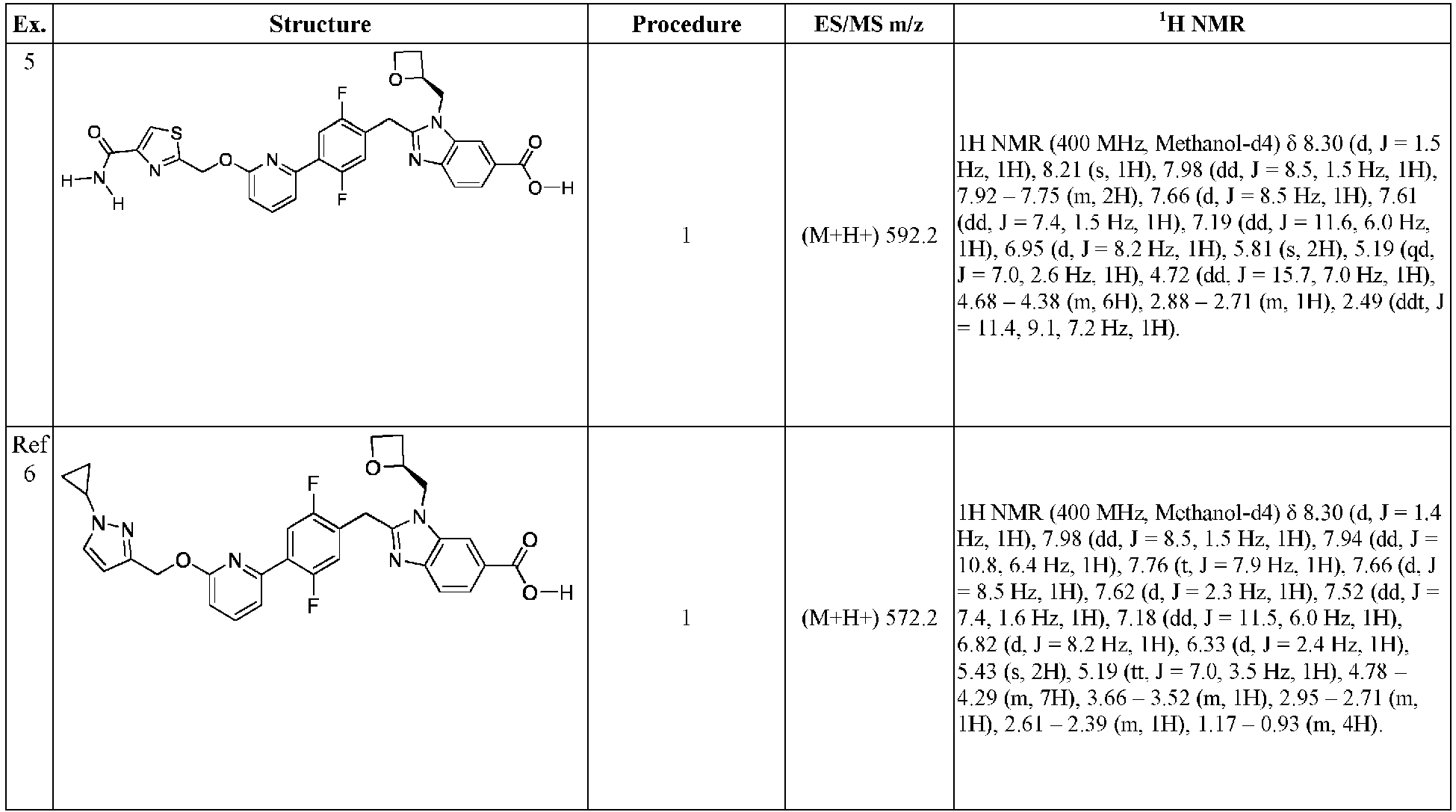


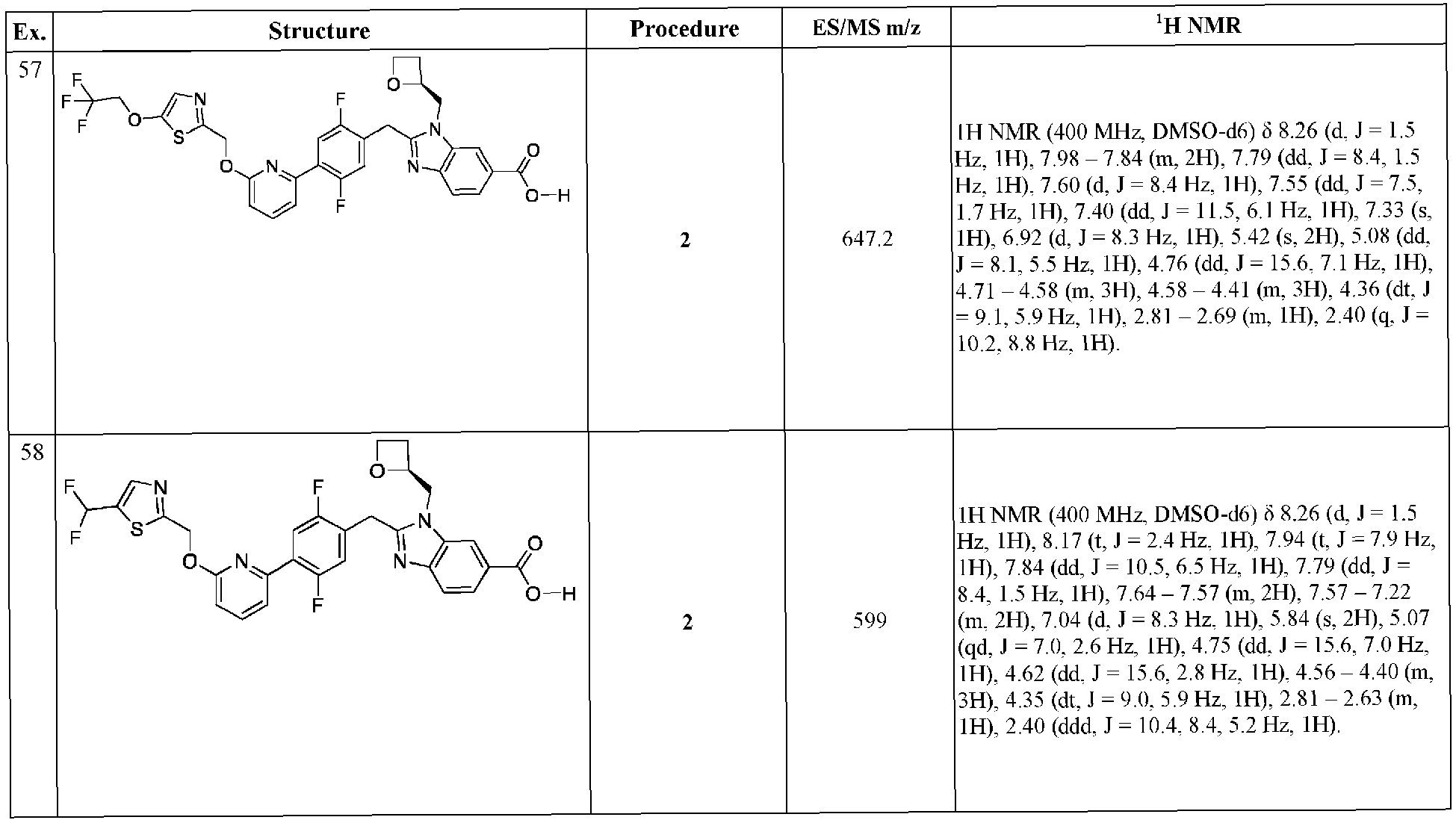
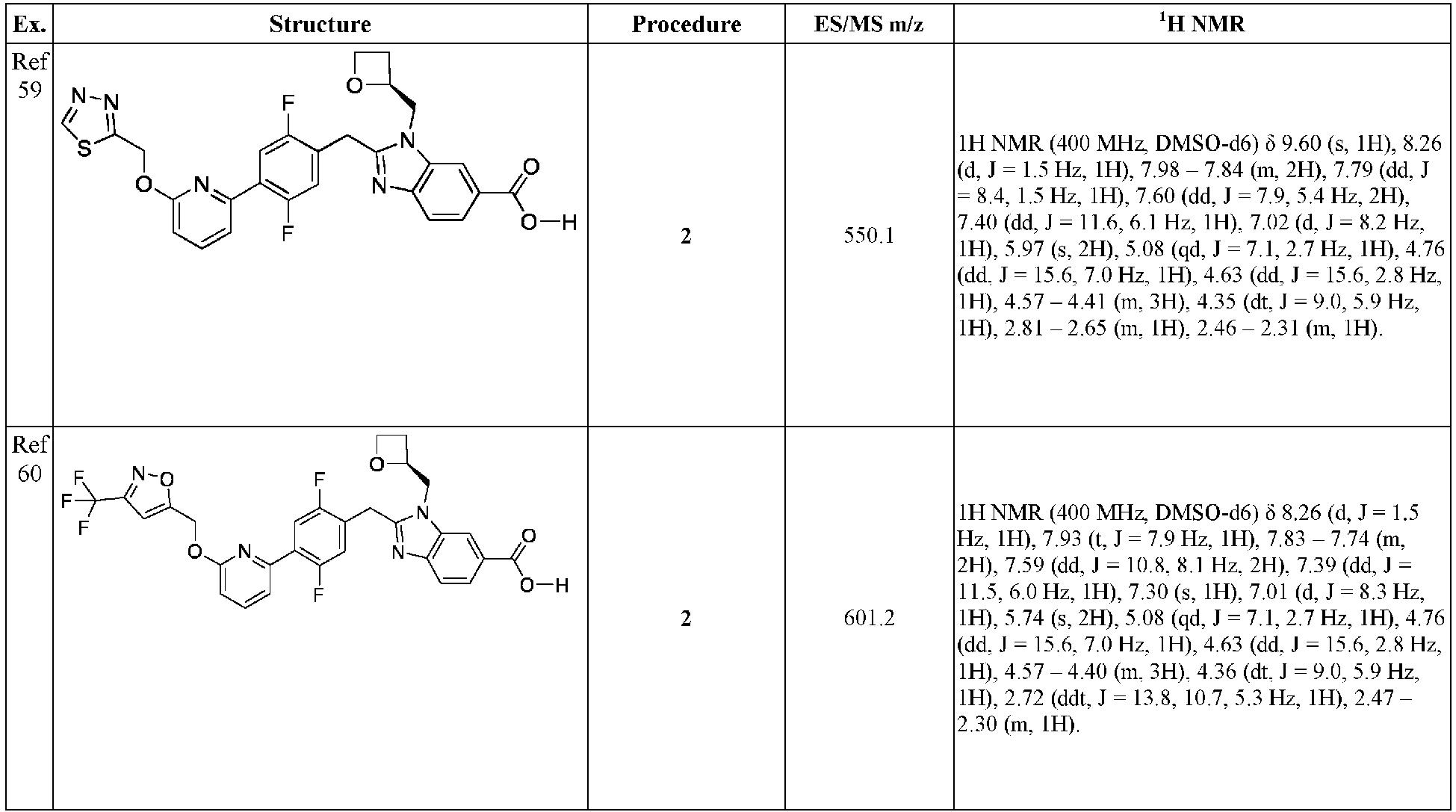


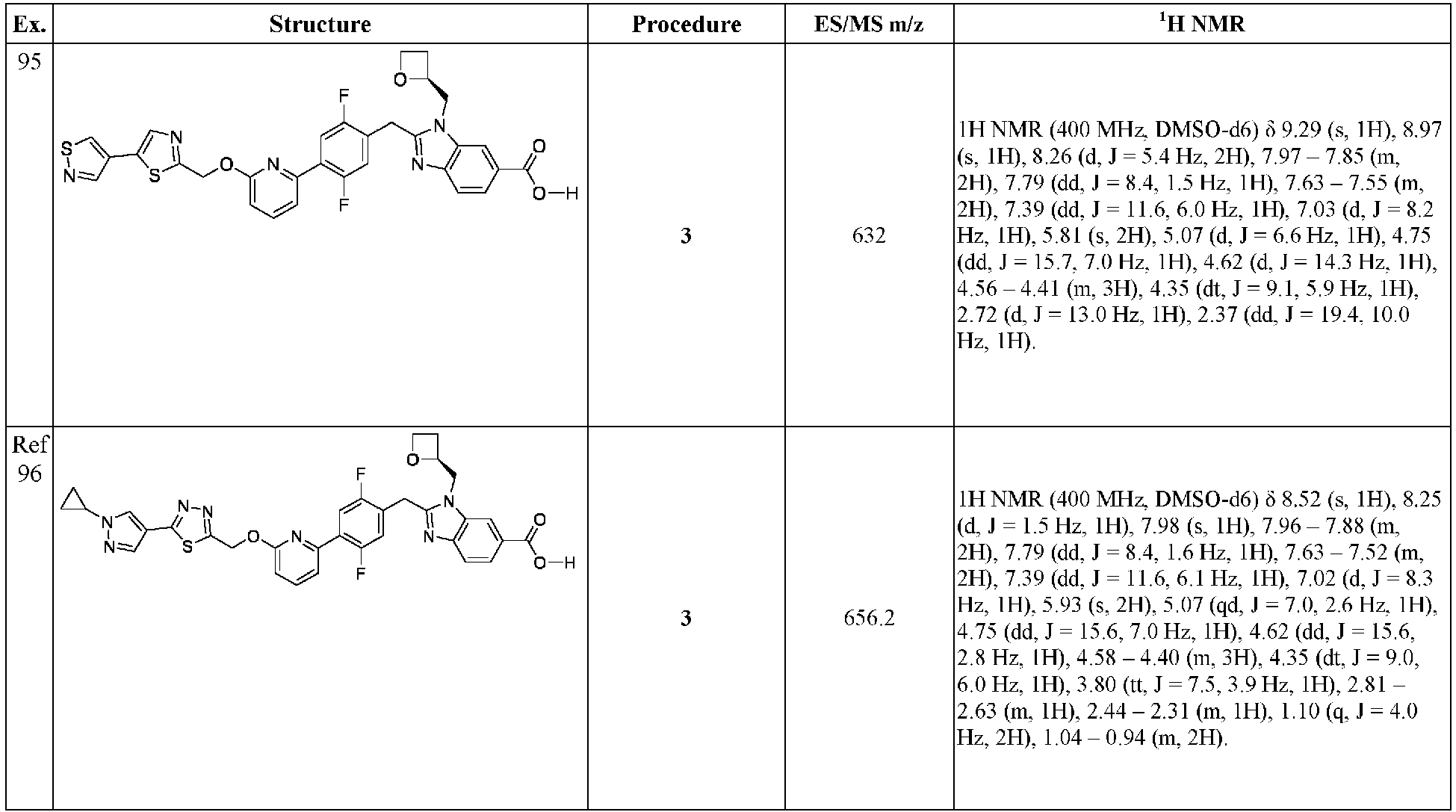

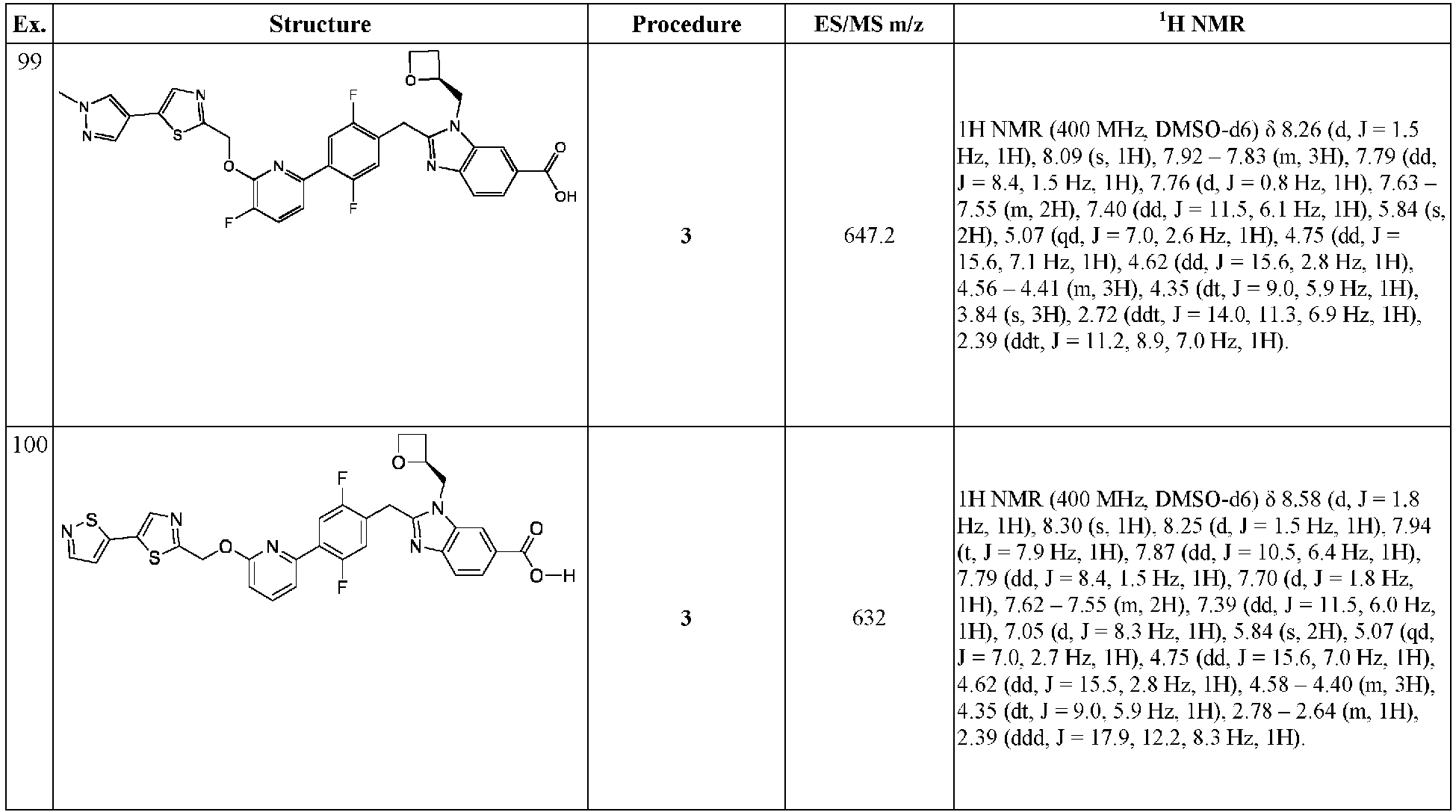


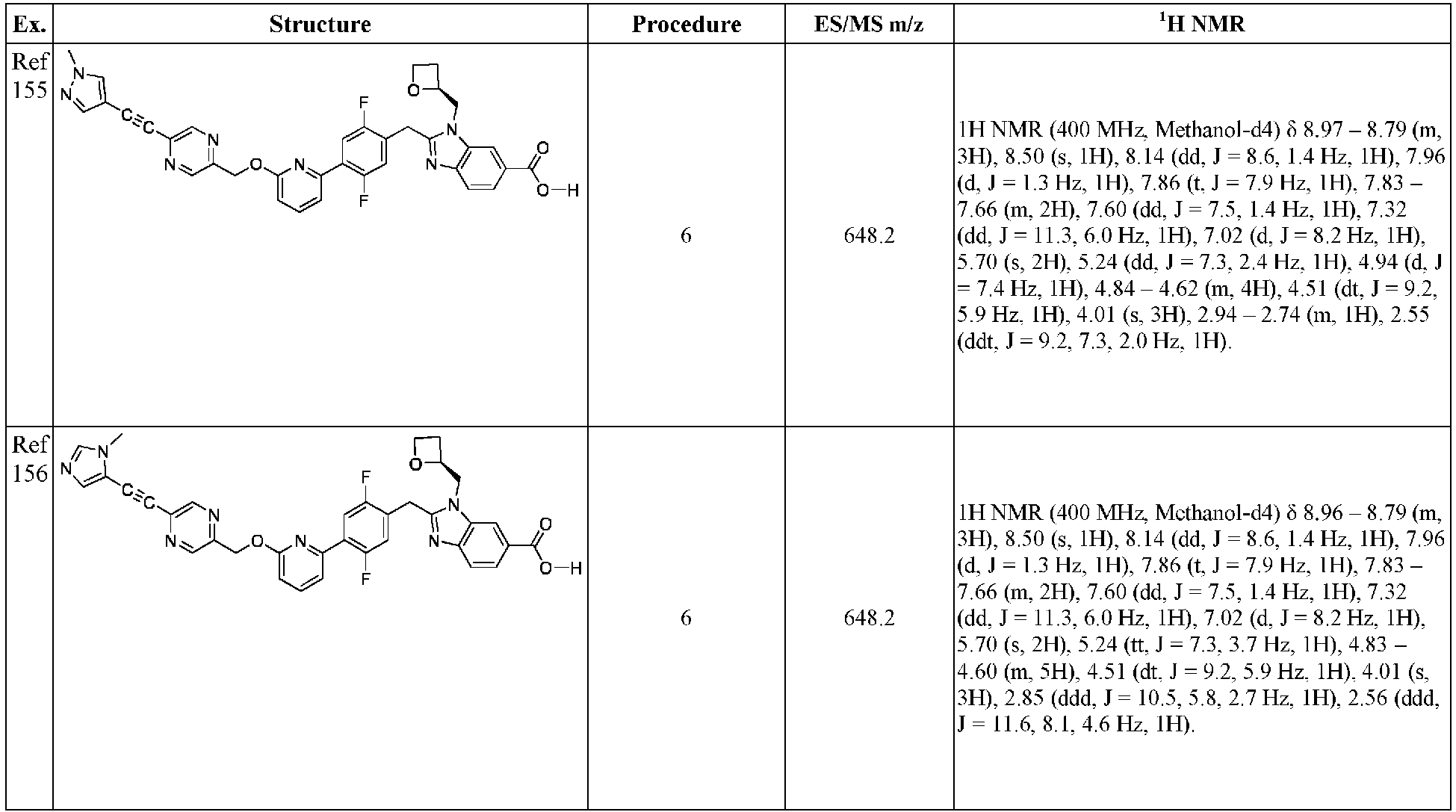


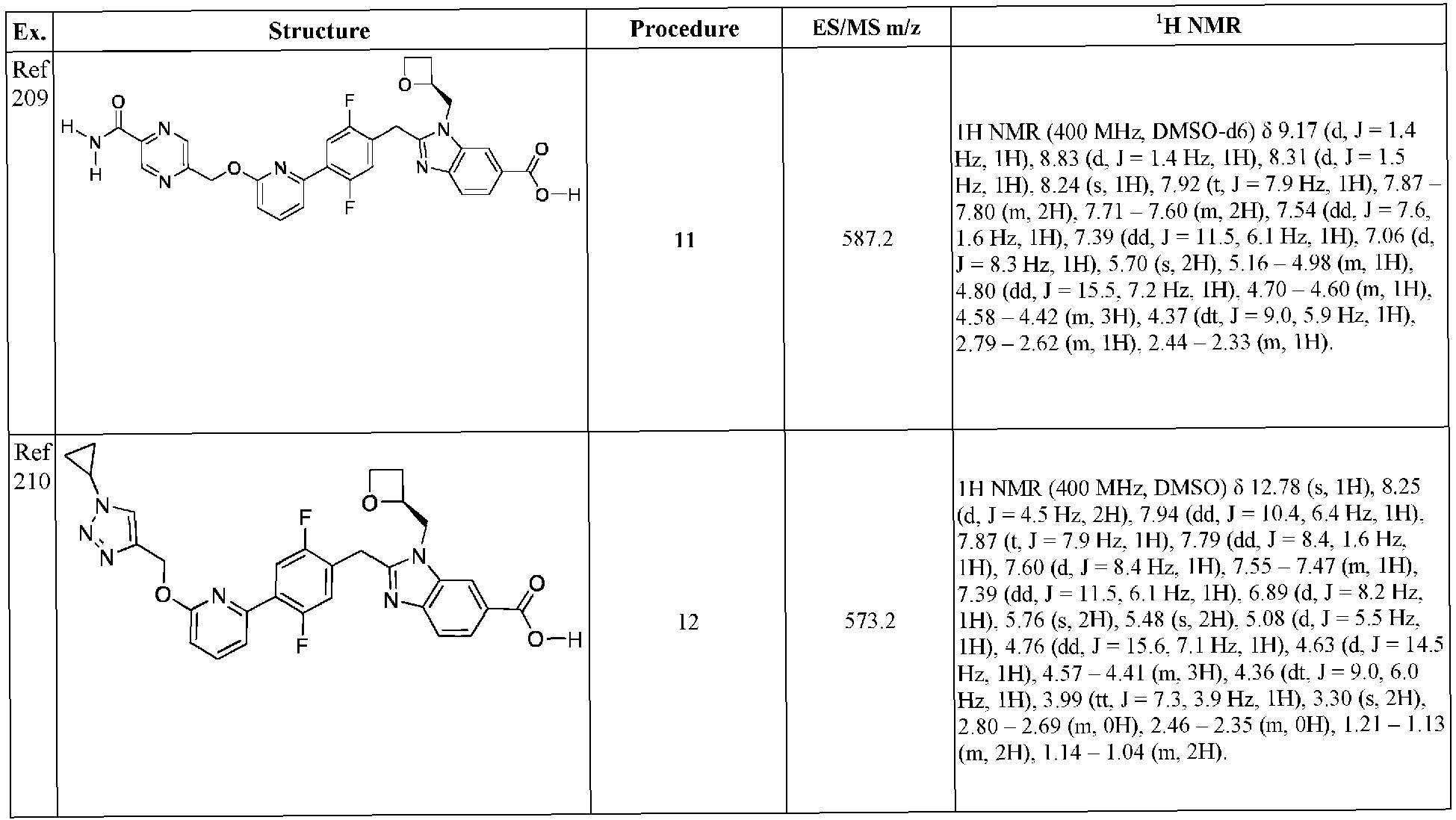


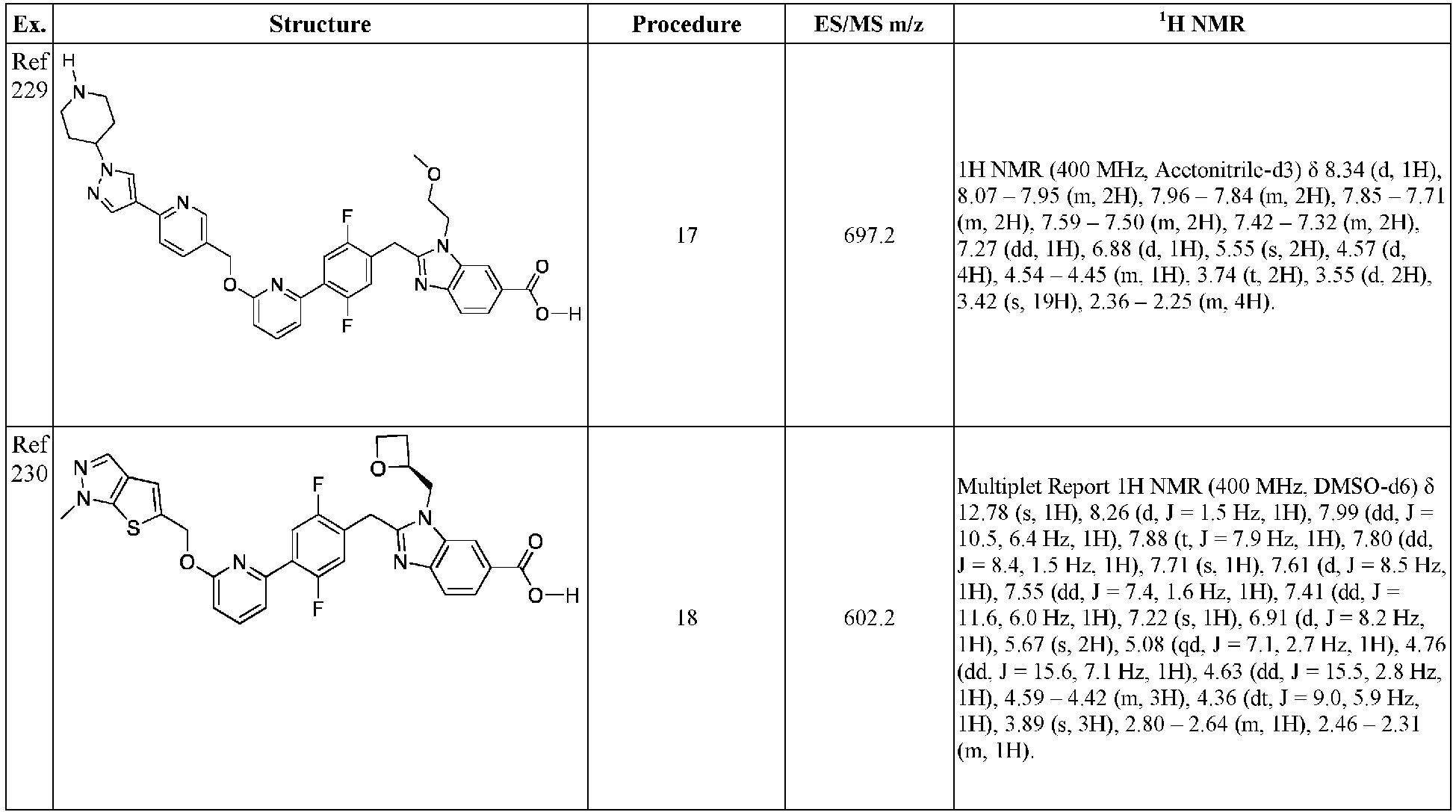


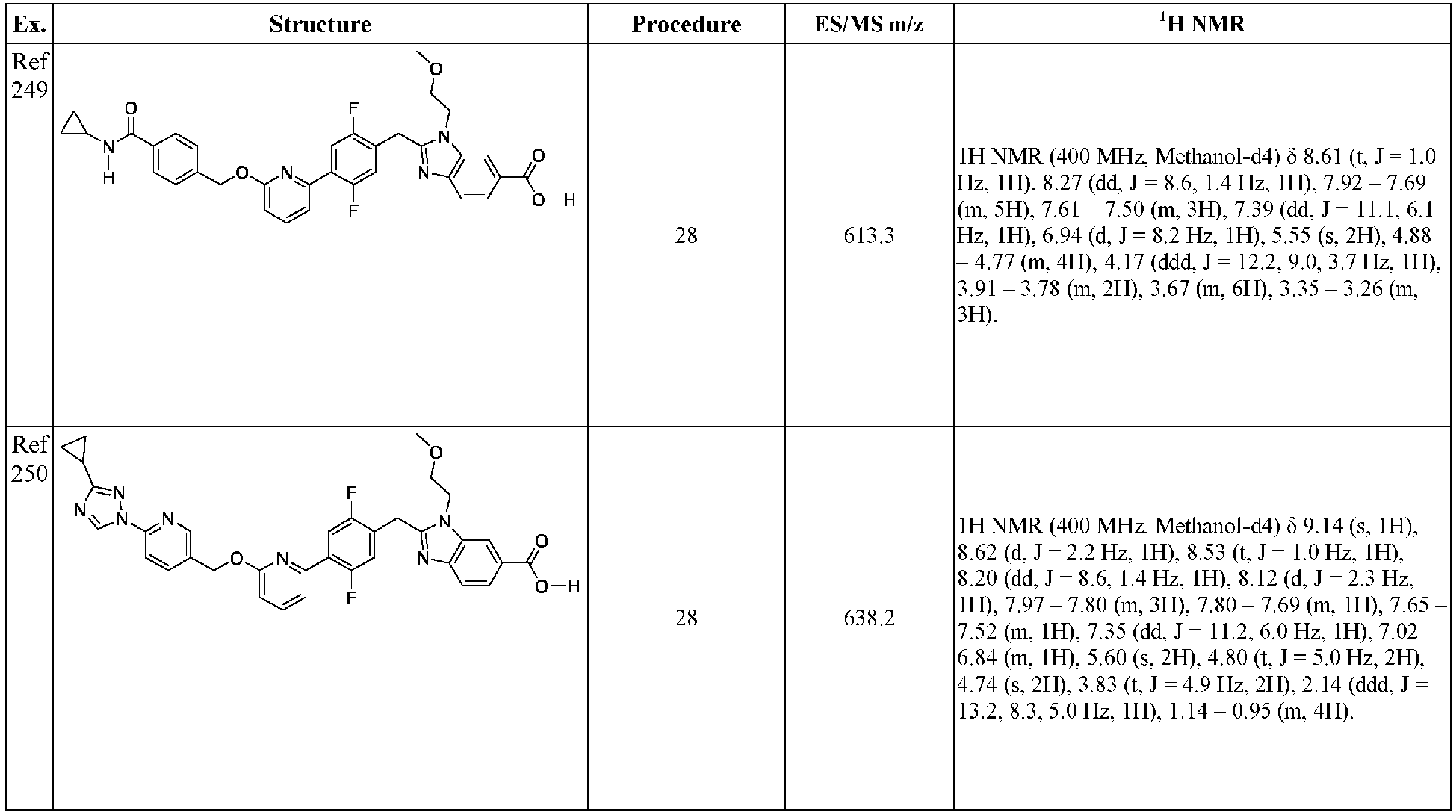


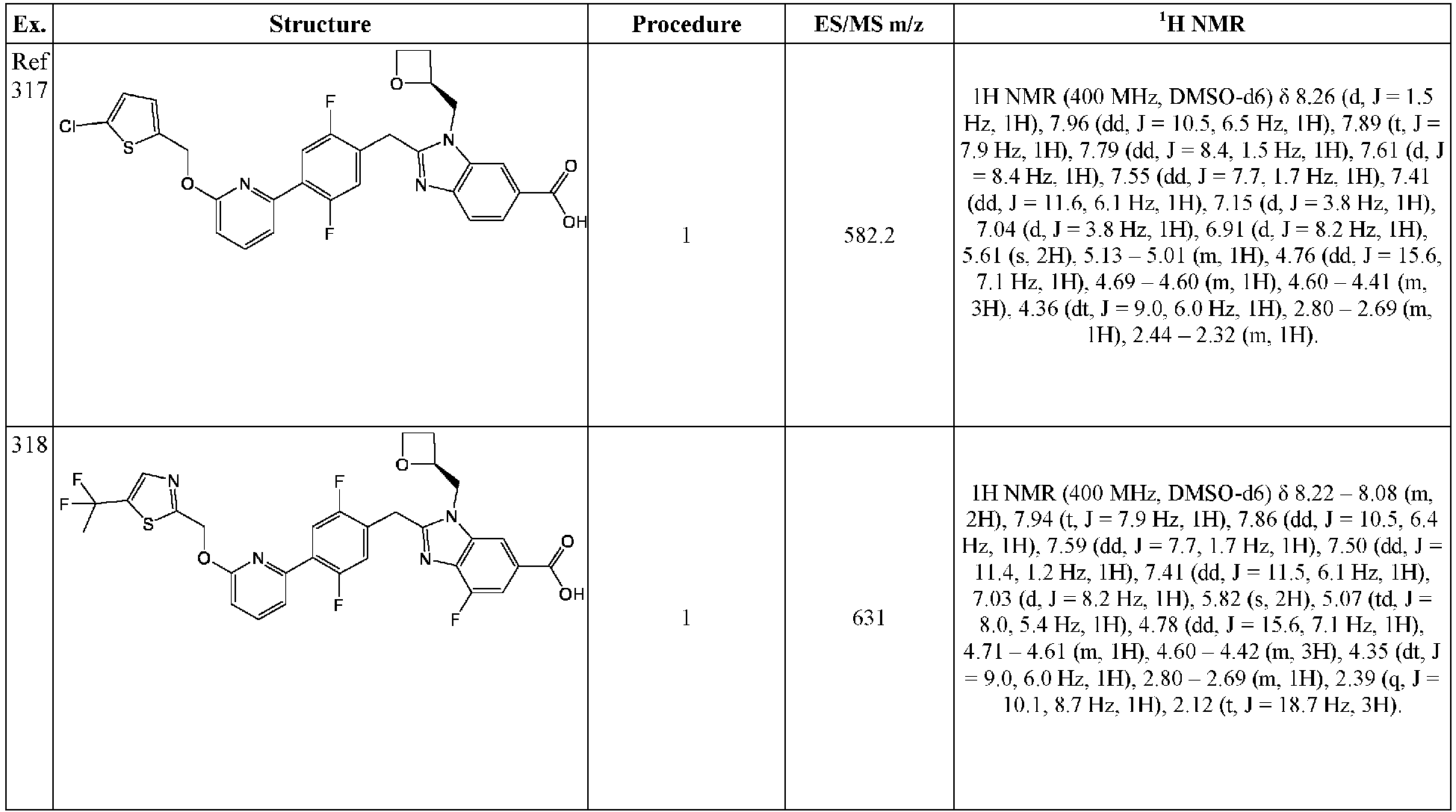


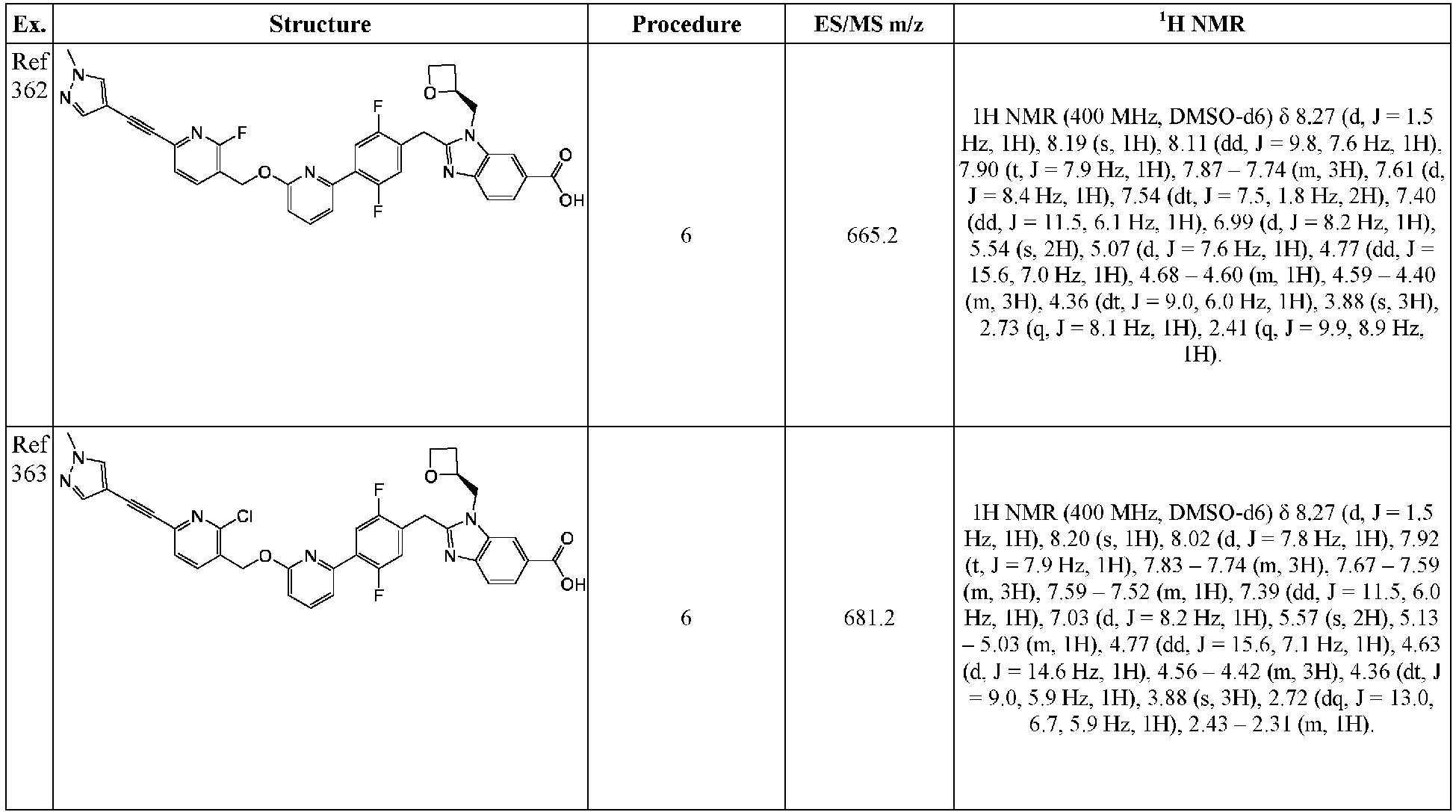


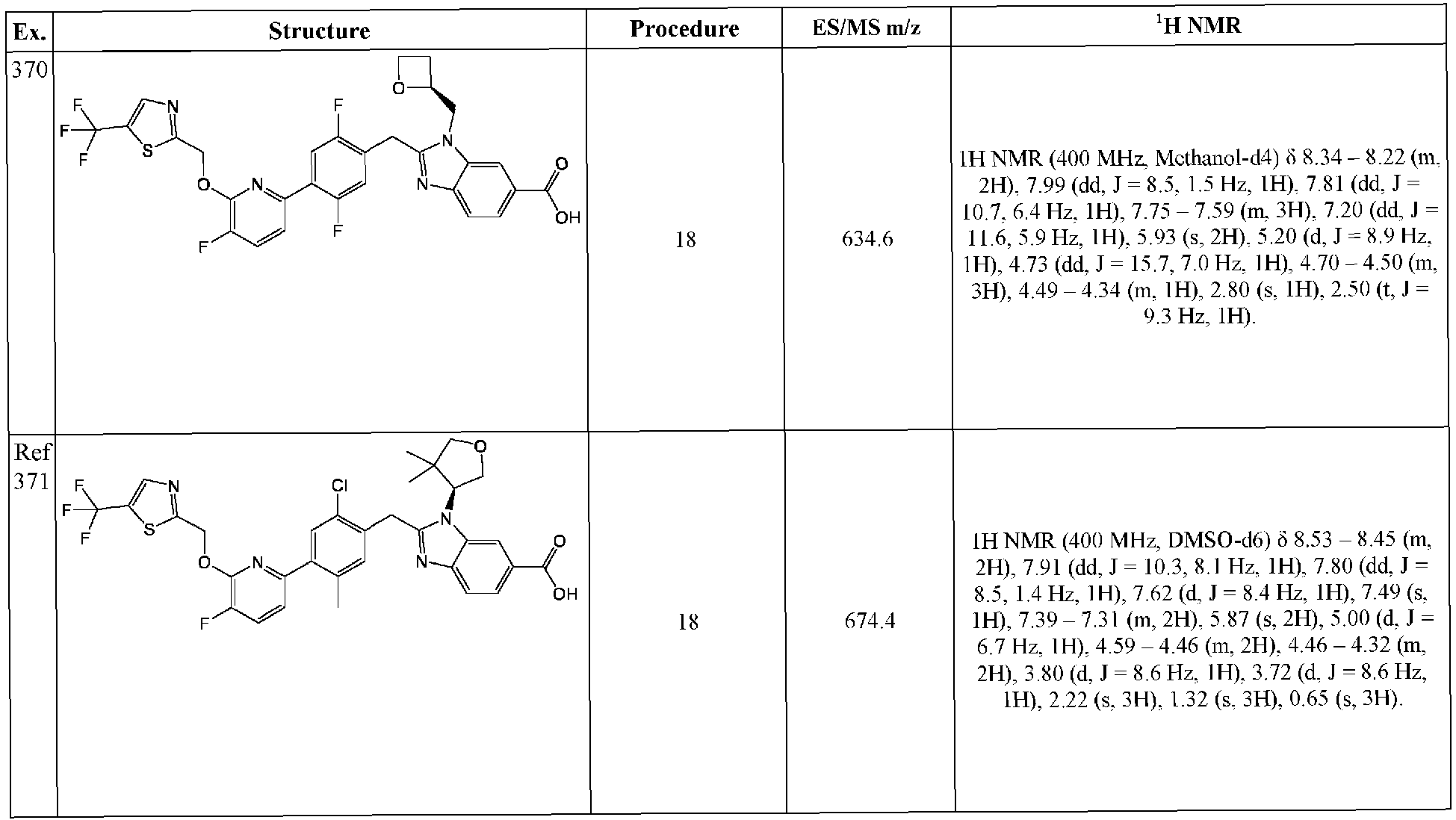


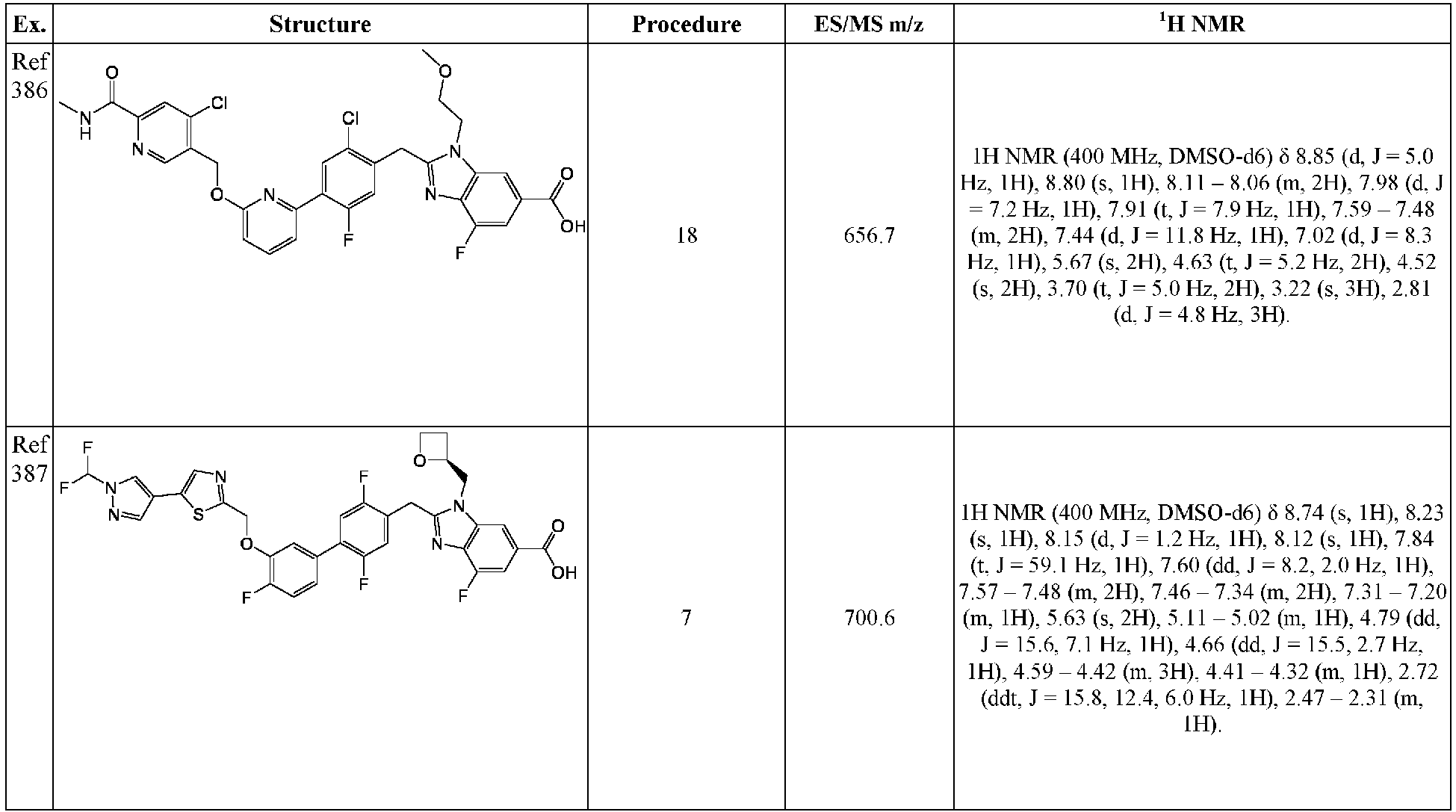


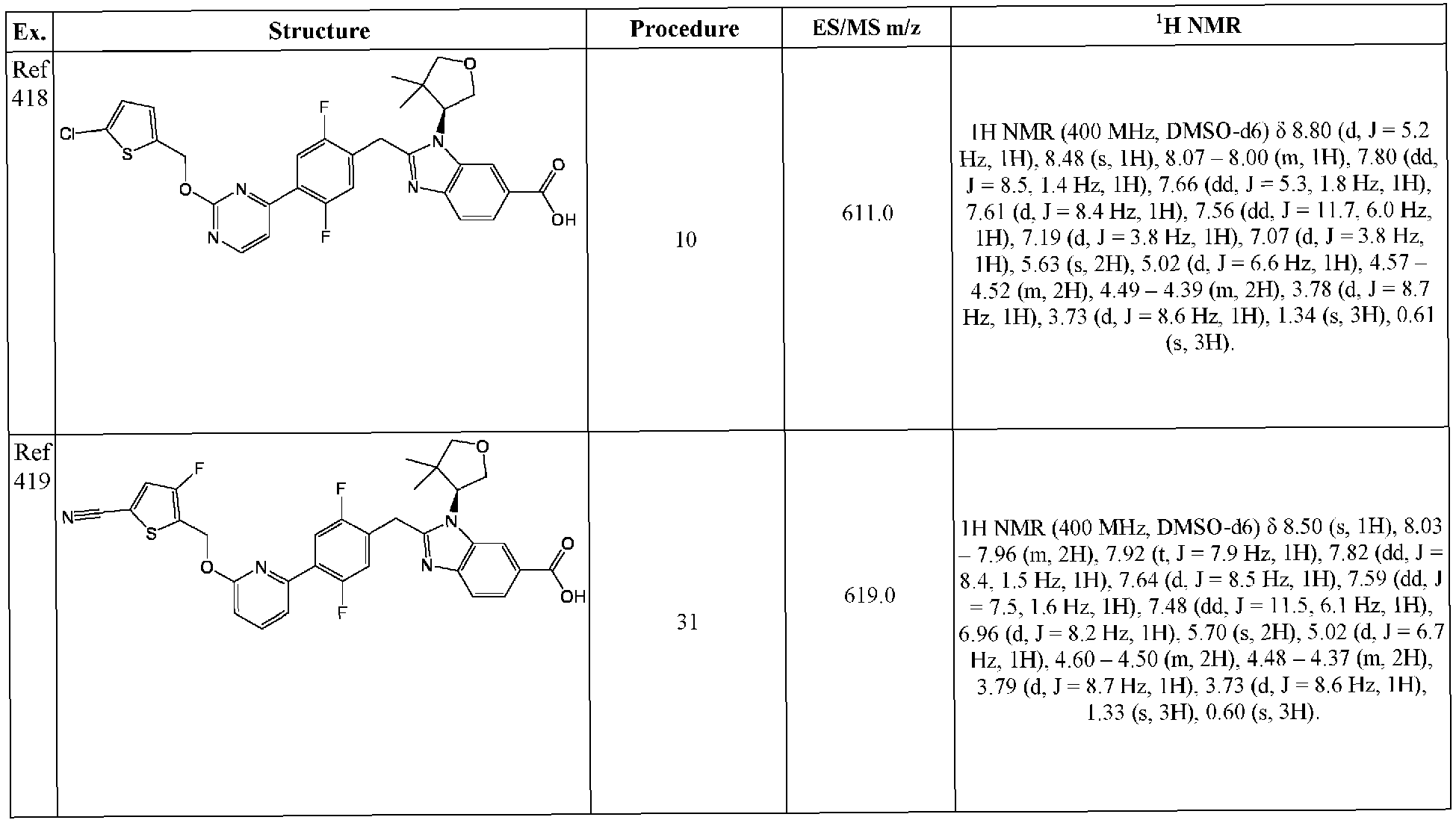


- GLP-1R activation by compounds of the present disclosure was quantified by measuring cAMP increase in CHO cells stably expressing GLP-1R (MultiSpan product # C1267-1a). The cells were harvested and plated in growth medium (DMEM/F-12 (Corning product # 10-090-CV) supplemented with 10% FBS (HyClone product # SH30071-03), penicillin/streptomycin (Corning product # 30-002CI) and 10µg/ml puromycin (Gibco product # A11138-03)) at 1,000 cells/well in a 384-well plate (Greiner product # 781080). The cells were then incubated overnight at 37 °C, 5% CO2. The next day, the medium was removed and the cells were washed with DPBS (Corning product # 21-031-CM) before adding the assay medium (HBSS, Corning product # 21-023-CV) with 20mM Hepes (Gibco product # 15630-080) and 0. 1% BSA (Rockland Immunochemicals product # BSA-1000)). Following the medium change, the cells were incubated for 1 hour at 37 °C, 5% CO2. The tested GLP-1 compound was added to the cells in a 10-point dose response followed by a 30-minute incubation at 37 °C, 5% CO2. cAMP concentration increase was then detected using Cisbio's cAMP Gs Dynamic Kit (product # 62AM4PEC) according to the manufacturer's protocol. The response was plotted against the log of the agonist concentration and fitted to a sigmoidal equation to determine the EC50.
- GLP-1R activation by small molecule agonists was quantified by measuring cAMP increase in CHO cells stably expressing GLP-1R (MultiSpan product # C1267-1a). 50nL of agonists were pre-spotted in a 10-point dose response onto 384-well plate (Corning product # CL3826) using the Labcyte Echo System. The cells were harvested and plated in assay buffer (HBSS (Corning product # 21-023-CV) with 20mM Hepes (Gibco product # 15630-080) and 0.1% BSA (Rockland Immunochemicals product # BSA-1000) or 100% Human Plasma (Innovative Research product #50-643-396) at 1,000 cells/well, 10µL/well, onto the pre-spotted plates. The cells are then incubated for 30 minutes at 37°C, 5% CO2. cAMP concentration increase was then detected using Cisbio's cAMP Gs Dynamic Kit (product # 62AM4PEC) according to the manufacturer's protocol. The response was plotted against the log of the agonist concentration and fitted to a sigmoidal equation to determine the EC50.
Compounds were run on one of the two GLP-1R Activation cAMP assays and the result are listed in Table 3. below. In the following Table 3, compounds that are not according to the invention are designated as Reference Examples by use of the abbreviation "Ref".Table 3. Activity Example No. GLP-1R Activation - Assay EC50 (nm) Example No. GLP-1R Activation - Assay EC50 (nm) Ref 1 0.27 228 26.00 2 0.11 229 17.87 3 3.15 230 0.33 4 1.43 231 1.51 5 0.50 232 5.65 Ref 6 3.09 233 1.20 Ref 7 3.71 234 5.90 8 0.92 235 1.10 Ref 9 0.95 236 0.22 Ref 10 7.55 237 3.68 11 0.60 238 8.61 Ref 12 1.16 239 446.57 Ref 13 0.54 240 1.13 Ref 14 5.68 241 0.12 Ref 15 0.96 242 0.02 Ref 16 8.86 243 0.17 Ref 17 7.00 244 2.28 Ref 18 0.32 245 0.10 Ref 19 23.24 246 0.57 20 0.33 247 0.25 21 0.41 248 5.61 22 0.17 249 36.08 23 1.43 250 22.60 Ref 24 1.54 251 0.89 Ref 25 0.53 252 0.075 Ref 26 0.23 253 0.026 27 0.08 253 0.12 Ref 28 0.44 254 0.374 Ref 29 13.75 255 0.366 Ref 30 1.99 256 0.443 Ref 3 1 1.32 257 0.583 Ref 32 0.79 258 0.483 Ref 33 1.75 259 0.577 Ref 34 0.20 260 0.254 Ref 35 0.22 261 0.044 Ref 36 5.28 262 0.134 Ref 37 8.46 263 0.131 Ref 38 0.60 265 0.152 Ref 39 0.86 266 0.367 Ref 40 0.83 267 0.401 Ref 41 0.17 268 0.762 Ref 42 0.07 269 0.748 Ref 43 0.30 270 0.191 Ref 44 75.29 271 0.897 Ref 46 0.14 272 1.899 47 0.09 273 0.144 Ref 48 2.33 274 0.196 Ref 49 0.65 275 0.372 50 0.67 276 1.313 Ref 51 0.21 277 0.312 Ref 52 0.13 278 0.617 53 0.38 279 0.955 54 0.09 280 0.067 Ref 55 0.44 281A 0.27 56 7.19 281B 20.799 57 0.73 282 0.311 58 0.14 283 0.109 Ref 59 2.38 284 0.183 Ref 60 1.44 285 0.126 Ref 61 0.96 286 0.042 Ref 62 1.98 287 0.185 Ref 63 0.89 288 0.067 Ref 64 6.38 289 0.262 Ref 65 0.19 290 0.155 Ref 66 6.65 291 0.689 Ref 67 6.52 292 0.499 Ref 68 5.37 293 0.184 Ref 69 2.59 294 0.182 Ref 70 1.93 295 0.202 Ref 71 0.29 296 0.036 Ref 72 0.82 297 0.508 Ref 73 1.10 298 0.466 Ref 74 0.25 299 2.63 Ref 75 0.61 300 0.823 Ref 76 4.23 301 0.341 Ref 77 6.32 302 0.567 Ref 78 9.40 303 0.252 79 0.06 304 0.524 80 0.19 305 0.305 Ref 81 0.81 306 0.621 Ref 82 5.53 307 0.59 Ref 83 3.51 308 0.683 84 0.07 309 0.084 85 0.05 310 0.038 Ref 86 0.14 311 0.03 87 0.08 312 0.044 88 0.44 313 0.032 89 1.86 314 0.094 90 0.21 315 0.764 Ref 91 0.12 316 0.129 Ref 92 0.07 317 0.125 93 0.06 318 0.028 94 2.87 319 0.034 95 0.08 320 0.537 Ref 96 0.13 321 0.246 Ref 97 0.11 322 0.349 98 0.03 323 0.281 99 0.14 324 0.123 100 0.09 325 0.582 101 0.14 326 0.451 102 13.55 327 0.381 103 0.23 328 0.342 104 0.07 329 0.226 105 0.14 330 0.431 106 0.14 331 0.58 107 0.31 332 0.109 108 0.18 333 0.205 Ref 109 0.62 334 0.354 Ref 110 0.95 335 0.202 111 0.05 336 0.261 Ref 112 0.13 337 1.2 Ref 113 0.16 338 0.218 114 0.11 339 0.043 115 0.07 340 0.058 116 0.15 341 0.772 Ref 117 0.28 342 0.039 118 0.44 343 0.459 Ref 119 0.39 344 0.055 Ref 120 2.84 345 0.027 Ref 121 729.57 346 0.027 Ref 122 695.38 347 0.271 Ref 123 2.65 348 1.868 Ref 124 0.81 349 0.323 Ref 125 3.64 350 0.209 Ref 126 0.31 351 0.182 Ref 127 3.72 352 0.52 Ref 128 1.95 353 0.188 Ref 129 3.17 354 0.622 Ref 130 0.57 355 0.355 Ref 131 3.38 356 0.099 Ref 132 0.17 357 0.508 Ref 133 0.30 358 0.243 Ref 134 0.60 359 0.051 Ref 135 0.34 360 0.174 Ref 136 0.25 361 0.62 Ref 137 0.24 362 0.33 Ref 138 0.28 363 0.295 Ref 139 0.28 364 0.929 Ref 140 0.40 365 0.164 Ref 141 0.33 366 0.56 Ref 142 0.25 367 0.235 Ref 143 0.14 368 0.712 Ref 144 0.99 369 0.683 Ref 145 0.25 370 0.28 Ref 146 0.09 371 1.766 Ref 147 0.60 372 0.024 Ref 148 0.51 373 0.079 Ref 149 0.29 374 0.478 Ref 150 10.02 375 0.372 Ref 151 0.10 376 0.153 Ref 152 0.68 377 0.481 Ref 153 0.36 378 0.068 Ref 154 0.52 379 0.303 Ref 155 0.83 380 0.078 Ref 156 1.19 381 0.301 Ref 157 3.07 382 1.271 Ref 158 0.20 383 0.6 Ref 159 0.18 384 0.563 Ref 160 0.20 385 0.11 Ref 161 0.08 386 0.121 Ref 162 0.16 387 0.095 Ref 163 0.70 388 0.186 Ref 164 0.10 389 0.257 165 2.00 390 0.235 166 0.62 391 0.305 167 0.87 392 0.206 Ref 168 21.31 393 0.777 Ref 169 11.82 394 0.62 170 8.29 395 0.197 Ref 171 2.94 396 0.678 Ref 172 2.57 397 0.497 Ref 173 23.24 398 0.017 Ref 174 40.62 399 0.01 Ref 175 0.11 400 0.412 Ref 176 2.19 401 0.487 Ref 177 34.57 402 0.208 Ref 178 23.59 403 0.096 Ref 179 4.59 404 0.689 Ref 180 28.04 405 0.363 Ref 181 5.99 406 0.385 Ref 182 0.19 407 0.239 Ref 183 0.26 408 0.381 Ref 184 0.12 409 0.695 Ref 185 0.08 410 0.551 Ref 186 0.91 411 0.315 Ref 187 0.12 412 0.099 Ref 188 0.05 413 0.36 Ref 189 0.30 414 0.318 Ref 190 0.20 415 0.189 Ref 191 0.69 416 0.336 Ref 192 0.32 417 0.26 Ref 193 0.22 418 0.384 Ref 194 0.17 419 0.096 Ref 195 0.11 420 0.178 Ref 196 0.29 421 0.087 Ref 197 0.08 422 0.066 Ref 198 0.04 423 0.023 Ref 199 0.53 424 0.027 Ref 200 0.24 425 0.535 Ref 201 0.39 426 0.931 Ref 202 0.58 427 1.418 Ref 203 1.10 428 3.628 Ref 204 5.57 429 0.024 Ref 205 0.25 430 0.039 Ref 206 43.28 431 0.195 Ref 207 0.46 432 0.093 Ref 208 0.02 433 0.413 Ref 209 0.14 434 0.087 Ref 210 15.65 435 0.427 Ref 211 0.51 436 0.367 Ref 212 0.10 437 0.105 Ref 213 0.48 438 0.335 Ref 214 0.08 439 0.397 Ref 215 0.18 440 0.041 Ref 216 0.72 441 0.475 Ref 217 0.27 442 0.669 Ref 218 0.80 443 3.449 Ref 219 0.85 444 0.433 Ref 220 2.08 445 0.101 Ref 221 1072.83 446 0.170 Ref 222 3.59 447 0.020 Ref 223 0.51 448 0.118 Ref 224 1.11 449 0.081 Ref 225 0.70 450 0.050 Ref 226 8.36 451 0.611 Ref 227 3.45 - Examples 54 and 253 were tested along with comparative examples CE-1 and CE-2.
- Compounds CE-2, Example 54 or Example 253 were combined with a mixture of 10% NMP (v:v) and 90% PEG300 (v:v), and the mixture was stirred until a homogeneous solution was obtained (1 mg/mL final concentration of test article).
- Compound CE-1 was combined with a mixture of 15% 2-hydroxypropyl-β-cyclodextrin (w:v) and 85% Mili-Q water (v:v), and the mixture was stirred until a homogeneous solution was obtained (0.5 mg/mL final concentration of test article).
- Young adult non-naive Cynomolgus monkeys with weight about 2.5-5kg (n = 1-3/test article/route)were fasted overnight and then dosed with either CE-1 (at 1 mg test article per kg animal weight), CE-2 (at 2 mg test article per kg animal weight), Example 54 (at 2 mg test article per kg animal weight), or Example 253 (at 2 mg test article per kg animal weight). Food was supplied approximately 4 hours post dose and animals were provided with free access to water all the time. Animals were restrained at designated time points for blood sampling. Approximately 500 µL of blood samples was taken via cephalic or saphenous vein into EDTA-K2 tubes. For oral administration (PO): blood samples were generally collected pre- dose, and at 15 min, 30 min, 1 hr, 2 hr, 4 hr, 8 hr, 12 hr, and 24 hr time points after dosing. Blood was maintained on wet ice, in chilled cryoracks, or at approximately 5°C prior to centrifugation to obtain plasma. Centrifugation was conducted within 1 hour of collection. Plasma (approximately 200 µL) was placed into a micronic tubes containing 4 µL of formic acid (the final concentration of formic acid in plasma was approximately 2%) and samples were vortex mixed. Samples were maintained on dry ice prior to storage at approximately -70°C.
- LC-MS/MS assays were utilized to quantify the concentration of the test articles in plasma as follows.
- 50 µL plasma sample was mixed with 350 µL of ACN combined with an internal standard. The mixture was then vortexed for about 1-5 min, and centrifuged at about 4,000-5,800 rpm for about 10-15 mm. An aliquot of 1 µL supernatant was used for LC-MS/MS analysis.
- MS conditions: A Sciex API 6500 equipped with electrospray ionization in the positive ion selected reaction monitoring mode was used for detection.
HPLC conditions
Mobile Phase A: H2O-0.1% Formic Acid
Mobile Phase B: ACN-0.1% Formic AcidTime (min) Mobile Phase B (%) 0.10 35 0.55 50 1.10 95 1.22 95 1.26 35 1.50 stop - Column: Phenomenex Kinetex XBCl8 (2.1 x 50 mm, 2.6 µm) with a flow rate of 1.20 mL/min
- Column temperature: 60 °C
- Retention time: approximately between 0.85 to 1.05
min - Pharmacokinetics parameters, including area under the curve (AUC0-24), maximum plasma concentration (Cmax), time to reach maximum plasma concentration (Tmax), oral bioavailability (F%), etc., were calculated using Dotmatics software in non-compartmental model.
- The results of the pharmacokinetics studies are presented in
FIG. 1 and Table 4. As is apparent inFIG. 1 , CE-1 demonstrates low exposures (<10nM plasma concentrations) over a period of 12h after a single oral dose of 1 mg/kg that subsequently drop to below the detection limit. In comparison, CE-2 achieves disproportionatelyhigher exposures 2 mg/kg at a 2-fold higher dose than CE-1 and has sustained exposures over 24h after a single oral dose. However, the oral bioavailability for CE-1 and CE-2 is low, 2.5% and 27.4%, respectively. - In contrast, as illustrated in
FIG. 1 , the plasma concentrations of orally - administered Example 54 and Example 253 at the same dose level as CE-2 (i.e., 2 mg/kg were higher than CE-1 (134-298-fold higher AUC0-24 despite only 2-fold higher dose), and CE-2 (2-5-fold higher AUC0-24 for the same dose) over 24 hours after oral dosing. Further, the oral bioavailability of Example 54 and Example 253 were higher than that of CE-1 and CE-2. These data show that compounds disclosed herein can provide prolonged exposures and/or higher oral bioavailability at least within 24h following a single oral dose administration of compound.Table 4. In vivo Monkey Oral PK Profiles Compound No. Oral dose (Arbitrary unit) Cmax (Arbitrary unit) Tmax (hr) AUC0-24 (Arbitrary units) F% Example 54 2 mg/kg 1270 ± 628 4.7 ± 1.2 4.7 ± 1.2 14200 ± 7690 89.0 ± 33.0 .0 ± 33.0 Example 253 2 mg/kg 582 ± 296 5.3 ± 2.3 6390 ± 2360 55.7 ± 20.6 Compound CE- 1 1 mg/kg 4.5 ± 0.8 2.2 ± 1.8 47.7 ± 13.3 2.5 ± 0.2 Compound CE-2 2 mg/kg 224 ± 130 4.0 ± 2.0 2810 ± 1330 27.4 ± 12.9 - Although the foregoing has been described in some detail by way of illustration and Example for purposes of clarity of understanding, one of skill in the art will appreciate that certain changes and modifications may be practiced within the scope of the appended claims. Where a conflict exists between the instant application and a reference provided herein, the instant application shall dominate.
Claims (19)
- A compound of Formula (II):
 R1 is thiazolyl optionally substituted with one to four R4;X1 is -C(H)= or -C(R8)=;X4 is -CH=, -C(R8)= or N;each RB is independently C1-9 alkyl, C1-8 haloalkyl, or halogen;each R8 is independently halogen;n is 0, 1, 2, or 3;each R4 is independently C1-9 alkyl, C1-8 haloalkyl, C1-6 alkoxy, C1-6 haloalkoxy, C2-6 alkoxyalkyl, C2-6 alkenyl, C2-6 alkynyl, halogen, C3-15 cycloalkyl, heterocyclyl, C6-10 aryl, heteroaryl, oxo, -NO2, -N3, -CN, -OR10a, -C(O)R10a, -C(O)O-R10a, -C(O)-N(R10a)(R10b), -N(R10a)(R10b), -N(R10a)2(R10b)+,-N(R10a)C(O)-R10b, -N(R10a)C(O)OR10b, -N(R10a)C(O)N(R10b)(R10c), -N(R10a)S(O)2(R10b), -NR10aS(O)2N(R10b)(R10c), -NR10aS(O)2O(R10b), -OC(O)R10a, -OC(O)O R10a, -OC(O)-N(R10a)(R10b), -S-R10a, -S(O) R10a, -S(O)(NH)R10a, -S(O)2R10a, -S(O)2N(R10a)(R10b), -S(O)(NR10a) R10b, or -Si(R10a)3;wherein each alkyl, haloalkyl, alkenyl, alkynyl, cycloalkyl, heterocyclyl, aryl, or heteroaryl is optionally substituted with one to four R5;each R5 is independently C1-9 alkyl, C1-8 haloalkyl, C1-6 alkoxy, C1-6 haloalkoxy, C2-6 alkoxyalkyl, C2-6 alkenyl, C2-6 alkynyl, C3-15 cycloalkyl, halogen, C3-15 cycloalkyl, heterocyclyl, C6-10 aryl, heteroaryl, oxo, -NO2, -N3, -CN, -O- R10a, -C(O)-R10a, -C(O)OR10a, -C(O)N(R10a)(R10b),-N(R10a)(R10b), -N(R10a)C(O)R10b, -N(R10a)C(O)OR10b, -N(R10a)C(O)N(R10b)(R10c), -N(R10a)S(O)2(R10b), -NR10aS(O)2N(R10b)(R10c), - NR10aS(O)2O(R10b), -OC(O)R10a, -OC(O)OR10a, -OC(O)-N(R10a)(R10b), -S-R10a, -S(O)R10a, -S(O)(NH)R10a, -S(O)2R10a, -S(O)2N(R10a)(R10b), -S(O)(NR10a)R10b, or -Si(R10a)3,wherein each alkyl, haloalkyl, alkenyl, alkynyl, cycloalkyl, heterocyclyl, aryl, or heteroaryl is optionally substituted with one to four R6;each R6 is independently C1-9 alkyl, C1-8 haloalkyl, C2-6 alkenyl, C2-6 alkynyl, halogen, C3-15 cycloalkyl, heterocyclyl, C6-10 aryl, heteroaryl, oxo, -OH, -CN, -NO2, -NH2, -N3, -SH, -O(C1-9 alkyl), -O(C1-8 haloalkyl), -O(C2-6 alkenyl), -O(C2-6 alkynyl), -O(C3-15 cycloalkyl), -O(heterocyclyl), -O(C6-10 aryl), -O(heteroaryl), -NH(C1-9 alkyl), -NH(C1-8 haloalkyl), -NH(C2-6 alkenyl), -NH(C2-6 alkynyl), -NH(C3-15 cycloalkyl), -NH(heterocyclyl), -NH(C6-10 aryl), -NH(heteroaryl), -N(C1-9 alkyl)2, -N(C1-8 haloalkyl)2, -N(C2-6 alkenyl)2, -N(C2-6 alkynyl)2, -N(C3-15 cycloalkyl)2, -N(heterocyclyl)2, -N(C6-10 aryl)2, -N(heteroaryl)2, -N(C1-9 alkyl)(C1-8 haloalkyl), -N(C1-9 alkyl)(C2-6 alkenyl), -N(C1-9 alkyl)(C2-6 alkynyl), -N(C1-9 alkyl)(C3-15 cycloalkyl), -N(C1-9 alkyl)(heterocyclyl), -N(C1-9 alkyl)(C6-10 aryl), -N(C1-9 alkyl)(heteroaryl), -C(O)(C1-9 alkyl), -C(O)(C1-8 haloalkyl), -C(O)(C2-6 alkenyl), -C(O)(C2-6 alkynyl), -C(O)(C3-15 cycloalkyl), -C(O)(heterocyclyl), -C(O)(C6-10 aryl), -C(O)(heteroaryl), -C(O)O(C1-9 alkyl), -C(O)O(C1-8 haloalkyl), -C(O)O(C2-6 alkenyl), -C(O)O(C2-6 alkynyl), -C(O)O(C3-15 cycloalkyl), - C(O)O(heterocyclyl), -C(O)O(C6-10 aryl), -C(O)O(heteroaryl), -C(O)NH2, -C(O)NH(C1-9 alkyl), -C(O)NH(C1-8 haloalkyl), -C(O)NH(C2-6 alkenyl), -C(O)NH(C2-6 alkynyl), -C(O)NH(C3-15 cycloalkyl), -C(O)NH(heterocyclyl), -C(O)NH(C6-10 aryl), -C(O)NH(heteroaryl), -C(O)N(C1-9 alkyl)2, -C(O)N(C1-8 haloalkyl)2, -C(O)N(C2-6 alkenyl)2, -C(O)N(C2-6 alkynyl)2, -C(O)N(C3-15 cycloalkyl)2, -C(O)N(heterocyclyl)2, -C(O)N(C6-10 aryl)2, -C(O)N(heteroaryl)2, -NHC(O)(C1-9 alkyl), -NHC(O)(C1-8 haloalkyl), -NHC(O)(C2-6 alkenyl), -NHC(O)(C2-6 alkynyl), -NHC(O)(C3-15 cycloalkyl), -NHC(O)(heterocyclyl), -NHC(O)(C6-10 aryl), -NHC(O)(heteroaryl), -NHC(O)O(C1-9 alkyl), -NHC(O)O(C1-8 haloalkyl), -NHC(O)O(C2-6 alkenyl), -NHC(O)O(C2-6 alkynyl), -NHC(O)O(C3-15 cycloalkyl), -NHC(O)O(heterocyclyl),-NHC(O)O(C6-10 aryl), -NHC(O)O(heteroaryl), -NHC(O)NH(C1-9 alkyl), -NHC(O)NH(C1-8 haloalkyl), -NHC(O)NH(C2-6 alkenyl), -NHC(O)NH(C2-6 alkynyl), -NHC(O)NH(C3-15 cycloalkyl), -NHC(O)NH(heterocyclyl), -NHC(O)NH(C6-10 aryl), -NHC(O)NH(heteroaryl), -NHS(O)(C1-9 alkyl), -N(C1-9 alkyl)(S(O)(C1-9 alkyl), - S(C1-9 alkyl), -S(C1-8 haloalkyl), -S(C2-6 alkenyl), -S(C2-6 alkynyl), -S(C3-15 cycloalkyl), -S(heterocyclyl), -S(C6-10 aryl), -S(heteroaryl), -S(O)N(C1-9 alkyl)2, -S(O)(C1-9 alkyl), -S(O)(C1-8 haloalkyl), -S(O)(C2-6 alkenyl), -S(O)(C2-6 alkynyl), -S(O)(C3-15 cycloalkyl), -S(O)(heterocyclyl), -S(O)(C6-10 aryl), -S(O)(heteroaryl), -S(O)2(C1-9 alkyl), -S(O)2(C1-8 haloalkyl), - S(O)2(C2-6 alkenyl), -S(O)2(C2-6 alkynyl), -S(O)2(C3-15 cycloalkyl), -S(O)2(heterocyclyl), -S(O)2(C6-10 aryl), -S(O)2(heteroaryl), -S(O)(NH)(C1-9 alkyl), -S(O)2NH(C1-9 alkyl), or -S(O)2N(C1-9 alkyl)2,
wherein each alkyl, cycloalkyl, heterocyclyl, aryl, or heteroaryl is optionally substituted with 1 to 3 C1-9 alkyl, C1-8 haloalkyl, halogen, -OH, -NH2, CO2H,-O(C1-9 alkyl), -O(C1-8 haloalkyl), -O(C3-15 cycloalkyl), - O(heterocyclyl), -O(aryl), -O(heteroaryl), -NH(C1-9 alkyl), -NH(C1-8 haloalkyl), -NH(C3-15 cycloalkyl), -NH(heterocyclyl), -NH(aryl), - NH(heteroaryl), -N(C1-9 alkyl)2, -N(C3-15 cycloalkyl)2, -NHC(O)(C1-8 haloalkyl), -NHC(O)(C3-15 cycloalkyl), -NHC(O)(heterocyclyl), - NHC(O)(aryl), -NHC(O)(heteroaryl),-NHC(O)O(C1-9 alkyl), -NHC(O)O(C1-8 haloalkyl), -NHC(O)O(C2-6 alkynyl), -NHC(O)O(C3-15 cycloalkyl), -NHC(O)O(heterocyclyl), - NHC(O)O(aryl), -NHC(O)O(heteroaryl), -NHC(O)NH(C1-9 alkyl), S(O)2(C1-9 alkyl), -S(O)2(C1-8 haloalkyl), -S(O)2(C3-15 cycloalkyl), - S(O)2(heterocyclyl), -S(O)2(aryl), -S(O)2(heteroaryl), -S(O)(NH)(C1-9 alkyl), -S(O)2NH(C1-9 alkyl), or -S(O)2N(C1-9 alkyl)2,wherein the alkyl or heterocyclyl is each optionally substituted with one to four halogens; andeach R10a, R10b, and R10c is independently H, C1-9 alkyl, C2-6 alkenyl, C2-6 alkynyl, C3-15 cycloalkyl, heterocyclyl, C6-10 aryl, or heteroaryl,
wherein the alkyl, alkenyl, alkynyl, cycloalkyl, heterocyclyl, aryl, or heteroaryl is each optionally substituted with one to four R6;a cycloalkyl is a monovalent or divalent single all carbon ring or a multiple condensed all carbon ring system wherein the ring in each instance is a non-aromatic saturated or unsaturated ring;each heterocyclyl has three to twelve ring members and has one to four heteroatoms, each independently N, O, or S; andeach heteroaryl has five to twelve ring members and one to four heteroatoms, each independently N, O, or S. - The compound of claim 1, or a pharmaceutically acceptable salt thereof, wherein R1 is

- The compound of claim 1, or a pharmaceutically acceptable salt thereof, wherein R1 is

- The compound of any one of claims 1 to 3, or a pharmaceutically acceptable salt thereof, wherein R8 is F or Cl.
- The compound of claim 1, or a pharmaceutically acceptable salt thereof, wherein the compound is selected from the group consisting of:


- The compound of claim 1, or pharmaceutically acceptable salt thereof, wherein the compound has the structure:

- The compound of claim 1, or pharmaceutically acceptable salt thereof, wherein the compound has the structure:

- The compound of claim 1, or pharmaceutically acceptable salt thereof, wherein the compound has the structure:

- The compound of claim 1, or pharmaceutically acceptable salt thereof, wherein the compound has the structure:

- The compound of claim 1, or pharmaceutically acceptable salt thereof, wherein the compound has the structure:

- The compound of claim 1, or pharmaceutically acceptable salt thereof, wherein the compound has the structure:

- The compound of claim 1, or pharmaceutically acceptable salt thereof, wherein the compound has the structure:

- A pharmaceutical composition comprising a pharmaceutically effective amount of a compound of any one of claims 1-12, or a pharmaceutically acceptable salt thereof, and a pharmaceutically acceptable carrier or excipient.
- The pharmaceutical composition of claim 13 further comprising one or more additional therapeutic agents.
- A compound of any one of claims 1-12, or a pharmaceutically acceptable salt thereof, for use in treating a glucagon-like peptide 1 receptor (GLP-1R) mediated disease or condition, wherein the GLP-1R mediated disease or condition is a liver disease or a metabolic disease.
- The compound or pharmaceutically acceptable salt thereof for use of claim 15, wherein the disease or condition comprises a liver disease,
optionally wherein the disease or condition comprises liver fibrosis, non-alcoholic fatty liver disease (NAFLD), non-alcoholic steatohepatitis (NASH), liver cirrhosis, compensated liver fibrosis, decompensated liver fibrosis, hepatocellular carcinoma, Primary Biliary Cirrhosis (PBC), or Primary Sclerosing Choleangitis (PSC), optionally wherein the disease or condition is non-alcoholic fatty liver disease (NAFLD) or non-alcoholic steatohepatitis (NASH). - The compound or pharmaceutically acceptable salt thereof for use of claim 15, wherein the disease or condition comprises a metabolic disease,
optionally wherein the disease or condition comprises type 1 diabetes, type 2 diabetes, pre-diabetes, idiopathic type 1 diabetes, latent autoimmune diabetes, maturity onset diabetes of the young, early onset diabetes, malnutrition-related diabetes, gestational diabetes, hyperglycemia, insulin resistance, hepatic insulin resistance, impaired glucose tolerance, diabetic neuropathy, diabetic nephropathy, kidney disease, diabetic retinopathy, adipocyte dysfunction, visceral adipose deposition, obesity, eating disorders, sleep apnea, weight gain, sugar craving, dyslipidemia, hyperinsulinemia, congestive heart failure, myocardial infarction, stroke, hemorrhagic stroke, ischemic stroke, traumatic brain injury, pulmonary hypertension, restenosis after angioplasty, intermittent claudication, post-prandial lipemia, metabolic acidosis, ketosis, arthritis, left ventricular hypertrophy, Parkinson's Disease, peripheral arterial disease, macular degeneration, cataract, glomerulosclerosis, chronic renal failure, metabolic syndrome, angina pectoris, premenstrual syndrome, thrombosis, atherosclerosis, impaired glucose metabolism, vascular restenosis, dementia, or Alzheimer's disease. - The compound or pharmaceutically acceptable salt thereof for use of claim 15, wherein the compound or pharmaceutically acceptable salt thereof is administered in combination with an additional therapeutic agent.
- The pharmaceutical composition of claim 14 or the compound or pharmaceutically acceptable salt thereof for use of claim 18, wherein the additional therapeutic agent comprises an anti-obesity agent including but not limited to peptide YY or an analogue thereof, a neuropeptide Y receptor type 2 (NPYR2) agonist, a NPYR1 agonist, an NPYR5 antagonist, a cannabinoid receptor type 1 (CB1 R) antagonist, a lipase inhibitor (e.g., orlistat), a human proislet peptide (HIP), a melanocortin receptor 4 agonist (MC4R)(e.g., setmelanotide), a melanin concentrating hormone receptor 1 antagonist, a farnesoid X receptor (FXR) agonist (e.g. obeticholic acid), apoptotic signal-regulating kinase (ASK-1) inhibitor, zonisamide, phentermine (alone or in combination with topiramate), a norepinephrine/dopamine reuptake inhibitor (e.g., buproprion), an opioid receptor antagonist (e.g., naltrexone), a combination of norepinephrine/dopamine reuptake inhibitor and opioid receptor antagonist (e.g., a combination of bupropion and naltrexone), a GDF-15 analog, sibutramine, a cholecystokinin agonist, amylin and analogues thereof (e.g., pramlintide), leptin and analogues thereof (e.g., metroleptin), a serotonergic agent (e.g., lorcaserin), a methionine aminopeptidase 2 (MetAP2) inhibitor (e.g., beloranib or ZGN-1061), phendimetrazine, diethylpropion, benzphetamine, an SGLT2 inhibitor (e.g., empagliflozin, canagliflozin, dapagliflozin, ipragliflozin, tofogliflozin, sergliflozin etabonate, remogliflozin etabonate, or ertugliflozin), an SGLTL1 inhibitor, a dual SGLT2/SGLT1 inhibitor, a fibroblast growth factor receptor (FGFR) modulator, an AMP-activated protein kinase (AMPK) activator, biotin, a MAS receptor modulator, or a glucagon receptor agonist (alone or in combination with another GLP-1 R agonist, e.g., liraglutide, exenatide, dulaglutide, albiglutide, lixisenatide, or semaglutide), a peroxisome proliferator-activated receptor alpha (PPARα) agonist, fish oil, an acetyl-coA carboxylase (ACC) inhibitor, a TGFβ antagonist, GFRAL agonist, and/or a pharmaceutically acceptable salt thereof.
Priority Applications (3)
| Application Number | Priority Date | Filing Date | Title |
|---|---|---|---|
| SI202230115T SI4271674T2 (en) | 2021-04-21 | 2022-04-19 | CARBOXY-BENZIMIDAZOLE COMPOUNDS THAT MODULATE GLP-1R |
| EP24218624.5A EP4520393A3 (en) | 2021-04-21 | 2022-04-19 | Carboxy-benzimidazole glp-1r modulating compounds |
| HRP20250415TT HRP20250415T4 (en) | 2021-04-21 | 2022-04-19 | GLP-1R MODULATING CARBOXY-BENZIMIDAZOLE COMPOUNDS |
Applications Claiming Priority (3)
| Application Number | Priority Date | Filing Date | Title |
|---|---|---|---|
| US202163177775P | 2021-04-21 | 2021-04-21 | |
| US202163285410P | 2021-12-02 | 2021-12-02 | |
| PCT/US2022/025329 WO2022225914A1 (en) | 2021-04-21 | 2022-04-19 | Carboxy-benzimidazole glp-1r modulating compounds |
Related Child Applications (2)
| Application Number | Title | Priority Date | Filing Date |
|---|---|---|---|
| EP24218624.5A Division EP4520393A3 (en) | 2021-04-21 | 2022-04-19 | Carboxy-benzimidazole glp-1r modulating compounds |
| EP24218624.5A Division-Into EP4520393A3 (en) | 2021-04-21 | 2022-04-19 | Carboxy-benzimidazole glp-1r modulating compounds |
Publications (4)
| Publication Number | Publication Date |
|---|---|
| EP4271674A1 EP4271674A1 (en) | 2023-11-08 |
| EP4271674B1 true EP4271674B1 (en) | 2025-02-12 |
| EP4271674B3 EP4271674B3 (en) | 2025-12-03 |
| EP4271674B9 EP4271674B9 (en) | 2026-03-11 |
Family
ID=81654849
Family Applications (2)
| Application Number | Title | Priority Date | Filing Date |
|---|---|---|---|
| EP22723850.8A Active EP4271674B9 (en) | 2021-04-21 | 2022-04-19 | Carboxy-benzimidazole glp-1r modulating compounds |
| EP24218624.5A Pending EP4520393A3 (en) | 2021-04-21 | 2022-04-19 | Carboxy-benzimidazole glp-1r modulating compounds |
Family Applications After (1)
| Application Number | Title | Priority Date | Filing Date |
|---|---|---|---|
| EP24218624.5A Pending EP4520393A3 (en) | 2021-04-21 | 2022-04-19 | Carboxy-benzimidazole glp-1r modulating compounds |
Country Status (27)
| Country | Link |
|---|---|
| US (2) | US20230021705A1 (en) |
| EP (2) | EP4271674B9 (en) |
| JP (2) | JP7642098B2 (en) |
| KR (1) | KR20230173719A (en) |
| AU (2) | AU2022260487B2 (en) |
| BR (1) | BR112023021978A2 (en) |
| CA (1) | CA3216372A1 (en) |
| CL (1) | CL2023003113A1 (en) |
| CO (1) | CO2023013766A2 (en) |
| CR (1) | CR20230493A (en) |
| DK (1) | DK4271674T6 (en) |
| DO (2) | DOP2023000231A (en) |
| ES (1) | ES3025032T7 (en) |
| FI (1) | FI4271674T6 (en) |
| HR (1) | HRP20250415T4 (en) |
| HU (1) | HUE071198T2 (en) |
| IL (1) | IL307768A (en) |
| LT (1) | LT4271674T (en) |
| MX (1) | MX2023012419A (en) |
| PE (1) | PE20232051A1 (en) |
| PH (1) | PH12023552861A1 (en) |
| PL (1) | PL4271674T6 (en) |
| PT (1) | PT4271674T (en) |
| SI (1) | SI4271674T2 (en) |
| TW (2) | TWI819577B (en) |
| UA (1) | UA130357C2 (en) |
| WO (1) | WO2022225914A1 (en) |
Families Citing this family (19)
| Publication number | Priority date | Publication date | Assignee | Title |
|---|---|---|---|---|
| PE20221040A1 (en) | 2019-10-25 | 2022-06-17 | Gilead Sciences Inc | GLP-1R MODULATING COMPOUNDS |
| CA3168543A1 (en) | 2020-01-29 | 2021-08-05 | Gilead Sciences, Inc. | Glp-1r modulating compounds |
| WO2022109182A1 (en) | 2020-11-20 | 2022-05-27 | Gilead Sciences, Inc. | Polyheterocyclic glp-1 r modulating compounds |
| WO2022192430A1 (en) | 2021-03-11 | 2022-09-15 | Gilead Sciences, Inc. | Glp-1r modulating compounds |
| EP4304711A1 (en) | 2021-03-11 | 2024-01-17 | Gilead Sciences, Inc. | Glp-1r modulating compounds |
| PL4271672T3 (en) | 2021-04-21 | 2026-04-20 | Gilead Sciences, Inc. | Carboxy-benzimidazole glp-1r modulating compounds |
| MX2023014985A (en) * | 2021-06-24 | 2024-02-14 | Hangzhou Zhongmeihuadong Pharmaceutical Co Ltd | GLP-1 RECEPTOR AGONIST AND COMPOSITION AND USE THEREOF. |
| US20250042882A1 (en) | 2021-12-16 | 2025-02-06 | Astrazeneca Ab | Certain 3-azabicyclo[3.1.0]hexanes as glp-1 receptor modulators |
| US20250066338A1 (en) | 2021-12-16 | 2025-02-27 | Astrazeneca Ab | Certain 3-azabicyclo[3.1.0]hexanes as glp-1 receptor modulators |
| EP4592285A1 (en) | 2022-09-22 | 2025-07-30 | Shionogi & Co., Ltd. | Fused ring compound having glp-1 receptor agonist effect |
| KR20250105662A (en) | 2022-11-11 | 2025-07-08 | 일라이 릴리 앤드 캄파니 | Glucagon-like peptide 1 receptor agonist |
| EP4619098A1 (en) | 2022-11-16 | 2025-09-24 | Eli Lilly and Company | Glucagon-like peptide 1 receptor agonists |
| CN118496200A (en) * | 2023-02-14 | 2024-08-16 | 成都康弘药业集团股份有限公司 | Indazolone compound, preparation method and application thereof |
| EP4731245A1 (en) * | 2023-06-23 | 2026-04-29 | Merck Sharp & Dohme LLC | Use of a long-acting oxyntomodulin derivative for treament of fatty liver disease |
| AU2024340407A1 (en) | 2023-09-14 | 2026-04-23 | Ascletis Pharma (China) Co., Limited | Glp-1r agonist and therapeutic method thereof |
| WO2025109387A1 (en) | 2023-11-24 | 2025-05-30 | Ascletis Pharma (China) Co., Limited | Glp-1r agonist and therapeutic method thereof |
| WO2025189141A1 (en) | 2024-03-08 | 2025-09-12 | Annapurna Bio, Inc. | Methods for treating obesity and increasing weight loss |
| WO2025226506A1 (en) * | 2024-04-23 | 2025-10-30 | Protagonist Therapeutics, Inc. | Mono- and dual-agonist compounds of human glp1r and gipr for obesity & t2dm |
| US12303604B1 (en) | 2024-10-16 | 2025-05-20 | Currax Pharmaceuticals Llc | Pharmaceutical formulations comprising naltrexone and/or bupropion |
Citations (1)
| Publication number | Priority date | Publication date | Assignee | Title |
|---|---|---|---|---|
| WO2021081207A1 (en) * | 2019-10-25 | 2021-04-29 | Gilead Sciences, Inc. | Glp-1r modulating compounds |
Family Cites Families (4)
| Publication number | Priority date | Publication date | Assignee | Title |
|---|---|---|---|---|
| BR112021020335A2 (en) * | 2019-04-12 | 2021-12-14 | Qilu Regor Therapeutics Inc | glp-1r agonists and uses thereof |
| KR102841983B1 (en) * | 2019-11-04 | 2025-08-04 | 주식회사 엘지화학 | Preparation Method of Light Modulating Device |
| EP4069686B1 (en) * | 2019-12-02 | 2025-01-22 | Hyundai Pharm Co., Ltd. | Glp-1 receptor agonist |
| CN116348464A (en) * | 2020-10-12 | 2023-06-27 | 杭州中美华东制药有限公司 | Benzimidazolone GLP-1 receptor agonists and uses thereof |
-
2022
- 2022-04-19 PE PE2023002901A patent/PE20232051A1/en unknown
- 2022-04-19 FI FIEP22723850.8T patent/FI4271674T6/en active
- 2022-04-19 UA UAA202305451A patent/UA130357C2/en unknown
- 2022-04-19 EP EP22723850.8A patent/EP4271674B9/en active Active
- 2022-04-19 CA CA3216372A patent/CA3216372A1/en active Pending
- 2022-04-19 EP EP24218624.5A patent/EP4520393A3/en active Pending
- 2022-04-19 IL IL307768A patent/IL307768A/en unknown
- 2022-04-19 PT PT227238508T patent/PT4271674T/en unknown
- 2022-04-19 HR HRP20250415TT patent/HRP20250415T4/en unknown
- 2022-04-19 BR BR112023021978A patent/BR112023021978A2/en unknown
- 2022-04-19 SI SI202230115T patent/SI4271674T2/en unknown
- 2022-04-19 AU AU2022260487A patent/AU2022260487B2/en active Active
- 2022-04-19 ES ES22723850T patent/ES3025032T7/en active Active
- 2022-04-19 CR CR20230493A patent/CR20230493A/en unknown
- 2022-04-19 HU HUE22723850A patent/HUE071198T2/en unknown
- 2022-04-19 WO PCT/US2022/025329 patent/WO2022225914A1/en not_active Ceased
- 2022-04-19 DK DK22723850.8T patent/DK4271674T6/en active
- 2022-04-19 PL PL22723850.8T patent/PL4271674T6/en unknown
- 2022-04-19 PH PH1/2023/552861A patent/PH12023552861A1/en unknown
- 2022-04-19 MX MX2023012419A patent/MX2023012419A/en unknown
- 2022-04-19 KR KR1020237040113A patent/KR20230173719A/en active Pending
- 2022-04-19 US US17/723,758 patent/US20230021705A1/en not_active Abandoned
- 2022-04-19 LT LTEPPCT/US2022/025329T patent/LT4271674T/en unknown
- 2022-04-19 JP JP2023563854A patent/JP7642098B2/en active Active
- 2022-04-20 TW TW111114937A patent/TWI819577B/en active
- 2022-04-20 TW TW112137479A patent/TW202402752A/en unknown
-
2023
- 2023-10-19 CL CL2023003113A patent/CL2023003113A1/en unknown
- 2023-10-19 CO CONC2023/0013766A patent/CO2023013766A2/en unknown
- 2023-10-19 DO DO2023000231A patent/DOP2023000231A/en unknown
-
2024
- 2024-12-12 JP JP2024217755A patent/JP2025028177A/en active Pending
-
2025
- 2025-03-20 US US19/085,239 patent/US20250312352A1/en active Pending
- 2025-05-12 DO DO2025000109A patent/DOP2025000109A/en unknown
- 2025-11-27 AU AU2025271403A patent/AU2025271403A1/en active Pending
Patent Citations (1)
| Publication number | Priority date | Publication date | Assignee | Title |
|---|---|---|---|---|
| WO2021081207A1 (en) * | 2019-10-25 | 2021-04-29 | Gilead Sciences, Inc. | Glp-1r modulating compounds |
Also Published As
Similar Documents
| Publication | Publication Date | Title |
|---|---|---|
| EP4271674B3 (en) | Carboxy-benzimidazole glp-1r modulating compounds | |
| EP4271672B1 (en) | Carboxy-benzimidazole glp-1r modulating compounds | |
| US12497382B2 (en) | GLP-1R modulating compounds | |
| EP3704113B1 (en) | Bridged bicyclic compounds as farnesoid x receptor modulators | |
| EP3230281B1 (en) | 1,3-thiazol-2-yl substituted benzamides | |
| EP3057422B1 (en) | Quinolinyl modulators of ror(gamma)t | |
| CN117295729A (en) | Carboxy-benzimidazole GLP-1R modulating compound | |
| CN117279905A (en) | Carboxy-benzimidazole GLP-1R modulating compound | |
| TWI919156B (en) | Glp-1r modulating compounds | |
| EA049680B1 (en) | GLP-1R-MODULATING CARBOXY-BENZIMIDAZOLE COMPOUNDS | |
| EA050465B1 (en) | GLP-1R-MODULATING CARBOXY-BENZIMIDAZOLE COMPOUNDS | |
| HK40106097A (en) | Carboxy-benzimidazole glp-1r modulating compounds |
Legal Events
| Date | Code | Title | Description |
|---|---|---|---|
| STAA | Information on the status of an ep patent application or granted ep patent |
Free format text: STATUS: UNKNOWN |
|
| STAA | Information on the status of an ep patent application or granted ep patent |
Free format text: STATUS: THE INTERNATIONAL PUBLICATION HAS BEEN MADE |
|
| PUAI | Public reference made under article 153(3) epc to a published international application that has entered the european phase |
Free format text: ORIGINAL CODE: 0009012 |
|
| STAA | Information on the status of an ep patent application or granted ep patent |
Free format text: STATUS: REQUEST FOR EXAMINATION WAS MADE |
|
| 17P | Request for examination filed |
Effective date: 20230731 |
|
| AK | Designated contracting states |
Kind code of ref document: A1 Designated state(s): AL AT BE BG CH CY CZ DE DK EE ES FI FR GB GR HR HU IE IS IT LI LT LU LV MC MK MT NL NO PL PT RO RS SE SI SK SM TR |
|
| STAA | Information on the status of an ep patent application or granted ep patent |
Free format text: STATUS: EXAMINATION IS IN PROGRESS |
|
| 17Q | First examination report despatched |
Effective date: 20240201 |
|
| DAV | Request for validation of the european patent (deleted) | ||
| DAX | Request for extension of the european patent (deleted) | ||
| GRAP | Despatch of communication of intention to grant a patent |
Free format text: ORIGINAL CODE: EPIDOSNIGR1 |
|
| STAA | Information on the status of an ep patent application or granted ep patent |
Free format text: STATUS: GRANT OF PATENT IS INTENDED |
|
| INTG | Intention to grant announced |
Effective date: 20240909 |
|
| GRAS | Grant fee paid |
Free format text: ORIGINAL CODE: EPIDOSNIGR3 |
|
| GRAA | (expected) grant |
Free format text: ORIGINAL CODE: 0009210 |
|
| STAA | Information on the status of an ep patent application or granted ep patent |
Free format text: STATUS: THE PATENT HAS BEEN GRANTED |
|
| P01 | Opt-out of the competence of the unified patent court (upc) registered |
Free format text: CASE NUMBER: APP_65060/2024 Effective date: 20241209 |
|
| AK | Designated contracting states |
Kind code of ref document: B1 Designated state(s): AL AT BE BG CH CY CZ DE DK EE ES FI FR GB GR HR HU IE IS IT LI LT LU LV MC MK MT NL NO PL PT RO RS SE SI SK SM TR |
|
| REG | Reference to a national code |
Ref country code: GB Ref legal event code: FG4D |
|
| REG | Reference to a national code |
Ref country code: CH Ref legal event code: EP |
|
| REG | Reference to a national code |
Ref country code: DE Ref legal event code: R096 Ref document number: 602022010547 Country of ref document: DE |
|
| REG | Reference to a national code |
Ref country code: IE Ref legal event code: FG4D |
|
| REG | Reference to a national code |
Ref country code: FI Ref legal event code: FGE |
|
| REG | Reference to a national code |
Ref country code: DK Ref legal event code: T3 Effective date: 20250424 |
|
| REG | Reference to a national code |
Ref country code: NL Ref legal event code: FP |
|
| REG | Reference to a national code |
Ref country code: PT Ref legal event code: SC4A Ref document number: 4271674 Country of ref document: PT Date of ref document: 20250506 Kind code of ref document: T Free format text: AVAILABILITY OF NATIONAL TRANSLATION Effective date: 20250429 Ref country code: SE Ref legal event code: TRGR |
|
| PGFP | Annual fee paid to national office [announced via postgrant information from national office to epo] |
Ref country code: LU Payment date: 20250414 Year of fee payment: 4 |
|
| REG | Reference to a national code |
Ref country code: HR Ref legal event code: T1PR Ref document number: P20250415 Country of ref document: HR |
|
| REG | Reference to a national code |
Ref country code: ES Ref legal event code: FG2A Ref document number: 3025032 Country of ref document: ES Kind code of ref document: T3 Effective date: 20250605 |
|
| REG | Reference to a national code |
Ref country code: SK Ref legal event code: T3 Ref document number: E 46321 Country of ref document: SK |
|
| PG25 | Lapsed in a contracting state [announced via postgrant information from national office to epo] |
Ref country code: RS Free format text: LAPSE BECAUSE OF FAILURE TO SUBMIT A TRANSLATION OF THE DESCRIPTION OR TO PAY THE FEE WITHIN THE PRESCRIBED TIME-LIMIT Effective date: 20250512 |
|
| PGFP | Annual fee paid to national office [announced via postgrant information from national office to epo] |
Ref country code: FI Payment date: 20250409 Year of fee payment: 4 |
|
| PGFP | Annual fee paid to national office [announced via postgrant information from national office to epo] |
Ref country code: DE Payment date: 20250429 Year of fee payment: 4 |
|
| PGFP | Annual fee paid to national office [announced via postgrant information from national office to epo] |
Ref country code: ES Payment date: 20250606 Year of fee payment: 4 Ref country code: DK Payment date: 20250425 Year of fee payment: 4 |
|
| PGFP | Annual fee paid to national office [announced via postgrant information from national office to epo] |
Ref country code: IS Payment date: 20250428 Year of fee payment: 4 Ref country code: HU Payment date: 20250409 Year of fee payment: 4 Ref country code: NO Payment date: 20250409 Year of fee payment: 4 |
|
| PGFP | Annual fee paid to national office [announced via postgrant information from national office to epo] |
Ref country code: PT Payment date: 20250502 Year of fee payment: 4 |
|
| PGFP | Annual fee paid to national office [announced via postgrant information from national office to epo] |
Ref country code: MT Payment date: 20250402 Year of fee payment: 4 |
|
| PGFP | Annual fee paid to national office [announced via postgrant information from national office to epo] |
Ref country code: CH Payment date: 20250501 Year of fee payment: 4 |
|
| PGFP | Annual fee paid to national office [announced via postgrant information from national office to epo] |
Ref country code: AT Payment date: 20250721 Year of fee payment: 4 |
|
| PGFP | Annual fee paid to national office [announced via postgrant information from national office to epo] |
Ref country code: TR Payment date: 20250416 Year of fee payment: 4 |
|
| PGFP | Annual fee paid to national office [announced via postgrant information from national office to epo] |
Ref country code: CZ Payment date: 20250409 Year of fee payment: 4 |
|
| REG | Reference to a national code |
Ref country code: DE Ref legal event code: R055 Ref document number: 602022010547 Country of ref document: DE |
|
| PLCP | Request for limitation filed |
Free format text: ORIGINAL CODE: EPIDOSNLIM1 |
|
| PLCQ | Request for limitation of patent found admissible |
Free format text: ORIGINAL CODE: 0009231 |
|
| REG | Reference to a national code |
Ref country code: EE Ref legal event code: FG4A Ref document number: E025080 Country of ref document: EE Effective date: 20250425 |
|
| REG | Reference to a national code |
Ref country code: GR Ref legal event code: EP Ref document number: 20250400921 Country of ref document: GR Effective date: 20250613 |
|
| REG | Reference to a national code |
Ref country code: HU Ref legal event code: AG4A Ref document number: E071198 Country of ref document: HU |
|
| LIM1 | Request for limitation found admissible |
Free format text: SEQUENCE NO: 1; FILED DURING OPPOSITION PERIOD Filing date: 20250730 Effective date: 20250730 |
|
| REG | Reference to a national code |
Ref country code: HR Ref legal event code: ODRP Ref document number: P20250415 Country of ref document: HR Payment date: 20250408 Year of fee payment: 4 |
|
| PLCR | Communication despatched that request for limitation of patent was allowed |
Free format text: ORIGINAL CODE: 0009245 |
|
| REG | Reference to a national code |
Ref country code: DE Ref legal event code: R056 Ref document number: 602022010547 Country of ref document: DE |
|
| PG25 | Lapsed in a contracting state [announced via postgrant information from national office to epo] |
Ref country code: SM Free format text: LAPSE BECAUSE OF FAILURE TO SUBMIT A TRANSLATION OF THE DESCRIPTION OR TO PAY THE FEE WITHIN THE PRESCRIBED TIME-LIMIT Effective date: 20250212 |
|
| PUAM | (expected) publication of b3 document |
Free format text: ORIGINAL CODE: 0009410 |
|
| STAA | Information on the status of an ep patent application or granted ep patent |
Free format text: STATUS: THE PATENT HAS BEEN LIMITED |
|
| REG | Reference to a national code |
Ref country code: CH Ref legal event code: M12 Free format text: ST27 STATUS EVENT CODE: U-0-0-M10-M12 (AS PROVIDED BY THE NATIONAL OFFICE) Effective date: 20251105 |
|
| REG | Reference to a national code |
Ref country code: DE Ref legal event code: R097 Ref document number: 602022010547 Country of ref document: DE |
|
| PLBE | No opposition filed within time limit |
Free format text: ORIGINAL CODE: 0009261 |
|
| PG25 | Lapsed in a contracting state [announced via postgrant information from national office to epo] |
Ref country code: MC Free format text: LAPSE BECAUSE OF FAILURE TO SUBMIT A TRANSLATION OF THE DESCRIPTION OR TO PAY THE FEE WITHIN THE PRESCRIBED TIME-LIMIT Effective date: 20250212 |
|
| REG | Reference to a national code |
Ref country code: CH Ref legal event code: L10 Free format text: ST27 STATUS EVENT CODE: U-0-0-L10-L00 (AS PROVIDED BY THE NATIONAL OFFICE) Effective date: 20251224 |
|
| PGFP | Annual fee paid to national office [announced via postgrant information from national office to epo] |
Ref country code: CY Payment date: 20250403 Year of fee payment: 4 |
|
| 26N | No opposition filed |
Effective date: 20251113 |
|
| REG | Reference to a national code |
Ref country code: CH Ref legal event code: Q17 Free format text: ST27 STATUS EVENT CODE: U-0-0-Q10-Q17 (AS PROVIDED BY THE NATIONAL OFFICE) Effective date: 20260211 Ref country code: SK Ref legal event code: T5 Ref document number: E 46321 Country of ref document: SK Ref country code: NL Ref legal event code: FP |
|
| REG | Reference to a national code |
Ref country code: AT Ref legal event code: UEP Ref document number: 1765984 Country of ref document: AT Kind code of ref document: T Effective date: 20250212 |
|
| REG | Reference to a national code |
Ref country code: HR Ref legal event code: T4IZ Ref document number: P20250415 Country of ref document: HR |
|
| PGFP | Annual fee paid to national office [announced via postgrant information from national office to epo] |
Ref country code: SE Payment date: 20260312 Year of fee payment: 5 |
|
| REG | Reference to a national code |
Ref country code: GR Ref legal event code: EP Ref document number: 20260400431 Country of ref document: GR Effective date: 20260407 |
|
| PGFP | Annual fee paid to national office [announced via postgrant information from national office to epo] |
Ref country code: LT Payment date: 20260319 Year of fee payment: 5 Ref country code: GB Payment date: 20260303 Year of fee payment: 5 |
|
| PGFP | Annual fee paid to national office [announced via postgrant information from national office to epo] |
Ref country code: IE Payment date: 20260310 Year of fee payment: 5 |
|
| PGFP | Annual fee paid to national office [announced via postgrant information from national office to epo] |
Ref country code: HR Payment date: 20260311 Year of fee payment: 5 |
|
| PGFP | Annual fee paid to national office [announced via postgrant information from national office to epo] |
Ref country code: RO Payment date: 20260330 Year of fee payment: 5 Ref country code: BE Payment date: 20260317 Year of fee payment: 5 Ref country code: IT Payment date: 20260320 Year of fee payment: 5 |
|
| REG | Reference to a national code |
Ref country code: EE Ref legal event code: LD4A Ref document number: E025080 Country of ref document: EE Ref country code: SK Ref legal event code: T4 Ref document number: E 46321 Country of ref document: SK |
|
| PGFP | Annual fee paid to national office [announced via postgrant information from national office to epo] |
Ref country code: NL Payment date: 20260317 Year of fee payment: 5 |
|
| PGFP | Annual fee paid to national office [announced via postgrant information from national office to epo] |
Ref country code: FR Payment date: 20260309 Year of fee payment: 5 |
|
| PGFP | Annual fee paid to national office [announced via postgrant information from national office to epo] |
Ref country code: PL Payment date: 20260319 Year of fee payment: 5 Ref country code: GR Payment date: 20260310 Year of fee payment: 5 |
|
| REG | Reference to a national code |
Ref country code: HR Ref legal event code: ODRP Ref document number: P20250415 Country of ref document: HR Payment date: 20260311 Year of fee payment: 5 |
|
| PGFP | Annual fee paid to national office [announced via postgrant information from national office to epo] |
Ref country code: LV Payment date: 20260303 Year of fee payment: 5 Ref country code: SK Payment date: 20260312 Year of fee payment: 5 Ref country code: EE Payment date: 20260304 Year of fee payment: 5 |
|
| PGFP | Annual fee paid to national office [announced via postgrant information from national office to epo] |
Ref country code: SI Payment date: 20260316 Year of fee payment: 5 |
|
| PGFP | Annual fee paid to national office [announced via postgrant information from national office to epo] |
Ref country code: BG Payment date: 20260316 Year of fee payment: 5 |
|
| REG | Reference to a national code |
Ref country code: CH Ref legal event code: U11 Free format text: ST27 STATUS EVENT CODE: U-0-0-U10-U11 (AS PROVIDED BY THE NATIONAL OFFICE) Effective date: 20260501 |