EP4270337B1 - Tablette d'acquisition et/ou de contrôle de données documentaires - Google Patents
Tablette d'acquisition et/ou de contrôle de données documentaires Download PDFInfo
- Publication number
- EP4270337B1 EP4270337B1 EP23169303.7A EP23169303A EP4270337B1 EP 4270337 B1 EP4270337 B1 EP 4270337B1 EP 23169303 A EP23169303 A EP 23169303A EP 4270337 B1 EP4270337 B1 EP 4270337B1
- Authority
- EP
- European Patent Office
- Prior art keywords
- tablet
- support
- reading
- acquisition
- module
- Prior art date
- Legal status (The legal status is an assumption and is not a legal conclusion. Google has not performed a legal analysis and makes no representation as to the accuracy of the status listed.)
- Active
Links
Images

Classifications
-
- G—PHYSICS
- G07—CHECKING-DEVICES
- G07C—TIME OR ATTENDANCE REGISTERS; REGISTERING OR INDICATING THE WORKING OF MACHINES; GENERATING RANDOM NUMBERS; VOTING OR LOTTERY APPARATUS; ARRANGEMENTS, SYSTEMS OR APPARATUS FOR CHECKING NOT PROVIDED FOR ELSEWHERE
- G07C9/00—Individual registration on entry or exit
- G07C9/20—Individual registration on entry or exit involving the use of a pass
- G07C9/22—Individual registration on entry or exit involving the use of a pass in combination with an identity check of the pass holder
- G07C9/25—Individual registration on entry or exit involving the use of a pass in combination with an identity check of the pass holder using biometric data, e.g. fingerprints, iris scans or voice recognition
- G07C9/257—Individual registration on entry or exit involving the use of a pass in combination with an identity check of the pass holder using biometric data, e.g. fingerprints, iris scans or voice recognition electronically
-
- G—PHYSICS
- G06—COMPUTING OR CALCULATING; COUNTING
- G06F—ELECTRIC DIGITAL DATA PROCESSING
- G06F1/00—Details not covered by groups G06F3/00 - G06F13/00 and G06F21/00
- G06F1/16—Constructional details or arrangements
- G06F1/1613—Constructional details or arrangements for portable computers
- G06F1/1626—Constructional details or arrangements for portable computers with a single-body enclosure integrating a flat display, e.g. Personal Digital Assistants [PDAs]
-
- G—PHYSICS
- G06—COMPUTING OR CALCULATING; COUNTING
- G06F—ELECTRIC DIGITAL DATA PROCESSING
- G06F1/00—Details not covered by groups G06F3/00 - G06F13/00 and G06F21/00
- G06F1/16—Constructional details or arrangements
- G06F1/1613—Constructional details or arrangements for portable computers
- G06F1/1633—Constructional details or arrangements of portable computers not specific to the type of enclosures covered by groups G06F1/1615 - G06F1/1626
- G06F1/1637—Details related to the display arrangement, including those related to the mounting of the display in the housing
- G06F1/1643—Details related to the display arrangement, including those related to the mounting of the display in the housing the display being associated to a digitizer, e.g. laptops that can be used as penpads
-
- G—PHYSICS
- G06—COMPUTING OR CALCULATING; COUNTING
- G06F—ELECTRIC DIGITAL DATA PROCESSING
- G06F1/00—Details not covered by groups G06F3/00 - G06F13/00 and G06F21/00
- G06F1/16—Constructional details or arrangements
- G06F1/1613—Constructional details or arrangements for portable computers
- G06F1/1633—Constructional details or arrangements of portable computers not specific to the type of enclosures covered by groups G06F1/1615 - G06F1/1626
- G06F1/1656—Details related to functional adaptations of the enclosure, e.g. to provide protection against EMI, shock, water, or to host detachable peripherals like a mouse or removable expansions units like PCMCIA cards, or to provide access to internal components for maintenance or to removable storage supports like CDs or DVDs, or to mechanically mount accessories
-
- G—PHYSICS
- G06—COMPUTING OR CALCULATING; COUNTING
- G06F—ELECTRIC DIGITAL DATA PROCESSING
- G06F1/00—Details not covered by groups G06F3/00 - G06F13/00 and G06F21/00
- G06F1/16—Constructional details or arrangements
- G06F1/1613—Constructional details or arrangements for portable computers
- G06F1/1633—Constructional details or arrangements of portable computers not specific to the type of enclosures covered by groups G06F1/1615 - G06F1/1626
- G06F1/1684—Constructional details or arrangements related to integrated I/O peripherals not covered by groups G06F1/1635 - G06F1/1675
-
- G—PHYSICS
- G06—COMPUTING OR CALCULATING; COUNTING
- G06F—ELECTRIC DIGITAL DATA PROCESSING
- G06F1/00—Details not covered by groups G06F3/00 - G06F13/00 and G06F21/00
- G06F1/16—Constructional details or arrangements
- G06F1/1613—Constructional details or arrangements for portable computers
- G06F1/1633—Constructional details or arrangements of portable computers not specific to the type of enclosures covered by groups G06F1/1615 - G06F1/1626
- G06F1/1684—Constructional details or arrangements related to integrated I/O peripherals not covered by groups G06F1/1635 - G06F1/1675
- G06F1/1686—Constructional details or arrangements related to integrated I/O peripherals not covered by groups G06F1/1635 - G06F1/1675 the I/O peripheral being an integrated camera
-
- G—PHYSICS
- G06—COMPUTING OR CALCULATING; COUNTING
- G06Q—INFORMATION AND COMMUNICATION TECHNOLOGY [ICT] SPECIALLY ADAPTED FOR ADMINISTRATIVE, COMMERCIAL, FINANCIAL, MANAGERIAL OR SUPERVISORY PURPOSES; SYSTEMS OR METHODS SPECIALLY ADAPTED FOR ADMINISTRATIVE, COMMERCIAL, FINANCIAL, MANAGERIAL OR SUPERVISORY PURPOSES, NOT OTHERWISE PROVIDED FOR
- G06Q50/00—Information and communication technology [ICT] specially adapted for implementation of business processes of specific business sectors, e.g. utilities or tourism
- G06Q50/10—Services
- G06Q50/26—Government or public services
- G06Q50/265—Personal security, identity or safety
-
- G—PHYSICS
- G07—CHECKING-DEVICES
- G07C—TIME OR ATTENDANCE REGISTERS; REGISTERING OR INDICATING THE WORKING OF MACHINES; GENERATING RANDOM NUMBERS; VOTING OR LOTTERY APPARATUS; ARRANGEMENTS, SYSTEMS OR APPARATUS FOR CHECKING NOT PROVIDED FOR ELSEWHERE
- G07C9/00—Individual registration on entry or exit
- G07C9/20—Individual registration on entry or exit involving the use of a pass
- G07C9/27—Individual registration on entry or exit involving the use of a pass with central registration
Definitions
- the present invention relates to the field of installations or devices for controlling documentary data, either on board a vehicle or outside a vehicle, for example inside a building, in particular when crossing a border.
- the purpose of such an installation or device is to be able to collect, when this has been made mandatory for crossing a border, information relating to identity documents, such as facial biometrics or fingerprints, as well as border crossing information, and then to transmit them to the State services so that they can verify this information and its conformity with the identity documents of the passenger(s) wishing to cross the border.
- the passenger(s) may in particular be seated on board a vehicle.
- Such a facility would then allow passengers to carry out pre-registration operations themselves, before crossing the border, in order to reduce the time spent by border guards in control operations. In the absence of such facilities, these operations would have to be carried out physically by border guards, which would slow down the flow of passengers.
- an agent must be physically present to consult the various documents presented by the passenger(s), query the databases and carry out the appropriate control procedures.
- the agent When the vehicle is a heavy goods vehicle transporting goods, the agent must also check the administrative documents relating to the goods transported.
- the document EP 3 944 204 describes an installation allowing passengers to carry out the procedures for acquiring and checking their documents themselves, while remaining in their vehicle, thanks in particular to a tablet made available to passengers at a terminal accessible from inside the vehicle.
- Such an installation although perfectly satisfactory, nevertheless requires numerous manipulations on the part of passengers, which can result in a longer period of use, particularly for passengers who are not used to such installations.
- the present invention aims to solve the various technical problems stated above.
- the present invention aims to propose a device allowing the acquisition and/or control of documentary data in a faster, simpler and more intuitive manner.
- the present invention aims to propose a device making it possible to facilitate and accelerate the steps of acquisition and/or control of documentary data by passengers.
- a tablet for acquiring and/or controlling documentary data in particular on board a vehicle or inside a building, according to the characteristics of claim 1.
- the tablet according to the present invention is configured to accelerate the acquisition and/or control of data thanks to its two-reader reading module in combination with the support.
- the tablet according to the present invention is configured to perform the reading of two different types of information included in said document, for example simultaneously, without requiring any action on the part of the passenger between the two information readings.
- the tablet is configured to perform, from a single support, two different information readings included in a document positioned on said support.
- the document data reading module is configured to acquire different data from a document arranged, or positioned or placed, motionless on the support, with the two different readers.
- the reading module is configured to read, at the same time, different data from a document that is placed motionless on the support.
- the reading module comprises an optical reader, for example for reading an MRZ track or a barcode, and an RFID reader, for example for reading an electronic chip.
- the tablet according to the present invention is configured to read both the MRZ track and the electronic chip of the passport, when the latter is positioned on the support, without requiring any intervention from the passenger between the two readings.
- the RFID reader is mounted on the same side as the tablet screen, and the optical reader is mounted on the side opposite the tablet screen.
- the optical reader is thus configured to read what is oriented towards the back of the tablet, that is to say what is oriented towards the user of the tablet facing the front of the latter.
- the support and the document data reading module are positioned above the screen, preferably on an upper part of the tablet, i.e. on a part of the upper surface, or above, of the tablet, in particular when the latter is in position of use or in a position for reading the document data.
- the support can be positioned or configured so as to allow the document to be placed on it, when the screen is positioned substantially vertically facing the user, for example can be positioned on an upper edge of the tablet.
- the support and the reading module can be positioned on an upper edge of the tablet, i.e. substantially between the front face and the back face of the tablet.
- Such a configuration makes it possible in particular to facilitate and improve the placement of the document on the support, since the weight of the document on the support will naturally lead to it being held on its support.
- Furthermore, such a configuration also allows a border control agent to see the correct use of the tablet by the passenger, by simply looking at the top of the tablet during the acquisition and/or control operations carried out by the passenger, in particular through the windshield of the vehicle or inside the building.
- the support has an upper surface in an inverted V shape, in particular intended to support a document in the form of a booklet, in the open state.
- One of the two readers of the document data reading module is mounted near one branch of the inverted V shape of the upper surface, and the other reader of the document data reading module is mounted near the other branch of the inverted V shape of the upper surface.
- the shape of the support is chosen to correspond to that of a passport opened to the identification page: thus, once the passport is opened to the identification page, it has a shape that will be positioned perfectly on the complementary inverted V shape of the support.
- the tablet therefore facilitates the correct positioning of the open passport on the support, while also allowing improved retention of the passport on the support.
- the passenger simply has to position the open passport on the support.
- the support has an upper surface in an inverted V configured to support a document in the form of a booklet, in the open state, placed motionless on it.
- opening it to access the information results in having the MRZ track on the front cover side, and the electronic chip on the back cover side. Positioning the open passport on the support therefore allows each reader to read the corresponding passport data.
- the support has an upper surface in an inverted V, with the tip of the V facing upwards when the tablet is in the use position or in the document data reading position.
- the tip of the V can be positioned at an upper edge of the tablet.
- the acquisition tablet also comprises at least one gripping handle, preferably two gripping handles located on two opposite lateral edges of the tablet, said at least one handle having a gripping surface configured to limit a sliding movement in the user's hand.
- the gripping handles are configured to facilitate the use of the tablet by the user, in particular its grip, for example on a terminal adjacent to his vehicle, or its holding during the stages of acquisition and/or control of the documentary data. Indeed, during such stages, the user may be required to use one of his hands to handle said documents, or to interact with the tablet, which leads to holding the tablet with only one hand and therefore to a risk of the tablet slipping in the user's hand, for example by pivoting.
- the handles are thus configured to limit such unwanted movements.
- said at least one handle has a cylindrical gripping surface with a flat surface, for example lateral.
- the cylindrical surface allows a comfortable grip for the user, while also facilitating cleaning of the handles thanks to the absence of roughness.
- a A flat surface is provided in the handle, preferably on the lateral side. The flat surface creates a break in the rounded surface of the handle, thus facilitating its non-rotation in the user's hand.
- the acquisition tablet has a rounded and shiny external surface.
- the rounded and shiny surface is chosen to facilitate cleaning and in particular disinfection.
- the shiny surface translates into a smooth surface limiting the adhesion of dirt and other things to its surface.
- a rounded and shiny surface also allows for easier cleaning by UV for disinfection.
- the acquisition tablet also comprises a charging module, the charging module comprising at least three electrical connectors, positioned symmetrically with respect to a plane of symmetry of the contour of the tablet, and configured to connect to two external charging connectors regardless of the direction of positioning of the tablet with respect to the two external connectors.
- the charging module comprising at least three electrical connectors, positioned symmetrically with respect to a plane of symmetry of the contour of the tablet, and configured to connect to two external charging connectors regardless of the direction of positioning of the tablet with respect to the two external connectors.
- the tablet is intended to be taken by the user from an installation or support, and is repositioned in said installation or on said support by the user, after acquisition and/or control of the documentary data.
- the tablet has several connectors arranged symmetrically. Such a configuration then allows an electrical connection between the installation or support and the tablet, regardless of the orientation of the latter, while respecting the polarity of the electrical contacts: there will always be at least two electrical connectors in contact with two charging connectors of the installation or support.
- the acquisition tablet also includes a biometric reader, in particular for reading fingerprints, for example a four-fingerprint reader, and/or a camera, in particular for facial biometric recognition.
- a biometric reader in particular for reading fingerprints, for example a four-fingerprint reader, and/or a camera, in particular for facial biometric recognition.
- the acquisition tablet comprises a body with at least one part forming said support, and in which said screen and said document data reading module are mounted.
- the body thus forms a shell in which the various electronic components of the tablet are integrated, in particular the screen, the control electronics, the readers, etc.
- the body which includes in particular the handles and the support, therefore makes it possible to arrange the various components in order to make the use of the tablet simple and intuitive for the passenger.
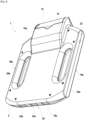
- THE figures 1 And 2 illustrate two perspective views, front and rear, of an exemplary embodiment of a tablet 1 according to the invention.
- the tablet 1 is intended to enable the acquisition, for example the reading, of documentary data such as data from a passport, an identity card, or any other official or non-official document, or to enable the control of such documentary data to verify that they match data already recorded for example.
- the tablet 1 can also be configured to acquire other data, in particular biometric data such as fingerprints or a photo, in order to record them or compare them with those contained in the documentary data.
- the tablet 1 comprises a main body 2 and different reading modules configured to read different data, mounted in said body 2.
- the body 2 is notably chosen with a smooth and shiny external surface, and having rounded edges, so as to allow easy and effective cleaning and disinfection, for example by exposure to UV, and so as to limit the areas at which microorganisms or dirt could accumulate.
- the tablet 1 may include a biometric reader 4 for reading fingerprints, for example a four-fingerprint reader.
- a conductive contour 5 may in particular be provided in the body 2, around the biometric reader 4, in order to allow the operation of the biometric reader 4 if necessary.
- the tablet 1 may also include a camera 6, with two lamps 8, of the flash type, arranged on either side of the tablet 1, in order to facilitate taking pictures.
- the tablet 1 also includes a dual data reader, for example an optical reader 10a and an RFID reader 10b, mounted inside a support 12. In the example illustrated in figures 1 And 2 , the support 12 is formed by the body 2.
- the dual data reader and the support 12 of the present embodiment are in particular designed to read data contained in a passport arranged on said support 12.
- the reading of the various data of the passport present on the support 12 can be carried out simultaneously, or successively without requiring any intervention by the user between the two.
- the user places, that is to say places, the passport on the support 12, and the dual data reader carries out the reading of the various data of the passport.
- the dual data reader comprises on the one hand the optical reader 10a, mounted on the rear part of the body 2 of the tablet 1 and configured to read the MRZ strip or the barcode of the passport, and on the other hand the RFID reader 10b, mounted on the front part of the body 2 of the tablet 1 and configured to read the data of the electronic chip contained in the passport.
- the support 12 under which the readers 10a and 10b are mounted comprises an exposed surface, preferably upper, configured to facilitate the correct positioning and holding of the passport in place, opposite said readers 10a, 10b.
- the support 12 can have an upper surface in an inverted V.
- Such a shape is particularly suitable for positioning and holding documents in booklet form: the booklet, in the open state, then has a shape complementary to that of the support 12.
- Each branch of the inverted V can then include one of the two readers 10a, 10b of the dual reader, in order to allow the reading of data on each part of the open booklet.
- the inverted V-shaped upper surface of the support 12 forms in particular a part of an upper surface of the main body 2.
- the tablet is configured so that the tip of the inverted V of the support 12 is oriented upwards when the tablet 1 is in use condition or in the condition of reading the data of a document.
- the tip of the inverted V of the support 12 can be positioned on an upper edge of the main body 2. This ensures that the document can remain stationary on the support 12, without having to be held while reading the data it contains.
- the side with the MRZ strip is positioned on the rear part of the support 12, where the optical reader 10a is located, which will lead to positioning the other side of the passport, with the electronic chip, on the front part of the support 12, where the RFID reader 10b is located.
- the user therefore only has to open and place the passport on the support 12 to allow the data to be read by the dual reader, and therefore does not need to position the passport on the one hand relative to an optical reader and on the other hand by an RFID reader.
- the RFID reader 10b is positioned on the front side of the tablet 1, under the front branch of the inverted V of the support 12. Since the RFID chip is read without contact, the front surface of the support 12 can be smooth.
- the optical reader 10a is positioned on the rear side of the tablet 1, under the rear branch of the inverted V of the support 12.
- the optical reader 10a includes in particular a window (not shown) allowing the reading of the MRZ strip or the barcode.
- the window In particular, in the present case, the document being intended to remain static during the reading of the MRZ strip or the barcode by the optical reader 10a, the latter must therefore include a window of length at least equal to that of the MRZ strip or the barcode.
- the body 2 also includes a rear cover 14, fixedly or removably mounted on the rest of the body. body 2, at least partially covering the optical reader 10a and the corresponding part of the inverted V-shaped branch of the support 12.
- the cover 14 thus serves as protection for the window through which the optical reader 10a can read the data of the MRZ or barcode tracks.
- the user positions the page, or the part of the booklet, with the MRZ strip in the slot formed by the rear branch of the inverted V of the support 12 and the cover 14, and the other page, or the other part of the booklet, on the front branch of the inverted V of the support 12.
- the slot formed by the support 12 and the cover 14 also makes it possible to prevent lateral sliding of the document along the longitudinal direction of the inverted V-shaped surface, thanks to the edges of the slot which form lateral retaining stops for the document.
- the document can stand alone on the support 12 while being read by both the optical reader 10a and the RFID reader 10b.
- the support 12 is positioned on top of the tablet 1 when the latter is used by the user.
- the support 12, and in particular the tip of the inverted V will be oriented upwards, which will allow the document to be simply placed on it, without having to hold the document.
- Such an arrangement of the support 12 can also allow a visual check, by an agent, of the correct use of the tablet 1 by the user. Indeed, the agent only needs to look at the top of the tablet 1, for example through the windshield of the user's vehicle or inside the building, to ensure that the user has correctly positioned his document on the support 12.
- the tablet 1 may also comprise a screen 16, for information or input for the user.
- the screen 16 may advantageously be touch-sensitive to facilitate the input of information by the user.
- the screen 16 is preferably oriented in portrait mode, that is to say with its greatest length oriented vertically when the user positions the tablet 1 upright facing him. In this case, it is therefore understood that the support 12 is arranged above the screen 16.
- the tablet 1 also includes a wireless communication module (not shown), for example a wifi or Bluetooth transmitter, to enable communication with a remote computer or server.
- a wireless communication module for example a wifi or Bluetooth transmitter, to enable communication with a remote computer or server.
- the tablet 1 also comprises two lateral gripping handles 18a, 18b, formed by the body 2.
- the handles 18a, 18b are arranged laterally on either side of the screen 16, that is to say on opposite lateral edges of the tablet 1.
- the handles 18a, 18b are of rounded and smooth shape, like the rest of the body 2, in order to allow effective cleaning and disinfection. More particularly, the handles 18a and 18b may have a generally cylindrical shape extending along the great length of the screen, in order to provide gripping comfort during use.
- flats 20a, 20b are also provided, for example on the outer lateral edge of the handles 18a, 18b, in order to facilitate their proper grip.
- the latter may comprise a reduced opening 22 through which a longitudinal tool can be inserted to actuate an ON/OFF button of the electronic device mounted in the body 2.
- the tablet 1 also includes a charging module 24 for connecting the tablet 1 to an external electrical source in order to recharge the battery of the tablet 1.
- the charging module 24 advantageously includes three electrical connectors 24a, 24b and 24c intended to connect to two charging terminals.
- the electrical connectors 24a, 24b, 24c are arranged symmetrically on the body 2 of the tablet 1, with an electrical connector 24a in the plane of symmetry of the tablet 1, so as to always be connected to the same charging terminal, regardless of the orientation of the tablet 1 when it is stored by the user, and two electrical connectors 24b, 24c mounted symmetrically with respect to the electrical connector 24a, so that there is always one of the two connectors 24b, 24c which is connected to the other charging terminal, depending on the storage direction. of the tablet by the user. This simply ensures that the charging module 24 of the tablet 1 is correctly connected to the charging terminals, regardless of the direction in which the
- the tablet according to the present invention it becomes faster and more intuitive for passengers to carry out the steps of acquiring and/or checking their documentary data.
- the geometry of the tablet, and in particular the shape of its upper support in which two different readers are integrated makes it possible to carry out several simultaneous or successive checks without the passenger having to intervene. It then becomes easier for passengers to carry out such steps themselves, without having to require the presence or assistance of a qualified member of staff.
Landscapes
- Engineering & Computer Science (AREA)
- Theoretical Computer Science (AREA)
- Computer Hardware Design (AREA)
- Physics & Mathematics (AREA)
- General Physics & Mathematics (AREA)
- Human Computer Interaction (AREA)
- General Engineering & Computer Science (AREA)
- Business, Economics & Management (AREA)
- Tourism & Hospitality (AREA)
- Educational Administration (AREA)
- Marketing (AREA)
- Computer Security & Cryptography (AREA)
- Health & Medical Sciences (AREA)
- Economics (AREA)
- General Health & Medical Sciences (AREA)
- Human Resources & Organizations (AREA)
- Development Economics (AREA)
- Primary Health Care (AREA)
- Strategic Management (AREA)
- General Business, Economics & Management (AREA)
- Image Input (AREA)
- Fittings On The Vehicle Exterior For Carrying Loads, And Devices For Holding Or Mounting Articles (AREA)
- Toys (AREA)
Description
- La présente invention concerne le domaine des installations ou dispositifs de contrôle des données documentaires, soit à bord d'un véhicule soit hors d'un véhicule, par exemple à l'intérieur d'un bâtiment, notamment lors d'un passage de frontière.
- Le but d'une telle installation ou dispositif est de pouvoir collecter, lorsque cela aura été rendu obligatoire pour le passage d'une frontière, des informations en lien avec les documents d'identité, telles que la biométrie faciale ou les empreintes digitales, ainsi que des informations de franchissement de la frontière, puis de les transmettre aux services de l'Etat afin qu'ils vérifient ces informations et leur conformité avec les documents d'identité du ou des passagers souhaitant franchir la frontière. Le ou les passagers peuvent notamment être installés à bord d'un véhicule.
- Une telle installation permettra alors de faire réaliser des opérations de préenregistrement par les passagers eux-mêmes, en amont du passage de la frontière, afin de diminuer le temps passé par les gardes-frontières dans les opérations de contrôle. En l'absence de telles installations, ces opérations devront être réalisées physiquement par des gardes-frontière, ce qui ralentira le flux des passagers.
- Actuellement, les agents procèdent à un contrôle d'identité du ou des passagers du véhicule sur la base des pièces d'identité fournies par le ou les passagers. Ils réalisent également, le cas échéant, un contrôle du véhicule sur la base des documents d'identité du véhicule, telle que la carte grise.
- Lors de cette opération, un agent doit être présent physiquement pour consulter les différents documents présentés par le ou les passagers, interroger les bases de données et réaliser les procédures de contrôle appropriées.
- Lorsque le véhicule est un poids-lourd transportant de la marchandise, l'agent doit également vérifier les documents administratifs afférents à la marchandise transportée.
- Ces démarches sont chronophages et mobilisent des ressources humaines. En outre, le protocole actuel impose à l'agent d'être en contact avec les passagers du véhicule.
- Le document
EP 3 944 204 décrit une installation permettant aux passagers d'effectuer eux-mêmes les démarches d'acquisition et de contrôle de leurs documents, tout en restant dans leur véhicule, grâce notamment à une tablette mise à disposition des passagers à une borne accessible depuis l'intérieur du véhicule. Une telle installation, bien que parfaitement satisfaisante, nécessite néanmoins de nombreuses manipulations de la part des passagers, ce qui peut entraîner une durée d'utilisation rallongée, notamment pour les passagers n'ayant pas l'habitude de telles installations. - Les documents
FR2968788 US 2021/0133404 A1 décrivent un dispositif d'acquisition de données documentaires similaire. - La présente invention vise à résoudre les différents problèmes techniques énoncés précédemment. En particulier, la présente invention vise à proposer un dispositif permettant l'acquisition et/ou le contrôle de données documentaires de manière plus rapide, simple et intuitive. Plus précisément, la présente invention vise à proposer un dispositif permettant de faciliter et d'accélérer les étapes d'acquisition et/ou de contrôle des données documentaires par les passagers.
- Ainsi, selon la présente invention, il est proposé une tablette d'acquisition et/ou de contrôle de données documentaires, notamment à bord d'un véhicule ou à l'intérieur d'un bâtiment, selon les caractéristiques de la revendication 1.
- Ainsi, la tablette selon la présente invention est configurée pour accélérer l'acquisition et/ou le contrôle des données grâce à son module de lecture à deux lecteurs en combinaison avec le support. En particulier, en positionnant le document à lire sur le support, la tablette selon la présente invention est configurée pour effectuer la lecture de deux types d'informations différentes comprises dans ledit document, par exemple simultanément, sans nécessiter d'action de la part du passager entre les deux lectures d'informations. Dit autrement, la tablette est configurée pour effectuer, depuis un seul et même support, deux lectures d'informations différentes comprises dans un document positionné sur ledit support.
- En particulier, le module de lecture de données documentaires est configuré pour acquérir différentes données d'un document disposé, ou positionné ou posé, immobile sur le support, avec les deux lecteurs différents. Dit autrement, le module de lecture est configuré pour lire, à la fois, des données différentes d'un document qui est posé immobile sur le support.
- Préférentiellement, le module de lecture comporte un lecteur optique, par exemple pour lire une piste MRZ ou un code-barres, et un lecteur RFID, par exemple pour lire une puce électronique.
- De tels lecteurs correspondent aux données pouvant être incluses dans un passeport. Ainsi, la tablette selon la présente invention est configurée pour lire à la fois la piste MRZ et la puce électronique du passeport, lorsque celui-ci est positionné sur le support, sans nécessiter d'intervention du passager entre les deux lectures.
- Préférentiellement, le lecteur RFID est monté du même côté que l'écran de la tablette, et le lecteur optique est monté du côté opposé à l'écran de la tablette.
- Le positionnement du lecteur optique sur la face arrière de la tablette permet à l'utilisateur de visualiser la partie lue par le lecteur, la bande MRZ, au moment de placer son document sur le support. En effet, le lecteur optique est ainsi configuré pour lire ce qui est orienté vers la face arrière de la tablette, c'est-à-dire ce qui est orienté vers l'utilisateur de la tablette faisant face à la face avant de celle-ci.
- Préférentiellement, le support et le module de lecture de données documentaires sont positionnés au-dessus de l'écran, de préférence sur une partie supérieure de la tablette, c'est-à-dire sur une partie de la surface supérieure, ou dessus, de la tablette, notamment lorsque celle-ci est en position d'utilisation ou en position de lecture des données du document. Par exemple, le support peut être positionné ou configuré de manière à permettre d'y poser le document dessus, lorsque l'écran est positionné sensiblement verticalement face à l'utilisateur, par exemple peut être positionné sur un chant supérieur de la tablette.
- Le support et le module de lecture peuvent être positionnés sur un chant supérieur de la tablette, c'est-à-dire sensiblement entre la face avant et la face arrière de la tablette. Une telle configuration permet notamment de faciliter et d'améliorer la mise en place du document sur le support, puisque le poids du document sur le support va naturellement conduire à le maintenir sur son support. Par ailleurs, une telle configuration permet également à un agent de contrôle aux frontières de visualiser la bonne utilisation de la tablette par le passager, en regardant simplement le haut de la tablette lors des opérations d'acquisition et/ou contrôle effectuées par le passager, notamment à travers le parebrise du véhicule ou bien à l'intérieur du bâtiment.
- Selon l'invention, le support présente une surface supérieure en V inversé, notamment destinée à supporter un document sous forme de livret, à l'état ouvert. Un des deux lecteurs du module de lecture de données documentaires est monté à proximité d'une branche du V inversé de la surface supérieure, et l'autre lecteur du module de lecture de données documentaires est monté à proximité de l'autre branche du V inversé de la surface supérieure.
- La forme du support est choisie de manière à correspondre à celle d'un passeport ouvert à la page d'identification : ainsi, une fois le passeport ouvert à la page d'identification, il présente une forme qui viendra se positionner parfaitement sur la forme complémentaire en V inversé du support. La tablette facilite donc le positionnement correct du passeport ouvert sur le support, tout en permettant également un maintien amélioré du passeport sur le support. Ainsi, pour permettre à la tablette de lire toutes les informations contenues dans le passeport, il suffit juste au passager de positionner le passeport ouvert sur le support. En particulier, il n'y a pas deux manipulations à faire de la part du passager pour lire d'une part la piste MRZ et d'autre part la puce électronique, mais une seule uniquement.
- Dit autrement, le support présente une surface supérieure en V inversé configurée pour supporter un document sous forme de livret, à l'état ouvert, posé immobile dessus. En particulier, dans le cas d'un passeport, l'ouverture de celui-ci pour accéder aux informations conduit à avoir la piste MRZ du côté de la couverture avant, et la puce électronique du côté de la couverture arrière. Le positionnement du passeport ouvert sur le support permet donc à chaque lecteur de lire les données du passeport correspondantes.
- Préférentiellement, le support présente une surface supérieure en V inversé, avec la pointe du V orientée vers le haut lorsque la tablette est en position d'utilisation ou en position de lecture des données du document. Par exemple, la pointe du V peut être positionnée au niveau d'un chant supérieur de la tablette.
- Préférentiellement, la tablette d'acquisition comporte également au moins une poignée de préhension, de préférence deux poignées de préhension situées sur deux bords latéraux opposés de la tablette, ladite au moins une poignée présentant une surface de préhension configurée pour limiter un mouvement de glissement dans la main de l'utilisateur.
- Les poignées de préhension sont configurées pour faciliter l'usage de la tablette par l'utilisateur, notamment sa saisie, par exemple sur une borne adjacente à son véhicule, ou encore sa tenue lors des étapes d'acquisition et/ou contrôle des données documentaires. En effet, lors des telles étapes, l'utilisateur peut être amené à utiliser une de ses mains pour manipuler lesdits documents, ou bien pour interagir avec la tablette, ce qui conduit à tenir la tablette avec une seule main et donc à un risque de glissement de la tablette dans la main de l'utilisateur, par exemple par pivotement. Les poignées sont ainsi configurées pour limiter de tels mouvements non-voulus.
- Préférentiellement, ladite au moins une poignée présente une surface de préhension de forme cylindrique avec un méplat, par exemple latéral.
- La surface cylindrique permet une préhension confortable pour l'utilisateur, tout en facilitant également le nettoyage des poignées grâce à l'absence d'aspérités. Cependant, afin de limiter les risques de glissement de la tablette entre les mains de l'utilisateur, et notamment les risques de rotation de la poignée dans la main de l'utilisateur lorsque celui-ci la tient d'une seule main, un méplat est prévu dans la poignée, de préférence du côté latéral. Le méplat permet de créer une rupture dans la surface arrondie de la poignée, facilitant ainsi sa non-rotation dans la main de l'utilisateur.
- Préférentiellement, la tablette d'acquisition comporte une surface externe arrondie et brillante.
- La surface arrondie et brillante est choisie afin d'en faciliter le nettoyage et notamment la désinfection. Ainsi, la surface brillante traduit une surface lisse limitant l'accroche de saletés et autres à sa surface. De plus, une surface arrondie et brillante permet également un nettoyage facilité par UV pour la désinfection.
- Préférentiellement, la tablette d'acquisition comporte également un module de recharge, le module de recharge comportant au moins trois connecteurs électriques, positionnés symétriquement par rapport à un plan de symétrie du contour de la tablette, et configurés pour se connecter à deux connecteurs externes de recharge quel que soit le sens de positionnement de la tablette par rapport aux deux connecteurs externes.
- La tablette est destinée à être prise par l'utilisateur depuis une installation ou un support, et est repositionnée dans ladite installation ou sur ledit support par l'utilisateur, après acquisition et/ou contrôle des données documentaires. Ainsi, et afin de s'assurer que le repositionnement de la tablette permettra bien de reconnecter les connecteurs électriques de celles-ci avec ceux de recharge situés sur l'installation ou le support, la tablette comporte plusieurs connecteurs disposés de manière symétrique. Une telle configuration permet alors une connexion électrique entre l'installation ou le support et la tablette, quelle que soit l'orientation de celle-ci, tout en respectant la polarité des contacts électriques : il y aura toujours au moins deux connecteurs électriques en contact avec deux connecteurs de recharge de l'installation ou du support.
- Préférentiellement, la tablette d'acquisition comporte également un lecteur biométrique, notamment pour la lecture d'empreintes digitales, par exemple un lecteur à quatre empreintes digitales, et/ou une caméra, notamment pour reconnaissance biométrique faciale.
- Préférentiellement, la tablette d'acquisition comporte un corps avec au moins une partie formant ledit support, et dans lequel sont montés ledit écran et ledit module de lecture de données documentaires.
- Le corps forme ainsi une coque dans laquelle sont intégrés les différents composants électroniques de la tablette, notamment l'écran, l'électronique de contrôle, les lecteurs, etc. Le corps, qui comporte notamment les poignées et le support, permet donc d'agencer les différents composants afin de rendre l'usage de la tablette simple et intuitif pour le passager.
-
- [
Fig. 1 ] Lafigure 1 représente une vue en perspective, de face, d'une tablette selon l'invention ; et - [
Fig. 2 ] Lafigure 2 représente une vue en perspective, de derrière, de la tablette de lafigure 1 . - Les
figures 1 et2 illustrent deux vues en perspective, avant et arrière, d'un exemple de mode de réalisation d'une tablette 1 selon l'invention. - La tablette 1 est destinée à permettre l'acquisition, par exemple la lecture, de données documentaires telles que des données d'un passeport, d'une carte d'identité, ou de tout autre document officiel ou non, ou bien à permettre le contrôle de telles données documentaires pour vérifier qu'elles concordent avec des données déjà enregistrées par exemple. La tablette 1 peut également être configurée pour acquérir d'autres données, notamment biométriques telles que des empreintes ou une photo, afin de les enregistrer ou bien les comparer avec celles contenues dans les données documentaires.
- A cet effet, la tablette 1 comporte un corps principal 2 et différents modules de lecture configurés pour lire différentes données, montés dans ledit corps 2. Le corps 2 est notamment choisi avec une surface externe lisse et brillante, et présentant des arêtes arrondies, de manière à en permettre un nettoyage et une désinfection facilités et efficaces, par exemple par exposition à des UV, et de manière à limiter les zones au niveau desquelles des microorganismes ou des saletés pourraient s'accumuler.
- Ainsi, la tablette 1 peut comporter un lecteur biométrique 4 pour la lecture des empreintes digitales, par exemple un lecteur quatre empreintes. Un contour conducteur 5 peut notamment être prévu dans le corps 2, autour du lecteur biométrique 4, afin de permettre le fonctionnement du lecteur biométrique 4 le cas échéant. La tablette 1 peut également comporter une caméra 6, avec deux lampes 8, de type flash, disposées de part et d'autre de la tablette 1, afin de faciliter la prise de vue. La tablette 1 comprend également un double lecteur de données, par exemple un lecteur optique 10a et un lecteur RFID 10b, monté à l'intérieur d'un support 12. Dans l'exemple illustré aux
figures 1 et2 , le support 12 est formé par le corps 2. - Le double lecteur de données et le support 12 du présent mode de réalisation sont notamment conçus pour lire des données contenues dans un passeport disposé sur ledit support 12. La lecture des différentes données du passeport présent sur le support 12 peut s'effectuer de manière simultanée, ou bien successivement sans nécessiter d'intervention de l'utilisateur entre les deux. Dit autrement, l'utilisateur met, c'est-à-dire pose, le passeport sur le support 12, et le double lecteur de données effectue la lecture des différentes données du passeport.
- Ainsi, le double lecteur de données comprend d'une part le lecteur optique 10a, monté sur la partie arrière du corps 2 de la tablette 1 et configuré pour lire la bande MRZ ou le code-barres du passeport, et d'autre le lecteur RFID 10b, monté sur la partie avant du corps 2 de la tablette 1 et configuré pour lire les données de la puce électronique contenue dans le passeport.
- Afin de positionner correctement le passeport par rapport aux lecteurs 10a, 10b, le support 12, sous lequel sont montés les lecteurs 10a et 10b, comprend une surface exposée, de préférence supérieure, configurée pour faciliter le bon positionnement et le maintien du passeport en place, en regard desdits lecteurs 10a, 10b.
- Ainsi, le support 12 peut présenter une surface supérieure en V inversé. Une telle forme est particulièrement adaptée pour le positionnement et le maintien de documents sous forme de livret : le livret, à l'état ouvert, présente alors une forme complémentaire à celle du support 12. Chaque branche du V inversé peut alors comporter un des deux lecteurs 10a, 10b du double lecteur, afin de permettre la lecture de données sur chaque partie du livret ouvert.
- La surface supérieure en V inversé du support 12 forme notamment une partie d'une surface supérieure du corps principal 2. En particulier, la tablette est configurée pour que la pointe du V inversé du support 12 soit orientée vers le haut lorsque la tablette 1 est en condition d'utilisation ou bien en condition de lecture des données d'un document. Par exemple, la pointe du V inversé du support 12 peut être positionnée sur un chant supérieur du corps principal 2. On s'assure ainsi que le document peut tenir immobile sur le support 12, sans avoir à être tenu pendant la lecture des données qu'il contient.
- Par exemple, dans le cas d'un passeport, lorsque celui-ci est ouvert à la page comportant la bande MRZ, le côté avec la bande MRZ est positionné sur la partie arrière du support 12, là où se trouve le lecteur optique 10a, ce qui conduira à positionner l'autre côté du passeport, avec la puce électronique, sur la partie avant du support 12, là où se trouve le lecteur RFID 10b. L'utilisateur n'a donc qu'à ouvrir et poser le passeport sur le support 12 pour en permettre la lecture des données par le double lecteur, et n'a donc pas besoin de positionner le passeport d'une part par rapport à un lecteur optique et d'autre part par un lecteur RFID.
- Le lecteur RFID 10b est positionné du côté avant de la tablette 1, sous la branche avant du V inversé du support 12. La lecture de la puce RFID se faisant sans contact, la surface avant du support 12 peut être lisse.
- Le lecteur optique 10a est positionné du côté arrière de la tablette 1, sous la branche arrière du V inversé du support 12. Le lecteur optique 10a comporte notamment une fenêtre (non représentée) permettant la lecture de la bande MRZ ou du code-barres. En particulier, dans le cas présent, le document étant destiné à rester statique pendant la lecture de la bande MRZ ou du code-barres par le lecteur optique 10a, ce dernier doit donc comporter une fenêtre de longueur au moins égale à celle de la bande MRZ ou du code-barres.
- Afin d'éviter les salissures et les poussières sur la fenêtre du lecteur optique 10a, ce qui pourrait compromettre la lecture correcte des données, le corps 2 comporte également un capot 14 arrière, monté fixe ou amovible sur le reste du corps 2, recouvrant au moins en partie le lecteur optique 10a et la partie correspondante de la branche en V inversée du support 12. Le capot 14 sert ainsi de protection à la fenêtre par laquelle le lecteur optique 10a peut lire les données des pistes MRZ ou code- barres. Ainsi, pour permettre la lecture de la bande MRZ, l'utilisateur positionne la page, ou la partie de livret, avec la bande MRZ dans la fente formée par la branche arrière du V inversé du support 12 et le capot 14, et l'autre page, ou l'autre partie du livret, sur la branche avant du V inversé du support 12. La fente formée par le support 12 et le capot 14 permet également d'éviter un glissement latéral du document le long de la direction longitudinale de la surface en V inversée, grâce aux bords de la fente qui viennent former des butées de retenue latérale pour le document.
- Ainsi positionné, le document peut tenir seul sur le support 12 tout en étant lu à la fois par le lecteur optique 10a et le lecteur RFID 10b.
- Afin de faciliter le maintien du document sur le support 12, le support 12 est positionné sur le dessus de la tablette 1 lorsque celle-ci est utilisée par l'utilisateur. Dit autrement, en utilisation, le support 12, et notamment la pointe du V inversé, va être orienté vers le haut, ce qui permettra d'y poser simplement le document dessus, sans avoir à tenir le document. Une telle disposition du support 12 peut également permettre une vérification visuelle, par un agent, de l'utilisation correcte de la tablette 1 par l'utilisateur. En effet, il suffit à l'agent de regarder le haut de la tablette 1, par exemple à travers le parebrise du véhicule de l'utilisateur ou bien à l'intérieur du bâtiment, pour s'assurer que celui-ci a bien positionné son document sur le support 12.
- La tablette 1 peut également comprendre un écran 16, d'informations ou de saisie pour l'utilisateur. L'écran 16 peut avantageusement être tactile pour faciliter la saisie d'informations par l'utilisateur. L'écran 16 est orienté de préférence en mode portrait, c'est-à-dire avec sa plus grande longueur orientée verticalement lorsque l'utilisateur positionne la tablette 1 debout face à lui. Dans ce cas, on comprend donc que le support 12 est disposé au-dessus de l'écran 16.
- La tablette 1 comporte également un module de communication sans fil (non représenté), par exemple un émetteur wifi ou Bluetooth, pour permettre une communication avec un ordinateur ou un serveur distant.
- La tablette 1 comprend également deux poignées 18a, 18b de préhension latérales, formées par le corps 2. Les poignées 18a, 18b sont disposées latéralement de part et d'autre de l'écran 16, c'est-à-dire sur des bords latéraux opposés de la tablette 1. Les poignées 18a, 18b sont de forme arrondie et lisse, comme le reste du corps 2, afin d'en permettre un nettoyage et une désinfection efficace. Plus particulièrement, les poignées 18a et 18b peuvent présenter une forme générale cylindrique s'étendant selon la grande longueur de l'écran, afin d'apporter un confort de préhension lors de l'utilisation. Toutefois, et afin d'éviter tout glissement de la poignée dans la main, notamment lorsque l'utilisateur tient la tablette 1 d'une seule main, des méplats 20a, 20b sont également prévus, par exemple sur le rebord latéral extérieur des poignées 18a, 18b, afin de faciliter leur bonne préhension.
- Afin de permettre un allumage ou une extinction du dispositif électronique monté dans le corps 2, ce dernier peut comporter une ouverture 22 réduite par laquelle un outil longitudinal peut être introduit pour actionner un bouton ON/OFF du dispositif électronique monté dans le corps 2. Un tel agencement permet notamment d'éviter un tel actionnement par l'utilisateur, même par inadvertance, tout en permettant d'éteindre et d'allumer la tablette 1 sans avoir à ouvrir le corps 2.
- Enfin, la tablette 1 comporte également un module de recharge 24 permettant de connecter la tablette 1 à une source électrique externe afin de recharger la batterie de la tablette 1. Le module de recharge 24 comporte avantageusement trois connecteurs électriques 24a, 24b et 24c destinés à venir se connecter à deux bornes de recharge. Afin de s'assurer que les pôles des connecteurs électriques de la tablette 1 soient en toutes circonstances, reliés aux mêmes pôles des bornes de recharge, les connecteurs électriques 24a, 24b, 24c sont disposés symétriquement sur le corps 2 de la tablette 1, avec un connecteur électrique 24a dans le plan de symétrie de la tablette 1, de manière à être toujours connecté à la même borne de recharge, quelle que soit l'orientation de la tablette 1 lors de son rangement par l'utilisateur, et deux connecteurs électriques 24b, 24c montés symétriquement par rapport au connecteur électrique 24a, de manière à ce qu'il y ait toujours un des deux connecteurs 24b, 24c qui soit relié à l'autre borne de recharge, en fonction du sens de rangement de la tablette par l'utilisateur. On s'assure ainsi simplement du bon branchement du module de recharge 24 de la tablette 1 sur les bornes de recharge, quel que soit le sens de positionnement de la tablette sur lesdites bornes de recharge.
- Ainsi, grâce à la tablette selon la présente invention, il devient plus rapide et plus intuitif pour les passagers d'effectuer les démarches d'acquisition et/ou de contrôle de leurs données documentaires. En particulier, la géométrie de la tablette, et notamment la forme de son support supérieur dans lequel sont intégrés deux lecteurs différents, permet d'effectuer plusieurs vérifications simultanées ou successives sans intervention du passager. Il devient alors plus facile pour les passagers d'effectuer de telles démarches eux-mêmes, sans avoir à requérir la présence ou l'assistance d'un membre du personnel qualifié.
Claims (11)
- Tablette (1) d'acquisition et/ou de contrôle de données documentaires, notamment à bord d'un véhicule ou à l'intérieur d'un bâtiment, comportant au moins un écran (16), par exemple orienté verticalement, un support (12) et un module de lecture de données documentaires, dans laquelle le module de lecture de données documentaires comporte deux lecteurs (10a, 10b) différents, dans laquelle le module de lecture de données documentaires est configuré pour acquérir différentes données d'un document disposé sur le support (12), avec les deux lecteurs différents (10a, 10b), caractérisée en ce que le support (12) présente une surface supérieure en V inversé et dans laquelle un (10a) des deux lecteurs du module de lecture de données documentaires est monté à proximité d'une branche du V inversé de la surface supérieure, et l'autre lecteur (10b) du module de lecture de données documentaires est monté à proximité de l'autre branche du V inversé de la surface supérieure.
- Tablette (1) d'acquisition selon la revendication 1, dans laquelle le module de lecture comporte un lecteur optique (10a), par exemple pour lire une piste MRZ ou un code-barres, et un lecteur RFID (10b), par exemple pour lire une puce électronique.
- Tablette (1) d'acquisition selon la revendication 2, dans laquelle le lecteur RFID (10b) est monté du même côté que l'écran (16) de la tablette (1), et dans laquelle le lecteur optique (10a) est monté du côté opposé à l'écran (16) de la tablette (1).
- Tablette (1) d'acquisition selon l'une quelconque des revendications précédentes, dans laquelle le support (12) et le module de lecture de données documentaires sont positionnés au-dessus de l'écran (16), de préférence sur une partie supérieure de la tablette (1).
- Tablette (1) d'acquisition selon l'une quelconque des revendications précédentes, dans laquelle la surface supérieure en V inversé est destinée à supporter un document sous forme de livret, à l'état ouvert.
- Tablette (1) d'acquisition selon l'une quelconque des revendications précédentes, comportant également au moins une poignée de préhension (18a, 18b), de préférence deux poignées de préhension situées sur deux bords latéraux opposés de la tablette (1), ladite au moins une poignée présentant une surface de préhension configurée pour limiter un mouvement de glissement dans la main de l'utilisateur.
- Tablette (1) d'acquisition selon la revendication précédente, dans laquelle ladite au moins une poignée (18a, 18b) présente une surface de préhension de forme cylindrique avec un méplat (20a, 20b), par exemple latéral.
- Tablette (1) d'acquisition selon l'une quelconque des revendications précédentes, comportant une surface externe arrondie et brillante.
- Tablette (1) d'acquisition selon l'une quelconque des revendications précédentes, comportant également un module de recharge (24), le module de recharge comportant au moins trois connecteurs électriques (24a, 24b, 24c), positionnés symétriquement par rapport à un plan de symétrie du contour de la tablette (1), et configurés pour se connecter à deux connecteurs externes de recharge quel que soit le sens de positionnement de la tablette (1) par rapport aux deux connecteurs externes.
- Tablette (1) d'acquisition selon l'une quelconque des revendications précédentes, comportant également un lecteur biométrique (4) et/ou une caméra (6).
- Tablette (1) d'acquisition selon l'une quelconque des revendications précédentes, comportant un corps (2) avec au moins une partie formant ledit support (12), et dans lequel sont montés ledit écran (16) et ledit module de lecture de données documentaires.
Priority Applications (1)
| Application Number | Priority Date | Filing Date | Title |
|---|---|---|---|
| HRP20250071TT HRP20250071T1 (hr) | 2022-04-26 | 2023-04-21 | Tablet za prikupljanje i/ili provjeru dokumentiranih podataka |
Applications Claiming Priority (1)
| Application Number | Priority Date | Filing Date | Title |
|---|---|---|---|
| FR2203861A FR3134903B1 (fr) | 2022-04-26 | 2022-04-26 | Tablette d’acquisition et/ou de contrôle de données documentaires |
Publications (3)
| Publication Number | Publication Date |
|---|---|
| EP4270337A1 EP4270337A1 (fr) | 2023-11-01 |
| EP4270337C0 EP4270337C0 (fr) | 2024-11-27 |
| EP4270337B1 true EP4270337B1 (fr) | 2024-11-27 |
Family
ID=82100567
Family Applications (1)
| Application Number | Title | Priority Date | Filing Date |
|---|---|---|---|
| EP23169303.7A Active EP4270337B1 (fr) | 2022-04-26 | 2023-04-21 | Tablette d'acquisition et/ou de contrôle de données documentaires |
Country Status (4)
| Country | Link |
|---|---|
| EP (1) | EP4270337B1 (fr) |
| FR (1) | FR3134903B1 (fr) |
| HR (1) | HRP20250071T1 (fr) |
| PL (1) | PL4270337T3 (fr) |
Family Cites Families (4)
| Publication number | Priority date | Publication date | Assignee | Title |
|---|---|---|---|---|
| JPH05207245A (ja) * | 1992-01-29 | 1993-08-13 | Sharp Corp | 携帯型光学読取装置 |
| FR2968788A1 (fr) * | 2010-12-08 | 2012-06-15 | Xiring | Terminal portable pour le controle d'identite |
| US11366975B2 (en) * | 2018-06-21 | 2022-06-21 | Custom S.P.A. | Apparatus for inspecting documents |
| FR3112881B1 (fr) | 2020-07-23 | 2026-07-24 | Getlink S E | Installation d’acquisition et de contrôle de données documentaires à bord d’un véhicule. |
-
2022
- 2022-04-26 FR FR2203861A patent/FR3134903B1/fr active Active
-
2023
- 2023-04-21 EP EP23169303.7A patent/EP4270337B1/fr active Active
- 2023-04-21 HR HRP20250071TT patent/HRP20250071T1/hr unknown
- 2023-04-21 PL PL23169303.7T patent/PL4270337T3/pl unknown
Also Published As
| Publication number | Publication date |
|---|---|
| EP4270337C0 (fr) | 2024-11-27 |
| FR3134903A1 (fr) | 2023-10-27 |
| FR3134903B1 (fr) | 2024-11-22 |
| HRP20250071T1 (hr) | 2025-03-28 |
| PL4270337T3 (pl) | 2025-03-24 |
| EP4270337A1 (fr) | 2023-11-01 |
Similar Documents
| Publication | Publication Date | Title |
|---|---|---|
| FR2665556A1 (fr) | Dispositif de logement d'une carte a memoire. | |
| EP3965010A1 (fr) | Personnalisation d'une carte à microcircuit | |
| EP4270337A1 (fr) | Tablette d'acquisition et/ou de contrôle de données documentaires | |
| EP0980561B1 (fr) | Carte amovible a connecteur enfichable, formant lecteur de carte a puce pour micro-ordinateur | |
| EP0198739A1 (fr) | Système de connexion pour cartes individuelles pour système de traitement de signaux | |
| EP1050006A1 (fr) | Dispositif de liaison entre au moins une carte a puce, un lecteur et l'hote | |
| FR2696863A1 (fr) | Cartouche intermédiaire polyvalente. | |
| EP2926292B1 (fr) | Trappe pour terminal | |
| EP0867011B1 (fr) | Lecteur portable de carte a puce apte a fonctionner meme range | |
| EP1826702B1 (fr) | Dispositif anti-intrusion | |
| EP2901369A1 (fr) | Dispositif de capture d'une image représentative d'une empreinte d'une partie du corps d'une personne | |
| FR3128047A1 (fr) | Installation d’acquisition et de contrôle de données documentaires à bord d’un véhicule. | |
| FR3025867B1 (fr) | Capsule permettant de guider la lumiere et dispositif de paiement sans contact associe. | |
| FR2783750A1 (fr) | Carte a module secable | |
| WO1998053421A1 (fr) | Connecteur avec insertion directe ou indirecte d'une carte a puce en son sein | |
| FR3037765A1 (fr) | Coque de protection pour terminal electronique | |
| EP3432611A1 (fr) | Système de localisation d'une personne par voie de télécommunication | |
| CA2989734A1 (fr) | Piece de maintien d'une tete de lecture magnetique. | |
| FR2722589A1 (fr) | Interface portable pour carte a puce electronique | |
| de Callataÿ | The Coinage of Heraclea Lucaniae (Archaeologica, 110) | |
| EP1564969A1 (fr) | Terminal portable multifonction à éléments de boitier rotatifs superposés | |
| EP1798695B1 (fr) | Système électronique connecté à un câble électrique à tenue en fatigue de câble améliorée | |
| Dupré | Mémoire et écriture: l'inscription du féminin dans l'histoire | |
| WO1999038105A1 (fr) | Connecteur ou raccord en forme de carte a puce | |
| EP3877967A1 (fr) | Support d'indicateur visuel et dispositif de paiement correspondant |
Legal Events
| Date | Code | Title | Description |
|---|---|---|---|
| REG | Reference to a national code |
Ref country code: HR Ref legal event code: TUEP Ref document number: P20250071T Country of ref document: HR |
|
| PUAI | Public reference made under article 153(3) epc to a published international application that has entered the european phase |
Free format text: ORIGINAL CODE: 0009012 |
|
| STAA | Information on the status of an ep patent application or granted ep patent |
Free format text: STATUS: THE APPLICATION HAS BEEN PUBLISHED |
|
| AK | Designated contracting states |
Kind code of ref document: A1 Designated state(s): AL AT BE BG CH CY CZ DE DK EE ES FI FR GB GR HR HU IE IS IT LI LT LU LV MC ME MK MT NL NO PL PT RO RS SE SI SK SM TR |
|
| STAA | Information on the status of an ep patent application or granted ep patent |
Free format text: STATUS: REQUEST FOR EXAMINATION WAS MADE |
|
| 17P | Request for examination filed |
Effective date: 20240327 |
|
| RBV | Designated contracting states (corrected) |
Designated state(s): AL AT BE BG CH CY CZ DE DK EE ES FI FR GB GR HR HU IE IS IT LI LT LU LV MC ME MK MT NL NO PL PT RO RS SE SI SK SM TR |
|
| GRAP | Despatch of communication of intention to grant a patent |
Free format text: ORIGINAL CODE: EPIDOSNIGR1 |
|
| STAA | Information on the status of an ep patent application or granted ep patent |
Free format text: STATUS: GRANT OF PATENT IS INTENDED |
|
| INTG | Intention to grant announced |
Effective date: 20240708 |
|
| GRAS | Grant fee paid |
Free format text: ORIGINAL CODE: EPIDOSNIGR3 |
|
| GRAA | (expected) grant |
Free format text: ORIGINAL CODE: 0009210 |
|
| STAA | Information on the status of an ep patent application or granted ep patent |
Free format text: STATUS: THE PATENT HAS BEEN GRANTED |
|
| AK | Designated contracting states |
Kind code of ref document: B1 Designated state(s): AL AT BE BG CH CY CZ DE DK EE ES FI FR GB GR HR HU IE IS IT LI LT LU LV MC ME MK MT NL NO PL PT RO RS SE SI SK SM TR |
|
| REG | Reference to a national code |
Ref country code: GB Ref legal event code: FG4D Free format text: NOT ENGLISH |
|
| REG | Reference to a national code |
Ref country code: CH Ref legal event code: EP |
|
| REG | Reference to a national code |
Ref country code: IE Ref legal event code: FG4D Free format text: LANGUAGE OF EP DOCUMENT: FRENCH |
|
| REG | Reference to a national code |
Ref country code: DE Ref legal event code: R096 Ref document number: 602023001149 Country of ref document: DE |
|
| U01 | Request for unitary effect filed |
Effective date: 20241127 |
|
| U07 | Unitary effect registered |
Designated state(s): AT BE BG DE DK EE FI FR IT LT LU LV MT NL PT RO SE SI Effective date: 20241205 |
|
| REG | Reference to a national code |
Ref country code: GR Ref legal event code: EP Ref document number: 20250400166 Country of ref document: GR Effective date: 20250211 |
|
| REG | Reference to a national code |
Ref country code: HR Ref legal event code: T1PR Ref document number: P20250071 Country of ref document: HR |
|
| PG25 | Lapsed in a contracting state [announced via postgrant information from national office to epo] |
Ref country code: IS Free format text: LAPSE BECAUSE OF FAILURE TO SUBMIT A TRANSLATION OF THE DESCRIPTION OR TO PAY THE FEE WITHIN THE PRESCRIBED TIME-LIMIT Effective date: 20250327 |
|
| PG25 | Lapsed in a contracting state [announced via postgrant information from national office to epo] |
Ref country code: ES Free format text: LAPSE BECAUSE OF FAILURE TO SUBMIT A TRANSLATION OF THE DESCRIPTION OR TO PAY THE FEE WITHIN THE PRESCRIBED TIME-LIMIT Effective date: 20241127 |
|
| PG25 | Lapsed in a contracting state [announced via postgrant information from national office to epo] |
Ref country code: NO Free format text: LAPSE BECAUSE OF FAILURE TO SUBMIT A TRANSLATION OF THE DESCRIPTION OR TO PAY THE FEE WITHIN THE PRESCRIBED TIME-LIMIT Effective date: 20250227 |
|
| REG | Reference to a national code |
Ref country code: HR Ref legal event code: ODRP Ref document number: P20250071 Country of ref document: HR Payment date: 20250407 Year of fee payment: 3 |
|
| PG25 | Lapsed in a contracting state [announced via postgrant information from national office to epo] |
Ref country code: RS Free format text: LAPSE BECAUSE OF FAILURE TO SUBMIT A TRANSLATION OF THE DESCRIPTION OR TO PAY THE FEE WITHIN THE PRESCRIBED TIME-LIMIT Effective date: 20250227 |
|
| U20 | Renewal fee for the european patent with unitary effect paid |
Year of fee payment: 3 Effective date: 20250404 |
|
| PG25 | Lapsed in a contracting state [announced via postgrant information from national office to epo] |
Ref country code: SM Free format text: LAPSE BECAUSE OF FAILURE TO SUBMIT A TRANSLATION OF THE DESCRIPTION OR TO PAY THE FEE WITHIN THE PRESCRIBED TIME-LIMIT Effective date: 20241127 |
|
| PG25 | Lapsed in a contracting state [announced via postgrant information from national office to epo] |
Ref country code: SK Free format text: LAPSE BECAUSE OF FAILURE TO SUBMIT A TRANSLATION OF THE DESCRIPTION OR TO PAY THE FEE WITHIN THE PRESCRIBED TIME-LIMIT Effective date: 20241127 |
|
| PG25 | Lapsed in a contracting state [announced via postgrant information from national office to epo] |
Ref country code: CZ Free format text: LAPSE BECAUSE OF FAILURE TO SUBMIT A TRANSLATION OF THE DESCRIPTION OR TO PAY THE FEE WITHIN THE PRESCRIBED TIME-LIMIT Effective date: 20241127 |
|
| PLBE | No opposition filed within time limit |
Free format text: ORIGINAL CODE: 0009261 |
|
| STAA | Information on the status of an ep patent application or granted ep patent |
Free format text: STATUS: NO OPPOSITION FILED WITHIN TIME LIMIT |
|
| 26N | No opposition filed |
Effective date: 20250828 |
|
| PG25 | Lapsed in a contracting state [announced via postgrant information from national office to epo] |
Ref country code: MC Free format text: LAPSE BECAUSE OF FAILURE TO SUBMIT A TRANSLATION OF THE DESCRIPTION OR TO PAY THE FEE WITHIN THE PRESCRIBED TIME-LIMIT Effective date: 20241127 |
|
| PG25 | Lapsed in a contracting state [announced via postgrant information from national office to epo] |
Ref country code: IE Free format text: LAPSE BECAUSE OF NON-PAYMENT OF DUE FEES Effective date: 20250421 |
|
| REG | Reference to a national code |
Ref country code: HR Ref legal event code: ODRP Ref document number: P20250071 Country of ref document: HR Payment date: 20260409 Year of fee payment: 4 |
|
| U20 | Renewal fee for the european patent with unitary effect paid |
Year of fee payment: 4 Effective date: 20260410 |
|
| PG25 | Lapsed in a contracting state [announced via postgrant information from national office to epo] |
Ref country code: CY Free format text: LAPSE BECAUSE OF FAILURE TO SUBMIT A TRANSLATION OF THE DESCRIPTION OR TO PAY THE FEE WITHIN THE PRESCRIBED TIME-LIMIT Effective date: 20241127 |
|
| PGFP | Annual fee paid to national office [announced via postgrant information from national office to epo] |
Ref country code: PL Payment date: 20260409 Year of fee payment: 4 |
|
| PGFP | Annual fee paid to national office [announced via postgrant information from national office to epo] |
Ref country code: GR Payment date: 20260427 Year of fee payment: 4 |
|
| PGFP | Annual fee paid to national office [announced via postgrant information from national office to epo] |
Ref country code: HR Payment date: 20260409 Year of fee payment: 4 |