EP4269088A1 - Liquid accommodation member for coating tool - Google Patents
Liquid accommodation member for coating tool Download PDFInfo
- Publication number
- EP4269088A1 EP4269088A1 EP21910643.2A EP21910643A EP4269088A1 EP 4269088 A1 EP4269088 A1 EP 4269088A1 EP 21910643 A EP21910643 A EP 21910643A EP 4269088 A1 EP4269088 A1 EP 4269088A1
- Authority
- EP
- European Patent Office
- Prior art keywords
- storage member
- paper
- liquid storage
- layer
- paper base
- Prior art date
- Legal status (The legal status is an assumption and is not a legal conclusion. Google has not performed a legal analysis and makes no representation as to the accuracy of the status listed.)
- Pending
Links
- 239000007788 liquid Substances 0.000 title claims abstract description 155
- 239000011248 coating agent Substances 0.000 title claims abstract description 91
- 238000000576 coating method Methods 0.000 title claims abstract description 91
- 230000004308 accommodation Effects 0.000 title 1
- 239000010410 layer Substances 0.000 claims abstract description 228
- 238000003860 storage Methods 0.000 claims abstract description 127
- 239000000463 material Substances 0.000 claims abstract description 52
- 239000012790 adhesive layer Substances 0.000 claims abstract description 38
- 229920005672 polyolefin resin Polymers 0.000 claims abstract description 35
- VYPSYNLAJGMNEJ-UHFFFAOYSA-N Silicium dioxide Chemical compound O=[Si]=O VYPSYNLAJGMNEJ-UHFFFAOYSA-N 0.000 claims abstract description 18
- 229910052751 metal Inorganic materials 0.000 claims abstract description 11
- 239000002184 metal Substances 0.000 claims abstract description 11
- 238000007740 vapor deposition Methods 0.000 claims abstract description 10
- 239000000377 silicon dioxide Substances 0.000 claims abstract description 9
- 239000000123 paper Substances 0.000 claims description 185
- 239000011086 glassine Substances 0.000 claims description 13
- 239000011088 parchment paper Substances 0.000 claims description 12
- 239000000835 fiber Substances 0.000 claims description 11
- -1 polypropylene Polymers 0.000 abstract description 15
- 239000004743 Polypropylene Substances 0.000 abstract description 10
- 229920003023 plastic Polymers 0.000 abstract description 10
- 239000004033 plastic Substances 0.000 abstract description 10
- 229920001155 polypropylene Polymers 0.000 abstract description 10
- 230000007613 environmental effect Effects 0.000 abstract description 4
- 239000000976 ink Substances 0.000 description 58
- 238000012360 testing method Methods 0.000 description 43
- 239000000853 adhesive Substances 0.000 description 34
- 230000001070 adhesive effect Effects 0.000 description 34
- 238000005452 bending Methods 0.000 description 32
- 238000004519 manufacturing process Methods 0.000 description 21
- 238000005259 measurement Methods 0.000 description 19
- 229920005989 resin Polymers 0.000 description 16
- 239000011347 resin Substances 0.000 description 16
- 238000011156 evaluation Methods 0.000 description 15
- 229910052782 aluminium Inorganic materials 0.000 description 11
- XAGFODPZIPBFFR-UHFFFAOYSA-N aluminium Chemical compound [Al] XAGFODPZIPBFFR-UHFFFAOYSA-N 0.000 description 11
- 239000011888 foil Substances 0.000 description 8
- 230000000052 comparative effect Effects 0.000 description 6
- 239000005038 ethylene vinyl acetate Substances 0.000 description 5
- 229920001200 poly(ethylene-vinyl acetate) Polymers 0.000 description 5
- 229920001083 polybutene Polymers 0.000 description 5
- XLYOFNOQVPJJNP-UHFFFAOYSA-N water Substances O XLYOFNOQVPJJNP-UHFFFAOYSA-N 0.000 description 5
- 229920000554 ionomer Polymers 0.000 description 4
- 239000002655 kraft paper Substances 0.000 description 4
- 229920002126 Acrylic acid copolymer Polymers 0.000 description 3
- 239000004698 Polyethylene Substances 0.000 description 3
- 239000004372 Polyvinyl alcohol Substances 0.000 description 3
- DNIAPMSPPWPWGF-UHFFFAOYSA-N Propylene glycol Chemical compound CC(O)CO DNIAPMSPPWPWGF-UHFFFAOYSA-N 0.000 description 3
- XTXRWKRVRITETP-UHFFFAOYSA-N Vinyl acetate Chemical compound CC(=O)OC=C XTXRWKRVRITETP-UHFFFAOYSA-N 0.000 description 3
- 230000004888 barrier function Effects 0.000 description 3
- 229920006167 biodegradable resin Polymers 0.000 description 3
- 230000002349 favourable effect Effects 0.000 description 3
- 229920000573 polyethylene Polymers 0.000 description 3
- 229920002451 polyvinyl alcohol Polymers 0.000 description 3
- OKTJSMMVPCPJKN-UHFFFAOYSA-N Carbon Chemical compound [C] OKTJSMMVPCPJKN-UHFFFAOYSA-N 0.000 description 2
- 229920003043 Cellulose fiber Polymers 0.000 description 2
- 229920000219 Ethylene vinyl alcohol Polymers 0.000 description 2
- QRUDEWIWKLJBPS-UHFFFAOYSA-N benzotriazole Chemical compound C1=CC=C2N[N][N]C2=C1 QRUDEWIWKLJBPS-UHFFFAOYSA-N 0.000 description 2
- 239000012964 benzotriazole Substances 0.000 description 2
- 239000001913 cellulose Substances 0.000 description 2
- 229920002678 cellulose Polymers 0.000 description 2
- 239000002131 composite material Substances 0.000 description 2
- 239000000428 dust Substances 0.000 description 2
- 230000000694 effects Effects 0.000 description 2
- 229920001971 elastomer Polymers 0.000 description 2
- 239000000806 elastomer Substances 0.000 description 2
- 229920006242 ethylene acrylic acid copolymer Polymers 0.000 description 2
- 229920005648 ethylene methacrylic acid copolymer Polymers 0.000 description 2
- 239000000314 lubricant Substances 0.000 description 2
- 239000000203 mixture Substances 0.000 description 2
- 239000003921 oil Substances 0.000 description 2
- 239000011087 paperboard Substances 0.000 description 2
- 229920002037 poly(vinyl butyral) polymer Polymers 0.000 description 2
- 230000009467 reduction Effects 0.000 description 2
- RAPZEAPATHNIPO-UHFFFAOYSA-N risperidone Chemical compound FC1=CC=C2C(C3CCN(CC3)CCC=3C(=O)N4CCCCC4=NC=3C)=NOC2=C1 RAPZEAPATHNIPO-UHFFFAOYSA-N 0.000 description 2
- 239000000243 solution Substances 0.000 description 2
- 239000000126 substance Substances 0.000 description 2
- 238000011282 treatment Methods 0.000 description 2
- 238000004804 winding Methods 0.000 description 2
- JIAARYAFYJHUJI-UHFFFAOYSA-L zinc dichloride Chemical compound [Cl-].[Cl-].[Zn+2] JIAARYAFYJHUJI-UHFFFAOYSA-L 0.000 description 2
- MFKRHJVUCZRDTF-UHFFFAOYSA-N 3-methoxy-3-methylbutan-1-ol Chemical compound COC(C)(C)CCO MFKRHJVUCZRDTF-UHFFFAOYSA-N 0.000 description 1
- 239000004925 Acrylic resin Substances 0.000 description 1
- 229920000178 Acrylic resin Polymers 0.000 description 1
- SGHZXLIDFTYFHQ-UHFFFAOYSA-L Brilliant Blue Chemical compound [Na+].[Na+].C=1C=C(C(=C2C=CC(C=C2)=[N+](CC)CC=2C=C(C=CC=2)S([O-])(=O)=O)C=2C(=CC=CC=2)S([O-])(=O)=O)C=CC=1N(CC)CC1=CC=CC(S([O-])(=O)=O)=C1 SGHZXLIDFTYFHQ-UHFFFAOYSA-L 0.000 description 1
- 229920005692 JONCRYL® Polymers 0.000 description 1
- 229920000426 Microplastic Polymers 0.000 description 1
- 239000006087 Silane Coupling Agent Substances 0.000 description 1
- GSEJCLTVZPLZKY-UHFFFAOYSA-N Triethanolamine Chemical compound OCCN(CCO)CCO GSEJCLTVZPLZKY-UHFFFAOYSA-N 0.000 description 1
- 235000010724 Wisteria floribunda Nutrition 0.000 description 1
- HCHKCACWOHOZIP-UHFFFAOYSA-N Zinc Chemical compound [Zn] HCHKCACWOHOZIP-UHFFFAOYSA-N 0.000 description 1
- 239000002253 acid Substances 0.000 description 1
- 239000000980 acid dye Substances 0.000 description 1
- 230000009471 action Effects 0.000 description 1
- 239000000654 additive Substances 0.000 description 1
- 239000000956 alloy Substances 0.000 description 1
- 229910045601 alloy Inorganic materials 0.000 description 1
- 239000007864 aqueous solution Substances 0.000 description 1
- 238000010009 beating Methods 0.000 description 1
- 150000001718 carbodiimides Chemical class 0.000 description 1
- 239000011111 cardboard Substances 0.000 description 1
- 230000008859 change Effects 0.000 description 1
- 239000011436 cob Substances 0.000 description 1
- 239000002537 cosmetic Substances 0.000 description 1
- 239000003431 cross linking reagent Substances 0.000 description 1
- 238000005520 cutting process Methods 0.000 description 1
- 238000000280 densification Methods 0.000 description 1
- 238000000151 deposition Methods 0.000 description 1
- 230000006866 deterioration Effects 0.000 description 1
- LQJVOKWHGUAUHK-UHFFFAOYSA-L disodium 5-amino-4-hydroxy-3-phenyldiazenylnaphthalene-2,7-disulfonate Chemical compound [Na+].[Na+].OC1=C2C(N)=CC(S([O-])(=O)=O)=CC2=CC(S([O-])(=O)=O)=C1N=NC1=CC=CC=C1 LQJVOKWHGUAUHK-UHFFFAOYSA-L 0.000 description 1
- 238000001035 drying Methods 0.000 description 1
- 238000010894 electron beam technology Methods 0.000 description 1
- 239000000839 emulsion Substances 0.000 description 1
- 239000003822 epoxy resin Substances 0.000 description 1
- 239000004715 ethylene vinyl alcohol Substances 0.000 description 1
- 239000007789 gas Substances 0.000 description 1
- 239000011521 glass Substances 0.000 description 1
- 229920001903 high density polyethylene Polymers 0.000 description 1
- 239000004700 high-density polyethylene Substances 0.000 description 1
- 239000001257 hydrogen Substances 0.000 description 1
- 229910052739 hydrogen Inorganic materials 0.000 description 1
- 150000002500 ions Chemical group 0.000 description 1
- QPPQHRDVPBTVEV-UHFFFAOYSA-N isopropyl dihydrogen phosphate Chemical compound CC(C)OP(O)(O)=O QPPQHRDVPBTVEV-UHFFFAOYSA-N 0.000 description 1
- 229920001684 low density polyethylene Polymers 0.000 description 1
- 239000004702 low-density polyethylene Substances 0.000 description 1
- 150000002739 metals Chemical class 0.000 description 1
- 238000000034 method Methods 0.000 description 1
- 239000002480 mineral oil Substances 0.000 description 1
- 235000010446 mineral oil Nutrition 0.000 description 1
- 229920000647 polyepoxide Polymers 0.000 description 1
- 229920006267 polyester film Polymers 0.000 description 1
- 239000011118 polyvinyl acetate Substances 0.000 description 1
- 229920002689 polyvinyl acetate Polymers 0.000 description 1
- 239000008213 purified water Substances 0.000 description 1
- 230000009257 reactivity Effects 0.000 description 1
- 230000002787 reinforcement Effects 0.000 description 1
- 238000007789 sealing Methods 0.000 description 1
- 238000007493 shaping process Methods 0.000 description 1
- 239000002356 single layer Substances 0.000 description 1
- 239000007787 solid Substances 0.000 description 1
- 239000010935 stainless steel Substances 0.000 description 1
- 229910001220 stainless steel Inorganic materials 0.000 description 1
- QAOWNCQODCNURD-UHFFFAOYSA-N sulfuric acid Substances OS(O)(=O)=O QAOWNCQODCNURD-UHFFFAOYSA-N 0.000 description 1
- 229920003002 synthetic resin Polymers 0.000 description 1
- 239000000057 synthetic resin Substances 0.000 description 1
- 239000002699 waste material Substances 0.000 description 1
- 239000000230 xanthan gum Substances 0.000 description 1
- 229920001285 xanthan gum Polymers 0.000 description 1
- 229940082509 xanthan gum Drugs 0.000 description 1
- 235000010493 xanthan gum Nutrition 0.000 description 1
- 229910052725 zinc Inorganic materials 0.000 description 1
- 239000011701 zinc Substances 0.000 description 1
- 239000011592 zinc chloride Substances 0.000 description 1
- 235000005074 zinc chloride Nutrition 0.000 description 1
Images


Classifications
-
- B—PERFORMING OPERATIONS; TRANSPORTING
- B43—WRITING OR DRAWING IMPLEMENTS; BUREAU ACCESSORIES
- B43K—IMPLEMENTS FOR WRITING OR DRAWING
- B43K7/00—Ball-point pens
- B43K7/02—Ink reservoirs; Ink cartridges
-
- B—PERFORMING OPERATIONS; TRANSPORTING
- B32—LAYERED PRODUCTS
- B32B—LAYERED PRODUCTS, i.e. PRODUCTS BUILT-UP OF STRATA OF FLAT OR NON-FLAT, e.g. CELLULAR OR HONEYCOMB, FORM
- B32B1/00—Layered products having a non-planar shape
- B32B1/08—Tubular products
-
- B—PERFORMING OPERATIONS; TRANSPORTING
- B32—LAYERED PRODUCTS
- B32B—LAYERED PRODUCTS, i.e. PRODUCTS BUILT-UP OF STRATA OF FLAT OR NON-FLAT, e.g. CELLULAR OR HONEYCOMB, FORM
- B32B15/00—Layered products comprising a layer of metal
- B32B15/04—Layered products comprising a layer of metal comprising metal as the main or only constituent of a layer, which is next to another layer of the same or of a different material
- B32B15/12—Layered products comprising a layer of metal comprising metal as the main or only constituent of a layer, which is next to another layer of the same or of a different material of paper or cardboard
-
- B—PERFORMING OPERATIONS; TRANSPORTING
- B32—LAYERED PRODUCTS
- B32B—LAYERED PRODUCTS, i.e. PRODUCTS BUILT-UP OF STRATA OF FLAT OR NON-FLAT, e.g. CELLULAR OR HONEYCOMB, FORM
- B32B15/00—Layered products comprising a layer of metal
- B32B15/20—Layered products comprising a layer of metal comprising aluminium or copper
-
- B—PERFORMING OPERATIONS; TRANSPORTING
- B32—LAYERED PRODUCTS
- B32B—LAYERED PRODUCTS, i.e. PRODUCTS BUILT-UP OF STRATA OF FLAT OR NON-FLAT, e.g. CELLULAR OR HONEYCOMB, FORM
- B32B29/00—Layered products comprising a layer of paper or cardboard
- B32B29/002—Layered products comprising a layer of paper or cardboard as the main or only constituent of a layer, which is next to another layer of the same or of a different material
- B32B29/005—Layered products comprising a layer of paper or cardboard as the main or only constituent of a layer, which is next to another layer of the same or of a different material next to another layer of paper or cardboard layer
-
- B—PERFORMING OPERATIONS; TRANSPORTING
- B32—LAYERED PRODUCTS
- B32B—LAYERED PRODUCTS, i.e. PRODUCTS BUILT-UP OF STRATA OF FLAT OR NON-FLAT, e.g. CELLULAR OR HONEYCOMB, FORM
- B32B29/00—Layered products comprising a layer of paper or cardboard
- B32B29/06—Layered products comprising a layer of paper or cardboard specially treated, e.g. surfaced, parchmentised
-
- B—PERFORMING OPERATIONS; TRANSPORTING
- B32—LAYERED PRODUCTS
- B32B—LAYERED PRODUCTS, i.e. PRODUCTS BUILT-UP OF STRATA OF FLAT OR NON-FLAT, e.g. CELLULAR OR HONEYCOMB, FORM
- B32B3/00—Layered products comprising a layer with external or internal discontinuities or unevennesses, or a layer of non-planar shape; Layered products comprising a layer having particular features of form
- B32B3/10—Layered products comprising a layer with external or internal discontinuities or unevennesses, or a layer of non-planar shape; Layered products comprising a layer having particular features of form characterised by a discontinuous layer, i.e. formed of separate pieces of material
- B32B3/14—Layered products comprising a layer with external or internal discontinuities or unevennesses, or a layer of non-planar shape; Layered products comprising a layer having particular features of form characterised by a discontinuous layer, i.e. formed of separate pieces of material characterised by a face layer formed of separate pieces of material which are juxtaposed side-by-side
-
- B—PERFORMING OPERATIONS; TRANSPORTING
- B32—LAYERED PRODUCTS
- B32B—LAYERED PRODUCTS, i.e. PRODUCTS BUILT-UP OF STRATA OF FLAT OR NON-FLAT, e.g. CELLULAR OR HONEYCOMB, FORM
- B32B7/00—Layered products characterised by the relation between layers; Layered products characterised by the relative orientation of features between layers, or by the relative values of a measurable parameter between layers, i.e. products comprising layers having different physical, chemical or physicochemical properties; Layered products characterised by the interconnection of layers
- B32B7/04—Interconnection of layers
- B32B7/12—Interconnection of layers using interposed adhesives or interposed materials with bonding properties
-
- B—PERFORMING OPERATIONS; TRANSPORTING
- B43—WRITING OR DRAWING IMPLEMENTS; BUREAU ACCESSORIES
- B43K—IMPLEMENTS FOR WRITING OR DRAWING
- B43K5/00—Pens with ink reservoirs in holders, e.g. fountain-pens
- B43K5/02—Ink reservoirs
-
- B—PERFORMING OPERATIONS; TRANSPORTING
- B43—WRITING OR DRAWING IMPLEMENTS; BUREAU ACCESSORIES
- B43K—IMPLEMENTS FOR WRITING OR DRAWING
- B43K7/00—Ball-point pens
- B43K7/02—Ink reservoirs; Ink cartridges
- B43K7/08—Preventing leakage
-
- B—PERFORMING OPERATIONS; TRANSPORTING
- B43—WRITING OR DRAWING IMPLEMENTS; BUREAU ACCESSORIES
- B43K—IMPLEMENTS FOR WRITING OR DRAWING
- B43K8/00—Pens with writing-points other than nibs or balls
- B43K8/02—Pens with writing-points other than nibs or balls with writing-points comprising fibres, felt, or similar porous or capillary material
- B43K8/03—Ink reservoirs; Ink cartridges
-
- B—PERFORMING OPERATIONS; TRANSPORTING
- B43—WRITING OR DRAWING IMPLEMENTS; BUREAU ACCESSORIES
- B43K—IMPLEMENTS FOR WRITING OR DRAWING
- B43K8/00—Pens with writing-points other than nibs or balls
- B43K8/14—Pens with writing-points other than nibs or balls with coreless tubular writing-points
- B43K8/146—Ink cartridges, ink reservoirs
-
- B—PERFORMING OPERATIONS; TRANSPORTING
- B43—WRITING OR DRAWING IMPLEMENTS; BUREAU ACCESSORIES
- B43K—IMPLEMENTS FOR WRITING OR DRAWING
- B43K8/00—Pens with writing-points other than nibs or balls
- B43K8/16—Pens with writing-points other than nibs or balls with tubular writing-points comprising a movable cleaning element
- B43K8/165—Ink cartridges, ink reservoirs
-
- B—PERFORMING OPERATIONS; TRANSPORTING
- B32—LAYERED PRODUCTS
- B32B—LAYERED PRODUCTS, i.e. PRODUCTS BUILT-UP OF STRATA OF FLAT OR NON-FLAT, e.g. CELLULAR OR HONEYCOMB, FORM
- B32B2250/00—Layers arrangement
- B32B2250/26—All layers being made of paper or paperboard
-
- B—PERFORMING OPERATIONS; TRANSPORTING
- B32—LAYERED PRODUCTS
- B32B—LAYERED PRODUCTS, i.e. PRODUCTS BUILT-UP OF STRATA OF FLAT OR NON-FLAT, e.g. CELLULAR OR HONEYCOMB, FORM
- B32B2250/00—Layers arrangement
- B32B2250/40—Symmetrical or sandwich layers, e.g. ABA, ABCBA, ABCCBA
-
- B—PERFORMING OPERATIONS; TRANSPORTING
- B32—LAYERED PRODUCTS
- B32B—LAYERED PRODUCTS, i.e. PRODUCTS BUILT-UP OF STRATA OF FLAT OR NON-FLAT, e.g. CELLULAR OR HONEYCOMB, FORM
- B32B2255/00—Coating on the layer surface
- B32B2255/12—Coating on the layer surface on paper layer
-
- B—PERFORMING OPERATIONS; TRANSPORTING
- B32—LAYERED PRODUCTS
- B32B—LAYERED PRODUCTS, i.e. PRODUCTS BUILT-UP OF STRATA OF FLAT OR NON-FLAT, e.g. CELLULAR OR HONEYCOMB, FORM
- B32B2255/00—Coating on the layer surface
- B32B2255/20—Inorganic coating
-
- B—PERFORMING OPERATIONS; TRANSPORTING
- B32—LAYERED PRODUCTS
- B32B—LAYERED PRODUCTS, i.e. PRODUCTS BUILT-UP OF STRATA OF FLAT OR NON-FLAT, e.g. CELLULAR OR HONEYCOMB, FORM
- B32B2255/00—Coating on the layer surface
- B32B2255/20—Inorganic coating
- B32B2255/205—Metallic coating
-
- B—PERFORMING OPERATIONS; TRANSPORTING
- B32—LAYERED PRODUCTS
- B32B—LAYERED PRODUCTS, i.e. PRODUCTS BUILT-UP OF STRATA OF FLAT OR NON-FLAT, e.g. CELLULAR OR HONEYCOMB, FORM
- B32B2255/00—Coating on the layer surface
- B32B2255/26—Polymeric coating
-
- B—PERFORMING OPERATIONS; TRANSPORTING
- B32—LAYERED PRODUCTS
- B32B—LAYERED PRODUCTS, i.e. PRODUCTS BUILT-UP OF STRATA OF FLAT OR NON-FLAT, e.g. CELLULAR OR HONEYCOMB, FORM
- B32B2255/00—Coating on the layer surface
- B32B2255/28—Multiple coating on one surface
-
- B—PERFORMING OPERATIONS; TRANSPORTING
- B32—LAYERED PRODUCTS
- B32B—LAYERED PRODUCTS, i.e. PRODUCTS BUILT-UP OF STRATA OF FLAT OR NON-FLAT, e.g. CELLULAR OR HONEYCOMB, FORM
- B32B2307/00—Properties of the layers or laminate
- B32B2307/40—Properties of the layers or laminate having particular optical properties
- B32B2307/412—Transparent
-
- B—PERFORMING OPERATIONS; TRANSPORTING
- B32—LAYERED PRODUCTS
- B32B—LAYERED PRODUCTS, i.e. PRODUCTS BUILT-UP OF STRATA OF FLAT OR NON-FLAT, e.g. CELLULAR OR HONEYCOMB, FORM
- B32B2307/00—Properties of the layers or laminate
- B32B2307/50—Properties of the layers or laminate having particular mechanical properties
- B32B2307/546—Flexural strength; Flexion stiffness
-
- B—PERFORMING OPERATIONS; TRANSPORTING
- B32—LAYERED PRODUCTS
- B32B—LAYERED PRODUCTS, i.e. PRODUCTS BUILT-UP OF STRATA OF FLAT OR NON-FLAT, e.g. CELLULAR OR HONEYCOMB, FORM
- B32B2307/00—Properties of the layers or laminate
- B32B2307/70—Other properties
- B32B2307/72—Density
-
- B—PERFORMING OPERATIONS; TRANSPORTING
- B32—LAYERED PRODUCTS
- B32B—LAYERED PRODUCTS, i.e. PRODUCTS BUILT-UP OF STRATA OF FLAT OR NON-FLAT, e.g. CELLULAR OR HONEYCOMB, FORM
- B32B2307/00—Properties of the layers or laminate
- B32B2307/70—Other properties
- B32B2307/726—Permeability to liquids, absorption
- B32B2307/7265—Non-permeable
-
- B—PERFORMING OPERATIONS; TRANSPORTING
- B32—LAYERED PRODUCTS
- B32B—LAYERED PRODUCTS, i.e. PRODUCTS BUILT-UP OF STRATA OF FLAT OR NON-FLAT, e.g. CELLULAR OR HONEYCOMB, FORM
- B32B2307/00—Properties of the layers or laminate
- B32B2307/70—Other properties
- B32B2307/732—Dimensional properties
-
- B—PERFORMING OPERATIONS; TRANSPORTING
- B32—LAYERED PRODUCTS
- B32B—LAYERED PRODUCTS, i.e. PRODUCTS BUILT-UP OF STRATA OF FLAT OR NON-FLAT, e.g. CELLULAR OR HONEYCOMB, FORM
- B32B2307/00—Properties of the layers or laminate
- B32B2307/70—Other properties
- B32B2307/732—Dimensional properties
- B32B2307/737—Dimensions, e.g. volume or area
- B32B2307/7375—Linear, e.g. length, distance or width
-
- B—PERFORMING OPERATIONS; TRANSPORTING
- B32—LAYERED PRODUCTS
- B32B—LAYERED PRODUCTS, i.e. PRODUCTS BUILT-UP OF STRATA OF FLAT OR NON-FLAT, e.g. CELLULAR OR HONEYCOMB, FORM
- B32B2553/00—Packaging equipment or accessories not otherwise provided for
-
- B—PERFORMING OPERATIONS; TRANSPORTING
- B32—LAYERED PRODUCTS
- B32B—LAYERED PRODUCTS, i.e. PRODUCTS BUILT-UP OF STRATA OF FLAT OR NON-FLAT, e.g. CELLULAR OR HONEYCOMB, FORM
- B32B2597/00—Tubular articles, e.g. hoses, pipes
Definitions
- the present invention relates to a liquid storage member for coating tools which reduces the environmental impact by using paper base material instead of plastics.
- An ink storage tube for writing tools such as ballpoint pens is put into a shaft pipe of the writing tool, and to the one end (the front end) of the ink storage tube, a ballpoint pen tip or a relay member supporting the ballpoint pen tip which is a writing tool member is pressed and fitted.
- transparent or translucent plastics such as polypropylene have been conventionally used for such ink storage tubes.
- PTL 1 discloses a writing tool equipped with a shaft pipe manufactured in the way that a laminated composite material made of barrier synthetic resins or metals such as aluminum is spirally wound on paper base material.
- the shaft pipe of this writing tool has the following layered structure to improve water-resistance and gas barrier properties; on the outside of shaft pipe, aluminum foil label paper with kraft paper on the back and liner paper are layered. And polyethylene layer and polyester film with aluminum vapor deposition film outside are layered on the inside of the shaft pipe.
- PTL 2 proposes an aqueous ink storage member with an ink storage tube having multilayer structure of one or more layers of other resin layers inside a storage tube base made of a biodegradable resin.
- the storage tube base made of a biodegradable resin not only does not swell with an aqueous ink and cause any dimensional change, but also biodegrades over time, which can thereby contribute to reducing the disposal amount of waste.
- products using biodegradable resins and paper base materials can be suitable for less pollution.
- environment-friendly products as alternative materials for plastics can be provided by using materials including pulp and paper as base materials.
- the present invention has been carried out to reduce plastics by substituting the liquid (e.g., ink) storage tubes made of plastics such as polypropylene with those made of paper base materials.
- liquid e.g., ink
- the liquid storage member for coating tools of the present invention has at least three layers of: a paper base laminate composed of an inner layer made of paper base material and an intermediate layer being a metal layer or a silica vapor deposition layer formed on the outer surface side of the inner layer; and an outer layer made of the paper base material formed on the outer surface side of the intermediate layer.
- the liquid storage member for coating tools has structures in which the paper base laminate is spirally wound and the outer layer made of the paper base material is spirally wound around the outer surface side of the intermediate layer.
- a polyolefin resin-containing adhesive layer lies in between the inner layer and the intermediate layer and/or between the intermediate layer and the outer layer.
- the paper base laminate preferably has a length of 4 to 20 mm in the width direction.
- the paper base material of the inner layer preferably has a density of 0.8 g/cm 3 or more.
- the paper base material of the inner layer is glassine paper, parchment paper, or vulcanized fiber.
- the liquid storage member for coating tools preferably has the following structure in the lengthwise direction: the paper base laminate is spirally wound for the adjacent portions to come into contact but not to be overlapped with each other, and the outer layer made of the paper base material is spirally wound for the adjacent portions to come into contact with each other.
- the liquid storage member for coating tools preferably has two or more of the paper base laminates.
- the contact portion of the paper base laminate and the contact portion of the outer layer made of the paper base material are preferably arranged apart from each other by 1 mm or more and a half or less of the width of the paper base laminate or the outer layer made of the paper base material in the lengthwise direction of the liquid storage member for coating tools.
- the liquid storage member for coating tools is a paper refill for a writing tool.
- the inner layer and the intermediate layer and/or the intermediate layer and the outer layer of the paper base laminate are bonded with a polyolefin resin-containing adhesive or other adhesives containing the polyolefin resin and another resin, which makes the layers adhere to each other and prevents ink from leaking out of the liquid storage member for coating tools.
- a polyolefin resin-containing adhesive or other adhesives containing the polyolefin resin and another resin which makes the layers adhere to each other and prevents ink from leaking out of the liquid storage member for coating tools.
- it is effective to leave more spaces between seams 4 of each paper base laminate and between seams 4' of each outer layer using a wider paper base laminate.
- the present invention can provide a liquid storage member for coating tools which successfully reduces plastic consumption and reduces the environmental impact.
- liquid storage member for coating tools of the present invention will be described in detail referring to the drawings.
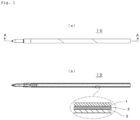
- Fig. 1 shows an example of configuration for a refill including the liquid storage member 10 for coating tools of the present invention.
- Fig. 1a shows a front view of an appearance of the refill and
- Fig. 1b shows a cross section along line A-A of the refill.
- a refill put in a barrel of a ballpoint pen is composed of a liquid storage member for coating tools 10 (hereinafter also referred to simply as the "liquid storage member 10") which is a paper-based long thin cylindrical ink storage tube to store ink (not shown); a joint 11 fixed to the end of the liquid storage member 10; and a ballpoint pen tip 12 fixed to the end of the joint 11 as a member for the writing tool.
- a liquid storage member for coating tools 10 hereinafter also referred to simply as the "liquid storage member 10"
- the liquid storage member 10 which is a paper-based long thin cylindrical ink storage tube to store ink (not shown)
- a joint 11 fixed to the end of the liquid storage member 10
- a ballpoint pen tip 12 fixed to the end of the joint 11 as a member for the writing tool.
- the joint 11 has a cylindrical rear end part which joints the liquid storage member 10 and a cylindrical tip part having larger outer diameter than the rear end part.
- a ballpoint pen tip 12 is installed in this tip part.
- An adhesive is applied to the rear end part of the joint 11 in advance so as to stick the joining part of the liquid storage member 10 together.
- the rear end part of the joint 11 is pressed to the inside of the tip part of the liquid storage member 10 to connect the joint 11 to the liquid storage member 10. Thereby the liquid storage member 10 is connected with the ballpoint pen tip 12 so as to flow ink through the joint 11.
- the liquid storage member 10 has at least three layers: the paper base laminate composed of the inner layer 1 made of paper base material and the intermediate layer 2 being a metal layer or a silica vapor deposition layer formed on the outer surface side of the inner layer 1; and the outer layer 3 made of the paper base material formed on the outer surface side of the intermediate layer 2.
- the liquid storage member 10 has a structure in which the paper base laminate is wound into a spiral shape so that the inner layer 1 could be inside, and a structure in which the outer layer made of the paper base material is wound into a spiral shape around the outer surface side of the intermediate layer 2.
- the liquid storage member 10 has a polyolefin resin-containing adhesive layer between the inner layer 1 and the intermediate layer 2 and/or between the intermediate layer 2 and the outer layer 3.
- the liquid storage member 10 has at least three layers composed of the inner layer 1 on contact with liquid, the intermediate layer 2, and the outer layer 3; and the polyolefin resin-containing adhesive layer 5 (hereinafter referred to simply as the "adhesive layer 5") between the inner layer 1 and the intermediate layer 2 and/or between the intermediate layer 2 and the outer layer 3.
- Fig. 2c shows a form having adhesive layers 5 both between an inner layer 1 and an intermediate layer 2 and between an intermediate layer 2 and an outer layer 3.
- the inner layer 1 and the intermediate layer 2 constitute the paper base laminate, in other words, a laminated composite material in which the metal layer or the silica vapor deposition layer is formed on the surface of the paper base materials.
- the adhesive layer 5 may exist between the paper base laminate.
- Materials of the inner layer 1 can include various known paper base materials, such as fine quality paper, medium quality paper, glazed paper, kraft paper, machine-glazed kraft paper, bleached kraft paper, cardboard, white paper board, liner, fine coating paper, coated paper, art paper, cast-coated paper, glassine paper, parchment paper and vulcanized fiber.
- a density of 0.8 g/cm 3 or more is favorable to the foregoing paper base materials, because of imparting satisfactory water-resistance and oil-resistance.
- the paper base material constituting the inner layer 1 is glassine paper, parchment paper, or vulcanized fiber and has a density of 0.8 g/cm 3 or more.
- Glassine paper which is highly dense and transparent paper, is prepared by beating virgin pulp most strongly to enlarge the specific surface area and supercalendering the paper made therefrom for densification and reinforcement of interfiber bonding of cellulose.
- the glassine paper with a basis weight of 20 to 50 g/m 2 is used in the present invention. Water-resistance and oil-resistance are easily imparted by using the glassine paper as the paper base material constituting the inner layer 1.
- Coating liquids such as a polyvinyl alcohol aqueous solution may be applied to either one or both sides of glassine paper with a basis weight of 20 to 50 g/m 2 as a base paper.
- the glassine paper ordinarily has a thickness of 20 to 50 ⁇ m, and 20 to 30 ⁇ m preferably.
- Parchment paper and vulcanized fiber are the products of direct interfiber bonding between cellulose reinforced by treatment with concentrated sulfuric acid and a solution of zinc chloride, that is, the products with increased density of hydrogen bonding between cellulose fibers. Therefore, the use of parchment paper and vulcanized fiber as the paper base material constituting the inner layer 1 can effectively restrain the paper dust from generating.
- parchment paper with a basis weight of 20 to 100 g/m 2 may be used, and preferably, oil-resistance may be enhanced for the parchment paper to have an oil absorbency of 13 g/m 2 or less in accordance with Testing Method for Water Absorptiveness of Paper and Paperboard (Cobb method), though mineral oil is used instead of water here.
- the parchment paper usually has a thickness of 20 to 100 ⁇ m, and 20 to 60 ⁇ m preferably.
- Vulcanized fiber can be thickened more easily than parchment paper because of the difference of reactivity in the manufacturing process. Therefore, the vulcanized fiber is appropriate when thicker paper base material is required.
- the vulcanized fiber ordinarily has a thickness of 0.08 to 1 mm, but considering the compressive strength of the paper tube part of the liquid storage member 10 after it is formed and the easy handling during the production, a thickness of 0.1 to 0.5 mm is preferable.
- the vulcanized fiber is denser than generally used paper-tube base papers and the density is usually 0.8 to 1.4 g/cm 3 . In the present invention, 0.8 to 1.3 g/cm 3 is favorable, considering the strength of the paper tube part and the availability.
- Parchment paper and vulcanized fiber may be impregnated with resin or coated with glass. Such treatments make the bonding of cellulose fibers stronger, and the generation of paper dust can be suppressed when these papers are used as paper base material constituting the inner layer 1.
- the intermediate layer 2 is a metal layer or a silica vapor deposition layer.
- the metal layer may be prepared by adhering metal foil such as aluminum foil to one side of the paper base material with a polyolefin resin-containing adhesive, or by depositing aluminum, an alloy of aluminum and zinc, etc., with electron beam in a vacuum.
- the polyolefin resin-containing adhesive used in the present invention is described.
- the polyolefin resin-containing adhesives may comprise one or more polyolefin resins or may be a mixture of one or more polyolefin resins with the other resins.
- polyolefin resin examples include modified polyolefin resins such as maleic anhydride-modified polypropylene besides polyethylene ionomer, polypropylene ionomer, polypropylene elastomer, polyethylene elastomer, high density polyethylene and low density polyethylene.
- modified polyolefin resins such as maleic anhydride-modified polypropylene besides polyethylene ionomer, polypropylene ionomer, polypropylene elastomer, polyethylene elastomer, high density polyethylene and low density polyethylene.
- polypropylene ionomer and maleic anhydride-modified polypropylene are preferable.
- the other resins include acrylic acid copolymer, ethylene-vinyl alcohol copolymer (EVOH), ethylene-acrylic acid copolymer (EAA), ethylene-methacrylic acid copolymer (EMAA), epoxy resin, a carbodiimide crosslinking agent, ethylene-vinyl acetate copolymer and polyvinyl alcohol.
- the proportion of the polyolefin resin in the whole adhesive is approximately 60 to 97 wt% and preferably 90 to 97 wt%.
- the proportion of the polyolefin resin in the total of the polyolefin resin and the other resins is approximately 68 to 98 wt% and preferably 93 to 98 wt%.
- the polyolefin resin-containing adhesive of the present invention is used in the form of dispersed or emulsified resin liquid based on polyolefin resins or a mixture of the polyolefin resins and the other resins.
- additives such as a silane coupling agent can be added to the resin liquid.
- dispersed adhesives such as polypropylene ionomer and maleic anhydride-modified polypropylene are preferable.
- the polyolefin resin-containing adhesive is applied between the inner layer 1 and the intermediate layer 2 and/or between the intermediate layer 2 and the outer layer 3.
- the adhesive layer 5 can be placed between the inner layer 1 and the intermediate layer 2 ( Fig. 2a ), between the intermediate layer 2 and the outer layer 3 ( Fig. 2b ), or between the inner layer 1, the intermediate layer 2 and the outer layer 3 ( Fig. 2c ).
- the application of the polyolefin resin-containing adhesive excellent in adhesion and ink-resistance to paper materials makes the inner layer 1, the intermediate layer 2 and the outer layer 3 adhere closely to each other, which thereby effectively prevents ink from leaking out of the liquid storage member 10.
- the ink-resistance stands for to what extent resin components in an adhesive can be prevented from being dissolved in an ink. Insufficient ink-resistance causes a decrease in strength and an increase in volatile loss of a refill. The ink leakage causes a poor appearance of the refill.
- the use of the polyolefin resin-containing adhesive shows the possibility of improving the ink-resistance, because of its low compatibility with ink and preventability of the polyolefin resin from dissolving into the ink.
- the polyolefin resin-containing adhesive has only to bond at least one pair of layers among the inner layer 1, the intermediate layer 2 and the outer layer 3.
- the other adhesives e.g., general-purpose adhesives, such as vinyl acetate resin type, acrylic resin type and polyvinyl alcohol can be simultaneously used.
- the polyolefin resin-containing adhesive is heaped up in the center of the inner layer 1 or the intermediate layer 2.
- the inner layer 1 and the intermediate layer 2 being pressed each other, the adhesive is spread over the entire adhesion surface, and both layers are bonded so that neither bubbles nor adhesion failure will remain in the bonded portion.
- the inner layer 1 and the intermediate layer 2, bonded together, are pressed and fixed until the adhesive gets stiffened.
- the polyolefin resin-containing adhesive is applied to the inner layer 1 or the intermediate layer 2 in an amount of approximately 5 to 50 g/m 2 and preferably 5 to 25 g/m 2 .
- the inner layer 1 and the intermediate layer 2 may be composed of the paper base laminates prepared from paper base material and a metal layer or a silica vapor deposition, all of which are of the same thickness, but each layer which has a different thickness may be used suitably in various combination.
- the paper base laminate is composed of the paper base material and the metal layer or silica vapor deposition layer with a thickness ratio of approximately 2/1 to 1200/1.
- the intermediate layer 2 adhering to the inner layer 1 is cut out to a width of 4 to 20 mm with a bobbin slitter machine to give a band-shaped paper base laminate.
- this paper base laminate is wound around the mandrel of a paper tube manufacturing machine into a spiral shape so as to make the inner layer 1 inside.
- the mandrel needs to have a surface pretreated with an appropriate lubricant in advance so as to pull it out easily after the inner layer 1, the intermediate layer 2 and the outer layer 3 are formed; or alternatively, a moderate amount of lubricant may be applied to the inside of the inner layer 1 (paper base material) to be in contact with the mandrel.
- an adhesive e.g., the polyolefin resin-containing adhesive is applied to the outside surface of the intermediate layer 2 to bond the outer layer 5 together.
- the paper base laminate have a band-shaped sheet with a width of 4 to 20 mm, and a width of 5 to 15 mm is far preferable.
- the paper base material is spirally wound around the outer surface side of the intermediate layer 2 and forms the outer layer 3. It is also preferable that the outer layer 3 be made of the paper base material with 4 to 20 mm in width, specifically 6 to 15 mm in width. Like the paper base laminate, reducing the number of seams 4' prevents liquid in the liquid storage member 10 from leaking.
- the paper base material constituting the inner layer 1 can be used as the paper base material constituting the outer layer 3.
- the outer layer 3 can be stuck on the intermediate layer 2 with the polyolefin resin-containing adhesive.
- the way of applying the polyolefin resin-containing adhesive and the application amount are almost the same as those used for the inner layer 1 and the intermediate layer 2.
- Each thickness ( ⁇ m) ratio of the inner layer 1, the intermediate layer 2 and the outer layer 3 is usually 20 to 60 : 0.025 to 12 : 50 to 200, and preferably 20 to 30 : 0.025 to 12 : 50 to 200.
- an additional inner layer 1 can be inserted between the intermediate layer 2 and the outer layer 3 as shown in Fig. 3 . Even in this case, the intermediate layer 2 and inner layer 1, or the inner layer 1 and outer layer 3 can be bonded with the polyolefin resin-containing adhesive.
- a liquid storage member 10 may have a structure (3a) of a paper base laminate (an inner layer 1 + an adhesive layer 5 + an intermediate layer 2), an adhesive layer 5, an inner layer 1, an adhesive layer 5, an inner layer 1, an adhesive layer 5, a paper base laminate (an intermediate layer 2 + an adhesive layer 5 + an inner layer 1), an adhesive layer 5, an outer layer 3, an adhesive layer 5 and an outer layer 3; or a structure (3b) of a paper base laminate (an inner layer 1 + an adhesive layer 5 + an intermediate layer 2), an adhesive layer 5, a paper base laminate (an inner layer 1 + an adhesive layer 5 + an intermediate layer 2), an adhesive layer 5, an outer layer 3, an adhesive layer 5 and an outer layer 3.
- the proportion of thicknesses ( ⁇ m) of the inner layer 1, the intermediate layer 2 and the outer layer 3 may be the same likewise the three-layer structure composed of an inner layer 1, an intermediate layer 2 and an outer layer 3.
- thickness of each layer can be different.
- the liquid storage member 10 having such a multilayer structure is a preferred embodiment from the viewpoint of preventing ink leakage and volatilization.
- the liquid storage member 10 preferably has a structure in which the paper base laminates are arranged into a spiral shape so that their adjacent portions come in contact but are not overlapped with each other in the lengthwise direction of the liquid storage member 10. Even though the adjacent portions are overlapped at the contact portion of the paper base laminate, that is, seam 4, the overlap should be at most 1 mm wide. When one seam 4 is in contact with the other seam 4 so as not to be overlapped with each other, or when the overlap is at most 1 mm wide, liquid leakage from the seam 4 is suppressed. When the overlap at the seam 4 is larger than a width of 1 mm, the level difference at the overlapped portion may cause liquid leakage.
- the outer layer 3 is preferably wound so that the adjacent portions come into contact with each other.
- a seam 4' of the outer layer 3 and a seam 4 of the paper base laminate are preferably spaced by 1 mm or more, and spaced by a half or less of the width of the paper base laminate or the outer layer 3 in the lengthwise direction of the liquid storage member for coating tools.
- the seam 4' and the seam 4 are preferably spaced by 3 mm or more, and spaced by a half or less of the width of the paper base laminate or the outer layer 3. Even though the seams 4' of the outer layer 3 are slightly overlapped, there is no trouble of liquid leakage.
- the liquid storage member 10 manufactured as described above is completed by pulling out the mandrel after the inner layer 1, the intermediate layer 2 and the outer layer 3 are formed, cutting a cylindrically formed body to have a certain length necessary for the liquid storage member 10 for coating tools, and drying it for a few hours under conditions of moderate temperature and humidity.
- the liquid storage member 10 is smaller in diameter than normal paper tubes.
- the outside diameter is usually 20 mm or less, preferably 15 mm or less, and far preferably 10 mm or less.
- the lower limit of the outside diameter is usually 1 mm or more and preferably 2 mm or more.
- the liquid storage member of such a small diameter demands strict dimensional accuracy.
- the outside diameter of the liquid storage member 10 becomes smaller, it is preferable that the paper base laminate be wound for the adjacent portions to come into contact but not to be overlapped with each other, and that the outer layer made of the paper base material be wound for the adjacent portions to have contact with each other, when the paper base laminate and the outer layer made of the paper base material are wound into a spiral shape.
- the liquid storage member 10 usually has a thickness of 0.07 to 0.6 mm, to be specific, 0.2 to 0.4 mm. In the above range of thickness, the liquid storage member 10 can hold a sufficient amount of liquid, which can improve barrier properties and restrain the liquid spill and deterioration easily.
- the liquid storage member 10 has definite limitations in size, because it is loaded into a coating tool.
- the widest cross section is 1 to 20 mm in length, to be specific, 3 to 10 mm in length.
- the coating tool of the present invention is not restricted only if equipped with the liquid storage member 10.
- the coating tool may be available for both wadding-type writing tools and direct liquid-type ones, and also may be appropriate for cosmetic tools, such as eyeliner, mascara and concealer.
- the nib may include a brush, a soft brush, and a pen of any kind.
- the writing tool includes a fountain pen, a ballpoint pen, a marking pen, a felt pen, a whiteout, and a brush pen.
- Ink put into the liquid storage member 10 may be either a water-based (gel) ink or an oil-based ink. Considering various uses of pens, inks for ballpoint pens, pressurized ballpoint pens, and marking pens are included.
- the present invention exerts favorable and meaningful effects.
- Glassine paper having a thickness of 25 ⁇ m (basis weight: 25 g/m 2 and density: 1.0 g/cm 3 ) was stuck on a 6.5 ⁇ m-thick aluminum foil with a polyolefin resin-containing adhesive CHEMIPEARL S500 (manufactured by Mitsui Chemicals, Inc.) to produce pasted paper.
- the pasted paper with the 6.5 ⁇ m-thick adhesive layer had a total thickness of 38 ⁇ m.
- the pasted paper was cut out to a width of 13 mm with a bobbin slitter machine.
- the pasted paper and the coated paper were each wound so as to butt each other at the adjacent portion in a manner not to be overlapped.
- the contact portion of the pasted paper and that of the coated papers were arranged apart from each other by 3 mm in the lengthwise direction.
- the spiral tube thus obtained was cut in a length of 89.3 mm to give a liquid storage member with an inner diameter of 3.8 mm for coating tools.
- the above liquid storage member was expressed as a paper tube 1.
- the obtained paper tube 1 was filled with 0.7 g of a coating liquid 1 prepared as prescribed below, and then filled with polybutene to a length of approximately 10 mm to seal the rear end of the coating liquid.
- ⁇ Coating liquid 1> Total amount: 100 wt%) Spiron Violet C-RH [manufactured by Hodogaya Chemical Co., Ltd.] 8% Spiron Yellow C-GNH [manufactured by Hodogaya Chemical Co., Ltd.] 5% Printex #35 [manufactured by Degussa Japan Co., Ltd.] 8% Polyvinyl butyral BL-1 [manufactured by Sekisui Chemical Co., Ltd.] 4% Polyvinyl butyral BH-3 [manufactured by Sekisui Chemical Co., Ltd.] 0.7% Hilac 110H [manufactured by Hitachi Chemical Co., Ltd.] 10% Solsperse 28000 [manufactured by The Lubrizol Corporation] (acid value
- the volatile loss of the paper tube 1 was 0.51%.
- a wedge-type bending jig was pressed to the center of paper tube 1 at a rate of 30 mm/min under the condition of an inter-fulcrum distance of 75 mm.
- the value determined at buckling was regarded as the bending strength.
- the bending strength of the paper tube 1 was 1.6 N.
- a paper tube 1 filled with a coating liquid 1 was kept upside down for 4 weeks at 50°C.
- a liquid storage member was manufactured in a manner similar to Example 1, except that acrylic acid copolymer (987B, manufactured by Japan Coating Resin Corporation) was used as an adhesive in place of CHEMIPEARL S500.
- the above liquid storage member was expressed as a paper tube 9.
- the paper tube 9 had a bending strength of 1.5 N and a result of ink leakage test of B. Since the coating liquid 1 exuded from the paper tube 9, the measurement of volatile loss was meaningless and unmeasurable. The results are shown in Table 1.
- a liquid storage member was manufactured in a manner similar to Example 1, except that ethylene-vinyl acetate copolymer (EVA AD-92, manufactured by Showa Denko K.K.) was used as an adhesive in place of CHEMIPEARL S500.
- EVA AD-92 ethylene-vinyl acetate copolymer
- CHEMIPEARL S500 CHEMIPEARL S500
- the paper tube 10 had a bending strength of 1.2 N and a result of ink leakage test of C. Since the coating liquid 1 exuded from the paper tube 10, the measurement of volatile loss was unmeasurable. The results are shown in Table 1.
- a liquid storage member was manufactured in a manner similar to Example 1, except that vinyl acetate resin (AX-428, manufactured by Showa Denko K.K.) was used as an adhesive in place of CHEMIPEARL S500.
- the above liquid storage member was expressed as a paper tube 11.
- the paper tube 11 had a bending strength of 1 N and a result of ink leakage test of C. Since the coating liquid 1 exuded from the paper tube 11, the measurement of volatile loss was unmeasurable. The results are shown in Table 1.
- a liquid storage member was manufactured in a manner similar to Example 1, except that the band-shaped pasted papers were spirally wound twofold around the outer surface side of the mandrel of the paper tube manufacturing machine (Langston), which did not become single- but double-layered.
- the liquid storage member was expressed as a paper tube 2.
- the obtained paper tube 2 was filled with coating liquid 1, the end of which was sealed with polybutene.
- the measurement of the volatile loss, the bending test and the ink leakage test were carried out in a manner similar to Example 1.
- the paper tube 2 had a volatile loss of 0.26%, a bending strength of 2.5 N and a result of ink leakage test of A. The results are shown in Table 1.
- a liquid storage member was manufactured in a manner similar to Example 2, except that acrylic acid copolymer (987B, manufactured by Japan Coating Resin Corporation) was used as an adhesive in place of CHEMIPEARL S500.
- the above liquid storage member was expressed as a paper tube 12.
- the obtained paper tube 12 was filled with coating liquid 1, the end of which was sealed with polybutene.
- the measurement of the volatile loss, the bending test and the ink leakage test were carried out in a manner similar to Example 1.
- the paper tube 12 had a bending strength of 2 N and a result of ink leakage test of A, but a volatile loss was as much as 2.89%.
- a liquid storage member was manufactured in a manner similar to Example 2, except that ethylene-vinyl acetate copolymer (EVA AD-92, manufactured by Showa Denko K.K.) was used as an adhesive in place of CHEMIPEARL S500.
- EVA AD-92 ethylene-vinyl acetate copolymer
- CHEMIPEARL S500 CHEMIPEARL S500
- the obtained paper tube 13 was filled with coating liquid 1, the end of which was sealed with polybutene.
- the measurement of the volatile loss, the bending test and the ink leakage test were carried out in a manner similar to Example 1.
- the paper tube 13 had a bending strength of 1.9 N. While the result of ink leakage test was B, the measurement of volatile loss was unmeasurable because the coating liquid 1 exuded from the paper tube 13. The results are shown in Table 1.
- a liquid storage member was manufactured in a manner similar to Example 2, except that vinyl acetate resin (AX-428, manufactured by Showa Denko K.K.) was used as an adhesive in place of CHEMIPEARL S500.
- the above liquid storage member was expressed as a paper tube 14.
- the obtained paper tube 14 was filled with coating liquid 1, the end of which was sealed with polybutene.
- the measurement of the volatile loss, the bending test and the ink leakage test were carried out in a manner similar to Example 1.
- the paper tube 14 had a bending strength of 1.8 N and a result of ink leakage test of B. Since the coating liquid 1 exuded from the paper tube 14, the measurement of volatile loss was unmeasurable. The results are shown in Table 1. [Table 1] Ex. 1 Comp.Ex.1 Comp.Ex.2 Comp.Ex.3 Ex. 2 Comp.Ex.4 Comp.Ex.5 Comp.Ex.6 Paper Tube 1 9 10 11 2 12 13 14 Coating Liquid 1 1 1 1 1 1 1 1 1 1 Volatile Loss (%) 0.51 - - - 0.26 2.89 - - Bending Strength (N) 1.6 1.5 1.2 1 2.5 2 1.9 1.8 Ink Leakage A B C C A A B B B
- a liquid storage member was manufactured in a manner similar to Example 1, except that the band-shaped pasted papers were spirally wound twofold around the outer surface side of the mandrel of the paper tube manufacturing machine (Langston), which did not become single- but double-layered.
- the liquid storage member was expressed as a paper tube 3.
- Coating liquid 2 was prepared as prescribed below. ⁇ Coating liquid 2> (Total amount: 100 wt%) Fuji Red 2510 [manufactured by Fuji Pigment Co., Ltd.] 8% Joncryl 61J [manufactured by BASF Japan Ltd.] 6% xanthan gum Kelsan S [manufactured by Sansho Co., Ltd.] 0.32% isopropyl phosphate 0.5% Bioden 421 [manufactured by Nippon Soda CO., LTD.] 0.2% benzotriazole 0.3% triethanolamine 1.4% propylene glycol 15% ion exchanged water 68.28%
- the paper tube 3 had a volatile loss of 5.59%, a bending strength of 2.5 N and a result of ink leakage test of A. The results are shown in Table 2.
- a liquid storage member was manufactured in a manner similar to Example 1, except that the band-shaped pasted papers were spirally wound twofold around the outer surface side of the mandrel of the paper tube manufacturing machine (Langston), which did not become single- but double-layered.
- the liquid storage member was expressed as a paper tube 4.
- Coating liquid 3 was prepared as prescribed below. ⁇ Coating liquid 3> (Total amount: 100 wt%) Vinyblan GV5651 [manufactured by Nissin Chemical Industry Co., Ltd.] (poly(vinyl acetate) emulsion; solid content 40%) 80% Acid dye Red No. 227 0.22% Yellow No. 4 0.34% Blue No. 1 0.08% Purified water 19.36%
- the paper tube 4 had a volatile loss of 4.16%, a bending strength of 2.5 N and a result of ink leakage test of A. The results are shown in Table 2.
- a liquid storage member was manufactured in a manner similar to Example 2, except that pasted paper prepared by sticking a 25 ⁇ m-thick parchment paper (basis weight: 25 g/m 2 and density: 1.0 g/cm 3 ) on a 6.5 ⁇ m-thick aluminum foil with a polyolefin resin-containing adhesive was used instead of glassine paper.
- the liquid storage member was expressed as a paper tube 5.
- the paper tube 5 had a volatile loss of 0.42%, a bending strength of 2.2 N and a result of ink leakage test of A. The results are shown in Table 2.
- a liquid storage member was manufactured in a manner similar to Example 2, except that pasted paper having not aluminum foil but a 0.4 ⁇ m-thick silica vapor deposition layer on a 25 ⁇ m-thick glassine paper (basis weight: 25 g/m 2 and density: 1.0 g/cm 3 ) was used.
- the liquid storage member was expressed as a paper tube 6.
- the paper tube 6 had a volatile loss of 0.79%, a bending strength of 2.2 N, and a result of ink leakage test of A. The results are shown in Table 2.
- a liquid storage member was manufactured in a manner similar to Example 2, except that the coated paper was wound overlapping a contact portion of 1 mm, instead of butting each other at the adjacent portion.
- the liquid storage member was expressed as a paper tube 7.
- the paper tube 7 had a volatile loss of 0.28%, a bending strength of 2.5 N and a result of ink leakage test of A. The results are shown in Table 2.
- a liquid storage member was manufactured in a manner similar to Example 2, except that the contact portion of the pasted paper and that of the coated paper were arranged apart from each other not by 3 mm but by 5 mm.
- the liquid storage member was expressed as a paper tube 8.
- the paper tube 8 had a volatile loss of 0.31%, a bending strength of 2.1 N and a result of ink leakage test of A. The results are shown in Table 2. [Table 2] Ex. 3 Ex. 4 Ex. 5 Ex. 6 Ex. 7 Ex. 8 Paper Tube 3 4 5 6 7 8 Coating Liquid 2 3 1 1 1 1 Volatile Loss (%) 5.59 4.16 0.42 0.79 0.28 0.31 Bending Strength (N) 2.5 2.5 2.2 2.2 2.5 2.1 Ink Leakage A A A A A A A A A A A A A A A A A A A A A A A A A A A A A A A A A A A A A A A A A A A A A A A
Landscapes
- Engineering & Computer Science (AREA)
- Mechanical Engineering (AREA)
- Laminated Bodies (AREA)
- Pens And Brushes (AREA)
Abstract
Description
- The present invention relates to a liquid storage member for coating tools which reduces the environmental impact by using paper base material instead of plastics.
- An ink storage tube for writing tools such as ballpoint pens is put into a shaft pipe of the writing tool, and to the one end (the front end) of the ink storage tube, a ballpoint pen tip or a relay member supporting the ballpoint pen tip which is a writing tool member is pressed and fitted.
- For the purpose of ensuring easy shaping and checking easily the amount of ink through the eyes, transparent or translucent plastics such as polypropylene have been conventionally used for such ink storage tubes.
- Recently, attention has been focused on the issue of microplastics flowing into the ocean. Momentum for action on global environmental issues, such as refrainment from using single-use plastics, has been growing.
- Proposals for plastic reduction have been also made concerning components of a writing tool.
PTL 1 discloses a writing tool equipped with a shaft pipe manufactured in the way that a laminated composite material made of barrier synthetic resins or metals such as aluminum is spirally wound on paper base material. - The shaft pipe of this writing tool has the following layered structure to improve water-resistance and gas barrier properties; on the outside of shaft pipe, aluminum foil label paper with kraft paper on the back and liner paper are layered. And polyethylene layer and polyester film with aluminum vapor deposition film outside are layered on the inside of the shaft pipe.
- According to this shaft pipe, a writing tool with less pollution can be provided with its content-resistance and durability kept, because of the material comprising the paper base materials.
- PTL 2 proposes an aqueous ink storage member with an ink storage tube having multilayer structure of one or more layers of other resin layers inside a storage tube base made of a biodegradable resin.
- According to
PTL 2, the storage tube base made of a biodegradable resin not only does not swell with an aqueous ink and cause any dimensional change, but also biodegrades over time, which can thereby contribute to reducing the disposal amount of waste. -
- PTL 1:
JP S62-70097 A - PTL 2:
JP 2001-146091 A - As described above, products using biodegradable resins and paper base materials can be suitable for less pollution. Especially, it is assumed that environment-friendly products as alternative materials for plastics can be provided by using materials including pulp and paper as base materials.
- According to the above viewpoint, the present invention has been carried out to reduce plastics by substituting the liquid (e.g., ink) storage tubes made of plastics such as polypropylene with those made of paper base materials.
- The liquid storage member for coating tools of the present invention has at least three layers of: a paper base laminate composed of an inner layer made of paper base material and an intermediate layer being a metal layer or a silica vapor deposition layer formed on the outer surface side of the inner layer; and an outer layer made of the paper base material formed on the outer surface side of the intermediate layer. The liquid storage member for coating tools has structures in which the paper base laminate is spirally wound and the outer layer made of the paper base material is spirally wound around the outer surface side of the intermediate layer. A polyolefin resin-containing adhesive layer lies in between the inner layer and the intermediate layer and/or between the intermediate layer and the outer layer.
- The paper base laminate preferably has a length of 4 to 20 mm in the width direction.
- The paper base material of the inner layer preferably has a density of 0.8 g/cm3 or more.
- Preferably, the paper base material of the inner layer is glassine paper, parchment paper, or vulcanized fiber.
- The liquid storage member for coating tools preferably has the following structure in the lengthwise direction: the paper base laminate is spirally wound for the adjacent portions to come into contact but not to be overlapped with each other, and the outer layer made of the paper base material is spirally wound for the adjacent portions to come into contact with each other.
- The liquid storage member for coating tools preferably has two or more of the paper base laminates.
- The contact portion of the paper base laminate and the contact portion of the outer layer made of the paper base material are preferably arranged apart from each other by 1 mm or more and a half or less of the width of the paper base laminate or the outer layer made of the paper base material in the lengthwise direction of the liquid storage member for coating tools.
- Preferably, the liquid storage member for coating tools is a paper refill for a writing tool.
- In the present invention, the inner layer and the intermediate layer and/or the intermediate layer and the outer layer of the paper base laminate are bonded with a polyolefin resin-containing adhesive or other adhesives containing the polyolefin resin and another resin, which makes the layers adhere to each other and prevents ink from leaking out of the liquid storage member for coating tools. In order to suppress ink leakage, it is effective to leave more spaces between
seams 4 of each paper base laminate and between seams 4' of each outer layer using a wider paper base laminate. - The present invention can provide a liquid storage member for coating tools which successfully reduces plastic consumption and reduces the environmental impact.
-
-
Fig. 1 shows an example of configuration for a refill including liquid storage member for coating tools of the present invention.Fig. 1a shows a front view of an appearance of the refill andFig. 1b shows a cross section along line A-A of the refill. -
Fig. 2 shows a three-layer structure of an inner layer, an intermediate layer and an outer layer constituting the liquid storage member for coating tools of the present invention: a form (2a) of an inner layer and an intermediate layer with an adhesive layer in-between, a form (2b) of an intermediate layer and an outer layer with an adhesive layer in-between, and a form (2c) of an inner layer, an intermediate layer and an outer layer each with adhesive layers in-between. -
Fig. 3 shows a multilayer structure of a paper base laminate constituting the liquid storage member for coating tools of the present invention: a form (3a) of a multilayer structure of [a paper base laminate (aninner layer 1 + anadhesive layer 5 + an intermediate layer 2), anadhesive layer 5, aninner layer 1, anadhesive layer 5, aninner layer 1, anadhesive layer 5, a paper base laminate (anintermediate layer 2 + anadhesive layer 5 + an inner layer 1), anadhesive layer 5, anouter layer 3, anadhesive layer 5 and an outer layer 3], or a form (3b) of a multilayer structure of [a paper base laminate (aninner layer 1 + anadhesive layer 5 + an intermediate layer 2), anadhesive layer 5, a paper base laminate (aninner layer 1 + anadhesive layer 5 + an intermediate layer 2), anadhesive layer 5, anouter layer 3, anadhesive layer 5 and an outer layer 3]. - The liquid storage member for coating tools of the present invention will be described in detail referring to the drawings.
-
Fig. 1 shows an example of configuration for a refill including theliquid storage member 10 for coating tools of the present invention.Fig. 1a shows a front view of an appearance of the refill andFig. 1b shows a cross section along line A-A of the refill. - In
Fig. 1 , for example, a refill put in a barrel of a ballpoint pen is composed of a liquid storage member for coating tools 10 (hereinafter also referred to simply as the "liquid storage member 10") which is a paper-based long thin cylindrical ink storage tube to store ink (not shown); a joint 11 fixed to the end of theliquid storage member 10; and a ballpoint pen tip 12 fixed to the end of the joint 11 as a member for the writing tool. - To be specific, the joint 11 has a cylindrical rear end part which joints the
liquid storage member 10 and a cylindrical tip part having larger outer diameter than the rear end part. A ballpoint pen tip 12 is installed in this tip part. An adhesive is applied to the rear end part of the joint 11 in advance so as to stick the joining part of theliquid storage member 10 together. In these circumstances, the rear end part of the joint 11 is pressed to the inside of the tip part of theliquid storage member 10 to connect the joint 11 to theliquid storage member 10. Thereby theliquid storage member 10 is connected with the ballpoint pen tip 12 so as to flow ink through the joint 11. - The
liquid storage member 10 has at least three layers: the paper base laminate composed of theinner layer 1 made of paper base material and theintermediate layer 2 being a metal layer or a silica vapor deposition layer formed on the outer surface side of theinner layer 1; and theouter layer 3 made of the paper base material formed on the outer surface side of theintermediate layer 2. Theliquid storage member 10 has a structure in which the paper base laminate is wound into a spiral shape so that theinner layer 1 could be inside, and a structure in which the outer layer made of the paper base material is wound into a spiral shape around the outer surface side of theintermediate layer 2. Theliquid storage member 10 has a polyolefin resin-containing adhesive layer between theinner layer 1 and theintermediate layer 2 and/or between theintermediate layer 2 and theouter layer 3. - The
liquid storage member 10 has at least three layers composed of theinner layer 1 on contact with liquid, theintermediate layer 2, and theouter layer 3; and the polyolefin resin-containing adhesive layer 5 (hereinafter referred to simply as the "adhesive layer 5") between theinner layer 1 and theintermediate layer 2 and/or between theintermediate layer 2 and theouter layer 3.Fig. 2c shows a form havingadhesive layers 5 both between aninner layer 1 and anintermediate layer 2 and between anintermediate layer 2 and anouter layer 3. Among such three layers, theinner layer 1 and theintermediate layer 2 constitute the paper base laminate, in other words, a laminated composite material in which the metal layer or the silica vapor deposition layer is formed on the surface of the paper base materials. As described above, theadhesive layer 5 may exist between the paper base laminate. - Materials of the
inner layer 1 can include various known paper base materials, such as fine quality paper, medium quality paper, glazed paper, kraft paper, machine-glazed kraft paper, bleached kraft paper, cardboard, white paper board, liner, fine coating paper, coated paper, art paper, cast-coated paper, glassine paper, parchment paper and vulcanized fiber. - A density of 0.8 g/cm3 or more is favorable to the foregoing paper base materials, because of imparting satisfactory water-resistance and oil-resistance.
- Preferably, the paper base material constituting the
inner layer 1 is glassine paper, parchment paper, or vulcanized fiber and has a density of 0.8 g/cm3 or more. - Glassine paper, which is highly dense and transparent paper, is prepared by beating virgin pulp most strongly to enlarge the specific surface area and supercalendering the paper made therefrom for densification and reinforcement of interfiber bonding of cellulose. The glassine paper with a basis weight of 20 to 50 g/m2 is used in the present invention. Water-resistance and oil-resistance are easily imparted by using the glassine paper as the paper base material constituting the
inner layer 1. Coating liquids such as a polyvinyl alcohol aqueous solution may be applied to either one or both sides of glassine paper with a basis weight of 20 to 50 g/m2 as a base paper. The glassine paper ordinarily has a thickness of 20 to 50 µm, and 20 to 30 µm preferably. - Parchment paper and vulcanized fiber are the products of direct interfiber bonding between cellulose reinforced by treatment with concentrated sulfuric acid and a solution of zinc chloride, that is, the products with increased density of hydrogen bonding between cellulose fibers. Therefore, the use of parchment paper and vulcanized fiber as the paper base material constituting the
inner layer 1 can effectively restrain the paper dust from generating. - For example, parchment paper with a basis weight of 20 to 100 g/m2 may be used, and preferably, oil-resistance may be enhanced for the parchment paper to have an oil absorbency of 13 g/m2 or less in accordance with Testing Method for Water Absorptiveness of Paper and Paperboard (Cobb method), though mineral oil is used instead of water here. The parchment paper usually has a thickness of 20 to 100 µm, and 20 to 60 µm preferably.
- Vulcanized fiber can be thickened more easily than parchment paper because of the difference of reactivity in the manufacturing process. Therefore, the vulcanized fiber is appropriate when thicker paper base material is required. The vulcanized fiber ordinarily has a thickness of 0.08 to 1 mm, but considering the compressive strength of the paper tube part of the
liquid storage member 10 after it is formed and the easy handling during the production, a thickness of 0.1 to 0.5 mm is preferable. The vulcanized fiber is denser than generally used paper-tube base papers and the density is usually 0.8 to 1.4 g/cm3. In the present invention, 0.8 to 1.3 g/cm3 is favorable, considering the strength of the paper tube part and the availability. - Parchment paper and vulcanized fiber may be impregnated with resin or coated with glass. Such treatments make the bonding of cellulose fibers stronger, and the generation of paper dust can be suppressed when these papers are used as paper base material constituting the
inner layer 1. - The
intermediate layer 2 is a metal layer or a silica vapor deposition layer. The metal layer may be prepared by adhering metal foil such as aluminum foil to one side of the paper base material with a polyolefin resin-containing adhesive, or by depositing aluminum, an alloy of aluminum and zinc, etc., with electron beam in a vacuum. - Herein, the polyolefin resin-containing adhesive used in the present invention is described. The polyolefin resin-containing adhesives may comprise one or more polyolefin resins or may be a mixture of one or more polyolefin resins with the other resins.
- Specific examples of the polyolefin resin include modified polyolefin resins such as maleic anhydride-modified polypropylene besides polyethylene ionomer, polypropylene ionomer, polypropylene elastomer, polyethylene elastomer, high density polyethylene and low density polyethylene. Among these, polypropylene ionomer and maleic anhydride-modified polypropylene are preferable.
- Specific examples of the other resins include acrylic acid copolymer, ethylene-vinyl alcohol copolymer (EVOH), ethylene-acrylic acid copolymer (EAA), ethylene-methacrylic acid copolymer (EMAA), epoxy resin, a carbodiimide crosslinking agent, ethylene-vinyl acetate copolymer and polyvinyl alcohol.
- When the polyolefin resin is mixed with the other resins, the proportion of the polyolefin resin in the whole adhesive is approximately 60 to 97 wt% and preferably 90 to 97 wt%. The proportion of the polyolefin resin in the total of the polyolefin resin and the other resins is approximately 68 to 98 wt% and preferably 93 to 98 wt%.
- The polyolefin resin-containing adhesive of the present invention is used in the form of dispersed or emulsified resin liquid based on polyolefin resins or a mixture of the polyolefin resins and the other resins. When necessary, additives such as a silane coupling agent can be added to the resin liquid. Among these, because of their excellent adhesion and handleability, dispersed adhesives, such as polypropylene ionomer and maleic anhydride-modified polypropylene are preferable.
- The polyolefin resin-containing adhesive is applied between the
inner layer 1 and theintermediate layer 2 and/or between theintermediate layer 2 and theouter layer 3. As shown inFig. 2 , theadhesive layer 5 can be placed between theinner layer 1 and the intermediate layer 2 (Fig. 2a ), between theintermediate layer 2 and the outer layer 3 (Fig. 2b ), or between theinner layer 1, theintermediate layer 2 and the outer layer 3 (Fig. 2c ). The application of the polyolefin resin-containing adhesive excellent in adhesion and ink-resistance to paper materials makes theinner layer 1, theintermediate layer 2 and theouter layer 3 adhere closely to each other, which thereby effectively prevents ink from leaking out of theliquid storage member 10. Herein, the ink-resistance stands for to what extent resin components in an adhesive can be prevented from being dissolved in an ink. Insufficient ink-resistance causes a decrease in strength and an increase in volatile loss of a refill. The ink leakage causes a poor appearance of the refill. The use of the polyolefin resin-containing adhesive shows the possibility of improving the ink-resistance, because of its low compatibility with ink and preventability of the polyolefin resin from dissolving into the ink. - In the present invention, the polyolefin resin-containing adhesive has only to bond at least one pair of layers among the
inner layer 1, theintermediate layer 2 and theouter layer 3. The other adhesives, e.g., general-purpose adhesives, such as vinyl acetate resin type, acrylic resin type and polyvinyl alcohol can be simultaneously used. - The polyolefin resin-containing adhesive is heaped up in the center of the
inner layer 1 or theintermediate layer 2. Next, theinner layer 1 and theintermediate layer 2 being pressed each other, the adhesive is spread over the entire adhesion surface, and both layers are bonded so that neither bubbles nor adhesion failure will remain in the bonded portion. Theinner layer 1 and theintermediate layer 2, bonded together, are pressed and fixed until the adhesive gets stiffened. - The polyolefin resin-containing adhesive is applied to the
inner layer 1 or theintermediate layer 2 in an amount of approximately 5 to 50 g/m2 and preferably 5 to 25 g/m2. - In the
liquid storage member 10, theinner layer 1 and theintermediate layer 2 may be composed of the paper base laminates prepared from paper base material and a metal layer or a silica vapor deposition, all of which are of the same thickness, but each layer which has a different thickness may be used suitably in various combination. - The paper base laminate is composed of the paper base material and the metal layer or silica vapor deposition layer with a thickness ratio of approximately 2/1 to 1200/1.
- The
intermediate layer 2 adhering to theinner layer 1 is cut out to a width of 4 to 20 mm with a bobbin slitter machine to give a band-shaped paper base laminate. Next, this paper base laminate is wound around the mandrel of a paper tube manufacturing machine into a spiral shape so as to make theinner layer 1 inside. Besides, the mandrel needs to have a surface pretreated with an appropriate lubricant in advance so as to pull it out easily after theinner layer 1, theintermediate layer 2 and theouter layer 3 are formed; or alternatively, a moderate amount of lubricant may be applied to the inside of the inner layer 1 (paper base material) to be in contact with the mandrel. Then, an adhesive e.g., the polyolefin resin-containing adhesive is applied to the outside surface of theintermediate layer 2 to bond theouter layer 5 together. - It is preferable that the paper base laminate have a band-shaped sheet with a width of 4 to 20 mm, and a width of 5 to 15 mm is far preferable. By winding this wide paper base laminate around the mandrel into a spiral shape, the desired length of
liquid storage member 10 can be easily obtained even without many winding turns. As a result, the contact area of the paper base laminate, i.e., the number ofseams 4 can be reduced, which successfully prevents liquid contained in theliquid storage member 10 from leaking. - The paper base material is spirally wound around the outer surface side of the
intermediate layer 2 and forms theouter layer 3. It is also preferable that theouter layer 3 be made of the paper base material with 4 to 20 mm in width, specifically 6 to 15 mm in width. Like the paper base laminate, reducing the number of seams 4' prevents liquid in theliquid storage member 10 from leaking. - The paper base material constituting the
inner layer 1 can be used as the paper base material constituting theouter layer 3. Theouter layer 3 can be stuck on theintermediate layer 2 with the polyolefin resin-containing adhesive. The way of applying the polyolefin resin-containing adhesive and the application amount are almost the same as those used for theinner layer 1 and theintermediate layer 2. - Each thickness (µm) ratio of the
inner layer 1, theintermediate layer 2 and theouter layer 3 is usually 20 to 60 : 0.025 to 12 : 50 to 200, and preferably 20 to 30 : 0.025 to 12 : 50 to 200. - Depending on types and thickness of paper base material, an additional
inner layer 1 can be inserted between theintermediate layer 2 and theouter layer 3 as shown inFig. 3 . Even in this case, theintermediate layer 2 andinner layer 1, or theinner layer 1 andouter layer 3 can be bonded with the polyolefin resin-containing adhesive. - There may exist two or more of the paper base laminates. As shown in
Fig. 3 , for example, aliquid storage member 10 may have a structure (3a) of a paper base laminate (aninner layer 1 + anadhesive layer 5 + an intermediate layer 2), anadhesive layer 5, aninner layer 1, anadhesive layer 5, aninner layer 1, anadhesive layer 5, a paper base laminate (anintermediate layer 2 + anadhesive layer 5 + an inner layer 1), anadhesive layer 5, anouter layer 3, anadhesive layer 5 and anouter layer 3; or a structure (3b) of a paper base laminate (aninner layer 1 + anadhesive layer 5 + an intermediate layer 2), anadhesive layer 5, a paper base laminate (aninner layer 1 + anadhesive layer 5 + an intermediate layer 2), anadhesive layer 5, anouter layer 3, anadhesive layer 5 and anouter layer 3. In the foregoing multilayer structures, the proportion of thicknesses (µm) of theinner layer 1, theintermediate layer 2 and theouter layer 3 may be the same likewise the three-layer structure composed of aninner layer 1, anintermediate layer 2 and anouter layer 3. In the case of multilayer structure consisting of two sets or more of theinner layer 1, theintermediate layer 2 and theouter layer 3, thickness of each layer can be different. Theliquid storage member 10 having such a multilayer structure is a preferred embodiment from the viewpoint of preventing ink leakage and volatilization. - As mentioned above, the
liquid storage member 10 preferably has a structure in which the paper base laminates are arranged into a spiral shape so that their adjacent portions come in contact but are not overlapped with each other in the lengthwise direction of theliquid storage member 10. Even though the adjacent portions are overlapped at the contact portion of the paper base laminate, that is,seam 4, the overlap should be at most 1 mm wide. When oneseam 4 is in contact with theother seam 4 so as not to be overlapped with each other, or when the overlap is at most 1 mm wide, liquid leakage from theseam 4 is suppressed. When the overlap at theseam 4 is larger than a width of 1 mm, the level difference at the overlapped portion may cause liquid leakage. - As with the paper base laminate, the
outer layer 3 is preferably wound so that the adjacent portions come into contact with each other. A seam 4' of theouter layer 3 and aseam 4 of the paper base laminate are preferably spaced by 1 mm or more, and spaced by a half or less of the width of the paper base laminate or theouter layer 3 in the lengthwise direction of the liquid storage member for coating tools. The seam 4' and theseam 4 are preferably spaced by 3 mm or more, and spaced by a half or less of the width of the paper base laminate or theouter layer 3. Even though the seams 4' of theouter layer 3 are slightly overlapped, there is no trouble of liquid leakage. - The
liquid storage member 10 manufactured as described above is completed by pulling out the mandrel after theinner layer 1, theintermediate layer 2 and theouter layer 3 are formed, cutting a cylindrically formed body to have a certain length necessary for theliquid storage member 10 for coating tools, and drying it for a few hours under conditions of moderate temperature and humidity. - The
liquid storage member 10 is smaller in diameter than normal paper tubes. The outside diameter is usually 20 mm or less, preferably 15 mm or less, and far preferably 10 mm or less. The lower limit of the outside diameter is usually 1 mm or more and preferably 2 mm or more. The liquid storage member of such a small diameter demands strict dimensional accuracy. As the outside diameter of theliquid storage member 10 becomes smaller, it is preferable that the paper base laminate be wound for the adjacent portions to come into contact but not to be overlapped with each other, and that the outer layer made of the paper base material be wound for the adjacent portions to have contact with each other, when the paper base laminate and the outer layer made of the paper base material are wound into a spiral shape. - The
liquid storage member 10 usually has a thickness of 0.07 to 0.6 mm, to be specific, 0.2 to 0.4 mm. In the above range of thickness, theliquid storage member 10 can hold a sufficient amount of liquid, which can improve barrier properties and restrain the liquid spill and deterioration easily. - The
liquid storage member 10 has definite limitations in size, because it is loaded into a coating tool. The widest cross section is 1 to 20 mm in length, to be specific, 3 to 10 mm in length. - The coating tool of the present invention is not restricted only if equipped with the
liquid storage member 10. The coating tool may be available for both wadding-type writing tools and direct liquid-type ones, and also may be appropriate for cosmetic tools, such as eyeliner, mascara and concealer. - As far as writing tools are concerned, the nib may include a brush, a soft brush, and a pen of any kind. To be more specific, the writing tool includes a fountain pen, a ballpoint pen, a marking pen, a felt pen, a whiteout, and a brush pen. Ink put into the
liquid storage member 10 may be either a water-based (gel) ink or an oil-based ink. Considering various uses of pens, inks for ballpoint pens, pressurized ballpoint pens, and marking pens are included. - When the coating tool is a writing tool and the
liquid storage member 10 is a paper refill for a writing tool, the present invention exerts favorable and meaningful effects. - Glassine paper having a thickness of 25 µm (basis weight: 25 g/m2 and density: 1.0 g/cm3) was stuck on a 6.5 µm-thick aluminum foil with a polyolefin resin-containing adhesive CHEMIPEARL S500 (manufactured by Mitsui Chemicals, Inc.) to produce pasted paper. The pasted paper with the 6.5 µm-thick adhesive layer had a total thickness of 38 µm. The pasted paper was cut out to a width of 13 mm with a bobbin slitter machine.
- To the aluminum foil side of the outer layer of the band-shaped pasted paper, 12 g/m2 of the polyolefin resin-containing adhesive was applied, and the obtained product was spirally wound around the outer surface side of the mandrel of a paper tube manufacturing machine (Langston) so as to make a single spirally shaped layer having the glassine paper inside.
- Next, 66 µm-thick coated paper (basis weight: 85 g/m2) which was cut out to a width of 13 mm with a bobbin slitter machine was spirally wound around the aluminum foil side of the outer layer of the pasted paper to make a single layer.
- It should be noted that the pasted paper and the coated paper were each wound so as to butt each other at the adjacent portion in a manner not to be overlapped. The contact portion of the pasted paper and that of the coated papers were arranged apart from each other by 3 mm in the lengthwise direction.
- The spiral tube thus obtained was cut in a length of 89.3 mm to give a liquid storage member with an inner diameter of 3.8 mm for coating tools. The above liquid storage member was expressed as a
paper tube 1. - The obtained
paper tube 1 was filled with 0.7 g of acoating liquid 1 prepared as prescribed below, and then filled with polybutene to a length of approximately 10 mm to seal the rear end of the coating liquid.< Coating liquid 1>(Total amount: 100 wt%) Spiron Violet C-RH [manufactured by Hodogaya Chemical Co., Ltd.] 8% Spiron Yellow C-GNH [manufactured by Hodogaya Chemical Co., Ltd.] 5% Printex #35 [manufactured by Degussa Japan Co., Ltd.] 8% Polyvinyl butyral BL-1 [manufactured by Sekisui Chemical Co., Ltd.] 4% Polyvinyl butyral BH-3 [manufactured by Sekisui Chemical Co., Ltd.] 0.7% Hilac 110H [manufactured by Hitachi Chemical Co., Ltd.] 10% Solsperse 28000 [manufactured by The Lubrizol Corporation] (acid value: 29, weight-average molecular weight: ca. 3400) 1% benzotriazole 0.5% 3-methoxy-3-methyl-1-butanol 62.8% - Next, a stainless steel stopper was press-fitted into the end part of the liquid storage member which was opposite to the sealing part above described. The
paper tube 1 with both ends closed was left settled horizontally for 10 days in an environment of 10% relative humidity (RH) at 50°C. The volatile loss (%) was obtained from the reduction amount of the coating liquid. - The volatile loss of the
paper tube 1 was 0.51%. - A wedge-type bending jig was pressed to the center of
paper tube 1 at a rate of 30 mm/min under the condition of an inter-fulcrum distance of 75 mm. The value determined at buckling was regarded as the bending strength. - The bending strength of the
paper tube 1 was 1.6 N. - A
paper tube 1 filled with acoating liquid 1 was kept upside down for 4 weeks at 50°C. - Ink leakage was observed through the eyes by the following evaluation standard.
- A: No ink leakage is detected.
- B: A slight amount of ink leakage is present.
- C: A significant amount of ink leakage is occurring.
- No ink leakage was observed when the
paper tube 1 was used. The result of ink leakage test was A. - A liquid storage member was manufactured in a manner similar to Example 1, except that acrylic acid copolymer (987B, manufactured by Japan Coating Resin Corporation) was used as an adhesive in place of CHEMIPEARL S500. The above liquid storage member was expressed as a paper tube 9.
- The measurement of the volatile loss, the bending test and the ink leakage test were carried out in a manner similar to Example 1.
- The paper tube 9 had a bending strength of 1.5 N and a result of ink leakage test of B. Since the
coating liquid 1 exuded from the paper tube 9, the measurement of volatile loss was meaningless and unmeasurable. The results are shown in Table 1. - A liquid storage member was manufactured in a manner similar to Example 1, except that ethylene-vinyl acetate copolymer (EVA AD-92, manufactured by Showa Denko K.K.) was used as an adhesive in place of CHEMIPEARL S500. The above liquid storage member was expressed as a
paper tube 10. - The measurement of the volatile loss, the bending test and the ink leakage test were carried out in a manner similar to Example 1.
- The
paper tube 10 had a bending strength of 1.2 N and a result of ink leakage test of C. Since thecoating liquid 1 exuded from thepaper tube 10, the measurement of volatile loss was unmeasurable. The results are shown in Table 1. - A liquid storage member was manufactured in a manner similar to Example 1, except that vinyl acetate resin (AX-428, manufactured by Showa Denko K.K.) was used as an adhesive in place of CHEMIPEARL S500. The above liquid storage member was expressed as a paper tube 11.
- The measurement of the volatile loss, the bending test and the ink leakage test were carried out in a manner similar to Example 1.
- The paper tube 11 had a bending strength of 1 N and a result of ink leakage test of C. Since the
coating liquid 1 exuded from the paper tube 11, the measurement of volatile loss was unmeasurable. The results are shown in Table 1. - A liquid storage member was manufactured in a manner similar to Example 1, except that the band-shaped pasted papers were spirally wound twofold around the outer surface side of the mandrel of the paper tube manufacturing machine (Langston), which did not become single- but double-layered. The liquid storage member was expressed as a
paper tube 2. - The obtained
paper tube 2 was filled withcoating liquid 1, the end of which was sealed with polybutene. The measurement of the volatile loss, the bending test and the ink leakage test were carried out in a manner similar to Example 1. - The
paper tube 2 had a volatile loss of 0.26%, a bending strength of 2.5 N and a result of ink leakage test of A. The results are shown in Table 1. - A liquid storage member was manufactured in a manner similar to Example 2, except that acrylic acid copolymer (987B, manufactured by Japan Coating Resin Corporation) was used as an adhesive in place of CHEMIPEARL S500. The above liquid storage member was expressed as a paper tube 12.
- The obtained paper tube 12 was filled with
coating liquid 1, the end of which was sealed with polybutene. The measurement of the volatile loss, the bending test and the ink leakage test were carried out in a manner similar to Example 1. - The paper tube 12 had a bending strength of 2 N and a result of ink leakage test of A, but a volatile loss was as much as 2.89%.
- A liquid storage member was manufactured in a manner similar to Example 2, except that ethylene-vinyl acetate copolymer (EVA AD-92, manufactured by Showa Denko K.K.) was used as an adhesive in place of CHEMIPEARL S500. The above liquid storage member was expressed as a paper tube 13.
- The obtained paper tube 13 was filled with
coating liquid 1, the end of which was sealed with polybutene. The measurement of the volatile loss, the bending test and the ink leakage test were carried out in a manner similar to Example 1. - The paper tube 13 had a bending strength of 1.9 N. While the result of ink leakage test was B, the measurement of volatile loss was unmeasurable because the
coating liquid 1 exuded from the paper tube 13. The results are shown in Table 1. - A liquid storage member was manufactured in a manner similar to Example 2, except that vinyl acetate resin (AX-428, manufactured by Showa Denko K.K.) was used as an adhesive in place of CHEMIPEARL S500. The above liquid storage member was expressed as a paper tube 14.
- The obtained paper tube 14 was filled with
coating liquid 1, the end of which was sealed with polybutene. The measurement of the volatile loss, the bending test and the ink leakage test were carried out in a manner similar to Example 1. - The paper tube 14 had a bending strength of 1.8 N and a result of ink leakage test of B. Since the
coating liquid 1 exuded from the paper tube 14, the measurement of volatile loss was unmeasurable. The results are shown in Table 1.[Table 1] Ex. 1 Comp.Ex.1 Comp.Ex.2 Comp.Ex.3 Ex. 2 Comp.Ex.4 Comp.Ex.5 Comp.Ex.6 Paper Tube 1 9 10 11 2 12 13 14 Coating Liquid 1 1 1 1 1 1 1 1 Volatile Loss (%) 0.51 - - - 0.26 2.89 - - Bending Strength (N) 1.6 1.5 1.2 1 2.5 2 1.9 1.8 Ink Leakage A B C C A A B B - A liquid storage member was manufactured in a manner similar to Example 1, except that the band-shaped pasted papers were spirally wound twofold around the outer surface side of the mandrel of the paper tube manufacturing machine (Langston), which did not become single- but double-layered. The liquid storage member was expressed as a
paper tube 3. - The measurement of the volatile loss, the bending test and the ink leakage test were carried out in a manner similar to Example 1, except that the
paper tube 3 was filled with coating liquid 2 in place ofcoating liquid 1.Coating liquid 2 was prepared as prescribed below.< Coating liquid 2>(Total amount: 100 wt%) Fuji Red 2510 [manufactured by Fuji Pigment Co., Ltd.] 8% Joncryl 61J [manufactured by BASF Japan Ltd.] 6% xanthan gum Kelsan S [manufactured by Sansho Co., Ltd.] 0.32% isopropyl phosphate 0.5% Bioden 421 [manufactured by Nippon Soda CO., LTD.] 0.2% benzotriazole 0.3% triethanolamine 1.4% propylene glycol 15% ion exchanged water 68.28% - The
paper tube 3 had a volatile loss of 5.59%, a bending strength of 2.5 N and a result of ink leakage test of A. The results are shown in Table 2. - A liquid storage member was manufactured in a manner similar to Example 1, except that the band-shaped pasted papers were spirally wound twofold around the outer surface side of the mandrel of the paper tube manufacturing machine (Langston), which did not become single- but double-layered. The liquid storage member was expressed as a
paper tube 4. - The measurement of the volatile loss, the bending test and the ink leakage test were carried out in a manner similar to Example 1, except that the
paper tube 4 was filled with coating liquid 3 in place ofcoating liquid 1.Coating liquid 3 was prepared as prescribed below.< Coating liquid 3>(Total amount: 100 wt%) Vinyblan GV5651 [manufactured by Nissin Chemical Industry Co., Ltd.] (poly(vinyl acetate) emulsion; solid content 40%) 80% Acid dye Red No. 227 0.22% Yellow No. 4 0.34% Blue No. 1 0.08% Purified water 19.36% - The
paper tube 4 had a volatile loss of 4.16%, a bending strength of 2.5 N and a result of ink leakage test of A. The results are shown in Table 2. - A liquid storage member was manufactured in a manner similar to Example 2, except that pasted paper prepared by sticking a 25 µm-thick parchment paper (basis weight: 25 g/m2 and density: 1.0 g/cm3) on a 6.5 µm-thick aluminum foil with a polyolefin resin-containing adhesive was used instead of glassine paper. The liquid storage member was expressed as a
paper tube 5. - The measurement of the volatile loss, the bending test and the ink leakage test were carried out in a manner similar to Example 1.
- The
paper tube 5 had a volatile loss of 0.42%, a bending strength of 2.2 N and a result of ink leakage test of A. The results are shown in Table 2. - A liquid storage member was manufactured in a manner similar to Example 2, except that pasted paper having not aluminum foil but a 0.4 µm-thick silica vapor deposition layer on a 25 µm-thick glassine paper (basis weight: 25 g/m2 and density: 1.0 g/cm3) was used. The liquid storage member was expressed as a paper tube 6.
- The measurement of the volatile loss, the bending test and the ink leakage test were carried out in a manner similar to Example 1.
- The paper tube 6 had a volatile loss of 0.79%, a bending strength of 2.2 N, and a result of ink leakage test of A. The results are shown in Table 2.
- A liquid storage member was manufactured in a manner similar to Example 2, except that the coated paper was wound overlapping a contact portion of 1 mm, instead of butting each other at the adjacent portion. The liquid storage member was expressed as a paper tube 7.
- The measurement of the volatile loss, the bending test and the ink leakage test were carried out in a manner similar to Example 1.
- The paper tube 7 had a volatile loss of 0.28%, a bending strength of 2.5 N and a result of ink leakage test of A. The results are shown in Table 2.
- A liquid storage member was manufactured in a manner similar to Example 2, except that the contact portion of the pasted paper and that of the coated paper were arranged apart from each other not by 3 mm but by 5 mm. The liquid storage member was expressed as a paper tube 8.
- The measurement of the volatile loss, the bending test and the ink leakage test were carried out in a manner similar to Example 1.
- The paper tube 8 had a volatile loss of 0.31%, a bending strength of 2.1 N and a result of ink leakage test of A. The results are shown in Table 2.
[Table 2] Ex. 3 Ex. 4 Ex. 5 Ex. 6 Ex. 7 Ex. 8 Paper Tube 3 4 5 6 7 8 Coating Liquid 2 3 1 1 1 1 Volatile Loss (%) 5.59 4.16 0.42 0.79 0.28 0.31 Bending Strength (N) 2.5 2.5 2.2 2.2 2.5 2.1 Ink Leakage A A A A A A -
- 10
- liquid storage member for coating tools
- 11
- joint
- 12
- ballpoint pen tip
- 1
- inner layer
- 2
- intermediate layer
- 3
- outer layer
- 4,4'
- seam
- 5
- adhesive layer
Claims (8)
- A liquid storage member for coating tools having at least three layers of: a paper base laminate composed of an inner layer made of paper base material and an intermediate layer of a metal layer or a silica vapor deposition layer formed on the outer surface side of the inner layer, and an outer layer made of the paper base material formed on the outer surface side of the intermediate layer;having structures in which the paper base laminate is spirally wound, and the outer layer made of the paper base material is spirally wound around the outer surface side of the intermediate layer; andhaving a polyolefin resin-containing adhesive layer at least either between the inner layer and the intermediate layer or between the intermediate layer and the outer layer.
- The liquid storage member for coating tools according to claim 1, wherein the paper base laminate has a length of 4 to 20 mm in the width direction.
- The liquid storage member for coating tools according to claim 1 or 2, wherein the paper base material of the inner layer has a density of 0.8 g/cm3 or more.
- The liquid storage member for coating tools according to any one of claims 1 to 3, wherein the paper base material of the inner layer is glassine paper, parchment paper, or vulcanized fiber.
- The liquid storage member for coating tools according to any one of claims 1 to 4, having structures in which in the lengthwise direction of the liquid storage member for coating tools,the paper base laminate is spirally wound for the adjacent portions to come into contact but not to be overlapped with each other, andthe outer layer made of the paper base material is spirally wound for the adjacent portions to come into contact with each other.
- The liquid storage member for coating tools according to any one of claims 1 to 5, having two or more of the paper base laminates.
- The liquid storage member for coating tools according to any one of claims 1 to 6, wherein the contact portion of the paper base laminate and the contact portion of the outer layer made of the paper base material are arranged apart by 1 mm or more and a half or less of the width of the paper base laminate or the outer layer made of the paper base material in the lengthwise direction of the liquid storage member for coating tools.
- The liquid storage member for coating tools according to any one of claims 1 to 7, being a paper refill for a writing tool.
Applications Claiming Priority (2)
| Application Number | Priority Date | Filing Date | Title |
|---|---|---|---|
| JP2020214552A JP7593593B2 (en) | 2020-12-24 | 2020-12-24 | Liquid storage member for application tool |
| PCT/JP2021/046777 WO2022138498A1 (en) | 2020-12-24 | 2021-12-17 | Liquid accommodation member for coating tool |
Publications (2)
| Publication Number | Publication Date |
|---|---|
| EP4269088A1 true EP4269088A1 (en) | 2023-11-01 |
| EP4269088A4 EP4269088A4 (en) | 2024-11-20 |
Family
ID=82157763
Family Applications (1)
| Application Number | Title | Priority Date | Filing Date |
|---|---|---|---|
| EP21910643.2A Pending EP4269088A4 (en) | 2020-12-24 | 2021-12-17 | Liquid accommodation member for coating tool |
Country Status (6)
| Country | Link |
|---|---|
| US (1) | US12275215B2 (en) |
| EP (1) | EP4269088A4 (en) |
| JP (1) | JP7593593B2 (en) |
| KR (1) | KR20230124982A (en) |
| CN (1) | CN116600983B (en) |
| WO (1) | WO2022138498A1 (en) |
Families Citing this family (1)
| Publication number | Priority date | Publication date | Assignee | Title |
|---|---|---|---|---|
| JP2024095345A (en) * | 2022-12-28 | 2024-07-10 | 三菱鉛筆株式会社 | Writing implements |
Family Cites Families (12)
| Publication number | Priority date | Publication date | Assignee | Title |
|---|---|---|---|---|
| JPS6270097A (en) * | 1985-09-24 | 1987-03-31 | 三菱鉛筆株式会社 | Writing utensil |
| JPH06133840A (en) * | 1992-10-26 | 1994-05-17 | Shigeru Nakagawa | Paper tube |
| US5693416A (en) * | 1995-12-19 | 1997-12-02 | Kucherovsky; Joseph | Method of making a spiral-wound tube, a tube made by such a method, and an outer layer used in such a tube |
| JP2001146091A (en) | 1999-11-18 | 2001-05-29 | Pilot Corp | Refill for water-based ink |
| JP2005096845A (en) * | 2003-08-27 | 2005-04-14 | Showa Marutsutsu Co Ltd | Compact |
| US20100087303A1 (en) * | 2008-10-02 | 2010-04-08 | Jari Pietikainen | Paperboard winding core for inorganic materials, having removable outer ply |
| JP2010269474A (en) | 2009-05-19 | 2010-12-02 | Kanagawa Kk | Rod-like member for use in delivery device |
| WO2011073999A2 (en) | 2009-12-17 | 2011-06-23 | Amit Kumar Yadav | Bio-deqradable writing instrument and a process for making the same |
| CN108189588A (en) * | 2018-02-06 | 2018-06-22 | 韩成森 | A kind of environmental protection pen tube and preparation method, pen core and pen |
| JP7154065B2 (en) * | 2018-08-23 | 2022-10-17 | 三菱鉛筆株式会社 | Ink storage tube for writing instruments |
| TW202100420A (en) | 2019-06-28 | 2021-01-01 | 許喻婷 | Paper-based composite structure of beverage bottle comprising a bottle body that includes a tubular helical structure that is made of a paper-based composite paper |
| JP7292672B2 (en) * | 2019-07-19 | 2023-06-19 | 三菱鉛筆株式会社 | Liquid storage member for applicator |
-
2020
- 2020-12-24 JP JP2020214552A patent/JP7593593B2/en active Active
-
2021
- 2021-12-17 KR KR1020237024586A patent/KR20230124982A/en active Pending
- 2021-12-17 US US18/258,945 patent/US12275215B2/en active Active
- 2021-12-17 WO PCT/JP2021/046777 patent/WO2022138498A1/en not_active Ceased
- 2021-12-17 EP EP21910643.2A patent/EP4269088A4/en active Pending
- 2021-12-17 CN CN202180085062.5A patent/CN116600983B/en active Active
Also Published As
| Publication number | Publication date |
|---|---|
| EP4269088A4 (en) | 2024-11-20 |
| WO2022138498A1 (en) | 2022-06-30 |
| KR20230124982A (en) | 2023-08-28 |
| JP2022100528A (en) | 2022-07-06 |
| CN116600983B (en) | 2026-03-20 |
| US20240042735A1 (en) | 2024-02-08 |
| CN116600983A (en) | 2023-08-15 |
| US12275215B2 (en) | 2025-04-15 |
| JP7593593B2 (en) | 2024-12-03 |
Similar Documents
| Publication | Publication Date | Title |
|---|---|---|
| EP4000945A1 (en) | Coating tool-use liquid holding member | |
| EP4269088A1 (en) | Liquid accommodation member for coating tool | |
| EP3613603A1 (en) | Ink storage pipe for writing utensils | |
| ES2711530T3 (en) | Water-activated paper tape laminated with film and methods of obtaining it | |
| CN108189588A (en) | A kind of environmental protection pen tube and preparation method, pen core and pen | |
| EP4527636A1 (en) | Ink containing member for writing utensils | |
| JP7746065B2 (en) | Liquid storage member for applicator | |
| JP3788612B2 (en) | Ink container for writing instruments | |
| HK40089105A (en) | Liquid storage member for coating tools | |
| JP7769493B2 (en) | Liquid storage member for writing implement, refill for writing implement, and writing implement | |
| US20250353319A1 (en) | Liquid storage member for coating tools | |
| JP7347718B1 (en) | Laminated film and packaging bags | |
| JP2022056686A (en) | Laminates and tube containers | |
| WO2023026562A1 (en) | Liquid accommodation member for writing instrument, refill for writing instrument, writing instrument, and liquid accommodation member for application tool | |
| JP7807959B2 (en) | Liquid storage member for applicator | |
| WO2003093028A1 (en) | Writing ink accommodating tube | |
| JP2023113100A (en) | Liquid storage member for applicator | |
| CN118613375A (en) | Liquid storage member for coating tool | |
| JP2021104851A (en) | Tube container | |
| JP7725839B2 (en) | Laminated sheet for forming the body of a tube container, tube container, and tube container with cap | |
| JP7567329B2 (en) | Laminate for tube container and tube container | |
| JP2025174678A (en) | Laminate, tube container, and tube container with cap | |
| JP2004262198A (en) | Refill for correction pen |
Legal Events
| Date | Code | Title | Description |
|---|---|---|---|
| STAA | Information on the status of an ep patent application or granted ep patent |
Free format text: STATUS: THE INTERNATIONAL PUBLICATION HAS BEEN MADE |
|
| PUAI | Public reference made under article 153(3) epc to a published international application that has entered the european phase |
Free format text: ORIGINAL CODE: 0009012 |
|
| STAA | Information on the status of an ep patent application or granted ep patent |
Free format text: STATUS: REQUEST FOR EXAMINATION WAS MADE |
|
| 17P | Request for examination filed |
Effective date: 20230724 |
|
| AK | Designated contracting states |
Kind code of ref document: A1 Designated state(s): AL AT BE BG CH CY CZ DE DK EE ES FI FR GB GR HR HU IE IS IT LI LT LU LV MC MK MT NL NO PL PT RO RS SE SI SK SM TR |
|
| DAV | Request for validation of the european patent (deleted) | ||
| DAX | Request for extension of the european patent (deleted) | ||
| A4 | Supplementary search report drawn up and despatched |
Effective date: 20241018 |
|
| RIC1 | Information provided on ipc code assigned before grant |
Ipc: B43K 8/16 20060101ALI20241014BHEP Ipc: B43K 8/14 20060101ALI20241014BHEP Ipc: B43K 8/03 20060101ALI20241014BHEP Ipc: B43K 5/02 20060101ALI20241014BHEP Ipc: B43K 7/02 20060101ALI20241014BHEP Ipc: B32B 1/08 20060101AFI20241014BHEP |