EP4268103B1 - Enabling access using a temporary passcode - Google Patents
Enabling access using a temporary passcode Download PDFInfo
- Publication number
- EP4268103B1 EP4268103B1 EP21840530.6A EP21840530A EP4268103B1 EP 4268103 B1 EP4268103 B1 EP 4268103B1 EP 21840530 A EP21840530 A EP 21840530A EP 4268103 B1 EP4268103 B1 EP 4268103B1
- Authority
- EP
- European Patent Office
- Prior art keywords
- passcode
- temporary
- temporary passcode
- provider
- electronic lock
- Prior art date
- Legal status (The legal status is an assumption and is not a legal conclusion. Google has not performed a legal analysis and makes no representation as to the accuracy of the status listed.)
- Active
Links
Images


Classifications
-
- G—PHYSICS
- G06—COMPUTING OR CALCULATING; COUNTING
- G06F—ELECTRIC DIGITAL DATA PROCESSING
- G06F21/00—Security arrangements for protecting computers, components thereof, programs or data against unauthorised activity
- G06F21/30—Authentication, i.e. establishing the identity or authorisation of security principals
- G06F21/31—User authentication
- G06F21/34—User authentication involving the use of external additional devices, e.g. dongles or smart cards
- G06F21/35—User authentication involving the use of external additional devices, e.g. dongles or smart cards communicating wirelessly
-
- G—PHYSICS
- G07—CHECKING-DEVICES
- G07C—TIME OR ATTENDANCE REGISTERS; REGISTERING OR INDICATING THE WORKING OF MACHINES; GENERATING RANDOM NUMBERS; VOTING OR LOTTERY APPARATUS; ARRANGEMENTS, SYSTEMS OR APPARATUS FOR CHECKING NOT PROVIDED FOR ELSEWHERE
- G07C9/00—Individual registration on entry or exit
- G07C9/30—Individual registration on entry or exit not involving the use of a pass
- G07C9/32—Individual registration on entry or exit not involving the use of a pass in combination with an identity check
- G07C9/33—Individual registration on entry or exit not involving the use of a pass in combination with an identity check by means of a password
-
- G—PHYSICS
- G07—CHECKING-DEVICES
- G07C—TIME OR ATTENDANCE REGISTERS; REGISTERING OR INDICATING THE WORKING OF MACHINES; GENERATING RANDOM NUMBERS; VOTING OR LOTTERY APPARATUS; ARRANGEMENTS, SYSTEMS OR APPARATUS FOR CHECKING NOT PROVIDED FOR ELSEWHERE
- G07C9/00—Individual registration on entry or exit
- G07C9/00174—Electronically operated locks; Circuits therefor; Nonmechanical keys therefor, e.g. passive or active electrical keys or other data carriers without mechanical keys
- G07C9/00896—Electronically operated locks; Circuits therefor; Nonmechanical keys therefor, e.g. passive or active electrical keys or other data carriers without mechanical keys specially adapted for particular uses
- G07C9/00904—Electronically operated locks; Circuits therefor; Nonmechanical keys therefor, e.g. passive or active electrical keys or other data carriers without mechanical keys specially adapted for particular uses for hotels, motels, office buildings or the like
-
- H—ELECTRICITY
- H04—ELECTRIC COMMUNICATION TECHNIQUE
- H04W—WIRELESS COMMUNICATION NETWORKS
- H04W12/00—Security arrangements; Authentication; Protecting privacy or anonymity
- H04W12/06—Authentication
- H04W12/068—Authentication using credential vaults, e.g. password manager applications or one time password [OTP] applications
-
- G—PHYSICS
- G06—COMPUTING OR CALCULATING; COUNTING
- G06F—ELECTRIC DIGITAL DATA PROCESSING
- G06F2221/00—Indexing scheme relating to security arrangements for protecting computers, components thereof, programs or data against unauthorised activity
- G06F2221/21—Indexing scheme relating to G06F21/00 and subgroups addressing additional information or applications relating to security arrangements for protecting computers, components thereof, programs or data against unauthorised activity
- G06F2221/2137—Time limited access, e.g. to a computer or data
-
- G—PHYSICS
- G07—CHECKING-DEVICES
- G07C—TIME OR ATTENDANCE REGISTERS; REGISTERING OR INDICATING THE WORKING OF MACHINES; GENERATING RANDOM NUMBERS; VOTING OR LOTTERY APPARATUS; ARRANGEMENTS, SYSTEMS OR APPARATUS FOR CHECKING NOT PROVIDED FOR ELSEWHERE
- G07C2209/00—Indexing scheme relating to groups G07C9/00 - G07C9/38
- G07C2209/08—With time considerations, e.g. temporary activation, valid time window or time limitations
Definitions
- the present disclosure relates to the field of access control and in particular to enabling access, using a temporary passcode, to a physical space secured by an electronic lock.
- a passcode in the form of a PIN is often entered to a lock, in order to unlock the lock.
- the PIN can consist of a sequence of digits, e.g. four or six digits.
- the passcode When deliveries are made, the passcode often needs to be shared with the delivery company, such that the delivery person can enter the building. The same applies for other services, e.g. cleaning, facilities management, etc. After entering the building, the delivery person or other service provider can go to the property of the receiver and deliver the package or provide the service.
- US 2018/302397 discloses a computer-based locking system using changing passcodes.
- An application on an electronic device requests a passcode from an application server.
- the application server generates the passcode based on a current time.
- a lock with a passcode interface and a locking mechanism captures the input passcode.
- the lock also generates a local passcode based on current time. The lock releases the locking mechanism in response to the input passcode matching the local passcode.
- One object is to improve the security for when pins need to be shared.
- a method for enabling access, using a temporary passcode, to a physical space secured by an electronic lock is performed in a passcode provider.
- the method comprises: synchronising with the electronic lock to align times for temporary passcode generation; receiving a signal to provide a temporary passcode for unlocking the electronic lock; determining a temporary passcode, the temporary passcode being valid only until an end time at the electronic lock, by selecting, from a plurality of currently valid temporary passcodes with different remaining validity times, the temporary passcode that has the longest remaining validity time, wherein the plurality of currently valid temporary passcodes are based on a new temporary passcode becoming valid in parallel when half of the validity time of a temporary passcode is left before it expires; and providing the temporary passcode for forwarding to a temporary passcode recipient.
- the determining a temporary passcode may comprise determining the temporary passcode based on a predetermined schedule of temporary passcode generation.
- the signal may be a user input signal from a user interface module, based on receiving input from a user to provide the temporary passcode.
- the providing the temporary passcode may comprise presenting the temporary passcode to the user.
- the providing the temporary passcode may comprise transmitting the temporary passcode to the temporary passcode recipient.
- the providing the temporary passcode may comprise transmitting the temporary passcode to the temporary passcode recipient via an application server.
- the passcode may be in the form of a sequence of digits.
- a passcode provider for enabling access, using a temporary passcode, to a physical space secured by an electronic lock.
- the passcode provider comprises: a processor; and a memory storing instructions that, when executed by the processor, cause the passcode provider to: synchronise with the electronic lock to align times for temporary passcode generation; receive a signal to provide a temporary passcode for unlocking the electronic lock; determine a temporary passcode, the temporary passcode being valid only until an end time at the electronic lock, by selecting, from a plurality of currently valid temporary passcodes with different remaining validity times, the temporary passcode that has the longest remaining validity time, wherein the plurality of currently valid temporary passcodes are based on a new temporary passcode becoming valid in parallel when half of the validity time of a temporary passcode is left before it expires; and provide the temporary passcode for forwarding to a temporary passcode recipient.
- the instructions to determine a temporary passcode may comprise instructions that, when executed by the processor, cause the passcode provider to determine the temporary passcode based on a predetermined schedule of temporary passcode generation.
- the signal may be a user input signal from a user interface module, based on receiving input from a user to provide the temporary passcode.
- the instructions to provide the temporary passcode may comprise instructions that, when executed by the processor, cause the passcode provider to present the temporary passcode to the user.
- the instructions to provide the temporary passcode may comprise instructions that, when executed by the processor, cause the passcode provider to transmit the temporary passcode to the temporary passcode recipient.
- the instructions to provide the temporary passcode may comprise instructions that, when executed by the processor, cause the passcode provider to transmit the temporary passcode to the temporary passcode recipient via an application server.
- the passcode may be in the form of a sequence of digits.
- a computer program for enabling access, using a temporary passcode, to a physical space secured by an electronic lock.
- the computer program comprises computer program code which, when executed on a passcode provider causes the passcode provider to: synchronise with the electronic lock to align times for temporary passcode generation; receive a signal to provide a temporary passcode for unlocking the electronic lock; determine a temporary passcode, the temporary passcode being valid only until an end time at the electronic lock, by selecting, from a plurality of currently valid temporary passcodes with different remaining validity times, the temporary passcode that has the longest remaining validity time, wherein the plurality of currently valid temporary passcodes are based on a new temporary passcode becoming valid in parallel when half of the validity time of a temporary passcode is left before it expires; and provide the temporary passcode for forwarding to a temporary passcode recipient.
- a computer program product comprising a computer program according to the third aspect and a computer readable means on which the computer program is stored.
- a passcode provider is first synchronised with an electronic lock.
- the passcode provider generates a temporary passcode (e.g. a temporary PIN), with a limited validity time.
- the temporary passcode is provided to a temporary passcode recipient (e.g. delivery person or other service provider) and the temporary passcode recipient can enter the passcode on a keypad of the electronic lock.
- the electronic lock (which has been synchronised with the passcode provider) can verify the passcode and grant access when appropriate.
- the same algorithm and schedule that is used for passcode generation by the passcode provider is also used for the passcode verification in the electronic lock.
- the passcode generation and verification on time, rather than a sequence of valid passcodes, the passcodes do not come out of synchronicity with each other between the passcode provider and the electronic lock. By basing the generation on time, also multiple recipients can receive concurrently valid passcodes.
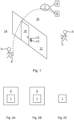
- Fig 1 is a schematic diagram illustrating an environment in which embodiments presented herein can be applied.
- Access to a physical space 16 is restricted by an openable physical barrier 15 which is selectively unlockable.
- the physical barrier 15 stands between the restricted physical space 16 and an accessible physical space 14.
- the accessible physical space 14 can be a restricted physical space in itself, but in relation to this physical barrier 15, the accessible physical space 14 is accessible.
- the barrier 15 can be a door, gate, hatch, cabinet door, drawer, window, etc.
- An electronic lock 12 is provided in order to control access to the physical space 16, by selectively unlocking the barrier 15.
- the electronic lock 12 can be provided in a structure 17 (such as a wall) surrounding the barrier 15 (as shown) or the electronic lock 12 can be provided in the barrier 15 itself (not shown).
- the electronic lock 12 is controllable to be in a locked state or in an unlocked state.
- the electronic lock 12 comprises a user input device 13, e.g. a keypad or touchscreen, for entry of a passcode, e.g. a pin or an alphanumeric sequence, to unlock the electronic lock 12.
- the electronic lock 12 supports one or more additional factors of authentication, e.g. by communicating with an electronic key, or biometrics.
- IP internet protocol
- the network can e.g. comprise any one or more of a local wireless network, a cellular network, a wired local-area network, a wide-area network (such as the Internet), etc.
- a user 5 has authority access the restricted physical space and can e.g. be a resident, a tenant, a facilities manager, etc.
- the user 5 has access to a user device 2, which can be a smartphone, computer etc., and is connected or connectable to the network 7.
- the user 5 can use a method to trigger the generation of a temporary passcode, which is provided to a temporary passcode recipient 4, e.g. via a recipient device 8.
- the temporary passcode recipient 4 can then enter the temporary passcode on the user input device 13 of the electronic lock 12, to thereby gain access to the restricted space.
- the application server 6 can implement server functionality which interacts with an application (also known as app) on the recipient device, for communicating the temporary passcode, as describe in more detail below with reference to Fig 3C .
- Figs 2A-C are schematic diagram illustrating embodiments of where the passcode provider 1 can be implemented.
- the passcode provider 1 is shown implemented in the code generation server 3, which can form part of what is commonly referred to as the cloud.
- the code generation server 3 is thus the host device for the passcode provider 1 in this implementation.
- the passcode provider 1 is shown implemented in the user device 2.
- the user device 2 is thus the host device for the passcode provider 1 in this implementation.
- the passcode provider 1 is shown as implemented as a stand-alone device.
- the passcode provider 1 thus does not have a host device in this implementation.
- Figs 3A-C are sequence diagrams illustrating communication between some of the entities of Fig 1 and Figs 2A-C , according to various embodiments. Specifically, the communication between the user device 2, the passcode provider 1 and the recipient device 8 are shown. In Fig 3C , the application server 6 is also included.
- the user controls the user device 2 to request 20 a temporary passcode from the passcode provider 1.
- the request can e.g. be sent using a web interface provided by the passcode provider.
- the request is transmitted using an application on the user device 2 that interacts with corresponding server functionality on the passcode provider.
- the passcode provider 1 is implemented in the user device 2
- the request is sent using internal communication, e.g. within an application executing on the user device.
- the passcode provider 1 generates 21 the temporary passcode as described in more detail below, in synchronicity with the passcode generation by the electronic lock.
- the passcode provider 1 provides the temporary passcode 25 to the user device 2.
- the user device 2 can now send the temporary passcode 25 to the recipient device 8, e.g. using a text message, an e-mail, or even using a voice call.
- the temporary passcode recipient can then enter the passcode to the electronic lock for entry to the restricted space 16. Since the passcode generation is synchronised between the temporary passcode generator 1 and the electronic lock 12, the temporary passcode can be verified without the need for online communication between the passcode generator 1 and the electronic lock 12.
- the temporary passcode recipient does not need any additional hardware or nor software to gain access using the temporary passcode.
- the passcode provider 1 After generating the passcode 21, the passcode provider 1 here sends the temporary passcode 25 directly to the recipient device, e.g. using a text message, an e-mail or a voice call with voice synthesis informing of the temporary passcode.
- the user can schedule the sending of passcode to a particular time or when a particular event occurs in the future.
- the passcode provider 1 is not implemented in the user device 2, this allows the user device 2 to be offline, and the passcode can still be transmitted to the recipient device 8 at an appropriate time.
- the passcode provider 1 After generating the passcode 21, the passcode provider 1 here sends the temporary passcode 25 to the application server 6.
- the application server 6 implements server-side functionality for an application on the recipient device. Hence, the application server 6 can here forward the temporary passcode 25 to the recipient device 8 for notifying the temporary passcode recipient 4.
- Fig 4 is a flow chart illustrating embodiments of methods for enabling access, using a temporary passcode, to a physical space secured by an electronic lock.
- the method is performed in the passcode provider 1.
- the temporary passcode can e.g. be in the form of a sequence of digits, e.g. a PIN. Alternatively, the temporary passcode is a sequence of letters and/or other characters.
- the passcode provider can be configured to generate temporary passcodes for a plurality of electronic locks 12, where the described methods can be performed in parallel for each one of the electronic locks 12.
- the passcode provider 1 synchronises with the electronic lock 12 to align times for temporary passcode generation.
- the synchronisation can e.g. occur over a wireless connection (e.g. Bluetooth, Bluetooth low energy (BLE), Wi-Fi) with the user device.
- the user device can act as a router or intermediary between the electronic lock 12 and the passcode provider 1 for the synchronisation.
- the user When a visitor needs access to the physical space secured by the electronic lock, e.g. due to a service, such as a delivery, or other service, ordered by the user, the user is notified that the visitor needs access, e.g. via text message, phone call, delivery information app, etc. The user will then request a temporary passcode.
- a service such as a delivery, or other service
- the passcode provider 1 receives a signal to provide a temporary passcode for unlocking the electronic lock.
- the signal can be a user input signal from a user interface module, based on receiving input from the user 5 to provide the temporary passcode, e.g. from a web interface or from an application running on the user device.
- the request comprises an indicated time of when the temporary passcode should be generated and transmitted.
- an identifier e.g. phone number, e-mail address, user id
- the request comprises an identifier of the electronic lock, for which the temporary passcode is requested.
- the passcode provider 1 determines a temporary passcode.
- the temporary passcode is valid only until an end time at the electronic lock 12.
- the validity duration of the temporary passcode can be configured to e.g. 1 minute, 10 minutes, etc.
- the request comprises an indicated time
- this step can be put in a wait time until the indicated time occurs.
- the temporary passcode is generated in synchronicity with passcode generation in the electronic lock. This is made possible by the earlier synchronisation and a common procedure of generating temporary passcodes over time.
- the temporary passcode can be determined based on a predetermined schedule of temporary passcode generation. The schedule is the same as a corresponding schedule in the electronic lock. In this way, the generated temporary passcode can be verified in the electronic lock.
- Each electronic lock can have its own generation of passcodes, e.g. generated according to the same algorithm but with initiated with different seeds.
- the temporary passcode is selected to be, from a plurality of currently valid temporary passcodes with different remaining validity times, the temporary passcode that has the longest remaining validity time.
- the plurality of currently valid temporary passcodes thus overlap in time. This procedure is illustrated in Fig 5 and is described in more detail below.
- the passcode provider 1 provides the temporary passcode for forwarding to a temporary passcode recipient. This can be implemented by presenting the temporary passcode to the user 5. Alternatively, or additionally, the passcode is provided by transmitting the temporary passcode to the temporary passcode recipient.
- the electronic lock can verify the temporary passcode when this is entered by the temporary passcode recipient.
- the electronic lock executes a passcode verification algorithm which corresponds to the passcode generation, to be able to verify the temporary passcode.
- the lock also accepts a static passcode, which can be used by legitimate users and can be shared with people for which the legitimate users have a high level of trust, e.g. family members.
- a static passcode which can be used by legitimate users and can be shared with people for which the legitimate users have a high level of trust, e.g. family members.
- the user can make sure the recipient receives a valid temporary passcode to gain access to the restricted physical space. After expiry, the temporary passcode is unusable and poses no security risk. At the same time, the temporary passcode is easy for the user to share with the recipient. Hence a solution is provided which is both secure and convenient.
- Fig 5 is a schematic diagram illustrating a schedule of passcodes overlapping in time, which can be used in embodiments of Fig 4 .
- the same (predetermined) schedule is used both by the passcode provider 1 and the electronic lock 12.
- the (horizontal) extension in Fig 5 of each temporary passcode 25a-f indicates its period of validity. There is a significant overlap in validity between passcodes. When half of the validity time of a temporary passcode is left before it expires, a new temporary passcode becomes valid in parallel. There is thus an overlap of half a validity time between temporary passcodes and there are two passcodes that are valid at each point in time.
- the passcode provider selects, from a plurality of currently overlapping valid temporary passcodes with different remaining validity times, the temporary passcode that has the longest remaining validity time. This reduces the risk of the passcode expiring prior the temporary passcode recipient being able to enter it.
- the electronic lock accepts either one of the concurrently valid passcodes to grant access.
- Fig 6 is a schematic diagram illustrating components of the passcode provider 1 of Fig 2A-C . It is to be noted that when the authentication device 1 is implemented in a host device, one or more of the mentioned components can be shared with the host device.
- a processor 60 is provided using any combination of one or more of a suitable central processing unit (CPU), graphics processing unit (GPU), multiprocessor, microcontroller, digital signal processor (DSP), etc., capable of executing software instructions 67 stored in a memory 64, which can thus be a computer program product.
- the processor 60 could alternatively be implemented using an application specific integrated circuit (ASIC), field programmable gate array (FPGA), etc.
- the processor 60 can be configured to execute the method described with reference to Fig 4 above.
- the memory 64 can be any combination of random-access memory (RAM) and/or read-only memory (ROM).
- the memory 64 also comprises persistent storage, which, for example, can be any single one or combination of magnetic memory, optical memory, solid-state memory or even remotely mounted memory.
- a data memory 66 is also provided for reading and/or storing data during execution of software instructions in the processor 60.
- the data memory 66 can be any combination of RAM and/or ROM.
- the passcode provider 1 further comprises an I/O interface 62 for communicating with external and/or internal entities.
- the I/O interface 62 also includes a user interface.
- Fig 7 shows one example of a computer program product 90 comprising computer readable means.
- a computer program 91 can be stored, which computer program can cause a processor to execute a method according to embodiments described herein.
- the computer program product is in the form of a removable solid-state memory, e.g. a Universal Serial Bus (USB) drive.
- USB Universal Serial Bus
- the computer program product could also be embodied in a memory of a device, such as the computer program product 64 of Fig 6 .
- While the computer program 91 is here schematically shown as a section of the removable solid-state memory, the computer program can be stored in any way which is suitable for the computer program product, such as another type of removable solid-state memory, or an optical disc, such as a CD (compact disc), a DVD (digital versatile disc) or a Blu-Ray disc.
- an optical disc such as a CD (compact disc), a DVD (digital versatile disc) or a Blu-Ray disc.
Landscapes
- Engineering & Computer Science (AREA)
- Physics & Mathematics (AREA)
- General Physics & Mathematics (AREA)
- Computer Security & Cryptography (AREA)
- Computer Networks & Wireless Communication (AREA)
- Theoretical Computer Science (AREA)
- Computer Hardware Design (AREA)
- Software Systems (AREA)
- General Engineering & Computer Science (AREA)
- Signal Processing (AREA)
- Lock And Its Accessories (AREA)
Description
- The present disclosure relates to the field of access control and in particular to enabling access, using a temporary passcode, to a physical space secured by an electronic lock.
- When a person needs to enter a protected common area, such as the common areas of a multi-residential building or an office, a passcode in the form of a PIN (personal identification number) is often entered to a lock, in order to unlock the lock. The PIN can consist of a sequence of digits, e.g. four or six digits.
- When deliveries are made, the passcode often needs to be shared with the delivery company, such that the delivery person can enter the building. The same applies for other services, e.g. cleaning, facilities management, etc. After entering the building, the delivery person or other service provider can go to the property of the receiver and deliver the package or provide the service.
- It is a security risk to share passcodes. Consider, as an example, a multi-residential building with 50 flats. If, on average, each flat receives only a single delivery a month, about 600 people will have received the passcode each year. The passcode could of course be changed over time, but this results in inconvenience for the residents.
-
US 2018/302397 discloses a computer-based locking system using changing passcodes. An application on an electronic device requests a passcode from an application server. The application server generates the passcode based on a current time. A lock with a passcode interface and a locking mechanism captures the input passcode. The lock also generates a local passcode based on current time. The lock releases the locking mechanism in response to the input passcode matching the local passcode. - One object is to improve the security for when pins need to be shared.
- According to a first aspect, it is provided a method for enabling access, using a temporary passcode, to a physical space secured by an electronic lock. The method is performed in a passcode provider. The method comprises: synchronising with the electronic lock to align times for temporary passcode generation; receiving a signal to provide a temporary passcode for unlocking the electronic lock; determining a temporary passcode, the temporary passcode being valid only until an end time at the electronic lock, by selecting, from a plurality of currently valid temporary passcodes with different remaining validity times, the temporary passcode that has the longest remaining validity time, wherein the plurality of currently valid temporary passcodes are based on a new temporary passcode becoming valid in parallel when half of the validity time of a temporary passcode is left before it expires; and providing the temporary passcode for forwarding to a temporary passcode recipient.
- The determining a temporary passcode may comprise determining the temporary passcode based on a predetermined schedule of temporary passcode generation.
- The signal may be a user input signal from a user interface module, based on receiving input from a user to provide the temporary passcode.
- The providing the temporary passcode may comprise presenting the temporary passcode to the user.
- The providing the temporary passcode may comprise transmitting the temporary passcode to the temporary passcode recipient.
- The providing the temporary passcode may comprise transmitting the temporary passcode to the temporary passcode recipient via an application server.
- The passcode may be in the form of a sequence of digits.
- According to a second aspect, it is provided a passcode provider for enabling access, using a temporary passcode, to a physical space secured by an electronic lock. The passcode provider comprises: a processor; and a memory storing instructions that, when executed by the processor, cause the passcode provider to: synchronise with the electronic lock to align times for temporary passcode generation; receive a signal to provide a temporary passcode for unlocking the electronic lock; determine a temporary passcode, the temporary passcode being valid only until an end time at the electronic lock, by selecting, from a plurality of currently valid temporary passcodes with different remaining validity times, the temporary passcode that has the longest remaining validity time, wherein the plurality of currently valid temporary passcodes are based on a new temporary passcode becoming valid in parallel when half of the validity time of a temporary passcode is left before it expires; and provide the temporary passcode for forwarding to a temporary passcode recipient.
- The instructions to determine a temporary passcode may comprise instructions that, when executed by the processor, cause the passcode provider to determine the temporary passcode based on a predetermined schedule of temporary passcode generation.
- The signal may be a user input signal from a user interface module, based on receiving input from a user to provide the temporary passcode.
- The instructions to provide the temporary passcode may comprise instructions that, when executed by the processor, cause the passcode provider to present the temporary passcode to the user.
- The instructions to provide the temporary passcode may comprise instructions that, when executed by the processor, cause the passcode provider to transmit the temporary passcode to the temporary passcode recipient.
- The instructions to provide the temporary passcode may comprise instructions that, when executed by the processor, cause the passcode provider to transmit the temporary passcode to the temporary passcode recipient via an application server.
- The passcode may be in the form of a sequence of digits.
- According to a third aspect, it is provided a computer program for enabling access, using a temporary passcode, to a physical space secured by an electronic lock. The computer program comprises computer program code which, when executed on a passcode provider causes the passcode provider to: synchronise with the electronic lock to align times for temporary passcode generation; receive a signal to provide a temporary passcode for unlocking the electronic lock; determine a temporary passcode, the temporary passcode being valid only until an end time at the electronic lock, by selecting, from a plurality of currently valid temporary passcodes with different remaining validity times, the temporary passcode that has the longest remaining validity time, wherein the plurality of currently valid temporary passcodes are based on a new temporary passcode becoming valid in parallel when half of the validity time of a temporary passcode is left before it expires; and provide the temporary passcode for forwarding to a temporary passcode recipient.
- According to a fourth aspect, it is provided a computer program product comprising a computer program according to the third aspect and a computer readable means on which the computer program is stored.
- Generally, all terms used in the claims are to be interpreted according to their ordinary meaning in the technical field, unless explicitly defined otherwise herein. All references to "a/an/the element, apparatus, component, means, step, etc." are to be interpreted openly as referring to at least one instance of the element, apparatus, component, means, step, etc., unless explicitly stated otherwise. The steps of any method disclosed herein do not have to be performed in the exact order disclosed, unless explicitly stated.
- Aspects and embodiments are now described, by way of example, with reference to the accompanying drawings, in which:
-
Fig 1 is a schematic diagram illustrating an environment in which embodiments presented herein can be applied; -
Figs 2A-C are schematic diagram illustrating embodiments of where the passcode provider can be implemented; -
Figs 3A-C are sequence diagrams illustrating communication between some of the entities ofFig 1 and Figs 2A-C , according to various embodiments; -
Fig 4 is a flow chart illustrating embodiments of methods for enabling access, using a temporary passcode, to a physical space secured by an electronic lock; -
Fig 5 is a schematic diagram illustrating a schedule of passcodes overlapping in time, which can be used in embodiments ofFig 4 ; -
Fig 6 is a schematic diagram illustrating components of the passcode provider ofFigs 2A-C ; and -
Fig 7 shows one example of a computer program product comprising computer readable means - The aspects of the present disclosure will now be described more fully hereinafter with reference to the accompanying drawings, in which certain embodiments of the invention are shown. These aspects may, however, be embodied in many different forms and should not be construed as limiting; rather, these embodiments are provided by way of example so that this disclosure will be thorough and complete, and to fully convey the scope of all aspects of invention to those skilled in the art. Like numbers refer to like elements throughout the description.
- According to embodiments presented herein, a passcode provider is first synchronised with an electronic lock. The passcode provider generates a temporary passcode (e.g. a temporary PIN), with a limited validity time. The temporary passcode is provided to a temporary passcode recipient (e.g. delivery person or other service provider) and the temporary passcode recipient can enter the passcode on a keypad of the electronic lock. The electronic lock (which has been synchronised with the passcode provider) can verify the passcode and grant access when appropriate. The same algorithm and schedule that is used for passcode generation by the passcode provider is also used for the passcode verification in the electronic lock. By synchronising the passcode provider and the electronic lock in advance, the electronic lock does not need to be constantly online. Moreover, after the temporary passcode has expired, it does not pose a security risk. Furthermore, by basing the passcode generation and verification on time, rather than a sequence of valid passcodes, the passcodes do not come out of synchronicity with each other between the passcode provider and the electronic lock. By basing the generation on time, also multiple recipients can receive concurrently valid passcodes.
-
Fig 1 is a schematic diagram illustrating an environment in which embodiments presented herein can be applied. Access to aphysical space 16 is restricted by an openablephysical barrier 15 which is selectively unlockable. Thephysical barrier 15 stands between the restrictedphysical space 16 and an accessiblephysical space 14. Note that the accessiblephysical space 14 can be a restricted physical space in itself, but in relation to thisphysical barrier 15, the accessiblephysical space 14 is accessible. Thebarrier 15 can be a door, gate, hatch, cabinet door, drawer, window, etc. Anelectronic lock 12 is provided in order to control access to thephysical space 16, by selectively unlocking thebarrier 15. - The
electronic lock 12 can be provided in a structure 17 (such as a wall) surrounding the barrier 15 (as shown) or theelectronic lock 12 can be provided in thebarrier 15 itself (not shown). Theelectronic lock 12 is controllable to be in a locked state or in an unlocked state. Theelectronic lock 12 comprises auser input device 13, e.g. a keypad or touchscreen, for entry of a passcode, e.g. a pin or an alphanumeric sequence, to unlock theelectronic lock 12. - Optionally, the
electronic lock 12 supports one or more additional factors of authentication, e.g. by communicating with an electronic key, or biometrics. - A network 7, which can be an internet protocol (IP)-based network, is provided, to which an optional
code generation server 3 and an optional application server 7 are connected. The network can e.g. comprise any one or more of a local wireless network, a cellular network, a wired local-area network, a wide-area network (such as the Internet), etc. - A
user 5 has authority access the restricted physical space and can e.g. be a resident, a tenant, a facilities manager, etc. Theuser 5 has access to auser device 2, which can be a smartphone, computer etc., and is connected or connectable to the network 7. As explained in more detail below, theuser 5 can use a method to trigger the generation of a temporary passcode, which is provided to atemporary passcode recipient 4, e.g. via arecipient device 8. - The
temporary passcode recipient 4 can then enter the temporary passcode on theuser input device 13 of theelectronic lock 12, to thereby gain access to the restricted space. - When provided, the
application server 6 can implement server functionality which interacts with an application (also known as app) on the recipient device, for communicating the temporary passcode, as describe in more detail below with reference toFig 3C . -
Figs 2A-C are schematic diagram illustrating embodiments of where thepasscode provider 1 can be implemented. - In
Fig 2A , thepasscode provider 1 is shown implemented in thecode generation server 3, which can form part of what is commonly referred to as the cloud. Thecode generation server 3 is thus the host device for thepasscode provider 1 in this implementation. - In
Fig 2B , thepasscode provider 1 is shown implemented in theuser device 2. Theuser device 2 is thus the host device for thepasscode provider 1 in this implementation. - In
Fig 2C , thepasscode provider 1 is shown as implemented as a stand-alone device. Thepasscode provider 1 thus does not have a host device in this implementation. -
Figs 3A-C are sequence diagrams illustrating communication between some of the entities ofFig 1 and Figs 2A-C , according to various embodiments. Specifically, the communication between theuser device 2, thepasscode provider 1 and therecipient device 8 are shown. InFig 3C , theapplication server 6 is also included. - First, the sequence of
Fig 3A will be described. When the user has a need to generate a temporary passcode, for a provider of a service, the user controls theuser device 2 to request 20 a temporary passcode from thepasscode provider 1. The request can e.g. be sent using a web interface provided by the passcode provider. Alternatively, the request is transmitted using an application on theuser device 2 that interacts with corresponding server functionality on the passcode provider. Alternatively, when thepasscode provider 1 is implemented in theuser device 2, the request is sent using internal communication, e.g. within an application executing on the user device. - The
passcode provider 1 generates 21 the temporary passcode as described in more detail below, in synchronicity with the passcode generation by the electronic lock. - Once generated, the
passcode provider 1 provides thetemporary passcode 25 to theuser device 2. Theuser device 2 can now send thetemporary passcode 25 to therecipient device 8, e.g. using a text message, an e-mail, or even using a voice call. The temporary passcode recipient can then enter the passcode to the electronic lock for entry to the restrictedspace 16. Since the passcode generation is synchronised between thetemporary passcode generator 1 and theelectronic lock 12, the temporary passcode can be verified without the need for online communication between thepasscode generator 1 and theelectronic lock 12. - In this embodiment, the temporary passcode recipient does not need any additional hardware or nor software to gain access using the temporary passcode.
- Looking now to
Fig 3B , only differences from the sequence ofFig 3A will be described. After generating thepasscode 21, thepasscode provider 1 here sends thetemporary passcode 25 directly to the recipient device, e.g. using a text message, an e-mail or a voice call with voice synthesis informing of the temporary passcode. - Since it is the
passcode provider 1 that sends the pin to the recipient device, the user can schedule the sending of passcode to a particular time or when a particular event occurs in the future. When thepasscode provider 1 is not implemented in theuser device 2, this allows theuser device 2 to be offline, and the passcode can still be transmitted to therecipient device 8 at an appropriate time. - Looking now to
Fig 3C , only differences from the sequence ofFig 3A will be described. After generating thepasscode 21, thepasscode provider 1 here sends thetemporary passcode 25 to theapplication server 6. Theapplication server 6 implements server-side functionality for an application on the recipient device. Hence, theapplication server 6 can here forward thetemporary passcode 25 to therecipient device 8 for notifying thetemporary passcode recipient 4. -
Fig 4 is a flow chart illustrating embodiments of methods for enabling access, using a temporary passcode, to a physical space secured by an electronic lock. The method is performed in thepasscode provider 1. The temporary passcode can e.g. be in the form of a sequence of digits, e.g. a PIN. Alternatively, the temporary passcode is a sequence of letters and/or other characters. The passcode provider can be configured to generate temporary passcodes for a plurality ofelectronic locks 12, where the described methods can be performed in parallel for each one of the electronic locks 12. - In a synchronise with
lock step 40, thepasscode provider 1 synchronises with theelectronic lock 12 to align times for temporary passcode generation. The synchronisation can e.g. occur over a wireless connection (e.g. Bluetooth, Bluetooth low energy (BLE), Wi-Fi) with the user device. The user device can act as a router or intermediary between theelectronic lock 12 and thepasscode provider 1 for the synchronisation. - When a visitor needs access to the physical space secured by the electronic lock, e.g. due to a service, such as a delivery, or other service, ordered by the user, the user is notified that the visitor needs access, e.g. via text message, phone call, delivery information app, etc. The user will then request a temporary passcode.
- In a receive signal to provide
temporary passcode step 42, thepasscode provider 1 receives a signal to provide a temporary passcode for unlocking the electronic lock. The signal can be a user input signal from a user interface module, based on receiving input from theuser 5 to provide the temporary passcode, e.g. from a web interface or from an application running on the user device. Optionally, the request comprises an indicated time of when the temporary passcode should be generated and transmitted. Optionally, an identifier (e.g. phone number, e-mail address, user id) of the temporary passcode recipient is provided in the request. Optionally, the request comprises an identifier of the electronic lock, for which the temporary passcode is requested. - In a determine
temporary passcode 44 step, thepasscode provider 1 determines a temporary passcode. The temporary passcode is valid only until an end time at theelectronic lock 12. The validity duration of the temporary passcode can be configured to e.g. 1 minute, 10 minutes, etc. When the request comprises an indicated time, this step can be put in a wait time until the indicated time occurs. The temporary passcode is generated in synchronicity with passcode generation in the electronic lock. This is made possible by the earlier synchronisation and a common procedure of generating temporary passcodes over time. In other words, the temporary passcode can be determined based on a predetermined schedule of temporary passcode generation. The schedule is the same as a corresponding schedule in the electronic lock. In this way, the generated temporary passcode can be verified in the electronic lock. Each electronic lock can have its own generation of passcodes, e.g. generated according to the same algorithm but with initiated with different seeds. - The temporary passcode is selected to be, from a plurality of currently valid temporary passcodes with different remaining validity times, the temporary passcode that has the longest remaining validity time. The plurality of currently valid temporary passcodes thus overlap in time. This procedure is illustrated in
Fig 5 and is described in more detail below. - In a provide
temporary passcode step 46, thepasscode provider 1 provides the temporary passcode for forwarding to a temporary passcode recipient. This can be implemented by presenting the temporary passcode to theuser 5. Alternatively, or additionally, the passcode is provided by transmitting the temporary passcode to the temporary passcode recipient. - Since the electronic lock generates a corresponding temporary passcode, the electronic lock can verify the temporary passcode when this is entered by the temporary passcode recipient. The electronic lock executes a passcode verification algorithm which corresponds to the passcode generation, to be able to verify the temporary passcode.
- Optionally, the lock also accepts a static passcode, which can be used by legitimate users and can be shared with people for which the legitimate users have a high level of trust, e.g. family members.
- Using embodiments presented herein, the user can make sure the recipient receives a valid temporary passcode to gain access to the restricted physical space. After expiry, the temporary passcode is unusable and poses no security risk. At the same time, the temporary passcode is easy for the user to share with the recipient. Hence a solution is provided which is both secure and convenient.
-
Fig 5 is a schematic diagram illustrating a schedule of passcodes overlapping in time, which can be used in embodiments ofFig 4 . The same (predetermined) schedule is used both by thepasscode provider 1 and theelectronic lock 12. Time flows from left to right. The (horizontal) extension inFig 5 of eachtemporary passcode 25a-f indicates its period of validity. There is a significant overlap in validity between passcodes. When half of the validity time of a temporary passcode is left before it expires, a new temporary passcode becomes valid in parallel. There is thus an overlap of half a validity time between temporary passcodes and there are two passcodes that are valid at each point in time. - When determining a temporary passcode, and applying the principles of
Fig 5 , of the two valid passcodes, the passcode provider selects, from a plurality of currently overlapping valid temporary passcodes with different remaining validity times, the temporary passcode that has the longest remaining validity time. This reduces the risk of the passcode expiring prior the temporary passcode recipient being able to enter it. - At any point in time, the electronic lock accepts either one of the concurrently valid passcodes to grant access.
-
Fig 6 is a schematic diagram illustrating components of thepasscode provider 1 ofFig 2A-C . It is to be noted that when theauthentication device 1 is implemented in a host device, one or more of the mentioned components can be shared with the host device. Aprocessor 60 is provided using any combination of one or more of a suitable central processing unit (CPU), graphics processing unit (GPU), multiprocessor, microcontroller, digital signal processor (DSP), etc., capable of executingsoftware instructions 67 stored in amemory 64, which can thus be a computer program product. Theprocessor 60 could alternatively be implemented using an application specific integrated circuit (ASIC), field programmable gate array (FPGA), etc. Theprocessor 60 can be configured to execute the method described with reference toFig 4 above. - The
memory 64 can be any combination of random-access memory (RAM) and/or read-only memory (ROM). Thememory 64 also comprises persistent storage, which, for example, can be any single one or combination of magnetic memory, optical memory, solid-state memory or even remotely mounted memory. - A
data memory 66 is also provided for reading and/or storing data during execution of software instructions in theprocessor 60. Thedata memory 66 can be any combination of RAM and/or ROM. - The
passcode provider 1 further comprises an I/O interface 62 for communicating with external and/or internal entities. Optionally, the I/O interface 62 also includes a user interface. - Other components of the
passcode provider 1 are omitted in order not to obscure the concepts presented herein. -
Fig 7 shows one example of acomputer program product 90 comprising computer readable means. On this computer readable means, acomputer program 91 can be stored, which computer program can cause a processor to execute a method according to embodiments described herein. In this example, the computer program product is in the form of a removable solid-state memory, e.g. a Universal Serial Bus (USB) drive. As explained above, the computer program product could also be embodied in a memory of a device, such as thecomputer program product 64 ofFig 6 . While thecomputer program 91 is here schematically shown as a section of the removable solid-state memory, the computer program can be stored in any way which is suitable for the computer program product, such as another type of removable solid-state memory, or an optical disc, such as a CD (compact disc), a DVD (digital versatile disc) or a Blu-Ray disc. - The aspects of the present disclosure have mainly been described above with reference to a few embodiments. However, as is readily appreciated by a person skilled in the art, other embodiments than the ones disclosed above are equally possible within the scope of the invention, as defined by the appended patent claims. Thus, while various aspects and embodiments have been disclosed herein, other aspects and embodiments will be apparent to those skilled in the art. The various aspects and embodiments disclosed herein are for purposes of illustration and are not intended to be limiting, with the true scope being indicated by the following claims.
Claims (15)
- A method for enabling access, using a temporary passcode (25. 25a-f), to a physical space (16) secured by an electronic lock (12), the method being performed in a passcode provider (1), the method comprising:synchronising (40) with the electronic lock (12) to align times for temporary passcode generation;receiving (42) a signal to provide a temporary passcode for unlocking the electronic lock;determining (44) a temporary passcode, the temporary passcode being valid only until an end time at the electronic lock (12), by selecting, from a plurality of currently valid temporary passcodes with different remaining validity times, the temporary passcode that has the longest remaining validity time, wherein the plurality of currently valid temporary passcodes are based on a new temporary passcode becoming valid in parallel when half of the validity time of a temporary passcode is left before it expires; andproviding (46) the temporary passcode for forwarding to a temporary passcode recipient.
- The method according to claim 1, wherein the determining (44) a temporary passcode comprises determining the temporary passcode based on a predetermined schedule of temporary passcode generation.
- The method according to claim 1 or 2, wherein the signal is a user input signal from a user interface module, based on receiving input from a user (5) to provide the temporary passcode.
- The method according to claim 3, wherein the providing (46) the temporary passcode comprises presenting the temporary passcode to the user (5).
- The method according to any one of the preceding claims, wherein the providing (46) the temporary passcode comprises transmitting the temporary passcode to the temporary passcode recipient.
- The method according to any one of the preceding claims, wherein the providing (46) the temporary passcode comprises transmitting the temporary passcode to the temporary passcode recipient via an application server.
- The method according to any one of the previous claims, wherein the passcode is in the form of a sequence of digits.
- A passcode provider (1) for enabling access, using a temporary passcode (25. 25a-f), to a physical space (16) secured by an electronic lock (12), the passcode provider (1) comprising:a processor (60); anda memory (64) storing instructions (67) that, when executed by the processor, cause the passcode provider (1) to:synchronise with the electronic lock (12) to align times for temporary passcode generation;receive a signal to provide a temporary passcode for unlocking the electronic lock;determine a temporary passcode, the temporary passcode being valid only until an end time at the electronic lock (12), by selecting, from a plurality of currently valid temporary passcodes with different remaining validity times, the temporary passcode that has the longest remaining validity time, wherein the plurality of currently valid temporary passcodes are based on a new temporary passcode becoming valid in parallel when half of the validity time of a temporary passcode is left before it expires; andprovide the temporary passcode for forwarding to a temporary passcode recipient.
- The passcode provider (1) according to claim 8, wherein the instructions to determine a temporary passcode comprise instructions (67) that, when executed by the processor, cause the passcode provider (1) to determine the temporary passcode based on a predetermined schedule of temporary passcode generation.
- The passcode provider (1) according to claim 8 or 9, wherein the signal is a user input signal from a user interface module, based on receiving input from a user (5) to provide the temporary passcode.
- The passcode provider (1) according to claim 10, wherein the instructions to provide the temporary passcode comprise instructions (67) that, when executed by the processor, cause the passcode provider (1) to present the temporary passcode to the user (5).
- The passcode provider (1) according to any one of claims 8 to 11, wherein the instructions to provide the temporary passcode comprise instructions (67) that, when executed by the processor, cause the passcode provider (1) to transmit the temporary passcode to the temporary passcode recipient.
- The passcode provider (1) according to any one of claims 8 to 12, wherein the instructions to provide the temporary passcode comprise instructions (67) that, when executed by the processor, cause the passcode provider (1) to transmit the temporary passcode to the temporary passcode recipient via an application server.
- A computer program (67, 91) for enabling access, using a temporary passcode (25. 25a-f), to a physical space (16) secured by an electronic lock (14), the computer program comprising computer program code which, when executed on a passcode provider (1) causes the passcode provider (1) to:synchronise with the electronic lock (14) to align times for temporary passcode generation;receive a signal to provide a temporary passcode for unlocking the electronic lock;determine a temporary passcode, the temporary passcode being valid only until an end time at the electronic lock (14), by selecting, from a plurality of currently valid temporary passcodes with different remaining validity times, the temporary passcode that has the longest remaining validity time, wherein the plurality of currently valid temporary passcodes are based on a new temporary passcode becoming valid in parallel when half of the validity time of a temporary passcode is left before it expires; andprovide the temporary passcode for forwarding to a temporary passcode recipient.
- A computer program product (64, 90) comprising a computer program according to claim 14 and a computer readable means on which the computer program is stored.
Applications Claiming Priority (2)
| Application Number | Priority Date | Filing Date | Title |
|---|---|---|---|
| SE2051533 | 2020-12-22 | ||
| PCT/EP2021/086183 WO2022136105A1 (en) | 2020-12-22 | 2021-12-16 | Enabling access using a temporary passcode |
Publications (3)
| Publication Number | Publication Date |
|---|---|
| EP4268103A1 EP4268103A1 (en) | 2023-11-01 |
| EP4268103B1 true EP4268103B1 (en) | 2024-09-25 |
| EP4268103C0 EP4268103C0 (en) | 2024-09-25 |
Family
ID=79316919
Family Applications (1)
| Application Number | Title | Priority Date | Filing Date |
|---|---|---|---|
| EP21840530.6A Active EP4268103B1 (en) | 2020-12-22 | 2021-12-16 | Enabling access using a temporary passcode |
Country Status (3)
| Country | Link |
|---|---|
| US (1) | US12367727B2 (en) |
| EP (1) | EP4268103B1 (en) |
| WO (1) | WO2022136105A1 (en) |
Families Citing this family (1)
| Publication number | Priority date | Publication date | Assignee | Title |
|---|---|---|---|---|
| US12367727B2 (en) | 2020-12-22 | 2025-07-22 | Assa Abloy Ab | Enabling access using a temporary passcode |
Family Cites Families (32)
| Publication number | Priority date | Publication date | Assignee | Title |
|---|---|---|---|---|
| US4633514A (en) * | 1984-11-05 | 1986-12-30 | Zenith Electronics Corporation | Keyboard controlled television receiver |
| US5537681A (en) * | 1994-05-02 | 1996-07-16 | Motorola, Inc. | Communication network with incoming calls directed through moving cells and method for operating same |
| US20040046018A1 (en) * | 2002-09-05 | 2004-03-11 | Ellenby Technologies, Inc. | System and method for electronic lock access |
| US7146499B2 (en) * | 2002-09-30 | 2006-12-05 | International Business Machines Corporation | Security system for replicated storage devices on computer networks |
| US7669236B2 (en) | 2004-11-18 | 2010-02-23 | Biogy, Inc. | Determining whether to grant access to a passcode protected system |
| US7707622B2 (en) | 2004-11-18 | 2010-04-27 | Biogy, Inc. | API for a system having a passcode authenticator |
| US7979716B2 (en) | 2004-11-18 | 2011-07-12 | Biogy, Inc. | Method of generating access keys |
| WO2006091301A2 (en) | 2005-01-24 | 2006-08-31 | Bionopoly Llc | Passcodes |
| US20100289615A1 (en) * | 2008-01-07 | 2010-11-18 | Adams Albert G | Electro-mechanical Leverlock with Switching System |
| US20120227450A1 (en) * | 2011-03-08 | 2012-09-13 | Security Enhancement Systems, Llc | Lock |
| WO2012122268A2 (en) * | 2011-03-08 | 2012-09-13 | Security Enhancement Systems, Llc | Lock |
| US8902040B2 (en) * | 2011-08-18 | 2014-12-02 | Greisen Enterprises Llc | Electronic lock and method |
| GB2522217A (en) * | 2014-01-16 | 2015-07-22 | Parcelhome Ltd | Electronic lock apparatus, method and system |
| US9619955B2 (en) * | 2015-02-13 | 2017-04-11 | David L. Eichenblatt | Systems and methods for facilitating package delivery or pickup |
| KR101623743B1 (en) * | 2015-09-22 | 2016-05-25 | 전용준 | Method for controlling the door lock of the home network system |
| US10290164B2 (en) * | 2015-09-22 | 2019-05-14 | Yong Joon Jeon | Method for controlling door lock of home network system |
| US10614641B2 (en) * | 2015-12-11 | 2020-04-07 | The Sun Lock Company, Ltd. | Electronic combination lock with different levels of access control |
| US9984524B2 (en) * | 2016-01-26 | 2018-05-29 | Acsys Ip Holding Inc | Systems and methods for remote access rights and verification |
| US20160191245A1 (en) * | 2016-03-09 | 2016-06-30 | Yufeng Qin | Method for Offline Authenticating Time Encoded Passcode |
| CN107622542A (en) * | 2016-07-13 | 2018-01-23 | 杭州海康威视数字技术股份有限公司 | A kind of AB doors method for controlling opening and closing, apparatus and system |
| EP3321892A1 (en) * | 2016-11-10 | 2018-05-16 | Gemalto Sa | A physical key for provisioning a communication device with data allowing it to access a vehicle resource |
| US20180177319A1 (en) * | 2016-12-27 | 2018-06-28 | Dan Willis | System and method for secure lock box with near proximity awareness |
| CN106898064A (en) * | 2017-01-09 | 2017-06-27 | 云丁网络技术(北京)有限公司 | A kind of generation method and its system of the off-line verification code based on intelligent door lock system |
| US9912659B1 (en) * | 2017-04-14 | 2018-03-06 | Matt Widdows | Locking systems with multifactor authentication and changing passcodes |
| KR102012276B1 (en) * | 2017-11-16 | 2019-10-21 | 주식회사 다자요 | Digital door lock system and the control method thereof |
| JP6897536B2 (en) * | 2017-12-12 | 2021-06-30 | トヨタ自動車株式会社 | Authentication information control system, authentication information control method, and authentication information control program |
| US11097689B2 (en) * | 2018-03-27 | 2021-08-24 | Denso International America, Inc. | Passive entry and passive start system and method using temporary keys |
| US11183035B2 (en) * | 2018-11-12 | 2021-11-23 | Eagle Eye Networks, Inc. | Video doorbell visitor filtration apparatuses and date-time system methods of operation |
| KR102483794B1 (en) * | 2019-06-05 | 2023-01-03 | 주식회사 모카시스템 | Entrance management system and method thereof |
| US11616655B2 (en) * | 2019-06-05 | 2023-03-28 | Sera4 Ltd. | Asymmetric cryptography assisted authentication and access protocols |
| US12100250B2 (en) * | 2020-11-09 | 2024-09-24 | Maximum Controls, LLC | Remote access management apparatus, system and method |
| US12367727B2 (en) | 2020-12-22 | 2025-07-22 | Assa Abloy Ab | Enabling access using a temporary passcode |
-
2021
- 2021-12-16 US US18/258,654 patent/US12367727B2/en active Active
- 2021-12-16 EP EP21840530.6A patent/EP4268103B1/en active Active
- 2021-12-16 WO PCT/EP2021/086183 patent/WO2022136105A1/en not_active Ceased
Also Published As
| Publication number | Publication date |
|---|---|
| US20240265760A1 (en) | 2024-08-08 |
| US12367727B2 (en) | 2025-07-22 |
| EP4268103C0 (en) | 2024-09-25 |
| EP4268103A1 (en) | 2023-11-01 |
| WO2022136105A1 (en) | 2022-06-30 |
Similar Documents
| Publication | Publication Date | Title |
|---|---|---|
| EP3552187B1 (en) | Providing access to a lock for a service provider | |
| US9979719B2 (en) | System and method for converting one-time passcodes to app-based authentication | |
| US8706083B2 (en) | Bluetooth authentication system and method | |
| CN109416713B (en) | Verification systems and non-transitory information recording media | |
| US12136304B2 (en) | Providing access to a lock by service consumer device | |
| EP3293995B1 (en) | Locking system and secure token and ownership transfer | |
| US10999267B2 (en) | Information processing apparatus, information processing method, program, information processing system, and communication apparatus | |
| EP3105907A1 (en) | Authentication system and method | |
| CN105900148A (en) | Time synchronization | |
| US9742784B2 (en) | Account registration and login method, and network attached storage system using the same | |
| US20170365119A1 (en) | Method for controlling door lock of home network system | |
| JP6852989B2 (en) | Key management system | |
| KR20150135032A (en) | System and method for updating secret key using physical unclonable function | |
| JP2019173523A (en) | Electric lock system and lock control terminal | |
| US12367727B2 (en) | Enabling access using a temporary passcode | |
| JP2025509902A (en) | Information Access Handover | |
| US11823511B2 (en) | Providing access to a lock for a service provider using a grant token and credential | |
| EP3776320B1 (en) | Transmitting service provider access data to a service provider server | |
| US11232660B2 (en) | Using a private key of a cryptographic key pair accessible to a service provider device | |
| JP7496177B1 (en) | Authenticated device, authenticating device, authentication request output method, authentication method, and program | |
| US20170316198A1 (en) | Method for authenticating a user device during the process of logging into a server | |
| WO2025093201A1 (en) | Enabling temporary access to a physical space | |
| CN121725538A (en) | Unlocking method and generating method of door lock, equipment and program product | |
| CN117278267A (en) | Enhanced authentication method and device | |
| WO2021052943A1 (en) | Evaluating access to a physical space |
Legal Events
| Date | Code | Title | Description |
|---|---|---|---|
| STAA | Information on the status of an ep patent application or granted ep patent |
Free format text: STATUS: UNKNOWN |
|
| STAA | Information on the status of an ep patent application or granted ep patent |
Free format text: STATUS: THE INTERNATIONAL PUBLICATION HAS BEEN MADE |
|
| PUAI | Public reference made under article 153(3) epc to a published international application that has entered the european phase |
Free format text: ORIGINAL CODE: 0009012 |
|
| STAA | Information on the status of an ep patent application or granted ep patent |
Free format text: STATUS: REQUEST FOR EXAMINATION WAS MADE |
|
| 17P | Request for examination filed |
Effective date: 20230705 |
|
| AK | Designated contracting states |
Kind code of ref document: A1 Designated state(s): AL AT BE BG CH CY CZ DE DK EE ES FI FR GB GR HR HU IE IS IT LI LT LU LV MC MK MT NL NO PL PT RO RS SE SI SK SM TR |
|
| DAV | Request for validation of the european patent (deleted) | ||
| DAX | Request for extension of the european patent (deleted) | ||
| GRAP | Despatch of communication of intention to grant a patent |
Free format text: ORIGINAL CODE: EPIDOSNIGR1 |
|
| STAA | Information on the status of an ep patent application or granted ep patent |
Free format text: STATUS: GRANT OF PATENT IS INTENDED |
|
| INTG | Intention to grant announced |
Effective date: 20240423 |
|
| GRAS | Grant fee paid |
Free format text: ORIGINAL CODE: EPIDOSNIGR3 |
|
| GRAA | (expected) grant |
Free format text: ORIGINAL CODE: 0009210 |
|
| STAA | Information on the status of an ep patent application or granted ep patent |
Free format text: STATUS: THE PATENT HAS BEEN GRANTED |
|
| AK | Designated contracting states |
Kind code of ref document: B1 Designated state(s): AL AT BE BG CH CY CZ DE DK EE ES FI FR GB GR HR HU IE IS IT LI LT LU LV MC MK MT NL NO PL PT RO RS SE SI SK SM TR |
|
| REG | Reference to a national code |
Ref country code: GB Ref legal event code: FG4D |
|
| REG | Reference to a national code |
Ref country code: CH Ref legal event code: EP |
|
| REG | Reference to a national code |
Ref country code: DE Ref legal event code: R096 Ref document number: 602021019432 Country of ref document: DE |
|
| REG | Reference to a national code |
Ref country code: IE Ref legal event code: FG4D |
|
| U01 | Request for unitary effect filed |
Effective date: 20241007 |
|
| U07 | Unitary effect registered |
Designated state(s): AT BE BG DE DK EE FI FR IT LT LU LV MT NL PT RO SE SI Effective date: 20241022 |
|
| U20 | Renewal fee for the european patent with unitary effect paid |
Year of fee payment: 4 Effective date: 20241121 |
|
| PG25 | Lapsed in a contracting state [announced via postgrant information from national office to epo] |
Ref country code: NO Free format text: LAPSE BECAUSE OF FAILURE TO SUBMIT A TRANSLATION OF THE DESCRIPTION OR TO PAY THE FEE WITHIN THE PRESCRIBED TIME-LIMIT Effective date: 20241225 |
|
| PG25 | Lapsed in a contracting state [announced via postgrant information from national office to epo] |
Ref country code: GR Free format text: LAPSE BECAUSE OF FAILURE TO SUBMIT A TRANSLATION OF THE DESCRIPTION OR TO PAY THE FEE WITHIN THE PRESCRIBED TIME-LIMIT Effective date: 20241226 |
|
| PG25 | Lapsed in a contracting state [announced via postgrant information from national office to epo] |
Ref country code: RS Free format text: LAPSE BECAUSE OF FAILURE TO SUBMIT A TRANSLATION OF THE DESCRIPTION OR TO PAY THE FEE WITHIN THE PRESCRIBED TIME-LIMIT Effective date: 20241225 |
|
| PG25 | Lapsed in a contracting state [announced via postgrant information from national office to epo] |
Ref country code: RS Free format text: LAPSE BECAUSE OF FAILURE TO SUBMIT A TRANSLATION OF THE DESCRIPTION OR TO PAY THE FEE WITHIN THE PRESCRIBED TIME-LIMIT Effective date: 20241225 Ref country code: NO Free format text: LAPSE BECAUSE OF FAILURE TO SUBMIT A TRANSLATION OF THE DESCRIPTION OR TO PAY THE FEE WITHIN THE PRESCRIBED TIME-LIMIT Effective date: 20241225 Ref country code: GR Free format text: LAPSE BECAUSE OF FAILURE TO SUBMIT A TRANSLATION OF THE DESCRIPTION OR TO PAY THE FEE WITHIN THE PRESCRIBED TIME-LIMIT Effective date: 20241226 |
|
| PG25 | Lapsed in a contracting state [announced via postgrant information from national office to epo] |
Ref country code: IS Free format text: LAPSE BECAUSE OF FAILURE TO SUBMIT A TRANSLATION OF THE DESCRIPTION OR TO PAY THE FEE WITHIN THE PRESCRIBED TIME-LIMIT Effective date: 20250125 |
|
| PG25 | Lapsed in a contracting state [announced via postgrant information from national office to epo] |
Ref country code: SM Free format text: LAPSE BECAUSE OF FAILURE TO SUBMIT A TRANSLATION OF THE DESCRIPTION OR TO PAY THE FEE WITHIN THE PRESCRIBED TIME-LIMIT Effective date: 20240925 |
|
| PG25 | Lapsed in a contracting state [announced via postgrant information from national office to epo] |
Ref country code: ES Free format text: LAPSE BECAUSE OF FAILURE TO SUBMIT A TRANSLATION OF THE DESCRIPTION OR TO PAY THE FEE WITHIN THE PRESCRIBED TIME-LIMIT Effective date: 20240925 |
|
| PG25 | Lapsed in a contracting state [announced via postgrant information from national office to epo] |
Ref country code: PL Free format text: LAPSE BECAUSE OF FAILURE TO SUBMIT A TRANSLATION OF THE DESCRIPTION OR TO PAY THE FEE WITHIN THE PRESCRIBED TIME-LIMIT Effective date: 20240925 Ref country code: CZ Free format text: LAPSE BECAUSE OF FAILURE TO SUBMIT A TRANSLATION OF THE DESCRIPTION OR TO PAY THE FEE WITHIN THE PRESCRIBED TIME-LIMIT Effective date: 20240925 |
|
| PG25 | Lapsed in a contracting state [announced via postgrant information from national office to epo] |
Ref country code: SK Free format text: LAPSE BECAUSE OF FAILURE TO SUBMIT A TRANSLATION OF THE DESCRIPTION OR TO PAY THE FEE WITHIN THE PRESCRIBED TIME-LIMIT Effective date: 20240925 |
|
| PG25 | Lapsed in a contracting state [announced via postgrant information from national office to epo] |
Ref country code: MC Free format text: LAPSE BECAUSE OF FAILURE TO SUBMIT A TRANSLATION OF THE DESCRIPTION OR TO PAY THE FEE WITHIN THE PRESCRIBED TIME-LIMIT Effective date: 20240925 |
|
| REG | Reference to a national code |
Ref country code: CH Ref legal event code: PL |
|
| PLBE | No opposition filed within time limit |
Free format text: ORIGINAL CODE: 0009261 |
|
| STAA | Information on the status of an ep patent application or granted ep patent |
Free format text: STATUS: NO OPPOSITION FILED WITHIN TIME LIMIT |
|
| 26N | No opposition filed |
Effective date: 20250626 |
|
| PG25 | Lapsed in a contracting state [announced via postgrant information from national office to epo] |
Ref country code: CH Free format text: LAPSE BECAUSE OF NON-PAYMENT OF DUE FEES Effective date: 20241231 |
|
| PG25 | Lapsed in a contracting state [announced via postgrant information from national office to epo] |
Ref country code: IE Free format text: LAPSE BECAUSE OF NON-PAYMENT OF DUE FEES Effective date: 20241216 |
|
| U20 | Renewal fee for the european patent with unitary effect paid |
Year of fee payment: 5 Effective date: 20251118 |
|
| PGFP | Annual fee paid to national office [announced via postgrant information from national office to epo] |
Ref country code: GB Payment date: 20251113 Year of fee payment: 5 |
|
| PG25 | Lapsed in a contracting state [announced via postgrant information from national office to epo] |
Ref country code: HR Free format text: LAPSE BECAUSE OF FAILURE TO SUBMIT A TRANSLATION OF THE DESCRIPTION OR TO PAY THE FEE WITHIN THE PRESCRIBED TIME-LIMIT Effective date: 20240925 |
|
| U1N | Appointed representative for the unitary patent procedure changed after the registration of the unitary effect |
Representative=s name: MARKS & CLERK LLP; GB |