EP4266531A1 - Battery parallel wire connection structure of energy storage system - Google Patents
Battery parallel wire connection structure of energy storage system Download PDFInfo
- Publication number
- EP4266531A1 EP4266531A1 EP21906893.9A EP21906893A EP4266531A1 EP 4266531 A1 EP4266531 A1 EP 4266531A1 EP 21906893 A EP21906893 A EP 21906893A EP 4266531 A1 EP4266531 A1 EP 4266531A1
- Authority
- EP
- European Patent Office
- Prior art keywords
- power
- battery
- port
- wire connection
- output port
- Prior art date
- Legal status (The legal status is an assumption and is not a legal conclusion. Google has not performed a legal analysis and makes no representation as to the accuracy of the status listed.)
- Pending
Links
Images

Classifications
-
- H—ELECTRICITY
- H02—GENERATION; CONVERSION OR DISTRIBUTION OF ELECTRIC POWER
- H02J—ELECTRIC POWER NETWORKS; CIRCUIT ARRANGEMENTS OR SYSTEMS FOR SUPPLYING OR DISTRIBUTING ELECTRIC POWER; SYSTEMS FOR STORING ELECTRIC ENERGY
- H02J7/00—Circuit arrangements for charging or discharging batteries or for supplying loads from batteries
- H02J7/50—Circuit arrangements for charging or discharging batteries or for supplying loads from batteries acting upon multiple batteries simultaneously or sequentially
-
- H—ELECTRICITY
- H01—ELECTRIC ELEMENTS
- H01M—PROCESSES OR MEANS, e.g. BATTERIES, FOR THE DIRECT CONVERSION OF CHEMICAL ENERGY INTO ELECTRICAL ENERGY
- H01M10/00—Secondary cells; Manufacture thereof
- H01M10/42—Methods or arrangements for servicing or maintenance of secondary cells or secondary half-cells
- H01M10/425—Structural combination with electronic components, e.g. electronic circuits integrated to the outside of the casing
-
- H—ELECTRICITY
- H01—ELECTRIC ELEMENTS
- H01M—PROCESSES OR MEANS, e.g. BATTERIES, FOR THE DIRECT CONVERSION OF CHEMICAL ENERGY INTO ELECTRICAL ENERGY
- H01M50/00—Constructional details or processes of manufacture of the non-active parts of electrochemical cells other than fuel cells, e.g. hybrid cells
- H01M50/20—Mountings; Secondary casings or frames; Racks, modules or packs; Suspension devices; Shock absorbers; Transport or carrying devices; Holders
- H01M50/298—Mountings; Secondary casings or frames; Racks, modules or packs; Suspension devices; Shock absorbers; Transport or carrying devices; Holders characterised by the wiring of battery packs
-
- H—ELECTRICITY
- H02—GENERATION; CONVERSION OR DISTRIBUTION OF ELECTRIC POWER
- H02J—ELECTRIC POWER NETWORKS; CIRCUIT ARRANGEMENTS OR SYSTEMS FOR SUPPLYING OR DISTRIBUTING ELECTRIC POWER; SYSTEMS FOR STORING ELECTRIC ENERGY
- H02J1/00—Circuit arrangements for DC mains or DC distribution networks
- H02J1/08—Three-wire DC power distribution systems; Systems having more than three wires
-
- H—ELECTRICITY
- H02—GENERATION; CONVERSION OR DISTRIBUTION OF ELECTRIC POWER
- H02J—ELECTRIC POWER NETWORKS; CIRCUIT ARRANGEMENTS OR SYSTEMS FOR SUPPLYING OR DISTRIBUTING ELECTRIC POWER; SYSTEMS FOR STORING ELECTRIC ENERGY
- H02J7/00—Circuit arrangements for charging or discharging batteries or for supplying loads from batteries
- H02J7/02—Circuit arrangements for charging or discharging batteries or for supplying loads from batteries for charging batteries from AC mains by converters
-
- H—ELECTRICITY
- H02—GENERATION; CONVERSION OR DISTRIBUTION OF ELECTRIC POWER
- H02J—ELECTRIC POWER NETWORKS; CIRCUIT ARRANGEMENTS OR SYSTEMS FOR SUPPLYING OR DISTRIBUTING ELECTRIC POWER; SYSTEMS FOR STORING ELECTRIC ENERGY
- H02J7/00—Circuit arrangements for charging or discharging batteries or for supplying loads from batteries
- H02J7/40—Circuit arrangements for charging or discharging batteries or for supplying loads from batteries characterised by the exchange of charge or discharge related data
-
- H—ELECTRICITY
- H01—ELECTRIC ELEMENTS
- H01M—PROCESSES OR MEANS, e.g. BATTERIES, FOR THE DIRECT CONVERSION OF CHEMICAL ENERGY INTO ELECTRICAL ENERGY
- H01M10/00—Secondary cells; Manufacture thereof
- H01M10/42—Methods or arrangements for servicing or maintenance of secondary cells or secondary half-cells
- H01M10/425—Structural combination with electronic components, e.g. electronic circuits integrated to the outside of the casing
- H01M2010/4271—Battery management systems including electronic circuits, e.g. control of current or voltage to keep battery in healthy state, cell balancing
-
- H—ELECTRICITY
- H01—ELECTRIC ELEMENTS
- H01M—PROCESSES OR MEANS, e.g. BATTERIES, FOR THE DIRECT CONVERSION OF CHEMICAL ENERGY INTO ELECTRICAL ENERGY
- H01M10/00—Secondary cells; Manufacture thereof
- H01M10/42—Methods or arrangements for servicing or maintenance of secondary cells or secondary half-cells
- H01M10/425—Structural combination with electronic components, e.g. electronic circuits integrated to the outside of the casing
- H01M2010/4278—Systems for data transfer from batteries, e.g. transfer of battery parameters to a controller, data transferred between battery controller and main controller
-
- H—ELECTRICITY
- H01—ELECTRIC ELEMENTS
- H01M—PROCESSES OR MEANS, e.g. BATTERIES, FOR THE DIRECT CONVERSION OF CHEMICAL ENERGY INTO ELECTRICAL ENERGY
- H01M2220/00—Batteries for particular applications
- H01M2220/10—Batteries in stationary systems, e.g. emergency power source in plant
-
- H—ELECTRICITY
- H02—GENERATION; CONVERSION OR DISTRIBUTION OF ELECTRIC POWER
- H02J—ELECTRIC POWER NETWORKS; CIRCUIT ARRANGEMENTS OR SYSTEMS FOR SUPPLYING OR DISTRIBUTING ELECTRIC POWER; SYSTEMS FOR STORING ELECTRIC ENERGY
- H02J2207/00—Details of circuit arrangements for charging or discharging batteries or supplying loads from batteries
- H02J2207/20—Charging or discharging characterised by the power electronics converter
-
- H—ELECTRICITY
- H02—GENERATION; CONVERSION OR DISTRIBUTION OF ELECTRIC POWER
- H02J—ELECTRIC POWER NETWORKS; CIRCUIT ARRANGEMENTS OR SYSTEMS FOR SUPPLYING OR DISTRIBUTING ELECTRIC POWER; SYSTEMS FOR STORING ELECTRIC ENERGY
- H02J3/00—Circuit arrangements for AC mains or AC distribution networks
- H02J3/28—Arrangements for balancing of the load in networks by storage of energy
- H02J3/32—Arrangements for balancing of the load in networks by storage of energy using batteries or super capacitors with converting means
-
- Y—GENERAL TAGGING OF NEW TECHNOLOGICAL DEVELOPMENTS; GENERAL TAGGING OF CROSS-SECTIONAL TECHNOLOGIES SPANNING OVER SEVERAL SECTIONS OF THE IPC; TECHNICAL SUBJECTS COVERED BY FORMER USPC CROSS-REFERENCE ART COLLECTIONS [XRACs] AND DIGESTS
- Y02—TECHNOLOGIES OR APPLICATIONS FOR MITIGATION OR ADAPTATION AGAINST CLIMATE CHANGE
- Y02E—REDUCTION OF GREENHOUSE GAS [GHG] EMISSIONS, RELATED TO ENERGY GENERATION, TRANSMISSION OR DISTRIBUTION
- Y02E60/00—Enabling technologies; Technologies with a potential or indirect contribution to GHG emissions mitigation
- Y02E60/10—Energy storage using batteries
Definitions
- the present invention relates to a battery parallel wire connection structure of an energy storage system, and more specifically to a battery wire connection structure which is capable of preventing errors and damage during system installation.
- An energy storage system (ESS) is applied to renewable energy generation with a non-uniform charge amount, stores the generated surplus power, and serves to supplement when the amount of power generation is insufficient compared to the amount of power in the load stage.
- the ESS conventionally uses lithium-ion batteries connected in parallel, and a battery management system is applied to each battery to detect the state of the battery and communicate with the upper power conversion system.
- a battery management system operates by receiving power from a power transmission system, and it is connected to a power line which receives power and a communication line for communication.
- each of a plurality of batteries must be connected with the power conversion system, communication line and power line, and the operator must connect each line when installing the ESS.
- FIG. 1 shows a conventional battery parallel wire connection structure.
- the battery parallel wire connection structure of the conventional ESS shows the connection structure of a power conversion system 100 and the power lines and communication lines of a plurality of battery management systems 200.
- the power conversion system 100 includes a power supply 110 for supplying PV or power of a power grid to a plurality of battery management systems 200, and a master communicator 120 for communicating with each of the battery management systems 200.
- each of the plurality of battery management systems 200 includes a power unit 210 for receiving power from the power supply 110 through a parallel power line 300, a slave communicator 220 which is connected to the master communicator 120 through a parallel communication line 400 to provide information such as a battery state, and a switch 230 for setting an ID of the slave communicator 220.
- the power conversion system 100 is a system for converting DC/DC power between the PV and the battery 500 or AC/DC power between the power grid and the battery 500, and as described above, it includes a power supply for supplying power to each of the battery management systems 200.
- the power of the power supply 110 is supplied to the power unit 210 of the battery management system 200, which manages the battery 500 of each storage device through the parallel power line 300.
- the power conversion system 100 may perform wired communication with the slave communicators 220 of the battery management system 200 through the master communicator 120 to check the status information of the battery 500, and to this end, a parallel communication line 400 is wire-connected between the master communicator 120 and the slave communicator 220.
- the operator operates the switch 230 to set the ID of each slave communicator 220.
- the problems to be solved by the present invention in consideration of the above-described problems are directed to providing a wire connection structure which is capable of preventing erroneous wire connection.
- the present invention is directed to providing a battery parallel wire connection structure of an energy storage system that can simplify the cable required to connect a battery management system, which is a slave system, from a power conversion system, which is a master system, and can automatically set an ID without using a switch.
- the battery parallel wire connection structure of an energy storage system includes a power converter which is provided to select a power line from among a plurality of power lines to supply power; and a plurality of battery managers that are sequentially connected to the power converter and are operated by the power which is selectively supplied through the power line selected from among the plurality of power lines, wherein the power converter includes a power output port, each of the battery managers includes a power input port and a power output port, and the power input port and the power output port of the battery manager include a power supply port and a plurality of bypass ports, and may be internally wire-connected such that one of the bypass ports of the power input port is connected to the power supply port of the power output port.
- the power converter may include a power supply for supplying power; a selector for selecting one from among a plurality of power lines that are connected to a power output port of the power converter and outputting power of the power supply; and a master communicator for communication with a battery manager that is selected by the selector and supplied with power.
- the internal wire connection of the battery manager may be wire-connected to a power output port of a battery manager at a position which is shifted according to a rule from the number of the power output port of the battery manager.
- the rule of shift may be that the internal wire connection of all of the battery managers is the same configuration, and the external wire connection between the battery managers is shifted such that it can be wire-connected between ports having the same port number.
- the present invention has the effect of preventing erroneous wire connection by connecting a communication line which is selectable in the master communicator of a power conversion system to a first battery management system and shifting the wire connection between an input terminal and an output terminal in the battery management system according to a predetermined rule.
- the present invention has the effects of reducing the work time by simplifying the wire connection operation, and reducing the complexity of a communication line and a power line.
- Power converter 11 Power supply 12: Master communicator 13: Selector 14, 24, 34, 44: Power output port 20, 30, 40: Battery manager 21, 31, 41: Power unit 22, 32, 42: Slave communicator 23, 33, 43: Power input port 25, 35, 45: First communication port 26, 36, 46: Second communication port
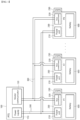
- FIG. 2 is a diagram illustrating the battery parallel wire connection structure of an energy storage system according to a preferred exemplary embodiment of the present invention.
- the battery parallel wire connection structure of an energy storage system is a configuration of supplying power to each of battery managers 20, 30, 40 by using as many power lines P1 to P3 as the number of the battery managers 20, 30, 40, which are slave devices, in a power converter 10, which is a master device.
- the number of battery managers 20, 30, 40 is arbitrarily determined according to the scale of the energy storage system, and in the present invention, three battery managers 20, 30, 40 are illustrated and described for the convenience of description.
- the inside of the battery manager 20, 30, 40 includes power input ports 23, 33, 43 and power output ports 24, 34, 44, and the internal wire connection is wire-connected such that the locations of the power input ports and the locations of the power output ports are shifted through a certain standard and connected to other locations.
- the power converter 10 includes a power supply 11 for supplying power to each of the battery managers 20, 30, 40, and a master communicator 12 for communicating with the battery managers 20, 30, 40.
- the power line of the power supply 11 is selected and branched through a selector 13 and supplied to the power input port 23 of the first battery manager 20 through the power output port 14.
- the number of ports of the power output port 14 is the same as the number of the battery managers 20, 30, 40.
- the selector 13 may be parallel-connected transistors that are selectively switched by a controller (not illustrated) or switching elements corresponding thereto.
- the battery managers 20, 30, 40 to which power is supplied are determined by the selector 13, and the controller may specify the slave communicators 22, 32, 42 through which communication is performed by confirming by which battery managers 20, 30, 40 power is currently being supplied to the master communicator 12.
- the power output port 14 includes first to third ports 14a, 14b, 14c, and first to third power lines P1, P2, P3 are connected to the first to third ports 14a, 14b, 14c, respectively.
- the power input port 23 of the first battery manager 20 connected to the power converter 10 also has first to third ports 23a, 23b, 23c, and first to third power lines P1, P2, P3 are connected thereto in order, respectively.
- the operator uses the first to third power lines P1 to P3 to connect ports of the power input port 23 of the battery manager 20 having the same number as the port number of the power output port 14 of the power converter 10.
- the battery manager 20 includes a power input port 23 and a power output port 24, and a wire connection is made between the power input port 23 and the power output port 24.
- Power which is input through the first port 23a of the power input port 23 of the battery manager 20 is supplied to the power unit 21 for supplying power to the battery manager 20, and power which is input through the second and third ports 23b, 23c, which are other ports, bypasses the battery manager 20 such that the rear end is connected to the power output port 24 through internal wire connection so as to be provided to the battery managers 30, 40, respectively.
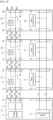
- FIG. 3 is a detailed diagram of the internal wire connection of the battery manager in FIG. 2 .
- power which is input through the first port 23a is supplied to the power unit 21 that supplies power to the battery manager 20 as described above.
- Power which is input through the second port 23b is connected to the power output port 24 along the internal wire connection, and the connection at this time is wire-connected to the port position of the power output port 24 which is obtained by subtracting 1 from the number of the second port 23b.
- the second port 23b of the power input port 23 is wire-connected to the first port 24a of the power output port 24, and similarly, the third port 23c of the power input port 23 is wire-connected to the second port 24b of the power output port 24.
- the third port 24c of the power output port 24 is in a state where power is not connected (denoted as NC).
- the wire connection between the battery managers 20 is simplified as a connection between the same port numbers as in the wire connection between the power converter 10 and the battery manager 20.
- the power input port 33 of the second battery manager 30 is connected to the power output port 24 of the first battery manager 20 by the first to third power lines P1 to P3, and in this case, wire connection is made between ports having the same number.
- the first port 24a of the power output port 24 of the battery manager 20 and the first port 33a of the power input port 33 of the battery manager 30 are connected by the first power line P1
- the second port 24b of the power output port 24 of the battery manager 20 and the second port 33b of the power input port 33 of the battery manager 30 are connected by the second power line P2.
- the third port 24c of the power output port 24 of the battery manager 20 and the third port 33c of the power input port 33 of the battery manager 30 are connected by the third power line P3.
- the second battery manager 30 also has the same internal structure as the battery manager 20.
- Power which is supplied through the first port 33a of the power input port 33 is supplied to the power unit 31, and power which is supplied through the second port 33b is output through the first port 34a of the power output port 34 through an internal wire connection.
- the third port 33c is connected to the second port 34b of the power output port 34, and the third port 34c of the power output port 34 is not connected.
- the first port 33a of the power input port 33 may be defined as a power supply port for supplying power to the power unit 31, and the remaining ports may be defined as bypass ports in a state where internal wire connection is shifted in order to connect to the power supply port of the next battery manager.
- all of the battery managers 20 may be mass-produced with the same structure, and external wire connection may also be performed in a common manner.
- first port 34a of the power output port 34 of the second battery manager 30 is connected to the first port 43a of the power input port 43 of the third battery manager 40 by a power line, and wire connection between the second ports 34b, 43b and the second ports 34c, 43c is made in the same manner.
- the power unit 41 is connected to the first port 43a of the power input port 43, which is a power supply port, and power is supplied according to the switching conversion of the selector 13.
- the internal wire connection of the battery manager 40 is also the same as the previously described two battery managers 20, 30, but power is not connected to the power output port 44 in either case.
- communication lines C1, C2 for communication are connected to a communication port 15 of the power converter 10 and a first communication port 25 of the first battery manager 20, and also directly connected to a second communication port 26 of the battery manager 20.
- the slave communicator 22 of the battery manager 20 is connected to a communication line which is branched by an internal wire connection.
- the internal communication wire connection of the battery managers 20 has a structure in which ports having the same number are connected without a shift, unlike internal power wire connection.
- the battery manager 20 in which power is supplied to the power unit 21 through the power supply line P1 is operated.
- the slave communicator 22 of the battery manager 20 which is supplied with power can be identified when communicating with the master communicator 12 of the power converter 10, even if there is no separate ID setting.
- the possibility of occurrence of errors may be reduced.
- the second power line P2 has one end connected to the second port 14b, which is the second port of the power output port 14 of the power converter 10, and the other end connected to the second port 23b of the power input port 23 of the first battery manager 20.
- This is connected to the first port 24a of the power output port 24 of the battery manager 20 by shifting the internal wire connection of the battery manager 20, and since the external connection which is connected by the operator is connected between ports having the same port number, it is connected to the first port 33a of the power input port 33 of the battery manager 30.
- the present invention proposes a wire connection structure for preventing errors in the wire connection process of an energy storage system by using the laws of nature, and thus has industrial applicability.
Landscapes
- Engineering & Computer Science (AREA)
- Power Engineering (AREA)
- Chemical & Material Sciences (AREA)
- Chemical Kinetics & Catalysis (AREA)
- Electrochemistry (AREA)
- General Chemical & Material Sciences (AREA)
- Microelectronics & Electronic Packaging (AREA)
- Manufacturing & Machinery (AREA)
- Charge And Discharge Circuits For Batteries Or The Like (AREA)
- Connection Of Batteries Or Terminals (AREA)
Abstract
Description
- This application claims priority to and the benefit of
Korean Patent Application No. 10-2020-0175474, filed on December 15, 2020 - The present invention relates to a battery parallel wire connection structure of an energy storage system, and more specifically to a battery wire connection structure which is capable of preventing errors and damage during system installation.
- An energy storage system (ESS) is applied to renewable energy generation with a non-uniform charge amount, stores the generated surplus power, and serves to supplement when the amount of power generation is insufficient compared to the amount of power in the load stage.
- The ESS conventionally uses lithium-ion batteries connected in parallel, and a battery management system is applied to each battery to detect the state of the battery and communicate with the upper power conversion system.
- In general, a battery management system (BMS) operates by receiving power from a power transmission system, and it is connected to a power line which receives power and a communication line for communication.
- That is, each of a plurality of batteries must be connected with the power conversion system, communication line and power line, and the operator must connect each line when installing the ESS.
- In this case, since the number of wire connections increases according to the number of batteries, if the wire connection is erroneous due to the operator's error, damage to the system may occur, and the installation work time may be delayed.
-
FIG. 1 shows a conventional battery parallel wire connection structure. - Referring to
FIG. 1 , the battery parallel wire connection structure of the conventional ESS shows the connection structure of apower conversion system 100 and the power lines and communication lines of a plurality ofbattery management systems 200. - The
power conversion system 100 includes apower supply 110 for supplying PV or power of a power grid to a plurality ofbattery management systems 200, and amaster communicator 120 for communicating with each of thebattery management systems 200. - In addition, each of the plurality of
battery management systems 200 includes apower unit 210 for receiving power from thepower supply 110 through aparallel power line 300, aslave communicator 220 which is connected to themaster communicator 120 through a parallel communication line 400 to provide information such as a battery state, and aswitch 230 for setting an ID of theslave communicator 220. - The conventional wire connection method having such a structure will be described in more detail.
- The
power conversion system 100 is a system for converting DC/DC power between the PV and thebattery 500 or AC/DC power between the power grid and thebattery 500, and as described above, it includes a power supply for supplying power to each of thebattery management systems 200. - The power of the
power supply 110 is supplied to thepower unit 210 of thebattery management system 200, which manages thebattery 500 of each storage device through theparallel power line 300. - In addition, the
power conversion system 100 may perform wired communication with theslave communicators 220 of thebattery management system 200 through themaster communicator 120 to check the status information of thebattery 500, and to this end, a parallel communication line 400 is wire-connected between themaster communicator 120 and theslave communicator 220. - In this case, the operator operates the
switch 230 to set the ID of eachslave communicator 220. - Between the
power conversion system 100 and thebattery management system 200, since as many parallel communication lines 400 as the number of thebattery management systems 200 are required, the operator must work to wire-connect each parallel communication line 400. - That is, it takes a lot of work time, and when the distance between the
power conversion system 100 and thebattery management system 200 is long or the number of thebattery management systems 200 is large, the complexity of the operation is further increased. - Therefore, many cases frequently occur in which the operator makes erroneous wire connection, and products may be damaged or errors may occur due to erroneous wire connection. In addition, when a communication error occurs, the task of finding the cause and resolving the error becomes a very difficult and complex operation.
- The problems to be solved by the present invention in consideration of the above-described problems are directed to providing a wire connection structure which is capable of preventing erroneous wire connection.
- In addition, the present invention is directed to providing a battery parallel wire connection structure of an energy storage system that can simplify the cable required to connect a battery management system, which is a slave system, from a power conversion system, which is a master system, and can automatically set an ID without using a switch.
- The battery parallel wire connection structure of an energy storage system according to the present invention to solve the above-described technical problems includes a power converter which is provided to select a power line from among a plurality of power lines to supply power; and a plurality of battery managers that are sequentially connected to the power converter and are operated by the power which is selectively supplied through the power line selected from among the plurality of power lines, wherein the power converter includes a power output port, each of the battery managers includes a power input port and a power output port, and the power input port and the power output port of the battery manager include a power supply port and a plurality of bypass ports, and may be internally wire-connected such that one of the bypass ports of the power input port is connected to the power supply port of the power output port.
- In an exemplary embodiment of the present invention, the power converter may include a power supply for supplying power; a selector for selecting one from among a plurality of power lines that are connected to a power output port of the power converter and outputting power of the power supply; and a master communicator for communication with a battery manager that is selected by the selector and supplied with power.
- In an exemplary embodiment of the present invention, the internal wire connection of the battery manager may be wire-connected to a power output port of a battery manager at a position which is shifted according to a rule from the number of the power output port of the battery manager.
- In an exemplary embodiment of the present invention, the rule of shift may be that the internal wire connection of all of the battery managers is the same configuration, and the external wire connection between the battery managers is shifted such that it can be wire-connected between ports having the same port number.
- The present invention has the effect of preventing erroneous wire connection by connecting a communication line which is selectable in the master communicator of a power conversion system to a first battery management system and shifting the wire connection between an input terminal and an output terminal in the battery management system according to a predetermined rule.
- In addition, the present invention has the effects of reducing the work time by simplifying the wire connection operation, and reducing the complexity of a communication line and a power line.
-
-
FIG. 1 is a diagram illustrating the battery parallel wire connection structure of a conventional energy storage system. -
FIG. 2 is a diagram illustrating the battery parallel wire connection structure of an energy storage system according to a preferred exemplary embodiment of the present invention. -
FIG. 3 is a detailed diagram of the internal wire connection of the battery manager inFIG. 2 . -
10: Power converter 11: Power supply 12: Master communicator 13: Selector 14, 24, 34, 44: Power output port 20, 30, 40: Battery manager 21, 31, 41: Power unit 22, 32, 42: Slave communicator 23, 33, 43: Power input port 25, 35, 45: First communication port 26, 36, 46: Second communication port - In order to fully understand the configuration and effects of the present invention, preferred exemplary embodiments of the present invention will be described with reference to the accompanying drawings. However, the present invention is not limited to the exemplary embodiments disclosed below, and may be embodied in various forms, and various modifications may be made. However, the description of the present exemplary embodiments is provided so that the disclosure of the present invention is complete, and to fully inform the scope of the invention to those of ordinary skill in the art to which the present invention pertains. In the accompanying drawings, components are enlarged in size from reality for the convenience of description, and the ratios of each component may be exaggerated or reduced.
- Terms such as "first," "second" and the like may be used to describe various components, but the components should not be limited by the above terms. The terms may be used only for the purpose of distinguishing one component from another component. For example, without departing from the scope of the present invention, a "first component" may be called a "second component," and similarly, a "second component" may also be called a "first component." In addition, a singular expression may include a plural expression, unless otherwise specified. The terms used in the exemplary embodiments of the present invention may be interpreted with the commonly known meaning to those of ordinary skill in the relevant technical field unless otherwise specified.
-
FIG. 2 is a diagram illustrating the battery parallel wire connection structure of an energy storage system according to a preferred exemplary embodiment of the present invention. - Referring to
FIG. 2 , the battery parallel wire connection structure of an energy storage system according to a preferred exemplary embodiment of the present invention is a configuration of supplying power to each ofbattery managers battery managers power converter 10, which is a master device. - The number of
battery managers battery managers - In this case, the inside of the
battery manager power input ports power output ports - Hereinafter, such a configuration will be described in more detail.
- The
power converter 10 includes apower supply 11 for supplying power to each of thebattery managers master communicator 12 for communicating with thebattery managers - The power line of the
power supply 11 is selected and branched through aselector 13 and supplied to thepower input port 23 of thefirst battery manager 20 through thepower output port 14. - In this case, the number of ports of the
power output port 14 is the same as the number of thebattery managers - The
selector 13 may be parallel-connected transistors that are selectively switched by a controller (not illustrated) or switching elements corresponding thereto. - Accordingly, the
battery managers selector 13, and the controller may specify theslave communicators battery managers master communicator 12. - That is, even if the operator does not set the ID of each slave communicator, it is possible to automatically recognize the
slave communicators - The
power output port 14 includes first tothird ports third ports - The
power input port 23 of thefirst battery manager 20 connected to thepower converter 10 also has first tothird ports - That is, the operator uses the first to third power lines P1 to P3 to connect ports of the
power input port 23 of thebattery manager 20 having the same number as the port number of thepower output port 14 of thepower converter 10. - Therefore, it is possible to reduce the occurrence of confusion during the wire connection process, and wire connection may be easily performed.
- The
battery manager 20 includes apower input port 23 and apower output port 24, and a wire connection is made between thepower input port 23 and thepower output port 24. - Power which is input through the
first port 23a of thepower input port 23 of thebattery manager 20 is supplied to thepower unit 21 for supplying power to thebattery manager 20, and power which is input through the second andthird ports battery manager 20 such that the rear end is connected to thepower output port 24 through internal wire connection so as to be provided to thebattery managers -
FIG. 3 is a detailed diagram of the internal wire connection of the battery manager inFIG. 2 . - Referring to
FIG. 3 , power which is input through thefirst port 23a is supplied to thepower unit 21 that supplies power to thebattery manager 20 as described above. - Power which is input through the
second port 23b is connected to thepower output port 24 along the internal wire connection, and the connection at this time is wire-connected to the port position of thepower output port 24 which is obtained by subtracting 1 from the number of thesecond port 23b. - That is, the
second port 23b of thepower input port 23 is wire-connected to thefirst port 24a of thepower output port 24, and similarly, thethird port 23c of thepower input port 23 is wire-connected to thesecond port 24b of thepower output port 24. - Accordingly, the
third port 24c of thepower output port 24 is in a state where power is not connected (denoted as NC). - By the internal wire connection of the
battery manager 20 as described above, the wire connection between thebattery managers 20 is simplified as a connection between the same port numbers as in the wire connection between thepower converter 10 and thebattery manager 20. - That is, the
power input port 33 of thesecond battery manager 30 is connected to thepower output port 24 of thefirst battery manager 20 by the first to third power lines P1 to P3, and in this case, wire connection is made between ports having the same number. - Specifically, the
first port 24a of thepower output port 24 of thebattery manager 20 and thefirst port 33a of thepower input port 33 of thebattery manager 30 are connected by the first power line P1, and thesecond port 24b of thepower output port 24 of thebattery manager 20 and thesecond port 33b of thepower input port 33 of thebattery manager 30 are connected by the second power line P2. - In addition, the
third port 24c of thepower output port 24 of thebattery manager 20 and thethird port 33c of thepower input port 33 of thebattery manager 30 are connected by the third power line P3. - As such, in the present invention, the operation of wire connection for connecting ports having the same number (or the same location) to each other is performed, and therefore, the operation of wire connection becomes very easy.
- The
second battery manager 30 also has the same internal structure as thebattery manager 20. - Power which is supplied through the
first port 33a of thepower input port 33 is supplied to thepower unit 31, and power which is supplied through thesecond port 33b is output through thefirst port 34a of thepower output port 34 through an internal wire connection. - In addition, the
third port 33c is connected to thesecond port 34b of thepower output port 34, and thethird port 34c of thepower output port 34 is not connected. - If this process is described in general, the
first port 33a of thepower input port 33 may be defined as a power supply port for supplying power to thepower unit 31, and the remaining ports may be defined as bypass ports in a state where internal wire connection is shifted in order to connect to the power supply port of the next battery manager. - Accordingly, all of the
battery managers 20 may be mass-produced with the same structure, and external wire connection may also be performed in a common manner. - Finally, the
first port 34a of thepower output port 34 of thesecond battery manager 30 is connected to thefirst port 43a of thepower input port 43 of thethird battery manager 40 by a power line, and wire connection between thesecond ports second ports - The
power unit 41 is connected to thefirst port 43a of thepower input port 43, which is a power supply port, and power is supplied according to the switching conversion of theselector 13. - The internal wire connection of the
battery manager 40 is also the same as the previously described twobattery managers power output port 44 in either case. - The wire connection of the power line has been described above, and communication lines C1, C2 for communication are connected to a
communication port 15 of thepower converter 10 and afirst communication port 25 of thefirst battery manager 20, and also directly connected to asecond communication port 26 of thebattery manager 20. - In this case, the
slave communicator 22 of thebattery manager 20 is connected to a communication line which is branched by an internal wire connection. - Therefore, communication lines can also be easily connected without confusion through the connection between ports having the same number (or location) of each communication port.
- The internal communication wire connection of the
battery managers 20 has a structure in which ports having the same number are connected without a shift, unlike internal power wire connection. - In this configuration, when the
power converter 10 needs to communicate with thebattery manager 20 at a first position, power is supplied to the first power line P1 through theselector 13, and power is not supplied to the second power line P2 and the third power line P3. - Accordingly, the
battery manager 20 in which power is supplied to thepower unit 21 through the power supply line P1 is operated. - The
slave communicator 22 of thebattery manager 20 which is supplied with power can be identified when communicating with themaster communicator 12 of thepower converter 10, even if there is no separate ID setting. - This is made possible through communication or setting sharing between the controller, which controls the
selector 13 of thepower converter 10, and themaster communicator 12. - Therefore, in the present invention, since the ID of the
slave communicator 22 is set automatically without the need for the operator to separately set the ID of theslave communicator 22, the possibility of occurrence of errors may be reduced. - When the power supply state of the
selector 13 is changed and power is supplied through the second power line P2 and power supplied to the first power line P1 and the third power line P3 is cut off, power is supplied to thebattery manager 30 which is located at a second position. - The second power line P2 has one end connected to the
second port 14b, which is the second port of thepower output port 14 of thepower converter 10, and the other end connected to thesecond port 23b of thepower input port 23 of thefirst battery manager 20. - This is connected to the
first port 24a of thepower output port 24 of thebattery manager 20 by shifting the internal wire connection of thebattery manager 20, and since the external connection which is connected by the operator is connected between ports having the same port number, it is connected to thefirst port 33a of thepower input port 33 of thebattery manager 30. - Therefore, power is supplied to the
power unit 31 of thebattery manager 30, and communication is made between theslave communicator 32 of thebattery manager 30 and themaster communicator 12 of thepower converter 10, and in this case, it can be also confirmed that current communication is being performed with theslave communicator 32 of thebattery manager 30 without a separate ID setting. - As such, in the present invention, since the external wire connection performed by the operator is made by wire connection between the same port numbers, the convenience of the operation of wire connection may be improved, confusion may be reduced, and work time may be shortened. In addition, since there is no need to set each ID, it is possible to prevent the occurrence of communication errors due to setting errors by the operator.
- Since the operation of the
battery manager 40 which is located at a third position can be easily understood from the operation of the twobattery managers 40 described above, the description of the operation will be omitted. - Although the exemplary embodiments according to the present invention have been described above, these are merely exemplary, and those of ordinary skill in the art will understand that various modifications and equivalent ranges of exemplary embodiments are possible therefrom. Accordingly, the true technical protection scope of the present invention should be defined by the following claims.
- The present invention proposes a wire connection structure for preventing errors in the wire connection process of an energy storage system by using the laws of nature, and thus has industrial applicability.
Claims (4)
- A battery parallel wire connection structure of an energy storage system, comprising:a power converter which is provided to select a power line from among a plurality of power lines to supply power; anda plurality of battery managers that are sequentially connected to the power converter and are operated by the power which is selectively supplied through the power line selected from among the plurality of power lines,wherein the power converter includes a power output port, each of the battery managers includes a power input port and a power output port, and the power input port and the power output port of the battery manager include a power supply port and a plurality of bypass ports, and may be internally wire-connected such that one of the bypass ports of the power input port is connected to the power supply port of the power output port.
- The battery parallel wire connection structure of claim 1, wherein the power converter comprises:a power supply for supplying power;a selector for selecting one from among a plurality of power lines that are connected to a power output port of the power converter and outputting power of the power supply; anda master communicator for communication with a battery manager that is selected by the selector and supplied with power.
- The battery parallel wire connection structure of claim 2, wherein the internal wire connection of the battery manager is wire-connected to a power output port of a battery manager at a position which is shifted according to a rule from the number of the power output port of the battery manager.
- The battery parallel wire connection structure of claim 3, wherein the rule of shift is that the internal wire connection of all of the battery managers is the same configuration, and the external wire connection between the battery managers is shifted such that it can be wire-connected between ports having the same port number.
Applications Claiming Priority (2)
| Application Number | Priority Date | Filing Date | Title |
|---|---|---|---|
| KR1020200175474A KR102534214B1 (en) | 2020-12-15 | 2020-12-15 | Parallel wiring structure for batteries of energy storage system |
| PCT/KR2021/016955 WO2022131588A1 (en) | 2020-12-15 | 2021-11-18 | Battery parallel wire connection structure of energy storage system |
Publications (2)
| Publication Number | Publication Date |
|---|---|
| EP4266531A1 true EP4266531A1 (en) | 2023-10-25 |
| EP4266531A4 EP4266531A4 (en) | 2024-11-13 |
Family
ID=82057853
Family Applications (1)
| Application Number | Title | Priority Date | Filing Date |
|---|---|---|---|
| EP21906893.9A Pending EP4266531A4 (en) | 2020-12-15 | 2021-11-18 | BATTERY PARALLEL WIRE CONNECTION STRUCTURE OF AN ENERGY STORAGE SYSTEM |
Country Status (5)
| Country | Link |
|---|---|
| US (1) | US20240039298A1 (en) |
| EP (1) | EP4266531A4 (en) |
| KR (1) | KR102534214B1 (en) |
| AU (1) | AU2021400533B2 (en) |
| WO (1) | WO2022131588A1 (en) |
Family Cites Families (12)
| Publication number | Priority date | Publication date | Assignee | Title |
|---|---|---|---|---|
| JPH05137267A (en) * | 1991-11-12 | 1993-06-01 | Dia Semikon Syst Kk | Power system |
| US7256516B2 (en) * | 2000-06-14 | 2007-08-14 | Aerovironment Inc. | Battery charging system and method |
| CN102893482B (en) * | 2010-04-27 | 2015-03-25 | Abb技术有限公司 | An energy storage device for a power compensator and a method for control thereof |
| US20130015805A1 (en) * | 2010-06-04 | 2013-01-17 | Triune Ip Llc | Energy storage element link and monitor |
| JP4898982B1 (en) * | 2010-08-31 | 2012-03-21 | パナソニック株式会社 | Battery power supply and battery power supply system |
| CN103081280B (en) * | 2010-10-15 | 2015-07-29 | 三洋电机株式会社 | Power-supply system |
| KR101926195B1 (en) * | 2012-07-09 | 2019-02-26 | 에스케이이노베이션 주식회사 | Relay welding management apparatus of the parallel battery system and method thereof |
| US9537328B2 (en) * | 2013-05-23 | 2017-01-03 | Samsung Sdi Co., Ltd. | Battery management system and method of driving the same |
| JP6158099B2 (en) * | 2014-01-07 | 2017-07-05 | 株式会社日立製作所 | Power converter and control method thereof |
| EP3319198B1 (en) * | 2015-06-30 | 2020-07-01 | GS Yuasa International Ltd. | Control device, power storage device, power storage system, and control method |
| CN108306347B (en) * | 2017-01-12 | 2023-05-23 | 罗伯特·博世有限公司 | Intelligent seamless charging system and method and electric vehicle |
| KR102127888B1 (en) * | 2019-10-08 | 2020-06-29 | 주식회사 엠알티 | power short-circuit switch application Energy storage system |
-
2020
- 2020-12-15 KR KR1020200175474A patent/KR102534214B1/en active Active
-
2021
- 2021-11-18 US US18/256,337 patent/US20240039298A1/en active Pending
- 2021-11-18 AU AU2021400533A patent/AU2021400533B2/en active Active
- 2021-11-18 WO PCT/KR2021/016955 patent/WO2022131588A1/en not_active Ceased
- 2021-11-18 EP EP21906893.9A patent/EP4266531A4/en active Pending
Also Published As
| Publication number | Publication date |
|---|---|
| WO2022131588A1 (en) | 2022-06-23 |
| EP4266531A4 (en) | 2024-11-13 |
| KR102534214B1 (en) | 2023-05-17 |
| KR20220085423A (en) | 2022-06-22 |
| AU2021400533B2 (en) | 2024-06-13 |
| AU2021400533A1 (en) | 2023-06-29 |
| US20240039298A1 (en) | 2024-02-01 |
Similar Documents
| Publication | Publication Date | Title |
|---|---|---|
| EP3890151B1 (en) | Adapter and control method thereof | |
| EP4266531A1 (en) | Battery parallel wire connection structure of energy storage system | |
| JP4251776B2 (en) | Inverter device | |
| CN105140905A (en) | Telecommunication equipment, power supply system and power supply realization method | |
| CN210007623U (en) | Power conversion system | |
| CN104701580A (en) | Battery and power supply switching method | |
| CN117478638B (en) | Addressing method and system for battery management system equipment | |
| US12491788B2 (en) | Charging station capable of realizing mutual capacity aid | |
| EP4266648A1 (en) | Apparatus for setting communication id of energy storage system | |
| CN105305513A (en) | Power supply system with multiple paths of outputs and building and controlling method of power supply system | |
| US11323018B2 (en) | Method for controlling controllable power semiconductor switches of a converter assembly with a plurality of switching modules having controllable power semiconductor switches, and a converter assembly with a control system configured for performing the method | |
| CN114200860A (en) | Multi-channel coupling output implementation circuit and method based on FPGA | |
| CN112653140B (en) | Power supply control method, device and storage medium | |
| CN106410787A (en) | Power supply and receiving mode switching equipment | |
| US7882276B2 (en) | Input/output module for a programmable controller | |
| CN219980482U (en) | Charging device with multi-section power distribution and charging pile | |
| CN206135416U (en) | Confession receives electric mode switch equipment | |
| CN117318004B (en) | Parallel current equalizing circuit of high-frequency switch power supply system for electron gun | |
| CN114137822B (en) | 4-20 MA current redundant output conversion circuit | |
| CN221379941U (en) | Novel switch board pencil | |
| CN218547481U (en) | Synchronous extended interface circuit and electronic equipment | |
| Margaritis et al. | Contemporary architectures for power systems considering future trends | |
| TWM680762U (en) | Load voltage switching circuit | |
| EP3836328A1 (en) | Reverse voltage protection | |
| EP2453393A1 (en) | Multi-mode data card and calibrating method thereof |
Legal Events
| Date | Code | Title | Description |
|---|---|---|---|
| STAA | Information on the status of an ep patent application or granted ep patent |
Free format text: STATUS: THE INTERNATIONAL PUBLICATION HAS BEEN MADE |
|
| PUAI | Public reference made under article 153(3) epc to a published international application that has entered the european phase |
Free format text: ORIGINAL CODE: 0009012 |
|
| STAA | Information on the status of an ep patent application or granted ep patent |
Free format text: STATUS: REQUEST FOR EXAMINATION WAS MADE |
|
| 17P | Request for examination filed |
Effective date: 20230630 |
|
| AK | Designated contracting states |
Kind code of ref document: A1 Designated state(s): AL AT BE BG CH CY CZ DE DK EE ES FI FR GB GR HR HU IE IS IT LI LT LU LV MC MK MT NL NO PL PT RO RS SE SI SK SM TR |
|
| DAV | Request for validation of the european patent (deleted) | ||
| DAX | Request for extension of the european patent (deleted) | ||
| REG | Reference to a national code |
Ref country code: DE Ref legal event code: R079 Free format text: PREVIOUS MAIN CLASS: H02J0007000000 Ipc: H01M0010420000 |
|
| A4 | Supplementary search report drawn up and despatched |
Effective date: 20241015 |
|
| RIC1 | Information provided on ipc code assigned before grant |
Ipc: H02J 7/00 20060101ALN20241009BHEP Ipc: H02J 3/32 20060101ALN20241009BHEP Ipc: H02J 1/08 20060101ALI20241009BHEP Ipc: H01M 10/42 20060101AFI20241009BHEP |