EP4265813A1 - Plated steel sheets for hot press forming having excellent hydrogen brittleness resistance and impact resistance, hot press formed parts, and manufacturing methods thereof - Google Patents
Plated steel sheets for hot press forming having excellent hydrogen brittleness resistance and impact resistance, hot press formed parts, and manufacturing methods thereof Download PDFInfo
- Publication number
- EP4265813A1 EP4265813A1 EP21906946.5A EP21906946A EP4265813A1 EP 4265813 A1 EP4265813 A1 EP 4265813A1 EP 21906946 A EP21906946 A EP 21906946A EP 4265813 A1 EP4265813 A1 EP 4265813A1
- Authority
- EP
- European Patent Office
- Prior art keywords
- steel sheet
- hot press
- content
- less
- base steel
- Prior art date
- Legal status (The legal status is an assumption and is not a legal conclusion. Google has not performed a legal analysis and makes no representation as to the accuracy of the status listed.)
- Pending
Links
Images


Classifications
-
- C—CHEMISTRY; METALLURGY
- C23—COATING METALLIC MATERIAL; COATING MATERIAL WITH METALLIC MATERIAL; CHEMICAL SURFACE TREATMENT; DIFFUSION TREATMENT OF METALLIC MATERIAL; COATING BY VACUUM EVAPORATION, BY SPUTTERING, BY ION IMPLANTATION OR BY CHEMICAL VAPOUR DEPOSITION, IN GENERAL; INHIBITING CORROSION OF METALLIC MATERIAL OR INCRUSTATION IN GENERAL
- C23C—COATING METALLIC MATERIAL; COATING MATERIAL WITH METALLIC MATERIAL; SURFACE TREATMENT OF METALLIC MATERIAL BY DIFFUSION INTO THE SURFACE, BY CHEMICAL CONVERSION OR SUBSTITUTION; COATING BY VACUUM EVAPORATION, BY SPUTTERING, BY ION IMPLANTATION OR BY CHEMICAL VAPOUR DEPOSITION, IN GENERAL
- C23C2/00—Hot-dipping or immersion processes for applying the coating material in the molten state without affecting the shape; Apparatus therefor
- C23C2/04—Hot-dipping or immersion processes for applying the coating material in the molten state without affecting the shape; Apparatus therefor characterised by the coating material
- C23C2/12—Aluminium or alloys based thereon
-
- C—CHEMISTRY; METALLURGY
- C23—COATING METALLIC MATERIAL; COATING MATERIAL WITH METALLIC MATERIAL; CHEMICAL SURFACE TREATMENT; DIFFUSION TREATMENT OF METALLIC MATERIAL; COATING BY VACUUM EVAPORATION, BY SPUTTERING, BY ION IMPLANTATION OR BY CHEMICAL VAPOUR DEPOSITION, IN GENERAL; INHIBITING CORROSION OF METALLIC MATERIAL OR INCRUSTATION IN GENERAL
- C23C—COATING METALLIC MATERIAL; COATING MATERIAL WITH METALLIC MATERIAL; SURFACE TREATMENT OF METALLIC MATERIAL BY DIFFUSION INTO THE SURFACE, BY CHEMICAL CONVERSION OR SUBSTITUTION; COATING BY VACUUM EVAPORATION, BY SPUTTERING, BY ION IMPLANTATION OR BY CHEMICAL VAPOUR DEPOSITION, IN GENERAL
- C23C2/00—Hot-dipping or immersion processes for applying the coating material in the molten state without affecting the shape; Apparatus therefor
- C23C2/02—Pretreatment of the material to be coated, e.g. for coating on selected surface areas
-
- B—PERFORMING OPERATIONS; TRANSPORTING
- B32—LAYERED PRODUCTS
- B32B—LAYERED PRODUCTS, i.e. PRODUCTS BUILT-UP OF STRATA OF FLAT OR NON-FLAT, e.g. CELLULAR OR HONEYCOMB, FORM
- B32B15/00—Layered products comprising a layer of metal
- B32B15/01—Layered products comprising a layer of metal all layers being exclusively metallic
- B32B15/012—Layered products comprising a layer of metal all layers being exclusively metallic one layer being formed of an iron alloy or steel, another layer being formed of aluminium or an aluminium alloy
-
- C—CHEMISTRY; METALLURGY
- C21—METALLURGY OF IRON
- C21D—MODIFYING THE PHYSICAL STRUCTURE OF FERROUS METALS; GENERAL DEVICES FOR HEAT TREATMENT OF FERROUS OR NON-FERROUS METALS OR ALLOYS; MAKING METAL MALLEABLE, e.g. BY DECARBURISATION OR TEMPERING
- C21D1/00—General methods or devices for heat treatment, e.g. annealing, hardening, quenching or tempering
- C21D1/26—Methods of annealing
-
- C—CHEMISTRY; METALLURGY
- C21—METALLURGY OF IRON
- C21D—MODIFYING THE PHYSICAL STRUCTURE OF FERROUS METALS; GENERAL DEVICES FOR HEAT TREATMENT OF FERROUS OR NON-FERROUS METALS OR ALLOYS; MAKING METAL MALLEABLE, e.g. BY DECARBURISATION OR TEMPERING
- C21D1/00—General methods or devices for heat treatment, e.g. annealing, hardening, quenching or tempering
- C21D1/74—Methods of treatment in inert gas, controlled atmosphere, vacuum or pulverulent material
- C21D1/76—Adjusting the composition of the atmosphere
-
- C—CHEMISTRY; METALLURGY
- C21—METALLURGY OF IRON
- C21D—MODIFYING THE PHYSICAL STRUCTURE OF FERROUS METALS; GENERAL DEVICES FOR HEAT TREATMENT OF FERROUS OR NON-FERROUS METALS OR ALLOYS; MAKING METAL MALLEABLE, e.g. BY DECARBURISATION OR TEMPERING
- C21D6/00—Heat treatment of ferrous alloys
- C21D6/002—Heat treatment of ferrous alloys containing Cr
-
- C—CHEMISTRY; METALLURGY
- C21—METALLURGY OF IRON
- C21D—MODIFYING THE PHYSICAL STRUCTURE OF FERROUS METALS; GENERAL DEVICES FOR HEAT TREATMENT OF FERROUS OR NON-FERROUS METALS OR ALLOYS; MAKING METAL MALLEABLE, e.g. BY DECARBURISATION OR TEMPERING
- C21D6/00—Heat treatment of ferrous alloys
- C21D6/005—Heat treatment of ferrous alloys containing Mn
-
- C—CHEMISTRY; METALLURGY
- C21—METALLURGY OF IRON
- C21D—MODIFYING THE PHYSICAL STRUCTURE OF FERROUS METALS; GENERAL DEVICES FOR HEAT TREATMENT OF FERROUS OR NON-FERROUS METALS OR ALLOYS; MAKING METAL MALLEABLE, e.g. BY DECARBURISATION OR TEMPERING
- C21D6/00—Heat treatment of ferrous alloys
- C21D6/008—Heat treatment of ferrous alloys containing Si
-
- C—CHEMISTRY; METALLURGY
- C21—METALLURGY OF IRON
- C21D—MODIFYING THE PHYSICAL STRUCTURE OF FERROUS METALS; GENERAL DEVICES FOR HEAT TREATMENT OF FERROUS OR NON-FERROUS METALS OR ALLOYS; MAKING METAL MALLEABLE, e.g. BY DECARBURISATION OR TEMPERING
- C21D8/00—Modifying the physical properties of ferrous metals or ferrous alloys by deformation combined with, or followed by, heat treatment
- C21D8/02—Modifying the physical properties of ferrous metals or ferrous alloys by deformation combined with, or followed by, heat treatment during manufacturing of plates or strips
-
- C—CHEMISTRY; METALLURGY
- C21—METALLURGY OF IRON
- C21D—MODIFYING THE PHYSICAL STRUCTURE OF FERROUS METALS; GENERAL DEVICES FOR HEAT TREATMENT OF FERROUS OR NON-FERROUS METALS OR ALLOYS; MAKING METAL MALLEABLE, e.g. BY DECARBURISATION OR TEMPERING
- C21D8/00—Modifying the physical properties of ferrous metals or ferrous alloys by deformation combined with, or followed by, heat treatment
- C21D8/02—Modifying the physical properties of ferrous metals or ferrous alloys by deformation combined with, or followed by, heat treatment during manufacturing of plates or strips
- C21D8/0221—Modifying the physical properties of ferrous metals or ferrous alloys by deformation combined with, or followed by, heat treatment during manufacturing of plates or strips characterised by the working steps
- C21D8/0226—Hot rolling
-
- C—CHEMISTRY; METALLURGY
- C21—METALLURGY OF IRON
- C21D—MODIFYING THE PHYSICAL STRUCTURE OF FERROUS METALS; GENERAL DEVICES FOR HEAT TREATMENT OF FERROUS OR NON-FERROUS METALS OR ALLOYS; MAKING METAL MALLEABLE, e.g. BY DECARBURISATION OR TEMPERING
- C21D8/00—Modifying the physical properties of ferrous metals or ferrous alloys by deformation combined with, or followed by, heat treatment
- C21D8/02—Modifying the physical properties of ferrous metals or ferrous alloys by deformation combined with, or followed by, heat treatment during manufacturing of plates or strips
- C21D8/0247—Modifying the physical properties of ferrous metals or ferrous alloys by deformation combined with, or followed by, heat treatment during manufacturing of plates or strips characterised by the heat treatment
- C21D8/0263—Modifying the physical properties of ferrous metals or ferrous alloys by deformation combined with, or followed by, heat treatment during manufacturing of plates or strips characterised by the heat treatment following hot rolling
-
- C—CHEMISTRY; METALLURGY
- C21—METALLURGY OF IRON
- C21D—MODIFYING THE PHYSICAL STRUCTURE OF FERROUS METALS; GENERAL DEVICES FOR HEAT TREATMENT OF FERROUS OR NON-FERROUS METALS OR ALLOYS; MAKING METAL MALLEABLE, e.g. BY DECARBURISATION OR TEMPERING
- C21D8/00—Modifying the physical properties of ferrous metals or ferrous alloys by deformation combined with, or followed by, heat treatment
- C21D8/02—Modifying the physical properties of ferrous metals or ferrous alloys by deformation combined with, or followed by, heat treatment during manufacturing of plates or strips
- C21D8/0247—Modifying the physical properties of ferrous metals or ferrous alloys by deformation combined with, or followed by, heat treatment during manufacturing of plates or strips characterised by the heat treatment
- C21D8/0273—Final recrystallisation annealing
-
- C—CHEMISTRY; METALLURGY
- C21—METALLURGY OF IRON
- C21D—MODIFYING THE PHYSICAL STRUCTURE OF FERROUS METALS; GENERAL DEVICES FOR HEAT TREATMENT OF FERROUS OR NON-FERROUS METALS OR ALLOYS; MAKING METAL MALLEABLE, e.g. BY DECARBURISATION OR TEMPERING
- C21D8/00—Modifying the physical properties of ferrous metals or ferrous alloys by deformation combined with, or followed by, heat treatment
- C21D8/02—Modifying the physical properties of ferrous metals or ferrous alloys by deformation combined with, or followed by, heat treatment during manufacturing of plates or strips
- C21D8/0278—Modifying the physical properties of ferrous metals or ferrous alloys by deformation combined with, or followed by, heat treatment during manufacturing of plates or strips involving a particular surface treatment
-
- C—CHEMISTRY; METALLURGY
- C21—METALLURGY OF IRON
- C21D—MODIFYING THE PHYSICAL STRUCTURE OF FERROUS METALS; GENERAL DEVICES FOR HEAT TREATMENT OF FERROUS OR NON-FERROUS METALS OR ALLOYS; MAKING METAL MALLEABLE, e.g. BY DECARBURISATION OR TEMPERING
- C21D9/00—Heat treatment, e.g. annealing, hardening, quenching or tempering, adapted for particular articles; Furnaces therefor
- C21D9/46—Heat treatment, e.g. annealing, hardening, quenching or tempering, adapted for particular articles; Furnaces therefor for sheet metals
-
- C—CHEMISTRY; METALLURGY
- C22—METALLURGY; FERROUS OR NON-FERROUS ALLOYS; TREATMENT OF ALLOYS OR NON-FERROUS METALS
- C22C—ALLOYS
- C22C38/00—Ferrous alloys, e.g. steel alloys
- C22C38/001—Ferrous alloys, e.g. steel alloys containing N
-
- C—CHEMISTRY; METALLURGY
- C22—METALLURGY; FERROUS OR NON-FERROUS ALLOYS; TREATMENT OF ALLOYS OR NON-FERROUS METALS
- C22C—ALLOYS
- C22C38/00—Ferrous alloys, e.g. steel alloys
- C22C38/002—Ferrous alloys, e.g. steel alloys containing In, Mg, or other elements not provided for in one single group C22C38/001 - C22C38/60
-
- C—CHEMISTRY; METALLURGY
- C22—METALLURGY; FERROUS OR NON-FERROUS ALLOYS; TREATMENT OF ALLOYS OR NON-FERROUS METALS
- C22C—ALLOYS
- C22C38/00—Ferrous alloys, e.g. steel alloys
- C22C38/008—Ferrous alloys, e.g. steel alloys containing tin
-
- C—CHEMISTRY; METALLURGY
- C22—METALLURGY; FERROUS OR NON-FERROUS ALLOYS; TREATMENT OF ALLOYS OR NON-FERROUS METALS
- C22C—ALLOYS
- C22C38/00—Ferrous alloys, e.g. steel alloys
- C22C38/02—Ferrous alloys, e.g. steel alloys containing silicon
-
- C—CHEMISTRY; METALLURGY
- C22—METALLURGY; FERROUS OR NON-FERROUS ALLOYS; TREATMENT OF ALLOYS OR NON-FERROUS METALS
- C22C—ALLOYS
- C22C38/00—Ferrous alloys, e.g. steel alloys
- C22C38/04—Ferrous alloys, e.g. steel alloys containing manganese
-
- C—CHEMISTRY; METALLURGY
- C22—METALLURGY; FERROUS OR NON-FERROUS ALLOYS; TREATMENT OF ALLOYS OR NON-FERROUS METALS
- C22C—ALLOYS
- C22C38/00—Ferrous alloys, e.g. steel alloys
- C22C38/06—Ferrous alloys, e.g. steel alloys containing aluminium
-
- C—CHEMISTRY; METALLURGY
- C22—METALLURGY; FERROUS OR NON-FERROUS ALLOYS; TREATMENT OF ALLOYS OR NON-FERROUS METALS
- C22C—ALLOYS
- C22C38/00—Ferrous alloys, e.g. steel alloys
- C22C38/18—Ferrous alloys, e.g. steel alloys containing chromium
-
- C—CHEMISTRY; METALLURGY
- C22—METALLURGY; FERROUS OR NON-FERROUS ALLOYS; TREATMENT OF ALLOYS OR NON-FERROUS METALS
- C22C—ALLOYS
- C22C38/00—Ferrous alloys, e.g. steel alloys
- C22C38/18—Ferrous alloys, e.g. steel alloys containing chromium
- C22C38/28—Ferrous alloys, e.g. steel alloys containing chromium with titanium or zirconium
-
- C—CHEMISTRY; METALLURGY
- C22—METALLURGY; FERROUS OR NON-FERROUS ALLOYS; TREATMENT OF ALLOYS OR NON-FERROUS METALS
- C22C—ALLOYS
- C22C38/00—Ferrous alloys, e.g. steel alloys
- C22C38/18—Ferrous alloys, e.g. steel alloys containing chromium
- C22C38/38—Ferrous alloys, e.g. steel alloys containing chromium with more than 1.5% by weight of manganese
-
- C—CHEMISTRY; METALLURGY
- C22—METALLURGY; FERROUS OR NON-FERROUS ALLOYS; TREATMENT OF ALLOYS OR NON-FERROUS METALS
- C22C—ALLOYS
- C22C38/00—Ferrous alloys, e.g. steel alloys
- C22C38/18—Ferrous alloys, e.g. steel alloys containing chromium
- C22C38/40—Ferrous alloys, e.g. steel alloys containing chromium with nickel
- C22C38/48—Ferrous alloys, e.g. steel alloys containing chromium with nickel with niobium or tantalum
-
- C—CHEMISTRY; METALLURGY
- C22—METALLURGY; FERROUS OR NON-FERROUS ALLOYS; TREATMENT OF ALLOYS OR NON-FERROUS METALS
- C22C—ALLOYS
- C22C38/00—Ferrous alloys, e.g. steel alloys
- C22C38/18—Ferrous alloys, e.g. steel alloys containing chromium
- C22C38/40—Ferrous alloys, e.g. steel alloys containing chromium with nickel
- C22C38/54—Ferrous alloys, e.g. steel alloys containing chromium with nickel with boron
-
- C—CHEMISTRY; METALLURGY
- C22—METALLURGY; FERROUS OR NON-FERROUS ALLOYS; TREATMENT OF ALLOYS OR NON-FERROUS METALS
- C22C—ALLOYS
- C22C38/00—Ferrous alloys, e.g. steel alloys
- C22C38/18—Ferrous alloys, e.g. steel alloys containing chromium
- C22C38/40—Ferrous alloys, e.g. steel alloys containing chromium with nickel
- C22C38/58—Ferrous alloys, e.g. steel alloys containing chromium with nickel with more than 1.5% by weight of manganese
-
- C—CHEMISTRY; METALLURGY
- C23—COATING METALLIC MATERIAL; COATING MATERIAL WITH METALLIC MATERIAL; CHEMICAL SURFACE TREATMENT; DIFFUSION TREATMENT OF METALLIC MATERIAL; COATING BY VACUUM EVAPORATION, BY SPUTTERING, BY ION IMPLANTATION OR BY CHEMICAL VAPOUR DEPOSITION, IN GENERAL; INHIBITING CORROSION OF METALLIC MATERIAL OR INCRUSTATION IN GENERAL
- C23C—COATING METALLIC MATERIAL; COATING MATERIAL WITH METALLIC MATERIAL; SURFACE TREATMENT OF METALLIC MATERIAL BY DIFFUSION INTO THE SURFACE, BY CHEMICAL CONVERSION OR SUBSTITUTION; COATING BY VACUUM EVAPORATION, BY SPUTTERING, BY ION IMPLANTATION OR BY CHEMICAL VAPOUR DEPOSITION, IN GENERAL
- C23C2/00—Hot-dipping or immersion processes for applying the coating material in the molten state without affecting the shape; Apparatus therefor
- C23C2/02—Pretreatment of the material to be coated, e.g. for coating on selected surface areas
- C23C2/022—Pretreatment of the material to be coated, e.g. for coating on selected surface areas by heating
-
- C—CHEMISTRY; METALLURGY
- C23—COATING METALLIC MATERIAL; COATING MATERIAL WITH METALLIC MATERIAL; CHEMICAL SURFACE TREATMENT; DIFFUSION TREATMENT OF METALLIC MATERIAL; COATING BY VACUUM EVAPORATION, BY SPUTTERING, BY ION IMPLANTATION OR BY CHEMICAL VAPOUR DEPOSITION, IN GENERAL; INHIBITING CORROSION OF METALLIC MATERIAL OR INCRUSTATION IN GENERAL
- C23C—COATING METALLIC MATERIAL; COATING MATERIAL WITH METALLIC MATERIAL; SURFACE TREATMENT OF METALLIC MATERIAL BY DIFFUSION INTO THE SURFACE, BY CHEMICAL CONVERSION OR SUBSTITUTION; COATING BY VACUUM EVAPORATION, BY SPUTTERING, BY ION IMPLANTATION OR BY CHEMICAL VAPOUR DEPOSITION, IN GENERAL
- C23C2/00—Hot-dipping or immersion processes for applying the coating material in the molten state without affecting the shape; Apparatus therefor
- C23C2/02—Pretreatment of the material to be coated, e.g. for coating on selected surface areas
- C23C2/024—Pretreatment of the material to be coated, e.g. for coating on selected surface areas by cleaning or etching
-
- C—CHEMISTRY; METALLURGY
- C23—COATING METALLIC MATERIAL; COATING MATERIAL WITH METALLIC MATERIAL; CHEMICAL SURFACE TREATMENT; DIFFUSION TREATMENT OF METALLIC MATERIAL; COATING BY VACUUM EVAPORATION, BY SPUTTERING, BY ION IMPLANTATION OR BY CHEMICAL VAPOUR DEPOSITION, IN GENERAL; INHIBITING CORROSION OF METALLIC MATERIAL OR INCRUSTATION IN GENERAL
- C23C—COATING METALLIC MATERIAL; COATING MATERIAL WITH METALLIC MATERIAL; SURFACE TREATMENT OF METALLIC MATERIAL BY DIFFUSION INTO THE SURFACE, BY CHEMICAL CONVERSION OR SUBSTITUTION; COATING BY VACUUM EVAPORATION, BY SPUTTERING, BY ION IMPLANTATION OR BY CHEMICAL VAPOUR DEPOSITION, IN GENERAL
- C23C2/00—Hot-dipping or immersion processes for applying the coating material in the molten state without affecting the shape; Apparatus therefor
- C23C2/26—After-treatment
-
- C—CHEMISTRY; METALLURGY
- C23—COATING METALLIC MATERIAL; COATING MATERIAL WITH METALLIC MATERIAL; CHEMICAL SURFACE TREATMENT; DIFFUSION TREATMENT OF METALLIC MATERIAL; COATING BY VACUUM EVAPORATION, BY SPUTTERING, BY ION IMPLANTATION OR BY CHEMICAL VAPOUR DEPOSITION, IN GENERAL; INHIBITING CORROSION OF METALLIC MATERIAL OR INCRUSTATION IN GENERAL
- C23C—COATING METALLIC MATERIAL; COATING MATERIAL WITH METALLIC MATERIAL; SURFACE TREATMENT OF METALLIC MATERIAL BY DIFFUSION INTO THE SURFACE, BY CHEMICAL CONVERSION OR SUBSTITUTION; COATING BY VACUUM EVAPORATION, BY SPUTTERING, BY ION IMPLANTATION OR BY CHEMICAL VAPOUR DEPOSITION, IN GENERAL
- C23C2/00—Hot-dipping or immersion processes for applying the coating material in the molten state without affecting the shape; Apparatus therefor
- C23C2/34—Hot-dipping or immersion processes for applying the coating material in the molten state without affecting the shape; Apparatus therefor characterised by the shape of the material to be treated
- C23C2/36—Elongated material
- C23C2/40—Plates; Strips
-
- C—CHEMISTRY; METALLURGY
- C23—COATING METALLIC MATERIAL; COATING MATERIAL WITH METALLIC MATERIAL; CHEMICAL SURFACE TREATMENT; DIFFUSION TREATMENT OF METALLIC MATERIAL; COATING BY VACUUM EVAPORATION, BY SPUTTERING, BY ION IMPLANTATION OR BY CHEMICAL VAPOUR DEPOSITION, IN GENERAL; INHIBITING CORROSION OF METALLIC MATERIAL OR INCRUSTATION IN GENERAL
- C23C—COATING METALLIC MATERIAL; COATING MATERIAL WITH METALLIC MATERIAL; SURFACE TREATMENT OF METALLIC MATERIAL BY DIFFUSION INTO THE SURFACE, BY CHEMICAL CONVERSION OR SUBSTITUTION; COATING BY VACUUM EVAPORATION, BY SPUTTERING, BY ION IMPLANTATION OR BY CHEMICAL VAPOUR DEPOSITION, IN GENERAL
- C23C28/00—Coating for obtaining at least two superposed coatings either by methods not provided for in a single one of groups C23C2/00 - C23C26/00 or by combinations of methods provided for in subclasses C23C and C25C or C25D
- C23C28/02—Coating for obtaining at least two superposed coatings either by methods not provided for in a single one of groups C23C2/00 - C23C26/00 or by combinations of methods provided for in subclasses C23C and C25C or C25D only coatings only including layers of metallic material
-
- C—CHEMISTRY; METALLURGY
- C23—COATING METALLIC MATERIAL; COATING MATERIAL WITH METALLIC MATERIAL; CHEMICAL SURFACE TREATMENT; DIFFUSION TREATMENT OF METALLIC MATERIAL; COATING BY VACUUM EVAPORATION, BY SPUTTERING, BY ION IMPLANTATION OR BY CHEMICAL VAPOUR DEPOSITION, IN GENERAL; INHIBITING CORROSION OF METALLIC MATERIAL OR INCRUSTATION IN GENERAL
- C23C—COATING METALLIC MATERIAL; COATING MATERIAL WITH METALLIC MATERIAL; SURFACE TREATMENT OF METALLIC MATERIAL BY DIFFUSION INTO THE SURFACE, BY CHEMICAL CONVERSION OR SUBSTITUTION; COATING BY VACUUM EVAPORATION, BY SPUTTERING, BY ION IMPLANTATION OR BY CHEMICAL VAPOUR DEPOSITION, IN GENERAL
- C23C28/00—Coating for obtaining at least two superposed coatings either by methods not provided for in a single one of groups C23C2/00 - C23C26/00 or by combinations of methods provided for in subclasses C23C and C25C or C25D
- C23C28/02—Coating for obtaining at least two superposed coatings either by methods not provided for in a single one of groups C23C2/00 - C23C26/00 or by combinations of methods provided for in subclasses C23C and C25C or C25D only coatings only including layers of metallic material
- C23C28/023—Coating for obtaining at least two superposed coatings either by methods not provided for in a single one of groups C23C2/00 - C23C26/00 or by combinations of methods provided for in subclasses C23C and C25C or C25D only coatings only including layers of metallic material only coatings of metal elements only
-
- C—CHEMISTRY; METALLURGY
- C23—COATING METALLIC MATERIAL; COATING MATERIAL WITH METALLIC MATERIAL; CHEMICAL SURFACE TREATMENT; DIFFUSION TREATMENT OF METALLIC MATERIAL; COATING BY VACUUM EVAPORATION, BY SPUTTERING, BY ION IMPLANTATION OR BY CHEMICAL VAPOUR DEPOSITION, IN GENERAL; INHIBITING CORROSION OF METALLIC MATERIAL OR INCRUSTATION IN GENERAL
- C23C—COATING METALLIC MATERIAL; COATING MATERIAL WITH METALLIC MATERIAL; SURFACE TREATMENT OF METALLIC MATERIAL BY DIFFUSION INTO THE SURFACE, BY CHEMICAL CONVERSION OR SUBSTITUTION; COATING BY VACUUM EVAPORATION, BY SPUTTERING, BY ION IMPLANTATION OR BY CHEMICAL VAPOUR DEPOSITION, IN GENERAL
- C23C28/00—Coating for obtaining at least two superposed coatings either by methods not provided for in a single one of groups C23C2/00 - C23C26/00 or by combinations of methods provided for in subclasses C23C and C25C or C25D
- C23C28/02—Coating for obtaining at least two superposed coatings either by methods not provided for in a single one of groups C23C2/00 - C23C26/00 or by combinations of methods provided for in subclasses C23C and C25C or C25D only coatings only including layers of metallic material
- C23C28/028—Including graded layers in composition or in physical properties, e.g. density, porosity, grain size
-
- C—CHEMISTRY; METALLURGY
- C22—METALLURGY; FERROUS OR NON-FERROUS ALLOYS; TREATMENT OF ALLOYS OR NON-FERROUS METALS
- C22C—ALLOYS
- C22C38/00—Ferrous alloys, e.g. steel alloys
- C22C38/18—Ferrous alloys, e.g. steel alloys containing chromium
- C22C38/32—Ferrous alloys, e.g. steel alloys containing chromium with boron
Definitions
- the present disclosure relates to plated steel sheets for hot press forming having excellent hydrogen embrittlement resistance and impact resistance, hot press formed parts, and manufacturing methods thereof.
- Hot press formed parts have recently been widely applied to structural members of automobiles for the purpose of improving fuel efficiency through weight reduction, protecting passengers, and the like.
- hot press formed parts may be used for bumpers, doors, pillar reinforcements, etc., that require ultra-high strength or energy absorption capacity.
- Patent Document 1 US Patent Publication No. 6296805 (hereinafter, Patent Document 1).
- Patent Document 1 discloses that, after Al-Si-based plated steel sheets are heated to 850°C or higher, a structure of a member is formed into martensite by hot press forming and rapid cooling by pressing, to thereby secure ultra-high strength having high tensile strength.
- the ultra-high strength steel for hot press forming since the ultra-high strength steel is formed at high temperature, complex shapes may be formed easily and a weight reduction effect may be expected through the increase in strength by rapid cooling in the mold.
- the martensitic structure is known to have low resistance to hydrogen embrittlement.
- hot press formed parts have residual stress due to rapid cooling after heating, and at the same time, the amount of diffusible hydrogen in steel increases, so there is a risk of delayed fracture due to hydrogen embrittlement and thus the application of the member may be limited.
- this amount of diffusible hydrogen moves to crack generation sites such as grain boundaries when stress occurs, impact resistance may deteriorate. Accordingly, various studies are being conducted to overcome this.
- Patent Document 1 U.S. Patent Publication No. 6296805
- the present disclosure provides plated steel sheets for hot press forming having excellent hydrogen embrittlement resistance and impact resistance, hot press formed parts, and manufacturing methods thereof.
- Sn max Sn coat ⁇ 1.8 [In the relational expression 2-1, the Sn coat denotes an average Sn content in the plating layer, and a unit is weight%. In addition, the Sn max denotes a maximum value of the Sn content in the Sn-enriched layer, and the unit is weight%.]
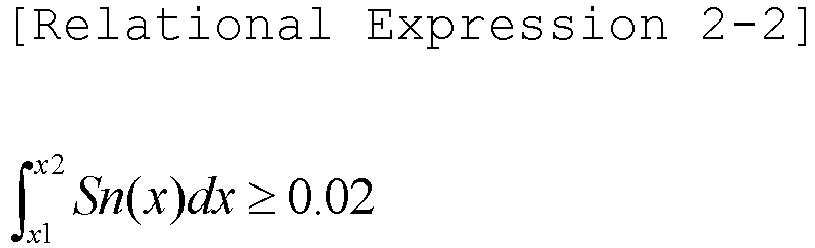
- the Sn(x) denotes the Sn content along an X-axis direction from one certain point in the plating layer to the base steel sheet side
- x1 denotes an X-axis point at a boundary between the plating layer and the Sn-enriched layer
- x2 denotes the X-axis point at the maximum value of the Sn content in the Sn-enriched layer.
- a manufacturing method of a hot press formed part may comprise: after heat-treating the plated steel sheet for hot press forming described above in a temperature range of Ac3 to 950°C for 1 to 1000 seconds, hot press forming the plated steel sheet.
- a Sn-enriched layer between a base steel sheet and a plating layer to reduce the amount of diffusible hydrogen in steel, it is possible to provide plated steel sheets for hot press forming having excellent hydrogen embrittlement resistance and impact resistance, hot press formed parts, and manufacturing methods thereof.
- the present inventors analyzed the effects of various components comprising the addition of Sn, manufacturing conditions, texture, etc., by a method using analysis of the amount of diffusible hydrogen in steel which is an indicator of a hydrogen embrittlement resistance effect in steel for hot press forming and a 3-point bending test (VDA238-100) which is one of indicators that may indicate impact resistance.
- VDA238-100 3-point bending test
- the plated steel sheet according to an aspect of the present disclosure may comprise: a base steel sheet comprising, in weight%, C: 0.07 to 0.5%, Si: 0.05 to 1%, Mn: 0.5 to 5%, P: 0.001 to 0.015%, S: 0.0001 to 0.02%, Al: 0.01 to 0.1%, Cr: 0.01 to 1%, N: 0.001 to 0.02%, Ti: 0.1% or less, B: 0.01% or less, Sn: 0.01 to 0.1%, and a balance of Fe and inevitable impurities; an aluminum or aluminum alloy plating layer disposed on at least one surface of the base steel sheet; and an Sn-enriched layer provided between the base steel sheet and the plating layer.
- a base steel sheet comprising, in weight%, C: 0.07 to 0.5%, Si: 0.05 to 1%, Mn: 0.5 to 5%, P: 0.001 to 0.015%, S: 0.0001 to 0.02%, Al: 0.01 to 0.1%, Cr: 0.01 to 1%, N: 0.00
- the C is an element that increases strength of a heat treated member and improves hardenability, and should be appropriately added as an essential element for strength control.
- the C content is less than 0.07%, since it is difficult to secure sufficient hardenability, insufficient martensite may not be secured when a cooling rate is reduced, and impact resistance may be inferior due to excessive generation of ferrite.
- the C content exceeds 0.5%, the strength may be excessively increased to cause brittleness and poor weldability. Therefore, the C content is preferably controlled in the range of 0.07 to 0.5%.
- the lower limit of the C content may be 0.078%
- the upper limit of the C content may be 0.348%.
- the Si should be added as a deoxidizing agent in steelmaking, as well as a solid solution strengthening element and a carbide formation suppressing element. Therefore, the Si is added as an element that is effective for uniformizing an internal structure, contributes to an increase in strength of the hot press formed part, and effective for material uniformity.
- the Si content is less than 0.05%, the above-described effect may not be expected, and the manufacturing cost and process cost for controlling the Si content are increased, which is not appropriate.
- the Si content exceeds 1%, since the plating property is greatly deteriorated due to excessive Si oxide generated on the surface of the steel sheet during annealing, the Si is added to 1% or less.
- the lower limit of the Si content may be 0.17%, and the upper limit of the Si content may be 0.80%.
- the Mn needs to be added not only to secure desired strength due to the solid solution strengthening effect, but also to suppress ferrite formation during the hot press forming through the improvement in hardenability.
- the Mn content is less than 0.5%, it is difficult to obtain a sufficient hardenability effect, and an excessive amount of other expensive alloying elements are required for insufficient hardenability, resulting in a significant increase in manufacturing costs.
- the Mn content exceeds 5%, the band structure arranged in the rolling direction on the microstructure is deepened, resulting in the nonuniformity of the internal structure. As a result, the impact resistance may be inferior, so the Mn is added below 5%.
- the lower limit of the Mn content may be 0.55%, and the upper limit of the Mn content may be more preferably 4.4%.
- the P is present as an impurity in steel, and a high manufacturing cost is required for the minimum content of less than 0.001%, which is not preferable.
- the upper limit of the P content is set to 0.015%.
- the lower limit of the P content may be 0.005%, and the upper limit of the P content may be preferably 0.012%.
- the S is an impurity, and the maximum content of the S is limited to 0.02% because the S is an element impairing the ductility, impact characteristics, and weldability of the member.
- the minimum content of the S is less than 0.0001%, it is not preferable because manufacturing costs are greatly increased.
- the lower limit of the S content may be 0.001%, and the upper limit of the S content may be 0.01%.
- the Al is an element that acts as a deoxidizer in steelmaking together with Si to increase the cleanliness of the steel.
- the Al content is less than 0.01%, it is difficult to obtain the above-described effect, and when the Al content exceeds 0.1%, the high-temperature ductility due to excessive AlN precipitates formed during the continuous casting process is lowered, and slab cracks may occur, which may cause problems in manufacturing. Accordingly, the upper limit of the Al is set to 0.1%. Meanwhile, in terms of further improving the above-described effect, the lower limit of the Al content may be 0.020%, and the upper limit of the Al content may be 0.081%.
- the Cr is added as an element for securing hardenability of steel and suppressing ferrite generation after hot press forming.
- the Cr content is less than 0.01%, it is difficult to secure the above-described effect.
- the Cr content exceeds 1%, the effect of improving hardenability compared to the amount added is insignificant, and excessive coarse iron carbide is formed, which may cause cracks when stress is applied and make the material inferior.
- the upper limit of the Cr content is set to 1%.
- the lower limit of the Cr content may be 0.10%, and the upper limit of the Cr content may be 0.61%.
- the N is comprised as an impurity in steel.
- the N content is less than 0.001%, excessive manufacturing costs are involved, and when the N content exceeds 0.02%, similar to the Al added, slab cracks due to AlN formation are likely to occur, so the upper limit of the N content is set to 0.02%. Meanwhile, in terms of further improving the above-described effect, the lower limit of the N content may be 0.003%, and the upper limit of the N content may be more preferably 0.005%.
- the Ti is an element that is optionally added in the present disclosure, and may serve to protect B from becoming a compound for securing hardenability by generating TiN by combining with nitrogen remaining as an impurity in steel.
- the TiC precipitates, precipitation strengthening and grain refinement effects may be expected.
- the upper limit of the Ti content is set to 0.1%.
- the lower limit of the Ti content may be 0%, and the lower limit of the Ti content may be 0.01% and the upper limit of the Ti content may be 0.035% in terms of further improving the above-described effect.
- the B is an element that is optionally added in the present disclosure, and is an element that may effectively improve hardenability.
- the B When the B is added, the B may be segregated at a prior austenite grain boundary and suppress brittleness of the hot press formed parts due to the grain boundary segregation of P or/and S as impurities.
- the upper limit of the B content is set to 0.01% because it may cause brittleness in hot rolling due to the formation of Fe 23 CB 6 composite compound.
- the lower limit of the B content may be 0%, and the lower limit of the B content may be 0.002% and the upper limit of the B content may be 0.008% in terms of further improving the above-described effect.
- the Sn is a key element in manufacturing the hot press formed parts, and forms an Sn-enriched layer at an interface between a base steel sheet and a plating layer, reducing the hydrogen content occluded during the heat treatment and reducing the susceptibility to hydrogen delayed fracture.
- the Sn content is less than 0.01%, it is difficult to expect the above-mentioned effect because a sufficiently enriched layer is not formed at the interface between the plating layer and base iron.
- the Sn content exceeds 0.1%, the Sn is excessively precipitated at the grain boundary to cause the grain boundary fracture when stress occurs, resulting in material degradation. Therefore, the upper limit of the Sn content is preferably set to 0.1%. However, in terms of further improving the above-described effect, the lower limit of the Sn content may be 0.011%, and the upper limit of the Sn content may be 0.097%.
- the balance other than the above-described components is iron (Fe), and any additional addition is not particularly limited as long as it is a component that may be comprised in the steel sheet for hot press forming.
- Fe iron
- any additional addition is not particularly limited as long as it is a component that may be comprised in the steel sheet for hot press forming.
- the unintended impurities from raw materials or the surrounding environment may inevitably be mixed in a normal manufacturing process, the unintended impurities may not be excluded. Since these impurities are known to those skilled in the ordinary manufacturing process, not all of them are specifically mentioned in this specification.
- the plating layer comprises an aluminum or aluminum alloy plating layer provided on at least one surface of the base steel sheet.
- the plating layer imparts corrosion resistance in the final hot press formed part.
- the type of the plating layer is not particularly limited, and the plating layer applied to the conventional plated steel sheet for hot press forming may be applied to the present disclosure without limitation.
- the plating layer may be an aluminum or aluminum alloy plating layer, and preferably, the plating layer may comprise Si: 6 to 12%, Fe: 1 to 4%, a balance of Al and inevitable impurities.
- the plated steel sheet may comprise the Sn-enriched layer provided between the base steel sheet and the plating layer.
- This Sn-enriched layer may be expressed within the concentration gradient layer in the boundary region between the base steel sheet and the plating layer.
- the concentration gradient layer is a layer in which the concentration changes in the boundary region between the base steel sheet and the plating layer, and means a layer in which Fe varies by 0.3 wt%/ ⁇ m or more in the range of 20 to 99% based on the gravimetric method in the thickness direction of the steel sheet.
- the Sn-enriched layer is provided between the base steel sheet and the plating layer and is a region classified by the Sn content as the Sn is concentrated.
- the Sn-enriched layer and the plating layer may be distinguished by analyzing the change in the Sn content in the thickness direction of the base steel sheet side from one certain point in the plating layer using glow discharge optical emission spectrometry (GDS).
- GDS glow discharge optical emission spectrometry
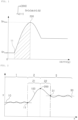
- an x axis represents a straight line distance from an arbitrary position inside a plating layer 1 in a thickness direction of a base steel sheet 3 side
- a y axis represents the Sn content measured using the GDS.
- the Sn-enriched layer 2 is viewed from a last contact point 11 (in the thickness direction of the base steel sheet 3 side) in the X-axis (+) direction of an average Sn content line 10 of the plating layer and an Sn content line 100 measured using the GDS.
- the average Sn content line 10 of the plating layer 1 may mean an extension line of the average Sn content line for the section from the point 8 ⁇ m away from the point 200 (Sn max point) where the Sn content is the maximum value in the Sn-enriched layer 2 to the point 15 ⁇ m away from the plating layer 1 side.
- the Sn-enriched layer 2 is viewed from a last contact point 31 (in the thickness direction of the plating layer 1 side) in an X-axis (-) direction of an average Sn content line 30 of the base steel sheet and the Sn content line 100 measured using the GDS.
- the average Sn content line 30 of the base steel sheet 3 may mean an extension line of the average Sn content line for the section from the point 8 ⁇ m away from the point 200 (Sn max point) where the Sn content is the maximum value in the Sn-enriched layer 2 to the point 15 ⁇ m away from the base steel sheet 3 side.
- the present inventors have found that reducing the amount of diffusible hydrogen occluded during the heat treatment of the press forming may suppress the occurrence of defects due to hydrogen delayed fracture.
- water vapor present in a heat treatment furnace is adsorbed on a surface of the blank.
- hydrogen generated by dissociation of water is occluded in the steel while having an austenite phase with high hydrogen solubility at high temperature.
- the inventors confirmed that the impact resistance tended to increase as the hydrogen content in steel decreased.
- the diffusible hydrogen occluded in the steel during the heat treatment in particular, the diffusible hydrogen present at the grain boundary is subjected to stress during bending, and acts to easily induce and propagate the grain boundary cracks. Therefore, by reducing the diffusible hydrogen content in steel, properties such as bendability and impact resistance may be improved.
- the present inventors found that the formation of the Sn-enriched layer having an appropriate concentration and thickness between the base steel sheet and the plating layer made it possible to achieve this effect. This is because the Sn-enriched layer serves as an effective protective film to relatively reduce the amount of diffusible hydrogen occluded in the steel.
- the plated steel sheets for hot press forming preferably satisfy the following relational expressions 1-1 and 1-2.
- the unit of the following relational expression 1-2 corresponds to [ ⁇ m*wt%] (the same applies to the following relational expressions 2-2 and 2-3).
- Sn max Sn coat ⁇ 1.5 [In the relational expression 1-1, the Sn coat represents an average Sn content in the plating layer, and a unit is weight%. In addition, the Sn max represents a maximum value of the Sn content in the Sn-enriched layer, and the unit is weight%.]
- the Sn(x) represents the Sn content along an X-axis direction from one certain point in the plating layer to the base steel sheet side
- x1 represents an X-axis point at a boundary between the plating layer and the Sn-enriched layer
- x2 represents the X-axis point at the maximum value of the Sn content in the Sn-enriched layer.
- both the above-described relational expressions 1-1 and 1-2 need to be satisfied when the Sn concentration and thickness of the Sn-enriched layer provided between the base steel sheet and the plating layer are at a certain level or higher.
- the Sn coat , Sn max , Sn(x), x1 and x2, etc. may be measured from data obtained when the Sn content change in the thickness direction of the base steel sheet is analyzed at one certain point in the plating layer using the above-described glow discharge optical emission spectrometry (GDS).
- GDS glow discharge optical emission spectrometry
- the Sn coat may correspond to the average Sn content line 10 of the plating layer 1 described above in the GDS profile of FIG. 2 herein
- the Sn max may correspond to a point 200 where the Sn content in the enriched layer 2 is the maximum value in the GDS profile of FIG. 2 herein.
- the area corresponding to the relational expression 1-2 is illustrated as a hatched portion. That is, the area of the hatched portion in FIG. 1 described above represents the integral value (that is, in the present disclosure, it may mean the area of the corresponding region obtained by using the quadrature method) of Sn(x) which is a function representing the change in the Sn content in the X-axis direction from one certain point in the plating layer from x1 (X-axis point at the boundary 11 between the plating layer and the Sn-enriched layer) to x2 (among the Sn-enriched layers, the X-axis point 200 at the maximum value of Sn content) to the base steel sheet side.
- the integral value may be obtained by calculation using the quadrature method per unit length (or unit depth) of the x axis of 0.01 ⁇ m.
- the lower limit of the Sn max /Sn coat value defined by the relational expression 1-1 may be 1.53, and more preferably, the upper limit of the Sn max /Sn coat value defined by the relational expression 1-1 may be 13.0.
- the lower limit of the value of ⁇ x 1 x 2 Sn x dx value defined by the relational expression 1-2 may be 0.018, and more preferably, the upper limit of the value of ⁇ x 1 x 2 Sn x dx defined by the relational expression 1-2 may be 0.35.
- the thickness of the Sn-enriched layer may be in the range of 1 to 20 um (i.e., 1 um or more and 20 ⁇ m or less).
- the thickness of the Sn-enriched layer when the thickness of the Sn-enriched layer is less than 1 ⁇ m, even if the heat treatment for hot forming is performed thereafter, a sufficient Sn-enriched layer may not be generated, so it may be difficult to expect the desired effect of improving hydrogen embrittlement resistance and impact resistance.
- the thickness of the Sn-enriched layer exceeds 20 um, the impact resistance may be inferior by acting as a crack site when stress occurs as Sn excessively precipitates at the grain boundary after the hot press forming.
- the lower limit of the thickness of the Sn-enriched layer may be 3 um, and the upper limit of the thickness of the Sn-enriched layer may be 15 ⁇ m.
- the performance is improved by concentrating an appropriate amount of Sn in the manganese segregation band existing in the base steel sheet of the plated steel sheet. That is, as a result of examining various conditions, the present inventors confirmed that this effect is further enhanced when the Sn concentration in the segregation band satisfies a certain level or more, or in addition, when the thickness of the Mn segregation band satisfies a certain level or less.
- the base steel sheet comprises the Mn segregation band, and the region in which the average Sn content of the Mn segregation band is 1.015 times or more compared to the average Sn content in the base steel sheet may be 50% or more (or, 60% or more) in an area fraction.
- MnS inclusions
- the region in which the average Sn content of the Mn segregation band is 1.015 times or more compared to the average Sn content in the base steel sheet may be 50% or more (or, 60% or more) in an area fraction.
- the upper limit of the average Sn content in the Mn segregation band is not particularly limited, but may be, for example, 5 times or less than the average Sn content in the region of the base steel sheet other than the Mn segregation band.
- the upper limit of an area of a portion in which the average Sn content is 1.015 times or more of the average Sn content in the base steel sheet among the Mn segregation bands may be 90%.
- the Mn segregation band may be identified using the EPMA component mapping result for Mn. Specifically, the average value of Mn intensity by the EPMA measured by heat-treating the plated steel sheet at a temperature of 1200°C or higher for several hours and then rapidly cooling the plated steel sheet to remove the Mn segregation band is referred to as Mn0.
- the specific point is defined as the Mn segregation point, and if the area is less than 50%, the specific point is defined as not being a Mn segregation point.
- Mn segregation points are collected, and a region drawn by connecting the outermost Mn segregation points with a straight line is referred to as the Mn segregation band.
- the ratio (Sn2/Sn1) of an average Sn content (Sn2) of the Mn segregation band to an average Sn content (Sn1) of the base steel sheet may be measured using the ratio of intensity according to the result of Sn component mapping using EPMA.
- the thickness of the Mn segregation band may be 20 ⁇ m or less, and by satisfying this, the impact resistance and bendability may be further improved. Since the impact resistance and bendability may be improved as the thickness of the Mn segregation band becomes thinner, the lower limit of the thickness of the Mn segregation band may not be separately limited. However, as an example, the lower limit of the thickness of the Mn segregation band may be 1 um. In this case, the thickness of the Mn segregation band may be defined as a value obtained by measuring the average thickness in the thickness direction (direction perpendicular to the rolling direction of the steel sheet) from the Mn segregation band image determined by the above-described method.
- the lower limit of the thickness of the Mn segregation band may be 3.0 um, or the upper limit of the thickness of the Mn segregation band may be 13.4 ⁇ m.
- hot press formed parts having excellent hydrogen embrittlement resistance and impact resistance may be manufactured by the hot press forming method to be described later for the plated steel sheets for hot press forming having the above-described configuration.
- the hot press formed part may comprise a base steel sheet having the same alloy composition as the base steel sheet of the above-described plated steel sheet; an aluminum or aluminum alloy plating layer provided on at least one surface of the base steel sheet; and an Sn-enriched layer provided between the base steel sheet and the plating layer, in which the hot press formed part satisfies the following relational expressions 2-1 and 2-2.
- the description of the base steel sheet, the plating layer, and the Sn-enriched layer may be applied in the same manner as described above.
- the relational expressions 2-1 and 2-2 are empirically obtained values, the units may not be specifically determined, and it is sufficient if the units of each variable are satisfied.
- Sn max Sn coat ⁇ 1.8 [In the relational expression 2-1, the Sn coat represents an average Sn content in the plating layer, and a unit is weight%. In addition, the Sn max represents a maximum value of the Sn content in the Sn-enriched layer, and the unit is weight%.]
- the Sn(x) represents the Sn content along an X-axis direction from one certain point in the plating layer to the base steel sheet side
- x1 represents an X-axis point at a boundary between the plating layer and the Sn-enriched layer
- x2 represents the X-axis point at the maximum value of the Sn content in the Sn-enriched layer.
- the hydrogen embrittlement resistance and impact resistance may be improved by effectively reducing the hydrogen content in steel by satisfying the above relational expressions 2-1 and 2-2.
- the method of distinguishing the plating layer from the Sn-enriched layer and the base steel sheet from the Sn-enriched layer may be the same as the method of distinguishing the plated steel sheet described above.
- the lower limit of the Sn max /Sn coat value defined by the relational expression 2-1 may be 1.83, and more preferably, the upper limit of the Sn max /Sn coat value defined by the relational expression 2-1 may be 13.46.
- the lower limit of the value of ⁇ x 1 x 2 Sn x dx defined by the relational expression 2-2 may be 0.024, and more preferably, the upper limit of the value of ⁇ x 1 x 2 Sn x dx defined by the relational expression 2-2 may be 0.352.
- relational expression 2-3 the definitions of Sn(x), x1 and x2 are the same as those defined in relational expression 2-2]
- the microstructure of the base steel sheet may comprise 5% or less of ferrite (comprising 0%) and a balance of martensite.
- ferrite comprising 0%
- other phases such as upper bainite, retained austenite, cementite, and pearlite may be additionally comprised in 1% or less.
- the base steel sheet may comprise 5% or less (comprising 0%) of ferrite in area fraction, which may secure hardenability and sufficient cooling rate according to steel component control in hot forming to manage the ferrite fraction to 5% or less. Meanwhile, in the hot press formed parts, when the ferrite fraction of the base steel sheet exceeds 5%, not only the intensity is lowered, but also the local stress is concentrated in the relatively soft ferrite, which may promote crack propagation and greatly reduce the impact resistance.
- the thickness of the Sn-enriched layer may be 2 to 30 ⁇ m.
- the thickness of the Sn-enriched layer in the hot press formed part is less than 2 ⁇ m, it may not be able to effectively suppress hydrogen permeated into steel during hot forming, so the desired effect of improving hydrogen embrittlement resistance and impact resistance may not be sufficiently exhibited.
- the thickness of the Sn-enriched layer in the hot press formed part exceeds 30 ⁇ m, Sn not only constitutes an enriched layer, but may also be excessively precipitated at the grain boundary of the surface layer of the base steel, which may promote the occurrence and propagation of cracks during the bending and reduce the impact resistance.
- the lower limit of the thickness of the Sn-enriched layer may be 3.4 um, and the upper limit of the thickness of the Sn-enriched layer may be 25 ⁇ m.
- the amount of diffusible hydrogen of the hot press formed part may be 0.4 ppm or less, and thus, excellent hydrogen embrittlement resistance may be secured.
- the amount of diffusible hydrogen of 0.4 ppm or less is because there is no cracking of parts even if a specimen is stressed by bending under the same yield stress of the material for 120 hours.
- the base steel sheet comprises the Mn segregation band
- the region in which the average Sn content of the Mn segregation band is 1.015 times or more compared to the average Sn content in the base steel sheet may be 50% or more (or, more preferably 60% or more) in an area fraction.
- the upper limit of the average Sn content in the Mn segregation band is not particularly limited, but may be, for example, 5 times or less than the average Sn content in the region of the base steel sheet other than the Mn segregation band.
- the upper limit of an area of a portion in which the average Sn content is 1.015 times or more of the average Sn content in the base steel sheet among the Mn segregation bands may be 95%.
- the thickness of the Mn segregation band may be 15 ⁇ m or less, and by satisfying this, the impact resistance and bendability may be further improved. Since the impact resistance and bendability may be improved as the thickness of the Mn segregation band becomes thinner, the lower limit of the thickness of the Mn segregation band may not be separately limited. However, as an example, the lower limit of the thickness of the Mn segregation band may be 1.5 ⁇ m.
- the lower limit of the thickness of the Mn segregation band may be 4.1 ⁇ m, or the upper limit of the thickness of the Mn segregation band may be 15.0 ⁇ m.
- the measurement method and standard of measurement in the above-described plated steel sheet may be equally applied.
- the plated steel sheets for hot press forming may comprise: reheating a steel slab comprising, in weight%, the above-described alloy composition at 1050 to 1300°C; obtaining a hot-rolled steel sheet by finishing rolling the heated steel slab at 750 to 950°C; coiling the hot-rolled steel sheet at 500 to 700°C; pickling the wound hot-rolled steel sheet so that a product of an acid concentration and a pickling time is 800 to 10,000 g/L*s; annealing the pickled steel sheet at 700 to 860°C in a dew point temperature condition of -75 to +20°C in an annealing furnace; and after the annealing, plating the steel sheet by passing the steel sheet through a plating bath made of aluminum or an aluminum alloy.
- the slab having the above-described alloy composition is reheated to 1050 to 1300°C.
- the reheating temperature is less than 1050°C, since the slab structure is not sufficiently homogenized, it is difficult to re-dissolve the precipitated element when using the precipitated element.
- the reheating temperature exceeds 1300°C, an excessive oxide layer is formed, resulting in an increase in manufacturing cost for removing the oxide layer and a high possibility of surface defects occurring after finish rolling.
- the finish rolling needs to be performed at 750 to 950°C.
- the finish rolling temperature is less than 750°C, ideal reverse rolling proceeds, and ferrite is introduced into the surface layer portion of the steel sheet, making it difficult to control the plate shape.
- the finish rolling temperature exceeds 950°C, coarsening of hot-rolled grains may occur, and excessive hot scale may occur, which is not appropriate because post-process manufacturing costs for coping with the same increase.
- the hot-rolled steel sheet is wound at 500 to 700°C and then cooled to prepare a hot-rolled coil.
- the coiling temperature is less than 500°C, martensite is formed in whole or in part on the steel sheet, so there is a problem in that it is difficult to control the shape of the coil, and the cold rolling property is lowered after the excessive increase of strength of the hot-rolled steel sheet.
- the coiling temperature exceeds 700°C, coarse carbides are excessively formed, and the occurrence of cracks is promoted when stress is generated in the hot press formed parts, so there is a problem in that impact resistance is lowered.
- the wound hot-rolled steel sheet is pickled so that a product of an acid concentration and a pickling time is 800 to 10,000 g/L*s.
- the above-described Sn-enriched layer is formed on the steel sheet that has gone through the above reheating, finish rolling, and coiling.
- the product of the acid concentration and the pickling time is applied within the range of 800 to 10,000 g/L*s, the Sn-enriched layer, which is the core of the present disclosure, is effectively protected, to thereby exhibit the effect of reducing the amount of diffusible hydrogen in steel.
- the product of the acid concentration and the pickling time is less than 800 g/L*s, the scale generated during the finish rolling may not be sufficiently removed, which may cause problems in the quality of the product.
- the product of the acid concentration and the pickling time exceeds 10,000 g/L*s, the whole or part of the Sn-enriched layer is lost during the pickling, which may not only fail to exert expected effects, but may also cause an increase in manufacturing costs. Therefore, the upper limit of the product of the acid concentration and the pickling time is set to 10,000 g/L*s.
- the above value may be expressed by adding the product of the acid concentration and pickling time for each tank.
- the lower limit of the product of the acid concentration and the pickling time may be 900 g/L*s, or the upper limit of the product of the acid concentration and the pickling time may be 4,200 g/L*s.
- hydrochloric acid HCl
- sulfuric acid H 2 SO 4
- hydrochloric acid HCl
- the use of hydrochloric acid (HCl) has excellent pickling performance and economical process cost, and is easy to secure surface quality with less possibility of occurrence of foreign matter on the surface after the pickling.
- the acid concentration may be in the range of 40 to 500g/L.
- the acid concentration is less than 40 g/L, the surface scale generated during the hot rolling is not sufficiently removed for a limited pickling time, and thus, defects may occur in the surface layer portion of the steel sheet.
- the acid concentration exceeds 500 g/L, it may be difficult to exert the desired effect of the invention in the final hot press formed member due to the loss of the Sn-enriched layer, and the surface layer defects due to over-acidification may occur.
- the lower limit of the acid concentration may be 150g/L
- the upper limit of the acid concentration may be 250g/L.
- the pickling time may be 5 to 60 seconds.
- the pickling time is less than 5 seconds, the scale of the surface layer of the steel sheet is not sufficiently removed, which can cause defects in the surface layer portion, and when the pickling time exceeds 60 seconds, the Sn-enriched layer may be lost to reduce productivity and increase the process cost.
- the pickling time may be 5 to 25 seconds.
- the pickling temperature may be 40 to 120°C.
- the pickling temperature is less than 40°C, the pickling force is not sufficient, which may adversely affect the quality of the product.
- the pickling temperature exceeds 120°C, not only fixed costs increase to maintain the pickling temperature at a high temperature, but also the increase in the amount of vaporization of the pickling solution due to the high temperature may increase the cost for replenishing the lost pickling solution.
- the lower limit of the pickling temperature may be 50°C, or the upper limit of the pickling temperature may be 100°C.
- the above-described pickled steel sheet may be annealed at 700 to 900°C in a dew point temperature condition of -75 to +20°C in an annealing furnace.
- the annealing temperature is less than 700°C, the recrystallization of the cold-rolled structure is not sufficiently completed, so the plate shape may be poor and the strength after plating is too high, which may cause mold wear during the blanking process.
- the annealing temperature exceeds 900°C, the surface oxide formation is promoted during the annealing process, causing the defects on the Al-Si plating surface.
- the annealing temperature may be 750 to 860°C or 800 to 860°C.
- the atmosphere during the annealing is preferably a non-oxidizing atmosphere, and a hydrogen-nitrogen mixed gas or the like may be used.
- the above-described dew point temperature of the atmospheric gas is performed at -75°C or higher + 20°C or lower.
- the dew point temperature is less than -75°C, there is a problem in that manufacturing cost increases because additional equipment for dew point control is required.
- the dew point temperature exceeds +20°C, the annealed oxide is formed on the surface of the steel sheet during the annealing, which may cause the surface quality defects such as unplating.
- the lower limit of the dew point temperature may be -55°C, or the upper limit of the dew point temperature may be 0°C.
- the plated steel sheet may be manufactured by passing the hot-rolled steel sheet through a plating bath made of aluminum or an aluminum alloy.
- the plating conditions may be applied to the present disclosure without limitation as long as the plating conditions are generally applied to steel sheets for hot press forming, but as an example, the composition of the plating bath is Si: 6-12%, Fe: 1-4%, a balance of Al and inevitable impurities.
- the plating amount in the plating is 15 to 140g/m 2 based on the conventionally manufactured single side. It is difficult to secure the desired corrosion resistance of the hot press formed part when the plating amount is less than 15g/m 2 on a single side basis, and when the plating amount exceeds 140g/m 2 , not only does manufacturing cost increase due to the excessive coating amount, but it is not easy to plate the coating amount uniformly in the entire width and length direction of the coil.
- the manufacturing method of the plated steel sheets for hot press forming according to an aspect of the present disclosure may further comprise, after the pickling treatment described above, cold-rolling the hot-rolled steel sheet to manufacture a cold-rolled steel sheet.
- the manufacturing method of plated steel sheets for hot press forming according to the present disclosure may further comprise, before heating a slab, continuous casting by light reduction, but is not particularly limited thereto.
- the present disclosure may reduce segregation and improve impact resistance by preparing a slab by applying light reduction during continuous casting. This is because, when the slab segregation occurs excessively, the segregation band is thickly concentrated until the final hot press formed part, and the impact resistance may be reduced due to the difference in hardness between the segregation band and the base steel sheet region other than the Mn segregation band and the formation of inclusions in the segregation band.
- the light reduction needs to be performed prior to the final solidification position of the slab during the continuous casting, and the total reduction rate during the light reduction by the continuous casting is preferably controlled to 0.5 to 5%.
- the total reduction ratio is less than 0.5% during the continuous casting, the reduction is hardly achieved and the center segregation is not sufficiently removed, resulting in poor impact resistance in the hot press formed part.
- the total reduction ratio exceeds 5% during the continuous casting, there may be a problem with reduction roll equipment, which may promote equipment failure and deterioration.
- the hot press formed parts having excellent hydrogen embrittlement resistance and impact resistance may be manufactured by performing the hot press forming on the plated steel sheets for hot press forming manufactured by the above-described manufacturing method. Specifically, a method of manufacturing a final member having excellent hydrogen embrittlement resistance and impact resistance through hot press forming and die quenching using the plated steel sheet manufactured by the above-described method will be described.
- a blank for hot forming is manufactured using the plated steel sheet manufactured according to the above-described steel composition and manufacturing method. The blank is heated within a temperature range of more than the temperature of the austenite single phase region, more specifically, the temperature of Ac3 and 975°C or lower.
- the Ac3 transformation point temperature may be calculated by the following relational expression 3.
- the heated blank is preferably maintained in the above temperature range for 1 to 1000 seconds.
- the holding time is less than 1 second, the uniform temperature distribution over the entire blank temperature may be difficult, causing material variation by location.
- the holding time exceeds 1000 seconds as in the case of exceeding the heating temperature, it may be difficult to secure the spot weldability due to the generation of excessive oxide on the surface of the member, and the manufacturing costs of the member may be increased.
- the heated blank is transferred to a press, and the final member is manufactured by performing the hot press forming and the die quenching at a cooling rate of -20°C/s or higher.
- a cooling rate of less than - 20°C/s a ferrite phase may be introduced during cooling to be generated at a grain boundary and the strength and impact resistance may deteriorate.
- the above-described blank transfer, hot press forming, and cooling steps, and the commonly used hot press forming method may be applied as it is.
- the Sn-enriched layer is formed in the concentration gradient layer between the base steel sheet and the plating layer, so it is possible to manufacture the hot press formed parts having excellent hydrogen embrittlement resistance and impact resistance according to the decrease in the amount of diffusible hydrogen in steel.
- composition of the steel used for the present disclosure is shown in Table 1 below (corresponding to a balance of Fe and other impurities), and a slab having each composition were prepared by vacuum melting to a thickness of 60 mm. After maintaining the slab at a temperature of 1200°C for 1 hour, the slab was hot rolled at a hot rolling end temperature of 900°C and wound at a coiling temperature of 580°C.
- the pickling process was performed at the HCl concentration of 200 g/L and a pickling time of 20 seconds, and thus, after the product of the HCl concentration and the pickling time was collectively applied at 4,000 g/L ⁇ s within the inventive range, the annealing was performed under the conditions of Table 2 below, and the plating was performed by immersing in a plating bath made of Al-9% Si-2% Fe and a balance of a trace amount of impurities.
- the hot press forming was performed at various temperatures, and after applying a heating time of 6 minutes and a transfer time to the mold of 10 seconds, the die quenching was applied.
- GDS850A model name, manufactured by LECO
- DC DC
- FR equipment were used to confirm the Sn-enriched layer near the surface
- GDS glow discharge optical emission spectrometry
- a concentration gradient layer varying by more than 0.3 wt%/ ⁇ m within the range of Fe in the range of 20 to 99% based on the weight method in the thickness direction (meaning the direction perpendicular to the rolling direction) exists between the base steel sheet and the plating layer.
- the Sn-enriched layer exists in this concentration gradient layer.
- the parameters Sn max Sn coat and ⁇ x 1 x 2 Sn x dx were measured as illustrated in FIG. 1 , and using the measured parameters, the parameter values of the relational expressions 1-1, 1-2, 2-1, and 2-2 for the plated steel sheet and the hot press formed part described in the table below were calculated.
- P 2 maximum load kgf ⁇ maximum bending angle ° [Table 1] S t e e l t y P e C Si Mn P S Al Cr N Ti B Sn A 0.22 0.55 0.9 0.011 0.002 0.020 0.10 0.005 0.031 0.003 0.097 B 0.21 8 0.8 0 2. 3 0.01 0.00 3 0.06 8 0.3 4 0.00 4 0.02 8 0.00 2 0.03 9 C 0.15 5 0.2 5 2. 1 0.01 0.00 1 0.08 1 0.2 5 0.00 3 0.02 6 0.00 3 0.01 1 D 0.30 8 0.5 0 4.
- the effect of improving impact resistance according to the formation of the Sn-enriched layer is illustrated in FIG. 4 , and the impact resistance tends to increase according to the formation of the Sn-enriched layer of the hot press formed part.
- the Sn-enriched layer serves as an effective protective film to reduce the amount of diffusible hydrogen in the steel to secure the excellent hydrogen embrittlement resistance and at the same time to secure the excellent impact resistance.
- Specimens were prepared in the same manner as in Experimental Example 1 described above, except that the pickling concentration, the pickling time, and the hot press forming temperature were changed to the conditions in Table 4 below. In this case, the pickling temperature was applied collectively at 80°C.
- Example 1 For the evaluation of each Example and Comparative Example, the amount of diffusible hydrogen and the impact resistance were evaluated in the same manner as in Experimental Example 1 described above, and it was evaluated whether the hot scale remains after pickling to additionally evaluate the surface properties (i.e., surface defects).
- surface properties i.e., surface defects.
- each steel type was attached to the surface of the specimen using a tape, then removed, and oxides thereon were attached to white paper, and then the whiteness was measured according to color difference analysis.
- the steel composition and the product of the acid concentration and the pickling time of the present disclosure is in the range of 800 to 10,000 g/L*s, and thus, the relational expressions 1-1, 1-2, 2-1, and 2-2 satisfied the inventive range.
- the relational expressions 1-1, 1-2, 2-1, and 2-2 satisfied the inventive range.
- a specimen was prepared in the same manner as in Experimental Example 1, except that the slab was prepared by light pressure at the total reduction amount shown in Table 7 below, and the conditions in Table 7 below were applied.
- each characteristic was evaluated in the same manner as in Experimental Example 1, and additionally, the thickness of the Mn segregation band in the steel sheet and the Sn content in the Mn segregation band were measured for the plated steel sheet and the hot press formed part, and showed in Table 7 below.
- the thickness of the Mn segregation band and the area of the portion where the average content of Sn is 1.015 times or more of the average content of Sn in the base steel sheet among the Mn segregation bands were measured by the electron probe X-ray micro analyzer (EPMA) method by applying the method described above.
- An example (Inventive Example 12) of the result of element mapping for Mn and Sn was illustrated in FIGS. 5 and 6 , respectively.
- the surface properties, the amount of diffusible hydrogen, and the impact resistance were measured in the same manner as described above.
- Examples 11 to 14 satisfied the ranges of the relational expressions 1-1, 1-2, 2-1, and 2-2 of the present application, and thus had excellent surface properties and excellent hydrogen embrittlement resistance due to a small amount of diffusible hydrogen.
- the thickness of the Mn segregation band satisfied 20 um or less (or, in the hot press formed part, the thickness of the Mn segregation band is 15 um or less), or in the plated steel sheet and the hot press formed part, in the case of Examples 12 to 14 in which the area of the Mn segregation band in which the average Sn content is 1.015 times or more than the average Sn content in the base steel sheet among the Mn segregation bands satisfies 60% or more, compared to Example 11, which does not satisfy at least one of the above conditions, and Comparative Example 7, which does not satisfy all of the above conditions, it was confirmed that the formability is further improved.
- hot press forming products having excellent impact resistance as well as resistance to hydrogen delayed fracture due to the reduction of the amount of diffusible hydrogen may be manufactured.
- These parts may be applied and utilized in various fields including the automobile manufacturing field as structural materials or reinforcing parts.
Landscapes
- Chemical & Material Sciences (AREA)
- Engineering & Computer Science (AREA)
- Materials Engineering (AREA)
- Mechanical Engineering (AREA)
- Metallurgy (AREA)
- Organic Chemistry (AREA)
- Chemical Kinetics & Catalysis (AREA)
- Thermal Sciences (AREA)
- Crystallography & Structural Chemistry (AREA)
- Physics & Mathematics (AREA)
- Heat Treatment Of Sheet Steel (AREA)
- Coating With Molten Metal (AREA)
- Heat Treatment Of Articles (AREA)
- Continuous Casting (AREA)
Abstract
Description
- The present disclosure relates to plated steel sheets for hot press forming having excellent hydrogen embrittlement resistance and impact resistance, hot press formed parts, and manufacturing methods thereof.
- Hot press formed parts have recently been widely applied to structural members of automobiles for the purpose of improving fuel efficiency through weight reduction, protecting passengers, and the like. In particular, hot press formed parts may be used for bumpers, doors, pillar reinforcements, etc., that require ultra-high strength or energy absorption capacity. As such a hot forming technique, there is provided
US Patent Publication No. 6296805 (hereinafter, Patent Document 1). - Patent Document 1 discloses that, after Al-Si-based plated steel sheets are heated to 850°C or higher, a structure of a member is formed into martensite by hot press forming and rapid cooling by pressing, to thereby secure ultra-high strength having high tensile strength. When applying the ultra-high strength steel for hot press forming, since the ultra-high strength steel is formed at high temperature, complex shapes may be formed easily and a weight reduction effect may be expected through the increase in strength by rapid cooling in the mold. However, the martensitic structure is known to have low resistance to hydrogen embrittlement. In particular, hot press formed parts have residual stress due to rapid cooling after heating, and at the same time, the amount of diffusible hydrogen in steel increases, so there is a risk of delayed fracture due to hydrogen embrittlement and thus the application of the member may be limited. In addition, since this amount of diffusible hydrogen moves to crack generation sites such as grain boundaries when stress occurs, impact resistance may deteriorate. Accordingly, various studies are being conducted to overcome this.
- Additionally, changes in process parameters during coil manufacture may cause changes in global or local mechanical properties within the sheet. Therefore, a steel composition that is less sensitive to changes in manufacturing parameters for the manufacture of the plated steel sheets and the hot press formed parts having good mechanical properties and homogeneity is required.
(Patent Document 1)U.S. Patent Publication No. 6296805 - The present disclosure provides plated steel sheets for hot press forming having excellent hydrogen embrittlement resistance and impact resistance, hot press formed parts, and manufacturing methods thereof.
- The object of the present disclosure is not limited to the foregoing. Those skilled in the art to which the present disclosure pertains will have no difficulty in understanding the additional objects of the present disclosure from the contents throughout the present specification.
- In an aspect in the present disclosure,
- a plated steel sheet for hot press forming may comprise: a base steel sheet comprising, in weight%, C: 0.07 to 0.5%, Si: 0.05 to 1%, Mn: 0.5 to 5%, P: 0.001 to 0.015%, S: 0.0001 to 0.02%, Al: 0.01 to 0.1%, Cr: 0.01 to 1%, N: 0.001 to 0.02%, Ti: 0.1% or less, B: 0.01% or less, Sn: 0.01 to 0.1%, and a balance of Fe and inevitable impurities;
- an aluminum or aluminum alloy plating layer disposed on at least one surface of the base steel sheet; and
- an Sn-enriched layer provided between the base steel sheet and the plating layer,
- in which the plated steel sheet for hot press forming may satisfy the following relational expressions 1-1 and 1-2.
- In another aspect in the present disclosure,
- a manufacturing method of a plated steel sheet for hot press may comprise: reheating a steel slab comprising, in weight%, C: 0.07 to 0.5%, Si: 0.05 to 1%, Mn: 0.5 to 5%, P: 0.001 to 0.015%, S: 0.0001 to 0.02%, Al: 0.01 to 0.1%, Cr: 0.01 to 1%, N: 0.001 to 0.02%, Ti: 0.1% or less, B: 0.01% or less, Sn: 0.01 to 0.1%, and a balance of Fe and inevitable impurities at 1050 to 1300°C;
- obtaining a hot-rolled steel sheet by finishing rolling the heated steel slab at 750 to 950°C;
- coiling the hot-rolled steel sheet at 500 to 700°C;
- pickling the wound hot-rolled steel sheet so that a product of an acid concentration and a pickling time is 800 to 10,000 g/L*s;
- annealing the pickled steel sheet at 700 to 900°C in a dew point temperature condition of -75 to +20°C in an annealing furnace; and
- after the annealing, plating the steel sheet by passing the steel sheet through a plating bath made of aluminum or an aluminum alloy.
- In still another aspect in the present disclosure,
- a hot press formed part may comprise: a base steel sheet comprising, in weight%, C: 0.07 to 0.5%, Si: 0.05 to 1%, Mn: 0.5 to 5%, P: 0.001 to 0.015%, S: 0.0001 to 0.02%, Al: 0.01 to 0.1%, Cr: 0.01 to 1%, N: 0.001 to 0.02%, Ti: 0.1% or less, B: 0.01% or less, Sn: 0.01 to 0.1%, and a balance of Fe and inevitable impurities;
- an aluminum or aluminum alloy plating layer disposed on at least one surface of the base steel sheet; and
- an Sn-enriched layer provided between the base steel sheet and the plating layer,
- in which the hot press formed part may satisfy the following relational expressions 2-1 and 2-2.
-

[In the relational expression 2-1, the Sncoat denotes an average Sn content in the plating layer, and a unit is weight%. In addition, the Snmax denotes a maximum value of the Sn content in the Sn-enriched layer, and the unit is weight%.] -
[In the relational expression 2-2, the Sn(x) denotes the Sn content along an X-axis direction from one certain point in the plating layer to the base steel sheet side, x1 denotes an X-axis point at a boundary between the plating layer and the Sn-enriched layer, and x2 denotes the X-axis point at the maximum value of the Sn content in the Sn-enriched layer.] - In yet another aspect in the present disclosure,
a manufacturing method of a hot press formed part may comprise: after heat-treating the plated steel sheet for hot press forming described above in a temperature range of Ac3 to 950°C for 1 to 1000 seconds, hot press forming the plated steel sheet. - According to an aspect of the present disclosure, by forming a Sn-enriched layer between a base steel sheet and a plating layer to reduce the amount of diffusible hydrogen in steel, it is possible to provide plated steel sheets for hot press forming having excellent hydrogen embrittlement resistance and impact resistance, hot press formed parts, and manufacturing methods thereof.
- Various and beneficial advantages and effects in the present disclosure are not limited to the above description, and may be more easily understood in the course of describing the specific exemplary embodiments in the present disclosure.
-
-
FIG. 1 is a diagram schematically illustrating a graph of a Sn-enriched layer gradient concentration in a region between a base steel sheet and a plating layer. -
FIG. 2 is a diagram schematically illustrating the Sn concentration gradient graph by an exemplary glow discharge optical emission spectrometry (GDS) of the present disclosure. -
FIG. 3 is a diagram illustrating a concentration gradient graph for an Sn content in a thickness direction of a base steel sheet side from the plating layer measured according to the GDS for Examples and Comparative Examples of the present application. -
FIG. 4 is a diagram illustrating a graph of a change in the amount of diffusible hydrogen according to parameter
-
FIG. 5 is diagram illustrating EPMA component mapping results for Mn in the base steel sheet for Example 12 of the present application. -
FIG. 6 is diagram illustrating EPMA component mapping results for Sn in the base steel sheet for Example 12 of the present application. - Hereinafter, exemplary embodiments of the present disclosure will be described. However, exemplary embodiments may be modified in various other forms, and the scope of the present disclosure is not limited to exemplary embodiments to be described below. In addition, these exemplary embodiments of the present disclosure are provided so that the present disclosure will completely describe the present disclosure to those skilled in the art.
- Since diffusible hydrogen at a grain boundary is a cause of accelerating the occurrence of grain boundary cracks when stress occurs, a method of reducing the amount of diffusible hydrogen in steel after hot stamping is required.
- Therefore, the present inventors analyzed the effects of various components comprising the addition of Sn, manufacturing conditions, texture, etc., by a method using analysis of the amount of diffusible hydrogen in steel which is an indicator of a hydrogen embrittlement resistance effect in steel for hot press forming and a 3-point bending test (VDA238-100) which is one of indicators that may indicate impact resistance. In this way, the present inventors were found that the amount of diffusible hydrogen may be reduced according to the formation of the Sn-enriched layer, and devised plated steel sheets for hot press forming, hot press formed parts having excellent hydrogen embrittlement resistance and impact resistance and manufacturing methods thereof.
- Hereinafter, plated steel sheets for hot press forming and hot press formed parts according to one aspect of the present disclosure will be described in detail.
- The plated steel sheet according to an aspect of the present disclosure may comprise: a base steel sheet comprising, in weight%, C: 0.07 to 0.5%, Si: 0.05 to 1%, Mn: 0.5 to 5%, P: 0.001 to 0.015%, S: 0.0001 to 0.02%, Al: 0.01 to 0.1%, Cr: 0.01 to 1%, N: 0.001 to 0.02%, Ti: 0.1% or less, B: 0.01% or less, Sn: 0.01 to 0.1%, and a balance of Fe and inevitable impurities; an aluminum or aluminum alloy plating layer disposed on at least one surface of the base steel sheet; and an Sn-enriched layer provided between the base steel sheet and the plating layer.
- First, the alloy composition of the base steel sheet of the present disclosure will be described in detail. It should be noted that in the present disclosure, when each element is expressed as content, the content means weight% unless otherwise specified.
- The C is an element that increases strength of a heat treated member and improves hardenability, and should be appropriately added as an essential element for strength control. When the C content is less than 0.07%, since it is difficult to secure sufficient hardenability, insufficient martensite may not be secured when a cooling rate is reduced, and impact resistance may be inferior due to excessive generation of ferrite. On the other hand, when the C content exceeds 0.5%, the strength may be excessively increased to cause brittleness and poor weldability. Therefore, the C content is preferably controlled in the range of 0.07 to 0.5%. However, in terms of further improving the above-described effect, the lower limit of the C content may be 0.078%, and the upper limit of the C content may be 0.348%.
- The Si should be added as a deoxidizing agent in steelmaking, as well as a solid solution strengthening element and a carbide formation suppressing element. Therefore, the Si is added as an element that is effective for uniformizing an internal structure, contributes to an increase in strength of the hot press formed part, and effective for material uniformity. However, when the Si content is less than 0.05%, the above-described effect may not be expected, and the manufacturing cost and process cost for controlling the Si content are increased, which is not appropriate. On the other hand, when the Si content exceeds 1%, since the plating property is greatly deteriorated due to excessive Si oxide generated on the surface of the steel sheet during annealing, the Si is added to 1% or less. However, in terms of further improving the above-described effect, the lower limit of the Si content may be 0.17%, and the upper limit of the Si content may be 0.80%.
- The Mn needs to be added not only to secure desired strength due to the solid solution strengthening effect, but also to suppress ferrite formation during the hot press forming through the improvement in hardenability. When the Mn content is less than 0.5%, it is difficult to obtain a sufficient hardenability effect, and an excessive amount of other expensive alloying elements are required for insufficient hardenability, resulting in a significant increase in manufacturing costs. When the Mn content exceeds 5%, the band structure arranged in the rolling direction on the microstructure is deepened, resulting in the nonuniformity of the internal structure. As a result, the impact resistance may be inferior, so the Mn is added below 5%. However, in terms of further improving the above-described effect, the lower limit of the Mn content may be 0.55%, and the upper limit of the Mn content may be more preferably 4.4%.
- The P is present as an impurity in steel, and a high manufacturing cost is required for the minimum content of less than 0.001%, which is not preferable. However, when the P content exceeds 0.015%, the weldability of the hot press formed parts and the material properties due to high-temperature grain boundary segregation deteriorate, so the upper limit of the P content is set to 0.015%. Meanwhile, in terms of further improving the above-described effect, the lower limit of the P content may be 0.005%, and the upper limit of the P content may be preferably 0.012%.
- The S is an impurity, and the maximum content of the S is limited to 0.02% because the S is an element impairing the ductility, impact characteristics, and weldability of the member. In addition, when the minimum content of the S is less than 0.0001%, it is not preferable because manufacturing costs are greatly increased. Meanwhile, in terms of further improving the above-described effect, the lower limit of the S content may be 0.001%, and the upper limit of the S content may be 0.01%.
- The Al is an element that acts as a deoxidizer in steelmaking together with Si to increase the cleanliness of the steel. When the Al content is less than 0.01%, it is difficult to obtain the above-described effect, and when the Al content exceeds 0.1%, the high-temperature ductility due to excessive AlN precipitates formed during the continuous casting process is lowered, and slab cracks may occur, which may cause problems in manufacturing. Accordingly, the upper limit of the Al is set to 0.1%. Meanwhile, in terms of further improving the above-described effect, the lower limit of the Al content may be 0.020%, and the upper limit of the Al content may be 0.081%.
- Like Mn, the Cr is added as an element for securing hardenability of steel and suppressing ferrite generation after hot press forming. When the Cr content is less than 0.01%, it is difficult to secure the above-described effect. On the other hand, when the Cr content exceeds 1%, the effect of improving hardenability compared to the amount added is insignificant, and excessive coarse iron carbide is formed, which may cause cracks when stress is applied and make the material inferior. As a result, the upper limit of the Cr content is set to 1%. Meanwhile, in terms of further improving the above-described effect, the lower limit of the Cr content may be 0.10%, and the upper limit of the Cr content may be 0.61%.
- The N is comprised as an impurity in steel. When the N content is less than 0.001%, excessive manufacturing costs are involved, and when the N content exceeds 0.02%, similar to the Al added, slab cracks due to AlN formation are likely to occur, so the upper limit of the N content is set to 0.02%. Meanwhile, in terms of further improving the above-described effect, the lower limit of the N content may be 0.003%, and the upper limit of the N content may be more preferably 0.005%.
- The Ti is an element that is optionally added in the present disclosure, and may serve to protect B from becoming a compound for securing hardenability by generating TiN by combining with nitrogen remaining as an impurity in steel. In addition, through the formation of the TiC precipitates, precipitation strengthening and grain refinement effects may be expected. However, when the Ti content exceeds 0.1%, a large amount of coarse TiN is formed and the quality of steel is inferior, so the upper limit of the Ti content is set to 0.1%. Meanwhile, since the Ti is an optional element and therefore may not be added, the lower limit of the Ti content may be 0%, and the lower limit of the Ti content may be 0.01% and the upper limit of the Ti content may be 0.035% in terms of further improving the above-described effect.
- The B is an element that is optionally added in the present disclosure, and is an element that may effectively improve hardenability. When the B is added, the B may be segregated at a prior austenite grain boundary and suppress brittleness of the hot press formed parts due to the grain boundary segregation of P or/and S as impurities. However, when the B content exceeds 0.01%, the upper limit of the B content is set to 0.01% because it may cause brittleness in hot rolling due to the formation of Fe23CB6 composite compound. Meanwhile, since the B is an optional element and therefore may not be added, the lower limit of the B content may be 0%, and the lower limit of the B content may be 0.002% and the upper limit of the B content may be 0.008% in terms of further improving the above-described effect.
- The Sn is a key element in manufacturing the hot press formed parts, and forms an Sn-enriched layer at an interface between a base steel sheet and a plating layer, reducing the hydrogen content occluded during the heat treatment and reducing the susceptibility to hydrogen delayed fracture. When the Sn content is less than 0.01%, it is difficult to expect the above-mentioned effect because a sufficiently enriched layer is not formed at the interface between the plating layer and base iron. When the Sn content exceeds 0.1%, the Sn is excessively precipitated at the grain boundary to cause the grain boundary fracture when stress occurs, resulting in material degradation. Therefore, the upper limit of the Sn content is preferably set to 0.1%. However, in terms of further improving the above-described effect, the lower limit of the Sn content may be 0.011%, and the upper limit of the Sn content may be 0.097%.
- The balance other than the above-described components is iron (Fe), and any additional addition is not particularly limited as long as it is a component that may be comprised in the steel sheet for hot press forming. In addition, since the unintended impurities from raw materials or the surrounding environment may inevitably be mixed in a normal manufacturing process, the unintended impurities may not be excluded. Since these impurities are known to those skilled in the ordinary manufacturing process, not all of them are specifically mentioned in this specification.
- In addition, the plating layer comprises an aluminum or aluminum alloy plating layer provided on at least one surface of the base steel sheet. The plating layer imparts corrosion resistance in the final hot press formed part. In the present disclosure, the type of the plating layer is not particularly limited, and the plating layer applied to the conventional plated steel sheet for hot press forming may be applied to the present disclosure without limitation. As an example, the plating layer may be an aluminum or aluminum alloy plating layer, and preferably, the plating layer may comprise Si: 6 to 12%, Fe: 1 to 4%, a balance of Al and inevitable impurities.
- According to an aspect of the present disclosure, the plated steel sheet may comprise the Sn-enriched layer provided between the base steel sheet and the plating layer. This Sn-enriched layer may be expressed within the concentration gradient layer in the boundary region between the base steel sheet and the plating layer. The concentration gradient layer is a layer in which the concentration changes in the boundary region between the base steel sheet and the plating layer, and means a layer in which Fe varies by 0.3 wt%/µm or more in the range of 20 to 99% based on the gravimetric method in the thickness direction of the steel sheet. Meanwhile, the Sn-enriched layer is provided between the base steel sheet and the plating layer and is a region classified by the Sn content as the Sn is concentrated. The Sn-enriched layer and the plating layer may be distinguished by analyzing the change in the Sn content in the thickness direction of the base steel sheet side from one certain point in the plating layer using glow discharge optical emission spectrometry (GDS).
- Specifically, as illustrated in
FIG. 2 , it is determined based on a graph in which an x axis represents a straight line distance from an arbitrary position inside a plating layer 1 in a thickness direction of a base steel sheet 3 side, and a y axis represents the Sn content measured using the GDS. - For example, based on
FIG. 2 schematically illustrating the above-described GDS measurement results, in an Sncontent increasing section 21 in the (+) direction of the X-axis provided in the Sn-enrichedlayer 2 between the plating layer 1 and the base steel sheet 3, the Sn-enrichedlayer 2 is viewed from a last contact point 11 (in the thickness direction of the base steel sheet 3 side) in the X-axis (+) direction of an averageSn content line 10 of the plating layer and anSn content line 100 measured using the GDS. - In this case, the average
Sn content line 10 of the plating layer 1 may mean an extension line of the average Sn content line for the section from the point 8 µm away from the point 200 (Snmax point) where the Sn content is the maximum value in the Sn-enrichedlayer 2 to the point 15 µm away from the plating layer 1 side. - Similarly, for the Sn-enriched
layer 2 and the base steel sheet 3 as in the above-described method, in an Sncontent increasing section 22 in the (-) direction of the x axis provided in the Sn-enrichedlayer 2 between the base steel sheet 3 and the plating layer 1 measured using the GDS, the Sn-enrichedlayer 2 is viewed from a last contact point 31 (in the thickness direction of the plating layer 1 side) in an X-axis (-) direction of an averageSn content line 30 of the base steel sheet and theSn content line 100 measured using the GDS. - In this case, the average
Sn content line 30 of the base steel sheet 3 may mean an extension line of the average Sn content line for the section from the point 8 µm away from the point 200 (Snmax point) where the Sn content is the maximum value in the Sn-enrichedlayer 2 to the point 15 µm away from the base steel sheet 3 side. - As a result of intensive studies, the present inventors have found that reducing the amount of diffusible hydrogen occluded during the heat treatment of the press forming may suppress the occurrence of defects due to hydrogen delayed fracture. Specifically, during the step of heating a blank having the plating layer made of aluminum or aluminum alloy during the hot press forming, water vapor present in a heat treatment furnace is adsorbed on a surface of the blank. Subsequently, hydrogen generated by dissociation of water is occluded in the steel while having an austenite phase with high hydrogen solubility at high temperature. However, when the rapid cooling by the hot press forming occurs and changes to the martensite phase, the solubility of hydrogen is rapidly lowered, and the alloy plating layer formed as the plating layer is alloyed acts as an obstacle to prevent hydrogen from being released. Therefore, a significant amount of diffusible hydrogen content remains in the steel, to thereby increase the possibility of the occurrence of cracks due to hydrogen delayed fracture. Therefore, reducing the amount of diffusible hydrogen occluded during the heat treatment is an important factor for suppressing defects.
- Furthermore, as a result of various studies, the inventors confirmed that the impact resistance tended to increase as the hydrogen content in steel decreased. This means that the diffusible hydrogen occluded in the steel during the heat treatment, in particular, the diffusible hydrogen present at the grain boundary is subjected to stress during bending, and acts to easily induce and propagate the grain boundary cracks. Therefore, by reducing the diffusible hydrogen content in steel, properties such as bendability and impact resistance may be improved.
- In particular, the present inventors found that the formation of the Sn-enriched layer having an appropriate concentration and thickness between the base steel sheet and the plating layer made it possible to achieve this effect. This is because the Sn-enriched layer serves as an effective protective film to relatively reduce the amount of diffusible hydrogen occluded in the steel.
- According to an aspect of the present disclosure, in order to effectively reduce the hydrogen content in steel to improve hydrogen embrittlement resistance and at the same time to secure excellent impact resistance, the plated steel sheets for hot press forming preferably satisfy the following relational expressions 1-1 and 1-2. In this case, the unit of the following relational expression 1-2 corresponds to [µm*wt%] (the same applies to the following relational expressions 2-2 and 2-3).
-

[In the relational expression 1-1, the Sncoat represents an average Sn content in the plating layer, and a unit is weight%. In addition, the Snmax represents a maximum value of the Sn content in the Sn-enriched layer, and the unit is weight%.] -

[In the relational expression 1-2, the Sn(x) represents the Sn content along an X-axis direction from one certain point in the plating layer to the base steel sheet side, x1 represents an X-axis point at a boundary between the plating layer and the Sn-enriched layer, and x2 represents the X-axis point at the maximum value of the Sn content in the Sn-enriched layer.] - That is, in order to exert the desired effect of the present disclosure, both the above-described relational expressions 1-1 and 1-2 need to be satisfied when the Sn concentration and thickness of the Sn-enriched layer provided between the base steel sheet and the plating layer are at a certain level or higher. In this case, the Sncoat, Snmax, Sn(x), x1 and x2, etc., may be measured from data obtained when the Sn content change in the thickness direction of the base steel sheet is analyzed at one certain point in the plating layer using the above-described glow discharge optical emission spectrometry (GDS). In other words, the Sncoat may correspond to the average
Sn content line 10 of the plating layer 1 described above in the GDS profile ofFIG. 2 herein, and the Snmax may correspond to apoint 200 where the Sn content in the enrichedlayer 2 is the maximum value in the GDS profile ofFIG. 2 herein. - In the relational expression 1-1, when the value of


- Meanwhile, in
FIG. 1 , the area corresponding to the relational expression 1-2 is illustrated as a hatched portion. That is, the area of the hatched portion inFIG. 1 described above represents the integral value (that is, in the present disclosure, it may mean the area of the corresponding region obtained by using the quadrature method) of Sn(x) which is a function representing the change in the Sn content in the X-axis direction from one certain point in the plating layer from x1 (X-axis point at theboundary 11 between the plating layer and the Sn-enriched layer) to x2 (among the Sn-enriched layers, theX-axis point 200 at the maximum value of Sn content) to the base steel sheet side. In this case, the integral value may be obtained by calculation using the quadrature method per unit length (or unit depth) of the x axis of 0.01 µm. - Alternatively, according to an aspect of the present disclosure, more preferably, the lower limit of the Snmax/Sncoat value defined by the relational expression 1-1 may be 1.53, and more preferably, the upper limit of the Snmax/Sncoat value defined by the relational expression 1-1 may be 13.0.
- Alternatively, according to an aspect of the present disclosure, more preferably, the lower limit of the value of


- In addition, according to an aspect of the present disclosure, although not particularly limited, in the plated steel sheet, the thickness of the Sn-enriched layer may be in the range of 1 to 20 um (i.e., 1 um or more and 20 µm or less).
- In the plated steel sheet, when the thickness of the Sn-enriched layer is less than 1 µm, even if the heat treatment for hot forming is performed thereafter, a sufficient Sn-enriched layer may not be generated, so it may be difficult to expect the desired effect of improving hydrogen embrittlement resistance and impact resistance. In addition, when the thickness of the Sn-enriched layer exceeds 20 um, the impact resistance may be inferior by acting as a crack site when stress occurs as Sn excessively precipitates at the grain boundary after the hot press forming. Meanwhile, in terms of further improving the above-described effect, in the plated steel sheet, the lower limit of the thickness of the Sn-enriched layer may be 3 um, and the upper limit of the thickness of the Sn-enriched layer may be 15 µm.
- Meanwhile, as a result of intensive examination to further improve the physical properties of the plated steel sheet and the members of the present inventors, it was found that the performance is improved by concentrating an appropriate amount of Sn in the manganese segregation band existing in the base steel sheet of the plated steel sheet. That is, as a result of examining various conditions, the present inventors confirmed that this effect is further enhanced when the Sn concentration in the segregation band satisfies a certain level or more, or in addition, when the thickness of the Mn segregation band satisfies a certain level or less.
- Specifically, according to an aspect of the present disclosure, in the plated steel sheet, the base steel sheet comprises the Mn segregation band, and the region in which the average Sn content of the Mn segregation band is 1.015 times or more compared to the average Sn content in the base steel sheet may be 50% or more (or, 60% or more) in an area fraction. By satisfying this, it is possible to reduce the generation of inclusions such as MnS, which mainly occur in the Mn segregation band, play a role in suppressing crack generation and propagation sites when stress occurs, and secure excellent impact resistance. In addition, when MnS is excessively produced, brittle fracture surfaces may be excessively developed. Therefore, when Sn is enriched, MnS may be reduced by satisfying the above-described configuration, to thereby reduce brittle fracture surfaces and more improve bendability.
- In this case, the upper limit of the average Sn content in the Mn segregation band is not particularly limited, but may be, for example, 5 times or less than the average Sn content in the region of the base steel sheet other than the Mn segregation band. In addition, although not particularly limited, the upper limit of an area of a portion in which the average Sn content is 1.015 times or more of the average Sn content in the base steel sheet among the Mn segregation bands may be 90%.
- As illustrated in
FIG. 5 , the Mn segregation band may be identified using the EPMA component mapping result for Mn. Specifically, the average value of Mn intensity by the EPMA measured by heat-treating the plated steel sheet at a temperature of 1200°C or higher for several hours and then rapidly cooling the plated steel sheet to remove the Mn segregation band is referred to as Mn0. Thereafter, among the points measured in the EPMA, when a square with an area of 0.4 µm2 is drawn vertically and horizontally around a specific point, if the area where the Mn intensity is 1.015 times or more than Mn0 among the points located within the square is 50% or more, the specific point is defined as the Mn segregation point, and if the area is less than 50%, the specific point is defined as not being a Mn segregation point. These Mn segregation points are collected, and a region drawn by connecting the outermost Mn segregation points with a straight line is referred to as the Mn segregation band. - In addition, the ratio (Sn2/Sn1) of an average Sn content (Sn2) of the Mn segregation band to an average Sn content (Sn1) of the base steel sheet may be measured using the ratio of intensity according to the result of Sn component mapping using EPMA.
- In addition, according to an aspect of the present disclosure, the thickness of the Mn segregation band may be 20 µm or less, and by satisfying this, the impact resistance and bendability may be further improved. Since the impact resistance and bendability may be improved as the thickness of the Mn segregation band becomes thinner, the lower limit of the thickness of the Mn segregation band may not be separately limited. However, as an example, the lower limit of the thickness of the Mn segregation band may be 1 um. In this case, the thickness of the Mn segregation band may be defined as a value obtained by measuring the average thickness in the thickness direction (direction perpendicular to the rolling direction of the steel sheet) from the Mn segregation band image determined by the above-described method. In this case, in terms of further improving the above-described effect, in the plated steel sheet, the lower limit of the thickness of the Mn segregation band may be 3.0 um, or the upper limit of the thickness of the Mn segregation band may be 13.4 µm.
- Meanwhile, hot press formed parts having excellent hydrogen embrittlement resistance and impact resistance may be manufactured by the hot press forming method to be described later for the plated steel sheets for hot press forming having the above-described configuration.
- The hot press formed part according to an aspect of the present disclosure may comprise a base steel sheet having the same alloy composition as the base steel sheet of the above-described plated steel sheet; an aluminum or aluminum alloy plating layer provided on at least one surface of the base steel sheet; and an Sn-enriched layer provided between the base steel sheet and the plating layer, in which the hot press formed part satisfies the following relational expressions 2-1 and 2-2. In this case, the description of the base steel sheet, the plating layer, and the Sn-enriched layer may be applied in the same manner as described above. In this case, since the relational expressions 2-1 and 2-2 are empirically obtained values, the units may not be specifically determined, and it is sufficient if the units of each variable are satisfied.

[In the relational expression 2-1, the Sncoat represents an average Sn content in the plating layer, and a unit is weight%. In addition, the Snmax represents a maximum value of the Sn content in the Sn-enriched layer, and the unit is weight%.] -

[In the relational expression 2-2, the Sn(x) represents the Sn content along an X-axis direction from one certain point in the plating layer to the base steel sheet side, x1 represents an X-axis point at a boundary between the plating layer and the Sn-enriched layer, and x2 represents the X-axis point at the maximum value of the Sn content in the Sn-enriched layer.] - In the present disclosure, when the plated steel sheet is heated for the hot press forming, the Sn-enrichment degree of the Sn-enriched layer is more deepened. Therefore, in the hot press formed part according to the present disclosure, the hydrogen embrittlement resistance and impact resistance may be improved by effectively reducing the hydrogen content in steel by satisfying the above relational expressions 2-1 and 2-2. In this case, in the hot press formed parts, the method of distinguishing the plating layer from the Sn-enriched layer and the base steel sheet from the Sn-enriched layer may be the same as the method of distinguishing the plated steel sheet described above.
- Alternatively, according to an aspect of the present disclosure, more preferably, the lower limit of the Snmax/Sncoat value defined by the relational expression 2-1 may be 1.83, and more preferably, the upper limit of the Snmax/Sncoat value defined by the relational expression 2-1 may be 13.46.
- Alternatively, according to an aspect of the present disclosure, more preferably, the lower limit of the value of


- Alternatively, according to an aspect of the present disclosure, more preferably, the following relational expression 2-3 may be satisfied, and thus, the hydrogen embrittlement resistance and impact resistance may be further improved.

[In relational expression 2-3, the definitions of Sn(x), x1 and x2 are the same as those defined in relational expression 2-2] - According to an aspect of the present disclosure, in the hot press formed parts, the microstructure of the base steel sheet may comprise 5% or less of ferrite (comprising 0%) and a balance of martensite. Alternatively, other phases such as upper bainite, retained austenite, cementite, and pearlite may be additionally comprised in 1% or less.
- According to an aspect of the present disclosure, the base steel sheet may comprise 5% or less (comprising 0%) of ferrite in area fraction, which may secure hardenability and sufficient cooling rate according to steel component control in hot forming to manage the ferrite fraction to 5% or less. Meanwhile, in the hot press formed parts, when the ferrite fraction of the base steel sheet exceeds 5%, not only the intensity is lowered, but also the local stress is concentrated in the relatively soft ferrite, which may promote crack propagation and greatly reduce the impact resistance.
- Further, according to one aspect of the present disclosure, in the hot press formed parts, the thickness of the Sn-enriched layer may be 2 to 30 µm.
- When the thickness of the Sn-enriched layer in the hot press formed part is less than 2 µm, it may not be able to effectively suppress hydrogen permeated into steel during hot forming, so the desired effect of improving hydrogen embrittlement resistance and impact resistance may not be sufficiently exhibited. In addition, when the thickness of the Sn-enriched layer in the hot press formed part exceeds 30 µm, Sn not only constitutes an enriched layer, but may also be excessively precipitated at the grain boundary of the surface layer of the base steel, which may promote the occurrence and propagation of cracks during the bending and reduce the impact resistance. Meanwhile, in terms of further improving the above-described effect, in the hot press formed part, the lower limit of the thickness of the Sn-enriched layer may be 3.4 um, and the upper limit of the thickness of the Sn-enriched layer may be 25 µm.
- In addition, according to an aspect of the present disclosure, the amount of diffusible hydrogen of the hot press formed part may be 0.4 ppm or less, and thus, excellent hydrogen embrittlement resistance may be secured. The amount of diffusible hydrogen of 0.4 ppm or less is because there is no cracking of parts even if a specimen is stressed by bending under the same yield stress of the material for 120 hours.
- In addition, according to an aspect of the present disclosure, in the hot press formed part, the base steel sheet comprises the Mn segregation band, and the region in which the average Sn content of the Mn segregation band is 1.015 times or more compared to the average Sn content in the base steel sheet may be 50% or more (or, more preferably 60% or more) in an area fraction. By satisfying this, it is possible to reduce the generation of inclusions such as MnS, which mainly occur in the Mn segregation band, play a role in suppressing crack generation and propagation sites when stress occurs, and secure excellent impact resistance. In addition, when MnS is excessively produced, brittle fracture surfaces may be excessively developed. Therefore, when Sn is enriched, MnS may be reduced by satisfying the above-described configuration, to thereby reduce brittle fracture surfaces and more improve bendability.
- In this case, the upper limit of the average Sn content in the Mn segregation band is not particularly limited, but may be, for example, 5 times or less than the average Sn content in the region of the base steel sheet other than the Mn segregation band. In addition, although not particularly limited, the upper limit of an area of a portion in which the average Sn content is 1.015 times or more of the average Sn content in the base steel sheet among the Mn segregation bands may be 95%.
- In addition, according to an aspect of the present disclosure, in the hot press formed parts, the thickness of the Mn segregation band may be 15 µm or less, and by satisfying this, the impact resistance and bendability may be further improved. Since the impact resistance and bendability may be improved as the thickness of the Mn segregation band becomes thinner, the lower limit of the thickness of the Mn segregation band may not be separately limited. However, as an example, the lower limit of the thickness of the Mn segregation band may be 1.5 µm.
- Meanwhile, in terms of further improving the above-described effect, in the hot press formed parts, the lower limit of the thickness of the Mn segregation band may be 4.1 µm, or the upper limit of the thickness of the Mn segregation band may be 15.0 µm.
- In this case, in the hot press formed parts, for the definition of the Mn segregation band, the ratio of the average Sn content in the Mn segregation band to the average Sn content in the base steel sheet, and the measurement of the thickness of the Mn segregation band, the measurement method and standard of measurement in the above-described plated steel sheet may be equally applied.
- Next, a method of manufacturing plated steel sheets for hot press forming according to another aspect of the present disclosure will be described.
- The plated steel sheets for hot press forming according to an aspect of the present disclosure may comprise: reheating a steel slab comprising, in weight%, the above-described alloy composition at 1050 to 1300°C; obtaining a hot-rolled steel sheet by finishing rolling the heated steel slab at 750 to 950°C; coiling the hot-rolled steel sheet at 500 to 700°C; pickling the wound hot-rolled steel sheet so that a product of an acid concentration and a pickling time is 800 to 10,000 g/L*s; annealing the pickled steel sheet at 700 to 860°C in a dew point temperature condition of -75 to +20°C in an annealing furnace; and after the annealing, plating the steel sheet by passing the steel sheet through a plating bath made of aluminum or an aluminum alloy.
- First, the slab having the above-described alloy composition is reheated to 1050 to 1300°C. When the reheating temperature is less than 1050°C, since the slab structure is not sufficiently homogenized, it is difficult to re-dissolve the precipitated element when using the precipitated element. On the other hand, when the reheating temperature exceeds 1300°C, an excessive oxide layer is formed, resulting in an increase in manufacturing cost for removing the oxide layer and a high possibility of surface defects occurring after finish rolling.
- The finish rolling needs to be performed at 750 to 950°C. When the finish rolling temperature is less than 750°C, ideal reverse rolling proceeds, and ferrite is introduced into the surface layer portion of the steel sheet, making it difficult to control the plate shape. On the other hand, when the finish rolling temperature exceeds 950°C, coarsening of hot-rolled grains may occur, and excessive hot scale may occur, which is not appropriate because post-process manufacturing costs for coping with the same increase.
- After the finish rolling is finished, the hot-rolled steel sheet is wound at 500 to 700°C and then cooled to prepare a hot-rolled coil. When the coiling temperature is less than 500°C, martensite is formed in whole or in part on the steel sheet, so there is a problem in that it is difficult to control the shape of the coil, and the cold rolling property is lowered after the excessive increase of strength of the hot-rolled steel sheet. On the other hand, when the coiling temperature exceeds 700°C, coarse carbides are excessively formed, and the occurrence of cracks is promoted when stress is generated in the hot press formed parts, so there is a problem in that impact resistance is lowered.
- The wound hot-rolled steel sheet is pickled so that a product of an acid concentration and a pickling time is 800 to 10,000 g/L*s. The above-described Sn-enriched layer is formed on the steel sheet that has gone through the above reheating, finish rolling, and coiling. When, in the pickling process, the product of the acid concentration and the pickling time is applied within the range of 800 to 10,000 g/L*s, the Sn-enriched layer, which is the core of the present disclosure, is effectively protected, to thereby exhibit the effect of reducing the amount of diffusible hydrogen in steel.
- Specifically, when the product of the acid concentration and the pickling time is less than 800 g/L*s, the scale generated during the finish rolling may not be sufficiently removed, which may cause problems in the quality of the product. On the other hand, when the product of the acid concentration and the pickling time exceeds 10,000 g/L*s, the whole or part of the Sn-enriched layer is lost during the pickling, which may not only fail to exert expected effects, but may also cause an increase in manufacturing costs. Therefore, the upper limit of the product of the acid concentration and the pickling time is set to 10,000 g/L*s. However, when there is more than one pickling tank and the acid concentration and pickling time are different, the above value may be expressed by adding the product of the acid concentration and pickling time for each tank. Meanwhile, in terms of further improving the above-described effect, the lower limit of the product of the acid concentration and the pickling time may be 900 g/L*s, or the upper limit of the product of the acid concentration and the pickling time may be 4,200 g/L*s.
- According to one aspect of the present disclosure, as an acid that may be used in the pickling step, those commonly used in the art may be applied. Representative examples comprise hydrochloric acid (HCl), sulfuric acid (H2SO4), etc. In particular, in the present disclosure, compared to the case of using other acids, the use of hydrochloric acid (HCl) has excellent pickling performance and economical process cost, and is easy to secure surface quality with less possibility of occurrence of foreign matter on the surface after the pickling.
- Meanwhile, although not particularly limited, according to an aspect of the present disclosure, the acid concentration may be in the range of 40 to 500g/L. When the acid concentration is less than 40 g/L, the surface scale generated during the hot rolling is not sufficiently removed for a limited pickling time, and thus, defects may occur in the surface layer portion of the steel sheet. On the other hand, when the acid concentration exceeds 500 g/L, it may be difficult to exert the desired effect of the invention in the final hot press formed member due to the loss of the Sn-enriched layer, and the surface layer defects due to over-acidification may occur. Meanwhile, in terms of further improving the above-described effect, the lower limit of the acid concentration may be 150g/L, and the upper limit of the acid concentration may be 250g/L.
- In addition, although not particularly limited, according to one aspect of the present disclosure, the pickling time may be 5 to 60 seconds. When the pickling time is less than 5 seconds, the scale of the surface layer of the steel sheet is not sufficiently removed, which can cause defects in the surface layer portion, and when the pickling time exceeds 60 seconds, the Sn-enriched layer may be lost to reduce productivity and increase the process cost. Meanwhile, in terms of further improving the above-described effect, or the pickling time may be 5 to 25 seconds.
- In addition, although not particularly limited, according to one aspect of the present disclosure, the pickling temperature may be 40 to 120°C. When the pickling temperature is less than 40°C, the pickling force is not sufficient, which may adversely affect the quality of the product. On the other hand, when the pickling temperature exceeds 120°C, not only fixed costs increase to maintain the pickling temperature at a high temperature, but also the increase in the amount of vaporization of the pickling solution due to the high temperature may increase the cost for replenishing the lost pickling solution. Meanwhile, in terms of further improving the above-described effect, the lower limit of the pickling temperature may be 50°C, or the upper limit of the pickling temperature may be 100°C.
- The above-described pickled steel sheet may be annealed at 700 to 900°C in a dew point temperature condition of -75 to +20°C in an annealing furnace. When the annealing temperature is less than 700°C, the recrystallization of the cold-rolled structure is not sufficiently completed, so the plate shape may be poor and the strength after plating is too high, which may cause mold wear during the blanking process. On the other hand, when the annealing temperature exceeds 900°C, the surface oxide formation is promoted during the annealing process, causing the defects on the Al-Si plating surface. Alternatively, in terms of further improving the effect of suppressing the mold wear and the plating surface defects during the blanking process, the annealing temperature may be 750 to 860°C or 800 to 860°C.
- In addition, the atmosphere during the annealing is preferably a non-oxidizing atmosphere, and a hydrogen-nitrogen mixed gas or the like may be used. In this case, the above-described dew point temperature of the atmospheric gas is performed at -75°C or higher + 20°C or lower. When the dew point temperature is less than -75°C, there is a problem in that manufacturing cost increases because additional equipment for dew point control is required. On the other hand, when the dew point temperature exceeds +20°C, the annealed oxide is formed on the surface of the steel sheet during the annealing, which may cause the surface quality defects such as unplating. Meanwhile, in terms of further improving the above-described effect, during the annealing the lower limit of the dew point temperature may be -55°C, or the upper limit of the dew point temperature may be 0°C.
- Al-Si plating is performed immediately after the annealing process. Specifically, after the annealing, the plated steel sheet may be manufactured by passing the hot-rolled steel sheet through a plating bath made of aluminum or an aluminum alloy. In this case, the plating conditions may be applied to the present disclosure without limitation as long as the plating conditions are generally applied to steel sheets for hot press forming, but as an example, the composition of the plating bath is Si: 6-12%, Fe: 1-4%, a balance of Al and inevitable impurities.
- In this case, it is not particularly limited, but it is preferable that the plating amount in the plating is 15 to 140g/m2 based on the conventionally manufactured single side. It is difficult to secure the desired corrosion resistance of the hot press formed part when the plating amount is less than 15g/m2 on a single side basis, and when the plating amount exceeds 140g/m2, not only does manufacturing cost increase due to the excessive coating amount, but it is not easy to plate the coating amount uniformly in the entire width and length direction of the coil.
- The manufacturing method of the plated steel sheets for hot press forming according to an aspect of the present disclosure may further comprise, after the pickling treatment described above, cold-rolling the hot-rolled steel sheet to manufacture a cold-rolled steel sheet.
- The manufacturing method of plated steel sheets for hot press forming according to the present disclosure may further comprise, before heating a slab, continuous casting by light reduction, but is not particularly limited thereto. The present disclosure may reduce segregation and improve impact resistance by preparing a slab by applying light reduction during continuous casting. This is because, when the slab segregation occurs excessively, the segregation band is thickly concentrated until the final hot press formed part, and the impact resistance may be reduced due to the difference in hardness between the segregation band and the base steel sheet region other than the Mn segregation band and the formation of inclusions in the segregation band.
- Accordingly, in order to prepare the slab, the light reduction needs to be performed prior to the final solidification position of the slab during the continuous casting, and the total reduction rate during the light reduction by the continuous casting is preferably controlled to 0.5 to 5%. When the total reduction ratio is less than 0.5% during the continuous casting, the reduction is hardly achieved and the center segregation is not sufficiently removed, resulting in poor impact resistance in the hot press formed part. On the other hand, when the total reduction ratio exceeds 5% during the continuous casting, there may be a problem with reduction roll equipment, which may promote equipment failure and deterioration.
- The hot press formed parts having excellent hydrogen embrittlement resistance and impact resistance may be manufactured by performing the hot press forming on the plated steel sheets for hot press forming manufactured by the above-described manufacturing method. Specifically, a method of manufacturing a final member having excellent hydrogen embrittlement resistance and impact resistance through hot press forming and die quenching using the plated steel sheet manufactured by the above-described method will be described. A blank for hot forming is manufactured using the plated steel sheet manufactured according to the above-described steel composition and manufacturing method. The blank is heated within a temperature range of more than the temperature of the austenite single phase region, more specifically, the temperature of Ac3 and 975°C or lower. In this case, when the heating temperature is less than the Ac3 temperature, it is difficult to secure the strength and impact resistance due to the presence of untransformed ferrite according to the ideal range. On the other hand, when the heating temperature exceeds 975°C, excessive oxide is generated on the surface of the member, making it difficult to secure spot weldability and increasing manufacturing costs for maintaining a high temperature. Meanwhile, in the present disclosure, the Ac3 transformation point temperature may be calculated by the following relational expression 3.

[In the above relational expression 3, [C], [Si], [Mn], [Cr], and [Mo] each independently represent the average weight% content for each element in parentheses comprised in the base iron, and among the elements, the content of elements not contained is calculated as "0."] - Hereinafter, the heated blank is preferably maintained in the above temperature range for 1 to 1000 seconds. When the holding time is less than 1 second, the uniform temperature distribution over the entire blank temperature may be difficult, causing material variation by location. On the other hand, when the holding time exceeds 1000 seconds, as in the case of exceeding the heating temperature, it may be difficult to secure the spot weldability due to the generation of excessive oxide on the surface of the member, and the manufacturing costs of the member may be increased.
- The heated blank is transferred to a press, and the final member is manufactured by performing the hot press forming and the die quenching at a cooling rate of -20°C/s or higher. In this case, at a cooling rate of less than - 20°C/s, a ferrite phase may be introduced during cooling to be generated at a grain boundary and the strength and impact resistance may deteriorate. There is no particular limitation on the above-described blank transfer, hot press forming, and cooling steps, and the commonly used hot press forming method may be applied as it is.
- In the hot press formed parts manufactured in this way, the Sn-enriched layer is formed in the concentration gradient layer between the base steel sheet and the plating layer, so it is possible to manufacture the hot press formed parts having excellent hydrogen embrittlement resistance and impact resistance according to the decrease in the amount of diffusible hydrogen in steel.
- Hereinafter, the present disclosure will be described in more detail with reference to Examples. However, it should be noted that the following Examples are only for illustrating the present disclosure in more detail and are not intended to limit the scope of the present disclosure. This is because the scope of the present disclosure is determined by the matters described in the claims and the matters reasonably inferred therefrom.
- The composition of the steel used for the present disclosure is shown in Table 1 below (corresponding to a balance of Fe and other impurities), and a slab having each composition were prepared by vacuum melting to a thickness of 60 mm. After maintaining the slab at a temperature of 1200°C for 1 hour, the slab was hot rolled at a hot rolling end temperature of 900°C and wound at a coiling temperature of 580°C. Thereafter, the pickling process was performed at the HCl concentration of 200 g/L and a pickling time of 20 seconds, and thus, after the product of the HCl concentration and the pickling time was collectively applied at 4,000 g/L·s within the inventive range, the annealing was performed under the conditions of Table 2 below, and the plating was performed by immersing in a plating bath made of Al-9% Si-2% Fe and a balance of a trace amount of impurities. In this exemplary embodiment, the hot press forming was performed at various temperatures, and after applying a heating time of 6 minutes and a transfer time to the mold of 10 seconds, the die quenching was applied.
- Structure analysis for ferrite observation was performed on the specimen manufactured as described above, and GDS850A (model name, manufactured by LECO), DC, and FR equipment were used to confirm the Sn-enriched layer near the surface, and the glow discharge optical emission spectrometry (GDS) was used to detect the Sn-enriched layer at the interface between the base steel sheet and the plating layer as illustrated in
FIG. 3 . In this case, it was confirmed from the GDS test results that a concentration gradient layer varying by more than 0.3 wt%/µm within the range of Fe in the range of 20 to 99% based on the weight method in the thickness direction (meaning the direction perpendicular to the rolling direction) exists between the base steel sheet and the plating layer. In addition, it was confirmed that the Sn-enriched layer exists in this concentration gradient layer. - Based on this result, the parameters


FIG. 1 , and using the measured parameters, the parameter values of the relational expressions 1-1, 1-2, 2-1, and 2-2 for the plated steel sheet and the hot press formed part described in the table below were calculated. - In addition, for each Example and Comparative Example, in order to confirm the amount of diffusible hydrogen, it was measured using thermal desorption analysis (TDA) equipment (Bruker G8; model name). In this case, the temperature was raised to 400°C at 20°C/min, and the time was maintained so that the diffusible hydrogen peak appears sufficiently to measure the diffusion hydrogen curve, and the total amount of diffusible hydrogen in the steel was obtained by integrating these curves.
- Meanwhile, a three-point bending test applying the VDA238-100 standard, which is one of the indicators that may indicate the impact resistance of the hot press formed part, was performed. In addition, as shown in the following relational expression 4, P2 obtained by multiplying the maximum load value by the bending angle at the maximum load value was calculated, and the effect of improving the bendability was confirmed. In this case, when the P2 value was 35,000 kgf*° or more, it was marked as 'good', and when it was less than 35,000 kgf*°, it was marked as 'poor.' It could be understood that when the maximum load value or the corresponding bending angle increases during the above-described bending test, the occurrence of cracks in the event of the impact is relatively reduced, and thus, the impact resistance is improved. Therefore, in order to analyze the effect of improving the impact resistance for various components comprising the addition of Sn, it was expressed as P2.

[Table 1] S t e e l t y P e C Si Mn P S Al Cr N Ti B Sn A 0.22 0.55 0.9 0.011 0.002 0.020 0.10 0.005 0.031 0.003 0.097 B 0.21 8 0.8 0 2. 3 0.01 0.00 3 0.06 8 0.3 4 0.00 4 0.02 8 0.00 2 0.03 9 C 0.15 5 0.2 5 2. 1 0.01 0.00 1 0.08 1 0.2 5 0.00 3 0.02 6 0.00 3 0.01 1 D 0.30 8 0.5 0 4. 4 0.01 0.00 3 0.05 4 0.3 7 0.00 4 0.03 5 0.00 4 0.01 5 E 0.07 8 0.1 7 3. 5 0.01 2 0.00 2 0.03 4 0.6 1 0.00 3 0.03 0 0.00 3 0.02 7 F 0.24 3 0.3 7 3. 6 0.01 0.00 4 0.02 1 0.5 0 0.00 5 0.03 1 0.00 2 0.05 9 G 0.21 6 0.4 1 1. 1 0.01 1 0.00 2 0.04 5 0.2 0 0.00 5 0.03 0 0.00 4 0.00 1 H 0.08 2 0.3 1 1. 5 0.01 0.00 2 0.02 7 0.4 7 0.00 4 0.02 4 0.00 3 0.00 8 I 0.32 5 0.6 5 1. 0 0.01 2 0.00 1 0.04 2 0.1 9 0.00 6 0.03 0 0.00 2 0.00 2 [Table 2] Annealing condition [Relation al Expressio n 1] [Relationa 1 Expression 2] Remarks Dew point temperature [°C] Annealing temperatur e [°C] 
steel sheet; A -40 790 12.51 0.345 Example 1 B -20 810 5.04 0.098 Example 2 C -55 840 1.53 0.018 Example 3 D 0 830 2.10 0.027 Example 4 E -10 800 3.65 0.060 Example 5 F 15 770 7.80 0.188 Example 6 G -30 790 1.01 0.001 Comparat ive Example 1 H 0 755 1.20 0.001 Comparat ive Example 2 I -50 835 1.01 0.001 Comparat ive Example 3 [Table 3] Ste el typ e Hot pre ss for min g tern per atu re [°C ] [Relat ional Expres sion 2-1] [Relation al Expressio n 2-2] P1 of member; Fer rit e fra cti on [%] Amoun t of diffu sible hydro gen [ppm] P2 [kgf*° ] Imp act res ist anc e Remark s 

A 900 13.46 0.352 0 0.192 43,177 Goo d Exampl e 1 B 900 5.50 0.106 0 0.325 37,538 Goo d Exampl e 2 C 900 1.83 0.024 0 0.391 35,504 Good Example 3 D 900 2.75 0.032 0 0.375 35,809 Goo d Exampl e 4 E 900 4.18 0.068 0 0.352 36,702 Goo d Exampl e 5 F 900 8.51 0.178 15 0.270 39,550 Goo d Exampl e 6 G 900 1.02 0.001 0 0.427 34,471 Poo r Compar ative Exampl e 1 H 900 1.75 0.002 0 0.405 34,507 Poo r Compar ative Exampl e 2 I 880 1.01 0.001 0 0.441 34,361 Poo r Compar ative Exampl e 3 
- As can be seen in Tables 1 to 3, in Examples 1 to 6 satisfying the alloy composition and manufacturing conditions of the present disclosure, the values of the relational expressions 1-1, 1-2, 2-1 and 2-2 satisfied the inventive range, so it was confirmed that the amount of diffusible hydrogen in the steel was reduced, and at the same time, the impact resistance was excellent.
- On the other hand, in the case of Comparative Examples 1 to 3, the Sn content in the steel fell short of the inventive range, and the values of


- Meanwhile, for the above-described Examples and Comparative Examples, it could be clearly confirmed that the effect of improving impact resistance according to the formation of the Sn-enriched layer is illustrated in
FIG. 4 , and the impact resistance tends to increase according to the formation of the Sn-enriched layer of the hot press formed part. Through this, as the P1 value increases, it can be seen that the Sn-enriched layer serves as an effective protective film to reduce the amount of diffusible hydrogen in the steel to secure the excellent hydrogen embrittlement resistance and at the same time to secure the excellent impact resistance. - Specimens were prepared in the same manner as in Experimental Example 1 described above, except that the pickling concentration, the pickling time, and the hot press forming temperature were changed to the conditions in Table 4 below. In this case, the pickling temperature was applied collectively at 80°C.
- For each Example and Comparative Example in Table 4 below, the values of the relational expressions 1-1, 1-2, 2-1 and 2-2 were measured in the same manner as in Experimental Example 1 described above, and are shown in Table 5 below. In addition, regarding the plated steel sheets (or hot press formed parts) for each Example and Comparative Example, based on the data obtained by analyzing the change in the Sn content by the GDS in the thickness direction of the base steel sheet for any 10 points on the surface of the plating layer, the thickness of the Sn-enriched layer was measured by applying the same method described in the specification (in other words, in
FIG. 2 which is a schematic diagram, the straight line distance in the thickness direction from thelast contact point 11 in the X-axis (+) direction of the averageSn content line 10 of the plating layer and theSn content line 100 by the GDS in the Sncontent increasing section 21 in the X-axis (+) direction of the Sn-enrichedlayer 2 to in thelast contact point 31 in the X-axis (-) direction of the averageSn content line 30 of the base steel sheet and theSn content line 100 by the GDS in the Sncontent increasing section 22 in the X-axis (-) direction of the Sn-enrichedlayer 2 was measured.) The average thickness of the Sn-enriched layer for the 10 points was measured and shown in Table 5 below. - For the evaluation of each Example and Comparative Example, the amount of diffusible hydrogen and the impact resistance were evaluated in the same manner as in Experimental Example 1 described above, and it was evaluated whether the hot scale remains after pickling to additionally evaluate the surface properties (i.e., surface defects). In order to confirm whether hot scale remains after pickling, after pickling, each steel type was attached to the surface of the specimen using a tape, then removed, and oxides thereon were attached to white paper, and then the whiteness was measured according to color difference analysis. In this case, the case where the whiteness was 95% or more was marked as 'good', and the case where the whiteness was less than 95% was marked as 'poor.'
[Table 4] Stee l type Hot press forming temperature [°C] HCl concen tratio n [g/L] Pickli ng time [s] HCl concentratio n*pickling time [g/L*s] Remarks H 900 200 3 600 Comparative Example 4 A 870 180 5 900 Example 7 A 900 200 20 4,000 Example 8 A 860 180 50 9, 000 Example 9 A 920 210 50 10,500 Comparative Example 5 A 880 200 20 4,000 Example 10 G 880 250 50 12,500 Comparative Example 6 [Table 5] Plate d steel sheet Hot press formed part Remarks Ste el typ e [Rela tiona l Expre ssion 1-1] [Relatio nal Expressi on 2] Thickn ess of Sn-enrich ed layer [µm] [Relatio nal Expressi on 2-1] [Relatio nal Expressi on 2-2] P1; Thick ness of Sn-enric hed layer [µm] 


H 1.58 0.024 1.4 1.96 0.036 2.3 Comparat ive Example 4 A 8.21 0.186 7.5 8.42 0.221 9.2 Example 7 A 5.04 0.098 3.8 5.50 0.106 5.0 Example 8 A 2.61 0.050 1.6 3.07 0.067 2.9 Example 9 A 1.40 0.013 0.9 1.71 0.023 1.8 Comparat ive Example 5 A 1.85 0.021 2.2 2.20 0.040 3.1 Example 10 G 1.14 0.008 0.7 1.35 0.015 1.3 Comparat ive Example 6 [Table 6] Steel typ e Surface property Amount of diffusibl e hydrogen [ppm] P2 [kgf*°] Impact resistan ce Remarks H Poor 0.356 36, 039 Good Comparat ive Example 4 A Good 0.308 44,011 Good Example 7 A Good 0.325 37,538 Good Example 8 A Good 0.358 36,011 Good Example 9 A Good 0.409 34,557 Poor Comparat ive Example 5 A Good 0.368 35,957 Good Example 10 G Good 0.415 34,300 Poor Comparat ive Example 6 - As can be seen in Tables 4 to 6, in Comparative Example 4, which does not satisfy the Sn content of the present disclosure and has a product of acid concentration and pickling time of less than 800 g/L*s, the hot scale is not completely removed, so it was confirmed that there is a high possibility of causing the surface defects during the post-processing.
- In addition, Comparative Examples 5 and 6 in which the product of the acid concentration and the pickling time exceeded 10,000 g/L*s did not satisfy all of the relational expressions 1-1, 1-2, 2-1, and 2-2, and thus, the hydrogen embrittlement resistance was inferior due to the high amount of diffusible hydrogen in the steel, and at the same time, the impact resistance was also inferior.
- On the other hand, in Examples 7 to 10 of the present disclosure, the steel composition and the product of the acid concentration and the pickling time of the present disclosure is in the range of 800 to 10,000 g/L*s, and thus, the relational expressions 1-1, 1-2, 2-1, and 2-2 satisfied the inventive range. As a result, not only the expression characteristics were excellent, but also the amount of diffusible hydrogen in the steel was reduced, so the hydrogen embrittlement resistance was excellent and at the same time, the impact resistance was excellent.
- Before reheating the slab, a specimen was prepared in the same manner as in Experimental Example 1, except that the slab was prepared by light pressure at the total reduction amount shown in Table 7 below, and the conditions in Table 7 below were applied. For the specimen, each characteristic was evaluated in the same manner as in Experimental Example 1, and additionally, the thickness of the Mn segregation band in the steel sheet and the Sn content in the Mn segregation band were measured for the plated steel sheet and the hot press formed part, and showed in Table 7 below.
- In particular, the thickness of the Mn segregation band and the area of the portion where the average content of Sn is 1.015 times or more of the average content of Sn in the base steel sheet among the Mn segregation bands were measured by the electron probe X-ray micro analyzer (EPMA) method by applying the method described above. An example (Inventive Example 12) of the result of element mapping for Mn and Sn was illustrated in
FIGS. 5 and 6 , respectively. - In this case, the surface properties, the amount of diffusible hydrogen, and the impact resistance were measured in the same manner as described above.
- In addition, in order to additionally evaluate formability, a bending test was performed on the members manufactured from each Example and Comparative Example in Table 7 below. Specifically, when the ratio of fractures is observed by measuring with SEM from the surface down to 100 µm, ductile fractures and cleavage fractures are generated. In this case, when the ratio of the area of the ductile fracture to the total measured area satisfies 70% or more, it was marked as 'O', and when the ratio of the area of the ductile fracture to the total measured area was less than that, it was marked as 'X.'
[Table 7] Ste el typ e Total reductio n ratio when continue usly casting Annea ling tempe ratur e [°C] Dew point temper ature of anneal ing [°C] Hot pres s form ing temp erat ure [°C] HCl conce ntrat ion [g/L] Pick ling time [s] HCl concen tratio n* Pickli ng time [g/L*s ] B 0.40% 850 -30 900 200 20 4,000 Example 11 B 0.52% 800 -40 920 190 22 4, 180 Example 12 B 0.70% 770 -20 900 220 18 3, 960 Example 13 B 4.10% 750 -30 880 180 23 4, 140 Example 14 I 1.30% 800 -20 890 220 21 4,620 Compara tive Example 7 I 6% - - - - - - Compara tive Example 8 [Table 8] Ste el typ e [Relationa l Expression 1-1] [Relationa l Expression 1-2] P1 of plated steel sheet [Relation al Expressio n 2-1] member P1 of [Relatio nal Expression 2-2]member Remarks 


B 2.34 0.0274 2.40 0.034 Example 11 B 2.26 0.0257 2.39 0.035 Example 12 B 2.18 0.0280 2.51 0.039 Example 13 B 2.21 0.0257 2.44 0.032 Example 14 I 1.01 0.001 1.02 0.001 Comparat ive Example 7 [Table 9] Ste el typ e Thickness of Mn segregati on band in plated steel sheet [µm] Ma* Thickness of Mn segregation in member [µm] Mb* Remarks B 20.1 58.4 30.2 58.8 Example 11 B 13.4 60.6 15.0 60.2 Example 12 B 9.7 64.5 10.9 64.1 Example 13 B 3.0 66.2 4.1 67.5 Example 14 I 6.7 65.0 7.0 65.6 Compara tive Example 7 Ma*: In the plated steel sheet, the area [%] of the portion where the average Sn content is 1.015 times or more of the average Sn content in the base steel sheet among the Mn segregation bands
Mb*: In the hot press formed part, the area [%] of the portion where the average Sn content is 1.015 times or more of the average Sn content in the base steel sheet among the Mn segregation bands[Table 10] Stee l type Surface property Amount of diffusibl e hydrogen [ppm] P2 [kgf*°] Impact resista nce Formab ility Remarks B Good 0.345 33,921 Good × Example 11 B Good 0.355 35,021 Good ∘ Example 12 B Good 0.339 35,369 Good ∘ Example 13 B Good 0.360 38,069 Good ∘ Example 14 I Good 0.422 34,500 Poor × Comparat ive Example 7 - As can be seen from Tables 7 to 10, in Comparative Example 7, the added Sn content was less than the inventive range, and Sn was not sufficiently concentrated in the Mn segregation band, resulting in poor impact resistance.
- In the case of Comparative Example 8, the total reduction ratio during continuous casting exceeded 5%, and the continuous casting was impossible due to a failure in the rolling pressing machine, and thus experimental evaluation was not possible.
- On the other hand, Examples 11 to 14 satisfied the ranges of the relational expressions 1-1, 1-2, 2-1, and 2-2 of the present application, and thus had excellent surface properties and excellent hydrogen embrittlement resistance due to a small amount of diffusible hydrogen.
- In particular, among the above-described exemplary embodiments, in the plated steel sheet, the thickness of the Mn segregation band satisfied 20 um or less (or, in the hot press formed part, the thickness of the Mn segregation band is 15 um or less), or in the plated steel sheet and the hot press formed part, in the case of Examples 12 to 14 in which the area of the Mn segregation band in which the average Sn content is 1.015 times or more than the average Sn content in the base steel sheet among the Mn segregation bands satisfies 60% or more, compared to Example 11, which does not satisfy at least one of the above conditions, and Comparative Example 7, which does not satisfy all of the above conditions, it was confirmed that the formability is further improved.
- From the above-described experiments, according to the present disclosure, even with the addition of the small amount of Sn in steel, hot press forming products having excellent impact resistance as well as resistance to hydrogen delayed fracture due to the reduction of the amount of diffusible hydrogen may be manufactured. These parts may be applied and utilized in various fields including the automobile manufacturing field as structural materials or reinforcing parts.
-
- 1 Plating layer
- 2 Sn-enriched layer
- 21: In Sn-enriched layer, Sn content increasing section in X-axis (+) direction
- 22: In Sn-enriched layer, Sn content increasing section in X-axis (-) direction
- 3: Base steel sheet
- 10: Average Sn content line of plating layer
- 11: Last contact point in X-axis (+) direction of average Sn content line of plating layer and Sn content line by GDS
- 30: Average Sn content line of base steel sheet
- 31: Last contact point in X-axis (-) direction of average Sn content line of base steel sheet and Sn content line by GDS
- 100: Sn content line by GDS
- 200: Point where Sn content in Sn-enriched layer is maximum value

[In the relational expression 1-1, the Sncoat denotes an average Sn content in the plating layer, and a unit is weight%. In addition, the Snmax denotes a maximum value of the Sn content in the Sn-enriched layer, and the unit is weight%.]

[In the relational expression 1-2, the Sn(x) denotes the Sn content along an X-axis direction from one certain point in the plating layer to the base steel sheet side, x1 denotes an X-axis point at a boundary between the plating layer and the Sn-enriched layer, and x2 denotes the X-axis point at the maximum value of the Sn content in the Sn-enriched layer.]
Claims (17)
- A plated steel sheet for hot press forming, comprising:a base steel sheet comprising, in weight%, C: 0.07 to 0.5%, Si: 0.05 to 1%, Mn: 0.5 to 5%, P: 0.001 to 0.015%, S: 0.0001 to 0.02%, Al: 0.01 to 0.1%, Cr: 0.01 to 1%, N: 0.001 to 0.02%, Ti: 0.1% or less, B: 0.01% or less, Sn: 0.01 to 0.1%, and a balance of Fe and inevitable impurities;an aluminum or aluminum alloy plating layer disposed on at least one surface of the base steel sheet; and an Sn-enriched layer provided between the base steel sheet and the plating layer,wherein the plated steel sheet for hot press forming satisfies the following relational expressions 1-1 and 1-2,
 where Sncoat denotes an average Sn content in the plating layer, and a unit is weight%, while Snmax denotes a maximum value of the Sn content in the Sn-enriched layer, and the unit is weight%,
 where Sn(x) denotes the Sn content in an X-axis direction from one certain point in the plating layer to the base steel sheet side, x1 denotes an X-axis point at a boundary between the plating layer and the Sn-enriched layer, and x2 denotes the X-axis point at the maximum value of the Sn content in the Sn-enriched layer.
 - The plated steel sheet of claim 1, wherein the thickness of the Sn-enriched layer is 1 µm or more and 20 µm or less.
- The plated steel sheet of claim 1, wherein the base steel sheet comprises a Mn segregation band, and
in the Mn segregation band, an area of a portion where an average content of Sn is 1.015 times or more compared to the average content of Sn in the base steel sheet is 60% or more. - The plated steel sheet of claim 3, wherein a thickness of the Mn segregation band is 20 µm or less.
- A manufacturing method of a plated steel sheet for hot press forming, comprising:reheating a steel slab comprising, in weight%, C: 0.07 to 0.5%, Si: 0.05 to 1%, Mn: 0.5 to 5%, P: 0.001 to 0.015%, S: 0.0001 to 0.02%, Al: 0.01 to 0.1%, Cr: 0.01 to 1%, N: 0.001 to 0.02%, Ti: 0.1% or less, B: 0.01% or less, Sn: 0.01 to 0.1%, and a balance of Fe and inevitable impurities at 1050 to 1300°C;obtaining a hot-rolled steel sheet by finishing rolling the heated steel slab at 750 to 950°C;coiling the hot-rolled steel sheet at 500 to 700°C;pickling the wound hot-rolled steel sheet so that a product of an acid concentration and a pickling time is 800 to 10,000 g/L*s;annealing the pickled steel sheet at 700 to 900°C in a dew point temperature condition of -75 to +20°C in an annealing furnace; andafter the annealing, plating the steel sheet by passing the steel sheet through a plating bath made of aluminum or an aluminum alloy.
- The manufacturing method of claim 5, wherein the concentration of the acid is 40 to 500 g/L.
- The manufacturing method of claim 5, wherein the pickling time is 5 to 60 seconds.
- The manufacturing method of claim 5, wherein the pickling temperature is 40 to 120°C.
- The manufacturing method of claim 5, wherein prior to the reheating step, continuous casting by light reduction at a reduction ratio of 0.5 to 5%.
- A hot press formed part, comprising:a base steel sheet comprising, in weight%, C: 0.07 to 0.5%, Si: 0.05 to 1%, Mn: 0.5 to 5%, P: 0.001 to 0.015%, S: 0.0001 to 0.02%, Al: 0.01 to 0.1%, Cr: 0.01 to 1%, N: 0.001 to 0.02%, Ti: 0.1% or less, B: 0.01% or less, Sn: 0.01 to 0.1%, and a balance of Fe and inevitable impurities;an aluminum or aluminum alloy plating layer disposed on at least one surface of the base steel sheet; andan Sn-enriched layer provided between the base steel sheet and the plating layer,wherein the hot press formed part satisfies the following relational expressions 2-1 and 2-2,
 where Sncoat denotes an average Sn content in the plating layer, and a unit is weight%, while Snmax denotes a maximum value of the Sn content in the Sn-enriched layer, and the unit is weight%,
 where Sn(x) denotes the Sn content along an X-axis direction from one certain point in the plating layer to the base steel sheet side, x1 denotes an X-axis point at a boundary between the plating layer and the Sn-enriched layer, and x2 denotes the X-axis point at the maximum value of the Sn content in the Sn-enriched layer.
 - The hot press formed part of claim 10, wherein the base steel sheet comprises 5% or less of ferrite in area fraction.
- The hot press formed part of claim 10, wherein the thickness of the Sn-enriched layer is 2 to 30 µm.
- The hot press formed part of claim 10, wherein the hot press formed part satisfies the following relational expression 2-3,

- The hot press formed part of claim 10, wherein the amount of diffusible hydrogen is less than 0.4 ppm.
- The hot press formed part of claim 10, wherein the base steel sheet comprises a Mn segregation band, and
in the Mn segregation band, an area of a portion where an average content of Sn is 1.015 times or more compared to the average content of Sn in the base steel sheet is 60% or more. - The hot press formed part of claim 15, wherein a thickness of the Mn segregation band is 15 µm or less.
- A manufacturing method of a hot press formed part, comprising: after heat-treating the plated steel sheet for hot press forming of claim 1 in a temperature range of Ac3 to 950°C for 1 to 1000 seconds, hot press forming the plated steel sheet.
Applications Claiming Priority (2)
| Application Number | Priority Date | Filing Date | Title |
|---|---|---|---|
| KR1020200179068A KR102885027B1 (en) | 2020-12-18 | 2020-12-18 | Plated steel sheets for hot press forming having excellent hydrogen brittleness resistance and impact resistance, hot press formed parts, and manufacturing methods thereof |
| PCT/KR2021/018222 WO2022131641A1 (en) | 2020-12-18 | 2021-12-03 | Plated steel sheets for hot press forming having excellent hydrogen brittleness resistance and impact resistance, hot press formed parts, and manufacturing methods thereof |
Publications (2)
| Publication Number | Publication Date |
|---|---|
| EP4265813A1 true EP4265813A1 (en) | 2023-10-25 |
| EP4265813A4 EP4265813A4 (en) | 2024-07-10 |
Family
ID=82059668
Family Applications (1)
| Application Number | Title | Priority Date | Filing Date |
|---|---|---|---|
| EP21906946.5A Pending EP4265813A4 (en) | 2020-12-18 | 2021-12-03 | CLAD STEEL SHEETS FOR HOT PRESSING WITH EXCELLENT HYDROGEN BRITTLE RESISTANCE AND IMPACT RESISTANCE, HOT PRESSING PARTS AND MANUFACTURING METHODS THEREFOR |
Country Status (7)
| Country | Link |
|---|---|
| US (2) | US12084734B2 (en) |
| EP (1) | EP4265813A4 (en) |
| JP (2) | JP7693802B2 (en) |
| KR (2) | KR102885027B1 (en) |
| CN (1) | CN116829758A (en) |
| MX (1) | MX2023004836A (en) |
| WO (1) | WO2022131641A1 (en) |
Family Cites Families (15)
| Publication number | Priority date | Publication date | Assignee | Title |
|---|---|---|---|---|
| FR2780984B1 (en) | 1998-07-09 | 2001-06-22 | Lorraine Laminage | COATED HOT AND COLD STEEL SHEET HAVING VERY HIGH RESISTANCE AFTER HEAT TREATMENT |
| CA2433626C (en) * | 2000-12-29 | 2009-12-08 | Nippon Steel Corporation | High strength hot-dip galvanized or galvannealed steel sheet having improved plating adhesion and press formability and process for producing the same |
| JP4288138B2 (en) | 2003-11-05 | 2009-07-01 | 新日本製鐵株式会社 | Steel sheet for hot forming |
| JP5413330B2 (en) | 2010-08-18 | 2014-02-12 | 新日鐵住金株式会社 | Hot-pressed plated steel sheet with excellent delayed fracture resistance and method for producing the same |
| JP5884151B2 (en) * | 2010-11-25 | 2016-03-15 | Jfeスチール株式会社 | Steel sheet for hot press and method for producing hot press member using the same |
| KR101568522B1 (en) * | 2013-12-24 | 2015-11-11 | 주식회사 포스코 | Cold rolled steel sheet for hot press forming, Forming part by using the same and Manufacturing method thereof |
| KR101630976B1 (en) * | 2014-12-08 | 2016-06-16 | 주식회사 포스코 | Ultra-high strenth galvanized steel sheet having excellent surface and coating adheision and method for manufacturing thereof |
| KR101647223B1 (en) * | 2014-12-23 | 2016-08-10 | 주식회사 포스코 | Method for manufacturing high strength galvanized steel sheet having excellent surface property and coating adhesion |
| KR101569505B1 (en) | 2014-12-24 | 2015-11-30 | 주식회사 포스코 | Hot press formed article having good anti-delamination, and method for the same |
| KR101696121B1 (en) | 2015-12-23 | 2017-01-13 | 주식회사 포스코 | Al-Fe coated steel sheet having good hydrogen delayed fracture resistance property, anti-delamination property and spot weldability, and HPF parts obtained therefrom |
| KR102428588B1 (en) | 2017-12-05 | 2022-08-03 | 닛폰세이테츠 가부시키가이샤 | Aluminum-based plated steel sheet, manufacturing method of aluminum-based plated steel sheet, and manufacturing method of automotive parts |
| JP7037350B2 (en) * | 2017-12-22 | 2022-03-16 | Toyo Tire株式会社 | Pneumatic tires |
| IN202017021813A (en) * | 2018-02-15 | 2020-08-21 | Nippon Steel Corp | |
| KR102165223B1 (en) | 2018-12-19 | 2020-10-13 | 주식회사 포스코 | Plated steel sheets for hot press forming having excellent impact toughness after hot press forming, hot press formed parts, and manufacturing methods thereof |
| KR102731359B1 (en) * | 2019-11-13 | 2024-11-19 | 닛폰세이테츠 가부시키가이샤 | Sheet steel for hot stamping and hot stamping molded parts |
-
2020
- 2020-12-18 KR KR1020200179068A patent/KR102885027B1/en active Active
-
2021
- 2021-12-03 CN CN202180085260.1A patent/CN116829758A/en active Pending
- 2021-12-03 EP EP21906946.5A patent/EP4265813A4/en active Pending
- 2021-12-03 MX MX2023004836A patent/MX2023004836A/en unknown
- 2021-12-03 JP JP2023524936A patent/JP7693802B2/en active Active
- 2021-12-03 WO PCT/KR2021/018222 patent/WO2022131641A1/en not_active Ceased
- 2021-12-03 US US18/034,265 patent/US12084734B2/en active Active
-
2024
- 2024-08-05 US US18/794,600 patent/US20240410028A1/en active Pending
-
2025
- 2025-04-02 JP JP2025060926A patent/JP2025102906A/en active Pending
- 2025-11-04 KR KR1020250164104A patent/KR20250163278A/en active Pending
Also Published As
| Publication number | Publication date |
|---|---|
| US20240410028A1 (en) | 2024-12-12 |
| KR102885027B1 (en) | 2025-11-11 |
| WO2022131641A1 (en) | 2022-06-23 |
| KR20220088232A (en) | 2022-06-27 |
| US20230383373A1 (en) | 2023-11-30 |
| US12084734B2 (en) | 2024-09-10 |
| KR20250163278A (en) | 2025-11-20 |
| MX2023004836A (en) | 2023-06-01 |
| JP2023547428A (en) | 2023-11-10 |
| CN116829758A (en) | 2023-09-29 |
| JP7693802B2 (en) | 2025-06-17 |
| JP2025102906A (en) | 2025-07-08 |
| EP4265813A4 (en) | 2024-07-10 |
Similar Documents
| Publication | Publication Date | Title |
|---|---|---|
| JP6729835B1 (en) | High-strength steel sheet and method for manufacturing the same | |
| US20260098317A1 (en) | Plated steel sheet for hot press forming having excellent impact properties after hot press forming, hot press formed member, and manufacturing methods thereof | |
| EP3508605B1 (en) | Cold-rolled high-strength steel plate having excellent phosphating performance and formability and manufacturing method therefor | |
| CN113840934A (en) | High-strength member, method for producing high-strength member, and method for producing steel sheet for high-strength member | |
| EP3272892A1 (en) | High-strength cold-rolled steel sheet and method for manufacturing same | |
| CN113316656B (en) | High-strength hot-dip galvanized steel sheet and method for producing the same | |
| EP4578987A1 (en) | Plated steel sheet for hot press forming having excellent impact resistance, hot press formed part, and manufacturing methods thereof | |
| KR20250150518A (en) | Plated steel sheets for hot press forming having excellent hydrogen brittleness resistance and impact resistance, hot press formed parts, and manufacturing methods thereof | |
| EP4389926A1 (en) | Steel material for hot forming, hot-formed member, and manufacturing method therefor | |
| KR20250029208A (en) | 120kg class ultra-high strength zinc-coated steel sheet and its manufacturing method | |
| EP4343015A1 (en) | Plated steel sheet for hot press forming having excellent hydrogen embrittlement resistance, hot press formed parts, and manufacturing methods thereof | |
| EP4265813A1 (en) | Plated steel sheets for hot press forming having excellent hydrogen brittleness resistance and impact resistance, hot press formed parts, and manufacturing methods thereof | |
| KR20250005064A (en) | Hot press-formed member and its manufacturing method | |
| KR20230038631A (en) | Hot press formed part having excellent hydrogen brittleness resistance and manufacturing methods thereof | |
| EP4079913A1 (en) | Steel for hot forming, hot-formed member, and manufacturing methods therefor | |
| KR20220083905A (en) | High strength plated steel sheet having excellent formability and surface property, and manufacturing method for the same | |
| EP4455344A1 (en) | Steel material for hot forming, hot formed part, and method for manufacturing thereof | |
| EP4640883A1 (en) | Cold-rolled steel sheet and manufacturing method therefor | |
| EP4640927A1 (en) | Plated steel sheet and method for manufacturing same | |
| JP2026071285A (en) | Hot-forming steel materials, hot-forming members, and methods for manufacturing the same. |
Legal Events
| Date | Code | Title | Description |
|---|---|---|---|
| STAA | Information on the status of an ep patent application or granted ep patent |
Free format text: STATUS: THE INTERNATIONAL PUBLICATION HAS BEEN MADE |
|
| PUAI | Public reference made under article 153(3) epc to a published international application that has entered the european phase |
Free format text: ORIGINAL CODE: 0009012 |
|
| STAA | Information on the status of an ep patent application or granted ep patent |
Free format text: STATUS: REQUEST FOR EXAMINATION WAS MADE |
|
| 17P | Request for examination filed |
Effective date: 20230504 |
|
| AK | Designated contracting states |
Kind code of ref document: A1 Designated state(s): AL AT BE BG CH CY CZ DE DK EE ES FI FR GB GR HR HU IE IS IT LI LT LU LV MC MK MT NL NO PL PT RO RS SE SI SK SM TR |
|
| DAV | Request for validation of the european patent (deleted) | ||
| DAX | Request for extension of the european patent (deleted) | ||
| A4 | Supplementary search report drawn up and despatched |
Effective date: 20240611 |
|
| RIC1 | Information provided on ipc code assigned before grant |
Ipc: C22C 38/18 20060101ALI20240605BHEP Ipc: C22C 38/06 20060101ALI20240605BHEP Ipc: C22C 38/00 20060101ALI20240605BHEP Ipc: C22C 38/28 20060101ALI20240605BHEP Ipc: C22C 38/38 20060101ALI20240605BHEP Ipc: C21D 8/02 20060101ALI20240605BHEP Ipc: C23C 2/40 20060101ALI20240605BHEP Ipc: C23C 2/02 20060101ALI20240605BHEP Ipc: C23C 2/12 20060101AFI20240605BHEP |
|
| TPAC | Observations filed by third parties |
Free format text: ORIGINAL CODE: EPIDOSNTIPA |
|
| STAA | Information on the status of an ep patent application or granted ep patent |
Free format text: STATUS: EXAMINATION IS IN PROGRESS |
|
| 17Q | First examination report despatched |
Effective date: 20260318 |