EP4265667A1 - Method for producing maleimide polyethylene glycol derivative - Google Patents
Method for producing maleimide polyethylene glycol derivative Download PDFInfo
- Publication number
- EP4265667A1 EP4265667A1 EP21906461.5A EP21906461A EP4265667A1 EP 4265667 A1 EP4265667 A1 EP 4265667A1 EP 21906461 A EP21906461 A EP 21906461A EP 4265667 A1 EP4265667 A1 EP 4265667A1
- Authority
- EP
- European Patent Office
- Prior art keywords
- group
- polyethylene glycol
- maleimide
- integer
- active hydrogen
- Prior art date
- Legal status (The legal status is an assumption and is not a legal conclusion. Google has not performed a legal analysis and makes no representation as to the accuracy of the status listed.)
- Granted
Links
Classifications
-
- C—CHEMISTRY; METALLURGY
- C08—ORGANIC MACROMOLECULAR COMPOUNDS; THEIR PREPARATION OR CHEMICAL WORKING-UP; COMPOSITIONS BASED THEREON
- C08G—MACROMOLECULAR COMPOUNDS OBTAINED OTHERWISE THAN BY REACTIONS ONLY INVOLVING UNSATURATED CARBON-TO-CARBON BONDS
- C08G65/00—Macromolecular compounds obtained by reactions forming an ether link in the main chain of the macromolecule
- C08G65/02—Macromolecular compounds obtained by reactions forming an ether link in the main chain of the macromolecule from cyclic ethers by opening of the heterocyclic ring
- C08G65/32—Polymers modified by chemical after-treatment
- C08G65/329—Polymers modified by chemical after-treatment with organic compounds
- C08G65/333—Polymers modified by chemical after-treatment with organic compounds containing nitrogen
- C08G65/33331—Polymers modified by chemical after-treatment with organic compounds containing nitrogen containing imide group
- C08G65/33337—Polymers modified by chemical after-treatment with organic compounds containing nitrogen containing imide group cyclic
-
- C—CHEMISTRY; METALLURGY
- C08—ORGANIC MACROMOLECULAR COMPOUNDS; THEIR PREPARATION OR CHEMICAL WORKING-UP; COMPOSITIONS BASED THEREON
- C08G—MACROMOLECULAR COMPOUNDS OBTAINED OTHERWISE THAN BY REACTIONS ONLY INVOLVING UNSATURATED CARBON-TO-CARBON BONDS
- C08G65/00—Macromolecular compounds obtained by reactions forming an ether link in the main chain of the macromolecule
- C08G65/02—Macromolecular compounds obtained by reactions forming an ether link in the main chain of the macromolecule from cyclic ethers by opening of the heterocyclic ring
- C08G65/32—Polymers modified by chemical after-treatment
- C08G65/329—Polymers modified by chemical after-treatment with organic compounds
- C08G65/333—Polymers modified by chemical after-treatment with organic compounds containing nitrogen
- C08G65/33331—Polymers modified by chemical after-treatment with organic compounds containing nitrogen containing imide group
-
- A—HUMAN NECESSITIES
- A61—MEDICAL OR VETERINARY SCIENCE; HYGIENE
- A61K—PREPARATIONS FOR MEDICAL, DENTAL OR TOILETRY PURPOSES
- A61K47/00—Medicinal preparations characterised by the non-active ingredients used, e.g. carriers or inert additives; Targeting or modifying agents chemically bound to the active ingredient
- A61K47/50—Medicinal preparations characterised by the non-active ingredients used, e.g. carriers or inert additives; Targeting or modifying agents chemically bound to the active ingredient the non-active ingredient being chemically bound to the active ingredient, e.g. polymer-drug conjugates
- A61K47/51—Medicinal preparations characterised by the non-active ingredients used, e.g. carriers or inert additives; Targeting or modifying agents chemically bound to the active ingredient the non-active ingredient being chemically bound to the active ingredient, e.g. polymer-drug conjugates the non-active ingredient being a modifying agent
- A61K47/56—Medicinal preparations characterised by the non-active ingredients used, e.g. carriers or inert additives; Targeting or modifying agents chemically bound to the active ingredient the non-active ingredient being chemically bound to the active ingredient, e.g. polymer-drug conjugates the non-active ingredient being a modifying agent the modifying agent being an organic macromolecular compound, e.g. an oligomeric, polymeric or dendrimeric molecule
- A61K47/59—Medicinal preparations characterised by the non-active ingredients used, e.g. carriers or inert additives; Targeting or modifying agents chemically bound to the active ingredient the non-active ingredient being chemically bound to the active ingredient, e.g. polymer-drug conjugates the non-active ingredient being a modifying agent the modifying agent being an organic macromolecular compound, e.g. an oligomeric, polymeric or dendrimeric molecule obtained otherwise than by reactions only involving carbon-to-carbon unsaturated bonds, e.g. polyureas or polyurethanes
- A61K47/60—Medicinal preparations characterised by the non-active ingredients used, e.g. carriers or inert additives; Targeting or modifying agents chemically bound to the active ingredient the non-active ingredient being chemically bound to the active ingredient, e.g. polymer-drug conjugates the non-active ingredient being a modifying agent the modifying agent being an organic macromolecular compound, e.g. an oligomeric, polymeric or dendrimeric molecule obtained otherwise than by reactions only involving carbon-to-carbon unsaturated bonds, e.g. polyureas or polyurethanes the organic macromolecular compound being a polyoxyalkylene oligomer, polymer or dendrimer, e.g. PEG, PPG, PEO or polyglycerol
-
- Y—GENERAL TAGGING OF NEW TECHNOLOGICAL DEVELOPMENTS; GENERAL TAGGING OF CROSS-SECTIONAL TECHNOLOGIES SPANNING OVER SEVERAL SECTIONS OF THE IPC; TECHNICAL SUBJECTS COVERED BY FORMER USPC CROSS-REFERENCE ART COLLECTIONS [XRACs] AND DIGESTS
- Y02—TECHNOLOGIES OR APPLICATIONS FOR MITIGATION OR ADAPTATION AGAINST CLIMATE CHANGE
- Y02P—CLIMATE CHANGE MITIGATION TECHNOLOGIES IN THE PRODUCTION OR PROCESSING OF GOODS
- Y02P20/00—Technologies relating to chemical industry
- Y02P20/50—Improvements relating to the production of bulk chemicals
- Y02P20/55—Design of synthesis routes, e.g. reducing the use of auxiliary or protecting groups
Definitions
- the present invention relates to a method for producing a maleimide polyethylene glycol derivative, which includes subjecting a maleimide polyethylene glycol derivative having a protective group to deprotection of the protective group.
- a drug may be one instable in blood, one which rapidly excretes from the body, one which exhibits antigenicity, or the like.
- Modification to such a drug with a water-soluble polymer, such as polyethylene glycol (PEG) leads to an improvement in blood retention, and therefore, research on the PEG is actively carried out in the fields of a drug delivery system and medicine.
- PEG polyethylene glycol
- stabilization of a drug or the like, lowering of antigenicity, reduction of the dose, or the like can be expected, and with an antibody etc. being further bound thereto, the targeting property can be enhanced.
- a maleimide group As one of a reactive functional group, a maleimide group is exemplified.
- the maleimide group reacts with a thiol group to form a stable thioether, so the maleimide group is well-known as a reactive functional group for a reagent for adding PEG, and is highly useful.
- the double bond moiety of the maleimide group is highly reactive, and therefore is liable to deteriorate.
- a maleimide polyethylene glycol derivative is synthesized through many steps after introduction of the maleimide group, there is a possibility that the introduction rate of the maleimide group (maleimidization rate) is lowered. Therefore, the method of introducing the maleimide group directly at the final step of the synthesis is preferred in view of restraining the deterioration.
- NPL 1 describing the reaction between a PEG derivative and maleimide is exemplified, and according to the described production method, in the case where the hydroxy group at the PEG terminal of the PEG derivative is allowed to react with maleimide at -78°C in the presence of triphenylphosphine and diisopropyl diazodicarboxylate, the yield rate of the maleimide polyethylene glycol derivative is 31%, and any reason for the low yield rate is not referred.
- NPL 1 Bioconjugate Chem., vol. 14, No. 2, 377-387 (2003 )
- An object of the present invention is to produce a maleimide polyethylene glycol derivative having a high maleimidization rate while restraining deterioration of a maleimide group in subjecting a maleimide polyethylene glycol derivative having a protective group to deprotection.
- the present inventors have found that, by adding silica gel in a reaction system at the time of deprotection, a maleimide polyethylene glycol derivative can be obtained while restraining the deterioration of a maleimide group as compared with the conventional method, thereby completing the present invention.
- the present invention relates to the following [1] to [6].
- a method for producing a maleimide polyethylene glycol derivative having a high maleimidization rate can be provided.
- a method for producing a maleimide polyethylene glycol derivative according to the present invention is a method for producing a maleimide polyethylene glycol derivative represented by the following general formula (2), which includes a reaction step of heating a maleimide polyethylene glycol derivative having a protective group represented by the following general formula (1), in a solvent in the presence of silica gel to cause deprotection.
- maleimide polyethylene glycol derivative having a protective group is sometimes referred to as "maleimide PEG derivative having a protective group” or "Compound 1".
- maleimide PEG derivative is sometimes referred to as "maleimide PEG derivative”.
- R 1 , R 2 , R 3 , and R 4 each independently represents a group selected from a hydrogen atom, an alkyl group, a halogen atom, a cyano group, a formyl group, an acyl group, a carboxy group, an acyloxy group, and an alkylcarbonyloxymethyl group,
- a maleimide polyethylene glycol derivative having a protective group represented by the general formula (1) is used as a raw material.
- R 1 , R 2 , R 3 , and R 4 in formula (1) each independently represents a group selected from a hydrogen atom, an alkyl group, a halogen atom, a cyano group, a formyl group, an acyl group, a carboxy group, an acyloxy group, and an alkylcarbonyloxymethyl group.
- R 1 , R 2 , R 3 , and R 4 each independently represents a hydrogen atom or an alkyl group having 1 to 5 carbon atoms,
- R 1 , R 2 , R 3 , and R 4 each is a hydrogen atom
- R 1 , R 2 , and R 3 each is a hydrogen atom and R 4 is a methyl group
- the embodiment where R 2 and R 3 each is a hydrogen atom and R 1 and R 4 each is a methyl group or the embodiment where R 2 and R 3 each is a hydrogen atom and R 1 and R 4 each is a methyl group.
- the active hydrogen group for example, a hydroxy group, a carboxy group, an amino group, and a thiol group are described, and among them, a hydroxy group is preferred.
- the compound having 2 to 5 of active hydrogen groups for example, a compound having 1 to 20 carbon atoms, preferably 2 to 10 carbon atoms is described, and examples of the compound include a polyol compound, a polycarbonic acid compound, a polyamine compound, and a polythiol compound, and among them, a polyol compound is preferred.
- polyol compound examples include ethylene glycol, propylene glycol, diethylene glycol, triethylene glycol, dipropylene glycol, glycerin, trimethylolpropane, 1,3,6-hexanetriol, pentaerythritol, and sorbitol, and among them, ethylene glycol, glycerin and pentaerythritol are preferred.
- the residue means one obtained by removing the hydroxy groups.
- the illustration is conducted with the following examples. If the compound having 2 to 5 of active hydrogen groups is ethylene glycol, the group represented by the following formula (a1) corresponds to the residue obtained by removing active hydrogen groups from a compound having 2 to 5 active hydrogen groups in the invention. If the compound having 2 to 5 of active hydrogen groups is glycerin, the group represented by the following formula (a2) corresponds to the residue obtained by removing active hydrogen groups from a compound having 2 to 5 active hydrogen groups in the invention.
- the group represented by the following formula (a3) corresponds to the residue obtained by removing active hydrogen groups from a compound having 2 to 5 active hydrogen groups in the invention.
- * in the formula (a1), (a2) or (a3) represents an atomic bonding.
- W in the formula (1) is a group selected from an ether group, a methylene group and a dimethylvinylidene group.
- W is preferably an ether group (i.e., an oxygen atom) in terms of easiness of protection for the maleimide and deprotection.
- Y 1 and Y 2 in the formula (1) each independently represents a single bond, an ether bond, an amide bond, an ester bond, a urethane bond, a carbonate bond, a thioether bond, a disulfide bond, a thioester bond, or an alkylene group containing any of them.
- Y 1 and Y 2 is preferably an ether group (i.e., an oxygen atom) from the viewpoint of easiness of production.
- X in the formula (1) is a hydrocarbon group having 1 to 7 carbon atoms, a protective group for a hydroxy group, a protective group for a carboxy group, a protective group for a thiol, a cyano group, or an alkylene group containing any of them.
- the protective group for a hydroxy group the protective group for a carboxy group, and the protective group for a thiol, for example, a t-butyl group, a benzyl group, a trityl group, a t-butyldimethylsilyl group, and a t-butyldiphenylsilyl group may be exemplified.
- X is preferably a hydrocarbon group having 1 to 7 carbon atoms, more preferably a methyl group.
- the method for producing a maleimide polyethylene glycol derivative having a protective group represented by the general formula (1) is not limited particularly, and the maleimide polyethylene glycol derivative having a protective group can be obtained, for example, by preparing the following maleimide protective body (formula (3)) and PEG derivative (formula (4)), and allowing them to react.
- R 1 , R 2 , R 3 , R 4 , W, Z, Y 1 , Y 2 , X, m1, m2, n1, n2, 1, a, and b are the same as in the general formula (1).
- the method for producing a maleimide polyethylene glycol derivative represented by the following general formula (2) is a production method including a reaction step of heating a maleimide polyethylene glycol derivative having a protective group represented by the above-described general formula (1), which is in a solvent, in the presence of silica gel to cause deprotection.
- the silica gel to be used in the production method of the present invention is a spherical or crushed silicon dioxide.
- the average particle size of the silica gel is not limited particularly, and is preferably from 5 to 425 ⁇ m, more preferably from 50 to 150 ⁇ m.
- the average pore size of the silica gel is not limited particularly, and is preferably from 2 to 15 nm, more preferably from 6 to 13 nm.
- the average pore volume of the silica gel is not limited particularly, and is preferably from 0.5 to 1.5 mL/g, more preferably from 0.6 to 1.2 mL/g.
- the specific surface area of the silica gel is not limited particularly, and is preferably from 200 to 800 m 2 /g, more preferably from 250 to 550 m 2 /g.
- the reaction efficiency is enhanced, and when they are not more than the respective upper limits of the above-described numeral ranges, the amount of the aimed product extracted from the residue obtained by filtering out the silica gel is increased to improve the productivity.
- the average particle size of the silica gel is a value measured according to a laser diffraction particle size distribution measuring method.
- the average pore size, the average pore volume and the specific surface area of the silica gel are those measured according to a nitrogen gas adsorption method.
- the specific surface area is the value calculated according to BET isotherm expression.
- the amount to be used of the silica gel is preferably from 0.1 to 5 times by weight, particularly preferably from 1 to 3 times by weight with respect to the maleimide PEG derivative having a protective group represented by the general formula (1) (Compound 1).
- Compound 1 the maleimide PEG derivative having a protective group represented by the general formula (1)
- the reaction to perform the deprotection according to the present invention is carried out in a solvent by heating.
- the temperature of the solvent at heating in the present invention i.e., the reaction temperature
- the temperature of the solvent at heating in the present invention is preferably from 70 to 150°C, above all, particularly preferably from 100 to 120°C.
- the temperature of the solvent is not less than the lower limit, the reaction easily proceeds, and when the temperature of the solvent is not more than the upper limit, the deterioration of the maleimide group is easily restrained.
- the solvent to be used in the present invention is aprotic and is not limited particularly as long as the solvent has a boiling temperature which is not less than a temperature comparable to the reaction temperature, and is preferably toluene or p-xylene.
- the amount of the solvent to be used is preferably from 3 to 50 times by weight, more preferably from 5 to 20 times by weight with respect to the maleimide polyethylene glycol derivative having a protective group represented by the general formula (1) (Compound 1).
- Compound 1 the general formula (1)
- the reaction time in the present invention is generally from 2 to 8 hours, while it depends on kinds or amount of the raw materials and solvent used.
- JNM-ECP400 and JNM-ECA600 were used for the analysis with 1 H-NMR.
- the integrated value regarding the values measured with NMR measurement is a theoretical value.
- maleimide protective body (B) (122.9 mg, 0.74 mmol).
- the precipitated crystals were dissolved in 10 g of ethyl acetate at 40°C while heating, and then 8 g of hexane was added thereto to perform crystallization.
- the precipitated crystals were filtered out, and a mixed solvent of 6 g of hexane and 12 g of ethyl acetate was added to the obtained precipitated crystals. This operation was repeated 4 times, the precipitated crystals were dissolved in 12 g of ethyl acetate at 40°C while heating, and then 6 g of hexane was added thereto, and crystallization was performed again. Finally, the generated crystals were washed with 8 g of hexane, and dried, thus obtaining the following maleimide polyethylene glycol derivative (A) having a protective group (1.35 g, 0.27 mmol).
- n 115
- a maleimide PEG derivative (D) having a protective group (molecular weight: 20,000) was produced in the same manner as in the above-described Production Examples (1-1) to (1-3) except for changing the charged amount of ethylene oxide in Production Example 1-2 to adjust the molecular weight.
- n 460
- the reaction liquid was filtrated, and the resulting filtrate was transferred into a 500-ml round-bottom flask equipped with a thermometer, a nitrogen-blowing tube, a stirrer, and a cooling tube, and 19.3 g (100 mmol) of a 28% methanol solution of sodium methoxide was added thereto, and the reaction was performed at 70°C for 6 hours.
- the precipitated crystals were dissolved in 10 g of ethyl acetate at 40°C while heating, and 8 g of hexane was added thereto to perform crystallization.
- the precipitated crystals were filtered out and a mixed solution of 6 g of hexane and 12 g of ethyl acetate were added to the obtained crystals. This operation was repeated 4 times, the precipitated crystals were dissolved in 12 g of ethyl acetate at 40°C while heating, and then 6 g of hexane was added thereto, and crystallization was performed again. Finally, the generated crystals were washed with 8 g of hexane and dried, thus obtaining the following maleimide polyethylene glycol derivative (E) having a protective group (1.30 g, 0.13 mmol).
- n 115
- the precipitated crystals were dissolved in 10 g of ethyl acetate at 40°C while heating, and 8 g of hexane was added thereto to perform crystallization.
- the precipitated crystals were filtered out, and a mixed solvent of 6 g of hexane and 12 g of ethyl acetate was added thereto. This operation was repeated 4 times, the precipitated crystals were dissolved in 12 g of ethyl acetate at 40°C while heating, and then 8 g of hexane was added thereto, and crystallization was performed again. Finally, the generated crystals were washed with 8 g of hexane and dried, thus obtaining the following maleimide polyethylene glycol derivative (L) having a protective group (1.28 g, 0.032 mmol).
- n 230
- the reaction liquid and the extraction liquid were transferred into a 50-mL egg-plant flask, and concentrated to dryness, followed by vacuum drying for 6 hours, thus obtaining a maleimide polyethylene glycol derivative (O) (yield: 189.5 mg, 0.037 mmol, yield rate: 96%, maleimidization rate: 97%).
- the reaction liquid and the extraction liquid were transferred into a 50-mL egg-plant flask, and concentrated to dryness, followed by vacuum drying for 6 hours, thus obtaining a maleimide polyethylene glycol derivative (P) (yield: 191.4 mg, 0.0095 mmol, yield rate: 96%, maleimidization rate: 97%).
- the reaction liquid and the extraction liquid were transferred into a 50-mL egg-plant flask, and concentrated to dryness, followed by vacuum drying for 6 hours, thus obtaining a maleimide polyethylene glycol derivative (Q) (yield: 188.3 mg, 0.019 mmol, yield rate: 95%, maleimidization rate: 96%).
- the reaction liquid and the extraction liquid were transferred into a 50-mL egg-plant flask, and concentrated to dryness, followed by vacuum drying for 6 hours, thus obtaining a maleimide polyethylene glycol derivative (R) (yield: 194.0 mg, 0.0048 mmol, yield rate: 98%, maleimidization rate: 96%).
- the reaction liquid and the extraction liquid were transferred into a 50-mL egg-plant flask, and concentrated to dryness, followed by vacuum drying for 6 hours, thus obtaining a maleimide polyethylene glycol derivative (R) (yield: 87.5 mg, 0.0021 mmol, yield rate: 59%, maleimidization rate: 65%).
- a method of producing a maleimide polyethylene glycol derivative at a high maleimidization rate can be provided by heating a maleimide polyethylene glycol derivative having a protective group in a solvent in the presence of silica gel.
Landscapes
- Chemical & Material Sciences (AREA)
- Health & Medical Sciences (AREA)
- Medicinal Chemistry (AREA)
- General Chemical & Material Sciences (AREA)
- Organic Chemistry (AREA)
- Polymers & Plastics (AREA)
- Chemical Kinetics & Catalysis (AREA)
- Pharmacology & Pharmacy (AREA)
- Animal Behavior & Ethology (AREA)
- General Health & Medical Sciences (AREA)
- Public Health (AREA)
- Veterinary Medicine (AREA)
- Life Sciences & Earth Sciences (AREA)
- Epidemiology (AREA)
- Engineering & Computer Science (AREA)
- Bioinformatics & Cheminformatics (AREA)
- Polyethers (AREA)
- Pyrrole Compounds (AREA)
- Low-Molecular Organic Synthesis Reactions Using Catalysts (AREA)
- Medicinal Preparation (AREA)
Abstract
Description
- The present invention relates to a method for producing a maleimide polyethylene glycol derivative, which includes subjecting a maleimide polyethylene glycol derivative having a protective group to deprotection of the protective group.
- A drug may be one instable in blood, one which rapidly excretes from the body, one which exhibits antigenicity, or the like. Modification to such a drug with a water-soluble polymer, such as polyethylene glycol (PEG), leads to an improvement in blood retention, and therefore, research on the PEG is actively carried out in the fields of a drug delivery system and medicine. With the PEG modification being done, stabilization of a drug or the like, lowering of antigenicity, reduction of the dose, or the like can be expected, and with an antibody etc. being further bound thereto, the targeting property can be enhanced.
- For modifying a biologically active substance, such as a drug, with PEG, it is necessary to convert a terminal group of the PEG into a reactive functional group. In the case where the conversion into the reactive functional group is not sufficient, an unmodified drug or a PEG not converted into a functional group remains as impurities, and therefore, it is necessary to produce a PEG derivative in a high purity.
- As one of a reactive functional group, a maleimide group is exemplified. The maleimide group reacts with a thiol group to form a stable thioether, so the maleimide group is well-known as a reactive functional group for a reagent for adding PEG, and is highly useful.
- However, the double bond moiety of the maleimide group is highly reactive, and therefore is liable to deteriorate. In the case where a maleimide polyethylene glycol derivative is synthesized through many steps after introduction of the maleimide group, there is a possibility that the introduction rate of the maleimide group (maleimidization rate) is lowered. Therefore, the method of introducing the maleimide group directly at the final step of the synthesis is preferred in view of restraining the deterioration.
- With respect to the method, NPL 1 describing the reaction between a PEG derivative and maleimide is exemplified, and according to the described production method, in the case where the hydroxy group at the PEG terminal of the PEG derivative is allowed to react with maleimide at -78°C in the presence of triphenylphosphine and diisopropyl diazodicarboxylate, the yield rate of the maleimide polyethylene glycol derivative is 31%, and any reason for the low yield rate is not referred.
- Furthermore, the reaction between a maleimide derivative, which is synthesized from a furan derivative and maleimide, and a PEG derivative is also reported (PTL 1). In the described production method, the leaving group of the PEG terminal is replaced by a maleimide derivative, and then deprotection by heating is performed to obtain a maleimide PEG derivative. With respect to this method, it is described as an advantage that the use of a maleimide derivative having a protective group which protects the high active double bond of the maleimide at the time of introducing the maleimide group can restrain lowering of the maleimidization rate, while the maleimidization rate is not described. However, it is difficult to prevent the maleimidization rate from lowering at the deprotection process.
- PTL 1:
US7,790,835B - NPL 1: Bioconjugate Chem., vol. 14, No. 2, 377-387 (2003)
- An object of the present invention is to produce a maleimide polyethylene glycol derivative having a high maleimidization rate while restraining deterioration of a maleimide group in subjecting a maleimide polyethylene glycol derivative having a protective group to deprotection.
- As a result of assiduous researches, the present inventors have found that, by adding silica gel in a reaction system at the time of deprotection, a maleimide polyethylene glycol derivative can be obtained while restraining the deterioration of a maleimide group as compared with the conventional method, thereby completing the present invention.
- Namely, the present invention relates to the following [1] to [6].
-
- [1] A method for producing a maleimide polyethylene glycol derivative represented by the following general formula (2), including a reaction step of heating a maleimide polyethylene glycol derivative having a protective group represented by the following general formula (1), in a solvent in the presence of silica gel to cause deprotection:


- wherein R1, R2, R3, and R4 each independently represents a group selected from a hydrogen atom, an alkyl group, a halogen atom, a cyano group, a formyl group, an acyl group, a carboxy group, an acyloxy group, and an alkylcarbonyloxymethyl group,
- Z is a residue obtained by removing active hydrogen groups from a compound having 2 to 5 active hydrogen groups,
- Y1 and Y2 each independently represents a single bond, an ether bond, an amide bond, an ester bond, a urethane bond, a carbonate bond, a thioether bond, a disulfide bond, a thioester bond, or an alkylene group containing any of them,
- W is a group selected from an ether group, a methylene group and a dimethylvinylidene group,
- X is a hydrocarbon group having 1 to 7 carbon atoms, a protective group for a hydroxy group, a protective group for a carboxy group, a protective group for a thiol, a cyano group, or an alkylene group containing any of them,
- m 1 and m2 each independently is 1 or 0,
- n1 represents the number of repeating units of the polyethylene glycol and is an integer of 0 or 10 to 2000,
- n2 represents the number of repeating units of the polyethylene glycol and is an integer of 10 to 2000,
- 1 represents the number of repeating units of the methylene group and is an integer of 0 or 2 to 10,
- a is an integer of 1 to 5, b is an integer of 0 to 4, and the sum of a and b is an integer of 2 to 5.
- [2] The production method according to the above [1], wherein R1, R2, R3, and R4 in the general formula (1) each independently is a hydrogen atom or an alkyl group.
- [3] The production method according to the above [1] or [2], wherein W in the general formula (1) is an ether group.
- [4] The production method according to any of the above [1] to [3], wherein, in the general formulae (1) and (2), Z is a residue obtained by removing active hydrogen groups from a compound having 2 active hydrogen groups, m1 and m2 each is 1, n1 and n2 each is an integer of 10 to 2000, 1 is 2, and a and b each is 1.
- [5] The production method according to any of the above [1] to [3], wherein, in the general formulae (1) and (2), Z is a residue obtained by removing active hydrogen groups from a compound having 3 active hydrogen groups, m1 is 0, m2 is 1, n1 is 0, n2 is an integer of 10 to 2000, 1 is 0, a is 1, and b is 2.
- [6] The production method according to any of the above [1] to [3], wherein, in the general formulae (1) and (2), Z is a residue obtained by removing active hydrogen groups from a compound having 4 active hydrogen groups, m1 is 1, n1 is from 10 to 2000, 1 is 2, a is 4, and b is 0.
- According to the present invention, a method for producing a maleimide polyethylene glycol derivative having a high maleimidization rate can be provided.
- The embodiments of the present invention are described in detail below.
- A method for producing a maleimide polyethylene glycol derivative according to the present invention is a method for producing a maleimide polyethylene glycol derivative represented by the following general formula (2), which includes a reaction step of heating a maleimide polyethylene glycol derivative having a protective group represented by the following general formula (1), in a solvent in the presence of silica gel to cause deprotection.
- Incidentally, the above-described maleimide polyethylene glycol derivative having a protective group is sometimes referred to as "maleimide PEG derivative having a protective group" or "Compound 1". The above-described maleimide polyethylene glycol derivative is sometimes referred to as "maleimide PEG derivative".


- In the formulae, R1, R2, R3, and R4 each independently represents a group selected from a hydrogen atom, an alkyl group, a halogen atom, a cyano group, a formyl group, an acyl group, a carboxy group, an acyloxy group, and an alkylcarbonyloxymethyl group,
- Z is a residue obtained by removing active hydrogen groups from a compound having 2 to 5 active hydrogen groups,
- Y1 and Y2 each independently represents a single bond, an ether bond, an amide bond, an ester bond, a urethane bond, a carbonate bond, a thioether bond, a disulfide bond, a thioester bond, or an alkylene group containing them,
- W is a group selected from an ether group, a methylene group and a dimethylvinylidene group,
- X is a hydrocarbon group having 1 to 7 carbon atoms, a protective group for a hydroxy group, a protective group for a carboxy group, a protective group for a thiol, a cyano group, or an alkylene group containing them,
- m1 and m2 each independently is 1 or 0,
- n1 represents the number of repeating units of the polyethylene glycol and is an integer of 0 or 10 to 2000,
- n2 represents the number of repeating units of the polyethylene glycol and is an integer of 10 to 2000,
- 1 represents the number of repeating units of the methylene group and is an integer of 0 or 2 to 10,
- a is an integer of 1 to 5, b is an integer of 0 to 4, and the sum of a and b is an integer of 2 to 5.
- [Maleimide polyethylene glycol derivative having a protective group represented by the general formula (1)]
- In the production method of the present invention, a maleimide polyethylene glycol derivative having a protective group represented by the general formula (1) is used as a raw material.

- R1, R2, R3, and R4 in formula (1) each independently represents a group selected from a hydrogen atom, an alkyl group, a halogen atom, a cyano group, a formyl group, an acyl group, a carboxy group, an acyloxy group, and an alkylcarbonyloxymethyl group.
- Among them, it is preferred that R1, R2, R3, and R4 each independently represents a hydrogen atom or an alkyl group having 1 to 5 carbon atoms,
- Particularly preferred is the embodiment where R1, R2, R3, and R4 each is a hydrogen atom, the embodiment where R2, R3, and R4 each is a hydrogen atom and R1 is a methyl group, the embodiment where R1, R2, and R3 each is a hydrogen atom and R4 is a methyl group, or the embodiment where R2 and R3 each is a hydrogen atom and R1 and R4 each is a methyl group.
- m1 and m2 in the formula (1) each independently is 1 or 0.
- n1 in the formula (1) represents the number of repeating units of the polyethylene glycol and is an integer of 0 or 10 to 2000. n 1 is preferably an integer of 50 to 1500, more preferably an integer of 100 to 500.
- n2 in the formula (1) represents the number of repeating units of the polyethylene glycol and is an integer of 10 to 2000. n2 is preferably an integer of 50 to 1500, more preferably an integer of 100 to 500.
- 1 in the formula (1) represents the number of repeating units of the methylene group and is an integer of 0 or 2 to 10.
- a in the formula (1) is an integer of 1 to 5, b is an integer of 0 to 4, and the sum of a and b is an integer of 2 to 5.
- Z in the formula (1) is a residue obtained by removing active hydrogen groups from a compound having 2 to 5 active hydrogen groups.
- As the active hydrogen group, for example, a hydroxy group, a carboxy group, an amino group, and a thiol group are described, and among them, a hydroxy group is preferred.
- As the compound having 2 to 5 of active hydrogen groups, for example, a compound having 1 to 20 carbon atoms, preferably 2 to 10 carbon atoms is described, and examples of the compound include a polyol compound, a polycarbonic acid compound, a polyamine compound, and a polythiol compound, and among them, a polyol compound is preferred.
- Examples of the polyol compound include ethylene glycol, propylene glycol, diethylene glycol, triethylene glycol, dipropylene glycol, glycerin, trimethylolpropane, 1,3,6-hexanetriol, pentaerythritol, and sorbitol, and among them, ethylene glycol, glycerin and pentaerythritol are preferred.
- With respect to the residue obtained by removing active hydrogen groups from a compound having 2 to 5 active hydrogen groups, if the active hydrogen group is a hydroxy group, the residue means one obtained by removing the hydroxy groups. The illustration is conducted with the following examples. If the compound having 2 to 5 of active hydrogen groups is ethylene glycol, the group represented by the following formula (a1) corresponds to the residue obtained by removing active hydrogen groups from a compound having 2 to 5 active hydrogen groups in the invention. If the compound having 2 to 5 of active hydrogen groups is glycerin, the group represented by the following formula (a2) corresponds to the residue obtained by removing active hydrogen groups from a compound having 2 to 5 active hydrogen groups in the invention. If the compound having 2 to 5 of active hydrogen groups is pentaerythritol, the group represented by the following formula (a3) corresponds to the residue obtained by removing active hydrogen groups from a compound having 2 to 5 active hydrogen groups in the invention. Noted that * in the formula (a1), (a2) or (a3) represents an atomic bonding.

- W in the formula (1) is a group selected from an ether group, a methylene group and a dimethylvinylidene group. Among them, W is preferably an ether group (i.e., an oxygen atom) in terms of easiness of protection for the maleimide and deprotection.
- Y1 and Y2 in the formula (1) each independently represents a single bond, an ether bond, an amide bond, an ester bond, a urethane bond, a carbonate bond, a thioether bond, a disulfide bond, a thioester bond, or an alkylene group containing any of them.
- Among those described above, Y1 and Y2 is preferably an ether group (i.e., an oxygen atom) from the viewpoint of easiness of production.
- X in the formula (1) is a hydrocarbon group having 1 to 7 carbon atoms, a protective group for a hydroxy group, a protective group for a carboxy group, a protective group for a thiol, a cyano group, or an alkylene group containing any of them.
- As the protective group for a hydroxy group, the protective group for a carboxy group, and the protective group for a thiol, for example, a t-butyl group, a benzyl group, a trityl group, a t-butyldimethylsilyl group, and a t-butyldiphenylsilyl group may be exemplified.
- Among them, X is preferably a hydrocarbon group having 1 to 7 carbon atoms, more preferably a methyl group.
- With respect to the general formula (1) and the general formula (2) described later, any one of the following embodiments (i) to (iii) is preferred.
- (i) Z is a residue obtained by removing active hydrogen groups from a compound having 2 active hydrogen groups, m 1 and m2 each is 1, n1 and n2 each is an integer of 10 to 2000, 1 is 2, and a and b each is 1.
- (ii) Z is a residue obtained by removing active hydrogen groups from a compound having 3 active hydrogen groups, m1 is 0, m2 is 1, n1 is 0, n2 is an integer of 10 to 2000, 1 is 0, a is 1, and b is 2.
- (iii) Z is a residue obtained by removing active hydrogen groups from a compound having 4 active hydrogen groups, m 1 is 1, n1 is from 10 to 2000, 1 is 2, a is 4, and b is 0.
- The method for producing a maleimide polyethylene glycol derivative having a protective group represented by the general formula (1) is not limited particularly, and the maleimide polyethylene glycol derivative having a protective group can be obtained, for example, by preparing the following maleimide protective body (formula (3)) and PEG derivative (formula (4)), and allowing them to react. With respect to the maleimide protective body and the PEG derivative, R1, R2, R3, R4, W, Z, Y1, Y2 , X, m1, m2, n1, n2, 1, a, and b are the same as in the general formula (1).

- The method for producing a maleimide polyethylene glycol derivative represented by the following general formula (2) is a production method including a reaction step of heating a maleimide polyethylene glycol derivative having a protective group represented by the above-described general formula (1), which is in a solvent, in the presence of silica gel to cause deprotection.
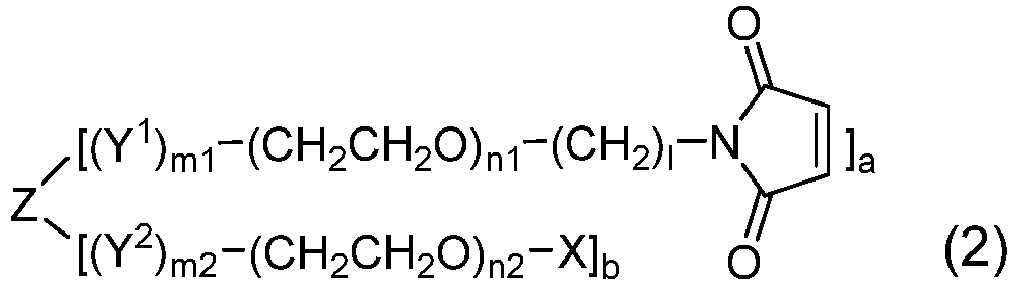
- Z, Y1, Y2, X, m1, m2, n1, n2, l, a and b in the formula (2) are the same as in the general formula (1) described above.
- The silica gel to be used in the production method of the present invention is a spherical or crushed silicon dioxide.
- The average particle size of the silica gel is not limited particularly, and is preferably from 5 to 425 µm, more preferably from 50 to 150 µm.
- The average pore size of the silica gel is not limited particularly, and is preferably from 2 to 15 nm, more preferably from 6 to 13 nm.
- The average pore volume of the silica gel is not limited particularly, and is preferably from 0.5 to 1.5 mL/g, more preferably from 0.6 to 1.2 mL/g.
- The specific surface area of the silica gel is not limited particularly, and is preferably from 200 to 800 m2/g, more preferably from 250 to 550 m2/g.
- When the average particle size, the average pore size, the pore volume and the specific surface area are not less than the respective lower limits of the above-described numeral ranges, the reaction efficiency is enhanced, and when they are not more than the respective upper limits of the above-described numeral ranges, the amount of the aimed product extracted from the residue obtained by filtering out the silica gel is increased to improve the productivity.
- The average particle size of the silica gel is a value measured according to a laser diffraction particle size distribution measuring method. The average pore size, the average pore volume and the specific surface area of the silica gel are those measured according to a nitrogen gas adsorption method. Incidentally, the specific surface area is the value calculated according to BET isotherm expression.
- The amount to be used of the silica gel is preferably from 0.1 to 5 times by weight, particularly preferably from 1 to 3 times by weight with respect to the maleimide PEG derivative having a protective group represented by the general formula (1) (Compound 1). When the used amount of the silica gel is not lower than these lower limits, it is easy to restrain deterioration of the maleimide group, and when the used amount of the silica gel is not more than the upper limits, it is easy to stir the reaction liquid.
- The reaction to perform the deprotection according to the present invention is carried out in a solvent by heating. The temperature of the solvent at heating in the present invention (i.e., the reaction temperature) is preferably from 70 to 150°C, above all, particularly preferably from 100 to 120°C. When the temperature of the solvent is not less than the lower limit, the reaction easily proceeds, and when the temperature of the solvent is not more than the upper limit, the deterioration of the maleimide group is easily restrained.
- The solvent to be used in the present invention is aprotic and is not limited particularly as long as the solvent has a boiling temperature which is not less than a temperature comparable to the reaction temperature, and is preferably toluene or p-xylene. The amount of the solvent to be used is preferably from 3 to 50 times by weight, more preferably from 5 to 20 times by weight with respect to the maleimide polyethylene glycol derivative having a protective group represented by the general formula (1) (Compound 1). When the used amount of the solvent is not less than the lower limits, it is easy to stir the reaction liquid, and when the used amount of the solvent is not more than the upper limits, the economic efficiency is enhanced.
- The reaction time in the present invention is generally from 2 to 8 hours, while it depends on kinds or amount of the raw materials and solvent used.
- In the following, the present invention is illustrated more specifically based on the examples. In the examples, the analysis on the maleimidization rate was carried out with NMR.
- For the analysis with 1H-NMR, JNM-ECP400 and JNM-ECA600, manufactured by JEOL Ltd., were used. The integrated value regarding the values measured with NMR measurement is a theoretical value.
- According to the following production examples (1-1) to (1-3), a maleimide polyethylene glycol derivative having a protective group (A) (molecular weight: 5,000) was produced.

- Into a 9-ml screw tube, 157.1 mg (1.61 mmol) of maleimide, 1.5 g of methyl t-butyl ether, and 876.7 mg (12.88 mmol) of furan were added, and the reaction was performed at 30°C for 8 hours under a nitrogen atmosphere. Then, the resulting reaction liquid was allowed to cool down to room temperature, and the precipitated crystals were filtered out and dried, thus obtaining the following maleimide protective body (B) (122.9 mg, 0.74 mmol).

- Into a 200-ml round-bottom flask equipped with a thermometer, a nitrogen-blowing tube, and a stirrer, 24 g (0.8 mol) of dehydrated methanol, and 0.563 g (24 mmol: 16 mol%) of metallic sodium were added, and the resulting mixture was stirred at room temperature while blowing nitrogen thereinto until the metallic sodium dissolved. The resulting solution was charged in a 5L-autoclave, and the inside of the system was replaced by nitrogen, the temperature was raised to 80°C, 2300g (52.3 mol) of ethylene oxide was added at 100 to 150°C and a pressure of 0.5 MPa or less, and the reaction was further performed for one hour. Then, the unreacted ethylene oxide gas was removed under reduced pressure, the temperature was cooled to 60°C, and the pH was adjusted to 7.5 with a 85% aqueous solution of phosphoric acid, thus obtaining the following Compound (C).
H3CO-(CH2CH2O)n-(CH2)2-OH (C)
n=115 - Into a 20 ml-screw tube, 2.00 g (0.40 mmol) of the Compound (C), 3.5 g of dehydrated toluene, 10 g of chloroform, 231.2 mg (1.40 mmol) of the maleimide protective body (B), 1.41 g (5.40 mmol) of triphenyl phosphine, and 1.09 g (5.40 mmol) of diisopropyldiazocarboxylate were charged, and the reaction was performed at room temperature for one hour under a nitrogen atmosphere. After the reaction, 10.0 mg of methanol was added thereto, and the resultant was concentrated at 50°C. The precipitated crystals were dissolved in 10 g of ethyl acetate at 40°C while heating, and then 8 g of hexane was added thereto to perform crystallization. The precipitated crystals were filtered out, and a mixed solvent of 6 g of hexane and 12 g of ethyl acetate was added to the obtained precipitated crystals. This operation was repeated 4 times, the precipitated crystals were dissolved in 12 g of ethyl acetate at 40°C while heating, and then 6 g of hexane was added thereto, and crystallization was performed again. Finally, the generated crystals were washed with 8 g of hexane, and dried, thus obtaining the following maleimide polyethylene glycol derivative (A) having a protective group (1.35 g, 0.27 mmol).
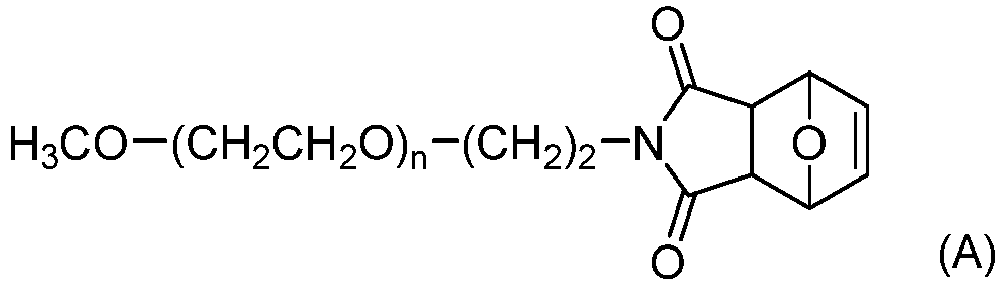
- A maleimide PEG derivative (D) having a protective group (molecular weight: 20,000) was produced in the same manner as in the above-described Production Examples (1-1) to (1-3) except for changing the charged amount of ethylene oxide in Production Example 1-2 to adjust the molecular weight.

- According to the following Production Examples (2-1) to (2-7), a maleimide polyethylene glycol derivative (E) having a protective group (molecular weight: 10,000) was produced.

- Into a 9-ml screw tube, 157.1 mg (1.61 mmol) of maleimide, 1.5 g of methyl t-butyl ether, and 877.7 mg (10.68 mmol) of 2-methylfuran were added, and the reaction was performed at 30°C for 8 hours under a nitrogen atmosphere. Then, the resulting reaction liquid was allowed to cool down to room temperature, and the precipitated crystals were filtered out and dried, thus obtaining the following maleimide protective body (F) (86.4 mg, 0.48 mmol).

- Into a 1000-ml round-bottom flask equipped with a thermometer, a nitrogen-blowing tube, and a stirrer, 132.2 g (1.0 mol) of 2,2-dimethyl-1,3-dioxolane-4-methanol, 231.4 g (1.2 mmol) of a 28% methanol solution of sodium methoxide, and 500 ml of toluene were added, and the toluene was refluxed under reduced pressure for one hour while blowing nitrogen thereinto to distill away the methanol. While the temperature of the resulting solution was maintained at 80°C, 126.6 g (1.0 mol) of benzyl chloride was added dropwise over 2 hours by using a dropping funnel, and for another 2 hours, the reaction was performed. The resulting reaction liquid was desolvated and purified by distillation (b.p. 93 to 95°C/266 Pa) to thereby obtain 4-(benzoxymethyl)-2,2-dimethyl-1,3-dioxolane (G).

- 222 g (1.0 mol) of the 4-(benzoxymethyl)-2,2-dimethyl-1,3-dioxolane (G), 250 ml of ethanol, and 400 ml of distilled water were measured and put into a 1-L beaker, and the pH of the resulting solution was adjusted to 2.0 with phosphoric acid. The solution was heated up to 70°C while blowing nitrogen thereinto, the reaction was performed for 1.5 hours, the pH was adjusted to 7.0 with sodium hydroxide, the salts were subjected to adsorption treatment with Kyowaad 1000 (manufactured by Kyowa Chemical Industry Co., Ltd.), and desolvation was performed, thus obtaining 3-benzyloxy-1,2-propanediol (H).

- Into a 300-ml round-bottom flask equipped with a thermometer, a nitrogen-blowing tube, and a stirrer, 27.3 g (0.15 mol) of the 3-benzyloxy-1,2-propanediol (H), 127 g (1.2 mol) of dehydrated toluene, and 0.9 g (39 mmol: 26 mol%) of metallic sodium were added, and the resulting solution was stirred at room temperature while blowing nitrogen thereinto until the metallic sodium dissolved. The resulting solution was charged in a 5-L autoclave, the inside of the system was replaced by nitrogen, the temperature was raised to 100°C, 1473 g (33.5 mol) of ethylene oxide was added at 100 to 150°C and a pressure of 1 MPa or less, and the reaction was further continued for 1 hour. The unreacted ethylene oxide gas was removed at reduced pressure, and the resulting solution was cooled to 60°C, and the pH was adjusted to 7.5 with a 85% aqueous solution of phosphoric acid, thus obtaining the following compound (I).

- Into a 500-ml round-bottom flask equipped with a thermometer, a nitrogen-blowing tube, a stirrer, a Dean-Stark tube, and a cooling tube, 100 g (10 mmol) of the above Compound (I) and 320 g of toluene were charged, heat reflux was performed, and the moisture content was removed with azeotropy. The contents were cooled to room temperature, 10.12 g (100 mmol) of triethylamine and 6.87 g (60 mmol) of methanesulfonyl chloride were added thereto, and the reaction was performed at 40°C for 6 hours. The reaction liquid was filtrated, and the resulting filtrate was transferred into a 500-ml round-bottom flask equipped with a thermometer, a nitrogen-blowing tube, a stirrer, and a cooling tube, and 19.3 g (100 mmol) of a 28% methanol solution of sodium methoxide was added thereto, and the reaction was performed at 70°C for 6 hours. Subsequently, 27 g of Kyowaad 700 (manufactured by Kyowa Chemical Industry Co., ltd.) was added to the reaction liquid, the resulting reaction liquid was further stirred for one hour at 70°C to subject the excessive sodium methoxide to adsorption treatment, the reaction liquid was filtrated, the filtrate was charged in a 1-L beaker, 300 g of ethyl acetate and 350 g of hexane were added thereto, and crystallization was performed. The precipitated crystals were filtered out into a 1-L beaker, and ethyl acetate was added thereto, the resulting solution was heated at 40°C such that the crystals dissolved, 300 g of hexane was added thereto, and crystallization was performed again. The precipitated crystals were filtered out and dried, thus obtaining the following Compound (J).

- Into a 500-ml round-bottom flask equipped with a thermometer, a nitrogen-blowing tube, a stirrer, and a cooling tube, 15 g of the above Compound (J) and 15 g of 5% palladium carbon (50% hydrous product) were charged, and after replacement by nitrogen, 300 ml of methanol and 150 ml of cyclohexene were added thereto, the temperature was increased, and the contents were slowly refluxed at 52 to 55°C to perform the reaction for 5 hours. The resulting reaction liquid was cooled to room temperature, the palladium carbon was filtered out with filtration, and the filtrate was concentrated. To the concentrated liquid, 50 ml of ethyl acetate and 50 ml of hexane were added to perform crystallization. The obtained crystals were filtered out and dried, thus obtaining the following Compound (K).

- Into a 20-ml screw tube, 2.0 g (0.20 mmol) of Compound (K), 3.5 g of dehydrated toluene, 10 g of chloroform, 125.4 mg (0.70 mmol) of the maleimide protective body (F), 708.2 mg (2.70 mmol) of triphenylphophine, and 546.0 mg (2.70 mmol) of diisopropyldiazodicarboxylate were charged, and the reaction was performed for one hour at room temperature under a nitrogen atmosphere. After the reaction, 10.0 mg of methanol was added thereto, and the resulting reaction liquid was concentrated at 50°C. The precipitated crystals were dissolved in 10 g of ethyl acetate at 40°C while heating, and 8 g of hexane was added thereto to perform crystallization. The precipitated crystals were filtered out and a mixed solution of 6 g of hexane and 12 g of ethyl acetate were added to the obtained crystals. This operation was repeated 4 times, the precipitated crystals were dissolved in 12 g of ethyl acetate at 40°C while heating, and then 6 g of hexane was added thereto, and crystallization was performed again. Finally, the generated crystals were washed with 8 g of hexane and dried, thus obtaining the following maleimide polyethylene glycol derivative (E) having a protective group (1.30 g, 0.13 mmol).

- According to the following production examples (3-1) to (3-3), a maleimide polyethylene glycol derivative (L) having a protective group (molecular weight: 40,000) was produced.

- Into a 9-ml screw tube, 386.9 mg (3.99 mmol) of maleimide, 3.7 g of methyl t-butyl ether, and 3.09 mg (32.14 mmol) of 2,5-dimethylfuran were added, and the reaction was performed for 8 hours at 50°C under a nitrogen atmosphere. Then, the resulting reaction liquid was allowed to cool down to room temperature, and the precipitated crystals were filtered out and dried, thus obtaining the following maleimide protective body (M) (522.3 mg, 2.70 mmol).

- Into a 1000-ml round-bottom flask equipped with a thermometer, a nitrogen-blowing tube, and a stirrer, 24.5 g (0.18 mol) of pentaerithritol, 420 g (4.6 mol) of dehydrated toluene, and 2.5 g (109 mmol: 73 mol%) of metallic sodium were add, and the resulting mixture was stirred at room temperature while blowing nitrogen thereinto until the metallic sodium dissolved. The resulting solution was charged in a 5-L atuoclave, the inside of the system was replaced by nitrogen, the temperature was raised to 100°C, 896 g (20.3 mol) of ethylene oxide was added thereto at 100 to 150°C and a pressure of 1MPa or less, and then the reaction was further continued for one hour. After unreacted ethylene oxide gas was removed at reduced pressure, the resulting solution was cooled to 60°C, and the pH was adjusted to 7.5 with a 85% aqueous solution of phosphoric acid, thus obtaining the following Compound (N).

- Into a 20-ml screw tube, 2.0 g (0.050 mmol) of the Compound (N), 3.5 g of dehydrated toluene, 10 g of chloroform, 31.4 mg (0.175 mol) of the maleimide protective body (M), 177.0 mg (0.675 mmol) of triphenylphosphine, and 136.5 mg (0.675 mmol) of diisopropyldiazodicarboxylate were charged, and the reaction was performed for one hour at room temperature under a nitrogen atmosphere. After the reaction, 10.0 mg of methanol was added thereto, and the resulting reaction solution was concentrated at 50°C. The precipitated crystals were dissolved in 10 g of ethyl acetate at 40°C while heating, and 8 g of hexane was added thereto to perform crystallization. The precipitated crystals were filtered out, and a mixed solvent of 6 g of hexane and 12 g of ethyl acetate was added thereto. This operation was repeated 4 times, the precipitated crystals were dissolved in 12 g of ethyl acetate at 40°C while heating, and then 8 g of hexane was added thereto, and crystallization was performed again. Finally, the generated crystals were washed with 8 g of hexane and dried, thus obtaining the following maleimide polyethylene glycol derivative (L) having a protective group (1.28 g, 0.032 mmol).

- Into a 100-mL side-arm test tube, 200 mg (0.04 mmol) of the maleimide polyethylene glycol derivative (A) having a protective group, 10 g of toluene, and 200 mg of silica gel (PSQ 100B, manufactured by Fuji Sylisia Ltd.) were added, and the reaction was performed at 110°C for 5 hours under a nitrogen atmosphere. The reaction liquid was subjected to decantation, and then, the aimed product was extracted from the silica gel with 4 g of methanol twice. The reaction liquid and the extraction liquid were transferred into a 50-mL egg-plant flask, and concentrated to dryness, followed by vacuum drying for 6 hours, thus obtaining a maleimide polyethylene glycol derivative (O) (yield: 189.5 mg, 0.037 mmol, yield rate: 96%, maleimidization rate: 97%). The silica gel (PSQ100B, manufactured by Fuji Sylisia Ltd.) used in the present example has an average particle size of 100 µm, an average pore size of 7 nm, a pore volume of 0.8 mL/g and a specific surface area of 500 m2/g.

- In the 1H-NMR of the maleimide polyethylene glycol derivative (O) obtained in Example 1, any peaks at 6.51 ppm and 6.42 ppm, which are derived from the maleimide polyethylene glycol derivative (A) having a protective group, were not present, and therefore, it was confirmed that the deprotection was complete. The integrated value of the peak at 6.71 ppm, which is derived from the vinyl proton of the maleimide group, was 1.94, and therefore, it was confirmed that the aimed maleimide polyethylene glycol derivative represented by the formula (2) was obtained at a maleimidization rate of 97%.
- Into a 100-mL side-arm test tube, 200 mg (0.01 mmol) of the maleimide polyethylene glycol derivative (D) having a protective group, 10 g of toluene, and 200 mg of silica gel (PSQ 100B, manufactured by Fuji Sylisia Ltd.) were added, and the reaction was performed at 110°C for 5 hours under a nitrogen atmosphere. The reaction liquid was subjected to decantation, and then, the aimed product was extracted from the silica gel with 4 g of methanol twice. The reaction liquid and the extraction liquid were transferred into a 50-mL egg-plant flask, and concentrated to dryness, followed by vacuum drying for 6 hours, thus obtaining a maleimide polyethylene glycol derivative (P) (yield: 191.4 mg, 0.0095 mmol, yield rate: 96%, maleimidization rate: 97%). The silica gel (PSQ100B, manufactured by Fuji Sylisia Ltd.) used in the present example has an average particle size of 100 µm, an average pore size of 7 nm, a pore volume of 0.8 mL/g and a specific surface area of 500 m2/g.

- In the 1H-NMR of the maleimide polyethylene glycol derivative (P) obtained in Example 2, any peaks at 6.51 ppm and 6.42 ppm, which are derived from the maleimide polyethylene glycol derivative (D) having a protective group, were not present, and therefore, it was confirmed that the deprotection was complete. The integrated value of the peak at 6.71 ppm, which is derived from the vinyl proton of the maleimide group, was 1.94, and therefore, it was confirmed that the aimed maleimide polyethylene glycol derivative (P) represented by the formula (2) was obtained at a maleimidization rate of 97%.
- Into a 100-mL side-arm test tube, 200 mg (0.02 mmol) of the maleimide polyethylene glycol derivative (E) having a protective group, 10 g of toluene, and 200 mg of silica gel (PSQ 100B, manufactured by Fuji Sylisia Ltd.) were added, and the reaction was performed at 110°C for 5 hours under a nitrogen atmosphere. The reaction liquid was subjected to decantation, and then, the aimed product was extracted from the silica gel with 4 g of methanol twice. The reaction liquid and the extraction liquid were transferred into a 50-mL egg-plant flask, and concentrated to dryness, followed by vacuum drying for 6 hours, thus obtaining a maleimide polyethylene glycol derivative (Q) (yield: 188.3 mg, 0.019 mmol, yield rate: 95%, maleimidization rate: 96%). The silica gel (PSQ100B, manufactured by Fuji Sylisia Ltd.) used in the present example has an average particle size of 100 µm, an average pore size of 7 nm, a pore volume of 0.8 mL/g and a specific surface area of 500 m2/g.

- In the 1H-NMR of the maleimide polyethylene glycol derivative (Q) obtained in Example 3, any peaks at 6.55 ppm, 6.41 ppm, 6.35 ppm, and 6.24 ppm, which are derived from the maleimide polyethylene glycol derivative (E) having a protective group, were not present, and therefore, it was confirmed that the deprotection was complete. The integrated value of the peak at 6.71 ppm, which is derived from the vinyl proton of the maleimide group, was 1.92, and therefore, it was confirmed that the aimed maleimide polyethylene glycol derivative (Q) represented by the formula (2) was obtained at a maleimidization rate of 96%.
- Into a 100-mL side-arm test tube, 200 mg (0.005 mmol) of the maleimide polyethylene glycol derivative (L) having a protective group, 10 g of toluene, and 200 mg of silica gel (PSQ 100B, manufactured by Fuji Sylisia Ltd.) were added, and the reaction was performed at 110°C for 5 hours under a nitrogen atmosphere. The reaction liquid was subjected to decantation, and then, the aimed product was extracted from the silica gel with 4 g of methanol twice. The reaction liquid and the extraction liquid were transferred into a 50-mL egg-plant flask, and concentrated to dryness, followed by vacuum drying for 6 hours, thus obtaining a maleimide polyethylene glycol derivative (R) (yield: 194.0 mg, 0.0048 mmol, yield rate: 98%, maleimidization rate: 96%). The silica gel (PSQ100B, manufactured by Fuji Sylisia Ltd.) used in the present example has an average particle size of 100 µm, an average pore size of 7 nm, a pore volume of 0.8 mL/g and a specific surface area of 500 m2/g.

- In the 1H-NMR of the maleimide polyethylene glycol derivative (R) obtained in Example 4, any peaks at 6.35 ppm and 6.23 ppm, which are derived from the maleimide polyethylene glycol derivative (L) having a protective group, were not present, and therefore, it was confirmed that the deprotection was complete. The integrated value of the peak at 6.71 ppm, which is derived from the vinyl proton of the maleimide group, was 1.92, and therefore, it was confirmed that the aimed maleimide PEG derivative (R) represented by the formula (2) was obtained at a maleimidization rate of 96%.
- Into a 100-mL three-necked round-bottom flask, 200 mg (0.04 mmol) of the maleimide polyethylene glycol derivative (A) having a protective group, and 10 g of toluene were added, and the reaction was performed at 110°C for 5 hours under a nitrogen atmosphere. The reaction liquid was transferred into a 50-mL egg-plant flask, and concentrated to dryness, followed by vacuum drying for 6 hours, thus obtaining a maleimide polyethylene glycol derivative (O) (yield: 195.4 g, 0.038 mmol, yield rate: 99%, maleimidization rate: 85%).
- In the 1H-NMR of the maleimide polyethylene glycol derivative (O) obtained in Comparative Example 1, any peaks in a range of 6.51 ppm and 6.42 ppm, which are derived from the maleimide polyethylene glycol derivative (A) having a protective group, were not present, and therefore, it was confirmed that the deprotection was complete. The integrated value of the peak at 6.71 ppm, which is derived from the vinyl proton of the maleimide group, was 1.70, and therefore, it was confirmed that the aimed maleimide PEG derivative (O) represented by the formula (2) was obtained at a maleimidization rate of 85%.
- Into a 100-mL side-arm test tube, 150 mg (0.0037 mmol) of the maleimide PEG derivative (L) having a protective group, 7.5 g of toluene, and 150 mg of Kyowaad 2000 (a solid solution of aluminum oxide and magnesium oxide, manufactured by Kyowa Chemical Industry Co., ltd.) were added, and the reaction was performed at 110°C for 5 hours under a nitrogen atmosphere. The reaction liquid was subjected to decantation, and then, the aimed product was extracted with 3 g of methanol twice. The reaction liquid and the extraction liquid were transferred into a 50-mL egg-plant flask, and concentrated to dryness, followed by vacuum drying for 6 hours, thus obtaining a maleimide polyethylene glycol derivative (R) (yield: 87.5 mg, 0.0021 mmol, yield rate: 59%, maleimidization rate: 65%).
- In the 1H-NMR of the maleimide polyethylene glycol derivative (R) obtained in Comparative Example 2, any peaks in a range of 6.35pm and 6.23 ppm, which are derived from the maleimide polyethylene glycol derivative (L) having a protective group, were not present, and therefore, it was confirmed that the deprotection was complete. The integrated value of the peak at 6.71 ppm, which is derived from the vinyl proton of the maleimide group, was 1.30, and therefore, it was confirmed that the aimed maleimide polyethylene glycol derivative (R) represented by the formula (2) was obtained at a maleimidization rate of 65%.
- As described above, a method of producing a maleimide polyethylene glycol derivative at a high maleimidization rate can be provided by heating a maleimide polyethylene glycol derivative having a protective group in a solvent in the presence of silica gel.
Claims (6)
- A method for producing a maleimide polyethylene glycol derivative represented by the following general formula (2), comprising a reaction step of heating a maleimide polyethylene glycol derivative having a protective group represented by the following general formula (1), in a solvent in the presence of silica gel to cause deprotection:

 wherein R1, R2, R3, and R4 each independently represents a group selected from a hydrogen atom, an alkyl group, a halogen atom, a cyano group, a formyl group, an acyl group, a carboxy group, an acyloxy group, and an alkylcarbonyloxymethyl group,Z is a residue obtained by removing active hydrogen groups from a compound having 2 to 5 active hydrogen groups,Y1 and Y2 each independently represents a single bond, an ether bond, an amide bond, an ester bond, a urethane bond, a carbonate bond, a thioether bond, a disulfide bond, a thioester bond, or an alkylene group containing any of them,W is a group selected from an ether group, a methylene group and a dimethylvinylidene group,X is a hydrocarbon group having 1 to 7 carbon atoms, a protective group for a hydroxy group, a protective group for a carboxy group, a protective group for a thiol, a cyano group, or an alkylene group containing any of them,m 1 and m2 each independently is 1 or 0,n1 represents the number of repeating units of the polyethylene glycol and is an integer of 0 or 10 to 2000,n2 represents the number of repeating units of the polyethylene glycol and is an integer of 10 to 2000,1 represents the number of repeating units of the methylene group and is an integer of 0 or 2 to 10,a is an integer of 1 to 5, b is an integer of 0 to 4, and the sum of a and b is an integer of 2 to 5.
 - The production method according to claim 1, wherein R1, R2, R3, and R4 in the general formula (1) each independently is a hydrogen atom or an alkyl group.
- The production method according to claim 1 or 2, wherein W in the general formula (1) is an ether group.
- The production method according to any of claims 1 to 3, wherein, in the general formulae (1) and (2), Z is a residue obtained by removing active hydrogen groups from a compound having 2 active hydrogen groups, m1 and m2 each is 1, n1 and n2 each is an integer of 10 to 2000, 1 is 2, and a and b each is 1.
- The production method according to any of claims 1 to 3, wherein, in the general formulae (1) and (2), Z is a residue obtained by removing active hydrogen groups from a compound having 3 active hydrogen groups, m1 is 0, m2 is 1, n1 is 0, n2 is an integer of 10 to 2000, 1 is 0, a is 1, and b is 2.
- The production method according to any of claims 1 to 3, wherein, in the general formulae (1) and (2), Z is a residue obtained by removing active hydrogen groups from a compound having 4 active hydrogen groups, m1 is 1, n1 is from 10 to 2000, 1 is 2, a is 4, and b is 0.
Applications Claiming Priority (2)
| Application Number | Priority Date | Filing Date | Title |
|---|---|---|---|
| JP2020207847 | 2020-12-15 | ||
| PCT/JP2021/045098 WO2022131098A1 (en) | 2020-12-15 | 2021-12-08 | Method for producing maleimide polyethylene glycol derivative |
Publications (3)
| Publication Number | Publication Date |
|---|---|
| EP4265667A1 true EP4265667A1 (en) | 2023-10-25 |
| EP4265667A4 EP4265667A4 (en) | 2024-12-04 |
| EP4265667B1 EP4265667B1 (en) | 2025-07-23 |
Family
ID=82057776
Family Applications (1)
| Application Number | Title | Priority Date | Filing Date |
|---|---|---|---|
| EP21906461.5A Active EP4265667B1 (en) | 2020-12-15 | 2021-12-08 | Method for producing maleimide polyethylene glycol derivative |
Country Status (5)
| Country | Link |
|---|---|
| US (1) | US12595336B2 (en) |
| EP (1) | EP4265667B1 (en) |
| JP (1) | JP7782463B2 (en) |
| CN (1) | CN116670202B (en) |
| WO (1) | WO2022131098A1 (en) |
Families Citing this family (1)
| Publication number | Priority date | Publication date | Assignee | Title |
|---|---|---|---|---|
| CN119463232B (en) * | 2024-10-12 | 2025-08-15 | 广东纵胜新材料股份有限公司 | Glass fiber reinforced bulk molding compound and preparation method thereof |
Family Cites Families (8)
| Publication number | Priority date | Publication date | Assignee | Title |
|---|---|---|---|---|
| JPS61122241A (en) * | 1984-11-15 | 1986-06-10 | Kawasaki Steel Corp | Production of tetrahydroanthraquinone compound |
| JP2000191639A (en) * | 1998-12-28 | 2000-07-11 | Mitsubishi Paper Mills Ltd | Novel production method of maleimide compound |
| US7790835B2 (en) * | 2003-12-03 | 2010-09-07 | Nektar Therapeutics | Method of preparing maleimide functionalized polymers |
| KR101051543B1 (en) * | 2007-11-27 | 2011-07-22 | 주식회사 엘지화학 | Manufacturing method of N-substituted maleimide |
| US8816099B2 (en) | 2010-03-31 | 2014-08-26 | Nof Corporation | Polyfunctional polyoxyalkylene compound, and producing method and intermediate thereof |
| JP5949037B2 (en) * | 2011-03-30 | 2016-07-06 | 日油株式会社 | Polyoxyethylene derivatives having multiple hydroxyl groups at the ends |
| JP7042053B2 (en) * | 2016-10-07 | 2022-03-25 | 国立大学法人東京工業大学 | Branched heteromonodisperse polyethylene glycol, its production method, and its conjugate |
| JP7474056B2 (en) | 2020-01-10 | 2024-04-24 | 日本板硝子株式会社 | Optical Filters |
-
2021
- 2021-12-08 EP EP21906461.5A patent/EP4265667B1/en active Active
- 2021-12-08 JP JP2022569909A patent/JP7782463B2/en active Active
- 2021-12-08 WO PCT/JP2021/045098 patent/WO2022131098A1/en not_active Ceased
- 2021-12-08 US US18/256,951 patent/US12595336B2/en active Active
- 2021-12-08 CN CN202180082299.8A patent/CN116670202B/en active Active
Also Published As
| Publication number | Publication date |
|---|---|
| EP4265667B1 (en) | 2025-07-23 |
| US20240043613A1 (en) | 2024-02-08 |
| CN116670202A (en) | 2023-08-29 |
| EP4265667A4 (en) | 2024-12-04 |
| WO2022131098A1 (en) | 2022-06-23 |
| JP7782463B2 (en) | 2025-12-09 |
| CN116670202B (en) | 2025-12-23 |
| JPWO2022131098A1 (en) | 2022-06-23 |
| US12595336B2 (en) | 2026-04-07 |
Similar Documents
| Publication | Publication Date | Title |
|---|---|---|
| EP3524631B1 (en) | Branched type hetero monodispersed polyethylene glycol, production method thereof, and conjugate thereof | |
| CN104497298B (en) | Method for preparing polyether polyol with low degree of unsaturation, high molecular weight and high activity | |
| EP4265667B1 (en) | Method for producing maleimide polyethylene glycol derivative | |
| EP4353680A1 (en) | Surface-modified nanoparticle | |
| WO2006025226A1 (en) | Polyglycerol monoethers and process for production thereof | |
| KR20080103536A (en) | Process for producing alkoxypolyoxyalkylene (meth) acrylate | |
| JPS61155391A (en) | Manufacture of stabilizer for polymer | |
| Vazifehasl et al. | Synthesis and characterization of novel diglycidyl methacrylate-based macromonomers on isosorbide for dental composites | |
| CN103467525A (en) | Method for preparing hexa(4-carboxylphenoxy)cyclotriphosphazene by hydrogen peroxide oxidation | |
| JP5460840B2 (en) | Polymer obtained from betulin and process for producing the same | |
| Malik et al. | Hydrogen phosphates: Self initiated organocatalysts for the controlled ring-opening polymerization of cyclic esters | |
| CN114716659B (en) | Method for preparing nitrogen-containing polymer through click polymerization without catalyst | |
| EP3778703B1 (en) | Method for purifying trityl group-containing monodispersed polyethylene glycol | |
| JP2010090385A (en) | Polymer obtained from betuline, and method of manufacturing the same | |
| WO2018189016A1 (en) | Low volatile organic anti-oxidation stabilisers for polymeric systems, their production and use | |
| Gowda et al. | Aryloxy and benzyloxy compounds of zirconium: Synthesis, structural characterization and studies on solvent-free ring-opening polymerization of ɛ-caprolactone and δ-valerolactone | |
| CN107541530A (en) | One kind is containing double tellurium biodegradable polymers and preparation method thereof | |
| Karpus et al. | Useful synthetic pathways to original, stable tunable neutral and anionic phosphorus dendrimers: new opportunities to expand dendrimer space | |
| Liu et al. | Syntheses of phosphorylcholine-substituted silsesquioxanes via thiol-ene ‘click’reaction | |
| EP4219592A1 (en) | Method for producing maleimide polyethylene glycol lipid | |
| Kitschke et al. | Spirocyclic tin salicyl alcoholates–a combined experimental and theoretical study on their structures, 119 Sn NMR chemical shifts and reactivity in thermally induced twin polymerization | |
| KR102731878B1 (en) | Cationic lipid and method for preparing the same | |
| EP2298781A1 (en) | Method for producing novel sulfur-containing organosilicon compound | |
| JP5312882B2 (en) | Method for producing monobenzyl ether of glycerin and / or glycerin polymer | |
| Nicol et al. | Synthesis of ω-mercapto-poly (alkylene oxide) by the Mitsunobu reaction |
Legal Events
| Date | Code | Title | Description |
|---|---|---|---|
| STAA | Information on the status of an ep patent application or granted ep patent |
Free format text: STATUS: THE INTERNATIONAL PUBLICATION HAS BEEN MADE |
|
| PUAI | Public reference made under article 153(3) epc to a published international application that has entered the european phase |
Free format text: ORIGINAL CODE: 0009012 |
|
| STAA | Information on the status of an ep patent application or granted ep patent |
Free format text: STATUS: REQUEST FOR EXAMINATION WAS MADE |
|
| 17P | Request for examination filed |
Effective date: 20230615 |
|
| AK | Designated contracting states |
Kind code of ref document: A1 Designated state(s): AL AT BE BG CH CY CZ DE DK EE ES FI FR GB GR HR HU IE IS IT LI LT LU LV MC MK MT NL NO PL PT RO RS SE SI SK SM TR |
|
| DAV | Request for validation of the european patent (deleted) | ||
| DAX | Request for extension of the european patent (deleted) | ||
| A4 | Supplementary search report drawn up and despatched |
Effective date: 20241105 |
|
| RIC1 | Information provided on ipc code assigned before grant |
Ipc: C08G 65/333 20060101AFI20241029BHEP |
|
| GRAP | Despatch of communication of intention to grant a patent |
Free format text: ORIGINAL CODE: EPIDOSNIGR1 |
|
| STAA | Information on the status of an ep patent application or granted ep patent |
Free format text: STATUS: GRANT OF PATENT IS INTENDED |
|
| INTG | Intention to grant announced |
Effective date: 20250313 |
|
| P01 | Opt-out of the competence of the unified patent court (upc) registered |
Free format text: CASE NUMBER: APP_19915/2025 Effective date: 20250425 |
|
| GRAS | Grant fee paid |
Free format text: ORIGINAL CODE: EPIDOSNIGR3 |
|
| GRAA | (expected) grant |
Free format text: ORIGINAL CODE: 0009210 |
|
| STAA | Information on the status of an ep patent application or granted ep patent |
Free format text: STATUS: THE PATENT HAS BEEN GRANTED |
|
| AK | Designated contracting states |
Kind code of ref document: B1 Designated state(s): AL AT BE BG CH CY CZ DE DK EE ES FI FR GB GR HR HU IE IS IT LI LT LU LV MC MK MT NL NO PL PT RO RS SE SI SK SM TR |
|
| REG | Reference to a national code |
Ref country code: GB Ref legal event code: FG4D |
|
| REG | Reference to a national code |
Ref country code: CH Ref legal event code: EP |
|
| REG | Reference to a national code |
Ref country code: IE Ref legal event code: FG4D |
|
| REG | Reference to a national code |
Ref country code: DE Ref legal event code: R096 Ref document number: 602021034864 Country of ref document: DE |
|
| REG | Reference to a national code |
Ref country code: NL Ref legal event code: MP Effective date: 20250723 |
|
| PG25 | Lapsed in a contracting state [announced via postgrant information from national office to epo] |
Ref country code: PT Free format text: LAPSE BECAUSE OF FAILURE TO SUBMIT A TRANSLATION OF THE DESCRIPTION OR TO PAY THE FEE WITHIN THE PRESCRIBED TIME-LIMIT Effective date: 20251124 |
|
| PG25 | Lapsed in a contracting state [announced via postgrant information from national office to epo] |
Ref country code: NL Free format text: LAPSE BECAUSE OF FAILURE TO SUBMIT A TRANSLATION OF THE DESCRIPTION OR TO PAY THE FEE WITHIN THE PRESCRIBED TIME-LIMIT Effective date: 20250723 |
|
| REG | Reference to a national code |
Ref country code: AT Ref legal event code: MK05 Ref document number: 1816395 Country of ref document: AT Kind code of ref document: T Effective date: 20250723 |
|
| REG | Reference to a national code |
Ref country code: CH Ref legal event code: U11 Free format text: ST27 STATUS EVENT CODE: U-0-0-U10-U11 (AS PROVIDED BY THE NATIONAL OFFICE) Effective date: 20260101 |
|
| PG25 | Lapsed in a contracting state [announced via postgrant information from national office to epo] |
Ref country code: IS Free format text: LAPSE BECAUSE OF FAILURE TO SUBMIT A TRANSLATION OF THE DESCRIPTION OR TO PAY THE FEE WITHIN THE PRESCRIBED TIME-LIMIT Effective date: 20251123 |
|
| PGFP | Annual fee paid to national office [announced via postgrant information from national office to epo] |
Ref country code: GB Payment date: 20251223 Year of fee payment: 5 |
|
| PG25 | Lapsed in a contracting state [announced via postgrant information from national office to epo] |
Ref country code: NO Free format text: LAPSE BECAUSE OF FAILURE TO SUBMIT A TRANSLATION OF THE DESCRIPTION OR TO PAY THE FEE WITHIN THE PRESCRIBED TIME-LIMIT Effective date: 20251023 |
|
| REG | Reference to a national code |
Ref country code: LT Ref legal event code: MG9D |
|
| PG25 | Lapsed in a contracting state [announced via postgrant information from national office to epo] |
Ref country code: AT Free format text: LAPSE BECAUSE OF FAILURE TO SUBMIT A TRANSLATION OF THE DESCRIPTION OR TO PAY THE FEE WITHIN THE PRESCRIBED TIME-LIMIT Effective date: 20250723 |
|
| PG25 | Lapsed in a contracting state [announced via postgrant information from national office to epo] |
Ref country code: FI Free format text: LAPSE BECAUSE OF FAILURE TO SUBMIT A TRANSLATION OF THE DESCRIPTION OR TO PAY THE FEE WITHIN THE PRESCRIBED TIME-LIMIT Effective date: 20250723 |
|
| PG25 | Lapsed in a contracting state [announced via postgrant information from national office to epo] |
Ref country code: HR Free format text: LAPSE BECAUSE OF FAILURE TO SUBMIT A TRANSLATION OF THE DESCRIPTION OR TO PAY THE FEE WITHIN THE PRESCRIBED TIME-LIMIT Effective date: 20250723 |
|
| PGFP | Annual fee paid to national office [announced via postgrant information from national office to epo] |
Ref country code: FR Payment date: 20251223 Year of fee payment: 5 |
|
| PG25 | Lapsed in a contracting state [announced via postgrant information from national office to epo] |
Ref country code: GR Free format text: LAPSE BECAUSE OF FAILURE TO SUBMIT A TRANSLATION OF THE DESCRIPTION OR TO PAY THE FEE WITHIN THE PRESCRIBED TIME-LIMIT Effective date: 20251024 |
|
| PG25 | Lapsed in a contracting state [announced via postgrant information from national office to epo] |
Ref country code: SE Free format text: LAPSE BECAUSE OF FAILURE TO SUBMIT A TRANSLATION OF THE DESCRIPTION OR TO PAY THE FEE WITHIN THE PRESCRIBED TIME-LIMIT Effective date: 20250723 |
|
| PGFP | Annual fee paid to national office [announced via postgrant information from national office to epo] |
Ref country code: IE Payment date: 20251218 Year of fee payment: 5 |
|
| PG25 | Lapsed in a contracting state [announced via postgrant information from national office to epo] |
Ref country code: LV Free format text: LAPSE BECAUSE OF FAILURE TO SUBMIT A TRANSLATION OF THE DESCRIPTION OR TO PAY THE FEE WITHIN THE PRESCRIBED TIME-LIMIT Effective date: 20250723 |
|
| PG25 | Lapsed in a contracting state [announced via postgrant information from national office to epo] |
Ref country code: PL Free format text: LAPSE BECAUSE OF FAILURE TO SUBMIT A TRANSLATION OF THE DESCRIPTION OR TO PAY THE FEE WITHIN THE PRESCRIBED TIME-LIMIT Effective date: 20250723 Ref country code: BG Free format text: LAPSE BECAUSE OF FAILURE TO SUBMIT A TRANSLATION OF THE DESCRIPTION OR TO PAY THE FEE WITHIN THE PRESCRIBED TIME-LIMIT Effective date: 20250723 |
|
| PG25 | Lapsed in a contracting state [announced via postgrant information from national office to epo] |
Ref country code: RS Free format text: LAPSE BECAUSE OF FAILURE TO SUBMIT A TRANSLATION OF THE DESCRIPTION OR TO PAY THE FEE WITHIN THE PRESCRIBED TIME-LIMIT Effective date: 20251023 |
|
| PG25 | Lapsed in a contracting state [announced via postgrant information from national office to epo] |
Ref country code: ES Free format text: LAPSE BECAUSE OF FAILURE TO SUBMIT A TRANSLATION OF THE DESCRIPTION OR TO PAY THE FEE WITHIN THE PRESCRIBED TIME-LIMIT Effective date: 20250723 |
|
| PG25 | Lapsed in a contracting state [announced via postgrant information from national office to epo] |
Ref country code: RO Free format text: LAPSE BECAUSE OF FAILURE TO SUBMIT A TRANSLATION OF THE DESCRIPTION OR TO PAY THE FEE WITHIN THE PRESCRIBED TIME-LIMIT Effective date: 20250723 |
|
| PG25 | Lapsed in a contracting state [announced via postgrant information from national office to epo] |
Ref country code: SM Free format text: LAPSE BECAUSE OF FAILURE TO SUBMIT A TRANSLATION OF THE DESCRIPTION OR TO PAY THE FEE WITHIN THE PRESCRIBED TIME-LIMIT Effective date: 20250723 |
|
| PG25 | Lapsed in a contracting state [announced via postgrant information from national office to epo] |
Ref country code: DK Free format text: LAPSE BECAUSE OF FAILURE TO SUBMIT A TRANSLATION OF THE DESCRIPTION OR TO PAY THE FEE WITHIN THE PRESCRIBED TIME-LIMIT Effective date: 20250723 |
|
| PGFP | Annual fee paid to national office [announced via postgrant information from national office to epo] |
Ref country code: DE Payment date: 20251223 Year of fee payment: 5 |
|
| PG25 | Lapsed in a contracting state [announced via postgrant information from national office to epo] |
Ref country code: IT Free format text: LAPSE BECAUSE OF FAILURE TO SUBMIT A TRANSLATION OF THE DESCRIPTION OR TO PAY THE FEE WITHIN THE PRESCRIBED TIME-LIMIT Effective date: 20250723 |
|
| PG25 | Lapsed in a contracting state [announced via postgrant information from national office to epo] |
Ref country code: CZ Free format text: LAPSE BECAUSE OF FAILURE TO SUBMIT A TRANSLATION OF THE DESCRIPTION OR TO PAY THE FEE WITHIN THE PRESCRIBED TIME-LIMIT Effective date: 20250723 |
|
| PGFP | Annual fee paid to national office [announced via postgrant information from national office to epo] |
Ref country code: CH Payment date: 20260101 Year of fee payment: 5 |
|
| PG25 | Lapsed in a contracting state [announced via postgrant information from national office to epo] |
Ref country code: SK Free format text: LAPSE BECAUSE OF FAILURE TO SUBMIT A TRANSLATION OF THE DESCRIPTION OR TO PAY THE FEE WITHIN THE PRESCRIBED TIME-LIMIT Effective date: 20250723 Ref country code: EE Free format text: LAPSE BECAUSE OF FAILURE TO SUBMIT A TRANSLATION OF THE DESCRIPTION OR TO PAY THE FEE WITHIN THE PRESCRIBED TIME-LIMIT Effective date: 20250723 |