EP4265589A1 - Method for producing fluorinated organic compound - Google Patents
Method for producing fluorinated organic compound Download PDFInfo
- Publication number
- EP4265589A1 EP4265589A1 EP21906736.0A EP21906736A EP4265589A1 EP 4265589 A1 EP4265589 A1 EP 4265589A1 EP 21906736 A EP21906736 A EP 21906736A EP 4265589 A1 EP4265589 A1 EP 4265589A1
- Authority
- EP
- European Patent Office
- Prior art keywords
- substituents
- group optionally
- fluorine
- group
- sup
- Prior art date
- Legal status (The legal status is an assumption and is not a legal conclusion. Google has not performed a legal analysis and makes no representation as to the accuracy of the status listed.)
- Pending
Links
Classifications
-
- C—CHEMISTRY; METALLURGY
- C07—ORGANIC CHEMISTRY
- C07C—ACYCLIC OR CARBOCYCLIC COMPOUNDS
- C07C17/00—Preparation of halogenated hydrocarbons
- C07C17/013—Preparation of halogenated hydrocarbons by addition of halogens
- C07C17/02—Preparation of halogenated hydrocarbons by addition of halogens to unsaturated hydrocarbons
-
- C—CHEMISTRY; METALLURGY
- C07—ORGANIC CHEMISTRY
- C07C—ACYCLIC OR CARBOCYCLIC COMPOUNDS
- C07C17/00—Preparation of halogenated hydrocarbons
- C07C17/093—Preparation of halogenated hydrocarbons by replacement by halogens
- C07C17/20—Preparation of halogenated hydrocarbons by replacement by halogens of halogen atoms by other halogen atoms
- C07C17/202—Preparation of halogenated hydrocarbons by replacement by halogens of halogen atoms by other halogen atoms two or more compounds being involved in the reaction
- C07C17/206—Preparation of halogenated hydrocarbons by replacement by halogens of halogen atoms by other halogen atoms two or more compounds being involved in the reaction the other compound being HX
-
- C—CHEMISTRY; METALLURGY
- C07—ORGANIC CHEMISTRY
- C07C—ACYCLIC OR CARBOCYCLIC COMPOUNDS
- C07C17/00—Preparation of halogenated hydrocarbons
- C07C17/07—Preparation of halogenated hydrocarbons by addition of hydrogen halides
- C07C17/087—Preparation of halogenated hydrocarbons by addition of hydrogen halides to unsaturated halogenated hydrocarbons
-
- C—CHEMISTRY; METALLURGY
- C07—ORGANIC CHEMISTRY
- C07C—ACYCLIC OR CARBOCYCLIC COMPOUNDS
- C07C21/00—Acyclic unsaturated compounds containing halogen atoms
- C07C21/02—Acyclic unsaturated compounds containing halogen atoms containing carbon-to-carbon double bonds
- C07C21/18—Acyclic unsaturated compounds containing halogen atoms containing carbon-to-carbon double bonds containing fluorine
-
- C—CHEMISTRY; METALLURGY
- C07—ORGANIC CHEMISTRY
- C07C—ACYCLIC OR CARBOCYCLIC COMPOUNDS
- C07C67/00—Preparation of carboxylic acid esters
- C07C67/28—Preparation of carboxylic acid esters by modifying the hydroxylic moiety of the ester, such modification not being an introduction of an ester group
- C07C67/287—Preparation of carboxylic acid esters by modifying the hydroxylic moiety of the ester, such modification not being an introduction of an ester group by introduction of halogen; by substitution of halogen atoms by other halogen atoms
-
- C—CHEMISTRY; METALLURGY
- C07—ORGANIC CHEMISTRY
- C07C—ACYCLIC OR CARBOCYCLIC COMPOUNDS
- C07C67/00—Preparation of carboxylic acid esters
- C07C67/30—Preparation of carboxylic acid esters by modifying the acid moiety of the ester, such modification not being an introduction of an ester group
- C07C67/307—Preparation of carboxylic acid esters by modifying the acid moiety of the ester, such modification not being an introduction of an ester group by introduction of halogen; by substitution of halogen atoms by other halogen atoms
Definitions
- the present disclosure relates to a method for producing a fluorinated organic compound.
- Fluorinated organic compounds are extremely important compounds as various chemical products, such as functional materials, pharmaceutical and agrochemical compounds, and electronic materials, and as intermediates thereof.
- Non-patent Literature (NPL) 1 discloses a method for producing a fluorinated organic compound by reacting a hypohalite and BF 3 with an alkene in a nonpolar solvent of CH 2 Cl 2 or CCl 4 .
- NPL 2 discloses a method of reacting an alkene with hydrogen fluoride pyridine and N-halosuccinimide.
- the problem to be solved by the present disclosure is to provide a novel method for producing a fluorinated organic compound.
- R 3 is an alkali metal, an alkaline earth metal, an alkyl group optionally having one or more substituents, a cycloalkyl group optionally having one or more substituents, an aryl group optionally having one or more substituents, a non-aromatic heterocyclic group optionally having one or more substituents, or a heteroaryl group optionally having one or more substituents.
- R 3 is an alkali metal, an alkaline earth metal, an alkyl group optionally having one or more substituents, a cycloalkyl group optionally having one or more substituents, an aryl group optionally having one or more substituents, a non-aromatic heterocyclic group optionally having one or more substituents, or a heteroaryl group optionally having one or more substituents.
- R 1 and R 2 are each independently a hydrogen atom, a halogen atom, an alkyl group optionally having one or more substituents, an alkoxy group optionally having one or more substituents, an alkylcarbonyl group optionally having one or more substituents, an alkylcarbonyloxy group optionally having one or more substituents, an alkoxycarbonyl group optionally having one or more substituents, a cycloalkyl group optionally having one or more substituents, an aryl group optionally having one or more substituents, or an aralkyl group optionally having one or more substituents, or R 1 and R 2 optionally form a ring together with the two adjacent carbon atoms.
- the one or more substituents are at least one member selected from the group consisting of halo groups, a hydroxyl group, alkoxy groups, alkylcarbonyl groups, alkylcarbonyloxy groups, alkoxycarbonyl groups, arylcarbonyloxy groups, aryloxycarbonyl groups, and aryl groups.
- the solvent is at least one member selected from the group consisting of aliphatic hydrocarbons, aromatic hydrocarbons, halogenated hydrocarbons, ethers, esters, nitriles, and water.
- a halogenating agent comprising (A) and (B) below:
- the present disclosure provides a novel method for producing a fluorinated organic compound.
- room temperature can refer to a temperature within the range of 10 to 40°C.
- C n-m (n and m are each an integer of 1 or more) indicates that the number of carbon atoms is n or more and m or less, as can be generally understood by a person skilled in the art.
- examples of the halogen atom may include fluorine, chlorine, bromine, and iodine.
- the "organic group” refers to a group containing one or more carbon atoms.
- organic group examples include
- examples of the hydrocarbon group may include an alkyl group, an alkenyl group, an alkynyl group, a cycloalkyl group, a cycloalkenyl group, a cycloalkadienyl group, an aryl group, an aralkyl group, and a group that is a combination of these groups.
- examples of the alkyl group may include linear or branched C 1- C 16 alkyl groups (e.g., C 1 -C 14 alkyl groups and C 1 -C 12 alkyl groups), such as methyl, ethyl, propyl, isopropyl, butyl, isobutyl, sec-butyl, tert-butyl, pentyl, isopentyl, neopentyl, hexyl, heptyl, octyl, nonyl, and decyl.
- C 1 -C 14 alkyl groups and C 1 -C 12 alkyl groups such as methyl, ethyl, propyl, isopropyl, butyl, isobutyl, sec-butyl, tert-butyl, pentyl, isopentyl, neopentyl, hexyl, heptyl, octyl, nonyl, and
- examples of the alkenyl group may include linear or branched C 2 -C 10 alkenyl groups, such as vinyl, 1-propen-1-yl, 2-propen-1-yl, isopropenyl, 2-buten-1-yl, 4-penten-1-yl, and 5-hexen-1-yl.
- examples of the alkynyl group may include linear or branched C 2 -C 10 alkynyl groups, such as ethynyl, 1-propyn-1-yl, 2-propyn-1-yl, 4-pentyn-1-yl, and 5-hexyn-1-yl.
- examples of the cycloalkyl group may include C 3 -C 7 cycloalkyl groups, such as cyclopropyl, cyclobutyl, cyclopentyl, cyclohexyl, and cycloheptyl.
- examples of the cycloalkenyl group may include C 3 -C 7 cycloalkenyl groups, such as cyclopropenyl, cyclobutenyl, cyclopentenyl, cyclohexenyl, and cycloheptenyl.
- examples of the cycloalkadienyl group may include C 4 -C 10 cycloalkadienyl groups, such as cyclobutadienyl, cyclopentadienyl, cyclohexadienyl, cycloheptadienyl, cyclooctadienyl, cyclononadienyl, and cyclodecadienyl.
- the aryl group may be monocyclic, bicyclic, tricyclic, or tetracyclic.
- the aryl group may be a C 6 -C 18 aryl group.
- examples of the aryl group may include phenyl, 1-naphthyl, 2-naphthyl, 2-biphenyl, 3-biphenyl, 4-biphenyl, and 2-anthryl.
- examples of the aralkyl group may include benzyl, phenethyl, diphenylmethyl, 1-naphthylmethyl, 2-naphthylmethyl, 2,2-diphenylethyl, 3-phenylpropyl, 4-phenylbutyl, 5-phenylpentyl, 2-biphenylylmethyl, 3-biphenylylmethyl, and 4-biphenylylmethyl.
- non-aromatic heterocyclic group may be monocyclic, bicyclic, tricyclic, or tetracyclic.
- the non-aromatic heterocyclic group may be, for example, a non-aromatic heterocyclic group containing, in addition to carbon, 1 to 4 heteroatoms selected from oxygen, sulfur, and nitrogen as a ring-constituting atom.
- non-aromatic heterocyclic group may be saturated or unsaturated.
- examples of the non-aromatic heterocyclic group may include tetrahydrofuryl, oxazolidinyl, imidazolinyl (e.g., 1-imidazolinyl, 2-imidazolinyl, and 4-imidazolinyl), aziridinyl (e.g., 1-aziridinyl and 2-aziridinyl), azetidinyl (e.g., 1-azetidinyl and 2-azetidinyl), pyrrolidinyl (e.g., 1-pyrrolidinyl, 2-pyrrolidinyl, and 3-pyrrolidinyl), piperidinyl (e.g., 1-piperidinyl, 2-piperidinyl, and 3-piperidinyl), azepanyl (e.g., 1-azepanyl, 2-azepanyl, 3-azepanyl, and 4-azepanyl),
- imidazolinyl
- heteroaryl group may include monocyclic aromatic heterocyclic groups (e.g., 5- or 6-membered monocyclic aromatic heterocyclic groups) and aromatic condensed heterocyclic groups (e.g., 5- to 18-membered aromatic condensed heterocyclic groups).
- examples of the 5- or 6-membered monocyclic aromatic heterocyclic groups may include pyrrolyl (e.g., 1-pyrrolyl, 2-pyrrolyl, and 3-pyrrolyl), furyl (e.g., 2-furyl and 3-furyl), thienyl (e.g., 2-thienyl and 3-thienyl), pyrazolyl (e.g., 1-pyrazolyl, 3-pyrazolyl, and 4-pyrazolyl), imidazolyl (e.g., 1-imidazolyl, 2-imidazolyl, and 4-imidazolyl), isoxazolyl (e.g., 3-isoxazolyl, 4-isoxazolyl, and 5-isoxazolyl), oxazolyl (e.g., 2-oxazolyl, 4-oxazolyl, and 5-oxazolyl), isothiazolyl (e.g., 3-isothiazolyl, 4-
- examples of the 5- to 18-membered aromatic condensed heterocyclic groups may include isoindolyl (e.g., 1-isoindolyl, 2-isoindolyl, 3-isoindolyl, 4-isoindolyl, 5-isoindolyl, 6-isoindolyl, and 7-isoindolyl), indolyl (e.g., 1-indolyl, 2-indolyl, 3-indolyl, 4-indolyl, 5-indolyl, 6-indolyl, and 7-indolyl), benzo[b]furanyl (e.g., 2-benzo[b]furanyl, 3-benzo[b]furanyl, 4-benzo[b]furanyl, 5-benzo[b]furanyl, 6-benzo[b]furanyl, and 7-benzo[b]furanyl), benzo[c]furanyl (
- quinolyl e.g., 2-benzothiazolyl, 4-benzothiazolyl, 5-benzothiazolyl, 6-benzothiazolyl, and 7-benzothiazolyl
- isoquinolyl e.g., 1-isoquinolyl, 3-isoquinolyl, 4-isoquinolyl, and 5-isoquinolyl
- quinolyl e.g., 2-quinolyl, 3-quinolyl, 4-quinolyl, 5-quinolyl, and 8-quinolyl
- cinnolinyl e.g., 3-cinnolinyl, 4-cinnolinyl, 5-cinnolinyl, 6-cinnolinyl, 7-cinnolinyl, and 8-cinnolinyl
- phthalazinyl e.g., 1-phthalazinyl, 4-phthalazinyl, 5-phthalazinyl, 6-phthalazinyl, 7-phthalazinyl, and 8-phthalazinyl
- examples of R r O- may include alkoxy (e.g., C 1 -C 10 alkoxy, such as methoxy, ethoxy, propoxy, and butoxy), cycloalkoxy (e.g., C 3 -C 7 cycloalkoxy, such as cyclopentoxy and cyclohexoxy), aryloxy (e.g., C 6 -C 18 aryloxy, such as phenoxy and naphthoxy), and aralkyloxy (e.g., C 7 -C 19 aralkyloxy, such as benzyloxy and phenethyloxy).
- alkoxy e.g., C 1 -C 10 alkoxy, such as methoxy, ethoxy, propoxy, and butoxy
- cycloalkoxy e.g., C 3 -C 7 cycloalkoxy, such as cyclopentoxy and cyclohexoxy
- aryloxy e.g., C 6
- examples of R r CO- may include alkylcarbonyl (e.g., (C 1 -C 10 alkyl)carbonyl, such as acetyl, propionyl, and butyryl), cycloalkylcarbonyl (e.g., (C 3 -C 7 cycloalkyl)carbonyl, such as cyclopentanoyl and cyclohexanoyl), arylcarbonyl (e.g., (C 6 -C 18 aryl)carbonyl, such as benzoyl and naphthoyl), and aralkylcarbonyl (e.g., (C 7 -C 19 aralkyl)carbonyl, such as benzylcarbonyl and phenethylcarbonyl).
- alkylcarbonyl e.g., (C 1 -C 10 alkyl)carbonyl, such as acetyl, propionyl, and butyryl
- examples of R r COO- may include alkylcarbonyloxy (e.g., (C 1 -C 10 alkyl)carbonyloxy, such as acetyloxy, propionyloxy, and butyryloxy), cycloalkylcarbonyloxy (e.g., (C 3 -C 7 cycloalkyl)carbonyloxy, such as cyclopentanoyloxy and cyclohexanoyloxy), arylcarbonyloxy (e.g., (C 6 -C 18 aryl)carbonyloxy, such as benzoyloxy and naphthoyloxy), and aralkylcarbonyloxy (e.g., (C 7 -C 19 aralkyl)carbonyloxy, such as benzylcarbonyloxy and phenethylcarbonyloxy).
- alkylcarbonyloxy e.g., (C 1 -C 10 alkyl)carbonyloxy, such as ace
- examples of R r SO 2 - may include alkylsulfonyl (e.g., C 1 -C 10 alkylsulfonyl, such as methylsulfonyl, ethylsulfonyl, and propylsulfonyl), cycloalkylsulfonyl (e.g., C 4 -C 8 cycloalkylsulfonyl, such as cyclopentylsulfonyl and cyclohexylsulfonyl), arylsulfonyl (e.g., C 6 -C 18 arylsulfonyl, such as phenylsulfonyl and naphthylsulfonyl), and aralkylsulfonyl (e.g., C 7 -C 19 aralkylsulfonyl, such as benzylsulfonyl and phene
- examples of R r OCO- may include alkoxycarbonyl (e.g., C 1 -C 10 alkoxy)carbonyl, such as methoxycarbonyl, ethoxycarbonyl, and propoxycarbonyl), cycloalkoxycarbonyl (e.g., (C 3 -C 7 cycloalkoxy)carbonyl, such as cyclopentoxycarbonyl and cyclohexoxycarbonyl), aryloxycarbonyl (e.g., (C 6 -C 18 aryloxy)carbonyl, such as phenoxycarbonyl and naphthoxycarbonyl), and aralkyloxycarbonyl (e.g., (C 7 -C 19 aralkyloxy)carbonyl, such as benzyloxycarbonyl and phenethyloxycarbonyl.
- alkoxycarbonyl e.g., C 1 -C 10 alkoxy
- cycloalkoxycarbonyl e.g
- examples of R r OSO 2 - may include alkoxysulfonyl (e.g., C 1 -C 10 alkoxysulfonyl, such as methoxysulfonyl, ethoxysulfonyl, and propoxysulfonyl), cycloalkoxysulfonyl (e.g., C 3 -C 7 cycloalkoxysulfonyl, such as cyclopentoxysulfonyl and cyclohexoxysulfonyl), aryloxysulfonyl (e.g., C 6 -C 18 aryloxysulfonyl, such as phenoxysulfonyl and naphthoxysulfonyl), and aralkyloxysulfonyl (e.g., C 7 -C 19 aralkyloxysulfonyl, such as benzyloxysulfonyl and phen
- examples of the substituents in the "hydrocarbon group optionally having one or more substituents,” “alkyl group optionally having one or more substituents,” “alkenyl group optionally having one or more substituents,” “alkynyl group optionally having one or more substituents,” “cycloalkyl group optionally having one or more substituents,” “cycloalkenyl group optionally having one or more substituents,” “cycloalkadienyl group optionally having one or more substituents,” “aryl group optionally having one or more substituents,” “aralkyl group optionally having one or more substituents,” “non-aromatic heterocyclic group optionally having one or more substituents,” and “heteroaryl group optionally having one or more substituents” may include a halo group, a nitro group, a cyano group, an oxo group, a thioxo group, a carboxyl group, a sulfo group,
- examples of the halo group may include fluoro, chloro, bromo, and iodo.
- the number of substituents may be within the range of 1 to the maximum substitutable number (e.g., 1, 2, 3, 4, 5, or 6).
- the production method according to the present disclosure comprises reacting compound (1) with fluorine source (A) and halogen source (B) other than fluorine to add fluorine and a halogen other than fluorine to the double bond or triple bond of compound (1).
- the substituents may be any group having a structure that enables substitution with the target and may be, for example, at least one member selected from the group consisting of halo groups, a hydroxyl group, alkoxy groups, alkylcarbonyl groups, alkylcarbonyloxy groups, alkoxycarbonyl groups, arylcarbonyloxy groups, aryloxycarbonyl groups, and aryl groups.
- the number of substituents may be within the range of 1 to the maximum substitutable number (e.g., 1, 2, or 3).
- R 1 and R 2 may form a ring together with the two adjacent carbon atoms.
- the ring is formed generally when the symbol is a double bond and n is 2.
- Examples of the ring include cycloalkene rings corresponding to the groups mentioned above as examples of the "cycloalkenyl group,” and non-aromatic heterocyclic rings corresponding to the groups with carbon-carbon double bond(s) among the groups mentioned above as examples of the "non-aromatic heterocyclic group.”
- the ring optionally has one or more substituents.
- substituents may include a hydrocarbon group, a halo group, a nitro group, a cyano group, an oxo group, a thioxo group, a carboxyl group, a sulfo group, a sulfamoyl group, a sulfinamoyl group, a sulfenamoyl group, R r O-, R r CO-, R r COO-, R r SO 2 -, R r OCO-, and R r OSO 2 - (in these formulas, R r is as defined above).
- the number of substituents may be within the range of 1 to the maximum substitutable number (e.g., 1, 2, 3, 4, or 5).
- compound (1) include a compound represented by formula (1A): wherein
- R 11 , R 12 , and R 21 are each independently a hydrogen atom, a halogen atom, an alkyl group optionally having one or more substituents, an alkoxy group optionally having one or more substituents, an alkylcarbonyl group optionally having one or more substituents, an alkylcarbonyloxy group optionally having one or more substituents, an alkoxycarbonyl group optionally having one or more substituents, a cycloalkyl group optionally having one or more substituents, an aryl group optionally having one or more substituents, or an aralkyl group optionally having one or more substituents, and R 22 is a hydrogen atom, and more preferably, R 11 , R 12 , and R 21 are each independently a hydrogen atom, a halogen atom, an alkyl group optionally substituted with one or more halo groups, an alkoxy group optionally substituted with one or more halo groups,
- the substituents may be any group having a structure that enables substitution with the target and may be, for example, at least one member selected from the group consisting of halo groups, a hydroxyl group, alkoxy groups, alkylcarbonyl groups, alkylcarbonyloxy groups, alkoxycarbonyl groups, arylcarbonyloxy groups, aryloxycarbonyl groups, and aryl groups.
- the number of substituents may be within the range of 1 to the maximum substitutable number (e.g., 1, 2, or 3) .
- R 11 and R 12 or R 21 and R 22 optionally form a ring together with the one adjacent carbon atom.
- the ring include cycloalkane rings corresponding to the groups mentioned above as examples of the "cycloalkyl group” (e.g., a C 5 -C 7 cycloalkane ring, such as a cyclohexane ring), and non-aromatic heterocyclic rings corresponding to the groups mentioned above as examples of the "non-aromatic heterocyclic group.”
- the ring optionally has one or more substituents.
- substituents may include a hydrocarbon group, a halo group, a nitro group, a cyano group, an oxo group, a thioxo group, a carboxyl group, a sulfo group, a sulfamoyl group, a sulfinamoyl group, a sulfenamoyl group, R r O-, R r CO-, R r COO-, R r SO 2 -, R r OCO-, and R r OSO 2 - (in these formulas, R r is as defined above).
- the number of substituents may be within the range of 1 to the maximum substitutable number (e.g., 1, 2, 3, 4, or 5).
- R 11 and R 21 , R 11 and R 22 , R 12 and R 21 , or R 12 and R 22 optionally form a ring together with the two adjacent carbon atoms.
- the ring include cycloalkene rings corresponding to the groups mentioned above as examples of the "cycloalkenyl group” (e.g., a C 5 -C 7 cycloalkene ring, such as a cyclohexene ring), and non-aromatic heterocyclic rings corresponding to the groups with carbon-carbon double bond(s) among the groups mentioned above as examples of the "non-aromatic heterocyclic group.”
- the ring optionally has one or more substituents.
- substituents may include a hydrocarbon group, a halo group, a nitro group, a cyano group, an oxo group, a thioxo group, a carboxyl group, a sulfo group, a sulfamoyl group, a sulfinamoyl group, a sulfenamoyl group, R r O-, R r CO-, R r COO-, R r SO 2 -, R r OCO-, and R r OSO 2 - (in these formulas, R r is as defined above).
- the number of substituents may be within the range of 1 to the maximum substitutable number (e.g., 1, 2, 3, 4, or 5).
- compound (1A) include compounds represented by formulas (1a) to (1c): wherein
- the substituents may be any group having a structure that enables substitution with the target and may be, for example, at least one member selected from the group consisting of halo groups, a hydroxyl group, alkoxy groups, alkylcarbonyl groups, alkylcarbonyloxy groups, alkoxycarbonyl groups, arylcarbonyloxy groups, aryloxycarbonyl groups, and aryl groups.
- the number of substituents may be within the range of 1 to the maximum substitutable number (e.g., 1, 2, or 3).
- R 1a is an alkyl group optionally having one or more substituents or an aralkyl group optionally having one or more substituents.
- R 1b and R 2b are each independently an aryl group optionally having one or more substituents.
- R 1c is a hydrogen atom, an alkyl group optionally having one or more substituents, or an aryl group optionally having one or more substituents
- R 2c is an alkyl group optionally having one or more substituents.
- the substituents may be any group having a structure that enables substitution with the target and may be, for example, at least one member selected from the group consisting of halo groups, a hydroxyl group, alkoxy groups, alkylcarbonyl groups, alkylcarbonyloxy groups, alkoxycarbonyl groups, arylcarbonyloxy groups, aryloxycarbonyl groups, and aryl groups.
- the number of substituents may be within the range of 1 to the maximum substitutable number (e.g., 1, 2, or 3) .
- hydrogen fluoride may be used as an aqueous solution (hydrofluoric acid).
- the aqueous solution may be, for example, an aqueous solution having a hydrogen fluoride concentration of 10 to 70 mass%.
- hydrogen fluoride salts include hydrogen fluoride amine salts and hydrogen fluoride ammonium salts.
- the amine may be a chain amine or a cyclic amine.
- chain amines examples include aliphatic primary amines, aliphatic secondary amines, and aliphatic tertiary amines.
- aliphatic primary amines include C 1 -C 6 alkylamines, such as methylamine, ethylamine, propylamine, butylamine, pentylamine, and hexylamine.
- aliphatic secondary amines include di-C 1 -C 6 alkylamines, such as dimethylamine, diethylamine, dipropylamine, dibutylamine, dipentylamine, and dihexylamine.
- aliphatic tertiary amines include tri-C 1 -C 6 alkylamines, such as trimethylamine, triethylamine, diisopropylethylamine, tributylamine, and N,N,N',N'-tetramethylethylenediamine.
- cyclic amines examples include aliphatic cyclic amines and aromatic cyclic amines.
- aliphatic cyclic amines examples include piperidine, piperazine, pyrrolidine, morpholine, N-methylpiperazine, N-methylpyrrolidine, 5-diazabicyclo[4.3.0]non-5-ene, and 1,4-diazabicyclo[2.2.2]octane.
- aromatic cyclic amines examples include pyridine, pyrimidine, pyrazine, quinoline, and imidazole.
- Examples of hydrogen fluoride ammonium salts include a compound represented by formula (A1): NQ 4 •xHF (A1) wherein Q is each independently a hydrogen atom, an alkyl group, a cycloalkyl group, an aryl group, or an aralkyl group, and x is an integer of 1 or more.
- Q is preferably an alkyl group, and more preferably a C 1 -C 6 alkyl group.
- X is preferably 1 to 10.
- compound (A1) include ammonium hydrogen fluoride (NH 4 F•HF), hydrogen fluoride-tetramethylammonium fluoride, hydrogen fluoride-tetraethylammonium fluoride, hydrogen fluoride-tetrapropylammonium fluoride, and hydrogen fluoride-tetrabutylammonium fluoride.
- NH 4 F•HF ammonium hydrogen fluoride
- hydrogen fluoride-tetramethylammonium fluoride hydrogen fluoride-tetraethylammonium fluoride
- hydrogen fluoride-tetrapropylammonium fluoride hydrogen fluoride-tetrapropylammonium fluoride
- hydrogen fluoride-tetrabutylammonium fluoride hydrogen fluoride-tetrabutylammonium fluoride.
- fluoride sources A
- example of fluoride salts include a compound represented by formula (A2): M 1 F m1 (A2)
- the fluoride salts may be preferably alkali metal fluoride salts (compounds (A2) in which M 1 is an alkali metal, and m1 is 1).
- Fluorine sources (A) may be used singly or in a combination of two or more.
- the amount of fluorine source (A) used is not limited.
- the lower limit of the amount of fluorine source (A) used can be, for example, 0.1 moles or more, preferably 0.2 moles or more, more preferably 0.3 moles or more, even more preferably 0.4 moles or more, and particularly preferably 0.5 moles or more, per mole of compound (1).
- the upper limit of the amount of fluorine source (A) used can be, for example, 1000 moles or less, preferably 500 moles or less, more preferably 300 moles or less, even more preferably 100 moles or less, still more preferably 50 moles or less, and particularly preferably 10 moles or less, per mole of compound (1).
- the amount of fluorine source (A) used can be, for example, within the range of 0.1 to 1000 moles, preferably within the range of 0.2 to 500 moles, more preferably within the range of 0.3 to 100 moles, even more preferably within the range of 0.4 to 50 moles, and particularly preferably within the range of 0.5 to 10 moles.
- Fluorine source (A) remaining after the reaction may be trapped and discarded; however, it is preferable to recover and reuse it from the viewpoint of production costs.
- the trapped residue after the reaction may be washed with, for example, water or alkaline water.
- R 3 is an alkali metal, an alkaline earth metal, an alkyl group optionally having one or more substituents, a cycloalkyl group optionally having one or more substituents, an aryl group optionally having one or more substituents, a non-aromatic heterocyclic group optionally having one or more substituents, or a heteroaryl group optionally having one or more substituents.
- alkali metals examples include Li, Na, K, and Cs.
- alkaline earth metals examples include Mg and Ca.
- the substituents may be any group having a structure that enables substitution with the target and may be, for example, a halo group.
- the number of substituents may be within the range of 1 to the maximum substitutable number (e.g., 1, 2, or 3).
- R 3 is more preferably an alkali metal or an alkyl group optionally having one or more substituents
- X is preferably a chlorine atom, a bromine atom, or an iodine atom, X is more preferably a chlorine atom or a bromine atom, and X is even more preferably a chlorine atom.
- Halogen source (B) may be, for example, a hydrate.
- halogen source (B) include a compound represented by formula (B1): R 3a ClO (B1) wherein R 3a is an alkali metal or a C 1 -C 4 alkyl group.
- Halogen sources (B) may be used singly or in a combination of two or more.
- the amount of halogen source (B) used is not limited.
- the lower limit of the amount of halogen source (B) used can be, for example, 0.1 moles or more, preferably 0.2 moles or more, and even more preferably 0.3 moles or more, per mole of compound (1).
- the lower limit of the amount of halogen source (B) used can be, for example, 10 moles or less, preferably 9 moles or less, and even more preferably 8 moles or less, per mole of compound (1).
- the amount of halogen source (B) used can be, for example, within the range of 0.1 to 10 moles, preferably 0.2 to 9 moles, and more preferably 0.3 to 8 moles, per mole of compound (1).
- Halogen source (B) remaining after the reaction may be trapped and discarded; however, it is preferable to recover and reuse it from the viewpoint of production costs.
- the trapped residue after the reaction may be washed with, for example, water or alkaline water.
- the reaction in the step described above can be performed in the presence or absence of BF 3 and/or N-halosuccinimide. However, it is preferred to perform the reaction in the absence of BF 3 and N-halosuccinimide.
- Each component may be added to the reaction system in the above step all at once, in several batches, or continuously.
- the reaction of the above step may be performed in the presence or absence of a solvent.
- the solvent may be a nonpolar solvent or a polar solvent.
- solvent examples include esters, ketones, aromatic hydrocarbons, alcohols, ethers, amines, nitrogen-containing polar organic compounds, nitriles, halogenated hydrocarbons, aliphatic hydrocarbons, fluorine-based solvents, carbonates, other solvents, and combinations thereof.
- esters as the solvent examples include ethyl acetate, butyl acetate, amyl acetate, ethylene glycol monomethyl ether acetate, and propylene glycol monomethyl ether acetate, and preferably ethyl acetate.
- ketones as the solvent include acetone, methyl ethyl ketone, diethyl ketone, hexanone, methyl isobutyl ketone, heptanone, diisobutyl ketone, acetonylacetone, methylhexanone, acetophenone, cyclohexanone, and diacetone alcohol, and preferably acetone.
- aromatic hydrocarbons examples include benzene, toluene, xylene, and ethylbenzene, and preferably benzene and toluene.
- alcohols as the solvent include methanol, ethanol, n-propanol, isopropanol, n-butanol, pentanol, hexanol, ethylene glycol, diethylene glycol, triethylene glycol, tetraethylene glycol, polyethylene glycol, propylene glycol, dipropylene glycol, tripropylene glycol, polypropylene glycol, trimethylene glycol, and hexanetriol, and preferably methanol and ethanol.
- ethers as the solvent include diethyl ether, dibutyl ether, tetrahydrofuran, tetrahydropyran, dioxane, dimethoxyethane, diethylene glycol diethyl ether, ethylene glycol monomethyl ether, ethylene glycol monoethyl ether, diethylene glycol monomethyl ether, diethylene glycol monoethyl ether, propylene glycol monomethyl ether (PGME; also known as "1-methoxy-2-propanol”), propylene glycol monoethyl ether, triethylene glycol dimethyl ether, triethylene glycol diethyl ether, tetraethylene glycol dimethyl ether, tetraethylene glycol diethyl ether, and anisole, and preferably diethyl ether and tetrahydrofuran.
- PGME also known as "1-methoxy-2-propanol”
- amines as the solvent examples include monoethanolamine, diethanolamine, and triethanolamine.
- nitrogen-containing polar organic compounds as the solvent include N,N-dimethylformamide, N,N-dimethylacetamide, N-methyl-2-pyrrolidone, 2-pyrrolidone, and 1,3-dimethyl-2-imidazolidinone, and preferably N,N-dimethylformamide, N,N-dimethylacetamide, and N-methyl-2-pyrrolidone.
- nitriles as the solvent include acetonitrile, propionitrile, butyronitrile, isobutyronitrile, benzonitrile, and adiponitrile, and preferably acetonitrile.
- halogenated hydrocarbons examples include dichloromethane, dichloroethane, chloroform, carbon tetrachloride, tetrachloroethane, trichloroethane, chlorobenzene, dichlorobenzene, and chlorotoluene, and preferably dichloromethane and chloroform.
- aliphatic hydrocarbons examples include hexane, cyclohexane, heptane, octane, nonane, decane, undecane, dodecane, and mineral spirits, and preferably cyclohexane and heptane.
- fluorine-based solvents examples include perfluorobenzene, trifluorotoluene, ditrifluorobenzene, and trifluoroethanol, and preferably perfluorobenzene and trifluoroethanol.
- carbonates as the solvent examples include tetralin dimethyl carbonate, methyl ethyl carbonate, diethyl carbonate, ethylene carbonate, and propylene carbonate, and preferably ethylene carbonate and propylene carbonate.
- solvents examples include acetic acid, pyridine, dimethylsulfoxide, sulfolane, and water.
- the solvent may be preferably at least one member selected from the group consisting of aliphatic hydrocarbons, aromatic hydrocarbons, halogenated hydrocarbons, ethers, esters, nitriles, and water, more preferably at least one member selected from the group consisting of aliphatic hydrocarbons, halogenated hydrocarbons, ethers, and water, and even more preferably a halogenated hydrocarbon.
- solvents may be used singly, or in a combination of two or more.
- the amount of solvent used may be, for example, generally within the range of 0 to 200 parts by mass, preferably within the range of 0 to 100 parts by mass, and more preferably within the range of 0 to 50 parts by mass, per part by mass of compound (1).
- the temperature of the above step may be generally within the range of -78 to 200°C, preferably within the range of -10 to 100°C, more preferably within the range of 0 to 100°C, and even more preferably within the range of 10 to 40°C.
- the time of the above step may be generally within the range of 0.1 to 72 hours, preferably within the range of 0.5 to 48 hours, and more preferably within the range of 1 to 36 hours.
- the production method according to the present disclosure may further comprise isolating or purifying compound (1).
- Isolation or purification of compound (1) can be performed by, for example, filtration, extraction, dissolution, concentration, precipitation, dehydration, adsorption, or chromatography, or a combination of these methods.
- the halogenating agent according to the present disclosure contains fluorine source (A) and halogen source (B) other than fluorine.
- Fluorine source (A) and halogen source (B) are as described above in section "Method for Producing Halogen Adduct of Compound (1).”
- the molar ratio of fluorine source (A) to halogen source (B) is not limited.
- the lower limit of the fluorine source (A) content can be, for example, 1 mole or more, preferably 1.5 moles or more, and even more preferably 2 moles or more, per mole of halogen source (B).
- the upper limit of the fluorine source (A) content can be, for example, 1000 moles or less, preferably 500 moles or less, and even more preferably 300 moles or less, per mole of halogen source (B).
- the fluorine source (A) content can be, for example, within the range of 1 to 1000 moles, preferably within the range of 1.5 to 500 moles, and more preferably within the range of 2 to 300 moles, per mole of halogen source (B).
- the halogenating agent according to the present disclosure may contain BF 3 and/or N-halosuccinimide, but preferably does not contain BF 3 and N-halosuccinimide.
- the halogenating agent according to the present disclosure can be suitably used to add fluorine and a halogen other than fluorine to the double bond or triple bond of compound (1) .
Landscapes
- Chemical & Material Sciences (AREA)
- Organic Chemistry (AREA)
- Chemical Kinetics & Catalysis (AREA)
- Organic Low-Molecular-Weight Compounds And Preparation Thereof (AREA)
Abstract
Description
- The present disclosure relates to a method for producing a fluorinated organic compound.
- Fluorinated organic compounds are extremely important compounds as various chemical products, such as functional materials, pharmaceutical and agrochemical compounds, and electronic materials, and as intermediates thereof.
- For example, Non-patent Literature (NPL) 1 discloses a method for producing a fluorinated organic compound by reacting a hypohalite and BF3 with an alkene in a nonpolar solvent of CH2Cl2 or CCl4. NPL 2 discloses a method of reacting an alkene with hydrogen fluoride pyridine and N-halosuccinimide.
-
- NPL 1: Heasley et al., Journal of Organic Chemistry, Vol. 48, No. 19, 1983, pp. 3195-3199
- NPL 2: Olah et al., Journal of Organic Chemistry, Vol. 44, No. 22, 1979, pp. 3872-3881
- Since BF3 in NPL 1 and N-halosuccinimide in NPL 2 are expensive, there is room for improvement in terms of production costs.
- The problem to be solved by the present disclosure is to provide a novel method for producing a fluorinated organic compound.
- The present disclosure encompasses the following embodiments.
- A method for producing a halogen adduct of a compound represented by formula (1):

- R1 and R2 are each independently a hydrogen atom, a halogen atom, or an organic group, or R1 and R2 optionally form a ring together with the two adjacent carbon atoms;
- n is 1 or 2; and
- the symbol

- with the proviso that
- when the symbol is a triple bond, n is 1,
- when the symbol is a double bond, n is 2,
- two R1s are optionally the same or different,
- two R2s are optionally the same or different, or
- two R1s or two R2s optionally form a ring together with their adjacent carbon atom,
the method comprising reacting the compound represented by formula (1) with - (A) at least one fluorine source selected from the group consisting of hydrogen fluoride, hydrogen fluoride salts, and fluoride salts, and
- (B) a halogen source other than fluorine represented by the formula: R3(OX)m, wherein R3 is a hydrogen atom, a cation, or an organic group, X is a halogen atom other than a fluorine atom, and m is an integer corresponding to the valence of R3, to add fluorine and a halogen other than fluorine to the double bond or triple bond.
- The production method according to Item 1, wherein the fluorine source (A) is at least one member selected from the group consisting of hydrogen fluoride, hydrogen fluoride amine salts, and alkali metal fluoride salts.
- The production method according to Item 1 or 2, wherein the amount of the fluorine source (A) is within the range of 0.1 to 1000 moles, per mole of the compound represented by formula (1) .
- The production method according to any one of Items 1 to 3, wherein in the halogen source (B) other than fluorine, R3 is an alkali metal, an alkaline earth metal, an alkyl group optionally having one or more substituents, a cycloalkyl group optionally having one or more substituents, an aryl group optionally having one or more substituents, a non-aromatic heterocyclic group optionally having one or more substituents, or a heteroaryl group optionally having one or more substituents. Item 5.
- The production method according to any one of Items 1 to 4, wherein in the halogen source (B) other than fluorine, X is a chlorine atom.
- The production method according to any one of Items 1 to 5, wherein the halogen source (B) other than fluorine is represented by the formula: R3aClO, wherein R3a is an alkali metal or a C1-C4 alkyl group.
- The production method according to any one of Items 1 to 6, wherein the amount of the halogen source (B) other than fluorine is within the range of 0.1 to 10 moles, per mole of the compound represented by formula (1).
- The production method according to any one of Items 1 to 7, wherein R1 and R2 are each independently a hydrogen atom, a halogen atom, an alkyl group optionally having one or more substituents, an alkoxy group optionally having one or more substituents, an alkylcarbonyl group optionally having one or more substituents, an alkylcarbonyloxy group optionally having one or more substituents, an alkoxycarbonyl group optionally having one or more substituents, a cycloalkyl group optionally having one or more substituents, an aryl group optionally having one or more substituents, or an aralkyl group optionally having one or more substituents, or R1 and R2 optionally form a ring together with the two adjacent carbon atoms.
- The production method according to Item 8, wherein the one or more substituents are at least one member selected from the group consisting of halo groups, a hydroxyl group, alkoxy groups, alkylcarbonyl groups, alkylcarbonyloxy groups, alkoxycarbonyl groups, arylcarbonyloxy groups, aryloxycarbonyl groups, and aryl groups.
- The production method according to any one of Items 1 to 9, wherein the compound represented by formula (1) is any one of the compounds represented by formulas (1a) to (1c):


- R1a is an alkyl group optionally having one or more substituents, an aryl group optionally having one or more substituents, or an aralkyl group optionally having one or more substituents,
- R1b and R2b are each independently an alkyl group optionally having one or more substituents, an aryl group optionally having one or more substituents, or an aralkyl group optionally having one or more substituents,
- R1c is a hydrogen atom, an alkyl group optionally having one or more substituents, an aryl group optionally having one or more substituents, or an aralkyl group optionally having one or more substituents, and
- R2c is an alkyl group optionally having one or more substituents. Item 11.
- The production method according to any one of Items 1 to 10, wherein the reaction is performed in the presence of a solvent.
- The production method according to Item 11, wherein the solvent is at least one member selected from the group consisting of aliphatic hydrocarbons, aromatic hydrocarbons, halogenated hydrocarbons, ethers, esters, nitriles, and water.
- A halogenating agent comprising (A) and (B) below:
- (A) at least one fluorine source selected from the group consisting of hydrogen fluoride, hydrogen fluoride salts, and fluoride salts; and
- (B) a halogen source other than fluorine represented by the formula: R3(OX)m, wherein R3 is a cation or an organic group, X is a halogen atom other than a fluorine atom, and m is an integer corresponding to the valence of R3.
- The present disclosure provides a novel method for producing a fluorinated organic compound.
- The above overview of the present disclosure is not intended to describe each of the disclosed embodiments or all of the implementations of the present disclosure.
- The following description of the present disclosure more specifically exemplifies the embodiments of the examples.
- In several parts of the present disclosure, guidance is provided through examples, and these examples can be used in various combinations.
- In each case, the group of examples can function as a non-exclusive and representative group.
- All publications, patents, and patent applications cited herein are incorporated herein by reference in their entirety.
- Unless otherwise specified, the symbols and abbreviations in the present specification can be understood in the context of the present specification in the meanings commonly used in the technical field to which the present disclosure belongs.
- In the present specification, the terms "comprise" and "contain" are used with the intention of including the terms "consisting essentially of" and "consisting of."
- Unless otherwise specified, the steps, treatments, or operations described in the present specification can be performed at room temperature.
- In the present specification, room temperature can refer to a temperature within the range of 10 to 40°C.
- In the present specification, the phrase "Cn-m" (n and m are each an integer of 1 or more) indicates that the number of carbon atoms is n or more and m or less, as can be generally understood by a person skilled in the art.
- In the present specification, the phrase "compound represented by formula (N)" (N is an integer of 1 or more) can be referred to as "compound (N)."
- In the present specification, unless otherwise specified, examples of the halogen atom may include fluorine, chlorine, bromine, and iodine.
- In the present specification, the "organic group" refers to a group containing one or more carbon atoms.
- Examples of the organic group may include
- an alkyl group optionally having one or more substituents,
- an alkenyl group optionally having one or more substituents,
- an alkynyl group optionally having one or more substituents,
- a cycloalkyl group optionally having one or more substituents,
- a cycloalkenyl group optionally having one or more substituents,
- a cycloalkadienyl group optionally having one or more substituents,
- an aryl group optionally having one or more substituents,
- an aralkyl group optionally having one or more substituents,
- a non-aromatic heterocyclic group optionally having one or more substituents,
- a heteroaryl group optionally having one or more substituents,
- a cyano group,
- an aldehyde group,
- a carboxyl group,
RrO-,
RrCO- ,
RrCOO- ,
RrSO2- ,
RrOCO-,
and
RrOSO2-
(in these formulas, Rr is independently - an alkyl group optionally having one or more substituents,
- an alkenyl group optionally having one or more substituents,
- an alkynyl group optionally having one or more substituents,
- a cycloalkyl group optionally having one or more substituents,
- a cycloalkenyl group optionally having one or more substituents,
- a cycloalkadienyl group optionally having one or more substituents,
- an aryl group optionally having one or more substituents,
- an aralkyl group optionally having one or more substituents,
- a non-aromatic heterocyclic group optionally having one or more substituents, or
- a heteroaryl group optionally having one or more substituents).
- In the present specification, unless otherwise specified, examples of the hydrocarbon group may include an alkyl group, an alkenyl group, an alkynyl group, a cycloalkyl group, a cycloalkenyl group, a cycloalkadienyl group, an aryl group, an aralkyl group, and a group that is a combination of these groups.
- In the present specification, unless otherwise specified, examples of the alkyl group may include linear or branched C1-C16 alkyl groups (e.g., C1-C14 alkyl groups and C1-C12 alkyl groups), such as methyl, ethyl, propyl, isopropyl, butyl, isobutyl, sec-butyl, tert-butyl, pentyl, isopentyl, neopentyl, hexyl, heptyl, octyl, nonyl, and decyl.
- In the present specification, unless otherwise specified, examples of the alkenyl group may include linear or branched C2-C10 alkenyl groups, such as vinyl, 1-propen-1-yl, 2-propen-1-yl, isopropenyl, 2-buten-1-yl, 4-penten-1-yl, and 5-hexen-1-yl.
- In the present specification, unless otherwise specified, examples of the alkynyl group may include linear or branched C2-C10 alkynyl groups, such as ethynyl, 1-propyn-1-yl, 2-propyn-1-yl, 4-pentyn-1-yl, and 5-hexyn-1-yl.
- In the present specification, unless otherwise specified, examples of the cycloalkyl group may include C3-C7 cycloalkyl groups, such as cyclopropyl, cyclobutyl, cyclopentyl, cyclohexyl, and cycloheptyl.
- In the present specification, unless otherwise specified, examples of the cycloalkenyl group may include C3-C7 cycloalkenyl groups, such as cyclopropenyl, cyclobutenyl, cyclopentenyl, cyclohexenyl, and cycloheptenyl.
- In the present specification, unless otherwise specified, examples of the cycloalkadienyl group may include C4-C10 cycloalkadienyl groups, such as cyclobutadienyl, cyclopentadienyl, cyclohexadienyl, cycloheptadienyl, cyclooctadienyl, cyclononadienyl, and cyclodecadienyl.
- In the present specification, unless otherwise specified, the aryl group may be monocyclic, bicyclic, tricyclic, or tetracyclic.
- In the present specification, unless otherwise specified, the aryl group may be a C6-C18 aryl group.
- In the present specification, unless otherwise specified, examples of the aryl group may include phenyl, 1-naphthyl, 2-naphthyl, 2-biphenyl, 3-biphenyl, 4-biphenyl, and 2-anthryl.
- In the present specification, unless otherwise specified, examples of the aralkyl group may include benzyl, phenethyl, diphenylmethyl, 1-naphthylmethyl, 2-naphthylmethyl, 2,2-diphenylethyl, 3-phenylpropyl, 4-phenylbutyl, 5-phenylpentyl, 2-biphenylylmethyl, 3-biphenylylmethyl, and 4-biphenylylmethyl.
- In the present specification, unless otherwise specified, the non-aromatic heterocyclic group may be monocyclic, bicyclic, tricyclic, or tetracyclic.
- In the present specification, unless otherwise specified, the non-aromatic heterocyclic group may be, for example, a non-aromatic heterocyclic group containing, in addition to carbon, 1 to 4 heteroatoms selected from oxygen, sulfur, and nitrogen as a ring-constituting atom.
- In the present specification, unless otherwise specified, the non-aromatic heterocyclic group may be saturated or unsaturated.
- In the present specification, unless otherwise specified, examples of the non-aromatic heterocyclic group may include tetrahydrofuryl, oxazolidinyl, imidazolinyl (e.g., 1-imidazolinyl, 2-imidazolinyl, and 4-imidazolinyl), aziridinyl (e.g., 1-aziridinyl and 2-aziridinyl), azetidinyl (e.g., 1-azetidinyl and 2-azetidinyl), pyrrolidinyl (e.g., 1-pyrrolidinyl, 2-pyrrolidinyl, and 3-pyrrolidinyl), piperidinyl (e.g., 1-piperidinyl, 2-piperidinyl, and 3-piperidinyl), azepanyl (e.g., 1-azepanyl, 2-azepanyl, 3-azepanyl, and 4-azepanyl), azocanyl (e.g., 1-azocanyl, 2-azocanyl, 3-azocanyl, and 4-azocanyl), piperazinyl (e.g., 1,4-piperazin-1-yl and 1,4-piperazin-2-yl), diazepinyl (e.g., 1,4-diazepin-1-yl, 1,4-diazepin-2-yl, 1,4-diazepin-5-yl, and 1,4-diazepin-6-yl), diazocanyl (e.g., 1,4-diazocan-1-yl, 1,4-diazocan-2-yl, 1,4-diazocan-5-yl, 1,4-diazocan-6-yl, 1,5-diazocan-1-yl, 1,5-diazocan-2-yl, and 1,5-diazocan-3-yl), tetrahydropyranyl (e.g., tetrahydropyran-4-yl), morpholinyl (e.g., 4-morpholinyl), thiomorpholinyl (e.g., 4-thiomorpholinyl), 2-oxazolidinyl, dihydrofuryl, dihydropyranyl, dihydroquinolyl, and the like.
- In the present specification, unless otherwise specified, examples of the heteroaryl group may include monocyclic aromatic heterocyclic groups (e.g., 5- or 6-membered monocyclic aromatic heterocyclic groups) and aromatic condensed heterocyclic groups (e.g., 5- to 18-membered aromatic condensed heterocyclic groups).
- In the present specification, unless otherwise specified, examples of the 5- or 6-membered monocyclic aromatic heterocyclic groups may include pyrrolyl (e.g., 1-pyrrolyl, 2-pyrrolyl, and 3-pyrrolyl), furyl (e.g., 2-furyl and 3-furyl), thienyl (e.g., 2-thienyl and 3-thienyl), pyrazolyl (e.g., 1-pyrazolyl, 3-pyrazolyl, and 4-pyrazolyl), imidazolyl (e.g., 1-imidazolyl, 2-imidazolyl, and 4-imidazolyl), isoxazolyl (e.g., 3-isoxazolyl, 4-isoxazolyl, and 5-isoxazolyl), oxazolyl (e.g., 2-oxazolyl, 4-oxazolyl, and 5-oxazolyl), isothiazolyl (e.g., 3-isothiazolyl, 4-isothiazolyl, and 5-isothiazolyl), thiazolyl (e.g., 2-thiazolyl, 4-thiazolyl, and 5-thiazolyl), triazolyl (e.g., 1,2,3-triazol-4-yl and 1,2,4-triazol-3-yl), oxadiazolyl (e.g., 1,2,4-oxadiazol-3-yl and 1,2,4-oxadiazol-5-yl), thiadiazolyl (e.g., 1,2,4-thiadiazol-3-yl and 1,2,4-thiadiazol-5-yl), tetrazolyl, pyridyl (e.g., 2-pyridyl, 3-pyridyl, and 4-pyridyl), pyridazinyl (e.g., 3-pyridazinyl and 4-pyridazinyl), pyrimidinyl (e.g., 2-pyrimidinyl, 4-pyrimidinyl, and 5-pyrimidinyl), pyrazinyl, and the like.
- In the present specification, unless otherwise specified, examples of the 5- to 18-membered aromatic condensed heterocyclic groups may include isoindolyl (e.g., 1-isoindolyl, 2-isoindolyl, 3-isoindolyl, 4-isoindolyl, 5-isoindolyl, 6-isoindolyl, and 7-isoindolyl), indolyl (e.g., 1-indolyl, 2-indolyl, 3-indolyl, 4-indolyl, 5-indolyl, 6-indolyl, and 7-indolyl), benzo[b]furanyl (e.g., 2-benzo[b]furanyl, 3-benzo[b]furanyl, 4-benzo[b]furanyl, 5-benzo[b]furanyl, 6-benzo[b]furanyl, and 7-benzo[b]furanyl), benzo[c]furanyl (e.g., 1-benzo[c]furanyl, 4-benzo[c]furanyl, and 5-benzo[c]furanyl), benzo[b]thienyl (e.g., 2-benzo[b]thienyl, 3-benzo[b]thienyl, 4-benzo[b]thienyl, 5-benzo[b]thienyl, 6-benzo[b]thienyl, and 7-benzo[b]thienyl), benzo[c]thienyl (e.g., 1-benzo[c]thienyl, 4-benzo[c]thienyl, and 5-benzo[c]thienyl), indazolyl (e.g., 1-indazolyl, 2-indazolyl, 3-indazolyl, 4-indazolyl, 5-indazolyl, 6-indazolyl, and 7-indazolyl), benzimidazolyl (e.g., 1-benzimidazolyl, 2-benzimidazolyl, 4-benzimidazolyl, and 5-benzimidazolyl), 1,2-benzisoxazolyl (e.g., 1,2-benzisoxazol-3-yl, 1,2-benzisoxazol-4-yl, 1,2-benzisoxazol-5-yl, 1,2-benzisoxazol-6-yl, and 1,2-benzisoxazol-7-yl), benzoxazolyl (e.g., 2-benzoxazolyl, 4-benzoxazolyl, 5-benzoxazolyl, 6-benzoxazolyl, and 7-benzoxazolyl), 1,2-benzisothiazolyl (e.g., 1,2-benzisothiazol-3-yl, 1,2-benzisothiazol-4-yl, 1,2-benzisothiazol-5-yl, 1,2-benzisothiazol-6-yl, and 1,2-benzisothiazol-7-yl), benzothiazolyl
- (e.g., 2-benzothiazolyl, 4-benzothiazolyl, 5-benzothiazolyl, 6-benzothiazolyl, and 7-benzothiazolyl), isoquinolyl (e.g., 1-isoquinolyl, 3-isoquinolyl, 4-isoquinolyl, and 5-isoquinolyl), quinolyl (e.g., 2-quinolyl, 3-quinolyl, 4-quinolyl, 5-quinolyl, and 8-quinolyl), cinnolinyl (e.g., 3-cinnolinyl, 4-cinnolinyl, 5-cinnolinyl, 6-cinnolinyl, 7-cinnolinyl, and 8-cinnolinyl), phthalazinyl (e.g., 1-phthalazinyl, 4-phthalazinyl, 5-phthalazinyl, 6-phthalazinyl, 7-phthalazinyl, and 8-phthalazinyl), quinazolinyl (e.g., 2-quinazolinyl, 4-quinazolinyl, 5-quinazolinyl, 6-quinazolinyl, 7-quinazolinyl, and 8-quinazolinyl), quinoxalinyl (e.g., 2-quinoxalinyl, 3-quinoxalinyl, 5-quinoxalinyl, 6-quinoxalinyl, 7-quinoxalinyl, and 8-quinoxalinyl), pyrazolo[1,5-a]pyridyl (e.g., pyrazolo[1,5-a]pyridin-2-yl, pyrazolo[1,5-a]pyridin-3-yl, pyrazolo[1,5-a]pyridin-4-yl, pyrazolo[1,5-a]pyridin-5-yl, pyrazolo[1,5-a]pyridin-6-yl, and pyrazolo[1,5-a]pyridin-7-yl), imidazo[1,2-a]pyridyl (e.g., imidazo[1,2-a]pyridin-2-yl, imidazo[1,2-a]pyridin-3-yl, imidazo[1,2-a]pyridin-5-yl, imidazo[1,2-a]pyridin-6-yl, imidazo[1,2-a]pyridin-7-yl, and imidazo[1,2-a]pyridin-8-yl).
- In the present specification, examples of RrO- may include alkoxy (e.g., C1-C10 alkoxy, such as methoxy, ethoxy, propoxy, and butoxy), cycloalkoxy (e.g., C3-C7 cycloalkoxy, such as cyclopentoxy and cyclohexoxy), aryloxy (e.g., C6-C18 aryloxy, such as phenoxy and naphthoxy), and aralkyloxy (e.g., C7-C19 aralkyloxy, such as benzyloxy and phenethyloxy).
- In the present specification, examples of RrCO- may include alkylcarbonyl (e.g., (C1-C10 alkyl)carbonyl, such as acetyl, propionyl, and butyryl), cycloalkylcarbonyl (e.g., (C3-C7 cycloalkyl)carbonyl, such as cyclopentanoyl and cyclohexanoyl), arylcarbonyl (e.g., (C6-C18 aryl)carbonyl, such as benzoyl and naphthoyl), and aralkylcarbonyl (e.g., (C7-C19 aralkyl)carbonyl, such as benzylcarbonyl and phenethylcarbonyl).
- In the present specification, examples of RrCOO- may include alkylcarbonyloxy (e.g., (C1-C10 alkyl)carbonyloxy, such as acetyloxy, propionyloxy, and butyryloxy), cycloalkylcarbonyloxy (e.g., (C3-C7 cycloalkyl)carbonyloxy, such as cyclopentanoyloxy and cyclohexanoyloxy), arylcarbonyloxy (e.g., (C6-C18 aryl)carbonyloxy, such as benzoyloxy and naphthoyloxy), and aralkylcarbonyloxy (e.g., (C7-C19 aralkyl)carbonyloxy, such as benzylcarbonyloxy and phenethylcarbonyloxy).
- In the present specification, examples of RrSO2- may include alkylsulfonyl (e.g., C1-C10 alkylsulfonyl, such as methylsulfonyl, ethylsulfonyl, and propylsulfonyl), cycloalkylsulfonyl (e.g., C4-C8 cycloalkylsulfonyl, such as cyclopentylsulfonyl and cyclohexylsulfonyl), arylsulfonyl (e.g., C6-C18 arylsulfonyl, such as phenylsulfonyl and naphthylsulfonyl), and aralkylsulfonyl (e.g., C7-C19 aralkylsulfonyl, such as benzylsulfonyl and phenethylsulfonyl).
- In the present specification, examples of RrOCO- may include alkoxycarbonyl (e.g., C1-C10 alkoxy)carbonyl, such as methoxycarbonyl, ethoxycarbonyl, and propoxycarbonyl), cycloalkoxycarbonyl (e.g., (C3-C7 cycloalkoxy)carbonyl, such as cyclopentoxycarbonyl and cyclohexoxycarbonyl), aryloxycarbonyl (e.g., (C6-C18 aryloxy)carbonyl, such as phenoxycarbonyl and naphthoxycarbonyl), and aralkyloxycarbonyl (e.g., (C7-C19 aralkyloxy)carbonyl, such as benzyloxycarbonyl and phenethyloxycarbonyl.
- In the present specification, examples of RrOSO2- may include alkoxysulfonyl (e.g., C1-C10 alkoxysulfonyl, such as methoxysulfonyl, ethoxysulfonyl, and propoxysulfonyl), cycloalkoxysulfonyl (e.g., C3-C7 cycloalkoxysulfonyl, such as cyclopentoxysulfonyl and cyclohexoxysulfonyl), aryloxysulfonyl (e.g., C6-C18 aryloxysulfonyl, such as phenoxysulfonyl and naphthoxysulfonyl), and aralkyloxysulfonyl (e.g., C7-C19 aralkyloxysulfonyl, such as benzyloxysulfonyl and phenethyloxysulfonyl) .
- In the present specification, examples of the substituents in the "hydrocarbon group optionally having one or more substituents," "alkyl group optionally having one or more substituents," "alkenyl group optionally having one or more substituents," "alkynyl group optionally having one or more substituents," "cycloalkyl group optionally having one or more substituents," "cycloalkenyl group optionally having one or more substituents," "cycloalkadienyl group optionally having one or more substituents," "aryl group optionally having one or more substituents," "aralkyl group optionally having one or more substituents," "non-aromatic heterocyclic group optionally having one or more substituents," and "heteroaryl group optionally having one or more substituents" may include a halo group, a nitro group, a cyano group, an oxo group, a thioxo group, a carboxyl group, a sulfo group, a sulfamoyl group, a sulfinamoyl group, a sulfenamoyl group, RrO-, RrCO-, RrCOO-, RrSO2-, RrOCO-, and RrOSO2- (in these formulas, Rr is as defined above) .
- Of these substituents, examples of the halo group may include fluoro, chloro, bromo, and iodo.
- The number of substituents may be within the range of 1 to the maximum substitutable number (e.g., 1, 2, 3, 4, 5, or 6).
- The production method according to the present disclosure comprises reacting compound (1) with fluorine source (A) and halogen source (B) other than fluorine to add fluorine and a halogen other than fluorine to the double bond or triple bond of compound (1).
- In one embodiment of compound (1),
- preferably, R1 and R2 are each independently a hydrogen atom, a halogen atom, an alkyl group optionally having one or more substituents, an alkoxy group optionally having one or more substituents, an alkylcarbonyl group optionally having one or more substituents, an alkylcarbonyloxy group optionally having one or more substituents, an alkoxycarbonyl group optionally having one or more substituents, a cycloalkyl group optionally having one or more substituents, an aryl group optionally having one or more substituents, or an aralkyl group optionally having one or more substituents, and
- more preferably, R1 and R2 are each independently a hydrogen atom, a halogen atom, an alkyl group optionally substituted with one or more halo groups, an alkoxy group optionally substituted with one or more halo groups, an alkoxyalkyl group optionally substituted with one or more halo groups, an alkylcarbonyl group optionally substituted with one or more halo groups, an alkylcarbonyloxy group optionally substituted with one or more halo groups, an alkoxycarbonyl group optionally substituted with one or more halo groups, a cycloalkyl group optionally having one or more substituents an aryl group optionally having one or more substituents, or an aralkyl group optionally having one or more substituents.
- The substituents may be any group having a structure that enables substitution with the target and may be, for example, at least one member selected from the group consisting of halo groups, a hydroxyl group, alkoxy groups, alkylcarbonyl groups, alkylcarbonyloxy groups, alkoxycarbonyl groups, arylcarbonyloxy groups, aryloxycarbonyl groups, and aryl groups. The number of substituents may be within the range of 1 to the maximum substitutable number (e.g., 1, 2, or 3).
- In one embodiment, R1 and R2 may form a ring together with the two adjacent carbon atoms. The ring is formed generally when the symbol is a double bond and n is 2.
- Examples of the ring include cycloalkene rings corresponding to the groups mentioned above as examples of the "cycloalkenyl group," and non-aromatic heterocyclic rings corresponding to the groups with carbon-carbon double bond(s) among the groups mentioned above as examples of the "non-aromatic heterocyclic group."
- The ring optionally has one or more substituents.
- Examples of the substituents may include a hydrocarbon group, a halo group, a nitro group, a cyano group, an oxo group, a thioxo group, a carboxyl group, a sulfo group, a sulfamoyl group, a sulfinamoyl group, a sulfenamoyl group, RrO-, RrCO-, RrCOO-, RrSO2-, RrOCO-, and RrOSO2- (in these formulas, Rr is as defined above).
- The number of substituents may be within the range of 1 to the maximum substitutable number (e.g., 1, 2, 3, 4, or 5).
- Preferable examples of compound (1) include a compound represented by formula (1A):

- R11, R12, R21, and R22 are each independently a hydrogen atom, a halogen atom, or an organic group, R11 and R12, or R21 and R22 optionally form a ring together with the one adjacent carbon atom, or R11 and R21, R11 and R22, R12 and R21, or R12 and R22 optionally form a ring together with the two adjacent carbon atoms;
- the symbol

- a compound represented by formula (1B):

- In one embodiment of compound (1A), preferably, R11, R12, and R21 are each independently a hydrogen atom, a halogen atom, an alkyl group optionally having one or more substituents, an alkoxy group optionally having one or more substituents, an alkylcarbonyl group optionally having one or more substituents, an alkylcarbonyloxy group optionally having one or more substituents, an alkoxycarbonyl group optionally having one or more substituents, a cycloalkyl group optionally having one or more substituents, an aryl group optionally having one or more substituents, or an aralkyl group optionally having one or more substituents, and R22 is a hydrogen atom, and more preferably, R11, R12, and R21 are each independently a hydrogen atom, a halogen atom, an alkyl group optionally substituted with one or more halo groups, an alkoxy group optionally substituted with one or more halo groups, an alkoxyalkyl group optionally substituted with one or more halo groups, an alkylcarbonyl group optionally substituted with one or more halo groups, an alkylcarbonyloxy group optionally substituted with one or more halo groups, an alkoxycarbonyl group optionally substituted with one or more halo groups, a cycloalkyl group optionally having one or more substituents an aryl group optionally having one or more substituents, or an aralkyl group optionally having one or more substituents, and R22 is a hydrogen atom.
- In the above embodiment,
- preferably, R11 and R21 are each independently a hydrogen atom, a halogen atom, an alkyl group optionally having one or more substituents, an alkoxy group optionally having one or more substituents, an alkylcarbonyl group optionally having one or more substituents, an alkylcarbonyloxy group optionally having one or more substituents, an alkoxycarbonyl group optionally having one or more substituents, a cycloalkyl group optionally having one or more substituents, an aryl group optionally having one or more substituents, or an aralkyl group optionally having one or more substituents, and R12 and R22 are each a hydrogen atom, and
- more preferably, R11 and R21 are each independently a hydrogen atom, a halogen atom, an alkyl group optionally substituted with one or more halo groups, an alkoxy group optionally substituted with one or more halo groups, an alkoxyalkyl group optionally substituted with one or more halo groups, an alkylcarbonyl group optionally substituted with one or more halo groups, an alkylcarbonyloxy group optionally substituted with one or more halo groups, an alkoxycarbonyl group optionally substituted with one or more halo groups, a cycloalkyl group optionally having one or more substituents an aryl group optionally having one or more substituents, or an aralkyl group optionally having one or more substituents, and R12 and R22 are each a hydrogen atom.
- In the above embodiment,
- preferably R11 is a hydrogen atom, a halogen atom, an alkyl group optionally having one or more substituents, an alkoxy group optionally having one or more substituents, an alkylcarbonyl group optionally having one or more substituents, an alkylcarbonyloxy group optionally having one or more substituents, an alkoxycarbonyl group optionally having one or more substituents, a cycloalkyl group optionally having one or more substituents, an aryl group optionally having one or more substituents, or an aralkyl group optionally having one or more substituents, R21 is a hydrogen atom, an alkyl group optionally having one or more substituents, a cycloalkyl group optionally having one or more substituents, an aryl group optionally having one or more substituents, or an aralkyl group optionally having one or more substituents, and R12 and R22 are each a hydrogen atom, and
- more preferably, R11 is a hydrogen atom, a halogen atom, an alkyl group optionally substituted with one or more halo groups, an alkoxy group optionally substituted with one or more halo groups, an alkoxyalkyl group optionally substituted with one or more halo groups, an alkylcarbonyl group optionally substituted with one or more halo groups, an alkylcarbonyloxy group optionally substituted with one or more halo groups, an alkoxycarbonyl group optionally substituted with one or more halo groups, a cycloalkyl group optionally having one or more substituents an aryl group optionally having one or more substituents, or an aralkyl group optionally having one or more substituents, R21 is a hydrogen atom, an alkyl group optionally having one or more substituents, a cycloalkyl group optionally having one or more substituents, an aryl group optionally having one or more substituents, or an aralkyl group optionally having one or more substituents, and R12 and R22 are each a hydrogen atom.
- In the above embodiment, the substituents may be any group having a structure that enables substitution with the target and may be, for example, at least one member selected from the group consisting of halo groups, a hydroxyl group, alkoxy groups, alkylcarbonyl groups, alkylcarbonyloxy groups, alkoxycarbonyl groups, arylcarbonyloxy groups, aryloxycarbonyl groups, and aryl groups. The number of substituents may be within the range of 1 to the maximum substitutable number (e.g., 1, 2, or 3) .
- In one embodiment of compound (1A), R11 and R12 or R21 and R22 optionally form a ring together with the one adjacent carbon atom. Examples of the ring include cycloalkane rings corresponding to the groups mentioned above as examples of the "cycloalkyl group" (e.g., a C5-C7 cycloalkane ring, such as a cyclohexane ring), and non-aromatic heterocyclic rings corresponding to the groups mentioned above as examples of the "non-aromatic heterocyclic group." The ring optionally has one or more substituents.
- Examples of the substituents may include a hydrocarbon group, a halo group, a nitro group, a cyano group, an oxo group, a thioxo group, a carboxyl group, a sulfo group, a sulfamoyl group, a sulfinamoyl group, a sulfenamoyl group, RrO-, RrCO-, RrCOO-, RrSO2-, RrOCO-, and RrOSO2- (in these formulas, Rr is as defined above).
- The number of substituents may be within the range of 1 to the maximum substitutable number (e.g., 1, 2, 3, 4, or 5).
- In one embodiment of compound (1A), R11 and R21, R11 and R22, R12 and R21, or R12 and R22 optionally form a ring together with the two adjacent carbon atoms. Examples of the ring include cycloalkene rings corresponding to the groups mentioned above as examples of the "cycloalkenyl group" (e.g., a C5-C7 cycloalkene ring, such as a cyclohexene ring), and non-aromatic heterocyclic rings corresponding to the groups with carbon-carbon double bond(s) among the groups mentioned above as examples of the "non-aromatic heterocyclic group."
- The ring optionally has one or more substituents.
- Examples of the substituents may include a hydrocarbon group, a halo group, a nitro group, a cyano group, an oxo group, a thioxo group, a carboxyl group, a sulfo group, a sulfamoyl group, a sulfinamoyl group, a sulfenamoyl group, RrO-, RrCO-, RrCOO-, RrSO2-, RrOCO-, and RrOSO2- (in these formulas, Rr is as defined above).
- The number of substituents may be within the range of 1 to the maximum substitutable number (e.g., 1, 2, 3, 4, or 5).
- Preferable examples of compound (1A) include compounds represented by formulas (1a) to (1c):


- R1a is an alkyl group optionally having one or more substituents, an aryl group optionally having one or more substituents, or an aralkyl group optionally having one or more substituents,
- R1b and R2b are each independently an alkyl group optionally having one or more substituents, an aryl group optionally having one or more substituents, or an aralkyl group optionally having one or more substituents,
- R1c is a hydrogen atom, an alkyl group optionally having one or more substituents, an aryl group optionally having one or more substituents, or an aralkyl group optionally having one or more substituents, and
- R2c is an alkyl group optionally having one or more substituents.
- The substituents may be any group having a structure that enables substitution with the target and may be, for example, at least one member selected from the group consisting of halo groups, a hydroxyl group, alkoxy groups, alkylcarbonyl groups, alkylcarbonyloxy groups, alkoxycarbonyl groups, arylcarbonyloxy groups, aryloxycarbonyl groups, and aryl groups. The number of substituents may be within the range of 1 to the maximum substitutable number (e.g., 1, 2, or 3).
- In one embodiment of compound (1a), preferably, R1a is an alkyl group optionally having one or more substituents or an aralkyl group optionally having one or more substituents.
- In one embodiment of compound (1b), preferably, R1b and R2b are each independently an aryl group optionally having one or more substituents.
- In one embodiment of compound (1c), preferably, R1c is a hydrogen atom, an alkyl group optionally having one or more substituents, or an aryl group optionally having one or more substituents, and R2c is an alkyl group optionally having one or more substituents.
- In one embodiment of compound (1B),
- preferably, R13 and R23 are each independently a hydrogen atom, a halogen atom, an alkyl group optionally having one or more substituents, an alkoxy group optionally having one or more substituents, an alkylcarbonyl group optionally having one or more substituents, an alkylcarbonyloxy group optionally having one or more substituents, an alkoxycarbonyl group optionally having one or more substituents, a cycloalkyl group optionally having one or more substituents, an aryl group optionally having one or more substituents, or an aralkyl group optionally having one or more substituents, and
- more preferably, R13 and R23 are each independently a hydrogen atom, a halogen atom, an alkyl group optionally substituted with one or more halo groups, an alkoxy group optionally substituted with one or more halo groups, an alkoxyalkyl group optionally substituted with one or more halo groups, an alkylcarbonyl group optionally substituted with one or more halo groups, an alkylcarbonyloxy group optionally substituted with one or more halo groups, an alkoxycarbonyl group optionally substituted with one or more halo groups, a cycloalkyl group optionally having one or more substituents an aryl group optionally having one or more substituents, or an aralkyl group optionally having one or more substituents.
- In the above embodiment, the substituents may be any group having a structure that enables substitution with the target and may be, for example, at least one member selected from the group consisting of halo groups, a hydroxyl group, alkoxy groups, alkylcarbonyl groups, alkylcarbonyloxy groups, alkoxycarbonyl groups, arylcarbonyloxy groups, aryloxycarbonyl groups, and aryl groups. The number of substituents may be within the range of 1 to the maximum substitutable number (e.g., 1, 2, or 3) .
- Of fluorine sources (A), hydrogen fluoride may be used as an aqueous solution (hydrofluoric acid). The aqueous solution may be, for example, an aqueous solution having a hydrogen fluoride concentration of 10 to 70 mass%.
- Of fluorine sources (A), examples of hydrogen fluoride salts include hydrogen fluoride amine salts and hydrogen fluoride ammonium salts.
- In the hydrogen fluoride amine salts, the amine may be a chain amine or a cyclic amine.
- Examples of chain amines include aliphatic primary amines, aliphatic secondary amines, and aliphatic tertiary amines.
- Examples of aliphatic primary amines include C1-C6 alkylamines, such as methylamine, ethylamine, propylamine, butylamine, pentylamine, and hexylamine.
- Examples of aliphatic secondary amines include di-C1-C6 alkylamines, such as dimethylamine, diethylamine, dipropylamine, dibutylamine, dipentylamine, and dihexylamine.
- Examples of aliphatic tertiary amines include tri-C1-C6 alkylamines, such as trimethylamine, triethylamine, diisopropylethylamine, tributylamine, and N,N,N',N'-tetramethylethylenediamine.
- Examples of cyclic amines include aliphatic cyclic amines and aromatic cyclic amines.
- Examples of aliphatic cyclic amines include piperidine, piperazine, pyrrolidine, morpholine, N-methylpiperazine, N-methylpyrrolidine, 5-diazabicyclo[4.3.0]non-5-ene, and 1,4-diazabicyclo[2.2.2]octane.
- Examples of aromatic cyclic amines include pyridine, pyrimidine, pyrazine, quinoline, and imidazole.
- Examples of hydrogen fluoride ammonium salts include a compound represented by formula (A1):
NQ4•xHF (A1)
wherein Q is each independently a hydrogen atom, an alkyl group, a cycloalkyl group, an aryl group, or an aralkyl group, and x is an integer of 1 or more. - In one embodiment of compound (A1), Q is preferably an alkyl group, and more preferably a C1-C6 alkyl group. X is preferably 1 to 10.
- Preferable examples of compound (A1) include ammonium hydrogen fluoride (NH4F•HF), hydrogen fluoride-tetramethylammonium fluoride, hydrogen fluoride-tetraethylammonium fluoride, hydrogen fluoride-tetrapropylammonium fluoride, and hydrogen fluoride-tetrabutylammonium fluoride.
- Of fluoride sources (A), example of fluoride salts include a compound represented by formula (A2):
M1Fm1 (A2)
- wherein M1 is an alkali metal or an alkaline earth metal; and
- m1 is 1 or 2, depending on the valence of M1.
- In one embodiment of compound (A2),
- M1 is preferably Li, Na, K, Ca, or Cs,
- M1 is more preferably Na, K, or Ca,
- and M1 is still more preferably K.
- The fluoride salts may be preferably alkali metal fluoride salts (compounds (A2) in which M1 is an alkali metal, and m1 is 1).
- Fluorine sources (A) may be used singly or in a combination of two or more.
- The amount of fluorine source (A) used is not limited. The lower limit of the amount of fluorine source (A) used can be, for example, 0.1 moles or more, preferably 0.2 moles or more, more preferably 0.3 moles or more, even more preferably 0.4 moles or more, and particularly preferably 0.5 moles or more, per mole of compound (1). The upper limit of the amount of fluorine source (A) used can be, for example, 1000 moles or less, preferably 500 moles or less, more preferably 300 moles or less, even more preferably 100 moles or less, still more preferably 50 moles or less, and particularly preferably 10 moles or less, per mole of compound (1). The amount of fluorine source (A) used can be, for example, within the range of 0.1 to 1000 moles, preferably within the range of 0.2 to 500 moles, more preferably within the range of 0.3 to 100 moles, even more preferably within the range of 0.4 to 50 moles, and particularly preferably within the range of 0.5 to 10 moles.
- Fluorine source (A) remaining after the reaction may be trapped and discarded; however, it is preferable to recover and reuse it from the viewpoint of production costs. The trapped residue after the reaction may be washed with, for example, water or alkaline water.
- In one embodiment of halogen source (B),
preferably, R3 is an alkali metal, an alkaline earth metal, an alkyl group optionally having one or more substituents, a cycloalkyl group optionally having one or more substituents, an aryl group optionally having one or more substituents, a non-aromatic heterocyclic group optionally having one or more substituents, or a heteroaryl group optionally having one or more substituents. - Examples of the alkali metals include Li, Na, K, and Cs. Examples of the alkaline earth metals include Mg and Ca.
- The substituents may be any group having a structure that enables substitution with the target and may be, for example, a halo group. The number of substituents may be within the range of 1 to the maximum substitutable number (e.g., 1, 2, or 3).
- R3 is more preferably an alkali metal or an alkyl group optionally having one or more substituents,
- R3 is even more preferably an alkali metal or an alkyl group,
- R3 is still more preferably an alkali metal or a C1-C6 alkyl group, and
- R3 is particularly preferably an alkali metal or a C1-C4 alkyl group.
- In one embodiment of halogen source (B), X is preferably a chlorine atom, a bromine atom, or an iodine atom, X is more preferably a chlorine atom or a bromine atom, and X is even more preferably a chlorine atom.
- Halogen source (B) may be, for example, a hydrate.
- Preferable examples of halogen source (B) include a compound represented by formula (B1):
R3aClO (B1)
wherein R3a is an alkali metal or a C1-C4 alkyl group. - Halogen sources (B) may be used singly or in a combination of two or more.
- The amount of halogen source (B) used is not limited. The lower limit of the amount of halogen source (B) used can be, for example, 0.1 moles or more, preferably 0.2 moles or more, and even more preferably 0.3 moles or more, per mole of compound (1). The lower limit of the amount of halogen source (B) used can be, for example, 10 moles or less, preferably 9 moles or less, and even more preferably 8 moles or less, per mole of compound (1). The amount of halogen source (B) used can be, for example, within the range of 0.1 to 10 moles, preferably 0.2 to 9 moles, and more preferably 0.3 to 8 moles, per mole of compound (1).
- Halogen source (B) remaining after the reaction may be trapped and discarded; however, it is preferable to recover and reuse it from the viewpoint of production costs. The trapped residue after the reaction may be washed with, for example, water or alkaline water.
- The reaction in the step described above can be performed in the presence or absence of BF3 and/or N-halosuccinimide. However, it is preferred to perform the reaction in the absence of BF3 and N-halosuccinimide.
- Each component may be added to the reaction system in the above step all at once, in several batches, or continuously.
- The reaction of the above step may be performed in the presence or absence of a solvent.
- The solvent may be a nonpolar solvent or a polar solvent.
- Examples of the solvent include esters, ketones, aromatic hydrocarbons, alcohols, ethers, amines, nitrogen-containing polar organic compounds, nitriles, halogenated hydrocarbons, aliphatic hydrocarbons, fluorine-based solvents, carbonates, other solvents, and combinations thereof.
- Examples of esters as the solvent include ethyl acetate, butyl acetate, amyl acetate, ethylene glycol monomethyl ether acetate, and propylene glycol monomethyl ether acetate, and preferably ethyl acetate.
- Examples of ketones as the solvent include acetone, methyl ethyl ketone, diethyl ketone, hexanone, methyl isobutyl ketone, heptanone, diisobutyl ketone, acetonylacetone, methylhexanone, acetophenone, cyclohexanone, and diacetone alcohol, and preferably acetone.
- Examples of aromatic hydrocarbons as the solvent include benzene, toluene, xylene, and ethylbenzene, and preferably benzene and toluene.
- Examples of alcohols as the solvent include methanol, ethanol, n-propanol, isopropanol, n-butanol, pentanol, hexanol, ethylene glycol, diethylene glycol, triethylene glycol, tetraethylene glycol, polyethylene glycol, propylene glycol, dipropylene glycol, tripropylene glycol, polypropylene glycol, trimethylene glycol, and hexanetriol, and preferably methanol and ethanol.
- Examples of ethers as the solvent include diethyl ether, dibutyl ether, tetrahydrofuran, tetrahydropyran, dioxane, dimethoxyethane, diethylene glycol diethyl ether, ethylene glycol monomethyl ether, ethylene glycol monoethyl ether, diethylene glycol monomethyl ether, diethylene glycol monoethyl ether, propylene glycol monomethyl ether (PGME; also known as "1-methoxy-2-propanol"), propylene glycol monoethyl ether, triethylene glycol dimethyl ether, triethylene glycol diethyl ether, tetraethylene glycol dimethyl ether, tetraethylene glycol diethyl ether, and anisole, and preferably diethyl ether and tetrahydrofuran.
- Examples of amines as the solvent include monoethanolamine, diethanolamine, and triethanolamine.
- Examples of nitrogen-containing polar organic compounds as the solvent include N,N-dimethylformamide, N,N-dimethylacetamide, N-methyl-2-pyrrolidone, 2-pyrrolidone, and 1,3-dimethyl-2-imidazolidinone, and preferably N,N-dimethylformamide, N,N-dimethylacetamide, and N-methyl-2-pyrrolidone.
- Examples of nitriles as the solvent include acetonitrile, propionitrile, butyronitrile, isobutyronitrile, benzonitrile, and adiponitrile, and preferably acetonitrile.
- Examples of halogenated hydrocarbons as the solvent include dichloromethane, dichloroethane, chloroform, carbon tetrachloride, tetrachloroethane, trichloroethane, chlorobenzene, dichlorobenzene, and chlorotoluene, and preferably dichloromethane and chloroform.
- Examples of aliphatic hydrocarbons as the solvent include hexane, cyclohexane, heptane, octane, nonane, decane, undecane, dodecane, and mineral spirits, and preferably cyclohexane and heptane.
- Examples of fluorine-based solvents include perfluorobenzene, trifluorotoluene, ditrifluorobenzene, and trifluoroethanol, and preferably perfluorobenzene and trifluoroethanol.
- Examples of carbonates as the solvent include tetralin dimethyl carbonate, methyl ethyl carbonate, diethyl carbonate, ethylene carbonate, and propylene carbonate, and preferably ethylene carbonate and propylene carbonate.
- Examples of other solvents include acetic acid, pyridine, dimethylsulfoxide, sulfolane, and water.
- The solvent may be preferably at least one member selected from the group consisting of aliphatic hydrocarbons, aromatic hydrocarbons, halogenated hydrocarbons, ethers, esters, nitriles, and water, more preferably at least one member selected from the group consisting of aliphatic hydrocarbons, halogenated hydrocarbons, ethers, and water, and even more preferably a halogenated hydrocarbon.
- These solvents may be used singly, or in a combination of two or more.
- The amount of solvent used may be, for example, generally within the range of 0 to 200 parts by mass, preferably within the range of 0 to 100 parts by mass, and more preferably within the range of 0 to 50 parts by mass, per part by mass of compound (1).
- The temperature of the above step may be generally within the range of -78 to 200°C, preferably within the range of -10 to 100°C, more preferably within the range of 0 to 100°C, and even more preferably within the range of 10 to 40°C.
- The time of the above step may be generally within the range of 0.1 to 72 hours, preferably within the range of 0.5 to 48 hours, and more preferably within the range of 1 to 36 hours.
- The production method according to the present disclosure may further comprise isolating or purifying compound (1). Isolation or purification of compound (1) can be performed by, for example, filtration, extraction, dissolution, concentration, precipitation, dehydration, adsorption, or chromatography, or a combination of these methods.
- The halogenating agent according to the present disclosure contains fluorine source (A) and halogen source (B) other than fluorine. Fluorine source (A) and halogen source (B) are as described above in section "Method for Producing Halogen Adduct of Compound (1)."
- The molar ratio of fluorine source (A) to halogen source (B) is not limited. The lower limit of the fluorine source (A) content can be, for example, 1 mole or more, preferably 1.5 moles or more, and even more preferably 2 moles or more, per mole of halogen source (B). The upper limit of the fluorine source (A) content can be, for example, 1000 moles or less, preferably 500 moles or less, and even more preferably 300 moles or less, per mole of halogen source (B). The fluorine source (A) content can be, for example, within the range of 1 to 1000 moles, preferably within the range of 1.5 to 500 moles, and more preferably within the range of 2 to 300 moles, per mole of halogen source (B).
- The halogenating agent according to the present disclosure may contain BF3 and/or N-halosuccinimide, but preferably does not contain BF3 and N-halosuccinimide.
- The halogenating agent according to the present disclosure can be suitably used to add fluorine and a halogen other than fluorine to the double bond or triple bond of compound (1) .
- One embodiment of the present disclosure is described in more detail below with reference to Examples; however, the present disclosure is not limited thereto.
- A solution of the substrate listed in Table 1 (1 mmol) in dichloromethane (6 mL) was cooled to 0°C in an ice bath, and HF•pyridine (0.2 mL, 10 mmol HF) was added. Subsequently, NaOCl•5H2O (298 mg, 4 mmol) was added at once with vigorous stirring. The reaction solution was stirred at 0°C for 2 hours. An aqueous solution of sodium thiosulfate (1.3 g) and water (20 mL) was added to the reaction solution, and the mixture was neutralized with NaHCO3 and then extracted with dichloromethane (20 mL x 3). The extracted dichloromethane solution was dried over anhydrous sodium sulfate, and the solvent was distilled off under reduced pressure. The yield of the main product was determined by 19F NMR. The main product was separated by silica gel column chromatography.
Table 1 Substrate Main product Yield (%) 

81 

78 

64 

70 

46 (0°C) 67 (room temperature) 

47 (room temperature, DCM/HFIP) 

85 - A solution of the substrate listed in Table 2 (1 mmol) in dichloromethane (6 mL) was cooled to 0°C in an ice bath, and HF•pyridine (0.2 mL, 10 mmol HF) was added. Subsequently, tert-BuOCl (0.45 mL, 4 mmol) was added thereto, and the reaction solution was stirred at 0°C for 2 hours. An aqueous solution of sodium thiosulfate (1.3 g) and water (20 mL) was added to the reaction solution, and the mixture was neutralized with NaHCO3 and then extracted with dichloromethane (20 mL x 3). The extracted dichloromethane solution was dried over anhydrous sodium sulfate, and the solvent was distilled off under reduced pressure. The yield of the product was determined by 19F NMR. The main product was separated by silica gel column chromatography.
Table 2 Substrate Main product Yield (%) 

83 

100 

72 
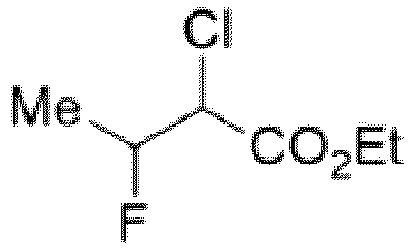
98 (room temperature) - The Examples above demonstrate examples with the use of compound (1) with a double bond as a substrate. However, the present invention is not limited to these. Compound (1) with a triple bond basically tends strongly to have a small steric hindrance and tends to be more reactive than compound (1) with a double bond. Therefore, the results of the Examples above suggest that the reaction will proceed in a similar manner even with the use of compound (1) with a triple bond as a substrate.
Claims (13)
- A method for producing a halogen adduct of a compound represented by formula (1):
 R1 and R2 are each independently a hydrogen atom, a halogen atom, or an organic group, or R1 and R2 optionally form a ring together with the two adjacent carbon atoms;n is 1 or 2; andthe symbol
 when the symbol is a triple bond, n is 1,when the symbol is a double bond, n is 2,two R1s are optionally the same or different,two R2s are optionally the same or different, ortwo R1s or two R2s optionally form a ring together with their adjacent carbon atom,
the method comprising reacting the compound represented by formula (1) with(A) at least one fluorine source selected from the group consisting of hydrogen fluoride, hydrogen fluoride salts, and fluoride salts, and(B) a halogen source other than fluorine represented by the formula: R3(OX)m, wherein R3 is a hydrogen atom, a cation, or an organic group, X is a halogen atom other than a fluorine atom, and m is an integer corresponding to the valence of R3, to add fluorine and a halogen other than fluorine to the double bond or triple bond. - The production method according to claim 1, wherein the fluorine source (A) is at least one member selected from the group consisting of hydrogen fluoride, hydrogen fluoride amine salts, and alkali metal fluoride salts.
- The production method according to claim 1 or 2,
wherein the amount of the fluorine source (A) is within the range of 0.1 to 1000 moles, per mole of the compound represented by formula (1). - The production method according to any one of claims 1 to 3, wherein in the halogen source (B) other than fluorine, R3 is an alkali metal, an alkaline earth metal, an alkyl group optionally having one or more substituents, a cycloalkyl group optionally having one or more substituents, an aryl group optionally having one or more substituents, a non-aromatic heterocyclic group optionally having one or more substituents, or a heteroaryl group optionally having one or more substituents.
- The production method according to any one of claims 1 to 4, wherein in the halogen source (B) other than fluorine, X is a chlorine atom.
- The production method according to any one of claims 1 to 5, wherein the halogen source (B) other than fluorine is represented by the formula: R3aClO, wherein R3a is an alkali metal or a C1-C4 alkyl group.
- The production method according to any one of claims 1 to 6, wherein the amount of the halogen source (B) other than fluorine is within the range of 0.1 to 10 moles, per mole of the compound represented by formula (1).
- The production method according to any one of claims 1 to 7, wherein R1 and R2 are each independently a hydrogen atom, a halogen atom, an alkyl group optionally having one or more substituents, an alkoxy group optionally having one or more substituents, an alkylcarbonyl group optionally having one or more substituents, an alkylcarbonyloxy group optionally having one or more substituents, an alkoxycarbonyl group optionally having one or more substituents, a cycloalkyl group optionally having one or more substituents, an aryl group optionally having one or more substituents, or an aralkyl group optionally having one or more substituents, or R1 and R2 optionally form a ring together with the two adjacent carbon atoms.
- The production method according to claim 8, wherein the one or more substituents are at least one member selected from the group consisting of halo groups, a hydroxyl group, alkoxy groups, alkylcarbonyl groups, alkylcarbonyloxy groups, alkoxycarbonyl groups, arylcarbonyloxy groups, aryloxycarbonyl groups, and aryl groups.
- The production method according to any one of claims 1 to 9, wherein the compound represented by formula (1) is any one of compounds represented by formulas (1a) to (1c):


 R1a is an alkyl group optionally having one or more substituents, an aryl group optionally having one or more substituents, or an aralkyl group optionally having one or more substituents,R1b and R2b are each independently an alkyl group optionally having one or more substituents, an aryl group optionally having one or more substituents, or an aralkyl group optionally having one or more substituents,R1c is a hydrogen atom, an alkyl group optionally having one or more substituents, an aryl group optionally having one or more substituents, or an aralkyl group optionally having one or more substituents, andR2c is an alkyl group optionally having one or more substituents.
 - The production method according to any one of claims 1 to 10, wherein the reaction is performed in the presence of a solvent.
- The production method according to claim 11, wherein the solvent is at least one member selected from the group consisting of aliphatic hydrocarbons, aromatic hydrocarbons, halogenated hydrocarbons, ethers, esters, nitriles, and water.
- A halogenating agent comprising (A) and (B) below:(A) at least one fluorine source selected from the group consisting of hydrogen fluoride, hydrogen fluoride salts, and fluoride salts; and(B) a halogen source other than fluorine represented by the formula: R3(OX)m, wherein R3 is a cation or an organic group, X is a halogen atom other than a fluorine atom, and m is an integer corresponding to the valence of R3.
Applications Claiming Priority (2)
| Application Number | Priority Date | Filing Date | Title |
|---|---|---|---|
| JP2020210289 | 2020-12-18 | ||
| PCT/JP2021/046869 WO2022131378A1 (en) | 2020-12-18 | 2021-12-17 | Method for producing fluorinated organic compound |
Publications (2)
| Publication Number | Publication Date |
|---|---|
| EP4265589A1 true EP4265589A1 (en) | 2023-10-25 |
| EP4265589A4 EP4265589A4 (en) | 2024-12-25 |
Family
ID=82057830
Family Applications (1)
| Application Number | Title | Priority Date | Filing Date |
|---|---|---|---|
| EP21906736.0A Pending EP4265589A4 (en) | 2020-12-18 | 2021-12-17 | METHOD FOR PRODUCING A FLUORINATED ORGANIC COMPOUND |
Country Status (5)
| Country | Link |
|---|---|
| US (1) | US20230322649A1 (en) |
| EP (1) | EP4265589A4 (en) |
| JP (1) | JP7704380B2 (en) |
| CN (1) | CN116583494A (en) |
| WO (1) | WO2022131378A1 (en) |
Families Citing this family (2)
| Publication number | Priority date | Publication date | Assignee | Title |
|---|---|---|---|---|
| JP7437712B2 (en) * | 2022-08-02 | 2024-02-26 | ダイキン工業株式会社 | Method for producing fluorinated organic compounds |
| WO2025071860A1 (en) | 2023-09-25 | 2025-04-03 | Aurorium Holdings Llc | Ester blends for electric drive and cooling application |
Family Cites Families (9)
| Publication number | Priority date | Publication date | Assignee | Title |
|---|---|---|---|---|
| JP3265434B2 (en) * | 1992-09-24 | 2002-03-11 | 独立行政法人産業技術総合研究所 | Method for producing gem-difluoroalkanes |
| JP3768572B2 (en) * | 1995-11-17 | 2006-04-19 | 株式会社カネカ | Production of aromatic substituted chlorinated hydrocarbons by chlorination reaction |
| US6207863B1 (en) * | 1998-08-11 | 2001-03-27 | Rohm And Haas Company | Synthesis of haloformimine compounds |
| JP2002155028A (en) * | 2000-11-14 | 2002-05-28 | Sumitomo Chem Co Ltd | Method for producing vinyl halide derivative |
| US6498110B2 (en) * | 2001-03-05 | 2002-12-24 | Micron Technology, Inc. | Ruthenium silicide wet etch |
| US9758455B2 (en) * | 2014-04-02 | 2017-09-12 | Daikin Industries, Ltd. | Method for producing fluorinated organic compound and fluorinating reagent |
| JP6884499B2 (en) * | 2015-04-21 | 2021-06-09 | ダイキン工業株式会社 | Method for producing composition, fluorinated reagent, and fluorinated organic compound |
| GB2568922A (en) * | 2017-11-30 | 2019-06-05 | Wcs Services Ltd | Improvements relating to hypochlorous acid |
| JP7201187B2 (en) * | 2019-05-10 | 2023-01-10 | ダイキン工業株式会社 | Method for producing fluorinated iodinated organic compound |
-
2021
- 2021-12-17 WO PCT/JP2021/046869 patent/WO2022131378A1/en not_active Ceased
- 2021-12-17 CN CN202180085050.2A patent/CN116583494A/en active Pending
- 2021-12-17 EP EP21906736.0A patent/EP4265589A4/en active Pending
- 2021-12-17 JP JP2022570085A patent/JP7704380B2/en active Active
-
2023
- 2023-06-16 US US18/210,750 patent/US20230322649A1/en active Pending
Also Published As
| Publication number | Publication date |
|---|---|
| JP7704380B2 (en) | 2025-07-08 |
| JPWO2022131378A1 (en) | 2022-06-23 |
| WO2022131378A1 (en) | 2022-06-23 |
| US20230322649A1 (en) | 2023-10-12 |
| CN116583494A (en) | 2023-08-11 |
| EP4265589A4 (en) | 2024-12-25 |
Similar Documents
| Publication | Publication Date | Title |
|---|---|---|
| US12091382B2 (en) | Method for producing fluorinated iodinated organic compound | |
| US20230322649A1 (en) | Method for producing fluorinated organic compound | |
| EP4567018A1 (en) | Method for producing fluorinated organic compound | |
| EP3778547B1 (en) | Fluorinated organic compound production method | |
| EP3560910A1 (en) | Method for manufacturing difluoromethylene compound | |
| JP7244789B2 (en) | Cyclic carbonate compound and method for producing the same | |
| JP7129070B2 (en) | Method for producing fluorinated organic compound | |
| JP7373809B2 (en) | fluoride compounds | |
| WO2026028480A1 (en) | Method for producing fluorinated organic compound | |
| US11680037B2 (en) | Branched fluorine-containing compound | |
| WO2018123890A1 (en) | Method for manufacturing difluoromethylene compound | |
| US11261148B2 (en) | Method for producing carbonyl compound | |
| WO2019216415A1 (en) | Production method for fluoromethyl derivative | |
| JP2017202989A (en) | Fluorine-containing compound, and method for producing the same | |
| JP2017202979A (en) | Method for producing halogenated fluorine-containing organic compound |
Legal Events
| Date | Code | Title | Description |
|---|---|---|---|
| STAA | Information on the status of an ep patent application or granted ep patent |
Free format text: STATUS: THE INTERNATIONAL PUBLICATION HAS BEEN MADE |
|
| PUAI | Public reference made under article 153(3) epc to a published international application that has entered the european phase |
Free format text: ORIGINAL CODE: 0009012 |
|
| STAA | Information on the status of an ep patent application or granted ep patent |
Free format text: STATUS: REQUEST FOR EXAMINATION WAS MADE |
|
| 17P | Request for examination filed |
Effective date: 20230711 |
|
| AK | Designated contracting states |
Kind code of ref document: A1 Designated state(s): AL AT BE BG CH CY CZ DE DK EE ES FI FR GB GR HR HU IE IS IT LI LT LU LV MC MK MT NL NO PL PT RO RS SE SI SK SM TR |
|
| RIN1 | Information on inventor provided before grant (corrected) |
Inventor name: OYAMADA, JUZO Inventor name: KITAMURA, TSUGIO Inventor name: KISHIKAWA, YOSUKE Inventor name: HIGASHI, MASAHIRO |
|
| DAV | Request for validation of the european patent (deleted) | ||
| DAX | Request for extension of the european patent (deleted) | ||
| A4 | Supplementary search report drawn up and despatched |
Effective date: 20241121 |
|
| RIC1 | Information provided on ipc code assigned before grant |
Ipc: C07C 69/76 20060101ALI20241115BHEP Ipc: C07C 69/635 20060101ALI20241115BHEP Ipc: C07C 69/63 20060101ALI20241115BHEP Ipc: C07C 67/307 20060101ALI20241115BHEP Ipc: C07C 22/08 20060101ALI20241115BHEP Ipc: C07C 19/10 20060101ALI20241115BHEP Ipc: C07C 17/02 20060101AFI20241115BHEP |