EP4263242B1 - Tyre tread with improved sipe on three levels and tyre - Google Patents
Tyre tread with improved sipe on three levels and tyre Download PDFInfo
- Publication number
- EP4263242B1 EP4263242B1 EP21839915.2A EP21839915A EP4263242B1 EP 4263242 B1 EP4263242 B1 EP 4263242B1 EP 21839915 A EP21839915 A EP 21839915A EP 4263242 B1 EP4263242 B1 EP 4263242B1
- Authority
- EP
- European Patent Office
- Prior art keywords
- tread
- sipe
- tyre
- section
- depth
- Prior art date
- Legal status (The legal status is an assumption and is not a legal conclusion. Google has not performed a legal analysis and makes no representation as to the accuracy of the status listed.)
- Active
Links
Images


Classifications
-
- B—PERFORMING OPERATIONS; TRANSPORTING
- B60—VEHICLES IN GENERAL
- B60C—VEHICLE TYRES; TYRE INFLATION; TYRE CHANGING; CONNECTING VALVES TO INFLATABLE ELASTIC BODIES IN GENERAL; DEVICES OR ARRANGEMENTS RELATED TO TYRES
- B60C11/00—Tyre tread bands; Tread patterns; Anti-skid inserts
- B60C11/03—Tread patterns
- B60C11/12—Tread patterns characterised by the use of narrow slits or incisions, e.g. sipes
- B60C11/1204—Tread patterns characterised by the use of narrow slits or incisions, e.g. sipes with special shape of the sipe
- B60C11/1218—Three-dimensional shape with regard to depth and extending direction
-
- B—PERFORMING OPERATIONS; TRANSPORTING
- B60—VEHICLES IN GENERAL
- B60C—VEHICLE TYRES; TYRE INFLATION; TYRE CHANGING; CONNECTING VALVES TO INFLATABLE ELASTIC BODIES IN GENERAL; DEVICES OR ARRANGEMENTS RELATED TO TYRES
- B60C11/00—Tyre tread bands; Tread patterns; Anti-skid inserts
- B60C11/03—Tread patterns
- B60C11/12—Tread patterns characterised by the use of narrow slits or incisions, e.g. sipes
- B60C11/1259—Depth of the sipe
-
- B—PERFORMING OPERATIONS; TRANSPORTING
- B60—VEHICLES IN GENERAL
- B60C—VEHICLE TYRES; TYRE INFLATION; TYRE CHANGING; CONNECTING VALVES TO INFLATABLE ELASTIC BODIES IN GENERAL; DEVICES OR ARRANGEMENTS RELATED TO TYRES
- B60C11/00—Tyre tread bands; Tread patterns; Anti-skid inserts
- B60C11/03—Tread patterns
- B60C11/12—Tread patterns characterised by the use of narrow slits or incisions, e.g. sipes
- B60C11/1272—Width of the sipe
- B60C11/1281—Width of the sipe different within the same sipe, i.e. enlarged width portion at sipe bottom or along its length
Definitions
- the present invention relates to a tyre tread.
- a tread pattern which incorporates an enhanced 3-level sipe geometry that improves the performance of a new tyre on dry surfaces whilst maintaining high performance on wet and/or snow-covered surfaces throughout the useful life thereof.
- US 2012/132337 A1 discloses a sipe consisting of a succession of thick and thin sections, arranged alternately and inclined with respect to the sliding surface of the tread.
- US 2002/017349 A1 discloses sipes that are characterised by an overall zigzag conformation such as to prevent deformation of the block and to increase the stiffness thereof.
- EP 2138330 A1 discloses a sipe having opposite faces that are configured to cooperate therebetween and wherein the distance thereof is at a maximum within that region of the tread which is subjected to maximum deflection.
- the technical problem posed and solved by the present invention is therefore that of overcoming the aforementioned problems and, in particular, of providing a tread with a sipe geometry such as to improve performance on wet and/or snow-covered surfaces as a result of normal wear during the life of the tyre without affecting the braking and handling ability of the tyre on a dry and/or smooth surface when the tyre is new.
- a further object of the present invention is a tyre as defined in claim 7.
- the tread according to the present invention is such as to provide optimal performance under wet and/or snow-covered road conditions but, at the same time, to provide the increased stiffness required in the event of a dry road surface.
- the tread of the present invention provides a sipe with an optimised geometry which, not only compensates for the reduction in the volume of the voids due to tyre wear, but at the same time manages to favour manoeuvrability and braking capacity on a dry and/or smooth surface, improving the performance under new tyre conditions.
- tread element refers to a portion of the tread pattern that can be repeated, identically, along the entire length of the tread.
- tread component refers to any block of the tread, regardless of the form and/or positioning thereof.
- contact surface refers to that portion of a surface of a component which comes into contact with the ground during the rolling of the tyre.
- tread refers to a thin and generally narrow groove in a tread component that is obtained by means of the moulding of the tyre, and that is particularly intended to improve the performance of the tyre on wet and/or snow-covered surfaces.
- tread block For descriptive simplicity reference will be made hereinafter to a generic tread block. As already mentioned, it is however to be understood that the principle underlying the present invention is applicable to any tread component, whether it is a block or something else.
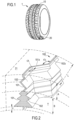
- a schematic perspective view is shown of a tyre 1 comprising a tread 10 according to a preferred embodiment of the present invention.
- a tread 10 for a tyre 1 comprises a plurality of tread components 20.
- Figure 2 shows an exemplary perspective view of a sipe 100 located within a block 20 of the tread 10 according to the present invention. For visual clarity, the solid portions of the block 20 are not shown.
- Each block 20 of the tread 10 has a respective contact surface 21 which, together with the tread, defines the surface of the tread itself that is in contact with the ground.
- At least one of the blocks 20 of the tread 10 comprises a sipe 100 having a sipe extension L and a sipe depth P, the latter along a direction of wear U that is substantially orthogonal to said contact surface 21.
- Said direction of wear U is namely a radial direction toward the centre of the tyre 1.
- the sipe 100 provides for a longitudinal sipe extension L between opposite ends of said block 20.
- said longitudinal extension L of the sipe 100 does not necessarily coincide with the direction of development of the tread 10, but can be oriented differently depending upon the relative positioning of the block 20 (or other component) within the same tread 10.
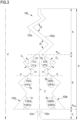
- the sipe 100 defines a first face 101 and a second face 102, opposite therebetween, of the component 20 and the sipe depth P along said direction of wear U and comprises a first and a second section, respectively denoted with the references A and C.
- the first section A is located above, namely externally in the radial direction of the tyre, with respect to the second section C, the first section A being the section closest to the contact surface 21 under new or progressive wear conditions of the tyre 1.
- the sipe 100 within the depth P thereof may comprise, in preferred embodiments, additional sections located above said first section A along the direction of wear U.
- the lower section C of the sipe depth P ends at the maximum wear limit of the tread 10 of the tyre 1 (skid depth).
- the sipe 100 comprises a further section, or intermediate section B, which connects the first and second sections A, C therebetween.
- the sipe 100 comprises, in sequence from a radially outer position to a radially inner position, said first section A, said intermediate section B and said second section C.
- the tread 10 of the invention therefore has at least one component 20 that is characterised by a specific sipe geometry 100, which determines three regions, or levels, that are located at selected and progressive depths along the direction of wear U.
- contact surfaces of the first interference profile 101b can come into contact with contact surfaces of the second interference profile 102b, favouring an improved locking condition as regards the interference profiles 101b, 102b themselves.
- This condition occurs, for example, during a rolling (or incipient rolling) condition of the tyre 1 whereupon, in addition to a radial stress (F z ), a tangential stress, denoted by way of example with the reference F x , also acts.
- This rolling condition is schematically illustrated in Figure 5C .
- a contact surface 11"a of a first pair of contact surfaces defines, together with a distinct contact surface 110"a that is consecutive and belonging to a second pair of contact surfaces, an obtuse angle ⁇ facing into said region of deformation V.
- the opposite faces 101, 102 at the intermediate section B comprise respective interference profiles 101b, 102b shaped in a "zig-zag” or “wavy” manner that define concavities and "ridges".
- This conformation favours the approaching of the contact surfaces of the opposing interference profiles 101b, 102b and makes it possible to generate local shear forces which contribute to the mutual locking thereof along a substantially tangential deformation direction of the block 20.
- the region of deformation V thus assumes a third volume V′′′ which is less than the second volume V" that is assumed when the tyre 1 is in a static condition.
- This configuration advantageously entails a further improvement in the performance of the tyre in terms of the stiffness of the tread 10 and of the coefficient of friction under dry conditions.
- the mutual distance between the first and second interference profiles 101b, 102b is less at the minimum depth P min of the intermediate section B compared to the mutual distance thereof, at the maximum depth P max .
- the combination of a geometry which provides, within a specific intermediate section B of the sipe 100, an overall "distancing" of the opposite faces 101, 102 which present therein interference profiles 101b, 102b shaped in a wavy (or “zig-zag") manner with contact surfaces configured for reversible contact makes it possible to maintain high performance on wet and/or snow-covered surfaces throughout the useful life of the tyre whilst, at the same time, providing adequate stiffness on a dry and/or smooth surface even when the tyre is new, in accordance with the behaviour described above with reference to Figures 4A-4C and 5A-5C .
- the overall "distancing" of the interference profiles 101b, 102b at the intermediate section B makes it possible to compensate for the void percentage reduction of the tread 10 owing to the wear progression, which progressively consumes the depth P of the sipe 100.
- the void percentage increases and thus slows the inevitable loss of performance of the tyre 1 on wet and/or snow-covered surfaces.
- the wear of the tyre 1 typically involves a decrease in the void percentage offered by the sipe 100, which gradually consumes the depth P thereof along the direction of wear U.
- This void reduction is mitigated by the distancing of the interference profiles 101b, 102b at the intermediate section B, in particular in considering the mutual distances thereof at the minimum depth P min and at the maximum depth P max .
- interference profiles 101b, 102b configured for reciprocal and reversible locking along directions of deformation, preferably radial and tangential, of the component 20 of the tread 10, which interferences compensate for the inevitable decrease in stiffness of the tyre 1 (especially when new) due to a geometry which, in a preferred embodiment of the invention, mitigates overall the reduction of voids precisely required to obtain the aforementioned performance on wet and/or snow-covered surfaces.
- Figure 6 shows a sectional view of the sipe profile 100 wherein some significant parameters are indicated according to a preferred embodiment of the invention with reference to the example of Figure 3 .
- each interference profile 101b, 102b preferably comprises three pairs of contact surfaces, respectively denoted by the references (11'a, 11"a) for the first pair, with the references (110'a, 110"a) for the second pair, with the references (1100'a, 1100"a) for the third pair, in relation to the first interference profile 101b.
- the references (12'b, 12"b) for the first pair with the references (120'b, 120"b) for the second pair, with the references (1200'b, 1200"b) for the third pair.
- the interference profiles 101b, 102b have different maximum (relative) distances from said development axis v corresponding to each of said three pairs of contact surfaces.
- the first interference profile 101b and at the first pair 1a it has a maximum (relative) distance a s that is less than the maximum (relative) distance b s corresponding to the second pair 1b.
- the first interference profile 101b has a maximum (relative) distance c s that is greater than the maximum (relative) distance b s corresponding to the second pair 1b.
- the respective minimum (relative) distances from said development axis v can be identified.
- said minimum (relative) distances are at respective obtuse angles ⁇ defined between a contact surface 11"a (or 12"b) respectively, of a first pair 1a (or 2a) with a distinct contact surface 110'a (or 120'b), consecutive thereto, and relative to a second pair 1b (or 2b).
- said minimum (relative) distances are denoted by the references d s , e s for the first interference profile 101b and with the references d d and e d for the second interference profile 102b.
- the development axis v of the intermediate section B is an axis of symmetry in relation to the first and second interference profiles 101b, 102b.
- said maximum (relative) distance and, even more preferably also the minimum (relative) distance increases along said wear direction U.
- specular pairs of opposite interference profiles i.e., the pairs 1a, 2a, the pairs 1b, 2b, the pairs 1c, 2c preferably have the same radial extension.
- said radial extensions are denoted with the references u, v, w, respectively, for the pairs 1a, 2a, the pairs 1b, 2b and the pairs 1c, 2c.
- the sum of the maximum radial extensions of the pairs of surfaces of a respective interference profile ranges between the minimum depth P min and the maximum depth P max of the intermediate section B.
- the table shown in Figure 7A indicates the values that the aforesaid parameters can assume for the sipe geometry 100 according to the present invention with reference to preferred intervals.
- the first and second opposing faces 101, 102 identify respective first profiles 101a, 102a in a plane ⁇ that is orthogonal to the direction of longitudinal extension, or sipe extension L.
- a first section A of the sipe 100 confers elevated rigidity to the component 20, thereby optimizing the performance of the tyre 1 on a dry road surface, especially when new.
- Both the first profiles 101a, 102a and the further profiles 101z, 102z along the direction of longitudinal extension L may comprise more than two consecutive sections such that they form two or more internal angles, respectively ⁇ and ⁇ .
- the profiles 101z, 102z can determine at least a first internal angle ⁇ 1 of a different extent in relation to a second inner angle ⁇ 2 .
Landscapes
- Engineering & Computer Science (AREA)
- Mechanical Engineering (AREA)
- Tires In General (AREA)
Description
- The present invention relates to a tyre tread. In particular, it refers to a tread pattern which incorporates an enhanced 3-level sipe geometry that improves the performance of a new tyre on dry surfaces whilst maintaining high performance on wet and/or snow-covered surfaces throughout the useful life thereof.
- Tyres are generally fitted with a tread that has grooves extending laterally and/or circumferentially, thereby defining "tread elements" that engage with the ground and that contribute to the overall performance of the tyre.
- As is known, the presence of grooves that are generally thin and not very wide, called notches or sipes, define voids that make it possible to improve the grip and traction of a tyre, especially in wet and/or snow-covered conditions, in the first case contributing to the draining of water and in the latter contributing to the trapping of snow.
- To date, the ability of tyres to maintain the initial level of performance thereof for as long as possible, especially in wet and/or snow-covered conditions and in consideration of the physiological wear and aging of the materials that constitute them, is the subject of particular attention amongst operators within the sector. Normal tread wear typically results, in fact, in a rapid reduction in the void percentage, and the closer it is to the end of the useful life thereof, the more the tyre is subjected to a drastic drop in adhesion in the wet/snow.
- To counter this trend, it is known to manufacture tyres with sipes having specific profiles wherein the main purpose thereof is to modify the geometric characteristics of the tread and to compensate for the decrease in performance due to the reduction in the void percentage during wear.
- In this sense, it is known to model sipes in such a way that appropriate, so-called "hidden" voids remain defined within the tread pattern in order to mitigate the void percentage drop during tyre wear and thus reduce the drop in performance on wet and/or snowy surfaces.
- The known solutions mentioned above, while managing to maintain good performance in terms of grip and traction on wet and/or snow-covered surfaces during the useful life of the tyre, on the other hand entail a decrease in the stiffness of the tread and, therefore, an overall worsening in performance in terms of stiffness, braking capacity and handling on dry and/or smooth surfaces, especially when the tyre is new.
- For example,
US 2012/132337 A1 discloses a sipe consisting of a succession of thick and thin sections, arranged alternately and inclined with respect to the sliding surface of the tread.US 2002/017349 A1 discloses sipes that are characterised by an overall zigzag conformation such as to prevent deformation of the block and to increase the stiffness thereof.EP 2138330 A1 discloses a sipe having opposite faces that are configured to cooperate therebetween and wherein the distance thereof is at a maximum within that region of the tread which is subjected to maximum deflection. - The technical problem posed and solved by the present invention is therefore that of overcoming the aforementioned problems and, in particular, of providing a tread with a sipe geometry such as to improve performance on wet and/or snow-covered surfaces as a result of normal wear during the life of the tyre without affecting the braking and handling ability of the tyre on a dry and/or smooth surface when the tyre is new.
- This is achieved by means of a tyre tread as defined in
claim 1. - A further object of the present invention is a tyre as defined in claim 7.
- Further characteristics of the present invention are defined in the corresponding dependent claims.
- The tread according to the present invention is such as to provide optimal performance under wet and/or snow-covered road conditions but, at the same time, to provide the increased stiffness required in the event of a dry road surface.
- In other words, the tread of the present invention provides a sipe with an optimised geometry which, not only compensates for the reduction in the volume of the voids due to tyre wear, but at the same time manages to favour manoeuvrability and braking capacity on a dry and/or smooth surface, improving the performance under new tyre conditions.
- For the purposes of the present invention, the term "tread element" refers to a portion of the tread pattern that can be repeated, identically, along the entire length of the tread.
- The term "tread component," or simply "component," refers to any block of the tread, regardless of the form and/or positioning thereof.
- The term "contact surface" refers to that portion of a surface of a component which comes into contact with the ground during the rolling of the tyre.
- The term "sipe" refers to a thin and generally narrow groove in a tread component that is obtained by means of the moulding of the tyre, and that is particularly intended to improve the performance of the tyre on wet and/or snow-covered surfaces.
- Other advantages, together with the characteristics and usages of the present invention, will become clear from the following detailed description of the preferred embodiments thereof given purely by way of non-limiting examples.
- Reference will be made to the drawings in the attached figures, wherein:
-
Figure 1 shows a tyre according to the present invention provided with a tread according to the present invention; -
Figure 2 is an exemplary perspective view of a sipe of a tread component according to the present invention; -
Figure 3 is a cross-sectional view of the sipe profile ofFigure 2 ; -
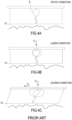
Figures 4A, 4B and 4C show a schematic representation of the behaviour of a tread component bearing a sipe according to an embodiment known in the state of the art, respectively in a static condition, stressed under normal load and under sliding conditions; -
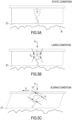
Figures 5A, 5B and 5C show a schematic representation of the behaviour of a tread component bearing a sipe according to an embodiment of the present invention, respectively in a static condition, stressed under normal load and under sliding conditions; -
Figure 6 shows the sectional view ofFigure 3 wherein preferred significant parameters of the sipe profile are indicated; -
Figure 7A shows a table wherein the preferred values of the parameters indicated inFigure 6 are indicated with further reference to preferred reference dimensions relating to a tread component incorporating the sipe profile shown inFigure 2 as shown in an exemplary schematic view ofFigure 7B - The thicknesses and curvatures shown in the above figures should be understood to be purely exemplary and are not necessarily shown in proportion. Furthermore, in these figures some layers/components of the tyre may have been omitted for a clearer illustration of the aspects of the present invention.
- The present invention will be described below with reference to the above figures.
- For descriptive simplicity reference will be made hereinafter to a generic tread block. As already mentioned, it is however to be understood that the principle underlying the present invention is applicable to any tread component, whether it is a block or something else.
- With initial reference to
Figure 1 , a schematic perspective view is shown of atyre 1 comprising atread 10 according to a preferred embodiment of the present invention. - In general terms, a
tread 10 for atyre 1 comprises a plurality oftread components 20. In particular,Figure 2 shows an exemplary perspective view of asipe 100 located within ablock 20 of thetread 10 according to the present invention. For visual clarity, the solid portions of theblock 20 are not shown. - Each
block 20 of thetread 10 has arespective contact surface 21 which, together with the tread, defines the surface of the tread itself that is in contact with the ground. - According to the present invention and with further reference to
Figure 3 , at least one of theblocks 20 of thetread 10 comprises asipe 100 having a sipe extension L and a sipe depth P, the latter along a direction of wear U that is substantially orthogonal to saidcontact surface 21. Said direction of wear U is namely a radial direction toward the centre of thetyre 1. - In a preferred and non-limiting embodiment, the
sipe 100 provides for a longitudinal sipe extension L between opposite ends of saidblock 20. - It is to be understood that said longitudinal extension L of the
sipe 100 does not necessarily coincide with the direction of development of thetread 10, but can be oriented differently depending upon the relative positioning of the block 20 (or other component) within thesame tread 10. - As can be seen in
Figure 2 , thesipe 100 defines afirst face 101 and asecond face 102, opposite therebetween, of thecomponent 20 and the sipe depth P along said direction of wear U and comprises a first and a second section, respectively denoted with the references A and C. - Preferably, the first section A is located above, namely externally in the radial direction of the tyre, with respect to the second section C, the first section A being the section closest to the
contact surface 21 under new or progressive wear conditions of thetyre 1. - For convenience, reference will therefore be made to said first section A as the upper section and to said second section C as the lower section.
- Although not illustrated in the Figures, the
sipe 100 within the depth P thereof may comprise, in preferred embodiments, additional sections located above said first section A along the direction of wear U. - Preferably, the lower section C of the sipe depth P ends at the maximum wear limit of the
tread 10 of the tyre 1 (skid depth). - Along said direction of wear U, the
sipe 100 comprises a further section, or intermediate section B, which connects the first and second sections A, C therebetween. - Preferably, according to the depth P thereof, the
sipe 100 comprises, in sequence from a radially outer position to a radially inner position, said first section A, said intermediate section B and said second section C. - As can be seen in
Figure 3 , the first and secondopposing faces sipe 100 have correspondingcomplementary profiles first interference profile 101b and asecond interference profile 102b at the intermediate section B and along said wear direction U. - Advantageously, the
tread 10 of the invention therefore has at least onecomponent 20 that is characterised by aspecific sipe geometry 100, which determines three regions, or levels, that are located at selected and progressive depths along the direction of wear U. - In general terms, these levels can cover different percentages of the depth P of the
sipe 100, such that the technical effect conferred by the geometry of each section A, B, C of thesipe 100 is synergistic and balanced in relation to the additional sections thereof, in order to adjust the stiffness and/or durability of thecomponents 20 of thetread 10, thereby optimising the performance of thetyre 1 as a function of the type of application required. - With reference to
Figure 7B , in a preferred application of the invention, at least onecomponent 20 of thetread 10 has an overall height T ranging between 5 mm and 20 mm. In general terms, the sipe depth P, i.e., the sum of the extension of the first section A, of the intermediate section B and of the second section C, is preferably between 40% and 100% of said height T, and even more preferably between 40% and 80% of said height T. - Furthermore, as indicated in the table of
Figure 7A , the first section A can have an extension of between 40% and 60%, preferably between 40% and 55%, of the sipe depth P, the intermediate section B can have an extension between 40% and 60%, preferably between 40% and 55%, of the sipe depth P and the second section C can have an extension of up to 25%, preferably between 5% and 15%, of the sipe depth P. - As mentioned above, the intermediate section B has a first 101b and a second 102b interference profile. With joint reference to
Figure 3 andFigures 5A-5C , each of said interference profiles comprises at least two contact surfaces, respectively denoted by the references 11'a, 11"a and 12'b, 12"b, facing one another and configured for reversible mutual contact in response to stress acting upon theblock 20. - In the illustrated example, it can be seen how the first and
second interference profiles block 20. This deformation region V preferably develops along an axis v parallel to said wear direction U. - The aforementioned contact surfaces 11'a, 11"a, 12'b, 12"b face the inside of said deformation region V.
- In particular, in
Figures 5A-5C the behaviour of ablock 20 of thetread 10, bearing asipe 100 according to the preferred embodiment just described, respectively in a static, laden and sliding condition (the latter representing a rolling condition of thetyre 1 with a moment of traction or braking). - This behaviour will be compared in the following with the corresponding
Figures 4A, 4B and 4C which show a schematic representation of the behaviour of a tread component bearing a sipe S according to a different embodiment. - As can be seen in
Figure 5A , in a static condition (for example, in the absence of stress pressing upon thetyre 1 and neglecting the weight thereof) the tyre rests upon a rolling plane R, the interference profiles 101b, 102b of the opposing faces 101, 102 are spaced therebetween and define a first void volume V' of the deformation region V. Under these conditions, substantial differences are not appreciable with the sipe S shown inFigure 4A , except in terms of the shape of the sipe itself. - Upon application of a load, represented by way of example in
Figure 5B by a force Fz, which acts normally, or radially, upon thetyre 1 and in particular upon the component 20 (a condition that is representative, for example, of a tyre mounted on a stationary vehicle), the latter tends to deform and consequently also the interference profiles 101b, 102b of the intermediate section B. - In particular, said
profiles Figure 5B with the four arrows denoted as a whole with the reference FR. - The region of deformation V thus assumes a second volume V" that is less than the first volume V' that is assumed when the
tyre 1 is in a static condition. - The pair of contact surfaces 11'a, 11"a of the
first profile 101b approach one another in a similar way to the pair of contact surfaces 12'b, 12"b of thesecond profile 102b. The contact surfaces of a respective pair come into contact and allow for partial reciprocal locking of the interference profiles 101b, 102b. - Said locking preferably takes place along a radial direction to the
contact surface 21 of thetread 10block 20 along the rolling plane R. - The deformation of the
block 20 is reversible and determines a reversible contact between the contact surfaces 11'a, 11"a, 12'b, 12"b. This contact can fail in the absence of said stress, in particular radial stress. - It can be seen that, with reference to the corresponding
Figure 4B , in a sipe S without interference profiles and contact surfaces, said contact cannot occur, nor the associated advantageous technical effects. - According to the invention, the particular geometry of the interference profiles 101b, 102b of the intermediate section B results in behaviour of the
tread 10component 20 that can be associated with that of a "spring". In other words, the inventive concept of the present invention advantageously makes it possible to obtain the reciprocal and reversible locking ofspecific interference profiles sipe 100 which, in coming into contact following stress upon theblock 20, mitigate the loss of stiffness of thetread 10 due to the deformation of the latter when subjected to stress. - Advantageously, contact surfaces of the
first interference profile 101b can come into contact with contact surfaces of thesecond interference profile 102b, favouring an improved locking condition as regards the interference profiles 101b, 102b themselves. - This condition occurs, for example, during a rolling (or incipient rolling) condition of the
tyre 1 whereupon, in addition to a radial stress (Fz), a tangential stress, denoted by way of example with the reference Fx, also acts. This rolling condition is schematically illustrated inFigure 5C . - Advantageously, and again with reference to the example illustrated in
Figure 3 , the contact surfaces 11'a, 11"a, 12'b, 12"b of therespective interference profiles respective interference profile - Similarly, for each interference profile, a
contact surface 11"a of a first pair of contact surfaces defines, together with a distinct contact surface 110"a that is consecutive and belonging to a second pair of contact surfaces, an obtuse angle ω facing into said region of deformation V. - Preferably, therefore, the opposite faces 101, 102 at the intermediate section B, comprise
respective interference profiles interference profiles block 20. - The aforementioned local shear forces are represented in
Figure 5C with the four arrows denoted as a whole with the reference FT. - The region of deformation V thus assumes a third volume V‴ which is less than the second volume V" that is assumed when the
tyre 1 is in a static condition. - This configuration advantageously entails a further improvement in the performance of the tyre in terms of the stiffness of the
tread 10 and of the coefficient of friction under dry conditions. - The absence is noted, with reference to the corresponding
Figure 4C , of any possible contact, and therefore of reciprocal locking, between the opposite faces of the sipe S, at least for the entire extension of the depth of the sipe, insofar as it does not have the specific shapes, and therefore the associated advantageous technical effects, proposed with the present invention. - Returning again to
Figure 3 , according to a preferred embodiment of the invention, the mutual distance between the first andsecond interference profiles - In this way it is possible to increase the void percentage of the
tread 10 and to further confer better performance to thetyre 1 on wet and/or snow-covered road surfaces. - Advantageously, the combination of a geometry which provides, within a specific intermediate section B of the
sipe 100, an overall "distancing" of the opposite faces 101, 102 which present thereininterference profiles Figures 4A-4C and5A-5C . - In other words, according to an advantageous aspect of the invention, the overall "distancing" of the interference profiles 101b, 102b at the intermediate section B, makes it possible to compensate for the void percentage reduction of the
tread 10 owing to the wear progression, which progressively consumes the depth P of thesipe 100. In this way, as the road surface contact area decreases, the void percentage increases and thus slows the inevitable loss of performance of thetyre 1 on wet and/or snow-covered surfaces. In fact the wear of thetyre 1 typically involves a decrease in the void percentage offered by thesipe 100, which gradually consumes the depth P thereof along the direction of wear U. This void reduction is mitigated by the distancing of the interference profiles 101b, 102b at the intermediate section B, in particular in considering the mutual distances thereof at the minimum depth Pmin and at the maximum depth Pmax. - The above is advantageously combined with the presence of
interference profiles component 20 of thetread 10, which interferences compensate for the inevitable decrease in stiffness of the tyre 1 (especially when new) due to a geometry which, in a preferred embodiment of the invention, mitigates overall the reduction of voids precisely required to obtain the aforementioned performance on wet and/or snow-covered surfaces. - In view of
Figure 7B and the table ofFigure 7A , reference is now made toFigure 6 , which shows a sectional view of thesipe profile 100 wherein some significant parameters are indicated according to a preferred embodiment of the invention with reference to the example ofFigure 3 . - In the illustrated example, along the intermediate section B, each
interference profile first interference profile 101b. Similarly, for thesecond interference profile 102b, with the references (12'b, 12"b) for the first pair, with the references (120'b, 120"b) for the second pair, with the references (1200'b, 1200"b) for the third pair. - For simplicity of explanation, hereinafter, reference will be made to the aforementioned three pairs of the
first profile 101b, respectively with thereferences second profile 102b, respectively with thereferences - In this example, the interference profiles 101b, 102b have different maximum (relative) distances from said development axis v corresponding to each of said three pairs of contact surfaces. In particular, for the
first interference profile 101b and at thefirst pair 1a, it has a maximum (relative) distance as that is less than the maximum (relative) distance bs corresponding to thesecond pair 1b. Corresponding to thethird pair 1c, thefirst interference profile 101b has a maximum (relative) distance cs that is greater than the maximum (relative) distance bs corresponding to thesecond pair 1b. - Similar considerations preferably apply to the maximum (relative) distances of the
second interference profile 102b from said development axis v, denoted with the references to ad, bd, cd, corresponding to the relative pairs ofcontact surfaces - Similarly, for both
interference profiles contact surface 11"a (or 12"b) respectively, of afirst pair 1a (or 2a) with a distinct contact surface 110'a (or 120'b), consecutive thereto, and relative to asecond pair 1b (or 2b). - In
Figure 6 , said minimum (relative) distances are denoted by the references ds, es for thefirst interference profile 101b and with the references dd and ed for thesecond interference profile 102b. - As can be seen in the illustrated embodiment, the development axis v of the intermediate section B is an axis of symmetry in relation to the first and
second interference profiles - In particular, said maximum (relative) distance and, even more preferably also the minimum (relative) distance, increases along said wear direction U.
- Furthermore, it is possible to identify a maximum radial extension of each
pair - In the event that said development axis v is an axis of symmetry, specular pairs of opposite interference profiles, i.e., the
pairs pairs pairs Figure 6 , said radial extensions are denoted with the references u, v, w, respectively, for thepairs pairs pairs - The sum of the maximum radial extensions of the pairs of surfaces of a respective interference profile ranges between the minimum depth Pmin and the maximum depth Pmax of the intermediate section B.
- The table shown in
Figure 7A indicates the values that the aforesaid parameters can assume for thesipe geometry 100 according to the present invention with reference to preferred intervals. - Considering now the upper section A, the first and second opposing faces 101, 102 identify respective
first profiles - Preferably, said respective
first profiles - As can be seen in the illustrated example, the pattern of the
first profiles first profiles - With further reference to
Figure 6 , it is possible to identify the distance between two crests (or valleys) of consecutive sections along a direction parallel to the direction of wear U, denoted by the reference y1. Similarly, it is possible to identify the distance between two crests (or valleys) of consecutive sections along a direction orthogonal to the direction of wear U, said distance denoted by the reference x1. - Furthermore, in
Figure 6 , the mutual distance between saidfirst profiles - The table shown in
Figure 7A shows the values that the aforesaid parameters can assume for thesipe geometry 100 according to the present invention with reference to preferred intervals. - A first section A of the
sipe 100 confers elevated rigidity to thecomponent 20, thereby optimizing the performance of thetyre 1 on a dry road surface, especially when new. - With joint reference to
Figure 2 andFigure 3 , the first and second opposite faces 101, 102 preferably identify further respective profiles with a surface α parallel to thecontact surface 21. - For example, with reference to the first section A of the
sipe 100, the first and second opposing faces 101, 102 identify profiles that extend along the direction of longitudinal extension L of thesipe 100 and have a pattern such as to be able to intersect, at at least two distinct points, a straight line lying on said surface α. These profiles are denoted inFigure 1 with thereferences 101z, 102z. - In this way a
sipe geometry 100 is obtained with a three-dimensional progression wherein the elevated stiffness of thecomponent 20 can be maintained by virtue of the interpenetration-during stressing-of the profiles of said first and second opposing faces 101, 102. That is to say, that the opening of theblock 20 is rendered difficult when the component is new and subjected to shear stress, for example during braking, as compared to a planar geometry. - Along said direction of longitudinal extension L, the
aforesaid profiles 101z, 102z may have a zig-zag pattern, similar to that described previously for thefirst profiles profiles 101z, 102z wherein each crest (or valley) is preferably defined by two consecutive sections that form therebetween an internal angle φ of between 135° and 180°. - Both the
first profiles further profiles 101z, 102z along the direction of longitudinal extension L may comprise more than two consecutive sections such that they form two or more internal angles, respectively β and φ. In embodiments, theprofiles 101z, 102z can determine at least a first internal angle φ 1 of a different extent in relation to a second inner angle φ 2. - In a similar way to that previously described for the upper section A, the lower section C of the sipe depth P comprises
second profiles 101c, 102c. Said second profiles are obtained within the aforementioned orthogonal plane γ in relation to the sipe extension L. Preferably, saidsecond profiles Figure 6 , the mutual distance thereof is denoted by the reference t3 and the preferred values of said mutual distance are indicated in the table ofFigure 7A . - According to a preferred embodiment, the lower section C also extends along the sipe extension L, according to that described above for the upper section A.
- In relation to a first aspect, a lower section C of the sipe depth P, as described above, keeps the rigidity of the
tread 10 of the invention low when worn, thereby conferring good grip to thetyre 1 on a wet and/or snow-covered road surface, also when the tyre is close to the end of the life thereof. - By means of the provision of a lower section C within the
tread 10, it is additionally possible according to the invention to obtain different values for the overall rigidity of theblock 20, also when the upper section A of thesipe 100 is completely worn. This adjustment can be obtained by modulating the relative extension percentage of the intermediate section Band lower section C in relation to the sipe depth P, as described above. - In terms of the production process, advantageously, the lower section C is sufficiently extended in order to facilitate the separation of the opposing faces 101, 102 of the
sipe 100 during the process of extracting the mold from thetread 10 without penalising the rigidity of thetyre 1 when new. - The present invention has heretofore been described with reference to the preferred embodiments thereof. It is intended that each of the technical solutions implemented in the preferred exemplary embodiments described herein can advantageously be combined in different ways therebetween in order to give form to other embodiments which belong to the same inventive nucleus and that all fall within the scope of protection afforded by the claims recited hereinafter.
Claims (7)
- A tread (10) for a tyre (1), having a plurality of tread components (20) each having a respective contact surface (21), wherein at least one of said plurality of components (20) comprises a sipe (100) defining a first (101) and a second (102) opposing faces of said at least one component (20), said sipe (100) having a sipe depth (P) along a radial direction (U), wherein said sipe depth (P) comprises a first (A) and a second (C) section and said first (101) and second (102) opposing faces have corresponding complementary profiles (101a, 101c, 101z, 102a, 102c, 102z) along said first (A) and second (C) section, wherein said first (101) and second (102) opposing faces further have a respective first (101b) and second (102b) interference profile in correspondence with an intermediate section (B) linking said first (A) and second (C) section to each other, wherein each of said first (101b) and second (102b) interference profile comprises at least two contact surfaces (11'a, 11"a, 12'b, 12"b) facing each other and configured to a reversible mutual contact in response to a load acting on said at least one component (20), wherein said first (101b) and second (102b) interference profile are spaced between a minimum depth (Pmin) and a maximum depth (Pmax) of said intermediate section (B) in such a way as to define a deformation region (V) of said at least one component (20) which develops along an axis (v) parallel to said radial direction (U), characterised in that said development axis (v) is an axis of symmetry with respect to the development of said first (101b) and second (102b) interference profile.
- The tread (10) according to claim 1, wherein the mutual distance between said first (101b) and second (102b) interference profile is smaller at said minimum depth (Pmin) than their mutual distance at of said maximum depth (Pmax).
- The tread (10) according to any one of previous claims, wherein said at least two contact surfaces (11'a, 11"a, 12'b, 12"b) are consecutive and incident to each other so as to form a concavity (C1, C2) at a maximum distance of a respective interference profile (101b, 102b) with respect to said development axis (v).
- The tread (10) according to previous claim, wherein each interference profile (101b, 102b) comprises three pairs (1a, 1b, 1c, 2a, 2b, 2c) of contact surfaces, wherein said first (101b) and/or second (102b) interference profile provides for a different maximum distance from said development axis (v) at each of said three pairs (1a, 1b, 1c, 2a, 2b, 2c) of contact surfaces.
- The tread (10) according to previous claim, wherein said maximum distance increases along said radial direction (U).
- The tread (10) according to any one of the preceding claims, wherein said sipe depth (P) comprises in sequence said first section (A), said intermediate section (B) and said second section (C).
- Tyre (1), comprising a tread (10) according to any one of the preceding claims.
Applications Claiming Priority (2)
| Application Number | Priority Date | Filing Date | Title |
|---|---|---|---|
| IT202000031364 | 2020-12-18 | ||
| PCT/EP2021/085978 WO2022129218A1 (en) | 2020-12-18 | 2021-12-15 | Tyre tread with improved sipe on three levels and tyre |
Publications (3)
| Publication Number | Publication Date |
|---|---|
| EP4263242A1 EP4263242A1 (en) | 2023-10-25 |
| EP4263242B1 true EP4263242B1 (en) | 2025-01-29 |
| EP4263242C0 EP4263242C0 (en) | 2025-01-29 |
Family
ID=74759414
Family Applications (1)
| Application Number | Title | Priority Date | Filing Date |
|---|---|---|---|
| EP21839915.2A Active EP4263242B1 (en) | 2020-12-18 | 2021-12-15 | Tyre tread with improved sipe on three levels and tyre |
Country Status (5)
| Country | Link |
|---|---|
| US (1) | US12370837B2 (en) |
| EP (1) | EP4263242B1 (en) |
| JP (1) | JP7590582B2 (en) |
| CA (1) | CA3204600A1 (en) |
| WO (1) | WO2022129218A1 (en) |
Family Cites Families (16)
| Publication number | Priority date | Publication date | Assignee | Title |
|---|---|---|---|---|
| FR2641501B1 (en) | 1989-01-10 | 1991-03-08 | Michelin & Cie | TIRE TREAD FOR WINTER TRAVEL |
| AT400694B (en) * | 1992-04-03 | 1996-02-26 | Semperit Ag | VEHICLE TIRES |
| JPH11291717A (en) * | 1998-04-13 | 1999-10-26 | Bridgestone Corp | Pneumatic tire |
| JP4149048B2 (en) * | 1998-09-22 | 2008-09-10 | 株式会社ブリヂストン | Pneumatic tire with sipe on tread |
| ES2254289T3 (en) | 2000-07-03 | 2006-06-16 | Societe De Technologie Michelin | TIRE BEARING BAND FOR THE TRANSPORTATION OF HEAVY LOADS. |
| JP4299804B2 (en) * | 2005-04-18 | 2009-07-22 | 住友ゴム工業株式会社 | Pneumatic tire |
| DE102008030810A1 (en) | 2008-06-28 | 2009-12-31 | Continental Aktiengesellschaft | Vehicle tires |
| FR2939360B1 (en) | 2008-12-05 | 2011-03-04 | Michelin Soc Tech | BEARING BAND WITH INCISIONS |
| JP5270407B2 (en) * | 2009-03-09 | 2013-08-21 | 東洋ゴム工業株式会社 | Pneumatic tire |
| JP5270417B2 (en) * | 2009-03-26 | 2013-08-21 | 東洋ゴム工業株式会社 | Pneumatic tire |
| RU2521899C1 (en) | 2010-10-29 | 2014-07-10 | Мишлен Решерш Э Текник С.А. | Tire tread with several wearing plies |
| JP2013133084A (en) * | 2011-12-27 | 2013-07-08 | Bridgestone Corp | Pneumatic tire |
| FR3017075B1 (en) * | 2014-02-03 | 2016-02-12 | Michelin & Cie | TIRE TREAD TIRE FOR HEAVY WEIGHT |
| FR3042738B1 (en) * | 2015-10-27 | 2017-11-24 | Michelin & Cie | PNEUMATIC WORKING LAYER COMPRISING MONOFILAMENTS AND GROOVED ROLLING BELT |
| KR102236274B1 (en) * | 2019-03-12 | 2021-04-05 | 금호타이어 주식회사 | Tire |
| JP7152362B2 (en) * | 2019-06-14 | 2022-10-12 | 株式会社ブリヂストン | pneumatic tire |
-
2021
- 2021-12-15 JP JP2023537060A patent/JP7590582B2/en active Active
- 2021-12-15 US US18/266,326 patent/US12370837B2/en active Active
- 2021-12-15 EP EP21839915.2A patent/EP4263242B1/en active Active
- 2021-12-15 WO PCT/EP2021/085978 patent/WO2022129218A1/en not_active Ceased
- 2021-12-15 CA CA3204600A patent/CA3204600A1/en active Pending
Also Published As
| Publication number | Publication date |
|---|---|
| CN116635253A (en) | 2023-08-22 |
| EP4263242A1 (en) | 2023-10-25 |
| WO2022129218A1 (en) | 2022-06-23 |
| US12370837B2 (en) | 2025-07-29 |
| US20240042803A1 (en) | 2024-02-08 |
| JP7590582B2 (en) | 2024-11-26 |
| CA3204600A1 (en) | 2022-06-23 |
| JP2023553730A (en) | 2023-12-25 |
| EP4263242C0 (en) | 2025-01-29 |
Similar Documents
| Publication | Publication Date | Title |
|---|---|---|
| EP1533141B1 (en) | Three-dimensional sipes for treads | |
| JP4542858B2 (en) | Heavy duty pneumatic tire | |
| JP5599814B2 (en) | Tire tread with incision with protrusion | |
| US20110265926A1 (en) | Tire tread for preventing irregular wear | |
| JP2010511561A (en) | Tread with double orientation cut | |
| EP2942210B1 (en) | Pneumatic tire for vehicle | |
| JPH06143936A (en) | Radial tire for heavy load | |
| CN109070645B (en) | tire tread | |
| US20120055601A1 (en) | Progressive tire mold element with scallops and tire formed by the same | |
| KR20110043462A (en) | Pneumatic tire | |
| RU2750764C2 (en) | Tire for vehicle wheels | |
| EP3573849A1 (en) | Three-dimensional tire sipe | |
| EP2714433A1 (en) | Winter tyre | |
| WO2015156397A1 (en) | Tire tread, and tire | |
| EP4263242B1 (en) | Tyre tread with improved sipe on three levels and tyre | |
| CN1568266A (en) | Tread comprising incisions and lamella for molding these incisions | |
| EP4188721B1 (en) | Tire with 3d-sipe and tire | |
| JPS5977907A (en) | Pneumatic radial tire for heavy duty vehicle | |
| CN116635253B (en) | Tire tread and tire with improved three-level sipe | |
| JPH08118918A (en) | Pneumatic radial tire | |
| JP4661421B2 (en) | Pneumatic tire | |
| US12251969B2 (en) | Tire tread for a heavy goods vehicle tire having improved incisions | |
| JP3190837U (en) | Winter tires | |
| EP4308388B1 (en) | Tyre with improved snow performance | |
| EP4452671B1 (en) | Winter tyre |
Legal Events
| Date | Code | Title | Description |
|---|---|---|---|
| STAA | Information on the status of an ep patent application or granted ep patent |
Free format text: STATUS: UNKNOWN |
|
| STAA | Information on the status of an ep patent application or granted ep patent |
Free format text: STATUS: THE INTERNATIONAL PUBLICATION HAS BEEN MADE |
|
| PUAI | Public reference made under article 153(3) epc to a published international application that has entered the european phase |
Free format text: ORIGINAL CODE: 0009012 |
|
| STAA | Information on the status of an ep patent application or granted ep patent |
Free format text: STATUS: REQUEST FOR EXAMINATION WAS MADE |
|
| 17P | Request for examination filed |
Effective date: 20230714 |
|
| AK | Designated contracting states |
Kind code of ref document: A1 Designated state(s): AL AT BE BG CH CY CZ DE DK EE ES FI FR GB GR HR HU IE IS IT LI LT LU LV MC MK MT NL NO PL PT RO RS SE SI SK SM TR |
|
| DAV | Request for validation of the european patent (deleted) | ||
| DAX | Request for extension of the european patent (deleted) | ||
| GRAP | Despatch of communication of intention to grant a patent |
Free format text: ORIGINAL CODE: EPIDOSNIGR1 |
|
| STAA | Information on the status of an ep patent application or granted ep patent |
Free format text: STATUS: GRANT OF PATENT IS INTENDED |
|
| INTG | Intention to grant announced |
Effective date: 20240715 |
|
| GRAS | Grant fee paid |
Free format text: ORIGINAL CODE: EPIDOSNIGR3 |
|
| GRAA | (expected) grant |
Free format text: ORIGINAL CODE: 0009210 |
|
| STAA | Information on the status of an ep patent application or granted ep patent |
Free format text: STATUS: THE PATENT HAS BEEN GRANTED |
|
| AK | Designated contracting states |
Kind code of ref document: B1 Designated state(s): AL AT BE BG CH CY CZ DE DK EE ES FI FR GB GR HR HU IE IS IT LI LT LU LV MC MK MT NL NO PL PT RO RS SE SI SK SM TR |
|
| REG | Reference to a national code |
Ref country code: GB Ref legal event code: FG4D |
|
| REG | Reference to a national code |
Ref country code: CH Ref legal event code: EP |
|
| REG | Reference to a national code |
Ref country code: DE Ref legal event code: R096 Ref document number: 602021025614 Country of ref document: DE |
|
| REG | Reference to a national code |
Ref country code: IE Ref legal event code: FG4D |
|
| U01 | Request for unitary effect filed |
Effective date: 20250218 |
|
| U07 | Unitary effect registered |
Designated state(s): AT BE BG DE DK EE FI FR IT LT LU LV MT NL PT RO SE SI Effective date: 20250224 |
|
| PG25 | Lapsed in a contracting state [announced via postgrant information from national office to epo] |
Ref country code: RS Free format text: LAPSE BECAUSE OF FAILURE TO SUBMIT A TRANSLATION OF THE DESCRIPTION OR TO PAY THE FEE WITHIN THE PRESCRIBED TIME-LIMIT Effective date: 20250429 |
|
| PG25 | Lapsed in a contracting state [announced via postgrant information from national office to epo] |
Ref country code: PL Free format text: LAPSE BECAUSE OF FAILURE TO SUBMIT A TRANSLATION OF THE DESCRIPTION OR TO PAY THE FEE WITHIN THE PRESCRIBED TIME-LIMIT Effective date: 20250129 |
|
| PG25 | Lapsed in a contracting state [announced via postgrant information from national office to epo] |
Ref country code: ES Free format text: LAPSE BECAUSE OF FAILURE TO SUBMIT A TRANSLATION OF THE DESCRIPTION OR TO PAY THE FEE WITHIN THE PRESCRIBED TIME-LIMIT Effective date: 20250129 |
|
| PG25 | Lapsed in a contracting state [announced via postgrant information from national office to epo] |
Ref country code: IS Free format text: LAPSE BECAUSE OF FAILURE TO SUBMIT A TRANSLATION OF THE DESCRIPTION OR TO PAY THE FEE WITHIN THE PRESCRIBED TIME-LIMIT Effective date: 20250529 Ref country code: NO Free format text: LAPSE BECAUSE OF FAILURE TO SUBMIT A TRANSLATION OF THE DESCRIPTION OR TO PAY THE FEE WITHIN THE PRESCRIBED TIME-LIMIT Effective date: 20250429 |
|
| PG25 | Lapsed in a contracting state [announced via postgrant information from national office to epo] |
Ref country code: HR Free format text: LAPSE BECAUSE OF FAILURE TO SUBMIT A TRANSLATION OF THE DESCRIPTION OR TO PAY THE FEE WITHIN THE PRESCRIBED TIME-LIMIT Effective date: 20250129 |
|
| PG25 | Lapsed in a contracting state [announced via postgrant information from national office to epo] |
Ref country code: GR Free format text: LAPSE BECAUSE OF FAILURE TO SUBMIT A TRANSLATION OF THE DESCRIPTION OR TO PAY THE FEE WITHIN THE PRESCRIBED TIME-LIMIT Effective date: 20250430 |
|
| PG25 | Lapsed in a contracting state [announced via postgrant information from national office to epo] |
Ref country code: SM Free format text: LAPSE BECAUSE OF FAILURE TO SUBMIT A TRANSLATION OF THE DESCRIPTION OR TO PAY THE FEE WITHIN THE PRESCRIBED TIME-LIMIT Effective date: 20250129 |
|
| PG25 | Lapsed in a contracting state [announced via postgrant information from national office to epo] |
Ref country code: CZ Free format text: LAPSE BECAUSE OF FAILURE TO SUBMIT A TRANSLATION OF THE DESCRIPTION OR TO PAY THE FEE WITHIN THE PRESCRIBED TIME-LIMIT Effective date: 20250129 |
|
| PG25 | Lapsed in a contracting state [announced via postgrant information from national office to epo] |
Ref country code: SK Free format text: LAPSE BECAUSE OF FAILURE TO SUBMIT A TRANSLATION OF THE DESCRIPTION OR TO PAY THE FEE WITHIN THE PRESCRIBED TIME-LIMIT Effective date: 20250129 |
|
| PLBE | No opposition filed within time limit |
Free format text: ORIGINAL CODE: 0009261 |
|
| STAA | Information on the status of an ep patent application or granted ep patent |
Free format text: STATUS: NO OPPOSITION FILED WITHIN TIME LIMIT |
|
| U20 | Renewal fee for the european patent with unitary effect paid |
Year of fee payment: 5 Effective date: 20251119 |
|
| 26N | No opposition filed |
Effective date: 20251030 |