EP4261964A1 - Cylindrical secondary battery degassing device - Google Patents
Cylindrical secondary battery degassing device Download PDFInfo
- Publication number
- EP4261964A1 EP4261964A1 EP21903850.2A EP21903850A EP4261964A1 EP 4261964 A1 EP4261964 A1 EP 4261964A1 EP 21903850 A EP21903850 A EP 21903850A EP 4261964 A1 EP4261964 A1 EP 4261964A1
- Authority
- EP
- European Patent Office
- Prior art keywords
- secondary battery
- cylindrical secondary
- charging
- discharging
- probe pin
- Prior art date
- Legal status (The legal status is an assumption and is not a legal conclusion. Google has not performed a legal analysis and makes no representation as to the accuracy of the status listed.)
- Pending
Links
Images




Classifications
-
- H—ELECTRICITY
- H01—ELECTRIC ELEMENTS
- H01M—PROCESSES OR MEANS, e.g. BATTERIES, FOR THE DIRECT CONVERSION OF CHEMICAL ENERGY INTO ELECTRICAL ENERGY
- H01M10/00—Secondary cells; Manufacture thereof
- H01M10/04—Construction or manufacture in general
- H01M10/049—Processes for forming or storing electrodes in the battery container
-
- H—ELECTRICITY
- H01—ELECTRIC ELEMENTS
- H01M—PROCESSES OR MEANS, e.g. BATTERIES, FOR THE DIRECT CONVERSION OF CHEMICAL ENERGY INTO ELECTRICAL ENERGY
- H01M50/00—Constructional details or processes of manufacture of the non-active parts of electrochemical cells other than fuel cells, e.g. hybrid cells
- H01M50/30—Arrangements for facilitating escape of gases
-
- G—PHYSICS
- G01—MEASURING; TESTING
- G01R—MEASURING ELECTRIC VARIABLES; MEASURING MAGNETIC VARIABLES
- G01R31/00—Arrangements for testing electric properties; Arrangements for locating electric faults; Arrangements for electrical testing characterised by what is being tested not provided for elsewhere
- G01R31/36—Arrangements for testing, measuring or monitoring the electrical condition of accumulators or electric batteries, e.g. capacity or state of charge [SoC]
- G01R31/364—Battery terminal connectors with integrated measuring arrangements
-
- H—ELECTRICITY
- H01—ELECTRIC ELEMENTS
- H01M—PROCESSES OR MEANS, e.g. BATTERIES, FOR THE DIRECT CONVERSION OF CHEMICAL ENERGY INTO ELECTRICAL ENERGY
- H01M10/00—Secondary cells; Manufacture thereof
- H01M10/04—Construction or manufacture in general
- H01M10/0422—Cells or battery with cylindrical casing
-
- H—ELECTRICITY
- H01—ELECTRIC ELEMENTS
- H01M—PROCESSES OR MEANS, e.g. BATTERIES, FOR THE DIRECT CONVERSION OF CHEMICAL ENERGY INTO ELECTRICAL ENERGY
- H01M10/00—Secondary cells; Manufacture thereof
- H01M10/42—Methods or arrangements for servicing or maintenance of secondary cells or secondary half-cells
- H01M10/44—Methods for charging or discharging
- H01M10/445—Methods for charging or discharging in response to gas pressure
-
- H—ELECTRICITY
- H01—ELECTRIC ELEMENTS
- H01M—PROCESSES OR MEANS, e.g. BATTERIES, FOR THE DIRECT CONVERSION OF CHEMICAL ENERGY INTO ELECTRICAL ENERGY
- H01M10/00—Secondary cells; Manufacture thereof
- H01M10/42—Methods or arrangements for servicing or maintenance of secondary cells or secondary half-cells
- H01M10/44—Methods for charging or discharging
- H01M10/446—Initial charging measures
-
- H—ELECTRICITY
- H01—ELECTRIC ELEMENTS
- H01M—PROCESSES OR MEANS, e.g. BATTERIES, FOR THE DIRECT CONVERSION OF CHEMICAL ENERGY INTO ELECTRICAL ENERGY
- H01M50/00—Constructional details or processes of manufacture of the non-active parts of electrochemical cells other than fuel cells, e.g. hybrid cells
- H01M50/30—Arrangements for facilitating escape of gases
- H01M50/308—Detachable arrangements, e.g. detachable vent plugs or plug systems
-
- H—ELECTRICITY
- H01—ELECTRIC ELEMENTS
- H01M—PROCESSES OR MEANS, e.g. BATTERIES, FOR THE DIRECT CONVERSION OF CHEMICAL ENERGY INTO ELECTRICAL ENERGY
- H01M10/00—Secondary cells; Manufacture thereof
- H01M10/04—Construction or manufacture in general
- H01M10/0404—Machines for assembling batteries
-
- Y—GENERAL TAGGING OF NEW TECHNOLOGICAL DEVELOPMENTS; GENERAL TAGGING OF CROSS-SECTIONAL TECHNOLOGIES SPANNING OVER SEVERAL SECTIONS OF THE IPC; TECHNICAL SUBJECTS COVERED BY FORMER USPC CROSS-REFERENCE ART COLLECTIONS [XRACs] AND DIGESTS
- Y02—TECHNOLOGIES OR APPLICATIONS FOR MITIGATION OR ADAPTATION AGAINST CLIMATE CHANGE
- Y02E—REDUCTION OF GREENHOUSE GAS [GHG] EMISSIONS, RELATED TO ENERGY GENERATION, TRANSMISSION OR DISTRIBUTION
- Y02E60/00—Enabling technologies; Technologies with a potential or indirect contribution to GHG emissions mitigation
- Y02E60/10—Energy storage using batteries
Definitions
- the disclosure relates to a cylindrical secondary battery degassing device, in particular, a cylindrical secondary battery degassing device in which gas generated during charging and discharging processes of a cylindrical secondary battery is suctioned and discharged through a vacuum suction module moving along with a charging-and-discharging probe pin being in contact with electrodes of the cylindrical secondary battery to charge and discharge the cylindrical secondary battery, thereby improving a process efficiency in manufacturing the cylindrical secondary battery, preventing the performance deterioration of the cylindrical secondary battery, and reducing time, efforts and costs for the degassing.
- a secondary battery refers to a battery that can be repeatedly used through a discharging process where chemical energy is converted into electrical energy and a charging process which is the reverse of the discharging process, and includes a nickel-cadmium (Ni-Cd) battery, a nickel-metal hydride (Ni-MH) battery, a lithium-metal battery, a lithium-ion (Li-ion) battery, a Li-ion polymer battery, etc.
- Ni-Cd nickel-cadmium
- Ni-MH nickel-metal hydride
- Li-metal battery lithium-metal battery
- Li-ion battery Li-ion polymer battery
- the lithium secondary batteries have been commercialized and widely used because they have a high energy density and voltage, a long cycle life, and a low self-discharge rate.
- the lithium secondary battery includes a polymer-type secondary battery, a cylindrical secondary battery, a polygonal secondary battery, etc.
- a conventional lithium secondary battery has a risk of ignition/explosion when exposed to high temperature. Further, a conventional lithium secondary battery has a risk of ignition/explosion as heated by IR heat even when a large current flows within a short period of time due to overcharging, external short circuit, nail penetration, local crush, etc. For example, gas is generated as a result of reaction between an electrolyte and an electrode and increases the internal pressure of the battery, and thus the lithium secondary battery may explode at a certain pressure or higher.
- gases generated inside the battery such as carbon dioxide
- Some of the gases generated inside the battery, such as carbon dioxide, are reversible to return back to their original material as being charged under certain conditions, but most of them remains in a gaseous state inside the secondary battery to increase the internal pressure and cause the battery to swell up.
- the swollen secondary battery may be too thick to be mounted to an electronic or electrical device designed to accommodate the battery, or may have no values of commodities as determined to be defective due to its swelling appearance
- Korean Patent No. 10-2133646 (hereinafter, referred to as the "related art") has proposed an apparatus and method for collecting gas generated in the secondary battery as well as charging and discharging the secondary battery, in which a cylindrical lithium-ion battery having a discharging capacity of about 1000 to 5000 mAh is accommodated, and a hole is made in the accommodated cylindrical secondary battery by one touch, thereby quickly collecting gas discharged through the hole.
- the foregoing related art employs a jig having a separate complicated structure, and has a structure for collecting gas from the lateral side of the jig, thereby having disadvantages that the structure is unnecessarily complicated; time, efforts and costs are excessively required to degas the gas generated during the charging and discharging; and more time, efforts and costs than necessary are required in the case of separately performing the degassing process.
- the disclosure is conceived to solve the problems of the related art, and an aspect of the disclosure is to provide a cylindrical secondary battery degassing device in which gas generated during charging and discharging processes of a cylindrical secondary battery is suctioned and discharged through a vacuum suction module moving along with a charging-and-discharging probe pin being in contact with electrodes of the cylindrical secondary battery to charge and discharge the cylindrical secondary battery, thereby improving a process efficiency in manufacturing the cylindrical secondary battery, preventing the performance deterioration of the cylindrical secondary battery, and reducing time, efforts and costs for the degassing.
- a cylindrical secondary battery degassing device includes: a mounting plate disposed movably; a charging-and-discharging probe pin mounted to the mounting plate and coming into contact with an electrode of a cylindrical secondary battery to charge and discharge the cylindrical secondary battery; and a vacuum suction module movable along with the charging-and-discharging probe pin, connected to a gas outlet of the cylindrical secondary battery, and configured to suction and discharge gas generated inside the cylindrical secondary battery during charging and discharging processes.
- the gas outlet of the cylindrical secondary battery may be formed at the center of the cylindrical secondary battery, and the vacuum suction module may be disposed being inserted in the charging-and-discharging probe pin.
- the gas outlet of the cylindrical secondary battery may be positioned off the center of the cylindrical secondary battery, and the vacuum suction module may be disposed being spaced apart from the charging-and-discharging probe pin and mounted to the mounting plate.
- the cylindrical secondary battery degassing device may further include an alignment unit configured to align a position of the cylindrical secondary battery, wherein the alignment unit drives the cylindrical secondary battery to rotate so as to align the gas outlet of the cylindrical secondary battery with the vacuum suction module disposed being mounted to the mounting plate.
- gas generated during charging and discharging processes of a cylindrical secondary battery is suctioned and discharged through a vacuum suction module moving along with a charging-and-discharging probe pin being in contact with electrodes of the cylindrical secondary battery to charge and discharge the cylindrical secondary battery, thereby having advantages of improving a process efficiency in manufacturing the cylindrical secondary battery, preventing the performance deterioration of the cylindrical secondary battery, and reducing time, efforts and costs for the degassing.
- FIGS. 1 and 3 show schematic cross-section and bottom views of cylindrical secondary battery degassing devices according to embodiments of the disclosure.
- a cylindrical secondary battery degassing device 100 relates to an apparatus for degassing gas generated during charging and discharging of a cylindrical secondary battery 10.
- the cylindrical secondary battery degassing device 100 may include a mounting plate 30, a charging-and-discharging probe pin 50 movable being mounted to the mounting plate 30, and a vacuum suction module 70 moving along with the charging-and-discharging probe pin 50 and performing degassing by inhaling and exhaling gas generated during the charging and discharging.
- the mounting plate 30 is movably disposed in a charging and discharging device for a cylindrical secondary battery.
- the mounting plate 30 may have various shapes and include various elements as long as it can move in a vertical direction, a horizontal direction or an oblique direction while the charging-and-discharging probe pin 50 is maintained in a stable state.
- the mounting plate 30 may be a pin board to which the charging-and-discharging probe pin 50 is electrically connected and mounted through a socket or the like.
- the pin board allows the charging-and-discharging probe pin 50 to be stably mounted thereto while being electrically connected thereto, and supplies power to or transmits or receives a signal to and from the charging-and-discharging probe pin 50 for the charging and discharging of the cylindrical secondary battery so that the charging and discharging operations can be carried out.
- the pin board is movably disposed so that the charging-and-discharging probe pin 50 mounted to the pin board can move in the vertical direction, the horizontal direction or the oblique direction. As the mounting plate 30, the pin board may be moved by a separate actuator.
- the mounting plate 30 may be a moving plate provided separately from the pin board.
- the moving plate may be stably mounted with the pin board.
- the moving plate is movably disposed so that the charging-and-discharging probe pin 50 mounted to the pin board can move in the vertical direction, the horizontal direction, or the oblique direction.
- the moving plate may be moved by a separate actuator.
- the mounting plate 30 is disposed to be moved by the separate actuator so that the charging-and-discharging probe pin 50 can move in various directions. As shown in FIGS. 1 and 3 , it may be ensured that the mounting plate 30 is disposed to be movable in the vertical direction above the cylindrical secondary battery 10.
- the mounting plate 30 is mounted with the charging-and-discharging probe pin 50.
- the charging-and-discharging probe pin 50 is mounted to the mounting plate 30 and comes into contact with an electrode 13 of the cylindrical secondary battery 10 to charge and discharge the cylindrical secondary battery 10.
- the cylindrical secondary battery 10 includes the electrode 13.
- the electrode may be disposed at various positions of the cylindrical secondary battery 10, but it is preferable that the electrode 13 of the cylindrical secondary battery 10 according to the disclosure is formed on the top of the cylindrical secondary battery 10.
- the charging-and-discharging probe pin 50 of the charging and discharging device needs to come into contact with the electrode 13 of the cylindrical secondary battery 10.
- the electrode 13 of the cylindrical secondary battery 10 is formed on the top of the cylindrical secondary battery 10, and more particularly in a central portion.
- the electrode 13 may be positioned in other portions than the top central portion of the cylindrical secondary battery 10.
- the electrode 13 according to the disclosure is positioned in the central portion.
- the charging-and-discharging probe pin 50 moves in the vertical direction while being mounted to the mounting plate 30, and moves down to come into electrical contact with the electrode 13 of the cylindrical secondary battery 10 so that the charging-and-discharging probe pin 50 can be in electrical contact with the electrode 13 formed in the central portion of the cylindrical secondary battery 10.
- the mounting plate 30 is operated to move in the vertical direction by the separate actuator, and is controlled to vertically move down so that the charging-and-discharging probe pin 50 can come into contact with the electrode 13 of the cylindrical secondary battery 10
- a charging and discharging process and a test for the cylindrical secondary battery 10 may be performed by applying voltage and current.
- gas is generated inside the cylindrical secondary battery 10 during the charging and discharging process, and it is thus necessary to perform the degassing by discharging the gas to the outside.
- the cylindrical secondary battery degassing device 100 is not separately moved and disposed, but moved along with the charging-and-discharging probe pin 50 moved and disposed for the charging and discharging of the cylindrical secondary battery 10, and includes the vacuum suction module 70 to perform the degassing by inhaling and exhaling gas generated in the cylindrical secondary battery 10 while the charging-and-discharging probe pin 50 is being in contact with the electrode 13 of the cylindrical secondary battery 10.
- the vacuum suction module 70 moves along with the charging-and-discharging probe pin 50, is connected to a gas outlet 11 of the cylindrical secondary battery 10, and performs an operation of inhaling and exhaling gas generated in the cylindrical secondary battery 10 during the charging and discharging process.
- the vacuum suction module 70 is connected to the gas outlet 11 formed in the cylindrical secondary battery 10.
- the vacuum suction module 70 is connected to the gas outlet 11 formed on the top of the cylindrical secondary battery 10.
- the gas outlet 11 formed in the cylindrical secondary battery 10 is positioned on the top of the cylindrical secondary battery 10. Specifically, the gas outlet 11 may, as shown in FIG. 2 , be positioned in the center of the cylindrical secondary battery 10, or, as shown in FIG. 4 , be positioned off the center of the cylindrical secondary battery 10. In this regard, details will be described later.
- the gas outlet 11 of the cylindrical secondary battery 10 may be variously shaped and disposed as long as it is structured to connect with the vacuum suction module 70 and easily discharge gas generated in the cylindrical secondary battery 10 during the charging and discharging process.
- the vacuum suction module 70 may have a structure to be easily connected to the gas outlet 11 of the cylindrical secondary battery 10 and to be sealed to maintain airtightness from the outside in the connected state.
- a vacuum pad 71 is provided in a lower portion of the vacuum suction module 70.
- the vacuum pad 71 may be in close contact with or connected to the gas outlet 11 of the cylindrical secondary battery 10 so as to communicate with the gas outlet 11, thereby maintaining the sealing state from the outside.
- the gas outlet 11 of the cylindrical secondary battery 10 may be positioned in the center or off the center of the cylindrical secondary battery 10.
- the gas outlet 11 of the cylindrical secondary battery 10 may, as shown in FIG. 2 , be formed at the center of the cylindrical secondary battery 10, and the vacuum suction module 70 may, as shown in FIG. 1 , be inserted and disposed in the charging-and-discharging probe pin 50.
- the gas outlet 11 of the cylindrical secondary battery 10 is formed at the center of the cylindrical secondary battery 10, and thus disposed inside or adjacent to the electrode 13 of the cylindrical secondary battery 10. Because the charging-and-discharging probe pin 50 is in contact with the electrode 13 of the cylindrical secondary battery 10 during the charging and discharging process, and the gas outlet 11 of the cylindrical secondary battery 10 is formed at the center of the cylindrical secondary battery 10, it is most preferable structurally that the vacuum suction module 70 is inserted and disposed in the charging-and-discharging probe pin 50.
- the vacuum pad 71 of the vacuum suction module 70 inserted and disposed in the charging-and-discharging probe pin 50 may be in contact with or connected to the gas outlet 11 of the cylindrical secondary battery 10 so as to communicate with the gas outlet 11.
- the gas outlet 11 of the cylindrical secondary battery 10 may, as shown in FIG. 4 , be positioned off the center of the cylindrical secondary battery 10, and, correspondingly, the vacuum suction module 70 may, as shown in FIG. 3 , be disposed being mounted to the mounting plate 30 as spaced apart from the charging-and-discharging probe pin 50.
- the gas outlet 11 of the cylindrical secondary battery 10 is positioned off the center of the cylindrical secondary battery 10, the gas outlet 11 is spaced apart from the electrode 13 formed at the center of the cylindrical secondary battery 10. Because the charging-and-discharging probe pin 50 comes into contact with the electrode 13 formed at the center of the cylindrical secondary battery 10 during the charging and discharging process but the gas outlet 11 of the cylindrical secondary battery 10 is positioned off the center of the cylindrical secondary battery 10, it is most preferable structurally that the vacuum suction module 70 is disposed to be spaced apart from the charging-and-discharging probe pin 50 and mounted to the mounting plate 30 so as to move along with the charging-and-discharging probe pin 50.
- the vacuum pad 71 of the vacuum suction module 70 disposed being mounted to the mounting plate 30 as spaced apart from the charging-and-discharging probe pin 50 may be in contact with or connected to the gas outlet 11 positioned off the center of the cylindrical secondary battery 10 so as to communicate with the gas outlet 11.
- the vacuum suction module 70 may be disposed being mounted to the mounting plate 30, to which the charging-and-discharging probe pin 50 is mounted, so that the vacuum suction module 70 can move along with the charging-and-discharging probe pin 50 and be in contact with or connected to the gas outlet 11 positioned off the center of the cylindrical secondary battery 10 in order to communicate with the gas outlet 11.
- the charging-and-discharging probe pin 50 comes into contact with the electrode 13 of the cylindrical secondary battery 10 and at the same time the vacuum suction module 70 is in contact with and connected to the gas outlet 11 of the cylindrical secondary battery 10 so as to communicate with the gas outlet 11.
- the vacuum suction module 70 may be in contact with and connected to the gas outlet 11 of the cylindrical secondary battery 10 so as to communicate with the gas outlet 11 as the charging-and-discharging probe pin 50 vertically moves down while being aligned with a top central portion of the cylindrical secondary battery 10.
- the cylindrical secondary battery degassing device 100 may further include an alignment unit 90 as shown in FIG. 5 .
- the cylindrical secondary battery degassing device 100 according to the disclosure shown in FIGS. 3 and 4 , further include the alignment unit 90 for the position alignment of the cylindrical secondary battery 10, in which the alignment unit 90 drives the cylindrical secondary battery 10 to rotate so that the gas outlet 11 of the cylindrical secondary battery 10 can be aligned with the vacuum suction module 70 disposed being mounted to the mounting plate 30.
- the alignment unit 90 performs an operation of rotating the cylindrical secondary battery 10 so that the gas outlet 11 of the cylindrical secondary battery 10 shown in FIG. 4 and the vacuum suction module 70 mounted to the mounting plate 30 can align in the vertical direction. Therefore, when the charging-and-discharging probe pin 50 vertically moves down while being assigned with the top central portion of the cylindrical secondary battery 10 by the alignment unit 90, the vacuum suction module 70 is in contact with and connected to the gas outlet 11 of the cylindrical secondary battery 10 so as to communicate with the gas outlet 11.
- the alignment of the cylindrical secondary battery 10 by the alignment unit 90 may be carried out before or after loading the cylindrical secondary battery 10 to a charging and discharging tray where a plurality of cylindrical secondary batteries is accommodated and mounted.
- the cylindrical secondary battery 10 may be aligned by the alignment unit 90 before being loaded to the tray for the charging and discharging, and the aligned cylindrical secondary battery 10 may be loaded to the charging and discharging tray.
- the cylindrical secondary battery 10 may be first loaded to the charging and discharging tray, and then subjected to the alignment of the alignment unit 90 while being mounted to the charging and discharging tray.
- the alignment unit 90 in the former case may be separately configured being spaced apart from the tray for the charging and discharging, and the alignment unit 90 in the latter case may be mounted to or disposed adjacent to the tray for the charging and discharging.
- the plurality of cylindrical secondary batteries 10 mounted to the charging and discharging tray are subjected to the alignment by the alignment unit 90 at a time, thereby having an effect on reducing time, efforts and costs taken in aligning the plurality of cylindrical secondary batteries 10 for the charging and discharging.
- the alignment unit 90 may be implemented by various shapes and methods as long as it can rotate the cylindrical secondary battery 10 to align the vacuum suction module 70 disposed being mounted to the mounting plate 30 with the gas outlet 11 of the cylindrical secondary battery 10 in the vertical direction.
- the alignment unit 90 includes an idle roller 93 for contact-supporting the cylindrical secondary battery 10 not to be separated, a driving roller 95 for driving the cylindrical secondary battery 10 contact-supported on the idle rollers 93 to rotate, a vision unit 91 for taking a position image of the gas outlet 11 of the cylindrical secondary battery 10, and a controller 97 for controlling the driving roller 95 to align the gas outlet 11 of the cylindrical secondary battery 10 with the vacuum suction module 70 disposed being mounted to the mounting plate 30 in the vertical direction in consideration of the position of the gas outlet 11 of the cylindrical secondary battery 10 identified based on image information received from the vision unit 91.
- the idle roller 93 contact-supports the lateral side of the cylindrical secondary battery 10 not to be separated when the cylindrical secondary battery 10 is driven to rotate by the driving roller 95. At least two idle rollers 93 are provided, and the at least two idle rollers 93 are spaced apart from each other and disposed to contact-support the lateral side of the cylindrical secondary battery 10. Each idle roller 93 contact-supports the cylindrical secondary battery 10 and allows the cylindrical secondary battery 10 to rotate naturally without resistance when driven to rotate by the driving roller 95.
- the driving roller 95 rotates the cylindrical secondary battery 10 under control of the controller 97.
- the driving roller 95 is disposed to be in contact with the lateral side of the cylindrical secondary battery 10, and rotated under control of the controller 97, thereby rotating the cylindrical secondary battery 10.
- the cylindrical secondary battery 10 is rotatably contact-supported on the idle roller 93 when driven to rotate by the driving roller 95, and thus rotated without being separated.
- the gas outlet 11 of the cylindrical secondary battery 10 is vertically aligned with the vacuum suction module 70 disposed being mounted to the mounting plate 30.
- the vision unit 91 takes an image of the cylindrical secondary battery 10 and transmits the image to the controller 97. Based on the image, the controller 97 may identify the position of the gas outlet 11 of the cylindrical secondary battery 10, calculate a rotated value of the cylindrical secondary battery 10 in consideration of the identified position of the gas outlet 11, and calculate a rotation driving value of the driving roller 95. As a result, the controller 97 may control the driving roller 95 to vertically align the gas outlet 11 of the cylindrical secondary battery 10 with the vacuum suction module 70 disposed being mounted to the mounting plate 30, in consideration of the position of the gas outlet 11 of the cylindrical secondary battery 10, which can be identified based on the image information of the cylindrical secondary battery 10 received from the vision unit 91.
- the idle rollers 93 and the driving rollers 95 may be disposed one-to-one corresponding to the respective cylindrical secondary batteries 10 mounted to the charging and discharging tray, and at least one vision unit 91 may be configured to take an image of the plurality of cylindrical secondary batteries 10 mounted to the charging and discharging tray, in which the vision unit 91 may be stationarily disposed or may be movably disposed to scan the plurality of cylindrical secondary batteries 10.
- the controller 97 may identify the position of the gas outlet 11 of each cylindrical secondary battery 10 based on the image information of the plurality of cylindrical secondary batteries 10 mounted to the charging and discharging tray, the image of which has been taken by the vision unit 91, and control the driving roller 95 disposed corresponding to each cylindrical secondary battery 10 in consideration of the identified position, thereby controlling the driving roller 95 to vertically align the gas outlet 11 of each cylindrical secondary battery 10 with the corresponding vacuum suction module 70 disposed being mounted to the mounting plate 30.
- the idle roller 93 and the driving roller 95 may be movably disposed not to interfere with the cylindrical secondary battery 10 loaded to or unloaded from the charging and discharging tray.
- the idle roller 93 and the driving roller 95 are being spaced apart from the mounting position of the cylindrical secondary battery 10 while the cylindrical secondary battery 10 is loaded to or unloaded from the charging and discharging tray, and are moved to be disposed being in contact with the lateral side of the cylindrical secondary battery 10 when the cylindrical secondary battery 10 is loaded and mounted to the charging and discharging tray.
- gas generated during charging and discharging processes of a cylindrical secondary battery is suctioned and discharged through a vacuum suction module moving along with a charging-and-discharging probe pin being in contact with electrodes of the cylindrical secondary battery to charge and discharge the cylindrical secondary battery, thereby exhibiting distinctive effects on improving a process efficiency in manufacturing the cylindrical secondary battery, preventing the performance deterioration of the cylindrical secondary battery, and reducing time, efforts and costs for the degassing.
- a cylindrical secondary battery degassing device is industrially applicable to improve a process efficiency in manufacturing the cylindrical secondary battery, prevent the performance deterioration of the cylindrical secondary battery, and reduce time, efforts and costs for degassing because gas generated during charging and discharging processes of a cylindrical secondary battery is suctioned and discharged through a vacuum suction module moving along with a charging-and-discharging probe pin being in contact with electrodes of the cylindrical secondary battery to charge and discharge the cylindrical secondary battery.
Landscapes
- Chemical & Material Sciences (AREA)
- Chemical Kinetics & Catalysis (AREA)
- Electrochemistry (AREA)
- General Chemical & Material Sciences (AREA)
- Engineering & Computer Science (AREA)
- Manufacturing & Machinery (AREA)
- Physics & Mathematics (AREA)
- General Physics & Mathematics (AREA)
- Secondary Cells (AREA)
- Battery Mounting, Suspending (AREA)
Abstract
Description
- The disclosure relates to a cylindrical secondary battery degassing device, in particular, a cylindrical secondary battery degassing device in which gas generated during charging and discharging processes of a cylindrical secondary battery is suctioned and discharged through a vacuum suction module moving along with a charging-and-discharging probe pin being in contact with electrodes of the cylindrical secondary battery to charge and discharge the cylindrical secondary battery, thereby improving a process efficiency in manufacturing the cylindrical secondary battery, preventing the performance deterioration of the cylindrical secondary battery, and reducing time, efforts and costs for the degassing.
- In general, a secondary battery refers to a battery that can be repeatedly used through a discharging process where chemical energy is converted into electrical energy and a charging process which is the reverse of the discharging process, and includes a nickel-cadmium (Ni-Cd) battery, a nickel-metal hydride (Ni-MH) battery, a lithium-metal battery, a lithium-ion (Li-ion) battery, a Li-ion polymer battery, etc.
- Among such secondary batteries, the lithium secondary batteries have been commercialized and widely used because they have a high energy density and voltage, a long cycle life, and a low self-discharge rate. The lithium secondary battery includes a polymer-type secondary battery, a cylindrical secondary battery, a polygonal secondary battery, etc.
- However, a conventional lithium secondary battery has a risk of ignition/explosion when exposed to high temperature. Further, a conventional lithium secondary battery has a risk of ignition/explosion as heated by IR heat even when a large current flows within a short period of time due to overcharging, external short circuit, nail penetration, local crush, etc. For example, gas is generated as a result of reaction between an electrolyte and an electrode and increases the internal pressure of the battery, and thus the lithium secondary battery may explode at a certain pressure or higher.
- According to the reaction in the lithium secondary battery, there may be generated various kinds of gases, such as hydrogen, oxygen, nitrogen, carbon monoxide, carbon dioxide, hydrocarbons of CnH2n-2 (n=2 to 5), CnH2n (n=2 to 5), or CnH2n+2(n=1 to 5), and other organic gases. Some of the gases generated inside the battery, such as carbon dioxide, are reversible to return back to their original material as being charged under certain conditions, but most of them remains in a gaseous state inside the secondary battery to increase the internal pressure and cause the battery to swell up. The swollen secondary battery may be too thick to be mounted to an electronic or electrical device designed to accommodate the battery, or may have no values of commodities as determined to be defective due to its swelling appearance
- Therefore, it is very important to degas or discharge the gas generated inside the secondary battery, or to collect and accurately analyze the gas. By degassing or discharging various gasses generated during the operation of the lithium-ion battery, the performance of the secondary battery is not deteriorated, and many other problems are solved. Further, information about the composition and content of the collected gases is useful for developing battery materials, optimizing battery manufacturing processes, and identifying the causes of battery defects.
- Meanwhile, it is also necessary to discharge the gas through the degassing and further to collect and analyze the gas even in the case of a can-type cylindrical secondary battery, which has a large discharge capacity, as a cylindrical secondary battery that has recently been developed as an energy source for electric vehicles and power tools. Accordingly, there are required a method of degassing the gas generated inside the cylindrical secondary battery during the charging and discharging processes, and further a method of collecting the gas while avoiding the internal short circuits.
- In this regard,
Korean Patent No. 10-2133646 - Further, there has been applied a method of performing a separate degassing process to remove gas present in the cylindrical secondary battery after the cylindrical secondary battery is subjected to the charging and discharging process.
- However, the foregoing related art employs a jig having a separate complicated structure, and has a structure for collecting gas from the lateral side of the jig, thereby having disadvantages that the structure is unnecessarily complicated; time, efforts and costs are excessively required to degas the gas generated during the charging and discharging; and more time, efforts and costs than necessary are required in the case of separately performing the degassing process.
- The disclosure is conceived to solve the problems of the related art, and an aspect of the disclosure is to provide a cylindrical secondary battery degassing device in which gas generated during charging and discharging processes of a cylindrical secondary battery is suctioned and discharged through a vacuum suction module moving along with a charging-and-discharging probe pin being in contact with electrodes of the cylindrical secondary battery to charge and discharge the cylindrical secondary battery, thereby improving a process efficiency in manufacturing the cylindrical secondary battery, preventing the performance deterioration of the cylindrical secondary battery, and reducing time, efforts and costs for the degassing.
- According to an embodiment of the disclosure, a cylindrical secondary battery degassing device includes: a mounting plate disposed movably; a charging-and-discharging probe pin mounted to the mounting plate and coming into contact with an electrode of a cylindrical secondary battery to charge and discharge the cylindrical secondary battery; and a vacuum suction module movable along with the charging-and-discharging probe pin, connected to a gas outlet of the cylindrical secondary battery, and configured to suction and discharge gas generated inside the cylindrical secondary battery during charging and discharging processes.
- Here, the gas outlet of the cylindrical secondary battery may be formed at the center of the cylindrical secondary battery, and the vacuum suction module may be disposed being inserted in the charging-and-discharging probe pin.
- Further, the gas outlet of the cylindrical secondary battery may be positioned off the center of the cylindrical secondary battery, and the vacuum suction module may be disposed being spaced apart from the charging-and-discharging probe pin and mounted to the mounting plate.
- Here, the cylindrical secondary battery degassing device may further include an alignment unit configured to align a position of the cylindrical secondary battery, wherein the alignment unit drives the cylindrical secondary battery to rotate so as to align the gas outlet of the cylindrical secondary battery with the vacuum suction module disposed being mounted to the mounting plate.
- In the foregoing cylindrical secondary battery degassing device, gas generated during charging and discharging processes of a cylindrical secondary battery is suctioned and discharged through a vacuum suction module moving along with a charging-and-discharging probe pin being in contact with electrodes of the cylindrical secondary battery to charge and discharge the cylindrical secondary battery, thereby having advantages of improving a process efficiency in manufacturing the cylindrical secondary battery, preventing the performance deterioration of the cylindrical secondary battery, and reducing time, efforts and costs for the degassing.
-
-
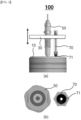
FIG. 1 shows schematic cross-section and bottom views of a cylindrical secondary battery degassing device according to a first embodiment of the disclosure. -
FIG. 2 shows plan and cross-section views of a cylindrical secondary battery applied toFIG. 1 . -
FIG. 3 shows schematic cross-section and bottom views of a cylindrical secondary battery degassing device according to a second embodiment of the disclosure. -
FIG. 4 shows plan and cross-section views of a cylindrical secondary battery applied toFIG. 3 . -
FIG. 5 shows a schematic configuration view of an alignment unit included in the cylindrical secondary battery degassing device shown inFIG. 3 . - Below, embodiments of a cylindrical secondary battery degassing device with the foregoing problems, solutions and effects according to the disclosure will be described with reference to the accompanying drawings.
- The disclosure may be variously modified and have many embodiments, and thus specific embodiments will be illustrated in the accompanying drawings and described in detail. The effects and features of the disclosure, and methods of achieving them will become apparent with reference to the embodiments to be described later in detail in conjunction with the accompanying drawings. However, the disclosure is not limited to the embodiments set forth herein but may be implemented in various forms.
- Below, embodiments of the disclosure will be described in detail with reference to the accompanying drawings. In the following description, the same reference numerals are used to designate the same or similar elements throughout the accompanying drawings, and repetitive descriptions thereof will be avoided.
- In the following embodiments, terms such as "include" or "have" are merely intended to indicate that the disclosed features or elements are present, but not intended to exclude the possibility that one or more other features or elements are added.
- For convenience of description, the elements may be exaggerated or reduced in size throughout the accompanying drawings. For example, the size and thickness of each element shown in the drawings are arbitrarily represented for ease of description, and thus the disclosure is not limited to those shown in the drawings.
- If a certain embodiment is implemented in a different way, a specific order of operations may be performed differently from the order described. For example, two operations consecutively described may be performed at substantially the same time, or may be performed in reverse order from that described.
-
FIGS. 1 and3 show schematic cross-section and bottom views of cylindrical secondary battery degassing devices according to embodiments of the disclosure. - As shown in
FIGS. 1 and3 , a cylindrical secondarybattery degassing device 100 relates to an apparatus for degassing gas generated during charging and discharging of a cylindricalsecondary battery 10. - To this end, the cylindrical secondary
battery degassing device 100 according to the disclosure may include amounting plate 30, a charging-and-dischargingprobe pin 50 movable being mounted to themounting plate 30, and avacuum suction module 70 moving along with the charging-and-dischargingprobe pin 50 and performing degassing by inhaling and exhaling gas generated during the charging and discharging. - The
mounting plate 30 is movably disposed in a charging and discharging device for a cylindrical secondary battery. Here, themounting plate 30 may have various shapes and include various elements as long as it can move in a vertical direction, a horizontal direction or an oblique direction while the charging-and-discharging probe pin 50 is maintained in a stable state. - For example, the
mounting plate 30 may be a pin board to which the charging-and-discharging probe pin 50 is electrically connected and mounted through a socket or the like. The pin board allows the charging-and-dischargingprobe pin 50 to be stably mounted thereto while being electrically connected thereto, and supplies power to or transmits or receives a signal to and from the charging-and-dischargingprobe pin 50 for the charging and discharging of the cylindrical secondary battery so that the charging and discharging operations can be carried out. The pin board is movably disposed so that the charging-and-dischargingprobe pin 50 mounted to the pin board can move in the vertical direction, the horizontal direction or the oblique direction. As themounting plate 30, the pin board may be moved by a separate actuator. - Further, the
mounting plate 30 may be a moving plate provided separately from the pin board. As the mounting plate, the moving plate may be stably mounted with the pin board. The moving plate is movably disposed so that the charging-and-discharging probe pin 50 mounted to the pin board can move in the vertical direction, the horizontal direction, or the oblique direction. As themounting plate 30, the moving plate may be moved by a separate actuator. - Here, the
mounting plate 30 is disposed to be moved by the separate actuator so that the charging-and-dischargingprobe pin 50 can move in various directions. As shown inFIGS. 1 and3 , it may be ensured that themounting plate 30 is disposed to be movable in the vertical direction above the cylindricalsecondary battery 10. - As described above, the
mounting plate 30 is mounted with the charging-and-dischargingprobe pin 50. The charging-and-dischargingprobe pin 50 is mounted to themounting plate 30 and comes into contact with anelectrode 13 of the cylindricalsecondary battery 10 to charge and discharge the cylindricalsecondary battery 10. - Specifically, as shown in
FIGS. 2 and4 , the cylindricalsecondary battery 10 includes theelectrode 13. The electrode may be disposed at various positions of the cylindricalsecondary battery 10, but it is preferable that theelectrode 13 of the cylindricalsecondary battery 10 according to the disclosure is formed on the top of the cylindricalsecondary battery 10. - To perform the charging and discharging process for the cylindrical
secondary battery 10, it is necessary to apply and measure voltage and current to the cylindricalsecondary battery 10. To this end, the charging-and-dischargingprobe pin 50 of the charging and discharging device needs to come into contact with theelectrode 13 of the cylindricalsecondary battery 10. - As described above, the
electrode 13 of the cylindricalsecondary battery 10 is formed on the top of the cylindricalsecondary battery 10, and more particularly in a central portion. Of course, theelectrode 13 may be positioned in other portions than the top central portion of the cylindricalsecondary battery 10. However, it will be taken into account that theelectrode 13 according to the disclosure is positioned in the central portion. - During the charging and discharging process, the charging-and-discharging
probe pin 50 moves in the vertical direction while being mounted to the mountingplate 30, and moves down to come into electrical contact with theelectrode 13 of the cylindricalsecondary battery 10 so that the charging-and-dischargingprobe pin 50 can be in electrical contact with theelectrode 13 formed in the central portion of the cylindricalsecondary battery 10. - Therefore, the mounting
plate 30 is operated to move in the vertical direction by the separate actuator, and is controlled to vertically move down so that the charging-and-dischargingprobe pin 50 can come into contact with theelectrode 13 of the cylindricalsecondary battery 10 - In this way, when the charging-and-discharging
probe pin 50 comes into contact with and is electrically connected to theelectrode 13 of the cylindricalsecondary battery 10, a charging and discharging process and a test for the cylindricalsecondary battery 10 may be performed by applying voltage and current. However, gas is generated inside the cylindricalsecondary battery 10 during the charging and discharging process, and it is thus necessary to perform the degassing by discharging the gas to the outside. - To this end, the cylindrical secondary
battery degassing device 100 according to the disclosure is not separately moved and disposed, but moved along with the charging-and-dischargingprobe pin 50 moved and disposed for the charging and discharging of the cylindricalsecondary battery 10, and includes thevacuum suction module 70 to perform the degassing by inhaling and exhaling gas generated in the cylindricalsecondary battery 10 while the charging-and-dischargingprobe pin 50 is being in contact with theelectrode 13 of the cylindricalsecondary battery 10. - As shown in
FIGS. 1 and3 , thevacuum suction module 70 moves along with the charging-and-dischargingprobe pin 50, is connected to agas outlet 11 of the cylindricalsecondary battery 10, and performs an operation of inhaling and exhaling gas generated in the cylindricalsecondary battery 10 during the charging and discharging process. - Specifically, when the mounting
plate 30 is moved down so that the charging-and-dischargingprobe pin 50 can come into contact with theelectrode 13 of the cylindricalsecondary battery 10 so as to perform the charging and discharging process for the cylindricalsecondary battery 10, thevacuum suction module 70 is connected to thegas outlet 11 formed in the cylindricalsecondary battery 10. In other words, when the charging-and-dischargingprobe pin 50 is in contact with theelectrode 13 of the cylindricalsecondary battery 10, thevacuum suction module 70 is connected to thegas outlet 11 formed on the top of the cylindricalsecondary battery 10. - The
gas outlet 11 formed in the cylindricalsecondary battery 10 is positioned on the top of the cylindricalsecondary battery 10. Specifically, thegas outlet 11 may, as shown inFIG. 2 , be positioned in the center of the cylindricalsecondary battery 10, or, as shown inFIG. 4 , be positioned off the center of the cylindricalsecondary battery 10. In this regard, details will be described later. - The
gas outlet 11 of the cylindricalsecondary battery 10 may be variously shaped and disposed as long as it is structured to connect with thevacuum suction module 70 and easily discharge gas generated in the cylindricalsecondary battery 10 during the charging and discharging process. - When the charging-and-discharging
probe pin 50 is in contact with theelectrode 13 of the cylindricalsecondary battery 10, thevacuum suction module 70 may have a structure to be easily connected to thegas outlet 11 of the cylindricalsecondary battery 10 and to be sealed to maintain airtightness from the outside in the connected state. - To this end, a
vacuum pad 71 is provided in a lower portion of thevacuum suction module 70. When the charging-and-dischargingprobe pin 50 moves down in the vertical direction and comes into contact with theelectrode 13 of the cylindricalsecondary battery 10, thevacuum pad 71 may be in close contact with or connected to thegas outlet 11 of the cylindricalsecondary battery 10 so as to communicate with thegas outlet 11, thereby maintaining the sealing state from the outside. - In this state, when a separately configured vacuum suction device (not shown) is connected to an upper side of the
vacuum suction module 70 and performs a suction operation, the inside of thevacuum suction module 70 becomes vacuum and gas generated inside the cylindricalsecondary battery 10 is suctioned and discharged to the outside through thegas outlet 11 and thevacuum suction module 70, thereby carrying out the degassing. - As described above, the
gas outlet 11 of the cylindricalsecondary battery 10 according to the disclosure may be positioned in the center or off the center of the cylindricalsecondary battery 10. - Specifically, the
gas outlet 11 of the cylindricalsecondary battery 10 according to an embodiment may, as shown inFIG. 2 , be formed at the center of the cylindricalsecondary battery 10, and thevacuum suction module 70 may, as shown inFIG. 1 , be inserted and disposed in the charging-and-dischargingprobe pin 50. - The
gas outlet 11 of the cylindricalsecondary battery 10 is formed at the center of the cylindricalsecondary battery 10, and thus disposed inside or adjacent to theelectrode 13 of the cylindricalsecondary battery 10. Because the charging-and-dischargingprobe pin 50 is in contact with theelectrode 13 of the cylindricalsecondary battery 10 during the charging and discharging process, and thegas outlet 11 of the cylindricalsecondary battery 10 is formed at the center of the cylindricalsecondary battery 10, it is most preferable structurally that thevacuum suction module 70 is inserted and disposed in the charging-and-dischargingprobe pin 50. - As a result, when the charging-and-discharging
probe pin 50 comes into contact with theelectrode 13 of the cylindricalsecondary battery 10 as the mountingplate 30 moves down in the vertical direction, thevacuum pad 71 of thevacuum suction module 70 inserted and disposed in the charging-and-dischargingprobe pin 50 may be in contact with or connected to thegas outlet 11 of the cylindricalsecondary battery 10 so as to communicate with thegas outlet 11. - The
gas outlet 11 of the cylindricalsecondary battery 10 according to another embodiment may, as shown inFIG. 4 , be positioned off the center of the cylindricalsecondary battery 10, and, correspondingly, thevacuum suction module 70 may, as shown inFIG. 3 , be disposed being mounted to the mountingplate 30 as spaced apart from the charging-and-dischargingprobe pin 50. - Because the
gas outlet 11 of the cylindricalsecondary battery 10 is positioned off the center of the cylindricalsecondary battery 10, thegas outlet 11 is spaced apart from theelectrode 13 formed at the center of the cylindricalsecondary battery 10. Because the charging-and-dischargingprobe pin 50 comes into contact with theelectrode 13 formed at the center of the cylindricalsecondary battery 10 during the charging and discharging process but thegas outlet 11 of the cylindricalsecondary battery 10 is positioned off the center of the cylindricalsecondary battery 10, it is most preferable structurally that thevacuum suction module 70 is disposed to be spaced apart from the charging-and-dischargingprobe pin 50 and mounted to the mountingplate 30 so as to move along with the charging-and-dischargingprobe pin 50. - As a result, when the charging-and-discharging
probe pin 50 comes into contact with theelectrode 13 of the cylindricalsecondary battery 10 as the mountingplate 30 moves down in the vertical direction, thevacuum pad 71 of thevacuum suction module 70 disposed being mounted to the mountingplate 30 as spaced apart from the charging-and-dischargingprobe pin 50 may be in contact with or connected to thegas outlet 11 positioned off the center of the cylindricalsecondary battery 10 so as to communicate with thegas outlet 11. - Here, while the charging-and-discharging
probe pin 50 moves down in the vertical direction and comes into contact with theelectrode 13 of the cylindricalsecondary battery 10, thevacuum suction module 70 may be disposed being mounted to the mountingplate 30, to which the charging-and-dischargingprobe pin 50 is mounted, so that thevacuum suction module 70 can move along with the charging-and-dischargingprobe pin 50 and be in contact with or connected to thegas outlet 11 positioned off the center of the cylindricalsecondary battery 10 in order to communicate with thegas outlet 11. Therefore, when the mountingplate 30 moves down in the vertical direction by a certain stroke, the charging-and-dischargingprobe pin 50 comes into contact with theelectrode 13 of the cylindricalsecondary battery 10 and at the same time thevacuum suction module 70 is in contact with and connected to thegas outlet 11 of the cylindricalsecondary battery 10 so as to communicate with thegas outlet 11. - Meanwhile, in the cylindrical secondary
battery degassing device 10 shown inFIGS. 1 and2 , thevacuum suction module 70 may be in contact with and connected to thegas outlet 11 of the cylindricalsecondary battery 10 so as to communicate with thegas outlet 11 as the charging-and-dischargingprobe pin 50 vertically moves down while being aligned with a top central portion of the cylindricalsecondary battery 10. - On the other hand, in the cylindrical secondary
battery degassing device 10 shown inFIGS. 3 and4 , even though the charging-and-dischargingprobe pin 50 vertically moves down while being aligned with the top central portion of the cylindricalsecondary battery 10, it is not ensured that thevacuum suction module 70 is in contact with and connected to thegas outlet 11 of the cylindricalsecondary battery 10 so as to communicate with thegas outlet 11 because thevacuum suction module 70 is mounted to the mountingplate 30 while being spaced apart from the charging-and-discharging probe pin 500 and thegas outlet 11 of the cylindricalsecondary battery 10 is positioned off the center of the cylindricalsecondary battery 10. - To this end, the cylindrical secondary
battery degassing device 100 according to an embodiment of the disclosure may further include analignment unit 90 as shown inFIG. 5 . In other words, the cylindrical secondarybattery degassing device 100 according to the disclosure, shown inFIGS. 3 and4 , further include thealignment unit 90 for the position alignment of the cylindricalsecondary battery 10, in which thealignment unit 90 drives the cylindricalsecondary battery 10 to rotate so that thegas outlet 11 of the cylindricalsecondary battery 10 can be aligned with thevacuum suction module 70 disposed being mounted to the mountingplate 30. - Specifically, the
alignment unit 90 performs an operation of rotating the cylindricalsecondary battery 10 so that thegas outlet 11 of the cylindricalsecondary battery 10 shown inFIG. 4 and thevacuum suction module 70 mounted to the mountingplate 30 can align in the vertical direction. Therefore, when the charging-and-dischargingprobe pin 50 vertically moves down while being assigned with the top central portion of the cylindricalsecondary battery 10 by thealignment unit 90, thevacuum suction module 70 is in contact with and connected to thegas outlet 11 of the cylindricalsecondary battery 10 so as to communicate with thegas outlet 11. - The alignment of the cylindrical
secondary battery 10 by thealignment unit 90 may be carried out before or after loading the cylindricalsecondary battery 10 to a charging and discharging tray where a plurality of cylindrical secondary batteries is accommodated and mounted. In other words, the cylindricalsecondary battery 10 may be aligned by thealignment unit 90 before being loaded to the tray for the charging and discharging, and the aligned cylindricalsecondary battery 10 may be loaded to the charging and discharging tray. As necessary, the cylindricalsecondary battery 10 may be first loaded to the charging and discharging tray, and then subjected to the alignment of thealignment unit 90 while being mounted to the charging and discharging tray. - The
alignment unit 90 in the former case may be separately configured being spaced apart from the tray for the charging and discharging, and thealignment unit 90 in the latter case may be mounted to or disposed adjacent to the tray for the charging and discharging. In the latter case unlike the former case, the plurality of cylindricalsecondary batteries 10 mounted to the charging and discharging tray are subjected to the alignment by thealignment unit 90 at a time, thereby having an effect on reducing time, efforts and costs taken in aligning the plurality of cylindricalsecondary batteries 10 for the charging and discharging. - The
alignment unit 90 may be implemented by various shapes and methods as long as it can rotate the cylindricalsecondary battery 10 to align thevacuum suction module 70 disposed being mounted to the mountingplate 30 with thegas outlet 11 of the cylindricalsecondary battery 10 in the vertical direction. - A specific exemplary configuration of the
alignment unit 90 is as follows. As shown inFIG. 5 , thealignment unit 90 includes anidle roller 93 for contact-supporting the cylindricalsecondary battery 10 not to be separated, a drivingroller 95 for driving the cylindricalsecondary battery 10 contact-supported on theidle rollers 93 to rotate, avision unit 91 for taking a position image of thegas outlet 11 of the cylindricalsecondary battery 10, and acontroller 97 for controlling the drivingroller 95 to align thegas outlet 11 of the cylindricalsecondary battery 10 with thevacuum suction module 70 disposed being mounted to the mountingplate 30 in the vertical direction in consideration of the position of thegas outlet 11 of the cylindricalsecondary battery 10 identified based on image information received from thevision unit 91. - The
idle roller 93 contact-supports the lateral side of the cylindricalsecondary battery 10 not to be separated when the cylindricalsecondary battery 10 is driven to rotate by the drivingroller 95. At least twoidle rollers 93 are provided, and the at least twoidle rollers 93 are spaced apart from each other and disposed to contact-support the lateral side of the cylindricalsecondary battery 10. Eachidle roller 93 contact-supports the cylindricalsecondary battery 10 and allows the cylindricalsecondary battery 10 to rotate naturally without resistance when driven to rotate by the drivingroller 95. - The driving
roller 95 rotates the cylindricalsecondary battery 10 under control of thecontroller 97. To this end, the drivingroller 95 is disposed to be in contact with the lateral side of the cylindricalsecondary battery 10, and rotated under control of thecontroller 97, thereby rotating the cylindricalsecondary battery 10. In this process, the cylindricalsecondary battery 10 is rotatably contact-supported on theidle roller 93 when driven to rotate by the drivingroller 95, and thus rotated without being separated. As a result, thegas outlet 11 of the cylindricalsecondary battery 10 is vertically aligned with thevacuum suction module 70 disposed being mounted to the mountingplate 30. - The
vision unit 91 takes an image of the cylindricalsecondary battery 10 and transmits the image to thecontroller 97. Based on the image, thecontroller 97 may identify the position of thegas outlet 11 of the cylindricalsecondary battery 10, calculate a rotated value of the cylindricalsecondary battery 10 in consideration of the identified position of thegas outlet 11, and calculate a rotation driving value of the drivingroller 95. As a result, thecontroller 97 may control the drivingroller 95 to vertically align thegas outlet 11 of the cylindricalsecondary battery 10 with thevacuum suction module 70 disposed being mounted to the mountingplate 30, in consideration of the position of thegas outlet 11 of the cylindricalsecondary battery 10, which can be identified based on the image information of the cylindricalsecondary battery 10 received from thevision unit 91. - Meanwhile, when the
alignment unit 90 described as above is mounted to or disposed adjacent to the foregoing charging and discharging tray, theidle rollers 93 and the drivingrollers 95 may be disposed one-to-one corresponding to the respective cylindricalsecondary batteries 10 mounted to the charging and discharging tray, and at least onevision unit 91 may be configured to take an image of the plurality of cylindricalsecondary batteries 10 mounted to the charging and discharging tray, in which thevision unit 91 may be stationarily disposed or may be movably disposed to scan the plurality of cylindricalsecondary batteries 10. - As a result, the
controller 97 may identify the position of thegas outlet 11 of each cylindricalsecondary battery 10 based on the image information of the plurality of cylindricalsecondary batteries 10 mounted to the charging and discharging tray, the image of which has been taken by thevision unit 91, and control the drivingroller 95 disposed corresponding to each cylindricalsecondary battery 10 in consideration of the identified position, thereby controlling the drivingroller 95 to vertically align thegas outlet 11 of each cylindricalsecondary battery 10 with the correspondingvacuum suction module 70 disposed being mounted to the mountingplate 30. - Meanwhile, when the
idle roller 93 and the drivingroller 95 are disposed one-to-one corresponding to the respective cylindricalsecondary batteries 10 mounted to the charging and discharging tray, theidle roller 93 and the drivingroller 95 may be movably disposed not to interfere with the cylindricalsecondary battery 10 loaded to or unloaded from the charging and discharging tray. - Therefore, the
idle roller 93 and the drivingroller 95 are being spaced apart from the mounting position of the cylindricalsecondary battery 10 while the cylindricalsecondary battery 10 is loaded to or unloaded from the charging and discharging tray, and are moved to be disposed being in contact with the lateral side of the cylindricalsecondary battery 10 when the cylindricalsecondary battery 10 is loaded and mounted to the charging and discharging tray. - In a cylindrical secondary battery degassing device described above, gas generated during charging and discharging processes of a cylindrical secondary battery is suctioned and discharged through a vacuum suction module moving along with a charging-and-discharging probe pin being in contact with electrodes of the cylindrical secondary battery to charge and discharge the cylindrical secondary battery, thereby exhibiting distinctive effects on improving a process efficiency in manufacturing the cylindrical secondary battery, preventing the performance deterioration of the cylindrical secondary battery, and reducing time, efforts and costs for the degassing.
- Although a few embodiments of the disclosure have been described above, it will be apparent for a person having ordinary knowledge in the art that these descriptions are for the illustrative purposes only and various changes can be made without departing from the scope of the disclosure. Accordingly, the genuine technical scope of the disclosure should be defined by the appended claims.
- A cylindrical secondary battery degassing device according to the disclosure is industrially applicable to improve a process efficiency in manufacturing the cylindrical secondary battery, prevent the performance deterioration of the cylindrical secondary battery, and reduce time, efforts and costs for degassing because gas generated during charging and discharging processes of a cylindrical secondary battery is suctioned and discharged through a vacuum suction module moving along with a charging-and-discharging probe pin being in contact with electrodes of the cylindrical secondary battery to charge and discharge the cylindrical secondary battery.
Claims (4)
- A cylindrical secondary battery degassing device comprising:a mounting plate disposed movably;a charging-and-discharging probe pin mounted to the mounting plate and coming into contact with an electrode of a cylindrical secondary battery to charge and discharge the cylindrical secondary battery; anda vacuum suction module movable along with the charging-and-discharging probe pin, connected to a gas outlet of the cylindrical secondary battery, and configured to suction and discharge gas generated inside the cylindrical secondary battery during charging and discharging processes.
- The cylindrical secondary battery degassing device of claim 1, whereinthe gas outlet of the cylindrical secondary battery is formed at the center of the cylindrical secondary battery, andthe vacuum suction module is disposed being inserted in the charging-and-discharging probe pin.
- The cylindrical secondary battery degassing device of claim 1, whereinthe gas outlet of the cylindrical secondary battery is positioned off the center of the cylindrical secondary battery, andthe vacuum suction module is disposed being spaced apart from the charging-and-discharging probe pin and mounted to the mounting plate.
- The cylindrical secondary battery degassing device of claim 3, further comprising an alignment unit configured to align a position of the cylindrical secondary battery,
wherein the alignment unit drives the cylindrical secondary battery to rotate so as to align the gas outlet of the cylindrical secondary battery with the vacuum suction module disposed being mounted to the mounting plate.
Applications Claiming Priority (2)
| Application Number | Priority Date | Filing Date | Title |
|---|---|---|---|
| KR1020200172984A KR102526980B1 (en) | 2020-12-11 | 2020-12-11 | Cylindrical secondary battery degassing device |
| PCT/KR2021/018571 WO2022124804A1 (en) | 2020-12-11 | 2021-12-09 | Cylindrical secondary battery degassing device |
Publications (2)
| Publication Number | Publication Date |
|---|---|
| EP4261964A1 true EP4261964A1 (en) | 2023-10-18 |
| EP4261964A4 EP4261964A4 (en) | 2025-07-23 |
Family
ID=81974739
Family Applications (1)
| Application Number | Title | Priority Date | Filing Date |
|---|---|---|---|
| EP21903850.2A Pending EP4261964A4 (en) | 2020-12-11 | 2021-12-09 | DEGASTING DEVICE FOR CYLINDRICAL SECONDARY BATTERY |
Country Status (4)
| Country | Link |
|---|---|
| US (1) | US12537259B2 (en) |
| EP (1) | EP4261964A4 (en) |
| KR (1) | KR102526980B1 (en) |
| WO (1) | WO2022124804A1 (en) |
Families Citing this family (2)
| Publication number | Priority date | Publication date | Assignee | Title |
|---|---|---|---|---|
| KR20220036229A (en) * | 2020-09-15 | 2022-03-22 | 주식회사 엘지에너지솔루션 | Charging and discharging device for secondary battery |
| CN121522500A (en) * | 2026-01-14 | 2026-02-13 | 深圳市益鸿智能科技有限公司 | Lithium-ion battery testing module and automatic testing machine |
Family Cites Families (7)
| Publication number | Priority date | Publication date | Assignee | Title |
|---|---|---|---|---|
| KR100319111B1 (en) * | 1999-11-25 | 2001-12-29 | 김순택 | Cap assembly of prismatic type secondary battery |
| KR100690026B1 (en) * | 2005-05-06 | 2007-03-08 | 에버테크노 주식회사 | Precharger of battery and electrolyte filling method using same |
| KR101077280B1 (en) | 2009-10-29 | 2011-10-27 | 허욱환 | Recycling apparatus and method of the waste lithium battery |
| KR102133646B1 (en) | 2018-05-21 | 2020-07-13 | 주식회사 엘지화학 | Apparatus for collecting inner gas in secondary electric cell and method thereof for charging and discharging |
| KR20200004745A (en) | 2018-07-04 | 2020-01-14 | 주식회사 엘지화학 | An automated apparatus for collecting gas generated inside secondary battery and a method thereof |
| KR102160339B1 (en) | 2018-07-09 | 2020-09-25 | 주식회사 엘지화학 | Apparatus for real-time collecting inner gas in pouch type secondary electric cell while charging and discharging and method thereof |
| KR102062656B1 (en) * | 2019-09-09 | 2020-01-06 | (주)에이앤에이 | Cylindrical Battery Aligner |
-
2020
- 2020-12-11 KR KR1020200172984A patent/KR102526980B1/en active Active
-
2021
- 2021-12-09 US US18/038,039 patent/US12537259B2/en active Active
- 2021-12-09 EP EP21903850.2A patent/EP4261964A4/en active Pending
- 2021-12-09 WO PCT/KR2021/018571 patent/WO2022124804A1/en not_active Ceased
Also Published As
| Publication number | Publication date |
|---|---|
| WO2022124804A1 (en) | 2022-06-16 |
| US12537259B2 (en) | 2026-01-27 |
| US20230420790A1 (en) | 2023-12-28 |
| KR102526980B1 (en) | 2023-05-03 |
| EP4261964A4 (en) | 2025-07-23 |
| KR20220083101A (en) | 2022-06-20 |
Similar Documents
| Publication | Publication Date | Title |
|---|---|---|
| CN102077107B (en) | Battery internal short circuit evaluation device | |
| KR102724647B1 (en) | Inspection method and apparatus of secondary battery cell in activation process | |
| US12537259B2 (en) | Cylindrical secondary battery degassing device | |
| US20060099502A1 (en) | Cylindrical lithium secondary battery | |
| KR102194845B1 (en) | Apparatus and method for inspecting low voltage defect of secondary battery | |
| CN102017238A (en) | Positive electrode plate for non-aqueous battery, electrode group for non-aqueous battery and manufacturing method thereof, prismatic non-aqueous secondary battery and manufacturing method thereof | |
| CN114207906B (en) | Secondary battery, battery pack, electronic device, electric tool, electric aircraft, and electric vehicle | |
| Gao et al. | Influence of coupling of overcharge state and short-term cycle on the mechanical integrity behavior of 18650 Li-ion batteries subject to lateral compression | |
| US20040241534A1 (en) | Method for charing non-aqueous electrolyte secondary battery and charger therefor | |
| JP2004213902A (en) | Battery charging apparatus and battery charging method | |
| JP4515405B2 (en) | Cylindrical lithium secondary battery and manufacturing method thereof | |
| US6997228B2 (en) | Lamination apparatus for automated manufacturing system of lithium secondary battery | |
| Laresgoiti et al. | Calendar ageing of commercial 18650 cells with nickel-rich cathode and graphite-silicon anode: Influence of check-up | |
| Gordon et al. | Towards more realistic Li-ion battery safety tests based on Li-plating as internal cell error | |
| US12051784B2 (en) | Secondary battery internal pressure measurement method | |
| KR101024318B1 (en) | Rechargeable battery formation unit | |
| US20230268566A1 (en) | Positive electrode active material, positive electrode including the same, secondary battery including the same, and gas analyzing apparatus | |
| JPH08148184A (en) | Non-aqueous electrolyte secondary battery | |
| JPH09167637A (en) | Cylindrical battery short circuit detection method | |
| US20240372155A1 (en) | Internal short circuit induction apparatus and method for batteries | |
| US20240204374A1 (en) | Battery for testing short circuit, manufacturing method therefor, and battery safety analysis method | |
| KR20150023114A (en) | Battery pack having gas discharge pipe | |
| KR20230082396A (en) | Welding error detection apparatus for negative tap of secondary battery | |
| KR20220104906A (en) | Inspection method of secondary battery cell in activation process | |
| KR20260022180A (en) | System and method for detecting bad weld |
Legal Events
| Date | Code | Title | Description |
|---|---|---|---|
| STAA | Information on the status of an ep patent application or granted ep patent |
Free format text: STATUS: THE INTERNATIONAL PUBLICATION HAS BEEN MADE |
|
| PUAI | Public reference made under article 153(3) epc to a published international application that has entered the european phase |
Free format text: ORIGINAL CODE: 0009012 |
|
| STAA | Information on the status of an ep patent application or granted ep patent |
Free format text: STATUS: REQUEST FOR EXAMINATION WAS MADE |
|
| 17P | Request for examination filed |
Effective date: 20230707 |
|
| AK | Designated contracting states |
Kind code of ref document: A1 Designated state(s): AL AT BE BG CH CY CZ DE DK EE ES FI FR GB GR HR HU IE IS IT LI LT LU LV MC MK MT NL NO PL PT RO RS SE SI SK SM TR |
|
| DAV | Request for validation of the european patent (deleted) | ||
| DAX | Request for extension of the european patent (deleted) | ||
| A4 | Supplementary search report drawn up and despatched |
Effective date: 20250620 |
|
| RIC1 | Information provided on ipc code assigned before grant |
Ipc: H01M 10/04 20060101AFI20250613BHEP Ipc: G01R 31/364 20190101ALI20250613BHEP Ipc: H01M 50/30 20210101ALI20250613BHEP Ipc: H01M 10/44 20060101ALI20250613BHEP Ipc: H01M 50/308 20210101ALI20250613BHEP |