EP4261303A1 - Hot rolled steel having low compressive strength loss after being processed into steel pipe, and manufacturing method therefor - Google Patents
Hot rolled steel having low compressive strength loss after being processed into steel pipe, and manufacturing method therefor Download PDFInfo
- Publication number
- EP4261303A1 EP4261303A1 EP21903669.6A EP21903669A EP4261303A1 EP 4261303 A1 EP4261303 A1 EP 4261303A1 EP 21903669 A EP21903669 A EP 21903669A EP 4261303 A1 EP4261303 A1 EP 4261303A1
- Authority
- EP
- European Patent Office
- Prior art keywords
- less
- rolled steel
- tensile
- steel
- hot rolled
- Prior art date
- Legal status (The legal status is an assumption and is not a legal conclusion. Google has not performed a legal analysis and makes no representation as to the accuracy of the status listed.)
- Pending
Links
Classifications
-
- C—CHEMISTRY; METALLURGY
- C22—METALLURGY; FERROUS OR NON-FERROUS ALLOYS; TREATMENT OF ALLOYS OR NON-FERROUS METALS
- C22C—ALLOYS
- C22C38/00—Ferrous alloys, e.g. steel alloys
- C22C38/001—Ferrous alloys, e.g. steel alloys containing N
-
- C—CHEMISTRY; METALLURGY
- C21—METALLURGY OF IRON
- C21D—MODIFYING THE PHYSICAL STRUCTURE OF FERROUS METALS; GENERAL DEVICES FOR HEAT TREATMENT OF FERROUS OR NON-FERROUS METALS OR ALLOYS; MAKING METAL MALLEABLE, e.g. BY DECARBURISATION OR TEMPERING
- C21D1/00—General methods or devices for heat treatment, e.g. annealing, hardening, quenching or tempering
- C21D1/18—Hardening; Quenching with or without subsequent tempering
-
- C—CHEMISTRY; METALLURGY
- C21—METALLURGY OF IRON
- C21D—MODIFYING THE PHYSICAL STRUCTURE OF FERROUS METALS; GENERAL DEVICES FOR HEAT TREATMENT OF FERROUS OR NON-FERROUS METALS OR ALLOYS; MAKING METAL MALLEABLE, e.g. BY DECARBURISATION OR TEMPERING
- C21D1/00—General methods or devices for heat treatment, e.g. annealing, hardening, quenching or tempering
- C21D1/84—Controlled slow cooling
-
- C—CHEMISTRY; METALLURGY
- C21—METALLURGY OF IRON
- C21D—MODIFYING THE PHYSICAL STRUCTURE OF FERROUS METALS; GENERAL DEVICES FOR HEAT TREATMENT OF FERROUS OR NON-FERROUS METALS OR ALLOYS; MAKING METAL MALLEABLE, e.g. BY DECARBURISATION OR TEMPERING
- C21D6/00—Heat treatment of ferrous alloys
- C21D6/005—Heat treatment of ferrous alloys containing Mn
-
- C—CHEMISTRY; METALLURGY
- C21—METALLURGY OF IRON
- C21D—MODIFYING THE PHYSICAL STRUCTURE OF FERROUS METALS; GENERAL DEVICES FOR HEAT TREATMENT OF FERROUS OR NON-FERROUS METALS OR ALLOYS; MAKING METAL MALLEABLE, e.g. BY DECARBURISATION OR TEMPERING
- C21D6/00—Heat treatment of ferrous alloys
- C21D6/008—Heat treatment of ferrous alloys containing Si
-
- C—CHEMISTRY; METALLURGY
- C21—METALLURGY OF IRON
- C21D—MODIFYING THE PHYSICAL STRUCTURE OF FERROUS METALS; GENERAL DEVICES FOR HEAT TREATMENT OF FERROUS OR NON-FERROUS METALS OR ALLOYS; MAKING METAL MALLEABLE, e.g. BY DECARBURISATION OR TEMPERING
- C21D8/00—Modifying the physical properties of ferrous metals or ferrous alloys by deformation combined with, or followed by, heat treatment
- C21D8/02—Modifying the physical properties of ferrous metals or ferrous alloys by deformation combined with, or followed by, heat treatment during manufacturing of plates or strips
-
- C—CHEMISTRY; METALLURGY
- C21—METALLURGY OF IRON
- C21D—MODIFYING THE PHYSICAL STRUCTURE OF FERROUS METALS; GENERAL DEVICES FOR HEAT TREATMENT OF FERROUS OR NON-FERROUS METALS OR ALLOYS; MAKING METAL MALLEABLE, e.g. BY DECARBURISATION OR TEMPERING
- C21D8/00—Modifying the physical properties of ferrous metals or ferrous alloys by deformation combined with, or followed by, heat treatment
- C21D8/02—Modifying the physical properties of ferrous metals or ferrous alloys by deformation combined with, or followed by, heat treatment during manufacturing of plates or strips
- C21D8/0221—Modifying the physical properties of ferrous metals or ferrous alloys by deformation combined with, or followed by, heat treatment during manufacturing of plates or strips characterised by the working steps
- C21D8/0226—Hot rolling
-
- C—CHEMISTRY; METALLURGY
- C21—METALLURGY OF IRON
- C21D—MODIFYING THE PHYSICAL STRUCTURE OF FERROUS METALS; GENERAL DEVICES FOR HEAT TREATMENT OF FERROUS OR NON-FERROUS METALS OR ALLOYS; MAKING METAL MALLEABLE, e.g. BY DECARBURISATION OR TEMPERING
- C21D8/00—Modifying the physical properties of ferrous metals or ferrous alloys by deformation combined with, or followed by, heat treatment
- C21D8/02—Modifying the physical properties of ferrous metals or ferrous alloys by deformation combined with, or followed by, heat treatment during manufacturing of plates or strips
- C21D8/0247—Modifying the physical properties of ferrous metals or ferrous alloys by deformation combined with, or followed by, heat treatment during manufacturing of plates or strips characterised by the heat treatment
- C21D8/0263—Modifying the physical properties of ferrous metals or ferrous alloys by deformation combined with, or followed by, heat treatment during manufacturing of plates or strips characterised by the heat treatment following hot rolling
-
- C—CHEMISTRY; METALLURGY
- C21—METALLURGY OF IRON
- C21D—MODIFYING THE PHYSICAL STRUCTURE OF FERROUS METALS; GENERAL DEVICES FOR HEAT TREATMENT OF FERROUS OR NON-FERROUS METALS OR ALLOYS; MAKING METAL MALLEABLE, e.g. BY DECARBURISATION OR TEMPERING
- C21D9/00—Heat treatment, e.g. annealing, hardening, quenching or tempering, adapted for particular articles; Furnaces therefor
- C21D9/46—Heat treatment, e.g. annealing, hardening, quenching or tempering, adapted for particular articles; Furnaces therefor for sheet metals
-
- C—CHEMISTRY; METALLURGY
- C22—METALLURGY; FERROUS OR NON-FERROUS ALLOYS; TREATMENT OF ALLOYS OR NON-FERROUS METALS
- C22C—ALLOYS
- C22C38/00—Ferrous alloys, e.g. steel alloys
- C22C38/002—Ferrous alloys, e.g. steel alloys containing In, Mg, or other elements not provided for in one single group C22C38/001 - C22C38/60
-
- C—CHEMISTRY; METALLURGY
- C22—METALLURGY; FERROUS OR NON-FERROUS ALLOYS; TREATMENT OF ALLOYS OR NON-FERROUS METALS
- C22C—ALLOYS
- C22C38/00—Ferrous alloys, e.g. steel alloys
- C22C38/02—Ferrous alloys, e.g. steel alloys containing silicon
-
- C—CHEMISTRY; METALLURGY
- C22—METALLURGY; FERROUS OR NON-FERROUS ALLOYS; TREATMENT OF ALLOYS OR NON-FERROUS METALS
- C22C—ALLOYS
- C22C38/00—Ferrous alloys, e.g. steel alloys
- C22C38/04—Ferrous alloys, e.g. steel alloys containing manganese
-
- C—CHEMISTRY; METALLURGY
- C22—METALLURGY; FERROUS OR NON-FERROUS ALLOYS; TREATMENT OF ALLOYS OR NON-FERROUS METALS
- C22C—ALLOYS
- C22C38/00—Ferrous alloys, e.g. steel alloys
- C22C38/06—Ferrous alloys, e.g. steel alloys containing aluminium
-
- C—CHEMISTRY; METALLURGY
- C21—METALLURGY OF IRON
- C21D—MODIFYING THE PHYSICAL STRUCTURE OF FERROUS METALS; GENERAL DEVICES FOR HEAT TREATMENT OF FERROUS OR NON-FERROUS METALS OR ALLOYS; MAKING METAL MALLEABLE, e.g. BY DECARBURISATION OR TEMPERING
- C21D2211/00—Microstructure comprising significant phases
- C21D2211/005—Ferrite
-
- C—CHEMISTRY; METALLURGY
- C21—METALLURGY OF IRON
- C21D—MODIFYING THE PHYSICAL STRUCTURE OF FERROUS METALS; GENERAL DEVICES FOR HEAT TREATMENT OF FERROUS OR NON-FERROUS METALS OR ALLOYS; MAKING METAL MALLEABLE, e.g. BY DECARBURISATION OR TEMPERING
- C21D2211/00—Microstructure comprising significant phases
- C21D2211/009—Pearlite
Definitions
- the present disclosure relates to a hot rolled steel having low compressive strength loss after being processed into a steel pipe, and a manufacturing method therefor.
- the high-speed vacuum tube train is basically a transportation means in the form of moving a train within the vacuum tube. That is, since the high-speed vacuum tube train system minimizes air resistance by maintaining an interior of the tube in a vacuum state, it is a transportation means based on the concept that the train may run at high speed.
- a steel material receives tensile stress in a circumferential direction of a steel pipe during a bending process, which may result in a compressive strength loss in the same circumferential direction after processing.
- Compressive strength loss in the circumferential direction of the steel pipe not only may cause shape deformation after processing a material, but also cause serious defects that may lead to tube collapse in emergency situations. Therefore, in the steel pipe material for a tube, a steel material that can minimize compressive strength loss needs to be applied.
- Patent Document 1 International Publication No. WO2005080621A1
- An aspect of the present disclosure is to provide a hot rolled steel having low compressive strength loss after being processed into a steel pipe, and a manufacturing method therefor.
- the tensile strength ⁇ Tensile of the hot rolled steel may be 385 MPa or more, and impact toughness at 0°C may be 50 J or more.
- a method for manufacturing a hot rolled steel having small compressive strength loss after being processed into a steel pipe may include: finish hot-rolling a steel slab including the above-described composition at a finish temperature of 950 to 1030°C; and
- a steel having small compressive strength loss after being processed into a steel pipe in which when tensile strength under a 0.3% stretching condition is referred to as ⁇
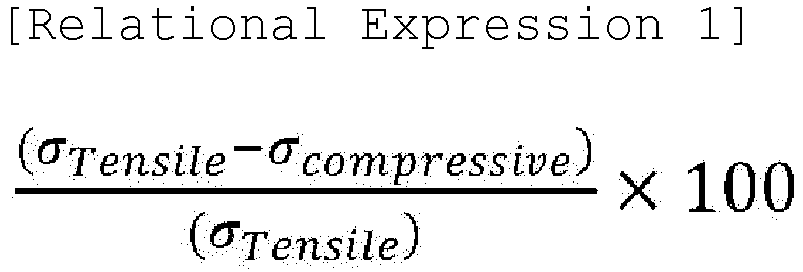
- Tensile and compressive strength when the stretched and deformed material is compressed by 0.2% again is referred to as ⁇ compressive , a value is less than 20% defined in the above-described Relational Expression 1.
- the present disclosure relates to technology for manufacturing a steel having low compressive strength loss during manufacturing of a steel pipe, and specifically, the steel including: by wt%, 0.15% or less of carbon (C), 2.5% or less of silicon (Si), 2.0% or less of manganese (Mn), 0.05% or less of aluminum (Al), nitrogen (N) and boron (B) in a sum of 0.002 to 0.
- the steel including: by wt%, 0.15% or less of carbon (C), 2.5% or less of silicon (Si), 2.0% or less of manganese (Mn), 0.05% or less of aluminum (Al), nitrogen (N) and boron (B) in a sum of 0.002 to 0.
- Carbon (C) is a representative hardenability improving element and is an element that effectively contributes to securing the strength of steel. Accordingly, the present disclosure may include carbon (C) in a range or more satisfying 250 ⁇ 450C + 95Si + 70Mn from a viewpoint of securing the strength of a vacuum tube structure.
- the present disclosure may limit an upper limit of the carbon (C) content to 0.15%. More preferably, the upper limit of the content of carbon (C) is limited to 0.12%.
- Silicon (Si) is an element contributing to the deoxidation of steel. Accordingly, the present disclosure may include silicon (Si) of 250 ⁇ 450C+95Si+70Mn or more to secure the cleanness and strength of steel.
- silicon (Si) when silicon (Si) is excessively added, high-temperature strength of a material may be increased to cause a problem in a continuous casting process, and the surface quality of a product may be deteriorated by preventing separation of surface scale. Accordingly, the present disclosure may limit an upper limit of the content of silicon (Si) to 2.5%. More preferably, the upper limit of the content of silicon (Si) is limited to 2.0%.
- the present disclosure may include manganese (Mn) of 250 ⁇ 450C+95Si+70Mn or more to secure the strength of steel.
- Mn manganese
- the present disclosure may limit an upper limit of the content of manganese (Mn) to 2.0%. More preferably, the upper limit of the manganese (Mn) content is limited to 1.8%.
- Aluminum (Al) is an element that easily reacts with oxygen, and is a representative element used in a deoxidation reaction during a steelmaking process. However, when aluminum (Al) is present in steel, since there is a concern of generating an inclusion, it is preferable to control aluminum (Al) so that aluminum (Al) does not remain in the steel as much as possible. Accordingly, the present disclosure may limit an upper limit of the content of aluminum (Al) to 0.05%.
- Nitrogen (N) and boron (B) are interstitial solid solution elements, and although their content in steel is lower than that of other elements, they have a relatively large effect on physical properties.
- the present inventors have found that the sum of the two element contents is related to a compressive strength loss of the material. That is, when the sum of the two elements exceeds 0.008%, by wt%, it was confirmed that it is considerably difficult to control a value defined in Relational Expression 2 described below to be less than 20. Furthermore, it is not preferable to control the sum of the two elements to be less than 0.002% due to high possibility for a cost increase in terms of material component control.
- the sum of the contents of the two elements may be limited to 0.002 to 0.008%, by wt%. More preferably, the sum of the contents of the two elements is limited to 0.003 to 0.007%, by wt%.
- the steel of the present disclosure consists of a mixed structure of ferrite and pearlite.
- a fraction of the ferrite may be 60 to 90%, in area %, and a fraction of the pearlite may be 10 to 40%, in area %.
- the present inventors have repeatedly studied a method for reducing a compressive strength loss after stretching a steel material, and as a result, they found that it is advantageous to reduce compressive strength loss when the size of ferrite particles in the steel material is large.
- an average grain size of the ferrite is 25 um or more
- an upper limit of the average grain size is limited to 25 um.
- a lower limit was set to 8 ⁇ m.
- the steel of the present disclosure may represent a compressive strength loss of less than 20% defined in the following Relational Expression 1.
- the present inventors simulated a situation in which a hot-rolled steel is subjected to tensile stress during steel pipe processing and a situation in which the corresponding steel pipe is subjected to compressive stress in an actual use environment, and as a result of the simulation, they found that the tensile stress is 0.3% and the compressive deformation is 0.2%, respectively. In addition, in order to avoid the risk of shape deformation and rapid collapse of the steel pipe during processing, they confirmed that it is necessary to control the value defined in the Relational Expression 1 to be less than 20%.
- the steel of the present disclosure may have a tensile strength ⁇ Tensile of 385 MPa or more and an impact toughness at 0°C of 50 J or more.
- the method for manufacturing steel according to the present disclosure includes: finish hot-rolling a steel slab including the above-described composition at a finish temperature of 950 to 1030°C; and cooling the finish hot-rolled steel sheet to a temperature within a range of 580 to 730°C at a cooling rate of 5 to 50°C and coiling the finish hot-rolled steel sheet, and a temperature change of the steel sheet is controlled to be within 20°C for 3 seconds immediately before coiling the cooled hot-rolled steel sheet.
- the steel slab having the above-described composition is finish hot-rolled at a finish temperature of 950 to 1030°C.
- the finish hot-rolling temperature is an operational factor that has a large effect on the austenite grain size (AGS) of the material.
- AGS austenite grain size
- FGS ferrite grain size
- the present inventors of the present disclosure found that in order to control the FGS to be 8 to 25 um, the finish hot-roll pressing temperature should be 950°C or more and 1030°C or less.
- the finish hot-rolling temperature is less than 950°C, the AGS becomes very fine and the FGS also comes out to be less than 8 um.
- the finish hot-rolling temperature exceeds 1030°C, the FGS may exceed 25 ⁇ m, which may be disadvantageous in terms of impact toughness.
- the finish hot-rolled steel sheet is cooled to a temperature within a range of 580 to 730°C at a cooling rate of 5 to 50°C and then coiled.
- the cooling rate when cooling the finish hot-rolled steel sheet affects the FGS, a surface scale, and material deviation inside the steel sheet.
- the cooling rate is less than 5°C/s, the FGS becomes more than 25 um, and the surface scale is thick, which may result in a decrease in a steel sheet recovery.
- the cooling rate exceeds 50°C/s, there may be a problem in that the FGS may become finer to less than 8 ⁇ m.
- a cooling end temperature during the cooling is relevant to high temperature strength for coiling a coil and the FGS for steel.
- the cooling end temperature is less than 580°C
- the strength of the steel during the coiling is high, which may result in a facility load problem during the coiling, and may cause the FGS to be less than 8 um.
- the cooling end temperature exceeds 730°C
- the FGS exceeds 25 ⁇ m, which may cause a compressive strength loss value according to the impact toughness and Relational Expression 1 described above to be 20% or more. Accordingly, in the present disclosure, the hot-rolled steel sheet needs to be cooled at a cooling end temperature of 580 to 730°C.
- the surface temperature of the cooled steel sheet is increased by heat recuperation, and the present inventors have found that when the steel sheet is coiled during the heat recuperation process, this affects the final FGS.
- the inside and outside of the steel sheet reach thermal equilibrium during the heat recuperative process, and in this case, when stress is applied during the coiling, it is determined that the FGS is affected by factors such as dislocation.
- the temperature change of the steel sheet for 3 seconds immediately before the coiling is limited to less than 20°C. This is because the FGS may exceed 25 um if the temperature change of the steel sheet exceeds 20°C for 3 seconds immediately before the coiling.
- a hot rolled steel sheet having the thickness of 10mm was produced by controlling the finish hot-rolling temperature, the cooling rate after the hot rolling, the cooling end temperature, and the temperature change of the steel sheet for 3 seconds immediately before the coiling.
- the FGS was measured in the microstructure thereof and shown in Table 3 below, and compressive strength loss value was measured to show results thereof in Table 3 below.
- the impact toughness at 0°C for each of the manufactured hot rolled steel sheet was measured, and results thereof were also shown in Table 3.
- Comparative Example 6 the steel composition component was within the scope of the present disclosure, but the finish hot-rolling temperature was considerably low, from which it can be seen that the FGS of the manufactured hot rolled steel sheet was less than 8 um and the compressive stress loss value was more than 20%, which were not good.
- Comparative Example 7 was a case in which the finish hot-rolling temperature was too high, and the FGS of the manufactured hot rolled steel sheet exceeded 25 um and the impact toughness value was less than 50 (J), which were not good.
- Comparative Example 8 was a case in which the steel composition component was within the scope of the present disclosure, but the cooling rate was too small in the steel manufacturing condition, and the FGS of the manufactured hot rolled steel sheet exceeded 25 ⁇ m and the impact toughness value was less than 50 (J), which were not good.
- Comparative Example 9 as the cooling rate was too high, it can be seen that the FGS of the manufactured hot rolled steel sheet was less than 8 ⁇ m and the compressive stress loss value was 20% or more, which were not good.
- Comparative Example 10 was a case in which the steel composition component was within the scope of the present disclosure, but the cooling end temperature was too low in, and the FGS of the manufactured hot rolled steel sheet was less than 8 um and the compressive stress loss value was more than 20%, which were not good.
- Comparative Example 11 as the cooling end temperature was too high, the FGS of the manufactured hot rolled steel sheet exceeded 25 um and the impact toughness value was less than 50 (J), which were not good.
- Comparative Examples 12 and 13 were a case in which the steel composition component was within the scope of the present disclosure, but the temperature change of the steel sheet for 3 seconds immediately before the coiling exceeded 20% in the steel manufacturing condition, and the FGS of the manufactured hot rolled steel sheet exceeded 25 um and the impact toughness value was less than 50 (J), which were not good.
Landscapes
- Chemical & Material Sciences (AREA)
- Engineering & Computer Science (AREA)
- Mechanical Engineering (AREA)
- Materials Engineering (AREA)
- Metallurgy (AREA)
- Organic Chemistry (AREA)
- Physics & Mathematics (AREA)
- Thermal Sciences (AREA)
- Crystallography & Structural Chemistry (AREA)
- Heat Treatment Of Steel (AREA)
Abstract
Description
- The present disclosure relates to a hot rolled steel having low compressive strength loss after being processed into a steel pipe, and a manufacturing method therefor.
- Recently, as a next-generation transportation system, research into a high-speed vacuum tube train known as a hyperloop has been actively conducted both domestically and internationally. The high-speed vacuum tube train is basically a transportation means in the form of moving a train within the vacuum tube. That is, since the high-speed vacuum tube train system minimizes air resistance by maintaining an interior of the tube in a vacuum state, it is a transportation means based on the concept that the train may run at high speed.
- According to recent trends, it is known that metal steel pipes are more advantageous than concrete in terms of maintaining a vacuum in a tube. In addition, in consideration of the strength and manufacture costs of tube materials, it is true that steel pipes are the most suitable.
- As a basic method of manufacturing a steel pipe, if a hot rolled material is required, a method of using a steel pipe prepared by welding a material after the material is subject to a separate heat treatment and a bending process in the form of a steel pipe is known.
- On the other hand, in the case of metal materials, it is well known that materials subjected to tensile stress once are affected by the Bauschinger effect in which the yield strength of compressive stress decreases. According to a steel pipe manufacturing process, a steel material receives tensile stress in a circumferential direction of a steel pipe during a bending process, which may result in a compressive strength loss in the same circumferential direction after processing. Compressive strength loss in the circumferential direction of the steel pipe not only may cause shape deformation after processing a material, but also cause serious defects that may lead to tube collapse in emergency situations. Therefore, in the steel pipe material for a tube, a steel material that can minimize compressive strength loss needs to be applied.
- (Patent Document 1)
International Publication No. WO2005080621A1 - An aspect of the present disclosure is to provide a hot rolled steel having low compressive strength loss after being processed into a steel pipe, and a manufacturing method therefor.
- The subject of the present disclosure is not limited to the above. A person skilled in the art would have no difficulty in understanding the further subject matter of the present disclosure from the general content of this specification.
- According to an aspect of the present disclosure,
- a hot rolled steel having small compressive strength loss after being processed into a steel pipe may include, by wt%, 0.15% or less of carbon (C), 2.5% or less of silicon (Si), 2.0% or less of manganese (Mn), 0.05% or less of aluminum (Al), nitrogen (N) and boron (B) in a sum of 0.002 to 0.008%, and a balance of Fe and inevitable impurities, wherein 250 < 450C + 95Si + 70Mn is satisfied,
- a microstructure is a mixed structure of ferrite and pearlite, the average grain size of the ferrite is 8 to 25 um, and
- when tensile strength under a 0.3% stretching condition is referred to as σTensile and compressive strength when the stretched and deformed material is compressed by 0.2% again is referred to as σcompressive, a value is less than 20% defined in the following Relational Expression 1.
-

- The tensile strength σTensile of the hot rolled steel may be 385 MPa or more, and impact toughness at 0°C may be 50 J or more.
- In addition, according to an aspect of the present disclosure,
- A method for manufacturing a hot rolled steel having small compressive strength loss after being processed into a steel pipe may include: finish hot-rolling a steel slab including the above-described composition at a finish temperature of 950 to 1030°C; and
- cooling the finish hot-rolled steel sheet to a temperature within a range of 580 to 730°C at a cooling rate of 5 to 50°C and coiling the finish hot-rolled steel sheet,
- wherein a temperature change of the cooled hot-rolled steel sheet is controlled to be within 20°C for 3 seconds immediately before coiling it.
- According to an aspect of the present disclosure, there may be provided a steel having small compressive strength loss after being processed into a steel pipe, in which when tensile strength under a 0.3% stretching condition is referred to as σTensile and compressive strength when the stretched and deformed material is compressed by 0.2% again is referred to as σcompressive, a value is less than 20% defined in the above-described Relational Expression 1.
- Hereinafter, exemplary embodiments in the present disclosure will be described.
- The present disclosure relates to technology for manufacturing a steel having low compressive strength loss during manufacturing of a steel pipe, and specifically, the steel including: by wt%, 0.15% or less of carbon (C), 2.5% or less of silicon (Si), 2.0% or less of manganese (Mn), 0.05% or less of aluminum (Al), nitrogen (N) and boron (B) in a sum of 0.002 to 0. 008%, and a balance of Fe and inevitable impurities, wherein 250 < 450C + 95Si + 70Mn is satisfied, a microstructure is a mixed structure of ferrite and pearlite, an average grain size of the ferrite is 8 to 25 um, and when tensile strength under a 0.3% stretching condition is referred to as σTensile and compressive strength when the stretched and deformed material is compressed by 0.2% again is referred to as σcompressive, a value is less than 20% defined in the Relational Expression 1.
- First of all, steel composition components of steel for manufacturing a steel pipe of the present disclosure and reasons for limitation thereof will be described. Hereinafter, "%" refers to "% by weight" unless otherwise specified.
- Carbon (C) is a representative hardenability improving element and is an element that effectively contributes to securing the strength of steel. Accordingly, the present disclosure may include carbon (C) in a range or more satisfying 250<450C + 95Si + 70Mn from a viewpoint of securing the strength of a vacuum tube structure. On the other hand, when the content of carbon (C) is excessively added, toughness of the steel may decrease and weldability may decrease. Accordingly, the present disclosure may limit an upper limit of the carbon (C) content to 0.15%. More preferably, the upper limit of the content of carbon (C) is limited to 0.12%.
- Silicon (Si) is an element contributing to the deoxidation of steel. Accordingly, the present disclosure may include silicon (Si) of 250<450C+95Si+70Mn or more to secure the cleanness and strength of steel. On the other hand, when silicon (Si) is excessively added, high-temperature strength of a material may be increased to cause a problem in a continuous casting process, and the surface quality of a product may be deteriorated by preventing separation of surface scale. Accordingly, the present disclosure may limit an upper limit of the content of silicon (Si) to 2.5%. More preferably, the upper limit of the content of silicon (Si) is limited to 2.0%.
- Since manganese (Mn) is an element contributing to improving the hardenability of steel, the present disclosure may include manganese (Mn) of 250<450C+95Si+70Mn or more to secure the strength of steel. On the other hand, when manganese (Mn) is excessively added, toughness of the steel may be deteriorated and weldability may be reduced. Accordingly, the present disclosure may limit an upper limit of the content of manganese (Mn) to 2.0%. More preferably, the upper limit of the manganese (Mn) content is limited to 1.8%.
- Aluminum (Al) is an element that easily reacts with oxygen, and is a representative element used in a deoxidation reaction during a steelmaking process. However, when aluminum (Al) is present in steel, since there is a concern of generating an inclusion, it is preferable to control aluminum (Al) so that aluminum (Al) does not remain in the steel as much as possible. Accordingly, the present disclosure may limit an upper limit of the content of aluminum (Al) to 0.05%.
- Nitrogen (N) and boron (B) are interstitial solid solution elements, and although their content in steel is lower than that of other elements, they have a relatively large effect on physical properties. The present inventors have found that the sum of the two element contents is related to a compressive strength loss of the material. That is, when the sum of the two elements exceeds 0.008%, by wt%, it was confirmed that it is considerably difficult to control a value defined in Relational Expression 2 described below to be less than 20. Furthermore, it is not preferable to control the sum of the two elements to be less than 0.002% due to high possibility for a cost increase in terms of material component control.
- Accordingly, in order to control the value defined in Relational Expression 2 described below to be less than 20 in an economical manner, the sum of the contents of the two elements may be limited to 0.002 to 0.008%, by wt%. More preferably, the sum of the contents of the two elements is limited to 0.003 to 0.007%, by wt%.
-

- In the present disclosure, it is required to control the contents of carbon (C), manganese (Mn), and silicon (Si) so as to satisfy the aforementioned inequation. If a calculation value of 450C+95Si+70Mn is 250 or less, material strength may be deteriorated.
- The steel of the present disclosure consists of a mixed structure of ferrite and pearlite.
- In the present disclosure, a fraction of the ferrite may be 60 to 90%, in area %, and a fraction of the pearlite may be 10 to 40%, in area %.
- The present inventors have repeatedly studied a method for reducing a compressive strength loss after stretching a steel material, and as a result, they found that it is advantageous to reduce compressive strength loss when the size of ferrite particles in the steel material is large. However, when an average grain size of the ferrite is 25 um or more, since the impact toughness is too low for the ferrite to be applied as a structure material, an upper limit of the average grain size is limited to 25 um. Furthermore, in order to realize a target compressive strength loss reduction in the present disclosure, since it was confirmed that the average crystal grain diameter needs to be 8 µm or more, a lower limit was set to 8 µm.
- When tensile strength under a 0.3% stretching condition is referred to as σTensile and compressive strength when the stretched and deformed material is compressed by 0.2% again is referred to as σcompressive , the steel of the present disclosure may represent a compressive strength loss of less than 20% defined in the following Relational Expression 1.
-

- The present inventors simulated a situation in which a hot-rolled steel is subjected to tensile stress during steel pipe processing and a situation in which the corresponding steel pipe is subjected to compressive stress in an actual use environment, and as a result of the simulation, they found that the tensile stress is 0.3% and the compressive deformation is 0.2%, respectively. In addition, in order to avoid the risk of shape deformation and rapid collapse of the steel pipe during processing, they confirmed that it is necessary to control the value defined in the Relational Expression 1 to be less than 20%.
- Meanwhile, in order for a steel pipe-processed material of the present disclosure to be used as a structural material, it is important to secure a certain level of strength and toughness. Accordingly, the steel of the present disclosure may have a tensile strength σTensile of 385 MPa or more and an impact toughness at 0°C of 50 J or more.
- Next, a method of manufacturing a hot rolled steel with little loss of compressive strength after processing a steel pipe of the present disclosure will be described.
- The method for manufacturing steel according to the present disclosure includes: finish hot-rolling a steel slab including the above-described composition at a finish temperature of 950 to 1030°C; and cooling the finish hot-rolled steel sheet to a temperature within a range of 580 to 730°C at a cooling rate of 5 to 50°C and coiling the finish hot-rolled steel sheet, and a temperature change of the steel sheet is controlled to be within 20°C for 3 seconds immediately before coiling the cooled hot-rolled steel sheet.
- First, in the present disclosure, the steel slab having the above-described composition is finish hot-rolled at a finish temperature of 950 to 1030°C.
- The finish hot-rolling temperature is an operational factor that has a large effect on the austenite grain size (AGS) of the material. In general, the AGS is known to have a very high correlation with the ferrite grain size (FGS), which is a cooling structure. In other words, when the AGS is coarse, the FGS is coarse and vice versa. The present inventors of the present disclosure found that in order to control the FGS to be 8 to 25 um, the finish hot-roll pressing temperature should be 950°C or more and 1030°C or less. When the finish hot-rolling temperature is less than 950°C, the AGS becomes very fine and the FGS also comes out to be less than 8 um. Conversely, when the finish hot-rolling temperature exceeds 1030°C, the FGS may exceed 25 µm, which may be disadvantageous in terms of impact toughness.
- Then, in the present disclosure, the finish hot-rolled steel sheet is cooled to a temperature within a range of 580 to 730°C at a cooling rate of 5 to 50°C and then coiled.
- The cooling rate when cooling the finish hot-rolled steel sheet affects the FGS, a surface scale, and material deviation inside the steel sheet. When the cooling rate is less than 5°C/s, the FGS becomes more than 25 um, and the surface scale is thick, which may result in a decrease in a steel sheet recovery. On the other hand, when the cooling rate exceeds 50°C/s, there may be a problem in that the FGS may become finer to less than 8 µm.
- In addition, a cooling end temperature during the cooling is relevant to high temperature strength for coiling a coil and the FGS for steel. When the cooling end temperature is less than 580°C, the strength of the steel during the coiling is high, which may result in a facility load problem during the coiling, and may cause the FGS to be less than 8 um. On the other hand, when the cooling end temperature exceeds 730°C, the FGS exceeds 25 µm, which may cause a compressive strength loss value according to the impact toughness and Relational Expression 1 described above to be 20% or more. Accordingly, in the present disclosure, the hot-rolled steel sheet needs to be cooled at a cooling end temperature of 580 to 730°C.
- Meanwhile, the surface temperature of the cooled steel sheet is increased by heat recuperation, and the present inventors have found that when the steel sheet is coiled during the heat recuperation process, this affects the final FGS. Although an exact principle thereof is unknown, the inside and outside of the steel sheet reach thermal equilibrium during the heat recuperative process, and in this case, when stress is applied during the coiling, it is determined that the FGS is affected by factors such as dislocation. In consideration of this, in the present disclosure, the temperature change of the steel sheet for 3 seconds immediately before the coiling is limited to less than 20°C. This is because the FGS may exceed 25 um if the temperature change of the steel sheet exceeds 20°C for 3 seconds immediately before the coiling.
- Hereinafter, the present disclosure will be described in detail through embodiments.
- After heating each steel slab provided with alloy compositions of Table 1 at a temperature within a range of 1250°C, a hot rolled steel sheet having the thickness of 10mm was produced by controlling the finish hot-rolling temperature, the cooling rate after the hot rolling, the cooling end temperature, and the temperature change of the steel sheet for 3 seconds immediately before the coiling. In addition, for each of the manufactured steel sheets, the FGS was measured in the microstructure thereof and shown in Table 3 below, and compressive strength loss value was measured to show results thereof in Table 3 below. In addition, the impact toughness at 0°C for each of the manufactured hot rolled steel sheet was measured, and results thereof were also shown in Table 3.
- Meanwhile, in Table 3 below, the FGS was measured using an optical microscope with 500X magnification after etching each specimen by a Nital etching manner, but tensile and compression tests were basically conducted in accordance with ASTM Standard E606-04, and , σTensile and σcompressive measured compressive strength loss using the value defined in the present disclosure. In addition, the impact toughness was measured by a V-notch impact test method of KS B 0810. Meanwhile, in Tables 2 and 3 below, Inventive Examples 1 to 9 had a mixed structure of ferrite and pearlite, and Comparative Examples 1 to 14 also had a mixed structure of ferrite and pearlite.
[Table 1] Steel Sheet No. Steel Composition Element (wt%) A* C Si Mn Al N B N+B 1 0.06 1.8 0.8 0.04 0.0027 0.0005 0.0032 254.0 2 0.12 1.2 1.3 0.02 0.0061 0.0002 0.0063 259.0 3 0.1 1.5 1.1 0.03 0.0014 0.0008 0.0022 264.5 4 0.05 2.0 1.1 0.01 0.0068 0.0003 0.0071 289.5 5 0.15 1.6 1.2 0.05 0.0077 0.0003 0.0080 303.5 6 0.08 2.2 1.2 0.03 0.0016 0.0004 0.0020 329.0 7 0.08 2.5 1.0 0.02 0.0041 0.0012 0.0053 343.5 8 0.1 2.0 1.6 0.02 0.0027 0.0006 0.0033 347.0 9 0.13 1.8 2.0 0.03 0.0021 0.0007 0.0028 369.5 10 0.05 1.5 1.2 0.04 0.0037 0.0011 0.0048 249.0 11 0.08 1.4 1.1 0.05 0.0002 0.006 0.0062 246.0 12 0.08 1.5 1.0 0.01 0.0034 0.0003 0.0037 248.5 13 0.12 1.3 1.3 0.02 0.0070 0.0011 0.0081 268.5 14 0.08 2.2 1.1 0.03 0.0076 0.0006 0.0082 322.0 * In Table 1, A* is 450C + 95Si + 70Mn. [Table 2] Steel Sheet No. Division Condition of manufacturing steel sheet Finish Hot Rolling Temperature (°C) Cooling Speed (°C/s) Cooling End Temperature (°C) Temperature Change of Steel Sheet for 3 Seconds Immediately before Coiling (°C) 1 IE 1 992 29 690 15 2 IE 2 1030 12 620 20 3 IE 3 987 34 664 3 4 IE 4 950 18 730 8 5 IE 5 966 17 703 12 6 IE 6 1022 5 580 7 7 IE 7 1013 22 616 6 8 IE 8 975 44 686 12 9 IE 9 998 50 643 10 10 CE 1 967 25 585 15 11 CE 2 1015 20 650 14 12 CE 3 1028 16 725 18 13 CE 4 1030 33 620 26 14 CE 5 1022 22 580 27 4 CE 6 949 16 728 10 5 CE 7 1031 15 701 6 4 CE 8 951 4 726 16 5 CE 9 963 51 710 13 4 CE 10 948 18 579 8 5 CE 11 966 17 731 12 1 CE 12 995 25 687 21 2 CE 13 1022 16 615 22 *In Table 2, IE: Inventive Example, CE: Comparative Example. [Table 3] Steel Sheet No. Division FGS (µm) σTensile (MPa) σcompressive (MPa) B* (%) Impact Toughness (J) 1 IE 1 21 386 320 17 52 2 IE 2 18 387 317 18 53 3 IE 3 15 392 314 20 54 4 IE 4 8 431 362 16 60 5 IE 5 25 385 339 12 50 6 IE 6 10 433 368 15 57 7 IE 7 13 452 371 18 54 8 IE 8 16 453 390 14 53 9 IE 9 19 462 388 16 52 10 CE 1 15 384 319 17 54 11 CE 2 17 382 313 18 53 12 CE 3 20 383 314 18 52 13 CE 4 7 387 306 21 64 14 CE 5 6 433 338 22 65 4 CE 6 7 431 340 21 62 5 CE 7 26 385 339 12 49 4 CE 8 27 431 362 16 48 5 CE 9 7 385 300 22 56 4 CE 10 6 431 340 21 65 5 CE 11 26 385 339 12 48 1 CE 12 26 386 324 16 48 2 CE 13 26 387 329 15 47 *In Table 3, B* represents compressive strength loss value (%) defined in Relational Expression 1. - In Table 3, IE: Inventive Example, CE: Comparative Example.
- As shown in Tables 1 to 3, in the case of Inventive Examples 1 to 9 in which not only the steel composition components but also the steel manufacturing conditions satisfy the scope of the present disclosure, it can be seen that the FGS is within a range of 8 to 25 um and compressive strength loss value defined in Relational Expression 1 was less than 20%, which was excellent. In addition, it can be seen that as the impact toughness value at 0°C was 50(J) or more, a toughness value was excellent.
- On the other hand, in Comparative Examples 1 to 3, under the steel manufacturing conditions, the tensile strength σTensile of the hot rolled steel sheet manufactured at a value of 450C+95Si+70Mn of 250 or less in the steel composition components within the scope of the present disclosure was not good below 385 MPa.
- In Comparative Examples 4 and 5, the steel manufacturing conditions were within the scope of the present disclosure, but the N+B content in the steel composition components deviated from the scope of the present disclosure, and from this, it can be seen that the FGS of the manufactured hot rolled steel sheet was less than 8 µm and the compressive stress loss value was more than 20%, which were not good.
- In addition, in Comparative Example 6, the steel composition component was within the scope of the present disclosure, but the finish hot-rolling temperature was considerably low, from which it can be seen that the FGS of the manufactured hot rolled steel sheet was less than 8 um and the compressive stress loss value was more than 20%, which were not good. In addition, Comparative Example 7 was a case in which the finish hot-rolling temperature was too high, and the FGS of the manufactured hot rolled steel sheet exceeded 25 um and the impact toughness value was less than 50 (J), which were not good.
- In addition, Comparative Example 8 was a case in which the steel composition component was within the scope of the present disclosure, but the cooling rate was too small in the steel manufacturing condition, and the FGS of the manufactured hot rolled steel sheet exceeded 25 µm and the impact toughness value was less than 50 (J), which were not good. In addition, in Comparative Example 9, as the cooling rate was too high, it can be seen that the FGS of the manufactured hot rolled steel sheet was less than 8 µm and the compressive stress loss value was 20% or more, which were not good.
- In addition, Comparative Example 10 was a case in which the steel composition component was within the scope of the present disclosure, but the cooling end temperature was too low in, and the FGS of the manufactured hot rolled steel sheet was less than 8 um and the compressive stress loss value was more than 20%, which were not good. In addition, in Comparative Example 11, as the cooling end temperature was too high, the FGS of the manufactured hot rolled steel sheet exceeded 25 um and the impact toughness value was less than 50 (J), which were not good.
- Furthermore, Comparative Examples 12 and 13 were a case in which the steel composition component was within the scope of the present disclosure, but the temperature change of the steel sheet for 3 seconds immediately before the coiling exceeded 20% in the steel manufacturing condition, and the FGS of the manufactured hot rolled steel sheet exceeded 25 um and the impact toughness value was less than 50 (J), which were not good.
- As described above, preferred embodiments of the present disclosure have been described in the detailed description, but various changes and modifications may be suggested to one skilled in the art without departing from the scope of the present disclosure. Therefore, the scope of present disclosure should not be limited to the described embodiments and should be determined not only by the claims described below but also by equivalents thereof.
Claims (5)
- A hot rolled steel having small compressive strength loss after being processed into a steel pipe, the hot rolled steel comprising:by wt%, 0.15% or less of carbon (C), 2.5% or less of silicon (Si), 2.0% or less of manganese (Mn), 0.05% or less of aluminum (Al), nitrogen (N) and boron (B) in a sum of 0.002 to 0.008%, and a balance of Fe and inevitable impurities,wherein 250 < 450C + 95Si + 70Mn is satisfied,a microstructure is a mixed structure of ferrite and pearlite,an average grain size of the ferrite is 8 to 25 um, andwhen tensile strength under a 0.3% stretching condition is referred to as σTensile and compressive strength when the stretched and deformed material is compressed by 0.2% again is referred to as σcompressive, a value is less than 20% defined in the following Relational Expression 1.
- The hot rolled steel having small compressive strength loss after being processed into a steel pipe of claim 1, wherein the tensile strength σTensile of the hot rolled steel is 385 MPa or more, and impact toughness at 0°C is 50 J or more.
- A method for manufacturing a hot rolled steel having small compressive strength loss after being processed into a steel pipe, the method comprising:finish hot-rolling a steel slab including, by wt%, 0.15% or less of carbon (C), 2.5% or less of silicon (Si), 2.0% or less of manganese (Mn), 0.05% or less of aluminum (Al), nitrogen (N) and boron (B) in a sum of 0.002 to 0.008%, and a balance of Fe and inevitable impurities at a finish temperature of 950 to 1030°c; andcooling the finish hot-rolled steel sheet to a temperature within a range of 580 to 730°C at a cooling rate of 5 to 50°C and coiling the finish hot-rolled steel sheet,wherein a temperature change of the cooled hot-rolled steel sheet is controlled to be within 20°C for 3 seconds immediately before coiling it.
- The method for manufacturing a hot rolled steel having a small compressive strength loss after being processed into a steel pipe of claim 3, wherein in the coiled hot rolled steel, a microstructure is a mixed structure of ferrite and pearlite, and an average grain size of the ferrite is 8 to 25 um, and
when tensile strength under a 0.3% stretching condition is referred to as σTensile and compressive strength when the stretched and deformed material is compressed by 0.2% again is referred to as σcompressive, a value is less than 20% defined in the following Relational Expression 1.
- The method for manufacturing a hot rolled steel having a small compressive strength loss after being processed into a steel pipe of claim 4, wherein the tensile strength σTensile of the hot rolled steel is 385 MPa or more, and impact toughness at 0°C is 50 J or more.
Applications Claiming Priority (2)
| Application Number | Priority Date | Filing Date | Title |
|---|---|---|---|
| KR1020200173436A KR102415762B1 (en) | 2020-12-11 | 2020-12-11 | Hot rolled steel with less loss of compressive strength after forming into pipe or tube and its manufacturing method |
| PCT/KR2021/016979 WO2022124623A1 (en) | 2020-12-11 | 2021-11-18 | Hot rolled steel having low compressive strength loss after being processed into steel pipe, and manufacturing method therefor |
Publications (2)
| Publication Number | Publication Date |
|---|---|
| EP4261303A1 true EP4261303A1 (en) | 2023-10-18 |
| EP4261303A4 EP4261303A4 (en) | 2025-06-11 |
Family
ID=81974690
Family Applications (1)
| Application Number | Title | Priority Date | Filing Date |
|---|---|---|---|
| EP21903669.6A Pending EP4261303A4 (en) | 2020-12-11 | 2021-11-18 | Hot-rolled steel with low compressive strength loss after processing into a steel pipe and manufacturing method therefor |
Country Status (6)
| Country | Link |
|---|---|
| US (1) | US20230416861A1 (en) |
| EP (1) | EP4261303A4 (en) |
| JP (1) | JP7644817B2 (en) |
| KR (1) | KR102415762B1 (en) |
| CN (1) | CN116601319B (en) |
| WO (1) | WO2022124623A1 (en) |
Family Cites Families (16)
| Publication number | Priority date | Publication date | Assignee | Title |
|---|---|---|---|---|
| JP3384170B2 (en) * | 1995-02-22 | 2003-03-10 | 日本鋼管株式会社 | Manufacturing method of hot rolled steel sheet for electric resistance welded steel pipe with excellent wear resistance |
| JP3143054B2 (en) * | 1995-05-30 | 2001-03-07 | 株式会社神戸製鋼所 | High-strength hot-rolled steel sheet with low yield strength after forming, pipe formed using the same, and method for producing the high-strength hot-rolled steel sheet |
| JP3924108B2 (en) * | 2000-03-13 | 2007-06-06 | 新日本製鐵株式会社 | Manufacturing method of high strength steel sheet with excellent hydroformability after pre-processing |
| JP4171281B2 (en) * | 2002-10-17 | 2008-10-22 | 新日本製鐵株式会社 | Steel plate excellent in workability and method for producing the same |
| CN1922337B (en) | 2004-02-19 | 2010-06-16 | 新日本制铁株式会社 | Embodiment of Bauschinger Effect Small steel plate or steel pipe and manufacturing method thereof |
| JP5151079B2 (en) | 2006-06-30 | 2013-02-27 | Jfeスチール株式会社 | Manufacturing method of steel material with excellent fatigue crack propagation resistance |
| KR20120097174A (en) * | 2011-02-24 | 2012-09-03 | 현대제철 주식회사 | Steel sheet and method of manufacturing the same |
| JP5397437B2 (en) * | 2011-08-31 | 2014-01-22 | Jfeスチール株式会社 | Hot-rolled steel sheet for cold-rolled steel sheet, hot-rolled steel sheet for hot-dip galvanized steel sheet, and manufacturing method thereof excellent in workability and material stability |
| CA2869700C (en) | 2012-04-12 | 2017-12-19 | Jfe Steel Corporation | Hot rolled steel sheet for square column for building structural members and method for manufacturing the same |
| BR112015023632B1 (en) * | 2013-04-04 | 2020-04-28 | Jfe Steel Corp | hot rolled steel sheet and method for producing it |
| JP6064897B2 (en) * | 2013-12-27 | 2017-01-25 | Jfeスチール株式会社 | High-strength steel material with excellent fatigue crack propagation resistance and its determination method |
| JP6350322B2 (en) * | 2015-02-10 | 2018-07-04 | Jfeスチール株式会社 | Manufacturing method and processing facility for high-strength steel sheet |
| JP6565887B2 (en) * | 2016-12-12 | 2019-08-28 | Jfeスチール株式会社 | Method for producing hot rolled steel sheet for low yield ratio square steel pipe and method for producing low yield ratio square steel pipe |
| CN110073018B (en) * | 2016-12-12 | 2021-08-27 | 杰富意钢铁株式会社 | Hot-rolled steel sheet for low yield ratio steel pipe, method for producing same, low yield ratio square steel pipe, and method for producing same |
| KR101913397B1 (en) * | 2016-12-23 | 2018-10-31 | 주식회사 포스코 | Steel material for pipe and manufacturing method of the same |
| KR102348664B1 (en) | 2019-12-18 | 2022-01-06 | 주식회사 포스코 | Steel for vacuum tube and manufacturing method for the same |
-
2020
- 2020-12-11 KR KR1020200173436A patent/KR102415762B1/en active Active
-
2021
- 2021-11-18 EP EP21903669.6A patent/EP4261303A4/en active Pending
- 2021-11-18 CN CN202180083378.0A patent/CN116601319B/en active Active
- 2021-11-18 US US18/037,468 patent/US20230416861A1/en active Pending
- 2021-11-18 JP JP2023530949A patent/JP7644817B2/en active Active
- 2021-11-18 WO PCT/KR2021/016979 patent/WO2022124623A1/en not_active Ceased
Also Published As
| Publication number | Publication date |
|---|---|
| EP4261303A4 (en) | 2025-06-11 |
| WO2022124623A1 (en) | 2022-06-16 |
| CN116601319B (en) | 2026-04-07 |
| KR20220083309A (en) | 2022-06-20 |
| JP7644817B2 (en) | 2025-03-12 |
| JP2023552317A (en) | 2023-12-15 |
| CN116601319A (en) | 2023-08-15 |
| KR102415762B1 (en) | 2022-07-01 |
| US20230416861A1 (en) | 2023-12-28 |
Similar Documents
| Publication | Publication Date | Title |
|---|---|---|
| EP2309014B1 (en) | Thick, high tensile-strength hot-rolled steel sheets with excellent low temperature toughness and manufacturing method therefor | |
| EP2949772B1 (en) | Hot-rolled steel sheet and method for manufacturing same | |
| EP2392682B1 (en) | Thick high-tensile-strength hot-rolled steel sheet with excellent low-temperature toughness and process for production of same | |
| KR101779305B1 (en) | Austenitic stainless steel sheet and method for producing same | |
| EP2759615B1 (en) | High-strength hot-rolled steel sheet having excellent bending characteristics and low-temperature toughness and method for producing same | |
| EP2796584B1 (en) | High-strength steel sheet and process for producing same | |
| EP3530769B1 (en) | Martensitic stainless steel sheet | |
| EP1870483B1 (en) | Hot-rolled steel sheet, method for production thereof and workedd article formed therefrom | |
| EP3929323B1 (en) | Ultrahigh-strength steel having excellent cold workability and ssc resistance, and manufacturing method therefor | |
| WO2013132796A1 (en) | High-strength cold-rolled steel sheet and process for manufacturing same | |
| EP4095272A1 (en) | Steel sheet and method for producing same | |
| JP4811288B2 (en) | High-strength cold-rolled steel sheet and manufacturing method thereof | |
| EP2053139A1 (en) | Hot-rolled steel sheets excellent both in workability and in strength and toughness after heat treatment and process for production thereof | |
| EP3375900A1 (en) | Electric resistance welded steel tube for line pipe | |
| KR101903174B1 (en) | Low alloy steel sheet with excellent strength and ductility | |
| EP4502210A1 (en) | Hot-rolled steel sheet and method for manufacturing same, and electric resistance welded steel pipe and method for manufacturing same | |
| JP2021147630A (en) | Hot rolled steel sheet, square steel pipe and method for manufacturing them | |
| EP3960891B1 (en) | Electric resistance welded steel pipe for linepipe | |
| JP2001032041A (en) | High strength hot rolled steel plate excellent in workability, and its manufacture | |
| EP1659191A1 (en) | High tensile strength cold-rolled steel sheet and method for production thereof | |
| KR101560948B1 (en) | High strength multi-matrix hot rolled steel sheet having excellent impact resistance and formability of edge part and method for manufacturing the same | |
| JP4854333B2 (en) | High strength steel plate, unannealed high strength steel plate and method for producing them | |
| EP4438761A1 (en) | Hot-rolled steel sheet and method for manufacturing same | |
| EP4442851A1 (en) | Ultra-high strength cold-rolled steel sheet having excellent elongation and manufacturing method thereof | |
| EP4407062A1 (en) | Ultra-high strength cold-rolled steel sheet having excellent hole-expandability and method for manufacturing same |
Legal Events
| Date | Code | Title | Description |
|---|---|---|---|
| STAA | Information on the status of an ep patent application or granted ep patent |
Free format text: STATUS: THE INTERNATIONAL PUBLICATION HAS BEEN MADE |
|
| PUAI | Public reference made under article 153(3) epc to a published international application that has entered the european phase |
Free format text: ORIGINAL CODE: 0009012 |
|
| STAA | Information on the status of an ep patent application or granted ep patent |
Free format text: STATUS: REQUEST FOR EXAMINATION WAS MADE |
|
| 17P | Request for examination filed |
Effective date: 20230606 |
|
| AK | Designated contracting states |
Kind code of ref document: A1 Designated state(s): AL AT BE BG CH CY CZ DE DK EE ES FI FR GB GR HR HU IE IS IT LI LT LU LV MC MK MT NL NO PL PT RO RS SE SI SK SM TR |
|
| DAV | Request for validation of the european patent (deleted) | ||
| DAX | Request for extension of the european patent (deleted) | ||
| A4 | Supplementary search report drawn up and despatched |
Effective date: 20250514 |
|
| RIC1 | Information provided on ipc code assigned before grant |
Ipc: C21D 1/02 20060101ALI20250508BHEP Ipc: C21D 8/02 20060101ALI20250508BHEP Ipc: C21D 9/46 20060101ALI20250508BHEP Ipc: C22C 38/06 20060101ALI20250508BHEP Ipc: C22C 38/04 20060101ALI20250508BHEP Ipc: C22C 38/02 20060101ALI20250508BHEP Ipc: C22C 38/00 20060101AFI20250508BHEP |