EP4261216A1 - Pyridine pyrrole ruthenium complex, preparation method therefor and application thereof as catalyst for preparing hydrazine by electrocatalytic ammonia oxidation - Google Patents
Pyridine pyrrole ruthenium complex, preparation method therefor and application thereof as catalyst for preparing hydrazine by electrocatalytic ammonia oxidation Download PDFInfo
- Publication number
- EP4261216A1 EP4261216A1 EP22909854.6A EP22909854A EP4261216A1 EP 4261216 A1 EP4261216 A1 EP 4261216A1 EP 22909854 A EP22909854 A EP 22909854A EP 4261216 A1 EP4261216 A1 EP 4261216A1
- Authority
- EP
- European Patent Office
- Prior art keywords
- coordination complex
- pyridine pyrrole
- pyridine
- formula
- ruthenium coordination
- Prior art date
- Legal status (The legal status is an assumption and is not a legal conclusion. Google has not performed a legal analysis and makes no representation as to the accuracy of the status listed.)
- Withdrawn
Links
Images


Classifications
-
- C—CHEMISTRY; METALLURGY
- C25—ELECTROLYTIC OR ELECTROPHORETIC PROCESSES; APPARATUS THEREFOR
- C25B—ELECTROLYTIC OR ELECTROPHORETIC PROCESSES FOR THE PRODUCTION OF COMPOUNDS OR NON-METALS; APPARATUS THEREFOR
- C25B1/00—Electrolytic production of inorganic compounds or non-metals
- C25B1/01—Products
- C25B1/02—Hydrogen or oxygen
-
- B—PERFORMING OPERATIONS; TRANSPORTING
- B01—PHYSICAL OR CHEMICAL PROCESSES OR APPARATUS IN GENERAL
- B01J—CHEMICAL OR PHYSICAL PROCESSES, e.g. CATALYSIS OR COLLOID CHEMISTRY; THEIR RELEVANT APPARATUS
- B01J31/00—Catalysts comprising hydrides, coordination complexes or organic compounds
- B01J31/16—Catalysts comprising hydrides, coordination complexes or organic compounds containing coordination complexes
- B01J31/22—Organic complexes
-
- C—CHEMISTRY; METALLURGY
- C07—ORGANIC CHEMISTRY
- C07F—ACYCLIC, CARBOCYCLIC OR HETEROCYCLIC COMPOUNDS CONTAINING ELEMENTS OTHER THAN CARBON, HYDROGEN, HALOGEN, OXYGEN, NITROGEN, SULFUR, SELENIUM OR TELLURIUM
- C07F15/00—Compounds containing elements of Groups 8, 9, 10 or 18 of the Periodic Table
- C07F15/0006—Compounds containing elements of Groups 8, 9, 10 or 18 of the Periodic Table compounds of the platinum group
- C07F15/0046—Ruthenium compounds
- C07F15/0053—Ruthenium compounds without a metal-carbon linkage
-
- C—CHEMISTRY; METALLURGY
- C25—ELECTROLYTIC OR ELECTROPHORETIC PROCESSES; APPARATUS THEREFOR
- C25B—ELECTROLYTIC OR ELECTROPHORETIC PROCESSES FOR THE PRODUCTION OF COMPOUNDS OR NON-METALS; APPARATUS THEREFOR
- C25B1/00—Electrolytic production of inorganic compounds or non-metals
- C25B1/01—Products
-
- C—CHEMISTRY; METALLURGY
- C25—ELECTROLYTIC OR ELECTROPHORETIC PROCESSES; APPARATUS THEREFOR
- C25B—ELECTROLYTIC OR ELECTROPHORETIC PROCESSES FOR THE PRODUCTION OF COMPOUNDS OR NON-METALS; APPARATUS THEREFOR
- C25B1/00—Electrolytic production of inorganic compounds or non-metals
- C25B1/50—Processes
-
- C—CHEMISTRY; METALLURGY
- C25—ELECTROLYTIC OR ELECTROPHORETIC PROCESSES; APPARATUS THEREFOR
- C25B—ELECTROLYTIC OR ELECTROPHORETIC PROCESSES FOR THE PRODUCTION OF COMPOUNDS OR NON-METALS; APPARATUS THEREFOR
- C25B11/00—Electrodes; Manufacture thereof not otherwise provided for
- C25B11/04—Electrodes; Manufacture thereof not otherwise provided for characterised by the material
- C25B11/051—Electrodes formed of electrocatalysts on a substrate or carrier
- C25B11/073—Electrodes formed of electrocatalysts on a substrate or carrier characterised by the electrocatalyst material
- C25B11/075—Electrodes formed of electrocatalysts on a substrate or carrier characterised by the electrocatalyst material consisting of a single catalytic element or catalytic compound
- C25B11/085—Organic compound
-
- C—CHEMISTRY; METALLURGY
- C25—ELECTROLYTIC OR ELECTROPHORETIC PROCESSES; APPARATUS THEREFOR
- C25B—ELECTROLYTIC OR ELECTROPHORETIC PROCESSES FOR THE PRODUCTION OF COMPOUNDS OR NON-METALS; APPARATUS THEREFOR
- C25B3/00—Electrolytic production of organic compounds
- C25B3/01—Products
- C25B3/09—Nitrogen containing compounds
-
- C—CHEMISTRY; METALLURGY
- C25—ELECTROLYTIC OR ELECTROPHORETIC PROCESSES; APPARATUS THEREFOR
- C25B—ELECTROLYTIC OR ELECTROPHORETIC PROCESSES FOR THE PRODUCTION OF COMPOUNDS OR NON-METALS; APPARATUS THEREFOR
- C25B3/00—Electrolytic production of organic compounds
- C25B3/20—Processes
- C25B3/23—Oxidation
-
- C—CHEMISTRY; METALLURGY
- C07—ORGANIC CHEMISTRY
- C07B—GENERAL METHODS OF ORGANIC CHEMISTRY; APPARATUS THEREFOR
- C07B2200/00—Indexing scheme relating to specific properties of organic compounds
- C07B2200/13—Crystalline forms, e.g. polymorphs
-
- Y—GENERAL TAGGING OF NEW TECHNOLOGICAL DEVELOPMENTS; GENERAL TAGGING OF CROSS-SECTIONAL TECHNOLOGIES SPANNING OVER SEVERAL SECTIONS OF THE IPC; TECHNICAL SUBJECTS COVERED BY FORMER USPC CROSS-REFERENCE ART COLLECTIONS [XRACs] AND DIGESTS
- Y02—TECHNOLOGIES OR APPLICATIONS FOR MITIGATION OR ADAPTATION AGAINST CLIMATE CHANGE
- Y02E—REDUCTION OF GREENHOUSE GAS [GHG] EMISSIONS, RELATED TO ENERGY GENERATION, TRANSMISSION OR DISTRIBUTION
- Y02E60/00—Enabling technologies; Technologies with a potential or indirect contribution to GHG emissions mitigation
- Y02E60/30—Hydrogen technology
- Y02E60/50—Fuel cells
Definitions
- the present invention belongs to the technical field of catalysis and relates to a catalytic material, particularly to a pyridine pyrrole ruthenium coordination complex catalytic material, and also to a synthesis method therefor and use thereof as a catalyst for electrocatalyzing ammonia oxidation to prepare hydrazine.
- Hydrogen (H 2 ) is one of the most ideal substitutes for fossil fuels; however, the large-scale direct use of hydrogen energy is limited by its disadvantages of very low volumetric energy density, being highly inflammable and explosive, high storage and transportation costs, and poor safety, and the like. Therefore, it is imperative to develop hydrogen storage technology and hydrogen storage materials.
- liquid small molecules are attracting attention as hydrogen energy carriers.
- Ammonia molecule (NH 3 ) has a hydrogen content as high as 17.6 wt% and thus has a big advantage as a hydrogen energy carrier, but its development and utilization progress slowly, mainly because it is mainly limited by the half-reaction of ammonia oxidation.
- N 2 H 4 Hydrazine
- Rhazine is widely applied in the fields of chemical industry, aerospace and energy as a strongly reducing, high-energy chemical reagent.
- the industrial production of N 2 H 4 was realized for the first time, and after more than 100 years of development, the current industrial production of N 2 H 4 still relies on the traditional or improved Raschig method, which uses a strongly oxidizing agent to chemically oxidize NH 3 to prepare N 2 H 4 , and still faces many bottleneck problems.
- the electrocatalytic NH 3 oxidation can realize the co-production of two products of high added value in one step: anhydrous N 2 H 4 and H 2 .
- the process has up to 100% atom economy and is cost-effective, and the industrial process is short; it is expected to become a disruptive and innovative technical approach to preparing anhydrous N 2 H 4 . Therefore, it is of great theoretical significance and practical value to develop a catalyst for electrocatalyzing ammonia oxidation to prepare hydrazine.
- a first aim of the present invention is to provide a pyridine pyrrole metal ruthenium coordination complex having high catalytic activity for electrocatalytic ammonia oxidation.
- a second aim of the present invention is to provide a simple and convenient method for preparing the pyridine pyrrole metal ruthenium coordination complex at low cost.
- a third aim of the present invention is to provide use of the pyridine pyrrole ruthenium coordination complex as a catalyst for electrocatalyzing ammonia oxidation.
- the pyridine pyrrole ruthenium coordination complex has high catalytic activity for electrocatalytic ammonia oxidation, and can convert ammonia into H 2 , N 2 and N 2 H 4 with high efficiency and high selectivity.
- the present invention provides a pyridine pyrrole ruthenium coordination complex, which has any one of structures of formula 1 to formula 5:
- the pyridine pyrrole ruthenium coordination complex of the present invention takes metal ruthenium as a central metal ion, and pyridine pyrrole compounds as ligands.
- the metal ruthenium is a high-period transition metal, having various oxidation states (the valence ranges from -2 to +8) and showing high reaction activity.
- the pyridine pyrrole ligands have electron withdrawing/donating capability and can effectively reduce the potential of ammonia oxidation.
- the internal hydrogen bond formed by a pyridine group of the pyridine pyrrole ligands and an ammonia molecule can accelerate the deprotonation process in ammonia oxidation, so that the whole pyridine pyrrole ruthenium coordination complex has high catalytic activity and high selectivity for ammonia oxidation.
- the present invention also provides a method for synthesizing the pyridine pyrrole ruthenium coordination complex, which comprises the following steps:
- a molar ratio of 2,5-dipyridylpyrrole, 2,5-dipyridyl-3-methyl-4-acetylpyrrole or 2,5-dipyridyl-3-carboxymethyl-4-methylpyrrole to cis-dichlorotetrakis(dimethyl sulfoxide)ruthenium is 1:2 to 2:1.
- a molar ratio of cis-dichlorotetrakis(dimethyl sulfoxide)ruthenium to bipyridine is 1:3 to 3:1.
- the basic compound is at least one of calcium hydride, sodium hydride and triethylamine.
- These basic compounds are mainly used to promote the deprotonation reaction of 2,5-dipyridylpyrrole, 2,5-dipyridyl-3-methyl-4-acetylpyrrole or 2,5-dipyridyl-3-carboxymethyl-4-methylpyrrole.
- the basic compounds and the pyridine pyrrole ligands are used in a ratio of (1-8):1.
- basic compounds that promote deprotonation reaction can be used, for example: sodium, sodium bicarbonate, sodium carbonate, sodium methoxide, and sodium hydroxide.
- step (1) the reaction is performed at a temperature of 50-115 °C for a period of 8-12 h.
- the organic solvent is dichloromethane, trichloromethane, acetonitrile, methanol, tetrahydrofuran, benzene or toluene.
- the reflux reaction is performed at a temperature of 50-115 °C for a period of 2-6 d.
- the ammonia-containing gas has an ammonia concentration of greater than 1%.
- the ammonia-containing gas may be pure ammonia gas or a combination of ammonia gas and nitrogen gas or an inert gas.
- the present invention also provides use of the pyridine pyrrole ruthenium coordination complex as a catalyst for electrocatalyzing ammonia oxidation to prepare N 2 H 4 and simultaneously co-produce H 2 .
- the method for preparing the pyridine pyrrole ruthenium coordination complex provided by the present invention is specifically as follows:
- the pyridine pyrrole ruthenium coordination complexes having structures of formula 1 to formula 5 of the present invention all have the catalytic property of electrocatalyzing ammonia oxidation to produce H 2 , N 2 and N 2 H 4 .
- electrolysis at a potential of no less than 0.5 V vs.Cp 2 Fe +/0 for 0-72 h under argon atmosphere produces 0-2500 ⁇ mol H 2 , 0-25 ⁇ mol N 2 and 0-2500 ⁇ mol N 2 H 4 .
- the conversion rate of converting NH 3 into N 2 H 4 may be up to 45%, and the solubility of N 2 H 4 in the electrolysis solution reaches 0.032 mol/L, with high Faraday efficiency FE of 50-92%.
- the substrate starting materials, solvents, etc. involved in the following examples are all commercially available products (analytically pure reagents). All the reagents used had underwent purification, drying and oxygen removal pretreatments. The involved synthesis and treatment processes used standard anhydrous and oxygen-free treatment techniques. 1 H NMR, 31 P NMR, and 19 F NMR used CDCl 3 as solvent and TMS as internal standard.
- Multiplicity is defined as follows: s (singlet); d (doublet); t (triplet); q (quartet) and m (multiplet).
- Absorption intensity is defined as follows: s (strong absorption); m (moderate absorption); w (weak absorption).
- Coordination complex 1 was dissolved in an organic solvent under nitrogen atmosphere. The solution was stirred and heated to 60 °C, reacted for 4 days, and then concentrated to 3 mL by rotary evaporation.
- R 1 b ⁇ F o ⁇ F c / ⁇ F o . w c R 2 ⁇ w F o ⁇ F c 2 / ⁇ w 2 F o 2 1 / 2 .
- Table 2 Some bond length and bond angle data of coordination complex 2 Bond Distances( ⁇ ) Ru(1)-N(1) 2.1371(19) Ru(1)-N(5) 2.1002(19) Ru(1)-N(2) 1.9368(17) Ru(1)-S(1) 2.2310(6) Ru(1)-N(3) 2.1341(17) S(1)-O(1) 1.4823(17) Ru(1)-N(4) 2.1037(17) Bond Angles (°) N(1)-Ru(1)-N(2) 76.22(7) N(3)-Ru(1)-N(5) 84.61(7) N(1)-Ru(1)-N(3) 152.48(7) N(4)-Ru(1)-N(5) 77.58(7) N(1)-Ru(1)-N(4) 102.97(7) S(1)-Ru(1)-N(1) 91.80(5) N(1)-Ru(1)-N(5) 92.43(7) S(1)-
- Coordination complex 2 (35 mg, 0.050 mmol) was dissolved in trichloromethane. Then 2% ammonia gas was introduced (nitrogen as carrier gas) for half an hour, and the solution was left to stand for 1 h. The process was repeated 3 times. The solution was left to stand for 2 weeks and finally concentrated at room temperature. Diethyl ether and n-hexane were sequentially added, and coordination complex 3 was obtained as a red lamellar crystal by liquid phase diffusion.
Landscapes
- Chemical & Material Sciences (AREA)
- Organic Chemistry (AREA)
- Engineering & Computer Science (AREA)
- Chemical Kinetics & Catalysis (AREA)
- Materials Engineering (AREA)
- Electrochemistry (AREA)
- Metallurgy (AREA)
- Inorganic Chemistry (AREA)
- Catalysts (AREA)
- Electrolytic Production Of Non-Metals, Compounds, Apparatuses Therefor (AREA)
- Pyridine Compounds (AREA)
Abstract
Description
- The present invention belongs to the technical field of catalysis and relates to a catalytic material, particularly to a pyridine pyrrole ruthenium coordination complex catalytic material, and also to a synthesis method therefor and use thereof as a catalyst for electrocatalyzing ammonia oxidation to prepare hydrazine.
- Hydrogen (H2) is one of the most ideal substitutes for fossil fuels; however, the large-scale direct use of hydrogen energy is limited by its disadvantages of very low volumetric energy density, being highly inflammable and explosive, high storage and transportation costs, and poor safety, and the like. Therefore, it is imperative to develop hydrogen storage technology and hydrogen storage materials. Among many hydrogen storage materials, liquid small molecules are attracting attention as hydrogen energy carriers. Ammonia molecule (NH3) has a hydrogen content as high as 17.6 wt% and thus has a big advantage as a hydrogen energy carrier, but its development and utilization progress slowly, mainly because it is mainly limited by the half-reaction of ammonia oxidation. Using small molecule metal coordination complexes as homogeneous catalysts provides a solution for catalytic oxidation of ammonia molecules under mild conditions. Hydrazine (N2H4) is widely applied in the fields of chemical industry, aerospace and energy as a strongly reducing, high-energy chemical reagent. In 1907, the industrial production of N2H4 was realized for the first time, and after more than 100 years of development, the current industrial production of N2H4 still relies on the traditional or improved Raschig method, which uses a strongly oxidizing agent to chemically oxidize NH3 to prepare N2H4, and still faces many bottleneck problems.

- 1) Low conversion rate and low product concentration in the reaction system. Since the dehydrogenation conversion of NH3 to N2H4 is very thermodynamically unfavorable (EN2H4/NH3 = 0.939 V) (as shown in (a)), the conversion of NH3 to N2H4 in the conventional process is inefficient (< 10%). Therefore, the molar ratio of NH3/N2H4 is usually increased (> 40/1) to improve the conversion rate. This leads to a low N2H4 product concentration (< 8%) in the reaction system and thus to a long, highly energy-consuming industrial process of subsequently extracting and concentrating hydrazine hydrate (N2H4·H2O).

- 2) Environmental pollution and many by-products. The traditional Raschig method uses a large amount of chlorine-containing strong oxidants, causing environmental pollution. The improved Raschig method also produces a large amount of organic by-products.
- 3) High cost of preparing anhydrous N2H4. The added value of anhydrous N2H4 is much higher than that of hydrazine hydrate (N2H4·H2O), as anhydrous N2H4 is 450,000 yuan/ton and 80% N2H4·H2O is 25,000 yuan/ton. Performing the Raschig method in an aqueous solution usually only affords up to 80% hydrazine hydrate (N2H4·H2O), and costly dehydration processes are required to obtain anhydrous N2H4.
- In a word, since the scientific challenge that the dehydrogenation conversion of NH3 to N2H4 is very thermodynamically unfavorable have not been overcome for a long time, the problem that the existing process for preparing N2H4 is complicated, produces low yield, is highly energy-consuming, and so on, cannot be addressed, keeping the price of N2H4 high. Therefore, developing a high-efficiency new method for preparing anhydrous N2H4 is scientifically challenging and is also of great practical value.
- In an organic solvent, the electrocatalytic NH3 oxidation can realize the co-production of two products of high added value in one step: anhydrous N2H4 and H2. The process has up to 100% atom economy and is cost-effective, and the industrial process is short; it is expected to become a disruptive and innovative technical approach to preparing anhydrous N2H4. Therefore, it is of great theoretical significance and practical value to develop a catalyst for electrocatalyzing ammonia oxidation to prepare hydrazine.
- To solve the problems in the prior art, a first aim of the present invention is to provide a pyridine pyrrole metal ruthenium coordination complex having high catalytic activity for electrocatalytic ammonia oxidation.
- A second aim of the present invention is to provide a simple and convenient method for preparing the pyridine pyrrole metal ruthenium coordination complex at low cost.
- A third aim of the present invention is to provide use of the pyridine pyrrole ruthenium coordination complex as a catalyst for electrocatalyzing ammonia oxidation. The pyridine pyrrole ruthenium coordination complex has high catalytic activity for electrocatalytic ammonia oxidation, and can convert ammonia into H2, N2 and N2H4 with high efficiency and high selectivity.
- To achieve the above aims, the present invention provides a pyridine pyrrole ruthenium coordination complex, which has any one of structures of
formula 1 to formula 5:


- The pyridine pyrrole ruthenium coordination complex of the present invention takes metal ruthenium as a central metal ion, and pyridine pyrrole compounds as ligands. The metal ruthenium is a high-period transition metal, having various oxidation states (the valence ranges from -2 to +8) and showing high reaction activity. The pyridine pyrrole ligands have electron withdrawing/donating capability and can effectively reduce the potential of ammonia oxidation. Meanwhile, the internal hydrogen bond formed by a pyridine group of the pyridine pyrrole ligands and an ammonia molecule can accelerate the deprotonation process in ammonia oxidation, so that the whole pyridine pyrrole ruthenium coordination complex has high catalytic activity and high selectivity for ammonia oxidation.
- The present invention also provides a method for synthesizing the pyridine pyrrole ruthenium coordination complex, which comprises the following steps:
- 1) dissolving 2,5-dipyridylpyrrole, 2,5-dipyridyl-3-methyl-4-acetylpyrrole or 2,5-dipyridyl-3-carboxymethyl-4-methylpyrrole, cis-dichlorotetrakis(dimethyl sulfoxide)ruthenium, bipyridine and a basic compound in an organic solvent, and heating the resulting solution at reflux for reaction to obtain the pyridine pyrrole ruthenium coordination complex having a structure of
formula 1,formula 4 orformula 5; - 2) dissolving the pyridine pyrrole ruthenium coordination complex having a structure of
formula 1 in a solvent, firstly heating the resulting solution at reflux for reaction, and then adding saturated ammonium hexafluorophosphate for ion exchange to obtain the pyridine pyrrole ruthenium coordination complex having a structure offormula 2; and - 3) dissolving the pyridine pyrrole ruthenium coordination complex having a structure of
formula 2 in a solvent, and then introducing an ammonia-containing gas for reaction to obtain the pyridine pyrrole ruthenium coordination complex having a structure offormula 3. - As a preferred embodiment, a molar ratio of 2,5-dipyridylpyrrole, 2,5-dipyridyl-3-methyl-4-acetylpyrrole or 2,5-dipyridyl-3-carboxymethyl-4-methylpyrrole to cis-dichlorotetrakis(dimethyl sulfoxide)ruthenium is 1:2 to 2:1.
- As a preferred embodiment, a molar ratio of cis-dichlorotetrakis(dimethyl sulfoxide)ruthenium to bipyridine is 1:3 to 3:1.
- As a preferred embodiment, the basic compound is at least one of calcium hydride, sodium hydride and triethylamine. These basic compounds are mainly used to promote the deprotonation reaction of 2,5-dipyridylpyrrole, 2,5-dipyridyl-3-methyl-4-acetylpyrrole or 2,5-dipyridyl-3-carboxymethyl-4-methylpyrrole. The basic compounds and the pyridine pyrrole ligands are used in a ratio of (1-8):1.
- As a preferred embodiment, basic compounds that promote deprotonation reaction can be used, for example: sodium, sodium bicarbonate, sodium carbonate, sodium methoxide, and sodium hydroxide.
- As a preferred embodiment, in step (1), the reaction is performed at a temperature of 50-115 °C for a period of 8-12 h.
- As a preferred embodiment, in step (1), the organic solvent is dichloromethane, trichloromethane, acetonitrile, methanol, tetrahydrofuran, benzene or toluene. As a preferred embodiment, in step (2), the reflux reaction is performed at a temperature of 50-115 °C for a period of 2-6 d.
- As a preferred embodiment, the ammonia-containing gas has an ammonia concentration of greater than 1%. The ammonia-containing gas may be pure ammonia gas or a combination of ammonia gas and nitrogen gas or an inert gas. The present invention also provides use of the pyridine pyrrole ruthenium coordination complex as a catalyst for electrocatalyzing ammonia oxidation to prepare N2H4 and simultaneously co-produce H2.
- The method for preparing the pyridine pyrrole ruthenium coordination complex provided by the present invention is specifically as follows:
- (1) Any one of 2,5-dipyridylpyrrole, 2,5-dipyridyl-3-methyl-4-acetylpyrrole and 2,5-dipyridyl-3-carboxymethyl-4-methylpyrrole ligands, and dichlorotetrakis(dimethyl sulfoxide)ruthenium, bipyridine and a basic compound are dissolved in a solvent such as toluene, methanol or tetrahydrofuran under nitrogen atmosphere, and the resulting solution was magnetically stirred and heated at reflux for 8-12 h.
- (2) After the reaction is completed, solvents such as toluene, diethyl ether or water are each added under nitrogen atmosphere to wash the mixture three times. Subsequently, the resulting solid is dissolved in dichloromethane, and anhydrous sodium sulfate is added to remove water from the solution. The solvent is removed from the filtrate to obtain a red solid, which is the ruthenium coordination complex having a structure of
formula 1,formula 4 orformula 5. - (3) The pyridine pyrrole ruthenium coordination complex having a structure of
formula 1 is dissolved in a solvent such as toluene, methanol or tetrahydrofuran under nitrogen atmosphere, and the resulting solution is stirred, and heated at reflux for 2-6 d. - (4) A saturated aqueous ammonium hexafluorophosphate solution is added dropwise to the above solution. After 2 h of stirring, the reaction mixture is filtered and dried by rotary evaporation to obtain a yellow solid, which is the pyridine pyrrole ruthenium coordination complex having a structure of
formula 2. - (5) The pyridine pyrrole ruthenium coordination complex having a structure of
formula 2 is dissolved in a solvent such as trichloromethane and dichloromethane or tetrahydrofuran and acetonitrile, and an ammonia gas with the concentration of 1-99.9% is then introduced for more than half an hour. The solution is left to stand for at least two days to obtain a red solid, which is the pyridine pyrrole ruthenium coordination complex having a structure offormula 3. - The pyridine pyrrole ruthenium coordination complexes having structures of
formula 1 toformula 5 of the present invention all have the catalytic property of electrocatalyzing ammonia oxidation to produce H2, N2 and N2H4. For example, electrolysis at a potential of no less than 0.5 V vs.Cp2Fe+/0 for 0-72 h under argon atmosphere produces 0-2500 µmol H2, 0-25 µmol N2 and 0-2500 µmol N2H4. The conversion rate of converting NH3 into N2H4 may be up to 45%, and the solubility of N2H4 in the electrolysis solution reaches 0.032 mol/L, with high Faraday efficiency FE of 50-92%. - Compared with the prior art, the technical solutions of the present invention have the following beneficial technical effects:
- 1) The pyridine pyrrole ruthenium coordination complexes of the present invention take high-activity metal ruthenium as a central metal ion and pyridine pyrrole compounds with electron withdrawing/donating capability as ligands, and thus have relatively high catalytic activity for ammonia oxidation. The method for preparing the pyridine pyrrole ruthenium coordination complexes of the present invention is simple, convenient and cost-efficient, favoring large-scale production.
- 2) The pyridine pyrrole ruthenium coordination complexes of the present invention can realize a one-step method for preparing anhydrous N2H4 and simultaneously co-producing H2 by electrocatalytic NH3 oxidation with high selectivity (nN2H4/nN2max 200), high catalytic efficiency (TOFN2H4max 400 h-1) and high Faraday efficiency FEmax 92%.
- 3) The pyridine pyrrole ruthenium coordination complexes of the present invention can realize a one-step method for preparing N2H4 in a pure organic solvent, favoring separation and purification.
- 4) To date, the synthesis of N2H4 still uses the traditional Raschig method and a non-catalytic oxidation approach. The approach uses a complicated process, produces low yield, is highly energy-consuming, and cause serious pollution. The pyridine pyrrole ruthenium coordination complexes of the present invention electrocatalyze the oxidation reaction at only room temperature and atmospheric pressure to synthesize two products of great value in one step, and the separation procedure is very simple. The present invention is completely capable of providing disruptive and innovative technology for the industrial production of anhydrous N2H4 in the future.
-
-
FIG. 1 is a single crystal diffraction pattern of coordination complex 1 [Ru(K2-N,N'-dpp)(bpy)(S-dmso)(Cl)]; -
FIG. 2 is a single crystal diffraction pattern of coordination complex 2 [Ru(K3-N,N'N"-dpp)(bpy)(S-dmso)] · PF6; -
FIG. 3 is a single crystal diffraction pattern of coordination complex 3 [Ru(K2-N,N'-dpp)(bpy)(S-dmso)(NH3)] · PF6; -
FIG. 4 is a single crystal diffraction pattern of coordination complex 4 [Ru(K2-N,N'-mdpc)(bpy)(S-dmso)(Cl)]; -
FIG. 5 is a single crystal diffraction pattern of coordination complex 5 [Ru(K3-N,N'N"-mdpe)(bpy)(Cl)]; -
FIG. 6 is a graph showing standard curves of gas chromatography of hydrogen and nitrogen; -
FIG. 7 is a graph showing the gas composition during ammonia oxidation reactions electrocatalyzed by 0.01mM coordination complexes -
FIG. 8 is a graph showing the gas composition during an ammonia oxidation reaction electrocatalyzed by 0.01mM coordination complex 3 at various reaction times; -
FIG. 9 is a graph showing the gas composition during an ammonia oxidation reaction electrocatalyzed by 0.01mM coordination complex 5 at various reaction times; -
FIG. 10 is a graph showing an ultraviolet-visible spectrum absorption intensity-hydrazine concentration standard curve; -
FIG. 11 is a graph showing ultraviolet-visible absorption spectra of the electrolysis solutions ofcoordination complexes - To facilitate the understanding of the present invention, the present invention will be described comprehensively and in further detail with reference to preferred examples. However, the protection scope of the present invention is not limited to the following specific examples.
- The substrate starting materials, solvents, etc. involved in the following examples are all commercially available products (analytically pure reagents). All the reagents used had underwent purification, drying and oxygen removal pretreatments. The involved synthesis and treatment processes used standard anhydrous and oxygen-free treatment techniques. 1H NMR, 31P NMR, and 19F NMR used CDCl3 as solvent and TMS as internal standard.
- Multiplicity is defined as follows: s (singlet); d (doublet); t (triplet); q (quartet) and m (multiplet). Absorption intensity is defined as follows: s (strong absorption); m (moderate absorption); w (weak absorption).
- Unless defined otherwise, all the terms used in the following have the same meaning as commonly understood by those skilled in the art. The terms used herein are for the purpose of describing specific examples only and not all of them are within the scope of the present invention.
-

- (1) cis-Dichlorotetrakis(dimethyl sulfoxide)ruthenium (1.088 g, 2.248 mmol), 2,5-dipyridylpyrrole (0.566 g, 2.248 mmol), bipyridine (0.351 g, 2.247 mmol) and triethylamine were dissolved in an organic solvent (50 mL) under nitrogen atmosphere. The solution was magnetically stirred and heated to 105 °C and was reacted for 10 h.
- (2) After the reaction was completed, toluene, diethyl ether and water were each added under nitrogen atmosphere to wash the mixture three times. Subsequently, the resulting solid was dissolved in dichloromethane, and anhydrous sodium sulfate was added to remove water was removed from the solution. The solvent was removed from the filtrate to obtain a red solid.
- (3) The resulting red solid was dissolved in dichloromethane by liquid phase diffusion, and diethyl ether and n-hexane were sequentially added. After the mixture was left to stand for 2 weeks,
coordination complex 1 was obtained as a red acicular crystal. - Yield: 32%
- 1H NMR(400MHz,CDCl3): δ10.171-10.186(d, 1H), δ9.399-9.413(d, 1H), δ8.125-8.137(d, 1H), δ7.914-7.934(d, 1H), δ7.644-7.731(m, 3H), δ7.573-7.607(t, 2H), δ7.472-7.510(m, 1H), δ7.099-7.169(m, 4H), δ6.963-6.995(m, 1H), δ6.829-6.838(d, 1H), δ6.676-6.710(m, 1H), δ6.299-6.309(d, 1H), δ3.165(s, 3H), δ2.401(s, 3H)ppm.
- IR(KBr, cm-1): 1589(s), 1522(s), 1433(s), 1323(s), 1279(w), 1152(w), 1074(s), 1014(s), 961(w), 919(w), 789(m), 766(s), 724(m), 686(m), 435(m).
-

- (4)
Coordination complex 1 was dissolved in an organic solvent under nitrogen atmosphere. The solution was stirred and heated to 60 °C, reacted for 4 days, and then concentrated to 3 mL by rotary evaporation. - (5) A saturated aqueous ammonium hexafluorophosphate solution was added dropwise to the above solution. After 2 h of stirring, the reaction mixture was filtered and dried by rotary evaporation to obtain a yellow solid.
- (6) The resulting red solid was dissolved in dichloromethane by liquid phase diffusion, and diethyl ether and n-hexane were sequentially added. After the mixture was left to stand for 2 weeks,
coordination complex 2 was obtained as a red acicular crystal. - Yield: 93%.
- 1H NMR(400MHz, CDCl3): δ10.315-10.301(d, 1H), δ8.583-8.563(d, 1H), δ8.442-8.422(d, 1H), δ8.177-8.138(t, 1H), δ7.924-7.884(t, 1H), δ7.763-7.730(t, 1H), δ7.550-7.511(m, 2H), δ7.418-7.399(d, 2H), δ7.328-7.315(d, 2H), δ7.231-7.197(t, 1H), δ6.909(s, 2H), δ6.823-6.809(d, 1H), δ6.748-6.715(m, 2H), δ2.582(s, 6H)ppm.
- 31P NMR(162MHz, CDCl3): δ-135.60, δ-140.01, δ-144.40, δ-148.80, δ-153.20ppm.
- 19F NMR(380MHz, CDCl3): δ-72.36, δ-74.25ppm.
- IR(KBr, cm-1): 1598(s), 1486(s), 1396(m), 1298(s), 1263(w), 1156(w), 1087(m), 1042(w), 1008(m), 840(s), 760(s), 557(s), 431(m).
Table 1. Crystal data of coordination complex 2Compound Coordination complex 2 Empirical formula C26H24F6N5OPRuS Formula weight 700.60 Crystal system monoclinic Space group P21/n a/Å 9.52761(19) b/Å 26.2603(5) c/Å 12.0967(2) al° bl° 101.4548(16) g/° V/[Å3] 2966.28(10) Z 4 ρ calcd [g cm-3] 1.569 µ [mm-1] 0.719 F(000) 1408.0 R int 0.0384 aGooF 1.024 b R 1, C wR2 [I>2σ (I)] 0.0406/ 0.0898 R 1, wR 2 [all data] 0.0615/ 0.0968 

Table 2. Some bond length and bond angle data of coordination complex 2 Bond Distances(Å) Ru(1)-N(1) 2.1371(19) Ru(1)-N(5) 2.1002(19) Ru(1)-N(2) 1.9368(17) Ru(1)-S(1) 2.2310(6) Ru(1)-N(3) 2.1341(17) S(1)-O(1) 1.4823(17) Ru(1)-N(4) 2.1037(17) Bond Angles (°) N(1)-Ru(1)-N(2) 76.22(7) N(3)-Ru(1)-N(5) 84.61(7) N(1)-Ru(1)-N(3) 152.48(7) N(4)-Ru(1)-N(5) 77.58(7) N(1)-Ru(1)-N(4) 102.97(7) S(1)-Ru(1)-N(1) 91.80(5) N(1)-Ru(1)-N(5) 92.43(7) S(1)-Ru(1)-N(2) 92.53(6) N(2)-Ru(1)-N(3) 76.55(7) S(1)-Ru(1)-N(3) 93.28(5) N(2)-Ru(1)-N(4) 169.54(8) S(1)-Ru(1)-N(4) 97.93(6) N(2)-Ru(1)-N(5) 92.00(8) S(1)-Ru(1)-N(5) 174.42(5) N(3)-Ru(1)-N(4) 103.07(7) O(1)-S(1)-Ru(1) 118.20(8) -
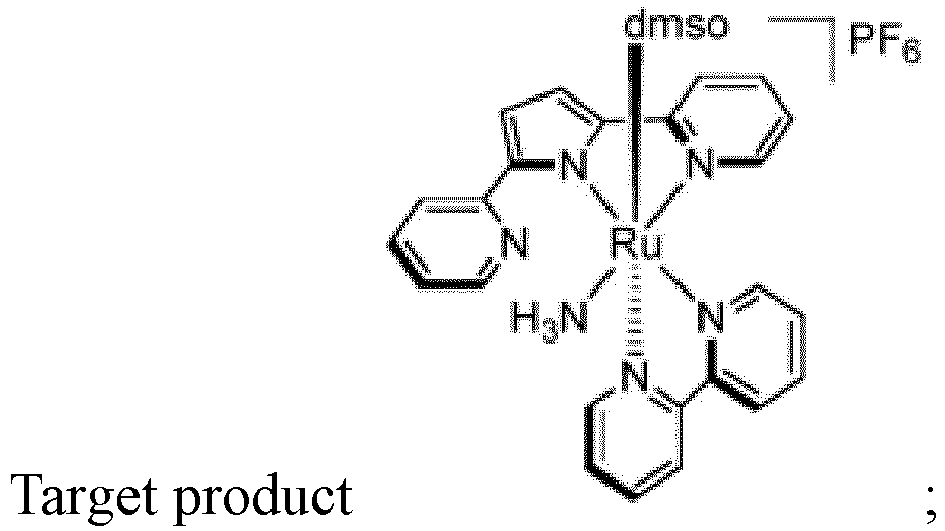
coordination complex 3 was obtained as a red lamellar crystal by liquid phase diffusion. - Yield: 98%.
- 1H NMR(400MHz, CDCl3): δ9.871-9.858(d, 1H), δ8.412-8.401(d, 1H), δ8.313-8.293(d, 1H), δ8.251-8.231(d, 1H), δ7.714-7.675(t, 1H), δ7.646-7.612(t, 1H), δ7.517-7.503(d, 1H), δ7.463-7.402(m, 2H), δ7.328-7.315(d, 2H), δ7.189-7.175(d, 1H), δ7.095-7.175(d, 1H), δ7.095-7.064(m, 1H), δ7.029-7.019(d, 1H), δ6.981-6.952(t, 1H), δ6.617-6.586(t, 1H), δ3.160(s, 3H), δ3.110(s, 3H), δ2.534(s, 3H)ppm.
- 31P NMR(162MHz, CDCl3): δ-135.92, δ-140.28, δ-144.64, δ-149.00, δ-153.36ppm.
- 19F NMR(380MHz, CDCl3): δ-72.02, δ-73.89ppm.
- IR(KBr, cm-1): 3371(w), 1604(m), 1529(m), 1454(w), 1421(m), 1325(m), 1161(w), 1080(m), 1018(m), 843(s), 764(m), 685(w), 557(m), 430(m).
-

- (1) Dichlorotetrakis(dimethyl sulfoxide)ruthenium (1.088 g, 2.248 mmol), 2,5-dipyridyl-3-carboxymethyl-4-methylpyrrole ligand (0.659 g, 2.248 mmol), bipyridine (0.351 g, 2.247 mmol) and triethylamine were dissolved in an organic solvent (50 mL) under nitrogen atmosphere. The solution was stirred and heated to 105 °C and was reacted for reaction for 9 h.
- (2) After the reaction was completed, diethyl ether and water were each added under nitrogen atmosphere to wash the mixture three times. Subsequently, the resulting solid was dissolved in dichloromethane, and anhydrous sodium sulfate was added to remove water from the solution. The solvent was removed from the filtrate to obtain a red solid.
- (3) The red solid was separated by column chromatography on a chromatographic silica gel column to obtain a red solid product.
- (4) The resulting red solid was dissolved in dichloromethane by liquid phase diffusion, and diethyl ether and n-hexane were sequentially added. After the mixture was left to stand for 2 weeks,
coordination complex 4 was obtained as a red acicular crystal. - Yield: 25%.
- 1H NMR(400MHz, CDCl3): δ9.677-9.689(d, 1H), δ9.552-9.565(d, 1H), δ8.045-8.091(t, 2H), δ7.847-7.868(d, 2H), δ7.738-7.796(m, 2H), δ7.485-7.528(m, 1H), δ7.430-7.442(d, 1H), δ7.132-7.178(m, 2H), δ7.026-7.062(m, 1H), δ6.892-6.928(m, 1H), δ6.779-6.813(m, 1H), δ6.724(s, 1H), δ3.290(s, 3H), δ3.019(s, 3H)ppm, δ2.744(s, 3H)ppm, δ2.460(s, 3H)ppm.
- IR(KBr, cm-1): 3603(m), 2916(s), 2497(m), 1682(s), 1589(m), 1521(w), 1444(s), 1414(w), 1323(w), 1261(w), 1198(w), 1153(w), 1078(s), 1012(w), 766(s), 729(w), 679(w), 430(m).
-

- (1) cis-[Ru(dmso)4(Cl)2] (1.088 g, 2.248 mmol), 2,5-dipyridyl-3-methyl-4-acetylpyrrole (0.623 g, 2.248 mmol), bipyridine (0.351 g, 2.247 mmol) and a base were dissolved in an organic solvent (50 mL) under nitrogen atmosphere. The solution was stirred and heated to 100 °C and was reacted for 12 h.
- (2) After the reaction was completed, toluene, diethyl ether and water were each added under nitrogen atmosphere to wash the mixture three times. Subsequently, the resulting solid was dissolved in dichloromethane, and anhydrous sodium sulfate was added to remove water from the solution. The solvent was removed from the filtrate to obtain a red solid.
- (3) The resulting red solid was dissolved in dichloromethane by liquid phase diffusion, and diethyl ether and n-hexane were sequentially added. After the mixture was left to stand for 2 weeks,
coordination complex 5 was obtained as a red acicular crystal. - Yield: 30%.
- 1H NMR(400MHz, CDCl3): δ10.443-10.457(d, 1H), δ8.906-8.927(d, 1H), δ8.159-8.179(d, 1H), δ7.913-7.932(d, 1H), δ7.787-7.826(t, 1H), δ7.709-7.722(d, 1H), δ7.612-7.645(t, 1H), δ7.454-7.505(t, 1H), δ7.249-7.351(m, 2H), δ7.087-7.110(t, 2H), δ6.847-6.886(m, 2H), δ6.406-6.475(m, 2H), δ2.794(s, 3H), δ2.603(s, 3H).
- IR(KBr, cm-1): 3095(w), 3059(m), 1631(m), 1589(s), 1460(s), 1417(m), 1354(w), 1340(w), 1242(w), 1136(s), 1020(w), 982(w), 945(w), 754(m), 619(w).
-
- (1) Gas chromatography was used to determine the gas composition during the reactions, and the conditions are as follows: the potential is not less than 0.5 V vs Cp2Fe+/0, and the electrolyte is an organic solution containing 0-0.1
mM coordination complex - (2) At different time stages of electrolysis, 100 µL of upper gas was drawn off with a gastight syringe and injected into a gas chromatograph to obtain the gas composition and content in the electrolytic cell.
- The results are as follows: after 24 h of electrolysis, 375.4 µmol H2 and 7.4 µmol N2 were produced with
coordination complex 1, 459.5 µmol H2 and 6.32 µmol N2 were produced withcoordination complex 2, and 1458.35 µmol H2 and 10.55 µmol N2 were produced withcoordination complex 3. After 48 h of electrolysis, 86.08 µmol H2 and 5.85 µmol N2 were produced withcoordination complex 5. The gas chromatography experiments reveals that the ratio of H2 to N2 in the system ranges from 10:1 to 200:1, which is much higher than the ratio of hydrogen to nitrogen in an ammonia molecule (3:1). During the electrolysis, the positive electrode products were all NH2NH2 in addition to N2, and no NO2 -, NO3 - and the like were produced. -
- (1) To a 10 mL cuvette, 0.4 mL of the electrolysis solution, 0.5 mL of HCl (0.6 mol/L) solution and 0.5 mL of p-C9H11NO in ethanol were added. The mixture was diluted with water to 10 mL and reacted for 1 h.
- (2) 0.5 mL of the reaction mixture was diluted to 10 mL in a 10 mL cuvette. The absorption intensity at 455 nm was measured on an ultraviolet-visible spectrometer, and the NH2NH2 content in the electrolysis solution was obtained from the NH2NH2 concentration-455 nm absorbance standard curve through the measured intensity.
- The results are as follows: after 24 h of electrolysis, 341.2 µmol, 423.0 µmol and 1380.04 µmol NH2NH2 were produced with
coordination complexes - The main method of the present invention for preparing
coordination complexes - It will be understood by those skilled in the art that the present invention is not limited to the examples described above. The examples described above and the descriptions in the specification are only intended to illustrate the principles and procedures of the present invention. Various changes and improvements may be made to the present invention without departing from the spirit and scope of the present invention, and these changes and improvements all fall within the protection scope of the present invention. The protection scope of the present invention is defined by the appended claims and equivalents thereof.
Claims (10)
- A pyridine pyrrole ruthenium coordination complex, having any one of structures of formula 1 to formula 5:


- A method for synthesizing the pyridine pyrrole ruthenium coordination complex according to claim 1, comprising the following steps:1) dissolving 2,5-dipyridylpyrrole, 2,5-dipyridyl-3-methyl-4-acetylpyrrole or 2,5-dipyridyl-3-carboxymethyl-4-methylpyrrole, cis-dichlorotetrakis(dimethyl sulfoxide)ruthenium, bipyridine and a basic compound in a solvent, and heating the resulting solution at reflux for reaction to obtain the pyridine pyrrole ruthenium coordination complex having a structure of formula 1, formula 4 or formula 5;2) dissolving the pyridine pyrrole ruthenium coordination complex having a structure of formula 1 in a solvent, firstly heating the resulting solution at reflux for reaction, and then adding saturated ammonium hexafluorophosphate solution for ion exchange to obtain a pyridine pyrrole ruthenium coordination complex having a structure of formula 2; and3) dissolving the pyridine pyrrole ruthenium coordination complex having a structure of formula 2 in a solvent, and then introducing an ammonia-containing gas for reaction to obtain the pyridine pyrrole ruthenium coordination complex having a structure of formula 3.
- The method for synthesizing the pyridine pyrrole ruthenium coordination complex according to claim 2, wherein a molar ratio of 2,5-dipyridylpyrrole, 2,5-dipyridyl-3-methyl-4-acetylpyrrole or 2,5-dipyridyl-3-carboxymethyl-4-methylpyrrole to cis-dichlorotetrakis(dimethyl sulfoxide)ruthenium is 1:2 to 2:1.
- The method for synthesizing the pyridine pyrrole ruthenium coordination complex according to claim 2, wherein a molar ratio of cis-dichlorotetrakis(dimethyl sulfoxide)ruthenium to bipyridine is 1:3 to 3:1.
- The method for synthesizing the pyridine pyrrole ruthenium coordination complex according to claim 2, wherein the basic compound is at least one of calcium hydride, sodium hydride and triethylamine.
- The method for synthesizing the pyridine pyrrole ruthenium coordination complex according to claim 2, wherein in step (1), the reaction is performed at a temperature of 50-115 °C for a period of 8-12 h.
- The method for synthesizing the pyridine pyrrole ruthenium coordination complex according to claim 2, wherein in step (2), the reflux reaction is performed at a temperature of 50-115 °C for a period of 2-6 d.
- The method for synthesizing the pyridine pyrrole ruthenium coordination complex according to claim 2, wherein the ammonia-containing gas has an ammonia concentration of greater than 1%.
- Use of the pyridine pyrrole ruthenium coordination complex according to claim 1 as a catalyst for electrocatalyzing ammonia oxidation to prepare N2H4 and co-produce H2.
- Use of the pyridine pyrrole ruthenium coordination complex according to claim 1 as a catalyst for electrocatalyzing ammonia oxidation to prepare N2H4 and co-produce H2, wherein organic solvents selected are anhydrous tetrahydrofuran and anhydrous acetonitrile.
Applications Claiming Priority (2)
| Application Number | Priority Date | Filing Date | Title |
|---|---|---|---|
| CN202111584527.XA CN114478648B (en) | 2021-12-22 | 2021-12-22 | A pyridine-pyrrole-like ruthenium complex, its preparation method and its application as an electrocatalytic ammonia oxidation catalyst |
| PCT/CN2022/139184 WO2023116540A1 (en) | 2021-12-22 | 2022-12-15 | Pyridine pyrrole ruthenium complex, preparation method therefor and application thereof as catalyst for preparing hydrazine by electrocatalytic ammonia oxidation |
Publications (2)
| Publication Number | Publication Date |
|---|---|
| EP4261216A1 true EP4261216A1 (en) | 2023-10-18 |
| EP4261216A4 EP4261216A4 (en) | 2025-07-09 |
Family
ID=81493812
Family Applications (1)
| Application Number | Title | Priority Date | Filing Date |
|---|---|---|---|
| EP22909854.6A Withdrawn EP4261216A4 (en) | 2021-12-22 | 2022-12-15 | Pyridine-pyrrole-ruthenium complex, production process therefor and application thereof as a catalyst for the production of hydrazine by electrocatalytic ammonia oxidation |
Country Status (6)
| Country | Link |
|---|---|
| US (1) | US20240101586A1 (en) |
| EP (1) | EP4261216A4 (en) |
| JP (1) | JP7629655B2 (en) |
| KR (1) | KR20230119704A (en) |
| CN (1) | CN114478648B (en) |
| WO (1) | WO2023116540A1 (en) |
Families Citing this family (3)
| Publication number | Priority date | Publication date | Assignee | Title |
|---|---|---|---|---|
| CN114478648B (en) * | 2021-12-22 | 2024-01-30 | 中南大学 | A pyridine-pyrrole-like ruthenium complex, its preparation method and its application as an electrocatalytic ammonia oxidation catalyst |
| CN114853798B (en) * | 2022-06-07 | 2024-07-02 | 海南贝欧亿科技有限公司 | Pyrrole ring tridentate metal complex and application thereof |
| CN120958005A (en) * | 2023-04-24 | 2025-11-14 | 株式会社钟化 | Methods for manufacturing ruthenium complexes, silyl-containing compounds, silyl-containing polymer mixtures, curable compositions and cured products |
Family Cites Families (6)
| Publication number | Priority date | Publication date | Assignee | Title |
|---|---|---|---|---|
| US20060122055A1 (en) * | 2004-12-06 | 2006-06-08 | Gaffney Anne M | (Amm)oxidation catalyst and catalytic (amm)oxidation process for conversion of lower alkanes |
| US8524903B2 (en) * | 2009-08-24 | 2013-09-03 | The University Of North Carolina At Chapel Hill | Ruthenium or osmium complexes and their uses as catalysts for water oxidation |
| JP5913222B2 (en) * | 2012-09-28 | 2016-04-27 | 富士フイルム株式会社 | Photoelectric conversion element and dye-sensitized solar cell |
| CN108997435B (en) * | 2018-05-29 | 2020-02-04 | 中南大学 | Dipyridyl pyrrole-ruthenium (I) complex, preparation method thereof and application thereof as electrochemical reduction catalyst |
| US11465136B2 (en) * | 2019-10-23 | 2022-10-11 | Wisconsin Alumni Research Foundation | Metal-metal bonded ammonia oxidation catalysts |
| CN114478648B (en) * | 2021-12-22 | 2024-01-30 | 中南大学 | A pyridine-pyrrole-like ruthenium complex, its preparation method and its application as an electrocatalytic ammonia oxidation catalyst |
-
2021
- 2021-12-22 CN CN202111584527.XA patent/CN114478648B/en active Active
-
2022
- 2022-12-15 WO PCT/CN2022/139184 patent/WO2023116540A1/en not_active Ceased
- 2022-12-15 EP EP22909854.6A patent/EP4261216A4/en not_active Withdrawn
- 2022-12-15 JP JP2023524432A patent/JP7629655B2/en active Active
- 2022-12-15 US US18/272,369 patent/US20240101586A1/en active Pending
- 2022-12-15 KR KR1020237024287A patent/KR20230119704A/en not_active Ceased
Also Published As
| Publication number | Publication date |
|---|---|
| WO2023116540A1 (en) | 2023-06-29 |
| JP7629655B2 (en) | 2025-02-14 |
| CN114478648B (en) | 2024-01-30 |
| EP4261216A4 (en) | 2025-07-09 |
| CN114478648A (en) | 2022-05-13 |
| US20240101586A1 (en) | 2024-03-28 |
| KR20230119704A (en) | 2023-08-16 |
| JP2024504897A (en) | 2024-02-02 |
Similar Documents
| Publication | Publication Date | Title |
|---|---|---|
| US20240101586A1 (en) | Pyridine pyrrole ruthenium coordination complex, preparation method therefor and use thereof as catalyst for electrocatalyzing ammonia oxidation to prepare hydrazine | |
| Miyazawa et al. | Visible-light-induced hydroalkoxymethylation of electron-deficient alkenes by photoredox catalysis | |
| Ma et al. | Boosting activity of molecular oxygen by pyridinium-based photocatalysts for metal-free alcohol oxidation | |
| US20090057161A1 (en) | Electrochemical process for the preparation of nitrogen fertilizers | |
| JP2024504897A5 (en) | ||
| Collman et al. | A stable dinitrogen complex of a ruthenium cofacial diporphyrin | |
| EP3255053B1 (en) | METHOD OF PREPARING WATER-CRACKING CATALYST HAVING Mn4CaO4 AS CORE STRUCTURE AND APPLICATION THEREOF | |
| Ahlquist et al. | C–H activation in strongly acidic media. The co-catalytic effect of the reaction medium | |
| CN112811392B (en) | Deuterium gas preparation method and deuterium reaction in which it participates as deuterium source | |
| Freund | Kinetics of the reduction of inorganic ions by borohydride—I ferricyanide | |
| CN120463736B (en) | Polyphenyltin bridged conjugated structure compound and its preparation method and application | |
| Fukushima et al. | Photoinduced four-and six-electron reduction of mononuclear ruthenium complexes having NAD+ analogous ligands | |
| US11465136B2 (en) | Metal-metal bonded ammonia oxidation catalysts | |
| Pregaglia et al. | Catalysis by cobalto-cyano complexes in non-aqueous solvents | |
| EP3705484A1 (en) | Cluster compound containing mn3sro4 and mn4sro4 core structures, preparation method thereof, and application for same | |
| CN113957461A (en) | A kind of electrochemical synthesis method of 1,1'-binaphthyl compounds | |
| Gibian et al. | Reduction of aromatic nitro and related compounds by dihydroflavins | |
| Ray et al. | Trivalent nickel: sulfur coordination (NiN2O2S2) vs. oxygen coordination (NiN2O4) | |
| Li et al. | Green synthesis of furan di-Schiff bases via a one-pot tandem amination-oxidation-amination process under room temperature | |
| Chung et al. | Preparation and reactions of new dioxygen bridged complexes of palladium | |
| Dhiman et al. | Photochemical oxidation of water catalysed by cyclometalated Ir (iii) complexes bearing Schiff-base ligands | |
| CN117822001A (en) | Method for preparing benzyl alcohol and derivatives thereof through electrochemical catalysis | |
| CN111788001A (en) | Ammonia decomposition method and ruthenium complex | |
| Chen et al. | Reduction of nitrobenzene to phenylhydroxylamine with anthraquinone-2-sulfonic sodium as an electron mediator | |
| Hasan et al. | Three-electron oxidations. III. Chromium (V) oxidation step |
Legal Events
| Date | Code | Title | Description |
|---|---|---|---|
| STAA | Information on the status of an ep patent application or granted ep patent |
Free format text: STATUS: THE INTERNATIONAL PUBLICATION HAS BEEN MADE |
|
| PUAI | Public reference made under article 153(3) epc to a published international application that has entered the european phase |
Free format text: ORIGINAL CODE: 0009012 |
|
| STAA | Information on the status of an ep patent application or granted ep patent |
Free format text: STATUS: REQUEST FOR EXAMINATION WAS MADE |
|
| 17P | Request for examination filed |
Effective date: 20230714 |
|
| AK | Designated contracting states |
Kind code of ref document: A1 Designated state(s): AL AT BE BG CH CY CZ DE DK EE ES FI FR GB GR HR HU IE IS IT LI LT LU LV MC ME MK MT NL NO PL PT RO RS SE SI SK SM TR |
|
| DAV | Request for validation of the european patent (deleted) | ||
| DAX | Request for extension of the european patent (deleted) | ||
| A4 | Supplementary search report drawn up and despatched |
Effective date: 20250612 |
|
| RIC1 | Information provided on ipc code assigned before grant |
Ipc: C25B 1/50 20210101ALI20250605BHEP Ipc: C25B 1/02 20060101ALI20250605BHEP Ipc: C25B 1/01 20210101ALI20250605BHEP Ipc: C07F 15/00 20060101AFI20250605BHEP |
|
| STAA | Information on the status of an ep patent application or granted ep patent |
Free format text: STATUS: THE APPLICATION HAS BEEN WITHDRAWN |
|
| 18W | Application withdrawn |
Effective date: 20251218 |