EP4261125B1 - Flight vehicle - Google Patents
Flight vehicle Download PDFInfo
- Publication number
- EP4261125B1 EP4261125B1 EP21906183.5A EP21906183A EP4261125B1 EP 4261125 B1 EP4261125 B1 EP 4261125B1 EP 21906183 A EP21906183 A EP 21906183A EP 4261125 B1 EP4261125 B1 EP 4261125B1
- Authority
- EP
- European Patent Office
- Prior art keywords
- payload
- unit
- battery
- radiator
- corresponding portion
- Prior art date
- Legal status (The legal status is an assumption and is not a legal conclusion. Google has not performed a legal analysis and makes no representation as to the accuracy of the status listed.)
- Active
Links
Images



Classifications
-
- B—PERFORMING OPERATIONS; TRANSPORTING
- B64—AIRCRAFT; AVIATION; COSMONAUTICS
- B64U—UNMANNED AERIAL VEHICLES [UAV]; EQUIPMENT THEREFOR
- B64U20/00—Constructional aspects of UAVs
- B64U20/90—Cooling
- B64U20/96—Cooling using air
-
- B—PERFORMING OPERATIONS; TRANSPORTING
- B64—AIRCRAFT; AVIATION; COSMONAUTICS
- B64U—UNMANNED AERIAL VEHICLES [UAV]; EQUIPMENT THEREFOR
- B64U20/00—Constructional aspects of UAVs
- B64U20/90—Cooling
- B64U20/98—Cooling using liquid, e.g. using lubrication oil
-
- B—PERFORMING OPERATIONS; TRANSPORTING
- B64—AIRCRAFT; AVIATION; COSMONAUTICS
- B64U—UNMANNED AERIAL VEHICLES [UAV]; EQUIPMENT THEREFOR
- B64U50/00—Propulsion; Power supply
- B64U50/10—Propulsion
- B64U50/19—Propulsion using electrically powered motors
-
- B—PERFORMING OPERATIONS; TRANSPORTING
- B64—AIRCRAFT; AVIATION; COSMONAUTICS
- B64U—UNMANNED AERIAL VEHICLES [UAV]; EQUIPMENT THEREFOR
- B64U50/00—Propulsion; Power supply
- B64U50/30—Supply or distribution of electrical power
- B64U50/31—Supply or distribution of electrical power generated by photovoltaics
-
- H—ELECTRICITY
- H01—ELECTRIC ELEMENTS
- H01M—PROCESSES OR MEANS, e.g. BATTERIES, FOR THE DIRECT CONVERSION OF CHEMICAL ENERGY INTO ELECTRICAL ENERGY
- H01M10/00—Secondary cells; Manufacture thereof
- H01M10/60—Heating or cooling; Temperature control
- H01M10/61—Types of temperature control
- H01M10/613—Cooling or keeping cold
-
- H—ELECTRICITY
- H01—ELECTRIC ELEMENTS
- H01M—PROCESSES OR MEANS, e.g. BATTERIES, FOR THE DIRECT CONVERSION OF CHEMICAL ENERGY INTO ELECTRICAL ENERGY
- H01M10/00—Secondary cells; Manufacture thereof
- H01M10/60—Heating or cooling; Temperature control
- H01M10/62—Heating or cooling; Temperature control specially adapted for specific applications
- H01M10/625—Vehicles
-
- H—ELECTRICITY
- H01—ELECTRIC ELEMENTS
- H01M—PROCESSES OR MEANS, e.g. BATTERIES, FOR THE DIRECT CONVERSION OF CHEMICAL ENERGY INTO ELECTRICAL ENERGY
- H01M10/00—Secondary cells; Manufacture thereof
- H01M10/60—Heating or cooling; Temperature control
- H01M10/65—Means for temperature control structurally associated with the cells
- H01M10/655—Solid structures for heat exchange or heat conduction
- H01M10/6552—Closed pipes transferring heat by thermal conductivity or phase transition, e.g. heat pipes
-
- B—PERFORMING OPERATIONS; TRANSPORTING
- B64—AIRCRAFT; AVIATION; COSMONAUTICS
- B64U—UNMANNED AERIAL VEHICLES [UAV]; EQUIPMENT THEREFOR
- B64U2101/00—UAVs specially adapted for particular uses or applications
- B64U2101/20—UAVs specially adapted for particular uses or applications for use as communications relays, e.g. high-altitude platforms
-
- H—ELECTRICITY
- H01—ELECTRIC ELEMENTS
- H01M—PROCESSES OR MEANS, e.g. BATTERIES, FOR THE DIRECT CONVERSION OF CHEMICAL ENERGY INTO ELECTRICAL ENERGY
- H01M2220/00—Batteries for particular applications
- H01M2220/20—Batteries in motive systems, e.g. vehicle, ship, plane
-
- Y—GENERAL TAGGING OF NEW TECHNOLOGICAL DEVELOPMENTS; GENERAL TAGGING OF CROSS-SECTIONAL TECHNOLOGIES SPANNING OVER SEVERAL SECTIONS OF THE IPC; TECHNICAL SUBJECTS COVERED BY FORMER USPC CROSS-REFERENCE ART COLLECTIONS [XRACs] AND DIGESTS
- Y02—TECHNOLOGIES OR APPLICATIONS FOR MITIGATION OR ADAPTATION AGAINST CLIMATE CHANGE
- Y02T—CLIMATE CHANGE MITIGATION TECHNOLOGIES RELATED TO TRANSPORTATION
- Y02T50/00—Aeronautics or air transport
- Y02T50/50—On board measures aiming to increase energy efficiency
Definitions
- the present invention relates to a flight vehicle.
- Japanese Patent Application Publication No. 2020-170888 discloses a flight vehicle that stores power generated by a solar panel in a battery and flies by using power of the battery or provides a wireless communication service.
- WO 2020/174213 A1 describes a vehicle comprising: a body having a skin; a heat source; and a thermal management system.
- the thermal management system comprises: a heat pipe comprising: an evaporator end and a condenser end; a vapour arranged to flow from the evaporator end to the condenser end; and a working fluid arranged to flow from the condenser end to the evaporator end, wherein the heat pipe is arranged such that the evaporator end is arranged in proximity to the heat source to absorb heat from the heat source; and one or more heat exchangers arranged in proximity to the condenser end and integrated with the skin.
- An embodiment of the present invention provides a flight vehicle.
- the flight vehicle includes a wing unit.
- the flight vehicle includes a main body unit.
- the flight vehicle includes a battery that is arranged in the wing unit.
- the flight vehicle includes a payload that is arranged in the main body unit and that includes at least any of electronic equipment or a control motor.
- the flight vehicle includes a radiator.
- the flight vehicle includes a heat pipe that exchanges heat between the battery, the payload, and the radiator and that has a check valve which causes a hydraulic fluid to be circulated to transfer the heat of the battery to the payload and the radiator.
- the heat pipe has a battery corresponding portion that corresponds to the battery.
- the heat pipe has a radiator corresponding portion that corresponds to the radiator.
- the heat pipe has a payload corresponding portion that corresponds to the payload.
- the heat pipe has a first circulation portion that extends from the battery corresponding portion, branches at a branch unit, and is connected to each of the radiator corresponding portion and the payload corresponding portion.
- the heat pipe has a second circulation portion that extends from the payload corresponding portion and is connected to the radiator corresponding portion.
- the heat pipe has a third circulation portion that extends from the radiator corresponding portion and is connected to the battery corresponding portion.
- the check valve may be positioned in the third circulation portion.
- the flight vehicle may include a valve that is arranged between the branch unit and the radiator corresponding portion in the first circulation portion and that is closed when a temperature of the payload is lower than a predetermined temperature threshold value, and is opened when the temperature of the payload is higher than the temperature threshold value.
- the valve may be a thermostatic valve.
- the flight vehicle may include a valve control unit that controls the valve to close the valve when the temperature of the payload is lower than a predetermined temperature threshold value, and to open the valve when the temperature of the payload is higher than the temperature threshold value.
- the payload corresponding portion may have a folded shape.
- the flight vehicle may include an air intake unit that is formed at a position corresponding to the battery on a front side of the wing unit; a heat sink unit that is arranged for the battery and cools the battery by air which flows in from the air intake unit and that includes a ventilation unit having a shape widening from the front side toward a rear side; and an exhaust unit that is formed at a position corresponding to the battery on the rear side of the wing unit and that exhausts air which flows out from the heat sink unit.
- the radiator may be positioned to be higher than the payload, and the battery may be positioned to be higher than the radiator.
- the battery corresponding portion may have a folded shape.
- the radiator corresponding portion may have a folded shape.
- the flight vehicle may function as a stratospheric platform.
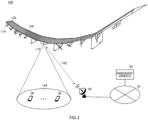
- Fig. 1 schematically shows an example of a HAPS 100.
- the HAPS 100 may be an example of a flight vehicle.
- the HAPS 100 may function as a stratospheric platform. While flying in a stratosphere, the HAPS 100 forms a feeder link 162 with a gateway 40 on the ground, and forms a wireless communication area 164 on the ground.
- the HAPS 100 includes a main body unit 110, a propeller 114, a wing unit 120, and a solar panel 150. Power generated by the solar panel 150 is stored in a battery arranged in the wing unit 120. The power stored in the battery is used by each configuration in the HAPS 100.
- a payload is arranged in the main body unit 110.
- the payload may include electronic equipment.
- the payload includes a control apparatus that controls flight and a communication of the HAPS 100.
- the payload may also include a control motor.
- the control apparatus controls the flight of the HAPS 100, for example, by controlling a rotation of the propeller 114, an angle of a flap or an elevator, or the like.
- the control apparatus may manage various types of sensors included in the HAPS 100. Examples of sensors include a positioning sensor such as a GPS sensor, a gyro sensor, an acceleration sensor, and the like.
- the control apparatus may manage a location, a posture, a movement direction, and a movement speed of the HAPS 100 by outputs of the various types of sensors.
- the control apparatus may use, for example, a FL (Feeder Link) antenna to form the feeder link 162 with the gateway 40.
- the control apparatus may access a network 20 via the gateway 40.
- the control apparatus may communicate with a management apparatus 50 connected to the network 20.
- the control apparatus may transmit various pieces of information to the management apparatus 50.
- the control apparatus transmits telemetry information to the management apparatus 50.
- the telemetry information may include location information of the HAPS 100.
- the location information may indicate a three-dimensional location of the HAPS 100.
- the telemetry information may include posture information of the HAPS 100.
- the posture information may indicate a pitch, a roll, and a yaw of the HAPS 100.
- the telemetry information may include movement direction information indicating the movement direction of the HAPS 100.
- the telemetry information may include movement speed information indicating the movement speed of the HAPS 100.
- control apparatus uses, for example, an SL (Service Link) antenna to form the wireless communication area 164 on the ground.
- the control apparatus uses the SL antenna to form a service link with a user terminal 30 on the ground.
- the user terminal 30 may be any communication terminal as long as the user terminal 30 is able to communicate with the HAPS 100.
- the user terminal 30 is, for example, a mobile phone such as a smartphone.
- the user terminal 30 may be a tablet terminal, a PC (Personal Computer), and the like.
- the user terminal 30 may be a so-called loT (Internet of Things) device.
- the user terminal 30 may include anything that corresponds to a so-called loE (Internet of Everything).
- the HAPS 100 relays a communication between the network 20 and the user terminal 30, for example, via the feeder link 162 and the service link.
- the HAPS 100 may provide the wireless communication service to the user terminal 30 by relaying the communication between the user terminal 30 and the network 20.
- the network 20 includes a mobile communication network.
- the mobile communication network may conform to any of the 3G (3rd Generation) communication system, the LTE (Long Term Evolution) communication system, the 5G (5th Generation) communication system, and the 6G (6th Generation) communication system and the communication system of the subsequent generation.
- the network 20 may include the Internet.
- the HAPS 100 transmits data received from the user terminal 30 in the wireless communication area 164 to the network 20.
- the HAPS 100 receives data addressed to the user terminal 30 in the wireless communication area 164, via the network 20, the HAPS 100 transmits the data to the user terminal 30.
- the management apparatus 50 manages the HAPS 100.
- the management apparatus 50 may communicate with the HAPS 100 via the network 20 and the gateway 40. It should be noted that the management apparatus 50 may communicate with the HAPS 100 via a communication satellite.
- the management apparatus 50 may control the HAPS 100 by transmitting various types of instructions.
- the management apparatus 50 may cause the HAPS 100 to circle over a target area such that the target area on the ground is covered by the wireless communication area 164.
- the HAPS 100 maintains the feeder link with the gateway 40 by adjusting a pointing direction of the FL antenna while flying in a circular orbit over the target area, and maintains the coverage of the target area by the wireless communication area 164 by adjusting a pointing direction of the SL antenna.
- the HAPS 100 contributes to solving the problem in the related art by taking in air from a front edge portion of the wing unit 120, heating and expanding the air which is taken in, by exhaust heat of the battery, and accelerating the air to exhaust the air from a rear edge portion of the wing unit 120, thereby preventing peeling and maintaining the laminar flow.
- an air intake unit takes in a boundary layer by a negative pressure of a rear portion to slow down the peeling. Then, by a structure of a heat sink that is provided on an upper portion of the battery and that has a shape of a harmonica in which a cross sectional area increases, an introduced atmosphere cools the battery, and the atmosphere which is taken in is caused to be heated, expanded, and accelerated.
- an exhaust unit that includes a nozzle for reducing the cross sectional area to increase a flow velocity, the atmosphere accelerated by the heat sink is further accelerated and discharged to prevent the peeling.
- Fig. 2 schematically shows an example of a structure of a wing unit 120 of the HAPS 100.
- Fig. 2 illustrates a case where eight batteries 300 are arranged in the wing unit 120; however, the number of batteries 300 is not limited to this, and may be another number. In order to keep a weight balance as a whole, it may be desirable to arrange the same number of batteries 300 on a right wing side and a left wing side to be symmetrical.
- the HAPS 100 includes a plurality of batteries 300; however, the HAPS 100 may include only one battery 300.
- the wing unit 120 may include an air intake unit 132 formed at a position corresponding to the battery 300 on a front side.
- the air intake unit 132 is arranged, for example, at the front edge portion of the wing unit 120.
- the air intake unit 132 has, for example, a plurality of openings.
- the air intake unit 132 has a large number of minute openings formed, for example, by the laser beam machining.
- the wing unit 120 includes an exhaust unit 136 formed at a position corresponding to the battery 300 on a rear side.
- the exhaust unit 136 is arranged, for example, between a main wing 122 and a movable wing 124 of the wing unit 120.
- the wing unit 120 may include a plurality of air intake units 132 and a plurality of exhaust units 136 that respectively correspond to the plurality of batteries 300, as shown in Fig. 2 .
- Fig. 3 schematically shows a cross sectional view of the wing unit 120 of the HAPS 100.
- the wing unit 120 includes the main wing 122, and the movable wing 124 connected to the main wing 122 via a hinge 126.
- the wing unit 120 may include a heat sink unit 134 that is arranged for the battery 300 and that cools the battery 300 by the air which flows in from the air intake unit 132.
- the heat sink unit 134 may have a shape corresponding to a shape of the battery 300. For example, when an upper surface of the battery 300 has a rectangular shape, a lower surface of the heat sink unit 134 may have a rectangular shape with the same size as that of the upper surface of the battery 300.
- a width of the air intake unit 132 may be the same as a width of the heat sink unit 134.
- the width of the air intake unit 132 may be narrower, or may be wider than the width of the heat sink unit 134.
- a width of the exhaust unit 136 may be the same as the width of the heat sink unit 134.
- the width of the exhaust unit 136 may be narrower, or may be wider than the width of the heat sink unit 134.
- the heat sink unit 134 has a ventilation unit 135 having a shape widening from the front side toward the rear side.
- the ventilation unit 135 may have a shape which increases in height from the front side toward the rear side. This makes it possible to heat, expand, and accelerate the air which is taken in, while cooling the battery 300.
- the heat sink unit 134 has, for example, a harmonica shape.
- the heat sink unit 134 having the harmonica shape makes it possible for the heat of the battery 300 to be efficiently exhausted without a severe obstruction of a flow of the air which flows in from the air intake unit 132 and is exhausted from the exhaust unit 136.
- the heat sink unit 134 may have a hollow structure rather than the harmonica shape.
- the air intake unit 132, the heat sink unit 134, and the exhaust unit 136 are connected.
- the exhaust unit 136 exhausts the air which flows out from the heat sink unit 134, to an outside of the wing unit 120.
- the air intake unit 132 takes in a laminar boundary layer on the front side of the wing unit 120 by the negative pressure of the rear portion. It is possible to take in the laminar boundary layer, and slow down the peeling of the laminar flow, and it is possible to maintain the laminar flow, and increase the lift and reduce the drag.
- the structure in which the negative pressure of the rear portion is applied to the air intake unit 132 it is possible to take in the laminar boundary layer without using a plasma actuator or the like.
- the plasma actuator is used, very high power is necessary and the total weight increases.
- the structure of the wing unit 120 according to the present embodiment it is possible to reduce power consumption in comparison with a case where the plasma actuator is used, and it is possible to contribute to a reduction of the total weight of the HAPS 100.
- the exhaust unit 136 may have a shape which narrows from the front side toward the rear side.
- the exhaust unit 136 has, for example, a shape which decreases in height from the front side toward the rear side. In this way, by the exhaust unit 136 having a structure in which the cross sectional area decreases from the front side toward the rear side, it is possible to increase, for the exhaust, the flow velocity of the air from the heat sink unit 134.
- the exhaust unit 136 may realize the exhaust along an upper surface of the movable wing 124 as illustrated in Fig. 3 .
- the exhaust unit 136 has an exhaust port, for example, between the main wing 122 and the hinge 126.
- the exhaust unit 136 generates propulsion power for the HAPS 100 by the exhaust and attracts the laminar boundary layer on the rear side of the wing unit 120.
- the air which flows from the heat sink unit 134 to the exhaust unit 136 is heated, expanded, and accelerated by the heat sink unit 134 as described above, and can be further accelerated by the exhaust unit 136, which makes it possible to contribute to the propulsion power of the HAPS 100, and makes it possible to contribute to preventing the peeling of the laminar boundary layer on the rear side of the wing unit 120.
- Fig. 4 schematically shows an example of a heat pipe 410 included in the HAPS 100.
- the heat pipe 410 exchanges the heat between a payload 200, the battery 300, and a radiator 400.
- the radiator 400 is positioned to be higher than the payload 200, and the battery 300 is positioned to be higher than the radiator 400.
- the heat pipe 410 has a check valve 420 that causes a hydraulic fluid to be circulated to transfer the heat of the battery 300 to the payload 200 and the radiator 400.
- a hydraulic fluid a CFC substitute, water, and the like may be adopted similar to a case of an existing heat pipe; however, a selection may be appropriately performed according to an environment in which the flight vehicle flies.
- the radiator 400 may be arranged in the main body unit 110 as shown in Fig. 4 .
- the radiator 400 may be arranged outside the main body unit 110.
- the heat pipe 410 may be configured to heat and keep the payload 200 to be warm in a situation in which the payload 200 is at a low temperature, such as while the HAPS100 is flying at night, while the HAPS100 moves to a location where the wireless communication area 164 is deployed, or while the HAPS100 is flying as a backup vehicle.
- the heat pipe 410 may be configured to cool the battery 300 and the payload 200 in a situation in which the power consumption is high, such as during daytime flight and prime time flight of the HAPS 100.
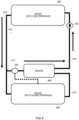
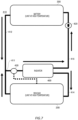
- Fig. 5 , Fig. 6 , and Fig. 7 are illustrations for describing heat circulations by the heat pipe 410.
- Fig. 5 schematically shows how the hydraulic fluid circulates in a case where the payload 200 is at a low temperature.
- Fig. 6 schematically shows how the hydraulic fluid circulates in a case where the payload 200 is at a suitable temperature.
- Fig. 7 schematically shows how the hydraulic fluid circulates in a case where the payload 200 is at a high temperature.
- the heat pipe 410 includes a battery corresponding portion that corresponds to the battery 300, a radiator corresponding portion that corresponds to the radiator 400, and a payload corresponding portion that corresponds to the payload 200.
- the battery corresponding portion may have a folded shape so as to contact more parts of the battery 300 to efficiently exchange the heat of the battery 300.
- the radiator corresponding portion may have a folded shape so as to contact more parts of the radiator 400 to efficiently dissipate the heat to the radiator 400.
- the payload corresponding portion may have a folded shape so as to contact more parts of the payload 200 to efficiently exchange the heat of the payload 200.
- the heat pipe 410 may include a first circulation portion 412 that extends from the battery corresponding portion, branches at a branch unit 411, and is connected to each of the radiator corresponding portion and the payload corresponding portion; a second circulation portion 414 that extends from the payload corresponding portion and is connected to the radiator corresponding portion; and a third circulation portion 416 that extends from the radiator corresponding portion and is connected to the battery corresponding portion.
- the check valve 420 is positioned in the third circulation portion 416.
- the heat pipe 410 has a valve 430 that is arranged between the branch unit 411 and the radiator corresponding portion in the first circulation portion 412 and that is closed when the temperature of the payload 200 is lower than a predetermined temperature threshold value, and is opened when the temperature of the payload 200 is higher than the temperature threshold value.
- the temperature threshold value may be, for example, 0°C.
- the temperature threshold value may be able to be set to any threshold value, or may be changeable.
- the valve 430 may be a thermostatic valve.
- the HAPS 100 may also include the valve 430 that is not the thermostatic valve; and a valve control unit that closes the valve 430 when the temperature of the payload 200 is lower than a predetermined temperature threshold value and that opens the valve 430 when the temperature of the payload 200 is higher than the temperature threshold value.
- Fig. 5 illustrates a state in which the temperature of payload 200 is lower than a predetermined temperature threshold value and the valve 430 is closed.
- the temperature of the payload 200 may be, for example, approximately from -90°C to 0°C.
- Fig. 6 illustrates a case where the temperature of the payload 200 is a suitable temperature.
- the temperature threshold value is set to be lower than the suitable temperature, and when the temperature of payload 200 is the suitable temperature, the valve 430 is in an open state.
- the temperature threshold value may be, for example, 0°C, as described above, and the valve 430 is opened when the temperature of payload 200 exceeds 0°C.
- the suitable temperature for the payload 200 may be approximately from 0°C to 50°C.
- the temperature of the payload 200 is the suitable temperature
- almost no hydraulic fluid circulates to a payload 200 side by a circulation resistance due to the structure of the payload corresponding portion of the heat pipe 410, and the hydraulic fluid circulates in order from the battery 300 to the radiator 400, and from the radiator 400 to the battery 300. In this manner, only the battery 300 is cooled and the heat is exhausted by the radiator 400.
- Fig. 7 illustrates a case where the temperature of the payload 200 is a high temperature.
- the high temperature of the payload 200 may be, for example, 50°C or higher.
- the valve 430 is in an open state.
- the temperature of the payload 200 is the high temperature, and thus the circulation of the hydraulic fluid occurs also on the payload 200 side.
- the hydraulic fluid circulates in order from the battery 300 to the radiator 400, and from the radiator 400 to the battery 300, and circulates in order from the payload 200 to the radiator 400 via the branch unit 411, and from the radiator 400 to the payload 200. In this manner, the payload 200 and the battery 300 are cooled, and the heat is exhausted by the radiator 400.
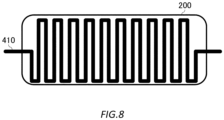
- Fig. 8 schematically shows an example of a structure of a payload corresponding portion of the heat pipe 410.
- the payload corresponding portion may have a folded structure, as illustrated in Fig. 8 .
- a portion that contacts the payload 200 increases, and it is possible to enhance the efficiency of the heat exchange.
- the first circulation portion 412, the second circulation portion 414, and the third circulation portion 416 it is possible to increase the resistance through which the hydraulic fluid passes, and when the payload 200 reaches a suitable temperature, it is possible for the hydraulic fluid not to circulate to the payload corresponding portion.
- the battery corresponding portion of the heat pipe 410 may also have a structure similar to the structure shown in Fig. 8 .
- Fig. 9 schematically shows an example of a structure of a radiator corresponding portion of the heat pipe 410.
- the radiator corresponding portion has a structure that branches at an inlet portion from the first circulation portion 412 and that is connected to each of the second circulation portion 414 and the third circulation portion 416, and may have a structure in which each connection portion is folded.
- the radiator corresponding portion has a structure that branches at an inlet portion from the first circulation portion 412 and that is connected to each of the second circulation portion 414 and the third circulation portion 416, and may have a structure in which each connection portion is folded.
- a temperature management control of the payload in the HAPS 100 in a stratospheric environment is an important and very difficult task. Electrical equipment, the control motor, and the like may not operate at a low temperature, and it requires electric power to be equipped with a heater for heating, which increases the weight. In addition, when a heat insulation structure is adopted, conversely, there occurs a problem that cooling becomes difficult. On the other hand, even when cooling is desired, a thin atmosphere makes it difficult for the heat to be naturally dissipated, and only a temperature of a unit at a high temperature becomes a very high temperature.
- the payload 200 that is desired to maintain a suitable temperature by being warmed and being cooled, and the battery 300 that is a portion at a high temperature and is desired to be cooled are connected to each other by the heat pipe 410 having the check valve 420.
- the radiator 400 and the valve 430 (the thermostatic valve) are arranged in between, and the valve 430 is opened and closed according to the temperature, and a flow mode of the hydraulic fluid in the valve 430 is changed to constantly cool the battery 300, and the warming and the cooling are performed to keep the payload 200 at the suitable temperature.
- the HAPS 100 is given as an example of the flight vehicle, but the present invention is not limited to this.
- the flight vehicle may be any flight vehicle as long as the battery and the payload are mounted on the flight vehicle.
- 20 network, 30: user terminal, 40: gateway, 50: management apparatus, 100: HAPS, 110: main body unit, 120: wing unit, 122: main wing, 124: movable wing, 126: hinge, 132: air intake unit, 134: heat sink unit, 136: exhaust unit, 150: solar panel, 162: feeder link, 164: wireless communication area, 200: payload, 300: battery, 400: radiator, 410: heat pipe, 411: branch unit, 412: first circulation portion, 414: second circulation portion, 416: third circulation portion, 420: check valve, 430: valve.
Landscapes
- Engineering & Computer Science (AREA)
- Chemical & Material Sciences (AREA)
- Aviation & Aerospace Engineering (AREA)
- Mechanical Engineering (AREA)
- Electrochemistry (AREA)
- Chemical Kinetics & Catalysis (AREA)
- Manufacturing & Machinery (AREA)
- General Chemical & Material Sciences (AREA)
- Combustion & Propulsion (AREA)
- Remote Sensing (AREA)
- Oil, Petroleum & Natural Gas (AREA)
- Secondary Cells (AREA)
- Electric Propulsion And Braking For Vehicles (AREA)
Description
- The present invention relates to a flight vehicle.
-
Japanese Patent Application Publication No. 2020-170888 WO 2020/174213 A1 describes a vehicle comprising: a body having a skin; a heat source; and a thermal management system. The thermal management system comprises: a heat pipe comprising: an evaporator end and a condenser end; a vapour arranged to flow from the evaporator end to the condenser end; and a working fluid arranged to flow from the condenser end to the evaporator end, wherein the heat pipe is arranged such that the evaporator end is arranged in proximity to the heat source to absorb heat from the heat source; and one or more heat exchangers arranged in proximity to the condenser end and integrated with the skin. - The invention is defined by claim 1. Embodiments of the invention are described in the dependent claims. An embodiment of the present invention provides a flight vehicle. The flight vehicle includes a wing unit. The flight vehicle includes a main body unit. The flight vehicle includes a battery that is arranged in the wing unit. The flight vehicle includes a payload that is arranged in the main body unit and that includes at least any of electronic equipment or a control motor. The flight vehicle includes a radiator. The flight vehicle includes a heat pipe that exchanges heat between the battery, the payload, and the radiator and that has a check valve which causes a hydraulic fluid to be circulated to transfer the heat of the battery to the payload and the radiator.
- The heat pipe has a battery corresponding portion that corresponds to the battery. The heat pipe has a radiator corresponding portion that corresponds to the radiator. The heat pipe has a payload corresponding portion that corresponds to the payload. The heat pipe has a first circulation portion that extends from the battery corresponding portion, branches at a branch unit, and is connected to each of the radiator corresponding portion and the payload corresponding portion. The heat pipe has a second circulation portion that extends from the payload corresponding portion and is connected to the radiator corresponding portion. The heat pipe has a third circulation portion that extends from the radiator corresponding portion and is connected to the battery corresponding portion. The check valve may be positioned in the third circulation portion. The flight vehicle may include a valve that is arranged between the branch unit and the radiator corresponding portion in the first circulation portion and that is closed when a temperature of the payload is lower than a predetermined temperature threshold value, and is opened when the temperature of the payload is higher than the temperature threshold value. The valve may be a thermostatic valve. The flight vehicle may include a valve control unit that controls the valve to close the valve when the temperature of the payload is lower than a predetermined temperature threshold value, and to open the valve when the temperature of the payload is higher than the temperature threshold value. The payload corresponding portion may have a folded shape. The flight vehicle may include an air intake unit that is formed at a position corresponding to the battery on a front side of the wing unit; a heat sink unit that is arranged for the battery and cools the battery by air which flows in from the air intake unit and that includes a ventilation unit having a shape widening from the front side toward a rear side; and an exhaust unit that is formed at a position corresponding to the battery on the rear side of the wing unit and that exhausts air which flows out from the heat sink unit. The radiator may be positioned to be higher than the payload, and the battery may be positioned to be higher than the radiator. The battery corresponding portion may have a folded shape. The radiator corresponding portion may have a folded shape. The flight vehicle may function as a stratospheric platform.
- The summary clause does not necessarily describe all necessary features of the embodiments of the present invention.
-
-
Fig. 1 schematically shows an example of aHAPS 100. -
Fig. 2 schematically shows an example of a structure of awing unit 120 of theHAPS 100. -
Fig. 3 schematically shows a cross sectional view of thewing unit 120 of theHAPS 100. -
Fig. 4 schematically shows an example of aheat pipe 410 included in theHAPS 100. -
Fig. 5 is an illustration for describing heat circulation by theheat pipe 410. -
Fig. 6 is an illustration for describing the heat circulation by theheat pipe 410. -
Fig. 7 is an illustration for describing the heat circulation by theheat pipe 410. -
Fig. 8 schematically shows an example of a structure of a payload corresponding portion of theheat pipe 410. -
Fig. 9 schematically shows an example of a structure of a radiator corresponding portion of theheat pipe 410. - Hereinafter, the present invention will be described through embodiments of the invention, but the following embodiments do not limit the invention according to claims.
-
Fig. 1 schematically shows an example of aHAPS 100. The HAPS 100 may be an example of a flight vehicle. The HAPS 100 may function as a stratospheric platform. While flying in a stratosphere, the HAPS 100 forms afeeder link 162 with agateway 40 on the ground, and forms awireless communication area 164 on the ground. - The HAPS 100 includes a
main body unit 110, apropeller 114, awing unit 120, and asolar panel 150. Power generated by thesolar panel 150 is stored in a battery arranged in thewing unit 120. The power stored in the battery is used by each configuration in theHAPS 100. - A payload is arranged in the
main body unit 110. The payload may include electronic equipment. For example, the payload includes a control apparatus that controls flight and a communication of theHAPS 100. The payload may also include a control motor. - The control apparatus controls the flight of the
HAPS 100, for example, by controlling a rotation of thepropeller 114, an angle of a flap or an elevator, or the like. The control apparatus may manage various types of sensors included in theHAPS 100. Examples of sensors include a positioning sensor such as a GPS sensor, a gyro sensor, an acceleration sensor, and the like. The control apparatus may manage a location, a posture, a movement direction, and a movement speed of theHAPS 100 by outputs of the various types of sensors. - The control apparatus may use, for example, a FL (Feeder Link) antenna to form the
feeder link 162 with thegateway 40. The control apparatus may access anetwork 20 via thegateway 40. The control apparatus may communicate with amanagement apparatus 50 connected to thenetwork 20. - The control apparatus may transmit various pieces of information to the
management apparatus 50. For example, the control apparatus transmits telemetry information to themanagement apparatus 50. The telemetry information may include location information of theHAPS 100. The location information may indicate a three-dimensional location of theHAPS 100. The telemetry information may include posture information of theHAPS 100. The posture information may indicate a pitch, a roll, and a yaw of theHAPS 100. The telemetry information may include movement direction information indicating the movement direction of theHAPS 100. The telemetry information may include movement speed information indicating the movement speed of theHAPS 100. - In addition, the control apparatus uses, for example, an SL (Service Link) antenna to form the
wireless communication area 164 on the ground. The control apparatus uses the SL antenna to form a service link with auser terminal 30 on the ground. - The
user terminal 30 may be any communication terminal as long as theuser terminal 30 is able to communicate with theHAPS 100. Theuser terminal 30 is, for example, a mobile phone such as a smartphone. Theuser terminal 30 may be a tablet terminal, a PC (Personal Computer), and the like. Theuser terminal 30 may be a so-called loT (Internet of Things) device. Theuser terminal 30 may include anything that corresponds to a so-called loE (Internet of Everything). - The
HAPS 100 relays a communication between thenetwork 20 and theuser terminal 30, for example, via thefeeder link 162 and the service link. TheHAPS 100 may provide the wireless communication service to theuser terminal 30 by relaying the communication between theuser terminal 30 and thenetwork 20. - The
network 20 includes a mobile communication network. The mobile communication network may conform to any of the 3G (3rd Generation) communication system, the LTE (Long Term Evolution) communication system, the 5G (5th Generation) communication system, and the 6G (6th Generation) communication system and the communication system of the subsequent generation. Thenetwork 20 may include the Internet. - For example, the
HAPS 100 transmits data received from theuser terminal 30 in thewireless communication area 164 to thenetwork 20. In addition, for example, when theHAPS 100 receives data addressed to theuser terminal 30 in thewireless communication area 164, via thenetwork 20, theHAPS 100 transmits the data to theuser terminal 30. - The
management apparatus 50 manages theHAPS 100. Themanagement apparatus 50 may communicate with theHAPS 100 via thenetwork 20 and thegateway 40. It should be noted that themanagement apparatus 50 may communicate with theHAPS 100 via a communication satellite. Themanagement apparatus 50 may control theHAPS 100 by transmitting various types of instructions. - The
management apparatus 50 may cause theHAPS 100 to circle over a target area such that the target area on the ground is covered by thewireless communication area 164. For example, theHAPS 100 maintains the feeder link with thegateway 40 by adjusting a pointing direction of the FL antenna while flying in a circular orbit over the target area, and maintains the coverage of the target area by thewireless communication area 164 by adjusting a pointing direction of the SL antenna. - When a flow on an upper surface of a wing of an aircraft is taken in, it is possible to maintain a laminar flow, and an effect of increasing lift and reducing drag may be obtained; however, due to a problem of a weight increase or a complicated structure, in a typical structure of the aircraft, the intake of the flow is only partially adopted in some aircraft. The
HAPS 100 according to the present embodiment contributes to solving the problem in the related art by taking in air from a front edge portion of thewing unit 120, heating and expanding the air which is taken in, by exhaust heat of the battery, and accelerating the air to exhaust the air from a rear edge portion of thewing unit 120, thereby preventing peeling and maintaining the laminar flow. As a specific example, in theHAPS 100 according to the present embodiment, as a front edge panel structure obtained by a process of forming innumerable minute openings by laser beam machining, an air intake unit takes in a boundary layer by a negative pressure of a rear portion to slow down the peeling. Then, by a structure of a heat sink that is provided on an upper portion of the battery and that has a shape of a harmonica in which a cross sectional area increases, an introduced atmosphere cools the battery, and the atmosphere which is taken in is caused to be heated, expanded, and accelerated. In a structure of the present invention, for a last part, through an exhaust unit that includes a nozzle for reducing the cross sectional area to increase a flow velocity, the atmosphere accelerated by the heat sink is further accelerated and discharged to prevent the peeling. -
Fig. 2 schematically shows an example of a structure of awing unit 120 of theHAPS 100.Fig. 2 illustrates a case where eightbatteries 300 are arranged in thewing unit 120; however, the number ofbatteries 300 is not limited to this, and may be another number. In order to keep a weight balance as a whole, it may be desirable to arrange the same number ofbatteries 300 on a right wing side and a left wing side to be symmetrical. It should be noted that in the example shown inFig. 2 , theHAPS 100 includes a plurality ofbatteries 300; however, theHAPS 100 may include only onebattery 300. - The
wing unit 120 may include anair intake unit 132 formed at a position corresponding to thebattery 300 on a front side. Theair intake unit 132 is arranged, for example, at the front edge portion of thewing unit 120. Theair intake unit 132 has, for example, a plurality of openings. Theair intake unit 132 has a large number of minute openings formed, for example, by the laser beam machining. - The
wing unit 120 includes anexhaust unit 136 formed at a position corresponding to thebattery 300 on a rear side. Theexhaust unit 136 is arranged, for example, between amain wing 122 and amovable wing 124 of thewing unit 120. - The
wing unit 120 may include a plurality ofair intake units 132 and a plurality ofexhaust units 136 that respectively correspond to the plurality ofbatteries 300, as shown inFig. 2 . -
Fig. 3 schematically shows a cross sectional view of thewing unit 120 of theHAPS 100. Thewing unit 120 includes themain wing 122, and themovable wing 124 connected to themain wing 122 via ahinge 126. Thewing unit 120 may include aheat sink unit 134 that is arranged for thebattery 300 and that cools thebattery 300 by the air which flows in from theair intake unit 132. Theheat sink unit 134 may have a shape corresponding to a shape of thebattery 300. For example, when an upper surface of thebattery 300 has a rectangular shape, a lower surface of theheat sink unit 134 may have a rectangular shape with the same size as that of the upper surface of thebattery 300. - A width of the
air intake unit 132 may be the same as a width of theheat sink unit 134. The width of theair intake unit 132 may be narrower, or may be wider than the width of theheat sink unit 134. - A width of the
exhaust unit 136 may be the same as the width of theheat sink unit 134. The width of theexhaust unit 136 may be narrower, or may be wider than the width of theheat sink unit 134. - The
heat sink unit 134 has aventilation unit 135 having a shape widening from the front side toward the rear side. Theventilation unit 135 may have a shape which increases in height from the front side toward the rear side. This makes it possible to heat, expand, and accelerate the air which is taken in, while cooling thebattery 300. - The
heat sink unit 134 has, for example, a harmonica shape. Theheat sink unit 134 having the harmonica shape makes it possible for the heat of thebattery 300 to be efficiently exhausted without a severe obstruction of a flow of the air which flows in from theair intake unit 132 and is exhausted from theexhaust unit 136. It should be noted that theheat sink unit 134 may have a hollow structure rather than the harmonica shape. - The
air intake unit 132, theheat sink unit 134, and theexhaust unit 136 are connected. Theexhaust unit 136 exhausts the air which flows out from theheat sink unit 134, to an outside of thewing unit 120. Theair intake unit 132 takes in a laminar boundary layer on the front side of thewing unit 120 by the negative pressure of the rear portion. It is possible to take in the laminar boundary layer, and slow down the peeling of the laminar flow, and it is possible to maintain the laminar flow, and increase the lift and reduce the drag. - In this way, by adopting the structure in which the negative pressure of the rear portion is applied to the
air intake unit 132, it is possible to take in the laminar boundary layer without using a plasma actuator or the like. When the plasma actuator is used, very high power is necessary and the total weight increases. With the structure of thewing unit 120 according to the present embodiment, it is possible to reduce power consumption in comparison with a case where the plasma actuator is used, and it is possible to contribute to a reduction of the total weight of theHAPS 100. - The
exhaust unit 136 may have a shape which narrows from the front side toward the rear side. Theexhaust unit 136 has, for example, a shape which decreases in height from the front side toward the rear side. In this way, by theexhaust unit 136 having a structure in which the cross sectional area decreases from the front side toward the rear side, it is possible to increase, for the exhaust, the flow velocity of the air from theheat sink unit 134. - The
exhaust unit 136 may realize the exhaust along an upper surface of themovable wing 124 as illustrated inFig. 3 . Theexhaust unit 136 has an exhaust port, for example, between themain wing 122 and thehinge 126. Theexhaust unit 136 generates propulsion power for theHAPS 100 by the exhaust and attracts the laminar boundary layer on the rear side of thewing unit 120. - The air which flows from the
heat sink unit 134 to theexhaust unit 136 is heated, expanded, and accelerated by theheat sink unit 134 as described above, and can be further accelerated by theexhaust unit 136, which makes it possible to contribute to the propulsion power of theHAPS 100, and makes it possible to contribute to preventing the peeling of the laminar boundary layer on the rear side of thewing unit 120. -
Fig. 4 schematically shows an example of aheat pipe 410 included in theHAPS 100. Theheat pipe 410 exchanges the heat between apayload 200, thebattery 300, and aradiator 400. Theradiator 400 is positioned to be higher than thepayload 200, and thebattery 300 is positioned to be higher than theradiator 400. - The
heat pipe 410 has acheck valve 420 that causes a hydraulic fluid to be circulated to transfer the heat of thebattery 300 to thepayload 200 and theradiator 400. As the hydraulic fluid, a CFC substitute, water, and the like may be adopted similar to a case of an existing heat pipe; however, a selection may be appropriately performed according to an environment in which the flight vehicle flies. - The
radiator 400 may be arranged in themain body unit 110 as shown inFig. 4 . Theradiator 400 may be arranged outside themain body unit 110. - The
heat pipe 410 may be configured to heat and keep thepayload 200 to be warm in a situation in which thepayload 200 is at a low temperature, such as while the HAPS100 is flying at night, while the HAPS100 moves to a location where thewireless communication area 164 is deployed, or while the HAPS100 is flying as a backup vehicle. Theheat pipe 410 may be configured to cool thebattery 300 and thepayload 200 in a situation in which the power consumption is high, such as during daytime flight and prime time flight of theHAPS 100. -
Fig. 5 ,Fig. 6 , andFig. 7 are illustrations for describing heat circulations by theheat pipe 410.Fig. 5 schematically shows how the hydraulic fluid circulates in a case where thepayload 200 is at a low temperature.Fig. 6 schematically shows how the hydraulic fluid circulates in a case where thepayload 200 is at a suitable temperature.Fig. 7 schematically shows how the hydraulic fluid circulates in a case where thepayload 200 is at a high temperature. - The
heat pipe 410 includes a battery corresponding portion that corresponds to thebattery 300, a radiator corresponding portion that corresponds to theradiator 400, and a payload corresponding portion that corresponds to thepayload 200. The battery corresponding portion may have a folded shape so as to contact more parts of thebattery 300 to efficiently exchange the heat of thebattery 300. The radiator corresponding portion may have a folded shape so as to contact more parts of theradiator 400 to efficiently dissipate the heat to theradiator 400. The payload corresponding portion may have a folded shape so as to contact more parts of thepayload 200 to efficiently exchange the heat of thepayload 200. - The
heat pipe 410 may include afirst circulation portion 412 that extends from the battery corresponding portion, branches at abranch unit 411, and is connected to each of the radiator corresponding portion and the payload corresponding portion; asecond circulation portion 414 that extends from the payload corresponding portion and is connected to the radiator corresponding portion; and athird circulation portion 416 that extends from the radiator corresponding portion and is connected to the battery corresponding portion. Thecheck valve 420 is positioned in thethird circulation portion 416. - The
heat pipe 410 has avalve 430 that is arranged between thebranch unit 411 and the radiator corresponding portion in thefirst circulation portion 412 and that is closed when the temperature of thepayload 200 is lower than a predetermined temperature threshold value, and is opened when the temperature of thepayload 200 is higher than the temperature threshold value. The temperature threshold value may be, for example, 0°C. The temperature threshold value may be able to be set to any threshold value, or may be changeable. Thevalve 430 may be a thermostatic valve. It should be noted that theHAPS 100 may also include thevalve 430 that is not the thermostatic valve; and a valve control unit that closes thevalve 430 when the temperature of thepayload 200 is lower than a predetermined temperature threshold value and that opens thevalve 430 when the temperature of thepayload 200 is higher than the temperature threshold value. -
Fig. 5 illustrates a state in which the temperature ofpayload 200 is lower than a predetermined temperature threshold value and thevalve 430 is closed. The temperature of thepayload 200 may be, for example, approximately from -90°C to 0°C. When there is nocheck valve 420, the hydraulic fluid which has become a gas, stays near thebattery 300; however, theheat pipe 410 according to the present embodiment has thecheck valve 420, so that the hydraulic fluid circulates in order from thebattery 300 to thepayload 200, from thepayload 200 to theradiator 400, and from theradiator 400 to thebattery 300, and cools thebattery 300 and the heat is exhausted by thepayload 200. -
Fig. 6 illustrates a case where the temperature of thepayload 200 is a suitable temperature. The temperature threshold value is set to be lower than the suitable temperature, and when the temperature ofpayload 200 is the suitable temperature, thevalve 430 is in an open state. The temperature threshold value may be, for example, 0°C, as described above, and thevalve 430 is opened when the temperature ofpayload 200 exceeds 0°C. The suitable temperature for thepayload 200 may be approximately from 0°C to 50°C. When the temperature of thepayload 200 is the suitable temperature, almost no hydraulic fluid circulates to apayload 200 side by a circulation resistance due to the structure of the payload corresponding portion of theheat pipe 410, and the hydraulic fluid circulates in order from thebattery 300 to theradiator 400, and from theradiator 400 to thebattery 300. In this manner, only thebattery 300 is cooled and the heat is exhausted by theradiator 400. -
Fig. 7 illustrates a case where the temperature of thepayload 200 is a high temperature. The high temperature of thepayload 200 may be, for example, 50°C or higher. Thevalve 430 is in an open state. The temperature of thepayload 200 is the high temperature, and thus the circulation of the hydraulic fluid occurs also on thepayload 200 side. The hydraulic fluid circulates in order from thebattery 300 to theradiator 400, and from theradiator 400 to thebattery 300, and circulates in order from thepayload 200 to theradiator 400 via thebranch unit 411, and from theradiator 400 to thepayload 200. In this manner, thepayload 200 and thebattery 300 are cooled, and the heat is exhausted by theradiator 400. -
Fig. 8 schematically shows an example of a structure of a payload corresponding portion of theheat pipe 410. The payload corresponding portion may have a folded structure, as illustrated inFig. 8 . By the payload corresponding portion having the folded structure, a portion that contacts thepayload 200 increases, and it is possible to enhance the efficiency of the heat exchange. In addition, in comparison with thefirst circulation portion 412, thesecond circulation portion 414, and thethird circulation portion 416, it is possible to increase the resistance through which the hydraulic fluid passes, and when thepayload 200 reaches a suitable temperature, it is possible for the hydraulic fluid not to circulate to the payload corresponding portion. The battery corresponding portion of theheat pipe 410 may also have a structure similar to the structure shown inFig. 8 . -
Fig. 9 schematically shows an example of a structure of a radiator corresponding portion of theheat pipe 410. As illustrated inFig. 9 , the radiator corresponding portion has a structure that branches at an inlet portion from thefirst circulation portion 412 and that is connected to each of thesecond circulation portion 414 and thethird circulation portion 416, and may have a structure in which each connection portion is folded. By having such a structure, in a case where thepayload 200 is at a high temperature, it is possible to cause the hydraulic fluid to circulate in order from thebattery 300 to theradiator 400, and from theradiator 400 to thebattery 300, and to circulate in order from thepayload 200 to theradiator 400 via thebranch unit 411, and from theradiator 400 to thepayload 200. In addition, by having the folded structure, a portion that contacts theradiator 400 increases, and it is possible to enhance the efficiency of the heat exchange. - A temperature management control of the payload in the
HAPS 100 in a stratospheric environment is an important and very difficult task. Electrical equipment, the control motor, and the like may not operate at a low temperature, and it requires electric power to be equipped with a heater for heating, which increases the weight. In addition, when a heat insulation structure is adopted, conversely, there occurs a problem that cooling becomes difficult. On the other hand, even when cooling is desired, a thin atmosphere makes it difficult for the heat to be naturally dissipated, and only a temperature of a unit at a high temperature becomes a very high temperature. - In the
HAPS 100 according to the present embodiment, for example, thepayload 200 that is desired to maintain a suitable temperature by being warmed and being cooled, and thebattery 300 that is a portion at a high temperature and is desired to be cooled, are connected to each other by theheat pipe 410 having thecheck valve 420. Then, theradiator 400 and the valve 430 (the thermostatic valve) are arranged in between, and thevalve 430 is opened and closed according to the temperature, and a flow mode of the hydraulic fluid in thevalve 430 is changed to constantly cool thebattery 300, and the warming and the cooling are performed to keep thepayload 200 at the suitable temperature. This makes it possible to contribute to automatically maintaining the suitable temperature only by a force of the fluid without consuming the electric power, which enables an effective temperature management. - In the embodiment described above, the
HAPS 100 is given as an example of the flight vehicle, but the present invention is not limited to this. The flight vehicle may be any flight vehicle as long as the battery and the payload are mounted on the flight vehicle. - While the embodiment of the present invention has been described, the technical scope of the invention is not limited to the above-described embodiment. It is apparent to persons skilled in the art that various alterations and improvements can be added to the above described embodiments. It is also apparent from the description of the claims that embodiments added with such alterations or improvements can be included in the technical scope of the present invention.
- The operations, procedures, steps, and stages of each process performed by an apparatus, system, program, and method shown in the claims, embodiments, or diagrams can be performed in any order as long as the order is not indicated by "prior to," "before," or the like and as long as the output from a previous process is not used in a later process. Even if the process flow is described using phrases such as "first" or "next" in the claims, embodiments, or diagrams, it does not necessarily mean that the process must be performed in this order.
- 20: network, 30: user terminal, 40: gateway, 50: management apparatus, 100: HAPS, 110: main body unit, 120: wing unit, 122: main wing, 124: movable wing, 126: hinge, 132: air intake unit, 134: heat sink unit, 136: exhaust unit, 150: solar panel, 162: feeder link, 164: wireless communication area, 200: payload, 300: battery, 400: radiator, 410: heat pipe, 411: branch unit, 412: first circulation portion, 414: second circulation portion, 416: third circulation portion, 420: check valve, 430: valve.
Claims (7)
- A flight vehicle (100) comprising:a wing unit (120);a main body unit (110);a battery (300) that is arranged in the wing unit (120);a payload (200) that is arranged in the main body unit (110) and that includes at least any of electronic equipment or a control motor;a radiator (400); anda heat pipe (410) that exchanges heat between the battery (300), the payload (200), and the radiator (400) and that has a check valve (420) which causes a hydraulic fluid to be circulated to transfer the heat of the battery (300) to the payload (200) and the radiator (400), whereinthe heat pipe (410) hasa battery corresponding portion that corresponds to the battery (300),a radiator corresponding portion that corresponds to the radiator (400),a payload corresponding portion that corresponds to the payload (200),characterized in that the heat pipe (410) has a first circulation portion (412) that extends from the battery corresponding portion, branches at a branch unit (411), and is connected to each of the radiator corresponding portion and the payload corresponding portion,a second circulation portion (414) that extends from the payload corresponding portion and is connected to the radiator corresponding portion, anda third circulation portion (416) that extends from the radiator corresponding portion and is connected to the battery corresponding portion.
- The flight vehicle (100) according to claim 1, wherein the check valve (420) is positioned in the third circulation portion (416).
- The flight vehicle (100) according to claim 1 or 2, comprising:
a valve (430) that is arranged between the branch unit (411) and the radiator corresponding portion in the first circulation portion (412) and that is closed when a temperature of the payload (200) is lower than a predetermined temperature threshold value, and is opened when the temperature of the payload (200) is higher than the temperature threshold value. - The flight vehicle (100) according to claim 3, wherein the valve (430) is a thermostatic valve.
- The flight vehicle (100) according to claim 3, comprising:
a valve control unit that controls the valve (430) to close the valve (430) when the temperature of the payload (200) is lower than a predetermined temperature threshold value, and to open the valve (430) when the temperature of the payload (200) is higher than the temperature threshold value. - The flight vehicle (100) according to any one of claims 1 to 5, wherein the payload corresponding portion has a folded shape.
- The flight vehicle (100) according to any one of claims 1 to 6, comprising:an air intake unit (132) that is formed at a position corresponding to the battery (300) on a front side of the wing unit (120);a heat sink unit (134) that is arranged for the battery (300) and cools the battery (300) by air which flows in from the air intake unit (132) and that includes a ventilation unit having a shape widening from the front side toward a rear side; andan exhaust unit (136) that is formed at a position corresponding to the battery (300) on the rear side of the wing unit (120) and that exhausts air which flows out from the heat sink unit (134).
Applications Claiming Priority (2)
| Application Number | Priority Date | Filing Date | Title |
|---|---|---|---|
| JP2020207095A JP7210527B2 (en) | 2020-12-14 | 2020-12-14 | flying object |
| PCT/JP2021/040672 WO2022130819A1 (en) | 2020-12-14 | 2021-11-04 | Flight vehicle |
Publications (4)
| Publication Number | Publication Date |
|---|---|
| EP4261125A1 EP4261125A1 (en) | 2023-10-18 |
| EP4261125A4 EP4261125A4 (en) | 2024-05-22 |
| EP4261125B1 true EP4261125B1 (en) | 2025-01-08 |
| EP4261125C0 EP4261125C0 (en) | 2025-01-08 |
Family
ID=82057582
Family Applications (1)
| Application Number | Title | Priority Date | Filing Date |
|---|---|---|---|
| EP21906183.5A Active EP4261125B1 (en) | 2020-12-14 | 2021-11-04 | Flight vehicle |
Country Status (4)
| Country | Link |
|---|---|
| US (1) | US20230307738A1 (en) |
| EP (1) | EP4261125B1 (en) |
| JP (1) | JP7210527B2 (en) |
| WO (1) | WO2022130819A1 (en) |
Families Citing this family (3)
| Publication number | Priority date | Publication date | Assignee | Title |
|---|---|---|---|---|
| JP7210526B2 (en) * | 2020-12-14 | 2023-01-23 | Hapsモバイル株式会社 | flying object |
| US20240326651A1 (en) * | 2023-03-30 | 2024-10-03 | InductEV, Inc. | System and method for thermal management of an inductive wireless power charger |
| CN116654242B (en) * | 2023-04-12 | 2025-07-25 | 西北工业大学 | Wing system applied to hypersonic aircraft |
Family Cites Families (8)
| Publication number | Priority date | Publication date | Assignee | Title |
|---|---|---|---|---|
| US5810284A (en) * | 1995-03-15 | 1998-09-22 | Hibbs; Bart D. | Aircraft |
| JP3942570B2 (en) * | 2003-09-09 | 2007-07-11 | 独立行政法人 宇宙航空研究開発機構 | Long-term airborne aircraft and its flight control system and its communication and observation system |
| DE10361653B4 (en) * | 2003-12-30 | 2008-08-07 | Airbus Deutschland Gmbh | Cooling device for removing heat from an arranged in the interior of an aircraft heat source |
| US7137592B2 (en) * | 2004-05-24 | 2006-11-21 | The Boeing Company | High-aspect ratio hybrid airship |
| DE102012217469A1 (en) * | 2012-09-26 | 2014-03-27 | Siemens Aktiengesellschaft | Cooling system for components in (air) vehicle structures |
| US10752129B2 (en) * | 2018-10-26 | 2020-08-25 | Pratt & Whitney Canada Corp. | Battery heating in hybrid electric power plant |
| ES2959029T3 (en) * | 2019-02-26 | 2024-02-19 | Bae Systems Plc | Thermal management system |
| JP7194067B2 (en) | 2019-04-01 | 2022-12-21 | Hapsモバイル株式会社 | COMMUNICATION CONTROL DEVICE, COMMUNICATION SYSTEM, PROGRAM, AND COMMUNICATION CONTROL METHOD |
-
2020
- 2020-12-14 JP JP2020207095A patent/JP7210527B2/en active Active
-
2021
- 2021-11-04 EP EP21906183.5A patent/EP4261125B1/en active Active
- 2021-11-04 WO PCT/JP2021/040672 patent/WO2022130819A1/en not_active Ceased
-
2023
- 2023-06-01 US US18/327,068 patent/US20230307738A1/en active Pending
Also Published As
| Publication number | Publication date |
|---|---|
| JP7210527B2 (en) | 2023-01-23 |
| JP2022094200A (en) | 2022-06-24 |
| WO2022130819A1 (en) | 2022-06-23 |
| EP4261125C0 (en) | 2025-01-08 |
| EP4261125A4 (en) | 2024-05-22 |
| US20230307738A1 (en) | 2023-09-28 |
| EP4261125A1 (en) | 2023-10-18 |
Similar Documents
| Publication | Publication Date | Title |
|---|---|---|
| US12116129B2 (en) | Flying body | |
| US20230307738A1 (en) | Flight vehicle | |
| EP2628680B1 (en) | Integrated environmental control systems and methods for controlling environmental temperature of an enclosed space | |
| US10393005B2 (en) | Fuel efficient powertrain cooling systems and radiator modules | |
| US9175695B2 (en) | Fluid-cooling device for a turbine engine propulsive unit | |
| US11990597B2 (en) | Thermal regulation of batteries | |
| US9744848B2 (en) | Vehicle radiator V type layout | |
| EP3718896A1 (en) | Thermal regulation of batteries | |
| EP3279091B1 (en) | Aircraft electronics thermal regulation system | |
| US10807723B2 (en) | Integrated liquid heat exchanger and outflow valve systems and methods | |
| EP2589537B1 (en) | Heat transfer devices | |
| EP3931088B1 (en) | Thermal management system | |
| CN105437917A (en) | Air-conditioning system for vehicle | |
| EP3184431A1 (en) | Cooling or heating of a passenger accommodation compartment of a multi-axis passenger-carrying aircraft | |
| CN110167772A (en) | Heating and cooling system for electric vehicle | |
| CN115367118B (en) | A thermal management system for tiltrotor aircraft | |
| EP2650218B1 (en) | Aircraft thermal control system and method of operating an aircraft thermal control system | |
| CN118714824A (en) | Hypersonic vehicle thermal protection system based on open pump-driven two-phase | |
| EP3702285A1 (en) | Thermal management system | |
| GB2581795A (en) | Thermal management system | |
| RU238416U1 (en) | UAV for transporting rescue modules during a fire | |
| EP3832427A1 (en) | Thermal management apparatus | |
| WO2024186683A1 (en) | Air cooling of components in a vehicle | |
| NZ716755B (en) | Multi-axis passenger-carrying aircraft |
Legal Events
| Date | Code | Title | Description |
|---|---|---|---|
| STAA | Information on the status of an ep patent application or granted ep patent |
Free format text: STATUS: THE INTERNATIONAL PUBLICATION HAS BEEN MADE |
|
| PUAI | Public reference made under article 153(3) epc to a published international application that has entered the european phase |
Free format text: ORIGINAL CODE: 0009012 |
|
| STAA | Information on the status of an ep patent application or granted ep patent |
Free format text: STATUS: REQUEST FOR EXAMINATION WAS MADE |
|
| 17P | Request for examination filed |
Effective date: 20230630 |
|
| AK | Designated contracting states |
Kind code of ref document: A1 Designated state(s): AL AT BE BG CH CY CZ DE DK EE ES FI FR GB GR HR HU IE IS IT LI LT LU LV MC MK MT NL NO PL PT RO RS SE SI SK SM TR |
|
| RAP1 | Party data changed (applicant data changed or rights of an application transferred) |
Owner name: SOFTBANK CORP. |
|
| DAV | Request for validation of the european patent (deleted) | ||
| DAX | Request for extension of the european patent (deleted) | ||
| REG | Reference to a national code |
Ref country code: DE Ref legal event code: R079 Free format text: PREVIOUS MAIN CLASS: B64C0039000000 Ipc: B64U0020960000 Ref document number: 602021024834 Country of ref document: DE |
|
| A4 | Supplementary search report drawn up and despatched |
Effective date: 20240418 |
|
| RIC1 | Information provided on ipc code assigned before grant |
Ipc: B64U 50/31 20230101ALI20240412BHEP Ipc: B64U 50/19 20230101ALI20240412BHEP Ipc: B64U 20/98 20230101ALI20240412BHEP Ipc: B64U 20/96 20230101AFI20240412BHEP |
|
| GRAP | Despatch of communication of intention to grant a patent |
Free format text: ORIGINAL CODE: EPIDOSNIGR1 |
|
| STAA | Information on the status of an ep patent application or granted ep patent |
Free format text: STATUS: GRANT OF PATENT IS INTENDED |
|
| RIC1 | Information provided on ipc code assigned before grant |
Ipc: B64U 50/31 20230101ALI20240830BHEP Ipc: B64U 50/19 20230101ALI20240830BHEP Ipc: B64U 20/98 20230101ALI20240830BHEP Ipc: B64U 20/96 20230101AFI20240830BHEP |
|
| INTG | Intention to grant announced |
Effective date: 20240920 |
|
| GRAS | Grant fee paid |
Free format text: ORIGINAL CODE: EPIDOSNIGR3 |
|
| GRAA | (expected) grant |
Free format text: ORIGINAL CODE: 0009210 |
|
| STAA | Information on the status of an ep patent application or granted ep patent |
Free format text: STATUS: THE PATENT HAS BEEN GRANTED |
|
| AK | Designated contracting states |
Kind code of ref document: B1 Designated state(s): AL AT BE BG CH CY CZ DE DK EE ES FI FR GB GR HR HU IE IS IT LI LT LU LV MC MK MT NL NO PL PT RO RS SE SI SK SM TR |
|
| REG | Reference to a national code |
Ref country code: GB Ref legal event code: FG4D |
|
| REG | Reference to a national code |
Ref country code: CH Ref legal event code: EP |
|
| REG | Reference to a national code |
Ref country code: DE Ref legal event code: R096 Ref document number: 602021024834 Country of ref document: DE |
|
| REG | Reference to a national code |
Ref country code: IE Ref legal event code: FG4D |
|
| U01 | Request for unitary effect filed |
Effective date: 20250114 |
|
| U07 | Unitary effect registered |
Designated state(s): AT BE BG DE DK EE FI FR IT LT LU LV MT NL PT RO SE SI Effective date: 20250203 |
|
| PG25 | Lapsed in a contracting state [announced via postgrant information from national office to epo] |
Ref country code: RS Free format text: LAPSE BECAUSE OF FAILURE TO SUBMIT A TRANSLATION OF THE DESCRIPTION OR TO PAY THE FEE WITHIN THE PRESCRIBED TIME-LIMIT Effective date: 20250408 |
|
| PG25 | Lapsed in a contracting state [announced via postgrant information from national office to epo] |
Ref country code: PL Free format text: LAPSE BECAUSE OF FAILURE TO SUBMIT A TRANSLATION OF THE DESCRIPTION OR TO PAY THE FEE WITHIN THE PRESCRIBED TIME-LIMIT Effective date: 20250108 |
|
| PG25 | Lapsed in a contracting state [announced via postgrant information from national office to epo] |
Ref country code: ES Free format text: LAPSE BECAUSE OF FAILURE TO SUBMIT A TRANSLATION OF THE DESCRIPTION OR TO PAY THE FEE WITHIN THE PRESCRIBED TIME-LIMIT Effective date: 20250108 |
|
| PG25 | Lapsed in a contracting state [announced via postgrant information from national office to epo] |
Ref country code: NO Free format text: LAPSE BECAUSE OF FAILURE TO SUBMIT A TRANSLATION OF THE DESCRIPTION OR TO PAY THE FEE WITHIN THE PRESCRIBED TIME-LIMIT Effective date: 20250408 Ref country code: IS Free format text: LAPSE BECAUSE OF FAILURE TO SUBMIT A TRANSLATION OF THE DESCRIPTION OR TO PAY THE FEE WITHIN THE PRESCRIBED TIME-LIMIT Effective date: 20250508 |
|
| PG25 | Lapsed in a contracting state [announced via postgrant information from national office to epo] |
Ref country code: HR Free format text: LAPSE BECAUSE OF FAILURE TO SUBMIT A TRANSLATION OF THE DESCRIPTION OR TO PAY THE FEE WITHIN THE PRESCRIBED TIME-LIMIT Effective date: 20250108 |
|
| PG25 | Lapsed in a contracting state [announced via postgrant information from national office to epo] |
Ref country code: GR Free format text: LAPSE BECAUSE OF FAILURE TO SUBMIT A TRANSLATION OF THE DESCRIPTION OR TO PAY THE FEE WITHIN THE PRESCRIBED TIME-LIMIT Effective date: 20250409 |
|
| PG25 | Lapsed in a contracting state [announced via postgrant information from national office to epo] |
Ref country code: SM Free format text: LAPSE BECAUSE OF FAILURE TO SUBMIT A TRANSLATION OF THE DESCRIPTION OR TO PAY THE FEE WITHIN THE PRESCRIBED TIME-LIMIT Effective date: 20250108 |
|
| PG25 | Lapsed in a contracting state [announced via postgrant information from national office to epo] |
Ref country code: CZ Free format text: LAPSE BECAUSE OF FAILURE TO SUBMIT A TRANSLATION OF THE DESCRIPTION OR TO PAY THE FEE WITHIN THE PRESCRIBED TIME-LIMIT Effective date: 20250108 |
|
| PG25 | Lapsed in a contracting state [announced via postgrant information from national office to epo] |
Ref country code: SK Free format text: LAPSE BECAUSE OF FAILURE TO SUBMIT A TRANSLATION OF THE DESCRIPTION OR TO PAY THE FEE WITHIN THE PRESCRIBED TIME-LIMIT Effective date: 20250108 |
|
| U20 | Renewal fee for the european patent with unitary effect paid |
Year of fee payment: 5 Effective date: 20250929 |
|
| PLBE | No opposition filed within time limit |
Free format text: ORIGINAL CODE: 0009261 |
|
| STAA | Information on the status of an ep patent application or granted ep patent |
Free format text: STATUS: NO OPPOSITION FILED WITHIN TIME LIMIT |
|
| 26N | No opposition filed |
Effective date: 20251009 |
|
| PGFP | Annual fee paid to national office [announced via postgrant information from national office to epo] |
Ref country code: GB Payment date: 20251121 Year of fee payment: 5 |