EP4260935A1 - Aluminum-based lithium ion sieve, preparation method therefor and use thereof - Google Patents
Aluminum-based lithium ion sieve, preparation method therefor and use thereof Download PDFInfo
- Publication number
- EP4260935A1 EP4260935A1 EP21905245.3A EP21905245A EP4260935A1 EP 4260935 A1 EP4260935 A1 EP 4260935A1 EP 21905245 A EP21905245 A EP 21905245A EP 4260935 A1 EP4260935 A1 EP 4260935A1
- Authority
- EP
- European Patent Office
- Prior art keywords
- aluminum
- solution
- sub
- lithium
- lis
- Prior art date
- Legal status (The legal status is an assumption and is not a legal conclusion. Google has not performed a legal analysis and makes no representation as to the accuracy of the status listed.)
- Pending
Links
- 229910052782 aluminium Inorganic materials 0.000 title claims abstract description 86
- XAGFODPZIPBFFR-UHFFFAOYSA-N aluminium Chemical compound [Al] XAGFODPZIPBFFR-UHFFFAOYSA-N 0.000 title claims abstract description 86
- 238000002360 preparation method Methods 0.000 title claims abstract description 18
- 229910001416 lithium ion Inorganic materials 0.000 title description 22
- HBBGRARXTFLTSG-UHFFFAOYSA-N Lithium ion Chemical compound [Li+] HBBGRARXTFLTSG-UHFFFAOYSA-N 0.000 title description 8
- WHXSMMKQMYFTQS-UHFFFAOYSA-N Lithium Chemical compound [Li] WHXSMMKQMYFTQS-UHFFFAOYSA-N 0.000 claims abstract description 62
- 229910052744 lithium Inorganic materials 0.000 claims abstract description 62
- 238000001179 sorption measurement Methods 0.000 claims abstract description 58
- 239000003463 adsorbent Substances 0.000 claims abstract description 56
- WMFOQBRAJBCJND-UHFFFAOYSA-M Lithium hydroxide Chemical compound [Li+].[OH-] WMFOQBRAJBCJND-UHFFFAOYSA-M 0.000 claims abstract description 39
- QAOWNCQODCNURD-UHFFFAOYSA-N Sulfuric acid Chemical compound OS(O)(=O)=O QAOWNCQODCNURD-UHFFFAOYSA-N 0.000 claims abstract description 36
- WNROFYMDJYEPJX-UHFFFAOYSA-K aluminium hydroxide Chemical compound [OH-].[OH-].[OH-].[Al+3] WNROFYMDJYEPJX-UHFFFAOYSA-K 0.000 claims abstract description 23
- 239000010842 industrial wastewater Substances 0.000 claims abstract description 21
- AZDRQVAHHNSJOQ-UHFFFAOYSA-N alumane Chemical class [AlH3] AZDRQVAHHNSJOQ-UHFFFAOYSA-N 0.000 claims abstract description 10
- 238000005406 washing Methods 0.000 claims abstract description 8
- 229910003002 lithium salt Inorganic materials 0.000 claims abstract description 7
- 159000000002 lithium salts Chemical class 0.000 claims abstract description 7
- 238000001914 filtration Methods 0.000 claims abstract description 5
- 238000002156 mixing Methods 0.000 claims abstract description 3
- 239000000243 solution Substances 0.000 claims description 92
- INHCSSUBVCNVSK-UHFFFAOYSA-L lithium sulfate Chemical compound [Li+].[Li+].[O-]S([O-])(=O)=O INHCSSUBVCNVSK-UHFFFAOYSA-L 0.000 claims description 28
- HEMHJVSKTPXQMS-UHFFFAOYSA-M Sodium hydroxide Chemical compound [OH-].[Na+] HEMHJVSKTPXQMS-UHFFFAOYSA-M 0.000 claims description 24
- 229910021502 aluminium hydroxide Inorganic materials 0.000 claims description 18
- 229910001679 gibbsite Inorganic materials 0.000 claims description 18
- 239000000203 mixture Substances 0.000 claims description 15
- XLYOFNOQVPJJNP-UHFFFAOYSA-N water Substances O XLYOFNOQVPJJNP-UHFFFAOYSA-N 0.000 claims description 15
- 238000000034 method Methods 0.000 claims description 14
- 239000012065 filter cake Substances 0.000 claims description 12
- CDBYLPFSWZWCQE-UHFFFAOYSA-L Sodium Carbonate Chemical compound [Na+].[Na+].[O-]C([O-])=O CDBYLPFSWZWCQE-UHFFFAOYSA-L 0.000 claims description 10
- 238000003795 desorption Methods 0.000 claims description 9
- UIIMBOGNXHQVGW-UHFFFAOYSA-M Sodium bicarbonate Chemical compound [Na+].OC([O-])=O UIIMBOGNXHQVGW-UHFFFAOYSA-M 0.000 claims description 8
- 239000011259 mixed solution Substances 0.000 claims description 8
- 239000012266 salt solution Substances 0.000 claims description 8
- DIZPMCHEQGEION-UHFFFAOYSA-H aluminium sulfate (anhydrous) Chemical compound [Al+3].[Al+3].[O-]S([O-])(=O)=O.[O-]S([O-])(=O)=O.[O-]S([O-])(=O)=O DIZPMCHEQGEION-UHFFFAOYSA-H 0.000 claims description 7
- 150000002500 ions Chemical class 0.000 claims description 7
- KWGKDLIKAYFUFQ-UHFFFAOYSA-M lithium chloride Chemical compound [Li+].[Cl-] KWGKDLIKAYFUFQ-UHFFFAOYSA-M 0.000 claims description 6
- 239000011347 resin Substances 0.000 claims description 6
- 229920005989 resin Polymers 0.000 claims description 6
- VHUUQVKOLVNVRT-UHFFFAOYSA-N Ammonium hydroxide Chemical compound [NH4+].[OH-] VHUUQVKOLVNVRT-UHFFFAOYSA-N 0.000 claims description 5
- 235000011114 ammonium hydroxide Nutrition 0.000 claims description 5
- 238000006243 chemical reaction Methods 0.000 claims description 5
- 229910000029 sodium carbonate Inorganic materials 0.000 claims description 5
- 235000017550 sodium carbonate Nutrition 0.000 claims description 5
- DGAQECJNVWCQMB-PUAWFVPOSA-M Ilexoside XXIX Chemical compound C[C@@H]1CC[C@@]2(CC[C@@]3(C(=CC[C@H]4[C@]3(CC[C@@H]5[C@@]4(CC[C@@H](C5(C)C)OS(=O)(=O)[O-])C)C)[C@@H]2[C@]1(C)O)C)C(=O)O[C@H]6[C@@H]([C@H]([C@@H]([C@H](O6)CO)O)O)O.[Na+] DGAQECJNVWCQMB-PUAWFVPOSA-M 0.000 claims description 4
- 229910021578 Iron(III) chloride Inorganic materials 0.000 claims description 4
- QAOWNCQODCNURD-UHFFFAOYSA-L Sulfate Chemical compound [O-]S([O-])(=O)=O QAOWNCQODCNURD-UHFFFAOYSA-L 0.000 claims description 4
- VSCWAEJMTAWNJL-UHFFFAOYSA-K aluminium trichloride Chemical compound Cl[Al](Cl)Cl VSCWAEJMTAWNJL-UHFFFAOYSA-K 0.000 claims description 4
- 229910000361 cobalt sulfate Inorganic materials 0.000 claims description 4
- 229940044175 cobalt sulfate Drugs 0.000 claims description 4
- KTVIXTQDYHMGHF-UHFFFAOYSA-L cobalt(2+) sulfate Chemical compound [Co+2].[O-]S([O-])(=O)=O KTVIXTQDYHMGHF-UHFFFAOYSA-L 0.000 claims description 4
- 229960002089 ferrous chloride Drugs 0.000 claims description 4
- 239000011790 ferrous sulphate Substances 0.000 claims description 4
- 235000003891 ferrous sulphate Nutrition 0.000 claims description 4
- NMCUIPGRVMDVDB-UHFFFAOYSA-L iron dichloride Chemical compound Cl[Fe]Cl NMCUIPGRVMDVDB-UHFFFAOYSA-L 0.000 claims description 4
- RBTARNINKXHZNM-UHFFFAOYSA-K iron trichloride Chemical compound Cl[Fe](Cl)Cl RBTARNINKXHZNM-UHFFFAOYSA-K 0.000 claims description 4
- BAUYGSIQEAFULO-UHFFFAOYSA-L iron(2+) sulfate (anhydrous) Chemical compound [Fe+2].[O-]S([O-])(=O)=O BAUYGSIQEAFULO-UHFFFAOYSA-L 0.000 claims description 4
- RUTXIHLAWFEWGM-UHFFFAOYSA-H iron(3+) sulfate Chemical compound [Fe+3].[Fe+3].[O-]S([O-])(=O)=O.[O-]S([O-])(=O)=O.[O-]S([O-])(=O)=O RUTXIHLAWFEWGM-UHFFFAOYSA-H 0.000 claims description 4
- 229910000359 iron(II) sulfate Inorganic materials 0.000 claims description 4
- 229910000360 iron(III) sulfate Inorganic materials 0.000 claims description 4
- IIPYXGDZVMZOAP-UHFFFAOYSA-N lithium nitrate Chemical compound [Li+].[O-][N+]([O-])=O IIPYXGDZVMZOAP-UHFFFAOYSA-N 0.000 claims description 4
- 229940099596 manganese sulfate Drugs 0.000 claims description 4
- 239000011702 manganese sulphate Substances 0.000 claims description 4
- 235000007079 manganese sulphate Nutrition 0.000 claims description 4
- SQQMAOCOWKFBNP-UHFFFAOYSA-L manganese(II) sulfate Chemical compound [Mn+2].[O-]S([O-])(=O)=O SQQMAOCOWKFBNP-UHFFFAOYSA-L 0.000 claims description 4
- LGQLOGILCSXPEA-UHFFFAOYSA-L nickel sulfate Chemical compound [Ni+2].[O-]S([O-])(=O)=O LGQLOGILCSXPEA-UHFFFAOYSA-L 0.000 claims description 4
- 229910000363 nickel(II) sulfate Inorganic materials 0.000 claims description 4
- 229910052708 sodium Inorganic materials 0.000 claims description 4
- 239000011734 sodium Substances 0.000 claims description 4
- 235000017557 sodium bicarbonate Nutrition 0.000 claims description 4
- 229910000030 sodium bicarbonate Inorganic materials 0.000 claims description 4
- 239000002253 acid Substances 0.000 claims description 3
- 238000001035 drying Methods 0.000 claims description 3
- BNGXYYYYKUGPPF-UHFFFAOYSA-M (3-methylphenyl)methyl-triphenylphosphanium;chloride Chemical compound [Cl-].CC1=CC=CC(C[P+](C=2C=CC=CC=2)(C=2C=CC=CC=2)C=2C=CC=CC=2)=C1 BNGXYYYYKUGPPF-UHFFFAOYSA-M 0.000 claims description 2
- WPUINVXKIPAAHK-UHFFFAOYSA-N aluminum;potassium;oxygen(2-) Chemical compound [O-2].[O-2].[Al+3].[K+] WPUINVXKIPAAHK-UHFFFAOYSA-N 0.000 claims description 2
- 239000006185 dispersion Substances 0.000 claims description 2
- 238000000227 grinding Methods 0.000 claims description 2
- 238000010438 heat treatment Methods 0.000 claims description 2
- 238000012856 packing Methods 0.000 claims description 2
- RBTVSNLYYIMMKS-UHFFFAOYSA-N tert-butyl 3-aminoazetidine-1-carboxylate;hydrochloride Chemical compound Cl.CC(C)(C)OC(=O)N1CC(N)C1 RBTVSNLYYIMMKS-UHFFFAOYSA-N 0.000 claims description 2
- 230000008901 benefit Effects 0.000 abstract description 6
- 239000003513 alkali Substances 0.000 abstract description 3
- 229910018626 Al(OH) Inorganic materials 0.000 abstract 2
- 230000008569 process Effects 0.000 description 7
- 239000000047 product Substances 0.000 description 5
- 239000002351 wastewater Substances 0.000 description 5
- 239000008367 deionised water Substances 0.000 description 4
- 229910021641 deionized water Inorganic materials 0.000 description 4
- 230000032683 aging Effects 0.000 description 3
- 230000004048 modification Effects 0.000 description 3
- 238000012986 modification Methods 0.000 description 3
- 230000009467 reduction Effects 0.000 description 3
- 238000009210 therapy by ultrasound Methods 0.000 description 3
- 238000002441 X-ray diffraction Methods 0.000 description 2
- 238000010521 absorption reaction Methods 0.000 description 2
- JLDSOYXADOWAKB-UHFFFAOYSA-N aluminium nitrate Chemical compound [Al+3].[O-][N+]([O-])=O.[O-][N+]([O-])=O.[O-][N+]([O-])=O JLDSOYXADOWAKB-UHFFFAOYSA-N 0.000 description 2
- 230000015572 biosynthetic process Effects 0.000 description 2
- 238000010586 diagram Methods 0.000 description 2
- 238000005516 engineering process Methods 0.000 description 2
- 238000000605 extraction Methods 0.000 description 2
- 238000003756 stirring Methods 0.000 description 2
- 239000000126 substance Substances 0.000 description 2
- 239000013589 supplement Substances 0.000 description 2
- 238000003786 synthesis reaction Methods 0.000 description 2
- 238000001132 ultrasonic dispersion Methods 0.000 description 2
- UIIMBOGNXHQVGW-DEQYMQKBSA-M Sodium bicarbonate-14C Chemical compound [Na+].O[14C]([O-])=O UIIMBOGNXHQVGW-DEQYMQKBSA-M 0.000 description 1
- 230000002378 acidificating effect Effects 0.000 description 1
- 229910000329 aluminium sulfate Inorganic materials 0.000 description 1
- CNLWCVNCHLKFHK-UHFFFAOYSA-N aluminum;lithium;dioxido(oxo)silane Chemical compound [Li+].[Al+3].[O-][Si]([O-])=O.[O-][Si]([O-])=O CNLWCVNCHLKFHK-UHFFFAOYSA-N 0.000 description 1
- 239000002585 base Substances 0.000 description 1
- 239000012267 brine Substances 0.000 description 1
- 239000010406 cathode material Substances 0.000 description 1
- 230000008859 change Effects 0.000 description 1
- 239000003153 chemical reaction reagent Substances 0.000 description 1
- 239000012141 concentrate Substances 0.000 description 1
- 239000013078 crystal Substances 0.000 description 1
- 238000011161 development Methods 0.000 description 1
- 230000018109 developmental process Effects 0.000 description 1
- 238000005265 energy consumption Methods 0.000 description 1
- 230000007613 environmental effect Effects 0.000 description 1
- 239000011888 foil Substances 0.000 description 1
- 239000012535 impurity Substances 0.000 description 1
- 238000003780 insertion Methods 0.000 description 1
- 238000004519 manufacturing process Methods 0.000 description 1
- 239000011159 matrix material Substances 0.000 description 1
- 229910052751 metal Inorganic materials 0.000 description 1
- 239000002184 metal Substances 0.000 description 1
- 150000002739 metals Chemical class 0.000 description 1
- 230000001681 protective effect Effects 0.000 description 1
- 239000002994 raw material Substances 0.000 description 1
- 238000004064 recycling Methods 0.000 description 1
- 229910001388 sodium aluminate Inorganic materials 0.000 description 1
- HPALAKNZSZLMCH-UHFFFAOYSA-M sodium;chloride;hydrate Chemical compound O.[Na+].[Cl-] HPALAKNZSZLMCH-UHFFFAOYSA-M 0.000 description 1
- 229910052642 spodumene Inorganic materials 0.000 description 1
- 238000000967 suction filtration Methods 0.000 description 1
- 239000008399 tap water Substances 0.000 description 1
- 235000020679 tap water Nutrition 0.000 description 1
Images

Classifications
-
- B—PERFORMING OPERATIONS; TRANSPORTING
- B01—PHYSICAL OR CHEMICAL PROCESSES OR APPARATUS IN GENERAL
- B01J—CHEMICAL OR PHYSICAL PROCESSES, e.g. CATALYSIS OR COLLOID CHEMISTRY; THEIR RELEVANT APPARATUS
- B01J20/00—Solid sorbent compositions or filter aid compositions; Sorbents for chromatography; Processes for preparing, regenerating or reactivating thereof
- B01J20/02—Solid sorbent compositions or filter aid compositions; Sorbents for chromatography; Processes for preparing, regenerating or reactivating thereof comprising inorganic material
- B01J20/04—Solid sorbent compositions or filter aid compositions; Sorbents for chromatography; Processes for preparing, regenerating or reactivating thereof comprising inorganic material comprising compounds of alkali metals, alkaline earth metals or magnesium
- B01J20/041—Oxides or hydroxides
-
- B—PERFORMING OPERATIONS; TRANSPORTING
- B01—PHYSICAL OR CHEMICAL PROCESSES OR APPARATUS IN GENERAL
- B01J—CHEMICAL OR PHYSICAL PROCESSES, e.g. CATALYSIS OR COLLOID CHEMISTRY; THEIR RELEVANT APPARATUS
- B01J20/00—Solid sorbent compositions or filter aid compositions; Sorbents for chromatography; Processes for preparing, regenerating or reactivating thereof
- B01J20/02—Solid sorbent compositions or filter aid compositions; Sorbents for chromatography; Processes for preparing, regenerating or reactivating thereof comprising inorganic material
- B01J20/06—Solid sorbent compositions or filter aid compositions; Sorbents for chromatography; Processes for preparing, regenerating or reactivating thereof comprising inorganic material comprising oxides or hydroxides of metals not provided for in group B01J20/04
- B01J20/08—Solid sorbent compositions or filter aid compositions; Sorbents for chromatography; Processes for preparing, regenerating or reactivating thereof comprising inorganic material comprising oxides or hydroxides of metals not provided for in group B01J20/04 comprising aluminium oxide or hydroxide; comprising bauxite
-
- B—PERFORMING OPERATIONS; TRANSPORTING
- B01—PHYSICAL OR CHEMICAL PROCESSES OR APPARATUS IN GENERAL
- B01J—CHEMICAL OR PHYSICAL PROCESSES, e.g. CATALYSIS OR COLLOID CHEMISTRY; THEIR RELEVANT APPARATUS
- B01J20/00—Solid sorbent compositions or filter aid compositions; Sorbents for chromatography; Processes for preparing, regenerating or reactivating thereof
- B01J20/02—Solid sorbent compositions or filter aid compositions; Sorbents for chromatography; Processes for preparing, regenerating or reactivating thereof comprising inorganic material
- B01J20/04—Solid sorbent compositions or filter aid compositions; Sorbents for chromatography; Processes for preparing, regenerating or reactivating thereof comprising inorganic material comprising compounds of alkali metals, alkaline earth metals or magnesium
- B01J20/045—Solid sorbent compositions or filter aid compositions; Sorbents for chromatography; Processes for preparing, regenerating or reactivating thereof comprising inorganic material comprising compounds of alkali metals, alkaline earth metals or magnesium containing sulfur, e.g. sulfates, thiosulfates, gypsum
-
- B—PERFORMING OPERATIONS; TRANSPORTING
- B01—PHYSICAL OR CHEMICAL PROCESSES OR APPARATUS IN GENERAL
- B01J—CHEMICAL OR PHYSICAL PROCESSES, e.g. CATALYSIS OR COLLOID CHEMISTRY; THEIR RELEVANT APPARATUS
- B01J20/00—Solid sorbent compositions or filter aid compositions; Sorbents for chromatography; Processes for preparing, regenerating or reactivating thereof
- B01J20/30—Processes for preparing, regenerating, or reactivating
- B01J20/3071—Washing or leaching
-
- B—PERFORMING OPERATIONS; TRANSPORTING
- B01—PHYSICAL OR CHEMICAL PROCESSES OR APPARATUS IN GENERAL
- B01J—CHEMICAL OR PHYSICAL PROCESSES, e.g. CATALYSIS OR COLLOID CHEMISTRY; THEIR RELEVANT APPARATUS
- B01J20/00—Solid sorbent compositions or filter aid compositions; Sorbents for chromatography; Processes for preparing, regenerating or reactivating thereof
- B01J20/30—Processes for preparing, regenerating, or reactivating
- B01J20/32—Impregnating or coating ; Solid sorbent compositions obtained from processes involving impregnating or coating
- B01J20/3202—Impregnating or coating ; Solid sorbent compositions obtained from processes involving impregnating or coating characterised by the carrier, support or substrate used for impregnation or coating
- B01J20/3204—Inorganic carriers, supports or substrates
-
- B—PERFORMING OPERATIONS; TRANSPORTING
- B01—PHYSICAL OR CHEMICAL PROCESSES OR APPARATUS IN GENERAL
- B01J—CHEMICAL OR PHYSICAL PROCESSES, e.g. CATALYSIS OR COLLOID CHEMISTRY; THEIR RELEVANT APPARATUS
- B01J20/00—Solid sorbent compositions or filter aid compositions; Sorbents for chromatography; Processes for preparing, regenerating or reactivating thereof
- B01J20/30—Processes for preparing, regenerating, or reactivating
- B01J20/32—Impregnating or coating ; Solid sorbent compositions obtained from processes involving impregnating or coating
- B01J20/3231—Impregnating or coating ; Solid sorbent compositions obtained from processes involving impregnating or coating characterised by the coating or impregnating layer
- B01J20/3234—Inorganic material layers
- B01J20/3236—Inorganic material layers containing metal, other than zeolites, e.g. oxides, hydroxides, sulphides or salts
-
- B—PERFORMING OPERATIONS; TRANSPORTING
- B01—PHYSICAL OR CHEMICAL PROCESSES OR APPARATUS IN GENERAL
- B01J—CHEMICAL OR PHYSICAL PROCESSES, e.g. CATALYSIS OR COLLOID CHEMISTRY; THEIR RELEVANT APPARATUS
- B01J39/00—Cation exchange; Use of material as cation exchangers; Treatment of material for improving the cation exchange properties
- B01J39/02—Processes using inorganic exchangers
-
- B—PERFORMING OPERATIONS; TRANSPORTING
- B01—PHYSICAL OR CHEMICAL PROCESSES OR APPARATUS IN GENERAL
- B01J—CHEMICAL OR PHYSICAL PROCESSES, e.g. CATALYSIS OR COLLOID CHEMISTRY; THEIR RELEVANT APPARATUS
- B01J39/00—Cation exchange; Use of material as cation exchangers; Treatment of material for improving the cation exchange properties
- B01J39/08—Use of material as cation exchangers; Treatment of material for improving the cation exchange properties
- B01J39/09—Inorganic material
-
- B—PERFORMING OPERATIONS; TRANSPORTING
- B01—PHYSICAL OR CHEMICAL PROCESSES OR APPARATUS IN GENERAL
- B01J—CHEMICAL OR PHYSICAL PROCESSES, e.g. CATALYSIS OR COLLOID CHEMISTRY; THEIR RELEVANT APPARATUS
- B01J39/00—Cation exchange; Use of material as cation exchangers; Treatment of material for improving the cation exchange properties
- B01J39/08—Use of material as cation exchangers; Treatment of material for improving the cation exchange properties
- B01J39/10—Oxides or hydroxides
-
- B—PERFORMING OPERATIONS; TRANSPORTING
- B01—PHYSICAL OR CHEMICAL PROCESSES OR APPARATUS IN GENERAL
- B01J—CHEMICAL OR PHYSICAL PROCESSES, e.g. CATALYSIS OR COLLOID CHEMISTRY; THEIR RELEVANT APPARATUS
- B01J47/00—Ion-exchange processes in general; Apparatus therefor
- B01J47/016—Modification or after-treatment of ion-exchangers
-
- C—CHEMISTRY; METALLURGY
- C02—TREATMENT OF WATER, WASTE WATER, SEWAGE, OR SLUDGE
- C02F—TREATMENT OF WATER, WASTE WATER, SEWAGE, OR SLUDGE
- C02F1/00—Treatment of water, waste water, or sewage
- C02F1/28—Treatment of water, waste water, or sewage by sorption
- C02F1/281—Treatment of water, waste water, or sewage by sorption using inorganic sorbents
-
- C—CHEMISTRY; METALLURGY
- C22—METALLURGY; FERROUS OR NON-FERROUS ALLOYS; TREATMENT OF ALLOYS OR NON-FERROUS METALS
- C22B—PRODUCTION AND REFINING OF METALS; PRETREATMENT OF RAW MATERIALS
- C22B26/00—Obtaining alkali, alkaline earth metals or magnesium
- C22B26/10—Obtaining alkali metals
- C22B26/12—Obtaining lithium
-
- C—CHEMISTRY; METALLURGY
- C22—METALLURGY; FERROUS OR NON-FERROUS ALLOYS; TREATMENT OF ALLOYS OR NON-FERROUS METALS
- C22B—PRODUCTION AND REFINING OF METALS; PRETREATMENT OF RAW MATERIALS
- C22B3/00—Extraction of metal compounds from ores or concentrates by wet processes
- C22B3/20—Treatment or purification of solutions, e.g. obtained by leaching
- C22B3/22—Treatment or purification of solutions, e.g. obtained by leaching by physical processes, e.g. by filtration, by magnetic means, or by thermal decomposition
- C22B3/24—Treatment or purification of solutions, e.g. obtained by leaching by physical processes, e.g. by filtration, by magnetic means, or by thermal decomposition by adsorption on solid substances, e.g. by extraction with solid resins
-
- C—CHEMISTRY; METALLURGY
- C22—METALLURGY; FERROUS OR NON-FERROUS ALLOYS; TREATMENT OF ALLOYS OR NON-FERROUS METALS
- C22B—PRODUCTION AND REFINING OF METALS; PRETREATMENT OF RAW MATERIALS
- C22B7/00—Working up raw materials other than ores, e.g. scrap, to produce non-ferrous metals and compounds thereof; Methods of a general interest or applied to the winning of more than two metals
- C22B7/006—Wet processes
-
- H—ELECTRICITY
- H01—ELECTRIC ELEMENTS
- H01M—PROCESSES OR MEANS, e.g. BATTERIES, FOR THE DIRECT CONVERSION OF CHEMICAL ENERGY INTO ELECTRICAL ENERGY
- H01M10/00—Secondary cells; Manufacture thereof
- H01M10/54—Reclaiming serviceable parts of waste accumulators
-
- C—CHEMISTRY; METALLURGY
- C02—TREATMENT OF WATER, WASTE WATER, SEWAGE, OR SLUDGE
- C02F—TREATMENT OF WATER, WASTE WATER, SEWAGE, OR SLUDGE
- C02F2101/00—Nature of the contaminant
- C02F2101/10—Inorganic compounds
-
- C—CHEMISTRY; METALLURGY
- C02—TREATMENT OF WATER, WASTE WATER, SEWAGE, OR SLUDGE
- C02F—TREATMENT OF WATER, WASTE WATER, SEWAGE, OR SLUDGE
- C02F2103/00—Nature of the water, waste water, sewage or sludge to be treated
- C02F2103/34—Nature of the water, waste water, sewage or sludge to be treated from industrial activities not provided for in groups C02F2103/12 - C02F2103/32
-
- Y—GENERAL TAGGING OF NEW TECHNOLOGICAL DEVELOPMENTS; GENERAL TAGGING OF CROSS-SECTIONAL TECHNOLOGIES SPANNING OVER SEVERAL SECTIONS OF THE IPC; TECHNICAL SUBJECTS COVERED BY FORMER USPC CROSS-REFERENCE ART COLLECTIONS [XRACs] AND DIGESTS
- Y02—TECHNOLOGIES OR APPLICATIONS FOR MITIGATION OR ADAPTATION AGAINST CLIMATE CHANGE
- Y02P—CLIMATE CHANGE MITIGATION TECHNOLOGIES IN THE PRODUCTION OR PROCESSING OF GOODS
- Y02P10/00—Technologies related to metal processing
- Y02P10/20—Recycling
-
- Y—GENERAL TAGGING OF NEW TECHNOLOGICAL DEVELOPMENTS; GENERAL TAGGING OF CROSS-SECTIONAL TECHNOLOGIES SPANNING OVER SEVERAL SECTIONS OF THE IPC; TECHNICAL SUBJECTS COVERED BY FORMER USPC CROSS-REFERENCE ART COLLECTIONS [XRACs] AND DIGESTS
- Y02—TECHNOLOGIES OR APPLICATIONS FOR MITIGATION OR ADAPTATION AGAINST CLIMATE CHANGE
- Y02W—CLIMATE CHANGE MITIGATION TECHNOLOGIES RELATED TO WASTEWATER TREATMENT OR WASTE MANAGEMENT
- Y02W30/00—Technologies for solid waste management
- Y02W30/50—Reuse, recycling or recovery technologies
- Y02W30/84—Recycling of batteries or fuel cells
Definitions
- the present disclosure belongs to the field of adsorbents, and specifically relates to an aluminum-based lithium ion-sieve (LIS), and a preparation method and use thereof.
- LIS aluminum-based lithium ion-sieve
- lithium foil and lithium rods are widely used in rechargeable lithium batteries.
- Some lithium batteries have long life, high voltage, high energy density, and no pollution, and can be used at a low temperature.
- the high-energy lithium battery is a promising power battery developed in recent years.
- Mobile phones, computers, and other devices that require long standby time all use lithium-ion batteries (LIBs).
- LIBs lithium-ion batteries
- lithium batteries are used instead of traditional gasoline engines to start vehicles.
- the existing technologies for lithium extraction include lithium ion adsorption technologies using an adsorption resin, an aluminum salt adsorbent, a lithium-insertion active matrix material, a MnOz adsorbent, an adsorbent prepared from spodumene concentrate, and a LIS.
- the LIS has attracted more and more attention due to its large adsorption capacity, high adsorption rate, and other advantages.
- a structure of current LIS is easily corroded, such that it is difficult to accurately control a lithium concentration and purity in an eluate.
- the present disclosure is intended to provide an aluminum-based LIS, and a preparation method and use thereof.
- the aluminum-based LIS has the advantages of high adsorption capacity and prominent stability, and can be used to effectively recover low-concentration lithium in industrial wastewater.
- the LIS is coated with aluminum hydroxide, which can effectively protect the structure from being corroded.
- an aluminum-based LIS which is Li 2 SO 4 -2Al(OH) 3 ⁇ nH 2 O coated with Al(OH) 3 , where n is 1 to 4.
- the present disclosure also provides a preparation method of the aluminum-based LIS, including the following steps:
- the aluminum salt in step (1) may be at least one from the group consisting of aluminum sulfate, aluminum chloride, aluminum nitrate, and sodium metaaluminate.
- the lithium salt in step (1) may be at least one from the group consisting of lithium hydroxide, lithium sulfate, lithium chloride, and lithium nitrate.
- the pH in step (1), may be adjusted to 9.0 to 11.0.
- the pH is adjusted to higher than 7.0 with at least one solution from the group consisting of a sodium hydroxide solution, a lithium hydroxide solution, a sodium carbonate solution, a sodium bicarbonate solution, and ammonia water in step (1)
- the pH may be adjusted with at least one from the group consisting of sodium hydroxide, lithium hydroxide, sodium carbonate, sodium bicarbonate, and ammonia water.
- the reaction in step (1), may be conducted at 30°C to 100°C for 1 h to 72 h.
- the dispersing may be conducted at a stirring rate controlled at 100 rpm to 700 rpm.
- the pH may be adjusted to 2.5 to 5.5.
- the pH may be adjusted to lower than 7.0 with at least one from the group consisting of a sulfuric acid solution, a sulfate-containing salt solution, and a mixed solution of the sulfuric acid and salt solutions.
- the sulfuric acid solution may have a concentration of 0.5 mol/L to 2 mol/L.
- the sulfate-containing salt solution is at least one from the group consisting of an aluminum sulfate solution, a nickel sulfate solution, a cobalt sulfate solution, a manganese sulfate solution, a ferric sulfate solution, and a ferrous sulfate solution.
- the mixed solution of the sulfuric acid and salt solutions is at least one from the group consisting of a mixed solution of sulfuric acid and ferric chloride solutions, and a mixed solution of sulfuric acid and ferrous chloride solutions.
- the metaaluminate may be at least one from the group consisting of sodium metaaluminate and potassium metaaluminate.
- the pH may be adjusted to 3.5 to 11.0.
- the pH is adjusted with at least one solution from the group consisting of a sodium hydroxide solution, a lithium hydroxide solution, a sodium carbonate solution, a sodium bicarbonate solution, ammonia water, an aluminum sulfate solution, a nickel sulfate solution, a cobalt sulfate solution, a manganese sulfate solution, a permanganic acid solution, a ferric sulfate solution, a ferrous sulfate solution, a ferric chloride solution, and a ferrous chloride solution.
- a sodium hydroxide solution a lithium hydroxide solution
- a sodium carbonate solution a sodium bicarbonate solution
- ammonia water an aluminum sulfate solution, a nickel sulfate solution, a cobalt sulfate solution, a manganese sulfate solution, a permanganic acid solution, a ferric sulfate solution, a ferrous sulfate solution,
- step (3) the drying may be conducted at 40°C to 100°C.
- an aluminum salt and a lithium salt reacts with an alkali for adjusting pH to obtain an adsorbent intermediate LiOH ⁇ 2Al(OH) 3 ⁇ nH 2 O, where the n is 1 to 4; a pH is adjusted to 2.5 to 5.5 with a dilute sulfuric acid (for adjusting pH) to obtain an aluminum-based lithium adsorbent Li 2 SO 4 ⁇ 2Al(OH) 3 ⁇ nH 2 O, where n is 1 to 4; and the adsorbent is filtered out, washed, and then mixed with a metaaluminate, and a pH is adjusted to 3.5 to 11 to obtain the Li 2 SO 4 ⁇ 2Al(OH) 3 ⁇ nH 2 O coated with Al(OH) 3 (aluminum-based LIS).
- the present disclosure also provides a method for treating industrial wastewater with the aluminum-based LIS, including the following steps:
- the industrial wastewater may be wastewater with low lithium concentration and high impurity ion concentration or wastewater with high pH.
- the post-adsorption solution is used to supplement the aluminum salt at the synthesis stage when being acidic and to supplement the metaaluminate at the synthesis stage when being alkaline.
- the standing may be conducted for 10 min to 20 min.
- the desorption for the lithium-ion adsorbent may be conducted with at least one from the group consisting of deionized water and tap water.
- the present disclosure is different from conventional aluminum-salt lithium-ion adsorbent in that the adsorbent of the present disclosure is coated with a substance and thus can be used in industrial wastewater and salt lake brine with high pH.
- the Al(OH) 3 shell plays a protective role for the lithium adsorbent during an adsorption and desorption process, that is, acid and base in industrial wastewater with high pH first react with Al(OH) 3 outside the lithium adsorbent, and Li ions can pass through the Al(OH) 3 shell due to small ion radius and thus are adsorbed by the lithium ion adsorbent serving as a crystal nucleus.
- the aluminum hydroxide can be recovered by reverse-adjusting a pH of the post-adsorption solution.
- the present disclosure has simple process, low requirements on equipment, low energy consumption, low cost, and high product value (a resulting product has prominent structural performance and high selective adsorption, and can be used to effectively adsorb and recover lithium from cathode materials of scrap automobile power batteries), which is conducive to environmental protection and resource recycling and shows considerable economic benefits.
- An aluminum-based LIS was provided in this example, which was Li 2 SO 4 -2Al(OH) 3 ⁇ 3H 2 O coated with Al(OH) 3 .
- a preparation method of the aluminum-based LIS in this example included the following steps:
- a method for treating industrial wastewater with the aluminum-based LIS including the following steps:
- the aluminum-based LIS exhibited an adsorption capacity of 2.7 mg/g for Li + , and the solution had a pH of 13 before adsorption and a pH of 8 after adsorption, indicating significant reduction in pH.
- Table 1 Li + concentration pH Industrial wastewater 325 mg/L 13 Post-adsorption solution 50 mg/L 8 Pure lithium solution 536 mg/L 6.5 Adsorption capacity of the aluminum-based LIS for Li + 2.7 mg/g
- the adsorbent showed high adsorption to Li in industrial wastewater; the pure lithium solution could be enriched to more than 500 mg/L through the counter-current desorption; and the Al(OH) 3 shell protected the aluminum-based adsorbent itself from being corroded during the adsorption process.
- FIG. 1 is a process flow diagram of Example 1 of the present disclosure. It can be seen from FIG. 1 that a lithium salt and an aluminum salt react with an alkali for adjusting pH, a dilute sulfuric acid is used to obtain an aluminum-based lithium adsorbent, and finally the aluminum-based lithium adsorbent is mixed with a metaaluminate to obtain the aluminum-based LIS coated with Al(OH) 3 , and the aluminum salt can also supplemented by reverse-adjusting a pH of the post-adsorption solution.
- a lithium salt and an aluminum salt react with an alkali for adjusting pH
- a dilute sulfuric acid is used to obtain an aluminum-based lithium adsorbent
- the aluminum-based lithium adsorbent is mixed with a metaaluminate to obtain the aluminum-based LIS coated with Al(OH) 3
- the aluminum salt can also supplemented by reverse-adjusting a pH of the post-adsorption solution.
- An aluminum-based LIS was provided in this example, which was Li 2 SO 4 ⁇ 2Al(OH) 3 ⁇ 3H 2 O coated with Al(OH) 3 .
- a preparation method of the aluminum-based LIS in this example included the following steps:
- a method for treating industrial wastewater with the aluminum-based LIS including the following steps:
- the aluminum-based LIS exhibited an adsorption capacity of 2.1 mg/g for Li + , and the solution had a pH of 12 before adsorption and a pH of 7.5 after adsorption, indicating significant reduction in pH.
- Table 2 Li + concentration pH Industrial wastewater 257 mg/L 12 Post-adsorption solution 41 mg/L 7.5 Pure lithium solution 424 mg/L 6.3
- An aluminum-based LIS was provided in this example, which was Li 2 SO 4 ⁇ 2Al(OH) 3 ⁇ nH 2 O coated with Al(OH) 3 , where the n was 1 to 4.
- a preparation method of the aluminum-based LIS in this example included the following steps:
- a method for treating industrial wastewater with the aluminum-based LIS including the following steps:
- the aluminum-based LIS exhibited an adsorption capacity of 2.3 mg/g for Li + , and the solution had a pH of 13 before adsorption and a pH of 8.5 after adsorption, indicating significant reduction in pH.
- Table 3 Li + concentration pH Industrial wastewater 431 mg/L 13 Post-adsorption solution 196 mg/L 8.5 Pure lithium solution 579 mg/L 6 Adsorption capacity of the aluminum-based LIS for Li + 2.3 mg/g
- the adsorbent showed high adsorption to Li in industrial wastewater; the pure lithium solution could be enriched to more than 500 mg/L through multiple counter-current desorption; and the Al(OH) 3 shell protected the aluminum-based adsorbent itself from being corroded during the adsorption process.
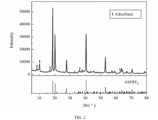
- FIG. 2 shows the XRD result of the product. It can be seen that the peak intensity of Al(OH) 3 was stronger than that of the adsorbent; and the absorption peak of aluminum hydroxide in the prepared product covered the absorption peak of the lithium-ion adsorbent, indicating that an aluminum-based lithium-ion adsorbent coated with aluminum hydroxide was synthesized.
Landscapes
- Chemical & Material Sciences (AREA)
- Organic Chemistry (AREA)
- Engineering & Computer Science (AREA)
- Chemical Kinetics & Catalysis (AREA)
- Inorganic Chemistry (AREA)
- Life Sciences & Earth Sciences (AREA)
- Environmental & Geological Engineering (AREA)
- Analytical Chemistry (AREA)
- Materials Engineering (AREA)
- Manufacturing & Machinery (AREA)
- Geology (AREA)
- Mechanical Engineering (AREA)
- Metallurgy (AREA)
- General Life Sciences & Earth Sciences (AREA)
- Hydrology & Water Resources (AREA)
- Water Supply & Treatment (AREA)
- Electrochemistry (AREA)
- General Chemical & Material Sciences (AREA)
- Geochemistry & Mineralogy (AREA)
- Solid-Sorbent Or Filter-Aiding Compositions (AREA)
- Water Treatment By Sorption (AREA)
Abstract
Description
- The present disclosure belongs to the field of adsorbents, and specifically relates to an aluminum-based lithium ion-sieve (LIS), and a preparation method and use thereof.
- In the field of chemical power supply, as lithium has high electrochemical potential, low weight, and large specific energy, lithium foil and lithium rods are widely used in rechargeable lithium batteries. Some lithium batteries have long life, high voltage, high energy density, and no pollution, and can be used at a low temperature. The high-energy lithium battery is a promising power battery developed in recent years. Mobile phones, computers, and other devices that require long standby time all use lithium-ion batteries (LIBs). Moreover, in the electric vehicle industry, in order to reduce driving costs, lithium batteries are used instead of traditional gasoline engines to start vehicles.
- With the development of power batteries, the disposal of scrap power batteries has become a challenge. At present, high-priced metals are recovered from scrap power batteries mainly by crushing and extraction. However, as lithium is difficult to extract, a large amount of lithium is easily enriched in a raffinate and cannot be effectively recovered.
- The existing technologies for lithium extraction include lithium ion adsorption technologies using an adsorption resin, an aluminum salt adsorbent, a lithium-insertion active matrix material, a MnOz adsorbent, an adsorbent prepared from spodumene concentrate, and a LIS. The LIS has attracted more and more attention due to its large adsorption capacity, high adsorption rate, and other advantages. A structure of current LIS is easily corroded, such that it is difficult to accurately control a lithium concentration and purity in an eluate.
- The present disclosure is intended to provide an aluminum-based LIS, and a preparation method and use thereof. The aluminum-based LIS has the advantages of high adsorption capacity and prominent stability, and can be used to effectively recover low-concentration lithium in industrial wastewater. Moreover, the LIS is coated with aluminum hydroxide, which can effectively protect the structure from being corroded.
- To achieve the above objective, the present disclosure provides an aluminum-based LIS, which is Li2SO4-2Al(OH)3·nH2O coated with Al(OH)3, where n is 1 to 4.
- The present disclosure also provides a preparation method of the aluminum-based LIS, including the following steps:
- (1) dissolving an aluminum salt in water, and subjecting a resulting solution to dispersion; and adding a lithium salt, heating, and adjusting a pH to higher than 7.0 to obtain an aluminum-based lithium adsorbent intermediate (LiOH·2Al(OH)3·nH2O), where n is 1 to 4;
- (2) adjusting a pH of the aluminum-based lithium adsorbent intermediate obtained in step (1) to lower than 7.0, and filtering a resulting mixture to obtain a filter cake, which is an aluminum-based lithium adsorbent (Li2SO4·2Al(OH)3·nH2O); and
- (3) washing the aluminum-based lithium adsorbent obtained in step (2), and mixing the aluminum-based lithium adsorbent with a metaaluminate solution; adjusting a pH, and filtering a resulting mixture to obtain a filter cake; and drying and grinding the filter cake to obtain the aluminum-based LIS.
- In some embodiments, the aluminum salt in step (1) may be at least one from the group consisting of aluminum sulfate, aluminum chloride, aluminum nitrate, and sodium metaaluminate.
- In some embodiments, the lithium salt in step (1) may be at least one from the group consisting of lithium hydroxide, lithium sulfate, lithium chloride, and lithium nitrate.
- In some embodiments, in step (1), the pH may be adjusted to 9.0 to 11.0.
- In some embodiments, the pH is adjusted to higher than 7.0 with at least one solution from the group consisting of a sodium hydroxide solution, a lithium hydroxide solution, a sodium carbonate solution, a sodium bicarbonate solution, and ammonia water in step (1)
- In some embodiments, in step (1), the pH may be adjusted with at least one from the group consisting of sodium hydroxide, lithium hydroxide, sodium carbonate, sodium bicarbonate, and ammonia water.
- In some embodiments, in step (1), the reaction may be conducted at 30°C to 100°C for 1 h to 72 h.
- In some embodiments, in step (1), the dispersing may be conducted at a stirring rate controlled at 100 rpm to 700 rpm.
- In some embodiments, in step (2), the pH may be adjusted to 2.5 to 5.5.
- In some embodiments, in step (2), the pH may be adjusted to lower than 7.0 with at least one from the group consisting of a sulfuric acid solution, a sulfate-containing salt solution, and a mixed solution of the sulfuric acid and salt solutions.
- In some other embodiments, the sulfuric acid solution may have a concentration of 0.5 mol/L to 2 mol/L.
- In some other embodiments, the sulfate-containing salt solution is at least one from the group consisting of an aluminum sulfate solution, a nickel sulfate solution, a cobalt sulfate solution, a manganese sulfate solution, a ferric sulfate solution, and a ferrous sulfate solution.
- In some other embodiments, the mixed solution of the sulfuric acid and salt solutions is at least one from the group consisting of a mixed solution of sulfuric acid and ferric chloride solutions, and a mixed solution of sulfuric acid and ferrous chloride solutions.
- In some embodiments, in step (3), the metaaluminate may be at least one from the group consisting of sodium metaaluminate and potassium metaaluminate.
- In some embodiments, in step (3), the pH may be adjusted to 3.5 to 11.0.
- In some other embodiments, the pH is adjusted with at least one solution from the group consisting of a sodium hydroxide solution, a lithium hydroxide solution, a sodium carbonate solution, a sodium bicarbonate solution, ammonia water, an aluminum sulfate solution, a nickel sulfate solution, a cobalt sulfate solution, a manganese sulfate solution, a permanganic acid solution, a ferric sulfate solution, a ferrous sulfate solution, a ferric chloride solution, and a ferrous chloride solution.
- In some embodiments, in step (3), the drying may be conducted at 40°C to 100°C.
- Principle: in the present disclosure, an aluminum salt and a lithium salt reacts with an alkali for adjusting pH to obtain an adsorbent intermediate LiOH·2Al(OH)3·nH2O, where the n is 1 to 4; a pH is adjusted to 2.5 to 5.5 with a dilute sulfuric acid (for adjusting pH) to obtain an aluminum-based lithium adsorbent Li2SO4·2Al(OH)3·nH2O, where n is 1 to 4; and the adsorbent is filtered out, washed, and then mixed with a metaaluminate, and a pH is adjusted to 3.5 to 11 to obtain the Li2SO4·2Al(OH)3·nH2O coated with Al(OH)3 (aluminum-based LIS).
- The present disclosure also provides a method for treating industrial wastewater with the aluminum-based LIS, including the following steps:
- (1) packing the aluminum-based LIS into a resin column, adding industrial wastewater, and conducting ion adsorption to obtain a post-adsorption solution and an aluminum-based LIS under adsorption saturation; and
- (2) subjecting the aluminum-based LIS under adsorption saturation to counter-current washing and then to counter-current desorption to obtain a pure lithium solution.
- In some embodiments, in step (1), the industrial wastewater may be wastewater with low lithium concentration and high impurity ion concentration or wastewater with high pH.
- In some embodiments, in step (1), the post-adsorption solution is used to supplement the aluminum salt at the synthesis stage when being acidic and to supplement the metaaluminate at the synthesis stage when being alkaline.
- In some embodiments, in step (1), the standing may be conducted for 10 min to 20 min.
- In some embodiments, in step (2), the desorption for the lithium-ion adsorbent may be conducted with at least one from the group consisting of deionized water and tap water.
- (1) The present disclosure is different from conventional aluminum-salt lithium-ion adsorbent in that the adsorbent of the present disclosure is coated with a substance and thus can be used in industrial wastewater and salt lake brine with high pH. The Al(OH)3 shell plays a protective role for the lithium adsorbent during an adsorption and desorption process, that is, acid and base in industrial wastewater with high pH first react with Al(OH)3 outside the lithium adsorbent, and Li ions can pass through the Al(OH)3 shell due to small ion radius and thus are adsorbed by the lithium ion adsorbent serving as a crystal nucleus. Moreover, the aluminum hydroxide can be recovered by reverse-adjusting a pH of the post-adsorption solution.
- (2) The present disclosure has simple process, low requirements on equipment, low energy consumption, low cost, and high product value (a resulting product has prominent structural performance and high selective adsorption, and can be used to effectively adsorb and recover lithium from cathode materials of scrap automobile power batteries), which is conducive to environmental protection and resource recycling and shows considerable economic benefits.
-
-
FIG. 1 is a process flow diagram of Example 1 of the present disclosure; and -
FIG. 2 is an X-ray diffraction (XRD) pattern of the aluminum-based LIS of Example 1 of the present disclosure. - In order to have a thorough understanding of the present disclosure, preferred experimental schemes of the present disclosure are described below with reference to examples to further illustrate the characteristics and advantages of the present disclosure. Any change or modification made without departing from the subject of the present disclosure can be understood by those skilled in the art. The protection scope of the present disclosure is determined by the claims.
- If no specific conditions are specified in the examples of the present disclosure, conventional conditions or the conditions recommended by a manufacturer will be adopted. All of the raw materials, reagents, or the like which are not specified with manufacturers are conventional commercially-available products.
- An aluminum-based LIS was provided in this example, which was Li2SO4-2Al(OH)3·3H2O coated with Al(OH)3.
- A preparation method of the aluminum-based LIS in this example included the following steps:
- (1) 36 g of LiOH was weighed and dissolved in 200 ml of deionized water, then 360 g of Al2(SO4)3 was added, and a resulting mixture was thoroughly mixed for 60 min by ultrasonic treatment; and the mixture was heated to 80°C in a water bath, and a pH was adjusted to 10.0 with sodium hydroxide to obtain an aluminum-based lithium adsorbent intermediate (LiOH·2Al(OH)3·nH2O);
- (2) a pH of the aluminum-based lithium adsorbent intermediate obtained in step (1) was adjusted to 4 with 0.5 mol/L dilute sulfuric acid; after reaction was completed, aging was conducted for 4 h; a resulting system was filtered, and a resulting filter cake was washed 2 to 3 times to obtain an aluminum-based lithium adsorbent (Li2SO4·2Al(OH)3·3H2O); and
- (3) the aluminum-based lithium adsorbent obtained in step (2) was filtered out by suction filtration and washed; 100 g of NaAlOz was weighed and dissolved in 500 ml of water, a resulting solution was mixed with the aluminum-based lithium adsorbent, and a pH was adjusted to 10.0; and a resulting mixture was filtered, and a resulting filter cake was collected, dried at 80°C for 24 h, and ground to obtain the aluminum-based lithium adsorbent (Li2SO4·2Al(OH)3·3H2O coated with Al(OH)3).
- A method for treating industrial wastewater with the aluminum-based LIS was provided, including the following steps:
- (1) 50 g of the aluminum-based LIS was packed into a resin column, and then strongly-alkaline industrial wastewater (with a pH of 13, Li+ content) was added for ion adsorption; and the column was placed in a thermostatic water bath and the solution was stirred for 60 min to obtain a post-adsorption solution and an aluminum-based LIS under adsorption saturation; where the Li+ content in wastewater was determined by ICP before and after adsorption, and the pH was determined by a smart pH meter before and after adsorption; and
- (2) the aluminum-based LIS under adsorption saturation was subjected to counter-current washing and then to counter-current desorption to obtain a pure lithium solution.
- As determined above, the aluminum-based LIS exhibited an adsorption capacity of 2.7 mg/g for Li+, and the solution had a pH of 13 before adsorption and a pH of 8 after adsorption, indicating significant reduction in pH.
Table 1 Li+ concentration pH Industrial wastewater 325 mg/L 13 Post-adsorption solution 50 mg/L 8 Pure lithium solution 536 mg/L 6.5 Adsorption capacity of the aluminum-based LIS for Li+ 2.7 mg/g - It can be seen from Table 1 that the adsorbent showed high adsorption to Li in industrial wastewater; the pure lithium solution could be enriched to more than 500 mg/L through the counter-current desorption; and the Al(OH)3 shell protected the aluminum-based adsorbent itself from being corroded during the adsorption process.
-
FIG. 1 is a process flow diagram of Example 1 of the present disclosure. It can be seen fromFIG. 1 that a lithium salt and an aluminum salt react with an alkali for adjusting pH, a dilute sulfuric acid is used to obtain an aluminum-based lithium adsorbent, and finally the aluminum-based lithium adsorbent is mixed with a metaaluminate to obtain the aluminum-based LIS coated with Al(OH)3, and the aluminum salt can also supplemented by reverse-adjusting a pH of the post-adsorption solution. - An aluminum-based LIS was provided in this example, which was Li2SO4·2Al(OH)3·3H2O coated with Al(OH)3.
- A preparation method of the aluminum-based LIS in this example included the following steps:
- (1) 48 g of LiOH was weighed and dissolved in 200 ml of deionized water, then 180 g of Al(OH)3 was added, and a resulting mixture was thoroughly mixed for 120 min by ultrasonic treatment; and the mixture was heated to 60°C in a water bath, and a pH was adjusted to 10.0 with sodium hydroxide to obtain an aluminum-based lithium adsorbent intermediate (LiOH·2Al(OH)3·3H2O);
- (2) a pH of the aluminum-based lithium adsorbent intermediate obtained in step (1) was adjusted to 4 with 0.5 mol/L dilute sulfuric acid; after reaction was completed, aging was conducted for 6 h; a resulting system was filtered, and a resulting filter cake was collected to obtain an aluminum-based lithium adsorbent (Li2SO4·2Al(OH)3·3H2O); and
- (3) the aluminum-based lithium adsorbent obtained in step (2) was washed 2 to 3 times; 300 g of NaAlOz was weighed and dissolved in 500 ml of water, a resulting solution was subjected to ultrasonic dispersion for 30 min and then mixed with the aluminum-based lithium adsorbent, and a pH was adjusted to 8.0; and a resulting mixture was filtered, and a resulting filter cake was collected, dried at 80°C for 24 h, and ground to obtain the aluminum-based lithium adsorbent (Li2SO4·2Al(OH)3·3H2O coated with Al(OH)3).
- A method for treating industrial wastewater with the aluminum-based LIS was provided, including the following steps:
- (1) 50 g of the aluminum-based LIS was packed into a resin column, and then strongly-alkaline industrial wastewater (with a pH of 12) was added for ion adsorption; and the column was placed in a thermostatic water bath and the solution was stirred for 60 min to obtain a post-adsorption solution and an aluminum-based LIS under adsorption saturation; where the Li+ content in wastewater was determined by ICP before and after adsorption, and the pH was determined by a smart pH meter before and after adsorption; and
- (2) the aluminum-based LIS under adsorption saturation was subjected to counter-current washing and then to counter-current desorption to obtain a pure lithium solution.
- As determined above, the aluminum-based LIS exhibited an adsorption capacity of 2.1 mg/g for Li+, and the solution had a pH of 12 before adsorption and a pH of 7.5 after adsorption, indicating significant reduction in pH.
Table 2 Li+ concentration pH Industrial wastewater 257 mg/L 12 Post-adsorption solution 41 mg/L 7.5 Pure lithium solution 424 mg/L 6.3 Adsorption capacity of the aluminum-based LIS for Li+ 2.1 mg/g - It can be seen from Table 2 that the adsorbent showed high adsorption to Li in industrial wastewater; and the Al(OH)3 shell protected the aluminum-based adsorbent itself from being corroded during the adsorption process.
- An aluminum-based LIS was provided in this example, which was Li2SO4·2Al(OH)3·nH2O coated with Al(OH)3, where the n was 1 to 4.
- A preparation method of the aluminum-based LIS in this example included the following steps:
- (1) 21 g of LiCl was weighed and dissolved in 200 ml of deionized water, then 210 g of Al(NO3)3 was added, and a resulting mixture was thoroughly mixed for 30 min by ultrasonic treatment; the mixture was heated to 90°C in a water bath, and a pH was adjusted to 12 with sodium hydroxide; and a resulting mixture was stirred for 12 h at a stirring rate of 120 rpm to obtain an aluminum-based lithium adsorbent intermediate (LiOH·2Al(OH)3·nH2O);
- (2) a pH of the aluminum-based lithium adsorbent intermediate obtained in step (1) was adjusted to 4 with 0.5 mol/L dilute sulfuric acid; after reaction was completed, aging was conducted for 6 h; a resulting system was filtered, and a resulting filter cake was collected to obtain an aluminum-based lithium adsorbent (Li2SO4·2Al(OH)3·nH2O); and
- (3) the aluminum-based lithium adsorbent obtained in step (2) was washed 2 to 3 times; 300 g of NaAlO2 was weighed and dissolved in 500 ml of water, a resulting solution was mixed with the aluminum-based lithium adsorbent; a resulting mixture was subjected to ultrasonic dispersion for 30 min, and a pH was adjusted to 6.0; and a resulting mixture was filtered, and a resulting filter cake was collected, dried at 80°C for 24 h, and ground to obtain the aluminum-based lithium adsorbent (Li2SO4·2Al(OH)3·nH2O coated with Al(OH)3).
- A method for treating industrial wastewater with the aluminum-based LIS was provided, including the following steps:
- (1) 50 g of the aluminum-based LIS was packed into a resin column, and then strongly-alkaline industrial wastewater (with a pH of 13) was added for ion adsorption; and the column was placed in a thermostatic water bath and the solution was stirred for 60 min to obtain a post-adsorption solution and an aluminum-based LIS under adsorption saturation; where the Li+ content in wastewater was determined by ICP before and after adsorption, and the pH was determined by a smart pH meter before and after adsorption; and
- (2) the aluminum-based LIS under adsorption saturation was subjected to counter-current washing and then to counter-current desorption to obtain a pure lithium solution.
- As determined above, the aluminum-based LIS exhibited an adsorption capacity of 2.3 mg/g for Li+, and the solution had a pH of 13 before adsorption and a pH of 8.5 after adsorption, indicating significant reduction in pH.
Table 3 Li+ concentration pH Industrial wastewater 431 mg/L 13 Post-adsorption solution 196 mg/L 8.5 Pure lithium solution 579 mg/L 6 Adsorption capacity of the aluminum-based LIS for Li+ 2.3 mg/g - It can be seen from Table 3 that the adsorbent showed high adsorption to Li in industrial wastewater; the pure lithium solution could be enriched to more than 500 mg/L through multiple counter-current desorption; and the Al(OH)3 shell protected the aluminum-based adsorbent itself from being corroded during the adsorption process.
-
FIG. 2 shows the XRD result of the product. It can be seen that the peak intensity of Al(OH)3 was stronger than that of the adsorbent; and the absorption peak of aluminum hydroxide in the prepared product covered the absorption peak of the lithium-ion adsorbent, indicating that an aluminum-based lithium-ion adsorbent coated with aluminum hydroxide was synthesized. - The aluminum-based LIS and a preparation method and use thereof provided in the present disclosure are described in detail above, and specific examples are used herein to illustrate the principle and implementation of the present disclosure. The examples are illustrated above merely to help understand the method and core ideas thereof (including the optimal mode) of the present disclosure and allow any person skilled in the art to practice the present disclosure, including manufacturing and using any device or system and implementing any combined method. It should be noted that several improvements and modifications may be made by persons of ordinary skill in the art without departing from the principle of the present disclosure, and these improvements and modifications should also fall within the protection scope of the present disclosure. The protection scope of the present disclosure is defined by the claims and may encompass other examples that those skilled in the art can think of. If these other examples have structural elements that are not different from the literal expression in the claims or include equivalent structural elements that are not substantially different from the literal expression in the claims, they should also be included in the scope of the claims.
Claims (10)
- An aluminum-based lithium ion-sieve (LIS), wherein the aluminum-based LIS is Li2SO4·2Al(OH)3·nH2O coated with Al(OH)3, wherein n is 1 to 4.
- A preparation method of the aluminum-based LIS according to claim 1, comprising the following steps:(1) dissolving an aluminum salt in water, and subjecting a resulting solution to dispersion; and adding a lithium salt, heating, and adjusting a pH to higher than 7.0 to obtain an aluminum-based lithium adsorbent intermediate (LiOH·2Al(OH)3·nH2O), wherein n is 1 to 4;(2) adjusting a pH of the aluminum-based lithium adsorbent intermediate obtained in step (1) to lower than 7.0, and filtering a resulting mixture to obtain a filter cake, which is an aluminum-based lithium adsorbent (Li2SO4·2Al(OH)3·nH2O); and(3) washing the aluminum-based lithium adsorbent obtained in step (2), and mixing the aluminum-based lithium adsorbent with a metaaluminate solution; adjusting a pH, and filtering a resulting mixture to obtain a filter cake; and drying and grinding the filter cake to obtain the aluminum-based LIS.
- The preparation method according to claim 2, wherein the aluminum salt in step (1) is at least one from the group consisting of aluminum sulfate, aluminum chloride, aluminum nitrate, and sodium metaaluminate.
- The preparation method according to claim 2, wherein the lithium salt in step (1) is at least one from the group consisting of lithium hydroxide, lithium sulfate, lithium chloride, and lithium nitrate.
- The preparation method according to claim 2, wherein the pH is adjusted to 9.0 to 11.0 in step (1); and the reaction is conducted at 30°C to 100°C for 1 h to 72 h in step (1).
- The preparation method according to claim 2, wherein the pH is adjusted to higher than 7.0 with at least one solution from the group consisting of a sodium hydroxide solution, a lithium hydroxide solution, a sodium carbonate solution, a sodium bicarbonate solution, and ammonia water in step (1).
- The preparation method according to claim 2, wherein in step (2), the pH is adjusted to lower than 7.0 with at least one from the group consisting of a sulfuric acid solution, a sulfate-containing salt solution, and a mixed solution of the sulfuric acid and salt solutions; the sulfuric acid solution has a concentration of 0.5 mol/L to 2 mol/L; and the sulfate-containing salt solution is at least one from the group consisting of an aluminum sulfate solution, a nickel sulfate solution, a cobalt sulfate solution, a manganese sulfate solution, a ferric sulfate solution, and a ferrous sulfate solution; and the mixed solution of the sulfuric acid and salt solutions is at least one from the group consisting of a mixed solution of sulfuric acid and ferric chloride solutions and a mixed solution of sulfuric acid and ferrous chloride solutions.
- The preparation method according to claim 2, wherein in step (3), the pH is adjusted to 3.5 to 11.0; and the pH is adjusted with at least one solution from the group consisting of a sodium hydroxide solution, a lithium hydroxide solution, a sodium carbonate solution, a sodium bicarbonate solution, ammonia water, an aluminum sulfate solution, a nickel sulfate solution, a cobalt sulfate solution, a manganese sulfate solution, a permanganic acid solution, a ferric sulfate solution, a ferrous sulfate solution, a ferric chloride solution, and a ferrous chloride solution.
- The preparation method according to claim 2, wherein the metaaluminate in step (3) is at least one from the group consisting of sodium metaaluminate and potassium metaaluminate.
- A method for treating industrial wastewater with the aluminum-based LIS according to claim 1, comprising the following steps:(1) packing the aluminum-based LIS into a resin column, adding industrial wastewater, and conducting ion adsorption to obtain a post-adsorption solution and an aluminum-based LIS under adsorption saturation; and(2) subjecting the aluminum-based LIS under adsorption saturation to counter-current washing and then to counter-current desorption to obtain a pure lithium solution.
Applications Claiming Priority (2)
| Application Number | Priority Date | Filing Date | Title |
|---|---|---|---|
| CN202011504630.4A CN112808226B (en) | 2020-12-18 | 2020-12-18 | Aluminum-based lithium ion sieve and preparation method and application thereof |
| PCT/CN2021/123400 WO2022127316A1 (en) | 2020-12-18 | 2021-10-13 | Aluminum-based lithium ion sieve, preparation method therefor and use thereof |
Publications (2)
| Publication Number | Publication Date |
|---|---|
| EP4260935A1 true EP4260935A1 (en) | 2023-10-18 |
| EP4260935A4 EP4260935A4 (en) | 2024-08-07 |
Family
ID=75853755
Family Applications (1)
| Application Number | Title | Priority Date | Filing Date |
|---|---|---|---|
| EP21905245.3A Pending EP4260935A4 (en) | 2020-12-18 | 2021-10-13 | ALUMINUM-BASED LITHIUM-ION SCREEN, PRODUCTION METHOD AND USE THEREOF |
Country Status (4)
| Country | Link |
|---|---|
| US (1) | US20230330622A1 (en) |
| EP (1) | EP4260935A4 (en) |
| CN (1) | CN112808226B (en) |
| WO (1) | WO2022127316A1 (en) |
Families Citing this family (18)
| Publication number | Priority date | Publication date | Assignee | Title |
|---|---|---|---|---|
| CN115837266B (en) * | 2021-09-18 | 2025-01-14 | 比亚迪股份有限公司 | Liquid phase precipitation synthesis method of aluminum salt type lithium ion adsorbent |
| CN115872421B (en) * | 2021-09-30 | 2024-11-19 | 比亚迪股份有限公司 | Method for recovering lithium from lithium-containing solution |
| CN113896214B (en) * | 2021-11-29 | 2023-03-21 | 福州大学 | Method for preparing high-purity lithium carbonate by adsorbing and carbonizing lithium sulfate solution |
| CN115286027B (en) * | 2022-06-29 | 2023-09-08 | 西安近代化学研究所 | Preparation method and application of aluminum hydroxide lithium salt compound |
| CN115323195A (en) * | 2022-07-13 | 2022-11-11 | 江西赣锋锂业股份有限公司 | Method for extracting lithium from brine by adsorption of lithium smelting slag |
| CN115869898B (en) * | 2022-07-15 | 2023-06-02 | 中国科学院青海盐湖研究所 | Lithium adsorbent, preparation method thereof and extraction method of lithium ions |
| CN115124053B (en) * | 2022-07-19 | 2024-05-07 | 浙江新锂想科技有限责任公司 | Method for extracting and preparing lithium product from lepidolite by adopting composite adsorption resin |
| CN115779874B (en) * | 2022-11-22 | 2023-07-07 | 湖南五创循环科技有限公司 | Preparation method of lithium adsorbent in lithium-containing solution |
| CN115739004B (en) * | 2022-11-25 | 2024-04-16 | 中国科学院青海盐湖研究所 | Lithium-aluminum adsorption material prepared from salt lake brine with high magnesium-lithium ratio and method thereof |
| KR20240093113A (en) * | 2022-12-15 | 2024-06-24 | 포스코홀딩스 주식회사 | Aluminum-based lithium adsorbent and manufacturing method thereof |
| CN116212830B (en) * | 2023-02-17 | 2025-04-22 | 北京碧水源膜科技有限公司 | A lithium ion adsorption material and its preparation method and application |
| CN116282111B (en) * | 2023-03-02 | 2025-02-11 | 武汉理工大学 | A compound, a preparation method thereof and its application as an elution-resistant deactivation lithium extraction adsorbent |
| CN116917513B (en) * | 2023-05-31 | 2025-01-14 | 广东邦普循环科技有限公司 | Coated lithium manganate lithium ion sieve and preparation method and application thereof |
| CN117599750B (en) * | 2023-12-04 | 2026-04-07 | 北京泰丰先行新能源科技有限公司 | Modified aluminum-based lithium adsorbent applicable to high sulfate radical brine and preparation method thereof |
| CN117916016B (en) * | 2023-12-04 | 2026-03-31 | 广东邦普循环科技有限公司 | A magnetic lithium extraction adsorbent, its preparation method and application |
| WO2025137904A1 (en) * | 2023-12-27 | 2025-07-03 | 广东邦普循环科技有限公司 | Modified aluminum-based lithium extraction adsorbent, and preparation method therefor and use thereof |
| CN117732427A (en) * | 2024-01-17 | 2024-03-22 | 北京华特源科技有限公司 | Lithium aluminum hydrotalcite adsorbent and preparation method thereof |
| CN118925661A (en) * | 2024-08-19 | 2024-11-12 | 江西九岭锂业股份有限公司 | Lithium slag-based ion sieve adsorbent and preparation method thereof, lithium ion adsorption column |
Family Cites Families (9)
| Publication number | Priority date | Publication date | Assignee | Title |
|---|---|---|---|---|
| US7138209B2 (en) * | 2000-10-09 | 2006-11-21 | Samsung Sdi Co., Ltd. | Positive active material for rechargeable lithium battery and method of preparing same |
| US7709149B2 (en) * | 2004-09-24 | 2010-05-04 | Lg Chem, Ltd. | Composite precursor for aluminum-containing lithium transition metal oxide and process for preparation of the same |
| CN101728529A (en) * | 2008-10-10 | 2010-06-09 | 深圳市天骄科技开发有限公司 | Lithium ion battery anode material and manufacturing method thereof |
| CN108110229A (en) * | 2013-01-21 | 2018-06-01 | 宁德新能源科技有限公司 | Alumina-coated is modified the preparation method of lithium nickel cobalt manganese oxygen positive electrode |
| CN103560236B (en) * | 2013-10-23 | 2016-05-11 | 合肥国轩高科动力能源有限公司 | Preparation method of alumina-coated Li(NixCoyMn1-x-y)O2 lithium-ion battery cathode material |
| FR3015459A1 (en) * | 2013-12-23 | 2015-06-26 | Eramet | PROCESS FOR PREPARING ADSORBENT MATERIAL, SHAPED BY PRECIPITATION OF ALUMINUM SULFATE AND SODIUM ALUMINATE, AND LITHIUM EXTRACTION METHOD USING THE SAME |
| FR3044001B1 (en) * | 2015-11-24 | 2017-12-29 | Eramet | PROCESS FOR PREPARING AN ADSORBENT MATERIAL COMPRISING A BASIC MIXING STEP AND METHOD OF EXTRACTING LITHIUM FROM SALINE SOLUTIONS USING THE SAME |
| EP3538266B1 (en) * | 2016-11-14 | 2024-08-21 | Lilac Solutions, Inc. | Lithium extraction with coated ion exchange particles |
| CN108993376B (en) * | 2018-09-17 | 2021-03-26 | 华东理工大学 | A kind of aluminum salt lithium adsorbent and preparation method and application thereof |
-
2020
- 2020-12-18 CN CN202011504630.4A patent/CN112808226B/en active Active
-
2021
- 2021-10-13 WO PCT/CN2021/123400 patent/WO2022127316A1/en not_active Ceased
- 2021-10-13 EP EP21905245.3A patent/EP4260935A4/en active Pending
-
2023
- 2023-06-19 US US18/211,587 patent/US20230330622A1/en active Pending
Also Published As
| Publication number | Publication date |
|---|---|
| CN112808226B (en) | 2022-11-15 |
| CN112808226A (en) | 2021-05-18 |
| WO2022127316A1 (en) | 2022-06-23 |
| EP4260935A4 (en) | 2024-08-07 |
| US20230330622A1 (en) | 2023-10-19 |
Similar Documents
| Publication | Publication Date | Title |
|---|---|---|
| US20230330622A1 (en) | Aluminum-based lithium ion-sieve (lis), and preparation method and use thereof | |
| CN111129632B (en) | Method for recycling positive and negative electrode mixed materials of waste ternary lithium ion battery | |
| CN103035977A (en) | Method for separating and recovering lithium from waste lithium ion battery | |
| CN111048862B (en) | A method for efficiently recovering positive and negative electrode materials of lithium ion batteries as electrode materials for supercapacitors | |
| CN113200574A (en) | Method for regenerating lithium-rich manganese-based positive electrode from mixed waste lithium battery | |
| CN108384955A (en) | A method of from selectively carrying lithium in waste material containing lithium battery | |
| CN115448335B (en) | Recycling method of waste lithium iron manganese phosphate battery | |
| CN113314778A (en) | Recycling method of retired lithium ion battery positive electrode material | |
| CN102923783A (en) | Battery grade high-purity manganese sulfate monohydrate and preparation method thereof | |
| CN104577104B (en) | Regeneration method of positive material lithium manganate waste of lithium ion battery | |
| CN109599602B (en) | Method for resource utilization of waste positive electrode material of lithium battery | |
| CN108933308B (en) | Comprehensive recycling method for anode and cathode of scrapped lithium battery | |
| CN104600284B (en) | Method for regenerating positive active material in spent lithium manganate lithium ion battery | |
| CN101654741A (en) | Method for separating and recovering lithium and cobalt from lithium ion cell | |
| CN116119690A (en) | Method for selectively recycling lithium from waste lithium battery | |
| CN120657303A (en) | Method for recycling waste lithium iron phosphate battery anode material based on organic solvent soaking | |
| CN118183859A (en) | Recovery method of waste lithium iron phosphate | |
| CN117276730A (en) | Method for recycling waste lithium cobaltate and lithium iron phosphate mixed materials and regenerating waste lithium cobaltate and lithium iron phosphate mixed materials into lithium iron phosphate | |
| CN118222850A (en) | Method for extracting lithium | |
| CN108400401A (en) | A method of using the active material of waste and old lithium dynamical battery separation as Material synthesis nickle cobalt lithium manganate | |
| CN115133164A (en) | Method for recovering metal lithium and treating sewage by coupling leaching of waste lithium iron phosphate batteries and organic wastewater treatment | |
| CN117043367B (en) | A method for lithium extraction from brine by electrochemical adsorption and its application | |
| CN105948130B (en) | A kind of mangano-manganic oxide, preparation method and applications | |
| CN106006749A (en) | Method for cooperatively treating waste lithium manganate and acid-making tail gas and recycling lithium manganese | |
| CN118702129B (en) | A method for resource utilization of lithium precipitation mother liquor |
Legal Events
| Date | Code | Title | Description |
|---|---|---|---|
| STAA | Information on the status of an ep patent application or granted ep patent |
Free format text: STATUS: THE INTERNATIONAL PUBLICATION HAS BEEN MADE |
|
| PUAI | Public reference made under article 153(3) epc to a published international application that has entered the european phase |
Free format text: ORIGINAL CODE: 0009012 |
|
| STAA | Information on the status of an ep patent application or granted ep patent |
Free format text: STATUS: REQUEST FOR EXAMINATION WAS MADE |
|
| 17P | Request for examination filed |
Effective date: 20230712 |
|
| AK | Designated contracting states |
Kind code of ref document: A1 Designated state(s): AL AT BE BG CH CY CZ DE DK EE ES FI FR GB GR HR HU IE IS IT LI LT LU LV MC MK MT NL NO PL PT RO RS SE SI SK SM TR |
|
| DAX | Request for extension of the european patent (deleted) | ||
| RAV | Requested validation state of the european patent: fee paid |
Extension state: MA Effective date: 20230712 |
|
| A4 | Supplementary search report drawn up and despatched |
Effective date: 20240704 |
|
| RIC1 | Information provided on ipc code assigned before grant |
Ipc: B01J 47/016 20170101ALI20240628BHEP Ipc: B01J 39/10 20060101ALI20240628BHEP Ipc: B01J 39/09 20170101ALI20240628BHEP Ipc: B01J 39/02 20060101ALI20240628BHEP Ipc: C02F 101/10 20060101ALI20240628BHEP Ipc: H01M 10/54 20060101ALI20240628BHEP Ipc: C22B 26/12 20060101ALI20240628BHEP Ipc: C22B 7/00 20060101ALI20240628BHEP Ipc: C22B 3/24 20060101ALI20240628BHEP Ipc: C02F 1/28 20230101ALI20240628BHEP Ipc: B01J 20/32 20060101ALI20240628BHEP Ipc: B01J 20/04 20060101ALI20240628BHEP Ipc: B01J 20/08 20060101AFI20240628BHEP |