EP4258415A1 - Method and apparatus for controlling heat pump air-conditioning system of traveling vehicle, and device and storage medium - Google Patents
Method and apparatus for controlling heat pump air-conditioning system of traveling vehicle, and device and storage medium Download PDFInfo
- Publication number
- EP4258415A1 EP4258415A1 EP20963827.9A EP20963827A EP4258415A1 EP 4258415 A1 EP4258415 A1 EP 4258415A1 EP 20963827 A EP20963827 A EP 20963827A EP 4258415 A1 EP4258415 A1 EP 4258415A1
- Authority
- EP
- European Patent Office
- Prior art keywords
- battery
- passenger cabin
- heating
- thermal load
- heating mode
- Prior art date
- Legal status (The legal status is an assumption and is not a legal conclusion. Google has not performed a legal analysis and makes no representation as to the accuracy of the status listed.)
- Pending
Links
Images


Classifications
-
- B—PERFORMING OPERATIONS; TRANSPORTING
- B60—VEHICLES IN GENERAL
- B60H—ARRANGEMENTS OF HEATING, COOLING, VENTILATING OR OTHER AIR-TREATING DEVICES SPECIALLY ADAPTED FOR PASSENGER OR GOODS SPACES OF VEHICLES
- B60H1/00—Heating, cooling or ventilating devices
- B60H1/00357—Air-conditioning arrangements specially adapted for particular vehicles
- B60H1/00385—Air-conditioning arrangements specially adapted for particular vehicles for vehicles having an electrical drive, e.g. hybrid or fuel cell
- B60H1/00392—Air-conditioning arrangements specially adapted for particular vehicles for vehicles having an electrical drive, e.g. hybrid or fuel cell for electric vehicles having only electric drive means
-
- B—PERFORMING OPERATIONS; TRANSPORTING
- B60—VEHICLES IN GENERAL
- B60H—ARRANGEMENTS OF HEATING, COOLING, VENTILATING OR OTHER AIR-TREATING DEVICES SPECIALLY ADAPTED FOR PASSENGER OR GOODS SPACES OF VEHICLES
- B60H1/00—Heating, cooling or ventilating devices
- B60H1/00271—HVAC devices specially adapted for particular vehicle parts or components and being connected to the vehicle HVAC unit
- B60H1/00278—HVAC devices specially adapted for particular vehicle parts or components and being connected to the vehicle HVAC unit for the battery
-
- B—PERFORMING OPERATIONS; TRANSPORTING
- B60—VEHICLES IN GENERAL
- B60H—ARRANGEMENTS OF HEATING, COOLING, VENTILATING OR OTHER AIR-TREATING DEVICES SPECIALLY ADAPTED FOR PASSENGER OR GOODS SPACES OF VEHICLES
- B60H1/00—Heating, cooling or ventilating devices
- B60H1/00642—Control systems or circuits; Control members or indication devices for heating, cooling or ventilating devices
- B60H1/00814—Control systems or circuits characterised by their output, for controlling particular components of the heating, cooling or ventilating installation
- B60H1/00878—Control systems or circuits characterised by their output, for controlling particular components of the heating, cooling or ventilating installation the components being temperature regulating devices
- B60H1/00899—Controlling the flow of liquid in a heat pump system
- B60H1/00921—Controlling the flow of liquid in a heat pump system where the flow direction of the refrigerant does not change and there is an extra subcondenser, e.g. in an air duct
-
- B—PERFORMING OPERATIONS; TRANSPORTING
- B60—VEHICLES IN GENERAL
- B60L—PROPULSION OF ELECTRICALLY-PROPELLED VEHICLES; SUPPLYING ELECTRIC POWER FOR AUXILIARY EQUIPMENT OF ELECTRICALLY-PROPELLED VEHICLES; ELECTRODYNAMIC BRAKE SYSTEMS FOR VEHICLES IN GENERAL; MAGNETIC SUSPENSION OR LEVITATION FOR VEHICLES; MONITORING OPERATING VARIABLES OF ELECTRICALLY-PROPELLED VEHICLES; ELECTRIC SAFETY DEVICES FOR ELECTRICALLY-PROPELLED VEHICLES
- B60L58/00—Methods or circuit arrangements for monitoring or controlling batteries or fuel cells, specially adapted for electric vehicles
- B60L58/10—Methods or circuit arrangements for monitoring or controlling batteries or fuel cells, specially adapted for electric vehicles for monitoring or controlling batteries
- B60L58/24—Methods or circuit arrangements for monitoring or controlling batteries or fuel cells, specially adapted for electric vehicles for monitoring or controlling batteries for controlling the temperature of batteries
- B60L58/27—Methods or circuit arrangements for monitoring or controlling batteries or fuel cells, specially adapted for electric vehicles for monitoring or controlling batteries for controlling the temperature of batteries by heating
-
- H—ELECTRICITY
- H01—ELECTRIC ELEMENTS
- H01M—PROCESSES OR MEANS, e.g. BATTERIES, FOR THE DIRECT CONVERSION OF CHEMICAL ENERGY INTO ELECTRICAL ENERGY
- H01M10/00—Secondary cells; Manufacture thereof
- H01M10/42—Methods or arrangements for servicing or maintenance of secondary cells or secondary half-cells
- H01M10/48—Accumulators combined with arrangements for measuring, testing or indicating the condition of cells, e.g. the level or density of the electrolyte
-
- H—ELECTRICITY
- H01—ELECTRIC ELEMENTS
- H01M—PROCESSES OR MEANS, e.g. BATTERIES, FOR THE DIRECT CONVERSION OF CHEMICAL ENERGY INTO ELECTRICAL ENERGY
- H01M10/00—Secondary cells; Manufacture thereof
- H01M10/42—Methods or arrangements for servicing or maintenance of secondary cells or secondary half-cells
- H01M10/48—Accumulators combined with arrangements for measuring, testing or indicating the condition of cells, e.g. the level or density of the electrolyte
- H01M10/486—Accumulators combined with arrangements for measuring, testing or indicating the condition of cells, e.g. the level or density of the electrolyte for measuring temperature
-
- H—ELECTRICITY
- H01—ELECTRIC ELEMENTS
- H01M—PROCESSES OR MEANS, e.g. BATTERIES, FOR THE DIRECT CONVERSION OF CHEMICAL ENERGY INTO ELECTRICAL ENERGY
- H01M10/00—Secondary cells; Manufacture thereof
- H01M10/60—Heating or cooling; Temperature control
- H01M10/61—Types of temperature control
- H01M10/615—Heating or keeping warm
-
- H—ELECTRICITY
- H01—ELECTRIC ELEMENTS
- H01M—PROCESSES OR MEANS, e.g. BATTERIES, FOR THE DIRECT CONVERSION OF CHEMICAL ENERGY INTO ELECTRICAL ENERGY
- H01M10/00—Secondary cells; Manufacture thereof
- H01M10/60—Heating or cooling; Temperature control
- H01M10/62—Heating or cooling; Temperature control specially adapted for specific applications
- H01M10/625—Vehicles
-
- H—ELECTRICITY
- H01—ELECTRIC ELEMENTS
- H01M—PROCESSES OR MEANS, e.g. BATTERIES, FOR THE DIRECT CONVERSION OF CHEMICAL ENERGY INTO ELECTRICAL ENERGY
- H01M10/00—Secondary cells; Manufacture thereof
- H01M10/60—Heating or cooling; Temperature control
- H01M10/63—Control systems
- H01M10/633—Control systems characterised by algorithms, flow charts, software details or the like
-
- H—ELECTRICITY
- H01—ELECTRIC ELEMENTS
- H01M—PROCESSES OR MEANS, e.g. BATTERIES, FOR THE DIRECT CONVERSION OF CHEMICAL ENERGY INTO ELECTRICAL ENERGY
- H01M10/00—Secondary cells; Manufacture thereof
- H01M10/60—Heating or cooling; Temperature control
- H01M10/63—Control systems
- H01M10/635—Control systems based on ambient temperature
-
- B—PERFORMING OPERATIONS; TRANSPORTING
- B60—VEHICLES IN GENERAL
- B60H—ARRANGEMENTS OF HEATING, COOLING, VENTILATING OR OTHER AIR-TREATING DEVICES SPECIALLY ADAPTED FOR PASSENGER OR GOODS SPACES OF VEHICLES
- B60H1/00—Heating, cooling or ventilating devices
- B60H1/00642—Control systems or circuits; Control members or indication devices for heating, cooling or ventilating devices
- B60H1/00735—Control systems or circuits characterised by their input, i.e. by the detection, measurement or calculation of particular conditions, e.g. signal treatment, dynamic models
- B60H1/00764—Control systems or circuits characterised by their input, i.e. by the detection, measurement or calculation of particular conditions, e.g. signal treatment, dynamic models the input being a vehicle driving condition, e.g. speed
-
- B—PERFORMING OPERATIONS; TRANSPORTING
- B60—VEHICLES IN GENERAL
- B60H—ARRANGEMENTS OF HEATING, COOLING, VENTILATING OR OTHER AIR-TREATING DEVICES SPECIALLY ADAPTED FOR PASSENGER OR GOODS SPACES OF VEHICLES
- B60H1/00—Heating, cooling or ventilating devices
- B60H1/32—Cooling devices
- B60H1/3204—Cooling devices using compression
- B60H1/3228—Cooling devices using compression characterised by refrigerant circuit configurations
- B60H1/32284—Cooling devices using compression characterised by refrigerant circuit configurations comprising two or more secondary circuits, e.g. at evaporator and condenser side
-
- B—PERFORMING OPERATIONS; TRANSPORTING
- B60—VEHICLES IN GENERAL
- B60H—ARRANGEMENTS OF HEATING, COOLING, VENTILATING OR OTHER AIR-TREATING DEVICES SPECIALLY ADAPTED FOR PASSENGER OR GOODS SPACES OF VEHICLES
- B60H1/00—Heating, cooling or ventilating devices
- B60H1/00271—HVAC devices specially adapted for particular vehicle parts or components and being connected to the vehicle HVAC unit
- B60H2001/00307—Component temperature regulation using a liquid flow
-
- B—PERFORMING OPERATIONS; TRANSPORTING
- B60—VEHICLES IN GENERAL
- B60L—PROPULSION OF ELECTRICALLY-PROPELLED VEHICLES; SUPPLYING ELECTRIC POWER FOR AUXILIARY EQUIPMENT OF ELECTRICALLY-PROPELLED VEHICLES; ELECTRODYNAMIC BRAKE SYSTEMS FOR VEHICLES IN GENERAL; MAGNETIC SUSPENSION OR LEVITATION FOR VEHICLES; MONITORING OPERATING VARIABLES OF ELECTRICALLY-PROPELLED VEHICLES; ELECTRIC SAFETY DEVICES FOR ELECTRICALLY-PROPELLED VEHICLES
- B60L2240/00—Control parameters of input or output; Target parameters
- B60L2240/10—Vehicle control parameters
- B60L2240/34—Cabin temperature
-
- B—PERFORMING OPERATIONS; TRANSPORTING
- B60—VEHICLES IN GENERAL
- B60L—PROPULSION OF ELECTRICALLY-PROPELLED VEHICLES; SUPPLYING ELECTRIC POWER FOR AUXILIARY EQUIPMENT OF ELECTRICALLY-PROPELLED VEHICLES; ELECTRODYNAMIC BRAKE SYSTEMS FOR VEHICLES IN GENERAL; MAGNETIC SUSPENSION OR LEVITATION FOR VEHICLES; MONITORING OPERATING VARIABLES OF ELECTRICALLY-PROPELLED VEHICLES; ELECTRIC SAFETY DEVICES FOR ELECTRICALLY-PROPELLED VEHICLES
- B60L2240/00—Control parameters of input or output; Target parameters
- B60L2240/40—Drive Train control parameters
- B60L2240/54—Drive Train control parameters related to batteries
- B60L2240/545—Temperature
-
- B—PERFORMING OPERATIONS; TRANSPORTING
- B60—VEHICLES IN GENERAL
- B60L—PROPULSION OF ELECTRICALLY-PROPELLED VEHICLES; SUPPLYING ELECTRIC POWER FOR AUXILIARY EQUIPMENT OF ELECTRICALLY-PROPELLED VEHICLES; ELECTRODYNAMIC BRAKE SYSTEMS FOR VEHICLES IN GENERAL; MAGNETIC SUSPENSION OR LEVITATION FOR VEHICLES; MONITORING OPERATING VARIABLES OF ELECTRICALLY-PROPELLED VEHICLES; ELECTRIC SAFETY DEVICES FOR ELECTRICALLY-PROPELLED VEHICLES
- B60L2240/00—Control parameters of input or output; Target parameters
- B60L2240/60—Navigation input
- B60L2240/66—Ambient conditions
- B60L2240/662—Temperature
-
- B—PERFORMING OPERATIONS; TRANSPORTING
- B60—VEHICLES IN GENERAL
- B60L—PROPULSION OF ELECTRICALLY-PROPELLED VEHICLES; SUPPLYING ELECTRIC POWER FOR AUXILIARY EQUIPMENT OF ELECTRICALLY-PROPELLED VEHICLES; ELECTRODYNAMIC BRAKE SYSTEMS FOR VEHICLES IN GENERAL; MAGNETIC SUSPENSION OR LEVITATION FOR VEHICLES; MONITORING OPERATING VARIABLES OF ELECTRICALLY-PROPELLED VEHICLES; ELECTRIC SAFETY DEVICES FOR ELECTRICALLY-PROPELLED VEHICLES
- B60L2270/00—Problem solutions or means not otherwise provided for
- B60L2270/46—Heat pumps, e.g. for cabin heating
-
- Y—GENERAL TAGGING OF NEW TECHNOLOGICAL DEVELOPMENTS; GENERAL TAGGING OF CROSS-SECTIONAL TECHNOLOGIES SPANNING OVER SEVERAL SECTIONS OF THE IPC; TECHNICAL SUBJECTS COVERED BY FORMER USPC CROSS-REFERENCE ART COLLECTIONS [XRACs] AND DIGESTS
- Y02—TECHNOLOGIES OR APPLICATIONS FOR MITIGATION OR ADAPTATION AGAINST CLIMATE CHANGE
- Y02E—REDUCTION OF GREENHOUSE GAS [GHG] EMISSIONS, RELATED TO ENERGY GENERATION, TRANSMISSION OR DISTRIBUTION
- Y02E60/00—Enabling technologies; Technologies with a potential or indirect contribution to GHG emissions mitigation
- Y02E60/10—Energy storage using batteries
Definitions
- the present disclosure relates to the field of vehicle energy management technologies, and in particular, to a method and an apparatus for controlling a heat pump air-conditioning system of a vehicle, a device and a storage medium.
- Heat pump air-conditioning systems are mounted in most of the new energy vehicles, especially in electric vehicles to satisfy requirements for supplying heat within the vehicles in winter. But, according to a latest test report of 2019 released by American Automobile Association, three types of electric cars on Chinese market were selected to participate in a test carried out in an environment of minus 7 degrees Celsius, which showed that compared with the air-conditioning systems turned off, the drivable mileage of the vehicles with the air-conditioning systems turned on was decreased by more than 40%. At present, the significant reduction of the drivable mileage in winter is the biggest factor that affects user experiences.
- a first aspect of the present disclosure provides a method of controlling a heat pump air-conditioning system of a vehicle, including:
- a second aspect of the present disclosure provides an apparatus for controlling a heat pump air-conditioning system of a vehicle, including:
- a third aspect of the present disclosure provides a device including a processor and a memory, where the memory stores at least one instruction, at least one segment of program, a code set or an instruction set, and the at least one instruction, the at least one segment of program, the code set or the instruction set is loaded and executed by the processor to perform the method of controlling a heat pump air-conditioning system of a vehicle according to the first aspect of the present disclosure.
- a fourth aspect of the present disclosure provides a non-transitory computer readable storage medium, storing at least one instruction, at least one segment of program, a code set or an instruction set, where the at least one instruction, the at least one segment of program, the code set or the instruction set is loaded and executed by a processor to perform the method of controlling a heat pump air-conditioning system of a vehicle according to the first aspect of the present disclosure.
- the device and the storage medium in the method and apparatus for controlling a heat pump air-conditioning system of a vehicle, the device and the storage medium according to the embodiments of the present disclosure, when the system heat supply amount cannot satisfy the heating requirements of the passenger cabin and the battery at the same time, intelligent control for arbitration of the heating mode of the heat pump air-conditioning system is performed based on the priority of heating the passenger cabin, the priority of heating the battery, the outside-vehicle environmental temperature, the battery temperature, the thermal load of the passenger cabin, the estimation value of electric drive natural waste heat and the thermal load of the battery system, to coordinate the requirements of both so as to enable the system to work in a more efficient and energy saving manner.
- the energy consumption of the battery will be reduced while the drivable mileage of the battery is improved.
- the heating requirement of the passenger cabin can be satisfied to enable the full vehicle comfort and efficiency to reach the optimum, thereby improving the user experiences.
- FIG. 1 is a flowchart illustrating a method of controlling a heat pump air-conditioning system of a vehicle according to an embodiment of the present disclosure.
- the specification provides operation steps of the method as shown in embodiments or flowcharts, but may include more or less operation steps based on normal or non-creative labor.
- the sequence of the steps in the embodiments is only one of many sequences for executing the operation steps rather than only one execution sequence.
- a system or a server product actually performs the steps, it may perform the steps in a sequence shown in the embodiments or drawings or in parallel (for example, in an environment of parallel processor or multi-thread processing).
- the method specifically includes the following steps.
- step S101 comfort requirement information of a passenger cabin, trip information and battery performance information are obtained.
- step S 102 according to heating requirement amounts of the passenger cabin and a battery and a system heat supply amount, it is determined whether the system heat supply amount satisfies heating requirements of the passenger cabin and the battery at the same time.
- step S103 when the system heat supply amount is incapable of satisfying the heating requirements of the passenger cabin and the battery at the same time, it is determined whether a priority of heating the passenger cabin is higher than a priority of heating the battery based on the comfort requirement information of the passenger cabin, the trip information and the battery performance information.
- the comfort requirement information of the passenger cabin includes a set temperature, a passenger cabin temperature, a glass temperature, a blower speed, a face-blowing and foot-blowing mode, a humidity and a daylight load and the like as well as information obtained in combination based on data transmitted by an intelligent cloud platform.
- the data transmitted by the intelligent cloud platform may be cold and hot preferences and air volume preference factors and the like of users based on big data deep computing as well as a human machine interface (HMI) target temperature and the like set automatically by the intelligent cloud platform for the users based on user habits.
- HMI human machine interface
- the trip information includes but not limited to route, weather, parking time and a mode of an electric drive unit.
- the battery performance information includes but not limited to an age of a battery pack, a charging state of a battery and a power requirement.
- a heating mode of the heat pump air-conditioning system is determined based on an outside-vehicle environmental temperature, a thermal load of the passenger cabin, an estimation value of electric drive natural waste heat and a thermal load of a battery system.
- the estimation value of electric drive natural waste heat may be a product of a motor power obtained based on estimation method and a preset scale coefficient.
- the value of the preset scale coefficient can be obtained after calibration, for example, the value of the preset scale coefficient is 10%.
- the heating mode of the heat pump air-conditioning system is determined based on a battery temperature, the thermal load of the passenger cabin, the estimation value of electric drive natural waste heat and the thermal load of the battery system.
- FIG. 2 is a flowchart of step S103. As shown in FIG. 2 , specifically, in step S3, determining whether the priority of heating the passenger cabin is higher than the priority of heating the battery based on the comfort requirement information of the passenger cabin, the trip information and the battery performance information includes the following steps.
- step S1031 based on the comfort requirement information of the passenger cabin, whether the thermal load of the passenger cabin is greater than a first preset value or in an unstable state is determined to obtain a first determination result.
- determining whether the thermal load of the passenger cabin is in an unstable state includes:
- step S1032 based on the trip information, whether a current travel state is a low-speed short-line travel is determined to obtain a second determination result.
- step S 1033 based on the battery performance information, whether a possibility of recovery of a battery pack is greater than a second preset value is determined to obtain a third determination result.
- an effective battery capacity In an actual running vehicle, in a case of very high continuous discharge rate, an effective battery capacity will decrease. In intermittent use, the battery will recover during a sleeping period and the temperature will also return to environmental level. The recovery possibility enables the effective capacity of the intermittently-used battery to be increased to some extent, and the discharge efficiency will be higher.
- the battery generally is intermittently used in a short-line low-speed travel process, and thus has time to recover the battery capacity. Therefore, the recovery possibility of the battery pack in the short-line low-speed travel process is higher than the recovery possibility of the battery pack in a long-line high speed travel process.
- step S1034 based on the first determination result, the second determination result and the third determination result, it is determined whether the priority of heating the passenger cabin is higher than the priority of heating the battery.
- determining whether the priority of heating the passenger cabin is higher than the priority of heating the battery includes:
- FIG. 3 is a flowchart of determining a heating mode of a heat pump air-conditioning system according to an embodiment of the present disclosure. As shown in FIG. 3 , specifically, in an embodiment, determining a heating mode of the heat pump air-conditioning system based on the outside-vehicle environmental temperature, the thermal load of the passenger cabin, the estimation value of electric drive natural waste heat and the thermal load of the battery system includes the following steps.
- the outside-vehicle environmental temperature is compared with a first preset temperature and a second preset temperature.
- the first preset temperature is -10 °C
- the second preset temperature is 10 °C. It should be noted that the values of the first preset temperature and the second preset temperature as above are only illustrative shall not be considered as limiting of the embodiments of the present disclosure. Based on actual requirements, the first preset temperature and the second preset temperature may also be set to other values.
- a current heating mode is set to a seventh heating mode or an eighth heating mode.
- Table 1 shows specific information of various heating modes provided by the embodiments of the present disclosure. Reference may be made to Table 1 for relevant information of the seventh heating mode or the eighth heating mode.
- FIG. 1 is an architecture diagram illustrating a multi-circuit heat pump air-conditioning system supporting vehicle low-temperature startup according to an embodiment of the present disclosure.
- an embodiment of the present disclosure provides a multi-circuit heat pump air-conditioning system supporting vehicle low-temperature startup, including a coolant system, a heat pump system and an electric control system.
- the coolant system includes a coolant circuit which includes a DC/DC, a motor, a battery pack, a coolant pipe, a hydraulic valve and at least one water pump, where the hydraulic valve is disposed in the coolant pipe.
- the at least one water pump is configured to pump a coolant through the coolant circuit along a specific flow direction.
- the motor includes a front motor and a rear motor, the front motor is series-connected with the DC/DC, and both the front motor and the DC/DC are parallel-connected with the rear motor.
- the hydraulic valve includes but not limited to a three-way valve, a proportional three-way valve, a four-way valve, an eight-way valve and a normally-opened valve.
- the eight-way valve may be replaced with two four-way valves. Based on different conduction states of the four-way valve and/or the eight-way valve, series connection and parallel connection states can be formed between a battery system and an electric drive system.
- the heat pump system includes a refrigerant circuit including a gas-liquid separator, a compressor, a battery heat exchanger, a liquid-cooled condenser, a coolant heater, a refrigerant pipe, and a hydraulic valve, where the hydraulic valve is disposed in the refrigerant pipe.
- the gas-liquid separator is generally mounted between an evaporator and the compressor, with the main purpose of: (1) preventing low-temperature steam returning to the compressor from carrying excess liquid drops, preventing the liquid coolant from entering a cylinder of the compressor and preventing liquid-slugging on the compressor; (2) preventing excess coolant from diluting the compressor oil; (3) having the functions of filtration, oil returning and liquid storage and the like.
- Filtering the refrigerant can guarantee gas entering the compressor is clean; oil returning can guarantee compressor oil is fully lubricated; and liquid storage refers to holding some unused refrigerant in the system to ensure full coolant circulation in the system as well as prevention of liquid-slugging.
- the coolant heater is used to heat the coolant when an environmental temperature is lower than a preset temperature and the heat pump system is in a non-working state.
- the compressor is used to work to heat the refrigerant in the refrigerant pipe after the heat pump system is started up.
- the refrigerant circuit has a high pressure side and a low pressure side. The compressor works to enable the refrigerant circuit to form the high pressure side and the low pressure side, thus pushing the refrigerant to flow.
- the electric control system includes a communication unit, a processor and a switching module.
- the communication unit is configured to receive an outside-vehicle environmental temperature, temperature adjustment requirements of the passenger cabin and the battery pack and a heat storage state of the battery pack.
- the processor is configured to, based on the outside-vehicle environmental temperature, the temperature adjustment requirements of the passenger cabin and the battery pack and the heat storage state of the battery pack, generate a working mode switching instruction.
- the switching module is configured to, in response to the working mode switching instruction, switch a connected state of the coolant circuit and/or the refrigerant circuit.
- the communication unit is electrically connected with the processor electrically connected with the switching module, and the coolant circuit is thermally connected with the refrigerant circuit.
- the thermal connection herein refers to heat exchange between the coolant circuit and the refrigerant circuit, which is achieved between the coolant and the refrigerant in the two circuits by using the battery heat exchanger or the liquid-cooled condenser.
- the heat exchange in the heat exchanger does not refer to simple heat exchange but a complex heat exchange process involving heat convection and heat transfer.
- outside-vehicle temperature sensors are disposed outside a vehicle body, for example, at the positions such as an engine cover, a luggage compartment cover, and a vehicle window, so as to detect the outside-vehicle environmental temperature and send the outside-vehicle environmental temperature to the communication unit.
- the battery heat exchanger may also be used as an evaporator.
- outside-vehicle temperature sensors are disposed outside a vehicle body, for example, at the positions such as an engine cover, a luggage compartment cover, and a vehicle window, so as to detect the outside-vehicle environmental temperature and send the outside-vehicle environmental temperature to the communication unit.
- a battery electric expansion valve (BEXV) is disposed between the liquid-cooled condenser and the battery heat exchanger, and an openness of the BEXV changes depending on load size.
- the battery heat exchanger may also be used as an evaporator.
- an Evaporator Electric Expansion Valve (EEXV) is disposed between the internal evaporator and the battery heat exchanger.
- EEXV Evaporator Electric Expansion Valve
- the openness of the EEXV can change depending on load size.
- the dehumidification, defogging and evaporator defrosting are started, the EEXV can be fully opened.
- a current heating mode is set based on the estimation value of electric drive natural waste heat and the thermal load of the passenger cabin.
- Table 1 Specific information of the heating modes of embodiments of the present disclosure Heatin g mode numbe r Applicable working conditions Heat source Heated object Circuit state Environm ent Battery Motor Compressor Passenger cabin HV H Passenge r cabin Batter y pack 01 When the outside-vehicle environmental temperature is -10 ° C to 10° C, only the passenger cabin is to be heated.
- ⁇ ⁇ Water source heat pump, battery and motor are in large-circulation series-connection through an eight-way valve, the heat radiator is short circuited, and air mixed in HVAC.
- 02 When the outside-vehicle environmental temperature is -10 ° C to 10° C, the passenger cabin and the battery both are to be heated, where the motor preheats the battery.
- ⁇ ⁇ ⁇ ⁇ Air source (environmental)heat pump, battery and motor are in small-circulation series-connection through the eight-way valve, the heat radiator works, and HVAC external circulation 03
- the outside-vehicle environmental ⁇ ⁇ ⁇ Source heat pump heats the passenger cabin, the battery and temperature is -10 ° C to 10° C, the passenger cabin is to be heated.
- the motor are in large-circulation series-connection through an eight-way valve, air mixed in HVAC. 04
- the outside-vehicle environmental temperature is ⁇ -10° C
- the battery has redundant heat storage, and the passenger cabin is to be heated, where the mode supports evaporator defrosting.
- ⁇ ⁇ ⁇ ⁇ Water source heat pump, battery and motor are in large-circulation series-connection through an eight-way valve, the heat radiator is short circuited, external circulation of HVAC, and PTC (Positive Temperature Coefficient) heating is started in case of not satisfied.
- ⁇ -v ⁇ Battery and motor are in large-circulation series-connection through an eight-way valve, the heat radiator is short circuited, the refrigerant transfers heat to the battery through coolant condenser, and PTC is turned off upon start of the heat pump svstem. 10
- the outside-vehicle environmental temperature is ⁇ -10° C
- the battery is to be heated.
- ⁇ -v ⁇ Battery and motor are in large-circulation series-connection through an eight-way valve, the heat radiator is short circuited, the refrigerant transfers heat to the battery through coolant condenser, and PTC is not turned off upon start of the heat pump system.
- setting the current heating mode based on the estimation value of electric drive natural waste heat and the thermal load of the passenger cabin includes:
- the method further includes:
- the current heating mode is set to a first heating mode, or second heating mode or third heating mode, where relevant information of the first heating mode, or the second heating mode and the third heating mode is shown in Table 1.
- FIG. 5 is a flowchart of determining a heating mode of a heat pump air-conditioning system according to an embodiment of the present disclosure. As shown in FIG. 5 , in an embodiment, determining the heating mode of the heat pump air-conditioning system based on the battery temperature, the thermal load of the passenger cabin, the estimation value of electric drive natural waste heat and the thermal load of the battery system includes the following steps.
- the battery temperature is compared with the first preset temperature and the second preset temperature.
- the first preset temperature is -10 °C
- the second preset temperature is 10 °C. It should be noted that the values of the first preset temperature and the second preset temperature as above are only illustrative and shall not be considered as limiting of the embodiments of the present disclosure. Based on actual requirements, the first preset temperature and the second preset temperature may also be set to other values.
- the current heating mode is set to an eighth heating mode or a tenth heating mode.
- the current heating mode is set based on the estimation value of electric drive natural waste heat and the thermal load of the battery system.
- setting the current heating mode based on the estimation value of electric drive natural waste heat and the thermal load of the battery system includes:
- the method of controlling a heat pump air-conditioning system of a vehicle further includes:
- FIG. 6 is a structural block diagram illustrating an apparatus for controlling a heat pump air-conditioning system of a vehicle according to an embodiment of the present disclosure. Specifically, as shown in FIG. 6 , the apparatus includes:
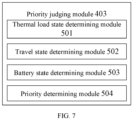
- FIG. 7 is a structural block diagram illustrating a priority judging module according to an embodiment of the present disclosure. As shown in FIG. 7 , specifically, the priority judging module 403 further includes:
- the priority determining module 504 includes:
- the first mode determining module 402 includes:
- the second mode setting module includes:
- the second mode setting module further includes:
- the second mode determining module 403 includes:
- the eighth mode setting module includes:
- the apparatus for controlling a heat pump air-conditioning system of a vehicle further includes:
- An embodiment of the present disclosure provides a device, including a processor and a memory, where the memory stores at least one instruction, at least one segment of program, a code set or an instruction set, and the at least one instruction, the at least one segment of program, the code set or the instruction set is loaded and executed by the processor to perform the method of controlling a heat pump air-conditioning system of a vehicle according to the method embodiments.
- An embodiment of the present disclosure provides a non-transitory storage medium, which can be disposed in a server to store at least one instruction, at least one segment of program, a code set or an instruction set for performing the method of controlling a heat pump air-conditioning system of a vehicle in the method embodiments, where the at least one instruction, the at least one segment of program, the code set or the instruction set is loaded and executed by a processor to perform the method of controlling a heat pump air-conditioning system of a vehicle according to the above method embodiments.
- the above storage medium may be located in at least one network server of a plurality of network servers in a computer network.
- the above storage medium may include but not limited to: a U flash disk, a read only memory (ROM), a random access memory (RAM), a mobile hard drive, a magnetic diskette or a compact disk and other mediums storing program codes.
- the heating priorities of the passenger cabin and the battery are determined.
- intelligent control on arbitration of the working mode at the time of operation of the heat pump system is carried out to coordinate the requirements of both so as to enable the system to work in a more efficient and energy-saving manner.
- the energy consumption of the battery will be reduced while the drivable mileage of the battery is improved.
- the heating requirement of the passenger cabin can be satisfied to enable the full vehicle comfort and efficiency to reach the optimum, thereby improving the user experiences.
Landscapes
- Engineering & Computer Science (AREA)
- Manufacturing & Machinery (AREA)
- General Chemical & Material Sciences (AREA)
- Electrochemistry (AREA)
- Chemical Kinetics & Catalysis (AREA)
- Chemical & Material Sciences (AREA)
- Mechanical Engineering (AREA)
- Physics & Mathematics (AREA)
- Thermal Sciences (AREA)
- Life Sciences & Earth Sciences (AREA)
- Sustainable Energy (AREA)
- Sustainable Development (AREA)
- Automation & Control Theory (AREA)
- Transportation (AREA)
- Power Engineering (AREA)
- Air-Conditioning For Vehicles (AREA)
Abstract
Description
- The present disclosure relates to the field of vehicle energy management technologies, and in particular, to a method and an apparatus for controlling a heat pump air-conditioning system of a vehicle, a device and a storage medium.
- Along with increasing growth of sales volume of new energy vehicles, users and national policies propose new requirements for drivable mileage of the new energy vehicles. Heat pump air-conditioning systems are mounted in most of the new energy vehicles, especially in electric vehicles to satisfy requirements for supplying heat within the vehicles in winter. But, according to a latest test report of 2019 released by American Automobile Association, three types of electric cars on Chinese market were selected to participate in a test carried out in an environment of minus 7 degrees Celsius, which showed that compared with the air-conditioning systems turned off, the drivable mileage of the vehicles with the air-conditioning systems turned on was decreased by more than 40%. At present, the significant reduction of the drivable mileage in winter is the biggest factor that affects user experiences.
- In the prior arts, a solution in which a heat pump air-conditioning system is controlled according to a battery charge state, a travel mileage, an in-vehicle temperature and a battery pack temperature still has some room to make further progress in energy saving and battery drivable mileage improvement.
- At present, the major heat pump air-conditioning systems have poor heating effect and greatly affect drivable mileage of batteries after being turned on, thereby affecting user experiences. In order to solve the technical problems in the prior art, a first aspect of the present disclosure provides a method of controlling a heat pump air-conditioning system of a vehicle, including:
- obtaining comfort requirement information of a passenger cabin, trip information and battery performance information;
- according to heating requirement amounts of the passenger cabin and a battery and a system heat supply amount, determining whether the system heat supply amount satisfies heating requirements of the passenger cabin and the battery at the same time;
- when the system heat supply amount is incapable of satisfying the heating requirements of the passenger cabin and the battery at the same time, determining whether a priority of heating the passenger cabin is higher than a priority of heating the battery based on the comfort requirement information of the passenger cabin, the trip information and the battery performance information;
- when the priority of heating the passenger cabin is higher than the priority of heating the battery, determining a heating mode of the heat pump air-conditioning system based on an outside-vehicle environmental temperature, a thermal load of the passenger cabin, an estimation value of electric drive natural waste heat and a thermal load of a battery system;
- when the priority of heating the passenger cabin is not higher than the priority of heating the battery, determining the heating mode of the heat pump air-conditioning system based on a battery temperature, the thermal load of the passenger cabin, the estimation value of electric drive natural waste heat and the thermal load of the battery system;
- based on heat consumption amount information of the passenger cabin, calculating the thermal load of the passenger cabin.
- A second aspect of the present disclosure provides an apparatus for controlling a heat pump air-conditioning system of a vehicle, including:
- an obtaining module, configured to obtain conform requirement information of a passenger cabin, trip information, and battery performance information;
- a requirement determining module, configured to, based on heating requirement amounts of the passenger cabin and a battery and a system heat supply amount, determine whether the system heat supply amount satisfies heating requirements of the passenger cabin and the battery at the same time;
- a priority judging module, configured to, when the system heat supply amount is incapable of satisfying the heating requirements of the passenger cabin and the battery at the same time, determine whether a priority of heating the passenger cabin is higher than a priority of heating the battery based on the comfort requirement information of the passenger cabin, the trip information and the battery performance information;
- a first mode determining module, configured to, when the priority of heating the passenger cabin is higher than the priority of heating the battery, determine a heating mode of the heat pump air-conditioning system based on an outside-vehicle environmental temperature, a thermal load of the passenger cabin, an estimation value of electric drive natural waste heat and a thermal load of a battery system;
- a second mode determining module, configured to, when the priority of heating the passenger cabin is not higher than the priority of heating the battery, determine the heating mode of the heat pump air-conditioning system based on a battery temperature, the thermal load of the passenger cabin, the estimation value of electric drive natural waste heat and the thermal load of the battery system.
- A third aspect of the present disclosure provides a device including a processor and a memory, where the memory stores at least one instruction, at least one segment of program, a code set or an instruction set, and the at least one instruction, the at least one segment of program, the code set or the instruction set is loaded and executed by the processor to perform the method of controlling a heat pump air-conditioning system of a vehicle according to the first aspect of the present disclosure.
- A fourth aspect of the present disclosure provides a non-transitory computer readable storage medium, storing at least one instruction, at least one segment of program, a code set or an instruction set, where the at least one instruction, the at least one segment of program, the code set or the instruction set is loaded and executed by a processor to perform the method of controlling a heat pump air-conditioning system of a vehicle according to the first aspect of the present disclosure.
- In the method and apparatus for controlling a heat pump air-conditioning system of a vehicle, the device and the storage medium according to the embodiments of the present disclosure, when the system heat supply amount cannot satisfy the heating requirements of the passenger cabin and the battery at the same time, intelligent control for arbitration of the heating mode of the heat pump air-conditioning system is performed based on the priority of heating the passenger cabin, the priority of heating the battery, the outside-vehicle environmental temperature, the battery temperature, the thermal load of the passenger cabin, the estimation value of electric drive natural waste heat and the thermal load of the battery system, to coordinate the requirements of both so as to enable the system to work in a more efficient and energy saving manner. Thus, the energy consumption of the battery will be reduced while the drivable mileage of the battery is improved. Further, the heating requirement of the passenger cabin can be satisfied to enable the full vehicle comfort and efficiency to reach the optimum, thereby improving the user experiences.
- The additional aspects and advantages of the present disclosure will be partially given in the following descriptions and partially become apparent from the following descriptions or known by practicing the present disclosure.
- In order to more clearly describe the technical solutions in the embodiments of the present disclosure and the prior arts, the drawings required for description of the embodiments and the prior arts will be briefly introduced. Apparently, the drawings described hereunder are only some embodiments, and those skilled in the art can obtain other drawings based on these drawings without making creative work.
-
FIG. 1 is a flowchart illustrating a method of controlling a heat pump air-conditioning system of a vehicle according to an embodiment of the present disclosure. -
FIG. 2 is a flowchart of step S103. -
FIG. 3 is a flowchart of determining a heating mode of a heat pump air-conditioning system according to an embodiment of the present disclosure. -
FIG. 4 is an architecture diagram of a heat pump air-conditioning system of a vehicle according to an embodiment of the present disclosure. -
FIG. 5 is a flowchart of determining a heating mode of a heat pump air-conditioning system according to an embodiment of the present disclosure. -
FIG. 6 is a structural block diagram illustrating an apparatus for controlling a heat pump air-conditioning system of a vehicle according to an embodiment of the present disclosure. -
FIG. 7 is a structural block diagram illustrating a priority judging module according to an embodiment of the present disclosure. - In order to make the objects, technical solutions and advantages of the embodiments of the present disclosure clearer, the technical solutions of the embodiments of the present disclosure will be fully and clearly described below in combination with the accompanying drawings in the embodiments of the present disclosure. Apparently, the embodiments described herein are merely some embodiments of the present disclosure rather than all embodiments. Other embodiments obtained by those of ordinary skill in the art based on the embodiments in the present disclosure without making creative work shall all fall into the scope of protection of the present disclosure. The examples of the embodiments are illustrated in the drawings where same or similar symbols refer to same or similar elements or elements having same or similar functions throughout the specification.
- The technical solutions in the prior arts still have the following shortcomings: firstly, determination is based only on the travel mileage, the in-vehicle temperature and the battery pack temperature without considering the waste heat utilization of the electric drive coolant system and insufficiently flexible control is provided on the heat pump system; secondly, control is only performed on the heat pump system in a travel process without considering heat utilization of the heat pump air-conditioning system in a parking process. It is necessary to make further improvements in energy saving and battery drivable mileage.
-
FIG. 1 is a flowchart illustrating a method of controlling a heat pump air-conditioning system of a vehicle according to an embodiment of the present disclosure. The specification provides operation steps of the method as shown in embodiments or flowcharts, but may include more or less operation steps based on normal or non-creative labor. The sequence of the steps in the embodiments is only one of many sequences for executing the operation steps rather than only one execution sequence. When a system or a server product actually performs the steps, it may perform the steps in a sequence shown in the embodiments or drawings or in parallel (for example, in an environment of parallel processor or multi-thread processing). As shown inFIG. 1 , the method specifically includes the following steps. - At step S101, comfort requirement information of a passenger cabin, trip information and battery performance information are obtained.
- At step S 102, according to heating requirement amounts of the passenger cabin and a battery and a system heat supply amount, it is determined whether the system heat supply amount satisfies heating requirements of the passenger cabin and the battery at the same time.
- At step S103, when the system heat supply amount is incapable of satisfying the heating requirements of the passenger cabin and the battery at the same time, it is determined whether a priority of heating the passenger cabin is higher than a priority of heating the battery based on the comfort requirement information of the passenger cabin, the trip information and the battery performance information.
- Optionally, the comfort requirement information of the passenger cabin includes a set temperature, a passenger cabin temperature, a glass temperature, a blower speed, a face-blowing and foot-blowing mode, a humidity and a daylight load and the like as well as information obtained in combination based on data transmitted by an intelligent cloud platform. The data transmitted by the intelligent cloud platform may be cold and hot preferences and air volume preference factors and the like of users based on big data deep computing as well as a human machine interface (HMI) target temperature and the like set automatically by the intelligent cloud platform for the users based on user habits.
- Specifically, the trip information includes but not limited to route, weather, parking time and a mode of an electric drive unit.
- Specifically, the battery performance information includes but not limited to an age of a battery pack, a charging state of a battery and a power requirement.
- At step S104, when the priority of heating the passenger cabin is higher than the priority of heating the battery, a heating mode of the heat pump air-conditioning system is determined based on an outside-vehicle environmental temperature, a thermal load of the passenger cabin, an estimation value of electric drive natural waste heat and a thermal load of a battery system.
- Preferably, the estimation value of electric drive natural waste heat may be a product of a motor power obtained based on estimation method and a preset scale coefficient. The value of the preset scale coefficient can be obtained after calibration, for example, the value of the preset scale coefficient is 10%.
- At step S105, when the priority of heating the passenger cabin is not higher than the priority of heating the battery, the heating mode of the heat pump air-conditioning system is determined based on a battery temperature, the thermal load of the passenger cabin, the estimation value of electric drive natural waste heat and the thermal load of the battery system.
-
FIG. 2 is a flowchart of step S103. As shown inFIG. 2 , specifically, in step S3, determining whether the priority of heating the passenger cabin is higher than the priority of heating the battery based on the comfort requirement information of the passenger cabin, the trip information and the battery performance information includes the following steps. - At step S1031, based on the comfort requirement information of the passenger cabin, whether the thermal load of the passenger cabin is greater than a first preset value or in an unstable state is determined to obtain a first determination result.
- In an example, determining whether the thermal load of the passenger cabin is in an unstable state includes:
- obtaining thermal load values of the passenger cabin within a current latest preset time length to form a historical data sample;
- determining whether a thermal load value of the passenger cabin exceeding a preset thermal load value is present in the historical data sample;
- if present, determining the thermal load of the passenger cabin is in an unstable state;
- if not present, determining the thermal load of the passenger cabin is in a stable state.
- At step S1032, based on the trip information, whether a current travel state is a low-speed short-line travel is determined to obtain a second determination result.
- At step S 1033, based on the battery performance information, whether a possibility of recovery of a battery pack is greater than a second preset value is determined to obtain a third determination result.
- In an actual running vehicle, in a case of very high continuous discharge rate, an effective battery capacity will decrease. In intermittent use, the battery will recover during a sleeping period and the temperature will also return to environmental level. The recovery possibility enables the effective capacity of the intermittently-used battery to be increased to some extent, and the discharge efficiency will be higher. The battery generally is intermittently used in a short-line low-speed travel process, and thus has time to recover the battery capacity. Therefore, the recovery possibility of the battery pack in the short-line low-speed travel process is higher than the recovery possibility of the battery pack in a long-line high speed travel process.
- At step S1034, based on the first determination result, the second determination result and the third determination result, it is determined whether the priority of heating the passenger cabin is higher than the priority of heating the battery.
- Specifically, based on the first determination result, the second determination result and the third determination result, determining whether the priority of heating the passenger cabin is higher than the priority of heating the battery includes:
- when the first determination result, the second determination result and the third determination result are all yes, determining the priority of heating the passenger cabin is higher than the priority of heating the battery;
- when all of the first determination result, the second determination result and the third determination result are not yes, determining the priority of heating the passenger cabin is not higher than the priority of heating the battery.
-
FIG. 3 is a flowchart of determining a heating mode of a heat pump air-conditioning system according to an embodiment of the present disclosure. As shown inFIG. 3 , specifically, in an embodiment, determining a heating mode of the heat pump air-conditioning system based on the outside-vehicle environmental temperature, the thermal load of the passenger cabin, the estimation value of electric drive natural waste heat and the thermal load of the battery system includes the following steps. - At step S201, the outside-vehicle environmental temperature is compared with a first preset temperature and a second preset temperature.
- For example, the first preset temperature is -10 °C, and the second preset temperature is 10 °C. It should be noted that the values of the first preset temperature and the second preset temperature as above are only illustrative shall not be considered as limiting of the embodiments of the present disclosure. Based on actual requirements, the first preset temperature and the second preset temperature may also be set to other values.
- At step S202, when the outside-vehicle environmental temperature is less than the first preset temperature, a current heating mode is set to a seventh heating mode or an eighth heating mode.
- Table 1 shows specific information of various heating modes provided by the embodiments of the present disclosure. Reference may be made to Table 1 for relevant information of the seventh heating mode or the eighth heating mode.
-
FIG. 1 is an architecture diagram illustrating a multi-circuit heat pump air-conditioning system supporting vehicle low-temperature startup according to an embodiment of the present disclosure. As shown inFIG. 1 , specifically, an embodiment of the present disclosure provides a multi-circuit heat pump air-conditioning system supporting vehicle low-temperature startup, including a coolant system, a heat pump system and an electric control system. - The coolant system includes a coolant circuit which includes a DC/DC, a motor, a battery pack, a coolant pipe, a hydraulic valve and at least one water pump, where the hydraulic valve is disposed in the coolant pipe. The at least one water pump is configured to pump a coolant through the coolant circuit along a specific flow direction.
- Specifically, the motor includes a front motor and a rear motor, the front motor is series-connected with the DC/DC, and both the front motor and the DC/DC are parallel-connected with the rear motor.
- Specifically, the hydraulic valve includes but not limited to a three-way valve, a proportional three-way valve, a four-way valve, an eight-way valve and a normally-opened valve. The eight-way valve may be replaced with two four-way valves. Based on different conduction states of the four-way valve and/or the eight-way valve, series connection and parallel connection states can be formed between a battery system and an electric drive system.
- The heat pump system includes a refrigerant circuit including a gas-liquid separator, a compressor, a battery heat exchanger, a liquid-cooled condenser, a coolant heater, a refrigerant pipe, and a hydraulic valve, where the hydraulic valve is disposed in the refrigerant pipe. The gas-liquid separator is generally mounted between an evaporator and the compressor, with the main purpose of: (1) preventing low-temperature steam returning to the compressor from carrying excess liquid drops, preventing the liquid coolant from entering a cylinder of the compressor and preventing liquid-slugging on the compressor; (2) preventing excess coolant from diluting the compressor oil; (3) having the functions of filtration, oil returning and liquid storage and the like. Filtering the refrigerant can guarantee gas entering the compressor is clean; oil returning can guarantee compressor oil is fully lubricated; and liquid storage refers to holding some unused refrigerant in the system to ensure full coolant circulation in the system as well as prevention of liquid-slugging. The coolant heater is used to heat the coolant when an environmental temperature is lower than a preset temperature and the heat pump system is in a non-working state. The compressor is used to work to heat the refrigerant in the refrigerant pipe after the heat pump system is started up. The refrigerant circuit has a high pressure side and a low pressure side. The compressor works to enable the refrigerant circuit to form the high pressure side and the low pressure side, thus pushing the refrigerant to flow.
- The electric control system includes a communication unit, a processor and a switching module. The communication unit is configured to receive an outside-vehicle environmental temperature, temperature adjustment requirements of the passenger cabin and the battery pack and a heat storage state of the battery pack. The processor is configured to, based on the outside-vehicle environmental temperature, the temperature adjustment requirements of the passenger cabin and the battery pack and the heat storage state of the battery pack, generate a working mode switching instruction. The switching module is configured to, in response to the working mode switching instruction, switch a connected state of the coolant circuit and/or the refrigerant circuit.
- The communication unit is electrically connected with the processor electrically connected with the switching module, and the coolant circuit is thermally connected with the refrigerant circuit. The thermal connection herein refers to heat exchange between the coolant circuit and the refrigerant circuit, which is achieved between the coolant and the refrigerant in the two circuits by using the battery heat exchanger or the liquid-cooled condenser. The heat exchange in the heat exchanger does not refer to simple heat exchange but a complex heat exchange process involving heat convection and heat transfer.
- Specifically, outside-vehicle temperature sensors are disposed outside a vehicle body, for example, at the positions such as an engine cover, a luggage compartment cover, and a vehicle window, so as to detect the outside-vehicle environmental temperature and send the outside-vehicle environmental temperature to the communication unit.
- Specifically, the battery heat exchanger may also be used as an evaporator.
- Specifically, outside-vehicle temperature sensors are disposed outside a vehicle body, for example, at the positions such as an engine cover, a luggage compartment cover, and a vehicle window, so as to detect the outside-vehicle environmental temperature and send the outside-vehicle environmental temperature to the communication unit.
- Specifically, a battery electric expansion valve (BEXV) is disposed between the liquid-cooled condenser and the battery heat exchanger, and an openness of the BEXV changes depending on load size. It should be pointed out that the battery heat exchanger may also be used as an evaporator.
- Specifically, an Evaporator Electric Expansion Valve (EEXV) is disposed between the internal evaporator and the battery heat exchanger. When the heating/cooling functions are started, the openness of the EEXV can change depending on load size. When the dehumidification, defogging and evaporator defrosting are started, the EEXV can be fully opened.
- At step S203, when the outside-vehicle environmental temperature is greater than the first preset temperature and less than the second preset temperature, a current heating mode is set based on the estimation value of electric drive natural waste heat and the thermal load of the passenger cabin.
Table 1 Specific information of the heating modes of embodiments of the present disclosure Heatin g mode numbe r Applicable working conditions Heat source Heated object Circuit state Environm ent Battery Motor Compressor Passenger cabin HV H Passenge r cabin Batter y pack 01 When the outside-vehicle environmental temperature is -10 ° C to 10° C, only the passenger cabin is to be heated. √ √ Water source heat pump, battery and motor are in large-circulation series-connection through an eight-way valve, the heat radiator is short circuited, and air mixed in HVAC. 02 When the outside-vehicle environmental temperature is -10 ° C to 10° C, the passenger cabin and the battery both are to be heated, where the motor preheats the battery. √ √ √ √ Air source (environmental)heat pump, battery and motor are in small-circulation series-connection through the eight-way valve, the heat radiator works, and HVAC external circulation 03 When the outside-vehicle environmental √ √ √ Source heat pump heats the passenger cabin, the battery and temperature is -10 ° C to 10° C, the passenger cabin is to be heated. the motor are in large-circulation series-connection through an eight-way valve, air mixed in HVAC. 04 When the outside-vehicle environmental temperature is <-10° C, the battery has redundant heat storage, and the passenger cabin is to be heated, where the mode supports evaporator defrosting. √ √ √ √ Water source heat pump, battery and motor are in large-circulation series-connection through an eight-way valve, the heat radiator is short circuited, external circulation of HVAC, and PTC (Positive Temperature Coefficient) heating is started in case of not satisfied. 05 When the outside-vehicle environmental temperature is <-10° C, the √ √ √ Water source heat pump, battery and motor are in large-circulation series-connection Environm ent Battery Motor Compressor Passenger cabin HV H Passenger cabin Battery pack battery has no heat storage or no much heat storage, and the passenger cabin is to be heated, where the mode supports evaporator defrosting. through an eight-way valve, the heat radiator is short circuited, air mixed in the HVAC, the evaporator and the condenser are series-connected in HVAC. 06 When the outside-vehicle environmental temperature is <-10° C, the battery has heat storage, and the passenger cabin is to be heated with large power. √ √ √ √ √ Battery and motor are in large-circulation series-connection through an eight-way valve, the heat radiator is short circuited, air mixed in the HVAC, the evaporator and the condenser are series-connected in HVAC. 07 When the outside-vehicle environmental temperature is <-10° C, the √ √ √ Battery and motor are in large-circulation series-connection through an eight-way battery has no heat storage, and the passenger cabin is to be heated. valve, the heat radiator is short circuited, air mixed in the HVAC, the evaporator and the condenser are series-connected in HVAC, the compressor works to heat the passenger cabin, and PTC is turned off upon start of the heat pump system. 08 When the outside-vehicle environmental temperature is <-10° C, the battery and the passenger cabin are to be heated. √ √ √ √ Battery and motor are in large-circulation series-connection through an eight-way valve, the heat radiator is short circuited, air mixed in the HVAC, the evaporator and the condenser are series-connected in HVAC, the compressor works to heat the passenger cabin, the redundant heat heats the battery, flow distribution is performed for the refrigerant by using a three-way valve downstream of the compressor, and PTC is turned off upon start of the heat pump system. 09 When the outside-vehicle environmental temperature is <-10° C, the battery is to be heated. √ -v √ Battery and motor are in large-circulation series-connection through an eight-way valve, the heat radiator is short circuited, the refrigerant transfers heat to the battery through coolant condenser, and PTC is turned off upon start of the heat pump svstem. 10 When the outside-vehicle environmental temperature is <-10° C, the battery is to be heated. √ -v √ Battery and motor are in large-circulation series-connection through an eight-way valve, the heat radiator is short circuited, the refrigerant transfers heat to the battery through coolant condenser, and PTC is not turned off upon start of the heat pump system. - Specifically, setting the current heating mode based on the estimation value of electric drive natural waste heat and the thermal load of the passenger cabin includes:
- comparing the estimation value of electric drive natural waste heat with the thermal load of the passenger cabin;
- when the estimation value of electric drive natural waste heat is greater than the thermal load of the passenger cabin, setting the current heating mode to a third heating mode, where the relevant information of the third heating mode is shown in Table 1;
- when the estimation value of electric drive natural waste heat is not greater than the thermal load of the passenger cabin, setting the current heating mode to a fourth heating mode, a fifth heating mode or a sixth heating mode, where relevant information of the fourth heating mode, the fifth heating mode and the sixth heating mode is shown in Table 1.
- Preferably, after comparing the estimation value of electric drive natural waste heat with the thermal load of the passenger cabin, the method further includes:
- when the estimation value of electric drive natural waste heat is not greater than the thermal load of the passenger cabin, comparing a fogging risk value with a preset risk value;
- when the fogging risk value is greater than the preset risk value, setting the current heating mode to the fifth heating mode to perform dehumidification and defogging within the passenger cabin, where relevant information of the fifth heating mode is shown in Table 1.
- At step S204, when the outside-vehicle environmental temperature is greater than the second preset temperature, the current heating mode is set to a first heating mode, or second heating mode or third heating mode, where relevant information of the first heating mode, or the second heating mode and the third heating mode is shown in Table 1.
-
FIG. 5 is a flowchart of determining a heating mode of a heat pump air-conditioning system according to an embodiment of the present disclosure. As shown inFIG. 5 , in an embodiment, determining the heating mode of the heat pump air-conditioning system based on the battery temperature, the thermal load of the passenger cabin, the estimation value of electric drive natural waste heat and the thermal load of the battery system includes the following steps. - At step S301, the battery temperature is compared with the first preset temperature and the second preset temperature.
- For example, the first preset temperature is -10 °C, and the second preset temperature is 10 °C. It should be noted that the values of the first preset temperature and the second preset temperature as above are only illustrative and shall not be considered as limiting of the embodiments of the present disclosure. Based on actual requirements, the first preset temperature and the second preset temperature may also be set to other values.
- At step S302, when the battery temperature is less than the first preset temperature, the current heating mode is set to an eighth heating mode or a tenth heating mode.
- At step S303, when the battery temperature is greater than the first preset temperature and less than the second preset temperature, the current heating mode is set based on the estimation value of electric drive natural waste heat and the thermal load of the battery system.
- When the battery temperature is greater than the second preset temperature, no heating is required.
- Specifically, setting the current heating mode based on the estimation value of electric drive natural waste heat and the thermal load of the battery system includes:
- comparing the estimation value of electric drive natural waste heat with the thermal load of the battery system;
- when the estimation value of electric drive natural waste heat is greater than the thermal load of the battery system, setting the current heating mode to a second heating mode;
- when the estimation value of electric drive natural waste heat is not greater than the thermal load of the battery system, setting the current heating mode to a ninth heating mode.
- Specifically, the method of controlling a heat pump air-conditioning system of a vehicle according to embodiments of the present disclosure further includes:
- obtaining heat consumption amount information of the passenger cabin; where the heat consumption amount information of the passenger cabin includes a heat consumption amount of vehicle roof, a heat consumption amount of glass window and door, a heat consumption amount of vehicle body skirt, a heat consumption amount of in-cabin floor, a heat consumption amount of cold air infiltration, a heat consumption amount of in-cabin passenger body and a heat consumption amount of vehicle windshield defrosting;
- calculating the thermal load Q1 of the passenger cabin based on the heat consumption amount information of the passenger cabin, where the thermal load Q1 of the passenger cabin is calculated in the following formula:

- Qa : heat consumption amount of vehicle roof, W;
- Qb : heat consumption amount of glass window and door, W;
- Qc : heat consumption amount of vehicle body skirt, W;
- Qd : heat consumption amount of in-cabin floor, W;
- Qe : heat consumption amount of cold air infiltration, W;
- Qp : heat consumption amount of in-cabin passenger body, W;
- Qf : heat consumption amount of vehicle windshield defrosting, W;
- Kb , Kc , Kd : vehicle roof heat transfer coefficients, in the unit of W/(m2·K);
- Fa , Fb , Fc , Fd : vehicle roof heat transfer coefficients, in the unit of m2;
- ∝H : outside-vehicle air-to-roof heat emission coefficient, in the unit of W/(m2·K);
- αB: inside-vehicle air-to-roof heat emission coefficient, in the unit of W/(m2·K);
-

- Ge : fresh air volume and leaking air volume, in the unit of m 3 · h;
- Gf : defrosting air volume, in the unit of m 3 · h;
- ρ: air density, in the unit of kg/m3;
- c : specific heat capacity of air, 1.005-1.009 kJ/(kg · °C);

- Δta : difference of in-cabin air temperature and outside-cabin air temperature, in the unit of°C;
- tBa : in-vehicle roof temperature, in the unit of °C;
- t H : outside-vehicle air temperature, in the unit of °C;
- tB : in-vehicle comfort temperature, generally 16 °C to 18 °C;
- It is to be noted that the present disclosure is not limited to the sequence of the actions described herein and some steps may be performed in another sequence or simultaneously based on the present disclosure.
-
FIG. 6 is a structural block diagram illustrating an apparatus for controlling a heat pump air-conditioning system of a vehicle according to an embodiment of the present disclosure. Specifically, as shown inFIG. 6 , the apparatus includes: - an obtaining
module 401, configured to obtain conform requirement information of a passenger cabin, trip information, and battery performance information; - a
requirement determining module 402, configured to, based on heating requirement amounts of the passenger cabin and a battery and a system heat supply amount, determine whether the system heat supply amount satisfies heating requirements of the passenger cabin and the battery at the same time; - a
priority judging module 403, configured to, when the system heat supply amount is incapable of satisfying the heating requirements of the passenger cabin and the battery at the same time, determine whether a priority of heating the passenger cabin is higher than a priority of heating the battery based on the comfort requirement information of the passenger cabin, the trip information and the battery performance information; - a first
mode determining module 404, configured to, when the priority of heating the passenger cabin is higher than the priority of heating the battery, determine a heating mode of the heat pump air-conditioning system based on an outside-vehicle environmental temperature, a thermal load of the passenger cabin, an estimation value of electric drive natural waste heat and a thermal load of a battery system; - a second
mode determining module 405, configured to, when the priority of heating the passenger cabin is not higher than the priority of heating the battery, determine a heating mode of the heat pump air-conditioning system based on a battery temperature, the thermal load of the passenger cabin, the estimation value of electric drive natural waste heat and the thermal load of the battery system. -
FIG. 7 is a structural block diagram illustrating a priority judging module according to an embodiment of the present disclosure. As shown inFIG. 7 , specifically, thepriority judging module 403 further includes: - a thermal load state determining module 501, configured to, based on the comfort requirement information of the passenger cabin, determine whether the thermal load of the passenger cabin is greater than a first preset value or in an unstable state to obtain a first determination result;
- specifically, the first preset value is a threshold set based on specific item;
- a travel
state determining module 502, configured to, based on the trip information, determine whether a current travel state is a low-speed short-line travel to obtain a second determination result; - a battery
state determining module 503, configured to, based on the battery performance information, determine whether a possibility of recovery of a battery pack is greater than a second preset value to obtain a third determination result; - specifically, the second preset value is a threshold set based on specific item;
- a
priority determining module 504, configured to, based on the first determination result, the second determination result and the third determination result, determine whether the priority of heating the passenger cabin is higher than the priority of heating the battery. - Furthermore, the
priority determining module 504 includes: - a first determining module, configured to, when the first determination result, the second determination result and the third determination result are all yes, determine the priority of heating the passenger cabin is higher than the priority of heating the battery;
- a second determining module, configured to, when all of the first determination result, the second determination result and the third determination result are not all yes, determine the priority of heating the passenger cabin is not higher than the priority of heating the battery.
- Furthermore, the first
mode determining module 402 includes: - an outside-vehicle environmental temperature comparing module, configured to compare the outside-vehicle environmental temperature with a first preset temperature and a second preset temperature;
- a first mode setting module, configured to, when the outside-vehicle environmental temperature is less than the first preset temperature, set a current heating mode to a seventh heating mode or an eighth heating mode;
- a second mode setting module, configured to, when the outside-vehicle environmental temperature is greater than the first preset temperature and less than the second preset temperature, set the current heating mode based on the estimation value of electric drive natural waste heat and the thermal load of the passenger cabin;
- a third mode setting module, configured to, when the outside-vehicle environmental temperature is greater than the second preset temperature, set the current heating mode to a first heating mode, or second heating mode or third heating mode.
- Furthermore, the second mode setting module includes:
- a second comparing module, configured to compare the estimation value of electric drive natural waste heat with the thermal load of the passenger cabin;
- a fourth mode setting module, configured to, when the estimation value of electric drive natural waste heat is greater than the thermal load of the passenger cabin, set the current heating mode to the third heating mode;
- a fifth mode setting module, configured to, when the estimation value of electric drive natural waste heat is not greater than the thermal load of the passenger cabin, set the current heating mode to a fourth heating mode, a fifth heating mode or a sixth heating mode.
- Furthermore, the second mode setting module further includes:
- a fogging risk value comparing module, configured to, when the estimation value of electric drive natural waste heat is not greater than the thermal load of the passenger cabin, compare a fogging risk value with a preset risk value;
- a sixth mode setting module, configured to, when the fogging risk value is greater than the preset risk value, set the current heating mode to the fifth heating mode to perform dehumidification and defogging within the passenger cabin.
- Furthermore, the second
mode determining module 403 includes: - a battery temperature comparing module, configured to compare the battery temperature with the first preset temperature and the second preset temperature;
- a seventh mode setting module, configured to, when the battery temperature is less than the first preset temperature, set the current heating mode to the eighth heating mode or a tenth heating mode;
- an eighth mode setting module, configured to, when the battery temperature is greater than the first preset temperature and less than the second preset temperature, set the current heating mode based on the estimation value of electric drive natural waste heat and the thermal load of the battery system.
- Furthermore, the eighth mode setting module includes:
- a third comparing module, configured to compare the estimation value of electric drive natural waste heat with the thermal load of the battery system;
- a ninth mode setting module, configured to, when the estimation value of electric drive natural waste heat is greater than the thermal load of the battery system, set the current heating mode to the second heating mode;
- a tenth mode setting module, configured to, when the estimation value of electric drive natural waste heat is not greater than the thermal load of the battery system, set the current heating mode to a ninth heating mode.
- Furthermore, the apparatus for controlling a heat pump air-conditioning system of a vehicle according to the embodiments of the present disclosure further includes:
- a heat consumption amount information obtaining module, configured to obtain heat consumption amount information of the passenger cabin; where the heat consumption amount information of the passenger cabin includes a heat consumption amount of vehicle roof, a heat consumption amount of glass window and door, a heat consumption amount of vehicle body skirt, a heat consumption amount of in-cabin floor, a heat consumption amount of cold air infiltration, a heat consumption amount of in-cabin passenger body and a heat consumption amount of vehicle windshield defrosting;
- a thermal load calculating module, configured to, based on the heat consumption amount information of the passenger cabin, calculate the thermal load of the passenger cabin.
- An embodiment of the present disclosure provides a device, including a processor and a memory, where the memory stores at least one instruction, at least one segment of program, a code set or an instruction set, and the at least one instruction, the at least one segment of program, the code set or the instruction set is loaded and executed by the processor to perform the method of controlling a heat pump air-conditioning system of a vehicle according to the method embodiments.
- An embodiment of the present disclosure provides a non-transitory storage medium, which can be disposed in a server to store at least one instruction, at least one segment of program, a code set or an instruction set for performing the method of controlling a heat pump air-conditioning system of a vehicle in the method embodiments, where the at least one instruction, the at least one segment of program, the code set or the instruction set is loaded and executed by a processor to perform the method of controlling a heat pump air-conditioning system of a vehicle according to the above method embodiments.
- Optionally, in the present embodiment, the above storage medium may be located in at least one network server of a plurality of network servers in a computer network. Optionally, in the present embodiment, the above storage medium may include but not limited to: a U flash disk, a read only memory (ROM), a random access memory (RAM), a mobile hard drive, a magnetic diskette or a compact disk and other mediums storing program codes.
- As can be seen from the embodiments of the method and apparatus for controlling a heat pump air-conditioning system of a vehicle, the device and the storage medium in the present disclosure, in the embodiments of the present disclosure, based on whether the heating requirement of the passenger cabin is large or unstable, whether the travel is a short-line low-speed travel, and the possibility of capacity recovery of the battery pack, the heating priorities of the passenger cabin and the battery are determined. When the system heat supply amount cannot satisfy the heating requirements of the passenger cabin and the battery at the same time, intelligent control on arbitration of the working mode at the time of operation of the heat pump system is carried out to coordinate the requirements of both so as to enable the system to work in a more efficient and energy-saving manner. Thus, the energy consumption of the battery will be reduced while the drivable mileage of the battery is improved. Further, the heating requirement of the passenger cabin can be satisfied to enable the full vehicle comfort and efficiency to reach the optimum, thereby improving the user experiences.
- It is to be noted that, the sequence of the above embodiments of the present disclosure is only illustrative and do not represent preference for the embodiments. Further, the above descriptions are made to the specific embodiments of the present disclosure. Other embodiments are still within the scope of protection of the appended claims. In some cases, the actions or steps recorded in the claims may be performed in a sequence different from recorded in the embodiments to obtain a desired result. Further, the processes depicted in the drawings do not necessarily require the shown sequence or continuous sequence to achieve a desired result. In some embodiments, multi-task processing and parallel processing may be possible or advantageous.
- The embodiments in the specification are described in a progressive manner with same or similar parts between the embodiments referred to each other. Each embodiment focuses on description of differences from other embodiments. Particularly, the apparatus and server embodiments are basically similar to the method embodiments and thus will be briefly described, and reference may be made to the descriptions of the method embodiments for related parts.
- Those skilled in the art can understand that all or part of the steps of the above embodiments may be achieved by hardware, or by instructing relevant hardware by using programs. The programs may be stored in a computer readable storage medium, which may be read only memory, magnetic disk or compact disk or the like.
- The above descriptions are made only to preferred embodiments of the present disclosure and such preferred embodiments do not constitute any limitation to the present disclosure. Any changes, equivalent substitutions and improvements etc. made within the spirit and principle of the present disclosure shall fall within the scope of protection of the present disclosure.
Claims (12)
- A method of controlling a heat pump air-conditioning system of a vehicle, comprising:obtaining comfort requirement information of a passenger cabin, trip information and battery performance information;according to heating requirement amounts of the passenger cabin and a battery and a system heat supply amount, determining whether the system heat supply amount satisfies heating requirements of the passenger cabin and the battery at the same time;when the system heat supply amount is incapable of satisfying the heating requirements of the passenger cabin and the battery at the same time, determining whether a priority of heating the passenger cabin is higher than a priority of heating the battery based on the comfort requirement information of the passenger cabin, the trip information and the battery performance information;when the priority of heating the passenger cabin is higher than the priority of heating the battery, determining a heating mode of the heat pump air-conditioning system based on an outside-vehicle environmental temperature, a thermal load of the passenger cabin, an estimation value of electric drive natural waste heat and a thermal load of a battery system; andwhen the priority of heating the passenger cabin is not higher than the priority of heating the battery, determining the heating mode of the heat pump air-conditioning system based on a battery temperature, the thermal load of the passenger cabin, the estimation value of electric drive natural waste heat and the thermal load of the battery system.
- The method of claim 1, wherein determining whether the priority of heating the passenger cabin is higher than the priority of heating the battery based on the comfort requirement information of the passenger cabin, the trip information and the battery performance information comprises:based on the comfort requirement information of the passenger cabin, determining whether the thermal load of the passenger cabin is greater than a first preset value or in an unstable state to obtain a first determination result;based on the trip information, determining whether a current travel state is a low-speed short line travel to obtain a second determination result;based on the battery performance information, determining whether a possibility of recovery of a battery pack is greater than a second preset value to obtain a third determination result;based on the first determination result, the second determination result and the third determination result, determining whether the priority of heating the passenger cabin is higher than the priority of heating the battery.
- The method of claim 2, wherein based on the first determination result, the second determination result and the third determination result, determining whether the priority of heating the passenger cabin is higher than the priority of heating the battery comprises:when the first determination result, the second determination result and the third determination result are all yes, determining that the priority of heating the passenger cabin is higher than the priority of heating the battery;when all of the first determination result, the second determination result and the third determination result are not all yes, determining that the priority of heating the passenger cabin is not higher than the priority of heating the battery.
- The method of claim 1, wherein determining the heating mode of the heat pump air-conditioning system based on the outside-vehicle environmental temperature, the thermal load of the passenger cabin, the estimation value of electric drive natural waste heat and the thermal load of the battery system comprises:comparing the outside-vehicle environmental temperature with a first preset temperature and a second preset temperature;when the outside-vehicle environmental temperature is less than the first preset temperature, setting a current heating mode to a seventh heating mode or an eighth heating mode;when the outside-vehicle environmental temperature is greater than the first preset temperature and less than the second preset temperature, setting the current heating mode based on the estimation value of electric drive natural waste heat and the thermal load of the passenger cabin;when the outside-vehicle environmental temperature is greater than the second preset temperature, setting the current heating mode to a first heating mode, a second heating mode or a third heating mode.
- The method of claim 4, wherein setting the current heating mode based on the estimation value of electric drive natural waste heat and the thermal load of the passenger cabin comprises:comparing the estimation value of electric drive natural waste heat with the thermal load of the passenger cabin;when the estimation value of electric drive natural waste heat is greater than the thermal load of the passenger cabin, setting the current heating mode to the third heating mode;when the estimation value of electric drive natural waste heat is not greater than the thermal load of the passenger cabin, setting the current heating mode to a fourth heating mode, a fifth heating mode or a sixth heating mode.
- The method of claim 4, wherein after comparing the estimation value of electric drive natural waste heat with the thermal load of the passenger cabin, the method further comprises:when the estimation value of electric drive natural waste heat is not greater than the thermal load of the passenger cabin, comparing a fogging risk value with a preset risk value;when the fogging risk value is greater than the preset risk value, setting the current heating mode to the fifth heating mode to perform dehumidification and defogging within the passenger cabin.
- The method of claim 1, wherein determining the heating mode of the heat pump air-conditioning system based on the battery temperature, the thermal load of the passenger cabin, the estimation value of electric drive natural waste heat and the thermal load of the battery system comprises:comparing the battery temperature with a first preset temperature and a second preset temperature;when the battery temperature is less than the first preset temperature, setting the current heating mode to an eighth heating mode or a tenth heating mode;when the battery temperature is greater than the first preset temperature and less than the second preset temperature, setting the current heating mode based on the estimation value of electric drive natural waste heat and the thermal load of the battery system;when the battery temperature is greater than the second preset temperature, performing no heating.
- The method of claim 7, wherein setting the current heating mode based on the estimation value of electric drive natural waste heat and the thermal load of the battery system comprises:comparing the estimation value of electric drive natural waste heat with the thermal load of the battery system;when the estimation value of electric drive natural waste heat is greater than the thermal load of the battery system, setting the current heating mode to a second heating mode;when the estimation value of electric drive natural waste heat is not greater than the thermal load of the battery system, setting the current heating mode to a ninth heating mode.
- The method of claim 1, further comprising:obtaining heat consumption amount information of the passenger cabin; wherein the heat consumption amount information of the passenger cabin comprises a heat consumption amount of vehicle roof, a heat consumption amount of glass window and door, a heat consumption amount of vehicle body skirt, a heat consumption amount of in-cabin floor, a heat consumption amount of cold air infiltration, a heat consumption amount of in-cabin passenger body and a heat consumption amount of vehicle windshield defrosting;based on the heat consumption amount information of the passenger cabin, calculating the thermal load of the passenger cabin.
- An apparatus for controlling a heat pump air-conditioning system of a vehicle, comprising:an obtaining module, configured to obtain conform requirement information of a passenger cabin, trip information, and battery performance information;a requirement determining module, configured to, based on heating requirement amounts of the passenger cabin and a battery and a system heat supply amount, determine whether the system heat supply amount satisfies heating requirements of the passenger cabin and the battery at the same time;a priority judging module, configured to, when the system heat supply amount is incapable of satisfying the heating requirements of the passenger cabin and the battery at the same time, determine whether a priority of heating the passenger cabin is higher than a priority of heating the battery based on the comfort requirement information of the passenger cabin, the trip information and the battery performance information;a first mode determining module, configured to, when the priority of heating the passenger cabin is higher than the priority of heating the battery, determine a heating mode of the heat pump air-conditioning system based on an outside-vehicle environmental temperature, a thermal load of the passenger cabin, an estimation value of electric drive natural waste heat and a thermal load of a battery system;a second mode determining module, configured to, when the priority of heating the passenger cabin is not higher than the priority of heating the battery, determine the heating mode of the heat pump air-conditioning system based on a battery temperature, the thermal load of the passenger cabin, the estimation value of electric drive natural waste heat and the thermal load of the battery system.
- A device, comprising a processor and a memory, wherein the memory stores at least one instruction, at least one segment of program, a code set or an instruction set, and the at least one instruction, the at least one segment of program, the code set or the instruction set is loaded and executed by the processor to perform the method according to any one of claims 1 to 9.
- A non-transitory computer readable storage medium, storing at least one instruction, at least one segment of program, a code set or an instruction set, wherein the at least one instruction, the at least one segment of program, the code set or the instruction set is loaded and executed by a processor to perform the method according to any one of claims 1 to 9.
Applications Claiming Priority (1)
| Application Number | Priority Date | Filing Date | Title |
|---|---|---|---|
| PCT/CN2020/124604 WO2022115976A1 (en) | 2020-12-03 | 2020-12-03 | Method and apparatus for controlling heat pump air-conditioning system of traveling vehicle, and device and storage medium |
Publications (2)
| Publication Number | Publication Date |
|---|---|
| EP4258415A1 true EP4258415A1 (en) | 2023-10-11 |
| EP4258415A4 EP4258415A4 (en) | 2024-01-24 |
Family
ID=81852784
Family Applications (1)
| Application Number | Title | Priority Date | Filing Date |
|---|---|---|---|
| EP20963827.9A Pending EP4258415A4 (en) | 2020-12-03 | 2020-12-03 | METHOD AND APPARATUS FOR CONTROLLING HEAT PUMP AIR CONDITIONING SYSTEM OF MOVING VEHICLE, AND DEVICE AND STORAGE MEDIUM |
Country Status (3)
| Country | Link |
|---|---|
| EP (1) | EP4258415A4 (en) |
| CN (1) | CN116348320A (en) |
| WO (1) | WO2022115976A1 (en) |
Cited By (1)
| Publication number | Priority date | Publication date | Assignee | Title |
|---|---|---|---|---|
| CN119840429A (en) * | 2025-02-28 | 2025-04-18 | 深蓝汽车科技有限公司 | Method for reducing use cost of vehicle, control device and vehicle |
Families Citing this family (11)
| Publication number | Priority date | Publication date | Assignee | Title |
|---|---|---|---|---|
| CN117301788B (en) * | 2022-06-24 | 2026-04-17 | 长城汽车股份有限公司 | Electric vehicles and their thermal management control methods, devices and storage media |
| CN115257284B (en) * | 2022-07-05 | 2025-05-06 | 东风汽车集团股份有限公司 | Heat source selection control method and system based on vehicle diversified working conditions |
| CN115632197A (en) * | 2022-10-11 | 2023-01-20 | 珠海格力电器股份有限公司 | Control method, device, air conditioner and storage medium for energy storage cabinet air conditioner |
| CN116176211A (en) * | 2022-12-29 | 2023-05-30 | 浙江吉利控股集团有限公司 | An automobile-based predictive control method, a vehicle control unit and an automobile |
| CN116605010A (en) * | 2023-05-19 | 2023-08-18 | 浩智增程科技(安徽)有限公司 | Temperature regulation method, system, storage medium and electronic equipment |
| CN117183675A (en) * | 2023-09-12 | 2023-12-08 | 浙江吉利控股集团有限公司 | Control method, device, vehicle and storage medium of vehicle heat pump system |
| CN117067856A (en) * | 2023-09-28 | 2023-11-17 | 广汽埃安新能源汽车股份有限公司 | Vehicle heating control method and device |
| US20250296405A1 (en) * | 2024-03-22 | 2025-09-25 | Fca Us Llc | Vehicle cabin dehumidification control system |
| CN118991343B (en) * | 2024-08-15 | 2025-09-12 | 一汽解放汽车有限公司 | Thermal management control method, thermal management system and vehicle |
| CN119749170A (en) * | 2024-12-30 | 2025-04-04 | 浙江吉利控股集团有限公司 | Control method, device, equipment, storage medium and vehicle of heat pump system |
| CN119974900B (en) * | 2025-03-28 | 2025-10-28 | 东风汽车股份有限公司 | A thermal management method, device, equipment and storage medium for a fixed operating scenario |
Family Cites Families (13)
| Publication number | Priority date | Publication date | Assignee | Title |
|---|---|---|---|---|
| DE102010025779A1 (en) * | 2009-07-03 | 2011-01-13 | DENSO CORPORATION, Kariya-shi | Air conditioning system for implementation of pre-air conditioning in passenger compartment of hybrid auto, during parking of vehicle, has control acting so that blower has predetermined efficiency level related to heat source |
| US9656535B2 (en) * | 2012-09-17 | 2017-05-23 | Hanon Systems | Method for operating an air conditioner for a motor vehicle |
| JP6252186B2 (en) * | 2014-01-15 | 2017-12-27 | 株式会社デンソー | Thermal management system for vehicles |
| US10967702B2 (en) * | 2017-09-07 | 2021-04-06 | Tesla, Inc. | Optimal source electric vehicle heat pump with extreme temperature heating capability and efficient thermal preconditioning |
| JP2019182135A (en) * | 2018-04-06 | 2019-10-24 | 株式会社デンソー | Cooling system |
| CN208881529U (en) * | 2018-07-27 | 2019-05-21 | 上海思致汽车工程技术有限公司 | A kind of electric automobile air conditioner heating system |
| CN111497550B (en) * | 2019-01-31 | 2022-03-18 | 广汽埃安新能源汽车有限公司 | A kind of automobile temperature control device and its control method |
| CN110217071B (en) * | 2019-06-13 | 2021-01-15 | 浙江吉利控股集团有限公司 | Vehicle thermal management control system and control method |
| CN110336088A (en) * | 2019-06-25 | 2019-10-15 | 浙江吉利控股集团有限公司 | A kind of pre-heating mean and device of power battery |
| CN110588277B (en) * | 2019-08-16 | 2021-03-30 | 中国第一汽车股份有限公司 | Electric automobile thermal management method and system and vehicle |
| CN111251826A (en) * | 2020-01-20 | 2020-06-09 | 东风汽车集团有限公司 | Passenger cabin priority refrigeration control method for pure electric vehicle thermal management system |
| CN111370812B (en) * | 2020-02-21 | 2022-01-14 | 吉利汽车研究院(宁波)有限公司 | Battery heating control method, device and system and storage medium |
| CN111688544B (en) * | 2020-05-29 | 2022-04-12 | 爱驰汽车有限公司 | Thermal management control method for power battery |
-
2020
- 2020-12-03 CN CN202080102466.6A patent/CN116348320A/en active Pending
- 2020-12-03 EP EP20963827.9A patent/EP4258415A4/en active Pending
- 2020-12-03 WO PCT/CN2020/124604 patent/WO2022115976A1/en not_active Ceased
Cited By (1)
| Publication number | Priority date | Publication date | Assignee | Title |
|---|---|---|---|---|
| CN119840429A (en) * | 2025-02-28 | 2025-04-18 | 深蓝汽车科技有限公司 | Method for reducing use cost of vehicle, control device and vehicle |
Also Published As
| Publication number | Publication date |
|---|---|
| CN116348320A (en) | 2023-06-27 |
| EP4258415A4 (en) | 2024-01-24 |
| WO2022115976A1 (en) | 2022-06-09 |
Similar Documents
| Publication | Publication Date | Title |
|---|---|---|
| WO2022115976A1 (en) | Method and apparatus for controlling heat pump air-conditioning system of traveling vehicle, and device and storage medium | |
| CN113682106B (en) | Vehicle thermal management control method and device | |
| CN110588277B (en) | Electric automobile thermal management method and system and vehicle | |
| EP2580076B1 (en) | Vehicle air conditioning system | |
| US11097635B2 (en) | Battery heat management integration system and operation method thereof | |
| US9376031B2 (en) | Rechargeable energy storage system (RESS) thermal conditioning based on RESS state of charge threshold | |
| EP4239254A1 (en) | Multi-loop heat-pump air conditioning system supporting low-temperature start of automobile, and automobile | |
| US8589024B2 (en) | Thermal conditioning of rechargeable energy storage systems of vehicles | |
| US20140174707A1 (en) | Method and system for thermal storage in a vehicle | |
| US10017030B2 (en) | Efficient transfer of heat to passenger cabin | |
| CN113997756B (en) | Control method, controller and system of multi-heat-source heating system of electric automobile and automobile | |
| CN111038215B (en) | Control method and device of automobile heat pump air conditioning system, storage medium and terminal | |
| CN115042585B (en) | Method for determining energy consumption of vehicle air conditioner, computer readable storage medium and vehicle | |
| CN115649010B (en) | A power battery fast charging precooling control system | |
| CN115352320A (en) | Vehicle power battery thermal management method and related equipment | |
| CN116176211A (en) | An automobile-based predictive control method, a vehicle control unit and an automobile | |
| US20240194978A1 (en) | Phase change material energy storage for electric vehicle thermal management system and method | |
| US9385382B2 (en) | Systems and methods for controlling cabin heating in fuel cell vehicles | |
| CN113650475B (en) | Vehicle thermal management control method, device, equipment and storage medium | |
| CN118952937B (en) | Vehicle air conditioner energy-saving mode control method and device | |
| CN119389069A (en) | Vehicle heating control method and device | |
| US20140034288A1 (en) | Rechargeable energy storage system cooling | |
| CN116639135B (en) | Cooperative control method and device for vehicle and vehicle | |
| CN114475360B (en) | Electric automobile motor cooling liquid recovery control method, electronic equipment and system | |
| CN114734779A (en) | Control method and device of vehicle air conditioning system, vehicle and storage medium |
Legal Events
| Date | Code | Title | Description |
|---|---|---|---|
| STAA | Information on the status of an ep patent application or granted ep patent |
Free format text: STATUS: THE INTERNATIONAL PUBLICATION HAS BEEN MADE |
|
| PUAI | Public reference made under article 153(3) epc to a published international application that has entered the european phase |
Free format text: ORIGINAL CODE: 0009012 |
|
| STAA | Information on the status of an ep patent application or granted ep patent |
Free format text: STATUS: REQUEST FOR EXAMINATION WAS MADE |
|
| 17P | Request for examination filed |
Effective date: 20230615 |
|
| AK | Designated contracting states |
Kind code of ref document: A1 Designated state(s): AL AT BE BG CH CY CZ DE DK EE ES FI FR GB GR HR HU IE IS IT LI LT LU LV MC MK MT NL NO PL PT RO RS SE SI SK SM TR |
|
| A4 | Supplementary search report drawn up and despatched |
Effective date: 20240103 |
|
| RIC1 | Information provided on ipc code assigned before grant |
Ipc: B60L 58/24 20190101ALI20231220BHEP Ipc: B60H 1/00 20060101ALI20231220BHEP Ipc: H01M 10/60 20140101AFI20231220BHEP |
|
| DAV | Request for validation of the european patent (deleted) | ||
| DAX | Request for extension of the european patent (deleted) | ||
| STAA | Information on the status of an ep patent application or granted ep patent |
Free format text: STATUS: EXAMINATION IS IN PROGRESS |
|
| 17Q | First examination report despatched |
Effective date: 20260219 |