EP4258405A1 - Method for preparing solid electrolyte for secondary battery - Google Patents
Method for preparing solid electrolyte for secondary battery Download PDFInfo
- Publication number
- EP4258405A1 EP4258405A1 EP21900987.5A EP21900987A EP4258405A1 EP 4258405 A1 EP4258405 A1 EP 4258405A1 EP 21900987 A EP21900987 A EP 21900987A EP 4258405 A1 EP4258405 A1 EP 4258405A1
- Authority
- EP
- European Patent Office
- Prior art keywords
- milling
- present disclosure
- calcining
- gas
- calcining furnace
- Prior art date
- Legal status (The legal status is an assumption and is not a legal conclusion. Google has not performed a legal analysis and makes no representation as to the accuracy of the status listed.)
- Pending
Links
Images


Classifications
-
- H—ELECTRICITY
- H01—ELECTRIC ELEMENTS
- H01M—PROCESSES OR MEANS, e.g. BATTERIES, FOR THE DIRECT CONVERSION OF CHEMICAL ENERGY INTO ELECTRICAL ENERGY
- H01M10/00—Secondary cells; Manufacture thereof
- H01M10/05—Accumulators with non-aqueous electrolyte
- H01M10/056—Accumulators with non-aqueous electrolyte characterised by the materials used as electrolytes, e.g. mixed inorganic/organic electrolytes
- H01M10/0561—Accumulators with non-aqueous electrolyte characterised by the materials used as electrolytes, e.g. mixed inorganic/organic electrolytes the electrolyte being constituted of inorganic materials only
- H01M10/0562—Solid materials
-
- B—PERFORMING OPERATIONS; TRANSPORTING
- B01—PHYSICAL OR CHEMICAL PROCESSES OR APPARATUS IN GENERAL
- B01J—CHEMICAL OR PHYSICAL PROCESSES, e.g. CATALYSIS OR COLLOID CHEMISTRY; THEIR RELEVANT APPARATUS
- B01J6/00—Heat treatments such as Calcining; Fusing ; Pyrolysis
- B01J6/001—Calcining
-
- C—CHEMISTRY; METALLURGY
- C01—INORGANIC CHEMISTRY
- C01B—NON-METALLIC ELEMENTS; COMPOUNDS THEREOF; METALLOIDS OR COMPOUNDS THEREOF NOT COVERED BY SUBCLASS C01C
- C01B25/00—Phosphorus; Compounds thereof
- C01B25/14—Sulfur, selenium, or tellurium compounds of phosphorus
-
- C—CHEMISTRY; METALLURGY
- C01—INORGANIC CHEMISTRY
- C01D—COMPOUNDS OF ALKALI METALS, i.e. LITHIUM, SODIUM, POTASSIUM, RUBIDIUM, CAESIUM, OR FRANCIUM
- C01D15/00—Lithium compounds
-
- C—CHEMISTRY; METALLURGY
- C01—INORGANIC CHEMISTRY
- C01D—COMPOUNDS OF ALKALI METALS, i.e. LITHIUM, SODIUM, POTASSIUM, RUBIDIUM, CAESIUM, OR FRANCIUM
- C01D15/00—Lithium compounds
- C01D15/04—Halides
-
- C—CHEMISTRY; METALLURGY
- C01—INORGANIC CHEMISTRY
- C01D—COMPOUNDS OF ALKALI METALS, i.e. LITHIUM, SODIUM, POTASSIUM, RUBIDIUM, CAESIUM, OR FRANCIUM
- C01D15/00—Lithium compounds
- C01D15/06—Sulfates; Sulfites
-
- H—ELECTRICITY
- H01—ELECTRIC ELEMENTS
- H01M—PROCESSES OR MEANS, e.g. BATTERIES, FOR THE DIRECT CONVERSION OF CHEMICAL ENERGY INTO ELECTRICAL ENERGY
- H01M10/00—Secondary cells; Manufacture thereof
- H01M10/05—Accumulators with non-aqueous electrolyte
- H01M10/052—Li-accumulators
-
- C—CHEMISTRY; METALLURGY
- C01—INORGANIC CHEMISTRY
- C01P—INDEXING SCHEME RELATING TO STRUCTURAL AND PHYSICAL ASPECTS OF SOLID INORGANIC COMPOUNDS
- C01P2002/00—Crystal-structural characteristics
- C01P2002/70—Crystal-structural characteristics defined by measured X-ray, neutron or electron diffraction data
- C01P2002/72—Crystal-structural characteristics defined by measured X-ray, neutron or electron diffraction data by d-values or two theta-values, e.g. as X-ray diagram
-
- H—ELECTRICITY
- H01—ELECTRIC ELEMENTS
- H01M—PROCESSES OR MEANS, e.g. BATTERIES, FOR THE DIRECT CONVERSION OF CHEMICAL ENERGY INTO ELECTRICAL ENERGY
- H01M2300/00—Electrolytes
- H01M2300/0017—Non-aqueous electrolytes
- H01M2300/0065—Solid electrolytes
- H01M2300/0068—Solid electrolytes inorganic
-
- H—ELECTRICITY
- H01—ELECTRIC ELEMENTS
- H01M—PROCESSES OR MEANS, e.g. BATTERIES, FOR THE DIRECT CONVERSION OF CHEMICAL ENERGY INTO ELECTRICAL ENERGY
- H01M2300/00—Electrolytes
- H01M2300/0017—Non-aqueous electrolytes
- H01M2300/0065—Solid electrolytes
- H01M2300/0068—Solid electrolytes inorganic
- H01M2300/008—Halides
-
- Y—GENERAL TAGGING OF NEW TECHNOLOGICAL DEVELOPMENTS; GENERAL TAGGING OF CROSS-SECTIONAL TECHNOLOGIES SPANNING OVER SEVERAL SECTIONS OF THE IPC; TECHNICAL SUBJECTS COVERED BY FORMER USPC CROSS-REFERENCE ART COLLECTIONS [XRACs] AND DIGESTS
- Y02—TECHNOLOGIES OR APPLICATIONS FOR MITIGATION OR ADAPTATION AGAINST CLIMATE CHANGE
- Y02E—REDUCTION OF GREENHOUSE GAS [GHG] EMISSIONS, RELATED TO ENERGY GENERATION, TRANSMISSION OR DISTRIBUTION
- Y02E60/00—Enabling technologies; Technologies with a potential or indirect contribution to GHG emissions mitigation
- Y02E60/10—Energy storage using batteries
Definitions
- the present disclosure relates to a method of preparing a solid electrolyte applicable to a secondary battery.
- lithium secondary batteries have been applied to various fields, including electric vehicles and energy storage systems (ESS). While a currently available lithium secondary battery is composed of a positive electrode material, a negative electrode material, an electrolyte, and a separator, technology regarding the positive and negative electrode materials is being continuously developed to improve output. In addition, technology for separators is being developed in connection with the stability of current batteries using liquid electrolytes.
- the lithium secondary battery materials capable of reversibly intercalating and deintercalating lithium ions are used as positive and negative electrodes, between which an organic or polymeric electrolyte solution is introduced to facilitate movement of the lithium ions, thereby producing electrical energy.
- an organic or polymeric electrolyte solution is introduced to facilitate movement of the lithium ions, thereby producing electrical energy.
- a rapid chemical reaction may result in an explosion caused by thermal runaway.
- efforts, including coating both sides of a separator with ceramic materials have been made to improve the stability of the separator.
- the solid electrolyte candidates for all-solid-state lithium secondary batteries include gel-type polymer electrolytes, inorganic electrolytes, and the like.
- Inorganic solid electrolytes can be divided into oxide-based and sulfide-based solid electrolytes.
- oxide-based and sulfide-based solid electrolytes can be divided into oxide-based and sulfide-based solid electrolytes.
- sulfide-based solid electrolytes Currently, a field of technology being actively developed is sulfide-based solid electrolytes.
- the sulfide-based solid electrolytes have an ionic conductivity of 10 -2 S/Cm and have been developed into materials having an ionic conductivity close to the level of organic electrolytes.
- LiPSX Cl, Br, or I
- the ionic conductivity is known to be substantially improved.
- synthesis processes of sulfide-based solid electrolytes are divided into dry milling based on mechanical milling methods and wet milling involving reactions performed in a solution state.
- dry processes ionic conductivity is relatively good.
- hydrogen sulfide (H2S) gas is generated during reaction processes of inorganic compounds, so stability may thus be problematic.
- H2S hydrogen sulfide
- a method of preparing a solid electrolyte for a secondary battery including the following steps:
- the S3 calcining may include: S3-a of providing the compound obtained through the mechanical milling in a calcining furnace;
- the purge process using the gas may be performed in at least one of the S3-b heating, the S3-c maintaining, and the S3-d cooling.
- the purge process using the gas may be performed in the S3-c maintaining and the S3-d cooling.
- the purge process using the gas may be performed in the S3-b heating and the S3-d cooling.
- the purge process may be performed at a temperature of 150°C or lower in the S3-b heating.
- the gas used in the purge process may include an inert gas.
- the inert gas may be argon (Ar).
- a purge process is effectively adopted during a calcination process, thereby lowering the loss of reactants to improve the overall reaction efficiency.
- a high-purity solid electrolyte can be obtained, and the ionic conductivity of the solid electrolyte thus can be further improved.
- a method of preparing a solid electrolyte for a secondary battery including the following steps:
- the phosphorous (P) sulfide is a compound containing phosphorus and sulfur components, which may be P 2 S 5 .
- the lithium halide is a compound containing lithium and halogen components, which may be represented by LiX, where X may be chlorine (Cl), bromine (Br), or iodine (I).
- the lithium sulfide is not particularly limited.
- the lithium sulfide may typically be Li 2 S, Li 2 S 2 , and the like, and may specifically be Li 2 S.
- Li 2 S preferably has a uniform particle size distribution, which can be realized by adjusting milling conditions from the synthesis process of Li 2 S.
- the uniform particle size distribution means that a particle diameter coefficient of variation (CV value) is 20% or lower when being measured with a typical particle size analyzer.
- amounts of the lithium sulfide, the phosphorus sulfide, and the lithium halide being mixed may be controlled in various ways depending on a molar ratio of a sulfide-based compound to be prepared, and is not particularly limited.
- the method of preparing the solid electrolyte for the secondary battery may include the mechanically milling step of the raw material composition in the milling container.
- the milling step is performed to mix the raw material composition.
- the raw materials may be mixed by dry methods, which include mechanical milling.
- Mechanical milling is a method of obtaining a desired material in the process of pulverizing a raw material composition by providing mechanical energy to a sample, which may use, for example, a roll mill, a ball mill, or a jet mill.
- the mechanically milling step of the raw material composition in the milling container may be performed in an environment where a force applied to the milling container is in a range of 60 G to 90 G.
- a force applied to the milling container is in a range of 60 G to 90 G.
- process conditions for the mechanical milling may be appropriately adjusted according to equipment being used.
- the applied force may be in a range of 70 G to 80 G or a range of 73 G to 78 G.
- the mechanically milling step of the raw material composition in the milling container may be performed under conditions of a rotation speed in a range of 100 rpm to 2,000 rpm, a range of 200 rpm to 1,500 rpm, or a range of 300 rpm to 1,000 rpm.
- the mechanically milling step of the raw material composition in the milling container may be performed for less than 1 hour and specifically, for less than 30 minutes or 1 minute or more to 20 minutes.
- the milling process time can be shortened, which is less than 1 hour.
- the milling process time preferably ranges from 5 minutes to 45 minutes and more preferably, from 5 minutes to 30 minutes.
- the milling process time exceeds 1 hour, a mixture may end up having an unintended crystal structure due to heat generated during the milling process, which may adversely affect ionic conductivity.
- the mechanical milling may be ball milling.
- the raw material composition is introduced into the milling container along with milling balls.
- the milling balls may be made of a metal oxide or ceramic oxide.
- the metal oxide may include tungsten oxide
- the ceramic oxide may include zirconia oxide.
- the mechanical milling is performed based on a principle in which balls are conveyed to reach a predetermined height by the centrifugal force generated when the milling container rotates, and the material is pulverized while the balls fall.
- the mechanical milling may be performed by one-dimensional rotation in which the container is fixed while being rotated in only one direction.
- the mechanical milling may be performed by two-dimensional rotation in which the container is rotated in one direction while another axis responsible for fixing the container rotates.
- particle size distribution may be further precisely controlled by continuously or intermittently applying vibration to the rotating milling container.
- the method of preparing the solid electrolyte for the secondary battery includes the step S3 of calcining the compound obtained through the mechanical milling.
- the calcining step is performed to improve the ionic conductivity of the solid electrolyte by crystallizing the solid electrolyte for the secondary battery.
- the calcining step S3 may include: a step S3-a of providing the compound obtained through the mechanical milling in a calcining furnace; a step S3-b of heating the calcining furnace to a temperature of 500°C or higher; a step S3-c of maintaining the calcining furnace for 4 hours to 10 hours; and a step S3-d of cooling the calcining furnace to room temperature.
- the step S3-a of providing the compound obtained through the mechanical milling in the calcining furnace in the calcination step S3 may be performed by a method in which an object to be calcined is positioned on a flat plate in a box-type furnace.
- the object to be calcined may be introduced into the cylinder and then rotated to allow uniform heat transfer to the object to be calcined.
- the uniformity of the internal crystal distribution of the obtained solid electrolyte may be easily obtained, which may be advantageous in terms of improvement in the ionic conductivity of the solid electrolyte.
- the step S3-b of heating the calcining furnace to a temperature of 500°C or higher is included.
- a starting temperature of the calcining furnace before the heating step may be room temperature.
- a heating rate in the step S3-b of heating the calcining furnace to a temperature of 500°C or higher may be in a range of 1°C/min to 100°C/min, a range of 10°C/min to 50°C/min, or in a range of 10°C/min to 3 0 ° C/min.
- a final temperature in the step S3-b of heating the calcining furnace to a temperature of 500°C or higher may be in a range of 400°C to 900°C, a range of 500°C to 700°C, or a range of 500°C to 550°C.
- damage to the object to be calcined may be minimized while effectively performing calcination.
- the maintaining step of the calcining furnace for 4 hours to 10 hours is included.
- a maintaining temperature in the maintaining step may be the final temperature in the heating step.
- the calcining furnace may be heated at a heating rate of 20°C/min to reach a final temperature of 550°C and then maintained for 6 hours. Maintaining the calcining furnace means that the heated object is kept in the calcining furnace without additionally performing heating.
- the maintaining step may be performed in a state where the calcining furnace is in a closed system.
- the closed system means a state where there is no flow of gas inside/outside the calcining furnace.
- the step S3-d of cooling the calcining furnace to room temperature may be included.
- a starting temperature of the calcining furnace in the cooling step may be the final temperature in the maintaining step.
- the step of cooling the furnace to room temperature may be performed for 1 hour to 10 hours or for 2 hours to 8 hours.
- the purge process using the gas may be performed in at least one of the heating, maintaining, and cooling steps.
- the purge process is a method of removing non-absorbed gas or vapor contained in a sealed space, which means that a neutral buffer gas, such as nitrogen, carbon dioxide, or air, is used to perform ventilation.
- a neutral buffer gas such as nitrogen, carbon dioxide, or air
- the above process is performed to remove H 2 S gas generated during the calcination process, which may be performed by a method known to those skilled in the art.
- H 2 S gas is hazardous and explosive, and is thus required to be removed during the process.
- a phosphorus sulfide compound for example, P 2 S 5
- a reactant may leak out.
- the purge process using the gas may be performed in the maintaining and cooling steps.
- the purge process using the gas may be performed in the heating and cooling steps.
- the purge process using the gas may be performed in the heating, maintaining, and cooling steps.
- the purge process may be repeatedly performed one or more times in the respective steps described above.
- the purge process may be each independently performed one time at a 2-hour point and a 4-hour point.
- the purge process performed in the heating step may be performed at a temperature of 150°C or lower.
- a temperature in the calcining furnace may be 150°C or lower.
- the above-described H 2 S ventilation effect may be maintained while minimizing the loss of the phosphorus sulfide compound, the reactant.
- the purge process performed in the cooling step may be performed at a temperature of 300°C or lower.
- a temperature in the calcining furnace may be 300°C or lower.
- the inert gas may be argon (Ar), nitrogen (N 2 ), or a mixed gas thereof.
- the inert gas may be argon (Ar).
- the solid electrolyte for the secondary battery prepared according to the preparation method described above may have a particle size (d50) in a range of 3 um to 4 ⁇ m, which is a particle size set to exhibit the optimal effect by properly dispersing the solid electrolyte in the secondary battery, the end product.
- d50 particle size in a range of 3 um to 4 ⁇ m
- strong energy is applied to the milling process to make particle size before entering the calcining process sufficiently small.
- particle size distribution is allowed to be uniform, so there is an effect that the time required for the pulverization process can be also shortened.
- the primary reaction compound was introduced into a calcining furnace made of quartz, and a calcining step was then performed.
- the calcining step was composed of heating, maintaining, and cooling steps.
- the heating step the calcining furnace was heated at a rate of 20°C per minute to increase a temperature up to 550°C.
- an argon purge process was performed at a 140°C-point.
- the calcining furnace heated to a temperature of 550°C was maintained for 6 hours to perform the maintaining step in which a reaction was performed.
- argon purging was performed at a 2-hour point and a 4-hour point.
- the cooling step was performed. Cooling allowed the calcining furnace to reach room temperature through natural cooling. In the cooling step, argon purging was performed at 200°C.
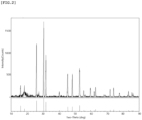
- FIG. 1 An X-ray diffraction spectrum of powder obtained through the above process is shown in FIG. 1 , in which ln Max indicates the maximum peak intensity, and ln Min indicates the peak intensity of lithium sulfide. The respective values thereof are shown in Table 1 below.
- Example 2 As in Example 1, in the glove box filled with nitrogen, 12.637 g of LiCl, 34.237 g of Li 2 S, 33.125 g of P 2 S 5 , and zirconia balls (130 g) with a diameter of 5 mm were introduced into a 150-mL polypropylene pot. Then, the glove box was sealed. Milling was performed at a rotation speed of 1,000 rpm for 10 minutes to obtain a primary reaction compound.
- the primary reaction compound was introduced into a calcining furnace made of quartz, and a calcining step was then performed.
- the calcining step was composed of heating, maintaining, and cooling steps.
- the heating step the calcining furnace was heated at a rate of 3°C per minute to increase a temperature up to 550°C.
- an argon purge process was not performed.
- the calcining furnace heated to a temperature of 550°C was maintained for 6 hours to perform the maintaining step in which a reaction was performed.
- argon purging was performed.
- the cooling step was performed. Cooling allowed the calcining furnace to reach room temperature through natural cooling. In the cooling step, argon purging was performed up to a room-temperature point.
- FIG. 2 An X-ray diffraction spectrum of powder obtained through the above process is shown in FIG. 2 , in which ln Max indicates the maximum peak intensity, and ln Min indicates the peak intensity of lithium sulfide. The respective values thereof are shown in Table 1 below.
- Example 2 As in Example 1, in the glove box filled with nitrogen, 12.637 g of LiCl, 34.237 g of Li 2 S, 33.125 g of P 2 S 5 , and zirconia balls (130 g) with a diameter of 5 mm were introduced into a 150-mL polypropylene pot. Then, the glove box was sealed. Milling was performed at a rotation speed of 1,000 rpm for 10 minutes to obtain a primary reaction compound.
- the primary reaction compound was introduced into a calcining furnace made of quartz, and a calcining step was then performed.
- the calcining step was composed of heating, maintaining, and cooling steps.
- the heating step the calcining furnace was heated at a rate of 3°C per minute to increase a temperature up to 550°C.
- an argon purge process was performed up to a temperature of 150°C. From above the temperature of 150°C, the heating step was performed up to a temperature of 550°C in a state without performing argon purging.
- the calcining furnace heated to a temperature of 550°C was maintained for 6 hours to perform the maintaining step in which a reaction was performed. Even in the maintaining step, argon purging was not performed, and a closed system was maintained.
- the cooling step was performed. Cooling allowed the calcining furnace to reach room temperature through natural cooling. In the cooling step, argon purging was performed at a point where the cooling started.
- the solid electrolyte compound powder was applied on a glass having a diameter of 20 mm and a thickness of 0.2 mm to obtain a sample.
- This sample was measured using XRD film, without allowing the sample to be in contact with air.
- the 2 ⁇ position of the diffraction peak was determined by Le Bail analysis through RIETAN-FP, the XRD analysis program.
- D2 PHASER a powder X-ray diffraction measuring device purchased from BRUKER Corporation, was used to perform the measurement under the following conditions:
- the resulting material referred to as the lnMax, was almost the same in all Examples, except for differing ln Min values. This is presumed to be because the entire lithium sulfide material was used in the reaction as a reactant. Therefore, it is seen that reaction efficiency is improved in the order of Example 1, Example 2, and Example 3.
- reaction efficiency can be improved in the preparation of a solid electrolyte for a secondary battery, thereby obtaining a high-purity solid electrolyte.
Landscapes
- Chemical & Material Sciences (AREA)
- Organic Chemistry (AREA)
- Engineering & Computer Science (AREA)
- Inorganic Chemistry (AREA)
- Materials Engineering (AREA)
- Chemical Kinetics & Catalysis (AREA)
- Physics & Mathematics (AREA)
- Manufacturing & Machinery (AREA)
- Electrochemistry (AREA)
- General Chemical & Material Sciences (AREA)
- General Physics & Mathematics (AREA)
- Condensed Matter Physics & Semiconductors (AREA)
- Thermal Sciences (AREA)
- Secondary Cells (AREA)
Abstract
Description
- This application claims the benefit of
Korean Patent Application Publication No. 10-2020-0167126, filed in the Korean Intellectual Property Office on December 3 2020 - The present disclosure relates to a method of preparing a solid electrolyte applicable to a secondary battery.
- This section provides background art regarding the present disclosure which is not necessarily known art.
- With recent remarkable development, technology for lithium secondary batteries has been applied to various fields, including electric vehicles and energy storage systems (ESS). While a currently available lithium secondary battery is composed of a positive electrode material, a negative electrode material, an electrolyte, and a separator, technology regarding the positive and negative electrode materials is being continuously developed to improve output. In addition, technology for separators is being developed in connection with the stability of current batteries using liquid electrolytes.
- In the lithium secondary battery, materials capable of reversibly intercalating and deintercalating lithium ions are used as positive and negative electrodes, between which an organic or polymeric electrolyte solution is introduced to facilitate movement of the lithium ions, thereby producing electrical energy. In this case, when a short-circuit in which the positive and negative electrodes are in direct contact occurs, a rapid chemical reaction may result in an explosion caused by thermal runaway. For this reason, to obtain stability of a separator, efforts, including coating both sides of a separator with ceramic materials, have been made to improve the stability of the separator.
- On the other hand, there have been efforts to switch electrolytes to inorganic solid electrolytes. In the case of secondary batteries composed of solid electrolytes, liquid electrolytes used in existing lithium secondary batteries are replaced with solid type. As a result, explosion and ignition caused by an electrolyte degradation reaction do not occur at all, and stability thus can be sharply improved. In addition, since lithium metal or lithium alloys can be used as negative electrode materials, there is an advantage in that energy density with respect to the mass and volume of the battery can be dramatically improved.
- On the contrary, in the case of using solid electrolytes, the ionic conductivity thereof is low, and electrode/electrolyte interface conditions are poor compared to the case of using liquid electrolytes. For this reason, there is a disadvantage in that battery performance is degraded. Nevertheless, as long as solid electrolyte performance is to be improved, all-solid-state secondary batteries using solid electrolytes can be widely used.
- The solid electrolyte candidates for all-solid-state lithium secondary batteries include gel-type polymer electrolytes, inorganic electrolytes, and the like. Inorganic solid electrolytes can be divided into oxide-based and sulfide-based solid electrolytes. Currently, a field of technology being actively developed is sulfide-based solid electrolytes. In addition, the sulfide-based solid electrolytes have an ionic conductivity of 10-2 S/Cm and have been developed into materials having an ionic conductivity close to the level of organic electrolytes.
- Among these, the solid electrolyte candidate known as a material with relatively high ionic conductivity is LiPSX (X = Cl, Br, or I) argyrodite-type material. In particular, when optimally adjusting a molar ratio of LiPSX, the ionic conductivity is known to be substantially improved.
- Typically, synthesis processes of sulfide-based solid electrolytes are divided into dry milling based on mechanical milling methods and wet milling involving reactions performed in a solution state. In the case of the dry processes, ionic conductivity is relatively good. However, in calcination processes, hydrogen sulfide (H2S) gas is generated during reaction processes of inorganic compounds, so stability may thus be problematic. In addition, in the process of removing the generated hydrogen sulfide gas, there is still a need to efficiently facilitate the reaction by preventing reactants from leaking out of the reaction system.
-
- (Patent Document 1)
Korean Patent Application Publication No. 10-2019-0062998 - (Patent Document 2)
Japanese Unexamined Patent Application Publication No. 2019-192598 -
- (Non-Patent Document 1) (Thesis 1) "A mechonochemical synthesis of submicron-sized Li2S and a mesoporous Li2S/C hybrid for high performance lithium/sulfur battery cathodes", Journal of Materials Chemistry A issued on 2017.02.24.
- (Non-Patent Document 2) (Thesis 2) "Solvent-Engineered Design Argyrodite Li6PS5X (X= Cl, Br, or I) Solid Electrolytes with High Ionic Conductivity", ACS Engery Letters issued on 2019.11.20.
- To solve the above problems, one objective of the present disclosure is to provide a method of preparing a LiPSX (X = Cl, Br, or I) solid electrolyte. Specifically, in a calcination process performed after a milling step, another objective of the present disclosure is to provide a method of preparing a high-purity solid electrolyte with high reaction efficiency by adjusting a purge process for each calcination step.
- However, objectives of the present disclosure are not limited to the objectives mentioned above, and other objectives not mentioned will become more apparent by those skilled in the art from the following description.
- In order to solve the above problems, provided is a method of preparing a solid electrolyte for a secondary battery, according one embodiment of the present disclosure, the method including the following steps:
- One embodiment of the present disclosure provides a method of preparing a solid electrolyte for a secondary battery, the method including: S1 of preparing a raw material composition containing phosphorous (P) sulfide, a lithium halide, and lithium sulfide;
- S2 of mechanically milling the raw material composition in a milling container to obtain a compound; and
- S3 of calcining the compound obtained through the mechanical milling,
- in which a purge process using a gas is performed in the S3 calcining.
- In one embodiment of the present disclosure, the S3 calcining may include: S3-a of providing the compound obtained through the mechanical milling in a calcining furnace;
- S3-b of heating the calcining furnace to a temperature of 500°C or higher;
- S3-c of maintaining the calcining furnace for 4 hours to 10 hours; and
- S3-d of cooling the calcining furnace to room temperature.
- In one embodiment of the present disclosure, the purge process using the gas may be performed in at least one of the S3-b heating, the S3-c maintaining, and the S3-d cooling.
- In one embodiment of the present disclosure, the purge process using the gas may be performed in the S3-c maintaining and the S3-d cooling.
- In one embodiment of the present disclosure, the purge process using the gas may be performed in the S3-b heating and the S3-d cooling.
- In one embodiment of the present disclosure, the purge process may be performed at a temperature of 150°C or lower in the S3-b heating.
- In one embodiment of the present disclosure, the gas used in the purge process may include an inert gas.
- In one embodiment of the present disclosure, the inert gas may be argon (Ar).
- In a method of preparing a solid electrolyte for a secondary battery, a purge process is effectively adopted during a calcination process, thereby lowering the loss of reactants to improve the overall reaction efficiency. As a result, a high-purity solid electrolyte can be obtained, and the ionic conductivity of the solid electrolyte thus can be further improved.
-
-
FIG. 1 is an X-ray diffraction pattern of an all-solid-state electrolyte compound prepared in Example 1; -
FIG. 2 is an X-ray diffraction pattern of an all-solid-state electrolyte compound prepared in Example 2; and -
FIG. 3 is an X-ray diffraction pattern of an all-solid-state electrolyte compound prepared in Example 3. - Hereinbelow, the present disclosure will be described in detail. Terms used herein are selected to describe embodiments and thus should not be construed as the limit of the present disclosure. Unless otherwise specified, all terms including technical and scientific terms used herein have the same meaning as commonly understood by those skilled in the art.
- Throughout this specification and claims, the terms "comprise", "comprises", and "comprising", unless stated otherwise, specify the presence of stated objects, steps or a group of objects, and steps, but do not preclude the presence or addition of any other objects, steps or a group of objects, or a group of steps.
- On the other hand, various embodiments and examples of the present disclosure can be combined with any other embodiments unless the text clearly indicates otherwise. In particular, some features indicated as being preferable or advantageous may be combined with any other features indicated as being preferable or advantageous.
- Hereinafter, the present disclosure will be described in detail.
- According to one embodiment of the present disclosure, provided is a method of preparing a solid electrolyte for a secondary battery including the following steps:
- Specifically, one embodiment of the present disclosure provides a method of preparing a solid electrolyte for a secondary battery, the method including the following steps: a step S1 of preparing raw material composition containing phosphorous (P) sulfide, a lithium halide, and lithium sulfide;
- a step S2 of mechanically milling the raw material composition in a milling container to obtain a compound; and
- a step S3 of calcining the compound obtained through the mechanical milling,
- in which a purge process using a gas is performed in the S3 calcining.
- In this specification, the phosphorous (P) sulfide is a compound containing phosphorus and sulfur components, which may be P2S5.
- In this specification, the lithium halide is a compound containing lithium and halogen components, which may be represented by LiX, where X may be chlorine (Cl), bromine (Br), or iodine (I).
- In this specification, the lithium sulfide is not particularly limited. However, the lithium sulfide may typically be Li2S, Li2S2, and the like, and may specifically be Li2S.
- In the embodiment, Li2S preferably has a uniform particle size distribution, which can be realized by adjusting milling conditions from the synthesis process of Li2S.
- In the present disclosure, the uniform particle size distribution means that a particle diameter coefficient of variation (CV value) is 20% or lower when being measured with a typical particle size analyzer.
- In this case, amounts of the lithium sulfide, the phosphorus sulfide, and the lithium halide being mixed may be controlled in various ways depending on a molar ratio of a sulfide-based compound to be prepared, and is not particularly limited.
- In one embodiment of the present disclosure, the method of preparing the solid electrolyte for the secondary battery may include the mechanically milling step of the raw material composition in the milling container. The milling step is performed to mix the raw material composition. The raw materials may be mixed by dry methods, which include mechanical milling. Mechanical milling is a method of obtaining a desired material in the process of pulverizing a raw material composition by providing mechanical energy to a sample, which may use, for example, a roll mill, a ball mill, or a jet mill.
- In one embodiment of the present disclosure, the mechanically milling step of the raw material composition in the milling container may be performed in an environment where a force applied to the milling container is in a range of 60 G to 90 G. To set up the environment described above, process conditions for the mechanical milling may be appropriately adjusted according to equipment being used. The applied force may be in a range of 70 G to 80 G or a range of 73 G to 78 G.
- In one embodiment of the present disclosure, the mechanically milling step of the raw material composition in the milling container may be performed under conditions of a rotation speed in a range of 100 rpm to 2,000 rpm, a range of 200 rpm to 1,500 rpm, or a range of 300 rpm to 1,000 rpm.
- In one embodiment of the present disclosure, the mechanically milling step of the raw material composition in the milling container may be performed for less than 1 hour and specifically, for less than 30 minutes or 1 minute or more to 20 minutes.
- In addition, in the case of applying a force in a range of 60 G to 90 G to a ball milling process, provided that the amount and size of particles are the same, the milling process time can be shortened, which is less than 1 hour. Under the same condition, the milling process time preferably ranges from 5 minutes to 45 minutes and more preferably, from 5 minutes to 30 minutes. When the milling process time exceeds 1 hour, a mixture may end up having an unintended crystal structure due to heat generated during the milling process, which may adversely affect ionic conductivity.
- In one embodiment of the present disclosure, the mechanical milling may be ball milling. In the case of using the ball milling, the raw material composition is introduced into the milling container along with milling balls. The milling balls may be made of a metal oxide or ceramic oxide. Typically, the metal oxide may include tungsten oxide, and the ceramic oxide may include zirconia oxide.
- On the other hand, the mechanical milling is performed based on a principle in which balls are conveyed to reach a predetermined height by the centrifugal force generated when the milling container rotates, and the material is pulverized while the balls fall. In this case, the mechanical milling may be performed by one-dimensional rotation in which the container is fixed while being rotated in only one direction. However, the mechanical milling may be performed by two-dimensional rotation in which the container is rotated in one direction while another axis responsible for fixing the container rotates. In addition, particle size distribution may be further precisely controlled by continuously or intermittently applying vibration to the rotating milling container.
- In one embodiment of the present disclosure, the method of preparing the solid electrolyte for the secondary battery includes the step S3 of calcining the compound obtained through the mechanical milling. The calcining step is performed to improve the ionic conductivity of the solid electrolyte by crystallizing the solid electrolyte for the secondary battery.
- In one embodiment of the present disclosure, the calcining step S3 may include: a step S3-a of providing the compound obtained through the mechanical milling in a calcining furnace; a step S3-b of heating the calcining furnace to a temperature of 500°C or higher; a step S3-c of maintaining the calcining furnace for 4 hours to 10 hours; and a step S3-d of cooling the calcining furnace to room temperature.
- In one embodiment of the present disclosure, the step S3-a of providing the compound obtained through the mechanical milling in the calcining furnace in the calcination step S3 may be performed by a method in which an object to be calcined is positioned on a flat plate in a box-type furnace. On the other hand, after placing a cylinder made of heat-resistant metal or quartz in the furnace, the object to be calcined may be introduced into the cylinder and then rotated to allow uniform heat transfer to the object to be calcined. When the cylinder-form container, as described above, is placed in the furnace and allowed to rotate for a uniform temperature gradient on the object to be calcined, the uniformity of the internal crystal distribution of the obtained solid electrolyte may be easily obtained, which may be advantageous in terms of improvement in the ionic conductivity of the solid electrolyte.
- In one embodiment of the present disclosure, the step S3-b of heating the calcining furnace to a temperature of 500°C or higher is included. In this case, a starting temperature of the calcining furnace before the heating step may be room temperature.
- In one embodiment of the present disclosure, a heating rate in the step S3-b of heating the calcining furnace to a temperature of 500°C or higher may be in a range of 1°C/min to 100°C/min, a range of 10°C/min to 50°C/min, or in a range of 10°C/min to 3 0 ° C/min.
- In one embodiment of the present disclosure, a final temperature in the step S3-b of heating the calcining furnace to a temperature of 500°C or higher may be in a range of 400°C to 900°C, a range of 500°C to 700°C, or a range of 500°C to 550°C. At the heating rate and final temperature described above, damage to the object to be calcined may be minimized while effectively performing calcination.
- In one embodiment of the present disclosure, the maintaining step of the calcining furnace for 4 hours to 10 hours is included. A maintaining temperature in the maintaining step may be the final temperature in the heating step. For example, in the heating step, the calcining furnace may be heated at a heating rate of 20°C/min to reach a final temperature of 550°C and then maintained for 6 hours. Maintaining the calcining furnace means that the heated object is kept in the calcining furnace without additionally performing heating.
- In one embodiment of the present disclosure, the maintaining step may be performed in a state where the calcining furnace is in a closed system. The closed system means a state where there is no flow of gas inside/outside the calcining furnace.
- In one embodiment of the present disclosure, the step S3-d of cooling the calcining furnace to room temperature may be included. In this case, a starting temperature of the calcining furnace in the cooling step may be the final temperature in the maintaining step.
- In one embodiment of the present disclosure, the step of cooling the furnace to room temperature may be performed for 1 hour to 10 hours or for 2 hours to 8 hours.
- In one embodiment of the present disclosure, the purge process using the gas may be performed in at least one of the heating, maintaining, and cooling steps. The purge process is a method of removing non-absorbed gas or vapor contained in a sealed space, which means that a neutral buffer gas, such as nitrogen, carbon dioxide, or air, is used to perform ventilation. In addition, the above process is performed to remove H2S gas generated during the calcination process, which may be performed by a method known to those skilled in the art. H2S gas is hazardous and explosive, and is thus required to be removed during the process. However, when performing the purge process, not only H2S gas but also a phosphorus sulfide compound (for example, P2S5), a reactant, may leak out.
- In one embodiment of the present disclosure, the purge process using the gas may be performed in the maintaining and cooling steps.
- In one embodiment of the present disclosure, the purge process using the gas may be performed in the heating and cooling steps.
- In one embodiment of the present disclosure, the purge process using the gas may be performed in the heating, maintaining, and cooling steps.
- In one embodiment of the present disclosure, the purge process may be repeatedly performed one or more times in the respective steps described above. For example, in the case of performing the maintaining step for 6 hours, the purge process may be each independently performed one time at a 2-hour point and a 4-hour point.
- In one embodiment of the present disclosure, the purge process performed in the heating step may be performed at a temperature of 150°C or lower. Specifically, when performing the purge process in the heating step, a temperature in the calcining furnace may be 150°C or lower. In this case, the above-described H2S ventilation effect may be maintained while minimizing the loss of the phosphorus sulfide compound, the reactant.
- In one embodiment of the present disclosure, the purge process performed in the cooling step may be performed at a temperature of 300°C or lower. Specifically, when performing the purge process in the cooling step, a temperature in the calcining furnace may be 300°C or lower.
- In one embodiment of the present disclosure, the inert gas may be argon (Ar), nitrogen (N2), or a mixed gas thereof.
- In one embodiment of the present disclosure, the inert gas may be argon (Ar).
- In one embodiment of the present disclosure, the solid electrolyte for the secondary battery prepared according to the preparation method described above may have a particle size (d50) in a range of 3 um to 4 µm, which is a particle size set to exhibit the optimal effect by properly dispersing the solid electrolyte in the secondary battery, the end product. In the solid electrolyte for the secondary battery prepared through the processes according to one embodiment of the present disclosure, strong energy is applied to the milling process to make particle size before entering the calcining process sufficiently small. In addition, particle size distribution is allowed to be uniform, so there is an effect that the time required for the pulverization process can be also shortened.
- Hereinafter, the present disclosure will be described with reference to embodiments.
- In a glove box filled with nitrogen, 0.2776 g of LiCl, 0.3672 g of Li2S, 0.3552 g of P2S5, and 15 zirconia balls with a diameter of 10 mm were introduced into a 45-mL stainless steel pot. Then, the glove box was sealed. Milling was performed at a rotation speed of 350 rpm and a force of 75 G to obtain a primary reaction compound.
- The primary reaction compound was introduced into a calcining furnace made of quartz, and a calcining step was then performed. The calcining step was composed of heating, maintaining, and cooling steps. In the heating step, the calcining furnace was heated at a rate of 20°C per minute to increase a temperature up to 550°C. In the heating step, an argon purge process was performed at a 140°C-point. The calcining furnace heated to a temperature of 550°C was maintained for 6 hours to perform the maintaining step in which a reaction was performed. In the maintaining step, argon purging was performed at a 2-hour point and a 4-hour point.
- After maintaining the calcining furnace at a temperature of 550°C for 6 hours, the cooling step was performed. Cooling allowed the calcining furnace to reach room temperature through natural cooling. In the cooling step, argon purging was performed at 200°C.
- An X-ray diffraction spectrum of powder obtained through the above process is shown in
FIG. 1 , in which lnMax indicates the maximum peak intensity, and lnMin indicates the peak intensity of lithium sulfide. The respective values thereof are shown in Table 1 below. - As in Example 1, in the glove box filled with nitrogen, 12.637 g of LiCl, 34.237 g of Li2S, 33.125 g of P2S5, and zirconia balls (130 g) with a diameter of 5 mm were introduced into a 150-mL polypropylene pot. Then, the glove box was sealed. Milling was performed at a rotation speed of 1,000 rpm for 10 minutes to obtain a primary reaction compound.
- The primary reaction compound was introduced into a calcining furnace made of quartz, and a calcining step was then performed. The calcining step was composed of heating, maintaining, and cooling steps. In the heating step, the calcining furnace was heated at a rate of 3°C per minute to increase a temperature up to 550°C. In the heating step, an argon purge process was not performed.
- After the heating step, the calcining furnace heated to a temperature of 550°C was maintained for 6 hours to perform the maintaining step in which a reaction was performed. During the maintaining step, argon purging was performed.
- After maintaining the calcining furnace at a temperature of 550°C for 6 hours, the cooling step was performed. Cooling allowed the calcining furnace to reach room temperature through natural cooling. In the cooling step, argon purging was performed up to a room-temperature point.
- An X-ray diffraction spectrum of powder obtained through the above process is shown in
FIG. 2 , in which lnMax indicates the maximum peak intensity, and lnMin indicates the peak intensity of lithium sulfide. The respective values thereof are shown in Table 1 below. - As in Example 1, in the glove box filled with nitrogen, 12.637 g of LiCl, 34.237 g of Li2S, 33.125 g of P2S5, and zirconia balls (130 g) with a diameter of 5 mm were introduced into a 150-mL polypropylene pot. Then, the glove box was sealed. Milling was performed at a rotation speed of 1,000 rpm for 10 minutes to obtain a primary reaction compound.
- The primary reaction compound was introduced into a calcining furnace made of quartz, and a calcining step was then performed. The calcining step was composed of heating, maintaining, and cooling steps. In the heating step, the calcining furnace was heated at a rate of 3°C per minute to increase a temperature up to 550°C. In the heating step, an argon purge process was performed up to a temperature of 150°C. From above the temperature of 150°C, the heating step was performed up to a temperature of 550°C in a state without performing argon purging. After the heating step, the calcining furnace heated to a temperature of 550°C was maintained for 6 hours to perform the maintaining step in which a reaction was performed. Even in the maintaining step, argon purging was not performed, and a closed system was maintained.
- After maintaining the calcining furnace at a closed state at a temperature of 550°C for 6 hours, the cooling step was performed. Cooling allowed the calcining furnace to reach room temperature through natural cooling. In the cooling step, argon purging was performed at a point where the cooling started.
- An X-ray diffraction spectrum of powder obtained through the above process is shown in
FIG. 3 , in which lnMax indicates the maximum peak intensity, and lnMin indicates the peak intensity of lithium sulfide. The respective values thereof are shown in Table 1 below. - X-ray diffraction patterns in each Example were measured using Rigaku equipment under the following conditions.
- In each Example, the solid electrolyte compound powder was applied on a glass having a diameter of 20 mm and a thickness of 0.2 mm to obtain a sample. This sample was measured using XRD film, without allowing the sample to be in contact with air. The 2θ position of the diffraction peak was determined by Le Bail analysis through RIETAN-FP, the XRD analysis program. D2 PHASER, a powder X-ray diffraction measuring device purchased from BRUKER Corporation, was used to perform the measurement under the following conditions:
- Tube voltage: 30 kV
- Tube current: 10 mA
- X-ray wavelength: Cu-Kα ray (1.5418 Å)
- Measurement range: 10.0° < 2θ < 90.0° (where 2θ represents a diffraction angle)
- According to the results shown in Table 1 above, the resulting material, referred to as the lnMax, was almost the same in all Examples, except for differing lnMin values. This is presumed to be because the entire lithium sulfide material was used in the reaction as a reactant. Therefore, it is seen that reaction efficiency is improved in the order of Example 1, Example 2, and Example 3.
- According to the present disclosure, reaction efficiency can be improved in the preparation of a solid electrolyte for a secondary battery, thereby obtaining a high-purity solid electrolyte.
| Classification | Intensity | ||
| lnMax | lnMin | lnMin/lnMax | |
| Example 1 | 11.7 | 2.25 | 0.1923 |
| Example 2 | 11.8 | 0.7 | 0.0593 |
| Example 3 | 11.8 | 0.5 | 0.0424 |
Claims (8)
- A method of preparing a solid electrolyte for a secondary battery, the method comprising:S1 of preparing a raw material composition comprising phosphorous (P) sulfide, a lithium halide, and lithium sulfide;S2 of mechanically milling the raw material composition in a milling container to obtain a compound; andS3 of calcining the compound obtained through the mechanical milling,wherein in the S3 calcining, a purge process using a gas is performed.
- The method of claim 1, wherein the S3 calcining comprises:S3-a of providing the compound obtained through the mechanical milling in a calcining furnace;S3-b of heating the calcining furnace to a temperature of 500°C or higher;S3-c of maintaining the calcining furnace at a temperature in a range of 500°C to 600°C or less for 4 hours to 10 hours; andS3-d of cooling the calcining furnace to room temperature.
- The method of claim 2, wherein the purge process using the gas is performed in at least one of the S3-b heating, the S3-c maintaining, and the S3-d cooling.
- The method of claim 2, wherein the purge process using the gas is performed in the S3-c maintaining and the S3-d cooling.
- The method of claim 2, wherein the purge process using the gas is performed in the S3-b heating and the S3-d cooling.
- The method of claim 5, wherein in the S3-b heating, the purge process is performed at a temperature of 150°C or lower.
- The method of claim 1, wherein the gas used in the purge process comprises an inert gas.
- The method of claim 7, wherein the inert gas is argon (Ar) .
Applications Claiming Priority (2)
| Application Number | Priority Date | Filing Date | Title |
|---|---|---|---|
| KR1020200167126A KR102873910B1 (en) | 2020-12-03 | 2020-12-03 | Process of manufacturing Solid Electrolyte for Secondary Battery |
| PCT/KR2021/017963 WO2022119299A1 (en) | 2020-12-03 | 2021-12-01 | Method for preparing solid electrolyte for secondary battery |
Publications (2)
| Publication Number | Publication Date |
|---|---|
| EP4258405A1 true EP4258405A1 (en) | 2023-10-11 |
| EP4258405A4 EP4258405A4 (en) | 2025-09-03 |
Family
ID=81854220
Family Applications (1)
| Application Number | Title | Priority Date | Filing Date |
|---|---|---|---|
| EP21900987.5A Pending EP4258405A4 (en) | 2020-12-03 | 2021-12-01 | METHOD FOR PRODUCING A SOLID ELECTROLYTE FOR A SECONDARY BATTERY |
Country Status (4)
| Country | Link |
|---|---|
| US (1) | US20230416091A1 (en) |
| EP (1) | EP4258405A4 (en) |
| KR (1) | KR102873910B1 (en) |
| WO (1) | WO2022119299A1 (en) |
Family Cites Families (12)
| Publication number | Priority date | Publication date | Assignee | Title |
|---|---|---|---|---|
| KR102393999B1 (en) * | 2015-11-13 | 2022-05-02 | 한국전기연구원 | Normal pressure synthesis of sulfide solid electrolyte composition for the solid lithium secondary batteries |
| WO2018003333A1 (en) * | 2016-07-01 | 2018-01-04 | 三井金属鉱業株式会社 | Sulfide-based solid electrolyte for lithium secondary battery |
| JP6901295B2 (en) * | 2017-03-17 | 2021-07-14 | 古河機械金属株式会社 | Manufacturing method of inorganic materials |
| US20210075056A1 (en) * | 2017-06-09 | 2021-03-11 | Idemitsu Kosan Co.,Ltd. | Method for producing a sulfide solid electrolyte |
| KR102044506B1 (en) | 2017-11-29 | 2019-11-13 | 전자부품연구원 | Solid Electrolyte, Method for Preparing the Same and All Solid Battery Compring the Same |
| JP7035772B2 (en) | 2018-04-27 | 2022-03-15 | トヨタ自動車株式会社 | Method for producing sulfide solid electrolyte |
| JP7105133B2 (en) * | 2018-08-10 | 2022-07-22 | 三井金属鉱業株式会社 | Method for producing crystalline sulfide-based solid electrolyte |
| EP3754774A4 (en) * | 2018-09-04 | 2021-06-16 | Mitsui Mining & Smelting Co., Ltd. | SULPHIDE COMPOSITE PARTICLES, SOLID ELECTROLYTE AND SECONDARY LITHIUM BATTERY |
| JP7428501B2 (en) * | 2018-11-01 | 2024-02-06 | 出光興産株式会社 | Method for modifying solid electrolyte containing argyrodite crystal structure |
| JP6738983B1 (en) * | 2018-11-08 | 2020-08-12 | 三井金属鉱業株式会社 | Sulfide solid electrolyte and battery |
| KR20200077715A (en) * | 2018-12-21 | 2020-07-01 | 전자부품연구원 | Sulfide based solid electrolyte and manufacturing method thereof |
| KR20230162588A (en) * | 2021-01-28 | 2023-11-28 | 스페셜티 오퍼레이션스 프랑스 | Compositions containing sulfide electrolytes |
-
2020
- 2020-12-03 KR KR1020200167126A patent/KR102873910B1/en active Active
-
2021
- 2021-12-01 EP EP21900987.5A patent/EP4258405A4/en active Pending
- 2021-12-01 US US18/265,001 patent/US20230416091A1/en active Pending
- 2021-12-01 WO PCT/KR2021/017963 patent/WO2022119299A1/en not_active Ceased
Also Published As
| Publication number | Publication date |
|---|---|
| KR20220078041A (en) | 2022-06-10 |
| EP4258405A4 (en) | 2025-09-03 |
| KR102873910B1 (en) | 2025-10-28 |
| WO2022119299A1 (en) | 2022-06-09 |
| US20230416091A1 (en) | 2023-12-28 |
Similar Documents
| Publication | Publication Date | Title |
|---|---|---|
| CN111512397B (en) | solid electrolyte | |
| US10938064B2 (en) | Sulfide-type compound particles, solid electrolyte, and lithium secondary battery | |
| KR101952196B1 (en) | Solid Electrolyte, Method for Preparing the Same and All Solid Battery Compring the Same | |
| KR102002597B1 (en) | Method for Preparing Solid Electrolyte, Solid Electrolyte Prepared by Using the Same, and All Solid Battery Comprising the Solid Electrolyte | |
| KR20190007028A (en) | Sulfide-based solid electrolyte for lithium secondary battery | |
| KR20170001947A (en) | Negative electrode material for nonaqueous electrolytic secondary battery, process for producing negative electrode material for nonaqueous electrolytic secondary battery, and lithium ion secondary battery | |
| WO2012131881A1 (en) | Nickel-manganese composite hydroxide particles, method for producing same, positive electrode active material for nonaqueous electrolyte secondary batteries, method for producing positive electrode active material for nonaqueous electrolyte secondary batteries, and nonaqueous electrolyte secondary battery | |
| WO2013094701A1 (en) | Nickel compound hydroxide and method for producing same, positive pole active substance for nonaqueous electrolyte secondary cell and method for producing same, and nonaqueous electrolyte secondary cell | |
| CN112020787B (en) | Sulfide solid electrolyte and all-solid battery | |
| JP7159639B2 (en) | Method for producing particles of transition metal composite hydroxide, and method for producing positive electrode active material for lithium ion secondary battery | |
| CN107851477A (en) | α-lithium solid electrolyte | |
| KR102396159B1 (en) | Sulfide based solid electrolyte for all solid battery, manufacturing method thereof and all solid battery comprising the solid electrolyte | |
| EP2762449B1 (en) | Method of manufacturing a silicon oxide-carbon composite | |
| JP6903360B2 (en) | Positive electrode active material, positive electrode and secondary battery using it, and method for manufacturing positive electrode active material | |
| Green et al. | High-power recycling: upcycling to the next generation of high-power anodes for Li-ion battery applications | |
| Gao et al. | Realizing excellent cycling stability of LiNi0. 80Co0. 15Al0. 05O2 cathode at high cutoff voltage by Al (PO3) 3 modification | |
| JP2023545828A (en) | Solid lithium ion conductive material containing ytterbium and its preparation method | |
| EP4258405A1 (en) | Method for preparing solid electrolyte for secondary battery | |
| KR20230165525A (en) | Manufacturing method for sulfide-based solid electrolyte, sulfide-based solid electrolyte, solid electrolytee, all-solid battery | |
| Guo et al. | Molten salt synthesis of Al-substituted single-crystal NCMA cathodes: synergistic mitigation of structural degradation and enhanced electrochemical stability: Q. Guo et al. | |
| Garcia‐Garcia et al. | Ultrafast Organic Emulsion‐Based Synthesis of High‐Performance Cathode Materials for Rechargeable Batteries | |
| KR102953817B1 (en) | Process of manufacturing Solid Electrolyte for Secondary Battery | |
| KR20220032854A (en) | Process of manufacturing Solid Electrolyte for Secondary Battery | |
| EP2762447A1 (en) | Silicon oxide for cathode active material in secondary battery | |
| WO2025004753A1 (en) | Halide solid electrolyte production method, halide solid electrolyte, positive electrode material, and battery |
Legal Events
| Date | Code | Title | Description |
|---|---|---|---|
| STAA | Information on the status of an ep patent application or granted ep patent |
Free format text: STATUS: THE INTERNATIONAL PUBLICATION HAS BEEN MADE |
|
| PUAI | Public reference made under article 153(3) epc to a published international application that has entered the european phase |
Free format text: ORIGINAL CODE: 0009012 |
|
| STAA | Information on the status of an ep patent application or granted ep patent |
Free format text: STATUS: REQUEST FOR EXAMINATION WAS MADE |
|
| 17P | Request for examination filed |
Effective date: 20230627 |
|
| AK | Designated contracting states |
Kind code of ref document: A1 Designated state(s): AL AT BE BG CH CY CZ DE DK EE ES FI FR GB GR HR HU IE IS IT LI LT LU LV MC MK MT NL NO PL PT RO RS SE SI SK SM TR |
|
| DAV | Request for validation of the european patent (deleted) | ||
| DAX | Request for extension of the european patent (deleted) | ||
| REG | Reference to a national code |
Ref country code: DE Ref legal event code: R079 Free format text: PREVIOUS MAIN CLASS: H01M0010056200 Ipc: C01B0025140000 |
|
| A4 | Supplementary search report drawn up and despatched |
Effective date: 20250805 |
|
| RIC1 | Information provided on ipc code assigned before grant |
Ipc: C01B 25/14 20060101AFI20250730BHEP Ipc: C01D 15/00 20060101ALI20250730BHEP Ipc: H01M 10/0562 20100101ALI20250730BHEP |