EP4257236A1 - Catalyst for methane reforming, and preparation method therefor - Google Patents
Catalyst for methane reforming, and preparation method therefor Download PDFInfo
- Publication number
- EP4257236A1 EP4257236A1 EP22895794.0A EP22895794A EP4257236A1 EP 4257236 A1 EP4257236 A1 EP 4257236A1 EP 22895794 A EP22895794 A EP 22895794A EP 4257236 A1 EP4257236 A1 EP 4257236A1
- Authority
- EP
- European Patent Office
- Prior art keywords
- catalyst
- chemical formula
- less
- real number
- coating layer
- Prior art date
- Legal status (The legal status is an assumption and is not a legal conclusion. Google has not performed a legal analysis and makes no representation as to the accuracy of the status listed.)
- Pending
Links
Images
Classifications
-
- B—PERFORMING OPERATIONS; TRANSPORTING
- B01—PHYSICAL OR CHEMICAL PROCESSES OR APPARATUS IN GENERAL
- B01J—CHEMICAL OR PHYSICAL PROCESSES, e.g. CATALYSIS OR COLLOID CHEMISTRY; THEIR RELEVANT APPARATUS
- B01J37/00—Processes, in general, for preparing catalysts; Processes, in general, for activation of catalysts
- B01J37/02—Impregnation, coating or precipitation
- B01J37/024—Multiple impregnation or coating
- B01J37/0244—Coatings comprising several layers
-
- B—PERFORMING OPERATIONS; TRANSPORTING
- B01—PHYSICAL OR CHEMICAL PROCESSES OR APPARATUS IN GENERAL
- B01J—CHEMICAL OR PHYSICAL PROCESSES, e.g. CATALYSIS OR COLLOID CHEMISTRY; THEIR RELEVANT APPARATUS
- B01J21/00—Catalysts comprising the elements, oxides, or hydroxides of magnesium, boron, aluminium, carbon, silicon, titanium, zirconium, or hafnium
- B01J21/06—Silicon, titanium, zirconium or hafnium; Oxides or hydroxides thereof
- B01J21/063—Titanium; Oxides or hydroxides thereof
-
- B—PERFORMING OPERATIONS; TRANSPORTING
- B01—PHYSICAL OR CHEMICAL PROCESSES OR APPARATUS IN GENERAL
- B01J—CHEMICAL OR PHYSICAL PROCESSES, e.g. CATALYSIS OR COLLOID CHEMISTRY; THEIR RELEVANT APPARATUS
- B01J23/00—Catalysts comprising metals or metal oxides or hydroxides, not provided for in group B01J21/00
- B01J23/002—Mixed oxides other than spinels, e.g. perovskite
-
- B—PERFORMING OPERATIONS; TRANSPORTING
- B01—PHYSICAL OR CHEMICAL PROCESSES OR APPARATUS IN GENERAL
- B01J—CHEMICAL OR PHYSICAL PROCESSES, e.g. CATALYSIS OR COLLOID CHEMISTRY; THEIR RELEVANT APPARATUS
- B01J23/00—Catalysts comprising metals or metal oxides or hydroxides, not provided for in group B01J21/00
- B01J23/02—Catalysts comprising metals or metal oxides or hydroxides, not provided for in group B01J21/00 of the alkali- or alkaline earth metals or beryllium
-
- B—PERFORMING OPERATIONS; TRANSPORTING
- B01—PHYSICAL OR CHEMICAL PROCESSES OR APPARATUS IN GENERAL
- B01J—CHEMICAL OR PHYSICAL PROCESSES, e.g. CATALYSIS OR COLLOID CHEMISTRY; THEIR RELEVANT APPARATUS
- B01J23/00—Catalysts comprising metals or metal oxides or hydroxides, not provided for in group B01J21/00
- B01J23/38—Catalysts comprising metals or metal oxides or hydroxides, not provided for in group B01J21/00 of noble metals
- B01J23/54—Catalysts comprising metals or metal oxides or hydroxides, not provided for in group B01J21/00 of noble metals combined with metals, oxides or hydroxides provided for in groups B01J23/02 - B01J23/36
- B01J23/56—Platinum group metals
- B01J23/63—Platinum group metals with rare earths or actinides
-
- B—PERFORMING OPERATIONS; TRANSPORTING
- B01—PHYSICAL OR CHEMICAL PROCESSES OR APPARATUS IN GENERAL
- B01J—CHEMICAL OR PHYSICAL PROCESSES, e.g. CATALYSIS OR COLLOID CHEMISTRY; THEIR RELEVANT APPARATUS
- B01J23/00—Catalysts comprising metals or metal oxides or hydroxides, not provided for in group B01J21/00
- B01J23/70—Catalysts comprising metals or metal oxides or hydroxides, not provided for in group B01J21/00 of the iron group metals or copper
- B01J23/74—Iron group metals
- B01J23/755—Nickel
-
- B—PERFORMING OPERATIONS; TRANSPORTING
- B01—PHYSICAL OR CHEMICAL PROCESSES OR APPARATUS IN GENERAL
- B01J—CHEMICAL OR PHYSICAL PROCESSES, e.g. CATALYSIS OR COLLOID CHEMISTRY; THEIR RELEVANT APPARATUS
- B01J23/00—Catalysts comprising metals or metal oxides or hydroxides, not provided for in group B01J21/00
- B01J23/70—Catalysts comprising metals or metal oxides or hydroxides, not provided for in group B01J21/00 of the iron group metals or copper
- B01J23/76—Catalysts comprising metals or metal oxides or hydroxides, not provided for in group B01J21/00 of the iron group metals or copper combined with metals, oxides or hydroxides provided for in groups B01J23/02 - B01J23/36
- B01J23/78—Catalysts comprising metals or metal oxides or hydroxides, not provided for in group B01J21/00 of the iron group metals or copper combined with metals, oxides or hydroxides provided for in groups B01J23/02 - B01J23/36 with alkali- or alkaline earth metals
-
- B—PERFORMING OPERATIONS; TRANSPORTING
- B01—PHYSICAL OR CHEMICAL PROCESSES OR APPARATUS IN GENERAL
- B01J—CHEMICAL OR PHYSICAL PROCESSES, e.g. CATALYSIS OR COLLOID CHEMISTRY; THEIR RELEVANT APPARATUS
- B01J23/00—Catalysts comprising metals or metal oxides or hydroxides, not provided for in group B01J21/00
- B01J23/70—Catalysts comprising metals or metal oxides or hydroxides, not provided for in group B01J21/00 of the iron group metals or copper
- B01J23/76—Catalysts comprising metals or metal oxides or hydroxides, not provided for in group B01J21/00 of the iron group metals or copper combined with metals, oxides or hydroxides provided for in groups B01J23/02 - B01J23/36
- B01J23/83—Catalysts comprising metals or metal oxides or hydroxides, not provided for in group B01J21/00 of the iron group metals or copper combined with metals, oxides or hydroxides provided for in groups B01J23/02 - B01J23/36 with rare earths or actinides
-
- B—PERFORMING OPERATIONS; TRANSPORTING
- B01—PHYSICAL OR CHEMICAL PROCESSES OR APPARATUS IN GENERAL
- B01J—CHEMICAL OR PHYSICAL PROCESSES, e.g. CATALYSIS OR COLLOID CHEMISTRY; THEIR RELEVANT APPARATUS
- B01J23/00—Catalysts comprising metals or metal oxides or hydroxides, not provided for in group B01J21/00
- B01J23/70—Catalysts comprising metals or metal oxides or hydroxides, not provided for in group B01J21/00 of the iron group metals or copper
- B01J23/76—Catalysts comprising metals or metal oxides or hydroxides, not provided for in group B01J21/00 of the iron group metals or copper combined with metals, oxides or hydroxides provided for in groups B01J23/02 - B01J23/36
- B01J23/84—Catalysts comprising metals or metal oxides or hydroxides, not provided for in group B01J21/00 of the iron group metals or copper combined with metals, oxides or hydroxides provided for in groups B01J23/02 - B01J23/36 with arsenic, antimony, bismuth, vanadium, niobium, tantalum, polonium, chromium, molybdenum, tungsten, manganese, technetium or rhenium
- B01J23/85—Chromium, molybdenum or tungsten
- B01J23/86—Chromium
- B01J23/866—Nickel and chromium
-
- B—PERFORMING OPERATIONS; TRANSPORTING
- B01—PHYSICAL OR CHEMICAL PROCESSES OR APPARATUS IN GENERAL
- B01J—CHEMICAL OR PHYSICAL PROCESSES, e.g. CATALYSIS OR COLLOID CHEMISTRY; THEIR RELEVANT APPARATUS
- B01J35/00—Catalysts, in general, characterised by their form or physical properties
- B01J35/60—Catalysts, in general, characterised by their form or physical properties characterised by their surface properties or porosity
- B01J35/64—Pore diameter
- B01J35/657—Pore diameter larger than 1000 nm
-
- B—PERFORMING OPERATIONS; TRANSPORTING
- B01—PHYSICAL OR CHEMICAL PROCESSES OR APPARATUS IN GENERAL
- B01J—CHEMICAL OR PHYSICAL PROCESSES, e.g. CATALYSIS OR COLLOID CHEMISTRY; THEIR RELEVANT APPARATUS
- B01J37/00—Processes, in general, for preparing catalysts; Processes, in general, for activation of catalysts
- B01J37/02—Impregnation, coating or precipitation
- B01J37/0215—Coating
-
- B—PERFORMING OPERATIONS; TRANSPORTING
- B01—PHYSICAL OR CHEMICAL PROCESSES OR APPARATUS IN GENERAL
- B01J—CHEMICAL OR PHYSICAL PROCESSES, e.g. CATALYSIS OR COLLOID CHEMISTRY; THEIR RELEVANT APPARATUS
- B01J37/00—Processes, in general, for preparing catalysts; Processes, in general, for activation of catalysts
- B01J37/02—Impregnation, coating or precipitation
- B01J37/0215—Coating
- B01J37/0225—Coating of metal substrates
-
- B—PERFORMING OPERATIONS; TRANSPORTING
- B01—PHYSICAL OR CHEMICAL PROCESSES OR APPARATUS IN GENERAL
- B01J—CHEMICAL OR PHYSICAL PROCESSES, e.g. CATALYSIS OR COLLOID CHEMISTRY; THEIR RELEVANT APPARATUS
- B01J37/00—Processes, in general, for preparing catalysts; Processes, in general, for activation of catalysts
- B01J37/02—Impregnation, coating or precipitation
- B01J37/0215—Coating
- B01J37/0228—Coating in several steps
-
- B—PERFORMING OPERATIONS; TRANSPORTING
- B01—PHYSICAL OR CHEMICAL PROCESSES OR APPARATUS IN GENERAL
- B01J—CHEMICAL OR PHYSICAL PROCESSES, e.g. CATALYSIS OR COLLOID CHEMISTRY; THEIR RELEVANT APPARATUS
- B01J37/00—Processes, in general, for preparing catalysts; Processes, in general, for activation of catalysts
- B01J37/02—Impregnation, coating or precipitation
- B01J37/0236—Drying, e.g. preparing a suspension, adding a soluble salt and drying
-
- B—PERFORMING OPERATIONS; TRANSPORTING
- B01—PHYSICAL OR CHEMICAL PROCESSES OR APPARATUS IN GENERAL
- B01J—CHEMICAL OR PHYSICAL PROCESSES, e.g. CATALYSIS OR COLLOID CHEMISTRY; THEIR RELEVANT APPARATUS
- B01J37/00—Processes, in general, for preparing catalysts; Processes, in general, for activation of catalysts
- B01J37/02—Impregnation, coating or precipitation
- B01J37/03—Precipitation; Co-precipitation
- B01J37/031—Precipitation
- B01J37/033—Using Hydrolysis
-
- B—PERFORMING OPERATIONS; TRANSPORTING
- B01—PHYSICAL OR CHEMICAL PROCESSES OR APPARATUS IN GENERAL
- B01J—CHEMICAL OR PHYSICAL PROCESSES, e.g. CATALYSIS OR COLLOID CHEMISTRY; THEIR RELEVANT APPARATUS
- B01J37/00—Processes, in general, for preparing catalysts; Processes, in general, for activation of catalysts
- B01J37/04—Mixing
-
- B—PERFORMING OPERATIONS; TRANSPORTING
- B01—PHYSICAL OR CHEMICAL PROCESSES OR APPARATUS IN GENERAL
- B01J—CHEMICAL OR PHYSICAL PROCESSES, e.g. CATALYSIS OR COLLOID CHEMISTRY; THEIR RELEVANT APPARATUS
- B01J37/00—Processes, in general, for preparing catalysts; Processes, in general, for activation of catalysts
- B01J37/08—Heat treatment
-
- C—CHEMISTRY; METALLURGY
- C01—INORGANIC CHEMISTRY
- C01B—NON-METALLIC ELEMENTS; COMPOUNDS THEREOF; METALLOIDS OR COMPOUNDS THEREOF NOT COVERED BY SUBCLASS C01C
- C01B3/00—Hydrogen; Gaseous mixtures containing hydrogen; Separation of hydrogen from mixtures containing it; Purification of hydrogen; Reversible storage of hydrogen
- C01B3/02—Production of hydrogen; Production of gaseous mixtures containing hydrogen
- C01B3/32—Production of hydrogen; Production of gaseous mixtures containing hydrogen by reaction of gaseous or liquid organic compounds with gasifying agents, e.g. water, carbon dioxide or air
- C01B3/34—Production of hydrogen; Production of gaseous mixtures containing hydrogen by reaction of gaseous or liquid organic compounds with gasifying agents, e.g. water, carbon dioxide or air by reaction of hydrocarbons with gasifying agents
- C01B3/38—Production of hydrogen; Production of gaseous mixtures containing hydrogen by reaction of gaseous or liquid organic compounds with gasifying agents, e.g. water, carbon dioxide or air by reaction of hydrocarbons with gasifying agents using catalysts
- C01B3/40—Production of hydrogen; Production of gaseous mixtures containing hydrogen by reaction of gaseous or liquid organic compounds with gasifying agents, e.g. water, carbon dioxide or air by reaction of hydrocarbons with gasifying agents using catalysts characterised by the catalyst
-
- B—PERFORMING OPERATIONS; TRANSPORTING
- B01—PHYSICAL OR CHEMICAL PROCESSES OR APPARATUS IN GENERAL
- B01J—CHEMICAL OR PHYSICAL PROCESSES, e.g. CATALYSIS OR COLLOID CHEMISTRY; THEIR RELEVANT APPARATUS
- B01J2523/00—Constitutive chemical elements of heterogeneous catalysts
-
- B—PERFORMING OPERATIONS; TRANSPORTING
- B01—PHYSICAL OR CHEMICAL PROCESSES OR APPARATUS IN GENERAL
- B01J—CHEMICAL OR PHYSICAL PROCESSES, e.g. CATALYSIS OR COLLOID CHEMISTRY; THEIR RELEVANT APPARATUS
- B01J2523/00—Constitutive chemical elements of heterogeneous catalysts
- B01J2523/20—Constitutive chemical elements of heterogeneous catalysts of Group II (IIA or IIB) of the Periodic Table
- B01J2523/24—Strontium
-
- B—PERFORMING OPERATIONS; TRANSPORTING
- B01—PHYSICAL OR CHEMICAL PROCESSES OR APPARATUS IN GENERAL
- B01J—CHEMICAL OR PHYSICAL PROCESSES, e.g. CATALYSIS OR COLLOID CHEMISTRY; THEIR RELEVANT APPARATUS
- B01J2523/00—Constitutive chemical elements of heterogeneous catalysts
- B01J2523/30—Constitutive chemical elements of heterogeneous catalysts of Group III (IIIA or IIIB) of the Periodic Table
- B01J2523/31—Aluminium
-
- B—PERFORMING OPERATIONS; TRANSPORTING
- B01—PHYSICAL OR CHEMICAL PROCESSES OR APPARATUS IN GENERAL
- B01J—CHEMICAL OR PHYSICAL PROCESSES, e.g. CATALYSIS OR COLLOID CHEMISTRY; THEIR RELEVANT APPARATUS
- B01J2523/00—Constitutive chemical elements of heterogeneous catalysts
- B01J2523/30—Constitutive chemical elements of heterogeneous catalysts of Group III (IIIA or IIIB) of the Periodic Table
- B01J2523/36—Yttrium
-
- B—PERFORMING OPERATIONS; TRANSPORTING
- B01—PHYSICAL OR CHEMICAL PROCESSES OR APPARATUS IN GENERAL
- B01J—CHEMICAL OR PHYSICAL PROCESSES, e.g. CATALYSIS OR COLLOID CHEMISTRY; THEIR RELEVANT APPARATUS
- B01J2523/00—Constitutive chemical elements of heterogeneous catalysts
- B01J2523/40—Constitutive chemical elements of heterogeneous catalysts of Group IV (IVA or IVB) of the Periodic Table
- B01J2523/41—Silicon
-
- B—PERFORMING OPERATIONS; TRANSPORTING
- B01—PHYSICAL OR CHEMICAL PROCESSES OR APPARATUS IN GENERAL
- B01J—CHEMICAL OR PHYSICAL PROCESSES, e.g. CATALYSIS OR COLLOID CHEMISTRY; THEIR RELEVANT APPARATUS
- B01J2523/00—Constitutive chemical elements of heterogeneous catalysts
- B01J2523/40—Constitutive chemical elements of heterogeneous catalysts of Group IV (IVA or IVB) of the Periodic Table
- B01J2523/47—Titanium
-
- B—PERFORMING OPERATIONS; TRANSPORTING
- B01—PHYSICAL OR CHEMICAL PROCESSES OR APPARATUS IN GENERAL
- B01J—CHEMICAL OR PHYSICAL PROCESSES, e.g. CATALYSIS OR COLLOID CHEMISTRY; THEIR RELEVANT APPARATUS
- B01J2523/00—Constitutive chemical elements of heterogeneous catalysts
- B01J2523/40—Constitutive chemical elements of heterogeneous catalysts of Group IV (IVA or IVB) of the Periodic Table
- B01J2523/48—Zirconium
-
- B—PERFORMING OPERATIONS; TRANSPORTING
- B01—PHYSICAL OR CHEMICAL PROCESSES OR APPARATUS IN GENERAL
- B01J—CHEMICAL OR PHYSICAL PROCESSES, e.g. CATALYSIS OR COLLOID CHEMISTRY; THEIR RELEVANT APPARATUS
- B01J2523/00—Constitutive chemical elements of heterogeneous catalysts
- B01J2523/80—Constitutive chemical elements of heterogeneous catalysts of Group VIII of the Periodic Table
- B01J2523/82—Metals of the platinum group
- B01J2523/821—Ruthenium
-
- B—PERFORMING OPERATIONS; TRANSPORTING
- B01—PHYSICAL OR CHEMICAL PROCESSES OR APPARATUS IN GENERAL
- B01J—CHEMICAL OR PHYSICAL PROCESSES, e.g. CATALYSIS OR COLLOID CHEMISTRY; THEIR RELEVANT APPARATUS
- B01J2523/00—Constitutive chemical elements of heterogeneous catalysts
- B01J2523/80—Constitutive chemical elements of heterogeneous catalysts of Group VIII of the Periodic Table
- B01J2523/84—Metals of the iron group
- B01J2523/847—Nickel
-
- C—CHEMISTRY; METALLURGY
- C01—INORGANIC CHEMISTRY
- C01B—NON-METALLIC ELEMENTS; COMPOUNDS THEREOF; METALLOIDS OR COMPOUNDS THEREOF NOT COVERED BY SUBCLASS C01C
- C01B2203/00—Integrated processes for the production of hydrogen or synthesis gas
- C01B2203/02—Processes for making hydrogen or synthesis gas
- C01B2203/0205—Processes for making hydrogen or synthesis gas containing a reforming step
- C01B2203/0227—Processes for making hydrogen or synthesis gas containing a reforming step containing a catalytic reforming step
- C01B2203/0238—Processes for making hydrogen or synthesis gas containing a reforming step containing a catalytic reforming step the reforming step being a carbon dioxide reforming step
-
- C—CHEMISTRY; METALLURGY
- C01—INORGANIC CHEMISTRY
- C01B—NON-METALLIC ELEMENTS; COMPOUNDS THEREOF; METALLOIDS OR COMPOUNDS THEREOF NOT COVERED BY SUBCLASS C01C
- C01B2203/00—Integrated processes for the production of hydrogen or synthesis gas
- C01B2203/10—Catalysts for performing the hydrogen forming reactions
- C01B2203/1005—Arrangement or shape of catalyst
- C01B2203/1029—Catalysts in the form of a foam
-
- C—CHEMISTRY; METALLURGY
- C01—INORGANIC CHEMISTRY
- C01B—NON-METALLIC ELEMENTS; COMPOUNDS THEREOF; METALLOIDS OR COMPOUNDS THEREOF NOT COVERED BY SUBCLASS C01C
- C01B2203/00—Integrated processes for the production of hydrogen or synthesis gas
- C01B2203/10—Catalysts for performing the hydrogen forming reactions
- C01B2203/1041—Composition of the catalyst
- C01B2203/1047—Group VIII metal catalysts
-
- C—CHEMISTRY; METALLURGY
- C01—INORGANIC CHEMISTRY
- C01B—NON-METALLIC ELEMENTS; COMPOUNDS THEREOF; METALLOIDS OR COMPOUNDS THEREOF NOT COVERED BY SUBCLASS C01C
- C01B2203/00—Integrated processes for the production of hydrogen or synthesis gas
- C01B2203/10—Catalysts for performing the hydrogen forming reactions
- C01B2203/1041—Composition of the catalyst
- C01B2203/1047—Group VIII metal catalysts
- C01B2203/1052—Nickel or cobalt catalysts
- C01B2203/1058—Nickel catalysts
-
- C—CHEMISTRY; METALLURGY
- C01—INORGANIC CHEMISTRY
- C01B—NON-METALLIC ELEMENTS; COMPOUNDS THEREOF; METALLOIDS OR COMPOUNDS THEREOF NOT COVERED BY SUBCLASS C01C
- C01B2203/00—Integrated processes for the production of hydrogen or synthesis gas
- C01B2203/10—Catalysts for performing the hydrogen forming reactions
- C01B2203/1041—Composition of the catalyst
- C01B2203/1047—Group VIII metal catalysts
- C01B2203/1064—Platinum group metal catalysts
-
- C—CHEMISTRY; METALLURGY
- C01—INORGANIC CHEMISTRY
- C01B—NON-METALLIC ELEMENTS; COMPOUNDS THEREOF; METALLOIDS OR COMPOUNDS THEREOF NOT COVERED BY SUBCLASS C01C
- C01B2203/00—Integrated processes for the production of hydrogen or synthesis gas
- C01B2203/10—Catalysts for performing the hydrogen forming reactions
- C01B2203/1041—Composition of the catalyst
- C01B2203/1082—Composition of support materials
-
- C—CHEMISTRY; METALLURGY
- C01—INORGANIC CHEMISTRY
- C01B—NON-METALLIC ELEMENTS; COMPOUNDS THEREOF; METALLOIDS OR COMPOUNDS THEREOF NOT COVERED BY SUBCLASS C01C
- C01B2203/00—Integrated processes for the production of hydrogen or synthesis gas
- C01B2203/12—Feeding the process for making hydrogen or synthesis gas
- C01B2203/1205—Composition of the feed
- C01B2203/1211—Organic compounds or organic mixtures used in the process for making hydrogen or synthesis gas
- C01B2203/1235—Hydrocarbons
- C01B2203/1241—Natural gas or methane
-
- Y—GENERAL TAGGING OF NEW TECHNOLOGICAL DEVELOPMENTS; GENERAL TAGGING OF CROSS-SECTIONAL TECHNOLOGIES SPANNING OVER SEVERAL SECTIONS OF THE IPC; TECHNICAL SUBJECTS COVERED BY FORMER USPC CROSS-REFERENCE ART COLLECTIONS [XRACs] AND DIGESTS
- Y02—TECHNOLOGIES OR APPLICATIONS FOR MITIGATION OR ADAPTATION AGAINST CLIMATE CHANGE
- Y02P—CLIMATE CHANGE MITIGATION TECHNOLOGIES IN THE PRODUCTION OR PROCESSING OF GOODS
- Y02P20/00—Technologies relating to chemical industry
- Y02P20/50—Improvements relating to the production of bulk chemicals
- Y02P20/52—Improvements relating to the production of bulk chemicals using catalysts, e.g. selective catalysts
Definitions
- the present application relates to a catalyst for methane reformation and a method for producing the same.
- the carbon dioxide reforming reaction is a technology to obtain synthesis gas composed of hydrogen and carbon monoxide by reacting methane and carbon dioxide.
- Synthesis gas is a material with high development value from diverse downstream raw materials.
- the reforming reaction of natural gas may be largely divided into steam reforming process, carbon dioxide (CO 2 ) reforming process, catalytic partial oxidation process, autothermal reforming process, tri-reforming process, such as the following Reaction Schemes 1 to 5, and the like.
- various catalysts may be used for reforming activity in the reforming process.
- noble metal catalysts when used in the reforming process, there is an advantage in that the efficiency of converting natural gas into hydrogen is high, but there is a problem in that the economic feasibility deteriorates because noble metal catalysts are expensive.
- nickel catalysts which have a high hydrogen conversion efficiency and are relatively inexpensive, are usually used in the reforming process.
- the nickel catalyst is deactivated by carbon that is inevitably produced on the surface of the nickel catalyst.
- the present application has been made in an effort to provide a catalyst for methane reformation and a method for producing the same.
- An exemplary embodiment of the present application provides a catalyst for methane reformation, comprising:
- Another exemplary embodiment of the present application provides a method for producing a catalyst for methane reformation, the method comprising:
- the catalyst for methane reformation can not only improve adhesion between a porous metal support and a second coating layer comprising a perovskite-based compound represented by Chemical Formula 2, but can also prevent side reactions of the porous metal support by forming an inorganic oxide; or a first coating layer comprising the inorganic oxide and a perovskite-based compound represented by the following Chemical Formula 1.
- the catalyst for methane reformation according to an exemplary embodiment of the present application is characterized in that reaction heat is easily controlled compared to pellet-type or powder-type catalysts in the related art because a perovskite-based compound is supported on a porous metal support having high thermal conductivity.
- the catalyst for methane reformation is characterized by being able to additionally increase activity because there is a synergistic effect between a coated inorganic oxide and a perovskite-based compound represented by Chemical Formula 2.
- the catalyst for methane reformation can exhibit high activity even at a high space velocity during a reforming reaction of methane because it is possible to increase the active surface area of the catalyst.
- powder-type catalysts and pellet-type support catalysts are usually used.
- the powder-type catalysts may have excellent performance due to excellent dispersion degree of the catalyst, it is difficult to directly use the powder-type catalyst in the industry.
- the catalyst comes out together with a material produced after the reaction, and in this case, the catalyst in the form of a powder gradually accumulates in the stream tube at the exit portion, and eventually, a phenomenon of blocking the entire tube may occur. Therefore, there is a disadvantage in that the powder-type catalysts cannot be used in the commercial reformers used in the industry.
- the pellet-type support catalyst is currently frequently used in industrial reformers. Due to the limitation of the mass transfer rate, the performance deteriorates compared to the powder-type catalyst only in terms of the catalyst performance, but there is an advantage in that the pellet-type support catalyst can be used for a long period of time because a support is used.
- a ⁇ -Al 2 O 3 pellet which is often used as the pellet-type support catalyst, has a weak structural strength, and thus may be easily broken, and accordingly, there is a disadvantage in that a differential pressure in the reactor is generated. Furthermore, since the volume is large due to the characteristics of the pellet-type support catalyst, the volume thereof becomes considerably large when the pellet-type support catalyst is used in a high-capacity reformer.
- the present application intended to alleviate a phenomenon of blocking the stream tube, which is a disadvantage of the powder-type, and improve the heat and mass transfer rates which are a common disadvantage of the powder-type and the pellet-type, through a method of coating a porous metal support catalyst having high heat and mass transfer rates with a catalyst. Further, the present application intends to provide a catalyst for methane reformation capable of supporting a large amount of catalyst at one time and suppressing side reactions caused by a binder.
- the catalyst for methane reformation comprises: a porous metal support; a first coating layer provided on the porous metal support and comprising an inorganic oxide; and a second coating layer provided on the first coating layer and comprising the perovskite-based compound represented by Chemical Formula 2.
- the first coating layer may further comprise a perovskite-based compound represented by the following Chemical Formula 1. [Chemical Formula 1] SrTi03
- the perovskite-based compound represented by Chemical Formula 1 is a catalyst component-free compound
- the perovskite-based compound represented by Chemical Formula 2 is a compound comprising a catalyst component (A and/or B of Chemical Formula 2), and these are different from each other.
- Chemical Formula 2 may be represented by the following Chemical Formula 3 or 4.
- Chemical Formula 3 SrTi ⁇ B y O 3- ⁇
- Chemical Formula 4 Sr 1-x Y x Ti ⁇ B y O 3- ⁇ In Chemical Formulae 3 and 4,
- the porous metal support may be composed of a material capable of maintaining thermal stability at a high temperature of 800°C or more.
- the porous metal support may be a metal foam comprising NiFeCrAl, NiCrAl, SiC or ⁇ -Al 2 O 3 .
- the porous metal support is a support having various shapes, has a small heat capacity and an excellent heat transfer ability, and thus may be molded into a desired shape for use.
- the form, size and the like of the porous metal support are not particularly limited, and the porous metal support may have a porosity of 10% to 99%, 50% to 96%, and 85% to 96%.
- the porous metal support may have an average pore size (cell size) of 400 ⁇ m to 2,000 ⁇ m, and 450 ⁇ m to 1,500 ⁇ m.
- the porous metal support has an average pore size of less than 400 ⁇ m, it may be difficult to coat the porous metal support with a precursor solution, and when the porous metal support has an average pore size of more than 2,000 ⁇ m, the surface area on which the catalyst can be coated is reduced, so that the average pore size range is not preferred because the range may be disadvantageous in the process.
- the porous metal support may be appropriately produced by those skilled in the art using methods known in the art, in consideration of the material, pore size, porosity, and the like of the porous metal support. According to an exemplary embodiment of the present application, a porous metal support having various materials, pore sizes, and the like may be applied as in Examples to be described below.
- the inorganic oxide may comprise one or more of TiO 2 , SiO 2 , ZrO 2 , and Al 2 O 3 .
- the case where the inorganic oxide comprises Al 2 O 3 may be disadvantageous in terms of coke production because scattered spots may develop more in the temperature range of a heat treatment process to be described below compared to the case where the inorganic oxide comprises other inorganic oxides, so that it is more preferred that the inorganic oxide comprises one or more of TiO 2 , SiO 2 and ZrO 2 .
- the first coating layer may comprise an inorganic oxide alone, and may also comprise both the perovskite-based compound represented by Chemical Formula 1 and an inorganic oxide.
- a total content of the perovskite-based compound represented by Chemical Formula 1 and the inorganic oxide may be 1 wt% to 20 wt%, and 1.5 wt% to 18 wt% based on the total weight of the porous metal support.
- the total content of the perovskite-based compound represented by Chemical Formula 1 and the inorganic oxide exceeds 20 wt%, the remaining capacity capable of coating the perovskite-based compound represented by Chemical Formula 2 may be reduced, and accordingly, the aforementioned total weight range is not preferred because the activity of the catalyst may be reduced compared to the volume of the porous metal support.
- the total content of the perovskite-based compound represented by Chemical Formula 1 and the inorganic oxide is less than 1 wt%, it may be difficult to obtain the effect caused by the first coating layer because the content is so small.
- the weight ratio of the first coating layer : the second coating layer comprising the perovskite-based compound represented by Chemical Formula 2 may be 1 : 1 to 1 : 20, and 1 : 1.1 to 1 : 15.
- the case where the weight ratio of the first coating layer : the second coating layer comprising the perovskite-based compound represented by Chemical Formula 2 is out of the range is not preferred because the activity of the catalyst may be reduced compared to the volume of the porous metal support.
- the (a + y) of Chemical Formula 2 may be 1. Further, in an exemplary embodiment of the present application, the (a + y) of Chemical Formula 2 may be a real number of more than 0.90 and less than 1.
- B such as Ni substitutes a part of Ti, and the theoretical stoichiometric ratio of (a + y) is 1, but when the content of Ti is slightly less than the theoretical stoichiometric ratio during the preparation of the perovskite-based compound represented by Chemical Formula 2, Ti in Chemical Formula 2 may be more easily substituted with B such as Ni.
- a content of the perovskite-based compound represented by Chemical Formula 2 may be 3 wt% to 40 wt%, 6 wt% to 35 wt%, and 7 wt% to 30 wt%, based on a total weight of the catalyst for methane reformation.
- the content of the perovskite-based compound represented by Chemical Formula 2 is less than 3 wt% based on the total weight of the catalyst for methane reformation, the reactivity may be lowered due to relatively few active sites on the catalyst surface, so the content is not preferred.
- the content of the perovskite-based compound represented by Chemical Formula 2 exceeds 40 wt%, a relatively large amount of the catalyst component is contained compared to the porous metal support, making it difficult to maintain the pore structure, it may not be easy to bond the catalyst component to the porous metal support, and accordingly, the practical benefits of the methane reforming reaction may be reduced.
- the first coating layer may be provided on the entire surface on the porous metal support.
- At least a portion of the surface of the catalyst for methane reformation may comprise protrusion shapes.
- the protrusion shape may be spherical, elliptical, or a combination thereof, but is not limited thereto.
- the first coating layer comprising the inorganic oxide may serve to fix the coating layer comprising the perovskite-based compound represented by Chemical Formula 2 on the porous metal support. Furthermore, the coating layer comprising the perovskite-based compound represented by Chemical Formula 2 may be present in the form of protrusions on the first coating layer, and accordingly, the performance of the methane reforming reaction may be improved by increasing the reaction surface area of the catalyst.
- the total content of catalyst supported on the porous metal support may be increased compared to when catalyst particles are applied alone.
- the durability and performance of the catalyst may be improved because it is possible to prevent a phenomenon in which a metal (Ni, Cr, and the like) that is the main component of the porous metal support is exposed to the surface in the form of a metal oxide (NiO, Cr 2 O 3 , and the like) under long-term operation conditions at high temperature (750°C or higher) and prevent the changes in component proportion or phase of the catalyst of Chemical Formula 2 by applying the first coating layer comprising the inorganic oxide.
- a metal Ni, Cr, and the like
- a metal oxide NiO, Cr 2 O 3 , and the like
- the catalyst for methane reformation may be applied to a steam reforming process, a carbon dioxide (CO 2 ) reforming process, a catalytic partial oxidation process, an autothermal reforming process, a tri-reforming process or a mixed reforming process, and the methane reforming process is not particularly limited.
- the method for producing a catalyst for methane reformation comprises: preparing each of a first solution comprising an inorganic oxide or inorganic oxide precursor; and a second solution comprising a precursor of the perovskite-based compound represented by Chemical Formula 2; producing a catalyst precursor provided with a first coating layer by coating a porous metal support with the first solution, and then performing a first heat treatment process; and producing a catalyst provided with a second coating layer by coating the catalyst precursor provided with the first coating layer with the second solution, and then performing a second heat treatment process.
- the first solution may further comprise a precursor of the perovskite-based compound represented by Chemical Formula 1.
- the solution comprising the precursor of the perovskite-based compound represented by Chemical Formula 1 and the solution comprising the precursor of the perovskite-based compound represented by Chemical Formula 2 may be each applied in the form of a sol or gel.
- the first solution comprising the inorganic oxide may be provided in the form of not only a particle dispersion, but also a sol or gel of a solution comprising an inorganic oxide precursor.
- the precursor of the perovskite-based compound is a precursor of the metal constituting the perovskite-based compound, and the metal molar ratio of the perovskite-based compound may be adjusted by adjusting the content thereof.
- the precursor of the metal is not particularly limited, and ammonium salts, nitrates, carbonates, chlorides, lactates, hydroxides, organic acid salts, oxides of the metal elements, or mixtures thereof may be applied in combination.
- the method for producing a catalyst for methane reformation comprises preparing each of a first solution comprising an inorganic oxide or inorganic oxide precursor; and a second solution comprising a precursor of the perovskite-based compound represented by Chemical Formula 2.
- the first solution and the second solution may each independently further comprise a solvent, and as the solvent, a solvent known in the art may be applied, and is not particularly limited thereto.
- the first solution may further comprise an organic dispersant, and as the organic dispersant, an organic dispersant known in the art may be applied, and is not particularly limited thereto.
- the first solution comprising the inorganic oxide may have a pH of 1 to 5, and 1 to 3.
- the first solution may comprise an inorganic oxide and may also comprise an inorganic oxide precursor such as a metal salt.
- the method for producing a catalyst for methane reformation comprises: producing a catalyst precursor provided with a first coating layer by coating a porous metal support with the first solution, and then performing a first heat treatment process; and producing a catalyst provided with a second coating layer by coating the catalyst precursor provided with the first coating layer with the second solution, and then performing a second heat treatment process.
- coating method of the first solution and the second solution methods known in the art may be used, and dip-coating, wash-coating and the like may be used, but the method is not limited thereto.
- the first heat treatment process and the second heat treatment process may each independently comprise performing drying and firing.
- the drying may be performed at a temperature of 50°C to 150°C for 1 hour to 48 hours, and may be performed at a temperature of 60°C to 100°C for 5 hours to 36 hours, but is not limited thereto.
- the firing may be performed at a temperature of 350°C to 1 100°C for 1 hour to 10 hours in an air atmosphere, and may be performed at a temperature of 500°C to 1,000°C for 1.5 hours to 8 hours in an air atmosphere, but is not limited thereto.
- the perovskite phase When the firing is performed at a temperature less than 350°C, the perovskite phase may not be properly formed, and when the firing is performed at a temperature more than 1,100°C, the durability of the porous metal support may deteriorate, so that the temperature is not preferred.
- the method may further comprise measuring the weight of the catalyst supported on the porous metal support after the second heat treatment process.
- the coating of the catalyst precursor with the first coating layer with the above-described second solution until a desired amount of catalyst is supported on the porous metal support, and then the performing of the second heat treatment process may be performed repeatedly once to 10 times until a desired amount of catalyst is supported on the porous metal support.
- the catalyst for methane reformation can not only improve adhesion between a porous metal support and a second coating layer comprising a perovskite-based compound represented by Chemical Formula 2, but can also prevent side reactions of the porous metal support by forming a first coating layer comprising an inorganic oxide.
- the catalyst for methane reformation according to an exemplary embodiment of the present application is characterized in that reaction heat is easily controlled compared to pellet-type or powder-type catalysts in the related art because a perovskite-based compound is supported on a porous metal support having high thermal conductivity.
- the catalyst for methane reformation is characterized by being able to additionally increase activity because there is a synergistic effect between a coated inorganic oxide and a perovskite-based compound represented by Chemical Formula 2.
- the catalyst for methane reformation can exhibit high activity even at a high space velocity during a reforming reaction of methane because it is possible to increase the active surface area of the catalyst.
- a suspension comprising 15 wt% of SiO 2 was prepared.
- the prepared inorganic oxide suspension had a pH of 1 to 3.
- a solution comprising a precursor of a perovskite compound (SrTi03) was prepared by the citrate method.
- Strontium nitrate (Sr(NO 3 ) 3 H 2 O) was dissolved in distilled water together with citric acid and ethylene glycol.
- titanium isopropoxide (Ti(OCH(CH 3 ) 2 ) 4 ) was dissolved in ethanol, the two solutions were mixed at 70°C. Thereafter, after the mixture was stirred for 3 hours, the mixture was cooled to room temperature and stored. In this case, the concentration of the solution was 0.1 M.
- a mixed solution of a solution comprising a precursor of the perovskite compound (SrTi03) and an inorganic oxide suspension was prepared.
- a solution comprising a precursor of a perovskite compound (SrTi 0.97 Ni 0.03 O 3- ⁇ ) was prepared by the citrate method.
- Strontium nitrate (Sr(NO 3 ) 3 H 2 O) and nickel nitrate (Ni(NO 3 ) 2 ) were dissolved in distilled water together with citric acid and ethylene glycol.
- titanium isopropoxide (Ti(OCH(CH 3 ) 2 ) 4 ) was dissolved in ethanol, the two solutions were mixed at 70°C. Thereafter, after the mixture was stirred for 3 hours, the mixture was cooled to room temperature and stored. In this case, the concentration of the solution was 0.1 M, and Ni was comprised in an amount of 3 mol% relative to Ti.
- a porous metal support (NiCrAl, average pore size: 1,200 ⁇ m) was dip-coated with the first solution (formation of a first coating layer), and then dried at 70°C for 24 hours, and heat-treated at 300°C to 900°C in an air atmosphere for 3 hours.
- the porous metal support in which the first coating layer was formed was dip-coated with the second solution (formation of a second coating layer), and then dried at 70°C for 24 hours, and heat-treated at 300°C to 900°C in an air atmosphere for 3 hours.
- the dip coating, drying and heat treatment of the second solution was repeated several times to finally produce a catalyst in which a first coating layer (SrTi03 + SiO 2 ) and a second coating layer (SrTi 0.97 Ni 0.03 O 3- ⁇ , 0 ⁇ ⁇ ⁇ 1) were provided on a porous metal support.
- the content of the first coating layer (SrTi03 + SiO 2 ) was 7 wt%, and the content of the perovskite-based compound (SrTi 0.97 Ni 0.03 O 3- ⁇ , 0 ⁇ ⁇ ⁇ 1) represented by Chemical Formula 2 was 20 wt%.
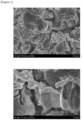
- FIG. 1 A set of electron microscope photographs of the surface of the catalyst for methane reformation according to Example 1 of the present application is illustrated in the following FIG. 1 .
- the content of the perovskite-based catalyst represented by Chemical Formula 1 or 2 may be calculated by the following Equation 1.
- Content wt % of perovskite-based catalyst represented by Chemical Formula 1 or 2 total weight of catalyst ⁇ weight of porous metal support / total weight of catalyst ⁇ 100
- a process was performed in the same manner as in Example 1, except that nickel nitrate (Ni(NO 3 ) 2 ) was used in an amount of 5 mol% relative to titanium based on the metal during the preparation of the second solution.
- Ni(NO 3 ) 2 nickel nitrate
- a process was performed in the same manner as in Example 1, except that yttrium nitrate (Y(NO 3 ) 2 ) was added in an amount of 12 mol% relative to strontium based on the metal during the preparation of the second solution and nickel nitrate (Ni(NO 3 ) 2 ) was added such that the molar ratio of titanium : nickel became 0.80 : 0.20.
- Y(NO 3 ) 2 yttrium nitrate
- Ni(NO 3 ) 2 nickel nitrate
- a process was performed in the same manner as in Example 1, except that yttrium nitrate (Y(NO 3 ) 2 ) was added in an amount of 8 mol% relative to strontium based on the metal and ruthenium chloride (RuCl 3 ) was added instead of nickel nitrate (Ni(NO 3 ) 2 ) such that the molar ratio of titanium : ruthenium became 0.80 : 0.15, during the preparation of the second solution.
- Y(NO 3 ) 2 yttrium nitrate
- RuCl 3 nickel nitrate
- a process was performed in the same manner as in Example 1, except that ZrO 2 was used instead of SiO 2 during the preparation of the first solution.
- a process was performed in the same manner as in Example 2, except that ZrO 2 was used instead of SiO 2 during the preparation of the first solution.
- a process was performed in the same manner as in Example 3, except that ZrO 2 was used instead of SiO 2 during the preparation of the first solution.
- a process was performed in the same manner as in Example 4, except that ZrO 2 was used instead of SiO 2 during the preparation of the first solution.
- a process was performed in the same manner as in Example 1, except that TiO 2 was used instead of SiO 2 during the preparation of the first solution.
- a process was performed in the same manner as in Example 2, except that TiO 2 was used instead of SiO 2 during the preparation of the first solution.
- a process was performed in the same manner as in Example 3, except that TiO 2 was used instead of SiO 2 during the preparation of the first solution.
- a process was performed in the same manner as in Example 4, except that TiO 2 was used instead of SiO 2 during the preparation of the first solution.
- a process was performed in the same manner as in Example 3, except that Al 2 O 3 was used instead of SiO 2 during the preparation of the first solution.
- a process was performed in the same manner as in Example 1, except that the precursor of the perovskite-based compound (SrTi03) was excluded and the inorganic oxide suspension was used alone during the preparation of the first solution.
- a process was performed in the same manner as in Example 3, except that the precursor of the perovskite-based compound (SrTi03) was excluded and the inorganic oxide suspension was used alone during the preparation of the first solution.
- a process was performed in the same manner as in Example 5, except that the precursor of the perovskite-based compound (SrTi03) was excluded and the inorganic oxide suspension was used alone during the preparation of the first solution.
- a process was performed in the same manner as in Example 7, except that the precursor of the perovskite-based compound (SrTi03) was excluded and the inorganic oxide suspension was used alone during the preparation of the first solution.
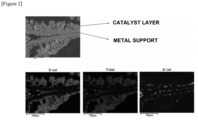
- the SEM-EDS mapping results of the catalyst for methane reformation according to Example 17 are illustrated in the following FIG. 2 .
- the Zr component is present as a coating layer on the skeleton surface of the porous metal support, and Sr and Ti, which are the main components of the perovskite-based compound represented by Chemical Formula 2, are present thereon.
- a process was performed in the same manner as in Example 8, except that the precursor of the perovskite-based compound (SrTi03) was excluded and the inorganic oxide suspension was used alone during the preparation of the first solution.
- a process was performed in the same manner as in Example 9, except that the precursor of the perovskite-based compound (SrTi03) was excluded and the inorganic oxide suspension was used alone during the preparation of the first solution.
- a process was performed in the same manner as in Example 11, except that the precursor of the perovskite-based compound (SrTi03) was excluded and the inorganic oxide suspension was used alone during the preparation of the first solution.
- a process was performed in the same manner as in Example 12, except that the precursor of the perovskite-based compound (SrTi03) was excluded and the inorganic oxide suspension was used alone during the preparation of the first solution.
- a process was performed in the same manner as in Example 13, except that the precursor of the perovskite-based compound (SrTi03) was excluded and the inorganic oxide suspension was used alone during the preparation of the first solution.
- a process was performed in the same manner as in Example 15, except that the content of the first coating layer (SiO 2 ) was adjusted so as to be 1.7 wt% based on the total weight of the catalyst for methane reformation.
- a process was performed in the same manner as in Example 15, except that the content of the first coating layer (SiO 2 ) was adjusted so as to be 13 wt% based on the total weight of the catalyst for methane reformation.
- a process was performed in the same manner as in Example 15, except that the content of the first coating layer (SiO 2 ) was adjusted so as to be 17 wt% based on the total weight of the catalyst for methane reformation.
- a process was performed in the same manner as in Example 18, except that ruthenium chloride (RuCl 3 ) was added such that the molar ratio of titanium : ruthenium became 0.85 : 0.15 during the preparation of the second solution.
- RuCl 3 ruthenium chloride
- a process was performed in the same manner as in Example 22, except that ruthenium chloride (RuCl 3 ) was added such that the molar ratio of titanium : ruthenium became 0.85 : 0.15 during the preparation of the second solution.
- RuCl 3 ruthenium chloride
- a process was performed in the same manner as in Example 3, except that as the porous metal support, NiFeCrAl (average pore size: 1,200 ⁇ m) was applied instead of NiCrAl.
- a process was performed in the same manner as in Example 7, except that as the porous metal support, NiFeCrAl (average pore size: 1,200 ⁇ m) was applied instead of NiCrAl.
- a process was performed in the same manner as in Example 11, except that as the porous metal support, NiFeCrAl (average pore size: 1,200 ⁇ m) was applied instead of NiCrAl.
- NiCrAl_800 average pore size: 800 ⁇ m
- NiCrAl_1500 average pore size: 1,500 ⁇ m
- a porous metal support (NiCrAl, average pore size: 1,200 ⁇ m) alone was used as Comparative Example 1.
- a process was performed in the same manner as in Example 1, except that the coating with the first solution alone was applied without the coating with the second solution.
- a process was performed in the same manner as in Example 16, except that the coating of the porous metal support with the first solution alone was applied without the coating of the catalyst precursor with the second solution.
- a process was performed in the same manner as in Example 16, except that the coating of the catalyst precursor with the second solution alone was applied without the coating of the porous metal support with the first solution.
- a process was performed in the same manner as in Example 3, except that the coating of the catalyst precursor with the second solution alone was applied without the coating of the porous metal support with the first solution.
- Example 1 NiCrAl SrTiO 3 + SiO 2 SrTi 0.97 N 0.03 O 3- ⁇
- Example 2 NiCrAl SrTiO 3 + SiO 2 SrTi 0.95 Ni 0.05 O 3- ⁇
- Example 3 NiCrAl SrTiO 3 + SiO 2 Sr 0.88 Y 0.12 Ti 0.80 Ni 0.20 O 3- ⁇
- Example 4 NiCrAl SrTiO 3 + SiO 2 Sr 0.92 Y 0.08 Ti 0.08 Ru 0.15 O 3- ⁇
- Example 5 NiCrAl SrTiO 3 + ZrO 2 SrTi 0.97 N 0.03 O 3- ⁇
- Example 6 NiCrAl SrTiO 3 + ZrO 2 SrTi 0.95 Ni 0.05 O 3- ⁇
- Example 7 NiCrAl SrTiO 3 + ZrO 2 Sr 0.88
- a fixed-bed reactor system was introduced to carry out a dry reforming reaction of methane.
- a catalytic reaction was performed for 100 hours. In order to more clearly compare the difference in activity between the catalysts, the activity characteristics of the catalysts were evaluated at severe space velocities.
- reaction conversion rate after 100 hours of reaction was calculated by analyzing the composition of the produced gas using gas chromatography (GC), and is shown in the following Table 2.
- a fixed-bed reactor system was introduced to carry out a dry reforming reaction of methane.
- a catalytic reaction was performed for 100 hours.
- reaction conversion rate after 100 hours of reaction was calculated by analyzing the composition of the produced gas using gas chromatography (GC), and is shown in the following Table 3.
- the catalyst for methane reformation which comprises the porous metal support according to the present invention, a first coating layer comprising an inorganic oxide, and a second coating layer comprising the perovskite-based compound represented by Chemical Formula 2 have excellent CH 4 conversion rate and CO 2 conversion rate compared to the Comparative Examples which do not comprise this configuration.
- the ratio of H 2 /CO can be improved compared to the Comparative Examples. Accordingly, it can be confirmed that side reactions caused by the porous metal support are reduced in the Examples of the present application.
- a fixed-bed reactor system was introduced to carry out a mixed reforming reaction of methane.
- the catalyst was about 2 g of Example 17.
- a catalytic reaction was performed for 100 hours.
- the catalyst for methane reformation can not only improve adhesion between a porous metal support and a second coating layer comprising a perovskite-based compound represented by Chemical Formula 2, but can also prevent side reactions of the porous metal support by forming a first coating layer comprising an inorganic oxide.
- the catalyst for methane reformation according to an exemplary embodiment of the present application is characterized in that reaction heat is easily controlled compared to pellet-type or powder-type catalysts in the related art because a perovskite-based compound is supported on a porous metal support having high thermal conductivity.
- the catalyst for methane reformation according to an exemplary embodiment of the present application is characterized by being able to additionally increase activity because there is a synergistic effect between a coated inorganic oxide and a perovskite-based compound represented by Chemical Formula 2.
- the catalyst for methane reformation according to an exemplary embodiment of the present application can exhibit high activity even at a high space velocity during a reforming reaction of methane because it is possible to increase the active surface area of the catalyst.
Landscapes
- Chemical & Material Sciences (AREA)
- Chemical Kinetics & Catalysis (AREA)
- Organic Chemistry (AREA)
- Engineering & Computer Science (AREA)
- Materials Engineering (AREA)
- Inorganic Chemistry (AREA)
- Combustion & Propulsion (AREA)
- General Health & Medical Sciences (AREA)
- Health & Medical Sciences (AREA)
- Physics & Mathematics (AREA)
- Thermal Sciences (AREA)
- Catalysts (AREA)
- Hydrogen, Water And Hydrids (AREA)
Abstract
Description
- This application claims priority to and the benefit of
Korean Patent Application No. 10-2021-0159454 filed in the Korean Intellectual Property Office on November 18, 2021 - The present application relates to a catalyst for methane reformation and a method for producing the same.
- As part of activities to reduce greenhouse gases caused by global warming, many studies on carbon dioxide conversion technologies have been conducted. The carbon dioxide reforming reaction, one of the carbon dioxide conversion technologies, is a technology to obtain synthesis gas composed of hydrogen and carbon monoxide by reacting methane and carbon dioxide.
- Synthesis gas is a material with high development value from diverse downstream raw materials. As a method for industrially obtaining synthesis gas (H2/CO), the reforming reaction of natural gas may be largely divided into steam reforming process, carbon dioxide (CO2) reforming process, catalytic partial oxidation process, autothermal reforming process, tri-reforming process, such as the following Reaction Schemes 1 to 5, and the like.
[Reaction Scheme 1] CH4 + H2O - 3H2 + CO ΔH = 226 kJ/mol
[Reaction Scheme 2] CH4 + CO2 - 2H2 + 2CO ΔH = 261 kJ/mol
[Reaction Scheme 3] CH4 + 0.5O2 - 2H2 + CO ΔH = -44 kJ/mol
[Reaction Scheme 4] autothermal reforming: Reaction Scheme 1 + Reaction Scheme 3
[Reaction Scheme 5] tri-reforming: Reaction Scheme 1 + Reaction Scheme 2 + Reaction Scheme 3
- Meanwhile, various catalysts may be used for reforming activity in the reforming process. Among them, when noble metal catalysts are used in the reforming process, there is an advantage in that the efficiency of converting natural gas into hydrogen is high, but there is a problem in that the economic feasibility deteriorates because noble metal catalysts are expensive.
- Accordingly, nickel catalysts, which have a high hydrogen conversion efficiency and are relatively inexpensive, are usually used in the reforming process. However, in such a case, there is a problem in that the nickel catalyst is deactivated by carbon that is inevitably produced on the surface of the nickel catalyst.
- Therefore, there is a need in the art for developing a catalyst which is resistant to carbon deposition and can be effectively applied to the reforming process of methane.
- The present application has been made in an effort to provide a catalyst for methane reformation and a method for producing the same.
- An exemplary embodiment of the present application provides a catalyst for methane reformation, comprising:
- a porous metal support;
- a first coating layer provided on the porous metal support and comprising an inorganic oxide; and
- a second coating layer provided on the first coating layer and comprising a perovskite-based compound represented by the following Chemical Formula 2.
[Chemical Formula 2] Sr1-xAxTiαByO3-δ
- In Chemical Formula 2,
- A is selected from Y, Sc, La and lanthanide series elements,
- B is Ni, Co, Fe, Mn, Cr, Mo, Ru or Rh,
- x is a real number of 0 or more and less than 1,
- y is a real number of 0 or more and less than 0.3,
- δ is a real number of 0 or more and less than 1,
- a is a real number of more than 0.7 and 1 or less, and
- (x + y) > 0 is satisfied.
- Further, another exemplary embodiment of the present application provides a method for producing a catalyst for methane reformation, the method comprising:
- preparing each of a first solution comprising an inorganic oxide or inorganic oxide precursor; and a second solution comprising a precursor of the perovskite-based compound represented by Chemical Formula 2;
- producing a catalyst precursor provided with a first coating layer by coating a porous metal support with the first solution, and then performing a first heat treatment process; and
- producing a catalyst provided with a second coating layer by coating the catalyst precursor provided with the first coating layer with the second solution, and then performing a second heat treatment process.
- The catalyst for methane reformation according to an exemplary embodiment of the present application can not only improve adhesion between a porous metal support and a second coating layer comprising a perovskite-based compound represented by Chemical Formula 2, but can also prevent side reactions of the porous metal support by forming an inorganic oxide; or a first coating layer comprising the inorganic oxide and a perovskite-based compound represented by the following Chemical Formula 1.
- In addition, the catalyst for methane reformation according to an exemplary embodiment of the present application is characterized in that reaction heat is easily controlled compared to pellet-type or powder-type catalysts in the related art because a perovskite-based compound is supported on a porous metal support having high thermal conductivity.
- Furthermore, the catalyst for methane reformation according to an exemplary embodiment of the present application is characterized by being able to additionally increase activity because there is a synergistic effect between a coated inorganic oxide and a perovskite-based compound represented by Chemical Formula 2.
- Further, the catalyst for methane reformation according to an exemplary embodiment of the present application can exhibit high activity even at a high space velocity during a reforming reaction of methane because it is possible to increase the active surface area of the catalyst.
-
-
FIG. 1 is a view illustrating a set of electron microscope photographs of the surface of the catalyst for methane reformation according to Example 1 of the present application. -
FIG. 2 is a view illustrating the SEM-EDS mapping results of the catalyst for methane reformation according to Example 17 of the present application. - Hereinafter, the present specification will be described in more detail.
- When one member is disposed "on" another member in the present specification, this comprises not only a case where the one member is brought into contact with another member, but also a case where still another member is present between the two members.
- When one part "comprises" one constituent element in the present specification, unless otherwise specifically described, this does not mean that another constituent element is excluded, but means that another constituent element may be further comprised.
- Currently, in the case of catalysts which are widely used in the field of reformers, generally, powder-type catalysts and pellet-type support catalysts are usually used. Although the powder-type catalysts may have excellent performance due to excellent dispersion degree of the catalyst, it is difficult to directly use the powder-type catalyst in the industry. For example, when a reformer is driven using the powder-type catalyst, the catalyst comes out together with a material produced after the reaction, and in this case, the catalyst in the form of a powder gradually accumulates in the stream tube at the exit portion, and eventually, a phenomenon of blocking the entire tube may occur. Therefore, there is a disadvantage in that the powder-type catalysts cannot be used in the commercial reformers used in the industry.
- In addition, the pellet-type support catalyst is currently frequently used in industrial reformers. Due to the limitation of the mass transfer rate, the performance deteriorates compared to the powder-type catalyst only in terms of the catalyst performance, but there is an advantage in that the pellet-type support catalyst can be used for a long period of time because a support is used. However, a γ-Al2O3 pellet, which is often used as the pellet-type support catalyst, has a weak structural strength, and thus may be easily broken, and accordingly, there is a disadvantage in that a differential pressure in the reactor is generated. Furthermore, since the volume is large due to the characteristics of the pellet-type support catalyst, the volume thereof becomes considerably large when the pellet-type support catalyst is used in a high-capacity reformer. Further, all reforming reactions are sensitive to reaction temperature, but the existing pellet-type catalyst has a disadvantage in that heat is not evenly distributed throughout the reactor due to a large reduction in thermal conductivity. In addition, since the reforming reaction is very fast, in the case of a pellet-type support or an extruded catalyst, the effectiveness factor of the catalyst is 0.3 or less, so that there is a disadvantage in that the utilization of the catalyst deteriorates.
- Thus, the present application intended to alleviate a phenomenon of blocking the stream tube, which is a disadvantage of the powder-type, and improve the heat and mass transfer rates which are a common disadvantage of the powder-type and the pellet-type, through a method of coating a porous metal support catalyst having high heat and mass transfer rates with a catalyst. Further, the present application intends to provide a catalyst for methane reformation capable of supporting a large amount of catalyst at one time and suppressing side reactions caused by a binder.
- The catalyst for methane reformation according to an exemplary embodiment of the present application comprises: a porous metal support; a first coating layer provided on the porous metal support and comprising an inorganic oxide; and a second coating layer provided on the first coating layer and comprising the perovskite-based compound represented by Chemical Formula 2.
- In an exemplary embodiment of the present application, the first coating layer may further comprise a perovskite-based compound represented by the following Chemical Formula 1.
[Chemical Formula 1] SrTi03
- In an exemplary embodiment of the present application, the perovskite-based compound represented by Chemical Formula 1 is a catalyst component-free compound, the perovskite-based compound represented by Chemical Formula 2 is a compound comprising a catalyst component (A and/or B of Chemical Formula 2), and these are different from each other.
- In an exemplary embodiment of the present application, Chemical Formula 2 may be represented by the following Chemical Formula 3 or 4.
[Chemical Formula 3] SrTiαByO3-δ
[Chemical Formula 4] Sr1-xYxTiαByO3-δ
In Chemical Formulae 3 and 4, - B is Ni or Ru,
- x is a real number of more than 0 and less than 1,
- y is a real number of more than 0 and less than 0.3, and
- δ is a real number of more than 0 and less than 1, and
- α is a real number of more than 0.7 and 1 or less.
- In an exemplary embodiment of the present application, the porous metal support may be composed of a material capable of maintaining thermal stability at a high temperature of 800°C or more.
- In an exemplary embodiment of the present application, the porous metal support may be a metal foam comprising NiFeCrAl, NiCrAl, SiC or α-Al2O3.
- The porous metal support is a support having various shapes, has a small heat capacity and an excellent heat transfer ability, and thus may be molded into a desired shape for use. The form, size and the like of the porous metal support are not particularly limited, and the porous metal support may have a porosity of 10% to 99%, 50% to 96%, and 85% to 96%. The porous metal support may have an average pore size (cell size) of 400 µm to 2,000 µm, and 450 µm to 1,500 µm. When the porous metal support has an average pore size of less than 400 µm, it may be difficult to coat the porous metal support with a precursor solution, and when the porous metal support has an average pore size of more than 2,000 µm, the surface area on which the catalyst can be coated is reduced, so that the average pore size range is not preferred because the range may be disadvantageous in the process. The porous metal support may be appropriately produced by those skilled in the art using methods known in the art, in consideration of the material, pore size, porosity, and the like of the porous metal support. According to an exemplary embodiment of the present application, a porous metal support having various materials, pore sizes, and the like may be applied as in Examples to be described below.
- In an exemplary embodiment of the present application, the inorganic oxide may comprise one or more of TiO2, SiO2, ZrO2, and Al2O3. In addition, the case where the inorganic oxide comprises Al2O3 may be disadvantageous in terms of coke production because scattered spots may develop more in the temperature range of a heat treatment process to be described below compared to the case where the inorganic oxide comprises other inorganic oxides, so that it is more preferred that the inorganic oxide comprises one or more of TiO2, SiO2 and ZrO2.
- In an exemplary embodiment of the present application, the first coating layer may comprise an inorganic oxide alone, and may also comprise both the perovskite-based compound represented by Chemical Formula 1 and an inorganic oxide.
- In an exemplary embodiment of the present application, a total content of the perovskite-based compound represented by Chemical Formula 1 and the inorganic oxide may be 1 wt% to 20 wt%, and 1.5 wt% to 18 wt% based on the total weight of the porous metal support. When the total content of the perovskite-based compound represented by Chemical Formula 1 and the inorganic oxide exceeds 20 wt%, the remaining capacity capable of coating the perovskite-based compound represented by Chemical Formula 2 may be reduced, and accordingly, the aforementioned total weight range is not preferred because the activity of the catalyst may be reduced compared to the volume of the porous metal support. Furthermore, when the total content of the perovskite-based compound represented by Chemical Formula 1 and the inorganic oxide is less than 1 wt%, it may be difficult to obtain the effect caused by the first coating layer because the content is so small.
- In an exemplary embodiment of the present application, the weight ratio of the first coating layer : the second coating layer comprising the perovskite-based compound represented by Chemical Formula 2 may be 1 : 1 to 1 : 20, and 1 : 1.1 to 1 : 15. The case where the weight ratio of the first coating layer : the second coating layer comprising the perovskite-based compound represented by Chemical Formula 2 is out of the range is not preferred because the activity of the catalyst may be reduced compared to the volume of the porous metal support.
- In an exemplary embodiment of the present application, the (a + y) of Chemical Formula 2 may be 1. Further, in an exemplary embodiment of the present application, the (a + y) of Chemical Formula 2 may be a real number of more than 0.90 and less than 1. In Chemical Formula 2, B such as Ni substitutes a part of Ti, and the theoretical stoichiometric ratio of (a + y) is 1, but when the content of Ti is slightly less than the theoretical stoichiometric ratio during the preparation of the perovskite-based compound represented by Chemical Formula 2, Ti in Chemical Formula 2 may be more easily substituted with B such as Ni.
- In an exemplary embodiment of the present application, a content of the perovskite-based compound represented by Chemical Formula 2 may be 3 wt% to 40 wt%, 6 wt% to 35 wt%, and 7 wt% to 30 wt%, based on a total weight of the catalyst for methane reformation. When the content of the perovskite-based compound represented by Chemical Formula 2 is less than 3 wt% based on the total weight of the catalyst for methane reformation, the reactivity may be lowered due to relatively few active sites on the catalyst surface, so the content is not preferred. In addition, when the content of the perovskite-based compound represented by Chemical Formula 2 exceeds 40 wt%, a relatively large amount of the catalyst component is contained compared to the porous metal support, making it difficult to maintain the pore structure, it may not be easy to bond the catalyst component to the porous metal support, and accordingly, the practical benefits of the methane reforming reaction may be reduced.
- In an exemplary embodiment of the present application, the first coating layer may be provided on the entire surface on the porous metal support.
- In an exemplary embodiment of the present application, at least a portion of the surface of the catalyst for methane reformation may comprise protrusion shapes. The protrusion shape may be spherical, elliptical, or a combination thereof, but is not limited thereto.
- In an exemplary embodiment of the present application, the first coating layer comprising the inorganic oxide may serve to fix the coating layer comprising the perovskite-based compound represented by Chemical Formula 2 on the porous metal support. Furthermore, the coating layer comprising the perovskite-based compound represented by Chemical Formula 2 may be present in the form of protrusions on the first coating layer, and accordingly, the performance of the methane reforming reaction may be improved by increasing the reaction surface area of the catalyst.
- Further, according to an exemplary embodiment of the present application, by simultaneously applying the first coating layer comprising the inorganic oxide; and the second coating layer comprising the perovskite-based compound represented by Chemical Formula 2, the total content of catalyst supported on the porous metal support may be increased compared to when catalyst particles are applied alone. In addition, according to an exemplary embodiment of the present application, the durability and performance of the catalyst may be improved because it is possible to prevent a phenomenon in which a metal (Ni, Cr, and the like) that is the main component of the porous metal support is exposed to the surface in the form of a metal oxide (NiO, Cr2O3, and the like) under long-term operation conditions at high temperature (750°C or higher) and prevent the changes in component proportion or phase of the catalyst of Chemical Formula 2 by applying the first coating layer comprising the inorganic oxide.
- In an exemplary embodiment of the present application, the catalyst for methane reformation may be applied to a steam reforming process, a carbon dioxide (CO2) reforming process, a catalytic partial oxidation process, an autothermal reforming process, a tri-reforming process or a mixed reforming process, and the methane reforming process is not particularly limited.
- The method for producing a catalyst for methane reformation according to an exemplary embodiment of the present application comprises: preparing each of a first solution comprising an inorganic oxide or inorganic oxide precursor; and a second solution comprising a precursor of the perovskite-based compound represented by Chemical Formula 2; producing a catalyst precursor provided with a first coating layer by coating a porous metal support with the first solution, and then performing a first heat treatment process; and producing a catalyst provided with a second coating layer by coating the catalyst precursor provided with the first coating layer with the second solution, and then performing a second heat treatment process.
- In the method for producing a catalyst for methane reformation according to an exemplary embodiment of the present application, the first solution may further comprise a precursor of the perovskite-based compound represented by Chemical Formula 1.
- In the method for producing a catalyst for methane reformation according to an exemplary embodiment of the present application, details on the porous metal support, the perovskite-based compound represented by Chemical Formula 1, the inorganic oxide, the perovskite-based compound represented by Chemical Formula 2, and the like are the same as those as described above.
- In particular, the solution comprising the precursor of the perovskite-based compound represented by Chemical Formula 1 and the solution comprising the precursor of the perovskite-based compound represented by Chemical Formula 2 may be each applied in the form of a sol or gel. Furthermore, the first solution comprising the inorganic oxide may be provided in the form of not only a particle dispersion, but also a sol or gel of a solution comprising an inorganic oxide precursor.
- The precursor of the perovskite-based compound is a precursor of the metal constituting the perovskite-based compound, and the metal molar ratio of the perovskite-based compound may be adjusted by adjusting the content thereof. In addition, the precursor of the metal is not particularly limited, and ammonium salts, nitrates, carbonates, chlorides, lactates, hydroxides, organic acid salts, oxides of the metal elements, or mixtures thereof may be applied in combination.
- The method for producing a catalyst for methane reformation according to an exemplary embodiment of the present application comprises preparing each of a first solution comprising an inorganic oxide or inorganic oxide precursor; and a second solution comprising a precursor of the perovskite-based compound represented by Chemical Formula 2.
- The first solution and the second solution may each independently further comprise a solvent, and as the solvent, a solvent known in the art may be applied, and is not particularly limited thereto. Furthermore, the first solution may further comprise an organic dispersant, and as the organic dispersant, an organic dispersant known in the art may be applied, and is not particularly limited thereto. Further, the first solution comprising the inorganic oxide may have a pH of 1 to 5, and 1 to 3.
- In addition, the first solution may comprise an inorganic oxide and may also comprise an inorganic oxide precursor such as a metal salt.
- The method for producing a catalyst for methane reformation according to an exemplary embodiment of the present application comprises: producing a catalyst precursor provided with a first coating layer by coating a porous metal support with the first solution, and then performing a first heat treatment process; and producing a catalyst provided with a second coating layer by coating the catalyst precursor provided with the first coating layer with the second solution, and then performing a second heat treatment process.
- As the coating method of the first solution and the second solution, methods known in the art may be used, and dip-coating, wash-coating and the like may be used, but the method is not limited thereto.
- The first heat treatment process and the second heat treatment process may each independently comprise performing drying and firing. The drying may be performed at a temperature of 50°C to 150°C for 1 hour to 48 hours, and may be performed at a temperature of 60°C to 100°C for 5 hours to 36 hours, but is not limited thereto. Further, the firing may be performed at a temperature of 350°C to 1 100°C for 1 hour to 10 hours in an air atmosphere, and may be performed at a temperature of 500°C to 1,000°C for 1.5 hours to 8 hours in an air atmosphere, but is not limited thereto. When the firing is performed at a temperature less than 350°C, the perovskite phase may not be properly formed, and when the firing is performed at a temperature more than 1,100°C, the durability of the porous metal support may deteriorate, so that the temperature is not preferred.
- In an exemplary embodiment of the present application, the method may further comprise measuring the weight of the catalyst supported on the porous metal support after the second heat treatment process. In addition, by measuring the weight of the catalyst supported on the porous metal support, the coating of the catalyst precursor with the first coating layer with the above-described second solution until a desired amount of catalyst is supported on the porous metal support, and then the performing of the second heat treatment process may be performed repeatedly once to 10 times until a desired amount of catalyst is supported on the porous metal support.
- The catalyst for methane reformation according to an exemplary embodiment of the present application can not only improve adhesion between a porous metal support and a second coating layer comprising a perovskite-based compound represented by Chemical Formula 2, but can also prevent side reactions of the porous metal support by forming a first coating layer comprising an inorganic oxide.
- In addition, the catalyst for methane reformation according to an exemplary embodiment of the present application is characterized in that reaction heat is easily controlled compared to pellet-type or powder-type catalysts in the related art because a perovskite-based compound is supported on a porous metal support having high thermal conductivity.
- Furthermore, the catalyst for methane reformation according to an exemplary embodiment of the present application is characterized by being able to additionally increase activity because there is a synergistic effect between a coated inorganic oxide and a perovskite-based compound represented by Chemical Formula 2.
- Further, the catalyst for methane reformation according to an exemplary embodiment of the present application can exhibit high activity even at a high space velocity during a reforming reaction of methane because it is possible to increase the active surface area of the catalyst.
- Hereinafter, the present application will be described in detail with reference to Examples for specifically describing the present application. However, the Examples according to the present application may be modified in various forms, and it is not interpreted that the scope of the present application is limited to the Examples described in detail below. The Examples of the present application are provided for more completely explaining the present application to the person with ordinary skill in the art.
- A suspension comprising 15 wt% of SiO2 was prepared. In this case, the prepared inorganic oxide suspension had a pH of 1 to 3.
- A solution comprising a precursor of a perovskite compound (SrTi03) was prepared by the citrate method. Strontium nitrate (Sr(NO3)3H2O) was dissolved in distilled water together with citric acid and ethylene glycol. After titanium isopropoxide (Ti(OCH(CH3)2)4) was dissolved in ethanol, the two solutions were mixed at 70°C. Thereafter, after the mixture was stirred for 3 hours, the mixture was cooled to room temperature and stored. In this case, the concentration of the solution was 0.1 M.
- A mixed solution of a solution comprising a precursor of the perovskite compound (SrTi03) and an inorganic oxide suspension was prepared.
- A solution comprising a precursor of a perovskite compound (SrTi0.97Ni0.03O3-δ) was prepared by the citrate method. Strontium nitrate (Sr(NO3)3H2O) and nickel nitrate (Ni(NO3)2) were dissolved in distilled water together with citric acid and ethylene glycol. After titanium isopropoxide (Ti(OCH(CH3)2)4) was dissolved in ethanol, the two solutions were mixed at 70°C. Thereafter, after the mixture was stirred for 3 hours, the mixture was cooled to room temperature and stored. In this case, the concentration of the solution was 0.1 M, and Ni was comprised in an amount of 3 mol% relative to Ti.
- A porous metal support (NiCrAl, average pore size: 1,200 µm) was dip-coated with the first solution (formation of a first coating layer), and then dried at 70°C for 24 hours, and heat-treated at 300°C to 900°C in an air atmosphere for 3 hours.
- Thereafter, the porous metal support in which the first coating layer was formed was dip-coated with the second solution (formation of a second coating layer), and then dried at 70°C for 24 hours, and heat-treated at 300°C to 900°C in an air atmosphere for 3 hours. The dip coating, drying and heat treatment of the second solution was repeated several times to finally produce a catalyst in which a first coating layer (SrTi03 + SiO2) and a second coating layer (SrTi0.97Ni0.03O3-δ, 0 < δ < 1) were provided on a porous metal support. Based on the total weight of the catalyst for methane reformation, the content of the first coating layer (SrTi03 + SiO2) was 7 wt%, and the content of the perovskite-based compound (SrTi0.97Ni0.03O3-δ, 0 < δ < 1) represented by Chemical Formula 2 was 20 wt%.
- A set of electron microscope photographs of the surface of the catalyst for methane reformation according to Example 1 of the present application is illustrated in the following
FIG. 1 . - The content of the perovskite-based catalyst represented by Chemical Formula 1 or 2 may be calculated by the following Equation 1.

- A process was performed in the same manner as in Example 1, except that nickel nitrate (Ni(NO3)2) was used in an amount of 5 mol% relative to titanium based on the metal during the preparation of the second solution.
- A process was performed in the same manner as in Example 1, except that yttrium nitrate (Y(NO3)2) was added in an amount of 12 mol% relative to strontium based on the metal during the preparation of the second solution and nickel nitrate (Ni(NO3)2) was added such that the molar ratio of titanium : nickel became 0.80 : 0.20.
- A process was performed in the same manner as in Example 1, except that yttrium nitrate (Y(NO3)2) was added in an amount of 8 mol% relative to strontium based on the metal and ruthenium chloride (RuCl3) was added instead of nickel nitrate (Ni(NO3)2) such that the molar ratio of titanium : ruthenium became 0.80 : 0.15, during the preparation of the second solution.
- A process was performed in the same manner as in Example 1, except that ZrO2 was used instead of SiO2 during the preparation of the first solution.
- A process was performed in the same manner as in Example 2, except that ZrO2 was used instead of SiO2 during the preparation of the first solution.
- A process was performed in the same manner as in Example 3, except that ZrO2 was used instead of SiO2 during the preparation of the first solution.
- A process was performed in the same manner as in Example 4, except that ZrO2 was used instead of SiO2 during the preparation of the first solution.
- A process was performed in the same manner as in Example 1, except that TiO2 was used instead of SiO2 during the preparation of the first solution.
- A process was performed in the same manner as in Example 2, except that TiO2 was used instead of SiO2 during the preparation of the first solution.
- A process was performed in the same manner as in Example 3, except that TiO2 was used instead of SiO2 during the preparation of the first solution.
- A process was performed in the same manner as in Example 4, except that TiO2 was used instead of SiO2 during the preparation of the first solution.
- A process was performed in the same manner as in Example 3, except that Al2O3 was used instead of SiO2 during the preparation of the first solution.
- A process was performed in the same manner as in Example 1, except that the precursor of the perovskite-based compound (SrTi03) was excluded and the inorganic oxide suspension was used alone during the preparation of the first solution.
- A process was performed in the same manner as in Example 3, except that the precursor of the perovskite-based compound (SrTi03) was excluded and the inorganic oxide suspension was used alone during the preparation of the first solution.
- A process was performed in the same manner as in Example 5, except that the precursor of the perovskite-based compound (SrTi03) was excluded and the inorganic oxide suspension was used alone during the preparation of the first solution.
- A process was performed in the same manner as in Example 7, except that the precursor of the perovskite-based compound (SrTi03) was excluded and the inorganic oxide suspension was used alone during the preparation of the first solution.
- The SEM-EDS mapping results of the catalyst for methane reformation according to Example 17 are illustrated in the following
FIG. 2 . As shown in the result of the followingFIG. 2 , it can be confirmed that the Zr component is present as a coating layer on the skeleton surface of the porous metal support, and Sr and Ti, which are the main components of the perovskite-based compound represented by Chemical Formula 2, are present thereon. - A process was performed in the same manner as in Example 8, except that the precursor of the perovskite-based compound (SrTi03) was excluded and the inorganic oxide suspension was used alone during the preparation of the first solution.
- A process was performed in the same manner as in Example 9, except that the precursor of the perovskite-based compound (SrTi03) was excluded and the inorganic oxide suspension was used alone during the preparation of the first solution.
- A process was performed in the same manner as in Example 11, except that the precursor of the perovskite-based compound (SrTi03) was excluded and the inorganic oxide suspension was used alone during the preparation of the first solution.
- A process was performed in the same manner as in Example 12, except that the precursor of the perovskite-based compound (SrTi03) was excluded and the inorganic oxide suspension was used alone during the preparation of the first solution.
- A process was performed in the same manner as in Example 13, except that the precursor of the perovskite-based compound (SrTi03) was excluded and the inorganic oxide suspension was used alone during the preparation of the first solution.
- A process was performed in the same manner as in Example 15, except that the content of the first coating layer (SiO2) was adjusted so as to be 1.7 wt% based on the total weight of the catalyst for methane reformation.
- A process was performed in the same manner as in Example 15, except that the content of the first coating layer (SiO2) was adjusted so as to be 13 wt% based on the total weight of the catalyst for methane reformation.
- A process was performed in the same manner as in Example 15, except that the content of the first coating layer (SiO2) was adjusted so as to be 17 wt% based on the total weight of the catalyst for methane reformation.
- A process was performed in the same manner as in Example 18, except that ruthenium chloride (RuCl3) was added such that the molar ratio of titanium : ruthenium became 0.85 : 0.15 during the preparation of the second solution.
- A process was performed in the same manner as in Example 22, except that ruthenium chloride (RuCl3) was added such that the molar ratio of titanium : ruthenium became 0.85 : 0.15 during the preparation of the second solution.
- A process was performed in the same manner as in Example 3, except that as the porous metal support, NiFeCrAl (average pore size: 1,200 µm) was applied instead of NiCrAl.
- A process was performed in the same manner as in Example 7, except that as the porous metal support, NiFeCrAl (average pore size: 1,200 µm) was applied instead of NiCrAl.
- A process was performed in the same manner as in Example 11, except that as the porous metal support, NiFeCrAl (average pore size: 1,200 µm) was applied instead of NiCrAl.
- A process was performed in the same manner as in Example 7, except that as the porous metal support, NiCrAl_800 (average pore size: 800 µm) was applied instead of NiCrAl.
- A process was performed in the same manner as in Example 7, except that as the porous metal support, NiCrAl_1500 (average pore size: 1,500 µm) was applied instead of NiCrAl.
- A porous metal support (NiCrAl, average pore size: 1,200 µm) alone was used as Comparative Example 1.
- A process was performed in the same manner as in Example 1, except that the coating with the first solution alone was applied without the coating with the second solution.
- A process was performed in the same manner as in Example 16, except that the coating of the porous metal support with the first solution alone was applied without the coating of the catalyst precursor with the second solution.
- A process was performed in the same manner as in Example 16, except that the coating of the catalyst precursor with the second solution alone was applied without the coating of the porous metal support with the first solution.
- A process was performed in the same manner as in Example 3, except that the coating of the catalyst precursor with the second solution alone was applied without the coating of the porous metal support with the first solution.
- The configurations of the porous metal supports, the first coating layer and the second coating layer in the Examples and Comparative Examples are shown in the following Table 1.
[Table 1] Porous metal support First coating layer Second coating layer Example 1 NiCrAl SrTiO3 + SiO2 SrTi0.97N0.03O3-δ Example 2 NiCrAl SrTiO3 + SiO2 SrTi0.95Ni0.05O3-δ Example 3 NiCrAl SrTiO3 + SiO2 Sr0.88Y0.12Ti0.80Ni0.20O3-δ Example 4 NiCrAl SrTiO3 + SiO2 Sr0.92Y0.08Ti0.08Ru0.15O3-δ Example 5 NiCrAl SrTiO3 + ZrO2 SrTi0.97N0.03O3-δ Example 6 NiCrAl SrTiO3 + ZrO2 SrTi0.95Ni0.05O3-δ Example 7 NiCrAl SrTiO3 + ZrO2 Sr0.88Y0.12Ti0.80Ni0.20O3-δ Example 8 NiCrAl SrTiO3 + ZrO2 Sr0.92Y0.08Ti0.80Ru0.15O3-δ Example 9 NiCrAl SrTiO3 + TiO2 SrTi0.97N0.03O3-δ Example 10 NiCrAl SrTiO3 + TiO2 SrTi0.95Ni0.05O3-δ Example 11 NiCrAl SrTiO3 + TiO2 Sr0.88Y0.12Ti0.80Ni0.20O3-δ Example 12 NiCrAl SrTiO3 + TiO2 Sr0.92Y0.08Ti0.80Ru0.15O3-δ Example 13 NiCrAl SrTiO3 + Al2O3 Sr0.88Y0.12Ti0.80Ni0.20O3-δ Example 14 NiCrAl SiO2 SrTi0.97N0.03O3-δ Example 15 NiCrAl SiO2 Sr0.88Y0.12Ti0.80Ni0.20O3-δ Example 16 NiCrAl ZrO2 SrTi0.97N0.03O3-δ Example 17 NiCrAl ZrO2 Sr0.88Y0.12Ti0.80Ni0.20O3-δ Example 18 NiCrAl ZrO2 Sr0.92Y0.08Ti0.80Ru0.15O3-δ Example 19 NiCrAl TiO2 SrTi0.97N0.03O3-δ Example 20 NiCrAl TiO2 Sr0.88Y0.12Ti0.80Ni0.20O3-δ Example 21 NiCrAl TiO2 Sr0.92Y0.08Ti0.80Ru0.15O3-δ Example 22 NiCrAl Al2O3 Sr0.88Y0.12Ti0.80Ni0.20O3-δ Example 23 NiCrAl SiO2 Sr0.88Y0.12Ti0.80Ni0.20O3-δ Example 24 NiCrAl SiO2 Sr0.88Y0.12Ti0.80Ni0.20O3-δ Example 25 NiCrAl SiO2 Sr0.88Y0.12Ti0.80Ni0.20O3-δ Example 26 NiCrAl ZrO2 Sr0.92Y0.08Ti0.85Ru0.15O3-δ Example 27 NiCrAl Al2O3 Sr0.92Y0.08Ti0.85Ru0.15O3-δ Example 28 NiFeCrAl SrTiO3 + SiO2 Sr0.88Y0.12Ti0.80Ni0.20O3-δ Example 29 NiFeCrAl SrTiO3 + ZrO2 Sr0.88Y0.12Ti0.80Ni0.20O3-δ Example 30 NiFeCrAl SrTiO3 + TiO2 Sr0.88Y0.12Ti0.80Ni0.20O3-δ Example 31 NiCrAl_800 SrTiO3 + ZrO2 Sr0.88Y0.12Ti0.80Ni0.20O3-δ Example 32 NiCrAl_1500 SrTiO3 + ZrO2 Sr0.88Y0.12Ti0.80Ni0.20O3-δ Comparative Example 1 NiCrAl - - Comparative Example 2 NiCrAl SrTiO3 + SiO2 - Comparative Example 3 NiCrAl ZrO2 - Comparative Example 4 NiCrAl - SrTi0.97N0.03O3-δ Comparative Example 5 NiCrAl - Sr0.88Y0.12Ti0.80Ni0.20O3-δ - A fixed-bed reactor system was introduced to carry out a dry reforming reaction of methane. A Quartz tube reactor (inner diameter = 1/2 inch, length = 50 cm) was used and packed with each catalyst (about 2g) of the Examples and the Comparative Examples. First, after the catalyst underwent a reduction process at 800°C under 10% H2/N2 conditions for 1 hour to 2 hours, a catalytic reaction was performed for 100 hours. In order to more clearly compare the difference in activity between the catalysts, the activity characteristics of the catalysts were evaluated at severe space velocities.
- Gas composition: CH4 : CO2: N2 = 1 : 1.2 : 0.96
- Flow rate: gas hour space velocity (GHSV) = 2,500 hr-1 (based on CH4)
- Reaction temperature: 750°C
- Reaction pressure: 1 bar
- A reaction conversion rate after 100 hours of reaction was calculated by analyzing the composition of the produced gas using gas chromatography (GC), and is shown in the following Table 2.

-
1) GC model: Agilent 6890
2) Oven temp.: 40°C/7 min-90°C/5 min-180°C/6 min
3) Detector: TCD, 250°C
4) Sample: 0.25 mL
5) Valve box Temp.: 150°C[Table 2] Catalyst type GHSV(hr-1) CH4 conversion rate (%) CO2 conversion rate (%) H2/CO Example 1 2,500 57 60 0.75 Example 2 2,500 58 62 0.74 Example 3 2,500 69 73 0.79 Example 4 2,500 67 73 0.78 Example 5 2,500 58.3 72 0.74 Example 6 2,500 60 63 0.76 Example 7 2,500 74 81 0.80 Example 8 2,500 72 81 0.81 Example 9 2,500 57 63 0.74 Example 10 2,500 59 63 0.76 Example 11 2,500 67.5 71 0.77 Example 12 2,500 67 72 0.78 Example 13 2,500 67 72 0.78 Example 14 2,500 61 65 0.76 Example 15 2,500 69 72 0.78 Example 16 2,500 62 70 0.75 Example 17 2,500 74.2 82 0.81 Example 18 2,500 72 81 0.80 Example 19 2,500 60 65 0.75 Example 20 2,500 67 71 0.77 Example 21 2,500 68 73 0.78 Example 22 2,500 67 72 0.75 Example 23 2,500 63 67 0.74 Example 24 2,500 71 79 0.80 Example 25 2,500 64 69 0.75 Comparative Example 1 2,500 18 20 0.54 Comparative Example 2 2,500 3 4 0.20 Comparative Example 3 2,500 0 0 - Comparative Example 4 2,500 42 54 0.73 Comparative Example 5 2,500 50 58 0.72 - A fixed-bed reactor system was introduced to carry out a dry reforming reaction of methane. A Quartz tube reactor (inner diameter = 1/2 inch, length = 50 cm) was used and packed with each catalyst (about 2g) of the Examples and the Comparative Examples. First, after the catalyst underwent a reduction process at 800°C under 10% H2/N2 conditions for 1 hour to 2 hours, a catalytic reaction was performed for 100 hours.
- Gas composition: CH4 : CO2: N2 = 1 : 1.2 : 0.96
- Flow rate: gas hour space velocity (GHSV) = 1,500 hr-1 (based on CH4)
- Reaction temperature: 800°C
- Reaction pressure: 1 bar
- A reaction conversion rate after 100 hours of reaction was calculated by analyzing the composition of the produced gas using gas chromatography (GC), and is shown in the following Table 3.

-
1) GC model: Agilent 6890
2) Oven temp.: 40°C/7 min-90°C/5 min-180°C/6 min
3) Detector: TCD, 250°C
4) Sample: 0.25 mL
5) Valve box Temp.: 150°C[Table 3] Catalyst type GHSV(hr-1) CH4 conversion rate (%) CO2 conversion rate (%) H2/CO Example 3 1,500 92 90 0.84 Example 7 1,500 93 91 0.85 Example 11 1,500 92 90 0.85 Example 15 1,500 92 89 0.85 Example 17 1,500 94 91 0.85 Example 20 1,500 91 90 0.84 Example 26 1,500 93 91 0.87 Example 27 1,500 91 88 0.85 Example 28 1,500 91 89 0.84 Example 29 1,500 93 91 0.85 Example 30 1,500 93 90 0.85 Example 31 1,500 95 92 0.87 Example 32 1,500 90 89 0.83 Comparative Example 1 1,500 20 23 0.54 Comparative Example 2 1,500 3 4 0.20 Comparative Example 3 1,500 0 0 - Comparative Example 4 1,500 87 88 0.82 - As in the results of Tables 2 and 3, it can be confirmed that the catalyst for methane reformation, which comprises the porous metal support according to the present invention, a first coating layer comprising an inorganic oxide, and a second coating layer comprising the perovskite-based compound represented by Chemical Formula 2 have excellent CH4 conversion rate and CO2 conversion rate compared to the Comparative Examples which do not comprise this configuration.
- In addition, it can be confirmed that in the Examples of the present application, the ratio of H2/CO can be improved compared to the Comparative Examples. Accordingly, it can be confirmed that side reactions caused by the porous metal support are reduced in the Examples of the present application.
- A fixed-bed reactor system was introduced to carry out a mixed reforming reaction of methane. A quartz tube reactor (inner diameter = 1/2 inch, length = 50 cm) was used and packed with the catalyst (about 2 g) of Example 17. First, after the catalyst underwent a reduction process at 800°C under 10% H2/N2 conditions for 1 hour to 2 hours, a catalytic reaction was performed for 100 hours.
- Gas composition: CH4 : H2O : CO2 = 1 : 0.8 : 0.4
- Flow rate: gas hour space velocity (GHSV) = 1,500 h-1
- Reaction temperature: 800°C
- Reaction pressure: 1 bar
- A reaction conversion rate after 100 hours of reaction was calculated by using gas chromatography (GC) to analyze the composition of produced gases, and as a result, a result in which a CH4 conversion rate was 93%, a CO2 conversion rate was 68%, and H2/CO = 1.9 was obtained.

-
- 1) GC model: Agilent 6890
- 2) Oven temp.: 40°C/7 min-90°C/5 min-180°C/6 min
- 3) Detector: TCD, 250°C
- 4) Sample: 0.25 mL
- 5) Valve box Temp.: 150°C
- As in the aforementioned results, the catalyst for methane reformation according to an exemplary embodiment of the present application can not only improve adhesion between a porous metal support and a second coating layer comprising a perovskite-based compound represented by Chemical Formula 2, but can also prevent side reactions of the porous metal support by forming a first coating layer comprising an inorganic oxide.
- Furthermore, the catalyst for methane reformation according to an exemplary embodiment of the present application is characterized in that reaction heat is easily controlled compared to pellet-type or powder-type catalysts in the related art because a perovskite-based compound is supported on a porous metal support having high thermal conductivity.
- Further, the catalyst for methane reformation according to an exemplary embodiment of the present application is characterized by being able to additionally increase activity because there is a synergistic effect between a coated inorganic oxide and a perovskite-based compound represented by Chemical Formula 2.
- In addition, the catalyst for methane reformation according to an exemplary embodiment of the present application can exhibit high activity even at a high space velocity during a reforming reaction of methane because it is possible to increase the active surface area of the catalyst.
Claims (12)
- A catalyst for methane reformation, comprising:a porous metal support;a first coating layer provided on the porous metal support and comprising an inorganic oxide; anda second coating layer provided on the first coating layer and comprising a perovskite-based compound represented by the following Chemical Formula 2:
[Chemical Formula 2] Sr1-xAxTiαByO3-δ
wherein, in Chemical Formula 2,A is selected from Y, Sc, La and lanthanide series elements,B is Ni, Co, Fe, Mn, Cr, Mo, Ru or Rh,x is a real number of 0 or more and less than 1,y is a real number of 0 or more and less than 0.3,δ is a real number of 0 or more and less than 1,α is a real number of more than 0.7 and 1 or less, and(x + y) > 0 is satisfied. - The catalyst of claim 1, wherein the first coating layer further comprises a perovskite-based compound represented by the following Chemical Formula 1:
[Chemical Formula 1] SrTi03
- The catalyst of claim 1, wherein Chemical Formula 2 is represented by the following Chemical Formula 3 or 4:
[Chemical Formula 3] SrTiαByO3-δ
[Chemical Formula 4] Sr1-xYxTiαByO3-δ
in Chemical Formulae 3 and 4,B is Ni or Ru,x is a real number of more than 0 and less than 1,y is a real number of more than 0 and less than 0.3, andδ is a real number of more than 0 and less than 1, andα is a real number of more than 0.7 and 1 or less. - The catalyst of claim 1, wherein the porous metal support is a metal foam comprising NiFeCrAl, NiCrAl, SiC or α-Al2O3.
- The catalyst of claim 1, wherein the inorganic oxide comprise one or more of TiO2, SiO2 and ZrO2.
- The catalyst of claim 1, wherein a content of the perovskite-based compound represented by Chemical Formula 2 is 3 wt% to 40 wt% based on a total weight of the catalyst for methane reformation.
- The catalyst of claim 1, wherein the catalyst for methane reformation is applied to a steam reforming process, a carbon dioxide (CO2) reforming process, a catalytic partial oxidation process, an autothermal reforming process, a tri-reforming process or a mixed reforming process.
- A method for producing a catalyst for methane reformation, the method comprising:preparing each of a first solution comprising an inorganic oxide or inorganic oxide precursor; and a second solution comprising a precursor of a perovskite-based compound represented by the following Chemical Formula 2;producing a catalyst precursor provided with a first coating layer by coating a porous metal support with the first solution, and then performing a first heat treatment process; andproducing a catalyst provided with a second coating layer by coating the catalyst precursor provided with the first coating layer with the second solution, and then performing a second heat treatment process:
[Chemical Formula 2] Sr1-xAxTiαByO3-δ
wherein, in Chemical Formula 2,A is selected from Y, Sc, La and lanthanide series elements,B is Ni, Co, Fe, Mn, Cr, Mo, Ru or Rh,x is a real number of 0 or more and less than 1,y is a real number of 0 or more and less than 0.3,δ is a real number of 0 or more and less than 1,α is a real number of more than 0.7 and 1 or less, and(x + y) > 0 is satisfied. - The method of claim 8, wherein the first solution further comprises a precursor of a perovskite-based compound represented by the following Chemical Formula 1:
[Chemical Formula 1] SrTiO3
- The method of claim 8, wherein Chemical Formula 2 is represented by the following Chemical Formula 3 or 4:
[Chemical Formula 3] SrTiαByO3-δ
[Chemical Formula 4] Sr1-xYxTiαByO3-δ
in Chemical Formulae 3 and 4,B is Ni or Ru,x is a real number of more than 0 and less than 1,y is a real number of more than 0 and less than 0.3, andδ is a real number of more than 0 and less than 1, andα is a real number of more than 0.7 and 1 or less. - The method of claim 8, wherein the porous metal support is a metal foam comprising NiFeCrAl, NiCrAl, SiC or α-Al2O3.
- The method of claim 8, wherein the inorganic oxide comprises one or more of TiO2, SiO2 and ZrO2.
Applications Claiming Priority (2)
| Application Number | Priority Date | Filing Date | Title |
|---|---|---|---|
| KR20210159454 | 2021-11-18 | ||
| PCT/KR2022/011293 WO2023090585A1 (en) | 2021-11-18 | 2022-08-01 | Catalyst for methane reforming, and preparation method therefor |
Publications (2)
| Publication Number | Publication Date |
|---|---|
| EP4257236A1 true EP4257236A1 (en) | 2023-10-11 |
| EP4257236A4 EP4257236A4 (en) | 2024-07-10 |
Family
ID=86397255
Family Applications (1)
| Application Number | Title | Priority Date | Filing Date |
|---|---|---|---|
| EP22895794.0A Pending EP4257236A4 (en) | 2021-11-18 | 2022-08-01 | CATALYST FOR METHANE REFORMING AND PRODUCTION PROCESS THEREFOR |
Country Status (6)
| Country | Link |
|---|---|
| US (1) | US20240299924A1 (en) |
| EP (1) | EP4257236A4 (en) |
| JP (1) | JP7677716B2 (en) |
| KR (1) | KR20230073076A (en) |
| CN (2) | CN116761674B (en) |
| WO (1) | WO2023090585A1 (en) |
Cited By (2)
| Publication number | Priority date | Publication date | Assignee | Title |
|---|---|---|---|---|
| EP4442360A4 (en) * | 2022-11-04 | 2025-05-07 | LG Chem, Ltd. | Catalyst for reforming methane and process for producing the same |
| EP4606474A4 (en) * | 2022-10-19 | 2026-03-04 | Lg Chemical Ltd | METHANE REFORMATION CATALYST AND MANUFACTURING METHOD THEREOF |
Families Citing this family (2)
| Publication number | Priority date | Publication date | Assignee | Title |
|---|---|---|---|---|
| JP2026512580A (en) * | 2023-12-18 | 2026-04-17 | エルジー・ケム・リミテッド | Methane reforming catalyst and method for producing the same |
| KR20250109899A (en) * | 2024-01-11 | 2025-07-18 | 주식회사 엘지화학 | Catalyst for reforming of methane and method for manufacturing thereof |
Family Cites Families (17)
| Publication number | Priority date | Publication date | Assignee | Title |
|---|---|---|---|---|
| US6440895B1 (en) * | 1998-07-27 | 2002-08-27 | Battelle Memorial Institute | Catalyst, method of making, and reactions using the catalyst |
| AU6985401A (en) * | 2000-06-13 | 2001-12-24 | Conoco Inc | Supported nickel-magnesium oxide catalysts and processes for the production of syngas |
| ITRM20030259A1 (en) * | 2003-05-28 | 2004-11-29 | Consiglio Nazionale Ricerche | MULTI-LAYER CATALYST, PROCEDURE FOR ITS |
| FR2879185B1 (en) * | 2004-12-10 | 2007-03-09 | Air Liquide | CATALYTIC REACTOR MEMBRANE |
| JP5076377B2 (en) * | 2006-07-03 | 2012-11-21 | トヨタ自動車株式会社 | Exhaust gas purification catalyst |
| JP5126560B2 (en) * | 2009-09-02 | 2013-01-23 | 株式会社村田製作所 | Hydrocarbon gas reforming catalyst, method for producing the same, and method for producing synthesis gas |
| FR2953151B1 (en) * | 2009-12-01 | 2014-06-13 | Air Liquide | CATALYTIC REACTOR COMPRISING A CATALYTIC ALVEOLAR STRUCTURE AND ELEMENTS OPTIMIZING THE CONTACT OF THIS ALVEOLAR STRUCTURE WITH THE INTERNAL WALL OF THE REACTOR |
| FR2961415A1 (en) * | 2010-06-18 | 2011-12-23 | Air Liquide | CATALYTIC REACTOR COMPRISING A CATALYTIC STRUCTURE PROVIDING AN IMPROVED DISTRIBUTION OF THE GAS FLOW |
| KR101511363B1 (en) * | 2012-11-21 | 2015-04-10 | 한국과학기술연구원 | A high-durability metal foam supported catalyst for compositive reforming steam - carbon dioxide and manufacture method thereof |
| KR20150021760A (en) * | 2013-08-21 | 2015-03-03 | 포항공과대학교 산학협력단 | Catalyst for reforming and synthesis of hydrocarbons and manufacturing methods of catalysts |
| KR20180018999A (en) * | 2016-08-09 | 2018-02-22 | 주식회사 에코프로 | Ni-based catalyst for SMR reaction coated on metal foam with improved catalyst adhesion and reaction property, and Manufacturing method and Use thereof |
| KR102015299B1 (en) * | 2017-06-15 | 2019-08-28 | 한국과학기술연구원 | Catalysts for reforming bio-gas and methods of manufacturing the same |
| CN107930626B (en) * | 2017-11-23 | 2021-04-23 | 上海蓝科石化环保科技股份有限公司 | VOCs waste gas treatment catalyst and preparation method thereof |
| KR102035735B1 (en) | 2017-12-22 | 2019-11-18 | 고등기술연구원연구조합 | Catalyst for dry reforming and method for manufacturing the same |
| KR20180127267A (en) * | 2018-10-25 | 2018-11-28 | 전남대학교산학협력단 | Perovskite-type Metal Oxide Catalyst for Dry Reforming of Methane for Inhibiting Carbon Deposition with an Increased Nickel Concentration and Method of Manufacturing the Same |
| EP4403259A1 (en) * | 2019-01-30 | 2024-07-24 | Lummus Technology LLC | Catalysts for oxidative coupling of methane |
| US12569831B2 (en) * | 2021-10-21 | 2026-03-10 | Lg Chem, Ltd. | Methane-reforming catalyst and method for producing same |
-
2022
- 2022-08-01 CN CN202280012351.7A patent/CN116761674B/en active Active
- 2022-08-01 JP JP2023542770A patent/JP7677716B2/en active Active
- 2022-08-01 CN CN202511651478.5A patent/CN121588833A/en active Pending
- 2022-08-01 KR KR1020220095653A patent/KR20230073076A/en active Pending
- 2022-08-01 EP EP22895794.0A patent/EP4257236A4/en active Pending
- 2022-08-01 US US18/273,108 patent/US20240299924A1/en active Pending
- 2022-08-01 WO PCT/KR2022/011293 patent/WO2023090585A1/en not_active Ceased
Cited By (2)
| Publication number | Priority date | Publication date | Assignee | Title |
|---|---|---|---|---|
| EP4606474A4 (en) * | 2022-10-19 | 2026-03-04 | Lg Chemical Ltd | METHANE REFORMATION CATALYST AND MANUFACTURING METHOD THEREOF |
| EP4442360A4 (en) * | 2022-11-04 | 2025-05-07 | LG Chem, Ltd. | Catalyst for reforming methane and process for producing the same |
Also Published As
| Publication number | Publication date |
|---|---|
| CN121588833A (en) | 2026-03-03 |
| JP7677716B2 (en) | 2025-05-15 |
| CN116761674A (en) | 2023-09-15 |
| US20240299924A1 (en) | 2024-09-12 |
| CN116761674B (en) | 2025-12-19 |
| KR20230073076A (en) | 2023-05-25 |
| WO2023090585A1 (en) | 2023-05-25 |
| EP4257236A4 (en) | 2024-07-10 |
| JP2024503472A (en) | 2024-01-25 |
Similar Documents
| Publication | Publication Date | Title |
|---|---|---|
| US20240299924A1 (en) | Catalyst for Methane Reforming, and Preparation Method Therefor | |
| EP4245409A1 (en) | Methane-reforming catalyst and method for producing same | |
| EP4257237A1 (en) | Methane-reforming catalyst and method for producing same | |
| EP4257235A1 (en) | Methane-reforming catalyst and method for producing same | |
| EP4606474A1 (en) | Methane-reforming catalyst and preparation method therefor | |
| US20250135446A1 (en) | Catalyst for Reforming Methane and Method for Producing Same | |
| US20260138120A1 (en) | Methane-Reforming Catalyst and Method for Producing Same | |
| EP4684877A1 (en) | Methane-reforming catalyst and method for producing same | |
| JP2026515491A (en) | Methane reforming catalyst and method for producing the same | |
| KR20250149125A (en) | Catalyst for reforming of methane and method for manufacturing thereof | |
| KR20250111684A (en) | Catalyst for reforming of methane and method for manufacturing thereof | |
| JP2026512580A (en) | Methane reforming catalyst and method for producing the same | |
| JP2026507345A (en) | Catalyst for methane reforming and method for producing same |
Legal Events
| Date | Code | Title | Description |
|---|---|---|---|
| STAA | Information on the status of an ep patent application or granted ep patent |
Free format text: STATUS: THE INTERNATIONAL PUBLICATION HAS BEEN MADE |
|
| PUAI | Public reference made under article 153(3) epc to a published international application that has entered the european phase |
Free format text: ORIGINAL CODE: 0009012 |
|
| STAA | Information on the status of an ep patent application or granted ep patent |
Free format text: STATUS: REQUEST FOR EXAMINATION WAS MADE |
|
| 17P | Request for examination filed |
Effective date: 20230707 |
|
| AK | Designated contracting states |
Kind code of ref document: A1 Designated state(s): AL AT BE BG CH CY CZ DE DK EE ES FI FR GB GR HR HU IE IS IT LI LT LU LV MC MK MT NL NO PL PT RO RS SE SI SK SM TR |
|
| A4 | Supplementary search report drawn up and despatched |
Effective date: 20240612 |
|
| RIC1 | Information provided on ipc code assigned before grant |
Ipc: B01J 37/03 20060101ALI20240606BHEP Ipc: B01J 35/64 20240101ALI20240606BHEP Ipc: B01J 23/83 20060101ALI20240606BHEP Ipc: B01J 23/78 20060101ALI20240606BHEP Ipc: B01J 23/63 20060101ALI20240606BHEP Ipc: C01B 3/40 20060101ALI20240606BHEP Ipc: B01J 37/08 20060101ALI20240606BHEP Ipc: B01J 37/02 20060101ALI20240606BHEP Ipc: B01J 23/755 20060101ALI20240606BHEP Ipc: B01J 21/06 20060101ALI20240606BHEP Ipc: B01J 23/02 20060101ALI20240606BHEP Ipc: B01J 23/00 20060101AFI20240606BHEP |
|
| DAV | Request for validation of the european patent (deleted) | ||
| DAX | Request for extension of the european patent (deleted) |