EP4257192A2 - Isoquinoline derivatives and their use for the treatemtn of ophthalmic disorders - Google Patents
Isoquinoline derivatives and their use for the treatemtn of ophthalmic disorders Download PDFInfo
- Publication number
- EP4257192A2 EP4257192A2 EP23191923.4A EP23191923A EP4257192A2 EP 4257192 A2 EP4257192 A2 EP 4257192A2 EP 23191923 A EP23191923 A EP 23191923A EP 4257192 A2 EP4257192 A2 EP 4257192A2
- Authority
- EP
- European Patent Office
- Prior art keywords
- alkyl
- aryl
- compound
- independently
- ono
- Prior art date
- Legal status (The legal status is an assumption and is not a legal conclusion. Google has not performed a legal analysis and makes no representation as to the accuracy of the status listed.)
- Pending
Links
Classifications
-
- C—CHEMISTRY; METALLURGY
- C07—ORGANIC CHEMISTRY
- C07D—HETEROCYCLIC COMPOUNDS
- C07D217/00—Heterocyclic compounds containing isoquinoline or hydrogenated isoquinoline ring systems
- C07D217/02—Heterocyclic compounds containing isoquinoline or hydrogenated isoquinoline ring systems with only hydrogen atoms or radicals containing only carbon and hydrogen atoms, directly attached to carbon atoms of the nitrogen-containing ring; Alkylene-bis-isoquinolines
-
- A—HUMAN NECESSITIES
- A61—MEDICAL OR VETERINARY SCIENCE; HYGIENE
- A61K—PREPARATIONS FOR MEDICAL, DENTAL OR TOILETRY PURPOSES
- A61K31/00—Medicinal preparations containing organic active ingredients
- A61K31/33—Heterocyclic compounds
- A61K31/395—Heterocyclic compounds having nitrogen as a ring hetero atom, e.g. guanethidine or rifamycins
- A61K31/435—Heterocyclic compounds having nitrogen as a ring hetero atom, e.g. guanethidine or rifamycins having six-membered rings with one nitrogen as the only ring hetero atom
- A61K31/47—Quinolines; Isoquinolines
- A61K31/472—Non-condensed isoquinolines, e.g. papaverine
-
- A—HUMAN NECESSITIES
- A61—MEDICAL OR VETERINARY SCIENCE; HYGIENE
- A61K—PREPARATIONS FOR MEDICAL, DENTAL OR TOILETRY PURPOSES
- A61K31/00—Medicinal preparations containing organic active ingredients
- A61K31/33—Heterocyclic compounds
- A61K31/395—Heterocyclic compounds having nitrogen as a ring hetero atom, e.g. guanethidine or rifamycins
- A61K31/435—Heterocyclic compounds having nitrogen as a ring hetero atom, e.g. guanethidine or rifamycins having six-membered rings with one nitrogen as the only ring hetero atom
- A61K31/47—Quinolines; Isoquinolines
- A61K31/472—Non-condensed isoquinolines, e.g. papaverine
- A61K31/4725—Non-condensed isoquinolines, e.g. papaverine containing further heterocyclic rings
-
- A—HUMAN NECESSITIES
- A61—MEDICAL OR VETERINARY SCIENCE; HYGIENE
- A61P—SPECIFIC THERAPEUTIC ACTIVITY OF CHEMICAL COMPOUNDS OR MEDICINAL PREPARATIONS
- A61P27/00—Drugs for disorders of the senses
- A61P27/02—Ophthalmic agents
-
- C—CHEMISTRY; METALLURGY
- C07—ORGANIC CHEMISTRY
- C07D—HETEROCYCLIC COMPOUNDS
- C07D401/00—Heterocyclic compounds containing two or more hetero rings, having nitrogen atoms as the only ring hetero atoms, at least one ring being a six-membered ring with only one nitrogen atom
- C07D401/02—Heterocyclic compounds containing two or more hetero rings, having nitrogen atoms as the only ring hetero atoms, at least one ring being a six-membered ring with only one nitrogen atom containing two hetero rings
- C07D401/12—Heterocyclic compounds containing two or more hetero rings, having nitrogen atoms as the only ring hetero atoms, at least one ring being a six-membered ring with only one nitrogen atom containing two hetero rings linked by a chain containing hetero atoms as chain links
-
- A—HUMAN NECESSITIES
- A61—MEDICAL OR VETERINARY SCIENCE; HYGIENE
- A61K—PREPARATIONS FOR MEDICAL, DENTAL OR TOILETRY PURPOSES
- A61K9/00—Medicinal preparations characterised by special physical form
- A61K9/0012—Galenical forms characterised by the site of application
- A61K9/0048—Eye, e.g. artificial tears
-
- A—HUMAN NECESSITIES
- A61—MEDICAL OR VETERINARY SCIENCE; HYGIENE
- A61K—PREPARATIONS FOR MEDICAL, DENTAL OR TOILETRY PURPOSES
- A61K9/00—Medicinal preparations characterised by special physical form
- A61K9/08—Solutions
Definitions
- the disclosure relates to a compound for inhibiting AGC kinase or a pharmaceutically acceptable salt thereof, and a pharmaceutical composition comprising the same.
- AGC kinase has become an attractive target for the treatment of many diseases such as hypertension, stroke, cancer and glaucoma.
- a compound of formula (I) or a pharmaceutically acceptable salt thereof is provided.
- Ar is indazole, 5-isoquinoline, 6-isoquinoline, or their N-oxide
- Y and J are independently H, C 1 -C 6 alkyl, C 6 -C 8 aryl, C 1 -C 6 aminoalkyl, -NH 2 , -CN, -OH, -O-alkyl, -O-aryl, -COOH, -COOR 4 , -CONHR 4 , -CONHCH 2 -aryl, -CONR 4 CH 2 -aryl, - NHCOR 4 , halogen, C 1 -C 6 halogened alkyl, -alkyl-OR 4 , -O-alkyl-OR 4 , -alkyl-ONO 2 , -O-O-
- a pharmaceutical composition comprising an effective amount of the compound of formula (I) or a pharmaceutically acceptable salt thereof, and a pharmaceutically acceptable carrier.
- molecular docking and three-dimensional quantitative structure-activity relationship are performed to design a new series of selective AGC inhibitors.
- AGC inhibitors based on, for example, pyridine, indazole or isoquinoline derivatives.
- An object of the present disclosure is to provide a preventing or treating agent for ophthalmic disorders. These compounds contain structural feature render them suitable for use in topical formulations. The structures described herein provide new compounds with therapeutically utility.
- a compound of formula (I) or a pharmaceutically acceptable salt thereof is provided.
- Ar is indazole, 5-isoquinoline, 6-isoquinoline, or their N-oxide
- Y and J are independently H, C 1 -C 6 alkyl, C 6 -C 8 aryl, C 1 -C 6 aminoalkyl, -NH 2 , -CN, -OH, -O-alkyl, -O-aryl, -COOH, -COOR 4 , -CONHR 4 , -CONHCH 2 -aryl, -CONR 4 CH 2 -aryl, - NHCOR 4 , halogen, C 1 -C 6 halogened alkyl, -alkyl-OR 4 , -O-alkyl-OR 4 , -alkyl-ONO 2 , -O-O-
- the pharmaceutically acceptable salt of the compound may comprise a salt form of such as HCl, CH 3 SO 3 H, tartaric acid, maleic acid, fumaric acid, malic acid, lactic acid or p-TSA.
- R 1 , R 2 and R 3 may be -(CH 2 ) n NR 10 R 11 or -(CH 2 ) n OH, wherein R 10 and R 11 are independently H, C 1 -C 6 alkyl, C 6 -C 8 aryl or bond together with nitrogen atom to form a C 5 -C 10 heterocyclic ring, and n is an integer from 1 to 6.
- R 8 and R 9 may be bond together with nitrogen atom to form a C 3 -C 10 heterocyclic ring.
- R 6 and R 7 may be independently H, C 1 -C 6 alkyl, C 6 -C 8 aryl or bond together with nitrogen atom to form a C 5 -C 10 heterocyclic ring.
- the compound may be any organic compound.
- the compound may be any organic compound.
- the compound may comprise
- the compound may comprise a prodrug, an optical isomer or a racemic mixture thereof.
- the compound may serve as, for example, an AGC kinase inhibitor.
- a pharmaceutical composition comprising an effective amount of a compound or a pharmaceutically acceptable salt thereof, and a pharmaceutically acceptable carrier.
- the compound contained in the pharmaceutical composition may be represented by formula (I).
- Ar is indazole, 5-isoquinoline, 6-isoquinoline, or their N-oxide
- Y and J are independently H, C 1 -C 6 alkyl, C 6 -C 8 aryl, C 1 -C 6 aminoalkyl, -NH 2 , -CN, -OH, -O-alkyl, -O-aryl, -COOH, -COOR 4 , -CONHR 4 , -CONHCH 2 -aryl, -CONR 4 CH 2 -aryl, - NHCOR 4 , halogen, C 1 -C 6 halogened alkyl, -alkyl-OR 4 , -O-alkyl-OR 4 , -alkyl-ONO 2 , -O-O-
- the pharmaceutically acceptable carrier may comprise 6-aminoisoquinoline or 5-aminoisoquinoline, or their N-oxide.
- the pharmaceutical composition may be an eye drop formulation.
- the compound of formula (I) may be synthesized by scheme I depicted as follows.
- Example 2 The preparation method of Example 2 is similar to that provided by Example 1. The distinction therebetween is that the compound “isoquinolin-6-ylcarbamate” was replace by the compound “phenyl isoquinolin-5-ylcarbamate phenyl” to obtain the product "1-(2-aminoethyl)-1-(1-(4-fluorophenyl)ethyl)-3-(isoquinoline-5-yl)urea".
- reaction intermediate containing Boc was added to 1.5ml 6N HCl/1ml MeOH with stirring at room temperature overnight to obtain a solution containing suspended solid. The solid was then filtered and washed with acetone to give 16mg of hydrochloride salt product.
- IC 50 values were determined according to the following ELISA protocol:
- ROCK Substrate Coated Plate Part No 241601: One strip well 96-well plate pre-coated with recombinant MYPT1.
- Buffer 25mM Tris, pH 7.5, 10mM MgCl 2 , 5mM Glycerol-2-Phsophate, 0.1mM Na 3 VO 4 ; 1% DMSO; 2.5mM DTT; (Enzyme: ROCK active-II) (Cell Biolabs, Catalog #STA-406, Part No. 241505) 0.1ng/ ⁇ l.
- ATP Solution (Part No. 241604): 100mM ATP. Final concentration of ATP in reaction mixture: 250 ⁇ M.
- Biotinylated substrate diluted to 0.25 ⁇ M with buffer described above (without ATP).
- the given activity (shown in Table 1 and Table 2) is denoted as the negative logarithm of the IC 50 (pIC 50 ) as follows: + : pIC 50 ⁇ 6.0 + + + : 6.0 ⁇ pIC 50 ⁇ 7.0 + + + + : 7.0 ⁇ pIC 50 ⁇ 8.0 + + + + + : pIC 50 > 8.0
Landscapes
- Health & Medical Sciences (AREA)
- Chemical & Material Sciences (AREA)
- Organic Chemistry (AREA)
- Animal Behavior & Ethology (AREA)
- General Health & Medical Sciences (AREA)
- Veterinary Medicine (AREA)
- Public Health (AREA)
- Life Sciences & Earth Sciences (AREA)
- Medicinal Chemistry (AREA)
- Pharmacology & Pharmacy (AREA)
- Epidemiology (AREA)
- Nuclear Medicine, Radiotherapy & Molecular Imaging (AREA)
- General Chemical & Material Sciences (AREA)
- Ophthalmology & Optometry (AREA)
- Engineering & Computer Science (AREA)
- Chemical Kinetics & Catalysis (AREA)
- Bioinformatics & Cheminformatics (AREA)
- Pharmaceuticals Containing Other Organic And Inorganic Compounds (AREA)
- Other In-Based Heterocyclic Compounds (AREA)
Abstract
Description
- This application is a Divisional of
E.P. patent application No. 18214556.5, filed on December 20, 2018 U.S. Provisional Application No. 62/610,446, filed on December 26, 2017 U.S. patent application Ser. No. 16/206,000, filed on November 30, 2018 - The disclosure relates to a compound for inhibiting AGC kinase or a pharmaceutically acceptable salt thereof, and a pharmaceutical composition comprising the same.
- AGC kinase has become an attractive target for the treatment of many diseases such as hypertension, stroke, cancer and glaucoma.
- Therefore, development of novel AGC kinase inhibitors with improved inhibitory activity is desired.
- In accordance with one embodiment of the disclosure, a compound of formula (I) or a pharmaceutically acceptable salt thereof is provided.

- In formula (I), Ar is indazole, 5-isoquinoline, 6-isoquinoline, or their N-oxide, X is -C(=Z)-, wherein Z is N-CN, NH, NR4, NCOR4, NCONR4R5, NCO-aryl, S, or O, Y and J are independently H, C1-C6 alkyl, C6-C8 aryl, C1-C6 aminoalkyl, -NH2, -CN, -OH, -O-alkyl, -O-aryl, -COOH, -COOR4, -CONHR4, -CONHCH2-aryl, -CONR4CH2-aryl, - NHCOR4, halogen, C1-C6 halogened alkyl, -alkyl-OR4, -O-alkyl-OR4, -alkyl-ONO2, -O-alkyl-ONO2, -OCOOR4, -O(C=O)-aryl, -CHR4OH, -CH2OH, -CH2O(C=O)-aryl, - CH2O(C=O)-R4, -CHR4O(C=O)-aryl, -CHR4O(C=O)-R4, unsaturated carboxylic ester, C2-C12 alkynyl, substituted C2-C12 alkynyl, -NHSO2R4, -SR4, -SO2R4, -SO2NHR4, or - SO2NR4R5, or Y and J bond together to form a carbocylic or aromatic ring, wherein R4 and R5 are independently H, C1-C6 alkyl, C6-C8 aryl, substituted C1-C6 alkyl, substituted C6-C8 aryl, C5-C12 cycloalkyl, C7-C12 alkylaryl, -alkyl-NR6R7, -alkyl-OR6, -alkyl-ONO2, -S(O)0-2-(alkyl-NR6R7), wherein R6 and R7 are independently H, alkyl, aryl or bond together with nitrogen atom to form a heterocyclic ring, and R1, R2 and R3 are H, C1-C6 alkyl, cycloalkyl, aryl, alkylaryl, alkylheteroaryl, alkylheterocycle, wherein any one thereof is optionally substituted with one or more of OH, ONO2, or NR8R9, wherein R8 and R9 are independently H, C1-C6 alkyl, C6-C8 aryl or bond together with nitrogen atom to form a heterocyclic ring.
- In accordance with one embodiment of the disclosure, a pharmaceutical composition is provided. The pharmaceutical composition comprises an effective amount of the compound of formula (I) or a pharmaceutically acceptable salt thereof, and a pharmaceutically acceptable carrier.
- A detailed description is given in the following embodiments.
- The following description is of the best-contemplated mode of carrying out the disclosure. This description is made for the purpose of illustrating the general principles of the disclosure and should not be taken in a limiting sense. The scope of the disclosure is best determined by reference to the appended claims.
- In the disclosure, molecular docking and three-dimensional quantitative structure-activity relationship are performed to design a new series of selective AGC inhibitors.
- In the disclosure, a new series of selective AGC inhibitors based on, for example, pyridine, indazole or isoquinoline derivatives, is developed. An object of the present disclosure is to provide a preventing or treating agent for ophthalmic disorders. These compounds contain structural feature render them suitable for use in topical formulations. The structures described herein provide new compounds with therapeutically utility.
- In accordance with one embodiment of the disclosure, a compound of formula (I) or a pharmaceutically acceptable salt thereof is provided.

- In formula (I), Ar is indazole, 5-isoquinoline, 6-isoquinoline, or their N-oxide, X is -C(=Z)-, wherein Z is N-CN, NH, NR4, NCOR4, NCONR4R5, NCO-aryl, S, or O, Y and J are independently H, C1-C6 alkyl, C6-C8 aryl, C1-C6 aminoalkyl, -NH2, -CN, -OH, -O-alkyl, -O-aryl, -COOH, -COOR4, -CONHR4, -CONHCH2-aryl, -CONR4CH2-aryl, - NHCOR4, halogen, C1-C6 halogened alkyl, -alkyl-OR4, -O-alkyl-OR4, -alkyl-ONO2, -O-alkyl-ONO2, -OCOOR4, -O(C=O)-aryl, -CHR4OH, -CH2OH, -CH2O(C=O)-aryl, - CH2O(C=O)-R4, -CHR4O(C=O)-aryl, -CHR4O(C=O)-R4, unsaturated carboxylic ester, C2-C12 alkynyl, substituted C2-C12 alkynyl, -NHSO2R4, -SR4, -SO2R4, -SO2NHR4, or - SO2NR4R5, or Y and J bond together to form a carbocylic or aromatic ring, wherein R4 and R5 are independently H, C1-C6 alkyl, C6-C8 aryl, substituted C1-C6 alkyl, substituted C6-C8 aryl, C5-C12 cycloalkyl, C7-C12 alkylaryl, -alkyl-NR6R7, -alkyl-OR6, -alkyl-ONO2, -S(O)0-2-(alkyl-NR6R7), wherein R6 and R7 are independently H, alkyl, aryl or bond together with nitrogen atom to form a heterocyclic ring, and R1, R2 and R3 are H, C1-C6 alkyl, cycloalkyl, aryl, alkylaryl, alkylheteroaryl, alkylheterocycle, wherein any one thereof is optionally substituted with one or more of OH, ONO2, or NR8R9, wherein R8 and R9 are independently H, C1-C6 alkyl, C6-C8 aryl or bond together with nitrogen atom to form a heterocyclic ring.
- In some embodiments, the pharmaceutically acceptable salt of the compound may comprise a salt form of such as HCl, CH3SO3H, tartaric acid, maleic acid, fumaric acid, malic acid, lactic acid or p-TSA.
- In some embodiments, R1, R2 and R3 may be -(CH2)nNR10R11 or -(CH2)nOH, wherein R10 and R11 are independently H, C1-C6 alkyl, C6-C8 aryl or bond together with nitrogen atom to form a C5-C10 heterocyclic ring, and n is an integer from 1 to 6.
- In some embodiments, R8 and R9 may be bond together with nitrogen atom to form a C3-C10 heterocyclic ring.
- In some embodiments, R6 and R7 may be independently H, C1-C6 alkyl, C6-C8 aryl or bond together with nitrogen atom to form a C5-C10 heterocyclic ring.
- In some embodiments, the compound may be

- In some embodiments, the compound may be

- In some embodiments, the compound may be


- In some embodiments, the compound may comprise



- In some embodiments, the compound may comprise a prodrug, an optical isomer or a racemic mixture thereof.
- In some embodiments, the compound may serve as, for example, an AGC kinase inhibitor.
- In accordance with one embodiment of the disclosure, a pharmaceutical composition is provided. The pharmaceutical composition comprises an effective amount of a compound or a pharmaceutically acceptable salt thereof, and a pharmaceutically acceptable carrier.
- The compound contained in the pharmaceutical composition may be represented by formula (I).
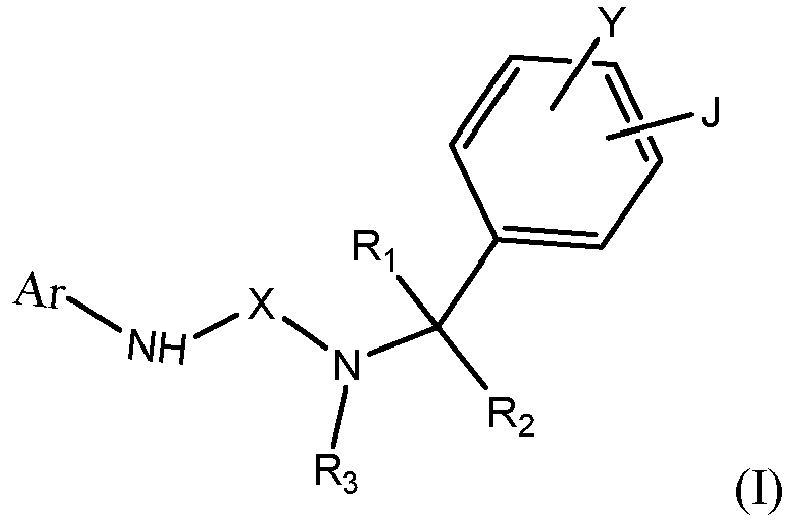
- In formula (I), Ar is indazole, 5-isoquinoline, 6-isoquinoline, or their N-oxide, X is -C(=Z)-, wherein Z is N-CN, NH, NR4, NCOR4, NCONR4R5, NCO-aryl, S, or O, Y and J are independently H, C1-C6 alkyl, C6-C8 aryl, C1-C6 aminoalkyl, -NH2, -CN, -OH, -O-alkyl, -O-aryl, -COOH, -COOR4, -CONHR4, -CONHCH2-aryl, -CONR4CH2-aryl, - NHCOR4, halogen, C1-C6 halogened alkyl, -alkyl-OR4, -O-alkyl-OR4, -alkyl-ONO2, -O-alkyl-ONO2, -OCOOR4, -O(C=O)-aryl, -CHR4OH, -CH2OH, -CH2O(C=O)-aryl, - CH2O(C=O)-R4, -CHR4O(C=O)-aryl, -CHR4O(C=O)-R4, unsaturated carboxylic ester, C2-C12 alkynyl, substituted C2-C12 alkynyl, -NHSO2R4, -SR4, -SO2R4, -SO2NHR4, or - SO2NR4R5, or Y and J bond together to form a carbocylic or aromatic ring, wherein R4 and R5 are independently H, C1-C6 alkyl, C6-C8 aryl, substituted C1-C6 alkyl, substituted C6-C8 aryl, C5-C12 cycloalkyl, C7-C12 alkylaryl, -alkyl-NR6R7, -alkyl-OR6, -alkyl-ONO2, -S(O)0-2-(alkyl-NR6R7), wherein R6 and R7 are independently H, alkyl, aryl or bond together with nitrogen atom to form a heterocyclic ring, and R1, R2 and R3 are H, C1-C6 alkyl, cycloalkyl, aryl, alkylaryl, alkylheteroaryl, alkylheterocycle, wherein any one thereof is optionally substituted with one or more of OH, ONO2, or NR8R9, wherein R8 and R9 are independently H, C1-C6 alkyl, C6-C8 aryl or bond together with nitrogen atom to form a heterocyclic ring.
- In some embodiments, the pharmaceutically acceptable carrier may comprise 6-aminoisoquinoline or 5-aminoisoquinoline, or their N-oxide.
- In some embodiments, the pharmaceutical composition may be an eye drop formulation.
- The compound of formula (I) may be synthesized by scheme I depicted as follows.


- a: TCDI
- b: primary amine
- c: secondary amine
- d: diphenyl N-cyanocarbonimidate
- e: CF3COOH or HCl
- The intermediate compounds of formula (II) may be synthesized by scheme IIB depicted as follows.

- a: benzylamine or alkyl amine/KCN/HOAc
- b: LiAlH4
- c: (Boc)2O/Et3N
- d: Pd(OH)2/H2
-


-


- 21.24mg phenyl isoquinolin-6-ylcarbamate and 22.7mg tert-butyl 2-(1-(4-fluorophenyl)ethylamino)ethylcarbamate in DMF were reacted at 110°C for 1hr. Water was added to the mixture and extracted with EA. The EA layer was thoroughly washed with water and dried by Na2SO4. After the EA layer was concentrated, the reaction intermediate was washed out by a column (EA/hexane=1:1). The reaction intermediate was then added to 1.5ml MeOH/0.5M HCl solution with stirring overnight. After the reaction was completed, a portion of methanol was distilled off and acetone was added with stirring for 10 minutes. After filtration, 19mg of the hydrochloride salt product was obtained.
- The NMR spectral data of the compound is listed below: 1H NMR (500 MHz CD3OD): δ1.71(d , 3H), 2.14(s, 2H), 2.84(t,2H), 3.45(m , 1H ), 3.54(m, 1H), 5.62(q, 1H), 7.16(t, 2H), 7.47 (t, 2H), 8.22(d, 2H), 8.39 (d,2H) ,8.56(s ,1H ), 9.50(s, 1H).
- The preparation method of Example 2 is similar to that provided by Example 1. The distinction therebetween is that the compound "isoquinolin-6-ylcarbamate" was replace by the compound "phenyl isoquinolin-5-ylcarbamate phenyl" to obtain the product "1-(2-aminoethyl)-1-(1-(4-fluorophenyl)ethyl)-3-(isoquinoline-5-yl)urea".
- The NMR spectral data of the compound is listed below: 1H NMR (500 MHz CD3OD): δ1.74(d , 3H) , 2.87(t,2H), 3.45(m , 1H ), 3.56(m, 1H), 5.60(q, 1H), 7.22(t, 2H), 7.57 (t, 2H), 8.05(t, 1H), 8.18 (d, 2H), 8.34(d, 1H), 8.40 (d,1H) ,8.58(d ,1H ), 9.79(s, 1H).
- 18.7mg phenyl isoquinolin-5-ylcarbamate and 15.2mg N-(3,4-difluorobenzyl)-N',N'-dimethylethane-1,2-diamine in DMSO were reacted at 110°C for 2hr. Water was added to the mixture and extracted with EA. The EA layer was thoroughly washed with water and dried by Na2SO4. After the EA layer was concentrated, the reaction intermediate was washed out by a column (100%EA, EA/MeOH=1:1). After purification, 19.6mg of the product was obtained.
- The NMR spectral data of the compound is listed below: 1H NMR (500 MHz CDCl3): δ 2.42(s,6H), 2.65 (t,2H) , 3.49 (t, 2H), 4.59 (s, 2H), 7.10(m, 2H ),7.15(m,1H), 7.57(t, 1H),7.68 (m, 2H), 7.91(d, 1H), 8.48 (d,1H) ,9.21(s , 1H ), 10.30(b, 1H).
- 38.6mg phenyl isoquinolin-5-ylcarbamate and 26.2mg N-((pyridin-4-yl)methyl)-N',N'-dimethylethylenediamine in DMSO were reacted at 110°C for 2hr. Water was added to the mixture and extracted with EA. The EA layer was thoroughly washed with water and dried by Na2SO4. After the EA layer was concentrated under reduced pressure, the reaction intermediate was washed out by a column (100%EA, EA/MeOH=1:1). The eluate was concentrated and then recrystallized by EA/hexane (1:1) to give 9.6mg of crystalline product.
- The NMR spectral data of the compound is listed below: 1H NMR (500 MHz CD3OD): δ 2.71(s,6H), 3.12 (t,2H) , 3.76 (t, 2H), 4.85 (s, 2H), 7.48(d, 2H ),7.68(t,1H), 7.70(d, 1H),7.78 (d, 1H), 7.97(d, 1H), 8.41 (d,1H) ,8.58(d, 1H ), 9.23(s, 1H).
-

- 11mg 5-isothiocyanatoisoquinoline and equivalent N-(4-fluorobenzyl)-N',N'-dimethyl-ethylenediamine in THF were reacted at room temperature overnight. Water was added to the mixture and extracted with EA. The EA layer was thoroughly washed with water and dried by Na2SO4. After purification by a silicone column (EA/MeOH=10:1), 9.6mg of crystalline product was obtained.
- The NMR spectral data of the compound is listed below: 1H NMR (500 MHz CD3OD): δ 2.30(s,6H), 2.65 (t,2H) , 3.83 (t, 2H), 5.22(s, 2H), 7.16(t, 2H ),7.49(t,2H), 7.67(m, 3H),8.01 (d, 1H), 8.39(d, 1H), 9.24(s, 1H).
-

- 6.8mg 6-isothiocyanatoisoquinoline and 24.2mg tert-butyl 2-(4-fluorobenzylamino)ethylcarbamate in 1.5ml DMF were stirred at room temperature overnight. Water was added to the mixture and extracted with EA. The EA layer was thoroughly washed with water and dried by Na2SO4. After the EA layer was concentrated under reduced pressure, the reaction intermediate "tert-butyl 2-(1-(4-fluorobenzyl)-3-(isoquinolin-6-yl)thioureido)ethylcarbamate" containing Boc was obtained. The reaction intermediate containing Boc was added to 1.5ml 6N HCl/1ml MeOH with stirring at room temperature overnight to obtain a solution containing suspended solid. The solid was then filtered and washed with acetone to give 16mg of hydrochloride salt product.
- The NMR spectral data of the compound is listed below: 1H NMR (500 MHz DMSO d-6): δ 3.14 (t , 2H) , 4.04(t, 2H), 5.17(s,2H), 7.22(t , 2H ), 7.37(m, 2H), 8.11(m, 4H), 8.26(d, 1H), 8.34 (d, 1H), 8.53(d, 1H) 9.62 (s,1H), 10.22(s, 1H).
-

- 15.7mg (84.3mmole) 6-isothiocyanatoisoquinoline, 25.6mg (84.5mmole) tert-butyl-2-(4-chloro-3-fluorobenzylamino)ethylcarbamate, and 5ml acetone were added to a reaction bottle at room temperature with stirring for 1 hour. After removing acetone by vacuum, the residue was purified by a SiO2 column (EA/Hexane=1:1). The intermediate product was added to 0.3ml 6N HCl and reacted overnight. The reaction liquid was drained under reduced pressure and stirred with 3ml acetone. The suspended solid was filtered and washed with acetone, and then the solid was taken and evaporated in vacuum to give 14.9g (42%) of product.
- The NMR spectral data of the compound is listed below: 1H NMR (500 MHz DMSO d-6): δ 3.16(t, 2H), 4.05(t, 2H), 5.21(s, 2H), 7.36(b, 1H), 7.45(t, 1H), 7.57(d, 1H), 8.14(b, 4H), 8.29(d, 1H), 8.36(d, 1H), 8.54(d, 1H), 9.64(s, 1H), 10.41(s, 1H).
-

- 14.4mg 6-isothiocyanatoisoquinoline, 22mg tert-butyl-2-(3-chlorobenzylamino)ethylcarbamate, and 3ml acetone were added to a reaction bottle at room temperature with stirring for 1 hour. After removing acetone by vacuum, the residue was purified by a SiO2 column (EA/Hexane=1:1). The intermediate product was added to 0.3ml 6N HCl and reacted overnight. 4ml methanol was added and filtered. The reaction liquid was drained under reduced pressure and stirred with 3ml acetone/methanol (10:1). The suspended solid was filtered and washed with acetone, and then the solid was taken and evaporated in vacuum to give 7.9mg of product.
- The NMR spectral data of the compound is listed below: 1H NMR (500 MHz DMSO d-6): δ 3.17(t, 2H), 4.09(t, 2H), 5.23(s, 2H), 7.30(d, 1H), 7.38(m, 2H), 7.43(m, 1H), 8.15(b, 4H), 8.29(d, 1H), 8.35(d, 1H), 8.54(d, 1H ), 9.46(s, 1H), 10.41(s, 1H).
-
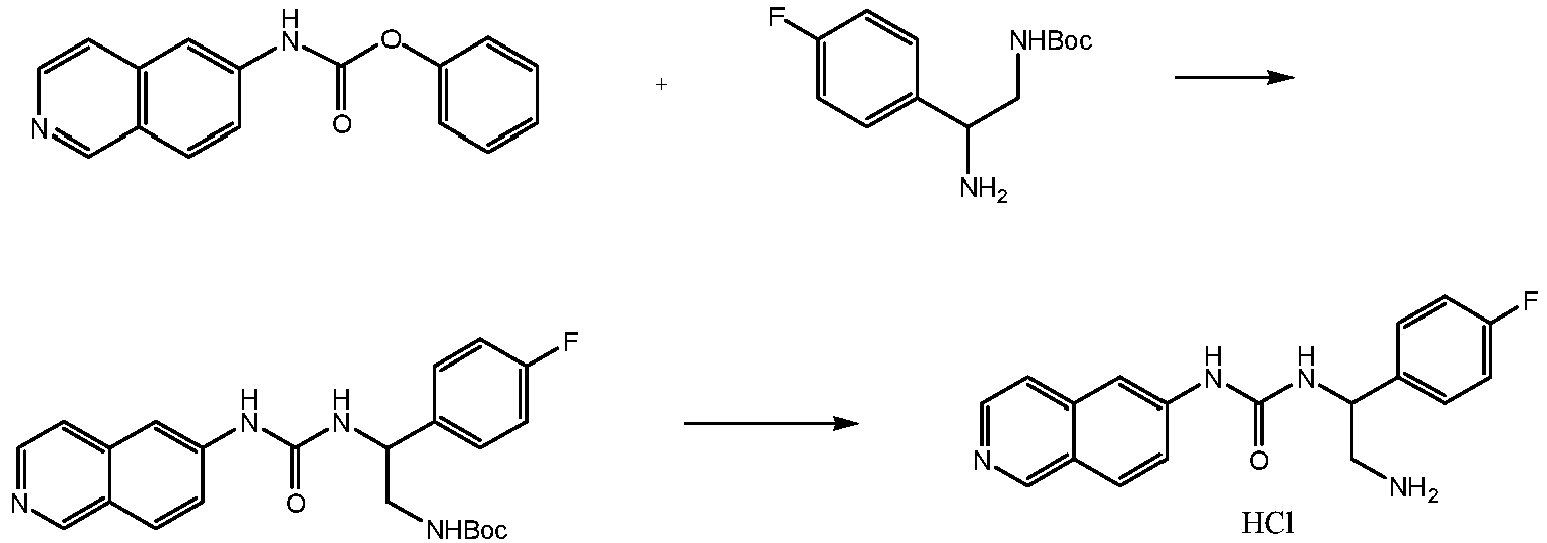
- 47mg phenyl isoquinolin-6-ylcarbamate and 47.7mg tert-butyl-2-amino-2-(4-fluorophenyl)ethylcarbamate in DMF were reacted at 110°C for 1 hour. Water was added to the reactant and extracted with EA. The EA layer was thoroughly washed with water and dried by Na2SO4. After the EA layer was concentrated, solid was precipitated by EA/Hexane (1:1). The intermediate solid was added to 6N HCl solution with stirring overnight. After the reaction was completed, the mixture was evaporated to dry under reduced pressure. A small amount of methanol was added, and the mixture was stirred for 10 minutes with acetone, and filtered to give 45.6mg of hydrochloride salt product.
- The NMR spectral data of the compound is listed below: 1H NMR (500 MHz CD3OD): δ 3.29(m, 1H), 3.35(m, 1H), 5.17(b, 1H), 7.12(t, 2H), 7.46(q, 2H), 7.90(d, 1H), 8.12(d, 1H), 8.30(m, 4H), 8.42(s, 1H), 9.38(s, 1H).
-
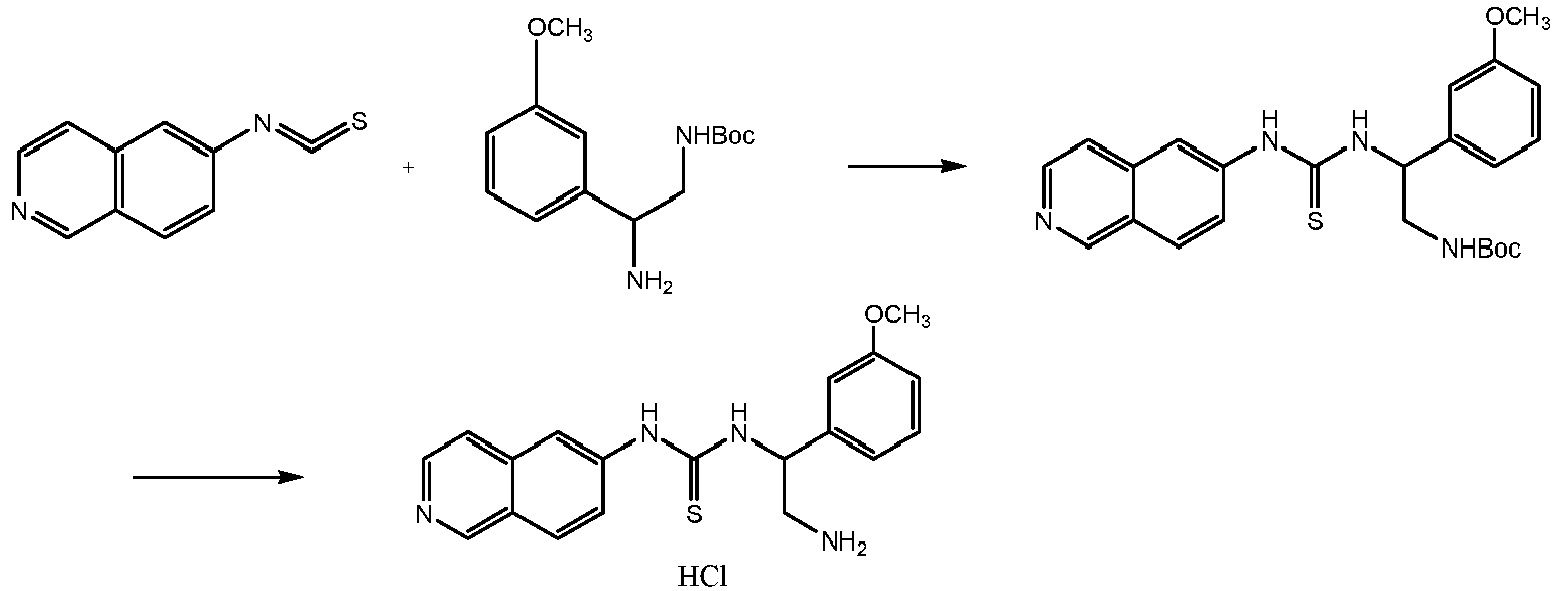
- 20mg 6-isothiocyanatoisoquinoline, 33mg tert-butyl-2-amino-2-phenylethylcarbamate, and 5ml THF were added to a reaction bottle at room temperature with stirring overnight. After removing THF by vacuum, the residue was purified by a SiO2 column (EA/Hexane=1:1). The intermediate product was added to 6N HCl and reacted overnight. After the reaction liquid was concentrated under reduced pressure, 1.5ml acetone/methanol (10:1) was added. The precipitate was filtered and washed with acetone, and then the solid was taken and evaporated in vacuum to give 13mg of hydrochloride salt product.
- The NMR spectral data of the compound is listed below: 1H NMR (500 MHz DMSO d-6): δ 3.25(m ,2H), 3.79(s, 3H), 5.76(dd, 1H), 6.90(d, 1H), 7.03(d,1H), 7.08(s, 1H), 7.31(t, 1H), 8.09(d, 1H), 8.19(b, 3H), 8.25(d, 1H), 8.37(d,1H), 8.49(d, 1H), 8.76(s, 1H), 9.59(s, 1H), 9.72(s, 1H), 11.4(s, 1H), (d, 1H), 11.44(s, 1H).
-

- 18.2mg 6-isothiocyanatoisoquinoline, 28.1mg tert-butyl-2-amino-2-(naphthalen-1-yl)ethylcarbamate, and 5ml THF were added to a reaction bottle at room temperature with stirring overnight. After removing THF by vacuum, the residue was purified by a SiO2 column (EA/Hexane=1:1). The intermediate product was added to 6N HCl and reacted overnight. After the reaction liquid was concentrated under reduced pressure, 1.5ml acetone/methanol (10:1) was added. The precipitate was filtered and washed with acetone, and then the solid was taken and evaporated in vacuum to give 12mg of product.
-

- 26.63mg 6-isothiocyanatoisoquinoline, 33.8mg tert-butyl-2-amino-2-phenylethylcarbamate, and 5ml THF were added to a reaction bottle at room temperature with stirring overnight. After removing THF by vacuum, the residue was purified by a SiO2 column (EA/Hexane=1:1). The intermediate product was added to 0.2ml MeOH/0.5ml HCl (3M in ether) and reacted overnight. After filtering and washing with acetone, the solid was taken and evaporated in vacuum to give 32mg of product.
- The NMR spectral data of the compound is listed below: 1H NMR (500 MHz DMSO d-6): δ 3.25(m, 2H), 5.79(d, d, 1H), 7.34(t, 1H), 7.41(t, 2H), 7.48(d, 2H), 8.10(d, 1H), 8.22(b, 2H), 8.28(d,1H), 8.40(d , 1H), 8.49(d, 1H), 8.79(s, 1H), 9.62(s, 1H), 9.83(d, 1H), 11.44(s, 1H).
-

- 86.63mg diphenyl cyanocarbonimidate, 52.1mg isoquinolin-6-amine, and 6ml THF were added to a reaction bottle with thermal reflux for 3.5hrs. After removing THF by vacuum, the residue was added to 10ml EA. The precipitated solid was filtered to obtain 32.9mg 1-cyano-3-(isoquinolin-6-yl)-2-phenylisourea. The intermediate was reacted with equivalent tert-butyl-2-(benzylamino)ethylcarbamate and 20mg of DIPEA in 5ml DMF at 110°C for 18 hrs. After cooling, 1N NaOH was added and extracted twice with EA. After the combined EA layer was dried and concentrated by Na2SO4, 26.4mg intermediate product was eluted out by a SiO2 column (EA/Hexane 4:1). The intermediate was added to 1.5ml 6N HCl at room temperature with stirring overnight. After the reaction solution was evaporated under reduced pressure, 2ml acetone/methanol (10:1) was added. The precipitate was filtered and washed with acetone, and then the solid was taken and evaporated in vacuum to give 18.7mg of product.
- Example 14: Preparation of 1-(4-methoxybenzyl)-1-(2-aminoethyl)-2-cyano-3-(isoquinolin-6-yl)guanidine hydrochloride
- The preparation is similar to Example 13. Tert-butyl-2-(benzylamino)ethylcarbamate was replaced by tert-butyl-2-(4-methoxybenzylamino)ethylcarbamate.
- The NMR spectral data of the compound is listed below: 1H NMR (500 MHz DMSO d-6): δ 3.12(m, 2H), 3.71(s, 3H), 3.78(m, 2H), 5.02(b, 2H), 6.90(d, 1H), 7.32(b, 1H), 8.21(b, 3H), 8.68(d,1H), 8.73(d, 1H), 9.56(s, 1H).
- The preparation is similar to Example 13. Tert-butyl-2-(benzylamino)ethylcarbamate was replaced by tert-butyl 2-(3-chlorobenzylamino)ethylcarbamate.
-


- 19.7mg 5-isothiocyanato-1H-indazole, 31.2mg tert-butyl 2-(4-(hydroxymethyl)benzylamino)ethylcarbamate and 5ml acetone were added in a reaction bottle and reacted at room temperature overnight. After removing acetone under reduced pressure and purifying by a SiO2 column (EA/Hexane = 2:1), an intermediate product was obtained. The intermediate product was added to a mixing solution of 0.7ml 3M HCl/ether and 0.1ml MeOH and stirred overnight at room temperature. The precipitated solid was filtered and the crystalline solid was washed with acetone. The solid was evaporated to dryness to yield 9.5mg of product.
- 1.81g isoquinolin-6-amine, 2.46g TCDI and 2eq Et3N in 8ml THF were stirred at room temperature for 4 hours. After removing THF by vacuum, the residue was purified by a column (EA/Hexane=1:1) to give 1.06g of product.
- The NMR spectral data of the compound is listed below: 1H NMR (500 MHz DMSO d-6): δ 7.67(d, 1H), 7.81(d, 1H), 8.04(s, 1H), 8.21(d, 1H), 8.54(d, 1H), 9.33(s, 1H).
-

- 3.46g 6-amino isoquinoline was added in 32ml THF and stirred in a water bath at room temperature. 4.03g (1.3eq) DIPEA was then added. At this time, 4.1344g phenylchloroformate was slowly added to the stirred reaction solution. After about 30 minutes, the reaction was heated and refluxed for 1 hour. After removing THF by vacuum, the residue was purified by a SiO2 column (EA/Hexane=1:1) to give 3.06g of solid product (yield: 48.2%).
- The NMR spectral data of the compound is listed below: 1H NMR (500 MHz DMSO d-6): δ 7.24(m, 3H), 7.44(t, 2H), 7.72(d, d, 2H), 8.03(d, 1H), 8.12(s, 1H), 8.40(d, 1H), 9.16(d, 1H), 10.69(s, 1H).
- To measure Rho-kinase inhibition, IC50 values were determined according to the following ELISA protocol:
- ROCK Substrate Coated Plate (Part No 241601): One strip well 96-well plate pre-coated with recombinant MYPT1.
- Buffer: 25mM Tris, pH 7.5, 10mM MgCl2, 5mM Glycerol-2-Phsophate, 0.1mM Na3VO4; 1% DMSO; 2.5mM DTT; (Enzyme: ROCK active-II) (Cell Biolabs, Catalog #STA-406, Part No. 241505) 0.1ng/µl.
- ATP Solution (Part No. 241604): 100mM ATP. Final concentration of ATP in reaction mixture: 250µM.
- Anti-phospho-MYPT1 (Thr696) (Part No. 241603).
- Secondary Antibody, HRP Conjugate (Part No. 231003).
- Biotinylated substrate, diluted to 0.25µM with buffer described above (without ATP).
- Steps:
- 1. Purified kinase or cell lysate sample can be used directly in the kinase assay or further diluted with 1X Kinase Buffer. Each sample should be assayed in duplicate.
- 2. Add 90µL of the diluted active ROCK-II positive control or unknown ROCK samples to the wells of the substrate plate.
- 3. Initiate the kinase reaction by adding 10µL of the 10X Kinase Reaction Buffer containing DTT and ATP. Mix well.
- 4. Cover with a plate cover and incubate the wells at 30°C for 30-60 minutes with gentle agitation.
- 5. Stop kinase reaction by flicking out the content or by adding 50µL of 0.5M EDTA, pH 8.0, to each well.
- 6. Remove the plate cover and empty wells. Wash microwell strips 3 times with 250µL 1X Wash Buffer per well with thorough aspiration between each wash. After the last wash, empty wells and tap microwell strips on absorbent pad or paper towel to remove excess 1X Wash Buffer.
- 7. Add 100µL of the diluted anti-phospho-MYPT1 (Thr696) antibody to each well.
- 8. Cover with the plate cover and incubate at room temperature for 1 hour on an orbital shaker.
- 9. Remove the plate cover and empty wells. Wash the strip wells 3 times according to step 6 above.
- 10. Add 100µL of the diluted HRP-conjugated secondary antibody to each well.
- 11. Cover with the plate cover and incubate at room temperature for 1 hour on an orbital shaker.
- 12. Remove the plate cover and empty wells. Wash microwell strips 3 times according to step 6 above. Proceed immediately to the next step.
- 13. Warm Substrate Solution to room temperature. Add 100µL of Substrate Solution to each well, including the blank wells. Incubate at room temperature for 5-20 minutes on an orbital shaker.
- 14. Stop the enzyme reaction by adding 100µL of Stop Solution into each well, including the blank wells. Results should be read immediately (color will fade over time).
- 15. Read absorbance of each microwell on a spectrophotometer using 450nm as the primary wave length.
- The given activity (shown in Table 1 and Table 2) is denoted as the negative logarithm of the IC50 (pIC50) as follows:


Table 1 formula (I) structure ROCK2 IC50 1 
+++ 2 
+++ 3 
++ 4 
++ 5 
+ 6 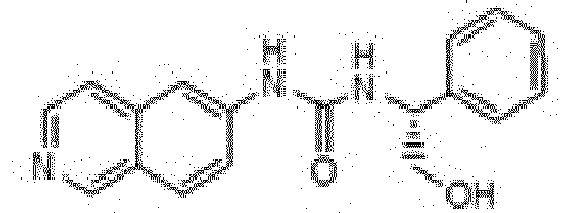
+++ 7 
+ 8 
++ 9 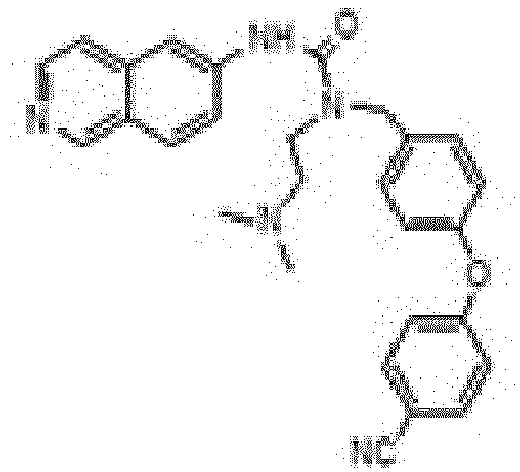
+ Table 2 formula (I) structure ROCK IC50 1 
+ 2 
+ 3 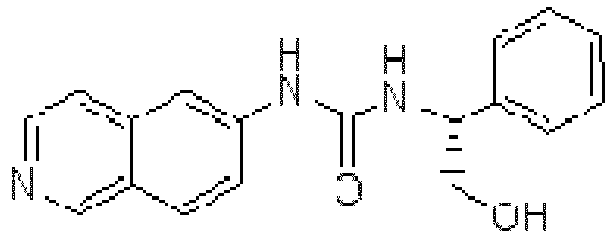
+ 4 
+ 5 
+ 6 
++ 7 
++ 8 
++ 9 
+ 10 
+ 11 
++ 12 
+ 13 
+ 14 
++ 15 
++ 16 
++ 17 
+ 18 
+ 19 
++ 20 
+ 21 
+ 22 
++ 23 
+++ 24 
++++ 25 
++++ 26 
++++ 27 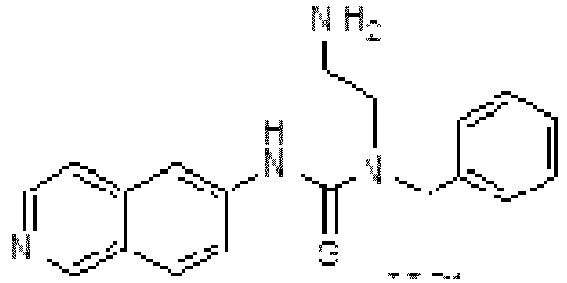
++ 28 
++ 29 
+++ 30 
+++ 31 
++++ 32 
++ 33 
++ 34 
+++ 35 
++++ 36 
++++ 37 
++++ 38 
+++ 39 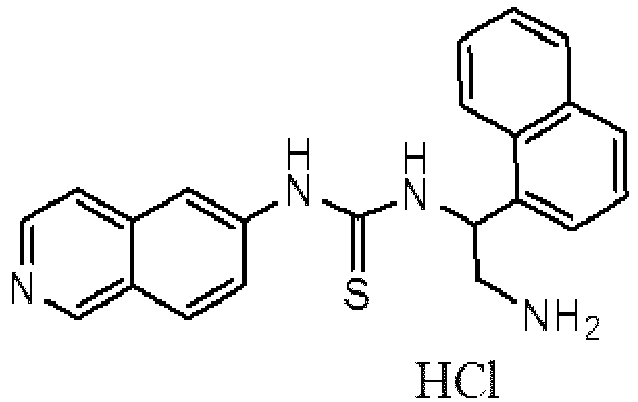
++++ - While the disclosure has been described by way of example and in terms of the preferred embodiments, it should be understood that the disclosure is not limited to the disclosed embodiments. On the contrary, it is intended to cover various modifications and similar arrangements (as would be apparent to those skilled in the art). Therefore, the scope of the appended claims should be accorded the broadest interpretation so as to encompass all such modifications and similar arrangements.
Claims (10)
- A compound of formula (I), or a pharmaceutically acceptable salt thereof:
 wherein Ar is 6-isoquinoline, or their N-oxide,X is -C(=Z)-, wherein Z is S,Y and J are independently H, C1-C6 alkyl, C6-C8 aryl, C1-C6 aminoalkyl, -NH2, -CN, -OH, -O-alkyl, -O-aryl, -COOH, -COOR4, -CONHR4, -CONHCH2-aryl, - CONR4CH2-aryl, -NHCOR4, halogen, C1-C6 halogened alkyl, -alkyl-OR4, -O-alkyl-OR4, -alkyl-ONO2, -O-alkyl-ONO2, -OCOOR4, -O(C=O)-aryl, -CHR4OH, -CH2OH, - CH2O(C=O)-aryl, -CH2O(C=O)-R4, -CHR4O(C=O)-aryl, -CHR4O(C=O)-R4, unsaturated carboxylic ester, C2-C12 alkynyl, substituted C2-C12 alkynyl, -NHSO2R4, - SR4, -SO2R4, -SO2NHR4, or -SO2NR4R5, or Y and J bond together to form a carbocylic or aromatic ring, wherein R4 and R5 are independently H, C1-C6 alkyl, C6-C8 aryl, substituted C1-C6 alkyl, substituted C6-C8 aryl, C5-C12 cycloalkyl, C7-C12 alkylaryl, -alkyl-NR6R7, -alkyl-OR6, -alkyl-ONO2, -S(O)0-2-(alkyl-NR6R7), wherein R6 and R7 are independently H, alkyl, aryl or bond together with nitrogen atom to form a heterocyclic ring, andR1 and R2 are methyl, hydroxymethyl or aminomethyl, and R3 is H, C1-C6 alkyl, cycloalkyl, aryl, alkylaryl, alkylheteroaryl, alkylheterocycle, wherein any one thereof is optionally substituted with one or more of OH, ONO2, or NR8R9, wherein R8 and R9 are independently H, C1-C6 alkyl, C6-C8 aryl or bond together with nitrogen atom to form a heterocyclic ring.
 - The compound as claimed in claim 1, wherein the pharmaceutically acceptable salt of the compound comprises a salt form of HCl, CH3SO3H, tartaric acid, maleic acid, fumaric acid, malic acid or lactic acid.
- The compound as claimed in one of claims 1 and 2, wherein the compound comprises a prodrug, an optical isomer or a racemic mixture thereof.
- The compound as claimed in one of claims 1, 2 and 3, wherein R3 is - (CH2)nNR10R11 or -(CH2)nOH, wherein R10 and R11 are independently H, C1-C6 alkyl, C6-C8 aryl or bond together with nitrogen atom to form a C5-C10 heterocyclic ring, and n is an integer from 1 to 6.
- The compound as claimed in one of claims 1, 2 and 3, wherein R8 and R9 bond together with nitrogen atom to form a C3-C10 heterocyclic ring.
- The compound as claimed in one of claims 1, 2, 3, 4 and 5, wherein R6 and R7 are independently H, C1-C6 alkyl, C6-C8 aryl or bond together with nitrogen atom to form a C5-C10 heterocyclic ring.
- The compound as claimed in one of claims 1, 2, 3, 4, 5 and 6, wherein the compound is an AGC kinase inhibitor.
- A pharmaceutical composition, comprising:an effective amount of the compound as claimed in one of claims 1, 2, 3, 4, 5, 6 and 7; anda pharmaceutically acceptable carrier.
- The pharmaceutical composition as claimed in claim 8, wherein the pharmaceutically acceptable carrier comprises 6-aminoisoquinoline or 5-aminoisoquinoline, or their N-oxide.
- The pharmaceutical composition as claimed in one of claims 8 and 9, wherein the pharmaceutical composition is an eye drop formulation.
Applications Claiming Priority (3)
| Application Number | Priority Date | Filing Date | Title |
|---|---|---|---|
| US201762610446P | 2017-12-26 | 2017-12-26 | |
| US16/206,000 US10696638B2 (en) | 2017-12-26 | 2018-11-30 | Compounds for inhibiting AGC kinase and pharmaceutical compositions comprising the same |
| EP18214556.5A EP3505513B1 (en) | 2017-12-26 | 2018-12-20 | Isoquinoline derivatives and their use for the treatemtn of ophthalmic disorders |
Related Parent Applications (2)
| Application Number | Title | Priority Date | Filing Date |
|---|---|---|---|
| EP18214556.5A Division EP3505513B1 (en) | 2017-12-26 | 2018-12-20 | Isoquinoline derivatives and their use for the treatemtn of ophthalmic disorders |
| EP18214556.5A Division-Into EP3505513B1 (en) | 2017-12-26 | 2018-12-20 | Isoquinoline derivatives and their use for the treatemtn of ophthalmic disorders |
Publications (2)
| Publication Number | Publication Date |
|---|---|
| EP4257192A2 true EP4257192A2 (en) | 2023-10-11 |
| EP4257192A3 EP4257192A3 (en) | 2023-10-18 |
Family
ID=64746410
Family Applications (2)
| Application Number | Title | Priority Date | Filing Date |
|---|---|---|---|
| EP23191923.4A Pending EP4257192A3 (en) | 2017-12-26 | 2018-12-20 | Isoquinoline derivatives and their use for the treatemtn of ophthalmic disorders |
| EP18214556.5A Active EP3505513B1 (en) | 2017-12-26 | 2018-12-20 | Isoquinoline derivatives and their use for the treatemtn of ophthalmic disorders |
Family Applications After (1)
| Application Number | Title | Priority Date | Filing Date |
|---|---|---|---|
| EP18214556.5A Active EP3505513B1 (en) | 2017-12-26 | 2018-12-20 | Isoquinoline derivatives and their use for the treatemtn of ophthalmic disorders |
Country Status (5)
| Country | Link |
|---|---|
| US (1) | US10696638B2 (en) |
| EP (2) | EP4257192A3 (en) |
| JP (1) | JP6785831B2 (en) |
| CN (1) | CN109956900B (en) |
| TW (1) | TWI697480B (en) |
Family Cites Families (32)
| Publication number | Priority date | Publication date | Assignee | Title |
|---|---|---|---|---|
| FR2581063B1 (en) | 1985-04-30 | 1987-07-17 | Chauvin Blache Lab | AMINO-2 THIAZOLES N-SUBSTITUTED, THEIR PREPARATION PROCESS AND THEIR APPLICATION IN THERAPEUTICS |
| US7217722B2 (en) * | 2000-02-01 | 2007-05-15 | Kirin Beer Kabushiki Kaisha | Nitrogen-containing compounds having kinase inhibitory activity and drugs containing the same |
| WO2002016318A1 (en) * | 2000-08-21 | 2002-02-28 | Pacific Corporation | Novel thiourea derivatives and the pharmaceutical compositions containing the same |
| US20030022891A1 (en) | 2000-12-01 | 2003-01-30 | Anandan Palani | MCH antagonists and their use in the treatment of obesity |
| CA2474322A1 (en) | 2002-01-25 | 2003-07-31 | Kylix Pharmaceuticals B.V. | 4(hetero-) aryl substituted (thia-/oxa-/pyra) zoles for inhibition of tie-2 |
| US7074805B2 (en) | 2002-02-20 | 2006-07-11 | Abbott Laboratories | Fused azabicyclic compounds that inhibit vanilloid receptor subtype 1 (VR1) receptor |
| CA2476936A1 (en) * | 2002-02-20 | 2003-08-28 | Chih-Hung Lee | Fused azabicyclic compounds that inhibit vanilloid receptor subtype 1 (vr1) receptor |
| GB0206876D0 (en) | 2002-03-22 | 2002-05-01 | Merck Sharp & Dohme | Therapeutic agents |
| AU2003257588A1 (en) | 2002-08-29 | 2004-03-19 | Santen Pharmaceutical Co., Ltd. | REMEDY FOR GLAUCOMA COMPRISING Rho KINASE INHIBITOR AND PROSTAGLANDINS |
| US20050113576A1 (en) | 2003-08-05 | 2005-05-26 | Chih-Hung Lee | Fused azabicyclic compounds that inhibit vanilloid receptor subtype 1 (VR1) receptor |
| GB0322016D0 (en) * | 2003-09-19 | 2003-10-22 | Merck Sharp & Dohme | New compounds |
| MXPA06012225A (en) | 2004-04-26 | 2007-01-31 | Alcon Inc | Statins for the treatment of ocular hypertension and glaucoma. |
| US20060142270A1 (en) | 2004-12-23 | 2006-06-29 | Kowa Co., Ltd. | Preventing or treating agent for glaucoma |
| EP1899322B1 (en) | 2005-06-28 | 2009-09-02 | Sanofi-Aventis | Isoquinoline derivatives as inhibitors of rho-kinase |
| ES2580108T3 (en) * | 2005-07-11 | 2016-08-19 | Aerie Pharmaceuticals, Inc | Isoquinoline compounds |
| US8211919B2 (en) | 2005-09-02 | 2012-07-03 | Astellas Pharma Inc. | Amide derivatives as rock inhibitors |
| TW200824687A (en) * | 2006-08-25 | 2008-06-16 | Abbott Lab | Compounds that inhibit TRPV1 and uses thereof |
| US8455513B2 (en) * | 2007-01-10 | 2013-06-04 | Aerie Pharmaceuticals, Inc. | 6-aminoisoquinoline compounds |
| US9187485B2 (en) | 2007-02-02 | 2015-11-17 | Baylor College Of Medicine | Methods and compositions for the treatment of cancer and related hyperproliferative disorders |
| CN103342701B (en) | 2007-02-13 | 2016-09-21 | Ab科学有限公司 | Thiazolamine compound polymorphic as inhibitors of kinases and preparation method thereof |
| GB0704932D0 (en) | 2007-03-14 | 2007-04-25 | Astex Therapeutics Ltd | Pharmaceutical compounds |
| EP2166846B1 (en) | 2007-06-20 | 2012-10-17 | Merck Sharp & Dohme Corp. | Inhibitors of janus kinases |
| US8455514B2 (en) | 2008-01-17 | 2013-06-04 | Aerie Pharmaceuticals, Inc. | 6-and 7-amino isoquinoline compounds and methods for making and using the same |
| EP2278969B1 (en) | 2008-04-21 | 2013-02-13 | Merck Sharp & Dohme Corp. | Inhibitors of Janus kinases |
| EP3828172A1 (en) | 2009-05-01 | 2021-06-02 | Aerie Pharmaceuticals, Inc. | Dual mechanism inhibitors for the treatment of disease |
| AU2010339456A1 (en) | 2009-12-30 | 2012-07-05 | Celgene Avilomics Research, Inc. | Ligand-directed covalent modification of protein |
| EP2542528B1 (en) | 2010-03-02 | 2013-06-19 | Amakem NV | Heterocyclic amides as rock inhibitors |
| WO2012015760A1 (en) | 2010-07-27 | 2012-02-02 | Inspire Pharmaceuticals, Inc. | Method for treating ophthalmic diseases using kinase inhibitor compounds in prodrug forms |
| US9409868B2 (en) * | 2012-01-24 | 2016-08-09 | H. Lee Moffin Cancer Center and Research Institute, Inc. | Inhibitors of rho associated protein kinases (ROCK) and methods of use |
| WO2015017546A1 (en) * | 2013-07-30 | 2015-02-05 | H. Lee Moffitt Cancer Center And Research Institute, Inc. | Selective histone deactylase 6 inhibitors |
| WO2016095089A1 (en) * | 2014-12-15 | 2016-06-23 | Merck Sharp & Dohme Corp. | Erk inhibitors |
| CN105906564B (en) * | 2016-05-05 | 2018-11-30 | 海南省药物研究所 | Compound, preparation method and its usage |
-
2018
- 2018-11-30 US US16/206,000 patent/US10696638B2/en active Active
- 2018-12-19 TW TW107145791A patent/TWI697480B/en active
- 2018-12-20 EP EP23191923.4A patent/EP4257192A3/en active Pending
- 2018-12-20 EP EP18214556.5A patent/EP3505513B1/en active Active
- 2018-12-21 JP JP2018239510A patent/JP6785831B2/en active Active
- 2018-12-26 CN CN201811601386.6A patent/CN109956900B/en active Active
Also Published As
| Publication number | Publication date |
|---|---|
| EP4257192A3 (en) | 2023-10-18 |
| US10696638B2 (en) | 2020-06-30 |
| TWI697480B (en) | 2020-07-01 |
| CN109956900B (en) | 2023-02-03 |
| US20190194137A1 (en) | 2019-06-27 |
| TW201927755A (en) | 2019-07-16 |
| EP3505513B1 (en) | 2023-09-27 |
| EP3505513A1 (en) | 2019-07-03 |
| JP2019142838A (en) | 2019-08-29 |
| CN109956900A (en) | 2019-07-02 |
| JP6785831B2 (en) | 2020-11-18 |
Similar Documents
| Publication | Publication Date | Title |
|---|---|---|
| AU2010204106B2 (en) | Compounds for the prevention and treatment of cardiovascular disease | |
| JP2690006B2 (en) | Substituted phenyl sulfonamides as selective β3 agonists for the treatment of diabetes and obesity | |
| JP4853965B2 (en) | Adamantane derivatives and azabicyclooctane derivatives and azabicyclononane derivatives and methods for their preparation and their use as DPP-IV inhibitors | |
| CN111303131B (en) | Tegoprazan (Tegoprazan) analogue and synthetic method thereof | |
| EP3480193B1 (en) | Pyrazole derivatives as alk5 inhibitors and uses thereof | |
| JP2004523583A5 (en) | ||
| WO2001007411A1 (en) | Biarylurea derivatives | |
| WO2001057044A1 (en) | Pyridoxazine derivatives | |
| KR102524421B1 (en) | Benzene condensed heterocyclic derivative and pharmaceutical composition containing the same | |
| KR20100044251A (en) | Certain chemical entities, compositions, and methods | |
| MX2007015531A (en) | Bicyclic derivatives as p38 kinase inhibitors. | |
| JP2017536417A (en) | Substituted oxazole and thiazole carboxamide and urea derivatives as vanilloid receptor ligand II | |
| TW200526630A (en) | Novel pyridine derivatives | |
| TR201802981T4 (en) | Fluorophenyl pyrazole compounds. | |
| AU2006263962A1 (en) | Bicyclic derivatives as p38 kinase inhibitors | |
| US6645968B2 (en) | Potassium channel openers | |
| EP3505513B1 (en) | Isoquinoline derivatives and their use for the treatemtn of ophthalmic disorders | |
| US6545008B1 (en) | Pyrimidine derivatives and processes for the preparation thereof | |
| EP2912034B1 (en) | 3,4-disubstituted oxazolidinone derivatives and their use as inhibitors of the calcium activated potassium channel | |
| WO2021106988A1 (en) | G9a INHIBITOR | |
| JP2010526045A (en) | Triaminopyrimidine derivatives as CDC25 phosphatase inhibitors | |
| JPH06211814A (en) | (Thio) urea derivative | |
| EP0529365A1 (en) | Diarylmethoxypiperidine derivatives | |
| NZ749951B (en) | Novel pyrazole derivative as alk5 inhibitor and uses thereof | |
| HK1142334A (en) | Triaminopyrimidine derivatives as inhibitors of cdc25 phosphatase |
Legal Events
| Date | Code | Title | Description |
|---|---|---|---|
| PUAI | Public reference made under article 153(3) epc to a published international application that has entered the european phase |
Free format text: ORIGINAL CODE: 0009012 |
|
| STAA | Information on the status of an ep patent application or granted ep patent |
Free format text: STATUS: THE APPLICATION HAS BEEN PUBLISHED |
|
| REG | Reference to a national code |
Ref country code: DE Ref legal event code: R079 Free format text: PREVIOUS MAIN CLASS: A61P0027020000 Ipc: C07D0217020000 |
|
| PUAL | Search report despatched |
Free format text: ORIGINAL CODE: 0009013 |
|
| AC | Divisional application: reference to earlier application |
Ref document number: 3505513 Country of ref document: EP Kind code of ref document: P |
|
| AK | Designated contracting states |
Kind code of ref document: A2 Designated state(s): AL AT BE BG CH CY CZ DE DK EE ES FI FR GB GR HR HU IE IS IT LI LT LU LV MC MK MT NL NO PL PT RO RS SE SI SK SM TR |
|
| AK | Designated contracting states |
Kind code of ref document: A3 Designated state(s): AL AT BE BG CH CY CZ DE DK EE ES FI FR GB GR HR HU IE IS IT LI LT LU LV MC MK MT NL NO PL PT RO RS SE SI SK SM TR |
|
| RIC1 | Information provided on ipc code assigned before grant |
Ipc: A61P 27/02 20060101ALI20230914BHEP Ipc: A61K 31/472 20060101ALI20230914BHEP Ipc: C07D 217/02 20060101AFI20230914BHEP |
|
| STAA | Information on the status of an ep patent application or granted ep patent |
Free format text: STATUS: REQUEST FOR EXAMINATION WAS MADE |
|
| 17P | Request for examination filed |
Effective date: 20240415 |
|
| RBV | Designated contracting states (corrected) |
Designated state(s): AL AT BE BG CH CY CZ DE DK EE ES FI FR GB GR HR HU IE IS IT LI LT LU LV MC MK MT NL NO PL PT RO RS SE SI SK SM TR |
|
| STAA | Information on the status of an ep patent application or granted ep patent |
Free format text: STATUS: EXAMINATION IS IN PROGRESS |
|
| 17Q | First examination report despatched |
Effective date: 20260306 |