EP4256665B1 - An electrical power system for a watercraft - Google Patents
An electrical power system for a watercraft Download PDFInfo
- Publication number
- EP4256665B1 EP4256665B1 EP21904638.0A EP21904638A EP4256665B1 EP 4256665 B1 EP4256665 B1 EP 4256665B1 EP 21904638 A EP21904638 A EP 21904638A EP 4256665 B1 EP4256665 B1 EP 4256665B1
- Authority
- EP
- European Patent Office
- Prior art keywords
- electrical
- generator
- electrical power
- power
- hts
- Prior art date
- Legal status (The legal status is an assumption and is not a legal conclusion. Google has not performed a legal analysis and makes no representation as to the accuracy of the status listed.)
- Active
Links
Images




Classifications
-
- B—PERFORMING OPERATIONS; TRANSPORTING
- B63—SHIPS OR OTHER WATERBORNE VESSELS; RELATED EQUIPMENT
- B63H—MARINE PROPULSION OR STEERING
- B63H21/00—Use of propulsion power plant or units on vessels
- B63H21/12—Use of propulsion power plant or units on vessels the vessels being motor-driven
- B63H21/17—Use of propulsion power plant or units on vessels the vessels being motor-driven by electric motor
-
- B—PERFORMING OPERATIONS; TRANSPORTING
- B63—SHIPS OR OTHER WATERBORNE VESSELS; RELATED EQUIPMENT
- B63J—AUXILIARIES ON VESSELS
- B63J3/00—Driving of auxiliaries
- B63J3/04—Driving of auxiliaries from power plant other than propulsion power plant
-
- B—PERFORMING OPERATIONS; TRANSPORTING
- B60—VEHICLES IN GENERAL
- B60L—PROPULSION OF ELECTRICALLY-PROPELLED VEHICLES; SUPPLYING ELECTRIC POWER FOR AUXILIARY EQUIPMENT OF ELECTRICALLY-PROPELLED VEHICLES; ELECTRODYNAMIC BRAKE SYSTEMS FOR VEHICLES IN GENERAL; MAGNETIC SUSPENSION OR LEVITATION FOR VEHICLES; MONITORING OPERATING VARIABLES OF ELECTRICALLY-PROPELLED VEHICLES; ELECTRIC SAFETY DEVICES FOR ELECTRICALLY-PROPELLED VEHICLES
- B60L1/00—Supplying electric power to auxiliary equipment of vehicles
-
- B—PERFORMING OPERATIONS; TRANSPORTING
- B60—VEHICLES IN GENERAL
- B60L—PROPULSION OF ELECTRICALLY-PROPELLED VEHICLES; SUPPLYING ELECTRIC POWER FOR AUXILIARY EQUIPMENT OF ELECTRICALLY-PROPELLED VEHICLES; ELECTRODYNAMIC BRAKE SYSTEMS FOR VEHICLES IN GENERAL; MAGNETIC SUSPENSION OR LEVITATION FOR VEHICLES; MONITORING OPERATING VARIABLES OF ELECTRICALLY-PROPELLED VEHICLES; ELECTRIC SAFETY DEVICES FOR ELECTRICALLY-PROPELLED VEHICLES
- B60L50/00—Electric propulsion with power supplied within the vehicle
- B60L50/10—Electric propulsion with power supplied within the vehicle using propulsion power supplied by engine-driven generators, e.g. generators driven by combustion engines
- B60L50/13—Electric propulsion with power supplied within the vehicle using propulsion power supplied by engine-driven generators, e.g. generators driven by combustion engines using AC generators and AC motors
-
- B—PERFORMING OPERATIONS; TRANSPORTING
- B63—SHIPS OR OTHER WATERBORNE VESSELS; RELATED EQUIPMENT
- B63G—OFFENSIVE OR DEFENSIVE ARRANGEMENTS ON VESSELS; MINE-LAYING; MINE-SWEEPING; SUBMARINES; AIRCRAFT CARRIERS
- B63G8/00—Underwater vessels, e.g. submarines; Equipment specially adapted therefor
- B63G8/08—Propulsion
-
- H—ELECTRICITY
- H02—GENERATION; CONVERSION OR DISTRIBUTION OF ELECTRIC POWER
- H02J—ELECTRIC POWER NETWORKS; CIRCUIT ARRANGEMENTS OR SYSTEMS FOR SUPPLYING OR DISTRIBUTING ELECTRIC POWER; SYSTEMS FOR STORING ELECTRIC ENERGY
- H02J3/00—Circuit arrangements for AC mains or AC distribution networks
- H02J3/007—Arrangements for selectively connecting one or more loads to one or more power sources or power lines
- H02J3/0073—Arrangements for selectively connecting one or more loads to one or more power sources or power lines by providing alternative feeding paths when the main path fails
-
- H—ELECTRICITY
- H02—GENERATION; CONVERSION OR DISTRIBUTION OF ELECTRIC POWER
- H02J—ELECTRIC POWER NETWORKS; CIRCUIT ARRANGEMENTS OR SYSTEMS FOR SUPPLYING OR DISTRIBUTING ELECTRIC POWER; SYSTEMS FOR STORING ELECTRIC ENERGY
- H02J3/00—Circuit arrangements for AC mains or AC distribution networks
- H02J3/38—Arrangements for feeding a single network from two or more generators or sources in parallel; Arrangements for feeding already energised networks from additional generators or sources in parallel
-
- H—ELECTRICITY
- H02—GENERATION; CONVERSION OR DISTRIBUTION OF ELECTRIC POWER
- H02K—DYNAMO-ELECTRIC MACHINES
- H02K55/00—Dynamo-electric machines having windings operating at cryogenic temperatures
- H02K55/02—Dynamo-electric machines having windings operating at cryogenic temperatures of the synchronous type
- H02K55/04—Dynamo-electric machines having windings operating at cryogenic temperatures of the synchronous type with rotating field windings
-
- B—PERFORMING OPERATIONS; TRANSPORTING
- B60—VEHICLES IN GENERAL
- B60L—PROPULSION OF ELECTRICALLY-PROPELLED VEHICLES; SUPPLYING ELECTRIC POWER FOR AUXILIARY EQUIPMENT OF ELECTRICALLY-PROPELLED VEHICLES; ELECTRODYNAMIC BRAKE SYSTEMS FOR VEHICLES IN GENERAL; MAGNETIC SUSPENSION OR LEVITATION FOR VEHICLES; MONITORING OPERATING VARIABLES OF ELECTRICALLY-PROPELLED VEHICLES; ELECTRIC SAFETY DEVICES FOR ELECTRICALLY-PROPELLED VEHICLES
- B60L2200/00—Type of vehicles
- B60L2200/32—Waterborne vessels
-
- B—PERFORMING OPERATIONS; TRANSPORTING
- B60—VEHICLES IN GENERAL
- B60L—PROPULSION OF ELECTRICALLY-PROPELLED VEHICLES; SUPPLYING ELECTRIC POWER FOR AUXILIARY EQUIPMENT OF ELECTRICALLY-PROPELLED VEHICLES; ELECTRODYNAMIC BRAKE SYSTEMS FOR VEHICLES IN GENERAL; MAGNETIC SUSPENSION OR LEVITATION FOR VEHICLES; MONITORING OPERATING VARIABLES OF ELECTRICALLY-PROPELLED VEHICLES; ELECTRIC SAFETY DEVICES FOR ELECTRICALLY-PROPELLED VEHICLES
- B60L2270/00—Problem solutions or means not otherwise provided for
- B60L2270/10—Emission reduction
- B60L2270/14—Emission reduction of noise
- B60L2270/147—Emission reduction of noise electro magnetic [EMI]
-
- B—PERFORMING OPERATIONS; TRANSPORTING
- B63—SHIPS OR OTHER WATERBORNE VESSELS; RELATED EQUIPMENT
- B63H—MARINE PROPULSION OR STEERING
- B63H21/00—Use of propulsion power plant or units on vessels
- B63H21/12—Use of propulsion power plant or units on vessels the vessels being motor-driven
- B63H21/17—Use of propulsion power plant or units on vessels the vessels being motor-driven by electric motor
- B63H2021/173—Use of propulsion power plant or units on vessels the vessels being motor-driven by electric motor making use of superconductivity
-
- B—PERFORMING OPERATIONS; TRANSPORTING
- B63—SHIPS OR OTHER WATERBORNE VESSELS; RELATED EQUIPMENT
- B63J—AUXILIARIES ON VESSELS
- B63J3/00—Driving of auxiliaries
- B63J2003/001—Driving of auxiliaries characterised by type of power supply, or power transmission, e.g. by using electric power or steam
- B63J2003/002—Driving of auxiliaries characterised by type of power supply, or power transmission, e.g. by using electric power or steam by using electric power
-
- B—PERFORMING OPERATIONS; TRANSPORTING
- B63—SHIPS OR OTHER WATERBORNE VESSELS; RELATED EQUIPMENT
- B63J—AUXILIARIES ON VESSELS
- B63J3/00—Driving of auxiliaries
- B63J3/02—Driving of auxiliaries from propulsion power plant
-
- H—ELECTRICITY
- H02—GENERATION; CONVERSION OR DISTRIBUTION OF ELECTRIC POWER
- H02J—ELECTRIC POWER NETWORKS; CIRCUIT ARRANGEMENTS OR SYSTEMS FOR SUPPLYING OR DISTRIBUTING ELECTRIC POWER; SYSTEMS FOR STORING ELECTRIC ENERGY
- H02J2105/00—Networks for supplying or distributing electric power characterised by their spatial reach or by the load
- H02J2105/30—Networks for supplying or distributing electric power characterised by their spatial reach or by the load the load networks being external to vehicles, i.e. exchanging power with vehicles
- H02J2105/31—Networks for supplying or distributing electric power characterised by their spatial reach or by the load the load networks being external to vehicles, i.e. exchanging power with vehicles for ships or vessels
Definitions
- This invention relates to an electric power system for a watercraft, such as a ship or submarine, and more specifically to a multi-function integrated power system which utilizes one or more HTS generators operating in both fixed and variable speed modes to energize the watercraft's electrical networks to power high temperature superconductor (HTS) motors for propulsion, electric weapon systems, and various onboard electrical loads (lighting and other hotel loads), without the need for a large power electronics drive system.
- HTS high temperature superconductor
- the shipping industry and navies around the world are interested in upgrading their watercrafts (i.e. ships and/or submarines) using advanced technologies to provide, for example, improved fuel efficiency, greater electric capacity, and more sophisticated onboard systems.
- the terms watercraft, ship, and/or submarine may be used interchangeably throughout this document and each shall be interpreted to encompass any waterborne vessels, including, for example, boats, ships, hovercraft and submarines. Size and weight reductions in propulsion and power generation systems will provide additional room for more equipment, cargo, and/or crew, improved fuel economy, and enhanced survivability and flexibility.
- new varieties of electric weapons, advanced sensors, and integrated support systems may be of interest to navies around the world.
- Such systems may include electromagnetic guns and high-powered laser or microwave directed-energy weapons, which present especially rigorous electrical power demands. For example, they require large amounts of electrical power over very short time periods of time.
- Typical propulsion and energy generation systems utilize single function marine gas turbine and diesel engine technologies to drive propeller shafts through a main reduction gear for mobility and separate dedicated electric power generated by prime movers are used to drive electrical generators to power electrical grids which feed the onboard electrical systems.
- gas turbine technologies There are physical limits in size and weight reductions that can be achieved with gas turbine technologies and significant advancements are not likely.
- marine gas turbine and diesel engine generator technologies which are used to produce electrical power are typically designed to operate efficiently and reliably at constant loading. Therefore, they are unable to support the above described dynamic loads associated with advanced electrical systems, such as electric weapons, without significant and costly electrical system upgrades which may not even fit on the ship.
- an additional energy storage system such as batteries or a fly wheel, may be needed to isolate the pulse effects of the primary energy storage powering the electric weapons.
- Such all-electric ships conventionally include one or more electric drive motors which are each for driving a propelling unit and are each fed by way of a respective electric power converter by an electrical power network on the ship (i.e. the ship's drive).
- the electrical power network is in turn fed by one or more diesel, gas or steam turbine generators.
- the voltage of the electrical power network is of a fixed predetermined amplitude and frequency, for example having a medium voltage with a nominal voltage of 6.6 kV at a nominal frequency of 60 Hz.
- a transformer is additionally connected between the converter and the power network.
- the converters convert the power network voltage (stepped down where necessary) to a voltage required to operate the electric motors driving the propellers, which electric motors have a different amplitude and frequency from the power network voltage.
- the power converter system or drive is a very large, complex and expensive system.
- a known electric drive solution is described in U.S. Patent No. 9,650,120 B2 (the '120 patent), which manages without using the ship's drive and instead it operates by coupling the generators and the electric propulsion motors to one another with no converters connected in between.
- the electric propulsion motors are driven by using one or more electric generators of variable speed and the electric motors are controlled and/or regulated indirectly, by control and/or regulation of the internal combustion engines for driving the generators.
- the '120 patent utilizes the electrical energy from the electric shaft and converts the voltage having variable amplitude and frequency using a power converter and a power network synchronizing device to a voltage of constant amplitude and constant frequency for an onboard power network. While the power converter and power network synchronizing device described in the '120 patent are not as large and complex as the ship's drive described above with conventional the all-electric ships, it is still a large and complex system.
- US 2012/302112 A1 discloses a ship drive system includes a first and one second drive shaft for driving a respective propulsion unit, wherein each of the electric drive shafts includes at least one speed-variable generator driven by an internal combustion engine for generating a motor voltage having a variable amplitude and variable frequency, and at least one speed-variable drive motor that is supplied with the voltage and coupled to the propulsion unit.
- the first and second drive shafts can be switched from a first operating state, in which they are electrically disconnected from each other, to a second operating state, in which they are electrically coupled to each other such energy can be transmitted from the at least one generator of the one drive shaft to the at least one drive motor of the other drive shaft.
- the at least one generator includes a superconductor winding.
- the disclosure features an electrical power system for a watercraft, including a first electrical power plant configured to selectively operate either in one of a variable frequency mode to output variable frequency power to a first electrical network or a fixed frequency mode to output fixed frequency power to a second electrical network wherein the first electrical power plant includes a prime mover and a generator.
- a first electrical load including a first high temperature superconductor (HTS) motor connected to the first electrical network to provide propulsion for the watercraft and a second electrical load connected to the second electrical network.
- HTS high temperature superconductor
- controller configured to selectively connect the generator of the first electrical power plant to the first electrical network and to operate the first electrical power plant in the variable frequency mode to output variable frequency power from the generator to power the first HTS motor or to selectively connect the generator of the first electrical power plant to the second electrical network and to operate the first electrical power plant in a fixed frequency mode to output fixed frequency power from the generator to power the second electrical load.
- the second electrical load includes at least one of an electric weapons system and a ship service system.
- the controller may be configured to selectively connect the first electrical power plant to one of the first electrical network, the second electrical network, and the third electrical network.
- the first electrical power plant may include at least one high inertia HTS generator.
- the first electrical power plant may include at least one gas turbine, steam turbine, or diesel engine prime mover interconnected to the at least one high inertia HTS generator.
- the second electrical power plant may include at least one high inertia HTS generator and at least one gas turbine, steam turbine, or diesel engine prime mover may be interconnected to the at least one high inertia HTS generator.
- the controller may connect the first electrical power plant to the first electrical network and operate the first electrical power plant in a variable frequency mode and the controller may connect the second electrical power plant to one or both of the second and third electrical networks and operates the second electrical power plant in a fixed frequency mode.
- a fourth electrical load connected to the first electrical power network and the fourth electrical load may include a second high temperature superconductor (HTS) motor to provide propulsion for the watercraft.
- the watercraft may be one of a ship or a submarine.
- ship 10 which may be a naval ship, e.g. a destroyer. While the inventive aspects of this disclosure are particularly applicable to naval ships, the disclosure is not limited to naval ships and could be applied to other types of ships with significant/rigorous noise and power requirements and need for size and weight reductions, such as oceanographic research ships and cruise ships.
- Ship 10 may include a first all-electric drive 12 and a second all-electric drive 14, which together form part of an all-electric propulsion and energy system.
- ship 10 could be outfitted with a hybrid electrical and mechanical propulsion and energy system, as described and claimed in U.S. Patent No. 10,669,001 .
- the disclosure is not limited to a ship with two drives and could be applied to a greater number of drives, provided there is at least one all electric propulsion system.
- the propulsion and energy system according to this disclosure may be installed in a newly built ship according to a new ship design or it may be installed as a retrofit to an older/existing ship/design.
- the retrofit may be of an already built ship wherein a mechanical drive is replaced with an all-electric drive or it may be a retrofit of an existing ship design wherein the ship will be newly built with an all-electrical (or hybrid) propulsion and energy system.
- Ship 10 may also include certain electric weapons 16 and 18, which may be, for example, electromagnetic guns and high-powered laser or microwave directed-energy weapons that require large amounts of power over very short time periods of time.
- Typical ships outfitted with existing, marine gas/steam turbine and diesel engine generator technologies may not be able to support such advanced electrical weapons, since marine gas turbine, steam turbine, and diesel engine generators were originally designed to operate efficiently and reliably at constant loading.
- the power quality requirements for the onboard ship systems are stringent (so-called Type 1 power) and require expensive additional power quality components not fully developed yet, such as series inductance or other energy storage means. This results in many more large system components which are difficult and maybe impossible to find space for in the ship and are high in cost.
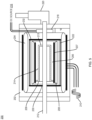
- ship power may be produced using one or more turbo-generators 50, Fig. 2 , having gas turbine 52, which may drive a high inertia HTS generator 54 via shaft 56.
- high inertia HTS generator 54 may be a 29MW 3600 rpm 2 pole generator.
- the disclosure is not limited to any particular prime mover generator or gas-turbine power level, pole count or configuration and is applicable to various gas turbine systems.
- this disclosure is not limited to gas turbine systems, as steam turbines could be used as the prime mover in place of gas turbines.
- the turbo-generators 50 may be configured to operate in dual modes, i.e. in a fixed frequency (e.g. 60Hz)/fixed voltage (e.g. 4160 VAC) mode and a variable frequency/variable voltage mode.
- the turbo-generators 50 may comprise gas turbine 52 and high inertia HTS generator 54.
- the high inertia HTS generator may be replaced with a more typical HTS generator, designed to minimize size and weight and having a lower rotational inertia.
- the power output of the one or more turbo-generators may be used for electric weapons systems and hotel loads. The operation of the multi-function turbo-generators in this mode is described below with regard to Fig. 3 .
- the one or more turbo-generators may be directly connected to one or more electric motors in a dedicated manner (i.e. they are not also connected to other electric loads).
- the generator kinetics are coupled directly to the electric motor kinetics without the large power electronic electric motor drive typically required for an electric ship propulsion motor.
- the rotational speed of the turbo-generator directly affects the rotational speed of the electric motor/propeller and hence the speed of the ship. This may be referred to herein as a synchronous propulsion drive.
- the dual modes operation of the turbo-generators 50 may be engaged under the control of a master controller typically operated from the ship's bridge.
- the disclosure may utilize separate grids to power the ship's electric propulsion, electric ship systems (hotel loads), and electric weapon systems.
- the grids may be used in a dedicated fashion or they may be interconnected also under the control of the master controller.
- Various functional configurations may be implemented that allow one or more of the turbo-generators to be operated in fixed or variable frequency mode, as desired, and to connect the one or more turbo-generators to the various loads in a dedicated or a combined way.
- a prior art all-electric ship configuration utilizing HTS generators and motors and capable of operating ships electric propulsion, electric ship systems, and electric weapon systems is shown in Fig. 3 .
- a large and complex power electronic drive system is required and is depicted in ship power grid configuration 100 of Fig 3 .
- Ship power grid configuration 100 includes two turbo generators 102 and 104, which may be of the type shown in Fig. 2 . Each generator in this example may output 29MW of three phase power at 4160 V AC at 60Hz.
- turbo-generator 102 is connected to the power grid through three phase switchgear 106 while turbo-generator 104 is connected to the power grid through three phase switchgear 108.
- Switchgear 106 is connected to switchgear 108 by port/starboard cable 110 so that in the event of a failure of one of the turbo-generators its respective switchgear can be back fed and powered by the operational turbo-generator.
- the variable speed electric motor 116 is a HTS motor and the input voltage is nine phase AC at 2700 V (approximately 37MW); therefore, the power from switchgear 106 and 108 must be converted and conditioned by a suitable power converter system.
- the output from switchgear 106 may be connected to a motor drive comprising a rectifier 118 and inverter 120. Power from switchgear 106 may be converted to DC power by rectifier 118 and then the DC may be converted to nine phase AC by inverter 120. Rectifier 118 and inverter 120 form a motor drive for controlling the current input to/rotational speed of motor 116 when they are connected to the motor 116 by disconnect cabinet 122. The maximum output power of motor drive in this example is 20 MW.
- the output from switchgear 108 may be converted to DC by rectifier 124 and then the DC may be converted to nine phase AC by inverter 126.
- Rectifier 124 and inverter 126 form a motor drive for controlling the current input to/rotational speed of motor 116 when they are connected to the motor 116 by disconnect cabinet 122.
- the maximum output power of motor drive in this example is also 20 MW.
- full power (40 MW) is needed for electric motor 116, both motor drives are connected via disconnect cabinet 122 to motor 116.
- ship power grid configuration 100 is also configured to supply power to pulsed power loads (not shown) through energy storage switchgear 128 powered by cables 127 and 129 connected to switchgear 106 and 108, respectively.
- transformer 130 connected to switchgear 106 converts 4160 V AC to 450 V AC and feeds that to distribution switchgear (not shown) to deliver lower voltage power to various systems on the ship.
- all loads propulsion, electric weapons, and hotel loads
- Pulsed power loads may consist of several seconds (e.g. 5 seconds) of very high power draw (e.g. 10MW or greater) through the energy storage switchgear 128 followed by a pause (e.g. 1 second) with no energy draw.
- the system design assumes that this cycle will be repeated indefinitely.
- pulsed loads can severely impact the proper operation of grid 100.
- a drop in rotational speed results in a proportionate drop in frequency, voltage and power from the turbo-generator.
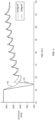
- Fig. 4 the impact on the rotational speed of such a pulsed load on turbo-generator 102/104 with a HTS generator is depicted over multiple pulse periods (assuming only one of the turbo-generators is operational).
- turbo-generator rpm dips from 3600 to approximately 1400 over the course of a few seconds with the initial pulsed load of 18MW.
- the rotational speed of the turbo-generator recovers somewhat over time as the cyclic 18MW pulses continue, but it still remains substantially below its initial 3600 rpm rotational speed.
- the estimated rotational inertia of the generator is approximately 790 kg-m2, which is based on the use of a HTS generator optimized for cost for a 29 MVA turbo-generator.
- the EM shield may be formed of steel and copper with an approximate thickness of 10cm (4in). In a weight optimized design, which may use aluminum in the EM shield, the rotational inertia may be significantly lower than in the cost optimized design. This means that the negative impact of the pulsed loads would be even greater.
- the impact of the torque on the turbo-generator may be reduced and thus pulsed power loads, like electric weapons systems, powered by a common grid powering type I loads and electric ship propulsion motors without requiring expensive additional power quality/storage components, such as series inductance or other energy storage means.
- Waveform 142 shows the impact on the rotational speed (approximately a 30% initial drop) of the turbo-generator, with a cyclic pulsed load of 18MW.
- the HTS generator used has an increased rotational inertia resulting in an overall turbo-generator rotational inertia of approximately 1496 kg-m 2 .
- the EM shield may be formed of steel with an approximate thickness of 18cm (7in).
- HTS generator 200 which has been designed to be optimized for minimum size and weight. As with the lower rotational inertia generator that produced the waveform 140 in Fig. 4 , this example may have a rotational inertia such that the overall rotational inertia of the turbo-generator will also be approximately 790 kg-m 2 .
- HTS generator 200 includes a stator assembly 202 having stator coil assemblies 204 1-n. As is well known in the art, the specific number of stator coil assemblies 204 1-n included within stator assembly 202 varies depending on various design criteria, such as whether the machine is a single phase or a poly-phase machine. For example, in one 29 MVA, 3-phase HTS generator described herein outputting 4500V AC at 60Hz, stator assembly 202 may include seventy-two (72) stator coil assemblies 214 1-n.
- a rotor assembly 206 rotates within stator assembly 202.
- rotor assembly 206 includes rotor winding assemblies 208 1-n.
- rotor assembly 206 may include two rotor winding assemblies (forming 2 poles), which may be in a saddle coil configuration, as they are well suited to high rpm generator applications. These rotor winding assemblies, during operation, generate a magnetic flux that links rotor assembly 206 and stator assembly 202. While this generator is designed as a two-pole machine, it will be understood by those skilled in the art that various pole count machines could be used and the particular design will be dependent upon the application.
- a three-phase voltage 210 is generated in stator coil assemblies 204 1-n which, in turn, is output to the power grid of the ship as shown, for example, in Fig, 3 .
- the three-phase voltage in the stator coil assemblies 204 1-n is produced by the rotor winding magnetic flux generated by the rotor coil assemblies 208 1-n that links rotor assembly 206 and stator assembly 202, as the rotor rotates when driven by turbo-generator shaft 212.
- the rotor winding assemblies 208 1-n may be mounted on an outside surface of support structure 207, which is connected to a first flange 209 that transfers the torque from torque tube 214. It should be noted that the rotor winding assemblies 208 1-n may, alternatively, be mounted on an inside surface support structure 207.
- Torque tube 214 is connected to a second flange 213, which is connected to turbo-generator shaft 212. Flanges 209 and 213 may be incorporated into torque tube 214 or may be separate assemblies. Of course, other torque tube designs may be used to transfer the torque from the shaft 212 to the rotor assembly in the cold space.
- field energy 216 for example, from a DC current source (not shown) may be applied to rotor winding assembly 208 1-n through a slip ring/rotating disk assembly 218.
- Rotor winding assemblies 208 1-n require DC current to generate the magnetic field (and the magnetic flux) required to link the rotor assembly 206 and stator assembly 202.
- Stator coil assemblies 204 1-n are formed of non-superconducting copper coil assemblies, for example, while rotor winding assemblies 208 1-n are superconducting assemblies incorporating HTS windings.
- HTS conductors include: thallium-barium-calcium-copper-oxide; bismuth-strontium-calcium-copper-oxide; mercury-barium-calcium-copper-oxide; and yttrium-barium-copper-oxide.
- HTS generator 200 includes a refrigeration system 220.
- Refrigeration system 220 is typically in the form of a cryogenic cooler that maintains the operating temperature of rotor winding assemblies 208 1-n at an operating temperature sufficiently low to enable the conductors to exhibit their superconducting characteristics. Since rotor winding assemblies 208 1-n must be kept cool by refrigeration system 220, torque tube 214 may be constructed from a high strength, low thermal conductivity metallic material (such as Inconel TM ) or composite material (such as G-10 phenolic or woven-glass epoxy).
- Rotor assembly 206 includes an electromagnetic shield 222 positioned between stator assembly 202 and rotor assembly 206 to shield or filter asynchronous fields from harmonics produced in the stator assembly 202.
- electromagnetic shield 222 is also typically cylindrical in shape. It is desirable to shield the rotor winding assemblies 208 1-n of rotor assembly 206 from these asynchronous fields. Accordingly, electromagnetic shield 222, which is fitted to rotor assembly 206, covers (or shields) rotor winding assemblies 208 1-n from the asynchronous fields and is constructed of a non-magnetic material (e.g., copper, aluminum, etc.).
- the electromagnetic shield 222 should be of a length sufficient to fully cover and shield rotor winding assemblies 208 1-n.
- the shield may be formed of aluminum with a thin overcoat of copper and having a thicknesses selected to shield ac fields and withstand fault loads. Aluminum is lightest solution but steel could be selected if weight is of less interest than cost.
- the shield also provides vacuum containment and steel presents a simpler sealing solution with welding.
- the electromagnetic shield 222 may be rigidly connected to shaft 212 via a pair of end plates 230, 232. This rigid connection can be in the form of a weld or a mechanical fastener system (e.g., bolts, rivets, splines, keyways, etc.).
- the thickness of electromagnetic shield 222 varies inversely with respect to the frequency of the three-phase AC power 210, which in this example is 60 Hertz. For low pole count designs the thickness may be selected to withstand transient forces during fault. For this frequency, typically, the thickness of electromagnetic shield 222 would be no more than 10cm (4in) of steel and copper.
- an inner ferromagnetic core e.g. an iron core
- an inner ferromagnetic core may be used to increase the magnetic permeance of the rotor and hence may allow for a reduced amount of HTS material needed to generate a given magnetic field. It also adds to the rotational inertia of the generator in a significant way.
- FIG. 6A there is shown a schematic cross-sectional view of HTS generator 300, which is similar to the type of HTS generator shown in FIG. 5 . The cross-sectional view is taken across the width of the generator, to depict the dimensions of the generator including electromagnetic shield thickness and the electromagnetic gap.
- HTS generator 300 includes a rotor assembly 302 having an inner iron core 304 depicted as a two pole generator.
- Rotor windings 306a and 306b are in the form of saddle coil windings and are each shown with two arc sections, which are joined at the ends to form the saddle coil.
- HTS generator 300 the limit on tip speed for HTS saddle coils 306a/b must be considered. Centrifugal loading on the HTS coils results in strain in the superconductor material. This strain is proportional to the square of the tip speed of the coils. Experience and analysis indicates that 150 m/sec tip speed is an acceptable limit for such coils. Generators for naval use may require over-speed testing up to 125% of rated speed. For a design speed of 3600 rpm, this corresponds to an over-speed test at 4,500 rpm requiring a field winding with a ⁇ 0.32m radius from the longitudinal axis of the generator to the mid-plane of coils 306a/b, which is depicted as R1 in Fig. 6A .
- the saddle coils are supported on their outside by a coil support cylinder 307.
- the nonrotating part of generator 300 begins at radius R2, which extends from the generator longitudinal axis to the inside radius of the stator 308, and consists of stator 308 and back iron 310.
- the EM shield 312 which is the outermost rotating member of rotor assembly 302. As described above, it shields the rotor assembly 302 from electromagnetic fields that are asynchronous with respect to the rotation to reduce AC losses in the HTS coil.
- the field strength produced by saddle coils 306a/b is proportional to the ampere-turns in each coil, but is inversely proportional to the electromagnetic ("EM") gap (R2-R1) between the saddle coils and stator.
- EM electromagnetic
- the majority of the EM gap (R2-R1) consists of the EM shield 312 and in a weight or cost optimized design, the EM shield is only made thick enough to perform its shielding function and its weight/mass is minimized by selecting a low density material with shielding capabilities.
- the inner radius Ri and outer radius Ro and a mass M would be calculated as follows: M Ri 2 + Ro 2 / 2 which, in this case, is approximately 560 kg-m 2 .
- the EM shield rotational inertia relative to the rotational inertia of the other system components in the turbo-generator would be as follows:
- the rotational inertia of the EM shield relative to the rotational inertia of the total generator is approximately seventy percent (70%).
- the rotational inertia in the EM shield is generally ⁇ 70% of the overall HTS generator rotational inertia (referred to herein as "low inertia" HTS generators).
- HTS generator 300' An HTS generator with increased rotational inertia is shown in Fig. 6B as HTS generator 300'. All components are essentially the same as HTS generator 300 of Fig. 6A , however, by constructing a thicker EM shield 312' the rotational inertia of the generator can be increased at the expense of additional ampere-turns in saddle coils 306a'/b'. In other words, a greater amount of HTS material will be required to produce the same electromagnetic field in HTS generator 300' as in HTS generator 300, since the EM gap (R2'-R1') of HTS generator 300' is greater than the EM gap (R2-R1), due to the increased thickness of the EM shield 312'.
- the EM shield 312' thickness, t' may be ⁇ 50% of R1/p.
- the thickness, t' may be approximately 18cm (7 in).
- higher density materials could be used. Examples of such materials may include copper (8.96g/cm3), steel (7.84 g/cm 3 ), lead (11.32 g/cm 3 ), gold (19.282 g/cm 3 ), tungsten (19.25 g/cm 3 ), and spent uranium (18.95 g/cm 3 ). One or more of these materials may be used to construct the EM shield.
- the amount of additional rotational inertia of the EM shield can be tailored to obtain desired operational characteristics for the particular turbo-generator and expected level and frequency of pulsed power loads.
- the inner radius Ri' and outer radius Ro' and a mass M' (using a combination of steel and tungsten alloy, for example) would be calculated as follows: M ′ Ri ′ 2 + Ro ′ 2 / 2 which, in this case, is approximately 1,477 kg-m 2 .
- the EM shield rotational inertia relative to the rotational inertia of the other system components in the turbo-generator would be as follows:
- the rotational inertia of the EM shield relative to the rotational inertia of the total generator is approximately eighty-five percent (85%).
- the rotational inertia in the EM shield may be generally ⁇ 80% of the overall HTS generator rotational inertia (referred to herein as "high inertia" HTS generators).
- the generator rotational inertia would still be 1492 kg-m 2 which is still nearly 190% of the rotational inertia of the cost and weight optimized design.
- the design of the HTS generator according to this disclosure has a number of important advantages; namely, it fits within a short axial length, has low reactance that avoids pole slipping in a highly pulsed application, and has high rotational inertia.
- HTS generators preferably high inertia HTS generators
- MTG main turbine generators
- Each of the MTGs may be configured and operated in either mode and used to selectively power the ship's electric propulsion systems (variable frequency mode), electric ship systems (fixed frequency mode), and electric weapon systems (fixed frequency mode), creating a multi-functional integrated power system (MF-IPS) with significant flexibility powering the various ships systems.
- MF-IPS multi-functional integrated power system
- MF-MTG 350 may be used to selectively power shipboard electric grids connected to three primary ship systems.
- the ship systems include a synchronous propulsion drive system 352, which may include a 37 MW HTS electric motor, connected via electrical power network 351.
- MF-MTG 350 when connected to electrical power network 351 may be configured to operate in variable frequency power mode (variable frequency and variable voltage) to drive the HTS electric motor.
- Type 1 ship service power system, 354 may be connected to MF-MTG 350 by electrical power network 353.
- electrical power network 354 would be powered by MF-MTG 350 operating at a fixed frequency power mode (fixed voltage, e.g. fixed voltage 4160 VAC, and fixed frequency, e.g. 60Hz).
- electric weapons systems 356, connected to electrical power network 355 may be powered by MF-MTG 350 operating at a fixed frequency (e.g. 60Hz) and voltage.
- a single MF-MTG is used; however, in a typical application, multiple MF-MTG's operating in either mode depending on the system load may be used to power the various onboard systems.
- four MF-MTGs are used; however, any suitable number may be used.
- the multi-functional integrated power system of the disclosure uses multiple separate buses.
- the separate busses may be used in a dedicated or interconnected manner to power specific demanded load types. This minimizes the complication, risk and attendant significant volume of power electronics and computing power required to maintain stability and near type 1 quality power required for single bus operation. It eliminates the large and complex power electronics motor drive typically needed for electric propulsion motors and it utilizes high inertia HTS generators to directly connect to the electric weapons, rather than connecting through large and expensive intermediary energy storage devices and filter.
- the power output of the turbo-generators may be used for electric weapons systems, and/or type 1 ship service loads.
- the turbo-generators may be directly connected to one or more electric motors in a dedicated manner (i.e. they are not also connected to other electric loads).
- the generator kinetics are coupled directly to the electric motor kinetics without the large power electronic electric motor drive typically required for an electric ship propulsion motor.
- the rotational speed of the turbo-generator directly affects the rotational speed of the electric motor/propeller and hence the speed of the ship. This may be referred to herein as a synchronous propulsion drive.
- Fig. 8A-C the topology of multi-functional integrated power system 400, according to an aspect of this disclosure, is shown. Also in Figs. 8A-8C , three functional configurations of the MF-IPS 400 are depicted only as exemplary configurations. It should be noted that other configurations are possible and are within the scope of the disclosure.
- the turbo-generators will be operated in a fixed frequency/fixed voltage mode and in others it will be operated in a variable frequency mode/variable voltage mode to power different ship systems.
- cables that are depicted with thicker lines are energized with cables depicted as thinner lines are de-energized.
- the turbo-generators that are depicted with solid colors are online and operational while the turbo-generators which are not depicted with solid colors are off-line and not operational.
- ER1 402 in the ship described in this example, there are two main engine rooms, ER1 402 and ER2 404.
- ER1 402 there is included turbo-generator 406 connected to three phase switchgear 408 via cable 407.
- turbo-generator 410 connected to three phase switchgear 412.
- the turbo-generators may be 29MW 3600 rpm 2 pole generators as shown in Fig. 2 and may include a high inertia HTS generator, as described above with regard to Figs. 4-6 .
- Fig. 8A depicts the standard configuration for the MF-IPS system described herein.
- Figs. 8B and 8C two alternative operating configurations are depicted.
- turbo-generator 406 is connected to and powers electric propulsion motor 414, which in this case may be a 37 MW HTS motor, via disconnect switch 420 which is fed by switchgear 408 interconnected to cable 409.
- Turbo-generator 406 is operated in a variable frequency/voltage mode with the speed of the motors/ship varied by adjusting the frequency and hence rotation of the turbo-generator and in turn the HTS motors.
- Electric propulsion motor 414 is connected to the starboard shaft (not shown) to drive starboard propeller 416.
- Starboard propeller 416 uses controllable pitch controller 418 to operate as a controllable pitch propeller to provide finer control over the ship's movement when needed for maneuvering and docking, for example.
- Switchgear 408 is also connected to switchgear 422 by cross-connect cable 423 in order to power switchgear 422, as needed.
- Switchgear 408 is also connected to ER2 404 via cross-connect cable 425 in the event that supplemental power from ER1 402 is needed by ER2 404 and vice-versa.
- Switchgear 422 is normally connected to and powered by turbo-generator 410 via switchgear 412. In alternate configurations, switchgear 422 may be used to power electric propulsion motor 414, via cable 427 (with the turbo-generator 410 operating in a variable frequency/variable voltage mode), or it may be used to provide supplemental power to ER2 404 via cross-connect cable 429.
- turbo-generator 410 is connected through switchgear 412 to electric weapons switchgear units 430a and 430b via cables 432a and 432b, respectively.
- Electric weapons switch gear units 430a and 430b are connected to electric weapons 434a and 434b, respectively.
- Turbo-generator 410 is operated in a fixed voltage/fixed frequency mode (e.g. 4160 VAC and 60Hz).
- ER1 machine controller 440 which is in communication with a master controller (not shown) which receives control signals from the ship's bridge.
- master controller not shown
- ER1 machine controller 440 and ER2 machine controller discussed below
- various functional configurations of the multi-functional integrated power system 400 may be implemented as described with regard to Figs. 8A-C .
- turbo-generator 440 connected to three phase switchgear 442 and turbo-generator 444 connected to three phase switchgear 446.
- These turbo-generators may also be configured as shown in Fig. 2 and may include a high inertia HTS generator as described above with regard to Figs. 4-6 .
- electric propulsion motor 448 which in this case is a 37 MW HTS motor, is powered by turbo-generator 440.
- Turbo-generator 440 is connected to and powers electric propulsion motor 448, via disconnect switch 443 which is fed by switchgear 442 interconnected to cable 445.
- Turbo-generator 440 is operated in a variable frequency/voltage mode, as described above.
- HTS motor 448 is connected to port shaft which drives port propeller 450.
- Port propeller 450 uses controllable pitch controller 452 to operate as a controllable pitch propeller to provide finer control over the ship's movement when needed for maneuvering and docking, for example.
- Turbo-generator 444 connected to three phase switchgear 446 is, in this configuration, primarily used to power electric weapons switchgear units 430a and 430b (in conjunction with or alternative to turbo-generator 410, as described above) via cables 447a and 447b, respectively.
- Turbo-generator 444 is operated in a fixed voltage/fixed frequency mode (e.g. 4160 VAC and 60Hz).
- Electric weapons switch gear units 430a and 430b are connected to electric weapons 434a and 434b, respectively.
- Switchgear 446 is also connected to switchgear 442 by cross-connect cable 455 in order to back-feed switchgear 442, as needed.
- Switchgear 456 is connected to switchgear 446 and additionally it is connected to switchgear 408 in ER1 402 via cross-connect cable 425 in the event that supplemental power from ER2 404 is needed by ER1 402 and vice-versa. Switchgear 456 is also connected to electric propulsion motor 448, via disconnect switch 443 which is fed by cable 457. In an alternate configuration, turbo-generator 444 may be used to power electric propulsion motor 448 by changing its mode of operation to variable frequency/voltage mode.
- ER2 machine controller 462 which is in communication with a master controller (not shown) which receives control signals from the ship's bridge.
- master controller the ER1 machine controller 440 and ER2 machine controller 462
- various functional configurations of the multi-functional integrated power system 400 may be implemented.
- SSGTGs small turbo-generators
- AMR 1 auxiliary machinery room
- SSGTG's may provide power to ship service network.
- SSGTGNo. 1470 may be connected to ship service transformer A 471 via ship service switchgear 473.
- SSGTG No. 2 472 may be directly connected to ship service transformer B 475 via ship service switchgear 477.
- Ship service switchgear 473 may also be interconnected to ship service switchgear 477 in generator room 490 via cable 482. It may also be connected to a third ship service switchgear 492 in ER 2 404 via cable 484 and switchgear 408 via cable 486. Cable 487 may connect ship service switchgear 472 to sensor system. Ship service switchgear 477 may also be interconnected to service switchgear 492 in ER 2 404 via cable 494 and to switchgear 442 in ER 2 404 via cable 496. Switchgear 447 may further be connected to the sensor system via cable 498.
- turbo-generators 406 and 440 are operated in a variable frequency/variable voltage mode operation in order to drive electric propulsion motors 414 and 448, respectively.
- the weapons systems 434a and 434b are powered by either turbo-generator 410 or turbo-generator 444 individually or in combination, with both turbo-generators operating in a fixed frequency/fixed voltage mode.
- FIG. 8B A second mode of operation is depicted in Fig. 8B , which enables fuel efficient transit at slower speeds (e.g. 20 knots) without the electric weapons systems energized.
- turbo-generator 440 in ER 2 404 is on-line and is powering both HTS motors 414 and 448 in a variable frequency mode.
- Turbo-generators 406, 410, and 444 are off-line.
- SSTG's 470 and 472 are online and are energizing to ship service transformer A 471 and ship service transformer B 475 to supply all of the power to the ship service network.
- turbo-generator 406, 440, and 444 are online and operating in a variable frequency/variable voltage mode to power HTS motors 414 and 448 which allows the ship to travel at 32 knots.
- Turbo-generator 410 is online and operating in a fixed frequency/fixed voltage mode to power electric weapons systems 434a and 434b.
- both SSTG's 470 and 472 are online and are energizing to ship service transformer A 471 and ship service transformer B 475 to supply all of the power to the ship service network.
- the three functional configurations of the MF-IPS 400 depicted in Figs. 8A-8C are only exemplary configurations and other configurations are possible and are encompassed within the scope of the disclosure.
- the multi-functional integrated power system of the disclosure uses multiple separate buses And, depending on load type the turbo-generators are uniquely operated in either a fixed frequency/fixed voltage mode or a variable frequency/variable voltage mode. This minimizes the complication, risk and attendant significant volume of power electronics and computing power required to maintain stability and near type 1 quality power required for single bus operation. It eliminates the large and complex power electronics motor drive typically needed for electric propulsion motors and it utilizes high inertia HTS generators to directly connect to the electric weapons, rather than connecting through large and expensive intermediary energy storage devices and filter.
Landscapes
- Engineering & Computer Science (AREA)
- Power Engineering (AREA)
- Mechanical Engineering (AREA)
- Transportation (AREA)
- Ocean & Marine Engineering (AREA)
- Combustion & Propulsion (AREA)
- Chemical & Material Sciences (AREA)
- Aviation & Aerospace Engineering (AREA)
- Connection Of Motors, Electrical Generators, Mechanical Devices, And The Like (AREA)
- Control Of Eletrric Generators (AREA)
- Supply And Distribution Of Alternating Current (AREA)
- Superconductive Dynamoelectric Machines (AREA)
- Control Of Vehicle Engines Or Engines For Specific Uses (AREA)
Description
- This invention relates to an electric power system for a watercraft, such as a ship or submarine, and more specifically to a multi-function integrated power system which utilizes one or more HTS generators operating in both fixed and variable speed modes to energize the watercraft's electrical networks to power high temperature superconductor (HTS) motors for propulsion, electric weapon systems, and various onboard electrical loads (lighting and other hotel loads), without the need for a large power electronics drive system.
- The shipping industry and navies around the world are interested in upgrading their watercrafts (i.e. ships and/or submarines) using advanced technologies to provide, for example, improved fuel efficiency, greater electric capacity, and more sophisticated onboard systems. The terms watercraft, ship, and/or submarine may be used interchangeably throughout this document and each shall be interpreted to encompass any waterborne vessels, including, for example, boats, ships, hovercraft and submarines. Size and weight reductions in propulsion and power generation systems will provide additional room for more equipment, cargo, and/or crew, improved fuel economy, and enhanced survivability and flexibility. For naval ships and submarines, new varieties of electric weapons, advanced sensors, and integrated support systems may be of interest to navies around the world. Such systems may include electromagnetic guns and high-powered laser or microwave directed-energy weapons, which present especially rigorous electrical power demands. For example, they require large amounts of electrical power over very short time periods of time.
- Typical propulsion and energy generation systems utilize single function marine gas turbine and diesel engine technologies to drive propeller shafts through a main reduction gear for mobility and separate dedicated electric power generated by prime movers are used to drive electrical generators to power electrical grids which feed the onboard electrical systems. There are physical limits in size and weight reductions that can be achieved with gas turbine technologies and significant advancements are not likely. In addition, marine gas turbine and diesel engine generator technologies, which are used to produce electrical power are typically designed to operate efficiently and reliably at constant loading. Therefore, they are unable to support the above described dynamic loads associated with advanced electrical systems, such as electric weapons, without significant and costly electrical system upgrades which may not even fit on the ship. For example, with a conventional gas turbine generator system an additional energy storage system, such as batteries or a fly wheel, may be needed to isolate the pulse effects of the primary energy storage powering the electric weapons.
- The concept of an all-electric watercraft has been deployed in the form of a ship, which may include the use of electrical means for all power needs, including propulsion, in lieu of other means such as mechanical, pneumatic, and hydraulic, is gaining momentum. Such all-electric ships, having an integrated power system (IPS), in particular those utilizing high temperature superconductor motors and generators, will result in size and weight reductions, which will provide additional room and weight capacity for more equipment, cargo, weapons, and/or crew, as well as improved efficiency and fuel economy. These systems are envisioned to share electric power seamlessly across a common electric bus allowing for universally shared power for all electric functions of the watercraft from powering the propellers, to energizing the combat systems, to feeding the lighting and other hotel loads.
- Such all-electric ships conventionally include one or more electric drive motors which are each for driving a propelling unit and are each fed by way of a respective electric power converter by an electrical power network on the ship (i.e. the ship's drive). The electrical power network is in turn fed by one or more diesel, gas or steam turbine generators. In this arrangement, the voltage of the electrical power network is of a fixed predetermined amplitude and frequency, for example having a medium voltage with a nominal voltage of 6.6 kV at a nominal frequency of 60 Hz. Where appropriate, a transformer is additionally connected between the converter and the power network. The converters convert the power network voltage (stepped down where necessary) to a voltage required to operate the electric motors driving the propellers, which electric motors have a different amplitude and frequency from the power network voltage.
- The power converter system or drive is a very large, complex and expensive system. A known electric drive solution is described in
U.S. Patent No. 9,650,120 B2 - The '120 patent utilizes the electrical energy from the electric shaft and converts the voltage having variable amplitude and frequency using a power converter and a power network synchronizing device to a voltage of constant amplitude and constant frequency for an onboard power network. While the power converter and power network synchronizing device described in the '120 patent are not as large and complex as the ship's drive described above with conventional the all-electric ships, it is still a large and complex system.
- Therefore, there exists a need for a more compact and less complicated power system for providing power to all of the ship's electrical loads, including its electric propulsion motors, electrical weapons systems, and various onboard electrical equipment such as lighting and other hotel loads.
-
US 2012/302112 A1 discloses a ship drive system includes a first and one second drive shaft for driving a respective propulsion unit, wherein each of the electric drive shafts includes at least one speed-variable generator driven by an internal combustion engine for generating a motor voltage having a variable amplitude and variable frequency, and at least one speed-variable drive motor that is supplied with the voltage and coupled to the propulsion unit. The first and second drive shafts can be switched from a first operating state, in which they are electrically disconnected from each other, to a second operating state, in which they are electrically coupled to each other such energy can be transmitted from the at least one generator of the one drive shaft to the at least one drive motor of the other drive shaft. To this end, the at least one generator includes a superconductor winding. - The invention is defined by the features of the
independent claim 1. Preferred embodiments are defined in thedependent claims 2 to 9. - In one aspect, the disclosure features an electrical power system for a watercraft, including a first electrical power plant configured to selectively operate either in one of a variable frequency mode to output variable frequency power to a first electrical network or a fixed frequency mode to output fixed frequency power to a second electrical network wherein the first electrical power plant includes a prime mover and a generator. There is a first electrical load including a first high temperature superconductor (HTS) motor connected to the first electrical network to provide propulsion for the watercraft and a second electrical load connected to the second electrical network. There is a controller configured to selectively connect the generator of the first electrical power plant to the first electrical network and to operate the first electrical power plant in the variable frequency mode to output variable frequency power from the generator to power the first HTS motor or to selectively connect the generator of the first electrical power plant to the second electrical network and to operate the first electrical power plant in a fixed frequency mode to output fixed frequency power from the generator to power the second electrical load.
- In other aspects of the disclosure, one or more of the following features may be included. The second electrical load includes at least one of an electric weapons system and a ship service system. There may further be included a third electrical network interconnected to a third load which includes at least one of an electric weapons system and a ship service system. The controller may be configured to selectively connect the first electrical power plant to one of the first electrical network, the second electrical network, and the third electrical network. The first electrical power plant may include at least one high inertia HTS generator. The first electrical power plant may include at least one gas turbine, steam turbine, or diesel engine prime mover interconnected to the at least one high inertia HTS generator. There may further be included a second electrical power plant configured to selectively power the first electrical network, the second electrical network, and the third electrical network. The second electrical power plant may include at least one high inertia HTS generator and at least one gas turbine, steam turbine, or diesel engine prime mover may be interconnected to the at least one high inertia HTS generator. The controller may connect the first electrical power plant to the first electrical network and operate the first electrical power plant in a variable frequency mode and the controller may connect the second electrical power plant to one or both of the second and third electrical networks and operates the second electrical power plant in a fixed frequency mode. There may further be included a fourth electrical load connected to the first electrical power network and the fourth electrical load may include a second high temperature superconductor (HTS) motor to provide propulsion for the watercraft. The watercraft may be one of a ship or a submarine.
- Embodiments of the present disclosure will now be described, by way of example only, with reference to the attached Figures, wherein:
-
FIG. 1 shows a perspective view of a ship with a multi-function integrated power systems according to an aspect of this disclosure; -
FIG. 2 shows a partial cut-away, side elevational view of a turbo-generator used with a multi-function power system according to an aspect of this disclosure; -
FIG. 3 shows a schematic block diagram of a prior art integrated power system utilizing a large motor drive system to drive the HTS ship propulsion motor; -
FIG. 4 shows a plot of turbo-generator rotational speed over time to depict the impact of pulsed power loads on generator rotational speed and hence power output; -
FIG. 5 shows a cross-sectional view of a HTS generator, taken along the length of the generator, designed to be optimized for size and weight reduction; -
FIG. 6A shows a cross-sectional view of the type of HTS generator ofFIG. 5 , taken across the width of the generator, to depict the dimensions of the generator including electromagnetic shield thickness and the electromagnetic gap; -
FIG. 6B shows a cross-sectional view of an HTS generator with increased rotational inertia according to an aspect of this disclosure, taken across the width of the generator, to depict the dimensions of the generator, including the electromagnetic shield thickness and the electromagnetic gap; -
FIG. 7 shows a schematic diagram of the multi-function main turbine generator configured to feed three separate networks to provide power ship, electric weapons ship service systems; -
FIG. 8A shows a schematic diagram of a multi-function integrated power system according to an aspect of the disclosure, configured in one mode of operation; -
FIG. 8B shows a schematic diagram on the multi-function integrated power system according toFig. 8A , configured in second mode of operation; and -
FIG. 8C shows a schematic diagram on the multi-function integrated power system according toFig. 8A , configured in third mode of operation. - The disclosure and the various features and advantageous details thereof are explained more fully with reference to the non-limiting embodiments and examples that are described and/or illustrated in the accompanying drawings and detailed in the following description. It should be noted that the features illustrated in the drawings are not necessarily drawn to scale, and features of one embodiment may be employed with other embodiments as the skilled artisan would recognize, even if not explicitly stated herein. Descriptions of well-known components and processing techniques may be omitted so as to not unnecessarily obscure the embodiments of the disclosure.
- The examples used herein are intended merely to facilitate an understanding of ways in which the system may be practiced and to further enable those of skill in the art to practice the embodiments of the disclosure. Accordingly, the examples and embodiments herein should not be construed as limiting the scope of the disclosure. Moreover, it is noted that like reference numerals represent similar parts throughout the several views of the drawings.
- While the preferred embodiment described herein as being incorporated into a ship, this is merely an exemplary application, as the multi-function integrated power systems according to this disclosure may be incorporated into any type of waterborne vessels, including, for example, boats, ships, hovercraft, submarines, or other type of watercraft, including unmanned water craft.
- Referring to
Fig. 1 , there is shownship 10, which may be a naval ship, e.g. a destroyer. While the inventive aspects of this disclosure are particularly applicable to naval ships, the disclosure is not limited to naval ships and could be applied to other types of ships with significant/rigorous noise and power requirements and need for size and weight reductions, such as oceanographic research ships and cruise ships.Ship 10 may include a first all-electric drive 12 and a second all-electric drive 14, which together form part of an all-electric propulsion and energy system. Alternatively ship 10 could be outfitted with a hybrid electrical and mechanical propulsion and energy system, as described and claimed inU.S. Patent No. 10,669,001 - The propulsion and energy system according to this disclosure may be installed in a newly built ship according to a new ship design or it may be installed as a retrofit to an older/existing ship/design. The retrofit may be of an already built ship wherein a mechanical drive is replaced with an all-electric drive or it may be a retrofit of an existing ship design wherein the ship will be newly built with an all-electrical (or hybrid) propulsion and energy system.
-
Ship 10 may also include certainelectric weapons Type 1 power) and require expensive additional power quality components not fully developed yet, such as series inductance or other energy storage means. This results in many more large system components which are difficult and maybe impossible to find space for in the ship and are high in cost. - One of the advantages to the electric power system described herein is that it is capable of powering advanced electric weapon systems and other electric ship
systems requiring Type 1 power (Mil Std. 1399), as well as providing ship propulsion with one common multi-function power source, at an affordable cost while reducing size, weight and technical complexity. In one aspect of the disclosure, ship power may be produced using one or more turbo-generators 50,Fig. 2 , havinggas turbine 52, which may drive a highinertia HTS generator 54 viashaft 56. In this example, highinertia HTS generator 54 may be a 29MW 3600rpm 2 pole generator. However, the disclosure is not limited to any particular prime mover generator or gas-turbine power level, pole count or configuration and is applicable to various gas turbine systems. Moreover, this disclosure is not limited to gas turbine systems, as steam turbines could be used as the prime mover in place of gas turbines. - In one aspect of the disclosure, the turbo-
generators 50 may be configured to operate in dual modes, i.e. in a fixed frequency (e.g. 60Hz)/fixed voltage (e.g. 4160 VAC) mode and a variable frequency/variable voltage mode. The turbo-generators 50 may comprisegas turbine 52 and highinertia HTS generator 54. Alternatively the high inertia HTS generator may be replaced with a more typical HTS generator, designed to minimize size and weight and having a lower rotational inertia. In a fixed frequency mode the power output of the one or more turbo-generators may be used for electric weapons systems and hotel loads. The operation of the multi-function turbo-generators in this mode is described below with regard toFig. 3 . In a variable frequency mode of operation, the one or more turbo-generators may be directly connected to one or more electric motors in a dedicated manner (i.e. they are not also connected to other electric loads). With the variable frequency mode, the generator kinetics are coupled directly to the electric motor kinetics without the large power electronic electric motor drive typically required for an electric ship propulsion motor. In other words, the rotational speed of the turbo-generator directly affects the rotational speed of the electric motor/propeller and hence the speed of the ship. This may be referred to herein as a synchronous propulsion drive. - The dual modes operation of the turbo-
generators 50 may be engaged under the control of a master controller typically operated from the ship's bridge. In addition, and as will be described further below, the disclosure may utilize separate grids to power the ship's electric propulsion, electric ship systems (hotel loads), and electric weapon systems. The grids may be used in a dedicated fashion or they may be interconnected also under the control of the master controller. Various functional configurations may be implemented that allow one or more of the turbo-generators to be operated in fixed or variable frequency mode, as desired, and to connect the one or more turbo-generators to the various loads in a dedicated or a combined way. - Before describing the integrated power system topology utilizing a dual mode of turbo-generator operation, a prior art all-electric ship configuration utilizing HTS generators and motors and capable of operating ships electric propulsion, electric ship systems, and electric weapon systems is shown in
Fig. 3 . However, with this prior art topology, a large and complex power electronic drive system is required and is depicted in shippower grid configuration 100 ofFig 3 . - In
Fig. 3 , only one electric motor (starboard side) and two turbo generators are depicted for ease of description; however, one skilled in the art will understand that the port side of the ship would include an additional electric motor and two additional turbo generators, as well as associated electric components and electric drive. Shippower grid configuration 100 includes twoturbo generators Fig. 2 . Each generator in this example may output 29MW of three phase power at 4160 V AC at 60Hz. In this example, turbo-generator 102 is connected to the power grid through threephase switchgear 106 while turbo-generator 104 is connected to the power grid through threephase switchgear 108. -
Switchgear 106 is connected to switchgear 108 by port/starboard cable 110 so that in the event of a failure of one of the turbo-generators its respective switchgear can be back fed and powered by the operational turbo-generator.Cables switchgear electric propulsion motor 116, which may be a conventional electric motor or a HTS motor. In this example, the variable speedelectric motor 116 is a HTS motor and the input voltage is nine phase AC at 2700 V (approximately 37MW); therefore, the power fromswitchgear - The output from
switchgear 106 may be connected to a motor drive comprising arectifier 118 andinverter 120. Power fromswitchgear 106 may be converted to DC power byrectifier 118 and then the DC may be converted to nine phase AC byinverter 120.Rectifier 118 andinverter 120 form a motor drive for controlling the current input to/rotational speed ofmotor 116 when they are connected to themotor 116 bydisconnect cabinet 122. The maximum output power of motor drive in this example is 20 MW. The output fromswitchgear 108 may be converted to DC byrectifier 124 and then the DC may be converted to nine phase AC byinverter 126.Rectifier 124 andinverter 126 form a motor drive for controlling the current input to/rotational speed ofmotor 116 when they are connected to themotor 116 bydisconnect cabinet 122. The maximum output power of motor drive in this example is also 20 MW. When full power (40 MW) is needed forelectric motor 116, both motor drives are connected viadisconnect cabinet 122 tomotor 116. - Continuing to refer to
Fig. 3 , shippower grid configuration 100 is also configured to supply power to pulsed power loads (not shown) throughenergy storage switchgear 128 powered bycables switchgear transformer 130 connected to switchgear 106converts 4160 V AC to 450 V AC and feeds that to distribution switchgear (not shown) to deliver lower voltage power to various systems on the ship. Thus, all loads (propulsion, electric weapons, and hotel loads) may be interconnected and powered by a common electric grid energized by one or more turbo-generators. - Pulsed power loads may consist of several seconds (e.g. 5 seconds) of very high power draw (e.g. 10MW or greater) through the
energy storage switchgear 128 followed by a pause (e.g. 1 second) with no energy draw. The system design assumes that this cycle will be repeated indefinitely. As noted above, such pulsed loads can severely impact the proper operation ofgrid 100. A drop in rotational speed results in a proportionate drop in frequency, voltage and power from the turbo-generator. InFig. 4 , the impact on the rotational speed of such a pulsed load on turbo-generator 102/104 with a HTS generator is depicted over multiple pulse periods (assuming only one of the turbo-generators is operational). - As shown by
waveform 140, turbo-generator rpm dips from 3600 to approximately 1400 over the course of a few seconds with the initial pulsed load of 18MW. The rotational speed of the turbo-generator recovers somewhat over time as the cyclic 18MW pulses continue, but it still remains substantially below its initial 3600 rpm rotational speed. In this cases, the estimated rotational inertia of the generator is approximately 790 kg-m2, which is based on the use of a HTS generator optimized for cost for a 29 MVA turbo-generator. In this example, the EM shield may be formed of steel and copper with an approximate thickness of 10cm (4in). In a weight optimized design, which may use aluminum in the EM shield, the rotational inertia may be significantly lower than in the cost optimized design. This means that the negative impact of the pulsed loads would be even greater. - With relatively low inertia in the turbo-generator, the torque imposed during the pulsed load on the turbo-generator has a more significant impact in reducing the rotational speed. In the example of
waveform 140, this translates into a nearly 60% drop in rotational speed and a commensurate drop in voltage, frequency, and power onpower grid 100. Moreover, with this level of cyclic loading on the turbo-generator it is certain to shorten turbine life and it may even cause the engine to shut down. - According to one aspect of this disclosure, it was realized that with greater rotational inertia in the HTS generator, the impact of the torque on the turbo-generator may be reduced and thus pulsed power loads, like electric weapons systems, powered by a common grid powering type I loads and electric ship propulsion motors without requiring expensive additional power quality/storage components, such as series inductance or other energy storage means.
-
Waveform 142 shows the impact on the rotational speed (approximately a 30% initial drop) of the turbo-generator, with a cyclic pulsed load of 18MW. In this case, the HTS generator used has an increased rotational inertia resulting in an overall turbo-generator rotational inertia of approximately 1496 kg-m2. The EM shield may be formed of steel with an approximate thickness of 18cm (7in). As is evident fromwaveform 142, as compared towaveform 140, increasing the rotational inertia of the turbo-generator to 1496 kg-m2 reduces substantially the impact of the initial and the subsequent cyclic pulsed loads on the rotational speed of the turbo-generator as well as the impact on voltage, frequency, and power onpower grid 100. Adding a tungsten alloy to the EM shield would further increase the rotational inertia to approximately 1817 kg-m2. - Referring to
FIG. 5 , there is shown a priorart HTS generator 200 which has been designed to be optimized for minimum size and weight. As with the lower rotational inertia generator that produced thewaveform 140 inFig. 4 , this example may have a rotational inertia such that the overall rotational inertia of the turbo-generator will also be approximately 790 kg-m2.HTS generator 200 includes astator assembly 202 havingstator coil assemblies 204 1-n. As is well known in the art, the specific number ofstator coil assemblies 204 1-n included withinstator assembly 202 varies depending on various design criteria, such as whether the machine is a single phase or a poly-phase machine. For example, in one 29 MVA, 3-phase HTS generator described herein outputting 4500V AC at 60Hz,stator assembly 202 may include seventy-two (72)stator coil assemblies 214 1-n. - A
rotor assembly 206 rotates withinstator assembly 202. As withstator assembly 202,rotor assembly 206 includesrotor winding assemblies 208 1-n. In the same 29 MVA, 3-phase HTS generator,rotor assembly 206 may include two rotor winding assemblies (forming 2 poles), which may be in a saddle coil configuration, as they are well suited to high rpm generator applications. These rotor winding assemblies, during operation, generate a magnetic flux that linksrotor assembly 206 andstator assembly 202. While this generator is designed as a two-pole machine, it will be understood by those skilled in the art that various pole count machines could be used and the particular design will be dependent upon the application. During operation ofgenerator 200, a three-phase voltage 210 is generated instator coil assemblies 204 1-n which, in turn, is output to the power grid of the ship as shown, for example, inFig, 3 . The three-phase voltage in thestator coil assemblies 204 1-n, is produced by the rotor winding magnetic flux generated by therotor coil assemblies 208 1-n that linksrotor assembly 206 andstator assembly 202, as the rotor rotates when driven by turbo-generator shaft 212. - The
rotor winding assemblies 208 1-n may be mounted on an outside surface ofsupport structure 207, which is connected to afirst flange 209 that transfers the torque fromtorque tube 214. It should be noted that therotor winding assemblies 208 1-n may, alternatively, be mounted on an insidesurface support structure 207.Torque tube 214 is connected to asecond flange 213, which is connected to turbo-generator shaft 212.Flanges torque tube 214 or may be separate assemblies. Of course, other torque tube designs may be used to transfer the torque from theshaft 212 to the rotor assembly in the cold space. - During operation of superconducting
rotating machine 200,field energy 216, for example, from a DC current source (not shown) may be applied torotor winding assembly 208 1-n through a slip ring/rotating disk assembly 218.Rotor winding assemblies 208 1-n, require DC current to generate the magnetic field (and the magnetic flux) required to link therotor assembly 206 andstator assembly 202.Stator coil assemblies 204 1-n are formed of non-superconducting copper coil assemblies, for example, whilerotor winding assemblies 208 1-n are superconducting assemblies incorporating HTS windings. Examples of HTS conductors include: thallium-barium-calcium-copper-oxide; bismuth-strontium-calcium-copper-oxide; mercury-barium-calcium-copper-oxide; and yttrium-barium-copper-oxide. - As these superconducting conductors only achieve their superconducting characteristics when operating at low temperatures,
HTS generator 200 includes arefrigeration system 220.Refrigeration system 220 is typically in the form of a cryogenic cooler that maintains the operating temperature ofrotor winding assemblies 208 1-n at an operating temperature sufficiently low to enable the conductors to exhibit their superconducting characteristics. Sincerotor winding assemblies 208 1-n must be kept cool byrefrigeration system 220,torque tube 214 may be constructed from a high strength, low thermal conductivity metallic material (such as Inconel™) or composite material (such as G-10 phenolic or woven-glass epoxy). -
Rotor assembly 206 includes an electromagnetic shield 222 positioned betweenstator assembly 202 androtor assembly 206 to shield or filter asynchronous fields from harmonics produced in thestator assembly 202. Asrotor assembly 206 is typically cylindrical in shape, electromagnetic shield 222 is also typically cylindrical in shape. It is desirable to shield therotor winding assemblies 208 1-n ofrotor assembly 206 from these asynchronous fields. Accordingly, electromagnetic shield 222, which is fitted torotor assembly 206, covers (or shields)rotor winding assemblies 208 1-n from the asynchronous fields and is constructed of a non-magnetic material (e.g., copper, aluminum, etc.). The electromagnetic shield 222 should be of a length sufficient to fully cover and shieldrotor winding assemblies 208 1-n. Typically, the shield may be formed of aluminum with a thin overcoat of copper and having a thicknesses selected to shield ac fields and withstand fault loads. Aluminum is lightest solution but steel could be selected if weight is of less interest than cost. The shield also provides vacuum containment and steel presents a simpler sealing solution with welding. - The electromagnetic shield 222 may be rigidly connected to
shaft 212 via a pair ofend plates phase AC power 210, which in this example is 60 Hertz. For low pole count designs the thickness may be selected to withstand transient forces during fault. For this frequency, typically, the thickness of electromagnetic shield 222 would be no more than 10cm (4in) of steel and copper. In order to reduce the size and weight of the generator, prior art systems such as this one, minimized the thickness of theelectromagnetic shield 122 to the point where it was of a sufficient thickness to filter the asynchronous fields and to support fault ovalizing forces on the shield, but no thicker, so as to minimize generator weight and size. - Although not shown in
generator 200 ofFig. 5 , an inner ferromagnetic core (e.g. an iron core) may be used to increase the magnetic permeance of the rotor and hence may allow for a reduced amount of HTS material needed to generate a given magnetic field. It also adds to the rotational inertia of the generator in a significant way. InFig. 6A there is shown a schematic cross-sectional view ofHTS generator 300, which is similar to the type of HTS generator shown inFIG. 5 . The cross-sectional view is taken across the width of the generator, to depict the dimensions of the generator including electromagnetic shield thickness and the electromagnetic gap. In this example,HTS generator 300 includes arotor assembly 302 having aninner iron core 304 depicted as a two pole generator.Rotor windings - In designing
HTS generator 300, the limit on tip speed forHTS saddle coils 306a/b must be considered. Centrifugal loading on the HTS coils results in strain in the superconductor material. This strain is proportional to the square of the tip speed of the coils. Experience and analysis indicates that 150 m/sec tip speed is an acceptable limit for such coils. Generators for naval use may require over-speed testing up to 125% of rated speed. For a design speed of 3600 rpm, this corresponds to an over-speed test at 4,500 rpm requiring a field winding with a ~0.32m radius from the longitudinal axis of the generator to the mid-plane ofcoils 306a/b, which is depicted as R1 inFig. 6A . The saddle coils are supported on their outside by acoil support cylinder 307. - The nonrotating part of
generator 300 begins at radius R2, which extends from the generator longitudinal axis to the inside radius of thestator 308, and consists ofstator 308 and backiron 310. Outside of thecoil support cylinder 307 is theEM shield 312, which is the outermost rotating member ofrotor assembly 302. As described above, it shields therotor assembly 302 from electromagnetic fields that are asynchronous with respect to the rotation to reduce AC losses in the HTS coil. The field strength produced bysaddle coils 306a/b is proportional to the ampere-turns in each coil, but is inversely proportional to the electromagnetic ("EM") gap (R2-R1) between the saddle coils and stator. Thus, increasing the EM gap increases the number of ampere-turns and hence the amount of HTS wire needed to generate a given electromagnetic field. - The majority of the EM gap (R2-R1) consists of the
EM shield 312 and in a weight or cost optimized design, the EM shield is only made thick enough to perform its shielding function and its weight/mass is minimized by selecting a low density material with shielding capabilities. TheEM shield 312 thickness, t, is generally < 40% of R1/p, where p is the number of pole pairs in the design (p=1 for a two pole generator). For this design the thickness, t, may be 10cm (4 in) and the material used for the EM shield may be a moderate-density material such as steel. - To determine the rotational inertia for
EM shield 312, the inner radius Ri and outer radius Ro and a mass M would be calculated as follows:
-
EM Shield 560 kg-m2 Inner Iron and Shafts 143 kg-m2 Field and support 87 kg-m2 Total Gen. Rotor 790 kg-m2 Turbine 96 kg-m2 Total 886 kg-m2 - For this example, the rotational inertia of the EM shield relative to the rotational inertia of the total generator is approximately seventy percent (70%). For typical cost/weight optimized designs, the rotational inertia in the EM shield is generally ≤ 70% of the overall HTS generator rotational inertia (referred to herein as "low inertia" HTS generators).
- An HTS generator with increased rotational inertia is shown in
Fig. 6B as HTS generator 300'. All components are essentially the same asHTS generator 300 ofFig. 6A , however, by constructing a thicker EM shield 312' the rotational inertia of the generator can be increased at the expense of additional ampere-turns insaddle coils 306a'/b'. In other words, a greater amount of HTS material will be required to produce the same electromagnetic field in HTS generator 300' as inHTS generator 300, since the EM gap (R2'-R1') of HTS generator 300' is greater than the EM gap (R2-R1), due to the increased thickness of the EM shield 312'. - For the increased rotational inertia design of HTS generator 300', the EM shield 312' thickness, t', may be ≥ 50% of R1/p. For this design, the thickness, t', may be approximately 18cm (7 in). In addition to increasing the thickness of the EM shield to increase its rotational inertia, higher density materials could be used. Examples of such materials may include copper (8.96g/cm3), steel (7.84 g/cm3), lead (11.32 g/cm3), gold (19.282 g/cm3), tungsten (19.25 g/cm3), and spent uranium (18.95 g/cm3). One or more of these materials may be used to construct the EM shield.
- By selecting the appropriate thickness and material composition of the EM shield 312', the amount of additional rotational inertia of the EM shield can be tailored to obtain desired operational characteristics for the particular turbo-generator and expected level and frequency of pulsed power loads.
- To determine the rotational inertia for EM shield 312', the inner radius Ri' and outer radius Ro' and a mass M' (using a combination of steel and tungsten alloy, for example) would be calculated as follows:

-
EM Shield 1,477kg-m2 Inner Iron and Shafts 151 kg-m2 Field and support 92 kg-m2 Total Gen. Rotor 1,720 kg-m2 Turbine 96 kg-m2 Total 1,816 kg-m2 - For this rotational inertia optimized example, the rotational inertia of the EM shield relative to the rotational inertia of the total generator is approximately eighty-five percent (85%). For typical rotational inertia optimized designs, the rotational inertia in the EM shield may be generally ≥ 80% of the overall HTS generator rotational inertia (referred to herein as "high inertia" HTS generators).
- If this design with a thick EM shield were constructed with just stainless steel in the EM shield the generator rotational inertia would still be 1492 kg-m2 which is still nearly 190% of the rotational inertia of the cost and weight optimized design. The design of the HTS generator according to this disclosure has a number of important advantages; namely, it fits within a short axial length, has low reactance that avoids pole slipping in a highly pulsed application, and has high rotational inertia.
- As noted above, an aspect of the disclosure utilizes HTS generators (preferably high inertia HTS generators) which may be configured to operate in two modes (i.e. fixed frequency mode and variable frequency mode) for the ships main turbine generators (MTG) turbo-generators. Each of the MTGs may be configured and operated in either mode and used to selectively power the ship's electric propulsion systems (variable frequency mode), electric ship systems (fixed frequency mode), and electric weapon systems (fixed frequency mode), creating a multi-functional integrated power system (MF-IPS) with significant flexibility powering the various ships systems.
- A simplified schematic diagram of a multi-function main turbine generator (MF-MTG) 350 according to an aspect of this disclosure is depicted in
Fig. 7 . MF-MTG 350 may be used to selectively power shipboard electric grids connected to three primary ship systems. The ship systems include a synchronouspropulsion drive system 352, which may include a 37 MW HTS electric motor, connected viaelectrical power network 351. MF-MTG 350, when connected toelectrical power network 351 may be configured to operate in variable frequency power mode (variable frequency and variable voltage) to drive the HTS electric motor.Type 1 ship service power system, 354 may be connected to MF-MTG 350 byelectrical power network 353. In this configuration,electrical power network 354 would be powered by MF-MTG 350 operating at a fixed frequency power mode (fixed voltage, e.g. fixedvoltage 4160 VAC, and fixed frequency, e.g. 60Hz). And, in another configuration,electric weapons systems 356, connected toelectrical power network 355, may be powered by MF-MTG 350 operating at a fixed frequency (e.g. 60Hz) and voltage. In this simple example, a single MF-MTG is used; however, in a typical application, multiple MF-MTG's operating in either mode depending on the system load may be used to power the various onboard systems. In the examples described below with regard toFigs 8A-8C , four MF-MTGs are used; however, any suitable number may be used. - Unlike prior art IPS systems, which incorporate all electric power on a single bus operating at a fixed voltage (e.g. 4160 VAC) and fixed frequency (e.g. 60Hz) for the distribution to all demanded loads, the multi-functional integrated power system of the disclosure, uses multiple separate buses. The separate busses may be used in a dedicated or interconnected manner to power specific demanded load types. This minimizes the complication, risk and attendant significant volume of power electronics and computing power required to maintain stability and near
type 1 quality power required for single bus operation. It eliminates the large and complex power electronics motor drive typically needed for electric propulsion motors and it utilizes high inertia HTS generators to directly connect to the electric weapons, rather than connecting through large and expensive intermediary energy storage devices and filter. - In a fixed frequency mode the power output of the turbo-generators may be used for electric weapons systems, and/or
type 1 ship service loads. In a variable frequency mode of operation, the turbo-generators may be directly connected to one or more electric motors in a dedicated manner (i.e. they are not also connected to other electric loads). With the variable frequency mode, the generator kinetics are coupled directly to the electric motor kinetics without the large power electronic electric motor drive typically required for an electric ship propulsion motor. In other words, the rotational speed of the turbo-generator directly affects the rotational speed of the electric motor/propeller and hence the speed of the ship. This may be referred to herein as a synchronous propulsion drive. - In
Fig. 8A-C , the topology of multi-functionalintegrated power system 400, according to an aspect of this disclosure, is shown. Also inFigs. 8A-8C , three functional configurations of the MF-IPS 400 are depicted only as exemplary configurations. It should be noted that other configurations are possible and are within the scope of the disclosure. As will be described, in certain configurations, the turbo-generators will be operated in a fixed frequency/fixed voltage mode and in others it will be operated in a variable frequency mode/variable voltage mode to power different ship systems. In the figures, cables that are depicted with thicker lines are energized with cables depicted as thinner lines are de-energized. The turbo-generators that are depicted with solid colors are online and operational while the turbo-generators which are not depicted with solid colors are off-line and not operational. - Referring to
Fig. 8A , in the ship described in this example, there are two main engine rooms,ER1 402 andER2 404. InER1 402 there is included turbo-generator 406 connected to threephase switchgear 408 viacable 407. Also inER1 402 is turbo-generator 410 connected to threephase switchgear 412. The turbo-generators may be 29MW 3600rpm 2 pole generators as shown inFig. 2 and may include a high inertia HTS generator, as described above with regard toFigs. 4-6 .Fig. 8A depicts the standard configuration for the MF-IPS system described herein. InFigs. 8B and8C two alternative operating configurations are depicted. - First,
ER1 402 will be described. In this configuration, turbo-generator 406 is connected to and powerselectric propulsion motor 414, which in this case may be a 37 MW HTS motor, viadisconnect switch 420 which is fed byswitchgear 408 interconnected tocable 409. Turbo-generator 406 is operated in a variable frequency/voltage mode with the speed of the motors/ship varied by adjusting the frequency and hence rotation of the turbo-generator and in turn the HTS motors.Electric propulsion motor 414 is connected to the starboard shaft (not shown) to drivestarboard propeller 416.Starboard propeller 416 usescontrollable pitch controller 418 to operate as a controllable pitch propeller to provide finer control over the ship's movement when needed for maneuvering and docking, for example. -
Switchgear 408 is also connected to switchgear 422 bycross-connect cable 423 in order topower switchgear 422, as needed.Switchgear 408 is also connected toER2 404 viacross-connect cable 425 in the event that supplemental power fromER1 402 is needed byER2 404 and vice-versa.Switchgear 422 is normally connected to and powered by turbo-generator 410 viaswitchgear 412. In alternate configurations,switchgear 422 may be used to powerelectric propulsion motor 414, via cable 427 (with the turbo-generator 410 operating in a variable frequency/variable voltage mode), or it may be used to provide supplemental power toER2 404 viacross-connect cable 429. In the current configuration depicted, turbo-generator 410 is connected throughswitchgear 412 to electricweapons switchgear units cables gear units electric weapons generator 410 is operated in a fixed voltage/fixed frequency mode (e.g. 4160 VAC and 60Hz). - Operation of the various components in
ER1 402 are under the control ofER1 machine controller 440 which is in communication with a master controller (not shown) which receives control signals from the ship's bridge. Through the master controller and theER1 machine controller 440 and ER2 machine controller (discussed below), various functional configurations of the multi-functionalintegrated power system 400 may be implemented as described with regard toFigs. 8A-C . - In
ER2 404 there is included turbo-generator 440 connected to threephase switchgear 442 and turbo-generator 444 connected to threephase switchgear 446. These turbo-generators may also be configured as shown inFig. 2 and may include a high inertia HTS generator as described above with regard toFigs. 4-6 . In this configuration,electric propulsion motor 448, which in this case is a 37 MW HTS motor, is powered by turbo-generator 440. Turbo-generator 440 is connected to and powerselectric propulsion motor 448, viadisconnect switch 443 which is fed byswitchgear 442 interconnected tocable 445. Turbo-generator 440 is operated in a variable frequency/voltage mode, as described above. -
HTS motor 448 is connected to port shaft which drivesport propeller 450.Port propeller 450 uses controllable pitch controller 452 to operate as a controllable pitch propeller to provide finer control over the ship's movement when needed for maneuvering and docking, for example. - Turbo-
generator 444 connected to threephase switchgear 446 is, in this configuration, primarily used to power electricweapons switchgear units generator 410, as described above) viacables generator 444 is operated in a fixed voltage/fixed frequency mode (e.g. 4160 VAC and 60Hz). Electric weapons switchgear units electric weapons Switchgear 446 is also connected to switchgear 442 bycross-connect cable 455 in order to back-feed switchgear 442, as needed.Switchgear 456 is connected to switchgear 446 and additionally it is connected to switchgear 408 inER1 402 viacross-connect cable 425 in the event that supplemental power fromER2 404 is needed byER1 402 and vice-versa.Switchgear 456 is also connected toelectric propulsion motor 448, viadisconnect switch 443 which is fed bycable 457. In an alternate configuration, turbo-generator 444 may be used to powerelectric propulsion motor 448 by changing its mode of operation to variable frequency/voltage mode. - Operation of the various components in
ER2 404 are under the control ofER2 machine controller 462 which is in communication with a master controller (not shown) which receives control signals from the ship's bridge. Through the master controller, theER1 machine controller 440 andER2 machine controller 462, various functional configurations of the multi-functionalintegrated power system 400 may be implemented. - In addition to the four primary turbo-
generators generator room 490. These SSGTG's may provide power to ship service network. SSGTGNo. 1470 may be connected to shipservice transformer A 471 viaship service switchgear 473. Similarly, SSGTG No. 2 472 may be directly connected to shipservice transformer B 475 viaship service switchgear 477. -
Ship service switchgear 473 may also be interconnected to shipservice switchgear 477 ingenerator room 490 viacable 482. It may also be connected to a thirdship service switchgear 492 inER 2 404 viacable 484 andswitchgear 408 viacable 486.Cable 487 may connect ship service switchgear 472 to sensor system.Ship service switchgear 477 may also be interconnected toservice switchgear 492 inER 2 404 viacable 494 and toswitchgear 442 inER 2 404 viacable 496. Switchgear 447 may further be connected to the sensor system viacable 498. - With respect to
Fig. 8A , a standard mode of operation of the MF-IPS 400 are described above. In the standard mode of operation turbo-generators electric propulsion motors weapons systems generator 410 or turbo-generator 444 individually or in combination, with both turbo-generators operating in a fixed frequency/fixed voltage mode. - A second mode of operation is depicted in
Fig. 8B , which enables fuel efficient transit at slower speeds (e.g. 20 knots) without the electric weapons systems energized. In this configuration, turbo-generator 440 inER 2 404 is on-line and is powering bothHTS motors generators service transformer A 471 and shipservice transformer B 475 to supply all of the power to the ship service network. - In a third mode of operation (full combat) depicted in
Fig. 8C , turbo-generator HTS motors generator 410 is online and operating in a fixed frequency/fixed voltage mode to powerelectric weapons systems service transformer A 471 and shipservice transformer B 475 to supply all of the power to the ship service network. - The three functional configurations of the MF-
IPS 400 depicted inFigs. 8A-8C are only exemplary configurations and other configurations are possible and are encompassed within the scope of the disclosure. The multi-functional integrated power system of the disclosure, uses multiple separate buses And, depending on load type the turbo-generators are uniquely operated in either a fixed frequency/fixed voltage mode or a variable frequency/variable voltage mode. This minimizes the complication, risk and attendant significant volume of power electronics and computing power required to maintain stability and neartype 1 quality power required for single bus operation. It eliminates the large and complex power electronics motor drive typically needed for electric propulsion motors and it utilizes high inertia HTS generators to directly connect to the electric weapons, rather than connecting through large and expensive intermediary energy storage devices and filter.
Claims (9)
- An electrical power system for a watercraft, comprising:a first electrical power plant (406, 410, 440, 444, 470, 472) configured to selectively operate in either a variable frequency mode to output variable frequency power to a first electrical network (351) or a fixed frequency mode to output fixed frequency power to a second electrical network (353, 355);wherein the first electrical power plant includes a primer mover and a generator;a first electrical load (352) including a first high temperature superconductor, HTS, motor (414, 448) connected to the first electrical network (351) to provide propulsion for the watercraft;a second electrical load (354, 356) connected to the second electrical network (353, 355); and characterized bya controller configured to selectively connect the generator of the first electrical power plant (406, 410, 440, 444, 470, 472) to the first electrical network (351) and to operate the first electrical power plant in the variable frequency mode to output variable frequency power from the generator to power the first HTS motor (414, 448) or to selectively connect the generator of the first electrical power plant (406, 410, 440, 444, 470, 472) to the second electrical network (353, 355) and to operate the first electrical power plant in the fixed frequency mode to output fixed frequency power from the generator to power the second electrical load (354, 356).
- The electrical power system of claim 1 wherein the second electrical load (354) includes at least one of an electric weapons system (356) and a ship service system (354).
- The electrical power system of claim 2 further including a third electrical network ( 356) interconnected to a third load which includes at least one of an electric weapons system (356) and a ship service system (354); and wherein the controller is configured to selectively connect the first electrical power plant (406, 410, 440, 444, 470, 472) to one of the first electrical network (351), the second electrical network (353) and the third electrical network (355).
- The electrical power system of claim 1 wherein the generator of the first electrical power plant (406, 410, 440, 444, 470, 472) includes at least one high inertia HTS generator.
- The electrical power system of claim 1 wherein the prime mover of the first electrical power plant (406, 410, 440, 444, 470, 472) includes at least one gas turbine, steam turbine, or diesel engine interconnected to the generator.
- The electrical power system of claim 3 further including a second electrical power plant (406, 410, 440, 444, 470, 472) configured to selectively power the first electrical network (351), the second electrical network (353), and the third electrical network (355); wherein the second electrical power plant (406, 410, 440, 444, 470, 472) includes at least one high inertia HTS generator and at least one gas turbine, steam turbine, or diesel engine prime mover interconnected to the at least one high inertia HTS generator.
- The electrical power system of claim 6 wherein the controller connects the first electrical power plant (406, 410, 440, 444, 470, 472) to the first electrical network and operates the first electrical power plant in a variable frequency mode and the controller connects the second electrical power plant (406, 410, 440, 444, 470, 472) to one or both of the second and third electrical networks (353, 355) and operates the second electrical power plant (406, 410, 440, 444, 470, 472) in a fixed frequency mode.
- The electrical power system of claim 7 further including fourth electrical load (450) connected to the first electrical power network and wherein the fourth electrical load (450) includes a second high temperature superconductor (HTS) motor (448) to provide propulsion for the watercraft.
- The electrical power system of claim 1 wherein the watercraft is one of a ship (10) or a submarine.
Applications Claiming Priority (2)
| Application Number | Priority Date | Filing Date | Title |
|---|---|---|---|
| US17/108,480 US11794872B2 (en) | 2020-12-01 | 2020-12-01 | Electrical power system for a watercraft |
| PCT/US2021/061342 WO2022140025A2 (en) | 2020-12-01 | 2021-12-01 | An electrical power system for a watercraft |
Publications (2)
| Publication Number | Publication Date |
|---|---|
| EP4256665A2 EP4256665A2 (en) | 2023-10-11 |
| EP4256665B1 true EP4256665B1 (en) | 2025-02-05 |
Family
ID=81752138
Family Applications (1)
| Application Number | Title | Priority Date | Filing Date |
|---|---|---|---|
| EP21904638.0A Active EP4256665B1 (en) | 2020-12-01 | 2021-12-01 | An electrical power system for a watercraft |
Country Status (8)
| Country | Link |
|---|---|
| US (1) | US11794872B2 (en) |
| EP (1) | EP4256665B1 (en) |
| JP (1) | JP7570520B2 (en) |
| KR (2) | KR102933133B1 (en) |
| AU (1) | AU2021409135B2 (en) |
| CA (1) | CA3200471A1 (en) |
| ES (1) | ES3019558T3 (en) |
| WO (1) | WO2022140025A2 (en) |
Family Cites Families (11)
| Publication number | Priority date | Publication date | Assignee | Title |
|---|---|---|---|---|
| US5684690A (en) * | 1996-08-16 | 1997-11-04 | The United States Of America As Represented By The Secretary Of The Navy | Integrated electrical power supply system for propulsion and service control |
| US6150731A (en) | 1999-02-16 | 2000-11-21 | Electric Boat Corporation | Integrated high frequency marine power distribution arrangement with transformerless high voltage variable speed drive |
| DE10158805A1 (en) * | 2001-11-30 | 2003-06-18 | Siemens Ag | marine propulsion |
| GB2456179B (en) * | 2008-01-07 | 2012-02-15 | Converteam Technology Ltd | Marine power distribution and propulsion systems |
| DE102009043530A1 (en) * | 2009-09-30 | 2011-04-07 | Siemens Aktiengesellschaft | Electric drive shaft and vehicle with such an electric drive shaft |
| US9580160B2 (en) | 2010-02-01 | 2017-02-28 | Siemens Aktiengesellschaft | Ship drive system having a plurality of electric drive shafts |
| JP6339353B2 (en) * | 2013-12-06 | 2018-06-06 | 国立研究開発法人 海上・港湾・航空技術研究所 | Electric propulsion ship control device, electric propulsion ship control system, and electric propulsion ship |
| US10601299B2 (en) | 2017-09-07 | 2020-03-24 | American Superconductor Corporation | High temperature superconductor generator with increased rotational inertia |
| AU2018329736B2 (en) * | 2017-09-07 | 2021-06-10 | American Superconductor Corporation | A hybrid electrical and mechanical propulsion and energy system for a ship |
| US10669001B2 (en) | 2017-12-11 | 2020-06-02 | American Superconductor Corporation | Hybrid electrical and mechanical propulsion and energy system for a ship |
| EP3648294B1 (en) | 2018-11-05 | 2022-09-14 | Damen 40 B.V. | Propulsion system with inter switchboard converter |
-
2020
- 2020-12-01 US US17/108,480 patent/US11794872B2/en active Active
-
2021
- 2021-12-01 WO PCT/US2021/061342 patent/WO2022140025A2/en not_active Ceased
- 2021-12-01 KR KR1020237022151A patent/KR102933133B1/en active Active
- 2021-12-01 AU AU2021409135A patent/AU2021409135B2/en active Active
- 2021-12-01 JP JP2023533282A patent/JP7570520B2/en active Active
- 2021-12-01 EP EP21904638.0A patent/EP4256665B1/en active Active
- 2021-12-01 CA CA3200471A patent/CA3200471A1/en active Pending
- 2021-12-01 ES ES21904638T patent/ES3019558T3/en active Active
- 2021-12-01 KR KR1020267005907A patent/KR20260044228A/en active Pending
Also Published As
| Publication number | Publication date |
|---|---|
| WO2022140025A9 (en) | 2022-10-06 |
| KR20260044228A (en) | 2026-04-01 |
| ES3019558T3 (en) | 2025-05-20 |
| US11794872B2 (en) | 2023-10-24 |
| KR20230110805A (en) | 2023-07-25 |
| AU2021409135B2 (en) | 2024-10-24 |
| KR102933133B1 (en) | 2026-03-04 |
| WO2022140025A2 (en) | 2022-06-30 |
| AU2021409135A1 (en) | 2023-06-22 |
| EP4256665A2 (en) | 2023-10-11 |
| CA3200471A1 (en) | 2022-06-30 |
| WO2022140025A3 (en) | 2022-11-10 |
| JP7570520B2 (en) | 2024-10-21 |
| US20220169354A1 (en) | 2022-06-02 |
| JP2023552344A (en) | 2023-12-15 |
Similar Documents
| Publication | Publication Date | Title |
|---|---|---|
| US9650120B2 (en) | Electric drive shaft and vehicle comprising such an electric drive shaft | |
| US4927329A (en) | Aircraft engine unducted fan blade pitch control system | |
| Thongam et al. | Trends in naval ship propulsion drive motor technology | |
| KR20120099156A (en) | Ship drive system having a plurality of electric drive shafts | |
| US10669001B2 (en) | Hybrid electrical and mechanical propulsion and energy system for a ship | |
| AU2018329736B2 (en) | A hybrid electrical and mechanical propulsion and energy system for a ship | |
| AU2021409135B2 (en) | An electrical power system for a watercraft | |
| JP7154283B2 (en) | High temperature superconductor generator with increased rotational inertia | |
| US20240364197A1 (en) | Shaft generator for generating power during a generating process and/or for providing power during a motor operation | |
| Arrington | The Analysis of Components, Designs, and Operation for Electric Propulsion and Integrated Electrical System. | |
| Dimitrov et al. | Features in the selection and operation of AC motors for electric propulsion system in ship | |
| Gieras | Naval electric machines | |
| AU2015200109B2 (en) | Electric drive shaft and vehicle comprising such an electric drive shaft |
Legal Events
| Date | Code | Title | Description |
|---|---|---|---|
| STAA | Information on the status of an ep patent application or granted ep patent |
Free format text: STATUS: UNKNOWN |
|
| STAA | Information on the status of an ep patent application or granted ep patent |
Free format text: STATUS: THE INTERNATIONAL PUBLICATION HAS BEEN MADE |
|
| PUAI | Public reference made under article 153(3) epc to a published international application that has entered the european phase |
Free format text: ORIGINAL CODE: 0009012 |
|
| STAA | Information on the status of an ep patent application or granted ep patent |
Free format text: STATUS: REQUEST FOR EXAMINATION WAS MADE |
|
| 17P | Request for examination filed |
Effective date: 20230627 |
|
| AK | Designated contracting states |
Kind code of ref document: A2 Designated state(s): AL AT BE BG CH CY CZ DE DK EE ES FI FR GB GR HR HU IE IS IT LI LT LU LV MC MK MT NL NO PL PT RO RS SE SI SK SM TR |
|
| DAV | Request for validation of the european patent (deleted) | ||
| DAX | Request for extension of the european patent (deleted) | ||
| REG | Reference to a national code |
Ref country code: DE Ref legal event code: R079 Free format text: PREVIOUS MAIN CLASS: H02J0003000000 Ipc: B60L0001000000 Ref document number: 602021025843 Country of ref document: DE |
|
| GRAP | Despatch of communication of intention to grant a patent |
Free format text: ORIGINAL CODE: EPIDOSNIGR1 |
|
| STAA | Information on the status of an ep patent application or granted ep patent |
Free format text: STATUS: GRANT OF PATENT IS INTENDED |
|
| RIC1 | Information provided on ipc code assigned before grant |
Ipc: B60L 50/13 20190101ALI20240618BHEP Ipc: H02J 3/38 20060101ALI20240618BHEP Ipc: B63J 3/02 20060101ALI20240618BHEP Ipc: H02J 3/00 20060101ALI20240618BHEP Ipc: B60L 1/00 20060101AFI20240618BHEP |
|
| INTG | Intention to grant announced |
Effective date: 20240709 |
|
| GRAS | Grant fee paid |
Free format text: ORIGINAL CODE: EPIDOSNIGR3 |
|
| GRAA | (expected) grant |
Free format text: ORIGINAL CODE: 0009210 |
|
| STAA | Information on the status of an ep patent application or granted ep patent |
Free format text: STATUS: THE PATENT HAS BEEN GRANTED |
|
| AK | Designated contracting states |
Kind code of ref document: B1 Designated state(s): AL AT BE BG CH CY CZ DE DK EE ES FI FR GB GR HR HU IE IS IT LI LT LU LV MC MK MT NL NO PL PT RO RS SE SI SK SM TR |
|
| REG | Reference to a national code |
Ref country code: GB Ref legal event code: FG4D |
|
| REG | Reference to a national code |
Ref country code: CH Ref legal event code: EP |
|
| REG | Reference to a national code |
Ref country code: IE Ref legal event code: FG4D |
|
| REG | Reference to a national code |
Ref country code: DE Ref legal event code: R096 Ref document number: 602021025843 Country of ref document: DE |
|
| REG | Reference to a national code |
Ref country code: SE Ref legal event code: TRGR |
|
| REG | Reference to a national code |
Ref country code: ES Ref legal event code: FG2A Ref document number: 3019558 Country of ref document: ES Kind code of ref document: T3 Effective date: 20250520 |
|
| REG | Reference to a national code |
Ref country code: NL Ref legal event code: MP Effective date: 20250205 |
|
| PG25 | Lapsed in a contracting state [announced via postgrant information from national office to epo] |
Ref country code: RS Free format text: LAPSE BECAUSE OF FAILURE TO SUBMIT A TRANSLATION OF THE DESCRIPTION OR TO PAY THE FEE WITHIN THE PRESCRIBED TIME-LIMIT Effective date: 20250505 |
|
| PG25 | Lapsed in a contracting state [announced via postgrant information from national office to epo] |
Ref country code: FI Free format text: LAPSE BECAUSE OF FAILURE TO SUBMIT A TRANSLATION OF THE DESCRIPTION OR TO PAY THE FEE WITHIN THE PRESCRIBED TIME-LIMIT Effective date: 20250205 |
|
| PG25 | Lapsed in a contracting state [announced via postgrant information from national office to epo] |
Ref country code: PL Free format text: LAPSE BECAUSE OF FAILURE TO SUBMIT A TRANSLATION OF THE DESCRIPTION OR TO PAY THE FEE WITHIN THE PRESCRIBED TIME-LIMIT Effective date: 20250205 |
|
| REG | Reference to a national code |
Ref country code: LT Ref legal event code: MG9D |
|
| PG25 | Lapsed in a contracting state [announced via postgrant information from national office to epo] |
Ref country code: IS Free format text: LAPSE BECAUSE OF FAILURE TO SUBMIT A TRANSLATION OF THE DESCRIPTION OR TO PAY THE FEE WITHIN THE PRESCRIBED TIME-LIMIT Effective date: 20250605 Ref country code: NO Free format text: LAPSE BECAUSE OF FAILURE TO SUBMIT A TRANSLATION OF THE DESCRIPTION OR TO PAY THE FEE WITHIN THE PRESCRIBED TIME-LIMIT Effective date: 20250505 |
|
| PG25 | Lapsed in a contracting state [announced via postgrant information from national office to epo] |
Ref country code: NL Free format text: LAPSE BECAUSE OF FAILURE TO SUBMIT A TRANSLATION OF THE DESCRIPTION OR TO PAY THE FEE WITHIN THE PRESCRIBED TIME-LIMIT Effective date: 20250205 |
|
| PG25 | Lapsed in a contracting state [announced via postgrant information from national office to epo] |
Ref country code: HR Free format text: LAPSE BECAUSE OF FAILURE TO SUBMIT A TRANSLATION OF THE DESCRIPTION OR TO PAY THE FEE WITHIN THE PRESCRIBED TIME-LIMIT Effective date: 20250205 |
|
| PG25 | Lapsed in a contracting state [announced via postgrant information from national office to epo] |
Ref country code: LV Free format text: LAPSE BECAUSE OF FAILURE TO SUBMIT A TRANSLATION OF THE DESCRIPTION OR TO PAY THE FEE WITHIN THE PRESCRIBED TIME-LIMIT Effective date: 20250205 Ref country code: PT Free format text: LAPSE BECAUSE OF FAILURE TO SUBMIT A TRANSLATION OF THE DESCRIPTION OR TO PAY THE FEE WITHIN THE PRESCRIBED TIME-LIMIT Effective date: 20250605 |
|
| PG25 | Lapsed in a contracting state [announced via postgrant information from national office to epo] |
Ref country code: GR Free format text: LAPSE BECAUSE OF FAILURE TO SUBMIT A TRANSLATION OF THE DESCRIPTION OR TO PAY THE FEE WITHIN THE PRESCRIBED TIME-LIMIT Effective date: 20250506 Ref country code: BG Free format text: LAPSE BECAUSE OF FAILURE TO SUBMIT A TRANSLATION OF THE DESCRIPTION OR TO PAY THE FEE WITHIN THE PRESCRIBED TIME-LIMIT Effective date: 20250205 |
|
| REG | Reference to a national code |
Ref country code: AT Ref legal event code: MK05 Ref document number: 1764836 Country of ref document: AT Kind code of ref document: T Effective date: 20250205 |
|
| PG25 | Lapsed in a contracting state [announced via postgrant information from national office to epo] |
Ref country code: SM Free format text: LAPSE BECAUSE OF FAILURE TO SUBMIT A TRANSLATION OF THE DESCRIPTION OR TO PAY THE FEE WITHIN THE PRESCRIBED TIME-LIMIT Effective date: 20250205 |
|
| PG25 | Lapsed in a contracting state [announced via postgrant information from national office to epo] |
Ref country code: DK Free format text: LAPSE BECAUSE OF FAILURE TO SUBMIT A TRANSLATION OF THE DESCRIPTION OR TO PAY THE FEE WITHIN THE PRESCRIBED TIME-LIMIT Effective date: 20250205 |
|
| PG25 | Lapsed in a contracting state [announced via postgrant information from national office to epo] |
Ref country code: AT Free format text: LAPSE BECAUSE OF FAILURE TO SUBMIT A TRANSLATION OF THE DESCRIPTION OR TO PAY THE FEE WITHIN THE PRESCRIBED TIME-LIMIT Effective date: 20250205 |
|
| PG25 | Lapsed in a contracting state [announced via postgrant information from national office to epo] |
Ref country code: EE Free format text: LAPSE BECAUSE OF FAILURE TO SUBMIT A TRANSLATION OF THE DESCRIPTION OR TO PAY THE FEE WITHIN THE PRESCRIBED TIME-LIMIT Effective date: 20250205 Ref country code: CZ Free format text: LAPSE BECAUSE OF FAILURE TO SUBMIT A TRANSLATION OF THE DESCRIPTION OR TO PAY THE FEE WITHIN THE PRESCRIBED TIME-LIMIT Effective date: 20250205 |
|
| PG25 | Lapsed in a contracting state [announced via postgrant information from national office to epo] |
Ref country code: RO Free format text: LAPSE BECAUSE OF FAILURE TO SUBMIT A TRANSLATION OF THE DESCRIPTION OR TO PAY THE FEE WITHIN THE PRESCRIBED TIME-LIMIT Effective date: 20250205 |
|
| PG25 | Lapsed in a contracting state [announced via postgrant information from national office to epo] |
Ref country code: SK Free format text: LAPSE BECAUSE OF FAILURE TO SUBMIT A TRANSLATION OF THE DESCRIPTION OR TO PAY THE FEE WITHIN THE PRESCRIBED TIME-LIMIT Effective date: 20250205 |
|
| REG | Reference to a national code |
Ref country code: DE Ref legal event code: R097 Ref document number: 602021025843 Country of ref document: DE |
|
| PLBE | No opposition filed within time limit |
Free format text: ORIGINAL CODE: 0009261 |
|
| STAA | Information on the status of an ep patent application or granted ep patent |
Free format text: STATUS: NO OPPOSITION FILED WITHIN TIME LIMIT |
|
| PGFP | Annual fee paid to national office [announced via postgrant information from national office to epo] |
Ref country code: GB Payment date: 20251229 Year of fee payment: 5 |
|
| 26N | No opposition filed |
Effective date: 20251106 |
|
| PGFP | Annual fee paid to national office [announced via postgrant information from national office to epo] |
Ref country code: IT Payment date: 20251219 Year of fee payment: 5 |
|
| PGFP | Annual fee paid to national office [announced via postgrant information from national office to epo] |
Ref country code: FR Payment date: 20251226 Year of fee payment: 5 |
|
| PGFP | Annual fee paid to national office [announced via postgrant information from national office to epo] |
Ref country code: SE Payment date: 20251227 Year of fee payment: 5 |
|
| PGFP | Annual fee paid to national office [announced via postgrant information from national office to epo] |
Ref country code: ES Payment date: 20260102 Year of fee payment: 5 |
|
| PGFP | Annual fee paid to national office [announced via postgrant information from national office to epo] |
Ref country code: DE Payment date: 20251229 Year of fee payment: 5 |