EP4254783A1 - Photovoltaic power generation system - Google Patents
Photovoltaic power generation system Download PDFInfo
- Publication number
- EP4254783A1 EP4254783A1 EP21898450.8A EP21898450A EP4254783A1 EP 4254783 A1 EP4254783 A1 EP 4254783A1 EP 21898450 A EP21898450 A EP 21898450A EP 4254783 A1 EP4254783 A1 EP 4254783A1
- Authority
- EP
- European Patent Office
- Prior art keywords
- power generation
- power
- generation efficiency
- efficiency optimization
- module
- Prior art date
- Legal status (The legal status is an assumption and is not a legal conclusion. Google has not performed a legal analysis and makes no representation as to the accuracy of the status listed.)
- Pending
Links
Images


Classifications
-
- H—ELECTRICITY
- H02—GENERATION; CONVERSION OR DISTRIBUTION OF ELECTRIC POWER
- H02J—ELECTRIC POWER NETWORKS; CIRCUIT ARRANGEMENTS OR SYSTEMS FOR SUPPLYING OR DISTRIBUTING ELECTRIC POWER; SYSTEMS FOR STORING ELECTRIC ENERGY
- H02J3/00—Circuit arrangements for AC mains or AC distribution networks
- H02J3/38—Arrangements for feeding a single network from two or more generators or sources in parallel; Arrangements for feeding already energised networks from additional generators or sources in parallel
- H02J3/388—Arrangements for the handling of islanding, e.g. for disconnection or for avoiding the disconnection of power
-
- H—ELECTRICITY
- H02—GENERATION; CONVERSION OR DISTRIBUTION OF ELECTRIC POWER
- H02S—GENERATION OF ELECTRIC POWER BY CONVERSION OF INFRARED RADIATION, VISIBLE LIGHT OR ULTRAVIOLET LIGHT, e.g. USING PHOTOVOLTAIC [PV] MODULES
- H02S50/00—Monitoring or testing of PV systems, e.g. load balancing or fault identification
-
- H—ELECTRICITY
- H02—GENERATION; CONVERSION OR DISTRIBUTION OF ELECTRIC POWER
- H02J—ELECTRIC POWER NETWORKS; CIRCUIT ARRANGEMENTS OR SYSTEMS FOR SUPPLYING OR DISTRIBUTING ELECTRIC POWER; SYSTEMS FOR STORING ELECTRIC ENERGY
- H02J3/00—Circuit arrangements for AC mains or AC distribution networks
- H02J3/28—Arrangements for balancing of the load in networks by storage of energy
- H02J3/32—Arrangements for balancing of the load in networks by storage of energy using batteries or super capacitors with converting means
-
- H—ELECTRICITY
- H02—GENERATION; CONVERSION OR DISTRIBUTION OF ELECTRIC POWER
- H02J—ELECTRIC POWER NETWORKS; CIRCUIT ARRANGEMENTS OR SYSTEMS FOR SUPPLYING OR DISTRIBUTING ELECTRIC POWER; SYSTEMS FOR STORING ELECTRIC ENERGY
- H02J3/00—Circuit arrangements for AC mains or AC distribution networks
- H02J3/38—Arrangements for feeding a single network from two or more generators or sources in parallel; Arrangements for feeding already energised networks from additional generators or sources in parallel
- H02J3/381—Dispersed generators
-
- H—ELECTRICITY
- H02—GENERATION; CONVERSION OR DISTRIBUTION OF ELECTRIC POWER
- H02J—ELECTRIC POWER NETWORKS; CIRCUIT ARRANGEMENTS OR SYSTEMS FOR SUPPLYING OR DISTRIBUTING ELECTRIC POWER; SYSTEMS FOR STORING ELECTRIC ENERGY
- H02J7/00—Circuit arrangements for charging or discharging batteries or for supplying loads from batteries
- H02J7/34—Parallel operation in networks using both storage and other DC sources, e.g. providing buffering
- H02J7/35—Parallel operation in networks using both storage and other DC sources, e.g. providing buffering with light sensitive cells
-
- H—ELECTRICITY
- H02—GENERATION; CONVERSION OR DISTRIBUTION OF ELECTRIC POWER
- H02J—ELECTRIC POWER NETWORKS; CIRCUIT ARRANGEMENTS OR SYSTEMS FOR SUPPLYING OR DISTRIBUTING ELECTRIC POWER; SYSTEMS FOR STORING ELECTRIC ENERGY
- H02J7/00—Circuit arrangements for charging or discharging batteries or for supplying loads from batteries
- H02J7/40—Circuit arrangements for charging or discharging batteries or for supplying loads from batteries characterised by the exchange of charge or discharge related data
- H02J7/42—Circuit arrangements for charging or discharging batteries or for supplying loads from batteries characterised by the exchange of charge or discharge related data with electronic devices having internal batteries, e.g. mobile phones
-
- H—ELECTRICITY
- H02—GENERATION; CONVERSION OR DISTRIBUTION OF ELECTRIC POWER
- H02J—ELECTRIC POWER NETWORKS; CIRCUIT ARRANGEMENTS OR SYSTEMS FOR SUPPLYING OR DISTRIBUTING ELECTRIC POWER; SYSTEMS FOR STORING ELECTRIC ENERGY
- H02J7/00—Circuit arrangements for charging or discharging batteries or for supplying loads from batteries
- H02J7/60—Circuit arrangements for charging or discharging batteries or for supplying loads from batteries including safety or protection arrangements
- H02J7/663—Circuit arrangements for charging or discharging batteries or for supplying loads from batteries including safety or protection arrangements using battery or load disconnect circuits
-
- H—ELECTRICITY
- H02—GENERATION; CONVERSION OR DISTRIBUTION OF ELECTRIC POWER
- H02J—ELECTRIC POWER NETWORKS; CIRCUIT ARRANGEMENTS OR SYSTEMS FOR SUPPLYING OR DISTRIBUTING ELECTRIC POWER; SYSTEMS FOR STORING ELECTRIC ENERGY
- H02J7/00—Circuit arrangements for charging or discharging batteries or for supplying loads from batteries
- H02J7/90—Regulation of charging or discharging current or voltage
- H02J7/933—Regulation of charging or discharging current or voltage the cycle being controlled or terminated in response to electric parameters
-
- H—ELECTRICITY
- H02—GENERATION; CONVERSION OR DISTRIBUTION OF ELECTRIC POWER
- H02S—GENERATION OF ELECTRIC POWER BY CONVERSION OF INFRARED RADIATION, VISIBLE LIGHT OR ULTRAVIOLET LIGHT, e.g. USING PHOTOVOLTAIC [PV] MODULES
- H02S40/00—Components or accessories in combination with PV modules, not provided for in groups H02S10/00 - H02S30/00
- H02S40/30—Electrical components
- H02S40/32—Electrical components comprising DC/AC inverter means associated with the PV module itself, e.g. AC modules
-
- H—ELECTRICITY
- H02—GENERATION; CONVERSION OR DISTRIBUTION OF ELECTRIC POWER
- H02S—GENERATION OF ELECTRIC POWER BY CONVERSION OF INFRARED RADIATION, VISIBLE LIGHT OR ULTRAVIOLET LIGHT, e.g. USING PHOTOVOLTAIC [PV] MODULES
- H02S40/00—Components or accessories in combination with PV modules, not provided for in groups H02S10/00 - H02S30/00
- H02S40/30—Electrical components
- H02S40/38—Energy storage means, e.g. batteries, structurally associated with PV modules
-
- H—ELECTRICITY
- H02—GENERATION; CONVERSION OR DISTRIBUTION OF ELECTRIC POWER
- H02J—ELECTRIC POWER NETWORKS; CIRCUIT ARRANGEMENTS OR SYSTEMS FOR SUPPLYING OR DISTRIBUTING ELECTRIC POWER; SYSTEMS FOR STORING ELECTRIC ENERGY
- H02J13/00—Circuit arrangements for providing remote monitoring or remote control of equipment in a power distribution network
- H02J13/13—Circuit arrangements for providing remote monitoring or remote control of equipment in a power distribution network characterised by the transmission of data to equipment in the power network
- H02J13/1311—Circuit arrangements for providing remote monitoring or remote control of equipment in a power distribution network characterised by the transmission of data to equipment in the power network using the power network as support for the transmission
-
- H—ELECTRICITY
- H02—GENERATION; CONVERSION OR DISTRIBUTION OF ELECTRIC POWER
- H02J—ELECTRIC POWER NETWORKS; CIRCUIT ARRANGEMENTS OR SYSTEMS FOR SUPPLYING OR DISTRIBUTING ELECTRIC POWER; SYSTEMS FOR STORING ELECTRIC ENERGY
- H02J2101/00—Supply or distribution of decentralised, dispersed or local electric power generation
- H02J2101/20—Dispersed power generation using renewable energy sources
- H02J2101/22—Solar energy
- H02J2101/24—Photovoltaics
-
- H—ELECTRICITY
- H02—GENERATION; CONVERSION OR DISTRIBUTION OF ELECTRIC POWER
- H02J—ELECTRIC POWER NETWORKS; CIRCUIT ARRANGEMENTS OR SYSTEMS FOR SUPPLYING OR DISTRIBUTING ELECTRIC POWER; SYSTEMS FOR STORING ELECTRIC ENERGY
- H02J2101/00—Supply or distribution of decentralised, dispersed or local electric power generation
- H02J2101/20—Dispersed power generation using renewable energy sources
- H02J2101/22—Solar energy
- H02J2101/24—Photovoltaics
- H02J2101/25—Photovoltaics involving maximum power point tracking control for photovoltaic sources
-
- H—ELECTRICITY
- H02—GENERATION; CONVERSION OR DISTRIBUTION OF ELECTRIC POWER
- H02J—ELECTRIC POWER NETWORKS; CIRCUIT ARRANGEMENTS OR SYSTEMS FOR SUPPLYING OR DISTRIBUTING ELECTRIC POWER; SYSTEMS FOR STORING ELECTRIC ENERGY
- H02J2207/00—Details of circuit arrangements for charging or discharging batteries or supplying loads from batteries
- H02J2207/20—Charging or discharging characterised by the power electronics converter
-
- Y—GENERAL TAGGING OF NEW TECHNOLOGICAL DEVELOPMENTS; GENERAL TAGGING OF CROSS-SECTIONAL TECHNOLOGIES SPANNING OVER SEVERAL SECTIONS OF THE IPC; TECHNICAL SUBJECTS COVERED BY FORMER USPC CROSS-REFERENCE ART COLLECTIONS [XRACs] AND DIGESTS
- Y02—TECHNOLOGIES OR APPLICATIONS FOR MITIGATION OR ADAPTATION AGAINST CLIMATE CHANGE
- Y02E—REDUCTION OF GREENHOUSE GAS [GHG] EMISSIONS, RELATED TO ENERGY GENERATION, TRANSMISSION OR DISTRIBUTION
- Y02E10/00—Energy generation through renewable energy sources
- Y02E10/50—Photovoltaic [PV] energy
-
- Y—GENERAL TAGGING OF NEW TECHNOLOGICAL DEVELOPMENTS; GENERAL TAGGING OF CROSS-SECTIONAL TECHNOLOGIES SPANNING OVER SEVERAL SECTIONS OF THE IPC; TECHNICAL SUBJECTS COVERED BY FORMER USPC CROSS-REFERENCE ART COLLECTIONS [XRACs] AND DIGESTS
- Y02—TECHNOLOGIES OR APPLICATIONS FOR MITIGATION OR ADAPTATION AGAINST CLIMATE CHANGE
- Y02E—REDUCTION OF GREENHOUSE GAS [GHG] EMISSIONS, RELATED TO ENERGY GENERATION, TRANSMISSION OR DISTRIBUTION
- Y02E10/00—Energy generation through renewable energy sources
- Y02E10/50—Photovoltaic [PV] energy
- Y02E10/56—Power conversion systems, e.g. maximum power point trackers
Definitions
- the present invention relates to a photovoltaic power generation system, and more particularly, to a photovoltaic power generation system capable of efficient management.
- a power generation efficiency optimization unit (optimizer) is added to each of a plurality of solar cell panels, and a DC power produced in each solar cell panel is converted into an AC power by using one inverter.
- the power generation efficiency optimization unit receives an output voltage reduction signal when the output voltage is higher than the maximum power point voltage of the solar cell panel from a control unit, operates in a buck mode to reduce the output voltage, and generates an output voltage increase signal when the output voltage is lower than the maximum power point voltage, transmits the generated output voltage increase signal to the power generation efficiency optimization unit, and operates in a boost mode to increase the output voltage.
- the power generation efficiency optimization unit includes serial communication UAART, SPI, and I2C, and since various information such as voltage, current, temperature, and operation commands are transmitted and received through serial communication between the controller and each power generation efficiency optimization unit, a communication speed is relatively low.
- FIG. 1 is a configuration diagram of a conventional photovoltaic power generation system.
- a conventional photovoltaic power generation system may include a plurality of PV modules 100, a power generation efficiency optimization unit 200 optimizing energy produced in each of the plurality of PV modules 100, and a power converter 300 communicating with the power generation efficiency optimization unit 200 and converting the energy produced in the PV module 100 to be stored in a battery 400 or converting the converted energy into an AC power and supplying the converted AC power to a power grid 600 through an energy meter 500.
- the power generation efficiency optimization unit 200 performs an optimization function for maximum power production and monitors a state of each PV module 100 and provides the monitored state to the power converter 300, and performs an optimization according to a control of the power converter 300.
- the power converter 300 includes a controller 310 and an inverter 320, and a converter 330 may be added as necessary. The addition of the converter 330 is determined according to whether the battery 400 is used.
- each PV module 100 The energy produced in each PV module 100 is provided to the power generation efficiency optimization unit 200 through the PV line 1, and each power generation efficiency optimization unit 200 monitors a state of the PV module 100 corresponding to 1:1 and performs an optimization for controlling production power.
- the energy produced in the PV module 100 may be provided to the power converter 300 through a PV line 1, and the DC electric energy supplied through the PV line 1 may be converted into AC electric energy through the inverter 320 and provided to the energy meter 500 through an AC line 3 and measured, and then may be supplied to the power grid 600.
- the power converter 300 may convert energy of each PV module 100 supplied through the PV line 1 into DC/DC energy through the converter 330 and then store the converted energy in the battery 400 through a battery line 2.
- the controller 310 of the power converter 300 may perform serial communication with each power generation efficiency optimization unit 200 or perform power line communication (PLC) through the PV line 1.
- PLC power line communication
- each power generation efficiency optimization unit 200 shares one inverter 320, when a failure occurs in the inverter 320, it is impossible to supply power produced through the entire PV module 100 to the power grid 600.
- each power generation efficiency optimization unit 200 shares one DC/DC converter, it is impossible to charge the battery 400 even when the DC/DC converter fails.
- the present invention is directed to providing a photovoltaic power generation system capable of supplying energy to a power grid or performing charging to a battery even when there is an abnormality in a specific means by multiplexing a means for converting voltage.
- a photovoltaic power generation system comprising: a plurality of PV modules; and a power generation efficiency optimization unit, which are installed to correspond to the respective PV modules one-to-one, and include inverters to convert power produced from the PV modules into AC power, and thus supply the same to a power grid through an AC line.
- the power generation efficiency optimization unit may further include a converter configured to convert power produced by a PV module and charge the power to a battery through a battery line.
- the power generation efficiency optimization unit may further include a monitoring unit configured to detect a state of the PV module; and a communication module unit configured to transmit information detected by the monitoring unit to a control unit of a controller.
- the power generation efficiency optimization unit may further include a RSD module unit configured to perform rapid shut down (RSD) according to the state of the PV module.
- RSD rapid shut down
- control unit may be configured to perform power line communication using the power generation efficiency optimization unit and the battery line.
- the present invention is designed to include an inverter in each of the power generation efficiency optimization units and directly connected to an AC line, thereby enabling power to be supplied to a power grid using other power generation efficiency optimization units that operate normally even when a failure occurs in a specific inverter.
- the present invention is designed to connect a battery line to the power generation efficiency optimization units to directly charge a battery and perform power line communication with a controller through the battery line, thereby enabling energy to be charged to the battery even when a failure occurs in a part of a DC/DC converter.
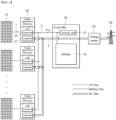
- FIG. 2 is a configuration diagram of a photovoltaic power generation system according to a preferred embodiment of the present invention.
- the photovoltaic power generation system of the present invention includes a plurality of PV modules 10, a plurality of power generation efficiency optimization units 20 connected to each of the plurality of PV modules 10 to optimize power generation efficiency and convert DC electric energy produced by the PV module 10 into AC and supply the same to a power grid 60 through an energy meter 50, and a controller 30 for checking and controlling monitoring information detected by the plurality of power generation efficiency optimization units 20.
- the number of PV modules 10 may be determined as necessary, and a power generation efficiency optimization unit 20 is added to each PV module 10.
- the power generation efficiency optimization unit 20 may be implemented as MLPE (Module Level Power Electronics), and the configuration of the power generation efficiency optimization unit 20 suitable for the example of FIG. 2 is illustrated in FIG. 3 .
- MLPE Module Level Power Electronics
- the power generation efficiency optimization unit 20 may include an inverter 21, a monitoring unit 23 for detecting information such as voltage, current, and temperature of the PV module 10, and a communication module unit 24 capable of providing the monitored information to the controller 30.
- the power generation efficiency optimization unit may include a Rapid Shut Down (RSD) module 22 that quickly cuts off operations during a malfunction of equipment.
- RSD Rapid Shut Down
- the communication module unit 24 may perform various types of communication with the controller 30, and serial communication may be used in addition to the characteristic power line communication of the present invention described later.
- the power generation efficiency optimization unit 20 of the present invention may include an inverter 21, and thus, convert energy produced by the PV module 10 into AC energy by being supplied through the PV line 1, and then may supply it to the power grid 60 through the AC line 3.
- the supply power is measured by the energy meter 50.
- the DC electric energy of each power generation efficiency optimization unit is converted into AC power by using one inverter and supplied to the power grid
- the present invention has a characteristic in that the DC electric power produced by the PV module 10 is converted into AC power and directly supplied to the power grid 60 by each power generation efficiency optimization unit 20, and thus the power supply may be maintained even when an abnormality occurs in some inverters 21.
- FIG. 4 is a configuration diagram of a photovoltaic power generation system according to another embodiment of the present invention.
- the present invention may further include a converter 25 for DC/DC conversion in each of the power generation efficiency optimization unit 20, and thus may convert DC power produced by the PV module 10 into DC power suitable for charging a battery 32 and may each charge the battery 32 as necessary.
- the battery 32 is included in the controller 30.
- the power generation efficiency optimization unit 20 further includes a converter 25 in the configuration described above with reference to FIG. 3 .
- the power generation efficiency optimization unit 20 is implemented as an MLPE, and a function module may be added as necessary.
- the converter 25 is a DC/DC converter, and converts power produced by each PV module 10 into power suitable for charging the battery 32.
- the power of the PV module 10 supplied through the PV line 1 is converted and directly supplied to the battery 32 through the battery line 2.
- the battery 32 may be charged by the power generation efficiency optimization unit 20 including another normal converter 25.
- control unit 31 of the controller 30 may perform power line communication with the power generation efficiency optimization unit 20 through the battery line 2.
- the power line communication through the battery line 2 may also perform communication between the power generation efficiency optimization units 20, and thus various applications and expansions may be possible.
- the present invention relates to a photovoltaic power generation system that optimizes power generation efficiency using natural laws and performs a predetermined operation even when a partial device malfunctions, and has industrial applicability.
Landscapes
- Engineering & Computer Science (AREA)
- Power Engineering (AREA)
- Supply And Distribution Of Alternating Current (AREA)
- Charge And Discharge Circuits For Batteries Or The Like (AREA)
- Photovoltaic Devices (AREA)
- Control Of Electrical Variables (AREA)
- Devices For Checking Fares Or Tickets At Control Points (AREA)
Abstract
Description
- This application claims priority to and the benefit of
Korean Patent Application No. 10-2020-0162484, filed on November 27, 2020 - The present invention relates to a photovoltaic power generation system, and more particularly, to a photovoltaic power generation system capable of efficient management.
- Recently, there has been an increasing case of installing a photovoltaic panel in an apartment or a house and using power produced in a home or providing power to a power grid.
- As an example of a photovoltaic power generation system, there is
Korean Patent Registration No. 10-2034431 (registered on October 11, 2019 - According to the contents described in the above Korean Patent, a power generation efficiency optimization unit (optimizer) is added to each of a plurality of solar cell panels, and a DC power produced in each solar cell panel is converted into an AC power by using one inverter.
- The power generation efficiency optimization unit receives an output voltage reduction signal when the output voltage is higher than the maximum power point voltage of the solar cell panel from a control unit, operates in a buck mode to reduce the output voltage, and generates an output voltage increase signal when the output voltage is lower than the maximum power point voltage, transmits the generated output voltage increase signal to the power generation efficiency optimization unit, and operates in a boost mode to increase the output voltage.
- However, since a conventional photovoltaic power generation system uses one inverter, when a failure occurs in the inverter, all production power cannot be converted.
- In addition, as described in the above Korean Patent, the power generation efficiency optimization unit includes serial communication UAART, SPI, and I2C, and since various information such as voltage, current, temperature, and operation commands are transmitted and received through serial communication between the controller and each power generation efficiency optimization unit, a communication speed is relatively low.
-
FIG. 1 is a configuration diagram of a conventional photovoltaic power generation system. - Referring to
FIG. 1 , a conventional photovoltaic power generation system may include a plurality ofPV modules 100, a power generationefficiency optimization unit 200 optimizing energy produced in each of the plurality ofPV modules 100, and apower converter 300 communicating with the power generationefficiency optimization unit 200 and converting the energy produced in thePV module 100 to be stored in abattery 400 or converting the converted energy into an AC power and supplying the converted AC power to apower grid 600 through anenergy meter 500. - The power generation
efficiency optimization unit 200 performs an optimization function for maximum power production and monitors a state of eachPV module 100 and provides the monitored state to thepower converter 300, and performs an optimization according to a control of thepower converter 300. - The
power converter 300 includes acontroller 310 and aninverter 320, and aconverter 330 may be added as necessary. The addition of theconverter 330 is determined according to whether thebattery 400 is used. - In the drawings, household loads using electric power are omitted.
- The energy produced in each
PV module 100 is provided to the power generationefficiency optimization unit 200 through thePV line 1, and each power generationefficiency optimization unit 200 monitors a state of thePV module 100 corresponding to 1:1 and performs an optimization for controlling production power. - The energy produced in the
PV module 100 may be provided to thepower converter 300 through aPV line 1, and the DC electric energy supplied through thePV line 1 may be converted into AC electric energy through theinverter 320 and provided to theenergy meter 500 through anAC line 3 and measured, and then may be supplied to thepower grid 600. - In addition, when necessary, the
power converter 300 may convert energy of eachPV module 100 supplied through thePV line 1 into DC/DC energy through theconverter 330 and then store the converted energy in thebattery 400 through abattery line 2. - As described above, the
controller 310 of thepower converter 300 may perform serial communication with each power generationefficiency optimization unit 200 or perform power line communication (PLC) through thePV line 1. - In the conventional configuration, since each power generation
efficiency optimization unit 200 shares oneinverter 320, when a failure occurs in theinverter 320, it is impossible to supply power produced through theentire PV module 100 to thepower grid 600. - Similarly, since each power generation
efficiency optimization unit 200 shares one DC/DC converter, it is impossible to charge thebattery 400 even when the DC/DC converter fails. - In consideration of the above problems, the present invention is directed to providing a photovoltaic power generation system capable of supplying energy to a power grid or performing charging to a battery even when there is an abnormality in a specific means by multiplexing a means for converting voltage.
- According to an aspect of the present invention, provided a photovoltaic power generation system, comprising: a plurality of PV modules; and a power generation efficiency optimization unit, which are installed to correspond to the respective PV modules one-to-one, and include inverters to convert power produced from the PV modules into AC power, and thus supply the same to a power grid through an AC line.
- In an embodiment of the present invention, the power generation efficiency optimization unit may further include a converter configured to convert power produced by a PV module and charge the power to a battery through a battery line.
- In an embodiment of the present invention, the power generation efficiency optimization unit may further include a monitoring unit configured to detect a state of the PV module; and a communication module unit configured to transmit information detected by the monitoring unit to a control unit of a controller.
- In an embodiment of the present invention, the power generation efficiency optimization unit may further include a RSD module unit configured to perform rapid shut down (RSD) according to the state of the PV module.
- In an embodiment of the present invention, the control unit may be configured to perform power line communication using the power generation efficiency optimization unit and the battery line.
- The present invention is designed to include an inverter in each of the power generation efficiency optimization units and directly connected to an AC line, thereby enabling power to be supplied to a power grid using other power generation efficiency optimization units that operate normally even when a failure occurs in a specific inverter.
- In addition, the present invention is designed to connect a battery line to the power generation efficiency optimization units to directly charge a battery and perform power line communication with a controller through the battery line, thereby enabling energy to be charged to the battery even when a failure occurs in a part of a DC/DC converter.
-
-
FIG. 1 is a configuration diagram of a conventional photovoltaic power generation system. -
FIG. 2 is a configuration diagram of a photovoltaic power generation system according to an embodiment of the present invention. -
FIG. 3 is a configuration diagram of a power generation efficiency optimization unit inFIG. 2 . -
FIG. 4 is a configuration diagram of a photovoltaic power generation system according to another embodiment of the present invention. - Hereinafter, in order to fully understand the configuration and effects of the present invention, preferred embodiments of the present invention will be described with reference to the accompanying drawings. However, the present invention is not limited to the embodiments disclosed below, and may be embodied in various forms and various modifications may be made. Rather, the description of the present invention is provided so that the present disclosure will be thorough and complete and will fully convey the scope of the invention to those of ordinary skill in the art. In the accompanying drawings, the size of the elements is enlarged compared to actual ones for the convenience of description, and the ratio of each element may be exaggerated or reduced.
- Terms such as 'first' and 'second' may be used to describe various elements, but, the above elements should not be limited by the terms above. The above terms may be used only for the purpose of distinguishing one element from another. For example, without departing from the scope of the present invention, a `first element' may be named a 'second element' and similarly, a 'second element' may also be named a 'first element.' In addition, expressions in the singular include plural expressions unless explicitly expressed otherwise in the context. Unless otherwise defined, terms used in the embodiments of the present invention may be interpreted as meanings commonly known to those of ordinary skill in the art.
-
FIG. 2 is a configuration diagram of a photovoltaic power generation system according to a preferred embodiment of the present invention. - Referring to
FIG. 2 , the photovoltaic power generation system of the present invention includes a plurality ofPV modules 10, a plurality of power generationefficiency optimization units 20 connected to each of the plurality ofPV modules 10 to optimize power generation efficiency and convert DC electric energy produced by thePV module 10 into AC and supply the same to apower grid 60 through anenergy meter 50, and acontroller 30 for checking and controlling monitoring information detected by the plurality of power generationefficiency optimization units 20. - Hereinafter, the configuration and operation of the photovoltaic power generation system of the present invention configured as described above will be described in more detail.
- First, the number of
PV modules 10 may be determined as necessary, and a power generationefficiency optimization unit 20 is added to eachPV module 10. - The power generation
efficiency optimization unit 20 may be implemented as MLPE (Module Level Power Electronics), and the configuration of the power generationefficiency optimization unit 20 suitable for the example ofFIG. 2 is illustrated inFIG. 3 . - That is, the power generation
efficiency optimization unit 20 may include aninverter 21, amonitoring unit 23 for detecting information such as voltage, current, and temperature of thePV module 10, and acommunication module unit 24 capable of providing the monitored information to thecontroller 30. - In addition, the power generation efficiency optimization unit may include a Rapid Shut Down (RSD)
module 22 that quickly cuts off operations during a malfunction of equipment. - The
communication module unit 24 may perform various types of communication with thecontroller 30, and serial communication may be used in addition to the characteristic power line communication of the present invention described later. - The power generation
efficiency optimization unit 20 of the present invention may include aninverter 21, and thus, convert energy produced by thePV module 10 into AC energy by being supplied through thePV line 1, and then may supply it to thepower grid 60 through theAC line 3. - In this case, the supply power is measured by the
energy meter 50. - In the above-described structure, when a failure occurs in the
inverter 21 of a specific power generationefficiency optimization unit 20, since other power generationefficiency optimization units 20 other than the powergeneration efficiency optimization 20 including the failedinverter 21 can normally convert power, it is possible to supply power to thepower grid 60. - That is, in the related art, the DC electric energy of each power generation efficiency optimization unit is converted into AC power by using one inverter and supplied to the power grid, but the present invention has a characteristic in that the DC electric power produced by the
PV module 10 is converted into AC power and directly supplied to thepower grid 60 by each power generationefficiency optimization unit 20, and thus the power supply may be maintained even when an abnormality occurs in someinverters 21. -
FIG. 4 is a configuration diagram of a photovoltaic power generation system according to another embodiment of the present invention. - Referring to
FIG. 4 , the present invention may further include aconverter 25 for DC/DC conversion in each of the power generationefficiency optimization unit 20, and thus may convert DC power produced by thePV module 10 into DC power suitable for charging abattery 32 and may each charge thebattery 32 as necessary. - In this case, the
battery 32 is included in thecontroller 30. - Hereinafter, the configuration and operation of the photovoltaic power generation system according to another embodiment of the present invention configured as described above will be described in more detail.
- The power generation
efficiency optimization unit 20 further includes aconverter 25 in the configuration described above with reference toFIG. 3 . As described above, the power generationefficiency optimization unit 20 is implemented as an MLPE, and a function module may be added as necessary. - The
converter 25 is a DC/DC converter, and converts power produced by eachPV module 10 into power suitable for charging thebattery 32. - That is, the power of the
PV module 10 supplied through thePV line 1 is converted and directly supplied to thebattery 32 through thebattery line 2. - Accordingly, even when a failure occurs in the
converter 25 included in some of the power generationefficiency optimization units 20, thebattery 32 may be charged by the power generationefficiency optimization unit 20 including anothernormal converter 25. - In addition, the
control unit 31 of thecontroller 30 may perform power line communication with the power generationefficiency optimization unit 20 through thebattery line 2. - That is, communication through the
battery line 2 is possible without connection of a separate communication line or expansion of the PV line, and thus the system may be easily installed, and the cost may be reduced. - In addition, the power line communication through the
battery line 2 may also perform communication between the power generationefficiency optimization units 20, and thus various applications and expansions may be possible. - While embodiments according to the present invention have been described above, but these are only exemplary, and those of ordinary skill in the art may understand that various modifications and embodiments of equivalent scope are possible therefrom. Accordingly, the true technical protection scope of the present invention shall be determined according to the attached claims.
- The present invention relates to a photovoltaic power generation system that optimizes power generation efficiency using natural laws and performs a predetermined operation even when a partial device malfunctions, and has industrial applicability.
| 10: | PV module | 20: | power generation efficiency optimization unit |
| 21: | inverter | 25: | converter |
| 30: | controller | 31: | control unit |
| 32: | battery | 60: | power grid |
Claims (5)
- A photovoltaic power generation system, comprising:a plurality of PV modules; anda power generation efficiency optimization unit, which are installed to correspond to the respective PV modules one-to-one, and include inverters to convert power produced from the PV modules into AC power, and thus supply the same to a power grid through an AC line.
- The photovoltaic power generation system of claim 1, wherein the power generation efficiency optimization unit further comprises a converter configured to convert power produced by a PV module and charge the power to a battery through a battery line.
- The photovoltaic power generation system of claim 2, wherein the power generation efficiency optimization unit further comprise:a monitoring unit configured to detect a state of the PV module; anda communication module unit configured to transmit information detected by the monitoring unit to a control unit of a controller.
- The photovoltaic power generation system of claim 3, wherein the power generation efficiency optimization unit further comprises a RSD module unit configured to perform rapid shut down (RSD) according to the state of the PV module.
- The photovoltaic power generation system of claim 3, wherein the control unit is configured to perform power line communication using the power generation efficiency optimization unit and the battery line.
Applications Claiming Priority (2)
| Application Number | Priority Date | Filing Date | Title |
|---|---|---|---|
| KR1020200162484A KR102559055B1 (en) | 2020-11-27 | 2020-11-27 | System for photovoltaics |
| PCT/KR2021/016515 WO2022114624A1 (en) | 2020-11-27 | 2021-11-12 | Photovoltaic power generation system |
Publications (2)
| Publication Number | Publication Date |
|---|---|
| EP4254783A1 true EP4254783A1 (en) | 2023-10-04 |
| EP4254783A4 EP4254783A4 (en) | 2024-10-23 |
Family
ID=81756114
Family Applications (1)
| Application Number | Title | Priority Date | Filing Date |
|---|---|---|---|
| EP21898450.8A Pending EP4254783A4 (en) | 2020-11-27 | 2021-11-12 | PHOTOVOLTAIC POWER GENERATION SYSTEM |
Country Status (5)
| Country | Link |
|---|---|
| US (1) | US12255463B2 (en) |
| EP (1) | EP4254783A4 (en) |
| KR (2) | KR102559055B1 (en) |
| AU (1) | AU2021385628C1 (en) |
| WO (1) | WO2022114624A1 (en) |
Families Citing this family (11)
| Publication number | Priority date | Publication date | Assignee | Title |
|---|---|---|---|---|
| KR102559055B1 (en) * | 2020-11-27 | 2023-07-21 | 한화솔루션 주식회사 | System for photovoltaics |
| KR102621719B1 (en) * | 2021-12-30 | 2024-01-04 | 가천대학교 산학협력단 | System for controlling power of solar panel |
| KR20240028876A (en) * | 2022-08-25 | 2024-03-05 | 엘지이노텍 주식회사 | Power Converting Apparatus |
| KR20240045888A (en) * | 2022-09-30 | 2024-04-08 | 엘지이노텍 주식회사 | PV(photovoltaic) module |
| KR20240088487A (en) * | 2022-12-13 | 2024-06-20 | 엘지이노텍 주식회사 | Power Converting Apparatus |
| WO2024177408A1 (en) * | 2023-02-22 | 2024-08-29 | 엘지이노텍 주식회사 | Power transmission device |
| KR20250014458A (en) * | 2023-07-20 | 2025-02-03 | 한화솔루션 주식회사 | Photovoltaic module control apparatus, photovoltaic module management appratus and controlling method thereof |
| KR20250146088A (en) * | 2024-03-29 | 2025-10-13 | 한화솔루션 주식회사 | Solar cell module and photovoltaic system thereof |
| KR20260021392A (en) * | 2024-08-06 | 2026-02-13 | 한화솔루션 주식회사 | Control Device, Photovoltaic System Including The Control Device And Control Method For Photovoltaic System |
| KR102811588B1 (en) * | 2024-10-08 | 2025-05-23 | (주)세진엔지니어링 | The Multi-Slot MLPE Device With Optional Expansion |
| KR102945887B1 (en) | 2024-10-31 | 2026-03-30 | 초당대학교 산학협력단 | PV Optimizer Training Equipment |
Family Cites Families (19)
| Publication number | Priority date | Publication date | Assignee | Title |
|---|---|---|---|---|
| JP2002112459A (en) * | 2000-09-29 | 2002-04-12 | Canon Inc | Solar cell module and power generator |
| US8204709B2 (en) * | 2005-01-18 | 2012-06-19 | Solar Sentry Corporation | System and method for monitoring photovoltaic power generation systems |
| US7193872B2 (en) * | 2005-01-28 | 2007-03-20 | Kasemsan Siri | Solar array inverter with maximum power tracking |
| US7855906B2 (en) * | 2009-10-26 | 2010-12-21 | General Electric Company | DC bus voltage control for two stage solar converter |
| US8710699B2 (en) * | 2009-12-01 | 2014-04-29 | Solaredge Technologies Ltd. | Dual use photovoltaic system |
| KR101149473B1 (en) * | 2010-05-06 | 2012-05-22 | 김혁 | Dc/dc converter device, inverter system and solar power generation system including the smae |
| CN103782471B (en) * | 2011-07-11 | 2017-08-22 | 赛恩沃茨公司 | For photovoltaic collection of energy and the system and method for conversion |
| US8780592B1 (en) * | 2011-07-11 | 2014-07-15 | Chilicon Power, LLC | Systems and methods for increasing output current quality, output power, and reliability of grid-interactive inverters |
| US9547033B1 (en) | 2011-11-12 | 2017-01-17 | Sunpower Corporation | Hierarchical fault prediction, detection and localization in PV systems with distributed electronics |
| WO2014043016A1 (en) * | 2012-09-11 | 2014-03-20 | Enphase Energy, Inc. | Method and apparatus for bidirectional power production in a power module |
| KR20140034564A (en) * | 2012-09-12 | 2014-03-20 | (주)엠케이에너지 | A device of crime prevention without a power supply |
| US20140153303A1 (en) * | 2012-11-30 | 2014-06-05 | SunEdison Microinverter Products LLC | Solar module having a back plane integrated inverter |
| KR20160001249A (en) * | 2014-06-27 | 2016-01-06 | (주) 이이시스 | Home energy management system using photovoltaic generation and energy storage system |
| KR20180020555A (en) * | 2016-08-18 | 2018-02-28 | 엘지전자 주식회사 | Photovoltaic module and photovoltaic system including the same |
| US10931104B2 (en) * | 2017-05-30 | 2021-02-23 | Solaredge Technologies Ltd. | System and method for interconnected elements of a power system |
| US11258398B2 (en) * | 2017-06-05 | 2022-02-22 | Tesla, Inc. | Multi-region solar roofing modules |
| KR102034431B1 (en) | 2018-05-11 | 2019-10-18 | 청주대학교 산학협력단 | Maximum Power Generation System of Solar Panel |
| KR102073855B1 (en) | 2018-05-21 | 2020-02-05 | 청주대학교 산학협력단 | Maximum Power Management System of Solar Panel |
| KR102559055B1 (en) * | 2020-11-27 | 2023-07-21 | 한화솔루션 주식회사 | System for photovoltaics |
-
2020
- 2020-11-27 KR KR1020200162484A patent/KR102559055B1/en active Active
-
2021
- 2021-11-12 EP EP21898450.8A patent/EP4254783A4/en active Pending
- 2021-11-12 US US18/254,305 patent/US12255463B2/en active Active
- 2021-11-12 AU AU2021385628A patent/AU2021385628C1/en active Active
- 2021-11-12 WO PCT/KR2021/016515 patent/WO2022114624A1/en not_active Ceased
-
2023
- 2023-07-19 KR KR1020230093894A patent/KR102734182B1/en active Active
Also Published As
| Publication number | Publication date |
|---|---|
| AU2021385628A1 (en) | 2023-06-29 |
| AU2021385628B2 (en) | 2024-08-08 |
| EP4254783A4 (en) | 2024-10-23 |
| US20240097452A1 (en) | 2024-03-21 |
| WO2022114624A1 (en) | 2022-06-02 |
| US12255463B2 (en) | 2025-03-18 |
| KR20220074229A (en) | 2022-06-03 |
| AU2021385628A9 (en) | 2024-05-02 |
| AU2021385628C1 (en) | 2024-10-31 |
| KR102734182B1 (en) | 2024-11-25 |
| KR20230113256A (en) | 2023-07-28 |
| KR102559055B1 (en) | 2023-07-21 |
Similar Documents
| Publication | Publication Date | Title |
|---|---|---|
| US12255463B2 (en) | Photovoltaic power generation system | |
| US8232676B2 (en) | Uninterruptible fuel cell system | |
| US7872375B2 (en) | Multiple bi-directional input/output power control system | |
| KR20100017843A (en) | Distributed inverter and intelligent gateway | |
| KR102283826B1 (en) | PV module serial/parallel conversion system for MPPT operating voltage optimization based on machine learning | |
| JP2006320149A (en) | Distributed power system | |
| CN115065321B (en) | Optimization device for automatically controlling voltage safety in non-watchdog mode and photovoltaic system | |
| KR20170048992A (en) | Energy storage system | |
| EP2159895B1 (en) | Electrically parallel connection of photovoltaic modules in a string to provide a DC voltage to a DC voltage bus | |
| CN117955426B (en) | Power equipment, power equipment control method and photovoltaic power generation system | |
| KR20230006987A (en) | solar power generation system | |
| KR20240032633A (en) | Back-up device and photovoltaic system including the same | |
| WO2009146065A2 (en) | Energy interface module and power conversion system | |
| KR20110110939A (en) | Photovoltaic Power Generation System Using Micro Inverter | |
| KR20170047821A (en) | Energy storage system | |
| CN120856042A (en) | Power device, power device control method and photovoltaic power generation system | |
| KR20200126594A (en) | Solar power monitoring system | |
| CN120359678A (en) | Photovoltaic system | |
| EP3370320A1 (en) | Power control system and control method for power control system | |
| CN120359679A (en) | Power conversion device | |
| WO2025110714A1 (en) | Power conversion device | |
| KR20250120129A (en) | Power converting apparatus | |
| KR20250074636A (en) | Power converting apparatus | |
| KR20250030766A (en) | Energy storage system and operating method thereof | |
| KR20250115247A (en) | Power converting apparatus |
Legal Events
| Date | Code | Title | Description |
|---|---|---|---|
| STAA | Information on the status of an ep patent application or granted ep patent |
Free format text: STATUS: THE INTERNATIONAL PUBLICATION HAS BEEN MADE |
|
| PUAI | Public reference made under article 153(3) epc to a published international application that has entered the european phase |
Free format text: ORIGINAL CODE: 0009012 |
|
| STAA | Information on the status of an ep patent application or granted ep patent |
Free format text: STATUS: REQUEST FOR EXAMINATION WAS MADE |
|
| 17P | Request for examination filed |
Effective date: 20230614 |
|
| AK | Designated contracting states |
Kind code of ref document: A1 Designated state(s): AL AT BE BG CH CY CZ DE DK EE ES FI FR GB GR HR HU IE IS IT LI LT LU LV MC MK MT NL NO PL PT RO RS SE SI SK SM TR |
|
| DAV | Request for validation of the european patent (deleted) | ||
| DAX | Request for extension of the european patent (deleted) | ||
| A4 | Supplementary search report drawn up and despatched |
Effective date: 20240925 |
|
| RIC1 | Information provided on ipc code assigned before grant |
Ipc: H02S 40/38 20140101ALI20240919BHEP Ipc: H02S 40/32 20140101ALI20240919BHEP Ipc: H02S 50/00 20140101AFI20240919BHEP |