EP4254535B1 - Electrochemical apparatus and electronic apparatus - Google Patents
Electrochemical apparatus and electronic apparatus Download PDFInfo
- Publication number
- EP4254535B1 EP4254535B1 EP23163722.4A EP23163722A EP4254535B1 EP 4254535 B1 EP4254535 B1 EP 4254535B1 EP 23163722 A EP23163722 A EP 23163722A EP 4254535 B1 EP4254535 B1 EP 4254535B1
- Authority
- EP
- European Patent Office
- Prior art keywords
- tab
- electrode plate
- electrochemical apparatus
- current collector
- thickness direction
- Prior art date
- Legal status (The legal status is an assumption and is not a legal conclusion. Google has not performed a legal analysis and makes no representation as to the accuracy of the status listed.)
- Active
Links
Images



Classifications
-
- H—ELECTRICITY
- H01—ELECTRIC ELEMENTS
- H01M—PROCESSES OR MEANS, e.g. BATTERIES, FOR THE DIRECT CONVERSION OF CHEMICAL ENERGY INTO ELECTRICAL ENERGY
- H01M10/00—Secondary cells; Manufacture thereof
- H01M10/05—Accumulators with non-aqueous electrolyte
- H01M10/058—Construction or manufacture
- H01M10/0587—Construction or manufacture of accumulators having only wound construction elements, i.e. wound positive electrodes, wound negative electrodes and wound separators
-
- H—ELECTRICITY
- H01—ELECTRIC ELEMENTS
- H01M—PROCESSES OR MEANS, e.g. BATTERIES, FOR THE DIRECT CONVERSION OF CHEMICAL ENERGY INTO ELECTRICAL ENERGY
- H01M10/00—Secondary cells; Manufacture thereof
- H01M10/04—Construction or manufacture in general
-
- H—ELECTRICITY
- H01—ELECTRIC ELEMENTS
- H01M—PROCESSES OR MEANS, e.g. BATTERIES, FOR THE DIRECT CONVERSION OF CHEMICAL ENERGY INTO ELECTRICAL ENERGY
- H01M4/00—Electrodes
- H01M4/02—Electrodes composed of, or comprising, active material
- H01M4/04—Processes of manufacture in general
- H01M4/0402—Methods of deposition of the material
- H01M4/0404—Methods of deposition of the material by coating on electrode collectors
-
- H—ELECTRICITY
- H01—ELECTRIC ELEMENTS
- H01M—PROCESSES OR MEANS, e.g. BATTERIES, FOR THE DIRECT CONVERSION OF CHEMICAL ENERGY INTO ELECTRICAL ENERGY
- H01M50/00—Constructional details or processes of manufacture of the non-active parts of electrochemical cells other than fuel cells, e.g. hybrid cells
- H01M50/10—Primary casings; Jackets or wrappings
- H01M50/102—Primary casings; Jackets or wrappings characterised by their shape or physical structure
- H01M50/103—Primary casings; Jackets or wrappings characterised by their shape or physical structure prismatic or rectangular
-
- H—ELECTRICITY
- H01—ELECTRIC ELEMENTS
- H01M—PROCESSES OR MEANS, e.g. BATTERIES, FOR THE DIRECT CONVERSION OF CHEMICAL ENERGY INTO ELECTRICAL ENERGY
- H01M50/00—Constructional details or processes of manufacture of the non-active parts of electrochemical cells other than fuel cells, e.g. hybrid cells
- H01M50/10—Primary casings; Jackets or wrappings
- H01M50/102—Primary casings; Jackets or wrappings characterised by their shape or physical structure
- H01M50/105—Pouches or flexible bags
-
- H—ELECTRICITY
- H01—ELECTRIC ELEMENTS
- H01M—PROCESSES OR MEANS, e.g. BATTERIES, FOR THE DIRECT CONVERSION OF CHEMICAL ENERGY INTO ELECTRICAL ENERGY
- H01M50/00—Constructional details or processes of manufacture of the non-active parts of electrochemical cells other than fuel cells, e.g. hybrid cells
- H01M50/10—Primary casings; Jackets or wrappings
- H01M50/147—Lids or covers
- H01M50/148—Lids or covers characterised by their shape
- H01M50/15—Lids or covers characterised by their shape for prismatic or rectangular cells
-
- H—ELECTRICITY
- H01—ELECTRIC ELEMENTS
- H01M—PROCESSES OR MEANS, e.g. BATTERIES, FOR THE DIRECT CONVERSION OF CHEMICAL ENERGY INTO ELECTRICAL ENERGY
- H01M50/00—Constructional details or processes of manufacture of the non-active parts of electrochemical cells other than fuel cells, e.g. hybrid cells
- H01M50/50—Current conducting connections for cells or batteries
- H01M50/531—Electrode connections inside a battery casing
- H01M50/533—Electrode connections inside a battery casing characterised by the shape of the leads or tabs
-
- H—ELECTRICITY
- H01—ELECTRIC ELEMENTS
- H01M—PROCESSES OR MEANS, e.g. BATTERIES, FOR THE DIRECT CONVERSION OF CHEMICAL ENERGY INTO ELECTRICAL ENERGY
- H01M50/00—Constructional details or processes of manufacture of the non-active parts of electrochemical cells other than fuel cells, e.g. hybrid cells
- H01M50/50—Current conducting connections for cells or batteries
- H01M50/531—Electrode connections inside a battery casing
- H01M50/534—Electrode connections inside a battery casing characterised by the material of the leads or tabs
-
- H—ELECTRICITY
- H01—ELECTRIC ELEMENTS
- H01M—PROCESSES OR MEANS, e.g. BATTERIES, FOR THE DIRECT CONVERSION OF CHEMICAL ENERGY INTO ELECTRICAL ENERGY
- H01M50/00—Constructional details or processes of manufacture of the non-active parts of electrochemical cells other than fuel cells, e.g. hybrid cells
- H01M50/50—Current conducting connections for cells or batteries
- H01M50/531—Electrode connections inside a battery casing
- H01M50/536—Electrode connections inside a battery casing characterised by the method of fixing the leads to the electrodes, e.g. by welding
-
- H—ELECTRICITY
- H01—ELECTRIC ELEMENTS
- H01M—PROCESSES OR MEANS, e.g. BATTERIES, FOR THE DIRECT CONVERSION OF CHEMICAL ENERGY INTO ELECTRICAL ENERGY
- H01M50/00—Constructional details or processes of manufacture of the non-active parts of electrochemical cells other than fuel cells, e.g. hybrid cells
- H01M50/50—Current conducting connections for cells or batteries
- H01M50/531—Electrode connections inside a battery casing
- H01M50/538—Connection of several leads or tabs of wound or folded electrode stacks
-
- H—ELECTRICITY
- H01—ELECTRIC ELEMENTS
- H01M—PROCESSES OR MEANS, e.g. BATTERIES, FOR THE DIRECT CONVERSION OF CHEMICAL ENERGY INTO ELECTRICAL ENERGY
- H01M50/00—Constructional details or processes of manufacture of the non-active parts of electrochemical cells other than fuel cells, e.g. hybrid cells
- H01M50/50—Current conducting connections for cells or batteries
- H01M50/531—Electrode connections inside a battery casing
- H01M50/54—Connection of several leads or tabs of plate-like electrode stacks, e.g. electrode pole straps or bridges
-
- H—ELECTRICITY
- H01—ELECTRIC ELEMENTS
- H01M—PROCESSES OR MEANS, e.g. BATTERIES, FOR THE DIRECT CONVERSION OF CHEMICAL ENERGY INTO ELECTRICAL ENERGY
- H01M50/00—Constructional details or processes of manufacture of the non-active parts of electrochemical cells other than fuel cells, e.g. hybrid cells
- H01M50/50—Current conducting connections for cells or batteries
- H01M50/543—Terminals
- H01M50/547—Terminals characterised by the disposition of the terminals on the cells
- H01M50/55—Terminals characterised by the disposition of the terminals on the cells on the same side of the cell
-
- Y—GENERAL TAGGING OF NEW TECHNOLOGICAL DEVELOPMENTS; GENERAL TAGGING OF CROSS-SECTIONAL TECHNOLOGIES SPANNING OVER SEVERAL SECTIONS OF THE IPC; TECHNICAL SUBJECTS COVERED BY FORMER USPC CROSS-REFERENCE ART COLLECTIONS [XRACs] AND DIGESTS
- Y02—TECHNOLOGIES OR APPLICATIONS FOR MITIGATION OR ADAPTATION AGAINST CLIMATE CHANGE
- Y02E—REDUCTION OF GREENHOUSE GAS [GHG] EMISSIONS, RELATED TO ENERGY GENERATION, TRANSMISSION OR DISTRIBUTION
- Y02E60/00—Enabling technologies; Technologies with a potential or indirect contribution to GHG emissions mitigation
- Y02E60/10—Energy storage using batteries
-
- Y—GENERAL TAGGING OF NEW TECHNOLOGICAL DEVELOPMENTS; GENERAL TAGGING OF CROSS-SECTIONAL TECHNOLOGIES SPANNING OVER SEVERAL SECTIONS OF THE IPC; TECHNICAL SUBJECTS COVERED BY FORMER USPC CROSS-REFERENCE ART COLLECTIONS [XRACs] AND DIGESTS
- Y02—TECHNOLOGIES OR APPLICATIONS FOR MITIGATION OR ADAPTATION AGAINST CLIMATE CHANGE
- Y02P—CLIMATE CHANGE MITIGATION TECHNOLOGIES IN THE PRODUCTION OR PROCESSING OF GOODS
- Y02P70/00—Climate change mitigation technologies in the production process for final industrial or consumer products
- Y02P70/50—Manufacturing or production processes characterised by the final manufactured product
Definitions
- This application relates to the field of energy storage technologies, and in particular, to an electrochemical apparatus and an electronic apparatus.
- An electrochemical apparatus is an apparatus that converts external energy into electric energy and that stores the electric energy in the electrochemical apparatus, to supply power to an external device (for example, a portable electronic apparatus) as needed.
- an electrochemical apparatus includes a housing, an electrode assembly accommodated in the housing, and tabs.
- the electrode assembly includes a first electrode plate, a second electrode plate, and a separator, where the first electrode plate and the second electrode plate have opposite polarities, with the separator sandwiched therebetween for separation.
- One end of one tab is connected to the first electrode plate, and an other end of the tab extends out of the housing; a plurality of conducting strips protrude from an edge of the second electrode plate, where the plurality of conducting strips are stacked; and one end of another tab is welded to the conducting strips stacked, and an other end of the tab extends out of the housing.
- CN 113437444 A describes relevant electrode tab shape and connections to balance high-rate charge-discharge performance and safety performance of an electrochemical device.
- EP 4064401 A2 describes a relevant tab of a battery cell having distinct portions connected in sequence.
- the inventors of this application found that when the first tab is experiencing vibration and impact, the first tab directly connected to the first electrode plate is prone to damage at a joint between the first tab and the first electrode plate, resulting in failure of the electrochemical apparatus.
- This application intends to provide an electrochemical apparatus and an electronic apparatus, to alleviate the problem that the first tab directly connected to the first electrode plate is prone to damage at a joint between the first tab and the first electrode plate.
- An electrochemical apparatus including a housing, an electrode assembly, a first tab, and a second tab.
- the electrode assembly is accommodated in the housing and includes a first electrode plate, a second electrode plate, and a separator disposed between the first electrode plate and the second electrode plate, where the first electrode plate, the second electrode plate, and the separator are stacked and then wound.
- the first electrode plate includes a first current collector.
- the second electrode plate includes a second current collector and a plurality of conducting strips integrally arranged with the second current collector, where the plurality of conducting strips protrude from the second current collector along a first direction, the plurality of conducting strips are stacked in a thickness direction of the electrode assembly to form a collecting portion, and the first direction is perpendicular to the thickness direction.
- the first tab directly connected to the first electrode plate and made of a sheet structure extending in a bent shape as a whole, the first tab includes a first portion, a second portion, and a third portion, where the first portion, the second portion, and the third portion are connected in sequence, the first portion is connected to the first current collector, the second portion is located outside the first current collector and disposed in a bent shape, and the third portion extends out of the housing.
- the second tab is connected to the collecting portion and extends out of the housing.
- the electrochemical apparatus can alleviate the problem that the first tab directly connected to the first electrode plate is prone to damage at a joint between the first tab and the first electrode plate caused by external impact.
- the electrode assembly has a first surface and a second surface, where the first surface and the second surface are opposite to each other in the thickness direction, and the second portion includes a first connecting section and a second connecting section.
- One end of the first connecting section is connected to the first portion and an other end of the first connecting section extends toward the first surface.
- the second connecting section is located on a side of the first connecting section far away from the electrode assembly, one end of the second connecting section is connected to an end of the first connecting section far away from the first portion, and an other end of the second connecting section is connected to the third portion. Therefore, when the first tab is impacted, the second connecting section bends elastically toward the second connecting section, so as to relieve part of impact force.
- a thickness of the electrode assembly in the thickness direction is L 1 mm.
- a distance from an overlapping part of the first portion and the first current collector in the thickness direction to the first surface is L 2 mm, where 0.6 ⁇ L 2 /L 1 ⁇ 0.9.
- the second direction is perpendicular to the first direction and the thickness direction.
- a distance from an overlapping part of the first portion and the first current collector in the thickness direction to the first surface is L 2 mm.
- a distance from the second portion to the first surface in the thickness direction is L 3 mm, where 0.75 ⁇ (L 2 -L 3 )/L 2 ⁇ 1.
- the second direction is perpendicular to the first direction and the thickness direction.
- a distance from an end of the third portion close to the second portion to the first surface in the thickness direction is L 41 mm
- a distance from an overlapping part of the first portion and the first current collector in the thickness direction to the first surface is L 42 mm, where L 41 /L 42 ⁇ 1.1.
- the second direction is perpendicular to the first direction and the thickness direction.
- the end of the second connecting section facing away from the first surface may be inserted inversely to touch the second electrode plate in the electrode assembly, causing short circuit to the electrochemical apparatus.
- Such arrangement with L 4 /L 2 ⁇ 1.1 is designed to control the end of the second connecting section facing away from the second surface not to go beyond the end of the first connecting section facing away from the first surface, or to go slightly beyond the end of the first connecting section facing away from the first surface, so as to reduce the risk of short circuit.
- a length of the first portion beyond an edge of the second current collector is L 5 mm, where 0.2 ⁇ L 5 ⁇ 2.
- Such arrangement is designed to form a specified gap between the second portion and the edge of the second current collector, so as to reduce the risk of the second portion coming into contact with the second electrode plate to some extent due to shaking and the risk of short circuit resulting therefrom.
- the housing includes a body portion and a sealing portion connected to the body portion.
- the body portion is provided with an accommodating chamber, the electrode assembly is accommodated in the accommodating chamber, and the first tab and the second tab pass through the sealing portion to extend out of the housing.
- a length of the third portion extending in the accommodating chamber in the first direction is L 61
- a length of the second tab extending in the accommodating chamber in the first direction is L 62 , where
- Such arrangement is designed to enable the electrochemical apparatus to have better anti-drop performance.
- the first tab is welded to the first current collector, and the first tab and the second tab extend out of the housing in the first direction.
- the first electrode plate is an anode electrode plate
- the second electrode plate is a cathode electrode plate.
- a material of the first tab includes copper, a copper alloy, nickel, or a nickel alloy
- a material of the second tab includes aluminum or an aluminum alloy.
- a cross-section area of the first tab is s 1 mm 2
- a cross-section area of the second tab is s 2 mm 2
- s 1 > s 2 Tunneling of electrons in or out the first electrode plate is realized by using the first tab
- tunneling of electrons in or out the second electrode plate is realized by using the plurality of conducting strips and the second tab.
- the first tab is more difficult to dissipate heat.
- Such arrangement with s 1 > s 2 is beneficial to increase a surface area of the first tab, thereby increasing a heat dissipation rate of the first tab, such that the first tab and the second tab dissipate heat in a more uniform manner.
- the housing includes a body portion and a sealing portion connected to the body portion, where the body portion is provided with an accommodating chamber, the electrode assembly is accommodated in the accommodating chamber, and the first tab passes through the sealing portion to extend out of the housing.
- the housing is provided with a third surface and a fourth surface, where the first surface and the second surface are opposite to each other in the thickness direction. In the thickness direction, the third surface, the first surface, the second surface, and the fourth surface are sequentially arranged, and a distance from the sealing portion to the third surface is greater than a distance from the sealing portion to the fourth surface. Therefore, the body portion includes a first accommodating space located between the sealing portion and the third surface and a second accommodating space located between the sealing portion and the fourth surface; and the entire second portion is located in the first accommodating space.
- the first electrode plate further includes a first active material layer disposed on the first current collector, a first concave portion is disposed on the first active material layer, the first concave portion exposes the first current collector, and the first tab is disposed at the first concave portion and connected to the first current collector.
- An electronic apparatus including the foregoing electrochemical apparatus.
- the electronic apparatus can also alleviate the problem that a first tab in the electrochemical apparatus thereof is prone to damage at a joint between the first tab and a first electrode plate caused by external impact.
- installing includes fixing or limiting an element or apparatus to a specific location or place by means of welding, screwing, clamping, bonding, or the like.
- the element or apparatus may stay still at the specific position or place, or may move within a limited range. After being fixed or limited to the specific position or place, the element or apparatus can be disassembled or cannot be disassembled. This is not limited in the embodiments of this application.
- FIG. 1 is a schematic diagram of an electrochemical apparatus 1 according to an embodiment of this application
- FIG. 2 is a schematic cross-sectional diagram of the electrochemical apparatus 1 along line A-A
- FIG. 3 is a schematic cross-sectional diagram of the electrochemical apparatus along line B-B
- FIG. 4 is a schematic cross-sectional diagram of the electrochemical apparatus along line C-C.
- the electrochemical apparatus 1 includes a housing 100, an electrode assembly 200, a first tab 300, and a second tab 400.
- the housing 100 is an installation support structure of the foregoing structures and also is a protective structure of the electrochemical apparatus 1.
- the electrode assembly 200 is accommodated in the housing 100, and includes a first electrode plate 210, a second electrode plate 220, and a separator 230 disposed between the first electrode plate 210 and the second electrode plate 220, where the first electrode plate 210, the second electrode plate 220, and the separator 230 are stacked and then wound.
- the first electrode plate 210 includes a first current collector 211.
- the second electrode plate 220 includes a second current collector 221 and a plurality of conducting strips 223 integrally arranged with the second current collector 221.
- All the conducting strips 223 protrude from the second current collector 221 along a first direction X shown in the figure, and all the conducting strips 223 are stacked in a thickness direction Z of the electrode assembly 200 shown in the figure to form a collecting portion 224, where the first direction X is perpendicular to the thickness direction Z.
- the first tab 300 includes a first portion 310, a second portion 320, and a third portion 330, where the first portion 310, the second portion 320, and the third portion 330 are connected in sequence, the first portion 310 is connected to the first electrode plate 210, the second portion 320 is located outside the first electrode plate 210 and disposed in a bent shape, and an end of the third portion 330 far away from the second portion 320 extends out of the housing 100.
- One end of the second tab 400 is connected to the collecting portion 224, and an other end of the second tab 400 extends out of the housing 100.
- "A plurality of" mentioned in this application means more than two. The following describes the housing 100, the electrode assembly 200, the first tab 300, and the second tab 400 in sequence.
- the housing 100 specifically referring to FIG. 1 and FIG. 2 .
- the housing 100 as a whole appears like a flat box-like structure, and a thickness direction of the housing 100 is the same as the thickness direction Z of the electrode assembly 200.
- the housing 100 is provided with a third surface 101 and a fourth surface 102, where the third surface 101 and a fourth surface 102 are opposite to each other in the thickness direction thereof.
- the housing 100 is further provided with a first end portion 110 and a second end portion 120, where the first end portion 110 and the second end portion 120 are opposite to each other each other.
- the first end portion 110 is an end of the housing 100 from which the first tab 300 and the second tab 400 extend, and the second end portion 120 is an end of the housing 100 far away from the first tab 300; and a direction determined by pointing from one of the first end portion 110 and the second end portion 120 to the other is consistent with the first direction X.
- the housing 100 is further provided with an accommodating chamber 103 to accommodate the electrode assembly 200, part of the first tab 300, part of the conducting strip 223, and part of the second tab 400.
- the electrochemical apparatus 1 is a pouch battery; and the housing 100 is made of a flexible sheet material, for example, aluminum-plastic film.
- the housing 100 includes a body portion 130 and a sealing portion 140 connected to the body portion 130.
- the body portion 130 is provided with the accommodating chamber 103.
- the electrode assembly 200 is accommodated in the accommodating chamber 103.
- the sealing portion 140 extends outward from a surface of the body portion 130 and is a region for sealing in a forming process of the housing 100; and the first tab 300 and the second tab 400 pass through the sealing portion 140 to extend out of the housing 100.
- the accommodating chamber 103 includes a first accommodating space 1031 and a second accommodating space 1032, where the first accommodating space 1031 is located between the sealing portion 140 and the third surface 101 in the thickness direction Z, the second accommodating space 1032 is located between the sealing portion 140 and the fourth surface 102 in the thickness direction Z, and a size of the first accommodating space 1031 in the thickness direction Z is greater than a size of the second accommodating space 1032 in the thickness direction Z.
- the electrochemical apparatus 1 may alternatively be a hard shell battery.
- the housing 100 may be made of a hard material, for example, a polymer material or a metal material.
- the electrode assembly 200 includes a first electrode plate 210, a second electrode plate 220, and a separator 230, where the first electrode plate 210, the second electrode plate 220, and the separator 230 are stacked.
- the first electrode plate 210 and the second electrode plate 220 have opposite polarities, and the separator 230 is disposed therebetween for separation.
- the first electrode plate 210, the second electrode plate 220, and the separator 230 are jointly wound and integrally present a cylindrical structure with a flat circular end face.
- the electrode assembly 200 is provided with a first surface 201 and a second surface 202, where the first surface 201 and the second surface 202 are opposite to each other in the thickness direction Z, the first surface 201 is disposed close to the third surface 101, and the second surface 202 is disposed close to the fourth surface 102.
- a thickness of the electrode assembly 200 in the thickness direction Z is L 1 mm.
- Persons skilled in the art may take a CT picture for the electrochemical apparatus 1 in the second direction Y; then may obtain a distance from the first surface 201 and the second surface 202 by using CT equipment, or may measure a distance from the first surface 201 and the second surface 202, namely L 1 , by using an instrument. It should be noted that a comparison of dimensions related to this application shall be made after a reasonable measurement error has been eliminated.
- the first electrode plate 210 is an anode electrode plate
- the second electrode plate 220 is a cathode electrode plate.
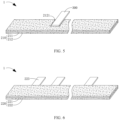
- FIG. 5 is a schematic diagram of a connection between a first electrode plate 210 and a first tab 300 both in a flattened state, where the first electrode plate 210 includes the first current collector 211 and a first active material layer 212.
- the first current collector 211 is a substrate material layer for supporting the first active material layer 212, and also serves as a carrier for electron moving in the first electrode plate 210; and the first active material layer 212 is disposed on a surface of the first current collector 211, and serves as a carrier for intercalation and deintercalation of lithium ions.
- the first active material layer 212 is provided with a first concave portion 2121 to expose the first current collector 211; and the first tab 300 is connected to the first current collector 211 at the first concave portion 2121.
- the first active material layer 212 may alternatively be provided with no first concave portion 2121.
- the first current collector 211 is provided with a naked foil region with no first active material layer 212 provided at its end, and the first current collector 211 is connected to the first tab 300 through the naked foil region.
- a material of the first current collector 211 includes copper, which is specifically a foil made of copper. It should be understood that, in other embodiments, the first current collector 211 may alternatively include another suitable conductive material. For example, in some embodiments, the first current collector 211 includes a copper alloy, nickel, or a nickel alloy.
- the first active material layer 212 includes an anode active material. For example, in some embodiments, the first active material layer 212 includes graphite, a conductive agent, and a binder. These materials are mixed, stirred to uniformity, and applied on a surface of the first current collector 211, such that the first active material layer 212 is obtained.
- FIG. 6 is a schematic diagram of the second electrode plate 220 in a flattened state.
- the second electrode plate 220 includes a second current collector 221, a second active material layer 222, and a plurality of conducting strips 223 protruding from the second current collector 221 in the first direction X.
- the second current collector 221 is a substrate material layer for supporting the second active material layer 222, and also serves as a carrier for electron moving in the second electrode plate 220; and the second active material layer 222 is provided on a surface of the second current collector 221, and serves as a carrier for intercalation and deintercalation of lithium ions.
- a material of the second current collector 221 includes aluminum, which is specifically a foil made of aluminum. It should be understood that, in other embodiments, the second current collector 221 may alternatively include another suitable conductive material. For example, in some embodiments, the second current collector 221 includes aluminum alloy, nickel, or nickel alloy.
- the second active material layer 222 includes a cathode active material.
- the second active material layer 222 includes lithium iron phosphate particles, a dispersing agent, a binder, and a conductive agent. These materials are mixed, stirred to uniformity, and applied on a surface of the second current collector 221, such that the second active material layer 222 is obtained.
- the conducting strip 223 is of a sheet structure and is connected to the second current collector 221.
- the conducting strips 223 are spaced from each other in a winding direction of the second electrode plate 220, thereby dividing the second electrode plate 220 into a plurality of regions staggered in the winding direction. Still referring to FIG. 4 .
- the conducting strips 223 are connected to an end of the second current collector 221 and are sequentially arranged in the thickness direction Z, ends of the conducting strips 223 far away from the second electrode plate 220 are stacked, and stacked portions of the conducting strips 223 constitute the collecting portion 224. In this way, the conducting strips 223 connect these regions in parallel, which is beneficial to reduce overall internal resistance of the second electrode plate 220 and reduce heat dissipated by the second electrode plate 220.
- the conducting strips 223 are integrally formed with the second current collector 221. In other words, the conducting strips 223 are formed by extending outward from an edge of the second current collector 221.
- the second active material layer 222 is applied on a surface of the second current collector 221; a region of the second current collector 221 not applied with the second active material layer 222 is cut into a shape shown in FIG.
- the first electrode plate 210, the separator 230, the second electrode plate 220, and the separator 230 are stacked sequentially and wound, ensuring that the conducting strips 223 are roughly aligned in the thickness direction; and finally ends of the conducting strips 223 far away from the second electrode plate 220 are laminated and fixed by welding, such that the electrode assembly 200 shown in FIG. 2 and FIG. 4 is obtained.
- the entire collecting portion 224 is U-shaped, and the collecting portion 224 includes a first extension section 2241, a second extension section 2242, and a third extension section 2243, where the first extension section 2241, the second extension section 2242, and the third extension section 2243 are connected in sequence.
- the first extension section 2241 is part of the collecting portion 224 close to the second electrode plate 220
- the third extension section 2243 is part of the collecting portion 224 far away from the second electrode plate 220.
- the first extension section 2241 and the third extension section 2243 are opposite to each other, and the first extension section 2241 is located between the electrode assembly 200 and the third extension section 2243.
- the second extension section 2242 is connected to the first extension section 2241 and the third extension section 2243 separately, such that the first extension section 2241, the second extension section 2242, and the third extension section 2243 jointly enclose a U-shaped structure. It should be understood that, even if the collecting portion 224 in this embodiment extends in a U-shaped manner, in other embodiments of this application, the collecting portion 224 may also extend in a straight line, an arc, or in any another shape, which is not specifically limited in this application.
- first tab 300 For the first tab 300, still referring to FIG. 5 and FIG. 3 , one end of the first tab 300 is connected to the electrode assembly 200, and an other end of the first tab 300 extends out of the housing 100 in the first direction X, such that a conductive terminal of the electrochemical apparatus 1 is constituted and configured to be connected to an external electricity load.
- the first tab 300 is of a sheet structure and extends in a bent shape as a whole, and the first tab 300 includes a first portion 310, a second portion 320, and a third portion 330, where the first portion 310, the second portion 320, and the third portion 330 are connected in sequence.
- the first portion 310 is connected to the first electrode plate 210, is flatshaped, and extends in the first direction X.
- the first portion 310 is located in the first concave portion 2121 and is fixed to the first current collector 211 by welding.
- a distance from an overlapping part of the first portion 310 and the first current collector 211 in the thickness direction Z to the first surface 201 is L 2 mm.
- a CT picture for the electrochemical apparatus 1 in the second direction Y may take a CT picture for the electrochemical apparatus 1 in the second direction Y; then may obtain a distance from the part of the first portion 310 overlapping on a surface of the first current collector 211 to the first surface 201 by using CT equipment, or may measure a distance from the part of the first portion 310 overlapping on a surface of the first current collector 211 to the first surface 201, namely, L 2 , by using an instrument.
- an end of the first portion 310 connecting to the second portion 320 is disposed beyond an edge of the first electrode plate 210, and a length of the first portion 310 beyond an edge of the second current collector 221 is L 5 mm.
- the second portion 320 is located outside the first electrode plate 210 and is disposed in a bent shape; and an end of the second portion 320 is connected to the first portion 310, and an other end of the second portion 320 is connected to the third portion 330.
- the entire second portion 320 is U-shaped, and the second portion 320 includes a first connecting section 321, a second connecting section 322, and a bending section 323.
- One end of the first connecting section 321 is connected to the first portion 310 and an other end of the first connecting section 321 extends toward the first surface 201.
- An end of the bending section 323 is connected to an end of the first connecting section 321 facing toward the first surface 201, and the end of the bending section 323 bends toward a side of the first connecting section 321 far away from the electrode assembly 200.
- the second connecting section 322 is located on a side of the first connecting section 321 far away from the electrode assembly 200, and the second connecting section 322 and the first connecting section 321 are opposite to each other in the first direction X.
- One end of the second connecting section 322 is connected to an end of the bending section 323 far away from the first connecting section 321, and an other end of the second connecting section 322 extends leaving away from the first surface 201.
- a distance from the second portion 320 to the first surface 201 in the thickness direction Z is L 3 mm.
- L 3 refers to a minimum distance, viewed from the second direction Y, from the second portion 320 to the first surface 201 in the thickness direction Z.
- Persons skilled in the art may take a CT picture for the electrochemical apparatus 1 in the second direction Y, and may draw a tangent line P-P on a side of the second portion 320 close to the first surface 201, where the tangent line is parallel to the first surface 201; and then may measure a distance from the tangent line P-P to the first surface 201, namely distance L 3 , by using an instrument.
- the second portion 320 includes the first connecting section 321, the bending section 323, and the second connecting section 322, all of which form a U-shaped structure.
- this application is not limited thereto, provided that the second portion 320 is in a bent shape.
- the second connecting section 322 of the second portion 320 is directly connected to the first connecting section 321, and in this case, the second portion 320 is a V-shaped structure.
- the bending section 323 may be omitted.
- the second portion 320 includes two V-shaped structures, where the two V-shaped structures are connected in sequence such that the second portion 320 is continuously bent.
- the third portion 330 is flat shaped on the whole, one end of which is connected to an end of the second portion 320 far away from the first portion 310, and an other end of which extends out of the housing 100.
- a length of the third portion 330 extending in the first direction X in the accommodating chamber 103 is L 61 mm.
- Persons skilled in the art may take a CT picture for the electrochemical apparatus 1 in the second direction Y, and may obtain a distance from an upper corner of the second portion 320 to an inner surface of the housing 100, as shown in FIG. 3 , by using CT equipment, or measure a distance from an upper corner of the second portion 320 to an inner surface of the housing 100, namely, distance L 61 as shown in FIG. 3 , by using an instrument.
- the first tab 300 When the first tab 300 is impacted, by means of elastic deformation of the second portion 320, at least part of impact force applied on the first tab 300 can be relieved such that impact force finally transferred to the first portion 310 and affecting a connection region between the first portion 310 and the first electrode plate 210 is reduced.
- a rounded corner is arranged at an end of the second portion 320 close to the first portion 310, and the rounded corner is connected to the first portion 310; and a rounded corner is arranged at an end of the second portion 320 close to the third portion 330, and the rounded corner is connected to the third portion 330.
- L 5 ⁇ 0.2 such arrangement is designed to form a specified gap between the second portion 320 and an edge of the second electrode plate 220, so as to reduce the risk of the second portion 320 coming into contact with the second electrode plate 220 due to shaking and a risk of short circuit resulting therefrom to some extent.
- the following describes a relationship between distance L 5 and short circuit of electrochemical apparatus 1 with reference to experimental data.
- Table 1 is a comparison table of short-circuit test for electrochemical apparatuses 1 of different examples.
- the electrochemical apparatuses 1 of various examples were the same except for the distance L 5 ; and the test aims to obtain the relationship based on the test results by controlling the distance L 5 of the electrochemical apparatus 1.
- a short-circuit test method of electrochemical apparatus includes the following steps:
- Table 1 Comparison table of short-circuit test for electrochemical apparatuses of different examples Group L 5 Passed quantity/tested quantity of electrochemical apparatuses in short-circuit test Example 1 0 980/1000 Example 2 0.1 990/1000 Example 3 0.2 1000/1000 Example 4 0.3 1000/1000 Example 5 0.6 1000/1000
- L 5 ⁇ 2.
- Such arrangement with L 5 leads to an increase in an volume of the electrochemical apparatus 1, thus reducing energy density of the electrochemical apparatus 1 to some extent; and such arrangement with L 5 ⁇ 2 is designed to ensure that there is a sufficient safe distance between the second portion 320 and the second electrode plate 220 and that the electrochemical apparatus 1 has high energy density.
- the "second direction" mentioned in this application is perpendicular to the thickness direction Z and the first direction X separately; in other words, the second direction Y, the first direction X, and the thickness direction Z are perpendicular to each other.
- change of the distance L 2 causes a position where the first tab 300 is connected to the first electrode plate 210 to change accordingly in the winding direction (that is, the length direction of the first electrode plate 210 shown in FIG. 5 ), which further causes the internal resistance of the first electrode plate 210 to be different; and correspondingly, heat dissipated by the first electrode plate 210 and temperature rise of the entire electrochemical device 1 also change.
- Table 2 is a comparison table of temperature rise test for electrochemical apparatuses 1 of various examples.
- the electrochemical apparatuses 1 of various examples were the same except for the parameter distance L 2 .
- This test aims to control change of L 2 , so as to control change of L 2 /L 1 , in other words, control change of a position of the first electrode plate 300 with respect to the first electrode plate 210 in the winding direction; and determine influence of the parameter L 2 /L 1 on the temperature rise of the electrochemical device 1 according to temperature rise in different examples.
- the temperature rise test includes the following steps:
- the electrochemical apparatus 1 satisfies 0.6 ⁇ L 2 /L 1 ⁇ 0.9. Specifically, referring to Table 2. It can be learned with reference to Examples 6 to 12 that when L 2 /L 1 ⁇ 0.6 or L 2 /L 1 > 0.9, the temperature rise of the electrochemical apparatus 1 is greater than 25°C; conversely, when 0.6 ⁇ L 2 /L 1 ⁇ 0.9, the temperature rise of the electrochemical apparatus 1 is less than 25°C.
- the first tab 300 is approximately located at a relatively central position of the first electrode plate 210, where internal resistance of the first electrode plate 210 is small, and accordingly, the temperature rise of the electrochemical apparatus 1 is low. It should be understood that when 0.1 ⁇ L 2 /L 1 ⁇ 0.4, the electrochemical apparatus 1 still has a small temperature rise. However, in this case, the second portion 320 has a short bending toward the first surface 201 with respect to the first portion 310, which is not conducive to providing sufficient elasticity to relieve sufficient impact force when the electrochemical apparatus 1 is impacted.
- a distance (L 2 -L 3 ) from a side of the second portion 320 close to the first surface 201 to the first portion 310 in the thickness direction Z affects anti-drop performance and vibration resistance of the electrochemical apparatus 1.
- the distance being too short results in a weak effect of relieving the impact force exerted on the second portion 320; correspondingly, the impact on the first tab 300 is still mostly transmitted to the first portion 310 and the first electrode plate 210. This may cause damage to the joint between the first tab 300 and the first electrode plate 210, or pierce the separator 230 to cause a short circuit of the electrode assembly 200.
- the electrochemical apparatus 1 has poor anti-drop performance. If the distance is too long, when the electrochemical apparatus 1 vibrates due to transportation, operation, and other factors, the second portion 320 may squeeze the housing 100 or even penetrate the housing 100, resulting in electrolyte leakage.
- Table 3 is a comparison table of vibration test and drop test for electrochemical apparatuses 1 of various examples.
- the electrochemical apparatuses 1 of various examples were the same except for the distance L 3 .
- This test aims to control change of L 3 , and realize change of (L 2 -L 3 )/L 2 , so as to determine influence of (L 2 -L 3 )/L 2 on the anti-drop performance and vibration resistance of the electrochemical apparatus 1 according to vibration test and drop test conditions in different examples.
- the drop test includes the following steps:
- the vibration test includes the following steps:
- the electrochemical apparatus 1 satisfies L 41 /L 42 ⁇ 1.1; where viewed in the second direction Y, a distance from an end of the third portion 320 close to the second portion 320 and on a side facing away from the first surface 201 to the first surface 201 in the thickness direction Z is L 41 mm, and a distance from a side of the first portion 310 facing away from the first surface 201 to the first surface 201 in the thickness direction Z is L 42 mm.
- Persons skilled in the art may take a CT picture for the electrochemical apparatus 1 in the second direction Y; then may obtain a distance from the left side of the lower end of the third portion 330 to the first surface 201, namely L 41 as shown in FIG.
- the second connecting section 322 bends toward the electrode assembly 200. Under the condition that, in the thickness direction Z, an end of the second connecting section 322 facing away from the first surface 201 goes significantly beyond an end of the first connecting section 321 facing away from the first surface 201, the end of the second connecting section 322 facing away from the first surface 201 may be inserted inversely to touch the second electrode plate 220 in the electrode assembly 200, causing short circuit to the electrochemical apparatus 1.
- Such arrangement with L 4 /L 2 ⁇ 1.1 is designed to control the end of the second connecting section 322 facing away from the first surface 201 not to go beyond the end of the first connecting section 321 facing away from the first surface 201, or to go slightly beyond the end of the first connecting section 321 facing away from the first surface 201, so as to reduce the risk of short circuit.
- the electrochemical apparatus 1 further includes insulating glue.
- the insulating glue is disposed on a surface of the second connecting section 322 facing toward the electrode assembly 200; and the insulating glue is used to prevent the second connecting section 322 from coming into contact with the second electrode plate 220 when the second connecting section 322 is bending toward the electrode assembly 200, thereby reducing the preceding hidden dangers.
- the second tab 400 includes a fourth portion 410 and a fifth portion 420.
- the fourth portion 410 is stacked on the third extension section 2243.
- the fourth portion 420 is disposed in a bent way with respect to the fourth portion 410 and extends linearly; and one end of the fifth portion 420 is connected to the fourth portion 410, and an other end of the fifth portion 420 extends out of the housing 100 in the first direction X.
- a length of the fifth portion 420 extending in the accommodating chamber 103 in the first direction X is L 62 , that is, a length of the second tab 400 extending in the accommodating chamber 103 in the first direction X.
- Persons skilled in the art may take a CT picture for the electrochemical apparatus 1 in the second direction Y, and may directly obtain a distance from an upper corner of the fourth portion 410 to an inner surface of the housing 100, as shown in FIG. 4 , by using CT equipment, or measure a distance from an upper corner of the fourth portion 410 to an inner surface of the housing 100, namely, distance L 62 as shown in FIG. 4 , by using an instrument.
- a cross-sectional area of the first tab 300 perpendicular to an extension path thereof is s 1 mm 2
- a cross-sectional area of the second tab 400 perpendicular to an extension path thereof is s 2 mm 2
- the first tab 300 and the second tab 400 satisfy s 1 > s 2
- Tunneling of electrons in or out of the first electrode plate 210 is realized by using the first tab 300
- tunneling of electrons in or out of the second electrode plate 220 is realized by using the plurality of conducting strips 223 and the second tab 400.
- the first tab 300 is more difficult to dissipate heat.
- Such arrangement with s 1 > s 2 is designed to increase a surface area of the first tab 300, thereby increasing a heat dissipation rate of the first tab 300, such that the first tab 300 and the second tab 400 dissipate heat in a more uniform manner.
- the electrochemical apparatus satisfies
- the following describes an influence of the difference between the distance L 61 and the distance L 62 on anti-drop performance of the electrochemical apparatus 1 with reference to test data.
- Table 4 is a comparison table of drop test for electrochemical apparatuses 1 of various examples.
- the electrochemical apparatuses 1 of various examples were the same except for a distance from the sealing portion 140 to the second portion 320 of the first tab 300 and/or a distance from the sealing portion 140 to the fourth portion 410 of the second tab 400, that is, the distance L 61 and/or distance L 62 .
- This test aims to control changes of L 61 and/or L 62 , and control change of
- For the temperature rise test referring to the steps S301 to S303, which will not be repeated herein.
- the electrochemical apparatus 1 includes a housing 100, an electrode assembly 200, a first tab 300, and a second tab 400.
- the first tab 300 includes: a first portion 310 connected to a first electrode plate 210, a second portion 320 located outside the first electrode plate 210 and disposed in a bent shape, and a third portion 330, at least part of which extends out of the housing 100. Tunneling of electrons in or out of the first electrode plate 210 is realized by using the first tab 300, while Tunneling of electrons in or out of the second electrode plate 220 is realized by using the plurality of conducting strips 223 thereon.
- the electrochemical apparatus can alleviate the problem that the first tab 300 directly connected to the first electrode plate 210 is prone to damage at a joint between the first tab 300 and the first electrode plate 210 caused by external impact.
- the arrangement of the conducting strips 223 and the second tab 400 allows the housing 100 have a space not filled by the electrode assembly 200 in the first end portion 110; and the second portion 320 disposed in a bent way in the first tab 300 and the conducting strips 223 disposed in a bent way can support the housing 100 in the thickness direction Z to some extent.
- first tab 300 and the second tab 400 both being located on the same end of the electrode assembly 200, that is, both being close to the first end portion 110.
- first tab 300 and the second tab 400 are also located on different ends of the electrode assembly 200.
- FIG. 7 is a schematic diagram of an electronic apparatus 2 according to an embodiment of this application.
- the electronic apparatus includes the electrochemical apparatus 1 according to any one of the foregoing embodiments and a load structure powered by the electrochemical apparatus 1.
- the electronic apparatus 2 includes a mobile phone. It can be understood that, in other embodiments of this application, the electronic apparatus may alternatively be a tablet computer, a computer, a drone, and other apparatus driven by electricity.
Landscapes
- Chemical & Material Sciences (AREA)
- Chemical Kinetics & Catalysis (AREA)
- Electrochemistry (AREA)
- General Chemical & Material Sciences (AREA)
- Engineering & Computer Science (AREA)
- Manufacturing & Machinery (AREA)
- Connection Of Batteries Or Terminals (AREA)
- Secondary Cells (AREA)
Description
- This application relates to the field of energy storage technologies, and in particular, to an electrochemical apparatus and an electronic apparatus.
- An electrochemical apparatus is an apparatus that converts external energy into electric energy and that stores the electric energy in the electrochemical apparatus, to supply power to an external device (for example, a portable electronic apparatus) as needed. Generally, an electrochemical apparatus includes a housing, an electrode assembly accommodated in the housing, and tabs. The electrode assembly includes a first electrode plate, a second electrode plate, and a separator, where the first electrode plate and the second electrode plate have opposite polarities, with the separator sandwiched therebetween for separation. One end of one tab is connected to the first electrode plate, and an other end of the tab extends out of the housing; a plurality of conducting strips protrude from an edge of the second electrode plate, where the plurality of conducting strips are stacked; and one end of another tab is welded to the conducting strips stacked, and an other end of the tab extends out of the housing.
CN 113437444 A describes relevant electrode tab shape and connections to balance high-rate charge-discharge performance and safety performance of an electrochemical device.EP 4064401 A2 describes a relevant tab of a battery cell having distinct portions connected in sequence. - During implementation of this application, the inventors of this application found that when the first tab is experiencing vibration and impact, the first tab directly connected to the first electrode plate is prone to damage at a joint between the first tab and the first electrode plate, resulting in failure of the electrochemical apparatus.
- This application intends to provide an electrochemical apparatus and an electronic apparatus, to alleviate the problem that the first tab directly connected to the first electrode plate is prone to damage at a joint between the first tab and the first electrode plate.
- The following technical solutions are adopted for this application to resolve the technical problem:
An electrochemical apparatus is provided, including a housing, an electrode assembly, a first tab, and a second tab. The electrode assembly is accommodated in the housing and includes a first electrode plate, a second electrode plate, and a separator disposed between the first electrode plate and the second electrode plate, where the first electrode plate, the second electrode plate, and the separator are stacked and then wound. The first electrode plate includes a first current collector. The second electrode plate includes a second current collector and a plurality of conducting strips integrally arranged with the second current collector, where the plurality of conducting strips protrude from the second current collector along a first direction, the plurality of conducting strips are stacked in a thickness direction of the electrode assembly to form a collecting portion, and the first direction is perpendicular to the thickness direction. The first tab directly connected to the first electrode plate and made of a sheet structure extending in a bent shape as a whole, the first tab includes a first portion, a second portion, and a third portion, where the first portion, the second portion, and the third portion are connected in sequence, the first portion is connected to the first current collector, the second portion is located outside the first current collector and disposed in a bent shape, and the third portion extends out of the housing. The second tab is connected to the collecting portion and extends out of the housing. - Since the first tab includes the second portion disposed in a bent way, when the first tab is impacted, the first tab can relieve part of impact force through deformation of the second portion, such that impact force finally reaching a joint between the first tab and the first electrode plate is reduced to some extent. Therefore, the electrochemical apparatus according to some embodiments of this application can alleviate the problem that the first tab directly connected to the first electrode plate is prone to damage at a joint between the first tab and the first electrode plate caused by external impact.
- In some embodiments, the electrode assembly has a first surface and a second surface, where the first surface and the second surface are opposite to each other in the thickness direction, and the second portion includes a first connecting section and a second connecting section. One end of the first connecting section is connected to the first portion and an other end of the first connecting section extends toward the first surface. The second connecting section is located on a side of the first connecting section far away from the electrode assembly, one end of the second connecting section is connected to an end of the first connecting section far away from the first portion, and an other end of the second connecting section is connected to the third portion. Therefore, when the first tab is impacted, the second connecting section bends elastically toward the second connecting section, so as to relieve part of impact force.
- In some embodiments, the second portion further includes a bending section. The first connecting section and the second connecting section are oppositely disposed in the first direction, one end of the bending section is connected to an end of the first connecting section facing toward the first surface, and an other end of the bending section is connected to an end of the second connecting section facing toward the first surface. In this way, the second portion is a U-shaped structure as a whole.
- In some embodiments, a thickness of the electrode assembly in the thickness direction is L1 mm. Viewed from a second direction, a distance from an overlapping part of the first portion and the first current collector in the thickness direction to the first surface is L2 mm, where 0.6 ≤ L2/L1 ≤ 0.9. The second direction is perpendicular to the first direction and the thickness direction. Such arrangement can maintain sufficient elasticity of the second portion of the first tab and realize low temperature rise in a charging process of the electrochemical apparatus.
- In some embodiments, viewed from a second direction, a distance from an overlapping part of the first portion and the first current collector in the thickness direction to the first surface is L2 mm. Viewed from a second direction, a distance from the second portion to the first surface in the thickness direction is L3 mm, where 0.75 ≤ (L2-L3)/L2 ≤ 1. The second direction is perpendicular to the first direction and the thickness direction. Such arrangement allows the electrochemical apparatus to have excellent anti-drop performance and vibration resistance.
- In some embodiments, viewed from a second direction, a distance from an end of the third portion close to the second portion to the first surface in the thickness direction is L41 mm, and a distance from an overlapping part of the first portion and the first current collector in the thickness direction to the first surface is L42 mm, where L41/L42 ≤ 1.1. The second direction is perpendicular to the first direction and the thickness direction. When the first tab is impacted by an external force, the second connecting section bends toward the electrode assembly. In the thickness direction, under the condition that an end of the second connecting section facing away from the first surface goes significantly beyond an end of the first connecting section facing away from the first surface, the end of the second connecting section facing away from the first surface may be inserted inversely to touch the second electrode plate in the electrode assembly, causing short circuit to the electrochemical apparatus. Such arrangement with L4/L2 ≤ 1.1 is designed to control the end of the second connecting section facing away from the second surface not to go beyond the end of the first connecting section facing away from the first surface, or to go slightly beyond the end of the first connecting section facing away from the first surface, so as to reduce the risk of short circuit.
- In some embodiments, a length of the first portion beyond an edge of the second current collector is L5 mm, where 0.2 ≤ L5 ≤ 2. Such arrangement is designed to form a specified gap between the second portion and the edge of the second current collector, so as to reduce the risk of the second portion coming into contact with the second electrode plate to some extent due to shaking and the risk of short circuit resulting therefrom.
- In some embodiments, the housing includes a body portion and a sealing portion connected to the body portion. The body portion is provided with an accommodating chamber, the electrode assembly is accommodated in the accommodating chamber, and the first tab and the second tab pass through the sealing portion to extend out of the housing. A length of the third portion extending in the accommodating chamber in the first direction is L61, and a length of the second tab extending in the accommodating chamber in the first direction is L62, where |L61-L62| ≤ 1 mm. Such arrangement is designed to enable the electrochemical apparatus to have better anti-drop performance.
- In some embodiments, the first tab is welded to the first current collector, and the first tab and the second tab extend out of the housing in the first direction.
- In some embodiments, the first electrode plate is an anode electrode plate, and the second electrode plate is a cathode electrode plate. A material of the first tab includes copper, a copper alloy, nickel, or a nickel alloy, and a material of the second tab includes aluminum or an aluminum alloy.
- In some embodiments, a cross-section area of the first tab is s1 mm2, a cross-section area of the second tab is s2 mm2, and s1 > s2. Tunneling of electrons in or out the first electrode plate is realized by using the first tab, while tunneling of electrons in or out the second electrode plate is realized by using the plurality of conducting strips and the second tab. Compared with the entirety composed of all the conducting strips and the second tab, the first tab is more difficult to dissipate heat. Such arrangement with s1 > s2 is beneficial to increase a surface area of the first tab, thereby increasing a heat dissipation rate of the first tab, such that the first tab and the second tab dissipate heat in a more uniform manner.
- In some embodiments, the housing includes a body portion and a sealing portion connected to the body portion, where the body portion is provided with an accommodating chamber, the electrode assembly is accommodated in the accommodating chamber, and the first tab passes through the sealing portion to extend out of the housing. The housing is provided with a third surface and a fourth surface, where the first surface and the second surface are opposite to each other in the thickness direction. In the thickness direction, the third surface, the first surface, the second surface, and the fourth surface are sequentially arranged, and a distance from the sealing portion to the third surface is greater than a distance from the sealing portion to the fourth surface. Therefore, the body portion includes a first accommodating space located between the sealing portion and the third surface and a second accommodating space located between the sealing portion and the fourth surface; and the entire second portion is located in the first accommodating space.
- In some embodiments, the first electrode plate further includes a first active material layer disposed on the first current collector, a first concave portion is disposed on the first active material layer, the first concave portion exposes the first current collector, and the first tab is disposed at the first concave portion and connected to the first current collector.
- The following technical solutions are further adopted for this application to resolve the technical problem:
An electronic apparatus is provided including the foregoing electrochemical apparatus. With the electrochemical apparatus provided, the electronic apparatus can also alleviate the problem that a first tab in the electrochemical apparatus thereof is prone to damage at a joint between the first tab and a first electrode plate caused by external impact. - To describe the technical solutions in some embodiments of this application more clearly, the following briefly describes the accompanying drawings required for describing some embodiments. Apparently, the accompanying drawings in the following descriptions show only some embodiments of this application, and persons of ordinary skill in the art may still derive others drawings from structures shown in these accompanying drawings.
-
FIG. 1 is a schematic diagram of an electrochemical apparatus according to an embodiment of this application; -
FIG. 2 is a schematic cross-sectional diagram of the electrochemical apparatus inFIG. 1 along line A-A; -
FIG. 3 is a schematic cross-sectional diagram of the electrochemical apparatus inFIG. 1 along line B-B; -
FIG. 4 is a schematic cross-sectional diagram of the electrochemical apparatus inFIG. 1 along line C-C; -
FIG. 5 is a schematic diagram of a connection between a first electrode plate and a first tab in a flattened state; -
FIG. 6 is a schematic diagram of a connection of a second electrode plate in a flattened state; and -
FIG. 7 is a schematic diagram of an electronic apparatus according to an embodiment of this application. - For ease of understanding this application, the following further describes this application in detail with reference to the accompanying drawings and specific embodiments. It should be noted that when an element is expressed as being "fastened/fixed" to another element, it may be directly fastened/fixed to the another element or one or more intermediate elements may be present. When an element is expressed as being "connected" to another element, it may be directly connected to the another element or one or more intermediate elements may be present. The terms "vertical", "horizontal", "left", "right", "inside", "outside", and similar expressions used in this specification are merely for description purposes.
- Unless otherwise defined, all technical and scientific terms used herein shall have the same meanings as commonly understood by those skilled in the art to which this application belongs. The terms used in the specification of this application are merely intended to describe specific embodiments but not to constitute any limitations on this application. The term "and/or" used herein includes any and all combinations of one or more associated items that are listed.
- In addition, technical features involved in different embodiments of this application that are described below may be combined as long as they do not conflict with each other.
- In this specification, "installing" includes fixing or limiting an element or apparatus to a specific location or place by means of welding, screwing, clamping, bonding, or the like. The element or apparatus may stay still at the specific position or place, or may move within a limited range. After being fixed or limited to the specific position or place, the element or apparatus can be disassembled or cannot be disassembled. This is not limited in the embodiments of this application.
- Referring to
FIG. 1 to FIG. 4 .FIG. 1 is a schematic diagram of anelectrochemical apparatus 1 according to an embodiment of this application;FIG. 2 is a schematic cross-sectional diagram of theelectrochemical apparatus 1 along line A-A;FIG. 3 is a schematic cross-sectional diagram of the electrochemical apparatus along line B-B; andFIG. 4 is a schematic cross-sectional diagram of the electrochemical apparatus along line C-C. Theelectrochemical apparatus 1 includes ahousing 100, anelectrode assembly 200, afirst tab 300, and asecond tab 400. Thehousing 100 is an installation support structure of the foregoing structures and also is a protective structure of theelectrochemical apparatus 1. Theelectrode assembly 200 is accommodated in thehousing 100, and includes afirst electrode plate 210, asecond electrode plate 220, and a separator 230 disposed between thefirst electrode plate 210 and thesecond electrode plate 220, where thefirst electrode plate 210, thesecond electrode plate 220, and the separator 230 are stacked and then wound. Thefirst electrode plate 210 includes a firstcurrent collector 211. Thesecond electrode plate 220 includes a secondcurrent collector 221 and a plurality of conductingstrips 223 integrally arranged with the secondcurrent collector 221. All the conductingstrips 223 protrude from the secondcurrent collector 221 along a first direction X shown in the figure, and all the conducting strips 223 are stacked in a thickness direction Z of theelectrode assembly 200 shown in the figure to form a collectingportion 224, where the first direction X is perpendicular to the thickness direction Z. Thefirst tab 300 includes afirst portion 310, a second portion 320, and a third portion 330, where thefirst portion 310, the second portion 320, and the third portion 330 are connected in sequence, thefirst portion 310 is connected to thefirst electrode plate 210, the second portion 320 is located outside thefirst electrode plate 210 and disposed in a bent shape, and an end of the third portion 330 far away from the second portion 320 extends out of thehousing 100. One end of thesecond tab 400 is connected to the collectingportion 224, and an other end of thesecond tab 400 extends out of thehousing 100. "A plurality of" mentioned in this application means more than two. The following describes thehousing 100, theelectrode assembly 200, thefirst tab 300, and thesecond tab 400 in sequence. - For the
housing 100, specifically referring toFIG. 1 and FIG. 2 . Thehousing 100 as a whole appears like a flat box-like structure, and a thickness direction of thehousing 100 is the same as the thickness direction Z of theelectrode assembly 200. Thehousing 100 is provided with athird surface 101 and afourth surface 102, where thethird surface 101 and afourth surface 102 are opposite to each other in the thickness direction thereof. Thehousing 100 is further provided with afirst end portion 110 and asecond end portion 120, where thefirst end portion 110 and thesecond end portion 120 are opposite to each other each other. Thefirst end portion 110 is an end of thehousing 100 from which thefirst tab 300 and thesecond tab 400 extend, and thesecond end portion 120 is an end of thehousing 100 far away from thefirst tab 300; and a direction determined by pointing from one of thefirst end portion 110 and thesecond end portion 120 to the other is consistent with the first direction X. In addition, thehousing 100 is further provided with anaccommodating chamber 103 to accommodate theelectrode assembly 200, part of thefirst tab 300, part of the conductingstrip 223, and part of thesecond tab 400. - In this embodiment, the
electrochemical apparatus 1 is a pouch battery; and thehousing 100 is made of a flexible sheet material, for example, aluminum-plastic film. Specifically, referring toFIG. 3 ,FIG. 4 , and with references to other accompanying drawings, thehousing 100 includes abody portion 130 and a sealingportion 140 connected to thebody portion 130. Thebody portion 130 is provided with theaccommodating chamber 103. Theelectrode assembly 200 is accommodated in theaccommodating chamber 103. The sealingportion 140 extends outward from a surface of thebody portion 130 and is a region for sealing in a forming process of thehousing 100; and thefirst tab 300 and thesecond tab 400 pass through the sealingportion 140 to extend out of thehousing 100. A distance from a side of the sealingportion 140 close to thethird surface 101 to thethird surface 101 in the thickness direction Z is D11, and a distance from a side of the sealingportion 140 close to thefourth surface 102 to thefourth surface 102 in the thickness direction Z is D12, where D11 > D12. In this way, theaccommodating chamber 103 includes a firstaccommodating space 1031 and a secondaccommodating space 1032, where the firstaccommodating space 1031 is located between the sealingportion 140 and thethird surface 101 in the thickness direction Z, the secondaccommodating space 1032 is located between the sealingportion 140 and thefourth surface 102 in the thickness direction Z, and a size of the firstaccommodating space 1031 in the thickness direction Z is greater than a size of the secondaccommodating space 1032 in the thickness direction Z. It should be noted that, in other embodiments of this application, theelectrochemical apparatus 1 may alternatively be a hard shell battery. Correspondingly, thehousing 100 may be made of a hard material, for example, a polymer material or a metal material. - For the
electrode assembly 200, specifically referring toFIG. 2 and with reference to other accompanying drawings. Theelectrode assembly 200 includes afirst electrode plate 210, asecond electrode plate 220, and a separator 230, where thefirst electrode plate 210, thesecond electrode plate 220, and the separator 230 are stacked. Thefirst electrode plate 210 and thesecond electrode plate 220 have opposite polarities, and the separator 230 is disposed therebetween for separation. Thefirst electrode plate 210, thesecond electrode plate 220, and the separator 230 are jointly wound and integrally present a cylindrical structure with a flat circular end face. Theelectrode assembly 200 is provided with afirst surface 201 and asecond surface 202, where thefirst surface 201 and thesecond surface 202 are opposite to each other in the thickness direction Z, thefirst surface 201 is disposed close to thethird surface 101, and thesecond surface 202 is disposed close to thefourth surface 102. A thickness of theelectrode assembly 200 in the thickness direction Z is L1 mm. Persons skilled in the art may take a CT picture for theelectrochemical apparatus 1 in the second direction Y; then may obtain a distance from thefirst surface 201 and thesecond surface 202 by using CT equipment, or may measure a distance from thefirst surface 201 and thesecond surface 202, namely L1, by using an instrument. It should be noted that a comparison of dimensions related to this application shall be made after a reasonable measurement error has been eliminated. - In this embodiment, the
first electrode plate 210 is an anode electrode plate, and thesecond electrode plate 220 is a cathode electrode plate. Referring toFIG. 5. FIG. 5 is a schematic diagram of a connection between afirst electrode plate 210 and afirst tab 300 both in a flattened state, where thefirst electrode plate 210 includes the firstcurrent collector 211 and a firstactive material layer 212. The firstcurrent collector 211 is a substrate material layer for supporting the firstactive material layer 212, and also serves as a carrier for electron moving in thefirst electrode plate 210; and the firstactive material layer 212 is disposed on a surface of the firstcurrent collector 211, and serves as a carrier for intercalation and deintercalation of lithium ions. The firstactive material layer 212 is provided with a firstconcave portion 2121 to expose the firstcurrent collector 211; and thefirst tab 300 is connected to the firstcurrent collector 211 at the firstconcave portion 2121. Certainly, in other embodiments of this application, the firstactive material layer 212 may alternatively be provided with no firstconcave portion 2121. Correspondingly, the firstcurrent collector 211 is provided with a naked foil region with no firstactive material layer 212 provided at its end, and the firstcurrent collector 211 is connected to thefirst tab 300 through the naked foil region. - For material selection for the first
current collector 211, in some embodiments, a material of the firstcurrent collector 211 includes copper, which is specifically a foil made of copper. It should be understood that, in other embodiments, the firstcurrent collector 211 may alternatively include another suitable conductive material. For example, in some embodiments, the firstcurrent collector 211 includes a copper alloy, nickel, or a nickel alloy. The firstactive material layer 212 includes an anode active material. For example, in some embodiments, the firstactive material layer 212 includes graphite, a conductive agent, and a binder. These materials are mixed, stirred to uniformity, and applied on a surface of the firstcurrent collector 211, such that the firstactive material layer 212 is obtained. - Referring to
FIG. 6. FIG. 6 is a schematic diagram of thesecond electrode plate 220 in a flattened state. Thesecond electrode plate 220 includes a secondcurrent collector 221, a secondactive material layer 222, and a plurality of conductingstrips 223 protruding from the secondcurrent collector 221 in the first direction X. The secondcurrent collector 221 is a substrate material layer for supporting the secondactive material layer 222, and also serves as a carrier for electron moving in thesecond electrode plate 220; and the secondactive material layer 222 is provided on a surface of the secondcurrent collector 221, and serves as a carrier for intercalation and deintercalation of lithium ions. - For material selection for the second
current collector 221, in some embodiments, a material of the secondcurrent collector 221 includes aluminum, which is specifically a foil made of aluminum. It should be understood that, in other embodiments, the secondcurrent collector 221 may alternatively include another suitable conductive material. For example, in some embodiments, the secondcurrent collector 221 includes aluminum alloy, nickel, or nickel alloy. The secondactive material layer 222 includes a cathode active material. For example, in some embodiments, the secondactive material layer 222 includes lithium iron phosphate particles, a dispersing agent, a binder, and a conductive agent. These materials are mixed, stirred to uniformity, and applied on a surface of the secondcurrent collector 221, such that the secondactive material layer 222 is obtained. - The conducting
strip 223 is of a sheet structure and is connected to the secondcurrent collector 221. The conducting strips 223 are spaced from each other in a winding direction of thesecond electrode plate 220, thereby dividing thesecond electrode plate 220 into a plurality of regions staggered in the winding direction. Still referring toFIG. 4 . The conducting strips 223 are connected to an end of the secondcurrent collector 221 and are sequentially arranged in the thickness direction Z, ends of the conducting strips 223 far away from thesecond electrode plate 220 are stacked, and stacked portions of the conducting strips 223 constitute the collectingportion 224. In this way, the conductingstrips 223 connect these regions in parallel, which is beneficial to reduce overall internal resistance of thesecond electrode plate 220 and reduce heat dissipated by thesecond electrode plate 220. - In some embodiments, the conducting
strips 223 are integrally formed with the secondcurrent collector 221. In other words, the conductingstrips 223 are formed by extending outward from an edge of the secondcurrent collector 221. In a process of preparing theelectrochemical apparatus 1, the secondactive material layer 222 is applied on a surface of the secondcurrent collector 221; a region of the secondcurrent collector 221 not applied with the secondactive material layer 222 is cut into a shape shown inFIG. 6 ; and thefirst electrode plate 210, the separator 230, thesecond electrode plate 220, and the separator 230 are stacked sequentially and wound, ensuring that the conducting strips 223 are roughly aligned in the thickness direction; and finally ends of the conducting strips 223 far away from thesecond electrode plate 220 are laminated and fixed by welding, such that theelectrode assembly 200 shown inFIG. 2 andFIG. 4 is obtained. - In some embodiments, the
entire collecting portion 224 is U-shaped, and the collectingportion 224 includes a first extension section 2241, a second extension section 2242, and athird extension section 2243, where the first extension section 2241, the second extension section 2242, and thethird extension section 2243 are connected in sequence. Along an extension path of the collectingportion 224, the first extension section 2241 is part of the collectingportion 224 close to thesecond electrode plate 220, and thethird extension section 2243 is part of the collectingportion 224 far away from thesecond electrode plate 220. In the first direction X, the first extension section 2241 and thethird extension section 2243 are opposite to each other, and the first extension section 2241 is located between theelectrode assembly 200 and thethird extension section 2243. The second extension section 2242 is connected to the first extension section 2241 and thethird extension section 2243 separately, such that the first extension section 2241, the second extension section 2242, and thethird extension section 2243 jointly enclose a U-shaped structure. It should be understood that, even if the collectingportion 224 in this embodiment extends in a U-shaped manner, in other embodiments of this application, the collectingportion 224 may also extend in a straight line, an arc, or in any another shape, which is not specifically limited in this application. - For the
first tab 300, still referring toFIG. 5 andFIG. 3 , one end of thefirst tab 300 is connected to theelectrode assembly 200, and an other end of thefirst tab 300 extends out of thehousing 100 in the first direction X, such that a conductive terminal of theelectrochemical apparatus 1 is constituted and configured to be connected to an external electricity load. Thefirst tab 300 is of a sheet structure and extends in a bent shape as a whole, and thefirst tab 300 includes afirst portion 310, a second portion 320, and a third portion 330, where thefirst portion 310, the second portion 320, and the third portion 330 are connected in sequence. The following describes thefirst portion 310, the second portion 320, and the third portion 330 in sequence with reference toFIG. 3 . - The
first portion 310 is connected to thefirst electrode plate 210, is flatshaped, and extends in the first direction X. Thefirst portion 310 is located in the firstconcave portion 2121 and is fixed to the firstcurrent collector 211 by welding. Viewed from the second direction Y, a distance from an overlapping part of thefirst portion 310 and the firstcurrent collector 211 in the thickness direction Z to thefirst surface 201 is L2 mm. Persons skilled in the art may take a CT picture for theelectrochemical apparatus 1 in the second direction Y; then may obtain a distance from the part of thefirst portion 310 overlapping on a surface of the firstcurrent collector 211 to thefirst surface 201 by using CT equipment, or may measure a distance from the part of thefirst portion 310 overlapping on a surface of the firstcurrent collector 211 to thefirst surface 201, namely, L2, by using an instrument. In this embodiment, in the first direction X, an end of thefirst portion 310 connecting to the second portion 320 is disposed beyond an edge of thefirst electrode plate 210, and a length of thefirst portion 310 beyond an edge of the secondcurrent collector 221 is L5 mm. Persons skilled in the art may take a CT picture for theelectrochemical apparatus 1 in the second direction Y; then may obtain a distance from an upper end of thefirst portion 310 to an upper edge of thesecond electrode plate 220, namely, L5 as shown inFIG. 3 , by using CT equipment or an instrument. - The second portion 320 is located outside the
first electrode plate 210 and is disposed in a bent shape; and an end of the second portion 320 is connected to thefirst portion 310, and an other end of the second portion 320 is connected to the third portion 330. In this embodiment, the entire second portion 320 is U-shaped, and the second portion 320 includes a first connectingsection 321, a second connectingsection 322, and abending section 323. One end of the first connectingsection 321 is connected to thefirst portion 310 and an other end of the first connectingsection 321 extends toward thefirst surface 201. An end of thebending section 323 is connected to an end of the first connectingsection 321 facing toward thefirst surface 201, and the end of thebending section 323 bends toward a side of the first connectingsection 321 far away from theelectrode assembly 200. In the first direction X, the second connectingsection 322 is located on a side of the first connectingsection 321 far away from theelectrode assembly 200, and the second connectingsection 322 and the first connectingsection 321 are opposite to each other in the first direction X. One end of the second connectingsection 322 is connected to an end of thebending section 323 far away from the first connectingsection 321, and an other end of the second connectingsection 322 extends leaving away from thefirst surface 201. In other words, an end of the second connectingsection 322 far away from the third portion 330 is indirectly connected to the first connectingsection 321 through thebending section 323. In this way, the first connectingsection 321, thebending section 323, and the second connectingsection 322 jointly form a U-shaped structure. Viewed from the second direction Y, a distance from the second portion 320 to thefirst surface 201 in the thickness direction Z is L3 mm. Specifically, L3 refers to a minimum distance, viewed from the second direction Y, from the second portion 320 to thefirst surface 201 in the thickness direction Z. Persons skilled in the art may take a CT picture for theelectrochemical apparatus 1 in the second direction Y, and may draw a tangent line P-P on a side of the second portion 320 close to thefirst surface 201, where the tangent line is parallel to thefirst surface 201; and then may measure a distance from the tangent line P-P to thefirst surface 201, namely distance L3, by using an instrument. - It should be understood that in this embodiment, the second portion 320 includes the first connecting
section 321, thebending section 323, and the second connectingsection 322, all of which form a U-shaped structure. However, this application is not limited thereto, provided that the second portion 320 is in a bent shape. For example, in some other embodiments of this application, the second connectingsection 322 of the second portion 320 is directly connected to the first connectingsection 321, and in this case, the second portion 320 is a V-shaped structure. In other words, in some cases, thebending section 323 may be omitted. For another example, in some other embodiments of this application, the second portion 320 includes two V-shaped structures, where the two V-shaped structures are connected in sequence such that the second portion 320 is continuously bent. - The third portion 330 is flat shaped on the whole, one end of which is connected to an end of the second portion 320 far away from the
first portion 310, and an other end of which extends out of thehousing 100. A length of the third portion 330 extending in the first direction X in theaccommodating chamber 103 is L61 mm. Persons skilled in the art may take a CT picture for theelectrochemical apparatus 1 in the second direction Y, and may obtain a distance from an upper corner of the second portion 320 to an inner surface of thehousing 100, as shown inFIG. 3 , by using CT equipment, or measure a distance from an upper corner of the second portion 320 to an inner surface of thehousing 100, namely, distance L61 as shown inFIG. 3 , by using an instrument. When thefirst tab 300 is impacted, by means of elastic deformation of the second portion 320, at least part of impact force applied on thefirst tab 300 can be relieved such that impact force finally transferred to thefirst portion 310 and affecting a connection region between thefirst portion 310 and thefirst electrode plate 210 is reduced. - In some embodiments, to alleviate transitions among the
first portion 310, the second portion 320, and the third portion 330 through sharp corners, which leads to stress concentration in a connection region of the three portions in thefirst tab 300, and affects mechanical performance of thefirst tab 300, a rounded corner is arranged at an end of the second portion 320 close to thefirst portion 310, and the rounded corner is connected to thefirst portion 310; and a rounded corner is arranged at an end of the second portion 320 close to the third portion 330, and the rounded corner is connected to the third portion 330. - In some embodiments, L5 ≥ 0.2; such arrangement is designed to form a specified gap between the second portion 320 and an edge of the
second electrode plate 220, so as to reduce the risk of the second portion 320 coming into contact with thesecond electrode plate 220 due to shaking and a risk of short circuit resulting therefrom to some extent. The following describes a relationship between distance L5 and short circuit ofelectrochemical apparatus 1 with reference to experimental data. - Specifically, referring to Table 1. Table 1 is a comparison table of short-circuit test for
electrochemical apparatuses 1 of different examples. Theelectrochemical apparatuses 1 of various examples were the same except for the distance L5; and the test aims to obtain the relationship based on the test results by controlling the distance L5 of theelectrochemical apparatus 1. - A short-circuit test method of electrochemical apparatus includes the following steps:
- S101: Open a small hole in the second end portion of the
electrochemical apparatus 1 such that all the electrolyte in thehousing 100 is completely poured out. - S102: Connect the
first tab 300 and thesecond tab 400 of theelectrochemical apparatus 1. - S103: Determine whether the
electrochemical apparatus 1 passes the short circuit test. A resistance of theelectrochemical apparatus 1 is measured when thefirst tab 300 is connected to thesecond tab 400. If the resistance is less than 1 mΩ, it indicates that there is a short circuit between thefirst electrode plate 210 and thesecond electrode plate 220, and theelectrochemical apparatus 1 failed the short-circuit test, otherwise, theelectrochemical apparatus 1 passes the short-circuit test. - In the examples, 1000
electrochemical apparatuses 1 were tested according to the method described above. The number ofelectrochemical apparatuses 1 that had passed the test was recorded, and the number of electrochemical apparatuses passed the test and the total number of tested electrochemical apparatuses were recorded in Table 1 in a fractional form. It can be learned from Examples 1 to 5 that when L5 < 0.2, theelectrochemical apparatus 1 has a specified risk of short circuit of the electrode assembly; and when L5 ≥ 0.2, the preceding deficiencies may be better overcome.Table 1 Comparison table of short-circuit test for electrochemical apparatuses of different examples Group L5 Passed quantity/tested quantity of electrochemical apparatuses in short-circuit test Example 1 0 980/1000 Example 2 0.1 990/1000 Example 3 0.2 1000/1000 Example 4 0.3 1000/1000 Example 5 0.6 1000/1000 - In addition, in this embodiment, L5 ≤ 2. Such arrangement with L5 leads to an increase in an volume of the
electrochemical apparatus 1, thus reducing energy density of theelectrochemical apparatus 1 to some extent; and such arrangement with L5 ≤ 2 is designed to ensure that there is a sufficient safe distance between the second portion 320 and thesecond electrode plate 220 and that theelectrochemical apparatus 1 has high energy density. It should be noted that the "second direction" mentioned in this application is perpendicular to the thickness direction Z and the first direction X separately; in other words, the second direction Y, the first direction X, and the thickness direction Z are perpendicular to each other. - It should be noted that change of the distance L2 causes a position where the
first tab 300 is connected to thefirst electrode plate 210 to change accordingly in the winding direction (that is, the length direction of thefirst electrode plate 210 shown inFIG. 5 ), which further causes the internal resistance of thefirst electrode plate 210 to be different; and correspondingly, heat dissipated by thefirst electrode plate 210 and temperature rise of the entireelectrochemical device 1 also change. - Referring to Table 2. Table 2 is a comparison table of temperature rise test for
electrochemical apparatuses 1 of various examples. Theelectrochemical apparatuses 1 of various examples were the same except for the parameter distance L2. This test aims to control change of L2, so as to control change of L2/L1, in other words, control change of a position of thefirst electrode plate 300 with respect to thefirst electrode plate 210 in the winding direction; and determine influence of the parameter L2/L1 on the temperature rise of theelectrochemical device 1 according to temperature rise in different examples. The temperature rise test includes the following steps: - S201: Place the
electrochemical apparatus 1 at a temperature of 25°C±2°C and charge theelectrochemical apparatus 1 to 100% state of charge (State of Charge, SOC). - S202: Leave the
electrochemical apparatus 1 standing for 120 minutes to make a temperature of theelectrochemical apparatus 1 the same as an ambient temperature. - S203: Record the ambient temperature T1.
- S204: Attach a temperature sensor to a central region of the
third surface 101 of thehousing 100. - S205: Discharge the
electrochemical apparatus 1 to 0% SOC at a current of 2I, where 1I means current intensity of theelectrochemical apparatus 1 when theelectrochemical apparatus 1 in a fully charged state, that is, in a 100% SOC state, is discharged to 0% SOC at 25°C at a constant current for 1 hour. For example, under the condition that a capacity of theelectrochemical apparatus 1 is 45 Ah, 1I is 45 A. - S206: Record a maximum temperature T2 measured by using the temperature sensor.
- S207: Calculate temperature rise ΔT of the
electrochemical apparatus 1, where ΔT = T2-T1. - In this application, the
electrochemical apparatus 1 satisfies 0.6 ≤ L2/L1 ≤ 0.9. Specifically, referring to Table 2. It can be learned with reference to Examples 6 to 12 that when L2/L1 < 0.6 or L2/L1 > 0.9, the temperature rise of theelectrochemical apparatus 1 is greater than 25°C; conversely, when 0.6 ≤ L2/L1 ≤ 0.9, the temperature rise of theelectrochemical apparatus 1 is less than 25°C. When L2/L1 = 0.75, in the winding direction of the first electrode plate 210 (namely, a length direction of the first electrode plate), thefirst tab 300 is approximately located at a relatively central position of thefirst electrode plate 210, where internal resistance of thefirst electrode plate 210 is small, and accordingly, the temperature rise of theelectrochemical apparatus 1 is low. It should be understood that when 0.1 ≤ L2/L1 ≤ 0.4, theelectrochemical apparatus 1 still has a small temperature rise. However, in this case, the second portion 320 has a short bending toward thefirst surface 201 with respect to thefirst portion 310, which is not conducive to providing sufficient elasticity to relieve sufficient impact force when theelectrochemical apparatus 1 is impacted. However, such arrangement with L2/L1 ≥ 0.5 is beneficial for theelectrochemical apparatus 1 to overcome these shortcomings. In conclusion, setting of 0.6 ≤ L2/L1 ≤ 0.9 can ensure sufficient elasticity of the second portion 320 of thefirst tab 300 and realize low temperature rise of theelectrochemical apparatus 1.Table 2 Comparison table of temperature rise for electrochemical apparatuses 1 of different examplesGroup L2 L1 L2/L1 Temperature rise of electrochemical apparatus (°C) Example 6 7.8 15.6 0.5 37°C Example 7 9.0 15.6 0.58 30°C Example 8 9.36 15.6 0.6 24°C Example 9 11.7 15.6 0.75 20°C Example 10 14.04 15.6 0.9 23°C Example 11 14.4 15.6 0.92 29°C Example 12 15.5 15.6 0.99 35°C - It should be noted that a distance (L2-L3) from a side of the second portion 320 close to the
first surface 201 to thefirst portion 310 in the thickness direction Z affects anti-drop performance and vibration resistance of theelectrochemical apparatus 1. Specifically, the distance being too short results in a weak effect of relieving the impact force exerted on the second portion 320; correspondingly, the impact on thefirst tab 300 is still mostly transmitted to thefirst portion 310 and thefirst electrode plate 210. This may cause damage to the joint between thefirst tab 300 and thefirst electrode plate 210, or pierce the separator 230 to cause a short circuit of theelectrode assembly 200. As a result, theelectrochemical apparatus 1 has poor anti-drop performance. If the distance is too long, when theelectrochemical apparatus 1 vibrates due to transportation, operation, and other factors, the second portion 320 may squeeze thehousing 100 or even penetrate thehousing 100, resulting in electrolyte leakage. - Referring to Table 3. Table 3 is a comparison table of vibration test and drop test for
electrochemical apparatuses 1 of various examples. Theelectrochemical apparatuses 1 of various examples were the same except for the distance L3. This test aims to control change of L3, and realize change of (L2-L3)/L2, so as to determine influence of (L2-L3)/L2 on the anti-drop performance and vibration resistance of theelectrochemical apparatus 1 according to vibration test and drop test conditions in different examples. - The drop test includes the following steps:
- S301: Place the
electrochemical apparatus 1 at a temperature of 25°C±2°C and charge the electrochemical apparatus to 100% SOC. - S302: Perform drop test for the electrochemical apparatus by using a drop test instrument special for electrochemical apparatuses. Specifically, first, a mechanical arm of the test instrument was controlled to grab a sample of the
electrochemical apparatus 1 and lift 1.8 m away from a marble slab, and the thickness direction Z of theelectrochemical apparatus 1 was controlled to be perpendicular to the marble slab and theelectrochemical apparatus 1 was released; then a mechanical appliance was controlled to grab a sample of theelectrochemical apparatus 1 and lift 1.8 m away from the marble slab, and thefirst tab 300 was controlled to face upward and theelectrochemical apparatus 1 is released; after that, the mechanical appliance was controlled to grab a sample of the electrochemical apparatus and lift 1.8 m away from the marble slab, and the second direction Y of theelectrode assembly 200 was controlled to be perpendicular to the marble slab and the electrochemical apparatus was released. - S303: Determine whether the electrochemical apparatus passes the test. Specifically, it is observed whether the surface of the housing of the electrochemical apparatus is damaged, whether a fire or explosion occurs; if so, the electrochemical apparatus failed the test; on the contrary, the electrochemical apparatus passed the test.
- The vibration test includes the following steps:
- S401: Place the
electrochemical apparatus 1 at a temperature of 25°C±2°C and charge theelectrochemical apparatus 1 to 100% SOC. - S402: Perform vibration test for the electrochemical apparatus by using an electrochemical apparatus vibration test instrument. The vibration test is performed in the first direction X, the second direction Y, and the thickness direction Z separately, with each direction in a sweep cycle between 10 Hz and 55 Hz and a test duration of 90 min±5 min. The vibration test equipment shall meet requirements of GB/T36972-2018. The amplitude of the vibration test is 0.76 mm, the maximum stroke is 1.52 mm, and the vibration frequency changes at a rate of 1 Hz/min between 10 Hz and 55 Hz.
- S403: Determine whether the electrochemical apparatus passes the test. Specifically, the tested electrochemical apparatus was left standing for 1h, and an opening in the
housing 100 of theelectrochemical apparatus 1 was cut in a dry environment; then it was observed whether the interior of thehousing 100 of theelectrochemical apparatus 1 was damaged or whether thehousing 100 leaked; and if so, theelectrochemical apparatus 1 failed the test; on the contrary, theelectrochemical apparatus 1 passed the test. - It can be learned from Examples 13 to 17 that when (L2-L3)/L2 < 0.75, or (L2-L3)/L2 > 1, a pass rate of the drop test does not reach 10/10, and when 0.75 ≤ (L2-L3)/L2 ≤ 1, a pass rate of the drop test is 10/10, indicating that these
electrochemical apparatuses 1 have excellent anti-drop performance. - In addition, it can be learned from Examples 13 to 17 that when (L2-L3)/L2 > 1, a pass rate of the
electrochemical apparatus 1 is low; on the contrary, when (L2-L3)/L2 ≤ 1, a pass rate of the drop test of theelectrochemical apparatus 1 is close to or even can reach 10/10. - It can be learned from test results of the drop test and the vibration test that when 0.75 ≤ (L2-L3)/L2 ≤ 1, the
electrochemical apparatuses 1 have both excellent anti-drop performance and vibration resistance.Table 3 Comparison table of vibration test and drop test for electrochemical apparatuses of various examples Group L3 L2 (L2-L3)/L2 Passed quantity/tested quantity in drop test Passed quantity/tested quantity in vibration test Example 13 7.5 11.7 0.64 8/10 10/10 Example 14 8.78 11.7 0.75 10/10 10/10 Example 15 11.25 11.7 0.96 10/10 10/10 Example 16 11.7 11.7 1.00 10/10 9/10 Example 17 12.75 11.7 1.09 9/10 6/10 - In some embodiments, the
electrochemical apparatus 1 satisfies L41/L42 ≤ 1.1; where viewed in the second direction Y, a distance from an end of the third portion 320 close to the second portion 320 and on a side facing away from thefirst surface 201 to thefirst surface 201 in the thickness direction Z is L41 mm, and a distance from a side of thefirst portion 310 facing away from thefirst surface 201 to thefirst surface 201 in the thickness direction Z is L42 mm. Persons skilled in the art may take a CT picture for theelectrochemical apparatus 1 in the second direction Y; then may obtain a distance from the left side of the lower end of the third portion 330 to thefirst surface 201, namely L41 as shown inFIG. 3 , by using CT equipment or an instrument; and persons skilled in the art may take a CT picture for theelectrochemical apparatus 1 in the second direction Y, and may measure a distance from the left side of thefirst portion 310 to thefirst surface 201, namely distance L42 as shown inFIG. 3 , by using CT equipment or an instrument. - When the
first tab 300 is subjected to an external force in the first direction X shown in the figure, or has a component force in the first direction X, the second connectingsection 322 bends toward theelectrode assembly 200. Under the condition that, in the thickness direction Z, an end of the second connectingsection 322 facing away from thefirst surface 201 goes significantly beyond an end of the first connectingsection 321 facing away from thefirst surface 201, the end of the second connectingsection 322 facing away from thefirst surface 201 may be inserted inversely to touch thesecond electrode plate 220 in theelectrode assembly 200, causing short circuit to theelectrochemical apparatus 1. Such arrangement with L4/L2 ≤ 1.1 is designed to control the end of the second connectingsection 322 facing away from thefirst surface 201 not to go beyond the end of the first connectingsection 321 facing away from thefirst surface 201, or to go slightly beyond the end of the first connectingsection 321 facing away from thefirst surface 201, so as to reduce the risk of short circuit. - In addition, to reduce a risk of short circuit caused by inverse insertion of the second connecting
section 322, in some embodiments, theelectrochemical apparatus 1 further includes insulating glue. Specifically, the insulating glue is disposed on a surface of the second connectingsection 322 facing toward theelectrode assembly 200; and the insulating glue is used to prevent the second connectingsection 322 from coming into contact with thesecond electrode plate 220 when the second connectingsection 322 is bending toward theelectrode assembly 200, thereby reducing the preceding hidden dangers. - For the
second tab 400, specifically referring toFIG. 4 and other accompanying drawings. One end of thesecond tab 400 is connected to the collectingportion 224, and an other end of thesecond tab 400 passes through thefirst end portion 110 and extends out of thehousing 100, to constitute another conductive terminal of theelectrochemical apparatus 1 for being connected to an external electricity load. In this embodiment, thesecond tab 400 includes afourth portion 410 and a fifth portion 420. Thefourth portion 410 is stacked on thethird extension section 2243. The fourth portion 420 is disposed in a bent way with respect to thefourth portion 410 and extends linearly; and one end of the fifth portion 420 is connected to thefourth portion 410, and an other end of the fifth portion 420 extends out of thehousing 100 in the first direction X. A length of the fifth portion 420 extending in theaccommodating chamber 103 in the first direction X is L62, that is, a length of thesecond tab 400 extending in theaccommodating chamber 103 in the first direction X. Persons skilled in the art may take a CT picture for theelectrochemical apparatus 1 in the second direction Y, and may directly obtain a distance from an upper corner of thefourth portion 410 to an inner surface of thehousing 100, as shown inFIG. 4 , by using CT equipment, or measure a distance from an upper corner of thefourth portion 410 to an inner surface of thehousing 100, namely, distance L62 as shown inFIG. 4 , by using an instrument. - Optionally, a cross-sectional area of the
first tab 300 perpendicular to an extension path thereof is s1 mm2, and a cross-sectional area of thesecond tab 400 perpendicular to an extension path thereof is s2 mm2, where thefirst tab 300 and thesecond tab 400 satisfy s1 > s2. Tunneling of electrons in or out of thefirst electrode plate 210 is realized by using thefirst tab 300, while tunneling of electrons in or out of thesecond electrode plate 220 is realized by using the plurality of conductingstrips 223 and thesecond tab 400. Compared with the entirety composed of all the conducting strips 223 and thesecond tab 400, thefirst tab 300 is more difficult to dissipate heat. Such arrangement with s1 > s2 is designed to increase a surface area of thefirst tab 300, thereby increasing a heat dissipation rate of thefirst tab 300, such that thefirst tab 300 and thesecond tab 400 dissipate heat in a more uniform manner. - In some embodiments, the electrochemical apparatus satisfies |L61-L62| ≤ 1. Specifically, when the sealing
portion 140 is impacted, an impact force is transferred toward thefirst tab 300 and thesecond tab 400; under the condition that there is a large difference between L61 and L62, one of the tabs is subjected to concentrated force, in other words, forces on the two tabs are uneven, which reduces anti-drop performance of theelectrochemical apparatus 1. The following describes an influence of the difference between the distance L61 and the distance L62 on anti-drop performance of theelectrochemical apparatus 1 with reference to test data. - Referring to Table 4. Table 4 is a comparison table of drop test for
electrochemical apparatuses 1 of various examples. Theelectrochemical apparatuses 1 of various examples were the same except for a distance from the sealingportion 140 to the second portion 320 of thefirst tab 300 and/or a distance from the sealingportion 140 to thefourth portion 410 of thesecond tab 400, that is, the distance L61 and/or distance L62. This test aims to control changes of L61 and/or L62, and control change of |L61-L62|, so as to determine influence of |L61-L62| on the anti-drop performance theelectrochemical apparatus 1 according to vibration cases in different examples. For the temperature rise test, referring to the steps S301 to S303, which will not be repeated herein. - With reference to Examples 18 to 22, when |L61-L62| > 1, a pass rate of the drop test cannot reach 10/10; correspondingly, when |L61-L62| ≤ 1, a pass rate of the drop test can reach 10/10, indicating that the
electrochemical apparatus 1 has excellent anti-drop performance. With reference to Examples 20, 23, and 24, theelectrochemical apparatuses 1 of various examples satisfy |L61-L62| = 0, except for L61 (or a specific value of L62). It can be learned that even though both L61 and L62 change, as long as an absolute value of the difference therebetween is constant, there is no obvious difference in the anti-drop performance of theelectrochemical apparatuses 1.Table 4 Comparison table of drop test for electrochemical apparatuses of different examples Group L61 L62 |L61-L62| Passed quantity/tested quantity in drop test Example 18 2 0.5 1.5 9/10 Example 19 2 1 1 10/10 Example 20 2 2 0 10/10 Example 21 2 3 1 10/10 Example 22 2 4 2 7/10 Example 23 3 3 0 10/10 Example 24 1 1 0 10/10 - To sum up, the
electrochemical apparatus 1 according to some embodiments of this application includes ahousing 100, anelectrode assembly 200, afirst tab 300, and asecond tab 400. Thefirst tab 300 includes: afirst portion 310 connected to afirst electrode plate 210, a second portion 320 located outside thefirst electrode plate 210 and disposed in a bent shape, and a third portion 330, at least part of which extends out of thehousing 100. Tunneling of electrons in or out of thefirst electrode plate 210 is realized by using thefirst tab 300, while Tunneling of electrons in or out of thesecond electrode plate 220 is realized by using the plurality of conductingstrips 223 thereon. - As the
first tab 300 includes the second portion 320 disposed in a bent way, in a case that thefirst tab 300 is impacted, thefirst tab 300 can relieve part of impact force through deformation of the second portion 320, such that impact force finally reaching a joint between thefirst tab 300 and thefirst electrode plate 210 is reduced to some extent. Therefore, the electrochemical apparatus according to some embodiments of this application can alleviate the problem that thefirst tab 300 directly connected to thefirst electrode plate 210 is prone to damage at a joint between thefirst tab 300 and thefirst electrode plate 210 caused by external impact. - In addition, the arrangement of the conducting strips 223 and the
second tab 400 allows thehousing 100 have a space not filled by theelectrode assembly 200 in thefirst end portion 110; and the second portion 320 disposed in a bent way in thefirst tab 300 and the conducting strips 223 disposed in a bent way can support thehousing 100 in the thickness direction Z to some extent. This reduces a disadvantage that thefirst end portion 110 of thehousing 100 is not suitable for an expected installation environment due to excessive deformation and collapse caused by extrusion. - It should be noted that the foregoing embodiments are described by using an example of the
first tab 300 and thesecond tab 400 both being located on the same end of theelectrode assembly 200, that is, both being close to thefirst end portion 110. However, in other embodiments of this application, thefirst tab 300 and thesecond tab 400 are also located on different ends of theelectrode assembly 200. - Based on the same inventive concept, this application further provides an electric apparatus. Referring to
FIG. 7. FIG. 7 is a schematic diagram of anelectronic apparatus 2 according to an embodiment of this application. The electronic apparatus includes theelectrochemical apparatus 1 according to any one of the foregoing embodiments and a load structure powered by theelectrochemical apparatus 1. In this embodiment, theelectronic apparatus 2 includes a mobile phone. It can be understood that, in other embodiments of this application, the electronic apparatus may alternatively be a tablet computer, a computer, a drone, and other apparatus driven by electricity. - In conclusion, it should be noted that the foregoing embodiments are merely intended to describe the technical solutions of this application, but not to limit this application. Under the concept of this application, the technical features in the foregoing embodiments or different embodiments can also be combined, the steps can be implemented in any order, and there are also many other variations in different aspects of this application as described above, which are not provided in detail for the sake of brevity. Although this application is described in detail with reference to the foregoing embodiments, persons of ordinary skill in the art should understand that modifications can be made to the technical solutions described in the foregoing embodiments, or equivalent substitutions can be made to some technical features therein, and these modifications or substitutions do not make the essence of the corresponding technical solutions depart from the scope of the technical solutions of some embodiments of this application.
Claims (14)
- An electrochemical apparatus (1), comprising:a housing (100);an electrode assembly (200) accommodated in the housing (100) and comprising a first electrode plate (210), a second electrode plate (220), and a separator disposed between the first electrode plate (210) and the second electrode plate (220); wherein the first electrode plate (210), the second electrode plate (220), and the separator (230) are stacked and then wound; the first electrode plate (210) comprises a first current collector (211), the second electrode plate (220) comprises a second current collector (221) and a plurality of conducting strips (223) integrally arranged with the second current collector (221), the plurality of conducting strips (223) protrude from the second current collector (221) along a first direction (X), the plurality of conducting strips (223) are stacked in a thickness direction of the electrode assembly (200) to form a collecting portion (224), and the first direction (X) is perpendicular to the thickness direction (Z);a first tab (300) directly connected to the first electrode plate (210) and made of a sheet structure extending in a bent shape as a whole, the first tab (300) comprising a first portion (310), a second portion (320), and a third portion (330); wherein the first portion (310), the second portion (320), and the third portion (330) are connected in sequence, the first portion (310) is connected to the first current collector (211), the second portion (320) is located outside the first current collector (211) and disposed in a bent shape, and the third portion (330) extends out of the housing (100); anda second tab (400) connected to the collecting portion (224) and extending out of the housing (100).
- The electrochemical apparatus (1) according to claim 1, characterized in that, the electrode assembly (200) has a first surface (201) and a second surface (202), the first surface (201) and the second surface (202) are opposite to each other in the thickness direction (Z); andthe second portion (320) comprises a first connecting section (321) and a second connecting section (322);one end of the first connecting section (321) is connected to the first portion (310) and an other end of the first connecting section (321) extends toward the first surface (201); andthe second connecting section (322) is located on a side of the first connecting section (321), wherein one end of the second connecting section (322) is connected to an end of the first connecting section (321), and an other end of the second connecting section (322) is connected to an end of the third portion (330).
- The electrochemical apparatus (1) according to claim 2, characterized in that, the second portion (320) further comprises a bending section (323); one end of the bending section (323) is connected to an end of the first connecting section (321) facing toward the first surface (201), and an other end of the bending section (323) connected to an end of the second connecting section (322) facing toward the first surface (201).
- The electrochemical apparatus (1) according to claim 2 or 3, characterized in that, a thickness of the electrode assembly (200) in the thickness direction (Z) is L1 mm;in a second direction (Y), a distance from an overlapping part of the first portion (310) and the first current collector (211) in the thickness direction (Z) to the first surface (201) is L2 mm, 0.6 ≤ L2/L1 ≤ 0.9; andthe second direction (Y) is perpendicular to the first direction (X) and the thickness direction (Z).
- The electrochemical apparatus (1) according to claim 2 or 3, characterized in that, a distance from an overlapping part of the first portion (310) and the first current collector (211) in the thickness direction (Z) to the first surface (201) is L2 mm;in a second direction (Y), in the thickness direction (Z), a distance from the second portion (320) to the first surface (201) is L3 mm, 0.75 ≤ (L2-L3)/L2 ≤ 1; andthe second direction (Y) is perpendicular to the first direction (X) and the thickness direction (Z).
- The electrochemical apparatus (1) according to claim 2 or 3, characterized in that, a distance from the end of the third portion (330) to the first surface (201) in the thickness direction (Z) is L41 mm, and in a second direction (Y), a distance from a side of the first portion (310) facing away from the first surface (201) to the first surface (201) is L42 mm, L41/L42 ≤ 1.1, and
the second direction (Y) is perpendicular to the first direction (X) and the thickness direction (Z). - The electrochemical apparatus (1) according to any one of claims 1 to 6, characterized in that, a length of the first portion (310) beyond an edge of the second current collector (221) is L5 mm; and 0.2 ≤ L5 ≤ 2.
- The electrochemical apparatus (1) according to any one of claims 1 to 6, characterized in that, the housing (100) comprises a body portion (130) and a sealing portion (140) connected to the body portion (130), the body portion (130) is provided with an accommodating chamber (103), the electrode assembly (200) is accommodated in the accommodating chamber (103); the first tab (300) and the second tab (400) pass through the sealing portion (140) to extend out of the housing (100); and
a length of the third portion (330) extending in the first direction (X) in the accommodating chamber (103) is L61, and a length of the second tab (400) extending in the first direction (X) in the accommodating chamber (103) is L62, and |L61-L62| ≤ 1mm. - The electrochemical apparatus (1) according to any one of claims 1 to 8, characterized in that, the first tab (300) is welded to the first current collector (211).
- The electrochemical apparatus (1) according to any one of claims 1 to 9, characterized in that, the first electrode plate (210) is an anode electrode plate, and the second electrode plate (220) is a cathode electrode plate; and
a material of the first tab (300) comprises copper, a copper alloy, nickel, or a nickel alloy; and a material of the second tab (400) comprises aluminum or an aluminum alloy. - The electrochemical apparatus (1) according to any one of claims 1 to 10, characterized in that, a cross-section area of the first tab (300) perpendicular to an extension path thereof is s1 mm2, a cross-section area of the second tab (400) perpendicular to an extension path thereof is s2 mm2, and s1 > s2.
- The electrochemical apparatus (1) according to any one of claims 2 to 11, characterized in that, the housing (100) comprises a body portion (130) and a sealing portion (140) connected to the body portion (130), the body portion (130) is provided with an accommodating chamber (103), the electrode assembly (200) is accommodated in the accommodating chamber (103), and the first tab (300) passes through the sealing portion (140) to extend out of the housing (100);the housing (100) is provided with a third surface (101) and a fourth surface (102), wherein the first surface (201) and the second surface (202) are opposite to each other in the thickness direction (Z); andin the thickness direction (Z), the third surface (101), the first surface (201), the second surface (202), and the fourth surface (102) are sequentially arranged; and in the thickness direction (Z), a distance (D11) from a side of the sealing portion (140) facing the third surface (101) to the third surface (101) is greater than a distance (D12) from a side of the sealing portion (140) facing the fourth surface (102) to the fourth surface (102).
- The electrochemical apparatus (1) according to any one of claims 1 to 12, characterized in that, the first electrode plate (210) further comprises a first active material layer (212) disposed on the first current collector (211), a first concave portion (2121) is disposed on the first active material layer (212), the first concave portion (2121) exposes the first current collector (211), and the first tab (300) is disposed at the first concave portion (2121) and connected to the first current collector (211).
- An electronic apparatus (1), comprising the electrochemical apparatus (1) according to any one of claims 1 to 13.
Applications Claiming Priority (1)
| Application Number | Priority Date | Filing Date | Title |
|---|---|---|---|
| CN202210346728.4A CN114649559A (en) | 2022-03-31 | 2022-03-31 | Electrochemical device and electronic device |
Publications (2)
| Publication Number | Publication Date |
|---|---|
| EP4254535A1 EP4254535A1 (en) | 2023-10-04 |
| EP4254535B1 true EP4254535B1 (en) | 2025-04-30 |
Family
ID=81994870
Family Applications (1)
| Application Number | Title | Priority Date | Filing Date |
|---|---|---|---|
| EP23163722.4A Active EP4254535B1 (en) | 2022-03-31 | 2023-03-23 | Electrochemical apparatus and electronic apparatus |
Country Status (2)
| Country | Link |
|---|---|
| EP (1) | EP4254535B1 (en) |
| CN (1) | CN114649559A (en) |
Families Citing this family (8)
| Publication number | Priority date | Publication date | Assignee | Title |
|---|---|---|---|---|
| WO2024065266A1 (en) * | 2022-09-28 | 2024-04-04 | 宁德时代新能源科技股份有限公司 | Electrode assembly, battery cell, battery, and electric device |
| CN115832541A (en) * | 2022-12-30 | 2023-03-21 | 东莞新能德科技有限公司 | Electrochemical devices and electrical equipment |
| CN116885399A (en) * | 2023-07-27 | 2023-10-13 | 宁德新能源科技有限公司 | Electrochemical devices and electrical equipment |
| CN117791053A (en) * | 2023-12-28 | 2024-03-29 | 宁德新能源科技有限公司 | Batteries and electrical equipment |
| KR20250153608A (en) * | 2024-04-18 | 2025-10-27 | 삼성에스디아이 주식회사 | Rechargeable battery |
| JP2025187146A (en) * | 2024-06-13 | 2025-12-25 | プライムプラネットエナジー&ソリューションズ株式会社 | Secondary battery and manufacturing method thereof |
| CN118801054A (en) * | 2024-06-29 | 2024-10-18 | 宁德新能源科技有限公司 | Secondary batteries and electronic devices |
| CN120073040B (en) * | 2025-03-14 | 2025-11-28 | 宁德新能源科技有限公司 | Secondary batteries and electrical equipment |
Family Cites Families (8)
| Publication number | Priority date | Publication date | Assignee | Title |
|---|---|---|---|---|
| US10658633B2 (en) * | 2011-02-16 | 2020-05-19 | Panasonic Intellectual Property Management Co., Ltd. | Battery and manufacturing method of the battery |
| CN102983304A (en) * | 2012-12-27 | 2013-03-20 | 天津力神电池股份有限公司 | Polymer lithium ion battery |
| CN109565084A (en) * | 2016-06-24 | 2019-04-02 | 宁德新能源科技有限公司 | Winding type battery cell |
| CN111755657B (en) * | 2019-03-29 | 2022-02-15 | 宁德新能源科技有限公司 | Electrode assembly |
| JP7528262B2 (en) * | 2020-05-11 | 2024-08-05 | チューハイ コスミクス バッテリー カンパニー,リミテッド | Batteries and electronic devices |
| CN115133232B (en) * | 2021-03-26 | 2025-05-09 | 宁德新能源科技有限公司 | Battery cells and electrical devices |
| CN113270671B (en) * | 2021-05-13 | 2024-04-16 | 宁德新能源科技有限公司 | Battery cells and electrical devices |
| CN117276816A (en) * | 2021-06-23 | 2023-12-22 | 东莞新能安科技有限公司 | Electrochemical devices and electronic devices |
-
2022
- 2022-03-31 CN CN202210346728.4A patent/CN114649559A/en active Pending
-
2023
- 2023-03-23 EP EP23163722.4A patent/EP4254535B1/en active Active
Also Published As
| Publication number | Publication date |
|---|---|
| CN114649559A (en) | 2022-06-21 |
| EP4254535A1 (en) | 2023-10-04 |
Similar Documents
| Publication | Publication Date | Title |
|---|---|---|
| EP4254535B1 (en) | Electrochemical apparatus and electronic apparatus | |
| KR100870349B1 (en) | Connection terminal of protective circuit board and secondary battery using same | |
| US6645664B2 (en) | Battery module and container for battery module | |
| US8178236B2 (en) | Secondary battery including an insulation case with an insertion groove | |
| US20100190056A1 (en) | Battery Tab Structure | |
| KR101074780B1 (en) | Cap assembly, can, and secondary battery using the same | |
| KR102123674B1 (en) | Battery Pack Comprising Electrode Terminal Connecting Plate | |
| KR100599793B1 (en) | Secondary Battery and Electrode Assembly Used in the Same | |
| KR100823193B1 (en) | Secondary battery | |
| EP4258454A1 (en) | Electrochemical apparatus and electronic device | |
| US20230307798A1 (en) | Battery | |
| EP4250465A2 (en) | Battery | |
| KR20190065077A (en) | Cylindrical Secondary Battery having Hollow portion filled with Thermal Conductive Resin | |
| WO2020133661A1 (en) | Secondary battery and battery module | |
| JP4515405B2 (en) | Cylindrical lithium secondary battery and manufacturing method thereof | |
| US20140212715A1 (en) | Rechargeable battery | |
| KR20120139362A (en) | Electrode assembly and secondary battery having the same | |
| CN114665228B (en) | Electrochemical devices and electronic devices | |
| CN221614143U (en) | Power battery post, post assembly structure, battery shell and battery | |
| CN210956793U (en) | Battery pack with low-temperature heating function and communication standby power system | |
| EP4376206A1 (en) | Cell and electrical device | |
| KR100502347B1 (en) | Rectangular secondary battery | |
| CN219716932U (en) | A three-electrode battery | |
| US20100209766A1 (en) | Secondary battery | |
| CN217485477U (en) | Naked electric core and battery |
Legal Events
| Date | Code | Title | Description |
|---|---|---|---|
| PUAI | Public reference made under article 153(3) epc to a published international application that has entered the european phase |
Free format text: ORIGINAL CODE: 0009012 |
|
| STAA | Information on the status of an ep patent application or granted ep patent |
Free format text: STATUS: REQUEST FOR EXAMINATION WAS MADE |
|
| 17P | Request for examination filed |
Effective date: 20230323 |
|
| AK | Designated contracting states |
Kind code of ref document: A1 Designated state(s): AL AT BE BG CH CY CZ DE DK EE ES FI FR GB GR HR HU IE IS IT LI LT LU LV MC ME MK MT NL NO PL PT RO RS SE SI SK SM TR |
|
| GRAP | Despatch of communication of intention to grant a patent |
Free format text: ORIGINAL CODE: EPIDOSNIGR1 |
|
| STAA | Information on the status of an ep patent application or granted ep patent |
Free format text: STATUS: GRANT OF PATENT IS INTENDED |
|
| INTG | Intention to grant announced |
Effective date: 20241128 |
|
| GRAS | Grant fee paid |
Free format text: ORIGINAL CODE: EPIDOSNIGR3 |
|
| GRAA | (expected) grant |
Free format text: ORIGINAL CODE: 0009210 |
|
| STAA | Information on the status of an ep patent application or granted ep patent |
Free format text: STATUS: THE PATENT HAS BEEN GRANTED |
|
| AK | Designated contracting states |
Kind code of ref document: B1 Designated state(s): AL AT BE BG CH CY CZ DE DK EE ES FI FR GB GR HR HU IE IS IT LI LT LU LV MC ME MK MT NL NO PL PT RO RS SE SI SK SM TR |
|
| REG | Reference to a national code |
Ref country code: CH Ref legal event code: EP Ref country code: GB Ref legal event code: FG4D |
|
| REG | Reference to a national code |
Ref country code: IE Ref legal event code: FG4D |
|
| REG | Reference to a national code |
Ref country code: DE Ref legal event code: R096 Ref document number: 602023003130 Country of ref document: DE |
|
| P01 | Opt-out of the competence of the unified patent court (upc) registered |
Free format text: CASE NUMBER: APP_22231/2025 Effective date: 20250513 |
|
| REG | Reference to a national code |
Ref country code: NL Ref legal event code: FP |
|
| REG | Reference to a national code |
Ref country code: AT Ref legal event code: MK05 Ref document number: 1790911 Country of ref document: AT Kind code of ref document: T Effective date: 20250430 |
|
| PG25 | Lapsed in a contracting state [announced via postgrant information from national office to epo] |
Ref country code: FI Free format text: LAPSE BECAUSE OF FAILURE TO SUBMIT A TRANSLATION OF THE DESCRIPTION OR TO PAY THE FEE WITHIN THE PRESCRIBED TIME-LIMIT Effective date: 20250430 Ref country code: PT Free format text: LAPSE BECAUSE OF FAILURE TO SUBMIT A TRANSLATION OF THE DESCRIPTION OR TO PAY THE FEE WITHIN THE PRESCRIBED TIME-LIMIT Effective date: 20250901 Ref country code: ES Free format text: LAPSE BECAUSE OF FAILURE TO SUBMIT A TRANSLATION OF THE DESCRIPTION OR TO PAY THE FEE WITHIN THE PRESCRIBED TIME-LIMIT Effective date: 20250430 |
|
| REG | Reference to a national code |
Ref country code: LT Ref legal event code: MG9D |
|
| PG25 | Lapsed in a contracting state [announced via postgrant information from national office to epo] |
Ref country code: GR Free format text: LAPSE BECAUSE OF FAILURE TO SUBMIT A TRANSLATION OF THE DESCRIPTION OR TO PAY THE FEE WITHIN THE PRESCRIBED TIME-LIMIT Effective date: 20250731 Ref country code: NO Free format text: LAPSE BECAUSE OF FAILURE TO SUBMIT A TRANSLATION OF THE DESCRIPTION OR TO PAY THE FEE WITHIN THE PRESCRIBED TIME-LIMIT Effective date: 20250730 |
|
| PG25 | Lapsed in a contracting state [announced via postgrant information from national office to epo] |
Ref country code: PL Free format text: LAPSE BECAUSE OF FAILURE TO SUBMIT A TRANSLATION OF THE DESCRIPTION OR TO PAY THE FEE WITHIN THE PRESCRIBED TIME-LIMIT Effective date: 20250430 |
|
| PG25 | Lapsed in a contracting state [announced via postgrant information from national office to epo] |
Ref country code: BG Free format text: LAPSE BECAUSE OF FAILURE TO SUBMIT A TRANSLATION OF THE DESCRIPTION OR TO PAY THE FEE WITHIN THE PRESCRIBED TIME-LIMIT Effective date: 20250430 |
|
| PG25 | Lapsed in a contracting state [announced via postgrant information from national office to epo] |
Ref country code: HR Free format text: LAPSE BECAUSE OF FAILURE TO SUBMIT A TRANSLATION OF THE DESCRIPTION OR TO PAY THE FEE WITHIN THE PRESCRIBED TIME-LIMIT Effective date: 20250430 |
|
| PG25 | Lapsed in a contracting state [announced via postgrant information from national office to epo] |
Ref country code: AT Free format text: LAPSE BECAUSE OF FAILURE TO SUBMIT A TRANSLATION OF THE DESCRIPTION OR TO PAY THE FEE WITHIN THE PRESCRIBED TIME-LIMIT Effective date: 20250430 |
|
| PG25 | Lapsed in a contracting state [announced via postgrant information from national office to epo] |
Ref country code: RS Free format text: LAPSE BECAUSE OF FAILURE TO SUBMIT A TRANSLATION OF THE DESCRIPTION OR TO PAY THE FEE WITHIN THE PRESCRIBED TIME-LIMIT Effective date: 20250731 |
|
| PG25 | Lapsed in a contracting state [announced via postgrant information from national office to epo] |
Ref country code: IS Free format text: LAPSE BECAUSE OF FAILURE TO SUBMIT A TRANSLATION OF THE DESCRIPTION OR TO PAY THE FEE WITHIN THE PRESCRIBED TIME-LIMIT Effective date: 20250830 |
|
| PG25 | Lapsed in a contracting state [announced via postgrant information from national office to epo] |
Ref country code: LV Free format text: LAPSE BECAUSE OF FAILURE TO SUBMIT A TRANSLATION OF THE DESCRIPTION OR TO PAY THE FEE WITHIN THE PRESCRIBED TIME-LIMIT Effective date: 20250430 |
|
| REG | Reference to a national code |
Ref country code: NL Ref legal event code: PD Owner name: NINGDE AMPEREX TECHNOLOGY LIMITED; CN Free format text: DETAILS ASSIGNMENT: CHANGE OF OWNER(S), ASSIGNMENT; FORMER OWNER NAME: DONGGUAN POWERAMP TECHNOLOGY LIMITED Effective date: 20251024 |
|
| REG | Reference to a national code |
Ref country code: DE Ref legal event code: R081 Ref document number: 602023003130 Country of ref document: DE Owner name: NINGDE AMPEREX TECHNOLOGY LIMITED, NINGDE, CN Free format text: FORMER OWNER: DONGGUAN POWERAMP TECHNOLOGY LIMITED, DONGGUAN, GUANGDONG, CN |
|
| REG | Reference to a national code |
Ref country code: GB Ref legal event code: 732E Free format text: REGISTERED BETWEEN 20251211 AND 20251217 |
|
| PG25 | Lapsed in a contracting state [announced via postgrant information from national office to epo] |
Ref country code: DK Free format text: LAPSE BECAUSE OF FAILURE TO SUBMIT A TRANSLATION OF THE DESCRIPTION OR TO PAY THE FEE WITHIN THE PRESCRIBED TIME-LIMIT Effective date: 20250430 Ref country code: SM Free format text: LAPSE BECAUSE OF FAILURE TO SUBMIT A TRANSLATION OF THE DESCRIPTION OR TO PAY THE FEE WITHIN THE PRESCRIBED TIME-LIMIT Effective date: 20250430 |
|
| PG25 | Lapsed in a contracting state [announced via postgrant information from national office to epo] |
Ref country code: CZ Free format text: LAPSE BECAUSE OF FAILURE TO SUBMIT A TRANSLATION OF THE DESCRIPTION OR TO PAY THE FEE WITHIN THE PRESCRIBED TIME-LIMIT Effective date: 20250430 |
|
| PG25 | Lapsed in a contracting state [announced via postgrant information from national office to epo] |
Ref country code: EE Free format text: LAPSE BECAUSE OF FAILURE TO SUBMIT A TRANSLATION OF THE DESCRIPTION OR TO PAY THE FEE WITHIN THE PRESCRIBED TIME-LIMIT Effective date: 20250430 |
|
| PG25 | Lapsed in a contracting state [announced via postgrant information from national office to epo] |
Ref country code: SK Free format text: LAPSE BECAUSE OF FAILURE TO SUBMIT A TRANSLATION OF THE DESCRIPTION OR TO PAY THE FEE WITHIN THE PRESCRIBED TIME-LIMIT Effective date: 20250430 |
|
| PG25 | Lapsed in a contracting state [announced via postgrant information from national office to epo] |
Ref country code: IT Free format text: LAPSE BECAUSE OF FAILURE TO SUBMIT A TRANSLATION OF THE DESCRIPTION OR TO PAY THE FEE WITHIN THE PRESCRIBED TIME-LIMIT Effective date: 20250430 |
|
| REG | Reference to a national code |
Ref country code: DE Ref legal event code: R097 Ref document number: 602023003130 Country of ref document: DE |
|
| PLBE | No opposition filed within time limit |
Free format text: ORIGINAL CODE: 0009261 |
|
| STAA | Information on the status of an ep patent application or granted ep patent |
Free format text: STATUS: NO OPPOSITION FILED WITHIN TIME LIMIT |
|
| REG | Reference to a national code |
Ref country code: CH Ref legal event code: L10 Free format text: ST27 STATUS EVENT CODE: U-0-0-L10-L00 (AS PROVIDED BY THE NATIONAL OFFICE) Effective date: 20260311 |
|
| PGFP | Annual fee paid to national office [announced via postgrant information from national office to epo] |
Ref country code: NL Payment date: 20260213 Year of fee payment: 4 |
|
| 26N | No opposition filed |
Effective date: 20260202 |
|
| PGFP | Annual fee paid to national office [announced via postgrant information from national office to epo] |
Ref country code: DE Payment date: 20260204 Year of fee payment: 4 |
|
| PGFP | Annual fee paid to national office [announced via postgrant information from national office to epo] |
Ref country code: FR Payment date: 20260209 Year of fee payment: 4 |