EP4254072A1 - Image forming apparatus, program, and image forming method - Google Patents
Image forming apparatus, program, and image forming method Download PDFInfo
- Publication number
- EP4254072A1 EP4254072A1 EP22193069.6A EP22193069A EP4254072A1 EP 4254072 A1 EP4254072 A1 EP 4254072A1 EP 22193069 A EP22193069 A EP 22193069A EP 4254072 A1 EP4254072 A1 EP 4254072A1
- Authority
- EP
- European Patent Office
- Prior art keywords
- consumable
- image forming
- forming apparatus
- covering
- display
- Prior art date
- Legal status (The legal status is an assumption and is not a legal conclusion. Google has not performed a legal analysis and makes no representation as to the accuracy of the status listed.)
- Granted
Links
Images




Classifications
-
- G—PHYSICS
- G06—COMPUTING OR CALCULATING; COUNTING
- G06F—ELECTRIC DIGITAL DATA PROCESSING
- G06F3/00—Input arrangements for transferring data to be processed into a form capable of being handled by the computer; Output arrangements for transferring data from processing unit to output unit, e.g. interface arrangements
- G06F3/12—Digital output to print unit, e.g. line printer, chain printer
- G06F3/1201—Dedicated interfaces to print systems
- G06F3/1223—Dedicated interfaces to print systems specifically adapted to use a particular technique
- G06F3/1229—Printer resources management or printer maintenance, e.g. device status, power levels
- G06F3/1234—Errors handling and recovery, e.g. reprinting
- G06F3/1235—Errors handling and recovery, e.g. reprinting caused by end of consumables, e.g. paper, ink, toner
-
- G—PHYSICS
- G03—PHOTOGRAPHY; CINEMATOGRAPHY; ANALOGOUS TECHNIQUES USING WAVES OTHER THAN OPTICAL WAVES; ELECTROGRAPHY; HOLOGRAPHY
- G03G—ELECTROGRAPHY; ELECTROPHOTOGRAPHY; MAGNETOGRAPHY
- G03G21/00—Arrangements not provided for by groups G03G13/00 - G03G19/00, e.g. cleaning, elimination of residual charge
- G03G21/16—Mechanical means for facilitating the maintenance of the apparatus, e.g. modular arrangements
- G03G21/1604—Arrangement or disposition of the entire apparatus
- G03G21/1623—Means to access the interior of the apparatus
- G03G21/1633—Means to access the interior of the apparatus using doors or covers
-
- G—PHYSICS
- G03—PHOTOGRAPHY; CINEMATOGRAPHY; ANALOGOUS TECHNIQUES USING WAVES OTHER THAN OPTICAL WAVES; ELECTROGRAPHY; HOLOGRAPHY
- G03G—ELECTROGRAPHY; ELECTROPHOTOGRAPHY; MAGNETOGRAPHY
- G03G15/00—Apparatus for electrographic processes using a charge pattern
- G03G15/50—Machine control of apparatus for electrographic processes using a charge pattern, e.g. regulating differents parts of the machine, multimode copiers, microprocessor control
- G03G15/5016—User-machine interface; Display panels; Control console
-
- G—PHYSICS
- G03—PHOTOGRAPHY; CINEMATOGRAPHY; ANALOGOUS TECHNIQUES USING WAVES OTHER THAN OPTICAL WAVES; ELECTROGRAPHY; HOLOGRAPHY
- G03G—ELECTROGRAPHY; ELECTROPHOTOGRAPHY; MAGNETOGRAPHY
- G03G15/00—Apparatus for electrographic processes using a charge pattern
- G03G15/55—Self-diagnostics; Malfunction or lifetime display
-
- G—PHYSICS
- G03—PHOTOGRAPHY; CINEMATOGRAPHY; ANALOGOUS TECHNIQUES USING WAVES OTHER THAN OPTICAL WAVES; ELECTROGRAPHY; HOLOGRAPHY
- G03G—ELECTROGRAPHY; ELECTROPHOTOGRAPHY; MAGNETOGRAPHY
- G03G15/00—Apparatus for electrographic processes using a charge pattern
- G03G15/55—Self-diagnostics; Malfunction or lifetime display
- G03G15/553—Monitoring or warning means for exhaustion or lifetime end of consumables, e.g. indication of insufficient copy sheet quantity for a job
-
- G—PHYSICS
- G06—COMPUTING OR CALCULATING; COUNTING
- G06F—ELECTRIC DIGITAL DATA PROCESSING
- G06F3/00—Input arrangements for transferring data to be processed into a form capable of being handled by the computer; Output arrangements for transferring data from processing unit to output unit, e.g. interface arrangements
- G06F3/12—Digital output to print unit, e.g. line printer, chain printer
- G06F3/1201—Dedicated interfaces to print systems
- G06F3/1202—Dedicated interfaces to print systems specifically adapted to achieve a particular effect
- G06F3/1203—Improving or facilitating administration, e.g. print management
-
- G—PHYSICS
- G06—COMPUTING OR CALCULATING; COUNTING
- G06F—ELECTRIC DIGITAL DATA PROCESSING
- G06F3/00—Input arrangements for transferring data to be processed into a form capable of being handled by the computer; Output arrangements for transferring data from processing unit to output unit, e.g. interface arrangements
- G06F3/12—Digital output to print unit, e.g. line printer, chain printer
- G06F3/1201—Dedicated interfaces to print systems
- G06F3/1202—Dedicated interfaces to print systems specifically adapted to achieve a particular effect
- G06F3/121—Facilitating exception or error detection and recovery, e.g. fault, media or consumables depleted
-
- G—PHYSICS
- G06—COMPUTING OR CALCULATING; COUNTING
- G06F—ELECTRIC DIGITAL DATA PROCESSING
- G06F3/00—Input arrangements for transferring data to be processed into a form capable of being handled by the computer; Output arrangements for transferring data from processing unit to output unit, e.g. interface arrangements
- G06F3/12—Digital output to print unit, e.g. line printer, chain printer
- G06F3/1201—Dedicated interfaces to print systems
- G06F3/1202—Dedicated interfaces to print systems specifically adapted to achieve a particular effect
- G06F3/1218—Reducing or saving of used resources, e.g. avoiding waste of consumables or improving usage of hardware resources
- G06F3/1221—Reducing or saving of used resources, e.g. avoiding waste of consumables or improving usage of hardware resources with regard to power consumption
Definitions
- the present disclosure relates to an image forming apparatus, a program, and an image forming method.
- An image forming apparatus has a mechanism of notifying a user of the replacement time of a consumable.
- a state of the consumable is monitored by using, for example, a sensor, and the user is notified of detection of a state that needs replacement.
- a replacement recommendation time is determined, and the replacement time is identified based on last replacement date and time and is reported. In the latter case, when the component is replaced, a counter that counts elapsed date and time until the replacement recommendation time or the number of times a job is carried out need to be reset by, for example, a user operation.
- Japanese Patent No. 4974837 discloses that a service mode and an operator maintenance mode in which a component is replaced are prepared as the operation modes of an image forming apparatus, where a replacement component list is displayed in the modes that are changed from a normal mode by a user operation, and a counter regarding a component that is selected from the replacement component list on the display is cleared.
- Japanese Unexamined Patent Application Publication No. 2019-184797 discloses an image forming apparatus that reports a guidance for replacing a component in the case where an event that needs the replacement of the component is detected and that ends the report of the guidance in conditions: an opened covering is closed for the replacement, and an input for reporting the completion of the replacement is received.
- Japanese Unexamined Patent Application Publication No. 2010-156737 discloses an image forming apparatus that displays a button for registering a report that represents a consumable is replaced with a new one when a front cover is opened, that resets a counter value that represents the amount of the used consumable by using a button operation, and that performs an image stabilizing process on the new consumable.
- the image stabilizing process is performed even with a standby job queuing at this time, and the standby job is subsequently carried out.
- the button operation is prohibited.
- a counter that counts, for example, elapsed date and time until the replacement recommendation time or the number of times a job is carried out is reset by, for example, a user operation when a component is replaced.
- the reset operation of the counter is to be received with a covering of the apparatus opened or in a special state such as a mode that is changed by an intentional operation, and if the reset operation is not correctly performed due to, for example, the oversight of resetting or an error of a target to be reset, and the state returns to a normal state, the replacement recommendation time is not correctly identified.
- an image forming apparatus including a processor configured to: detect presence or absence of a malfunction and opening and closing of a covering; and cause a display device to display information about a consumable such that a reset operation of a counter that is set regarding the consumable is receivable in a case where a predetermined malfunction does not occur, and a covering related to the consumable is opened and is subsequently closed.
- the image forming apparatus in which the processor is configured to cause the display device to display different screens between a case where the opened covering is closed when a predetermined condition regarding the consumable is satisfied and a case where the covering is closed when the condition is not satisfied.
- the image forming apparatus in which the processor is configured to: cause the display device to display information about the opened covering in response to the opening and closing of the covering; cause the display device to display the information about the consumable in a case where the covering is closed when the condition is satisfied; and cause the display device to dismiss a display of the information about the opened covering in a case where the covering is closed when the condition is not satisfied.
- the condition is a condition regarding a replacement time of the consumable that is calculated by using a method that is determined for the consumable.
- the image forming apparatus in which the processor is configured to cause the display device to dismiss a display of the information about the consumable in a case where a predetermined phenomenon occurs with the display device displaying the information about the consumable.
- an image forming apparatus comprising: a processor configured to: cause a display device to display an operation screen and receive an operation of a user by using the operation screen; cause the display device to display an image in which a position of a covering of the image forming apparatus that is opened and closed is indicated in a first operation mode; and cause the display device to display an image in which the position of the covering of the image forming apparatus that is opened and closed and a position of a consumable are indicated in a second operation mode such that a reset operation of a counter that is set regarding the consumable that is specified in the image is receivable.
- the image forming apparatus in which the processor is configured to enter the second operation mode from the first operation mode in a case where the opened covering is closed when a predetermined condition is satisfied.
- the image forming apparatus in which the condition is that a predetermined malfunction of the image forming apparatus does not occur and that a replacement time of the consumable that is calculated by using a method that is determined for the consumable comes.
- the image forming apparatus in which the processor is configured to enter the first operation mode in a case where a predetermined phenomenon occurs in the second operation mode and even in a case where the reset operation of the counter is not received.
- the image forming apparatus in which the processor is configured to notify the user of a fact that the reset operation of the counter is not received when a next image formation process is performed in a case where the processor enters the first operation mode due to occurrence of the phenomenon.
- the image forming apparatus according to the ninth aspect in which the phenomenon is that an instruction for performing a process that is to be performed in the first operation mode is transmitted.
- the image forming apparatus according to the ninth aspect in which the phenomenon is that the image forming apparatus enters a power saving mode.
- the image forming apparatus according to the ninth aspect in which the phenomenon is that the image forming apparatus is not operated, and a predetermined time has elapsed.
- a program causing a computer to execute a process including detecting presence or absence of a malfunction and opening and closing of a covering; and causing a display device to display information about a consumable in a case where a predetermined malfunction does not occur, and a covering related to the consumable is opened and is subsequently closed; and receiving a reset operation of a counter that is set regarding the consumable about which the information is displayed.
- a program causing a computer to execute a process including causing a display device to display an operation screen and receiving an operation of a user by using the operation screen; causing the display device to display an image in which a position of a covering of the image forming apparatus that is opened and closed is indicated in a first operation mode; causing the display device to display an image in which the position of the covering of the image forming apparatus that is opened and closed and a position of a consumable are indicated in a second operation mode; and receiving a reset operation of a counter that is set regarding the consumable that is specified in the image.
- an image forming method including: detecting presence or absence of a malfunction and opening and closing of a covering; and causing a display device to display information about a consumable such that a reset operation of a counter that is set regarding the consumable is receivable in a case where a predetermined malfunction does not occur, and a covering related to the consumable is opened and is subsequently closed.
- the oversight or error of the reset operation of the counter when a component is replaced can be reduced in a manner in which information about the consumable is displayed based on a state of the image forming apparatus.
- information about whether the condition regarding the consumable is satisfied can be provided to the user unlike the case where a display is not changed depending on the condition regarding the consumable.
- the state returns to a normal state when the condition is not satisfied unlike the case where a display is not changed depending on the condition regarding the consumable.
- information about the replacement time of the consumable can be provided to the user unlike the case where a display is not changed depending on the condition regarding the replacement time of the consumable.
- difficulty displaying information about the phenomenon that occurs can be reduced unlike the case where the information about the consumable is continuously displayed also when the phenomenon occurs.
- the consumable the counter of which is to be reset can be intuitively grasped unlike the case where the consumable is listed.
- the user does not need to be conscious, and the mode can be changed unlike the case where an operation of changing the mode into a special mode is set.
- the mode can be inhibited from being unnecessarily changed unlike the case where the operation mode is not changed depending on the condition regarding the replacement time of the consumable and a malfunction.
- difficulty displaying the information about the phenomenon that occurs can be reduced unlike the case where the second operation mode continues also when the phenomenon occurs.
- the user can be notified of the fact that the reset operation of the counter is not completed unlike the case where the image formation process is performed without notification.
- a normal process that is specified can be immediately performed unlike the case where the second operation mode continues also when an instruction for performing the normal process is transmitted.
- the normal process can be immediately started when the mode returns from the power saving mode unlike the case where the second operation mode continues even when the image forming apparatus enters the power saving mode.
- the mode can autonomously return to the first operation mode unlike the case where the second operation mode continues in the case where the image forming apparatus is not operated.
- the oversight or error of the reset operation of the counter when a component is replaced can be reduced in a manner in which information about the consumable is displayed based on a state of a computer in which the program according to the present disclosure is installed.
- the consumable the counter of which is to be reset can be intuitively grasped unlike the case where the consumable is listed in the computer in which the program according to the present disclosure is installed.
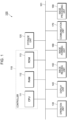
- FIG. 1 illustrates the structure of an image forming apparatus according to the present exemplary embodiment.
- An image forming apparatus 100 includes a controller 110, a storage unit 120, an operation unit 130, a display unit 140, an image reading unit 150, an image forming unit 160, a communication unit 170, and an image processing unit 180. These functional units are connected to a bus 101 and transmit and receive data via the bus 101.
- the controller 110 controls the functional units described above in the image forming apparatus 100.
- the controller 110 is a functional unit that performs various data processes.
- the controller 110 includes a central processing unit (CPU) 111 corresponding to an arithmetic unit and a random access memory (RAM) 112 and a read only memory (ROM) 113 that are storage components.
- the RAM 112 is a main memory and is used as a work memory when the CPU 111 performs arithmetic processing.
- the ROM 113 stores a program and data such as set values that are prepared in advance.
- the CPU 111 directly reads the program and the data from the ROM 113 and performs processing.
- a program and data are stored also in the storage unit 120.
- the CPU 111 reads the program that is stored in the storage unit 120 into the RAM 112 and runs the program.
- the CPU 111 of the controller 110 reads and runs the program for performing various functions described later.
- Examples of the functions that are performed according to the present exemplary embodiment include a function of display control on a user interface (UI) screen in operation modes described later, a function of receiving an operation by using the UI screen, and a counter function that is used for calculating the replacement time or replenishment time for a consumable.
- UI user interface
- the word "replacement” includes the replacement of the consumable (for example, a photoconductor drum) that needs to be replaced depending on a state and the replenishment of a consumable (for example, toner or paper) that needs to be replenished depending on a state. In some cases, however, the replacement and replenishment are distinguished, and the phrase “replacement and replenishment” or "replacement or replenishment” is described.
- the storage unit 120 is a functional unit that stores the program that is performed by the CPU 111 and the data as described above and that stores various kinds of data generated by various operations such as the data of an image that is read by the image reading unit 150.
- the storage unit 120 is operated by using a storage device such as a magnetic disk device or a solid state drive (SSD).
- the operation unit 130 is a functional unit that receives an operation of a user.
- the operation unit 130 includes a hardware keyboard or a touch sensor that outputs a control signal depending on the position of a press or a touch of, for example, a finger.
- a touch screen into which a touch sensor and a liquid-crystal display that serves as the display unit 140 are incorporated may be included.
- the display unit 140 is a functional unit that displays images such as an information image that provides the user with various kinds of information, a preview image for an image to be read or outputted, or an operation image for the operation of the user.
- the display unit 140 includes a liquid-crystal display.
- a combination of the display unit 140 and the operation unit 130 described above may be used as a user interface unit for the user to input and output information from and to the image forming apparatus 100.
- the image reading unit 150 is a functional unit that optically reads an image on a document.
- Examples of a method of reading the image include a CCD method in which reflection light of light that is radiated from a light source to the document is shrunk by a lens and is received by a charge coupled device (CCD) and a CIS method in which reflection light of light that is sequentially radiated from a light emitting diode (LED) light source to the document and is received by a contact image sensor (CIS).
- CCD charge coupled device
- CIS contact image sensor
- the image forming unit 160 is a functional unit that forms an image based on image data on a recording material such as paper by using an image formation material.
- An example of a method of forming the image on the recording material is an electrophotographic system that uses toner as the image formation material, that transfers toner that is attached to a photoconductor member to the recording material, and that forms the image.
- the communication unit 170 is a functional unit that transmits and receives an instruction and data to and from an external device.
- the communication unit 170 is an interface that is compatible with a system of communication with the external device. Connection with the external device may be connection via a network or direct connection.
- a communication line may be a wired line or a wireless line.
- the image processing unit 180 is a functional unit that includes a processor corresponding to an arithmetic unit and a work memory and that performs image processing such as color correction or gradation correction on an image that is represented by image data.
- the CPU 111 of the controller 110 may double as the processor.
- the RAM 112 of the controller 110 may double as the work memory.
- the operation modes of the image forming apparatus 100 include a normal mode that is an example of a first operation mode and a consumable replacement mode that is an example of a second operation mode.
- the normal mode is the operation mode when the image forming apparatus 100 is in a normal operation state.
- the normal operation state is a state in which power is on, the components of the image forming apparatus 100 start up, and normal use such as image printing or reading becomes ready.
- the consumable replacement mode is the operation mode in which an operation required depending on the replacement of a consumable is received.
- the image forming apparatus 100 has a mechanism of notifying a user of the replacement time of the consumable.
- a state of the consumable is monitored by using, for example, a sensor, and the user is notified of detection of a state that needs replacement or replenishment.
- the user is notified by using a method in which a message for prompting the user to replace the consumable is displayed on the display unit 140.
- a monitoring unit such as a sensor detects this, and notification to the user is dismissed.
- a time (referred to as a "replacement recommendation time") in which replacement or replenishment is recommended is determined depending on the kind of the consumable.
- a time (referred to as a "replacement time") that needs replacement or replenishment is identified for the consumable depending on progression information after date and time (referred to as "last replacement date and time") at which the consumable is replaced or replenished at last. The progression information is used to identify the replacement time of the consumable.
- the replacement recommendation time and the progression information are set depending on the kind of the consumable.
- the replacement recommendation time is defined by using an elapsed time after the consumable is replaced. An elapsed time after the last replacement date and time is used as the progression information.
- the replacement recommendation time is defined by using the number of times the job is carried out after the consumable is replaced. The number of times the job is carried out after the last replacement date and time is used as the progression information.
- Such progression information is merely described by way of example, and various kinds of information may be used as the progression information depending on the kind of the consumable.
- the progression information about consumables is calculated by using a method that is determined depending on the kinds of the consumables.
- the replacement time of each consumable is a time at which the progression information after the last replacement date and time of the consumable reaches the replacement recommendation time.
- the image forming apparatus 100 notifies the user of the replacement time of the consumable. For example, the user is notified by, for example, using a method in which a message for prompting the user to replace the consumable is displayed on the display unit 140.
- a counter that counts the progression information until a next replacement time of the consumable needs to be reset after the consumable is replaced or replenished.
- the counter is manually reset by the user who replaces the consumable.
- the image forming apparatus 100 has the consumable replacement mode to reduce the oversight or error of the reset operation of the counter that is performed by the user.
- the normal mode is changed into the consumable replacement mode in the case where a predetermined condition is satisfied when a covering of a housing of the image forming apparatus 100 is opened and closed.
- conditions under which the normal mode is changed into the consumable replacement mode include the occurrence of a malfunction related to a consumable in the image forming apparatus 100 when a covering at a position at which the consumable is located is opened, the replacement time of a consumable is near, and nonoccurrence of a malfunction other than the malfunction related to the consumable.
- An example of the malfunction other than the malfunction related to the consumable is paper jam.
- the image forming apparatus 100 enters the consumable replacement mode from the normal mode.
- a specific UI screen is displayed on the display unit 140, information about, for example, the position of the consumable is displayed by using the UI screen, and the reset operation of the counter that is performed by the user for counting the progression information about the consumable is receivable.
- the UI screen will be described in detail later.
- the image forming apparatus 100 does not enter the consumable replacement mode from the normal mode.
- a state in which the covering of the image forming apparatus 100 is opened corresponds to a malfunction, and a notification screen for notifying the user of the position of the opened covering is displayed on the display unit 140.
- the notification screen is cleared. For this reason, when the covering of the image forming apparatus 100 is closed, the display unit 140 displays different screens depending on whether the mode is changed into the consumable replacement mode.
- the counter When the reset operation of the counter that counts the progression information about the consumable is performed by using the UI screen that is displayed on the display unit 140 after the mode is changed into the consumable replacement mode, the counter is reset, and the mode of the image forming apparatus 100 returns to the normal mode from the consumable replacement mode. Even when the reset operation is not performed, the mode of the image forming apparatus 100 returns to the normal mode from the consumable replacement mode due to the occurrence of a predetermined phenomenon that occurs in the image forming apparatus 100.
- Phenomena that trigger the return to the normal mode (referred to as a "return trigger”) may be various phenomena that need an operation in the normal mode when the phenomena occur.
- Examples thereof may include an instruction for carrying out a job in the normal mode such as image printing, powering off the image forming apparatus 100, changing the mode of the image forming apparatus 100 into a power saving mode, and a predetermined time elapsed while the reset operation is not performed.
- These phenomena are examples.
- the phenomena may be set as the return trigger in consideration of various scenes in which the consumable replacement mode is to be changed into the normal mode.
- the UI screen that is displayed on the display unit 140 of the image forming apparatus 100 in the consumable replacement mode will be described.
- an image referred to as an "apparatus image” of the appearance of the image forming apparatus 100 is displayed on the display unit 140, and the position of the covering that is opened and closed is indicated.
- An image referred to as a "consumable image” of a consumable in the housing that is covered by the covering is displayed, and an operation of selecting the counter to be reset is received on the consumable image.
- display screens in several scenes on the display unit 140 are referred.
- the monitoring unit described above is not provided for the consumable.
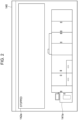
- Fig. 2 illustrates an example of a screen on which the image forming apparatus 100 that is in a stop state in the normal mode is displayed.
- Fig. 2 illustrates an apparatus image 141a of the image forming apparatus 100 and a text region 142a.
- a message that "STOPPED" representing a state of the image forming apparatus 100 is displayed.
- the apparatus image 141a illustrated in Fig. 2 is an image of the image forming apparatus 100 viewed in front of a front side.
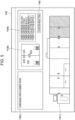
- Fig. 3 illustrates an example of a screen on which the image forming apparatus 100 with coverings opened in the normal mode is displayed.
- Fig. 3 illustrates an apparatus image 141b in which the positions of opened coverings are indicated and a text region 142b.
- a message that "COVERINGS ARE OPENED" representing a state of the image forming apparatus 100 is displayed.
- two right-hand coverings are opened when viewed in the same direction as the apparatus image 141a in Fig. 2 .
- the coverings in the apparatus image 141b in Fig. 3 are displayed by using a color that differs from that of the other portion (in the figure, these are illustrated by hatching).
- a mark (a cross mark that is surrounded by a circle) that visually attracts attention is left near the coverings that are displayed by the color that differs from that of the other portion.
- the same mark and a message that "CHECK COVERINGS (FRONT COVERINGS OF BODY (RIGHT))" for prompting the user to check the coverings are displayed.
- the state of the image forming apparatus 100 returns to the stop state in the normal mode. Accordingly, the display on the display unit 140 becomes the same as the display illustrated in Fig. 2 .
- the image forming apparatus 100 enters the consumable replacement mode.
- the UI screen is displayed on the display unit 140.
- Fig. 4 illustrates an example of the UI screen in the consumable replacement mode.
- the UI screen in the case where the image forming apparatus 100 enters the consumable replacement mode in the state illustrated in Fig. 3 .
- Fig. 4 illustrates an apparatus image 141c in which the positions of the opened coverings that are closed are indicated, text regions 142c and 144a, and a consumable image 143a in which the positions of the consumables that are installed in the housing of the image forming apparatus 100 are indicated.
- a message that "CONSUMABLE REPLACEMENT MODE” that is one of the operation modes of the image forming apparatus 100 is displayed.
- a message that "PLEASE SELECT REPLACED CONSUMABLE" for prompting the user to select the consumable is displayed.
- the same coverings as the coverings that are displayed by the different color (hatching) in the example in Fig. 3 are displayed by using a color that differs from that of the other portion.
- the coverings are displayed by using the color that differs from the color of the opened coverings on the screen for notification of the states of the opened coverings in Fig. 3 (in the figure, the coverings are displayed by using hatching that differs from that in Fig. 3 ).
- the coverings that are displayed in the different color are closed after the coverings are opened once. Accordingly, it is recognized from the display on the UI screen that there is a possibility that a consumable that is installed in an inner portion is replaced or replenished when the coverings are opened.
- the consumable image 143a a situation in the housing that faces the coverings that are displayed by using the different color in the apparatus image 141c is displayed.
- the images of the consumables are displayed at positions corresponding to the actual positions of the consumables in the housing.
- the UI screen in the consumable replacement mode enables the operation of selecting a consumable that is displayed in the consumable image 143a is receivable from the user.
- the operation unit 130 of the image forming apparatus 100 is a touch screen
- the consumable is selected by touching a part of the image of the consumable (in other words, the replaced consumable) on the UI screen by the user.
- the operation of selecting the consumable is performed by the user, and resetting of the counter that counts the progression information about the selected consumable is prepared.
- Fig. 5 illustrates an example of the UI screen in the case where the operation of selecting the consumable is performed in the consumable replacement mode.
- the UI screen is displayed with some consumables selected in the state illustrated in Fig. 4 .
- the selected consumables are displayed by using a color that differs from those of consumables that are not selected (in the figure, the selected consumables are displayed by using thick lines).
- a text region 144b on the right of the consumable image 143b in Fig. 5 texts that represent the names of the selected consumables are displayed.
- the consumables such as "TONER CARTRIDGE YELLOW 2" and "TONER COLLECTION BOTTLE 1" are selected.
- the user refers the UI screen illustrated in Fig. 5 and may visually check whether the user correctly selects the consumables, based on information about the positions of the consumables that is displayed in the apparatus image 141c and in the consumable image 143b and the names of the consumables that are displayed in the text region 144b.
- a button object 145 for resetting the counter that counts the progression information about the selected consumables is displayed below the text region 144b (in the figure, a text that "COUNTER-RESETTING" is displayed).
- the user selects the button object 145 on the UI screen, and another window (referred to as a "confirmation window") for checking whether the counter is reset is consequently displayed.
- Fig. 6 illustrates a state in which the confirmation window is displayed on the UI screen in Fig. 5 .
- a confirmation window 146 illustrated in Fig. 6 a message text that "REPLACEMENT TIME IS RESET. ARE YOU SURE?", a button object 146a for resetting the counter, and a button object 146b for cancel are displayed.
- the button object 146a is selected, the counter for each consumable that is selected on the UI screen in Fig. 5 is reset.
- the image forming apparatus 100 enters the normal mode from the consumable replacement mode.
- the state of the screen on the display unit 140 returns to the state illustrated in Fig. 2 .
- the button object 146b is selected, the confirmation window 146 on the screen of the display unit 140 is closed, and the screen returns to the UI screen illustrated in Fig. 5 .
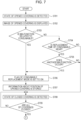
- Fig. 7 and Fig. 8 are flowcharts illustrating an operation regarding the consumable replacement mode of the image forming apparatus 100.
- the controller 110 detects a state of the opened covering by using signals from sensors that are disposed on the coverings (S701).
- the controller 110 causes the display unit 140 to display an image (see Fig. 3 ) of the opened covering (S702).
- the controller 110 determines whether the malfunction that occurs is related to any one of the consumables. Examples of the malfunction related to any one of the consumables include out of toner, out of paper, and another operation failure due to the degradation of the consumable.
- the storage unit 120 stores information about the malfunction related to any one of the consumables in advance, and when the occurrence of the malfunction is detected, the controller 110 refers the stored information and determines whether the malfunction is related to any one of the consumables.
- the controller 110 enters the consumable replacement mode, and for this purpose, the flag of the consumable replacement mode in a mode control function is set to ON (S706).
- the controller 110 causes a storage component such as the storage unit 120 or the RAM 112 to store information (in the figure, "INFORMATION ABOUT POSITION OF OPENED COVERING") about the opened covering (S707).
- the reason is as follows: it is presumed that the covering of the image forming apparatus 100 is opened for replacement of the consumable related to the malfunction.
- the controller 110 determines whether the replacement time of a consumable is near.
- An example of the case where the replacement time is near is the case where a difference between the progression information (a counter value) about the consumable and the replacement recommendation time that is set for the consumable is less than a redetermined threshold.
- the controller 110 determines whether a malfunction (referred to as "another malfunction") other than the malfunction related to the consumable occurs.
- a malfunction referred to as "another malfunction”
- An example of the other malfunction is paper jam.
- the controller 110 enters the consumable replacement mode, and for this purpose, the flag of the consumable replacement mode in the mode control function is set to ON (S706).
- the reason is as follows: it is presumed that when the replacement time of a consumable is near and when the other malfunction does not occur, the covering of the image forming apparatus 100 is opened in order to replace the consumable.
- the controller 110 causes the storage component such as the storage unit 120 or the RAM 112 to store the information (in the figure, "INFORMATION ABOUT POSITION OF OPENED COVERING" about the opened covering (S707).
- the controller 110 does not enter the consumable replacement mode, and the flag of the consumable replacement mode in the mode control function is not set to ON. If the replacement time of a consumable is near (YES at S704), and any of the other malfunctions occurs (NO at S705), it is presumed that the covering of the image forming apparatus 100 is opened in order to correct the other malfunction that occurs. Accordingly, the controller 110 does not enter the consumable replacement mode, and the flag of the consumable replacement mode in the mode control function is not set to ON.
- the controller 110 detects a state of the closed covering by using signals from the sensors that are disposed on the coverings (S708), and whether all of the coverings of the image forming apparatus 100 are closed is determined. If at least a covering remains opened (NO at S709), the covering remains opened, which corresponds to a malfunction, and a process at S708 is performed again.
- the controller 110 determines whether the flag of the consumable replacement mode is ON. If the flag is OFF (NO at S710), no operations in the consumable replacement mode are performed, and the image (see Fig. 2 ) in the normal mode is displayed on the display unit 140 (S720).
- the controller 110 enters the consumable replacement mode (S711), and the display unit 140 displays the UI screen (see Fig. 4 ) in the consumable replacement mode (S712).
- the controller 110 resets the counter of the selected consumable (S714).
- an example of the reset operation is an operation of selecting the button object 145 in Fig. 5 and selecting the button object 146a in Fig. 6 .
- the controller 110 resets the counter of the selected consumable and subsequently changes the operation mode of the image forming apparatus 100 into the normal mode (S719).
- the controller 110 causes the display unit 140 to display the image (see Fig. 2 ) in the normal mode (S720).
- the controller 110 waits the reset operation of the counter described above and determines whether phenomena that are set as the trigger for the end of the consumable replacement mode occur.
- the phenomena to be detected are four phenomena: a job that is to be carried out in the normal mode is carried out, the image forming apparatus 100 is powered off, the image forming apparatus 100 enters the power saving mode, and a predetermined time has elapsed. If any one of these phenomena is detected (YES at any one of S715 to S718), the controller 110 enters the normal mode (S719), and the display unit 140 displays the image (see Fig. 2 ) in the normal mode (S720).
- the controller 110 waits for the reset operation or the detection of any one of the phenomena. After the predetermined time has elapsed, which corresponds to YES at S718, the controller 110 enters the normal mode, and the image in the normal mode is displayed (S719 and S720).
- the controller 110 may enter the normal mode in response to the occurrence of the phenomenon and may notify the user of the fact that the reset operation of the counter is not received with an appropriate timing, for example, when the image forming apparatus 100 carries out a next job in the case where the UI screen in the consumable replacement mode is cleared.
- the notification may be transmitted after the job is carried out at S715, when a next job is carried out, when the image forming apparatus 100 starts up after the power is turned off at S716, or when the image forming apparatus 100 that enters the power saving mode at S717 enters the normal mode again.
- the notification may be periodically transmitted after the predetermined time has elapsed at S718.
- the user is notified by displaying a message on the display unit 140.
- an image in which the position of the target consumable is indicated may be displayed on the display unit 140 in addition to the message as in the UI screen in the consumable replacement mode illustrated in Fig. 5 and Fig. 6 .
- the user may operate the operation unit 130 of the image forming apparatus 100 such that the display unit 140 displays the UI screen in the consumable replacement mode for the reset operation of the counter.
- the exemplary embodiment of the present disclosure will be described above.
- the technical scope of the present disclosure is not limited to the exemplary embodiment described above.
- the opened coverings are displayed by using the color that differs from that of the other portion in the apparatus image.
- the portion at the position of each consumable the counter of which is to be reset is displayed by using the color that differs from that of the other portion.
- each selected consumable the counter of which is to be reset is displayed by using the color that differs from those of the other consumables.
- These display formats are not limited to the use of the different colors as described above, provided that the position of each opened covering, the position of each consumable, and each selected consumable are recognizable.
- a covering or a consumable to be recognized may have brightness or contrast that differs from that of the other portion.
- the mode in the case where another malfunction occurs, the mode is not changed into the consumable replacement mode even when a covering of the housing of the image forming apparatus 100 is opened and closed and when the replacement time of a consumable is near.
- the mode may be changed into the consumable replacement mode regardless of the presence or absence of the other malfunction when the covering is closed and when the replacement time of a consumable is near.
- Various other modifications and alterations are included in the present disclosure without departing from the technical scope of the present disclosure.
- processor refers to hardware in a broad sense.
- Examples of the processor include general processors (e.g., CPU: Central Processing Unit) and dedicated processors (e.g., GPU: Graphics Processing Unit, ASIC: Application Specific Integrated Circuit, FPGA: Field Programmable Gate Array, and programmable logic device).
- processor is broad enough to encompass one processor or plural processors in collaboration which are located physically apart from each other but may work cooperatively.
- the order of operations of the processor is not limited to one described in the embodiments above, and may be changed.
Landscapes
- Engineering & Computer Science (AREA)
- Theoretical Computer Science (AREA)
- Physics & Mathematics (AREA)
- General Physics & Mathematics (AREA)
- Human Computer Interaction (AREA)
- General Engineering & Computer Science (AREA)
- Microelectronics & Electronic Packaging (AREA)
- Control Or Security For Electrophotography (AREA)
- Accessory Devices And Overall Control Thereof (AREA)
- Facsimiles In General (AREA)
Abstract
Description
- The present disclosure relates to an image forming apparatus, a program, and an image forming method.
- An image forming apparatus has a mechanism of notifying a user of the replacement time of a consumable. In an example, a state of the consumable is monitored by using, for example, a sensor, and the user is notified of detection of a state that needs replacement. In another example, a replacement recommendation time is determined, and the replacement time is identified based on last replacement date and time and is reported. In the latter case, when the component is replaced, a counter that counts elapsed date and time until the replacement recommendation time or the number of times a job is carried out need to be reset by, for example, a user operation.
-
Japanese Patent No. 4974837 -
Japanese Unexamined Patent Application Publication No. 2019-184797 -
Japanese Unexamined Patent Application Publication No. 2010-156737 - As for a consumable a state of which is not detectable, a counter that counts, for example, elapsed date and time until the replacement recommendation time or the number of times a job is carried out is reset by, for example, a user operation when a component is replaced. However, if the reset operation of the counter is to be received with a covering of the apparatus opened or in a special state such as a mode that is changed by an intentional operation, and if the reset operation is not correctly performed due to, for example, the oversight of resetting or an error of a target to be reset, and the state returns to a normal state, the replacement recommendation time is not correctly identified.
- Accordingly, it is an object of the present disclosure to provide an image forming apparatus that enables the oversight or error of the reset operation of a counter when a component is replaced to be reduced in a manner in which information about a consumable is displayed based on a state of the image forming apparatus.
- According to a first aspect of the present disclosure, there is provided an image forming apparatus including a processor configured to: detect presence or absence of a malfunction and opening and closing of a covering; and cause a display device to display information about a consumable such that a reset operation of a counter that is set regarding the consumable is receivable in a case where a predetermined malfunction does not occur, and a covering related to the consumable is opened and is subsequently closed.
- According to a second aspect of the present disclosure, there is provided the image forming apparatus according to the first aspect in which the processor is configured to cause the display device to display different screens between a case where the opened covering is closed when a predetermined condition regarding the consumable is satisfied and a case where the covering is closed when the condition is not satisfied.
- According to a third aspect of the present disclosure, there is provided the image forming apparatus according to the second aspect in which the processor is configured to: cause the display device to display information about the opened covering in response to the opening and closing of the covering; cause the display device to display the information about the consumable in a case where the covering is closed when the condition is satisfied; and cause the display device to dismiss a display of the information about the opened covering in a case where the covering is closed when the condition is not satisfied.
- According to a fourth aspect of the present disclosure, there is provided the image forming apparatus according to the second aspect in which the condition is a condition regarding a replacement time of the consumable that is calculated by using a method that is determined for the consumable.
- According to a fifth aspect of the present disclosure, there is provided the image forming apparatus according to the first aspect in which the processor is configured to cause the display device to dismiss a display of the information about the consumable in a case where a predetermined phenomenon occurs with the display device displaying the information about the consumable.
- According to a sixth aspect of the present disclosure, there is provided an image forming apparatus comprising: a processor configured to: cause a display device to display an operation screen and receive an operation of a user by using the operation screen; cause the display device to display an image in which a position of a covering of the image forming apparatus that is opened and closed is indicated in a first operation mode; and cause the display device to display an image in which the position of the covering of the image forming apparatus that is opened and closed and a position of a consumable are indicated in a second operation mode such that a reset operation of a counter that is set regarding the consumable that is specified in the image is receivable.
- According to a seventh aspect of the present disclosure, there is provided the image forming apparatus according to the sixth aspect in which the processor is configured to enter the second operation mode from the first operation mode in a case where the opened covering is closed when a predetermined condition is satisfied.
- According to an eighth aspect of the present disclosure, there is provided the image forming apparatus according to the seventh aspect in which the condition is that a predetermined malfunction of the image forming apparatus does not occur and that a replacement time of the consumable that is calculated by using a method that is determined for the consumable comes.
- According to a ninth aspect of the present disclosure, there is provided the image forming apparatus according to the sixth aspect in which the processor is configured to enter the first operation mode in a case where a predetermined phenomenon occurs in the second operation mode and even in a case where the reset operation of the counter is not received.
- According to a tenth aspect of the present disclosure, there is provided the image forming apparatus according to the ninth aspect in which the processor is configured to notify the user of a fact that the reset operation of the counter is not received when a next image formation process is performed in a case where the processor enters the first operation mode due to occurrence of the phenomenon.
- According to an eleventh aspect of the present disclosure, there is provided the image forming apparatus according to the ninth aspect in which the phenomenon is that an instruction for performing a process that is to be performed in the first operation mode is transmitted.
- According to a twelfth aspect of the present disclosure, there is provided the image forming apparatus according to the ninth aspect in which the phenomenon is that the image forming apparatus enters a power saving mode.
- According to a thirteenth aspect of the present disclosure, there is provided the image forming apparatus according to the ninth aspect in which the phenomenon is that the image forming apparatus is not operated, and a predetermined time has elapsed.
- According to a fourteenth aspect of the present disclosure, there is provided a program causing a computer to execute a process including detecting presence or absence of a malfunction and opening and closing of a covering; and causing a display device to display information about a consumable in a case where a predetermined malfunction does not occur, and a covering related to the consumable is opened and is subsequently closed; and receiving a reset operation of a counter that is set regarding the consumable about which the information is displayed.
- According to a fifteenth aspect of the present disclosure, there is provided a program causing a computer to execute a process including causing a display device to display an operation screen and receiving an operation of a user by using the operation screen; causing the display device to display an image in which a position of a covering of the image forming apparatus that is opened and closed is indicated in a first operation mode; causing the display device to display an image in which the position of the covering of the image forming apparatus that is opened and closed and a position of a consumable are indicated in a second operation mode; and receiving a reset operation of a counter that is set regarding the consumable that is specified in the image.
- According to a sixteenth aspect of the present disclosure, there is provided an image forming method including: detecting presence or absence of a malfunction and opening and closing of a covering; and causing a display device to display information about a consumable such that a reset operation of a counter that is set regarding the consumable is receivable in a case where a predetermined malfunction does not occur, and a covering related to the consumable is opened and is subsequently closed.
- According to the first or sixteenth aspect, the oversight or error of the reset operation of the counter when a component is replaced can be reduced in a manner in which information about the consumable is displayed based on a state of the image forming apparatus.
- According to the second aspect, information about whether the condition regarding the consumable is satisfied can be provided to the user unlike the case where a display is not changed depending on the condition regarding the consumable.
- According to the third aspect, it is suggested that the state returns to a normal state when the condition is not satisfied unlike the case where a display is not changed depending on the condition regarding the consumable.
- According to the fourth aspect, information about the replacement time of the consumable can be provided to the user unlike the case where a display is not changed depending on the condition regarding the replacement time of the consumable.
- According to the fifth aspect, difficulty displaying information about the phenomenon that occurs can be reduced unlike the case where the information about the consumable is continuously displayed also when the phenomenon occurs.
- According to the sixth aspect, the consumable the counter of which is to be reset can be intuitively grasped unlike the case where the consumable is listed.
- According to the seventh aspect, the user does not need to be conscious, and the mode can be changed unlike the case where an operation of changing the mode into a special mode is set.
- According to the eighth aspect, the mode can be inhibited from being unnecessarily changed unlike the case where the operation mode is not changed depending on the condition regarding the replacement time of the consumable and a malfunction.
- According to the ninth aspect, difficulty displaying the information about the phenomenon that occurs can be reduced unlike the case where the second operation mode continues also when the phenomenon occurs.
- According to the tenth aspect, the user can be notified of the fact that the reset operation of the counter is not completed unlike the case where the image formation process is performed without notification.
- According to the eleventh aspect, a normal process that is specified can be immediately performed unlike the case where the second operation mode continues also when an instruction for performing the normal process is transmitted.
- According to the twelfth aspect, the normal process can be immediately started when the mode returns from the power saving mode unlike the case where the second operation mode continues even when the image forming apparatus enters the power saving mode.
- According to the thirteenth aspect, the mode can autonomously return to the first operation mode unlike the case where the second operation mode continues in the case where the image forming apparatus is not operated.
- According to the fourteen aspect, the oversight or error of the reset operation of the counter when a component is replaced can be reduced in a manner in which information about the consumable is displayed based on a state of a computer in which the program according to the present disclosure is installed.
- According to the fifteen aspect, the consumable the counter of which is to be reset can be intuitively grasped unlike the case where the consumable is listed in the computer in which the program according to the present disclosure is installed.
- An exemplary embodiment of the present disclosure will be described in detail based on the following figures, wherein:
-
Fig. 1 illustrates an example of the structure of an image forming apparatus according to an exemplary embodiment; -
Fig. 2 illustrates an example of a screen on which the image forming apparatus that stops in a normal mode is displayed; -
Fig. 3 illustrates an example of a screen on which the image forming apparatus with coverings opened in the normal mode is displayed; -
Fig. 4 illustrates an example of a UI screen in a consumable replacement mode; -
Fig. 5 illustrates an example of the UI screen in the case where an operation of selecting a consumable is performed in the consumable replacement mode. -
Fig. 6 illustrates a state in which a confirmation window is displayed on the UI screen inFig. 5 ; -
Fig. 7 is a flowchart illustrating an operation regarding the consumable replacement mode of the image forming apparatus; and -
Fig. 8 is a flowchart illustrating the operation regarding the consumable replacement mode of the image forming apparatus. - An exemplary embodiment of the present disclosure will hereinafter be described with reference to the attached drawings.
-
Fig. 1 illustrates the structure of an image forming apparatus according to the present exemplary embodiment. Animage forming apparatus 100 includes acontroller 110, astorage unit 120, anoperation unit 130, adisplay unit 140, animage reading unit 150, animage forming unit 160, acommunication unit 170, and animage processing unit 180. These functional units are connected to abus 101 and transmit and receive data via thebus 101. - The
controller 110 controls the functional units described above in theimage forming apparatus 100. Thecontroller 110 is a functional unit that performs various data processes. Thecontroller 110 includes a central processing unit (CPU) 111 corresponding to an arithmetic unit and a random access memory (RAM) 112 and a read only memory (ROM) 113 that are storage components. TheRAM 112 is a main memory and is used as a work memory when theCPU 111 performs arithmetic processing. TheROM 113 stores a program and data such as set values that are prepared in advance. TheCPU 111 directly reads the program and the data from theROM 113 and performs processing. A program and data are stored also in thestorage unit 120. TheCPU 111 reads the program that is stored in thestorage unit 120 into theRAM 112 and runs the program. - According to the present exemplary embodiment, the
CPU 111 of thecontroller 110 reads and runs the program for performing various functions described later. Examples of the functions that are performed according to the present exemplary embodiment include a function of display control on a user interface (UI) screen in operation modes described later, a function of receiving an operation by using the UI screen, and a counter function that is used for calculating the replacement time or replenishment time for a consumable. These functions will be described in detail later. In the following description, the word "replacement" includes the replacement of the consumable (for example, a photoconductor drum) that needs to be replaced depending on a state and the replenishment of a consumable (for example, toner or paper) that needs to be replenished depending on a state. In some cases, however, the replacement and replenishment are distinguished, and the phrase "replacement and replenishment" or "replacement or replenishment" is described. - The
storage unit 120 is a functional unit that stores the program that is performed by theCPU 111 and the data as described above and that stores various kinds of data generated by various operations such as the data of an image that is read by theimage reading unit 150. For example, thestorage unit 120 is operated by using a storage device such as a magnetic disk device or a solid state drive (SSD). - The
operation unit 130 is a functional unit that receives an operation of a user. For example, theoperation unit 130 includes a hardware keyboard or a touch sensor that outputs a control signal depending on the position of a press or a touch of, for example, a finger. A touch screen into which a touch sensor and a liquid-crystal display that serves as thedisplay unit 140 are incorporated may be included. - The
display unit 140 is a functional unit that displays images such as an information image that provides the user with various kinds of information, a preview image for an image to be read or outputted, or an operation image for the operation of the user. For example, thedisplay unit 140 includes a liquid-crystal display. A combination of thedisplay unit 140 and theoperation unit 130 described above may be used as a user interface unit for the user to input and output information from and to theimage forming apparatus 100. - The
image reading unit 150 is a functional unit that optically reads an image on a document. Examples of a method of reading the image include a CCD method in which reflection light of light that is radiated from a light source to the document is shrunk by a lens and is received by a charge coupled device (CCD) and a CIS method in which reflection light of light that is sequentially radiated from a light emitting diode (LED) light source to the document and is received by a contact image sensor (CIS). - The
image forming unit 160 is a functional unit that forms an image based on image data on a recording material such as paper by using an image formation material. An example of a method of forming the image on the recording material is an electrophotographic system that uses toner as the image formation material, that transfers toner that is attached to a photoconductor member to the recording material, and that forms the image. - The
communication unit 170 is a functional unit that transmits and receives an instruction and data to and from an external device. Thecommunication unit 170 is an interface that is compatible with a system of communication with the external device. Connection with the external device may be connection via a network or direct connection. A communication line may be a wired line or a wireless line. - The
image processing unit 180 is a functional unit that includes a processor corresponding to an arithmetic unit and a work memory and that performs image processing such as color correction or gradation correction on an image that is represented by image data. TheCPU 111 of thecontroller 110 may double as the processor. TheRAM 112 of thecontroller 110 may double as the work memory. - The operation modes of the
image forming apparatus 100 according to the present exemplary embodiment will be described. The operation modes of theimage forming apparatus 100 include a normal mode that is an example of a first operation mode and a consumable replacement mode that is an example of a second operation mode. The normal mode is the operation mode when theimage forming apparatus 100 is in a normal operation state. For example, the normal operation state is a state in which power is on, the components of theimage forming apparatus 100 start up, and normal use such as image printing or reading becomes ready. The consumable replacement mode is the operation mode in which an operation required depending on the replacement of a consumable is received. - The consumable is degraded or consumed through the use of the
image forming apparatus 100 and accordingly needs to be replaced or replenished in an appropriate time. For this reason, theimage forming apparatus 100 has a mechanism of notifying a user of the replacement time of the consumable. In an example of this kind of mechanism, a state of the consumable is monitored by using, for example, a sensor, and the user is notified of detection of a state that needs replacement or replenishment. For example, the user is notified by using a method in which a message for prompting the user to replace the consumable is displayed on thedisplay unit 140. In this case, when the consumable is replaced or replenished, a monitoring unit such as a sensor detects this, and notification to the user is dismissed. - As for a consumable, the state that needs replacement or replenishment cannot be detected if the monitoring unit described above is not provided. For this kind of the consumable, a time (referred to as a "replacement recommendation time") in which replacement or replenishment is recommended is determined depending on the kind of the consumable. A time (referred to as a "replacement time") that needs replacement or replenishment is identified for the consumable depending on progression information after date and time (referred to as "last replacement date and time") at which the consumable is replaced or replenished at last. The progression information is used to identify the replacement time of the consumable.
- The replacement recommendation time and the progression information are set depending on the kind of the consumable. For example, as for a consumable that is degraded or reduced over time, the replacement recommendation time is defined by using an elapsed time after the consumable is replaced. An elapsed time after the last replacement date and time is used as the progression information. As for a consumable that is degraded or reduced depending on a job that is carried out by the
image forming apparatus 100, the replacement recommendation time is defined by using the number of times the job is carried out after the consumable is replaced. The number of times the job is carried out after the last replacement date and time is used as the progression information. Such progression information is merely described by way of example, and various kinds of information may be used as the progression information depending on the kind of the consumable. The progression information about consumables is calculated by using a method that is determined depending on the kinds of the consumables. - The replacement time of each consumable is a time at which the progression information after the last replacement date and time of the consumable reaches the replacement recommendation time. As for each consumable, the
image forming apparatus 100 notifies the user of the replacement time of the consumable. For example, the user is notified by, for example, using a method in which a message for prompting the user to replace the consumable is displayed on thedisplay unit 140. - As for the consumable for which the monitoring unit is not provided as described above, a counter that counts the progression information until a next replacement time of the consumable needs to be reset after the consumable is replaced or replenished. For example, the counter is manually reset by the user who replaces the consumable. According to the present exemplary embodiment, the
image forming apparatus 100 has the consumable replacement mode to reduce the oversight or error of the reset operation of the counter that is performed by the user. - The normal mode is changed into the consumable replacement mode in the case where a predetermined condition is satisfied when a covering of a housing of the
image forming apparatus 100 is opened and closed. Examples of conditions under which the normal mode is changed into the consumable replacement mode include the occurrence of a malfunction related to a consumable in theimage forming apparatus 100 when a covering at a position at which the consumable is located is opened, the replacement time of a consumable is near, and nonoccurrence of a malfunction other than the malfunction related to the consumable. An example of the malfunction other than the malfunction related to the consumable is paper jam. In the case where the covering of theimage forming apparatus 100 is closed when this condition is satisfied, theimage forming apparatus 100 enters the consumable replacement mode from the normal mode. After theimage forming apparatus 100 enters the consumable replacement mode, a specific UI screen is displayed on thedisplay unit 140, information about, for example, the position of the consumable is displayed by using the UI screen, and the reset operation of the counter that is performed by the user for counting the progression information about the consumable is receivable. The UI screen will be described in detail later. - In the case where the covering of the
image forming apparatus 100 is closed when the condition described above is not satisfied, theimage forming apparatus 100 does not enter the consumable replacement mode from the normal mode. In the normal mode, a state in which the covering of theimage forming apparatus 100 is opened corresponds to a malfunction, and a notification screen for notifying the user of the position of the opened covering is displayed on thedisplay unit 140. When the covering is closed, the notification screen is cleared. For this reason, when the covering of theimage forming apparatus 100 is closed, thedisplay unit 140 displays different screens depending on whether the mode is changed into the consumable replacement mode. - When the reset operation of the counter that counts the progression information about the consumable is performed by using the UI screen that is displayed on the
display unit 140 after the mode is changed into the consumable replacement mode, the counter is reset, and the mode of theimage forming apparatus 100 returns to the normal mode from the consumable replacement mode. Even when the reset operation is not performed, the mode of theimage forming apparatus 100 returns to the normal mode from the consumable replacement mode due to the occurrence of a predetermined phenomenon that occurs in theimage forming apparatus 100. Phenomena that trigger the return to the normal mode (referred to as a "return trigger") may be various phenomena that need an operation in the normal mode when the phenomena occur. Examples thereof may include an instruction for carrying out a job in the normal mode such as image printing, powering off theimage forming apparatus 100, changing the mode of theimage forming apparatus 100 into a power saving mode, and a predetermined time elapsed while the reset operation is not performed. These phenomena are examples. The phenomena may be set as the return trigger in consideration of various scenes in which the consumable replacement mode is to be changed into the normal mode. - The UI screen that is displayed on the
display unit 140 of theimage forming apparatus 100 in the consumable replacement mode will be described. According to the present exemplary embodiment, an image (referred to as an "apparatus image") of the appearance of theimage forming apparatus 100 is displayed on thedisplay unit 140, and the position of the covering that is opened and closed is indicated. An image (referred to as a "consumable image") of a consumable in the housing that is covered by the covering is displayed, and an operation of selecting the counter to be reset is received on the consumable image. In the following description including a situation in which the normal mode is changed into the consumable replacement mode, display screens in several scenes on thedisplay unit 140 are referred. In the following description, the monitoring unit described above is not provided for the consumable. -
Fig. 2 illustrates an example of a screen on which theimage forming apparatus 100 that is in a stop state in the normal mode is displayed.Fig. 2 illustrates anapparatus image 141a of theimage forming apparatus 100 and atext region 142a. In thetext region 142a, a message that "STOPPED" representing a state of theimage forming apparatus 100 is displayed. Theapparatus image 141a illustrated inFig. 2 is an image of theimage forming apparatus 100 viewed in front of a front side. -
Fig. 3 illustrates an example of a screen on which theimage forming apparatus 100 with coverings opened in the normal mode is displayed.Fig. 3 illustrates anapparatus image 141b in which the positions of opened coverings are indicated and atext region 142b. In thetext region 142b, a message that "COVERINGS ARE OPENED" representing a state of theimage forming apparatus 100 is displayed. - In the description as for the
image forming apparatus 100, two right-hand coverings are opened when viewed in the same direction as theapparatus image 141a inFig. 2 . The coverings in theapparatus image 141b inFig. 3 are displayed by using a color that differs from that of the other portion (in the figure, these are illustrated by hatching). InFig. 3 , a mark (a cross mark that is surrounded by a circle) that visually attracts attention is left near the coverings that are displayed by the color that differs from that of the other portion. In thetext region 142b, the same mark and a message that "CHECK COVERINGS (FRONT COVERINGS OF BODY (RIGHT))" for prompting the user to check the coverings are displayed. - In the case where the opened coverings are closed when the condition for changing the normal mode into the consumable replacement mode is not satisfied, the state of the
image forming apparatus 100 returns to the stop state in the normal mode. Accordingly, the display on thedisplay unit 140 becomes the same as the display illustrated inFig. 2 . In the case where the coverings are closed when the condition for changing the normal mode into the consumable replacement mode is satisfied, theimage forming apparatus 100 enters the consumable replacement mode. The UI screen is displayed on thedisplay unit 140. -
Fig. 4 illustrates an example of the UI screen in the consumable replacement mode. In an example illustrated inFig. 4 , the UI screen in the case where theimage forming apparatus 100 enters the consumable replacement mode in the state illustrated inFig. 3 .Fig. 4 illustrates anapparatus image 141c in which the positions of the opened coverings that are closed are indicated,text regions consumable image 143a in which the positions of the consumables that are installed in the housing of theimage forming apparatus 100 are indicated. In thetext region 142c, a message that "CONSUMABLE REPLACEMENT MODE" that is one of the operation modes of theimage forming apparatus 100 is displayed. In thetext region 144a, a message that "PLEASE SELECT REPLACED CONSUMABLE" for prompting the user to select the consumable is displayed. - In the
apparatus image 141c in the example illustrated inFig. 4 , the same coverings as the coverings that are displayed by the different color (hatching) in the example inFig. 3 are displayed by using a color that differs from that of the other portion. On the UI screen, the coverings are displayed by using the color that differs from the color of the opened coverings on the screen for notification of the states of the opened coverings inFig. 3 (in the figure, the coverings are displayed by using hatching that differs from that inFig. 3 ). The coverings that are displayed in the different color are closed after the coverings are opened once. Accordingly, it is recognized from the display on the UI screen that there is a possibility that a consumable that is installed in an inner portion is replaced or replenished when the coverings are opened. - In the
consumable image 143a, a situation in the housing that faces the coverings that are displayed by using the different color in theapparatus image 141c is displayed. In theconsumable image 143a in which the situation in the housing is indicated, the images of the consumables are displayed at positions corresponding to the actual positions of the consumables in the housing. The UI screen in the consumable replacement mode enables the operation of selecting a consumable that is displayed in theconsumable image 143a is receivable from the user. For example, in the case where theoperation unit 130 of theimage forming apparatus 100 is a touch screen, the consumable is selected by touching a part of the image of the consumable (in other words, the replaced consumable) on the UI screen by the user. The operation of selecting the consumable is performed by the user, and resetting of the counter that counts the progression information about the selected consumable is prepared. -
Fig. 5 illustrates an example of the UI screen in the case where the operation of selecting the consumable is performed in the consumable replacement mode. In an example illustrated inFig. 5 , the UI screen is displayed with some consumables selected in the state illustrated inFig. 4 . In aconsumable image 143b inFig. 5 , the selected consumables are displayed by using a color that differs from those of consumables that are not selected (in the figure, the selected consumables are displayed by using thick lines). - In a
text region 144b on the right of theconsumable image 143b inFig. 5 , texts that represent the names of the selected consumables are displayed. In an example illustrated inFig. 5 , the consumables such as "TONER CARTRIDGE YELLOW 2" and "TONER COLLECTION BOTTLE 1" are selected. The user refers the UI screen illustrated inFig. 5 and may visually check whether the user correctly selects the consumables, based on information about the positions of the consumables that is displayed in theapparatus image 141c and in theconsumable image 143b and the names of the consumables that are displayed in thetext region 144b. Abutton object 145 for resetting the counter that counts the progression information about the selected consumables is displayed below thetext region 144b (in the figure, a text that "COUNTER-RESETTING" is displayed). The user selects thebutton object 145 on the UI screen, and another window (referred to as a "confirmation window") for checking whether the counter is reset is consequently displayed. -
Fig. 6 illustrates a state in which the confirmation window is displayed on the UI screen inFig. 5 . In aconfirmation window 146 illustrated inFig. 6 , a message text that "REPLACEMENT TIME IS RESET. ARE YOU SURE?", abutton object 146a for resetting the counter, and abutton object 146b for cancel are displayed. When thebutton object 146a is selected, the counter for each consumable that is selected on the UI screen inFig. 5 is reset. Theimage forming apparatus 100 enters the normal mode from the consumable replacement mode. The state of the screen on thedisplay unit 140 returns to the state illustrated inFig. 2 . When thebutton object 146b is selected, theconfirmation window 146 on the screen of thedisplay unit 140 is closed, and the screen returns to the UI screen illustrated inFig. 5 . -
Fig. 7 andFig. 8 are flowcharts illustrating an operation regarding the consumable replacement mode of theimage forming apparatus 100. When theimage forming apparatus 100 malfunctions, and one of the coverings is opened, the controller 110 (seeFig. 1 ) detects a state of the opened covering by using signals from sensors that are disposed on the coverings (S701). Thecontroller 110 causes thedisplay unit 140 to display an image (seeFig. 3 ) of the opened covering (S702). Thecontroller 110 determines whether the malfunction that occurs is related to any one of the consumables. Examples of the malfunction related to any one of the consumables include out of toner, out of paper, and another operation failure due to the degradation of the consumable. For example, the storage unit 120 (seeFig. 1 ) stores information about the malfunction related to any one of the consumables in advance, and when the occurrence of the malfunction is detected, thecontroller 110 refers the stored information and determines whether the malfunction is related to any one of the consumables. - If the malfunction that occurs is related to any one of the consumables (YES at S703), the
controller 110 enters the consumable replacement mode, and for this purpose, the flag of the consumable replacement mode in a mode control function is set to ON (S706). Thecontroller 110 causes a storage component such as thestorage unit 120 or theRAM 112 to store information (in the figure, "INFORMATION ABOUT POSITION OF OPENED COVERING") about the opened covering (S707). The reason is as follows: it is presumed that the covering of theimage forming apparatus 100 is opened for replacement of the consumable related to the malfunction. - If the malfunction that occurs is not related to the consumables (NO at S703), the
controller 110 determines whether the replacement time of a consumable is near. An example of the case where the replacement time is near is the case where a difference between the progression information (a counter value) about the consumable and the replacement recommendation time that is set for the consumable is less than a redetermined threshold. - If the replacement time of a consumable is near (YES at S704), the
controller 110 determines whether a malfunction (referred to as "another malfunction") other than the malfunction related to the consumable occurs. An example of the other malfunction is paper jam. Some malfunctions instead of all malfunctions other than the malfunction related to the consumable may be set as other malfunctions in advance, and whether the malfunction that occurs is any one of the other set malfunctions may be determined. - If the other malfunction does not occur (YES at S705), the
controller 110 enters the consumable replacement mode, and for this purpose, the flag of the consumable replacement mode in the mode control function is set to ON (S706). The reason is as follows: it is presumed that when the replacement time of a consumable is near and when the other malfunction does not occur, the covering of theimage forming apparatus 100 is opened in order to replace the consumable. Thecontroller 110 causes the storage component such as thestorage unit 120 or theRAM 112 to store the information (in the figure, "INFORMATION ABOUT POSITION OF OPENED COVERING" about the opened covering (S707). - If the malfunction that occurs is not related to the consumables (NO at S703), and the replacement time of each consumable is not near (NO at S704), it is presumed that the covering of the
image forming apparatus 100 is opened in order to replace the consumable. Accordingly, thecontroller 110 does not enter the consumable replacement mode, and the flag of the consumable replacement mode in the mode control function is not set to ON. If the replacement time of a consumable is near (YES at S704), and any of the other malfunctions occurs (NO at S705), it is presumed that the covering of theimage forming apparatus 100 is opened in order to correct the other malfunction that occurs. Accordingly, thecontroller 110 does not enter the consumable replacement mode, and the flag of the consumable replacement mode in the mode control function is not set to ON. - Subsequently, the covering that is opened at S701 is closed, the
controller 110 detects a state of the closed covering by using signals from the sensors that are disposed on the coverings (S708), and whether all of the coverings of theimage forming apparatus 100 are closed is determined. If at least a covering remains opened (NO at S709), the covering remains opened, which corresponds to a malfunction, and a process at S708 is performed again. - If all of the coverings are closed (YES at S709), the
controller 110 determines whether the flag of the consumable replacement mode is ON. If the flag is OFF (NO at S710), no operations in the consumable replacement mode are performed, and the image (seeFig. 2 ) in the normal mode is displayed on the display unit 140 (S720). - If the flag of the consumable replacement mode is ON (YES at S710), the
controller 110 enters the consumable replacement mode (S711), and thedisplay unit 140 displays the UI screen (seeFig. 4 ) in the consumable replacement mode (S712). When the user selects the consumable on the UI screen and performs the reset operation (YES at S713), thecontroller 110 resets the counter of the selected consumable (S714). In the example described with reference toFig. 4 to Fig. 6 , an example of the reset operation is an operation of selecting thebutton object 145 inFig. 5 and selecting thebutton object 146a inFig. 6 . - The
controller 110 resets the counter of the selected consumable and subsequently changes the operation mode of theimage forming apparatus 100 into the normal mode (S719). Thecontroller 110 causes thedisplay unit 140 to display the image (seeFig. 2 ) in the normal mode (S720). - After the
display unit 140 displays the UI screen, thecontroller 110 waits the reset operation of the counter described above and determines whether phenomena that are set as the trigger for the end of the consumable replacement mode occur. In the description, the phenomena to be detected are four phenomena: a job that is to be carried out in the normal mode is carried out, theimage forming apparatus 100 is powered off, theimage forming apparatus 100 enters the power saving mode, and a predetermined time has elapsed. If any one of these phenomena is detected (YES at any one of S715 to S718), thecontroller 110 enters the normal mode (S719), and thedisplay unit 140 displays the image (seeFig. 2 ) in the normal mode (S720). If none of these phenomena is detected (NO at S715 to S718), thecontroller 110 waits for the reset operation or the detection of any one of the phenomena. After the predetermined time has elapsed, which corresponds to YES at S718, thecontroller 110 enters the normal mode, and the image in the normal mode is displayed (S719 and S720). - It is thought that the counter of a consumable that is specified on the UI screen in the consumable replacement mode is not reset, although the mode returns to the normal mode. An example thereof is the case where any one of the phenomena at S715 to S718 in
Fig. 8 occurs, and the mode is consequently changed into the normal mode. In this case, there is a possibility that the counter to be reset is not reset. In view of this, thecontroller 110 may enter the normal mode in response to the occurrence of the phenomenon and may notify the user of the fact that the reset operation of the counter is not received with an appropriate timing, for example, when theimage forming apparatus 100 carries out a next job in the case where the UI screen in the consumable replacement mode is cleared. Specifically, the notification may be transmitted after the job is carried out at S715, when a next job is carried out, when theimage forming apparatus 100 starts up after the power is turned off at S716, or when theimage forming apparatus 100 that enters the power saving mode at S717 enters the normal mode again. The notification may be periodically transmitted after the predetermined time has elapsed at S718. For example, the user is notified by displaying a message on thedisplay unit 140. At this time, an image in which the position of the target consumable is indicated may be displayed on thedisplay unit 140 in addition to the message as in the UI screen in the consumable replacement mode illustrated inFig. 5 andFig. 6 . In response to the notification, the user may operate theoperation unit 130 of theimage forming apparatus 100 such that thedisplay unit 140 displays the UI screen in the consumable replacement mode for the reset operation of the counter. - The exemplary embodiment of the present disclosure will be described above. However, the technical scope of the present disclosure is not limited to the exemplary embodiment described above. For example, according to the exemplary embodiment described above, as for the image (see
Fig. 3 ) in which the opened coverings are indicated, the opened coverings are displayed by using the color that differs from that of the other portion in the apparatus image. Similarly, on the UI screen (seeFig. 4 ), the portion at the position of each consumable the counter of which is to be reset is displayed by using the color that differs from that of the other portion. On the UI screen, each selected consumable the counter of which is to be reset is displayed by using the color that differs from those of the other consumables. These display formats are not limited to the use of the different colors as described above, provided that the position of each opened covering, the position of each consumable, and each selected consumable are recognizable. For example, a covering or a consumable to be recognized may have brightness or contrast that differs from that of the other portion. - According to the embodiment described above, in the case where another malfunction occurs, the mode is not changed into the consumable replacement mode even when a covering of the housing of the
image forming apparatus 100 is opened and closed and when the replacement time of a consumable is near. However, the mode may be changed into the consumable replacement mode regardless of the presence or absence of the other malfunction when the covering is closed and when the replacement time of a consumable is near. Various other modifications and alterations are included in the present disclosure without departing from the technical scope of the present disclosure. - In the embodiments above, the term "processor" refers to hardware in a broad sense. Examples of the processor include general processors (e.g., CPU: Central Processing Unit) and dedicated processors (e.g., GPU: Graphics Processing Unit, ASIC: Application Specific Integrated Circuit, FPGA: Field Programmable Gate Array, and programmable logic device).
- In the embodiments above, the term "processor" is broad enough to encompass one processor or plural processors in collaboration which are located physically apart from each other but may work cooperatively. The order of operations of the processor is not limited to one described in the embodiments above, and may be changed.
- The foregoing description of the exemplary embodiments of the present disclosure has been provided for the purposes of illustration and description. It is not intended to be exhaustive or to limit the disclosure to the precise forms disclosed. Obviously, many modifications and variations will be apparent to practitioners skilled in the art. The embodiments were chosen and described in order to best explain the principles of the disclosure and its practical applications, thereby enabling others skilled in the art to understand the disclosure for various embodiments and with the various modifications as are suited to the particular use contemplated. It is intended that the scope of the disclosure be defined by the following claims and their equivalents.
Claims (16)
- An image forming apparatus comprising:
a processor configured to:detect presence or absence of a malfunction and opening and closing of a covering; andcause a display device to display information about a consumable such that a reset operation of a counter that is set regarding the consumable is receivable in a case where a predetermined malfunction does not occur, and a covering related to the consumable is opened and is subsequently closed. - The image forming apparatus according to Claim 1,
wherein the processor is configured to cause the display device to display different screens between a case where the opened covering is closed when a predetermined condition regarding the consumable is satisfied and a case where the covering is closed when the condition is not satisfied. - The image forming apparatus according to Claim 2,
wherein the processor is configured to:cause the display device to display information about the opened covering in response to the opening and closing of the covering;cause the display device to display the information about the consumable in a case where the covering is closed when the condition is satisfied; andcause the display device to dismiss a display of the information about the opened covering in a case where the covering is closed when the condition is not satisfied. - The image forming apparatus according to Claim 2,
wherein the condition is a condition regarding a replacement time of the consumable that is calculated by using a method that is determined for the consumable. - The image forming apparatus according to Claim 1,
wherein the processor is configured to cause the display device to dismiss a display of the information about the consumable in a case where a predetermined phenomenon occurs with the display device displaying the information about the consumable. - An image forming apparatus comprising:
a processor configured to:cause a display device to display an operation screen and receive an operation of a user by using the operation screen;cause the display device to display an image in which a position of a covering of the image forming apparatus that is opened and closed is indicated in a first operation mode; andcause the display device to display an image in which the position of the covering of the image forming apparatus that is opened and closed and a position of a consumable are indicated in a second operation mode such that a reset operation of a counter that is set regarding the consumable that is specified in the image is receivable. - The image forming apparatus according to Claim 6,
wherein the processor is configured to enter the second operation mode from the first operation mode in a case where the opened covering is closed when a predetermined condition is satisfied. - The image forming apparatus according to Claim 7,
wherein the condition is that a predetermined malfunction of the image forming apparatus does not occur and that a replacement time of the consumable that is calculated by using a method that is determined for the consumable comes. - The image forming apparatus according to Claim 6,
wherein the processor is configured to enter the first operation mode in a case where a predetermined phenomenon occurs in the second operation mode and even in a case where the reset operation of the counter is not received. - The image forming apparatus according to Claim 9,
wherein the processor is configured to notify the user of a fact that the reset operation of the counter is not received when a next image formation process is performed in a case where the processor enters the first operation mode due to occurrence of the phenomenon. - The image forming apparatus according to Claim 9,
wherein the phenomenon is that an instruction for performing a process that is to be performed in the first operation mode is transmitted. - The image forming apparatus according to Claim 9,
wherein the phenomenon is that the image forming apparatus enters a power saving mode. - The image forming apparatus according to Claim 9,
wherein the phenomenon is that the image forming apparatus is not operated, and a predetermined time has elapsed. - A program causing a computer to execute a process, the process comprising:detecting presence or absence of a malfunction and opening and closing of a covering; andcausing a display device to display information about a consumable in a case where a predetermined malfunction does not occur, and a covering related to the consumable is opened and is subsequently closed; andreceiving a reset operation of a counter that is set regarding the consumable about which the information is displayed.
- A program causing a computer to execute a process, the process comprising:causing a display device to display an operation screen and receiving an operation of a user by using the operation screen;causing the display device to display an image in which a position of a covering of the image forming apparatus that is opened and closed is indicated in a first operation mode;causing the display device to display an image in which the position of the covering of the image forming apparatus that is opened and closed and a position of a consumable are indicated in a second operation mode; andreceiving a reset operation of a counter that is set regarding the consumable that is specified in the image.
- An image forming method comprising:detecting presence or absence of a malfunction and opening and closing of a covering; andcausing a display device to display information about a consumable such that a reset operation of a counter that is set regarding the consumable is receivable in a case where a predetermined malfunction does not occur, and a covering related to the consumable is opened and is subsequently closed.
Applications Claiming Priority (1)
| Application Number | Priority Date | Filing Date | Title |
|---|---|---|---|
| JP2022054136A JP7823463B2 (en) | 2022-03-29 | 2022-03-29 | Image forming apparatus and program |
Publications (2)
| Publication Number | Publication Date |
|---|---|
| EP4254072A1 true EP4254072A1 (en) | 2023-10-04 |
| EP4254072B1 EP4254072B1 (en) | 2025-12-24 |
Family
ID=83151709
Family Applications (1)
| Application Number | Title | Priority Date | Filing Date |
|---|---|---|---|
| EP22193069.6A Active EP4254072B1 (en) | 2022-03-29 | 2022-08-31 | Image forming apparatus, program, and image forming method |
Country Status (4)
| Country | Link |
|---|---|
| US (1) | US12554445B2 (en) |
| EP (1) | EP4254072B1 (en) |
| JP (1) | JP7823463B2 (en) |
| CN (1) | CN116931394A (en) |
Citations (4)
| Publication number | Priority date | Publication date | Assignee | Title |
|---|---|---|---|---|
| JP2003241584A (en) * | 2002-02-14 | 2003-08-29 | Fuji Xerox Co Ltd | Image forming apparatus and method for resetting counter of the apparatus for consumable pats |
| JP2010156737A (en) | 2008-12-26 | 2010-07-15 | Konica Minolta Business Technologies Inc | Image forming apparatus |
| JP4974837B2 (en) | 2007-10-12 | 2012-07-11 | キヤノン株式会社 | Management device, image forming apparatus, component management method, storage medium, and program |
| US20190312986A1 (en) * | 2018-04-09 | 2019-10-10 | Canon Kabushiki Kaisha | Image forming apparatus, control method, and non-transitory computer-readable storage medium storing program |
Family Cites Families (2)
| Publication number | Priority date | Publication date | Assignee | Title |
|---|---|---|---|---|
| JP4264985B2 (en) * | 1997-06-11 | 2009-05-20 | ブラザー工業株式会社 | Printing paper weighing device and ink replenishment time warning device |
| JP2002337366A (en) * | 2001-05-18 | 2002-11-27 | Canon Inc | Image recording apparatus, information processing apparatus, image recording system, and control method thereof |
-
2022
- 2022-03-29 JP JP2022054136A patent/JP7823463B2/en active Active
- 2022-08-05 US US17/881,687 patent/US12554445B2/en active Active
- 2022-08-24 CN CN202211020719.2A patent/CN116931394A/en active Pending
- 2022-08-31 EP EP22193069.6A patent/EP4254072B1/en active Active
Patent Citations (5)
| Publication number | Priority date | Publication date | Assignee | Title |
|---|---|---|---|---|
| JP2003241584A (en) * | 2002-02-14 | 2003-08-29 | Fuji Xerox Co Ltd | Image forming apparatus and method for resetting counter of the apparatus for consumable pats |
| JP4974837B2 (en) | 2007-10-12 | 2012-07-11 | キヤノン株式会社 | Management device, image forming apparatus, component management method, storage medium, and program |
| JP2010156737A (en) | 2008-12-26 | 2010-07-15 | Konica Minolta Business Technologies Inc | Image forming apparatus |
| US20190312986A1 (en) * | 2018-04-09 | 2019-10-10 | Canon Kabushiki Kaisha | Image forming apparatus, control method, and non-transitory computer-readable storage medium storing program |
| JP2019184797A (en) | 2018-04-09 | 2019-10-24 | キヤノン株式会社 | Image forming device, notification method, and program |
Also Published As
| Publication number | Publication date |
|---|---|
| JP2023146769A (en) | 2023-10-12 |
| EP4254072B1 (en) | 2025-12-24 |
| CN116931394A (en) | 2023-10-24 |
| US12554445B2 (en) | 2026-02-17 |
| US20230315358A1 (en) | 2023-10-05 |
| JP7823463B2 (en) | 2026-03-04 |
Similar Documents
| Publication | Publication Date | Title |
|---|---|---|
| JP2007007991A (en) | Image printing apparatus and error information output program for image printing apparatus | |
| US11436457B2 (en) | Image forming apparatus and control method for image forming apparatus | |
| JP2018017894A (en) | Image formation device | |
| US9063685B2 (en) | Desktop environment color alert system for printing devices | |
| JP2012088649A (en) | Image forming apparatus | |
| EP4254072B1 (en) | Image forming apparatus, program, and image forming method | |
| JP2015179403A (en) | Management system and management method | |
| US20120046988A1 (en) | Method and apparatus for determining accurate low supply levels in consumables used in an image production device | |
| JP5531402B2 (en) | Image forming apparatus | |
| US8654384B2 (en) | Image forming apparatus and image forming system | |
| JP2003241584A (en) | Image forming apparatus and method for resetting counter of the apparatus for consumable pats | |
| US12182459B2 (en) | Image forming apparatus and display control method | |
| US7063469B2 (en) | Image output apparatus for providing stable operation | |
| JP4204739B2 (en) | Image forming apparatus, stop control method in image forming apparatus, and computer-readable storage medium storing program for executing the method | |
| US5124690A (en) | Information display device | |
| JP7697083B1 (en) | Image forming apparatus, control method for image forming apparatus, and program therefor | |
| JP2008298987A (en) | Sheet transfer device and image forming apparatus | |
| JPH10190935A (en) | Image-forming device | |
| US11930144B2 (en) | Energy-saving information processing apparatus, image forming apparatus, and method for controlling energy-saving information processing apparatus | |
| KR100366029B1 (en) | Toner Level Display Method | |
| JP6563834B2 (en) | Image forming apparatus and error notification method | |
| JP2019158950A (en) | Image forming apparatus | |
| JP7661784B2 (en) | Image processing device and method for controlling the image processing device | |
| JP7778486B2 (en) | Image forming apparatus, control method for image forming apparatus, and program | |
| JP2012137520A (en) | Image forming apparatus |
Legal Events
| Date | Code | Title | Description |
|---|---|---|---|
| PUAI | Public reference made under article 153(3) epc to a published international application that has entered the european phase |
Free format text: ORIGINAL CODE: 0009012 |
|
| STAA | Information on the status of an ep patent application or granted ep patent |
Free format text: STATUS: THE APPLICATION HAS BEEN PUBLISHED |
|
| AK | Designated contracting states |
Kind code of ref document: A1 Designated state(s): AL AT BE BG CH CY CZ DE DK EE ES FI FR GB GR HR HU IE IS IT LI LT LU LV MC MK MT NL NO PL PT RO RS SE SI SK SM TR |
|
| STAA | Information on the status of an ep patent application or granted ep patent |
Free format text: STATUS: REQUEST FOR EXAMINATION WAS MADE |
|
| 17P | Request for examination filed |
Effective date: 20240226 |
|
| RBV | Designated contracting states (corrected) |
Designated state(s): AL AT BE BG CH CY CZ DE DK EE ES FI FR GB GR HR HU IE IS IT LI LT LU LV MC MK MT NL NO PL PT RO RS SE SI SK SM TR |
|
| GRAP | Despatch of communication of intention to grant a patent |
Free format text: ORIGINAL CODE: EPIDOSNIGR1 |
|
| STAA | Information on the status of an ep patent application or granted ep patent |
Free format text: STATUS: GRANT OF PATENT IS INTENDED |
|
| INTG | Intention to grant announced |
Effective date: 20250722 |
|
| GRAS | Grant fee paid |
Free format text: ORIGINAL CODE: EPIDOSNIGR3 |
|
| GRAA | (expected) grant |
Free format text: ORIGINAL CODE: 0009210 |
|
| STAA | Information on the status of an ep patent application or granted ep patent |
Free format text: STATUS: THE PATENT HAS BEEN GRANTED |
|
| AK | Designated contracting states |
Kind code of ref document: B1 Designated state(s): AL AT BE BG CH CY CZ DE DK EE ES FI FR GB GR HR HU IE IS IT LI LT LU LV MC MK MT NL NO PL PT RO RS SE SI SK SM TR |
|
| REG | Reference to a national code |
Ref country code: CH Ref legal event code: F10 Free format text: ST27 STATUS EVENT CODE: U-0-0-F10-F00 (AS PROVIDED BY THE NATIONAL OFFICE) Effective date: 20251224 Ref country code: GB Ref legal event code: FG4D |
|
| REG | Reference to a national code |
Ref country code: DE Ref legal event code: R096 Ref document number: 602022027315 Country of ref document: DE |
|
| REG | Reference to a national code |
Ref country code: LT Ref legal event code: MG9D |
|
| PG25 | Lapsed in a contracting state [announced via postgrant information from national office to epo] |
Ref country code: NO Free format text: LAPSE BECAUSE OF FAILURE TO SUBMIT A TRANSLATION OF THE DESCRIPTION OR TO PAY THE FEE WITHIN THE PRESCRIBED TIME-LIMIT Effective date: 20260324 |
|
| PG25 | Lapsed in a contracting state [announced via postgrant information from national office to epo] |
Ref country code: FI Free format text: LAPSE BECAUSE OF FAILURE TO SUBMIT A TRANSLATION OF THE DESCRIPTION OR TO PAY THE FEE WITHIN THE PRESCRIBED TIME-LIMIT Effective date: 20251224 Ref country code: HR Free format text: LAPSE BECAUSE OF FAILURE TO SUBMIT A TRANSLATION OF THE DESCRIPTION OR TO PAY THE FEE WITHIN THE PRESCRIBED TIME-LIMIT Effective date: 20251224 |
|
| PG25 | Lapsed in a contracting state [announced via postgrant information from national office to epo] |
Ref country code: RS Free format text: LAPSE BECAUSE OF FAILURE TO SUBMIT A TRANSLATION OF THE DESCRIPTION OR TO PAY THE FEE WITHIN THE PRESCRIBED TIME-LIMIT Effective date: 20260324 |
|
| PG25 | Lapsed in a contracting state [announced via postgrant information from national office to epo] |
Ref country code: LV Free format text: LAPSE BECAUSE OF FAILURE TO SUBMIT A TRANSLATION OF THE DESCRIPTION OR TO PAY THE FEE WITHIN THE PRESCRIBED TIME-LIMIT Effective date: 20251224 |
|
| REG | Reference to a national code |
Ref country code: NL Ref legal event code: MP Effective date: 20251224 |
|
| PG25 | Lapsed in a contracting state [announced via postgrant information from national office to epo] |
Ref country code: BG Free format text: LAPSE BECAUSE OF FAILURE TO SUBMIT A TRANSLATION OF THE DESCRIPTION OR TO PAY THE FEE WITHIN THE PRESCRIBED TIME-LIMIT Effective date: 20251224 |