EP4253474A1 - Method for preparing material containing chlorinated polyethylene by means of supercritical foaming - Google Patents
Method for preparing material containing chlorinated polyethylene by means of supercritical foaming Download PDFInfo
- Publication number
- EP4253474A1 EP4253474A1 EP22851567.2A EP22851567A EP4253474A1 EP 4253474 A1 EP4253474 A1 EP 4253474A1 EP 22851567 A EP22851567 A EP 22851567A EP 4253474 A1 EP4253474 A1 EP 4253474A1
- Authority
- EP
- European Patent Office
- Prior art keywords
- chlorinated polyethylene
- carbon dioxide
- mpa
- supercritical carbon
- reactor
- Prior art date
- Legal status (The legal status is an assumption and is not a legal conclusion. Google has not performed a legal analysis and makes no representation as to the accuracy of the status listed.)
- Granted
Links
Images
Classifications
-
- C—CHEMISTRY; METALLURGY
- C08—ORGANIC MACROMOLECULAR COMPOUNDS; THEIR PREPARATION OR CHEMICAL WORKING-UP; COMPOSITIONS BASED THEREON
- C08J—WORKING-UP; GENERAL PROCESSES OF COMPOUNDING; AFTER-TREATMENT NOT COVERED BY SUBCLASSES C08B, C08C, C08F, C08G or C08H
- C08J9/00—Working-up of macromolecular substances to porous or cellular articles or materials; After-treatment thereof
- C08J9/04—Working-up of macromolecular substances to porous or cellular articles or materials; After-treatment thereof using blowing gases generated by a previously added blowing agent
- C08J9/12—Working-up of macromolecular substances to porous or cellular articles or materials; After-treatment thereof using blowing gases generated by a previously added blowing agent by a physical blowing agent
- C08J9/122—Hydrogen, oxygen, CO2, nitrogen or noble gases
-
- C—CHEMISTRY; METALLURGY
- C08—ORGANIC MACROMOLECULAR COMPOUNDS; THEIR PREPARATION OR CHEMICAL WORKING-UP; COMPOSITIONS BASED THEREON
- C08L—COMPOSITIONS OF MACROMOLECULAR COMPOUNDS
- C08L23/00—Compositions of homopolymers or copolymers of unsaturated aliphatic hydrocarbons having only one carbon-to-carbon double bond; Compositions of derivatives of such polymers
- C08L23/26—Compositions of homopolymers or copolymers of unsaturated aliphatic hydrocarbons having only one carbon-to-carbon double bond; Compositions of derivatives of such polymers modified by chemical after-treatment
- C08L23/28—Compositions of homopolymers or copolymers of unsaturated aliphatic hydrocarbons having only one carbon-to-carbon double bond; Compositions of derivatives of such polymers modified by chemical after-treatment by reaction with halogens or halogen-containing compounds
-
- B—PERFORMING OPERATIONS; TRANSPORTING
- B29—WORKING OF PLASTICS; WORKING OF SUBSTANCES IN A PLASTIC STATE IN GENERAL
- B29C—SHAPING OR JOINING OF PLASTICS; SHAPING OF MATERIAL IN A PLASTIC STATE, NOT OTHERWISE PROVIDED FOR; AFTER-TREATMENT OF THE SHAPED PRODUCTS, e.g. REPAIRING
- B29C44/00—Shaping by internal pressure generated in the material, e.g. swelling or foaming ; Producing porous or cellular expanded plastics articles
- B29C44/34—Auxiliary operations
- B29C44/3442—Mixing, kneading or conveying the foamable material
- B29C44/3446—Feeding the blowing agent
-
- C—CHEMISTRY; METALLURGY
- C08—ORGANIC MACROMOLECULAR COMPOUNDS; THEIR PREPARATION OR CHEMICAL WORKING-UP; COMPOSITIONS BASED THEREON
- C08J—WORKING-UP; GENERAL PROCESSES OF COMPOUNDING; AFTER-TREATMENT NOT COVERED BY SUBCLASSES C08B, C08C, C08F, C08G or C08H
- C08J9/00—Working-up of macromolecular substances to porous or cellular articles or materials; After-treatment thereof
- C08J9/04—Working-up of macromolecular substances to porous or cellular articles or materials; After-treatment thereof using blowing gases generated by a previously added blowing agent
- C08J9/12—Working-up of macromolecular substances to porous or cellular articles or materials; After-treatment thereof using blowing gases generated by a previously added blowing agent by a physical blowing agent
- C08J9/125—Water, e.g. hydrated salts
-
- C—CHEMISTRY; METALLURGY
- C08—ORGANIC MACROMOLECULAR COMPOUNDS; THEIR PREPARATION OR CHEMICAL WORKING-UP; COMPOSITIONS BASED THEREON
- C08K—Use of inorganic or non-macromolecular organic substances as compounding ingredients
- C08K3/00—Use of inorganic substances as compounding ingredients
- C08K3/02—Elements
- C08K3/04—Carbon
- C08K3/042—Graphene or derivatives, e.g. graphene oxides
-
- B—PERFORMING OPERATIONS; TRANSPORTING
- B29—WORKING OF PLASTICS; WORKING OF SUBSTANCES IN A PLASTIC STATE IN GENERAL
- B29C—SHAPING OR JOINING OF PLASTICS; SHAPING OF MATERIAL IN A PLASTIC STATE, NOT OTHERWISE PROVIDED FOR; AFTER-TREATMENT OF THE SHAPED PRODUCTS, e.g. REPAIRING
- B29C44/00—Shaping by internal pressure generated in the material, e.g. swelling or foaming ; Producing porous or cellular expanded plastics articles
- B29C44/34—Auxiliary operations
- B29C44/3461—Making or treating expandable particles
-
- B—PERFORMING OPERATIONS; TRANSPORTING
- B29—WORKING OF PLASTICS; WORKING OF SUBSTANCES IN A PLASTIC STATE IN GENERAL
- B29K—INDEXING SCHEME ASSOCIATED WITH SUBCLASSES B29B, B29C OR B29D, RELATING TO MOULDING MATERIALS OR TO MATERIALS FOR MOULDS, REINFORCEMENTS, FILLERS OR PREFORMED PARTS, e.g. INSERTS
- B29K2023/00—Use of polyalkenes or derivatives thereof as moulding material
- B29K2023/04—Polymers of ethylene
- B29K2023/06—PE, i.e. polyethylene
-
- C—CHEMISTRY; METALLURGY
- C08—ORGANIC MACROMOLECULAR COMPOUNDS; THEIR PREPARATION OR CHEMICAL WORKING-UP; COMPOSITIONS BASED THEREON
- C08J—WORKING-UP; GENERAL PROCESSES OF COMPOUNDING; AFTER-TREATMENT NOT COVERED BY SUBCLASSES C08B, C08C, C08F, C08G or C08H
- C08J2201/00—Foams characterised by the foaming process
- C08J2201/02—Foams characterised by the foaming process characterised by mechanical pre- or post-treatments
- C08J2201/03—Extrusion of the foamable blend
-
- C—CHEMISTRY; METALLURGY
- C08—ORGANIC MACROMOLECULAR COMPOUNDS; THEIR PREPARATION OR CHEMICAL WORKING-UP; COMPOSITIONS BASED THEREON
- C08J—WORKING-UP; GENERAL PROCESSES OF COMPOUNDING; AFTER-TREATMENT NOT COVERED BY SUBCLASSES C08B, C08C, C08F, C08G or C08H
- C08J2203/00—Foams characterized by the expanding agent
- C08J2203/06—CO2, N2 or noble gases
-
- C—CHEMISTRY; METALLURGY
- C08—ORGANIC MACROMOLECULAR COMPOUNDS; THEIR PREPARATION OR CHEMICAL WORKING-UP; COMPOSITIONS BASED THEREON
- C08J—WORKING-UP; GENERAL PROCESSES OF COMPOUNDING; AFTER-TREATMENT NOT COVERED BY SUBCLASSES C08B, C08C, C08F, C08G or C08H
- C08J2203/00—Foams characterized by the expanding agent
- C08J2203/08—Supercritical fluid
-
- C—CHEMISTRY; METALLURGY
- C08—ORGANIC MACROMOLECULAR COMPOUNDS; THEIR PREPARATION OR CHEMICAL WORKING-UP; COMPOSITIONS BASED THEREON
- C08J—WORKING-UP; GENERAL PROCESSES OF COMPOUNDING; AFTER-TREATMENT NOT COVERED BY SUBCLASSES C08B, C08C, C08F, C08G or C08H
- C08J2323/00—Characterised by the use of homopolymers or copolymers of unsaturated aliphatic hydrocarbons having only one carbon-to-carbon double bond; Derivatives of such polymers
- C08J2323/26—Characterised by the use of homopolymers or copolymers of unsaturated aliphatic hydrocarbons having only one carbon-to-carbon double bond; Derivatives of such polymers modified by chemical after-treatment
- C08J2323/28—Characterised by the use of homopolymers or copolymers of unsaturated aliphatic hydrocarbons having only one carbon-to-carbon double bond; Derivatives of such polymers modified by chemical after-treatment by reaction with halogens or halogen-containing compounds
-
- C—CHEMISTRY; METALLURGY
- C08—ORGANIC MACROMOLECULAR COMPOUNDS; THEIR PREPARATION OR CHEMICAL WORKING-UP; COMPOSITIONS BASED THEREON
- C08J—WORKING-UP; GENERAL PROCESSES OF COMPOUNDING; AFTER-TREATMENT NOT COVERED BY SUBCLASSES C08B, C08C, C08F, C08G or C08H
- C08J2407/00—Characterised by the use of natural rubber
-
- C—CHEMISTRY; METALLURGY
- C08—ORGANIC MACROMOLECULAR COMPOUNDS; THEIR PREPARATION OR CHEMICAL WORKING-UP; COMPOSITIONS BASED THEREON
- C08J—WORKING-UP; GENERAL PROCESSES OF COMPOUNDING; AFTER-TREATMENT NOT COVERED BY SUBCLASSES C08B, C08C, C08F, C08G or C08H
- C08J9/00—Working-up of macromolecular substances to porous or cellular articles or materials; After-treatment thereof
- C08J9/0066—Use of inorganic compounding ingredients
-
- Y—GENERAL TAGGING OF NEW TECHNOLOGICAL DEVELOPMENTS; GENERAL TAGGING OF CROSS-SECTIONAL TECHNOLOGIES SPANNING OVER SEVERAL SECTIONS OF THE IPC; TECHNICAL SUBJECTS COVERED BY FORMER USPC CROSS-REFERENCE ART COLLECTIONS [XRACs] AND DIGESTS
- Y02—TECHNOLOGIES OR APPLICATIONS FOR MITIGATION OR ADAPTATION AGAINST CLIMATE CHANGE
- Y02P—CLIMATE CHANGE MITIGATION TECHNOLOGIES IN THE PRODUCTION OR PROCESSING OF GOODS
- Y02P20/00—Technologies relating to chemical industry
- Y02P20/50—Improvements relating to the production of bulk chemicals
- Y02P20/54—Improvements relating to the production of bulk chemicals using solvents, e.g. supercritical solvents or ionic liquids
Definitions
- the invention relates to the field of foaming technology, in particular to C08G101/00, more in particular to a method for preparing foam materials by supercritical foaming.
- Chlorinated polyethylene is widely used because of its excellent weather resistance and solvent resistance.
- the foam material obtained by mixing chlorinated polyethylene, filling agent, foaming agent, crosslinking agent, lubricant and stabilizing agent, moulding and vulcanizing has weather resistance, chemical resistance and mechanical properties, but does not solve the problem of foam density; meanwhile, the chemical foaming agent is used to be mixed with the raw materials, so that foaming is not controlled, and it is difficult to ensure the foam uniformity. Therefore, it is necessary to provide a foaming method to solve the problem of uncontrolled foam, ensure the foam uniformity and smoothness, and improve the foaming density to expand the application range of chlorinated polyethylene materials.
- the invention provides a method for preparing foam materials by supercritical foaming in the first aspect, including the following steps:
- the content of water in the invention is not specially limited, as long as the chlorinated polyethylene material can be immersed.
- the specific content can be conventionally chosen by the technicians in the field.
- the water accounts for 60-80% of the volume of the reactor, more preferably 72wt%
- the foaming nucleating agent in the invention is not specially limited, and can be conventionally chosen by the technicians in the field.
- the foaming nucleating agent accounts for 0.05-0.1wt% of water, preferably 0.08wt%.
- the foaming nucleating agents can be listed as follows: calcium carbonate, clay, fiber crystal, butane, pentane and so on.
- the foaming nucleating agent is pentane.
- pentane includes cyclopentane and n-pentane.
- the weight ratio of cyclopentane and n-pentane is (4-6):1, more preferably 5:1.
- Step (2) the material is heated to 70 degrees C.
- Step (3) supercritical carbon dioxide is injected to make the pressure in the reactor 20-30 MPa, preferably 25-28 MPa, more preferably 26 MPa.
- supercritical carbon dioxide is injected in a segmented manner.
- Segmented manner in the invention refers to the intermittent injection of supercritical carbon dioxide.
- Step (3) supercritical carbon dioxide is firstly injected at the rate of 2-5 MPa/s to make the pressure in the reactor reach 8-10 MPa and keep it for 15-20 minutes; then the supercritical carbon dioxide is injected again at the rate of 0.5-1 MPa/s to make the pressure in the reactor reach 12-15 MPa and keep it for 10-15 minutes; finally, the supercritical carbon dioxide is injected at the rate of 2-5 MPa/s to make the pressure in the reactor reach 20-30 MPa and keep it for a period of time until the chlorinated polyethylene material achieves saturation adsorption of supercritical carbon dioxide.
- Step (3) supercritical carbon dioxide is firstly injected at the rate of 3 MPa/s to make the pressure in the reactor reach 8 MPa and keep it for 18 minutes; then the supercritical carbon dioxide is injected again at the rate of 0.6 MPa/s to make the pressure in the reactor reach 13 MPa and keep it for 12 minutes; finally, the supercritical carbon dioxide is injected at the rate of 2 MPa/s to make the pressure in the reactor reach 26 MPa and keep it for a period of time until the chlorinated polyethylene material achieves saturation adsorption of supercritical carbon dioxide.
- the supercritical carbon dioxide can be fully diffused into the chlorinated polyethylene material under such specific conditions to avoid affecting the diffusion of supercritical carbon dioxide into the chlorinated polyethylene material due to the diffusion resistance caused by viscosity when the supercritical carbon dioxide is injected. Meanwhile, the phenomenon of forming bubble barriers on the surface of the chlorinated polyethylene material may be avoided when the supercritical fluid is injected.
- Step (4) the chlorinated polyethylene material is removed and treated at 140 degrees C for 3 minutes.
- chlorinated polyethylene material in the invention is not specially limited, and can be conventionally chosen by the technicians in the field.
- the chlorinated polyethylene material in the invention can be self-made or purchased.
- the chlorinated polyethylene material contains graphene.
- the preparation method of the chlorinated polyethylene material includes: mix 65 parts of chlorinated polyethylene, 10 parts of natural rubber, 3 parts of calcium-zinc stabilizer, 10 parts of graphene, 0.2 part of stearic acid and 10 parts of dioctyl phthalate by weight, extrude and granulate through a single screw extruder, and then extrude at 100-150 degrees C to get a molding plate; irradiate and crosslink the molding plate with the crosslinking irradiation dose of 10-50KGy to obtain the chlorinated polyethylene material.
- the preparation method of the chlorinated polyethylene material includes: mix 65 parts of chlorinated polyethylene, 10 parts of natural rubber, 3 parts of calcium-zinc stabilizer, 10 parts of graphene, 0.2 part of stearic acid and 10 parts of dioctyl phthalate by weight, extrude and granulate through a single screw extruder, and then extrude at 120degrees C to get a molding plate; irradiate and crosslink the molding plate with the crosslinking irradiation dose of 35KGy to obtain the chlorinated polyethylene material.
- Chlorinated polyethylene in the invention is not specially limited, and can be conventionally chosen by the technicians in the field.
- the chlorinated polyethylene is purchased from Sichuan Jinsen Plastic Co., Ltd., and the brand is JS.
- the natural rubber is purchased from Taizhou Zhonghong Waste Rubber Comprehensive Utilization Co., Ltd., and the commodity name is natural reclaimed fine rubber.
- the calcium-zinc stabilizer is purchased from Jinan Hui Jinchuan Trading Co., Ltd.
- the graphene is purchased from Shandong Xiangzhao New Material Co., Ltd., the brand is Xiangzhao, and the model is 001.
- the undisclosed part of the preparation method for chlorinated polyethylene material in the invention can be conventionally selected by technicians in the field.
- the invention provides a foam material prepared by a method for preparing foam materials by supercritical foaming in the second aspect.
- the invention has the following beneficial effects:
- the example 1 of the invention provides a method for preparing foam materials by supercritical foaming, including the following steps:
- the chlorinated polyethylene is purchased from Sichuan Jinsen Plastic Co., Ltd., and the brand is JS; the natural rubber is purchased from Taizhou Zhonghong Waste Rubber Comprehensive Utilization Co., Ltd., and the commodity name is natural reclaimed fine rubber; the calcium-zinc stabilizer is purchased from Jinan Hui Jinchuan Trading Co., Ltd.; the graphene is purchased from Shandong Xiangzhao New Material Co., Ltd., the brand is Xiangzhao, and the model is 001.
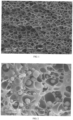
- the SEM image of the foam material obtained in the embodiment is shown in Fig. 1 , from which it can be seen that the foam material has orderly foams and large foam density.
- the example w of the invention provides a method for preparing foam materials by supercritical foaming, including the following steps:
- the chlorinated polyethylene is purchased from Sichuan Jinsen Plastic Co., Ltd., and the brand is JS; the natural rubber is purchased from Taizhou Zhonghong Waste Rubber Comprehensive Utilization Co., Ltd., and the commodity name is natural reclaimed fine rubber; the calcium-zinc stabilizer is purchased from Jinan Hui Jinchuan Trading Co., Ltd.; the graphene is purchased from Shandong Xiangzhao New Material Co., Ltd., the brand is Xiangzhao, and the model is 001.
- the example 3 of the invention provides a method for preparing foam materials by supercritical foaming, including the following steps:
- the chlorinated polyethylene is purchased from Sichuan Jinsen Plastic Co., Ltd., and the brand is JS; the natural rubber is purchased from Taizhou Zhonghong Waste Rubber Comprehensive Utilization Co., Ltd., and the commodity name is natural reclaimed fine rubber; the calcium-zinc stabilizer is purchased from Jinan Hui Jinchuan Trading Co., Ltd.; the graphene is purchased from Shandong Xiangzhao New Material Co., Ltd., the brand is Xiangzhao, and the model is 001.
- the example 4 of the invention provides a method for preparing foam materials by supercritical foaming, including the following steps:
- the chlorinated polyethylene is purchased from Sichuan Jinsen Plastic Co., Ltd., and the brand is JS; the natural rubber is purchased from Taizhou Zhonghong Waste Rubber Comprehensive Utilization Co., Ltd., and the commodity name is natural reclaimed fine rubber; the calcium-zinc stabilizer is purchased from Jinan Hui Jinchuan Trading Co., Ltd.; the graphene is purchased from Shandong Xiangzhao New Material Co., Ltd., the brand is Xiangzhao, and the model is 001.
- the example 5 of the invention provides a method for preparing foam materials by supercritical foaming, including the following steps:
- the chlorinated polyethylene is purchased from Sichuan Jinsen Plastic Co., Ltd., and the brand is JS; the natural rubber is purchased from Taizhou Zhonghong Waste Rubber Comprehensive Utilization Co., Ltd., and the commodity name is natural reclaimed fine rubber; the calcium-zinc stabilizer is purchased from Jinan Hui Jinchuan Trading Co., Ltd.; the graphene is purchased from Shandong Xiangzhao New Material Co., Ltd., the brand is Xiangzhao, and the model is 001.
- the SEM image of the foam material obtained in the embodiment is shown in Fig. 2 , from which it can be seen that there are foams growing in the foams of the foam material.
- the example 6 of the invention provides a method for preparing foam materials by supercritical foaming, including the following steps:
- the chlorinated polyethylene is purchased from Sichuan Jinsen Plastic Co., Ltd., and the brand is JS; the natural rubber is purchased from Taizhou Zhonghong Waste Rubber Comprehensive Utilization Co., Ltd., and the commodity name is natural reclaimed fine rubber; the calcium-zinc stabilizer is purchased from Jinan Hui Jinchuan Trading Co., Ltd.; the graphene is purchased from Shandong Xiangzhao New Material Co., Ltd., the brand is Xiangzhao, and the model is 001.
- Foam morphology The morphologies of the foams for the foam materials obtained in the examples 1-6 were respectively observed with an electron microscope to record whether the foams are regular and whether there are foams overlapped. Foam overlap refers to the presence of foams in the foams.
- Foam density The foam density of the foam materials obtained in the examples 1-6 were calculated respectively. Foam density refers to the number of foams per unit volume, in /cm 3 . If the foam density is more than 9 ⁇ 10 7 /cm 3 , the material will be qualified; if the foam density is less than 9 ⁇ 10 7 /cm 3 , the material will be unqualified. Table 1 Foam morphology Foam density Example 1 The foams are regular without overlap Qualified Example 2 The foams are regular without overlap Qualified Example 3 The foams are regular without overlap Qualified Example 4 The foams are regular without overlap Unqualified Example 5 The foams are irregular and overlapped Qualified Example 6 The foams are irregular and overlapped Unqualified
Landscapes
- Chemical & Material Sciences (AREA)
- Health & Medical Sciences (AREA)
- Chemical Kinetics & Catalysis (AREA)
- Medicinal Chemistry (AREA)
- Polymers & Plastics (AREA)
- Organic Chemistry (AREA)
- Engineering & Computer Science (AREA)
- Materials Engineering (AREA)
- General Chemical & Material Sciences (AREA)
- Manufacture Of Porous Articles, And Recovery And Treatment Of Waste Products (AREA)
Abstract
Description
- The invention relates to the field of foaming technology, in particular to C08G101/00, more in particular to a method for preparing foam materials by supercritical foaming.
- Chlorinated polyethylene is widely used because of its excellent weather resistance and solvent resistance. In
CN201610058673 - In view of some problems existing in the prior art, the invention provides a method for preparing foam materials by supercritical foaming in the first aspect, including the following steps:
- (1) Add the chlorinated polyethylene material into the reactor, add water and foaming nucleating agent, and then close the reactor cover;
- (2) Heat to 50-80 degrees C ;
- (3) Inject supercritical carbon dioxide into the reactor, so that the chlorinated polyethylene material can achieve saturation adsorption of supercritical carbon dioxide;
- (4) Remove and treat the chlorinated polyethylene material at 100-150 degrees C for 1-5 minutes.
- The content of water in the invention is not specially limited, as long as the chlorinated polyethylene material can be immersed. The specific content can be conventionally chosen by the technicians in the field.
- In one preferred embodiment, the water accounts for 60-80% of the volume of the reactor, more preferably 72wt%
- The foaming nucleating agent in the invention is not specially limited, and can be conventionally chosen by the technicians in the field.
- In one preferred embodiment, the foaming nucleating agent accounts for 0.05-0.1wt% of water, preferably 0.08wt%.
- Unexpectedly, the applicant finds that the foaming nucleating agent takes effect rapidly when the foaming nucleating agent accounts for 0.05-0. 1wt% of water.
- The foaming nucleating agents can be listed as follows: calcium carbonate, clay, fiber crystal, butane, pentane and so on.
- In one preferred embodiment, the foaming nucleating agent is pentane.
- Preferably, pentane includes cyclopentane and n-pentane.
- Further preferably, the weight ratio of cyclopentane and n-pentane is (4-6):1, more preferably 5:1.
- Unexpectedly, the applicant finds that when the chlorinated polyethylene material includes the specific graphene in the invention, addition of a specific proportion of cyclopentane and n-pentane in the reactor can effectively avoid the heterogeneous nucleation caused by the foaming process of the chlorinated polyethylene material, reduce the foam size and increase the foam density.
- In one preferred embodiment, in Step (2), the material is heated to 70 degrees C.
- Unexpectedly, the applicant finds that when the material is heated to 50-80 degrees C, especially 70 degrees C, the final foam sizes are close and the differentiation is small.
- In one preferred embodiment, in Step (3), supercritical carbon dioxide is injected to make the pressure in the reactor 20-30 MPa, preferably 25-28 MPa, more preferably 26 MPa.
- Unexpectedly, the applicant finds that when the pressure of the reactor is 20-30 MPa due to the injection of supercritical carbon dioxide, the time for the chlorinated polyethylene material in the invention to achieve saturation adsorption of supercritical carbon dioxide is relatively short, so that the production efficiency is improved.
- Preferably, supercritical carbon dioxide is injected in a segmented manner.
- Segmented manner in the invention refers to the intermittent injection of supercritical carbon dioxide.
- In a preferred embodiment, in Step (3), supercritical carbon dioxide is firstly injected at the rate of 2-5 MPa/s to make the pressure in the reactor reach 8-10 MPa and keep it for 15-20 minutes; then the supercritical carbon dioxide is injected again at the rate of 0.5-1 MPa/s to make the pressure in the reactor reach 12-15 MPa and keep it for 10-15 minutes; finally, the supercritical carbon dioxide is injected at the rate of 2-5 MPa/s to make the pressure in the reactor reach 20-30 MPa and keep it for a period of time until the chlorinated polyethylene material achieves saturation adsorption of supercritical carbon dioxide.
- In a more preferred embodiment, in Step (3), supercritical carbon dioxide is firstly injected at the rate of 3 MPa/s to make the pressure in the reactor reach 8 MPa and keep it for 18 minutes; then the supercritical carbon dioxide is injected again at the rate of 0.6 MPa/s to make the pressure in the reactor reach 13 MPa and keep it for 12 minutes; finally, the supercritical carbon dioxide is injected at the rate of 2 MPa/s to make the pressure in the reactor reach 26 MPa and keep it for a period of time until the chlorinated polyethylene material achieves saturation adsorption of supercritical carbon dioxide.
- In the experiments, the applicant finds that when the supercritical carbon dioxide is injected to make the pressure in the reactor 2-30 MPa, the foam uniformity and density of the final foam material obtained by the method cannot meet the requirements while improving the saturation adsorption efficiency. In the study, the applicant unexpectedly finds that the foam uniformity and density of the foam material finally obtained can meet the requirements when the supercritical carbon dioxide is firstly injected in a segmented manner at the rate of 2-5 MPa/s to make the pressure in the reactor reach 8-10 MPa and keep it for 15-20 minutes; then the supercritical carbon dioxide is injected again at the rate of 0.5-1 MPa/s to make the pressure in the reactor reach 12-15 MPa and keep it for 10-15 minutes; finally, the supercritical carbon dioxide is injected at the rate of 2-5 MPa/s to make the pressure in the reactor reach 20-30 MPa. The applicant thinks that the possible reason is that the supercritical carbon dioxide can be fully diffused into the chlorinated polyethylene material under such specific conditions to avoid affecting the diffusion of supercritical carbon dioxide into the chlorinated polyethylene material due to the diffusion resistance caused by viscosity when the supercritical carbon dioxide is injected. Meanwhile, the phenomenon of forming bubble barriers on the surface of the chlorinated polyethylene material may be avoided when the supercritical fluid is injected.
- In one preferred embodiment, in Step (4), the chlorinated polyethylene material is removed and treated at 140 degrees C for 3 minutes.
- Unexpectedly, the applicant finds that when treated at 100-150 degrees C for 1-5 minutes, the foam material obtained at this time avoids foams in the foams or on the boundary.
- The specific type of chlorinated polyethylene material in the invention is not specially limited, and can be conventionally chosen by the technicians in the field.
- The chlorinated polyethylene material in the invention can be self-made or purchased.
- In one preferred embodiment, the chlorinated polyethylene material contains graphene.
- In one preferred embodiment, the preparation method of the chlorinated polyethylene material includes: mix 65 parts of chlorinated polyethylene, 10 parts of natural rubber, 3 parts of calcium-zinc stabilizer, 10 parts of graphene, 0.2 part of stearic acid and 10 parts of dioctyl phthalate by weight, extrude and granulate through a single screw extruder, and then extrude at 100-150 degrees C to get a molding plate; irradiate and crosslink the molding plate with the crosslinking irradiation dose of 10-50KGy to obtain the chlorinated polyethylene material.
- In a preferred embodiment, the preparation method of the chlorinated polyethylene material includes: mix 65 parts of chlorinated polyethylene, 10 parts of natural rubber, 3 parts of calcium-zinc stabilizer, 10 parts of graphene, 0.2 part of stearic acid and 10 parts of dioctyl phthalate by weight, extrude and granulate through a single screw extruder, and then extrude at 120degrees C to get a molding plate; irradiate and crosslink the molding plate with the crosslinking irradiation dose of 35KGy to obtain the chlorinated polyethylene material.
- Chlorinated polyethylene in the invention is not specially limited, and can be conventionally chosen by the technicians in the field.
- In one preferred embodiment, the chlorinated polyethylene is purchased from Sichuan Jinsen Plastic Co., Ltd., and the brand is JS.
- The natural rubber is purchased from Taizhou Zhonghong Waste Rubber Comprehensive Utilization Co., Ltd., and the commodity name is natural reclaimed fine rubber.
- The calcium-zinc stabilizer is purchased from Jinan Hui Jinchuan Trading Co., Ltd.
- The graphene is purchased from Shandong Xiangzhao New Material Co., Ltd., the brand is Xiangzhao, and the model is 001.
- The undisclosed part of the preparation method for chlorinated polyethylene material in the invention can be conventionally selected by technicians in the field.
- The invention provides a foam material prepared by a method for preparing foam materials by supercritical foaming in the second aspect.
- Compared with the prior art, the invention has the following beneficial effects:
- (1) The preparation method is simple, environmentally friendly, efficient and low-cost, uniform micropores improve the elasticity of the foam material and reduce the density of the foam material, which is 0.2-0.3g/cm3, and the foam wall is thin.
- (2) The foaming nucleating agent takes effect rapidly when the foaming nucleating agent with specific content is used, particularly 0.05-0. 1wt%.
- (3) When the foaming nucleating agent consists of a specific proportion of cyclopentane and n-pentane, and the chlorinated polyethylene material includes the specific graphene in the invention, the heterogeneous nucleation caused by the foaming process of the chlorinated polyethylene material can be effectively avoided, thereby reducing the foam size and increasing the foam density.
- (4) When the material is heated to 50-80 degrees C in Step (2), especially 70 degrees C, the final foam sizes are close and the differentiation is small.
- (5) When the supercritical carbon dioxide is injected to make the pressure of the reactor 20-30 MPa, the time for the chlorinated polyethylene material in the invention to achieve saturated adsorption of supercritical carbon dioxide is short, thereby improving the production efficiency;
- (6) The foam uniformity and density of the foam material can meet the requirements by injecting the supercritical carbon dioxide in a segmented manner in the invention;
- (7) When treated at 100-150 degrees C for 1-5 minutes, the foam material obtained at this time avoids foams in the foams or on the boundary.
-
-
Fig. 1 is the SEM image of foam material obtained in the example 1 of the invention. -
Fig. 2 is the SEM image of foam material obtained in the example 5 of the invention. - The invention is described below by means of embodiments, but is not limited to the examples given below.
- The example 1 of the invention provides a method for preparing foam materials by supercritical foaming, including the following steps:
- (1) Mix 65 parts of chlorinated polyethylene, 10 parts of natural rubber, 3 parts of calcium-zinc stabilizer, 10 parts of graphene, 0.2 part of stearic acid and 10 parts of dioctyl phthalate by weight, extrude and granulate through a single screw extruder, and then extrude at 100 degrees C to get a molding plate; irradiate and crosslink the molding plate with the crosslinking irradiation dose of 10KGy to obtain the chlorinated polyethylene material;
- (2) Add the chlorinated polyethylene material to the reactor, add water accounting for 60% of the volume of the reactor, and add the foaming nucleating agent to close the reactor cover, in which the foaming nucleating agent accounts for 0.05wt% of water, with the weight ratio 4:1 of cyclopentane and n-pentane;
- (3) Heat to 50 degrees C;
- (4) Inject the supercritical carbon dioxide at the rate of 2 MPa/s to make the pressure in the reactor reach 8 MPa and keep it for 15 minutes; then inject the supercritical carbon dioxide again at the rate of 0.5 MPa/s to make the pressure in the reactor reach 12 MPa and keep it for 10 minutes; finally, inject the supercritical carbon dioxide at the rate of 2 MPa/s to make the pressure in the reactor reach 20 MPa and keep it for a period of time until the chlorinated polyethylene material achieves saturation adsorption of supercritical carbon dioxide.
- (5) Remove and treat the chlorinated polyethylene material at 100 degrees C for 5 minutes.
- The chlorinated polyethylene is purchased from Sichuan Jinsen Plastic Co., Ltd., and the brand is JS; the natural rubber is purchased from Taizhou Zhonghong Waste Rubber Comprehensive Utilization Co., Ltd., and the commodity name is natural reclaimed fine rubber; the calcium-zinc stabilizer is purchased from Jinan Hui Jinchuan Trading Co., Ltd.; the graphene is purchased from Shandong Xiangzhao New Material Co., Ltd., the brand is Xiangzhao, and the model is 001.
- The SEM image of the foam material obtained in the embodiment is shown in
Fig. 1 , from which it can be seen that the foam material has orderly foams and large foam density. - The example w of the invention provides a method for preparing foam materials by supercritical foaming, including the following steps:
- (1) Mix 65 parts of chlorinated polyethylene, 10 parts of natural rubber, 3 parts of calcium-zinc stabilizer, 10 parts of graphene, 0.2 part of stearic acid and 10 parts of dioctyl phthalate by weight, extrude and granulate through a single screw extruder, and then extrude at 150 degrees C to get a molding plate; irradiate and crosslink the molding plate with the crosslinking irradiation dose of 50KGy to obtain the chlorinated polyethylene material;
- (2) Add the chlorinated polyethylene material to the reactor, add water accounting for 80% of the volume of the reactor, and add the foaming nucleating agent to close the reactor cover, in which the foaming nucleating agent accounts for 0.1 wt% of water, with the weight ratio 6:1 of cyclopentane and n-pentane;
- (3) Heat to 80 degrees C;
- (4) Inject the supercritical carbon dioxide at the rate of 5 MPa/s to make the pressure in the reactor reach 10 MPa and keep it for 20 minutes; then inject the supercritical carbon dioxide again at the rate of 1 MPa/s to make the pressure in the reactor reach 15 MPa and keep it for 15 minutes; finally, inject the supercritical carbon dioxide at the rate of 5 MPa/s to make the pressure in the reactor reach 30 MPa and keep it for a period of time until the chlorinated polyethylene material achieves saturation adsorption of supercritical carbon dioxide.
- (5) Remove and treat the chlorinated polyethylene material at 150 degrees C for 1 minute.
- The chlorinated polyethylene is purchased from Sichuan Jinsen Plastic Co., Ltd., and the brand is JS; the natural rubber is purchased from Taizhou Zhonghong Waste Rubber Comprehensive Utilization Co., Ltd., and the commodity name is natural reclaimed fine rubber; the calcium-zinc stabilizer is purchased from Jinan Hui Jinchuan Trading Co., Ltd.; the graphene is purchased from Shandong Xiangzhao New Material Co., Ltd., the brand is Xiangzhao, and the model is 001.
- The example 3 of the invention provides a method for preparing foam materials by supercritical foaming, including the following steps:
- (1) Mix 65 parts of chlorinated polyethylene, 10 parts of natural rubber, 3 parts of calcium-zinc stabilizer, 10 parts of graphene, 0.2 part of stearic acid and 10 parts of dioctyl phthalate by weight, extrude and granulate through a single screw extruder, and then extrude at 120 degrees C to get a molding plate; irradiate and crosslink the molding plate with the crosslinking irradiation dose of 35KGy to obtain the chlorinated polyethylene material;
- (2) Add the chlorinated polyethylene material to the reactor, add water accounting for 72% of the volume of the reactor, and add the foaming nucleating agent to close the reactor cover, in which the foaming nucleating agent accounts for 0.08wt% of water, with the weight ratio 5:1 of cyclopentane and n-pentane;
- (3) Heat to 70 degrees C;
- (4) Inject the supercritical carbon dioxide at the rate of 3 MPa/s to make the pressure in the reactor reach 8 MPa and keep it for 18 minutes; then inject the supercritical carbon dioxide again at the rate of 0.6 MPa/s to make the pressure in the reactor reach 13 MPa and keep it for 12 minutes; finally, inject the supercritical carbon dioxide at the rate of 2 MPa/s to make the pressure in the reactor reach 26 MPa and keep it for a period of time until the chlorinated polyethylene material achieves saturation adsorption of supercritical carbon dioxide.
- (5) Remove and treat the chlorinated polyethylene material at 140 degrees C for 3 minutes.
- The chlorinated polyethylene is purchased from Sichuan Jinsen Plastic Co., Ltd., and the brand is JS; the natural rubber is purchased from Taizhou Zhonghong Waste Rubber Comprehensive Utilization Co., Ltd., and the commodity name is natural reclaimed fine rubber; the calcium-zinc stabilizer is purchased from Jinan Hui Jinchuan Trading Co., Ltd.; the graphene is purchased from Shandong Xiangzhao New Material Co., Ltd., the brand is Xiangzhao, and the model is 001.
- The example 4 of the invention provides a method for preparing foam materials by supercritical foaming, including the following steps:
- (1) Mix 65 parts of chlorinated polyethylene, 10 parts of natural rubber, 3 parts of calcium-zinc stabilizer, 10 parts of graphene, 0.2 part of stearic acid and 10 parts of dioctyl phthalate by weight, extrude and granulate through a single screw extruder, and then extrude at 120 degrees C to get a molding plate; irradiate and crosslink the molding plate with the crosslinking irradiation dose of 35KGy to obtain the chlorinated polyethylene material;
- (2) Add the chlorinated polyethylene material to the reactor, add water accounting for 72% of the volume of the reactor, and add the foaming nucleating agent to close the reactor cover, in which the foaming nucleating agent accounts for 0.08wt% of water, with the weight ratio 5:1 of cyclopentane and n-pentane;
- (3) Heat to 70 degrees C;
- (4) Inject the supercritical carbon dioxide at the rate of 3 MPa/s to make the pressure in the reactor reach 26 MPa and keep it for a period of time until the chlorinated polyethylene material achieves saturation adsorption of supercritical carbon dioxide.
- (5) Remove and treat the chlorinated polyethylene material at 140 degrees C for 3 minutes.
- The chlorinated polyethylene is purchased from Sichuan Jinsen Plastic Co., Ltd., and the brand is JS; the natural rubber is purchased from Taizhou Zhonghong Waste Rubber Comprehensive Utilization Co., Ltd., and the commodity name is natural reclaimed fine rubber; the calcium-zinc stabilizer is purchased from Jinan Hui Jinchuan Trading Co., Ltd.; the graphene is purchased from Shandong Xiangzhao New Material Co., Ltd., the brand is Xiangzhao, and the model is 001.
- The example 5 of the invention provides a method for preparing foam materials by supercritical foaming, including the following steps:
- (1) Mix 65 parts of chlorinated polyethylene, 10 parts of natural rubber, 3 parts of calcium-zinc stabilizer, 10 parts of graphene, 0.2 part of stearic acid and 10 parts of dioctyl phthalate by weight, extrude and granulate through a single screw extruder, and then extrude at 120 degrees C to get a molding plate; irradiate and crosslink the molding plate with the crosslinking irradiation dose of 35KGy to obtain the chlorinated polyethylene material;
- (2) Add the chlorinated polyethylene material to the reactor, add water accounting for 72% of the volume of the reactor, and add the foaming nucleating agent to close the reactor cover, in which the foaming nucleating agent accounts for 0.08wt% of water, with the weight ratio 5:1 of cyclopentane and n-pentane;
- (3) Heat to 70 degrees C;
- (4) Firstly inject the supercritical carbon dioxide at the rate of 3 MPa/s to make the pressure in the reactor reach 8 MPa and keep it for 18 minutes; then inject the supercritical carbon dioxide again at the rate of 0.6 MPa/s to make the pressure in the reactor reach 13 MPa and keep it for 12 minutes; finally, inject the supercritical carbon dioxide at the rate of 2 MPa/s to make the pressure in the reactor reach 26 MPa and keep it for a period of time until the chlorinated polyethylene material achieves saturation adsorption of supercritical carbon dioxide.
- (5) Remove and treat the chlorinated polyethylene material at 160 degrees C for 3 minutes.
- The chlorinated polyethylene is purchased from Sichuan Jinsen Plastic Co., Ltd., and the brand is JS; the natural rubber is purchased from Taizhou Zhonghong Waste Rubber Comprehensive Utilization Co., Ltd., and the commodity name is natural reclaimed fine rubber; the calcium-zinc stabilizer is purchased from Jinan Hui Jinchuan Trading Co., Ltd.; the graphene is purchased from Shandong Xiangzhao New Material Co., Ltd., the brand is Xiangzhao, and the model is 001.
- The SEM image of the foam material obtained in the embodiment is shown in
Fig. 2 , from which it can be seen that there are foams growing in the foams of the foam material. - The example 6 of the invention provides a method for preparing foam materials by supercritical foaming, including the following steps:
- (1) Mix 65 parts of chlorinated polyethylene, 10 parts of natural rubber, 3 parts of calcium-zinc stabilizer, 10 parts of graphene, 0.2 part of stearic acid and 10 parts of dioctyl phthalate by weight, extrude and granulate through a single screw extruder, and then extrude at 120 degrees C to get a molding plate; irradiate and crosslink the molding plate with the crosslinking irradiation dose of 35KGy to obtain the chlorinated polyethylene material;
- (2) Add the chlorinated polyethylene material to the reactor, add water accounting for 72% of the volume of the reactor, and add the foaming nucleating agent to close the reactor cover, in which the foaming nucleating agent accounts for 0.08wt% of water, with the weight ratio 2:1 of cyclopentane and n-pentane;
- (3) Heat to 70 degrees C;
- (4) Firstly inject the supercritical carbon dioxide at the rate of 3 MPa/s to make the pressure in the reactor reach 8 MPa and keep it for 18 minutes; then inject the supercritical carbon dioxide again at the rate of 0.6 MPa/s to make the pressure in the reactor reach 13 MPa and keep it for 12 minutes; finally, inject the supercritical carbon dioxide at the rate of 2 MPa/s to make the pressure in the reactor reach 26 MPa and keep it for a period of time until the chlorinated polyethylene material achieves saturation adsorption of supercritical carbon dioxide.
- (5) Remove and treat the chlorinated polyethylene material at 140 degrees C for 3 minutes.
- The chlorinated polyethylene is purchased from Sichuan Jinsen Plastic Co., Ltd., and the brand is JS; the natural rubber is purchased from Taizhou Zhonghong Waste Rubber Comprehensive Utilization Co., Ltd., and the commodity name is natural reclaimed fine rubber; the calcium-zinc stabilizer is purchased from Jinan Hui Jinchuan Trading Co., Ltd.; the graphene is purchased from Shandong Xiangzhao New Material Co., Ltd., the brand is Xiangzhao, and the model is 001.
- Foam morphology: The morphologies of the foams for the foam materials obtained in the examples 1-6 were respectively observed with an electron microscope to record whether the foams are regular and whether there are foams overlapped. Foam overlap refers to the presence of foams in the foams.
- Foam density: The foam density of the foam materials obtained in the examples 1-6 were calculated respectively. Foam density refers to the number of foams per unit volume, in /cm3. If the foam density is more than 9 × 10⁷/cm3, the material will be qualified; if the foam density is less than 9 × 10⁷/cm3, the material will be unqualified.
Table 1 Foam morphology Foam density Example 1 The foams are regular without overlap Qualified Example 2 The foams are regular without overlap Qualified Example 3 The foams are regular without overlap Qualified Example 4 The foams are regular without overlap Unqualified Example 5 The foams are irregular and overlapped Qualified Example 6 The foams are irregular and overlapped Unqualified
Claims (10)
- A method for preparing foam materials by supercritical foaming, characterized in that, the method includes the following steps:(1) add the chlorinated polyethylene material into the reactor, add water and foaming nucleating agent, and then close the reactor cover;(2) heat to 50-80 °C;(3) inject supercritical carbon dioxide into the reactor, so that the chlorinated polyethylene material can achieve saturation adsorption of supercritical carbon dioxide;(4) remove and treat the chlorinated polyethylene material at 100-150 °C for 1-5 minutes.
- The method according to claim 1, characterized in that, in Step (3), supercritical carbon dioxide is injected to make the pressure in the reactor 20-30 MPa.
- The method according to claim 2, characterized in that, in Step (3), supercritical carbon dioxide is injected in a segmented way.
- The method according to claim 3, characterized in that, in Step (3), supercritical carbon dioxide is firstly injected at the rate of 2-5 MPa/s to make the pressure in the reactor reach 8-10 MPa and keep it for 15-20 minutes; then the supercritical carbon dioxide is injected again at the rate of 0.5-1 MPa/s to make the pressure in the reactor reach 12-15 MPa and keep it for 10-15 minutes; finally, the supercritical carbon dioxide is injected at the rate of 2-5 MPa/s to make the pressure in the reactor reach 20-30 MPa and keep it for a period of time until the chlorinated polyethylene material achieves saturation adsorption of supercritical carbon dioxide.
- The method according to any one of claims 1 to 4, characterized in that, in Step (4), the chlorinated polyethylene material is removed and treated at 140 °C for 3 minutes.
- The method according to claim 5, characterized in that, water accounts for 60-80% of the volume of the reactor.
- The method according to claim 6, characterized in that, the foaming nucleating agent accounts for 0.05-0. 1wt% of water.
- The method according to claim 6 or 7, characterized in that, the foaming nucleating agent is selected from one or more of calcium carbonate, clay, fibrous crystal, butane and pentane.
- The method according to claim 8, characterized in that, the chlorinated polyethylene material contains graphene.
- A foam material prepared by the method according to any one of claims 1 to 9.
Applications Claiming Priority (2)
| Application Number | Priority Date | Filing Date | Title |
|---|---|---|---|
| CN202110884402 | 2021-08-03 | ||
| PCT/CN2022/079781 WO2023010840A1 (en) | 2021-08-03 | 2022-03-08 | Method for preparing material containing chlorinated polyethylene by means of supercritical foaming |
Publications (4)
| Publication Number | Publication Date |
|---|---|
| EP4253474A1 true EP4253474A1 (en) | 2023-10-04 |
| EP4253474A4 EP4253474A4 (en) | 2024-10-30 |
| EP4253474B1 EP4253474B1 (en) | 2025-12-24 |
| EP4253474C0 EP4253474C0 (en) | 2025-12-24 |
Family
ID=85155068
Family Applications (1)
| Application Number | Title | Priority Date | Filing Date |
|---|---|---|---|
| EP22851567.2A Active EP4253474B1 (en) | 2021-08-03 | 2022-03-08 | Method for preparing material containing chlorinated polyethylene by means of supercritical foaming |
Country Status (4)
| Country | Link |
|---|---|
| US (1) | US20230391972A1 (en) |
| EP (1) | EP4253474B1 (en) |
| JP (1) | JP7628618B2 (en) |
| WO (1) | WO2023010840A1 (en) |
Family Cites Families (7)
| Publication number | Priority date | Publication date | Assignee | Title |
|---|---|---|---|---|
| JPH07102103A (en) * | 1993-09-30 | 1995-04-18 | Sekisui Chem Co Ltd | Method of manufacturing foam |
| JP2001213991A (en) * | 2000-02-03 | 2001-08-07 | Esuteia:Kk | Method for producing foamed polymer material and method for producing foamed product |
| JP5117757B2 (en) | 2007-04-26 | 2013-01-16 | 日東電工株式会社 | Light reflecting member including polyolefin resin foam and method for producing the same |
| CN107200941A (en) | 2016-03-16 | 2017-09-26 | 青岛科技大学 | A kind of chlorinated polyethylene elastomer microporous foam material and preparation method thereof |
| CN105924814A (en) | 2016-06-26 | 2016-09-07 | 仇颖莹 | Preparation method for chlorinated polyethylene/polyvinyl chloride composite foaming material |
| CN107880370B (en) | 2016-09-29 | 2020-05-26 | 青岛科技大学 | Preparation method of plastic particles |
| CN109734955B (en) | 2019-01-22 | 2020-11-03 | 中国科学院长春应用化学研究所 | A kind of polar polymer negative Poisson's ratio foam material and preparation method thereof |
-
2022
- 2022-03-08 EP EP22851567.2A patent/EP4253474B1/en active Active
- 2022-03-08 WO PCT/CN2022/079781 patent/WO2023010840A1/en not_active Ceased
- 2022-03-08 JP JP2023542913A patent/JP7628618B2/en active Active
-
2023
- 2023-08-17 US US18/234,897 patent/US20230391972A1/en active Pending
Also Published As
| Publication number | Publication date |
|---|---|
| EP4253474B1 (en) | 2025-12-24 |
| EP4253474A4 (en) | 2024-10-30 |
| US20230391972A1 (en) | 2023-12-07 |
| JP7628618B2 (en) | 2025-02-10 |
| WO2023010840A1 (en) | 2023-02-09 |
| EP4253474C0 (en) | 2025-12-24 |
| JP2024503080A (en) | 2024-01-24 |
Similar Documents
| Publication | Publication Date | Title |
|---|---|---|
| JP7214228B2 (en) | A method for manufacturing polymer microporous foam products without using a mold during foaming by supercritical fluid | |
| CN105218851A (en) | A kind of method preparing polymkeric substance hole-opening foaming material | |
| CN103160045B (en) | A kind of polyvinyl-chloride foam material and preparation method thereof | |
| CN102010517A (en) | Method for preparing silicon rubber foam material by using supercritical carbon dioxide technology | |
| CN105751467B (en) | Microporous foam thermoplastic polyurethane material and preparation method thereof | |
| JP2022516153A (en) | Manufacturing method of high-magnification polylactic acid foam sheet material | |
| CN104629176A (en) | Open-celled polypropylene microcellular foaming sheet and production method thereof | |
| EP4253474A1 (en) | Method for preparing material containing chlorinated polyethylene by means of supercritical foaming | |
| CN113134934A (en) | Gas-liquid two-phase self-balancing supercritical swelling foaming method | |
| CN1019401B (en) | Process for producing polyethylene open-cell foam | |
| CN107266765A (en) | A kind of inorganic foamed IXPE foams and preparation method thereof | |
| CN104327296A (en) | Mixed polyurethane foam material and preparation method thereof | |
| CN105038164A (en) | Polylactide-based blended material, preparation method thereof and method for preparing foam material from polylactide-based blended material | |
| CN107541032A (en) | A kind of enhanced polytrimethylene carbonate biomaterial and its high through-hole rate foaming product and their preparation method | |
| CN101613488A (en) | A kind of preparation method of polypropylene and its blend particle physical gas foaming | |
| CN108976684B (en) | Nano-pore polymer foam and preparation method thereof | |
| CN116285261A (en) | Biodegradable polylactic acid-based polyester foamable particles, injection-molded low-density foamed products, and preparation method | |
| CN118006090A (en) | A kind of PBAT microporous foam material and preparation method thereof | |
| CN117430859A (en) | Fully-degradable polylactic acid foaming material and preparation method thereof | |
| CN114316432B (en) | Uniform foaming molding process in polymer melt cavity | |
| CN116945455A (en) | A physical microporous foaming molding process for polymer materials | |
| CN116423737A (en) | A kind of preparation method of low-density thermoplastic polyurethane microcellular foaming material | |
| CN116120679A (en) | SMMA microporous foam material with high toughness and preparation method thereof | |
| CN210617106U (en) | Self-equilibrium supercritical foaming device for multi-component and multi-phase complex system | |
| CN111621092A (en) | A kind of preparation method of high-efficiency molded foamed polypropylene |
Legal Events
| Date | Code | Title | Description |
|---|---|---|---|
| STAA | Information on the status of an ep patent application or granted ep patent |
Free format text: STATUS: THE INTERNATIONAL PUBLICATION HAS BEEN MADE |
|
| PUAI | Public reference made under article 153(3) epc to a published international application that has entered the european phase |
Free format text: ORIGINAL CODE: 0009012 |
|
| STAA | Information on the status of an ep patent application or granted ep patent |
Free format text: STATUS: REQUEST FOR EXAMINATION WAS MADE |
|
| 17P | Request for examination filed |
Effective date: 20230628 |
|
| AK | Designated contracting states |
Kind code of ref document: A1 Designated state(s): AL AT BE BG CH CY CZ DE DK EE ES FI FR GB GR HR HU IE IS IT LI LT LU LV MC MK MT NL NO PL PT RO RS SE SI SK SM TR |
|
| A4 | Supplementary search report drawn up and despatched |
Effective date: 20241002 |
|
| RIC1 | Information provided on ipc code assigned before grant |
Ipc: B29C 44/34 20060101ALI20240926BHEP Ipc: C08J 9/12 20060101ALI20240926BHEP Ipc: C08L 23/28 20060101AFI20240926BHEP |
|
| DAV | Request for validation of the european patent (deleted) | ||
| DAX | Request for extension of the european patent (deleted) | ||
| GRAP | Despatch of communication of intention to grant a patent |
Free format text: ORIGINAL CODE: EPIDOSNIGR1 |
|
| STAA | Information on the status of an ep patent application or granted ep patent |
Free format text: STATUS: GRANT OF PATENT IS INTENDED |
|
| INTG | Intention to grant announced |
Effective date: 20250916 |
|
| RIC1 | Information provided on ipc code assigned before grant |
Ipc: C08L 23/28 20060101AFI20250909BHEP Ipc: C08J 9/12 20060101ALI20250909BHEP Ipc: B29C 44/34 20060101ALI20250909BHEP |
|
| GRAS | Grant fee paid |
Free format text: ORIGINAL CODE: EPIDOSNIGR3 |
|
| GRAA | (expected) grant |
Free format text: ORIGINAL CODE: 0009210 |
|
| STAA | Information on the status of an ep patent application or granted ep patent |
Free format text: STATUS: THE PATENT HAS BEEN GRANTED |
|
| AK | Designated contracting states |
Kind code of ref document: B1 Designated state(s): AL AT BE BG CH CY CZ DE DK EE ES FI FR GB GR HR HU IE IS IT LI LT LU LV MC MK MT NL NO PL PT RO RS SE SI SK SM TR |
|
| REG | Reference to a national code |
Ref country code: CH Ref legal event code: F10 Free format text: ST27 STATUS EVENT CODE: U-0-0-F10-F00 (AS PROVIDED BY THE NATIONAL OFFICE) Effective date: 20251224 Ref country code: GB Ref legal event code: FG4D |
|
| REG | Reference to a national code |
Ref country code: DE Ref legal event code: R096 Ref document number: 602022027595 Country of ref document: DE |
|
| U01 | Request for unitary effect filed |
Effective date: 20260116 |
|
| U07 | Unitary effect registered |
Designated state(s): AT BE BG DE DK EE FI FR IT LT LU LV MT NL PT RO SE SI Effective date: 20260121 |
|
| PGFP | Annual fee paid to national office [announced via postgrant information from national office to epo] |
Ref country code: GB Payment date: 20260318 Year of fee payment: 5 |
|
| PG25 | Lapsed in a contracting state [announced via postgrant information from national office to epo] |
Ref country code: NO Free format text: LAPSE BECAUSE OF FAILURE TO SUBMIT A TRANSLATION OF THE DESCRIPTION OR TO PAY THE FEE WITHIN THE PRESCRIBED TIME-LIMIT Effective date: 20260324 |
|
| PG25 | Lapsed in a contracting state [announced via postgrant information from national office to epo] |
Ref country code: HR Free format text: LAPSE BECAUSE OF FAILURE TO SUBMIT A TRANSLATION OF THE DESCRIPTION OR TO PAY THE FEE WITHIN THE PRESCRIBED TIME-LIMIT Effective date: 20251224 |
|
| PGFP | Annual fee paid to national office [announced via postgrant information from national office to epo] |
Ref country code: AT Payment date: 20260301 Year of fee payment: 5 |
|
| PG25 | Lapsed in a contracting state [announced via postgrant information from national office to epo] |
Ref country code: RS Free format text: LAPSE BECAUSE OF FAILURE TO SUBMIT A TRANSLATION OF THE DESCRIPTION OR TO PAY THE FEE WITHIN THE PRESCRIBED TIME-LIMIT Effective date: 20260324 |
|
| U20 | Renewal fee for the european patent with unitary effect paid |
Year of fee payment: 5 Effective date: 20260318 |