EP4253379A2 - Methods for the preparation of 5-bromo-2-(3-chloro-pyridin-2-yl)-2h-pyrazole-3-carboxylic acid - Google Patents
Methods for the preparation of 5-bromo-2-(3-chloro-pyridin-2-yl)-2h-pyrazole-3-carboxylic acid Download PDFInfo
- Publication number
- EP4253379A2 EP4253379A2 EP23168252.7A EP23168252A EP4253379A2 EP 4253379 A2 EP4253379 A2 EP 4253379A2 EP 23168252 A EP23168252 A EP 23168252A EP 4253379 A2 EP4253379 A2 EP 4253379A2
- Authority
- EP
- European Patent Office
- Prior art keywords
- compound
- mixture
- hydrogen
- halogen
- formula
- Prior art date
- Legal status (The legal status is an assumption and is not a legal conclusion. Google has not performed a legal analysis and makes no representation as to the accuracy of the status listed.)
- Withdrawn
Links
- 238000000034 method Methods 0.000 title claims abstract description 427
- FORBXGROTPOMEH-UHFFFAOYSA-N 5-bromo-2-(3-chloropyridin-2-yl)pyrazole-3-carboxylic acid Chemical compound OC(=O)C1=CC(Br)=NN1C1=NC=CC=C1Cl FORBXGROTPOMEH-UHFFFAOYSA-N 0.000 title description 13
- 238000002360 preparation method Methods 0.000 title description 2
- 150000001875 compounds Chemical class 0.000 claims description 232
- 239000000203 mixture Substances 0.000 claims description 232
- 239000002585 base Substances 0.000 claims description 181
- 229910052739 hydrogen Inorganic materials 0.000 claims description 134
- 239000001257 hydrogen Substances 0.000 claims description 134
- 150000001412 amines Chemical class 0.000 claims description 124
- YXFVVABEGXRONW-UHFFFAOYSA-N Toluene Chemical compound CC1=CC=CC=C1 YXFVVABEGXRONW-UHFFFAOYSA-N 0.000 claims description 122
- 229910052736 halogen Inorganic materials 0.000 claims description 118
- 150000002367 halogens Chemical class 0.000 claims description 118
- 239000002904 solvent Substances 0.000 claims description 116
- WYURNTSHIVDZCO-UHFFFAOYSA-N Tetrahydrofuran Chemical compound C1CCOC1 WYURNTSHIVDZCO-UHFFFAOYSA-N 0.000 claims description 98
- UFHFLCQGNIYNRP-UHFFFAOYSA-N Hydrogen Chemical compound [H][H] UFHFLCQGNIYNRP-UHFFFAOYSA-N 0.000 claims description 96
- 238000006243 chemical reaction Methods 0.000 claims description 75
- 229910052751 metal Inorganic materials 0.000 claims description 68
- 239000002184 metal Substances 0.000 claims description 68
- 239000002253 acid Substances 0.000 claims description 59
- 239000003153 chemical reaction reagent Substances 0.000 claims description 52
- 239000000654 additive Substances 0.000 claims description 44
- 230000000996 additive effect Effects 0.000 claims description 44
- 125000000623 heterocyclic group Chemical group 0.000 claims description 41
- LMBFAGIMSUYTBN-MPZNNTNKSA-N teixobactin Chemical compound C([C@H](C(=O)N[C@@H]([C@@H](C)CC)C(=O)N[C@@H](CO)C(=O)N[C@H](CCC(N)=O)C(=O)N[C@H]([C@@H](C)CC)C(=O)N[C@@H]([C@@H](C)CC)C(=O)N[C@@H](CO)C(=O)N[C@H]1C(N[C@@H](C)C(=O)N[C@@H](C[C@@H]2NC(=N)NC2)C(=O)N[C@H](C(=O)O[C@H]1C)[C@@H](C)CC)=O)NC)C1=CC=CC=C1 LMBFAGIMSUYTBN-MPZNNTNKSA-N 0.000 claims description 38
- OKKJLVBELUTLKV-UHFFFAOYSA-N Methanol Chemical group OC OKKJLVBELUTLKV-UHFFFAOYSA-N 0.000 claims description 37
- 125000004435 hydrogen atom Chemical group [H]* 0.000 claims description 33
- 239000007818 Grignard reagent Substances 0.000 claims description 31
- 150000004795 grignard reagents Chemical class 0.000 claims description 31
- UAOMVDZJSHZZME-UHFFFAOYSA-N diisopropylamine Chemical compound CC(C)NC(C)C UAOMVDZJSHZZME-UHFFFAOYSA-N 0.000 claims description 27
- 230000026030 halogenation Effects 0.000 claims description 26
- 238000005658 halogenation reaction Methods 0.000 claims description 26
- 150000007529 inorganic bases Chemical class 0.000 claims description 24
- LFQSCWFLJHTTHZ-UHFFFAOYSA-N Ethanol Chemical compound CCO LFQSCWFLJHTTHZ-UHFFFAOYSA-N 0.000 claims description 23
- RYHBNJHYFVUHQT-UHFFFAOYSA-N 1,4-Dioxane Chemical compound C1COCCO1 RYHBNJHYFVUHQT-UHFFFAOYSA-N 0.000 claims description 22
- 150000001925 cycloalkenes Chemical class 0.000 claims description 18
- 150000007524 organic acids Chemical group 0.000 claims description 17
- KFZMGEQAYNKOFK-UHFFFAOYSA-N Isopropanol Chemical compound CC(C)O KFZMGEQAYNKOFK-UHFFFAOYSA-N 0.000 claims description 15
- IGWHDMPTQKSDTL-JXOAFFINSA-N TMP Chemical compound O=C1NC(=O)C(C)=CN1[C@H]1[C@H](O)[C@H](O)[C@@H](COP(O)(O)=O)O1 IGWHDMPTQKSDTL-JXOAFFINSA-N 0.000 claims description 14
- HPNMFZURTQLUMO-UHFFFAOYSA-N diethylamine Chemical compound CCNCC HPNMFZURTQLUMO-UHFFFAOYSA-N 0.000 claims description 14
- FFUAGWLWBBFQJT-UHFFFAOYSA-N hexamethyldisilazane Chemical compound C[Si](C)(C)N[Si](C)(C)C FFUAGWLWBBFQJT-UHFFFAOYSA-N 0.000 claims description 14
- JWUJQDFVADABEY-UHFFFAOYSA-N 2-methyltetrahydrofuran Chemical compound CC1CCCO1 JWUJQDFVADABEY-UHFFFAOYSA-N 0.000 claims description 13
- WTKZEGDFNFYCGP-UHFFFAOYSA-N Pyrazole Chemical compound C=1C=NNC=1 WTKZEGDFNFYCGP-UHFFFAOYSA-N 0.000 claims description 13
- 150000002894 organic compounds Chemical class 0.000 claims description 12
- 150000002148 esters Chemical group 0.000 claims description 11
- RTZKZFJDLAIYFH-UHFFFAOYSA-N ether Substances CCOCC RTZKZFJDLAIYFH-UHFFFAOYSA-N 0.000 claims description 11
- 150000002825 nitriles Chemical group 0.000 claims description 11
- 229910000000 metal hydroxide Inorganic materials 0.000 claims description 10
- 150000004692 metal hydroxides Chemical class 0.000 claims description 10
- 150000003217 pyrazoles Chemical class 0.000 claims description 10
- 125000001033 ether group Chemical group 0.000 claims description 8
- 229910052740 iodine Inorganic materials 0.000 claims description 7
- YLQBMQCUIZJEEH-UHFFFAOYSA-N tetrahydrofuran Natural products C=1C=COC=1 YLQBMQCUIZJEEH-UHFFFAOYSA-N 0.000 claims description 7
- 229910001854 alkali hydroxide Inorganic materials 0.000 claims description 6
- 150000008044 alkali metal hydroxides Chemical group 0.000 claims description 6
- 229910001860 alkaline earth metal hydroxide Inorganic materials 0.000 claims description 6
- 125000002915 carbonyl group Chemical group [*:2]C([*:1])=O 0.000 claims description 6
- 150000002431 hydrogen Chemical group 0.000 claims description 6
- 239000000543 intermediate Substances 0.000 abstract description 4
- PXBFMLJZNCDSMP-UHFFFAOYSA-N 2-Aminobenzamide Chemical class NC(=O)C1=CC=CC=C1N PXBFMLJZNCDSMP-UHFFFAOYSA-N 0.000 abstract description 2
- 239000005886 Chlorantraniliprole Substances 0.000 abstract description 2
- 239000005889 Cyantraniliprole Substances 0.000 abstract description 2
- PSOVNZZNOMJUBI-UHFFFAOYSA-N chlorantraniliprole Chemical compound CNC(=O)C1=CC(Cl)=CC(C)=C1NC(=O)C1=CC(Br)=NN1C1=NC=CC=C1Cl PSOVNZZNOMJUBI-UHFFFAOYSA-N 0.000 abstract description 2
- DVBUIBGJRQBEDP-UHFFFAOYSA-N cyantraniliprole Chemical compound CNC(=O)C1=CC(C#N)=CC(C)=C1NC(=O)C1=CC(Br)=NN1C1=NC=CC=C1Cl DVBUIBGJRQBEDP-UHFFFAOYSA-N 0.000 abstract description 2
- 230000000749 insecticidal effect Effects 0.000 abstract 1
- KWGKDLIKAYFUFQ-UHFFFAOYSA-M lithium chloride Chemical compound [Li+].[Cl-] KWGKDLIKAYFUFQ-UHFFFAOYSA-M 0.000 description 94
- HEMHJVSKTPXQMS-UHFFFAOYSA-M Sodium hydroxide Chemical compound [OH-].[Na+] HEMHJVSKTPXQMS-UHFFFAOYSA-M 0.000 description 39
- VEXZGXHMUGYJMC-UHFFFAOYSA-N Hydrochloric acid Chemical compound Cl VEXZGXHMUGYJMC-UHFFFAOYSA-N 0.000 description 37
- DTQVDTLACAAQTR-UHFFFAOYSA-N Trifluoroacetic acid Chemical compound OC(=O)C(F)(F)F DTQVDTLACAAQTR-UHFFFAOYSA-N 0.000 description 32
- QAOWNCQODCNURD-UHFFFAOYSA-N Sulfuric acid Chemical compound OS(O)(=O)=O QAOWNCQODCNURD-UHFFFAOYSA-N 0.000 description 30
- NBIIXXVUZAFLBC-UHFFFAOYSA-N Phosphoric acid Chemical compound OP(O)(O)=O NBIIXXVUZAFLBC-UHFFFAOYSA-N 0.000 description 28
- 239000000243 solution Substances 0.000 description 27
- ULKSWZAXQDJMJT-UHFFFAOYSA-M magnesium;2,2,6,6-tetramethylpiperidin-1-ide;chloride Chemical compound [Cl-].CC1(C)CCCC(C)(C)N1[Mg+] ULKSWZAXQDJMJT-UHFFFAOYSA-M 0.000 description 25
- KWYUFKZDYYNOTN-UHFFFAOYSA-M Potassium hydroxide Chemical compound [OH-].[K+] KWYUFKZDYYNOTN-UHFFFAOYSA-M 0.000 description 24
- CCERQOYLJJULMD-UHFFFAOYSA-M magnesium;carbanide;chloride Chemical compound [CH3-].[Mg+2].[Cl-] CCERQOYLJJULMD-UHFFFAOYSA-M 0.000 description 24
- 239000000843 powder Substances 0.000 description 20
- WEVYAHXRMPXWCK-UHFFFAOYSA-N Acetonitrile Chemical compound CC#N WEVYAHXRMPXWCK-UHFFFAOYSA-N 0.000 description 19
- -1 amine compounds Chemical class 0.000 description 19
- PCLIMKBDDGJMGD-UHFFFAOYSA-N N-bromosuccinimide Chemical compound BrN1C(=O)CCC1=O PCLIMKBDDGJMGD-UHFFFAOYSA-N 0.000 description 18
- 230000003197 catalytic effect Effects 0.000 description 18
- ZMXDDKWLCZADIW-UHFFFAOYSA-N N,N-Dimethylformamide Chemical compound CN(C)C=O ZMXDDKWLCZADIW-UHFFFAOYSA-N 0.000 description 17
- AFVFQIVMOAPDHO-UHFFFAOYSA-N Methanesulfonic acid Chemical compound CS(O)(=O)=O AFVFQIVMOAPDHO-UHFFFAOYSA-N 0.000 description 16
- IMNFDUFMRHMDMM-UHFFFAOYSA-N N-Heptane Chemical class CCCCCCC IMNFDUFMRHMDMM-UHFFFAOYSA-N 0.000 description 16
- JOXIMZWYDAKGHI-UHFFFAOYSA-N toluene-4-sulfonic acid Chemical compound CC1=CC=C(S(O)(=O)=O)C=C1 JOXIMZWYDAKGHI-UHFFFAOYSA-N 0.000 description 16
- BMYNFMYTOJXKLE-UHFFFAOYSA-N 3-azaniumyl-2-hydroxypropanoate Chemical compound NCC(O)C(O)=O BMYNFMYTOJXKLE-UHFFFAOYSA-N 0.000 description 14
- 229910000147 aluminium phosphate Inorganic materials 0.000 description 14
- HGCIXCUEYOPUTN-UHFFFAOYSA-N cyclohexene Chemical compound C1CCC=CC1 HGCIXCUEYOPUTN-UHFFFAOYSA-N 0.000 description 14
- WJUKOGPNGRUXMG-UHFFFAOYSA-N 1,2-dibromo-1,1,2,2-tetrachloroethane Chemical compound ClC(Cl)(Br)C(Cl)(Cl)Br WJUKOGPNGRUXMG-UHFFFAOYSA-N 0.000 description 13
- 125000000524 functional group Chemical group 0.000 description 13
- IUYHWZFSGMZEOG-UHFFFAOYSA-M magnesium;propane;chloride Chemical compound [Mg+2].[Cl-].C[CH-]C IUYHWZFSGMZEOG-UHFFFAOYSA-M 0.000 description 13
- LWIHDJKSTIGBAC-UHFFFAOYSA-K tripotassium phosphate Chemical compound [K+].[K+].[K+].[O-]P([O-])([O-])=O LWIHDJKSTIGBAC-UHFFFAOYSA-K 0.000 description 13
- CURLTUGMZLYLDI-UHFFFAOYSA-N Carbon dioxide Chemical compound O=C=O CURLTUGMZLYLDI-UHFFFAOYSA-N 0.000 description 12
- XEKOWRVHYACXOJ-UHFFFAOYSA-N Ethyl acetate Chemical compound CCOC(C)=O XEKOWRVHYACXOJ-UHFFFAOYSA-N 0.000 description 12
- SECXISVLQFMRJM-UHFFFAOYSA-N N-Methylpyrrolidone Chemical compound CN1CCCC1=O SECXISVLQFMRJM-UHFFFAOYSA-N 0.000 description 12
- CQRPUKWAZPZXTO-UHFFFAOYSA-M magnesium;2-methylpropane;chloride Chemical compound [Mg+2].[Cl-].C[C-](C)C CQRPUKWAZPZXTO-UHFFFAOYSA-M 0.000 description 12
- QUXHCILOWRXCEO-UHFFFAOYSA-M magnesium;butane;chloride Chemical compound [Mg+2].[Cl-].CCC[CH2-] QUXHCILOWRXCEO-UHFFFAOYSA-M 0.000 description 12
- NXPHGHWWQRMDIA-UHFFFAOYSA-M magnesium;carbanide;bromide Chemical compound [CH3-].[Mg+2].[Br-] NXPHGHWWQRMDIA-UHFFFAOYSA-M 0.000 description 12
- LVKCSZQWLOVUGB-UHFFFAOYSA-M magnesium;propane;bromide Chemical compound [Mg+2].[Br-].C[CH-]C LVKCSZQWLOVUGB-UHFFFAOYSA-M 0.000 description 12
- NLKNQRATVPKPDG-UHFFFAOYSA-M potassium iodide Chemical compound [K+].[I-] NLKNQRATVPKPDG-UHFFFAOYSA-M 0.000 description 12
- FRUVEMGREZOAGC-UHFFFAOYSA-N 2-(3-bromopyrazol-1-yl)-3-chloropyridine Chemical compound ClC1=CC=CN=C1N1N=C(Br)C=C1 FRUVEMGREZOAGC-UHFFFAOYSA-N 0.000 description 11
- WQDUMFSSJAZKTM-UHFFFAOYSA-N Sodium methoxide Chemical compound [Na+].[O-]C WQDUMFSSJAZKTM-UHFFFAOYSA-N 0.000 description 10
- GDTBXPJZTBHREO-UHFFFAOYSA-N bromine Substances BrBr GDTBXPJZTBHREO-UHFFFAOYSA-N 0.000 description 10
- 229910002092 carbon dioxide Inorganic materials 0.000 description 10
- 239000003444 phase transfer catalyst Substances 0.000 description 10
- BWHMMNNQKKPAPP-UHFFFAOYSA-L potassium carbonate Chemical compound [K+].[K+].[O-]C([O-])=O BWHMMNNQKKPAPP-UHFFFAOYSA-L 0.000 description 10
- 125000003944 tolyl group Chemical group 0.000 description 10
- DFCAINPSKAFWCM-UHFFFAOYSA-N 3-bromo-1-(oxan-2-yl)pyrazole Chemical compound N1=C(Br)C=CN1C1OCCCC1 DFCAINPSKAFWCM-UHFFFAOYSA-N 0.000 description 9
- CVHYIERLKZMAPH-UHFFFAOYSA-N 5-bromo-1-(oxan-2-yl)pyrazole Chemical compound BrC1=CC=NN1C1OCCCC1 CVHYIERLKZMAPH-UHFFFAOYSA-N 0.000 description 9
- BUDQDWGNQVEFAC-UHFFFAOYSA-N Dihydropyran Chemical group C1COC=CC1 BUDQDWGNQVEFAC-UHFFFAOYSA-N 0.000 description 9
- FXHOOIRPVKKKFG-UHFFFAOYSA-N N,N-Dimethylacetamide Chemical compound CN(C)C(C)=O FXHOOIRPVKKKFG-UHFFFAOYSA-N 0.000 description 9
- 229910052794 bromium Inorganic materials 0.000 description 9
- IEJIGPNLZYLLBP-UHFFFAOYSA-N dimethyl carbonate Chemical compound COC(=O)OC IEJIGPNLZYLLBP-UHFFFAOYSA-N 0.000 description 9
- 239000007787 solid Substances 0.000 description 9
- VXKOVUFOVCJHBA-UHFFFAOYSA-N 1,2-dibromo-1,1,2-trichloroethane Chemical class ClC(Br)C(Cl)(Cl)Br VXKOVUFOVCJHBA-UHFFFAOYSA-N 0.000 description 8
- CTQNGGLPUBDAKN-UHFFFAOYSA-N O-Xylene Chemical compound CC1=CC=CC=C1C CTQNGGLPUBDAKN-UHFFFAOYSA-N 0.000 description 8
- GPWHDDKQSYOYBF-UHFFFAOYSA-N ac1l2u0q Chemical class Br[Br-]Br GPWHDDKQSYOYBF-UHFFFAOYSA-N 0.000 description 8
- PFZYFZRUPFUEOB-UHFFFAOYSA-N diethyl 2,2-dibromopropanedioate Chemical class CCOC(=O)C(Br)(Br)C(=O)OCC PFZYFZRUPFUEOB-UHFFFAOYSA-N 0.000 description 8
- 150000007522 mineralic acids Chemical class 0.000 description 8
- 150000003242 quaternary ammonium salts Chemical class 0.000 description 8
- SFLXUZPXEWWQNH-UHFFFAOYSA-K tetrabutylazanium;tribromide Chemical compound [Br-].[Br-].[Br-].CCCC[N+](CCCC)(CCCC)CCCC.CCCC[N+](CCCC)(CCCC)CCCC.CCCC[N+](CCCC)(CCCC)CCCC SFLXUZPXEWWQNH-UHFFFAOYSA-K 0.000 description 8
- XLYOFNOQVPJJNP-UHFFFAOYSA-N water Substances O XLYOFNOQVPJJNP-UHFFFAOYSA-N 0.000 description 8
- 239000008096 xylene Substances 0.000 description 8
- MUGSKSNNEORSJG-UHFFFAOYSA-N 3174-74-1 Chemical compound C1CC=CCO1 MUGSKSNNEORSJG-UHFFFAOYSA-N 0.000 description 7
- KWYHDKDOAIKMQN-UHFFFAOYSA-N N,N,N',N'-tetramethylethylenediamine Chemical compound CN(C)CCN(C)C KWYHDKDOAIKMQN-UHFFFAOYSA-N 0.000 description 7
- 125000004429 atom Chemical group 0.000 description 7
- 125000001246 bromo group Chemical group Br* 0.000 description 7
- 239000003921 oil Substances 0.000 description 7
- 239000003960 organic solvent Substances 0.000 description 7
- 125000001412 tetrahydropyranyl group Chemical group 0.000 description 7
- IJGRMHOSHXDMSA-UHFFFAOYSA-N Atomic nitrogen Chemical compound N#N IJGRMHOSHXDMSA-UHFFFAOYSA-N 0.000 description 6
- WMFOQBRAJBCJND-UHFFFAOYSA-M Lithium hydroxide Chemical group [Li+].[OH-] WMFOQBRAJBCJND-UHFFFAOYSA-M 0.000 description 6
- 125000004122 cyclic group Chemical group 0.000 description 6
- 235000019439 ethyl acetate Nutrition 0.000 description 6
- 229910000160 potassium phosphate Inorganic materials 0.000 description 6
- 235000011009 potassium phosphates Nutrition 0.000 description 6
- OKTJSMMVPCPJKN-UHFFFAOYSA-N Carbon Chemical compound [C] OKTJSMMVPCPJKN-UHFFFAOYSA-N 0.000 description 5
- 229910052799 carbon Inorganic materials 0.000 description 5
- 238000001816 cooling Methods 0.000 description 5
- 239000010410 layer Substances 0.000 description 5
- 239000012044 organic layer Substances 0.000 description 5
- 239000012074 organic phase Substances 0.000 description 5
- 229910000027 potassium carbonate Inorganic materials 0.000 description 5
- LPNYRYFBWFDTMA-UHFFFAOYSA-N potassium tert-butoxide Chemical compound [K+].CC(C)(C)[O-] LPNYRYFBWFDTMA-UHFFFAOYSA-N 0.000 description 5
- XEZNGIUYQVAUSS-UHFFFAOYSA-N 18-crown-6 Chemical compound C1COCCOCCOCCOCCOCCO1 XEZNGIUYQVAUSS-UHFFFAOYSA-N 0.000 description 4
- XHZWFUVEKDDQPF-UHFFFAOYSA-N 5-bromo-1h-pyrazole Chemical compound BrC1=CC=NN1 XHZWFUVEKDDQPF-UHFFFAOYSA-N 0.000 description 4
- ICXXXLGATNSZAV-UHFFFAOYSA-N butylazanium;chloride Chemical group [Cl-].CCCC[NH3+] ICXXXLGATNSZAV-UHFFFAOYSA-N 0.000 description 4
- XKBGEWXEAPTVCK-UHFFFAOYSA-M methyltrioctylammonium chloride Chemical compound [Cl-].CCCCCCCC[N+](C)(CCCCCCCC)CCCCCCCC XKBGEWXEAPTVCK-UHFFFAOYSA-M 0.000 description 4
- 238000002156 mixing Methods 0.000 description 4
- JRMUNVKIHCOMHV-UHFFFAOYSA-M tetrabutylammonium bromide Chemical compound [Br-].CCCC[N+](CCCC)(CCCC)CCCC JRMUNVKIHCOMHV-UHFFFAOYSA-M 0.000 description 4
- IMZWSOSYNFVECD-UHFFFAOYSA-N 1-(oxan-2-yl)pyrazole Chemical compound O1CCCCC1N1N=CC=C1 IMZWSOSYNFVECD-UHFFFAOYSA-N 0.000 description 3
- 239000007864 aqueous solution Substances 0.000 description 3
- QVGXLLKOCUKJST-UHFFFAOYSA-N atomic oxygen Chemical compound [O] QVGXLLKOCUKJST-UHFFFAOYSA-N 0.000 description 3
- 239000010779 crude oil Substances 0.000 description 3
- 239000000463 material Substances 0.000 description 3
- 229910052757 nitrogen Inorganic materials 0.000 description 3
- 229910052760 oxygen Inorganic materials 0.000 description 3
- 239000001301 oxygen Substances 0.000 description 3
- 125000006239 protecting group Chemical group 0.000 description 3
- WKBOTKDWSSQWDR-UHFFFAOYSA-N Bromine atom Chemical compound [Br] WKBOTKDWSSQWDR-UHFFFAOYSA-N 0.000 description 2
- UIIMBOGNXHQVGW-UHFFFAOYSA-M Sodium bicarbonate Chemical class [Na+].OC([O-])=O UIIMBOGNXHQVGW-UHFFFAOYSA-M 0.000 description 2
- FAPWRFPIFSIZLT-UHFFFAOYSA-M Sodium chloride Chemical compound [Na+].[Cl-] FAPWRFPIFSIZLT-UHFFFAOYSA-M 0.000 description 2
- NINIDFKCEFEMDL-UHFFFAOYSA-N Sulfur Chemical compound [S] NINIDFKCEFEMDL-UHFFFAOYSA-N 0.000 description 2
- 125000000217 alkyl group Chemical group 0.000 description 2
- RQPZNWPYLFFXCP-UHFFFAOYSA-L barium dihydroxide Chemical compound [OH-].[OH-].[Ba+2] RQPZNWPYLFFXCP-UHFFFAOYSA-L 0.000 description 2
- 229910001863 barium hydroxide Inorganic materials 0.000 description 2
- AXCZMVOFGPJBDE-UHFFFAOYSA-L calcium dihydroxide Chemical group [OH-].[OH-].[Ca+2] AXCZMVOFGPJBDE-UHFFFAOYSA-L 0.000 description 2
- 239000000920 calcium hydroxide Substances 0.000 description 2
- 229910001861 calcium hydroxide Inorganic materials 0.000 description 2
- 239000001569 carbon dioxide Substances 0.000 description 2
- 238000004821 distillation Methods 0.000 description 2
- 125000001188 haloalkyl group Chemical group 0.000 description 2
- 150000002484 inorganic compounds Chemical class 0.000 description 2
- 229910010272 inorganic material Inorganic materials 0.000 description 2
- 239000002917 insecticide Substances 0.000 description 2
- KJIFKLIQANRMOU-UHFFFAOYSA-N oxidanium;4-methylbenzenesulfonate Chemical compound O.CC1=CC=C(S(O)(=O)=O)C=C1 KJIFKLIQANRMOU-UHFFFAOYSA-N 0.000 description 2
- 239000012071 phase Substances 0.000 description 2
- 150000003839 salts Chemical class 0.000 description 2
- 229920006395 saturated elastomer Polymers 0.000 description 2
- 239000002002 slurry Substances 0.000 description 2
- 125000001424 substituent group Chemical group 0.000 description 2
- 229910052717 sulfur Inorganic materials 0.000 description 2
- 239000011593 sulfur Substances 0.000 description 2
- 238000010792 warming Methods 0.000 description 2
- MAKFMOSBBNKPMS-UHFFFAOYSA-N 2,3-dichloropyridine Chemical compound ClC1=CC=CN=C1Cl MAKFMOSBBNKPMS-UHFFFAOYSA-N 0.000 description 1
- ZCYVEMRRCGMTRW-UHFFFAOYSA-N 7553-56-2 Chemical compound [I] ZCYVEMRRCGMTRW-UHFFFAOYSA-N 0.000 description 1
- HBAQYPYDRFILMT-UHFFFAOYSA-N 8-[3-(1-cyclopropylpyrazol-4-yl)-1H-pyrazolo[4,3-d]pyrimidin-5-yl]-3-methyl-3,8-diazabicyclo[3.2.1]octan-2-one Chemical class C1(CC1)N1N=CC(=C1)C1=NNC2=C1N=C(N=C2)N1C2C(N(CC1CC2)C)=O HBAQYPYDRFILMT-UHFFFAOYSA-N 0.000 description 1
- NLXLAEXVIDQMFP-UHFFFAOYSA-N Ammonia chloride Chemical class [NH4+].[Cl-] NLXLAEXVIDQMFP-UHFFFAOYSA-N 0.000 description 1
- VHUUQVKOLVNVRT-UHFFFAOYSA-N Ammonium hydroxide Chemical compound [NH4+].[OH-] VHUUQVKOLVNVRT-UHFFFAOYSA-N 0.000 description 1
- BVKZGUZCCUSVTD-UHFFFAOYSA-M Bicarbonate Chemical class OC([O-])=O BVKZGUZCCUSVTD-UHFFFAOYSA-M 0.000 description 1
- BVKZGUZCCUSVTD-UHFFFAOYSA-L Carbonate Chemical class [O-]C([O-])=O BVKZGUZCCUSVTD-UHFFFAOYSA-L 0.000 description 1
- ZAMOUSCENKQFHK-UHFFFAOYSA-N Chlorine atom Chemical compound [Cl] ZAMOUSCENKQFHK-UHFFFAOYSA-N 0.000 description 1
- PXGOKWXKJXAPGV-UHFFFAOYSA-N Fluorine Chemical compound FF PXGOKWXKJXAPGV-UHFFFAOYSA-N 0.000 description 1
- 229910019142 PO4 Chemical class 0.000 description 1
- VMHLLURERBWHNL-UHFFFAOYSA-M Sodium acetate Chemical compound [Na+].CC([O-])=O VMHLLURERBWHNL-UHFFFAOYSA-M 0.000 description 1
- 230000001133 acceleration Effects 0.000 description 1
- 150000007513 acids Chemical class 0.000 description 1
- 238000013019 agitation Methods 0.000 description 1
- 239000000908 ammonium hydroxide Substances 0.000 description 1
- 239000008346 aqueous phase Substances 0.000 description 1
- 230000009286 beneficial effect Effects 0.000 description 1
- 230000015572 biosynthetic process Effects 0.000 description 1
- 125000004432 carbon atom Chemical group C* 0.000 description 1
- 150000001732 carboxylic acid derivatives Chemical class 0.000 description 1
- 239000000460 chlorine Substances 0.000 description 1
- 229910052801 chlorine Inorganic materials 0.000 description 1
- 238000004440 column chromatography Methods 0.000 description 1
- 238000005859 coupling reaction Methods 0.000 description 1
- 125000000753 cycloalkyl group Chemical group 0.000 description 1
- 125000001495 ethyl group Chemical group [H]C([H])([H])C([H])([H])* 0.000 description 1
- 238000000605 extraction Methods 0.000 description 1
- 239000011737 fluorine Substances 0.000 description 1
- 229910052731 fluorine Inorganic materials 0.000 description 1
- 229940083124 ganglion-blocking antiadrenergic secondary and tertiary amines Drugs 0.000 description 1
- 125000005843 halogen group Chemical group 0.000 description 1
- 230000007062 hydrolysis Effects 0.000 description 1
- 238000006460 hydrolysis reaction Methods 0.000 description 1
- XLYOFNOQVPJJNP-UHFFFAOYSA-M hydroxide Chemical class [OH-] XLYOFNOQVPJJNP-UHFFFAOYSA-M 0.000 description 1
- 239000012535 impurity Substances 0.000 description 1
- 239000004615 ingredient Substances 0.000 description 1
- 239000011630 iodine Substances 0.000 description 1
- 125000001449 isopropyl group Chemical group [H]C([H])([H])C([H])(*)C([H])([H])[H] 0.000 description 1
- 239000007788 liquid Substances 0.000 description 1
- INYUNZDEMLMPDE-UHFFFAOYSA-N methyl 5-bromo-2-(3-chloropyridin-2-yl)pyrazole-3-carboxylate Chemical compound COC(=O)C1=CC(Br)=NN1C1=NC=CC=C1Cl INYUNZDEMLMPDE-UHFFFAOYSA-N 0.000 description 1
- 125000002496 methyl group Chemical group [H]C([H])([H])* 0.000 description 1
- 230000005012 migration Effects 0.000 description 1
- 238000013508 migration Methods 0.000 description 1
- 125000004108 n-butyl group Chemical group [H]C([H])([H])C([H])([H])C([H])([H])C([H])([H])* 0.000 description 1
- 125000004123 n-propyl group Chemical group [H]C([H])([H])C([H])([H])C([H])([H])* 0.000 description 1
- 150000007530 organic bases Chemical class 0.000 description 1
- 238000003408 phase transfer catalysis Methods 0.000 description 1
- NBIIXXVUZAFLBC-UHFFFAOYSA-K phosphate Chemical class [O-]P([O-])([O-])=O NBIIXXVUZAFLBC-UHFFFAOYSA-K 0.000 description 1
- 239000010452 phosphate Chemical class 0.000 description 1
- 150000003141 primary amines Chemical class 0.000 description 1
- 238000000746 purification Methods 0.000 description 1
- 239000000376 reactant Substances 0.000 description 1
- 238000002390 rotary evaporation Methods 0.000 description 1
- 239000011780 sodium chloride Substances 0.000 description 1
- 239000007858 starting material Substances 0.000 description 1
- 238000003786 synthesis reaction Methods 0.000 description 1
- 230000002194 synthesizing effect Effects 0.000 description 1
- 229910000404 tripotassium phosphate Inorganic materials 0.000 description 1
- 239000002699 waste material Substances 0.000 description 1
Classifications
-
- C—CHEMISTRY; METALLURGY
- C07—ORGANIC CHEMISTRY
- C07D—HETEROCYCLIC COMPOUNDS
- C07D401/00—Heterocyclic compounds containing two or more hetero rings, having nitrogen atoms as the only ring hetero atoms, at least one ring being a six-membered ring with only one nitrogen atom
- C07D401/02—Heterocyclic compounds containing two or more hetero rings, having nitrogen atoms as the only ring hetero atoms, at least one ring being a six-membered ring with only one nitrogen atom containing two hetero rings
- C07D401/04—Heterocyclic compounds containing two or more hetero rings, having nitrogen atoms as the only ring hetero atoms, at least one ring being a six-membered ring with only one nitrogen atom containing two hetero rings directly linked by a ring-member-to-ring-member bond
-
- C—CHEMISTRY; METALLURGY
- C07—ORGANIC CHEMISTRY
- C07D—HETEROCYCLIC COMPOUNDS
- C07D231/00—Heterocyclic compounds containing 1,2-diazole or hydrogenated 1,2-diazole rings
- C07D231/02—Heterocyclic compounds containing 1,2-diazole or hydrogenated 1,2-diazole rings not condensed with other rings
- C07D231/10—Heterocyclic compounds containing 1,2-diazole or hydrogenated 1,2-diazole rings not condensed with other rings having two or three double bonds between ring members or between ring members and non-ring members
- C07D231/14—Heterocyclic compounds containing 1,2-diazole or hydrogenated 1,2-diazole rings not condensed with other rings having two or three double bonds between ring members or between ring members and non-ring members with hetero atoms or with carbon atoms having three bonds to hetero atoms with at the most one bond to halogen, e.g. ester or nitrile radicals, directly attached to ring carbon atoms
- C07D231/16—Halogen atoms or nitro radicals
-
- C—CHEMISTRY; METALLURGY
- C07—ORGANIC CHEMISTRY
- C07D—HETEROCYCLIC COMPOUNDS
- C07D405/00—Heterocyclic compounds containing both one or more hetero rings having oxygen atoms as the only ring hetero atoms, and one or more rings having nitrogen as the only ring hetero atom
- C07D405/02—Heterocyclic compounds containing both one or more hetero rings having oxygen atoms as the only ring hetero atoms, and one or more rings having nitrogen as the only ring hetero atom containing two hetero rings
- C07D405/04—Heterocyclic compounds containing both one or more hetero rings having oxygen atoms as the only ring hetero atoms, and one or more rings having nitrogen as the only ring hetero atom containing two hetero rings directly linked by a ring-member-to-ring-member bond
Definitions
- This disclosure is directed to novel methods of synthesizing 5-Bromo-2-(3-chloro-pyridin-2-yl)-2H-pyrazole-3-carboxylic acid.
- Compounds prepared by the methods disclosed herein are useful for preparation of certain anthranilamide compounds that are of interest as insecticides, such as, for example, the insecticides chlorantraniliprole and cyantraniliprole.
- the present disclosure provides novel methods useful for preparing 5-Bromo-2-(3-chloro-pyridin-2-yl)-2H-pyrazole-3-carboxylic acid and derivatives thereof.
- the benefits of the methods of the present disclosure compared to previous methods are numerous and include improved overall yield, reduced cost, reduced waste, simplified operation complexity, and fewer steps in a linear sequence (i.e. more highly convergent synthesis).
- the disclosed methods provide an overall yield of about 50% with commercially available and easily handled reagents.
- compositions comprising, “comprising,” “includes,” “including,” “has,” “having,” “contains”, “containing,” “characterized by” or any other variation thereof, are intended to cover a non-exclusive inclusion, subject to any limitation explicitly indicated.
- a composition, mixture, process or method that comprises a list of elements is not necessarily limited to only those elements but may include other elements not expressly listed or inherent to such composition, mixture, process or method.
- transitional phrase “consisting essentially of' is used to define a composition or method that includes materials, steps, features, components, or elements, in addition to those literally disclosed, provided that these additional materials, steps, features, components, or elements do not materially affect the basic and novel characteristic(s) of the claimed invention.
- halogen either alone or in compound words such as “haloalkyl”, includes fluorine, chlorine, bromine or iodine. Further, when used in compound words such as “haloalkyl”, said alkyl may be partially or fully substituted with halogen atoms which may be the same or different.
- organic base includes, without limitation, amine compounds (e.g., primary, secondary and tertiary amines), heterocycles including nitrogen-containing heterocycles, and ammonium hydroxide.
- inorganic base includes, without limitation, inorganic compounds with the ability to react with, or neutralize, acids to form salts, such as, for example, metal salts of hydroxide, carbonate, bicarbonate and phosphate.
- halogenation reagent includes, without limitation, halogens and inorganic compounds, such as, for example, bromine, N-bromosuccinimide, 1,3-dibromo-5,5-dimethylhylhydantoin, 1,2-dibromotetrachloroethane, tetrabutylammonium tribromide, quaternary ammonium salts of tribromide, 1,2-dibromotrichloroethane, diethyl dibromomalonate, and combinations thereof.
- phase transfer catalyst includes compounds that facilitate the migration of a reactant from one phase into another phase where a reaction occurs.
- Phase transfer catalysis refers to the acceleration of the reaction upon the addition of the phase transfer catalyst.
- the functional group comprising an ester bond is an alkyl (or cycloalkyl) having one to eight carbon atoms, like methyl, ethyl, 1 -propyl, 2-propyl, 1 - butyl, 1-methylheptyl (meptyl), etc.
- ether includes, without limitation, a functional group comprising an ether bond (C-O-C).
- nitrile includes, without limitation, a functional group comprising a nitrile bond (-C ⁇ N).
- organic acid includes, without limitation, a functional group that confers acidity and consists of atoms selected from carbon, nitrogen, oxygen, and hydrogen.
- carrier includes, without limitation, a functional group comprising a ring or ring system wherein the atoms forming the ring backbone are selected only from carbon.
- heterocycle includes, without limitation, a functional group comprising a ring or ring system in which at least one atom forming the ring backbone is not carbon, e.g., nitrogen, oxygen, or sulfur.
- saturated refers to a functional group comprising a backbone consisting of atoms linked to one another by single bonds; unless otherwise specified, the remaining atom valences are occupied by hydrogen atoms.
- unsaturated refers to a functional group comprising a backbone comprising at least one double bond. Unless otherwise stated, an “unsaturated” functional group may be partially unsaturated or fully unsaturated.
- cycloalkene includes, without limitation, a functional group comprising a ring or ring system wherein the atoms forming the ring backbone are selected only from carbon, and wherein the ring or ring system comprises at least one double bond.
- heterocycloalkene includes, without limitation, a functional group comprising a ring or ring system in which at least one atom forming the ring backbone is not carbon, e.g., nitrogen, oxygen, or sulfur, and wherein the ring or ring system comprises at least one double bond.
- Certain compounds of this invention can exist as one or more stereoisomers.
- the various stereoisomers include enantiomers, diastereomers, atropisomers and geometric isomers.
- one stereoisomer may be more active and/or may exhibit beneficial effects when enriched relative to the other stereoisomer(s) or when separated from the other stereoisomer(s). Additionally, the skilled artisan knows how to separate, enrich, and/or to selectively prepare said stereoisomers.
- a compound of Formula VI is prepared according to a method represented by Scheme 1.
- the R groups are as defined anywhere in this disclosure.
- a compound of Formula VI is prepared according to a method represented by Scheme 2.
- the R groups are as defined anywhere in this disclosure.
- 5-Bromo-2-(3-chloro-pyridin-2-yl)-2H-pyrazole-3-carboxylic acid is prepared according to a method represented by Scheme 3.
- 5-Bromo-2-(3-chloro-pyridin-2-yl)-2H-pyrazole-3-carboxylic acid is prepared according to a method represented by Scheme 4.
- 5-Bromo-2-(3-chloro-pyridin-2-yl)-2H-pyrazole-3-carboxylic acid is prepared according to a method represented by Scheme 5.
- 5-Bromo-2-(3-chloro-pyridin-2-yl)-2H-pyrazole-3-carboxylic acid is prepared according to a method represented by Scheme 6.
- a compound of Formula VII is prepared according to a method represented by Scheme 7.
- the R groups are as defined anywhere in this disclosure.
- This aspect includes reacting pyrazole with 3,4-dihydropyran (DHP) in the presence of an acid and optionally in an organic solvent.
- the organic solvent is selected from toluene, xylene, heptane, and combinations thereof.
- the organic solvent is toluene.
- the acid is selected from organic acid, inorganic acid, and combinations thereof.
- the acid is selected from trifluoroacetic acid, sulfuric acid, p-toluenesulfonic acid, methylsulfonic acid, hydrochloric acid, hydrobromic acid, phosphoric acid, and combinations thereof.
- the acid is used in a catalytic amount.
- the acid is used in a catalytic amount in the range from about 1 mol% to about 10 mol%. In another embodiment, the acid is a catalytic amount of trifluoroacetic acid or sulfuric acid. In one embodiment, the reaction temperature is in the range from about 25 °C to about 120 °C. In another embodiment, the reaction temperature is in the range from about 60 °C to about 95 °C.
- a compound of Formula VIII is prepared according to a method represented by Scheme 8.
- the R groups are as defined anywhere in this disclosure.
- This aspect includes reacting a compound of Formula VII with a base reagent in an organic solvent, followed by a halogenation reagent.
- the compound of Formula VII, an organic solvent, and a base reagent are mixed first to form a metalated intermediate, and then the resulting mixture is reacted with a halogenation reagent.
- the halogenation reagent is selected from Br 2 , N-bromosuccinimide, 1,3-Dibromo-5,5-dimethylhylhydantoin, DBTCE, and combinations thereof.
- the halogenation reagent is selected from bromine, N-bromosuccinimide, 1,3-dibromo-5,5-dimethylhylhydantoin, 1,2-dibromotetrachloroethane, tetrabutylammonium tribromide, quaternary ammonium salts of tribromide, 1,2-dibromotrichloroethane, diethyl dibromomalonate, and combinations thereof.
- the halogenation reagent is DBTCE.
- the solvent is selected from THF, toluene, 1,4-dioxane, 2-Me-THF, and combinations thereof. In another embodiment, the solvent is THF.
- the base reagent is selected from i Pr 2 NMgCl, i Pr 2 NMgBr, Et 2 NMgCl, TMPMgCl, TMPMgCl•LiCl, i PriNMgCl•LiCl, i Pr 2 NMgBr•LiCl, and combinations thereof.
- the base reagent is i Pr 2 NMgCl.
- the base reagent is selected from a combination of a Grignard reagent, such as MeMgCl, MeMgBr, iPrMgCl, iPrMgBr, nBuMgCl, nBuMgBr, t BuMgCl, and combinations thereof and an amine base, such as i Pr 2 NH, TMP, Et 2 NH, c-Hexyl 2 NH, and combinations thereof.
- the base reagent is selected from a combination of a Grignard reagent and a catalytic amount of an amine base.
- the base reagent is selected from a combination of a Grignard reagent and a catalytic amount of an amine base, wherein the catalytic amount of the amine base in is the range from about 1 mol% to about 90 mol%.
- the base reagent is selected from a combination of a Grignard reagent and a catalytic amount of an amine base, wherein the catalytic amount of the amine base in is the range from about 5 mol% to about 50 mol%.
- the base reagent is selected from a combination of a Grignard reagent and a catalytic amount of an amine base, wherein the catalytic amount of the amine base in is the range from about 10 mol% to about 20 mol%.
- the base reagent is a combination of MeMgCl with a catalytic amount of i Pr 2 NH.
- the reaction temperature is in the range from about 0 °C to about 60 °C. In another embodiment, the reaction temperature is in the range from about 40 °C to about 50 °C. In one embodiment, this aspect produces two distinct compounds of Formula VIII. In another embodiment, this aspect produces two distinct compounds of Formula VIII, wherein the distinct compounds of Formula VIII are isomers.
- the two distinct compounds of Formula VIII are 5-bromo-1-(tetrahydro-2H-pyran-2-yl)-1H-pyrazole and 3-bromo-1-(tetrahydro-2H-pyran-2-yl)-1H-pyrazole.
- a compound of Formula II is prepared according to a method represented by Scheme 9.
- the R groups are as defined anywhere in this disclosure.
- This aspect includes reacting a compound of Formula VIII with an acid in an organic solvent.
- the organic solvent is selected from MeOH, EtOH, iPrOH, toluene, 1,4-dioxane, THF, and combinations thereof.
- the solvent is MeOH.
- the acid is selected from hydrochloric acid, sulfuric acid, phosphoric acid, methylsulfonic acid, trifluoroacetic acid, hydrobromic acid, and combinations thereof.
- the acid is MeSOsH.
- the reaction temperature is in the range from about 20 °C to 150 °C. In another embodiment, the reaction temperature is in the range from about 20 °C to 50 °C.
- this aspect includes reacting at least two distinct compounds of Formula VIII. In another embodiment, this aspect includes reacting 5-bromo-1-(tetrahydro-2H-pyran-2-yl)-1H-pyrazole and 3-bromo-1-(tetrahydro-2H-pyran-2-yl)-1H-pyrazole.
- a compound of Formula III is prepared according to a method represented by Scheme 10.
- the R groups are as defined anywhere in this disclosure.
- This aspect includes mixing a compound of Formula II with a compound of Formula IV in a solvent in the presence of an inorganic base and optionally an additive.
- the inorganic base is selected from powder sodium hydroxide, powder potassium hydroxide, potassium carbonate, potassium phosphate powder sodium methoxide, powder potassium t-butoxide, and combinations thereof.
- the inorganic base is powdered potassium phosphate.
- the solvent is selected from toluene, N,N-Dimethylformamide (DMF), N,N-Dimethylacetamide (DMAc), N-methyl-2-pyrrolidone (NMP), acetonitrile, and combinations thereof.
- the solvent is acetonitrile.
- the reaction temperature is in the range from about 100 °C to about 200 °C. In another embodiment, the reaction temperature is in the range from about 100 °C to about 180 °C. In another embodiment, the reaction temperature is in the range from about 130 °C to about 180 °C. In another embodiment, the temperature is in the range from about 145 °C to about 160 °C. In another embodiment, the temperature is in the range from about 135 °C to about 145 °C.
- a compound of Formula VI is prepared according to a method represented by Scheme 11.
- the R groups are as defined anywhere in this disclosure.
- This aspect includes mixing a compound of Formula III with CO 2 in a solvent in the presence of a base reagent and optionally an additive.
- the compound of Formula III, a solvent, a base reagent, and optionally an additive are mixed first to form a metalated intermediate, and then the resulting mixture is reacted with CO 2 .
- the compound of Formula III, a solvent, a base reagent, optionally an additive, and CO 2 are concurrently mixed and subsequently reacted.
- the base reagent is selected from i Pr 2 NMgCl, i Pr 2 NMgBr, Et 2 NMgCl, TMPMgCl, TMPMgCl•LiCl, i Pr 2 NMgCl•LiCl, i Pr 2 NMgBr•LiCl, and combinations thereof.
- the base reagent is i Pr 2 NMgCl.
- the base reagent is selected from a combination of a Grignard reagent and an amine base.
- the base reagent is selected from a combination of a Grignard reagent and a catalytic amount of an amine base.
- the base reagent is selected from a combination of a Grignard reagent selected from MeMgCl, MeMgBr, iPrMgCl, iPrMgBr, nBuMgCl, nBuMgBr, tBuMgCl, and combinations thereof, and a catalytic amount of an amine base selected from i Pr 2 NH, TMP, Et 2 NH, hexamethyldisilazane (HMDS), c-Hexyl 2 NH, and combinations thereof.
- the base reagent is a combination of MeMgCl and i Pr 2 NH.
- the solvent is selected from THF, toluene, 1,4-dioxane, Me-THF, and combinations thereof.
- the solvent is THF.
- the solvent is THF.
- the reaction temperature is in the range from about 0 °C to about 60 °C. In another embodiment, the temperature is in the range from about 0 °C to about 30 °C. In another embodiment, the temperature is in the range from about 10 °C to about 20 °C.
- the additive is selected from LiCl, TMEDA, and combinations thereof.
- a compound of Formula V is prepared according to a method represented by Scheme 12.
- the R groups are as defined anywhere in this disclosure.
- This aspect includes mixing a compound of Formula III with dimethyl carbonate (DMC) in a solvent in the presence of a base reagent and optionally an additive.
- DMC dimethyl carbonate
- the compound of Formula III, a solvent, a base reagent, and optionally an additive are mixed first to form a metalated intermediate, and then the resulting mixture is reacted with dimethyl carbonate.
- the compound of Formula III, a solvent, a base reagent, optionally an additive, and dimethyl carbonate are concurrently mixed and subsequently reacted.
- the base reagent is selected from i Pr 2 NMgCl, i Pr 2 NMgBr, Et 2 NMgCl, TMPMgCl, TMPMgCl•LiCl, i Pr 2 NMgCl•LiCl, i Pr 2 NMgBr•LiCl, and combinations thereof.
- the base reagent is i Pr 2 NMgCl.
- the base reagent is selected from a combination of a Grignard reagent and an amine base.
- the base reagent is selected from a combination of a Grignard reagent and a catalytic amount of an amine base.
- the base reagent is selected from a combination of a Grignard reagent selected from MeMgCl, MeMgBr, iPrMgCl, iPrMgBr, nBuMgCl, nBuMgBr, tBuMgCl, and combinations thereof, and a catalytic amount of an amine base selected from i Pr 2 NH, TMP, Et 2 NH, hexamethyldisilazane (HMDS), c-Hexyl 2 NH, and combinations thereof.
- the base reagent is a combination of MeMgCl and i Pr 2 NH.
- the solvent is selected from THF, toluene, 1,4-dioxane, Me-THF, and combinations thereof. In another embodiment, the solvent is THF. In one embodiment, the reaction temperature is in the range from about 0 °C to about 50 °C. In another embodiment, the temperature is in the range from about 10 °C to about 25 °C. In one embodiment, the additive is selected from LiCl, TMEDA, and combinations thereof.
- a compound of Formula VI is prepared according to a method represented by Scheme 13.
- the R groups are as defined anywhere in this disclosure.
- the metal hydroxide is selected from alkali hydroxide, alkaline earth metal hydroxide, and combinations thereof.
- the alkali hydroxide is selected from lithium hydroxide, sodium hydroxide, potassium hydroxide, and combinations.
- the alkaline earth metal hydroxide is selected from calcium hydroxide, barium hydroxide, and combinations thereof.
- the metal hydroxide is sodium hydroxide or potassium hydroxide.
- the reaction temperature is in the range from about 0 °C to about 90 °C. In another embodiment, the reaction temperature is in the range from about 30 °C to about 60 °C. In another embodiment, the reaction temperature is in the range from about 60 °C to about 80 °C. In another embodiment, the reaction temperature is in the range from about 40 °C to about 70 °C.
- aqueous layer was acidified by 2N HCl (aq) to a pH of about 2, and subsequently extracted with 20 mL EtOAc to afford 0.77 g of 5-bromo-2-(3-chloro-pyridin-2-yl)-2H-pyrazole-3-carboxylic acid.
- a mixture of i Pr 2 NMgCl in THF (prepared from 8 mL i Pr 2 NH and 18 mL of a 3 M MeMgCl solution in THF) was added to a solution of 10.0 g 2-(3-bromo-1H-pyrazol-1-yl)-3-chloropyridine in 40 mL of toluene and 6.0 mL TMEDA at 0 °C over 10 minutes. The resulting mixture was stirred at 0 °C for 3 hours. Gaseous CO 2 was introduced into the solution for 10 minutes, and then 100 mL water was added, and the pH was adjusted to about 9.
- Example 14 Reaction in the presence of a Grignard reagent.
- a mixture of i Pr 2 NMgCl in THF (prepared from 32 g i Pr 2 NH and 98 mL of a 3 M MeMgCl solution in THF) was added to a solution of 60.0 g 2-(3-bromo-1H-pyrazol-1-yl)-3-chloropyridine and 11 g LiCl in 300 mL THF and 50 mL toluene at 5 °C over 45 minutes. The resulting mixture was stirred at 8 °C to 15 °C for 6 hours. Gaseous CO 2 was introduced into the solution for 15 minutes, and then 100 mL water was added, and the pH was adjusted to about 1 with 2 N HCl. The organic phase was separated and concentrated by rotary evaporation.
- Example 15 Reaction in the presence of a Grignard reagent and hydrolysis.
- a mixture of i Pr 2 NMgCl in THF (prepared from mixing 10.9 g i Pr 2 NH and 35 mL of a 3 M MeMgCl solution in THF in 50 mL THF at 50 °C for 3 hours) was added to a solution of 20.1 g 2-(3-bromo-1H-pyrazol-1-yl)-3-chloropyridine and 3.6 g LiCl in 100 mL THF at 5 °C over 30 minutes. The resulting mixture was stirred at 10 °C for 3 hours, and then 60 mL dimethyl carbonate was added. The resulting mixture was stirred at 45 °C for 3 hours.
Landscapes
- Chemical & Material Sciences (AREA)
- Organic Chemistry (AREA)
- Plural Heterocyclic Compounds (AREA)
- Organic Low-Molecular-Weight Compounds And Preparation Thereof (AREA)
- Pharmaceuticals Containing Other Organic And Inorganic Compounds (AREA)
- Nitrogen Condensed Heterocyclic Rings (AREA)
Abstract
Description
- This application claims the benefit of
U.S. Provisional Application No. 62/916,827 filed October 18, 2019 - This disclosure is directed to novel methods of synthesizing 5-Bromo-2-(3-chloro-pyridin-2-yl)-2H-pyrazole-3-carboxylic acid. Compounds prepared by the methods disclosed herein are useful for preparation of certain anthranilamide compounds that are of interest as insecticides, such as, for example, the insecticides chlorantraniliprole and cyantraniliprole.
- The present disclosure provides novel methods useful for preparing 5-Bromo-2-(3-chloro-pyridin-2-yl)-2H-pyrazole-3-carboxylic acid and derivatives thereof. The benefits of the methods of the present disclosure compared to previous methods are numerous and include improved overall yield, reduced cost, reduced waste, simplified operation complexity, and fewer steps in a linear sequence (i.e. more highly convergent synthesis).
- The disclosed methods provide an overall yield of about 50% with commercially available and easily handled reagents.
- In one aspect, provided herein is a method of preparing a compound of Formula VI, wherein

- each of R5 - R10 is independently selected from hydrogen and halogen; and
- R13 is an organic acid, the method comprising
- I) forming a mixture comprising
- A) a compound of Formula V, wherein

- each of R5 - R10 is independently selected from hydrogen and halogen;
- R12 is selected from ether, ester, and nitrile; and wherein the compound of Formula V is prepared according to a method comprising
- i) forming a mixture comprising
- a) a compound of Formula III, wherein

- R4 is hydrogen;
- each of R5 - R10 is independently selected from hydrogen and halogen; and
- wherein the compound of Formula III is prepared according to a method comprising
- IA) forming a mixture comprising
- AA) a compound of Formula II, wherein

- each of R4, R5, and R6 is independently selected from hydrogen and halogen;
- wherein at least one of R4, R5, and R6 is hydrogen; and
- wherein the compound of Formula II is prepared according to a method comprising
- ia) forming a mixture comprising
- aa) a compound of Formula VIII, wherein

- R14 is selected from substituted or unsubstituted carbocycle and substituted or unsubstituted heterocycle;
- each of R15, R16, and R17 is independently selected from hydrogen and halogen; and
- wherein at least one of R15, R16, and R17 is a halogen;
- bb) a solvent; and
- cc) an acid; and
- aa) a compound of Formula VIII, wherein
- iia) reacting the mixture;
- ia) forming a mixture comprising
- BB) a compound of Formula IV, wherein

- CC) a solvent;
- DD) an inorganic base; and
- EE) optionally an additive; and
- AA) a compound of Formula II, wherein
- IIA) reacting the mixture;
- IA) forming a mixture comprising
- b) a solvent;
- c) a base comprising
- a compound comprising a metal; and
- optionally a first amine base;
- d) optionally an additive; and
- e) optionally a second amine base; and
- a) a compound of Formula III, wherein
- ii) reacting the mixture with an organic compound; and
- i) forming a mixture comprising
- B) a metal hydroxide; and
- A) a compound of Formula V, wherein
- II) reacting the mixture.
- I) forming a mixture comprising
- In one aspect, provided herein is a method of preparing a compound of Formula VI, wherein

- each of R5 - R10 is independently selected from hydrogen and halogen; and
- R13 is an organic acid, the method comprising
- I) forming a mixture comprising
- A) a compound of Formula III, wherein

- R4 is hydrogen;
- each of R5 - R10 is independently selected from hydrogen and halogen; and
- wherein the compound of Formula III is prepared according to a method comprising
- i) forming a mixture comprising
- a) a compound of Formula II, wherein

- each of R4, R5, and R6 is independently selected from hydrogen and halogen;
- wherein at least one of R4, R5, and R6 is hydrogen; and
- wherein the compound of Formula II is prepared according to a method comprising
- IA) forming a mixture comprising
- AA) a compound of Formula VIII, wherein
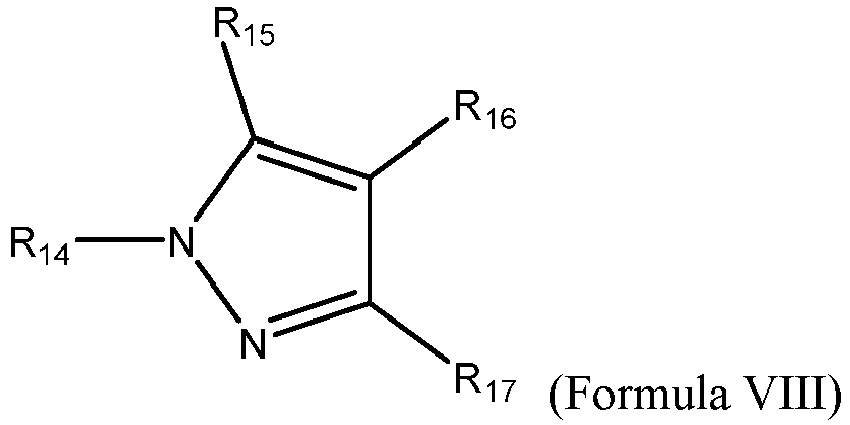
- R14 is selected from substituted or unsubstituted carbocycle and substituted or unsubstituted heterocycle;
- each of R15, R16, and R17 is independently selected from hydrogen and halogen; and
- wherein at least one of R15, R16, and R17 is a halogen;
- BB) a solvent; and
- CC) an acid; and
- AA) a compound of Formula VIII, wherein
- IIa) reacting the mixture;
- IA) forming a mixture comprising
- b) a compound of Formula IV, wherein

- c) a solvent;
- d) an inorganic base; and
- e) optionally an additive; and
- a) a compound of Formula II, wherein
- ii) reacting the mixture;
- i) forming a mixture comprising
- B) a solvent;
- C) a base comprising
- a compound comprising a metal; and
- optionally a first amine base;
- D) optionally an additive; and
- E) optionally a second amine base; and
- A) a compound of Formula III, wherein
- II) reacting the mixture with a carbonyl-containing compound.
- I) forming a mixture comprising
- In one aspect, provided herein is a method of preparing a compound of Formula II, wherein
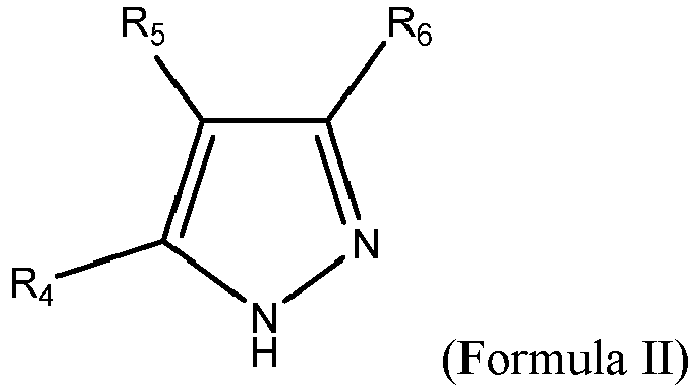
- each of R4, R5, and R6 is independently selected from hydrogen and halogen; and
- wherein at least one of R4, R5, and R6 is hydrogen, the method comprising
- I) forming a mixture comprising
- A) a compound of Formula VIII, wherein

- R14 is selected from substituted or unsubstituted carbocycle and substituted or unsubstituted heterocycle;
- each of R15, R16, and R17 is independently selected from hydrogen and halogen; and
- wherein at least one of R15, R16, and R17 is a halogen;
- B) a solvent; and
- C) an acid; and
- A) a compound of Formula VIII, wherein
- II) reacting the mixture.
- I) forming a mixture comprising
- In one aspect, provided herein is a method of preparing a compound of Formula VII, wherein

- I) forming a mixture comprising
- A) pyrazole or a pyrazole derivative;
- B) a cycloalkene or heterocycloalkene;
- C) optionally a solvent; and
- D) an acid; and
- II) reacting the mixture.
- In one aspect, provided herein is a method of preparing a compound of Formula VIII, wherein

- R14 is selected from substituted or unsubstituted carbocycle and substituted or unsubstituted heterocycle;
- each of R15, R16, and R17 is independently selected from hydrogen and halogen; and
- wherein at least one of R15, R16, and R17 is a halogen, the method comprising
- I) forming a mixture comprising
- A) the compound of Formula VII, wherein

- B) a solvent;
- C) a base comprising
- a compound comprising a metal; and
- optionally a first amine base; and
- D) optionally a second amine base; and
- A) the compound of Formula VII, wherein
- II) reacting the mixture with a halogenation reagent.
- I) forming a mixture comprising
- In one aspect, provided herein is a method of preparing a compound of Formula V, wherein

- each of R5 - R10 is independently selected from hydrogen and halogen; and
- R12 is selected from ether, ester, and nitrile, the method comprising
- i) forming a mixture comprising
- a) a compound of Formula III, wherein

- R4 is hydrogen;
- each of R5 - R10 is independently selected from hydrogen and halogen; and
- wherein the compound of Formula III is prepared according to a method comprising
- IA) forming a mixture comprising
- AA) a compound of Formula II, wherein

- each of R4, R5, and R6 is independently selected from hydrogen and halogen;
- wherein at least one of R4, R5, and R6 is hydrogen; and
- wherein the compound of Formula II is prepared according to a method comprising
- ia) forming a mixture comprising
- aa) a compound of Formula VIII, wherein

- R14 is selected from substituted or unsubstituted carbocycle and substituted or unsubstituted heterocycle;
- each of R15, R16, and R17 is independently selected from hydrogen and halogen; and
- wherein at least one of R15, R16, and R17 is a halogen;
- bb) a solvent; and
- cc) an acid; and
- aa) a compound of Formula VIII, wherein
- iia) reacting the mixture;
- ia) forming a mixture comprising
- BB) a compound of Formula IV, wherein

- CC) a solvent;
- DD) an inorganic base; and
- EE) optionally an additive; and
- AA) a compound of Formula II, wherein
- IIA) reacting the mixture;
- IA) forming a mixture comprising
- b) a solvent;
- c) a base comprising
- a compound comprising a metal; and
- optionally a first amine base;
- d) optionally an additive; and
- e) optionally a second amine base; and
- a) a compound of Formula III, wherein
- ii) reacting the mixture with an organic compound.
- i) forming a mixture comprising
- In one aspect, provided herein is a method of preparing a compound of Formula III, wherein

- R4 is hydrogen; and
- each of R5 - R10 is independently selected from hydrogen and halogen, the method comprising
- i) forming a mixture comprising
- a) a compound of Formula II, wherein

- each of R4, R5, and R6 is independently selected from hydrogen and halogen;
- wherein at least one of R4, R5, and R6 is hydrogen; and
- wherein the compound of Formula II is prepared according to a method comprising
- IA) forming a mixture comprising
- AA) a compound of Formula VIII, wherein

- R14 is selected from substituted or unsubstituted carbocycle and substituted or unsubstituted heterocycle;
- each of R15, R16, and R17 is independently selected from hydrogen and halogen; and
- wherein at least one of R15, R16, and R17 is a halogen;
- BB) a solvent; and
- CC) an acid; and
- AA) a compound of Formula VIII, wherein
- IIa) reacting the mixture;
- IA) forming a mixture comprising
- b) a compound of Formula IV, wherein
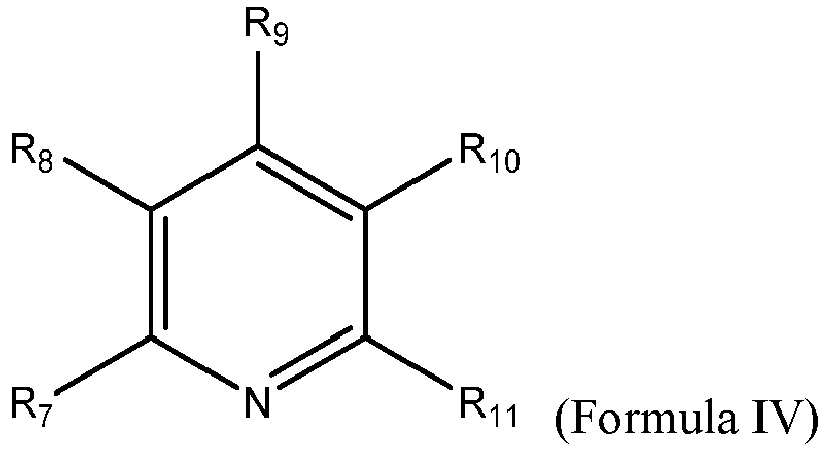
- c) a solvent;
- d) an inorganic base; and
- e) optionally an additive; and
- a) a compound of Formula II, wherein
- ii) reacting the mixture.
- i) forming a mixture comprising
- As used herein, the terms "comprises," "comprising," "includes," "including," "has," "having," "contains", "containing," "characterized by" or any other variation thereof, are intended to cover a non-exclusive inclusion, subject to any limitation explicitly indicated. For example, a composition, mixture, process or method that comprises a list of elements is not necessarily limited to only those elements but may include other elements not expressly listed or inherent to such composition, mixture, process or method.
- The transitional phrase "consisting of' excludes any element, step, or ingredient not specified. If in the claim, such would close the claim to the inclusion of materials other than those recited except for impurities ordinarily associated therewith. When the phrase "consisting of" appears in a clause of the body of a claim, rather than immediately following the preamble, it limits only the element set forth in that clause; other elements are not excluded from the claim as a whole.
- The transitional phrase "consisting essentially of' is used to define a composition or method that includes materials, steps, features, components, or elements, in addition to those literally disclosed, provided that these additional materials, steps, features, components, or elements do not materially affect the basic and novel characteristic(s) of the claimed invention. The term "consisting essentially of' occupies a middle ground between "comprising" and "consisting of".
- Where an invention or a portion thereof is defined with an openended term such as "comprising," it should be readily understood that (unless otherwise stated) the description should be interpreted to also describe such an invention using the terms "consisting essentially of" or "consisting of."
- Further, unless expressly stated to the contrary, "or" refers to an inclusive or and not to an exclusive or. For example, a condition A or B is satisfied by any one of the following: A is true (or present) and B is false (or not present), A is false (or not present) and B is true (or present), and both A and B are true (or present).
- Also, the indefinite articles "a" and "an" preceding an element or component of the invention are intended to be nonrestrictive regarding the number of instances (i.e. occurrences) of the element or component. Therefore "a" or "an" should be read to include one or at least one, and the singular word form of the element or component also includes the plural unless the number is obviously meant to be singular.
- As used herein, the term "about" means plus or minus 10% of the value.
- The term "halogen", either alone or in compound words such as "haloalkyl", includes fluorine, chlorine, bromine or iodine. Further, when used in compound words such as "haloalkyl", said alkyl may be partially or fully substituted with halogen atoms which may be the same or different.
- When a group contains a substituent which can be hydrogen, for example R4, then, when this substituent is taken as hydrogen, it is recognized that this is equivalent to said group being unsubstituted.
- The term "organic base" includes, without limitation, amine compounds (e.g., primary, secondary and tertiary amines), heterocycles including nitrogen-containing heterocycles, and ammonium hydroxide.
- The term "inorganic base" includes, without limitation, inorganic compounds with the ability to react with, or neutralize, acids to form salts, such as, for example, metal salts of hydroxide, carbonate, bicarbonate and phosphate.
- The term "halogenation reagent" includes, without limitation, halogens and inorganic compounds, such as, for example, bromine, N-bromosuccinimide, 1,3-dibromo-5,5-dimethylhylhydantoin, 1,2-dibromotetrachloroethane, tetrabutylammonium tribromide, quaternary ammonium salts of tribromide, 1,2-dibromotrichloroethane, diethyl dibromomalonate, and combinations thereof.
- The term "phase transfer catalyst" includes compounds that facilitate the migration of a reactant from one phase into another phase where a reaction occurs. Phase transfer catalysis refers to the acceleration of the reaction upon the addition of the phase transfer catalyst.
- The term "ester" includes, without limitation, a functional group comprising an ester bond (C(=O)-O-). In some aspects, the functional group comprising an ester bond is an alkyl (or cycloalkyl) having one to eight carbon atoms, like methyl, ethyl, 1 -propyl, 2-propyl, 1 - butyl, 1-methylheptyl (meptyl), etc.
- The term "ether" includes, without limitation, a functional group comprising an ether bond (C-O-C).
- The term "nitrile" includes, without limitation, a functional group comprising a nitrile bond (-C≡N).
- The term "carboxylic acid" includes, without limitation, a functional group comprising a carboxylic acid bond (C(=O)-OH).
- The term "organic acid" includes, without limitation, a functional group that confers acidity and consists of atoms selected from carbon, nitrogen, oxygen, and hydrogen.
- The term "carbocycle" includes, without limitation, a functional group comprising a ring or ring system wherein the atoms forming the ring backbone are selected only from carbon.
- The term "heterocycle" includes, without limitation, a functional group comprising a ring or ring system in which at least one atom forming the ring backbone is not carbon, e.g., nitrogen, oxygen, or sulfur.
- The term "saturated" refers to a functional group comprising a backbone consisting of atoms linked to one another by single bonds; unless otherwise specified, the remaining atom valences are occupied by hydrogen atoms.
- The term "unsaturated" refers to a functional group comprising a backbone comprising at least one double bond. Unless otherwise stated, an "unsaturated" functional group may be partially unsaturated or fully unsaturated.
- The term "cycloalkene" includes, without limitation, a functional group comprising a ring or ring system wherein the atoms forming the ring backbone are selected only from carbon, and wherein the ring or ring system comprises at least one double bond.
- The term "heterocycloalkene" includes, without limitation, a functional group comprising a ring or ring system in which at least one atom forming the ring backbone is not carbon, e.g., nitrogen, oxygen, or sulfur, and wherein the ring or ring system comprises at least one double bond.
- Certain compounds of this invention can exist as one or more stereoisomers. The various stereoisomers include enantiomers, diastereomers, atropisomers and geometric isomers. One skilled in the art will appreciate that one stereoisomer may be more active and/or may exhibit beneficial effects when enriched relative to the other stereoisomer(s) or when separated from the other stereoisomer(s). Additionally, the skilled artisan knows how to separate, enrich, and/or to selectively prepare said stereoisomers.
- The embodiments of this disclosure include:
- Embodiment 1. A method of preparing a compound of Formula VI, wherein

- each of R5 - R10 is independently selected from hydrogen and halogen; and
- R13 is an organic acid, the method comprising
- I) forming a mixture comprising
- A) a compound of Formula V, wherein

- each of R5 - R10 is independently selected from hydrogen and halogen;
- R12 is selected from ether, ester, and nitrile; and
- wherein the compound of Formula V is prepared according to a method comprising
- i) forming a mixture comprising
- a) a compound of Formula III, wherein

- R4 is hydrogen;
- each of R5 - R10 is independently selected from hydrogen and halogen; and
- wherein the compound of Formula III is prepared according to a method comprising
- IA) forming a mixture comprising
- AA) a compound of Formula II, wherein

- each of R4, R5, and R6 is independently selected from hydrogen and halogen;
- wherein at least one of R4, R5, and R6 is hydrogen; and
- wherein the compound of Formula II is prepared according to a method comprising
- ia) forming a mixture comprising
- aa) a compound of Formula VIII, wherein

- R14 is selected from substituted or unsubstituted carbocycle and substituted or unsubstituted heterocycle;
- each of R15, R16, and R17 is independently selected from hydrogen and halogen; and
- wherein at least one of R15, R16, and R17 is a halogen;
- bb) a solvent; and
- cc) an acid; and
- aa) a compound of Formula VIII, wherein
- iia) reacting the mixture;
- ia) forming a mixture comprising
- BB) a compound of Formula IV, wherein

- CC) a solvent;
- DD) an inorganic base; and
- EE) optionally an additive; and
- AA) a compound of Formula II, wherein
- IIA) reacting the mixture;
- IA) forming a mixture comprising
- b) a solvent;
- c) a base comprising
- a compound comprising a metal; and
- optionally a first amine base;
- d) optionally an additive; and
- e) optionally a second amine base; and
- a) a compound of Formula III, wherein
- ii) reacting the mixture with an organic compound; and
- i) forming a mixture comprising
- B) a metal hydroxide; and
- A) a compound of Formula V, wherein
- II) reacting the mixture.
- I) forming a mixture comprising
- Embodiment 2. The method of embodiment 1, wherein the metal hydroxide is selected from alkali hydroxide, alkaline earth metal hydroxide, and combinations thereof.
- Embodiment 3. The method of embodiment 2, wherein the alkali hydroxide is selected from lithium hydroxide, sodium hydroxide, and potassium hydroxide.
- Embodiment 4. The method of embodiment 2, wherein the alkaline earth metal hydroxide is selected from calcium hydroxide and barium hydroxide.
- Embodiment 5. The method of embodiment 1, wherein the method step II) of reacting the mixture occurs at a reaction temperature in the range of about 0 °C to about 90 °C.
- Embodiment 6. The method of embodiment 1, wherein the compound comprising a metal is a Grignard reagent.
- Embodiment 7. The method of embodiment 1, wherein the compound comprising a metal is selected from iPr2NMgCl, iPr2NMgBr, Et2NMgCl, TMPMgCl, TMPMgCl•LiCl, iPr2NMgCl•LiCl, iPr2NMgBr•LiCl, MeMgCl, MeMgBr, iPrMgCl, iPrMgBr, nBuMgCl, nBuMgBr, tBuMgCl, and combinations thereof.
- Embodiment 8. The method of embodiment 1, wherein the first amine base and the second amine base are each independently selected from iPr2NH, TMP, hexamethyldisilazane, Et2NH, c-hexyl2NH, and combinations thereof.
- Embodiment 9. The method of embodiment 1, wherein at least one of the first amine base and the second amine base are present in a stoichiometric or catalytic amount relative to the compound comprising a metal.
- Embodiment 10. The method of embodiment 1 wherein the base is iPr2NMgCl.
- Embodiment 11. The method of embodiment 1 wherein the base comprises MeMgCl and iPr2NH.
- Embodiment 12. The method of embodiment 1, wherein the solvent b) is selected from THF, toluene, 1,4-dioxane, Me-THF, and combinations thereof.
- Embodiment 13. The method of embodiment 1, wherein the organic compound is selected from dimethyl carbonate, N,N-dimethyacetamide, and combinations thereof.
- Embodiment 14. The method of embodiment 13, wherein the organic compound is dimethyl carbonate.
- Embodiment 15. The method of embodiment 1, wherein the additive d) is selected from LiCl, TMEDA, and combinations thereof.
- Embodiment 16. The method of embodiment 1, wherein the method step ii) of reacting the mixture occurs at a reaction temperature in the range of about 0 °C to about 50 °C.
- Embodiment 17. The method of embodiment 16, wherein the method step ii) of reacting the mixture occurs at a reaction temperature in the range of about 0 °C to about 30 °C.
- Embodiment 18. The method of embodiment 17, wherein the method step ii) of reacting the mixture occurs at a reaction temperature in the range of about 10 °C to about 25 °C.
- Embodiment 19. The method of embodiment 1, wherein R5 and R6 of Formula III are each independently hydrogen.
- Embodiment 20. The method of embodiment 1, wherein the inorganic base DD) is selected from powder sodium hydroxide, powder potassium hydroxide, potassium carbonate, potassium phosphate, powder sodium methoxide, powder potassium t-butoxide, and combinations thereof.
- Embodiment 21. The method of embodiment 1, wherein the solvent CC) is selected from toluene, N,N-dimethylformamide, N,N-dimethylacetamide, N-methyl-2-pyrrolidone, acetonitrile, and combinations thereof.
- Embodiment 22. The method of embodiment 1, wherein the additive EE) is selected from potassium iodide, a phase transfer catalyst, and combinations thereof.
- Embodiment 23. The method of embodiment 22, wherein the phase transfer catalyst is selected from butyl ammonium chloride, tetra butyl ammonium bromide, aliquat-336, 18-crown-6, and combinations thereof.
- Embodiment 24. The method of embodiment 1, wherein the method step IIA) of reacting the mixture occurs at a reaction temperature in the range of about 100 °C to about 200 °C.
- Embodiment 25. The method of embodiment 1, wherein the solvent bb) is selected from methanol, ethanol, isopropanol, toluene, 1,4-dioxane, tetrahydrofuran, and combinations thereof.
- Embodiment 26. The method of embodiment 1, wherein the acid cc) is selected from hydrochloric acid, sulfuric acid, phosphoric acid, methylsulfonic acid, trifluoroacetic acid, hydrobromic acid, and combinations thereof.
- Embodiment 27. The method of embodiment 1, wherein the method step iia) of reacting the mixture occurs at a reaction temperature in the range of about 20 °C to about 150 °C.
- Embodiment 28. The method of embodiment 1, wherein R14 is tetrahydropyranyl.
- Embodiment 29. The method of embodiment 1, wherein R12 is selected from ester and nitrile.
- Embodiment 30. The method of embodiment 1, wherein the compound of Formula VIII is prepared according to a method comprising
- I) forming a mixture comprising
- A) a compound of Formula VII, wherein

- B) a solvent;
- C) a base comprising
- a compound comprising a metal; and
- optionally a first amine base; and
- D) optionally a second amine base; and
- A) a compound of Formula VII, wherein
- II) reacting the mixture with a halogenation reagent.
- I) forming a mixture comprising
- Embodiment 31. The method of embodiment 30, wherein the halogenation reagent is selected from bromine, N-bromosuccinimide, 1,3-dibromo-5,5-dimethylhylhydantoin, 1,2-dibromotetrachloroethane, tetrabutylammonium tribromide, quaternary ammonium salts of tribromide, 1,2-dibromotrichloroethane, diethyl dibromomalonate, and combinations thereof.
- Embodiment 32. The method of embodiment 30, wherein the solvent is selected from THF, toluene, 1,4-dioxane, Me-THF, and combinations thereof.
- Embodiment 33. The method of embodiment 30, wherein the compound comprising a metal is a Grignard reagent.
- Embodiment 34. The method of embodiment 30, wherein the compound comprising a metal is selected from iPr2NMgCl, iPr2NMgBr, Et2NMgCl, TMPMgCl, TMPMgCl•LiCl, iPr2NMgCl•LiCl, iPr2NMgBr•LiCl, MeMgCl, MeMgBr, iPrMgCl, iPrMgBr, nBuMgCl, nBuMgBr, tBuMgCl, and combinations thereof.
- Embodiment 35. The method of embodiment 30, wherein the first amine base and the second amine base are each independently selected from iPr2NH, TMP, Et2NH, c-hexyl2NH, and combinations thereof.
- Embodiment 36. The method of embodiment 30, wherein at least one of the first amine base and the second amine base are present in an amount relative to the compound comprising a metal in the range of about 1 mol% to about 90 mol%.
- Embodiment 37. The method of embodiment 36, wherein at least one of the first amine base and the second amine base are present in an amount relative to the compound comprising a metal in the range of about 5 mol% to about 50 mol%.
- Embodiment 38. The method of embodiment 37, wherein at least one of the first amine base and the second amine base are present in an amount relative to the compound comprising a metal in the range of about 10 mol% to about 20 mol%.
- Embodiment 39. The method of embodiment 30, wherein the method step of reacting the mixture occurs at a reaction temperature in the range of about 0 °C to about 60 °C.
- Embodiment 40. The method of embodiment 39, wherein the method step of reacting the mixture occurs at a reaction temperature in the range of about 40 °C to about 50 °C.
- Embodiment 41. The method of embodiment 30, wherein the method produces a mixture of compounds of Formula VIII.
- Embodiment 42. The method of embodiment 30, wherein the method produces a compound selected from

- Embodiment 43. The method of embodiment 30, wherein R14 is tetrahydropyranyl.
- Embodiment 44. The method of embodiment 30, wherein the compound of Formula VII is prepared according to a method comprising
- I) forming a mixture comprising
- A) pyrazole or a pyrazole derivative;
- B) a cycloalkene or heterocycloalkene;
- C) optionally a solvent; and
- D) an acid; and
- II) reacting the mixture.
- I) forming a mixture comprising
- Embodiment 45. The method of embodiment 44, wherein the cycloalkene or heterocycloalkene is selected from 3,4-dihydropyran, 3,6-dihydropyran, cyclohexene, and combinations thereof.
- Embodiment 46. The method of embodiment 44, wherein the solvent is selected from toluene, xylene, heptanes, and combinations thereof.
- Embodiment 47. The method of embodiment 44, wherein the acid is selected from organic acid, inorganic acid, and combinations thereof.
- Embodiment 48. The method of embodiment 44, wherein the acid is selected from trifluoroacetic acid, sulfuric acid, p-toluenesulfonic acid, methylsulfonic acid, hydrochloric acid, hydrobromic acid, phosphoric acid, and combinations thereof.
- Embodiment 49. The method of embodiment 44, wherein the method step of reacting the mixture occurs at a reaction temperature in the range of about 25 °C to about 120 °C.
- Embodiment 50. The method of embodiment 49, wherein the method step of reacting the mixture occurs at a reaction temperature in the range of about 60 °C to about 95 °C.
- Embodiment 51. A method of preparing a compound of Formula VI, wherein

- each of R5 - R10 is independently selected from hydrogen and halogen; and
- R13 is an organic acid, the method comprising
- I) forming a mixture comprising
- A) a compound of Formula III, wherein

- R4 is hydrogen;
- each of R5 - R10 is independently selected from hydrogen and halogen; and
- wherein the compound of Formula III is prepared according to a method comprising
- i) forming a mixture comprising
- a) a compound of Formula II, wherein

and halogen;
wherein at least one of R4, R5, and R6 is hydrogen; and wherein the compound of Formula II is prepared according to a method comprising- IA) forming a mixture comprising
- AA) a compound of Formula VIII, wherein

- R14 is selected from substituted or unsubstituted carbocycle and substituted or unsubstituted heterocycle;
- each of R15, R16, and R17 is independently selected from hydrogen and halogen; and
- wherein at least one of R15, R16, and R17 is a halogen;
- BB) a solvent; and
- CC) an acid; and
- AA) a compound of Formula VIII, wherein
- IIa) reacting the mixture;
- IA) forming a mixture comprising
- b) a compound of Formula IV, wherein

- c) a solvent;
- d) an inorganic base; and
- e) optionally an additive; and
- a) a compound of Formula II, wherein
- ii) reacting the mixture;
- i) forming a mixture comprising
- B) a carbonyl-containing compound;
- C) a solvent;
- D) a base comprising
- a compound comprising a metal; and
- optionally a first amine base;
- E) optionally an additive; and
- F) optionally a second amine base; and
- A) a compound of Formula III, wherein
- II) reacting the mixture.
- I) forming a mixture comprising
- Embodiment 52. The method of embodiment 51, wherein the compound comprising a metal is a Grignard reagent.
- [0089] Embodiment 53. The method of embodiment 51, wherein the compound comprising a metal is selected from iPr2NMgCl, iPr2NMgBr, Et2NMgCl, TMPMgCl, TMPMgCl•LiCl, iPr2NMgCl•LiCl, iPr2NMgBr•LiCl, MeMgCl, MeMgBr, iPrMgCl, iPrMgBr, nBuMgCl, nBuMgBr, tBuMgCl, and combinations thereof.
- Embodiment 54. The method of embodiment 51, wherein the first amine base and the second amine base are each independently selected from iPr2NH, TMP, hexamethyldisilazane, Et2NH, c-hexyl2NH, and combinations thereof.
- Embodiment 55. The method of embodiment 51, wherein at least one of the first amine base and the second amine base are present in a stoichiometric or catalytic amount relative to the compound comprising a metal.
- Embodiment 56. The method of embodiment 51 wherein the base is iPr2NMgCl.
- Embodiment 57. The method of embodiment 51 wherein the base comprises MeMgCl and iPr2NH.
- Embodiment 58. The method of embodiment 51, wherein the solvent C) is selected from THF, toluene, 1,4-dioxane, Me-THF, and combinations thereof.
- Embodiment 59. The method of embodiment 51, wherein the carbonyl-containing compound is selected from dimethylcarbonate, N,N-dimethylacetamide, carbon dioxide, and combinations thereof.
- Embodiment 60. The method of embodiment 59, wherein the carbonyl-containing compound is carbon dioxide.
- Embodiment 61. The method of embodiment 51, wherein the additive E) is selected from LiCl, TMEDA, and combinations thereof.
- Embodiment 62. The method of embodiment 51, wherein the method step II) of reacting the mixture occurs at a reaction temperature in the range of about 0 °C to about 50 °C.
- Embodiment 63. The method of embodiment 62, wherein the method step II) of reacting the mixture occurs at a reaction temperature in the range of about 0 °C to about 30 °C.
- Embodiment 64. The method of embodiment 63, wherein the method step II) of reacting the mixture occurs at a reaction temperature in the range of about 10 °C to about 25 °C.
- Embodiment 65. The method of embodiment 51, wherein the inorganic base d) is selected from powder sodium hydroxide, powder potassium hydroxide, potassium carbonate, potassium phosphate, powder sodium methoxide, powder potassium t-butoxide, and combinations thereof.
- Embodiment 66. The method of embodiment 51, wherein the solvent c) is selected from toluene, N,N-dimethylformamide, N,N-dimethylacetamide, N-methyl-2-pyrrolidone, acetonitrile, and combinations thereof.
- Embodiment 67. The method of embodiment 51, wherein the additive e) is selected from potassium iodide, a phase transfer catalyst, and combinations thereof.
- Embodiment 68. The method of embodiment 67, wherein the phase transfer catalyst is selected from butyl ammonium chloride, tetra butyl ammonium bromide, aliquat-336, 18-crown-6, and combinations thereof.
- Embodiment 69. The method of embodiment 51, wherein the method step ii) of reacting the mixture occurs at a reaction temperature in the range of about 100 °C to about 180 °C.
- Embodiment 70. The method of embodiment 51, wherein the solvent BB) is selected from methanol, ethanol, isopropanol, toluene, 1,4-dioxane, tetrahydrofuran, and combinations thereof.
- Embodiment 71. The method of embodiment 51, wherein the acid CC) is selected from hydrochloric acid, sulfuric acid, phosphoric acid, methylsulfonic acid, trifluoroacetic acid, hydrobromic acid, and combinations thereof.
- Embodiment 72. The method of embodiment 51, wherein the method step IIa) of reacting the mixture occurs at a reaction temperature in the range of about 20 °C to about 150 °C.
- Embodiment 73. The method of embodiment 51, wherein the compound of Formula VIII is prepared according to a method comprising
- I) forming a mixture comprising
- A) a compound of Formula VII, wherein

- B) a solvent;
- C) a base comprising
- a compound comprising a metal; and
- optionally a first amine base; and
- D) optionally a second amine base; and
- A) a compound of Formula VII, wherein
- II) reacting the mixture with a halogenation reagent.
- I) forming a mixture comprising
- Embodiment 74. The method of embodiment 73, wherein the halogenation reagent is selected from bromine, N-bromosuccinimide, 1,3-dibromo-5,5-dimethylhylhydantoin, 1,2-dibromotetrachloroethane, tetrabutylammonium tribromide, quaternary ammonium salts of tribromide, 1,2-dibromotrichloroethane, diethyl dibromomalonate, and combinations thereof.
- Embodiment 75. The method of embodiment 73, wherein the solvent is selected from THF, toluene, 1,4-dioxane, Me-THF, and combinations thereof.
- Embodiment 76. The method of embodiment 73, wherein the compound comprising a metal is a Grignard reagent.
- Embodiment 77. The method of embodiment 73, wherein the compound comprising a metal is selected from iPr2NMgCl, iPr2NMgBr, Et2NMgCl, TMPMgCl, TMPMgCl•LiCl, iPr2NMgCl•LiCl, iPr2NMgBr•LiCl, MeMgCl, MeMgBr, iPrMgCl, iPrMgBr, nBuMgCl, nBuMgBr, tBuMgCl, and combinations thereof.
- Embodiment 78. The method of embodiment 73, wherein the first amine base and the second amine base are each independently selected from iPr2NH, TMP, Et2NH, c-hexyl2NH, and combinations thereof.
- Embodiment 79. The method of embodiment 73, wherein at least one of the first amine base and the second amine base are present in an amount relative to the compound comprising a metal in the range of about 1 mol% to about 90 mol%.
- Embodiment 80. The method of embodiment 79, wherein at least one of the first amine base and the second amine base are present in an amount relative to the compound comprising a metal in the range of about 5 mol% to about 50 mol%.
- Embodiment 81. The method of embodiment 80, wherein at least one of the first amine base and the second amine base are present in an amount relative to the compound comprising a metal in the range of about 10 mol% to about 20 mol%.
- Embodiment 82. The method of embodiment 73, wherein the method step of reacting the mixture occurs at a reaction temperature in the range of about 0 °C to about 60 °C.
- Embodiment 83. The method of embodiment 82, wherein the method step of reacting the mixture occurs at a reaction temperature in the range of about 40 °C to about 50 °C.
- Embodiment 84. The method of embodiment 73, wherein the method produces a mixture of compounds of Formula VIII.
- Embodiment 85. The method of embodiment 73, wherein the method produces a compound selected from

- Embodiment 86. The method of embodiment 73, wherein R14 is tetrahydropyranyl.
- Embodiment 87. The method of embodiment 73, wherein the compound of Formula VII is prepared according to a method comprising
- I) forming a mixture comprising
- A) pyrazole or a pyrazole derivative;
- B) a cycloalkene or heterocycloalkene;
- C) optionally a solvent; and
- D) an acid; and
- II) reacting the mixture.
- I) forming a mixture comprising
- Embodiment 88. The method of embodiment 87, wherein the cycloalkene or heterocycloalkene is selected from 3,4-dihydropyran, 3,6-dihydropyran, cyclohexene, and combinations thereof.
- Embodiment 89. The method of embodiment 87, wherein the solvent is selected from toluene, xylene, heptanes, and combinations thereof.
- Embodiment 90. The method of embodiment 87, wherein the acid is selected from organic acid, inorganic acid, and combinations thereof.
- Embodiment 91. The method of embodiment 87, wherein the acid is selected from trifluoroacetic acid, sulfuric acid, p-toluenesulfonic acid, methylsulfonic acid, hydrochloric acid, hydrobromic acid, phosphoric acid, and combinations thereof.
- Embodiment 92. The method of embodiment 87, wherein the method step of reacting the mixture occurs at a reaction temperature in the range of about 25 °C to about 120 °C.
- Embodiment 93. The method of embodiment 92, wherein the method step of reacting the mixture occurs at a reaction temperature in the range of about 60 °C to about 95 °C.
- Embodiment 94. A method of preparing a compound of Formula II, wherein

- each of R4, R5, and R6 is independently selected from hydrogen and halogen; and
- wherein at least one of R4, R5, and R6 is hydrogen, the method comprising
- I) forming a mixture comprising
- A) a compound of Formula VIII, wherein

- R14 is selected from substituted or unsubstituted carbocycle and substituted or unsubstituted heterocycle;
- each of R15, R16, and R17 is independently selected from hydrogen and halogen; and
- wherein at least one of R15, R16, and R17 is a halogen;
- B) a solvent; and
- C) an acid; and
- A) a compound of Formula VIII, wherein
- II) reacting the mixture.
- I) forming a mixture comprising
- Embodiment 95. The method of embodiment 94, wherein the solvent is selected from methanol, ethanol, isopropanol, toluene, 1,4-dioxane, tetrahydrofuran, and combinations thereof.
- Embodiment 96. The method of embodiment 94, wherein the acid is selected from hydrochloric acid, sulfuric acid, phosphoric acid, methylsulfonic acid, trifluoroacetic acid, hydrobromic acid, and combinations thereof.
- Embodiment 97. The method of embodiment 94, wherein the method step of reacting the mixture occurs at a reaction temperature in the range of about 20 °C to about 150 °C.
- Embodiment 98. The method of embodiment 94, wherein the compound of Formula VIII is prepared according to a method comprising
- I) forming a mixture comprising
- A) a compound of Formula VII, wherein

- B) a solvent;
- C) a base comprising
- a compound comprising a metal; and
- optionally a first amine base; and
- D) optionally a second amine base; and
- A) a compound of Formula VII, wherein
- II) reacting the mixture with a halogenation reagent.
- I) forming a mixture comprising
- Embodiment 99. The method of embodiment 98, wherein the halogenation reagent is selected from bromine, N-bromosuccinimide, 1,3-dibromo-5,5-dimethylhylhydantoin, 1,2-dibromotetrachloroethane, tetrabutylammonium tribromide, quaternary ammonium salts of tribromide, 1,2-dibromotrichloroethane, diethyl dibromomalonate, and combinations thereof.
- Embodiment 100. The method of embodiment 98, wherein the solvent is selected from THF, toluene, 1,4-dioxane, Me-THF, and combinations thereof.
- Embodiment 101. The method of embodiment 98, wherein the compound comprising a metal is a Grignard reagent.
- Embodiment 102. The method of embodiment 98, wherein the compound comprising a metal is selected from iPr2NMgCl, iPr2NMgBr, Et2NMgCl, TMPMgCl, TMPMgCl•LiCl, iPr2NMgCl•LiCl, iPr2NMgBr•LiCl, MeMgCl, MeMgBr, iPrMgCl, iPrMgBr, nBuMgCl, nBuMgBr, tBuMgCl, and combinations thereof.
- Embodiment 103. The method of embodiment 98, wherein the first amine base and the second amine base are each independently selected from iPr2NH, TMP, Et2NH, c-hexyl2NH, and combinations thereof.
- Embodiment 104. The method of embodiment 98, wherein at least one of the first amine base and the second amine base are present in an amount relative to the compound comprising a metal in the range of about 1 mol% to about 90 mol%.
- Embodiment 105. The method of embodiment 104, wherein at least one of the first amine base and the second amine base are present in an amount relative to the compound comprising a metal in the range of about 5 mol% to about 50 mol%.
- Embodiment 106. The method of embodiment 105, wherein at least one of the first amine base and the second amine base are present in an amount relative to the compound comprising a metal in the range of about 10 mol% to about 20 mol%.
- Embodiment 107. The method of embodiment 98, wherein the method step of reacting the mixture occurs at a reaction temperature in the range of about 0 °C to about 60 °C.
- Embodiment 108. The method of embodiment 107, wherein the method step of reacting the mixture occurs at a reaction temperature in the range of about 40 °C to about 50 °C.
- Embodiment 109. The method of embodiment 98, wherein the method produces a mixture of compounds of Formula VIII.
- Embodiment 110. The method of embodiment 98, wherein the method produces a compound selected from
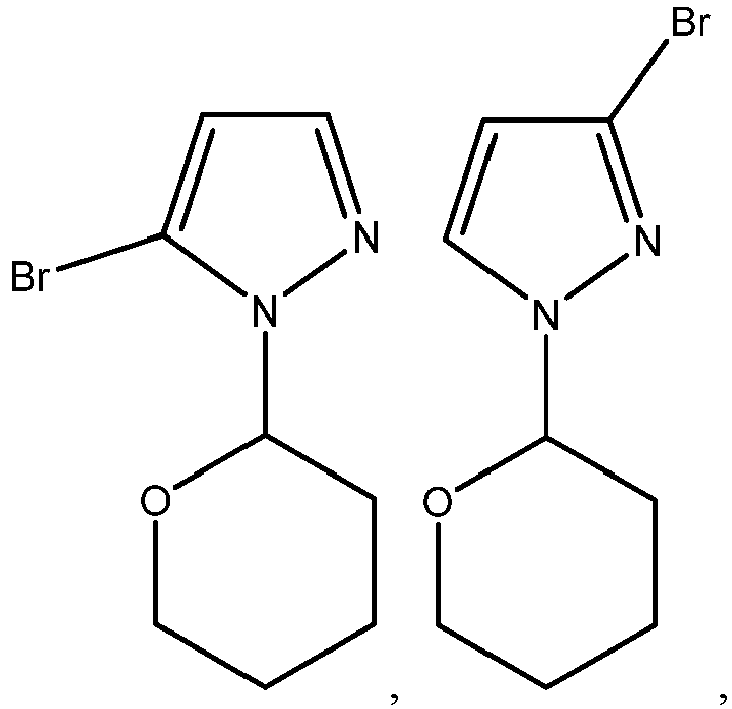
- Embodiment 111. The method of embodiment 98, wherein R14 is tetrahydropyranyl.
- Embodiment 112. The method of embodiment 98, wherein the compound of Formula VII is prepared according to a method comprising
- I) forming a mixture comprising
- A) pyrazole or a pyrazole derivative;
- B) a cycloalkene or heterocycloalkene;
- C) optionally a solvent; and
- D) an acid; and
- II) reacting the mixture.
- I) forming a mixture comprising
- Embodiment 113. The method of embodiment 112, wherein the cycloalkene or heterocycloalkene is selected from 3,4-dihydropyran, 3,6-dihydropyran, cyclohexene, and combinations thereof.
- Embodiment 114. The method of embodiment 112, wherein the solvent is selected from toluene, xylene, heptanes, and combinations thereof.
- Embodiment 115. The method of embodiment 112, wherein the acid is selected from organic acid, inorganic acid, and combinations thereof.
- Embodiment 116. The method of embodiment 112, wherein the acid is selected from trifluoroacetic acid, sulfuric acid, p-toluenesulfonic acid, methylsulfonic acid, hydrochloric acid, hydrobromic acid, phosphoric acid, and combinations thereof.
- Embodiment 117. The method of embodiment 112, wherein the method step of reacting the mixture occurs at a reaction temperature in the range of about 25 °C to about 120 °C.
- Embodiment 118. The method of embodiment 117, wherein the method step of reacting the mixture occurs at a reaction temperature in the range of about 60 °C to about 95 °C.
- Embodiment 119. A method of preparing a compound of Formula VII, wherein

- I) forming a mixture comprising
- A) pyrazole or a pyrazole derivative;
- B) a cycloalkene or heterocycloalkene;
- C) optionally a solvent; and
- D) an acid; and
- II) reacting the mixture.
- I) forming a mixture comprising
- Embodiment 120. The method of embodiment 119, wherein the cycloalkene or heterocycloalkene is selected from 3,4-dihydropyran, 3,6-dihydropyran, cyclohexene, and combinations thereof.
- Embodiment 121. The method of embodiment 119, wherein the solvent is selected from toluene, xylene, heptanes, and combinations thereof.
- Embodiment 122. The method of embodiment 119, wherein the acid is selected from organic acid, inorganic acid, and combinations thereof.
- Embodiment 123. The method of embodiment 119, wherein the acid is selected from trifluoroacetic acid, sulfuric acid, p-toluenesulfonic acid, methylsulfonic acid, hydrochloric acid, hydrobromic acid, phosphoric acid, and combinations thereof.
- Embodiment 124. The method of embodiment 119, wherein the method step of reacting the mixture occurs at a reaction temperature in the range of about 25 °C to about 120 °C.
- Embodiment 125. The method of embodiment 124, wherein the method step of reacting the mixture occurs at a reaction temperature in the range of about 60 °C to about 95 °C.
- Embodiment 126. A method of preparing a compound of Formula VIII, wherein

- R14 is selected from substituted or unsubstituted carbocycle and substituted or unsubstituted heterocycle;
- each of R15, R16, and R17 is independently selected from hydrogen and halogen; and
- wherein at least one of R15, R16, and R17 is a halogen, the method comprising
- I) forming a mixture comprising
- A) the compound of Formula VII, wherein

- B) a solvent;
- C) a base comprising
- a compound comprising a metal; and
- optionally a first amine base; and
- D) optionally a second amine base; and
- A) the compound of Formula VII, wherein
- II) reacting the mixture with a halogenation reagent.
- I) forming a mixture comprising
- Embodiment 127. The method of embodiment 126, wherein the halogenation reagent is selected from bromine, N-bromosuccinimide, 1,3-dibromo-5,5-dimethylhylhydantoin, 1,2-dibromotetrachloroethane, tetrabutylammonium tribromide, quaternary ammonium salts of tribromide, 1,2-dibromotrichloroethane, diethyl dibromomalonate, and combinations thereof.
- Embodiment 128. The method of embodiment 126, wherein the solvent is selected from THF, toluene, 1,4-dioxane, Me-THF, and combinations thereof.
- Embodiment 129. The method of embodiment 126, wherein the compound comprising a metal is a Grignard reagent.
- Embodiment 130. The method of embodiment 126, wherein the compound comprising a metal is selected from iPr2NMgCl, iPr2NMgBr, Et2NMgCl, TMPMgCl, TMPMgCl•LiCl, iPr2NMgCl•LiCl, iPr2NMgBr•LiCl, MeMgCl, MeMgBr, iPrMgCl, iPrMgBr, nBuMgCl, nBuMgBr, tBuMgCl, and combinations thereof.
- Embodiment 131. The method of embodiment 126, wherein the first amine base and the second amine base are each independently selected from iPr2NH, TMP, Et2NH, c-hexyl2NH, and combinations thereof.
- Embodiment 132. The method of embodiment 126, wherein at least one of the first amine base and the second amine base are present in an amount relative to the compound comprising a metal in the range of about 1 mol% to about 90 mol%.
- Embodiment 133. The method of embodiment 132, wherein at least one of the first amine base and the second amine base are present in an amount relative to the compound comprising a metal in the range of about 5 mol% to about 50 mol%.
- Embodiment 134. The method of embodiment 133, wherein at least one of the first amine base and the second amine base are present in an amount relative to the compound comprising a metal in the range of about 10 mol% to about 20 mol%.
- Embodiment 135. The method of embodiment 126, wherein the method step of reacting the mixture occurs at a reaction temperature in the range of about 0 °C to about 60 °C.
- Embodiment 136. The method of embodiment 135, wherein the method step of reacting the mixture occurs at a reaction temperature in the range of about 40 °C to about 50 °C.
- Embodiment 137. The method of embodiment 126, wherein the method produces a mixture of compounds of Formula VIII.
- Embodiment 138. The method of embodiment 126, wherein the method produces a compound selected from

- Embodiment 139. The method of embodiment 126, wherein R14 is tetrahydropyranyl.
- Embodiment 140. The method of embodiment 126, wherein the compound of Formula VII is prepared according to a method comprising
- I) forming a mixture comprising
- A) pyrazole or a pyrazole derivative;
- B) a cycloalkene or heterocycloalkene;
- C) optionally a solvent; and
- D) an acid; and
- II) reacting the mixture.
- I) forming a mixture comprising
- Embodiment 141. The method of embodiment 140, wherein the cycloalkene or heterocycloalkene is selected from 3,4-dihydropyran, 3,6-dihydropyran, cyclohexene, and combinations thereof.
- Embodiment 142. The method of embodiment 140, wherein the solvent is selected from toluene, xylene, heptanes, and combinations thereof.
- Embodiment 143. The method of embodiment 140, wherein the acid is selected from organic acid, inorganic acid, and combinations thereof.
- Embodiment 144. The method of embodiment 140, wherein the acid is selected from trifluoroacetic acid, sulfuric acid, p-toluenesulfonic acid, methylsulfonic acid, hydrochloric acid, hydrobromic acid, phosphoric acid, and combinations thereof.
- Embodiment 145. The method of embodiment 140, wherein the method step of reacting the mixture occurs at a reaction temperature in the range of about 25 °C to about 120 °C.
- Embodiment 146. The method of embodiment 145, wherein the method step of reacting the mixture occurs at a reaction temperature in the range of about 60 °C to about 95 °C.
- Embodiment 147. A method of preparing a compound of Formula V, wherein

- each of R5 - R10 is independently selected from hydrogen and halogen; and
- R12 is selected from ether, ester, and nitrile, the method comprising
- i) forming a mixture comprising
- a) a compound of Formula III, wherein

- R4 is hydrogen;
- each of R5 - R10 is independently selected from hydrogen and halogen; and
- wherein the compound of Formula III is prepared according to a method comprising
- IA) forming a mixture comprising
- AA) a compound of Formula II, wherein

- each of R4, R5, and R6 is independently selected from hydrogen and halogen;
- wherein at least one of R4, R5, and R6 is hydrogen; and
- wherein the compound of Formula II is prepared according to a method comprising
- ia) forming a mixture comprising
- aa) a compound of Formula VIII, wherein

- R14 is selected from substituted or unsubstituted carbocycle and substituted or unsubstituted heterocycle;
- each of R15, R16, and R17 is independently selected from hydrogen and halogen; and
- wherein at least one of R15, R16, and R17 is a halogen;
- bb) a solvent; and
- cc) an acid; and
- aa) a compound of Formula VIII, wherein
- iia) reacting the mixture;
- ia) forming a mixture comprising
- BB) a compound of Formula IV, wherein

- CC) a solvent;
- DD) an inorganic base; and
- EE) optionally an additive; and
- AA) a compound of Formula II, wherein
- IIA) reacting the mixture;
- IA) forming a mixture comprising
- b) a solvent;
- c) a base comprising
- a compound comprising a metal; and
- optionally a first amine base;
- d) optionally an additive; and
- e) optionally a second amine base; and
- a) a compound of Formula III, wherein
- ii) reacting the mixture with an organic compound.
- i) forming a mixture comprising
- Embodiment 148. The method of embodiment 147, wherein the compound comprising a metal is a Grignard reagent.
- Embodiment 149. The method of embodiment 147, wherein the compound comprising a metal is selected from iPr2NMgCl, iPr2NMgBr, Et2NMgCl, TMPMgCl, TMPMgCl•LiCl, iPr2NMgCl•LiCl, iPr2NMgBr•LiCl, MeMgCl, MeMgBr, iPrMgCl, iPrMgBr, nBuMgCl, nBuMgBr, tBuMgCl, and combinations thereof.
- Embodiment 150. The method of embodiment 147, wherein the first amine base and the second amine base are each independently selected from iPr2NH, TMP, hexamethyldisilazane, Et2NH, c-hexyl2NH, and combinations thereof.
- Embodiment 151. The method of embodiment 147, wherein at least one of the first amine base and the second amine base are present in a stoichiometric or catalytic amount relative to the compound comprising a metal.
- Embodiment 152. The method of embodiment 147 wherein the base is iPr2NMgCl.
- Embodiment 153. The method of embodiment 147 wherein the base comprises MeMgCl and iPr2NH.
- Embodiment 154. The method of embodiment 147, wherein the solvent b) is selected from THF, toluene, 1,4-dioxane, Me-THF, and combinations thereof.
- Embodiment 155. The method of embodiment 147, wherein the organic compound is selected from dimethyl carbonate, N,N-dimethyacetamide, and combinations thereof.
- Embodiment 156. The method of embodiment 155, wherein the organic compound is dimethyl carbonate.
- Embodiment 157. The method of embodiment 147, wherein the additive d) is selected from LiCl, TMEDA, and combinations thereof.
- Embodiment 158. The method of embodiment 147, wherein the method step ii) of reacting the mixture occurs at a reaction temperature in the range of about 0 °C to about 50 °C.
- Embodiment 159. The method of embodiment 158, wherein the method step ii) of reacting the mixture occurs at a reaction temperature in the range of about 0 °C to about 30 °C.
- Embodiment 160. The method of embodiment 159, wherein the method step ii) of reacting the mixture occurs at a reaction temperature in the range of about 10 °C to about 25 °C.
- Embodiment 161. The method of embodiment 147, wherein R5 and R6 of Formula III are each independently hydrogen.
- Embodiment 162. The method of embodiment 147, wherein the inorganic base DD) is selected from powder sodium hydroxide, powder potassium hydroxide, potassium carbonate, potassium phosphate, powder sodium methoxide, powder potassium t-butoxide, and combinations thereof.
- Embodiment 163. The method of embodiment 147, wherein the solvent CC) is selected from toluene, N,N-dimethylformamide, N,N-dimethylacetamide, N-methyl-2-pyrrolidone, acetonitrile, and combinations thereof.
- Embodiment 164. The method of embodiment 147, wherein the additive EE) is selected from potassium iodide, a phase transfer catalyst, and combinations thereof.
- Embodiment 165. The method of embodiment 164, wherein the phase transfer catalyst is selected from butyl ammonium chloride, tetra butyl ammonium bromide, aliquat-336, 18-crown-6, and combinations thereof.
- Embodiment 166. The method of embodiment 147, wherein the method step IIA) of reacting the mixture occurs at a reaction temperature in the range of about 100 °C to about 200 °C.
- Embodiment 167. The method of embodiment 147, wherein the solvent bb) is selected from methanol, ethanol, isopropanol, toluene, 1,4-dioxane, tetrahydrofuran, and combinations thereof.
- Embodiment 168. The method of embodiment 147, wherein the acid cc) is selected from hydrochloric acid, sulfuric acid, phosphoric acid, methylsulfonic acid, trifluoroacetic acid, hydrobromic acid, and combinations thereof.
- Embodiment 169. The method of embodiment 147, wherein the method step iia) of reacting the mixture occurs at a reaction temperature in the range of about 20 °C to about 150 °C.
- Embodiment 170. The method of embodiment 147, wherein R12 is selected from ester and nitrile.
- Embodiment 171. The method of embodiment 147, wherein the compound of Formula VIII is prepared according to a method comprising
- I) forming a mixture comprising
- A) a compound of Formula VII, wherein

- B) a solvent;
- C) a base comprising
- a compound comprising a metal; and
- optionally a first amine base; and
- D) optionally a second amine base; and
- A) a compound of Formula VII, wherein
- II) reacting the mixture with a halogenation reagent.
- I) forming a mixture comprising
- Embodiment 172. The method of embodiment 171, wherein the halogenation reagent is selected from bromine, N-bromosuccinimide, 1,3-dibromo-5,5-dimethylhylhydantoin, 1,2-dibromotetrachloroethane, tetrabutylammonium tribromide, quaternary ammonium salts of tribromide, 1,2-dibromotrichloroethane, diethyl dibromomalonate, and combinations thereof.
- Embodiment 173. The method of embodiment 171, wherein the solvent is selected from THF, toluene, 1,4-dioxane, Me-THF, and combinations thereof.
- Embodiment 174. The method of embodiment 171, wherein the compound comprising a metal is a Grignard reagent.
- Embodiment 175. The method of embodiment 171, wherein the compound comprising a metal is selected from iPr2NMgCl, iPr2NMgBr, Et2NMgCl, TMPMgCl, TMPMgCl•LiCl, iPr2NMgCl•LiCl, iPr2NMgBr•LiCl, MeMgCl, MeMgBr, iPrMgCl, iPrMgBr, nBuMgCl, nBuMgBr, tBuMgCl, and combinations thereof.
- Embodiment 176. The method of embodiment 171, wherein the first amine base and the second amine base are each independently selected from iPr2NH, TMP, Et2NH, c-hexyl2NH, and combinations thereof.
- Embodiment 177. The method of embodiment 171, wherein at least one of the first amine base and the second amine base are present in an amount relative to the compound comprising a metal in the range of about 1 mol% to about 90 mol%.
- Embodiment 178. The method of embodiment 177, wherein at least one of the first amine base and the second amine base are present in an amount relative to the compound comprising a metal in the range of about 5 mol% to about 50 mol%.
- Embodiment 179. The method of embodiment 178, wherein at least one of the first amine base and the second amine base are present in an amount relative to the compound comprising a metal in the range of about 10 mol% to about 20 mol%.
- Embodiment 180. The method of embodiment 171, wherein the method step of reacting the mixture occurs at a reaction temperature in the range of about 0 °C to about 60 °C.
- Embodiment 181. The method of embodiment 180, wherein the method step of reacting the mixture occurs at a reaction temperature in the range of about 40 °C to about 50 °C.
- Embodiment 182. The method of embodiment 171, wherein the method produces a mixture of compounds of Formula VIII.
- Embodiment 183. The method of embodiment 171, wherein the method produces a compound selected from

- Embodiment 184. The method of embodiment 171, wherein R14 is tetrahydropyranyl.
- Embodiment 185. The method of embodiment 171, wherein the compound of Formula VII is prepared according to a method comprising
- I) forming a mixture comprising
- A) pyrazole or a pyrazole derivative;
- B) a cycloalkene or heterocycloalkene;
- C) optionally a solvent; and
- D) an acid; and
- II) reacting the mixture.
- I) forming a mixture comprising
- Embodiment 186. The method of embodiment 185, wherein the cycloalkene or heterocycloalkene is selected from 3,4-dihydropyran, 3,6-dihydropyran, cyclohexene, and combinations thereof.
- Embodiment 187. The method of embodiment 185, wherein the solvent is selected from toluene, xylene, heptanes, and combinations thereof.
- Embodiment 188. The method of embodiment 185, wherein the acid is selected from organic acid, inorganic acid, and combinations thereof.
- Embodiment 189. The method of embodiment 188, wherein the acid is selected from trifluoroacetic acid, sulfuric acid, p-toluenesulfonic acid, methylsulfonic acid, hydrochloric acid, hydrobromic acid, phosphoric acid, and combinations thereof.
- Embodiment 190. The method of embodiment 185, wherein the method step of reacting the mixture occurs at a reaction temperature in the range of about 25 °C to about 120 °C.
- Embodiment 191. The method of embodiment 190, wherein the method step of reacting the mixture occurs at a reaction temperature in the range of about 60 °C to about 95 °C.
- Embodiment 192. A method of preparing a compound of Formula III, wherein

- R4 is hydrogen; and
- each of R5 - R10 is independently selected from hydrogen and halogen, the method comprising
- i) forming a mixture comprising
- a) a compound of Formula II, wherein

- each of R4, R5, and R6 is independently selected from hydrogen and halogen;
- wherein at least one of R4, Rs, and R6 is hydrogen; and
- wherein the compound of Formula II is prepared according to a method comprising
- IA) forming a mixture comprising
- AA) a compound of Formula VIII, wherein

- R14 is selected from substituted or unsubstituted carbocycle and substituted or unsubstituted heterocycle;
- each of R15, R16, and R17 is independently selected from hydrogen and halogen; and
- wherein at least one of R15, R16, and R17 is a halogen;
- BB) a solvent; and
- CC) an acid; and
- AA) a compound of Formula VIII, wherein
- IIa) reacting the mixture;
- IA) forming a mixture comprising
- b) a compound of Formula IV, wherein

- c) a solvent;
- d) an inorganic base; and
- e) optionally an additive; and
- a) a compound of Formula II, wherein
- ii) reacting the mixture.
- i) forming a mixture comprising
- Embodiment 193. The method of embodiment 192, wherein R5 and R6 of Formula III are each independently hydrogen.
- Embodiment 194. The method of embodiment 192, wherein the inorganic base d) is selected from powder sodium hydroxide, powder potassium hydroxide, potassium carbonate, potassium phosphate, powder sodium methoxide, powder potassium t-butoxide, and combinations thereof.
- Embodiment 195. The method of embodiment 192, wherein the solvent c) is selected from toluene, N,N-dimethylformamide, N,N-dimethylacetamide, N-methyl-2-pyrrolidone, acetonitrile, and combinations thereof.
- Embodiment 196. The method of embodiment 192, wherein the additive e) is selected from potassium iodide, a phase transfer catalyst, and combinations thereof.
- Embodiment 197. The method of embodiment 196, wherein the phase transfer catalyst is selected from butyl ammonium chloride, tetra butyl ammonium bromide, aliquat-336, 18-crown-6, and combinations thereof.
- Embodiment 198. The method of embodiment 192, wherein the method step ii) of reacting the mixture occurs at a reaction temperature in the range of about 100 °C to about 180 °C.
- Embodiment 199. The method of embodiment 192, wherein the solvent BB) is selected from methanol, ethanol, isopropanol, toluene, 1,4-dioxane, tetrahydrofuran, and combinations thereof.
- Embodiment 200. The method of embodiment 192, wherein the acid CC) is selected from hydrochloric acid, sulfuric acid, phosphoric acid, methylsulfonic acid, trifluoroacetic acid, hydrobromic acid, and combinations thereof.
- Embodiment 201. The method of embodiment 192, wherein the method step IIa) of reacting the mixture occurs at a reaction temperature in the range of about 20 °C to about 150 °C.
- Embodiment 202. The method of embodiment 192, wherein the compound of Formula VIII is prepared according to a method comprising
- I) forming a mixture comprising
- A) a compound of Formula VII, wherein
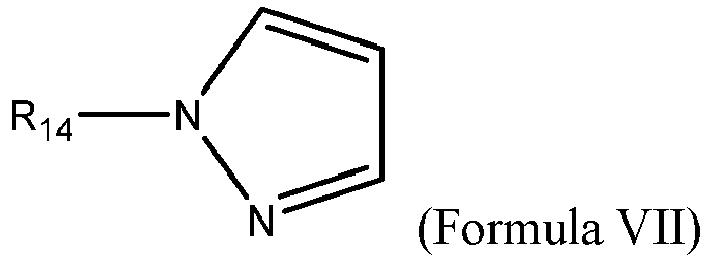
- B) a solvent;
- C) a base comprising
- a compound comprising a metal; and
- optionally a first amine base; and
- D) optionally a second amine base; and
- A) a compound of Formula VII, wherein
- II) reacting the mixture with a halogenation reagent.
- I) forming a mixture comprising
- Embodiment 203. The method of embodiment 202, wherein the halogenation reagent is selected from bromine, N-bromosuccinimide, 1,3-dibromo-5,5-dimethylhylhydantoin, 1,2-dibromotetrachloroethane, tetrabutylammonium tribromide, quaternary ammonium salts of tribromide, 1,2-dibromotrichloroethane, diethyl dibromomalonate, and combinations thereof.
- Embodiment 204. The method of embodiment 202, wherein the solvent is selected from THF, toluene, 1,4-dioxane, Me-THF, and combinations thereof.
- Embodiment 205. The method of embodiment 202, wherein the compound comprising a metal is a Grignard reagent.
- Embodiment 206. The method of embodiment 202, wherein the compound comprising a metal is selected from iPr2NMgCl, iPr2NMgBr, Et2NMgCl, TMPMgCl, TMPMgCl•LiCl, iPr2NMgCl•LiCl, iPr2NMgBr•LiCl, MeMgCl, MeMgBr, iPrMgCl, iPrMgBr, nBuMgCl, nBuMgBr, tBuMgCl, and combinations thereof.
- Embodiment 207. The method of embodiment 202, wherein the first amine base and the second amine base are each independently selected from iPr2NH, TMP, Et2NH, c-hexyl2NH, and combinations thereof.
- Embodiment 208. The method of embodiment 202, wherein at least one of the first amine base and the second amine base are present in an amount relative to the compound comprising a metal in the range of about 1 mol% to about 90 mol%.
- Embodiment 209. The method of embodiment 208, wherein at least one of the first amine base and the second amine base are present in an amount relative to the compound comprising a metal in the range of about 5 mol% to about 50 mol%.
- Embodiment 210. The method of embodiment 209, wherein at least one of the first amine base and the second amine base are present in an amount relative to the compound comprising a metal in the range of about 10 mol% to about 20 mol%.
- Embodiment 211. The method of embodiment 202, wherein the method step of reacting the mixture occurs at a reaction temperature in the range of about 0 °C to about 60 °C.
- Embodiment 212. The method of embodiment 211, wherein the method step of reacting the mixture occurs at a reaction temperature in the range of about 40 °C to about 50 °C.
- Embodiment 213. The method of embodiment 202, wherein the method produces a mixture of compounds of Formula VIII.
- Embodiment 214. The method of embodiment 202, wherein the method produces a compound selected from

- Embodiment 215. The method of embodiment 202, wherein R14 is tetrahydropyranyl.
- Embodiment 216. The method of embodiment 202, wherein the compound of Formula VII is prepared according to a method comprising
- I) forming a mixture comprising
- A) pyrazole or a pyrazole derivative;
- B) a cycloalkene or heterocycloalkene;
- C) optionally a solvent; and
- D) an acid; and
- II) reacting the mixture.
- I) forming a mixture comprising
- Embodiment 217. The method of embodiment 216, wherein the cycloalkene or heterocycloalkene is selected from 3,4-dihydropyran, 3,6-dihydropyran, cyclohexene, and combinations thereof.
- Embodiment 218. The method of embodiment 216, wherein the solvent is selected from toluene, xylene, heptanes, and combinations thereof.
- Embodiment 219. The method of embodiment 216, wherein the acid is selected from organic acid, inorganic acid, and combinations thereof.
- Embodiment 220. The method of embodiment 216, wherein the acid is selected from trifluoroacetic acid, sulfuric acid, p-toluenesulfonic acid, methylsulfonic acid, hydrochloric acid, hydrobromic acid, phosphoric acid, and combinations thereof.
- Embodiment 221. The method of embodiment 216, wherein the method step of reacting the mixture occurs at a reaction temperature in the range of about 25 °C to about 120 °C.
- Embodiment 222. The method of embodiment 221, wherein the method step of reacting the mixture occurs at a reaction temperature in the range of about 60 °C to about 95 °C.
- In one aspect, a compound of Formula VI is prepared according to a method represented by Scheme 1. The R groups are as defined anywhere in this disclosure.

- In one aspect, a compound of Formula VI is prepared according to a method represented by Scheme 2. The R groups are as defined anywhere in this disclosure.


- In one aspect, 5-Bromo-2-(3-chloro-pyridin-2-yl)-2H-pyrazole-3-carboxylic acid is prepared according to a method represented by Scheme 3.

- In one aspect, 5-Bromo-2-(3-chloro-pyridin-2-yl)-2H-pyrazole-3-carboxylic acid is prepared according to a method represented by Scheme 4.

- In one aspect, 5-Bromo-2-(3-chloro-pyridin-2-yl)-2H-pyrazole-3-carboxylic acid is prepared according to a method represented by Scheme 5.

- In one aspect, 5-Bromo-2-(3-chloro-pyridin-2-yl)-2H-pyrazole-3-carboxylic acid is prepared according to a method represented by Scheme 6.


- In one aspect, a compound of Formula VII is prepared according to a method represented by Scheme 7. The R groups are as defined anywhere in this disclosure.

- This aspect includes reacting pyrazole with 3,4-dihydropyran (DHP) in the presence of an acid and optionally in an organic solvent. In one embodiment, the organic solvent is selected from toluene, xylene, heptane, and combinations thereof. In another embodiment, the organic solvent is toluene. In one embodiment, the acid is selected from organic acid, inorganic acid, and combinations thereof. In another embodiment, the acid is selected from trifluoroacetic acid, sulfuric acid, p-toluenesulfonic acid, methylsulfonic acid, hydrochloric acid, hydrobromic acid, phosphoric acid, and combinations thereof. In one embodiment, the acid is used in a catalytic amount. In another embodiment, the acid is used in a catalytic amount in the range from about 1 mol% to about 10 mol%. In another embodiment, the acid is a catalytic amount of trifluoroacetic acid or sulfuric acid. In one embodiment, the reaction temperature is in the range from about 25 °C to about 120 °C. In another embodiment, the reaction temperature is in the range from about 60 °C to about 95 °C.
- In one aspect, a compound of Formula VIII is prepared according to a method represented by Scheme 8. The R groups are as defined anywhere in this disclosure.

- This aspect includes reacting a compound of Formula VII with a base reagent in an organic solvent, followed by a halogenation reagent. In one embodiment, the compound of Formula VII, an organic solvent, and a base reagent are mixed first to form a metalated intermediate, and then the resulting mixture is reacted with a halogenation reagent. In one embodiment, the halogenation reagent is selected from Br2, N-bromosuccinimide, 1,3-Dibromo-5,5-dimethylhylhydantoin, DBTCE, and combinations thereof. In another embodiment, the halogenation reagent is selected from bromine, N-bromosuccinimide, 1,3-dibromo-5,5-dimethylhylhydantoin, 1,2-dibromotetrachloroethane, tetrabutylammonium tribromide, quaternary ammonium salts of tribromide, 1,2-dibromotrichloroethane, diethyl dibromomalonate, and combinations thereof. In another embodiment, the halogenation reagent is DBTCE. In one embodiment, the solvent is selected from THF, toluene, 1,4-dioxane, 2-Me-THF, and combinations thereof. In another embodiment, the solvent is THF. In one embodiment, the base reagent is selected from iPr2NMgCl, iPr2NMgBr, Et2NMgCl, TMPMgCl, TMPMgCl•LiCl, iPriNMgCl•LiCl, iPr2NMgBr•LiCl, and combinations thereof. In another embodiment, the base reagent is iPr2NMgCl. In another embodiment, the base reagent is selected from a combination of a Grignard reagent, such as MeMgCl, MeMgBr, iPrMgCl, iPrMgBr, nBuMgCl, nBuMgBr, tBuMgCl, and combinations thereof and an amine base, such as iPr2NH, TMP, Et2NH, c-Hexyl2NH, and combinations thereof. In another embodiment, the base reagent is selected from a combination of a Grignard reagent and a catalytic amount of an amine base. In another embodiment, the base reagent is selected from a combination of a Grignard reagent and a catalytic amount of an amine base, wherein the catalytic amount of the amine base in is the range from about 1 mol% to about 90 mol%. In another embodiment, the base reagent is selected from a combination of a Grignard reagent and a catalytic amount of an amine base, wherein the catalytic amount of the amine base in is the range from about 5 mol% to about 50 mol%. In another embodiment, the base reagent is selected from a combination of a Grignard reagent and a catalytic amount of an amine base, wherein the catalytic amount of the amine base in is the range from about 10 mol% to about 20 mol%. In another embodiment, the base reagent is a combination of MeMgCl with a catalytic amount of iPr2NH. In one embodiment, the reaction temperature is in the range from about 0 °C to about 60 °C. In another embodiment, the reaction temperature is in the range from about 40 °C to about 50 °C. In one embodiment, this aspect produces two distinct compounds of Formula VIII. In another embodiment, this aspect produces two distinct compounds of Formula VIII, wherein the distinct compounds of Formula VIII are isomers. In another embodiment, the two distinct compounds of Formula VIII are 5-bromo-1-(tetrahydro-2H-pyran-2-yl)-1H-pyrazole and 3-bromo-1-(tetrahydro-2H-pyran-2-yl)-1H-pyrazole.
- In one aspect, a compound of Formula II is prepared according to a method represented by Scheme 9. The R groups are as defined anywhere in this disclosure.

- This aspect includes reacting a compound of Formula VIII with an acid in an organic solvent. In one embodiment, the organic solvent is selected from MeOH, EtOH, iPrOH, toluene, 1,4-dioxane, THF, and combinations thereof. In another embodiment, the solvent is MeOH. In one embodiment, the acid is selected from hydrochloric acid, sulfuric acid, phosphoric acid, methylsulfonic acid, trifluoroacetic acid, hydrobromic acid, and combinations thereof. In another embodiment, the acid is MeSOsH. In one embodiment, the reaction temperature is in the range from about 20 °C to 150 °C. In another embodiment, the reaction temperature is in the range from about 20 °C to 50 °C. In one embodiment, this aspect includes reacting at least two distinct compounds of Formula VIII. In another embodiment, this aspect includes reacting 5-bromo-1-(tetrahydro-2H-pyran-2-yl)-1H-pyrazole and 3-bromo-1-(tetrahydro-2H-pyran-2-yl)-1H-pyrazole.
- In one aspect, a compound of Formula III is prepared according to a method represented by Scheme 10. The R groups are as defined anywhere in this disclosure.

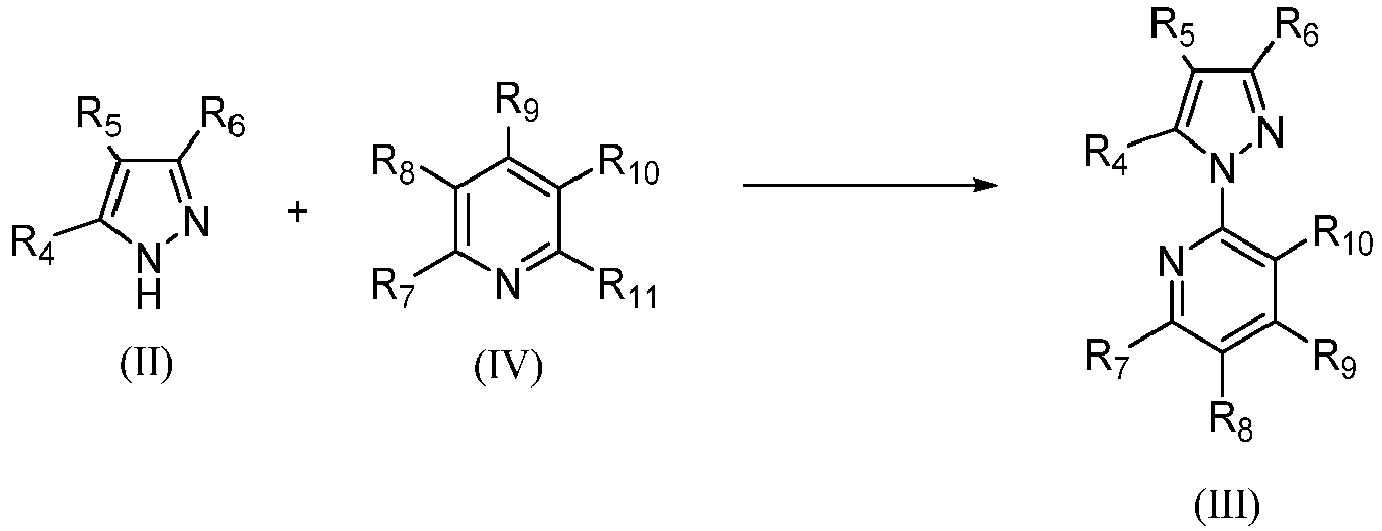
- This aspect includes mixing a compound of Formula II with a compound of Formula IV in a solvent in the presence of an inorganic base and optionally an additive. In one embodiment, the inorganic base is selected from powder sodium hydroxide, powder potassium hydroxide, potassium carbonate, potassium phosphate powder sodium methoxide, powder potassium t-butoxide, and combinations thereof. In another embodiment, the inorganic base is powdered potassium phosphate. In one embodiment, the solvent is selected from toluene, N,N-Dimethylformamide (DMF), N,N-Dimethylacetamide (DMAc), N-methyl-2-pyrrolidone (NMP), acetonitrile, and combinations thereof. In another embodiment, the solvent is acetonitrile. In one embodiment, the reaction temperature is in the range from about 100 °C to about 200 °C. In another embodiment, the reaction temperature is in the range from about 100 °C to about 180 °C. In another embodiment, the reaction temperature is in the range from about 130 °C to about 180 °C. In another embodiment, the temperature is in the range from about 145 °C to about 160 °C. In another embodiment, the temperature is in the range from about 135 °C to about 145 °C.
- In one aspect, a compound of Formula VI is prepared according to a method represented by Scheme 11. The R groups are as defined anywhere in this disclosure.

- This aspect includes mixing a compound of Formula III with CO2 in a solvent in the presence of a base reagent and optionally an additive. In one embodiment, the compound of Formula III, a solvent, a base reagent, and optionally an additive are mixed first to form a metalated intermediate, and then the resulting mixture is reacted with CO2. In one embodiment, the compound of Formula III, a solvent, a base reagent, optionally an additive, and CO2 are concurrently mixed and subsequently reacted. In one embodiment, the base reagent is selected from iPr2NMgCl, iPr2NMgBr, Et2NMgCl, TMPMgCl, TMPMgCl•LiCl, iPr2NMgCl•LiCl, iPr2NMgBr•LiCl, and combinations thereof. In another embodiment, the base reagent is iPr2NMgCl. In one embodiment, the base reagent is selected from a combination of a Grignard reagent and an amine base. In another embodiment, the base reagent is selected from a combination of a Grignard reagent and a catalytic amount of an amine base. In another embodiment, the base reagent is selected from a combination of a Grignard reagent selected from MeMgCl, MeMgBr, iPrMgCl, iPrMgBr, nBuMgCl, nBuMgBr, tBuMgCl, and combinations thereof, and a catalytic amount of an amine base selected from iPr2NH, TMP, Et2NH, hexamethyldisilazane (HMDS), c-Hexyl2NH, and combinations thereof. In other embodiment, the base reagent is a combination of MeMgCl and iPr2NH. In one embodiment, the solvent is selected from THF, toluene, 1,4-dioxane, Me-THF, and combinations thereof. In another embodiment, the solvent is THF. In another embodiment, the solvent is THF. In one embodiment, the reaction temperature is in the range from about 0 °C to about 60 °C. In another embodiment, the temperature is in the range from about 0 °C to about 30 °C. In another embodiment, the temperature is in the range from about 10 °C to about 20 °C. In one embodiment, the additive is selected from LiCl, TMEDA, and combinations thereof.
- In one aspect, a compound of Formula V is prepared according to a method represented by Scheme 12. The R groups are as defined anywhere in this disclosure.


- This aspect includes mixing a compound of Formula III with dimethyl carbonate (DMC) in a solvent in the presence of a base reagent and optionally an additive. In one embodiment, the compound of Formula III, a solvent, a base reagent, and optionally an additive are mixed first to form a metalated intermediate, and then the resulting mixture is reacted with dimethyl carbonate. In one embodiment, the compound of Formula III, a solvent, a base reagent, optionally an additive, and dimethyl carbonate are concurrently mixed and subsequently reacted.
- In one embodiment, the base reagent is selected from iPr2NMgCl, iPr2NMgBr, Et2NMgCl, TMPMgCl, TMPMgCl•LiCl, iPr2NMgCl•LiCl, iPr2NMgBr•LiCl, and combinations thereof. In another embodiment, the base reagent is iPr2NMgCl. In one embodiment, the base reagent is selected from a combination of a Grignard reagent and an amine base. In another embodiment, the base reagent is selected from a combination of a Grignard reagent and a catalytic amount of an amine base. In another embodiment, the base reagent is selected from a combination of a Grignard reagent selected from MeMgCl, MeMgBr, iPrMgCl, iPrMgBr, nBuMgCl, nBuMgBr, tBuMgCl, and combinations thereof, and a catalytic amount of an amine base selected from iPr2NH, TMP, Et2NH, hexamethyldisilazane (HMDS), c-Hexyl2NH, and combinations thereof. In other embodiment, the base reagent is a combination of MeMgCl and iPr2NH. In one embodiment, the solvent is selected from THF, toluene, 1,4-dioxane, Me-THF, and combinations thereof. In another embodiment, the solvent is THF. In one embodiment, the reaction temperature is in the range from about 0 °C to about 50 °C. In another embodiment, the temperature is in the range from about 10 °C to about 25 °C. In one embodiment, the additive is selected from LiCl, TMEDA, and combinations thereof.
- In one aspect, a compound of Formula VI is prepared according to a method represented by Scheme 13. The R groups are as defined anywhere in this disclosure.

- This aspect includes reacting a compound of Formula V with an aqueous metal hydroxide solution. In one embodiment, the metal hydroxide is selected from alkali hydroxide, alkaline earth metal hydroxide, and combinations thereof. In one embodiment, the alkali hydroxide is selected from lithium hydroxide, sodium hydroxide, potassium hydroxide, and combinations. In one embodiment, the alkaline earth metal hydroxide is selected from calcium hydroxide, barium hydroxide, and combinations thereof. In another embodiment, the metal hydroxide is sodium hydroxide or potassium hydroxide. In one embodiment, the reaction temperature is in the range from about 0 °C to about 90 °C. In another embodiment, the reaction temperature is in the range from about 30 °C to about 60 °C. In another embodiment, the reaction temperature is in the range from about 60 °C to about 80 °C. In another embodiment, the reaction temperature is in the range from about 40 °C to about 70 °C.
- Without further elaboration, it is believed that one skilled in the art using the preceding description can utilize the present invention to its fullest extent. The following Examples are, therefore, to be construed as merely illustrative, and not limiting of the disclosure in any way whatsoever. The starting material for the following Examples may not have necessarily been prepared by a particular preparative run whose procedure is described in other Examples. It also is understood that any numerical range recited herein includes all values from the lower value to the upper value. For example, if a range is stated as 10-50, it is intended that values such as 12-30, 20-40, or 30-50, etc., are expressly enumerated in this specification. These are only examples of what is specifically intended, and all possible combinations of numerical values between and including the lowest value and the highest value enumerated are to be considered to be expressly stated in this application.
- 0.2 mL of trifluoracetic acid (TFA) was added to a mixture of 23.2 g pyrazole and 31.5 g of DHP over 1 minute. The resulting mixture was self-heated to over 130 °C initially. The reaction was held at 130 °C for 1 hour. The crude light brown oil was purified by distillation under reduced pressure. 47 grams of clear liquid was collected at 90 °C.
- 1.46 grams of p-toluenesulfonic acid monohydrate was added to a mixture of 104.7 g pyrazole and 350 mL of toluene, and subsequently heated to 87 °C. Next, 145 g of 3,4-dihydro-2H-pyran was added over 30 minutes. The resulting mixture was stirred between 90 and 95 °C for 2.5 hours. After cooling to 30 °C, the solution was washed with 300 mL of saturated sodium bicarbonate aqueous solution and concentrated to a yellow oil (242 g).
- 5 mL of iPr2NH and 120 mL of 1.3 M iPrMgCl/LiCl in THF was added to a solution of 19.4 g of 1-(tetrahydro-2H-pyran-2-yl)-1H-pyrazole in 225 mL THF over 1 hour at room temperature. The temperature was maintained at a temperature from 19 °C to 27 °C during addition. The resulting mixture was stirred overnight at room temperature. After cooling to 5 °C, a solution of 1,2-dibromotetrachloroethane (51 g in 100 mL THF) was added over 30 min, during which the temperature was maintained below 10 °C. After warming to room temperature, saturated NH4Cl (aq) was added. The organic layer was separated and concentrated to afford a dark oil comprising 5-bromo-1-(tetrahydro-2H-pyran-2-yl)-1H-pyrazole and 3-bromo-1-(tetrahydro-2H-pyran-2-yl)-1H-pyrazole.
- 2.0 mL of iPr2NH and 50 mL of 3 M MeMgCl in THF was added to a solution of 18.3 g of 1-(tetrahydro-2H-pyran-2-yl)-1H-pyrazole in 210 mL THF over 10 minutes at room temperature. The resulting mixture was stirred at 50 °C for 2 hours. After cooling to 10 °C, a solution of 1,2-dibromotetrachloroethane (43 g in 70 mL THF) was added over 20 min. After warming to room temperature, 300 mL of water and 20 mL of 2 N HCl was added. The organic layer was separated and concentrated to afford a brown oil comprising 5-bromo-1-(tetrahydro-2H-pyran-2-yl)-1H-pyrazole and 3-bromo-1-(tetrahydro-2H-pyran-2-yl)-1H-pyrazole.
- 6.2 mL of iPr2NH was added to a solution of 71 g of 1-(tetrahydro-2H-pyran-2-yl)-1H-pyrazole in 800 mL THF at room temperature. 200 mL of 3 M MeMgCl in THF was then added over 30 minutes. The resulting mixture was stirred at room temperature for 20 hours. After cooling to 6 °C, 148 g of 1,2-dibromotetrachloroethane solid was added portion-wise over 30 minutes, during which the temperature was maintained below 15 °C. Next, the mixture was stirred at 15 °C for 1 hour, and then a solution of 60 g NaOAc in 300 mL water was added. The organic layer was separated and concentrated to 122.7 g of dark brown oil comprising 5-bromo-1-(tetrahydro-2H-pyran-2-yl)-1H-pyrazole as a major component and 3-bromo-1-(tetrahydro-2H-pyran-2-yl)-1H-pyrazole as a minor component. After standing at room temperature for 3 days, 5-bromo-1-(tetrahydro-2H-pyran-2-yl)-1H-pyrazole was isomerized to 3-bromo-1-(tetrahydro-2H-pyran-2-yl)-1H-pyrazole. 85.2 g of 3-bromo-1-(tetrahydro-2H-pyran-2-yl)-1H-pyrazole was obtained after purification by column chromatography.
- To 12 g of crude oil (5-bromo-1-(tetrahydro-2H-pyran-2-yl)-1H-pyrazole containing 3-bromo-1-(tetrahydro-2H-pyran-2-yl)-1H-pyrazole), 50 mL of MeOH and 50 mL of 3 M HCl in MeOh was added. The resulting mixture was stirred at room temperature for four hours, and then concentrated on rotavapor. The residue was diluted with 100 mL of EtOAc, washed with saturated NaHCOs, and concentrated to afford 11 g of crude 3-bromo-1H-pyrazole.
- To 2 g of crude oil (5-bromo-1-(tetrahydro-2H-pyran-2-yl)-1H-pyrazole), 20 mL of MeOH and 1 mL of MeSO3H was added. The resulting mixture was stirred at room temperature for two hours, and then concentrated on rotavapor. The residue was diluted with 20 mL of EtOAc, washed with saturated NaHCO3, and concentrated to afford 1.6 g of crude 3-bromo-1H-pyrazole.
- To a solution of 109.7 g of crude oil (5-bromo-1-(tetrahydro-2H-pyran-2-yl)-1H-pyrazole containing 3-bromo-1-(tetrahydro-2H-pyran-2-yl)-1H-pyrazole) in 8000 mL MeOH, 96.2 g of MeSO3H was added. The resulting mixture was stirred at room temperature for two hours, and then concentrated to a dark oil. With agitation, 3 N NaOH was added until the pH was about 8. Next, NaCl solid was added until saturation and then extracted with 300 mL of EtOAc. The organic layer was separated and concentrated to afford 64.6 g of crude 3-bromo-1H-pyrazole as a brown oil.
- 151 g of 2,3-dichloropyridine (151 g), 135.9 g of 3-bromo-1H-pyrazole, 210 g of powdered K3PO4, and 700 mL of CH3CN were charged into an autoclave. The mixture was sealed and stirred at 140 °C for 8 hours. After cooling to room temperature, 400 mL of water was added and the organic layer was separated. The solvent was removed by distillation to afford 220 g of 2-(3-bromo-1H-pyrazol-1-yl)-3-chloropyridine as a solid.
- 9.3 mL of a 1.0 M TMPMgCl•LiCl solution in THF was added to a solution of 2.04 g 2-(3-bromo-1H-pyrazol-1-yl)-3-chloropyridine in 28 mL of THF at 8 °C over 30 minutes. The resulting mixture was stirred at 10 °C for 2 hours. Gaseous CO2 was introduced into the solution for 5 minutes, and then 100 mL water was added, and the pH was adjusted to about 9 by adding 1N NaOH aqueous solution. The resulting solution was washed with 50 mL toluene and the aqueous layer was acidified by 2N HCl (aq) to a pH of about 3, and subsequently extracted with 50 mL EtOAc. The organic phase was separated and concentrated to provide 1.9 g of 5-bromo-2-(3-chloro-pyridin-2-yl)-2H-pyrazole-3-carboxylic acid as an off-white solid.
- 22 mL of a 0.4 M iPr2NMgCl•LiCl solution in THF (freshly prepared from iPr2NH and zPrMgCl.LiCl in THF overnight at room temperature) was added to a solution of 2.0 g 2-(3-bromo-1H-pyrazol-1-yl)-3-chloropyridine in 20 mL of THF at 2 °C over 10 minutes. The resulting mixture was stirred at 5 °C for 3 hours. Gaseous CO2 was introduced into the solution for 5 minutes, and then 50 mL water was added, and the pH was adjusted to about 9 by adding 1N NaOH aqueous solution. An extraction with 30 mL toluene afforded 1.23 g of recovered 2-(3-bromo-1H-pyrazol-1-yl)-3-chloropyridine. The aqueous layer was acidified by 2N HCl (aq) to a pH of about 2, and subsequently extracted with 50 mL EtOAc to afford 0.82 g of 5-bromo-2-(3-chloro-pyridin-2-yl)-2H-pyrazole-3-carboxylic acid as a beige solid.
- 4.0 mL of a 3 M MeMgCl solution in THF was added to a solution of 2.0 g 2-(3-bromo-1H-pyrazol-1-yl)-3-chloropyridine in 20 mL of toluene, 0.39 mL HMDS, and 1.3 mL TMEDA at 7.5 °C over 10 minutes. The resulting mixture was stirred at 7 °C overnight (17 hours). Gaseous CO2 was introduced into the solution for 5 minutes, and then 50 mL water was added, and the pH was adjusted to about 9. The organic phase was separated and concentrated to afford 0.71 g of recovered 2-(3-bromo-1H-pyrazol-1-yl)-3-chloropyridine as a yellow solid. The aqueous layer was acidified by 2N HCl (aq) to a pH of about 2, and subsequently extracted with 20 mL EtOAc to afford 0.77 g of 5-bromo-2-(3-chloro-pyridin-2-yl)-2H-pyrazole-3-carboxylic acid.
- A mixture of iPr2NMgCl in THF (prepared from 8 mL iPr2NH and 18 mL of a 3 M MeMgCl solution in THF) was added to a solution of 10.0 g 2-(3-bromo-1H-pyrazol-1-yl)-3-chloropyridine in 40 mL of toluene and 6.0 mL TMEDA at 0 °C over 10 minutes. The resulting mixture was stirred at 0 °C for 3 hours. Gaseous CO2 was introduced into the solution for 10 minutes, and then 100 mL water was added, and the pH was adjusted to about 9. The organic phase was separated and concentrated to afford 6.6 g of recovered 2-(3-bromo-1H-pyrazol-1-yl)-3-chloropyridine. The aqueous layer was acidified by 2N HCl (aq) to a pH of about 2, and the slurry was filtered and dried to afford 3.2 g of 5-bromo-2-(3-chloro-pyridin-2-yl)-2H-pyrazole-3-carboxylic acid as a yellow solid.
- A mixture of iPr2NMgCl in THF (prepared from 32 g iPr2NH and 98 mL of a 3 M MeMgCl solution in THF) was added to a solution of 60.0 g 2-(3-bromo-1H-pyrazol-1-yl)-3-chloropyridine and 11 g LiCl in 300 mL THF and 50 mL toluene at 5 °C over 45 minutes. The resulting mixture was stirred at 8 °C to 15 °C for 6 hours. Gaseous CO2 was introduced into the solution for 15 minutes, and then 100 mL water was added, and the pH was adjusted to about 1 with 2 N HCl. The organic phase was separated and concentrated by rotary evaporation. The residue was treated with 200 mL 2N NaOH and extracted with 100 mL toluene to afford 17.2 g of recovered 2-(3-bromo-1H-pyrazol-1-yl)-3-chloropyridine. The aqueous layer was acidified by 2N HCl (aq) to a pH of about 1, and the slurry was filtered and dried to afford 46 g of 5-bromo-2-(3-chloro-pyridin-2-yl)-2H-pyrazole-3-carboxylic acid.
- A mixture of iPr2NMgCl in THF (prepared from mixing 10.9 g iPr2NH and 35 mL of a 3 M MeMgCl solution in THF in 50 mL THF at 50 °C for 3 hours) was added to a solution of 20.1 g 2-(3-bromo-1H-pyrazol-1-yl)-3-chloropyridine and 3.6 g LiCl in 100 mL THF at 5 °C over 30 minutes. The resulting mixture was stirred at 10 °C for 3 hours, and then 60 mL dimethyl carbonate was added. The resulting mixture was stirred at 45 °C for 3 hours. 200 mL 1 N HCl was added, and the organic phase was separated and concentrated to 27 g crude methyl 3-bromo-1-(3-chloropyridin-2-yl)-1H-pyrazole-5-carboxylate. 80 mL toluene and 200 mL 1 N NaOH was added and the mixture was stirred at 60 °C for 3 hours. The aqueous phase was separated and acidified with concentrated HCL to a pH of about 1, and then the solid was filtered and dried to afford 16.1 g of 5-bromo-2-(3-chloro-pyridin-2-yl)-2H-pyrazole-3-carboxylic acid as a solid.
- This written description uses examples to illustrate the present disclosure, including the best mode, and also to enable any person skilled in the art to practice the disclosure, including making and using any devices or systems and performing any incorporated methods. The patentable scope of the disclosure is defined by the claims, and may include other examples that occur to those skilled in the art. Such other examples are intended to be within the scope of the claims if they have structural elements that do not differ from the literal language of the claims, or if they include equivalent structural elements with insubstantial differences from the literal language of the claims.
- Further aspects of the invention (Aspects A1-A19) are as follows:
- A1. A method of preparing a compound of Formula VI, wherein

- each of R5 - R10 is independently selected from hydrogen and halogen; and
- R13 is an organic acid, the method comprising
- I) forming a mixture comprising
- A) a compound of Formula V, wherein

- each of R5 - R10 is independently selected from hydrogen and halogen;
- R12 is selected from ether, ester, and nitrile; and
- wherein the compound of Formula V is prepared according to a method comprising
- i) forming a mixture comprising
- a) a compound of Formula III, wherein

- R4 is hydrogen;
- each of R5 - R10 is independently selected from hydrogen and halogen; and
- wherein the compound of Formula III is prepared according to a method comprising
- IA) forming a mixture comprising
- AA) a compound of Formula II, wherein

- each of R4, R5, and R6 is independently selected from hydrogen and halogen;
- wherein at least one of R4, Rs, and R6 is hydrogen; and
- wherein the compound of Formula II is prepared according to a method comprising
- ia) forming a mixture comprising
- aa) a compound of Formula VIII, wherein

- R14 is selected from substituted or unsubstituted carbocycle and substituted or unsubstituted heterocycle;
- each of R15, R16, and R17 is independently selected from hydrogen and halogen; and
- wherein at least one of R15, R16, and R17 is a halogen;
- bb) a solvent; and
- cc) an acid; and
- aa) a compound of Formula VIII, wherein
- iia) reacting the mixture;
- ia) forming a mixture comprising
- BB) a compound of Formula IV, wherein

- CC) a solvent;
- DD) an inorganic base; and
- EE) optionally an additive; and
- AA) a compound of Formula II, wherein
- IIA) reacting the mixture;
- IA) forming a mixture comprising
- b) a solvent;
- c) a base comprising
- a compound comprising a metal; and
- optionally a first amine base;
- d) optionally an additive; and
- e) optionally a second amine base; and
- a) a compound of Formula III, wherein
- i) forming a mixture comprising
- ii) reacting the mixture with an organic compound; and
- B) a metal hydroxide; and
- A) a compound of Formula V, wherein
- II) reacting the mixture.
- I) forming a mixture comprising
- A2. The method of Aspect A1, wherein the metal hydroxide is selected from alkali hydroxide, alkaline earth metal hydroxide, and combinations thereof.
- A3. The method of Aspect A1, wherein the method step II) of reacting the mixture occurs at a reaction temperature in the range of about 0 °C to about 90 °C.
- A4. The method of Aspect A1, wherein the compound comprising a metal is a Grignard reagent.
- A5. The method of Aspect A1, wherein the first amine base and the second amine base are each independently selected from iPr2NH, TMP, hexamethyldisilazane, Et2NH, c-hexyl2NH, and combinations thereof.
- A6. The method of Aspect A1, wherein the solvent b) is selected from THF, toluene, 1,4-dioxane, Me-THF, and combinations thereof.
- A7. The method of Aspect A1, wherein the method step ii) of reacting the mixture occurs at a reaction temperature in the range of about 0 °C to about 50 °C.
- A8. The method of Aspect A1, wherein the compound of Formula VIII is prepared according to a method comprising
- I) forming a mixture comprising
- A) a compound of Formula VII, wherein

- B) a solvent;
- C) a base comprising
- a compound comprising a metal; and
- optionally a first amine base; and
- D) optionally a second amine base; and
- A) a compound of Formula VII, wherein
- II) reacting the mixture with a halogenation reagent.
- I) forming a mixture comprising
- A9. The method of Aspect A8, wherein the method produces a compound selected from

- A10. A method of preparing a compound of Formula VI, wherein

- each of R5 - R10 is independently selected from hydrogen and halogen; and
- R13 is an organic acid, the method comprising
- I) forming a mixture comprising
- A) a compound of Formula III, wherein

- R4 is hydrogen;
- each of R5 - R10 is independently selected from hydrogen and halogen; and
- wherein the compound of Formula III is prepared according to a method comprising
- i) forming a mixture comprising
- a) a compound of Formula II, wherein

- each of R4, R5, and R6 is independently selected from hydrogen and halogen;
- wherein at least one of R4, Rs, and R6 is hydrogen; and
- wherein the compound of Formula II is prepared according to a method comprising
- IA) forming a mixture comprising
- AA) a compound of Formula VIII, wherein

- R14 is selected from substituted or unsubstituted carbocycle and substituted or unsubstituted heterocycle;
- each of R15, R16, and R17 is independently selected from hydrogen and halogen; and
- wherein at least one of R15, R16, and R17 is a halogen;
- BB) a solvent; and
- CC) an acid; and
- AA) a compound of Formula VIII, wherein
- IIa) reacting the mixture;
- b) a compound of Formula IV, wherein

- c) a solvent;
- d) an inorganic base; and
- e) optionally an additive; and
- IA) forming a mixture comprising
- a) a compound of Formula II, wherein
- ii) reacting the mixture;
- i) forming a mixture comprising
- B) a solvent;
- C) a base comprising
- a compound comprising a metal; and
- optionally a first amine base;
- D) optionally an additive; and
- E) optionally a second amine base; and
- A) a compound of Formula III, wherein
- II) reacting the mixture with a carbonyl-containing compound.
- I) forming a mixture comprising
- A11. The method of Aspect A10, wherein the compound comprising a metal is a Grignard reagent.
- A12. A method of preparing a compound of Formula II, wherein

- each of R4, R5, and R6 is independently selected from hydrogen and halogen; and
- wherein at least one of R4, Rs, and R6 is hydrogen, the method comprising
- I) forming a mixture comprising
- A) a compound of Formula VIII, wherein

- R14 is selected from substituted or unsubstituted carbocycle and substituted or unsubstituted heterocycle;
- each of R15, R16, and R17 is independently selected from hydrogen and halogen; and
- wherein at least one of R15, R16, and R17 is a halogen;
- B) a solvent; and
- C) an acid; and
- A) a compound of Formula VIII, wherein
- II) reacting the mixture.
- I) forming a mixture comprising
- A13. The method of Aspect A12, wherein the solvent is selected from methanol, ethanol, isopropanol, toluene, 1,4-dioxane, tetrahydrofuran, and combinations thereof.
- A14. A method of preparing a compound of Formula VII, wherein

- I) forming a mixture comprising
- A) pyrazole or a pyrazole derivative;
- B) a cycloalkene or heterocycloalkene;
- C) optionally a solvent; and
- D) an acid; and
- II) reacting the mixture.
- I) forming a mixture comprising
- A15. A method of preparing a compound of Formula VIII, wherein

- R14 is selected from substituted or unsubstituted carbocycle and substituted or unsubstituted heterocycle;
- each of R15, R16, and R17 is independently selected from hydrogen and halogen; and
- wherein at least one of R15, R16, and R17 is a halogen, the method comprising
- I) forming a mixture comprising
- A) the compound of Formula VII, wherein
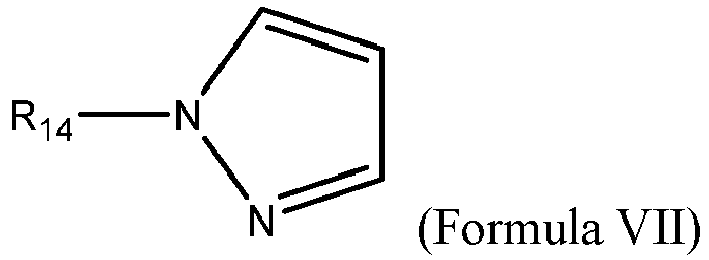
- B) a solvent;
- C) a base comprising
- a compound comprising a metal; and
- optionally a first amine base; and
- D) optionally a second amine base; and
- A) the compound of Formula VII, wherein
- II) reacting the mixture with a halogenation reagent.
- I) forming a mixture comprising
- A16. The method of Aspect A15, wherein the compound comprising a metal is a Grignard reagent.
- A17. A method of preparing a compound of Formula V, wherein

- each of R5 - R10 is independently selected from hydrogen and halogen; and
- R12 is selected from ether, ester, and nitrile, the method comprising
- i) forming a mixture comprising
- a) a compound of Formula III, wherein
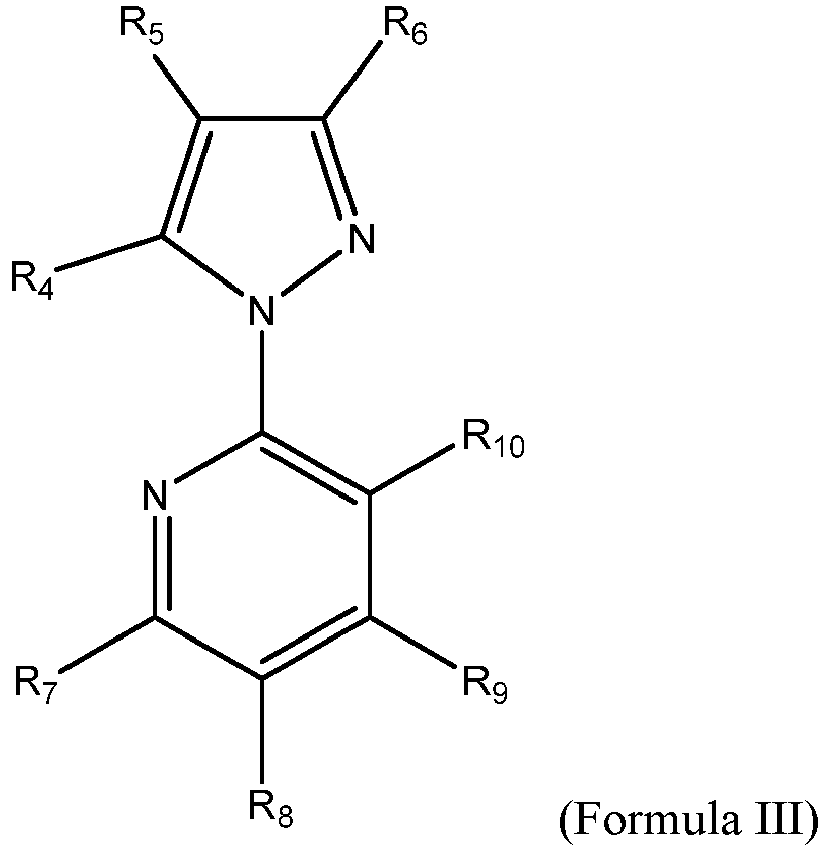
- R4 is hydrogen;
- each of R5 - R10 is independently selected from hydrogen and halogen; and
- wherein the compound of Formula III is prepared according to a method comprising
- IA) forming a mixture comprising
- AA) a compound of Formula II, wherein

- each of R4, R5, and R6 is independently selected from hydrogen and halogen;
- wherein at least one of R4, Rs, and R6 is hydrogen; and
- wherein the compound of Formula II is prepared according to a method comprising
- ia) forming a mixture comprising
- aa) a compound of Formula VIII, wherein

- R14 is selected from substituted or unsubstituted carbocycle and substituted or unsubstituted heterocycle;
- each of R15, R16, and R17 is independently selected from hydrogen and halogen; and
- wherein at least one of R15, R16, and R17 is a halogen;
- bb) a solvent; and
- cc) an acid; and
- aa) a compound of Formula VIII, wherein
- iia) reacting the mixture;
- ia) forming a mixture comprising
- BB) a compound of Formula IV, wherein

- CC) a solvent;
- DD) an inorganic base; and
- EE) optionally an additive; and
- AA) a compound of Formula II, wherein
- IIA) reacting the mixture;
- IA) forming a mixture comprising
- b) a solvent;
- c) a base comprising
- a compound comprising a metal; and
- optionally a first amine base;
- d) optionally an additive; and
- e) optionally a second amine base; and
- a) a compound of Formula III, wherein
- ii) reacting the mixture with an organic compound.
- i) forming a mixture comprising
- A18. The method of Aspect A17, wherein the compound comprising a metal is a Grignard reagent.
- A19. A method of preparing a compound of Formula III, wherein

- R4 is hydrogen; and
- each of R5 - R10 is independently selected from hydrogen and halogen, the method comprising
- i) forming a mixture comprising
- a) a compound of Formula II, wherein

- each of R4, R5, and R6 is independently selected from hydrogen and halogen;
- wherein at least one of R4, R5, and R6 is hydrogen; and
- wherein the compound of Formula II is prepared according to a method comprising
- IA) forming a mixture comprising
- AA) a compound of Formula VIII, wherein

- R14 is selected from substituted or unsubstituted carbocycle and substituted or unsubstituted heterocycle;
- each of R15, R16, and R17 is independently selected from hydrogen and halogen; and
- wherein at least one of R15, R16, and R17 is a halogen;
- BB) a solvent; and
- CC) an acid; and
- AA) a compound of Formula VIII, wherein
- IIa) reacting the mixture;
- IA) forming a mixture comprising
- b) a compound of Formula IV, wherein

- c) a solvent;
- d) an inorganic base; and
- e) optionally an additive; and
- a) a compound of Formula II, wherein
- ii) reacting the mixture.
- i) forming a mixture comprising
Claims (15)
- A method of preparing a compound of Formula VI, wherein
 each of R5 - R10 is independently selected from hydrogen and halogen; andR13 is an organic acid, the method comprisingI) forming a mixture comprisingA) a compound of Formula V, wherein
 each of R5 - R10 is independently selected from hydrogen and halogen;R12 is selected from ether, ester, and nitrile; andwherein the compound of Formula V is prepared according to a method comprisingi) forming a mixture comprisinga) a compound of Formula III, wherein
 R4 is hydrogen;each of R5 - R10 is independently selected from hydrogen and halogen; andwherein the compound of Formula III is prepared according to a method comprisingIA) forming a mixture comprisingAA) a compound of Formula II, wherein
 each of R4, R5, and R6 is independently selected from hydrogen and halogen;wherein at least one of R4, Rs, and R6 is hydrogen; andwherein the compound of Formula II is prepared according to a method comprisingia) forming a mixture comprisingaa) a compound of Formula VIII, wherein
 R14 is selected from substituted or unsubstituted carbocycle and substituted or unsubstituted heterocycle;each of R15, R16, and R17 is independently selected from hydrogen and halogen; and wherein at least one of R15, R16, and R17 is a halogen;bb) a solvent; andcc) an acid; andiia) reacting the mixture;BB) a compound of Formula IV, wherein
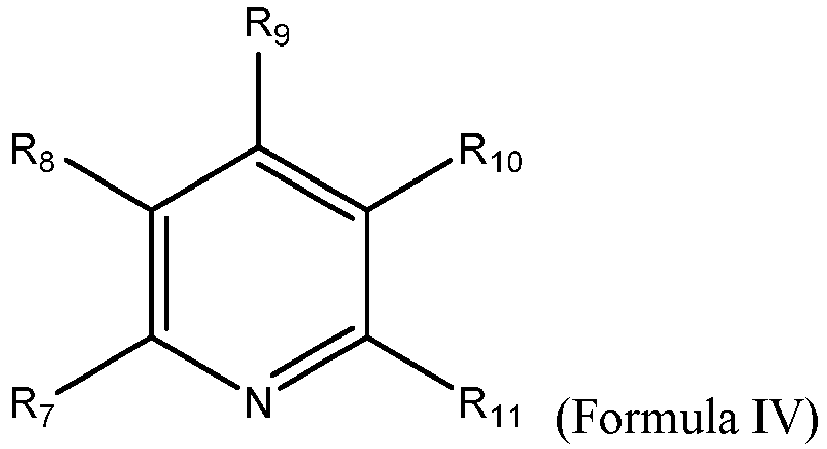 CC) a solvent;DD) an inorganic base; andEE) optionally an additive; andIIA) reacting the mixture;b) a solvent;c) a base comprisinga compound comprising a metal; andoptionally a first amine base;d) optionally an additive; ande) optionally a second amine base; andii) reacting the mixture with an organic compound; andB) a metal hydroxide; andII) reacting the mixture.
 - The method of claim 1, wherein:(A) the metal hydroxide is selected from alkali hydroxide, alkaline earth metal hydroxide, and combinations thereof, or(B) the method step II) of reacting the mixture occurs at a reaction temperature in the range of about 0 °C to about 90 °C.
- The method of claim 1, wherein the first amine base and the second amine base are each independently selected from iPr2NH, TMP, hexamethyldisilazane, Et2NH, c-hexyl2NH, and combinations thereof.
- The method of claim 1, wherein the solvent b) is selected from THF, toluene, 1,4-dioxane, Me-THF, and combinations thereof.
- The method of claim 1, wherein the method step ii) of reacting the mixture occurs at a reaction temperature in the range of about 0 °C to about 50 °C.
- The method of claim 1, wherein the compound of Formula VIII is prepared according to a method comprisingI) forming a mixture comprisingA) a compound of Formula VII, wherein
 B) a solvent;C) a base comprisinga compound comprising a metal; andoptionally a first amine base; andD) optionally a second amine base; andII) reacting the mixture with a halogenation reagent.
 - The method of claim 6, wherein the method produces a compound selected from

- A method of preparing a compound of Formula VI, wherein
 each of R5 - R10 is independently selected from hydrogen and halogen; andR13 is an organic acid, the method comprisingI) forming a mixture comprisingA) a compound of Formula III, wherein
 R4 is hydrogen;each of R5 - R10 is independently selected from hydrogen and halogen; andwherein the compound of Formula III is prepared according to a method comprisingi) forming a mixture comprisinga) a compound of Formula II, wherein
 each of R4, R5, and R6 is independently selected from hydrogen and halogen;wherein at least one of R4, R5, and R6 is hydrogen; andwherein the compound of Formula II is prepared according to a method comprisingIA) forming a mixture comprisingAA) a compound of Formula VIII, wherein
 R14 is selected from substituted or unsubstituted carbocycle and substituted or unsubstituted heterocycle;each of R15, R16, and R17 is independently selected from hydrogen and halogen; andwherein at least one of R15, R16, and R17 is a halogen;BB) a solvent; andCC) an acid; andIIa) reacting the mixture;b) a compound of Formula IV, wherein
 c) a solvent;d) an inorganic base; ande) optionally an additive; andii) reacting the mixture;B) a solvent;C) a base comprisinga compound comprising a metal; andoptionally a first amine base;D) optionally an additive; andE) optionally a second amine base; andII) reacting the mixture with a carbonyl-containing compound.
 - A method of preparing a compound of Formula II, wherein
 each of R4, R5, and R6 is independently selected from hydrogen and halogen; andwherein at least one of R4, R5, and R6 is hydrogen, the method comprisingI) forming a mixture comprisingA) a compound of Formula VIII, wherein
 R14 is selected from substituted or unsubstituted carbocycle and substituted or unsubstituted heterocycle;each of R15, R16, and R17 is independently selected from hydrogen and halogen; andwherein at least one of R15, R16, and R17 is a halogen;B) a solvent; andC) an acid; andII) reacting the mixture.
 - The method of claim 9, wherein the solvent is selected from methanol, ethanol, isopropanol, toluene, 1,4-dioxane, tetrahydrofuran, and combinations thereof.
- A method of preparing a compound of Formula VII, wherein
 I) forming a mixture comprisingA) pyrazole or a pyrazole derivative;B) a cycloalkene or heterocycloalkene;C) optionally a solvent; andD) an acid; andII) reacting the mixture.
 - A method of preparing a compound of Formula VIII, wherein
 R14 is selected from substituted or unsubstituted carbocycle and substituted or unsubstituted heterocycle;each of R15, R16, and R17 is independently selected from hydrogen and halogen; andwherein at least one of R15, R16, and R17 is a halogen, the method comprisingI) forming a mixture comprisingA) the compound of Formula VII, wherein
 B) a solvent;C) a base comprisinga compound comprising a metal; andoptionally a first amine base; andD) optionally a second amine base; andII) reacting the mixture with a halogenation reagent.
 - A method of preparing a compound of Formula V, wherein
 each of R5 - R10 is independently selected from hydrogen and halogen; andR12 is selected from ether, ester, and nitrile, the method comprisingi) forming a mixture comprisinga) a compound of Formula III, wherein
 R4 is hydrogen;each of R5 - R10 is independently selected from hydrogen and halogen; andwherein the compound of Formula III is prepared according to a method comprisingIA) forming a mixture comprisingAA) a compound of Formula II, wherein
 each of R4, R5, and R6 is independently selected from hydrogen and halogen;wherein at least one of R4, R5, and R6 is hydrogen; andwherein the compound of Formula II is prepared according to a method comprisingia) forming a mixture comprisingaa) a compound of Formula VIII, wherein
 R14 is selected from substituted or unsubstituted carbocycle and substituted or unsubstituted heterocycle;each of R15, R16, and R17 is independently selected from hydrogen and halogen; andwherein at least one of R15, R16, and R17 is a halogen;bb) a solvent; andcc) an acid; andiia) reacting the mixture;BB) a compound of Formula IV, wherein
 CC) a solvent;DD) an inorganic base; andEE) optionally an additive; andIIA) reacting the mixture;b) a solvent;c) a base comprisinga compound comprising a metal; andoptionally a first amine base;d) optionally an additive; ande) optionally a second amine base; andii) reacting the mixture with an organic compound.
 - The method of any of claims 1, 8, 10 or 12, wherein the compound comprising a metal is a Grignard reagent.
- A method of preparing a compound of Formula III, wherein
 R4 is hydrogen; andeach of R5 - R10 is independently selected from hydrogen and halogen, the method comprisingi) forming a mixture comprisinga) a compound of Formula II, wherein
 each of R4, R5, and R6 is independently selected from hydrogen and halogen;wherein at least one of R4, R5, and R6 is hydrogen; andwherein the compound of Formula II is prepared according to a method comprisingIA) forming a mixture comprisingAA) a compound of Formula VIII, wherein
 R14 is selected from substituted or unsubstituted carbocycle and substituted or unsubstituted heterocycle;each of R15, R16, and R17 is independently selected from hydrogen and halogen; andwherein at least one of R15, R16, and R17 is a halogen;BB) a solvent; andCC) an acid; andIIa) reacting the mixture;b) a compound of Formula IV, wherein
 c) a solvent;d) an inorganic base; ande) optionally an additive; andii) reacting the mixture.
Applications Claiming Priority (3)
| Application Number | Priority Date | Filing Date | Title |
|---|---|---|---|
| US201962916827P | 2019-10-18 | 2019-10-18 | |
| EP20804066.7A EP3976588B1 (en) | 2019-10-18 | 2020-10-16 | Methods for the preparation of 5-bromo-2-(3-chloro-pyridin-2-yl)-2h-pyrazole-3-carboxylic acid |
| PCT/US2020/055894 WO2021076838A1 (en) | 2019-10-18 | 2020-10-16 | Methods for the preparation of 5-bromo-2-(3-chloro-pyridin-2-yl)-2h-pyrazole-3-carboxylic acid |
Related Parent Applications (1)
| Application Number | Title | Priority Date | Filing Date |
|---|---|---|---|
| EP20804066.7A Division EP3976588B1 (en) | 2019-10-18 | 2020-10-16 | Methods for the preparation of 5-bromo-2-(3-chloro-pyridin-2-yl)-2h-pyrazole-3-carboxylic acid |
Publications (2)
| Publication Number | Publication Date |
|---|---|
| EP4253379A2 true EP4253379A2 (en) | 2023-10-04 |
| EP4253379A3 EP4253379A3 (en) | 2023-11-15 |
Family
ID=73198480
Family Applications (2)
| Application Number | Title | Priority Date | Filing Date |
|---|---|---|---|
| EP23168252.7A Withdrawn EP4253379A3 (en) | 2019-10-18 | 2020-10-16 | Methods for the preparation of 5-bromo-2-(3-chloro-pyridin-2-yl)-2h-pyrazole-3-carboxylic acid |
| EP20804066.7A Active EP3976588B1 (en) | 2019-10-18 | 2020-10-16 | Methods for the preparation of 5-bromo-2-(3-chloro-pyridin-2-yl)-2h-pyrazole-3-carboxylic acid |
Family Applications After (1)
| Application Number | Title | Priority Date | Filing Date |
|---|---|---|---|
| EP20804066.7A Active EP3976588B1 (en) | 2019-10-18 | 2020-10-16 | Methods for the preparation of 5-bromo-2-(3-chloro-pyridin-2-yl)-2h-pyrazole-3-carboxylic acid |
Country Status (16)
| Country | Link |
|---|---|
| US (1) | US20230002347A1 (en) |
| EP (2) | EP4253379A3 (en) |
| JP (1) | JP2022552277A (en) |
| KR (1) | KR20220084131A (en) |
| CN (1) | CN114555582A (en) |
| AR (1) | AR120235A1 (en) |
| AU (1) | AU2020368460A1 (en) |
| BR (1) | BR112022007241A2 (en) |
| HU (1) | HUE062971T2 (en) |
| IL (2) | IL294706A (en) |
| MA (1) | MA56052A (en) |
| MX (1) | MX2022004630A (en) |
| PL (1) | PL3976588T3 (en) |
| TW (1) | TWI879818B (en) |
| WO (1) | WO2021076838A1 (en) |
| ZA (1) | ZA202204276B (en) |
Family Cites Families (11)
| Publication number | Priority date | Publication date | Assignee | Title |
|---|---|---|---|---|
| MY140912A (en) * | 2004-07-26 | 2010-01-29 | Du Pont | Mixtures of anthranilamide invertebrate pest control agents |
| CL2008000979A1 (en) * | 2007-04-11 | 2008-10-17 | Sumitomo Chemical Co | PROCESS TO PRODUCE A COMPOUND DERIVED FROM 2-PIRIDIN-2-IL-2H-PIRAZOL-3-PHENYLAMIDE; INTERMEDIARY COMPOUNDS; THE COMPOUND IN YES; PESTICIDE COMPOSITION CONTAINING SUCH COMPOUND; USE OF SUCH COMPOUND AS A PESTICIDE; AND METHOD FOR CONTROL |
| JP2008280341A (en) * | 2007-04-12 | 2008-11-20 | Sumitomo Chemical Co Ltd | Hydrazide compounds and their control applications |
| JP2008280340A (en) * | 2007-04-12 | 2008-11-20 | Sumitomo Chemical Co Ltd | Hydrazide compound and harmful arthropod control agent containing the same |
| ES2377588T3 (en) * | 2007-07-16 | 2012-03-29 | Syngenta Participations Ag | Condensed anthranilamide insecticides |
| IN2014CN01136A (en) * | 2011-08-12 | 2015-04-10 | Basf Se | |
| WO2013105100A1 (en) * | 2012-01-09 | 2013-07-18 | Symed Labs Limited | Processes for the preparation of 5-chloro-n-({(5s)-2-oxo-3-[4-(3-oxo-4-morpholinyl)phenyl]-1,3-oxazolidin-5-yl}methyl)-2-thiophene-carboxamide and intermediates thereof |
| CN105189477A (en) * | 2013-05-17 | 2015-12-23 | 巴斯夫欧洲公司 | Process for preparing n-substituted 1h-pyrazole-5-carboxylic acid compounds and derivatives thereof |
| EP3029031A4 (en) * | 2013-07-30 | 2017-01-11 | Takeda Pharmaceutical Company Limited | Heterocyclic compound |
| CN105669643A (en) * | 2013-12-05 | 2016-06-15 | 江西天人生态股份有限公司 | O-carboxamido benzamide derivative based on ryanodine receptor, and preparation method and application thereof |
| WO2017066606A1 (en) * | 2015-10-16 | 2017-04-20 | William Marsh Rice University | Epothilone analogs, methods of synthesis, methods of treatment, and drug conjugates thereof |
-
2020
- 2020-10-16 JP JP2022521270A patent/JP2022552277A/en active Pending
- 2020-10-16 MA MA056052A patent/MA56052A/en unknown
- 2020-10-16 AU AU2020368460A patent/AU2020368460A1/en not_active Abandoned
- 2020-10-16 HU HUE20804066A patent/HUE062971T2/en unknown
- 2020-10-16 CN CN202080072850.6A patent/CN114555582A/en active Pending
- 2020-10-16 WO PCT/US2020/055894 patent/WO2021076838A1/en not_active Ceased
- 2020-10-16 MX MX2022004630A patent/MX2022004630A/en unknown
- 2020-10-16 BR BR112022007241A patent/BR112022007241A2/en not_active Application Discontinuation
- 2020-10-16 KR KR1020227016371A patent/KR20220084131A/en not_active Ceased
- 2020-10-16 AR ARP200102858A patent/AR120235A1/en unknown
- 2020-10-16 IL IL294706A patent/IL294706A/en unknown
- 2020-10-16 US US17/769,798 patent/US20230002347A1/en not_active Abandoned
- 2020-10-16 PL PL20804066.7T patent/PL3976588T3/en unknown
- 2020-10-16 EP EP23168252.7A patent/EP4253379A3/en not_active Withdrawn
- 2020-10-16 EP EP20804066.7A patent/EP3976588B1/en active Active
- 2020-10-16 TW TW109135808A patent/TWI879818B/en active
-
2022
- 2022-04-04 IL IL291940A patent/IL291940B2/en unknown
- 2022-04-14 ZA ZA2022/04276A patent/ZA202204276B/en unknown
Also Published As
| Publication number | Publication date |
|---|---|
| AR120235A1 (en) | 2022-02-09 |
| US20230002347A1 (en) | 2023-01-05 |
| EP3976588B1 (en) | 2023-04-19 |
| IL291940A (en) | 2022-06-01 |
| TW202130620A (en) | 2021-08-16 |
| PL3976588T3 (en) | 2023-08-21 |
| HUE062971T2 (en) | 2023-12-28 |
| MA56052A (en) | 2022-04-06 |
| IL291940B2 (en) | 2023-09-01 |
| BR112022007241A2 (en) | 2022-07-05 |
| KR20220084131A (en) | 2022-06-21 |
| WO2021076838A1 (en) | 2021-04-22 |
| MX2022004630A (en) | 2022-06-08 |
| TWI879818B (en) | 2025-04-11 |
| CN114555582A (en) | 2022-05-27 |
| ZA202204276B (en) | 2024-08-28 |
| JP2022552277A (en) | 2022-12-15 |
| AU2020368460A1 (en) | 2022-04-21 |
| IL291940B1 (en) | 2023-05-01 |
| EP4253379A3 (en) | 2023-11-15 |
| IL294706A (en) | 2022-09-01 |
| EP3976588A1 (en) | 2022-04-06 |
Similar Documents
| Publication | Publication Date | Title |
|---|---|---|
| KR20180100313A (en) | 4 - ((6- (2- (2,4-difluorophenyl) -1,1-difluoro-2-hydroxy- ) Propyl) pyridin-3-yl) oxy) benzonitrile and the preparation method | |
| IL185885A (en) | Method for preparing optionally substituted 2-cyclopropyl and 2-phenyl 1,6-dihydro-6-oxo-4-pyrimidine carboxylic acids and intermediates | |
| EP3976591B1 (en) | Methods for the preparation of 5-bromo-2-(3-chloro-pyridin-2-yl)-2h-pyrazole-3-carboxylic acid | |
| EP3976588B1 (en) | Methods for the preparation of 5-bromo-2-(3-chloro-pyridin-2-yl)-2h-pyrazole-3-carboxylic acid | |
| US20230018429A1 (en) | Process for synthesis of (3-chloro-2-pyridyl)hydrazine | |
| EP4045487B1 (en) | Methods for the preparation of 5-bromo-2-(3-chloro-pyridin-2-yl)-2h-pyrazole-3-carboxylic acid | |
| EP2298763A1 (en) | Method for producing 1-biphenylmethylimidazole compound | |
| EP3976590B1 (en) | Methods for the preparation of 5-bromo-2-(3-chloro-pyridin-2-yl)-2h-pyrazole-3-carboxylic acid | |
| KR20080046611A (en) | Improved Losartan Manufacturing Method | |
| JPH1129555A (en) | Method for producing pyrazolinone derivatives | |
| EP1807401B1 (en) | Process for the preparation of phenyl 2-pyrimidinyl ketones and their novel intermediates | |
| EP1700853A1 (en) | Processes for producing tetrahydropyran-4-one and pyran-4-one | |
| WO2024054476A1 (en) | New processes for synthesis of (3-chloro-2-pyridyl)hydrazine | |
| JP4643474B2 (en) | Method for producing mono-substituted succinimide | |
| EA046889B1 (en) | METHODS FOR OBTAINING 5-BROMO-2-(3-CHLOROPYRIDIN-2-YL)-2H-PYRAZOLE-3-CARBOXYLIC ACID | |
| CA3023114C (en) | Process for producing lamivudine and emtricitabine | |
| EP4284793A1 (en) | Methods for the preparation of 5-bromo-2-(3-chloro-pyridin-2-yl)-2h-pyrazole-3-carboxylic acid |
Legal Events
| Date | Code | Title | Description |
|---|---|---|---|
| PUAI | Public reference made under article 153(3) epc to a published international application that has entered the european phase |
Free format text: ORIGINAL CODE: 0009012 |
|
| STAA | Information on the status of an ep patent application or granted ep patent |
Free format text: STATUS: THE APPLICATION HAS BEEN PUBLISHED |
|
| AC | Divisional application: reference to earlier application |
Ref document number: 3976588 Country of ref document: EP Kind code of ref document: P |
|
| AK | Designated contracting states |
Kind code of ref document: A2 Designated state(s): AL AT BE BG CH CY CZ DE DK EE ES FI FR GB GR HR HU IE IS IT LI LT LU LV MC MK MT NL NO PL PT RO RS SE SI SK SM TR |
|
| REG | Reference to a national code |
Ref country code: DE Ref legal event code: R079 Free format text: PREVIOUS MAIN CLASS: C07D0405040000 Ipc: C07D0231160000 |
|
| PUAL | Search report despatched |
Free format text: ORIGINAL CODE: 0009013 |
|
| AK | Designated contracting states |
Kind code of ref document: A3 Designated state(s): AL AT BE BG CH CY CZ DE DK EE ES FI FR GB GR HR HU IE IS IT LI LT LU LV MC MK MT NL NO PL PT RO RS SE SI SK SM TR |
|
| RIC1 | Information provided on ipc code assigned before grant |
Ipc: C07D 405/04 20060101ALI20231009BHEP Ipc: C07D 401/04 20060101ALI20231009BHEP Ipc: C07D 231/16 20060101AFI20231009BHEP |
|
| STAA | Information on the status of an ep patent application or granted ep patent |
Free format text: STATUS: THE APPLICATION IS DEEMED TO BE WITHDRAWN |
|
| 18D | Application deemed to be withdrawn |
Effective date: 20240516 |