EP4253197A1 - Method for estimating an articulation angle between a towing vehicle and a trailer, respective device, driving assistance system, commercial vehicle and computer program product - Google Patents
Method for estimating an articulation angle between a towing vehicle and a trailer, respective device, driving assistance system, commercial vehicle and computer program product Download PDFInfo
- Publication number
- EP4253197A1 EP4253197A1 EP22165932.9A EP22165932A EP4253197A1 EP 4253197 A1 EP4253197 A1 EP 4253197A1 EP 22165932 A EP22165932 A EP 22165932A EP 4253197 A1 EP4253197 A1 EP 4253197A1
- Authority
- EP
- European Patent Office
- Prior art keywords
- trailer
- axle
- center
- towing vehicle
- distance
- Prior art date
- Legal status (The legal status is an assumption and is not a legal conclusion. Google has not performed a legal analysis and makes no representation as to the accuracy of the status listed.)
- Granted
Links
Images


Classifications
-
- B—PERFORMING OPERATIONS; TRANSPORTING
- B62—LAND VEHICLES FOR TRAVELLING OTHERWISE THAN ON RAILS
- B62D—MOTOR VEHICLES; TRAILERS
- B62D15/00—Steering not otherwise provided for
- B62D15/02—Steering position indicators ; Steering position determination; Steering aids
- B62D15/021—Determination of steering angle
- B62D15/024—Other means for determination of steering angle without directly measuring it, e.g. deriving from wheel speeds on different sides of the car
-
- B—PERFORMING OPERATIONS; TRANSPORTING
- B62—LAND VEHICLES FOR TRAVELLING OTHERWISE THAN ON RAILS
- B62D—MOTOR VEHICLES; TRAILERS
- B62D13/00—Steering specially adapted for trailers
-
- B—PERFORMING OPERATIONS; TRANSPORTING
- B62—LAND VEHICLES FOR TRAVELLING OTHERWISE THAN ON RAILS
- B62D—MOTOR VEHICLES; TRAILERS
- B62D15/00—Steering not otherwise provided for
- B62D15/02—Steering position indicators ; Steering position determination; Steering aids
- B62D15/021—Determination of steering angle
- B62D15/023—Determination of steering angle by measuring on the king pin
-
- B—PERFORMING OPERATIONS; TRANSPORTING
- B62—LAND VEHICLES FOR TRAVELLING OTHERWISE THAN ON RAILS
- B62D—MOTOR VEHICLES; TRAILERS
- B62D15/00—Steering not otherwise provided for
- B62D15/02—Steering position indicators ; Steering position determination; Steering aids
- B62D15/025—Active steering aids, e.g. helping the driver by actively influencing the steering system after environment evaluation
Definitions
- the present invention relates to a method for estimating an articulation angle between a towing vehicle and a trailer, a respective device for estimating the articulation angle, a driving assistance system for a towing vehicle comprising the device for estimating the articulation angle, a commercial vehicle comprising the device and/or the driving assistance system and a computer program product for executing the method.
- the articulation angle of a trailer with respect to a towing vehicle is a very important signal for vehicle maneuver execution, especially for automated driving.
- the knowledge of the actual articulation angle is necessary to be able to calculate the trajectory of the vehicle, to control the movement and to make the transport safer.
- the basic option to determine the articulation angle is by measuring using an articulation angle sensor.
- an articulation angle sensor causes additional cost and might be error prone.
- a method for estimating an articulation angle between a towing vehicle and a trailer with respect to a pivot comprises the steps of:
- the articulation angle is rather determined by an estimation of the articulation angle based on wheel speeds than by a direct measurement of the articulation angle by an articulation angle sensor.
- wheel speeds of representatives thereof may be determined by already implemented sensors.
- wheel speed sensors implemented with respect to a brake control or the like may be used to provide data for an estimation of the articulation angle.
- articulation angle sensors for a direct measurement may be omitted.
- articulation sensors may still be used in parallel, e.g. for calibration purposes and/or plausibility checks.
- the towing vehicle may be a truck towing the trailer such as a semi-trailer or a central axis trailer.
- the towing vehicle may also be a towing trailer towing the trailer within a vehicle combination of a truck and several trailers.
- the articulation angle between the truck towing the towing trailer and/or the articulation angle between the towing trailer and the trailer may be estimated.
- the articulation angle is estimated with respect to a pivot representative of the relative rotational movement between the towing vehicle and the trailer, e.g. a kingpin.
- any of the towing vehicle and trailer represents a rotating rigid body having a point as so-called “Instantaneous Center of Velocity", hereinafter also referred to as "ICV".
- Each of the rigid bodies rotates around its respective ICV. Accordingly, when a vehicle, i.e. the towing vehicle and/or the trailer, turns, e.g. in response to a steering angle, it turns around its ICV at such moment in time.
- the ICV of the towing vehicle is different from the ICV of the trailer. Further, the distance between the respective ICV and a respective wheel of the vehicle is proportional to the magnitude of the wheel speed.
- the ICV associated with the vehicle can be determined to deduce the amount of cornering to estimate the articulation angle between the towing vehicle and the trailer.
- the estimation of the articulation angle between the towing vehicle and the trailer with respect to the pivot is based on the wheel speed(s) of the towing vehicle and/or the trailer as time varying signals.
- the at least one instantaneous speed is determined for at least one non-steered axle of the towing vehicle, preferably as speed of the center of at least one rear axle of the towing vehicle, and/or for at least one non-steered axle of the trailer, preferably as speed of the center of at least one rear axle or as speed of at least one wheel of at least one rear axle of the trailer.
- the estimation of the articulation angle between the towing vehicle and the trailer with respect to the pivot is based on the wheel speed(s) of the towing vehicle on the non-steered axle(s) and/or the wheel speed(s) of the trailer on the non-steered axle(s), e.g. non dolly axles.
- the distance between the instantaneous center of velocity of the towing vehicle and the center of at least one axle of the towing vehicle is calculated, preferably based on a distance between a steering axle, preferably a front axle, of the towing vehicle, and a non-steering axle, preferably a rear axle, of the towing vehicle, and a steering angle of the steering axle.
- the determination of the distance between the instantaneous center of velocity of the towing vehicle and the center of at least one axle of the towing vehicle is determined by being calculated.
- the distance between the instantaneous center of velocity of the towing vehicle and the center of at least one axle of the towing vehicle may be stored in a database in dependence of a steering angle.
- the distance between the instantaneous center of velocity of the towing vehicle and the center of at least one axle of the towing vehicle may be calculated based on a distance between a steering axle, such as a front axle, of the towing vehicle and a non-steering axle, such as a rear axle, of the towing vehicle, and a steering angle of the steering axle.
- the distance between the steering axle and the non-steering axle of the towing vehicle may be input data or data provided by a database as available geometric input data of the towing vehicle.
- the steering angle may be provided by a direct or indirect determination, e.g. to be measured by a sensor or as per a steering command by an automatic driving system. Consequently, the estimation of the articulation angle between the towing vehicle and the trailer with respect to the pivot is based on the wheel speed(s) of the towing vehicle and/or the trailer and the steering angle of the steering axle as time varying signals.
- the estimation of the articulation angle may be based on the steering angle in accordance with a steering action.
- the steering angle refers to the steering action on the steering axle, e.g. the front axle or at least one of the front axles of the towing vehicle.
- the distance between the instantaneous center of velocity of the trailer and the center of at least one axle of the trailer is calculated, preferably based on a distance between a center of at least one wheel on the at least one axle of the trailer facing towards the instantaneous center of velocity of the trailer and a distance between the center of the at least one wheel on the at least one axle facing towards the instantaneous center of velocity of the trailer and at least one wheel on the other side of the at least one axle.
- the estimation of the articulation angle may be based on the wheel speed(s) of the trailer on both sides on the same axis.
- the angle of a velocity vector of the pivot and the velocity vector of the at least one axle of the towing vehicle may be calculated based geometric data of the towing vehicle, i.e. the distance between the center of at least one axle of the towing vehicle and the pivot, and the distance between the instantaneous center of velocity of the towing vehicle and the center of at least one axle of the towing vehicle, which may be also calculated based on geometric data, i.e. the distance between the steering axle of the towing vehicle and the non-steering axle of the towing vehicle, and the steering angle.
- v T is defined as speed of the center of at least one axle of the trailer
- the articulation angle may be estimated in dependence of the angle of a velocity vector of the pivot and the velocity vector of the at least one axle of the towing vehicle, which may be calculated based on equation (4), and the ratio between the speeds of the center of the at least one rear axle of the trailer and the center of the pivot as per equation (7). Consequently, the estimation of the articulation angle may only depend on the geometric data of the towing vehicle, e.g. the distance between the front and the rear axle and the distance between the rear axle and the pivot, the instantaneous steering angle and the respective wheel speeds of the center of rear axles of the towing vehicle and the center of rear axles of the trailer.
- the term cos ⁇ 1 ⁇ T ⁇ K is replaced by tan ⁇ 1 L r T , which allows the articulation angle to be estimated based on the geometric data of the trailer, e.g. the distance between the pivot and the rear axle of the trailer and the distance between the left and right wheels of the rear axle of the trailer, the instantaneous steering angle and the respective wheel speeds of the left and the right wheel of the trailer.
- the method for estimation the articulation angle may also comprise the estimation of the articulation angle as per equation (7) and equation (8) in parallel, for example, for a plausibility check and/or to proceed further with the estimated articulation angle indicated a higher risk under given driving conditions. Accordingly, the security lever may be enhanced and/or failures of the wheel speed sensors may be detected.
- the articulation angle can be estimated without any data of the towing vehicle, i.e. geometric data, wheel speeds or the steering angle of the towing vehicle.
- the simplification may only be applied under predetermined operating conditions of the towing vehicle and trailer combination, e.g. in dependence of a driving speed, road conditions and/or steering angle.
- the estimation as per equation (9) may also be used in parallel to the estimation as per equation (7) and/or equation (8).
- any estimation of the articulation angle by at least two of the equations (7) to (9) may only be performed at predetermined timings, for example, in dependence of predetermined operating conditions, regular intervals as interim checks or the like.
- the present invention relates to a device for estimating an articulation angle between a towing vehicle and a trailer with respect to a pivot by executing the method as described above.
- the device comprises a data unit configured to receive and/or store data of the distance between the steering axle, preferably a front axle, of the towing vehicle and a non-steering axle, preferably a rear axle, of the towing vehicle, the distance between the non-steering axle of the towing vehicle and the pivot, the distance between the at least one axle of the trailer and the pivot, and/or the distance between the center of the at least one wheel on the at least one axle facing towards the instantaneous center of velocity of the trailer and at least one wheel on the other side of the at least one axle.
- the device further comprises a determination unit configured to determine the steering angle of the steering axle, the speed of the center of at least one axle of the towing vehicle, the speed of the center of at least one axle of the trailer, and/or the speed of at least one wheel of at least one rear axle of the trailer, preferably the speeds of opposing wheels of the at least one axle with respect to the center of the at least one axle.
- the device comprises an estimation unit configured to determine the distance between the instantaneous center of velocity of the towing vehicle and the center of at least one axle of the towing vehicle representative for a rotation of the towing vehicle about the instantaneous center of velocity of the towing vehicle, the distance between the instantaneous center of velocity of the trailer and the center of at least one axle of the trailer representative for a rotation of the trailer about the instantaneous center of velocity of the trailer, the speed of the center of the pivot, the angle of the velocity vector of the pivot and the velocity vector of the at least one axle of the towing vehicle, and/or the ratio between the speeds of the center of the at least one rear axle of the trailer and the center of the pivot to estimate the articulation angle, and an output unit configured to output the articulation angle.
- the data unit is configured to receive and/or store the geometric data of the towing vehicle and/or the trailer required to estimate the articulation angle as per equation (7), equation (8) and/or equation (9).
- the determination unit is configured to determine the steering angle and/or the respective wheel speeds required to estimate the articulation angle as per equation (7), equation (8) and/or equation (9). Accordingly, the determination unit receives respective wheel speed sensor signals or comprises such sensors.
- the estimation unit is configured to receive the required data by the data unit and the determination unit to determine the variables required to estimate the articulation angle as per equation (7), equation (8) and/or equation (9) based on the data of the data unit and the determination unit to estimate the articulation angle.
- the output unit may be configured to output the estimated articulation angle for further processing by a driving assistance system to take measures in response to the estimated articulation angle, e.g. to avoid critical articulation angles.
- the output device may be configured to provide an optical, acoustic and/or tactile output representative of the estimated articulation angle.
- the estimated articulation angle may be displayed to an operator of the towing vehicle.
- any kind of output by the output device may depend on the instantaneous estimated articulation angle. For example, if the articulation angle is below a predetermined value, the estimated articulation angle is output to the driving assistance device to be considered for further assistance to the extent required. However, if the estimated articulation angle exceeds the predetermined value, the estimated articulated angle may also be displayed to an operator of the towing vehicle and/or a supervising control architecture. Upon further exceeding the predetermined value over a predetermined period in time and/or a critical value, an acoustic alarm and/or red light may be added.
- the predetermined and/or critical value may be adaptable to different driving operations and/or boundary conditions such as road conditions.
- the data unit, the determination unit, the estimation unit and the output unit do not have to be separated entities but may only be represented as different operators of a processor or the like.
- the estimation unit is or comprises a calculation unit to calculate the at least one of the distance between the instantaneous center of velocity of the towing vehicle and the center of at least one axle of the towing vehicle representative for a rotation of the towing vehicle about the instantaneous center of velocity of the towing vehicle, the distance between the instantaneous center of velocity of the trailer and the center of at least one axle of the trailer representative for a rotation of the trailer about the instantaneous center of velocity of the trailer, the speed of the center of the pivot, the angle of the velocity vector of the pivot and the velocity vector of the at least one axle of the towing vehicle, and/or the ratio between the speeds of the center of the at least one rear axle of the trailer and the center of the pivot.
- the estimation unit is configured to calculate the required variables to estimate the articulation angle. Due to the calculation ability, the estimation unit may not require storage means for data basis to assign an estimated articulation angle to any parameter combination provided by the data unit and the determination unit but allows the use of an algorithm instead. However, the estimation unit may still use some stored articulation angles in response to a parameter combination provided by the data unit and the determination unit in addition, e.g. for plausibility checks and failure analysis, or alternatively, e.g. if available and otherwise to be calculated.
- the present invention relates to a driving assistance system for a towing vehicle comprising the device for estimating an articulation angle between a towing vehicle and a trailer with respect to a pivot as described above by executing the method as described above.
- the driving assistance system may be able to take respective countermeasures depending on the estimated articulation angle or ranges thereof.
- the driving assistance system may be configured to restrict the speed, accelerations or decelerations and/or steering angles of the towing vehicle or may completely stop the towing vehicle.
- the consideration of the estimated articulation angle may be preferably advantageous in driving assistance systems for autonomous driving operations.
- the present invention relates to a commercial vehicle comprising the device as described above and/or the driving assistance system as described above.
- the present invention relates to a computer program product comprising a program code stored on a machine-readable medium for executing the method as described above.
- the program code stored is preferably executed on a data processing unit of the device for estimating an articulation angle between a towing vehicle and a trailer with respect to a pivot as described above.
- the towing vehicle 10 comprises a front axle 11, which is the steering axle in the given exemplary embodiment, and a rear axle 12, which is the non-steering axle in the given exemplary embodiment.
- the center of the front axle 11 is denoted by K and the center of the rear axle 12 is denoted by R.
- a wheelbase as the distance b between the front axle 11 and the rear axle 12 is the distance between point F and point R.
- a steering angle ⁇ the direction of a vector of the speed v F of the center of the front axle 11 with respect to the point F corresponds to the steering angle ⁇ of the wheels of the front axle 11 with respect to the longitudinal axis of the towing vehicle, which extends between point F and point R.
- the rear axle 12 is a non-steering axle, a vector of the speed v R of the center of the rear axle 12 with respect to the point R remains directed in the longitudinal direction of the towing vehicle 10.
- the towing vehicle 10 comprises the king pin K about which the trailer 20 pivots in response to the instantaneous steering angle ⁇ resulting in the articulation angle ⁇ between the longitudinal axis of the towing vehicle 10 and the longitudinal axis of the trailer 20, which extends between the king pin K and a center T of rear axles 21, 22, 23 of the trailer 20 to be described later.
- a vector of the speed v K of the center of the king pin K corresponds an angle ⁇ .
- a distance c is the distance between the center of the kingpin K and point R in the longitudinal direction of the towing vehicle.
- the towing vehicle 10 Upon application of the steering angle ⁇ , the towing vehicle 10 represents a rotating rigid body rotating about point P as instantaneous center of velocity (ICV) of the towing vehicle 10.
- ICV instantaneous center of velocity
- the instantaneous distance r can be determined based on the distance b between point F and point R as given input data and the instantaneous steering angle ⁇ .
- the trailer 20 comprises a first rear axle 21, a second rear axle 22 and a third rear axle 23.
- the rear axles 21, 22 and 23 are represented by a point T as center of the rear axles 21, 22, 23 of the trailer 20. Since the rear axles 21, 22 and 23 are non-steering axles, a vector of the speed v T of the center of the rear axles 21, 22, 23 with respect to the point T remains directed in the longitudinal direction of the trailer 20.
- a distance L is the distance between the point T and the center of the king pin K in the longitudinal direction of the trailer 20.
- the trailer 20 Upon application of the steering angle ⁇ on the front axle 11 of the towing vehicle 10, the trailer 20 represents a rotating rigid body rotating about point D as instantaneous center of velocity (ICV) of the trailer 20.
- a distance r T is the distance between point D and point T.
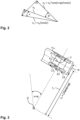
- Figure 2 is a diagram showing the geometric relationships between speed vectors v R , v K and v T and angles ⁇ and ⁇ .
- FIG. 3 shows an enlarged view of a rear axle portion of the trailer and respective geometric ratios.
- the rear part of the trailer 20 comprising the rear axles 21, 22, 23 is shown.
- Each of the rear axles 21, 22, 23 of the trailer 20 comprises a left wheel as wheel facing towards the instantaneous center of velocity D, and a right wheel as wheel facing away from the instantaneous center of velocity D. Even though the exemplary embodiment shows only one left and one right wheel per axle, each of the axles may provide more than one left and/or right wheel, which may be represented by one left or right wheel in Fig. 3 .
- a distance between point D as instantaneous center of velocity of the trailer 20 and each wheel of the rear axles 21, 22, 23 is proportional to the wheel speed of such wheels.
- the articulation angle ⁇ between the respective longitudinal axes of the towing vehicle 10 and the trailer 20 with respect to the center of the king pin K as pivot can be estimated based on the geometric data and instantaneous wheel speeds.
- exemplary embodiments of respective methods are presented.
- the method uses the geometric data of the towing vehicle 10, here the distance b between the front axle 11 and the rear axle 12, and the distance c between the rear axle 12 and the center of the king pin K, the instantaneous steering angle ⁇ , the speed v R of the center of the rear axle 12 of the towing vehicle with respect to point R, and the speed v T of the center of the rear axles 21, 22, 23 of the trailer 20 with respect to point T as input data.
- the geometric data may be provided by a database to be selected according to the specific towing vehicle 10 and trailer 20 as preset and/or as constant preset.
- the steering angle ⁇ may be provided in accordance with a control signal causing the steering and/or by respective sensor data.
- the speeds v R and v T may also be estimated in accordance with respective control signals with respect to a driving speed, acceleration or deceleration, and/or by a sensor signals, for example by direct measurements or indirect measurements representative of the speeds v R and/or v T .
- the speed v K of the center of the king pin K may also be determined as input data in term of being available in accordance with a control signal or by sensor data as direct or indirect measurement. Nevertheless, the calculation may reduce the required amount of data to be provided as input data.
- the articulation angle ⁇ according to the first embodiment of the method for estimating the articulation angle ⁇ is estimated based on the input data, i.e. the distance b between the front axle 11 and the rear axle 12, and the distance c between the rear axle 12 and the center of the king pin K, the instantaneous steering angle ⁇ , the speed v R of the center of the rear axle 12 of the towing vehicle with respect to point R, and the speed v T of the center of the rear axles 21, 22, 23 of the trailer 20 with respect to point T, and the respectively calculated variables, i.e.
- the articulation angle ⁇ is estimated by using the wheel speed(s) of the towing vehicle 10 and the trailer 20 and steering angle ⁇ as time varying signals. Specifically, the articulation angle ⁇ is estimated by using the wheel speed(s) of the non-steering axle of the towing vehicle 10 and/or the non-steering axle of the trailer 20 and steering angle ⁇ as time varying signals. More specifically, the articulation angle ⁇ is estimated by using the geometric parameters of towing vehicle axle- and king pin bases.
- the method uses the geometric data of the trailer 20, here the distance L between the point T and the center of the king pin K in the longitudinal direction of the trailer 20 and the distance w between the left and the right wheels of the rear axles 21, 22, 23 of the trailer 20, and the speed v TL of the left wheels of the rear axles 21, 22, 23 of the trailer 20 as well as the speed v TR of the right wheels of the rear axles 21, 22, 23 of the trailer 20 as input data.
- the second exemplary embodiment of the method for estimating the articulation angle ⁇ does not require any data with respect to the towing vehicle 10.
- the articulation angle ⁇ according to the second embodiment of the method for estimating the articulation angle ⁇ is estimated based on the input data of the trailer 20, i.e. the distance L between the point T and the center of the king pin K in the longitudinal direction of the trailer 20, and the distance w between the left and the right wheels of the rear axles 21, 22, 23 of the trailer 20, and the speed v TL of the left wheels of the rear axles 21, 22, 23 of the trailer 20 as well as the speed v TR of the right wheels of the rear axles 21, 22, 23 of the trailer 20, and the respectively calculated variables, i.e. the distance ro between the point D as instantaneous center of velocity of the trailer 20 and the left wheel, and the distance r T between point D as instantaneous center of velocity of the trailer 20 and point T.
- the articulation angle ⁇ is estimated by using the wheel speed(s) of the trailer 20 as the only time varying signals. Specifically, the articulation angle ⁇ is estimated by using the wheel speed(s) of the non-steering axle of the trailer 20 as time varying signals. More specifically, the articulation angle ⁇ is estimated by using the wheel speed(s) of the trailer 20 on both sides on the same axle, preferably on the non-steering axles, as time varying signals.
- the geometric input data may be restricted to the geometric data of the axle- and wheelbases of the trailer 20.
- the method combines the first and second embodiment of the method for estimating the articulation angle ⁇ .
- the input data comprises the geometric data of the towing vehicle 10, here the distance b between the front axle 11 and the rear axle 12, and the distance c between the rear axle 12 and the center of the king pin K, and the geometric data of the trailer 20, here the distance L between the point T and the center of the king pin K in the longitudinal direction of the trailer 20, and the distance w between the left and the right wheels of the rear axles 21, 22, 23 of the trailer 20.
- the input data comprises the instantaneous steering angle ⁇ , the speed v R of the center of the rear axle 12 of the towing vehicle 10 with respect to point R, and the speed v TL of the left wheels of the rear axles 21, 22, 23 of the trailer 20 as well as the speed v TR of the right wheels of the rear axles 21, 22, 23 of the trailer 20.
- the articulation angle ⁇ is estimated by using the wheel speed(s) of the towing vehicle 10 and the trailer 20 and steering angle ⁇ as time varying signals.
- the articulation angle ⁇ is estimated by using the wheel speed(s) of the non-steering axle of the towing vehicle 10 and/or the non-steering axle of the trailer 20 and steering angle ⁇ as time varying signals.
- the articulation angle ⁇ is estimated by using the geometric parameters of towing vehicle axle- and king pin bases.
- the articulation angle ⁇ is estimated by using the wheel speed(s) of the trailer 20 on both sides on the same axle, preferably on the non-steering axles, as time varying signals.
- the geometric input data refers to the trailer geometric parameters of the towing vehicle axle- and kingpin bases plus the trailer axle- and wheelbases.
- Figure 4 shows a schematic representation of a device for estimating an articulation angle ⁇ between the towing vehicle 10 and the trailer 20 with respect to the center of the king pin K as pivot.
- the device comprises
- the device may be configured to execute any of the previously described methods for estimating an articulation angle ⁇ between the towing vehicle 10 and the trailer 20 with respect to the pivot according to the first to second embodiment.
- the device may be alternatively configured to provide only one or two of such methods or any other applicable method in accordance with the invention. Accordingly, the respective device is configured to determine and calculate data at least required for such execution.
Landscapes
- Engineering & Computer Science (AREA)
- Chemical & Material Sciences (AREA)
- Combustion & Propulsion (AREA)
- Transportation (AREA)
- Mechanical Engineering (AREA)
- Steering Control In Accordance With Driving Conditions (AREA)
Abstract
determining a distance (r) between an instantaneous center of velocity (P) of the towing vehicle (10) and a center of at least one axle (R) of the towing vehicle (10) representative for a rotation of the towing vehicle (10) about the instantaneous center of velocity (P) of the towing vehicle (10) and/or a distance (rT) between an instantaneous center of velocity (D) of the trailer (20) and a center of at least one axle (T) of the trailer (20) representative for a rotation of the trailer (20) about the instantaneous center of velocity (D) of the trailer (20),
determining at least one instantaneous speed (vR, vT, vTL, vTR) representative for a wheel speed of at least one wheel of the towing vehicle (10) and/or the trailer (20), wherein the at least one instantaneous speed (vR, vT, vTL, vTR) refers to the at least one determined distance (r, rT), and
estimating the articulation angle (ϕ) based on the at least one determined instantaneous speed and the at least one determined distance (r, rT).
Description
- The present invention relates to a method for estimating an articulation angle between a towing vehicle and a trailer, a respective device for estimating the articulation angle, a driving assistance system for a towing vehicle comprising the device for estimating the articulation angle, a commercial vehicle comprising the device and/or the driving assistance system and a computer program product for executing the method.
- The articulation angle of a trailer with respect to a towing vehicle is a very important signal for vehicle maneuver execution, especially for automated driving. The knowledge of the actual articulation angle is necessary to be able to calculate the trajectory of the vehicle, to control the movement and to make the transport safer.
- The basic option to determine the articulation angle is by measuring using an articulation angle sensor. However, such sensor causes additional cost and might be error prone.
- Therefore, it is an object of the present invention to provide an improved method, device, driving assistance system, commercial vehicle and computer program product to determine an articulation angle between a towing vehicle and a trailer.
- The object is solved by the subject-matter of the independent claims. Further aspects of the present invention are subject to the dependent claims.
- According to the present invention, a method for estimating an articulation angle between a towing vehicle and a trailer with respect to a pivot, comprises the steps of:
- determining a distance between an instantaneous center of velocity of the towing vehicle and a center of at least one axle of the towing vehicle representative for a rotation of the towing vehicle about the instantaneous center of velocity of the towing vehicle and/or a distance between an instantaneous center of velocity of the trailer and a center of at least one axle of the trailer representative for a rotation of the trailer about the instantaneous center of velocity of the trailer,
- determining at least one instantaneous speed representative for a wheel speed of at least one wheel of the towing vehicle and/or the trailer, wherein the at least one instantaneous speed refers to the at least one determined distance, and
- estimating the articulation angle based on the at least one determined instantaneous speed and the at least one determined distance.
- With respect to the above the articulation angle is rather determined by an estimation of the articulation angle based on wheel speeds than by a direct measurement of the articulation angle by an articulation angle sensor. Specifically, wheel speeds of representatives thereof may be determined by already implemented sensors. For example, wheel speed sensors implemented with respect to a brake control or the like may be used to provide data for an estimation of the articulation angle. In other words, articulation angle sensors for a direct measurement may be omitted. However, articulation sensors may still be used in parallel, e.g. for calibration purposes and/or plausibility checks.
- The towing vehicle may be a truck towing the trailer such as a semi-trailer or a central axis trailer. However, the towing vehicle may also be a towing trailer towing the trailer within a vehicle combination of a truck and several trailers. In such configuration the articulation angle between the truck towing the towing trailer and/or the articulation angle between the towing trailer and the trailer may be estimated. The articulation angle is estimated with respect to a pivot representative of the relative rotational movement between the towing vehicle and the trailer, e.g. a kingpin. If a steering angle is applied to a vehicle combination of at least one towing vehicle and at least one trailer, any of the towing vehicle and trailer represents a rotating rigid body having a point as so-called "Instantaneous Center of Velocity", hereinafter also referred to as "ICV". Each of the rigid bodies rotates around its respective ICV. Accordingly, when a vehicle, i.e. the towing vehicle and/or the trailer, turns, e.g. in response to a steering angle, it turns around its ICV at such moment in time. The ICV of the towing vehicle is different from the ICV of the trailer. Further, the distance between the respective ICV and a respective wheel of the vehicle is proportional to the magnitude of the wheel speed. Consequently, if the wheel speeds of a vehicle are known, the ICV associated with the vehicle can be determined to deduce the amount of cornering to estimate the articulation angle between the towing vehicle and the trailer. In other words, the estimation of the articulation angle between the towing vehicle and the trailer with respect to the pivot is based on the wheel speed(s) of the towing vehicle and/or the trailer as time varying signals.
- In some embodiments, the at least one instantaneous speed is determined for at least one non-steered axle of the towing vehicle, preferably as speed of the center of at least one rear axle of the towing vehicle, and/or for at least one non-steered axle of the trailer, preferably as speed of the center of at least one rear axle or as speed of at least one wheel of at least one rear axle of the trailer.
- In other words, the estimation of the articulation angle between the towing vehicle and the trailer with respect to the pivot is based on the wheel speed(s) of the towing vehicle on the non-steered axle(s) and/or the wheel speed(s) of the trailer on the non-steered axle(s), e.g. non dolly axles.
- In some embodiments, the distance between the instantaneous center of velocity of the towing vehicle and the center of at least one axle of the towing vehicle is calculated, preferably based on a distance between a steering axle, preferably a front axle, of the towing vehicle, and a non-steering axle, preferably a rear axle, of the towing vehicle, and a steering angle of the steering axle.
- Accordingly, the determination of the distance between the instantaneous center of velocity of the towing vehicle and the center of at least one axle of the towing vehicle is determined by being calculated. Alternatively, the distance between the instantaneous center of velocity of the towing vehicle and the center of at least one axle of the towing vehicle may be stored in a database in dependence of a steering angle.
- Specifically, the distance between the instantaneous center of velocity of the towing vehicle and the center of at least one axle of the towing vehicle may be calculated based on a distance between a steering axle, such as a front axle, of the towing vehicle and a non-steering axle, such as a rear axle, of the towing vehicle, and a steering angle of the steering axle. The distance between the steering axle and the non-steering axle of the towing vehicle may be input data or data provided by a database as available geometric input data of the towing vehicle. The steering angle may be provided by a direct or indirect determination, e.g. to be measured by a sensor or as per a steering command by an automatic driving system. Consequently, the estimation of the articulation angle between the towing vehicle and the trailer with respect to the pivot is based on the wheel speed(s) of the towing vehicle and/or the trailer and the steering angle of the steering axle as time varying signals.
- Preferably, the distance between the instantaneous center of velocity of the towing vehicle and the center of at least one axle of the towing vehicle is calculated by

- Accordingly, the estimation of the articulation angle may be based on the steering angle in accordance with a steering action. The steering angle refers to the steering action on the steering axle, e.g. the front axle or at least one of the front axles of the towing vehicle.
- In some embodiments, the distance between the instantaneous center of velocity of the trailer and the center of at least one axle of the trailer is calculated, preferably based on a distance between a center of at least one wheel on the at least one axle of the trailer facing towards the instantaneous center of velocity of the trailer and a distance between the center of the at least one wheel on the at least one axle facing towards the instantaneous center of velocity of the trailer and at least one wheel on the other side of the at least one axle.
- Preferably, the distance between the instantaneous center of velocity of the trailer and the center of at least one axle of the trailer is calculated by


- In other words, the estimation of the articulation angle may be based on the wheel speed(s) of the trailer on both sides on the same axis.
- In some embodiments, the method further comprises a determination of an angle of a velocity vector of the pivot and the velocity vector of the at least one axle of the towing vehicle, preferably calculated by

- Accordingly, the angle of a velocity vector of the pivot and the velocity vector of the at least one axle of the towing vehicle may be calculated based geometric data of the towing vehicle, i.e. the distance between the center of at least one axle of the towing vehicle and the pivot, and the distance between the instantaneous center of velocity of the towing vehicle and the center of at least one axle of the towing vehicle, which may be also calculated based on geometric data, i.e. the distance between the steering axle of the towing vehicle and the non-steering axle of the towing vehicle, and the steering angle.
- Preferably, the articulation angle is estimated by


- According to equation (5), the articulation angle may be estimated in dependence of the angle of a velocity vector of the pivot and the velocity vector of the at least one axle of the towing vehicle, which may be calculated based on equation (4), and the ratio between the speeds of the center of the at least one rear axle of the trailer and the center of the pivot as per equation (7). Consequently, the estimation of the articulation angle may only depend on the geometric data of the towing vehicle, e.g. the distance between the front and the rear axle and the distance between the rear axle and the pivot, the instantaneous steering angle and the respective wheel speeds of the center of rear axles of the towing vehicle and the center of rear axles of the trailer.
- Alternatively, the articulation angle is estimated by

- Here, the term


- The method for estimation the articulation angle may also comprise the estimation of the articulation angle as per equation (7) and equation (8) in parallel, for example, for a plausibility check and/or to proceed further with the estimated articulation angle indicated a higher risk under given driving conditions. Accordingly, the security lever may be enhanced and/or failures of the wheel speed sensors may be detected.
- In some embodiments, the articulation angle is estimated by

- Equation (9) is a simplification of equation (8) with ε being set to ε = 0 as to be neglected. By such approach, the articulation angle can be estimated without any data of the towing vehicle, i.e. geometric data, wheel speeds or the steering angle of the towing vehicle. The simplification may only be applied under predetermined operating conditions of the towing vehicle and trailer combination, e.g. in dependence of a driving speed, road conditions and/or steering angle. Further, as per the above, the estimation as per equation (9) may also be used in parallel to the estimation as per equation (7) and/or equation (8). In principle, any estimation of the articulation angle by at least two of the equations (7) to (9) may only be performed at predetermined timings, for example, in dependence of predetermined operating conditions, regular intervals as interim checks or the like.
- In another aspect, the present invention relates to a device for estimating an articulation angle between a towing vehicle and a trailer with respect to a pivot by executing the method as described above. The device comprises a data unit configured to receive and/or store data of the distance between the steering axle, preferably a front axle, of the towing vehicle and a non-steering axle, preferably a rear axle, of the towing vehicle, the distance between the non-steering axle of the towing vehicle and the pivot, the distance between the at least one axle of the trailer and the pivot, and/or the distance between the center of the at least one wheel on the at least one axle facing towards the instantaneous center of velocity of the trailer and at least one wheel on the other side of the at least one axle. The device further comprises a determination unit configured to determine the steering angle of the steering axle, the speed of the center of at least one axle of the towing vehicle, the speed of the center of at least one axle of the trailer, and/or the speed of at least one wheel of at least one rear axle of the trailer, preferably the speeds of opposing wheels of the at least one axle with respect to the center of the at least one axle. Additionally, the device comprises an estimation unit configured to determine the distance between the instantaneous center of velocity of the towing vehicle and the center of at least one axle of the towing vehicle representative for a rotation of the towing vehicle about the instantaneous center of velocity of the towing vehicle, the distance between the instantaneous center of velocity of the trailer and the center of at least one axle of the trailer representative for a rotation of the trailer about the instantaneous center of velocity of the trailer, the speed of the center of the pivot, the angle of the velocity vector of the pivot and the velocity vector of the at least one axle of the towing vehicle, and/or the ratio between the speeds of the center of the at least one rear axle of the trailer and the center of the pivot to estimate the articulation angle, and an output unit configured to output the articulation angle.
- For example, the data unit is configured to receive and/or store the geometric data of the towing vehicle and/or the trailer required to estimate the articulation angle as per equation (7), equation (8) and/or equation (9). Similarly, the determination unit is configured to determine the steering angle and/or the respective wheel speeds required to estimate the articulation angle as per equation (7), equation (8) and/or equation (9). Accordingly, the determination unit receives respective wheel speed sensor signals or comprises such sensors. The estimation unit is configured to receive the required data by the data unit and the determination unit to determine the variables required to estimate the articulation angle as per equation (7), equation (8) and/or equation (9) based on the data of the data unit and the determination unit to estimate the articulation angle. The output unit may be configured to output the estimated articulation angle for further processing by a driving assistance system to take measures in response to the estimated articulation angle, e.g. to avoid critical articulation angles. Alternatively or in addition, the output device may be configured to provide an optical, acoustic and/or tactile output representative of the estimated articulation angle. As an example, the estimated articulation angle may be displayed to an operator of the towing vehicle.
- Any kind of output by the output device may depend on the instantaneous estimated articulation angle. For example, if the articulation angle is below a predetermined value, the estimated articulation angle is output to the driving assistance device to be considered for further assistance to the extent required. However, if the estimated articulation angle exceeds the predetermined value, the estimated articulated angle may also be displayed to an operator of the towing vehicle and/or a supervising control architecture. Upon further exceeding the predetermined value over a predetermined period in time and/or a critical value, an acoustic alarm and/or red light may be added. The predetermined and/or critical value may be adaptable to different driving operations and/or boundary conditions such as road conditions.
- The data unit, the determination unit, the estimation unit and the output unit do not have to be separated entities but may only be represented as different operators of a processor or the like.
- In some embodiments, the estimation unit is or comprises a calculation unit to calculate the at least one of
the distance between the instantaneous center of velocity of the towing vehicle and the center of at least one axle of the towing vehicle representative for a rotation of the towing vehicle about the instantaneous center of velocity of the towing vehicle, the distance between the instantaneous center of velocity of the trailer and the center of at least one axle of the trailer representative for a rotation of the trailer about the instantaneous center of velocity of the trailer, the speed of the center of the pivot, the angle of the velocity vector of the pivot and the velocity vector of the at least one axle of the towing vehicle, and/or the ratio between the speeds of the center of the at least one rear axle of the trailer and the center of the pivot. - Accordingly, the estimation unit is configured to calculate the required variables to estimate the articulation angle. Due to the calculation ability, the estimation unit may not require storage means for data basis to assign an estimated articulation angle to any parameter combination provided by the data unit and the determination unit but allows the use of an algorithm instead. However, the estimation unit may still use some stored articulation angles in response to a parameter combination provided by the data unit and the determination unit in addition, e.g. for plausibility checks and failure analysis, or alternatively, e.g. if available and otherwise to be calculated.
- In another aspect, the present invention relates to a driving assistance system for a towing vehicle comprising the device for estimating an articulation angle between a towing vehicle and a trailer with respect to a pivot as described above by executing the method as described above.
- By receiving the estimated articulation angle, the driving assistance system may be able to take respective countermeasures depending on the estimated articulation angle or ranges thereof. For example, the driving assistance system may be configured to restrict the speed, accelerations or decelerations and/or steering angles of the towing vehicle or may completely stop the towing vehicle. The consideration of the estimated articulation angle may be preferably advantageous in driving assistance systems for autonomous driving operations.
- In another aspect, the present invention relates to a commercial vehicle comprising the device as described above and/or the driving assistance system as described above.
- In another aspect, the present invention relates to a computer program product comprising a program code stored on a machine-readable medium for executing the method as described above.
- The program code stored is preferably executed on a data processing unit of the device for estimating an articulation angle between a towing vehicle and a trailer with respect to a pivot as described above.
- Further advantages, aspects and details of the present invention are subject to the claims, the following description of exemplary embodiments applying the principles of the invention, and the respective exemplary drawings.
-
Figure 1 is a top view on a towing vehicle and a trailer attached thereto showing different data applicable for an estimation of the articulation angle between the towing vehicle and the trailer with respect to a pivot; -
Figure 2 is a diagram showing the geometric relationships between speed vectors and angles, respectively; -
Figure 3 is an enlarged view of a rear axle portion of the trailer and respective geometric ratios; and -
Figure 4 is a schematic representation of a device for estimating an articulation angle between the towing vehicle and the trailer with respect to the pivot. -
Figure 1 shows top view on a towingvehicle 10 and atrailer 20 attached thereto showing different data applicable for an estimation of the articulation angle ϕ between the towingvehicle 10 and thetrailer 20 with respect to a center of a king pin K as pivot. - The towing
vehicle 10 comprises afront axle 11, which is the steering axle in the given exemplary embodiment, and arear axle 12, which is the non-steering axle in the given exemplary embodiment. The center of thefront axle 11 is denoted by K and the center of therear axle 12 is denoted by R. Accordingly, a wheelbase as the distance b between thefront axle 11 and therear axle 12 is the distance between point F and point R. In accordance with a steering angle ϑ the direction of a vector of the speed vF of the center of thefront axle 11 with respect to the point F corresponds to the steering angle ϑ of the wheels of thefront axle 11 with respect to the longitudinal axis of the towing vehicle, which extends between point F and point R. Since therear axle 12 is a non-steering axle, a vector of the speed vR of the center of therear axle 12 with respect to the point R remains directed in the longitudinal direction of the towingvehicle 10. - The towing
vehicle 10 comprises the king pin K about which thetrailer 20 pivots in response to the instantaneous steering angle ϑ resulting in the articulation angle ϕ between the longitudinal axis of the towingvehicle 10 and the longitudinal axis of thetrailer 20, which extends between the king pin K and a center T ofrear axles trailer 20 to be described later. A vector of the speed vK of the center of the king pin K corresponds an angle ε. A distance c is the distance between the center of the kingpin K and point R in the longitudinal direction of the towing vehicle. - Upon application of the steering angle ϑ, the towing
vehicle 10 represents a rotating rigid body rotating about point P as instantaneous center of velocity (ICV) of the towingvehicle 10. A distance r as the distance between point P and point R can be expressed by
- Accordingly, the instantaneous distance r can be determined based on the distance b between point F and point R as given input data and the instantaneous steering angle ϑ.
- The
trailer 20 comprises a firstrear axle 21, a secondrear axle 22 and a thirdrear axle 23. Therear axles rear axles trailer 20. Since therear axles rear axles trailer 20. A distance L is the distance between the point T and the center of the king pin K in the longitudinal direction of thetrailer 20. - Upon application of the steering angle ϑ on the
front axle 11 of the towingvehicle 10, thetrailer 20 represents a rotating rigid body rotating about point D as instantaneous center of velocity (ICV) of thetrailer 20. A distance rT is the distance between point D and point T. -
Figure 2 is a diagram showing the geometric relationships between speed vectors vR, vK and vT and angles ε and ϕ. - As apparent from
Fig. 2 , the angle ε is the angle between the vector of the speed vK with respect to point K and the vector of the speed vR with respect to point R and can be expressed by
- Further, the speed vK with respect to the center of the king pin K can be calculated by

- Accordingly, the speed vT with respect to point T and the angle between vK and vT being ε + ϕ can be expressed by

-
Figure 3 shows an enlarged view of a rear axle portion of the trailer and respective geometric ratios. In concrete, the rear part of thetrailer 20 comprising therear axles - Each of the
rear axles trailer 20 comprises a left wheel as wheel facing towards the instantaneous center of velocity D, and a right wheel as wheel facing away from the instantaneous center of velocity D. Even though the exemplary embodiment shows only one left and one right wheel per axle, each of the axles may provide more than one left and/or right wheel, which may be represented by one left or right wheel inFig. 3 . - A distance between point D as instantaneous center of velocity of the
trailer 20 and each wheel of therear axles trailer 20 turns to the left, the following equation may be used:
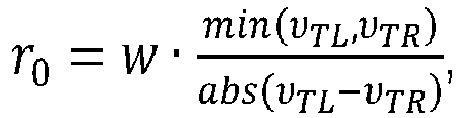
trailer 20 and the left wheel and w is the distance between the left and the right wheel. - Accordingly, the distance ro can by expressed by

- Further, the distance rT between point D as instantaneous center of velocity of the
trailer 20 and point T can be expressed by
- In accordance with the geometric relationships and speeds vF, vR, vK and vT or vTL and vTR, respectively, representative of respective wheel speeds, the articulation angle ϕ between the respective longitudinal axes of the towing
vehicle 10 and thetrailer 20 with respect to the center of the king pin K as pivot can be estimated based on the geometric data and instantaneous wheel speeds. In the following, exemplary embodiments of respective methods are presented. - According to a first exemplary embodiment of the method for estimating the articulation angle ϕ, the method uses the geometric data of the towing
vehicle 10, here the distance b between thefront axle 11 and therear axle 12, and the distance c between therear axle 12 and the center of the king pin K, the instantaneous steering angle ϑ, the speed vR of the center of therear axle 12 of the towing vehicle with respect to point R, and the speed vT of the center of therear axles trailer 20 with respect to point T as input data. In principle, the geometric data may be provided by a database to be selected according to thespecific towing vehicle 10 andtrailer 20 as preset and/or as constant preset. The steering angle ϑ may be provided in accordance with a control signal causing the steering and/or by respective sensor data. The speeds vR and vT may also be estimated in accordance with respective control signals with respect to a driving speed, acceleration or deceleration, and/or by a sensor signals, for example by direct measurements or indirect measurements representative of the speeds vR and/or vT. - Based on the distance b between the
front axle 11 and therear axle 12 of the towingvehicle 10 and the instantaneous steering angle ϑ, the distance r between point P as instantaneous center of velocity of the towingvehicle 10 and therear axle 12 of the towingvehicle 10 is calculated by equation (1), i.e.
- Further, the angle ε between the vectors of the speed vR of the center of the
rear axle 12 of the towingvehicle 10 and the speed vK of the center of the kingpin K is calculated by equation (4), i.e.
- According to the available data, the speed vK of the center of the king pin K is calculated by equation (6), i.e.

- However, the speed vK of the center of the king pin K may also be determined as input data in term of being available in accordance with a control signal or by sensor data as direct or indirect measurement. Nevertheless, the calculation may reduce the required amount of data to be provided as input data.
- As the ratio between the speed vT of the center of the
rear axles trailer 20 and the speed vK of the center of the kingpin K can be expressed by

- In summary, the articulation angle ϕ according to the first embodiment of the method for estimating the articulation angle ϕ is estimated based on the input data, i.e. the distance b between the
front axle 11 and therear axle 12, and the distance c between therear axle 12 and the center of the king pin K, the instantaneous steering angle ϑ, the speed vR of the center of therear axle 12 of the towing vehicle with respect to point R, and the speed vT of the center of therear axles trailer 20 with respect to point T, and the respectively calculated variables, i.e. the distance r between point P as instantaneous center of velocity of the towingvehicle 10 and therear axle 12 of the towingvehicle 10, the angle ε between the vectors of the speed vR of the center of therear axle 12 of the towingvehicle 10 and the speed vK of the center of the kingpin K, and the speed vK of the center of the king pin K. - Consequently, as a basic principle, the articulation angle ϕ is estimated by using the wheel speed(s) of the towing
vehicle 10 and thetrailer 20 and steering angle ϑ as time varying signals. Specifically, the articulation angle ϕ is estimated by using the wheel speed(s) of the non-steering axle of the towingvehicle 10 and/or the non-steering axle of thetrailer 20 and steering angle ϑ as time varying signals. More specifically, the articulation angle ϕ is estimated by using the geometric parameters of towing vehicle axle- and king pin bases. - According to a second exemplary embodiment of the method for estimating the articulation angle ϕ, the method uses the geometric data of the
trailer 20, here the distance L between the point T and the center of the king pin K in the longitudinal direction of thetrailer 20 and the distance w between the left and the right wheels of therear axles trailer 20, and the speed vTL of the left wheels of therear axles trailer 20 as well as the speed vTR of the right wheels of therear axles trailer 20 as input data. - Based on the distance w between the left and the right wheels of the
rear axles trailer 20 and the speed vTL of the left wheels of therear axles trailer 20 as well as the speed vTR of the right wheels of therear axles trailer 20, the distance ro between the point D as instantaneous center of velocity of thetrailer 20 and the left wheel is calculated by equation (3), i.e.
- Further, the distance rT between point D as instantaneous center of velocity of the
trailer 20 and point T is calculated by equation (2), i.e.
- Since the sum of the angle ε and articulation angle ϕ can be expressed by


- According to the second exemplary embodiment of the method for estimating the articulation angle ϕ, the angle ε is set to 0 as being neglected. Consequently, the articulation angle ϕ is estimated by equation (9), i.e.

- As per the above, the second exemplary embodiment of the method for estimating the articulation angle ϕ does not require any data with respect to the towing
vehicle 10. - In summary, the articulation angle ϕ according to the second embodiment of the method for estimating the articulation angle ϕ is estimated based on the input data of the
trailer 20, i.e. the distance L between the point T and the center of the king pin K in the longitudinal direction of thetrailer 20, and the distance w between the left and the right wheels of therear axles trailer 20, and the speed vTL of the left wheels of therear axles trailer 20 as well as the speed vTR of the right wheels of therear axles trailer 20, and the respectively calculated variables, i.e. the distance ro between the point D as instantaneous center of velocity of thetrailer 20 and the left wheel, and the distance rT between point D as instantaneous center of velocity of thetrailer 20 and point T. - Consequently, as a basic principle, the articulation angle ϕ is estimated by using the wheel speed(s) of the
trailer 20 as the only time varying signals. Specifically, the articulation angle ϕ is estimated by using the wheel speed(s) of the non-steering axle of thetrailer 20 as time varying signals. More specifically, the articulation angle ϕ is estimated by using the wheel speed(s) of thetrailer 20 on both sides on the same axle, preferably on the non-steering axles, as time varying signals. Preferably, the geometric input data may be restricted to the geometric data of the axle- and wheelbases of thetrailer 20. - According to a third exemplary embodiment of the method for estimating the articulation angle ϕ, the method combines the first and second embodiment of the method for estimating the articulation angle ϕ. Accordingly, the input data comprises the geometric data of the towing
vehicle 10, here the distance b between thefront axle 11 and therear axle 12, and the distance c between therear axle 12 and the center of the king pin K, and the geometric data of thetrailer 20, here the distance L between the point T and the center of the king pin K in the longitudinal direction of thetrailer 20, and the distance w between the left and the right wheels of therear axles trailer 20. Further, the input data comprises the instantaneous steering angle ϑ, the speed vR of the center of therear axle 12 of the towingvehicle 10 with respect to point R, and the speed vTL of the left wheels of therear axles trailer 20 as well as the speed vTR of the right wheels of therear axles trailer 20. - Based on the distance b between the
front axle 11 and therear axle 12 of the towingvehicle 10 and the instantaneous steering angle ϑ, the distance r between point P as instantaneous center of velocity of the towingvehicle 10 and therear axle 12 of the towingvehicle 10 is calculated by equation (1), i.e.
- Further, the angle ε between the vectors of the speed vR of the center of the
rear axle 12 of the towingvehicle 10 and the speed vK of the center of the kingpin K is calculated by equation (4), i.e.
- Based on the distance w between the left and the right wheels of the
rear axles trailer 20, and the speed vTL of the left wheels of therear axles trailer 20, as well as the speed vTR of the right wheels of therear axles trailer 20, the distance ro between the point D as instantaneous center of velocity of thetrailer 20 and the left wheel is calculated by equation (3), i.e.
- Further, the distance rT between point D as instantaneous center of velocity of the
trailer 20 and point T is calculated by equation (2), i.e.
- Since the sum of the angle ε and articulation angle ϕ can be expressed by


- Consequently, as a basic principle, the articulation angle ϕ is estimated by using the wheel speed(s) of the towing
vehicle 10 and thetrailer 20 and steering angle ϑ as time varying signals. Specifically, the articulation angle ϕ is estimated by using the wheel speed(s) of the non-steering axle of the towingvehicle 10 and/or the non-steering axle of thetrailer 20 and steering angle ϑ as time varying signals. More specifically, the articulation angle ϕ is estimated by using the geometric parameters of towing vehicle axle- and king pin bases. More specifically, the articulation angle ϕ is estimated by using the wheel speed(s) of thetrailer 20 on both sides on the same axle, preferably on the non-steering axles, as time varying signals. Preferably, the geometric input data refers to the trailer geometric parameters of the towing vehicle axle- and kingpin bases plus the trailer axle- and wheelbases. -
Figure 4 shows a schematic representation of a device for estimating an articulation angle ϕ between the towingvehicle 10 and thetrailer 20 with respect to the center of the king pin K as pivot. - The device comprises
- a
data unit 30 configured to receive and/or store data of- the distance b between a steering axle, preferably the
front axle 11, of the towingvehicle 10 and a non-steering axle, preferably therear axle 12, of the towingvehicle 10, - the distance c between the non-steering axle of the towing
vehicle 10 and the center of the king pin K as pivot, - the distance L between the at least one
axle trailer 20 and the center of the king pin K as pivot, and/or - the distance w between the center of the at least one wheel on the at least one
axle trailer 20 facing towards the instantaneous center of velocity D of thetrailer 20 and at least one wheel on the other side of the at least oneaxle trailer 20,
- the distance b between a steering axle, preferably the
- a
determination unit 40 configured to determine- the steering angle ϑ of the steering axle,
- the speed vR of the center of at least one axle represented by point R of the towing
vehicle 10, - the speed vT of the center of at least one axle represented by point T of the
trailer 20, and/or - the speed vTL and/or vTR of at least one wheel of at least one
rear axle trailer 20, preferably the speeds vTL and vTR of opposing wheels of the at least oneaxle
- an
estimation unit 50 configured to determine- the distance r between the instantaneous center of velocity P of the towing
vehicle 10 and the center of at least one axle R the towingvehicle 10 representative for a rotation of the towingvehicle 10 about the instantaneous center of velocity P of the towingvehicle 10, - the distance rT between the instantaneous center of velocity D of the
trailer 20 and the center of at least one axle represented by point T of thetrailer 20 representative for a rotation of thetrailer 20 about the instantaneous center of velocity D of thetrailer 20, - the speed vK of the center of the king pin K as pivot,
- the angle ε of the velocity vector vK of the king pin K as pivot and the velocity vector vR of the at least one
axle 12 of the towingvehicle 10, and/or - the ratio between the speeds vT and vK of the center of the at least one rear axle represented by point T of the
trailer 20 and the center of the king pin K as pivot, - to estimate the articulation angle ϕ, and
- the distance r between the instantaneous center of velocity P of the towing
- an
output unit 60 configured to output the articulation angle ϕ. - The device may be configured to execute any of the previously described methods for estimating an articulation angle ϕ between the towing
vehicle 10 and thetrailer 20 with respect to the pivot according to the first to second embodiment. However, the device may be alternatively configured to provide only one or two of such methods or any other applicable method in accordance with the invention. Accordingly, the respective device is configured to determine and calculate data at least required for such execution. - The invention has been described with respect to exemplary embodiments. However, the invention is not limited to the exemplary embodiments.
-
- 10
- towing vehicle
- 11
- front axle (towing vehicle)
- 12
- rear axle (towing vehicle)
- 20
- trailer
- 21
- first rear axle (trailer)
- 22
- second rear axle (trailer)
- 23
- third rear axle (trailer)
- 30
- data unit
- 40
- determination unit
- 50
- calculation unit (estimation unit)
- 60
- output unit
- b
- distance between front and rear axle (towing vehicle)
- c
- distance between rear axle and king pin (towing vehicle)
- D
- instantaneous center of velocity (ICV) point (trailer)
- F
- center of front axle (towing vehicle)
- K
- center of king pin (pivot)
- L
- distance between K (king pin (pivot)) and T (center of rear axle(s) of trailer)
- P
- instantaneous center of velocity (ICV) point (towing vehicle)
- r
- distance between P (ICV point of towing vehicle) and R (center of rear axle of towing vehicle)
- rT
- distance between D (ICV point of trailer) and T (center of rear axle(s) of trailer)
- ro
- distance between D (ICV point of trailer) and facing wheel(s) of rear axle(s) (trailer)
- R
- center of rear axle (towing vehicle)
- T
- center of rear axle(s) (trailer)
- w
- distance between wheels on opposite sides of the rear axle(s) (trailer)
- ε
- angle between velocity vectors vK and vR
- ϑ
- steering angle
- vF
- speed of center of front axle (towing vehicle)
- vK
- speed of center of king pin (pivot)
- vR
- speed of center of rear axle (towing vehicle)
- vT
- speed of center of rear axle(s) (trailer)
- vTL
- speed of left wheel(s) of rear axle(s) (trailer; facing towards D)
- vTR
- speed of right wheel(s) of rear axle(s) (trailer; facing away from D)
- ϕ
- articulation angle
Claims (15)
- Method for estimating an articulation angle (ϕ) between a towing vehicle (10) and a trailer (20) with respect to a pivot (K), comprising the steps of:determining a distance (r) between an instantaneous center of velocity (P) of the towing vehicle (10) and a center of at least one axle (R) of the towing vehicle (10) representative for a rotation of the towing vehicle (10) about the instantaneous center of velocity (P) of the towing vehicle (10) and/or a distance (rT) between an instantaneous center of velocity (D) of the trailer (20) and a center of at least one axle (T) of the trailer (20) representative for a rotation of the trailer (20) about the instantaneous center of velocity (D) of the trailer (20),determining at least one instantaneous speed (vR, vT, vTL, vTR) representative for a wheel speed of at least one wheel of the towing vehicle (10) and/or the trailer (20), wherein the at least one instantaneous speed (vR, vT, vTL, vTR) refers to the at least one determined distance (r, rT), andestimating the articulation angle (ϕ) based on the at least one determined instantaneous speed and the at least one determined distance (r, rT).
- Method according to claim 1, wherein the at least one instantaneous speed (vR, vT, vTL, vTR) is determined for at least one non-steered axle (12) of the towing vehicle (10), preferably as speed (vR) of the center of at least one rear axle (R) of the towing vehicle (10), and/or for at least one non-steered axle (21, 22, 23) of the trailer (20), preferably as speed (vT) of the center of at least one rear axle (T) or as speed (vTL, vTR) of at least one wheel of at least one rear axle (21, 22, 23) of the trailer (20).
- Method according to claim 1 or 2, wherein the distance (r) between the instantaneous center of velocity (P) of the towing vehicle (10) and the center of at least one axle (R) of the towing vehicle (10) is calculated, preferably based on a distance (b) between a steering axle (11), preferably a front axle (11), of the towing vehicle (10), and a non-steering axle (12), preferably a rear axle (12), of the towing vehicle (10), and a steering angle (ϑ) of the steering axle (11).
- Method according to claim 3, wherein the distance (r) between the instantaneous center of velocity (P) of the towing vehicle (10) and the center of at least one axle (R) the towing vehicle (10) is calculated by

- Method according to any one of the preceding claims, wherein the distance (rT) between the instantaneous center of velocity (D) of the trailer (20) and the center of at least one axle (T) of the trailer (20) is calculated, preferably based on a distance (r0) between a center of at least one wheel on the at least one axle (21, 22, 23) of the trailer (20) facing towards the instantaneous center of velocity (D) of the trailer (20) and a distance (w) between the center of the at least one wheel on the at least one axle (21, 22, 23) facing towards the instantaneous center of velocity (D) of the trailer (20) and at least one wheel on the other side of the at least one axle (21, 22, 23).
- Method according to claim 5, wherein the distance (rT) between the instantaneous center of velocity (D) of the trailer (20) and the center of at least one axle (T) of the trailer (20) is calculated by

- Method according to any one of the preceding claims, wherein the method further comprises a determination of an angle (ε) of a velocity vector (vK) of the pivot (K) and the velocity vector (vR) of the at least one axle (12) of the towing vehicle (10), preferably calculated by

- Method according to claim 7, wherein the articulation angle (ϕ) is estimated by


- Method according to claim 7, wherein the articulation angle (ϕ) is estimated by

- Method according to any one of the claims 1 to 6, wherein the articulation angle (ϕ) is estimated by

- Device for estimating an articulation angle (ϕ) between a towing vehicle (10) and a trailer (20) with respect to a pivot (K) by executing the method according to any one of the claims 1 to 10, comprising:a data unit (30) configured to receive and/or store data of- the distance (b) between the steering axle (11), preferably a front axle (11), of the towing vehicle (10) and a non-steering axle (12), preferably a rear axle (12), of the towing vehicle (10),- the distance (c) between the non-steering axle (12) of the towing vehicle (10) and the pivot (K),- the distance (L) between the at least one axle (21, 22, 23) of the trailer (20) and the pivot (K), and/or- the distance (w) between the center of the at least one wheel on the at least one axle (21, 22, 23) facing towards the instantaneous center of velocity (D) of the trailer (20) and at least one wheel on the other side of the at least one axle (21, 22, 23),a determination unit (40) configured to determine- the steering angle (ϑ) of the steering axle (11),- the speed (vR) of the center of at least one axle (R) of the towing vehicle (10),- the speed (vT) of the center of at least one axle (T) of the trailer (20), and/or- the speed (vTL, vTR) of at least one wheel of at least one rear axle (21, 22, 23) of the trailer (20), preferably the speeds (vTL, vTR) of opposing wheels of the at least one axle (21, 22, 23) with respect to the center of the at least one axle (T),an estimation unit (50) configured to determine- the distance (r) between the instantaneous center of velocity (P) of the towing vehicle (10) and the center of at least one axle (R) the towing vehicle (10) representative for a rotation of the towing vehicle (10) about the instantaneous center of velocity (P) of the towing vehicle (10),- the distance (rT) between the instantaneous center of velocity (D) of the trailer (20) and the center of at least one axle (T) of the trailer (20) representative for a rotation of the trailer (20) about the instantaneous center of velocity (D) of the trailer (20),- the speed (vK) of the center of the pivot (K),- the angle (ε) of the velocity vector (vK) of the pivot (K) and the velocity vector (vR) of the at least one axle (12) of the towing vehicle (10), and/or- the ratio between the speeds (vT, vK) of the center of the at least one rear axle (T) of the trailer (20) and the center of the pivot (K)to estimate the articulation angle (ϕ), andan output unit (60) configured to output the articulation angle (ϕ).
- Device according to claim 11, wherein the estimation unit (50) is or comprises a calculation unit (50) to calculate the at least one of- the distance (r) between the instantaneous center of velocity (P) of the towing vehicle (10) and the center of at least one axle (R) the towing vehicle (10) representative for a rotation of the towing vehicle (10) about the instantaneous center of velocity (P) of the towing vehicle (10),- the distance (rT) between the instantaneous center of velocity (D) of the trailer (20) and the center of at least one axle (T) of the trailer (20) representative for a rotation of the trailer (20) about the instantaneous center of velocity (D) of the trailer (20),- the speed (vK) of the center of the pivot (K),- the angle (ε) of the velocity vector (vK) of the pivot (K) and the velocity vector (vR) of the at least one axle (12) of the towing vehicle (10), and/or- the ratio between the speeds (vT, vK) of the center of the at least one rear axle (T) of the trailer (20) and the center of the pivot (K).
- Driving assistance system for a towing vehicle (10) comprising the device for estimating an articulation angle (ϕ) between a towing vehicle (10) and a trailer (20) with respect to a pivot (K) according to claim 11 or 12 by executing the method according to any one of the claims 1 to 10.
- Commercial vehicle comprising the device according to claim 11 or 12 and/or the driving assistance system according to claim 13.
- Computer program product comprising a program code stored on a machine-readable medium for executing the method according to any one of the claims 1 to 10.
Priority Applications (3)
| Application Number | Priority Date | Filing Date | Title |
|---|---|---|---|
| ES22165932T ES3057097T3 (en) | 2022-03-31 | 2022-03-31 | Method for estimating an articulation angle between a towing vehicle and a trailer, respective device, driving assistance system, commercial vehicle and computer program product |
| EP22165932.9A EP4253197B1 (en) | 2022-03-31 | 2022-03-31 | Method for estimating an articulation angle between a towing vehicle and a trailer, respective device, driving assistance system, commercial vehicle and computer program product |
| US18/128,513 US12358556B2 (en) | 2022-03-31 | 2023-03-30 | Method for estimating an articulation angle between a towing vehicle and a trailer, respective device, driving assistance system, commercial vehicle and computer program product |
Applications Claiming Priority (1)
| Application Number | Priority Date | Filing Date | Title |
|---|---|---|---|
| EP22165932.9A EP4253197B1 (en) | 2022-03-31 | 2022-03-31 | Method for estimating an articulation angle between a towing vehicle and a trailer, respective device, driving assistance system, commercial vehicle and computer program product |
Publications (2)
| Publication Number | Publication Date |
|---|---|
| EP4253197A1 true EP4253197A1 (en) | 2023-10-04 |
| EP4253197B1 EP4253197B1 (en) | 2025-11-12 |
Family
ID=81326812
Family Applications (1)
| Application Number | Title | Priority Date | Filing Date |
|---|---|---|---|
| EP22165932.9A Active EP4253197B1 (en) | 2022-03-31 | 2022-03-31 | Method for estimating an articulation angle between a towing vehicle and a trailer, respective device, driving assistance system, commercial vehicle and computer program product |
Country Status (3)
| Country | Link |
|---|---|
| US (1) | US12358556B2 (en) |
| EP (1) | EP4253197B1 (en) |
| ES (1) | ES3057097T3 (en) |
Citations (1)
| Publication number | Priority date | Publication date | Assignee | Title |
|---|---|---|---|---|
| US20160139599A1 (en) * | 2014-11-14 | 2016-05-19 | International Truck Intellectual Property Company, Llc | Determining turning radius of coupled vehicles |
Family Cites Families (7)
| Publication number | Priority date | Publication date | Assignee | Title |
|---|---|---|---|---|
| US10106193B2 (en) * | 2016-07-01 | 2018-10-23 | Ford Global Technologies, Llc | Enhanced yaw rate trailer angle detection initialization |
| US10173722B2 (en) * | 2016-11-04 | 2019-01-08 | GM Global Technology Operations LLC | System and method for determining a hitch angle based on an input from a sensor and a kinematic model of a vehicle and a trailer, and for controlling the vehicle based on the hitch angle |
| US11420695B2 (en) * | 2018-01-31 | 2022-08-23 | Vieletech Inc. | Semi-autonomous trailer hauler |
| EP4103453B1 (en) * | 2020-02-11 | 2024-07-03 | Volvo Truck Corporation | Methods for controlling a self-powered dolly vehicle during evasive maneuvering |
| US11964659B2 (en) * | 2020-06-03 | 2024-04-23 | GM Global Technology Operations LLC | System and method for determining a hitch angle for controlling a vehicle with active rear steering |
| US11560026B2 (en) * | 2020-11-06 | 2023-01-24 | GM Global Technology Operations LLC | System and method for hitch angle estimation |
| EP4086147A1 (en) * | 2021-05-07 | 2022-11-09 | Volvo Truck Corporation | Electrified trailer with reverse assist function |
-
2022
- 2022-03-31 ES ES22165932T patent/ES3057097T3/en active Active
- 2022-03-31 EP EP22165932.9A patent/EP4253197B1/en active Active
-
2023
- 2023-03-30 US US18/128,513 patent/US12358556B2/en active Active
Patent Citations (1)
| Publication number | Priority date | Publication date | Assignee | Title |
|---|---|---|---|---|
| US20160139599A1 (en) * | 2014-11-14 | 2016-05-19 | International Truck Intellectual Property Company, Llc | Determining turning radius of coupled vehicles |
Also Published As
| Publication number | Publication date |
|---|---|
| EP4253197B1 (en) | 2025-11-12 |
| US12358556B2 (en) | 2025-07-15 |
| US20230311987A1 (en) | 2023-10-05 |
| ES3057097T3 (en) | 2026-02-26 |
Similar Documents
| Publication | Publication Date | Title |
|---|---|---|
| US8073594B2 (en) | Trailer articulation angle estimation | |
| US6999856B2 (en) | Trailer tongue length estimation using a trailer yaw rate sensor | |
| US6522956B2 (en) | Method and device for estimating a transverse acceleration at an axle of a semitrailer or a trailer of a vehicle combination | |
| US9845109B2 (en) | Continuous estimation of surface friction coefficient based on EPS and vehicle models | |
| US5523947A (en) | System and method for estimating trailer length | |
| US6806809B2 (en) | Trailer tongue length estimation using a hitch angle sensor | |
| US8326480B2 (en) | Method and device for monitoring the state of tires | |
| US10632978B2 (en) | Method and system for determining friction between the ground and a tire of a vehicle | |
| US20090128315A1 (en) | Method for determining absolute tire rolling circumferences and tire pressure control system | |
| JPH06273187A (en) | Vehicle weight center slip angle measuring device | |
| US11560026B2 (en) | System and method for hitch angle estimation | |
| US20170190355A1 (en) | Wheel alignment monitoring | |
| CN114787014A (en) | On-board road friction estimation | |
| JP7354272B2 (en) | Method for estimating vehicle motion state during vehicle operation | |
| CN105564502B (en) | A kind of power steering early warning system and its working method based on machine vision | |
| US11142174B2 (en) | Method for a utility vehicle which has a trailer coupling, device and utility vehicle for said method, and computer program product for same | |
| US10077980B2 (en) | Method and control unit for determining an angle between longitudinal axes of component vehicles of a tractor-trailer combination | |
| EP4253197B1 (en) | Method for estimating an articulation angle between a towing vehicle and a trailer, respective device, driving assistance system, commercial vehicle and computer program product | |
| Ehlers et al. | State and parameter estimation in a semitrailer for different loading conditions only based on trailer signals | |
| Bouteldja et al. | Jackknifing warning for articulated vehicles based on a detection and prediction system | |
| US11866033B2 (en) | Method for estimating an effective length of a first vehicle segment of a vehicle combination | |
| EP4509391A1 (en) | Method for avoiding collisions and vehicle | |
| JPH10332730A (en) | Vehicle turning state sensor monitoring device | |
| EP4512674A1 (en) | Trailer yaw-rate estimator | |
| GB2398047A (en) | Tow bar length calculation |
Legal Events
| Date | Code | Title | Description |
|---|---|---|---|
| PUAI | Public reference made under article 153(3) epc to a published international application that has entered the european phase |
Free format text: ORIGINAL CODE: 0009012 |
|
| STAA | Information on the status of an ep patent application or granted ep patent |
Free format text: STATUS: THE APPLICATION HAS BEEN PUBLISHED |
|
| AK | Designated contracting states |
Kind code of ref document: A1 Designated state(s): AL AT BE BG CH CY CZ DE DK EE ES FI FR GB GR HR HU IE IS IT LI LT LU LV MC MK MT NL NO PL PT RO RS SE SI SK SM TR |
|
| RAP3 | Party data changed (applicant data changed or rights of an application transferred) |
Owner name: KNORR-BREMSE SYSTEME FUER NUTZFAHRZEUGE GMBH |
|
| STAA | Information on the status of an ep patent application or granted ep patent |
Free format text: STATUS: REQUEST FOR EXAMINATION WAS MADE |
|
| 17P | Request for examination filed |
Effective date: 20240404 |
|
| RBV | Designated contracting states (corrected) |
Designated state(s): AL AT BE BG CH CY CZ DE DK EE ES FI FR GB GR HR HU IE IS IT LI LT LU LV MC MK MT NL NO PL PT RO RS SE SI SK SM TR |
|
| GRAP | Despatch of communication of intention to grant a patent |
Free format text: ORIGINAL CODE: EPIDOSNIGR1 |
|
| STAA | Information on the status of an ep patent application or granted ep patent |
Free format text: STATUS: GRANT OF PATENT IS INTENDED |
|
| INTG | Intention to grant announced |
Effective date: 20250616 |
|
| P01 | Opt-out of the competence of the unified patent court (upc) registered |
Free format text: CASE NUMBER: UPC_APP_4326_4253197/2025 Effective date: 20250825 |
|
| GRAS | Grant fee paid |
Free format text: ORIGINAL CODE: EPIDOSNIGR3 |
|
| GRAA | (expected) grant |
Free format text: ORIGINAL CODE: 0009210 |
|
| STAA | Information on the status of an ep patent application or granted ep patent |
Free format text: STATUS: THE PATENT HAS BEEN GRANTED |
|
| AK | Designated contracting states |
Kind code of ref document: B1 Designated state(s): AL AT BE BG CH CY CZ DE DK EE ES FI FR GB GR HR HU IE IS IT LI LT LU LV MC MK MT NL NO PL PT RO RS SE SI SK SM TR |
|
| REG | Reference to a national code |
Ref country code: CH Ref legal event code: F10 Free format text: ST27 STATUS EVENT CODE: U-0-0-F10-F00 (AS PROVIDED BY THE NATIONAL OFFICE) Effective date: 20251112 Ref country code: GB Ref legal event code: FG4D |
|
| REG | Reference to a national code |
Ref country code: IE Ref legal event code: FG4D |
|
| REG | Reference to a national code |
Ref country code: DE Ref legal event code: R096 Ref document number: 602022024738 Country of ref document: DE |
|
| REG | Reference to a national code |
Ref country code: SE Ref legal event code: TRGR |
|
| REG | Reference to a national code |
Ref country code: ES Ref legal event code: FG2A Ref document number: 3057097 Country of ref document: ES Kind code of ref document: T3 Effective date: 20260226 |
|
| REG | Reference to a national code |
Ref country code: NL Ref legal event code: MP Effective date: 20251112 |
|
| PGFP | Annual fee paid to national office [announced via postgrant information from national office to epo] |
Ref country code: SE Payment date: 20260323 Year of fee payment: 5 |
|
| PGFP | Annual fee paid to national office [announced via postgrant information from national office to epo] |
Ref country code: GB Payment date: 20260319 Year of fee payment: 5 |
|
| REG | Reference to a national code |
Ref country code: LT Ref legal event code: MG9D |
|
| PG25 | Lapsed in a contracting state [announced via postgrant information from national office to epo] |
Ref country code: NO Free format text: LAPSE BECAUSE OF FAILURE TO SUBMIT A TRANSLATION OF THE DESCRIPTION OR TO PAY THE FEE WITHIN THE PRESCRIBED TIME-LIMIT Effective date: 20260212 |
|
| PGFP | Annual fee paid to national office [announced via postgrant information from national office to epo] |
Ref country code: DE Payment date: 20260320 Year of fee payment: 5 |
|
| PG25 | Lapsed in a contracting state [announced via postgrant information from national office to epo] |
Ref country code: HR Free format text: LAPSE BECAUSE OF FAILURE TO SUBMIT A TRANSLATION OF THE DESCRIPTION OR TO PAY THE FEE WITHIN THE PRESCRIBED TIME-LIMIT Effective date: 20251112 Ref country code: AT Free format text: LAPSE BECAUSE OF FAILURE TO SUBMIT A TRANSLATION OF THE DESCRIPTION OR TO PAY THE FEE WITHIN THE PRESCRIBED TIME-LIMIT Effective date: 20251112 Ref country code: FI Free format text: LAPSE BECAUSE OF FAILURE TO SUBMIT A TRANSLATION OF THE DESCRIPTION OR TO PAY THE FEE WITHIN THE PRESCRIBED TIME-LIMIT Effective date: 20251112 |
|
| REG | Reference to a national code |
Ref country code: AT Ref legal event code: MK05 Ref document number: 1856548 Country of ref document: AT Kind code of ref document: T Effective date: 20251112 |
|
| PG25 | Lapsed in a contracting state [announced via postgrant information from national office to epo] |
Ref country code: NL Free format text: LAPSE BECAUSE OF FAILURE TO SUBMIT A TRANSLATION OF THE DESCRIPTION OR TO PAY THE FEE WITHIN THE PRESCRIBED TIME-LIMIT Effective date: 20251112 |
|
| PG25 | Lapsed in a contracting state [announced via postgrant information from national office to epo] |
Ref country code: RS Free format text: LAPSE BECAUSE OF FAILURE TO SUBMIT A TRANSLATION OF THE DESCRIPTION OR TO PAY THE FEE WITHIN THE PRESCRIBED TIME-LIMIT Effective date: 20260212 |
|
| PG25 | Lapsed in a contracting state [announced via postgrant information from national office to epo] |
Ref country code: IS Free format text: LAPSE BECAUSE OF FAILURE TO SUBMIT A TRANSLATION OF THE DESCRIPTION OR TO PAY THE FEE WITHIN THE PRESCRIBED TIME-LIMIT Effective date: 20260312 |
|
| PG25 | Lapsed in a contracting state [announced via postgrant information from national office to epo] |
Ref country code: PT Free format text: LAPSE BECAUSE OF FAILURE TO SUBMIT A TRANSLATION OF THE DESCRIPTION OR TO PAY THE FEE WITHIN THE PRESCRIBED TIME-LIMIT Effective date: 20260312 |
|
| PG25 | Lapsed in a contracting state [announced via postgrant information from national office to epo] |
Ref country code: PL Free format text: LAPSE BECAUSE OF FAILURE TO SUBMIT A TRANSLATION OF THE DESCRIPTION OR TO PAY THE FEE WITHIN THE PRESCRIBED TIME-LIMIT Effective date: 20251112 |
|
| PG25 | Lapsed in a contracting state [announced via postgrant information from national office to epo] |
Ref country code: LV Free format text: LAPSE BECAUSE OF FAILURE TO SUBMIT A TRANSLATION OF THE DESCRIPTION OR TO PAY THE FEE WITHIN THE PRESCRIBED TIME-LIMIT Effective date: 20251112 |
|
| PG25 | Lapsed in a contracting state [announced via postgrant information from national office to epo] |
Ref country code: BG Free format text: LAPSE BECAUSE OF FAILURE TO SUBMIT A TRANSLATION OF THE DESCRIPTION OR TO PAY THE FEE WITHIN THE PRESCRIBED TIME-LIMIT Effective date: 20251112 |
|
| PG25 | Lapsed in a contracting state [announced via postgrant information from national office to epo] |
Ref country code: LT Free format text: LAPSE BECAUSE OF FAILURE TO SUBMIT A TRANSLATION OF THE DESCRIPTION OR TO PAY THE FEE WITHIN THE PRESCRIBED TIME-LIMIT Effective date: 20251112 |
|
| PG25 | Lapsed in a contracting state [announced via postgrant information from national office to epo] |
Ref country code: SM Free format text: LAPSE BECAUSE OF FAILURE TO SUBMIT A TRANSLATION OF THE DESCRIPTION OR TO PAY THE FEE WITHIN THE PRESCRIBED TIME-LIMIT Effective date: 20251112 |
|
| PGFP | Annual fee paid to national office [announced via postgrant information from national office to epo] |
Ref country code: ES Payment date: 20260414 Year of fee payment: 5 |
|
| PG25 | Lapsed in a contracting state [announced via postgrant information from national office to epo] |
Ref country code: DK Free format text: LAPSE BECAUSE OF FAILURE TO SUBMIT A TRANSLATION OF THE DESCRIPTION OR TO PAY THE FEE WITHIN THE PRESCRIBED TIME-LIMIT Effective date: 20251112 |
|
| PG25 | Lapsed in a contracting state [announced via postgrant information from national office to epo] |
Ref country code: IT Free format text: LAPSE BECAUSE OF FAILURE TO SUBMIT A TRANSLATION OF THE DESCRIPTION OR TO PAY THE FEE WITHIN THE PRESCRIBED TIME-LIMIT Effective date: 20251112 |
|
| PG25 | Lapsed in a contracting state [announced via postgrant information from national office to epo] |
Ref country code: EE Free format text: LAPSE BECAUSE OF FAILURE TO SUBMIT A TRANSLATION OF THE DESCRIPTION OR TO PAY THE FEE WITHIN THE PRESCRIBED TIME-LIMIT Effective date: 20251112 |
|
| PG25 | Lapsed in a contracting state [announced via postgrant information from national office to epo] |
Ref country code: CZ Free format text: LAPSE BECAUSE OF FAILURE TO SUBMIT A TRANSLATION OF THE DESCRIPTION OR TO PAY THE FEE WITHIN THE PRESCRIBED TIME-LIMIT Effective date: 20251112 |
|
| PG25 | Lapsed in a contracting state [announced via postgrant information from national office to epo] |
Ref country code: SK Free format text: LAPSE BECAUSE OF FAILURE TO SUBMIT A TRANSLATION OF THE DESCRIPTION OR TO PAY THE FEE WITHIN THE PRESCRIBED TIME-LIMIT Effective date: 20251112 |