EP4251437B1 - Shock absorber and spring assembly for a vehicle suspension, comprising an electromechanical adjustment device for adjusting the vertical position of the spring and an associated blocking system, and method for moving the spring plate of the shock absorber - Google Patents
Shock absorber and spring assembly for a vehicle suspension, comprising an electromechanical adjustment device for adjusting the vertical position of the spring and an associated blocking system, and method for moving the spring plate of the shock absorber Download PDFInfo
- Publication number
- EP4251437B1 EP4251437B1 EP21824025.7A EP21824025A EP4251437B1 EP 4251437 B1 EP4251437 B1 EP 4251437B1 EP 21824025 A EP21824025 A EP 21824025A EP 4251437 B1 EP4251437 B1 EP 4251437B1
- Authority
- EP
- European Patent Office
- Prior art keywords
- screw
- rotation
- axis
- shock absorber
- spring
- Prior art date
- Legal status (The legal status is an assumption and is not a legal conclusion. Google has not performed a legal analysis and makes no representation as to the accuracy of the status listed.)
- Active
Links
Images


Classifications
-
- B—PERFORMING OPERATIONS; TRANSPORTING
- B60—VEHICLES IN GENERAL
- B60G—VEHICLE SUSPENSION ARRANGEMENTS
- B60G17/00—Resilient suspensions having means for adjusting the spring or vibration-damper characteristics, for regulating the distance between a supporting surface and a sprung part of vehicle or for locking suspension during use to meet varying vehicular or surface conditions, e.g. due to speed or load
- B60G17/015—Resilient suspensions having means for adjusting the spring or vibration-damper characteristics, for regulating the distance between a supporting surface and a sprung part of vehicle or for locking suspension during use to meet varying vehicular or surface conditions, e.g. due to speed or load the regulating means comprising electric or electronic elements
- B60G17/0152—Resilient suspensions having means for adjusting the spring or vibration-damper characteristics, for regulating the distance between a supporting surface and a sprung part of vehicle or for locking suspension during use to meet varying vehicular or surface conditions, e.g. due to speed or load the regulating means comprising electric or electronic elements characterised by the action on a particular type of suspension unit
- B60G17/0157—Resilient suspensions having means for adjusting the spring or vibration-damper characteristics, for regulating the distance between a supporting surface and a sprung part of vehicle or for locking suspension during use to meet varying vehicular or surface conditions, e.g. due to speed or load the regulating means comprising electric or electronic elements characterised by the action on a particular type of suspension unit non-fluid unit, e.g. electric motor
-
- B—PERFORMING OPERATIONS; TRANSPORTING
- B60—VEHICLES IN GENERAL
- B60G—VEHICLE SUSPENSION ARRANGEMENTS
- B60G15/00—Resilient suspensions characterised by arrangement, location or type of combined spring and vibration damper, e.g. telescopic type
- B60G15/02—Resilient suspensions characterised by arrangement, location or type of combined spring and vibration damper, e.g. telescopic type having mechanical spring
- B60G15/06—Resilient suspensions characterised by arrangement, location or type of combined spring and vibration damper, e.g. telescopic type having mechanical spring and fluid damper
- B60G15/062—Resilient suspensions characterised by arrangement, location or type of combined spring and vibration damper, e.g. telescopic type having mechanical spring and fluid damper the spring being arranged around the damper
- B60G15/063—Resilient suspensions characterised by arrangement, location or type of combined spring and vibration damper, e.g. telescopic type having mechanical spring and fluid damper the spring being arranged around the damper characterised by the mounting of the spring on the damper
-
- B—PERFORMING OPERATIONS; TRANSPORTING
- B60—VEHICLES IN GENERAL
- B60G—VEHICLE SUSPENSION ARRANGEMENTS
- B60G17/00—Resilient suspensions having means for adjusting the spring or vibration-damper characteristics, for regulating the distance between a supporting surface and a sprung part of vehicle or for locking suspension during use to meet varying vehicular or surface conditions, e.g. due to speed or load
- B60G17/02—Spring characteristics, e.g. mechanical springs and mechanical adjusting means
- B60G17/021—Spring characteristics, e.g. mechanical springs and mechanical adjusting means the mechanical spring being a coil spring
-
- B—PERFORMING OPERATIONS; TRANSPORTING
- B60—VEHICLES IN GENERAL
- B60T—VEHICLE BRAKE CONTROL SYSTEMS OR PARTS THEREOF; BRAKE CONTROL SYSTEMS OR PARTS THEREOF, IN GENERAL; ARRANGEMENT OF BRAKING ELEMENTS ON VEHICLES IN GENERAL; PORTABLE DEVICES FOR PREVENTING UNWANTED MOVEMENT OF VEHICLES; VEHICLE MODIFICATIONS TO FACILITATE COOLING OF BRAKES
- B60T7/00—Brake-action initiating means
- B60T7/02—Brake-action initiating means for personal initiation
- B60T7/08—Brake-action initiating means for personal initiation hand actuated
- B60T7/10—Disposition of hand control
- B60T7/101—Disposition of hand control by means of a pull rod
-
- F—MECHANICAL ENGINEERING; LIGHTING; HEATING; WEAPONS; BLASTING
- F16—ENGINEERING ELEMENTS AND UNITS; GENERAL MEASURES FOR PRODUCING AND MAINTAINING EFFECTIVE FUNCTIONING OF MACHINES OR INSTALLATIONS; THERMAL INSULATION IN GENERAL
- F16H—GEARING
- F16H25/00—Gearings comprising primarily only cams, cam-followers and screw-and-nut mechanisms
- F16H25/18—Gearings comprising primarily only cams, cam-followers and screw-and-nut mechanisms for conveying or interconverting oscillating or reciprocating motions
- F16H25/20—Screw mechanisms
- F16H25/24—Elements essential to such mechanisms, e.g. screws, nuts
- F16H25/2454—Brakes; Rotational locks
-
- B—PERFORMING OPERATIONS; TRANSPORTING
- B60—VEHICLES IN GENERAL
- B60G—VEHICLE SUSPENSION ARRANGEMENTS
- B60G2202/00—Indexing codes relating to the type of spring, damper or actuator
- B60G2202/30—Spring/Damper and/or actuator Units
- B60G2202/31—Spring/Damper and/or actuator Units with the spring arranged around the damper, e.g. MacPherson strut
- B60G2202/312—The spring being a wound spring
-
- B—PERFORMING OPERATIONS; TRANSPORTING
- B60—VEHICLES IN GENERAL
- B60G—VEHICLE SUSPENSION ARRANGEMENTS
- B60G2202/00—Indexing codes relating to the type of spring, damper or actuator
- B60G2202/30—Spring/Damper and/or actuator Units
- B60G2202/32—The spring being in series with the damper and/or actuator
-
- B—PERFORMING OPERATIONS; TRANSPORTING
- B60—VEHICLES IN GENERAL
- B60G—VEHICLE SUSPENSION ARRANGEMENTS
- B60G2202/00—Indexing codes relating to the type of spring, damper or actuator
- B60G2202/40—Type of actuator
- B60G2202/42—Electric actuator
-
- B—PERFORMING OPERATIONS; TRANSPORTING
- B60—VEHICLES IN GENERAL
- B60G—VEHICLE SUSPENSION ARRANGEMENTS
- B60G2202/00—Indexing codes relating to the type of spring, damper or actuator
- B60G2202/40—Type of actuator
- B60G2202/442—Rotary actuator
-
- B—PERFORMING OPERATIONS; TRANSPORTING
- B60—VEHICLES IN GENERAL
- B60G—VEHICLE SUSPENSION ARRANGEMENTS
- B60G2204/00—Indexing codes related to suspensions per se or to auxiliary parts
- B60G2204/40—Auxiliary suspension parts; Adjustment of suspensions
- B60G2204/419—Gears
-
- B—PERFORMING OPERATIONS; TRANSPORTING
- B60—VEHICLES IN GENERAL
- B60G—VEHICLE SUSPENSION ARRANGEMENTS
- B60G2204/00—Indexing codes related to suspensions per se or to auxiliary parts
- B60G2204/40—Auxiliary suspension parts; Adjustment of suspensions
- B60G2204/424—Mechanisms for force adjustment, e.g. constant force mechanisms
-
- B—PERFORMING OPERATIONS; TRANSPORTING
- B60—VEHICLES IN GENERAL
- B60G—VEHICLE SUSPENSION ARRANGEMENTS
- B60G2204/00—Indexing codes related to suspensions per se or to auxiliary parts
- B60G2204/40—Auxiliary suspension parts; Adjustment of suspensions
- B60G2204/46—Means for locking the suspension
- B60G2204/4604—Means for locking the suspension mechanically, e.g. using a hook as anticreep mechanism
-
- B—PERFORMING OPERATIONS; TRANSPORTING
- B60—VEHICLES IN GENERAL
- B60G—VEHICLE SUSPENSION ARRANGEMENTS
- B60G2500/00—Indexing codes relating to the regulated action or device
- B60G2500/30—Height or ground clearance
Definitions
- This invention relates in general to a shock absorber and spring assembly for a vehicle suspension, which assembly is provided with an adjustment device for adjusting the vertical position of the spring and thus controlling the clearance of the vehicle from the ground.
- a vehicle suspension comprising a shock absorber and spring assembly, in which the shock absorber is connected at its lower end to a wheel carrier or to a suspension arm and at its upper end to the body of the vehicle, and in which the spring is arranged around the shock absorber and abuts at its lower end against a spring plate and at its upper end against the body of the vehicle, it is known to use an adjustment device arranged between the cylinder of the shock absorber and the spring plate to vary the vertical position of the spring and thus allow the clearance of the body of the vehicle from the ground to be adjusted.
- the adjustment devices used for this purpose may be of different kinds, such as hydraulic devices, pneumatic devices, hydro-pneumatic devices and electromechanical devices.
- electromechanical adjustment devices are gaining more and more attention and interest on account of their high level of reliability, their relatively low cost, and their compactness by comparison with other types of adjustment devices.
- the motion conversion mechanism in turn comprises a screw adapted to be rotated about its axis by the electric motor, and a nut screw which meshes with the screw and is connected to the spring plate for conjoint translation therewith, in such a way that, by activating the electric motor, the rotary motion transmitted by the electric motor to the screw is converted into translational motion of the nut screw, and thus into translational motion of the spring plate.
- a solution of the type mentioned above is known, for example, from WO 2019/097461 A1 , which discloses a spring and shock absorber assembly for a vehicle suspension, according to the preamble of claim 1, which assembly is designed to prevent the spring plate from rotating relative to the shock absorber without needing to use suitable anti-rotation means.
- the screw and the nut screw of the motion conversion mechanism are arranged eccentrically with respect to the axis of the shock absorber, and the kinematic mechanism formed by the worm screw and by the nut screw is designed to have low efficiency (i.e. high levels of friction) such that it is an irreversible mechanism.
- the screw is only allowed to rotate relative to the nut screw when the former is rotated by the electric motor, whereas rotation caused solely by the downward forces transmitted by the spring to the spring support plate is prevented.
- this solution ensures that the mechanism is not able to move from a particular attained position, due solely to the effect of the weight of the vehicle and the other resilient forces caused by the deformation of the spring when the vehicle is in use.
- the object of this invention is to overcome the aforementioned problems.
- a spring and shock absorber assembly for a vehicle suspension comprises an additional mechanism for blocking the relative rotation between the screw and the nut screw, which is necessary in order to be able to maintain the desired position of the spring support plate under the action of the forces transmitted to the spring by said plate without having to continue to supply the electric motor with electricity, even when a high-efficiency, i.e. reversible, screw/nut screw kinematic mechanism is used.
- the electromechanical adjustment device comprises: an electric motor adapted to generate a rotary motion; a motion conversion mechanism which extends along an axis parallel but not coincident to the axis of the shock absorber and which in turn includes a nut screw which meshes with a screw rotated by the electric motor, which nut screw is connected to the spring support plate for conjoint translation therewith; and a mechanism for blocking the rotation of the screw with respect to the nut screw, comprising a clutch, the opening action of which is controlled by exciting an electromagnet with electrical current.
- the screw/nut screw kinematic mechanism is preferably high-efficiency, for example is achieved by the use of a ball screw.
- the mechanism for blocking the rotation of the screw with respect to the nut screw comprises an electrically actuated clutch which includes two discs provided with profiles which mesh with one another, i.e. a lower disc which rotates together with the screw, and an upper disc which is non-rotatably fixed but is able to translate axially along the axis of the screw.
- the two discs have a series of teeth which may engage with one another.
- These teeth may have profiles which, with respect to a plane containing the axis of the screw, form different angles on their right-hand side and on their left-hand side, i.e. depending on the engaged flank.
- the two engaged teeth are brought into contact with one another on a first side, which is advantageously characterized by a small angle of the profile of the teeth with respect to a plane containing the axis of the screw, and the sliding of a tooth of the upper disc with respect to the tooth of the lower disc is therefore blocked, thus also preventing the screw from rotating with respect to the nut screw and preventing the upward translation of the upper disc.
- the screw tends to rotate in a second direction counter to the first direction
- the two engaged teeth are brought into contact with one another on a second side, which is advantageously characterized by a large angle of the profile of the teeth with respect to a plane containing the axis of the screw, and it is therefore possible to slide a tooth of the upper disc with respect to the tooth of the lower disc, thus making it possible to rotate the screw with respect to the nut screw and consequently translate the upper disc upward.
- the first direction of rotation corresponds to the direction of rotation of the screw during the downward motion of the spring support plate. This downward motion is triggered by the downward force transmitted by the spring to the spring support plate.
- the second direction of rotation corresponds to the direction of rotation of the screw during the upward motion of the spring support plate. This upward motion is only possible when the screw is activated by the electric motor.
- the upper disc is preferably pushed downward by resilient return means, in so doing ensuring that the profiles of the upper disc enter into engagement with the profiles of the lower disc.
- the upper disc may also be moved upward by using an electrical current to excite an electromagnet arranged above the upper disc. By exciting the electromagnet, the upper disc is attracted and is translated upward until the teeth of the upper disc are no longer engaged with the teeth of the lower disc. In this latter condition, the mechanism is unblocked and the screw may freely rotate in one direction of rotation or in the other direction of rotation under the action of the torque transmitted by the electric motor, or under the action of the downward force transmitted by the spring through the spring support plate, or as a result of both of these two actions combined.
- a shock absorber and spring assembly for a vehicle suspension comprises a shock absorber 10 having a cylinder 14 and a rod 16 which extend along a first axis z, and a spring plate 18 which is arranged around the cylinder 14 of the shock absorber 10 and is slidable with respect thereto along said first axis z.
- a spring 12 the bottom of which rests on the spring plate 18; and an electromechanical adjustment device arranged between the cylinder 14 of the shock absorber 10 and the spring plate 18, for varying in a continuous and controlled manner the vertical position of the lower end of the spring 12 and thus allowing the clearance of the vehicle from the ground to be adjusted.
- This adjustment device comprises an electric motor 22 adapted to generate a rotary motion, and a screw and nut screw motion conversion mechanism 24, 26 adapted to convert the rotary motion generated by the electric motor 22 into a translational motion of the spring plate 18, wherein said motion conversion mechanism comprises a single screw 24 which extends along a second axis z' parallel to said first axis z and is adapted to be rotated by the electric motor 22 about said second axis z', and a single nut screw 26 which meshes with the screw 24 and is connected to the spring plate 18 for conjoint translation therewith, in such a way that, following the activation of the electric motor 22, the rotary motion transmitted by the electric motor 22 to the screw 24 is converted into translational motion of the nut screw 26 along said second axis z', and therefore into translational motion of the spring plate 18 with respect to the cylinder 14 of the shock absorber 10 along said first axis z.
- said motion conversion mechanism comprises a single screw 24 which extends along a second axis z' parallel
- the second axis z' is spaced from said first axis z in such a way that the unit formed by the screw 24 and the nut screw 26 is arranged eccentrically with respect to the cylinder 14 of the shock absorber 10 and to the spring plate 18.
- the motion conversion mechanism further comprises a mechanism for blocking the rotation of the screw 24, which blocking mechanism includes a primary disc 50 which is connected to the screw 24 for conjoint rotation therewith, and an auxiliary disc 52 which is non-rotatably fixed with respect to the screw 24, the primary and auxiliary discs having respective profiles 50', 52' which mesh with one another.
- the auxiliary disc 52 is movable along the axis z' from a blocking position (a lower position in the example shown) in which the profiles 50', 52' of the two primary 50 and auxiliary discs 52 are mutually engaged and the rotation of the screw 24 is prevented, and an unblocking position (an upper position in the example shown) in which the profiles 50', 52' of the two primary 50 and auxiliary discs 52 prevent mutual engagement and the rotation of the screw 24 is allowed.
- the shock absorber and spring assembly for a vehicle suspension also comprises a first support arm 28 which carries the electric motor 22 and the screw 24 and is rigidly connected to the cylinder 14 of the shock absorber 10, a second support arm 34 which carries the nut screw 26 and is rigidly connected to the spring plate 18, and a guide sleeve 38 which is rigidly connected at one end to said second support arm 34 and at the other end to the spring plate 18 and is arranged around the cylinder 14 of the shock absorber 10 so as to be able to slide along the first axis z.
- the mechanism for blocking the rotation of the screw 24 may advantageously be housed in a seat provided in the first support arm 28.
- the mechanism for blocking the rotation of the screw 24 comprises an electromagnet 58 adapted to attract the auxiliary disc 52 toward the unblocking position by means of electrical excitation, and resilient means 56 adapted to push the auxiliary disc 52 toward the blocking position.
- the mutually meshing profiles 50', 52' comprise respective teeth having a first side which has a first angle with respect to a plane containing the axis z' and which enters into engagement when the screw 24 rotates or tends to rotate in a first direction of rotation (advantageously when the spring plate 18 tends to move downward along the first axis z), and a second side which has a second angle with respect to a plane containing the axis z' that is greater than the first angle, said second side entering into engagement when the screw 24 rotates or tends to rotate in the opposite direction of rotation (advantageously when the spring plate 18 tends to move upward along the first axis z).
- This first direction of rotation and second direction of rotation may be, for example, a counterclockwise direction of rotation and a clockwise direction of rotation of the discs, respectively, as shown in Fig. 4A and 4B .
- the first angle is preferably between 5° and 15° so that the sliding of the profile of the auxiliary disc 52 with respect to the profile of the primary disc 50 is blocked, and the second angle is between 65° and 75° so that it is possible for the profile of the auxiliary disc 52 to slide with respect to the profile of the primary disc 50.
- This configuration makes it possible to impart an initial course to the auxiliary disc 52 along the second axis z', by virtue of the mutual sliding of the profiles having the second angle. In this way, it is possible, for example, to move the auxiliary disc 52 closer to the possible electromagnet 58, thus reducing the excitation energy required to attract the auxiliary disc 52 toward the position of disengagement from the primary disc 50.
- the first side preferably enters into engagement when the screw 24 rotates or tends to rotate so as to cause a descending motion of the nut screw 26 along the axis z', and the second side enters into engagement when the screw 24 rotates or tends to rotate so as to cause an ascending motion of the nut screw 26 along the axis z'.
- the screw 24 is a ball screw. A high-efficiency kinematic mechanism is thus obtained, reducing the friction and increasing the energy efficiency of the assembly.
- the adjustment device may advantageously also comprise a speed reduction gear mechanism arranged between the electric motor 22 and the screw 24.
- a method for moving the spring plate 18 of a shock absorber 10 comprises the steps of providing a shock absorber and spring assembly for a vehicle suspension according to one or more of the embodiments described above.
- the mechanism may be activated downward by means of the following steps. Starting from the condition in which the mechanism for blocking the rotation of the screw 24 is in the blocking position, in which the profiles 50', 52' of the two primary 50 and auxiliary discs 52 engage with one another (being advantageously engaged with one another on the first side, which does not allow relative sliding between the engaged teeth, or on the side of their first angle), the electric motor 22 is activated in the second direction of rotation until the teeth come into contact with each other on the second side (side of their second angle), which instead allows the relative sliding between the two engaged profiles.
- the electric motor 22 is then made to continue to rotate in the second direction of rotation so that, by means of the relative sliding of the engaged teeth, the primary disc 50 rotates further with respect to the auxiliary disc 52, triggering a translation of the latter along the axis z' away from the primary disc 50.
- the electromagnet 58 is then excited so as to further attract the auxiliary disc 52 along the axis z' until the profiles of the primary and auxiliary discs 50, 52 disengage from one another and the mechanism for blocking the rotation of the screw 24 unblocks, and the rotation of the electric motor 22 in the second direction of rotation is stopped so that, for example under the action of the downward force transmitted by the spring 12 through the spring plate 18, the screw 24 rotates in the first direction of rotation and the spring plate 18 moves downward along the first axis z, keeping the electromagnet 58 excited.
- the electromagnet 58 is de-excited, and the profiles of the two primary and auxiliary discs 50, 52 are brought back into engagement (advantageously on account of the action of the resilient means 56) and into contact with one another on their first side by the action of the downward force transmitted by the spring 12, causing the rotation of the device to be blocked. From this moment on, the vertical position of the spring plate 18 remains unchanged.
- the electromagnet 58 is preferably configured to operate on the principle of reluctance, it is possible to estimate the position of the auxiliary disc 52 with respect to the primary disc 50 by means of measuring the inductance of the magnetic circuit.
- the mechanism may be activated upward by means of the following steps. Starting from the condition in which the blocking mechanism is engaged and the teeth of the two discs 50, 52 are therefore in contact on the first side, which does not allow relative sliding between the engaged teeth, the electric motor 22 is activated in the second direction of rotation until the teeth come into contact on the opposite side (second side), which allows the relative sliding between the two engaged profiles. The motor 22 continues to rotate in the second direction of rotation and, on account of the relative sliding of the engaged teeth, the primary disc 50 may also rotate with respect to the auxiliary disc 52 and this latter begins to translate upward.
- the electromagnet 58 of the blocking device is excited and a further action is exerted on the auxiliary disc 52, which action also translates said auxiliary disc upward until the teeth of this auxiliary disc 52 are no longer engaged with the teeth of the primary disc 50, and the mechanism unblocks.
- the electric motor 22 continues to be controlled in the second direction of rotation, causing the spring plate 18 to ascend.
- the electromagnet 58 is kept excited.
- the electric motor 22 is de-energized and the electromagnet 58 is de-excited, and the profiles of the two primary and auxiliary discs 50, 52 are brought back into engagement (advantageously on account of the action of the resilient means 56) and into contact on their first side by the action of the downward force transmitted by the spring 12, causing the rotation of the device to be blocked. From this moment on, the vertical position of the spring plate 18 remains unchanged.
Landscapes
- Engineering & Computer Science (AREA)
- Mechanical Engineering (AREA)
- General Engineering & Computer Science (AREA)
- Transportation (AREA)
- Vehicle Body Suspensions (AREA)
Description
- This invention relates in general to a shock absorber and spring assembly for a vehicle suspension, which assembly is provided with an adjustment device for adjusting the vertical position of the spring and thus controlling the clearance of the vehicle from the ground.
- In a vehicle suspension comprising a shock absorber and spring assembly, in which the shock absorber is connected at its lower end to a wheel carrier or to a suspension arm and at its upper end to the body of the vehicle, and in which the spring is arranged around the shock absorber and abuts at its lower end against a spring plate and at its upper end against the body of the vehicle, it is known to use an adjustment device arranged between the cylinder of the shock absorber and the spring plate to vary the vertical position of the spring and thus allow the clearance of the body of the vehicle from the ground to be adjusted.
- The adjustment devices used for this purpose may be of different kinds, such as hydraulic devices, pneumatic devices, hydro-pneumatic devices and electromechanical devices. Of these, electromechanical adjustment devices are gaining more and more attention and interest on account of their high level of reliability, their relatively low cost, and their compactness by comparison with other types of adjustment devices.
- More specifically, a shock absorber and spring assembly for a vehicle suspension that uses an electromechanical adjustment device comprises an electric motor adapted to generate a rotary motion and a screw and nut screw motion conversion mechanism adapted to convert the rotary motion generated by the electric motor into a translational motion of the spring plate.
- The motion conversion mechanism in turn comprises a screw adapted to be rotated about its axis by the electric motor, and a nut screw which meshes with the screw and is connected to the spring plate for conjoint translation therewith, in such a way that, by activating the electric motor, the rotary motion transmitted by the electric motor to the screw is converted into translational motion of the nut screw, and thus into translational motion of the spring plate.
- A solution of the type mentioned above is known, for example, from
WO 2019/097461 A1 , which discloses a spring and shock absorber assembly for a vehicle suspension, according to the preamble of claim 1, which assembly is designed to prevent the spring plate from rotating relative to the shock absorber without needing to use suitable anti-rotation means. - In this known solution, the screw and the nut screw of the motion conversion mechanism are arranged eccentrically with respect to the axis of the shock absorber, and the kinematic mechanism formed by the worm screw and by the nut screw is designed to have low efficiency (i.e. high levels of friction) such that it is an irreversible mechanism.
- In so doing, the screw is only allowed to rotate relative to the nut screw when the former is rotated by the electric motor, whereas rotation caused solely by the downward forces transmitted by the spring to the spring support plate is prevented.
- Ultimately, this solution ensures that the mechanism is not able to move from a particular attained position, due solely to the effect of the weight of the vehicle and the other resilient forces caused by the deformation of the spring when the vehicle is in use.
- However, this solution has some disadvantages caused by the high friction of the screw/nut screw kinematic mechanism, such as the high electrical energy consumption by the electric motor (since it is necessary to expend a lot of energy to counteract the friction forces), long activation times (since a considerable part of the power input to the electric motor is used to counteract the friction, and is therefore not used to move the spring support plate vertically), and high wear of the screw and nut screw threads (the tangential force components on the threads are higher, resulting in the device having a shorter service life).
- The object of this invention is to overcome the aforementioned problems.
- To achieve this object, a spring and shock absorber assembly for a vehicle suspension according to the invention comprises an additional mechanism for blocking the relative rotation between the screw and the nut screw, which is necessary in order to be able to maintain the desired position of the spring support plate under the action of the forces transmitted to the spring by said plate without having to continue to supply the electric motor with electricity, even when a high-efficiency, i.e. reversible, screw/nut screw kinematic mechanism is used.
- The electromechanical adjustment device according to the invention comprises: an electric motor adapted to generate a rotary motion; a motion conversion mechanism which extends along an axis parallel but not coincident to the axis of the shock absorber and which in turn includes a nut screw which meshes with a screw rotated by the electric motor, which nut screw is connected to the spring support plate for conjoint translation therewith; and a mechanism for blocking the rotation of the screw with respect to the nut screw, comprising a clutch, the opening action of which is controlled by exciting an electromagnet with electrical current. The screw/nut screw kinematic mechanism is preferably high-efficiency, for example is achieved by the use of a ball screw.
- The mechanism for blocking the rotation of the screw with respect to the nut screw comprises an electrically actuated clutch which includes two discs provided with profiles which mesh with one another, i.e. a lower disc which rotates together with the screw, and an upper disc which is non-rotatably fixed but is able to translate axially along the axis of the screw.
- According to one embodiment, on the two faces facing one another, the two discs have a series of teeth which may engage with one another. These teeth may have profiles which, with respect to a plane containing the axis of the screw, form different angles on their right-hand side and on their left-hand side, i.e. depending on the engaged flank.
- In particular, when the screw tends to rotate in a first direction, the two engaged teeth are brought into contact with one another on a first side, which is advantageously characterized by a small angle of the profile of the teeth with respect to a plane containing the axis of the screw, and the sliding of a tooth of the upper disc with respect to the tooth of the lower disc is therefore blocked, thus also preventing the screw from rotating with respect to the nut screw and preventing the upward translation of the upper disc.
- By contrast, when the screw tends to rotate in a second direction counter to the first direction, the two engaged teeth are brought into contact with one another on a second side, which is advantageously characterized by a large angle of the profile of the teeth with respect to a plane containing the axis of the screw, and it is therefore possible to slide a tooth of the upper disc with respect to the tooth of the lower disc, thus making it possible to rotate the screw with respect to the nut screw and consequently translate the upper disc upward.
- The first direction of rotation corresponds to the direction of rotation of the screw during the downward motion of the spring support plate. This downward motion is triggered by the downward force transmitted by the spring to the spring support plate.
- By contrast, the second direction of rotation corresponds to the direction of rotation of the screw during the upward motion of the spring support plate. This upward motion is only possible when the screw is activated by the electric motor.
- The upper disc is preferably pushed downward by resilient return means, in so doing ensuring that the profiles of the upper disc enter into engagement with the profiles of the lower disc. The upper disc may also be moved upward by using an electrical current to excite an electromagnet arranged above the upper disc. By exciting the electromagnet, the upper disc is attracted and is translated upward until the teeth of the upper disc are no longer engaged with the teeth of the lower disc. In this latter condition, the mechanism is unblocked and the screw may freely rotate in one direction of rotation or in the other direction of rotation under the action of the torque transmitted by the electric motor, or under the action of the downward force transmitted by the spring through the spring support plate, or as a result of both of these two actions combined.
- The aforesaid and other aims and advantages are achieved, according to one aspect of the invention, by a spring and shock absorber assembly for a vehicle suspension and by a method for moving the spring plate of a shock absorber which have the features defined in the accompanying claims.
- The functional and structural features of some preferred embodiments of a spring and shock absorber assembly for a vehicle suspension according to the invention will now be described. Reference is made to the appended drawings, in which:
-
Fig. 1 is a schematic perspective view of a spring and shock absorber assembly for a vehicle suspension, according to one embodiment of the invention; -
Fig. 2 is a schematic axial cross-sectional view of the spring and shock absorber assembly for a vehicle suspension inFig. 1 ; -
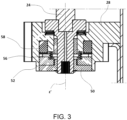
Fig. 3 is a schematic axial cross-sectional view of a detail inFig. 2 , in particular the mechanism for blocking the rotation of the screw; -
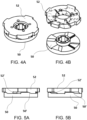
Fig. 4A and 4B are two schematic perspective views of a mechanical clutch associated with the mechanism for blocking the rotation inFig. 3 , in a condition in which the respective profiles are engaged and in a condition in which the respective profiles are disengaged, respectively, according to one embodiment of the invention; and -
Fig. 5A and 5B are schematic side views of the mechanical clutch inFig. 4A and 4B shown in respective conditions in which the profiles are engaged on opposite sides of the teeth, according to one embodiment of the invention. - Before describing in detail a plurality of embodiments of the invention, it should be clarified that the invention is not limited in its application to the design details and configuration of the components presented in the following description or illustrated in the drawings. The invention is capable of assuming other embodiments and of being implemented or constructed in practice in different ways. It should also be understood that the phraseology and terminology have a descriptive purpose and should not be construed as limiting.
- With reference made by way of example to
Fig. 1 to 3 , a shock absorber and spring assembly for a vehicle suspension according to this invention comprises a shock absorber 10 having acylinder 14 and arod 16 which extend along a first axis z, and aspring plate 18 which is arranged around thecylinder 14 of the shock absorber 10 and is slidable with respect thereto along said first axis z. - The following are also present: a
spring 12, the bottom of which rests on thespring plate 18; and an electromechanical adjustment device arranged between thecylinder 14 of the shock absorber 10 and thespring plate 18, for varying in a continuous and controlled manner the vertical position of the lower end of thespring 12 and thus allowing the clearance of the vehicle from the ground to be adjusted. - This adjustment device comprises an
electric motor 22 adapted to generate a rotary motion, and a screw and nut screwmotion conversion mechanism electric motor 22 into a translational motion of thespring plate 18, wherein said motion conversion mechanism comprises asingle screw 24 which extends along a second axis z' parallel to said first axis z and is adapted to be rotated by theelectric motor 22 about said second axis z', and asingle nut screw 26 which meshes with thescrew 24 and is connected to thespring plate 18 for conjoint translation therewith, in such a way that, following the activation of theelectric motor 22, the rotary motion transmitted by theelectric motor 22 to thescrew 24 is converted into translational motion of thenut screw 26 along said second axis z', and therefore into translational motion of thespring plate 18 with respect to thecylinder 14 of the shock absorber 10 along said first axis z. - The second axis z' is spaced from said first axis z in such a way that the unit formed by the
screw 24 and thenut screw 26 is arranged eccentrically with respect to thecylinder 14 of the shock absorber 10 and to thespring plate 18. - The motion conversion mechanism further comprises a mechanism for blocking the rotation of the
screw 24, which blocking mechanism includes aprimary disc 50 which is connected to thescrew 24 for conjoint rotation therewith, and anauxiliary disc 52 which is non-rotatably fixed with respect to thescrew 24, the primary and auxiliary discs having respective profiles 50', 52' which mesh with one another. - The
auxiliary disc 52 is movable along the axis z' from a blocking position (a lower position in the example shown) in which the profiles 50', 52' of the two primary 50 andauxiliary discs 52 are mutually engaged and the rotation of thescrew 24 is prevented, and an unblocking position (an upper position in the example shown) in which the profiles 50', 52' of the two primary 50 andauxiliary discs 52 prevent mutual engagement and the rotation of thescrew 24 is allowed. - According to one embodiment, the shock absorber and spring assembly for a vehicle suspension also comprises a
first support arm 28 which carries theelectric motor 22 and thescrew 24 and is rigidly connected to thecylinder 14 of the shock absorber 10, asecond support arm 34 which carries thenut screw 26 and is rigidly connected to thespring plate 18, and aguide sleeve 38 which is rigidly connected at one end to saidsecond support arm 34 and at the other end to thespring plate 18 and is arranged around thecylinder 14 of the shock absorber 10 so as to be able to slide along the first axis z. - The mechanism for blocking the rotation of the
screw 24 may advantageously be housed in a seat provided in thefirst support arm 28. - According to one preferred embodiment, the mechanism for blocking the rotation of the
screw 24 comprises anelectromagnet 58 adapted to attract theauxiliary disc 52 toward the unblocking position by means of electrical excitation, andresilient means 56 adapted to push theauxiliary disc 52 toward the blocking position. - According to one embodiment, the mutually meshing profiles 50', 52' comprise respective teeth having a first side which has a first angle with respect to a plane containing the axis z' and which enters into engagement when the
screw 24 rotates or tends to rotate in a first direction of rotation (advantageously when thespring plate 18 tends to move downward along the first axis z), and a second side which has a second angle with respect to a plane containing the axis z' that is greater than the first angle, said second side entering into engagement when thescrew 24 rotates or tends to rotate in the opposite direction of rotation (advantageously when thespring plate 18 tends to move upward along the first axis z). This first direction of rotation and second direction of rotation may be, for example, a counterclockwise direction of rotation and a clockwise direction of rotation of the discs, respectively, as shown inFig. 4A and 4B . - The first angle is preferably between 5° and 15° so that the sliding of the profile of the
auxiliary disc 52 with respect to the profile of theprimary disc 50 is blocked, and the second angle is between 65° and 75° so that it is possible for the profile of theauxiliary disc 52 to slide with respect to the profile of theprimary disc 50. This configuration makes it possible to impart an initial course to theauxiliary disc 52 along the second axis z', by virtue of the mutual sliding of the profiles having the second angle. In this way, it is possible, for example, to move theauxiliary disc 52 closer to thepossible electromagnet 58, thus reducing the excitation energy required to attract theauxiliary disc 52 toward the position of disengagement from theprimary disc 50. - The first side preferably enters into engagement when the
screw 24 rotates or tends to rotate so as to cause a descending motion of thenut screw 26 along the axis z', and the second side enters into engagement when thescrew 24 rotates or tends to rotate so as to cause an ascending motion of thenut screw 26 along the axis z'. - According to one preferred embodiment, the
screw 24 is a ball screw. A high-efficiency kinematic mechanism is thus obtained, reducing the friction and increasing the energy efficiency of the assembly. - The adjustment device may advantageously also comprise a speed reduction gear mechanism arranged between the
electric motor 22 and thescrew 24. - According to one aspect of the invention, a method for moving the
spring plate 18 of ashock absorber 10 comprises the steps of providing a shock absorber and spring assembly for a vehicle suspension according to one or more of the embodiments described above. - The mechanism may be activated downward by means of the following steps. Starting from the condition in which the mechanism for blocking the rotation of the
screw 24 is in the blocking position, in which the profiles 50', 52' of the two primary 50 andauxiliary discs 52 engage with one another (being advantageously engaged with one another on the first side, which does not allow relative sliding between the engaged teeth, or on the side of their first angle), theelectric motor 22 is activated in the second direction of rotation until the teeth come into contact with each other on the second side (side of their second angle), which instead allows the relative sliding between the two engaged profiles. - The
electric motor 22 is then made to continue to rotate in the second direction of rotation so that, by means of the relative sliding of the engaged teeth, theprimary disc 50 rotates further with respect to theauxiliary disc 52, triggering a translation of the latter along the axis z' away from theprimary disc 50. - The
electromagnet 58 is then excited so as to further attract theauxiliary disc 52 along the axis z' until the profiles of the primary andauxiliary discs screw 24 unblocks, and the rotation of theelectric motor 22 in the second direction of rotation is stopped so that, for example under the action of the downward force transmitted by thespring 12 through thespring plate 18, thescrew 24 rotates in the first direction of rotation and thespring plate 18 moves downward along the first axis z, keeping theelectromagnet 58 excited. - Once the
spring plate 18 has reached the desired position along the axis z, theelectromagnet 58 is de-excited, and the profiles of the two primary andauxiliary discs spring 12, causing the rotation of the device to be blocked. From this moment on, the vertical position of thespring plate 18 remains unchanged. - Given that the
electromagnet 58 is preferably configured to operate on the principle of reluctance, it is possible to estimate the position of theauxiliary disc 52 with respect to theprimary disc 50 by means of measuring the inductance of the magnetic circuit. - Similarly, the mechanism may be activated upward by means of the following steps. Starting from the condition in which the blocking mechanism is engaged and the teeth of the two
discs electric motor 22 is activated in the second direction of rotation until the teeth come into contact on the opposite side (second side), which allows the relative sliding between the two engaged profiles. Themotor 22 continues to rotate in the second direction of rotation and, on account of the relative sliding of the engaged teeth, theprimary disc 50 may also rotate with respect to theauxiliary disc 52 and this latter begins to translate upward. At this point, theelectromagnet 58 of the blocking device is excited and a further action is exerted on theauxiliary disc 52, which action also translates said auxiliary disc upward until the teeth of thisauxiliary disc 52 are no longer engaged with the teeth of theprimary disc 50, and the mechanism unblocks. Starting from this condition, theelectric motor 22 continues to be controlled in the second direction of rotation, causing thespring plate 18 to ascend. During the entire ascension phase, theelectromagnet 58 is kept excited. Once it has reached the desired position, theelectric motor 22 is de-energized and theelectromagnet 58 is de-excited, and the profiles of the two primary andauxiliary discs spring 12, causing the rotation of the device to be blocked. From this moment on, the vertical position of thespring plate 18 remains unchanged. - Throughout this description and in the claims, the terms and expressions indicating positions and orientations, such as "axial" or "transverse," refer to the first axis z and the second axis z'.
- Various aspects and embodiments of a spring and shock absorber assembly for a vehicle suspension and a method for moving the spring plate of a shock absorber according to the invention have been described. It is understood that each embodiment may be combined with any other embodiment. Furthermore, the invention is not limited to the described embodiments, but may be varied within the scope defined by the appended claims.
Claims (10)
- Shock absorber and spring assembly for a vehicle suspension, comprising:- a shock absorber (10) having a cylinder (14) and a rod (16) which extend along a first axis (z),- a spring plate (18) which is arranged around the cylinder (14) of the shock absorber (10) and is slidable with respect to this along said first axis (z),- a spring (12), the bottom of which rests on the spring plate (18), and- an electromechanical adjustment device arranged between the cylinder (14) of the shock absorber (10) and the spring plate (18) for varying in a continuous and controlled manner the vertical position of the lower end of the spring (12) and thus allowing the clearance of the vehicle from the ground to be adjusted,wherein the adjustment device comprises an electric motor (22) adapted to generate a rotary motion and a screw and nut screw motion conversion mechanism (24, 26) adapted to convert the rotary motion generated by the electric motor (22) into a translational motion of the spring plate (18),wherein said motion conversion mechanism comprises a single screw (24) which extends along a second axis (z') parallel to said first axis (z) and is adapted to be rotated by the electric motor (22) about said second axis (z'), and a single nut screw (26) which meshes with the screw (24) and is connected to the spring plate (18) for conjoint translation therewith, in such a way that, following the activation of the electric motor (22), the rotary motion transmitted by the electric motor (22) to the screw (24) is converted into translational motion of the nut screw (26) along said second axis (z'), and therefore into translational motion of the spring plate (18) with respect to the cylinder (14) of the shock absorber (10) along said first axis (z), said second axis (z') being spaced from said first axis (z) in such a way that the unit formed by the screw (24) and the nut screw (26) is arranged eccentrically with respect to the cylinder (14) of the shock absorber (10) and to the spring plate (18);characterised in thatsaid motion conversion mechanism further comprising a mechanism for blocking the rotation of the screw (24), which blocking mechanism includes a primary disc (50) which is connected to the screw (24) for conjoint rotation therewith, and an auxiliary disc (52) which is fixed in rotation with respect to the screw (24), said primary (50) and auxiliary (52) discs having respective profiles (50', 52') which mesh with one another, the auxiliary disc (52) being translatable along the second axis (z') from a blocking position in which the profiles (50', 52') of the two primary (50) and auxiliary (52) discs are mutually engaged and the rotation of the screw (24) is prevented, and an unblocking position in which the profiles (50', 52') of the two primary (50) and auxiliary (52) discs prevent mutual engagement and the rotation of the screw (24) is allowed.
- Device according to claim 1, further comprising a first support arm (28) which carries the electric motor (22) and the screw (24) and is rigidly connected to the cylinder (14) of the shock absorber (10), a second support arm (34) which carries the nut screw (26) and is rigidly connected to the spring plate (18), and a guide sleeve (38) which is rigidly connected at one end to said second support arm (34) and at the other end to the spring plate (18) and is arranged around the cylinder (14) of the shock absorber (10) so as to be able to slide along said first axis (z).
- Device according to claim 2, wherein the mechanism for blocking the rotation of the screw (24) is housed in a seat provided in the first support arm (28).
- Device according to any of the preceding claims, wherein the mechanism for blocking the rotation of the screw (24) comprises an electromagnet (58) adapted to attract the auxiliary disc (52) toward the unblocking position by means of electrical excitation, and resilient means (56) adapted to push the auxiliary disc (52) toward the blocking position.
- Device according to any of the preceding claims, wherein the mutually meshing profiles (50', 52') comprise respective teeth having a first side which has a first angle with respect to a plane containing the axis (z') and which enters into engagement when the screw (24) rotates or tends to rotate in a first direction of rotation, and a second side which has a second angle with respect to a plane containing the axis (z') that is greater than the first angle, said second side entering into engagement when the screw (24) rotates or tends to rotate in the opposite direction of rotation.
- Device according to claim 5, wherein the first angle is between 5° and 15° so that the sliding of the profile of the auxiliary disc (52) with respect to the profile of the primary disc (50) is blocked, and the second angle is between 65° and 75° so that it is possible for the profile of the auxiliary disc (52) to slide with respect to the profile of the primary disc (50).
- Device according to claim 5 or 6, wherein the first side enters into engagement when the screw (24) rotates or tends to rotate so as to cause a descending motion of the nut screw (26) along the axis (z'), and the second side enters into engagement when the screw (24) rotates or tends to rotate so as to cause an ascending motion of the nut screw (26) along the axis (z').
- Shock absorber and spring assembly according to any of the preceding claims, wherein the screw (24) is a ball screw.
- Shock absorber and spring assembly according to any of the preceding claims, wherein the adjustment device further comprises a speed reduction gear mechanism arranged between the electric motor (22) and the screw (24).
- Method for moving the spring plate (18) of a shock absorber (10), comprising the steps of:a) providing a shock absorber and spring assembly for a vehicle suspension according to any of claims 4 to 9;b) starting from the condition in which the mechanism for blocking the rotation of the screw (24) is in the blocking position, in which the profiles (50', 52') of the two primary (50) and auxiliary (52) discs are mutually engaged on the side of their first angle, activating the electric motor (22) in the second direction of rotation until the teeth come into contact with one another on the side of their second angle, which allows the relative sliding of the two profiles (50', 52');c) continuing to rotate the electric motor (22) in the second direction of rotation so that, by means of the relative sliding of the engaged teeth, the primary disc (50) rotates further with respect to the auxiliary disc (52), triggering a translation of the latter along the axis (z') away from the primary disc (50);d) exciting the electromagnet (58) so as to further attract the auxiliary disc (52) along the axis (z') until the profiles of the primary and auxiliary discs (50, 52) and the mechanism for blocking the rotation of the screw (24) unblocks;e) to obtain a downward motion of the spring plate (18): stopping the rotation of the electric motor (22) in the second direction of rotation, so that the screw (24) rotates in the first direction of rotation and the spring plate (18) moves downward along the first axis (z), keeping the electromagnet (58) excited; orf) to obtain an upward motion of the spring plate (18): continuing to rotate the electric motor (22) in the second direction of rotation, so that the screw (24) continues to rotate in the second direction of rotation and the spring plate (18) moves upward along the first axis (z), keeping the electromagnet (58) excited; andg) once the spring plate (18) has reached the desired position, and only in the case of upward motion, stopping the rotation of the electric motor (22) in the second direction of rotation, de-exciting the electromagnet (58), bringing the profiles of the two primary and auxiliary discs (50, 52) back into engagement and bringing the same profiles into contact on their first side by the action of the downward force transmitted by the spring (12), causing the rotation of the device to be blocked.
Applications Claiming Priority (2)
| Application Number | Priority Date | Filing Date | Title |
|---|---|---|---|
| IT102020000028382A IT202000028382A1 (en) | 2020-11-25 | 2020-11-25 | SHOCK ABSORBER AND SPRING ASSEMBLY FOR VEHICLE SUSPENSION WITH ELECTROMECHANICAL ADJUSTMENT DEVICE FOR ADJUSTING THE VERTICAL POSITION OF THE SPRING AND RELATED LOCKING SYSTEM, AND METHOD OF ADJUSTING THE VERTICAL POSITION OF THE SPRING |
| PCT/IB2021/060963 WO2022112988A1 (en) | 2020-11-25 | 2021-11-25 | Shock absorber and spring assembly for a vehicle suspension, comprising an electromechanical adjustment device for adjusting the vertical position of the spring and a relative blocking system, and method for adjusting the vertical position of the spring |
Publications (2)
| Publication Number | Publication Date |
|---|---|
| EP4251437A1 EP4251437A1 (en) | 2023-10-04 |
| EP4251437B1 true EP4251437B1 (en) | 2025-05-21 |
Family
ID=74592484
Family Applications (1)
| Application Number | Title | Priority Date | Filing Date |
|---|---|---|---|
| EP21824025.7A Active EP4251437B1 (en) | 2020-11-25 | 2021-11-25 | Shock absorber and spring assembly for a vehicle suspension, comprising an electromechanical adjustment device for adjusting the vertical position of the spring and an associated blocking system, and method for moving the spring plate of the shock absorber |
Country Status (4)
| Country | Link |
|---|---|
| EP (1) | EP4251437B1 (en) |
| CN (1) | CN116685480B (en) |
| IT (1) | IT202000028382A1 (en) |
| WO (1) | WO2022112988A1 (en) |
Family Cites Families (8)
| Publication number | Priority date | Publication date | Assignee | Title |
|---|---|---|---|---|
| JP5332446B2 (en) * | 2008-09-25 | 2013-11-06 | 日産自動車株式会社 | Suspension with steering device |
| CN107757285B (en) * | 2016-08-22 | 2020-03-31 | 比亚迪股份有限公司 | Suspension system of automobile, automobile with suspension system and control method |
| CN107757286B (en) * | 2016-08-22 | 2019-11-22 | 比亚迪股份有限公司 | Suspension system of automobile, automobile and control method thereof |
| US10076942B2 (en) * | 2016-09-06 | 2018-09-18 | Toyota Jidosha Kabushiki Kaisha | Suspension device |
| KR102554918B1 (en) * | 2016-12-15 | 2023-07-11 | 현대자동차주식회사 | Suspension apparatus able to adjusting vehucle height |
| DE102017102402A1 (en) * | 2017-02-08 | 2018-08-09 | Schaeffler Technologies AG & Co. KG | transmission assembly |
| JP7295109B2 (en) * | 2017-11-17 | 2023-06-20 | マレッリ・サスペンション・システムズ・イタリー・ソチエタ・ペル・アツィオーニ | Damper and spring unit for vehicle suspension with electromechanical adjusting device for adjusting the vertical position of the spring |
| DE102018128595A1 (en) * | 2018-11-14 | 2020-05-14 | Ovalo Gmbh | Device for connecting a shock absorber to a body |
-
2020
- 2020-11-25 IT IT102020000028382A patent/IT202000028382A1/en unknown
-
2021
- 2021-11-25 EP EP21824025.7A patent/EP4251437B1/en active Active
- 2021-11-25 CN CN202180078760.2A patent/CN116685480B/en active Active
- 2021-11-25 WO PCT/IB2021/060963 patent/WO2022112988A1/en not_active Ceased
Also Published As
| Publication number | Publication date |
|---|---|
| CN116685480A (en) | 2023-09-01 |
| EP4251437A1 (en) | 2023-10-04 |
| CN116685480B (en) | 2025-08-29 |
| WO2022112988A1 (en) | 2022-06-02 |
| IT202000028382A1 (en) | 2022-05-25 |
Similar Documents
| Publication | Publication Date | Title |
|---|---|---|
| US8312783B2 (en) | Aircraft flight control actuation system with direct acting, force limiting, actuator | |
| US9050874B2 (en) | Spring damper unit | |
| US7926822B2 (en) | Adjustment device for suspension means | |
| JP6591986B2 (en) | Drum brake device including parking brake operating in duo servo mode, vehicle and assembly method related thereto | |
| US7014019B2 (en) | Brake actuator comprising an energy accumulator and an inertia weight | |
| EP3784919B1 (en) | System and method for operating magnetorheological fluid clutch apparatus | |
| US10746235B2 (en) | Multimode control system for magnetorheological fluid actuator unit | |
| US20160377137A1 (en) | Motor Vehicle Brake Which Can Be Activated Electromechanically And Hydraulically And Has Optional Self-Locking | |
| JP5877811B2 (en) | Electric actuator for vehicles | |
| RU1807931C (en) | Actuator electromechanical drive | |
| AU2014211684A1 (en) | Brake unit for a vehicle and vehicle with a brake unit of this type | |
| CN103415729A (en) | Device for changing an operating state of at least one switch element | |
| EP4251437B1 (en) | Shock absorber and spring assembly for a vehicle suspension, comprising an electromechanical adjustment device for adjusting the vertical position of the spring and an associated blocking system, and method for moving the spring plate of the shock absorber | |
| CN103115123B (en) | The locking device of ball screw | |
| US11585457B2 (en) | Valve drive with snap function | |
| KR20220027805A (en) | linear drive system | |
| WO2010128952A2 (en) | Fail-safe valve actuator | |
| CN112879647B (en) | An adjustable passive reset electric actuator | |
| US20240044385A1 (en) | Actuator with integrated parking brake | |
| US6352140B1 (en) | Disc brake to be opened by torque | |
| CN214500193U (en) | Adjustable passive reset type electric actuating mechanism | |
| CA3182520A1 (en) | Fail-safe drive and actuating drive with a fail-safe drive | |
| CN217048589U (en) | Hydraulic pressure generating device for braking and hydraulic braking system | |
| CN223563371U (en) | Preload regulating device for shock absorber | |
| CN119664827B (en) | Electromechanical brake device |
Legal Events
| Date | Code | Title | Description |
|---|---|---|---|
| STAA | Information on the status of an ep patent application or granted ep patent |
Free format text: STATUS: UNKNOWN |
|
| STAA | Information on the status of an ep patent application or granted ep patent |
Free format text: STATUS: THE INTERNATIONAL PUBLICATION HAS BEEN MADE |
|
| PUAI | Public reference made under article 153(3) epc to a published international application that has entered the european phase |
Free format text: ORIGINAL CODE: 0009012 |
|
| STAA | Information on the status of an ep patent application or granted ep patent |
Free format text: STATUS: REQUEST FOR EXAMINATION WAS MADE |
|
| 17P | Request for examination filed |
Effective date: 20230620 |
|
| AK | Designated contracting states |
Kind code of ref document: A1 Designated state(s): AL AT BE BG CH CY CZ DE DK EE ES FI FR GB GR HR HU IE IS IT LI LT LU LV MC MK MT NL NO PL PT RO RS SE SI SK SM TR |
|
| DAV | Request for validation of the european patent (deleted) | ||
| DAX | Request for extension of the european patent (deleted) | ||
| GRAP | Despatch of communication of intention to grant a patent |
Free format text: ORIGINAL CODE: EPIDOSNIGR1 |
|
| STAA | Information on the status of an ep patent application or granted ep patent |
Free format text: STATUS: GRANT OF PATENT IS INTENDED |
|
| INTG | Intention to grant announced |
Effective date: 20241219 |
|
| GRAS | Grant fee paid |
Free format text: ORIGINAL CODE: EPIDOSNIGR3 |
|
| GRAA | (expected) grant |
Free format text: ORIGINAL CODE: 0009210 |
|
| STAA | Information on the status of an ep patent application or granted ep patent |
Free format text: STATUS: THE PATENT HAS BEEN GRANTED |
|
| AK | Designated contracting states |
Kind code of ref document: B1 Designated state(s): AL AT BE BG CH CY CZ DE DK EE ES FI FR GB GR HR HU IE IS IT LI LT LU LV MC MK MT NL NO PL PT RO RS SE SI SK SM TR |
|
| REG | Reference to a national code |
Ref country code: GB Ref legal event code: FG4D |
|
| REG | Reference to a national code |
Ref country code: CH Ref legal event code: EP |
|
| REG | Reference to a national code |
Ref country code: DE Ref legal event code: R096 Ref document number: 602021031231 Country of ref document: DE |
|
| REG | Reference to a national code |
Ref country code: IE Ref legal event code: FG4D |
|
| REG | Reference to a national code |
Ref country code: NL Ref legal event code: MP Effective date: 20250521 |
|
| PG25 | Lapsed in a contracting state [announced via postgrant information from national office to epo] |
Ref country code: ES Free format text: LAPSE BECAUSE OF FAILURE TO SUBMIT A TRANSLATION OF THE DESCRIPTION OR TO PAY THE FEE WITHIN THE PRESCRIBED TIME-LIMIT Effective date: 20250521 Ref country code: FI Free format text: LAPSE BECAUSE OF FAILURE TO SUBMIT A TRANSLATION OF THE DESCRIPTION OR TO PAY THE FEE WITHIN THE PRESCRIBED TIME-LIMIT Effective date: 20250521 Ref country code: PT Free format text: LAPSE BECAUSE OF FAILURE TO SUBMIT A TRANSLATION OF THE DESCRIPTION OR TO PAY THE FEE WITHIN THE PRESCRIBED TIME-LIMIT Effective date: 20250922 |
|
| REG | Reference to a national code |
Ref country code: LT Ref legal event code: MG9D |
|
| PG25 | Lapsed in a contracting state [announced via postgrant information from national office to epo] |
Ref country code: GR Free format text: LAPSE BECAUSE OF FAILURE TO SUBMIT A TRANSLATION OF THE DESCRIPTION OR TO PAY THE FEE WITHIN THE PRESCRIBED TIME-LIMIT Effective date: 20250822 Ref country code: NO Free format text: LAPSE BECAUSE OF FAILURE TO SUBMIT A TRANSLATION OF THE DESCRIPTION OR TO PAY THE FEE WITHIN THE PRESCRIBED TIME-LIMIT Effective date: 20250821 |
|
| PG25 | Lapsed in a contracting state [announced via postgrant information from national office to epo] |
Ref country code: PL Free format text: LAPSE BECAUSE OF FAILURE TO SUBMIT A TRANSLATION OF THE DESCRIPTION OR TO PAY THE FEE WITHIN THE PRESCRIBED TIME-LIMIT Effective date: 20250521 Ref country code: NL Free format text: LAPSE BECAUSE OF FAILURE TO SUBMIT A TRANSLATION OF THE DESCRIPTION OR TO PAY THE FEE WITHIN THE PRESCRIBED TIME-LIMIT Effective date: 20250521 |
|
| PG25 | Lapsed in a contracting state [announced via postgrant information from national office to epo] |
Ref country code: BG Free format text: LAPSE BECAUSE OF FAILURE TO SUBMIT A TRANSLATION OF THE DESCRIPTION OR TO PAY THE FEE WITHIN THE PRESCRIBED TIME-LIMIT Effective date: 20250521 |
|
| PG25 | Lapsed in a contracting state [announced via postgrant information from national office to epo] |
Ref country code: HR Free format text: LAPSE BECAUSE OF FAILURE TO SUBMIT A TRANSLATION OF THE DESCRIPTION OR TO PAY THE FEE WITHIN THE PRESCRIBED TIME-LIMIT Effective date: 20250521 |
|
| PG25 | Lapsed in a contracting state [announced via postgrant information from national office to epo] |
Ref country code: RS Free format text: LAPSE BECAUSE OF FAILURE TO SUBMIT A TRANSLATION OF THE DESCRIPTION OR TO PAY THE FEE WITHIN THE PRESCRIBED TIME-LIMIT Effective date: 20250821 |
|
| PG25 | Lapsed in a contracting state [announced via postgrant information from national office to epo] |
Ref country code: IS Free format text: LAPSE BECAUSE OF FAILURE TO SUBMIT A TRANSLATION OF THE DESCRIPTION OR TO PAY THE FEE WITHIN THE PRESCRIBED TIME-LIMIT Effective date: 20250921 |
|
| PG25 | Lapsed in a contracting state [announced via postgrant information from national office to epo] |
Ref country code: LV Free format text: LAPSE BECAUSE OF FAILURE TO SUBMIT A TRANSLATION OF THE DESCRIPTION OR TO PAY THE FEE WITHIN THE PRESCRIBED TIME-LIMIT Effective date: 20250521 |
|
| REG | Reference to a national code |
Ref country code: AT Ref legal event code: MK05 Ref document number: 1796480 Country of ref document: AT Kind code of ref document: T Effective date: 20250521 |
|
| PGFP | Annual fee paid to national office [announced via postgrant information from national office to epo] |
Ref country code: DE Payment date: 20251022 Year of fee payment: 5 |
|
| PG25 | Lapsed in a contracting state [announced via postgrant information from national office to epo] |
Ref country code: DK Free format text: LAPSE BECAUSE OF FAILURE TO SUBMIT A TRANSLATION OF THE DESCRIPTION OR TO PAY THE FEE WITHIN THE PRESCRIBED TIME-LIMIT Effective date: 20250521 Ref country code: AT Free format text: LAPSE BECAUSE OF FAILURE TO SUBMIT A TRANSLATION OF THE DESCRIPTION OR TO PAY THE FEE WITHIN THE PRESCRIBED TIME-LIMIT Effective date: 20250521 Ref country code: SM Free format text: LAPSE BECAUSE OF FAILURE TO SUBMIT A TRANSLATION OF THE DESCRIPTION OR TO PAY THE FEE WITHIN THE PRESCRIBED TIME-LIMIT Effective date: 20250521 |
|
| PGFP | Annual fee paid to national office [announced via postgrant information from national office to epo] |
Ref country code: IT Payment date: 20251022 Year of fee payment: 5 |
|
| PGFP | Annual fee paid to national office [announced via postgrant information from national office to epo] |
Ref country code: FR Payment date: 20251022 Year of fee payment: 5 |
|
| PG25 | Lapsed in a contracting state [announced via postgrant information from national office to epo] |
Ref country code: CZ Free format text: LAPSE BECAUSE OF FAILURE TO SUBMIT A TRANSLATION OF THE DESCRIPTION OR TO PAY THE FEE WITHIN THE PRESCRIBED TIME-LIMIT Effective date: 20250521 |
|
| PG25 | Lapsed in a contracting state [announced via postgrant information from national office to epo] |
Ref country code: EE Free format text: LAPSE BECAUSE OF FAILURE TO SUBMIT A TRANSLATION OF THE DESCRIPTION OR TO PAY THE FEE WITHIN THE PRESCRIBED TIME-LIMIT Effective date: 20250521 |
|
| PG25 | Lapsed in a contracting state [announced via postgrant information from national office to epo] |
Ref country code: SK Free format text: LAPSE BECAUSE OF FAILURE TO SUBMIT A TRANSLATION OF THE DESCRIPTION OR TO PAY THE FEE WITHIN THE PRESCRIBED TIME-LIMIT Effective date: 20250521 |
|
| REG | Reference to a national code |
Ref country code: DE Ref legal event code: R097 Ref document number: 602021031231 Country of ref document: DE |
|
| PG25 | Lapsed in a contracting state [announced via postgrant information from national office to epo] |
Ref country code: RO Free format text: LAPSE BECAUSE OF FAILURE TO SUBMIT A TRANSLATION OF THE DESCRIPTION OR TO PAY THE FEE WITHIN THE PRESCRIBED TIME-LIMIT Effective date: 20250521 |
|
| PLBE | No opposition filed within time limit |
Free format text: ORIGINAL CODE: 0009261 |
|
| STAA | Information on the status of an ep patent application or granted ep patent |
Free format text: STATUS: NO OPPOSITION FILED WITHIN TIME LIMIT |
|
| REG | Reference to a national code |
Ref country code: CH Ref legal event code: L10 Free format text: ST27 STATUS EVENT CODE: U-0-0-L10-L00 (AS PROVIDED BY THE NATIONAL OFFICE) Effective date: 20260402 |
|
| 26N | No opposition filed |
Effective date: 20260224 |