EP4250630A1 - Key management device, quantum cryptography communication system, and computer program product - Google Patents
Key management device, quantum cryptography communication system, and computer program product Download PDFInfo
- Publication number
- EP4250630A1 EP4250630A1 EP22190031.9A EP22190031A EP4250630A1 EP 4250630 A1 EP4250630 A1 EP 4250630A1 EP 22190031 A EP22190031 A EP 22190031A EP 4250630 A1 EP4250630 A1 EP 4250630A1
- Authority
- EP
- European Patent Office
- Prior art keywords
- key
- random number
- encryption key
- request
- encryption
- Prior art date
- Legal status (The legal status is an assumption and is not a legal conclusion. Google has not performed a legal analysis and makes no representation as to the accuracy of the status listed.)
- Pending
Links
- 238000004891 communication Methods 0.000 title claims abstract description 127
- 238000004590 computer program Methods 0.000 title claims description 6
- 230000004044 response Effects 0.000 claims abstract description 94
- 238000000034 method Methods 0.000 claims description 48
- 238000006243 chemical reaction Methods 0.000 claims description 16
- 238000009825 accumulation Methods 0.000 claims description 14
- 238000012217 deletion Methods 0.000 claims description 6
- 230000037430 deletion Effects 0.000 claims description 6
- 238000010586 diagram Methods 0.000 description 41
- 230000006870 function Effects 0.000 description 15
- 238000005516 engineering process Methods 0.000 description 6
- 239000013307 optical fiber Substances 0.000 description 6
- 230000005540 biological transmission Effects 0.000 description 4
- 238000012905 input function Methods 0.000 description 2
- 239000008186 active pharmaceutical agent Substances 0.000 description 1
- 238000012790 confirmation Methods 0.000 description 1
- 239000000284 extract Substances 0.000 description 1
- 238000012545 processing Methods 0.000 description 1
- 230000005610 quantum mechanics Effects 0.000 description 1
- 238000006467 substitution reaction Methods 0.000 description 1
Images







Classifications
-
- H—ELECTRICITY
- H04—ELECTRIC COMMUNICATION TECHNIQUE
- H04L—TRANSMISSION OF DIGITAL INFORMATION, e.g. TELEGRAPHIC COMMUNICATION
- H04L9/00—Cryptographic mechanisms or cryptographic arrangements for secret or secure communications; Network security protocols
- H04L9/08—Key distribution or management, e.g. generation, sharing or updating, of cryptographic keys or passwords
- H04L9/0816—Key establishment, i.e. cryptographic processes or cryptographic protocols whereby a shared secret becomes available to two or more parties, for subsequent use
- H04L9/0852—Quantum cryptography
-
- H—ELECTRICITY
- H04—ELECTRIC COMMUNICATION TECHNIQUE
- H04L—TRANSMISSION OF DIGITAL INFORMATION, e.g. TELEGRAPHIC COMMUNICATION
- H04L9/00—Cryptographic mechanisms or cryptographic arrangements for secret or secure communications; Network security protocols
- H04L9/08—Key distribution or management, e.g. generation, sharing or updating, of cryptographic keys or passwords
- H04L9/0816—Key establishment, i.e. cryptographic processes or cryptographic protocols whereby a shared secret becomes available to two or more parties, for subsequent use
- H04L9/0852—Quantum cryptography
- H04L9/0855—Quantum cryptography involving additional nodes, e.g. quantum relays, repeaters, intermediate nodes or remote nodes
-
- H—ELECTRICITY
- H04—ELECTRIC COMMUNICATION TECHNIQUE
- H04L—TRANSMISSION OF DIGITAL INFORMATION, e.g. TELEGRAPHIC COMMUNICATION
- H04L9/00—Cryptographic mechanisms or cryptographic arrangements for secret or secure communications; Network security protocols
- H04L9/08—Key distribution or management, e.g. generation, sharing or updating, of cryptographic keys or passwords
- H04L9/0816—Key establishment, i.e. cryptographic processes or cryptographic protocols whereby a shared secret becomes available to two or more parties, for subsequent use
- H04L9/0819—Key transport or distribution, i.e. key establishment techniques where one party creates or otherwise obtains a secret value, and securely transfers it to the other(s)
-
- H—ELECTRICITY
- H04—ELECTRIC COMMUNICATION TECHNIQUE
- H04L—TRANSMISSION OF DIGITAL INFORMATION, e.g. TELEGRAPHIC COMMUNICATION
- H04L9/00—Cryptographic mechanisms or cryptographic arrangements for secret or secure communications; Network security protocols
- H04L9/08—Key distribution or management, e.g. generation, sharing or updating, of cryptographic keys or passwords
- H04L9/0816—Key establishment, i.e. cryptographic processes or cryptographic protocols whereby a shared secret becomes available to two or more parties, for subsequent use
- H04L9/085—Secret sharing or secret splitting, e.g. threshold schemes
-
- H—ELECTRICITY
- H04—ELECTRIC COMMUNICATION TECHNIQUE
- H04L—TRANSMISSION OF DIGITAL INFORMATION, e.g. TELEGRAPHIC COMMUNICATION
- H04L9/00—Cryptographic mechanisms or cryptographic arrangements for secret or secure communications; Network security protocols
- H04L9/08—Key distribution or management, e.g. generation, sharing or updating, of cryptographic keys or passwords
- H04L9/0861—Generation of secret information including derivation or calculation of cryptographic keys or passwords
- H04L9/0869—Generation of secret information including derivation or calculation of cryptographic keys or passwords involving random numbers or seeds
Definitions
- Arrangements described herein relate generally to a key management device, a quantum cryptography communication system, and a computer program product.
- the quantum key distribution (QKD) technology for securely sharing an encryption key by utilizing a single photon continuously transmitted between a transmission node and a reception node connected by an optical fiber is conventionally known. It is ensured that the encryption key shared by the quantum key distribution technology is not eavesdropped based on the principle of quantum mechanics. In addition, it is guaranteed by information theory that encrypted data communication by a one-time pad (OTP) using this encryption key cannot be decrypted by an eavesdropper having any knowledge.
- OTP one-time pad
- an application programming interface (API) technology for supplying an encryption key to an application has been standardized, and the API technology has started to be used. Furthermore, in the quantum cryptography communication system, there is a case where the application desires to use not only an encryption key that is a random number shared with another node but also a random number (unique random number) independent of the another node. Alternatively, in a case where cryptography communication is performed by a common key encryption method such as advanced encryption standard (AES) encryption, there is a case where it is desired to simultaneously acquire another random number used as an initialization vector (IV) in addition to the encryption key.
- AES advanced encryption standard
- Each of the transmission node and the reception node are collectively referred to as a node.
- the node of the arrangement is referred to as a trusted node (TN), for example.
- TN trusted node
- a function of performing encrypted data communication using a shared encryption key is referred to as an application separately from the node.
- FIG. 1 is a diagram illustrating an example of a basic configuration of a quantum cryptography communication system according to a first arrangement.
- a node 10a includes a KM 20a and a QKD module 30a.
- a key manager (KM) 20a is a key management device that manages an encryption key.
- the QKD module 30a shares an encryption key by quantum key distribution (QKD).
- QKD quantum key distribution
- the KM 20a and the QKD module 30a may be configured as a single device/system or may be configured as separate devices/systems.
- node 10a may not include the QKD module 30a.
- the KM 20a of the node 10a and the QKD module 30a implemented as an external device of the node 10a are connected by a link. Since the description of a node 10b is similar to that of the node 10a, it is omitted.
- the encryption key shared by a QKD link 130 between the node 10a and node 10b are supplied to an application 40a and an application 40b.
- the applications 40a and 40b encrypt data using the encryption key acquired from the nodes 10a and 10b, and perform encrypted data communication.
- a method of sharing an encryption key in the QKD technology has a restriction on a distance in which an encryption key can be shared due to use of a single photon as a medium.
- FIG. 2 is a diagram illustrating an example of a device configuration of a quantum cryptography communication system 100 according to the first arrangement.
- a node 10a includes a KM 20a and a QKD module 30a.
- the node 10a is connected to the application 40a.
- the node 10b includes a KM 20b and QKD modules 30b-1 to 30b-2.
- the node 10b is connected to both nodes 10a and 10c and thus includes two QKD modules 30b.
- the node 10c includes a KM 20c and a QKD module 30c.
- the node 10c is connected to an application 40c.
- nodes 10a to 10c are simply referred to as a node 10.
- KMs 20a to 20c are simply referred to as a KM 20.
- QKD modules 30a to 30c are not distinguished, they are simply referred to as a QKD module 30.
- applications 40a and 40c are not distinguished, they are simply referred to as an application 40.
- a key sharing network (QKD network) 120 and a QKD link 130 are configured by a communication network in which the nodes 10a to 10c each having functions of a transmission node and a reception node are connected to each other by an optical fiber link.
- the key sharing network 120 may use a link different from the optical fiber of the QKD link 130 that performs key distribution by the QKD.
- the number of links is not limited. That is, the key sharing network 120 and the QKD link 130 may be independently configured by different optical fibers.
- the applications 40a and 40c are accommodated in an encrypted data communication network 110.
- the QKD module 30 of each node 10 shares, as a local key, an encryption key shared by the QKD with the QKD module 30 of the neighboring node 10 connected by the optical fiber link.
- the KM 20a (20c) supplies a common encryption key (hereinafter, "global key") to the application 40a (40c). After this, the application 40a (40c) encrypts data using a global key supplied by the KM 20a (20c), and performs encrypted data communication.
- a specific example of a method of sharing a common global key between the applications 40a and 40c will be described. Note that the sharing method described herein is an example. As long as a common global key can be shared, a method of sharing the global key in the key sharing network 120 is not limited.
- the node 10a generates a global key different from the local key from random number information and the like separately regardless of the QKD.
- the KM 20a of the node 10a encrypts the global key with the local key shared between the QKD modules 30a and 30b-1 and forwards the encrypted global key to the KM 20b of the neighboring node 10b.
- the KM 20b of the neighboring node 10b encrypts the global key with the local key shared between the QKD modules 30b-2 and 30c, and forwards the encrypted global key to the KM 20c of the neighboring node 10c.
- the node 10 can share the global key with any node 10 on the key sharing network 120.
- the global key is forwarded on the link in an encrypted state by the local key shared by the QKD. Therefore, assuming the safety of the node 10 itself, it can be said that the safety of the global key is ensured as in the local key.
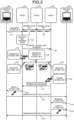
- FIG. 3 is a sequence diagram illustrating an example of a global key supply process according to the first arrangement.
- the application 40a is connected to the node 10a on the key sharing network 120.
- the application 40c is connected to the node 10c on the key sharing network 120.
- a local key is shared between the nodes 10a and 10b by QKD (step S1).
- the local key is shared by the nodes 10b and 10c by QKD (step S2).
- the application 40a transmits a global key request (global key request message) to the node 10a (step S3).
- the global key request indicates a request for a global key used for encrypted data communication with the application 40c.
- the node 10a identifies the node 10c (key sharing node in Fig. 3 ) connected to the application 40c communicating with the application 40a from, for example, the information of the application name (the application 40c) included in the global key request (step S4).
- the node 10a may identify the node 10c connected to the application 40c by referring to data called a connection information directory.
- the node 10a starts global key sharing control with the node 10c (step S5). Specifically, the node 10a transmits a notification indicating a request for a global key sharing process to the node 10c.
- the node 10a sets a random number generated using a random number generator or the like as a global key (step S6), encrypts the global key with a local key shared with the node 10b (step S7), and transmits the encrypted global key to the node 10b.
- the node 10b decrypts the encrypted global key with the same local key as the local key of the node 10a to extract the global key.
- the node 10b encrypts the global key with the local key shared with the node 10c (step S8), and transmits the encrypted global key to the node 10c.
- the node 10c decrypts the encrypted global key with the same local key as the local key used for encryption in the node 10b, and extracts the global key (step S9). Next, the node 10c stores the decrypted global key in a storage or the like (step S10). Next, the node 10c transmits a global key storage notification indicating that the global key has been stored to the node 10a (step S11).
- the node 10a transmits a global key response message for supplying the global key shared with the node 10c to the application 40a (step S12).
- the global key response message includes a global key shared by the nodes 10a and 10c and a key ID assigned to the global key.
- the application 40a notifies the application 40c of the key ID of the global key used for the cryptography communication (step S13). Note that this key ID notification may be notified prior to the cryptography communication between the applications 40a and 40c, or the application 40a may be notified together with encrypted data encrypted with the global key.
- step S14 when receiving a global key request (global key request message) from the application 40c (step S14), the node 10c supplies the global key stored in step S10 to the application 40c (step S15).
- the application 40c generates the global key request message when transmitting the encrypted data to the application 40a or when decrypting the encrypted data received from the application 40a.
- the global key request message includes the key ID of the global key requested by the application 40c.
- the node 10c returns a global key corresponding to the key ID included in the global key request message among the global keys shared with the node 10a to the application 40c (global key response message).
- the applications 40a and 40c perform encrypted data communication using the common encryption key (global key) acquired by the above flow (step S16).
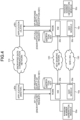
- FIG. 4 is a diagram for explaining an example of a key supply interface according to the first arrangement.
- a random number generation module 50a that generates a random number used for the global key is further connected to the node 10a (10c).
- the node 10a in FIG. 4 can be used as a mechanism for sharing any secret information such as an encryption key generated in another system and a secret key in a digital certificate/public key method. Furthermore, since the node 10a includes not only the KM 20a but also the QKD module 30a, the random number generation function of the random number generation module 50a may be used for key sharing in QKD. Note that the random number generation function may be provided in a device (for example, a random number generation management server device or the like) different from the node 10a as in the random number generation module 50a illustrated in FIG. 4 , or may be incorporated in the node 10a.
- a device for example, a random number generation management server device or the like
- the application 40a in which the cryptography communication session is started is referred to as a master
- the application 40c in which the cryptography communication session is received is referred to as a slave.
- the request message and the response message exchanged between the application 40 and the node 10 are achieved by, for example, calling of the Web API and a response thereof.
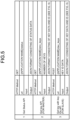
- FIG. 5 is a diagram illustrating an example of a key supply API according to the first arrangement.
- the first API is a state confirmation API (Get status API) by which the application 40 inquires the state of the node 10 or the quantum cryptography communication system.
- the second API is a key acquisition API (Get key API) by which the application 40a serving as a master acquires an encryption key from the node 10a.
- the master application 40a designates, for example, the number of encryption keys by the key acquisition API.
- the node 10a responds to the master application 40a by supplying the encryption key and the key ID of the encryption key.
- the third API is a key acquisition API (Get key with key IDs API) by which the slave application 40c acquires an encryption key from the node 10c.
- the slave application 40c designates, for example, a key ID of an encryption key by the key acquisition API.
- the key acquisition API is called from the application 40c, the node 10c responds to the slave application 40c by supplying the encryption key and the key ID of the encryption key.
- FIG. 6 is a diagram illustrating an example of a response data format of an encryption key and a key ID according to the first arrangement.
- the example of FIG. 6 illustrates a case of a response data format in which data of "key ID" indicating a key ID and data of "key” indicating an encryption key are associated with each other.
- the application 40 desires to use high-quality random number data during cryptography communication (for example, an initial vector (IV) for cryptography communication, a random number for secret sharing storage of data, and the like.).
- the node 10 supplies a combination of the encryption key and the random number generated by a random number generation module 50 by the key supply API.
- the KM 20 that supplies the encryption key and the random number data integrally and efficiently generates, stores, and manages the encryption key and the random number.
- FIG. 7 is a diagram illustrating an example of a functional configuration of the KM 20 according to the first arrangement.
- the KM 20 according to the first arrangement includes a supply unit 1, a communication unit 2, a random number acquisition unit 3, a key acquisition unit 4, a determination unit 5, and a generation unit 6.
- the supply unit 1 supplies the data generated by the generation unit 6 to the application 40 in response to a request message (API call) from the application 40.
- API call request message
- the communication unit 2 communicates with another device.
- the communication unit 2 performs communication for sharing a key or a random number, communication for making a notification of non-use of a key, communication for instructing deletion of a key, or the like with another KM 20.
- the random number acquisition unit 3 acquires a random number from the random number generation module 50 or the like.
- the key acquisition unit 4 acquires a key generated by QKD from the QKD module 30.
- the determination unit 5 determines the supply data (at least one of the key and the random number) according to the request message from the application 40. For example, when receiving a request message (API call) designating at least one of the encryption key and the random number from the application 40, the determination unit 5 determines the necessary size and number of encryption keys, and the necessary size and number of random numbers. Furthermore, for example, when receiving a request message (API call) designating at least one of the encryption method, the communication destination, and the data size, the determination unit 5 determines the encryption keys having the necessary size and number, the necessary size and number of encryption keys, and the necessary size and number of random numbers according to the requested encryption method, communication destination, and data size.
- the generation unit 6 generates data (at least one of a key and a random number) to be supplied to the application 40.
- the generation unit 6 generates data (for example, JSON data) to be returned in the same message format as a response message (API response) based on the determination by the determination unit 5.
- the response message includes at least one of the random number acquired from the random number acquisition unit 3 and the encryption key acquired from the key acquisition unit 4.
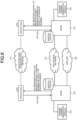
- FIG. 8 is a diagram illustrating an example of supplying a random number according to the first arrangement.
- the node 10 of the first arrangement supplies a random number instead of the encryption key or supplies a random number in addition to the encryption key by an API response (response message) according to an API call (request message) from the application 40a to the node 10a. That is, the node 10 of the first arrangement supplies the application 40 connected to the node 10 with the random number and the encryption key at the same time, or supplies the random number in a message format similar to the supply of the encryption key.
- an IV random number having an appropriate size for use in cryptography communication can be supplied by a single API call simultaneously when the key is supplied.
- data protection by secret sharing and cryptography communication using an encryption key are simultaneously performed, they can be supplied by a single API call.
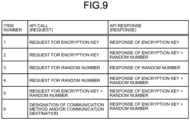
- FIG. 9 is a diagram illustrating an example of an API call and a response according to the first arrangement.
- FIG. 9 illustrates an example of a relationship (combination) between the API call (request) and the API response (response).
- Item number 1 is a case where only the encryption key is received from the node 10.
- a request for an encryption key is made as an API call, and the encryption key is supplied as an API response.
- Item number 2 is a case where not only the encryption key but also the random number is received from the node 10.
- a request for an encryption key is made as an API call, and the random number in addition to the encryption key are supplied as an API response.
- Item number 3 is a case where only a random number is received from the node 10.
- a request for a random number is made as an API call, and the random number is supplied as an API response.
- Item number 4 is a case where not only the random number but also the encryption key is received from the node 10.
- a request for a random number is made as an API call, and the encryption key in addition to the random number are supplied as an API response.
- Item number 5 is a case where a random number and an encryption key are received from the node 10.
- a request for an encryption key and a random number is made as an API call, and the encryption key and the random number are supplied as an API response.
- Item number 6 is a case where a random number and an encryption key are received from the node 10.
- a communication method or a communication destination is designated as API call, and the encryption key and the random number are supplied as an API response.
- encryption keys and random numbers having different types, sizes, and numbers may be supplied according to the designated communication destination.
- API operation of the APIs of item numbers 1 to 6 is enabled is determined by setting of the node 10, for example.
- the API call is a request for an encryption key in both item numbers 1 and 2, but whether to supply the encryption key as an API response or supply the random number in addition to the encryption key is determined by setting of the node 10.
- the encryption key included in the API response may be any key depending on the use.
- the encryption key included in the API response may be any key, and is, for example, the local key, the global key, or the like described above.
- FIGS. 10A to 10D are diagrams illustrating specific examples of API calls (requests) according to the first arrangement.
- the request message from the application 40 is achieved by, for example, the API of FIGS. 10A to 10D .
- ⁇ KME_hostname ⁇ included in url of the POST method indicates a host name (IP address) of the node 10.
- the parameter is designated by the request body of the POST method, but may be designated by the GET method.
- FIG. 10A is a case where a random number is designated and called by the API call.
- a random number is designated and called by the API call.
- the type in the example of FIG. 10A , "rng" indicating a random number
- the number in the example of FIG. 10A , 3
- the size in the example of FIG. 10A , 1024
- the type in FIG. 10A is a parameter that designates at least one of an encryption key and a random number as the type of data requested from the application 40.
- "number” is a parameter that identifies the number of pieces of request data.
- "size” is a parameter that identifies the size of the request data.
- the generation unit 6 generates a response message including the request data having a size and the number designated by the request message by the API.
- FIG. 10B illustrates a case where a key and a random number are designated and called.
- the communication destination is designated in (SAE_ID).
- SAE_ID for example, an ID for identifying the application 40 as the communication destination is designated.
- the type, the number, and the size of the requested data are designated by parameters.
- type "key” included in the parameter in the second line of the request body of the POST parameter in FIG. 10B indicates an encryption key
- "number” indicates the number of encryption keys
- size indicates the size of the encryption key.
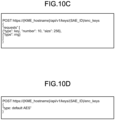
- FIG. 10C is a case where a key and a random number are designated and called by the same API call as in FIG. 10B , but the random number size is not designated in the request body of the POST parameter, for example.
- the request body of the POST parameter when a key is requested, the number and the size parameters are designated, and when a random number is requested, the number and the size are not designated.
- the KM 20 of the node 10 determines the number and the size of the random numbers based on the setting of the KM 20 and the like.
- FIG. 10D illustrates a case where the communication scheme is designated.
- the API in FIG. 10D is called by the same API call (same url designation) as that in FIG. 10B , but for example, the size and the number of keys and the size and the number of random numbers are not designated in the request body of the POST parameter, and the encryption method (in the example of FIG. 10D , "default AES") to be used is designated.
- the KM 20 of the node 10 determines the number and the size of the random numbers based on the encryption method to be used.
- the request message by the API call in FIG. 10D may include at least one of a method parameter designating an encryption method used by the application 40 and a communication destination parameter designating a communication destination of the application 40.
- the generation unit 6 In a case where the method parameter is included in the request message, the generation unit 6 generates a response message including at least one of the encryption key and the random number according to the method parameter. Furthermore, in a case where the communication destination parameter is included in the request message, the generation unit 6 generates the response message including at least one of the encryption key and the random number according to the communication destination parameter.
- the request message by the API call in FIG. 10D may further include a size parameter designating a data size.
- the generation unit 6 generates the response message including at least one of the encryption key having a size designated by the size parameter and the random number having a size designated by the size parameter.
- the request message by the API call may include a size parameter designating the data size of the transmission data.
- the generation unit 6 generates a response message including at least one of the encryption key used for an encryption process of data having a size designated by the size parameter and the random number used for an encryption process of data having a size designated by the size parameter.
- the generation unit 6 generates a response message including the encryption key used for the encryption process of data of the size designated by the size parameter and the random number used for the encryption process of data of the data size.
- the random number used for the encryption process includes, for example, a random number used as the IV and a random number necessary for protecting data of the size with secret sharing.
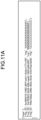
- FIGS. 11A to 11C are diagrams illustrating specific examples of API responses (responses) according to the first arrangement.
- FIGS. 11A to 11C illustrate examples of returning a response in the JSON format.
- FIG. 11A is a case where a random number is returned.
- "rng” represents data indicating a random number.
- "rng_ID” indicates identification information for identifying a random number. Note that the case of returning the encryption key has the same format as that of FIG. 11A .
- FIG. 11B is a case where both the key and the random number are returned.
- “key” indicates data indicating an encryption key.
- “key_ID” indicates identification information for identifying an encryption key.
- AES is used as the encryption method and the random number is used as IV
- the size of the random number and the size of one encryption key often match.
- the size may be different depending on the handling of headers or the like of communication data and stored data, but the size of the random number and the size of the encryption key are substantially the same.
- FIG. 11C illustrates a case where a key and a random number are combined and returned. For example, a key used for AES and IV are combined and returned.
- the generation unit 6 there are a case where the type of data supplied in response to the request is an encryption key, a case where the type of data supplied in response to the request is a random number, and a case where the type of data supplied in response to the request is both the encryption key and the random number.
- the response message is generated by describing the response message using a message format (in the examples of FIGS. 11A to 11C , JSON format) of the same format.
- FIG. 12 is a flowchart illustrating an operation example of the KM 20 according to the first arrangement.
- the supply unit 1 receives a request message (API call) from the application 40 (step S21).
- a request message for example, at least one of an encryption key and a random number is designated in the request message.
- at least one of an encryption method, a communication destination, and a data size is designated in the request message.
- the determination unit 5 determines the size and the number of encryption keys and the size and the number of random numbers according to the request message received in step S21 (step S22).
- the KM 20 performs communication for acquiring the same encryption key or random number in the communication unit 2 (communication for sharing the same encryption key or random number) with another KM 20 (Step S23).
- This communication may be performed in advance before step S24 of acquiring data, or may be performed before step S21 or step S22.
- the KM 20 acquires data based on the determination result of step S22 (step S24). For example, when a random number is requested, the random number acquisition unit 3 acquires random numbers having the requested size and the number from the random number generation module 50. Furthermore, for example, in a case where an encryption key is requested, the key acquisition unit 4 acquires encryption keys having the requested size and the number from the QKD module 30.
- step S25 the generation unit 6 generates a response message by using the data acquired in step S24 (step S25).
- the supply unit 1 supplies the application 40 with the response message generated in step S25 (step S26).
- FIG. 13 is a diagram illustrating an example of supplying an encryption key according to the first arrangement.
- the KM 20a acquires the encryption key from the QKD module 30a, and the KM 20c acquires the encryption key from the QKD module 30c (step S31).
- the KM 20a supplies the application 40a with the encryption key acquired in step S31, and the KM 20c supplies the application 40c with the encryption key acquired in step S31 (step S32).
- the encryption key to be supplied may be a local key (an encryption key shared by the QKD link 130) or a global key (an encryption key shared by the key sharing network 120).
- the encryption key to be supplied may be an encryption key already accumulated in the storage device of the KM 20.
- FIG. 14 is a diagram illustrating an example of supplying a random number according to the first arrangement.
- the KM 20a acquires a random number from the random number generation module 50a, and the KM 20c acquires a random number from a random number generation module 50c (step S41).
- the KM 20a supplies the application 40a with the random number acquired in step S41, and the KM 20c supplies the application 40c with the random number acquired in step S41 (step S42).
- the random number to be supplied may be a random number already accumulated in the storage device of the KM 20.
- the communication unit 2 performs communication for acquiring the same encryption key or random number with another KM 20.
- the supply unit 1 receives a request message from the application 40 that performs encrypted data communication.
- the determination unit 5 determines the type of request data requested by the request message.
- the generation unit 6 generates a response message including at least one of the encryption key shared by the QKD via the communication network (at least one of a QKD network 120 that shares a global key and a QKD link 130 that shares a local key) and the random number according to the type of request data.
- the generation unit generates a response message including at least one of a global key shared via the QKD network 120, a local key shared via the QKD link 130, and a random number according to the type of request data.
- the supply unit 1 supplies the application 40 with the response message.
- the key management device (KM 20) of the first arrangement it is possible to supply not only the encryption key but also the random number shared by the QKD according to the request.
- FIG. 15 is a diagram illustrating an example of a functional configuration of a KM 20-2 according to the second arrangement.
- the KM 20-2 according to the second arrangement includes a supply unit 1, a communication unit 2, a random number acquisition unit 3, a key acquisition unit 4, a determination unit 5, a generation unit 6, and a conversion unit 7.
- the conversion unit 7 is further added.
- the conversion unit 7 converts encryption key data for an encryption key into random number data for a random number, or converts random number data for a random number into encryption key data for an encryption key.
- the random number can be shared with another KM 20-2 and made available as an encryption key.
- the encryption key shared with another KM 20-2 can be made available as a random number.
- the determination unit 5 of the second arrangement also has a function of determining whether to use the conversion unit 7 when supplying at least one of a random number and an encryption key in response to a request. For example, in a case where the encryption key is supplied, the determination unit 5 determines which is more appropriate, supplying the accumulated encryption key or converting the random number into the encryption key to supply as the encryption key, based on the amount of encryption keys currently accumulated (generated, managed) and the amount of random numbers currently accumulated (generation, management).
- the appropriateness is determined based on the viewpoint and the like of the utilization efficiency of the accumulated encryption keys and the accumulated random numbers. For example, when the encryption key is requested, in a case where the accumulated (generated, managed) amount of encryption keys is smaller than a threshold value, the determination unit 5 determines that a random number is converted into an encryption key and supplied as the encryption key.
- the determination unit 5 determines whether the accumulation amount of encryption keys in the KM 20-2 is smaller than the first threshold value.
- the conversion unit 7 converts the random number acquired from the random number acquisition unit 3 into the encryption key.
- the communication unit 2 encrypts the converted encryption key indicating the encryption key converted from the random number with the encryption key shared by the QKD, and transmits the encrypted converted encryption key to the KM 20-2 connected to the application 40 on the reception side of the encrypted data communication.
- the generation unit 6 generates a response message including the converted encryption key.
- the encryption key can be supplied even when a large amount of the encryption keys is requested.
- the determination unit 5 determines that the encryption key is converted into a random number and supplied as the random number.
- the determination unit 5 determines whether the accumulation amount of the random numbers in the KM 20-2 is smaller than the second threshold value.
- the conversion unit 7 converts the encryption key acquired from the key acquisition unit 4 into the random number.
- the communication unit 2 transmits, to the KM 20-2 sharing the encryption key converted into the random number, communication for making notification of the non-use or deletion of the encryption key converted into the random number.
- the generation unit 6 generates a response message including a converted random number indicating the random number converted from the encryption key.
- the random number can be supplied even when a large amount of random numbers is requested.
- FIG. 16 is a flowchart illustrating an operation example of the KM 20-2 of the second arrangement.
- the supply unit 1 receives a request message (API call) from the application 40 (step S51). Details of step S51 are similar to those of step S21 in FIG. 12 of the first arrangement.
- the determination unit 5 determines the size and the number of encryption keys and the size and the number of random numbers according to the request message received in step S51 (step S52).
- the determination unit 5 determines whether to convert data with respect to the encryption key and the random number (step S53).
- step S53, No the process of steps S56 to S58 is executed. Since the process in the case of not converting the data is similar to that of steps S24 to S26 in FIG. 12 of the first arrangement, the description thereof is omitted.
- the conversion unit 7 converts the data (step S54). Specifically, in a case where the encryption key is converted into a random number, the key acquisition unit 4 acquires the encryption key data corresponding to the random number having the size and the number requested by the request message from the storage device of the QKD module 30 or the KM 20-2. In the case that the random number is converted into the encryption key, the random number acquisition unit 3 acquires the random number data corresponding to the encryption key having the size and the number requested by the request message from the storage device of the random number generation module 50 or the KM 20-2.
- the communication unit 2 performs control communication associated with data conversion (step S55). Specifically, when converting the encryption key into a random number, the communication unit 2 notifies another KM 20-2 sharing the encryption key to be converted that the encryption key is converted into the random number. In addition, the communication unit 2 performs communication for requesting non-use or deletion of the encryption key. When converting the random number into the encryption key, the communication unit 2 encrypts the random number using an encryption key shared with another KM 20-2, and transmits the encrypted random number to the another KM 20-2, thereby sharing the encryption key converted from the random number with the another KM 20-2.
- step S57 the generation unit 6 generates a response message by using the data converted in step S54 (step S57). Since the process of step S58 is similar to that of step S26 of FIG. 12 of the first arrangement, the description thereof will be omitted.
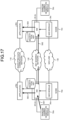
- FIG. 17 is a diagram illustrating an example of supplying an encryption key converted from a random number according to the second arrangement.
- the KM 20-2a acquires a random number from the random number generation module 50a (step S61).
- the conversion unit 7 converts the random number acquired in step S61 into an encryption key.
- the KM 20-2a encrypts the encryption key converted from the random number using the encryption key shared with the KM 20-2c, and transmits the encrypted encryption key to the KM 20-2c, thereby sharing the encryption key converted from the random number with the KM 20-2c (step S62).
- the security of the communication path sharing the encryption key converted from the random number is equivalent to QKD because the encryption key generated by QKD and shared is used for the encryption of communication.
- the KM 20-2a supplies the encryption key converted from the random number to the application 40a
- the KM 20-2c supplies the encryption key shared in step S62 to the application 40c (step S63).
- the random number to be converted may be a random number already accumulated in the storage device of the KM 20-2a.
- the random number acquired from the random number generation module 50c can be shared with the KM 20-2a as the encryption key in the same manner as in the case of the KM 20-2a.
- FIG. 18 is a diagram illustrating an example of supplying a random number converted from an encryption key according to the second arrangement.
- the KM 20-2a acquires an encryption key from the QKD module 30a (step S71).
- the conversion unit 7 converts the encryption key acquired in step S71 into a random number.
- the KM 20-2a notifies the KM 20-2c, which shares the encryption key to be converted, that the encryption key is converted into random number, and performs communication to request non-use or deletion of the encryption key (step S72).
- the KM 20-2a supplies the random number converted from the encryption key to the application 40a (step S73).
- the encryption key to be converted may be a local key (an encryption key shared by the QKD link 130) or a global key (an encryption key shared by the key sharing network 120).
- the encryption key to be converted may be an encryption key already accumulated in the storage device of the KM 20-2a.
- the encryption key acquired from the QKD module 30c can be supplied to the application 40c as the random number in the same manner as in the case of the KM 20-2a.
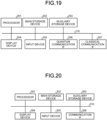
- FIG. 19 is a diagram illustrating an example of a hardware configuration of the QKD module 30 according to the first and second arrangements.
- the QKD module 30 includes a processor 201, a main storage device 202, an auxiliary storage device 203, a display device 204, an input device 205, a quantum communication IF 206, and a classical communication IF 207.
- the processor 201, the main storage device 202, the auxiliary storage device 203, the display device 204, the input device 205, the quantum communication IF 206, and the classical communication IF 207 are connected via a bus 210.
- the processor 201 executes a program read from the auxiliary storage device 203 to the main storage device 202.
- the main storage device 202 is a memory such as a read only memory (ROM) and a random access memory (RAM).
- the auxiliary storage device 203 is a hard disk drive (HDD), a memory card, or the like.
- the display device 204 displays the state and the like of the QKD module 30.
- the input device 205 receives an input from the user. Note that the QKD module 30 may not include the display device 204 and the input device 205.
- the quantum communication IF 206 is an interface for connection a quantum cryptography communication path (optical fiber link).
- the classical communication IF 207 is an interface for connection to a QKD control signal communication path, the KM 20, and the like.
- the QKD module 30 does not include the display device 204 and the input device 205, for example, a display function and an input function of an external terminal connected via the classical communication IF 207 may be used.
- FIG. 20 is a diagram illustrating an example of a hardware configuration of the KM 20 (20-2) according to the first and second arrangements.
- the KM 20 includes a processor 301, a main storage device 302, an auxiliary storage device 303, a display device 304, an input device 305, and a communication IF 306.
- the processor 301, the main storage device 302, the auxiliary storage device 303, the display device 304, the input device 305, and the communication IF 306 are connected via a bus 310.
- the processor 301 executes a program read from the auxiliary storage device 303 to the main storage device 302.
- the main storage device 302 is a memory such as a ROM and a RAM.
- the auxiliary storage device 303 is an HDD, a memory card, or the like.
- the display device 304 displays a state and the like of the KM 20.
- the input device 305 receives an input from the user. Note that the KM 20 may not include the display device 304 and the input device 305.
- the communication IF 306 is an interface for connection to the KM 20, the QKD module 30, the application 40, and the like.
- the KM 20 does not include the display device 304 and the input device 305, for example, a display function and an input function of an external terminal connected via the communication IF 306 may be used.
- the program executed by the KM 20 and the QKD module 30 is stored, in a file in an installable format or an executable format, in a computer-readable storage medium such as a CD-ROM, a memory card, a CD-R, and a digital versatile disc (DVD), and is supplied as a computer program product.
- a computer-readable storage medium such as a CD-ROM, a memory card, a CD-R, and a digital versatile disc (DVD)
- the program executed by the KM 20 and the QKD module 30 may be stored on a computer connected to a network such as the Internet and supplied by being downloaded via the network.
- the program executed by the KM 20 and the QKD module 30 may be supplied via a network such as the Internet without being downloaded.
- the program executed by the KM 20 and the QKD module 30 may be supplied by being incorporated in a ROM or the like in advance.
- the program executed by the KM 20 (20-2) has a module configuration including functions that can be achieved by the program among the functional configurations of the KM 20 (20-2) described above.
- the processor 301 reads the program from the storage medium such as the auxiliary storage device 303 and executes the program, whereby the function achieved by the program is loaded to the main storage device 302. That is, the function achieved by the program is generated on the main storage device 302.
- the functions of the KM 20 (20-2) may be achieved by hardware such as an integrated circuit (IC).
- the IC is, for example, a processor that executes dedicated processing.
- each processor may achieve one of the functions or may achieve two or more of the functions.
Landscapes
- Engineering & Computer Science (AREA)
- Computer Security & Cryptography (AREA)
- Computer Networks & Wireless Communication (AREA)
- Signal Processing (AREA)
- Physics & Mathematics (AREA)
- Electromagnetism (AREA)
- Theoretical Computer Science (AREA)
- Storage Device Security (AREA)
Abstract
A key management device (20) according to an arrangement includes a determination unit (5), a generation unit (6), and a supply unit (1). The determination unit (5) determines a type of request data requested by a request message transmitted from an application that performs encrypted data communication. The generation unit (6) generates a response message including at least one of a random number and an encryption key shared by quantum key distribution (QKD) via a communication network according to a type of the request data. The supply unit (1) supplies the response message to the application.
Description
- Arrangements described herein relate generally to a key management device, a quantum cryptography communication system, and a computer program product.
- The quantum key distribution (QKD) technology for securely sharing an encryption key by utilizing a single photon continuously transmitted between a transmission node and a reception node connected by an optical fiber is conventionally known. It is ensured that the encryption key shared by the quantum key distribution technology is not eavesdropped based on the principle of quantum mechanics. In addition, it is guaranteed by information theory that encrypted data communication by a one-time pad (OTP) using this encryption key cannot be decrypted by an eavesdropper having any knowledge.
- However, by the conventional technologies, it has been unfeasible to supply not only an encryption key but also a random number shared by QKD according to a request.
-
-
FIG. 1 is a diagram illustrating an example of a basic configuration of a quantum cryptography communication system according to a first arrangement; -
FIG. 2 is a diagram illustrating an example of a device configuration of the quantum cryptography communication system according to the first arrangement; -
FIG. 3 is a sequence diagram illustrating an example of a global key supply process according to the first arrangement; -
FIG. 4 is a diagram for explaining an example of a key supply interface according to the first arrangement; -
FIG. 5 is a diagram illustrating an example of a key supply API according to the first arrangement; -
FIG. 6 is a diagram illustrating an example of a data format of an encryption key and a key ID according to the first arrangement; -
FIG. 7 is a diagram illustrating an example of a functional configuration of a KM according to the first arrangement; -
FIG. 8 is a diagram illustrating an example of supplying a random number according to the first arrangement; -
FIG. 9 is a diagram illustrating an example of an API call and an API response according to the first arrangement; -
FIG. 10A is a diagram illustrating a specific example of the API call according to the first arrangement; -
FIG. 10B is a diagram illustrating a specific example of the API call according to the first arrangement; -
FIG. 10C is a diagram illustrating a specific example of the API call according to the first arrangement; -
FIG. 10D is a diagram illustrating a specific example of the API call according to the first arrangement; -
FIG. 11A is a diagram illustrating a specific example of the API response according to the first arrangement; -
FIG. 11B is a diagram illustrating a specific example of the API response according to the first arrangement; -
FIG. 11C is a diagram illustrating a specific example of the API response according to the first arrangement; -
FIG. 12 is a flowchart illustrating an operation example of the KM according to the first arrangement; -
FIG. 13 is a diagram illustrating an example of supplying an encryption key according to the first arrangement; -
FIG. 14 is a diagram illustrating an example of supplying a random number according to the first arrangement; -
FIG. 15 is a diagram illustrating an example of a hardware configuration of a KM according to a second arrangement; -
FIG. 16 is a flowchart illustrating an operation example of the KM of the second arrangement; -
FIG. 17 is a diagram illustrating an example of supplying an encryption key converted from a random number according to the second arrangement; -
FIG. 18 is a diagram illustrating an example of supplying a random number converted from an encryption key according to the second arrangement; -
FIG. 19 is a diagram illustrating an example of a hardware configuration of a QKD module according to the first and second arrangements; and -
FIG. 20 is a diagram illustrating an example of a hardware configuration of the KM according to the first and second arrangements. - Hereinafter, arrangements of a key management device, a quantum cryptography communication system, and a computer program product will be described in detail with reference to the accompanying drawings.
- In the QKD network, an application programming interface (API) technology for supplying an encryption key to an application has been standardized, and the API technology has started to be used. Furthermore, in the quantum cryptography communication system, there is a case where the application desires to use not only an encryption key that is a random number shared with another node but also a random number (unique random number) independent of the another node. Alternatively, in a case where cryptography communication is performed by a common key encryption method such as advanced encryption standard (AES) encryption, there is a case where it is desired to simultaneously acquire another random number used as an initialization vector (IV) in addition to the encryption key.
- In the following arrangements, a key management device, a quantum cryptography communication system, and a program capable of supplying not only an encryption key but also a random number shared by QKD according to a request by the API will be described.
- First, a basic configuration of a quantum cryptography communication system will be described. Each of the transmission node and the reception node are collectively referred to as a node. The node of the arrangement is referred to as a trusted node (TN), for example. In addition, a function of performing encrypted data communication using a shared encryption key is referred to as an application separately from the node.
-
FIG. 1 is a diagram illustrating an example of a basic configuration of a quantum cryptography communication system according to a first arrangement. Anode 10a includes aKM 20a and aQKD module 30a. A key manager (KM) 20a is a key management device that manages an encryption key. TheQKD module 30a shares an encryption key by quantum key distribution (QKD). - Note that the
KM 20a and theQKD module 30a may be configured as a single device/system or may be configured as separate devices/systems. For example,node 10a may not include theQKD module 30a. In this case, theKM 20a of thenode 10a and theQKD module 30a implemented as an external device of thenode 10a are connected by a link. Since the description of anode 10b is similar to that of thenode 10a, it is omitted. - In the example of
FIG. 1 , the encryption key shared by aQKD link 130 between thenode 10a andnode 10b are supplied to anapplication 40a and anapplication 40b. Theapplications nodes -
FIG. 2 is a diagram illustrating an example of a device configuration of a quantum cryptography communication system 100 according to the first arrangement. Anode 10a includes aKM 20a and aQKD module 30a. Thenode 10a is connected to theapplication 40a. Thenode 10b includes aKM 20b andQKD modules 30b-1 to 30b-2. Thenode 10b is connected to bothnodes QKD modules 30b. Thenode 10c includes aKM 20c and aQKD module 30c. Thenode 10c is connected to anapplication 40c. - Hereinafter, in a case where the
nodes 10a to 10c are not distinguished, they are simply referred to as anode 10. Similarly, when theKMs 20a to 20c are not distinguished, they are simply referred to as aKM 20. Similarly, when theQKD modules 30a to 30c are not distinguished, they are simply referred to as a QKD module 30. Similarly, when theapplications - In the example of
FIG. 2 , a key sharing network (QKD network) 120 and aQKD link 130 are configured by a communication network in which thenodes 10a to 10c each having functions of a transmission node and a reception node are connected to each other by an optical fiber link. Note that thekey sharing network 120 may use a link different from the optical fiber of the QKD link 130 that performs key distribution by the QKD. The number of links is not limited. That is, thekey sharing network 120 and the QKD link 130 may be independently configured by different optical fibers. Theapplications data communication network 110. - A case where encrypted data communication is performed between the
application 40a and theapplication 40c will be described. - The QKD module 30 of each
node 10 shares, as a local key, an encryption key shared by the QKD with the QKD module 30 of the neighboringnode 10 connected by the optical fiber link. TheKM 20a (20c) supplies a common encryption key (hereinafter, "global key") to theapplication 40a (40c). After this, theapplication 40a (40c) encrypts data using a global key supplied by theKM 20a (20c), and performs encrypted data communication. - Here, a specific example of a method of sharing a common global key between the
applications key sharing network 120 is not limited. - The
node 10a generates a global key different from the local key from random number information and the like separately regardless of the QKD. TheKM 20a of thenode 10a encrypts the global key with the local key shared between theQKD modules KM 20b of the neighboringnode 10b. Next, theKM 20b of the neighboringnode 10b encrypts the global key with the local key shared between theQKD modules 30b-2 and 30c, and forwards the encrypted global key to theKM 20c of the neighboringnode 10c. - In this manner, by repeating the process of encrypting the global key with the local key and forwarding the global key, the
node 10 can share the global key with anynode 10 on thekey sharing network 120. At this time, the global key is forwarded on the link in an encrypted state by the local key shared by the QKD. Therefore, assuming the safety of thenode 10 itself, it can be said that the safety of the global key is ensured as in the local key. -
FIG. 3 is a sequence diagram illustrating an example of a global key supply process according to the first arrangement. In the example ofFIG. 3 , an example of a sequence in which theapplications application 40a is connected to thenode 10a on thekey sharing network 120. Theapplication 40c is connected to thenode 10c on thekey sharing network 120. - First, a local key is shared between the
nodes nodes - Next, the
application 40a transmits a global key request (global key request message) to thenode 10a (step S3). The global key request indicates a request for a global key used for encrypted data communication with theapplication 40c. - Next, the
node 10a identifies thenode 10c (key sharing node inFig. 3 ) connected to theapplication 40c communicating with theapplication 40a from, for example, the information of the application name (theapplication 40c) included in the global key request (step S4). Note that thenode 10a may identify thenode 10c connected to theapplication 40c by referring to data called a connection information directory. - Next, the
node 10a starts global key sharing control with thenode 10c (step S5). Specifically, thenode 10a transmits a notification indicating a request for a global key sharing process to thenode 10c. - The operation of the global key sharing process is as described above. For example, the
node 10a sets a random number generated using a random number generator or the like as a global key (step S6), encrypts the global key with a local key shared with thenode 10b (step S7), and transmits the encrypted global key to thenode 10b. Thenode 10b decrypts the encrypted global key with the same local key as the local key of thenode 10a to extract the global key. Next, thenode 10b encrypts the global key with the local key shared with thenode 10c (step S8), and transmits the encrypted global key to thenode 10c. Thenode 10c decrypts the encrypted global key with the same local key as the local key used for encryption in thenode 10b, and extracts the global key (step S9). Next, thenode 10c stores the decrypted global key in a storage or the like (step S10). Next, thenode 10c transmits a global key storage notification indicating that the global key has been stored to thenode 10a (step S11). - Note that it is also possible to use a global key shared between the
node 10a and thenode 10c in advance without performing the global key sharing operation in steps S5 to S11. - Next, the
node 10a transmits a global key response message for supplying the global key shared with thenode 10c to theapplication 40a (step S12). The global key response message includes a global key shared by thenodes - Next, the
application 40a notifies theapplication 40c of the key ID of the global key used for the cryptography communication (step S13). Note that this key ID notification may be notified prior to the cryptography communication between theapplications application 40a may be notified together with encrypted data encrypted with the global key. - Next, when receiving a global key request (global key request message) from the
application 40c (step S14), thenode 10c supplies the global key stored in step S10 to theapplication 40c (step S15). - Note that the
application 40c generates the global key request message when transmitting the encrypted data to theapplication 40a or when decrypting the encrypted data received from theapplication 40a. The global key request message includes the key ID of the global key requested by theapplication 40c. Thenode 10c returns a global key corresponding to the key ID included in the global key request message among the global keys shared with thenode 10a to theapplication 40c (global key response message). - The
applications -
FIG. 4 is a diagram for explaining an example of a key supply interface according to the first arrangement. In the example ofFIG. 4 , a randomnumber generation module 50a that generates a random number used for the global key is further connected to thenode 10a (10c). - The
node 10a inFIG. 4 can be used as a mechanism for sharing any secret information such as an encryption key generated in another system and a secret key in a digital certificate/public key method. Furthermore, since thenode 10a includes not only theKM 20a but also theQKD module 30a, the random number generation function of the randomnumber generation module 50a may be used for key sharing in QKD. Note that the random number generation function may be provided in a device (for example, a random number generation management server device or the like) different from thenode 10a as in the randomnumber generation module 50a illustrated inFIG. 4 , or may be incorporated in thenode 10a. - In
FIG. 4 , theapplication 40a in which the cryptography communication session is started is referred to as a master, and theapplication 40c in which the cryptography communication session is received is referred to as a slave. The request message and the response message exchanged between the application 40 and thenode 10 are achieved by, for example, calling of the Web API and a response thereof. Example of key supply API -
FIG. 5 is a diagram illustrating an example of a key supply API according to the first arrangement. - The first API is a state confirmation API (Get status API) by which the application 40 inquires the state of the
node 10 or the quantum cryptography communication system. - The second API is a key acquisition API (Get key API) by which the
application 40a serving as a master acquires an encryption key from thenode 10a. Themaster application 40a designates, for example, the number of encryption keys by the key acquisition API. When the key acquisition API is called from theapplication 40a, thenode 10a responds to themaster application 40a by supplying the encryption key and the key ID of the encryption key. - The third API is a key acquisition API (Get key with key IDs API) by which the
slave application 40c acquires an encryption key from thenode 10c. Theslave application 40c designates, for example, a key ID of an encryption key by the key acquisition API. When the key acquisition API is called from theapplication 40c, thenode 10c responds to theslave application 40c by supplying the encryption key and the key ID of the encryption key. - Note that, in a case where the encryption key and the key ID are defined in the JSON format in the second and third API responses, an example of the response data format is as illustrated in
FIG. 6 . -
FIG. 6 is a diagram illustrating an example of a response data format of an encryption key and a key ID according to the first arrangement. The example ofFIG. 6 illustrates a case of a response data format in which data of "key ID" indicating a key ID and data of "key" indicating an encryption key are associated with each other. - There is a case where the application 40 desires to use high-quality random number data during cryptography communication (for example, an initial vector (IV) for cryptography communication, a random number for secret sharing storage of data, and the like.). In the first arrangement, assuming application to such a use case, the
node 10 supplies a combination of the encryption key and the random number generated by a random number generation module 50 by the key supply API. TheKM 20 that supplies the encryption key and the random number data integrally and efficiently generates, stores, and manages the encryption key and the random number. -
FIG. 7 is a diagram illustrating an example of a functional configuration of theKM 20 according to the first arrangement. TheKM 20 according to the first arrangement includes asupply unit 1, acommunication unit 2, a randomnumber acquisition unit 3, akey acquisition unit 4, adetermination unit 5, and ageneration unit 6. - The
supply unit 1 supplies the data generated by thegeneration unit 6 to the application 40 in response to a request message (API call) from the application 40. - The
communication unit 2 communicates with another device. For example, thecommunication unit 2 performs communication for sharing a key or a random number, communication for making a notification of non-use of a key, communication for instructing deletion of a key, or the like with anotherKM 20. - The random
number acquisition unit 3 acquires a random number from the random number generation module 50 or the like. - The
key acquisition unit 4 acquires a key generated by QKD from the QKD module 30. - The
determination unit 5 determines the supply data (at least one of the key and the random number) according to the request message from the application 40. For example, when receiving a request message (API call) designating at least one of the encryption key and the random number from the application 40, thedetermination unit 5 determines the necessary size and number of encryption keys, and the necessary size and number of random numbers. Furthermore, for example, when receiving a request message (API call) designating at least one of the encryption method, the communication destination, and the data size, thedetermination unit 5 determines the encryption keys having the necessary size and number, the necessary size and number of encryption keys, and the necessary size and number of random numbers according to the requested encryption method, communication destination, and data size. - The
generation unit 6 generates data (at least one of a key and a random number) to be supplied to the application 40. Thegeneration unit 6 generates data (for example, JSON data) to be returned in the same message format as a response message (API response) based on the determination by thedetermination unit 5. The response message includes at least one of the random number acquired from the randomnumber acquisition unit 3 and the encryption key acquired from thekey acquisition unit 4. -
FIG. 8 is a diagram illustrating an example of supplying a random number according to the first arrangement. As illustrated inFIG. 8 , thenode 10 of the first arrangement supplies a random number instead of the encryption key or supplies a random number in addition to the encryption key by an API response (response message) according to an API call (request message) from theapplication 40a to thenode 10a. That is, thenode 10 of the first arrangement supplies the application 40 connected to thenode 10 with the random number and the encryption key at the same time, or supplies the random number in a message format similar to the supply of the encryption key. As a result, for example, an IV (random number) having an appropriate size for use in cryptography communication can be supplied by a single API call simultaneously when the key is supplied. Furthermore, for example, in a case where data protection by secret sharing and cryptography communication using an encryption key are simultaneously performed, they can be supplied by a single API call. -
FIG. 9 is a diagram illustrating an example of an API call and a response according to the first arrangement.FIG. 9 illustrates an example of a relationship (combination) between the API call (request) and the API response (response). -
Item number 1 is a case where only the encryption key is received from thenode 10. A request for an encryption key is made as an API call, and the encryption key is supplied as an API response. -
Item number 2 is a case where not only the encryption key but also the random number is received from thenode 10. A request for an encryption key is made as an API call, and the random number in addition to the encryption key are supplied as an API response. -
Item number 3 is a case where only a random number is received from thenode 10. A request for a random number is made as an API call, and the random number is supplied as an API response. -
Item number 4 is a case where not only the random number but also the encryption key is received from thenode 10. A request for a random number is made as an API call, and the encryption key in addition to the random number are supplied as an API response. -
Item number 5 is a case where a random number and an encryption key are received from thenode 10. A request for an encryption key and a random number is made as an API call, and the encryption key and the random number are supplied as an API response. -
Item number 6 is a case where a random number and an encryption key are received from thenode 10. A communication method or a communication destination is designated as API call, and the encryption key and the random number are supplied as an API response. Note that, foritem number 6, for example, encryption keys and random numbers having different types, sizes, and numbers may be supplied according to the designated communication destination. - Note that which API operation of the APIs of
item numbers 1 to 6 is enabled is determined by setting of thenode 10, for example. For example, the API call is a request for an encryption key in bothitem numbers node 10. - In addition, the encryption key included in the API response may be any key depending on the use. For example, the encryption key included in the API response may be any key, and is, for example, the local key, the global key, or the like described above.
-
FIGS. 10A to 10D are diagrams illustrating specific examples of API calls (requests) according to the first arrangement. The request message from the application 40 is achieved by, for example, the API ofFIGS. 10A to 10D . {KME_hostname} included in url of the POST method indicates a host name (IP address) of thenode 10. InFIGS. 10A to 10D , the parameter is designated by the request body of the POST method, but may be designated by the GET method. -
FIG. 10A is a case where a random number is designated and called by the API call. When only a random number is requested, it is not necessary to designate the communication destination by a parameter. For example, in the example ofFIG. 10A , in the request body of the POST parameter, the type (in the example ofFIG. 10A , "rng" indicating a random number), the number (in the example ofFIG. 10A ,3 ), and the size (in the example ofFIG. 10A , 1024) of the requested data are designated by parameters. - Note that the type in
FIG. 10A is a parameter that designates at least one of an encryption key and a random number as the type of data requested from the application 40. "number" is a parameter that identifies the number of pieces of request data. "size" is a parameter that identifies the size of the request data. Thegeneration unit 6 generates a response message including the request data having a size and the number designated by the request message by the API. -
FIG. 10B illustrates a case where a key and a random number are designated and called. In the API ofFIG. 10B , since the key is acquired, the communication destination is designated in (SAE_ID). In "SAE_ID", for example, an ID for identifying the application 40 as the communication destination is designated. For example, in the example ofFIG. 10B , in the request body of the POST parameter, the type, the number, and the size of the requested data are designated by parameters. For example, type "key" included in the parameter in the second line of the request body of the POST parameter inFIG. 10B indicates an encryption key, "number" indicates the number of encryption keys, and "size" indicates the size of the encryption key. -
FIG. 10C is a case where a key and a random number are designated and called by the same API call as inFIG. 10B , but the random number size is not designated in the request body of the POST parameter, for example. For example, in the request body of the POST parameter, when a key is requested, the number and the size parameters are designated, and when a random number is requested, the number and the size are not designated. In this case, theKM 20 of thenode 10 determines the number and the size of the random numbers based on the setting of theKM 20 and the like. -
FIG. 10D illustrates a case where the communication scheme is designated. The API inFIG. 10D is called by the same API call (same url designation) as that inFIG. 10B , but for example, the size and the number of keys and the size and the number of random numbers are not designated in the request body of the POST parameter, and the encryption method (in the example ofFIG. 10D , "default AES") to be used is designated. In this case, theKM 20 of thenode 10 determines the number and the size of the random numbers based on the encryption method to be used. - Note that the request message by the API call in
FIG. 10D may include at least one of a method parameter designating an encryption method used by the application 40 and a communication destination parameter designating a communication destination of the application 40. In a case where the method parameter is included in the request message, thegeneration unit 6 generates a response message including at least one of the encryption key and the random number according to the method parameter. Furthermore, in a case where the communication destination parameter is included in the request message, thegeneration unit 6 generates the response message including at least one of the encryption key and the random number according to the communication destination parameter. - Furthermore, the request message by the API call in
FIG. 10D may further include a size parameter designating a data size. In this case, thegeneration unit 6 generates the response message including at least one of the encryption key having a size designated by the size parameter and the random number having a size designated by the size parameter. - In addition, the request message by the API call may include a size parameter designating the data size of the transmission data. In a case where the size parameter is included in the request message, the
generation unit 6 generates a response message including at least one of the encryption key used for an encryption process of data having a size designated by the size parameter and the random number used for an encryption process of data having a size designated by the size parameter. - Specifically, in a case where only the size parameter is designated by the API call, the
generation unit 6 generates a response message including the encryption key used for the encryption process of data of the size designated by the size parameter and the random number used for the encryption process of data of the data size. The random number used for the encryption process includes, for example, a random number used as the IV and a random number necessary for protecting data of the size with secret sharing. -
FIGS. 11A to 11C are diagrams illustrating specific examples of API responses (responses) according to the first arrangement.FIGS. 11A to 11C illustrate examples of returning a response in the JSON format. -
FIG. 11A is a case where a random number is returned. "rng" represents data indicating a random number. "rng_ID" indicates identification information for identifying a random number. Note that the case of returning the encryption key has the same format as that ofFIG. 11A . -
FIG. 11B is a case where both the key and the random number are returned. "key" indicates data indicating an encryption key. "key_ID" indicates identification information for identifying an encryption key. For example, when AES is used as the encryption method and the random number is used as IV, the size of the random number and the size of one encryption key often match. In addition, for example, in a case where a random number is used for data protection by secret sharing and OTP is used for cryptography communication, the size may be different depending on the handling of headers or the like of communication data and stored data, but the size of the random number and the size of the encryption key are substantially the same. -
FIG. 11C illustrates a case where a key and a random number are combined and returned. For example, a key used for AES and IV are combined and returned. - For example, as illustrated in
FIGS. 11A to 11C , in thegeneration unit 6, there are a case where the type of data supplied in response to the request is an encryption key, a case where the type of data supplied in response to the request is a random number, and a case where the type of data supplied in response to the request is both the encryption key and the random number. In these cases, the response message is generated by describing the response message using a message format (in the examples ofFIGS. 11A to 11C , JSON format) of the same format. -
FIG. 12 is a flowchart illustrating an operation example of theKM 20 according to the first arrangement. First, thesupply unit 1 receives a request message (API call) from the application 40 (step S21). For example, at least one of an encryption key and a random number is designated in the request message. Furthermore, for example, at least one of an encryption method, a communication destination, and a data size is designated in the request message. - Next, the
determination unit 5 determines the size and the number of encryption keys and the size and the number of random numbers according to the request message received in step S21 (step S22). - Next, the
KM 20 performs communication for acquiring the same encryption key or random number in the communication unit 2 (communication for sharing the same encryption key or random number) with another KM 20 (Step S23). This communication may be performed in advance before step S24 of acquiring data, or may be performed before step S21 or step S22. - Next, the
KM 20 acquires data based on the determination result of step S22 (step S24). For example, when a random number is requested, the randomnumber acquisition unit 3 acquires random numbers having the requested size and the number from the random number generation module 50. Furthermore, for example, in a case where an encryption key is requested, thekey acquisition unit 4 acquires encryption keys having the requested size and the number from the QKD module 30. - Next, the
generation unit 6 generates a response message by using the data acquired in step S24 (step S25). Next, thesupply unit 1 supplies the application 40 with the response message generated in step S25 (step S26). -
FIG. 13 is a diagram illustrating an example of supplying an encryption key according to the first arrangement. First, theKM 20a acquires the encryption key from theQKD module 30a, and theKM 20c acquires the encryption key from theQKD module 30c (step S31). Next, theKM 20a supplies theapplication 40a with the encryption key acquired in step S31, and theKM 20c supplies theapplication 40c with the encryption key acquired in step S31 (step S32). - Note that the encryption key to be supplied may be a local key (an encryption key shared by the QKD link 130) or a global key (an encryption key shared by the key sharing network 120). The encryption key to be supplied may be an encryption key already accumulated in the storage device of the
KM 20. -
FIG. 14 is a diagram illustrating an example of supplying a random number according to the first arrangement. First, theKM 20a acquires a random number from the randomnumber generation module 50a, and theKM 20c acquires a random number from a randomnumber generation module 50c (step S41). Next, theKM 20a supplies theapplication 40a with the random number acquired in step S41, and theKM 20c supplies theapplication 40c with the random number acquired in step S41 (step S42). - Note that the random number to be supplied may be a random number already accumulated in the storage device of the
KM 20. - As described above, in the key management device (KM 20) according to the first arrangement, the
communication unit 2 performs communication for acquiring the same encryption key or random number with anotherKM 20. Thesupply unit 1 receives a request message from the application 40 that performs encrypted data communication. Thedetermination unit 5 determines the type of request data requested by the request message. Thegeneration unit 6 generates a response message including at least one of the encryption key shared by the QKD via the communication network (at least one of aQKD network 120 that shares a global key and aQKD link 130 that shares a local key) and the random number according to the type of request data. Specifically, the generation unit generates a response message including at least one of a global key shared via theQKD network 120, a local key shared via theQKD link 130, and a random number according to the type of request data. Thesupply unit 1 supplies the application 40 with the response message. - As a result, according to the key management device (KM 20) of the first arrangement, it is possible to supply not only the encryption key but also the random number shared by the QKD according to the request.
- Next, the second arrangement will be described. In the description of the second arrangement, the description similar to that of the first arrangement will be omitted, and portions different from those of the first arrangement will be described.
-
FIG. 15 is a diagram illustrating an example of a functional configuration of a KM 20-2 according to the second arrangement. The KM 20-2 according to the second arrangement includes asupply unit 1, acommunication unit 2, a randomnumber acquisition unit 3, akey acquisition unit 4, adetermination unit 5, ageneration unit 6, and a conversion unit 7. In the KM 20-2 of the second arrangement, the conversion unit 7 is further added. - The conversion unit 7 converts encryption key data for an encryption key into random number data for a random number, or converts random number data for a random number into encryption key data for an encryption key. By the process of the conversion unit 7, the random number can be shared with another KM 20-2 and made available as an encryption key. In addition, by the process of the conversion unit 7, the encryption key shared with another KM 20-2 can be made available as a random number.
- The
determination unit 5 of the second arrangement also has a function of determining whether to use the conversion unit 7 when supplying at least one of a random number and an encryption key in response to a request. For example, in a case where the encryption key is supplied, thedetermination unit 5 determines which is more appropriate, supplying the accumulated encryption key or converting the random number into the encryption key to supply as the encryption key, based on the amount of encryption keys currently accumulated (generated, managed) and the amount of random numbers currently accumulated (generation, management). - The appropriateness is determined based on the viewpoint and the like of the utilization efficiency of the accumulated encryption keys and the accumulated random numbers. For example, when the encryption key is requested, in a case where the accumulated (generated, managed) amount of encryption keys is smaller than a threshold value, the
determination unit 5 determines that a random number is converted into an encryption key and supplied as the encryption key. - Specifically, when the request data is the encryption key, the
determination unit 5 determines whether the accumulation amount of encryption keys in the KM 20-2 is smaller than the first threshold value. Next, when the accumulation amount of encryption keys is smaller than the first threshold value, the conversion unit 7 converts the random number acquired from the randomnumber acquisition unit 3 into the encryption key. Next, thecommunication unit 2 encrypts the converted encryption key indicating the encryption key converted from the random number with the encryption key shared by the QKD, and transmits the encrypted converted encryption key to the KM 20-2 connected to the application 40 on the reception side of the encrypted data communication. Then, thegeneration unit 6 generates a response message including the converted encryption key. - By making the converted encryption key available, for example, in a case where the accumulation amount of encryption keys is smaller than the first threshold value, the encryption key can be supplied even when a large amount of the encryption keys is requested.
- Similarly, for example, when a random number is requested, in a case where the accumulated (generated, managed) amount of random numbers is smaller than a threshold value, the
determination unit 5 determines that the encryption key is converted into a random number and supplied as the random number. - Specifically, when the request data is a random number, the
determination unit 5 determines whether the accumulation amount of the random numbers in the KM 20-2 is smaller than the second threshold value. Next, in a case where the accumulation amount of the random numbers is smaller than the second threshold value, the conversion unit 7 converts the encryption key acquired from thekey acquisition unit 4 into the random number. Next, thecommunication unit 2 transmits, to the KM 20-2 sharing the encryption key converted into the random number, communication for making notification of the non-use or deletion of the encryption key converted into the random number. Then, thegeneration unit 6 generates a response message including a converted random number indicating the random number converted from the encryption key. - By making the converted random number available, for example, in a case where the accumulation amount of the random numbers is smaller than the second threshold value, the random number can be supplied even when a large amount of random numbers is requested.
-
FIG. 16 is a flowchart illustrating an operation example of the KM 20-2 of the second arrangement. First, thesupply unit 1 receives a request message (API call) from the application 40 (step S51). Details of step S51 are similar to those of step S21 inFIG. 12 of the first arrangement. - Next, the
determination unit 5 determines the size and the number of encryption keys and the size and the number of random numbers according to the request message received in step S51 (step S52). - Next, the
determination unit 5 determines whether to convert data with respect to the encryption key and the random number (step S53). - In a case where the data is not converted (step S53, No), the process of steps S56 to S58 is executed. Since the process in the case of not converting the data is similar to that of steps S24 to S26 in
FIG. 12 of the first arrangement, the description thereof is omitted. - When the data is converted (step S53, Yes), the conversion unit 7 converts the data (step S54). Specifically, in a case where the encryption key is converted into a random number, the
key acquisition unit 4 acquires the encryption key data corresponding to the random number having the size and the number requested by the request message from the storage device of the QKD module 30 or the KM 20-2. In the case that the random number is converted into the encryption key, the randomnumber acquisition unit 3 acquires the random number data corresponding to the encryption key having the size and the number requested by the request message from the storage device of the random number generation module 50 or the KM 20-2. - Next, the
communication unit 2 performs control communication associated with data conversion (step S55). Specifically, when converting the encryption key into a random number, thecommunication unit 2 notifies another KM 20-2 sharing the encryption key to be converted that the encryption key is converted into the random number. In addition, thecommunication unit 2 performs communication for requesting non-use or deletion of the encryption key. When converting the random number into the encryption key, thecommunication unit 2 encrypts the random number using an encryption key shared with another KM 20-2, and transmits the encrypted random number to the another KM 20-2, thereby sharing the encryption key converted from the random number with the another KM 20-2. - Next, the
generation unit 6 generates a response message by using the data converted in step S54 (step S57). Since the process of step S58 is similar to that of step S26 ofFIG. 12 of the first arrangement, the description thereof will be omitted. -
FIG. 17 is a diagram illustrating an example of supplying an encryption key converted from a random number according to the second arrangement. First, the KM 20-2a acquires a random number from the randomnumber generation module 50a (step S61). The conversion unit 7 converts the random number acquired in step S61 into an encryption key. - Next, the KM 20-2a encrypts the encryption key converted from the random number using the encryption key shared with the KM 20-2c, and transmits the encrypted encryption key to the KM 20-2c, thereby sharing the encryption key converted from the random number with the KM 20-2c (step S62).
- At this time, the security of the communication path sharing the encryption key converted from the random number is equivalent to QKD because the encryption key generated by QKD and shared is used for the encryption of communication.
- Next, the KM 20-2a supplies the encryption key converted from the random number to the
application 40a, and the KM 20-2c supplies the encryption key shared in step S62 to theapplication 40c (step S63). - Note that the random number to be converted may be a random number already accumulated in the storage device of the KM 20-2a. As for the KM 20-2c, the random number acquired from the random
number generation module 50c can be shared with the KM 20-2a as the encryption key in the same manner as in the case of the KM 20-2a. -
FIG. 18 is a diagram illustrating an example of supplying a random number converted from an encryption key according to the second arrangement. First, the KM 20-2a acquires an encryption key from theQKD module 30a (step S71). The conversion unit 7 converts the encryption key acquired in step S71 into a random number. - Next, the KM 20-2a notifies the KM 20-2c, which shares the encryption key to be converted, that the encryption key is converted into random number, and performs communication to request non-use or deletion of the encryption key (step S72). Next, the KM 20-2a supplies the random number converted from the encryption key to the
application 40a (step S73). - Note that the encryption key to be converted may be a local key (an encryption key shared by the QKD link 130) or a global key (an encryption key shared by the key sharing network 120). In addition, the encryption key to be converted may be an encryption key already accumulated in the storage device of the KM 20-2a. As for the KM 20-2c, the encryption key acquired from the
QKD module 30c can be supplied to theapplication 40c as the random number in the same manner as in the case of the KM 20-2a. - Finally, an example of a hardware configuration of the KM 20 (20-2) and the QKD module 30 according to the first and second arrangements will be described.
-
FIG. 19 is a diagram illustrating an example of a hardware configuration of the QKD module 30 according to the first and second arrangements. The QKD module 30 includes aprocessor 201, amain storage device 202, anauxiliary storage device 203, adisplay device 204, aninput device 205, a quantum communication IF 206, and a classical communication IF 207. Theprocessor 201, themain storage device 202, theauxiliary storage device 203, thedisplay device 204, theinput device 205, the quantum communication IF 206, and the classical communication IF 207 are connected via abus 210. - The
processor 201 executes a program read from theauxiliary storage device 203 to themain storage device 202. Themain storage device 202 is a memory such as a read only memory (ROM) and a random access memory (RAM). Theauxiliary storage device 203 is a hard disk drive (HDD), a memory card, or the like. - The
display device 204 displays the state and the like of the QKD module 30. Theinput device 205 receives an input from the user. Note that the QKD module 30 may not include thedisplay device 204 and theinput device 205. - The quantum communication IF 206 is an interface for connection a quantum cryptography communication path (optical fiber link). The classical communication IF 207 is an interface for connection to a QKD control signal communication path, the
KM 20, and the like. When the QKD module 30 does not include thedisplay device 204 and theinput device 205, for example, a display function and an input function of an external terminal connected via the classical communication IF 207 may be used. -
FIG. 20 is a diagram illustrating an example of a hardware configuration of the KM 20 (20-2) according to the first and second arrangements. TheKM 20 includes aprocessor 301, amain storage device 302, anauxiliary storage device 303, adisplay device 304, aninput device 305, and a communication IF 306. Theprocessor 301, themain storage device 302, theauxiliary storage device 303, thedisplay device 304, theinput device 305, and the communication IF 306 are connected via abus 310. - The
processor 301 executes a program read from theauxiliary storage device 303 to themain storage device 302. Themain storage device 302 is a memory such as a ROM and a RAM. Theauxiliary storage device 303 is an HDD, a memory card, or the like. - The
display device 304 displays a state and the like of theKM 20. Theinput device 305 receives an input from the user. Note that theKM 20 may not include thedisplay device 304 and theinput device 305. - The communication IF 306 is an interface for connection to the
KM 20, the QKD module 30, the application 40, and the like. When theKM 20 does not include thedisplay device 304 and theinput device 305, for example, a display function and an input function of an external terminal connected via the communication IF 306 may be used. - The program executed by the
KM 20 and the QKD module 30 is stored, in a file in an installable format or an executable format, in a computer-readable storage medium such as a CD-ROM, a memory card, a CD-R, and a digital versatile disc (DVD), and is supplied as a computer program product. - In addition, the program executed by the
KM 20 and the QKD module 30 may be stored on a computer connected to a network such as the Internet and supplied by being downloaded via the network. - In addition, the program executed by the
KM 20 and the QKD module 30 may be supplied via a network such as the Internet without being downloaded. - In addition, the program executed by the
KM 20 and the QKD module 30 may be supplied by being incorporated in a ROM or the like in advance. - The program executed by the KM 20 (20-2) has a module configuration including functions that can be achieved by the program among the functional configurations of the KM 20 (20-2) described above. The
processor 301 reads the program from the storage medium such as theauxiliary storage device 303 and executes the program, whereby the function achieved by the program is loaded to themain storage device 302. That is, the function achieved by the program is generated on themain storage device 302. - Note that some or all of the functions of the KM 20 (20-2) may be achieved by hardware such as an integrated circuit (IC). The IC is, for example, a processor that executes dedicated processing.
- In addition, in a case where each function is achieved by using a plurality of processors, each processor may achieve one of the functions or may achieve two or more of the functions.
- While certain arrangements have been described, these arrangements have been presented by way of example only, and are not intended to limit the scope of the claims. Indeed, the apparatuses described herein may be embodied in a variety of other forms; furthermore various omissions, substitutions and changes in the form of the apparatuses described herein may be made.
- Example 1. A key management device (20) according to an arrangement includes a determination unit (5), a generation unit (6), and a supply unit (1). The determination unit (5) is configured to determine a type of request data requested by a request message transmitted from an application that performs encrypted data communication. The generation unit (6) is configured to generate a response message including at least one of a random number and an encryption key shared by quantum key distribution (QKD) via a communication network according to a type of the request data. The supply unit (1) is configured to supply the response message to the application.
- Example 2. In the key management device (20) according to example 1, the communication network includes at least one of a QKD network that shares a global key and a QKD link that shares a local key, and the generation unit (6) generates a response message including at least one of a global key shared via the QKD network, a local key shared via the QKD link, and a random number according to a type of the request data.
- Example 3. In the key management device (20) according to example 1 or 2, the key management device (20) is connected to a QKD module that is one of devices included in the communication network and a random number generation module that generates the random number.
- Example 4. In the key management device (20) according to any one of examples 1 to 3, the request message includes a parameter designating at least one of the encryption key and the random number as the type of the request data.
- Example 5. In the key management device (20) according to example 4, the request message further includes a parameter designating a number of pieces of request data and a parameter designating a size of the request data, and the generation unit (6) generates a response message including the request data having a size and the number designated by the request message.
- Example 6. In the key management device (20) according to any one of examples 1 to 3, the request message includes at least one of a method parameter designating an encryption method used by the application, a communication destination parameter designating a communication destination of the application, and a size parameter designating a data size. The generation unit (6) generates a response message including at least one of an encryption key and a random number according to the method parameter in a case where the method parameter is included in the request message, generates a response message including at least one of an encryption key and a random number according to the communication destination parameter in a case where the communication destination parameter is included in the request message, and generates a response message including at least one of an encryption key used for an encryption process of data having a size designated by the size parameter and a random number used for an encryption process of data having a size designated by the size parameter in a case where the size parameter is included in the request message.
- Example 7. In the key management device (20) according to any one of examples 1 to 6, the generation unit (6) generates the response message by describing the response message using a message format of a same format in a case where a type of data supplied in response to a request is an encryption key, in a case where a type of data supplied in response to a request is a random number, and in a case where types of data supplied in response to a request are both the encryption key and the random number.
- Example 8. In the key management device (20) according to any one of examples 1 to 7, when the request data is an encryption key, the determination unit (5) determines whether an accumulation amount of encryption keys in the key management device (20) is smaller than a first threshold value. The key management device (20) further includes a conversion unit (7) configured to convert a random number into an encryption key when the accumulation amount of the encryption keys is smaller than the first threshold value, and a communication unit (2) configured to encrypt a converted encryption key indicating an encryption key converted from the random number using an encryption key shared by the QKD and transmit the encrypted converted encryption key to a device connected to an application on a reception side of the encrypted data communication. The generation unit (6) generates a response message including the converted encryption key.
- Example 9. In the key management device (20) according to example 8, when the request data is the random number, the determination unit (5) determines whether an accumulation amount of random numbers in the key management device (20) is smaller than a second threshold value, the conversion unit (7) converts an encryption key into a random number in a case where the accumulation amount of the random numbers is smaller than the second threshold value, the communication unit transmits communication for making a notification of non-use or deletion of the encryption key, that is converted into the random number, to a device sharing the encryption key converted into the random number, and the generation unit (6) generates a response message including a converted random number indicating a random number converted from an encryption key.
- Example 10. A quantum cryptography communication system according to an arrangement includes an encrypted data communication network in which a plurality of applications performs encrypted data communication, a communication network in which a plurality of quantum key distribution (QKD) modules shares an encryption key by QKD, and a plurality of key management devices (20) connected to the plurality of QKD modules. The key management device (20) includes a determination unit (5), a generation unit (6), and a supply unit (1). The determination unit (5) is configured to determine a type of request data requested by a request message transmitted from an application. The generation unit (6) is configured to generate a response message including at least one of the encryption key and a random number according to a type of the request data. The supply unit (1) is configured to supply the response message to the application.
- Example 11. According to an arrangement, a computer program product includes a non-transitory computer-readable medium including programmed instructions stored therein and the instructions cause a computer to function as a determination unit (5), a generation unit (6), and a supply unit (1). The determination unit (5) is configured to determine a type of request data requested by a request message transmitted from an application that performs encrypted data communication. The generation unit (6) is configured to generate a response message including at least one of a random number and an encryption key shared by quantum key distribution (QKD) via a communication network according to a type of the request data. The supply unit (1) is configured to supply the response message to the application.
Claims (11)
- A key management device (20) comprising:a determination unit (5) configured to determine a type of request data requested by a request message transmitted from an application that performs encrypted data communication;a generation unit (6) configured to generate a response message including at least one of a random number and an encryption key shared by quantum key distribution (QKD) via a communication network according to a type of the request data; anda supply unit (1) configured to supply the response message to the application.
- The key management device (20) according to claim 1, whereinthe communication network includes at least one of a QKD network that shares a global key and a QKD link that shares a local key, andthe generation unit (6) generates a response message including at least one of a global key shared via the QKD network, a local key shared via the QKD link, and a random number according to a type of the request data.
- The key management device (20) according to claim 1 or 2, whereinthe key management device (20) is connected toa QKD module that is one of devices included in the communication network anda random number generation module that generates the random number.
- The key management device (20) according to any one of claims 1 to 3, wherein
the request message includes a parameter designating at least one of the encryption key and the random number as the type of the request data. - The key management device (20) according to claim 4, whereinthe request message further includes a parameter designating a number of pieces of request data and a parameter designating a size of the request data, andthe generation unit (6) generates a response message including the request data having a size and the number designated by the request message.
- The key management device (20) according to any one of claims 1 to 3, whereinthe request message includes at least one of a method parameter designating an encryption method used by the application, a communication destination parameter designating a communication destination of the application, and a size parameter designating a data size, andthe generation unit (6) generates a response message including at least one of an encryption key and a random number according to the method parameter in a case where the method parameter is included in the request message, generates a response message including at least one of an encryption key and a random number according to the communication destination parameter in a case where the communication destination parameter is included in the request message, and generates a response message including at least one of an encryption key used for an encryption process of data having a size designated by the size parameter and a random number used for an encryption process of data having a size designated by the size parameter in a case where the size parameter is included in the request message.
- The key management device (20) according to any one of claims 1 to 6, wherein
the generation unit (6) generates the response message by describing the response message using a message format of a same format in a case where a type of data supplied in response to a request is an encryption key, in a case where a type of data supplied in response to a request is a random number, and in a case where types of data supplied in response to a request are both the encryption key and the random number. - The key management device (20) according to any one of claims 1 to 7, whereinwhen the request data is an encryption key, the determination unit (5) determines whether an accumulation amount of encryption keys in the key management device (20) is smaller than a first threshold value,the key management device (20) further includesa conversion unit (7) configured to convert a random number into an encryption key when the accumulation amount of the encryption keys is smaller than the first threshold value, anda communication unit (2) configured to encrypt a converted encryption key indicating an encryption key converted from the random number using an encryption key shared by the QKD and transmit the encrypted converted encryption key to a device connected to an application on a reception side of the encrypted data communication, andthe generation unit (6) generates a response message including the converted encryption key.
- The key management device (20) according to claim 8, whereinwhen the request data is the random number, the determination unit (5) determines whether an accumulation amount of random numbers in the key management device (20) is smaller than a second threshold value,the conversion unit (7) converts an encryption key into a random number in a case where the accumulation amount of the random numbers is smaller than the second threshold value,the communication unit transmits communication for making a notification of non-use or deletion of the encryption key, that is converted into the random number, to a device sharing the encryption key converted into the random number, andthe generation unit (6) generates a response message including a converted random number indicating a random number converted from an encryption key.
- A quantum cryptography communication system comprising:an encrypted data communication network in which a plurality of applications performs encrypted data communication;a communication network in which a plurality of quantum key distribution (QKD) modules shares an encryption key by QKD; anda plurality of key management devices (20) connected to the plurality of QKD modules, whereinthe key management device (20) comprises:a determination unit (5) configured to determine a type of request data requested by a request message transmitted from an application,a generation unit (6) configured to generate a response message including at least one of the encryption key and a random number according to a type of the request data, anda supply unit (1) configured to supply the response message to the application.
- A computer program product comprising a non-transitory computer-readable medium including programmed instructions stored therein, the instructions causing a computer to function as:a determination unit (5) configured to determine a type of request data requested by a request message transmitted from an application that performs encrypted data communication;a generation unit (6) configured to generate a response message including at least one of a random number and an encryption key shared by quantum key distribution (QKD) via a communication network according to a type of the request data; anda supply unit (1) configured to supply the response message to the application.
Applications Claiming Priority (1)
| Application Number | Priority Date | Filing Date | Title |
|---|---|---|---|
| JP2022045276A JP7679330B2 (en) | 2022-03-22 | 2022-03-22 | Key management device, quantum cryptography communication system and program |
Publications (1)
| Publication Number | Publication Date |
|---|---|
| EP4250630A1 true EP4250630A1 (en) | 2023-09-27 |
Family
ID=82898895
Family Applications (1)
| Application Number | Title | Priority Date | Filing Date |
|---|---|---|---|
| EP22190031.9A Pending EP4250630A1 (en) | 2022-03-22 | 2022-08-11 | Key management device, quantum cryptography communication system, and computer program product |
Country Status (3)
| Country | Link |
|---|---|
| US (1) | US12341879B2 (en) |
| EP (1) | EP4250630A1 (en) |
| JP (1) | JP7679330B2 (en) |
Families Citing this family (2)
| Publication number | Priority date | Publication date | Assignee | Title |
|---|---|---|---|---|
| US12418423B2 (en) * | 2023-04-11 | 2025-09-16 | Hewlett Packard Enterprise Development Lp | Binding a virtual security processor to a physical security processor |
| US20250274271A1 (en) * | 2024-02-26 | 2025-08-28 | Jpmorgan Chase Bank, N.A. | Systems and methods for quantum-safe key infrastructures |
Citations (2)
| Publication number | Priority date | Publication date | Assignee | Title |
|---|---|---|---|---|
| WO2020260751A1 (en) * | 2019-06-27 | 2020-12-30 | Nokia Technologies Oy | Encrypted communication based on quantum key |
| US20220006627A1 (en) * | 2020-07-03 | 2022-01-06 | Electronics And Telecommunications Research Institute | Quantum key distribution node apparatus and method for quantum key distribution thereof |
Family Cites Families (7)
| Publication number | Priority date | Publication date | Assignee | Title |
|---|---|---|---|---|
| US7646873B2 (en) * | 2004-07-08 | 2010-01-12 | Magiq Technologies, Inc. | Key manager for QKD networks |
| JP2014068313A (en) | 2012-09-27 | 2014-04-17 | Toshiba Corp | COMMUNICATION METHOD, APPLICATION DEVICE, PROGRAM, AND COMMUNICATION SYSTEM |
| JP6223884B2 (en) * | 2014-03-19 | 2017-11-01 | 株式会社東芝 | COMMUNICATION DEVICE, COMMUNICATION METHOD, AND PROGRAM |
| JP2016171530A (en) * | 2015-03-13 | 2016-09-23 | 株式会社東芝 | Communication apparatus, communication method, program and communication system |
| JP2019050453A (en) | 2017-09-07 | 2019-03-28 | 株式会社東芝 | Communication apparatus, communication method, program and communication system |
| US10708046B1 (en) * | 2018-11-08 | 2020-07-07 | Nxgen Partners Ip, Llc | Quantum resistant blockchain with multi-dimensional quantum key distribution |
| JP7282713B2 (en) * | 2020-04-16 | 2023-05-29 | 株式会社東芝 | Quantum Cryptography Device, Quantum Cryptography Communication Charge Calculation System, and Quantum Cryptography Communication Charge Calculation Method |
-
2022
- 2022-03-22 JP JP2022045276A patent/JP7679330B2/en active Active
- 2022-08-11 EP EP22190031.9A patent/EP4250630A1/en active Pending
- 2022-08-22 US US17/821,281 patent/US12341879B2/en active Active
Patent Citations (2)
| Publication number | Priority date | Publication date | Assignee | Title |
|---|---|---|---|---|
| WO2020260751A1 (en) * | 2019-06-27 | 2020-12-30 | Nokia Technologies Oy | Encrypted communication based on quantum key |
| US20220006627A1 (en) * | 2020-07-03 | 2022-01-06 | Electronics And Telecommunications Research Institute | Quantum key distribution node apparatus and method for quantum key distribution thereof |
Also Published As
| Publication number | Publication date |
|---|---|
| US12341879B2 (en) | 2025-06-24 |
| US20230308264A1 (en) | 2023-09-28 |
| JP2023139648A (en) | 2023-10-04 |
| JP7679330B2 (en) | 2025-05-19 |
Similar Documents
| Publication | Publication Date | Title |
|---|---|---|
| US11316677B2 (en) | Quantum key distribution node apparatus and method for quantum key distribution thereof | |
| US10757083B2 (en) | Method, apparatus, and system for quantum key distribution | |
| US9509510B2 (en) | Communication device, communication method, and computer program product | |
| JP5624526B2 (en) | Key sharing apparatus, key sharing method, and key sharing program | |
| EP3413505A1 (en) | Communication apparatus, communication system, key sharing method, and computer-readable medium | |
| US20220029797A1 (en) | Communication system, key management server device, router, and computer program product | |
| EP3944555B1 (en) | Communication system, key management server device, router, and computer-readable medium | |
| EP4250630A1 (en) | Key management device, quantum cryptography communication system, and computer program product | |
| US9083682B2 (en) | Communication device and computer program product | |
| JP2014187659A (en) | Communication device, communication system, communication method and program | |
| JP7669309B2 (en) | Quantum cryptography communication system, key management device, and key management method | |
| WO2020082226A1 (en) | Method and system for transferring data in a blockchain system | |
| EP4181458B1 (en) | Quantum cryptography storage system, distribution control device, and computer-readable medium | |
| EP4152684B1 (en) | Quantum cryptography communication system, quantum cryptography communication device, key management device, and computer-readable medium | |
| JP2025505184A (en) | Quantum key distribution network and quantum security communication network including the same | |
| KR20190139742A (en) | Distributed Ledger for logging inquiry time in blockchain | |
| KR101837064B1 (en) | Apparatus and method for secure communication | |
| CN118827080B (en) | Data security transmission methods, devices, network equipment and terminals | |
| US20250097031A1 (en) | Information processing device, qkd network system, information processing method, and computer program product | |
| CN113821258B (en) | Method and device for realizing local operation of ground system through cloud system instructions | |
| EP4618471A1 (en) | Information processing device, quantum cryptographic communication system, information processing method, and computer-readable medium | |
| KR20190139744A (en) | Distributed Ledger for Integrity of Information Retrieval in Block Chain Using UUID | |
| CN119966615A (en) | A self-distributed global quantum security encryption device and communication system | |
| CN120602937A (en) | A quantum-safe unmanned system swarm communication method and system |
Legal Events
| Date | Code | Title | Description |
|---|---|---|---|
| PUAI | Public reference made under article 153(3) epc to a published international application that has entered the european phase |
Free format text: ORIGINAL CODE: 0009012 |
|
| STAA | Information on the status of an ep patent application or granted ep patent |
Free format text: STATUS: REQUEST FOR EXAMINATION WAS MADE |
|
| 17P | Request for examination filed |
Effective date: 20220811 |
|
| AK | Designated contracting states |
Kind code of ref document: A1 Designated state(s): AL AT BE BG CH CY CZ DE DK EE ES FI FR GB GR HR HU IE IS IT LI LT LU LV MC MK MT NL NO PL PT RO RS SE SI SK SM TR |