EP4250233A1 - Picture encryption method and apparatus, computer device, storage medium, and program product - Google Patents
Picture encryption method and apparatus, computer device, storage medium, and program product Download PDFInfo
- Publication number
- EP4250233A1 EP4250233A1 EP21893689.6A EP21893689A EP4250233A1 EP 4250233 A1 EP4250233 A1 EP 4250233A1 EP 21893689 A EP21893689 A EP 21893689A EP 4250233 A1 EP4250233 A1 EP 4250233A1
- Authority
- EP
- European Patent Office
- Prior art keywords
- picture
- pictures
- prediction
- information
- target
- Prior art date
- Legal status (The legal status is an assumption and is not a legal conclusion. Google has not performed a legal analysis and makes no representation as to the accuracy of the status listed.)
- Granted
Links
Images




Classifications
-
- H—ELECTRICITY
- H04—ELECTRIC COMMUNICATION TECHNIQUE
- H04N—PICTORIAL COMMUNICATION, e.g. TELEVISION
- H04N1/00—Scanning, transmission or reproduction of documents or the like, e.g. facsimile transmission; Details thereof
- H04N1/32—Circuits or arrangements for control or supervision between transmitter and receiver or between image input and image output device, e.g. between a still-image camera and its memory or between a still-image camera and a printer device
- H04N1/32101—Display, printing, storage or transmission of additional information, e.g. ID code, date and time or title
- H04N1/32144—Display, printing, storage or transmission of additional information, e.g. ID code, date and time or title embedded in the image data, i.e. enclosed or integrated in the image, e.g. watermark, super-imposed logo or stamp
- H04N1/32149—Methods relating to embedding, encoding, decoding, detection or retrieval operations
- H04N1/32267—Methods relating to embedding, encoding, decoding, detection or retrieval operations combined with processing of the image
- H04N1/32272—Encryption or ciphering
-
- G—PHYSICS
- G06—COMPUTING OR CALCULATING; COUNTING
- G06T—IMAGE DATA PROCESSING OR GENERATION, IN GENERAL
- G06T9/00—Image coding
- G06T9/002—Image coding using neural networks
-
- G—PHYSICS
- G06—COMPUTING OR CALCULATING; COUNTING
- G06F—ELECTRIC DIGITAL DATA PROCESSING
- G06F21/00—Security arrangements for protecting computers, components thereof, programs or data against unauthorised activity
- G06F21/60—Protecting data
- G06F21/602—Providing cryptographic facilities or services
-
- G—PHYSICS
- G06—COMPUTING OR CALCULATING; COUNTING
- G06V—IMAGE OR VIDEO RECOGNITION OR UNDERSTANDING
- G06V10/00—Arrangements for image or video recognition or understanding
- G06V10/40—Extraction of image or video features
- G06V10/42—Global feature extraction by analysis of the whole pattern, e.g. using frequency domain transformations or autocorrelation
- G06V10/431—Frequency domain transformation; Autocorrelation
-
- G—PHYSICS
- G06—COMPUTING OR CALCULATING; COUNTING
- G06V—IMAGE OR VIDEO RECOGNITION OR UNDERSTANDING
- G06V10/00—Arrangements for image or video recognition or understanding
- G06V10/40—Extraction of image or video features
- G06V10/44—Local feature extraction by analysis of parts of the pattern, e.g. by detecting edges, contours, loops, corners, strokes or intersections; Connectivity analysis, e.g. of connected components
-
- G—PHYSICS
- G06—COMPUTING OR CALCULATING; COUNTING
- G06V—IMAGE OR VIDEO RECOGNITION OR UNDERSTANDING
- G06V10/00—Arrangements for image or video recognition or understanding
- G06V10/70—Arrangements for image or video recognition or understanding using pattern recognition or machine learning
- G06V10/77—Processing image or video features in feature spaces; using data integration or data reduction, e.g. principal component analysis [PCA] or independent component analysis [ICA] or self-organising maps [SOM]; Blind source separation
- G06V10/774—Generating sets of training patterns; Bootstrap methods, e.g. bagging or boosting
-
- G—PHYSICS
- G06—COMPUTING OR CALCULATING; COUNTING
- G06V—IMAGE OR VIDEO RECOGNITION OR UNDERSTANDING
- G06V10/00—Arrangements for image or video recognition or understanding
- G06V10/70—Arrangements for image or video recognition or understanding using pattern recognition or machine learning
- G06V10/82—Arrangements for image or video recognition or understanding using pattern recognition or machine learning using neural networks
-
- G—PHYSICS
- G06—COMPUTING OR CALCULATING; COUNTING
- G06V—IMAGE OR VIDEO RECOGNITION OR UNDERSTANDING
- G06V40/00—Recognition of biometric, human-related or animal-related patterns in image or video data
- G06V40/10—Human or animal bodies, e.g. vehicle occupants or pedestrians; Body parts, e.g. hands
- G06V40/16—Human faces, e.g. facial parts, sketches or expressions
Definitions
- Embodiments of this application relate to the technical field of artificial intelligence, and in particular, to a picture encryption method and apparatus, a computer device, a storage medium and a program product.
- Face recognition can be applied to payment scenarios to realize "face swiping" payment.
- a common encryption method encrypts the face swiping data by adopting an asymmetric algorithm according to a certain encryption format, where the encryption format is usually introduction of a timestamp of the face swiping data or a counter.
- Embodiments of this application provide a picture encryption method and apparatus, a computer device, a storage medium and a program product, so as to improve the safety of picture encryption.
- the technical solution is as follows: according to one aspect, a picture encryption method is provided. The method is executed by a computer device, the method including:
- a picture encryption apparatus includes:
- the information output module includes: an information output sub-module configured to successively input the one or more picture features of each of the N first pictures into a recurrent network in an image prediction model according to the chronological order to obtain the prediction information of each of the N first pictures outputted by the recurrent network.
- the apparatus further includes:
- the prediction information includes prediction sub-information of each of the M first picture segments of the corresponding first picture, the prediction sub-information being used for indicating a prediction result of the first picture segment.
- the feature extraction sub-module includes:
- the feature preprocessing unit is configured to:
- the first type feature information includes: at least one of energy distribution feature information, high and low frequency distribution feature information, flatness feature information and spectral centroid feature information of an image frequency spectrogram.
- the apparatus further includes:
- the model updating module includes: a parameter updating sub-module configured to perform parameter updating on at least one network of the recurrent network, the partitioned network and the image feature extraction network based on the loss function value.
- the recurrent network includes: at least one of a bi-directional gated recurrent unit (BGRU), a gated recurrent unit (GRU) and a long short term memory (LSTM) network.
- BGRU bi-directional gated recurrent unit
- GRU gated recurrent unit
- LSTM long short term memory
- the picture encryption module includes: a picture encryption sub-module configured to splice the N first pictures with the prediction information of each of the N first pictures to generate encrypted picture data of the N first pictures.
- all or part of pictures in the N first pictures include face images.
- the prediction information is used for indicating whether the first picture includes the face images with image qualities satisfying quality conditions.
- a computer device including a processor and a memory, the memory storing at least one instruction, at least one program, a code set, or an instruction set, and the at least one instruction, the at least one program, the code set or the instruction set being loaded and executed by the processor to implement the foregoing picture encryption method.
- a computer-readable storage medium storing at least one instruction, at least one program, a code set or an instruction set, the at least one instruction, the at least one program, the code set or the instruction set being loaded and executed by a processor to implement the foregoing picture encryption method.
- a computer program product or a computer program including computer instructions, the computer instructions being stored in a computer-readable storage medium.
- a processor of a computer device reads the computer instructions from the computer-readable storage medium, and executes the computer instructions, so that the computer device performs the picture encryption method provided in the various optional implementations of the foregoing aspects.
- the technical solutions provided in this application may include the following beneficial effects: After the first pictures having the chronological order are subjected to feature extraction, the first pictures are subjected to target prediction to obtain the prediction information corresponding to each of the first pictures, and the first pictures are encrypted based on the prediction information corresponding to each of the first picture. Prediction is performed through the status information updated based on the one or more picture features of each of the first pictures on which the target prediction has been performed, so as to obtain prediction information of the one or more picture features of the first picture on which the target prediction is currently performed.
- the prediction information of each of the first pictures is affected by considering relevance of the one or more picture features of each of the first pictures in time dimension, so that a condition that a first image is easily cracked for an encryption format only introducing a non-neural network safety factor is avoided, and therefore, the safety of the encrypted first image is also improved while the encryption format that encrypts the first pictures is expanded.
- AI artificial intelligence
- Face recognition is a bioidentification technology for identity recognition based on feature information of a human face. Face recognition obtains, by using a vidicon or a camera, an image or a video stream that includes a human face, and automatically detects and tracks the human face in the image, so as to further perform a series of related application operations on the detected face image. It technically includes image obtaining, feature localization, identity verification and searching.
- the prediction information corresponding to the face pictures is outputted by the recurrent network, and the face pictures are encrypted based on the prediction information corresponding to the face pictures, so that the safety of the encrypted face image is improved.
- FIG. 1 is a schematic diagram of a face picture encryption system according to an exemplary embodiment.
- a model training device 110 trains inputted each group of first picture samples to obtain a machine learning model
- an image processing device 120 may output the prediction information corresponding to the group of first pictures according to the trained machine learning model and the inputted to-be-encrypted each group of first pictures, and perform data packing on the prediction information and the group of first pictures in a certain data format, so as to complete encryption of the group of first pictures.
- the above-mentioned model training device 110 and the image processing device 120 may be computer devices with a machine learning capability.
- the computer device may be a fixed computer device such as a personal computer, a server, and a fixed scientific research device; and alternatively, the computer device may be a mobile computer device such as a tablet computer and an e-book reader.
- the model training device 110 and the image processing device 120 may be the same device; and alternatively, the model training device 110 and the image processing device 120 may be different devices. Moreover, when the model training device 110 and the image processing device 120 are different devices, the model training device 110 and the image processing device 120 may be devices of the same type. For example, the model training device 110 and the image processing device 120 may both be personal computers; and alternatively, the model training device 110 and the image processing device 120 may also be devices of different types.
- the model training device 110 may be a server, and the image processing device 120 may be a fixed scientific research device, or the like. Specific types of the model training device 110 and the image processing device 120 are not limited in the embodiments of this application.
- the face picture obtaining terminal 130 may be a smartphone, a tablet computer, a laptop computer, a desktop computer, a cash device or the like having a face image recognition function, but is not limited thereto.
- the picture obtaining terminal 130 is a face obtaining terminal
- the face obtaining terminal may be a terminal having a face recognition function.
- the image processing device 120 may be an independent physical server, or may be a server cluster or a distributed system formed by a plurality of physical servers, or may be a cloud server that provides a basic cloud computing service such as a cloud service, a cloud database, cloud computing, a cloud function, cloud storage, a network service, cloud communication, a middleware service, a domain name service, a security service, a content delivery network (CDN), big data, and an artificial intelligence platform.
- a basic cloud computing service such as a cloud service, a cloud database, cloud computing, a cloud function, cloud storage, a network service, cloud communication, a middleware service, a domain name service, a security service, a content delivery network (CDN), big data, and an artificial intelligence platform.
- a basic cloud computing service such as a cloud service, a cloud database, cloud computing, a cloud function, cloud storage, a network service, cloud communication, a middleware service, a domain name service, a security service, a content delivery network (CDN),
- the face picture encryption system is applied to an intelligent payment platform, where the picture obtaining terminal 130 may be a face obtaining terminal, for example, a large screen self-assisted cash device.
- the large screen self-assisted cash device may obtain face videos of the user within a period of time.
- the face videos include several face pictures having a chronological order, the face pictures may be pictures including face images and are uploaded to the image processing device 120 via a transmission network.
- the image processing device 120 performs feature extraction and operation on the face pictures having the chronological order through the machine learning model, and finally outputs the prediction information corresponding to the face pictures, and encrypts the face pictures and the corresponding prediction information in an appointed data format, so as to generate the encrypted face image.
- the face picture obtaining terminal 130 and the image processing device 120 are connected through a communication network.
- the communication network is a wired network or a wireless network.
- the wireless network or the wired network uses a standard communication technology and/or protocol.
- the network is usually the Internet, but may alternatively be any other networks, including but not limited to a local area network (LAN), a metropolitan area network (MAN), a wide area network (WAN), a mobile, wired, or wireless network, or any combination of a dedicated network or a virtual dedicated network).
- technologies and/or formats such as HyperText Markup Language (HTML) and extensible markup language (XML), are used for representing data exchanged through a network.
- HTML HyperText Markup Language
- XML extensible markup language
- all or some links may be encrypted by using conventional encryption technologies such as a secure socket layer (SSL), transport layer security (TLS), a virtual private network (VPN), and internet protocol security (IPsec).
- custom and/or dedicated data communication technologies may also be used in place of or in addition to the foregoing data communication technologies. This is not limited in this application.
- FIG. 2 is a schematic diagram of a face obtaining terminal according to an exemplary embodiment.
- the face obtaining terminal 20 includes a camera component 21, a display screen 22, a certificate printing area 23 and a commodity scanning area 24.
- the camera component 21 may obtain the face image of the user, and the display screen 22 may display the obtained face image and a obtaining result.
- the user may input commodity information of a to-be-paid commodity in the commodity scanning area 24 and then start a flow of face recognition payment.
- the display screen 22 may support display of interface information and may be touched by the user to operate.
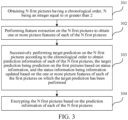
- FIG. 3 is a flowchart of a picture encryption method according to an exemplary embodiment.
- the picture encryption method may be executed by a computer device.
- the computer device may be either a terminal or a server; and alternatively, the computer device may include the terminal and the server.
- the above-mentioned computer device may be the image processing device 120 shown in FIG. 1 .
- the picture encryption method includes the following steps: In S301, N first pictures having a chronological order are obtained, where N is an integer equal to or greater than 2.
- the computer device obtains an image video uploaded by the picture obtaining terminal within an appointed period of time and obtains the N first pictures arranged according to the chronological order from the image video.
- N is an integer greater than or equal to 2.
- time intervals among the N first pictures having the chronological order are identical.
- the computer device may obtain each frame of face picture in the image video as the N first pictures.
- feature extraction is performed on the N first pictures to obtain one or more picture features of each of the N first pictures.
- the computer device performs feature extraction on the obtained N first pictures to obtain one or more picture features of each of the N first pictures.
- the computer device may perform feature extraction on the N first pictures through an image feature extraction network in the trained image prediction model to obtain one or more picture features corresponding to each of the N first pictures.
- the image prediction model is a neural network model trained by a gradient descent algorithm by taking a cross entropy as a loss function based on a TensorFlow machine learning library.
- Feature extraction on the N first pictures may be performed by the image feature extraction network in the image predication model.
- the image feature extraction network includes a convolutional layer and a pooling layer.
- target prediction is successively performed on the N first pictures according to the chronological order to obtain prediction information of each of the N first pictures, where the target prediction is prediction on the first pictures based on status information, and the status information is information updated based on the one or more picture features of each of the first pictures on which the target prediction has been performed.
- the computer device may successively perform target prediction on the N first pictures according to the chronological order to obtain the prediction information of each of the N first pictures.
- the one or more picture features corresponding to each of the N first pictures obtained by feature extraction are successively inputted into a recurrent network in an image prediction model according to the chronological order of the N first pictures and are calculated by the recurrent network to output the prediction information of each of the N first pictures.
- the target prediction is prediction on the first pictures based on current status information
- the current status information is information updated based on the one or more picture features of each of the first pictures on which the target prediction has been performed.
- the recurrent network can be added into the image prediction model behind the image feature extraction network.
- the status information of the current recurrent network may be determined according to the picture features of the face pictures that have been inputted.
- the computer device may perform prediction on the currently inputted picture features according to the status information of the current recurrent network and output a prediction result.
- the status information is the status information of the recurrent network, such as, the status information is hidden status of the recurrent network.
- the input of the recurrent network is the picture feature x[t] (or represented as x t ) inputted at the current moment t and a hidden status h[t-1] (or represented as h t - 1 ) of the recurrent network at a previous moment t-1, namely, the outputted prediction result y[t] (or represented as y t ) and the outputted hidden status h[t] (or represented as h t ) of the recurrent network at the current moment t will be determined according to the picture feature x[t] inputted at the current moment t and the hidden status h[t-1] at the previous moment t-1.
- ⁇ ( ) represents a predetermined activation function
- tanh ( ) represents a predetermined activation function
- W z , W r , W are predetermined parameters.
- y t h t .
- the N first pictures are encrypted based on the prediction information of each of the N first pictures.
- the computer device may process the first pictures based on the prediction information of each of the N first pictures, so as to encrypt the N first pictures.
- the computer device may encrypt the N first pictures of a human based on the outputted prediction information after the one or more picture features of each of the N first pictures are inputted into the recurrent network.
- the prediction information corresponding to each of the N first pictures is combined with picture data of the N first pictures according to an appointed data structure, so as to generate the encrypted N first pictures.
- the first pictures having the chronological order are subjected to feature extraction
- the first pictures are subjected to target prediction to obtain the prediction information corresponding to the first pictures
- the first pictures are encrypted based on the prediction information corresponding to the first picture.
- Prediction is performed through the status information updated based on the one or more picture features of each of the first pictures on which the target prediction has been performed, so as to obtain prediction information of the one or more picture features of the first picture on which the target prediction is currently performed.
- the prediction information of each of the first pictures is affected by considering relevance of the one or more picture features of each of the first pictures in time dimension, so that a condition that a first image is easily cracked for an encryption format only introducing a non-neural network safety factor is avoided, and therefore, the safety of the encrypted first image is also improved while the encryption format that encrypts the first pictures is expanded.
- FIG. 4 is a flowchart of a picture encryption method according to an exemplary embodiment.
- the picture encryption method may be executed by a computer device.
- the computer device may be either a terminal or a server; and alternatively, the computer device may include the terminal and the server.
- the above-mentioned computer device may be the image processing device 120 shown in FIG. 1 .
- the picture encryption method includes the following steps: In S401, training data is obtained.
- the model training device obtains the training data for model training.
- the training data includes K first picture samples having a chronological order and annotated information of each of the K first picture samples.
- the annotated information may be used for indicating whether the first picture includes a target object or the first picture includes the target object with the image quality satisfying a quantity condition.
- the annotated information may further be a label of the picture including the target object.
- the first pictures are images in each video obtained by the face obtaining device.
- the face obtaining device may obtain multiple segments of face images, and the multiple segments of face images include half of positive sample face images and half of negative sample face images.
- Each frame of face pictures included in the face images as the positive sample face images is the face picture with the image quality satisfying the quality condition.
- Each frame of face pictures included in the face images as the negative sample face images is not the face picture or is the face image with the image quality dissatisfying the quality condition.
- the obtained training data is preprocessed, namely, data cleaning is performed, so as to screen out invalid face pictures in the training data.
- the invalid face pictures may be face pictures, where face data in the pictures cannot be extracted due to too dark or black pictures.
- feature extraction is performed on the K first picture samples to obtain one or more picture features corresponding to each of the K first picture samples.
- the computer device for model training may perform feature extraction on the K first picture samples to obtain one or more picture features corresponding to each of the K first picture samples.
- the computer device for model training may perform partitioned processing on the K face picture samples to obtain L face picture segment samples corresponding to the K face picture samples, and perform feature extraction on the L face picture segment samples of the K face pictures based on the attention weights corresponding to the L face picture segment samples to obtain the picture features corresponding to the K face pictures.
- K is an integer greater than or equal to 2.
- L is a positive integer equal to or greater than 1.
- the computer device partitions the face picture samples in the face image samples according to various sizes of windows, converts RGB three-colored face picture segment samples into gray face picture segment samples, then performs feature information extraction at different orders of magnitudes of fast Fourier transform to obtain at least one of energy distribution feature information, high and low frequency distribution feature information, flatness feature information and spectral centroid feature information of the image frequency spectrogram corresponding to the face picture segment samples, splices the gray values of the face picture segment samples with the correspondingly obtained appointed type feature information, inputs the spliced gray value and feature information into an input layer of the image prediction model, and performs feature extraction on the face picture segment samples through the convolutional layer, the pooling layer and the attention mechanism layer, so as to obtain the picture features corresponding to the K face pictures.
- the one or more picture features corresponding to each of the K first picture samples are successively inputted into the recurrent network in the image prediction model according to the chronological order to obtain the prediction information of each of the K first picture samples outputted by the recurrent network.
- the computer device successively inputs the one or more picture features corresponding to each of the K first picture samples into the recurrent network in the image prediction model according to the chronological order to obtain the prediction information of each of the K first picture samples outputted by the recurrent network based on the status information at the moment.
- the computer device successively inputs the one or more picture features corresponding to each of the K face picture samples outputted by the image feature extraction network into the recurrent network in the image prediction model according to the chronological order to obtain the prediction information of each of the K face picture samples outputted by the recurrent network.
- the prediction information is used for indicating the prediction results of the corresponding face picture samples; and the recurrent network is a network that performs prediction on the inputted picture features through the status information, and the status information is information updated based on the one or more picture features of each of the face picture samples that have been inputted.
- the L face picture segment samples corresponding to the K face picture samples are successively inputted into the recurrent network according to the chronological order, so as to output the prediction information corresponding to the K face picture samples, where the prediction information corresponding to the face picture samples is a vector of the prediction result including L face picture segment samples.
- the recurrent network includes at least one of a bidirectional gated recurrent unit (BGRU), a gated recurrent unit (GRU) and a long short term memory (LSTM) network.
- BGRU bidirectional gated recurrent unit
- GRU gated recurrent unit
- LSTM long short term memory
- FIG. 5 is a schematic structural diagram of a BGRU involved in an embodiment of this application.
- the BGRU is a common bi-directional gated recurrent neural network, where its input is the picture feature x[t] (or represented as x t ) inputted at the current moment t and a hidden status h[t-1] (or represented as h t -1 ) at a previous moment t-1, namely, the outputted prediction result y[t] (or represented as y t ) and the outputted hidden status h[t] (or represented as h t ) of the recurrent network (such as the BGRU) at the current moment t will be affected by the picture feature inputted at the current moment t and the hidden status h[t-1] at the previous moment t-1.
- ⁇ ( ) represents a predetermined activation function
- tanh ( ) represents a predetermined activation function
- W z , W r , W are predetermined parameters.
- y t h t .
- prediction results of the K first picture samples are obtained based on the prediction information of each of the K first picture samples.
- the computer device may obtain whether each of the K first picture samples includes the target object with the image quality satisfying the quality condition according to the prediction information of each of the K first picture samples.
- the computer device may determine whether the group of training samples are the target face pictures according to the prediction information of the K face picture samples.
- the target face pictures may face images with image qualities satisfying quality conditions.
- a loss function value is obtained based on the prediction results of the K first picture samples and the annotated information of each of the K first picture samples.
- the computer device counts the prediction result(s) of each of the K first picture samples, and determines the loss function value of the model according to whether the target object is included indicated by the prediction result of each of the K first picture samples and whether the target object is included indicated by pre-annotated information of each of the K first picture samples.
- the computer device counts the prediction results of the K face picture samples, and determines the loss function value of the model according to whether the prediction results are predicted as the target face and whether the pre-annotated information of the K picture samples is the target face.
- the image prediction model is updated based on the loss function value.
- the computer device updates model parameters in the image prediction model based on the calculated loss function value till the model training is completed.
- parameter updating is performed on at least one network of the recurrent network, the partitioned network and the image feature extraction network based on the loss function value.
- the updated model parameters include, but not limited to, the attention weights and the sizes of the target windows.
- model evaluation on the image prediction model is performed through a test set.
- the computer device may convert each group of face pictures into each group of gray pictures by obtaining each group of face pictures in the test set, then partition each group of gray pictures, extract feature information of each group of gray pictures, perform prediction on the several partitioned face picture segments subjected to feature extraction through the recurrent network, and count the prediction results of face picture segments by adopting a voting method. If the face picture segment is predicted as the target face, a vote is casted to the positive sample, and otherwise, a vote is casted to the negative sample.
- N first pictures having a chronological order are obtained.
- the N first pictures having the chronological order are obtained by an image obtaining device.
- all or part of pictures in the N first pictures include the face images, and the prediction information is used for indicating whether the first picture includes the face images with image qualities satisfying quality conditions.
- the image obtaining device may be a face obtaining device, and the first pictures may be face pictures.
- the face obtaining device obtains the face images within an appointed period of time and uploads them to the server, and the server obtains N face pictures from the face images, where N is an integer equal to or greater than 2.
- the appointed period of time may be either a preset duration or a duration determined by the face obtaining terminal according to a face recognition condition.
- a developer may directly set the duration during which the face obtaining terminal obtains the face images to be 5s.
- the obtained 5s face images are uploaded to the server; and alternatively, the face obtaining terminal determines the obtaining duration according to the qualities of the currently obtained face images, and the qualities of the face images obtained by the face obtaining terminal are negatively correlated to the obtaining duration.
- Abtaining of the N face pictures from the face images may be obtaining by taking a frame as a unit, namely, the N face pictures include each frame of face picture in the obtained face images.
- the N face pictures are face pictures successively obtained according to the chronological order in a process of face recognition at a single time.
- FIG. 6 is a schematic diagram of continuous time face image obtaining involved in an embodiment of this application.
- the face obtaining terminal displays a first status picture 61 to remind the user to adjust.
- the face obtaining terminal starts to obtain face image
- the face obtaining terminal displays a second status picture 62.
- There is a countdown indication in the display area and when countdown is completed, the N face pictures are obtained completely.
- partitioned processing is performed on the N first pictures according to a size of a target window to obtain M first picture segments corresponding to each of the N first pictures.
- the computer device may partition the N first pictures according to the target window through the partitioned network by inputting the N first pictures into the partitioned network in the image prediction module to obtain the M first picture segments corresponding to each of the N first pictures.
- M is an integer equal to or greater than 1; and the size of the target window may be a network parameter of the partitioned network.
- the size of the target window is a model parameter updated in the training stage of the image prediction model.
- the face picture subjected to the partitioned network may be divided into 4 face picture segments.
- feature extraction is performed on the M first picture segments corresponding to each of the N first pictures based on attention weights corresponding to the M first picture segments to obtain one or more picture features of each of the N first pictures.
- the computer device may perform feature extraction on the M first picture segments corresponding to each of the N first pictures based on attention weights respectively corresponding to the M first picture segments to obtain one or more picture features of each of the N first pictures.
- the computer device preprocesses the M first picture segments corresponding to the target picture to obtain the preprocessed features of the M first picture segments corresponding to the target picture, and then inputs the one or more preprocessed features of each of the M first picture segments corresponding to the target picture into the image feature extraction network in the image prediction model to obtain the picture features of the target picture outputted by the image feature extraction network.
- the target picture may be the target face picture when being applied to a scenario for encrypting the face picture.
- the target face picture is any one of the N face pictures.
- the image feature extraction network includes the attention mechanism layer.
- the attention mechanism layer is used for processing the preprocessed features of the M face picture segments by taking the attention weights of the M face picture segments as parameters.
- the computer device obtains the gray value of the target picture segment, then obtains the first type feature information of the target picture segment based on fast Fourier transform of first order of magnitude, and combines the gray value of the target picture segment with the first type feature information of the target picture segment to obtain the preprocessed features of the target picture segment.
- the target picture segment is any one of the M first picture segments corresponding to the target picture.
- the computer device may input the M first picture segments corresponding to each of the N first pictures into the image feature extraction network, and perform feature extraction on the M first picture segments through the image feature extraction network to obtain the one or more picture segment features corresponding to each of the M first picture segments, and the image feature extraction network includes the attention mechanism layer.
- the attention mechanism layer may be used for distributing the attention weight for the first picture segments.
- the one or more picture features of each of the N first pictures corresponding to the M first picture segments are obtained based on each of the one or more picture segment features.
- the image feature extraction network may include the convolutional layer and the pooling layer.
- the first layer of the image prediction model is an input layer
- the convolutional layer using 64 convolution kernels (the size of the convolution kernels is 3x3, the stride is 1 and the padding is 1) is taken as a second layer
- the pooling layer with windows of 2x2 and stride of 2 is taken as a third layer
- the convolutional layer using 128 convolution kernels (the size of the convolution kernels is 3x3, the stride is 1 and the padding is 1) is taken as a fourth layer
- the pooling layer with windows of 2x2 and stride of 2 is taken as a fifth layer
- the convolutional layer using 256 convolution kernels (the size of the convolution kernels is 3x3, the stride is 1 and the padding is 1) is taken as a sixth layer
- the pooling layer with windows of 2x2 and stride of 2 is taken as a seventh layer
- a batch normalization layer is added into an eighth layer
- a max pooling layer is added into a ninth layer.
- the attention mechanism layer may be located
- the first type feature information includes at least one of energy distribution feature information, high and low frequency distribution feature information, flatness feature information and spectral centroid feature information of an image frequency spectrogram.
- the computer device may extract the energy distribution feature of the image frequency spectrogram in a case that the order of magnitude of fast Fourier transform (FFT Size) is 4096, and normalize the energy distribution feature of the image frequency spectrogram.
- the computer device may extract the high and low frequency distribution feature in a case that the order of magnitude of fast Fourier transform (FFT Size) is 2048, and normalize the high and low frequency distribution feature.
- the computer device may extract the flatness feature in a case that the order of magnitude of fast Fourier transform (FFT Size) is 1024, and normalize the flatness feature.
- the computer device may extract the spectral centroid feature in a case that the order of magnitude of fast Fourier transform (FFT Size) is 1024, and normalize the spectral centroid feature.
- the one or more picture features of each of the N first pictures are successively inputted into a recurrent network in an image prediction model according to the chronological order to obtain the prediction information of each of the N first pictures outputted by the recurrent network.
- the computer device successively inputs the one or more picture features corresponding to each of the N first pictures outputted by the image feature extraction network into the recurrent network in the image prediction model according to the chronological order to obtain the prediction information of each of the N first pictures outputted by the recurrent network.
- the M first picture segments are successively inputted into the recurrent network according to the chronological order of the corresponding N first pictures to obtain the prediction results respectively corresponding to the first picture segments outputted by the recurrent network.
- the prediction information of each of the N first pictures is obtained based on the prediction results of the M first picture segments.
- the prediction information may be used for indicating the prediction results of the first pictures; and the recurrent network is a network that performs prediction on the inputted picture features through the status information, and the status information is information updated based on the one or more picture features of each of the face pictures that have been inputted.
- the prediction information is information for indicating whether the corresponding face pictures include the faces, or the prediction information is information for indicating whether the corresponding face pictures include the face images with the image qualities satisfying the quality conditions.
- the recurrent network includes at least one of a bi-directional gated recurrent unit (BGRU), a gated recurrent unit (GRU) and a long short term memory (LSTM) network.
- BGRU bi-directional gated recurrent unit
- GRU gated recurrent unit
- LSTM long short term memory
- the tenth layer of the image prediction model can be added with the bi-directional gated recurrent unit (BGRU), where a hidden unit is 256.
- BGRU bi-directional gated recurrent unit
- the face pictures are successively inputted into the recurrent network according to the chronological order.
- the 2 face picture segments corresponding to a first face picture sample are inputted first. If the prediction result of the face picture segment includes face information, the prediction result corresponding to the face picture segment is 1, and otherwise, it is 0.
- the prediction information corresponding to the first face picture is a vector of (1, 1).
- the prediction results of the M face picture segments in the N face pictures are outputted by way of a sigmoid function adopted in the last layer of the image prediction model.
- the prediction information may be an outputted logits value of MxY, where M is the number of segments of an inputted image of the model, and Y is the prediction result of each segment, which is 0 or 1.
- FIG. 7 is a schematic structural diagram of an image prediction model involved in the embodiments of this application.
- a frequency spectrogram 71 corresponding to the face picture is inputted into the convolutional layers for feature extraction, then the extracted features are outputted and calculated in time dimension by way of the recurrent network 72, and a prediction label 73 corresponding to the frequency spectrogram 71 is outputted by way of a fully connected layer.
- the prediction information includes prediction sub-information of each of the M first picture segments of the corresponding first picture, the prediction sub-information being used for indicating a prediction result of the corresponding first picture segment.
- the N first pictures are spliced with the prediction information of each of the N first pictures to generate encrypted picture data of the N first pictures.
- the computer device may splice the N first pictures with the prediction information of each of the N first pictures to obtain the encrypted picture data of the N first pictures.
- the computer device may splice the N face pictures with the corresponding prediction information to obtain the encrypted picture data of the N face pictures.
- the N face pictures are spliced with the prediction information based on a target data structure to generate the encrypted N face pictures.
- the target data structure may be the encrypted face pictures generated by splicing in format of ⁇ prediction information ⁇ ⁇ payload ⁇ , where payload is the face data corresponding to the face pictures.
- the N face pictures are spliced with the prediction information and attribute information of the face data based on the target data structure to generate the encrypted N face pictures.
- the attribute information of the face data includes at least one of timestamp, counter information (counter), magic number information (magic_num), device model information (device_info), signature algorithm edition information (sign_version) and random number information (random).
- the target data structure may be the encrypted face pictures generated by splicing in format of ⁇ magic _num ⁇ ⁇ device _info ⁇ ⁇ sign _version ⁇ ⁇ timestamp ⁇ counter ⁇ prediction information ⁇ ⁇ random ⁇ ⁇ payload ⁇ .
- the first pictures having the chronological order are subjected to feature extraction
- the first pictures are subjected to target prediction to obtain the prediction information corresponding to the first pictures
- the first pictures are encrypted based on the prediction information corresponding to the first picture.
- Prediction is performed through the status information updated based on the one or more picture features of each of the first pictures on which the target prediction has been performed, so as to obtain prediction information of the one or more picture features of the first picture on which the target prediction is currently performed.
- the prediction information of each of the first pictures is affected by considering relevance of the one or more picture features of each of the first pictures in time dimension, so that a condition that a first image is easily cracked for an encryption format only introducing a non-neural network safety factor is avoided, and therefore, the safety of the encrypted first image is also improved while the encryption format that encrypts the first pictures is expanded.
- FIG. 8 is a schematic structural diagram of a face picture encryption system according to an exemplary embodiment.
- the face obtaining terminal 81 obtains the N face pictures of the user having the chronological order, and all or part of the N face pictures include the face images, where the N face pictures are the face picture 1 corresponding to a moment t1, the face picture 2 corresponding to a moment t2, .... the face picture N corresponding to a moment tN.
- the N face pictures are transmitted to the server 82 and are partitioned through the partitioned network 821, the face picture segments have the attention weights correspondingly, and the face picture segments having the attention weights are inputted into the image feature extraction network 822.
- the image feature extraction network 822 includes the convolutional layer and the pooling layer.
- the extracted extraction features corresponding to the N face pictures are inputted into the recurrent network 823 according to the chronological order, the hidden status (or represented as h t ) corresponding to the next moment and the prediction information (or represented as y t ) corresponding to the face picture 1 are outputted based on the extraction feature (or represented as x t ) corresponding to the face picture 1 and the hidden status (or represented as h t -1 ) of the current BGRU unit, and then the hidden status corresponding to next moment and the prediction information corresponding to the face picture 2 are outputted based on the extraction feature corresponding to the face picture 2 and the hidden status of the processed face picture 1 till the prediction information corresponding to the face picture N is outputted completely, and the picture data of the N face pictures are spliced with the corresponding prediction information to generate the encrypted face pictures.
- ⁇ ( ) represents a predetermined activation function
- tanh ( ) represents a predetermined activation function
- W z , W r , W are predetermined parameters.
- y t h t .
- the first pictures having the chronological order are subjected to feature extraction
- the first pictures are subjected to target prediction to obtain the prediction information corresponding to the first pictures
- the first pictures are encrypted based on the prediction information corresponding to the first picture.
- Prediction is performed through the status information updated based on the one or more picture features of each of the first pictures on which the target prediction has been performed, so as to obtain prediction information of the one or more picture features of the first picture on which the target prediction is currently performed.
- the prediction information of each of the first pictures is affected by considering relevance of the one or more picture features of each of the first pictures in time dimension, so that a condition that a first image is easily cracked for an encryption format only introducing a non-neural network safety factor is avoided, and therefore, the safety of the encrypted first image is also improved while the encryption format that encrypts the first pictures is expanded.
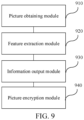
- FIG. 9 is a block diagram of a picture encryption apparatus according to an exemplary embodiment. As shown in FIG. 9 , the picture encryption apparatus may include:
- the information output module 930 includes: an information output sub-module configured to successively input the one or more picture features of each of the N first pictures into a recurrent network in an image prediction model according to the chronological order to obtain the prediction information of each of the N first pictures outputted by the recurrent network.
- the apparatus further includes:
- the prediction information includes prediction sub-information of each of the M first picture segments of the corresponding first picture, the prediction sub-information being used for indicating a prediction result of the first picture segment.
- the feature extraction sub-module includes:
- the feature preprocessing unit is configured to:
- the first type feature information includes: at least one of energy distribution feature information, high and low frequency distribution feature information, flatness feature information and spectral centroid feature information of an image frequency spectrogram.
- the apparatus further includes:
- the model updating module includes: a parameter updating sub-module configured to perform parameter updating on at least one network of the recurrent network, the partitioned network and the image feature extraction network based on the loss function value.
- the recurrent network includes: at least one of a bi-directional gated recurrent unit (BGRU), a gated recurrent unit (GRU) and a long short term memory (LSTM) network.
- BGRU bi-directional gated recurrent unit
- GRU gated recurrent unit
- LSTM long short term memory
- the picture encryption module 940 includes: a picture encryption sub-module configured to splice the N first pictures with the prediction information of each of the N first pictures to generate encrypted picture data of the N first pictures.
- all or part of pictures in the N first pictures include face images.
- the prediction information is used for indicating whether the first picture includes the face images with image qualities satisfying quality conditions.
- the first pictures having the chronological order are subjected to feature extraction
- the first pictures are subjected to target prediction to obtain the prediction information corresponding to the first pictures
- the first pictures are encrypted based on the prediction information corresponding to the first picture.
- Prediction is performed through the status information updated based on the one or more picture features of each of the first pictures on which the target prediction has been performed, so as to obtain prediction information of the one or more picture features of the first picture on which the target prediction is currently performed.
- the prediction information of each of the first pictures is affected by considering relevance of the picture features of each of the first pictures in time dimension, so that a condition that a first image is easily cracked for an encryption format only introducing a non-neural network safety factor is avoided, and therefore, the safety of the encrypted first image is also improved while the encryption format that encrypts the first pictures is expanded.
- FIG. 10 is a schematic structural diagram of a computer device according to an exemplary embodiment.
- the computer device 1000 includes a central processing unit (CPU) 1001, a system memory 1004 including a random access memory (RAM) 1002 and a read-only memory (ROM) 1003, and a system bus 1005 connecting the system memory 1004 to the CPU 1001.
- the computer device 1000 further includes a basic input/output (I/O) system 1006 assisting in transmitting information between components in a computer device, and a mass storage device 1007 configured to store an operating system 1013, an application program 1014, and another program module 1015.
- the input/output controller 1010 further provides output to a display screen, a printer, or other types of output devices.
- the computer device 1000 may further be connected, through a network such as the Internet, to a remote computer device on the network. That is, the computer device 1000 may be connected to a network 1012 by using a network interface unit 1011 connected to the system bus 1005, or may be connected to another type of network or a remote computer device system (not shown) by using a network interface unit 1011.
- the memory further includes one or more programs.
- the one or more programs are stored in the memory.
- the CPU 1001 executes the one or more programs to implement all or some steps of the method shown in FIG. 3 or FIG. 4 .
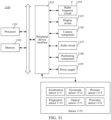
- FIG. 11 is a structural block diagram of a computer device 1100 according to an exemplary embodiment.
- the computer device 1100 may be the terminal in the image recognition system shown in FIG. 1 .
- the computer device 1100 includes a processor 1101 and a memory 1102.
- the processor 1101 may further include an artificial intelligence (AI) processor.
- AI artificial intelligence
- the AI processor is configured to process computing operations related to machine learning.
- the memory 1102 may include one or more computer-readable storage media that may be non-transitory.
- the non-transitory computer-readable storage medium in the memory 1102 is configured to store at least one instruction, and the at least one instruction being configured to be executed by the processor 1101 to implement the method provided in the method embodiments of this application.
- the computer device 1100 further optionally includes a peripheral interface 1103 and at least one peripheral.
- the processor 1101, the memory 1102, and the peripheral interface 1103 may be connected through a bus or a signal cable.
- Each peripheral may be connected to the peripheral interface 1103 through a bus, a signal cable, or a circuit board.
- the peripheral includes at least one of a radio frequency (RF) circuit 1104, a display screen 1105, a camera component 1106, an audio circuit 1107, a positioning component 1108, and a power supply 1109.
- RF radio frequency
- the computer device 1100 further includes one or more sensors 1110.
- the one or more sensors 1110 include, but are not limited to, an acceleration sensor 1111, a gyroscope sensor 1112, a pressure sensor 1113, a fingerprint sensor 1114, an optical sensor 1115, and a proximity sensor 1116.
- FIG. 11 does not constitute any limitation on the computer device 1100, and the computer device may include more components or fewer components than those shown in the figure, or some components may be combined, or a different component deployment may be used.
- a non-temporary computer-readable storage medium including an instruction is further provided, for example, a memory including at least one instruction, at least one program, a code set, or an instruction set.
- the at least one instruction, the at least one program, the code set, or the instruction set may be executed by a processor to implement all or some steps of the method shown in any embodiment in FIG. 3 or FIG. 4 .
- the functions described in the embodiments of this application may be implemented by using hardware, software, firmware, or any combination thereof.
- the functions can be stored in a computer-readable medium or can be used as one or more instructions or code in a computer-readable medium for transmission.
- the computer-readable medium includes a computer storage medium and a communication medium, where the communication medium includes any medium that enables a computer program to be transmitted from one place to another.
- the storage medium may be any available medium accessible to a general-purpose or dedicated computer device.
- a computer program product or a computer program including computer instructions, the computer instructions being stored in a computer-readable storage medium.
- a processor of a computer device reads the computer instructions from the computer-readable storage medium, and executes the computer instructions, so that the computer device performs the picture encryption method provided in the various optional implementations of the foregoing aspects.
Landscapes
- Engineering & Computer Science (AREA)
- Theoretical Computer Science (AREA)
- Multimedia (AREA)
- General Physics & Mathematics (AREA)
- Physics & Mathematics (AREA)
- Computer Vision & Pattern Recognition (AREA)
- General Health & Medical Sciences (AREA)
- Evolutionary Computation (AREA)
- Health & Medical Sciences (AREA)
- Software Systems (AREA)
- Artificial Intelligence (AREA)
- Medical Informatics (AREA)
- Computing Systems (AREA)
- Databases & Information Systems (AREA)
- Signal Processing (AREA)
- Computer Security & Cryptography (AREA)
- Computer Hardware Design (AREA)
- General Engineering & Computer Science (AREA)
- Bioethics (AREA)
- Oral & Maxillofacial Surgery (AREA)
- Human Computer Interaction (AREA)
- Image Analysis (AREA)
- Facsimile Image Signal Circuits (AREA)
- Image Processing (AREA)
Abstract
Description
- This application claims priority to
Chinese Patent Application No. 202011306972.5, entitled "FACE PICTURE ENCRYPTION METHOD AND APPARATUS, COMPUTER DEVICE, AND STORAGE MEDIUM" and filed with the China National Intellectual Property Administration, November 19, 2020 - Embodiments of this application relate to the technical field of artificial intelligence, and in particular, to a picture encryption method and apparatus, a computer device, a storage medium and a program product.
- Nowadays, with increasing development of artificial intelligence, application of the artificial intelligence technology is more and more extensive in life, including application in the face recognition technology. Face recognition can be applied to payment scenarios to realize "face swiping" payment.
- In related art, in order to guarantee the safety of face swiping data obtained by face swiping, it is usually necessary to encrypt the face swiping data. A common encryption method encrypts the face swiping data by adopting an asymmetric algorithm according to a certain encryption format, where the encryption format is usually introduction of a timestamp of the face swiping data or a counter.
- However, encryption of the face swiping data by adopting the above-mentioned solution will lead to a condition that the encryption format of the face swiping data is easily cracked, resulting in poor safety of the face swiping data.
- Embodiments of this application provide a picture encryption method and apparatus, a computer device, a storage medium and a program product, so as to improve the safety of picture encryption. The technical solution is as follows:
according to one aspect, a picture encryption method is provided. The method is executed by a computer device, the method including: - obtaining N first pictures having a chronological order, where N is an integer equal to or greater than 2;
- performing feature extraction on the N first pictures to obtain one or more picture features of each of the N first pictures;
- successively performing target prediction on the N first pictures according to the chronological order to obtain prediction information of each of the N first pictures, where the target prediction is prediction on the first pictures based on status information, and the status information is information updated based on the one or more picture features of each of the first pictures on which the target prediction has been performed; and
- encrypting the N first pictures based on the prediction information of each of the N first pictures.
- According to another aspect, a picture encryption apparatus is provided. The apparatus includes:
- a picture obtaining module configured to obtain N first pictures having a chronological order, where N is an integer equal to or greater than 2;
- a feature extraction module configured to perform feature extraction on the N first pictures to obtain one or more picture features of each of the N first pictures;
- an information output module configured to successively perform target prediction on the N first pictures according to the chronological order to obtain prediction information of each of the N first pictures, where the target prediction is prediction on the first pictures based on status information, and the status information is information updated based on the one or more picture features of each of the first pictures on which the target prediction has been performed; and
- a picture encryption module configured to encrypt the N first pictures based on the prediction information of each of the N first pictures.
- In a possible implementation, the information output module includes:
an information output sub-module configured to successively input the one or more picture features of each of the N first pictures into a recurrent network in an image prediction model according to the chronological order to obtain the prediction information of each of the N first pictures outputted by the recurrent network. - In a possible implementation, the apparatus further includes:
- an picture segment obtaining module configured to, through a partitioned network in the image prediction model, perform partitioned processing on the N first pictures according to a size of a target window to obtain M first picture segments corresponding to each of the N first pictures before the performing feature extraction on the N first pictures to obtain one or more picture features corresponding to each of the N first pictures, where M is an integer equal to or greater than 1, and the size of the target window is a network parameter of the partitioned network; and
- the feature extraction module includes:
- a feature extraction sub-module configured to perform feature extraction on the M first picture segments of each of the N first pictures based on attention weights of the M first picture segments to obtain one or more picture features of each of the N first pictures.
- In a possible implementation, the prediction information includes prediction sub-information of each of the M first picture segments of the corresponding first picture, the prediction sub-information being used for indicating a prediction result of the first picture segment.
- In a possible implementation, the feature extraction sub-module includes:
- a feature preprocessing unit for preprocessing the M first picture segments of a target picture to obtain one or more preprocessed features of each of the M first picture segments of the target picture, where the target picture is any one of the N first pictures; and
- a target feature obtaining unit for inputting the one or more preprocessed features of each of the M first picture segments of the target picture into an image feature extraction network in the image prediction model to obtain the picture feature of the target picture outputted by the image feature extraction network,
- where the image feature extraction network includes an attention mechanism layer used for processing the one or more preprocessed features of each of the M first picture segments by taking the attention weights of the M first picture segments as parameters.
- In a possible implementation, the feature preprocessing unit is configured to:
- obtain a gray value of a target picture segment, where the target picture segment is any one of the M first picture segments corresponding to the target picture;
- obtain first type feature information of the target picture segment based on fast Fourier transform of a first order of magnitude; and
- combine the gray value of the target picture segment with the first type feature information of the target picture block to obtain a preprocessed feature of the target picture segment.
- In a possible implementation, the first type feature information includes:
at least one of energy distribution feature information, high and low frequency distribution feature information, flatness feature information and spectral centroid feature information of an image frequency spectrogram. - In a possible implementation, the apparatus further includes:
- a training data obtaining module configured to obtain training data before obtaining N first pictures with a chronological order, where the training data includes K first picture samples having a chronological order and annotated information of each of the K first picture samples, K being an integer equal to or greater than 2;
- a sample feature extraction module configured to perform feature extraction on the K first picture samples to obtain one or more picture features corresponding to each of the K first picture samples;
- a sample prediction information obtaining module configured to successively input the one or more picture features corresponding to each of the K first picture samples into the recurrent network in the image prediction model according to the chronological order to obtain the prediction information of each of the K first picture samples outputted by the recurrent network;
- a sample prediction result obtaining module configured to obtain prediction results of the K first picture samples based on the prediction information of each of the K first picture samples;
- a loss function value obtaining module configured to obtain a loss function value based on the prediction results of the K first picture samples and the annotated information of each of the K first picture samples; and
- a model updating module configured to update the image prediction model based on the loss function value.
- In a possible implementation, the model updating module includes:
a parameter updating sub-module configured to perform parameter updating on at least one network of the recurrent network, the partitioned network and the image feature extraction network based on the loss function value. - In a possible implementation, the recurrent network includes:
at least one of a bi-directional gated recurrent unit (BGRU), a gated recurrent unit (GRU) and a long short term memory (LSTM) network. - In a possible implementation, the picture encryption module includes:
a picture encryption sub-module configured to splice the N first pictures with the prediction information of each of the N first pictures to generate encrypted picture data of the N first pictures. - In a possible implementation, all or part of pictures in the N first pictures include face images.
- In a possible implementation, the prediction information is used for indicating whether the first picture includes the face images with image qualities satisfying quality conditions.
- According to another aspect, a computer device is provided, including a processor and a memory, the memory storing at least one instruction, at least one program, a code set, or an instruction set, and the at least one instruction, the at least one program, the code set or the instruction set being loaded and executed by the processor to implement the foregoing picture encryption method.
- According to another aspect, a computer-readable storage medium is provided, the storage medium storing at least one instruction, at least one program, a code set or an instruction set, the at least one instruction, the at least one program, the code set or the instruction set being loaded and executed by a processor to implement the foregoing picture encryption method.
- According to an aspect of this application, a computer program product or a computer program is provided, the computer program product or the computer program including computer instructions, the computer instructions being stored in a computer-readable storage medium. A processor of a computer device reads the computer instructions from the computer-readable storage medium, and executes the computer instructions, so that the computer device performs the picture encryption method provided in the various optional implementations of the foregoing aspects.
- The technical solutions provided in this application may include the following beneficial effects:
After the first pictures having the chronological order are subjected to feature extraction, the first pictures are subjected to target prediction to obtain the prediction information corresponding to each of the first pictures, and the first pictures are encrypted based on the prediction information corresponding to each of the first picture. Prediction is performed through the status information updated based on the one or more picture features of each of the first pictures on which the target prediction has been performed, so as to obtain prediction information of the one or more picture features of the first picture on which the target prediction is currently performed. Through the above-mentioned solution, the prediction information of each of the first pictures is affected by considering relevance of the one or more picture features of each of the first pictures in time dimension, so that a condition that a first image is easily cracked for an encryption format only introducing a non-neural network safety factor is avoided, and therefore, the safety of the encrypted first image is also improved while the encryption format that encrypts the first pictures is expanded. - It is to be understood that the above general descriptions and the following detailed descriptions are merely for exemplary and explanatory purposes, and cannot limit this application.
- The accompanying drawings herein, which are incorporated into the specification and constitute a part of this specification, show embodiments that conform to this application, and are used for describing a principle of this application together with this specification.
-
FIG. 1 is a schematic diagram of a picture encryption system according to an exemplary embodiment. -
FIG. 2 is a schematic diagram of a face obtaining terminal according to an example embodiment. -
FIG. 3 is a flowchart of a picture encryption method according to an exemplary embodiment. -
FIG. 4 is a schematic flowchart of a picture encryption method according to an exemplary embodiment. -
FIG. 5 is a schematic structural diagram of a BGRU involved in the embodiment shown inFIG. 4 . -
FIG. 6 is a schematic diagram of continuous time face image obtaining involved in the embodiment shown inFIG. 4 . -
FIG. 7 is a schematic structural diagram of an image prediction module involved in the embodiment shown inFIG. 4 . -
FIG. 8 is a schematic structural diagram of a face picture encryption system according to an exemplary embodiment. -
FIG. 9 is a block diagram of a picture encryption apparatus illustrated by an exemplary embodiment. -
FIG. 10 is a schematic structural diagram of a computer device according to an exemplary embodiment. -
FIG. 11 is a structural block diagram of a computer device according to an exemplary embodiment. - Exemplary embodiments are described in detail herein, and examples thereof are shown in the accompanying drawings. When the following descriptions are made with reference to the accompanying drawings, unless otherwise indicated, the same numbers in different accompanying drawings represent the same or similar elements. The following implementations described in the following exemplary embodiments do not represent all implementations that are consistent with this application. Instead, they are merely examples of apparatuses and methods consistent with aspects related to this application as recited in the appended claims.
- "Several" mentioned herein refers to one or more, and "more" refers to two or more than two. And/or describes an association relationship for describing associated objects and represents that three relationships may exist. For example, A and/or B may represent the following three cases: Only A exists, both A and B exist, and only B exists. The character "/" generally indicates an "or" relationship between the associated objects.
- The solutions shown in the embodiments of this application may be implemented in a process of face swiping payment by virtue of artificial intelligence (AI).
- Face recognition is a bioidentification technology for identity recognition based on feature information of a human face. Face recognition obtains, by using a vidicon or a camera, an image or a video stream that includes a human face, and automatically detects and tracks the human face in the image, so as to further perform a series of related application operations on the detected face image. It technically includes image obtaining, feature localization, identity verification and searching.
- After face pictures of a user having the chronological order are obtained, by way of feature extraction, the prediction information corresponding to the face pictures is outputted by the recurrent network, and the face pictures are encrypted based on the prediction information corresponding to the face pictures, so that the safety of the encrypted face image is improved.
- The solutions provided in the embodiments of this application involve technologies such as face recognition and machine learning of AI, and are specifically described by using the following embodiments.
- The solutions of the embodiments of this application include a model training stage and an image processing stage.
FIG. 1 is a schematic diagram of a face picture encryption system according to an exemplary embodiment. As shown inFIG. 1 , in the model training stage, amodel training device 110 trains inputted each group of first picture samples to obtain a machine learning model, and in the image processing stage, animage processing device 120 may output the prediction information corresponding to the group of first pictures according to the trained machine learning model and the inputted to-be-encrypted each group of first pictures, and perform data packing on the prediction information and the group of first pictures in a certain data format, so as to complete encryption of the group of first pictures. - The above-mentioned
model training device 110 and theimage processing device 120 may be computer devices with a machine learning capability. For example, the computer device may be a fixed computer device such as a personal computer, a server, and a fixed scientific research device; and alternatively, the computer device may be a mobile computer device such as a tablet computer and an e-book reader. - In a possible implementation, the
model training device 110 and theimage processing device 120 may be the same device; and alternatively, themodel training device 110 and theimage processing device 120 may be different devices. Moreover, when themodel training device 110 and theimage processing device 120 are different devices, themodel training device 110 and theimage processing device 120 may be devices of the same type. For example, themodel training device 110 and theimage processing device 120 may both be personal computers; and alternatively, themodel training device 110 and theimage processing device 120 may also be devices of different types. For example, themodel training device 110 may be a server, and theimage processing device 120 may be a fixed scientific research device, or the like. Specific types of themodel training device 110 and theimage processing device 120 are not limited in the embodiments of this application. - The face
picture obtaining terminal 130 may be a smartphone, a tablet computer, a laptop computer, a desktop computer, a cash device or the like having a face image recognition function, but is not limited thereto. - For example, the
picture obtaining terminal 130 is a face obtaining terminal, and the face obtaining terminal may be a terminal having a face recognition function. - The
image processing device 120 may be an independent physical server, or may be a server cluster or a distributed system formed by a plurality of physical servers, or may be a cloud server that provides a basic cloud computing service such as a cloud service, a cloud database, cloud computing, a cloud function, cloud storage, a network service, cloud communication, a middleware service, a domain name service, a security service, a content delivery network (CDN), big data, and an artificial intelligence platform. - In a possible implementation, the face picture encryption system is applied to an intelligent payment platform, where the
picture obtaining terminal 130 may be a face obtaining terminal, for example, a large screen self-assisted cash device. When the user uses the large screen self-assisted cash device, the large screen self-assisted cash device may obtain face videos of the user within a period of time. The face videos include several face pictures having a chronological order, the face pictures may be pictures including face images and are uploaded to theimage processing device 120 via a transmission network. Theimage processing device 120 performs feature extraction and operation on the face pictures having the chronological order through the machine learning model, and finally outputs the prediction information corresponding to the face pictures, and encrypts the face pictures and the corresponding prediction information in an appointed data format, so as to generate the encrypted face image. - The face
picture obtaining terminal 130 and theimage processing device 120 are connected through a communication network. Optionally, the communication network is a wired network or a wireless network. - Optionally, the wireless network or the wired network uses a standard communication technology and/or protocol. The network is usually the Internet, but may alternatively be any other networks, including but not limited to a local area network (LAN), a metropolitan area network (MAN), a wide area network (WAN), a mobile, wired, or wireless network, or any combination of a dedicated network or a virtual dedicated network). In some embodiments, technologies and/or formats, such as HyperText Markup Language (HTML) and extensible markup language (XML), are used for representing data exchanged through a network. In addition, all or some links may be encrypted by using conventional encryption technologies such as a secure socket layer (SSL), transport layer security (TLS), a virtual private network (VPN), and internet protocol security (IPsec). In other embodiments, custom and/or dedicated data communication technologies may also be used in place of or in addition to the foregoing data communication technologies. This is not limited in this application.
- The embodiments of this application may be applied to scenarios for encrypting face pictures. The first pictures are obtained by the face obtaining terminal. When the face recognition technology is applied to intelligent payment, the face obtaining terminal obtains the face images.
FIG. 2 is a schematic diagram of a face obtaining terminal according to an exemplary embodiment. As shown inFIG. 2 , theface obtaining terminal 20 includes acamera component 21, adisplay screen 22, acertificate printing area 23 and acommodity scanning area 24. - The
camera component 21 may obtain the face image of the user, and thedisplay screen 22 may display the obtained face image and a obtaining result. - In the payment process, the user may input commodity information of a to-be-paid commodity in the
commodity scanning area 24 and then start a flow of face recognition payment. - The
display screen 22 may support display of interface information and may be touched by the user to operate. -
FIG. 3 is a flowchart of a picture encryption method according to an exemplary embodiment. The picture encryption method may be executed by a computer device. The computer device may be either a terminal or a server; and alternatively, the computer device may include the terminal and the server. For example, the above-mentioned computer device may be theimage processing device 120 shown inFIG. 1 . As shown inFIG. 3 , the picture encryption method includes the following steps:
In S301, N first pictures having a chronological order are obtained, where N is an integer equal to or greater than 2. - In the embodiments of this application, the computer device obtains an image video uploaded by the picture obtaining terminal within an appointed period of time and obtains the N first pictures arranged according to the chronological order from the image video. N is an integer greater than or equal to 2.
- In a possible implementation, time intervals among the N first pictures having the chronological order are identical.
- The computer device may obtain each frame of face picture in the image video as the N first pictures.
- In S302, feature extraction is performed on the N first pictures to obtain one or more picture features of each of the N first pictures.
- In the embodiments of this application, the computer device performs feature extraction on the obtained N first pictures to obtain one or more picture features of each of the N first pictures.
- The computer device may perform feature extraction on the N first pictures through an image feature extraction network in the trained image prediction model to obtain one or more picture features corresponding to each of the N first pictures.
- In a possible implementation, the image prediction model is a neural network model trained by a gradient descent algorithm by taking a cross entropy as a loss function based on a TensorFlow machine learning library.
- Feature extraction on the N first pictures may be performed by the image feature extraction network in the image predication model. The image feature extraction network includes a convolutional layer and a pooling layer.
- In S303, target prediction is successively performed on the N first pictures according to the chronological order to obtain prediction information of each of the N first pictures, where the target prediction is prediction on the first pictures based on status information, and the status information is information updated based on the one or more picture features of each of the first pictures on which the target prediction has been performed.
- In the embodiments of this application, the computer device may successively perform target prediction on the N first pictures according to the chronological order to obtain the prediction information of each of the N first pictures.
- The one or more picture features corresponding to each of the N first pictures obtained by feature extraction are successively inputted into a recurrent network in an image prediction model according to the chronological order of the N first pictures and are calculated by the recurrent network to output the prediction information of each of the N first pictures.
- Optionally, the target prediction is prediction on the first pictures based on current status information, and the current status information is information updated based on the one or more picture features of each of the first pictures on which the target prediction has been performed.
- The recurrent network can be added into the image prediction model behind the image feature extraction network. The status information of the current recurrent network may be determined according to the picture features of the face pictures that have been inputted. The computer device may perform prediction on the currently inputted picture features according to the status information of the current recurrent network and output a prediction result. As an example, the status information is the status information of the recurrent network, such as, the status information is hidden status of the recurrent network. As an example, the input of the recurrent network is the picture feature x[t] (or represented as xt ) inputted at the current moment t and a hidden status h[t-1] (or represented as ht- 1) of the recurrent network at a previous moment t-1, namely, the outputted prediction result y[t] (or represented as yt) and the outputted hidden status h[t] (or represented as ht) of the recurrent network at the current moment t will be determined according to the picture feature x[t] inputted at the current moment t and the hidden status h[t-1] at the previous moment t-1.
- As an example, the outputted prediction result yt and the outputted hidden status ht of the recurrent network at the current moment t will be determined by following equations:


- As an example, σ( ) represents a predetermined activation function, tanh( ) represents a predetermined activation function, Wz , Wr , W are predetermined parameters. As an example, yt = ht .
- In S304, the N first pictures are encrypted based on the prediction information of each of the N first pictures.
- In the embodiments of this application, the computer device may process the first pictures based on the prediction information of each of the N first pictures, so as to encrypt the N first pictures.
- The computer device may encrypt the N first pictures of a human based on the outputted prediction information after the one or more picture features of each of the N first pictures are inputted into the recurrent network.
- In a possible implementation, the prediction information corresponding to each of the N first pictures is combined with picture data of the N first pictures according to an appointed data structure, so as to generate the encrypted N first pictures.
- In conclusion, after the first pictures having the chronological order are subjected to feature extraction, the first pictures are subjected to target prediction to obtain the prediction information corresponding to the first pictures, and the first pictures are encrypted based on the prediction information corresponding to the first picture. Prediction is performed through the status information updated based on the one or more picture features of each of the first pictures on which the target prediction has been performed, so as to obtain prediction information of the one or more picture features of the first picture on which the target prediction is currently performed. Through the above-mentioned solution, the prediction information of each of the first pictures is affected by considering relevance of the one or more picture features of each of the first pictures in time dimension, so that a condition that a first image is easily cracked for an encryption format only introducing a non-neural network safety factor is avoided, and therefore, the safety of the encrypted first image is also improved while the encryption format that encrypts the first pictures is expanded.
-
FIG. 4 is a flowchart of a picture encryption method according to an exemplary embodiment. The picture encryption method may be executed by a computer device. The computer device may be either a terminal or a server; and alternatively, the computer device may include the terminal and the server. For example, the above-mentioned computer device may be theimage processing device 120 shown inFIG. 1 . As shown inFIG. 4 , the picture encryption method includes the following steps:
In S401, training data is obtained. - In the embodiments of this application, the model training device obtains the training data for model training.
- The training data includes K first picture samples having a chronological order and annotated information of each of the K first picture samples.
- The annotated information may be used for indicating whether the first picture includes a target object or the first picture includes the target object with the image quality satisfying a quantity condition. The annotated information may further be a label of the picture including the target object.
- In a possible implementation, the first pictures are images in each video obtained by the face obtaining device.
- For example, with respect to a condition that the sample is the face image, the face obtaining device may obtain multiple segments of face images, and the multiple segments of face images include half of positive sample face images and half of negative sample face images. Each frame of face pictures included in the face images as the positive sample face images is the face picture with the image quality satisfying the quality condition. Each frame of face pictures included in the face images as the negative sample face images is not the face picture or is the face image with the image quality dissatisfying the quality condition. The obtained training data is preprocessed, namely, data cleaning is performed, so as to screen out invalid face pictures in the training data.
- The invalid face pictures may be face pictures, where face data in the pictures cannot be extracted due to too dark or black pictures.
- In S402, feature extraction is performed on the K first picture samples to obtain one or more picture features corresponding to each of the K first picture samples.
- In the embodiments of this application, the computer device for model training may perform feature extraction on the K first picture samples to obtain one or more picture features corresponding to each of the K first picture samples.
- In a case that the first picture sample is a face image sample, the computer device for model training may perform partitioned processing on the K face picture samples to obtain L face picture segment samples corresponding to the K face picture samples, and perform feature extraction on the L face picture segment samples of the K face pictures based on the attention weights corresponding to the L face picture segment samples to obtain the picture features corresponding to the K face pictures.
- K is an integer greater than or equal to 2. L is a positive integer equal to or greater than 1.
- Exemplarily, the computer device partitions the face picture samples in the face image samples according to various sizes of windows, converts RGB three-colored face picture segment samples into gray face picture segment samples, then performs feature information extraction at different orders of magnitudes of fast Fourier transform to obtain at least one of energy distribution feature information, high and low frequency distribution feature information, flatness feature information and spectral centroid feature information of the image frequency spectrogram corresponding to the face picture segment samples, splices the gray values of the face picture segment samples with the correspondingly obtained appointed type feature information, inputs the spliced gray value and feature information into an input layer of the image prediction model, and performs feature extraction on the face picture segment samples through the convolutional layer, the pooling layer and the attention mechanism layer, so as to obtain the picture features corresponding to the K face pictures.
- In S403, the one or more picture features corresponding to each of the K first picture samples are successively inputted into the recurrent network in the image prediction model according to the chronological order to obtain the prediction information of each of the K first picture samples outputted by the recurrent network.
- In the embodiments of this application, the computer device successively inputs the one or more picture features corresponding to each of the K first picture samples into the recurrent network in the image prediction model according to the chronological order to obtain the prediction information of each of the K first picture samples outputted by the recurrent network based on the status information at the moment.
- In a case that the first picture sample is the face image sample, the computer device successively inputs the one or more picture features corresponding to each of the K face picture samples outputted by the image feature extraction network into the recurrent network in the image prediction model according to the chronological order to obtain the prediction information of each of the K face picture samples outputted by the recurrent network.
- The prediction information is used for indicating the prediction results of the corresponding face picture samples; and the recurrent network is a network that performs prediction on the inputted picture features through the status information, and the status information is information updated based on the one or more picture features of each of the face picture samples that have been inputted.
- In a possible implementation, the L face picture segment samples corresponding to the K face picture samples are successively inputted into the recurrent network according to the chronological order, so as to output the prediction information corresponding to the K face picture samples, where the prediction information corresponding to the face picture samples is a vector of the prediction result including L face picture segment samples.
- In a possible implementation, the recurrent network includes at least one of a bidirectional gated recurrent unit (BGRU), a gated recurrent unit (GRU) and a long short term memory (LSTM) network.
- For example,
FIG. 5 is a schematic structural diagram of a BGRU involved in an embodiment of this application. As shown inFIG. 5 , the BGRU is a common bi-directional gated recurrent neural network, where its input is the picture feature x[t] (or represented as xt ) inputted at the current moment t and a hidden status h[t-1] (or represented as h t-1) at a previous moment t-1, namely, the outputted prediction result y[t] (or represented as yt ) and the outputted hidden status h[t] (or represented as ht) of the recurrent network (such as the BGRU) at the current moment t will be affected by the picture feature inputted at the current moment t and the hidden status h[t-1] at the previous moment t-1. - As an example, the outputted prediction result yt and the outputted hidden status ht of the recurrent network at the current moment t will be determined by following equations:


- As an example, σ( ) represents a predetermined activation function, tanh( ) represents a predetermined activation function, W z, Wr , W are predetermined parameters. As an example, yt = ht .
- In S404, prediction results of the K first picture samples are obtained based on the prediction information of each of the K first picture samples.
- In the embodiments of this application, the computer device may obtain whether each of the K first picture samples includes the target object with the image quality satisfying the quality condition according to the prediction information of each of the K first picture samples.
- In a case that the first picture sample is the face image sample, the computer device may determine whether the group of training samples are the target face pictures according to the prediction information of the K face picture samples. The target face pictures may face images with image qualities satisfying quality conditions.
- In S405, a loss function value is obtained based on the prediction results of the K first picture samples and the annotated information of each of the K first picture samples.
- In a possible implementation, the computer device counts the prediction result(s) of each of the K first picture samples, and determines the loss function value of the model according to whether the target object is included indicated by the prediction result of each of the K first picture samples and whether the target object is included indicated by pre-annotated information of each of the K first picture samples.
- In a case that the first picture sample is the face image sample, the computer device counts the prediction results of the K face picture samples, and determines the loss function value of the model according to whether the prediction results are predicted as the target face and whether the pre-annotated information of the K picture samples is the target face.
- In S406, the image prediction model is updated based on the loss function value.
- In the embodiments of this application, the computer device updates model parameters in the image prediction model based on the calculated loss function value till the model training is completed.
- In a possible implementation, parameter updating is performed on at least one network of the recurrent network, the partitioned network and the image feature extraction network based on the loss function value.
- The updated model parameters include, but not limited to, the attention weights and the sizes of the target windows.
- In a possible implementation, after the image prediction model is trained, model evaluation on the image prediction model is performed through a test set.
- In a case that the first picture sample is the face image sample, the computer device may convert each group of face pictures into each group of gray pictures by obtaining each group of face pictures in the test set, then partition each group of gray pictures, extract feature information of each group of gray pictures, perform prediction on the several partitioned face picture segments subjected to feature extraction through the recurrent network, and count the prediction results of face picture segments by adopting a voting method. If the face picture segment is predicted as the target face, a vote is casted to the positive sample, and otherwise, a vote is casted to the negative sample.
- In S407, N first pictures having a chronological order are obtained.
- In the embodiments of this application, the N first pictures having the chronological order are obtained by an image obtaining device.
- In a possible implementation, all or part of pictures in the N first pictures include the face images, and the prediction information is used for indicating whether the first picture includes the face images with image qualities satisfying quality conditions.
- That is to say, the image obtaining device may be a face obtaining device, and the first pictures may be face pictures.
- In a possible implementation, the face obtaining device obtains the face images within an appointed period of time and uploads them to the server, and the server obtains N face pictures from the face images, where N is an integer equal to or greater than 2.
- The appointed period of time may be either a preset duration or a duration determined by the face obtaining terminal according to a face recognition condition.
- Exemplarily, a developer may directly set the duration during which the face obtaining terminal obtains the face images to be 5s. When the face obtaining terminal starts to obtain the face images for 5s, the obtained 5s face images are uploaded to the server; and alternatively, the face obtaining terminal determines the obtaining duration according to the qualities of the currently obtained face images, and the qualities of the face images obtained by the face obtaining terminal are negatively correlated to the obtaining duration.
- Abtaining of the N face pictures from the face images may be obtaining by taking a frame as a unit, namely, the N face pictures include each frame of face picture in the obtained face images.
- In a possible implementation, the N face pictures are face pictures successively obtained according to the chronological order in a process of face recognition at a single time.
- For example,
FIG. 6 is a schematic diagram of continuous time face image obtaining involved in an embodiment of this application. As shown inFIG. 6 , when the user faces the face obtaining terminal, the face obtaining terminal displays afirst status picture 61 to remind the user to adjust. When the face obtaining terminal starts to obtain face image, the face obtaining terminal displays asecond status picture 62. There is a countdown indication in the display area, and when countdown is completed, the N face pictures are obtained completely. - In S408, through a partitioned network in the image prediction model, partitioned processing is performed on the N first pictures according to a size of a target window to obtain M first picture segments corresponding to each of the N first pictures.
- In the embodiments of this application, the computer device may partition the N first pictures according to the target window through the partitioned network by inputting the N first pictures into the partitioned network in the image prediction module to obtain the M first picture segments corresponding to each of the N first pictures.
- M is an integer equal to or greater than 1; and the size of the target window may be a network parameter of the partitioned network.
- In a possible implementation, the size of the target window is a model parameter updated in the training stage of the image prediction model.
- Exemplarily, by taking a condition that the first picture is the face picture as an example, when the size of the target window is 2x2, and if the face picture is a 4x4 picture, the face picture subjected to the partitioned network may be divided into 4 face picture segments.
- In S409, feature extraction is performed on the M first picture segments corresponding to each of the N first pictures based on attention weights corresponding to the M first picture segments to obtain one or more picture features of each of the N first pictures.
- In the embodiments of this application, the computer device may perform feature extraction on the M first picture segments corresponding to each of the N first pictures based on attention weights respectively corresponding to the M first picture segments to obtain one or more picture features of each of the N first pictures.
- In a possible implementation, the computer device preprocesses the M first picture segments corresponding to the target picture to obtain the preprocessed features of the M first picture segments corresponding to the target picture, and then inputs the one or more preprocessed features of each of the M first picture segments corresponding to the target picture into the image feature extraction network in the image prediction model to obtain the picture features of the target picture outputted by the image feature extraction network.
- Exemplarily, the target picture may be the target face picture when being applied to a scenario for encrypting the face picture.
- The target face picture is any one of the N face pictures. The image feature extraction network includes the attention mechanism layer. The attention mechanism layer is used for processing the preprocessed features of the M face picture segments by taking the attention weights of the M face picture segments as parameters.
- In a possible implementation, the computer device obtains the gray value of the target picture segment, then obtains the first type feature information of the target picture segment based on fast Fourier transform of first order of magnitude, and combines the gray value of the target picture segment with the first type feature information of the target picture segment to obtain the preprocessed features of the target picture segment.
- The target picture segment is any one of the M first picture segments corresponding to the target picture.
- Exemplarily, the computer device may input the M first picture segments corresponding to each of the N first pictures into the image feature extraction network, and perform feature extraction on the M first picture segments through the image feature extraction network to obtain the one or more picture segment features corresponding to each of the M first picture segments, and the image feature extraction network includes the attention mechanism layer. The attention mechanism layer may be used for distributing the attention weight for the first picture segments. The one or more picture features of each of the N first pictures corresponding to the M first picture segments are obtained based on each of the one or more picture segment features.
- The image feature extraction network may include the convolutional layer and the pooling layer.
- Exemplarily, the first layer of the image prediction model is an input layer, the convolutional layer using 64 convolution kernels (the size of the convolution kernels is 3x3, the stride is 1 and the padding is 1) is taken as a second layer, the pooling layer with windows of 2x2 and stride of 2 is taken as a third layer, the convolutional layer using 128 convolution kernels (the size of the convolution kernels is 3x3, the stride is 1 and the padding is 1) is taken as a fourth layer, the pooling layer with windows of 2x2 and stride of 2 is taken as a fifth layer, the convolutional layer using 256 convolution kernels (the size of the convolution kernels is 3x3, the stride is 1 and the padding is 1) is taken as a sixth layer, the pooling layer with windows of 2x2 and stride of 2 is taken as a seventh layer, a batch normalization layer is added into an eighth layer, and a max pooling layer is added into a ninth layer. The attention mechanism layer may be located in front of the convolutional layer or the pooling layer.
- In a possible implementation, the first type feature information includes at least one of energy distribution feature information, high and low frequency distribution feature information, flatness feature information and spectral centroid feature information of an image frequency spectrogram.
- For example, the computer device may extract the energy distribution feature of the image frequency spectrogram in a case that the order of magnitude of fast Fourier transform (FFT Size) is 4096, and normalize the energy distribution feature of the image frequency spectrogram. The computer device may extract the high and low frequency distribution feature in a case that the order of magnitude of fast Fourier transform (FFT Size) is 2048, and normalize the high and low frequency distribution feature. The computer device may extract the flatness feature in a case that the order of magnitude of fast Fourier transform (FFT Size) is 1024, and normalize the flatness feature. The computer device may extract the spectral centroid feature in a case that the order of magnitude of fast Fourier transform (FFT Size) is 1024, and normalize the spectral centroid feature.
- In S410, the one or more picture features of each of the N first pictures are successively inputted into a recurrent network in an image prediction model according to the chronological order to obtain the prediction information of each of the N first pictures outputted by the recurrent network.
- In the embodiments of this application, the computer device successively inputs the one or more picture features corresponding to each of the N first pictures outputted by the image feature extraction network into the recurrent network in the image prediction model according to the chronological order to obtain the prediction information of each of the N first pictures outputted by the recurrent network.
- In a possible implementation, the M first picture segments are successively inputted into the recurrent network according to the chronological order of the corresponding N first pictures to obtain the prediction results respectively corresponding to the first picture segments outputted by the recurrent network. The prediction information of each of the N first pictures is obtained based on the prediction results of the M first picture segments.
- The prediction information may be used for indicating the prediction results of the first pictures; and the recurrent network is a network that performs prediction on the inputted picture features through the status information, and the status information is information updated based on the one or more picture features of each of the face pictures that have been inputted.
- In a possible implementation, when the first pictures are the face pictures, the prediction information is information for indicating whether the corresponding face pictures include the faces, or the prediction information is information for indicating whether the corresponding face pictures include the face images with the image qualities satisfying the quality conditions.
- In a possible implementation, the recurrent network includes at least one of a bi-directional gated recurrent unit (BGRU), a gated recurrent unit (GRU) and a long short term memory (LSTM) network.
- For example, the tenth layer of the image prediction model can be added with the bi-directional gated recurrent unit (BGRU), where a hidden unit is 256. When 2 face pictures respectively correspond to 2 face picture segments, the face pictures are successively inputted into the recurrent network according to the chronological order. The 2 face picture segments corresponding to a first face picture sample are inputted first. If the prediction result of the face picture segment includes face information, the prediction result corresponding to the face picture segment is 1, and otherwise, it is 0. When the 2 face picture segments both are predicted to have the face information, the prediction information corresponding to the first face picture is a vector of (1, 1).
- In a possible implementation, the prediction results of the M face picture segments in the N face pictures are outputted by way of a sigmoid function adopted in the last layer of the image prediction model.
- The prediction information may be an outputted logits value of MxY, where M is the number of segments of an inputted image of the model, and Y is the prediction result of each segment, which is 0 or 1.
- For example,
FIG. 7 is a schematic structural diagram of an image prediction model involved in the embodiments of this application. As shown inFIG. 7 , afrequency spectrogram 71 corresponding to the face picture is inputted into the convolutional layers for feature extraction, then the extracted features are outputted and calculated in time dimension by way of the recurrent network 72, and aprediction label 73 corresponding to thefrequency spectrogram 71 is outputted by way of a fully connected layer. - In a possible implementation, the prediction information includes prediction sub-information of each of the M first picture segments of the corresponding first picture, the prediction sub-information being used for indicating a prediction result of the corresponding first picture segment.
- In S411, the N first pictures are spliced with the prediction information of each of the N first pictures to generate encrypted picture data of the N first pictures.
- In the embodiments of this application, the computer device may splice the N first pictures with the prediction information of each of the N first pictures to obtain the encrypted picture data of the N first pictures.
- The computer device may splice the N face pictures with the corresponding prediction information to obtain the encrypted picture data of the N face pictures.
- In a possible implementation, the N face pictures are spliced with the prediction information based on a target data structure to generate the encrypted N face pictures.
- Exemplarily, the target data structure may be the encrypted face pictures generated by splicing in format of {prediction information} {payload}, where payload is the face data corresponding to the face pictures.
- In another possible implementation, the N face pictures are spliced with the prediction information and attribute information of the face data based on the target data structure to generate the encrypted N face pictures.
- In a possible implementation, the attribute information of the face data includes at least one of timestamp, counter information (counter), magic number information (magic_num), device model information (device_info), signature algorithm edition information (sign_version) and random number information (random).
- Exemplarily, the target data structure may be the encrypted face pictures generated by splicing in format of { magic _num} { device _info} { sign _version} {timestamp}{counter}{prediction information} {random} {payload}.
- In conclusion, after the first pictures having the chronological order are subjected to feature extraction, the first pictures are subjected to target prediction to obtain the prediction information corresponding to the first pictures, and the first pictures are encrypted based on the prediction information corresponding to the first picture. Prediction is performed through the status information updated based on the one or more picture features of each of the first pictures on which the target prediction has been performed, so as to obtain prediction information of the one or more picture features of the first picture on which the target prediction is currently performed. Through the above-mentioned solution, the prediction information of each of the first pictures is affected by considering relevance of the one or more picture features of each of the first pictures in time dimension, so that a condition that a first image is easily cracked for an encryption format only introducing a non-neural network safety factor is avoided, and therefore, the safety of the encrypted first image is also improved while the encryption format that encrypts the first pictures is expanded.
-
FIG. 8 is a schematic structural diagram of a face picture encryption system according to an exemplary embodiment. As shown inFIG. 8 , theface obtaining terminal 81 obtains the N face pictures of the user having the chronological order, and all or part of the N face pictures include the face images, where the N face pictures are theface picture 1 corresponding to a moment t1, theface picture 2 corresponding to a moment t2, .... the face picture N corresponding to a moment tN. The N face pictures are transmitted to theserver 82 and are partitioned through the partitionednetwork 821, the face picture segments have the attention weights correspondingly, and the face picture segments having the attention weights are inputted into the imagefeature extraction network 822. The imagefeature extraction network 822 includes the convolutional layer and the pooling layer. The extracted extraction features corresponding to the N face pictures are inputted into therecurrent network 823 according to the chronological order, the hidden status (or represented as ht ) corresponding to the next moment and the prediction information (or represented as yt ) corresponding to theface picture 1 are outputted based on the extraction feature (or represented as x t ) corresponding to theface picture 1 and the hidden status (or represented as h t-1) of the current BGRU unit, and then the hidden status corresponding to next moment and the prediction information corresponding to theface picture 2 are outputted based on the extraction feature corresponding to theface picture 2 and the hidden status of the processedface picture 1 till the prediction information corresponding to the face picture N is outputted completely, and the picture data of the N face pictures are spliced with the corresponding prediction information to generate the encrypted face pictures. - As an example, the outputted prediction result yt and the outputted hidden status ht of the recurrent network at the current moment t will be determined by following equations:


- As an example, σ( ) represents a predetermined activation function, tanh( ) represents a predetermined activation function, W z, Wr , W are predetermined parameters. As an example, yt = ht .
- In conclusion, after the first pictures having the chronological order are subjected to feature extraction, the first pictures are subjected to target prediction to obtain the prediction information corresponding to the first pictures, and the first pictures are encrypted based on the prediction information corresponding to the first picture. Prediction is performed through the status information updated based on the one or more picture features of each of the first pictures on which the target prediction has been performed, so as to obtain prediction information of the one or more picture features of the first picture on which the target prediction is currently performed. Through the above-mentioned solution, the prediction information of each of the first pictures is affected by considering relevance of the one or more picture features of each of the first pictures in time dimension, so that a condition that a first image is easily cracked for an encryption format only introducing a non-neural network safety factor is avoided, and therefore, the safety of the encrypted first image is also improved while the encryption format that encrypts the first pictures is expanded.
-
FIG. 9 is a block diagram of a picture encryption apparatus according to an exemplary embodiment. As shown inFIG. 9 , the picture encryption apparatus may include: - a
picture obtaining module 910 configured to obtain N first pictures having a chronological order, where N is an integer equal to or greater than 2; - a
feature extraction module 920 configured to perform feature extraction on the N first pictures to obtain one or more picture features of each of the N first pictures; - an
information output module 930 configured to successively perform target prediction on the N first pictures according to the chronological order to obtain prediction information of each of the N first pictures, where the target prediction is prediction on the first pictures based on status information, and the status information is information updated based on the one or more picture features of each of the first pictures on which the target prediction has been performed; and - a
picture encryption module 940 configured to encrypt the N first pictures based on the prediction information of each of the N first pictures. - In a possible implementation, the
information output module 930 includes:
an information output sub-module configured to successively input the one or more picture features of each of the N first pictures into a recurrent network in an image prediction model according to the chronological order to obtain the prediction information of each of the N first pictures outputted by the recurrent network. - In a possible implementation, the apparatus further includes:
- an picture segment obtaining module configured to, through a partitioned network in the image prediction model, perform partitioned processing on the N first pictures according to a size of a target window to obtain M first picture segments corresponding to each of the N first pictures before the performing feature extraction on the N first pictures to obtain one or more picture features corresponding to each of the N first pictures, where M is an integer equal to or greater than 1, and the size of the target window is a network parameter of the partitioned network; and
- the
feature extraction module 920 includes: - a feature extraction sub-module configured to perform feature extraction on the M first picture segments of each of the N first pictures based on attention weights of the M first picture segments to obtain one or more picture features of each of the N first pictures.
- In a possible implementation, the prediction information includes prediction sub-information of each of the M first picture segments of the corresponding first picture, the prediction sub-information being used for indicating a prediction result of the first picture segment.
- In a possible implementation, the feature extraction sub-module includes:
- a feature preprocessing unit for preprocessing the M first picture segments of a target picture to obtain one or more preprocessed features of each of the M first picture segments of the target picture, where the target picture is any one of the N first pictures; and
- a target feature obtaining unit for inputting the one or more preprocessed features of each of the M first picture segments of the target picture into an image feature extraction network in the image prediction model to obtain the picture feature of the target picture outputted by the image feature extraction network,
- where the image feature extraction network includes an attention mechanism layer used for processing the one or more preprocessed features of each of the M first picture segments by taking the attention weights of the M first picture segments as parameters.
- In a possible implementation, the feature preprocessing unit is configured to:
- obtain a gray value of a target picture segment, where the target picture segment is any one of the M first picture segments corresponding to the target picture;
- obtain first type feature information of the target picture segment based on fast Fourier transform of a first order of magnitude; and
- combine the gray value of the target picture segment with the first type feature information of the target picture block to obtain a preprocessed feature of the target picture segment.
- In a possible implementation, the first type feature information includes:
at least one of energy distribution feature information, high and low frequency distribution feature information, flatness feature information and spectral centroid feature information of an image frequency spectrogram. - In a possible implementation, the apparatus further includes:
- a training data obtaining module configured to obtain training data before obtaining N first pictures with a chronological order, where the training data includes K first picture samples having a chronological order and annotated information of each of the K first picture samples, K being an integer equal to or greater than 2;
- a sample feature extraction module configured to perform feature extraction on the K first picture samples to obtain one or more picture features corresponding to each of the K first picture samples;
- a sample prediction information obtaining module configured to successively input the one or more picture features corresponding to each of the K first picture samples into the recurrent network in the image prediction model according to the chronological order to obtain the prediction information of each of the K first picture samples outputted by the recurrent network;
- a sample prediction result obtaining module configured to obtain prediction results of the K first picture samples based on the prediction information of each of the K first picture samples;
- a loss function value obtaining module configured to obtain a loss function value based on the prediction results of the K first picture samples and the annotated information of each of the K first picture samples; and
- a model updating module configured to update the image prediction model based on the loss function value.
- In a possible implementation, the model updating module includes:
a parameter updating sub-module configured to perform parameter updating on at least one network of the recurrent network, the partitioned network and the image feature extraction network based on the loss function value. - In a possible implementation, the recurrent network includes:
at least one of a bi-directional gated recurrent unit (BGRU), a gated recurrent unit (GRU) and a long short term memory (LSTM) network. - In a possible implementation, the
picture encryption module 940 includes:
a picture encryption sub-module configured to splice the N first pictures with the prediction information of each of the N first pictures to generate encrypted picture data of the N first pictures. - In a possible implementation, all or part of pictures in the N first pictures include face images.
- In a possible implementation, the prediction information is used for indicating whether the first picture includes the face images with image qualities satisfying quality conditions.
- In conclusion, after the first pictures having the chronological order are subjected to feature extraction, the first pictures are subjected to target prediction to obtain the prediction information corresponding to the first pictures, and the first pictures are encrypted based on the prediction information corresponding to the first picture. Prediction is performed through the status information updated based on the one or more picture features of each of the first pictures on which the target prediction has been performed, so as to obtain prediction information of the one or more picture features of the first picture on which the target prediction is currently performed. Through the above-mentioned solution, the prediction information of each of the first pictures is affected by considering relevance of the picture features of each of the first pictures in time dimension, so that a condition that a first image is easily cracked for an encryption format only introducing a non-neural network safety factor is avoided, and therefore, the safety of the encrypted first image is also improved while the encryption format that encrypts the first pictures is expanded.
-
FIG. 10 is a schematic structural diagram of a computer device according to an exemplary embodiment. Thecomputer device 1000 includes a central processing unit (CPU) 1001, asystem memory 1004 including a random access memory (RAM) 1002 and a read-only memory (ROM) 1003, and asystem bus 1005 connecting thesystem memory 1004 to theCPU 1001. Thecomputer device 1000 further includes a basic input/output (I/O)system 1006 assisting in transmitting information between components in a computer device, and amass storage device 1007 configured to store anoperating system 1013, anapplication program 1014, and anotherprogram module 1015. Similarly, the input/output controller 1010 further provides output to a display screen, a printer, or other types of output devices. - According to the embodiments of this application, the
computer device 1000 may further be connected, through a network such as the Internet, to a remote computer device on the network. That is, thecomputer device 1000 may be connected to anetwork 1012 by using anetwork interface unit 1011 connected to thesystem bus 1005, or may be connected to another type of network or a remote computer device system (not shown) by using anetwork interface unit 1011. - The memory further includes one or more programs. The one or more programs are stored in the memory. The
CPU 1001 executes the one or more programs to implement all or some steps of the method shown inFIG. 3 orFIG. 4 . -
FIG. 11 is a structural block diagram of acomputer device 1100 according to an exemplary embodiment. Thecomputer device 1100 may be the terminal in the image recognition system shown inFIG. 1 . - Generally, the
computer device 1100 includes aprocessor 1101 and amemory 1102. - In some embodiments, the
processor 1101 may further include an artificial intelligence (AI) processor. The AI processor is configured to process computing operations related to machine learning. - The
memory 1102 may include one or more computer-readable storage media that may be non-transitory. In some embodiments, the non-transitory computer-readable storage medium in thememory 1102 is configured to store at least one instruction, and the at least one instruction being configured to be executed by theprocessor 1101 to implement the method provided in the method embodiments of this application. - In some embodiments, the
computer device 1100 further optionally includes aperipheral interface 1103 and at least one peripheral. Theprocessor 1101, thememory 1102, and theperipheral interface 1103 may be connected through a bus or a signal cable. Each peripheral may be connected to theperipheral interface 1103 through a bus, a signal cable, or a circuit board. Specifically, the peripheral includes at least one of a radio frequency (RF)circuit 1104, adisplay screen 1105, acamera component 1106, anaudio circuit 1107, apositioning component 1108, and apower supply 1109. - In some embodiments, the
computer device 1100 further includes one ormore sensors 1110. The one ormore sensors 1110 include, but are not limited to, anacceleration sensor 1111, agyroscope sensor 1112, apressure sensor 1113, afingerprint sensor 1114, anoptical sensor 1115, and aproximity sensor 1116. - A person skilled in the art may understand that the structure shown in
FIG. 11 does not constitute any limitation on thecomputer device 1100, and the computer device may include more components or fewer components than those shown in the figure, or some components may be combined, or a different component deployment may be used. - In an exemplary embodiment, a non-temporary computer-readable storage medium including an instruction is further provided, for example, a memory including at least one instruction, at least one program, a code set, or an instruction set. The at least one instruction, the at least one program, the code set, or the instruction set may be executed by a processor to implement all or some steps of the method shown in any embodiment in
FIG. 3 orFIG. 4 . - A person skilled in the art is to be aware that in the one or more examples, the functions described in the embodiments of this application may be implemented by using hardware, software, firmware, or any combination thereof. When implemented by using software, the functions can be stored in a computer-readable medium or can be used as one or more instructions or code in a computer-readable medium for transmission. The computer-readable medium includes a computer storage medium and a communication medium, where the communication medium includes any medium that enables a computer program to be transmitted from one place to another. The storage medium may be any available medium accessible to a general-purpose or dedicated computer device.
- According to an aspect of this application, a computer program product or a computer program is provided, the computer program product or the computer program including computer instructions, the computer instructions being stored in a computer-readable storage medium. A processor of a computer device reads the computer instructions from the computer-readable storage medium, and executes the computer instructions, so that the computer device performs the picture encryption method provided in the various optional implementations of the foregoing aspects.
- Other embodiments of this application will be apparent to a person skilled in the art from consideration of the specification and practice of this application here. This application is intended to cover any variation, use, or adaptive change of this application. These variations, uses, or adaptive changes follow the general principles of this application and include common general knowledge or common technical means in the art that are not disclosed in this application. The specification and the embodiments are considered as merely exemplary, and the scope and spirit of this application are pointed out in the following claims.
- It is to be understood that this application is not limited to the precise structures described above and shown in the accompanying drawings, and various modifications and changes can be made without departing from the scope of this application. The scope of this application is subject only to the appended claims.
Claims (20)
- A picture encryption method, executed by a computer device, the method comprising:obtaining N first pictures having a chronological order, N being an integer equal to or greater than 2;performing feature extraction on the N first pictures to obtain one or more picture features of each of the N first pictures;successively performing target prediction on the N first pictures according to the chronological order to obtain prediction information of each of the N first pictures, the target prediction being prediction on the first pictures based on status information, and the status information being information updated based on the one or more picture features of each of the first pictures on which the target prediction has been performed; andencrypting the N first pictures based on the prediction information of each of the N first pictures.
- The method according to claim 1, wherein the successively performing target prediction on the N first pictures according to the chronological order to obtain prediction information of each of the N first pictures comprises:
successively inputting the one or more picture features of each of the N first pictures into a recurrent network in an image prediction model according to the chronological order to obtain the prediction information of each of the N first pictures outputted by the recurrent network, wherein the status information is the status information of the recurrent network. - The method according to claim 2, wherein before the performing feature extraction on the N first pictures to obtain one or more picture features of each of the N first pictures, the method further comprises:through a partitioned network in the image prediction model, performing partitioned processing on the N first pictures according to a size of a target window to obtain M first picture segments corresponding to each of the N first pictures, wherein M is an integer equal to or greater than 1, and the size of the target window is a network parameter of the partitioned network; andthe performing feature extraction on the N first pictures to obtain one or more picture features of each of the N first pictures comprises:
performing feature extraction on the M first picture segments of each of the N first pictures based on attention weights of the M first picture segments to obtain the one or more picture features of each of the N first pictures. - The method according to claim 3, wherein the prediction information comprises prediction sub-information of each of the M first picture segments of the corresponding first picture, the prediction sub-information being used for indicating a prediction result of the first picture segment.
- The method according to claim 3, wherein the performing feature extraction on the M first picture segments of each of the N first pictures based on attention weights of the M first picture segments to obtain the one or more picture features of each of the N first pictures comprises:preprocessing the M first picture segments of a target picture to obtain one or more preprocessed features of each of the M first picture segments of the target picture, wherein the target picture is any one of the N first pictures; andinputting the one or more preprocessed features of each of the M first picture segments of the target picture into an image feature extraction network in the image prediction model to obtain the picture feature of the target picture outputted by the image feature extraction network,wherein the image feature extraction network comprises an attention mechanism layer used for processing the one or more preprocessed features of each of the M first picture segments by taking the attention weights of the M first picture segments as parameters.
- The method according to claim 5, wherein the preprocessing the M first picture segments of a target picture to obtain one or more preprocessed features of each of the M first picture segments of the target picture comprises:obtaining a gray value of a target picture segment, wherein the target picture segment is any one of the M first picture segments corresponding to the target picture;obtaining first type feature information of the target picture segment based on fast Fourier transform of a first order of magnitude; andcombining the gray value of the target picture segment with the first type feature information of the target picture block to obtain a preprocessed feature of the target picture segment.
- The method according to claim 6, where the first type feature information comprises:
at least one of energy distribution feature information, high and low frequency distribution feature information, flatness feature information and spectral centroid feature information of an image frequency spectrogram. - The method according to claim 5, wherein before the obtaining the N first pictures having a chronological order, the method further comprises:obtaining training data, wherein the training data comprises K first picture samples having a chronological order and annotated information of each of the K first picture samples, K being an integer equal to or greater than 2;performing feature extraction on the K first picture samples to obtain one or more picture features corresponding to each of the K first picture samples;successively inputting the one or more picture features corresponding to each of the K first picture samples into the recurrent network in the image prediction model according to the chronological order to obtain the prediction information of each of the K first picture samples outputted by the recurrent network;obtaining prediction results of the K first picture samples based on the prediction information of each of the K first picture samples;obtaining a loss function value based on the prediction results of the K first picture samples and the annotated information of each of the K first picture samples; andupdating the image prediction model based on the loss function value.
- The method according to claim 8, wherein the updating the image prediction model based on the loss function value comprises:
performing parameter updating on at least one network of the recurrent network, the partitioned network and the image feature extraction network based on the loss function value. - The method according to any one of claims 2 to 9, wherein the recurrent network comprises:
at least one of a bi-directional gated recurrent unit (BGRU), a gated recurrent unit (GRU) and a long short term memory (LSTM) network. - The method according to any one of claims 1 to 9, wherein the encrypting the N first pictures based on the prediction information of each of the N first pictures comprises:
splicing the N first pictures with the prediction information of each of the N first pictures to generate encrypted picture data of the N first pictures. - The method according to any one of claims 1 to 9, wherein all or part of pictures in the N first pictures comprise face images.
- The method according to claim 12, wherein the prediction information is used for indicating whether the first picture comprises the face images with image qualities satisfying quality conditions.
- The method according to claim 12, wherein the N first pictures are pictures acquired successively according to the chronological order in a process of identity recognition at a single time based on the face images.
- A picture encryption apparatus, the apparatus comprising:a picture obtaining module configured to obtain N first pictures having a chronological order, N being an integer equal to or greater than 2;a feature extraction module configured to perform feature extraction on the N first pictures to obtain one or more picture features of each of the N first pictures;an information output module configured to successively perform target prediction on the N first pictures according to the chronological order to obtain prediction information of each of the N first pictures, the target prediction being prediction on the first pictures based on status information, and the status information being information updated based on the one or more picture features of each of the first pictures on which the target prediction has been performed; anda picture encryption module configured to encrypt the N first pictures based on the prediction information of each of the N first pictures.
- The apparatus according to claim 15, where the information output module comprises:
an information output sub-module configured to successively input the one or more picture features of each of the N first pictures into a recurrent network in an image prediction model according to the chronological order to obtain the prediction information of each of the N first pictures outputted by the recurrent network, wherein the status information is the status information of the recurrent network. - The apparatus according to claim 16, further comprising:an picture segment obtaining module configured to, through a partitioned network in the image prediction model, perform partitioned processing on the N first pictures according to a size of a target window to obtain M first picture segments corresponding to each of the N first pictures before the performing feature extraction on the N first pictures to obtain one or more picture features corresponding to each of the N first pictures, wherein M is an integer equal to or greater than 1, and the size of the target window is a network parameter of the partitioned network; andthe feature extraction module comprises:
a feature extraction sub-module configured to perform feature extraction on the M first picture segments of each of the N first pictures based on attention weights of the M first picture segments to obtain the one or more picture features of each of the N first pictures. - A computer device, comprising a processor and a memory, the memory storing at least one instruction, at least one program, a code set or an instruction set, the at least one instruction, the at least one program, the code set or the instruction set being loaded and executed by the processor to implement the picture encryption method according to any one of claims 1 to 14.
- A computer-readable storage medium, storing at least one instruction, at least one program, a code set or an instruction set, the at least one instruction, the at least one program, the code set or the instruction set being loaded and executed by a processor to implement the picture encryption method according to any one of claims 1 to 14.
- A computer program product, the computer program product comprising at least one computer program, the computer program being loaded and executed by a processor to implement the picture encryption method according to any one of claims 1 to 14.
Applications Claiming Priority (2)
| Application Number | Priority Date | Filing Date | Title |
|---|---|---|---|
| CN202011306972.5A CN113516723B (en) | 2020-11-19 | 2020-11-19 | Face image encryption method, device, computer equipment and storage medium |
| PCT/CN2021/125894 WO2022105541A1 (en) | 2020-11-19 | 2021-10-22 | Picture encryption method and apparatus, computer device, storage medium, and program product |
Publications (3)
| Publication Number | Publication Date |
|---|---|
| EP4250233A1 true EP4250233A1 (en) | 2023-09-27 |
| EP4250233A4 EP4250233A4 (en) | 2024-05-29 |
| EP4250233B1 EP4250233B1 (en) | 2026-04-08 |
Family
ID=78060237
Family Applications (1)
| Application Number | Title | Priority Date | Filing Date |
|---|---|---|---|
| EP21893689.6A Active EP4250233B1 (en) | 2020-11-19 | 2021-10-22 | Picture encryption method and apparatus, computer device, storage medium, and program product |
Country Status (5)
| Country | Link |
|---|---|
| US (1) | US12166941B2 (en) |
| EP (1) | EP4250233B1 (en) |
| JP (1) | JP7496034B2 (en) |
| CN (1) | CN113516723B (en) |
| WO (1) | WO2022105541A1 (en) |
Families Citing this family (5)
| Publication number | Priority date | Publication date | Assignee | Title |
|---|---|---|---|---|
| CN113516723B (en) * | 2020-11-19 | 2025-09-12 | 腾讯科技(深圳)有限公司 | Face image encryption method, device, computer equipment and storage medium |
| CN113762971A (en) * | 2021-05-17 | 2021-12-07 | 腾讯科技(深圳)有限公司 | Data encryption method and device, computer equipment and storage medium |
| US12517521B2 (en) * | 2022-04-27 | 2026-01-06 | Snap Inc. | Landing an autonomous drone with gestures |
| CN117725242B (en) * | 2023-04-04 | 2024-10-22 | 书行科技(北京)有限公司 | Image searching method, device, equipment and medium |
| CN121397158B (en) * | 2025-12-25 | 2026-04-03 | 数盾信息科技股份有限公司 | Picture encryption internet transmission method and system |
Family Cites Families (14)
| Publication number | Priority date | Publication date | Assignee | Title |
|---|---|---|---|---|
| JP2004282687A (en) * | 2003-01-23 | 2004-10-07 | Toshiba Corp | Encoding device, decoding device, communication system, encoding method and decoding method |
| CN1284111C (en) * | 2003-12-15 | 2006-11-08 | 中国科学院自动化研究所 | Distributed human face detecting and identifying method under mobile computing environment |
| CN105023005B (en) * | 2015-08-05 | 2018-12-07 | 王丽婷 | Face identification device and its recognition methods |
| GB2547712A (en) * | 2016-02-29 | 2017-08-30 | Fujitsu Ltd | Method and apparatus for generating time series data sets for predictive analysis |
| DE102016114168A1 (en) * | 2016-08-01 | 2018-02-01 | Connaught Electronics Ltd. | Method for detecting an object in a surrounding area of a motor vehicle with prediction of the movement of the object, camera system and motor vehicle |
| GB2555431A (en) * | 2016-10-27 | 2018-05-02 | Nokia Technologies Oy | A method for analysing media content |
| US20180129900A1 (en) * | 2016-11-04 | 2018-05-10 | Siemens Healthcare Gmbh | Anonymous and Secure Classification Using a Deep Learning Network |
| CN108197507A (en) * | 2017-12-30 | 2018-06-22 | 刘智 | A kind of privacy real-time protection method and system |
| JP7122693B2 (en) * | 2019-02-01 | 2022-08-22 | パナソニックIpマネジメント株式会社 | Face authentication system and face authentication method |
| CN110751767A (en) * | 2019-10-31 | 2020-02-04 | 中国联合网络通信集团有限公司 | An image processing method and device |
| CN111062323B (en) * | 2019-12-16 | 2023-06-02 | 腾讯科技(深圳)有限公司 | Face image transmission method, numerical value transfer method, device and electronic equipment |
| CN111404676B (en) * | 2020-03-02 | 2023-08-29 | 北京丁牛科技有限公司 | Method and device for generating, storing and transmitting secret key and ciphertext |
| CN112232210B (en) * | 2020-10-16 | 2024-06-28 | 京东方科技集团股份有限公司 | Personnel flow analysis method and system, electronic device and readable storage medium |
| CN113516723B (en) * | 2020-11-19 | 2025-09-12 | 腾讯科技(深圳)有限公司 | Face image encryption method, device, computer equipment and storage medium |
-
2020
- 2020-11-19 CN CN202011306972.5A patent/CN113516723B/en active Active
-
2021
- 2021-10-22 EP EP21893689.6A patent/EP4250233B1/en active Active
- 2021-10-22 JP JP2023518910A patent/JP7496034B2/en active Active
- 2021-10-22 WO PCT/CN2021/125894 patent/WO2022105541A1/en not_active Ceased
-
2022
- 2022-09-09 US US17/941,395 patent/US12166941B2/en active Active
Also Published As
| Publication number | Publication date |
|---|---|
| WO2022105541A1 (en) | 2022-05-27 |
| JP2023547769A (en) | 2023-11-14 |
| JP7496034B2 (en) | 2024-06-05 |
| US12166941B2 (en) | 2024-12-10 |
| EP4250233B1 (en) | 2026-04-08 |
| CN113516723B (en) | 2025-09-12 |
| CN113516723A (en) | 2021-10-19 |
| US20230007143A1 (en) | 2023-01-05 |
| EP4250233A4 (en) | 2024-05-29 |
Similar Documents
| Publication | Publication Date | Title |
|---|---|---|
| EP4250233B1 (en) | Picture encryption method and apparatus, computer device, storage medium, and program product | |
| US20230081645A1 (en) | Detecting forged facial images using frequency domain information and local correlation | |
| EP3742332A1 (en) | Method and apparatus for training model for recognizing key points of hand, and method and apparatus for recognizing key points of hand | |
| US12047513B2 (en) | Labeling method, apparatus, and device, and readable storage medium | |
| KR20200042629A (en) | Method for generating annotation and image based on touch of mobile device to learn artificial intelligence and apparatus therefor | |
| EP4113376B1 (en) | Image classification model training method and apparatus, computer device, and storage medium | |
| CN110929806B (en) | Picture processing method and device based on artificial intelligence and electronic equipment | |
| US11527022B2 (en) | Method and apparatus for transforming hair | |
| JP2021507439A (en) | Image processing methods and devices, electronic devices, storage media and program products | |
| CN110136054B (en) | Image processing methods and devices | |
| US12154364B2 (en) | Information processing apparatus, control method, and non-transitory storage medium | |
| WO2018154092A1 (en) | Multiscale image generation | |
| CN108062544A (en) | For the method and apparatus of face In vivo detection | |
| CN114049417B (en) | Virtual character image generation method and device, readable medium and electronic equipment | |
| CN117011859A (en) | An image processing method and related devices | |
| WO2024125267A1 (en) | Image processing method and apparatus, computer-readable storage medium, electronic device and computer program product | |
| CN108229680A (en) | Nerve network system, remote sensing images recognition methods, device, equipment and medium | |
| CN107622241A (en) | Display methods and device for mobile device | |
| CN113470818A (en) | Disease prediction method, device, system, electronic device and computer readable medium | |
| CN117593263B (en) | Image tampering detection method, device, storage medium and electronic equipment | |
| US12307700B2 (en) | Object number estimation device, control method, and program | |
| US20250329023A1 (en) | Image segmentation method and apparatus, electronic device, and storage medium | |
| CN112434323A (en) | Model parameter obtaining method and device, computer equipment and storage medium | |
| US20230401847A1 (en) | System and Method to Create Configurable, Context Sensitive Functions in AR Experiences | |
| CN116258800A (en) | An expression driving method, device, equipment and medium |
Legal Events
| Date | Code | Title | Description |
|---|---|---|---|
| STAA | Information on the status of an ep patent application or granted ep patent |
Free format text: STATUS: THE INTERNATIONAL PUBLICATION HAS BEEN MADE |
|
| PUAI | Public reference made under article 153(3) epc to a published international application that has entered the european phase |
Free format text: ORIGINAL CODE: 0009012 |
|
| STAA | Information on the status of an ep patent application or granted ep patent |
Free format text: STATUS: REQUEST FOR EXAMINATION WAS MADE |
|
| 17P | Request for examination filed |
Effective date: 20230619 |
|
| AK | Designated contracting states |
Kind code of ref document: A1 Designated state(s): AL AT BE BG CH CY CZ DE DK EE ES FI FR GB GR HR HU IE IS IT LI LT LU LV MC MK MT NL NO PL PT RO RS SE SI SK SM TR |
|
| DAV | Request for validation of the european patent (deleted) | ||
| DAX | Request for extension of the european patent (deleted) | ||
| A4 | Supplementary search report drawn up and despatched |
Effective date: 20240426 |
|
| RIC1 | Information provided on ipc code assigned before grant |
Ipc: G06F 21/60 20130101ALI20240422BHEP Ipc: G06T 9/00 20060101AFI20240422BHEP |
|
| GRAP | Despatch of communication of intention to grant a patent |
Free format text: ORIGINAL CODE: EPIDOSNIGR1 |
|
| STAA | Information on the status of an ep patent application or granted ep patent |
Free format text: STATUS: GRANT OF PATENT IS INTENDED |
|
| INTG | Intention to grant announced |
Effective date: 20251103 |
|
| GRAS | Grant fee paid |
Free format text: ORIGINAL CODE: EPIDOSNIGR3 |
|
| GRAA | (expected) grant |
Free format text: ORIGINAL CODE: 0009210 |
|
| STAA | Information on the status of an ep patent application or granted ep patent |
Free format text: STATUS: THE PATENT HAS BEEN GRANTED |
|
| AK | Designated contracting states |
Kind code of ref document: B1 Designated state(s): AL AT BE BG CH CY CZ DE DK EE ES FI FR GB GR HR HU IE IS IT LI LT LU LV MC MK MT NL NO PL PT RO RS SE SI SK SM TR |
|
| REG | Reference to a national code |
Ref country code: CH Ref legal event code: F10 Free format text: ST27 STATUS EVENT CODE: U-0-0-F10-F00 (AS PROVIDED BY THE NATIONAL OFFICE) Effective date: 20260408 Ref country code: GB Ref legal event code: FG4D |
|
| REG | Reference to a national code |
Ref country code: DE Ref legal event code: R096 Ref document number: 602021051869 Country of ref document: DE |