EP4249520A1 - Composite absorber and hygiene product - Google Patents
Composite absorber and hygiene product Download PDFInfo
- Publication number
- EP4249520A1 EP4249520A1 EP21915095.0A EP21915095A EP4249520A1 EP 4249520 A1 EP4249520 A1 EP 4249520A1 EP 21915095 A EP21915095 A EP 21915095A EP 4249520 A1 EP4249520 A1 EP 4249520A1
- Authority
- EP
- European Patent Office
- Prior art keywords
- absorbent
- polymer
- sample
- bodily fluid
- composite
- Prior art date
- Legal status (The legal status is an assumption and is not a legal conclusion. Google has not performed a legal analysis and makes no representation as to the accuracy of the status listed.)
- Pending
Links
Images


Classifications
-
- A—HUMAN NECESSITIES
- A61—MEDICAL OR VETERINARY SCIENCE; HYGIENE
- A61F—FILTERS IMPLANTABLE INTO BLOOD VESSELS; PROSTHESES; DEVICES PROVIDING PATENCY TO, OR PREVENTING COLLAPSING OF, TUBULAR STRUCTURES OF THE BODY, e.g. STENTS; ORTHOPAEDIC, NURSING OR CONTRACEPTIVE DEVICES; FOMENTATION; TREATMENT OR PROTECTION OF EYES OR EARS; BANDAGES, DRESSINGS OR ABSORBENT PADS; FIRST-AID KITS
- A61F13/00—Bandages or dressings; Absorbent pads
- A61F13/15—Absorbent pads, e.g. sanitary towels, swabs or tampons for external or internal application to the body; Supporting or fastening means therefor; Tampon applicators
-
- A—HUMAN NECESSITIES
- A61—MEDICAL OR VETERINARY SCIENCE; HYGIENE
- A61F—FILTERS IMPLANTABLE INTO BLOOD VESSELS; PROSTHESES; DEVICES PROVIDING PATENCY TO, OR PREVENTING COLLAPSING OF, TUBULAR STRUCTURES OF THE BODY, e.g. STENTS; ORTHOPAEDIC, NURSING OR CONTRACEPTIVE DEVICES; FOMENTATION; TREATMENT OR PROTECTION OF EYES OR EARS; BANDAGES, DRESSINGS OR ABSORBENT PADS; FIRST-AID KITS
- A61F13/00—Bandages or dressings; Absorbent pads
- A61F13/15—Absorbent pads, e.g. sanitary towels, swabs or tampons for external or internal application to the body; Supporting or fastening means therefor; Tampon applicators
- A61F13/53—Absorbent pads, e.g. sanitary towels, swabs or tampons for external or internal application to the body; Supporting or fastening means therefor; Tampon applicators characterised by the absorbing medium
-
- A—HUMAN NECESSITIES
- A61—MEDICAL OR VETERINARY SCIENCE; HYGIENE
- A61L—METHODS OR APPARATUS FOR STERILISING MATERIALS OR OBJECTS IN GENERAL; DISINFECTION, STERILISATION OR DEODORISATION OF AIR; CHEMICAL ASPECTS OF BANDAGES, DRESSINGS, ABSORBENT PADS OR SURGICAL ARTICLES; MATERIALS FOR BANDAGES, DRESSINGS, ABSORBENT PADS OR SURGICAL ARTICLES
- A61L15/00—Chemical aspects of, or use of materials for, bandages, dressings or absorbent pads
- A61L15/16—Bandages, dressings or absorbent pads for physiological fluids such as urine or blood, e.g. sanitary towels, tampons
- A61L15/22—Bandages, dressings or absorbent pads for physiological fluids such as urine or blood, e.g. sanitary towels, tampons containing macromolecular materials
- A61L15/24—Macromolecular compounds obtained by reactions only involving carbon-to-carbon unsaturated bonds; Derivatives thereof
-
- A—HUMAN NECESSITIES
- A61—MEDICAL OR VETERINARY SCIENCE; HYGIENE
- A61L—METHODS OR APPARATUS FOR STERILISING MATERIALS OR OBJECTS IN GENERAL; DISINFECTION, STERILISATION OR DEODORISATION OF AIR; CHEMICAL ASPECTS OF BANDAGES, DRESSINGS, ABSORBENT PADS OR SURGICAL ARTICLES; MATERIALS FOR BANDAGES, DRESSINGS, ABSORBENT PADS OR SURGICAL ARTICLES
- A61L15/00—Chemical aspects of, or use of materials for, bandages, dressings or absorbent pads
- A61L15/16—Bandages, dressings or absorbent pads for physiological fluids such as urine or blood, e.g. sanitary towels, tampons
- A61L15/42—Use of materials characterised by their function or physical properties
- A61L15/425—Porous materials, e.g. foams or sponges
-
- A—HUMAN NECESSITIES
- A61—MEDICAL OR VETERINARY SCIENCE; HYGIENE
- A61L—METHODS OR APPARATUS FOR STERILISING MATERIALS OR OBJECTS IN GENERAL; DISINFECTION, STERILISATION OR DEODORISATION OF AIR; CHEMICAL ASPECTS OF BANDAGES, DRESSINGS, ABSORBENT PADS OR SURGICAL ARTICLES; MATERIALS FOR BANDAGES, DRESSINGS, ABSORBENT PADS OR SURGICAL ARTICLES
- A61L15/00—Chemical aspects of, or use of materials for, bandages, dressings or absorbent pads
- A61L15/16—Bandages, dressings or absorbent pads for physiological fluids such as urine or blood, e.g. sanitary towels, tampons
- A61L15/42—Use of materials characterised by their function or physical properties
- A61L15/60—Liquid-swellable gel-forming materials, e.g. super-absorbents
-
- C—CHEMISTRY; METALLURGY
- C08—ORGANIC MACROMOLECULAR COMPOUNDS; THEIR PREPARATION OR CHEMICAL WORKING-UP; COMPOSITIONS BASED THEREON
- C08F—MACROMOLECULAR COMPOUNDS OBTAINED BY REACTIONS ONLY INVOLVING CARBON-TO-CARBON UNSATURATED BONDS
- C08F220/00—Copolymers of compounds having one or more unsaturated aliphatic radicals, each having only one carbon-to-carbon double bond, and only one being terminated by only one carboxyl radical or a salt, anhydride ester, amide, imide or nitrile thereof
- C08F220/02—Monocarboxylic acids having less than ten carbon atoms; Derivatives thereof
- C08F220/10—Esters
- C08F220/12—Esters of monohydric alcohols or phenols
- C08F220/16—Esters of monohydric alcohols or phenols of phenols or of alcohols containing two or more carbon atoms
- C08F220/18—Esters of monohydric alcohols or phenols of phenols or of alcohols containing two or more carbon atoms with acrylic or methacrylic acids
- C08F220/1804—C4-(meth)acrylate, e.g. butyl (meth)acrylate, isobutyl (meth)acrylate or tert-butyl (meth)acrylate
-
- C—CHEMISTRY; METALLURGY
- C08—ORGANIC MACROMOLECULAR COMPOUNDS; THEIR PREPARATION OR CHEMICAL WORKING-UP; COMPOSITIONS BASED THEREON
- C08F—MACROMOLECULAR COMPOUNDS OBTAINED BY REACTIONS ONLY INVOLVING CARBON-TO-CARBON UNSATURATED BONDS
- C08F8/00—Chemical modification by after-treatment
- C08F8/12—Hydrolysis
-
- A—HUMAN NECESSITIES
- A61—MEDICAL OR VETERINARY SCIENCE; HYGIENE
- A61F—FILTERS IMPLANTABLE INTO BLOOD VESSELS; PROSTHESES; DEVICES PROVIDING PATENCY TO, OR PREVENTING COLLAPSING OF, TUBULAR STRUCTURES OF THE BODY, e.g. STENTS; ORTHOPAEDIC, NURSING OR CONTRACEPTIVE DEVICES; FOMENTATION; TREATMENT OR PROTECTION OF EYES OR EARS; BANDAGES, DRESSINGS OR ABSORBENT PADS; FIRST-AID KITS
- A61F13/00—Bandages or dressings; Absorbent pads
- A61F13/15—Absorbent pads, e.g. sanitary towels, swabs or tampons for external or internal application to the body; Supporting or fastening means therefor; Tampon applicators
- A61F2013/15008—Absorbent pads, e.g. sanitary towels, swabs or tampons for external or internal application to the body; Supporting or fastening means therefor; Tampon applicators characterized by the use
- A61F2013/15146—Absorbent pads, e.g. sanitary towels, swabs or tampons for external or internal application to the body; Supporting or fastening means therefor; Tampon applicators characterized by the use for urine collection
-
- A—HUMAN NECESSITIES
- A61—MEDICAL OR VETERINARY SCIENCE; HYGIENE
- A61F—FILTERS IMPLANTABLE INTO BLOOD VESSELS; PROSTHESES; DEVICES PROVIDING PATENCY TO, OR PREVENTING COLLAPSING OF, TUBULAR STRUCTURES OF THE BODY, e.g. STENTS; ORTHOPAEDIC, NURSING OR CONTRACEPTIVE DEVICES; FOMENTATION; TREATMENT OR PROTECTION OF EYES OR EARS; BANDAGES, DRESSINGS OR ABSORBENT PADS; FIRST-AID KITS
- A61F13/00—Bandages or dressings; Absorbent pads
- A61F13/15—Absorbent pads, e.g. sanitary towels, swabs or tampons for external or internal application to the body; Supporting or fastening means therefor; Tampon applicators
- A61F13/15203—Properties of the article, e.g. stiffness or absorbency
- A61F2013/15284—Properties of the article, e.g. stiffness or absorbency characterized by quantifiable properties
- A61F2013/15463—Absorbency
-
- A—HUMAN NECESSITIES
- A61—MEDICAL OR VETERINARY SCIENCE; HYGIENE
- A61F—FILTERS IMPLANTABLE INTO BLOOD VESSELS; PROSTHESES; DEVICES PROVIDING PATENCY TO, OR PREVENTING COLLAPSING OF, TUBULAR STRUCTURES OF THE BODY, e.g. STENTS; ORTHOPAEDIC, NURSING OR CONTRACEPTIVE DEVICES; FOMENTATION; TREATMENT OR PROTECTION OF EYES OR EARS; BANDAGES, DRESSINGS OR ABSORBENT PADS; FIRST-AID KITS
- A61F13/00—Bandages or dressings; Absorbent pads
- A61F13/15—Absorbent pads, e.g. sanitary towels, swabs or tampons for external or internal application to the body; Supporting or fastening means therefor; Tampon applicators
- A61F13/15203—Properties of the article, e.g. stiffness or absorbency
- A61F2013/15284—Properties of the article, e.g. stiffness or absorbency characterized by quantifiable properties
- A61F2013/15487—Capillary properties, e.g. wicking
- A61F2013/15495—Capillary properties, e.g. wicking pore dimension
-
- A—HUMAN NECESSITIES
- A61—MEDICAL OR VETERINARY SCIENCE; HYGIENE
- A61F—FILTERS IMPLANTABLE INTO BLOOD VESSELS; PROSTHESES; DEVICES PROVIDING PATENCY TO, OR PREVENTING COLLAPSING OF, TUBULAR STRUCTURES OF THE BODY, e.g. STENTS; ORTHOPAEDIC, NURSING OR CONTRACEPTIVE DEVICES; FOMENTATION; TREATMENT OR PROTECTION OF EYES OR EARS; BANDAGES, DRESSINGS OR ABSORBENT PADS; FIRST-AID KITS
- A61F13/00—Bandages or dressings; Absorbent pads
- A61F13/15—Absorbent pads, e.g. sanitary towels, swabs or tampons for external or internal application to the body; Supporting or fastening means therefor; Tampon applicators
- A61F13/15203—Properties of the article, e.g. stiffness or absorbency
- A61F2013/15284—Properties of the article, e.g. stiffness or absorbency characterized by quantifiable properties
- A61F2013/15487—Capillary properties, e.g. wicking
- A61F2013/15512—Capillary properties, e.g. wicking with specific hydrophilicity
-
- A—HUMAN NECESSITIES
- A61—MEDICAL OR VETERINARY SCIENCE; HYGIENE
- A61F—FILTERS IMPLANTABLE INTO BLOOD VESSELS; PROSTHESES; DEVICES PROVIDING PATENCY TO, OR PREVENTING COLLAPSING OF, TUBULAR STRUCTURES OF THE BODY, e.g. STENTS; ORTHOPAEDIC, NURSING OR CONTRACEPTIVE DEVICES; FOMENTATION; TREATMENT OR PROTECTION OF EYES OR EARS; BANDAGES, DRESSINGS OR ABSORBENT PADS; FIRST-AID KITS
- A61F13/00—Bandages or dressings; Absorbent pads
- A61F13/15—Absorbent pads, e.g. sanitary towels, swabs or tampons for external or internal application to the body; Supporting or fastening means therefor; Tampon applicators
- A61F13/53—Absorbent pads, e.g. sanitary towels, swabs or tampons for external or internal application to the body; Supporting or fastening means therefor; Tampon applicators characterised by the absorbing medium
- A61F2013/530481—Absorbent pads, e.g. sanitary towels, swabs or tampons for external or internal application to the body; Supporting or fastening means therefor; Tampon applicators characterised by the absorbing medium having superabsorbent materials, i.e. highly absorbent polymer gel materials
Definitions
- the present invention relates to a composite absorbent body and a sanitary product having the same.
- Patent Literature 1 discloses an absorbent article containing a polymeric foam material formed of a hydrophilic flexible structure of interconnected open cells.
- Patent Literature 1 Japanese Patent No. 3231320
- Such a porous material is used in a particulate form so as to be able to more efficiently absorb a bodily fluid in some cases.
- the particle diameter is reduced, the pore structure of the porous material is destroyed, and there is a risk that the absorption performance for the bodily fluid is decreased.
- the present invention was achieved in view of such problems, and an aspect of the present invention is to provide an absorbent body capable of efficiently absorbing a bodily fluid and having excellent absorption performance.
- One aspect (Aspect 1) of the present invention is: a composite absorbent body for a sanitary product for absorbing a bodily fluid, the composite absorbent body comprising:
- the particulate polymer absorbent capable of taking a bodily fluid into the continuous pores by a capillary phenomenon has a particle diameter of 300 ⁇ m or more, the pore structure including the continuous skeleton and the continuous pores is easily maintained. Therefore, the bodily fluid can be efficiently absorbed and excellent absorption performance can be exhibited.
- Aspect 2 of the present invention is: the composite absorbent body according to Aspect 1, wherein a volume increase rate of a volume at the time of saturated liquid absorption of the polymer absorbent with respect to a volume before liquid absorption is 233% to 567%.
- the volume increase rate at the time of liquid absorption of the polymer absorbent is 233% to 567%, the bodily fluid can be more efficiently absorbed, and further excellent absorption performance can be exhibited.
- Still another aspect (Aspect 3) of the present invention is: the composite absorbent body according to Aspect 1 or 2, wherein a porosity per unit volume of the polymer absorbent is 85% or more.
- the porosity per unit volume of the polymer absorbent is 85% or more, a larger amount of bodily fluid can be absorbed and further exhibit excellent absorption performance can be exhibited.
- Still another aspect (Aspect 4) of the present invention is: the composite absorbent body according to any one of Aspects 1 to 3, wherein an average diameter of the continuous pores is 1 ⁇ m to 1000 ⁇ m.
- the composite absorbent body according to Aspect 4 since the average diameter of the continuous pores of the polymer absorbent is 1 ⁇ m to 1000 ⁇ m, the spaces (pores) for taking in the bodily fluid of the polymer absorbent are less likely to collapse, and the composite absorbent body can have a higher absorption rate and stably exhibit excellent absorption performance.
- Still another aspect (Aspect 5) of the present invention is: the composite absorbent body according to any one of Aspects 1 to 4, wherein the polymer absorbent is a monolithic absorbent.
- the polymer absorbent is a monolithic absorbent, the bodily fluid can be rapidly absorbed and the temporarily held bodily fluid can be more steadily transferred to the SAP.
- Still another aspect (Aspect 6) of the present invention is: the composite absorbent body according to any one of Aspects 1 to 5, wherein the polymer absorbent is a hydrolysate of a crosslinked polymer of a (meth)acrylic acid ester and a compound containing two or more vinyl groups in one molecule, and contains at least one or more -COONa groups.
- the hydrophilic continuous skeleton easily extends, and the continuous pores are also easily widened when the bodily fluid is absorbed. Therefore, a larger amount of bodily fluid can be more rapidly taken into the continuous pores, and the composite absorbent body can more reliably exhibit further excellent absorption performance as an absorbent body.
- Still another (Aspect 7) of the present invention is: a sanitary product comprising: the composite absorbent body according to any one of Aspects 1 to 6.
- the sanitary product according to Aspect 7 has the composite absorbent body of any of Aspects 1 to 6, the bodily fluid can be efficiently absorbed as a sanitary product, and excellent absorption performance can be exhibited.
- an absorbent body capable of efficiently absorbing a bodily fluid and having excellent absorption performance can be provided.
- a preferable embodiment of a composite absorbent body of the present invention will be described in detail using a light incontinence pad 1 which is an example of a sanitary product to which the composite absorbent body is applied.
- an "object for example, a light incontinence pad, a composite absorbent body, or the like
- a plane view a thickness direction of the object from the upper side in the vertical direction (in a case where the object is a sanitary product, the top sheet side)
- the "lengthwise direction” refers to a “direction in which the length of a longitudinally elongated object (for example, a light incontinence pad, a composite absorbent body, or the like in an unfolded state) in a plan view is long”
- the "width direction” refers to a “direction in which the length of a longitudinally elongated object in a plan view is short”
- the “thickness direction” refers to a "direction vertical to the object placed on a horizontal plane in an unfolded state”
- the lengthwise direction, the width direction, and the thickness direction have a relationship in which the respective directions are orthogonal to each other.
- a “relatively proximal side with respect to the skin surface of the wearer while the light incontinence pad 1 is put on” will be referred to as a “skin facing surface side”
- a “relatively distal side with respect to the skin surface of the wearer while the light incontinence pad 1 is put on” will be referred to as a “non-skin facing surface side.”
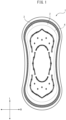
- FIG. 1 is a schematic plan view of a light incontinence pad 1 in an unfolded state to which a composite absorbent body 4 according to an embodiment of the present invention is applied.
- the light incontinence pad 1 has a lengthwise direction L and a width direction W, and has a longitudinally elongated outer shape in which two lengthwise end edges protrude toward the outer side in the lengthwise direction in an arc shape.
- the outer shape of the light incontinence pad 1 is not limited to such an embodiment, and, as long as the light incontinence pad 1 has a longitudinally elongated shape, any shape (for example, an elliptical shape, a rectangular shape, a hourglass shape, a gourd shape, and the like) can be employed according to various uses, usage modes, and the like.
- the light incontinence pad 1 basically includes, in a thickness direction, a liquid-permeable top sheet 2 that forms a surface on a skin facing surface side of the light incontinence pad 1, a back sheet 3 that forms a surface on a non-skin facing surface side of the light incontinence pad 1, and a composite absorbent body 4 that is positioned between the top sheet and the back sheet. Further, the light incontinence pad 1 further includes an adhesive portion (not shown) that is arranged on the surface of the non-skin facing surface side of the back sheet 3 and adhesively fixes the light incontinence pad 1 to the inner surface of clothing such underwear of a wearer.
- the configuration of the light incontinence pad 1 is not limited to the above-described configuration, and, for example, the light incontinence pad 1 may include a pair of side sheets for forming leakproof walls, which are positioned at both end portions of the light incontinence pad 1 in the width direction W and arranged to extend in the lengthwise direction L, at a position on the skin facing surface side with respect to the top sheet 2, and a plurality of elastic members which are arranged along the lengthwise direction L in each of the pair of side sheets.
- the composite absorbent body 4 is formed of a water absorbent member that is positioned between the top sheet 2 and the back sheet 3 and is capable of absorbing a bodily fluid such as urine discharged from the wearer and permeating the top sheet 2, and the composite absorbent body 4 includes a particulate polymer absorbent having a hydrophilic continuous skeleton and continuous pores and having a particle diameter of 300 ⁇ m or more.
- such a polymer absorbent can take a bodily fluid into the continuous pores by the capillary phenomenon and further has a specific particle diameter of 300 ⁇ m or more, the pore structure having the continuous skeleton and the continuous pores can be maintained. Therefore, the bodily fluid can be efficiently absorbed and excellent absorption performance can be exhibited. Therefore, the composite absorbent body 4 including such a polymer absorbent can exhibit excellent absorption performance as an absorbent body.
- the light incontinence pad 1 including such a composite absorbent body 4 can efficiently absorb the bodily fluid as a light incontinence pad and exhibit excellent absorption performance. It should be noted that the particle diameter of the polymer absorbent will be described later.
- the top sheet 2 has a longitudinally elongated outer shape that extends from one side end edge to the other side end edge in the lengthwise direction L of the light incontinence pad 1, and extends over the vicinity of the one side end edge to the vicinity of the other side end edge in the width direction W of the light incontinence pad 1 in a plan view, as shown in FIG. 1 .
- the top sheet 2 is formed of a liquid-permeable sheet-like member arranged at a position on the skin facing surface side in the thickness direction of the light incontinence pad 1 and forms a contact surface capable of coming into contact with the skin of the wearer, that is, the surface on the skin facing surface side of the light incontinence pad 1.
- the top sheet 2 has a slightly larger size in the lengthwise direction L and the width direction W compared with the composite absorbent body 4 arranged on the non-skin facing surface side of the top sheet 2, and is joined to the back sheet 3 positioned on the non-skin facing surface side in the peripheral edge portion.
- the outer shape, various dimensions, basis weight, and the like of the top sheet are not particularly limited, as long as they can be used for the top sheet of a sanitary product, and any shape, various dimensions, basis weight, and the like according to the desired liquid permeability, texture, flexibility, strength, and the like can be employed.
- the back sheet 3 has a longitudinally elongated outer shape that extends from one side end edge to the other side end edge in the lengthwise direction L of the light incontinence pad 1 and extends from the one side end edge to the other side end edge in the width direction W of the light incontinence pad 1 in a plan view.
- the back sheet 3 is arranged at a position on the non-skin facing surface side in the thickness direction of the light incontinence pad 1, and is formed of a liquid-impermeable sheet-like member that forms the non-skin facing surface of the light incontinence pad 1 and prevents a bodily fluid such as urine that has permeated the composite absorbent body 4 from leaking out from the light incontinence pad 1.
- the outer shape, various dimensions, basis weight, and the like of the back sheet are not particularly limited, as long as they can be used for the back sheet of the sanitary product, and any shape, various dimensions, basis weight, and the like according to the desired leakage preventing performance, breathability, strength, and the like can be employed.
- the composite absorbent body 4 has a longitudinally elongated outer shape that centers about the central part in the lengthwise direction L and the width direction W of the light incontinence pad 1, extends in a wide region in the lengthwise direction L from the vicinity of one side end edge to the vicinity of the other side end edge in the lengthwise direction L, and also extends in the width direction W in a wide region from the vicinity of the one side end edge to the vicinity of the other side end edge in the width direction W, in which two lengthwise end edges protrude in an arc shape toward the lengthwise outer side in a plan view, as shown in FIG. 1 .
- the composite absorbent body 4 has a constricted portion having a relatively short widthwise length compared with other portions in the lengthwise central part in a plan view, and further has a minimum width portion having the minimum width of the composite absorbent body 4 in the constricted portion, and a maximum width portion having the maximum width of the composite absorbent body 4 on the lengthwise outer side of the constricted portion.
- the composite absorbent body 4 is formed of a predetermined water-absorbent member that is arranged between the top sheet 2 and the back sheet 3 in the thickness direction of the light incontinence pad 1 and is capable of absorbing and holding a bodily fluid such as urine that has permeated the top sheet 2 and the absorbent member is formed of a water-absorbent material such as a polymer absorbent, hydrophilic fibers, or superabsorbent polymer, which will be described later, and a sheet such as a tissue that holds the water-absorbent material. That is, the composite absorbent body means a water-absorbent member formed of a water-absorbent material that can absorb and hold a bodily fluid, and a sheet that holds the water-absorbent material.
- the composite absorbent body 4 is joined to each of the top sheet 2 and the back sheet 3 with any adhesive such as a hot-melt adhesive.
- the composite absorbent body 4 includes a polymer absorbent having a hydrophilic continuous skeleton and continuous pores as described above and having a specific particle diameter. This polymer absorbent will be described later.
- the composite absorbent body 4 may include only the polymer absorbent as the water-absorbent material, or may further include a water-absorbent material well-known in the art in addition to the above-mentioned polymer absorbent.
- a water-absorbent material for example, there are provided hydrophilic fibers, superabsorbent polymers, and the like, and more specifically, there are provided cellulose-based fibers such as pulp fibers (for example, pulverized pulp), cotton, rayon, and acetate; granular matters formed of superabsorbent polymers (SAP) such as sodium acrylate copolymers; mixtures thereof in any combination; and the like.
- SAP superabsorbent polymers
- the composite absorbent body 4 has a configuration in which such a polymer absorbent or a water-absorbent material is covered with a wrapping sheet such as a tissue having hydrophilicity.
- the outer shape, various dimensions, basis weight, and the like of the composite absorbent body are not particularly limited as long as the effects of the present invention are not impaired, and any outer shape, various dimensions, basis weight, and the like according to the desired water absorption, flexibility, strength, and the like can be adopted.
- the polymer absorbent is not particularly limited as long as the polymer absorbent is a particulate polymer absorbent having a hydrophilic continuous skeleton and continuous pores and has a specific particle diameter of 300 ⁇ m or more.
- a polymer compound that is a hydrolysate of a crosslinked polymer of two or more monomers containing at least a (meth)acrylic acid ester and has at least one hydrophilic group in the functional group More specifically, there is provided a polymer compound that is a hydrolysate of a crosslinked polymer of a (meth)acrylic acid ester and a compound containing two or more vinyl groups in one molecule and has at least a -COONa group.
- Such a polymer absorbent is an organic porous body having at least one or more -COONa groups in one molecule and may further have a -COOH group.
- -COONa groups are substantially uniformly distributed.
- the polymer absorbent is a polymer compound that is a hydrolysate of a crosslinked polymer of a (meth)acrylic acid ester and a compound containing two or more vinyl groups in one molecule and contains at least one or more -COONa groups
- the hydrophilic continuous skeleton easily extends when a bodily fluid such as urine is absorbed, and the continuous pores are easily widened. Therefore, a larger amount of bodily fluid can be more rapidly taken into the continuous pores, and further excellent absorption performance can be exhibited as an absorbent body.
- (meth)acrylic acid ester refers to an acrylic acid ester or a methacrylic acid ester.
- a hydrophilic continuous skeleton is formed by an organic polymer having at least a -COONa group, and has continuous holes (continuous pores) that serve as absorption sites for a liquid to be absorbed (that is, a bodily fluid such as urine) are provided between the skeletons.
- the polymer absorbent may have a -COOR group.
- the presence of the -COOH group and the -COONa group in the organic polymer that forms the hydrophilic continuous skeleton can be confirmed by analysis through infrared spectrophotometry or a method of quantifying a weakly acidic ion exchange group.
- FIG. 2 is a diagram illustrating a manufacturing process of an absorbent A which is an example of a polymer absorbent.
- the upper figure shows polymer constituent raw materials
- the middle figure shows a monolith A as a crosslinked polymer of a (meth)acrylic acid ester and divinylbenzene
- the lower figure shows the absorbent A obtained by subjecting the monolith A in the middle figure to hydrolysis and drying.
- an absorbent A formed of a hydrolysate of a crosslinked polymer of a (meth)acrylic acid ester and divinylbenzene, which is an example of a polymer absorbent, will be described.
- the polymer absorbent is not limited to such an absorbent A, and may be a hydrolysate of a crosslinked polymer of a (meth)acrylic acid ester and a compound having two or more vinyl groups in one molecule, or a hydrolysate of a crosslinked polymer of two or more types of monomers containing at least a (meth)acrylic acid ester, or the like.
- the “monolith A” is an organic porous body formed of a crosslinked polymer of a (meth)acrylic acid ester and divinylbenzene before being subjected to hydrolysis, and will also be referred to as a "monolithic organic porous body”.
- absorbent A is a hydrolysate of a crosslinked polymer (monolith A) of a (meth)acrylic acid ester and divinylbenzene after being subjected to hydrolysis and drying. It should be noted that the absorbent A is assumed to be in the dry state in the following description.
- the absorbent A has a hydrophilic continuous skeleton and continuous pores.
- the absorbent A which is an organic polymer having a hydrophilic continuous skeleton, is obtained by performing crosslinking polymerization using a (meth)acrylic acid ester, which is a polymerization monomer, and divinylbenzene, which is a crosslinking monomer, and then hydrolyzing the obtained crosslinked polymer (monolith A) as shown in FIG. 2 .
- the organic polymer that forms the hydrophilic continuous skeleton has, as constituent units, polymerization residue of an ethylene group (hereinafter, referred to as a "constituent unit X”) and a crosslinked polymerization residue of divinylbenzene (hereinafter, referred to as a "constituent unit Y").
- the polymerization residue (constituent unit X) of the ethylene group in the organic polymer that forms the hydrophilic continuous skeleton has a -COONa group or both of the - COOH group and the -COONa group generated by the hydrolysis of the carboxylic acid ester group.
- the polymerization monomer is a (meth)acrylic acid ester
- the polymerization residue of the ethylene group (constituent unit X) has a -COONa group, a -COOH group, and an ester group.
- the ratio of the crosslinked polymerization residue (constituent unit Y) of divinylbenzene in the organic polymer that forms the hydrophilic continuous skeleton is, for example, 0.1 to 30 mol%, and preferably 0.1 to 20 mol%, with respect to all of the constituent units.
- the ratio of the crosslinked polymerization residue (constituent unit Y) of divinylbenzene in the organic polymer that forms the hydrophilic continuous skeleton is, for example, about 3 mol%, preferably 0.1 to 10 mol%, and more preferably 0.3 to 8 mol%, with respect to all constituent units.
- the organic polymer that forms the hydrophilic continuous skeleton may be formed of only the constituent unit X and the constituent unit Y, or may be formed of, in addition to the constituent unit X and the constituent unit Y, a constituent unit other than the constituent unit X and the constituent unit Y, such as a polymerization residue of monomers other than (meth)acrylic acid ester and divinylbenzene.
- constituent unit other than the constituent unit X and the constituent unit Y for example, there are provided polymerization residues of monomers such as styrene, ⁇ -methylstyrene, vinyltoluene, vinylbenzyl chloride, glycidyl (meth)acrylate, isobutene, butadiene, isoprene, chloroprene, vinyl chloride, vinyl bromide, vinylidene chloride, tetrafluoroethylene, (meth)acrylonitrile, vinyl acetate, ethylene glycol di(meth)acrylate, tripropylene glycol di(meth)acrylate, trimethylol propane tri(meth)acrylate and the like.
- monomers such as styrene, ⁇ -methylstyrene, vinyltoluene, vinylbenzyl chloride, glycidyl (meth)acrylate, isobutene, butadiene, isoprene, chloroprene, vinyl chlor
- the ratio of the constituent unit other than the constituent unit X and the constituent unit Y in the organic polymer that forms the hydrophilic continuous skeleton is, for example, 0 to 50 mol%, and preferably 0 to 30 mol%, with respect to all of the constituent units.
- the thickness of the hydrophilic continuous skeleton of the absorbent A is 0.1 to 100 ⁇ m.
- the thickness of the hydrophilic continuous skeleton of the absorbent A is 0.1 ⁇ m or more, spaces (pores) for taking in a liquid (bodily fluid) to be absorbed in the porous body is less likely to collapse during absorption, and the absorption amount is less likely to decrease.
- the thickness of the hydrophilic continuous skeleton is 100 ⁇ m or less, an excellent absorption rate can be easily obtained.
- the thickness of the continuous skeleton is measured at the thickness evaluation point, which is the cross section of the skeleton appearing in a test piece for electron microscope measurement.
- the continuous skeleton is formed by spaces between water droplets removed by dehydration and drying after hydrolysis described later, and therefore the skeleton is often polygonal. Therefore, the thickness of the continuous skeleton is defined as the average value of the diameter ( ⁇ m) of a circle that circumscribes the polygonal cross section.
- ⁇ m the diameter of the polygonal cross section.
- a small hole may exist in the polygon, but in such cases, the circumscribed circle of the polygonal cross section that surrounds the small hole is measured.
- the average diameter of the continuous pores of the absorbent A is 1 ⁇ m to 1000 ⁇ m.
- the average diameter of the continuous pores of the absorbent A is 1 ⁇ m or more, the spaces (pores) for taking in the liquid (bodily fluid) to be absorbed in the porous body become less likely to collapse during absorption, and the absorption rate is less likely to decrease.
- the average diameter of the continuous pores is 1000 ⁇ m or less, an excellent absorption rate can be easily obtained. Therefore, the composite absorbent body including such an absorbent A can have a higher absorption rate and stably exhibit excellent absorption performance.
- the average diameter ( ⁇ m) of the continuous pores of the absorbent A can be measured by mercury intrusion porosimetry, and the maximum value of the pore distribution curve obtained by such a mercury intrusion porosimetry is employed.
- a sample used for measurement of the average diameter of the continuous pores regardless of the ionic form of the absorbent A, a sample dried in a vacuum dryer set at a temperature of 50°C for 18 hours or longer is used. It should be noted that the final reaching pressure is set to 0 Torr.
- the average diameter of the continuous pores of the absorbent A is smaller than the particle diameter of the absorbent A.
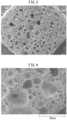
- FIG. 3 is an SEM photograph of the absorbent A at a magnification of 50 times
- FIG. 4 is an SEM photograph of the absorbent A at a magnification of 100 times
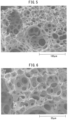
- FIG. 5 is an SEM photograph of the absorbent A at a magnification of 500 times
- FIG. 6 is an SEM photograph of the absorbent A at a magnification of 1000 times
- FIG. 7 is an SEM photograph of the absorbent A at a magnification of 1500 times.
- the absorbent A shown in FIGS. 3 to 7 is an example of an absorbent having butyl methacrylate as a polymerization monomer and divinylbenzene as a crosslinking monomer, and an SEM photograph is taken using an absorbent having a cubic structure of 2 mm sides.
- the absorbent A shown in FIGS. 3 to 7 has a large number of bubble-shaped macropores, and further has a portion in which these bubble-shaped macropores overlap each other.
- the absorbent A has an open cell structure in which portion in which these macropores overlap each other forms a common opening (mesopore), that is, an open cell structure (continuous macropore structure).
- the portion in which the macropores overlap each other forms a common opening (mesopore) having an average diameter of 1 to 1000 ⁇ m in a dry state, preferably 10 to 200 ⁇ m, and particularly preferably 20 to 100 ⁇ m, and most of the common openings (mesopores) have an open pore structure.
- a common opening having an average diameter of 1 to 1000 ⁇ m in a dry state, preferably 10 to 200 ⁇ m, and particularly preferably 20 to 100 ⁇ m, and most of the common openings (mesopores) have an open pore structure.
- the average diameter of the mesopores in the dry state is 1 ⁇ m or more, the absorption rate of the liquid to be absorbed becomes more favorable.
- the average diameter of the mesopores in the dry state is 1000 ⁇ m or less, the absorbent A is less likely to be embrittled.
- the absorbent A having such an open cell structure makes it possible to uniformly form a macropore group and a mesopore group, and also has the advantage of making it possible to remarkably increase the pore volume and specific surface area compared with a particle agglomerated porous body such as that described in Japanese Patent Application Publication No. H08-252579 .
- the total pore volume of the pores of the absorbent A is preferably 0.5 to 50 mL/g, and more preferably 2 to 30 mL/g.
- the total pore volume of the absorbent A is 0.5 mL/g or more, spaces (pores) for taking in the liquid (bodily fluid) to be absorbed in the porous body become less likely to collapse during absorption, and the absorption amount and the absorption rate are less likely to decrease.
- the total pore volume of the absorbent A is 50 mL/g or less, the strength of the absorbent A is less likely to decrease.
- the total pore volume can be measured by the mercury intrusion porosimetry.
- a sample for measurement of the total pore volume regardless of the ionic form of the absorbent A, a sample obtained by drying in a vacuum dryer set at a temperature of 50°C for 18 hours or longer is used. It should be noted that the final reaching pressure is set to 0 Torr.
- the appearance in a case where the absorbent A and a liquid such as a bodily fluid (hereinafter, simply referred to as a "bodily fluid”) come into contact with each other will be described.
- a liquid such as a bodily fluid
- the mass of the absorbed bodily fluid is substantially proportional to the volume of the bodily fluid, in the following description, the mass of the bodily fluid is sometimes simply referred to as the "amount of bodily fluid”.
- the continuous pores of the absorbent A are pores in which a plurality of pores are continuous with each other, and the fact that a large number of pores are located can be visually recognized from the external appearance as well.
- a certain amount of bodily fluid enters the plurality of pores and is absorbed by the absorbent A by the capillary phenomenon.
- the bodily fluid absorbed by the absorbent A a part of the bodily fluid is absorbed into the hydrophilic continuous skeleton by the osmotic pressure, and thus the continuous skeleton expands.
- the bodily fluid absorbed by the absorbent A the bodily fluid that is not absorbed into the hydrophilic continuous skeleton is absorbed in a state of being stored in the pores.
- the absorbent A has a property that a hydrophilic continuous skeleton expands when absorbing the bodily fluid. This expansion of the continuous skeleton occurs in almost all directions. Further, as the outer shape of the absorbent A increases due to the above-described expansion of the continuous skeleton, the size of each pore also increases. When the size of the pores is increased in this manner, the volume in the pore is increased, and therefore, the amount of bodily fluid that can be stored in the pores is also increased.
- the absorbent A which becomes larger when a certain amount of bodily fluid is absorbed can further absorb a predetermined amount of bodily fluid into the expanded pores due to the capillary phenomenon.
- the absorbent A absorbs the bodily fluid by the capillary phenomenon, the bodily fluid can be rapidly absorbed.
- the amount of bodily fluid that remains in the pores is larger than the amount of bodily fluid absorbed in the hydrophilic continuous skeleton. Since most of the bodily fluid absorbed in the absorbent A is absorbed by storing the bodily fluid in the pores by the capillary phenomenon, the higher the porosity (the void volume of the pores with respect to the unit volume of the absorbent A), which is the ratio of the void volume of the pores (total pore volume), the more the bodily fluid can be absorbed.
- the porosity per unit volume of the polymer absorbent is preferably 85% or more, and more preferably 90% or more. When the porosity per unit volume of the polymer absorbent is 85% or more, a larger amount of bodily fluid can be absorbed and further excellent absorption performance can be exhibited.
- the specific surface area of the absorbent A obtained by the mercury intrusion porosimetry is 400 m 2 /g, and the pore volume is 15.5 mL/g.
- This pore volume of 15.5 mL/g means that the volume of the pores in 1 g of the absorbent A is 15.5 mL.
- the volume of the pores occupied in 1 g of the absorbent A is 15.5 mL
- the volume of 1 g of the absorbent A is 1 mL.
- the total volume (volume) of 1 g of the absorbent A becomes 15.5 + 1 (mL), and the ratio of the pore volume in the total volume becomes the porosity. Therefore, the porosity of the absorbent A becomes 15.5/(15.5 + 1) ⁇ 100 ⁇ 94%.
- the absorbent A having a hydrophilic continuous skeleton and continuous pores that is, the polymer absorbent is applied to a composite absorbent body for absorbing a bodily fluid such as urine, such as the composite absorbent body 4 of the light incontinence pad 1 described above, in a particulate form having a specific particle diameter of 300 ⁇ m or more.
- the polymer absorbent can take a bodily fluid into the continuous pores by the capillary phenomenon and further has a specific particle diameter of 300 ⁇ m or more, the pore structure having the continuous skeleton and the continuous pores can be maintained. Therefore, the bodily fluid can be efficiently absorbed and excellent absorption performance can be exhibited. Accordingly, the composite absorbent body of the present invention containing such a polymer absorbent can efficiently absorb the bodily fluid as an absorbent body and can exhibit excellent absorption performance.
- the particle diameter of the polymer absorbent is preferably 2000 ⁇ m or less, and more preferably 400 ⁇ m to 1500 ⁇ m from the viewpoints of absorption efficiency, a feeling of wearing (feeling of foreign matter), and the like.
- the particle diameter of the polymer absorbent is 400 ⁇ m or more, a certain number or more of pores present in the particles of the polymer absorbent can be secured, and a larger amount of liquid to be absorbed (bodily fluid) can be stably taken, that is, excellent water absorption can be stably exhibited.
- the particle diameter of the polymer absorbent can be measured by a sieve method and means the average particle diameter of the particles classified by a sieve tester.
- the sample in a case where the above-described sample for measurement (polymer absorbent) is collected from a product of a sanitary product to be used, the sample can be obtained as follows.
- the polymer absorbent having a hydrophilic continuous skeleton and continuous pores exhibits excellent water absorption amount even in a polymer absorbent having a particle diameter of as small as 300 ⁇ m, and further, a polymer absorbent having a particle diameter of 400 ⁇ m or more (more specifically, 430 ⁇ m or more also stably exhibits a high water absorption amount.
- the continuous skeleton of the polymer absorbent absorbs a part of the bodily fluid that has entered the continuous pores by osmotic pressure and expands. Then, the bodily fluid can be further taken into the pores that are enlarged by the expansion. That is, the polymer absorbent can further absorb the bodily fluid while expanding (increasing the volume) (in other words, the polymer absorbent can expand and further increase the water absorption amount and the liquid retention amount). Therefore, even when the size and amount of the polymer absorbent before the absorption of the bodily fluid are small, a larger amount of bodily fluid can be efficiently absorbed.
- the polymer absorbent has a volume increase rate of the volume at the time of saturated liquid absorption with respect to the volume before liquid absorption is 233% to 567%.
- the volume increase rate at the time of liquid absorption of the polymer absorbent is within such a range, the polymer absorbent can more efficiently absorb the bodily fluid and further exhibit excellent absorption performance.
- the volume increase rate of the volume at the time of saturated liquid absorption of the polymer absorbent with respect to the volume before liquid absorption can be measured as follows.
- the polymer absorbent has a specific water absorption such that the initial water absorption amount after 5 seconds have elapsed from the application of a load of 40 g/cm 2 is 5 g/g or more, and the water absorption amount after 20 seconds or more have elapsed is 110% or more of the initial water absorption amount.
- the polymer absorbent has the specific initial absorption amount and the specific absorption amount after 20 seconds or more have elapsed, the absorption amount in the initial stage of absorption is large, the bodily fluid can be temporarily held, and the bodily fluid can be absorbed even after a predetermined time has elapsed. Therefore, high absorption performance can be further exhibited.
- the load of 40 g/cm 2 mentioned above is a load on the assumption of general body pressure
- the water absorption amount after 20 seconds or more have elapsed means the water absorption amount (mass; g/g) at any timing after 20 seconds have elapsed from the load application under a predetermined temperature condition (for example, any timing after 20 seconds have elapsed, after 60 seconds have elapsed, after 300 seconds have elapsed, after 3600 seconds have elapsed, or the like).
- the initial water absorption amount of the polymer absorbent and the water absorption amount after a predetermined time has elapsed can be measured as follows.
- the water absorption amount (g/g) is "the initial water absorption amount after 5 seconds have elapsed from the application of a load of 40 g/cm 2"
- the water absorption amount (g/g) is "the water absorption amount after 20 seconds or more have elapsed”.
- the composite absorbent body further includes a conventional superabsorbent polymer (SAP) in addition to the above-mentioned polymer absorbent.
- SAP superabsorbent polymer
- the composite absorbent body includes the SAP together with the polymer absorbent, a bodily fluid such as urine can be rapidly absorbed by the polymer absorbent body in the composite absorbent body, temporarily held, then transferred to the SAP having a high water retention capacity for the bodily fluid, and held in the SAP. Therefore, the composite absorbent body can exhibit higher absorption performance as an absorbent body.
- the amount of liquid transferred from the polymer absorbent to the SAP is 5.0 g/g or more.
- the amount of the liquid transferred from the polymer absorbent to the SAP is 5.0 g/g or more, the bodily fluid temporarily held by the polymer absorbent can be more reliably transferred to the SAP, and thus the composite absorbent body can further reliably exhibit high absorption efficiency as an absorbent body.
- the amount of the liquid transferred from the polymer absorbent to the SAP is more preferably 23.0 g/g or more, even preferably 27.0 g/g or more, and particularly preferably 33.0 g/g or more.
- the amount of the liquid transferred from the polymer absorbent to the SAP can be measured as follows.
- the polymer absorbent has a liquid discharge rate of 70% or more for absorbed water.
- the liquid discharge rate of the polymer absorbent is 70% or more, the water absorbed by the polymer absorbent is easily released, and thus the bodily fluid temporarily held by the polymer absorbent can be more easily transferred to the SAP.
- the liquid discharge rate of the polymer absorbent is particularly preferably 75% or more.
- the liquid discharge rate of the polymer absorbent can be measured as follows.
- the above-described absorbent A can be obtained by allowing the absorbent A to pass through a crosslinking polymerization step and a hydrolysis step.
- a crosslinking polymerization step As shown in FIG. 2 , the above-described absorbent A can be obtained by allowing the absorbent A to pass through a crosslinking polymerization step and a hydrolysis step.
- a crosslinking polymerization step As shown in FIG. 2 , the above-described absorbent A can be obtained by allowing the absorbent A to pass through a crosslinking polymerization step and a hydrolysis step.
- an oil-soluble monomer for crosslinking polymerization, a crosslinking monomer, a surfactant, water, and optionally a polymerization initiator are mixed to obtain a water-in-oil emulsion.
- This water-in-oil emulsion is an emulsion in which water droplets are dispersed in an oil phase that serves as a continuous phase.
- a monolith A is obtained by performing crosslinking polymerization using butyl methacrylate, which is (meth)acrylic acid ester, as an oil-soluble monomer, divinylbenzene as a crosslinking monomer, sorbitan monooleate as a surfactant, and further isobutyronitrile as a polymerization initiator.
- butyl methacrylate which is (meth)acrylic acid ester
- divinylbenzene as a crosslinking monomer
- sorbitan monooleate as a surfactant
- isobutyronitrile as a polymerization initiator.
- the absorbent A as shown in the upper figure of FIG.2 , first, 9.2 g of t-butyl methacrylate as an oil-soluble monomer, 0.28 g of divinylbenzene as a crosslinking monomer, 1.0 g of sorbitan monooleate (hereinafter, abbreviated as "SMO") as a surfactant, and 0.4 g of 2,2'-azobis(isobutyronitrile) as a polymerization initiator are mixed and uniformly dissolved.
- SMO sorbitan monooleate
- the emulsion is rapidly transferred to a reaction vessel, sealed, and left to stand still and polymerized at 60°C for 24 hours. After completion of the polymerization, the content is taken out, extracted with methanol, and dried under reduced pressure to obtain a monolith A having a continuous macropore structure.
- the monolith A had an open cell structure and the thickness of the continuous skeleton is 5.4 ⁇ m. Further, the average diameter of the continuous pores measured by the mercury intrusion porosimetry is 36.2 ⁇ m, and the total pore volume is 15.5 mL/g.
- the content of divinylbenzene with respect to all the monomers is preferably 0.3 to 10 mol%, and more preferably 0.3 to 5 mol%.
- the ratio of divinylbenzene to the total of butyl methacrylate and divinylbenzene is preferably 0.1 to 10 mol%, and more preferably 0.3 to 8 mol%. It should be noted that in the above-described absorbent A, the ratio of butyl methacrylate with respect to the total of butyl methacrylate and divinylbenzene is 97.0 mol% and the ratio of divinylbenzene with respect to the total of butyl methacrylate and divinylbenzene is 3.0 mol%.
- the amount of the surfactant added can be set depending on the type of the oil-soluble monomer and the size of the desired emulsion particle (macropore), and it is preferable that the amount of the surfactant is set to be in a range of about 2 to 70% with respect to the total amount of the oil-soluble monomer and the surfactant.
- alcohols such as methanol and stearyl alcohol
- carboxylic acids such as stearic acid
- hydrocarbons such as octane, dodecane, and toluene
- cyclic ethers such as tetrahydrofuran and dioxane, and the like may coexist in the polymerization system.
- the mixing method for forming the water-in-oil emulsion is not particularly limited, and for example, any mixing method such as a method of mixing each component all together at once, and a method in which oil-soluble components, which are an oil-soluble monomer, a surfactant, and an oil-soluble polymerization initiator, and water-soluble components, which are water or a water-soluble polymerization initiator, are uniformly dissolved separately, and then oil-soluble components and water-soluble components are mixed can be adopted.
- the mixing device for forming the emulsion is not particularly limited, and any device such as an ordinary mixer, homogenizer, or high pressure homogenizer can be used according to the desired emulsion particle diameter.
- a so-called planetary type stirring device in which an object to be treated is placed in a mixing container, and the object to be treated is stirred and mixed by rotating the mixing container in a tilted state while revolving around the revolution axis can be used.
- the mixing conditions are not particularly limited, and any stirring rotation rate, any stirring time, and the like can be set depending on the desired emulsion particle diameter. It should be noted that, in the above-described planetary type stirring device, water droplets can be uniformly generated in the W/O emulsion, and any average diameter can be set within a wide range.
- polymerization conditions of the water-in-oil emulsion various conditions can be adopted depending on the type of monomer or initiator and the like.
- polymerization may be conducted by heating at a temperature of 30°C to 100°C for 1 to 48 hours in a sealed container under an inert atmosphere.
- polymerization may be conducted at a temperature of 0 to 30°C for 1 to 48 hours in a sealed container under an inert atmosphere.
- the content is taken out and subjected to Soxhlet extraction with a solvent such as isopropanol to remove the unreacted monomer and the residual surfactant, and thus the monolith A shown in the middle figure of FIG. 2 is obtained.
- a solvent such as isopropanol
- the monolith A is immersed in dichloroethane to which zinc bromide is added, stirred at 40°C for 24 hours, then brought into contact with methanol, 4% hydrochloric acid, a 4% aqueous solution of sodium hydroxide, and water in this order for hydrolysis, and then dried.
- a block-shaped absorbent A is obtained.
- the block-shaped absorbent A is pulverized to a predetermined size (that is, a particle diameter of 300 ⁇ m or more) to obtain a particulate absorbent A.
- the particulate form of the absorbent A may be shaped (granulated) into a particle shape during drying or after drying.
- the method for hydrolyzing the monolith A is not particularly limited, and various methods can be adopted.
- a method of bringing a solvent into contact with a strong base such as sodium hydroxide or a method of bringing a solvent into contact with a hydrohalic acid such as hydrochloric acid, a Brönsted acid such as sulfuric acid, nitric acid, trifluoroacetic acid, methanesulfonic acid, or p-toluenesulfonic acid, or a Lewis acid such as zinc bromide, aluminum chloride, aluminum bromide, titanium (IV) chloride, cerium chloride/sodium iodide, or magnesium iodide using any of various solvent including aromatic solvents such as toluene and xylene, halogen-based solvents such as chloroform and dichloroethane, ether-based solvents such as tetrahydrofuran and isopropyl ether, amide-based solvents such as dimethyl
- the (meth)acrylic acid ester is not particularly limited, C1 to C10 (that is, containing 1 to 10 carbon atoms) alkyl ester of (meth)acrylic acid is preferable, and C4 (that is, containing 4 carbon atoms) alkyl ester of (meth)acrylic acid is particularly preferable.
- (meth)acrylic acid t-butyl ester there are provided (meth)acrylic acid t-butyl ester, (meth)acrylic acid n-butyl ester, and (meth)acrylic acid iso-butyl ester.
- the monomer used for the crosslinking polymerization may be only (meth)acrylic acid ester and divinylbenzene, or may include (meth)acrylic acid ester and divinylbenzene, and additionally, a monomer other than (meth)acrylic acid ester and divinylbenzene.
- the monomer other than (meth)acrylic acid ester and divinylbenzene styrene is not particularly limited, and for example, there are provided styrene, ⁇ -methylstyrene, vinyltoluene, vinylbenzyl chloride, glycidyl (meth)acrylate, 2-ethylhexyl (meth)acrylate, isobutene, butadiene, isoprene, chloroprene, vinyl chloride, vinyl bromide, vinylidene chloride, tetrafluoroethylene, (meth)acrylonitrile, vinyl acetate, ethylene glycol di(meth)acrylate, trimethylol propane tri(meth)acrylate, and the like.
- the ratio of the monomer other than (meth)acrylic acid ester and divinylbenzene in all monomers used for the crosslinking polymerization is preferably 0 to 80 mol%, and more preferably 0 to 50 mol%.
- the surfactant is not limited to the above-described sorbitan monooleate, and any surfactant that can form a water-in-oil (W/O) emulsion when a monomer for crosslinking polymerization and water are mixed can be used.
- W/O water-in-oil
- nonionic surfactants such as sorbitan monolaurate, sorbitan monopalmitate, sorbitan monostearate, sorbitan trioleate, polyoxyethylene group nonylphenyl ether, polyoxyethylene group stearyl ether, and polyoxyethylene group sorbitan monooleate, anionic surfactants such as potassium oleate, sodium dodecylbenzene sulfonate, and dioctyl sodium sulfosuccinate, cationic surfactants such as distearyl dimethyl ammonium chloride, and amphoretic surfactants such as lauryl dimethyl betaine. These surfactants may be used alone or in combination of two or more types.
- the polymerization initiator may be water-soluble or oil-soluble.
- the polymerization initiator may be water-soluble or oil-soluble.
- azobis (4-methoxy-2,4-dimethylvaleronitrile), azobisisobutyronitrile, azobisdimethylvaleronitrile, azobiscyclohexanenitrile, azobiscyclohexanecarbonitrile, azobis (2-methylpropionamidine) dihydrochloride, benzoyl peroxide, potassium persulfate, ammonium persulfate, hydrogen peroxide-ferrous chloride, sodium persulfate-sodium acid sulfite, and tetramethylthiuram disulfide.
- the addition of polymerization proceeds with only heating or only light irradiation even when the polymerization initiator is not added. Therefore, in such a system, the addition
- the composite absorbent body of the present invention can be applied to various sanitary products such as underpants-shaped disposable diapers, tape-type disposable diapers, sanitary napkins, absorbent panty liners, absorbent pads (for example, bedsore pads, puerperal pads and the like), absorbent sheets, breast pads, disposable diapers for pets, absorbent pads for pets, excrement disposal sheets for pets, wet sheets, wet tissues, cosmetic wiping sheets, masks, and the like.
- the bodily fluid that is the liquid to be absorbed of the composite absorbent body is a liquid discharged from a wearer of a sanitary product, and for example, there are provided urine, sweat, feces, menstrual blood, vaginal discharge, breast milk, blood, exudate, and the like.
- the present invention is not limited to the above-described embodiments and the like, and appropriate combinations, substitutions, modifications, and the like can be made without departing from the aspect, gist, and the like of the present invention.
Landscapes
- Health & Medical Sciences (AREA)
- Chemical & Material Sciences (AREA)
- Epidemiology (AREA)
- Engineering & Computer Science (AREA)
- Life Sciences & Earth Sciences (AREA)
- Animal Behavior & Ethology (AREA)
- General Health & Medical Sciences (AREA)
- Public Health (AREA)
- Veterinary Medicine (AREA)
- Chemical Kinetics & Catalysis (AREA)
- Materials Engineering (AREA)
- Hematology (AREA)
- Vascular Medicine (AREA)
- Medicinal Chemistry (AREA)
- Polymers & Plastics (AREA)
- Organic Chemistry (AREA)
- Heart & Thoracic Surgery (AREA)
- Biomedical Technology (AREA)
- Dispersion Chemistry (AREA)
- General Chemical & Material Sciences (AREA)
- Absorbent Articles And Supports Therefor (AREA)
- Addition Polymer Or Copolymer, Post-Treatments, Or Chemical Modifications (AREA)
Abstract
Description
- The present invention relates to a composite absorbent body and a sanitary product having the same.
- In sanitary products such as disposable diapers and sanitary napkins, those including a porous material such as a sponge material as an absorbent body are known. For example, Patent Literature 1 discloses an absorbent article containing a polymeric foam material formed of a hydrophilic flexible structure of interconnected open cells.
- [Patent Literature 1]
Japanese Patent No. 3231320 - Such a porous material is used in a particulate form so as to be able to more efficiently absorb a bodily fluid in some cases. However, when the particle diameter is reduced, the pore structure of the porous material is destroyed, and there is a risk that the absorption performance for the bodily fluid is decreased.
- The present invention was achieved in view of such problems, and an aspect of the present invention is to provide an absorbent body capable of efficiently absorbing a bodily fluid and having excellent absorption performance.
- One aspect (Aspect 1) of the present invention is:
a composite absorbent body for a sanitary product for absorbing a bodily fluid, the composite absorbent body comprising: - a particulate polymer absorbent having a hydrophilic continuous skeleton and continuous pores, wherein
- the polymer absorbent has a particle diameter of 300 µm or more.
- In the composite absorbent body according to Aspect 1, since the particulate polymer absorbent capable of taking a bodily fluid into the continuous pores by a capillary phenomenon has a particle diameter of 300 µm or more, the pore structure including the continuous skeleton and the continuous pores is easily maintained. Therefore, the bodily fluid can be efficiently absorbed and excellent absorption performance can be exhibited.
- In addition, another aspect (Aspect 2) of the present invention is:
the composite absorbent body according to Aspect 1, wherein
a volume increase rate of a volume at the time of saturated liquid absorption of the polymer absorbent with respect to a volume before liquid absorption is 233% to 567%. - In the composite absorbent body according to
Aspect 2, since the volume increase rate at the time of liquid absorption of the polymer absorbent is 233% to 567%, the bodily fluid can be more efficiently absorbed, and further excellent absorption performance can be exhibited. - Still another aspect (Aspect 3) of the present invention is:
the composite absorbent body according toAspect 1 or 2, wherein
a porosity per unit volume of the polymer absorbent is 85% or more. - In the composite absorbent body according to
Aspect 3, since the porosity per unit volume of the polymer absorbent is 85% or more, a larger amount of bodily fluid can be absorbed and further exhibit excellent absorption performance can be exhibited. - Still another aspect (Aspect 4) of the present invention is:
the composite absorbent body according to any one of Aspects 1 to 3, wherein
an average diameter of the continuous pores is 1 µm to 1000 µm. - In the composite absorbent body according to
Aspect 4, since the average diameter of the continuous pores of the polymer absorbent is 1 µm to 1000 µm, the spaces (pores) for taking in the bodily fluid of the polymer absorbent are less likely to collapse, and the composite absorbent body can have a higher absorption rate and stably exhibit excellent absorption performance. - Still another aspect (Aspect 5) of the present invention is:
the composite absorbent body according to any one of Aspects 1 to 4, wherein
the polymer absorbent is a monolithic absorbent. - In the composite absorbent body according to Aspect 5, since the polymer absorbent is a monolithic absorbent, the bodily fluid can be rapidly absorbed and the temporarily held bodily fluid can be more steadily transferred to the SAP.
- Still another aspect (Aspect 6) of the present invention is:
the composite absorbent body according to any one of Aspects 1 to 5, wherein
the polymer absorbent is a hydrolysate of a crosslinked polymer of a (meth)acrylic acid ester and a compound containing two or more vinyl groups in one molecule, and contains at least one or more -COONa groups. - In the composite absorbent body according to Aspect 6, since the polymer absorbent has the above-described specific configuration, the hydrophilic continuous skeleton easily extends, and the continuous pores are also easily widened when the bodily fluid is absorbed. Therefore, a larger amount of bodily fluid can be more rapidly taken into the continuous pores, and the composite absorbent body can more reliably exhibit further excellent absorption performance as an absorbent body.
- Still another (Aspect 7) of the present invention is:
a sanitary product comprising:
the composite absorbent body according to any one of Aspects 1 to 6. - Since the sanitary product according to Aspect 7 has the composite absorbent body of any of Aspects 1 to 6, the bodily fluid can be efficiently absorbed as a sanitary product, and excellent absorption performance can be exhibited.
- According to the present invention, an absorbent body capable of efficiently absorbing a bodily fluid and having excellent absorption performance can be provided.
-
-
FIG. 1 is a schematic plan view of a light incontinence pad 1 in an unfolded state when viewed in the thickness direction from the skin facing surface side. -
FIG. 2 is a diagram illustrating a manufacturing process of an absorbent A which is an example of a polymer absorbent. -
FIG. 3 is an SEM photograph of the absorbent A at a magnification of 50 times. -
FIG. 4 is an SEM photograph of the absorbent A at a magnification of 100 times. -
FIG. 5 is an SEM photograph of the absorbent A at a magnification of 500 times. -
FIG. 6 is an SEM photograph of the absorbent A at a magnification of 1000 times. -
FIG. 7 is an SEM photograph of the absorbent A at a magnification of 1500 times. - Hereinafter, a preferable embodiment of a composite absorbent body of the present invention will be described in detail using a light incontinence pad 1 which is an example of a sanitary product to which the composite absorbent body is applied.
- It should be noted that in the present specification, unless otherwise specified, an "object (for example, a light incontinence pad, a composite absorbent body, or the like) placed on a horizontal plane in an unfolded state is viewed in a thickness direction of the object from the upper side in the vertical direction (in a case where the object is a sanitary product, the top sheet side)" will be simply referred to as a "plan view".
- It should be noted that in the present specification, the "lengthwise direction" refers to a "direction in which the length of a longitudinally elongated object (for example, a light incontinence pad, a composite absorbent body, or the like in an unfolded state) in a plan view is long", the "width direction" refers to a "direction in which the length of a longitudinally elongated object in a plan view is short", the "thickness direction" refers to a "direction vertical to the object placed on a horizontal plane in an unfolded state", and the lengthwise direction, the width direction, and the thickness direction have a relationship in which the respective directions are orthogonal to each other.
- Further, in the present specification, unless otherwise specified, in the thickness direction of the light incontinence pad 1, a "relatively proximal side with respect to the skin surface of the wearer while the light incontinence pad 1 is put on" will be referred to as a "skin facing surface side," and a "relatively distal side with respect to the skin surface of the wearer while the light incontinence pad 1 is put on" will be referred to as a "non-skin facing surface side."
-
FIG. 1 is a schematic plan view of a light incontinence pad 1 in an unfolded state to which a compositeabsorbent body 4 according to an embodiment of the present invention is applied. - As shown in
FIG. 1 , in a plan view, the light incontinence pad 1 has a lengthwise direction L and a width direction W, and has a longitudinally elongated outer shape in which two lengthwise end edges protrude toward the outer side in the lengthwise direction in an arc shape. It should be noted that the outer shape of the light incontinence pad 1 is not limited to such an embodiment, and, as long as the light incontinence pad 1 has a longitudinally elongated shape, any shape (for example, an elliptical shape, a rectangular shape, a hourglass shape, a gourd shape, and the like) can be employed according to various uses, usage modes, and the like. - The light incontinence pad 1 basically includes, in a thickness direction, a liquid-
permeable top sheet 2 that forms a surface on a skin facing surface side of the light incontinence pad 1, aback sheet 3 that forms a surface on a non-skin facing surface side of the light incontinence pad 1, and a compositeabsorbent body 4 that is positioned between the top sheet and the back sheet. Further, the light incontinence pad 1 further includes an adhesive portion (not shown) that is arranged on the surface of the non-skin facing surface side of theback sheet 3 and adhesively fixes the light incontinence pad 1 to the inner surface of clothing such underwear of a wearer. - It should be noted that the configuration of the light incontinence pad 1 is not limited to the above-described configuration, and, for example, the light incontinence pad 1 may include a pair of side sheets for forming leakproof walls, which are positioned at both end portions of the light incontinence pad 1 in the width direction W and arranged to extend in the lengthwise direction L, at a position on the skin facing surface side with respect to the
top sheet 2, and a plurality of elastic members which are arranged along the lengthwise direction L in each of the pair of side sheets. - Further, in the light incontinence pad 1, the composite
absorbent body 4 is formed of a water absorbent member that is positioned between thetop sheet 2 and theback sheet 3 and is capable of absorbing a bodily fluid such as urine discharged from the wearer and permeating thetop sheet 2, and the compositeabsorbent body 4 includes a particulate polymer absorbent having a hydrophilic continuous skeleton and continuous pores and having a particle diameter of 300 µm or more. - Since such a polymer absorbent can take a bodily fluid into the continuous pores by the capillary phenomenon and further has a specific particle diameter of 300 µm or more, the pore structure having the continuous skeleton and the continuous pores can be maintained. Therefore, the bodily fluid can be efficiently absorbed and excellent absorption performance can be exhibited. Therefore, the composite
absorbent body 4 including such a polymer absorbent can exhibit excellent absorption performance as an absorbent body. - Therefore, the light incontinence pad 1 including such a composite
absorbent body 4 can efficiently absorb the bodily fluid as a light incontinence pad and exhibit excellent absorption performance. It should be noted that the particle diameter of the polymer absorbent will be described later. - Hereinafter, various configurating members of a sanitary product to which the composite absorbent body of the present invention is applied will be described in more detail using the above-described light incontinence pad 1.
- In the above-described light incontinence pad 1, the
top sheet 2 has a longitudinally elongated outer shape that extends from one side end edge to the other side end edge in the lengthwise direction L of the light incontinence pad 1, and extends over the vicinity of the one side end edge to the vicinity of the other side end edge in the width direction W of the light incontinence pad 1 in a plan view, as shown inFIG. 1 . Thetop sheet 2 is formed of a liquid-permeable sheet-like member arranged at a position on the skin facing surface side in the thickness direction of the light incontinence pad 1 and forms a contact surface capable of coming into contact with the skin of the wearer, that is, the surface on the skin facing surface side of the light incontinence pad 1. - Further, as shown in
FIG. 1 , thetop sheet 2 has a slightly larger size in the lengthwise direction L and the width direction W compared with the compositeabsorbent body 4 arranged on the non-skin facing surface side of thetop sheet 2, and is joined to theback sheet 3 positioned on the non-skin facing surface side in the peripheral edge portion. - In the present invention, the outer shape, various dimensions, basis weight, and the like of the top sheet are not particularly limited, as long as they can be used for the top sheet of a sanitary product, and any shape, various dimensions, basis weight, and the like according to the desired liquid permeability, texture, flexibility, strength, and the like can be employed.
- In the above-described light incontinence pad 1, the
back sheet 3 has a longitudinally elongated outer shape that extends from one side end edge to the other side end edge in the lengthwise direction L of the light incontinence pad 1 and extends from the one side end edge to the other side end edge in the width direction W of the light incontinence pad 1 in a plan view. Theback sheet 3 is arranged at a position on the non-skin facing surface side in the thickness direction of the light incontinence pad 1, and is formed of a liquid-impermeable sheet-like member that forms the non-skin facing surface of the light incontinence pad 1 and prevents a bodily fluid such as urine that has permeated the compositeabsorbent body 4 from leaking out from the light incontinence pad 1. - In the present invention, the outer shape, various dimensions, basis weight, and the like of the back sheet are not particularly limited, as long as they can be used for the back sheet of the sanitary product, and any shape, various dimensions, basis weight, and the like according to the desired leakage preventing performance, breathability, strength, and the like can be employed.
- In the light incontinence pad 1, the composite
absorbent body 4 has a longitudinally elongated outer shape that centers about the central part in the lengthwise direction L and the width direction W of the light incontinence pad 1, extends in a wide region in the lengthwise direction L from the vicinity of one side end edge to the vicinity of the other side end edge in the lengthwise direction L, and also extends in the width direction W in a wide region from the vicinity of the one side end edge to the vicinity of the other side end edge in the width direction W, in which two lengthwise end edges protrude in an arc shape toward the lengthwise outer side in a plan view, as shown inFIG. 1 . - More specifically, the composite
absorbent body 4 has a constricted portion having a relatively short widthwise length compared with other portions in the lengthwise central part in a plan view, and further has a minimum width portion having the minimum width of the compositeabsorbent body 4 in the constricted portion, and a maximum width portion having the maximum width of the compositeabsorbent body 4 on the lengthwise outer side of the constricted portion. - The composite
absorbent body 4 is formed of a predetermined water-absorbent member that is arranged between thetop sheet 2 and theback sheet 3 in the thickness direction of the light incontinence pad 1 and is capable of absorbing and holding a bodily fluid such as urine that has permeated thetop sheet 2 and the absorbent member is formed of a water-absorbent material such as a polymer absorbent, hydrophilic fibers, or superabsorbent polymer, which will be described later, and a sheet such as a tissue that holds the water-absorbent material. That is, the composite absorbent body means a water-absorbent member formed of a water-absorbent material that can absorb and hold a bodily fluid, and a sheet that holds the water-absorbent material. - It should be noted that in the light incontinence pad 1, the composite
absorbent body 4 is joined to each of thetop sheet 2 and theback sheet 3 with any adhesive such as a hot-melt adhesive. - The composite
absorbent body 4 includes a polymer absorbent having a hydrophilic continuous skeleton and continuous pores as described above and having a specific particle diameter. This polymer absorbent will be described later. - It should be noted that the composite
absorbent body 4 may include only the polymer absorbent as the water-absorbent material, or may further include a water-absorbent material well-known in the art in addition to the above-mentioned polymer absorbent. As the water-absorbent material, for example, there are provided hydrophilic fibers, superabsorbent polymers, and the like, and more specifically, there are provided cellulose-based fibers such as pulp fibers (for example, pulverized pulp), cotton, rayon, and acetate; granular matters formed of superabsorbent polymers (SAP) such as sodium acrylate copolymers; mixtures thereof in any combination; and the like. - It should be noted that the composite
absorbent body 4 has a configuration in which such a polymer absorbent or a water-absorbent material is covered with a wrapping sheet such as a tissue having hydrophilicity. - It should be noted that, in the present invention, the outer shape, various dimensions, basis weight, and the like of the composite absorbent body are not particularly limited as long as the effects of the present invention are not impaired, and any outer shape, various dimensions, basis weight, and the like according to the desired water absorption, flexibility, strength, and the like can be adopted.
- Hereinafter, the polymer absorbent used in the composite absorbent body of the present invention will be described in more detail.
- The polymer absorbent is not particularly limited as long as the polymer absorbent is a particulate polymer absorbent having a hydrophilic continuous skeleton and continuous pores and has a specific particle diameter of 300 µm or more. For example, there is provided a polymer compound that is a hydrolysate of a crosslinked polymer of two or more monomers containing at least a (meth)acrylic acid ester and has at least one hydrophilic group in the functional group. More specifically, there is provided a polymer compound that is a hydrolysate of a crosslinked polymer of a (meth)acrylic acid ester and a compound containing two or more vinyl groups in one molecule and has at least a -COONa group. Such a polymer absorbent is an organic porous body having at least one or more -COONa groups in one molecule and may further have a -COOH group. In the skeleton of the porous body, -COONa groups are substantially uniformly distributed.
- When the polymer absorbent is a polymer compound that is a hydrolysate of a crosslinked polymer of a (meth)acrylic acid ester and a compound containing two or more vinyl groups in one molecule and contains at least one or more -COONa groups, the hydrophilic continuous skeleton easily extends when a bodily fluid such as urine is absorbed, and the continuous pores are easily widened. Therefore, a larger amount of bodily fluid can be more rapidly taken into the continuous pores, and further excellent absorption performance can be exhibited as an absorbent body.
- It should be noted that in the present specification, the term "(meth)acrylic acid ester" refers to an acrylic acid ester or a methacrylic acid ester.
- In the polymer absorbent formed of a hydrolysate of a crosslinked polymer of a (meth)acrylic acid ester and divinylbenzene, a hydrophilic continuous skeleton is formed by an organic polymer having at least a -COONa group, and has continuous holes (continuous pores) that serve as absorption sites for a liquid to be absorbed (that is, a bodily fluid such as urine) are provided between the skeletons.
- It should be noted that since in the hydrolysis treatment, the -COOR group (that is, the carboxylic acid ester group) of the crosslinked polymer is converted into a -COONa group or a -COOH group (refer to
FIG. 2 ), the polymer absorbent may have a -COOR group. - The presence of the -COOH group and the -COONa group in the organic polymer that forms the hydrophilic continuous skeleton can be confirmed by analysis through infrared spectrophotometry or a method of quantifying a weakly acidic ion exchange group.
- Here,
FIG. 2 is a diagram illustrating a manufacturing process of an absorbent A which is an example of a polymer absorbent. InFIG. 2 , the upper figure shows polymer constituent raw materials, the middle figure shows a monolith A as a crosslinked polymer of a (meth)acrylic acid ester and divinylbenzene, and the lower figure shows the absorbent A obtained by subjecting the monolith A in the middle figure to hydrolysis and drying. - Hereinafter, an absorbent A formed of a hydrolysate of a crosslinked polymer of a (meth)acrylic acid ester and divinylbenzene, which is an example of a polymer absorbent, will be described.
- It should be noted that the polymer absorbent is not limited to such an absorbent A, and may be a hydrolysate of a crosslinked polymer of a (meth)acrylic acid ester and a compound having two or more vinyl groups in one molecule, or a hydrolysate of a crosslinked polymer of two or more types of monomers containing at least a (meth)acrylic acid ester, or the like.
- It should be noted that in the following description, the "monolith A" is an organic porous body formed of a crosslinked polymer of a (meth)acrylic acid ester and divinylbenzene before being subjected to hydrolysis, and will also be referred to as a "monolithic organic porous body".
- The "absorbent A" is a hydrolysate of a crosslinked polymer (monolith A) of a (meth)acrylic acid ester and divinylbenzene after being subjected to hydrolysis and drying. It should be noted that the absorbent A is assumed to be in the dry state in the following description.
- First, the structure of the absorbent A will be described.
- As described above, the absorbent A has a hydrophilic continuous skeleton and continuous pores. The absorbent A, which is an organic polymer having a hydrophilic continuous skeleton, is obtained by performing crosslinking polymerization using a (meth)acrylic acid ester, which is a polymerization monomer, and divinylbenzene, which is a crosslinking monomer, and then hydrolyzing the obtained crosslinked polymer (monolith A) as shown in
FIG. 2 . - The organic polymer that forms the hydrophilic continuous skeleton has, as constituent units, polymerization residue of an ethylene group (hereinafter, referred to as a "constituent unit X") and a crosslinked polymerization residue of divinylbenzene (hereinafter, referred to as a "constituent unit Y").
- Further, the polymerization residue (constituent unit X) of the ethylene group in the organic polymer that forms the hydrophilic continuous skeleton has a -COONa group or both of the - COOH group and the -COONa group generated by the hydrolysis of the carboxylic acid ester group. It should be noted that, in a case where the polymerization monomer is a (meth)acrylic acid ester, the polymerization residue of the ethylene group (constituent unit X) has a -COONa group, a -COOH group, and an ester group.
- In the absorbent A, the ratio of the crosslinked polymerization residue (constituent unit Y) of divinylbenzene in the organic polymer that forms the hydrophilic continuous skeleton is, for example, 0.1 to 30 mol%, and preferably 0.1 to 20 mol%, with respect to all of the constituent units. For example, in the absorbent A containing butyl methacrylate as the polymerization monomer and divinylbenzene as the crosslinking monomer, the ratio of the crosslinked polymerization residue (constituent unit Y) of divinylbenzene in the organic polymer that forms the hydrophilic continuous skeleton is, for example, about 3 mol%, preferably 0.1 to 10 mol%, and more preferably 0.3 to 8 mol%, with respect to all constituent units.
- It should be noted that, when the ratio of the crosslinked polymerization residue of divinylbenzene in the organic polymer that forms the hydrophilic continuous skeleton is 0.1 mol% or more, it becomes difficult to decrease the strength of the absorbent A, and, when the ratio of the crosslinked polymerization residue of divinylbenzene is 30 mol% or less, it becomes difficult to decrease the absorption amount of the liquid to be absorbed.
- In the absorbent A, the organic polymer that forms the hydrophilic continuous skeleton may be formed of only the constituent unit X and the constituent unit Y, or may be formed of, in addition to the constituent unit X and the constituent unit Y, a constituent unit other than the constituent unit X and the constituent unit Y, such as a polymerization residue of monomers other than (meth)acrylic acid ester and divinylbenzene.
- As the constituent unit other than the constituent unit X and the constituent unit Y, for example, there are provided polymerization residues of monomers such as styrene, α-methylstyrene, vinyltoluene, vinylbenzyl chloride, glycidyl (meth)acrylate, isobutene, butadiene, isoprene, chloroprene, vinyl chloride, vinyl bromide, vinylidene chloride, tetrafluoroethylene, (meth)acrylonitrile, vinyl acetate, ethylene glycol di(meth)acrylate, tripropylene glycol di(meth)acrylate, trimethylol propane tri(meth)acrylate and the like.
- It should be noted that the ratio of the constituent unit other than the constituent unit X and the constituent unit Y in the organic polymer that forms the hydrophilic continuous skeleton is, for example, 0 to 50 mol%, and preferably 0 to 30 mol%, with respect to all of the constituent units.
- Further, it is preferable that the thickness of the hydrophilic continuous skeleton of the absorbent A is 0.1 to 100 µm. When the thickness of the hydrophilic continuous skeleton of the absorbent A is 0.1 µm or more, spaces (pores) for taking in a liquid (bodily fluid) to be absorbed in the porous body is less likely to collapse during absorption, and the absorption amount is less likely to decrease. On the other hand, when the thickness of the hydrophilic continuous skeleton is 100 µm or less, an excellent absorption rate can be easily obtained.
- It should be noted that since the pore structure of the hydrophilic continuous skeleton of the absorbent A is an open cell structure, the thickness of the continuous skeleton is measured at the thickness evaluation point, which is the cross section of the skeleton appearing in a test piece for electron microscope measurement. The continuous skeleton is formed by spaces between water droplets removed by dehydration and drying after hydrolysis described later, and therefore the skeleton is often polygonal. Therefore, the thickness of the continuous skeleton is defined as the average value of the diameter (µm) of a circle that circumscribes the polygonal cross section. In addition, in rare cases, a small hole may exist in the polygon, but in such cases, the circumscribed circle of the polygonal cross section that surrounds the small hole is measured.
- Further, it is preferable that the average diameter of the continuous pores of the absorbent A is 1 µm to 1000 µm. When the average diameter of the continuous pores of the absorbent A is 1 µm or more, the spaces (pores) for taking in the liquid (bodily fluid) to be absorbed in the porous body become less likely to collapse during absorption, and the absorption rate is less likely to decrease. On the other hand, when the average diameter of the continuous pores is 1000 µm or less, an excellent absorption rate can be easily obtained. Therefore, the composite absorbent body including such an absorbent A can have a higher absorption rate and stably exhibit excellent absorption performance.
- It should be noted that the average diameter (µm) of the continuous pores of the absorbent A can be measured by mercury intrusion porosimetry, and the maximum value of the pore distribution curve obtained by such a mercury intrusion porosimetry is employed. For a sample used for measurement of the average diameter of the continuous pores, regardless of the ionic form of the absorbent A, a sample dried in a vacuum dryer set at a temperature of 50°C for 18 hours or longer is used. It should be noted that the final reaching pressure is set to 0 Torr. In addition, of course, the average diameter of the continuous pores of the absorbent A is smaller than the particle diameter of the absorbent A.
- Here,
FIG. 3 is an SEM photograph of the absorbent A at a magnification of 50 times,FIG. 4 is an SEM photograph of the absorbent A at a magnification of 100 times,FIG. 5 is an SEM photograph of the absorbent A at a magnification of 500 times,FIG. 6 is an SEM photograph of the absorbent A at a magnification of 1000 times, andFIG. 7 is an SEM photograph of the absorbent A at a magnification of 1500 times. - The absorbent A shown in
FIGS. 3 to 7 is an example of an absorbent having butyl methacrylate as a polymerization monomer and divinylbenzene as a crosslinking monomer, and an SEM photograph is taken using an absorbent having a cubic structure of 2 mm sides. - The absorbent A shown in
FIGS. 3 to 7 has a large number of bubble-shaped macropores, and further has a portion in which these bubble-shaped macropores overlap each other. The absorbent A has an open cell structure in which portion in which these macropores overlap each other forms a common opening (mesopore), that is, an open cell structure (continuous macropore structure). - The portion in which the macropores overlap each other forms a common opening (mesopore) having an average diameter of 1 to 1000 µm in a dry state, preferably 10 to 200 µm, and particularly preferably 20 to 100 µm, and most of the common openings (mesopores) have an open pore structure. When the average diameter of the mesopores in the dry state is 1 µm or more, the absorption rate of the liquid to be absorbed becomes more favorable. On the other hand, when the average diameter of the mesopores in the dry state is 1000 µm or less, the absorbent A is less likely to be embrittled.
- It should be noted that such an overlap between the macropores is approximately 1 to 12 pieces in one macropore, and is approximately 3 to 10 pieces in many cases.
- Further, the absorbent A having such an open cell structure makes it possible to uniformly form a macropore group and a mesopore group, and also has the advantage of making it possible to remarkably increase the pore volume and specific surface area compared with a particle agglomerated porous body such as that described in
Japanese Patent Application Publication No. H08-252579 - It should be noted that the total pore volume of the pores of the absorbent A is preferably 0.5 to 50 mL/g, and more preferably 2 to 30 mL/g. When the total pore volume of the absorbent A is 0.5 mL/g or more, spaces (pores) for taking in the liquid (bodily fluid) to be absorbed in the porous body become less likely to collapse during absorption, and the absorption amount and the absorption rate are less likely to decrease. On the other hand, when the total pore volume of the absorbent A is 50 mL/g or less, the strength of the absorbent A is less likely to decrease.
- It should be noted that the total pore volume can be measured by the mercury intrusion porosimetry. As a sample for measurement of the total pore volume, regardless of the ionic form of the absorbent A, a sample obtained by drying in a vacuum dryer set at a temperature of 50°C for 18 hours or longer is used. It should be noted that the final reaching pressure is set to 0 Torr.
- Hereinafter, the appearance in a case where the absorbent A and a liquid such as a bodily fluid (hereinafter, simply referred to as a "bodily fluid") come into contact with each other will be described. However, the same applies to a case where the composite
absorbent body 4 containing the absorbent A comes into contact with the bodily fluid. Further, since the mass of the absorbed bodily fluid is substantially proportional to the volume of the bodily fluid, in the following description, the mass of the bodily fluid is sometimes simply referred to as the "amount of bodily fluid". - As shown in
FIGS. 3 to 7 , the continuous pores of the absorbent A are pores in which a plurality of pores are continuous with each other, and the fact that a large number of pores are located can be visually recognized from the external appearance as well. When the bodily fluid comes into contact with the absorbent A having a plurality of pores, a certain amount of bodily fluid enters the plurality of pores and is absorbed by the absorbent A by the capillary phenomenon. At this time, in the bodily fluid absorbed by the absorbent A, a part of the bodily fluid is absorbed into the hydrophilic continuous skeleton by the osmotic pressure, and thus the continuous skeleton expands. On the other hand, in the bodily fluid absorbed by the absorbent A, the bodily fluid that is not absorbed into the hydrophilic continuous skeleton is absorbed in a state of being stored in the pores. - As described above, the absorbent A has a property that a hydrophilic continuous skeleton expands when absorbing the bodily fluid. This expansion of the continuous skeleton occurs in almost all directions. Further, as the outer shape of the absorbent A increases due to the above-described expansion of the continuous skeleton, the size of each pore also increases. When the size of the pores is increased in this manner, the volume in the pore is increased, and therefore, the amount of bodily fluid that can be stored in the pores is also increased.
- That is, the absorbent A which becomes larger when a certain amount of bodily fluid is absorbed can further absorb a predetermined amount of bodily fluid into the expanded pores due to the capillary phenomenon.
- Further, since the absorbent A absorbs the bodily fluid by the capillary phenomenon, the bodily fluid can be rapidly absorbed.
- Further, in the bodily fluid absorbed by the absorbent A, the amount of bodily fluid that remains in the pores is larger than the amount of bodily fluid absorbed in the hydrophilic continuous skeleton. Since most of the bodily fluid absorbed in the absorbent A is absorbed by storing the bodily fluid in the pores by the capillary phenomenon, the higher the porosity (the void volume of the pores with respect to the unit volume of the absorbent A), which is the ratio of the void volume of the pores (total pore volume), the more the bodily fluid can be absorbed.
- The porosity per unit volume of the polymer absorbent is preferably 85% or more, and more preferably 90% or more. When the porosity per unit volume of the polymer absorbent is 85% or more, a larger amount of bodily fluid can be absorbed and further excellent absorption performance can be exhibited.
- For example, when the porosity of the absorbent A shown in
FIGS. 3 to 7 described above is calculated, the following is obtained. - First, the specific surface area of the absorbent A obtained by the mercury intrusion porosimetry is 400 m2/g, and the pore volume is 15.5 mL/g. This pore volume of 15.5 mL/g means that the volume of the pores in 1 g of the absorbent A is 15.5 mL.
- Here, in a case of assuming that the specific gravity of the absorbent A is 1 g/mL, the volume of the pores occupied in 1 g of the absorbent A, that is, the pore volume, is 15.5 mL, and the volume of 1 g of the absorbent A is 1 mL.
- Then, the total volume (volume) of 1 g of the absorbent A becomes 15.5 + 1 (mL), and the ratio of the pore volume in the total volume becomes the porosity. Therefore, the porosity of the absorbent A becomes 15.5/(15.5 + 1) × 100 ≅ 94%.
- In the present invention, the absorbent A having a hydrophilic continuous skeleton and continuous pores, that is, the polymer absorbent is applied to a composite absorbent body for absorbing a bodily fluid such as urine, such as the composite
absorbent body 4 of the light incontinence pad 1 described above, in a particulate form having a specific particle diameter of 300 µm or more. - Since the polymer absorbent can take a bodily fluid into the continuous pores by the capillary phenomenon and further has a specific particle diameter of 300 µm or more, the pore structure having the continuous skeleton and the continuous pores can be maintained. Therefore, the bodily fluid can be efficiently absorbed and excellent absorption performance can be exhibited. Accordingly, the composite absorbent body of the present invention containing such a polymer absorbent can efficiently absorb the bodily fluid as an absorbent body and can exhibit excellent absorption performance.
- It should be noted that the particle diameter of the polymer absorbent is preferably 2000 µm or less, and more preferably 400 µm to 1500 µm from the viewpoints of absorption efficiency, a feeling of wearing (feeling of foreign matter), and the like. In particular, when the particle diameter of the polymer absorbent is 400 µm or more, a certain number or more of pores present in the particles of the polymer absorbent can be secured, and a larger amount of liquid to be absorbed (bodily fluid) can be stably taken, that is, excellent water absorption can be stably exhibited.
- In addition, the particle diameter of the polymer absorbent can be measured by a sieve method and means the average particle diameter of the particles classified by a sieve tester.
- Here, a plurality of types of polymer absorbents having different particle diameters, which are classified using a sieve tester, are prepared, and the water absorption amounts of the polymer absorbents having different particle diameters are measured according to the following measurement method. The measurement results of the water absorption amount are shown in Table 1 below.
-
- (1) 1 g of a sample for measurement (polymer absorbent) is sealed in a mesh bag (N-No255HD 115 (standard width: 115 cm, 255 mesh/2.54 cm, opening: 57 µm, wire diameter: 43 µm, thickness: 75 µm), manufactured by NBC Meshtec Inc.) which is cut into 10 cm squares. It should be noted that the mass (g) of the mesh bag is measured in advance. Further, the measurement method is performed under conditions of a temperature of 25°C and a humidity of 60%. Further, in a case where the sample for measurement (polymer absorbent) is collected from a product of a sanitary product and used, the sample for measurement (polymer absorbent) can be obtained according to the above-described <Method for Collecting Sample for Measurement (Polymer Absorbent)>.
- (2) The mesh bag containing the sample sealed therein is immersed in physiological saline (0.9% sodium chloride aqueous solution) for 1 hour.
- (3) The mass (g) after the mesh bag is suspended for 5 minutes and drained is measured.
- (4) The water absorption amount (g) of the sample is calculated by subtracting the mass (= 1 g) of the sample and the total mass of the mesh bag from the mass of the mesh bag after draining measured in (3) above, and the water absorption amount is further divided by the mass (= 1 g) of the sample to obtain the water absorption amount (g/g) per unit mass of the sample (polymer absorbent).
- It should be noted that in a case where the above-described sample for measurement (polymer absorbent) is collected from a product of a sanitary product to be used, the sample can be obtained as follows.
-
- (1) The top sheet or the like is peeled off from the product of the sanitary product to expose the composite absorbent body.
- (2) The object to be measured (polymer absorbent) is dropped from the exposed composite absorbent body, and a substance other than the object to be measured (in a particulate state) (for example, pulp, synthetic resin fibers, or the like) is removed with tweezers or the like.
- (3) A microscope or a simple loupe is used as magnifying observation means, and the object to be measured is collected using the tweezers or the like, while observing at a magnification capable of recognizing the difference from SAP or at a magnification capable of visually recognizing the pores of the porous body. It should be noted that the magnification of the simple loupe is not particularly limited as long as the pores of the porous body can be visually recognized, and, for example, a magnification of 25 to 50 times can be given.
- (4) The object to be measured collected in this manner is used as the sample for measurement in various measurement methods.
- As shown in Table 1, it can be seen that the polymer absorbent having a hydrophilic continuous skeleton and continuous pores exhibits excellent water absorption amount even in a polymer absorbent having a particle diameter of as small as 300 µm, and further, a polymer absorbent having a particle diameter of 400 µm or more (more specifically, 430 µm or more also stably exhibits a high water absorption amount.
- Further, as described above, when the bodily fluid enters the continuous pores due to the capillary phenomenon, the continuous skeleton of the polymer absorbent absorbs a part of the bodily fluid that has entered the continuous pores by osmotic pressure and expands. Then, the bodily fluid can be further taken into the pores that are enlarged by the expansion. That is, the polymer absorbent can further absorb the bodily fluid while expanding (increasing the volume) (in other words, the polymer absorbent can expand and further increase the water absorption amount and the liquid retention amount). Therefore, even when the size and amount of the polymer absorbent before the absorption of the bodily fluid are small, a larger amount of bodily fluid can be efficiently absorbed. In particular, in the present invention, from the viewpoint of such absorption efficiency of the bodily fluid, it is preferable that the polymer absorbent has a volume increase rate of the volume at the time of saturated liquid absorption with respect to the volume before liquid absorption is 233% to 567%. When the volume increase rate at the time of liquid absorption of the polymer absorbent is within such a range, the polymer absorbent can more efficiently absorb the bodily fluid and further exhibit excellent absorption performance.
- The volume increase rate of the volume at the time of saturated liquid absorption of the polymer absorbent with respect to the volume before liquid absorption can be measured as follows.
-
- (1) A sample for measurement (polymer absorbent) is placed in an acrylic cylinder (inner diameter: 26 mm, outer diameter: 38 mm, height: 80 mm, mass: 57 g) to which a nylon mesh material (manufactured by NBC Meshtec Co., Ltd., N-No 255HD 115 (standard width: 115 cm, 255 mesh/2.54 cm, opening: 57 µm, wire diameter: 43 µm, thickness: 75 µm) is attached to the bottom face, and the height (mm) of the sample from the bottom face of the cylinder to the upper surface of the sample in the cylinder is measured. It should be noted that in a case where the upper surface of the sample in the cylinder is not flat, the height up to the highest portion (apex portion) is measured. Further, the measurement method is performed under conditions of a temperature of 25°C and a humidity of 60%. Further, in a case where the sample for measurement (polymer absorbent) is collected from a product of a sanitary product and used, the sample for measurement (polymer absorbent) can be obtained according to the above <Method for Collecting Sample for Measurement (Polymer Absorbent)>.
- (2) The volume of the sample in the cylinder, that is, the volume before liquid absorption (mm3), is calculated from the measured height of the sample in the cylinder, and the bottom face area in the cylinder (the circumferential ratio is assumed to be 3.14).
- (3) Next, 60 mL of physiological saline (0.9% sodium chloride aqueous solution) is placed in a petri dish (inner diameter: 97 mm, mass: 58 g), the cylinder containing the sample of (1) above is placed in the petri dish, the bottom face of the cylinder is immersed in the physiological saline, and the physiological saline is absorbed in the sample in the cylinder.
- (4) As the sample in the cylinder absorbs the physiological saline, the height (volume) of the sample in the cylinder changes. The change in the height of the sample in the cylinder is continuously observed, and when there is no change in the height of the sample (that is, when the liquid is absorbed until the sample is saturated), the height of the sample in the cylinder (that is, height at the time of saturated liquid absorption; mm) is measured. It should be noted that in a case where the upper surface of the sample in the cylinder at the time of saturated liquid absorption is not flat, the height up to the highest portion (apex portion) is measured.
- (5) The volume of the sample in the cylinder at the time of saturated liquid absorption, that is, the volume at the time of saturated liquid absorption (mm3), is calculated from the measured height of the sample in the cylinder at the time of saturated liquid absorption and the bottom face area in the cylinder (the circumferential ratio is assumed to be 3.14).
- (6) The volume at the time of saturated liquid absorption calculated in (5) above is divided by the volume before liquid absorption calculated in (2) above and then multiplied by 100 to obtain the volume increase rate (%) of the volume at the time of saturated liquid absorption of the sample (polymer absorbent) with respect to the volume before liquid absorption.
- Further, in the present invention, it is preferable that the polymer absorbent has a specific water absorption such that the initial water absorption amount after 5 seconds have elapsed from the application of a load of 40 g/cm2 is 5 g/g or more, and the water absorption amount after 20 seconds or more have elapsed is 110% or more of the initial water absorption amount.
- When the polymer absorbent has the specific initial absorption amount and the specific absorption amount after 20 seconds or more have elapsed, the absorption amount in the initial stage of absorption is large, the bodily fluid can be temporarily held, and the bodily fluid can be absorbed even after a predetermined time has elapsed. Therefore, high absorption performance can be further exhibited.
- Here, the load of 40 g/cm2 mentioned above is a load on the assumption of general body pressure, and the water absorption amount after 20 seconds or more have elapsed means the water absorption amount (mass; g/g) at any timing after 20 seconds have elapsed from the load application under a predetermined temperature condition (for example, any timing after 20 seconds have elapsed, after 60 seconds have elapsed, after 300 seconds have elapsed, after 3600 seconds have elapsed, or the like).
- It should be noted that the initial water absorption amount of the polymer absorbent and the water absorption amount after a predetermined time has elapsed can be measured as follows.
-
- (1) 25 g of physiological saline (0.9% sodium chloride aqueous solution) is placed in a petri dish with a pedestal (inner diameter: 85 mm, depth: 20 mm, pedestal arrangement: two pedestals arranged in parallel with a space of 24 mm in the central part of the bottom face (inner surface side), pedestal width: 2 mm, pedestal height: 2 mm, pedestal length: 25 mm). It should be noted that the measurement method is performed under conditions of a temperature of 25°C and a humidity of 60%.
- (2) 0.16 g of a sample for measurement (polymer absorbent) is placed in a plastic cylinder (inner diameter: 26 mm, outer diameter: 32 mm, height: 33 mm) having a nylon mesh material (N-No255HD 115 (standard width: 115 cm, 255 mesh/2.54 cm, opening: 57 µm, wire diameter: 43 µm, thickness: 75 µm), manufactured by NBC Meshtec Inc.) attached to the bottom face and spread evenly. It should be noted that in a case where the sample for measurement (polymer absorbent) is collected from a product of a sanitary product and used, the sample for measurement (polymer absorbent) can be obtained according to the above <Method for Collecting Sample for Measurement (Polymer Absorbent)>.
- (3) A cylindrical plastic piston (diameter: 25 mm, mass: 5 g) is placed on the sample in the cylinder, and further a weight of a predetermined mass (200 g; for a load of 40 g/cm2) on the plastic piston to measure the mass (g) of the cylinder.
- (4) The cylinder containing the sample, the plastic piston, and the weight are placed on the pedestal in the central part of the Petri dish, the bottom face of the cylinder is immersed in the physiological saline, and the physiological saline is absorbed by the sample in the cylinder.
- (5) After a predetermined time has elapsed (for example, after 5 seconds have elapsed, after 20 seconds have elapsed, after 60 seconds have elapsed, after 300 seconds have elapsed, after 3600 seconds have elapsed, or the like), the cylinder is pulled up, the cylinder is tilted at 45° and drained for 1 minute, and then the mass (g) of the cylinder is measured.
- (6) The water absorption amount (g) of the sample is calculated by subtracting the mass of the cylinder before water absorption measured in (3) above from the mass of the cylinder after water absorption measured in (5) above, and the water absorption amount (g/g) is divided by the mass of the sample (= 0.16 g) to obtain the water absorption amount (g/g) per unit mass of the sample (polymer absorbent).
- It should be noted that, in a case where the predetermined time (that is, the water absorption time) in (5) above is 5 seconds, the water absorption amount (g/g) is "the initial water absorption amount after 5 seconds have elapsed from the application of a load of 40 g/cm2", and in a case where the water absorption time is 20 seconds or more, the water absorption amount (g/g) is "the water absorption amount after 20 seconds or more have elapsed".
- In addition, in the present invention, it is preferable that the composite absorbent body further includes a conventional superabsorbent polymer (SAP) in addition to the above-mentioned polymer absorbent. When the composite absorbent body includes the SAP together with the polymer absorbent, a bodily fluid such as urine can be rapidly absorbed by the polymer absorbent body in the composite absorbent body, temporarily held, then transferred to the SAP having a high water retention capacity for the bodily fluid, and held in the SAP. Therefore, the composite absorbent body can exhibit higher absorption performance as an absorbent body.
- Further, in a case where the composite absorbent body includes the polymer absorbent and the SAP, it is preferable that the amount of liquid transferred from the polymer absorbent to the SAP is 5.0 g/g or more. When the amount of the liquid transferred from the polymer absorbent to the SAP is 5.0 g/g or more, the bodily fluid temporarily held by the polymer absorbent can be more reliably transferred to the SAP, and thus the composite absorbent body can further reliably exhibit high absorption efficiency as an absorbent body. It should be noted that the amount of the liquid transferred from the polymer absorbent to the SAP is more preferably 23.0 g/g or more, even preferably 27.0 g/g or more, and particularly preferably 33.0 g/g or more.
- The amount of the liquid transferred from the polymer absorbent to the SAP can be measured as follows.
-
- (1) 0.3 g of a sample for measurement (polymer absorbent) is placed in a plastic cylinder (inner diameter: 60 mm, outer diameter: 70 mm, height: 52 mm, mass: 64 g) having a nylon mesh material (N-No255HD 115 (standard width: 115 cm, 255 mesh/2.54 cm, opening: 57 µm, wire diameter: 43 µm, thickness: 75 µm), manufactured by NBC Meshtec Inc.) attached to the bottom face and spread evenly and the mass (g) of the cylinder is measured. It should be noted that the measurement method is performed under conditions of a temperature of 25°C and a humidity of 60%. Further, in a case where the sample for measurement (polymer absorbent) is collected from a product of a sanitary product and used, the sample for measurement (polymer absorbent) can be obtained according to the above <Method for Collecting Sample for Measurement (Polymer Absorbent)>.
- (2) A plastic cylinder (inner diameter: 60 mm, outer diameter: 70 mm, height: 52 mm, mass: 64 g) is placed in a Petri dish (inner diameter: 85 mm, depth: 20 mm), 0.3 g of the superabsorbent polymer (SAP) is evenly sprinkled into the cylinder, the cylinder is removed, and the mass (g) of the Petri dish is measured.
- (3) 60 mL of physiological saline (0.9% sodium chloride aqueous solution) is placed in a petri dish with a pedestal (inner diameter: 85 mm, depth: 20 mm, pedestal arrangement: two pedestals arranged in parallel with a space of 24 mm in the central part of the bottom face (inner surface side), pedestal width: 2 mm, pedestal height: 2 mm, pedestal length: 25 mm).
- (4) The cylinder containing the sample for measurement (polymer absorbent) is placed on the pedestal of the central part of the Petri dish with the pedestal, the bottom face of the cylinder is immersed in the physiological saline, and the physiological saline is absorbed by the sample in the cylinder for 3 minutes.
- (5) After absorption of water for 3 minutes, the cylinder is pulled up, tilted at 45°, and drained for 1 minute, and then the mass (g) of the cylinder is measured.
- (6) The water absorption amount (g) of the sample is calculated by subtracting the mass (g) of the cylinder after water absorption measured in (5) above from the mass (g) of the cylinder before water absorption measured in (1) above, and the water absorption amount (g/g) is divided by the mass of the sample (= 0.3 g) to obtain the water absorption amount (g/g) per unit mass of the sample.
- (7) Then, the cylinder after draining in (5) above is placed on the Petri dish containing the SAP, and the sample in the cylinder and the SAP in the Petri dish are brought into contact with each other via the bottom face (mesh material) of the cylinder.
- (8) After 3 minutes from the contact of the sample and the SAP, the cylinder is removed and the mass (g) of the Petri dish is measured.
- (9) The water absorption amount (g) of the SAP is calculated by subtracting the mass (g) of the Petri dish measured in (8) above from the mass (g) of the Petri dish measured in (2) above, and the water absorption amount (g) is further divided by the mass (= 0.3 g) of the sample to obtain the water absorption amount (g/g) of the SAP per unit mass of the sample, that is, the amount (g/g) of liquid transferred to the SAP per unit mass of the sample.
- Further, in a case where the composite absorbent body includes the above-described polymer absorbent and SAP, it is preferable that the polymer absorbent has a liquid discharge rate of 70% or more for absorbed water. When the liquid discharge rate of the polymer absorbent is 70% or more, the water absorbed by the polymer absorbent is easily released, and thus the bodily fluid temporarily held by the polymer absorbent can be more easily transferred to the SAP. It should be noted that the liquid discharge rate of the polymer absorbent is particularly preferably 75% or more. The liquid discharge rate of the polymer absorbent can be measured as follows.
- <Method for Measuring Liquid Discharge Rate of Polymer Absorbent>
- (1) 1 g of a sample for measurement (polymer absorbent) is sealed in a mesh bag (N-No255HD 115 (standard width: 115 cm, 255 mesh/2.54 cm, opening: 57 µm, wire diameter: 43 µm, thickness: 75 µm), manufactured by NBC Meshtec Inc.) which is cut into 10 cm squares. It should be noted that the mass (g) of the mesh bag is measured in advance. Further, the measurement method is performed under conditions of a temperature of 25°C and a humidity of 60%. Further, in a case where the sample for measurement (polymer absorbent) is collected from a product of a sanitary product and used, the sample for measurement (polymer absorbent) can be obtained according to the above <Method for Collecting Sample for Measurement (Polymer Absorbent)>.
- (2) The mesh bag containing the sample sealed therein is immersed in physiological saline (0.9% sodium chloride aqueous solution) for 1 hour.
- (3) The mass (g) after the mesh bag is suspended for 5 minutes and drained is measured.
- (4) The water absorption amount (g) of the sample is calculated by subtracting the mass (= 1 g) of the sample and the total mass of the mesh bag from the mass of the mesh bag after draining measured in (3) above, and the water absorption amount is further divided by the mass (= 1 g) of the sample to obtain the water absorption amount (g/g) per unit mass of the sample (polymer absorbent).
- (5) Further, the mesh bag after draining in (3) above is subjected to a centrifugation treatment at 150 G for 90 seconds, and the mass (g) of the mesh bag after the centrifugation treatment is measured.
- (6) The liquid discharge amount (g) of the sample is calculated by subtracting the mass (= 1 g) of the sample and the total mass of the mesh bag from the mass of the mesh bag after the centrifugation treatment measured in (5) above, and the liquid discharge amount is further divided by the mass (= 1 g) of the sample to obtain the liquid discharge amount (g/g) per unit mass of the sample (polymer absorbent).
- (7) The liquid discharge amount per unit mass obtained in (6) above is divided by the water absorption amount per unit mass obtained in (4) above and multiplied by 100 to obtain the liquid discharge amount with respect to the water absorption amount of the sample (polymer absorbent), that is, the liquid discharge rate (%).
- Hereinafter, a method for manufacturing such a polymer absorbent will be described in detail using the above-described absorbent A as an example.
- As shown in
FIG. 2 , the above-described absorbent A can be obtained by allowing the absorbent A to pass through a crosslinking polymerization step and a hydrolysis step. Hereinafter, each of these steps will be described. - First, an oil-soluble monomer for crosslinking polymerization, a crosslinking monomer, a surfactant, water, and optionally a polymerization initiator are mixed to obtain a water-in-oil emulsion. This water-in-oil emulsion is an emulsion in which water droplets are dispersed in an oil phase that serves as a continuous phase.
- As shown in the upper figure of
FIG. 2 , in the above-described absorbent A, a monolith A is obtained by performing crosslinking polymerization using butyl methacrylate, which is (meth)acrylic acid ester, as an oil-soluble monomer, divinylbenzene as a crosslinking monomer, sorbitan monooleate as a surfactant, and further isobutyronitrile as a polymerization initiator. - Specifically, in the absorbent A, as shown in the upper figure of
FIG.2 , first, 9.2 g of t-butyl methacrylate as an oil-soluble monomer, 0.28 g of divinylbenzene as a crosslinking monomer, 1.0 g of sorbitan monooleate (hereinafter, abbreviated as "SMO") as a surfactant, and 0.4 g of 2,2'-azobis(isobutyronitrile) as a polymerization initiator are mixed and uniformly dissolved. - Next, the mixture of t-butyl methacrylate, divinylbenzene, SMO, and 2,2'-azobis(isobutyronitrile) is added to 180 g of pure water, and a vacuum stirring defoaming mixer (manufactured by EME. Corp.), which is a planetary motion type stirring device, is used to perform stirring under reduced pressure to obtain a water-in-oil emulsion.
- Further, the emulsion is rapidly transferred to a reaction vessel, sealed, and left to stand still and polymerized at 60°C for 24 hours. After completion of the polymerization, the content is taken out, extracted with methanol, and dried under reduced pressure to obtain a monolith A having a continuous macropore structure. It should be noted that, as a result of observing the internal structure of the monolith A by SEM, the monolith A had an open cell structure and the thickness of the continuous skeleton is 5.4 µm. Further, the average diameter of the continuous pores measured by the mercury intrusion porosimetry is 36.2 µm, and the total pore volume is 15.5 mL/g.
- It should be noted that the content of divinylbenzene with respect to all the monomers is preferably 0.3 to 10 mol%, and more preferably 0.3 to 5 mol%. Further, the ratio of divinylbenzene to the total of butyl methacrylate and divinylbenzene is preferably 0.1 to 10 mol%, and more preferably 0.3 to 8 mol%. It should be noted that in the above-described absorbent A, the ratio of butyl methacrylate with respect to the total of butyl methacrylate and divinylbenzene is 97.0 mol% and the ratio of divinylbenzene with respect to the total of butyl methacrylate and divinylbenzene is 3.0 mol%.
- The amount of the surfactant added can be set depending on the type of the oil-soluble monomer and the size of the desired emulsion particle (macropore), and it is preferable that the amount of the surfactant is set to be in a range of about 2 to 70% with respect to the total amount of the oil-soluble monomer and the surfactant.
- It should be noted that, in order to control the bubble shape and the size of the monolith A, alcohols such as methanol and stearyl alcohol; carboxylic acids such as stearic acid; hydrocarbons such as octane, dodecane, and toluene; cyclic ethers such as tetrahydrofuran and dioxane, and the like may coexist in the polymerization system.
- Further, the mixing method for forming the water-in-oil emulsion is not particularly limited, and for example, any mixing method such as a method of mixing each component all together at once, and a method in which oil-soluble components, which are an oil-soluble monomer, a surfactant, and an oil-soluble polymerization initiator, and water-soluble components, which are water or a water-soluble polymerization initiator, are uniformly dissolved separately, and then oil-soluble components and water-soluble components are mixed can be adopted.
- Further, the mixing device for forming the emulsion is not particularly limited, and any device such as an ordinary mixer, homogenizer, or high pressure homogenizer can be used according to the desired emulsion particle diameter. Further, a so-called planetary type stirring device in which an object to be treated is placed in a mixing container, and the object to be treated is stirred and mixed by rotating the mixing container in a tilted state while revolving around the revolution axis can be used.
- Further, the mixing conditions are not particularly limited, and any stirring rotation rate, any stirring time, and the like can be set depending on the desired emulsion particle diameter. It should be noted that, in the above-described planetary type stirring device, water droplets can be uniformly generated in the W/O emulsion, and any average diameter can be set within a wide range.
- As the polymerization conditions of the water-in-oil emulsion, various conditions can be adopted depending on the type of monomer or initiator and the like. For example, in a case of using azobisisobutyronitrile, benzoyl peroxide, potassium persulfate, or the like as the polymerization initiator, polymerization may be conducted by heating at a temperature of 30°C to 100°C for 1 to 48 hours in a sealed container under an inert atmosphere. In a case of using hydrogen peroxide-ferrous chloride, sodium persulfate-sodium acid sulfite, or the like as the polymerization initiator, polymerization may be conducted at a temperature of 0 to 30°C for 1 to 48 hours in a sealed container under an inert atmosphere.
- It should be noted that, after the polymerization, the content is taken out and subjected to Soxhlet extraction with a solvent such as isopropanol to remove the unreacted monomer and the residual surfactant, and thus the monolith A shown in the middle figure of
FIG. 2 is obtained. - Subsequently, a step (hydrolysis step) of hydrolyzing the monolith A (crosslinked polymer) to obtain the absorbent A will be described.
- First, the monolith A is immersed in dichloroethane to which zinc bromide is added, stirred at 40°C for 24 hours, then brought into contact with methanol, 4% hydrochloric acid, a 4% aqueous solution of sodium hydroxide, and water in this order for hydrolysis, and then dried. Thus, a block-shaped absorbent A is obtained. Further, the block-shaped absorbent A is pulverized to a predetermined size (that is, a particle diameter of 300 µm or more) to obtain a particulate absorbent A. It should be noted that the particulate form of the absorbent A may be shaped (granulated) into a particle shape during drying or after drying.
- Further, the method for hydrolyzing the monolith A is not particularly limited, and various methods can be adopted. For example, there is a method of bringing a solvent into contact with a strong base such as sodium hydroxide, or a method of bringing a solvent into contact with a hydrohalic acid such as hydrochloric acid, a Brönsted acid such as sulfuric acid, nitric acid, trifluoroacetic acid, methanesulfonic acid, or p-toluenesulfonic acid, or a Lewis acid such as zinc bromide, aluminum chloride, aluminum bromide, titanium (IV) chloride, cerium chloride/sodium iodide, or magnesium iodide using any of various solvent including aromatic solvents such as toluene and xylene, halogen-based solvents such as chloroform and dichloroethane, ether-based solvents such as tetrahydrofuran and isopropyl ether, amide-based solvents such as dimethylformamide and dimethylacetamide, alcohol-based solvents such as methanol and ethanol, carboxylic acid-based solvents such as acetic acid and propionic acid, or water as the solvent.
- Further, among the polymerization raw materials of the organic polymer that forms the hydrophilic continuous skeleton of the absorbent A, the (meth)acrylic acid ester is not particularly limited, C1 to C10 (that is, containing 1 to 10 carbon atoms) alkyl ester of (meth)acrylic acid is preferable, and C4 (that is, containing 4 carbon atoms) alkyl ester of (meth)acrylic acid is particularly preferable.
- It should be noted that as a C4 alkyl ester of (meth)acrylic acid, there are provided (meth)acrylic acid t-butyl ester, (meth)acrylic acid n-butyl ester, and (meth)acrylic acid iso-butyl ester.
- Further, the monomer used for the crosslinking polymerization may be only (meth)acrylic acid ester and divinylbenzene, or may include (meth)acrylic acid ester and divinylbenzene, and additionally, a monomer other than (meth)acrylic acid ester and divinylbenzene.
- In the latter case, the monomer other than (meth)acrylic acid ester and divinylbenzene styrene is not particularly limited, and for example, there are provided styrene, α-methylstyrene, vinyltoluene, vinylbenzyl chloride, glycidyl (meth)acrylate, 2-ethylhexyl (meth)acrylate, isobutene, butadiene, isoprene, chloroprene, vinyl chloride, vinyl bromide, vinylidene chloride, tetrafluoroethylene, (meth)acrylonitrile, vinyl acetate, ethylene glycol di(meth)acrylate, trimethylol propane tri(meth)acrylate, and the like.
- It should be noted that, the ratio of the monomer other than (meth)acrylic acid ester and divinylbenzene in all monomers used for the crosslinking polymerization is preferably 0 to 80 mol%, and more preferably 0 to 50 mol%.
- Further, the surfactant is not limited to the above-described sorbitan monooleate, and any surfactant that can form a water-in-oil (W/O) emulsion when a monomer for crosslinking polymerization and water are mixed can be used. As such a surfactant, for example, there are provided nonionic surfactants such as sorbitan monolaurate, sorbitan monopalmitate, sorbitan monostearate, sorbitan trioleate, polyoxyethylene group nonylphenyl ether, polyoxyethylene group stearyl ether, and polyoxyethylene group sorbitan monooleate, anionic surfactants such as potassium oleate, sodium dodecylbenzene sulfonate, and dioctyl sodium sulfosuccinate, cationic surfactants such as distearyl dimethyl ammonium chloride, and amphoretic surfactants such as lauryl dimethyl betaine. These surfactants may be used alone or in combination of two or more types.
- In addition, a compound that generates radicals by heat and light irradiation is suitably used as the polymerization initiator. The polymerization initiator may be water-soluble or oil-soluble. For example, there are provided azobis (4-methoxy-2,4-dimethylvaleronitrile), azobisisobutyronitrile, azobisdimethylvaleronitrile, azobiscyclohexanenitrile, azobiscyclohexanecarbonitrile, azobis (2-methylpropionamidine) dihydrochloride, benzoyl peroxide, potassium persulfate, ammonium persulfate, hydrogen peroxide-ferrous chloride, sodium persulfate-sodium acid sulfite, and tetramethylthiuram disulfide. However, in some cases, there is a system in which polymerization proceeds with only heating or only light irradiation even when the polymerization initiator is not added. Therefore, in such a system, the addition of the polymerization initiator is not necessary.
- It should be noted that, in addition to the light incontinence pad of the above-described embodiment, the composite absorbent body of the present invention can be applied to various sanitary products such as underpants-shaped disposable diapers, tape-type disposable diapers, sanitary napkins, absorbent panty liners, absorbent pads (for example, bedsore pads, puerperal pads and the like), absorbent sheets, breast pads, disposable diapers for pets, absorbent pads for pets, excrement disposal sheets for pets, wet sheets, wet tissues, cosmetic wiping sheets, masks, and the like. Therefore, the bodily fluid that is the liquid to be absorbed of the composite absorbent body is a liquid discharged from a wearer of a sanitary product, and for example, there are provided urine, sweat, feces, menstrual blood, vaginal discharge, breast milk, blood, exudate, and the like.
- In addition, the present invention is not limited to the above-described embodiments and the like, and appropriate combinations, substitutions, modifications, and the like can be made without departing from the aspect, gist, and the like of the present invention.
-
- 1: Light incontinence pad
- 2: top sheet
- 3: back sheet
- 4: composite absorbent body
| Table 1 | |||
| Particle diameter by sieve method (µm) | Average particle diameter (µm) | Water absorption amount (g/g) | |
| Polymer absorben t | 2000 to 1500 | 1750 | 67.8 |
| 1500 to 1000 | 1250 | 65.2 | |
| 1000 to 850 | 925 | 63.0 | |
| 850 to 600 | 725 | 64.5 | |
| 600 to 500 | 550 | 55.7 | |
| 500 to 355 | 430 | 58.4 | |
| 355 to 250 | 300 | 54.5 | |
| 250 to 150 | 200 | 43.4 | |
| 150 µm or less | 100 | 26.6 | |
Claims (7)
- A composite absorbent body for a sanitary product for absorbing a bodily fluid, the composite absorbent body comprising:a particulate polymer absorbent having a hydrophilic continuous skeleton and a continuous pore, whereinthe polymer absorbent has a particle diameter of 300 µm or more.
- The composite absorbent body according to Claim 1, wherein
a volume increase rate of a volume at a time of saturated liquid absorption of the polymer absorbent with respect to a volume before liquid absorption is 233% to 567%. - The composite absorbent body according to Claim 1 or 2, wherein
a porosity per unit volume of the polymer absorbent is 85% or more. - The composite absorbent body according to any one of Claims 1 to 3, wherein
an average diameter of the continuous pore is 1 µm to 1000 µm. - The composite absorbent body according to any one of Claims 1 to 5, wherein
the polymer absorbent is a monolithic absorbent. - The composite absorbent body according to any one of Claims 1 to 6, wherein
the polymer absorbent is a hydrolysate of a crosslinked polymer of a (meth)acrylic acid ester and a compound containing two or more vinyl groups in one molecule, and contains at least one or more -COONa groups. - A sanitary product comprising:the composite absorbent body according to any one of Claims 1 to 7.
Applications Claiming Priority (2)
| Application Number | Priority Date | Filing Date | Title |
|---|---|---|---|
| JP2020219821A JP7693316B2 (en) | 2020-12-29 | 2020-12-29 | Composite absorbent materials and sanitary products |
| PCT/JP2021/046293 WO2022145234A1 (en) | 2020-12-29 | 2021-12-15 | Composite absorber and hygiene product |
Publications (2)
| Publication Number | Publication Date |
|---|---|
| EP4249520A1 true EP4249520A1 (en) | 2023-09-27 |
| EP4249520A4 EP4249520A4 (en) | 2024-05-22 |
Family
ID=82259258
Family Applications (1)
| Application Number | Title | Priority Date | Filing Date |
|---|---|---|---|
| EP21915095.0A Pending EP4249520A4 (en) | 2020-12-29 | 2021-12-15 | COMPOSITE ABSORBER AND HYGIENE PRODUCT |
Country Status (5)
| Country | Link |
|---|---|
| EP (1) | EP4249520A4 (en) |
| JP (1) | JP7693316B2 (en) |
| CN (1) | CN116783223B (en) |
| TW (1) | TWI905341B (en) |
| WO (1) | WO2022145234A1 (en) |
Families Citing this family (1)
| Publication number | Priority date | Publication date | Assignee | Title |
|---|---|---|---|---|
| WO2024005002A1 (en) | 2022-06-29 | 2024-01-04 | 富士フイルム株式会社 | Acoustic wave probe, acoustic wave measurement device, and ultrasonic diagnosis device |
Family Cites Families (13)
| Publication number | Priority date | Publication date | Assignee | Title |
|---|---|---|---|---|
| US4654039A (en) * | 1985-06-18 | 1987-03-31 | The Proctor & Gamble Company | Hydrogel-forming polymer compositions for use in absorbent structures |
| US5260345A (en) * | 1991-08-12 | 1993-11-09 | The Procter & Gamble Company | Absorbent foam materials for aqueous body fluids and absorbent articles containing such materials |
| TW419382B (en) * | 1994-06-13 | 2001-01-21 | Nippon Catalytic Chem Ind | Absorbing agent, method of manufacturing same and absorbent product containing same |
| JPH08252579A (en) | 1995-01-19 | 1996-10-01 | Asahi Glass Co Ltd | Porous ion exchanger and method for producing deionized water |
| ID19116A (en) * | 1996-10-15 | 1998-06-18 | Nippon Catalytic Chem Ind | WATER ABSORPTION MATERIALS AND ITS PRODUCTION PROCESSES |
| SE512405C2 (en) * | 1997-06-19 | 2000-03-13 | Sca Hygiene Prod Ab | Absorbent material structure, its manufacturing process and use, and a disposable absorbent article comprising such material structure |
| JP4273512B2 (en) * | 1999-06-28 | 2009-06-03 | 日本エクスラン工業株式会社 | Hygroscopic polymer and molded product thereof |
| JP3783914B2 (en) * | 2000-04-04 | 2006-06-07 | 大王製紙株式会社 | Body fluid absorbent article |
| CN1642505A (en) * | 2002-03-21 | 2005-07-20 | 陶氏环球技术公司 | Designing dry and porous absorbent composites containing super-absorbent polymers |
| WO2012002455A1 (en) * | 2010-06-30 | 2012-01-05 | 株式会社日本触媒 | Polyacrylic acid-based water-absorbing resin and process for producing same |
| JP5876280B2 (en) * | 2011-12-02 | 2016-03-02 | 株式会社イノアック技術研究所 | Laminated body |
| JP6868964B2 (en) * | 2016-03-17 | 2021-05-12 | 株式会社リブドゥコーポレーション | Absorbent article |
| JP6907050B2 (en) * | 2017-06-30 | 2021-07-21 | 花王株式会社 | Absorbent article |
-
2020
- 2020-12-29 JP JP2020219821A patent/JP7693316B2/en active Active
-
2021
- 2021-12-15 CN CN202180087769.XA patent/CN116783223B/en active Active
- 2021-12-15 TW TW110146893A patent/TWI905341B/en active
- 2021-12-15 WO PCT/JP2021/046293 patent/WO2022145234A1/en not_active Ceased
- 2021-12-15 EP EP21915095.0A patent/EP4249520A4/en active Pending
Also Published As
| Publication number | Publication date |
|---|---|
| JP2022104704A (en) | 2022-07-11 |
| JP7693316B2 (en) | 2025-06-17 |
| EP4249520A4 (en) | 2024-05-22 |
| CN116783223B (en) | 2026-07-21 |
| TWI905341B (en) | 2025-11-21 |
| WO2022145234A1 (en) | 2022-07-07 |
| CN116783223A (en) | 2023-09-19 |
| TW202239389A (en) | 2022-10-16 |
Similar Documents
| Publication | Publication Date | Title |
|---|---|---|
| EP4248927B1 (en) | Composite absorbent and sanitary material | |
| JP7657890B2 (en) | Absorbent articles | |
| KR20220027061A (en) | Absorbents and absorbent articles | |
| WO2024057952A1 (en) | Composite absorber and sanitary goods using same | |
| JP7693316B2 (en) | Composite absorbent materials and sanitary products | |
| TWI899396B (en) | Composite absorbents and sanitary products | |
| EP4248928B1 (en) | Composite absorbent and sanitary material | |
| EP4249521A1 (en) | Composite absorbent body and sanitary article | |
| EP4249522A1 (en) | Composite absorbent object and sanitary supply | |
| WO2022145226A1 (en) | Composite absorber and sanitary article | |
| JP7682125B2 (en) | Composite absorbent material and sanitary products using the same |
Legal Events
| Date | Code | Title | Description |
|---|---|---|---|
| STAA | Information on the status of an ep patent application or granted ep patent |
Free format text: STATUS: THE INTERNATIONAL PUBLICATION HAS BEEN MADE |
|
| PUAI | Public reference made under article 153(3) epc to a published international application that has entered the european phase |
Free format text: ORIGINAL CODE: 0009012 |
|
| STAA | Information on the status of an ep patent application or granted ep patent |
Free format text: STATUS: REQUEST FOR EXAMINATION WAS MADE |
|
| 17P | Request for examination filed |
Effective date: 20230623 |
|
| AK | Designated contracting states |
Kind code of ref document: A1 Designated state(s): AL AT BE BG CH CY CZ DE DK EE ES FI FR GB GR HR HU IE IS IT LI LT LU LV MC MK MT NL NO PL PT RO RS SE SI SK SM TR |
|
| DAV | Request for validation of the european patent (deleted) | ||
| DAX | Request for extension of the european patent (deleted) | ||
| REG | Reference to a national code |
Ref country code: DE Ref legal event code: R079 Free format text: PREVIOUS MAIN CLASS: C08F0008120000 Ipc: A61L0015240000 |
|
| A4 | Supplementary search report drawn up and despatched |
Effective date: 20240424 |
|
| RIC1 | Information provided on ipc code assigned before grant |
Ipc: A61F 13/53 20060101ALI20240418BHEP Ipc: A61F 13/15 20060101ALI20240418BHEP Ipc: C08F 8/12 20060101ALI20240418BHEP Ipc: A61L 15/60 20060101ALI20240418BHEP Ipc: A61L 15/42 20060101ALI20240418BHEP Ipc: A61L 15/24 20060101AFI20240418BHEP |
|
| STAA | Information on the status of an ep patent application or granted ep patent |
Free format text: STATUS: EXAMINATION IS IN PROGRESS |
|
| 17Q | First examination report despatched |
Effective date: 20250731 |